Cambridge IGCSE Science - Combined 0653 — 2017 Oct/Nov Paper 3 · Variant 3
0653/33/O/N/17 · 9 questions · 80 marks · ≈90 min
The question paper and its mark scheme, free to read here and free to download. This is Cambridge’s own paper, exactly as it was sat.
Question paper24 pages


Mark scheme10 pages
Answers below. Sit the paper first if you are practising.
Questions as text
Q1 · Use the following words or phrases to complete the flow chart about a possible pathway…
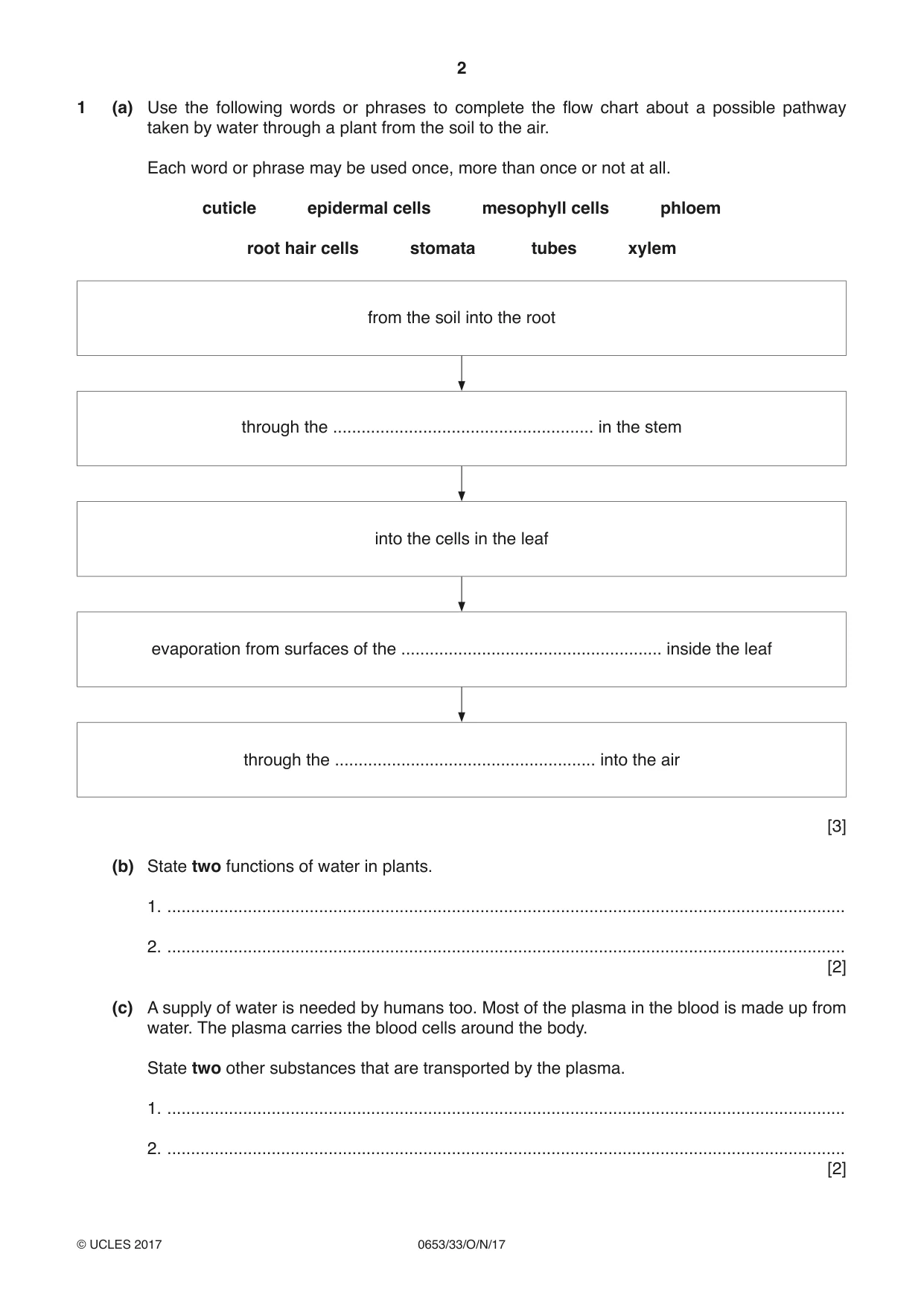
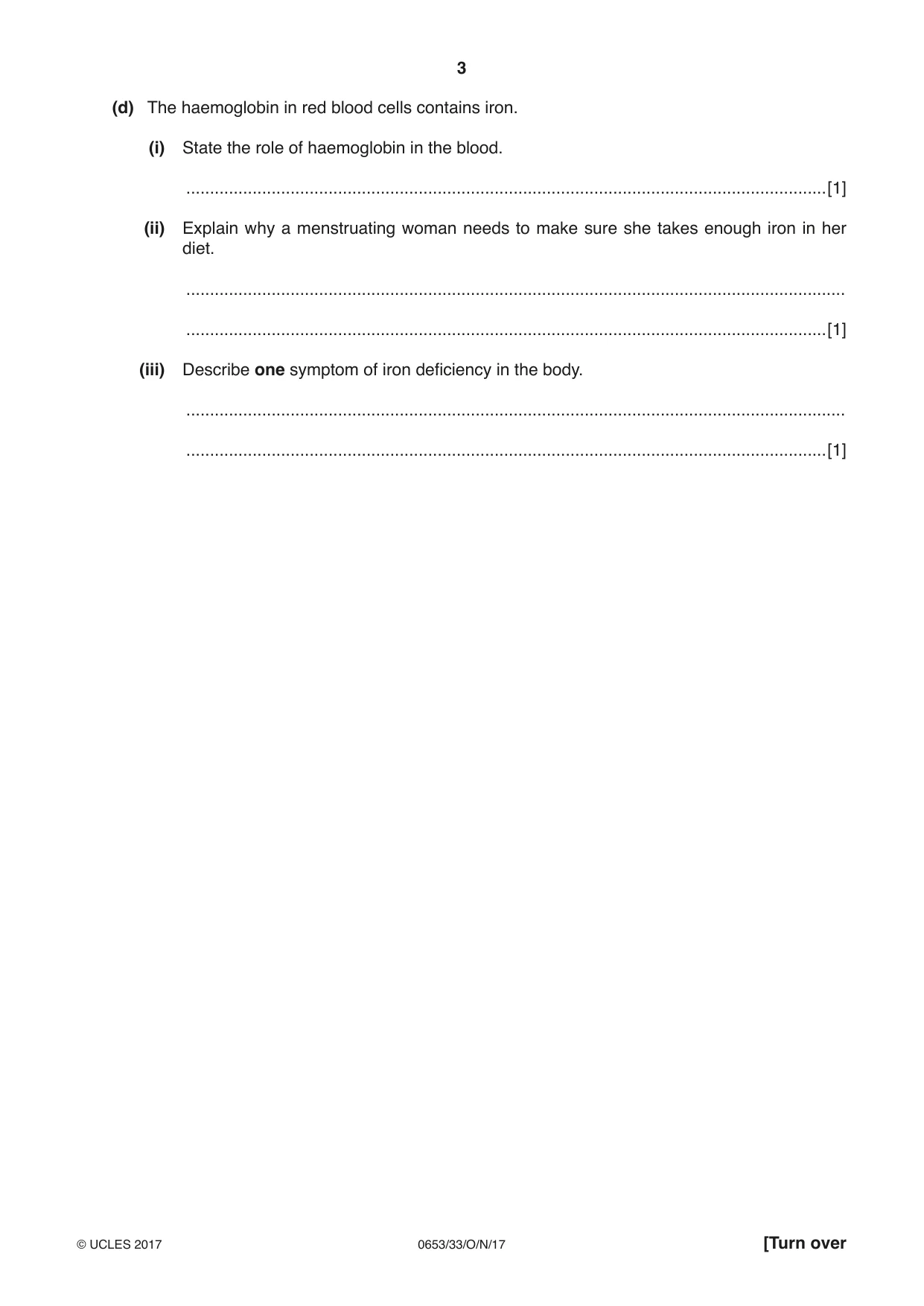
1 (a) Use the following words or phrases to complete the flow chart about a possible pathway taken by water through a plant from the soil to the air. Each word or phrase may be used once, more than once or not at all. cuticle epidermal cells mesophyll cells phloem root hair cells stomata tubes xylem from the soil into the root through the ....................................................... in the stem into the cells in the leaf evaporation from surfaces of the ....................................................... inside the leaf through the ....................................................... into the air [3] (b) State two functions of water in plants. 1. ............................................................................................................................................... 2. ............................................................................................................................................... [2] (c) A supply of water is needed by humans too. Most of the plasma in the blood is made up from water. The plasma carries the blood cells around the body. State two other substances that are transported by the plasma. 1. ............................................................................................................................................... 2. ............................................................................................................................................... [2] (d) The haemoglobin in red blood cells contains iron. (i) State the role of haemoglobin in the blood. .......................................................................................................................................[1] (ii) Explain why a menstruating woman needs to make sure she takes enough iron in her diet. ........................................................................................................................................... .......................................................................................................................................[1] (iii) Describe one symptom of iron deficiency in the body. ........................................................................................................................................... .......................................................................................................................................[1]
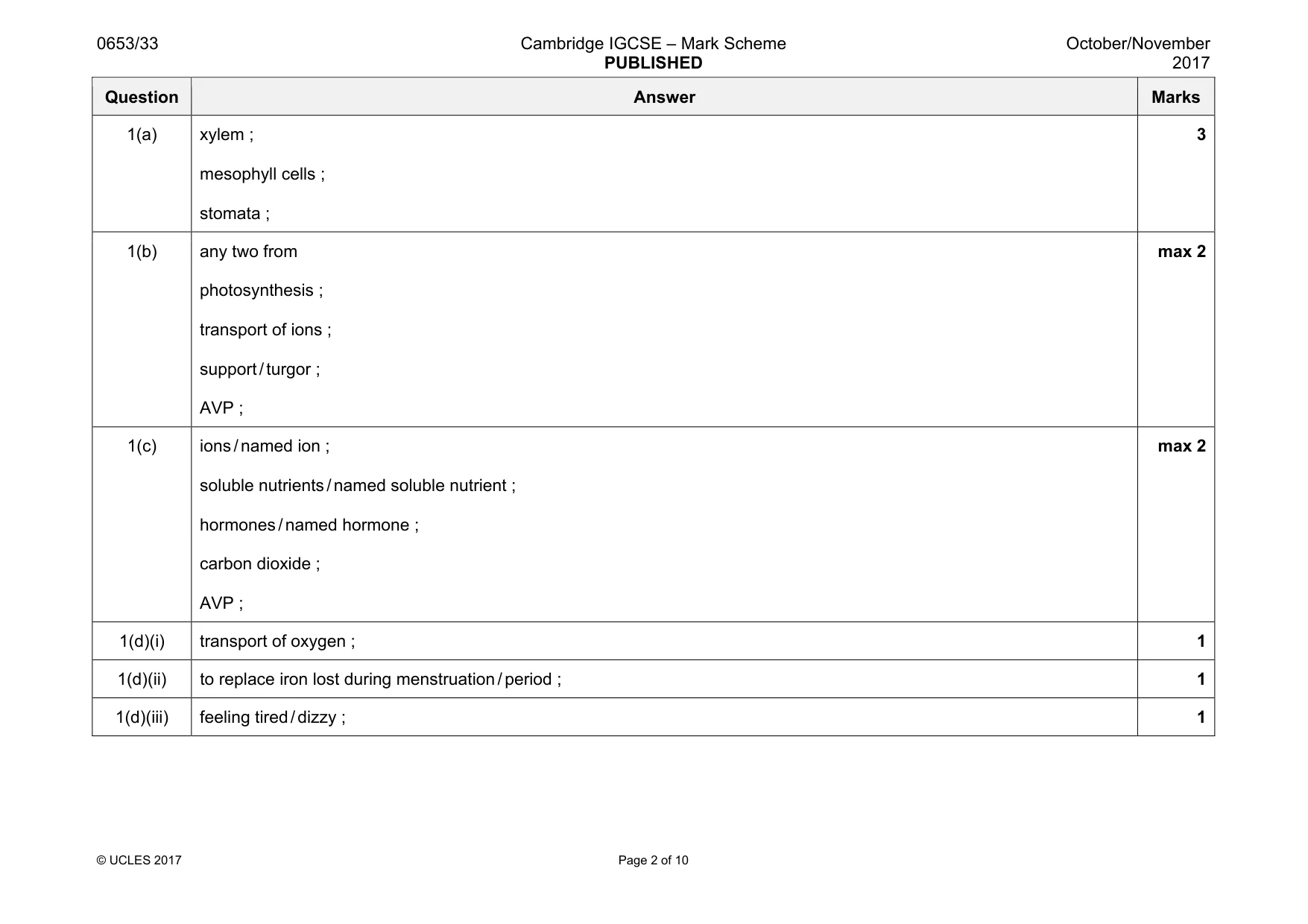
Mark scheme: 1(a) xylem ; mesophyll cells ; stomata ; 3 1(b) any two from photosynthesis ; transport of ions ; support / turgor ; AVP ; max 2 1(c) ions / named ion ; soluble nutrients / named soluble nutrient ; hormones / named hormone ; carbon dioxide ; AVP ; max 2 1(d)(i) transport of oxygen ; 1 1(d)(ii) to replace iron lost during menstruation / period ; 1 1(d)(iii) feeling tired / dizzy ; 1
Q2 · Some iron objects are shown in Fig
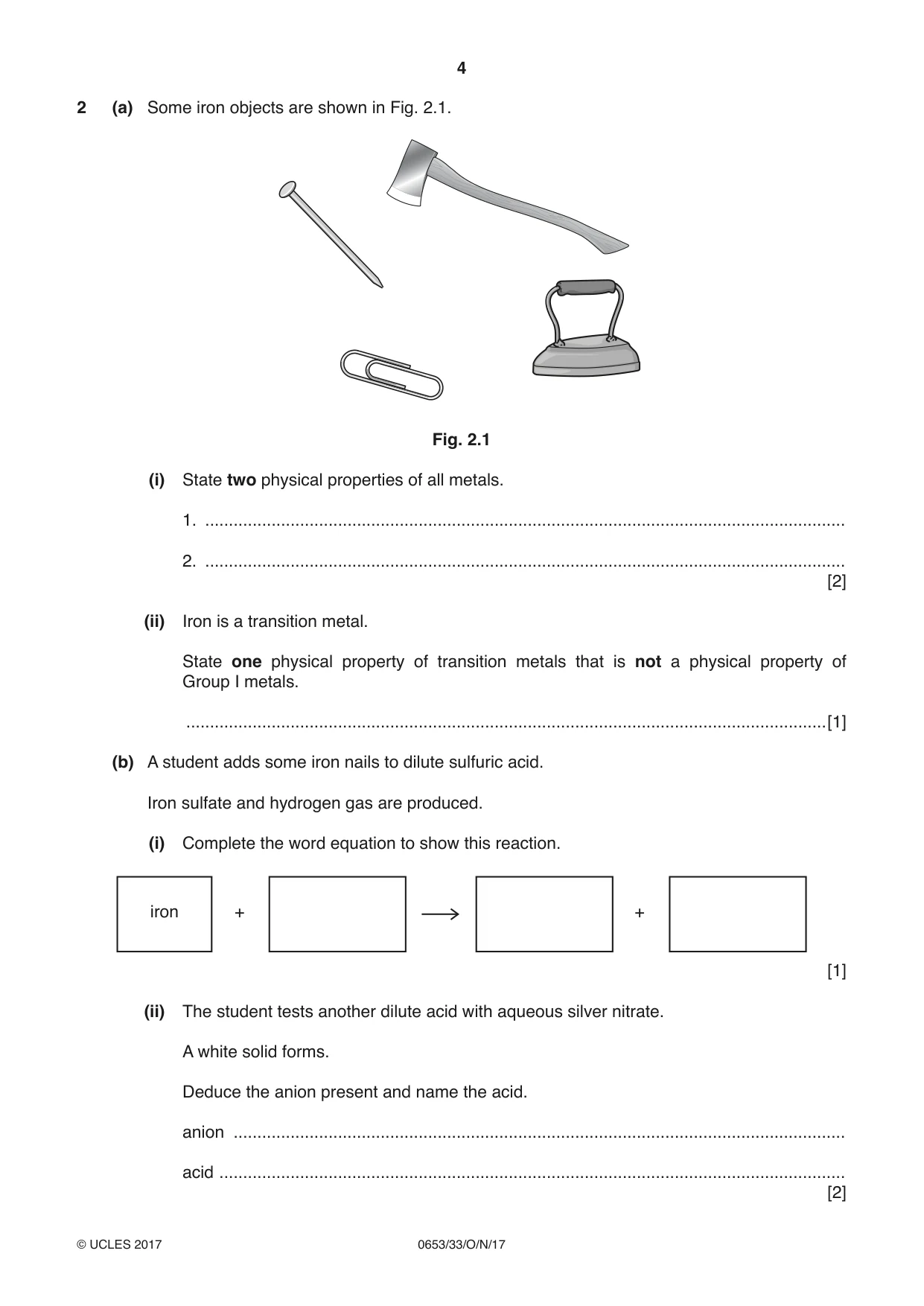
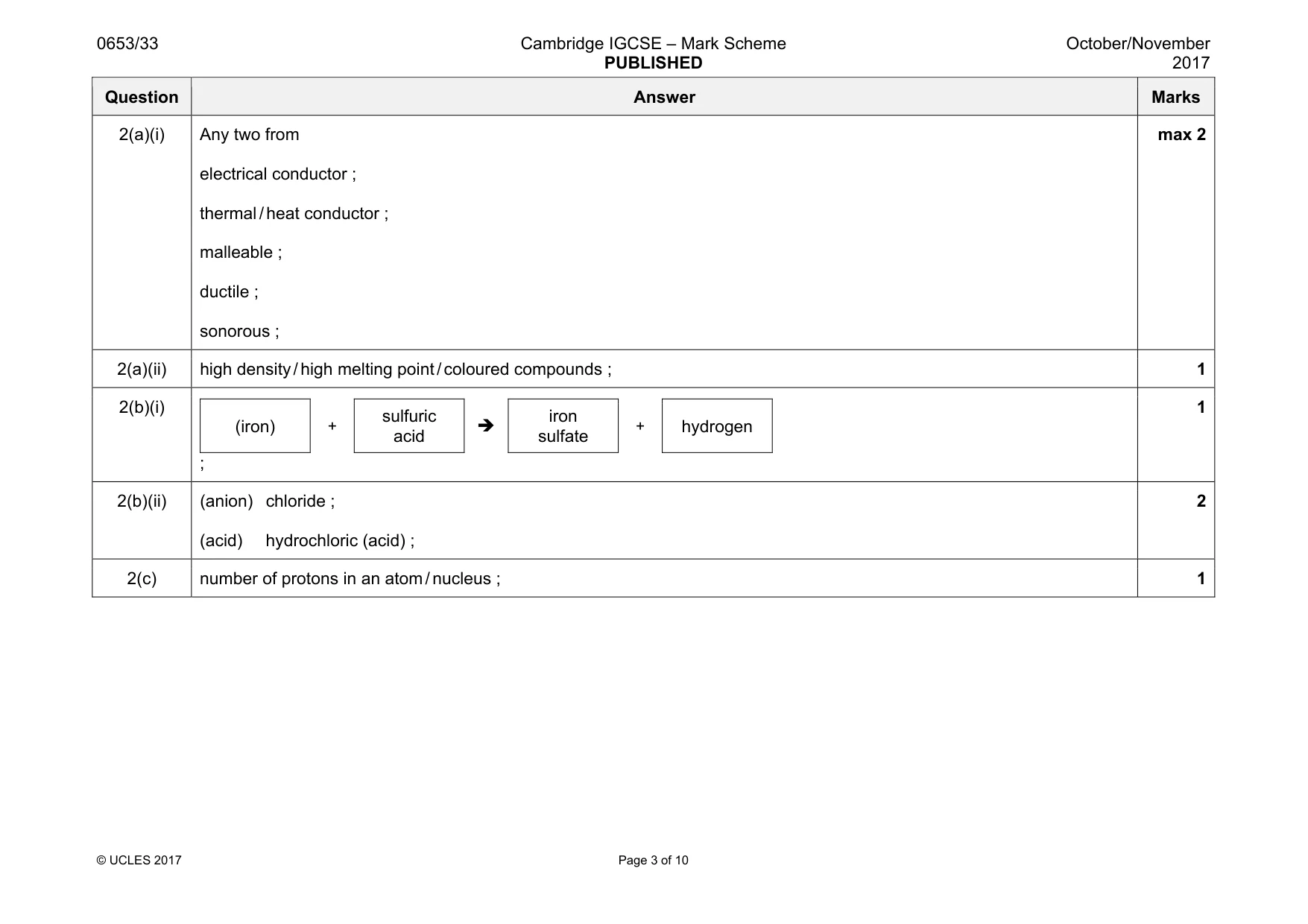
2 (a) Some iron objects are shown in Fig. 2.1. Fig. 2.1 (i) State two physical properties of all metals. 1. ....................................................................................................................................... 2. ....................................................................................................................................... [2] (ii) Iron is a transition metal. State one physical property of transition metals that is not a physical property of Group I metals. .......................................................................................................................................[1] (b) A student adds some iron nails to dilute sulfuric acid. Iron sulfate and hydrogen gas are produced. (i) Complete the word equation to show this reaction. iron + + [1] (ii) The student tests another dilute acid with aqueous silver nitrate. A white solid forms. Deduce the anion present and name the acid. anion ................................................................................................................................. acid .................................................................................................................................... [2] (c) The atomic number of iron is 26. Explain what is meant by atomic number. ................................................................................................................................................... ...............................................................................................................................................[1]
Mark scheme: 2(a)(i) Any two from electrical conductor ; thermal / heat conductor ; malleable ; ductile ; sonorous ; max 2 2(a)(ii) high density / high melting point / coloured compounds ; 1 2(b)(i) (iron) + sulfuric acid Î iron sulfate + hydrogen ; 1 2(b)(ii) (anion) chloride ; (acid) hydrochloric (acid) ; 2 2(c) number of protons in an atom / nucleus ; 1
Q3 · Four forces, P, Q, R and S, acting on a submarine
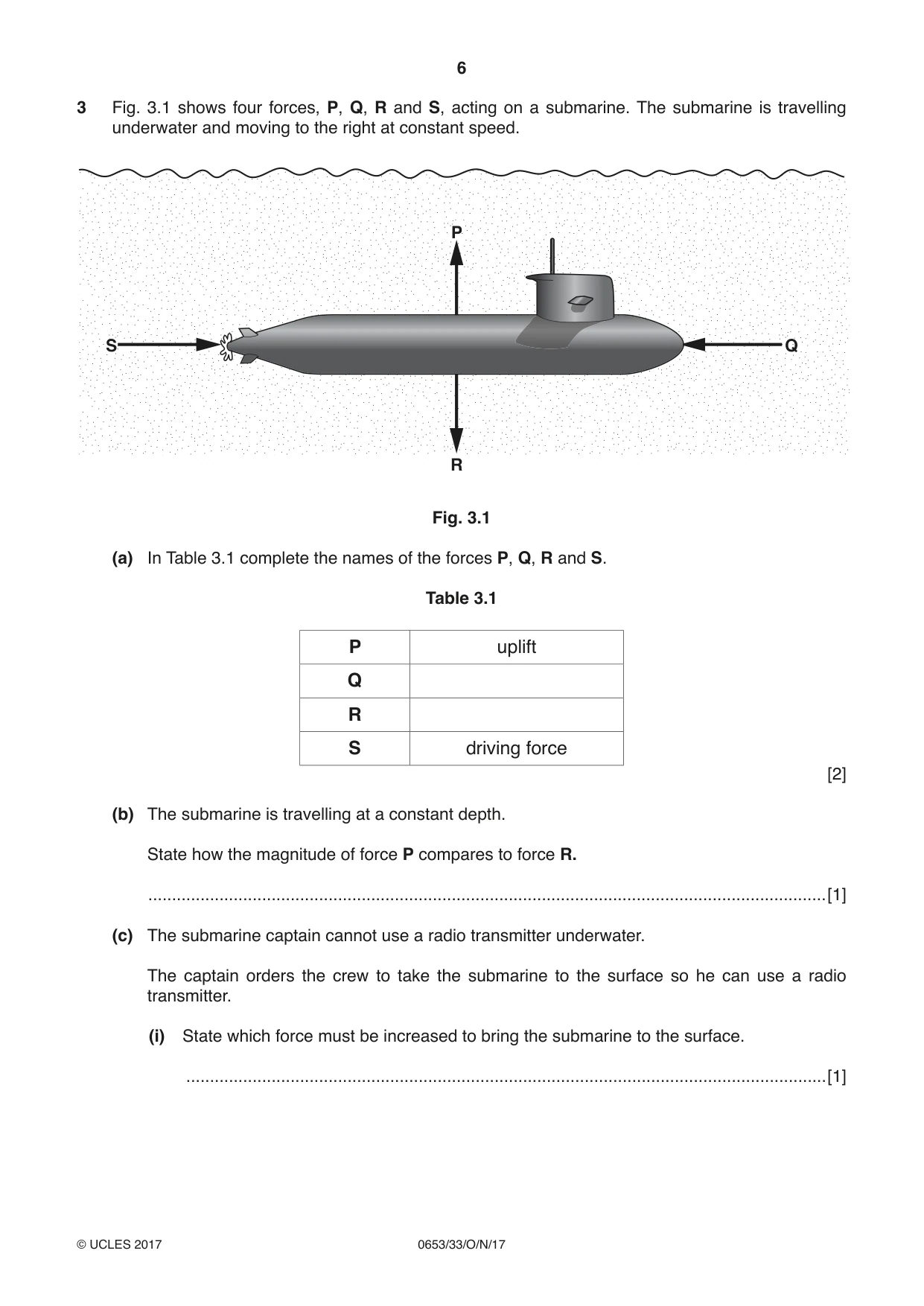
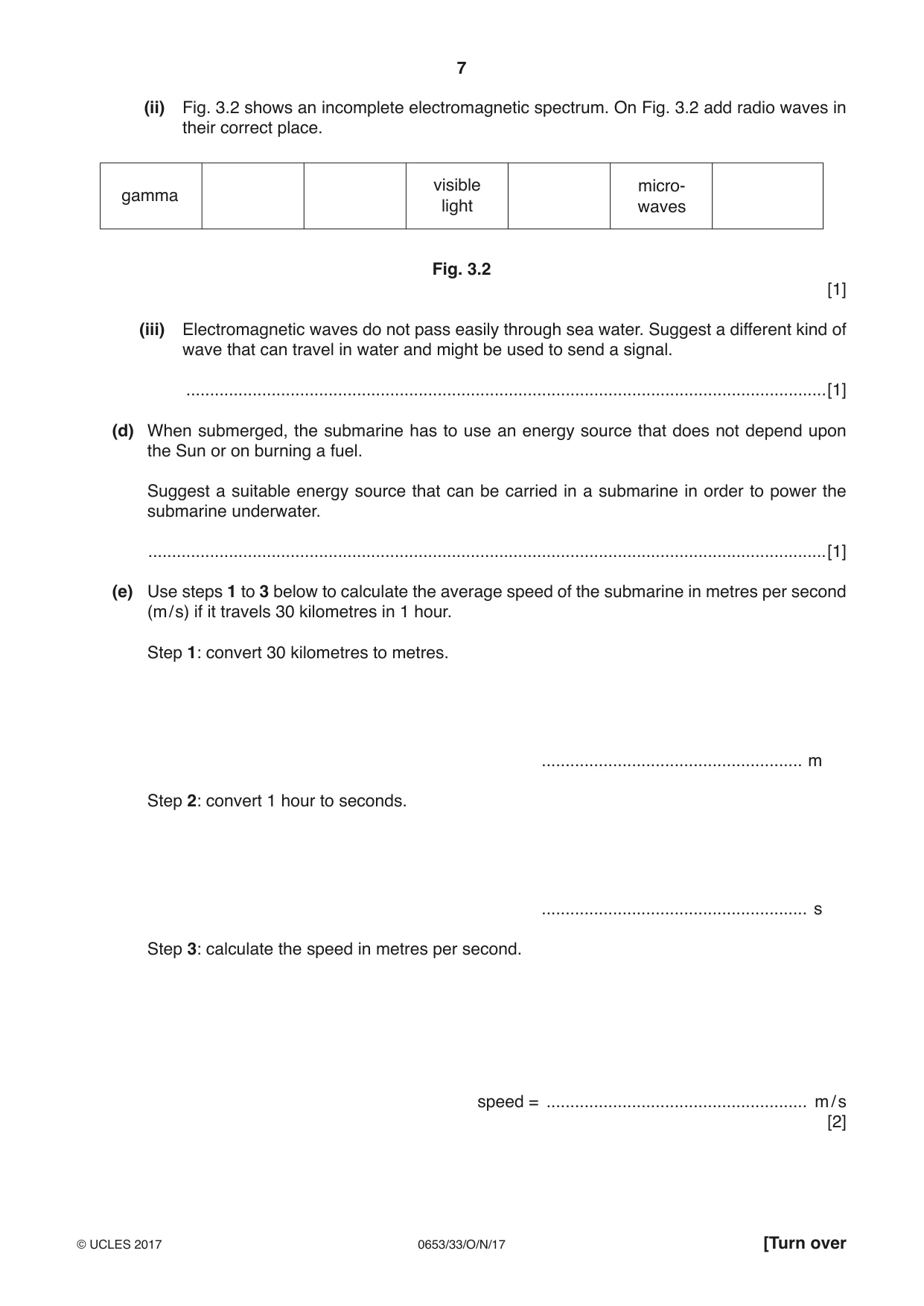
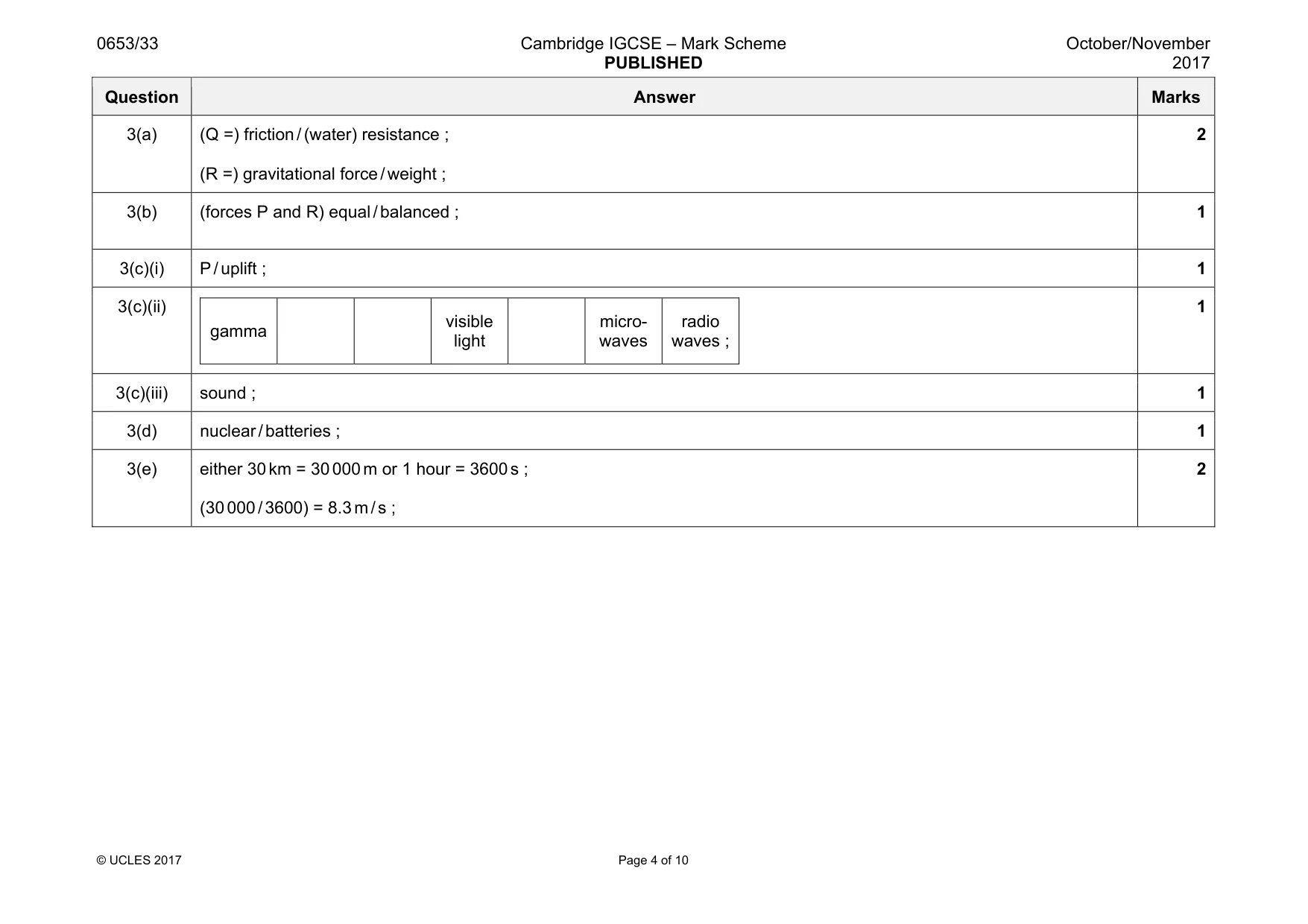
3 Fig. 3.1 shows four forces, P, Q, R and S, acting on a submarine. The submarine is travelling underwater and moving to the right at constant speed. P S Q R Fig. 3.1 (a) In Table 3.1 complete the names of the forces P, Q, R and S. Table 3.1 P uplift Q R S driving force [2] (b) The submarine is travelling at a constant depth. State how the magnitude of force P compares to force R. ...............................................................................................................................................[1] (c) The submarine captain cannot use a radio transmitter underwater. The captain orders the crew to take the submarine to the surface so he can use a radio transmitter. (i) State which force must be increased to bring the submarine to the surface. .......................................................................................................................................[1] (ii) Fig. 3.2 shows an incomplete electromagnetic spectrum. On Fig. 3.2 add radio waves in their correct place. visible micro- gamma light waves Fig. 3.2 [1] (iii) Electromagnetic waves do not pass easily through sea water. Suggest a different kind of wave that can travel in water and might be used to send a signal. .......................................................................................................................................[1] (d) When submerged, the submarine has to use an energy source that does not depend upon the Sun or on burning a fuel. Suggest a suitable energy source that can be carried in a submarine in order to power the submarine underwater. ...............................................................................................................................................[1] (e) Use steps 1 to 3 below to calculate the average speed of the submarine in metres per second (m / s) if it travels 30 kilometres in 1 hour. Step 1: convert 30 kilometres to metres. ....................................................... m Step 2: convert 1 hour to seconds. ........................................................ s Step 3: calculate the speed in metres per second. speed = ....................................................... m / s [2]
Mark scheme: 3(a) (Q =) friction / (water) resistance ; (R =) gravitational force / weight ; 2 3(b) (forces P and R) equal / balanced ; 1 3(c)(i) P / uplift ; 1 3(c)(ii) gamma visible light micro- waves radio waves ; 1 3(c)(iii) sound ; 1 3(d) nuclear / batteries ; 1 3(e) either 30 km = 30 000 m or 1 hour = 3600 s ; (30 000 / 3600) = 8.3 m / s ; 2
Q4 · A diagram of the alimentary canal
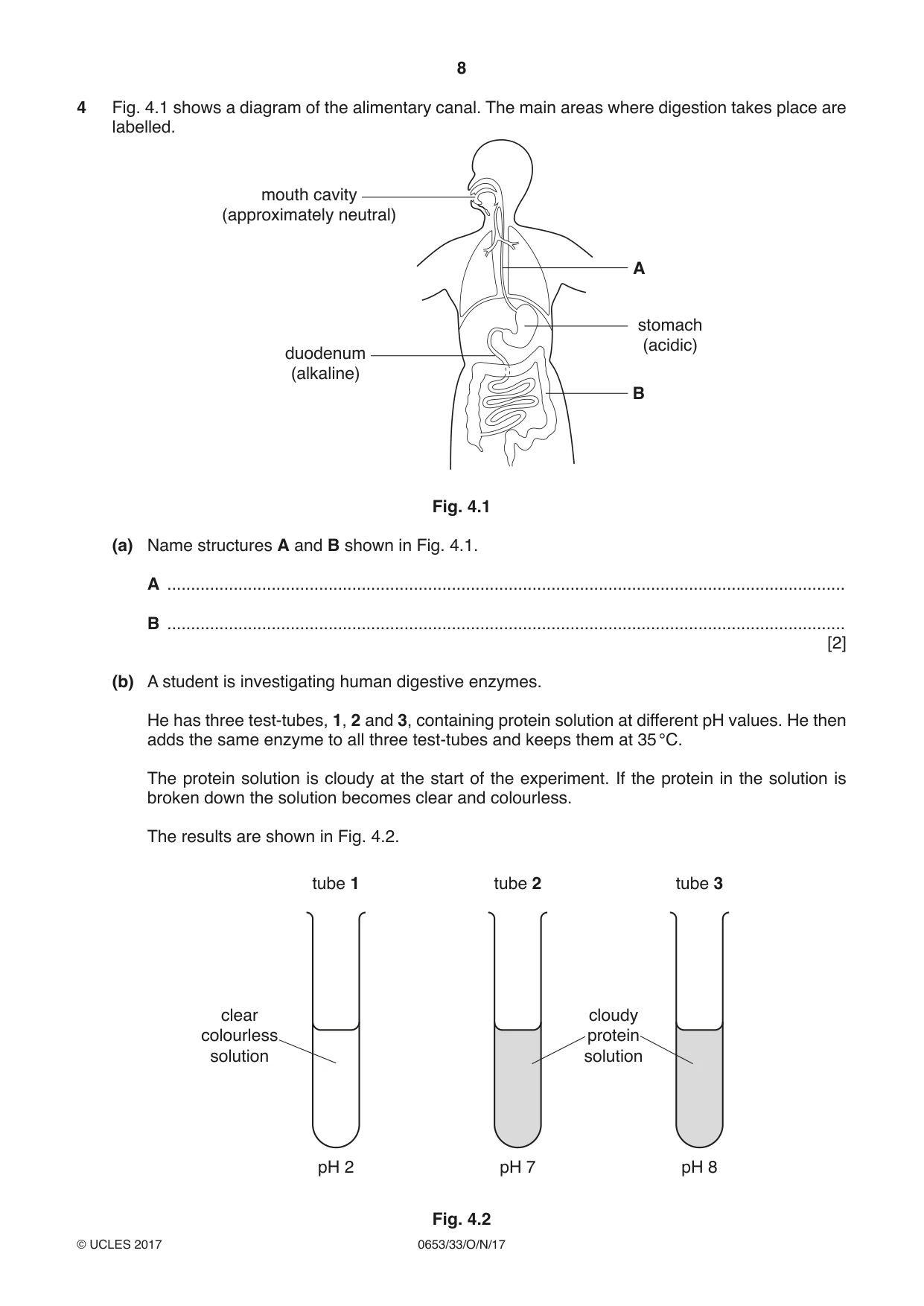
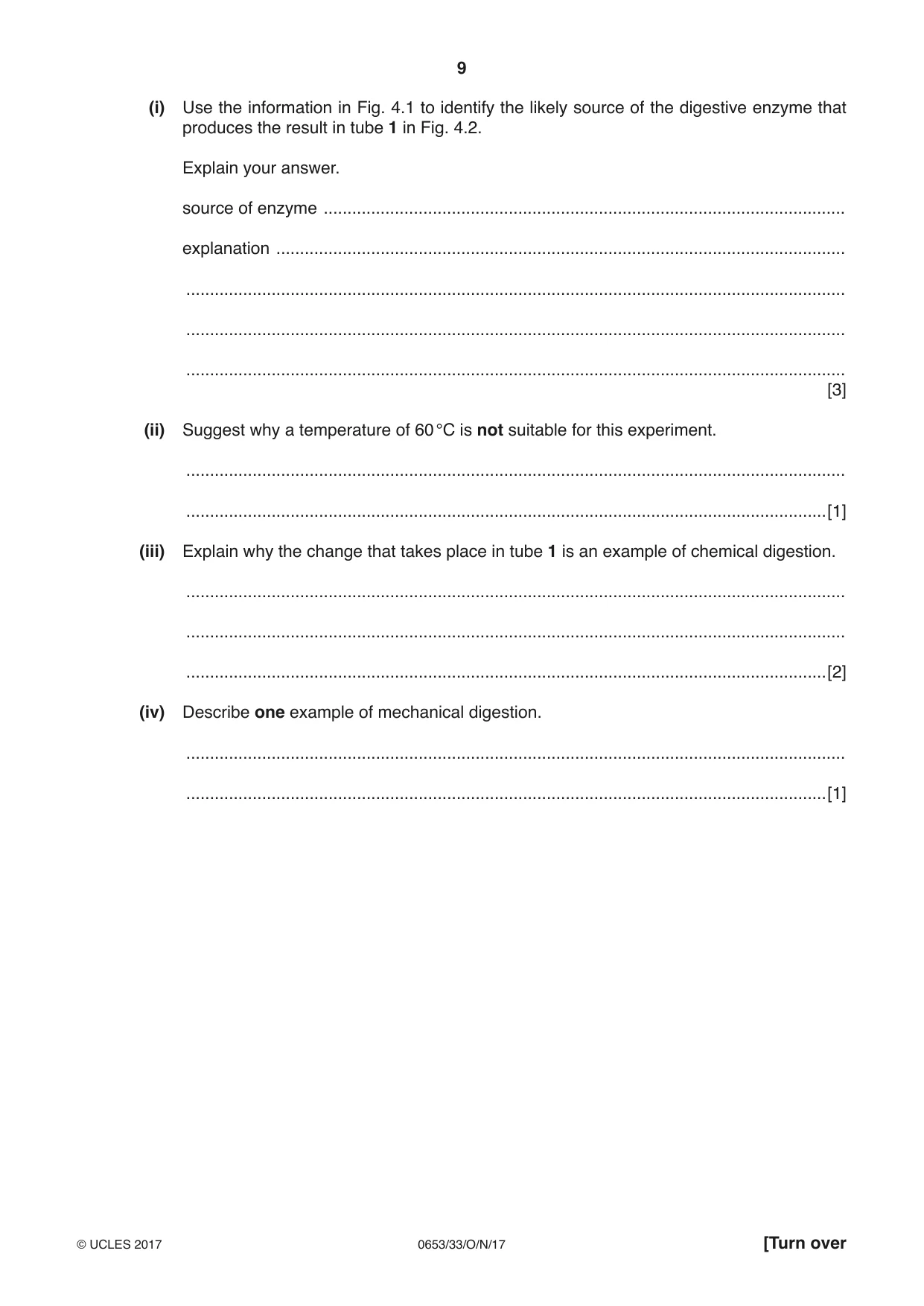
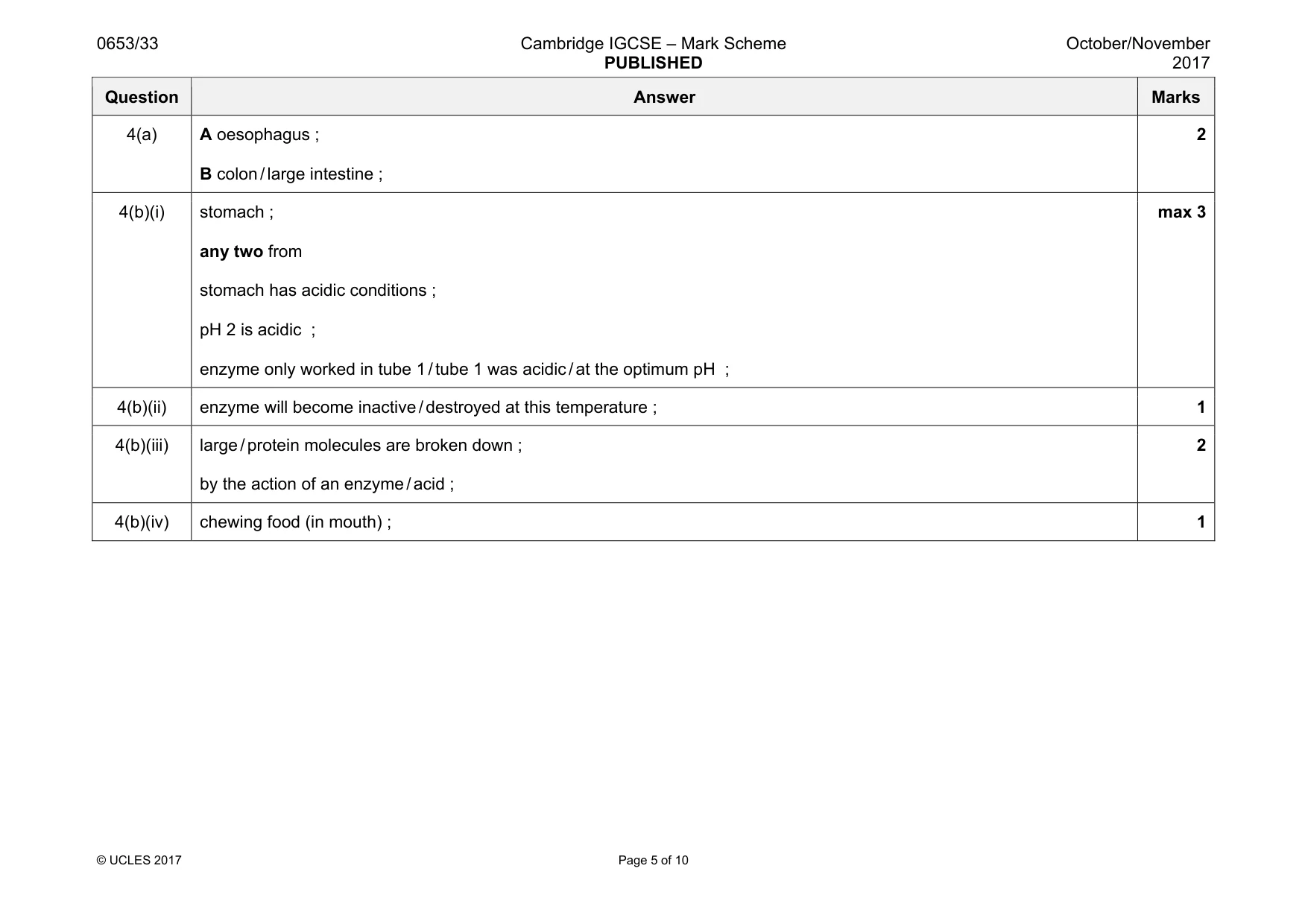
4 Fig. 4.1 shows a diagram of the alimentary canal. The main areas where digestion takes place are labelled. mouth cavity (approximately neutral) A stomach (acidic) duodenum (alkaline) B Fig. 4.1 (a) Name structures A and B shown in Fig. 4.1. A ............................................................................................................................................... B ............................................................................................................................................... [2] (b) A student is investigating human digestive enzymes. He has three test-tubes, 1, 2 and 3, containing protein solution at different pH values. He then adds the same enzyme to all three test-tubes and keeps them at 35 °C. The protein solution is cloudy at the start of the experiment. If the protein in the solution is broken down the solution becomes clear and colourless. The results are shown in Fig. 4.2. tube 1 tube 2 tube 3 clear cloudy colourless protein solution solution pH 2 pH 7 pH 8 Fig. 4.2 (i) Use the information in Fig. 4.1 to identify the likely source of the digestive enzyme that produces the result in tube 1 in Fig. 4.2. Explain your answer. source of enzyme .............................................................................................................. explanation ........................................................................................................................ ........................................................................................................................................... ........................................................................................................................................... ........................................................................................................................................... [3] (ii) Suggest why a temperature of 60 °C is not suitable for this experiment. ........................................................................................................................................... .......................................................................................................................................[1] (iii) Explain why the change that takes place in tube 1 is an example of chemical digestion. ........................................................................................................................................... ........................................................................................................................................... .......................................................................................................................................[2] (iv) Describe one example of mechanical digestion. ........................................................................................................................................... .......................................................................................................................................[1]
Mark scheme: 4(a) A oesophagus ; B colon / large intestine ; 2 4(b)(i) stomach ; any two from stomach has acidic conditions ; pH 2 is acidic ; enzyme only worked in tube 1 / tube 1 was acidic / at the optimum pH ; max 3 4(b)(ii) enzyme will become inactive / destroyed at this temperature ; 1 4(b)(iii) large / protein molecules are broken down ; by the action of an enzyme / acid ; 2 4(b)(iv) chewing food (in mouth) ; 1
Q5 · Pure water can be separated from sea water using the apparatus shown in Fig
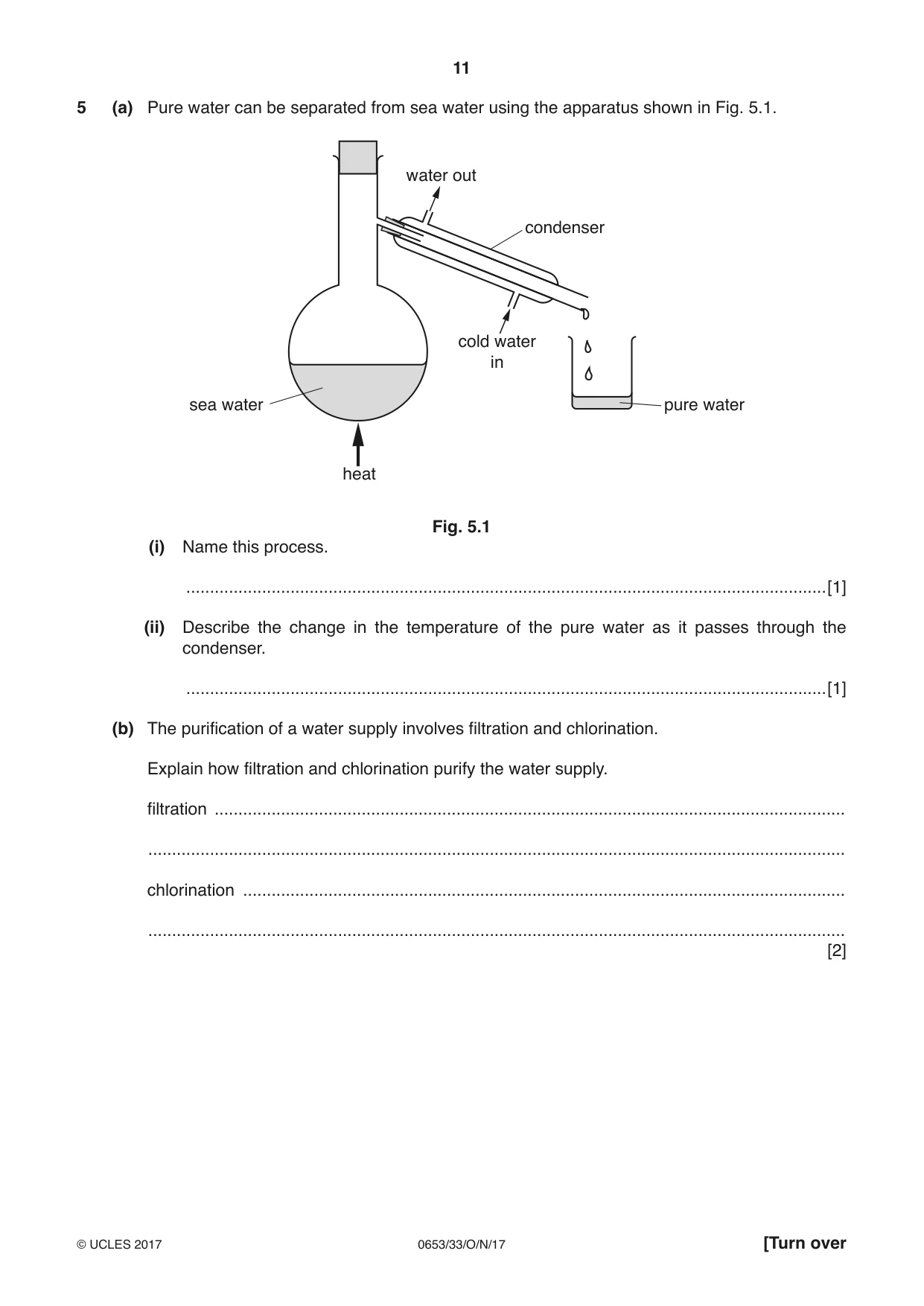
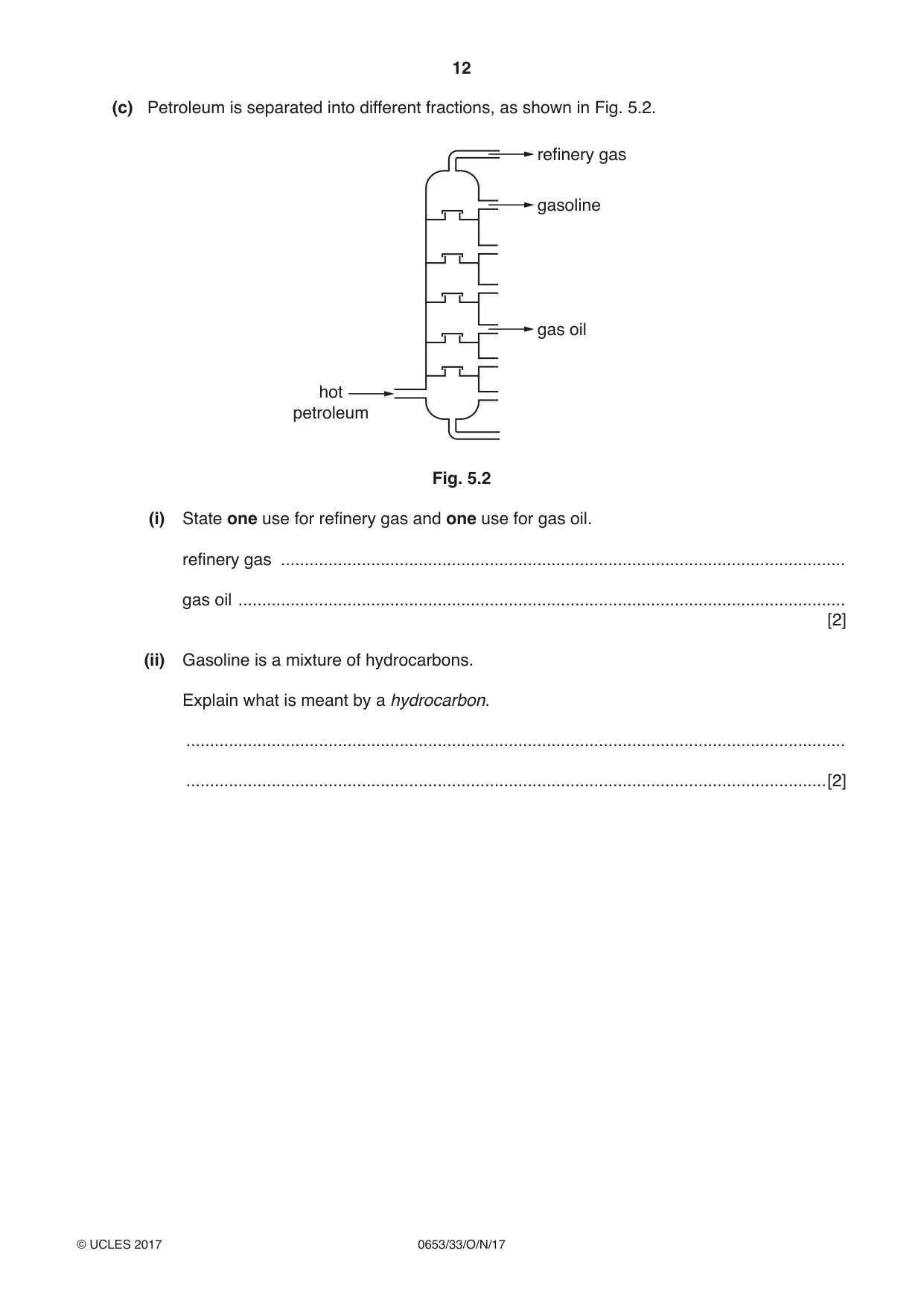
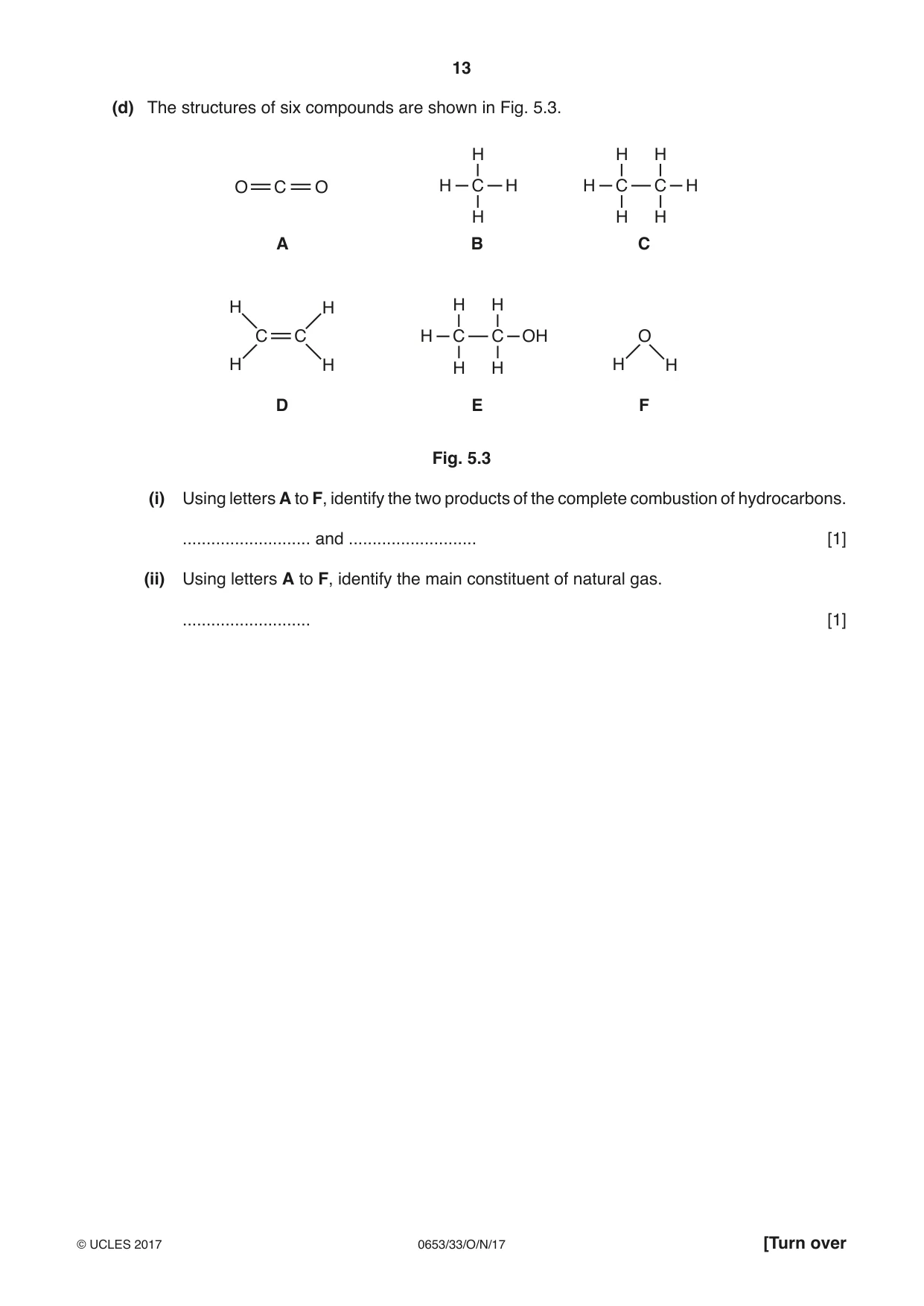
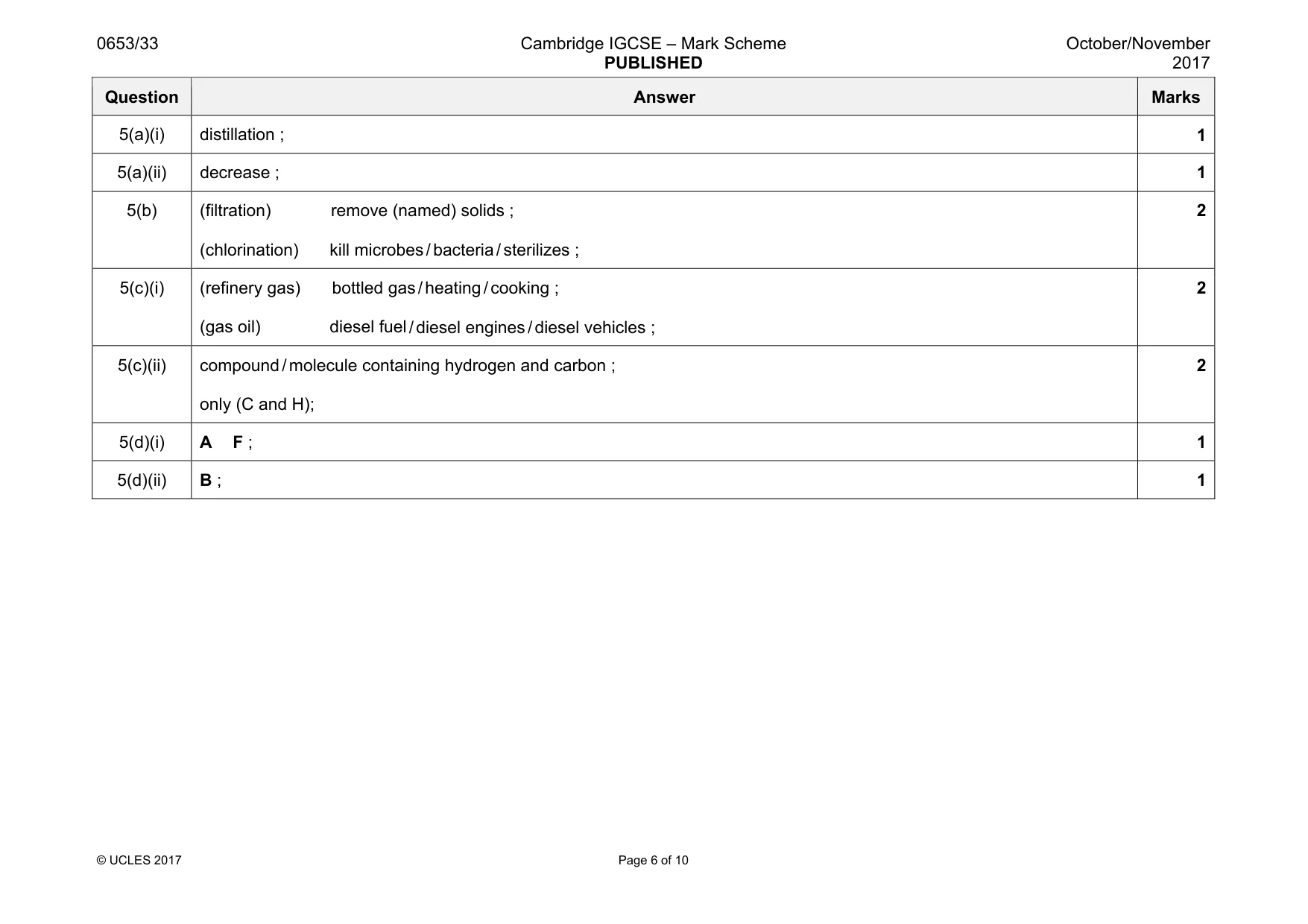
5 (a) Pure water can be separated from sea water using the apparatus shown in Fig. 5.1. water out condenser cold water in sea water pure water heat Fig. 5.1 (i) Name this process. .......................................................................................................................................[1] (ii) Describe the change in the temperature of the pure water as it passes through the condenser. .......................................................................................................................................[1] (b) The purification of a water supply involves filtration and chlorination. Explain how filtration and chlorination purify the water supply. filtration ..................................................................................................................................... ................................................................................................................................................... chlorination ............................................................................................................................... ................................................................................................................................................... [2] (c) Petroleum is separated into different fractions, as shown in Fig. 5.2. refinery gas gasoline gas oil hot petroleum Fig. 5.2 (i) State one use for refinery gas and one use for gas oil. refinery gas ....................................................................................................................... gas oil ................................................................................................................................ [2] (ii) Gasoline is a mixture of hydrocarbons. Explain what is meant by a hydrocarbon. ........................................................................................................................................... .......................................................................................................................................[2] (d) The structures of six compounds are shown in Fig. 5.3. H H H O C O H C H H C C H H H H A B C H H H H C C H C C OH O H H H H H H D E F Fig. 5.3 (i) Using letters A to F, identify the two products of the complete combustion of hydrocarbons. ........................... and ........................... [1] (ii) Using letters A to F, identify the main constituent of natural gas. ........................... [1]
Mark scheme: 5(a)(i) distillation ; 1 5(a)(ii) decrease ; 1 5(b) (filtration) remove (named) solids ; (chlorination) kill microbes / bacteria / sterilizes ; 2 5(c)(i) (refinery gas) bottled gas / heating / cooking ; (gas oil) diesel fuel / diesel engines / diesel vehicles ; 2 5(c)(ii) compound / molecule containing hydrogen and carbon ; only (C and H); 2 5(d)(i) A F ; 1 5(d)(ii) B ; 1
Question 6
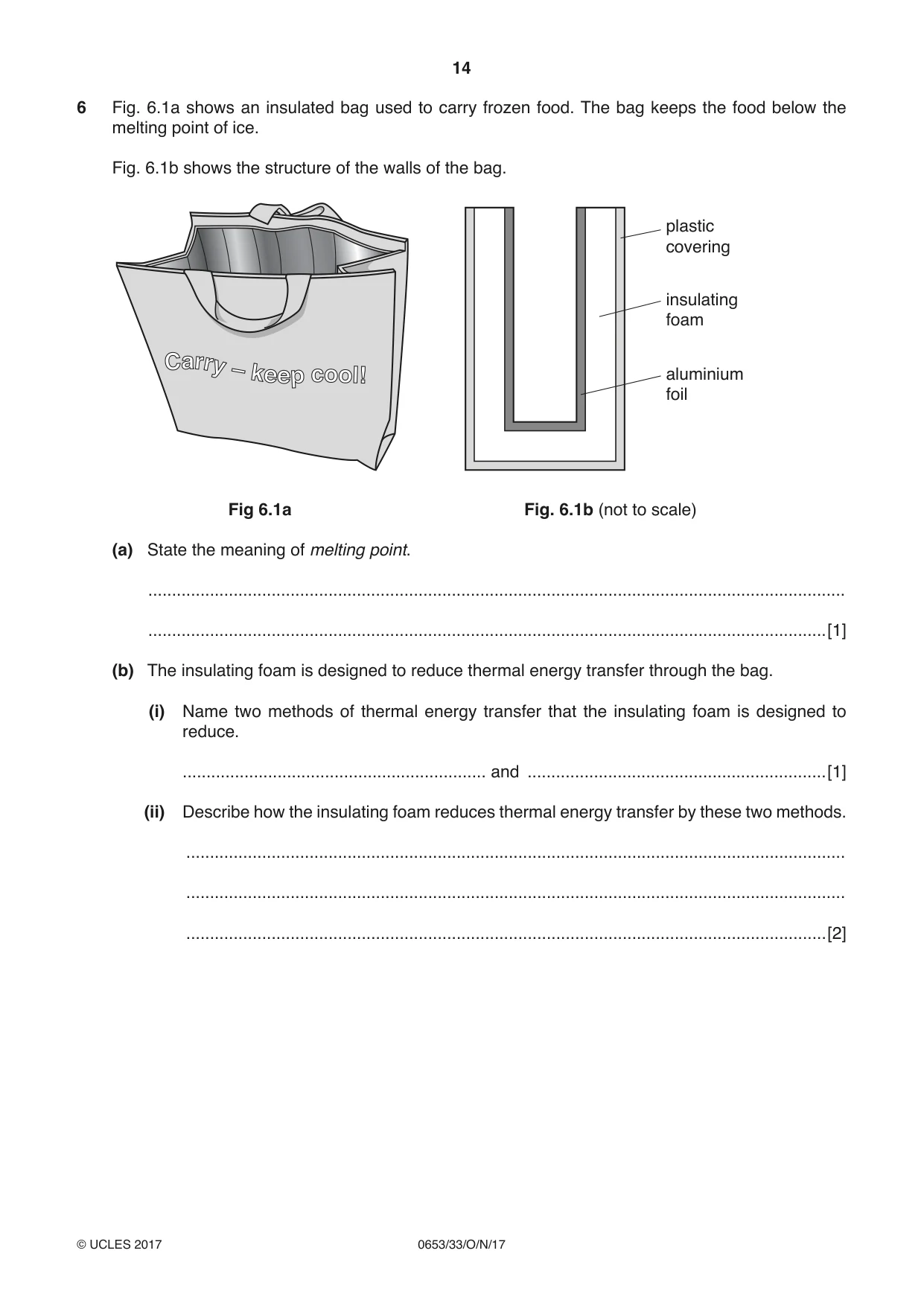
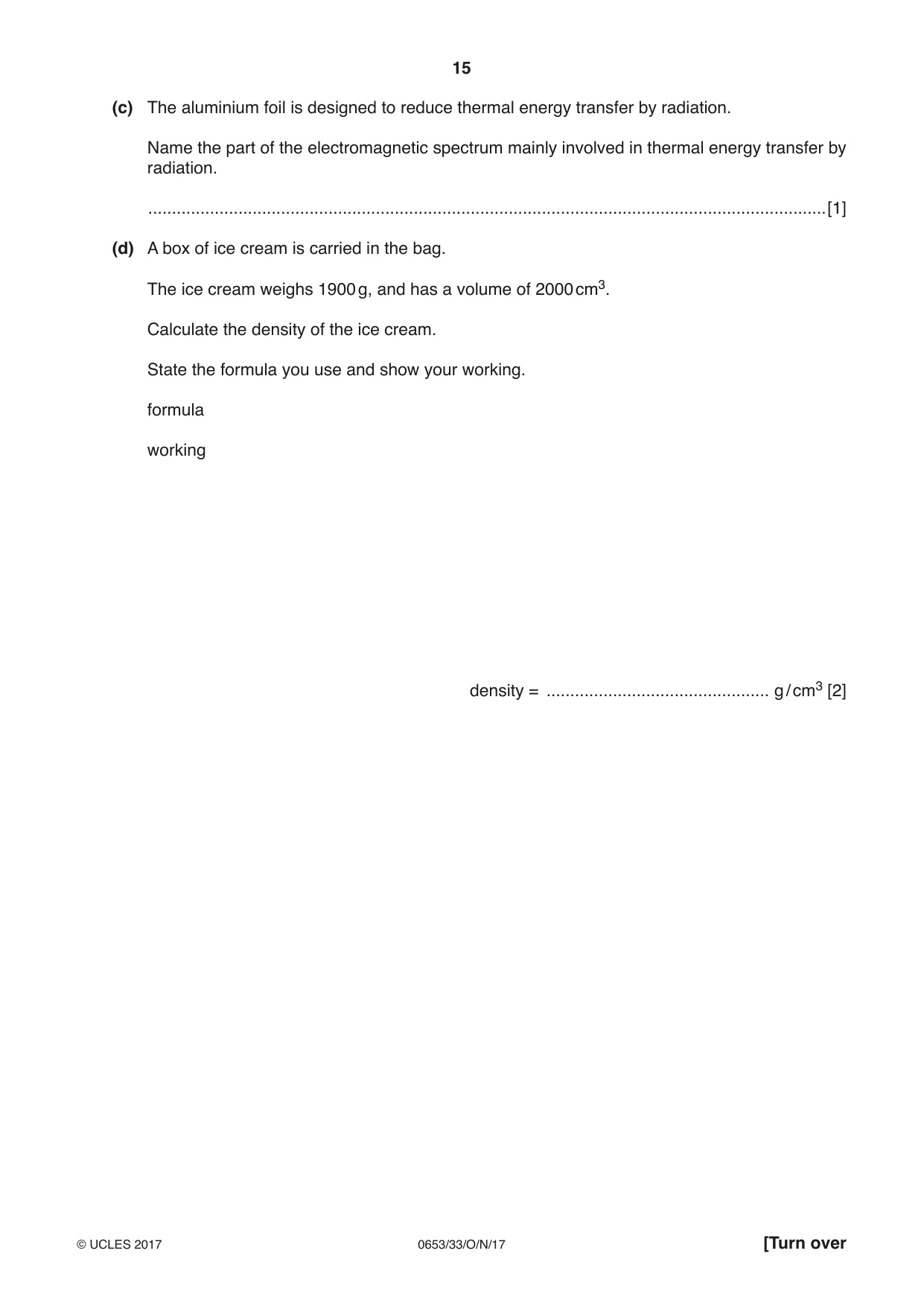
6 Fig. 6.1a shows an insulated bag used to carry frozen food. The bag keeps the food below the melting point of ice. Fig. 6.1b shows the structure of the walls of the bag. plastic covering insulating foam aluminium Carry– keep cool! foil Fig 6.1a Fig. 6.1b (not to scale) (a) State the meaning of melting point. ................................................................................................................................................... ...............................................................................................................................................[1] (b) The insulating foam is designed to reduce thermal energy transfer through the bag. (i) Name two methods of thermal energy transfer that the insulating foam is designed to reduce. ................................................................ and ...............................................................[1] (ii) Describe how the insulating foam reduces thermal energy transfer by these two methods. ........................................................................................................................................... ........................................................................................................................................... .......................................................................................................................................[2] (c) The aluminium foil is designed to reduce thermal energy transfer by radiation. Name the part of the electromagnetic spectrum mainly involved in thermal energy transfer by radiation. ...............................................................................................................................................[1] (d) A box of ice cream is carried in the bag. The ice cream weighs 1900 g, and has a volume of 2000 cm3. Calculate the density of the ice cream. State the formula you use and show your working. formula working density = ............................................... g / cm3 [2]
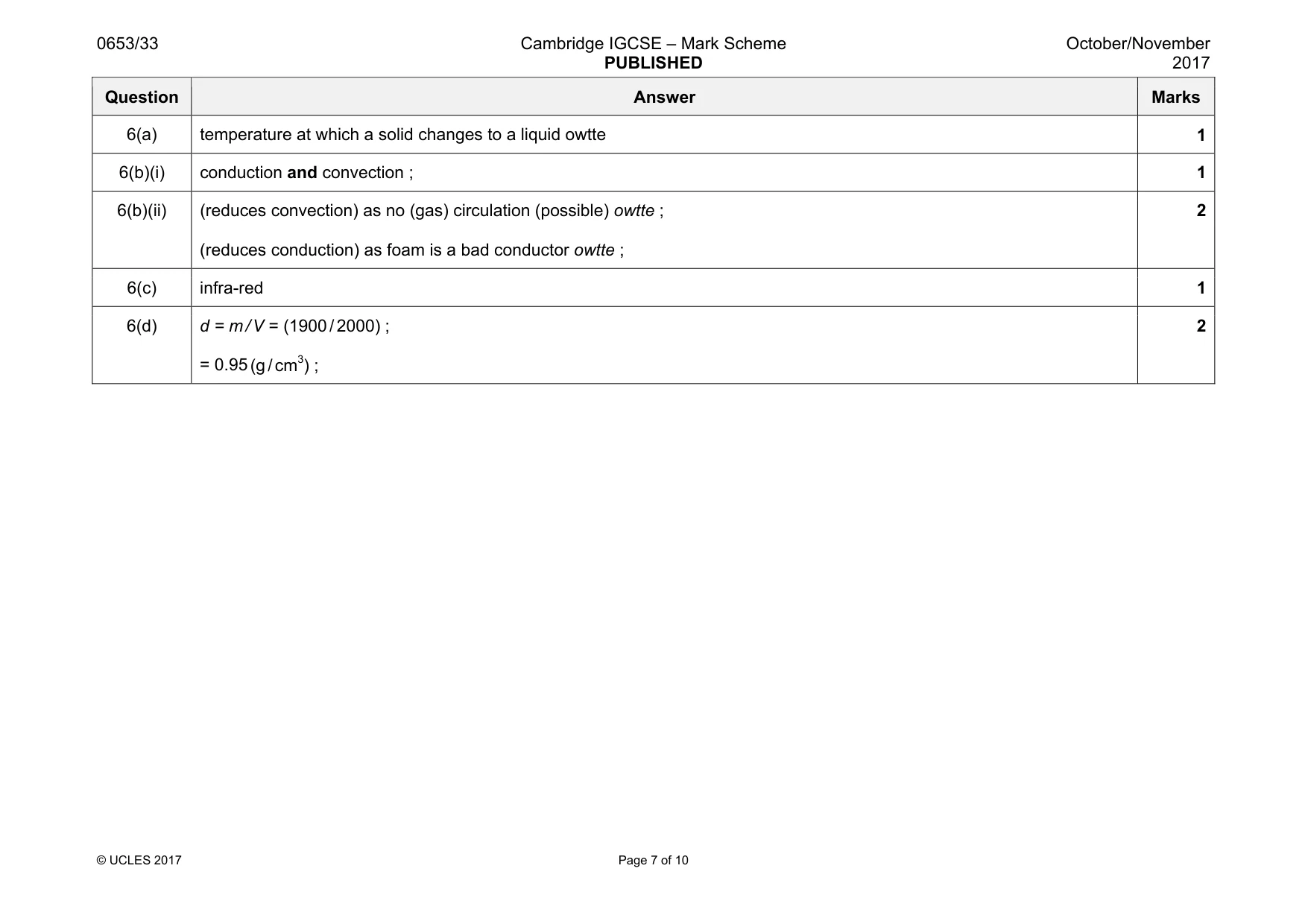
Mark scheme: 6(a) temperature at which a solid changes to a liquid owtte 1 6(b)(i) conduction and convection ; 1 6(b)(ii) (reduces convection) as no (gas) circulation (possible) owtte ; (reduces conduction) as foam is a bad conductor owtte ; 2 6(c) infra-red 1 6(d) d = m / V = (1900 / 2000) ; = 0.95 (g / cm3) ; 2
Q7 · Some processes occurring in a forest growing on a hill
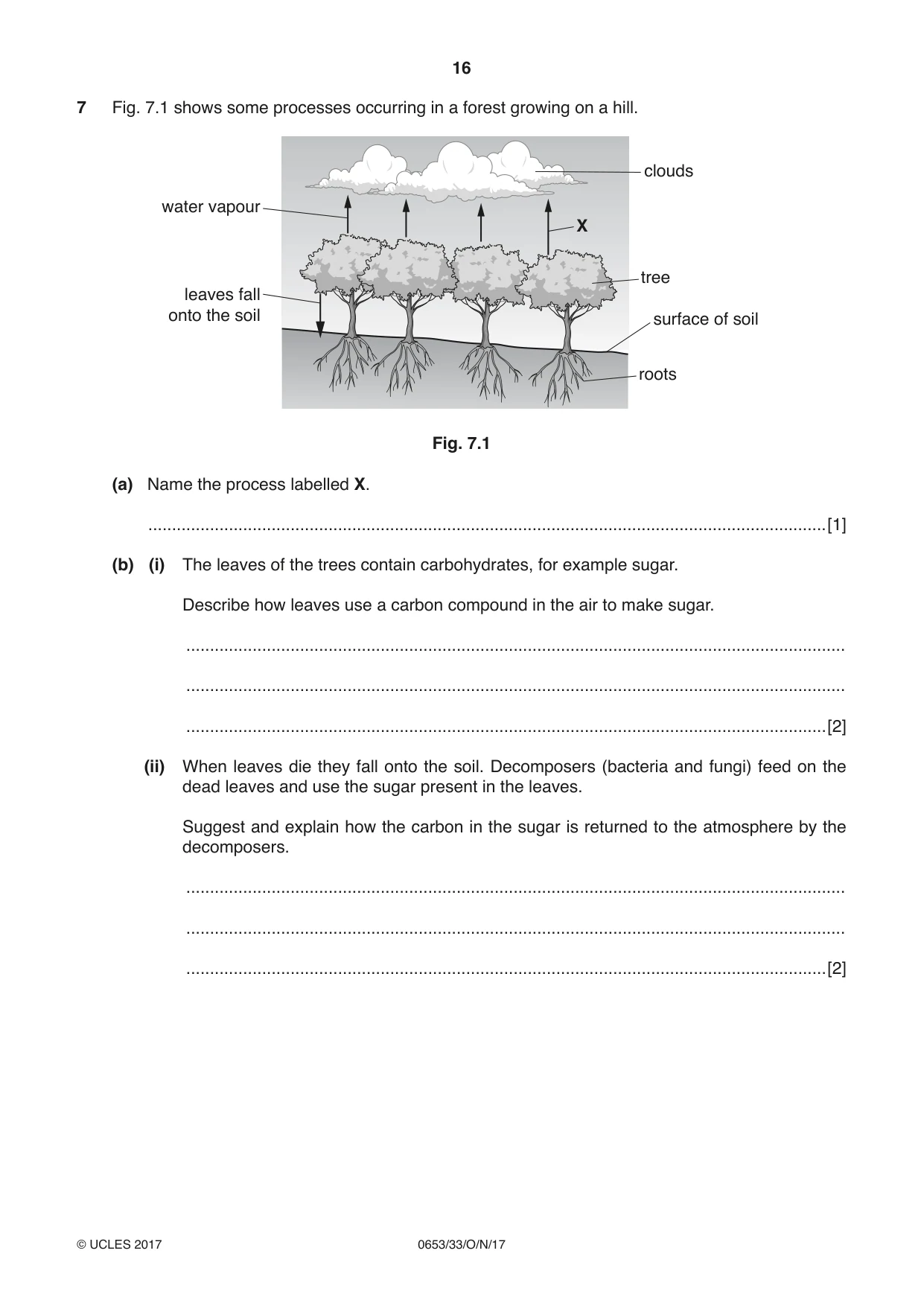
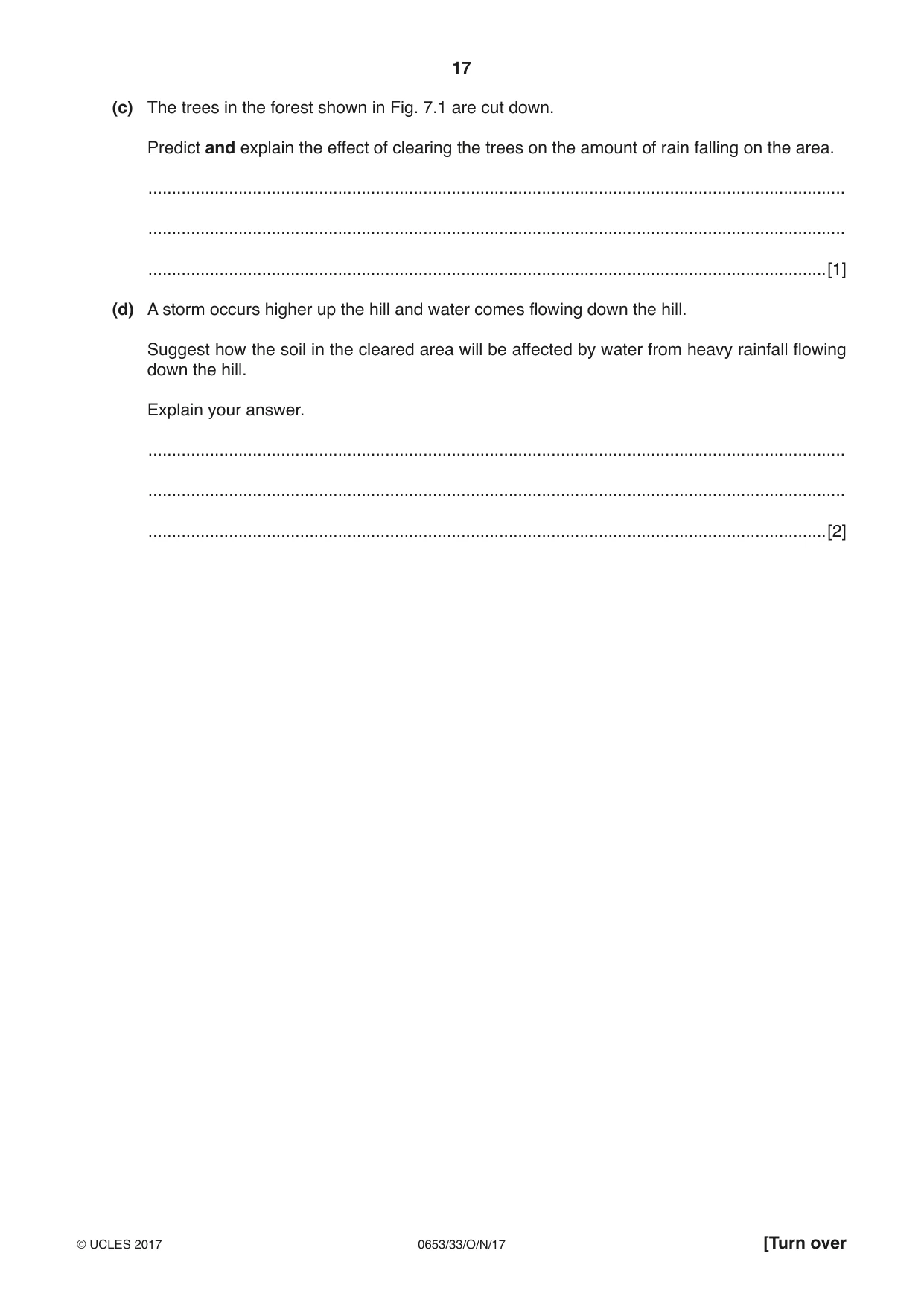
7 Fig. 7.1 shows some processes occurring in a forest growing on a hill. clouds water vapour X tree leaves fall onto the soil surface of soil roots Fig. 7.1 (a) Name the process labelled X. ...............................................................................................................................................[1] (b) (i) The leaves of the trees contain carbohydrates, for example sugar. Describe how leaves use a carbon compound in the air to make sugar. ........................................................................................................................................... ........................................................................................................................................... .......................................................................................................................................[2] (ii) When leaves die they fall onto the soil. Decomposers (bacteria and fungi) feed on the dead leaves and use the sugar present in the leaves. Suggest and explain how the carbon in the sugar is returned to the atmosphere by the decomposers. ........................................................................................................................................... ........................................................................................................................................... .......................................................................................................................................[2] (c) The trees in the forest shown in Fig. 7.1 are cut down. Predict and explain the effect of clearing the trees on the amount of rain falling on the area. ................................................................................................................................................... ................................................................................................................................................... ...............................................................................................................................................[1] (d) A storm occurs higher up the hill and water comes flowing down the hill. Suggest how the soil in the cleared area will be affected by water from heavy rainfall flowing down the hill. Explain your answer. ................................................................................................................................................... ................................................................................................................................................... ...............................................................................................................................................[2]
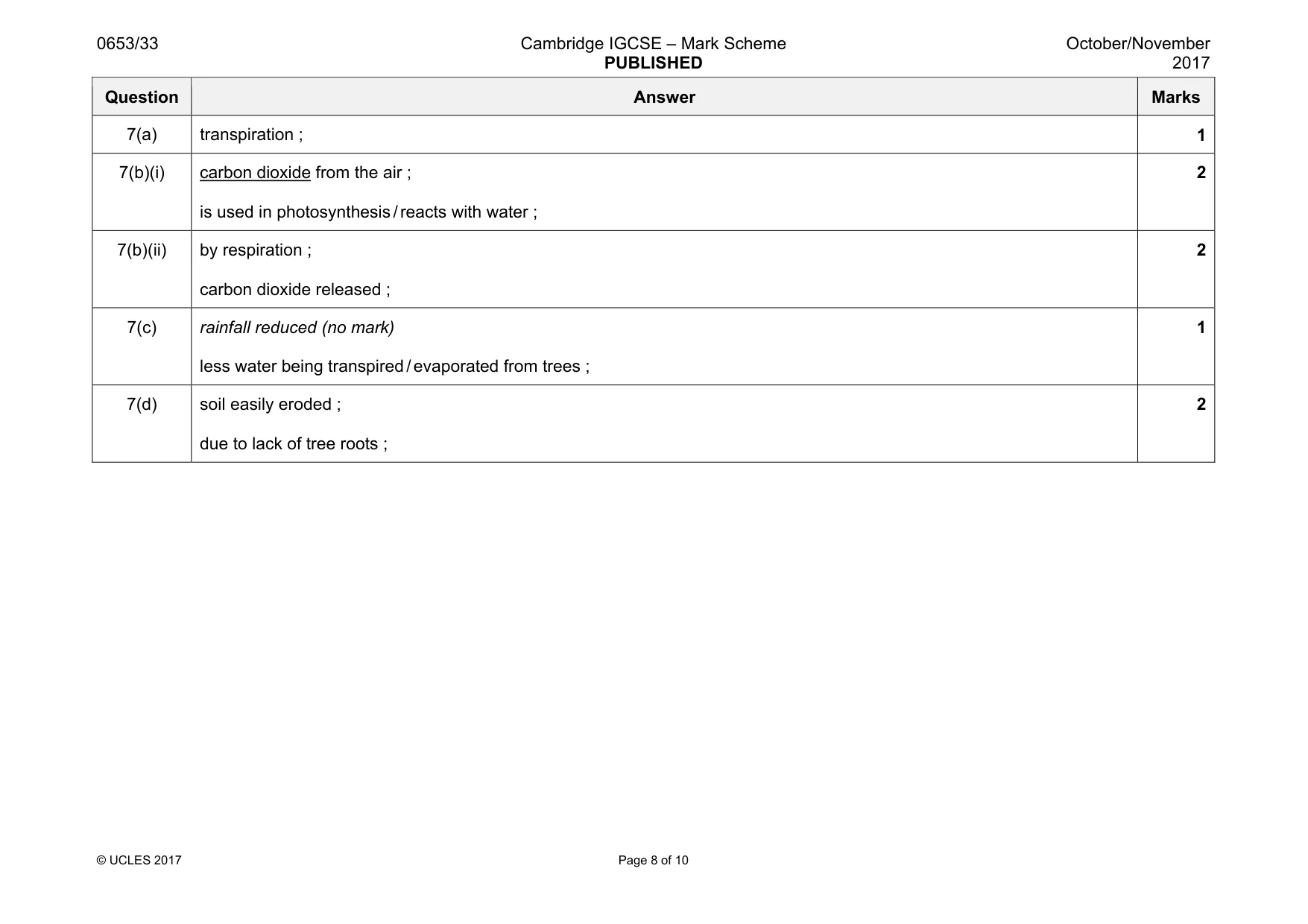
Mark scheme: 7(a) transpiration ; 1 7(b)(i) carbon dioxide from the air ; is used in photosynthesis / reacts with water ; 2 7(b)(ii) by respiration ; carbon dioxide released ; 2 7(c) rainfall reduced (no mark) less water being transpired / evaporated from trees ; 1 7(d) soil easily eroded ; due to lack of tree roots ; 2
Q8 · Molten lead(II) bromide is broken down into simpler substances using the apparatus shown…
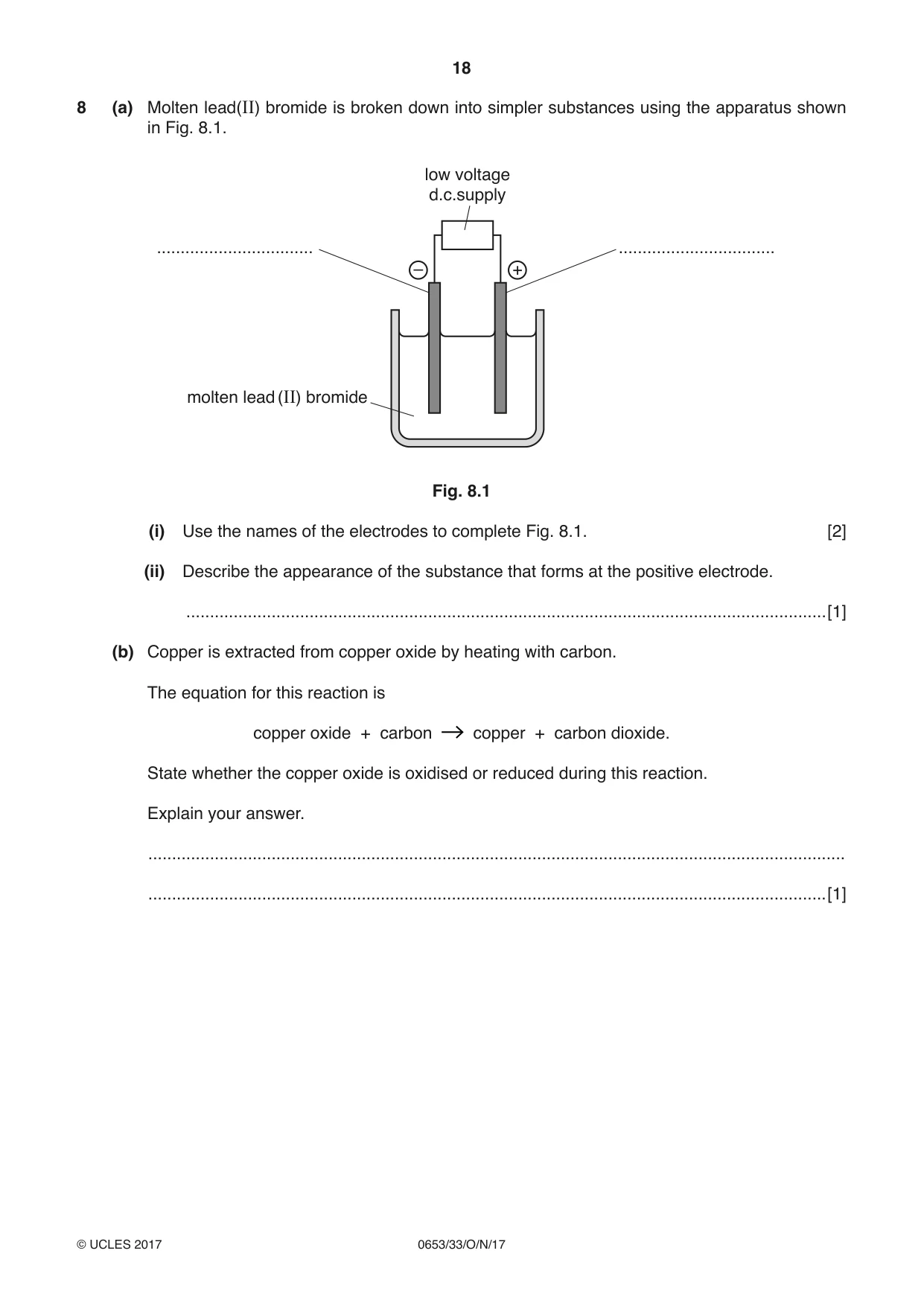
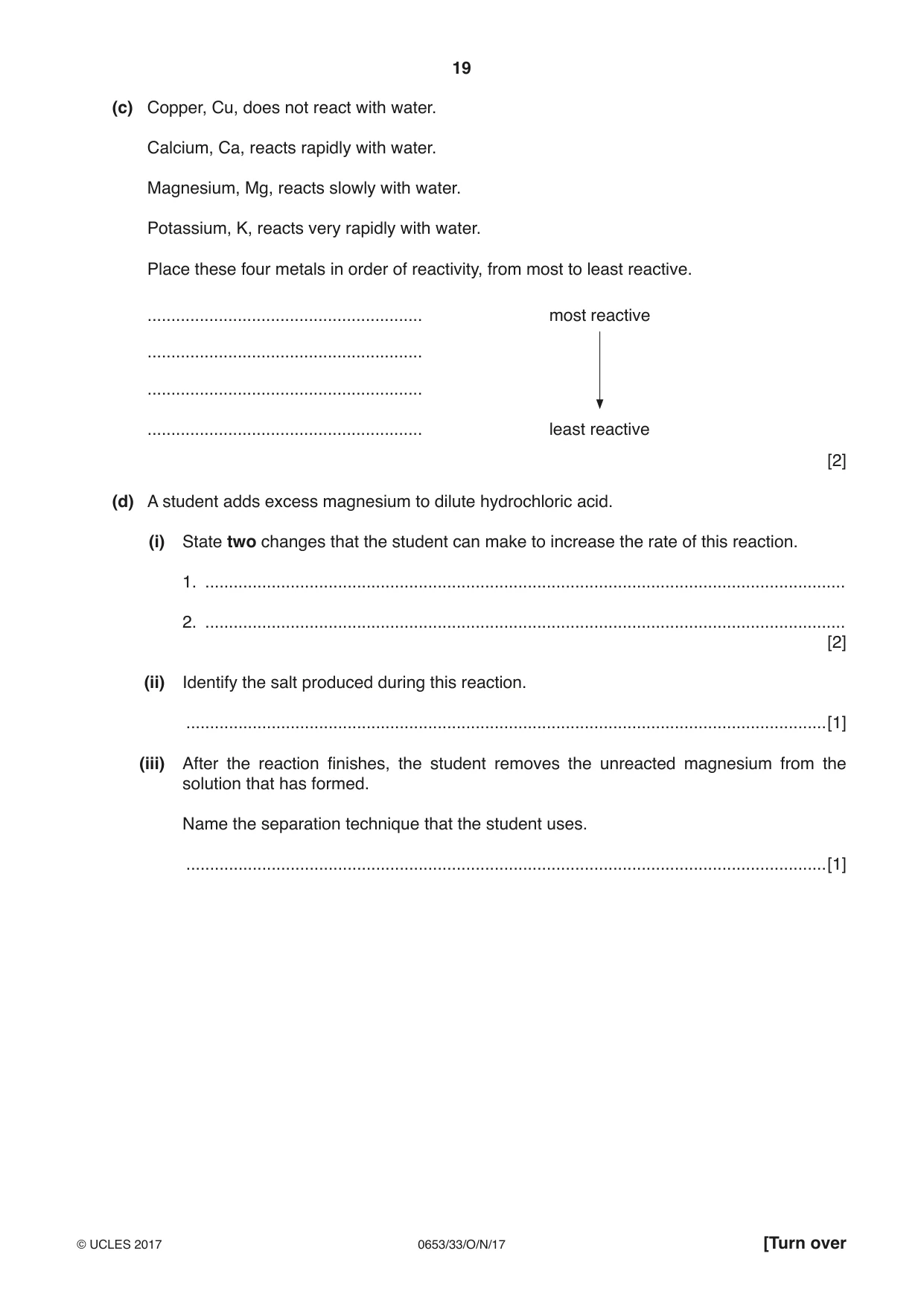
8 (a) Molten lead(II) bromide is broken down into simpler substances using the apparatus shown in Fig. 8.1. low voltage d.c.supply ................................. ................................. – + molten lead (II) bromide Fig. 8.1 (i) Use the names of the electrodes to complete Fig. 8.1. [2] (ii) Describe the appearance of the substance that forms at the positive electrode. .......................................................................................................................................[1] (b) Copper is extracted from copper oxide by heating with carbon. The equation for this reaction is copper oxide + carbon copper + carbon dioxide. State whether the copper oxide is oxidised or reduced during this reaction. Explain your answer. ................................................................................................................................................... ...............................................................................................................................................[1] (c) Copper, Cu, does not react with water. Calcium, Ca, reacts rapidly with water. Magnesium, Mg, reacts slowly with water. Potassium, K, reacts very rapidly with water. Place these four metals in order of reactivity, from most to least reactive. .......................................................... most reactive .......................................................... .......................................................... .......................................................... least reactive [2] (d) A student adds excess magnesium to dilute hydrochloric acid. (i) State two changes that the student can make to increase the rate of this reaction. 1. ....................................................................................................................................... 2. ....................................................................................................................................... [2] (ii) Identify the salt produced during this reaction. .......................................................................................................................................[1] (iii) After the reaction finishes, the student removes the unreacted magnesium from the solution that has formed. Name the separation technique that the student uses. .......................................................................................................................................[1]
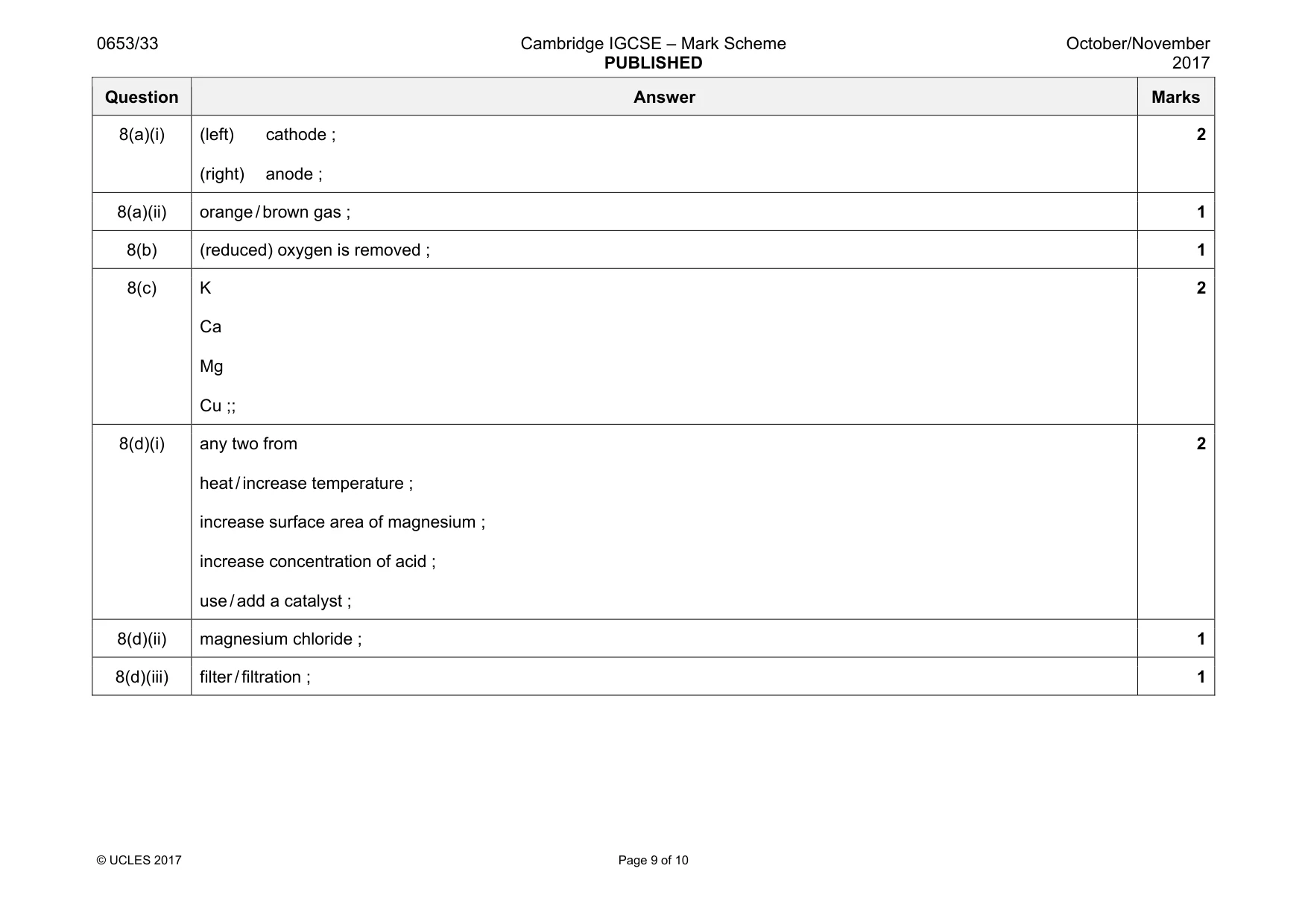
Mark scheme: 8(a)(i) (left) cathode ; (right) anode ; 2 8(a)(ii) orange / brown gas ; 1 8(b) (reduced) oxygen is removed ; 1 8(c) K Ca Mg Cu ;; 2 8(d)(i) any two from heat / increase temperature ; increase surface area of magnesium ; increase concentration of acid ; use / add a catalyst ; 2 8(d)(ii) magnesium chloride ; 1 8(d)(iii) filter / filtration ; 1
Q9 · A toy car powered by batteries
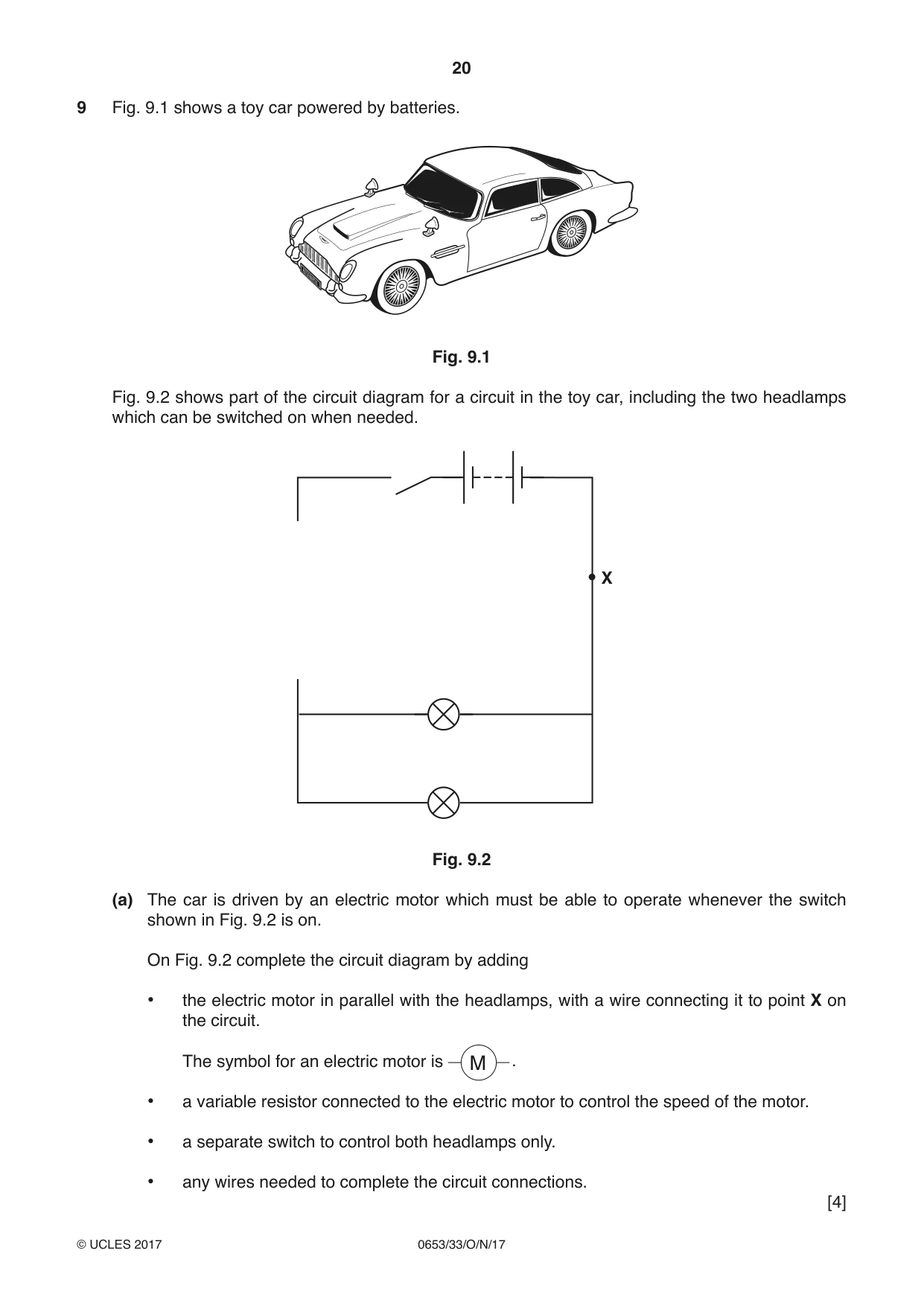
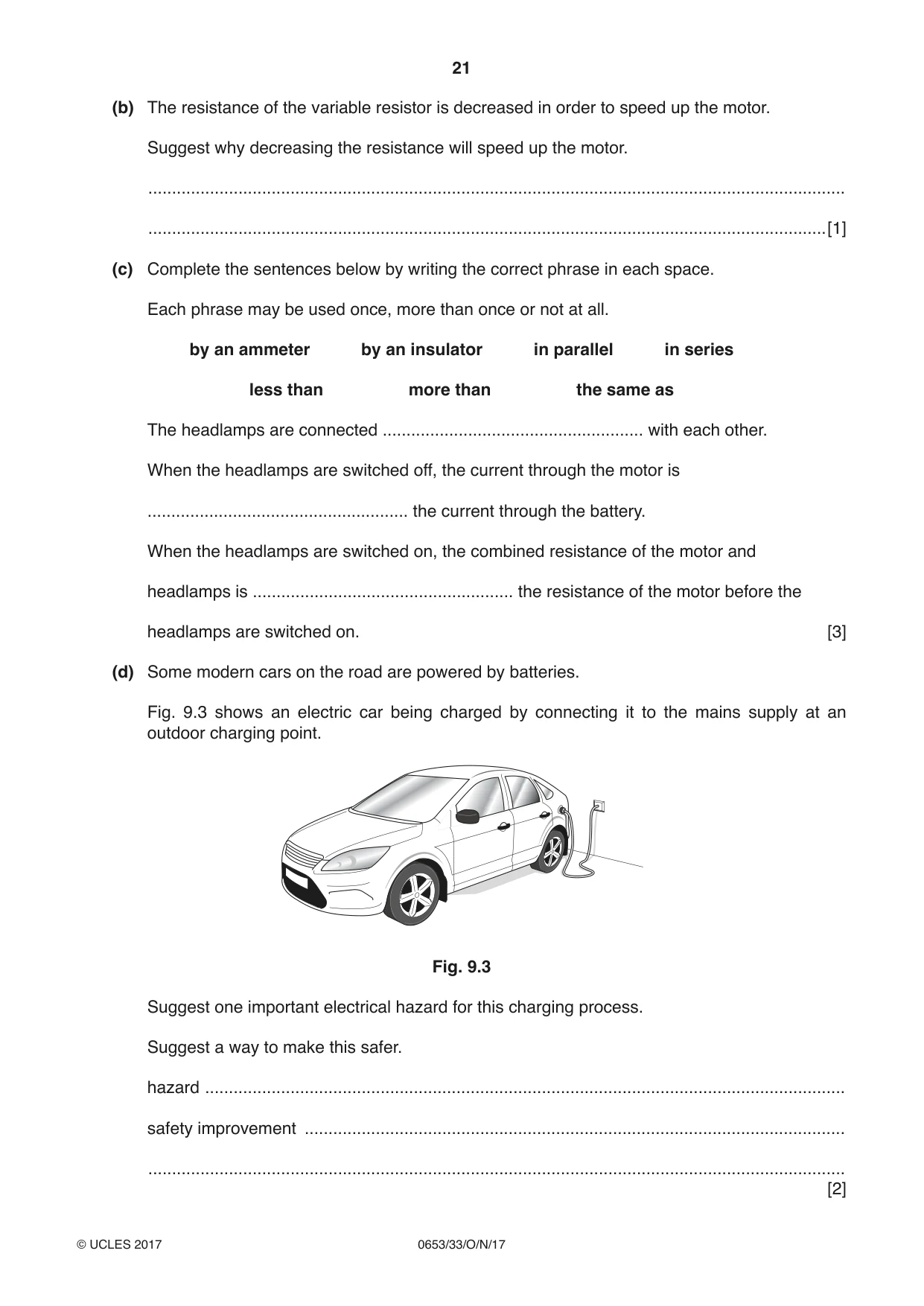
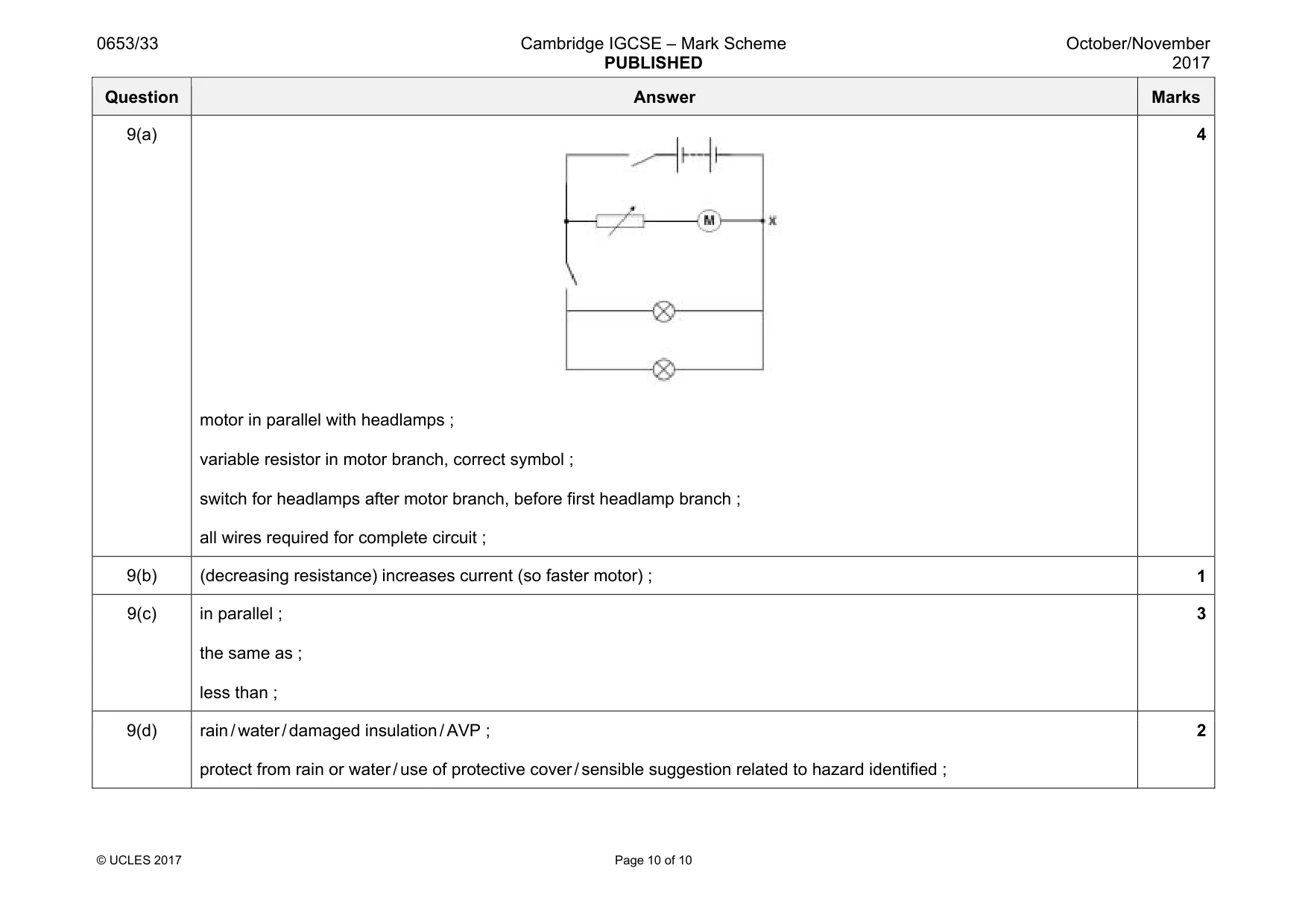
9 Fig. 9.1 shows a toy car powered by batteries. Fig. 9.1 Fig. 9.2 shows part of the circuit diagram for a circuit in the toy car, including the two headlamps which can be switched on when needed. X Fig. 9.2 (a) The car is driven by an electric motor which must be able to operate whenever the switch shown in Fig. 9.2 is on. On Fig. 9.2 complete the circuit diagram by adding • the electric motor in parallel with the headlamps, with a wire connecting it to point X on the circuit. The symbol for an electric motor is M . • a variable resistor connected to the electric motor to control the speed of the motor. • a separate switch to control both headlamps only. • any wires needed to complete the circuit connections. [4] (b) The resistance of the variable resistor is decreased in order to speed up the motor. Suggest why decreasing the resistance will speed up the motor. ................................................................................................................................................... ...............................................................................................................................................[1] (c) Complete the sentences below by writing the correct phrase in each space. Each phrase may be used once, more than once or not at all. by an ammeter by an insulator in parallel in series less than more than the same as The headlamps are connected ....................................................... with each other. When the headlamps are switched off, the current through the motor is ....................................................... the current through the battery. When the headlamps are switched on, the combined resistance of the motor and headlamps is ....................................................... the resistance of the motor before the headlamps are switched on. [3] (d) Some modern cars on the road are powered by batteries. Fig. 9.3 shows an electric car being charged by connecting it to the mains supply at an outdoor charging point. Fig. 9.3 Suggest one important electrical hazard for this charging process. Suggest a way to make this safer. hazard ....................................................................................................................................... safety improvement .................................................................................................................. ................................................................................................................................................... [2]
Mark scheme: 9(a) motor in parallel with headlamps ; variable resistor in motor branch, correct symbol ; switch for headlamps after motor branch, before first headlamp branch ; all wires required for complete circuit ; 4 9(b) (decreasing resistance) increases current (so faster motor) ; 1 9(c) in parallel ; the same as ; less than ; 3 9(d) rain / water / damaged insulation / AVP ; protect from rain or water / use of protective cover / sensible suggestion related to hazard identified ; 2
What was in this paper
The subtopics covered by these 9 questions, and how many questions each got. Open one in a new tab to see every Cambridge question on it.
What you needed in this session
Cambridge’s own grade thresholds for 2017 Oct/Nov, Paper 3 · Variant 3. A higher threshold means an easier paper — the bar moves with how the cohort did.