Cambridge IGCSE Science - Combined 0653 — 2024 May/June Paper 3 · Variant 2
0653/32/M/J/24 · 9 questions · 80 marks · ≈90 min
The question paper and its mark scheme, free to read here and free to download. This is Cambridge’s own paper, exactly as it was sat.
Question paper24 pages

Mark scheme10 pages
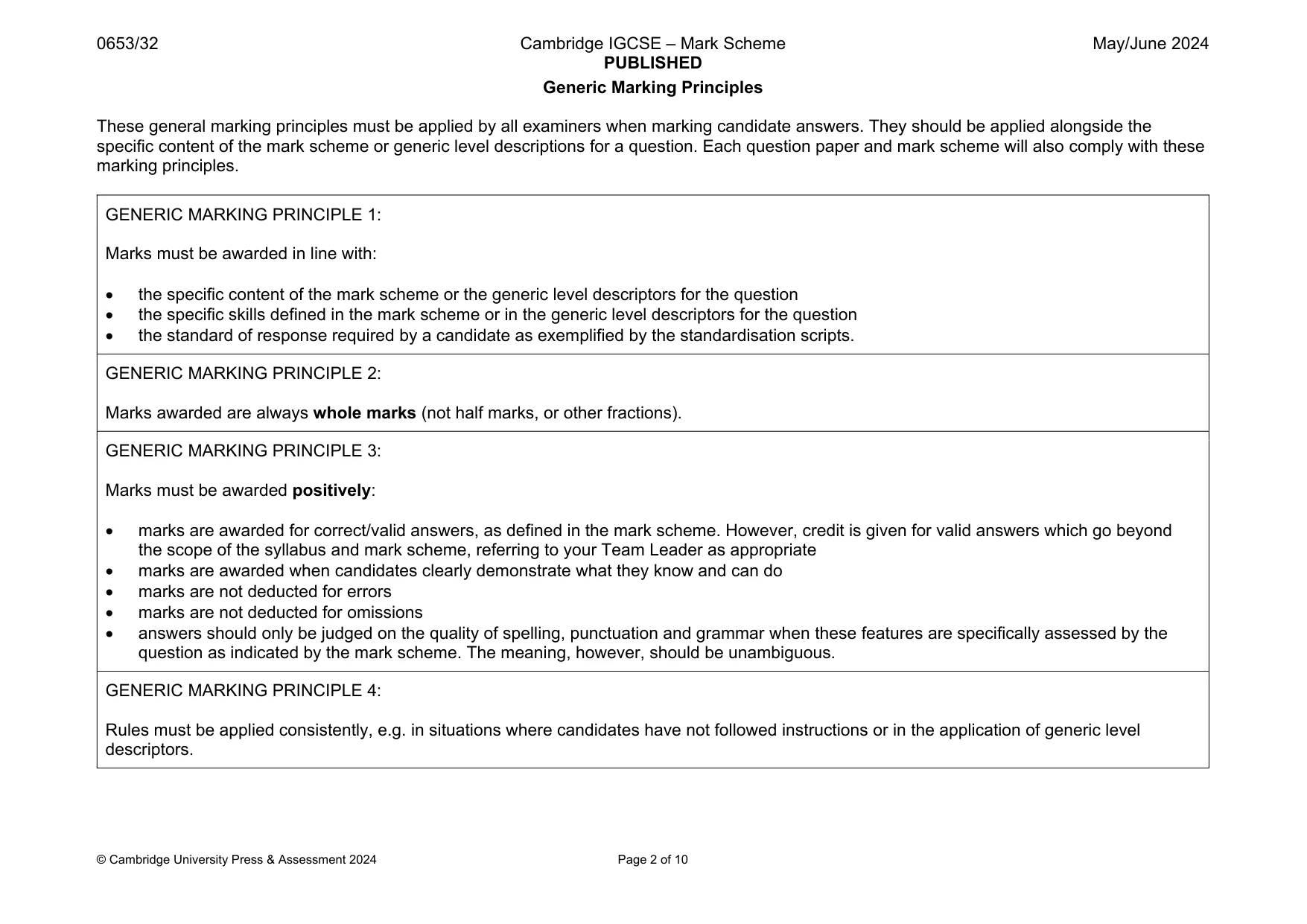
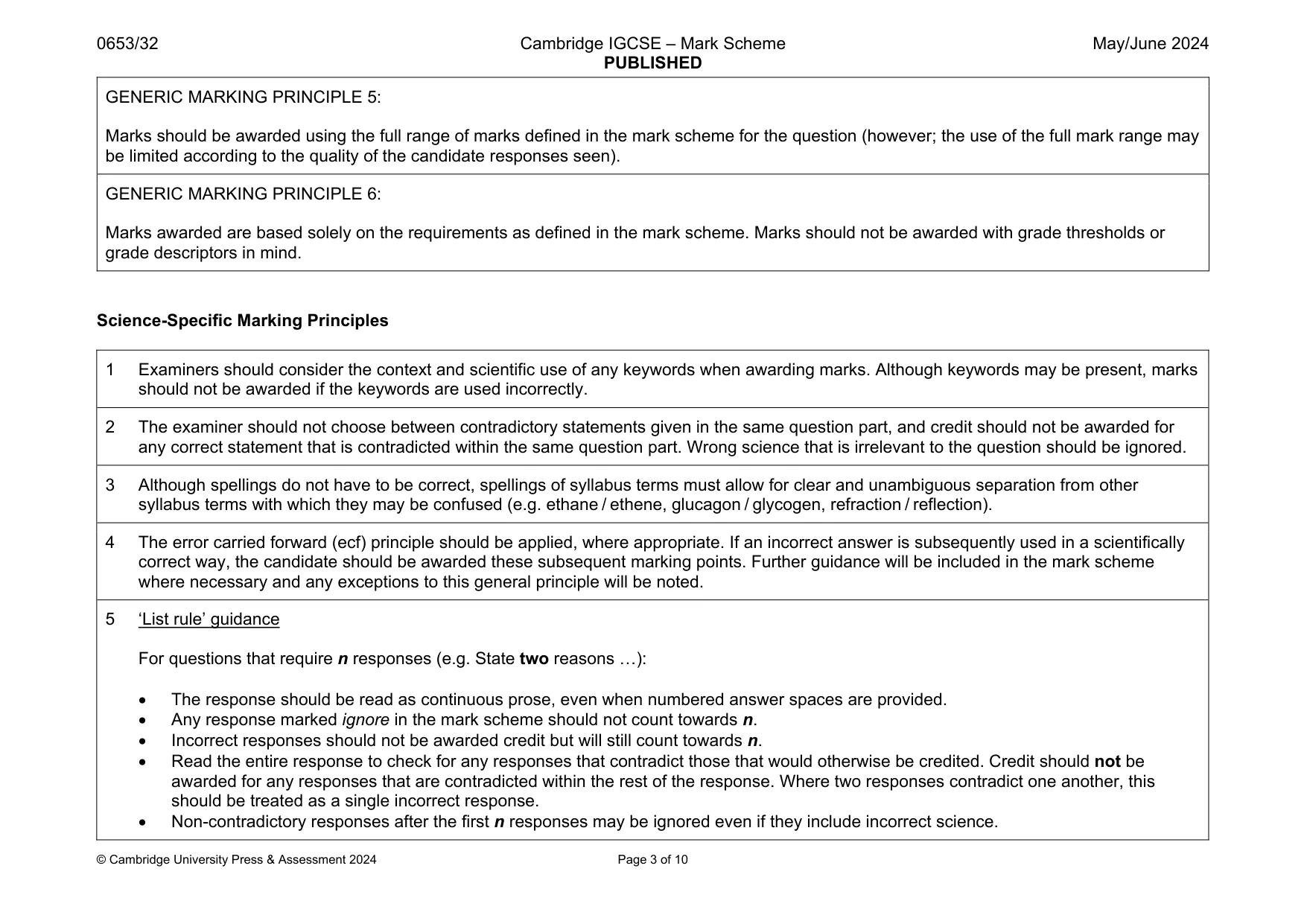
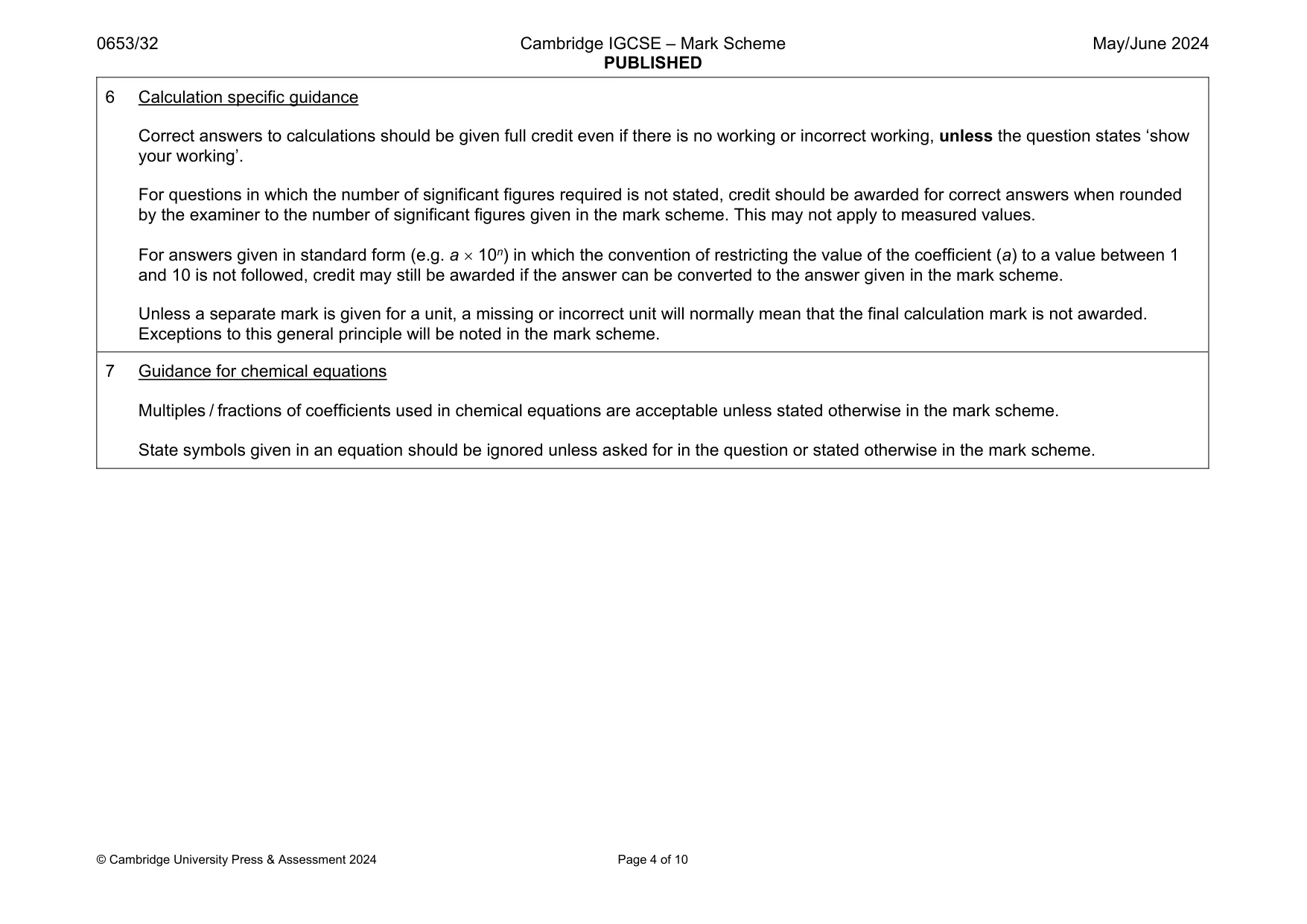
Answers below. Sit the paper first if you are practising.
Questions as text
Q1 · A diagram of the male reproductive system in humans
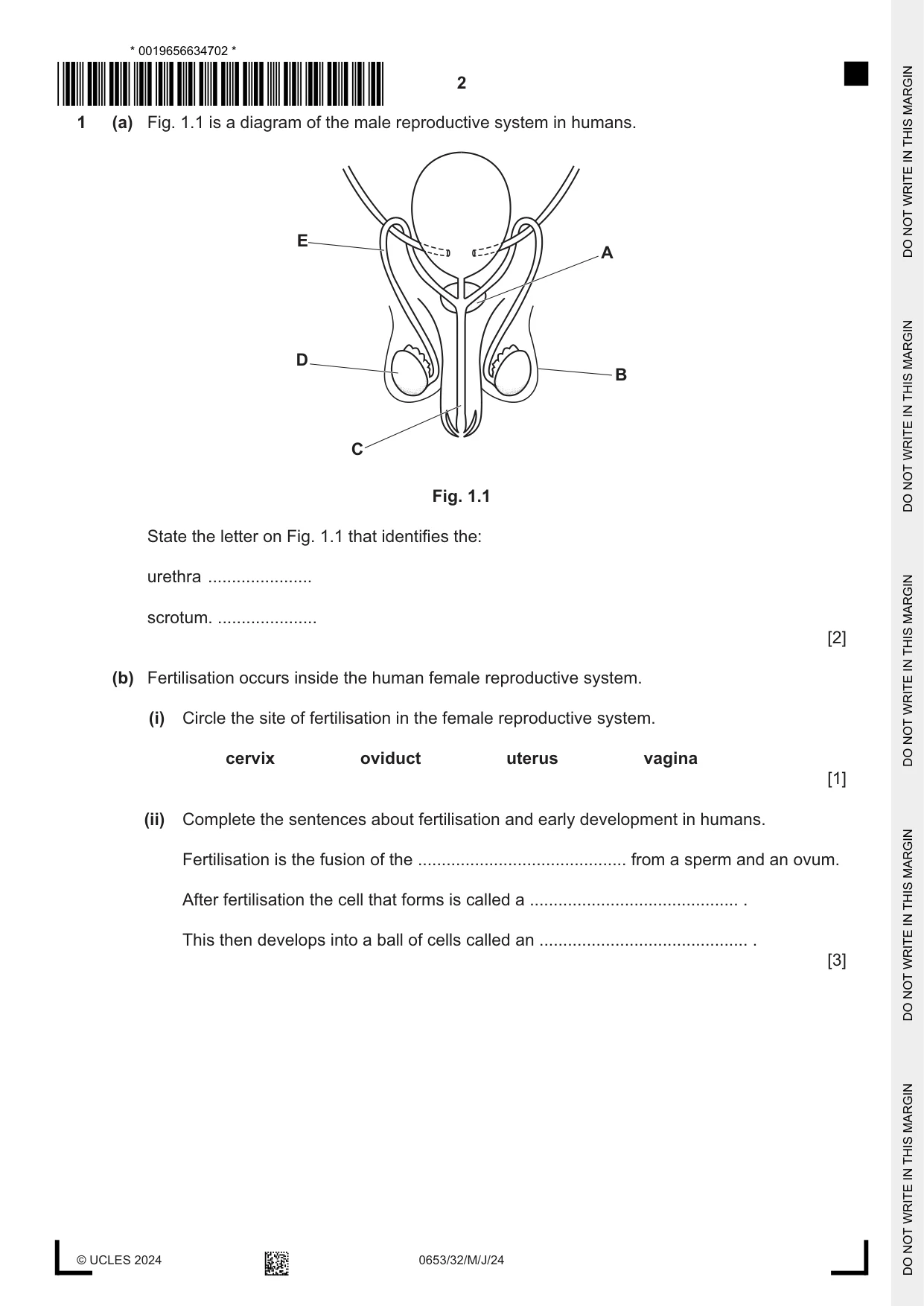
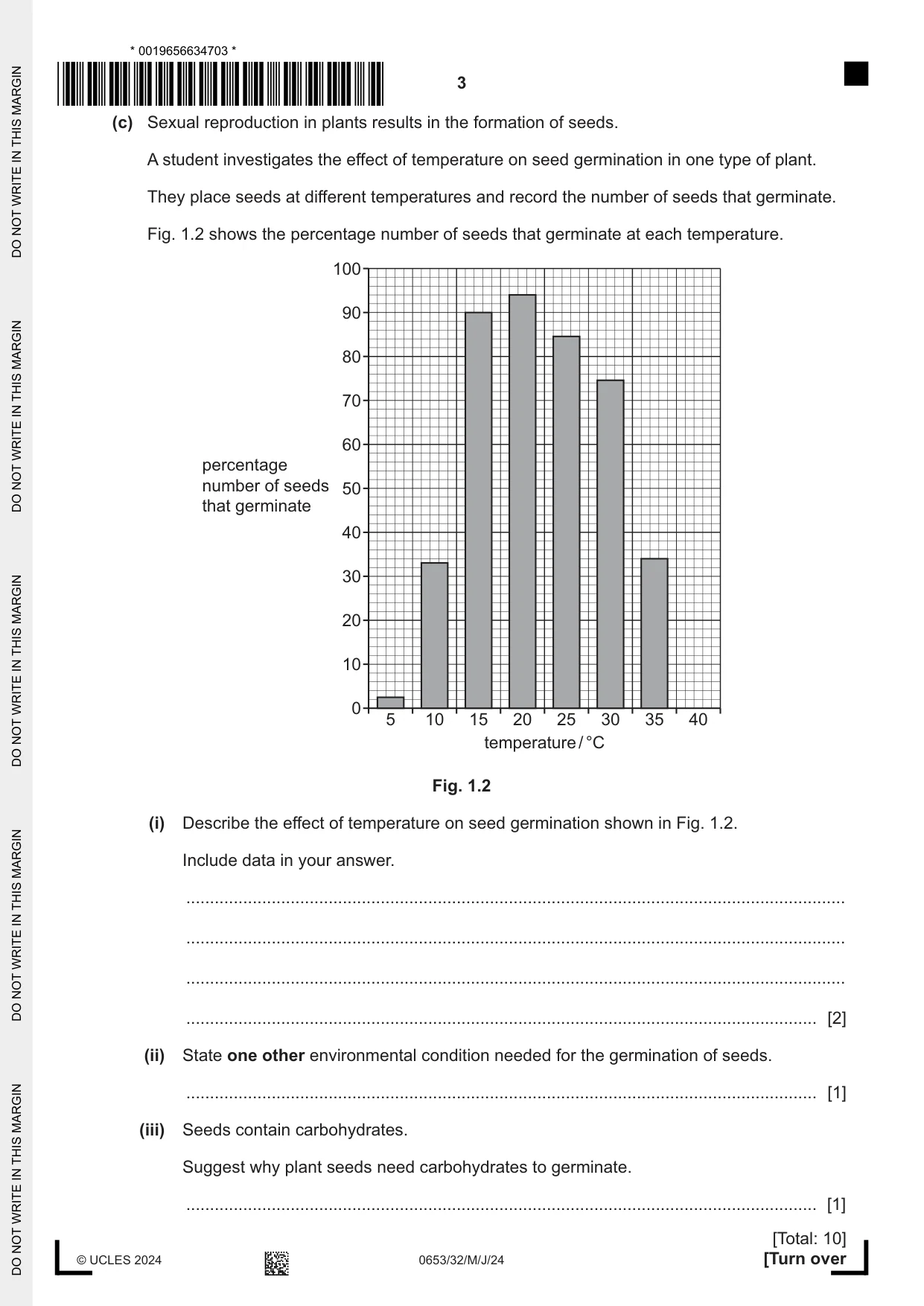
1 (a) Fig. 1.1 is a diagram of the male reproductive system in humans. E A D B C Fig. 1.1 State the letter on Fig. 1.1 that identifies the: urethra ...................... scrotum. ..................... [2] (b) Fertilisation occurs inside the human female reproductive system. (i) Circle the site of fertilisation in the female reproductive system. cervix oviduct uterus vagina [1] (ii) Complete the sentences about fertilisation and early development in humans. Fertilisation is the fusion of the ............................................ from a sperm and an ovum. After fertilisation the cell that forms is called a ............................................ . This then develops into a ball of cells called an ............................................ . [3] (c) Sexual reproduction in plants results in the formation of seeds. A student investigates the effect of temperature on seed germination in one type of plant. They place seeds at different temperatures and record the number of seeds that germinate. Fig. 1.2 shows the percentage number of seeds that germinate at each temperature. 100 90 80 70 60 percentage number of seeds 50 that germinate 40 30 20 10 0 5 10 15 20 25 30 35 40 temperature / °C Fig. 1.2 (i) Describe the effect of temperature on seed germination shown in Fig. 1.2. Include data in your answer. ........................................................................................................................................... ........................................................................................................................................... ........................................................................................................................................... ..................................................................................................................................... [2] (ii) State one other environmental condition needed for the germination of seeds. ..................................................................................................................................... [1] (iii) Seeds contain carbohydrates. Suggest why plant seeds need carbohydrates to germinate. ..................................................................................................................................... [1] [Total: 10]
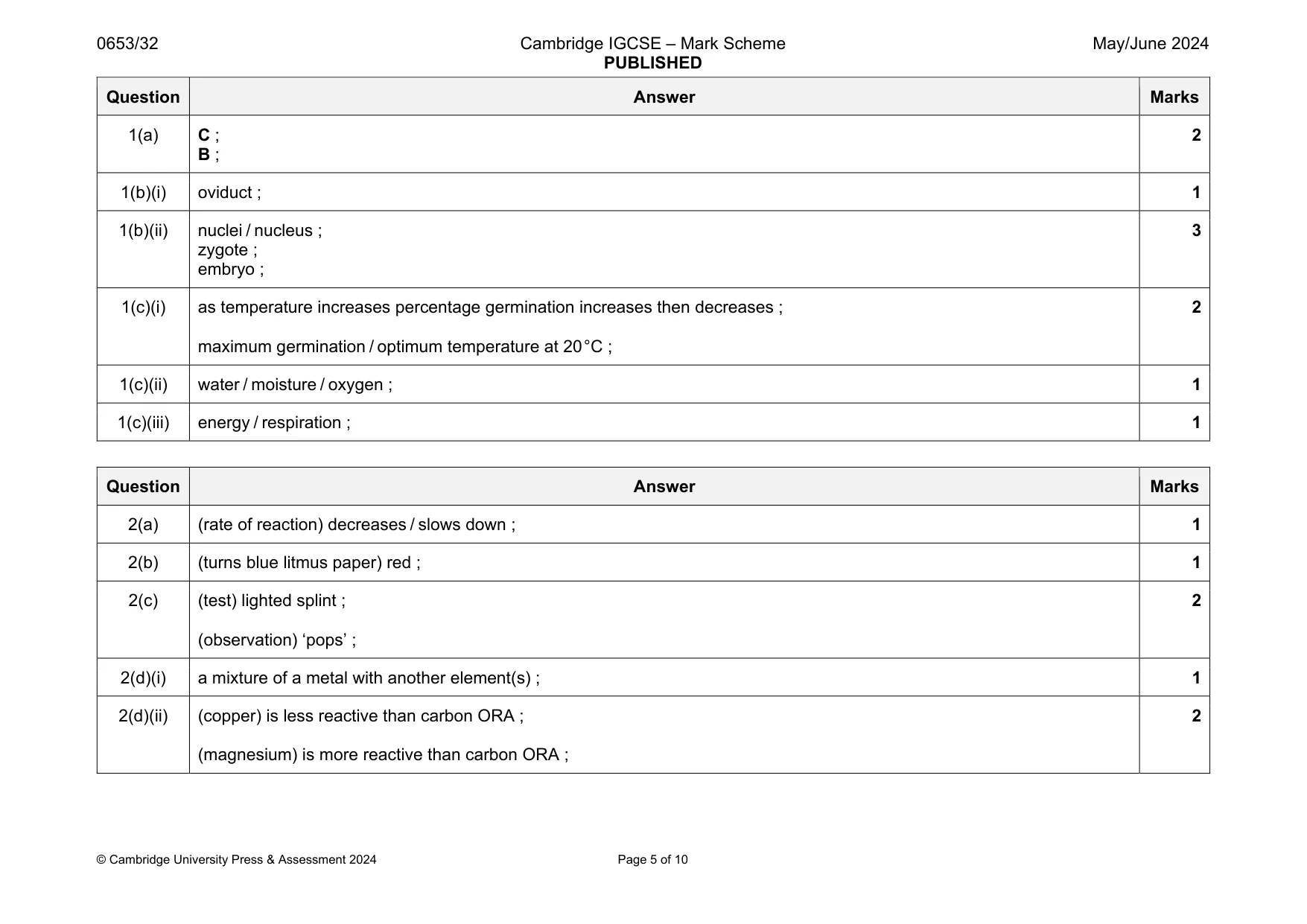
Mark scheme: 1(a) C ; B ; 2 1(b)(i) oviduct ; 1 1(b)(ii) nuclei / nucleus ; zygote ; embryo ; 3 1(c)(i) as temperature increases percentage germination increases then decreases ; maximum germination / optimum temperature at 20 °C ; 2 1(c)(ii) water / moisture / oxygen ; 1 1(c)(iii) energy / respiration ; 1
Q2 · A student investigates the reaction of magnesium with excess dilute hydrochloric acid…
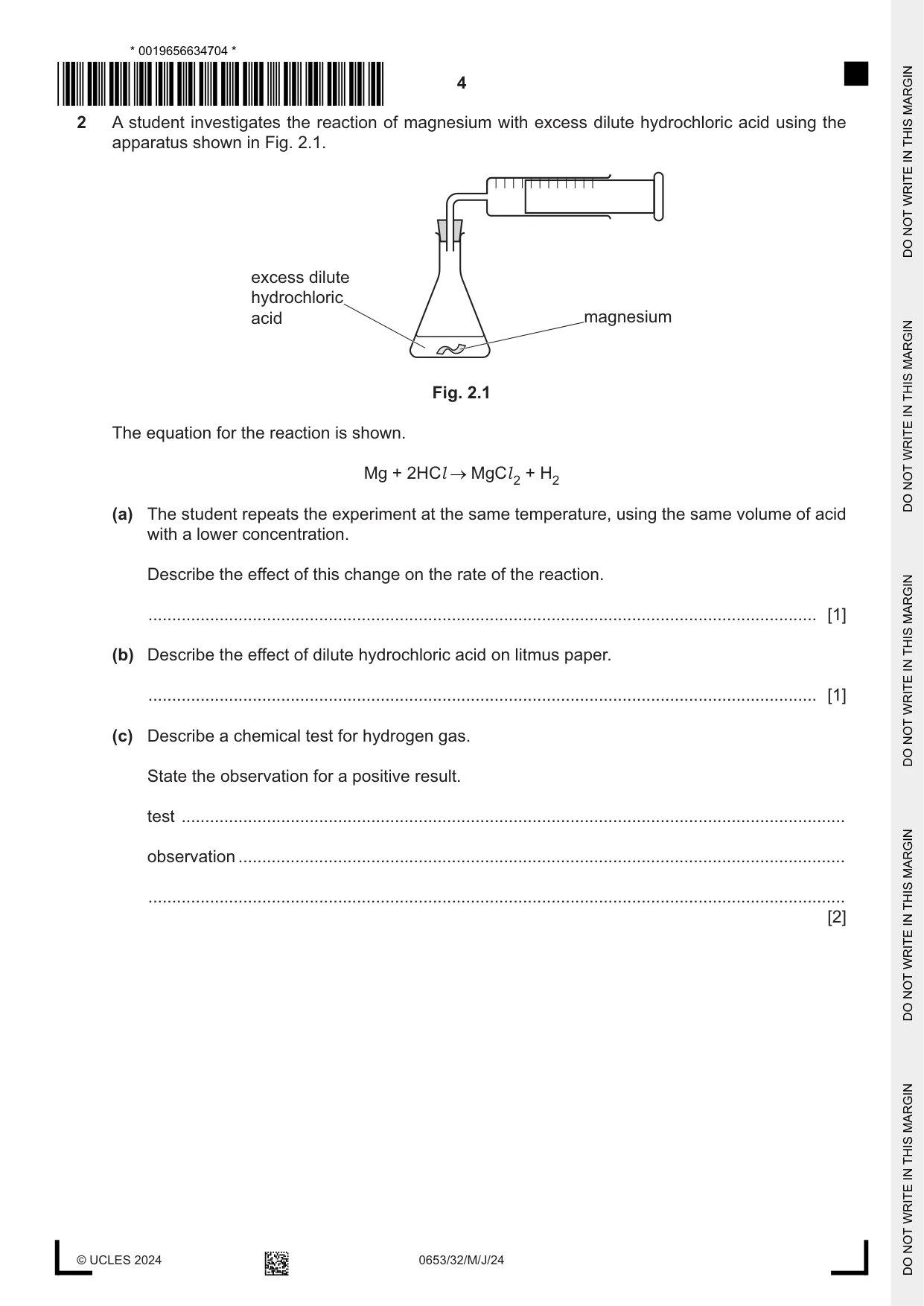
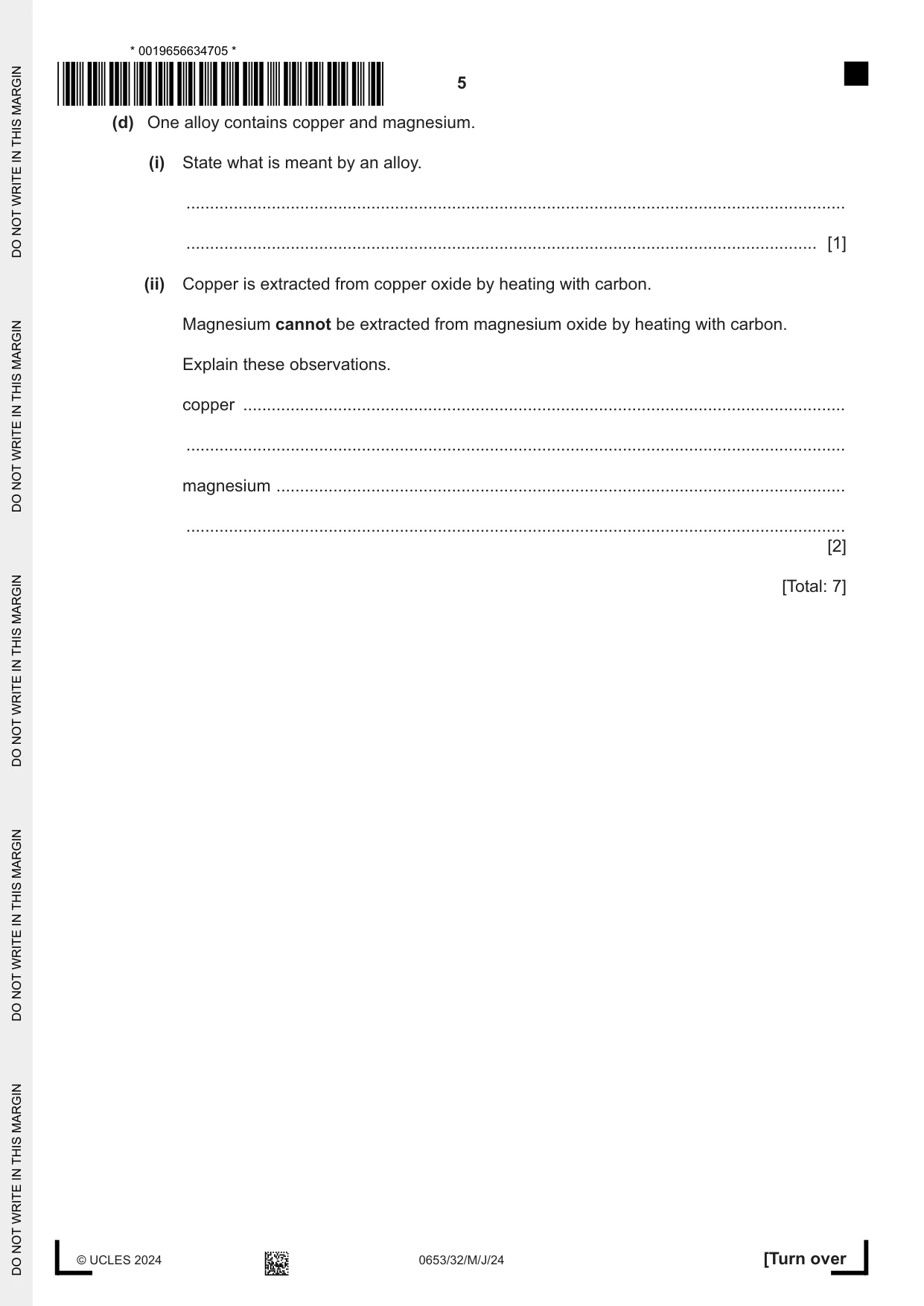
2 A student investigates the reaction of magnesium with excess dilute hydrochloric acid using the apparatus shown in Fig. 2.1. excess dilute hydrochloric acid magnesium Fig. 2.1 The equation for the reaction is shown. Mg + 2HCl MgCl2 + H2 (a) The student repeats the experiment at the same temperature, using the same volume of acid with a lower concentration. Describe the effect of this change on the rate of the reaction. ............................................................................................................................................. [1] (b) Describe the effect of dilute hydrochloric acid on litmus paper. ............................................................................................................................................. [1] (c) Describe a chemical test for hydrogen gas. State the observation for a positive result. test ............................................................................................................................................ observation ................................................................................................................................ ................................................................................................................................................... [2] (d) One alloy contains copper and magnesium. (i) State what is meant by an alloy. ........................................................................................................................................... ..................................................................................................................................... [1] (ii) Copper is extracted from copper oxide by heating with carbon. Magnesium cannot be extracted from magnesium oxide by heating with carbon. Explain these observations. copper ............................................................................................................................... ........................................................................................................................................... magnesium ........................................................................................................................ ........................................................................................................................................... [2] [Total: 7]
Mark scheme: 2(a) (rate of reaction) decreases / slows down ; 1 2(b) (turns blue litmus paper) red ; 1 2(c) (test) lighted splint ; (observation) ‘pops’ ; 2 2(d)(i) a mixture of a metal with another element(s) ; 1 2(d)(ii) (copper) is less reactive than carbon ORA ; (magnesium) is more reactive than carbon ORA ; 2
Q3 · An old‑fashioned room heater made of iron
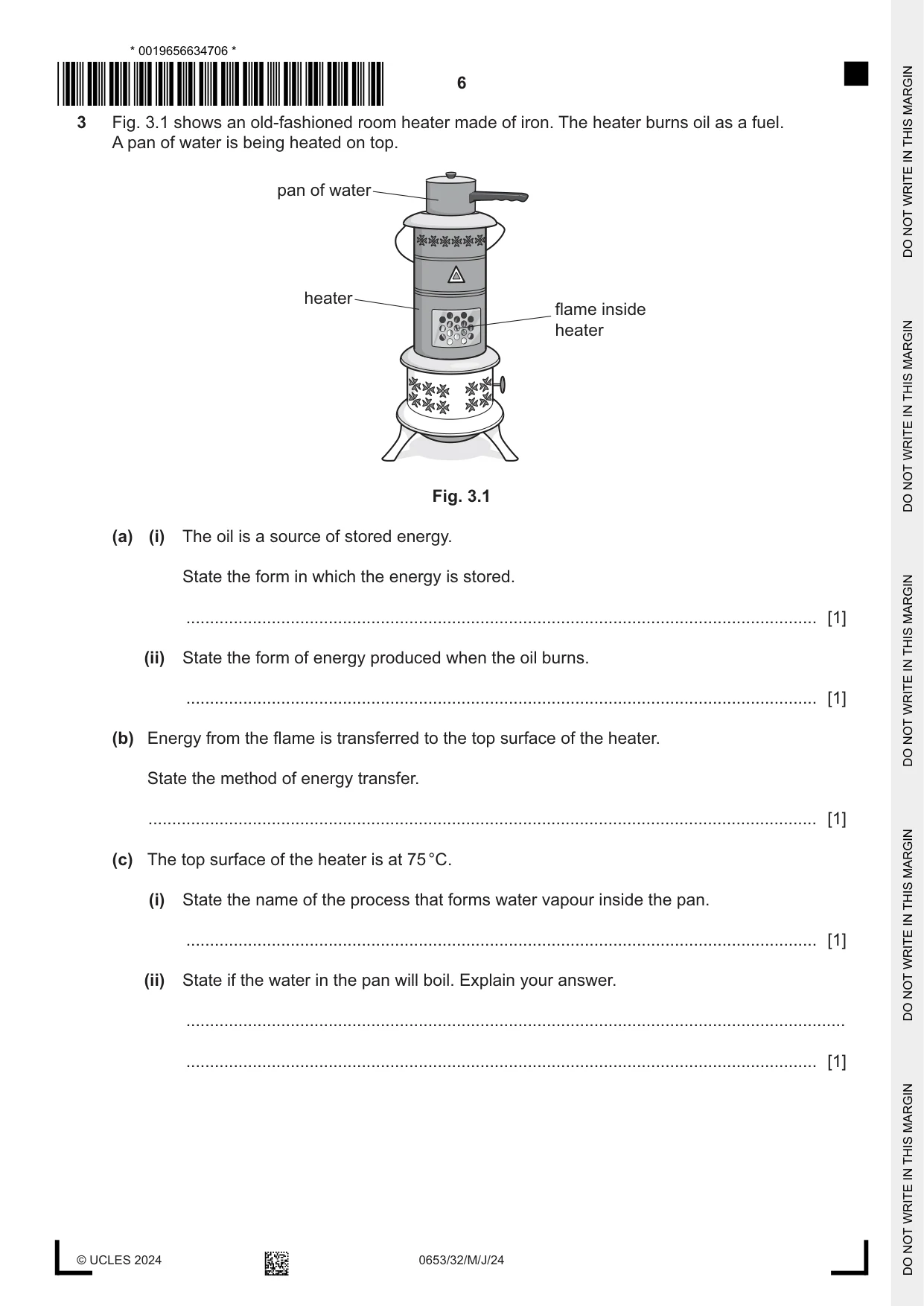
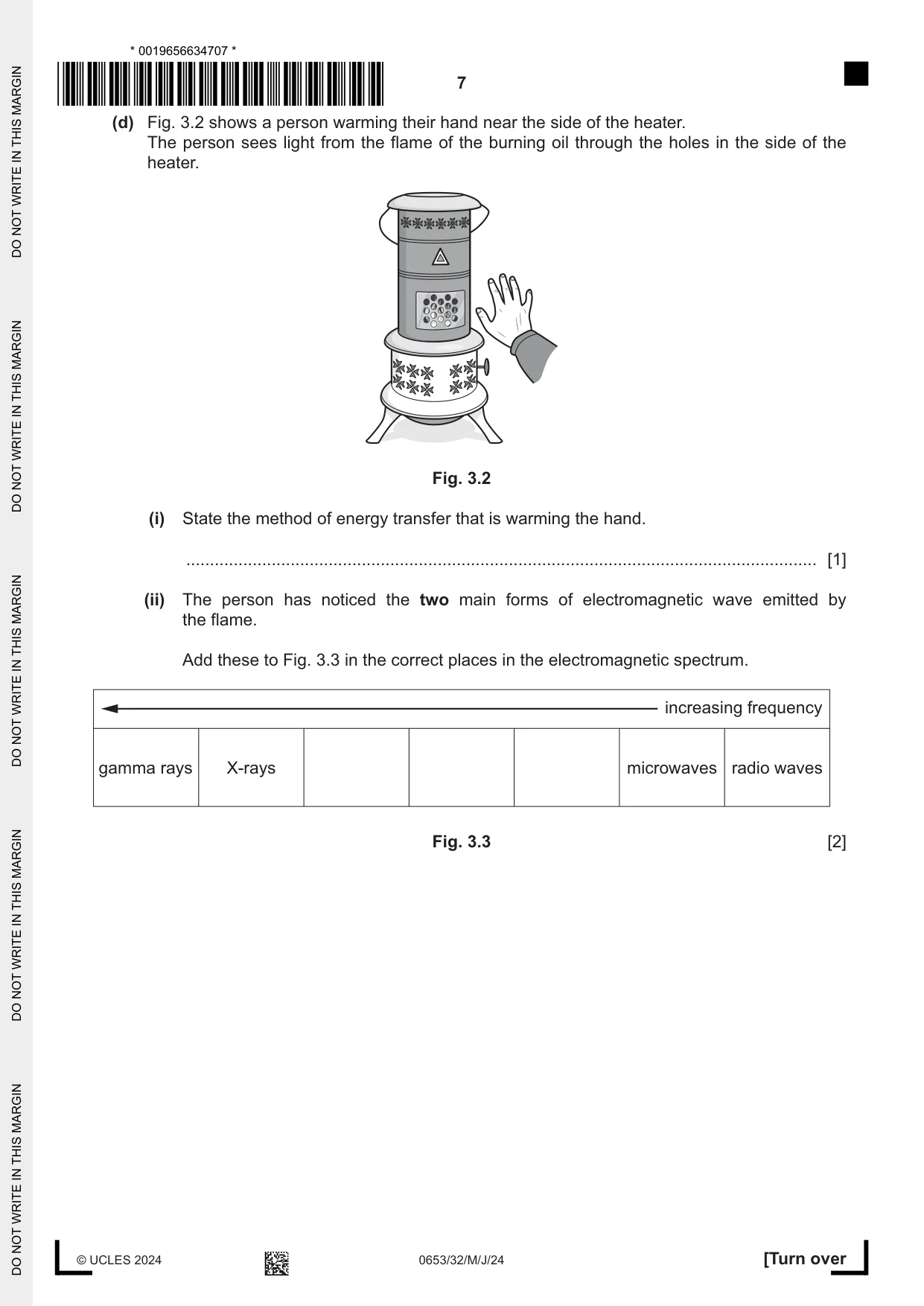
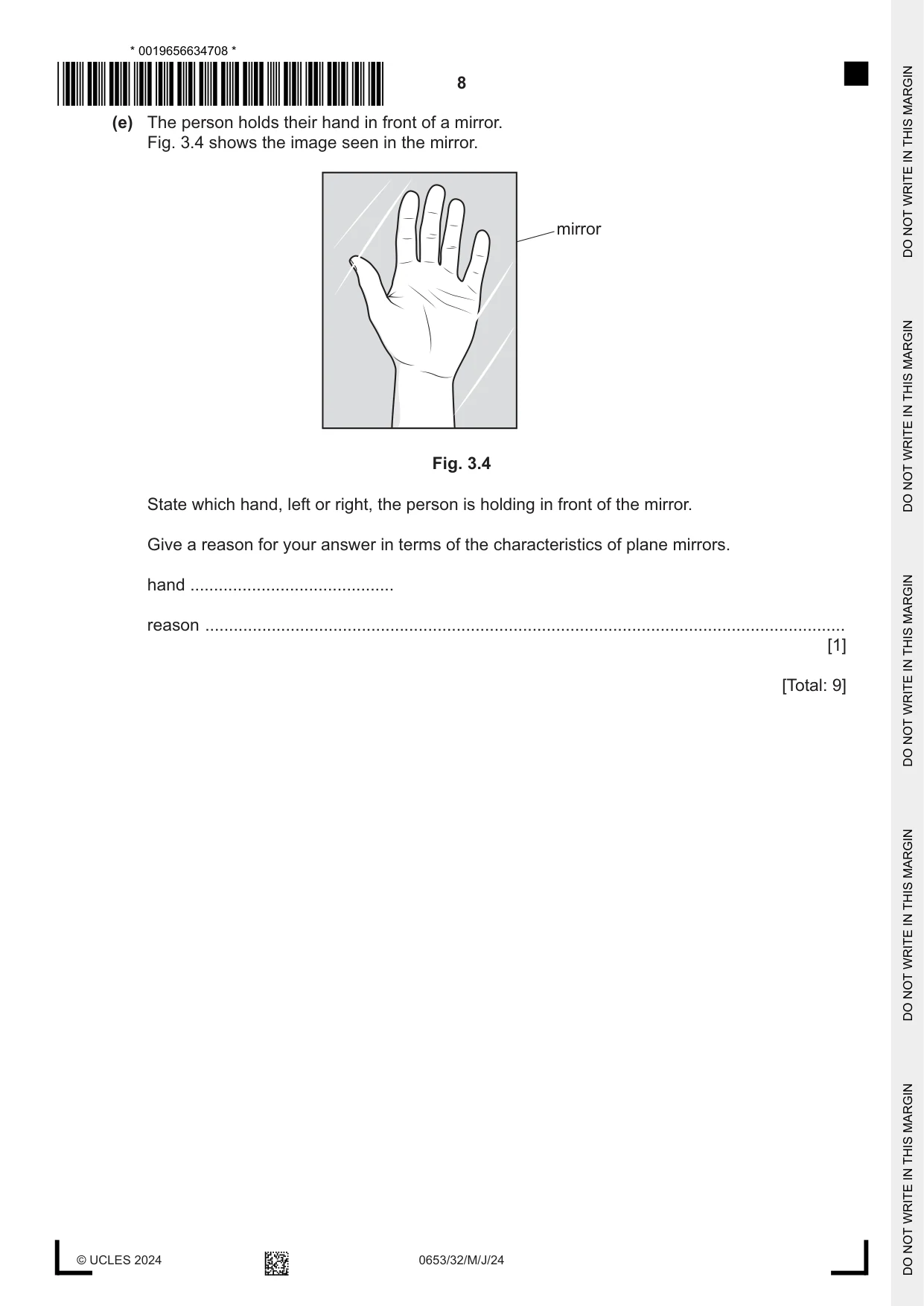
3 Fig. 3.1 shows an old‑fashioned room heater made of iron. The heater burns oil as a fuel. A pan of water is being heated on top. pan of water heater flame inside heater Fig. 3.1 (a) (i) The oil is a source of stored energy. State the form in which the energy is stored. ..................................................................................................................................... [1] (ii) State the form of energy produced when the oil burns. ..................................................................................................................................... [1] (b) Energy from the flame is transferred to the top surface of the heater. State the method of energy transfer. ............................................................................................................................................. [1] (c) The top surface of the heater is at 75 °C. (i) State the name of the process that forms water vapour inside the pan. ..................................................................................................................................... [1] (ii) State if the water in the pan will boil. Explain your answer. ........................................................................................................................................... ..................................................................................................................................... [1] (d) Fig. 3.2 shows a person warming their hand near the side of the heater. The person sees light from the flame of the burning oil through the holes in the side of the heater. Fig. 3.2 (i) State the method of energy transfer that is warming the hand. ..................................................................................................................................... [1] (ii) The person has noticed the two main forms of electromagnetic wave emitted by the flame. Add these to Fig. 3.3 in the correct places in the electromagnetic spectrum. increasing frequency gamma rays X-rays microwaves radio waves Fig. 3.3 [2] (e) The person holds their hand in front of a mirror. Fig. 3.4 shows the image seen in the mirror. mirror Fig. 3.4 State which hand, left or right, the person is holding in front of the mirror. Give a reason for your answer in terms of the characteristics of plane mirrors. hand ........................................... reason ....................................................................................................................................... [1] [Total: 9]
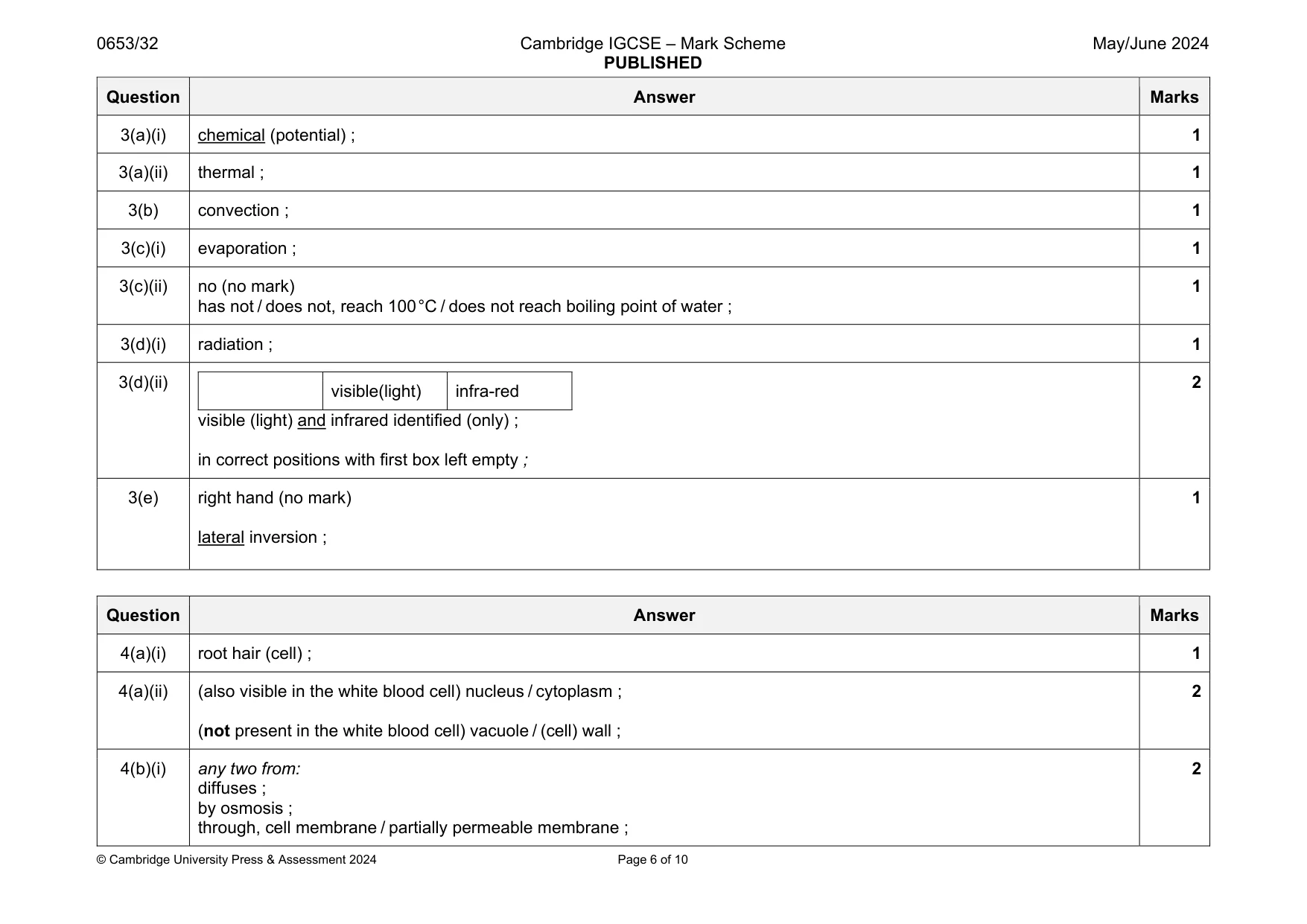
Mark scheme: 3(a)(i) chemical (potential) ; 1 3(a)(ii) thermal ; 1 3(b) convection ; 1 3(c)(i) evaporation ; 1 3(c)(ii) no (no mark) has not / does not, reach 100 °C / does not reach boiling point of water ; 1 3(d)(i) radiation ; 1 3(d)(ii) visible(light) infra-red visible (light) and infrared identified (only) ; in correct positions with first box left empty ; 2 3(e) right hand (no mark) lateral inversion ; 1
Question 4
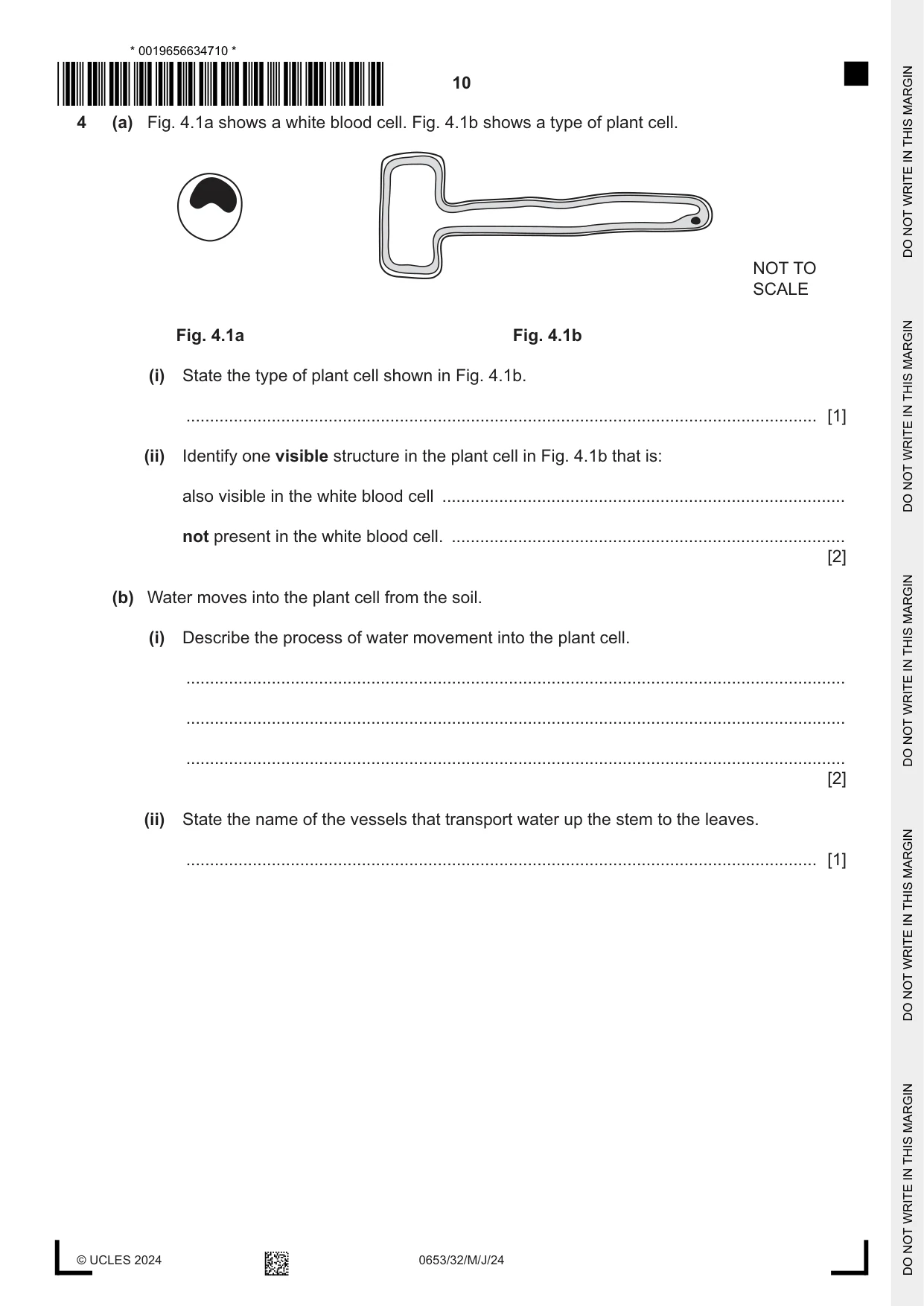
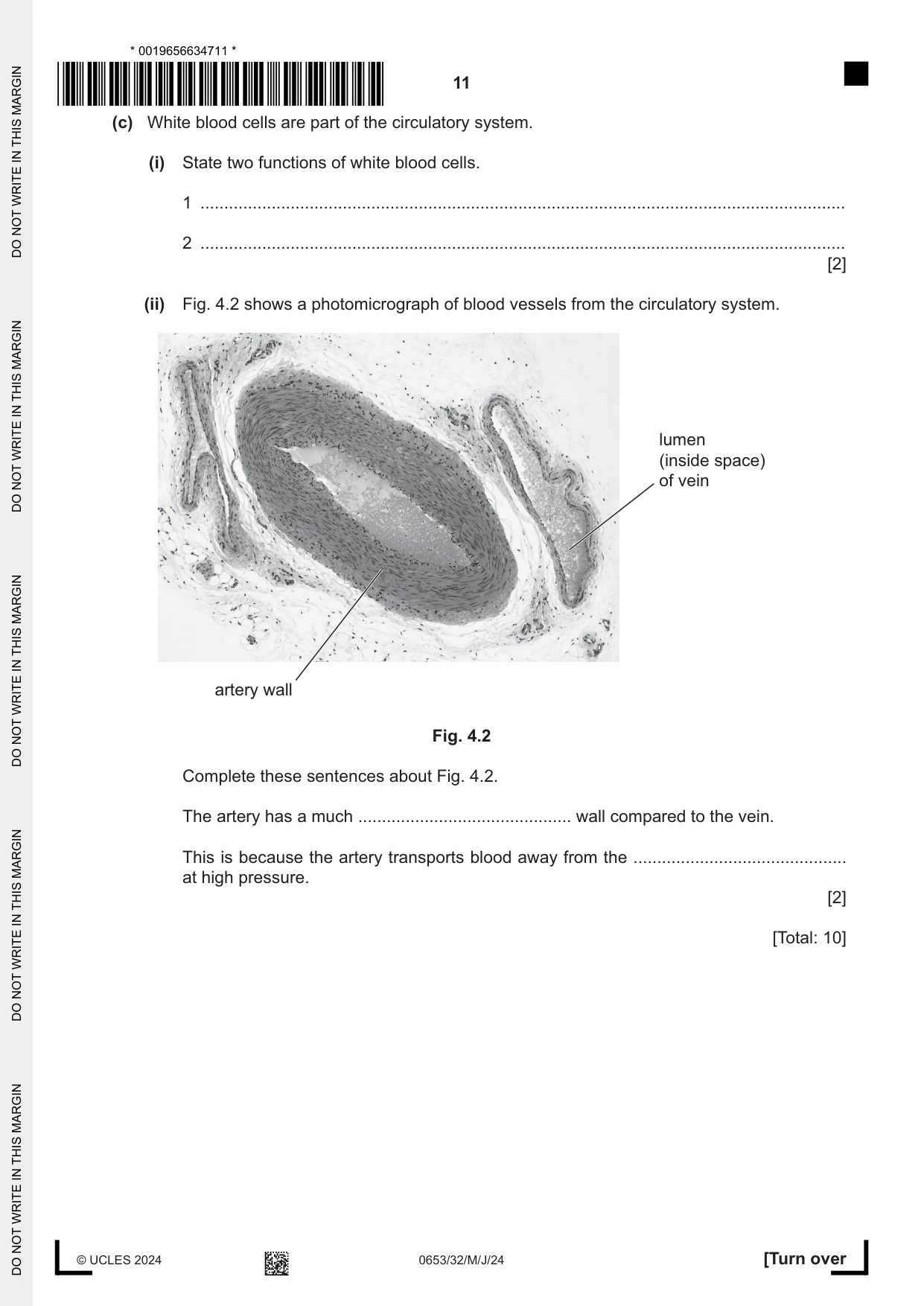
4 (a) Fig. 4.1a shows a white blood cell. Fig. 4.1b shows a type of plant cell. NOT TO SCALE Fig. 4.1a Fig. 4.1b (i) State the type of plant cell shown in Fig. 4.1b. ..................................................................................................................................... [1] (ii) Identify one visible structure in the plant cell in Fig. 4.1b that is: also visible in the white blood cell ..................................................................................... not present in the white blood cell. ................................................................................... [2] (b) Water moves into the plant cell from the soil. (i) Describe the process of water movement into the plant cell. ........................................................................................................................................... ........................................................................................................................................... ........................................................................................................................................... [2] (ii) State the name of the vessels that transport water up the stem to the leaves. ..................................................................................................................................... [1] (c) White blood cells are part of the circulatory system. (i) State two functions of white blood cells. 1 ........................................................................................................................................ 2 ........................................................................................................................................ [2] (ii) Fig. 4.2 shows a photomicrograph of blood vessels from the circulatory system. lumen (inside space) of vein artery wall Fig. 4.2 Complete these sentences about Fig. 4.2. The artery has a much ............................................. wall compared to the vein. This is because the artery transports blood away from the ............................................. at high pressure. [2] [Total: 10]
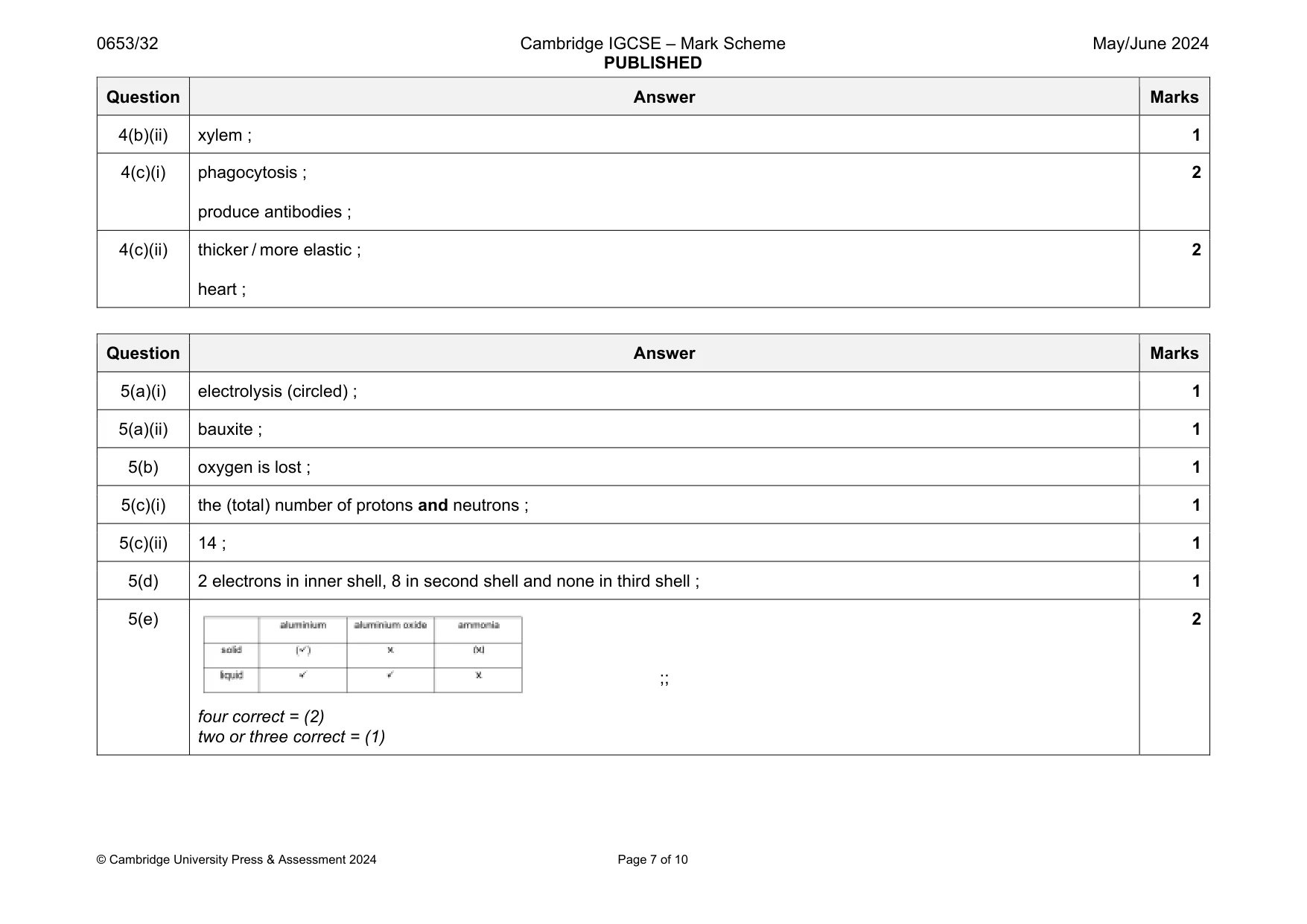
Mark scheme: 4(a)(i) root hair (cell) ; 1 4(a)(ii) (also visible in the white blood cell) nucleus / cytoplasm ; (not present in the white blood cell) vacuole / (cell) wall ; 2 4(b)(i) any two from: diffuses ; by osmosis ; through, cell membrane / partially permeable membrane ; 2 Question Answer Marks 4(b)(ii) xylem ; 1 4(c)(i) phagocytosis ; produce antibodies ; 2 4(c)(ii) thicker / more elastic ; heart ; 2
Q5 · Aluminium ore contains aluminium oxide
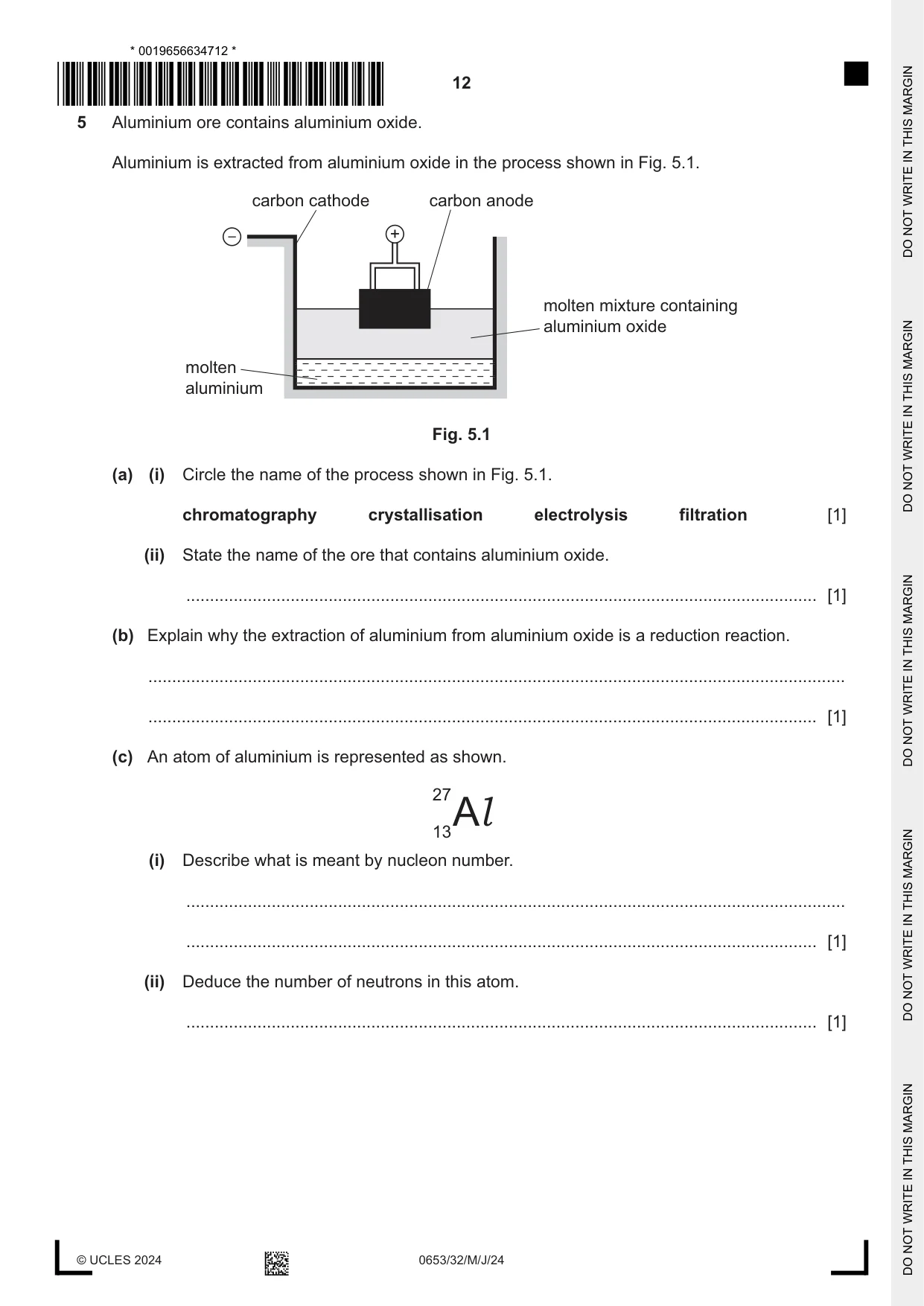
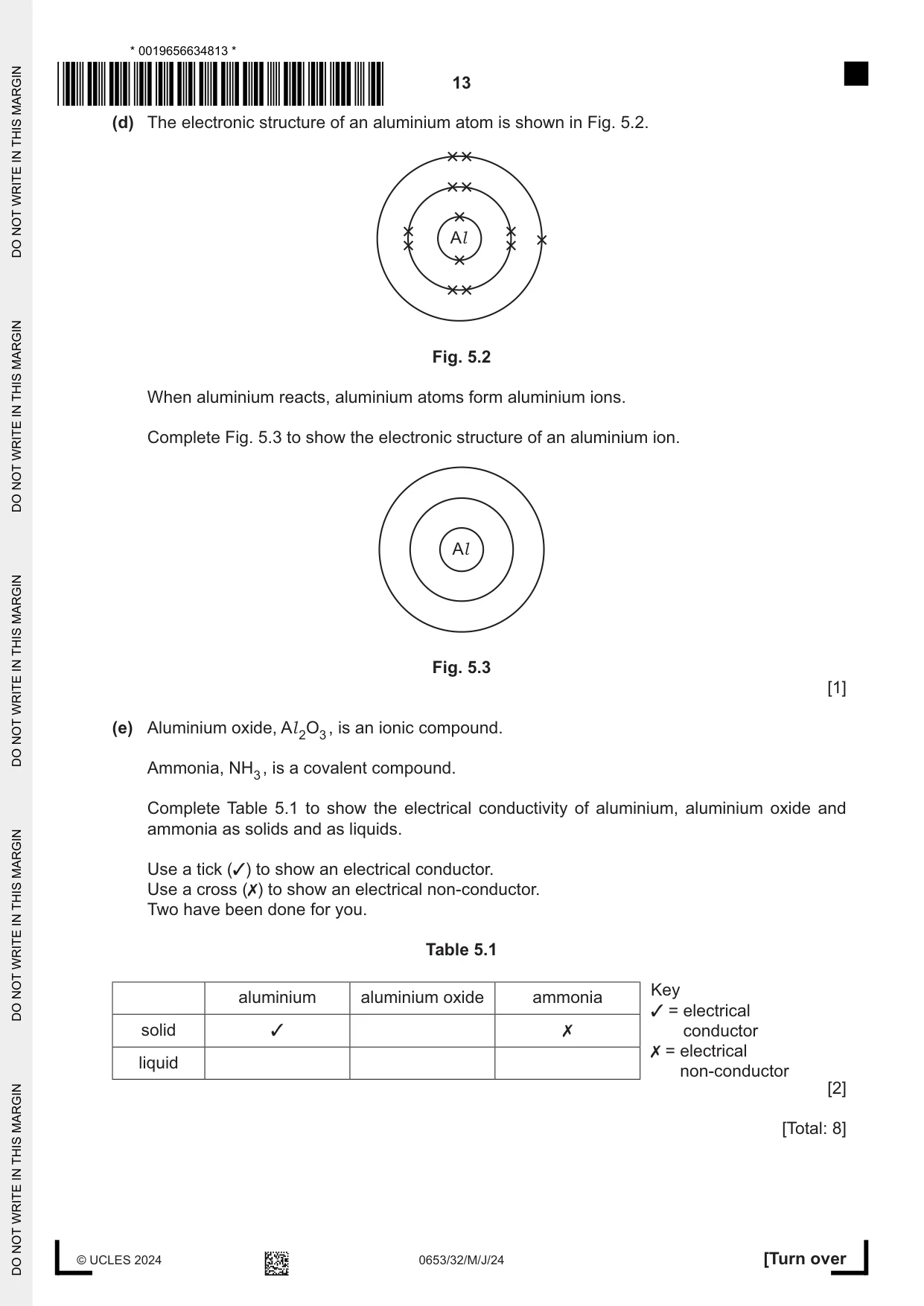
5 Aluminium ore contains aluminium oxide. Aluminium is extracted from aluminium oxide in the process shown in Fig. 5.1. carbon cathode carbon anode – + molten mixture containing aluminium oxide molten aluminium Fig. 5.1 (a) (i) Circle the name of the process shown in Fig. 5.1. chromatography crystallisation electrolysis filtration [1] (ii) State the name of the ore that contains aluminium oxide. ..................................................................................................................................... [1] (b) Explain why the extraction of aluminium from aluminium oxide is a reduction reaction. ................................................................................................................................................... ............................................................................................................................................. [1] (c) An atom of aluminium is represented as shown. 27 13Al (i) Describe what is meant by nucleon number. ........................................................................................................................................... ..................................................................................................................................... [1] (ii) Deduce the number of neutrons in this atom. ..................................................................................................................................... [1] (d) The electronic structure of an aluminium atom is shown in Fig. 5.2. Al Fig. 5.2 When aluminium reacts, aluminium atoms form aluminium ions. Complete Fig. 5.3 to show the electronic structure of an aluminium ion. Al Fig. 5.3 [1] (e) Aluminium oxide, Al2O3 , is an ionic compound. Ammonia, NH3 , is a covalent compound. Complete Table 5.1 to show the electrical conductivity of aluminium, aluminium oxide and ammonia as solids and as liquids. Use a tick (✓) to show an electrical conductor. Use a cross (✗) to show an electrical non‑conductor. Two have been done for you. Table 5.1 Key aluminium aluminium oxide ammonia ✓ = electrical solid ✓ ✗ conductor ✗ = electrical liquid non‑conductor [2] [Total: 8]
Mark scheme: 5(a)(i) electrolysis (circled) ; 1 5(a)(ii) bauxite ; 1 5(b) oxygen is lost ; 1 5(c)(i) the (total) number of protons and neutrons ; 1 5(c)(ii) 14 ; 1 5(d) 2 electrons in inner shell, 8 in second shell and none in third shell ; 1 5(e) ;; four correct = (2) two or three correct = (1) 2
Q6 · A rover vehicle on the planet Mars
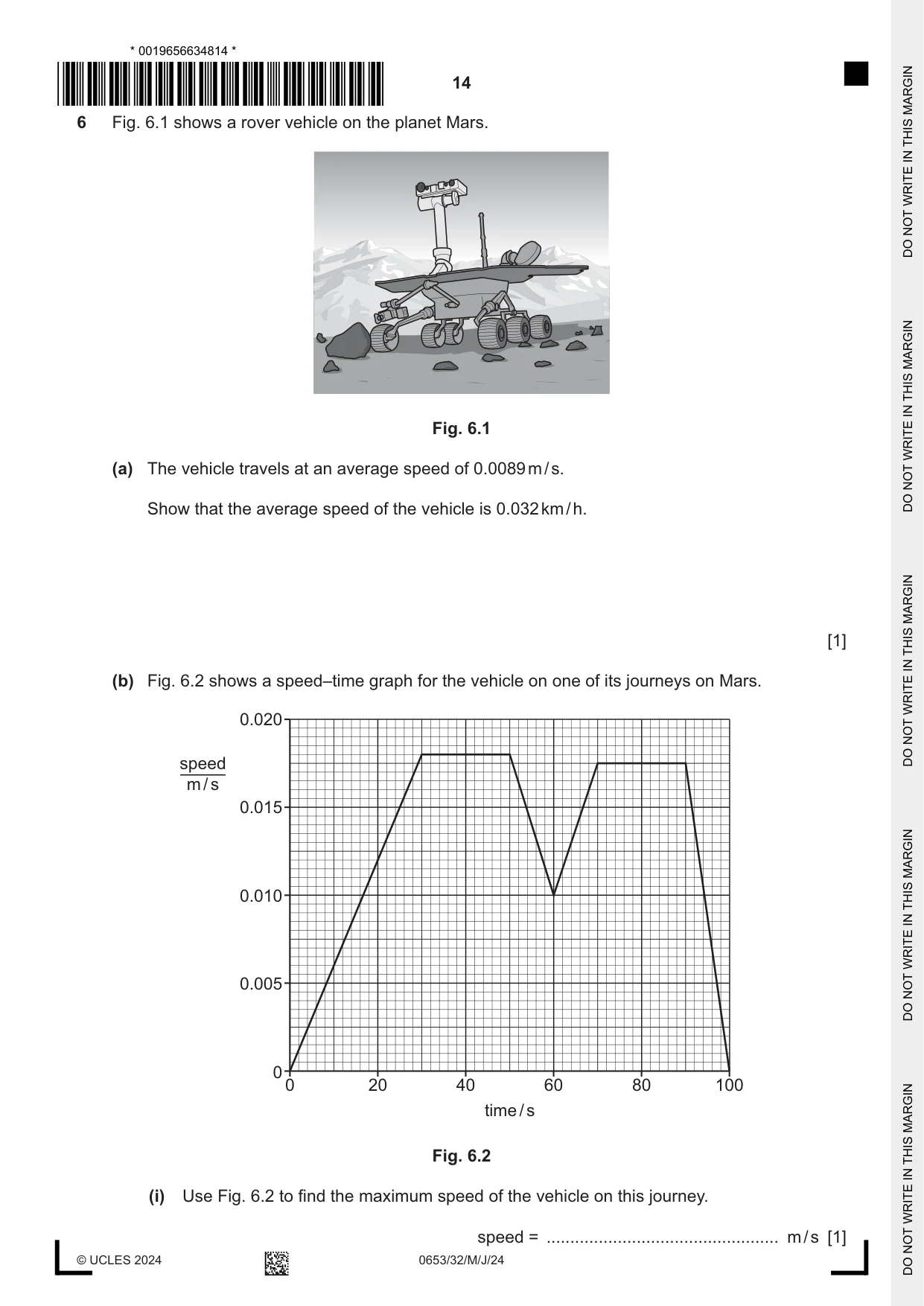
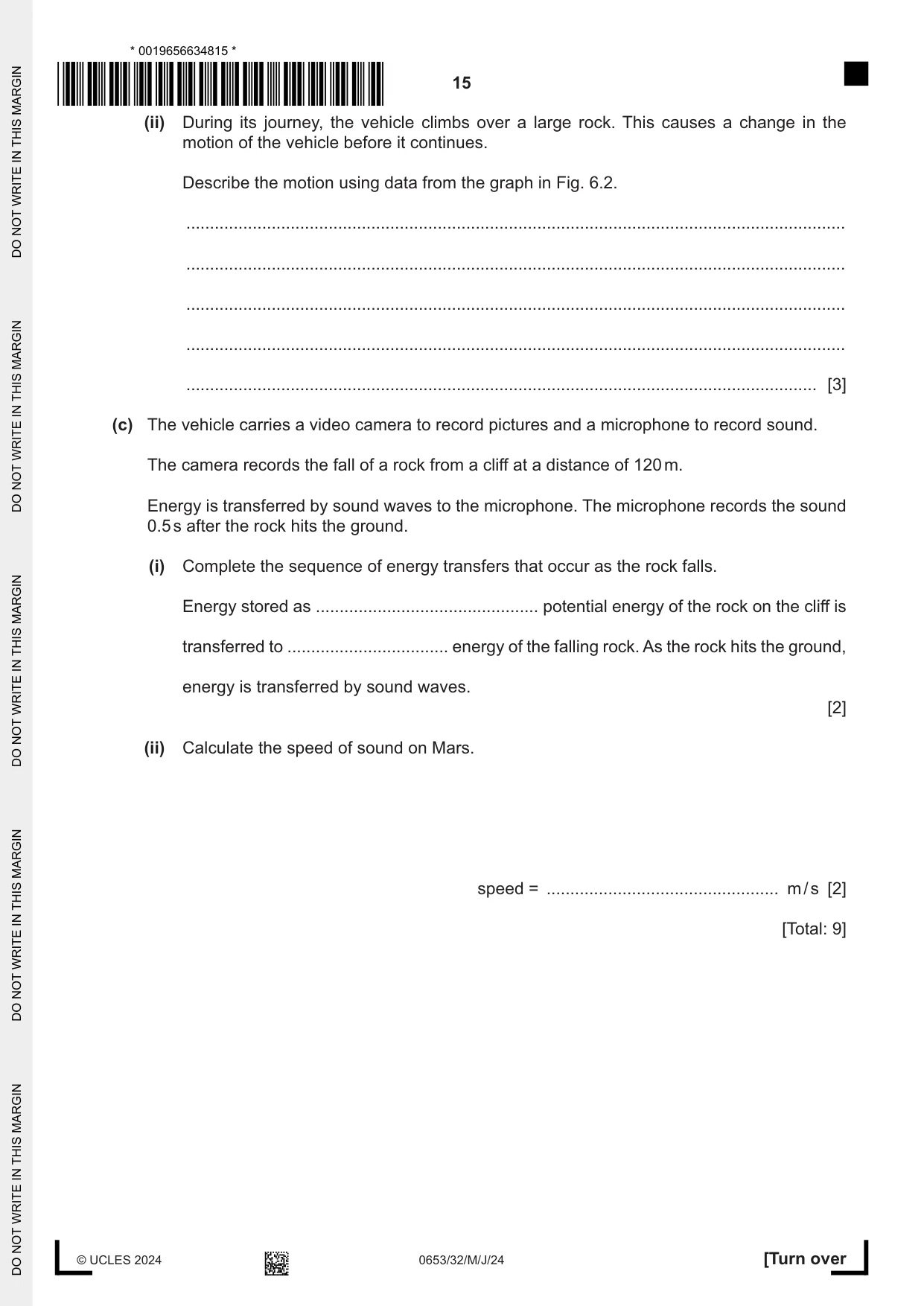
6 Fig. 6.1 shows a rover vehicle on the planet Mars. Fig. 6.1 (a) The vehicle travels at an average speed of 0.0089 m / s. Show that the average speed of the vehicle is 0.032 km / h. [1] (b) Fig. 6.2 shows a speed–time graph for the vehicle on one of its journeys on Mars. 0.020 speed m / s 0.015 0.010 0.005 0 0 20 40 60 80 100 time / s Fig. 6.2 (i) Use Fig. 6.2 to find the maximum speed of the vehicle on this journey. speed = ................................................. m / s [1] (ii) During its journey, the vehicle climbs over a large rock. This causes a change in the motion of the vehicle before it continues. Describe the motion using data from the graph in Fig. 6.2. ........................................................................................................................................... ........................................................................................................................................... ........................................................................................................................................... ........................................................................................................................................... ..................................................................................................................................... [3] (c) The vehicle carries a video camera to record pictures and a microphone to record sound. The camera records the fall of a rock from a cliff at a distance of 120 m. Energy is transferred by sound waves to the microphone. The microphone records the sound 0.5 s after the rock hits the ground. (i) Complete the sequence of energy transfers that occur as the rock falls. Energy stored as ............................................... potential energy of the rock on the cliff is transferred to .................................. energy of the falling rock. As the rock hits the ground, energy is transferred by sound waves. [2] (ii) Calculate the speed of sound on Mars. speed = ................................................. m / s [2] [Total: 9]
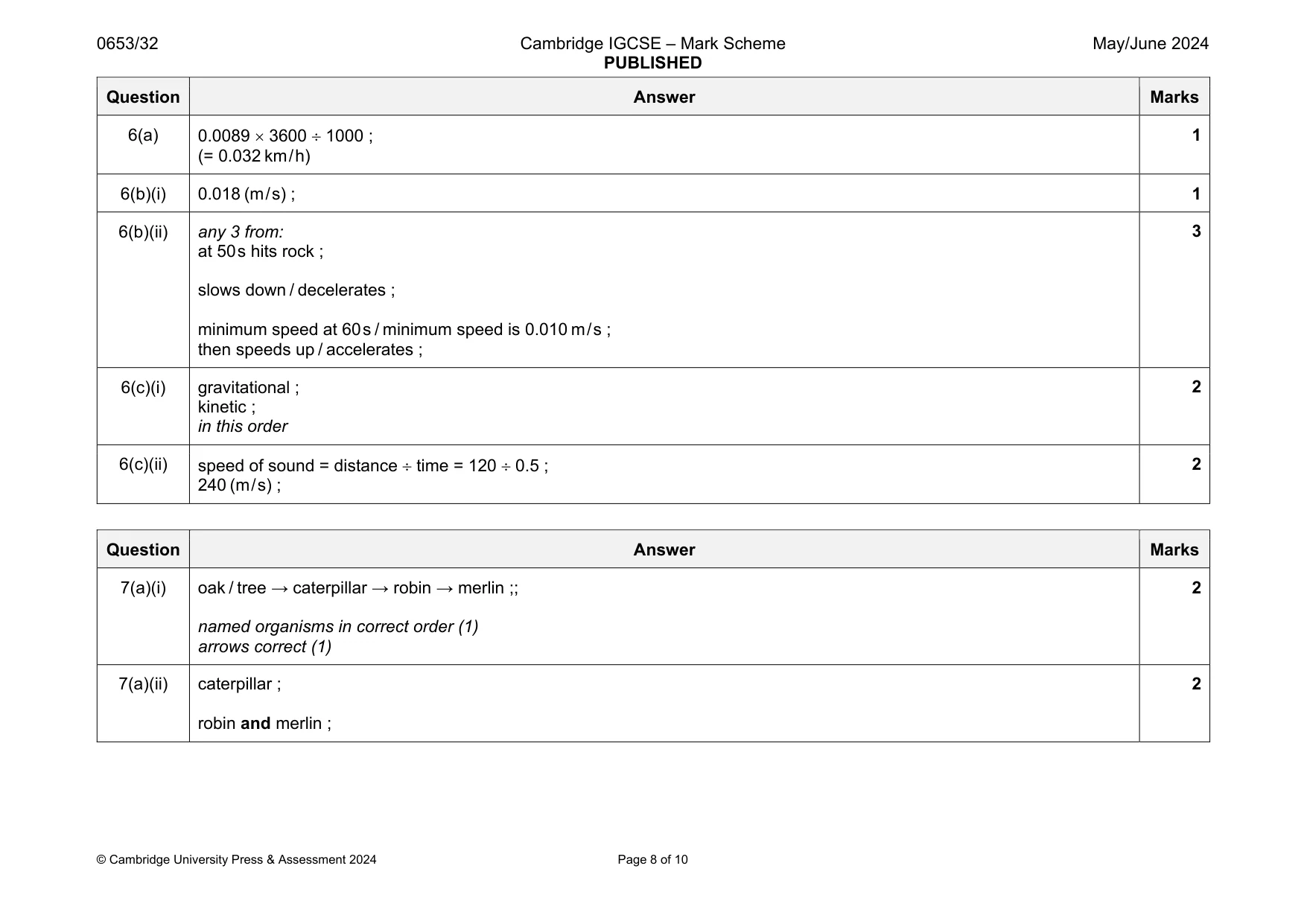
Mark scheme: 6(a) (= 0.032 km / h) 1 6(b)(i) 0.018 (m / s) ; 1 6(b)(ii) any 3 from: at 50 s hits rock ; slows down / decelerates ; minimum speed at 60 s / minimum speed is 0.010 m / s ; then speeds up / accelerates ; 3 6(c)(i) gravitational ; kinetic ; in this order 2 6(c)(ii) speed of sound = distance time = 120 0.5 ; 240 (m / s) ; 2
Question 7
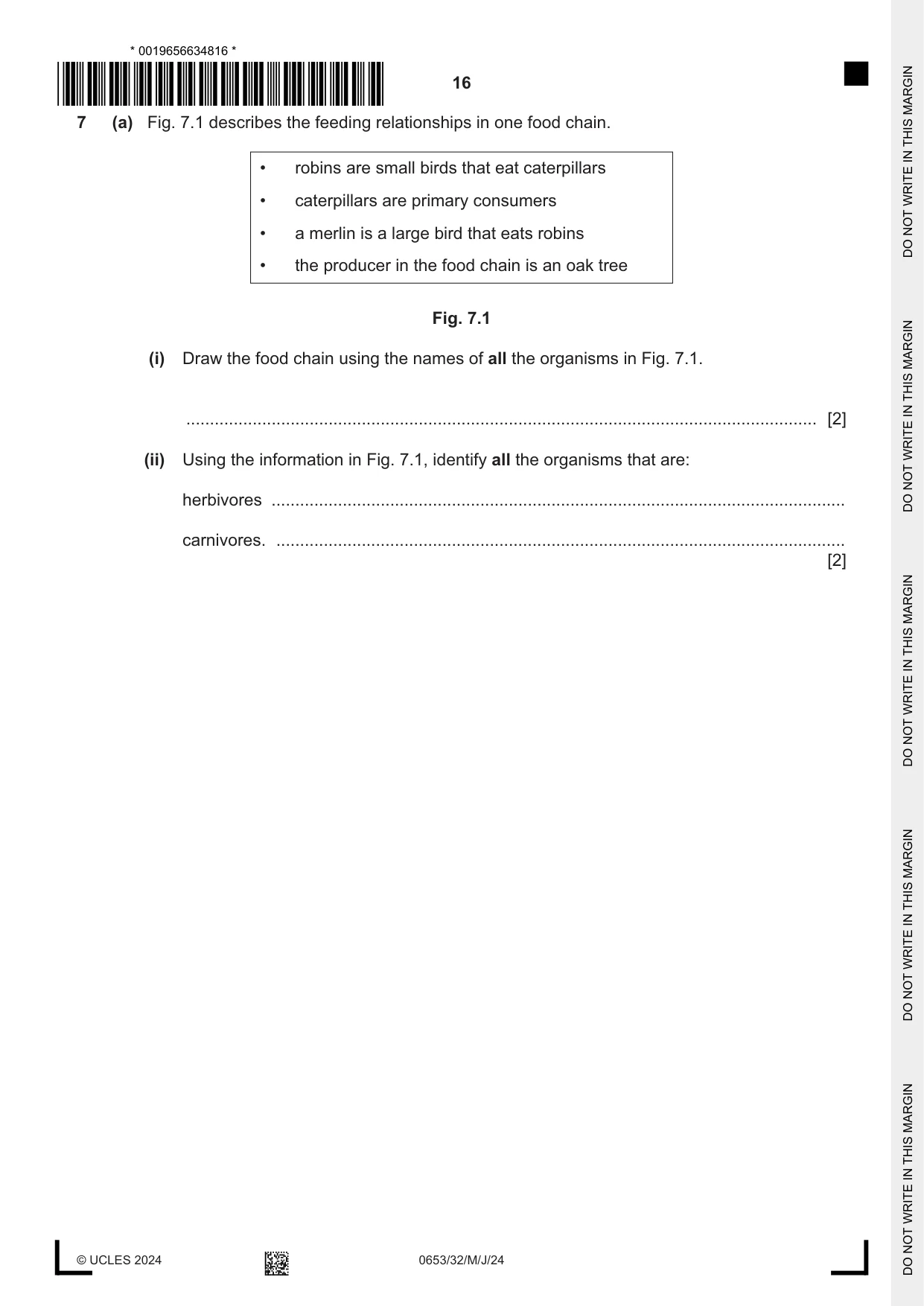
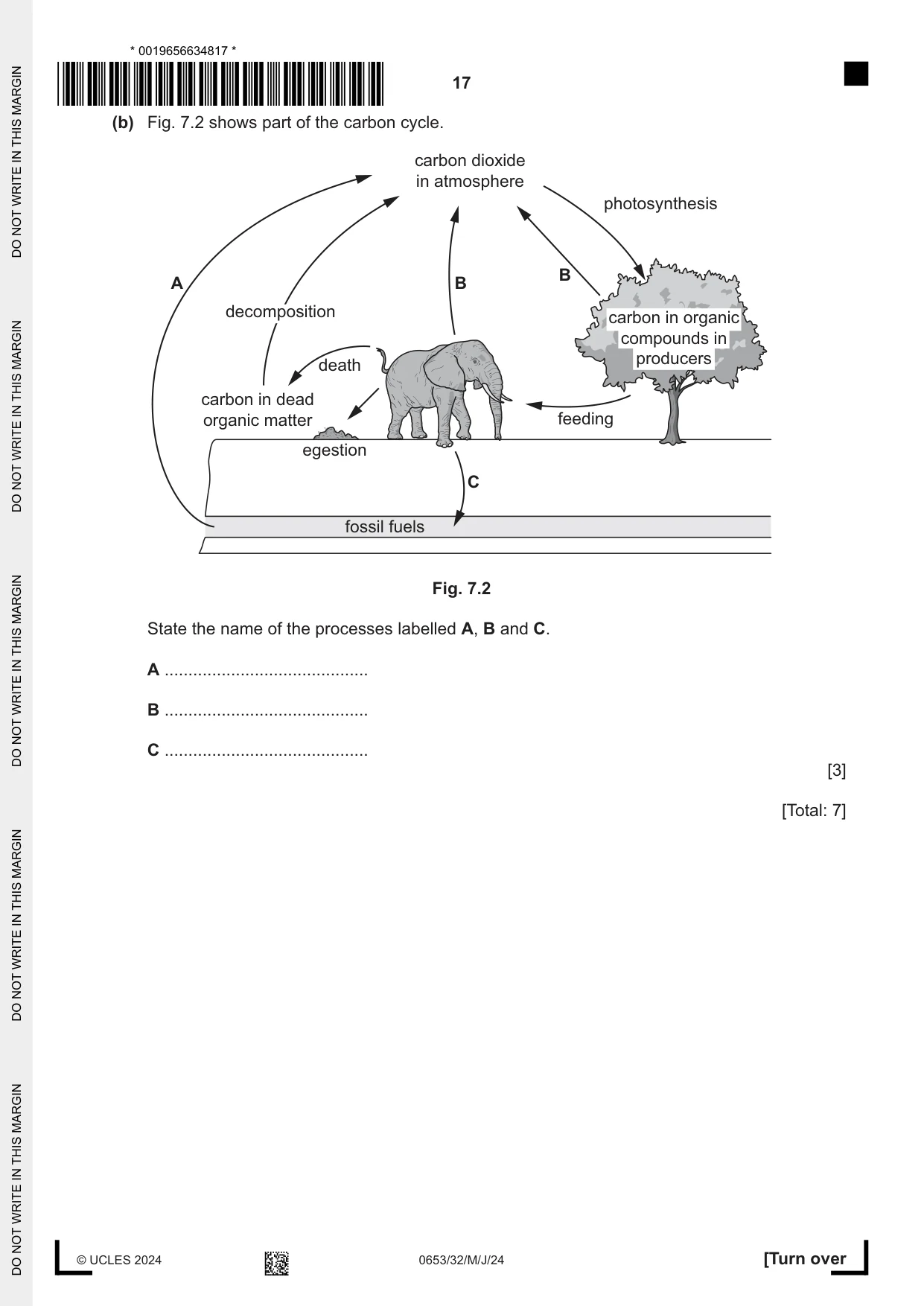
7 (a) Fig. 7.1 describes the feeding relationships in one food chain. • robins are small birds that eat caterpillars • caterpillars are primary consumers • a merlin is a large bird that eats robins • the producer in the food chain is an oak tree Fig. 7.1 (i) Draw the food chain using the names of all the organisms in Fig. 7.1. ..................................................................................................................................... [2] (ii) Using the information in Fig. 7.1, identify all the organisms that are: herbivores ......................................................................................................................... carnivores. ........................................................................................................................ [2] (b) Fig. 7.2 shows part of the carbon cycle. carbon dioxide in atmosphere photosynthesis B A B decomposition carbon in organic compounds in producers death carbon in dead organic matter feeding egestion C fossil fuels Fig. 7.2 State the name of the processes labelled A, B and C. A ........................................... B ........................................... C ........................................... [3] [Total: 7]
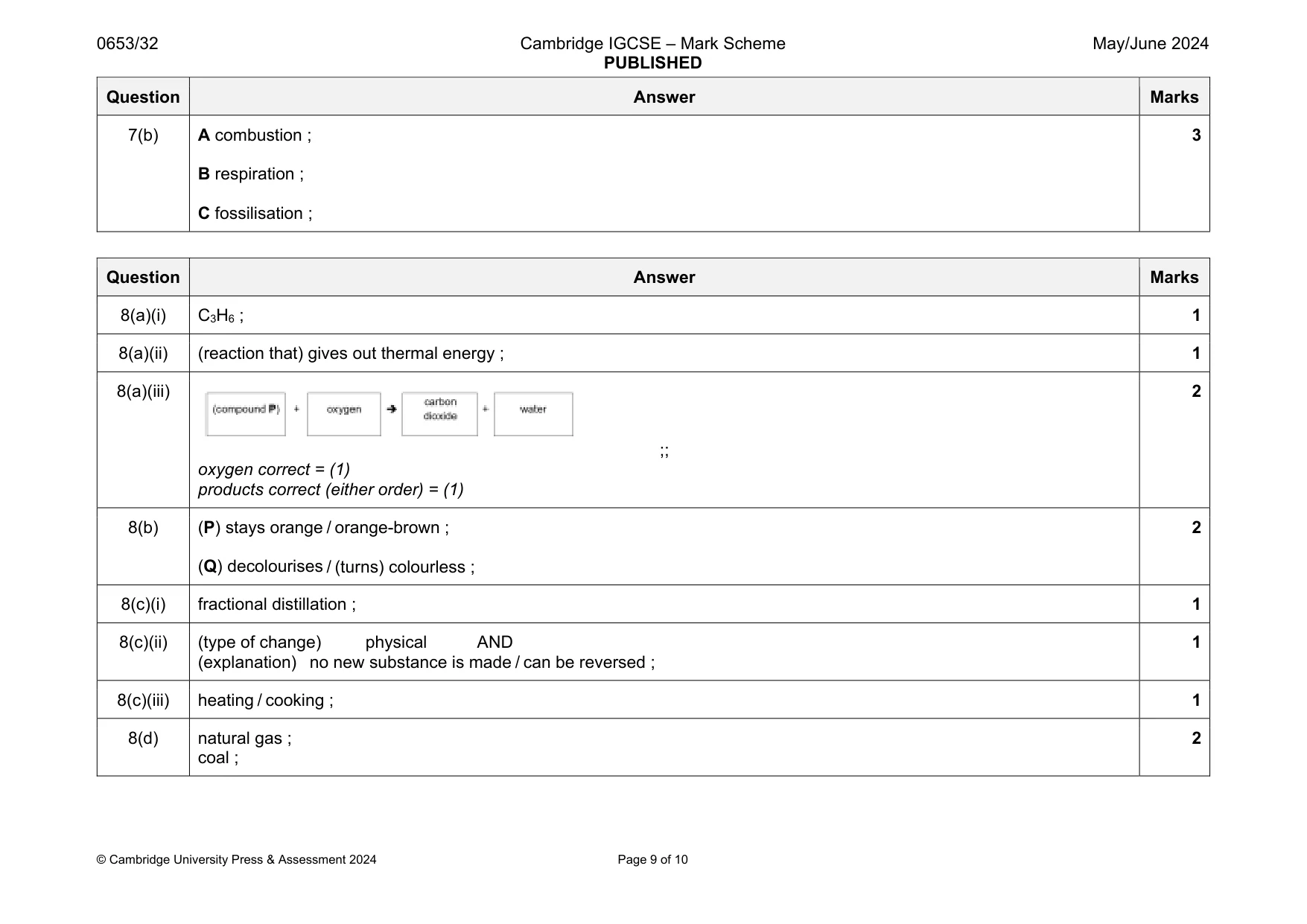
Mark scheme: 7(a)(i) oak / tree → caterpillar → robin → merlin ;; named organisms in correct order (1) arrows correct (1) 2 7(a)(ii) caterpillar ; robin and merlin ; 2 Question Answer Marks 7(b) A combustion ; B respiration ; C fossilisation ; 3
Q8 · The structures of compounds P and Q are shown in Fig
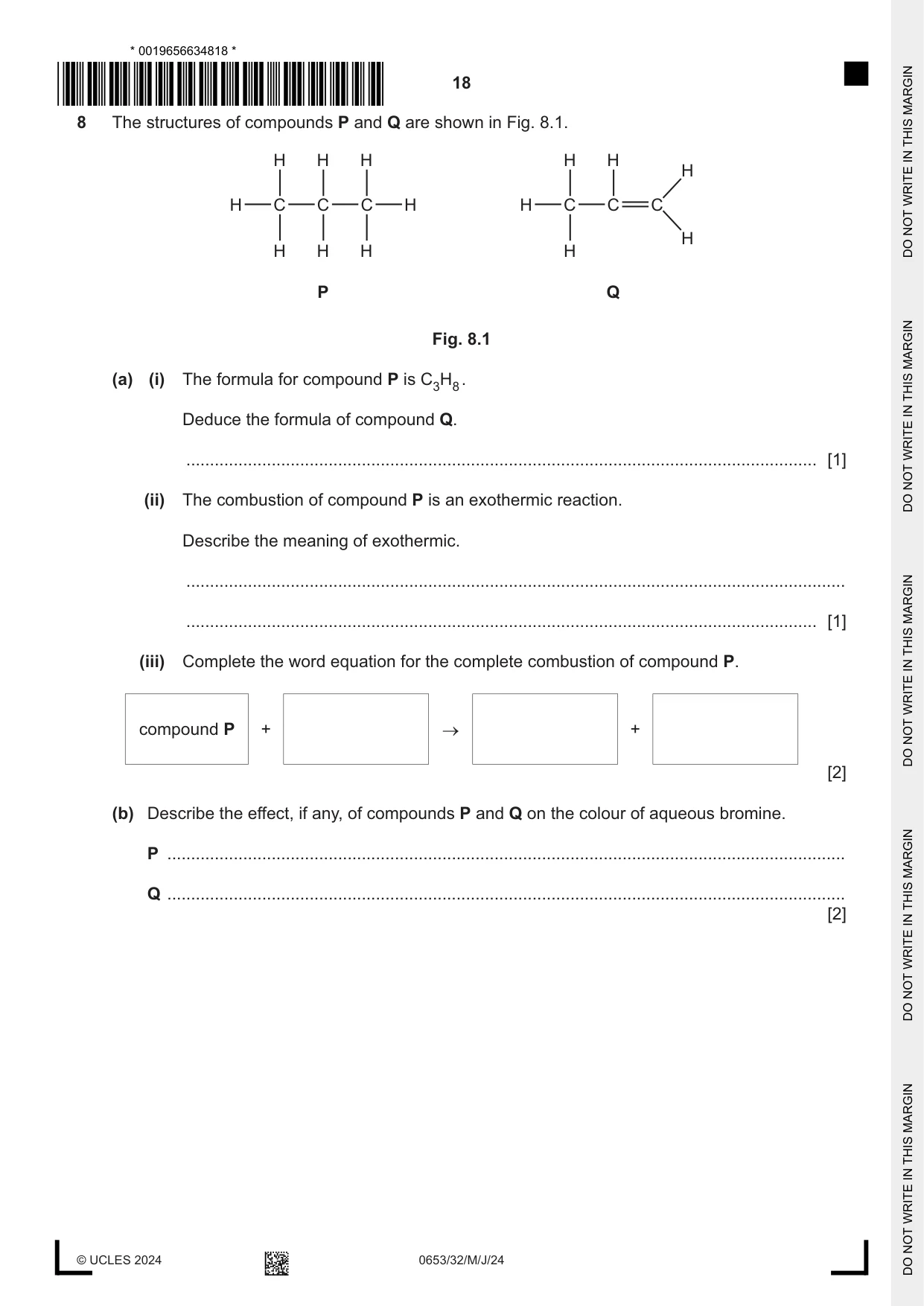
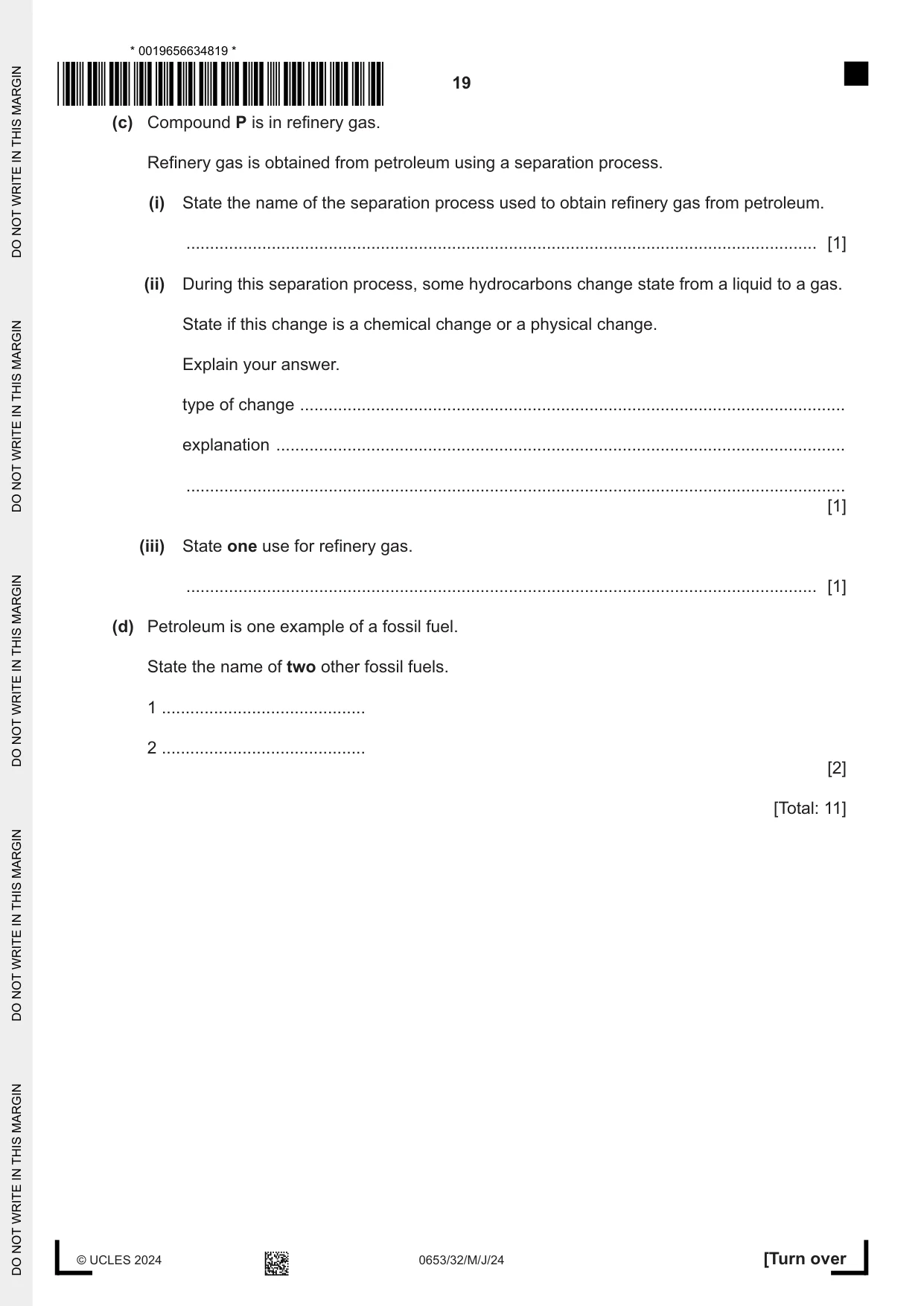
8 The structures of compounds P and Q are shown in Fig. 8.1. H H H H H H H C C C H H C C C H H H H H P Q Fig. 8.1 (a) (i) The formula for compound P is C3H8 . Deduce the formula of compound Q. ..................................................................................................................................... [1] (ii) The combustion of compound P is an exothermic reaction. Describe the meaning of exothermic. ........................................................................................................................................... ..................................................................................................................................... [1] (iii) Complete the word equation for the complete combustion of compound P. compound P + + [2] (b) Describe the effect, if any, of compounds P and Q on the colour of aqueous bromine. P ............................................................................................................................................... Q ............................................................................................................................................... [2] (c) Compound P is in refinery gas. Refinery gas is obtained from petroleum using a separation process. (i) State the name of the separation process used to obtain refinery gas from petroleum. ..................................................................................................................................... [1] (ii) During this separation process, some hydrocarbons change state from a liquid to a gas. State if this change is a chemical change or a physical change. Explain your answer. type of change ................................................................................................................... explanation ........................................................................................................................ ........................................................................................................................................... [1] (iii) State one use for refinery gas. ..................................................................................................................................... [1] (d) Petroleum is one example of a fossil fuel. State the name of two other fossil fuels. 1 ........................................... 2 ........................................... [2] [Total: 11]
Mark scheme: 8(a)(i) C3H6 ; 1 8(a)(ii) (reaction that) gives out thermal energy ; 1 8(a)(iii) ;; ;; ;; oxygen correct = (1) products correct (either order) = (1) 2 8(b) (P) stays orange / orange-brown ; (Q) decolourises / (turns) colourless ; 2 8(c)(i) fractional distillation ; 1 8(c)(ii) (type of change) physical AND (explanation) no new substance is made / can be reversed ; 1 8(c)(iii) heating / cooking ; 1 8(d) natural gas ; coal ; 2
Q9 · A student investigates the current in different resistors by connecting them in a circuit…
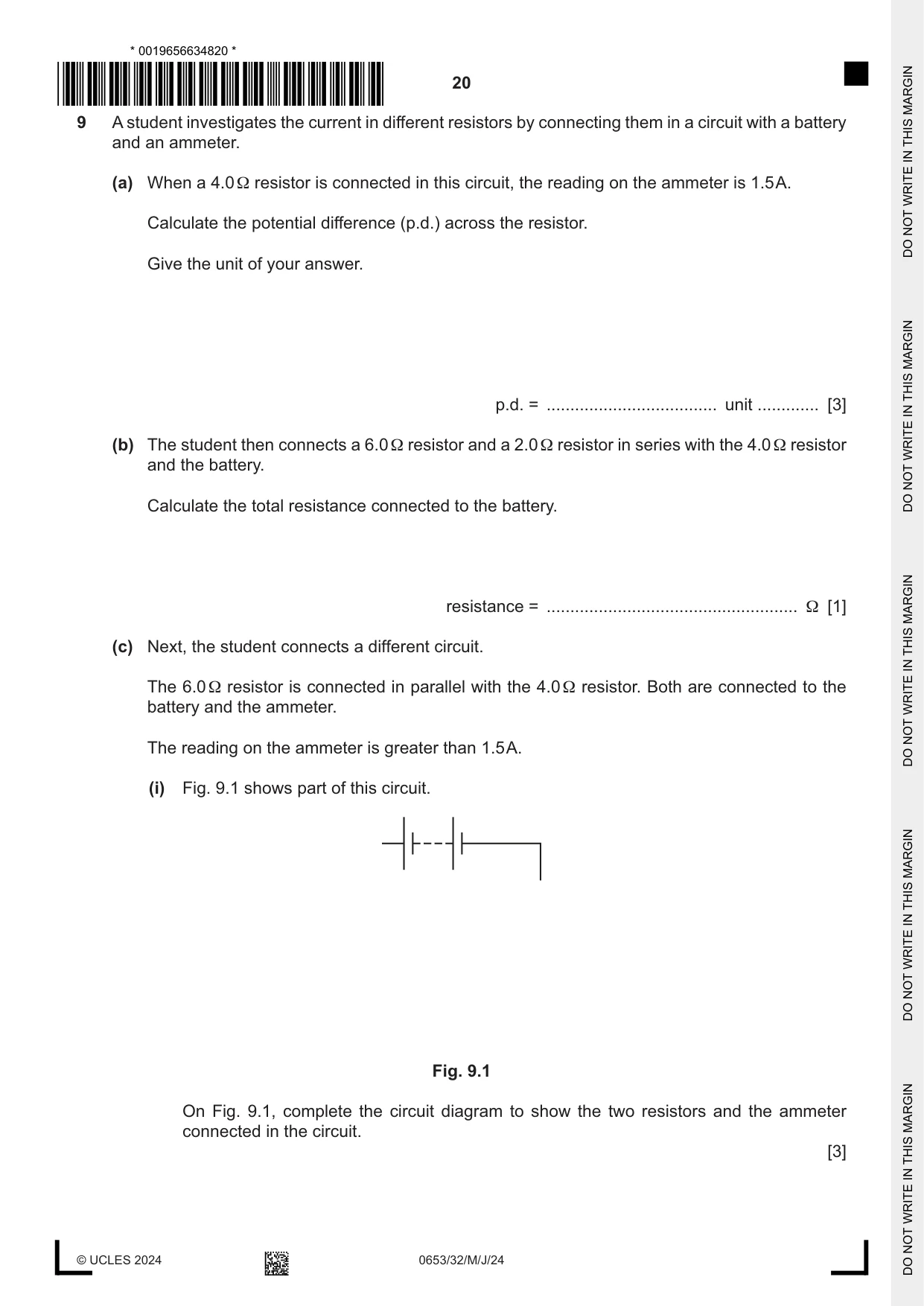
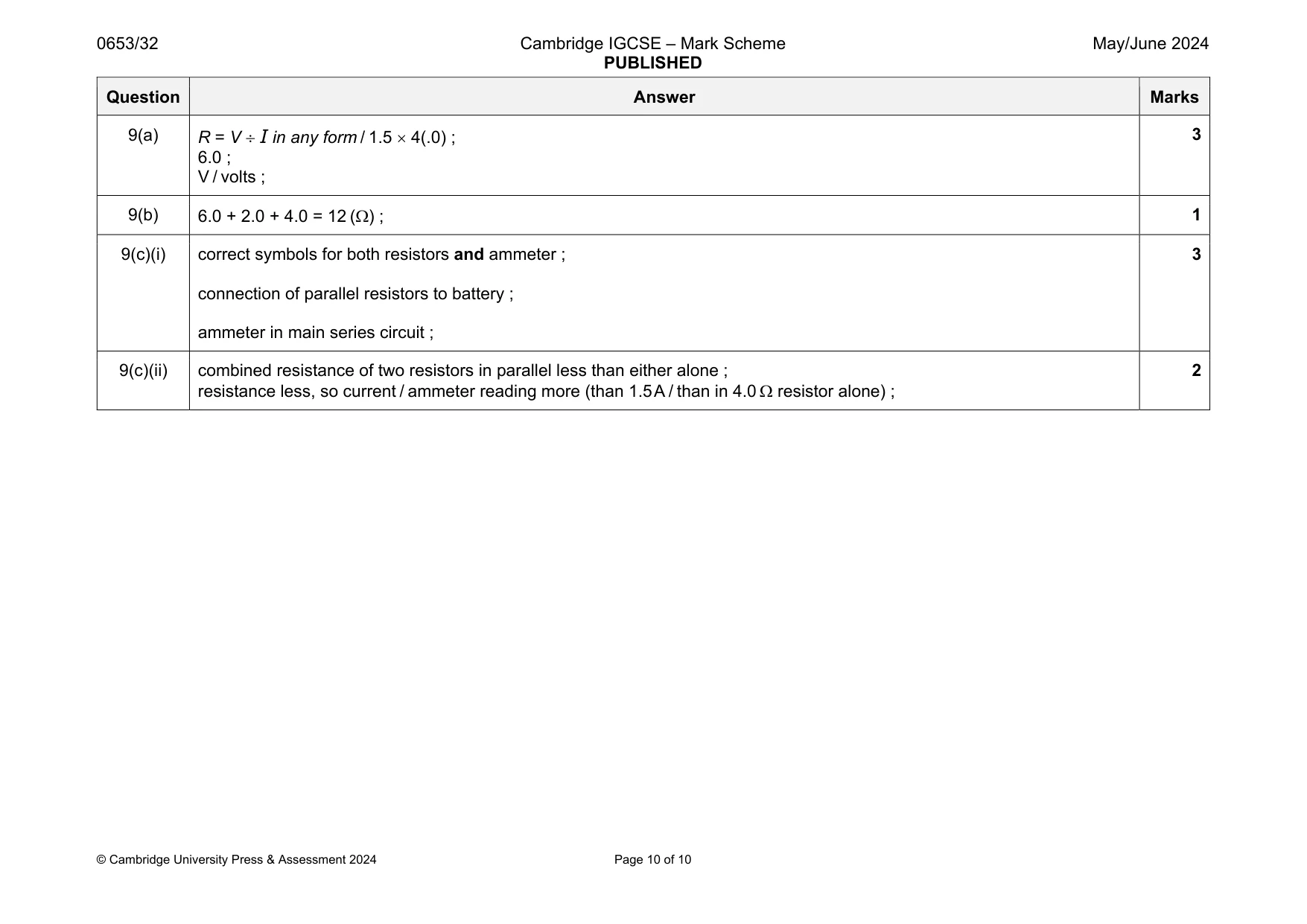
9 A student investigates the current in different resistors by connecting them in a circuit with a battery and an ammeter. (a) When a 4.0 Ω resistor is connected in this circuit, the reading on the ammeter is 1.5 A. Calculate the potential difference (p.d.) across the resistor. Give the unit of your answer. p.d. = .................................... unit ............. [3] (b) The student then connects a 6.0 Ω resistor and a 2.0 Ω resistor in series with the 4.0 Ω resistor and the battery. Calculate the total resistance connected to the battery. resistance = ..................................................... Ω [1] (c) Next, the student connects a different circuit. The 6.0 Ω resistor is connected in parallel with the 4.0 Ω resistor. Both are connected to the battery and the ammeter. The reading on the ammeter is greater than 1.5 A. (i) Fig. 9.1 shows part of this circuit. Fig. 9.1 On Fig. 9.1, complete the circuit diagram to show the two resistors and the ammeter connected in the circuit. [3] (ii) Explain why the reading on the ammeter is greater than 1.5 A. ........................................................................................................................................... ........................................................................................................................................... ........................................................................................................................................... ..................................................................................................................................... [2] [Total: 9]
Mark scheme: 9(a) 6.0 ; V / volts ; 9(b) 6.0 + 2.0 + 4.0 = 12 () ; 1 9(c)(i) correct symbols for both resistors and ammeter ; connection of parallel resistors to battery ; ammeter in main series circuit ; 3 9(c)(ii) combined resistance of two resistors in parallel less than either alone ; resistance less, so current / ammeter reading more (than 1.5 A / than in 4.0 resistor alone) ; 2
What was in this paper
The subtopics covered by these 9 questions, and how many questions each got. Open one in a new tab to see every Cambridge question on it.
What you needed in this session
Cambridge’s own grade thresholds for 2024 May/June, Paper 3 · Variant 2. A higher threshold means an easier paper — the bar moves with how the cohort did.