Cambridge IGCSE Science - Combined 0653 — 2023 May/June Paper 3 · Variant 2
0653/32/M/J/23 · 9 questions · 80 marks · ≈90 min
The question paper and its mark scheme, free to read here and free to download. This is Cambridge’s own paper, exactly as it was sat.
Question paper24 pages



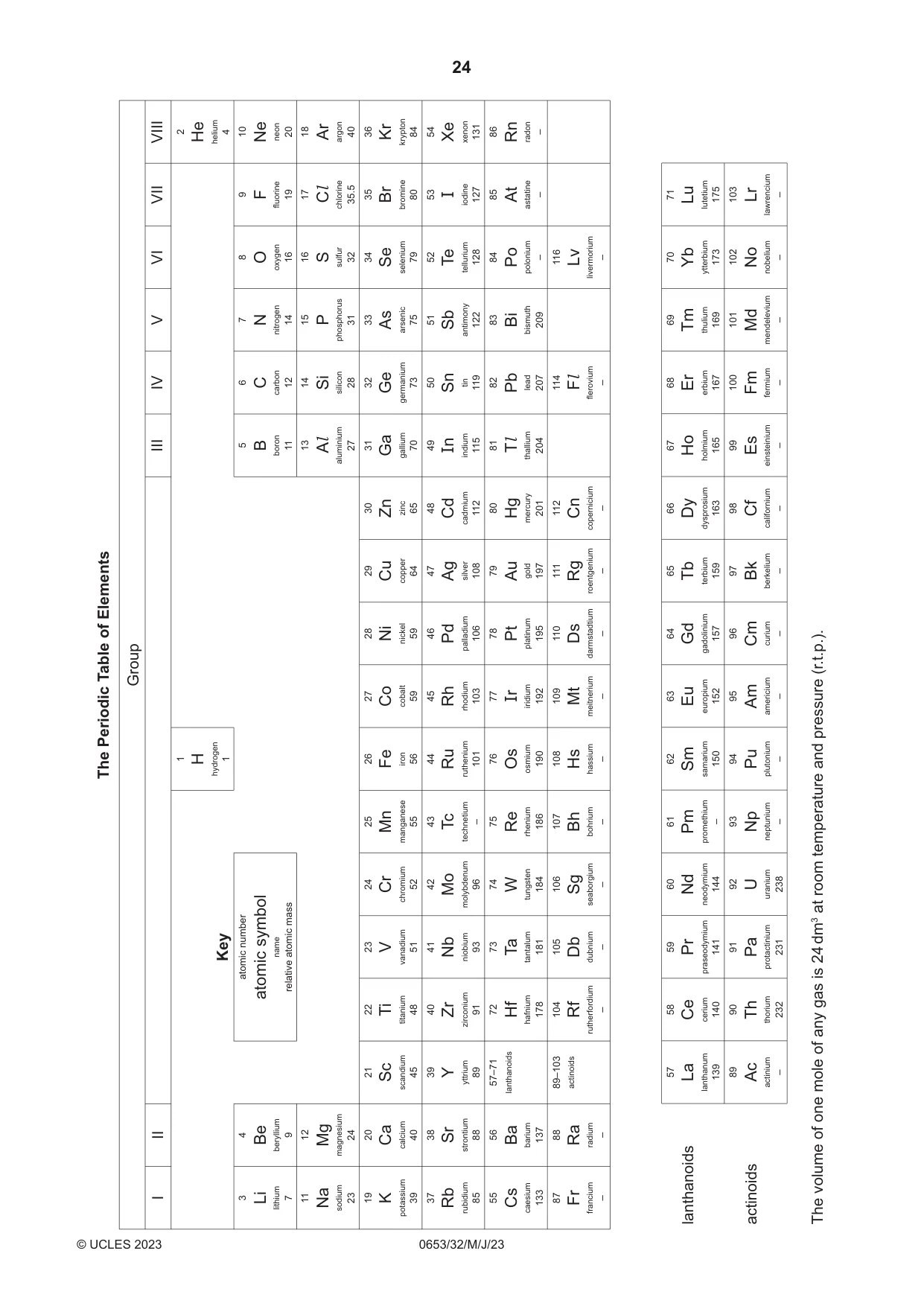
Mark scheme12 pages
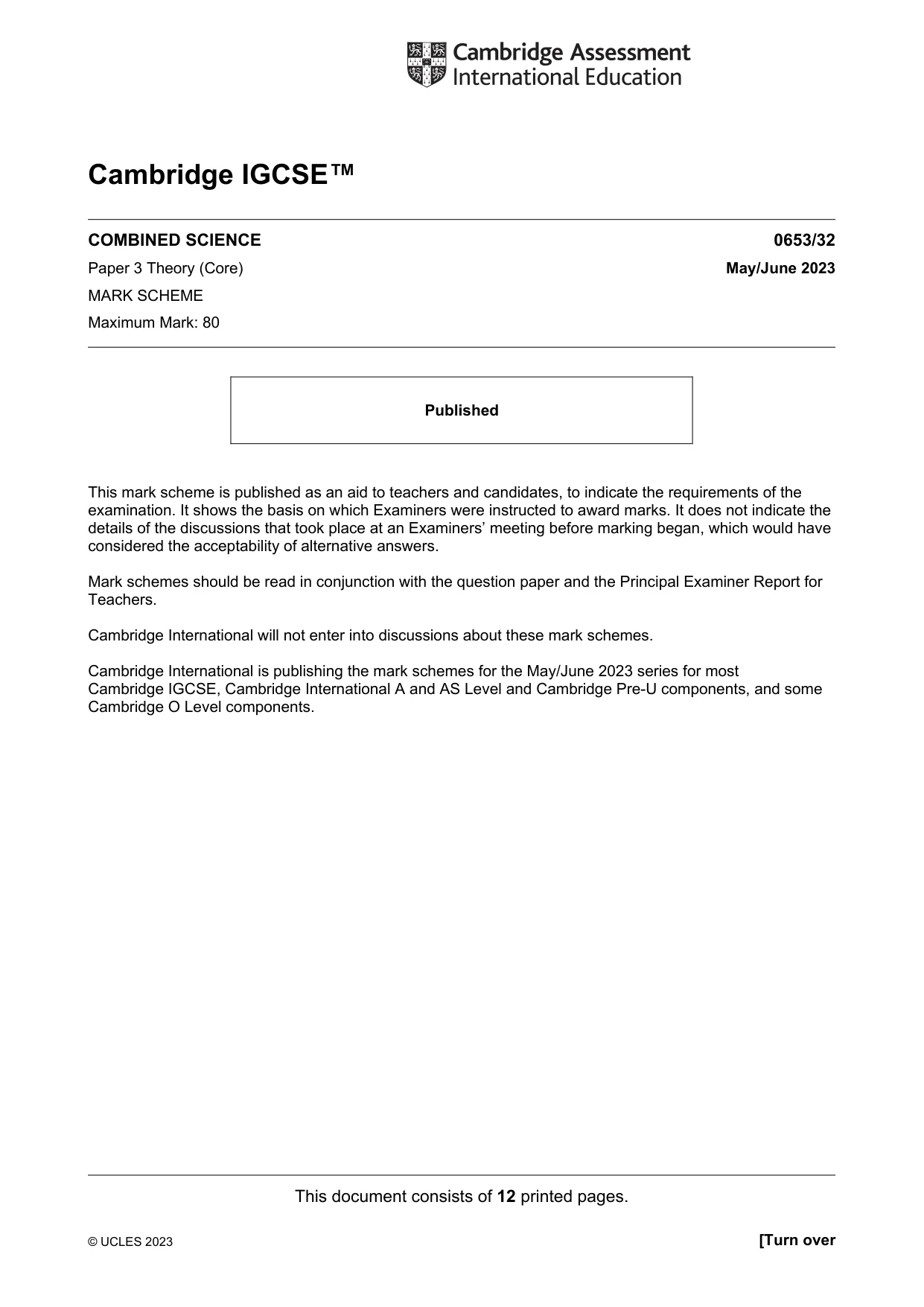
Answers below. Sit the paper first if you are practising.
Questions as text
Q1 · A diagram of a human heart
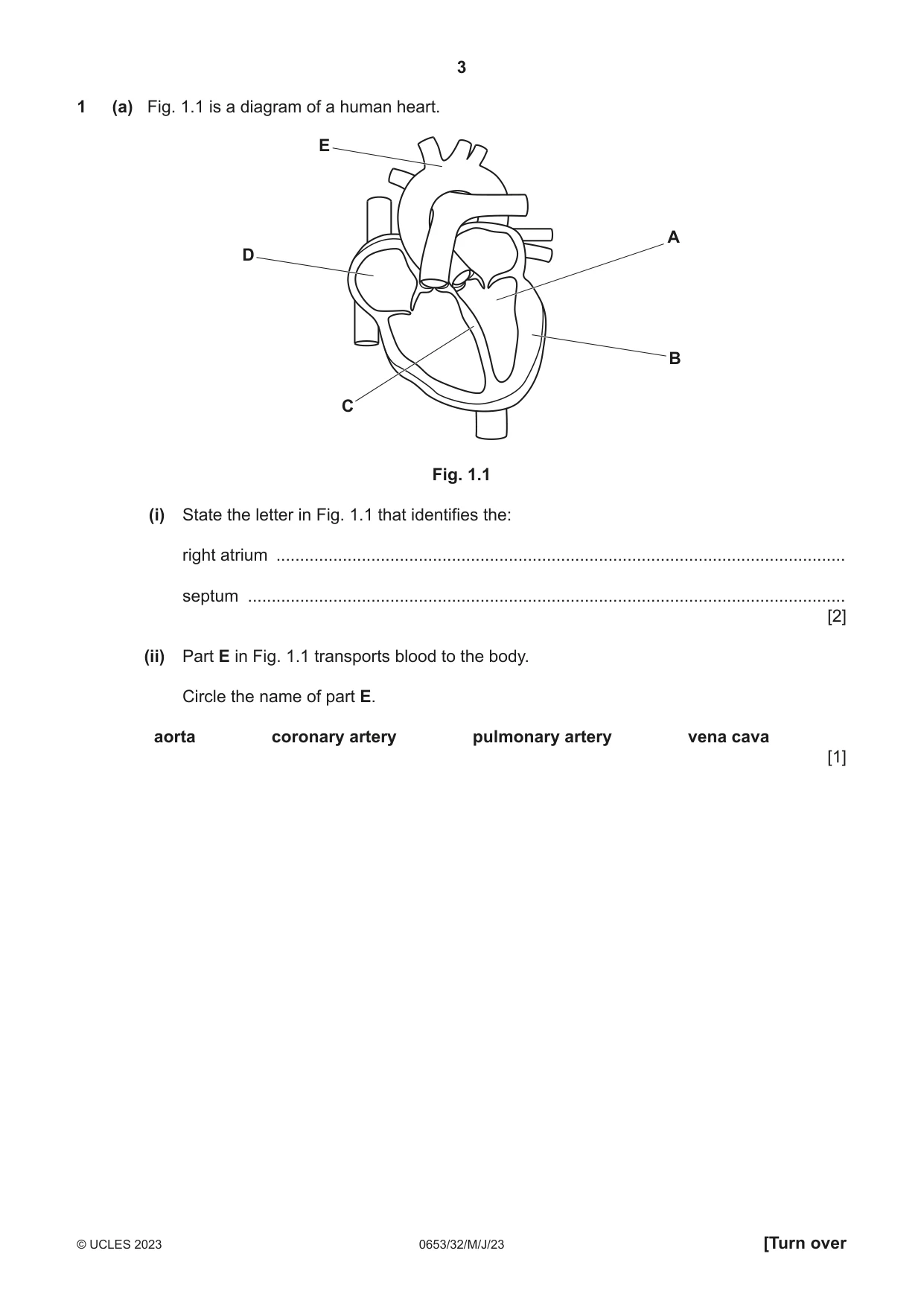
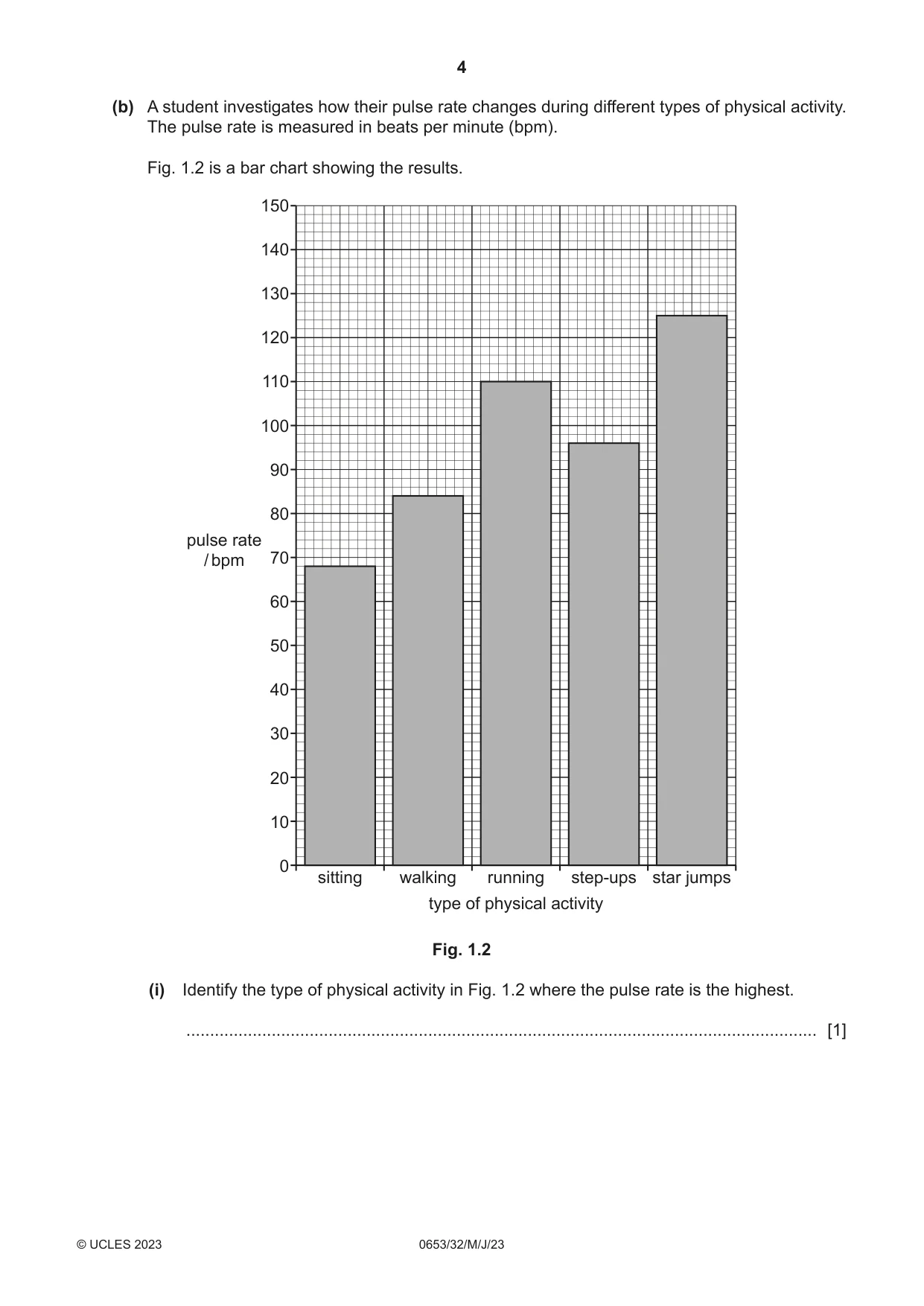
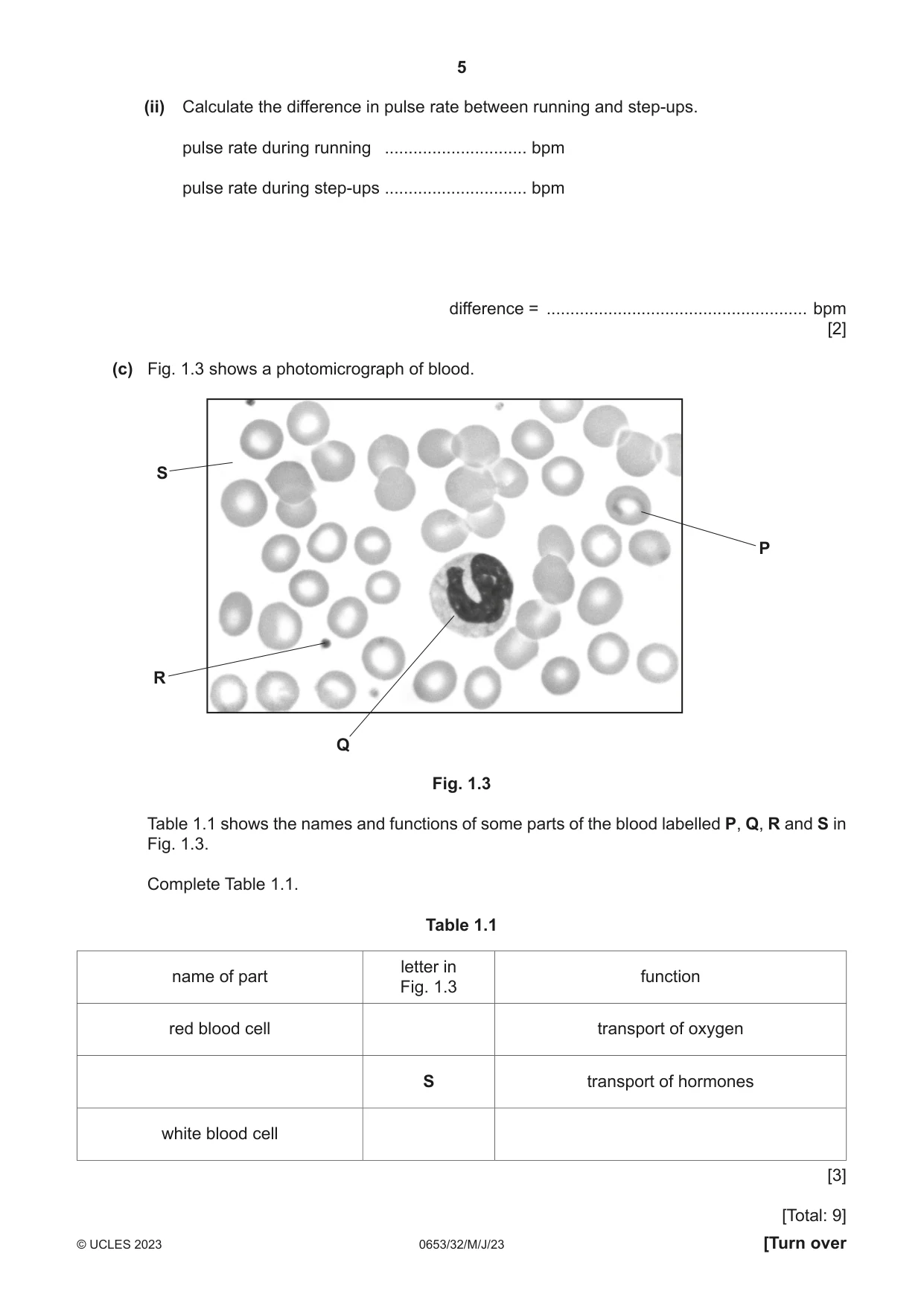
1 (a) Fig. 1.1 is a diagram of a human heart. E A D B C Fig. 1.1 (i) State the letter in Fig. 1.1 that identifies the: right atrium ........................................................................................................................ septum .............................................................................................................................. [2] (ii) Part E in Fig. 1.1 transports blood to the body. Circle the name of part E. aorta coronary artery pulmonary artery vena cava [1] (b) A student investigates how their pulse rate changes during different types of physical activity. The pulse rate is measured in beats per minute (bpm). Fig. 1.2 is a bar chart showing the results. 150 140 130 120 110 100 90 80 pulse rate / bpm 70 60 50 40 30 20 10 0 sitting walking running step-ups star jumps type of physical activity Fig. 1.2 (i) Identify the type of physical activity in Fig. 1.2 where the pulse rate is the highest. ..................................................................................................................................... [1] (ii) Calculate the difference in pulse rate between running and step‑ups. pulse rate during running .............................. bpm pulse rate during step‑ups .............................. bpm difference = ....................................................... bpm [2] (c) Fig. 1.3 shows a photomicrograph of blood. S P R Q Fig. 1.3 Table 1.1 shows the names and functions of some parts of the blood labelled P, Q, R and S in Fig. 1.3. Complete Table 1.1. Table 1.1 letter in name of part function Fig. 1.3 red blood cell transport of oxygen S transport of hormones white blood cell [3] [Total: 9]
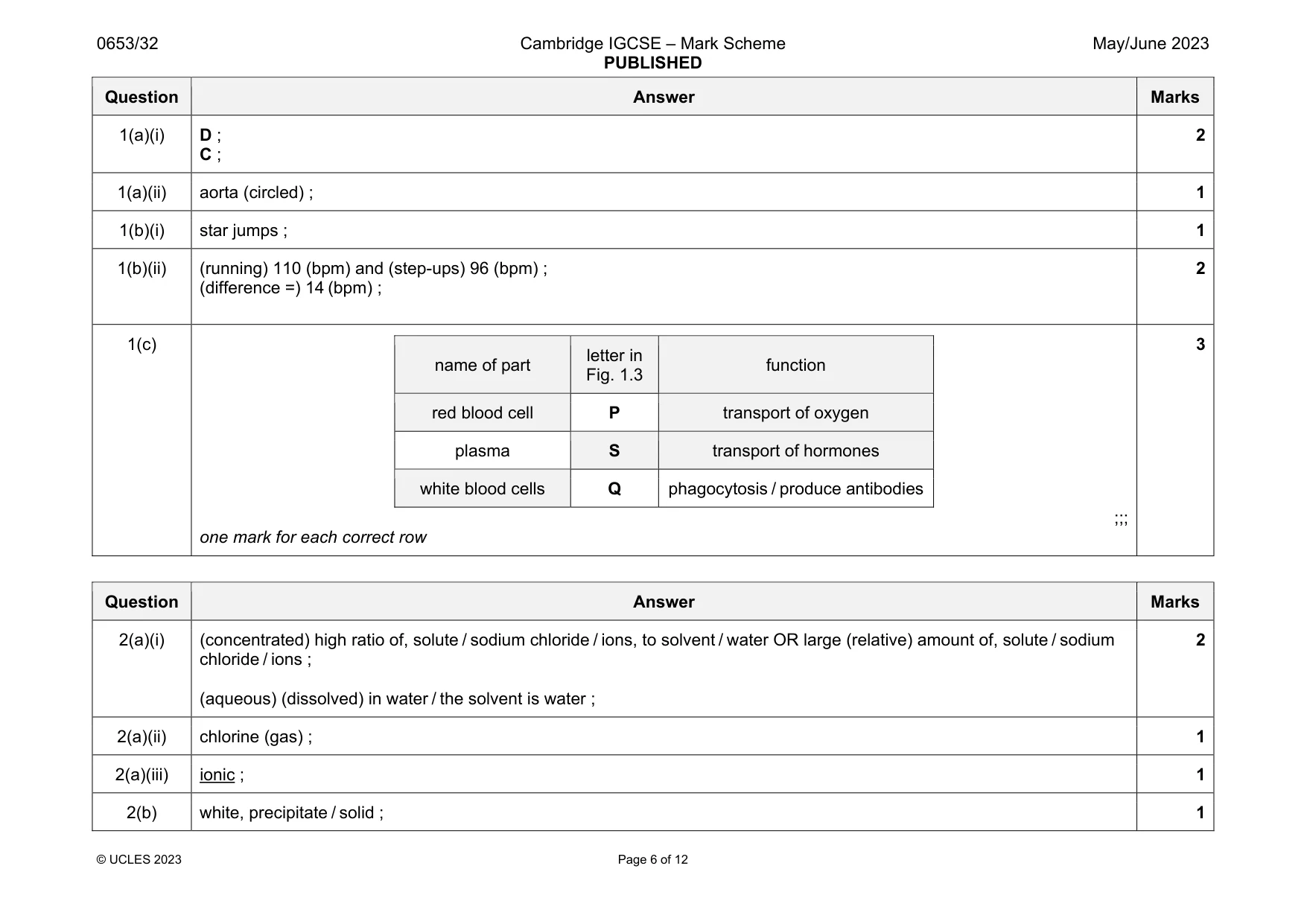
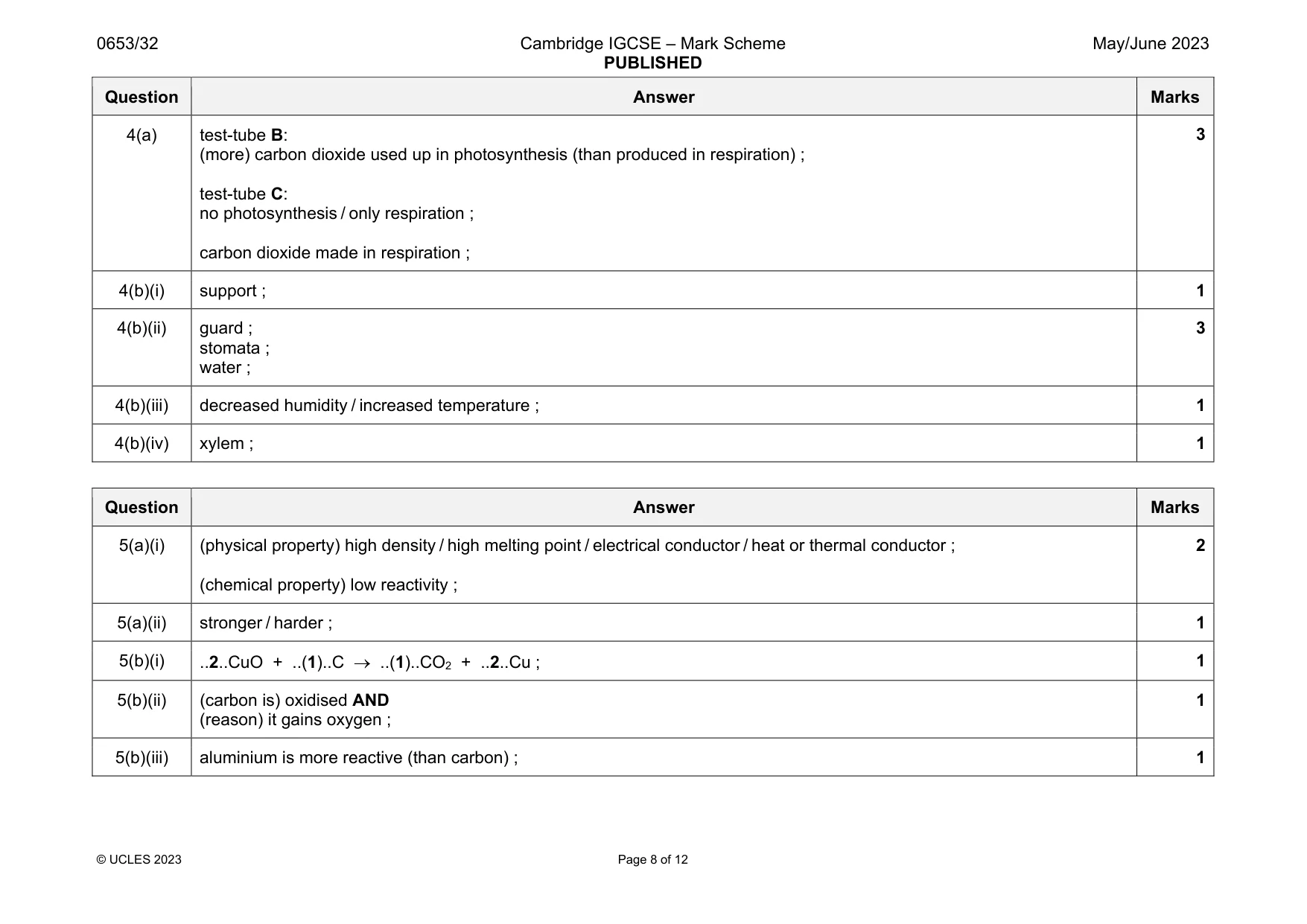
Mark scheme: 1(a)(i) D ; C ; 2 1(a)(ii) aorta (circled) ; 1 1(b)(i) star jumps ; 1 1(b)(ii) (running) 110 (bpm) and (step-ups) 96 (bpm) ; (difference =) 14 (bpm) ; 2 1(c) name of part letter in Fig. 1.3 function red blood cell P transport of oxygen plasma S transport of hormones white blood cells Q phagocytosis / produce antibodies ;;; one mark for each correct row 3
Q2 · A student investigates sodium chloride, NaCl
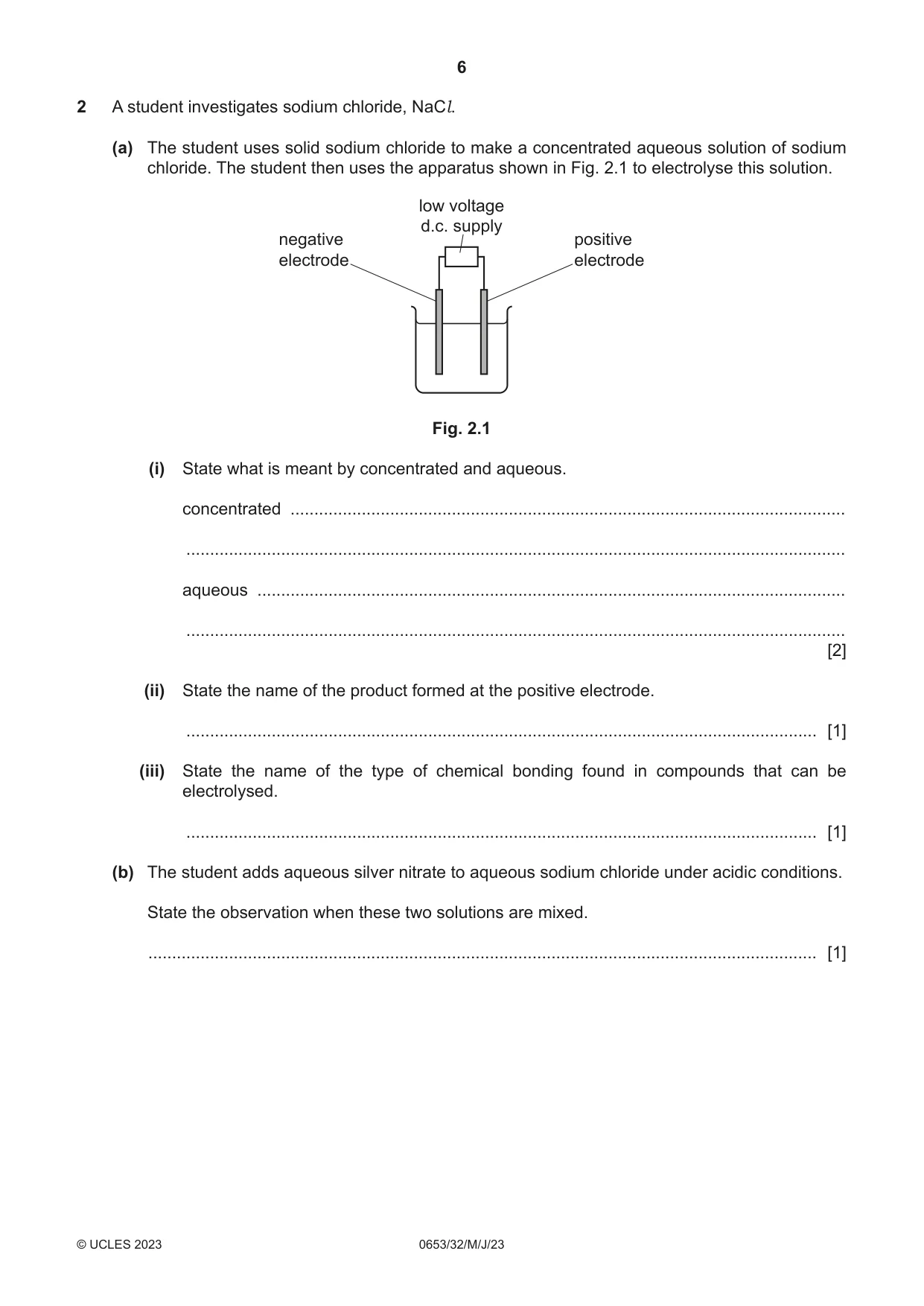
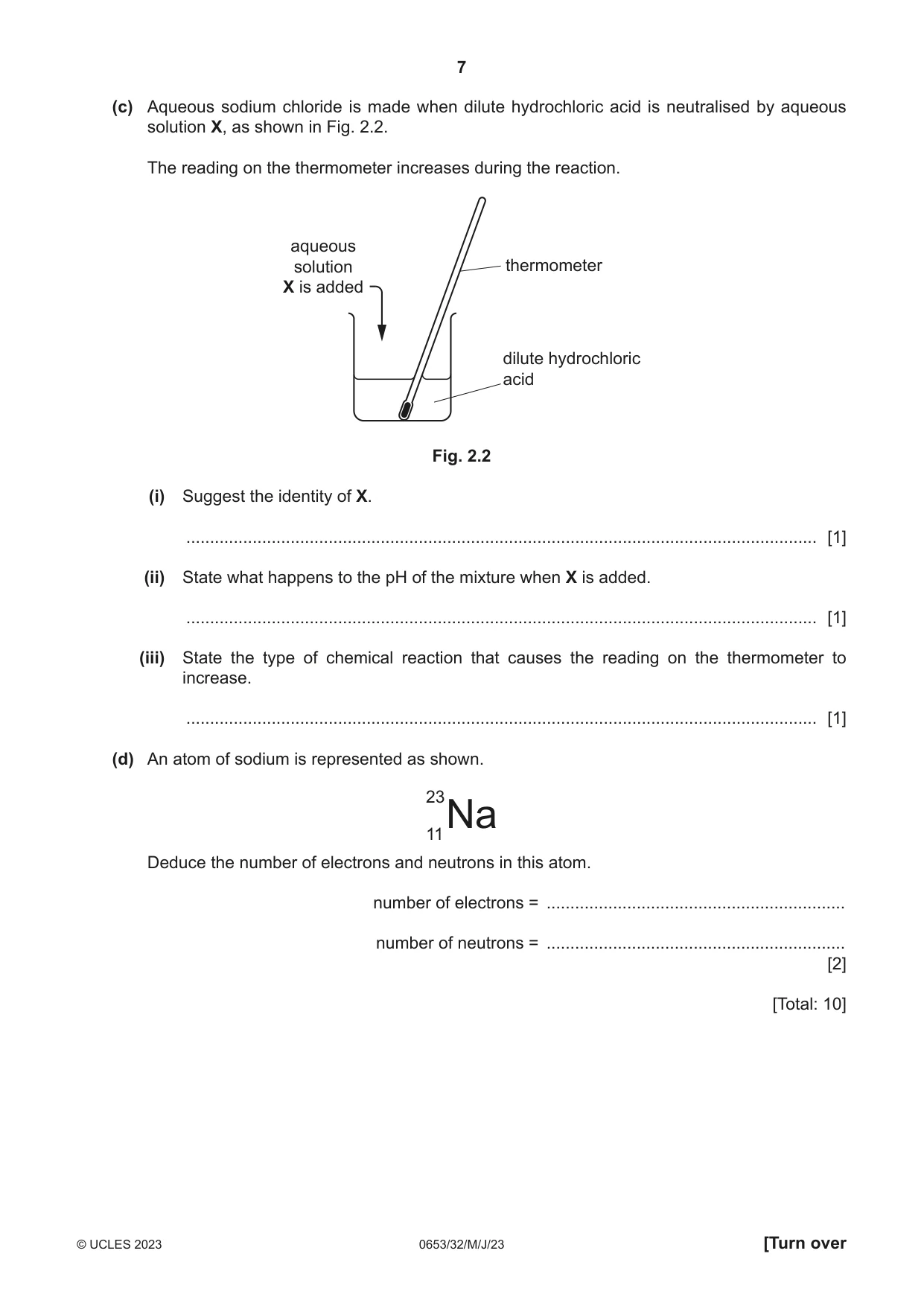
2 A student investigates sodium chloride, NaCl. (a) The student uses solid sodium chloride to make a concentrated aqueous solution of sodium chloride. The student then uses the apparatus shown in Fig. 2.1 to electrolyse this solution. low voltage d.c. supply negative positive electrode electrode Fig. 2.1 (i) State what is meant by concentrated and aqueous. concentrated ..................................................................................................................... ........................................................................................................................................... aqueous ............................................................................................................................ ........................................................................................................................................... [2] (ii) State the name of the product formed at the positive electrode. ..................................................................................................................................... [1] (iii) State the name of the type of chemical bonding found in compounds that can be electrolysed. ..................................................................................................................................... [1] (b) The student adds aqueous silver nitrate to aqueous sodium chloride under acidic conditions. State the observation when these two solutions are mixed. ............................................................................................................................................. [1] (c) Aqueous sodium chloride is made when dilute hydrochloric acid is neutralised by aqueous solution X, as shown in Fig. 2.2. The reading on the thermometer increases during the reaction. aqueous solution thermometer X is added dilute hydrochloric acid Fig. 2.2 (i) Suggest the identity of X. ..................................................................................................................................... [1] (ii) State what happens to the pH of the mixture when X is added. ..................................................................................................................................... [1] (iii) State the type of chemical reaction that causes the reading on the thermometer to increase. ..................................................................................................................................... [1] (d) An atom of sodium is represented as shown. 2311Na Deduce the number of electrons and neutrons in this atom. number of electrons = ............................................................... number of neutrons = ............................................................... [2] [Total: 10]
Mark scheme: 2(a)(i) (concentrated) high ratio of, solute / sodium chloride / ions, to solvent / water OR large (relative) amount of, solute / sodium chloride / ions ; (aqueous) (dissolved) in water / the solvent is water ; 2(a)(ii) chlorine (gas) ; 1 2(a)(iii) ionic ; 1 2(b) white, precipitate / solid ; 1 Question Answer Marks 2(c)(i) sodium hydroxide / NaOH / sodium carbonate / Na2CO3 / sodium hydrogen carbonate / NaHCO3 ; 1 2(c)(ii) increases / rises / goes up to 7 ; 1 2(c)(iii) exothermic ; 1 2(d) (electrons) 11 ; (neutrons) 12 ; 2
Q3 · A speed–time graph for a car on part of a journey along a road
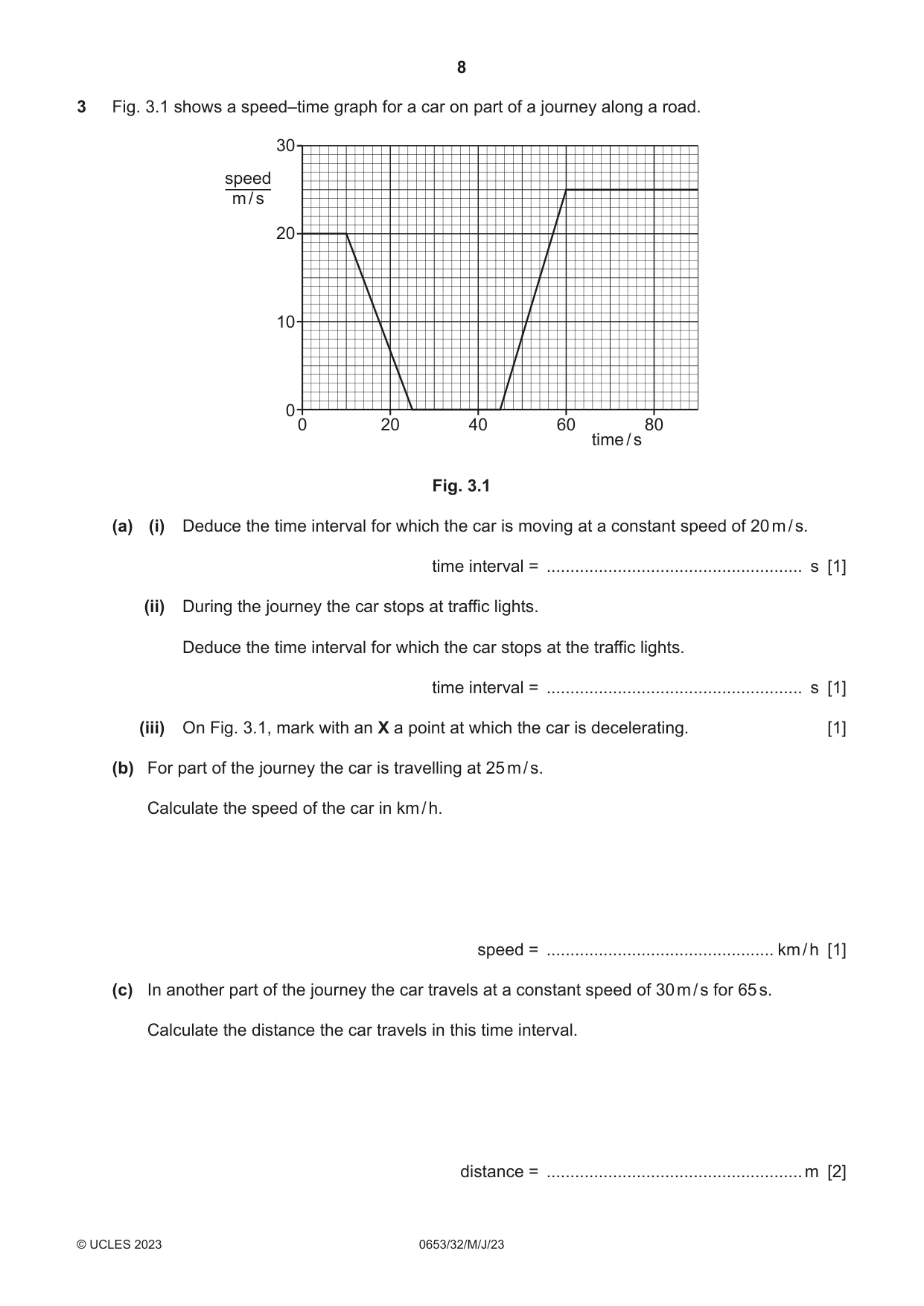
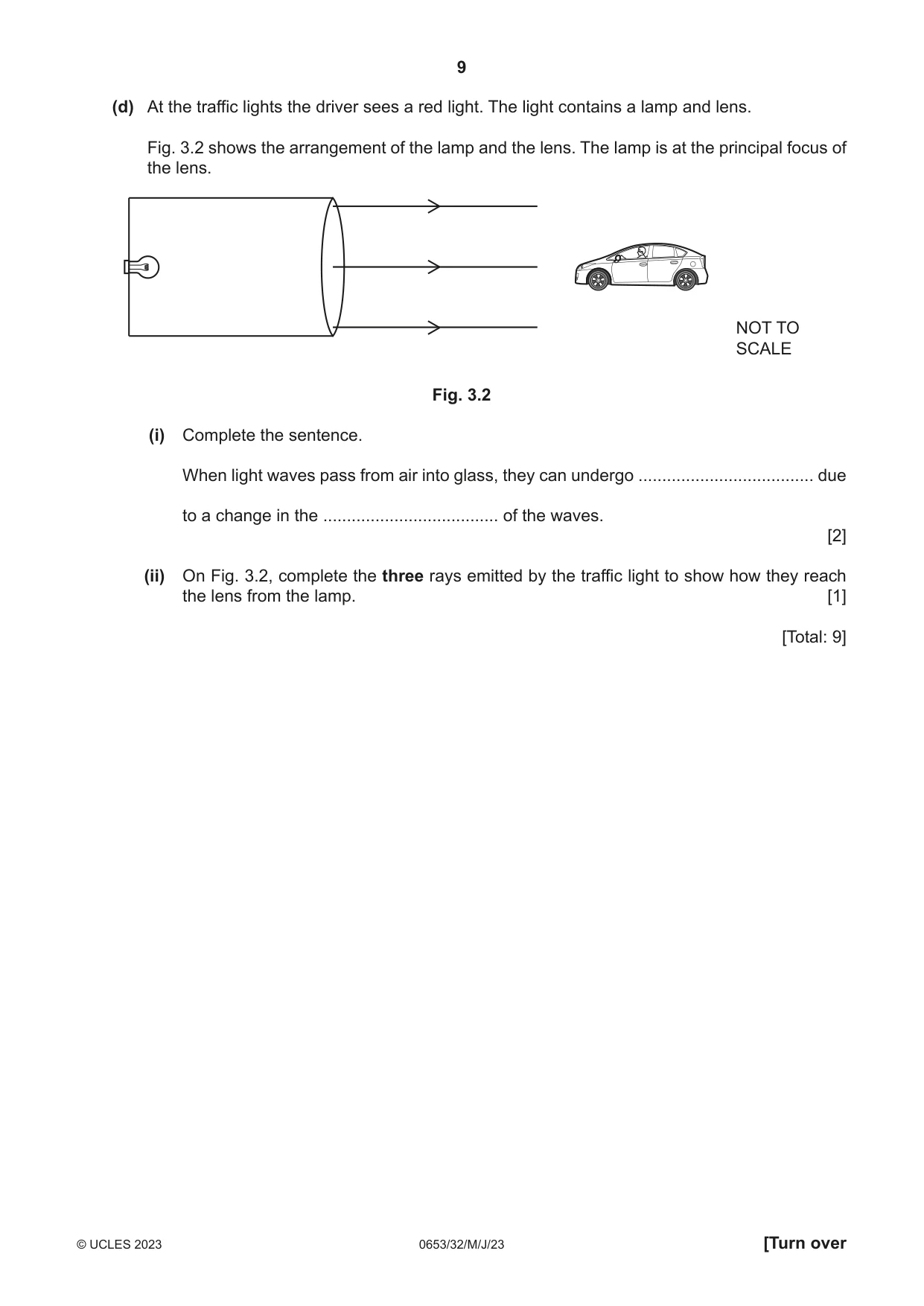
3 Fig. 3.1 shows a speed–time graph for a car on part of a journey along a road. 30 speed m / s 20 10 0 0 20 40 60 80 time / s Fig. 3.1 (a) (i) Deduce the time interval for which the car is moving at a constant speed of 20 m / s. time interval = ...................................................... s [1] (ii) During the journey the car stops at traffic lights. Deduce the time interval for which the car stops at the traffic lights. time interval = ...................................................... s [1] (iii) On Fig. 3.1, mark with an X a point at which the car is decelerating. [1] (b) For part of the journey the car is travelling at 25 m / s. Calculate the speed of the car in km / h. speed = ................................................ km / h [1] (c) In another part of the journey the car travels at a constant speed of 30 m / s for 65 s. Calculate the distance the car travels in this time interval. distance = ...................................................... m [2] (d) At the traffic lights the driver sees a red light. The light contains a lamp and lens. Fig. 3.2 shows the arrangement of the lamp and the lens. The lamp is at the principal focus of the lens. NOT TO SCALE Fig. 3.2 (i) Complete the sentence. When light waves pass from air into glass, they can undergo ..................................... due to a change in the ..................................... of the waves. [2] (ii) On Fig. 3.2, complete the three rays emitted by the traffic light to show how they reach the lens from the lamp. [1] [Total: 9]
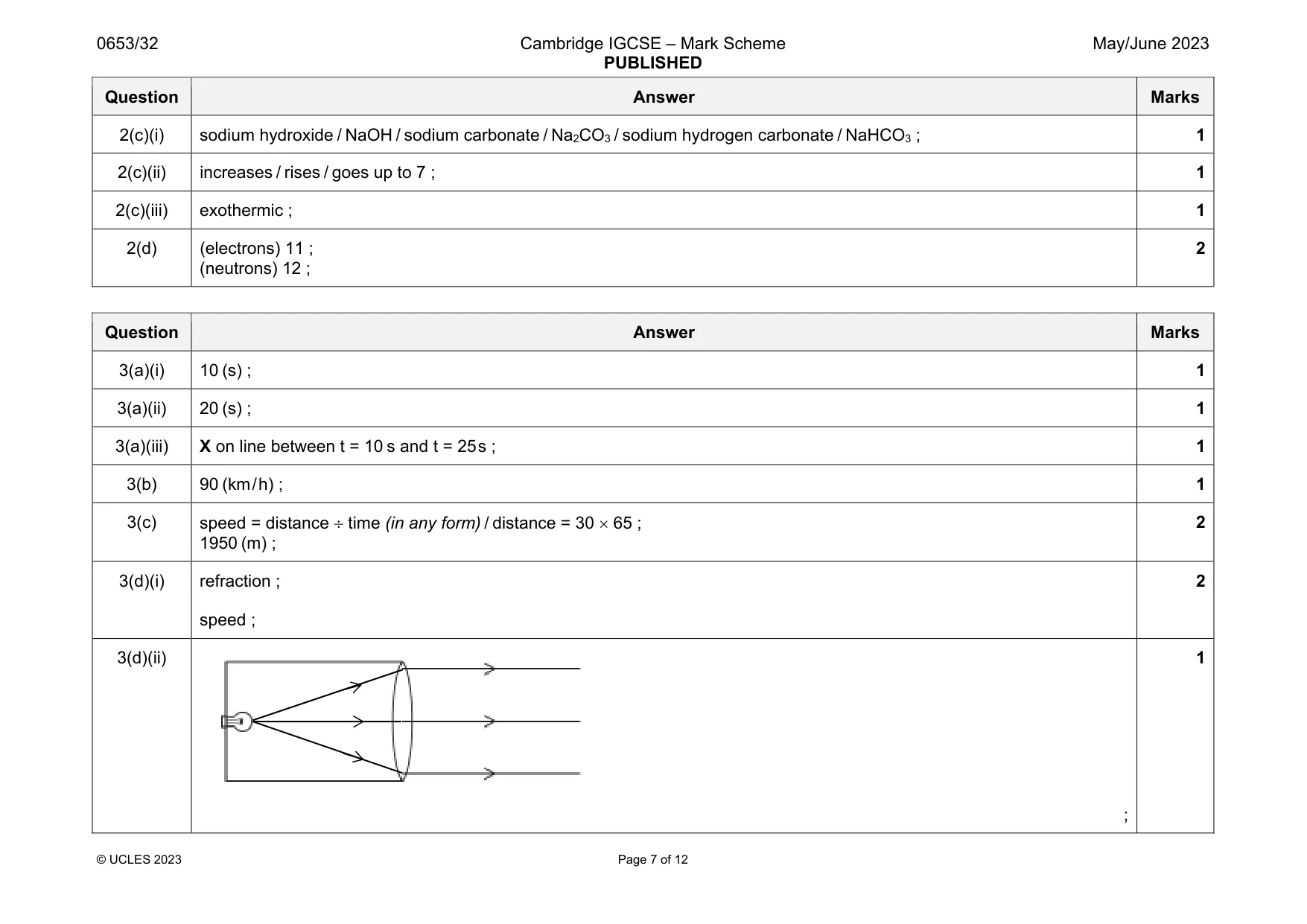
Mark scheme: 3(a)(i) 10 (s) ; 1 3(a)(ii) 20 (s) ; 1 3(a)(iii) X on line between t = 10 s and t = 25 s ; 1 3(b) 90 (km / h) ; 1 3(c) speed = distance time (in any form) / distance = 30 65 ; 1950 (m) ; 2 3(d)(i) refraction ; speed ; 2 3(d)(ii) ; 1
Q4 · A student investigates photosynthesis
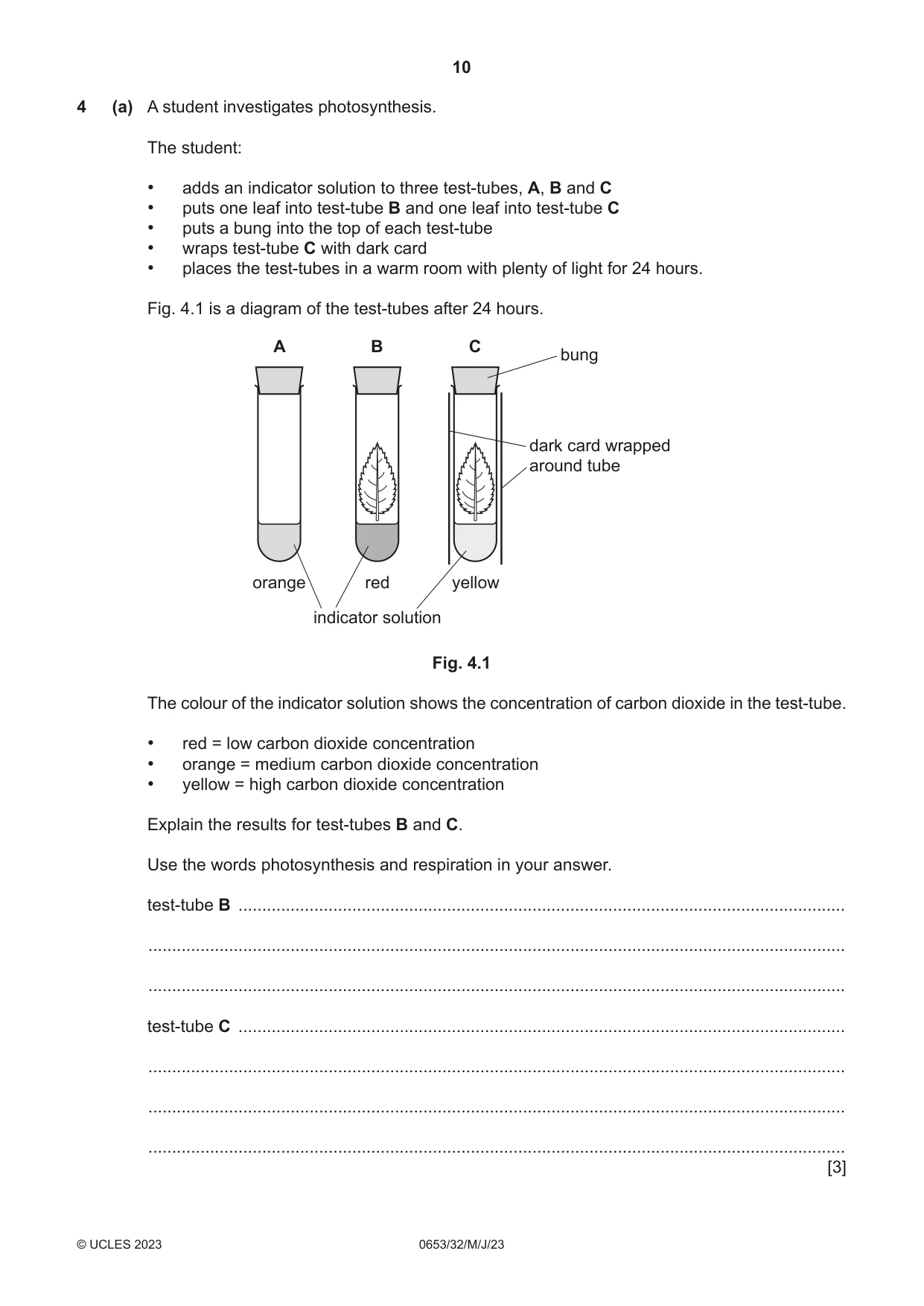
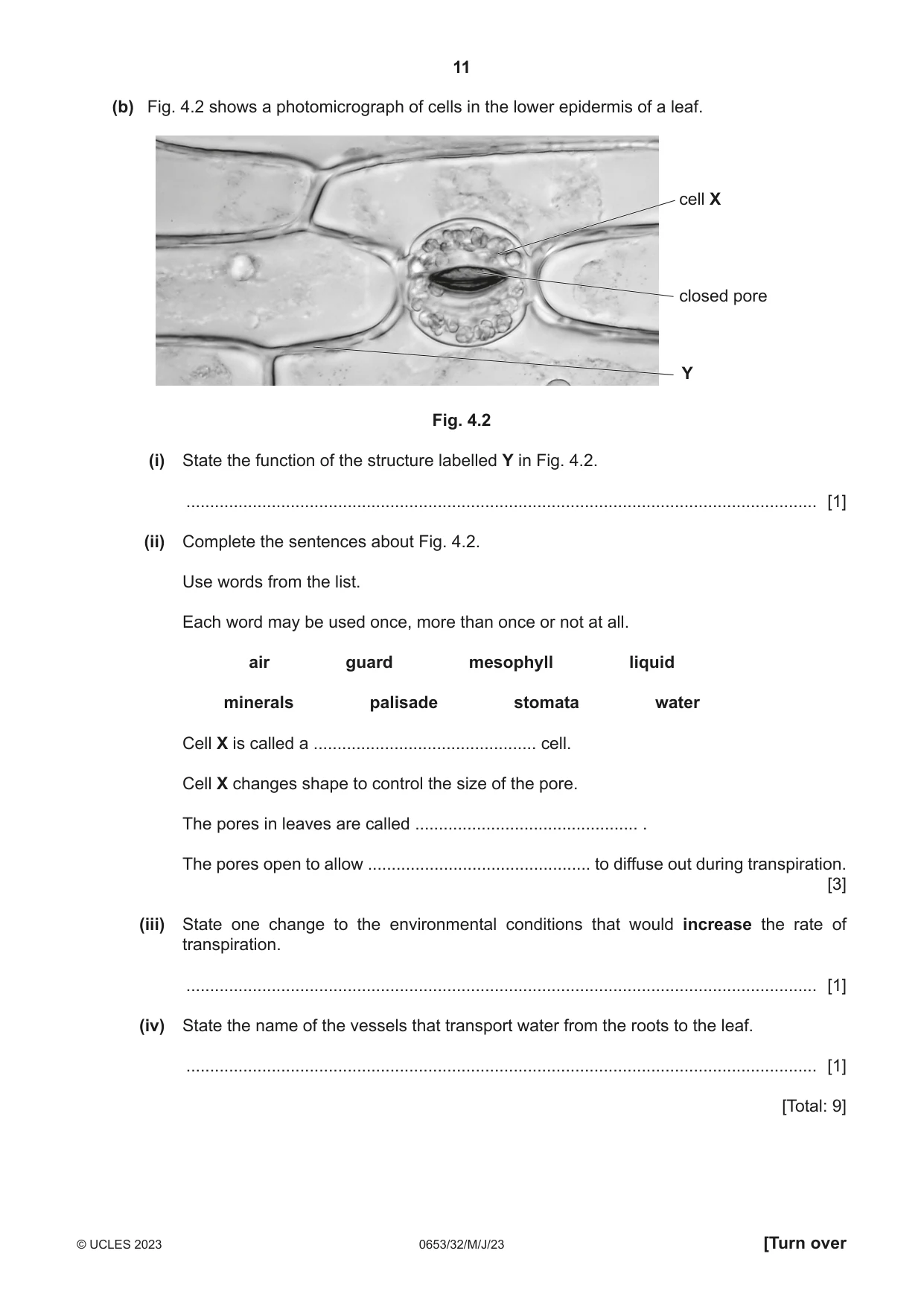
4 (a) A student investigates photosynthesis. The student: • adds an indicator solution to three test‑tubes, A, B and C • puts one leaf into test‑tube B and one leaf into test‑tube C • puts a bung into the top of each test‑tube • wraps test‑tube C with dark card • places the test‑tubes in a warm room with plenty of light for 24 hours. Fig. 4.1 is a diagram of the test‑tubes after 24 hours. A B C bung dark card wrapped around tube orange red yellow indicator solution Fig. 4.1 The colour of the indicator solution shows the concentration of carbon dioxide in the test‑tube. • red = low carbon dioxide concentration • orange = medium carbon dioxide concentration • yellow = high carbon dioxide concentration Explain the results for test‑tubes B and C. Use the words photosynthesis and respiration in your answer. test‑tube B ................................................................................................................................ ................................................................................................................................................... ................................................................................................................................................... test‑tube C ................................................................................................................................ ................................................................................................................................................... ................................................................................................................................................... ................................................................................................................................................... [3] (b) Fig. 4.2 shows a photomicrograph of cells in the lower epidermis of a leaf. cell X closed pore Y Fig. 4.2 (i) State the function of the structure labelled Y in Fig. 4.2. ..................................................................................................................................... [1] (ii) Complete the sentences about Fig. 4.2. Use words from the list. Each word may be used once, more than once or not at all. air guard mesophyll liquid minerals palisade stomata water Cell X is called a ............................................... cell. Cell X changes shape to control the size of the pore. The pores in leaves are called ............................................... . The pores open to allow ............................................... to diffuse out during transpiration. [3] (iii) State one change to the environmental conditions that would increase the rate of transpiration. ..................................................................................................................................... [1] (iv) State the name of the vessels that transport water from the roots to the leaf. ..................................................................................................................................... [1] [Total: 9]
Mark scheme: 4(a) test-tube B: (more) carbon dioxide used up in photosynthesis (than produced in respiration) ; test-tube C: no photosynthesis / only respiration ; carbon dioxide made in respiration ; 4(b)(i) support ; 1 4(b)(ii) guard ; stomata ; water ; 3 4(b)(iii) decreased humidity / increased temperature ; 1 4(b)(iv) xylem ; 1
Q5 · Copper is a transition element
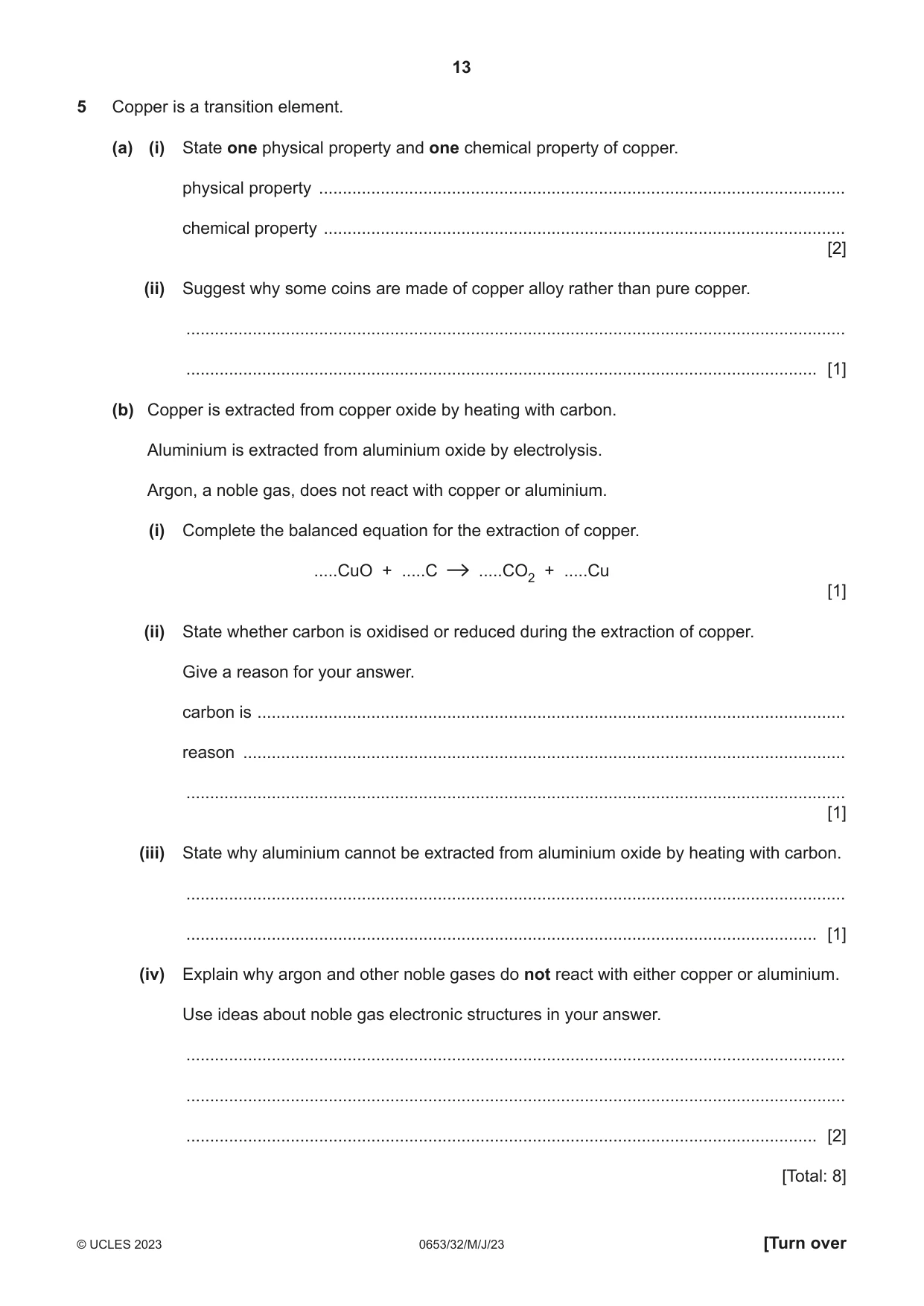
5 Copper is a transition element. (a) (i) State one physical property and one chemical property of copper. physical property ............................................................................................................... chemical property .............................................................................................................. [2] (ii) Suggest why some coins are made of copper alloy rather than pure copper. ........................................................................................................................................... ..................................................................................................................................... [1] (b) Copper is extracted from copper oxide by heating with carbon. Aluminium is extracted from aluminium oxide by electrolysis. Argon, a noble gas, does not react with copper or aluminium. (i) Complete the balanced equation for the extraction of copper. .....CuO + .....C .....CO2 + .....Cu [1] (ii) State whether carbon is oxidised or reduced during the extraction of copper. Give a reason for your answer. carbon is ............................................................................................................................ reason ............................................................................................................................... ........................................................................................................................................... [1] (iii) State why aluminium cannot be extracted from aluminium oxide by heating with carbon. ........................................................................................................................................... ..................................................................................................................................... [1] (iv) Explain why argon and other noble gases do not react with either copper or aluminium. Use ideas about noble gas electronic structures in your answer. ........................................................................................................................................... ........................................................................................................................................... ..................................................................................................................................... [2] [Total: 8]
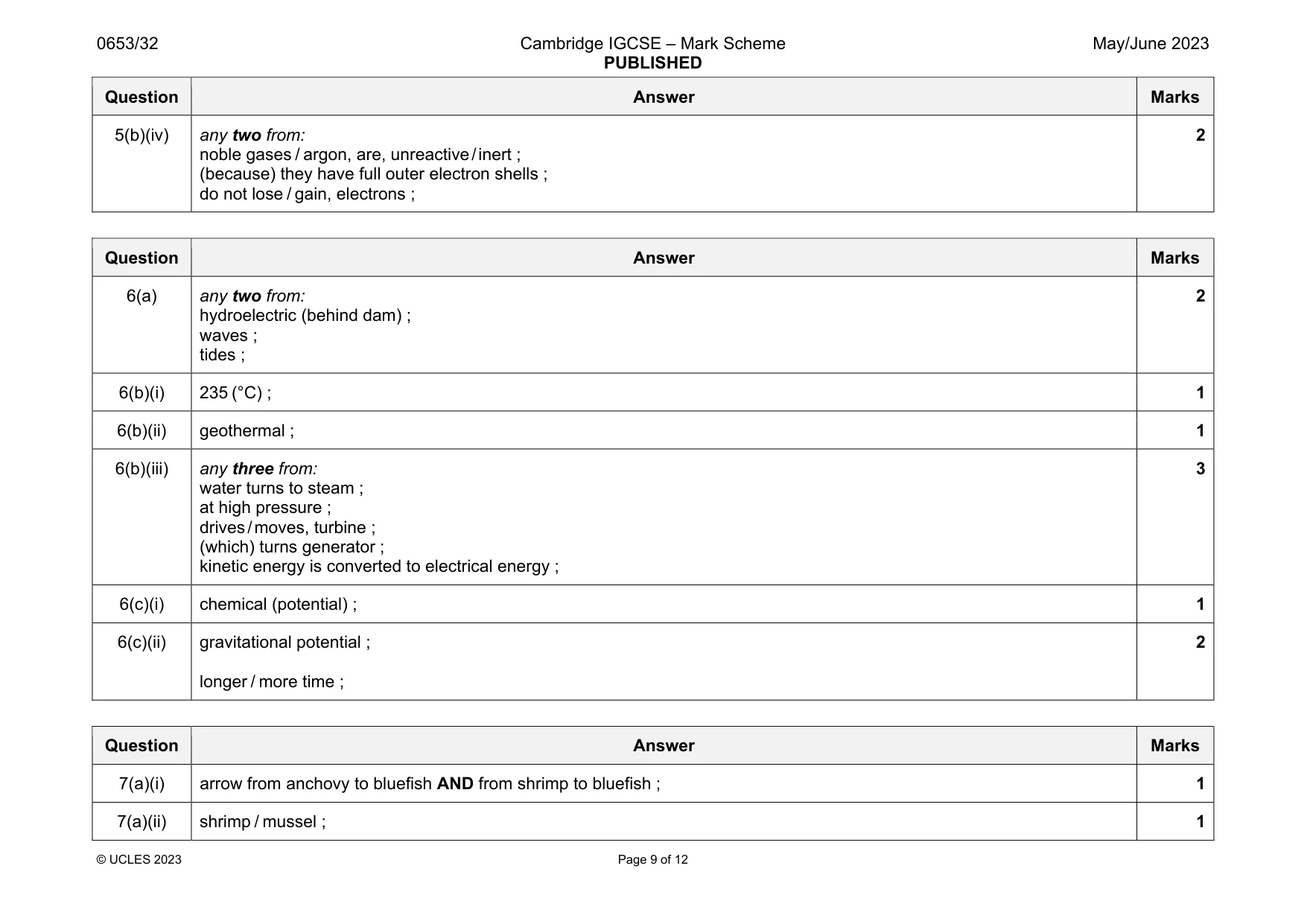
Mark scheme: 5(a)(i) (physical property) high density / high melting point / electrical conductor / heat or thermal conductor ; (chemical property) low reactivity ; 2 5(a)(ii) stronger / harder ; 1 5(b)(i) ..2..CuO + ..(1)..C ..(1)..CO2 + ..2..Cu ; 1 5(b)(ii) (carbon is) oxidised AND (reason) it gains oxygen ; 1 5(b)(iii) aluminium is more reactive (than carbon) ; 1 Question Answer Marks 5(b)(iv) any two from: noble gases / argon, are, unreactive / inert ; (because) they have full outer electron shells ; do not lose / gain, electrons ; 2
Q6 · Moving water has kinetic energy
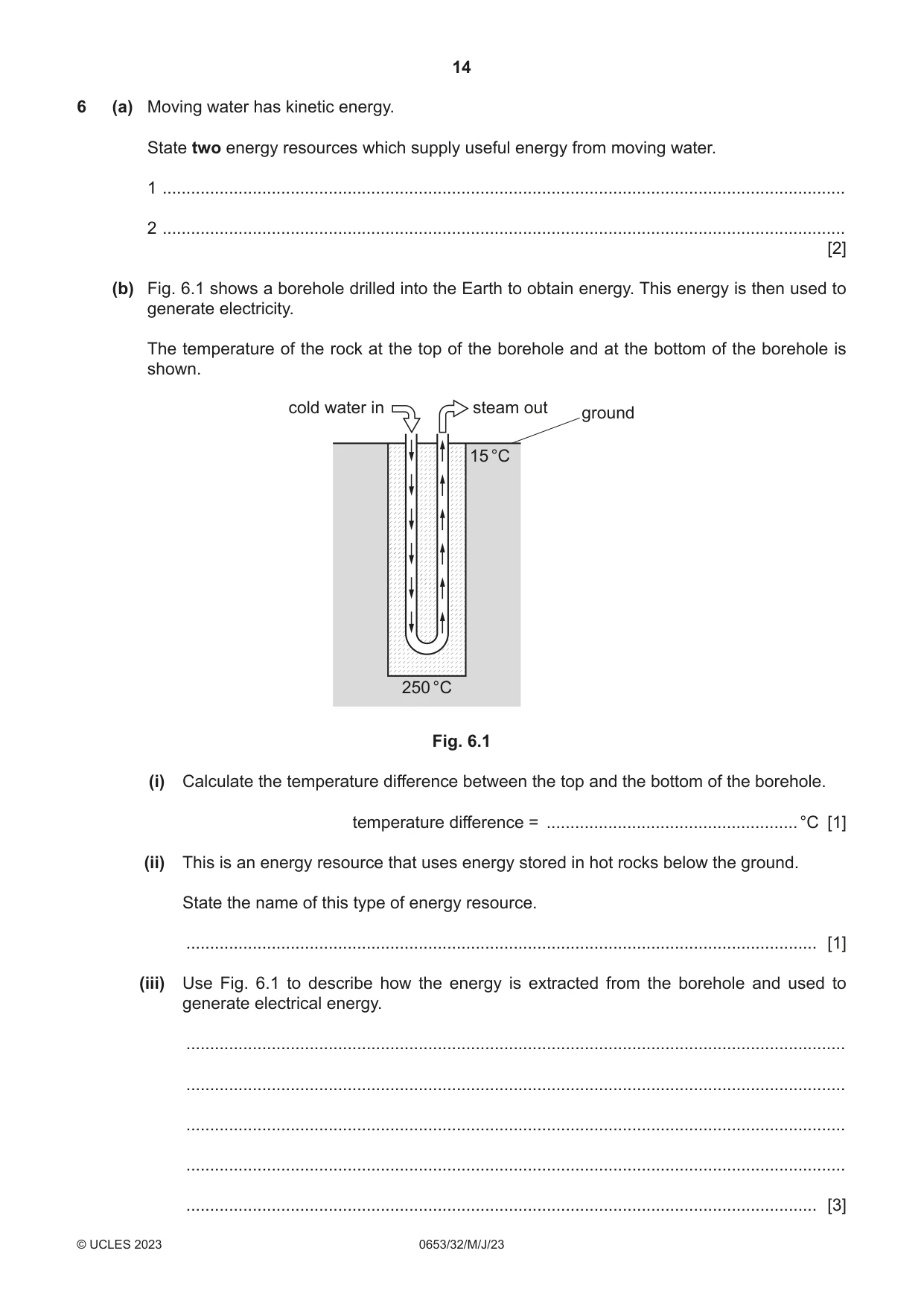
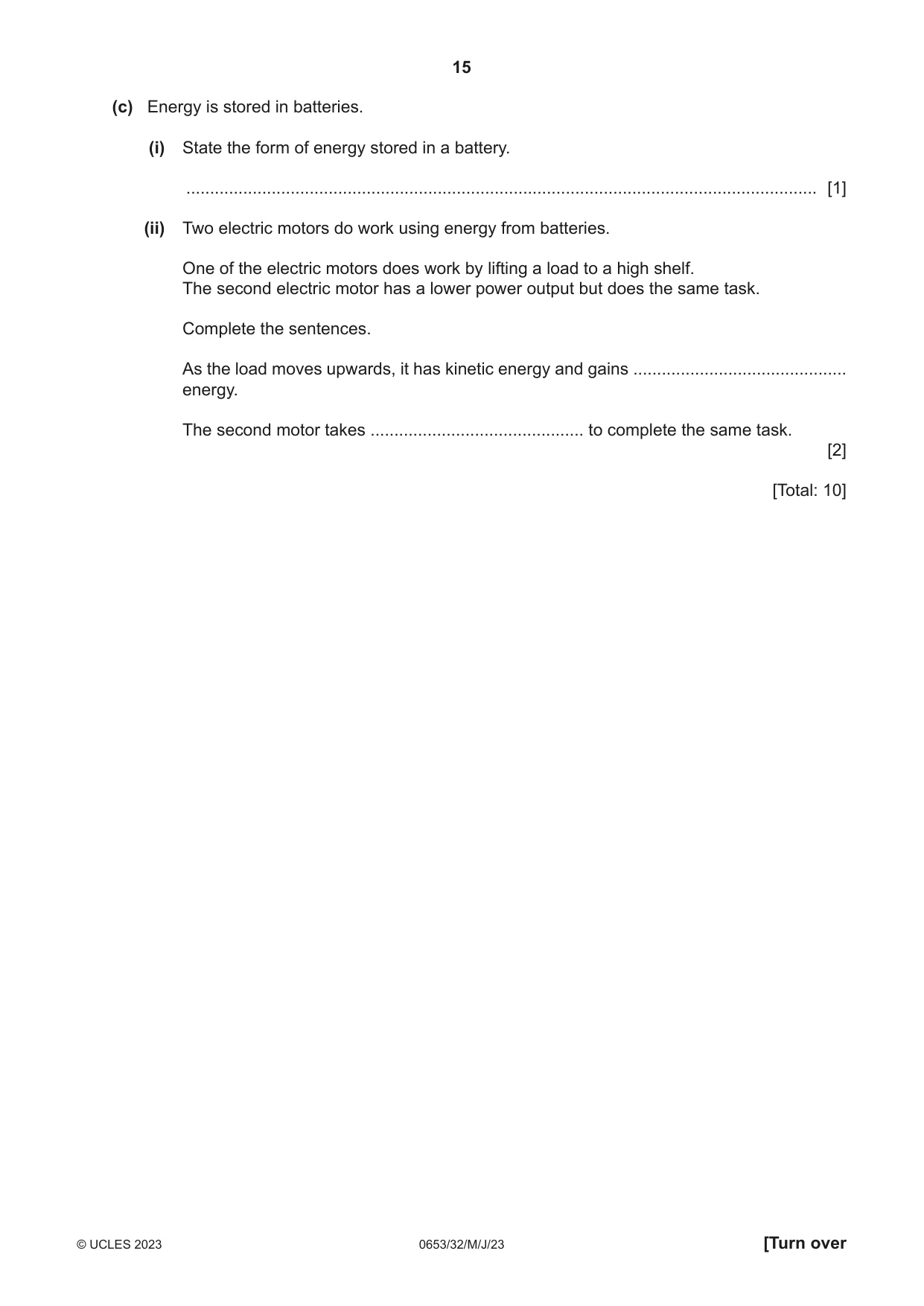
6 (a) Moving water has kinetic energy. State two energy resources which supply useful energy from moving water. 1 ................................................................................................................................................ 2 ................................................................................................................................................ [2] (b) Fig. 6.1 shows a borehole drilled into the Earth to obtain energy. This energy is then used to generate electricity. The temperature of the rock at the top of the borehole and at the bottom of the borehole is shown. cold water in steam out ground 15 °C 250 °C Fig. 6.1 (i) Calculate the temperature difference between the top and the bottom of the borehole. temperature difference = ..................................................... °C [1] (ii) This is an energy resource that uses energy stored in hot rocks below the ground. State the name of this type of energy resource. ..................................................................................................................................... [1] (iii) Use Fig. 6.1 to describe how the energy is extracted from the borehole and used to generate electrical energy. ........................................................................................................................................... ........................................................................................................................................... ........................................................................................................................................... ........................................................................................................................................... ..................................................................................................................................... [3] (c) Energy is stored in batteries. (i) State the form of energy stored in a battery. ..................................................................................................................................... [1] (ii) Two electric motors do work using energy from batteries. One of the electric motors does work by lifting a load to a high shelf. The second electric motor has a lower power output but does the same task. Complete the sentences. As the load moves upwards, it has kinetic energy and gains ............................................. energy. The second motor takes ............................................. to complete the same task. [2] [Total: 10]
Mark scheme: 6(a) any two from: hydroelectric (behind dam) ; waves ; tides ; 2 6(b)(i) 235 (°C) ; 1 6(b)(ii) geothermal ; 1 6(b)(iii) any three from: water turns to steam ; at high pressure ; drives / moves, turbine ; (which) turns generator ; kinetic energy is converted to electrical energy ; 3 6(c)(i) chemical (potential) ; 1 6(c)(ii) gravitational potential ; longer / more time ; 2
Q7 · An incomplete food web
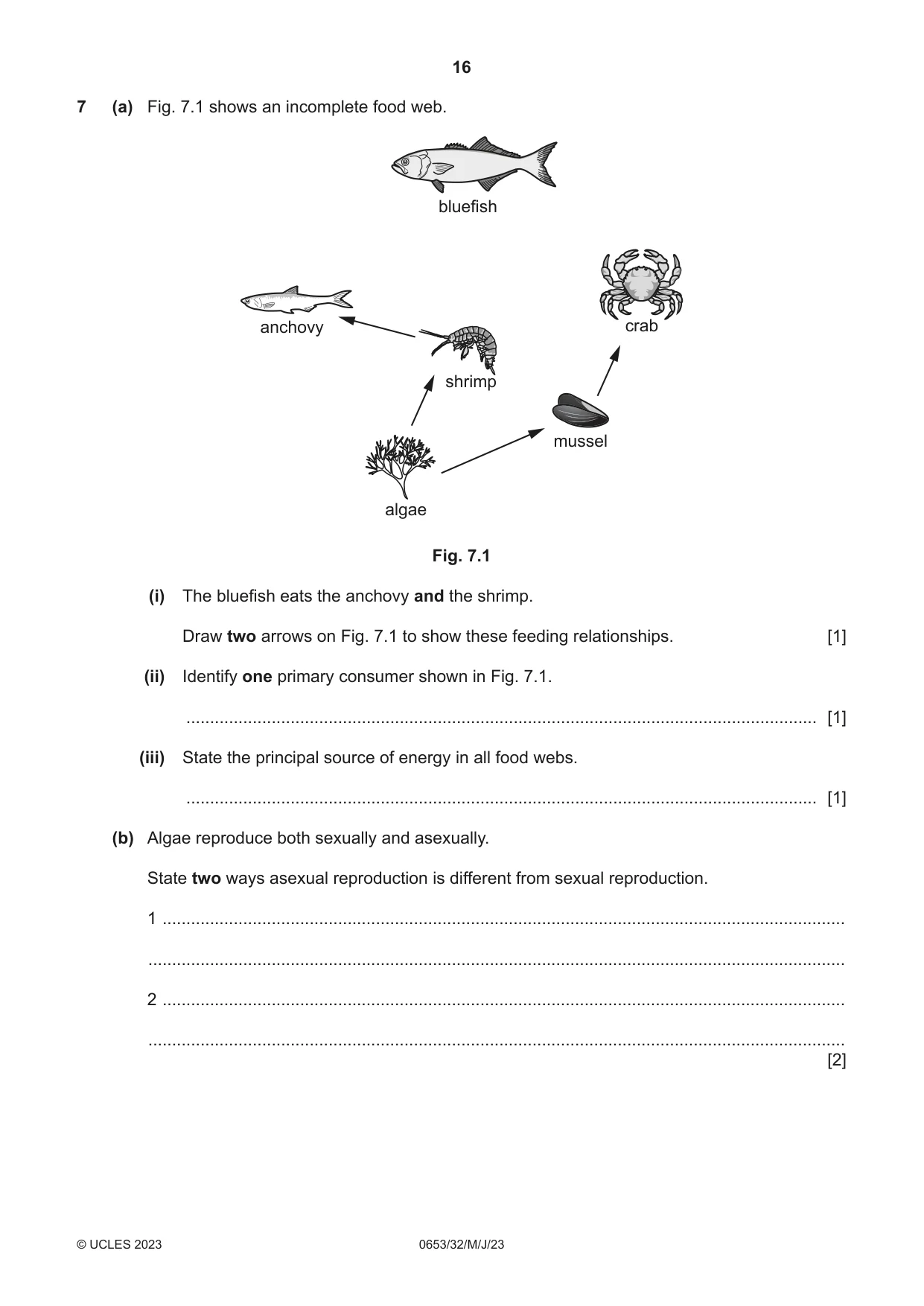
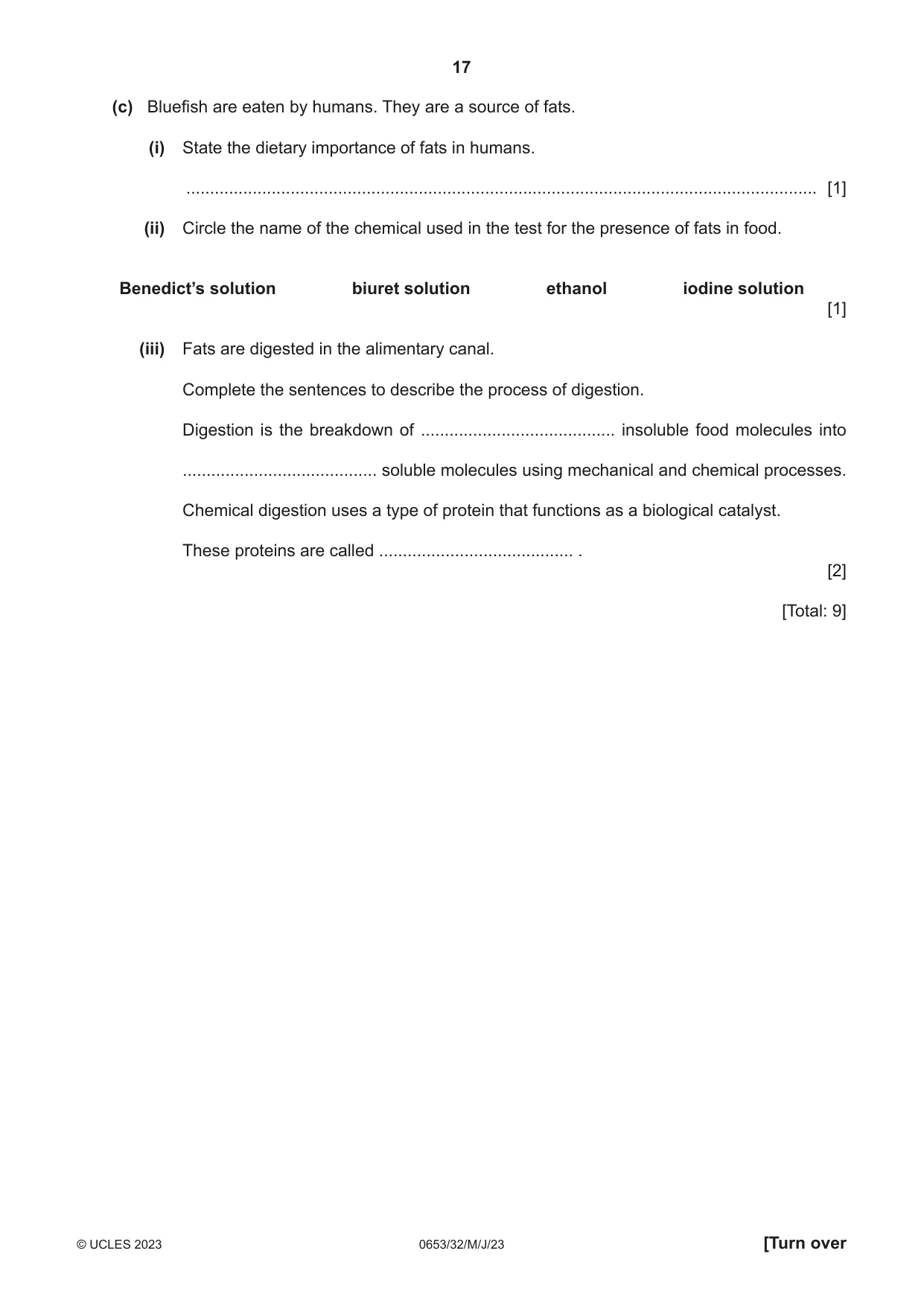
7 (a) Fig. 7.1 shows an incomplete food web. bluefish anchovy crab shrimp mussel algae Fig. 7.1 (i) The bluefish eats the anchovy and the shrimp. Draw two arrows on Fig. 7.1 to show these feeding relationships. [1] (ii) Identify one primary consumer shown in Fig. 7.1. ..................................................................................................................................... [1] (iii) State the principal source of energy in all food webs. ..................................................................................................................................... [1] (b) Algae reproduce both sexually and asexually. State two ways asexual reproduction is different from sexual reproduction. 1 ................................................................................................................................................ ................................................................................................................................................... 2 ................................................................................................................................................ ................................................................................................................................................... [2] (c) Bluefish are eaten by humans. They are a source of fats. (i) State the dietary importance of fats in humans. ..................................................................................................................................... [1] (ii) Circle the name of the chemical used in the test for the presence of fats in food. Benedict’s solution biuret solution ethanol iodine solution [1] (iii) Fats are digested in the alimentary canal. Complete the sentences to describe the process of digestion. Digestion is the breakdown of ......................................... insoluble food molecules into ......................................... soluble molecules using mechanical and chemical processes. Chemical digestion uses a type of protein that functions as a biological catalyst. These proteins are called ......................................... . [2] [Total: 9]
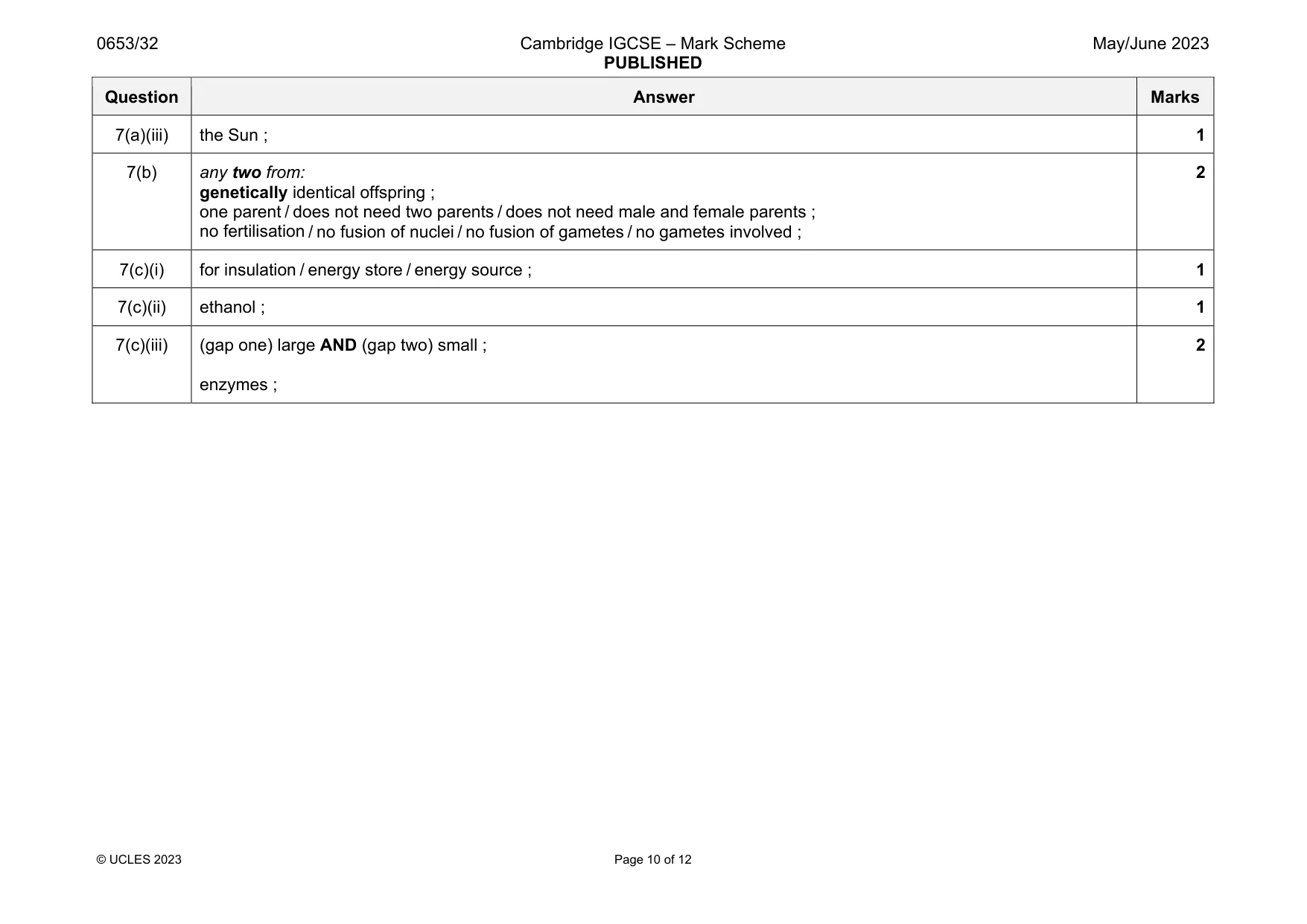
Mark scheme: 7(a)(i) arrow from anchovy to bluefish AND from shrimp to bluefish ; 1 7(a)(ii) shrimp / mussel ; 1 Question Answer Marks 7(a)(iii) the Sun ; 1 7(b) any two from: genetically identical offspring ; one parent / does not need two parents / does not need male and female parents ; no fertilisation / no fusion of nuclei / no fusion of gametes / no gametes involved ; 2 7(c)(i) for insulation / energy store / energy source ; 1 7(c)(ii) ethanol ; 1 7(c)(iii) (gap one) large AND (gap two) small ; enzymes ; 2
Q8 · Methane, CH4, is the main constituent of natural gas
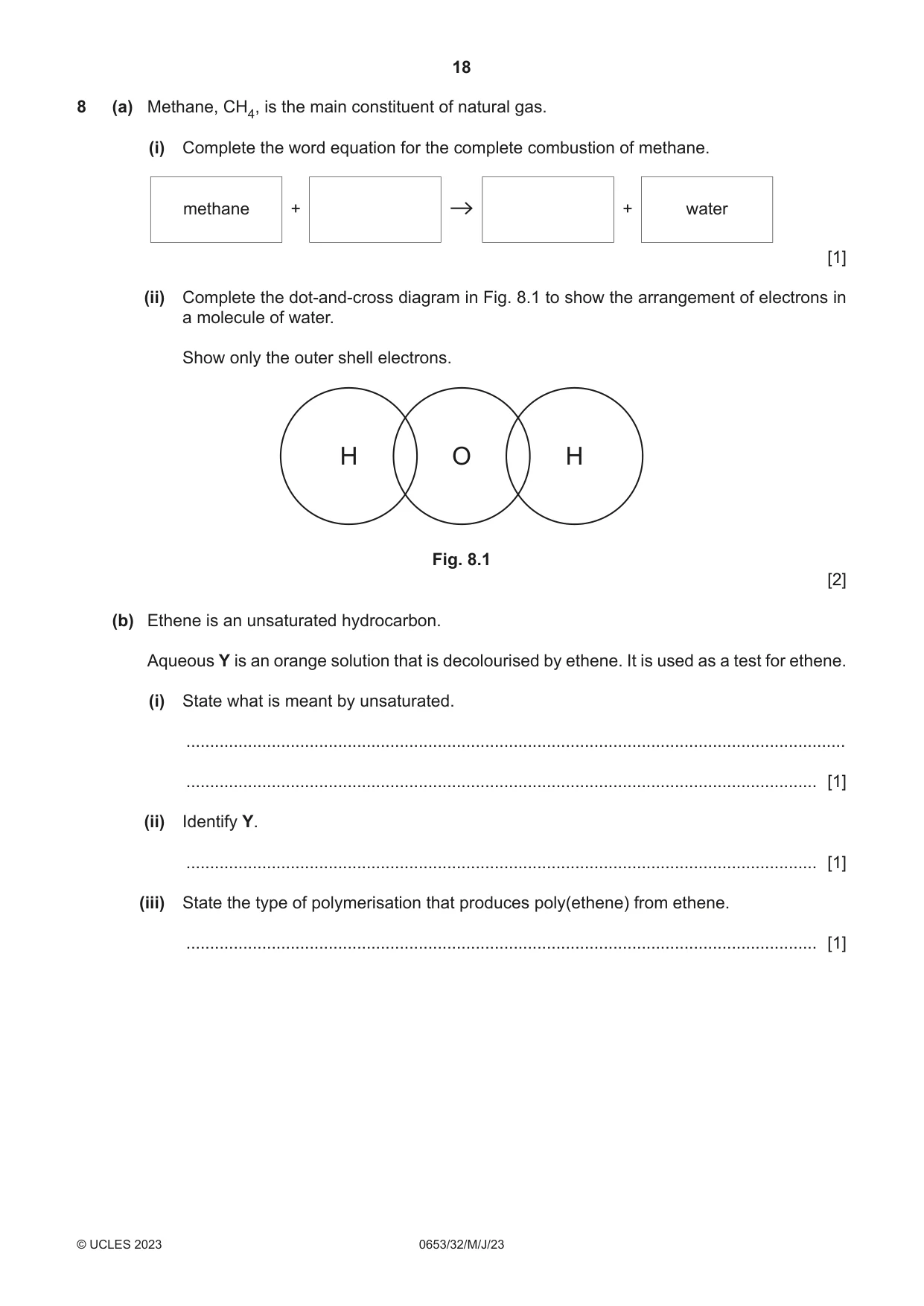
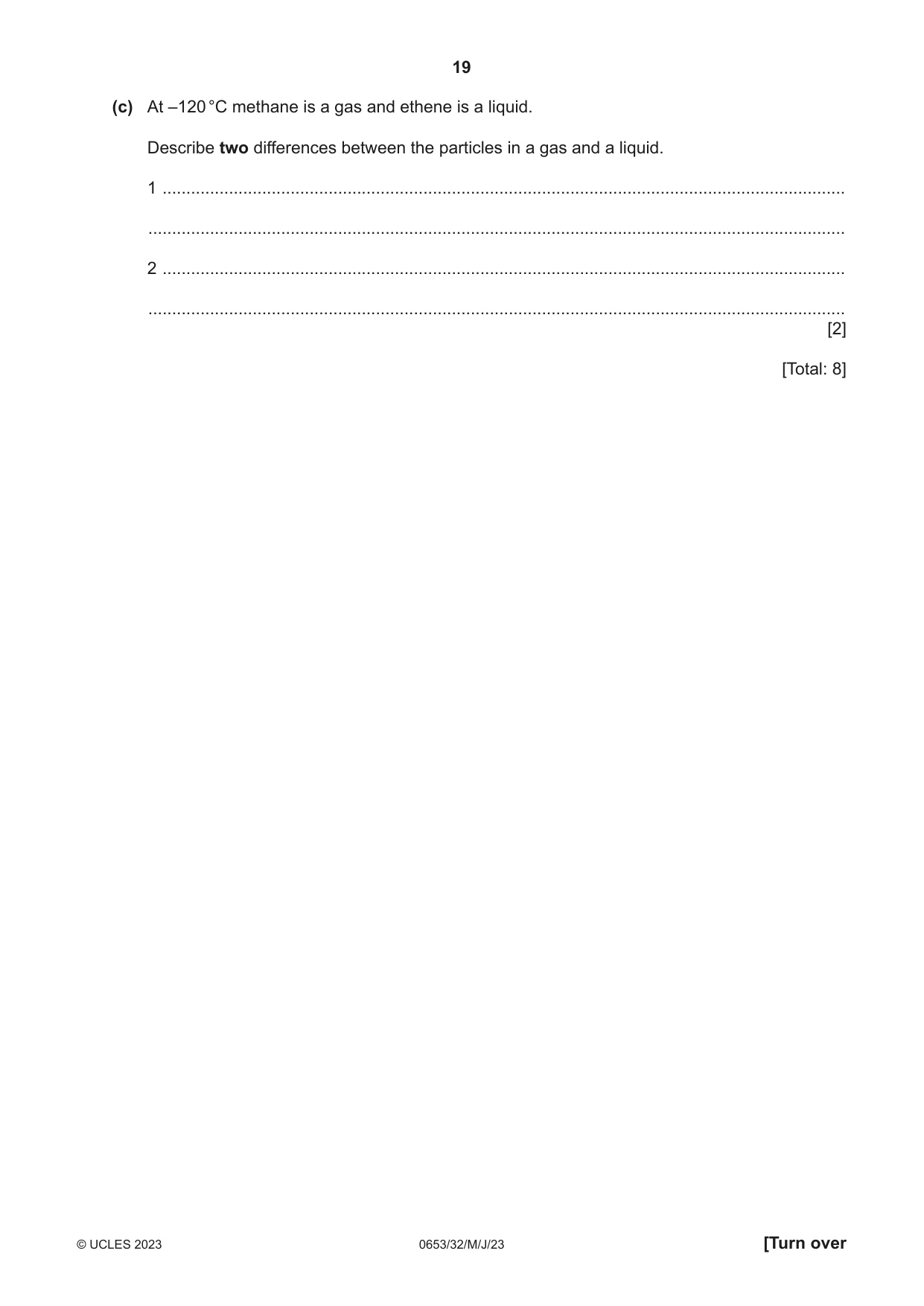
8 (a) Methane, CH4, is the main constituent of natural gas. (i) Complete the word equation for the complete combustion of methane. methane + + water [1] (ii) Complete the dot‑and‑cross diagram in Fig. 8.1 to show the arrangement of electrons in a molecule of water. Show only the outer shell electrons. H O H Fig. 8.1 [2] (b) Ethene is an unsaturated hydrocarbon. Aqueous Y is an orange solution that is decolourised by ethene. It is used as a test for ethene. (i) State what is meant by unsaturated. ........................................................................................................................................... ..................................................................................................................................... [1] (ii) Identify Y. ..................................................................................................................................... [1] (iii) State the type of polymerisation that produces poly(ethene) from ethene. ..................................................................................................................................... [1] (c) At –120 °C methane is a gas and ethene is a liquid. Describe two differences between the particles in a gas and a liquid. 1 ................................................................................................................................................ ................................................................................................................................................... 2 ................................................................................................................................................ ................................................................................................................................................... [2] [Total: 8]
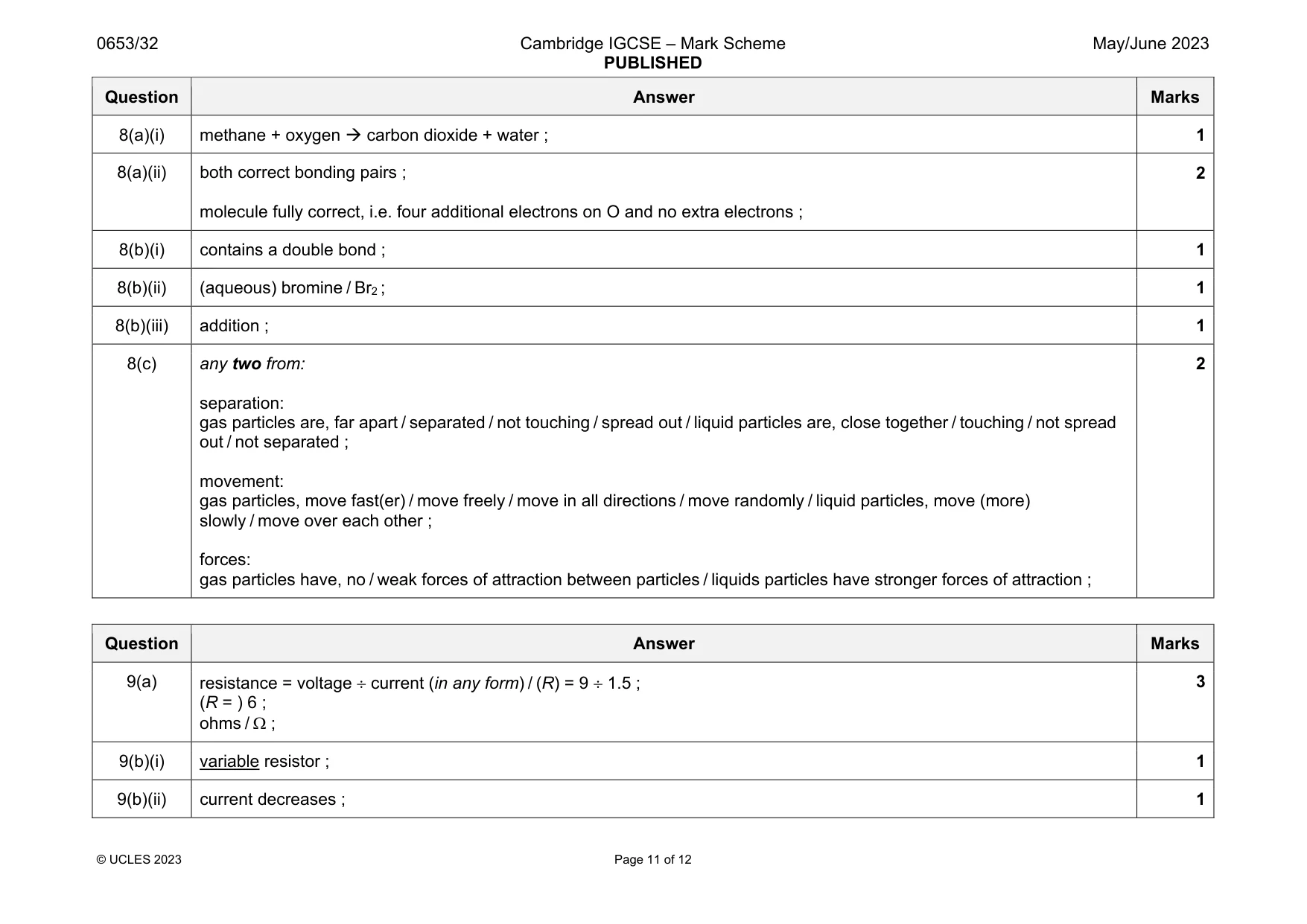
Mark scheme: 8(a)(i) methane + oxygen carbon dioxide + water ; 1 8(a)(ii) both correct bonding pairs ; molecule fully correct, i.e. four additional electrons on O and no extra electrons ; 2 8(b)(i) contains a double bond ; 1 8(b)(ii) (aqueous) bromine / Br2 ; 1 8(b)(iii) addition ; 1 8(c) any two from: separation: gas particles are, far apart / separated / not touching / spread out / liquid particles are, close together / touching / not spread out / not separated ; movement: gas particles, move fast(er) / move freely / move in all directions / move randomly / liquid particles, move (more) slowly / move over each other ; forces: gas particles have, no / weak forces of attraction between particles / liquids particles have stronger forces of attraction ; 2
Question 9
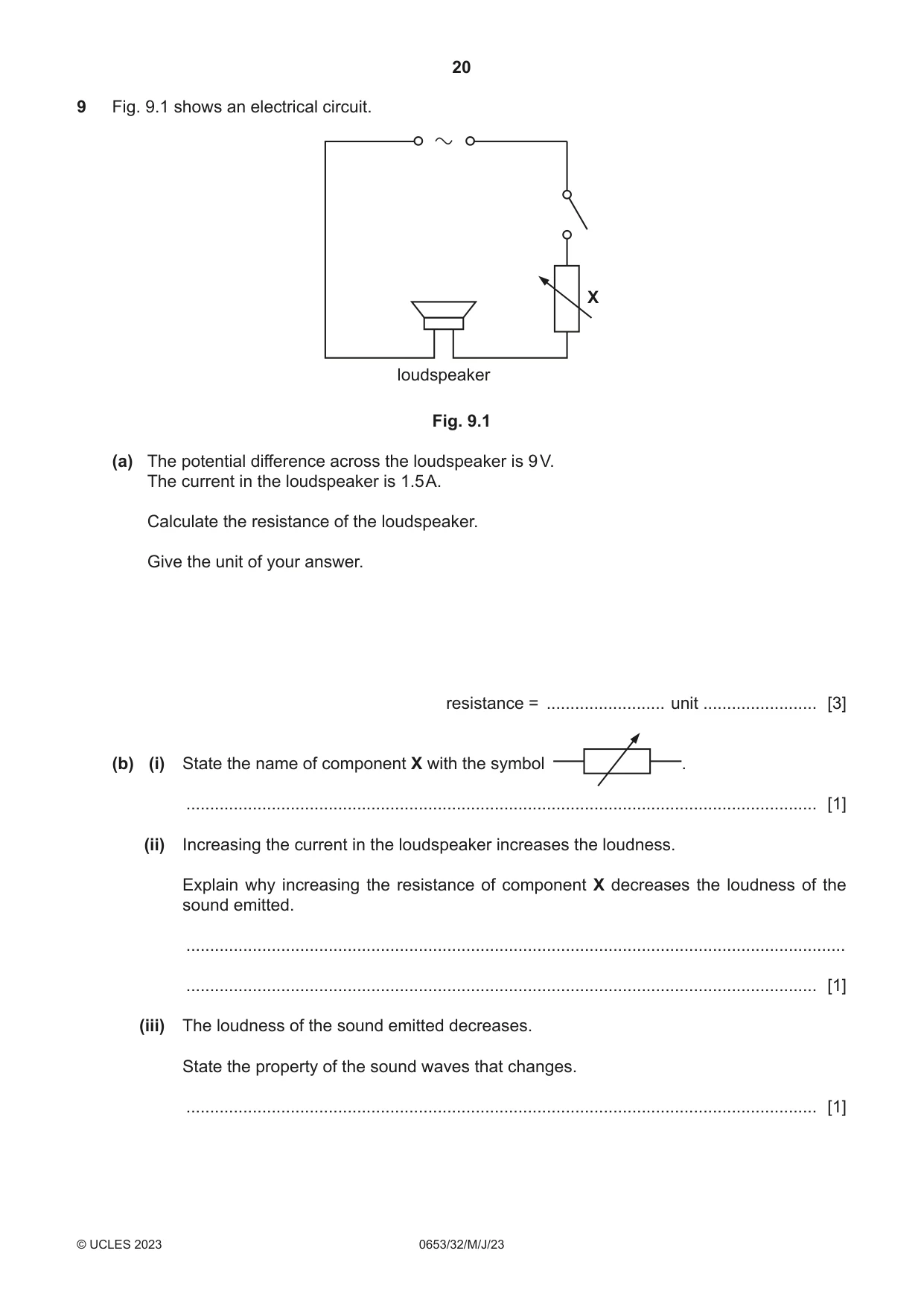
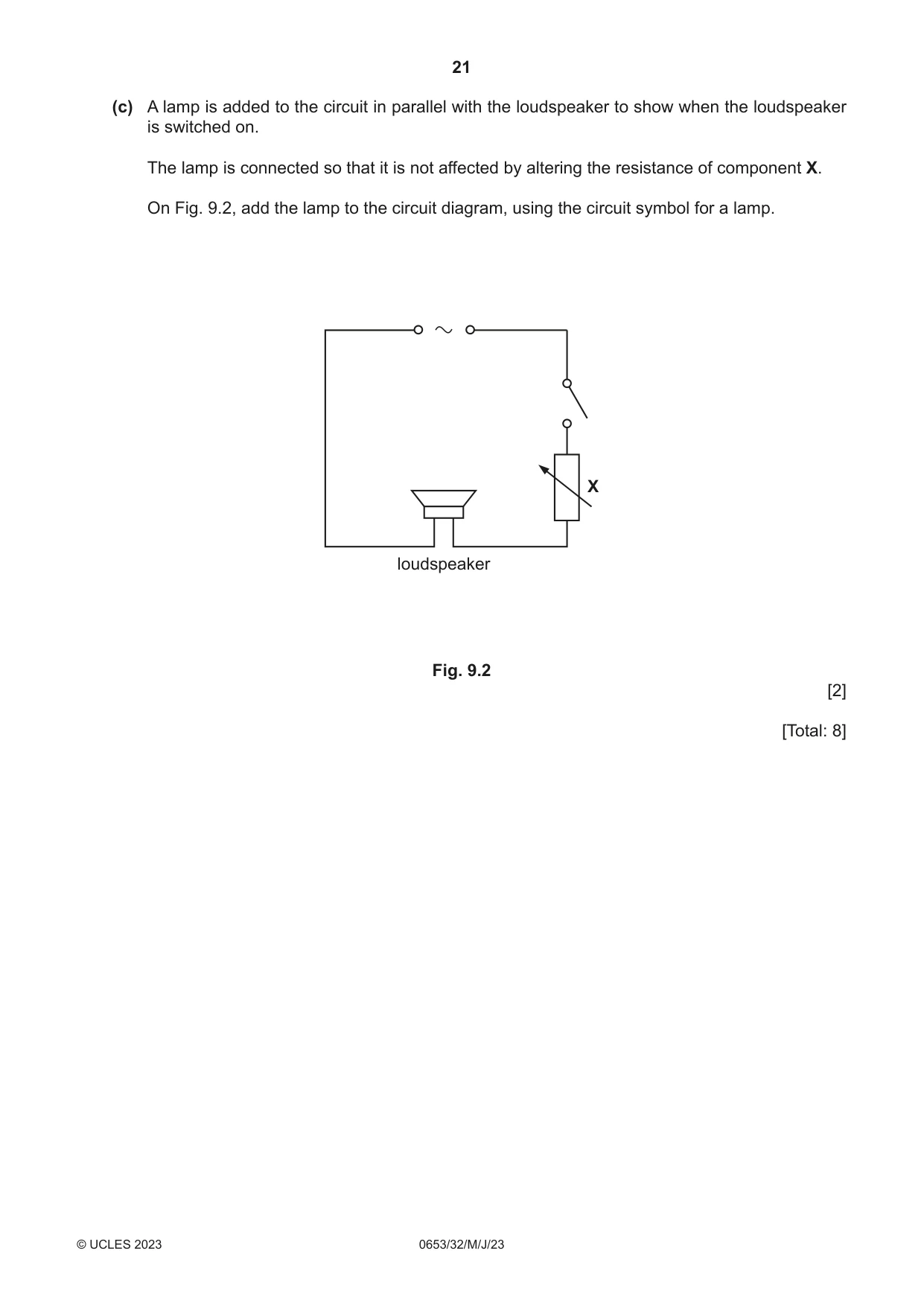
9 Fig. 9.1 shows an electrical circuit. X loudspeaker Fig. 9.1 (a) The potential difference across the loudspeaker is 9 V. The current in the loudspeaker is 1.5 A. Calculate the resistance of the loudspeaker. Give the unit of your answer. resistance = ......................... unit ........................ [3] (b) (i) State the name of component X with the symbol . ..................................................................................................................................... [1] (ii) Increasing the current in the loudspeaker increases the loudness. Explain why increasing the resistance of component X decreases the loudness of the sound emitted. ........................................................................................................................................... ..................................................................................................................................... [1] (iii) The loudness of the sound emitted decreases. State the property of the sound waves that changes. ..................................................................................................................................... [1] (c) A lamp is added to the circuit in parallel with the loudspeaker to show when the loudspeaker is switched on. The lamp is connected so that it is not affected by altering the resistance of component X. On Fig. 9.2, add the lamp to the circuit diagram, using the circuit symbol for a lamp. X loudspeaker Fig. 9.2 [2] [Total: 8]
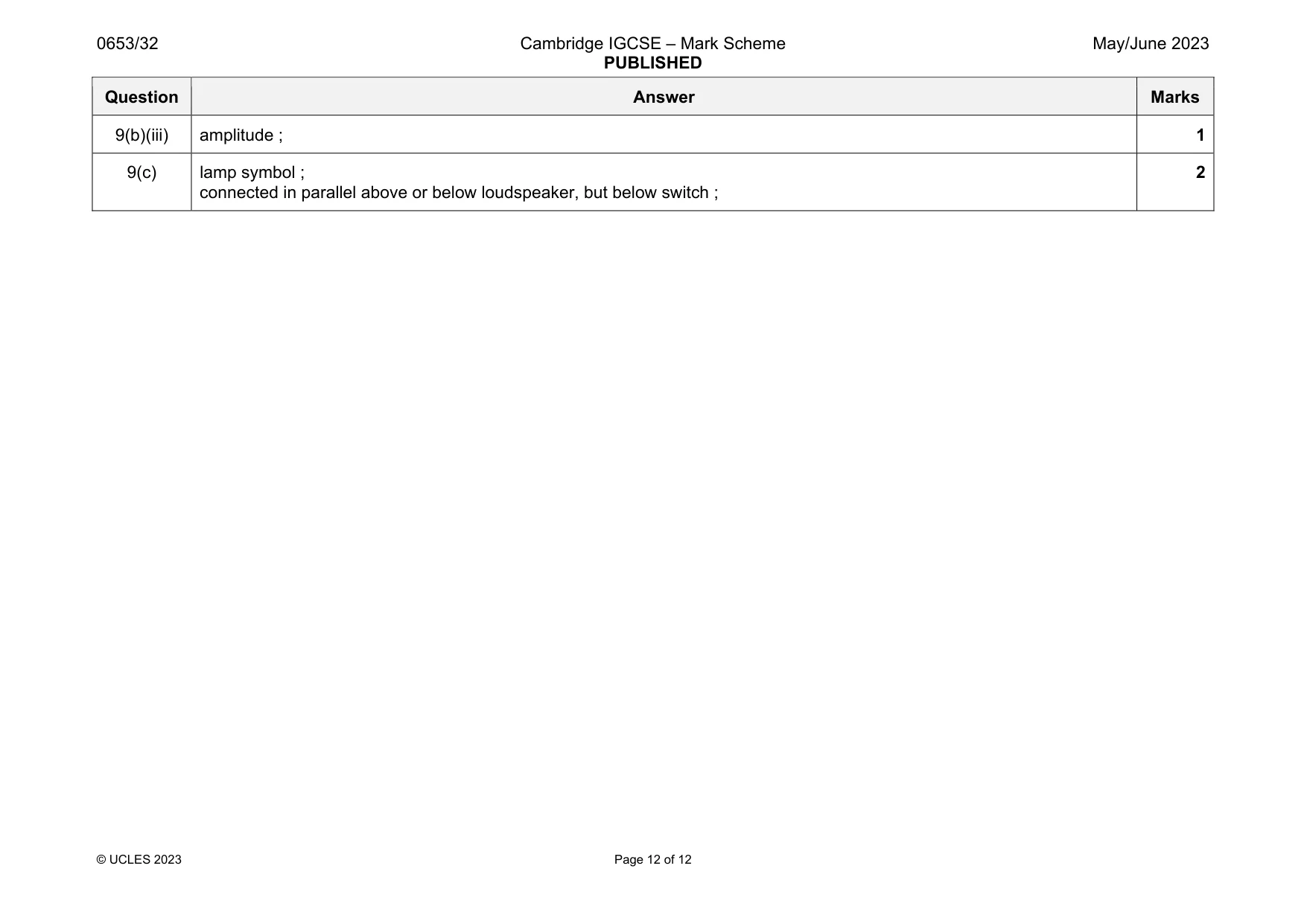
Mark scheme: 9(a) (R = ) 6 ; ohms / ; 9(b)(i) variable resistor ; 1 9(b)(ii) current decreases ; 1 Question Answer Marks 9(b)(iii) amplitude ; 1 9(c) lamp symbol ; connected in parallel above or below loudspeaker, but below switch ; 2
What was in this paper
The subtopics covered by these 9 questions, and how many questions each got. Open one in a new tab to see every Cambridge question on it.
What you needed in this session
Cambridge’s own grade thresholds for 2023 May/June, Paper 3 · Variant 2. A higher threshold means an easier paper — the bar moves with how the cohort did.