Cambridge IGCSE Science - Combined 0653 — 2024 Feb/March Paper 3 · Variant 2
0653/32/F/M/24 · 9 questions · 80 marks · ≈90 min
The question paper and its mark scheme, free to read here and free to download. This is Cambridge’s own paper, exactly as it was sat.
Question paper24 pages


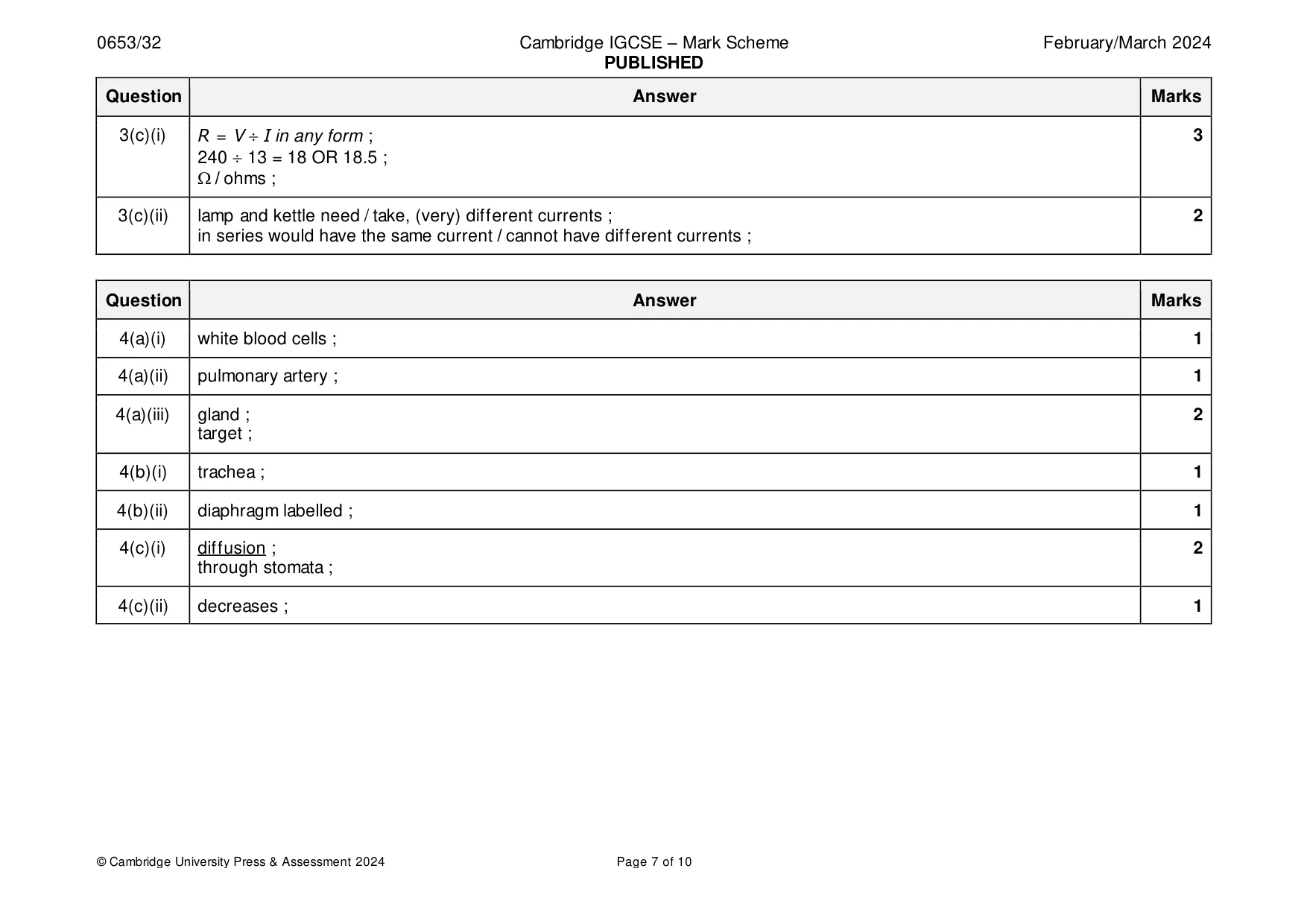
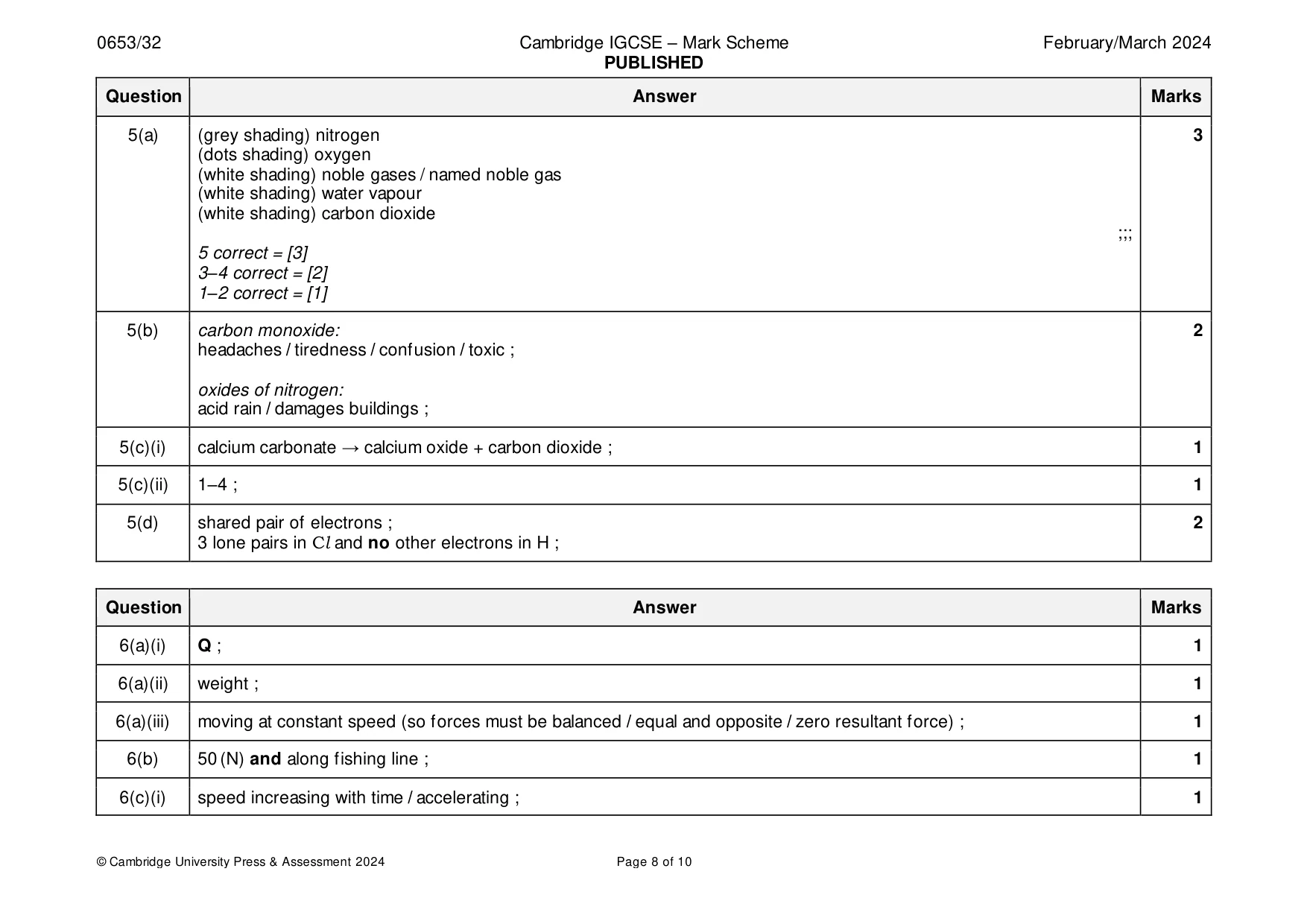
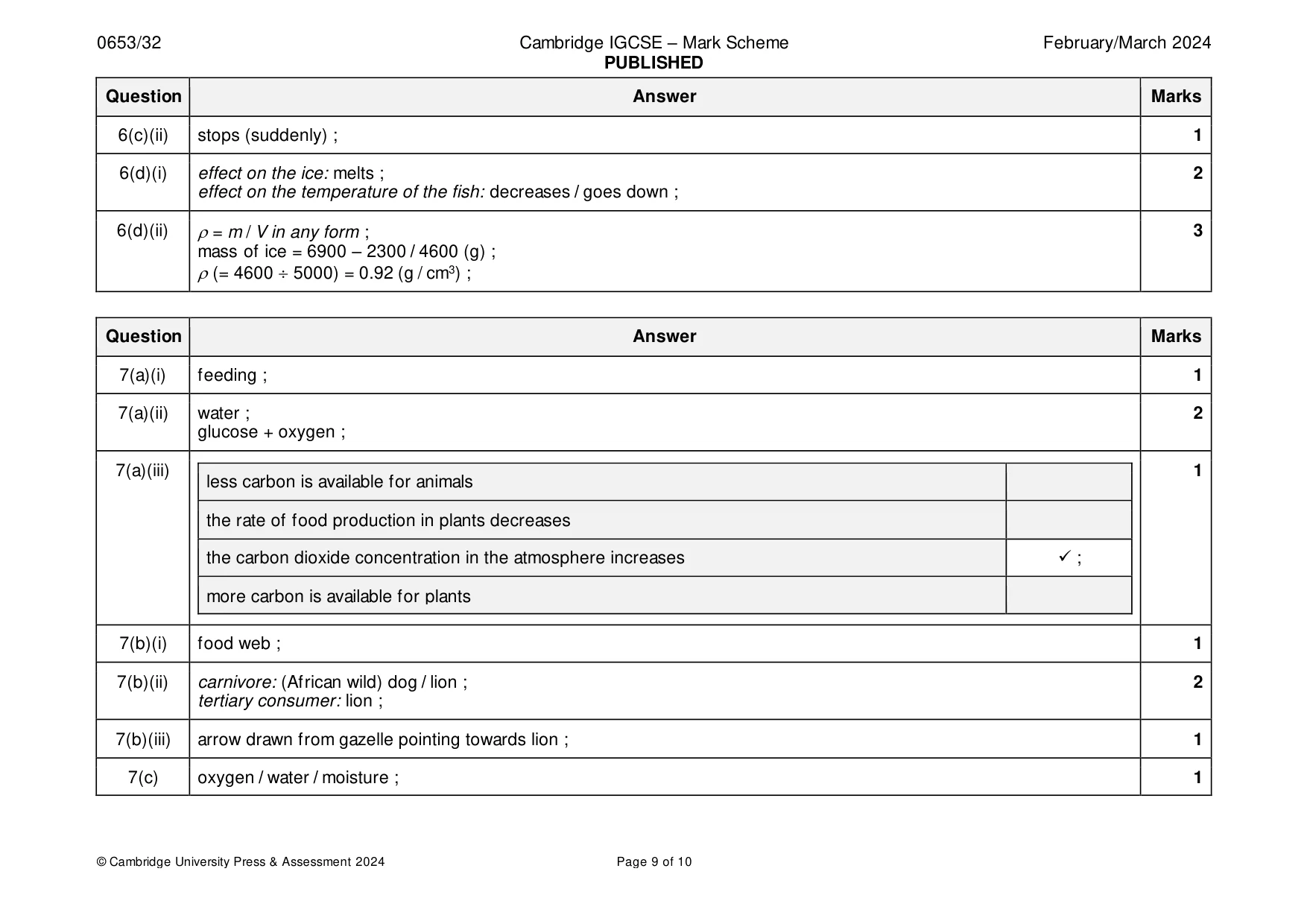
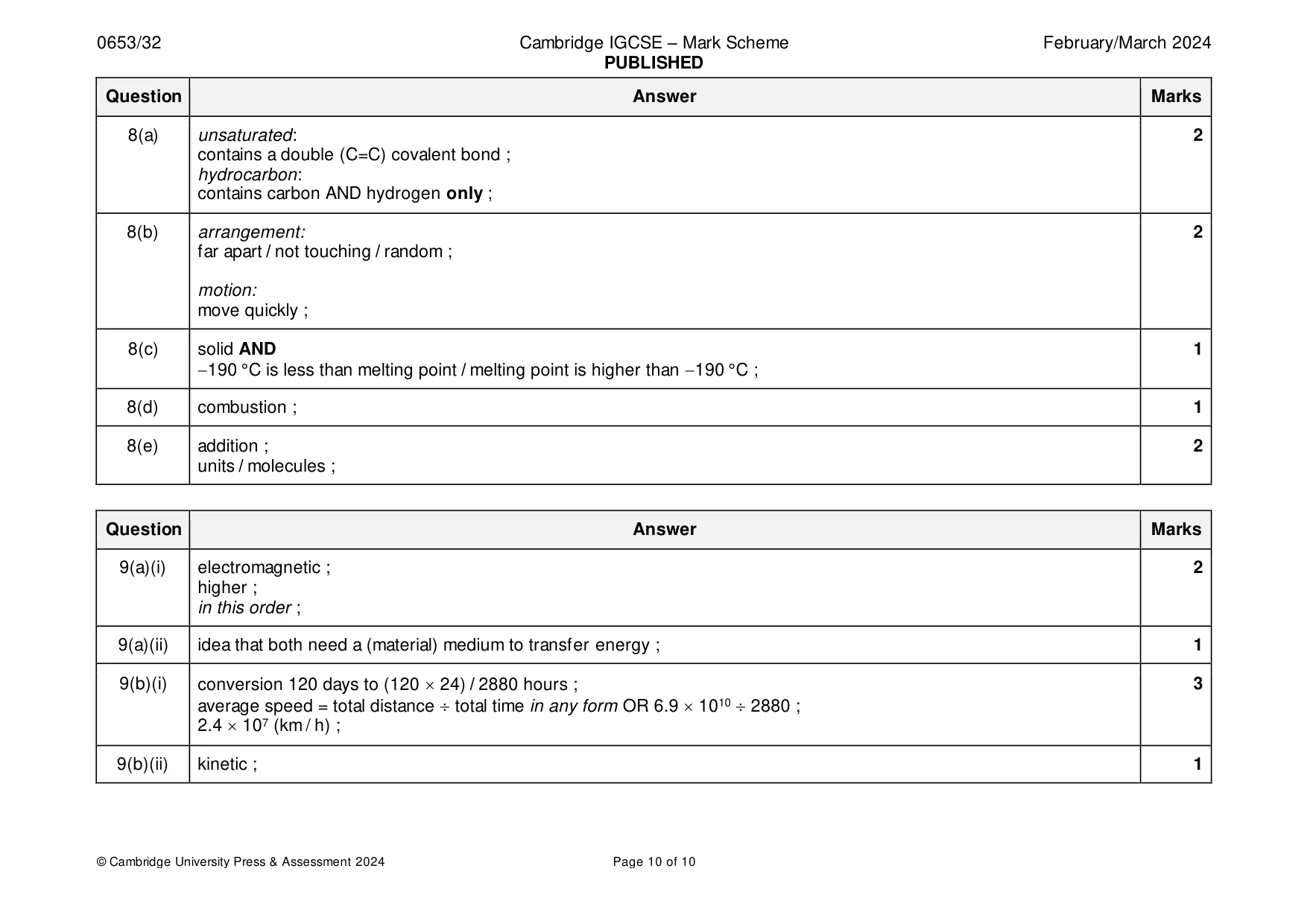
Mark scheme10 pages
Answers below. Sit the paper first if you are practising.
Questions as text
Q1 · The boxes on the left show the names of some structures found in cells
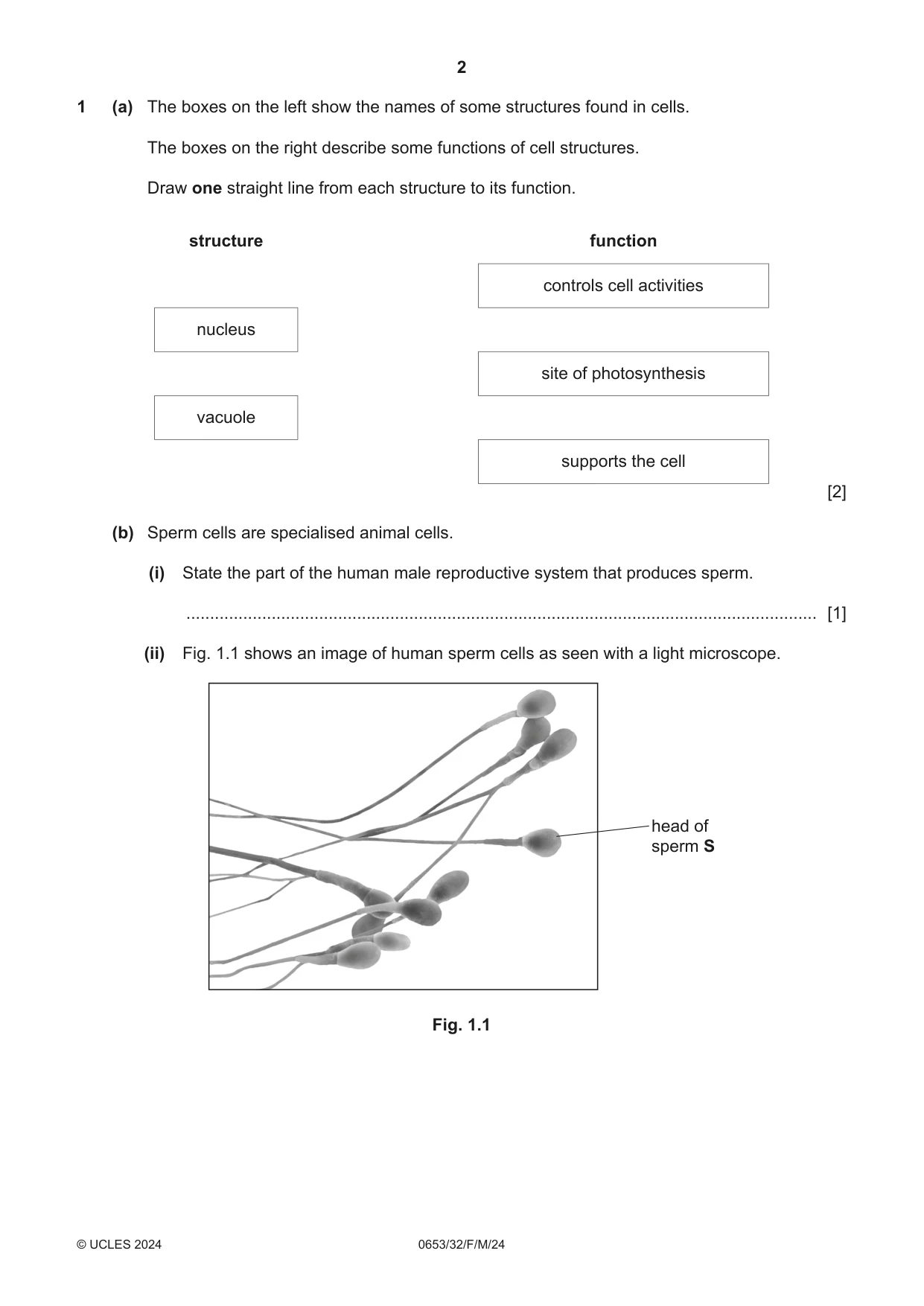
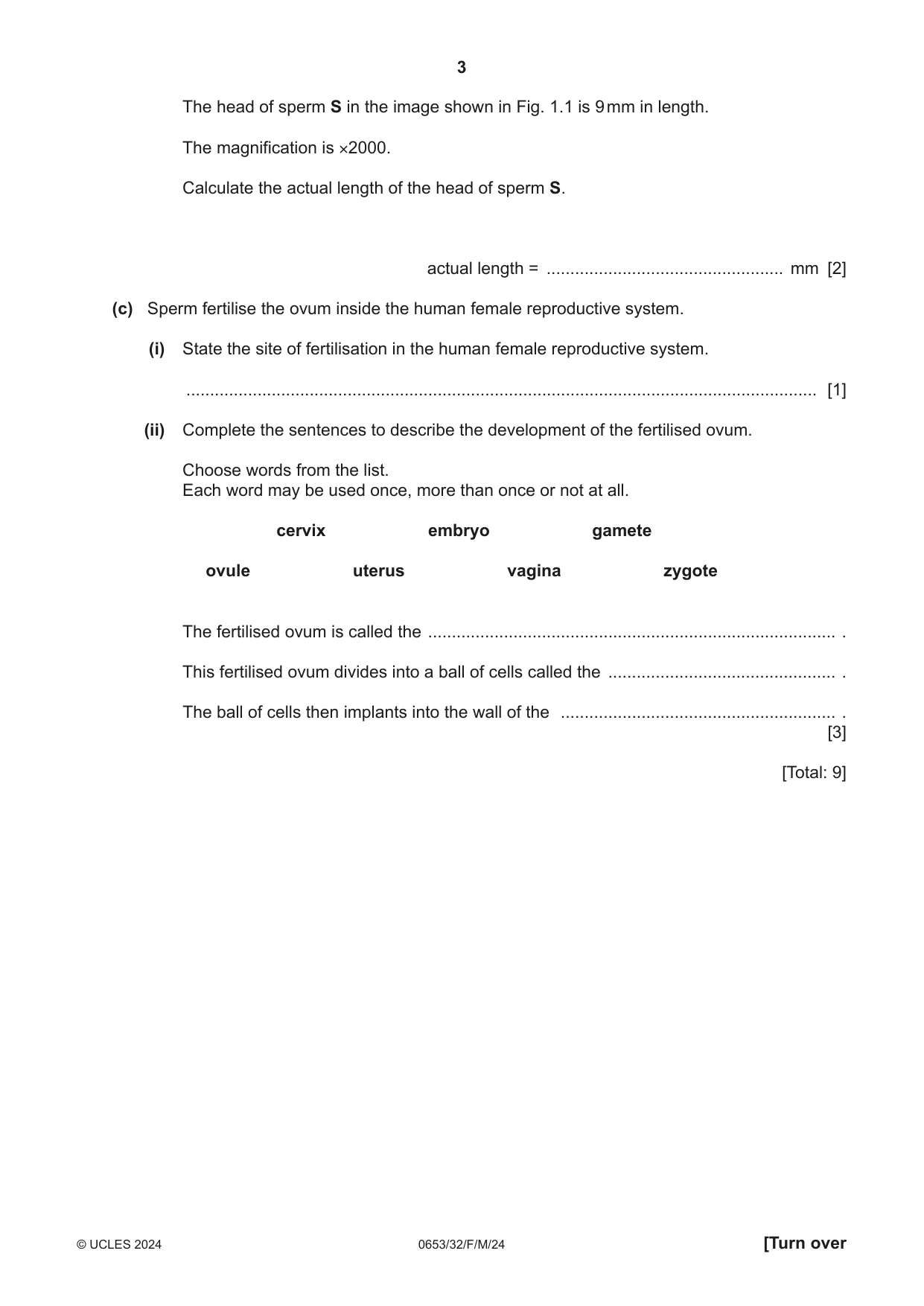
1 (a) The boxes on the left show the names of some structures found in cells. The boxes on the right describe some functions of cell structures. Draw one straight line from each structure to its function. structure function controls cell activities nucleus site of photosynthesis vacuole supports the cell [2] (b) Sperm cells are specialised animal cells. (i) State the part of the human male reproductive system that produces sperm. ..................................................................................................................................... [1] (ii) Fig. 1.1 shows an image of human sperm cells as seen with a light microscope. head of sperm S Fig. 1.1 The head of sperm S in the image shown in Fig. 1.1 is 9 mm in length. The magnification is ×2000. Calculate the actual length of the head of sperm S. actual length = .................................................. mm [2] (c) Sperm fertilise the ovum inside the human female reproductive system. (i) State the site of fertilisation in the human female reproductive system. ..................................................................................................................................... [1] (ii) Complete the sentences to describe the development of the fertilised ovum. Choose words from the list. Each word may be used once, more than once or not at all. cervix embryo gamete ovule uterus vagina zygote The fertilised ovum is called the ...................................................................................... . This fertilised ovum divides into a ball of cells called the ................................................ . The ball of cells then implants into the wall of the .......................................................... . [3] [Total: 9]
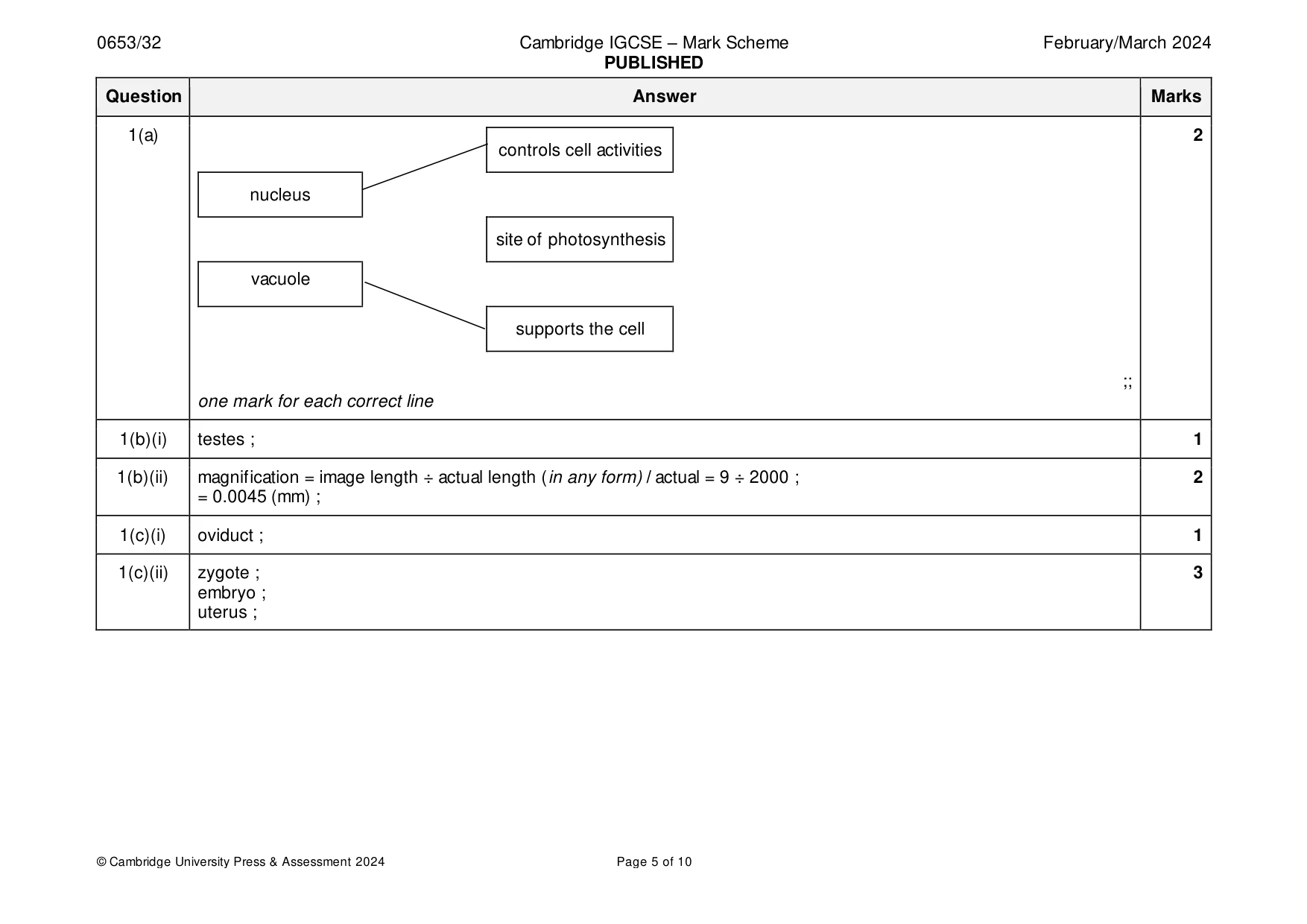
Mark scheme: Question Answer Marks 1(a) 2 controls cell activities nucleus site of photosynthesis vacuole supports the cell ;; one mark for each correct line 1(b)(i) testes ; 1 1(b)(ii) magnification = image length ÷ actual length (in any form) / actual = 9 ÷ 2000 ; 2 = 0.0045 (mm) ; 1(c)(i) oviduct ; 1 1(c)(ii) zygote ; 3 embryo ; uterus ;
Q2 · Lithium is an element in Group I of the Periodic Table
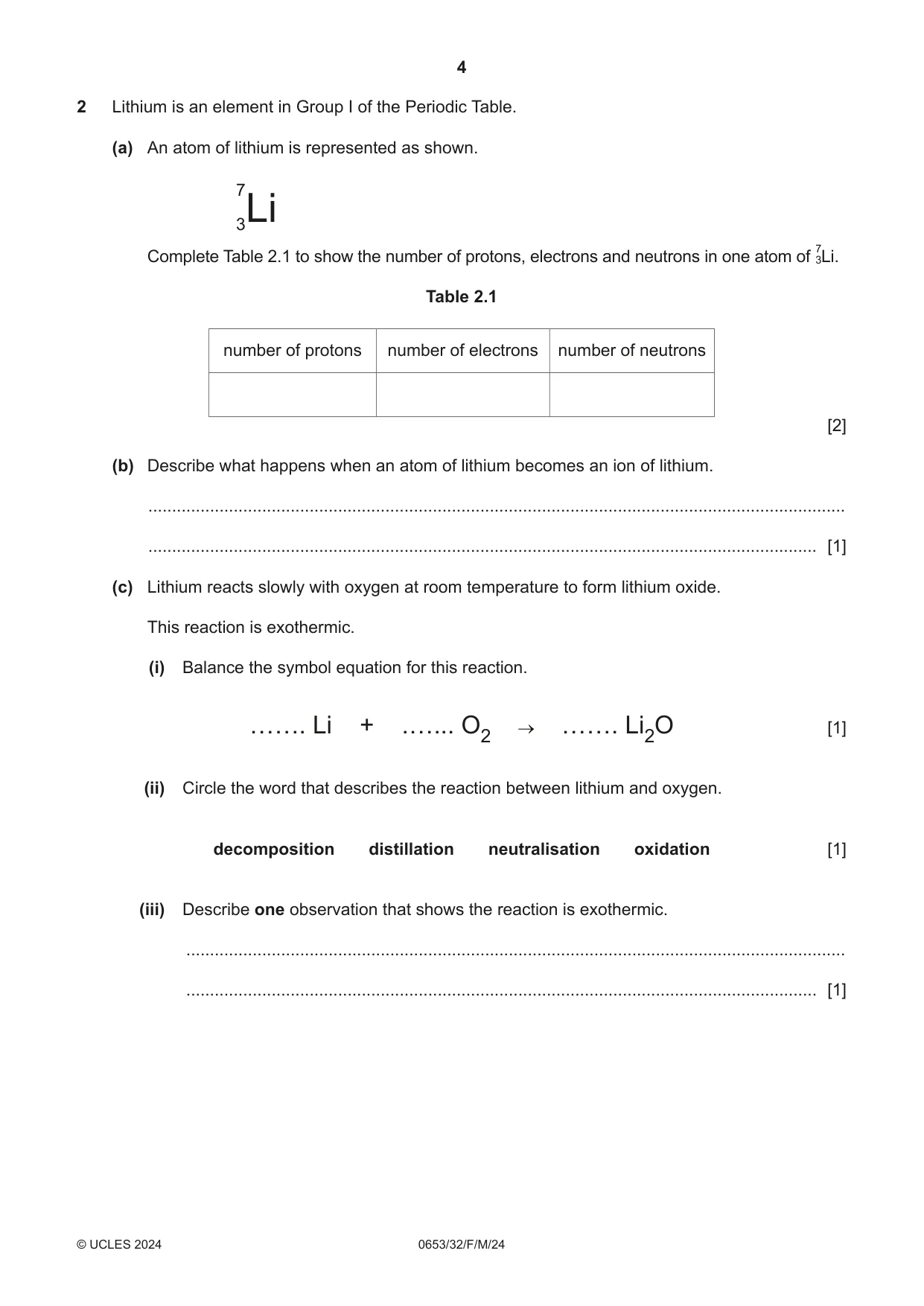
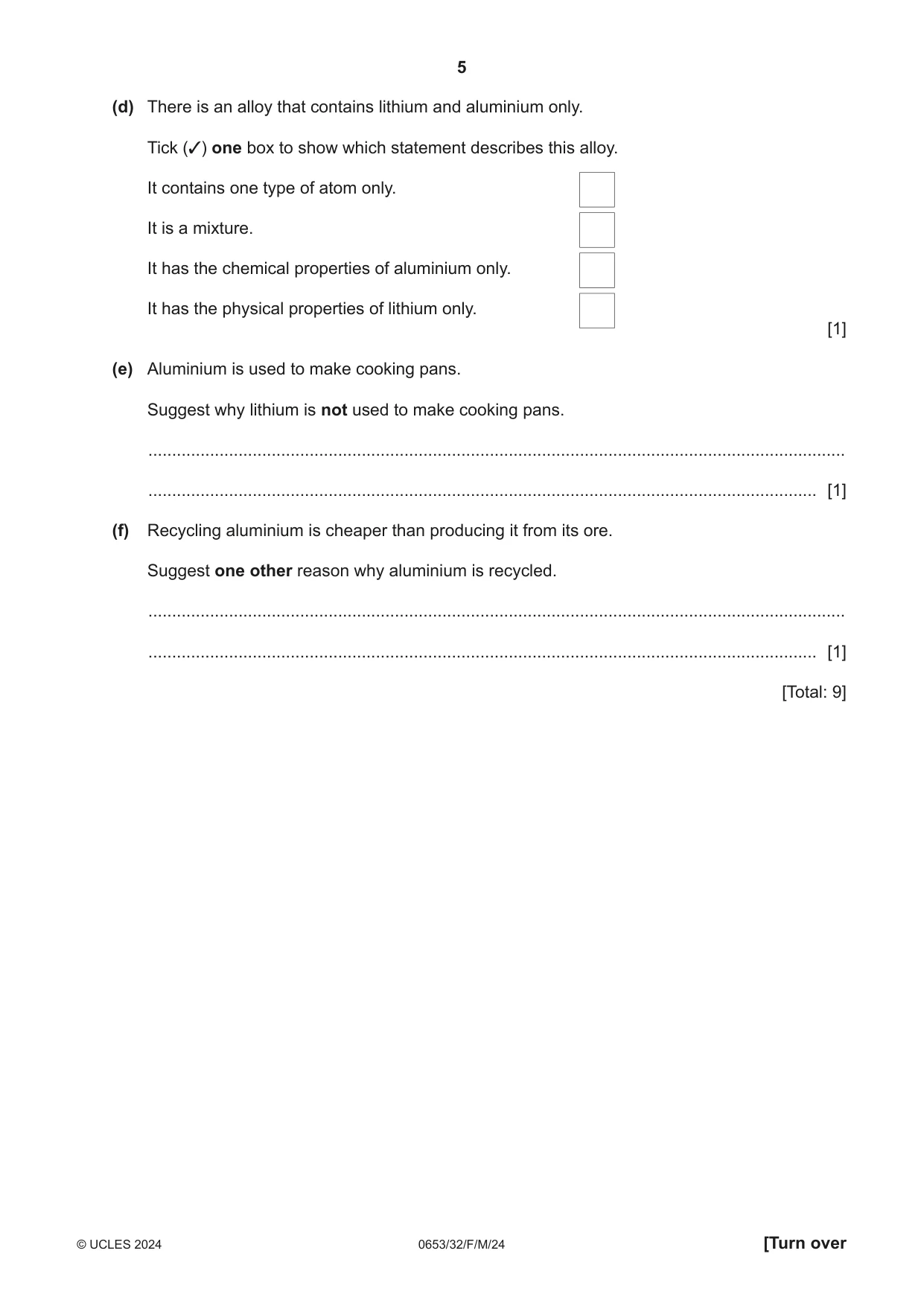
2 Lithium is an element in Group I of the Periodic Table. (a) An atom of lithium is represented as shown. 73Li Complete Table 2.1 to show the number of protons, electrons and neutrons in one atom of 73Li. Table 2.1 number of protons number of electrons number of neutrons [2] (b) Describe what happens when an atom of lithium becomes an ion of lithium. ................................................................................................................................................... ............................................................................................................................................. [1] (c) Lithium reacts slowly with oxygen at room temperature to form lithium oxide. This reaction is exothermic. (i) Balance the symbol equation for this reaction. [1] ……. Li + .…... O2 ……. Li2O (ii) Circle the word that describes the reaction between lithium and oxygen. decomposition distillation neutralisation oxidation [1] (iii) Describe one observation that shows the reaction is exothermic. ........................................................................................................................................... ..................................................................................................................................... [1] (d) There is an alloy that contains lithium and aluminium only. Tick (3) one box to show which statement describes this alloy. It contains one type of atom only. It is a mixture. It has the chemical properties of aluminium only. It has the physical properties of lithium only. [1] (e) Aluminium is used to make cooking pans. Suggest why lithium is not used to make cooking pans. ................................................................................................................................................... ............................................................................................................................................. [1] (f) Recycling aluminium is cheaper than producing it from its ore. Suggest one other reason why aluminium is recycled. ................................................................................................................................................... ............................................................................................................................................. [1] [Total: 9]
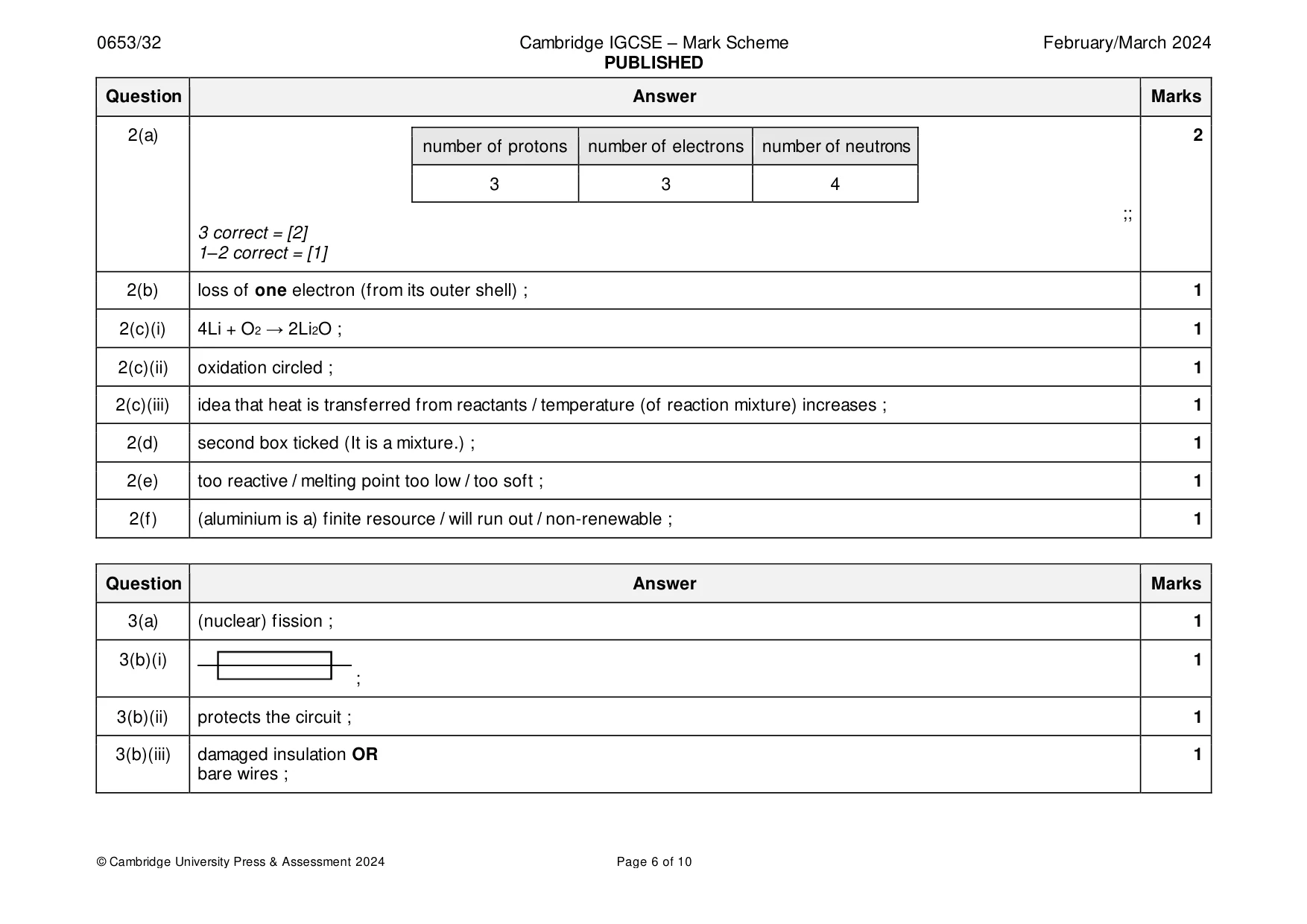
Mark scheme: 2(a) 2 number of protons number of electrons number of neutrons 3 3 4 ;; 3 correct = [2] 1–2 correct = [1] 2(b) loss of one electron (from its outer shell) ; 1 2(c)(i) 4Li + O2 → 2Li2O ; 1 2(c)(ii) oxidation circled ; 1 2(c)(iii) idea that heat is transferred from reactants / temperature (of reaction mixture) increases ; 1 2(d) second box ticked (It is a mixture.) ; 1 2(e) too reactive / melting point too low / too soft ; 1 2(f) (aluminium is a) finite resource / will run out / non-renewable ; 1
Q3 · A nuclear power station
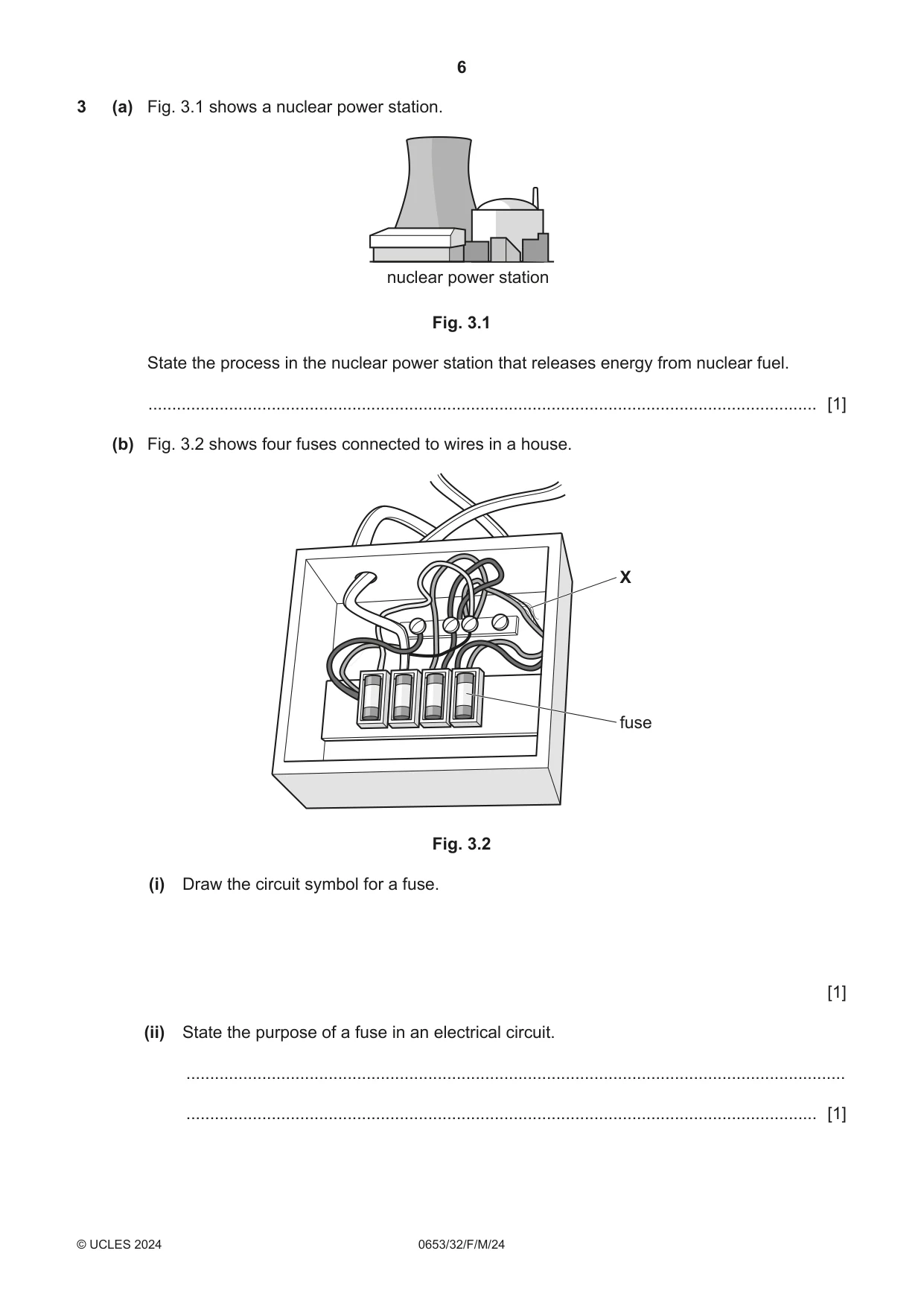
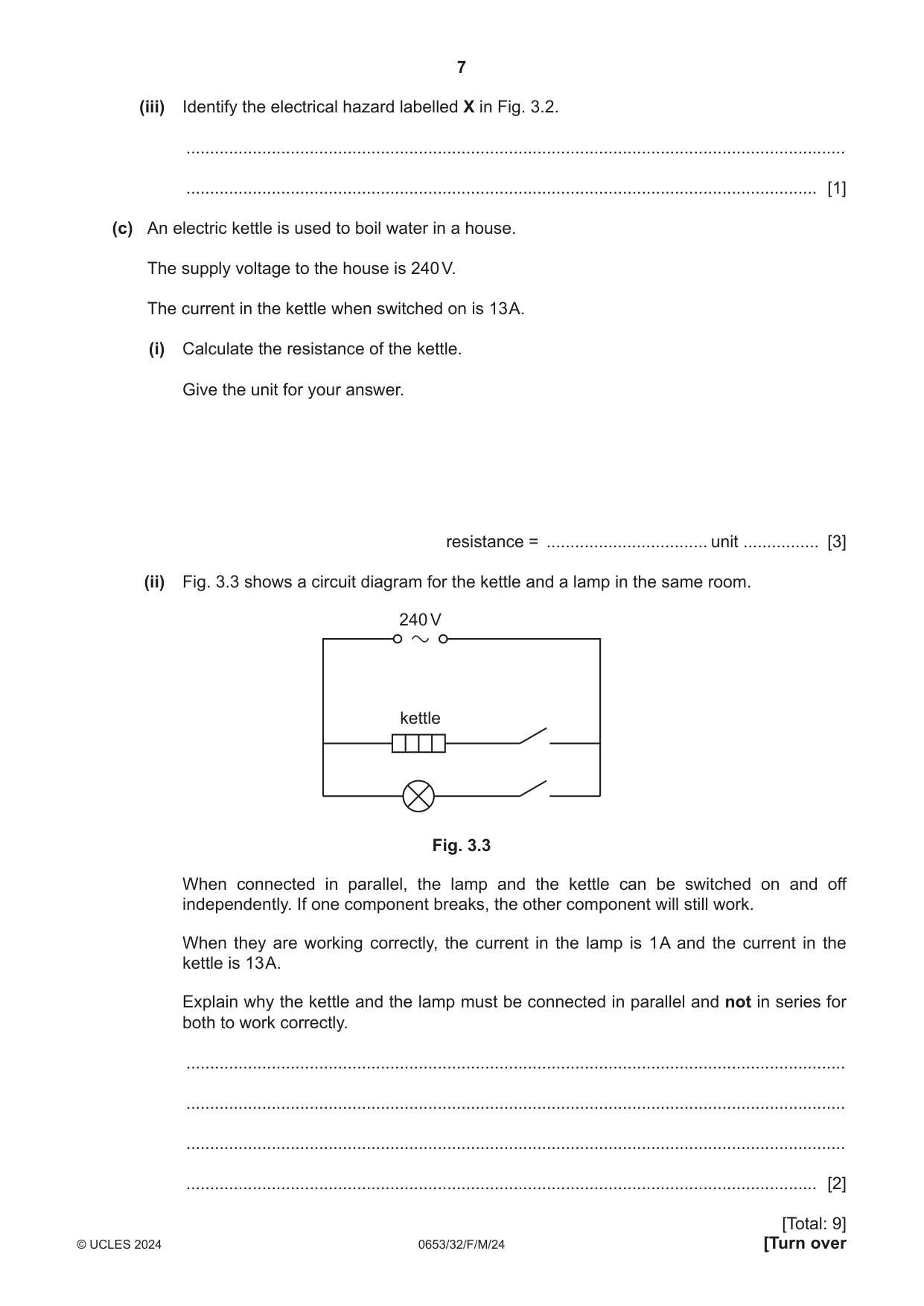
3 (a) Fig. 3.1 shows a nuclear power station. nuclear power station Fig. 3.1 State the process in the nuclear power station that releases energy from nuclear fuel. ............................................................................................................................................. [1] (b) Fig. 3.2 shows four fuses connected to wires in a house. X fuse Fig. 3.2 (i) Draw the circuit symbol for a fuse. [1] (ii) State the purpose of a fuse in an electrical circuit. ........................................................................................................................................... ..................................................................................................................................... [1] (iii) Identify the electrical hazard labelled X in Fig. 3.2. ........................................................................................................................................... ..................................................................................................................................... [1] (c) An electric kettle is used to boil water in a house. The supply voltage to the house is 240 V. The current in the kettle when switched on is 13 A. (i) Calculate the resistance of the kettle. Give the unit for your answer. resistance = .................................. unit ................ [3] (ii) Fig. 3.3 shows a circuit diagram for the kettle and a lamp in the same room. 240 V kettle Fig. 3.3 When connected in parallel, the lamp and the kettle can be switched on and off independently. If one component breaks, the other component will still work. When they are working correctly, the current in the lamp is 1 A and the current in the kettle is 13 A. Explain why the kettle and the lamp must be connected in parallel and not in series for both to work correctly. ........................................................................................................................................... ........................................................................................................................................... ........................................................................................................................................... ..................................................................................................................................... [2]
Mark scheme: 3(a) (nuclear) fission ; 1 3(b)(i) 1 ; 3(b)(ii) protects the circuit ; 1 3(b)(iii) damaged insulation OR 1 bare wires ; 3(c)(i) R = V I in any form ; 3 240 13 = 18 OR 18.5 ; / ohms ; 3(c)(ii) lamp and kettle need / take, (very) different currents ; 2 in series would have the same current / cannot have different currents ;
Q4 · Blood and blood vessels are part of the circulatory system in humans
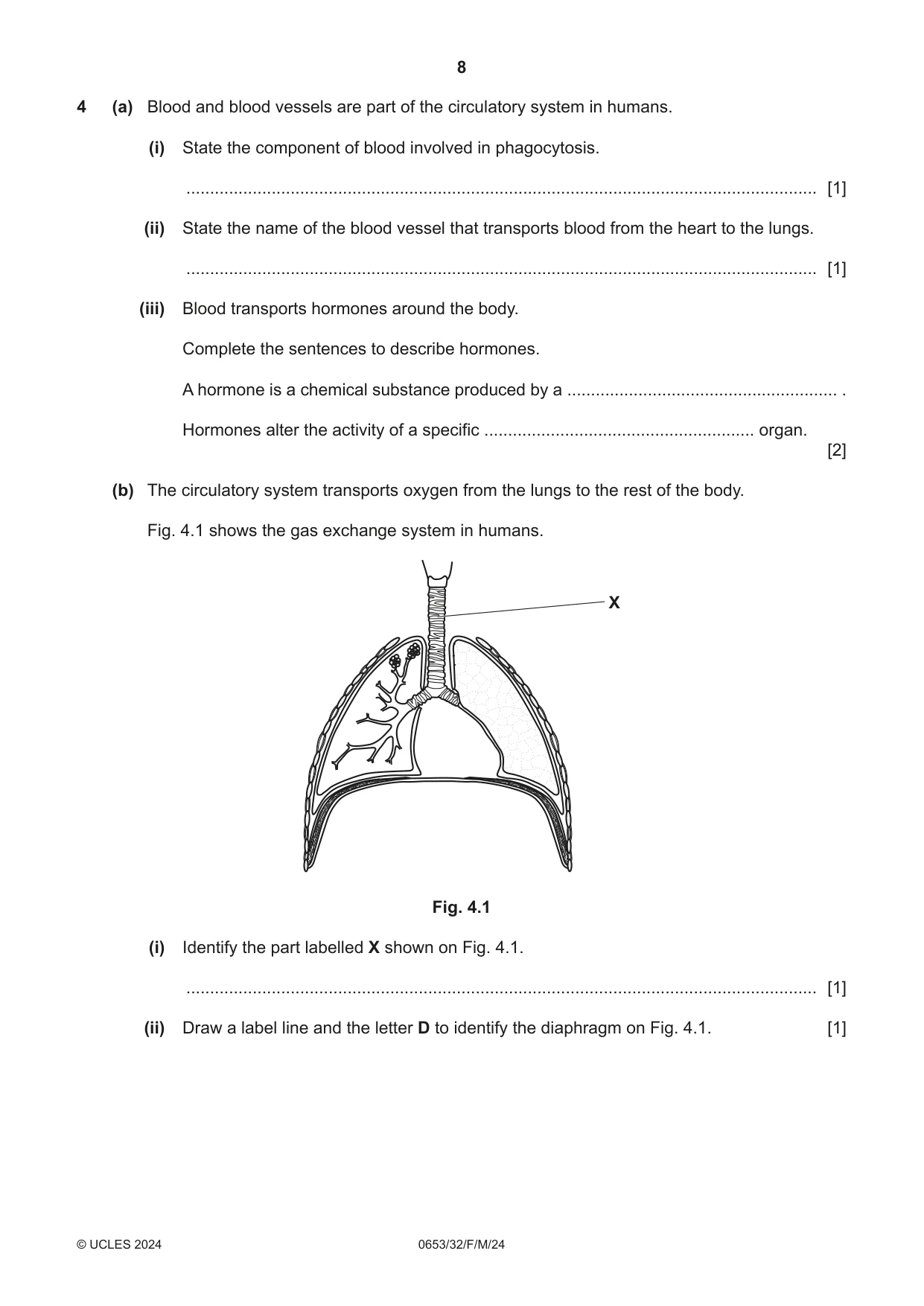
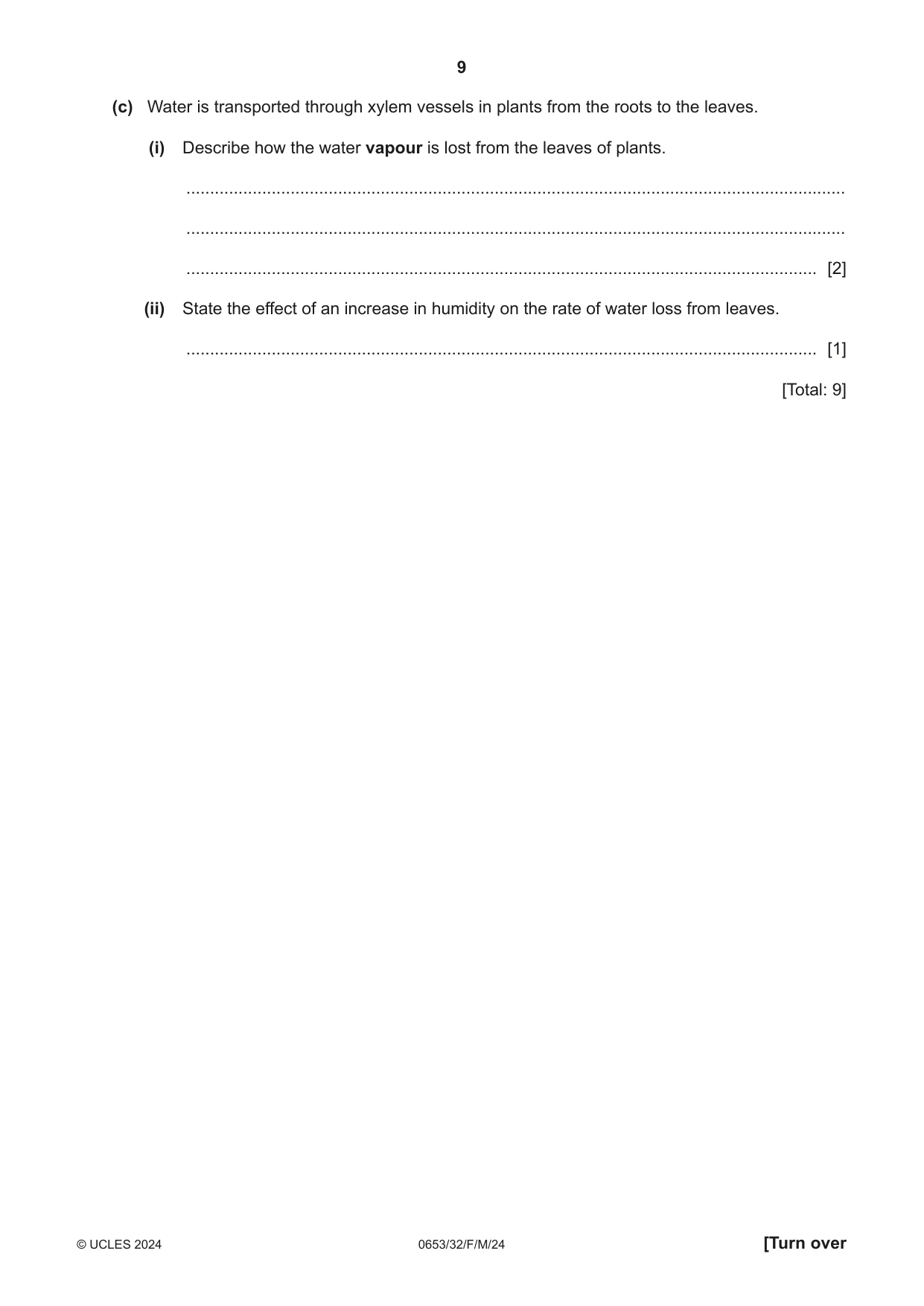
4 (a) Blood and blood vessels are part of the circulatory system in humans. (i) State the component of blood involved in phagocytosis. ..................................................................................................................................... [1] (ii) State the name of the blood vessel that transports blood from the heart to the lungs. ..................................................................................................................................... [1] (iii) Blood transports hormones around the body. Complete the sentences to describe hormones. A hormone is a chemical substance produced by a ......................................................... . Hormones alter the activity of a specific ......................................................... organ. [2] (b) The circulatory system transports oxygen from the lungs to the rest of the body. Fig. 4.1 shows the gas exchange system in humans. X Fig. 4.1 (i) Identify the part labelled X shown on Fig. 4.1. ..................................................................................................................................... [1] (ii) Draw a label line and the letter D to identify the diaphragm on Fig. 4.1. [1] (c) Water is transported through xylem vessels in plants from the roots to the leaves. (i) Describe how the water vapour is lost from the leaves of plants. ........................................................................................................................................... ........................................................................................................................................... ..................................................................................................................................... [2] (ii) State the effect of an increase in humidity on the rate of water loss from leaves. ..................................................................................................................................... [1] [Total: 9]
Mark scheme: 4(a)(i) white blood cells ; 1 4(a)(ii) pulmonary artery ; 1 4(a)(iii) gland ; 2 target ; 4(b)(i) trachea ; 1 4(b)(ii) diaphragm labelled ; 1 4(c)(i) diffusion ; 2 through stomata ; 4(c)(ii) decreases ; 1
Q5 · A pie chart showing the composition of clean air
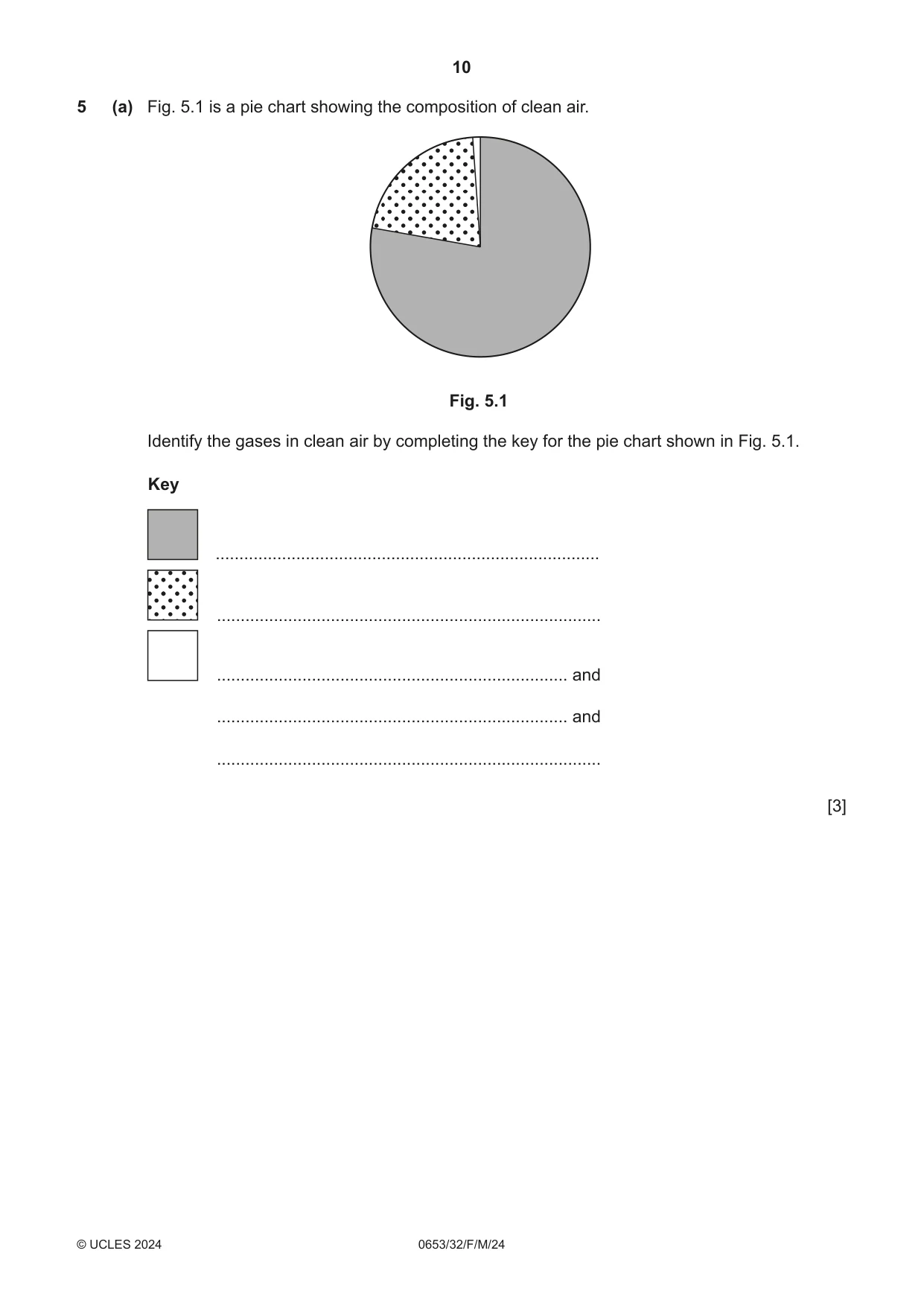
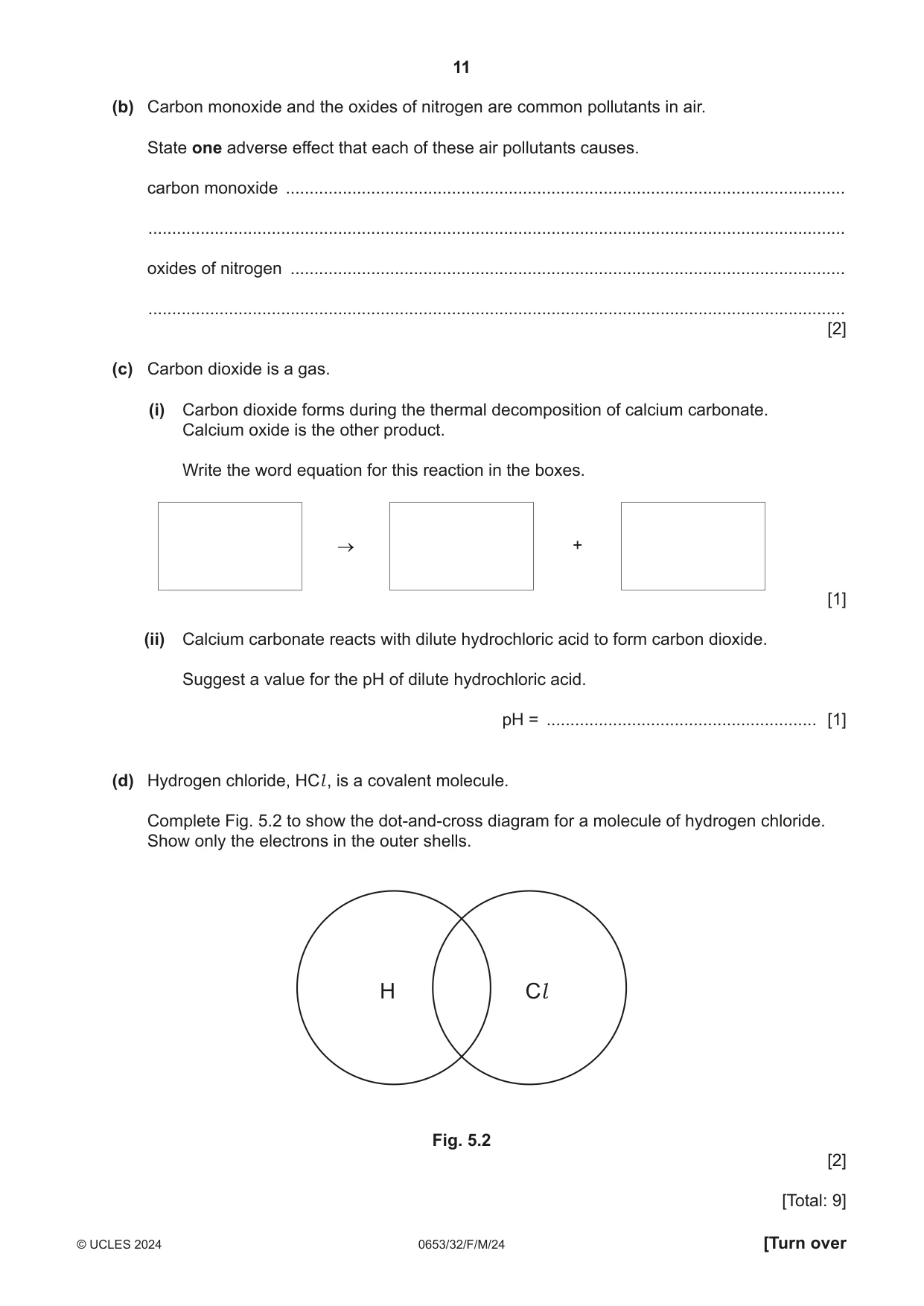
5 (a) Fig. 5.1 is a pie chart showing the composition of clean air. Fig. 5.1 Identify the gases in clean air by completing the key for the pie chart shown in Fig. 5.1. Key ................................................................................. ................................................................................. .......................................................................... and .......................................................................... and ................................................................................. [3] (b) Carbon monoxide and the oxides of nitrogen are common pollutants in air. State one adverse effect that each of these air pollutants causes. carbon monoxide ...................................................................................................................... ................................................................................................................................................... oxides of nitrogen ..................................................................................................................... ................................................................................................................................................... [2] (c) Carbon dioxide is a gas. (i) Carbon dioxide forms during the thermal decomposition of calcium carbonate. Calcium oxide is the other product. Write the word equation for this reaction in the boxes. + [1] (ii) Calcium carbonate reacts with dilute hydrochloric acid to form carbon dioxide. Suggest a value for the pH of dilute hydrochloric acid. pH = ......................................................... [1] (d) Hydrogen chloride, HCl , is a covalent molecule. Complete Fig. 5.2 to show the dot-and-cross diagram for a molecule of hydrogen chloride. Show only the electrons in the outer shells. H Cl Fig. 5.2 [2] [Total: 9]
Mark scheme: 5(a) (grey shading) nitrogen 3 (dots shading) oxygen (white shading) noble gases / named noble gas (white shading) water vapour (white shading) carbon dioxide ;;; 5 correct = [3] 3–4 correct = [2] 1–2 correct = [1] 5(b) carbon monoxide: 2 headaches / tiredness / confusion / toxic ; oxides of nitrogen: acid rain / damages buildings ; 5(c)(i) calcium carbonate → calcium oxide + carbon dioxide ; 1 5(c)(ii) 1–4 ; 1 5(d) shared pair of electrons ; 2 3 lone pairs in Cl and no other electrons in H ;
Q6 · The forces P, Q, R and S acting on a fishing boat at sea
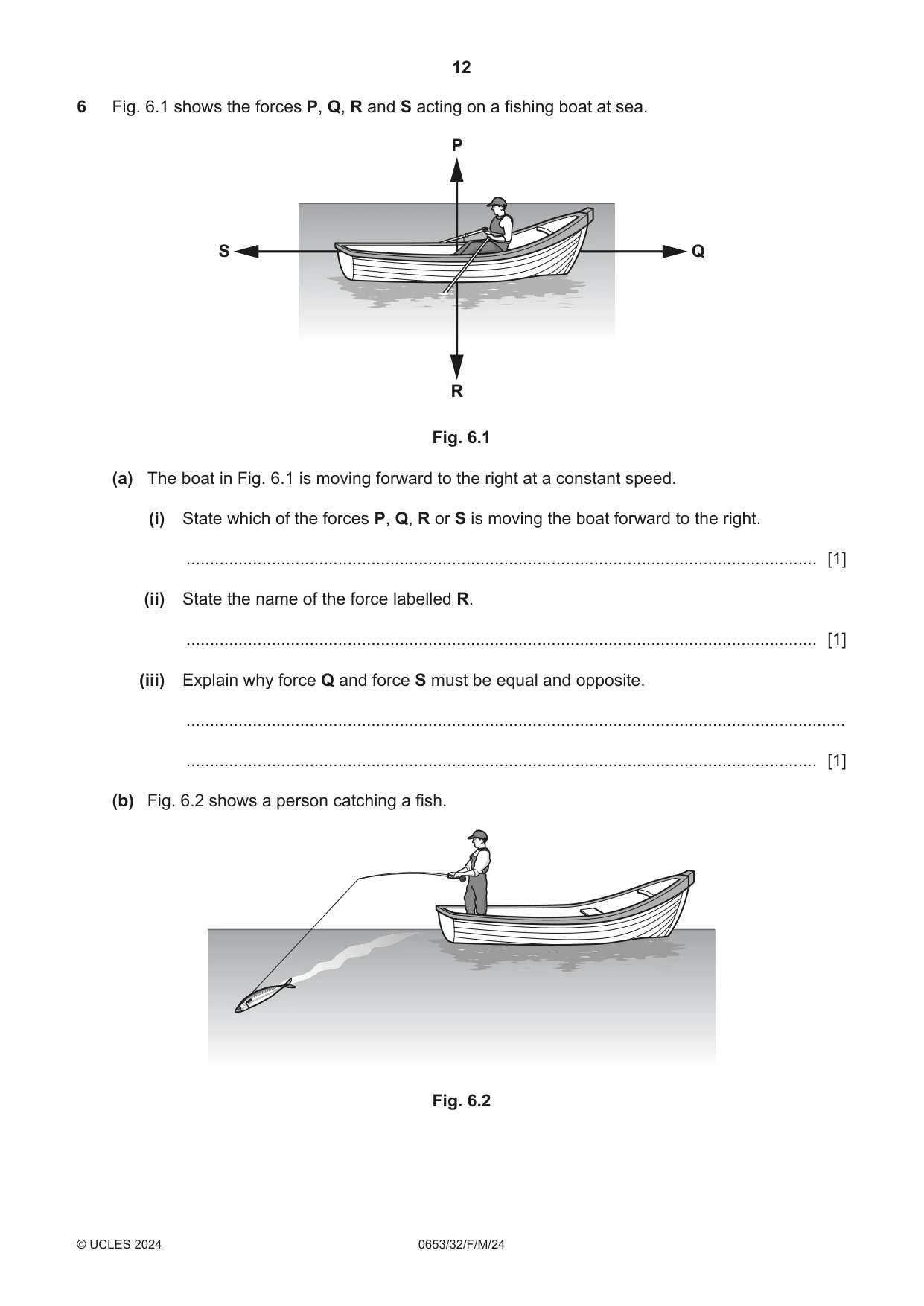
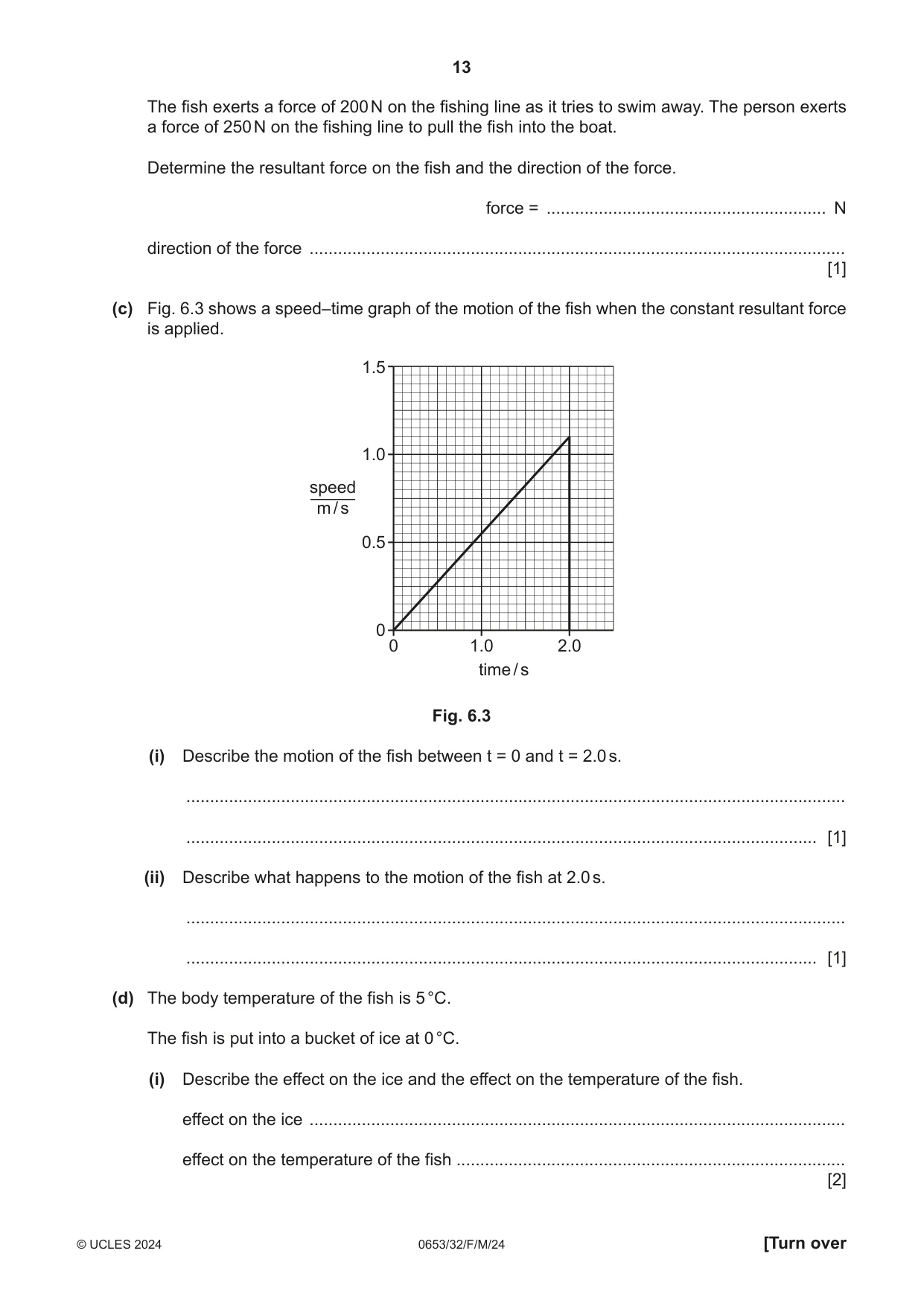
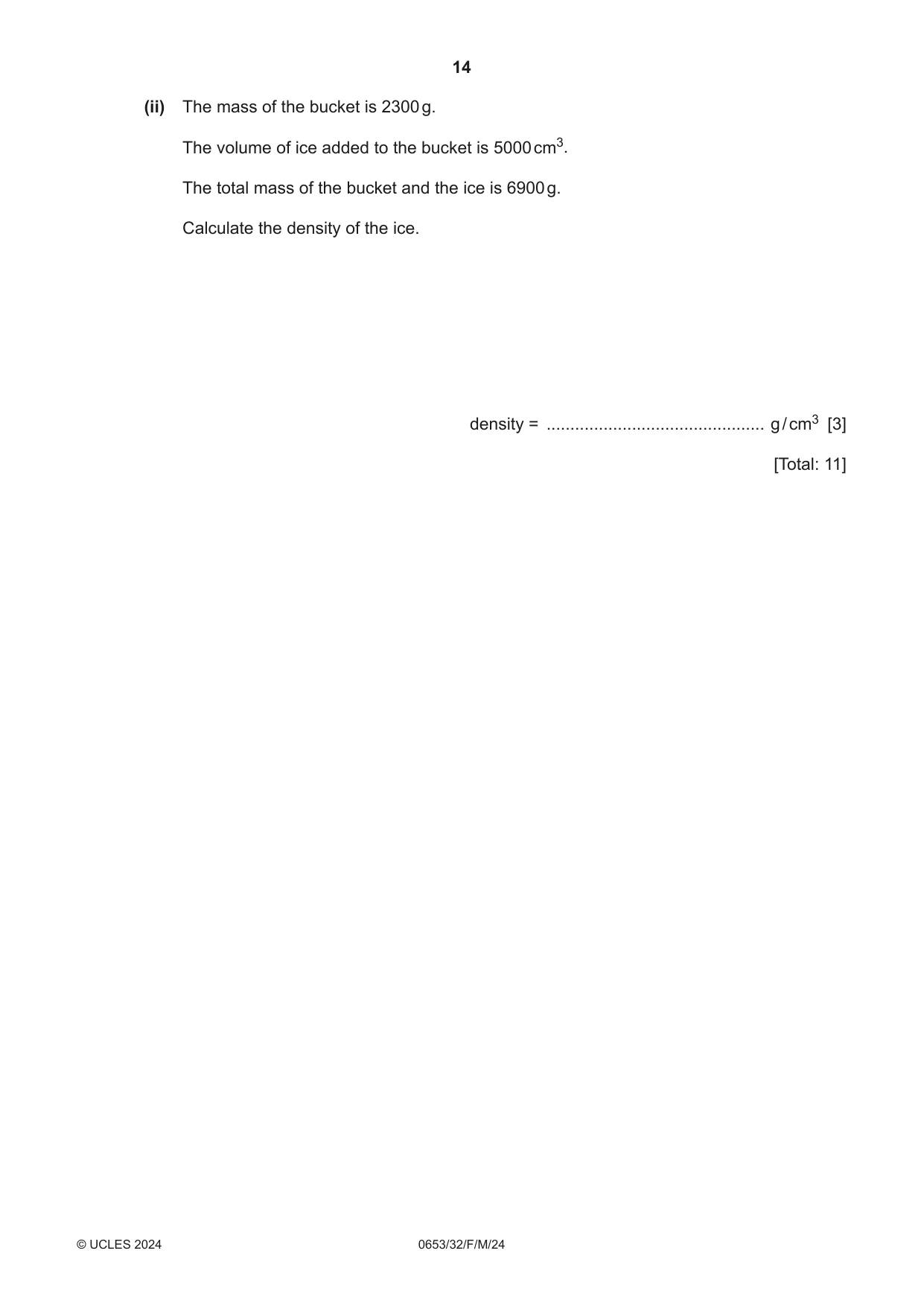
6 Fig. 6.1 shows the forces P, Q, R and S acting on a fishing boat at sea. P S Q R Fig. 6.1 (a) The boat in Fig. 6.1 is moving forward to the right at a constant speed. (i) State which of the forces P, Q, R or S is moving the boat forward to the right. ..................................................................................................................................... [1] (ii) State the name of the force labelled R. ..................................................................................................................................... [1] (iii) Explain why force Q and force S must be equal and opposite. ........................................................................................................................................... ..................................................................................................................................... [1] (b) Fig. 6.2 shows a person catching a fish. Fig. 6.2 The fish exerts a force of 200 N on the fishing line as it tries to swim away. The person exerts a force of 250 N on the fishing line to pull the fish into the boat. Determine the resultant force on the fish and the direction of the force. force = ........................................................... N direction of the force ................................................................................................................. [1] (c) Fig. 6.3 shows a speed–time graph of the motion of the fish when the constant resultant force is applied. 1.5 1.0 speed m / s 0.5 0 0 1.0 2.0 time / s Fig. 6.3 (i) Describe the motion of the fish between t = 0 and t = 2.0 s. ........................................................................................................................................... ..................................................................................................................................... [1] (ii) Describe what happens to the motion of the fish at 2.0 s. ........................................................................................................................................... ..................................................................................................................................... [1] (d) The body temperature of the fish is 5 °C. The fish is put into a bucket of ice at 0 °C. (i) Describe the effect on the ice and the effect on the temperature of the fish. effect on the ice ................................................................................................................. effect on the temperature of the fish .................................................................................. [2] (ii) The mass of the bucket is 2300 g. The volume of ice added to the bucket is 5000 cm3. The total mass of the bucket and the ice is 6900 g. Calculate the density of the ice. density = .............................................. g / cm3 [3] [Total: 11]
Mark scheme: 6(a)(i) Q ; 1 6(a)(ii) weight ; 1 6(a)(iii) moving at constant speed (so forces must be balanced / equal and opposite / zero resultant force) ; 1 6(b) 50 (N) and along fishing line ; 1 6(c)(i) speed increasing with time / accelerating ; 1 6(c)(ii) stops (suddenly) ; 1 6(d)(i) effect on the ice: melts ; 2 effect on the temperature of the fish: decreases / goes down ; 6(d)(ii) = m / V in any form ; 3 mass of ice = 6900 – 2300 / 4600 (g) ; (= 4600 5000) = 0.92 (g / cm3) ;
Q7 · Part of the carbon cycle
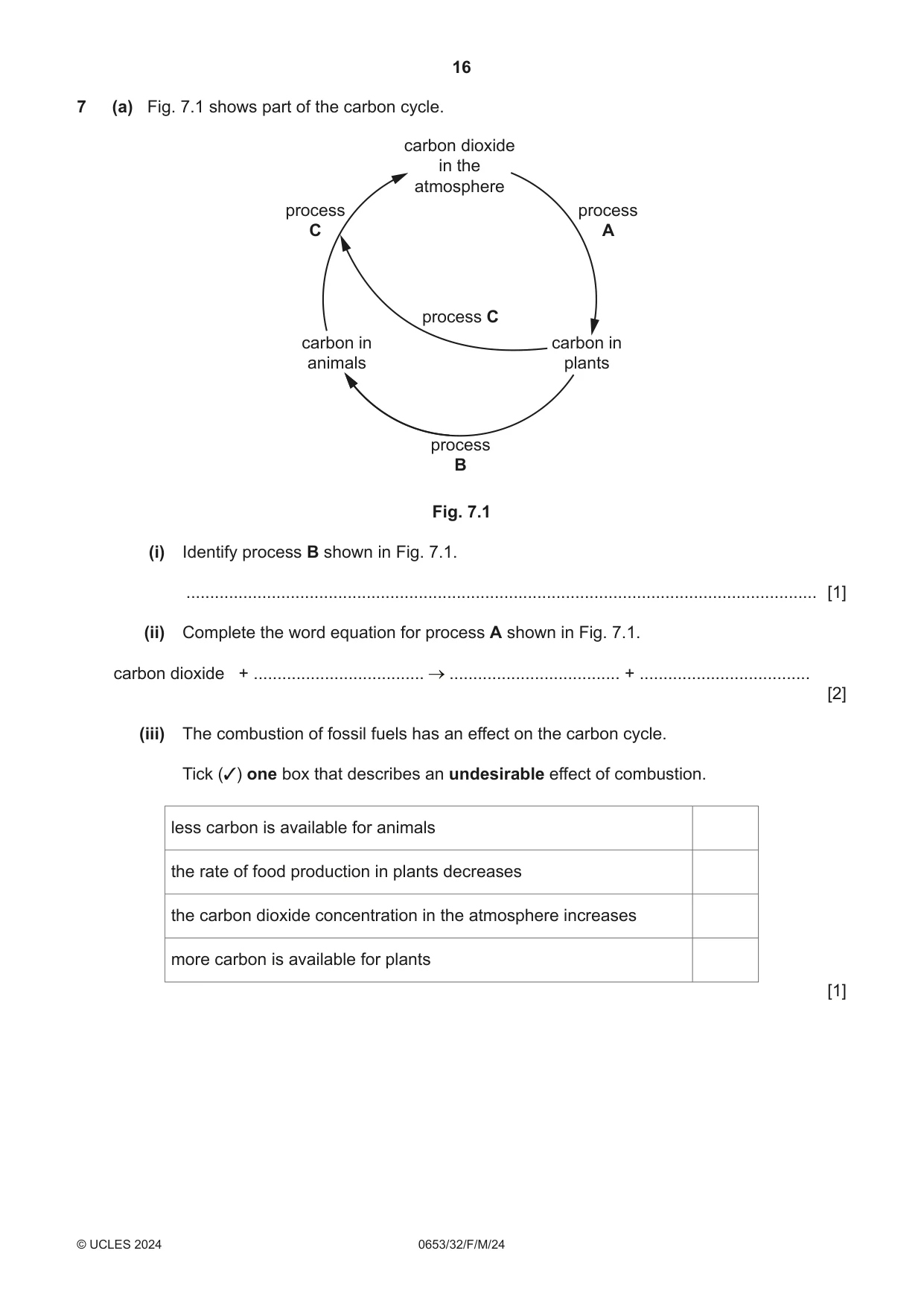
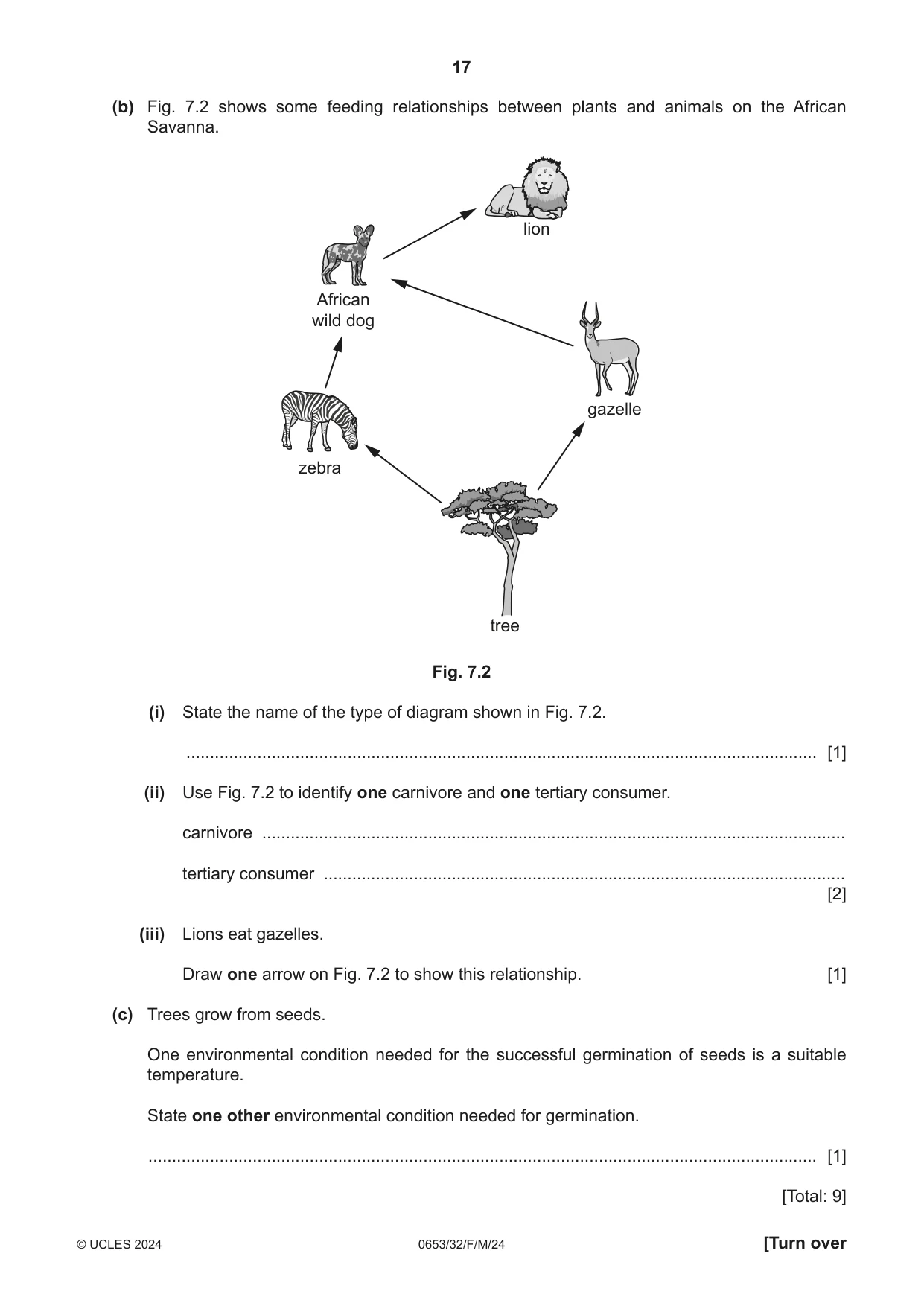
7 (a) Fig. 7.1 shows part of the carbon cycle. carbon dioxide in the atmosphere process process C A process C carbon in carbon in animals plants process B Fig. 7.1 (i) Identify process B shown in Fig. 7.1. ..................................................................................................................................... [1] (ii) Complete the word equation for process A shown in Fig. 7.1. carbon dioxide + .................................... .................................... + .................................... [2] (iii) The combustion of fossil fuels has an effect on the carbon cycle. Tick (3) one box that describes an undesirable effect of combustion. less carbon is available for animals the rate of food production in plants decreases the carbon dioxide concentration in the atmosphere increases more carbon is available for plants [1] (b) Fig. 7.2 shows some feeding relationships between plants and animals on the African Savanna. lion African wild dog gazelle zebra tree Fig. 7.2 (i) State the name of the type of diagram shown in Fig. 7.2. ..................................................................................................................................... [1] (ii) Use Fig. 7.2 to identify one carnivore and one tertiary consumer. carnivore ........................................................................................................................... tertiary consumer .............................................................................................................. [2] (iii) Lions eat gazelles. Draw one arrow on Fig. 7.2 to show this relationship. [1] (c) Trees grow from seeds. One environmental condition needed for the successful germination of seeds is a suitable temperature. State one other environmental condition needed for germination. ............................................................................................................................................. [1] [Total: 9]
Mark scheme: 7(a)(i) feeding ; 1 7(a)(ii) water ; 2 glucose + oxygen ; 7(a)(iii) 1 less carbon is available for animals the rate of food production in plants decreases the carbon dioxide concentration in the atmosphere increases ✓ ; more carbon is available for plants 7(b)(i) food web ; 1 7(b)(ii) carnivore: (African wild) dog / lion ; 2 tertiary consumer: lion ; 7(b)(iii) arrow drawn from gazelle pointing towards lion ; 1 7(c) oxygen / water / moisture ; 1
Q8 · Ethene is an example of an alkene
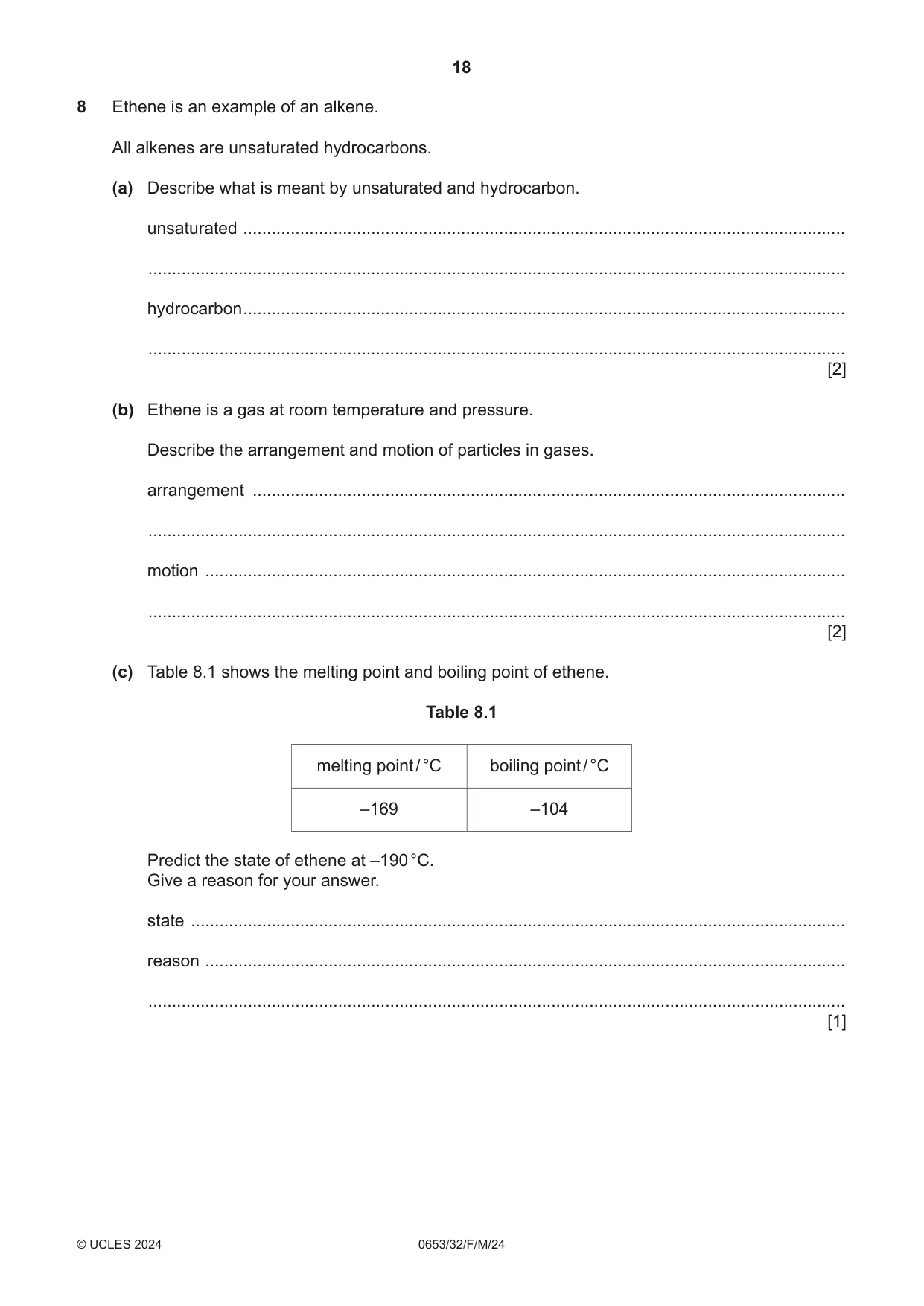
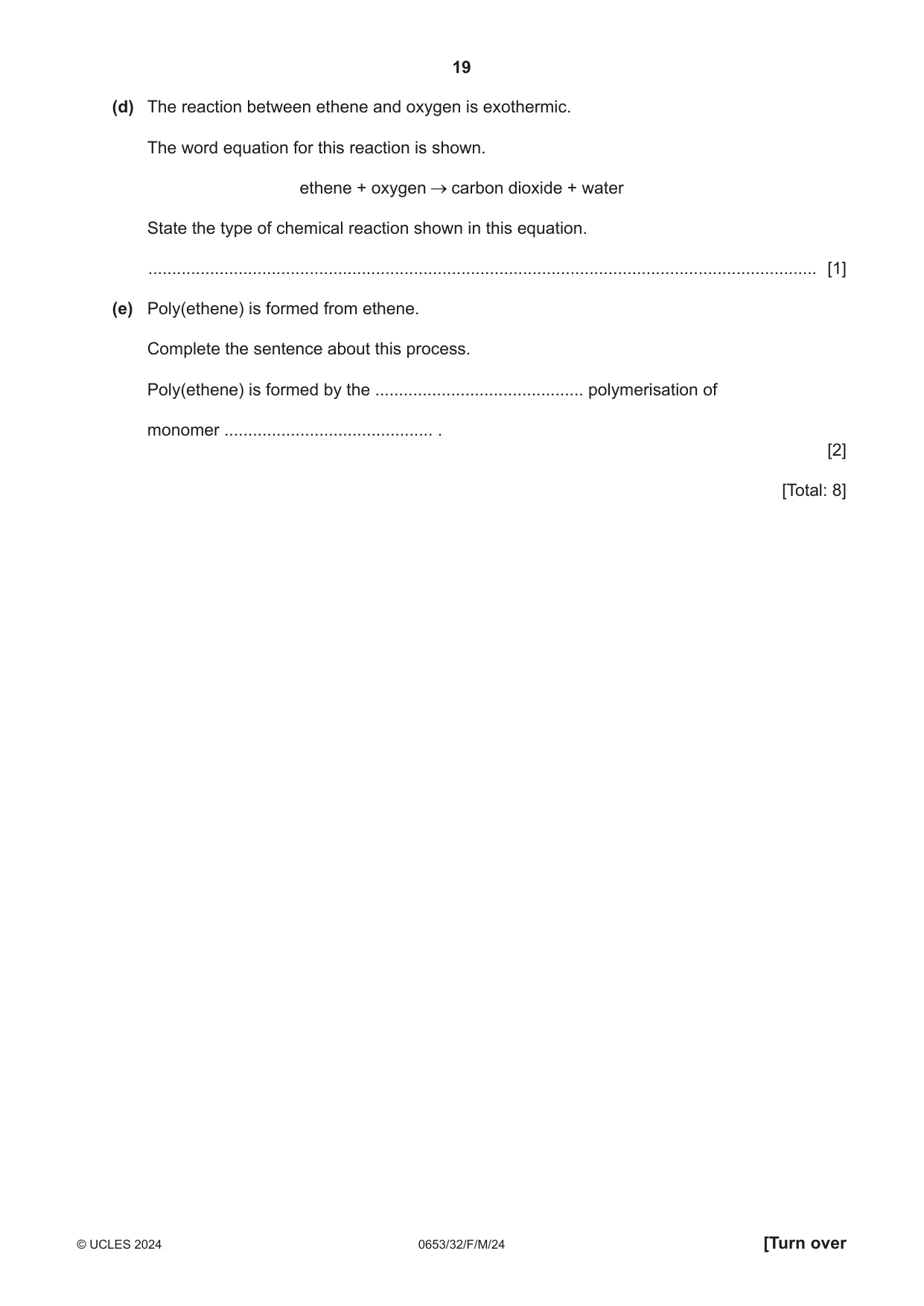
8 Ethene is an example of an alkene. All alkenes are unsaturated hydrocarbons. (a) Describe what is meant by unsaturated and hydrocarbon. unsaturated ............................................................................................................................... ................................................................................................................................................... hydrocarbon ............................................................................................................................... ................................................................................................................................................... [2] (b) Ethene is a gas at room temperature and pressure. Describe the arrangement and motion of particles in gases. arrangement ............................................................................................................................. ................................................................................................................................................... motion ....................................................................................................................................... ................................................................................................................................................... [2] (c) Table 8.1 shows the melting point and boiling point of ethene. Table 8.1 melting point / °C boiling point / °C –169 –104 Predict the state of ethene at –190 °C. Give a reason for your answer. state .......................................................................................................................................... reason ....................................................................................................................................... ................................................................................................................................................... [1] (d) The reaction between ethene and oxygen is exothermic. The word equation for this reaction is shown. ethene + oxygen carbon dioxide + water State the type of chemical reaction shown in this equation. ............................................................................................................................................. [1] (e) Poly(ethene) is formed from ethene. Complete the sentence about this process. Poly(ethene) is formed by the ............................................ polymerisation of monomer ............................................ . [2] [Total: 8]
Mark scheme: 8(a) unsaturated: 2 contains a double (C=C) covalent bond ; hydrocarbon: contains carbon AND hydrogen only ; 8(b) arrangement: 2 far apart / not touching / random ; motion: move quickly ; 8(c) solid AND 1 −190 °C is less than melting point / melting point is higher than −190 °C ; 8(d) combustion ; 1 8(e) addition ; 2 units / molecules ;
Q9 · A spacecraft approaching the planet Venus
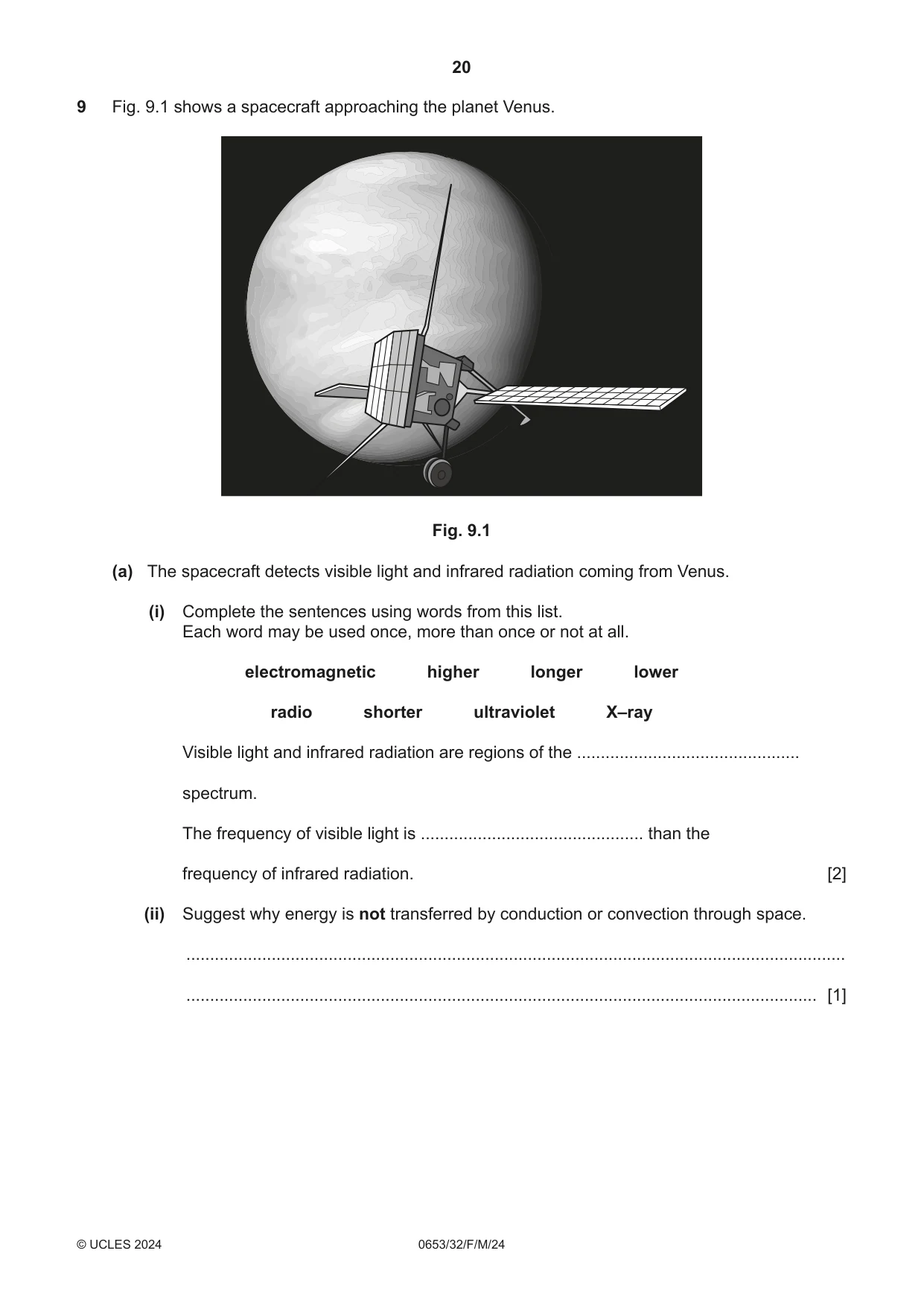
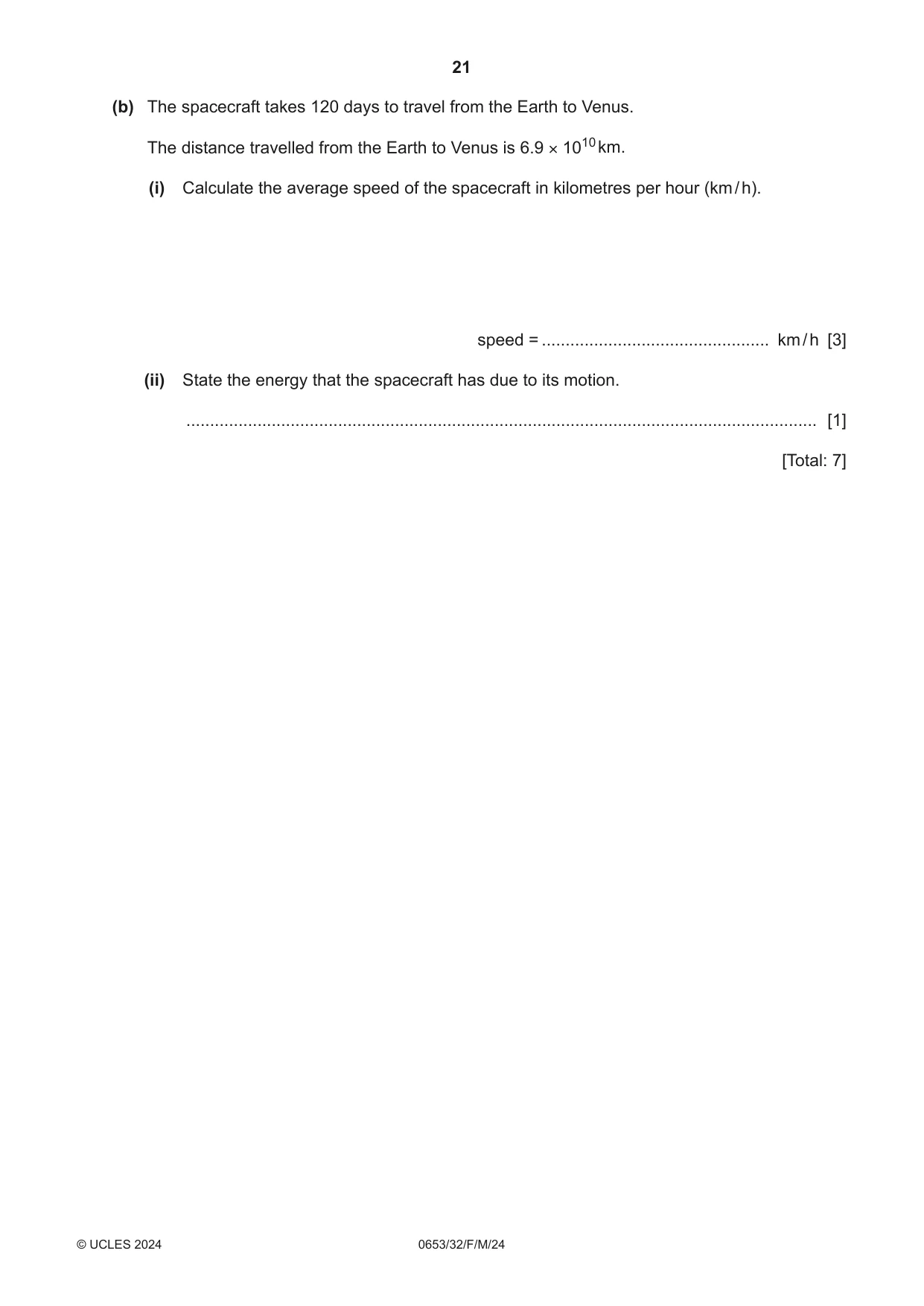
9 Fig. 9.1 shows a spacecraft approaching the planet Venus. Fig. 9.1 (a) The spacecraft detects visible light and infrared radiation coming from Venus. (i) Complete the sentences using words from this list. Each word may be used once, more than once or not at all. electromagnetic higher longer lower radio shorter ultraviolet X–ray Visible light and infrared radiation are regions of the ............................................... spectrum. The frequency of visible light is ............................................... than the frequency of infrared radiation. [2] (ii) Suggest why energy is not transferred by conduction or convection through space. ........................................................................................................................................... ..................................................................................................................................... [1] (b) The spacecraft takes 120 days to travel from the Earth to Venus. The distance travelled from the Earth to Venus is 6.9 × 10¹⁰ km. (i) Calculate the average speed of the spacecraft in kilometres per hour (km / h). speed = ................................................ km / h [3] (ii) State the energy that the spacecraft has due to its motion. ..................................................................................................................................... [1] [Total: 7]
Mark scheme: 9(a)(i) electromagnetic ; 2 higher ; in this order ; 9(a)(ii) idea that both need a (material) medium to transfer energy ; 1 9(b)(i) conversion 120 days to (120 24) / 2880 hours ; 3 average speed = total distance total time in any form OR 6.9 1010 2880 ; 2.4 107 (km / h) ; 9(b)(ii) kinetic ; 1
What was in this paper
The subtopics covered by these 9 questions, and how many questions each got. Open one in a new tab to see every Cambridge question on it.
What you needed in this session
Cambridge’s own grade thresholds for 2024 Feb/March, Paper 3 · Variant 2. A higher threshold means an easier paper — the bar moves with how the cohort did.