Cambridge IGCSE Science - Combined 0653 — 2021 Feb/March Paper 3 · Variant 2
0653/32/F/M/21 · 9 questions · 80 marks · ≈90 min
The question paper and its mark scheme, free to read here and free to download. This is Cambridge’s own paper, exactly as it was sat.
Question paper24 pages


Mark scheme11 pages
Answers below. Sit the paper first if you are practising.
Questions as text
Q1 · Some of the organs of the human body
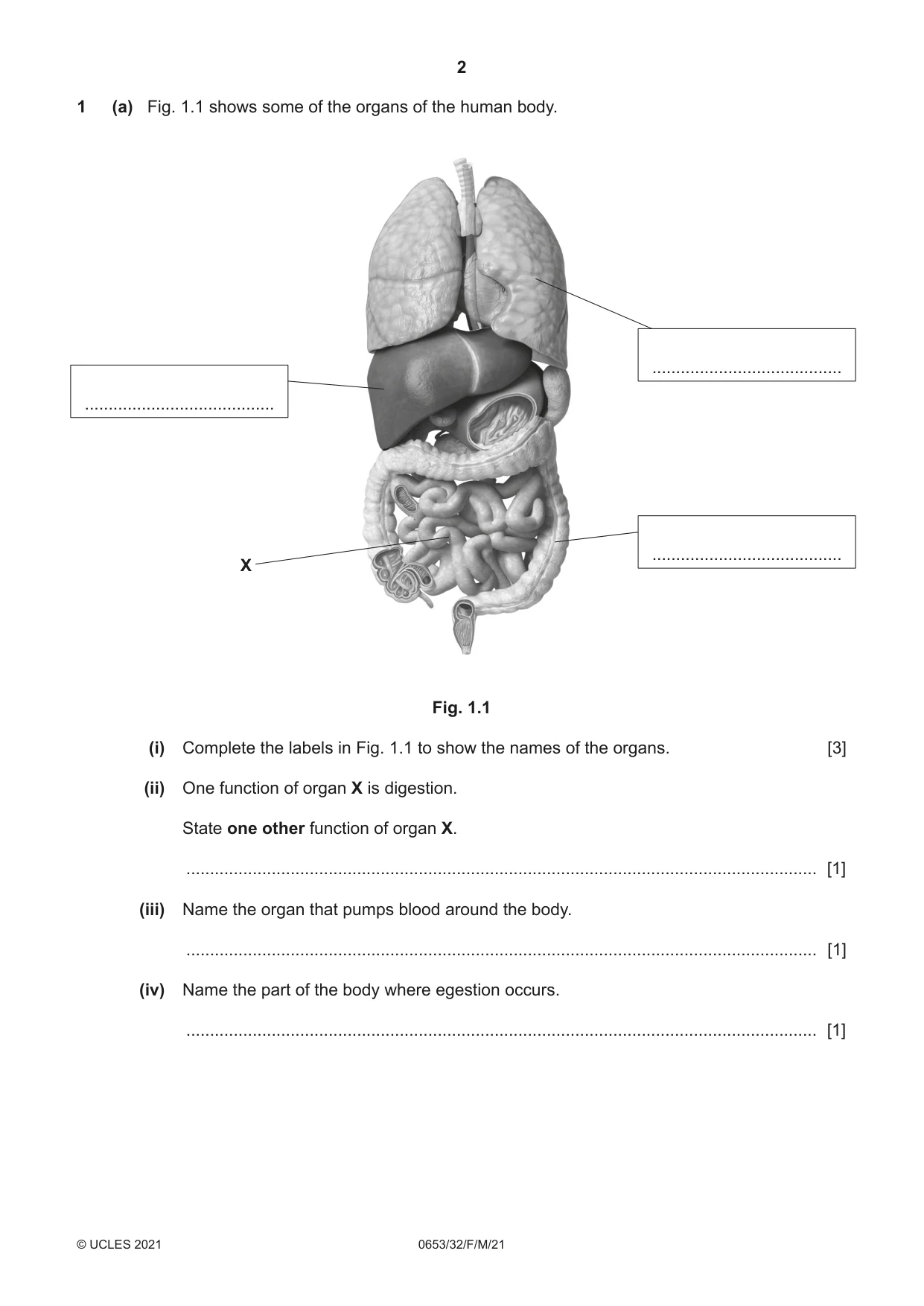
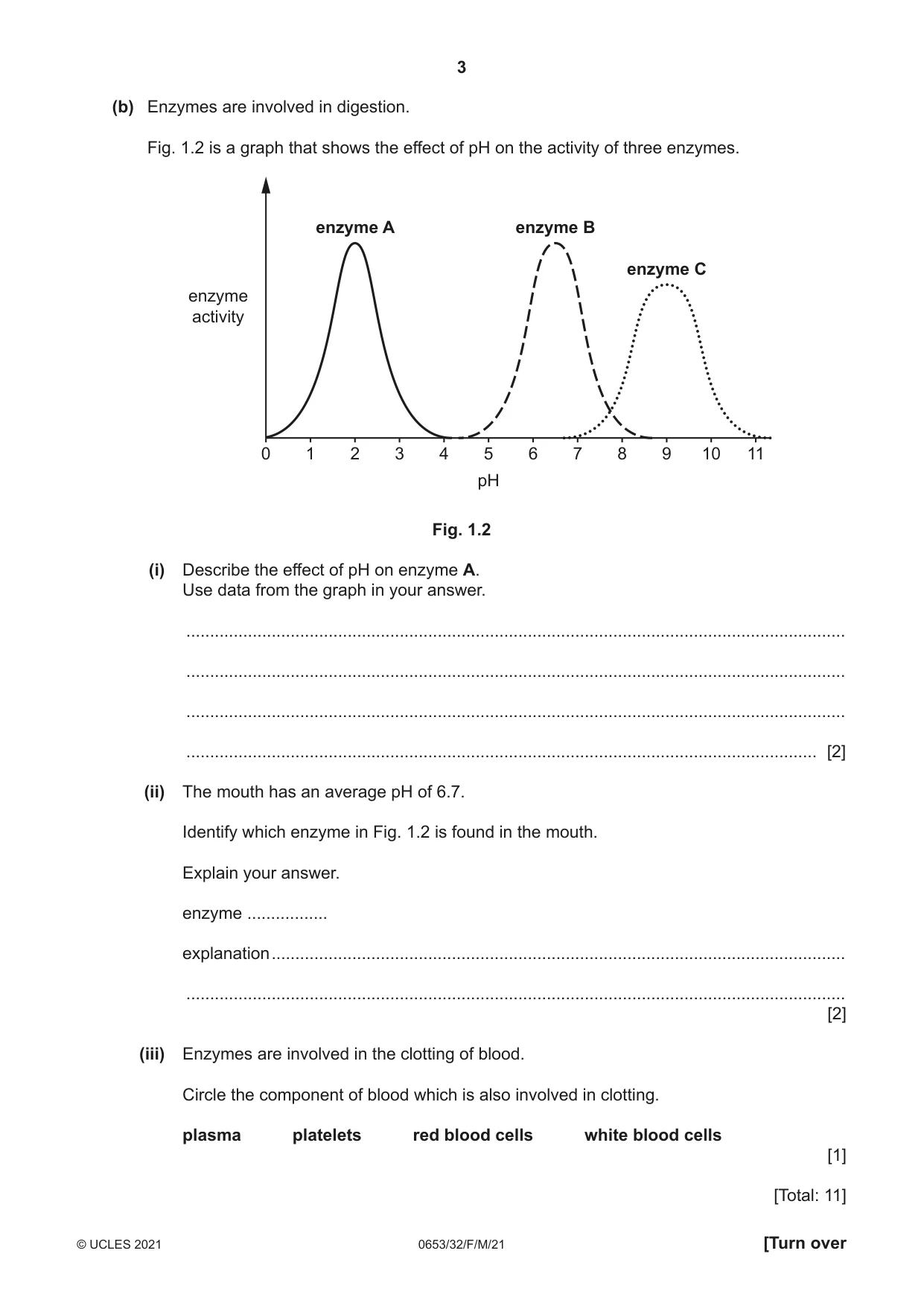
1 (a) Fig. 1.1 shows some of the organs of the human body. ........................................ ........................................ ........................................ X Fig. 1.1 (i) Complete the labels in Fig. 1.1 to show the names of the organs. [3] (ii) One function of organ X is digestion. State one other function of organ X. ..................................................................................................................................... [1] (iii) Name the organ that pumps blood around the body. ..................................................................................................................................... [1] (iv) Name the part of the body where egestion occurs. ..................................................................................................................................... [1] (b) Enzymes are involved in digestion. Fig. 1.2 is a graph that shows the effect of pH on the activity of three enzymes. enzyme A enzyme B enzyme C enzyme activity 0 1 2 3 4 5 6 7 8 9 10 11 pH Fig. 1.2 (i) Describe the effect of pH on enzyme A. Use data from the graph in your answer. ........................................................................................................................................... ........................................................................................................................................... ........................................................................................................................................... ..................................................................................................................................... [2] (ii) The mouth has an average pH of 6.7. Identify which enzyme in Fig. 1.2 is found in the mouth. Explain your answer. enzyme ................. explanation ......................................................................................................................... ........................................................................................................................................... [2] (iii) Enzymes are involved in the clotting of blood. Circle the component of blood which is also involved in clotting. plasma platelets red blood cells white blood cells [1] [Total: 11]
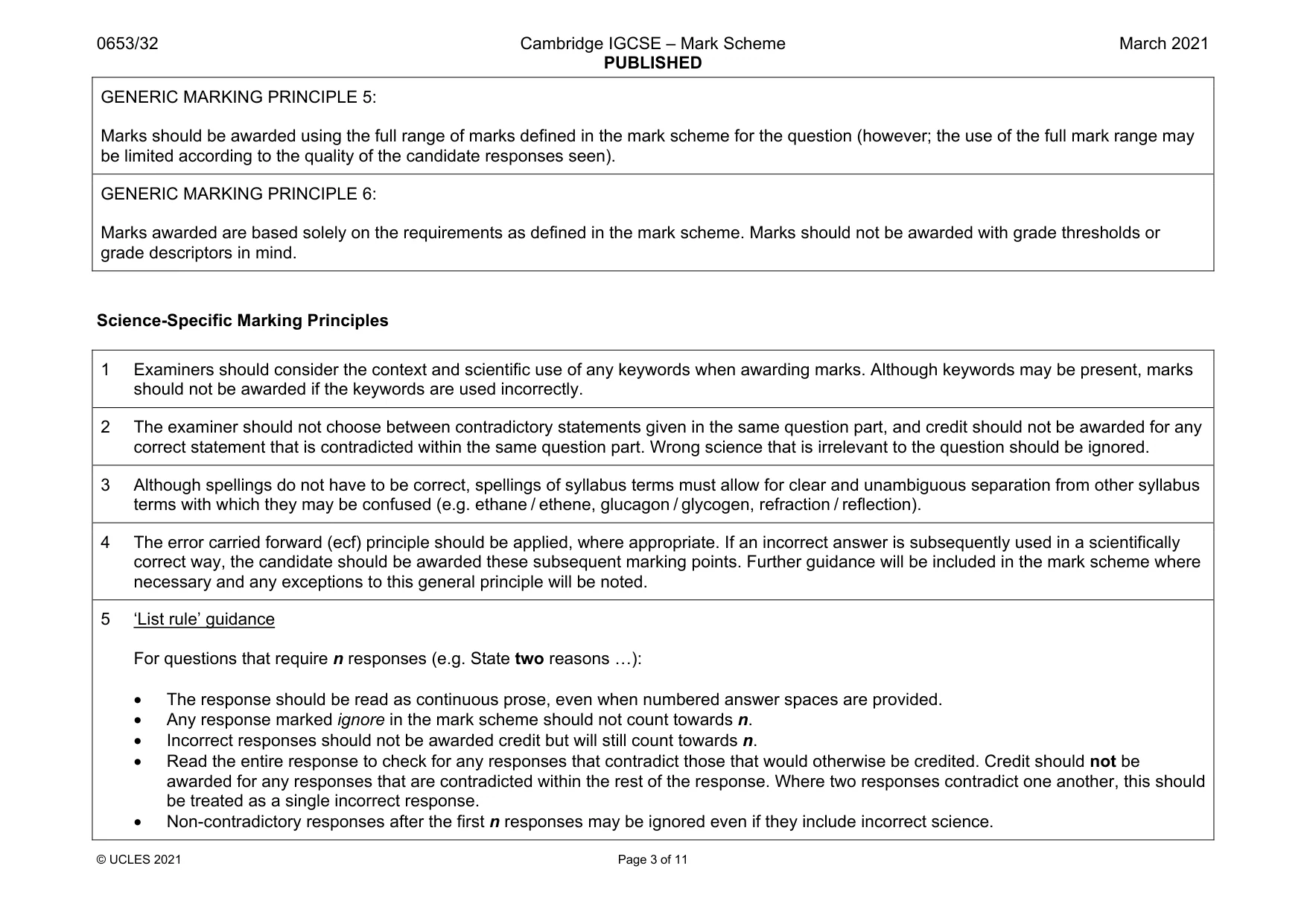
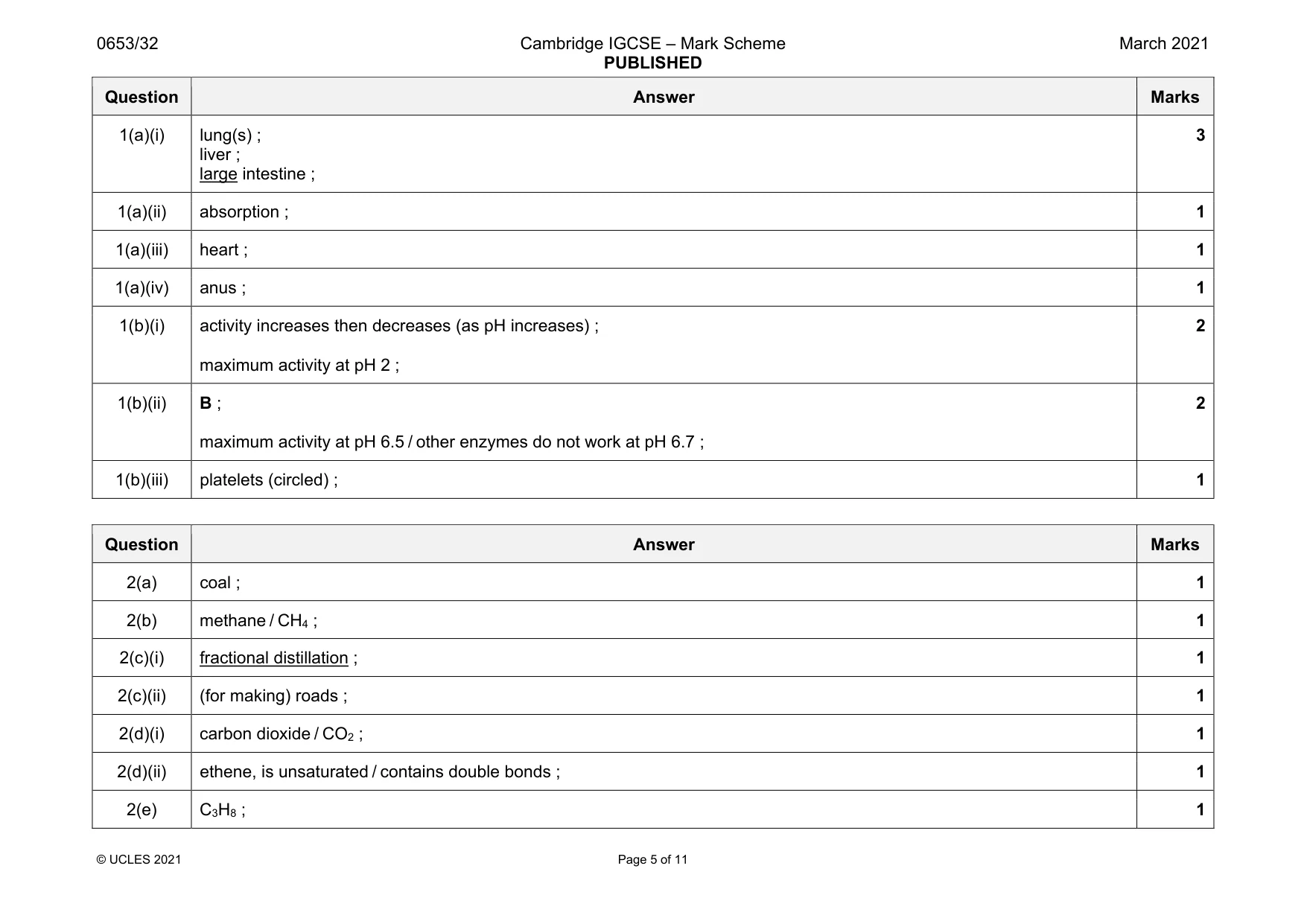
Mark scheme: 1(a)(i) lung(s) ; liver ; large intestine ; 3 1(a)(ii) absorption ; 1 1(a)(iii) heart ; 1 1(a)(iv) anus ; 1 1(b)(i) activity increases then decreases (as pH increases) ; maximum activity at pH 2 ; 2 1(b)(ii) B ; maximum activity at pH 6.5 / other enzymes do not work at pH 6.7 ; 2 1(b)(iii) platelets (circled) ; 1
Q2 · Natural gas and petroleum are two types of fossil fuel
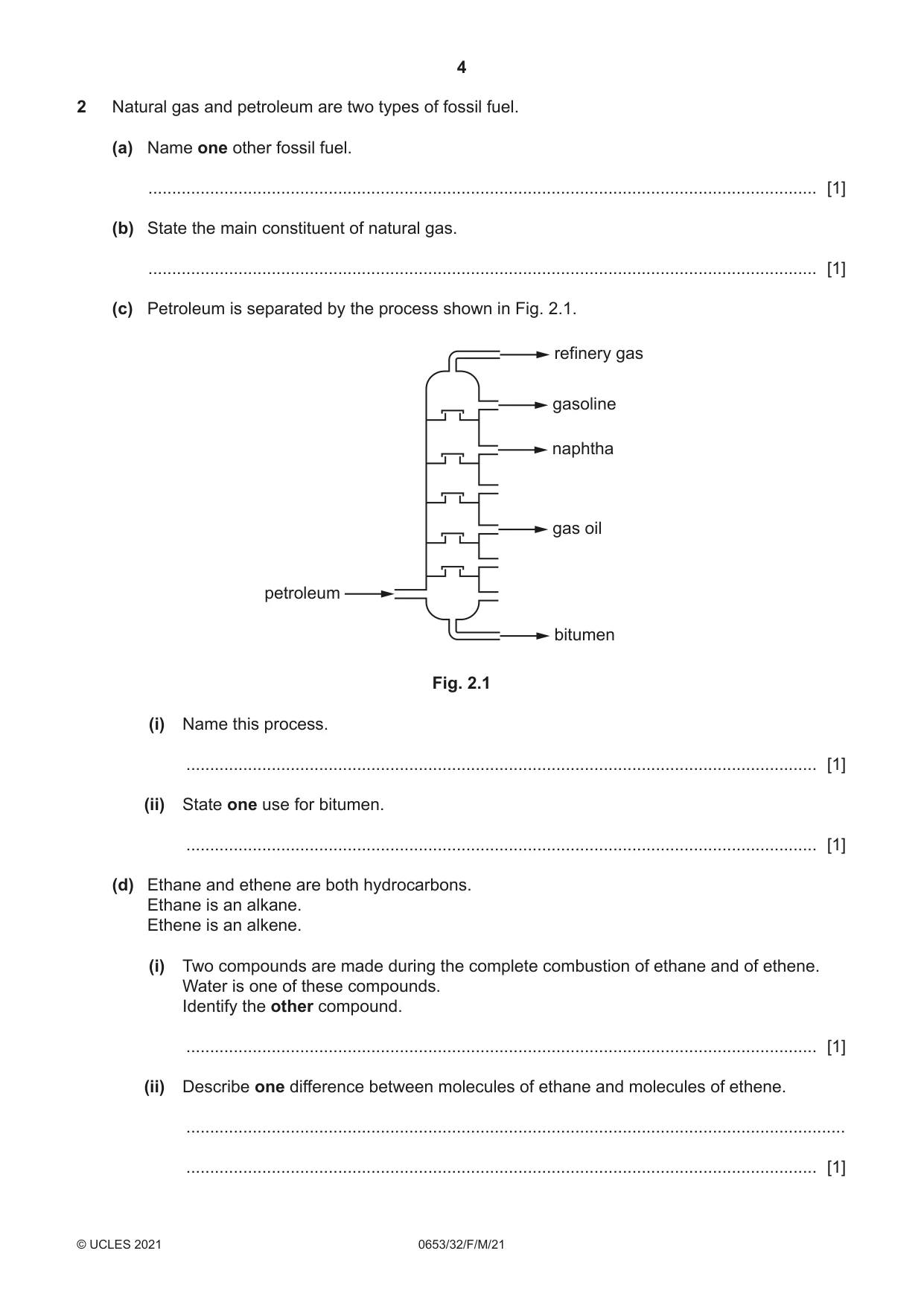
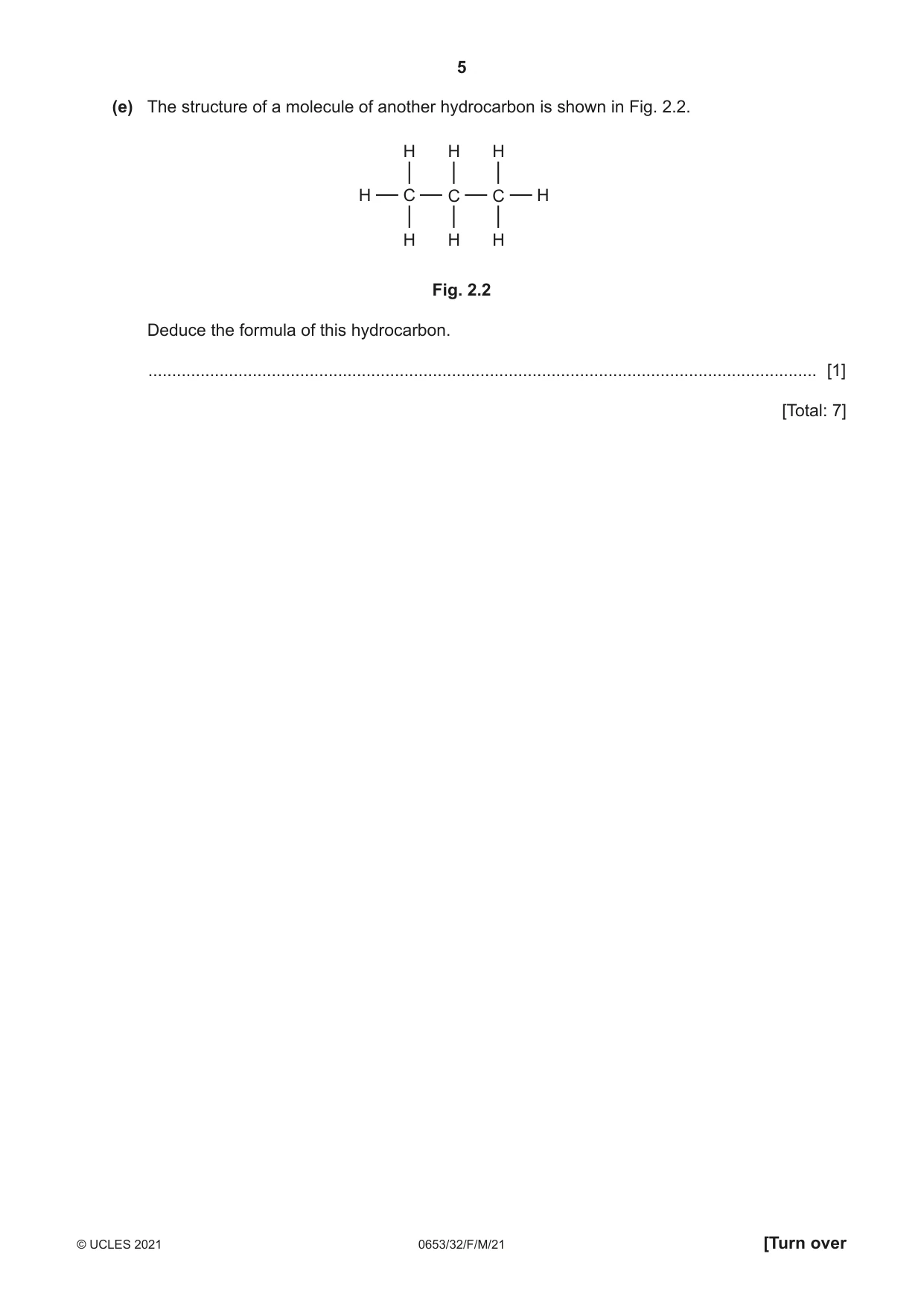
2 Natural gas and petroleum are two types of fossil fuel. (a) Name one other fossil fuel. ............................................................................................................................................. [1] (b) State the main constituent of natural gas. ............................................................................................................................................. [1] (c) Petroleum is separated by the process shown in Fig. 2.1. refinery gas gasoline naphtha gas oil petroleum bitumen Fig. 2.1 (i) Name this process. ..................................................................................................................................... [1] (ii) State one use for bitumen. ..................................................................................................................................... [1] (d) Ethane and ethene are both hydrocarbons. Ethane is an alkane. Ethene is an alkene. (i) Two compounds are made during the complete combustion of ethane and of ethene. Water is one of these compounds. Identify the other compound. ..................................................................................................................................... [1] (ii) Describe one difference between molecules of ethane and molecules of ethene. ........................................................................................................................................... ..................................................................................................................................... [1] (e) The structure of a molecule of another hydrocarbon is shown in Fig. 2.2. H H H H C C C H H H H Fig. 2.2 Deduce the formula of this hydrocarbon. ............................................................................................................................................. [1] [Total: 7]
Mark scheme: 2(a) coal ; 1 2(b) methane / CH4 ; 1 2(c)(i) fractional distillation ; 1 2(c)(ii) (for making) roads ; 1 2(d)(i) carbon dioxide / CO2 ; 1 2(d)(ii) ethene, is unsaturated / contains double bonds ; 1 2(e) C3H8 ; 1
Q3 · A car moving forward along a road
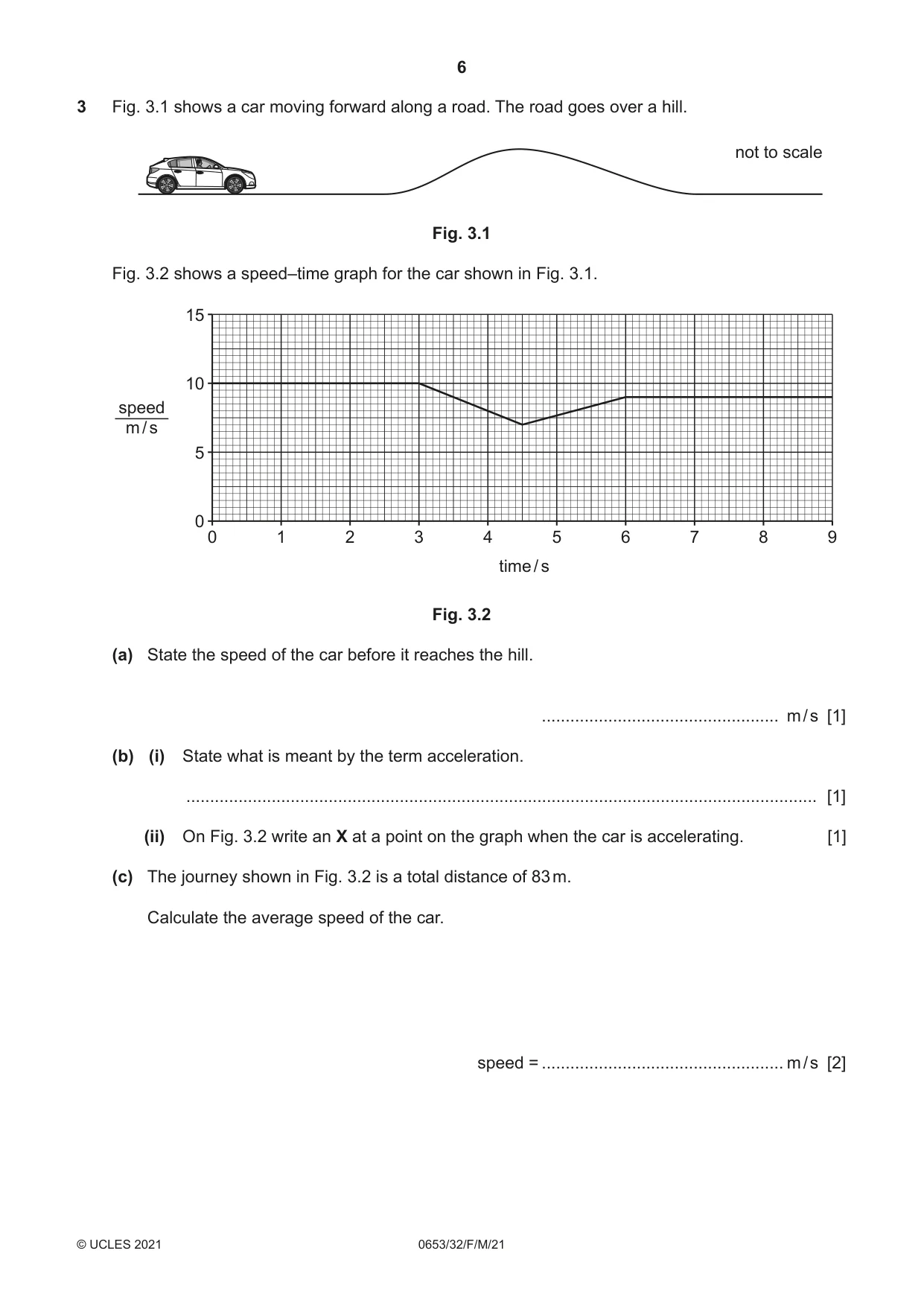
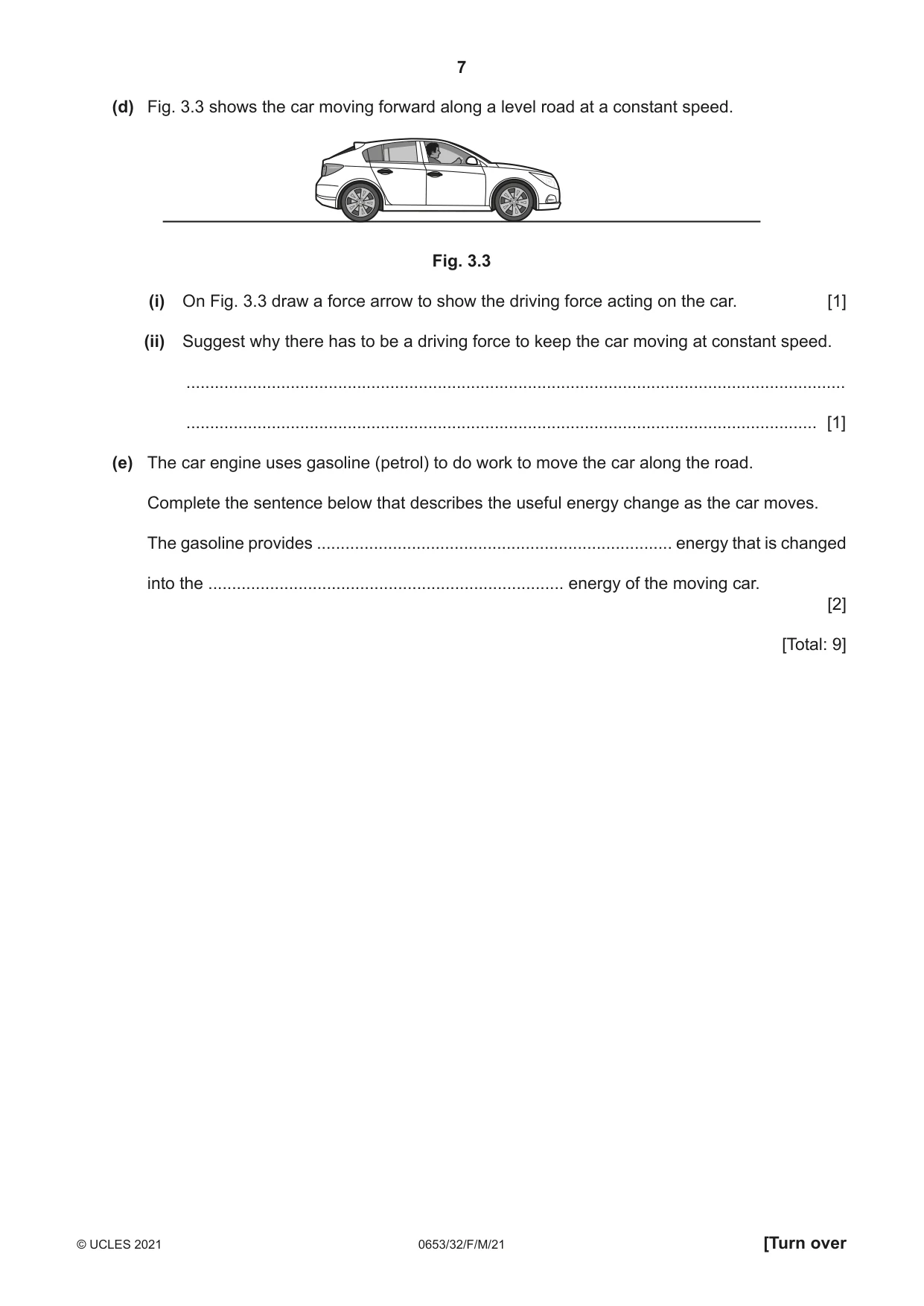
3 Fig. 3.1 shows a car moving forward along a road. The road goes over a hill. not to scale Fig. 3.1 Fig. 3.2 shows a speed–time graph for the car shown in Fig. 3.1. 15 10 speed m / s 5 0 0 1 2 3 4 5 6 7 8 9 time / s Fig. 3.2 (a) State the speed of the car before it reaches the hill. .................................................. m / s [1] (b) (i) State what is meant by the term acceleration. ..................................................................................................................................... [1] (ii) On Fig. 3.2 write an X at a point on the graph when the car is accelerating. [1] (c) The journey shown in Fig. 3.2 is a total distance of 83 m. Calculate the average speed of the car. speed = ................................................... m / s [2] (d) Fig. 3.3 shows the car moving forward along a level road at a constant speed. Fig. 3.3 (i) On Fig. 3.3 draw a force arrow to show the driving force acting on the car. [1] (ii) Suggest why there has to be a driving force to keep the car moving at constant speed. ........................................................................................................................................... ..................................................................................................................................... [1] (e) The car engine uses gasoline (petrol) to do work to move the car along the road. Complete the sentence below that describes the useful energy change as the car moves. The gasoline provides ........................................................................... energy that is changed into the ........................................................................... energy of the moving car. [2] [Total: 9]
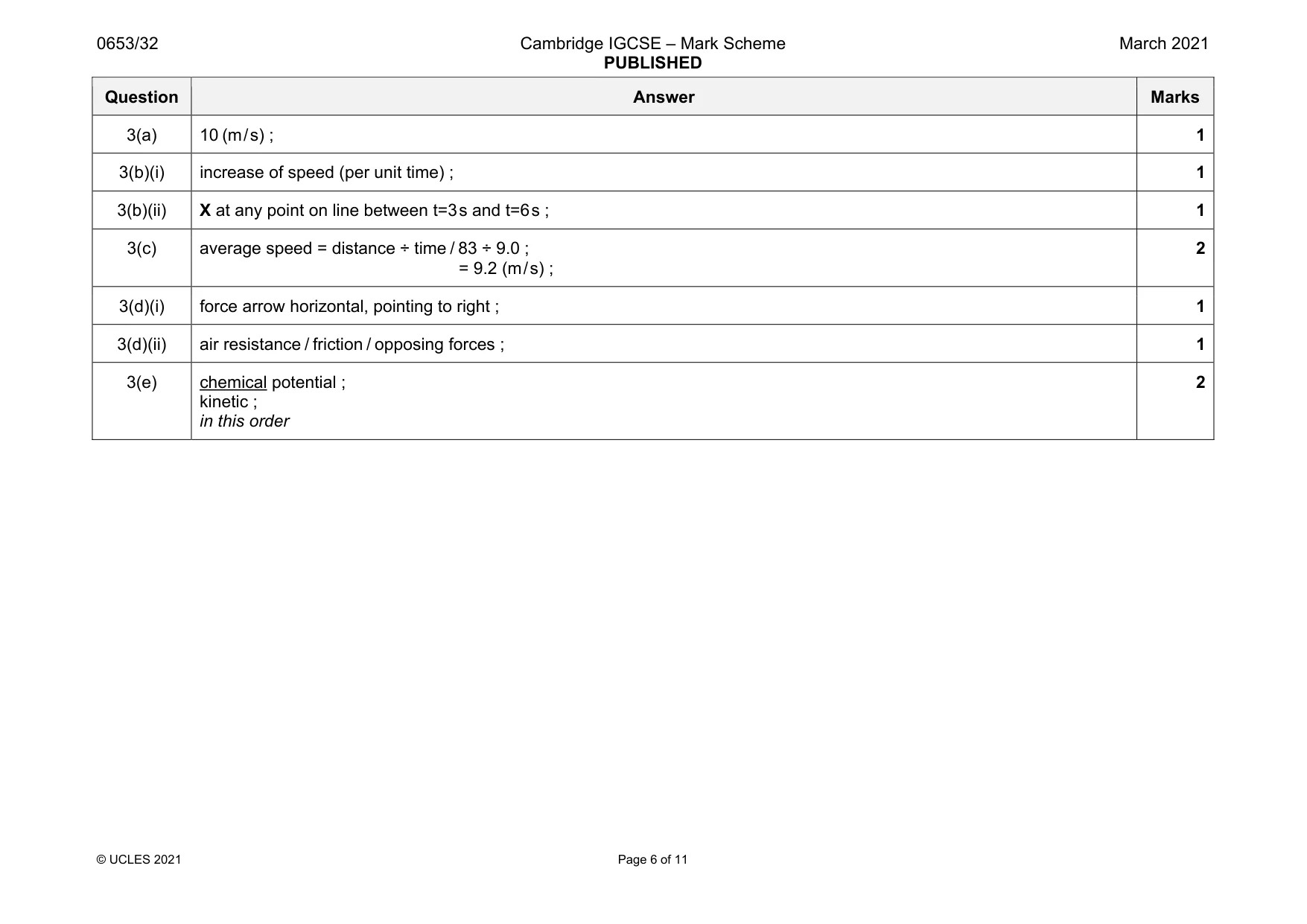
Mark scheme: 3(a) 10 (m / s) ; 1 3(b)(i) increase of speed (per unit time) ; 1 3(b)(ii) X at any point on line between t=3 s and t=6 s ; 1 3(c) average speed = distance ÷ time / 83 ÷ 9.0 ; = 9.2 (m / s) ; 2 3(d)(i) force arrow horizontal, pointing to right ; 1 3(d)(ii) air resistance / friction / opposing forces ; 1 3(e) chemical potential ; kinetic ; in this order 2
Q4 · The boxes on the left show parts of the male reproductive system
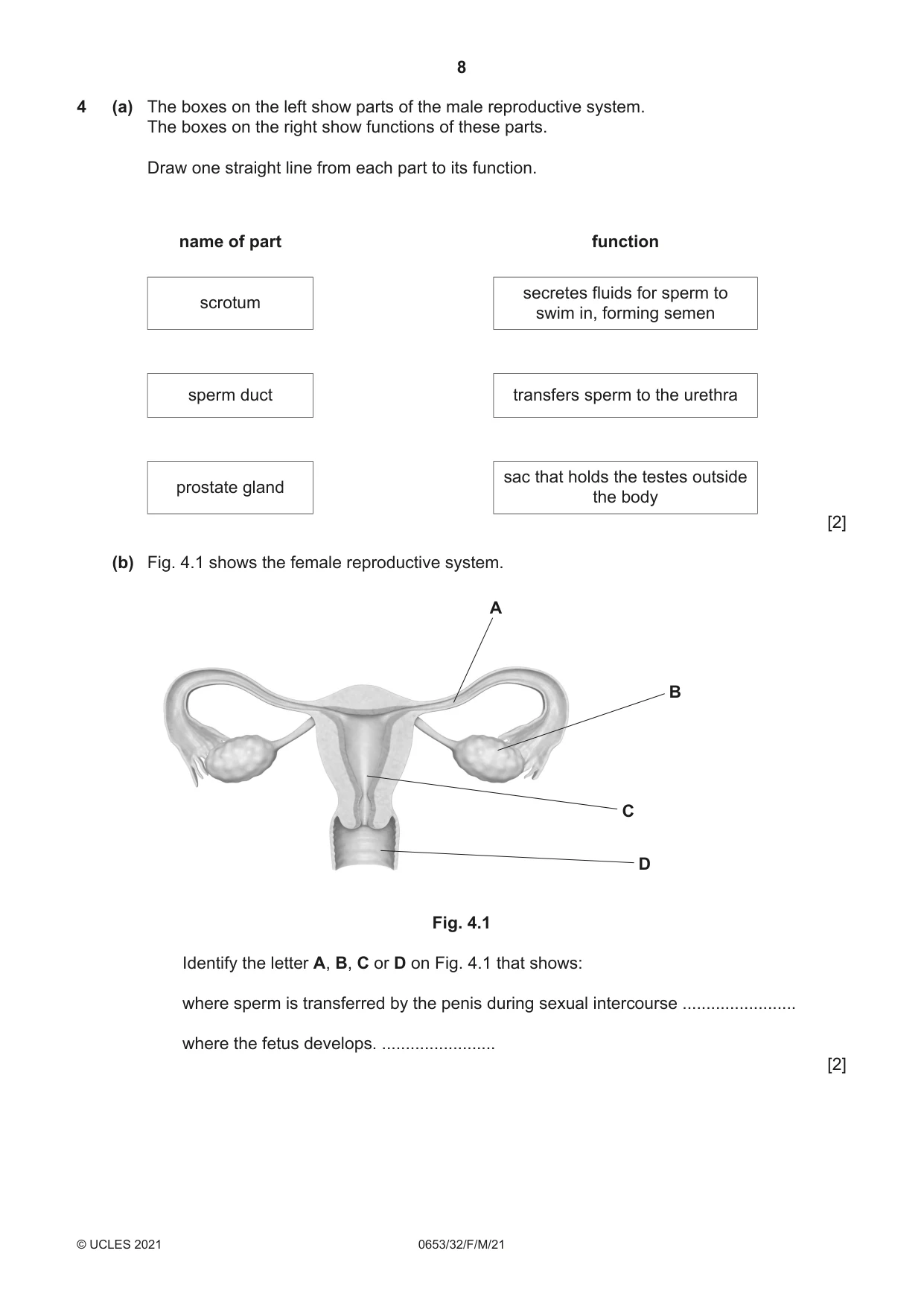
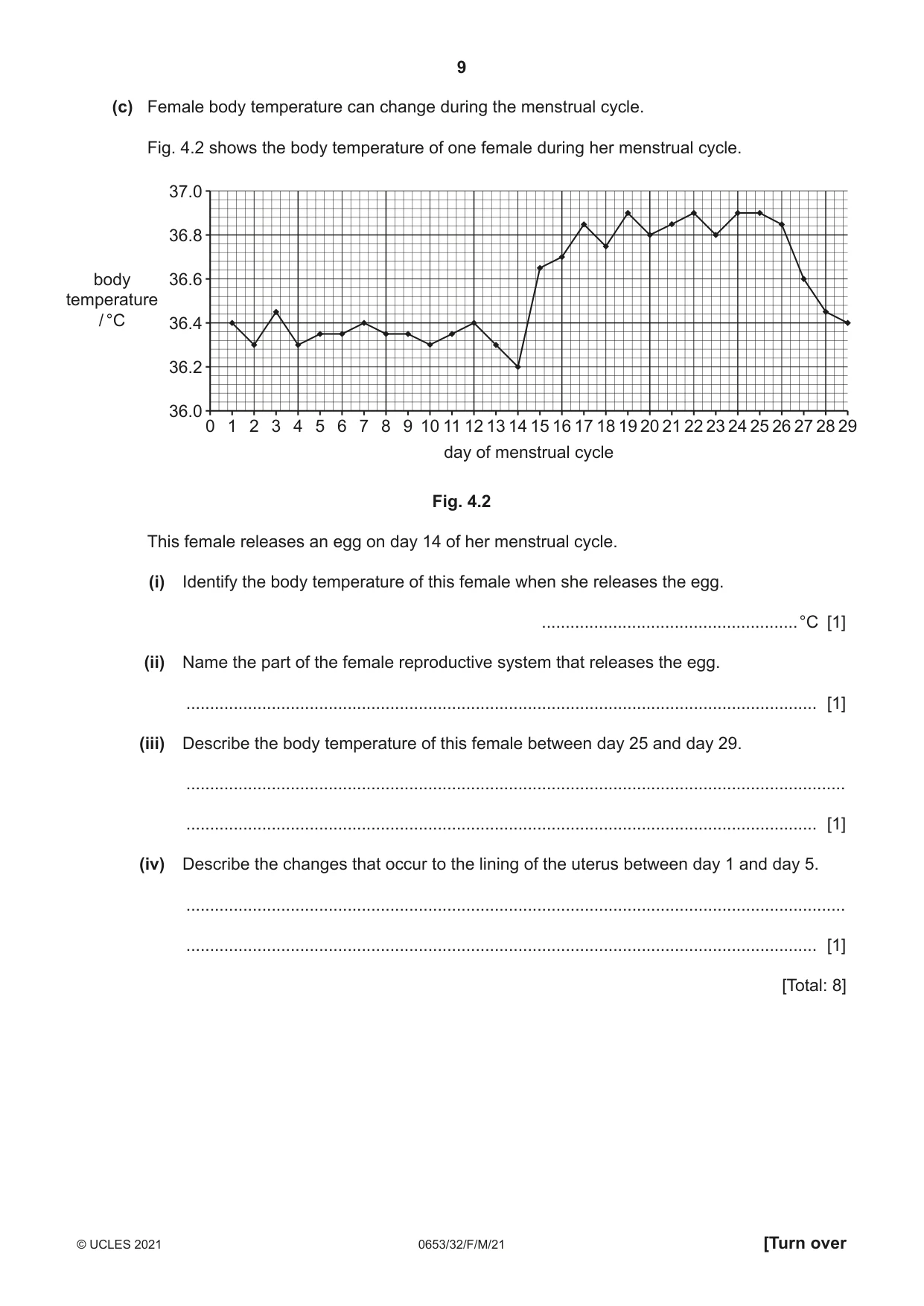
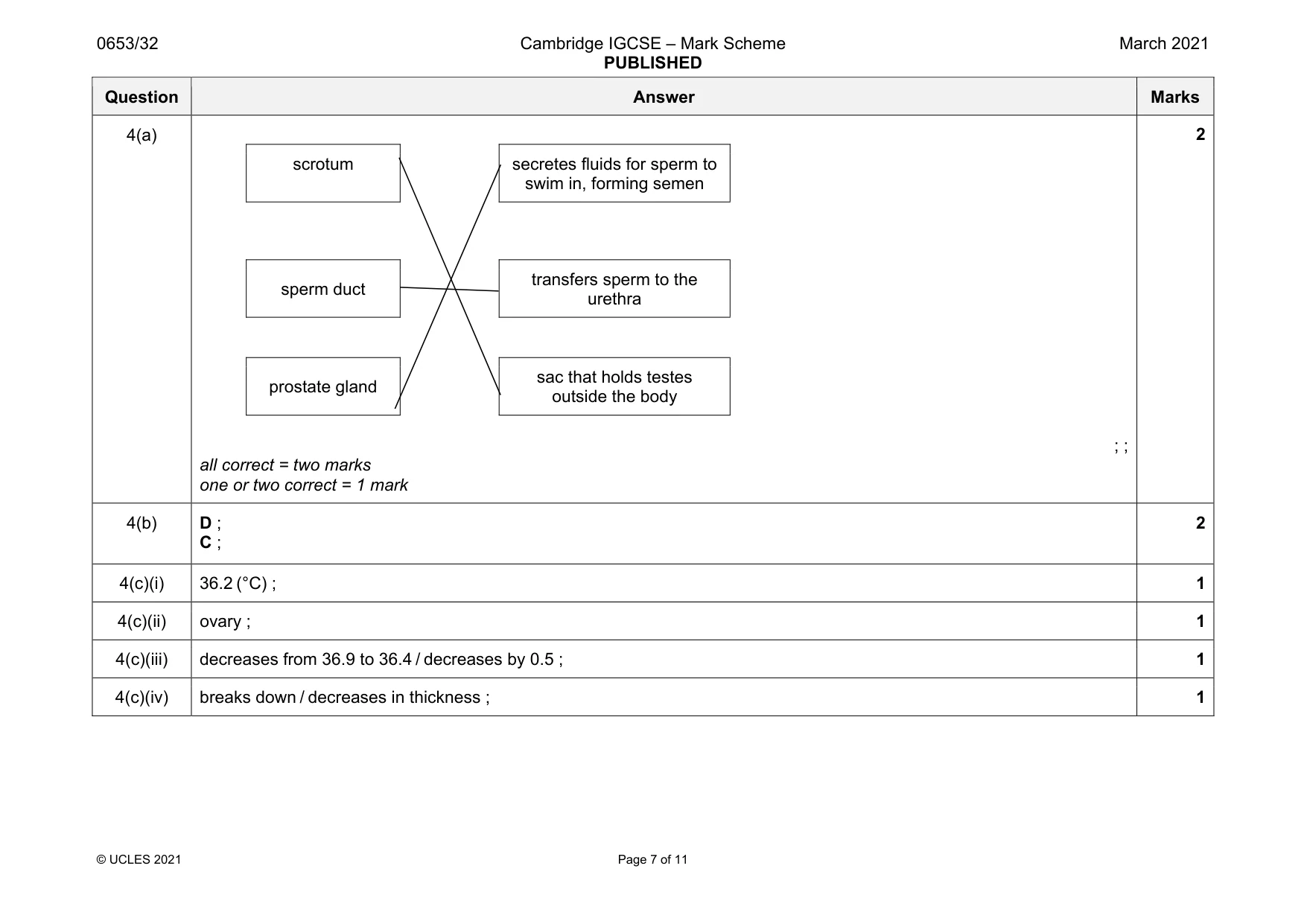
4 (a) The boxes on the left show parts of the male reproductive system. The boxes on the right show functions of these parts. Draw one straight line from each part to its function. name of part function secretes fluids for sperm to scrotum swim in, forming semen sperm duct transfers sperm to the urethra sac that holds the testes outside prostate gland the body [2] (b) Fig. 4.1 shows the female reproductive system. A B C D Fig. 4.1 Identify the letter A, B, C or D on Fig. 4.1 that shows: where sperm is transferred by the penis during sexual intercourse ........................ where the fetus develops. ........................ [2] (c) Female body temperature can change during the menstrual cycle. Fig. 4.2 shows the body temperature of one female during her menstrual cycle. 37.0 36.8 body 36.6 temperature / °C 36.4 36.2 36.0 0 1 2 3 4 5 6 7 8 9 10 11 12 13 14 15 16 17 18 19 20 21 22 23 24 25 26 27 28 29 day of menstrual cycle Fig. 4.2 This female releases an egg on day 14 of her menstrual cycle. (i) Identify the body temperature of this female when she releases the egg. ......................................................°C [1] (ii) Name the part of the female reproductive system that releases the egg. ..................................................................................................................................... [1] (iii) Describe the body temperature of this female between day 25 and day 29. ........................................................................................................................................... ..................................................................................................................................... [1] (iv) Describe the changes that occur to the lining of the uterus between day 1 and day 5. ........................................................................................................................................... ..................................................................................................................................... [1] [Total: 8]
Mark scheme: 4(a) scrotum secretes fluids for sperm to swim in, forming semen sperm duct transfers sperm to the urethra prostate gland sac that holds testes outside the body ; ; all correct = two marks one or two correct = 1 mark 4(b) D ; C ; 2 4(c)(i) 36.2 (°C) ; 1 4(c)(ii) ovary ; 1 4(c)(iii) decreases from 36.9 to 36.4 / decreases by 0.5 ; 1 4(c)(iv) breaks down / decreases in thickness ; 1
Q5 · An iron paperclip, shown in Fig
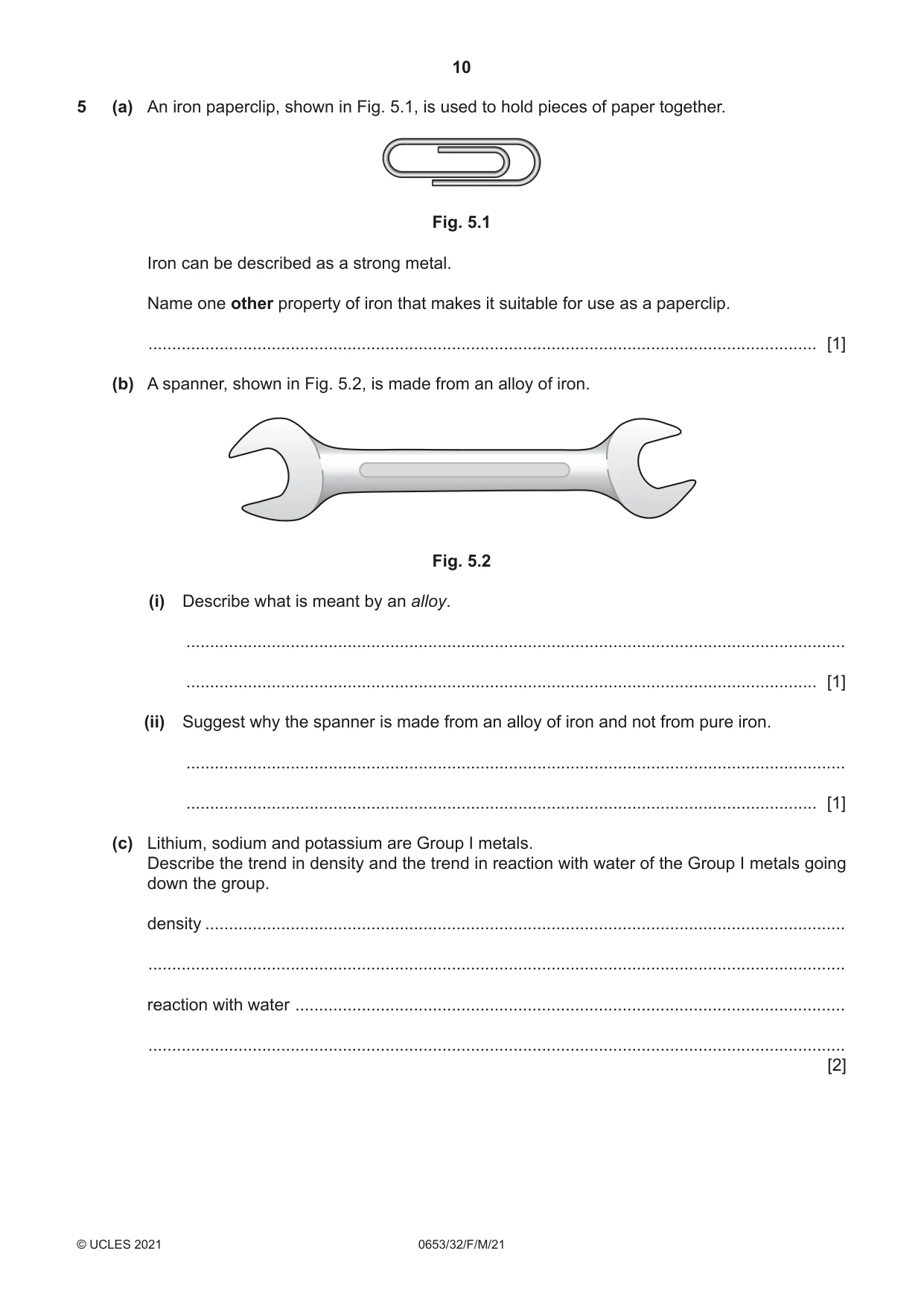
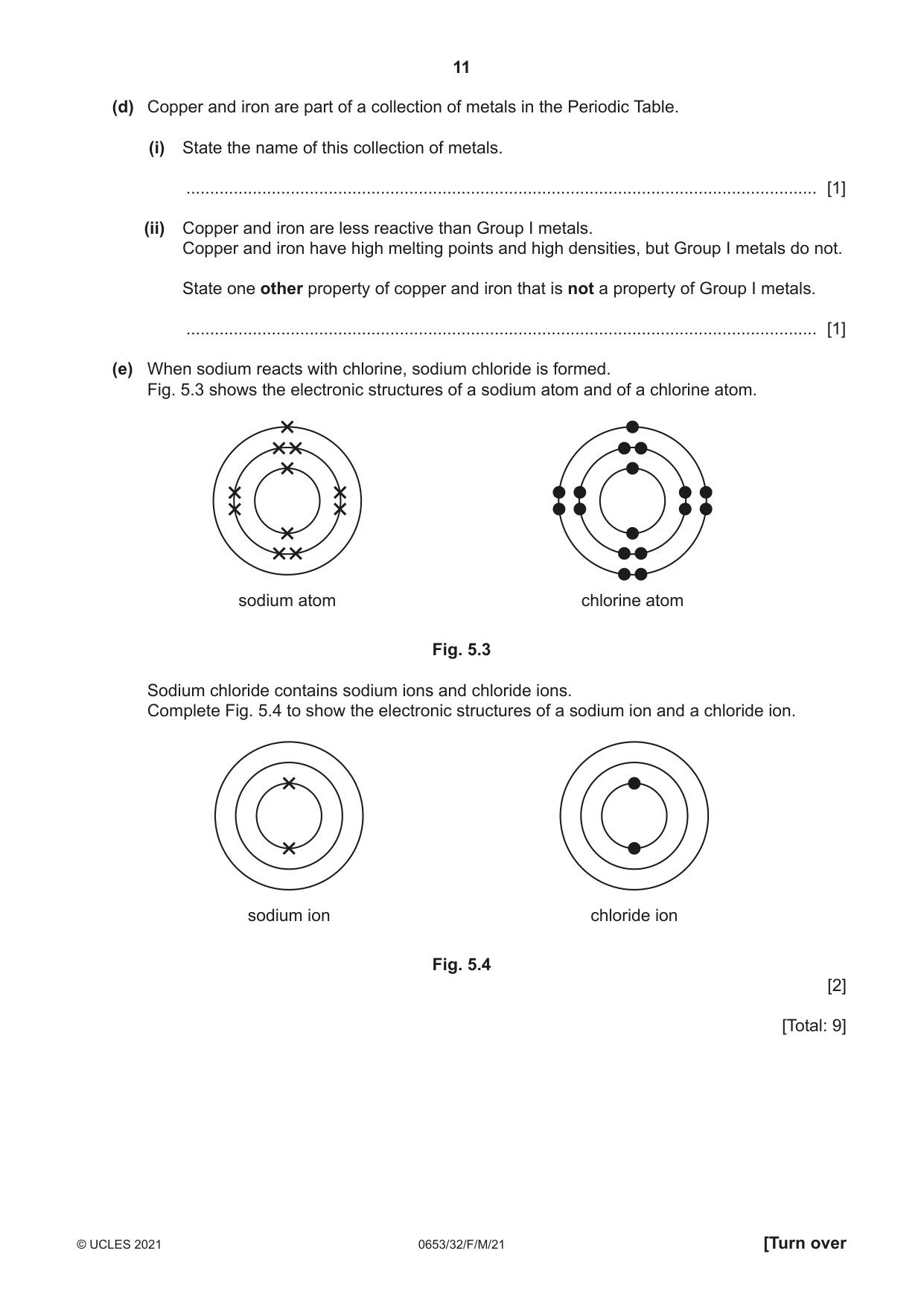
5 (a) An iron paperclip, shown in Fig. 5.1, is used to hold pieces of paper together. Fig. 5.1 Iron can be described as a strong metal. Name one other property of iron that makes it suitable for use as a paperclip. ............................................................................................................................................. [1] (b) A spanner, shown in Fig. 5.2, is made from an alloy of iron. Fig. 5.2 (i) Describe what is meant by an alloy. ........................................................................................................................................... ..................................................................................................................................... [1] (ii) Suggest why the spanner is made from an alloy of iron and not from pure iron. ........................................................................................................................................... ..................................................................................................................................... [1] (c) Lithium, sodium and potassium are Group I metals. Describe the trend in density and the trend in reaction with water of the Group I metals going down the group. density ....................................................................................................................................... ................................................................................................................................................... reaction with water .................................................................................................................... ................................................................................................................................................... [2] (d) Copper and iron are part of a collection of metals in the Periodic Table. (i) State the name of this collection of metals. ..................................................................................................................................... [1] (ii) Copper and iron are less reactive than Group I metals. Copper and iron have high melting points and high densities, but Group I metals do not. State one other property of copper and iron that is not a property of Group I metals. ..................................................................................................................................... [1] (e) When sodium reacts with chlorine, sodium chloride is formed. Fig. 5.3 shows the electronic structures of a sodium atom and of a chlorine atom. sodium atom chlorine atom Fig. 5.3 Sodium chloride contains sodium ions and chloride ions. Complete Fig. 5.4 to show the electronic structures of a sodium ion and a chloride ion. sodium ion chloride ion Fig. 5.4 [2] [Total: 9]
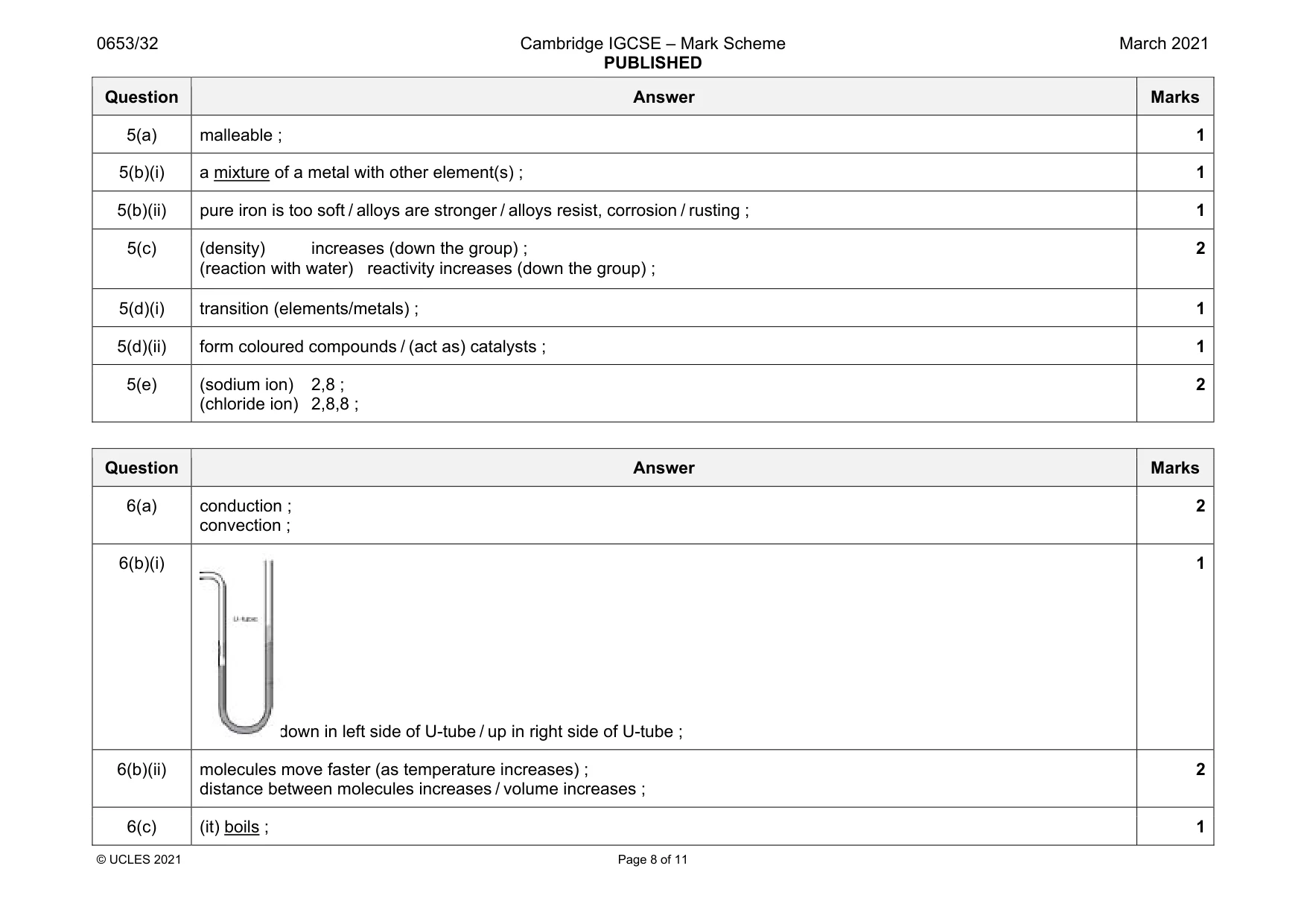
Mark scheme: 5(a) malleable ; 1 5(b)(i) a mixture of a metal with other element(s) ; 1 5(b)(ii) pure iron is too soft / alloys are stronger / alloys resist, corrosion / rusting ; 1 5(c) (density) increases (down the group) ; (reaction with water) reactivity increases (down the group) ; 2 5(d)(i) transition (elements/metals) ; 1 5(d)(ii) form coloured compounds / (act as) catalysts ; 1 5(e) (sodium ion) 2,8 ; (chloride ion) 2,8,8 ; 2
Q6 · A flask containing gas being heated in a water-bath
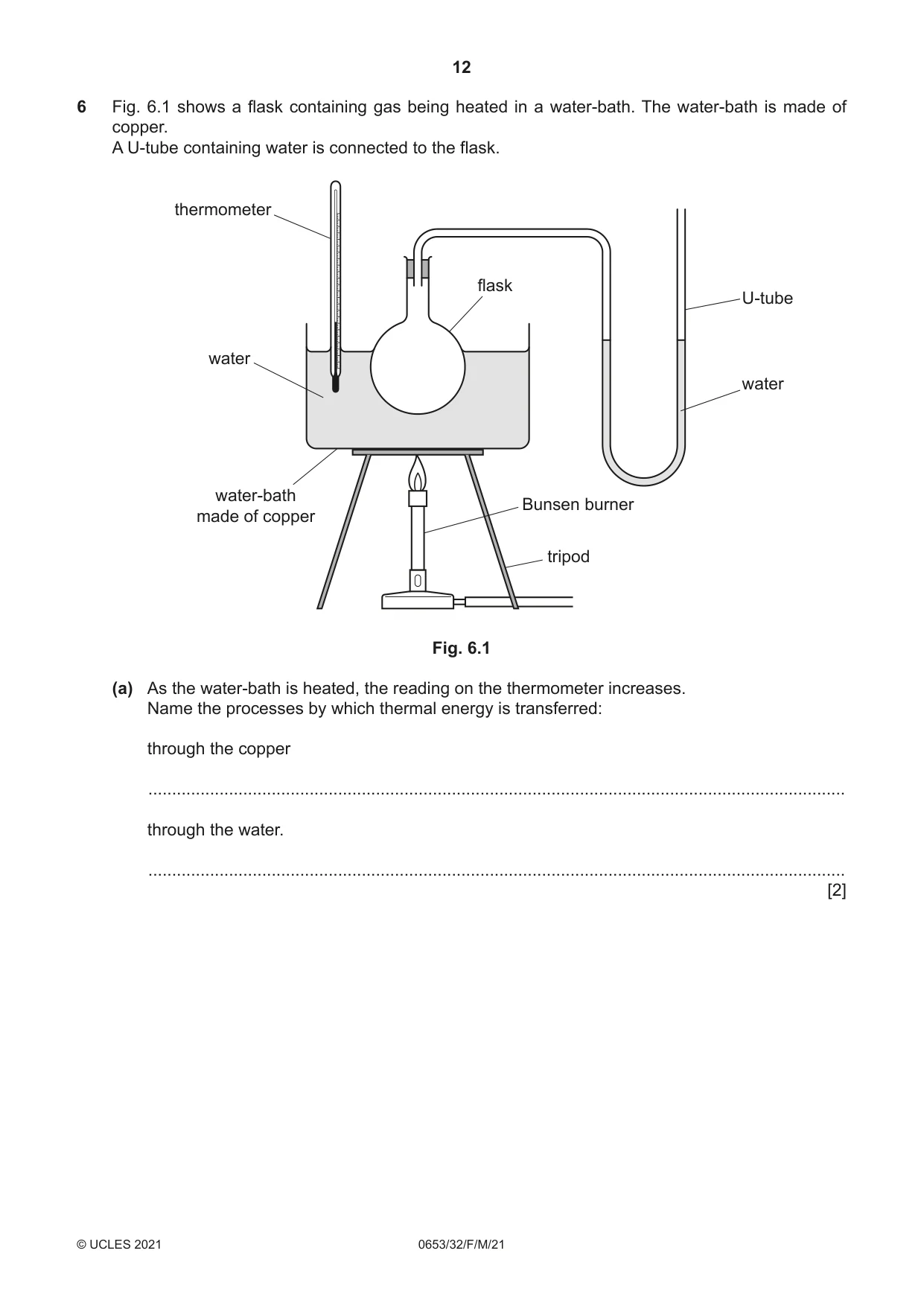
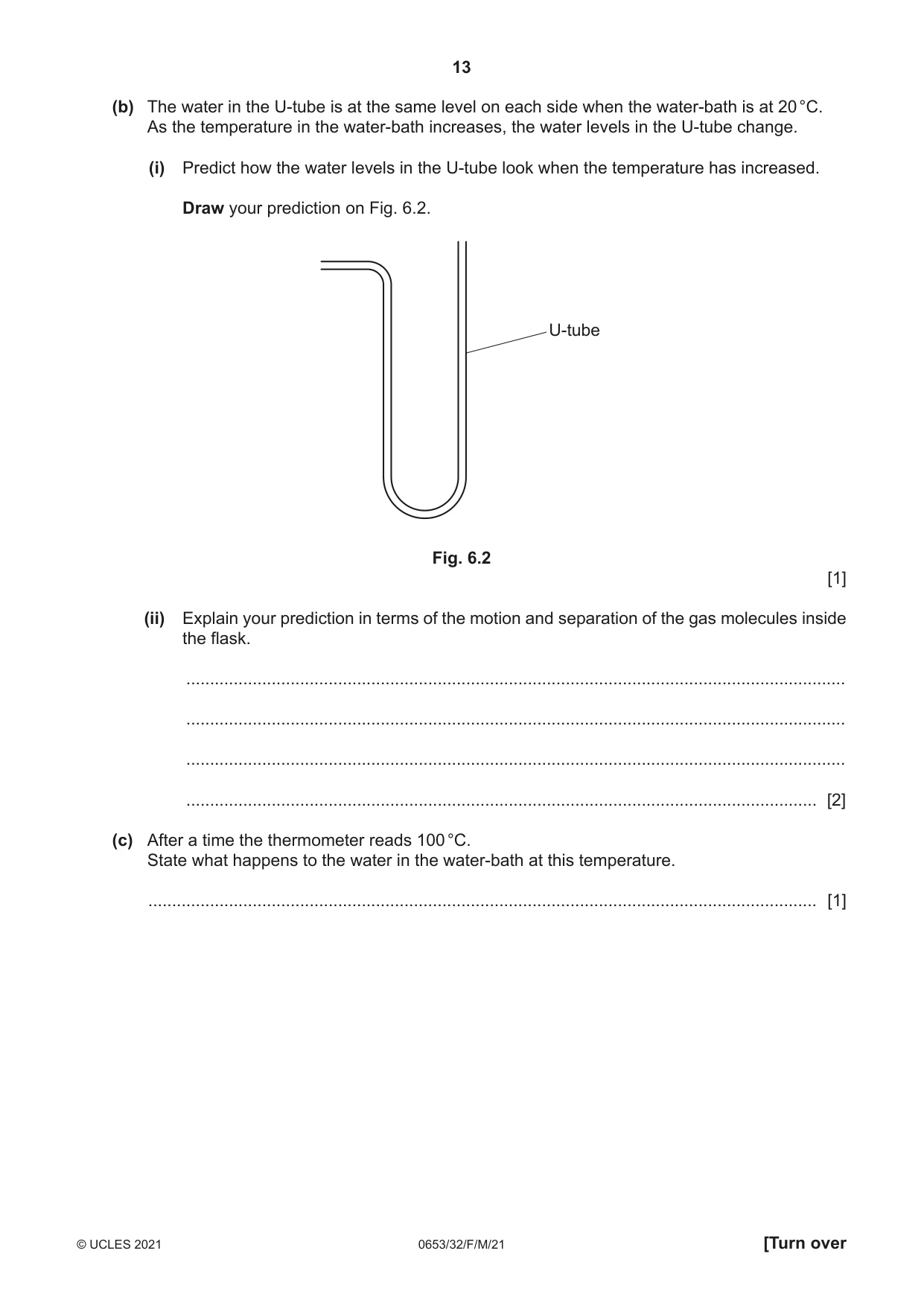
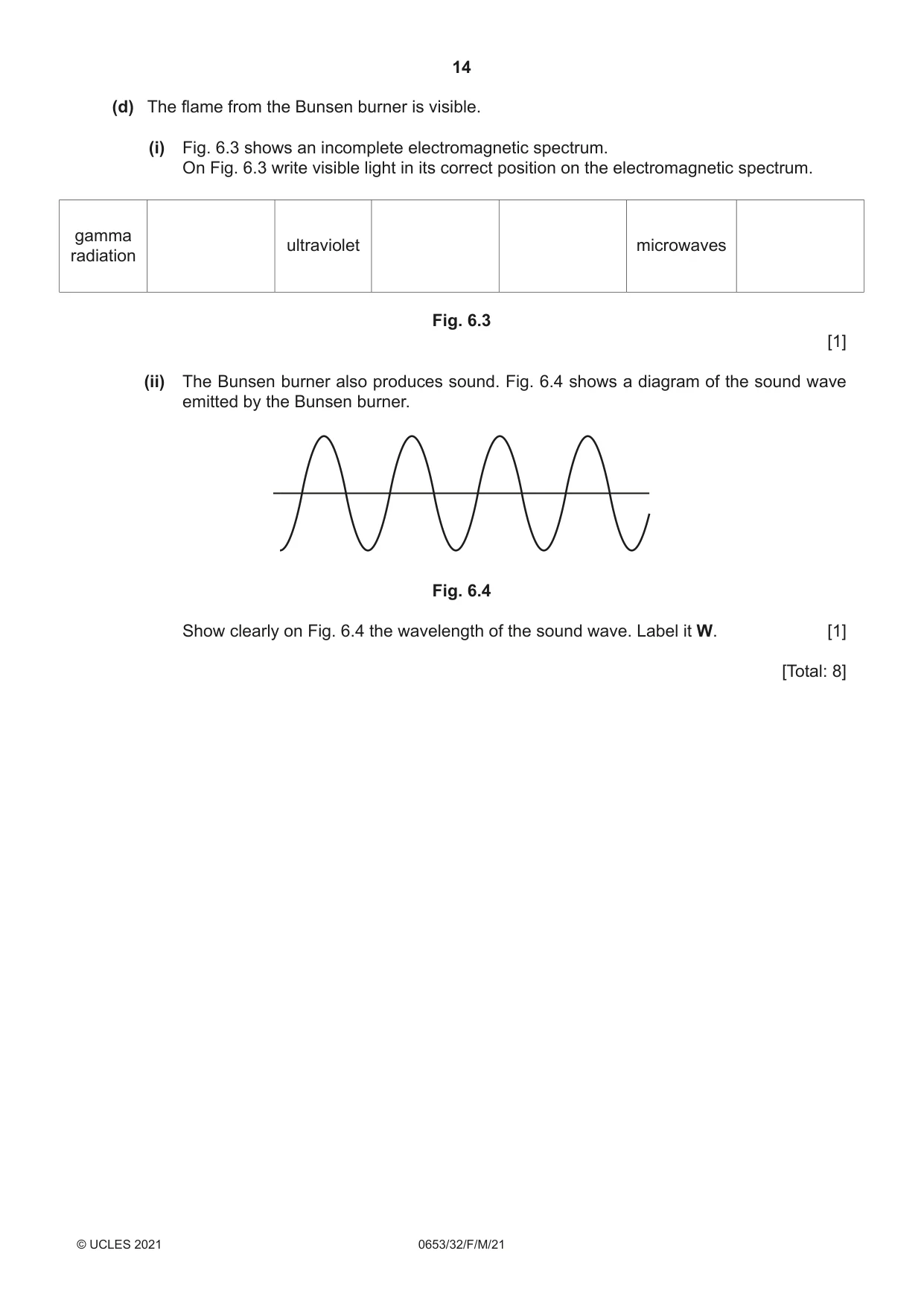
6 Fig. 6.1 shows a flask containing gas being heated in a water-bath. The water-bath is made of copper. A U-tube containing water is connected to the flask. thermometer flask U-tube water water water-bath Bunsen burner made of copper tripod Fig. 6.1 (a) As the water-bath is heated, the reading on the thermometer increases. Name the processes by which thermal energy is transferred: through the copper ................................................................................................................................................... through the water. ................................................................................................................................................... [2] (b) The water in the U-tube is at the same level on each side when the water-bath is at 20 °C. As the temperature in the water-bath increases, the water levels in the U-tube change. (i) Predict how the water levels in the U-tube look when the temperature has increased. Draw your prediction on Fig. 6.2. U-tube Fig. 6.2 [1] (ii) Explain your prediction in terms of the motion and separation of the gas molecules inside the flask. ........................................................................................................................................... ........................................................................................................................................... ........................................................................................................................................... ..................................................................................................................................... [2] (c) After a time the thermometer reads 100 °C. State what happens to the water in the water-bath at this temperature. ............................................................................................................................................. [1] (d) The flame from the Bunsen burner is visible. (i) Fig. 6.3 shows an incomplete electromagnetic spectrum. On Fig. 6.3 write visible light in its correct position on the electromagnetic spectrum. gamma ultraviolet microwavesradiation Fig. 6.3 [1] (ii) The Bunsen burner also produces sound. Fig. 6.4 shows a diagram of the sound wave emitted by the Bunsen burner. Fig. 6.4 Show clearly on Fig. 6.4 the wavelength of the sound wave. Label it W. [1] [Total: 8]
Mark scheme: 6(a) conduction ; convection ; 2 6(b)(i) down in left side of U-tube / up in right side of U-tube ; 1 6(b)(ii) molecules move faster (as temperature increases) ; distance between molecules increases / volume increases ; 2 6(c) (it) boils ; 1 Question Answer Marks 6(d)(i) visible light in centre box (right of ultraviolet) ; 1 6(d)(ii) correct wavelength indicated on diagram ; 1
Q7 · Part of a food web from a lake
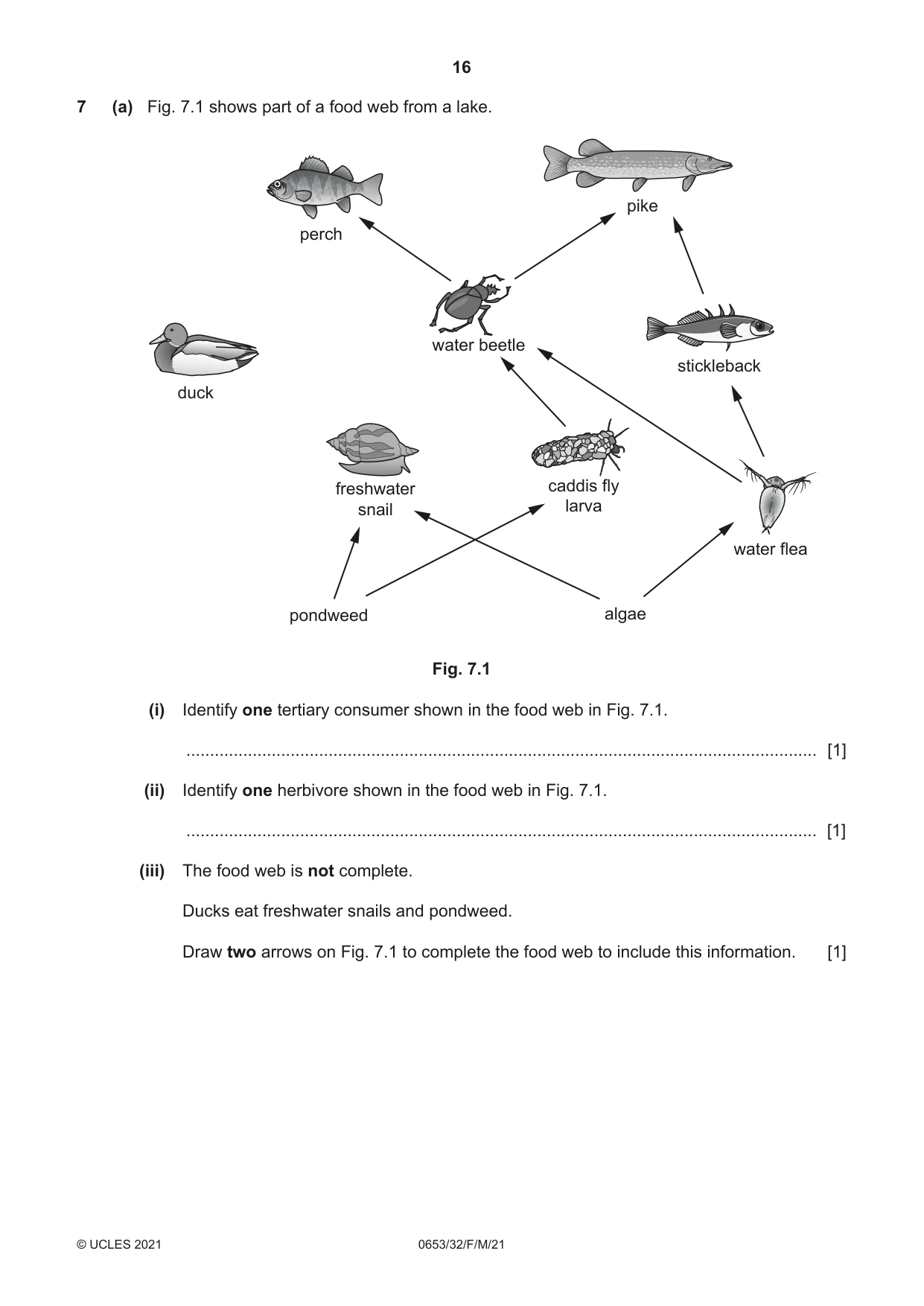
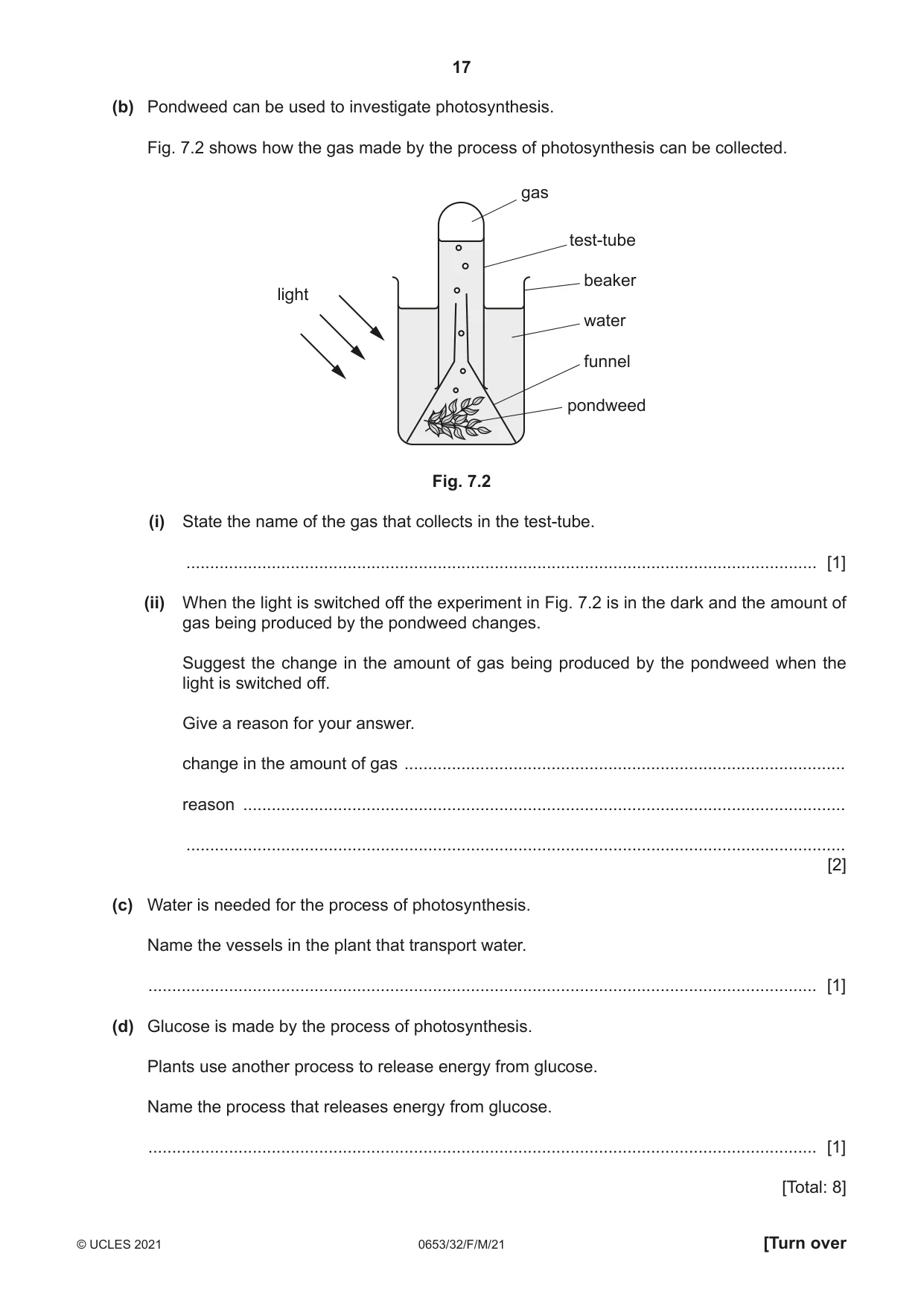
7 (a) Fig. 7.1 shows part of a food web from a lake. pike perch water beetle stickleback duck freshwater caddis fly snail larva water flea pondweed algae Fig. 7.1 (i) Identify one tertiary consumer shown in the food web in Fig. 7.1. ..................................................................................................................................... [1] (ii) Identify one herbivore shown in the food web in Fig. 7.1. ..................................................................................................................................... [1] (iii) The food web is not complete. Ducks eat freshwater snails and pondweed. Draw two arrows on Fig. 7.1 to complete the food web to include this information. [1] (b) Pondweed can be used to investigate photosynthesis. Fig. 7.2 shows how the gas made by the process of photosynthesis can be collected. gas test-tube beaker light water funnel pondweed Fig. 7.2 (i) State the name of the gas that collects in the test-tube. ..................................................................................................................................... [1] (ii) When the light is switched off the experiment in Fig. 7.2 is in the dark and the amount of gas being produced by the pondweed changes. Suggest the change in the amount of gas being produced by the pondweed when the light is switched off. Give a reason for your answer. change in the amount of gas ............................................................................................. reason ............................................................................................................................... ........................................................................................................................................... [2] (c) Water is needed for the process of photosynthesis. Name the vessels in the plant that transport water. ............................................................................................................................................. [1] (d) Glucose is made by the process of photosynthesis. Plants use another process to release energy from glucose. Name the process that releases energy from glucose. ............................................................................................................................................. [1] [Total: 8]
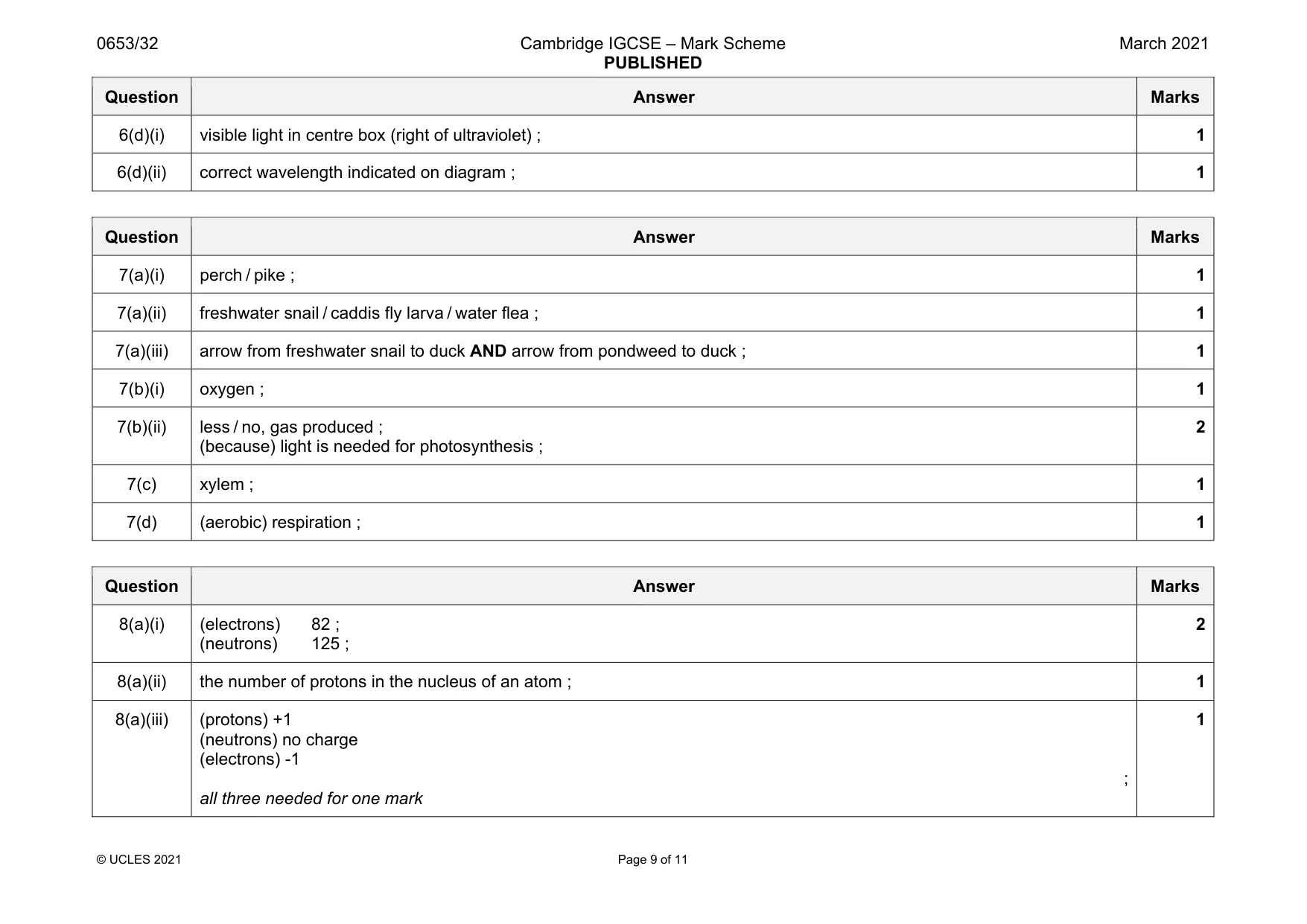
Mark scheme: 7(a)(i) perch / pike ; 1 7(a)(ii) freshwater snail / caddis fly larva / water flea ; 1 7(a)(iii) arrow from freshwater snail to duck AND arrow from pondweed to duck ; 1 7(b)(i) oxygen ; 1 7(b)(ii) less / no, gas produced ; (because) light is needed for photosynthesis ; 2 7(c) xylem ; 1 7(d) (aerobic) respiration ; 1
Q8 · An atom of lead is represented by the symbol shown
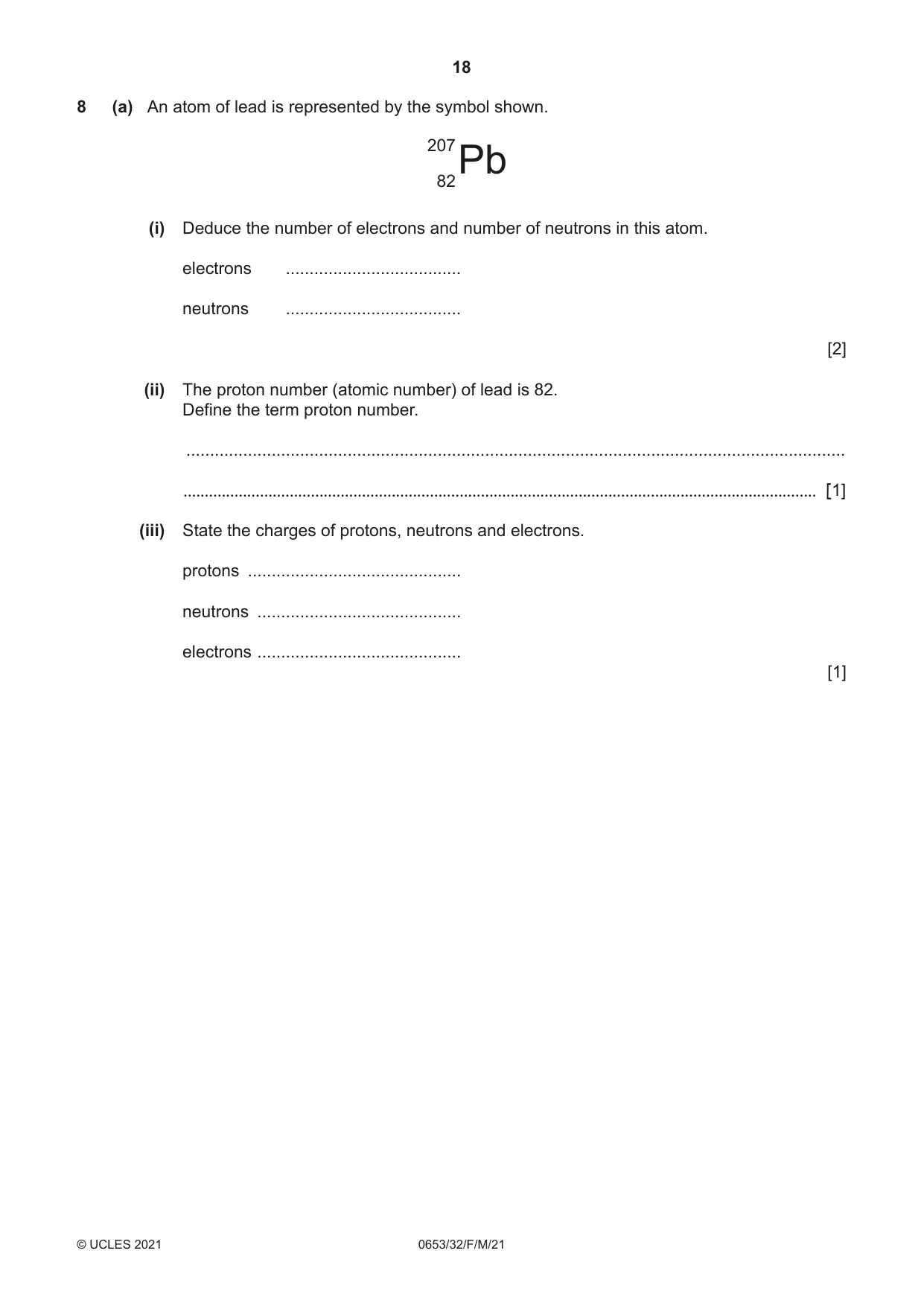
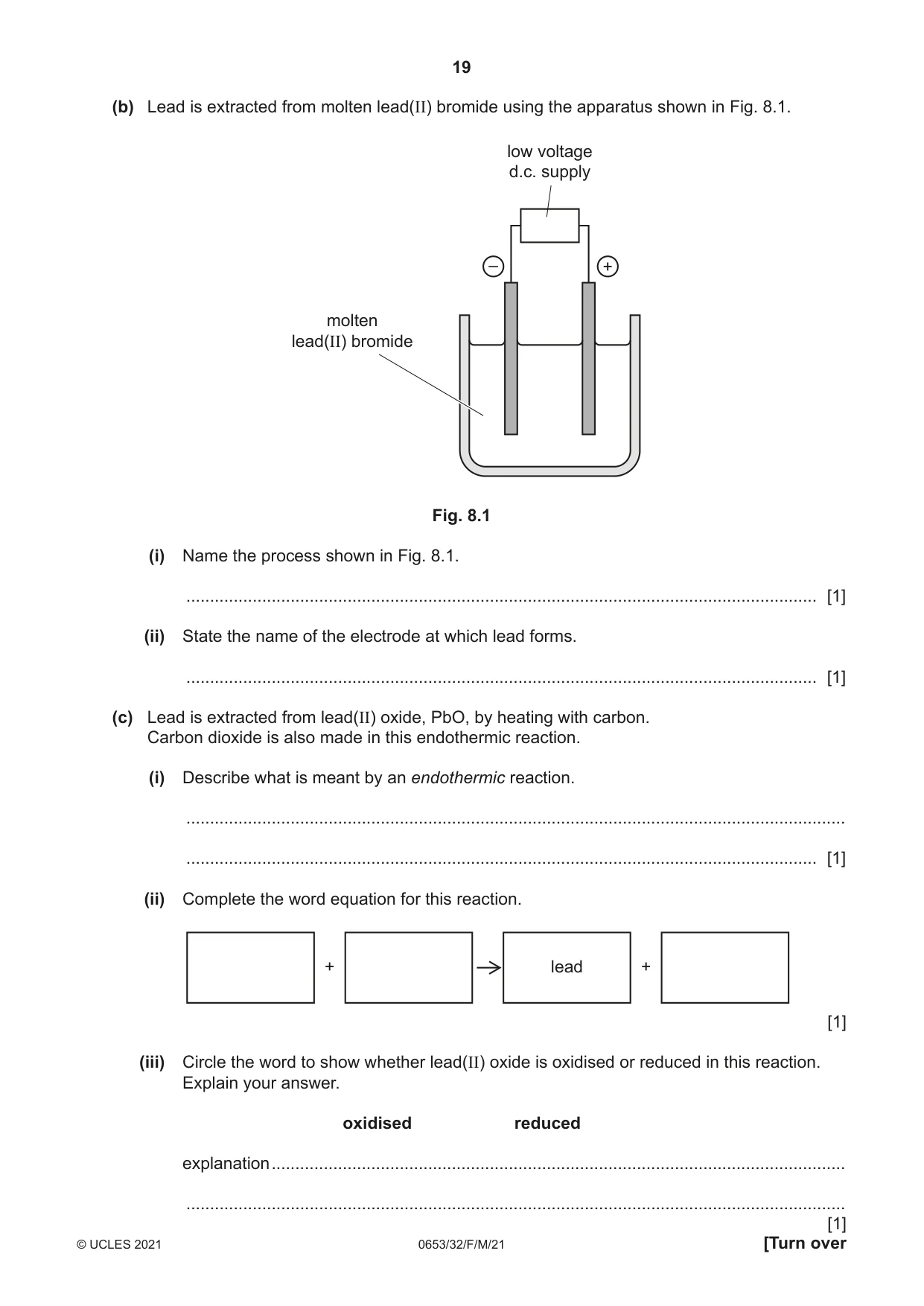
8 (a) An atom of lead is represented by the symbol shown. 207 Pb 82 (i) Deduce the number of electrons and number of neutrons in this atom. electrons ..................................... neutrons ..................................... [2] (ii) The proton number (atomic number) of lead is 82. Define the term proton number. ........................................................................................................................................... ..................................................................................................................................................... [1] (iii) State the charges of protons, neutrons and electrons. protons ............................................. neutrons ........................................... electrons ........................................... [1] (b) Lead is extracted from molten lead(II) bromide using the apparatus shown in Fig. 8.1. low voltage d.c. supply – + molten lead(II) bromide Fig. 8.1 (i) Name the process shown in Fig. 8.1. ..................................................................................................................................... [1] (ii) State the name of the electrode at which lead forms. ..................................................................................................................................... [1] (c) Lead is extracted from lead(II) oxide, PbO, by heating with carbon. Carbon dioxide is also made in this endothermic reaction. (i) Describe what is meant by an endothermic reaction. ........................................................................................................................................... ..................................................................................................................................... [1] (ii) Complete the word equation for this reaction. + lead + [1] (iii) Circle the word to show whether lead(II) oxide is oxidised or reduced in this reaction. Explain your answer. oxidised reduced explanation ......................................................................................................................... ........................................................................................................................................... (d) A teacher has a different compound of lead. When this compound of lead reacts with dilute hydrochloric acid, carbon dioxide is formed. Suggest the name of this compound of lead. ............................................................................................................................................. [1] [Total: 10]
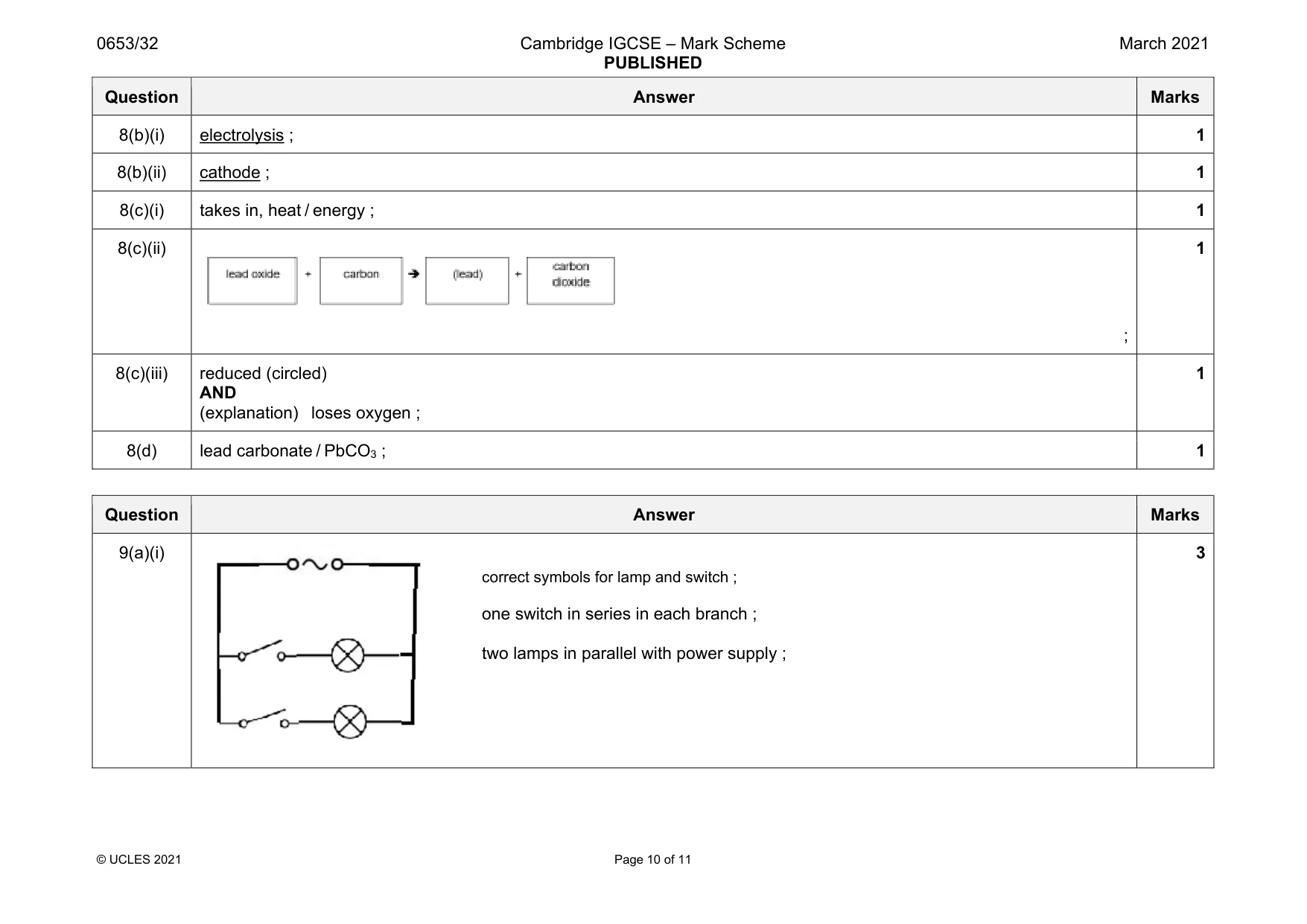
Mark scheme: 8(a)(i) (electrons) 82 ; (neutrons) 125 ; 2 8(a)(ii) the number of protons in the nucleus of an atom ; 1 8(a)(iii) (protons) +1 (neutrons) no charge (electrons) -1 ; all three needed for one mark 1 Question Answer Marks 8(b)(i) electrolysis ; 1 8(b)(ii) cathode ; 1 8(c)(i) takes in, heat / energy ; 1 8(c)(ii) ; 1 8(c)(iii) reduced (circled) AND (explanation) loses oxygen ; 1 8(d) lead carbonate / PbCO3 ; 1
Q9 · Two identical street lamps are connected in parallel to the mains electricity supply
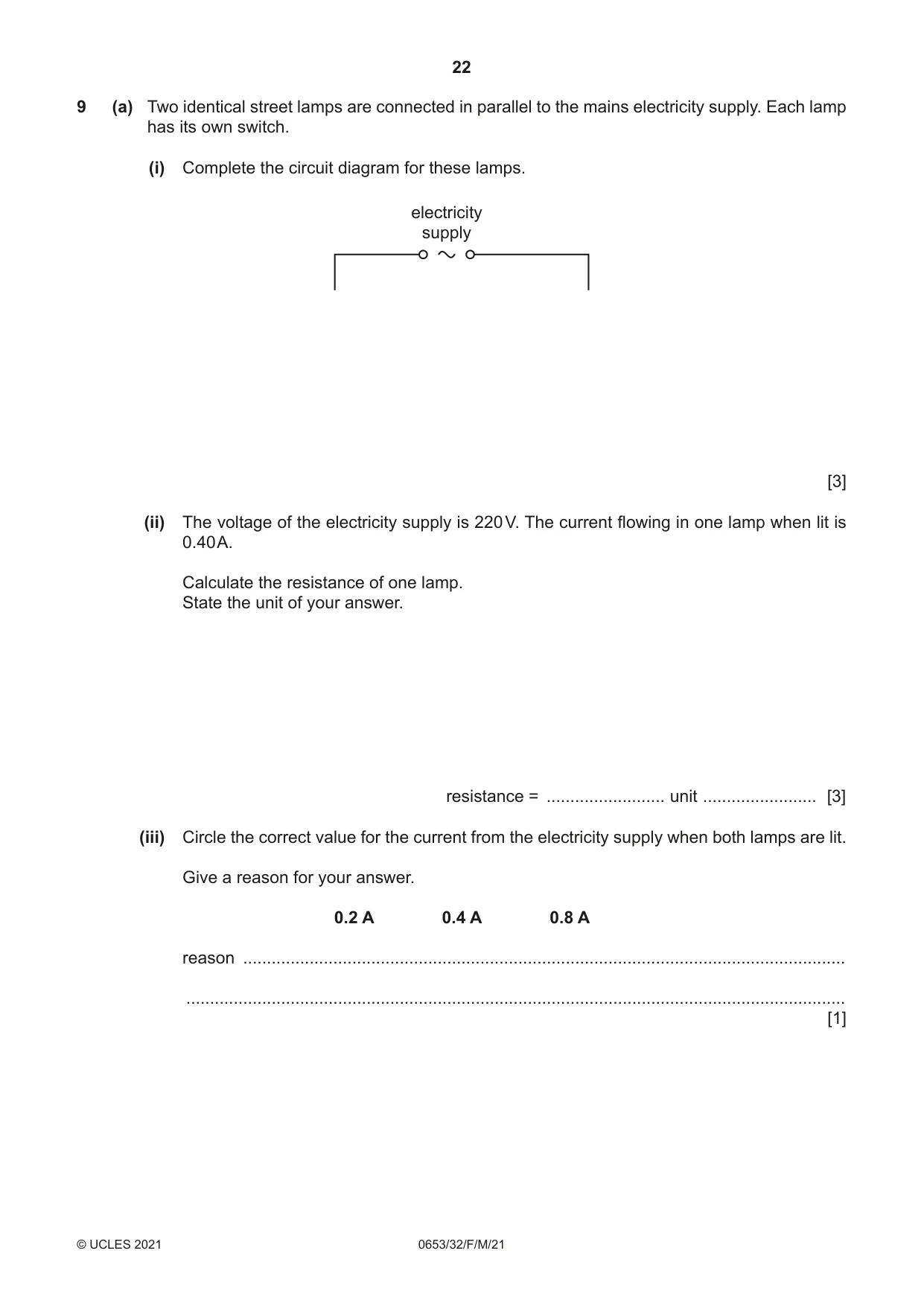
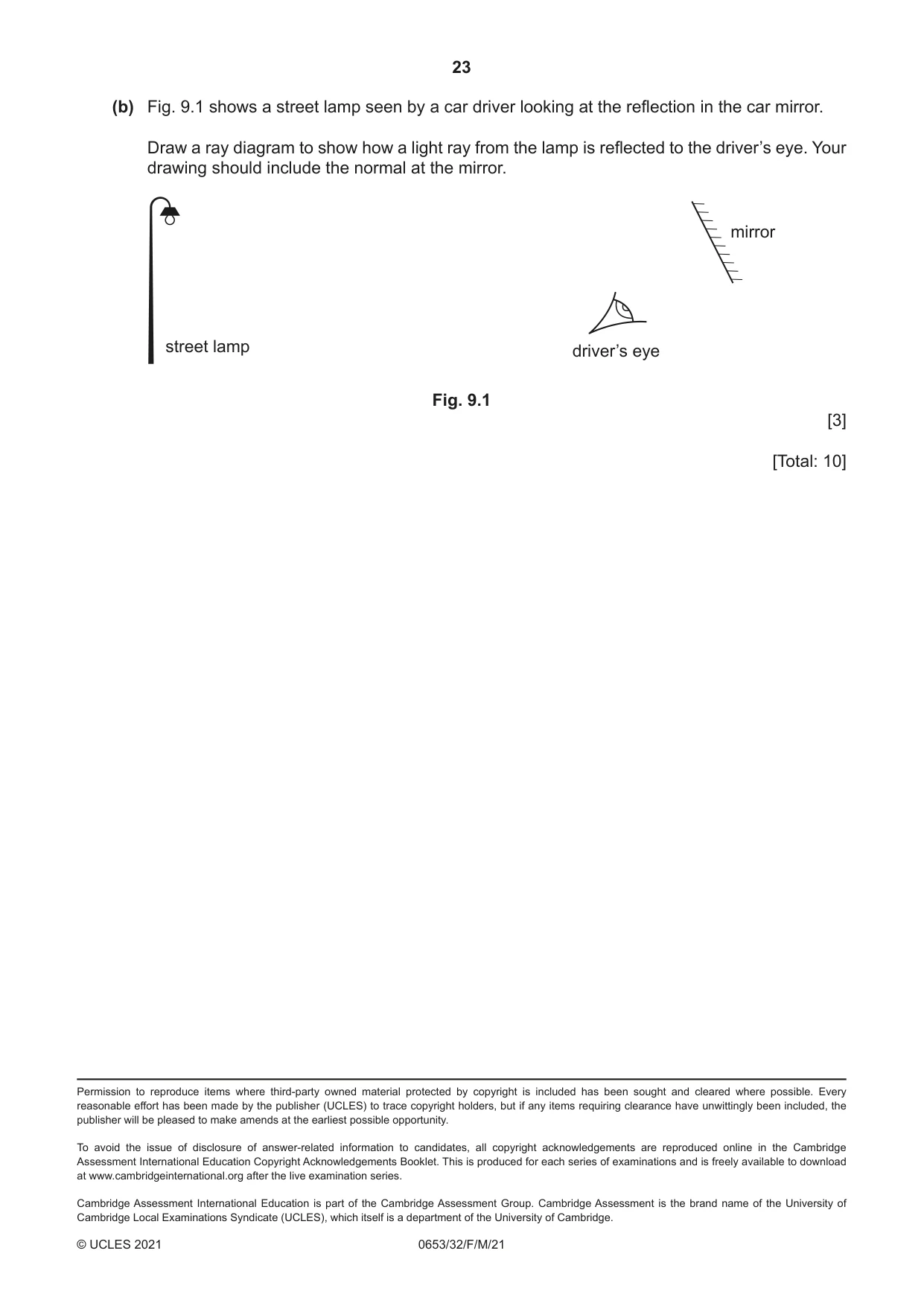
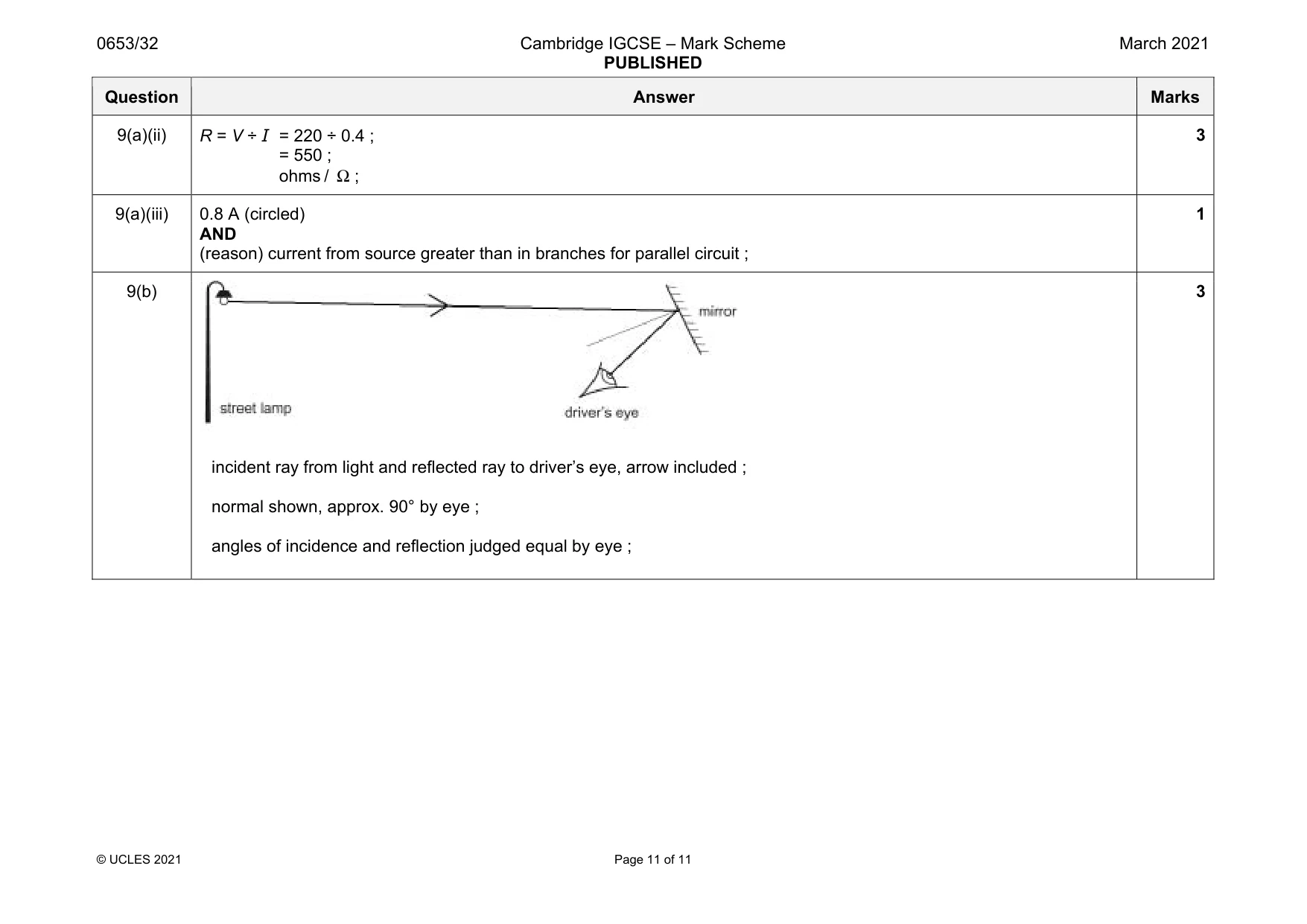
9 (a) Two identical street lamps are connected in parallel to the mains electricity supply. Each lamp has its own switch. (i) Complete the circuit diagram for these lamps. electricity supply [3] (ii) The voltage of the electricity supply is 220 V. The current flowing in one lamp when lit is 0.40 A. Calculate the resistance of one lamp. State the unit of your answer. resistance = ......................... unit ........................ [3] (iii) Circle the correct value for the current from the electricity supply when both lamps are lit. Give a reason for your answer. 0.2 A 0.4 A 0.8 A reason ............................................................................................................................... ........................................................................................................................................... [1] (b) Fig. 9.1 shows a street lamp seen by a car driver looking at the reflection in the car mirror. Draw a ray diagram to show how a light ray from the lamp is reflected to the driver’s eye. Your drawing should include the normal at the mirror. mirror street lamp driver’s eye Fig. 9.1 [3] [Total: 10]
Mark scheme: 9(a)(i) 3 correct symbols for lamp and switch ; one switch in series in each branch ; two lamps in parallel with power supply ; Question Answer Marks 9(a)(ii) R = V ÷ I = 220 ÷ 0.4 ; = 550 ; ohms / Ω ; 3 9(a)(iii) 0.8 A (circled) AND (reason) current from source greater than in branches for parallel circuit ; 1 9(b) 3 incident ray from light and reflected ray to driver’s eye, arrow included ; normal shown, approx. 90° by eye ; angles of incidence and reflection judged equal by eye ;
What was in this paper
The subtopics covered by these 9 questions, and how many questions each got. Open one in a new tab to see every Cambridge question on it.
What you needed in this session
Cambridge’s own grade thresholds for 2021 Feb/March, Paper 3 · Variant 2. A higher threshold means an easier paper — the bar moves with how the cohort did.