Cambridge IGCSE Science - Combined 0653 — 2021 Oct/Nov Paper 3 · Variant 3
0653/33/O/N/21 · 9 questions · 80 marks · ≈90 min
The question paper and its mark scheme, free to read here and free to download. This is Cambridge’s own paper, exactly as it was sat.
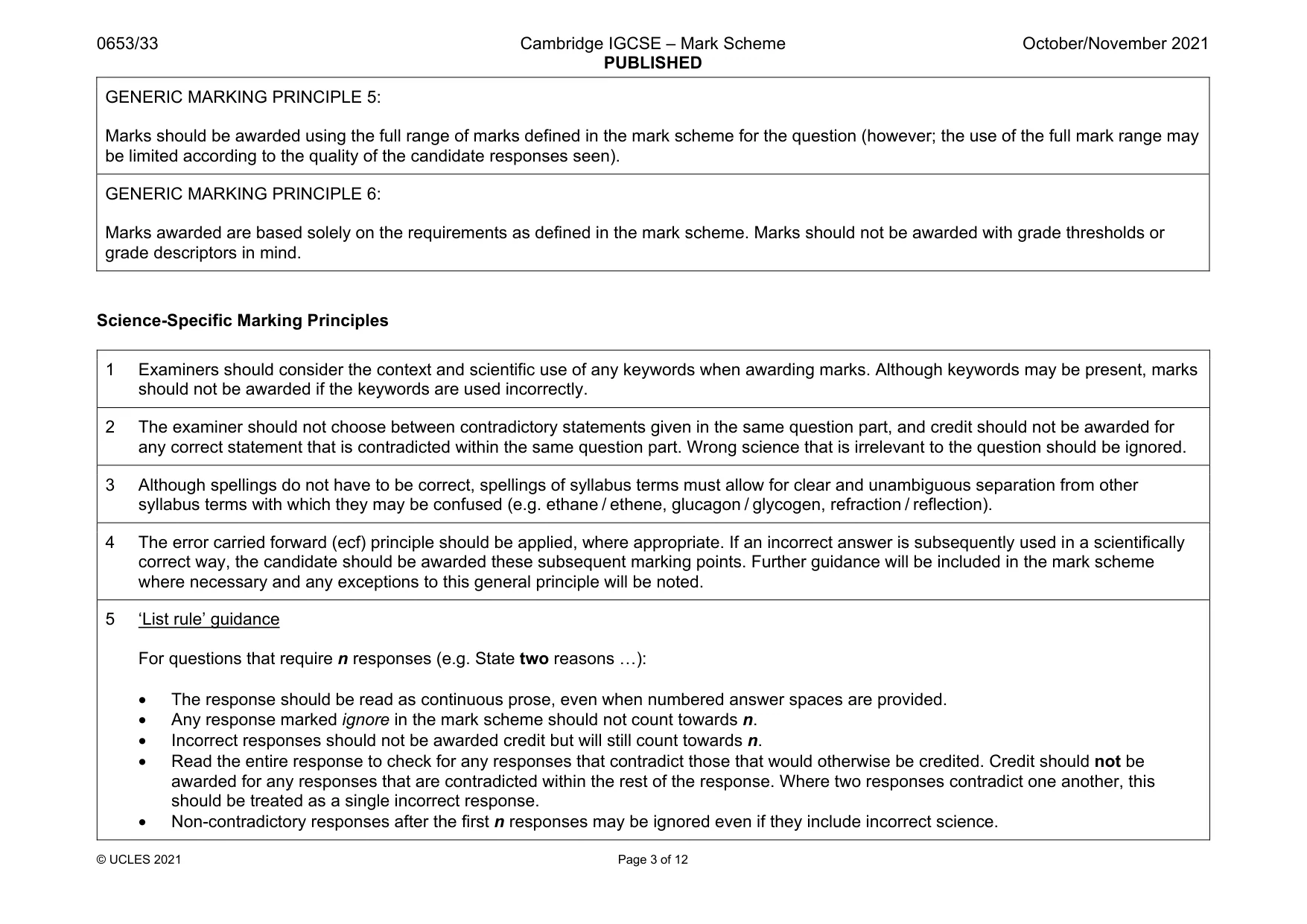
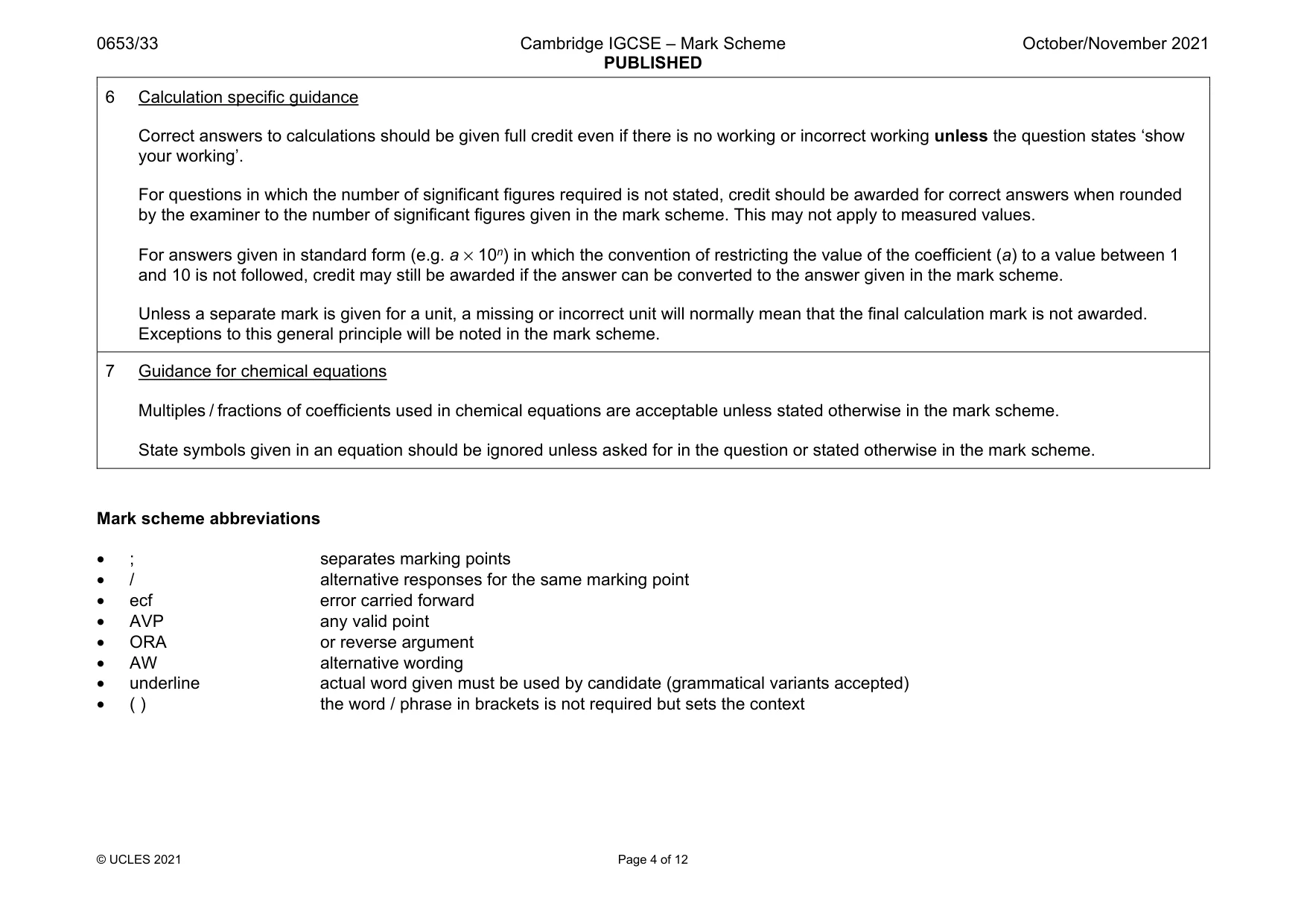
Question paper24 pages


Mark scheme12 pages
Answers below. Sit the paper first if you are practising.
Questions as text
Q1 · A blue dye is dissolved in water to make a blue liquid
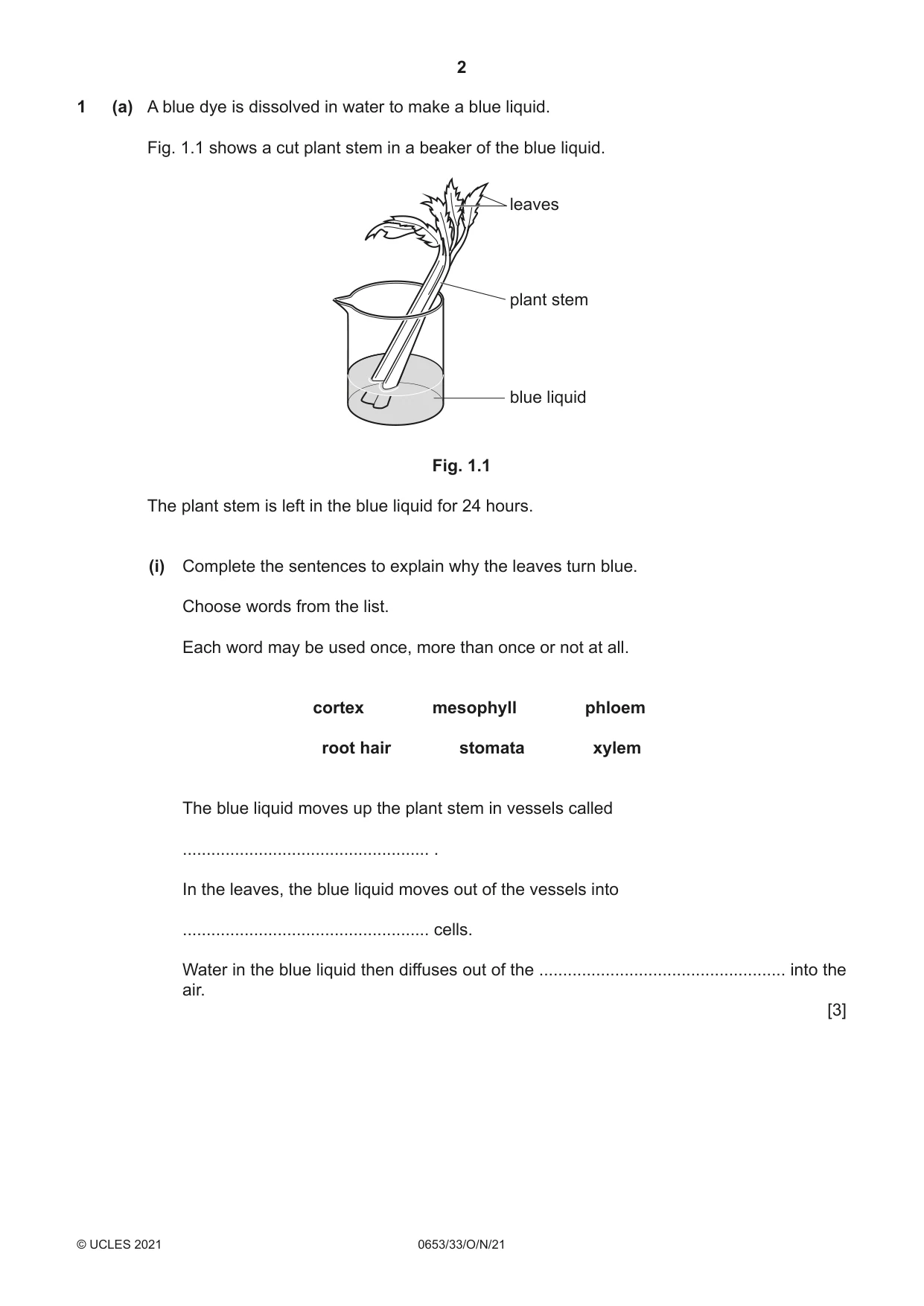
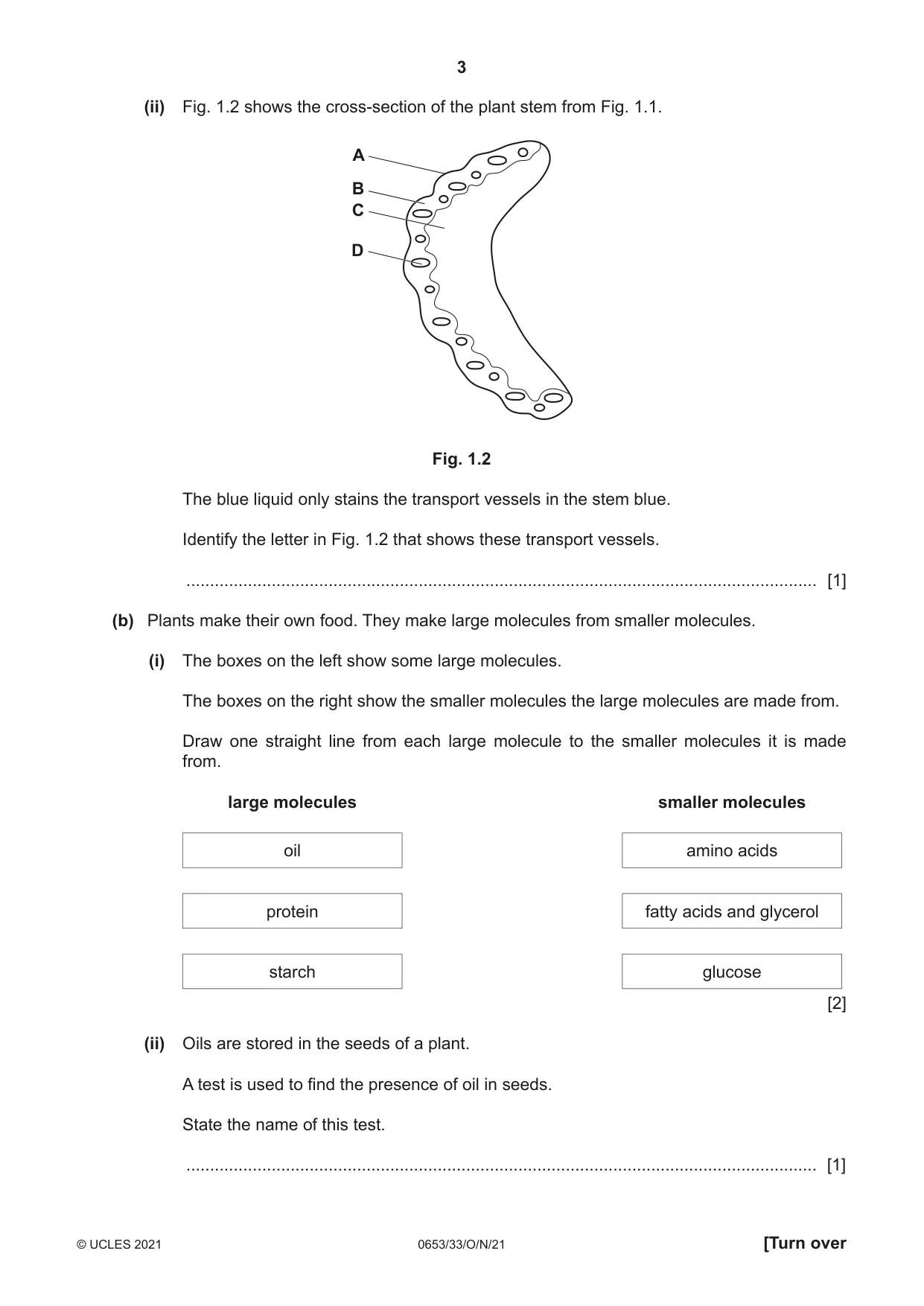
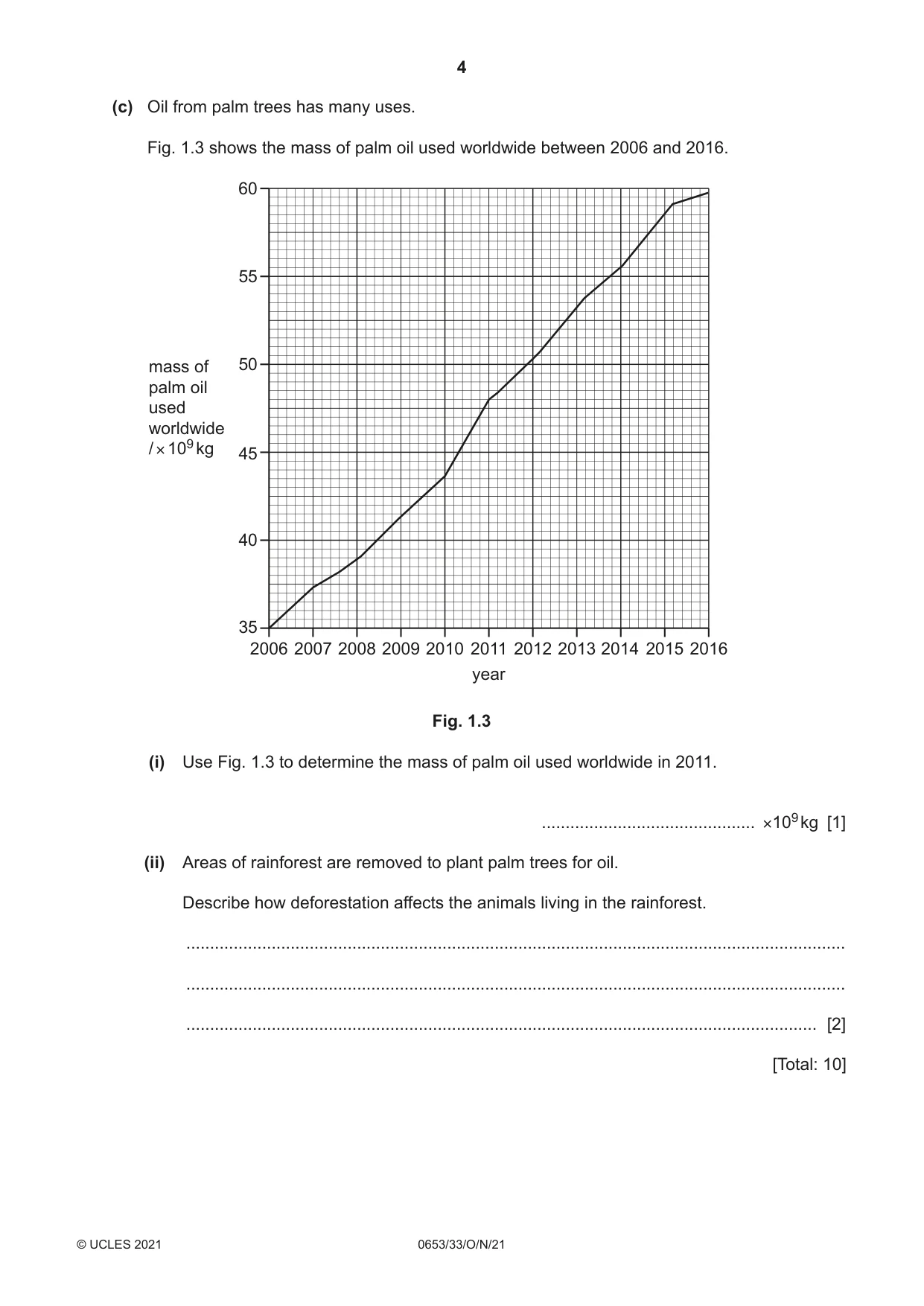
1 (a) A blue dye is dissolved in water to make a blue liquid. Fig. 1.1 shows a cut plant stem in a beaker of the blue liquid. leaves plant stem blue liquid Fig. 1.1 The plant stem is left in the blue liquid for 24 hours. (i) Complete the sentences to explain why the leaves turn blue. Choose words from the list. Each word may be used once, more than once or not at all. cortex mesophyll phloem root hair stomata xylem The blue liquid moves up the plant stem in vessels called .................................................... . In the leaves, the blue liquid moves out of the vessels into .................................................... cells. Water in the blue liquid then diffuses out of the .................................................... into the air. [3] (ii) Fig. 1.2 shows the cross-section of the plant stem from Fig. 1.1. A B C D Fig. 1.2 The blue liquid only stains the transport vessels in the stem blue. Identify the letter in Fig. 1.2 that shows these transport vessels. ..................................................................................................................................... [1] (b) Plants make their own food. They make large molecules from smaller molecules. (i) The boxes on the left show some large molecules. The boxes on the right show the smaller molecules the large molecules are made from. Draw one straight line from each large molecule to the smaller molecules it is made from. large molecules smaller molecules oil amino acids protein fatty acids and glycerol starch glucose [2] (ii) Oils are stored in the seeds of a plant. A test is used to find the presence of oil in seeds. State the name of this test. ..................................................................................................................................... [1] (c) Oil from palm trees has many uses. Fig. 1.3 shows the mass of palm oil used worldwide between 2006 and 2016. 60 55 mass of 50 palm oil used worldwide / × 109 kg 45 40 35 2006 2007 2008 2009 2010 2011 2012 2013 2014 2015 2016 year Fig. 1.3 (i) Use Fig. 1.3 to determine the mass of palm oil used worldwide in 2011. ............................................. ×109 kg [1] (ii) Areas of rainforest are removed to plant palm trees for oil. Describe how deforestation affects the animals living in the rainforest. ........................................................................................................................................... ........................................................................................................................................... ..................................................................................................................................... [2] [Total: 10]
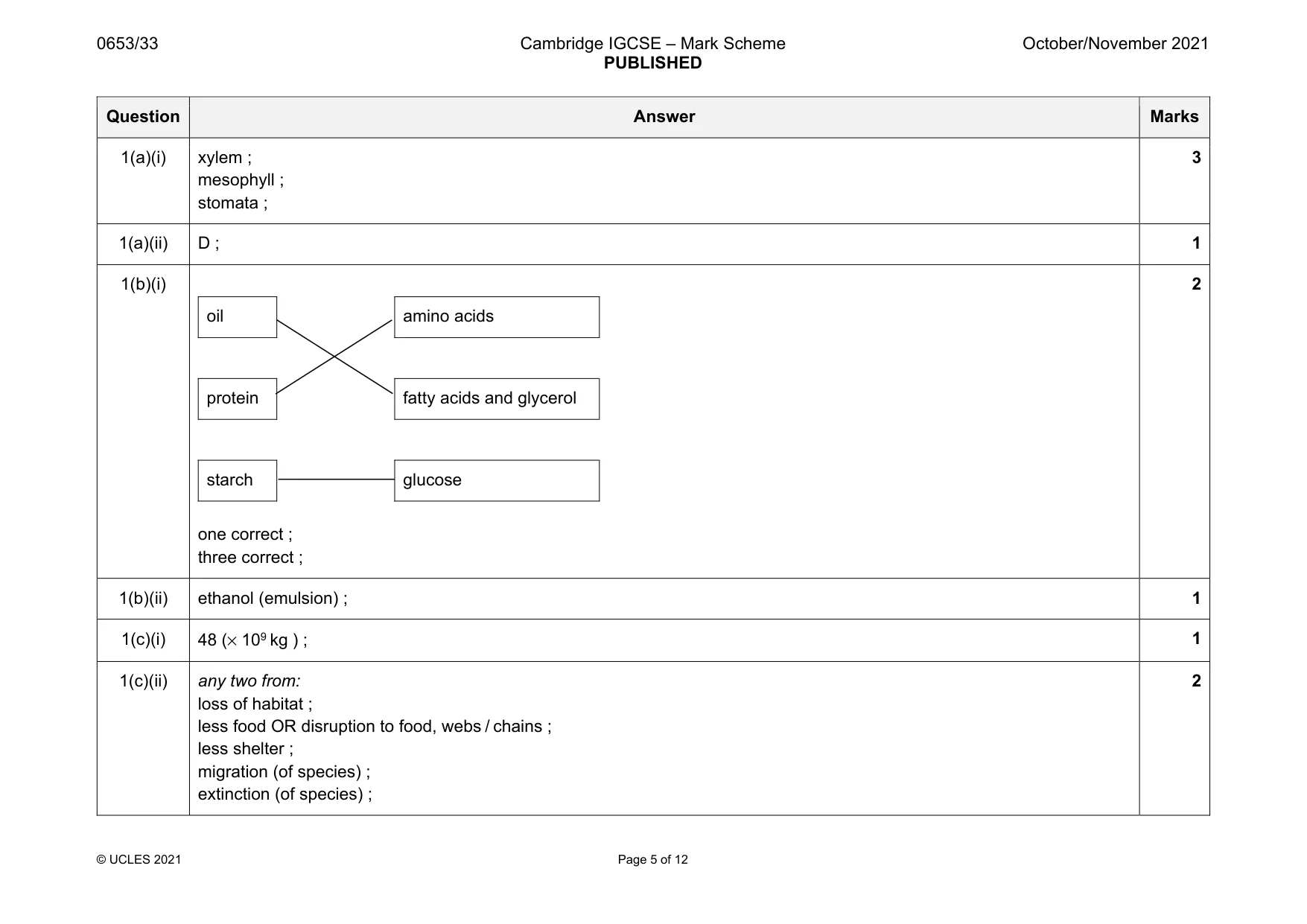
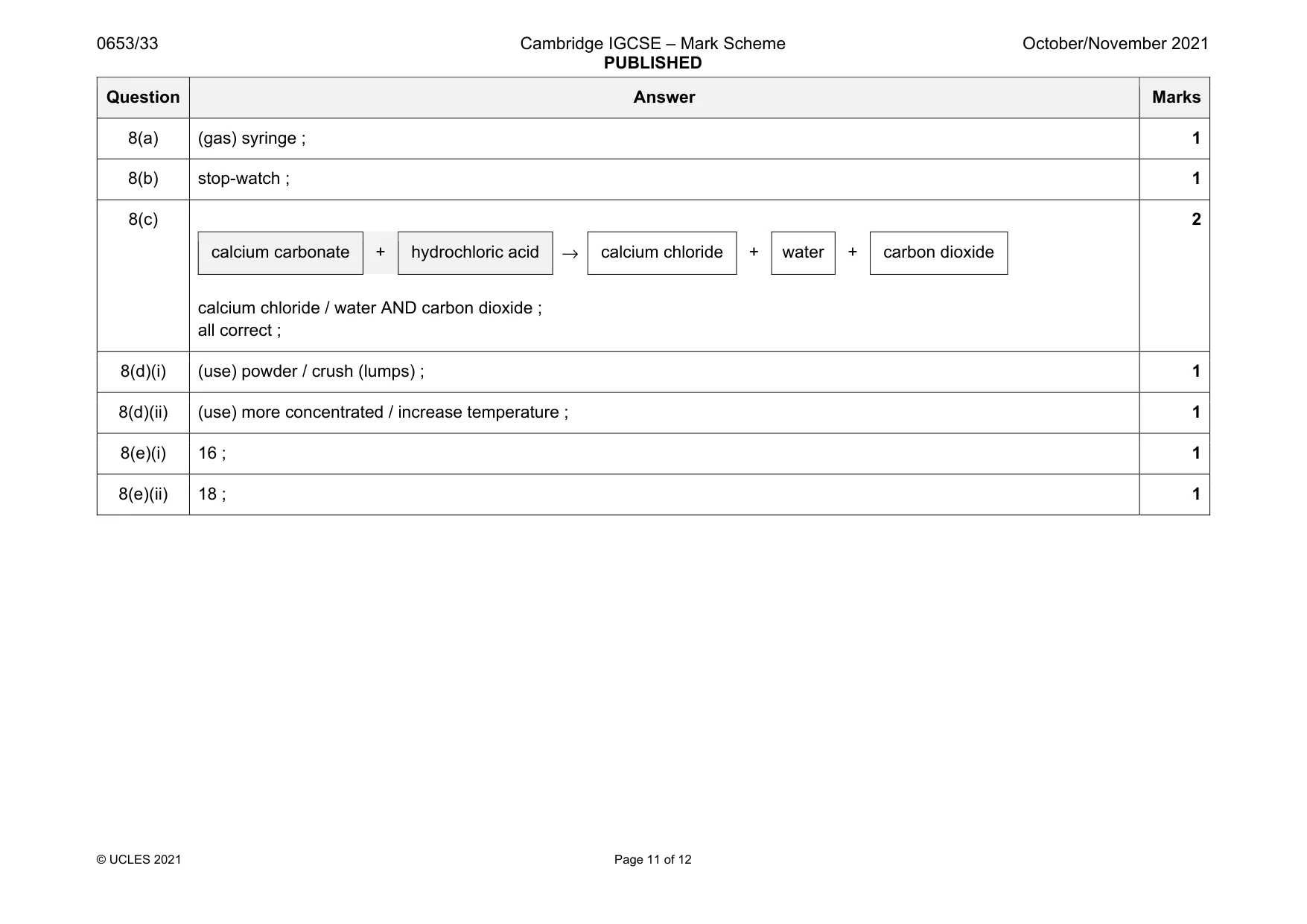
Mark scheme: 1(a)(i) xylem ; mesophyll ; stomata ; 3 1(a)(ii) D ; 1 1(b)(i) oil amino acids protein fatty acids and glycerol starch glucose one correct ; three correct ; 2 1(b)(ii) ethanol (emulsion) ; 1 1(c)(i) 48 (× 109 kg ) ; 1 1(c)(ii) any two from: loss of habitat ; less food OR disruption to food, webs / chains ; less shelter ; migration (of species) ; extinction (of species) ; 2
Q2 · A student separates some insoluble solid material from concentrated aqueous sodium…
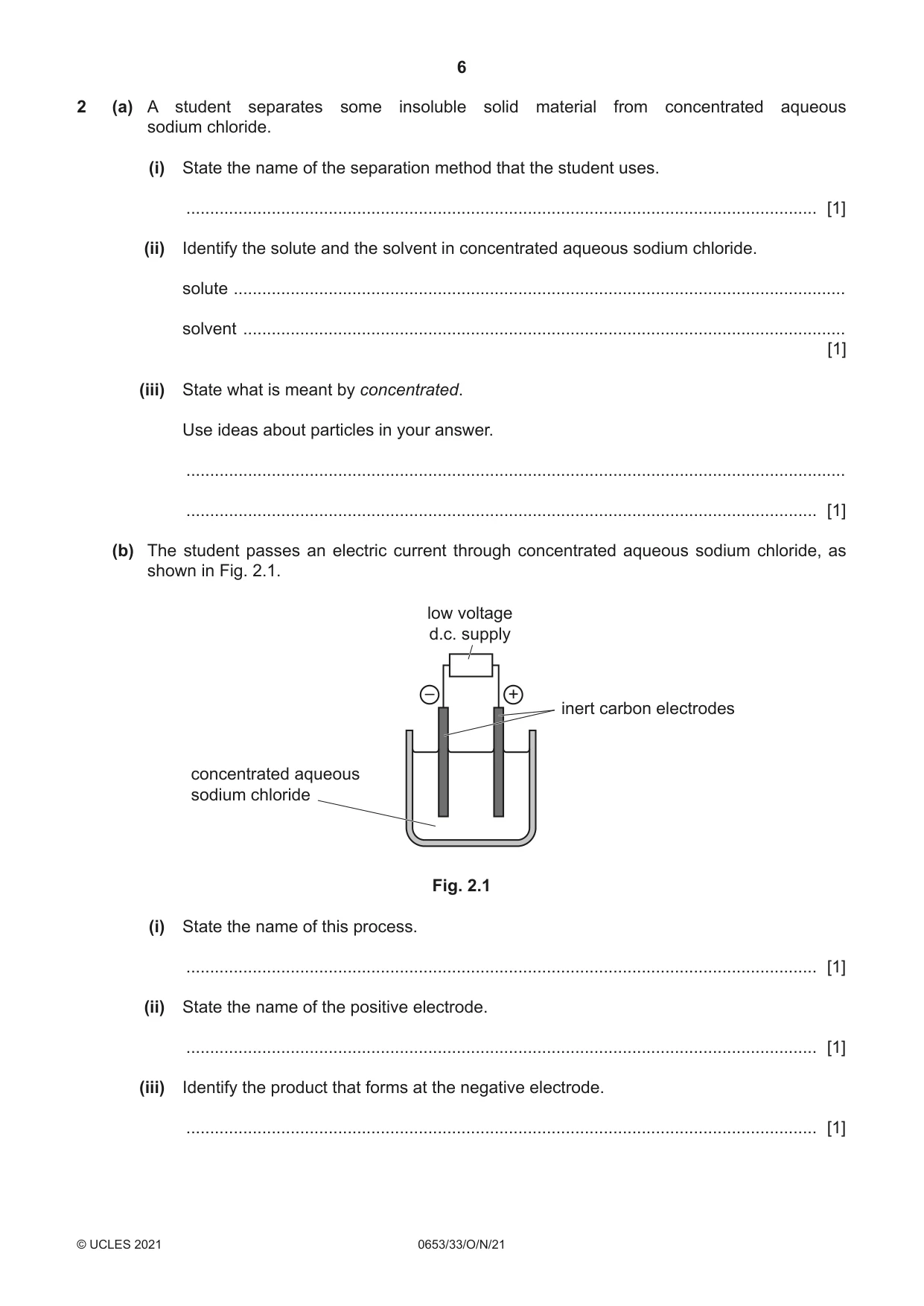
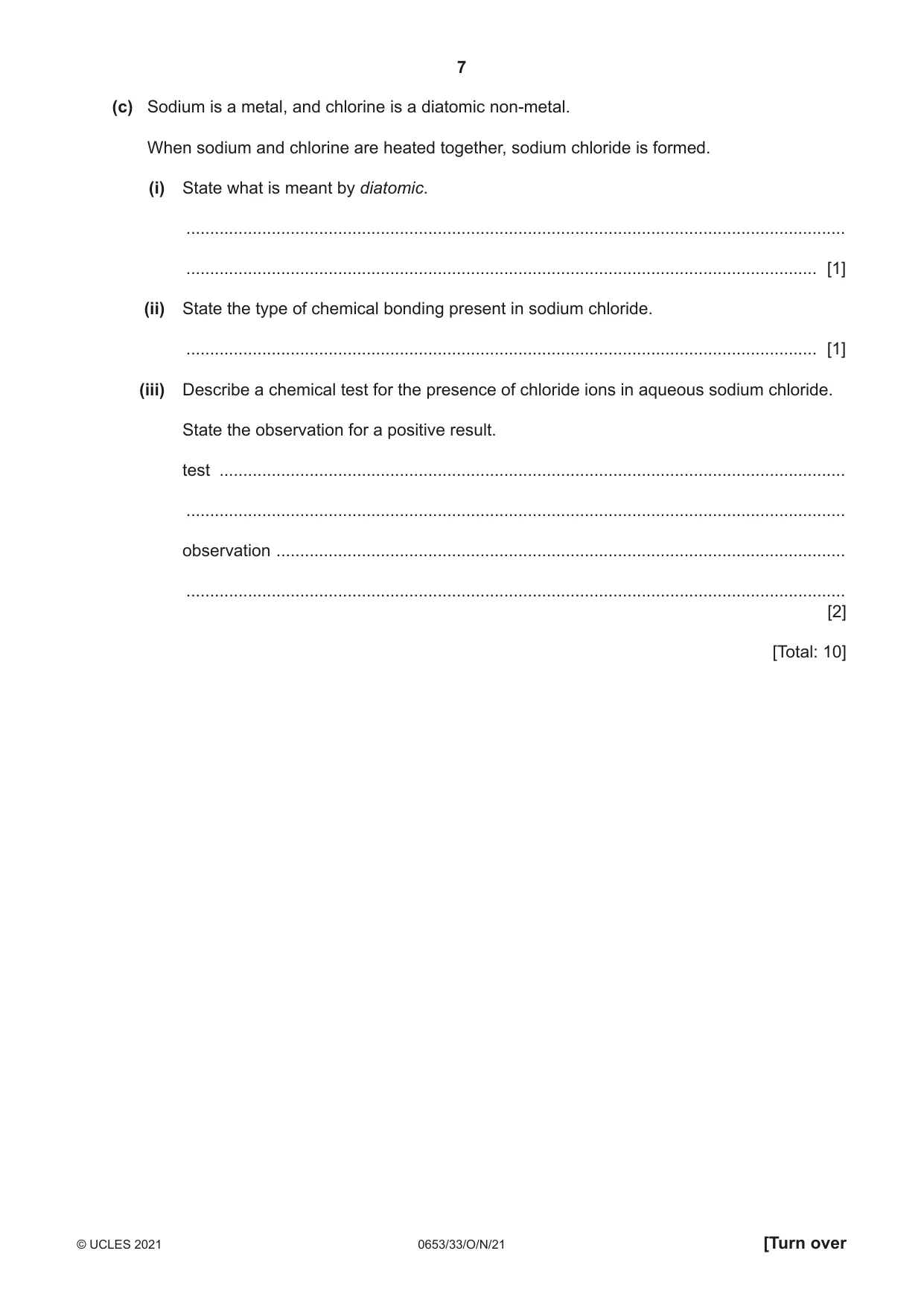
2 (a) A student separates some insoluble solid material from concentrated aqueous sodium chloride. (i) State the name of the separation method that the student uses. ..................................................................................................................................... [1] (ii) Identify the solute and the solvent in concentrated aqueous sodium chloride. solute ................................................................................................................................. solvent ............................................................................................................................... [1] (iii) State what is meant by concentrated. Use ideas about particles in your answer. ........................................................................................................................................... ..................................................................................................................................... [1] (b) The student passes an electric current through concentrated aqueous sodium chloride, as shown in Fig. 2.1. low voltage d.c. supply – + inert carbon electrodes concentrated aqueous sodium chloride Fig. 2.1 (i) State the name of this process. ..................................................................................................................................... [1] (ii) State the name of the positive electrode. ..................................................................................................................................... [1] (iii) Identify the product that forms at the negative electrode. ..................................................................................................................................... [1] (c) Sodium is a metal, and chlorine is a diatomic non-metal. When sodium and chlorine are heated together, sodium chloride is formed. (i) State what is meant by diatomic. ........................................................................................................................................... ..................................................................................................................................... [1] (ii) State the type of chemical bonding present in sodium chloride. ..................................................................................................................................... [1] (iii) Describe a chemical test for the presence of chloride ions in aqueous sodium chloride. State the observation for a positive result. test .................................................................................................................................... ........................................................................................................................................... observation ........................................................................................................................ ........................................................................................................................................... [2] [Total: 10]
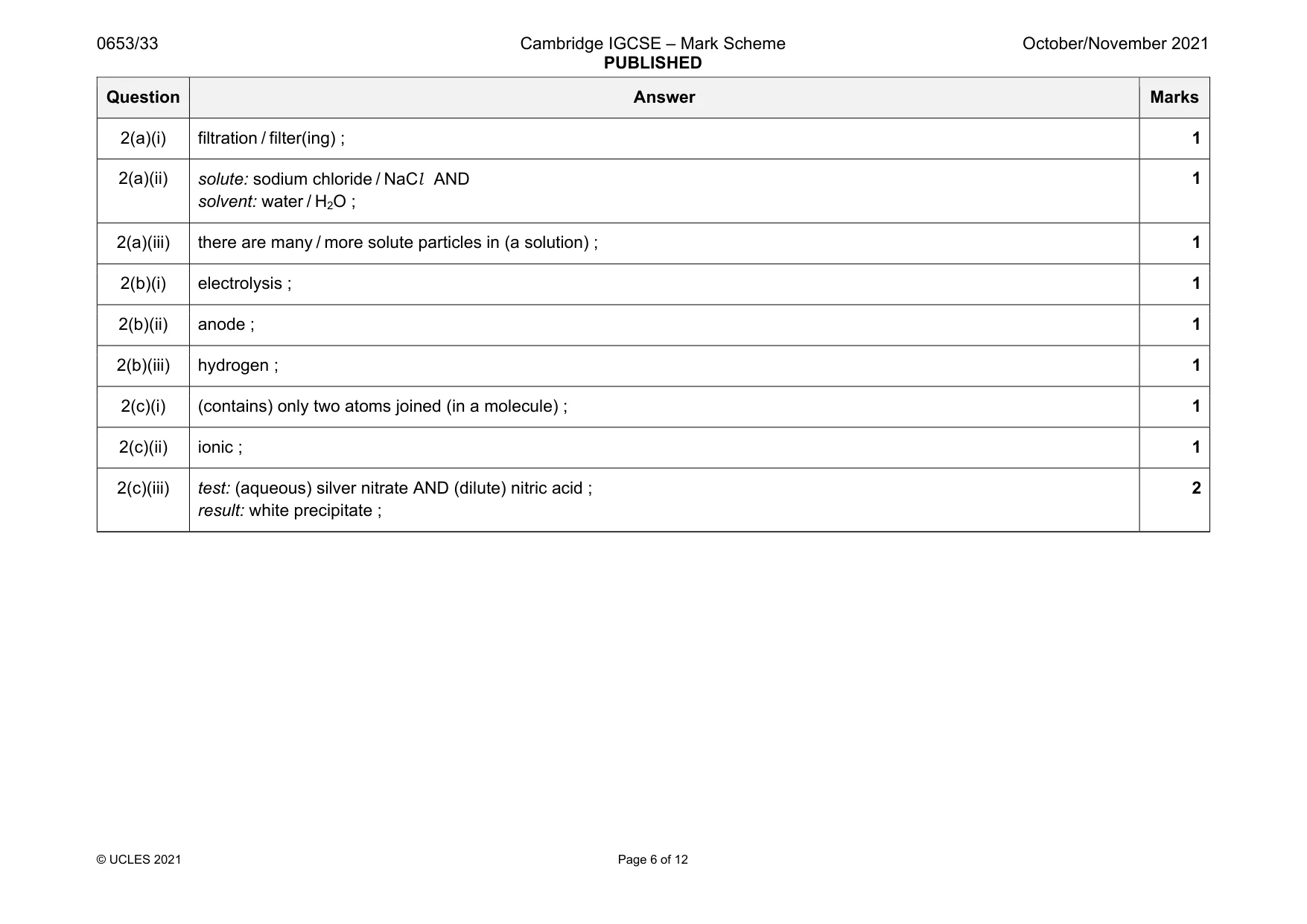
Mark scheme: 2(a)(i) filtration / filter(ing) ; 1 2(a)(ii) solute: sodium chloride / NaCl AND solvent: water / H2O ; 1 2(a)(iii) there are many / more solute particles in (a solution) ; 1 2(b)(i) electrolysis ; 1 2(b)(ii) anode ; 1 2(b)(iii) hydrogen ; 1 2(c)(i) (contains) only two atoms joined (in a molecule) ; 1 2(c)(ii) ionic ; 1 2(c)(iii) test: (aqueous) silver nitrate AND (dilute) nitric acid ; result: white precipitate ; 2
Q3 · The seven regions of the electromagnetic spectrum
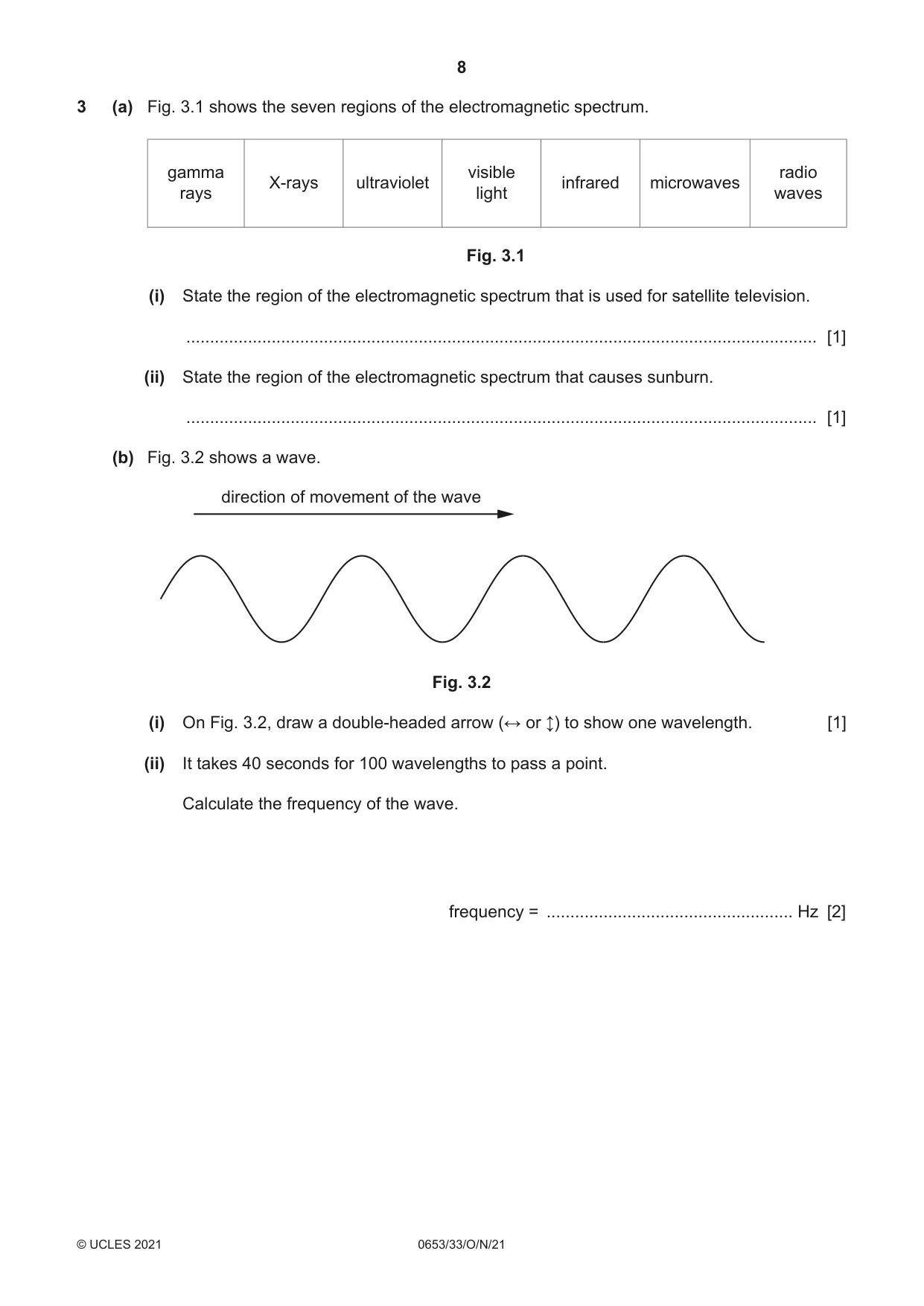
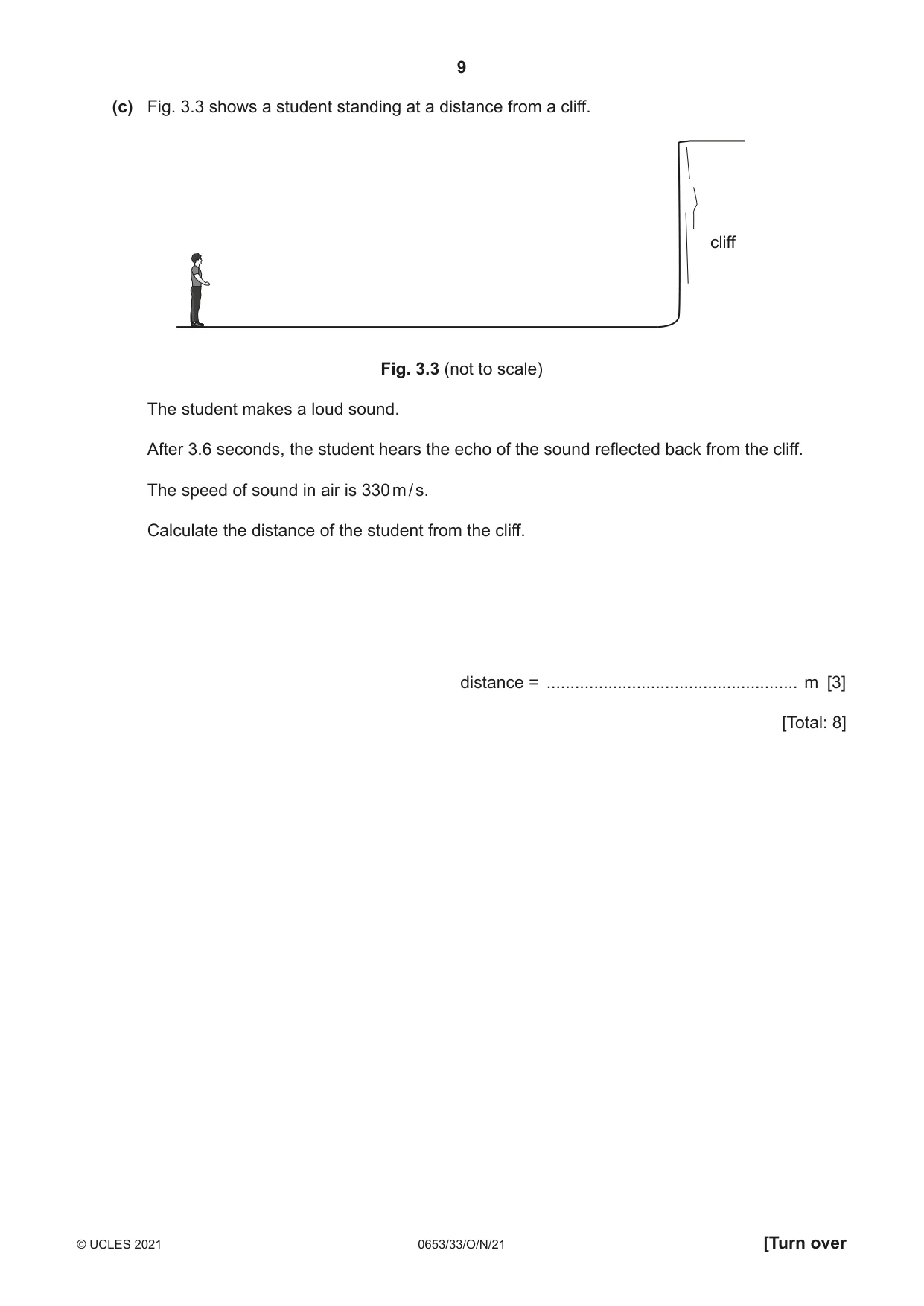
3 (a) Fig. 3.1 shows the seven regions of the electromagnetic spectrum. gamma visible radio X-rays ultraviolet infrared microwaves rays light waves Fig. 3.1 (i) State the region of the electromagnetic spectrum that is used for satellite television. ..................................................................................................................................... [1] (ii) State the region of the electromagnetic spectrum that causes sunburn. ..................................................................................................................................... [1] (b) Fig. 3.2 shows a wave. direction of movement of the wave Fig. 3.2 (i) On Fig. 3.2, draw a double-headed arrow (↔ or ↕) to show one wavelength. [1] (ii) It takes 40 seconds for 100 wavelengths to pass a point. Calculate the frequency of the wave. frequency = .................................................... Hz [2] (c) Fig. 3.3 shows a student standing at a distance from a cliff. cliff Fig. 3.3 (not to scale) The student makes a loud sound. After 3.6 seconds, the student hears the echo of the sound reflected back from the cliff. The speed of sound in air is 330 m / s. Calculate the distance of the student from the cliff. distance = ..................................................... m [3] [Total: 8]
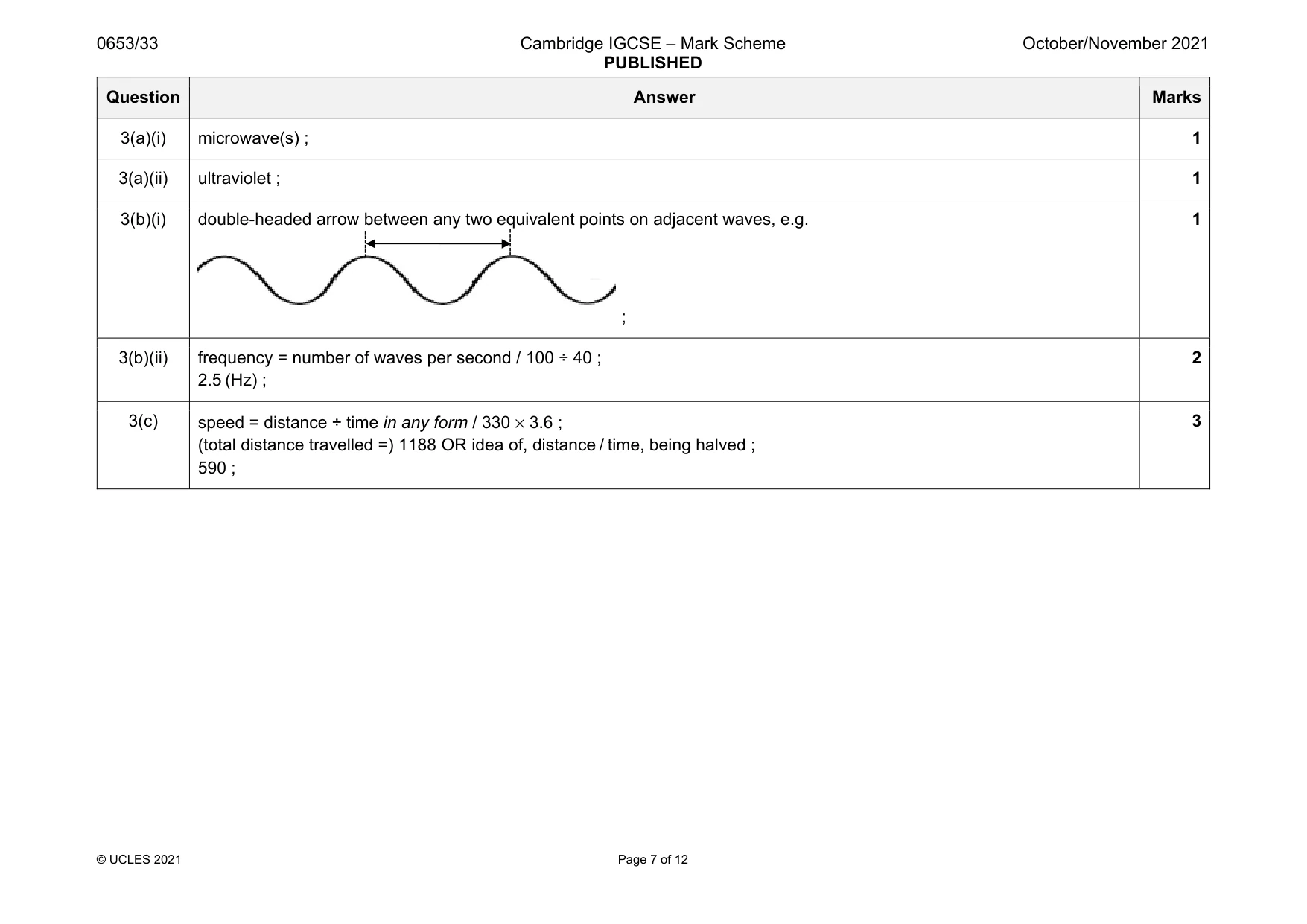
Mark scheme: 3(a)(i) microwave(s) ; 1 3(a)(ii) ultraviolet ; 1 3(b)(i) double-headed arrow between any two equivalent points on adjacent waves, e.g. ; 1 3(b)(ii) frequency = number of waves per second / 100 ÷ 40 ; 2.5 (Hz) ; 2 3(c) speed = distance ÷ time in any form / 330 × 3.6 ; (total distance travelled =) 1188 OR idea of, distance / time, being halved ; 590 ; 3
Q4 · A biology teacher measures the pulse rate of five students A–E before and after exercise
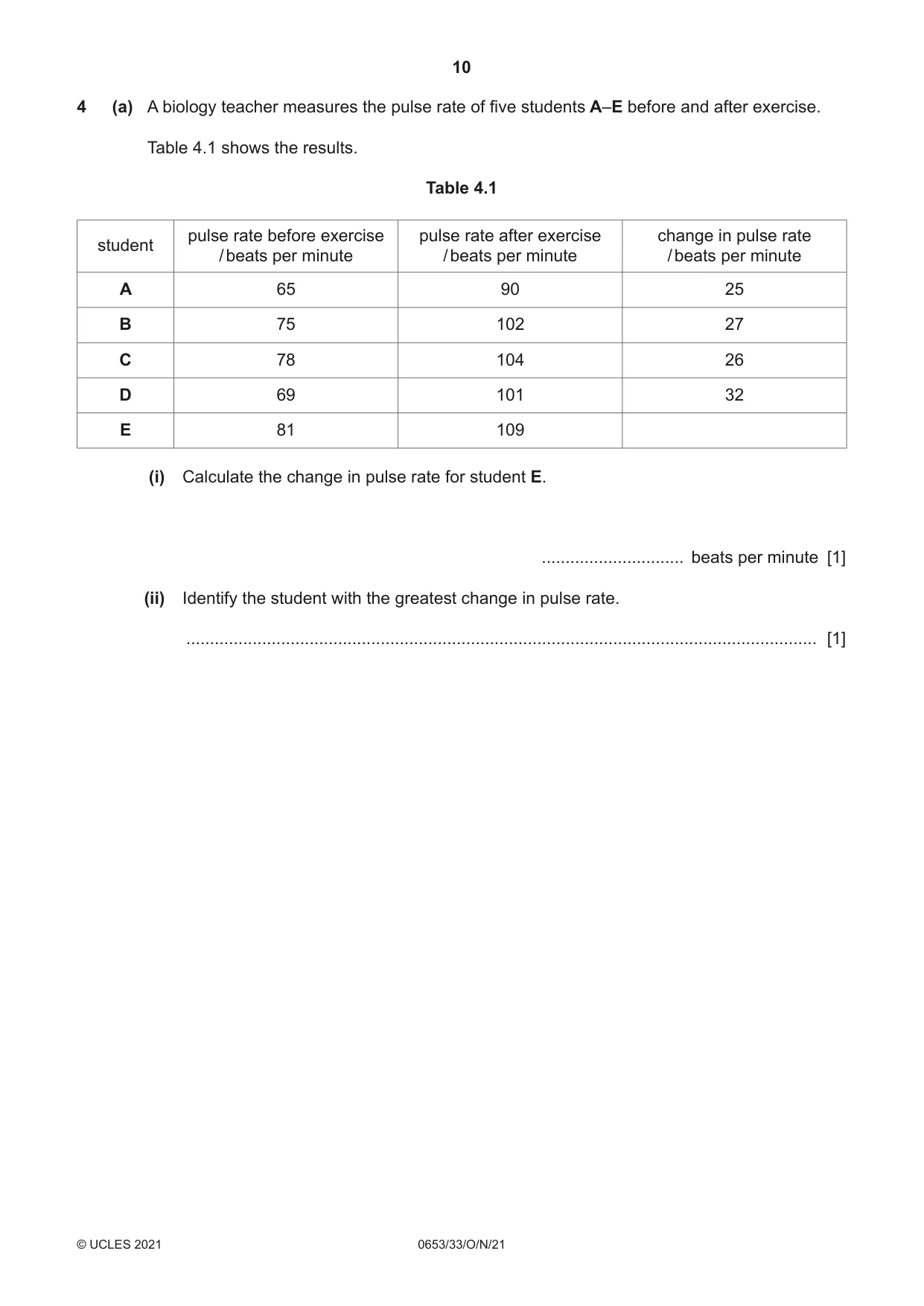
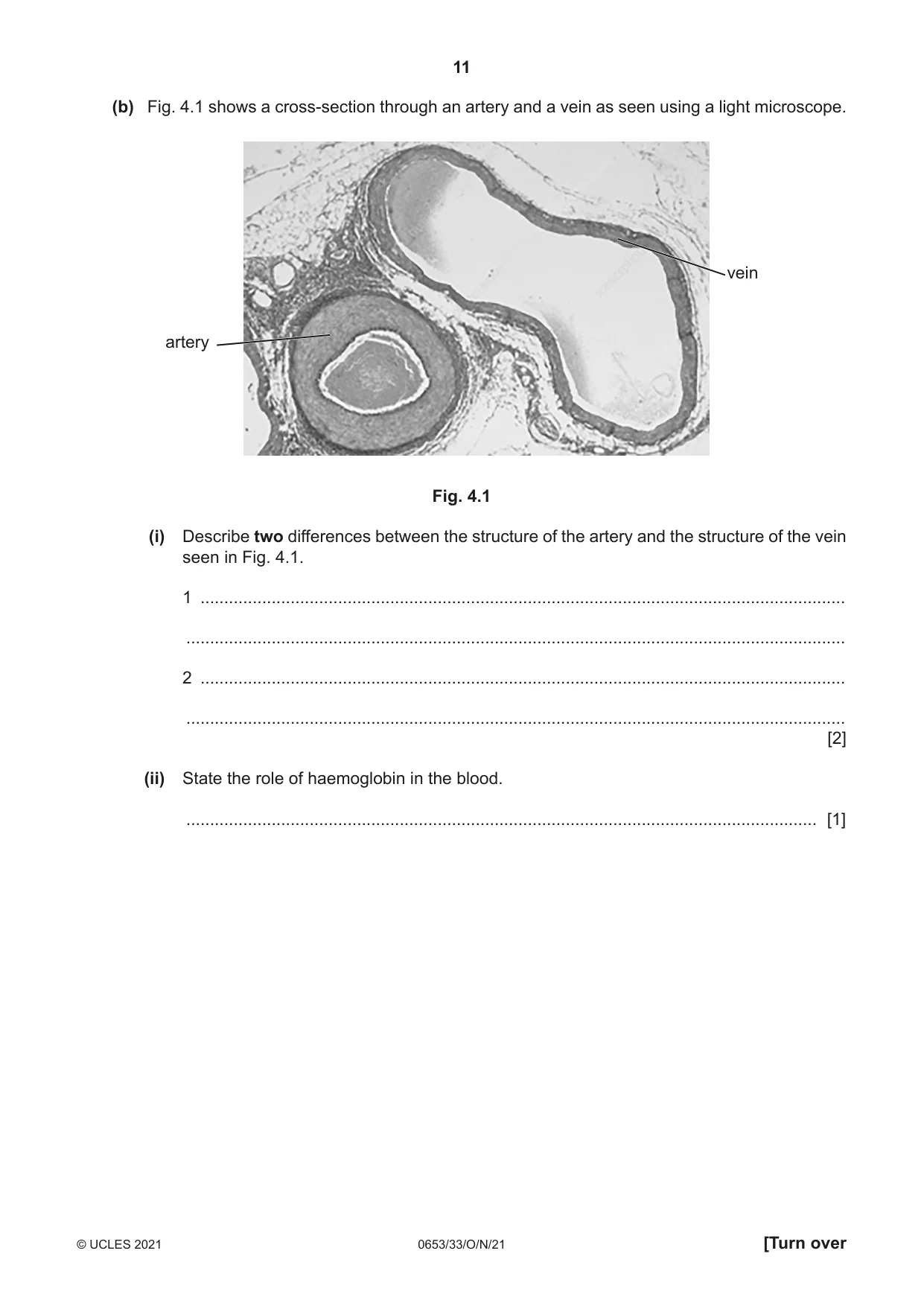
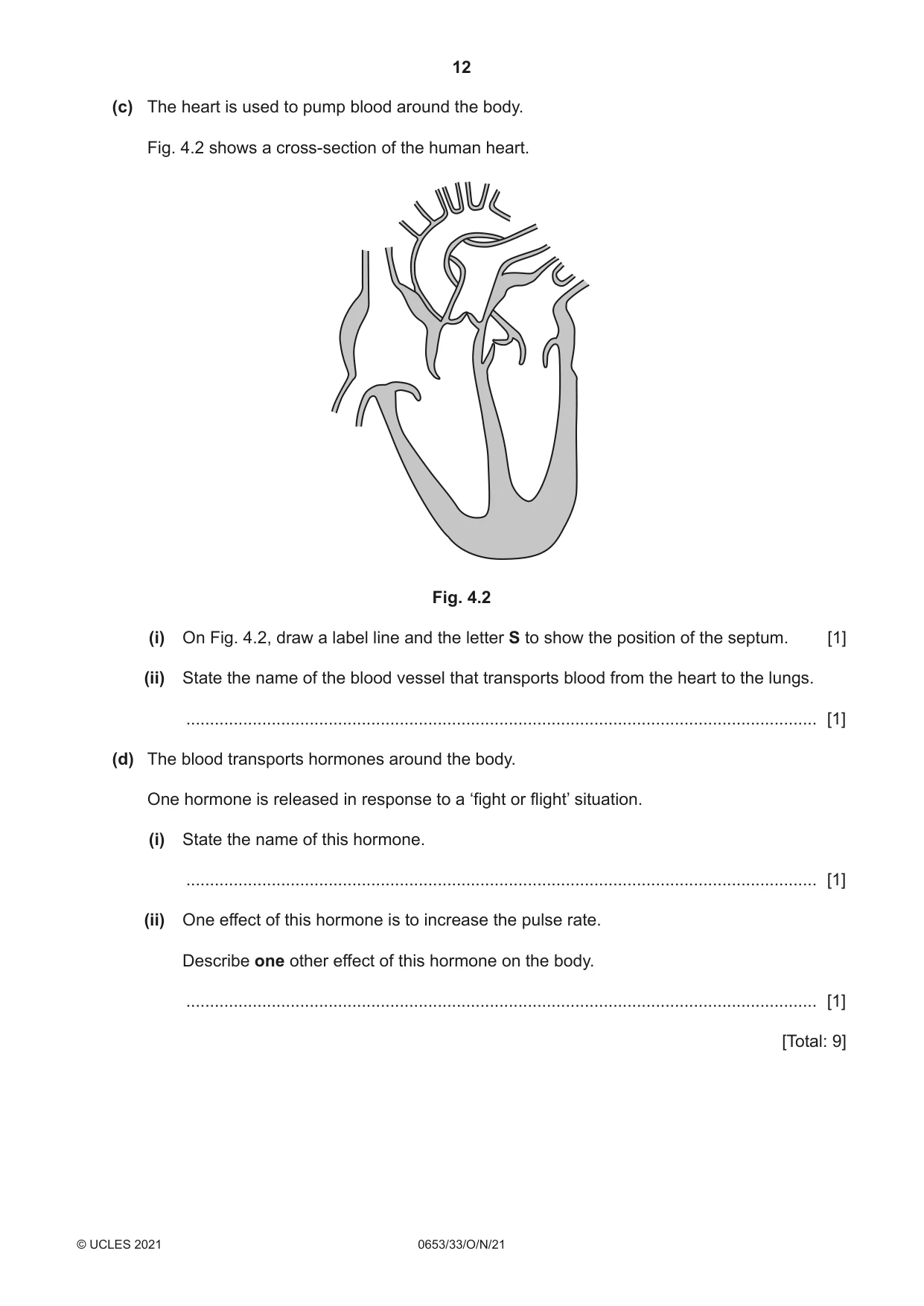
4 (a) A biology teacher measures the pulse rate of five students A–E before and after exercise. Table 4.1 shows the results. Table 4.1 pulse rate before exercise pulse rate after exercise change in pulse rate student / beats per minute / beats per minute / beats per minute A 65 90 25 B 75 102 27 C 78 104 26 D 69 101 32 E 81 109 (i) Calculate the change in pulse rate for student E. .............................. beats per minute [1] (ii) Identify the student with the greatest change in pulse rate. ..................................................................................................................................... [1] (b) Fig. 4.1 shows a cross-section through an artery and a vein as seen using a light microscope. vein artery Fig. 4.1 (i) Describe two differences between the structure of the artery and the structure of the vein seen in Fig. 4.1. 1 ........................................................................................................................................ ........................................................................................................................................... 2 ........................................................................................................................................ ........................................................................................................................................... [2] (ii) State the role of haemoglobin in the blood. ..................................................................................................................................... [1] (c) The heart is used to pump blood around the body. Fig. 4.2 shows a cross-section of the human heart. Fig. 4.2 (i) On Fig. 4.2, draw a label line and the letter S to show the position of the septum. [1] (ii) State the name of the blood vessel that transports blood from the heart to the lungs. ..................................................................................................................................... [1] (d) The blood transports hormones around the body. One hormone is released in response to a ‘fight or flight’ situation. (i) State the name of this hormone. ..................................................................................................................................... [1] (ii) One effect of this hormone is to increase the pulse rate. Describe one other effect of this hormone on the body. ..................................................................................................................................... [1] [Total: 9]
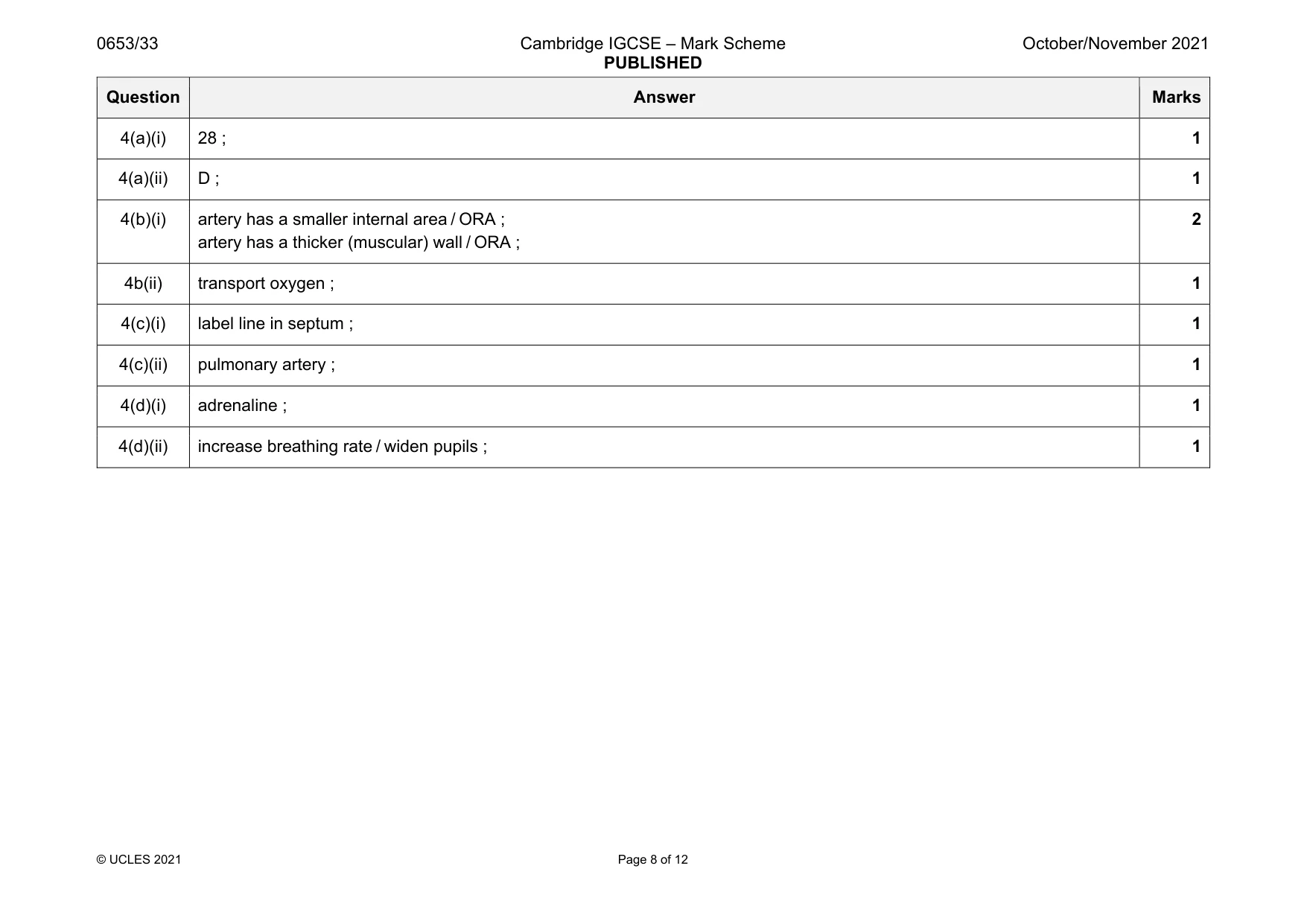
Mark scheme: 4(a)(i) 28 ; 1 4(a)(ii) D ; 1 4(b)(i) artery has a smaller internal area / ORA ; artery has a thicker (muscular) wall / ORA ; 2 4b(ii) transport oxygen ; 1 4(c)(i) label line in septum ; 1 4(c)(ii) pulmonary artery ; 1 4(d)(i) adrenaline ; 1 4(d)(ii) increase breathing rate / widen pupils ; 1
Q5 · The Periodic Table lists all of the known elements
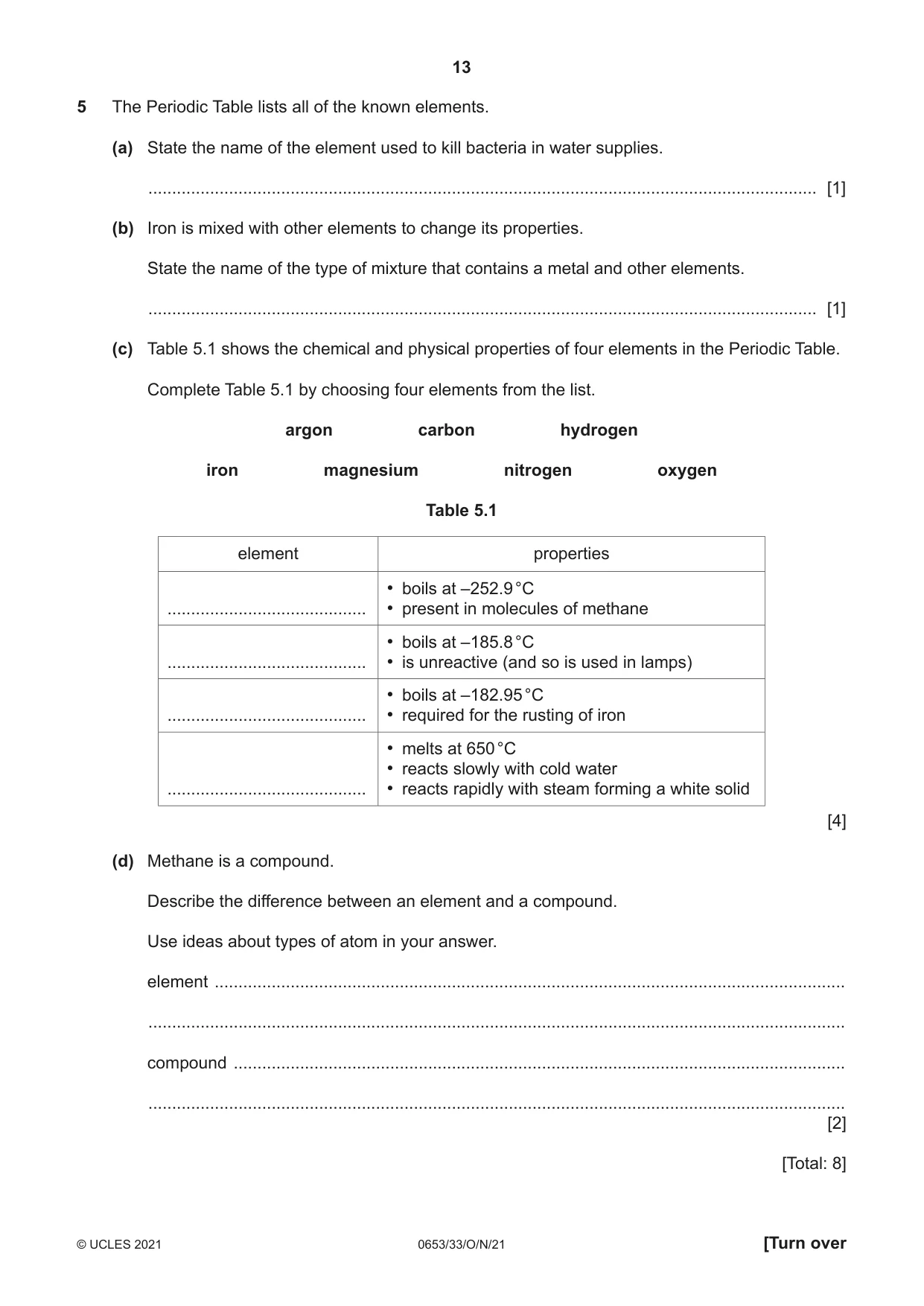
5 The Periodic Table lists all of the known elements. (a) State the name of the element used to kill bacteria in water supplies. ............................................................................................................................................. [1] (b) Iron is mixed with other elements to change its properties. State the name of the type of mixture that contains a metal and other elements. ............................................................................................................................................. [1] (c) Table 5.1 shows the chemical and physical properties of four elements in the Periodic Table. Complete Table 5.1 by choosing four elements from the list. argon carbon hydrogen iron magnesium nitrogen oxygen Table 5.1 element properties • boils at –252.9 °C .......................................... • present in molecules of methane • boils at –185.8 °C .......................................... • is unreactive (and so is used in lamps) • boils at –182.95 °C .......................................... • required for the rusting of iron • melts at 650 °C • reacts slowly with cold water .......................................... • reacts rapidly with steam forming a white solid [4] (d) Methane is a compound. Describe the difference between an element and a compound. Use ideas about types of atom in your answer. element ..................................................................................................................................... ................................................................................................................................................... compound ................................................................................................................................. ................................................................................................................................................... [2] [Total: 8]
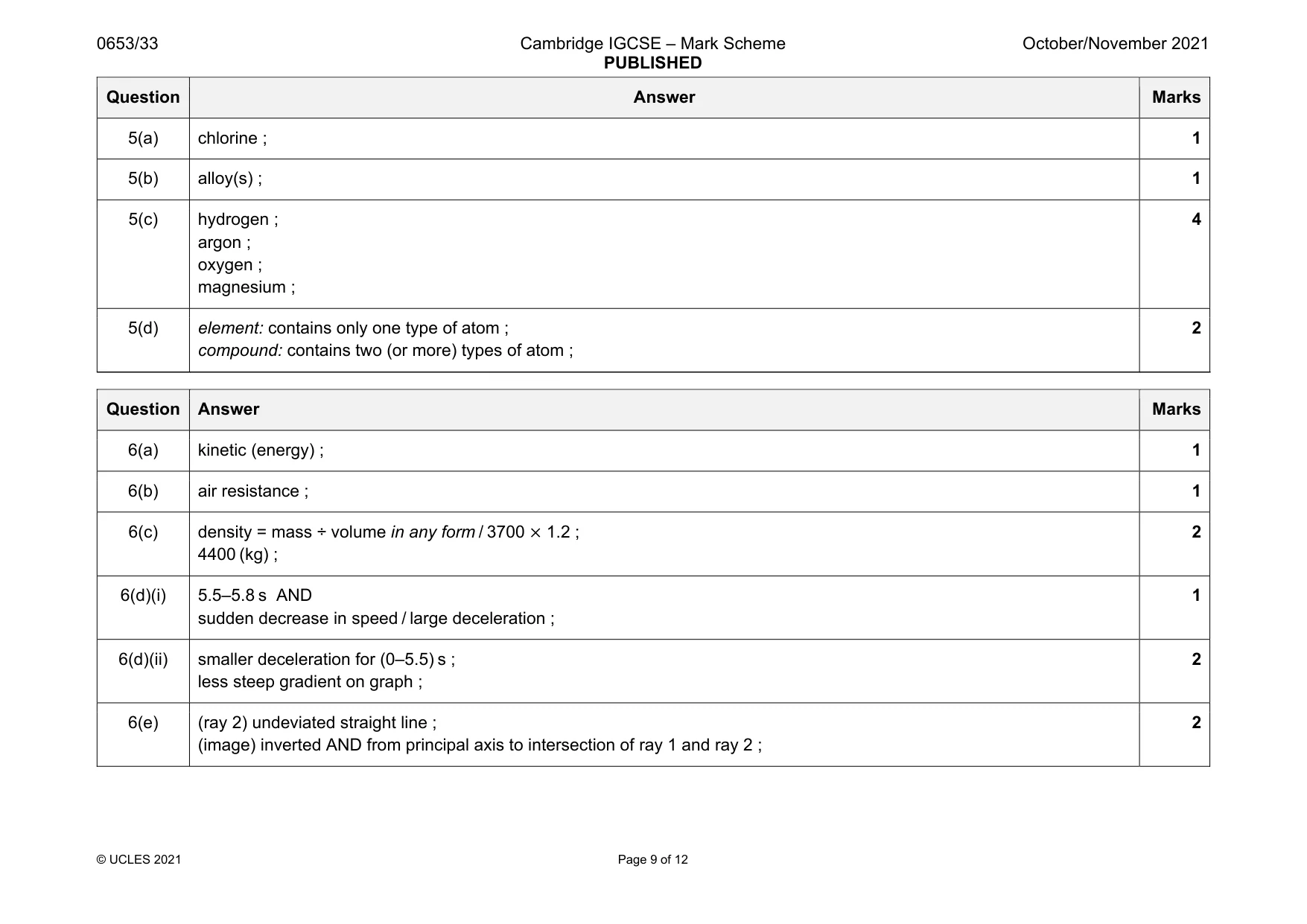
Mark scheme: 5(a) chlorine ; 1 5(b) alloy(s) ; 1 5(c) hydrogen ; argon ; oxygen ; magnesium ; 4 5(d) element: contains only one type of atom ; compound: contains two (or more) types of atom ; 2 Question Answer Marks
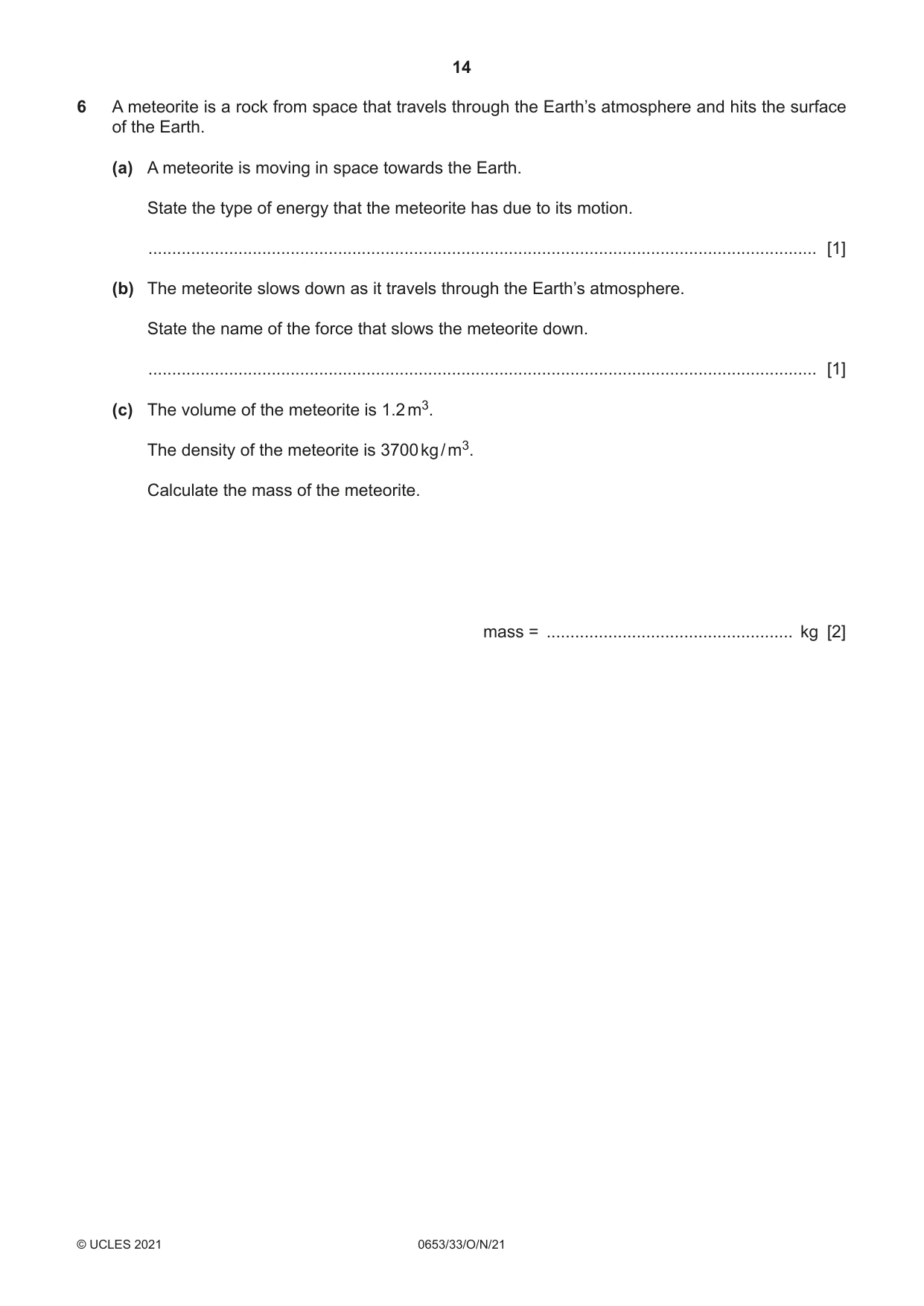
Q6 · A meteorite is a rock from space that travels through the Earth’s atmosphere and hits the…
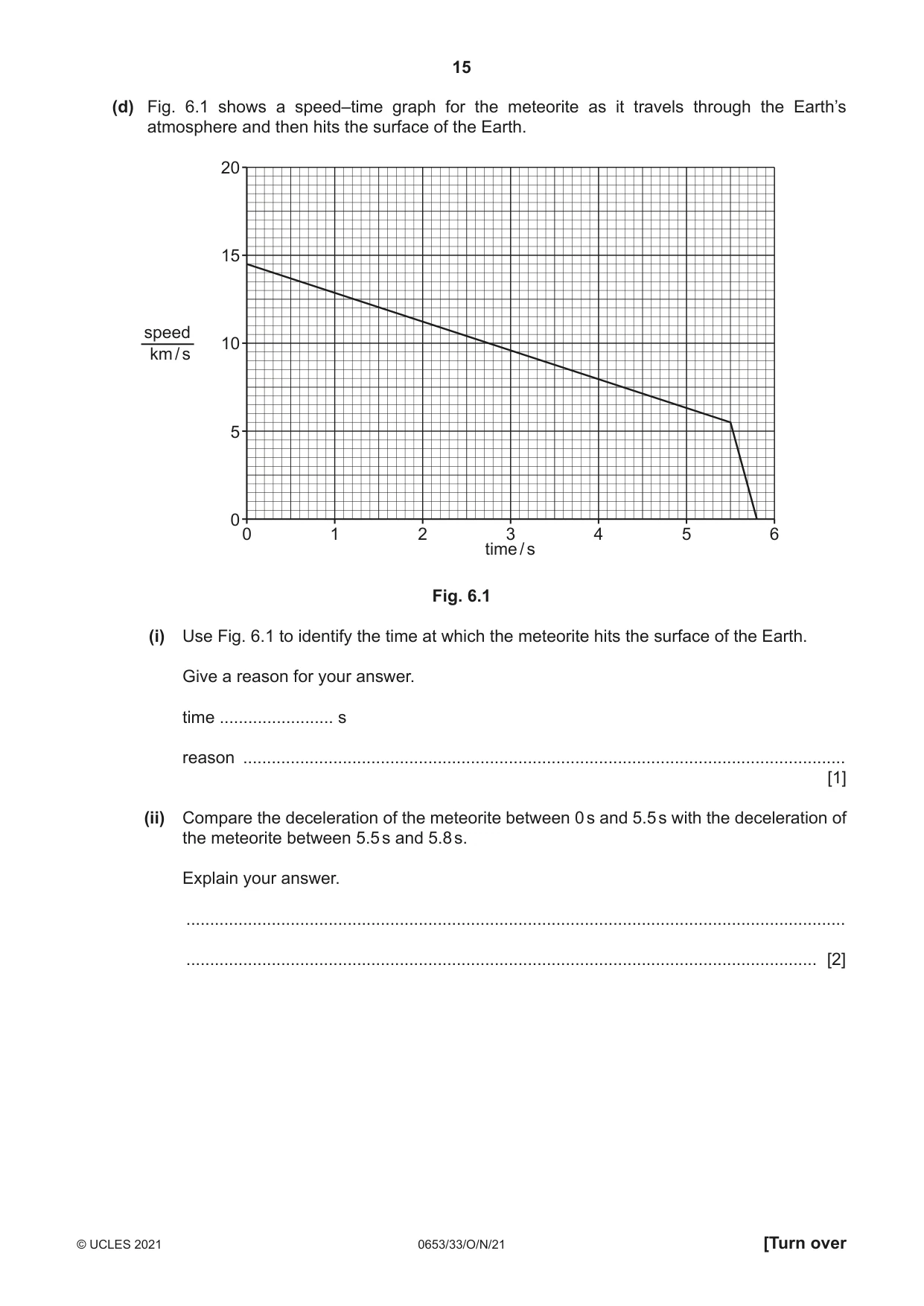
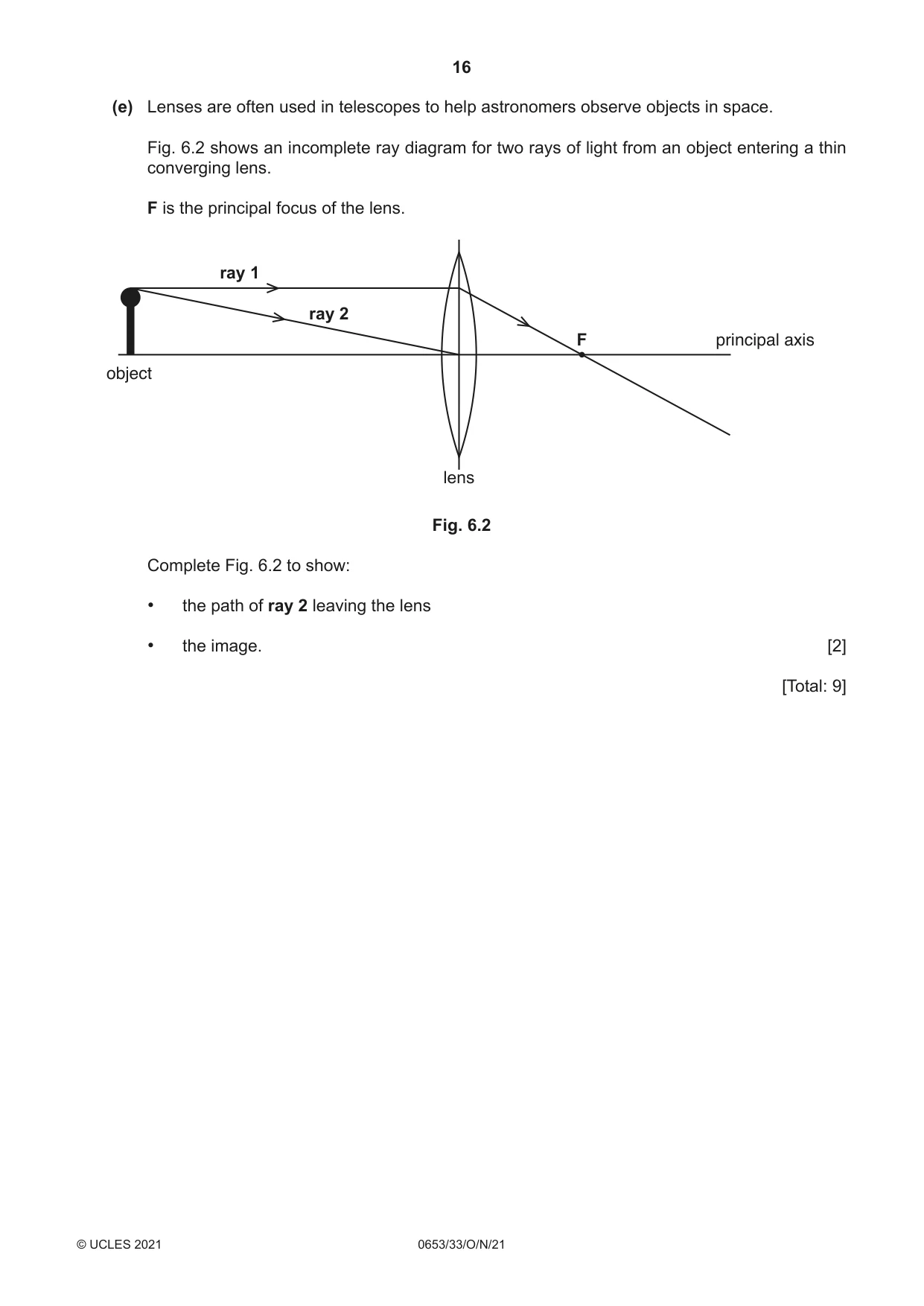
6 A meteorite is a rock from space that travels through the Earth’s atmosphere and hits the surface of the Earth. (a) A meteorite is moving in space towards the Earth. State the type of energy that the meteorite has due to its motion. ............................................................................................................................................. [1] (b) The meteorite slows down as it travels through the Earth’s atmosphere. State the name of the force that slows the meteorite down. ............................................................................................................................................. [1] (c) The volume of the meteorite is 1.2 m3. The density of the meteorite is 3700 kg / m3. Calculate the mass of the meteorite. mass = .................................................... kg [2] (d) Fig. 6.1 shows a speed–time graph for the meteorite as it travels through the Earth’s atmosphere and then hits the surface of the Earth. 20 15 speed 10 km / s 5 0 0 1 2 3 4 5 6 time / s Fig. 6.1 (i) Use Fig. 6.1 to identify the time at which the meteorite hits the surface of the Earth. Give a reason for your answer. time ........................ s reason ............................................................................................................................... [1] (ii) Compare the deceleration of the meteorite between 0 s and 5.5 s with the deceleration of the meteorite between 5.5 s and 5.8 s. Explain your answer. ........................................................................................................................................... ..................................................................................................................................... [2] (e) Lenses are often used in telescopes to help astronomers observe objects in space. Fig. 6.2 shows an incomplete ray diagram for two rays of light from an object entering a thin converging lens. F is the principal focus of the lens. ray 1 ray 2 F principal axis object lens Fig. 6.2 Complete Fig. 6.2 to show: • the path of ray 2 leaving the lens • the image. [2] [Total: 9]
Mark scheme: 6(a) kinetic (energy) ; 1 6(b) air resistance ; 1 6(c) density = mass ÷ volume in any form / 3700 × 1.2 ; 4400 (kg) ; 2 6(d)(i) 5.5–5.8 s AND sudden decrease in speed / large deceleration ; 1 6(d)(ii) smaller deceleration for (0–5.5) s ; less steep gradient on graph ; 2 6(e) (ray 2) undeviated straight line ; (image) inverted AND from principal axis to intersection of ray 1 and ray 2 ; 2
Question 7
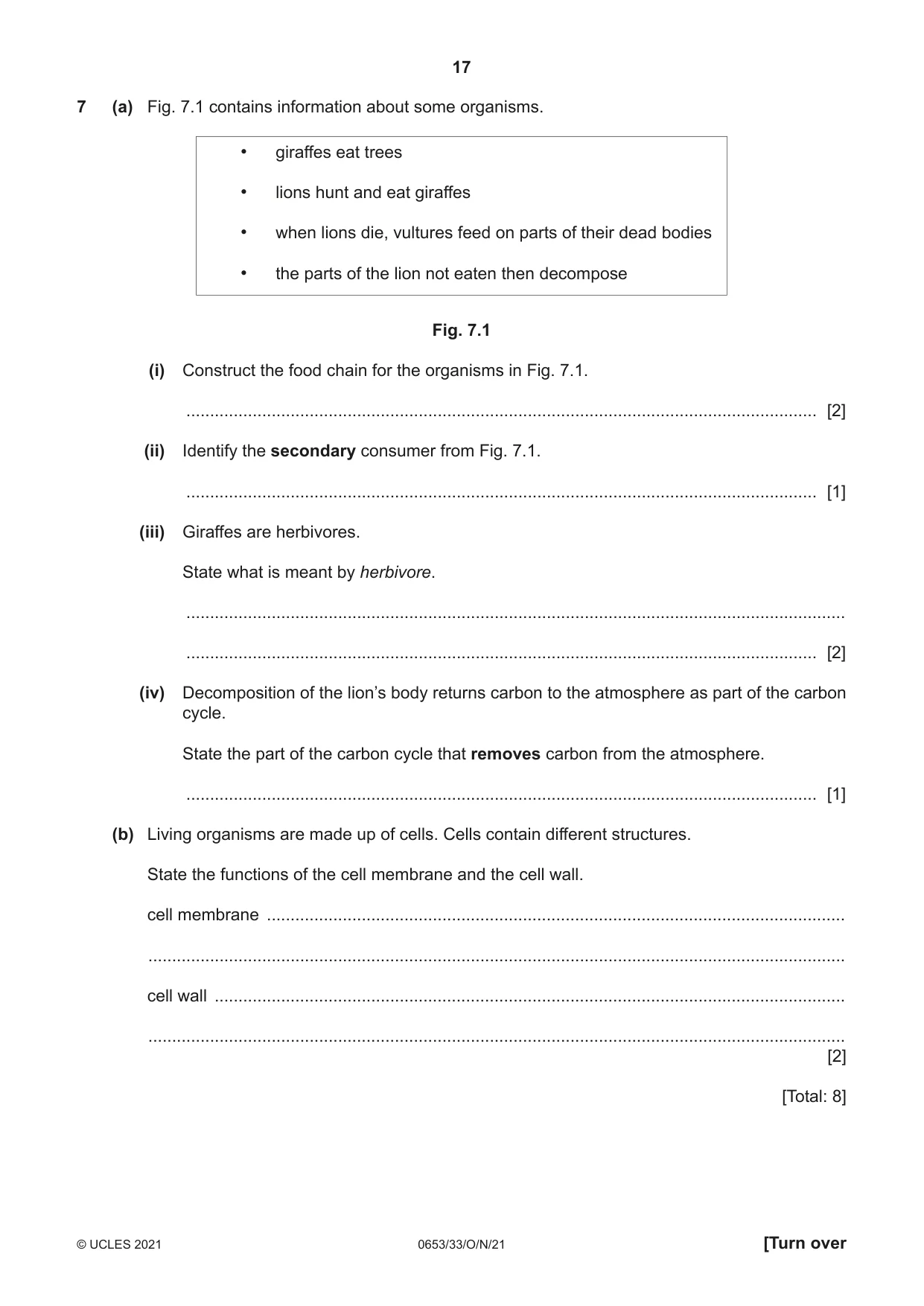
7 (a) Fig. 7.1 contains information about some organisms. • giraffes eat trees • lions hunt and eat giraffes • when lions die, vultures feed on parts of their dead bodies • the parts of the lion not eaten then decompose Fig. 7.1 (i) Construct the food chain for the organisms in Fig. 7.1. ..................................................................................................................................... [2] (ii) Identify the secondary consumer from Fig. 7.1. ..................................................................................................................................... [1] (iii) Giraffes are herbivores. State what is meant by herbivore. ........................................................................................................................................... ..................................................................................................................................... [2] (iv) Decomposition of the lion’s body returns carbon to the atmosphere as part of the carbon cycle. State the part of the carbon cycle that removes carbon from the atmosphere. ..................................................................................................................................... [1] (b) Living organisms are made up of cells. Cells contain different structures. State the functions of the cell membrane and the cell wall. cell membrane .......................................................................................................................... ................................................................................................................................................... cell wall ..................................................................................................................................... ................................................................................................................................................... [2] [Total: 8]
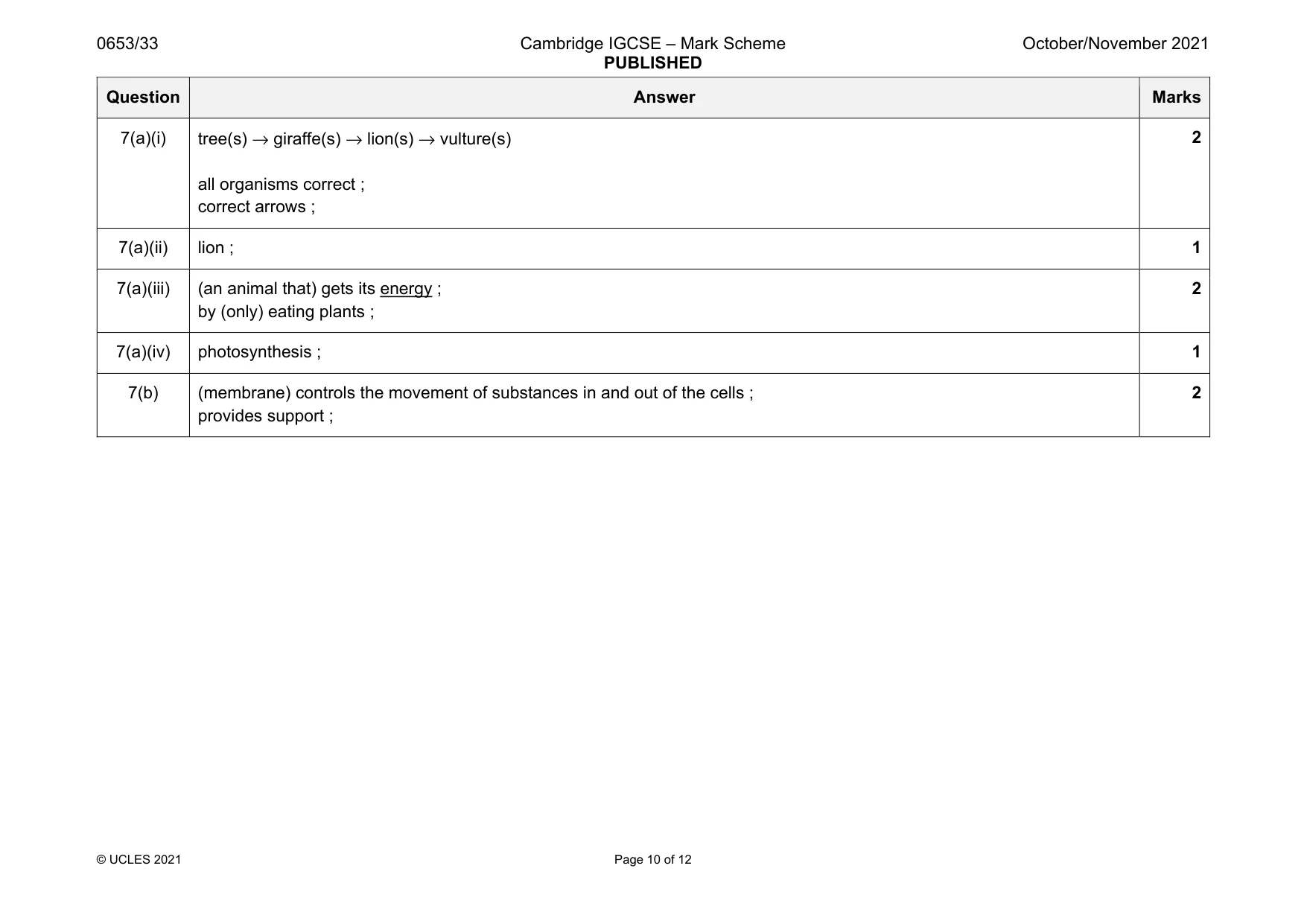
Mark scheme: 7(a)(i) tree(s) → giraffe(s) → lion(s) → vulture(s) all organisms correct ; correct arrows ; 7(a)(ii) lion ; 1 7(a)(iii) (an animal that) gets its energy ; by (only) eating plants ; 2 7(a)(iv) photosynthesis ; 1 7(b) (membrane) controls the movement of substances in and out of the cells ; provides support ; 2
Q8 · A student investigates the rate of the reaction between lumps of calcium carbonate and…
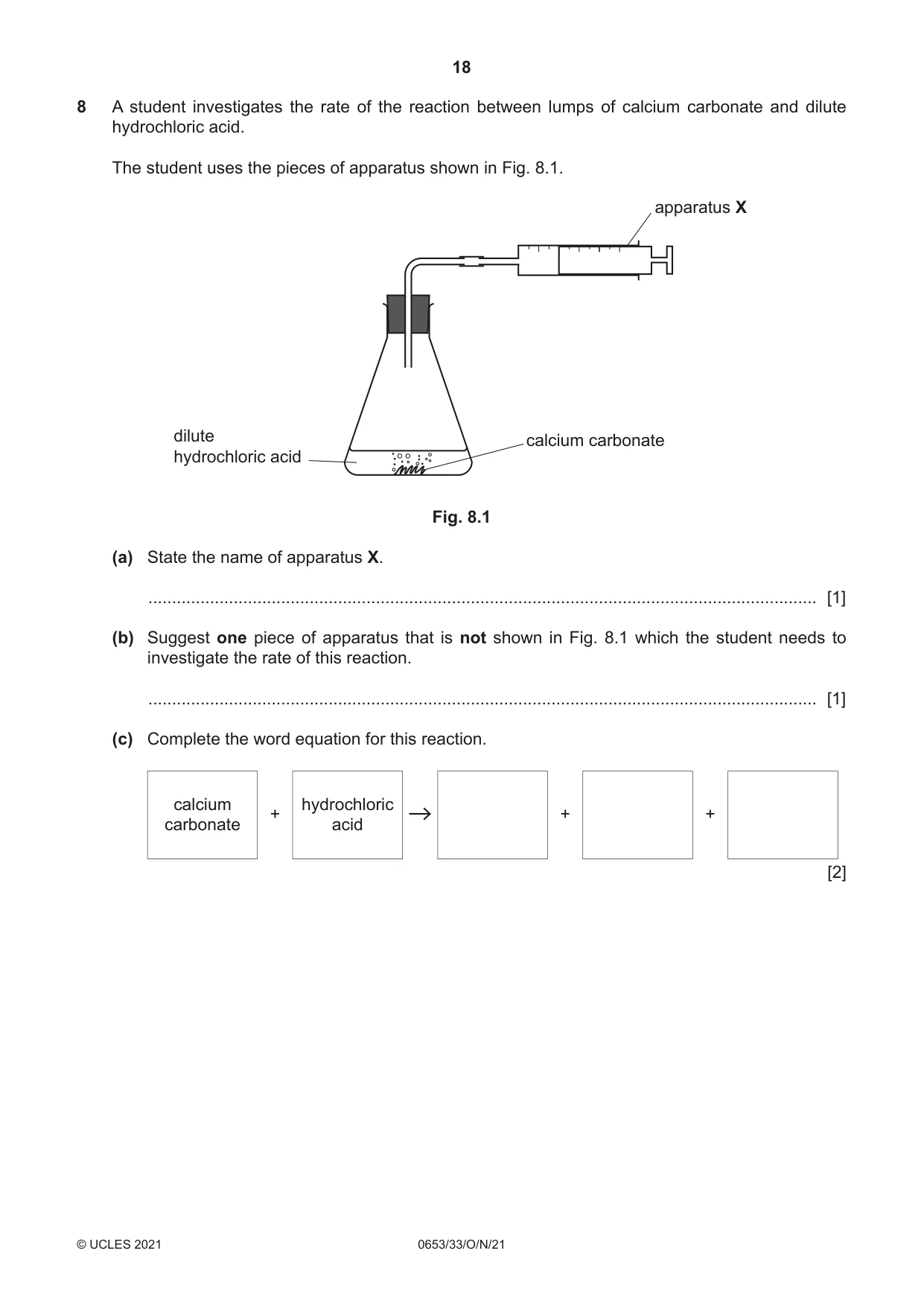
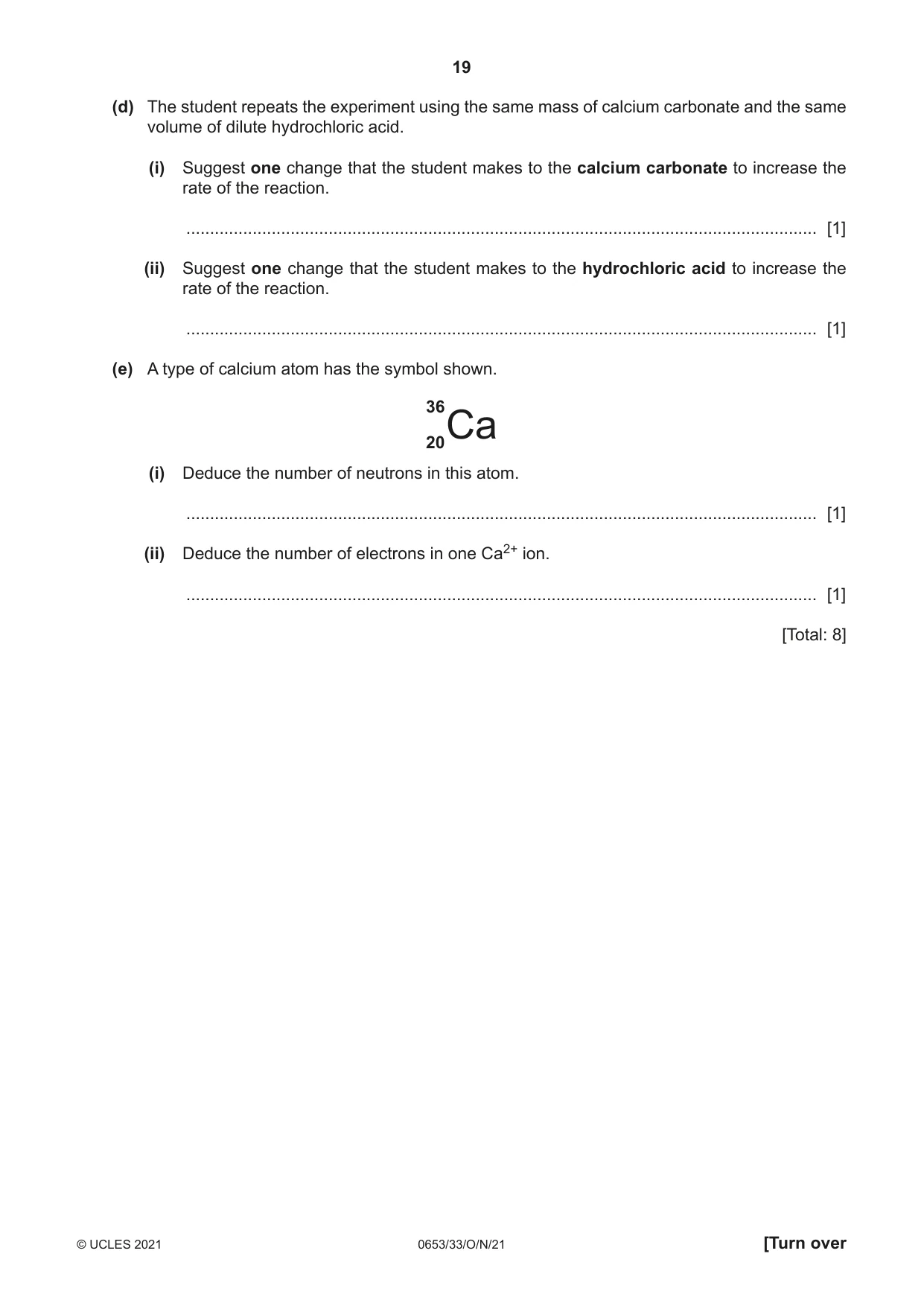
8 A student investigates the rate of the reaction between lumps of calcium carbonate and dilute hydrochloric acid. The student uses the pieces of apparatus shown in Fig. 8.1. apparatus X dilute calcium carbonate hydrochloric acid Fig. 8.1 (a) State the name of apparatus X. ............................................................................................................................................. [1] (b) Suggest one piece of apparatus that is not shown in Fig. 8.1 which the student needs to investigate the rate of this reaction. ............................................................................................................................................. [1] (c) Complete the word equation for this reaction. calcium hydrochloric + + + carbonate acid [2] (d) The student repeats the experiment using the same mass of calcium carbonate and the same volume of dilute hydrochloric acid. (i) Suggest one change that the student makes to the calcium carbonate to increase the rate of the reaction. ..................................................................................................................................... [1] (ii) Suggest one change that the student makes to the hydrochloric acid to increase the rate of the reaction. ..................................................................................................................................... [1] (e) A type of calcium atom has the symbol shown. 3620Ca (i) Deduce the number of neutrons in this atom. ..................................................................................................................................... [1] (ii) Deduce the number of electrons in one Ca2+ ion. ..................................................................................................................................... [1] [Total: 8]
Mark scheme: 8(a) (gas) syringe ; 1 8(b) stop-watch ; 1 8(c) calcium carbonate + hydrochloric acid → calcium chloride + water + carbon dioxide calcium chloride / water AND carbon dioxide ; all correct ; 2 8(d)(i) (use) powder / crush (lumps) ; 1 8(d)(ii) (use) more concentrated / increase temperature ; 1 8(e)(i) 16 ; 1 8(e)(ii) 18 ; 1
Q9 · Two identical lamps connected to a 1.5 V cell
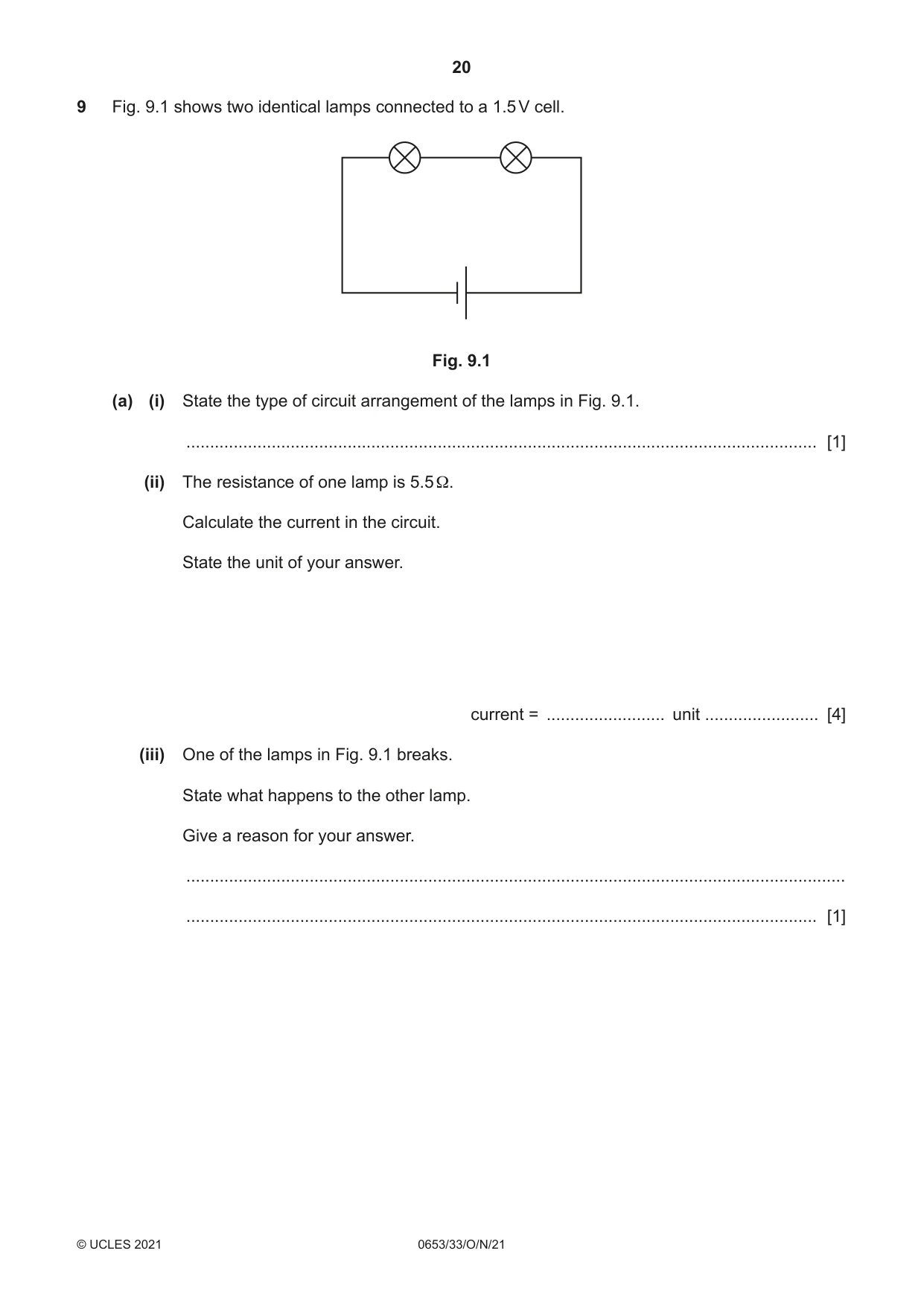
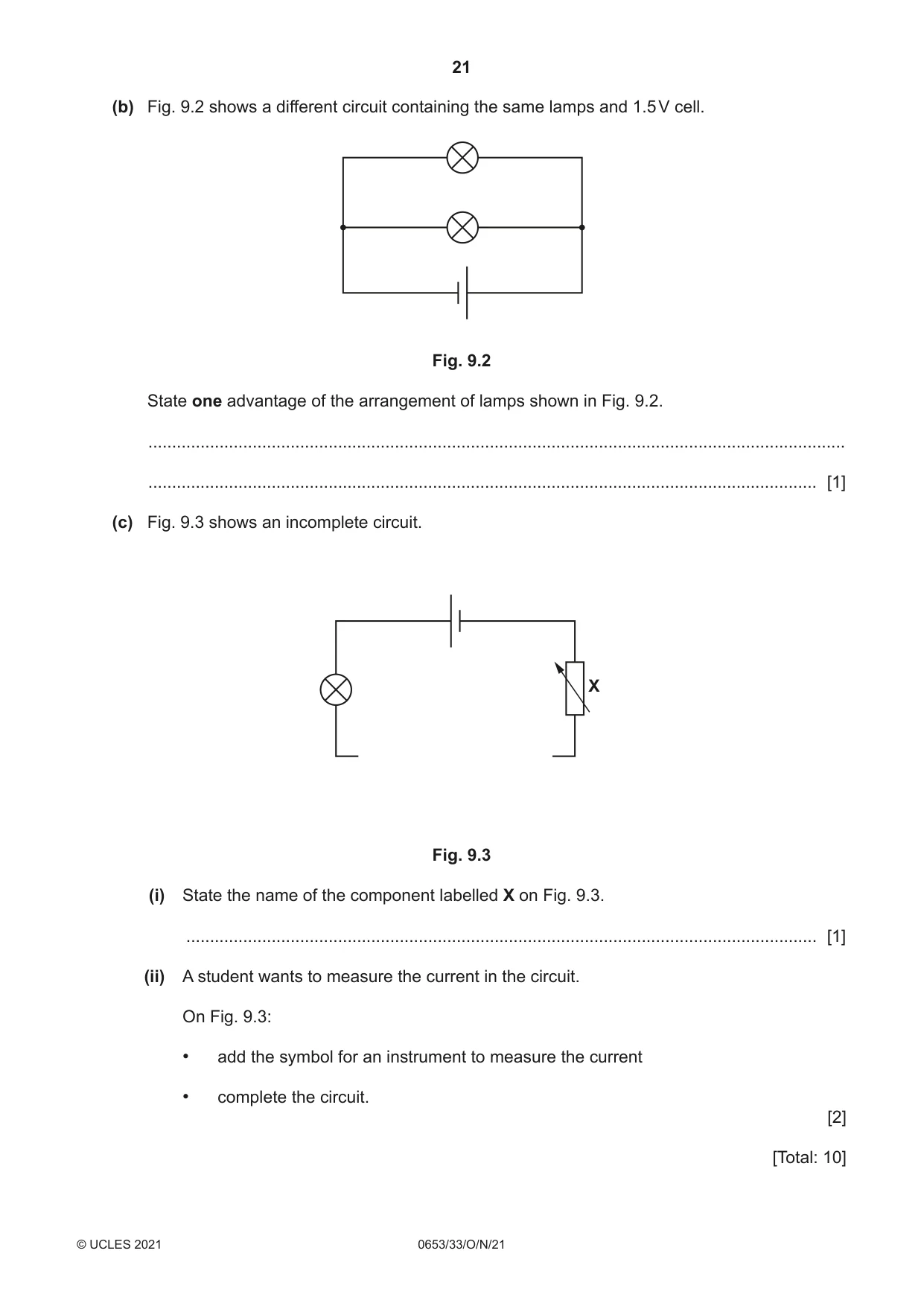
9 Fig. 9.1 shows two identical lamps connected to a 1.5 V cell. Fig. 9.1 (a) (i) State the type of circuit arrangement of the lamps in Fig. 9.1. ..................................................................................................................................... [1] (ii) The resistance of one lamp is 5.5 Ω. Calculate the current in the circuit. State the unit of your answer. current = ......................... unit ........................ [4] (iii) One of the lamps in Fig. 9.1 breaks. State what happens to the other lamp. Give a reason for your answer. ........................................................................................................................................... ..................................................................................................................................... [1] (b) Fig. 9.2 shows a different circuit containing the same lamps and 1.5 V cell. Fig. 9.2 State one advantage of the arrangement of lamps shown in Fig. 9.2. ................................................................................................................................................... ............................................................................................................................................. [1] (c) Fig. 9.3 shows an incomplete circuit. X Fig. 9.3 (i) State the name of the component labelled X on Fig. 9.3. ..................................................................................................................................... [1] (ii) A student wants to measure the current in the circuit. On Fig. 9.3: • add the symbol for an instrument to measure the current • complete the circuit. [2] [Total: 10]
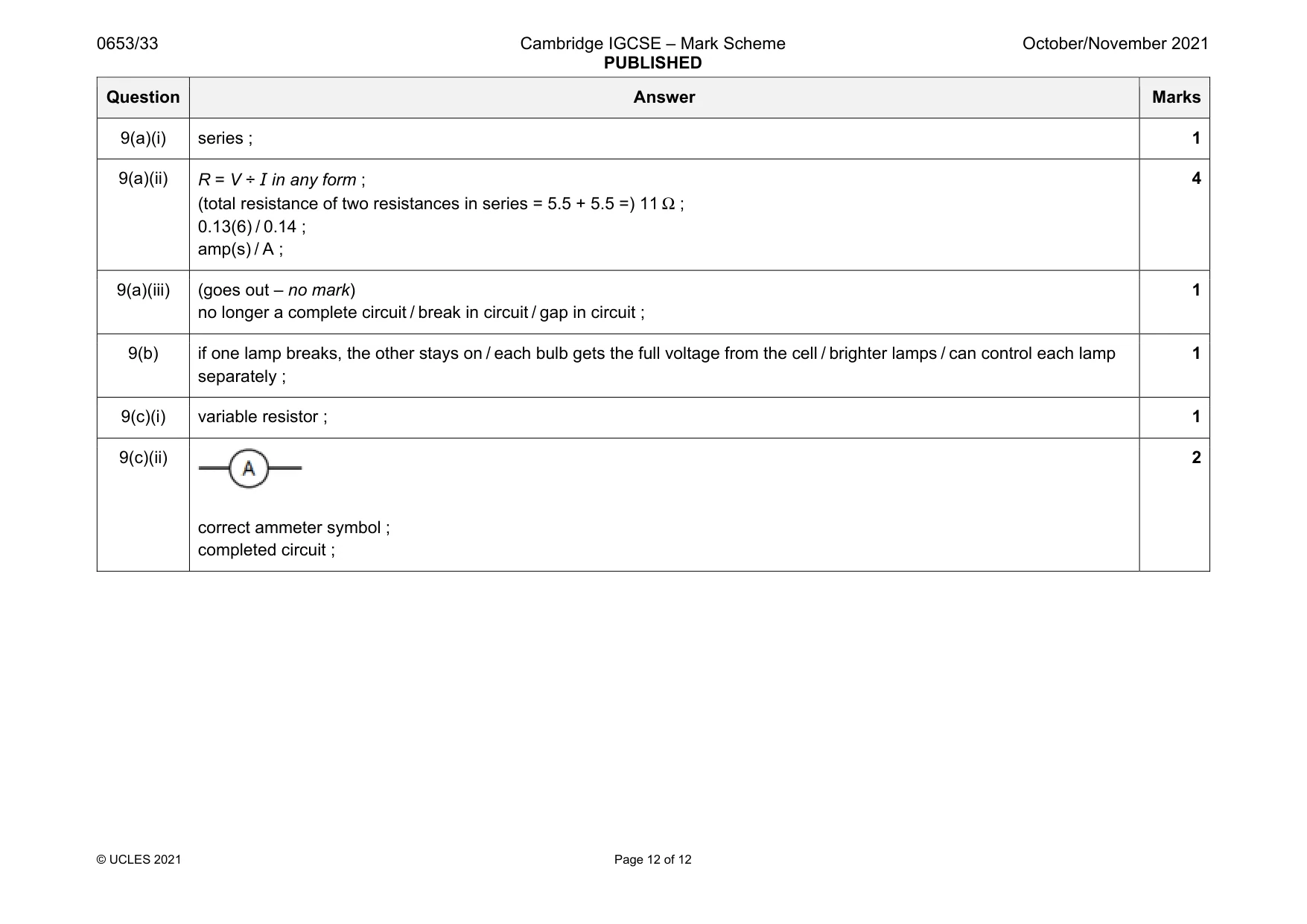
Mark scheme: 9(a)(i) series ; 1 9(a)(ii) R = V ÷ I in any form ; (total resistance of two resistances in series = 5.5 + 5.5 =) 11 Ω ; 0.13(6) / 0.14 ; amp(s) / A ; 4 9(a)(iii) (goes out – no mark) no longer a complete circuit / break in circuit / gap in circuit ; 1 9(b) if one lamp breaks, the other stays on / each bulb gets the full voltage from the cell / brighter lamps / can control each lamp separately ; 1 9(c)(i) variable resistor ; 1 9(c)(ii) correct ammeter symbol ; completed circuit ; 2
What was in this paper
The subtopics covered by these 9 questions, and how many questions each got. Open one in a new tab to see every Cambridge question on it.
What you needed in this session
Cambridge’s own grade thresholds for 2021 Oct/Nov, Paper 3 · Variant 3. A higher threshold means an easier paper — the bar moves with how the cohort did.