Cambridge IGCSE Science - Combined 0653 — 2022 May/June Paper 3 · Variant 3
0653/33/M/J/22 · 9 questions · 80 marks · ≈90 min
The question paper and its mark scheme, free to read here and free to download. This is Cambridge’s own paper, exactly as it was sat.
Question paper20 pages
Mark scheme13 pages
Answers below. Sit the paper first if you are practising.
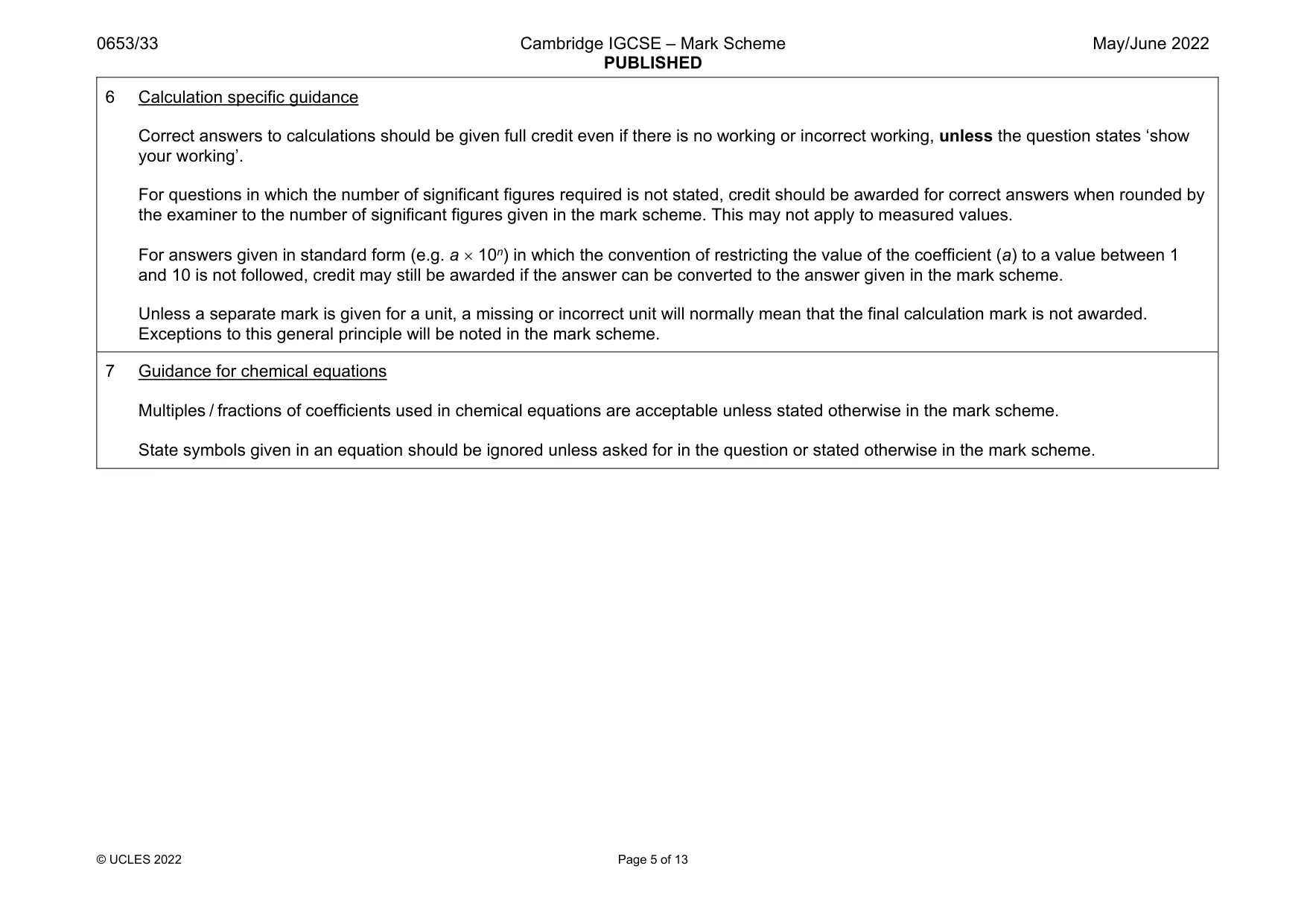
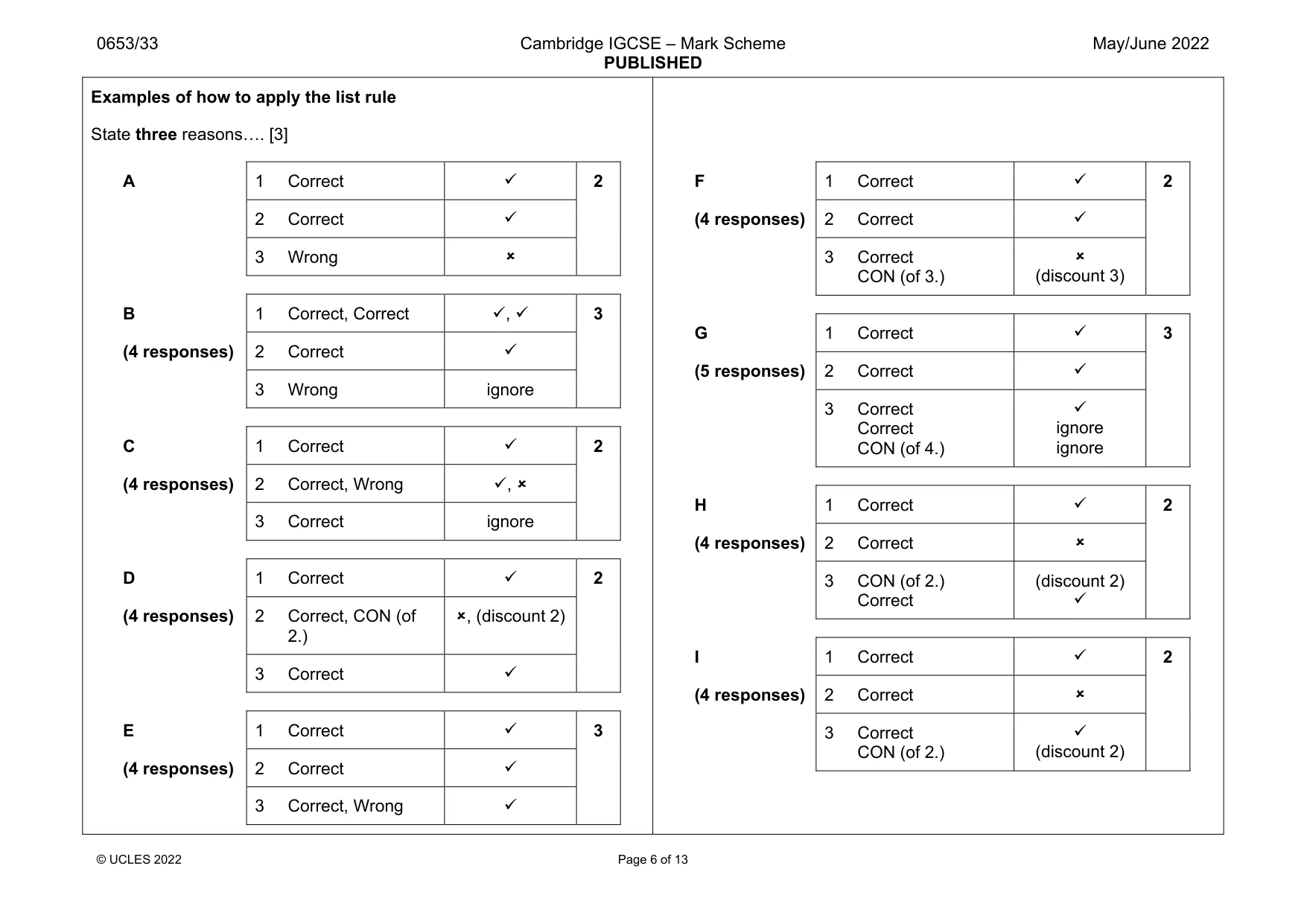
Questions as text
Q1 · The boxes on the left show different parts of the male and female reproductive system in…
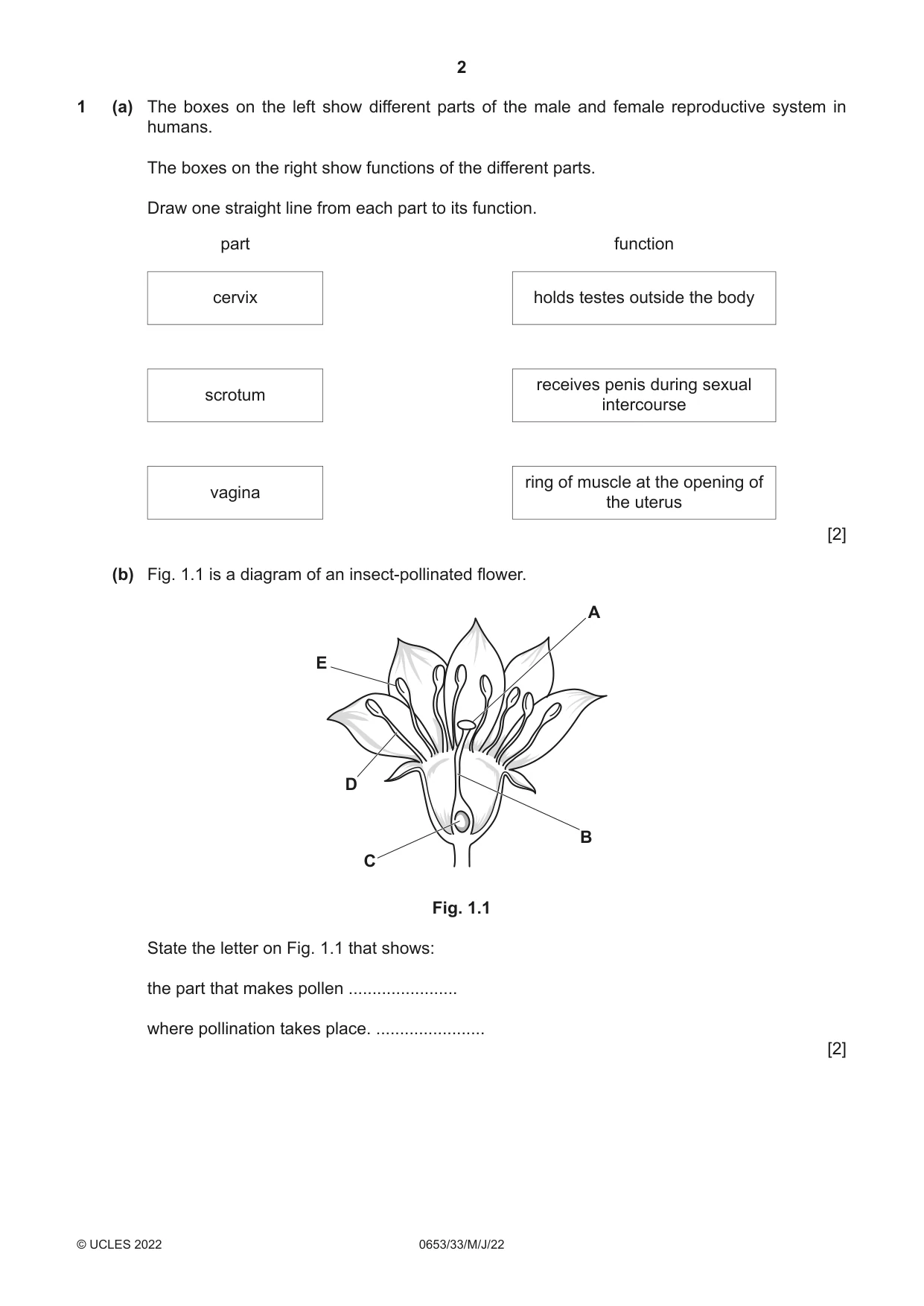
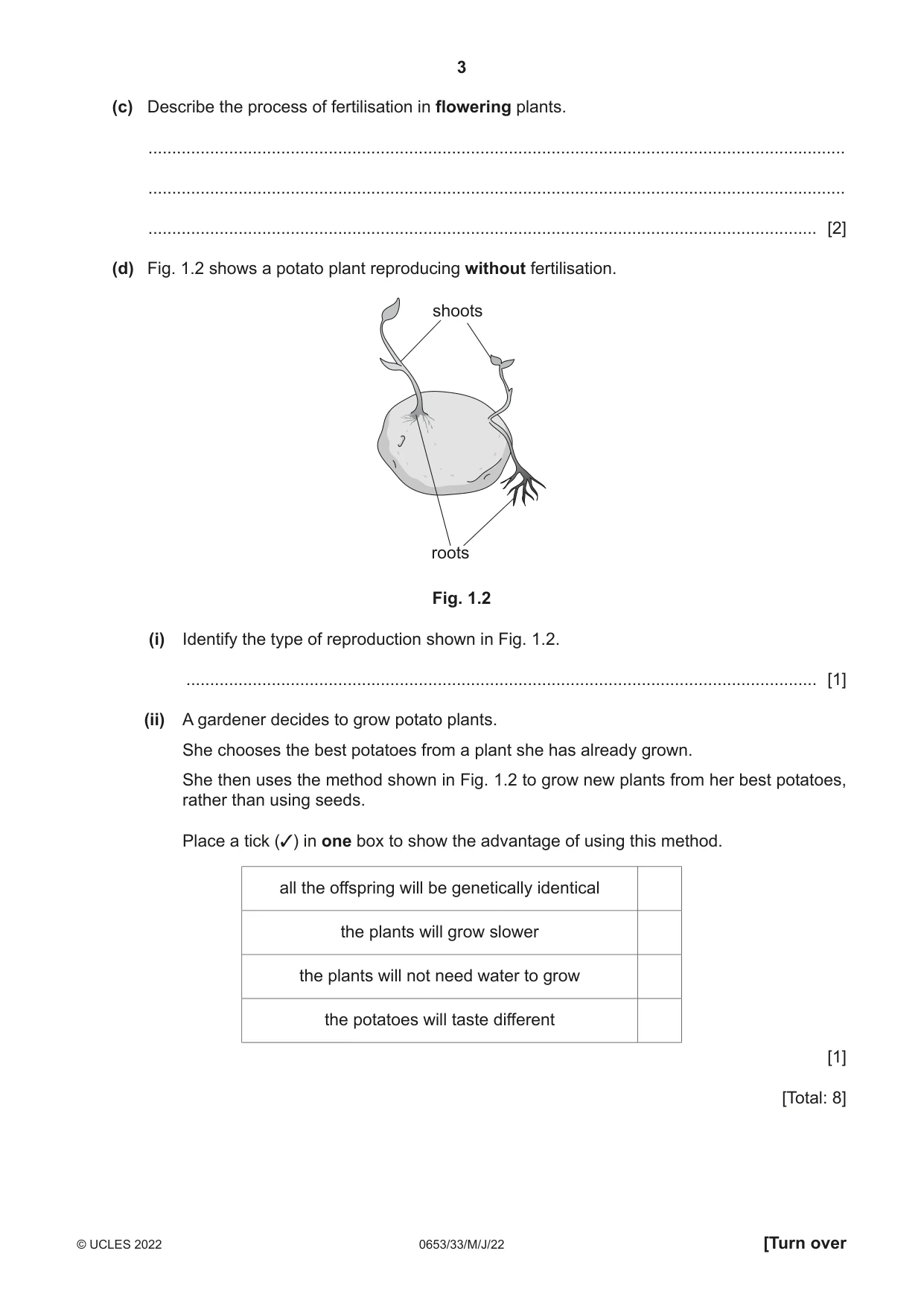
1 (a) The boxes on the left show different parts of the male and female reproductive system in humans. The boxes on the right show functions of the different parts. Draw one straight line from each part to its function. part function cervix holds testes outside the body receives penis during sexual scrotum intercourse ring of muscle at the opening of vagina the uterus [2] (b) Fig. 1.1 is a diagram of an insect‑pollinated flower. A E D B C Fig. 1.1 State the letter on Fig. 1.1 that shows: the part that makes pollen ....................... where pollination takes place. ....................... [2] (c) Describe the process of fertilisation in flowering plants. ................................................................................................................................................... ................................................................................................................................................... ............................................................................................................................................. [2] (d) Fig. 1.2 shows a potato plant reproducing without fertilisation. shoots roots Fig. 1.2 (i) Identify the type of reproduction shown in Fig. 1.2. ..................................................................................................................................... [1] (ii) A gardener decides to grow potato plants. She chooses the best potatoes from a plant she has already grown. She then uses the method shown in Fig. 1.2 to grow new plants from her best potatoes, rather than using seeds. Place a tick (✓) in one box to show the advantage of using this method. all the offspring will be genetically identical the plants will grow slower the plants will not need water to grow the potatoes will taste different [1] [Total: 8]
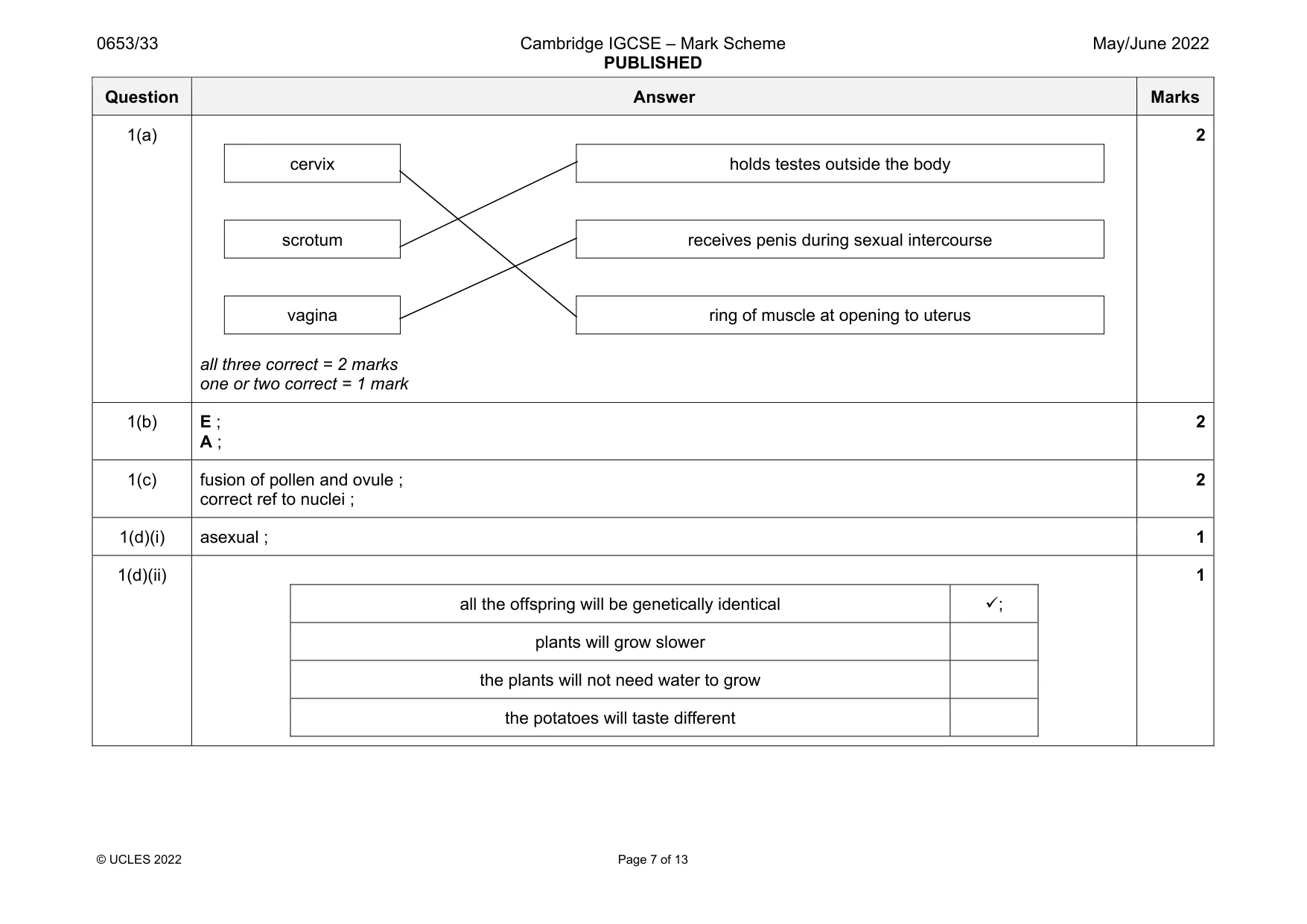
Mark scheme: 1(a) cervix holds testes outside the body scrotum receives penis during sexual intercourse vagina ring of muscle at opening to uterus all three correct = 2 marks one or two correct = 1 mark 2 1(b) E ; A ; 2 1(c) fusion of pollen and ovule ; correct ref to nuclei ; 2 1(d)(i) asexual ; 1 1(d)(ii) all the offspring will be genetically identical ; plants will grow slower the plants will not need water to grow the potatoes will taste different 1
Q2 · A student investigates the gases in air
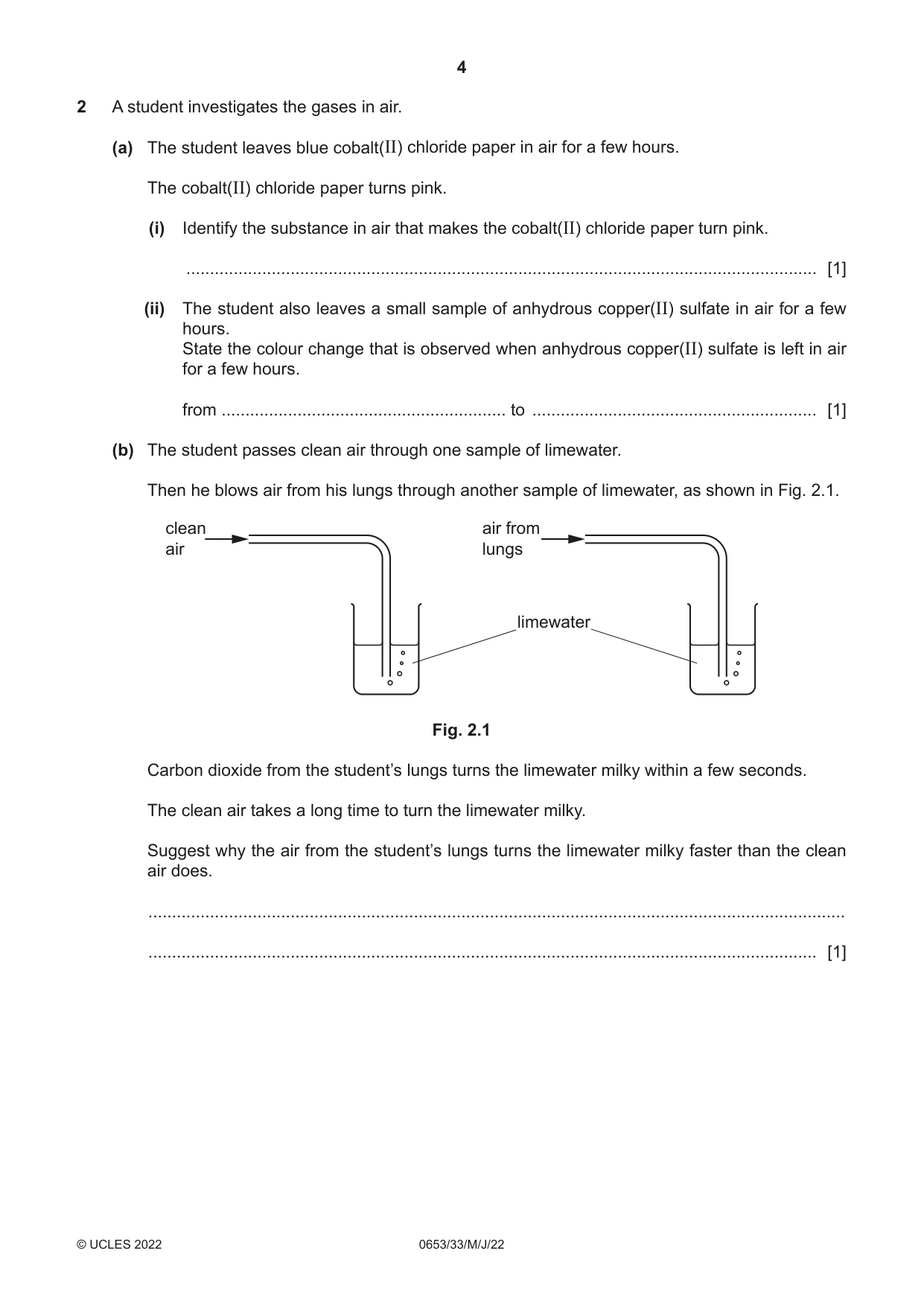
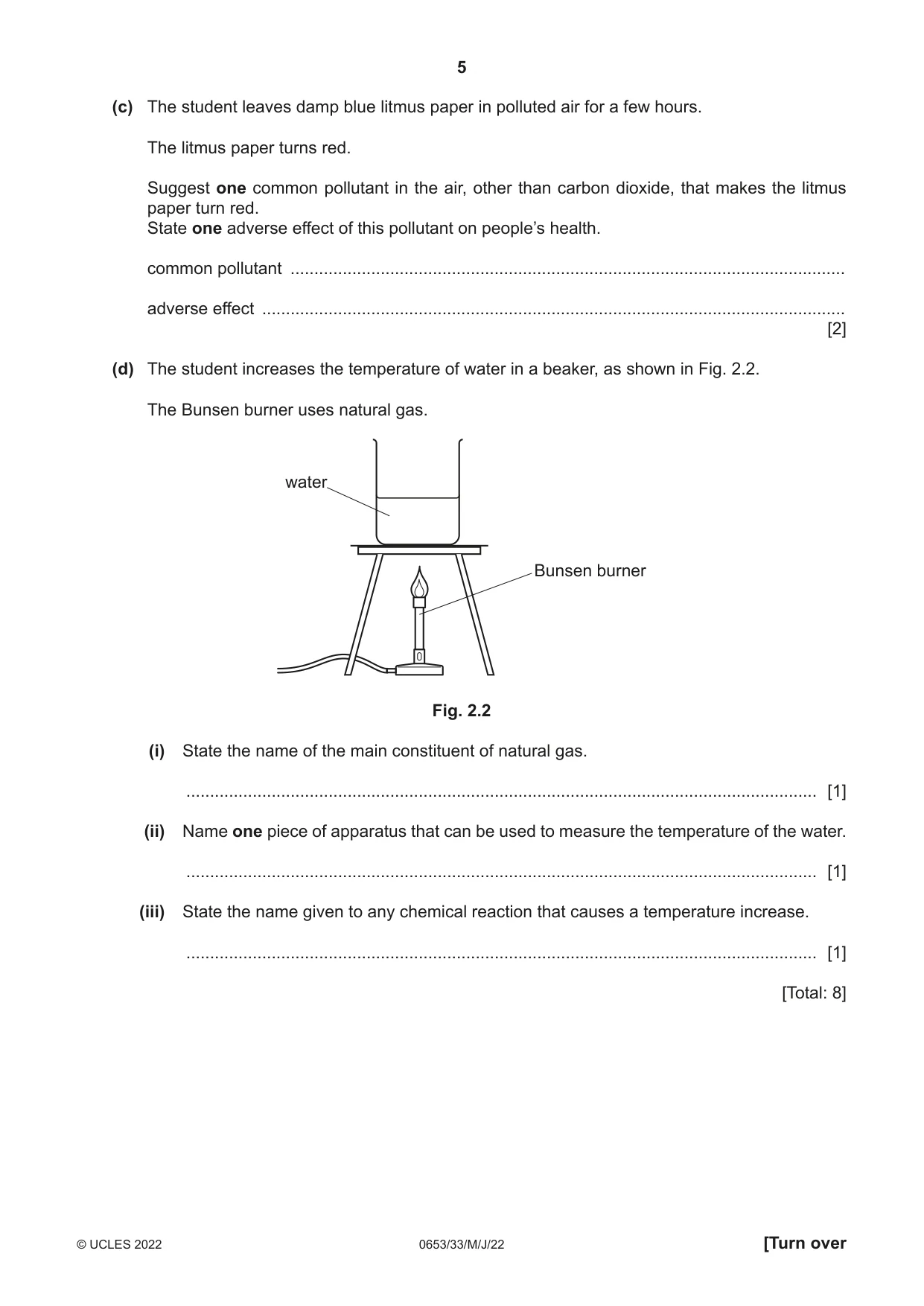
2 A student investigates the gases in air. (a) The student leaves blue cobalt(II) chloride paper in air for a few hours. The cobalt(II) chloride paper turns pink. (i) Identify the substance in air that makes the cobalt(II) chloride paper turn pink. ..................................................................................................................................... [1] (ii) The student also leaves a small sample of anhydrous copper(II) sulfate in air for a few hours. State the colour change that is observed when anhydrous copper(II) sulfate is left in air for a few hours. from ............................................................ to ............................................................ [1] (b) The student passes clean air through one sample of limewater. Then he blows air from his lungs through another sample of limewater, as shown in Fig. 2.1. clean air from air lungs limewater Fig. 2.1 Carbon dioxide from the student’s lungs turns the limewater milky within a few seconds. The clean air takes a long time to turn the limewater milky. Suggest why the air from the student’s lungs turns the limewater milky faster than the clean air does. ................................................................................................................................................... ............................................................................................................................................. [1] (c) The student leaves damp blue litmus paper in polluted air for a few hours. The litmus paper turns red. Suggest one common pollutant in the air, other than carbon dioxide, that makes the litmus paper turn red. State one adverse effect of this pollutant on people’s health. common pollutant ..................................................................................................................... adverse effect ........................................................................................................................... [2] (d) The student increases the temperature of water in a beaker, as shown in Fig. 2.2. The Bunsen burner uses natural gas. water Bunsen burner Fig. 2.2 (i) State the name of the main constituent of natural gas. ..................................................................................................................................... [1] (ii) Name one piece of apparatus that can be used to measure the temperature of the water. ..................................................................................................................................... [1] (iii) State the name given to any chemical reaction that causes a temperature increase. ..................................................................................................................................... [1] [Total: 8]
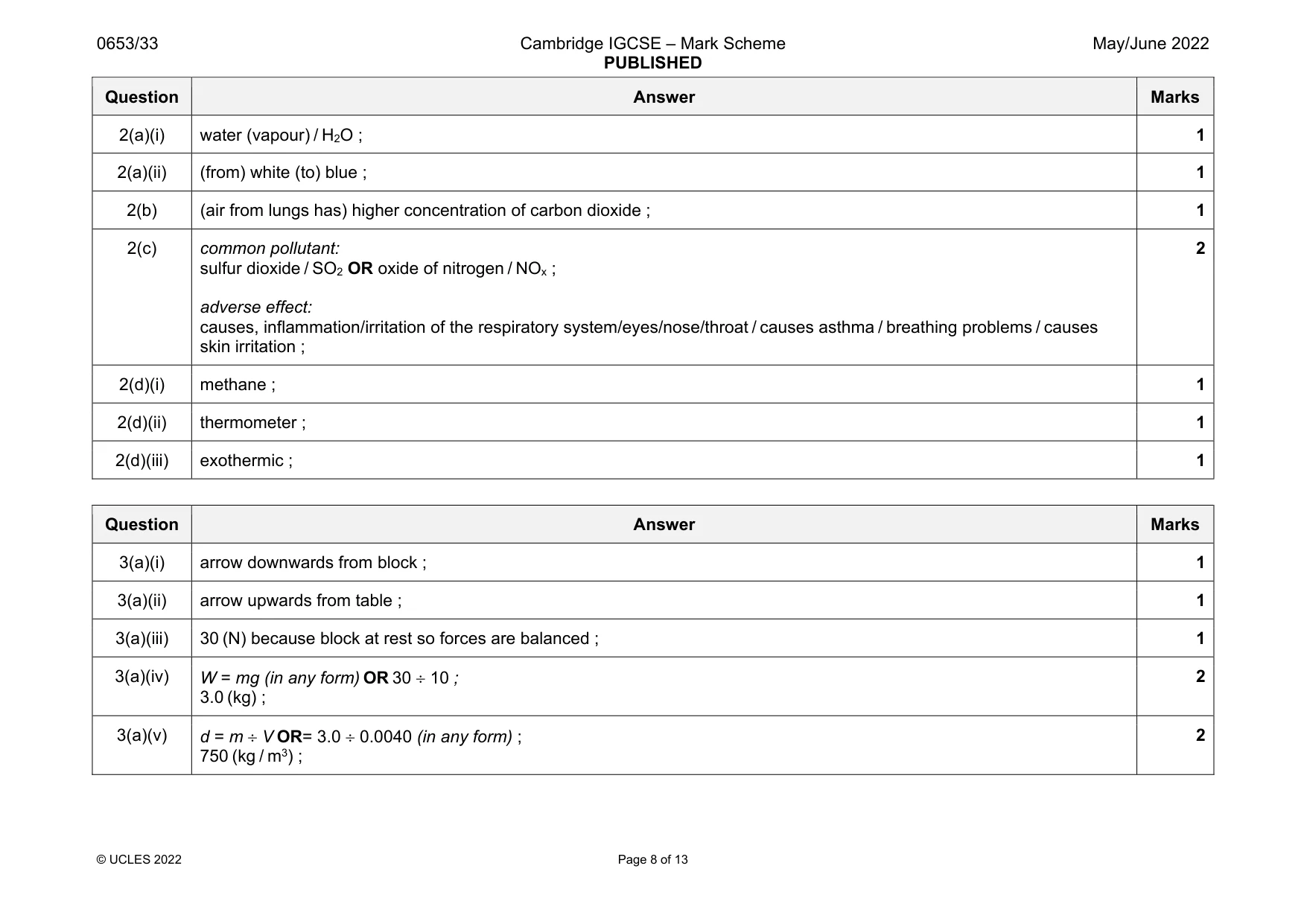
Mark scheme: 2(a)(i) water (vapour) / H2O ; 1 2(a)(ii) (from) white (to) blue ; 1 2(b) (air from lungs has) higher concentration of carbon dioxide ; 1 2(c) common pollutant: sulfur dioxide / SO2 OR oxide of nitrogen / NOx ; adverse effect: causes, inflammation/irritation of the respiratory system/eyes/nose/throat / causes asthma / breathing problems / causes skin irritation ; 2 2(d)(i) methane ; 1 2(d)(ii) thermometer ; 1 2(d)(iii) exothermic ; 1
Q3 · A solid block at rest on a table
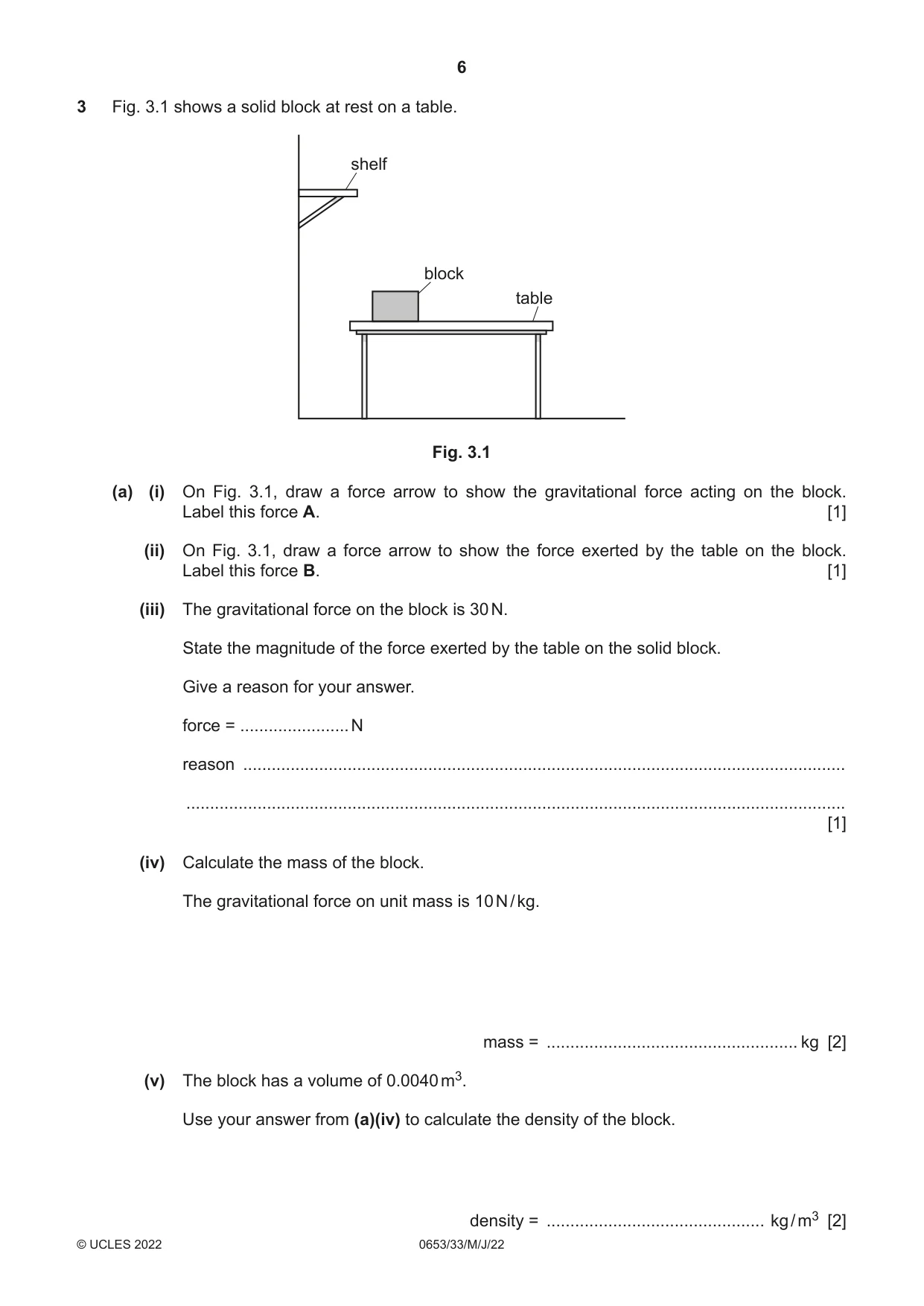
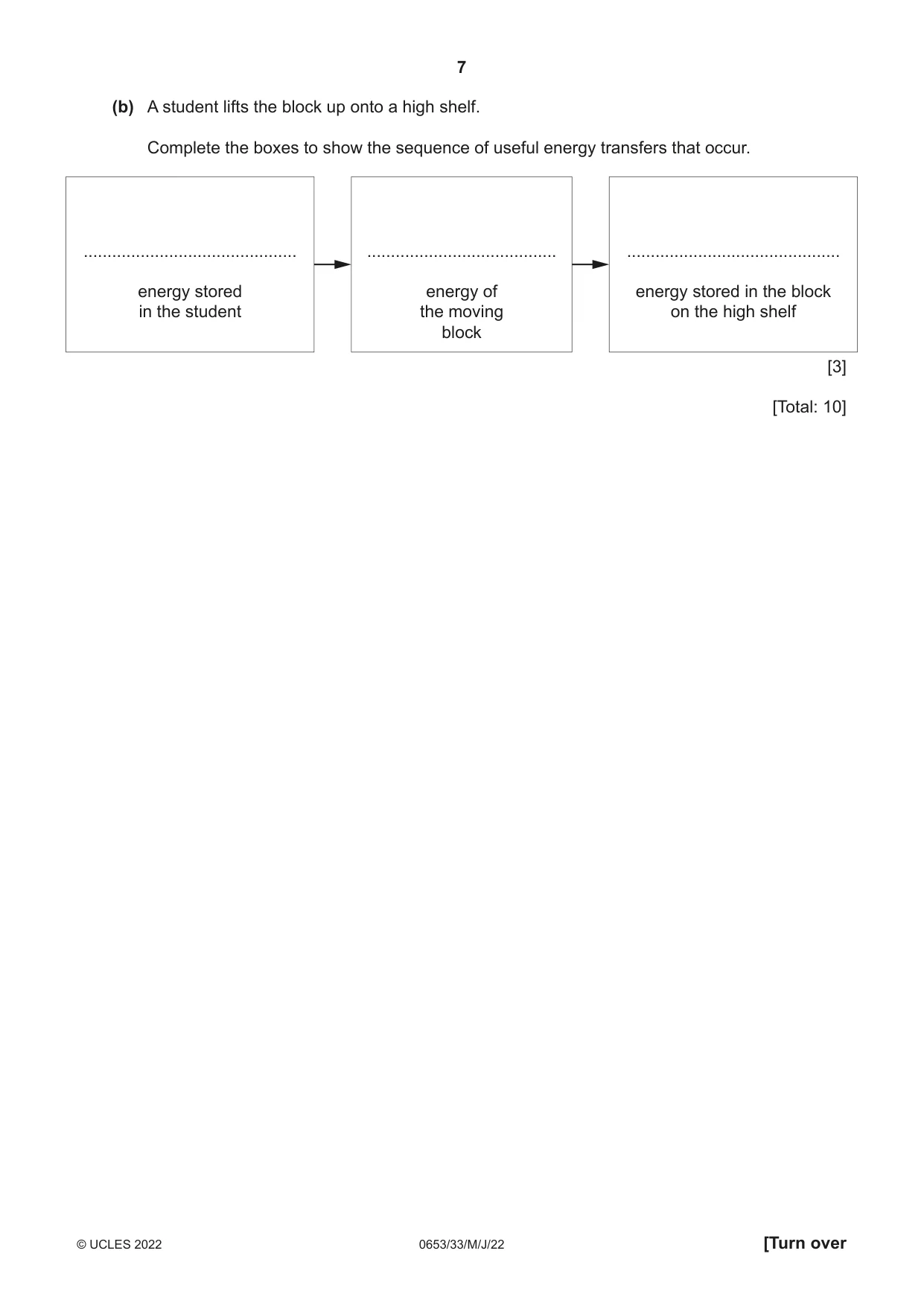
3 Fig. 3.1 shows a solid block at rest on a table. shelf block table Fig. 3.1 (a) (i) On Fig. 3.1, draw a force arrow to show the gravitational force acting on the block. Label this force A. [1] (ii) On Fig. 3.1, draw a force arrow to show the force exerted by the table on the block. Label this force B. [1] (iii) The gravitational force on the block is 30 N. State the magnitude of the force exerted by the table on the solid block. Give a reason for your answer. force = ....................... N reason ............................................................................................................................... ........................................................................................................................................... [1] (iv) Calculate the mass of the block. The gravitational force on unit mass is 10 N / kg. mass = ..................................................... kg [2] (v) The block has a volume of 0.0040 m3. Use your answer from (a)(iv) to calculate the density of the block. density = .............................................. kg / m3 [2] (b) A student lifts the block up onto a high shelf. Complete the boxes to show the sequence of useful energy transfers that occur. ............................................. ........................................ ............................................. energy stored energy of energy stored in the block in the student the moving on the high shelf block [3] [Total: 10]
Mark scheme: 3(a)(i) arrow downwards from block ; 1 3(a)(ii) arrow upwards from table ; 1 3(a)(iii) 30 (N) because block at rest so forces are balanced ; 1 3(a)(iv) W = mg (in any form) OR 30 10 ; 3.0 (kg) ; 2 3(a)(v) d = m V OR= 3.0 0.0040 (in any form) ; 750 (kg / m3) ; 2 Question Answer Marks 3(b) chemical (potential) ; kinetic ; gravitational (potential) ; 3
Q4 · A diagram of the human heart
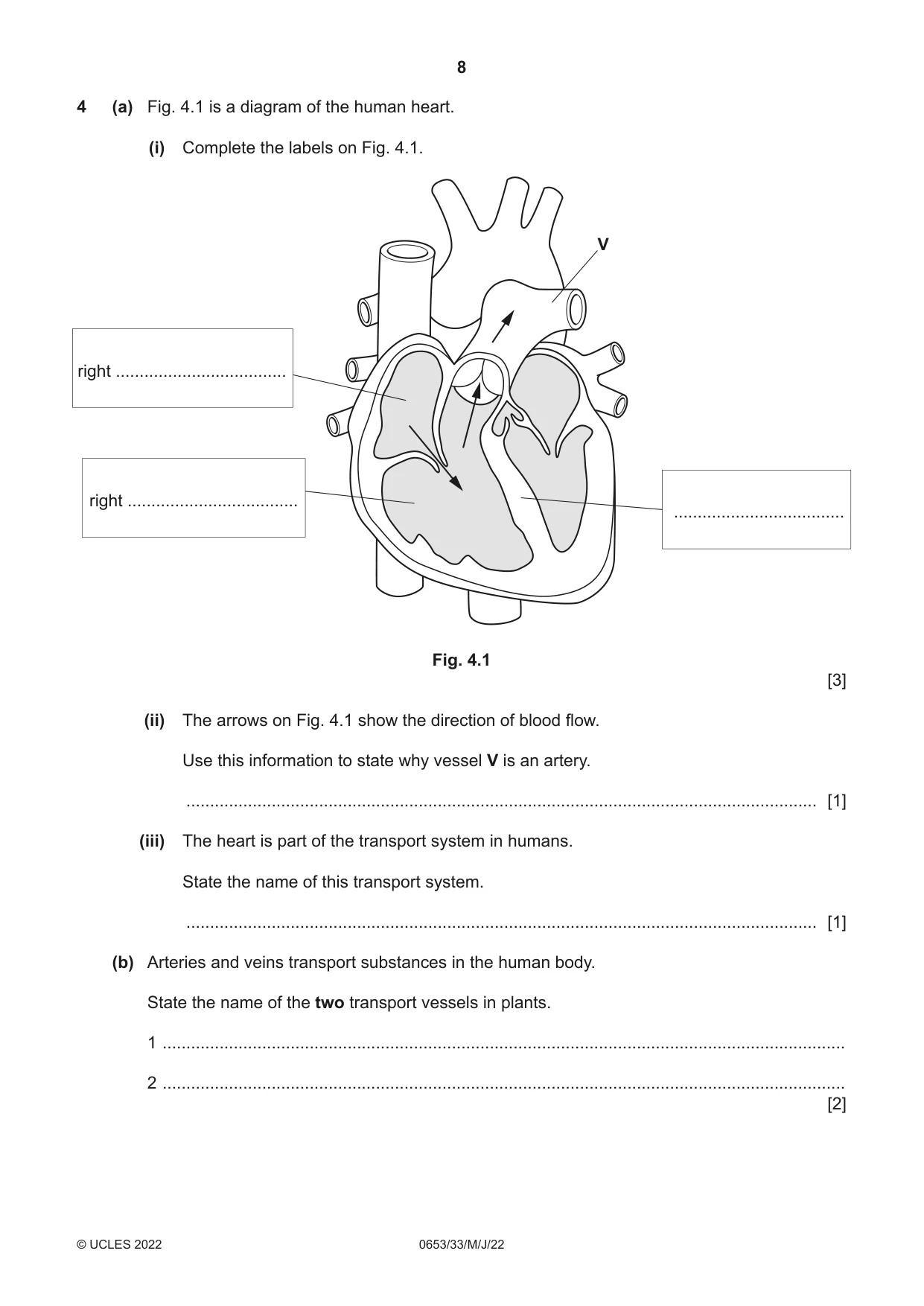
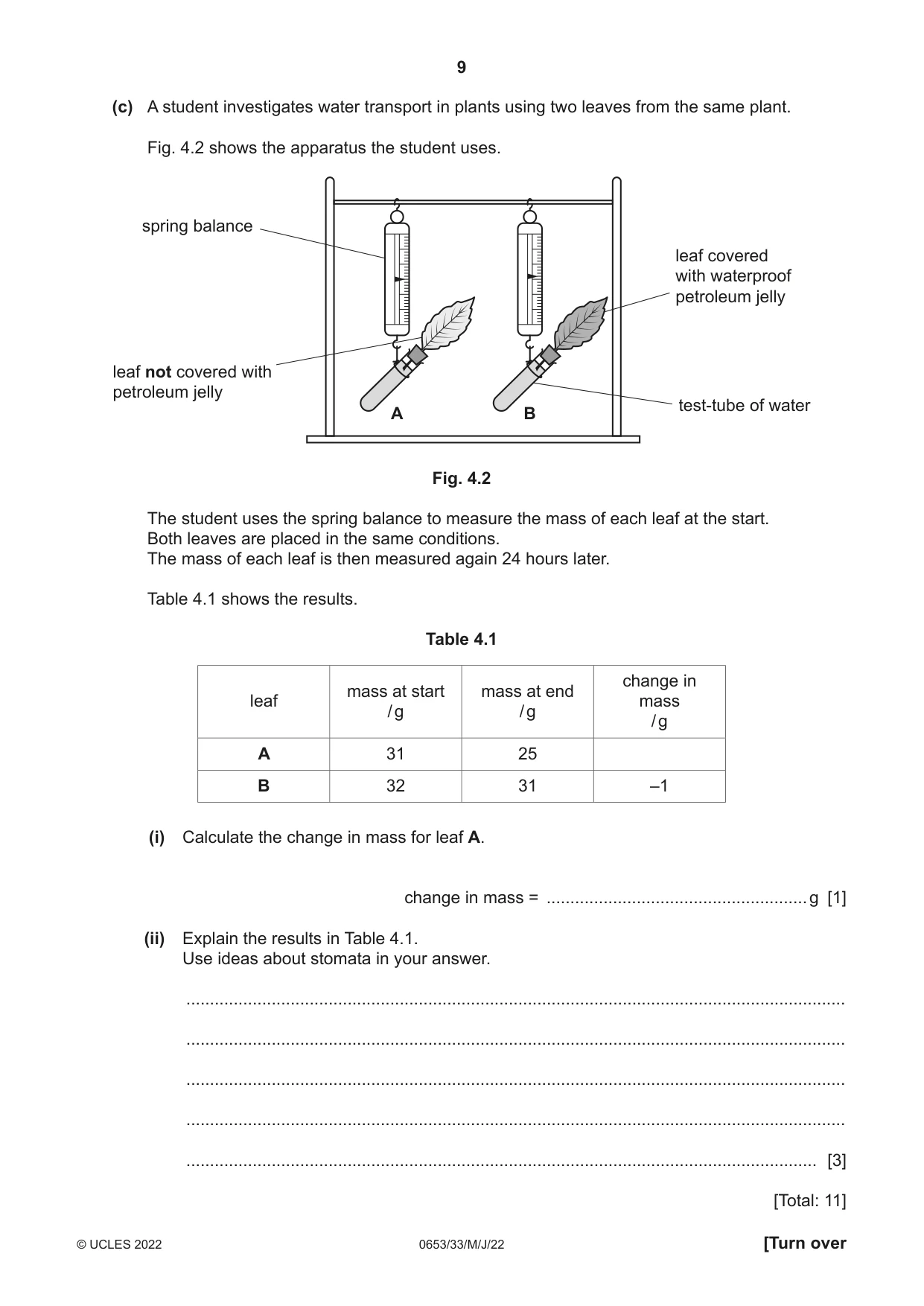
4 (a) Fig. 4.1 is a diagram of the human heart. (i) Complete the labels on Fig. 4.1. V right .................................... right .................................... .................................... Fig. 4.1 [3] (ii) The arrows on Fig. 4.1 show the direction of blood flow. Use this information to state why vessel V is an artery. ..................................................................................................................................... [1] (iii) The heart is part of the transport system in humans. State the name of this transport system. ..................................................................................................................................... [1] (b) Arteries and veins transport substances in the human body. State the name of the two transport vessels in plants. 1 ................................................................................................................................................ 2 ................................................................................................................................................ [2] (c) A student investigates water transport in plants using two leaves from the same plant. Fig. 4.2 shows the apparatus the student uses. spring balance leaf covered with waterproof petroleum jelly leaf not covered with petroleum jelly test-tube of water A B Fig. 4.2 The student uses the spring balance to measure the mass of each leaf at the start. Both leaves are placed in the same conditions. The mass of each leaf is then measured again 24 hours later. Table 4.1 shows the results. Table 4.1 change in mass at start mass at end leaf mass / g / g / g A 31 25 B 32 31 –1 (i) Calculate the change in mass for leaf A. change in mass = ....................................................... g [1] (ii) Explain the results in Table 4.1. Use ideas about stomata in your answer. ........................................................................................................................................... ........................................................................................................................................... ........................................................................................................................................... ........................................................................................................................................... ..................................................................................................................................... [3] [Total: 11]
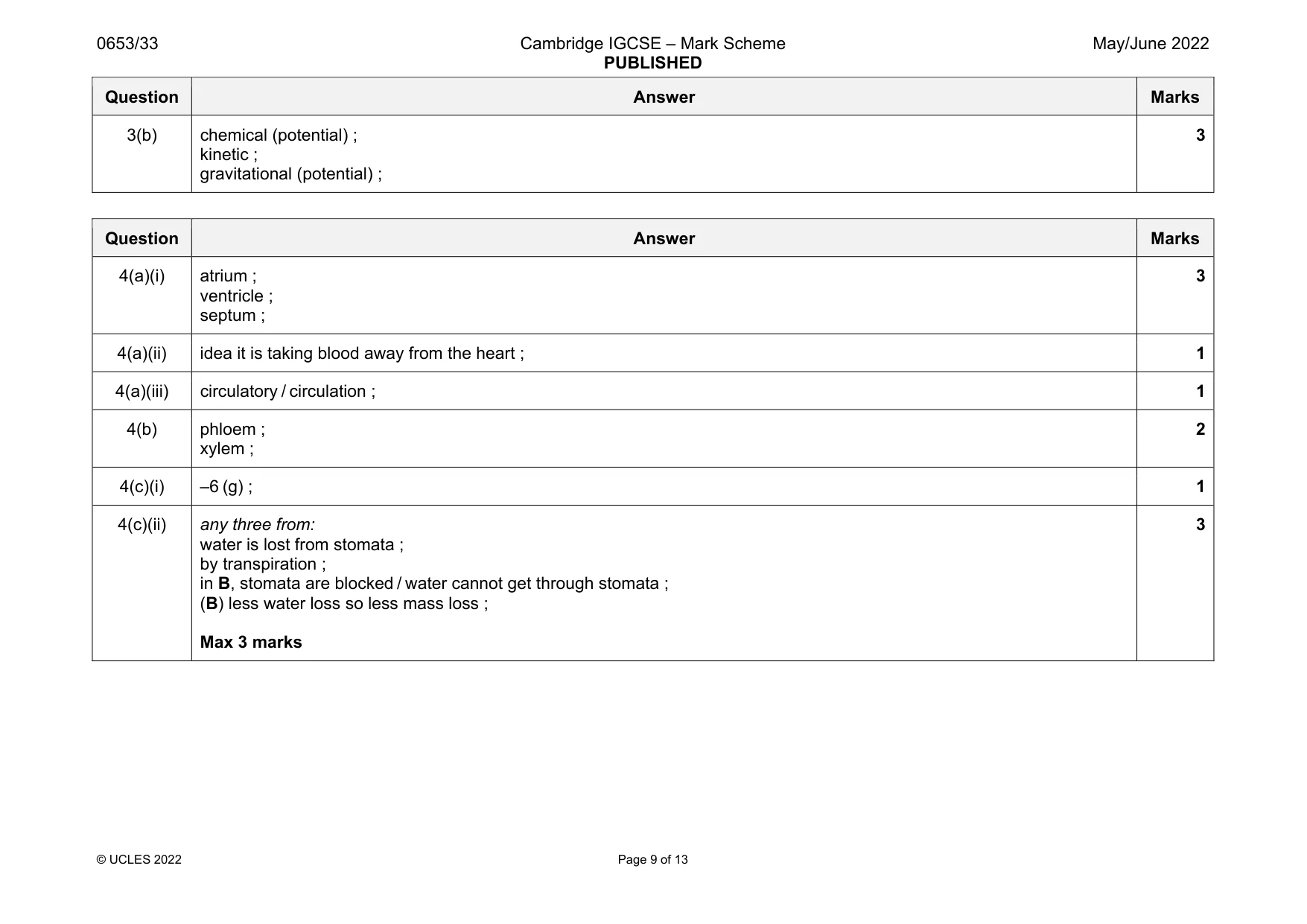
Mark scheme: 4(a)(i) atrium ; ventricle ; septum ; 3 4(a)(ii) idea it is taking blood away from the heart ; 1 4(a)(iii) circulatory / circulation ; 1 4(b) phloem ; xylem ; 2 4(c)(i) –6 (g) ; 1 4(c)(ii) any three from: water is lost from stomata ; by transpiration ; in B, stomata are blocked / water cannot get through stomata ; (B) less water loss so less mass loss ; Max 3 marks 3
Q5 · Lithium, sodium and potassium are three elements in Group I of the Periodic Table, as…
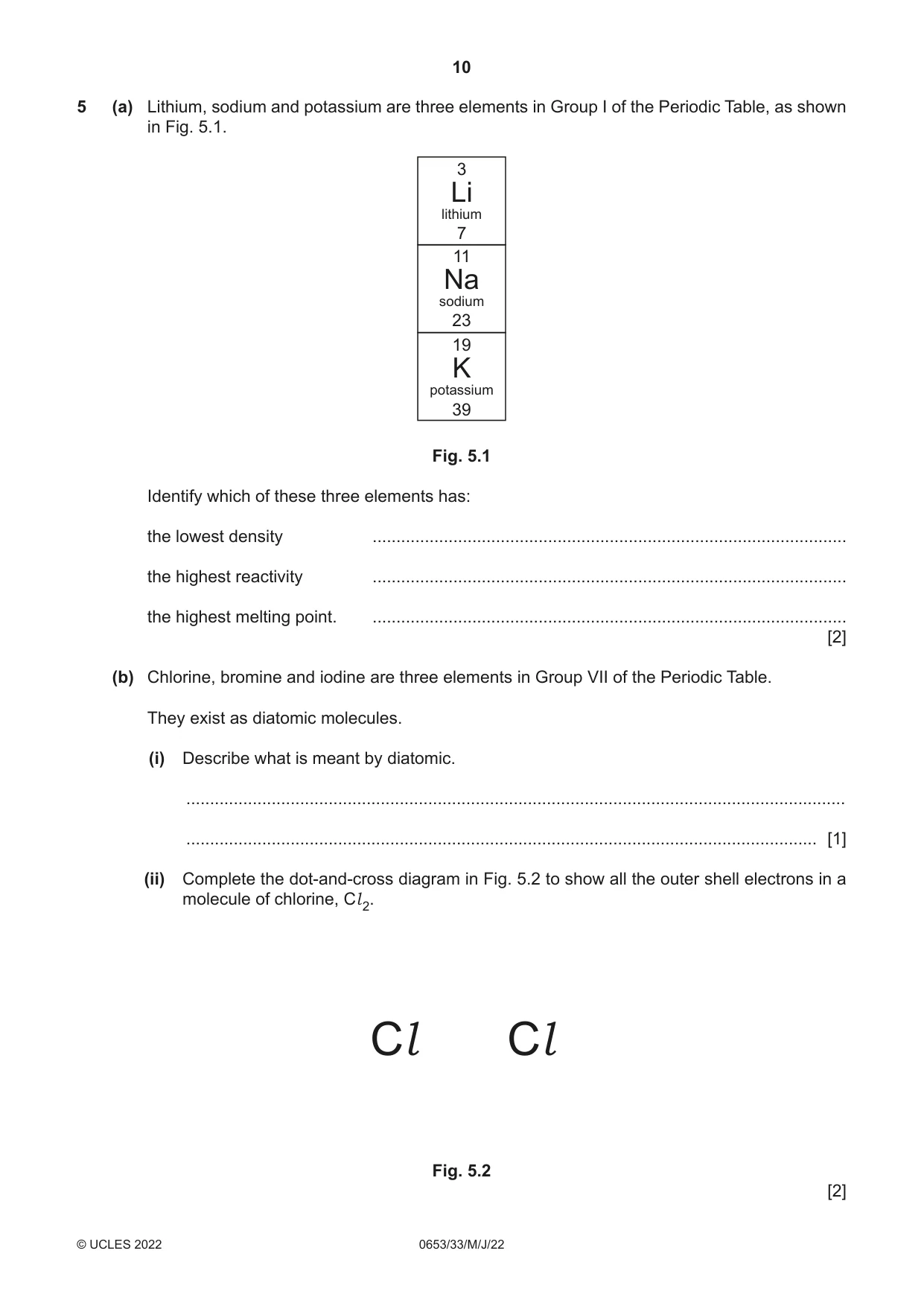
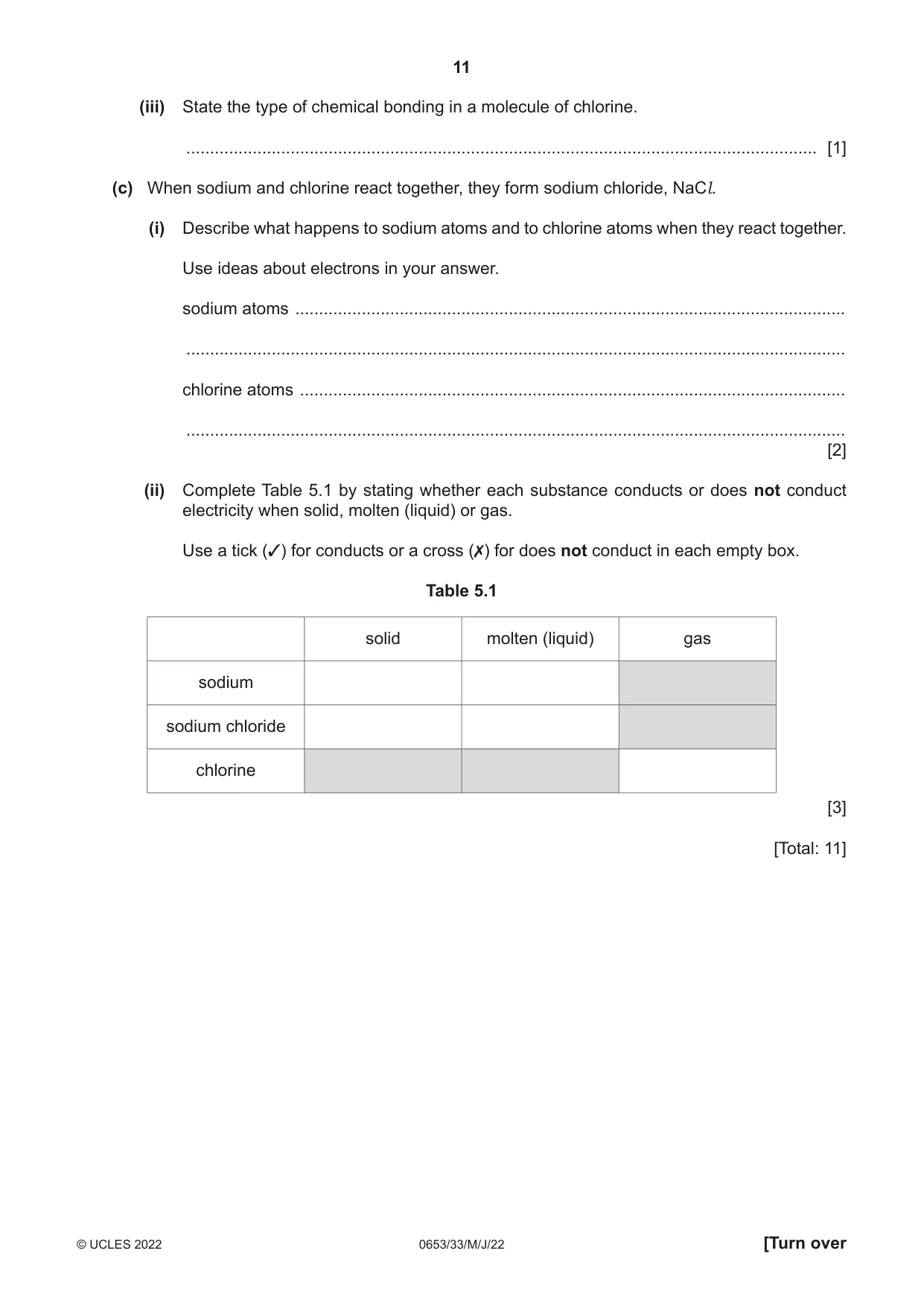
5 (a) Lithium, sodium and potassium are three elements in Group I of the Periodic Table, as shown in Fig. 5.1. 3 Li lithium 7 11 Na sodium 23 19 K potassium 39 Fig. 5.1 Identify which of these three elements has: the lowest density .................................................................................................... the highest reactivity .................................................................................................... the highest melting point. .................................................................................................... [2] (b) Chlorine, bromine and iodine are three elements in Group VII of the Periodic Table. They exist as diatomic molecules. (i) Describe what is meant by diatomic. ........................................................................................................................................... ..................................................................................................................................... [1] (ii) Complete the dot‑and‑cross diagram in Fig. 5.2 to show all the outer shell electrons in a molecule of chlorine, Cl 2. Cl Cl Fig. 5.2 [2] (iii) State the type of chemical bonding in a molecule of chlorine. ..................................................................................................................................... [1] (c) When sodium and chlorine react together, they form sodium chloride, NaCl. (i) Describe what happens to sodium atoms and to chlorine atoms when they react together. Use ideas about electrons in your answer. sodium atoms .................................................................................................................... ........................................................................................................................................... chlorine atoms ................................................................................................................... ........................................................................................................................................... [2] (ii) Complete Table 5.1 by stating whether each substance conducts or does not conduct electricity when solid, molten (liquid) or gas. Use a tick (✓) for conducts or a cross (✗) for does not conduct in each empty box. Table 5.1 solid molten (liquid) gas sodium sodium chloride chlorine [3] [Total: 11]
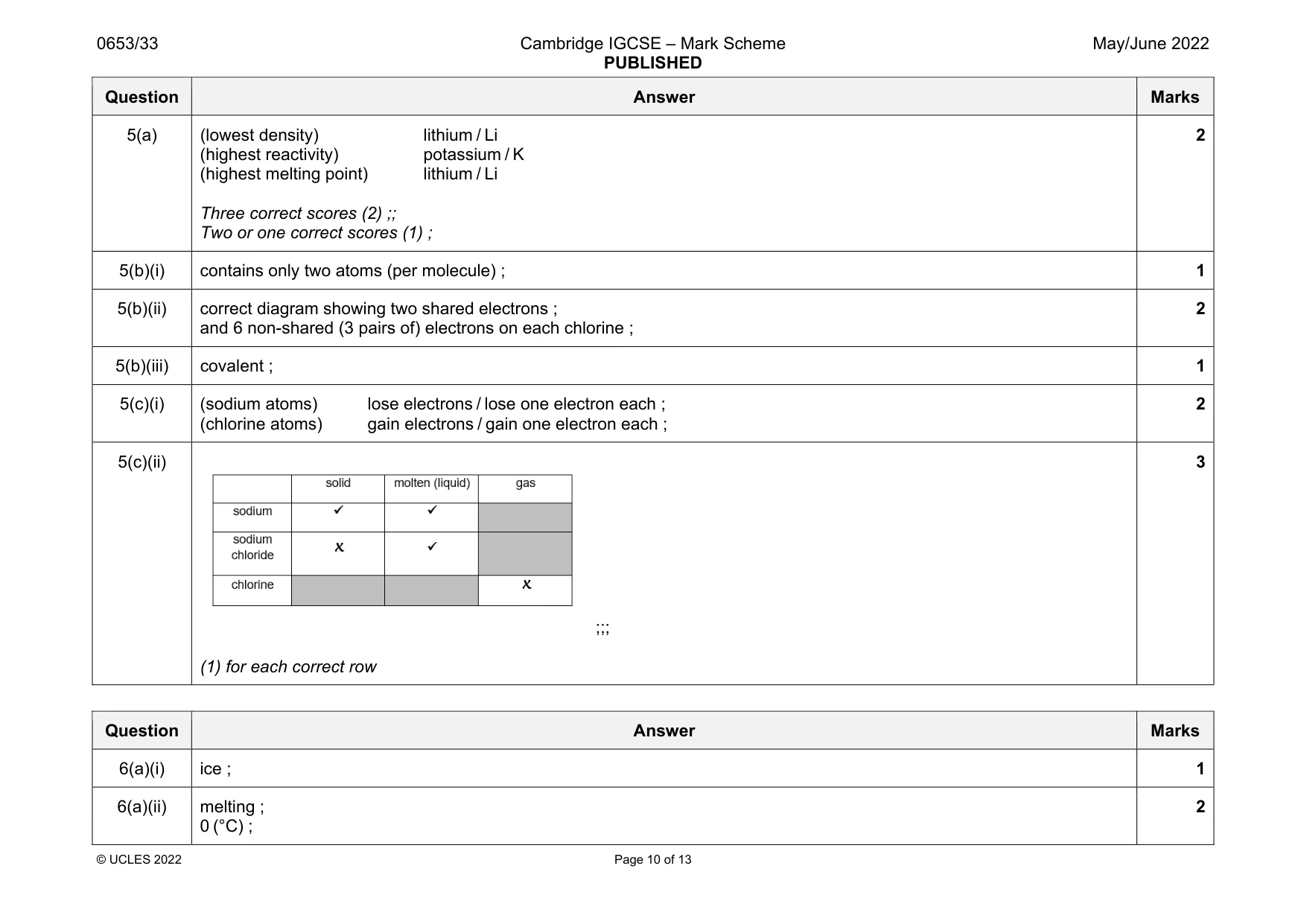
Mark scheme: 5(a) (lowest density) lithium / Li (highest reactivity) potassium / K (highest melting point) lithium / Li Three correct scores (2) ;; Two or one correct scores (1) ; 2 5(b)(i) contains only two atoms (per molecule) ; 1 5(b)(ii) correct diagram showing two shared electrons ; and 6 non-shared (3 pairs of) electrons on each chlorine ; 2 5(b)(iii) covalent ; 1 5(c)(i) (sodium atoms) lose electrons / lose one electron each ; (chlorine atoms) gain electrons / gain one electron each ; 2 5(c)(ii) ;;; (1) for each correct row 3
Q6 · An ice cube floating in a glass of water
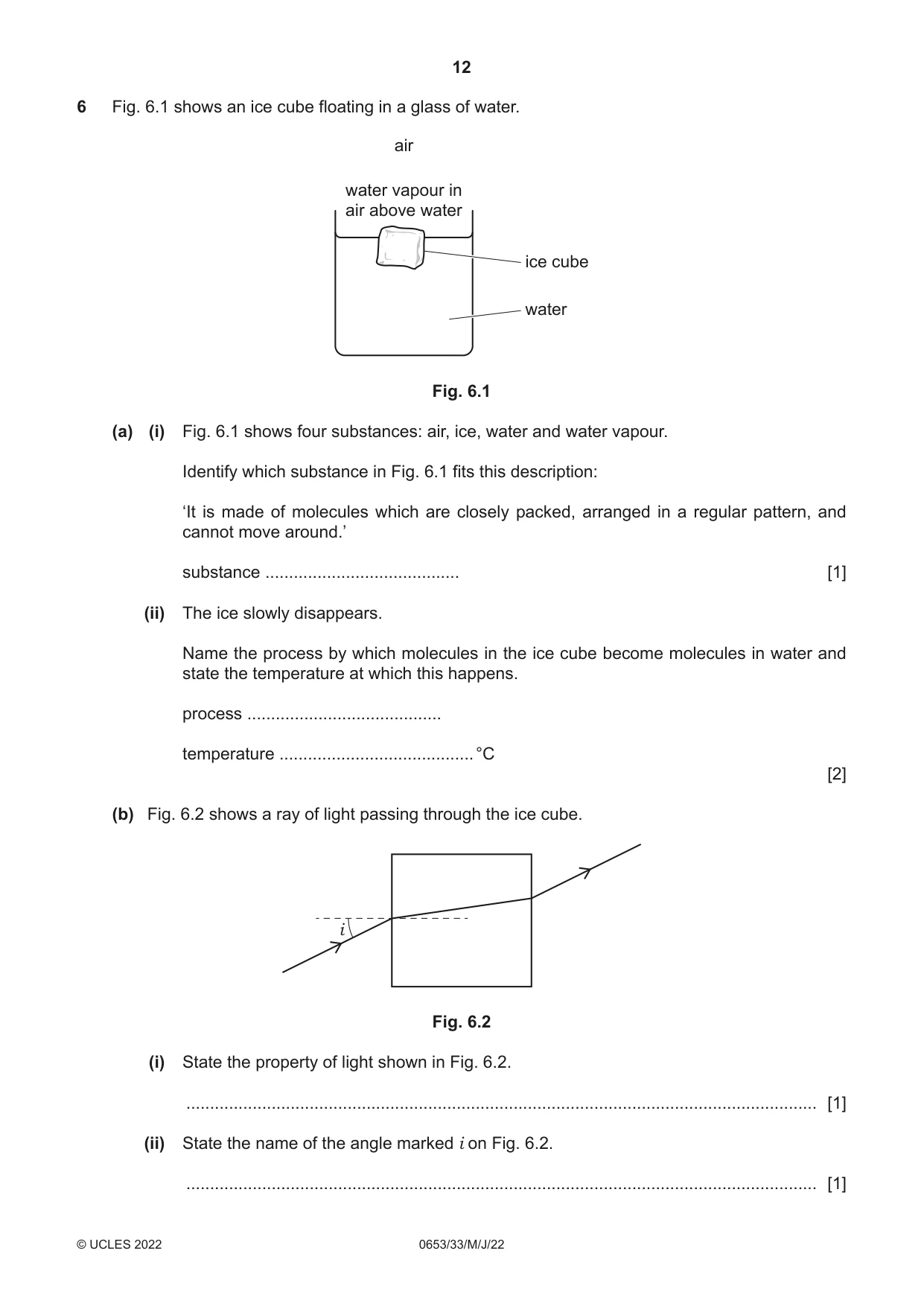
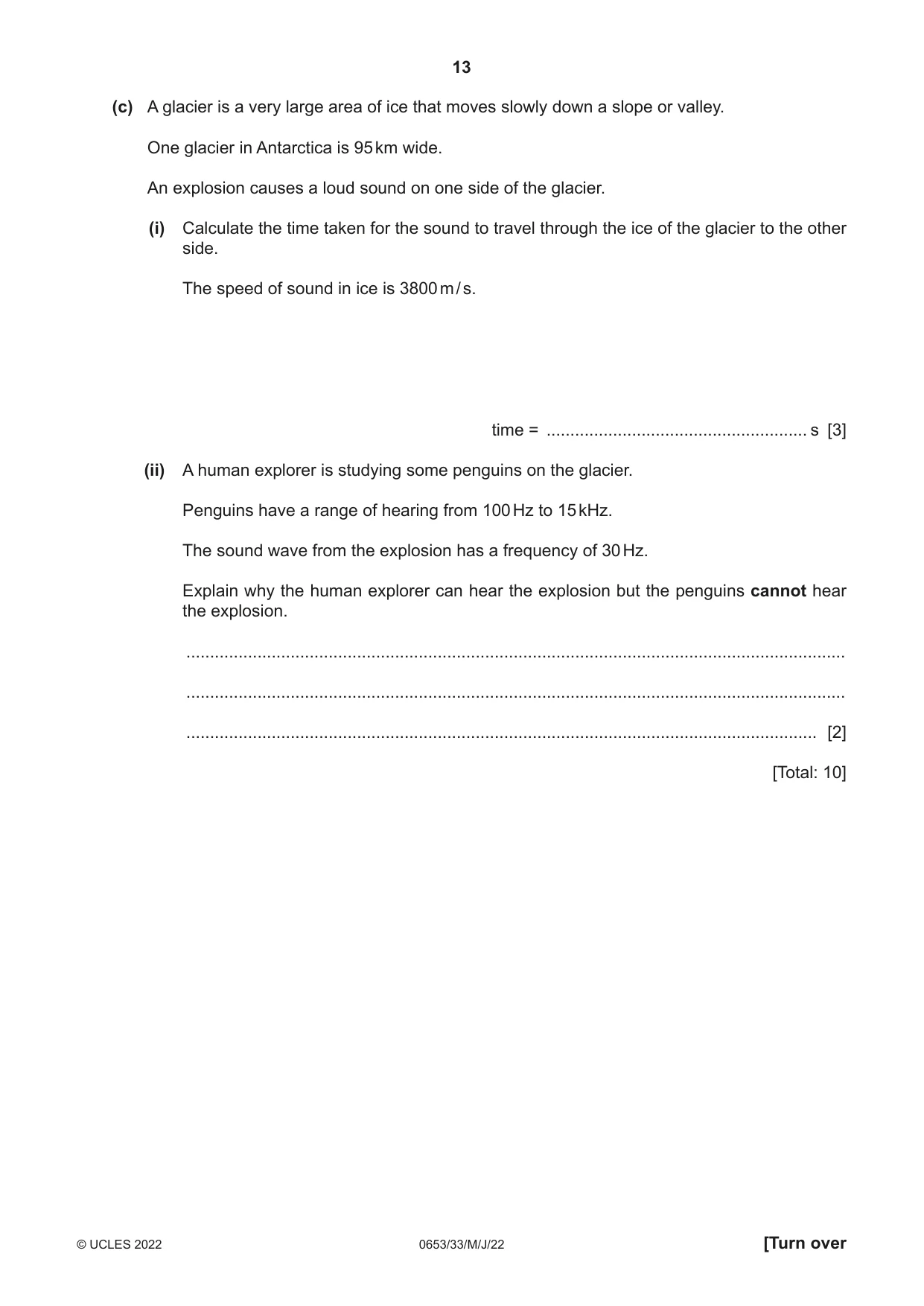
6 Fig. 6.1 shows an ice cube floating in a glass of water. air water vapour in air above water ice cube water Fig. 6.1 (a) (i) Fig. 6.1 shows four substances: air, ice, water and water vapour. Identify which substance in Fig. 6.1 fits this description: ‘It is made of molecules which are closely packed, arranged in a regular pattern, and cannot move around.’ substance ......................................... [1] (ii) The ice slowly disappears. Name the process by which molecules in the ice cube become molecules in water and state the temperature at which this happens. process ......................................... temperature ......................................... °C [2] (b) Fig. 6.2 shows a ray of light passing through the ice cube. i Fig. 6.2 (i) State the property of light shown in Fig. 6.2. ..................................................................................................................................... [1] (ii) State the name of the angle marked i on Fig. 6.2. ..................................................................................................................................... [1] (c) A glacier is a very large area of ice that moves slowly down a slope or valley. One glacier in Antarctica is 95 km wide. An explosion causes a loud sound on one side of the glacier. (i) Calculate the time taken for the sound to travel through the ice of the glacier to the other side. The speed of sound in ice is 3800 m / s. time = ....................................................... s [3] (ii) A human explorer is studying some penguins on the glacier. Penguins have a range of hearing from 100 Hz to 15 kHz. The sound wave from the explosion has a frequency of 30 Hz. Explain why the human explorer can hear the explosion but the penguins cannot hear the explosion. ........................................................................................................................................... ........................................................................................................................................... ..................................................................................................................................... [2] [Total: 10]
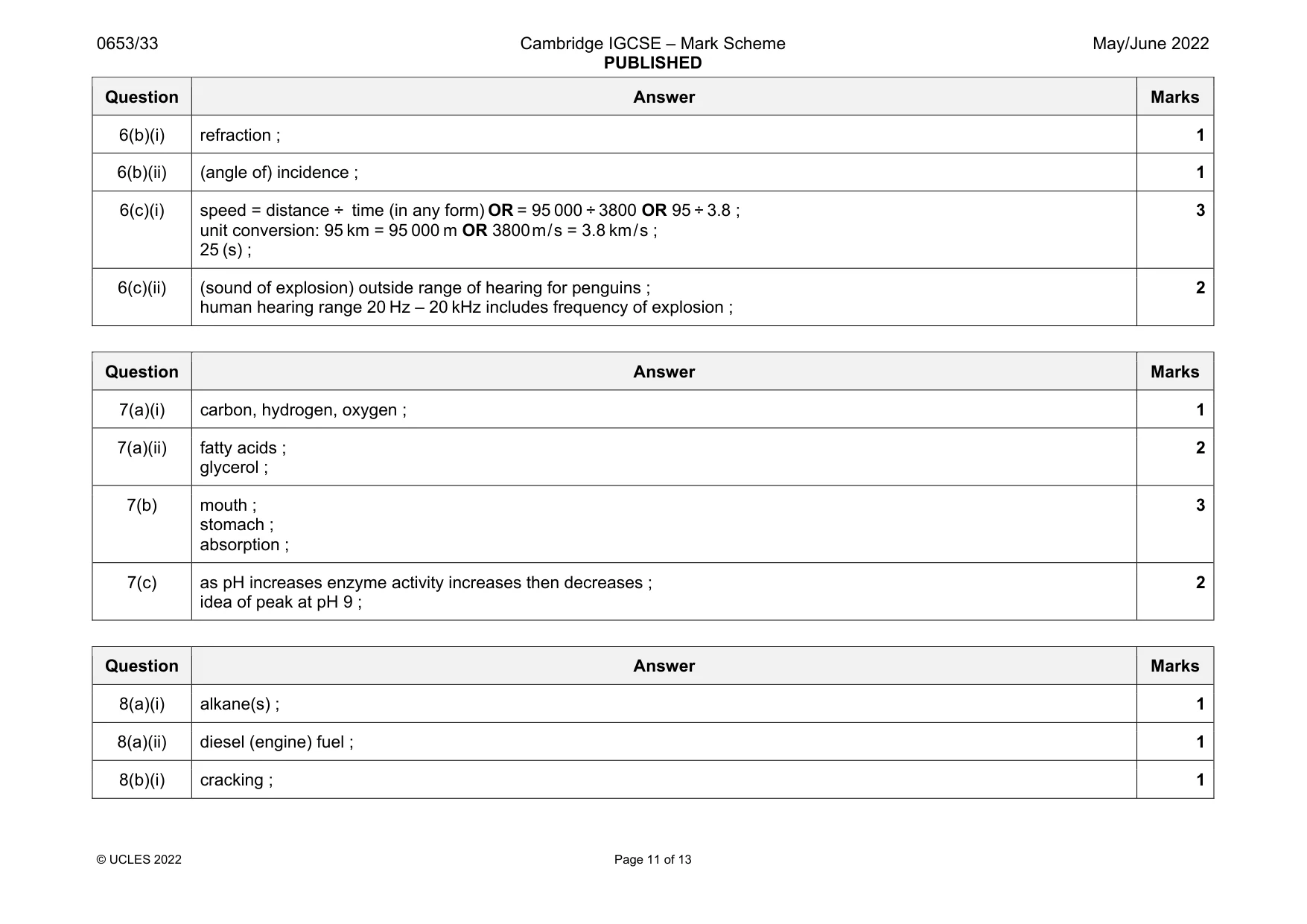
Mark scheme: 6(a)(i) ice ; 1 6(a)(ii) melting ; 0 (°C) ; 2 Question Answer Marks 6(b)(i) refraction ; 1 6(b)(ii) (angle of) incidence ; 1 6(c)(i) speed = distance ÷ time (in any form) OR = 95 000 ÷ 3800 OR 95 ÷ 3.8 ; unit conversion: 95 km = 95 000 m OR 3800 m / s = 3.8 km / s ; 25 (s) ; 3 6(c)(ii) (sound of explosion) outside range of hearing for penguins ; human hearing range 20 Hz – 20 kHz includes frequency of explosion ; 2
Q7 · The nuts in Fig
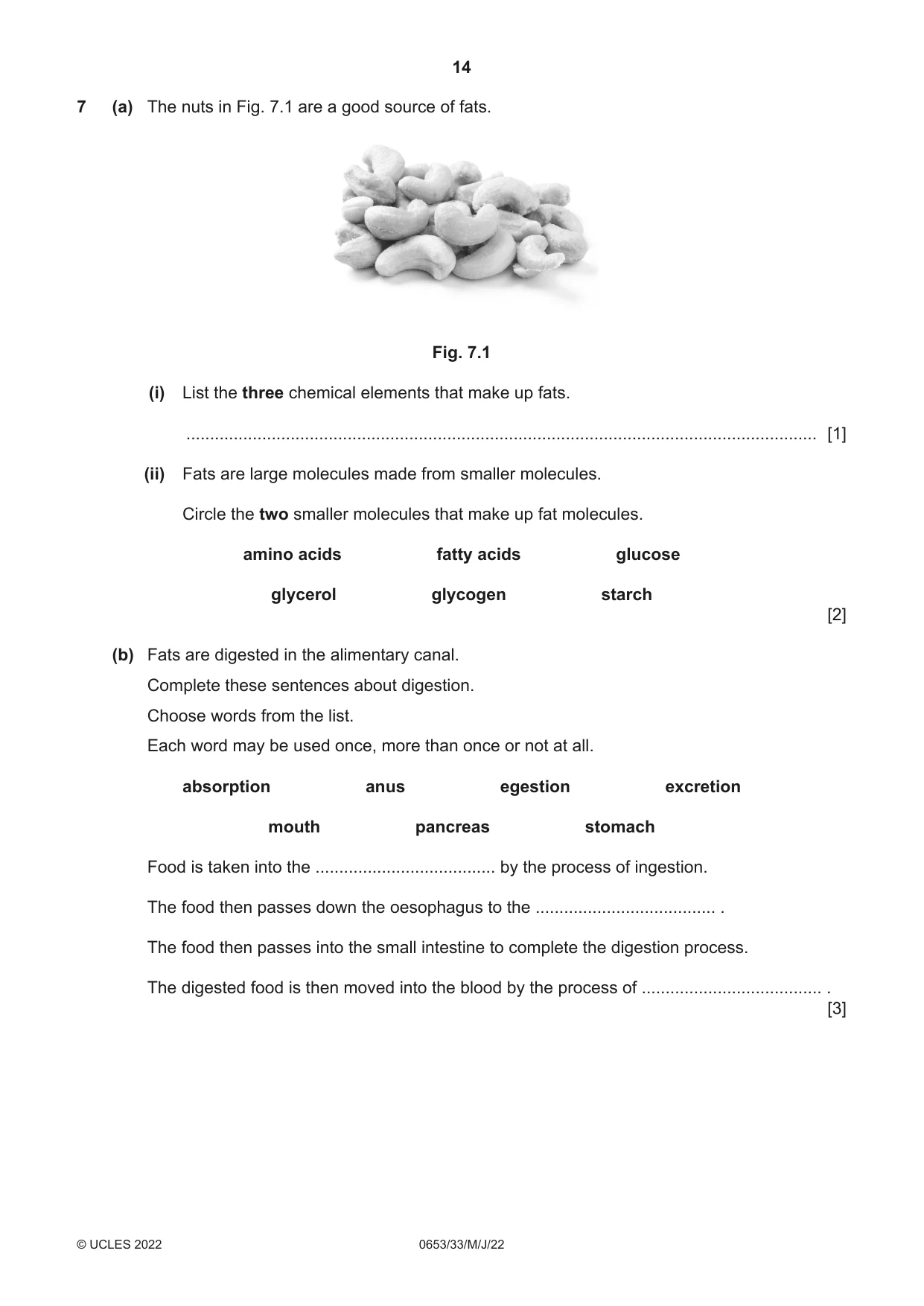
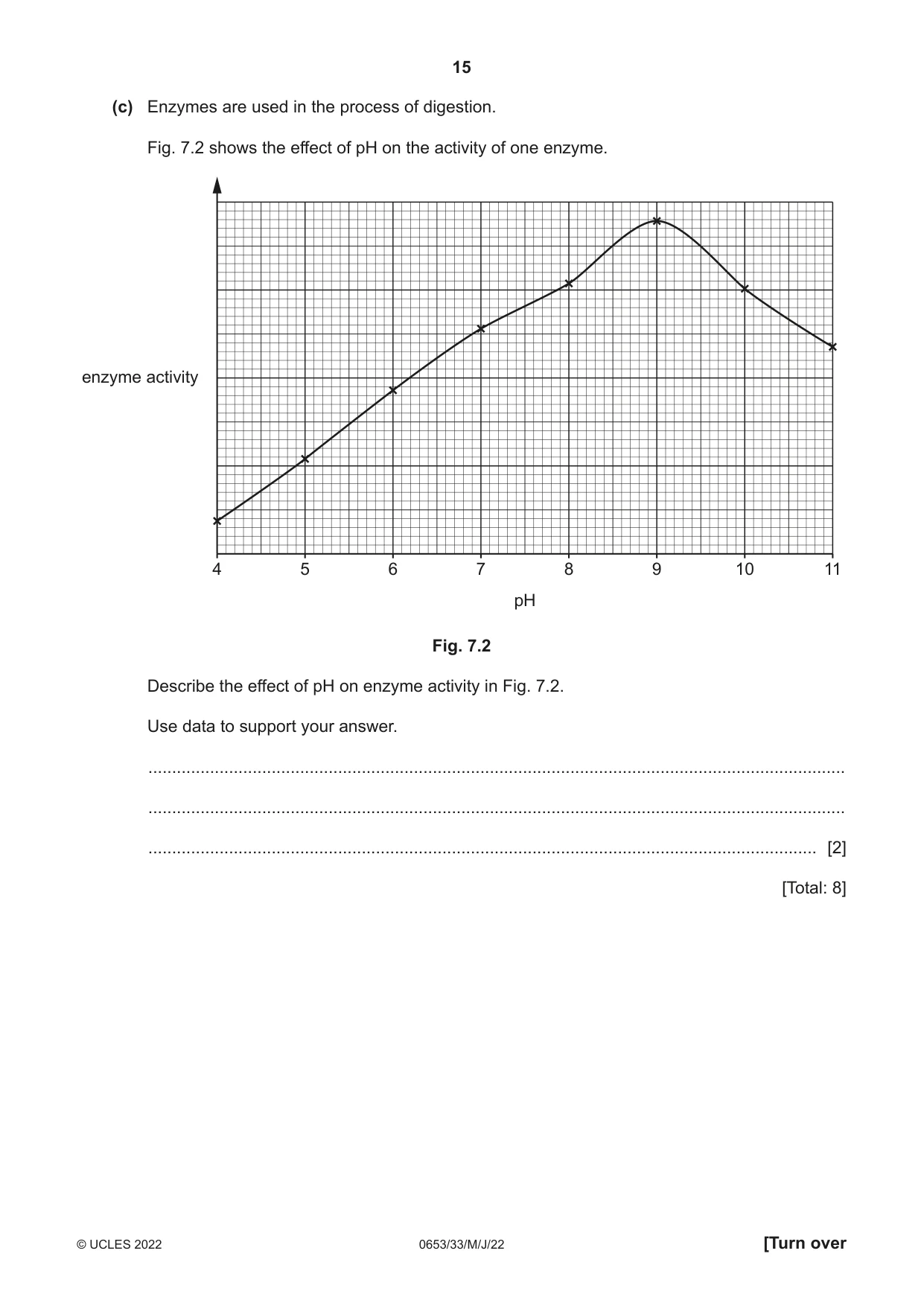
7 (a) The nuts in Fig. 7.1 are a good source of fats. Fig. 7.1 (i) List the three chemical elements that make up fats. ..................................................................................................................................... [1] (ii) Fats are large molecules made from smaller molecules. Circle the two smaller molecules that make up fat molecules. amino acids fatty acids glucose glycerol glycogen starch [2] (b) Fats are digested in the alimentary canal. Complete these sentences about digestion. Choose words from the list. Each word may be used once, more than once or not at all. absorption anus egestion excretion mouth pancreas stomach Food is taken into the ...................................... by the process of ingestion. The food then passes down the oesophagus to the ...................................... . The food then passes into the small intestine to complete the digestion process. The digested food is then moved into the blood by the process of ...................................... . [3] (c) Enzymes are used in the process of digestion. Fig. 7.2 shows the effect of pH on the activity of one enzyme. enzyme activity 4 5 6 7 8 9 10 11 pH Fig. 7.2 Describe the effect of pH on enzyme activity in Fig. 7.2. Use data to support your answer. ................................................................................................................................................... ................................................................................................................................................... ............................................................................................................................................. [2] [Total: 8]
Mark scheme: 7(a)(i) carbon, hydrogen, oxygen ; 1 7(a)(ii) fatty acids ; glycerol ; 2 7(b) mouth ; stomach ; absorption ; 3 7(c) as pH increases enzyme activity increases then decreases ; idea of peak at pH 9 ; 2
Q8 · Petroleum is separated into useful fractions by the process shown in Fig
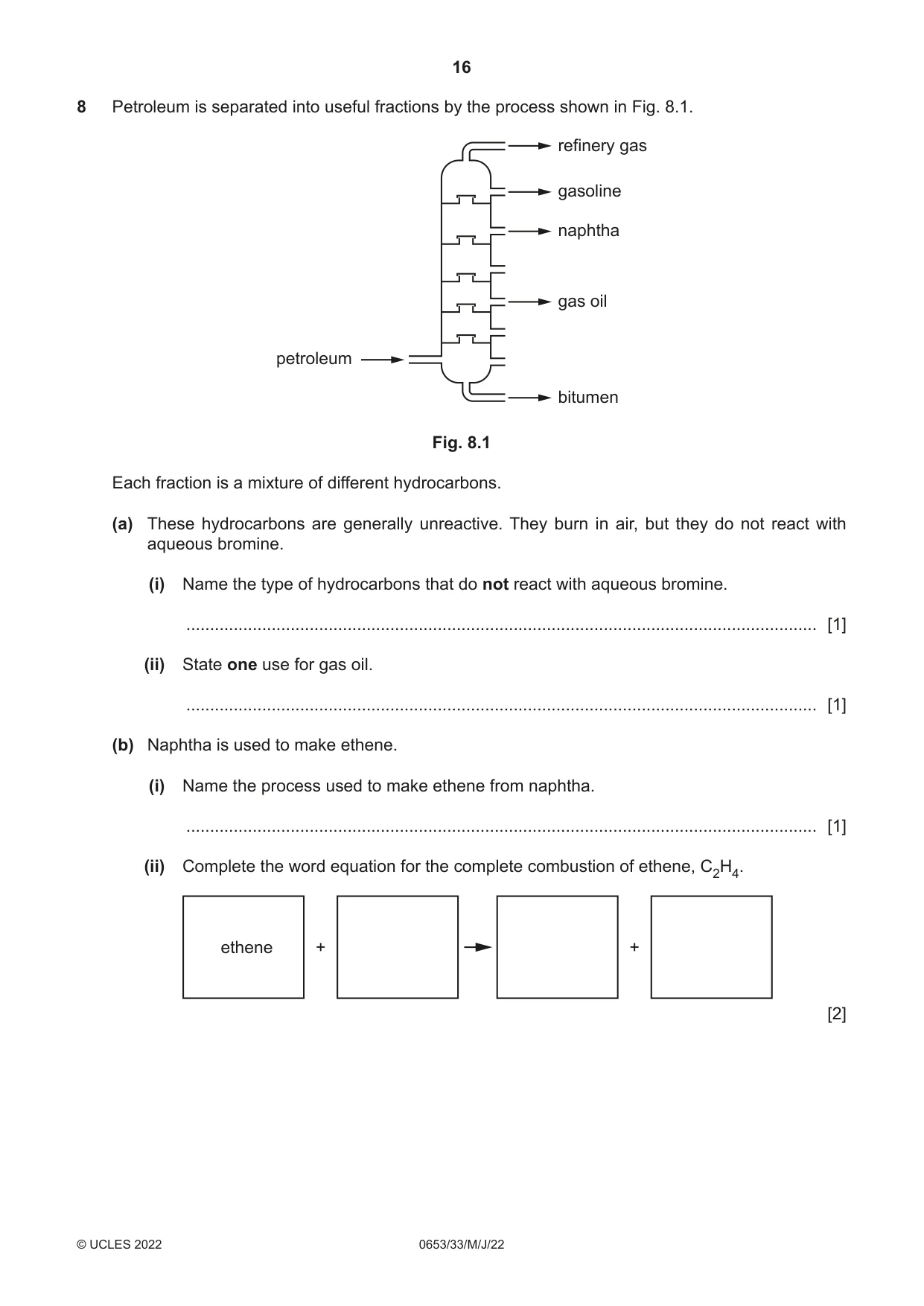
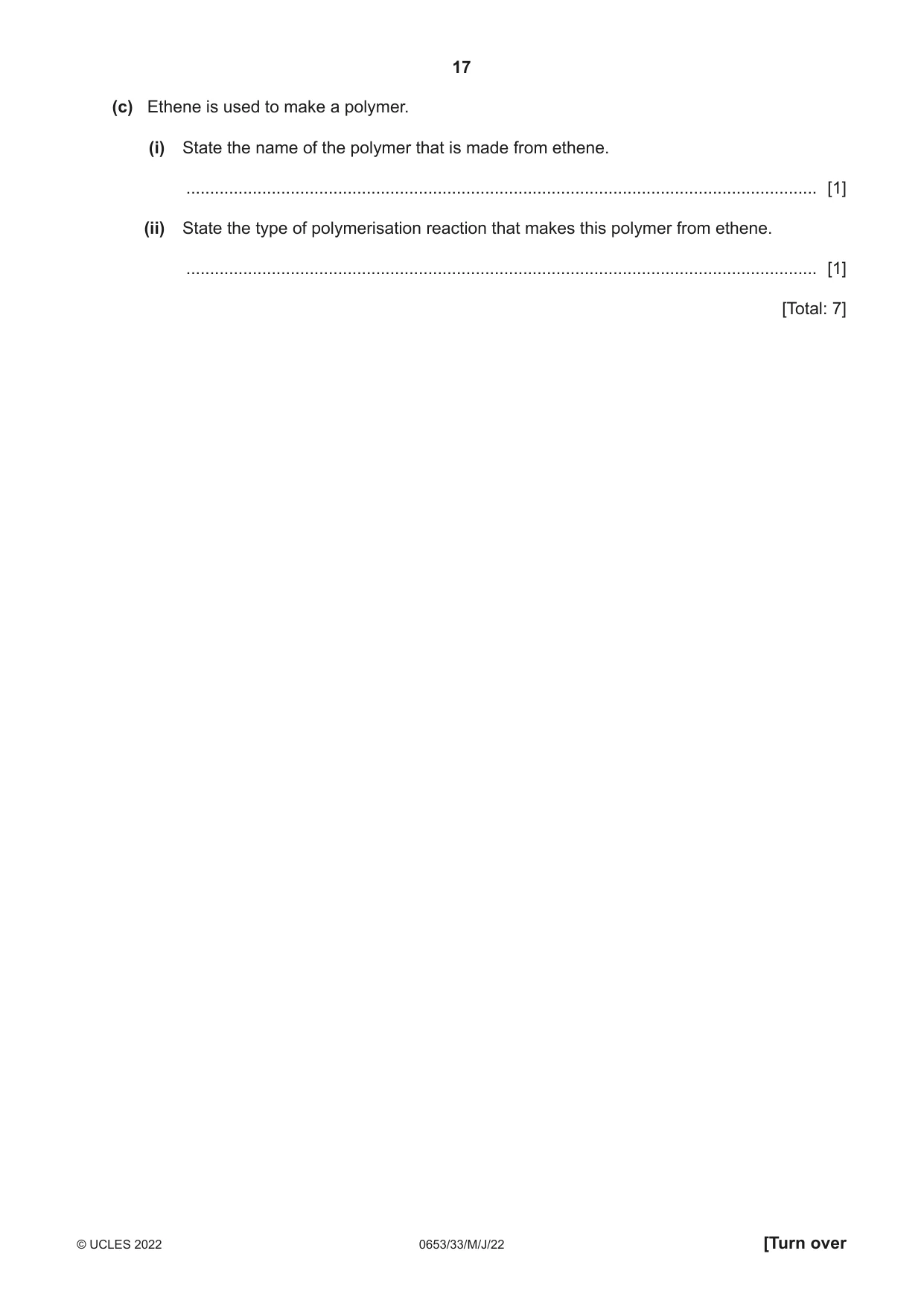
8 Petroleum is separated into useful fractions by the process shown in Fig. 8.1. refinery gas gasoline naphtha gas oil petroleum bitumen Fig. 8.1 Each fraction is a mixture of different hydrocarbons. (a) These hydrocarbons are generally unreactive. They burn in air, but they do not react with aqueous bromine. (i) Name the type of hydrocarbons that do not react with aqueous bromine. ..................................................................................................................................... [1] (ii) State one use for gas oil. ..................................................................................................................................... [1] (b) Naphtha is used to make ethene. (i) Name the process used to make ethene from naphtha. ..................................................................................................................................... [1] (ii) Complete the word equation for the complete combustion of ethene, C2H4. ethene + + [2] (c) Ethene is used to make a polymer. (i) State the name of the polymer that is made from ethene. ..................................................................................................................................... [1] (ii) State the type of polymerisation reaction that makes this polymer from ethene. ..................................................................................................................................... [1] [Total: 7]
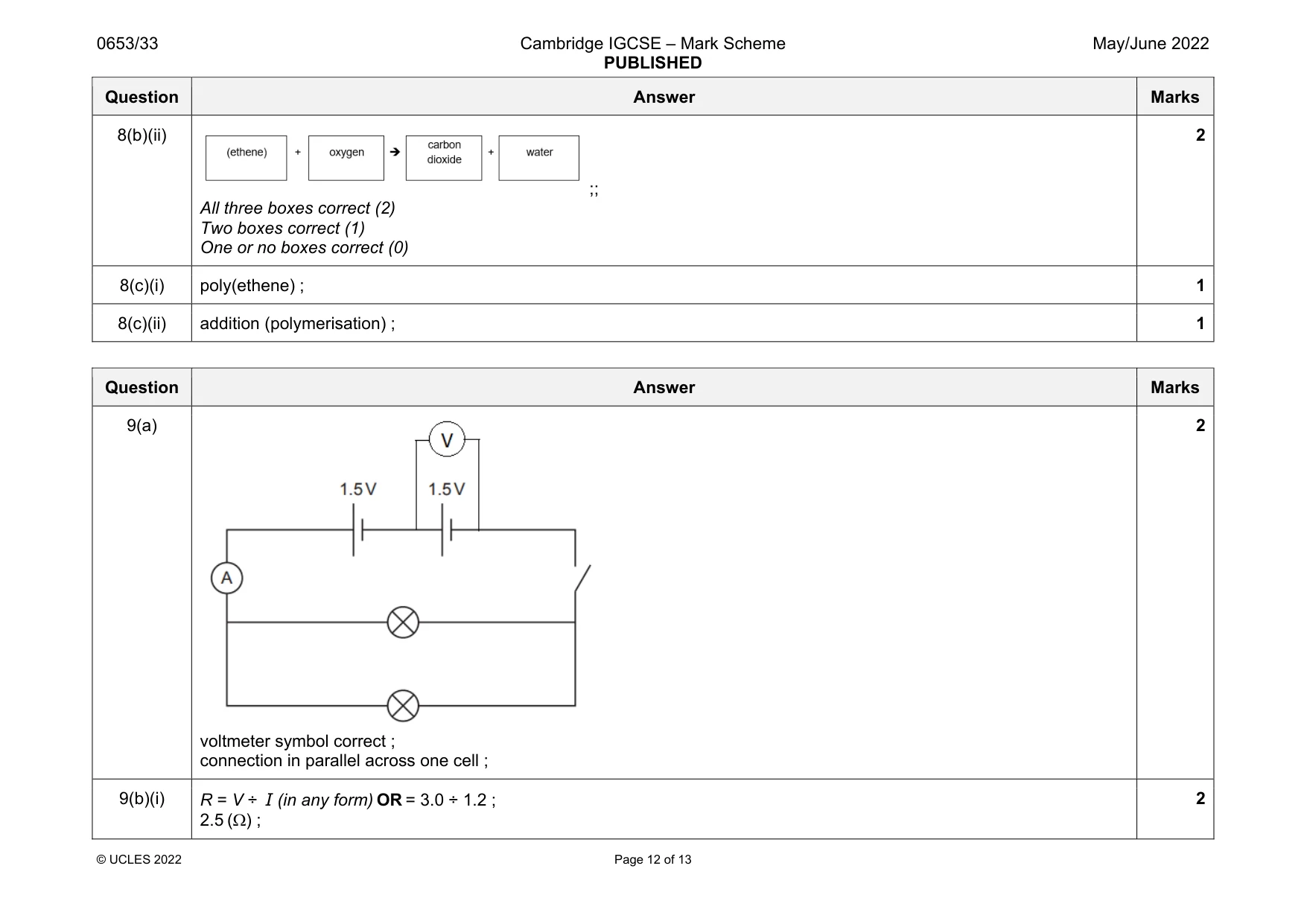
Mark scheme: 8(a)(i) alkane(s) ; 1 8(a)(ii) diesel (engine) fuel ; 1 8(b)(i) cracking ; 1 Question Answer Marks 8(b)(ii) ;; All three boxes correct (2) Two boxes correct (1) One or no boxes correct (0) 2 8(c)(i) poly(ethene) ; 1 8(c)(ii) addition (polymerisation) ; 1
Q9 · Two 1.5 V cells are connected to two lamps and a switch
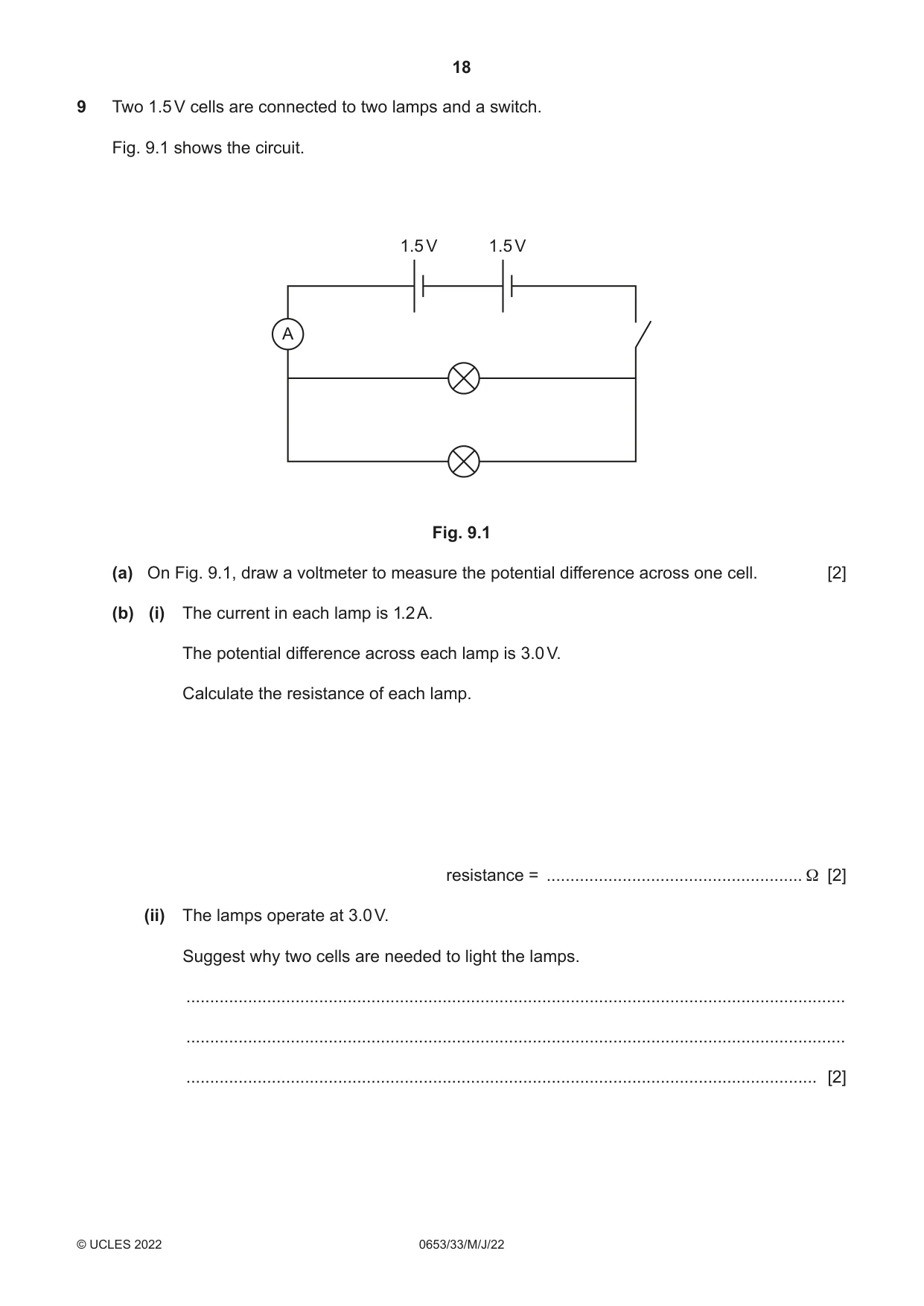
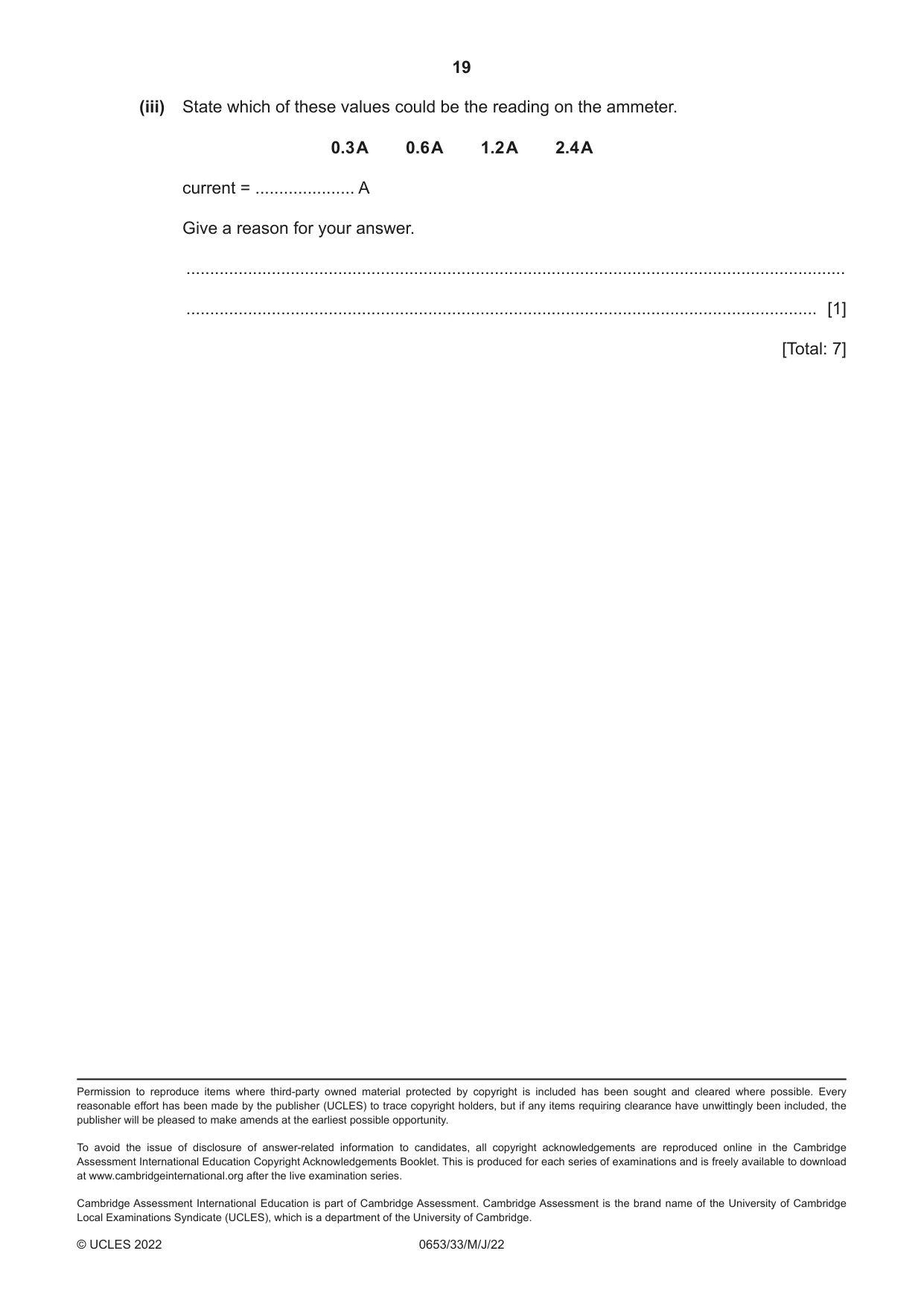
9 Two 1.5 V cells are connected to two lamps and a switch. Fig. 9.1 shows the circuit. 1.5 V 1.5 V A Fig. 9.1 (a) On Fig. 9.1, draw a voltmeter to measure the potential difference across one cell. [2] (b) (i) The current in each lamp is 1.2 A. The potential difference across each lamp is 3.0 V. Calculate the resistance of each lamp. resistance = ...................................................... Ω [2] (ii) The lamps operate at 3.0 V. Suggest why two cells are needed to light the lamps. ........................................................................................................................................... ........................................................................................................................................... ..................................................................................................................................... [2] (iii) State which of these values could be the reading on the ammeter. 0.3 A 0.6 A 1.2 A 2.4 A current = ..................... A Give a reason for your answer. ........................................................................................................................................... ..................................................................................................................................... [1] [Total: 7]
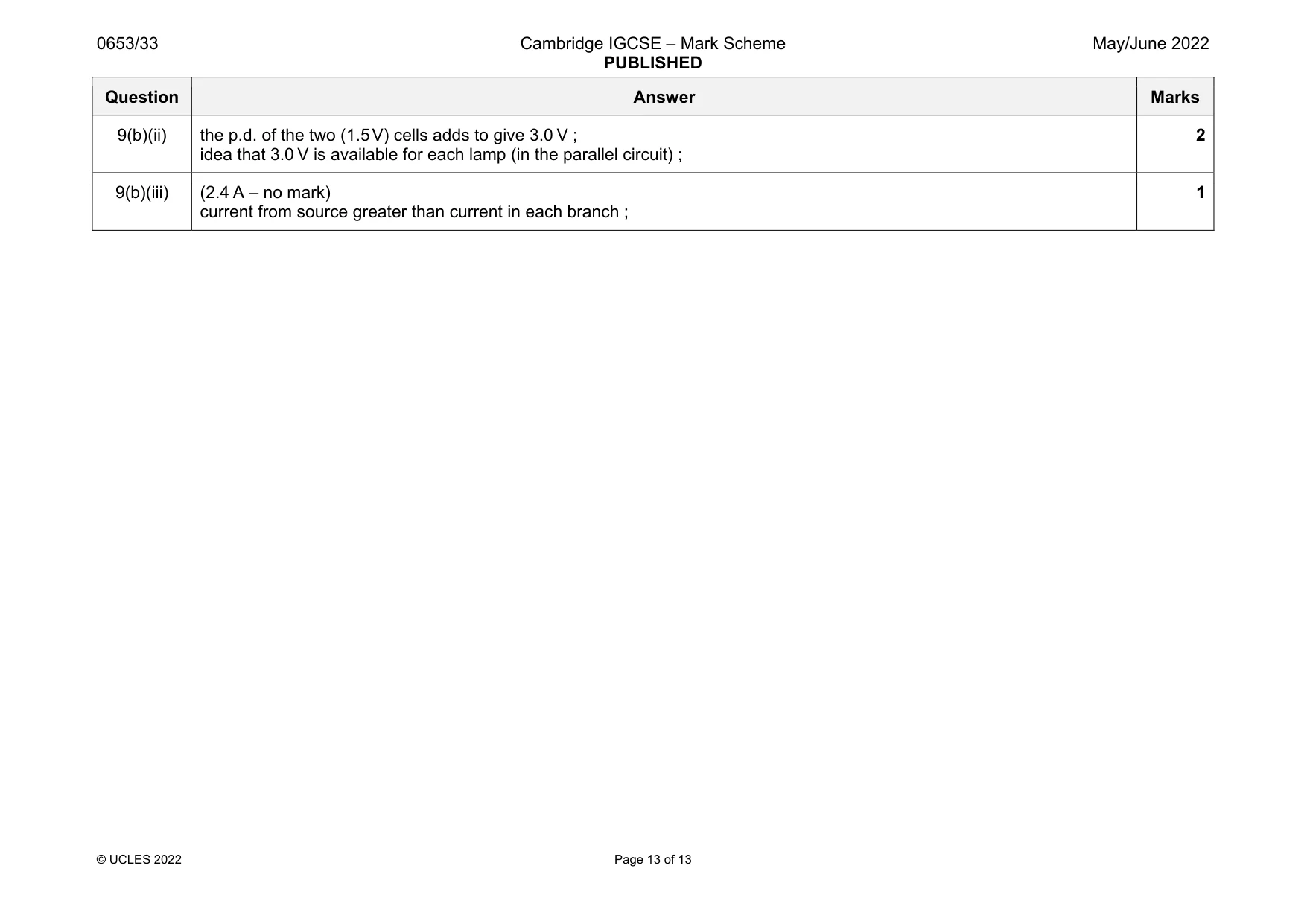
Mark scheme: 9(a) voltmeter symbol correct ; connection in parallel across one cell ; 9(b)(i) R = V ÷ I (in any form) OR = 3.0 ÷ 1.2 ; 2.5 () ; 2 Question Answer Marks 9(b)(ii) the p.d. of the two (1.5 V) cells adds to give 3.0 V ; idea that 3.0 V is available for each lamp (in the parallel circuit) ; 2 9(b)(iii) (2.4 A – no mark) current from source greater than current in each branch ; 1
What was in this paper
The subtopics covered by these 9 questions, and how many questions each got. Open one in a new tab to see every Cambridge question on it.
What you needed in this session
Cambridge’s own grade thresholds for 2022 May/June, Paper 3 · Variant 3. A higher threshold means an easier paper — the bar moves with how the cohort did.