Cambridge IGCSE Science - Combined 0653 — 2023 May/June Paper 3 · Variant 1
0653/31/M/J/23 · 9 questions · 80 marks · ≈90 min
The question paper and its mark scheme, free to read here and free to download. This is Cambridge’s own paper, exactly as it was sat.
Question paper20 pages

Mark scheme11 pages
Answers below. Sit the paper first if you are practising.
Questions as text
Q1 · The parts of an insect-pollinated flower
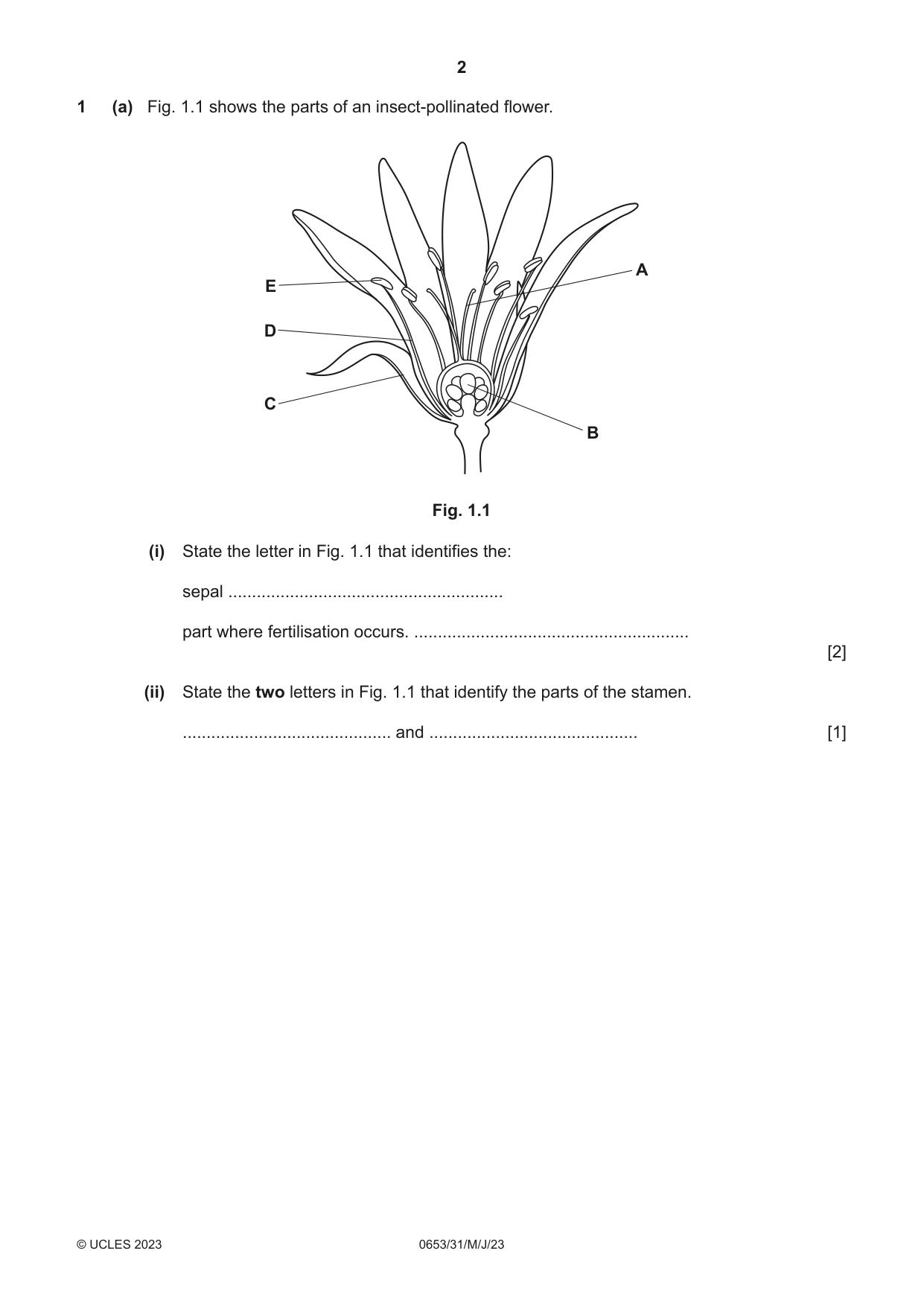
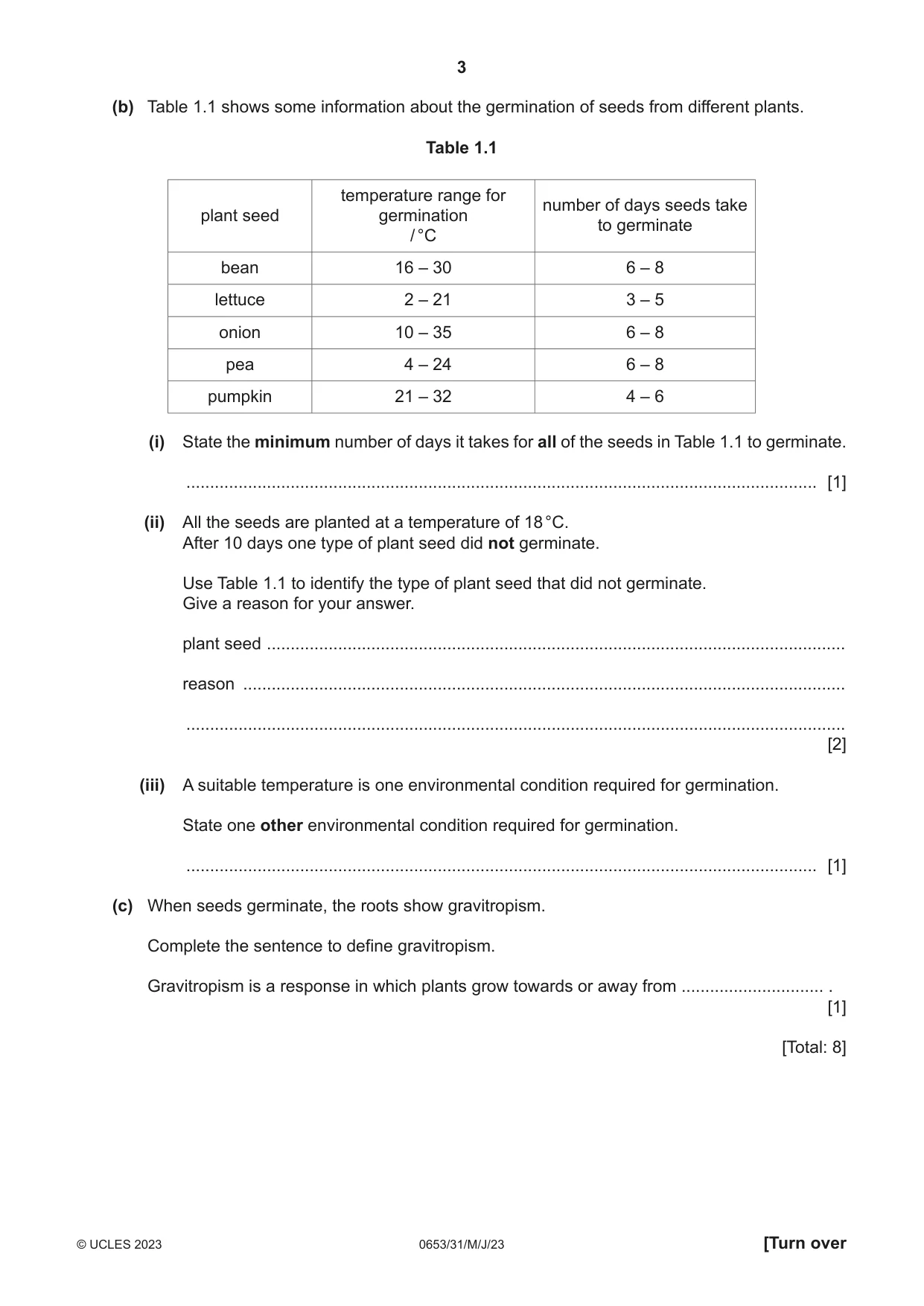
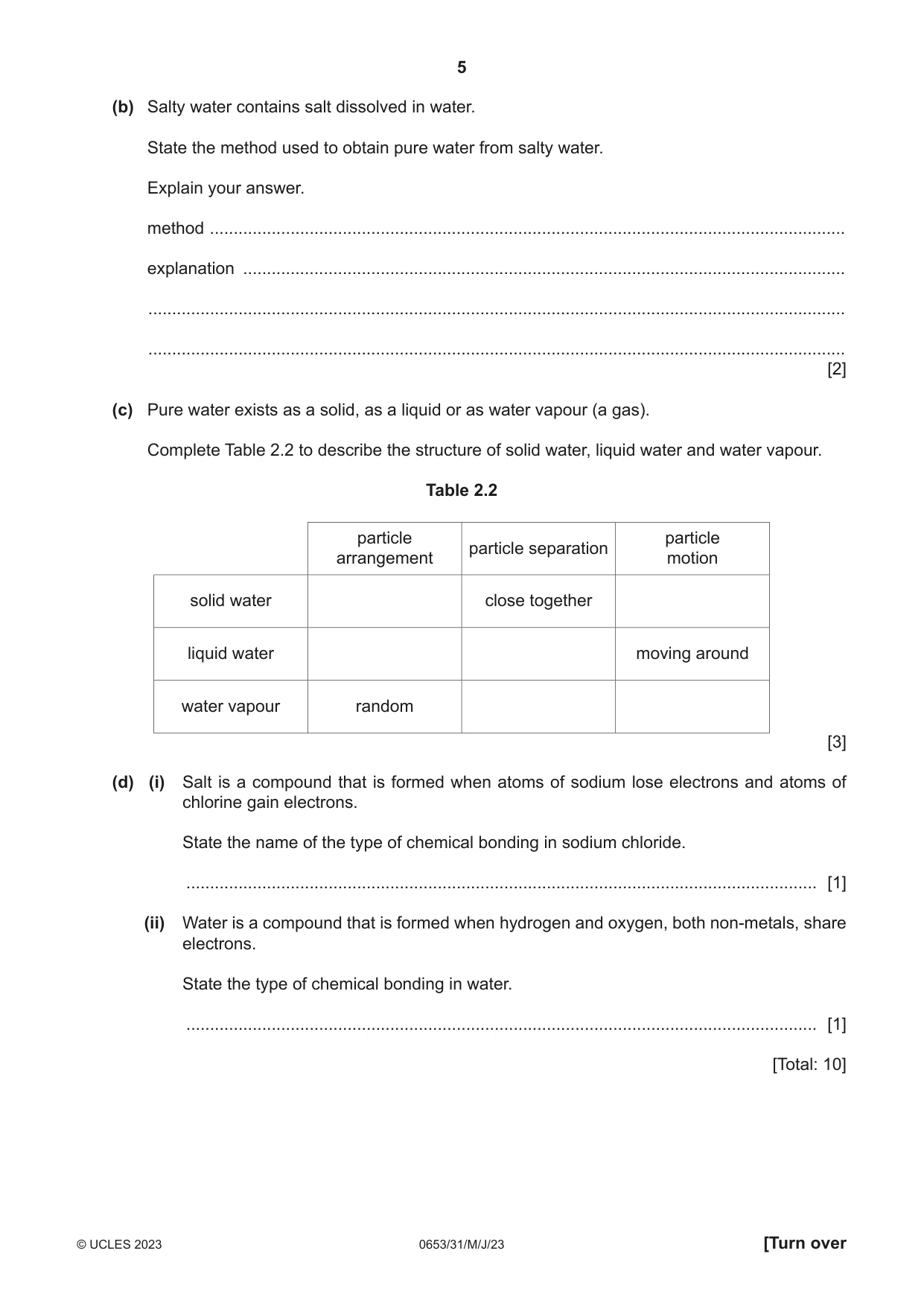
1 (a) Fig. 1.1 shows the parts of an insect-pollinated flower. A E D C B Fig. 1.1 (i) State the letter in Fig. 1.1 that identifies the: sepal .......................................................... part where fertilisation occurs. .......................................................... [2] (ii) State the two letters in Fig. 1.1 that identify the parts of the stamen. ............................................ and ............................................ [1] (b) Table 1.1 shows some information about the germination of seeds from different plants. Table 1.1 temperature range for number of days seeds take plant seed germination to germinate / °C bean 16 – 30 6 – 8 lettuce 2 – 21 3 – 5 onion 10 – 35 6 – 8 pea 4 – 24 6 – 8 pumpkin 21 – 32 4 – 6 (i) State the minimum number of days it takes for all of the seeds in Table 1.1 to germinate. ..................................................................................................................................... [1] (ii) All the seeds are planted at a temperature of 18 °C. After 10 days one type of plant seed did not germinate. Use Table 1.1 to identify the type of plant seed that did not germinate. Give a reason for your answer. plant seed .......................................................................................................................... reason ............................................................................................................................... ........................................................................................................................................... [2] (iii) A suitable temperature is one environmental condition required for germination. State one other environmental condition required for germination. ..................................................................................................................................... [1] (c) When seeds germinate, the roots show gravitropism. Complete the sentence to define gravitropism. Gravitropism is a response in which plants grow towards or away from .............................. . [1] [Total: 8]
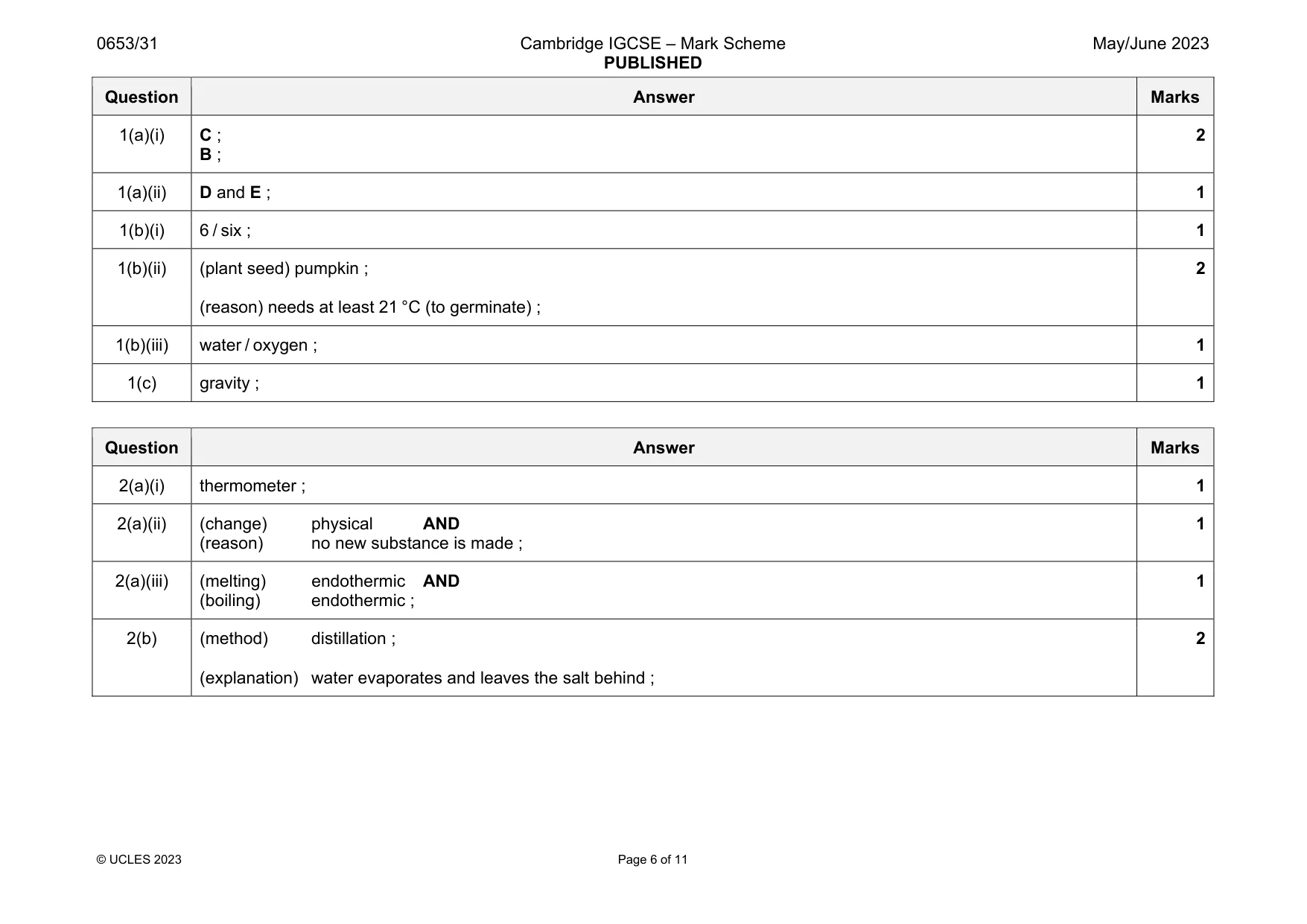
Mark scheme: 1(a)(i) C ; B ; 2 1(a)(ii) D and E ; 1 1(b)(i) 6 / six ; 1 1(b)(ii) (plant seed) pumpkin ; (reason) needs at least 21 °C (to germinate) ; 2 1(b)(iii) water / oxygen ; 1 1(c) gravity ; 1
Q2 · A student measures the melting point of some salty water and some pure water
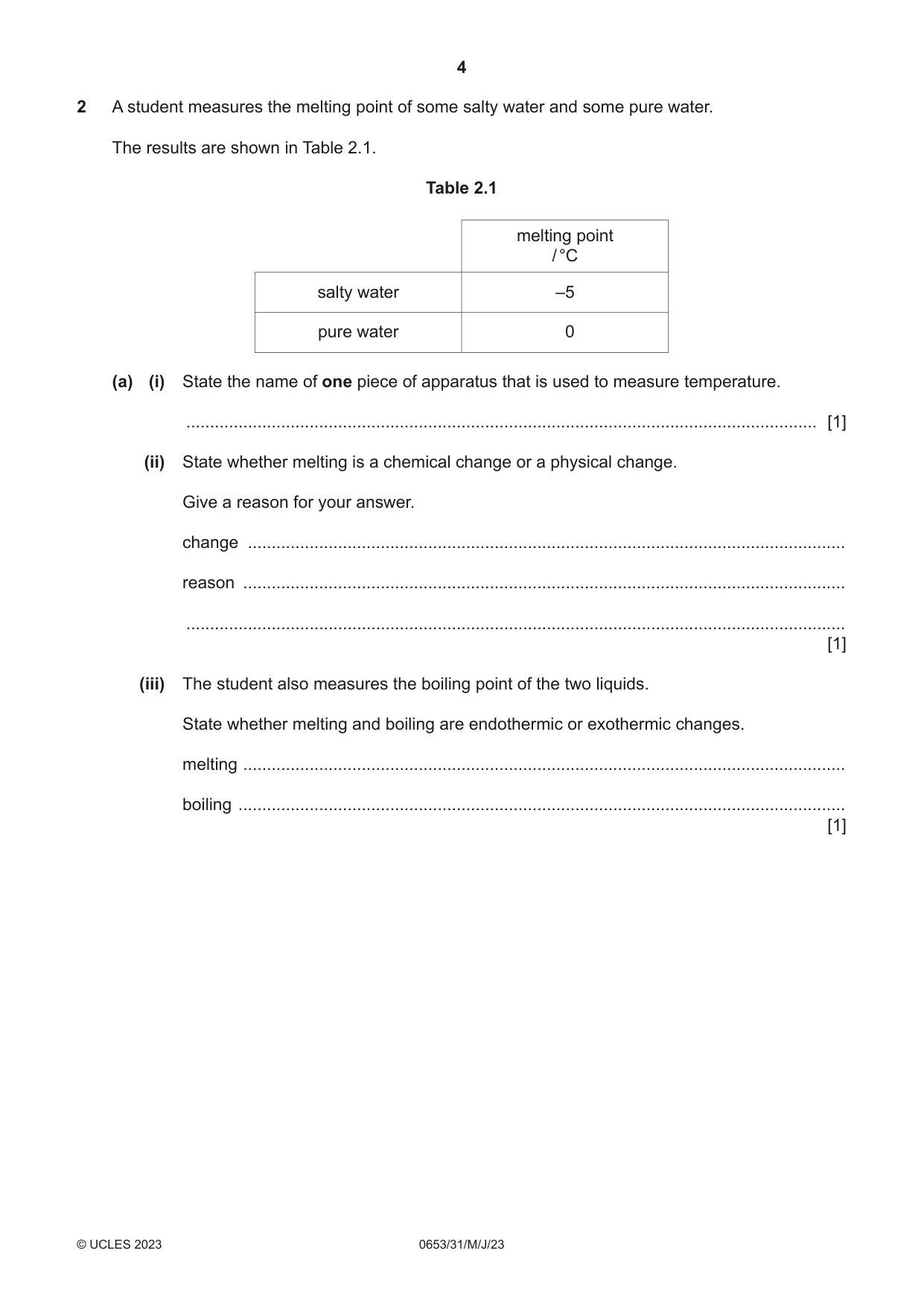
2 A student measures the melting point of some salty water and some pure water. The results are shown in Table 2.1. Table 2.1 melting point / °C salty water –5 pure water 0 (a) (i) State the name of one piece of apparatus that is used to measure temperature. ..................................................................................................................................... [1] (ii) State whether melting is a chemical change or a physical change. Give a reason for your answer. change .............................................................................................................................. reason ............................................................................................................................... ........................................................................................................................................... [1] (iii) The student also measures the boiling point of the two liquids. State whether melting and boiling are endothermic or exothermic changes. melting ............................................................................................................................... boiling ................................................................................................................................ [1] (b) Salty water contains salt dissolved in water. State the method used to obtain pure water from salty water. Explain your answer. method ...................................................................................................................................... explanation ............................................................................................................................... ................................................................................................................................................... ................................................................................................................................................... [2] (c) Pure water exists as a solid, as a liquid or as water vapour (a gas). Complete Table 2.2 to describe the structure of solid water, liquid water and water vapour. Table 2.2 particle particle particle separation arrangement motion solid water close together liquid water moving around water vapour random [3] (d) (i) Salt is a compound that is formed when atoms of sodium lose electrons and atoms of chlorine gain electrons. State the name of the type of chemical bonding in sodium chloride. ..................................................................................................................................... [1] (ii) Water is a compound that is formed when hydrogen and oxygen, both non-metals, share electrons. State the type of chemical bonding in water. ..................................................................................................................................... [1] [Total: 10]
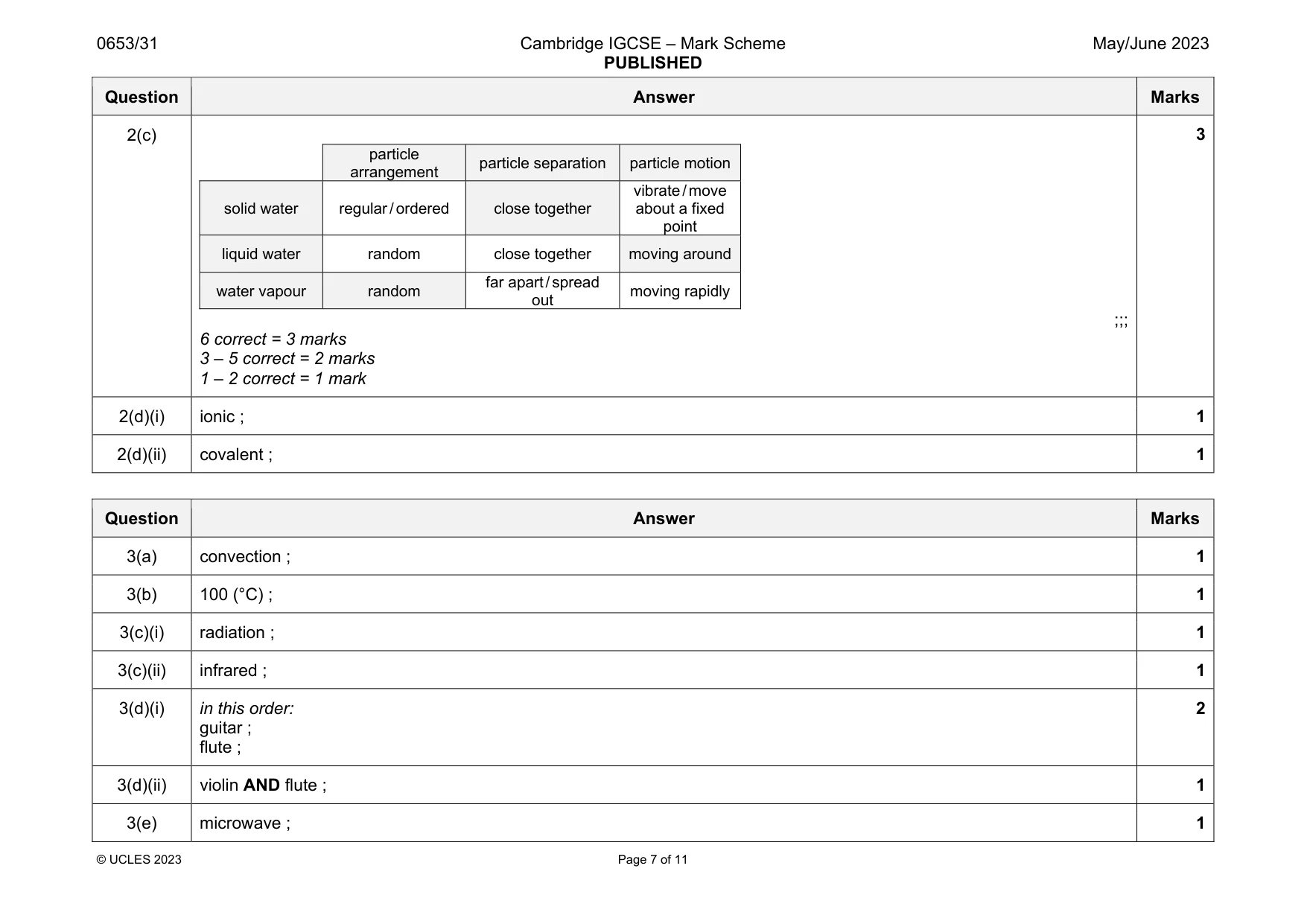
Mark scheme: 2(a)(i) thermometer ; 1 2(a)(ii) (change) physical AND (reason) no new substance is made ; 1 2(a)(iii) (melting) endothermic AND (boiling) endothermic ; 1 2(b) (method) distillation ; (explanation) water evaporates and leaves the salt behind ; 2 Question Answer Marks 2(c) particle arrangement particle separation particle motion solid water regular / ordered close together vibrate / move about a fixed point liquid water random close together moving around water vapour random far apart / spread out moving rapidly ;;; 6 correct = 3 marks 3 – 5 correct = 2 marks 1 – 2 correct = 1 mark 3 2(d)(i) ionic ; 1 2(d)(ii) covalent ; 1
Q3 · A group of people keeping warm by a campfire and playing musical instruments
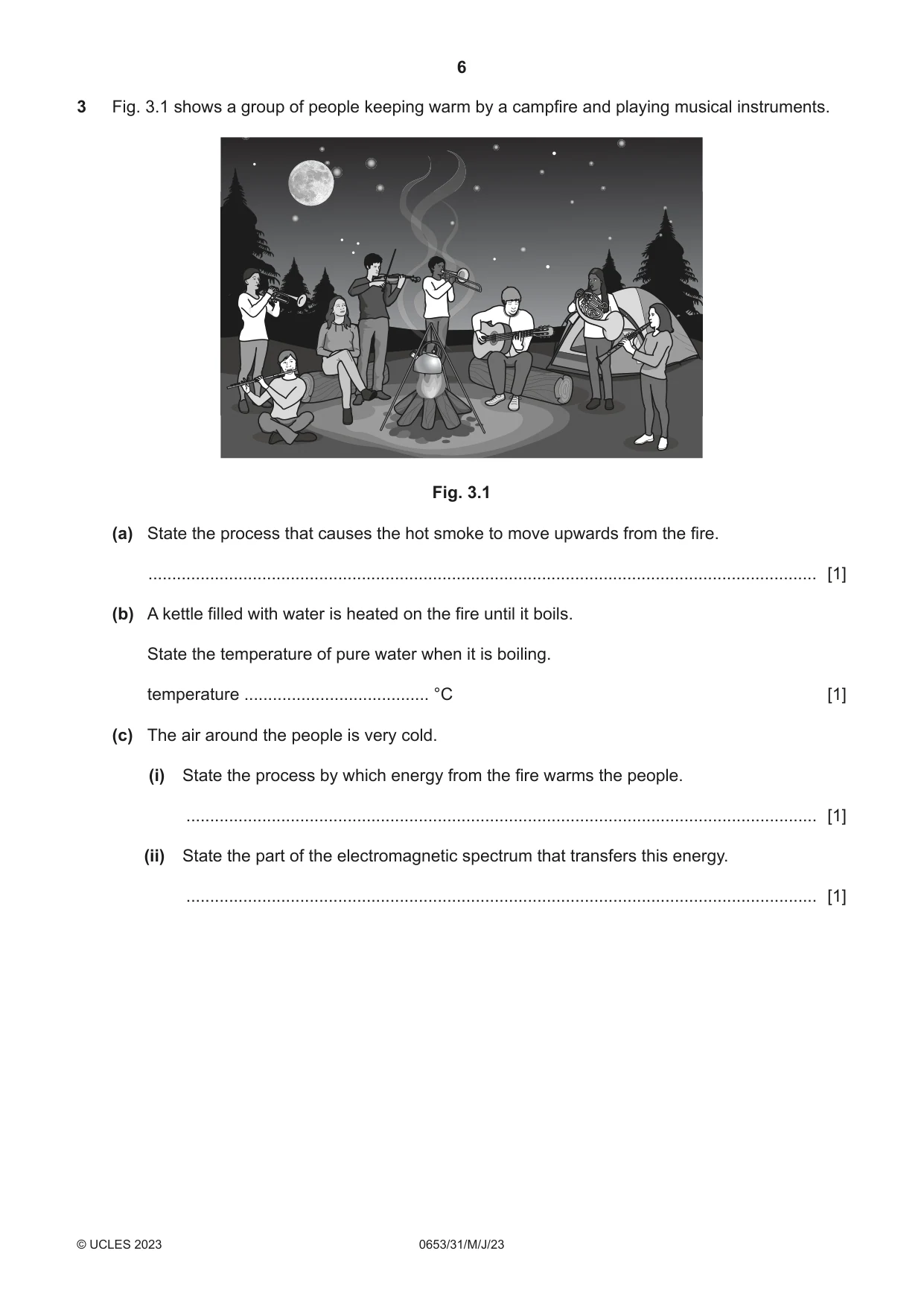
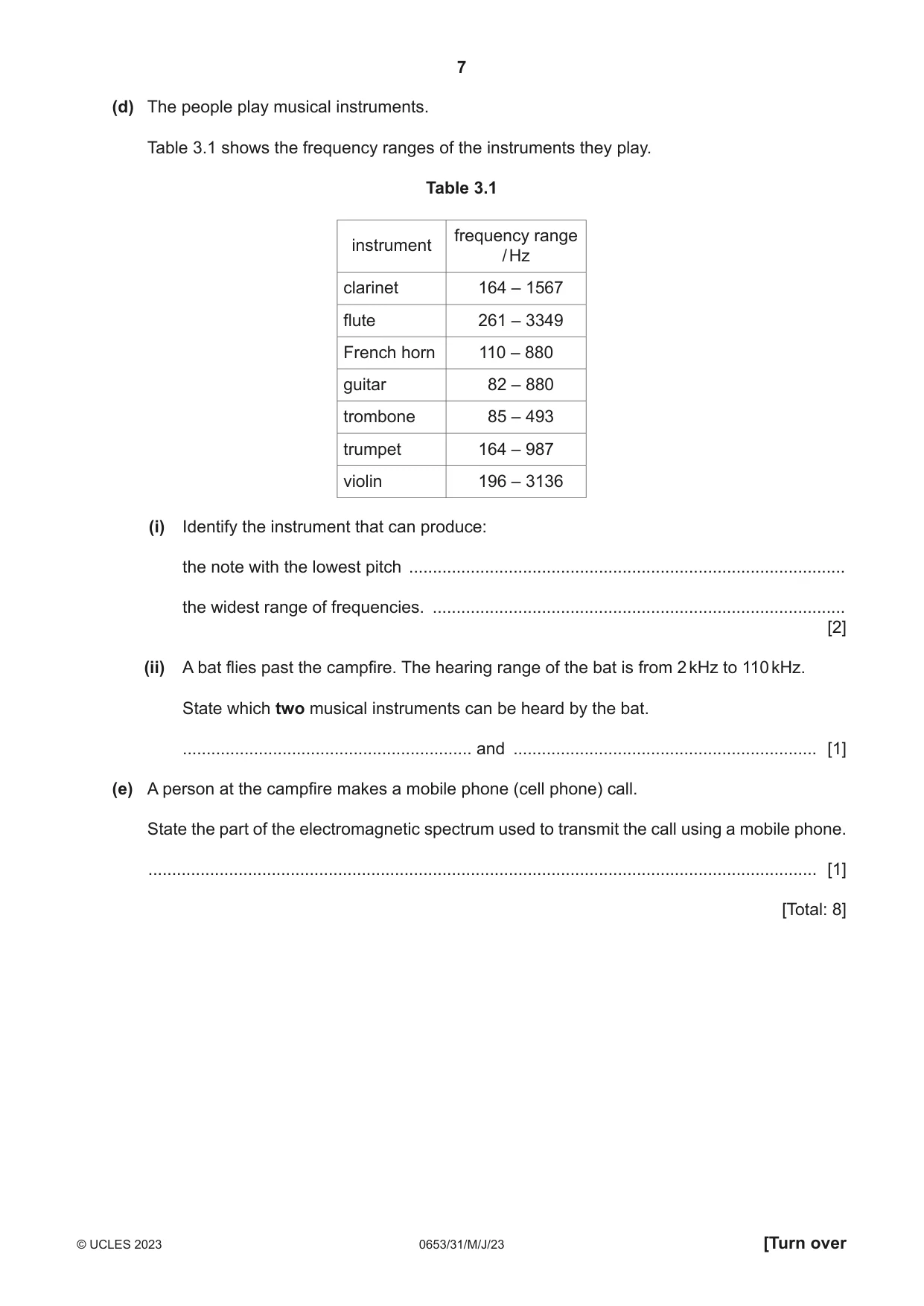
3 Fig. 3.1 shows a group of people keeping warm by a campfire and playing musical instruments. Fig. 3.1 (a) State the process that causes the hot smoke to move upwards from the fire. ............................................................................................................................................. [1] (b) A kettle filled with water is heated on the fire until it boils. State the temperature of pure water when it is boiling. temperature ....................................... °C [1] (c) The air around the people is very cold. (i) State the process by which energy from the fire warms the people. ..................................................................................................................................... [1] (ii) State the part of the electromagnetic spectrum that transfers this energy. ..................................................................................................................................... [1] (d) The people play musical instruments. Table 3.1 shows the frequency ranges of the instruments they play. Table 3.1 frequency range instrument / Hz clarinet 164 – 1567 flute 261 – 3349 French horn 110 – 880 guitar 82 – 880 trombone 85 – 493 trumpet 164 – 987 violin 196 – 3136 (i) Identify the instrument that can produce: the note with the lowest pitch ............................................................................................ the widest range of frequencies. ....................................................................................... [2] (ii) A bat flies past the campfire. The hearing range of the bat is from 2 kHz to 110 kHz. State which two musical instruments can be heard by the bat. ............................................................. and ................................................................ [1] (e) A person at the campfire makes a mobile phone (cell phone) call. State the part of the electromagnetic spectrum used to transmit the call using a mobile phone. ............................................................................................................................................. [1] [Total: 8]
Mark scheme: 3(a) convection ; 1 3(b) 100 (°C) ; 1 3(c)(i) radiation ; 1 3(c)(ii) infrared ; 1 3(d)(i) in this order: guitar ; flute ; 2 3(d)(ii) violin AND flute ; 1 3(e) microwave ; 1
Q4 · A model of the human gas exchange system
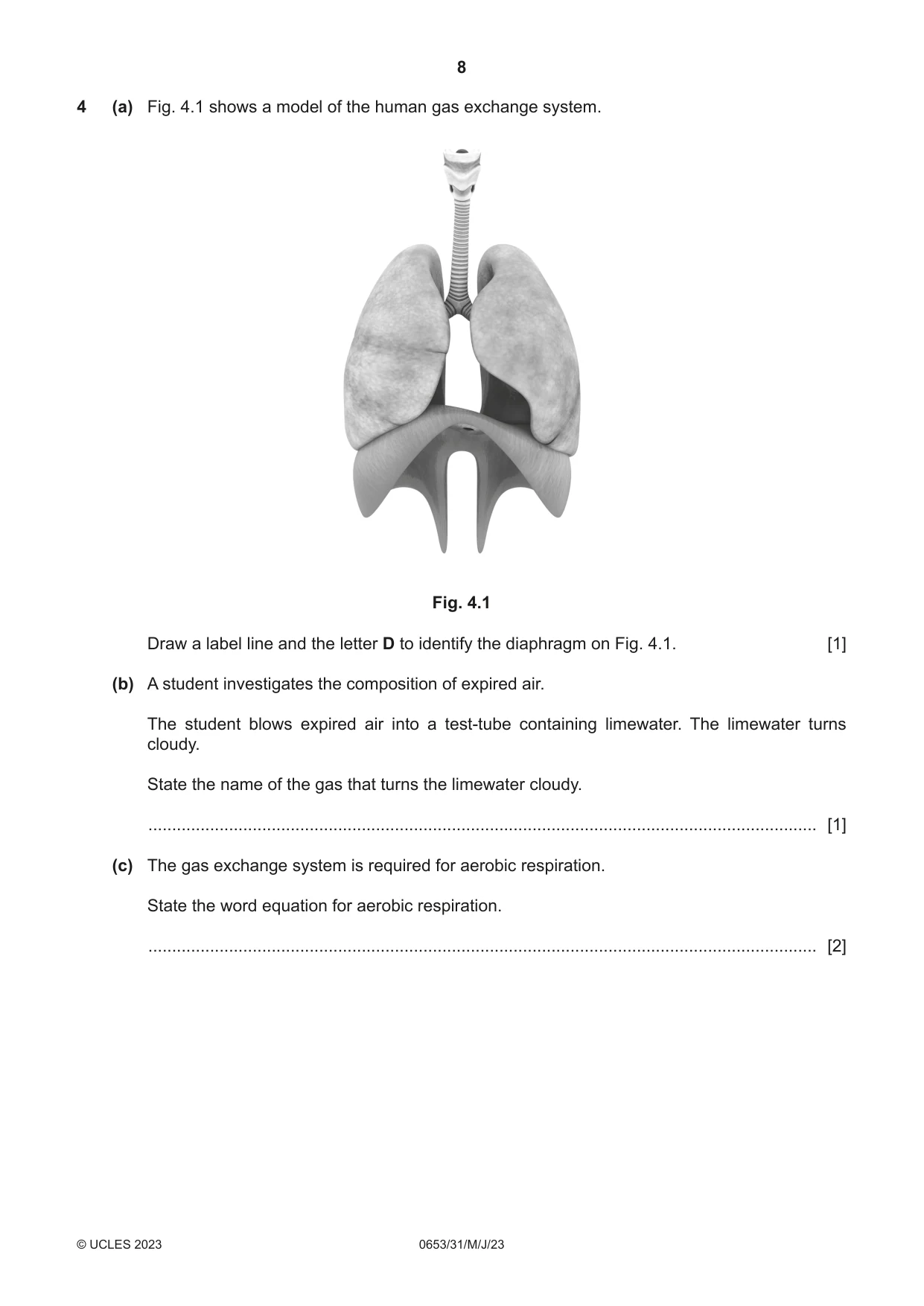
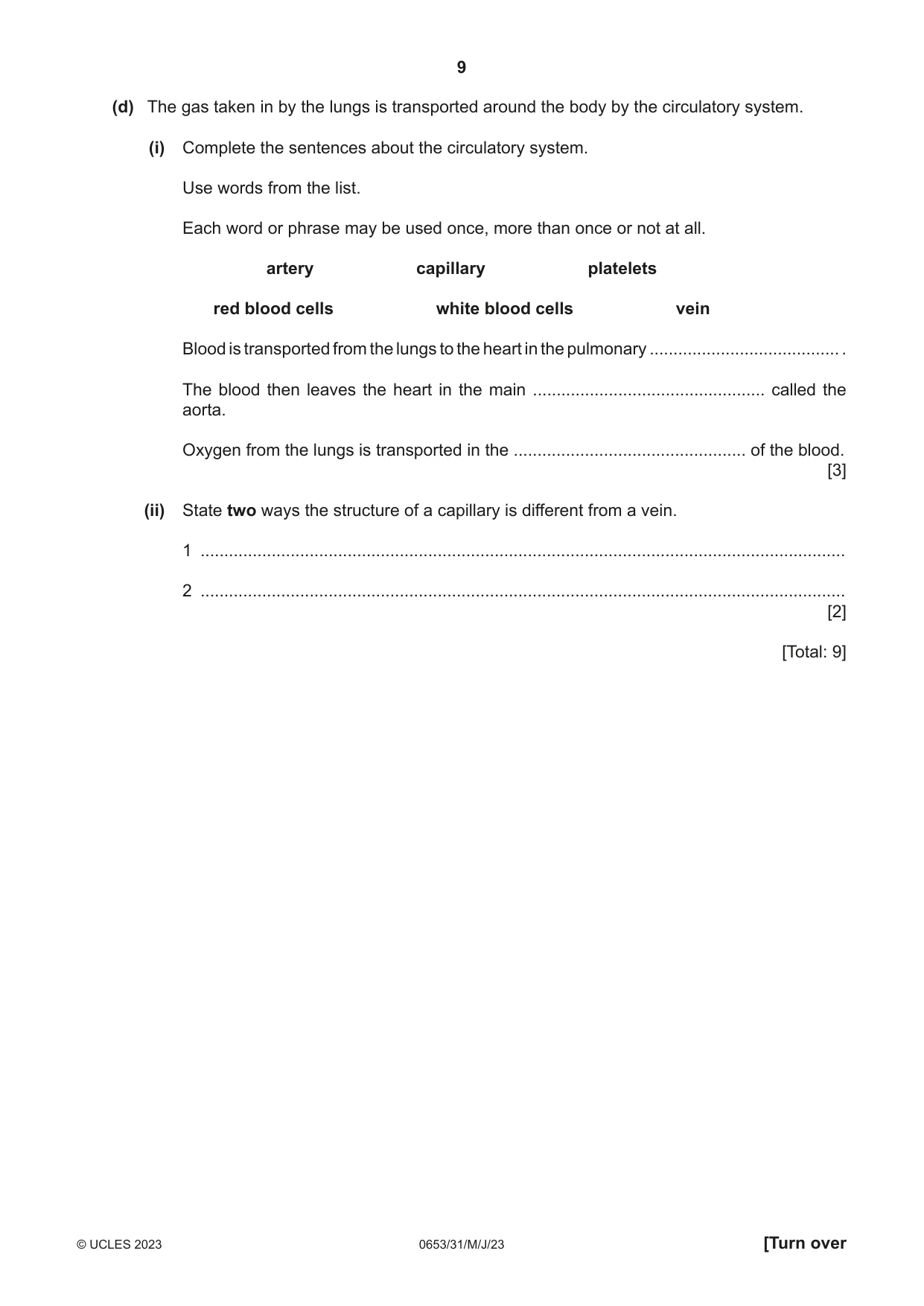
4 (a) Fig. 4.1 shows a model of the human gas exchange system. Fig. 4.1 Draw a label line and the letter D to identify the diaphragm on Fig. 4.1. [1] (b) A student investigates the composition of expired air. The student blows expired air into a test-tube containing limewater. The limewater turns cloudy. State the name of the gas that turns the limewater cloudy. ............................................................................................................................................. [1] (c) The gas exchange system is required for aerobic respiration. State the word equation for aerobic respiration. ............................................................................................................................................. [2] (d) The gas taken in by the lungs is transported around the body by the circulatory system. (i) Complete the sentences about the circulatory system. Use words from the list. Each word or phrase may be used once, more than once or not at all. artery capillary platelets red blood cells white blood cells vein Blood is transported from the lungs to the heart in the pulmonary ........................................ . The blood then leaves the heart in the main ................................................. called the aorta. Oxygen from the lungs is transported in the ................................................. of the blood. [3] (ii) State two ways the structure of a capillary is different from a vein. 1 ........................................................................................................................................ 2 ........................................................................................................................................ [2] [Total: 9]
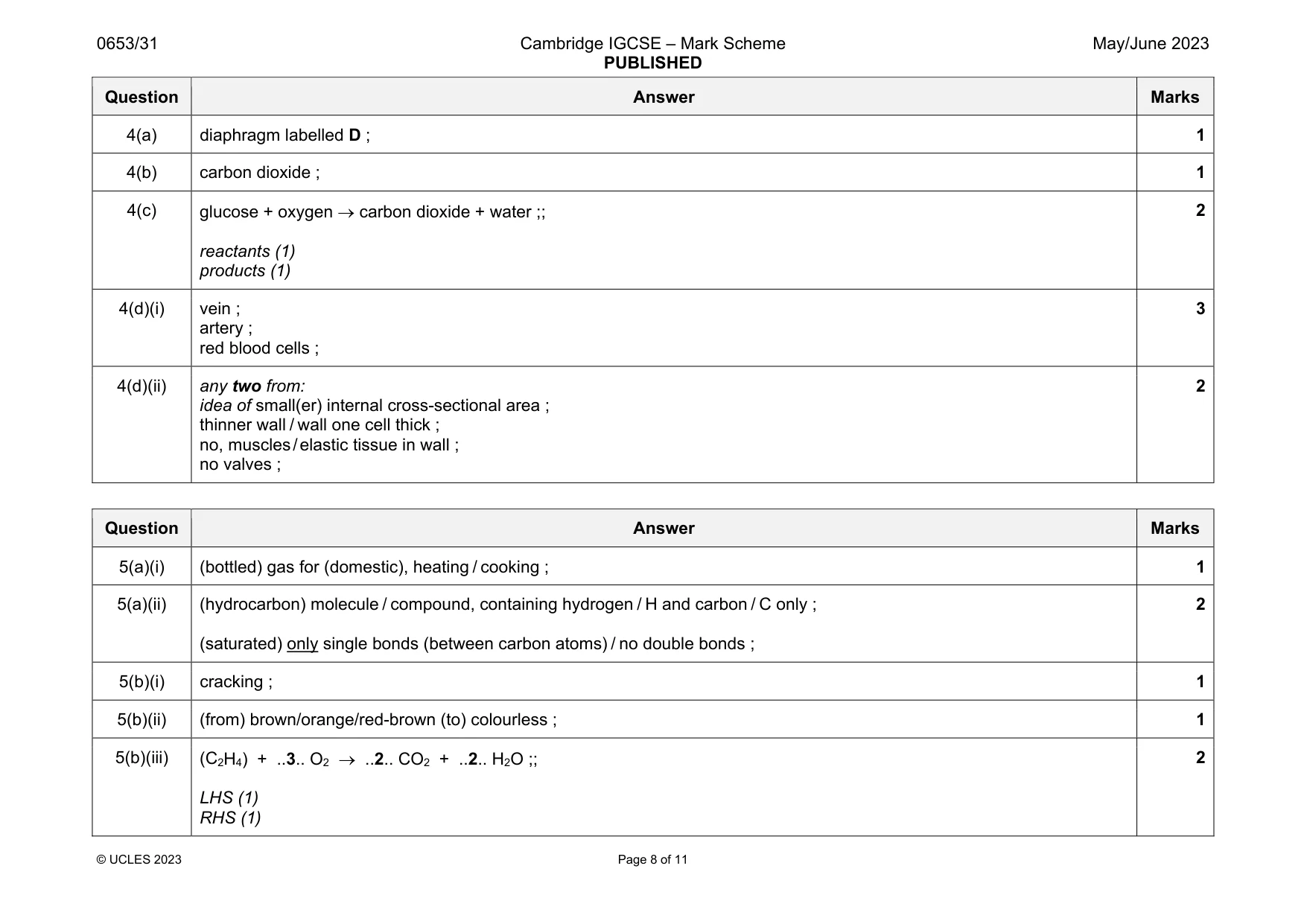
Mark scheme: 4(a) diaphragm labelled D ; 1 4(b) carbon dioxide ; 1 4(c) glucose + oxygen carbon dioxide + water ;; reactants (1) products (1) 2 4(d)(i) vein ; artery ; red blood cells ; 3 4(d)(ii) any two from: idea of small(er) internal cross-sectional area ; thinner wall / wall one cell thick ; no, muscles / elastic tissue in wall ; no valves ; 2
Q5 · Ethane, C2H6, is an alkane
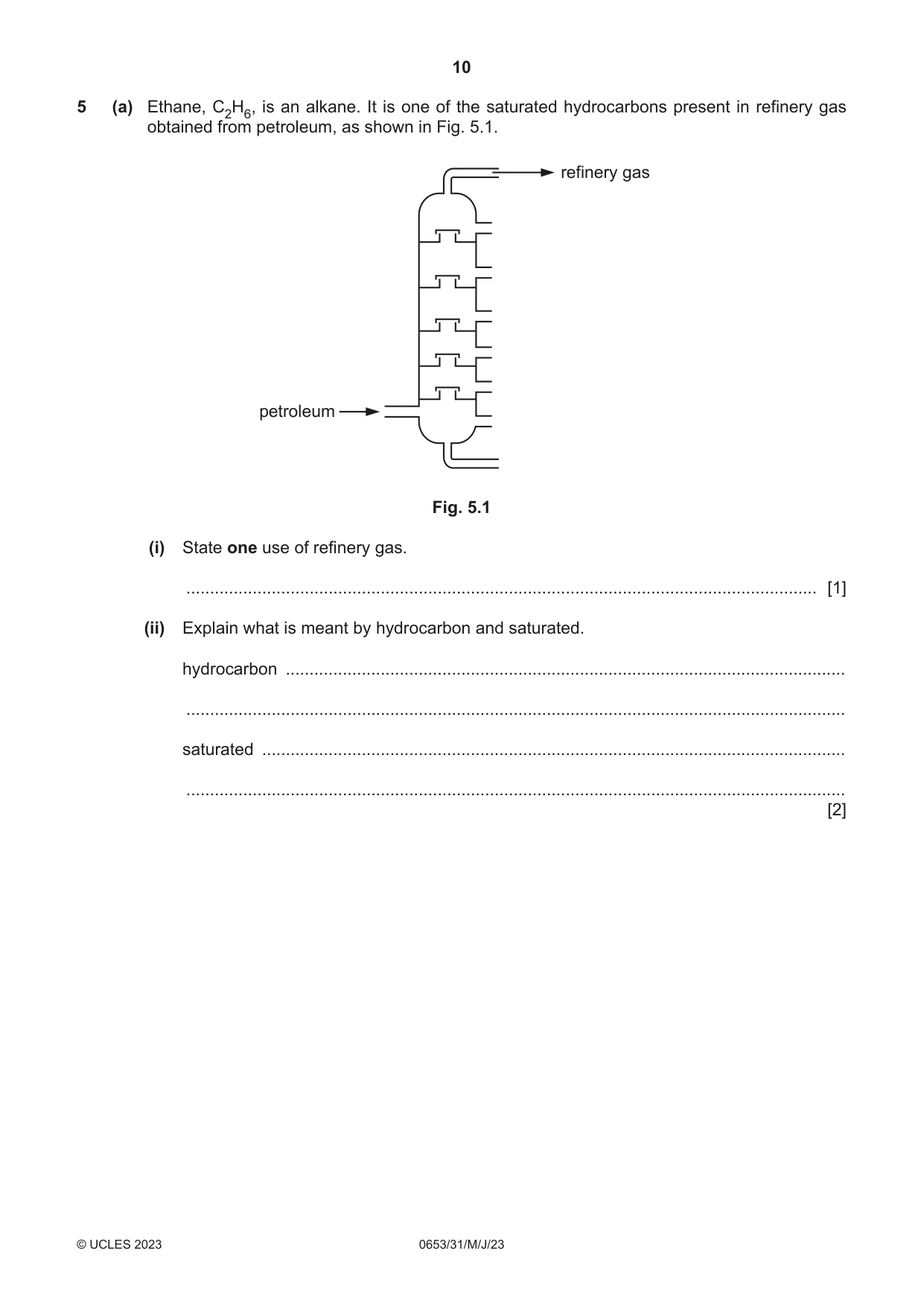
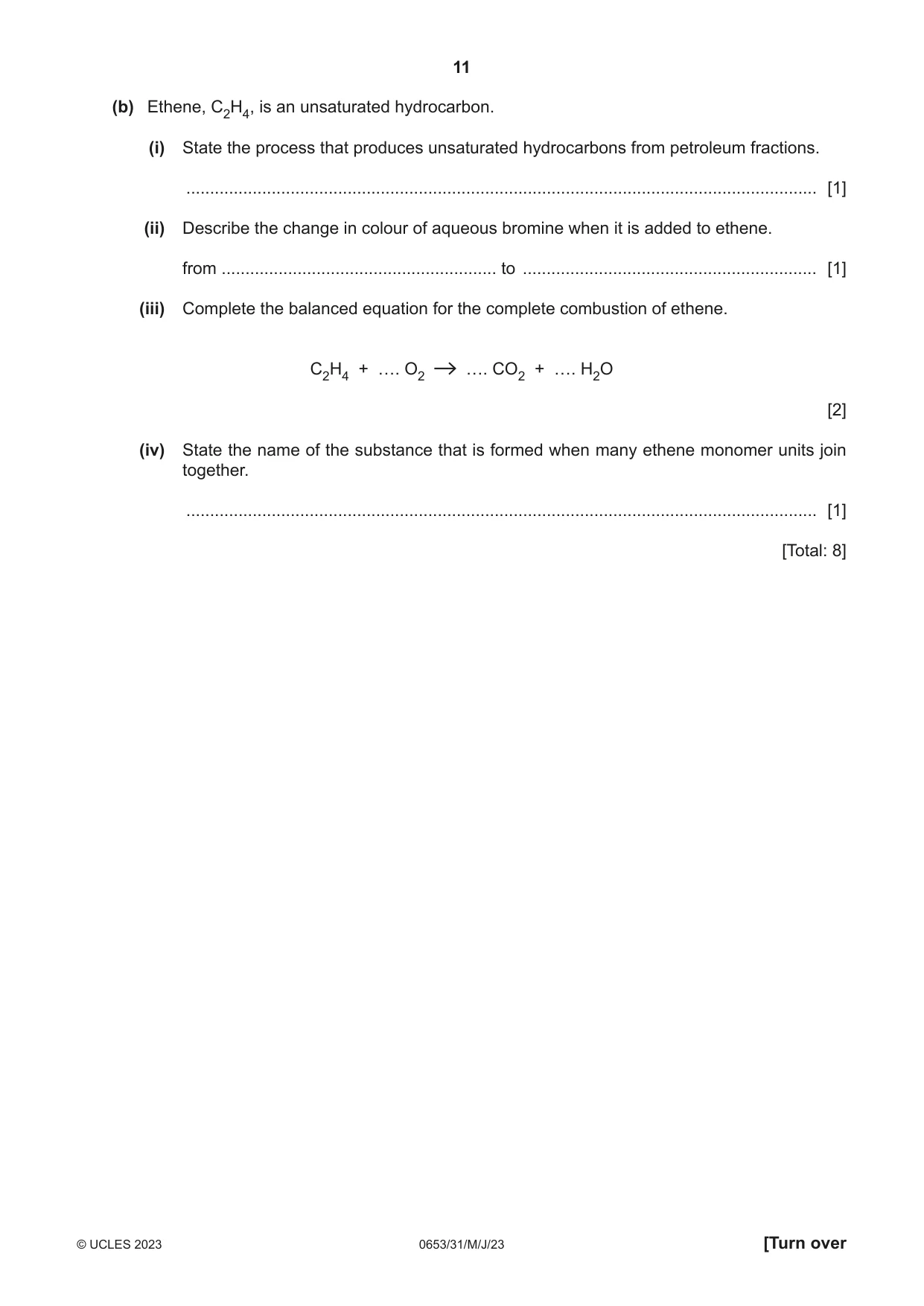
5 (a) Ethane, C2H6, is an alkane. It is one of the saturated hydrocarbons present in refinery gas obtained from petroleum, as shown in Fig. 5.1. refinery gas petroleum Fig. 5.1 (i) State one use of refinery gas. ..................................................................................................................................... [1] (ii) Explain what is meant by hydrocarbon and saturated. hydrocarbon ...................................................................................................................... ........................................................................................................................................... saturated ........................................................................................................................... ........................................................................................................................................... [2] (b) Ethene, C2H4, is an unsaturated hydrocarbon. (i) State the process that produces unsaturated hydrocarbons from petroleum fractions. ..................................................................................................................................... [1] (ii) Describe the change in colour of aqueous bromine when it is added to ethene. from .......................................................... to .............................................................. [1] (iii) Complete the balanced equation for the complete combustion of ethene. C2H4 + …. O2 …. CO2 + …. H2O [2] (iv) State the name of the substance that is formed when many ethene monomer units join together. ..................................................................................................................................... [1] [Total: 8]
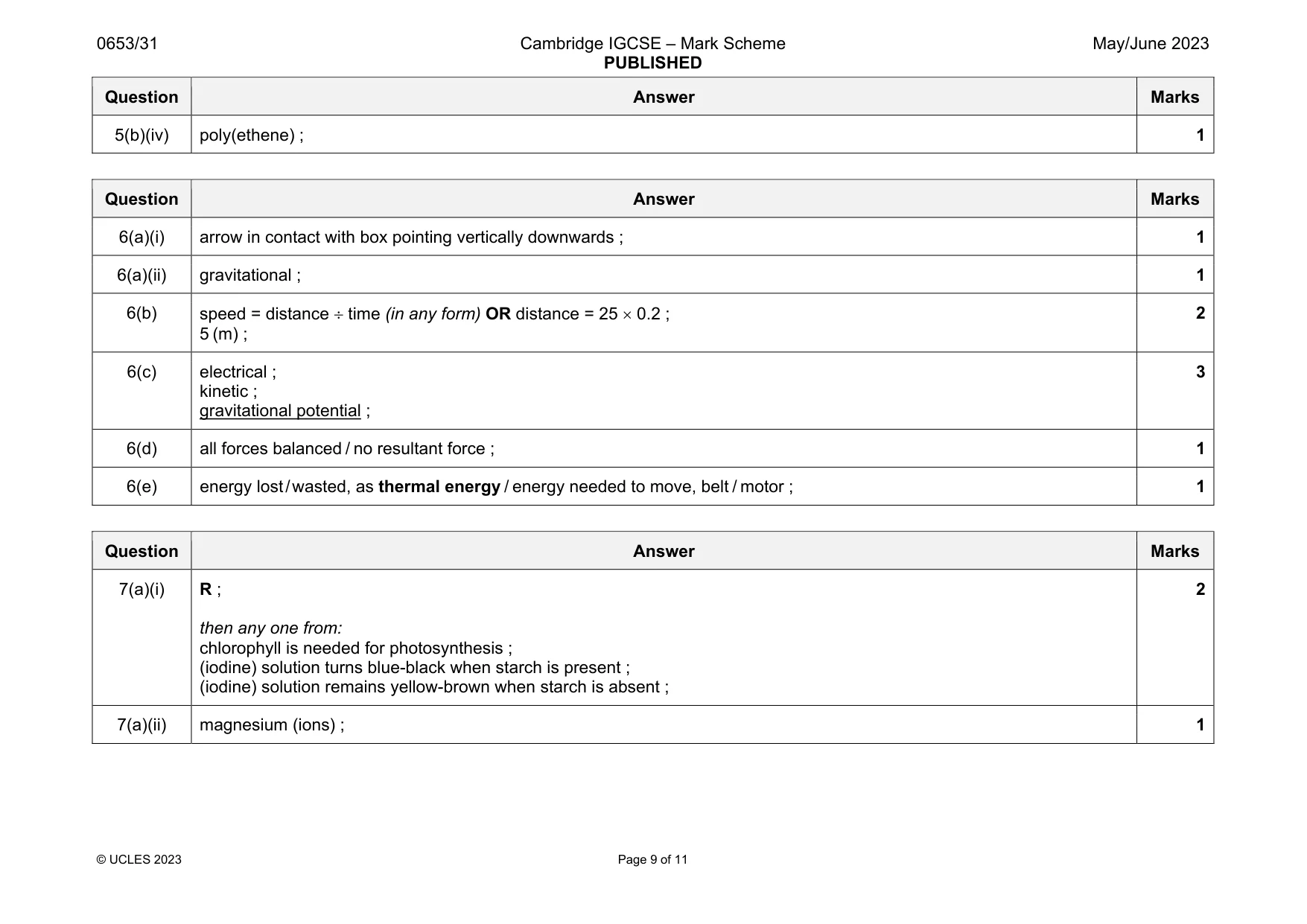
Mark scheme: 5(a)(i) (bottled) gas for (domestic), heating / cooking ; 1 5(a)(ii) (hydrocarbon) molecule / compound, containing hydrogen / H and carbon / C only ; (saturated) only single bonds (between carbon atoms) / no double bonds ; 2 5(b)(i) cracking ; 1 5(b)(ii) (from) brown/orange/red-brown (to) colourless ; 1 5(b)(iii) (C2H4) + ..3.. O2 ..2.. CO2 + ..2.. H2O ;; LHS (1) RHS (1) 2 Question Answer Marks 5(b)(iv) poly(ethene) ; 1
Q6 · A moving conveyor belt carrying a box from the ground up to an aircraft
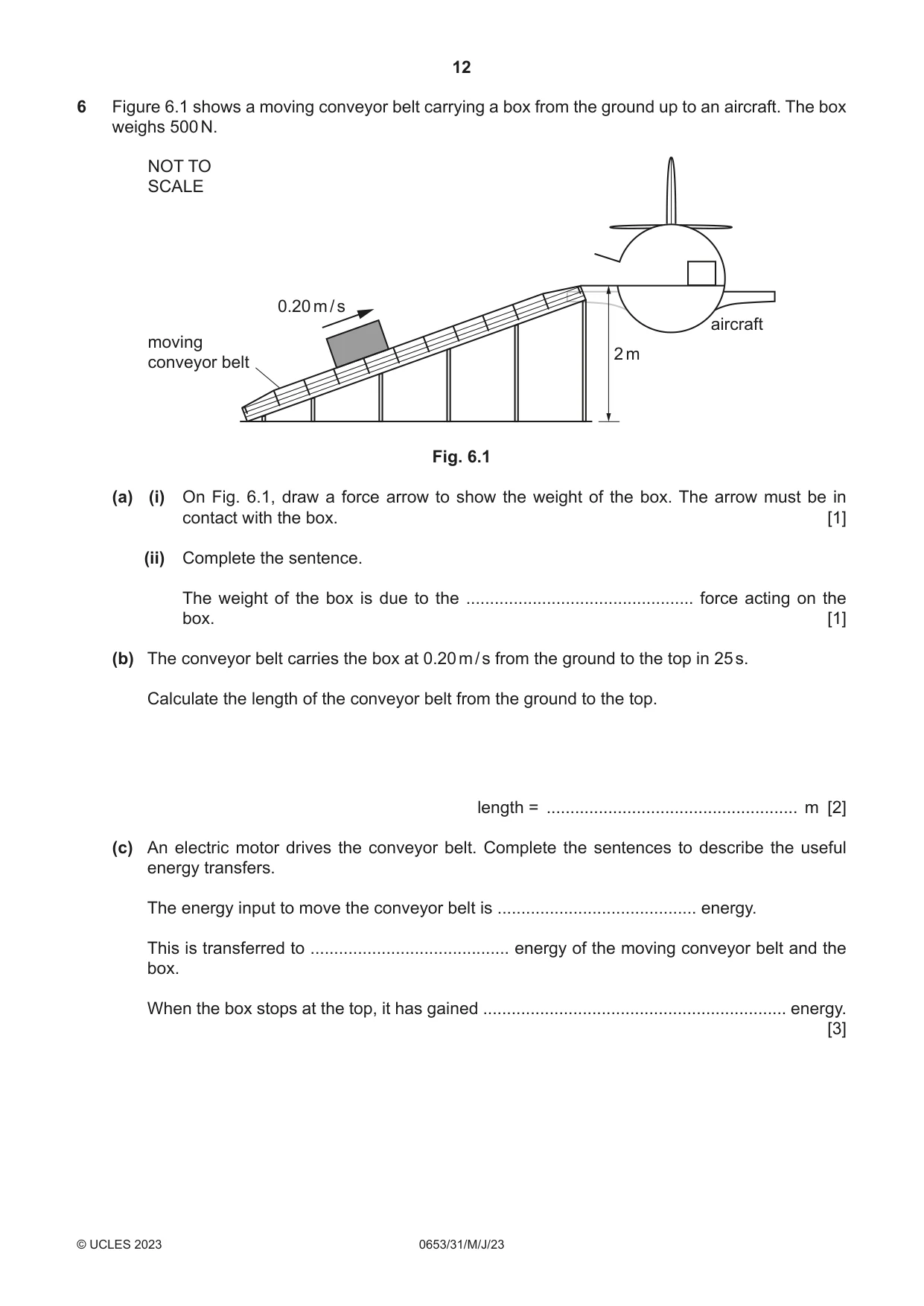
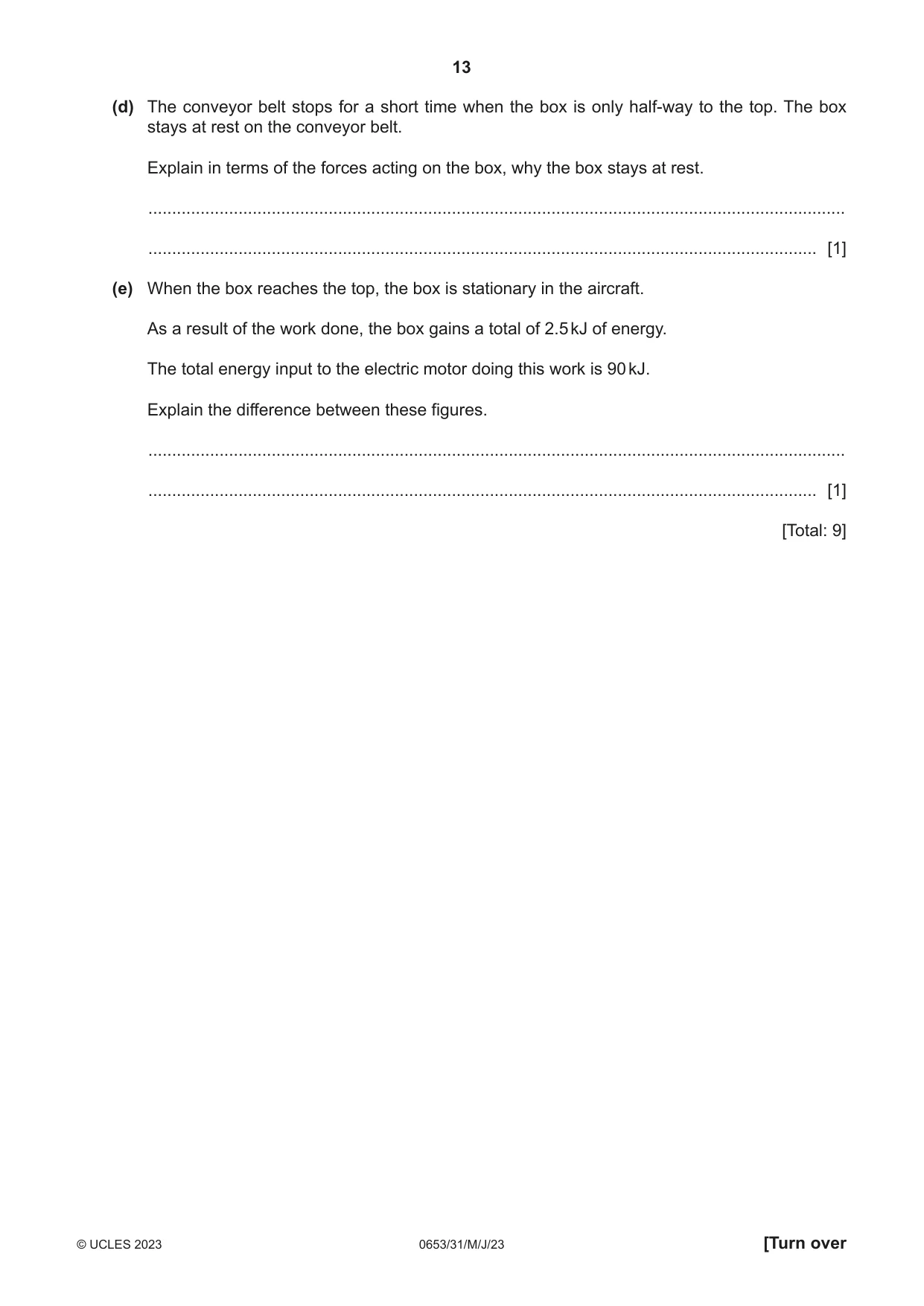
6 Figure 6.1 shows a moving conveyor belt carrying a box from the ground up to an aircraft. The box weighs 500 N. NOT TO SCALE 0.20 m / s aircraft moving 2 m conveyor belt Fig. 6.1 (a) (i) On Fig. 6.1, draw a force arrow to show the weight of the box. The arrow must be in contact with the box. [1] (ii) Complete the sentence. The weight of the box is due to the ................................................ force acting on the box. [1] (b) The conveyor belt carries the box at 0.20 m / s from the ground to the top in 25 s. Calculate the length of the conveyor belt from the ground to the top. length = ..................................................... m [2] (c) An electric motor drives the conveyor belt. Complete the sentences to describe the useful energy transfers. The energy input to move the conveyor belt is .......................................... energy. This is transferred to .......................................... energy of the moving conveyor belt and the box. When the box stops at the top, it has gained ................................................................ energy. [3] (d) The conveyor belt stops for a short time when the box is only half-way to the top. The box stays at rest on the conveyor belt. Explain in terms of the forces acting on the box, why the box stays at rest. ................................................................................................................................................... ............................................................................................................................................. [1] (e) When the box reaches the top, the box is stationary in the aircraft. As a result of the work done, the box gains a total of 2.5 kJ of energy. The total energy input to the electric motor doing this work is 90 kJ. Explain the difference between these figures. ................................................................................................................................................... ............................................................................................................................................. [1] [Total: 9]
Mark scheme: 6(a)(i) arrow in contact with box pointing vertically downwards ; 1 6(a)(ii) gravitational ; 1 6(b) speed = distance time (in any form) OR distance = 25 0.2 ; 5 (m) ; 2 6(c) electrical ; kinetic ; gravitational potential ; 3 6(d) all forces balanced / no resultant force ; 1 6(e) energy lost / wasted, as thermal energy / energy needed to move, belt / motor ; 1
Q7 · The leaves of some plants have green and white areas
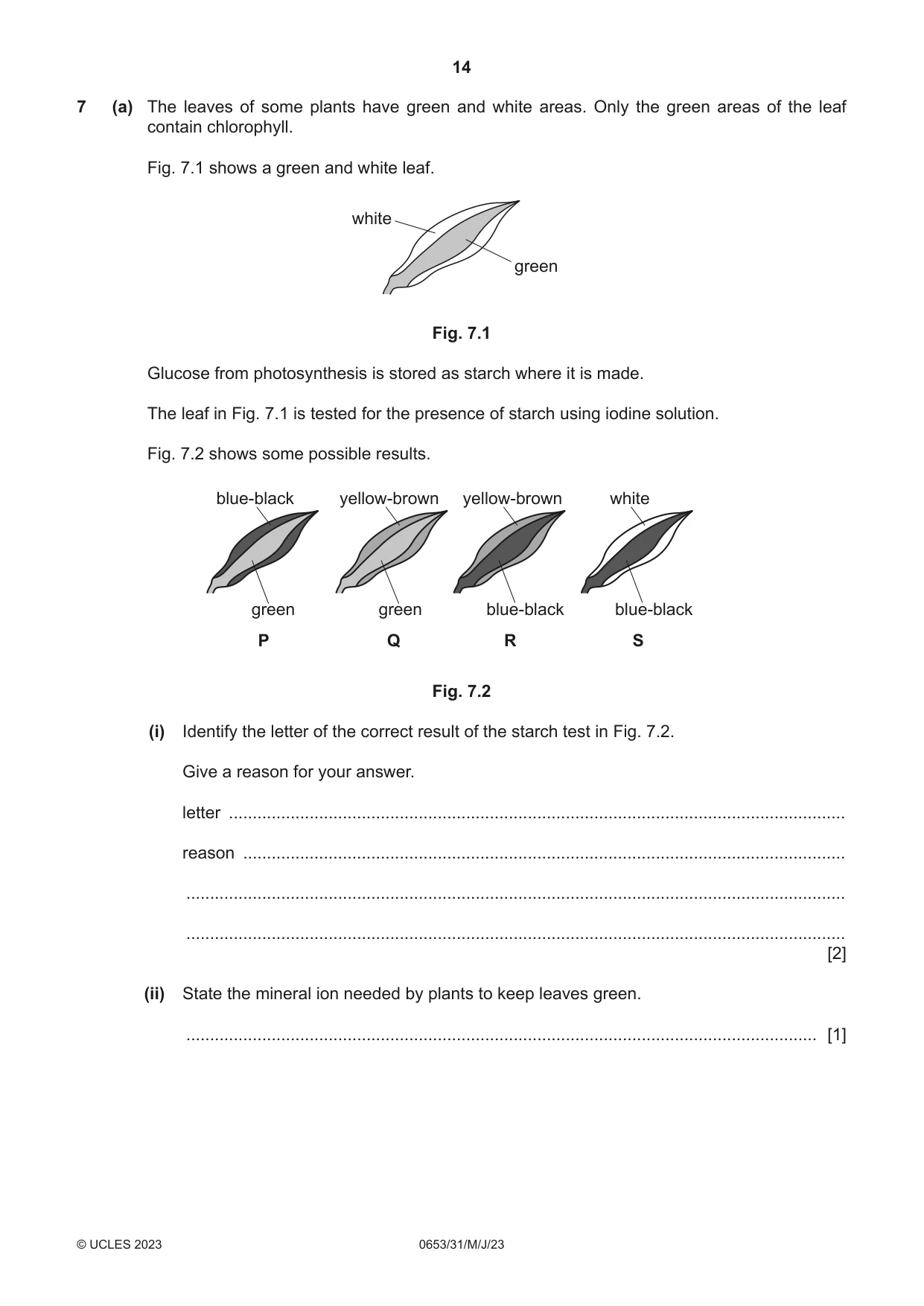
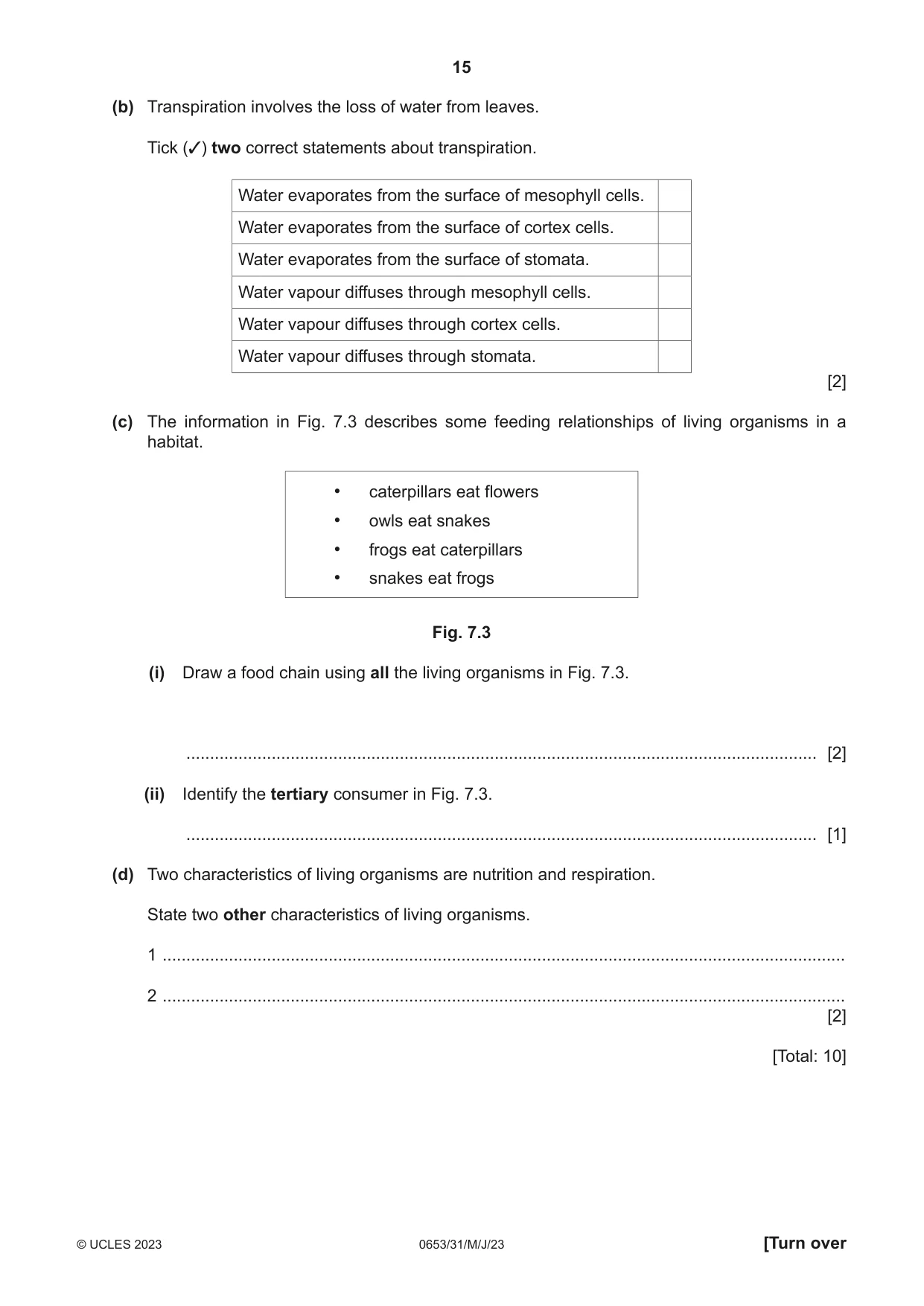
7 (a) The leaves of some plants have green and white areas. Only the green areas of the leaf contain chlorophyll. Fig. 7.1 shows a green and white leaf. white green Fig. 7.1 Glucose from photosynthesis is stored as starch where it is made. The leaf in Fig. 7.1 is tested for the presence of starch using iodine solution. Fig. 7.2 shows some possible results. blue-black yellow-brown yellow-brown white green green blue-black blue-black P Q R S Fig. 7.2 (i) Identify the letter of the correct result of the starch test in Fig. 7.2. Give a reason for your answer. letter .................................................................................................................................. reason ............................................................................................................................... ........................................................................................................................................... ........................................................................................................................................... [2] (ii) State the mineral ion needed by plants to keep leaves green. ..................................................................................................................................... [1] (b) Transpiration involves the loss of water from leaves. Tick (3) two correct statements about transpiration. Water evaporates from the surface of mesophyll cells. Water evaporates from the surface of cortex cells. Water evaporates from the surface of stomata. Water vapour diffuses through mesophyll cells. Water vapour diffuses through cortex cells. Water vapour diffuses through stomata. [2] (c) The information in Fig. 7.3 describes some feeding relationships of living organisms in a habitat. • caterpillars eat flowers • owls eat snakes • frogs eat caterpillars • snakes eat frogs Fig. 7.3 (i) Draw a food chain using all the living organisms in Fig. 7.3. ..................................................................................................................................... [2] (ii) Identify the tertiary consumer in Fig. 7.3. ..................................................................................................................................... [1] (d) Two characteristics of living organisms are nutrition and respiration. State two other characteristics of living organisms. 1 ................................................................................................................................................ 2 ................................................................................................................................................ [2] [Total: 10]
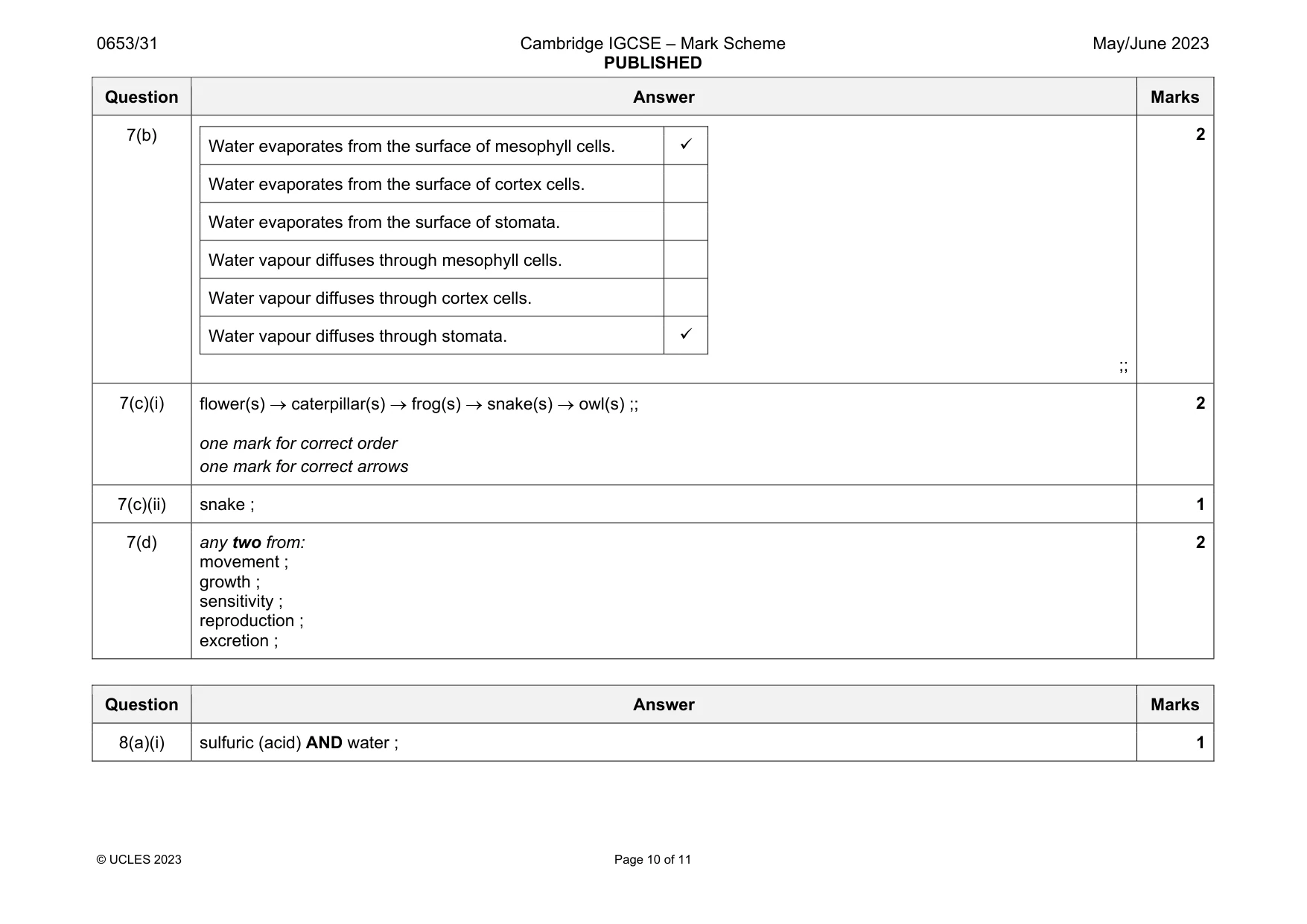
Mark scheme: 7(a)(i) R ; then any one from: chlorophyll is needed for photosynthesis ; (iodine) solution turns blue-black when starch is present ; (iodine) solution remains yellow-brown when starch is absent ; 7(a)(ii) magnesium (ions) ; 1 Question Answer Marks 7(b) Water evaporates from the surface of mesophyll cells. Water evaporates from the surface of cortex cells. Water evaporates from the surface of stomata. Water vapour diffuses through mesophyll cells. Water vapour diffuses through cortex cells. Water vapour diffuses through stomata. ;; 2 7(c)(i) flower(s) caterpillar(s) frog(s) snake(s) owl(s) ;; one mark for correct order one mark for correct arrows 2 7(c)(ii) snake ; 1 7(d) any two from: movement ; growth ; sensitivity ; reproduction ; excretion ; 2
Q8 · Copper(II) sulfate, CuSO4, can be made by reacting copper(II) oxide, CuO, with a dilute…
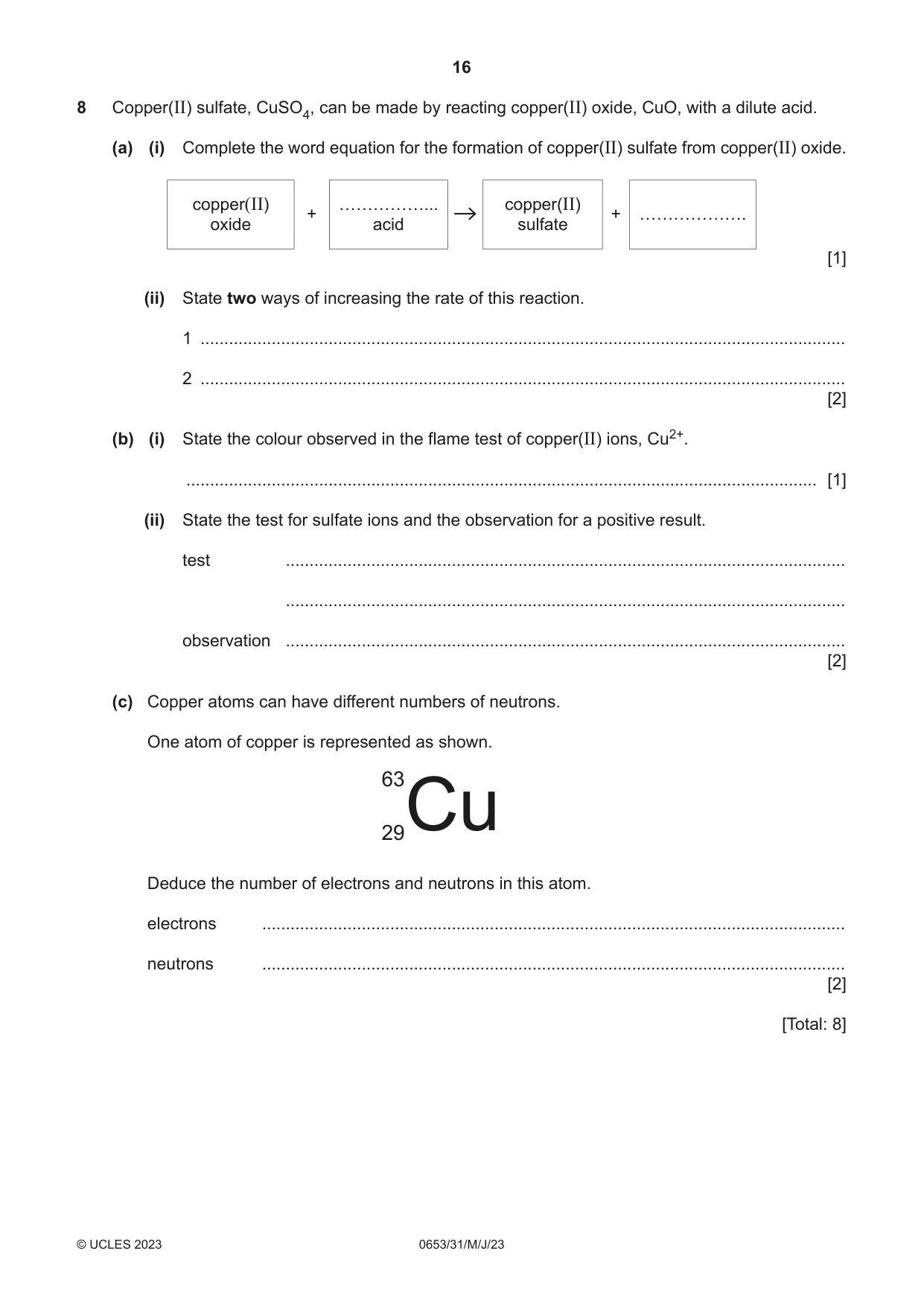
8 Copper(II) sulfate, CuSO4, can be made by reacting copper(II) oxide, CuO, with a dilute acid. (a) (i) Complete the word equation for the formation of copper(II) sulfate from copper(II) oxide. copper(II) ……………... copper(II) + + ………………. oxide acid sulfate [1] (ii) State two ways of increasing the rate of this reaction. 1 ........................................................................................................................................ 2 ........................................................................................................................................ [2] (b) (i) State the colour observed in the flame test of copper(II) ions, Cu2+. ..................................................................................................................................... [1] (ii) State the test for sulfate ions and the observation for a positive result. test ...................................................................................................................... ...................................................................................................................... observation ...................................................................................................................... [2] (c) Copper atoms can have different numbers of neutrons. One atom of copper is represented as shown. 63 29Cu Deduce the number of electrons and neutrons in this atom. electrons ........................................................................................................................... neutrons ........................................................................................................................... [2] [Total: 8]
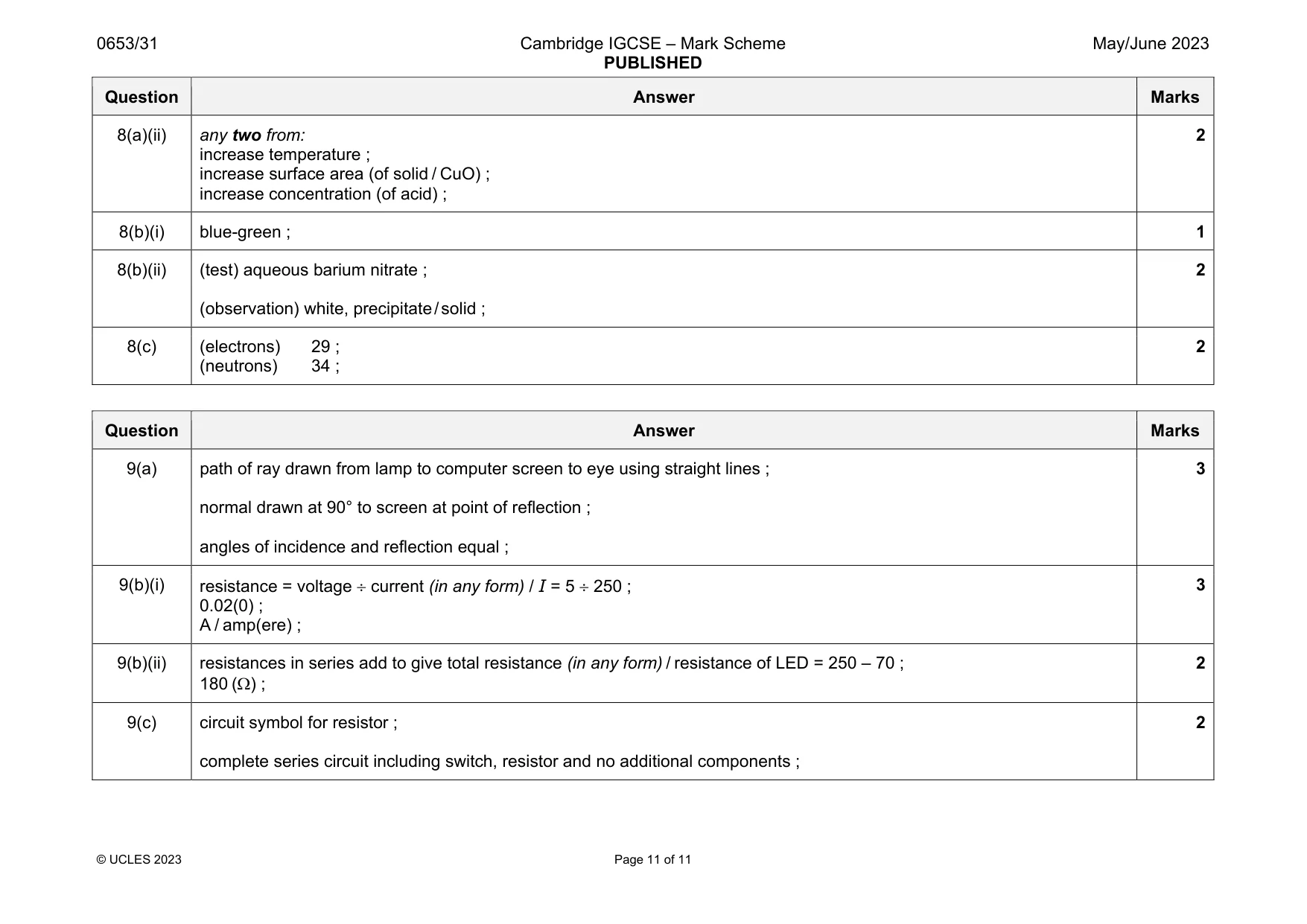
Mark scheme: 8(a)(i) sulfuric (acid) AND water ; 1 Question Answer Marks 8(a)(ii) any two from: increase temperature ; increase surface area (of solid / CuO) ; increase concentration (of acid) ; 2 8(b)(i) blue-green ; 1 8(b)(ii) (test) aqueous barium nitrate ; (observation) white, precipitate / solid ; 2 8(c) (electrons) 29 ; (neutrons) 34 ; 2
Q9 · A student using a laptop computer
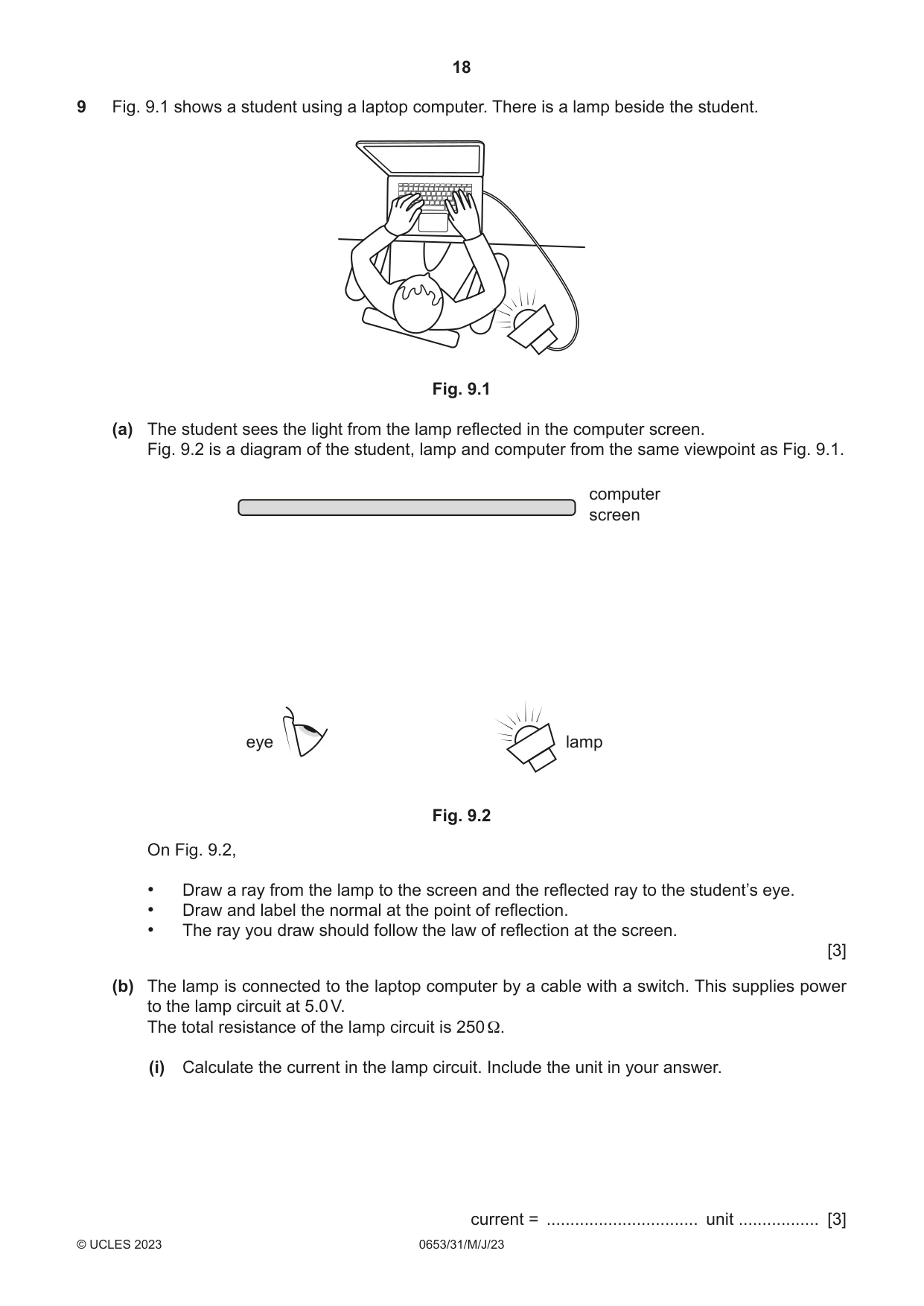
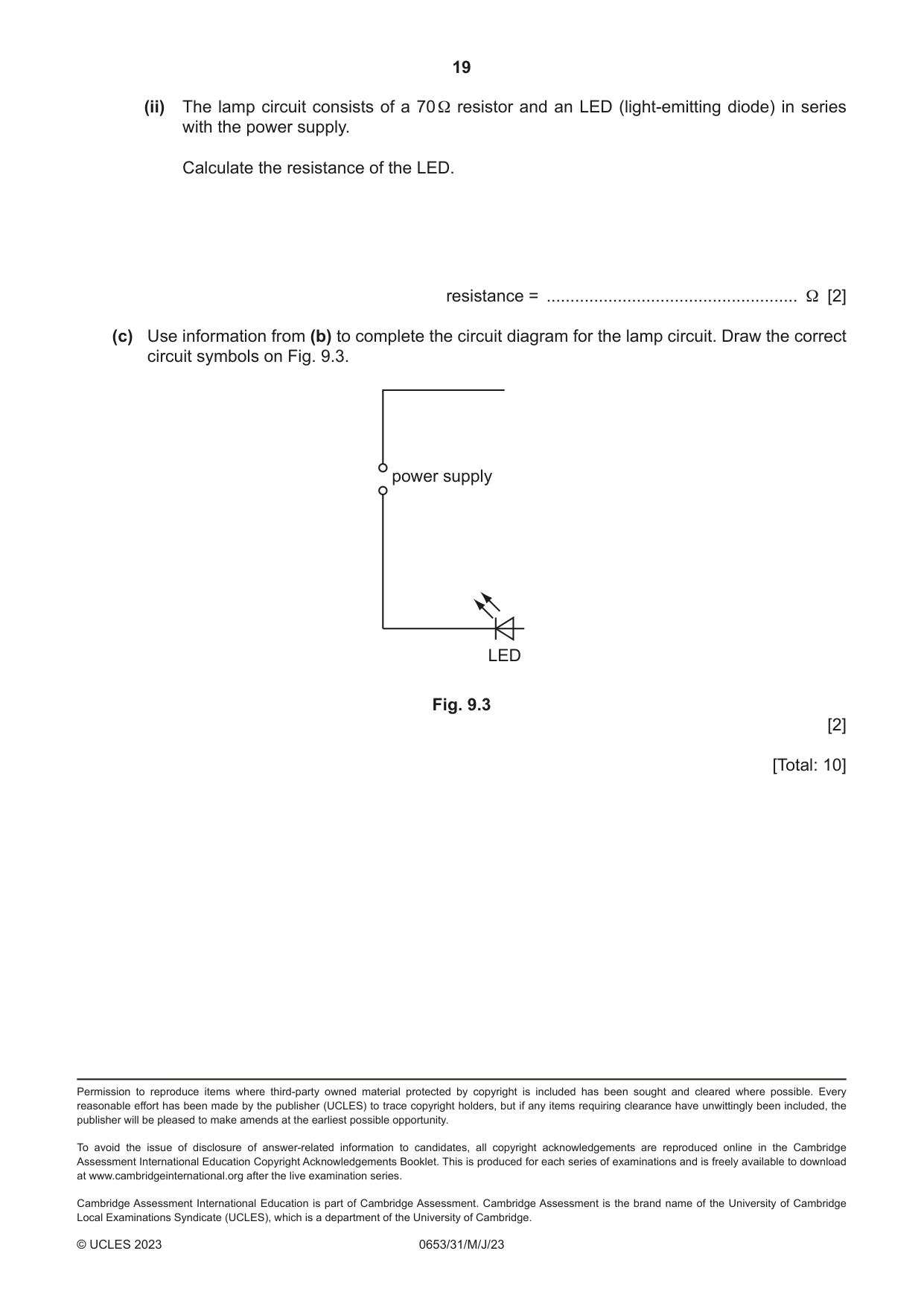
9 Fig. 9.1 shows a student using a laptop computer. There is a lamp beside the student. Fig. 9.1 (a) The student sees the light from the lamp reflected in the computer screen. Fig. 9.2 is a diagram of the student, lamp and computer from the same viewpoint as Fig. 9.1. computer screen eye lamp Fig. 9.2 On Fig. 9.2, • Draw a ray from the lamp to the screen and the reflected ray to the student’s eye. • Draw and label the normal at the point of reflection. • The ray you draw should follow the law of reflection at the screen. [3] (b) The lamp is connected to the laptop computer by a cable with a switch. This supplies power to the lamp circuit at 5.0 V. The total resistance of the lamp circuit is 250 Ω. (i) Calculate the current in the lamp circuit. Include the unit in your answer. current = ................................ unit ................. [3] (ii) The lamp circuit consists of a 70 Ω resistor and an LED (light-emitting diode) in series with the power supply. Calculate the resistance of the LED. resistance = ..................................................... Ω [2] (c) Use information from (b) to complete the circuit diagram for the lamp circuit. Draw the correct circuit symbols on Fig. 9.3. power supply LED Fig. 9.3 [2] [Total: 10]
Mark scheme: 9(a) path of ray drawn from lamp to computer screen to eye using straight lines ; normal drawn at 90° to screen at point of reflection ; angles of incidence and reflection equal ; 9(b)(i) resistance = voltage current (in any form) / I = 5 250 ; 0.02(0) ; A / amp(ere) ; 3 9(b)(ii) resistances in series add to give total resistance (in any form) / resistance of LED = 250 – 70 ; 180 () ; 2 9(c) circuit symbol for resistor ; complete series circuit including switch, resistor and no additional components ; 2
What was in this paper
The subtopics covered by these 9 questions, and how many questions each got. Open one in a new tab to see every Cambridge question on it.
What you needed in this session
Cambridge’s own grade thresholds for 2023 May/June, Paper 3 · Variant 1. A higher threshold means an easier paper — the bar moves with how the cohort did.