Cambridge IGCSE Science - Combined 0653 — 2020 Oct/Nov Paper 3 · Variant 3
0653/33/O/N/20 · 9 questions · 80 marks · ≈90 min
The question paper and its mark scheme, free to read here and free to download. This is Cambridge’s own paper, exactly as it was sat.
Question paper20 pages

Mark scheme10 pages
Answers below. Sit the paper first if you are practising.
Questions as text
Q1 · A diagram of muscle cells
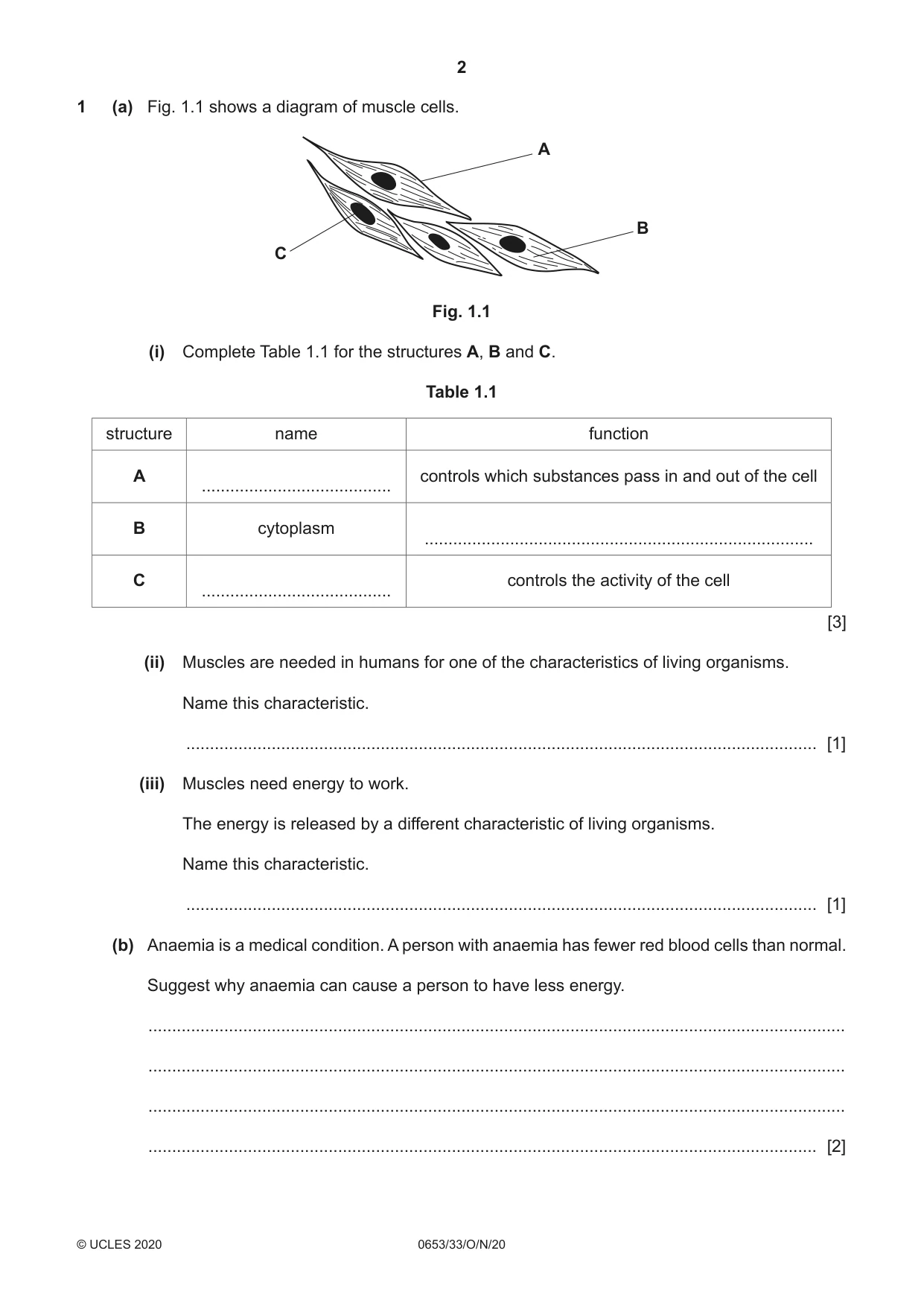
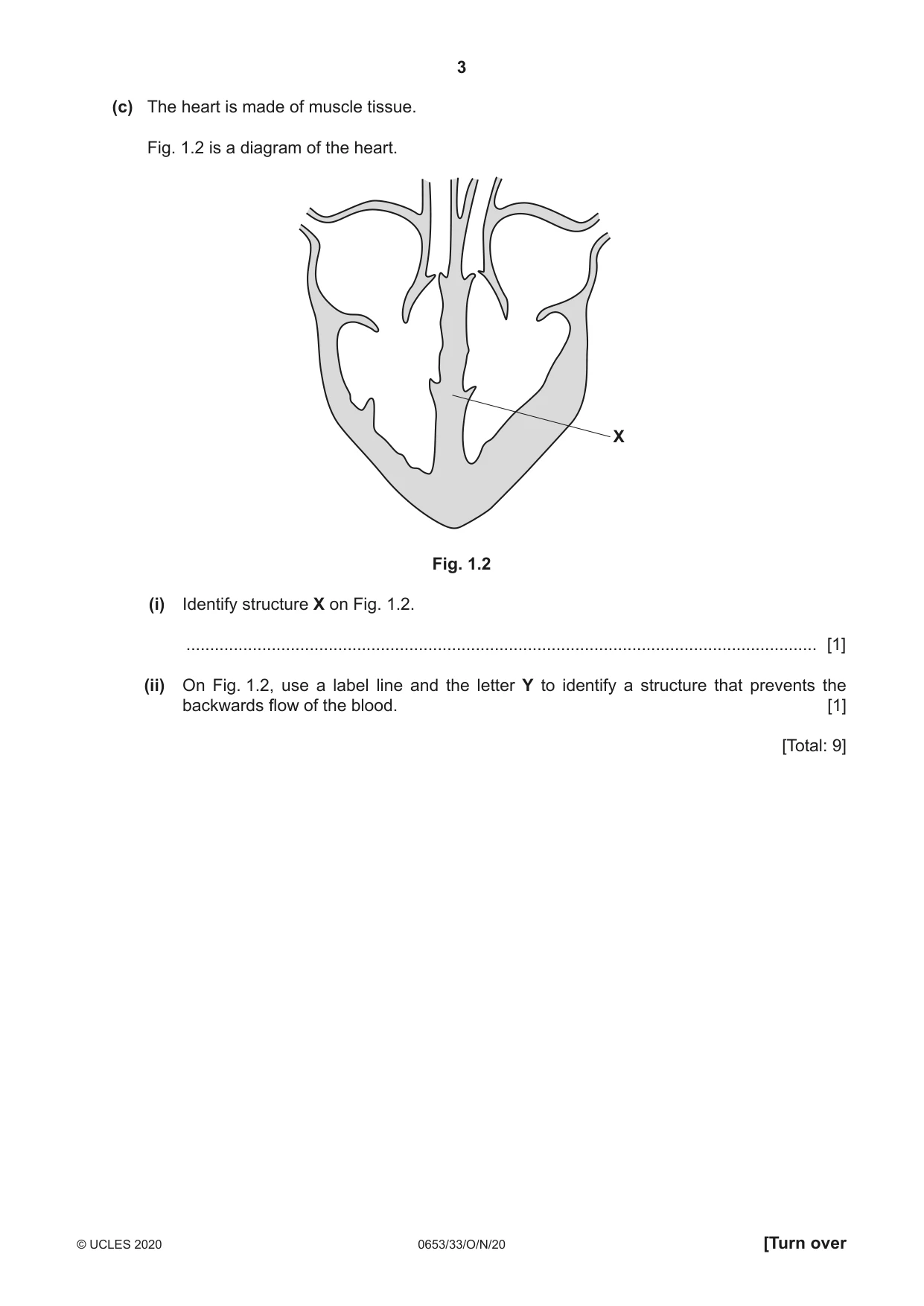
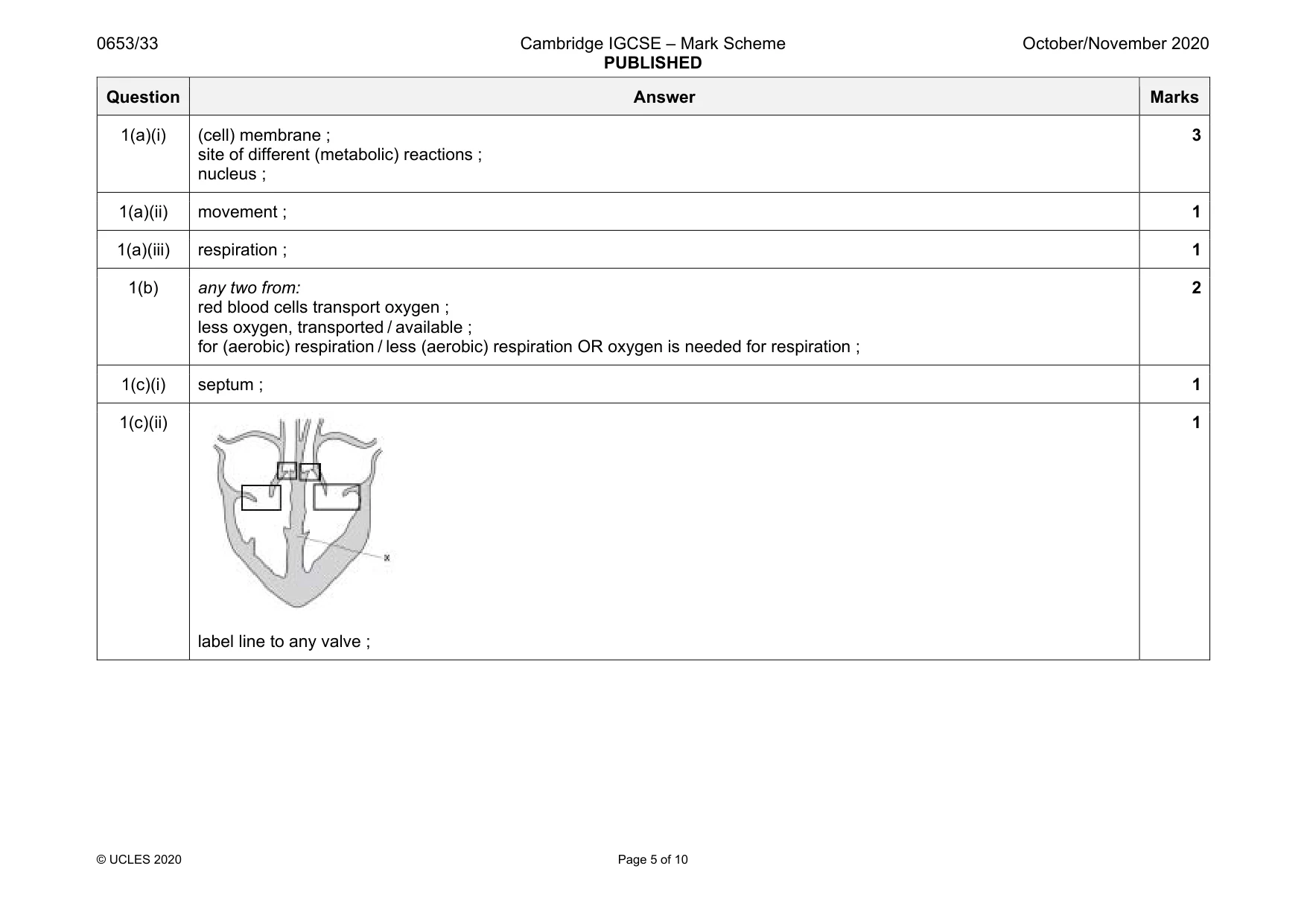
1 (a) Fig. 1.1 shows a diagram of muscle cells. A B C Fig. 1.1 (i) Complete Table 1.1 for the structures A, B and C. Table 1.1 structure name function A controls which substances pass in and out of the cell ........................................ B cytoplasm .................................................................................. C controls the activity of the cell ........................................ [3] (ii) Muscles are needed in humans for one of the characteristics of living organisms. Name this characteristic. ..................................................................................................................................... [1] (iii) Muscles need energy to work. The energy is released by a different characteristic of living organisms. Name this characteristic. ..................................................................................................................................... [1] (b) Anaemia is a medical condition. A person with anaemia has fewer red blood cells than normal. Suggest why anaemia can cause a person to have less energy. ................................................................................................................................................... ................................................................................................................................................... ................................................................................................................................................... ............................................................................................................................................. [2] (c) The heart is made of muscle tissue. Fig. 1.2 is a diagram of the heart. X Fig. 1.2 (i) Identify structure X on Fig. 1.2. ..................................................................................................................................... [1] (ii) On Fig. 1.2, use a label line and the letter Y to identify a structure that prevents the backwards flow of the blood. [1] [Total: 9]
Mark scheme: 1(a)(i) (cell) membrane ; site of different (metabolic) reactions ; nucleus ; 3 1(a)(ii) movement ; 1 1(a)(iii) respiration ; 1 1(b) any two from: red blood cells transport oxygen ; less oxygen, transported / available ; for (aerobic) respiration / less (aerobic) respiration OR oxygen is needed for respiration ; 2 1(c)(i) septum ; 1 1(c)(ii) label line to any valve ; 1
Q2 · A student investigates the rate of reaction between a piece of magnesium and excess…
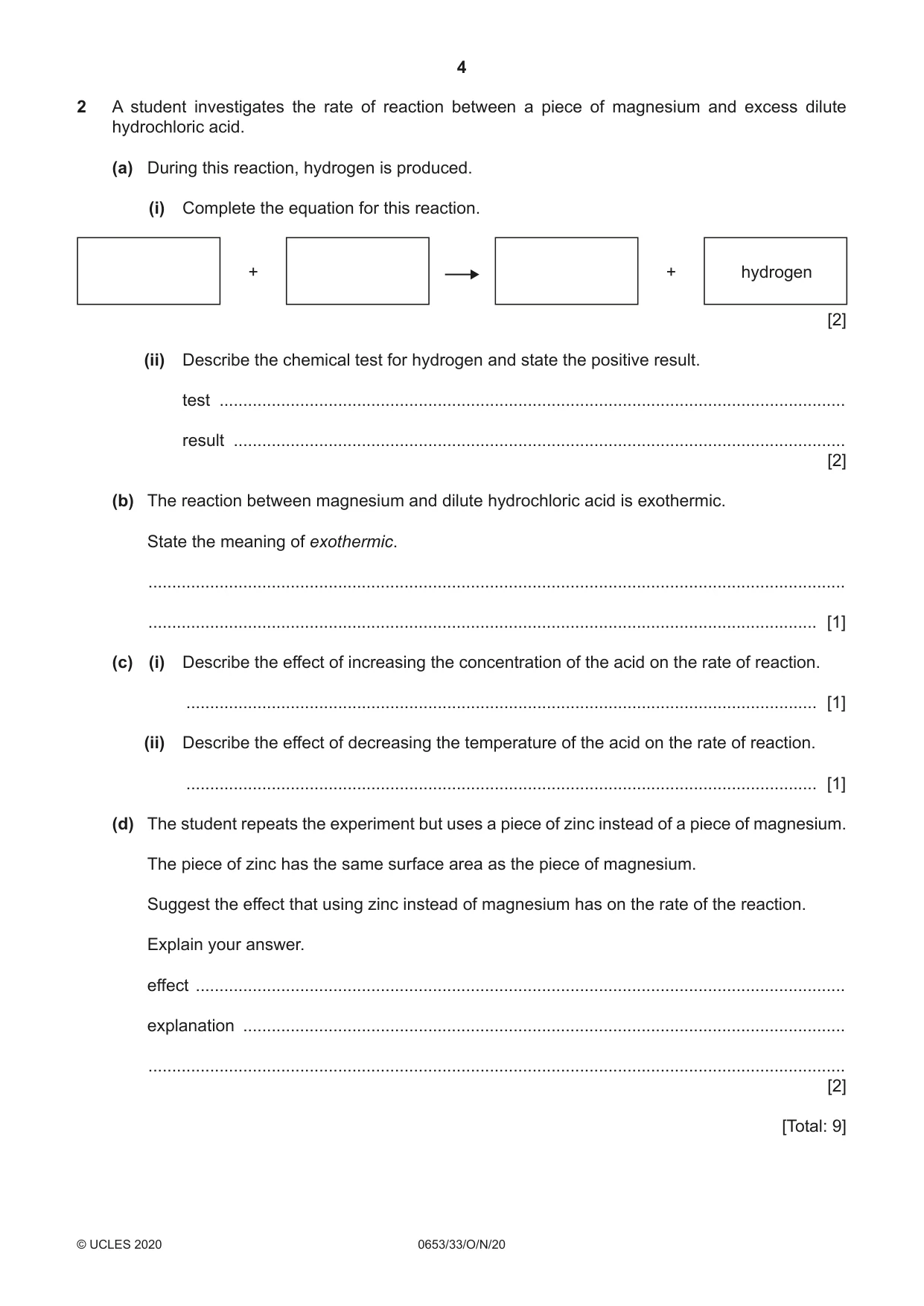
2 A student investigates the rate of reaction between a piece of magnesium and excess dilute hydrochloric acid. (a) During this reaction, hydrogen is produced. (i) Complete the equation for this reaction. + + hydrogen [2] (ii) Describe the chemical test for hydrogen and state the positive result. test .................................................................................................................................... result ................................................................................................................................. [2] (b) The reaction between magnesium and dilute hydrochloric acid is exothermic. State the meaning of exothermic. ................................................................................................................................................... ............................................................................................................................................. [1] (c) (i) Describe the effect of increasing the concentration of the acid on the rate of reaction. ..................................................................................................................................... [1] (ii) Describe the effect of decreasing the temperature of the acid on the rate of reaction. ..................................................................................................................................... [1] (d) The student repeats the experiment but uses a piece of zinc instead of a piece of magnesium. The piece of zinc has the same surface area as the piece of magnesium. Suggest the effect that using zinc instead of magnesium has on the rate of the reaction. Explain your answer. effect ......................................................................................................................................... explanation ............................................................................................................................... ................................................................................................................................................... [2] [Total: 9]
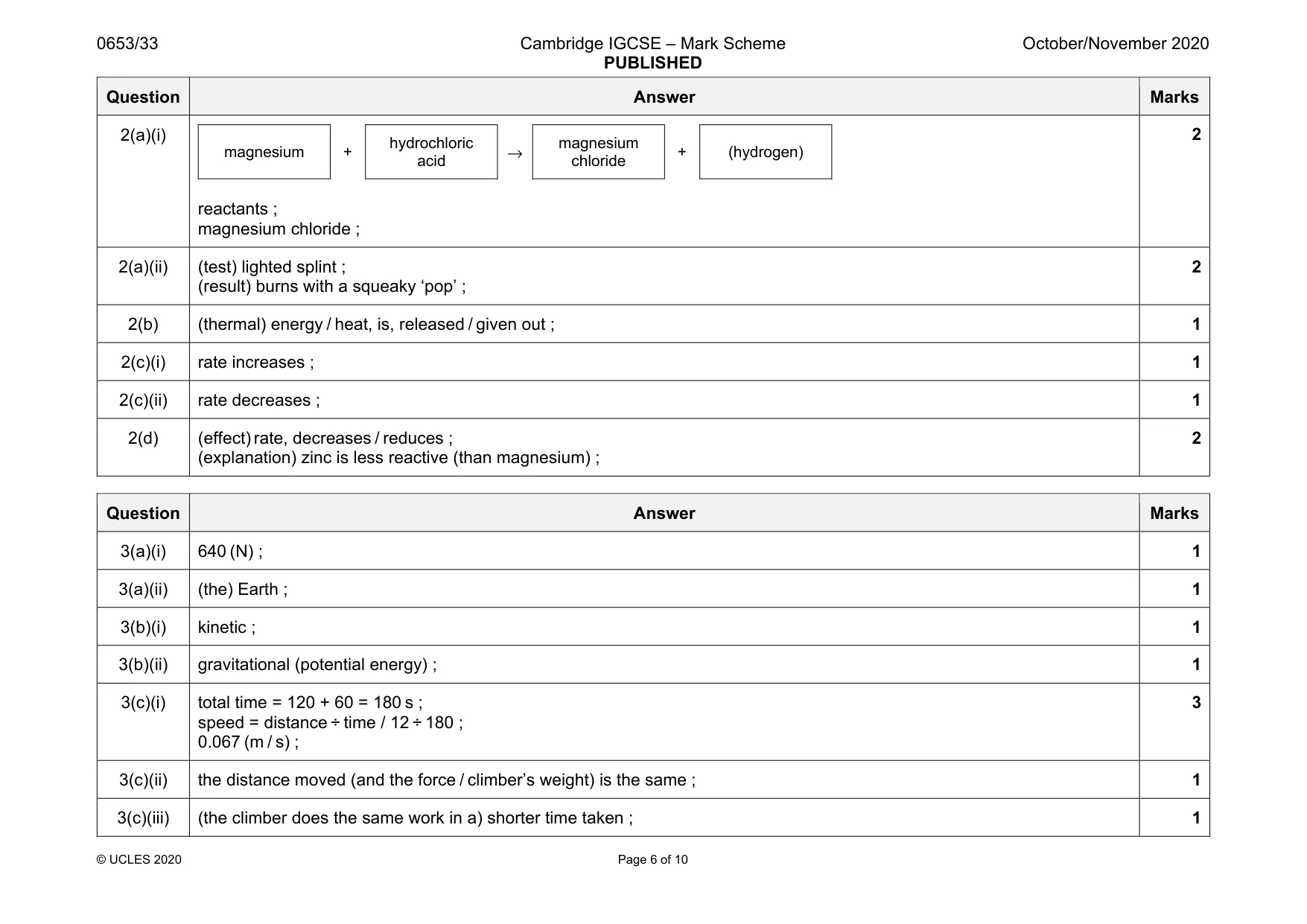
Mark scheme: 2(a)(i) magnesium + hydrochloric acid → magnesium chloride + (hydrogen) reactants ; magnesium chloride ; 2(a)(ii) (test) lighted splint ; (result) burns with a squeaky ‘pop’ ; 2 2(b) (thermal) energy / heat, is, released / given out ; 1 2(c)(i) rate increases ; 1 2(c)(ii) rate decreases ; 1 2(d) (effect) rate, decreases / reduces ; (explanation) zinc is less reactive (than magnesium) ; 2
Q3 · A climber moving up a rock face
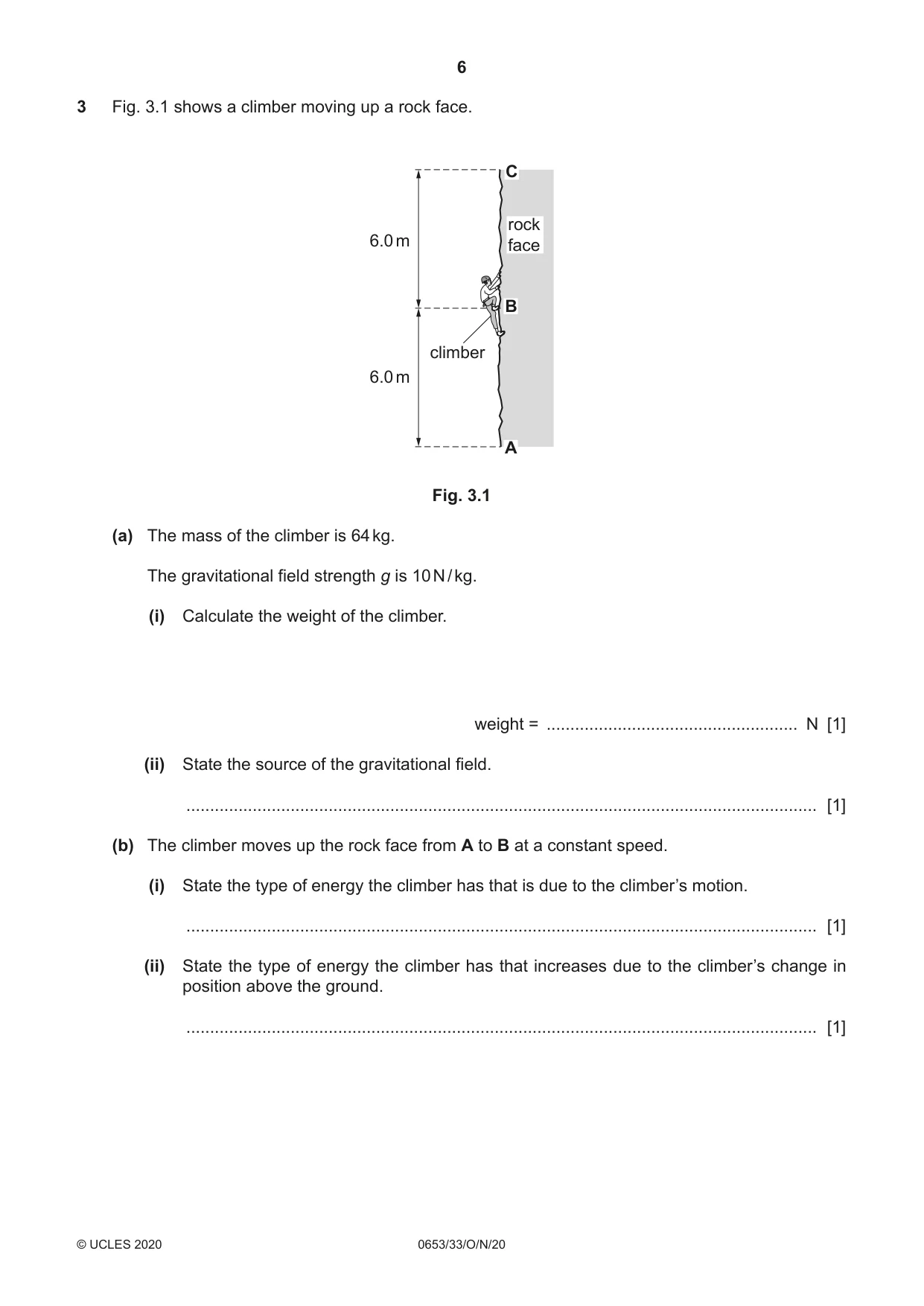
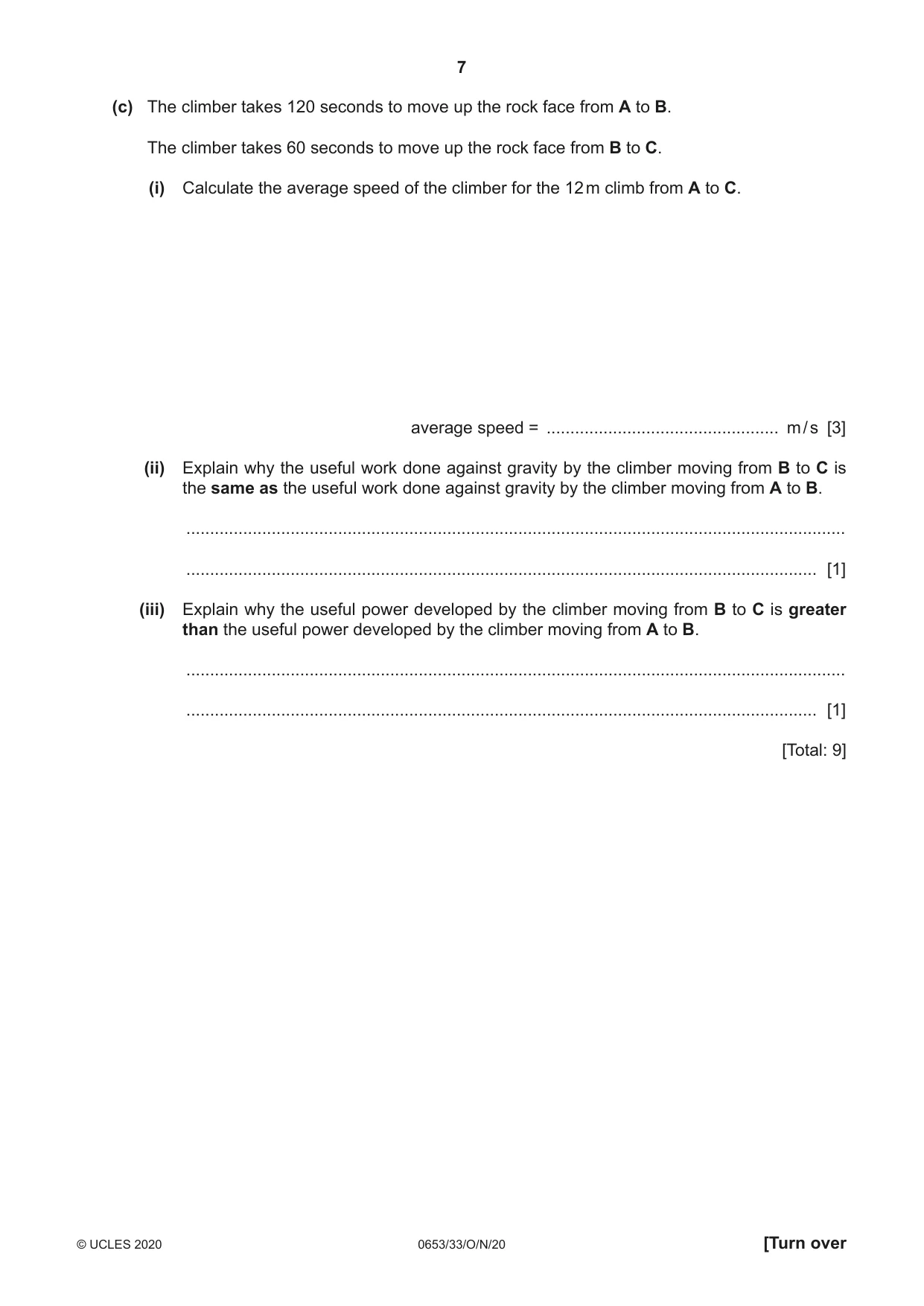
3 Fig. 3.1 shows a climber moving up a rock face. C rock 6.0 m face B climber 6.0 m A Fig. 3.1 (a) The mass of the climber is 64 kg. The gravitational field strength g is 10 N / kg. (i) Calculate the weight of the climber. weight = ..................................................... N [1] (ii) State the source of the gravitational field. ..................................................................................................................................... [1] (b) The climber moves up the rock face from A to B at a constant speed. (i) State the type of energy the climber has that is due to the climber’s motion. ..................................................................................................................................... [1] (ii) State the type of energy the climber has that increases due to the climber’s change in position above the ground. ..................................................................................................................................... [1] (c) The climber takes 120 seconds to move up the rock face from A to B. The climber takes 60 seconds to move up the rock face from B to C. (i) Calculate the average speed of the climber for the 12 m climb from A to C. average speed = ................................................. m / s [3] (ii) Explain why the useful work done against gravity by the climber moving from B to C is the same as the useful work done against gravity by the climber moving from A to B. ........................................................................................................................................... ..................................................................................................................................... [1] (iii) Explain why the useful power developed by the climber moving from B to C is greater than the useful power developed by the climber moving from A to B. ........................................................................................................................................... ..................................................................................................................................... [1] [Total: 9]
Mark scheme: 3(a)(i) 640 (N) ; 1 3(a)(ii) (the) Earth ; 1 3(b)(i) kinetic ; 1 3(b)(ii) gravitational (potential energy) ; 1 3(c)(i) total time = 120 + 60 = 180 s ; speed = distance ÷ time / 12 ÷ 180 ; 0.067 (m / s) ; 3 3(c)(ii) the distance moved (and the force / climber’s weight) is the same ; 1 3(c)(iii) (the climber does the same work in a) shorter time taken ; 1
Q4 · Plant cells as seen with a microscope
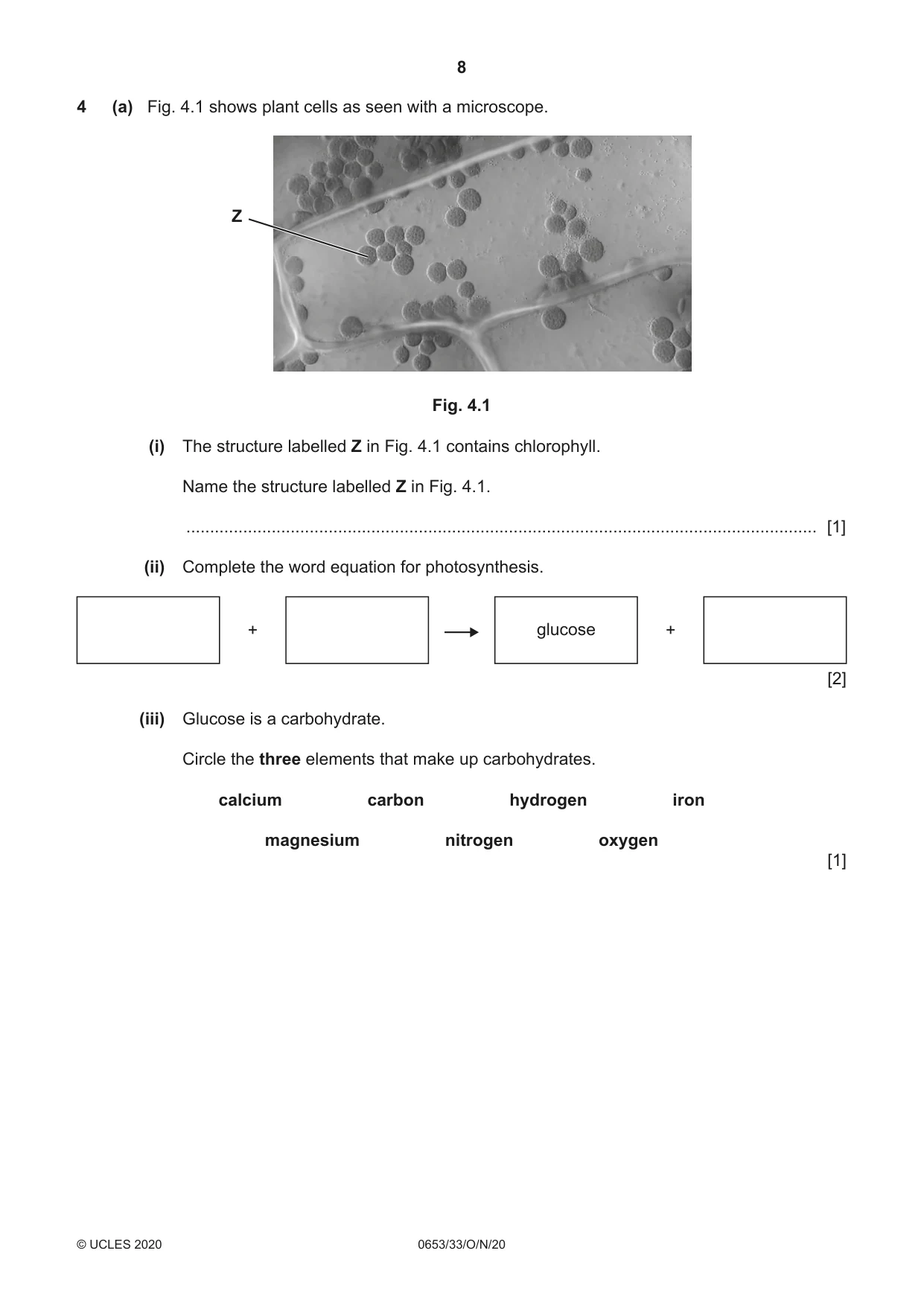
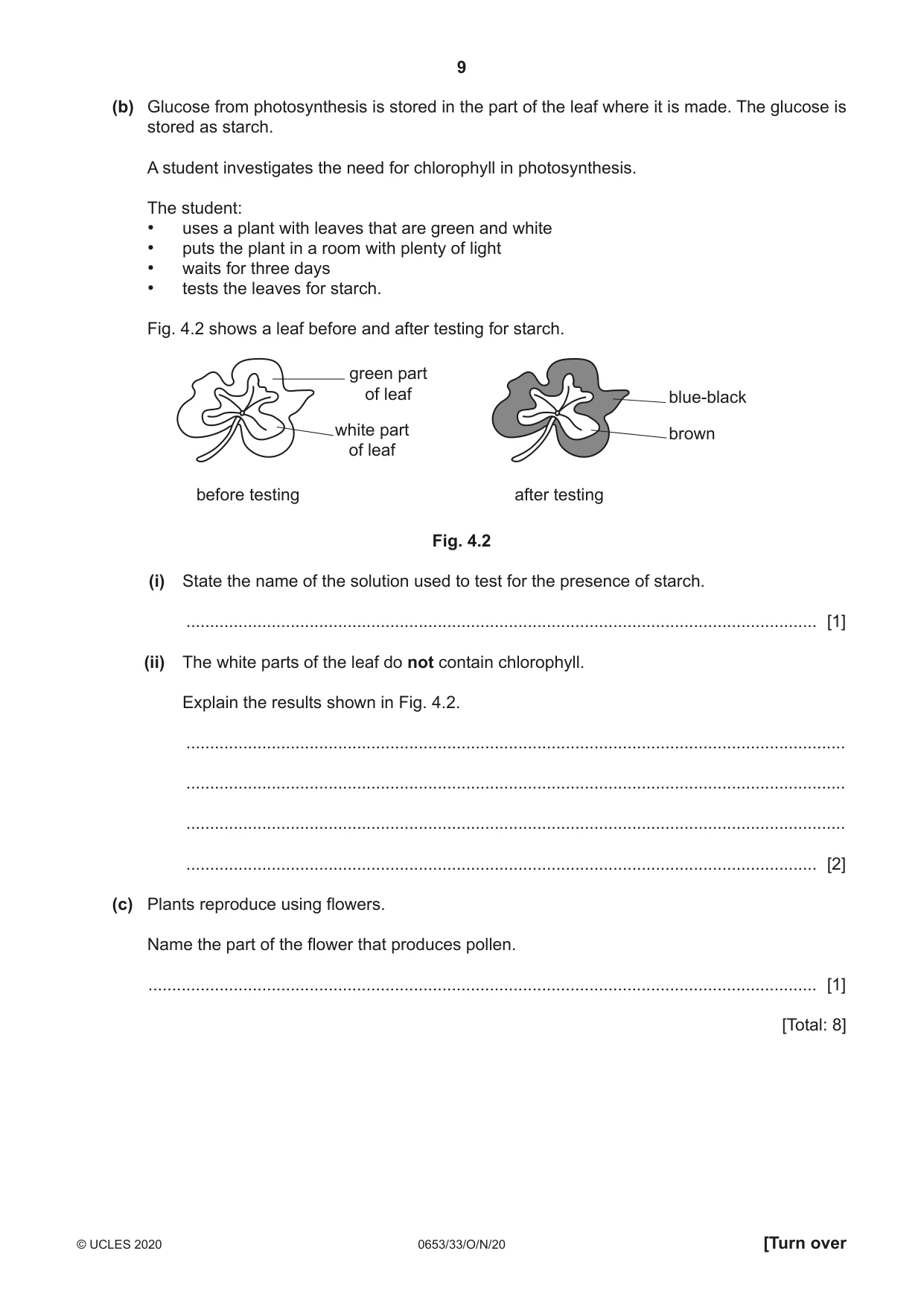
4 (a) Fig. 4.1 shows plant cells as seen with a microscope. Z Fig. 4.1 (i) The structure labelled Z in Fig. 4.1 contains chlorophyll. Name the structure labelled Z in Fig. 4.1. ..................................................................................................................................... [1] (ii) Complete the word equation for photosynthesis. + glucose + [2] (iii) Glucose is a carbohydrate. Circle the three elements that make up carbohydrates. calcium carbon hydrogen iron magnesium nitrogen oxygen [1] (b) Glucose from photosynthesis is stored in the part of the leaf where it is made. The glucose is stored as starch. A student investigates the need for chlorophyll in photosynthesis. The student: • uses a plant with leaves that are green and white • puts the plant in a room with plenty of light • waits for three days • tests the leaves for starch. Fig. 4.2 shows a leaf before and after testing for starch. green part of leaf blue-black white part brown of leaf before testing after testing Fig. 4.2 (i) State the name of the solution used to test for the presence of starch. ..................................................................................................................................... [1] (ii) The white parts of the leaf do not contain chlorophyll. Explain the results shown in Fig. 4.2. ........................................................................................................................................... ........................................................................................................................................... ........................................................................................................................................... ..................................................................................................................................... [2] (c) Plants reproduce using flowers. Name the part of the flower that produces pollen. ............................................................................................................................................. [1] [Total: 8]
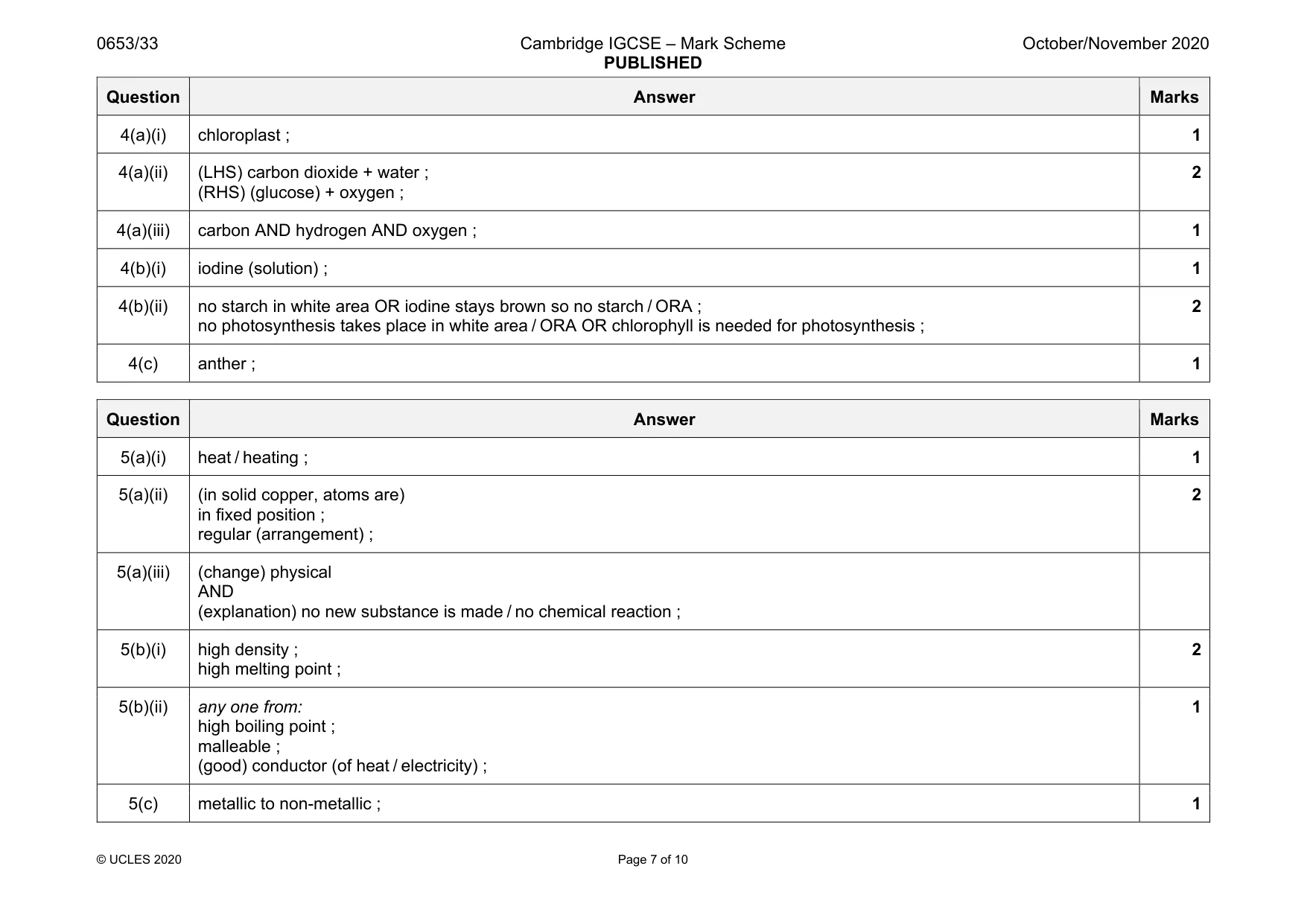
Mark scheme: 4(a)(i) chloroplast ; 1 4(a)(ii) (LHS) carbon dioxide + water ; (RHS) (glucose) + oxygen ; 2 4(a)(iii) carbon AND hydrogen AND oxygen ; 1 4(b)(i) iodine (solution) ; 1 4(b)(ii) no starch in white area OR iodine stays brown so no starch / ORA ; no photosynthesis takes place in white area / ORA OR chlorophyll is needed for photosynthesis ; 2 4(c) anther ; 1
Q5 · The water tap shown in Fig
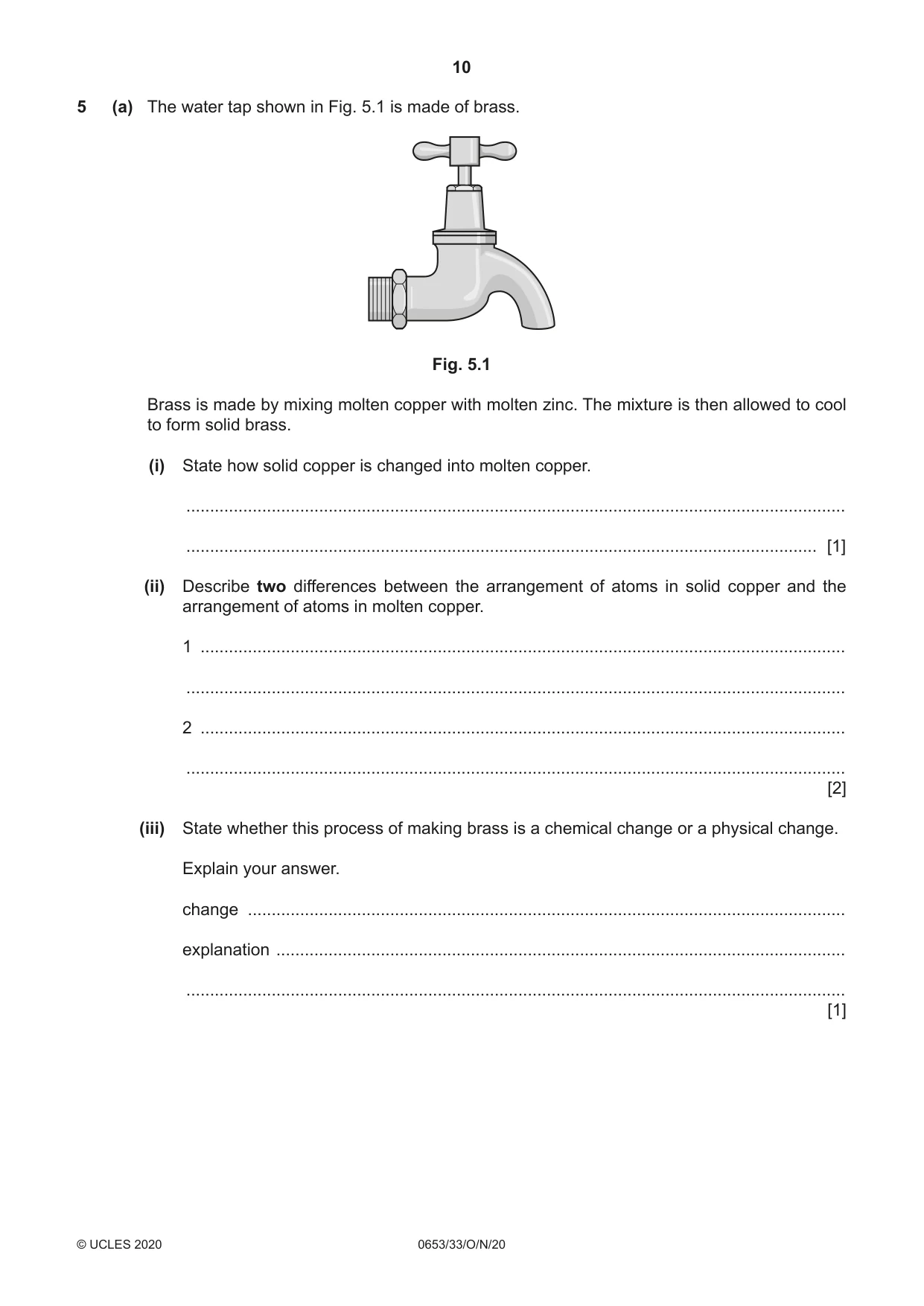
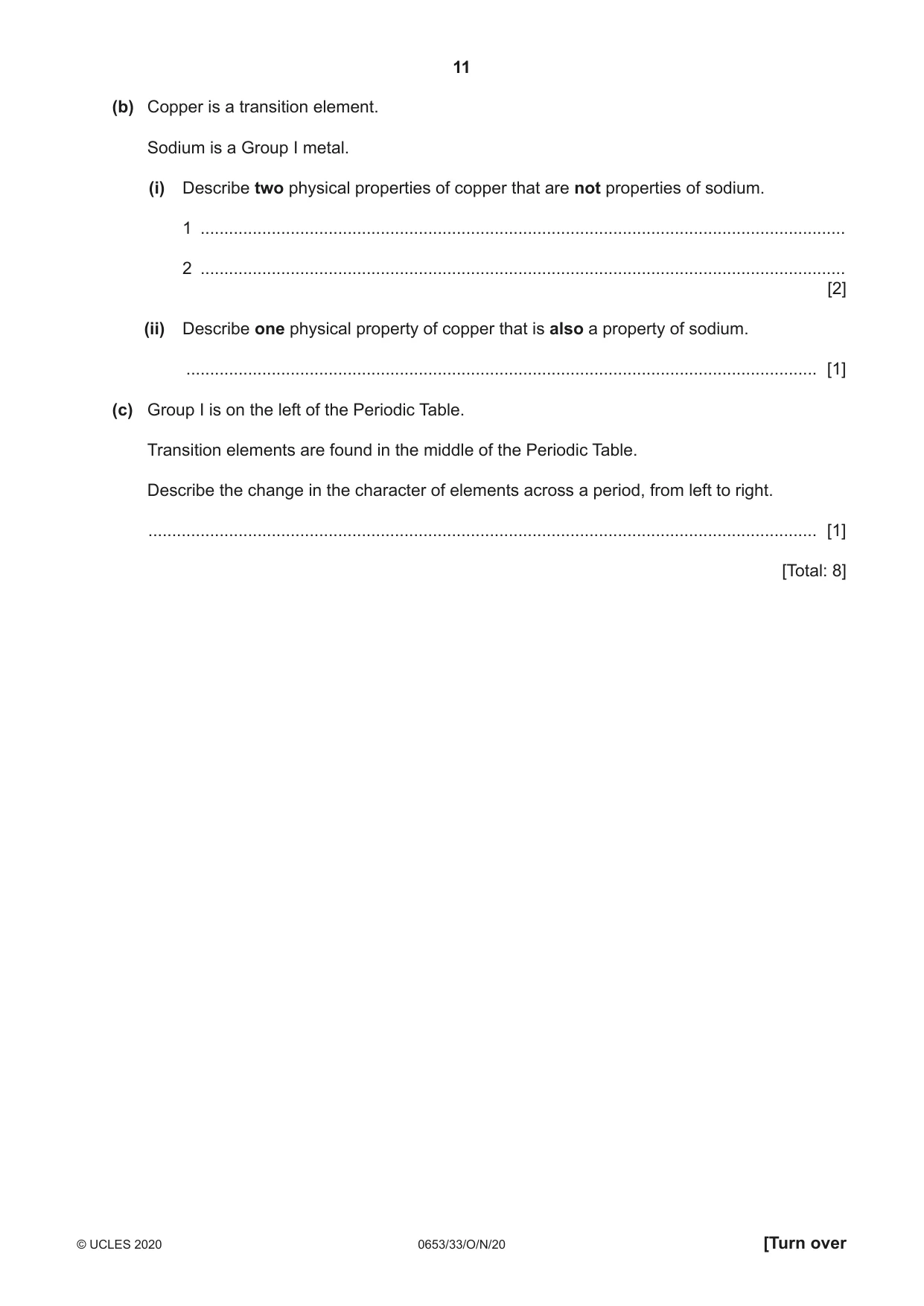
5 (a) The water tap shown in Fig. 5.1 is made of brass. Fig. 5.1 Brass is made by mixing molten copper with molten zinc. The mixture is then allowed to cool to form solid brass. (i) State how solid copper is changed into molten copper. ........................................................................................................................................... ..................................................................................................................................... [1] (ii) Describe two differences between the arrangement of atoms in solid copper and the arrangement of atoms in molten copper. 1 ........................................................................................................................................ ........................................................................................................................................... 2 ........................................................................................................................................ ........................................................................................................................................... [2] (iii) State whether this process of making brass is a chemical change or a physical change. Explain your answer. change .............................................................................................................................. explanation ........................................................................................................................ ........................................................................................................................................... [1] (b) Copper is a transition element. Sodium is a Group I metal. (i) Describe two physical properties of copper that are not properties of sodium. 1 ........................................................................................................................................ 2 ........................................................................................................................................ [2] (ii) Describe one physical property of copper that is also a property of sodium. ..................................................................................................................................... [1] (c) Group I is on the left of the Periodic Table. Transition elements are found in the middle of the Periodic Table. Describe the change in the character of elements across a period, from left to right. ............................................................................................................................................. [1] [Total: 8]
Mark scheme: 5(a)(i) heat / heating ; 1 5(a)(ii) (in solid copper, atoms are) in fixed position ; regular (arrangement) ; 2 5(a)(iii) (change) physical AND (explanation) no new substance is made / no chemical reaction ; 5(b)(i) high density ; high melting point ; 2 5(b)(ii) any one from: high boiling point ; malleable ; (good) conductor (of heat / electricity) ; 1 5(c) metallic to non-metallic ; 1
Q6 · Gamma rays are a type of electromagnetic radiation
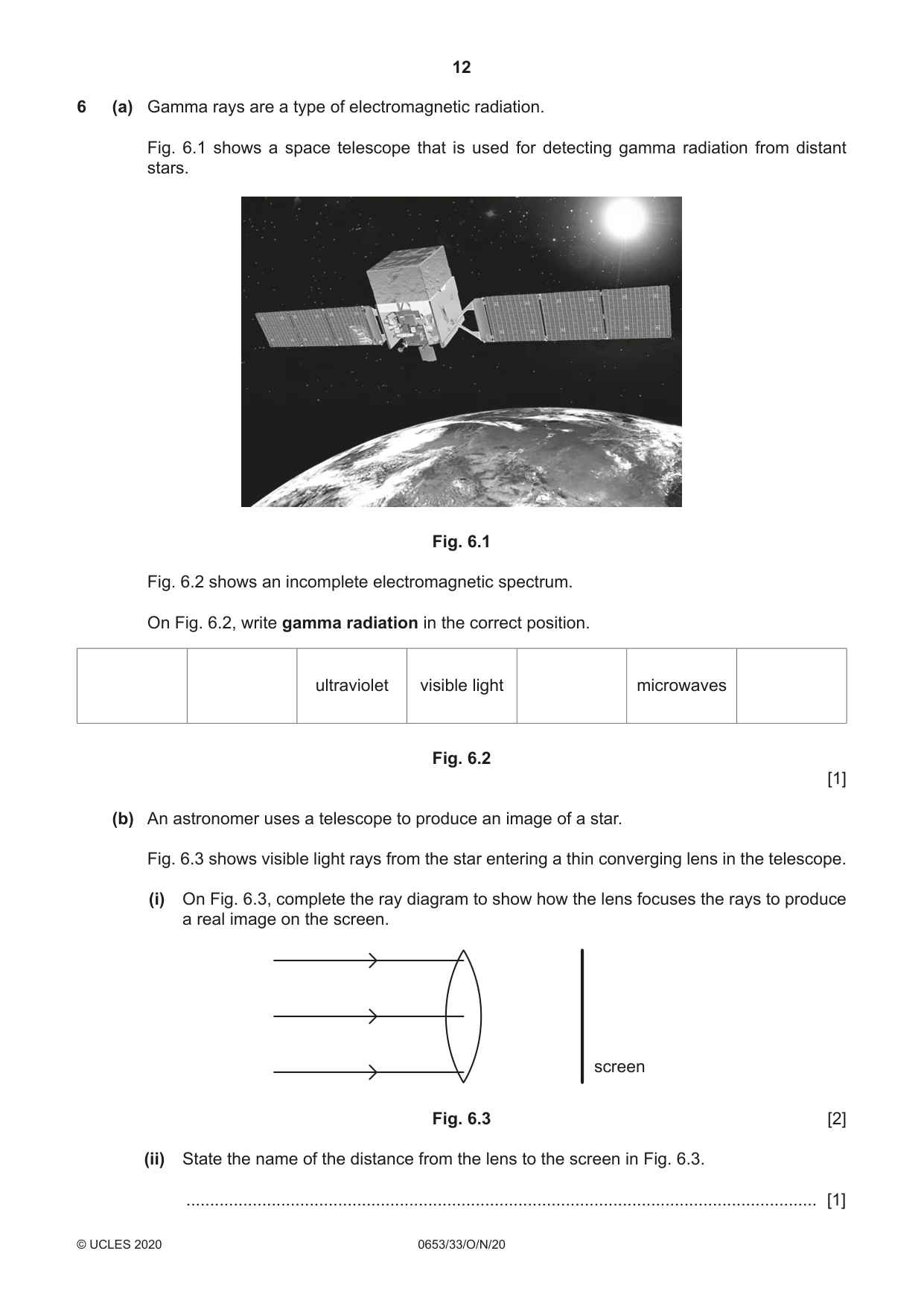
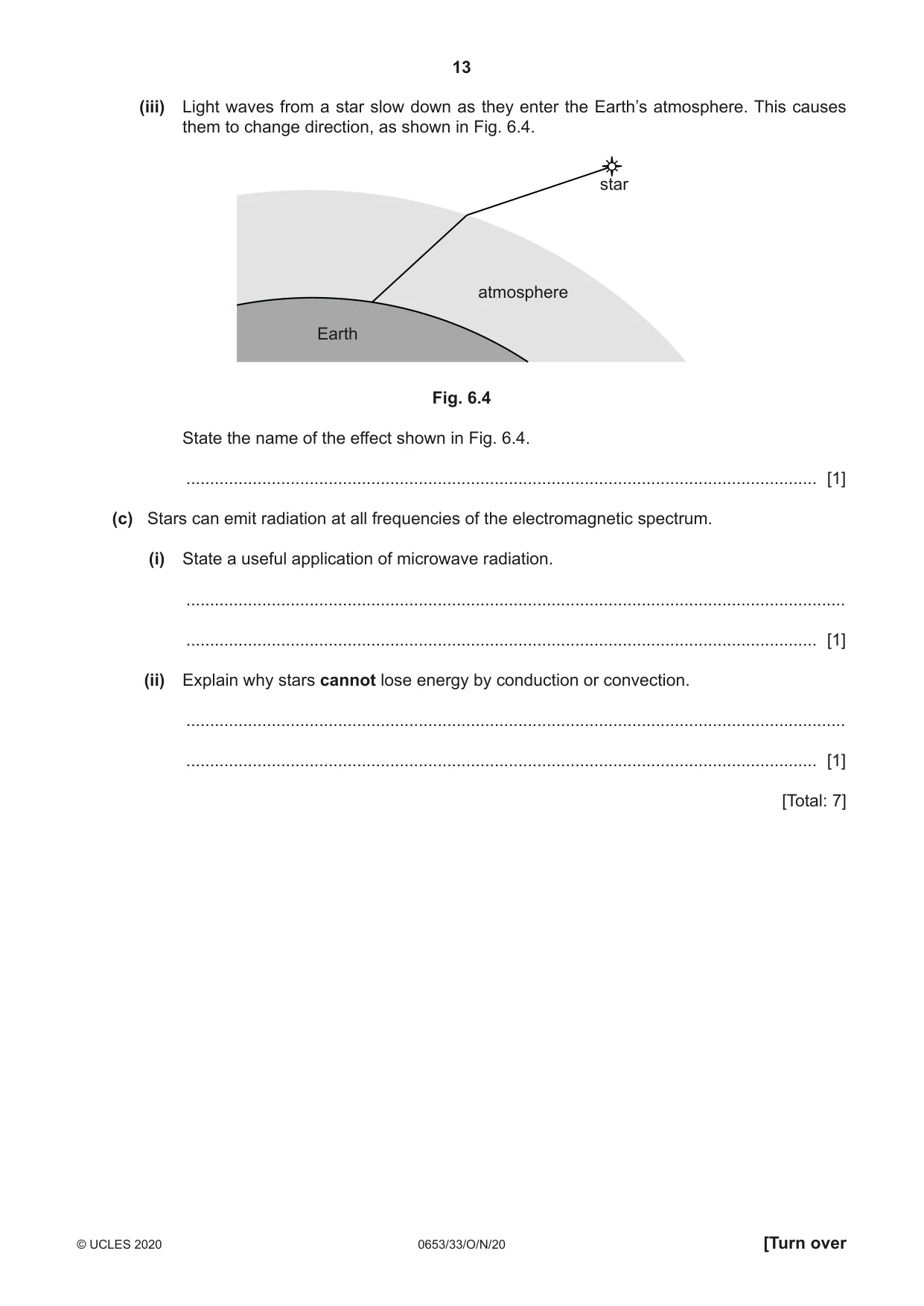
6 (a) Gamma rays are a type of electromagnetic radiation. Fig. 6.1 shows a space telescope that is used for detecting gamma radiation from distant stars. Fig. 6.1 Fig. 6.2 shows an incomplete electromagnetic spectrum. On Fig. 6.2, write gamma radiation in the correct position. ultraviolet visible light microwaves Fig. 6.2 [1] (b) An astronomer uses a telescope to produce an image of a star. Fig. 6.3 shows visible light rays from the star entering a thin converging lens in the telescope. (i) On Fig. 6.3, complete the ray diagram to show how the lens focuses the rays to produce a real image on the screen. screen Fig. 6.3 [2] (ii) State the name of the distance from the lens to the screen in Fig. 6.3. ..................................................................................................................................... [1] (iii) Light waves from a star slow down as they enter the Earth’s atmosphere. This causes them to change direction, as shown in Fig. 6.4. star atmosphere Earth Fig. 6.4 State the name of the effect shown in Fig. 6.4. ..................................................................................................................................... [1] (c) Stars can emit radiation at all frequencies of the electromagnetic spectrum. (i) State a useful application of microwave radiation. ........................................................................................................................................... ..................................................................................................................................... [1] (ii) Explain why stars cannot lose energy by conduction or convection. ........................................................................................................................................... ..................................................................................................................................... [1] [Total: 7]
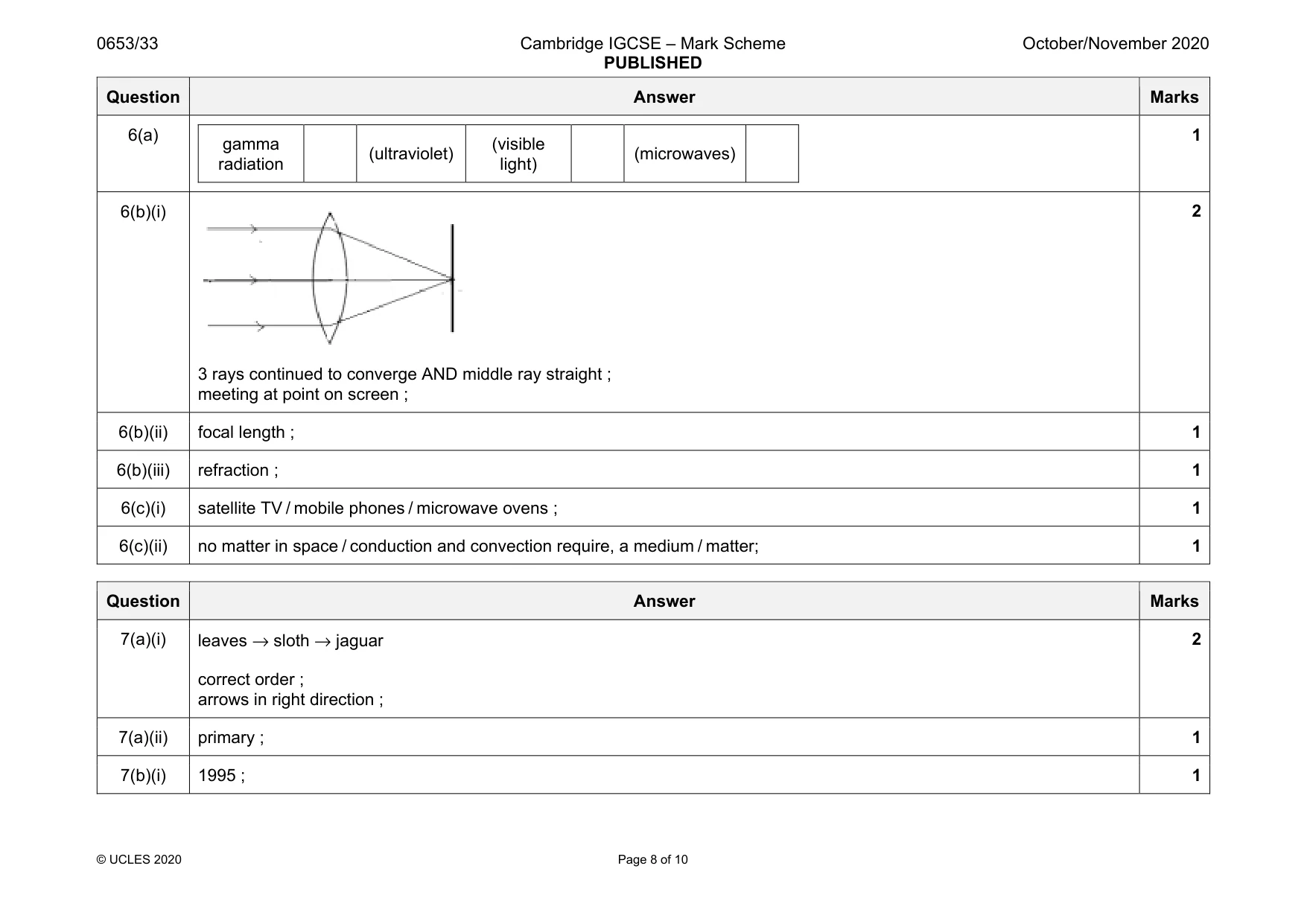
Mark scheme: 6(a) gamma radiation (ultraviolet) (visible light) (microwaves) 1 6(b)(i) 3 rays continued to converge AND middle ray straight ; meeting at point on screen ; 2 6(b)(ii) focal length ; 1 6(b)(iii) refraction ; 1 6(c)(i) satellite TV / mobile phones / microwave ovens ; 1 6(c)(ii) no matter in space / conduction and convection require, a medium / matter; 1
Q7 · A picture of a sloth and some information about sloths
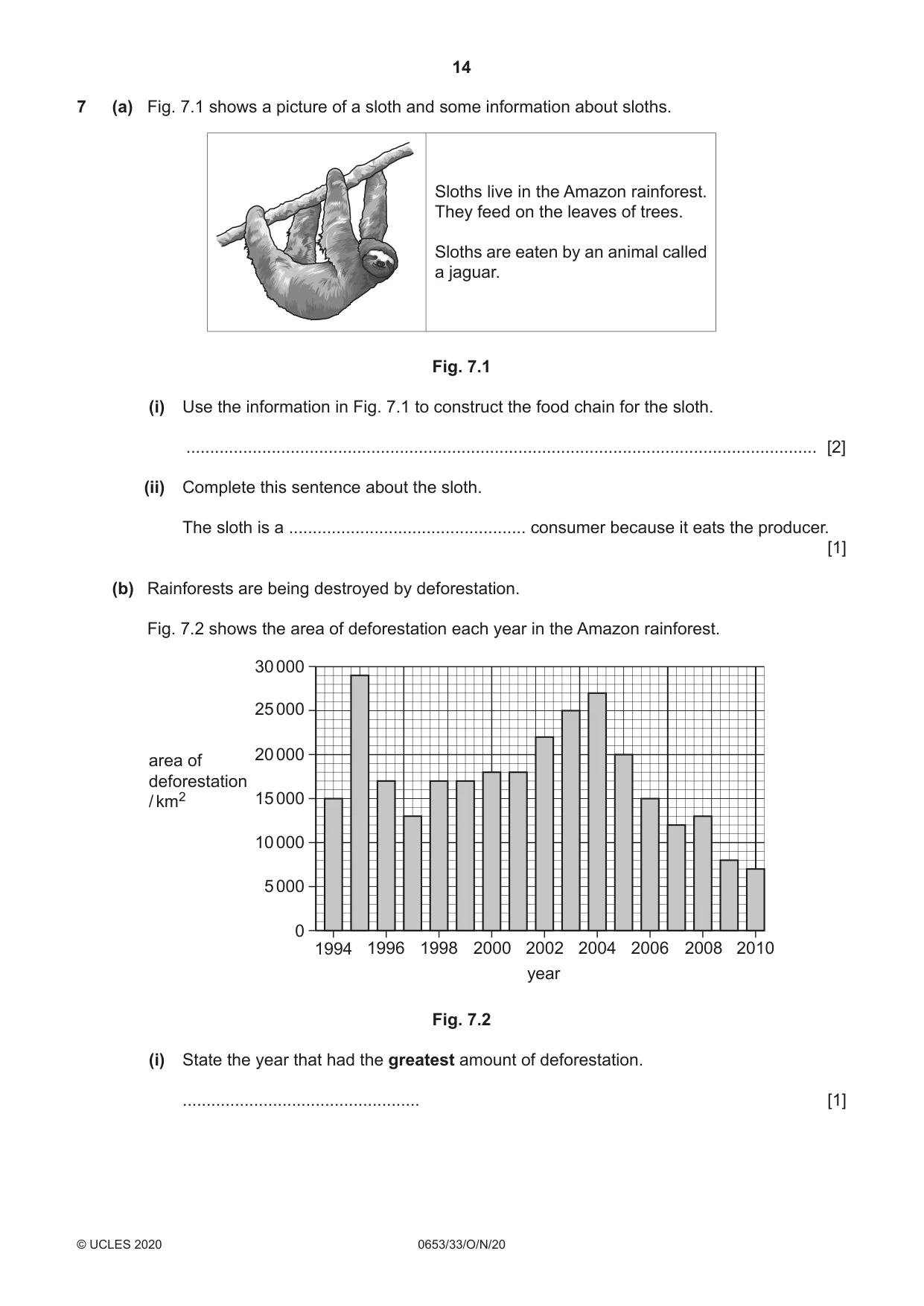
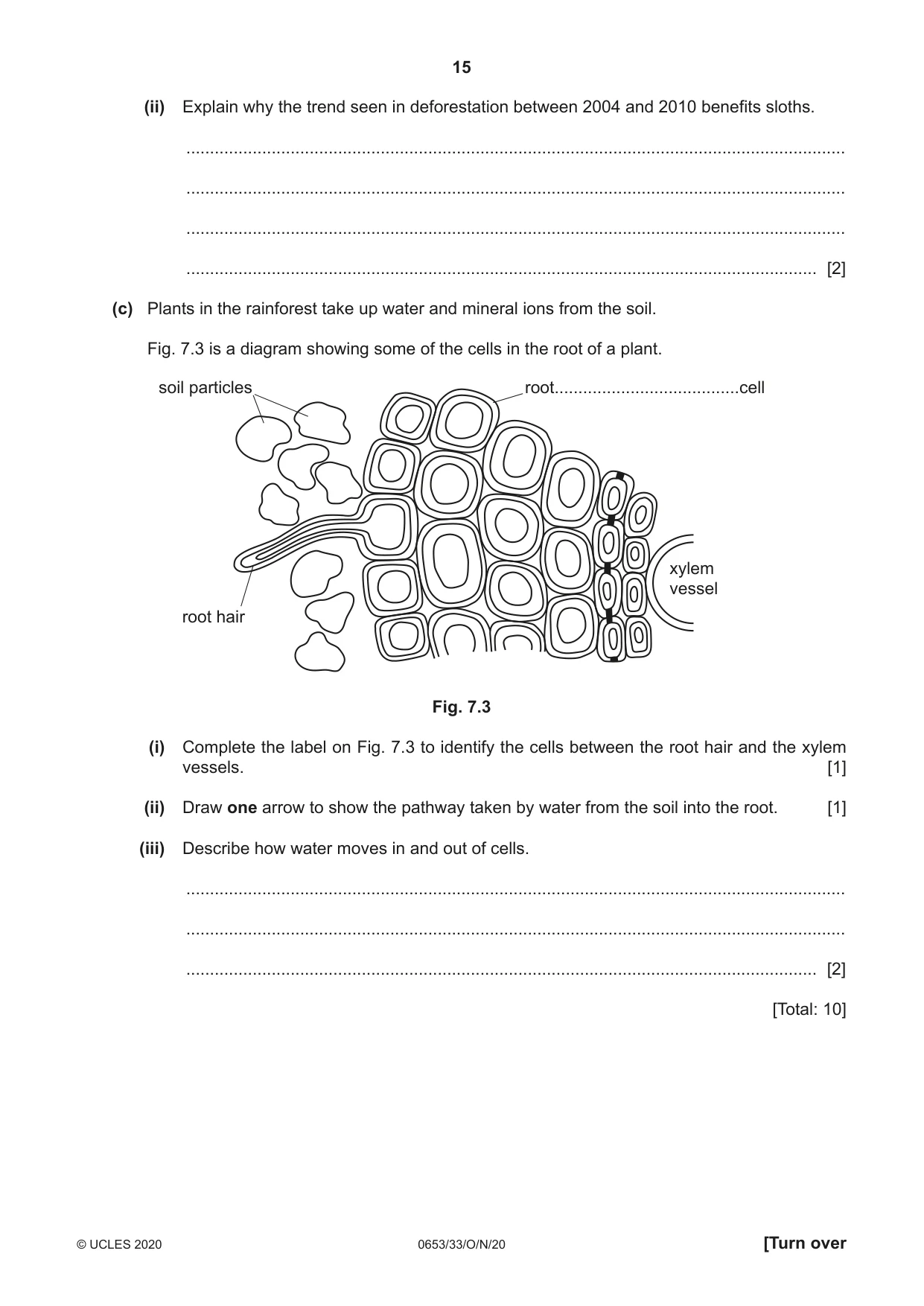
7 (a) Fig. 7.1 shows a picture of a sloth and some information about sloths. Sloths live in the Amazon rainforest. They feed on the leaves of trees. Sloths are eaten by an animal called a jaguar. Fig. 7.1 (i) Use the information in Fig. 7.1 to construct the food chain for the sloth. ..................................................................................................................................... [2] (ii) Complete this sentence about the sloth. The sloth is a .................................................. consumer because it eats the producer. [1] (b) Rainforests are being destroyed by deforestation. Fig. 7.2 shows the area of deforestation each year in the Amazon rainforest. 30 000 25 000 20 000 area of deforestation / km2 15 000 10 000 5 000 0 1994 1996 1998 2000 2002 2004 2006 2008 2010 year Fig. 7.2 (i) State the year that had the greatest amount of deforestation. .................................................. [1] (ii) Explain why the trend seen in deforestation between 2004 and 2010 benefits sloths. ........................................................................................................................................... ........................................................................................................................................... ........................................................................................................................................... ..................................................................................................................................... [2] (c) Plants in the rainforest take up water and mineral ions from the soil. Fig. 7.3 is a diagram showing some of the cells in the root of a plant. soil particles root.......................................cell xylem vessel root hair Fig. 7.3 (i) Complete the label on Fig. 7.3 to identify the cells between the root hair and the xylem vessels. [1] (ii) Draw one arrow to show the pathway taken by water from the soil into the root. [1] (iii) Describe how water moves in and out of cells. ........................................................................................................................................... ........................................................................................................................................... ..................................................................................................................................... [2] [Total: 10]
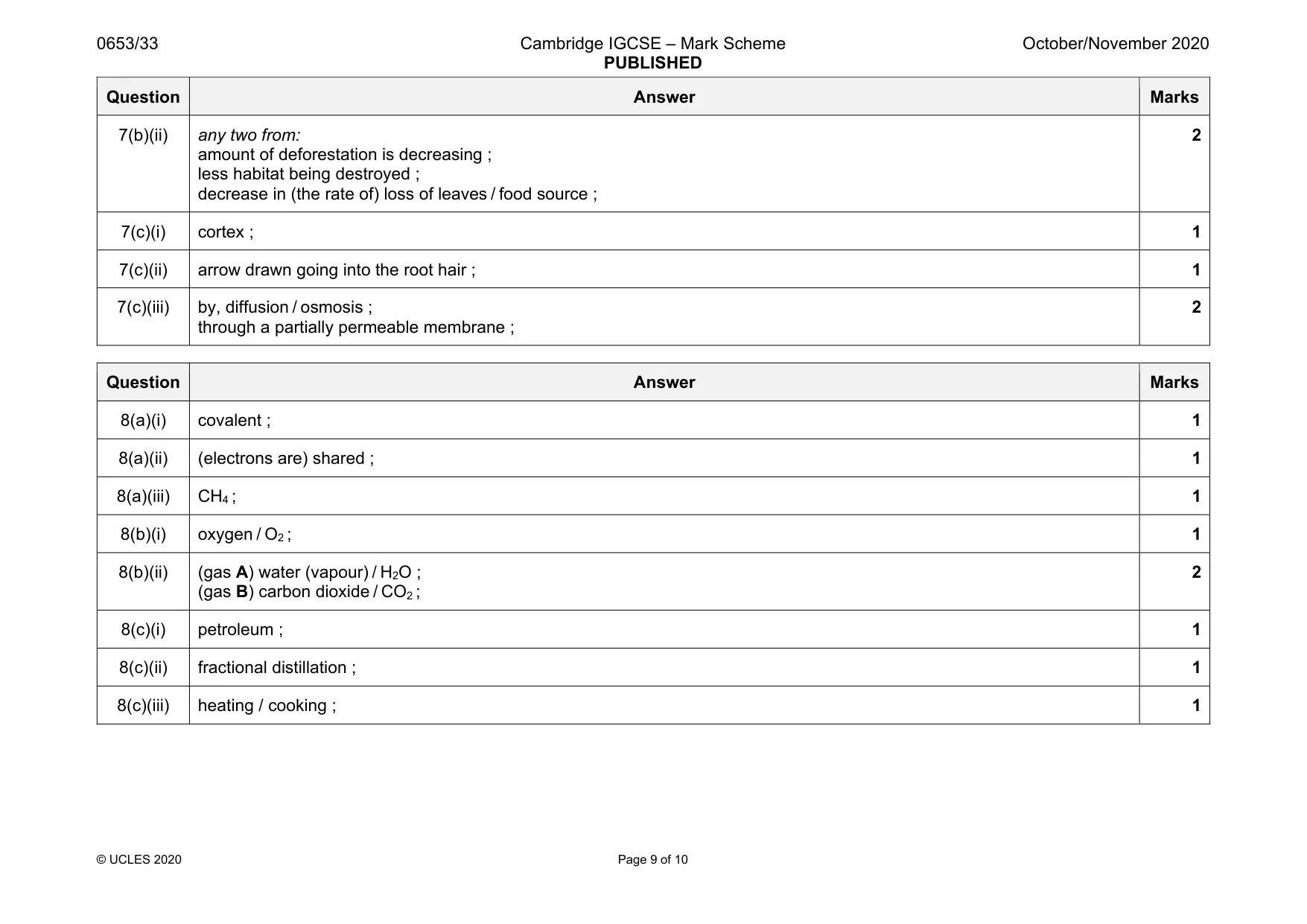
Mark scheme: 7(a)(i) leaves → sloth → jaguar correct order ; arrows in right direction ; 7(a)(ii) primary ; 1 7(b)(i) 1995 ; 1 Question Answer Marks 7(b)(ii) any two from: amount of deforestation is decreasing ; less habitat being destroyed ; decrease in (the rate of) loss of leaves / food source ; 2 7(c)(i) cortex ; 1 7(c)(ii) arrow drawn going into the root hair ; 1 7(c)(iii) by, diffusion / osmosis ; through a partially permeable membrane ; 2
Q8 · A molecule of methane is represented in Fig
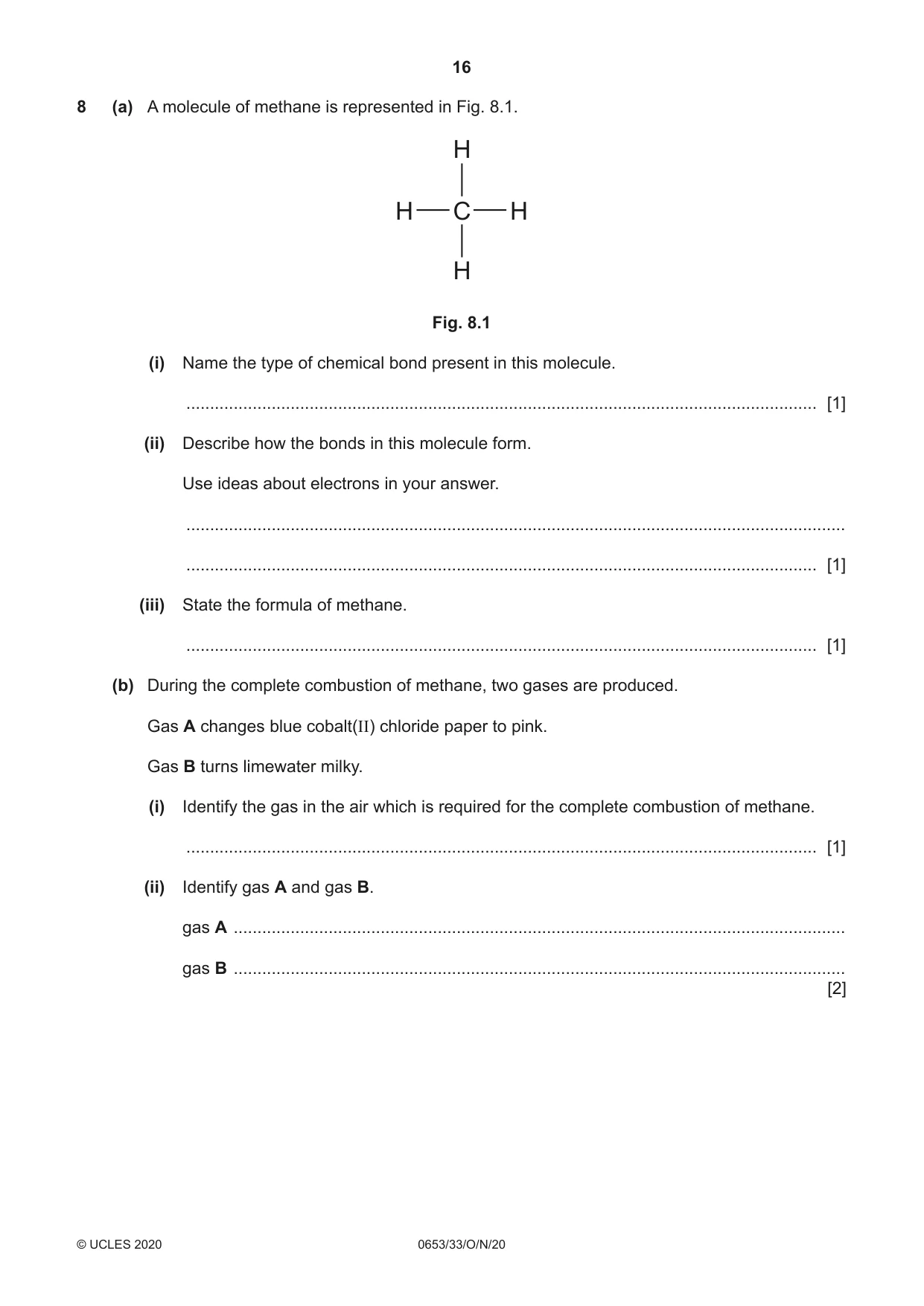
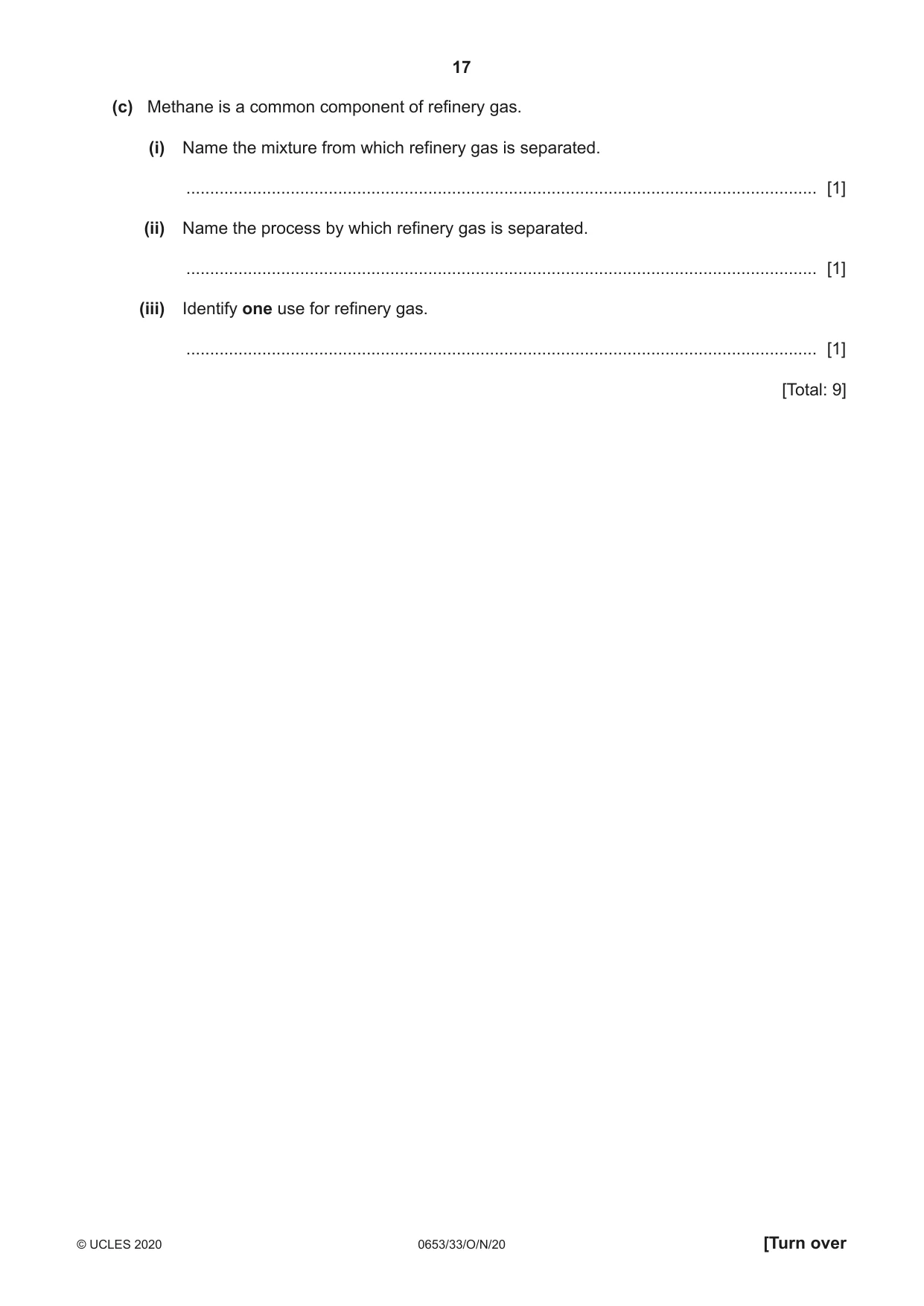
8 (a) A molecule of methane is represented in Fig. 8.1. H H C H H Fig. 8.1 (i) Name the type of chemical bond present in this molecule. ..................................................................................................................................... [1] (ii) Describe how the bonds in this molecule form. Use ideas about electrons in your answer. ........................................................................................................................................... ..................................................................................................................................... [1] (iii) State the formula of methane. ..................................................................................................................................... [1] (b) During the complete combustion of methane, two gases are produced. Gas A changes blue cobalt(II) chloride paper to pink. Gas B turns limewater milky. (i) Identify the gas in the air which is required for the complete combustion of methane. ..................................................................................................................................... [1] (ii) Identify gas A and gas B. gas A ................................................................................................................................. gas B ................................................................................................................................. [2] (c) Methane is a common component of refinery gas. (i) Name the mixture from which refinery gas is separated. ..................................................................................................................................... [1] (ii) Name the process by which refinery gas is separated. ..................................................................................................................................... [1] (iii) Identify one use for refinery gas. ..................................................................................................................................... [1] [Total: 9]
Mark scheme: 8(a)(i) covalent ; 1 8(a)(ii) (electrons are) shared ; 1 8(a)(iii) CH4 ; 1 8(b)(i) oxygen / O2 ; 1 8(b)(ii) (gas A) water (vapour) / H2O ; (gas B) carbon dioxide / CO2 ; 2 8(c)(i) petroleum ; 1 8(c)(ii) fractional distillation ; 1 8(c)(iii) heating / cooking ; 1
Q9 · In the box in Fig
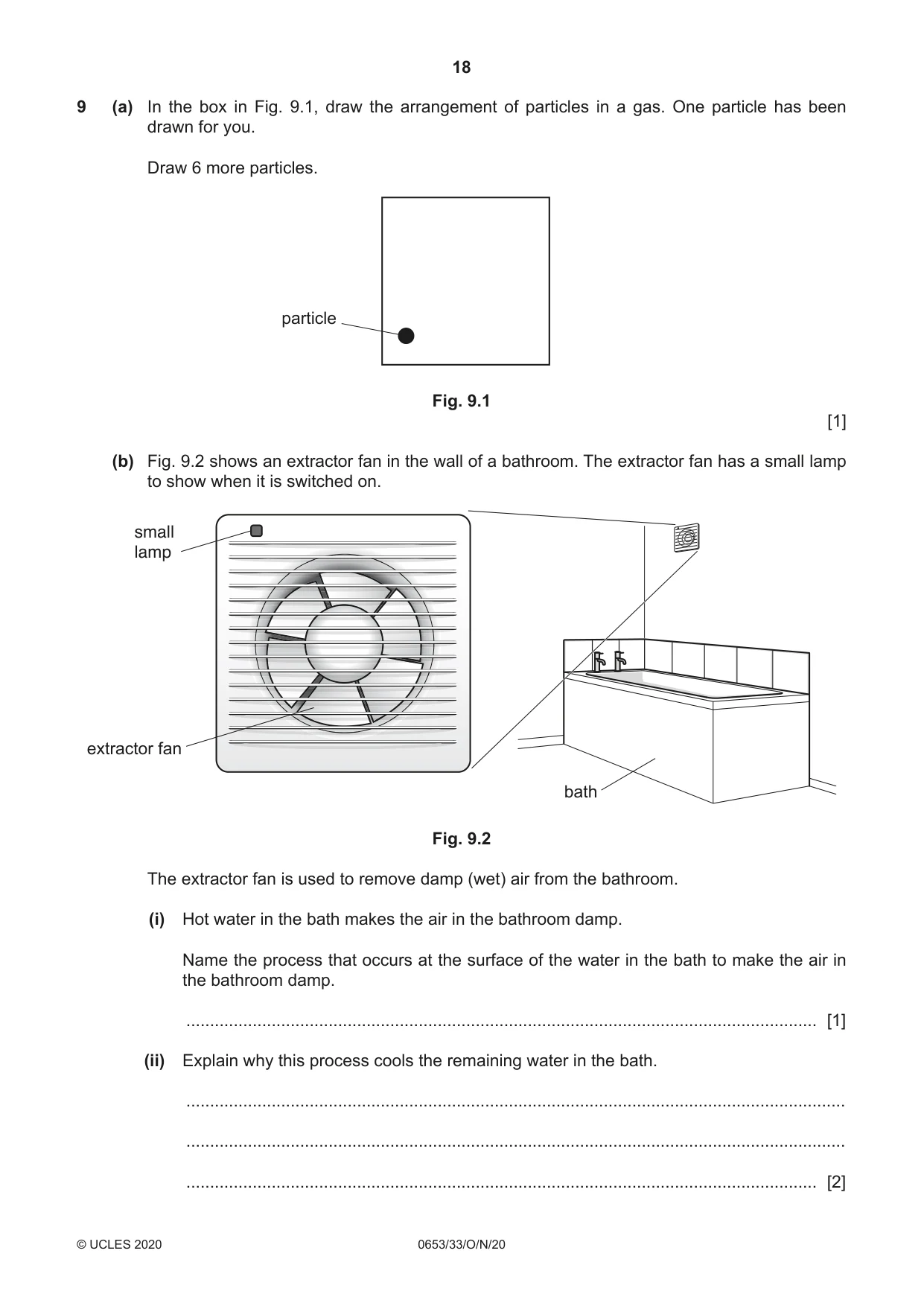
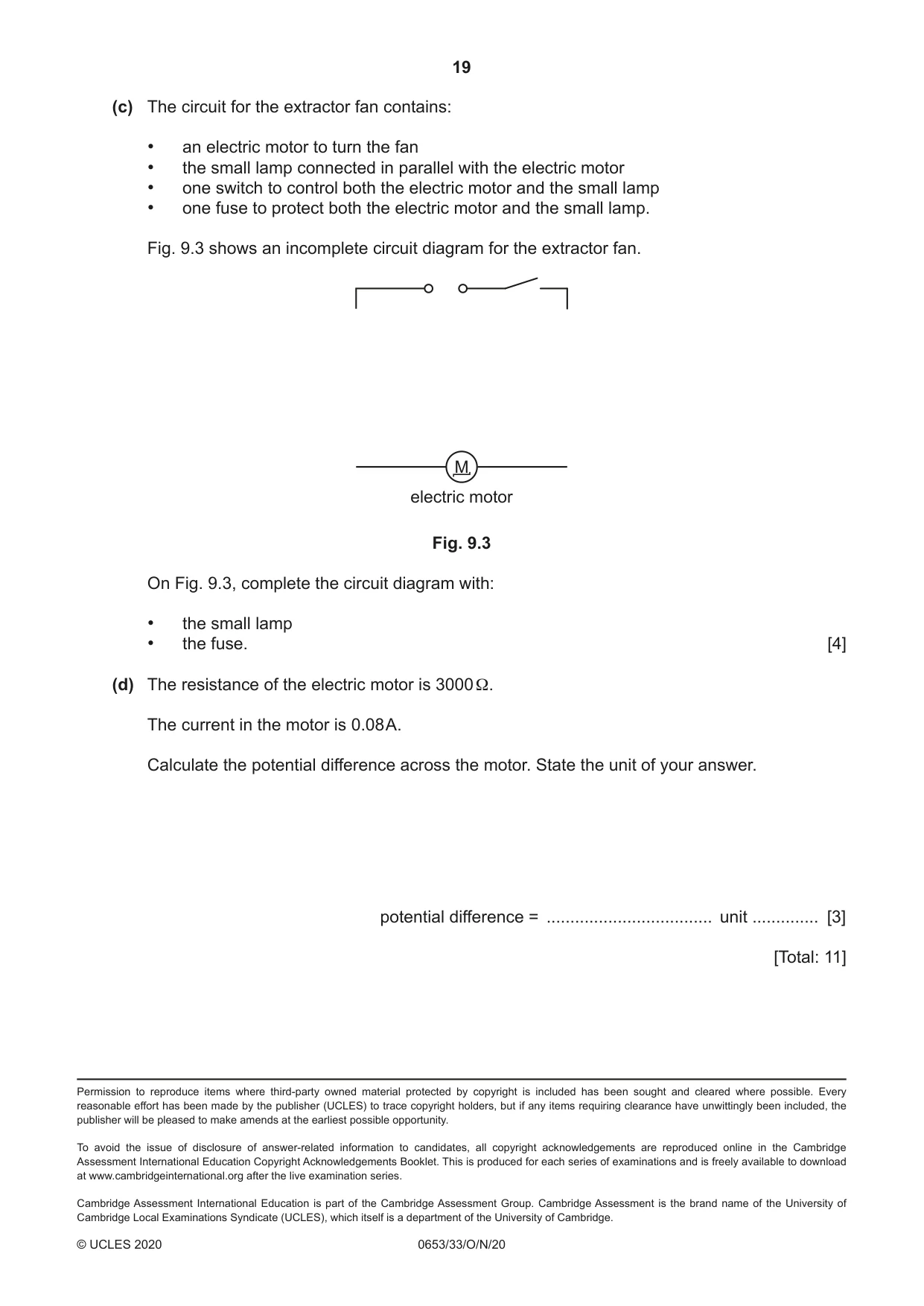
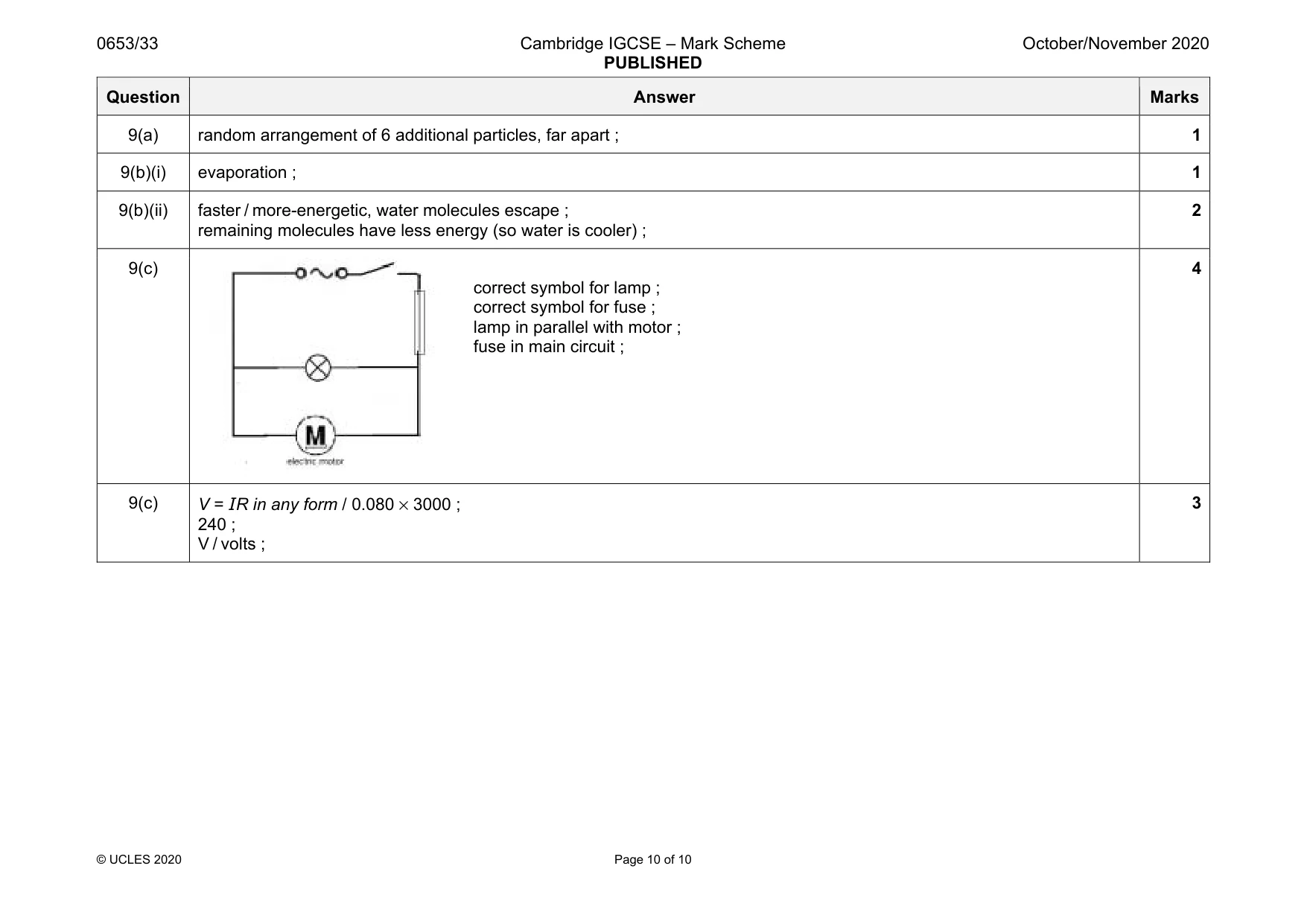
9 (a) In the box in Fig. 9.1, draw the arrangement of particles in a gas. One particle has been drawn for you. Draw 6 more particles. particle Fig. 9.1 [1] (b) Fig. 9.2 shows an extractor fan in the wall of a bathroom. The extractor fan has a small lamp to show when it is switched on. small lamp extractor fan bath Fig. 9.2 The extractor fan is used to remove damp (wet) air from the bathroom. (i) Hot water in the bath makes the air in the bathroom damp. Name the process that occurs at the surface of the water in the bath to make the air in the bathroom damp. ..................................................................................................................................... [1] (ii) Explain why this process cools the remaining water in the bath. ........................................................................................................................................... ........................................................................................................................................... ..................................................................................................................................... [2] (c) The circuit for the extractor fan contains: • an electric motor to turn the fan • the small lamp connected in parallel with the electric motor • one switch to control both the electric motor and the small lamp • one fuse to protect both the electric motor and the small lamp. Fig. 9.3 shows an incomplete circuit diagram for the extractor fan. M electric motor Fig. 9.3 On Fig. 9.3, complete the circuit diagram with: • the small lamp • the fuse. [4] (d) The resistance of the electric motor is 3000 Ω. The current in the motor is 0.08 A. Calculate the potential difference across the motor. State the unit of your answer. potential difference = ................................... unit .............. [3] [Total: 11]
Mark scheme: 9(a) random arrangement of 6 additional particles, far apart ; 1 9(b)(i) evaporation ; 1 9(b)(ii) faster / more-energetic, water molecules escape ; remaining molecules have less energy (so water is cooler) ; 2 9(c) correct symbol for lamp ; correct symbol for fuse ; lamp in parallel with motor ; fuse in main circuit ; 4 9(c) V = IR in any form / 0.080 × 3000 ; 240 ; V / volts ; 3
What was in this paper
The subtopics covered by these 9 questions, and how many questions each got. Open one in a new tab to see every Cambridge question on it.
What you needed in this session
Cambridge’s own grade thresholds for 2020 Oct/Nov, Paper 3 · Variant 3. A higher threshold means an easier paper — the bar moves with how the cohort did.