Cambridge IGCSE Science - Combined 0653 — 2018 Oct/Nov Paper 3 · Variant 1
0653/31/O/N/18 · 9 questions · 80 marks · ≈90 min
The question paper and its mark scheme, free to read here and free to download. This is Cambridge’s own paper, exactly as it was sat.
Question paper20 pages


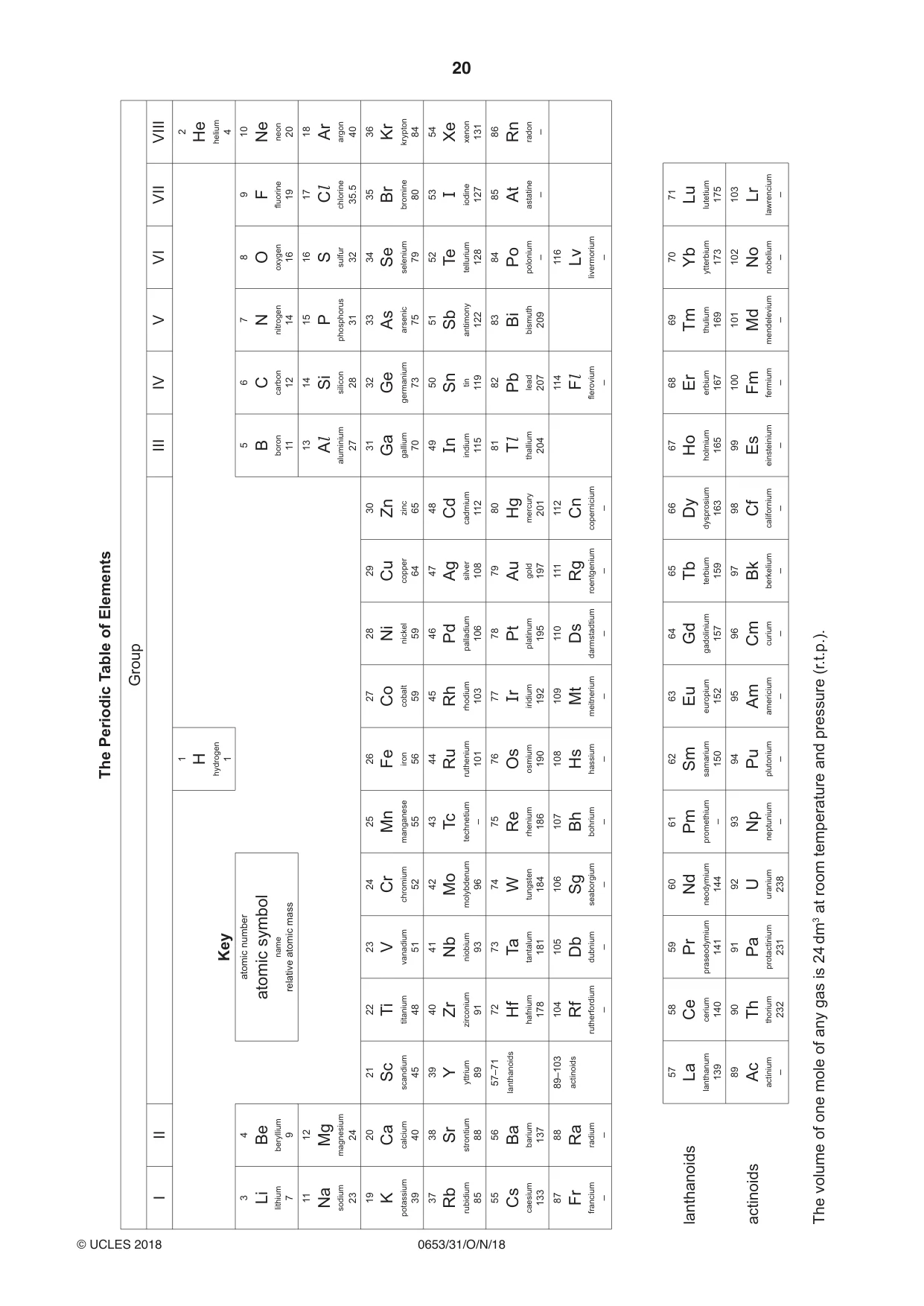
Mark scheme10 pages
Answers below. Sit the paper first if you are practising.
Questions as text
Q1 · The list shows some processes that occur in living organisms
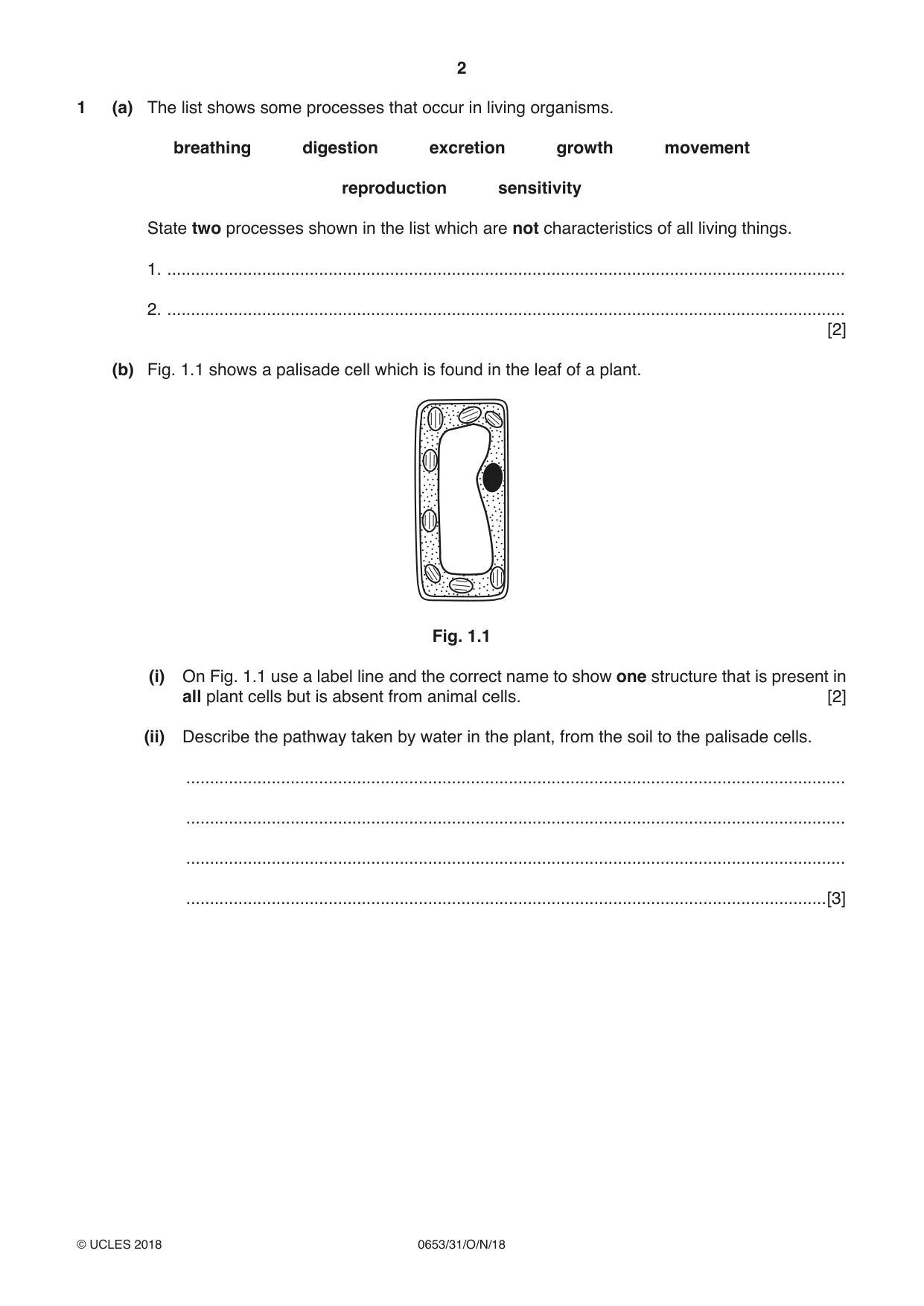
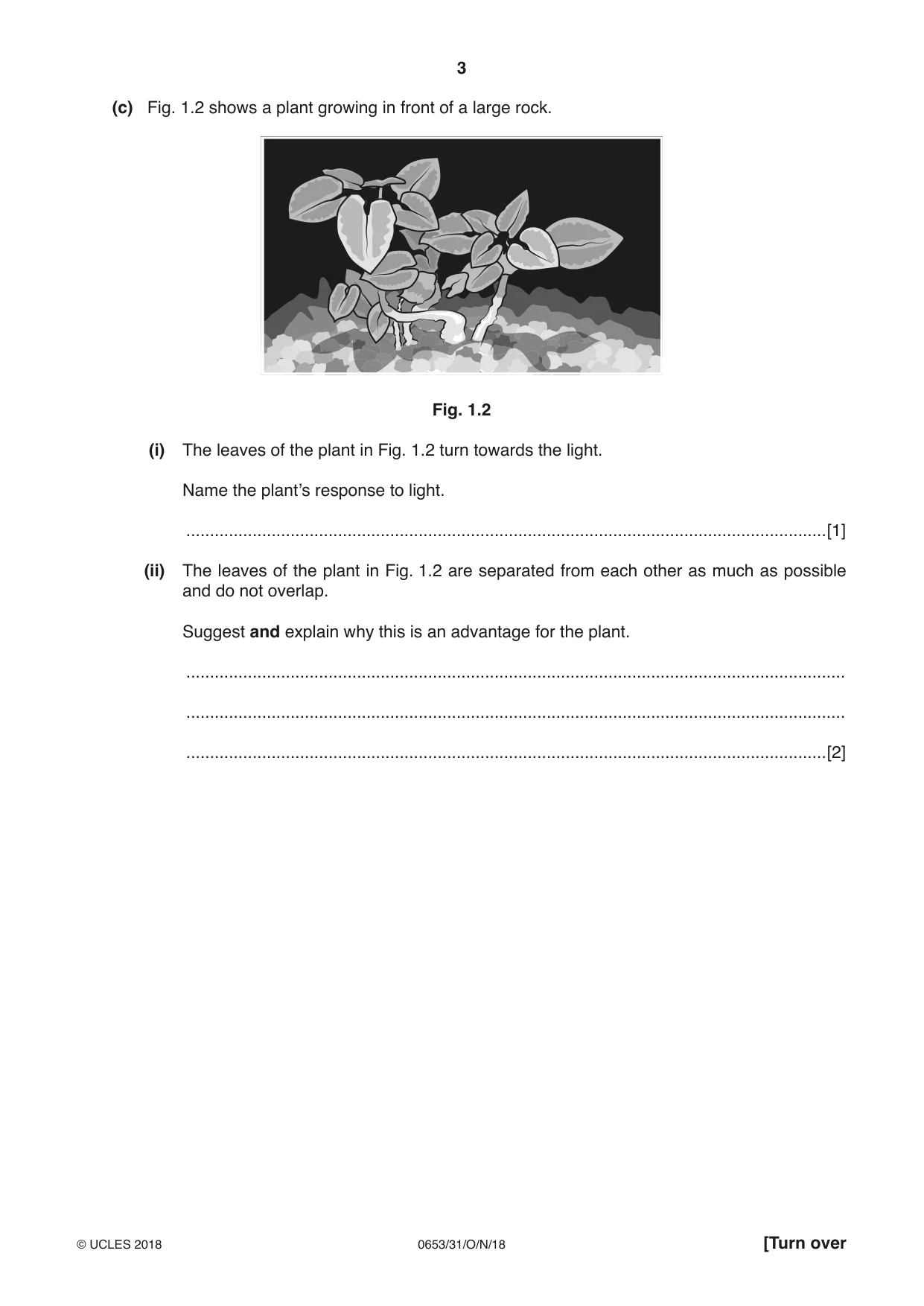
1 (a) The list shows some processes that occur in living organisms. breathing digestion excretion growth movement reproduction sensitivity State two processes shown in the list which are not characteristics of all living things. 1. ............................................................................................................................................... 2. ............................................................................................................................................... [2] (b) Fig. 1.1 shows a palisade cell which is found in the leaf of a plant. Fig. 1.1 (i) On Fig. 1.1 use a label line and the correct name to show one structure that is present in all plant cells but is absent from animal cells. [2] (ii) Describe the pathway taken by water in the plant, from the soil to the palisade cells. ........................................................................................................................................... ........................................................................................................................................... ........................................................................................................................................... .......................................................................................................................................[3] (c) Fig. 1.2 shows a plant growing in front of a large rock. Fig. 1.2 (i) The leaves of the plant in Fig. 1.2 turn towards the light. Name the plant’s response to light. .......................................................................................................................................[1] (ii) The leaves of the plant in Fig. 1.2 are separated from each other as much as possible and do not overlap. Suggest and explain why this is an advantage for the plant. ........................................................................................................................................... ........................................................................................................................................... .......................................................................................................................................[2]
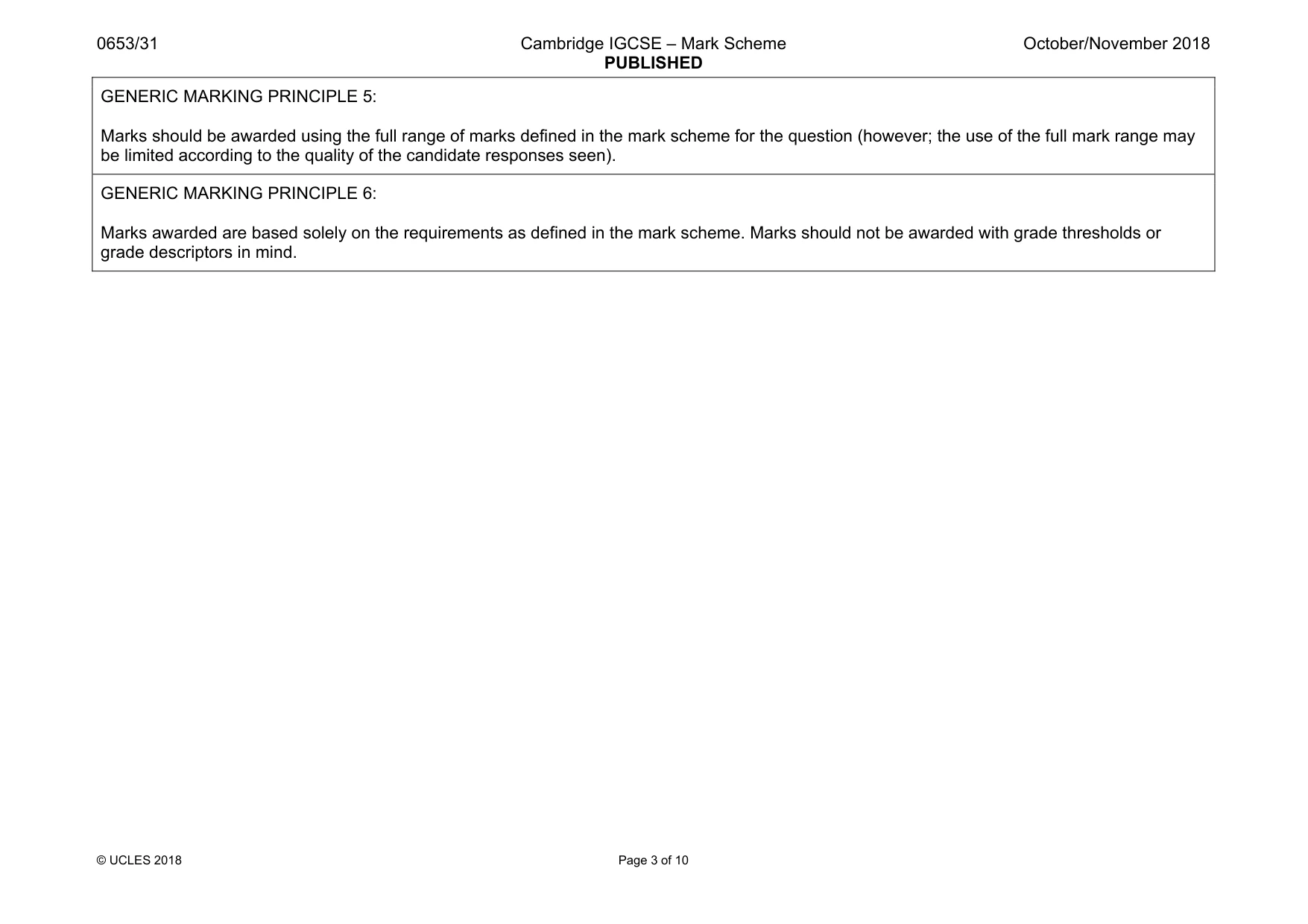
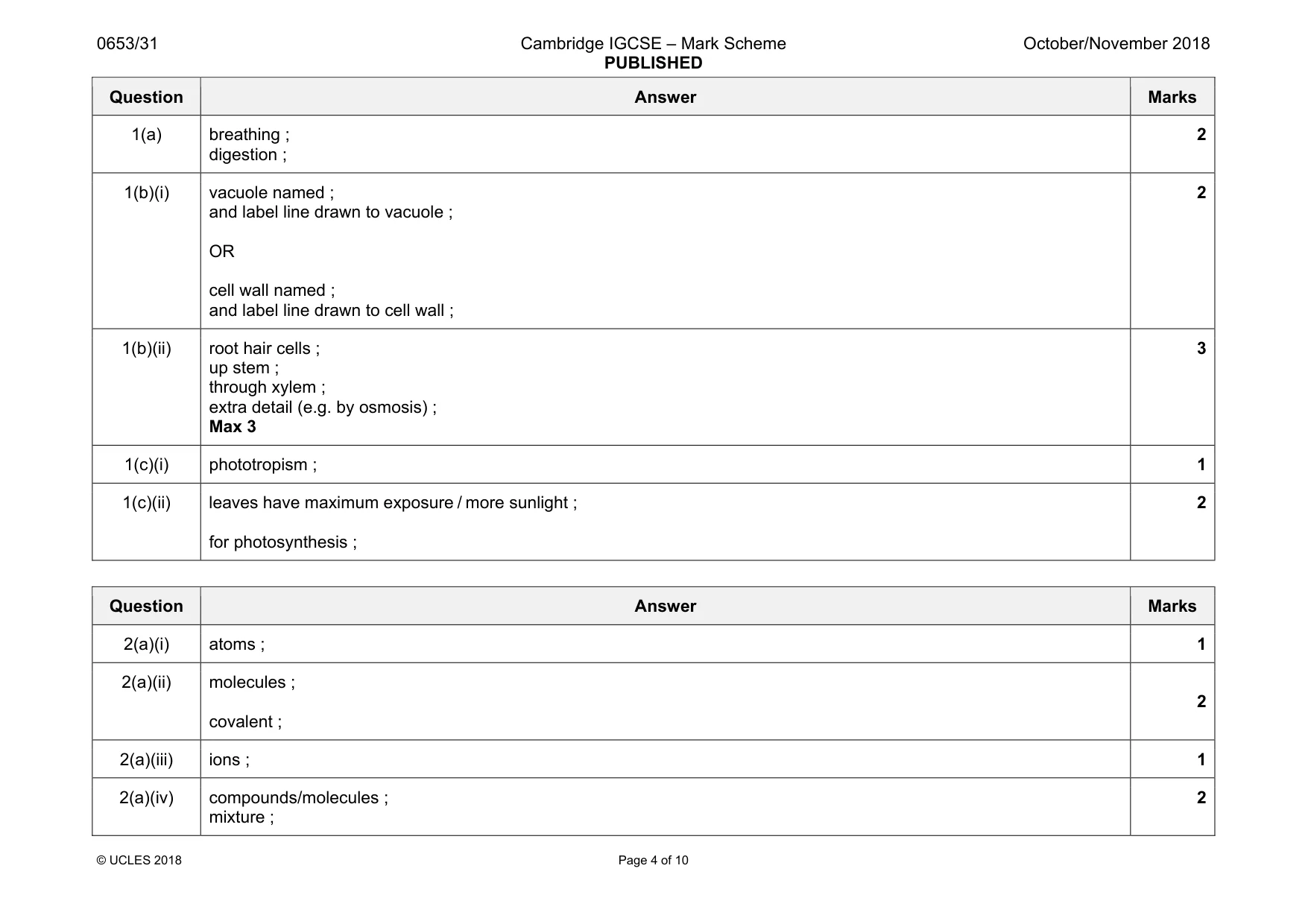
Mark scheme: 1(a) breathing ; digestion ; 2 1(b)(i) vacuole named ; and label line drawn to vacuole ; OR cell wall named ; and label line drawn to cell wall ; 2 1(b)(ii) root hair cells ; up stem ; through xylem ; extra detail (e.g. by osmosis) ; Max 3 3 1(c)(i) phototropism ; 1 1(c)(ii) leaves have maximum exposure / more sunlight ; for photosynthesis ; 2
Q2 · Complete the following sentences using words from the list
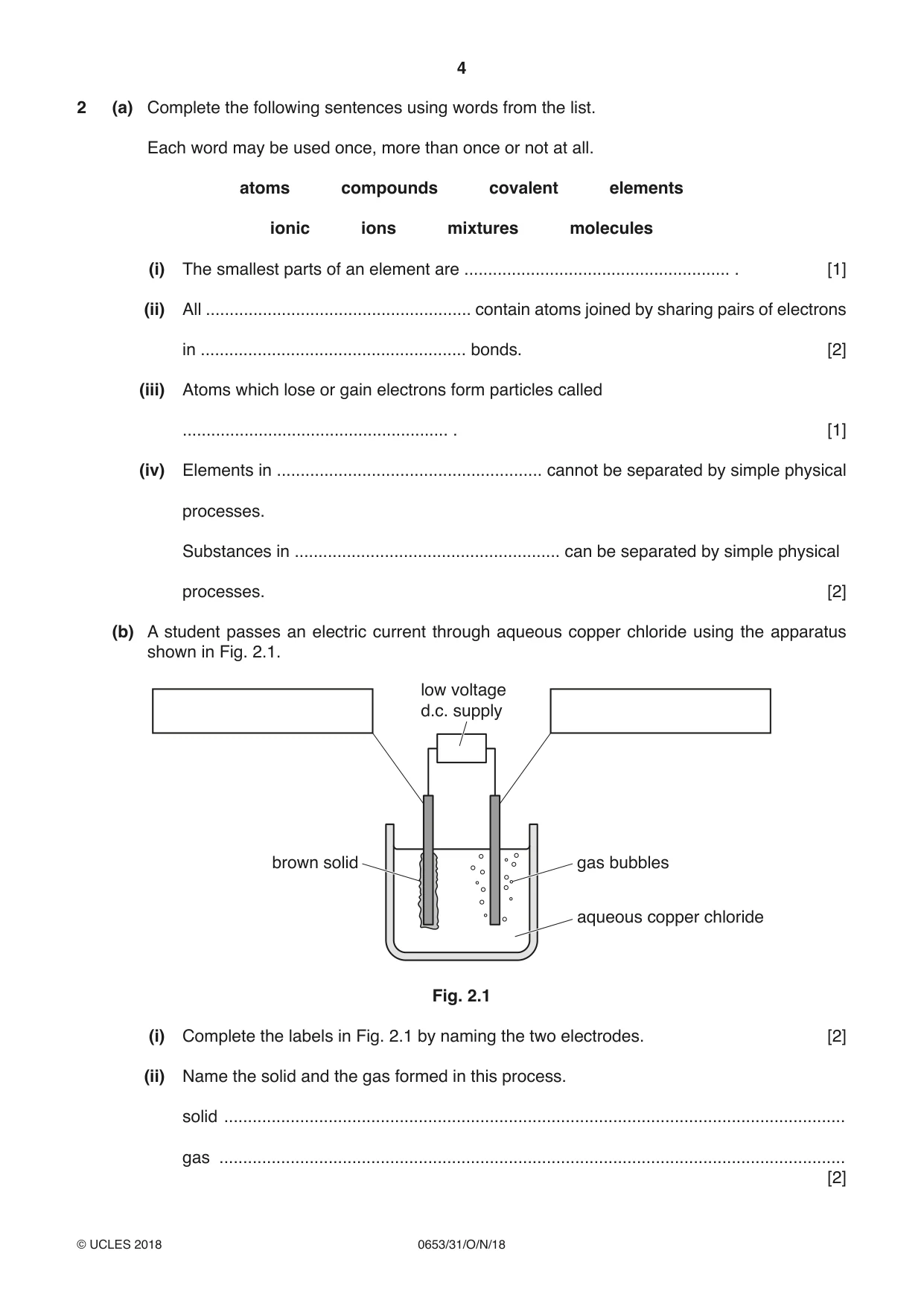
2 (a) Complete the following sentences using words from the list. Each word may be used once, more than once or not at all. atoms compounds covalent elements ionic ions mixtures molecules (i) The smallest parts of an element are ........................................................ . [1] (ii) All ........................................................ contain atoms joined by sharing pairs of electrons in ........................................................ bonds. [2] (iii) Atoms which lose or gain electrons form particles called ........................................................ . [1] (iv) Elements in ........................................................ cannot be separated by simple physical processes. Substances in ........................................................ can be separated by simple physical processes. [2] (b) A student passes an electric current through aqueous copper chloride using the apparatus shown in Fig. 2.1. low voltage d.c. supply brown solid gas bubbles aqueous copper chloride Fig. 2.1 (i) Complete the labels in Fig. 2.1 by naming the two electrodes. [2] (ii) Name the solid and the gas formed in this process. solid ................................................................................................................................... gas .................................................................................................................................... [2]
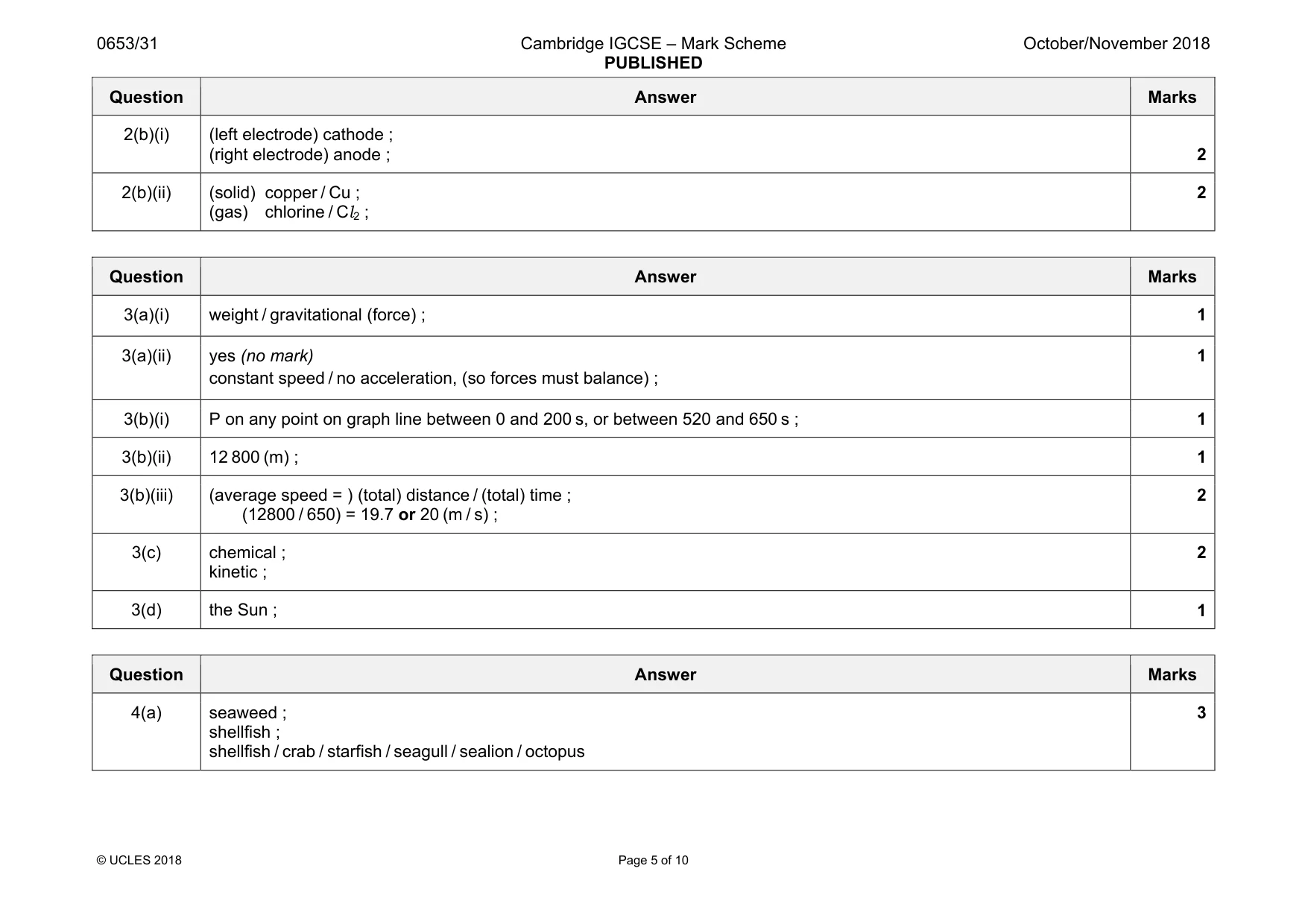
Mark scheme: 2(a)(i) atoms ; 1 2(a)(ii) molecules ; covalent ; 2 2(a)(iii) ions ; 1 2(a)(iv) compounds/molecules ; mixture ; 2 Question Answer Marks 2(b)(i) (left electrode) cathode ; (right electrode) anode ; 2 2(b)(ii) (solid) copper / Cu ; (gas) chlorine / Cl2 ; 2
Q3 · A train made up of a steam engine and a passenger coach
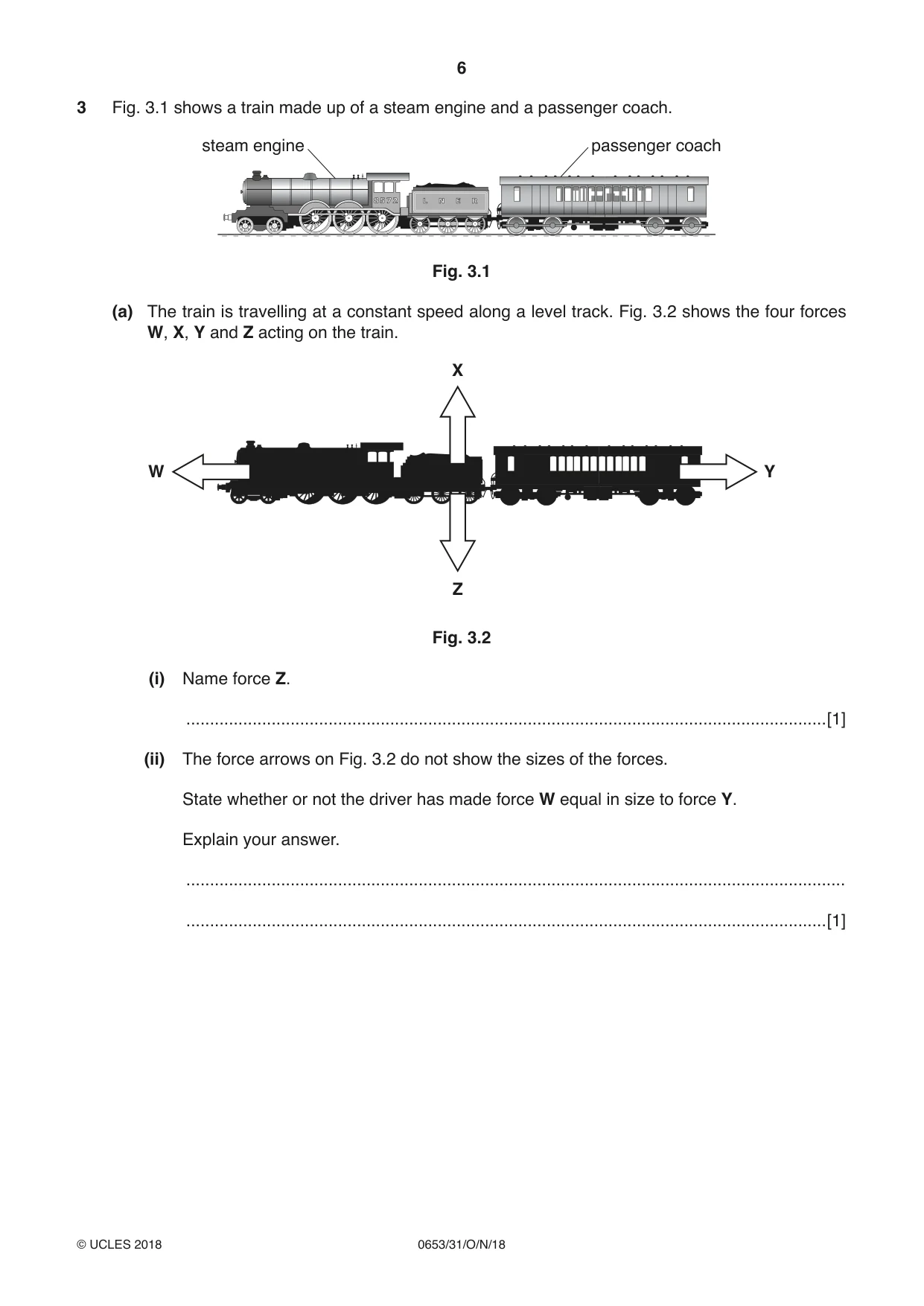
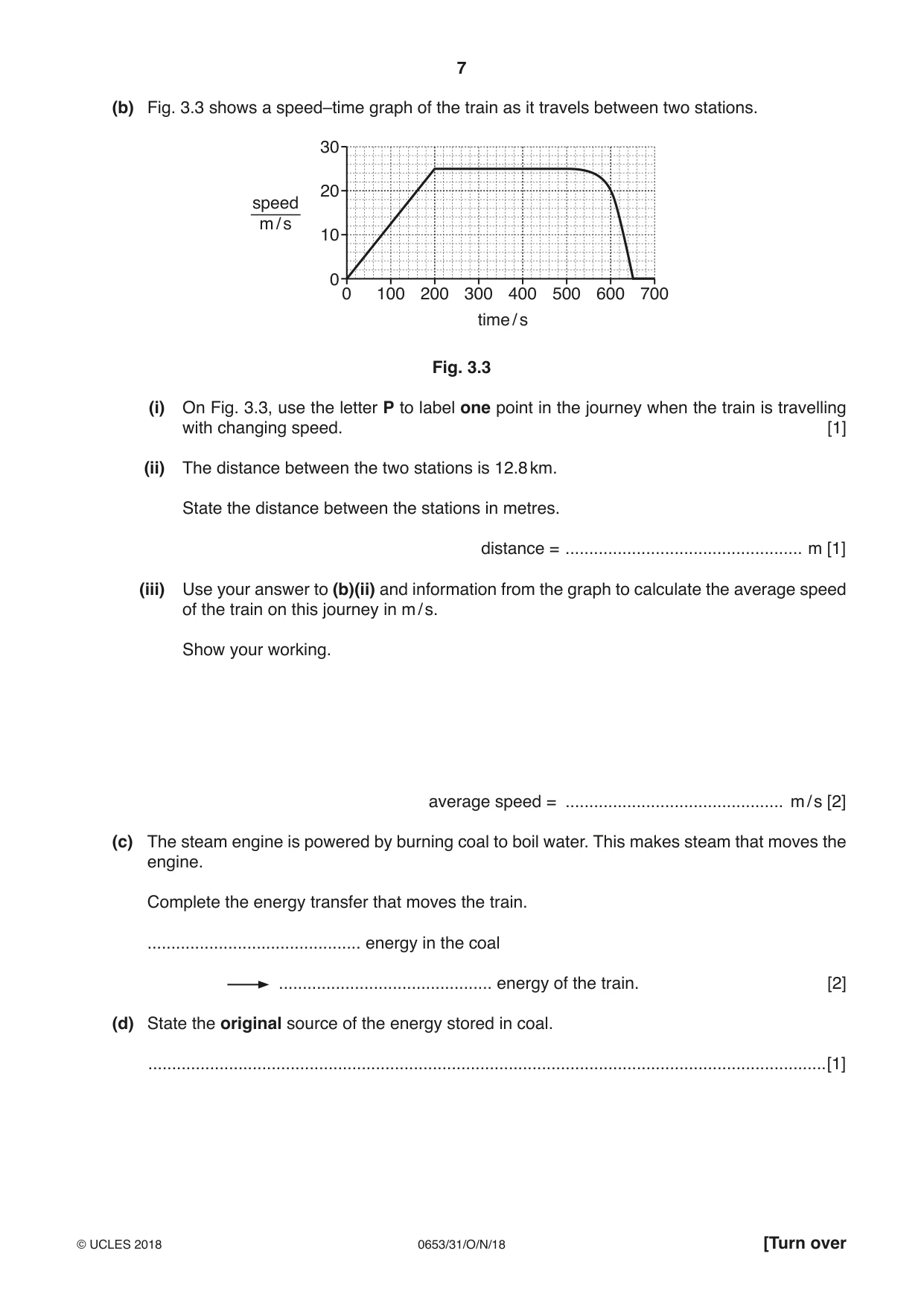
3 Fig. 3.1 shows a train made up of a steam engine and a passenger coach. steam engine passenger coach Fig. 3.1 (a) The train is travelling at a constant speed along a level track. Fig. 3.2 shows the four forces W, X, Y and Z acting on the train. X W Y Z Fig. 3.2 (i) Name force Z. .......................................................................................................................................[1] (ii) The force arrows on Fig. 3.2 do not show the sizes of the forces. State whether or not the driver has made force W equal in size to force Y. Explain your answer. ........................................................................................................................................... .......................................................................................................................................[1] (b) Fig. 3.3 shows a speed–time graph of the train as it travels between two stations. 30 20 speed m / s 10 0 0 100 200 300 400 500 600 700 time / s Fig. 3.3 (i) On Fig. 3.3, use the letter P to label one point in the journey when the train is travelling with changing speed. [1] (ii) The distance between the two stations is 12.8 km. State the distance between the stations in metres. distance = .................................................. m [1] (iii) Use your answer to (b)(ii) and information from the graph to calculate the average speed of the train on this journey in m / s. Show your working. average speed = .............................................. m / s [2] (c) The steam engine is powered by burning coal to boil water. This makes steam that moves the engine. Complete the energy transfer that moves the train. ............................................. energy in the coal ............................................. energy of the train. [2] (d) State the original source of the energy stored in coal. ...............................................................................................................................................[1]
Mark scheme: 3(a)(i) weight / gravitational (force) ; 1 3(a)(ii) yes (no mark) constant speed / no acceleration, (so forces must balance) ; 1 3(b)(i) P on any point on graph line between 0 and 200 s, or between 520 and 650 s ; 1 3(b)(ii) 12 800 (m) ; 1 3(b)(iii) (average speed = ) (total) distance / (total) time ; (12800 / 650) = 19.7 or 20 (m / s) ; 2 3(c) chemical ; kinetic ; 2 3(d) the Sun ; 1
Q4 · Part of an aquatic food web
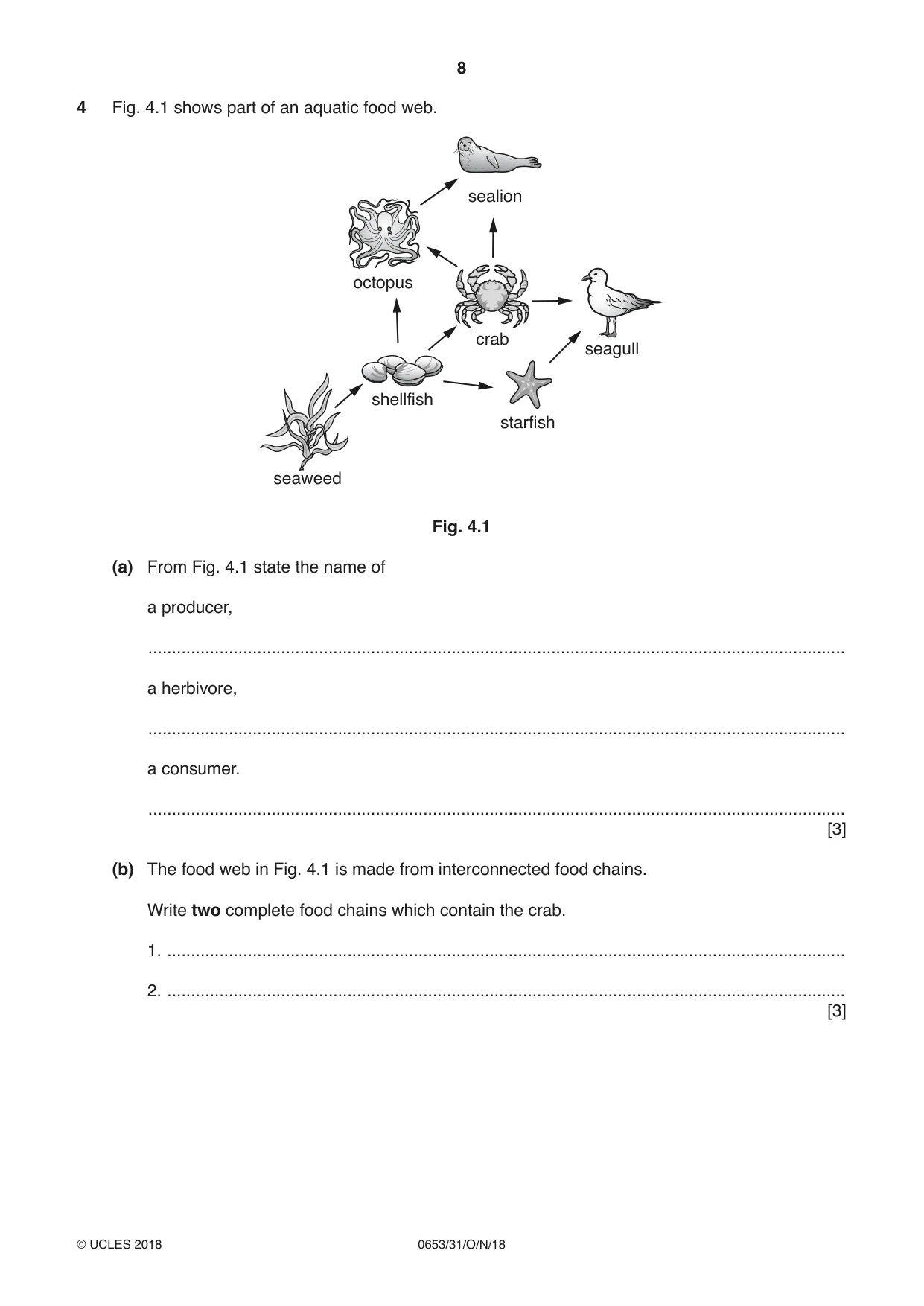
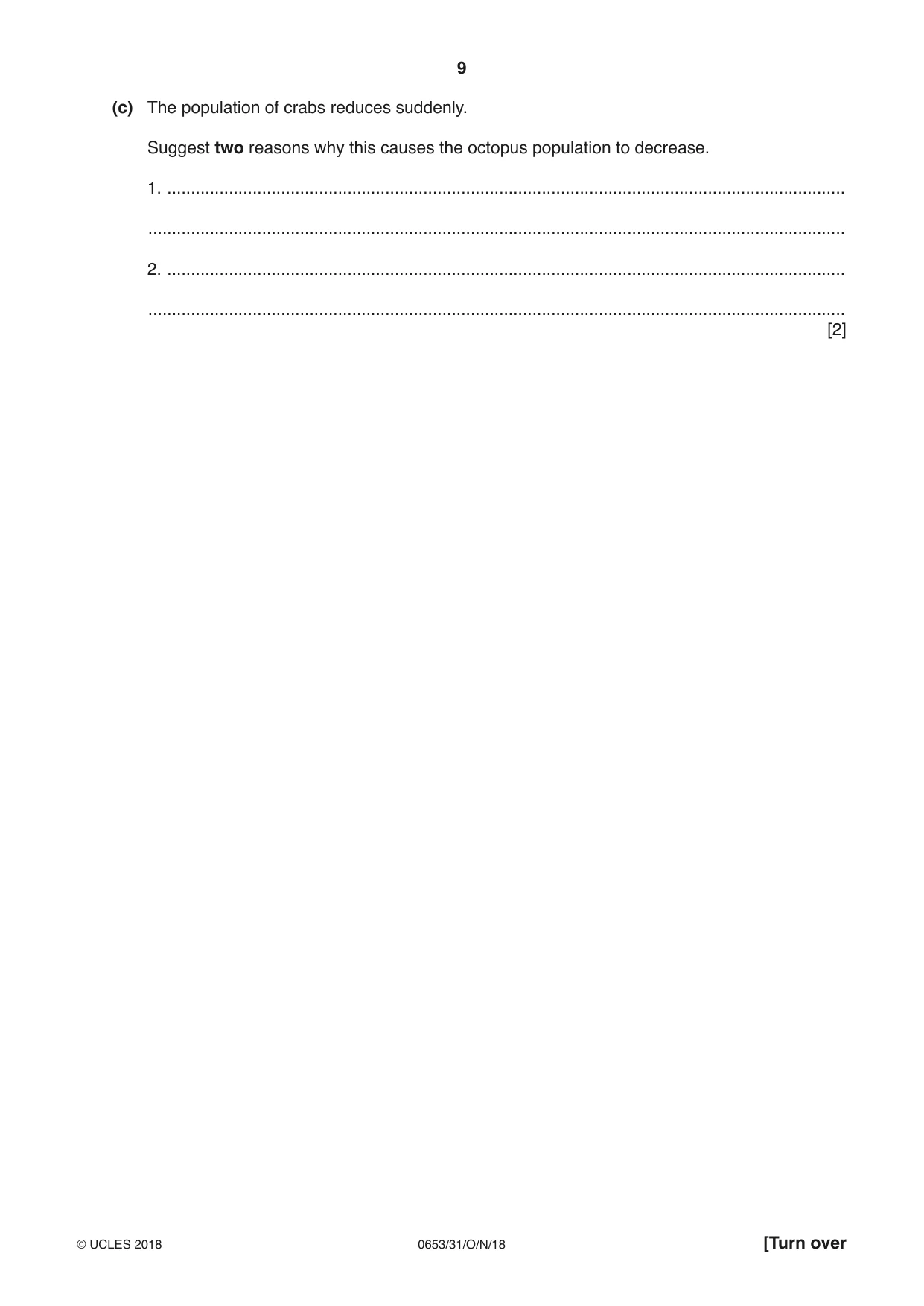
4 Fig. 4.1 shows part of an aquatic food web. sealion octopus crab seagull shellfish starfish seaweed Fig. 4.1 (a) From Fig. 4.1 state the name of a producer, ................................................................................................................................................... a herbivore, ................................................................................................................................................... a consumer. ................................................................................................................................................... [3] (b) The food web in Fig. 4.1 is made from interconnected food chains. Write two complete food chains which contain the crab. 1. ............................................................................................................................................... 2. ............................................................................................................................................... [3] (c) The population of crabs reduces suddenly. Suggest two reasons why this causes the octopus population to decrease. 1. ............................................................................................................................................... ................................................................................................................................................... 2. ............................................................................................................................................... ................................................................................................................................................... [2]
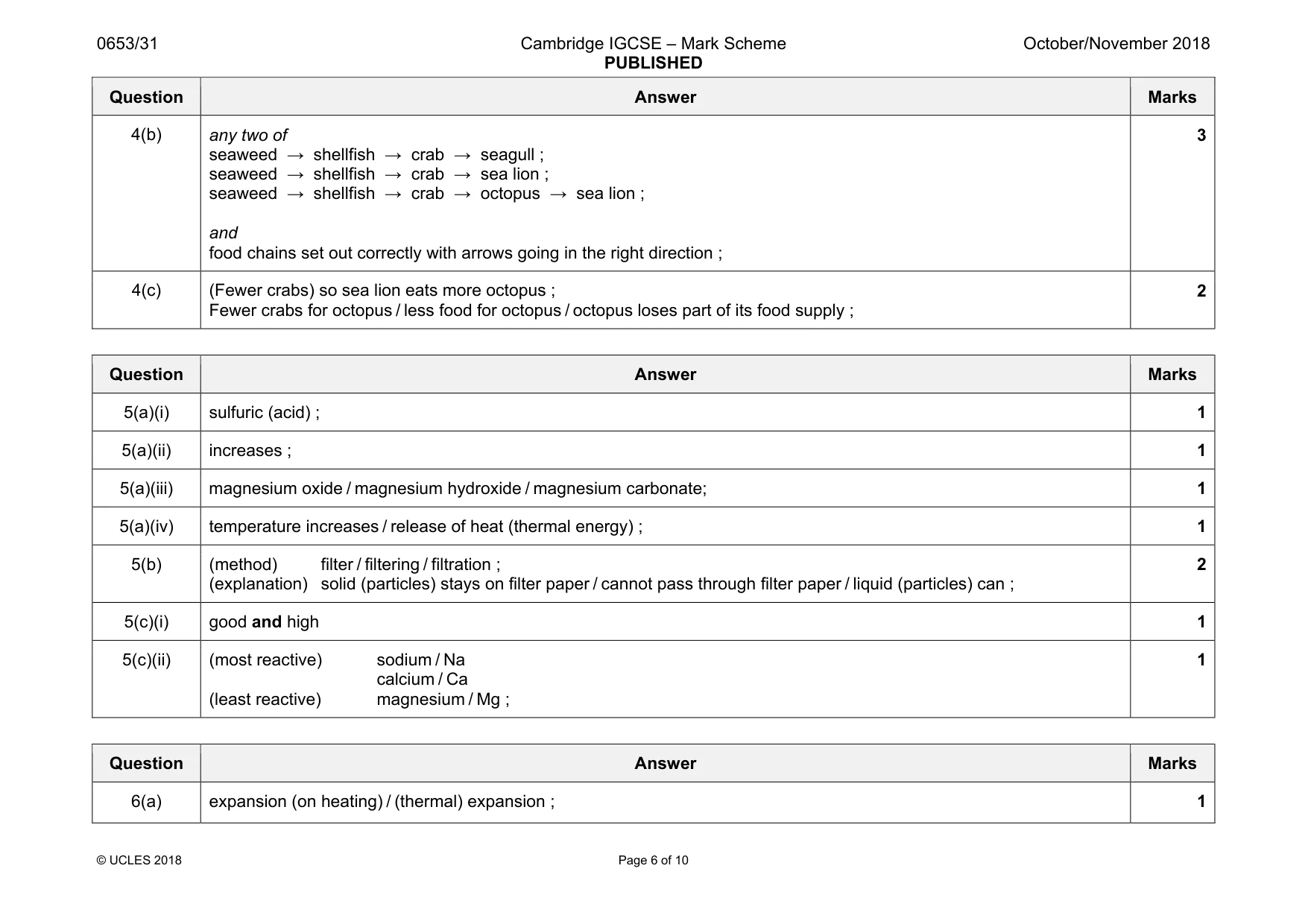
Mark scheme: 4(a) seaweed ; shellfish ; shellfish / crab / starfish / seagull / sealion / octopus 3 Question Answer Marks 4(b) any two of seaweed → shellfish → crab → seagull ; seaweed → shellfish → crab → sea lion ; seaweed → shellfish → crab → octopus → sea lion ; and food chains set out correctly with arrows going in the right direction ; 3 4(c) (Fewer crabs) so sea lion eats more octopus ; Fewer crabs for octopus / less food for octopus / octopus loses part of its food supply ; 2
Q5 · A student makes magnesium sulfate by reacting magnesium with a dilute acid
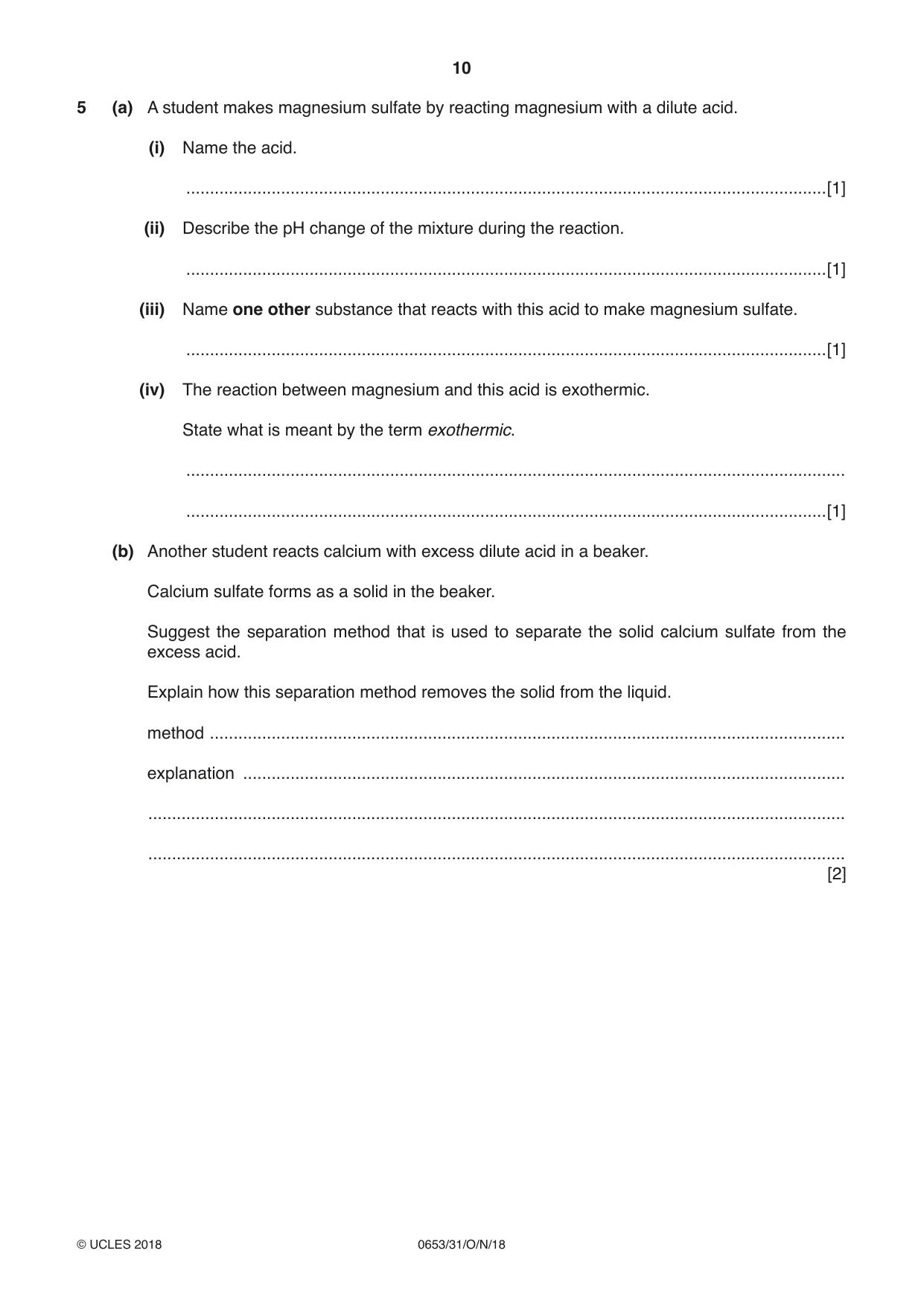
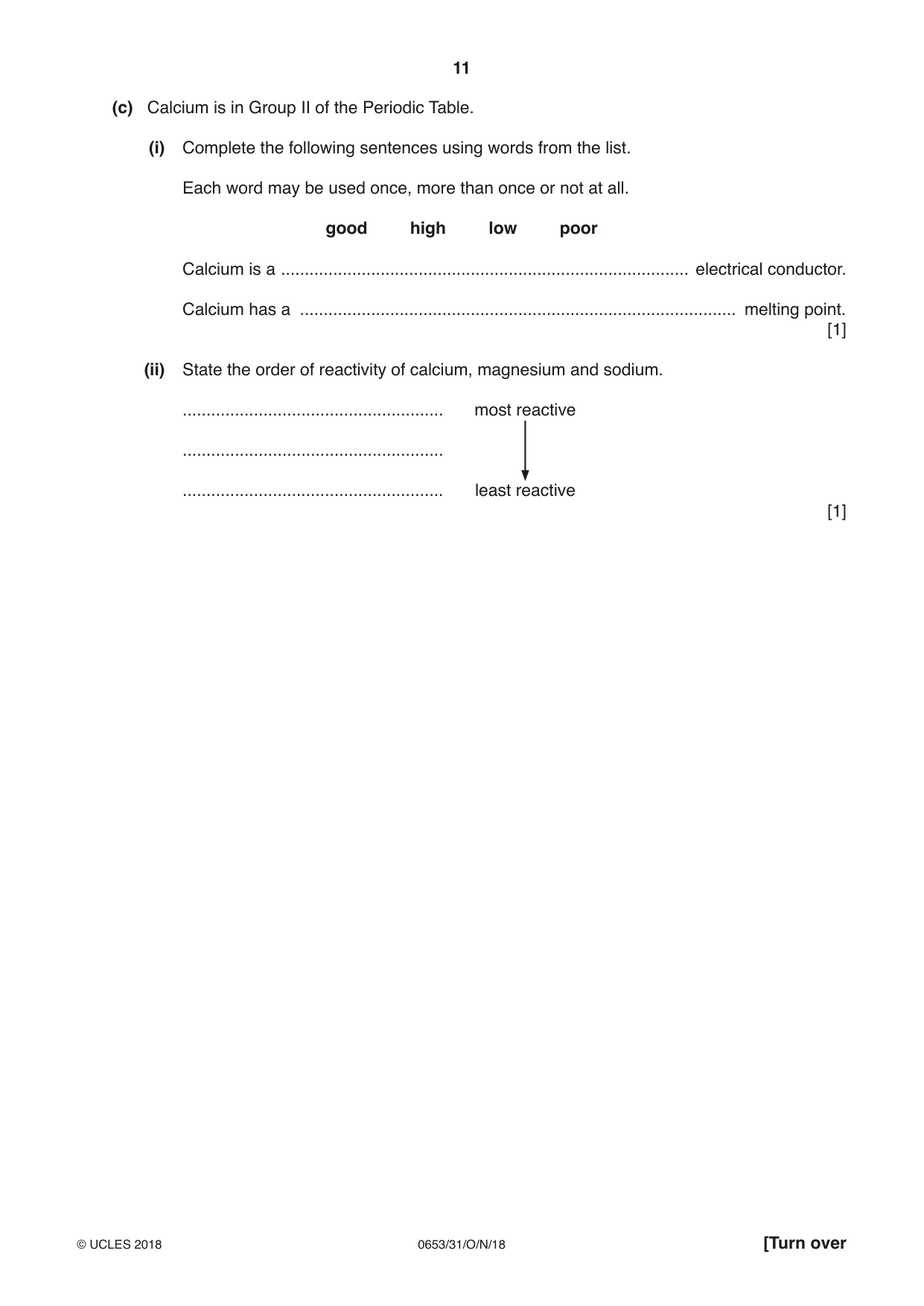
5 (a) A student makes magnesium sulfate by reacting magnesium with a dilute acid. (i) Name the acid. .......................................................................................................................................[1] (ii) Describe the pH change of the mixture during the reaction. .......................................................................................................................................[1] (iii) Name one other substance that reacts with this acid to make magnesium sulfate. .......................................................................................................................................[1] (iv) The reaction between magnesium and this acid is exothermic. State what is meant by the term exothermic. ........................................................................................................................................... .......................................................................................................................................[1] (b) Another student reacts calcium with excess dilute acid in a beaker. Calcium sulfate forms as a solid in the beaker. Suggest the separation method that is used to separate the solid calcium sulfate from the excess acid. Explain how this separation method removes the solid from the liquid. method ...................................................................................................................................... explanation ............................................................................................................................... ................................................................................................................................................... ................................................................................................................................................... [2] (c) Calcium is in Group II of the Periodic Table. (i) Complete the following sentences using words from the list. Each word may be used once, more than once or not at all. good high low poor Calcium is a ...................................................................................... electrical conductor. Calcium has a ............................................................................................ melting point. [1] (ii) State the order of reactivity of calcium, magnesium and sodium. ....................................................... most reactive ....................................................... ....................................................... least reactive [1]
Mark scheme: 5(a)(i) sulfuric (acid) ; 1 5(a)(ii) increases ; 1 5(a)(iii) magnesium oxide / magnesium hydroxide / magnesium carbonate; 1 5(a)(iv) temperature increases / release of heat (thermal energy) ; 1 5(b) (method) filter / filtering / filtration ; (explanation) solid (particles) stays on filter paper / cannot pass through filter paper / liquid (particles) can ; 2 5(c)(i) good and high 1 5(c)(ii) (most reactive) sodium / Na calcium / Ca (least reactive) magnesium / Mg ; 1
Q6 · A liquid-in-glass thermometer at room temperature
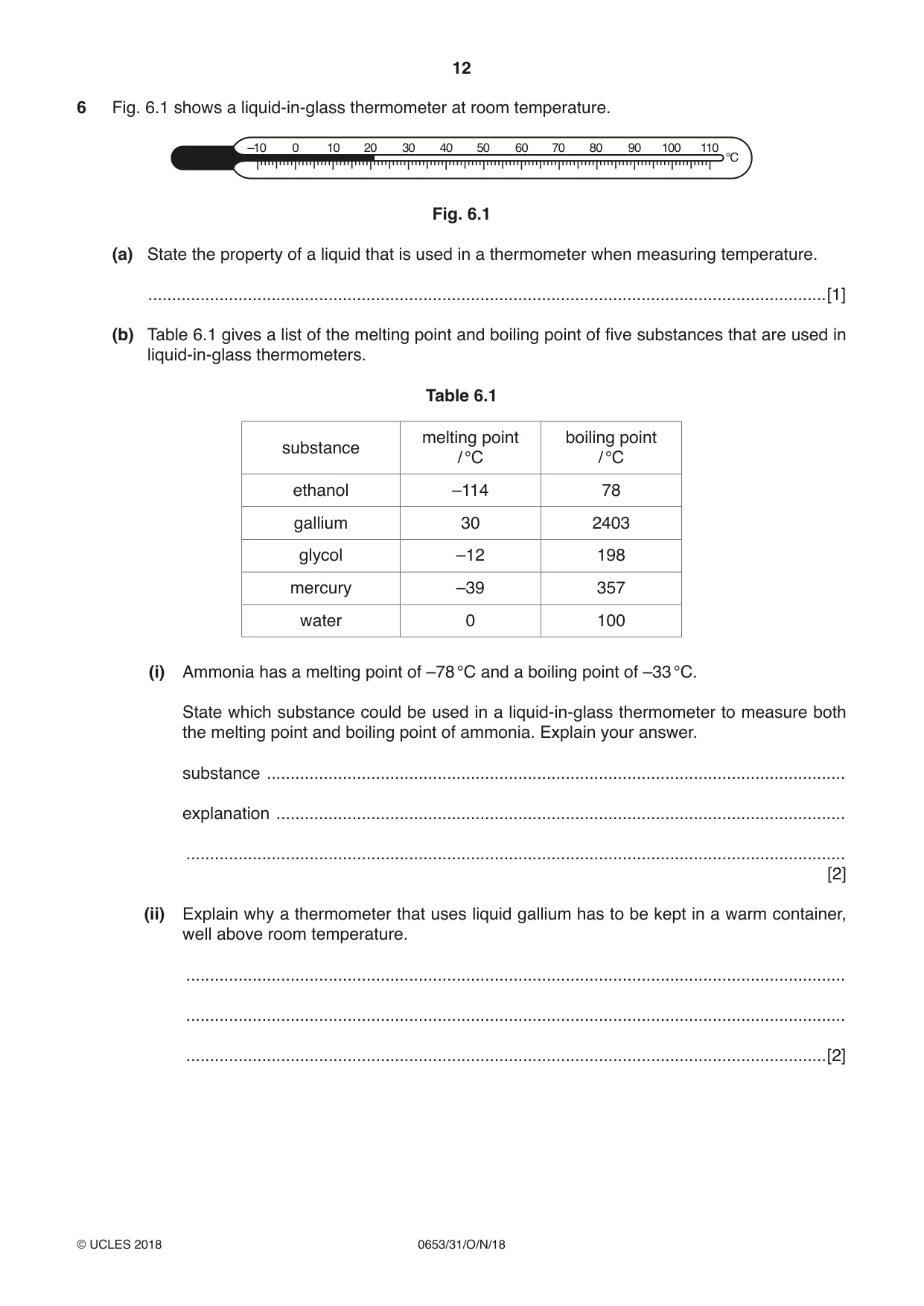
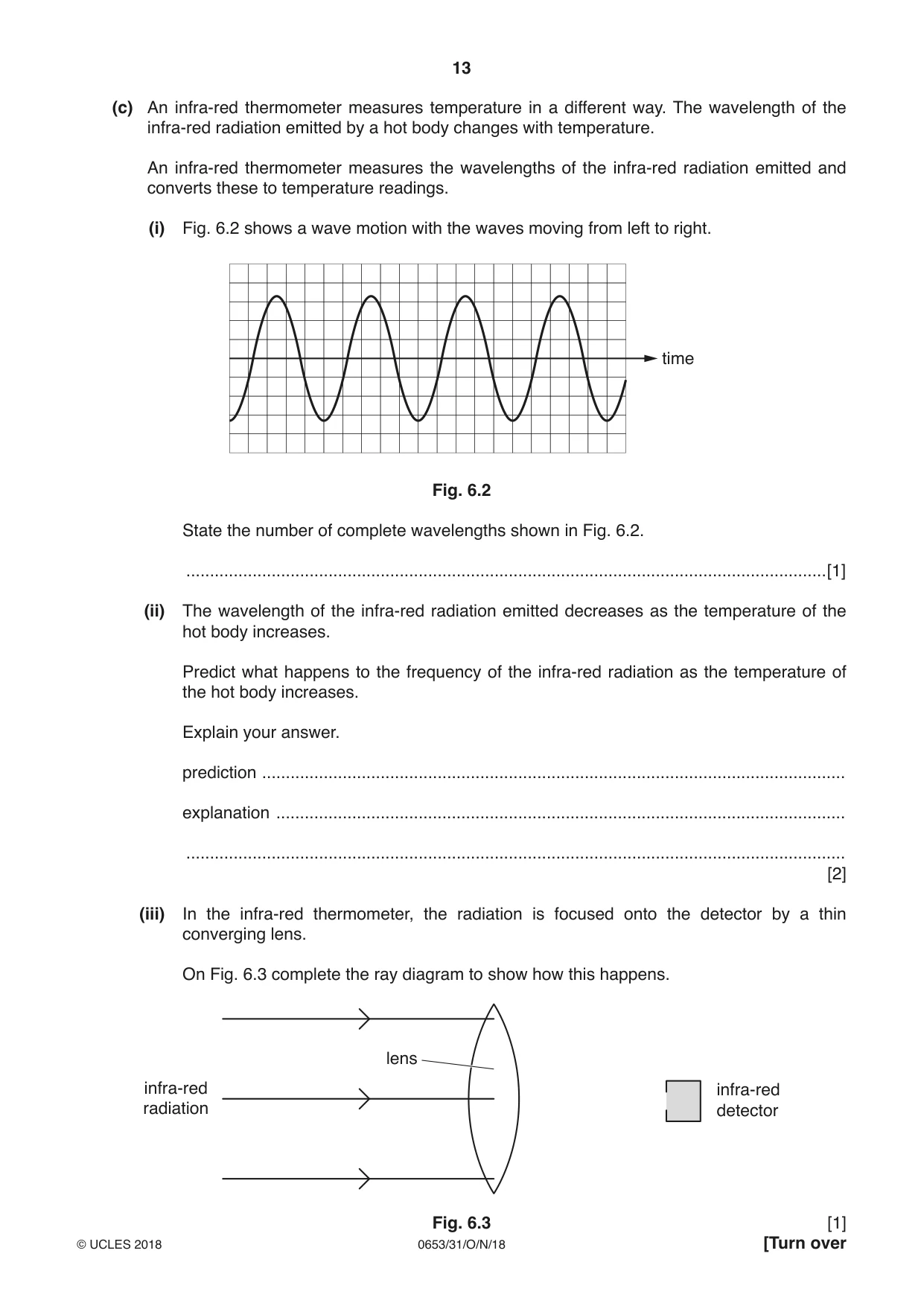
6 Fig. 6.1 shows a liquid-in-glass thermometer at room temperature. –10 0 10 20 30 40 50 60 70 80 90 100 110 °C Fig. 6.1 (a) State the property of a liquid that is used in a thermometer when measuring temperature. ...............................................................................................................................................[1] (b) Table 6.1 gives a list of the melting point and boiling point of five substances that are used in liquid-in-glass thermometers. Table 6.1 melting point boiling point substance / °C / °C ethanol –114 78 gallium 30 2403 glycol –12 198 mercury –39 357 water 0 100 (i) Ammonia has a melting point of –78 °C and a boiling point of –33 °C. State which substance could be used in a liquid-in-glass thermometer to measure both the melting point and boiling point of ammonia. Explain your answer. substance .......................................................................................................................... explanation ........................................................................................................................ ........................................................................................................................................... [2] (ii) Explain why a thermometer that uses liquid gallium has to be kept in a warm container, well above room temperature. ........................................................................................................................................... ........................................................................................................................................... .......................................................................................................................................[2] (c) An infra-red thermometer measures temperature in a different way. The wavelength of the infra-red radiation emitted by a hot body changes with temperature. An infra-red thermometer measures the wavelengths of the infra-red radiation emitted and converts these to temperature readings. (i) Fig. 6.2 shows a wave motion with the waves moving from left to right. time Fig. 6.2 State the number of complete wavelengths shown in Fig. 6.2. .......................................................................................................................................[1] (ii) The wavelength of the infra-red radiation emitted decreases as the temperature of the hot body increases. Predict what happens to the frequency of the infra-red radiation as the temperature of the hot body increases. Explain your answer. prediction ........................................................................................................................... explanation ........................................................................................................................ ........................................................................................................................................... [2] (iii) In the infra-red thermometer, the radiation is focused onto the detector by a thin converging lens. On Fig. 6.3 complete the ray diagram to show how this happens. lens infra-red infra-red radiation detector
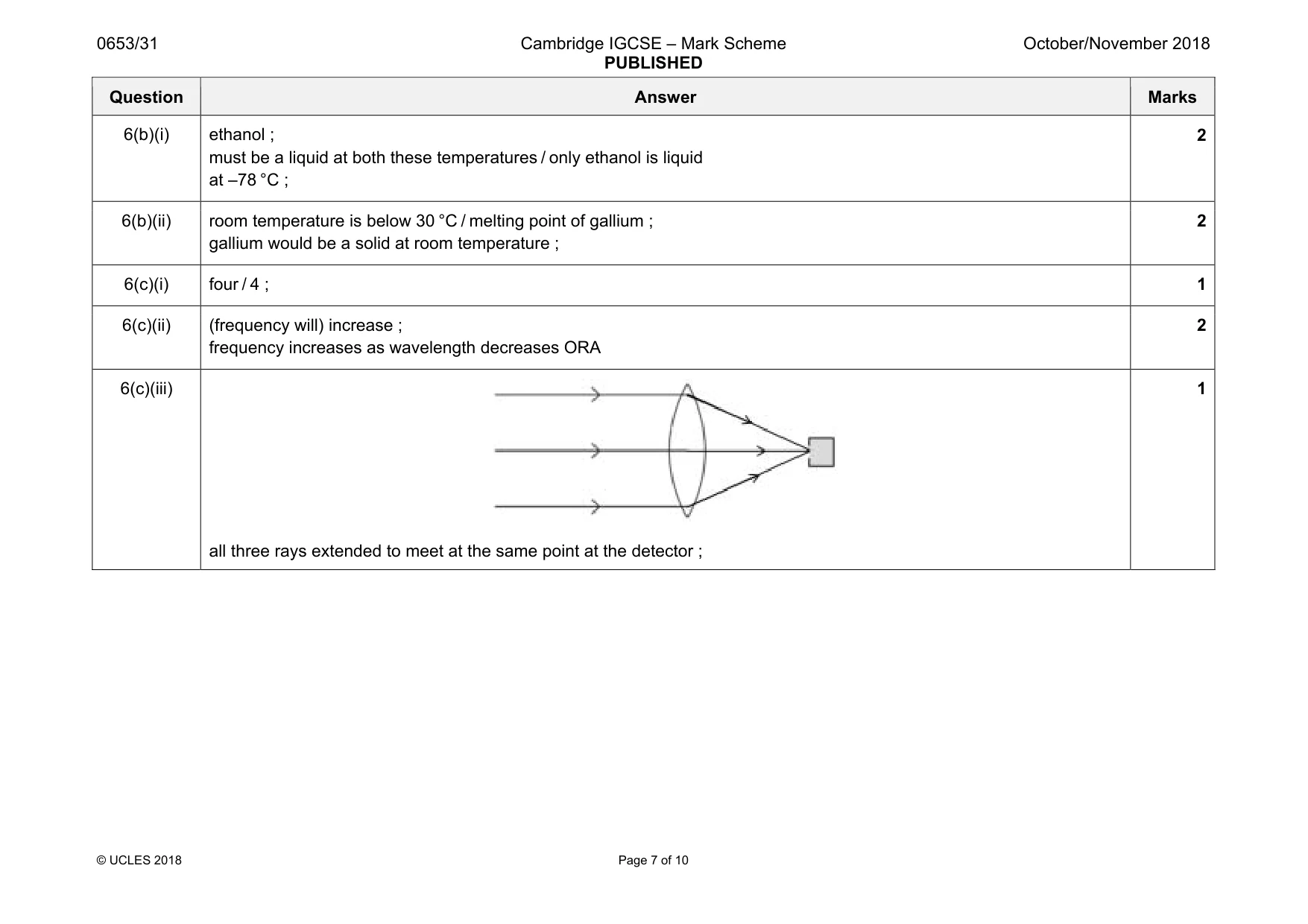
Mark scheme: 6(a) expansion (on heating) / (thermal) expansion ; 1 Question Answer Marks 6(b)(i) ethanol ; must be a liquid at both these temperatures / only ethanol is liquid at –78 °C ; 2 6(b)(ii) room temperature is below 30 °C / melting point of gallium ; gallium would be a solid at room temperature ; 2 6(c)(i) four / 4 ; 1 6(c)(ii) (frequency will) increase ; frequency increases as wavelength decreases ORA 2 6(c)(iii) all three rays extended to meet at the same point at the detector ; 1
Q7 · Some features of arteries, veins and capillaries
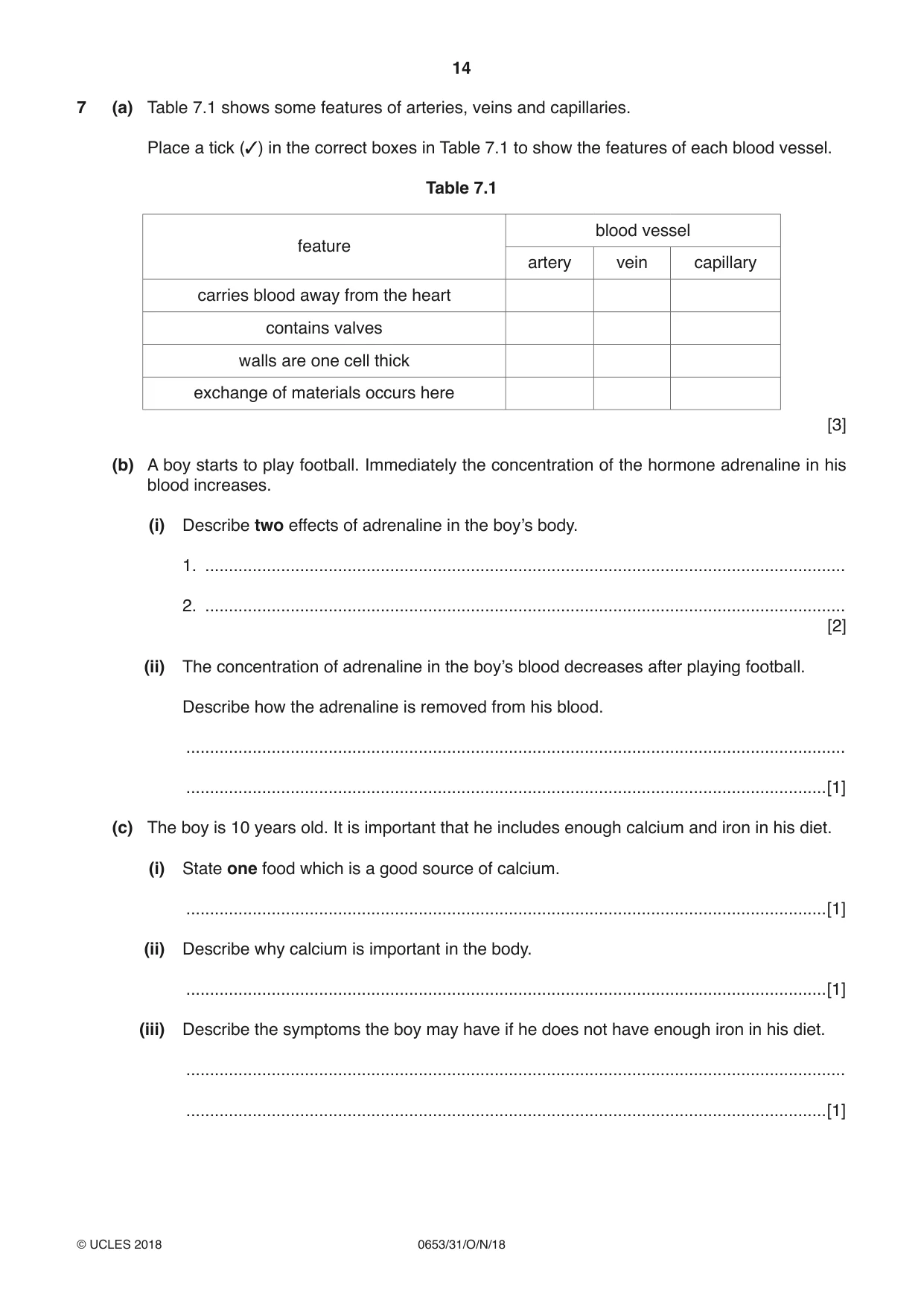
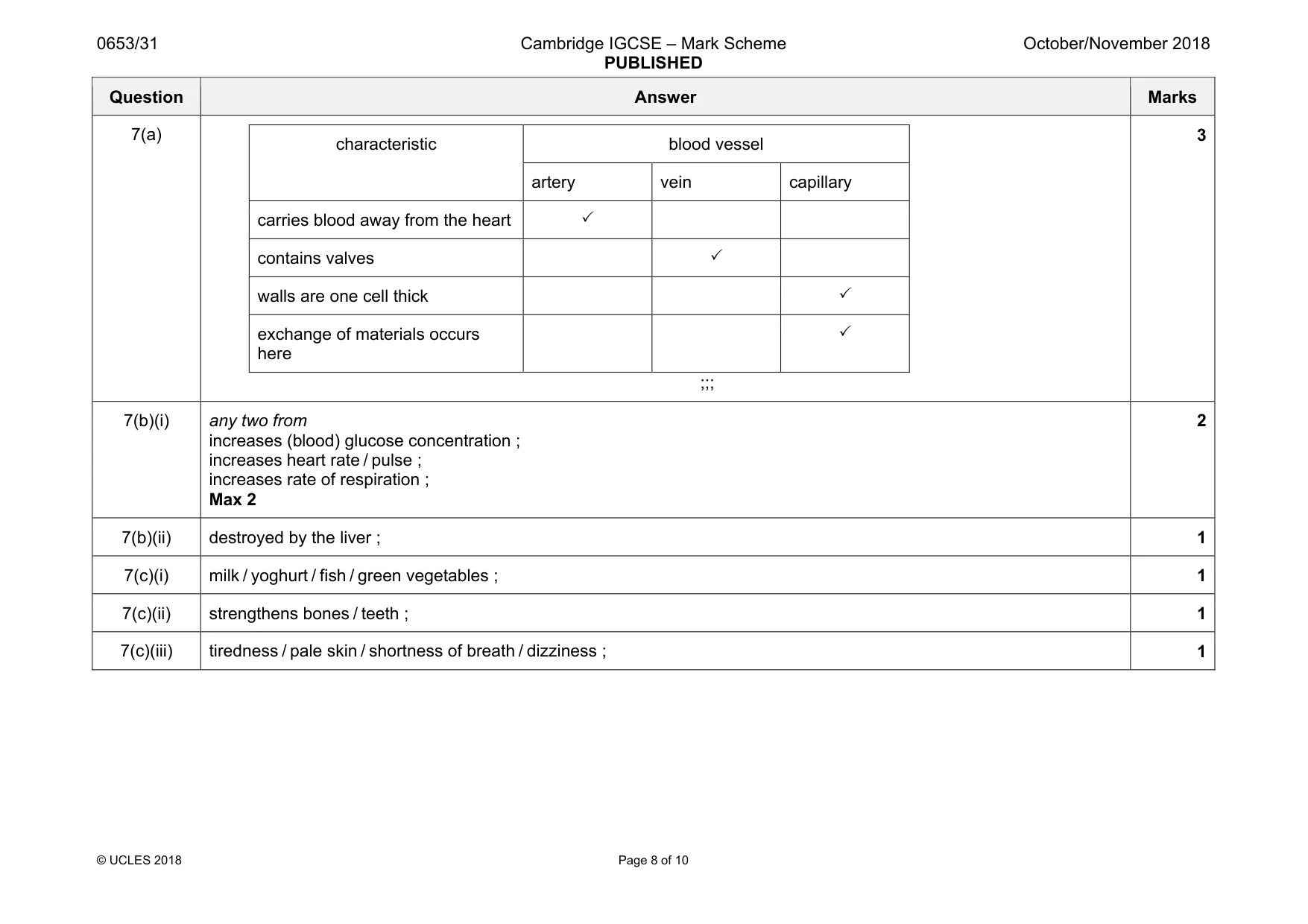
7 (a) Table 7.1 shows some features of arteries, veins and capillaries. Place a tick (3) in the correct boxes in Table 7.1 to show the features of each blood vessel. Table 7.1 blood vessel feature artery vein capillary carries blood away from the heart contains valves walls are one cell thick exchange of materials occurs here [3] (b) A boy starts to play football. Immediately the concentration of the hormone adrenaline in his blood increases. (i) Describe two effects of adrenaline in the boy’s body. 1. ....................................................................................................................................... 2. ....................................................................................................................................... [2] (ii) The concentration of adrenaline in the boy’s blood decreases after playing football. Describe how the adrenaline is removed from his blood. ........................................................................................................................................... .......................................................................................................................................[1] (c) The boy is 10 years old. It is important that he includes enough calcium and iron in his diet. (i) State one food which is a good source of calcium. .......................................................................................................................................[1] (ii) Describe why calcium is important in the body. .......................................................................................................................................[1] (iii) Describe the symptoms the boy may have if he does not have enough iron in his diet. ........................................................................................................................................... .......................................................................................................................................[1]
Mark scheme: 7(a) characteristic blood vessel artery vein capillary carries blood away from the heart 3 contains valves 3 walls are one cell thick 3 exchange of materials occurs here 3 ;;; 3 7(b)(i) any two from increases (blood) glucose concentration ; increases heart rate / pulse ; increases rate of respiration ; Max 2 2 7(b)(ii) destroyed by the liver ; 1 7(c)(i) milk / yoghurt / fish / green vegetables ; 1 7(c)(ii) strengthens bones / teeth ; 1 7(c)(iii) tiredness / pale skin / shortness of breath / dizziness ; 1
Q8 · Petroleum is separated into more useful substances using the process shown in Fig
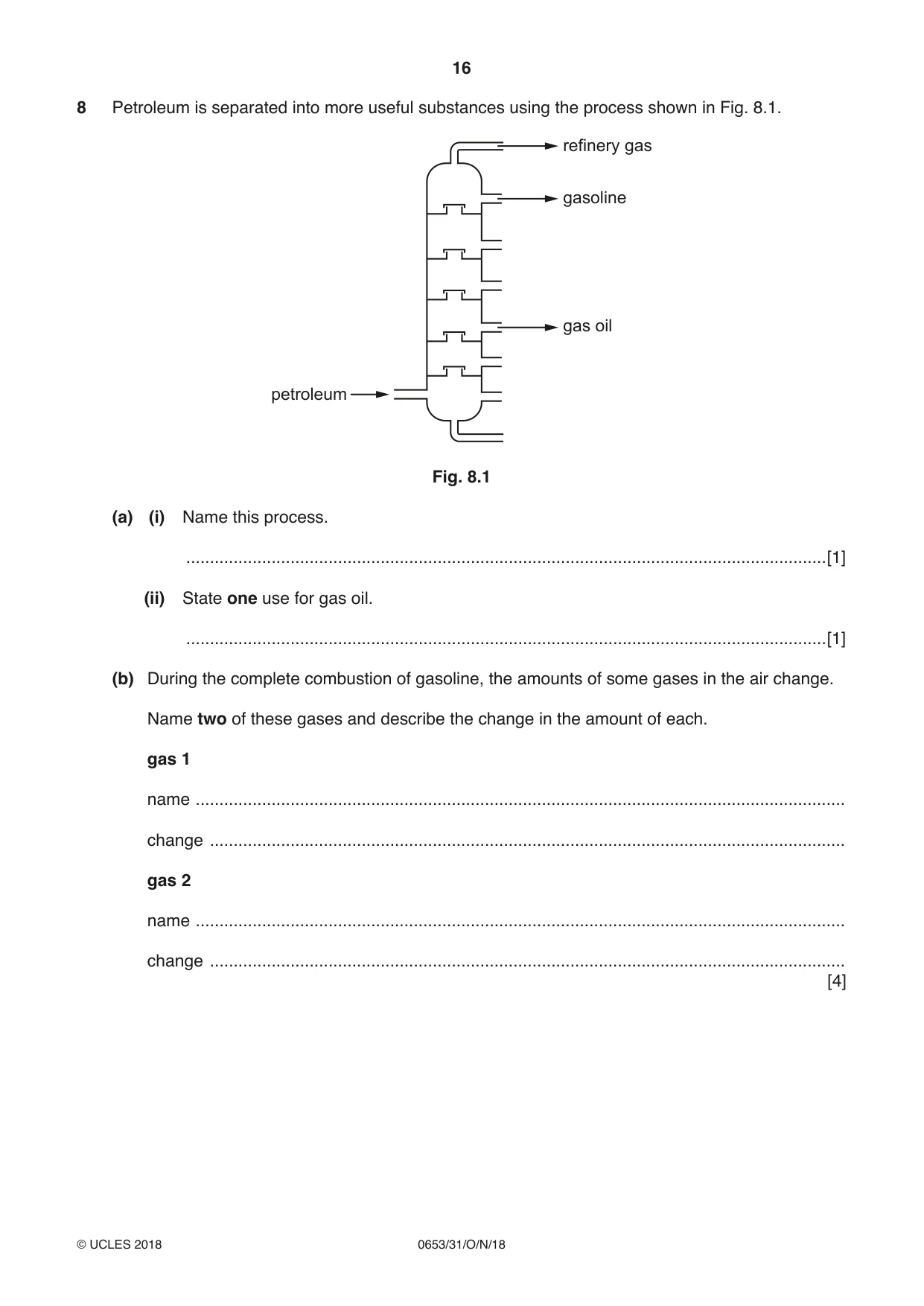
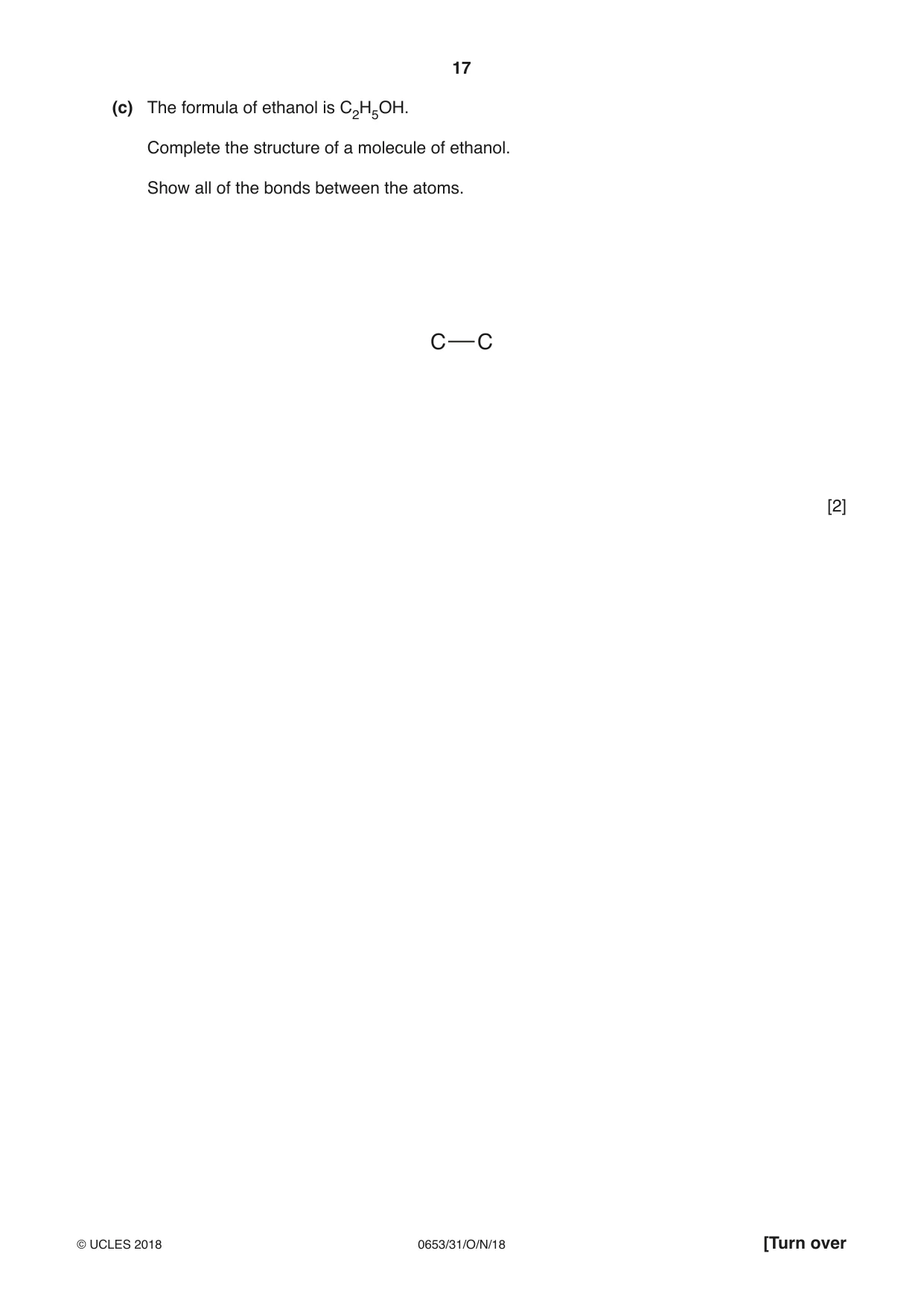
8 Petroleum is separated into more useful substances using the process shown in Fig. 8.1. refinery gas gasoline gas oil petroleum Fig. 8.1 (a) (i) Name this process. .......................................................................................................................................[1] (ii) State one use for gas oil. .......................................................................................................................................[1] (b) During the complete combustion of gasoline, the amounts of some gases in the air change. Name two of these gases and describe the change in the amount of each. gas 1 name ......................................................................................................................................... change ...................................................................................................................................... gas 2 name ......................................................................................................................................... change ...................................................................................................................................... [4] (c) The formula of ethanol is C2H5OH. Complete the structure of a molecule of ethanol. Show all of the bonds between the atoms. C C [2]
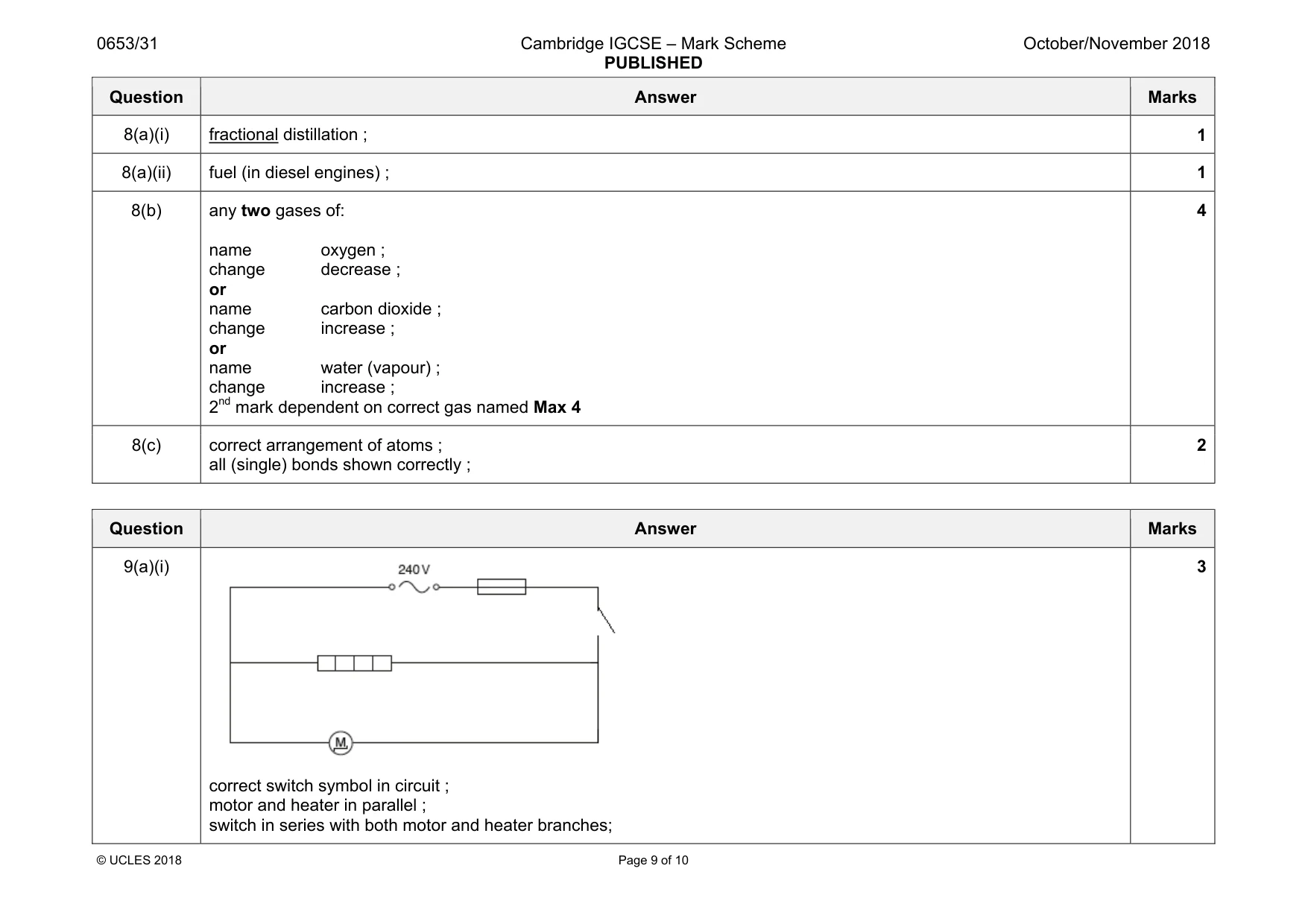
Mark scheme: 8(a)(i) fractional distillation ; 1 8(a)(ii) fuel (in diesel engines) ; 1 8(b) any two gases of: name oxygen ; change decrease ; or name carbon dioxide ; change increase ; or name water (vapour) ; change increase ; 2nd mark dependent on correct gas named Max 4 4 8(c) correct arrangement of atoms ; all (single) bonds shown correctly ; 2
Q9 · A dishwasher (an electric dishwashing machine)
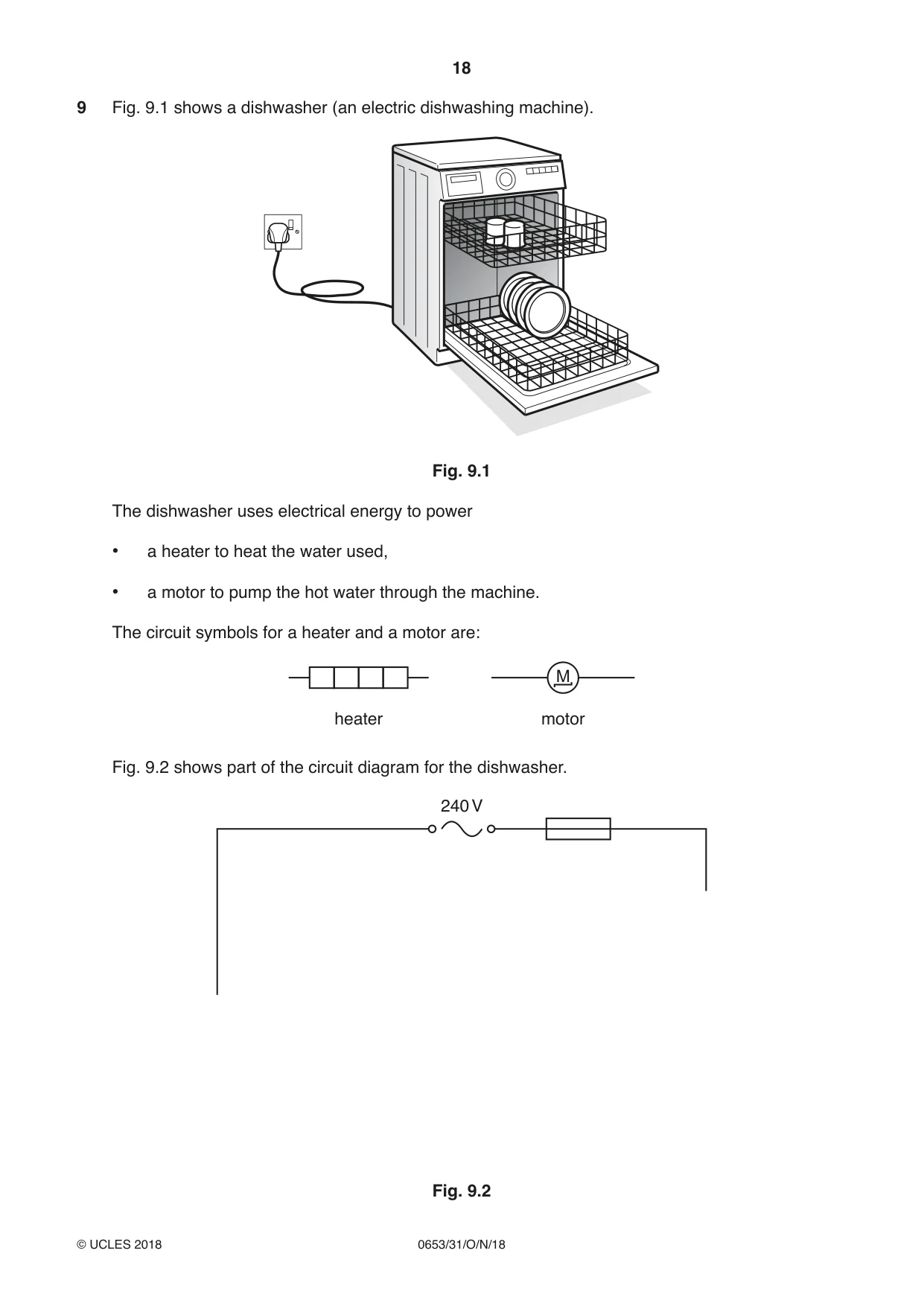
9 Fig. 9.1 shows a dishwasher (an electric dishwashing machine). Fig. 9.1 The dishwasher uses electrical energy to power • a heater to heat the water used, • a motor to pump the hot water through the machine. The circuit symbols for a heater and a motor are: M heater motor Fig. 9.2 shows part of the circuit diagram for the dishwasher. 240 V Fig. 9.2 (a) (i) The heater and the motor are connected in parallel. A switch turns both the heater and the motor on and off. On Fig. 9.2 complete the circuit diagram for the dishwasher. [3] (ii) Name the component in Fig. 9.2 represented by the symbol and state the reason for including it in the circuit. component ........................................................................................................................ reason ............................................................................................................................... ........................................................................................................................................... [2] (b) When switched on, the resistance of the heater is 24 Ω and the resistance of the motor is 4 Ω. V (i) Use the formula R = to calculate the current through the heater. I Show your working and give the unit of your answer. working current = .............................................. unit ............................ [3] (ii) Put a circle around the likely value of the combined resistance of the heater and motor in this circuit. Give a reason for your choice. 3.4 Ω 28 Ω reason ............................................................................................................................... .......................................................................................................................................[1]
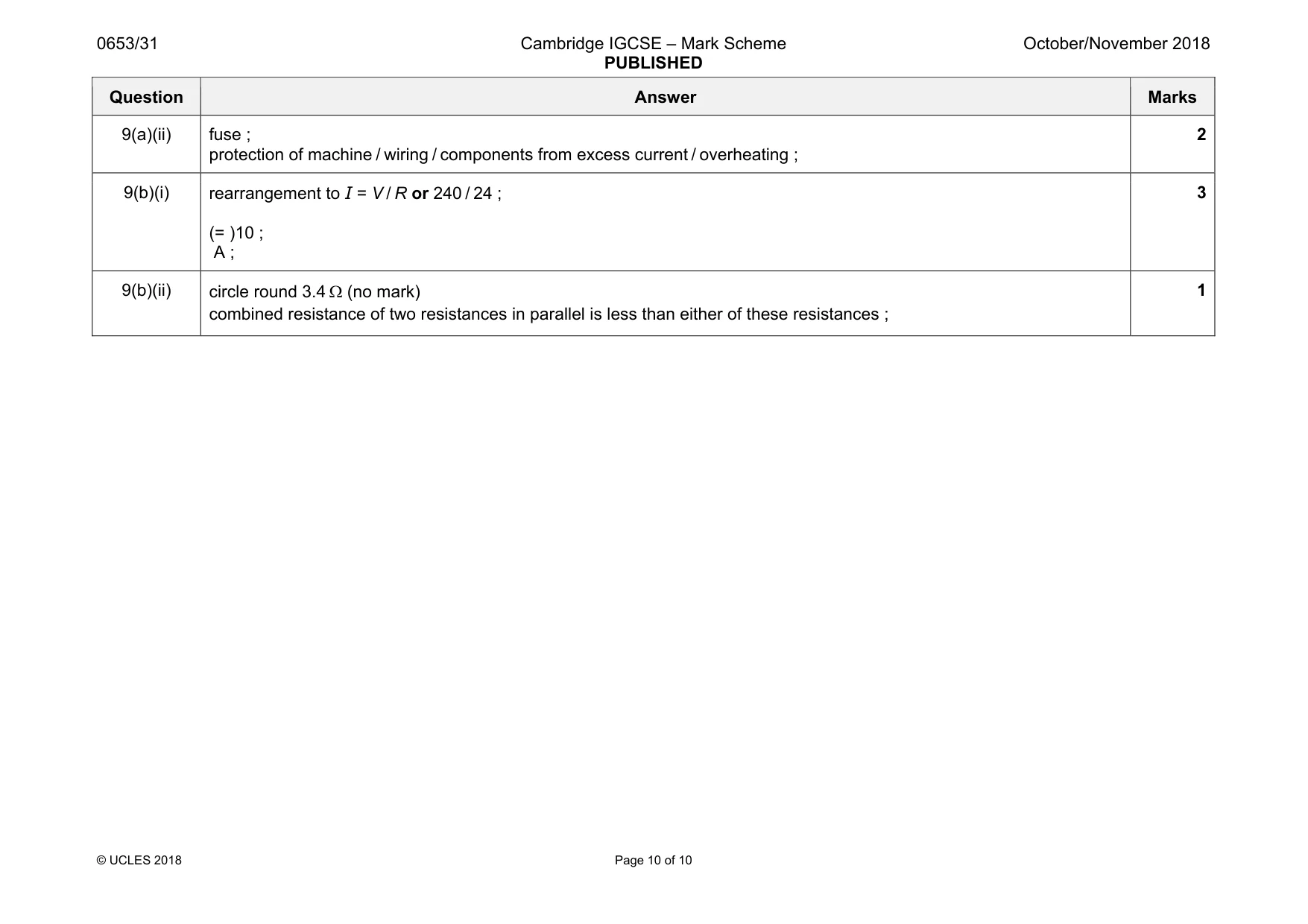
Mark scheme: 9(a)(i) correct switch symbol in circuit ; motor and heater in parallel ; switch in series with both motor and heater branches; 3 Question Answer Marks 9(a)(ii) fuse ; protection of machine / wiring / components from excess current / overheating ; 2 9(b)(i) rearrangement to I = V / R or 240 / 24 ; (= )10 ; A ; 3 9(b)(ii) circle round 3.4 Ω (no mark) combined resistance of two resistances in parallel is less than either of these resistances ; 1
What was in this paper
The subtopics covered by these 9 questions, and how many questions each got. Open one in a new tab to see every Cambridge question on it.
What you needed in this session
Cambridge’s own grade thresholds for 2018 Oct/Nov, Paper 3 · Variant 1. A higher threshold means an easier paper — the bar moves with how the cohort did.