Cambridge IGCSE Science - Combined 0653 — 2024 Oct/Nov Paper 3 · Variant 1
0653/31/O/N/24 · 9 questions · 80 marks · ≈90 min
The question paper and its mark scheme, free to read here and free to download. This is Cambridge’s own paper, exactly as it was sat.
Question paper24 pages
Mark scheme13 pages
Answers below. Sit the paper first if you are practising.
Questions as text
Q1 · The flower of a plant
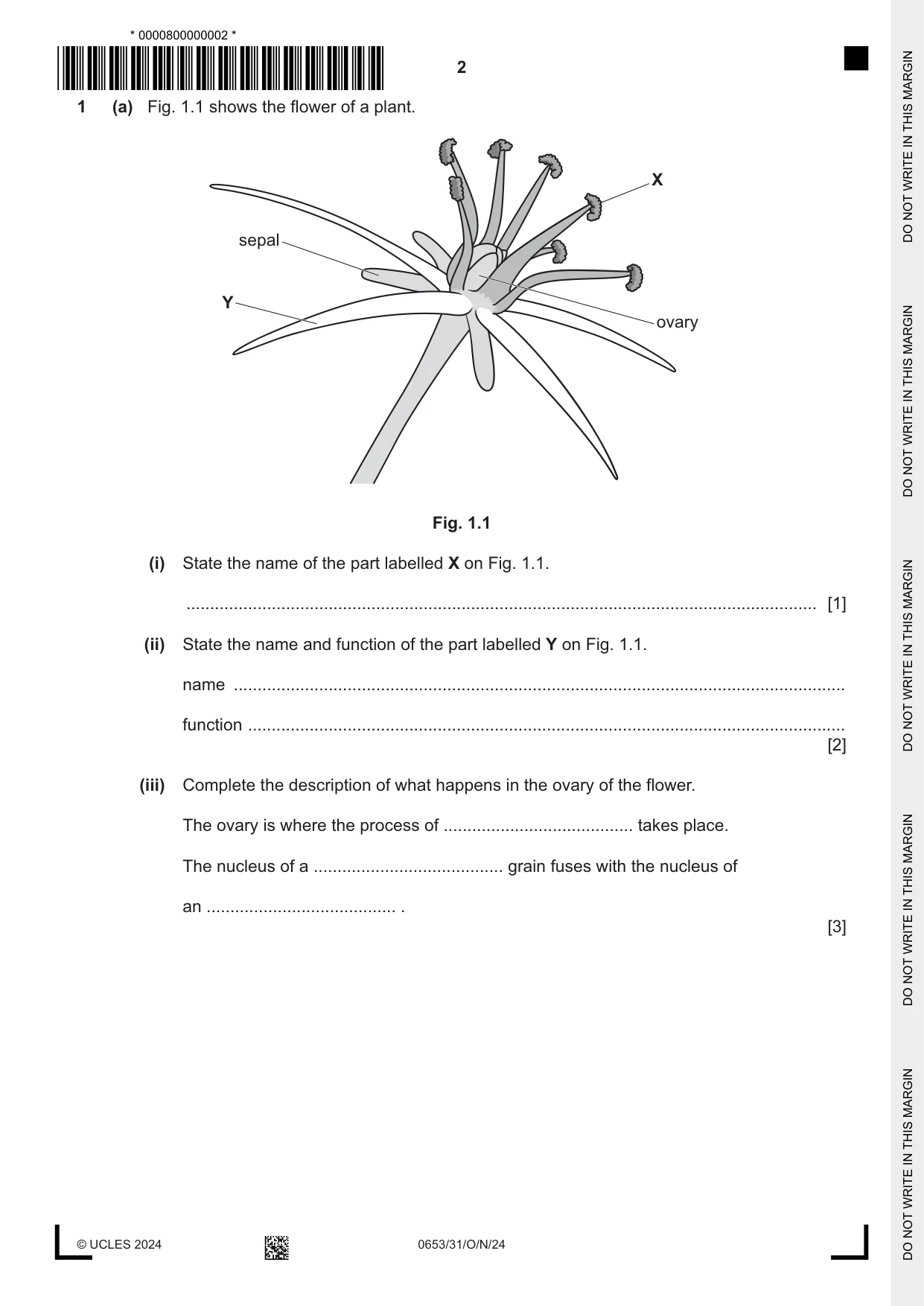
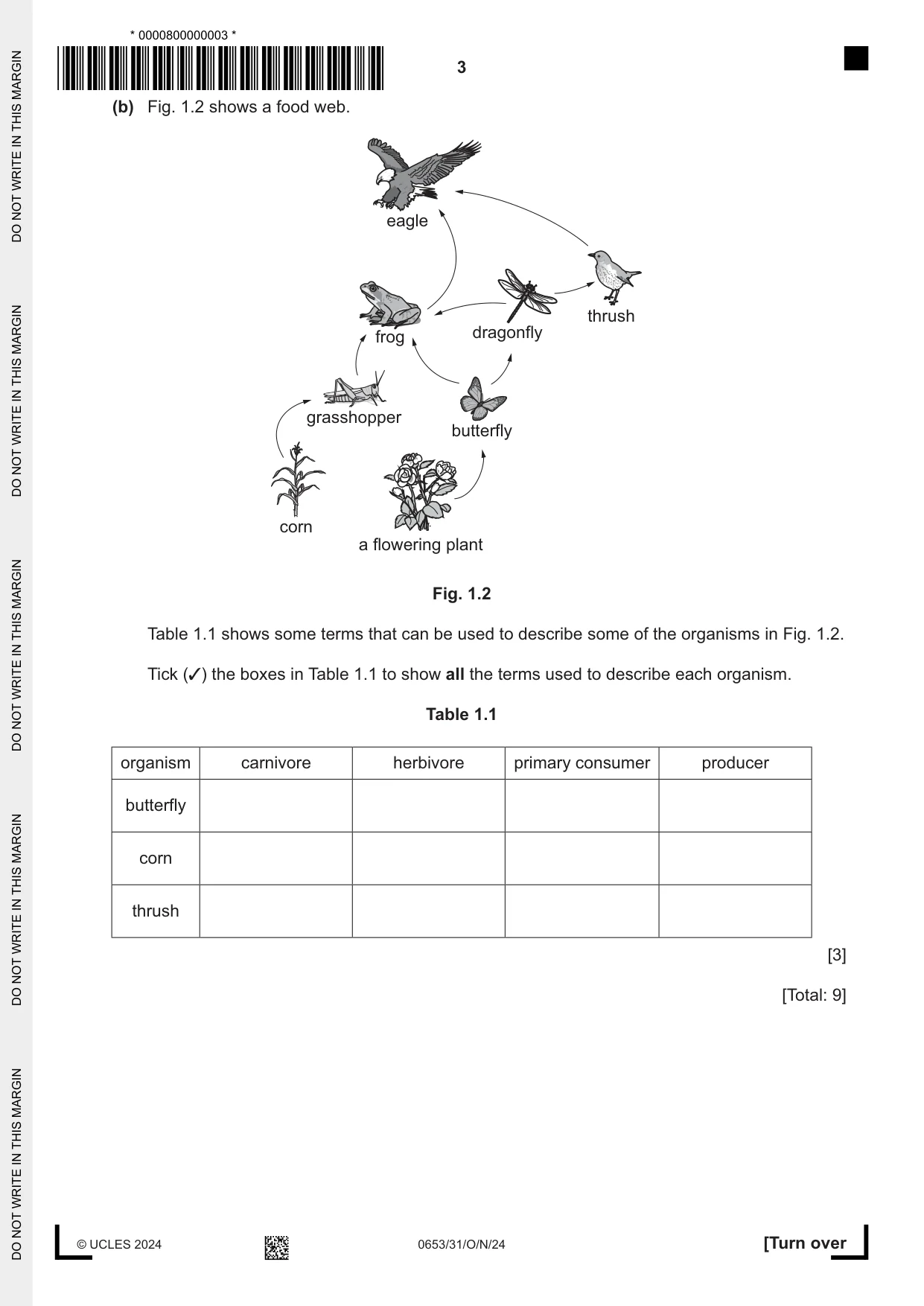
1 (a) Fig. 1.1 shows the flower of a plant. X sepal Y ovary Fig. 1.1 (i) State the name of the part labelled X on Fig. 1.1. ..................................................................................................................................... [1] (ii) State the name and function of the part labelled Y on Fig. 1.1. name ................................................................................................................................. function .............................................................................................................................. [2] (iii) Complete the description of what happens in the ovary of the flower. The ovary is where the process of ........................................ takes place. The nucleus of a ........................................ grain fuses with the nucleus of an ........................................ . [3] (b) Fig. 1.2 shows a food web. eagle thrush frog dragonfly grasshopper butterfly corn a flowering plant Fig. 1.2 Table 1.1 shows some terms that can be used to describe some of the organisms in Fig. 1.2. Tick (✓) the boxes in Table 1.1 to show all the terms used to describe each organism. Table 1.1 organism carnivore herbivore primary consumer producer butterfly corn thrush [3] [Total: 9]
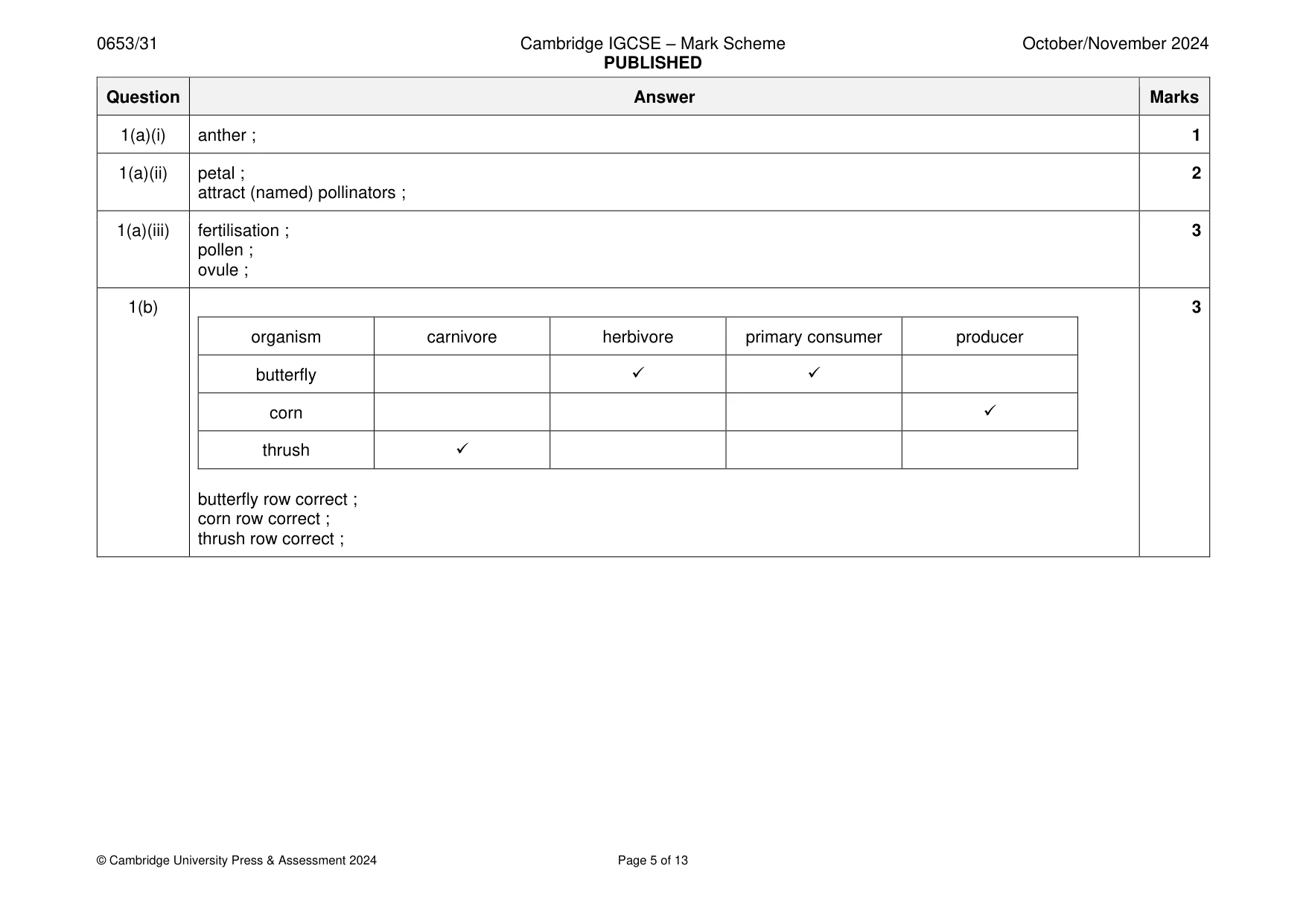
Mark scheme: Question Answer Marks 1(a)(i) anther ; 1 1(a)(ii) petal ; 2 attract (named) pollinators ; 1(a)(iii) fertilisation ; 3 pollen ; ovule ; 1(b) 3 organism carnivore herbivore primary consumer producer butterfly ✓ ✓ corn ✓ thrush ✓ butterfly row correct ; corn row correct ; thrush row correct ;
Q2 · A student investigates the rate of reaction between solid magnesium carbonate and dilute…
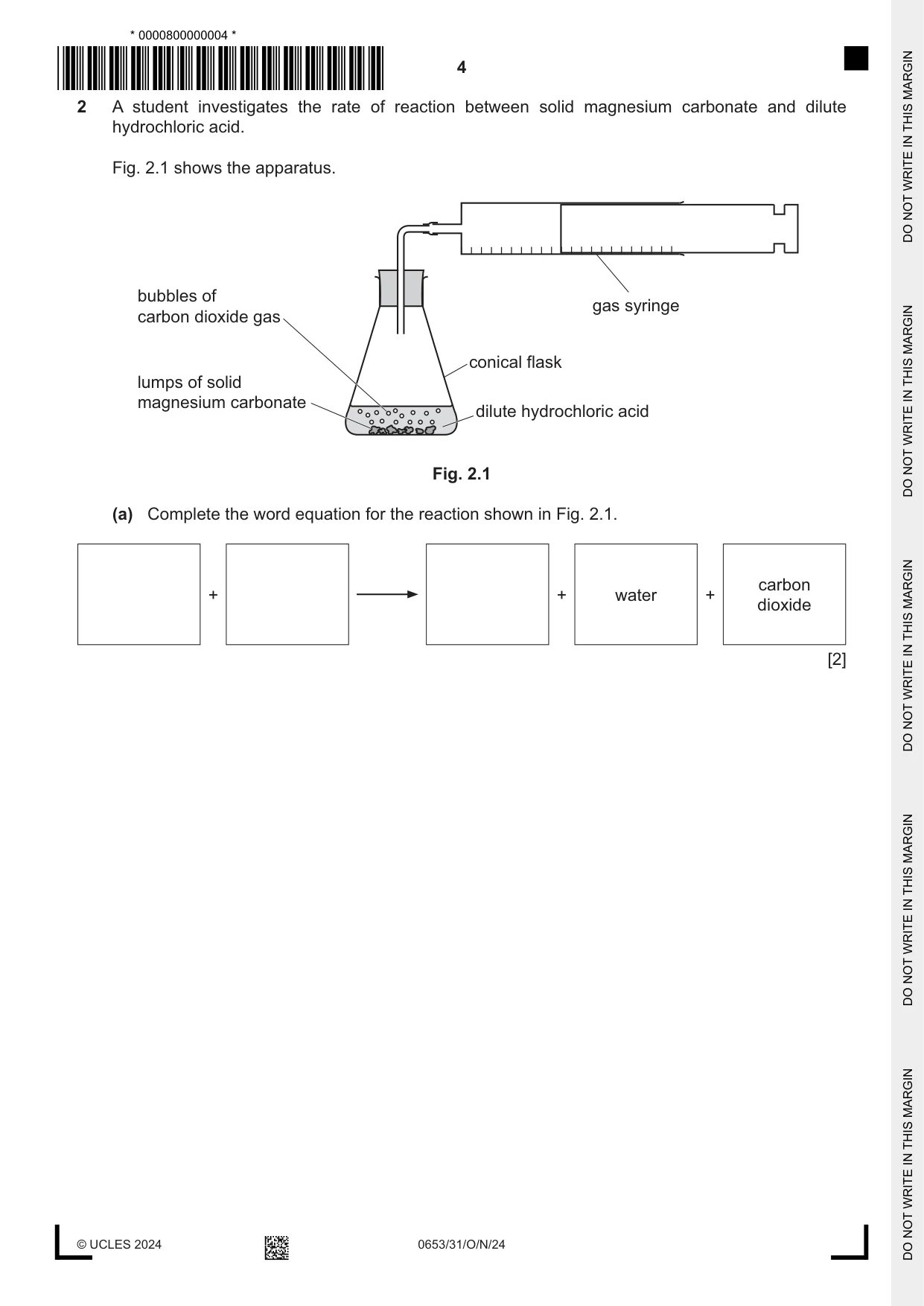
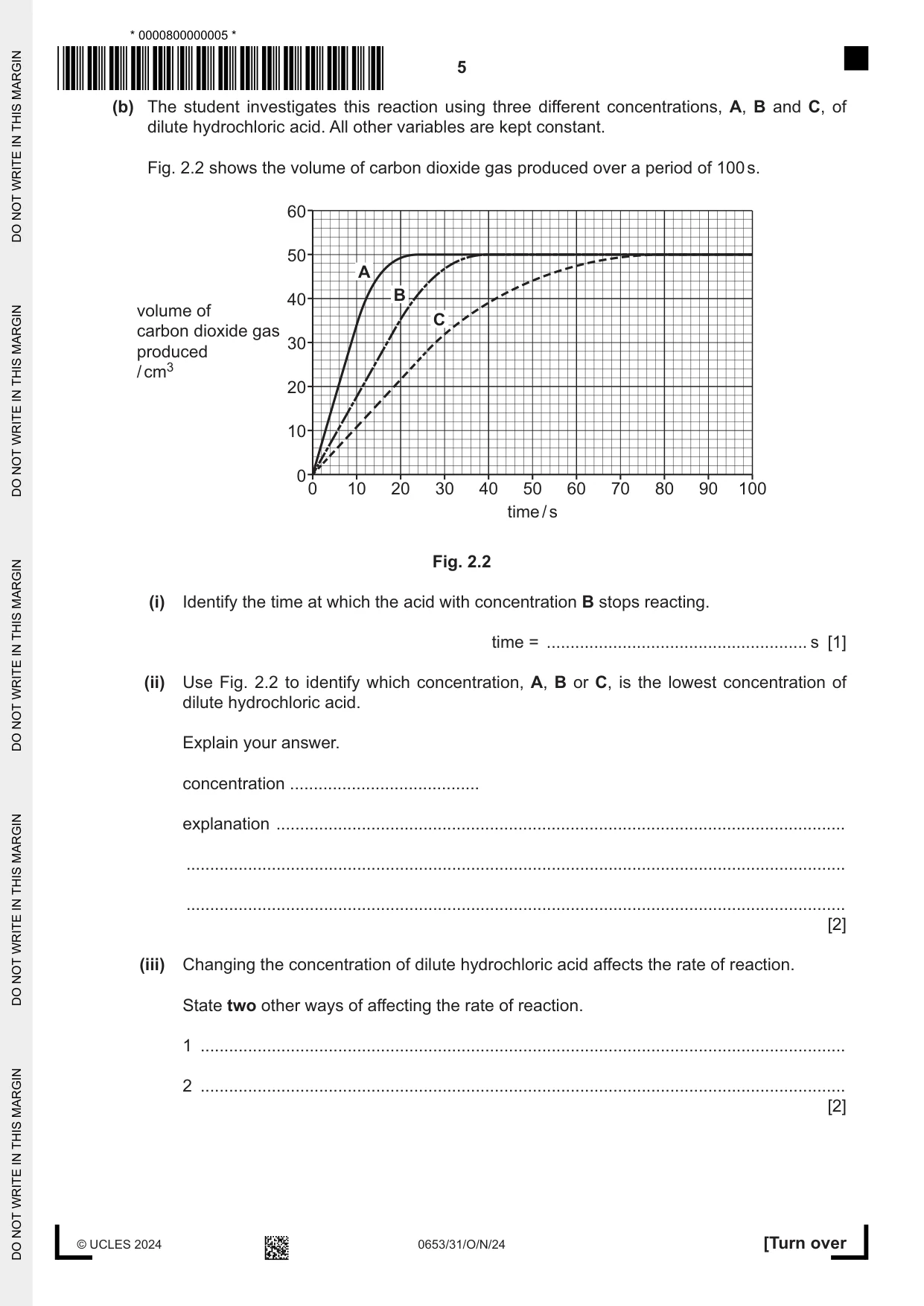
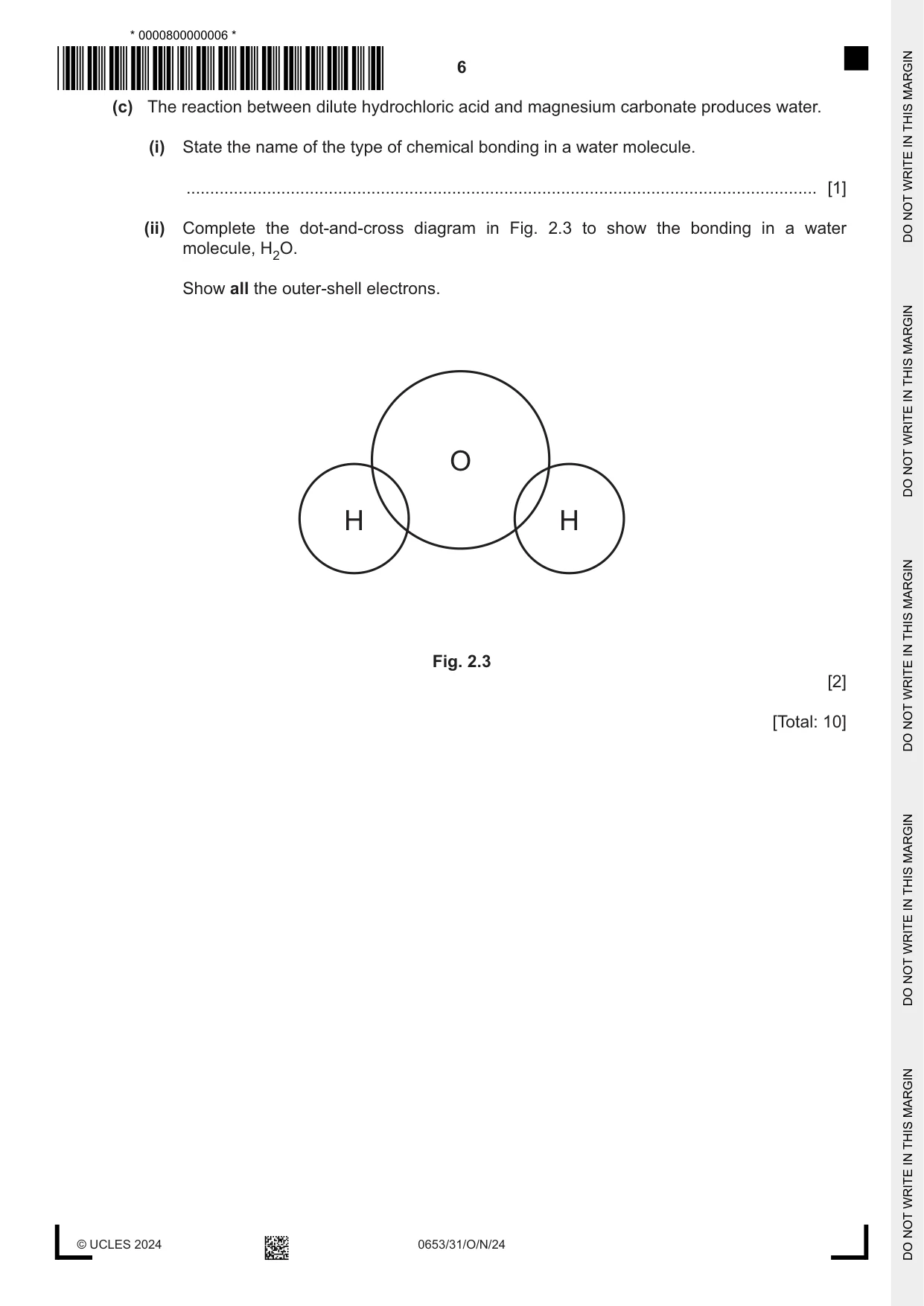
2 A student investigates the rate of reaction between solid magnesium carbonate and dilute hydrochloric acid. Fig. 2.1 shows the apparatus. bubbles of gas syringe carbon dioxide gas conical flask lumps of solid magnesium carbonate dilute hydrochloric acid Fig. 2.1 (a) Complete the word equation for the reaction shown in Fig. 2.1. carbon + + water + dioxide [2] (b) The student investigates this reaction using three different concentrations, A, B and C, of dilute hydrochloric acid. All other variables are kept constant. Fig. 2.2 shows the volume of carbon dioxide gas produced over a period of 100 s. 60 50 A 40 B volume of C carbon dioxide gas 30 produced / cm3 20 10 0 0 10 20 30 40 50 60 70 80 90 100 time / s Fig. 2.2 (i) Identify the time at which the acid with concentration B stops reacting. time = ....................................................... s [1] (ii) Use Fig. 2.2 to identify which concentration, A, B or C, is the lowest concentration of dilute hydrochloric acid. Explain your answer. concentration ........................................ explanation ........................................................................................................................ ........................................................................................................................................... ........................................................................................................................................... [2] (iii) Changing the concentration of dilute hydrochloric acid affects the rate of reaction. State two other ways of affecting the rate of reaction. 1 ........................................................................................................................................ 2 ........................................................................................................................................ [2] (c) The reaction between dilute hydrochloric acid and magnesium carbonate produces water. (i) State the name of the type of chemical bonding in a water molecule. ..................................................................................................................................... [1] (ii) Complete the dot-and-cross diagram in Fig. 2.3 to show the bonding in a water molecule, H2O. Show all the outer-shell electrons. O H H Fig. 2.3 [2] [Total: 10]
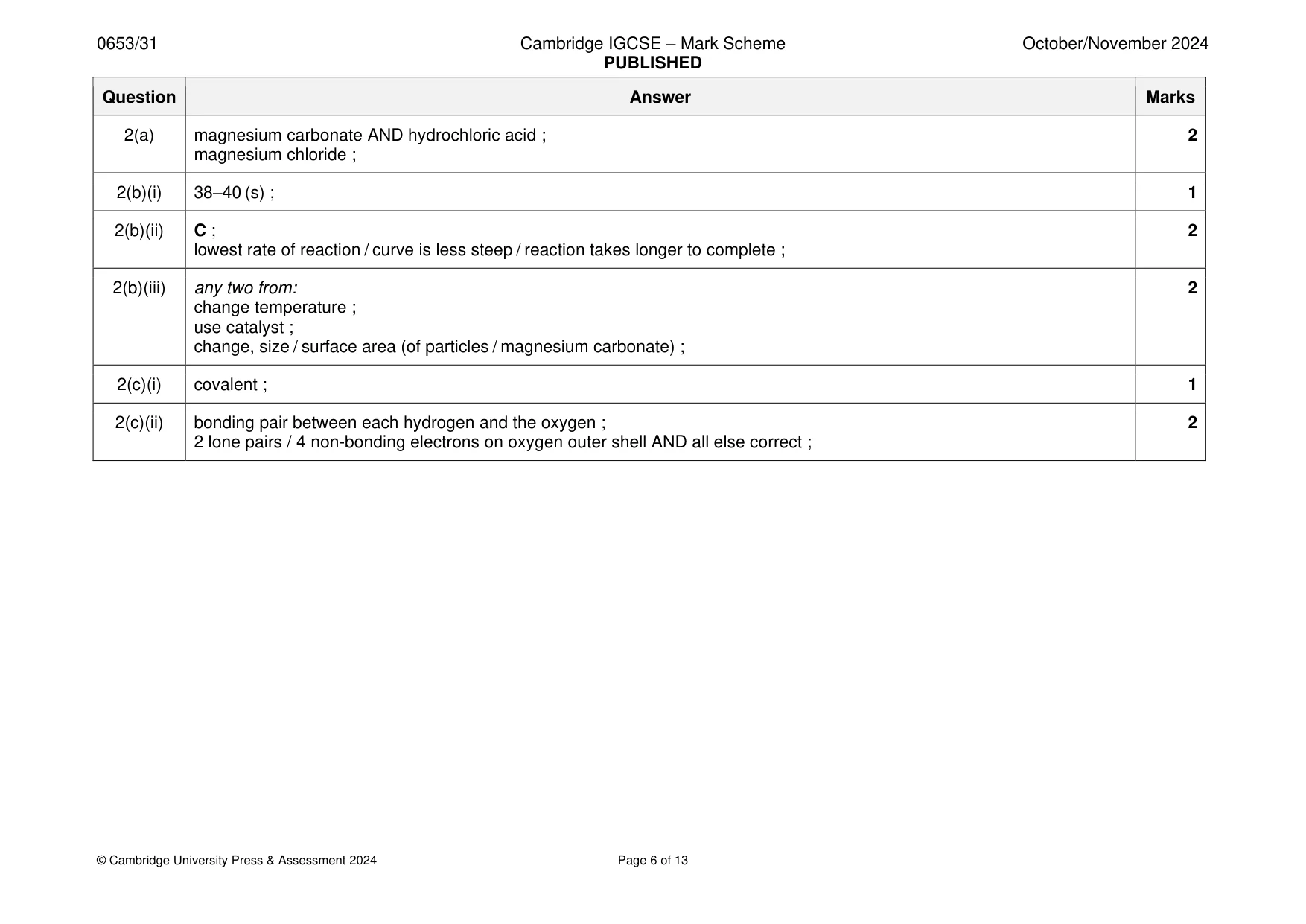
Mark scheme: 2(a) magnesium carbonate AND hydrochloric acid ; 2 magnesium chloride ; 2(b)(i) 38–40 (s) ; 1 2(b)(ii) C ; 2 lowest rate of reaction / curve is less steep / reaction takes longer to complete ; 2(b)(iii) any two from: 2 change temperature ; use catalyst ; change, size / surface area (of particles / magnesium carbonate) ; 2(c)(i) covalent ; 1 2(c)(ii) bonding pair between each hydrogen and the oxygen ; 2 2 lone pairs / 4 non-bonding electrons on oxygen outer shell AND all else correct ;
Q3 · A block of wood
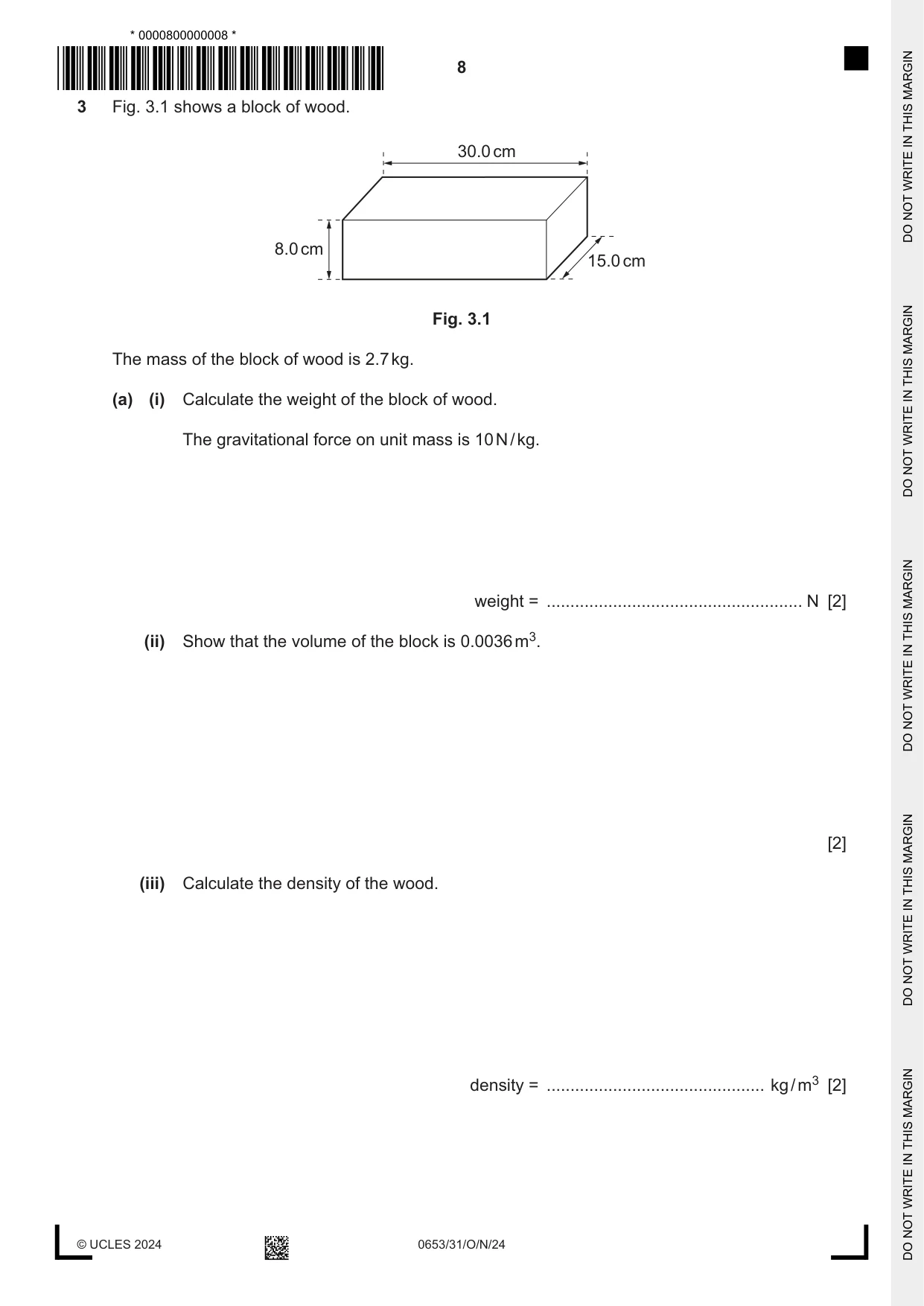
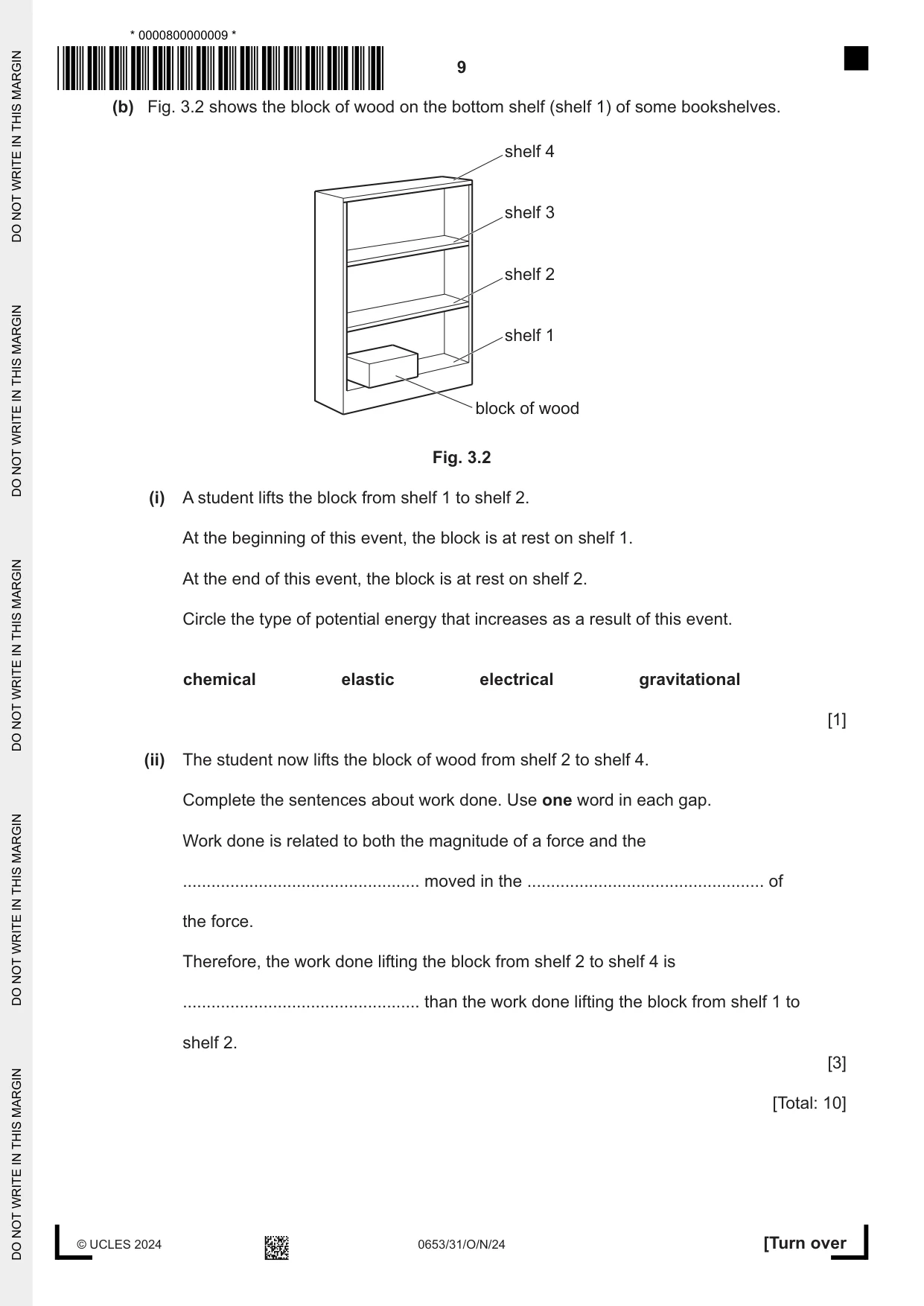
3 Fig. 3.1 shows a block of wood. 30.0 cm 8.0 cm 15.0 cm Fig. 3.1 The mass of the block of wood is 2.7 kg. (a) (i) Calculate the weight of the block of wood. The gravitational force on unit mass is 10 N / kg. weight = ...................................................... N [2] (ii) Show that the volume of the block is 0.0036 m3. [2] (iii) Calculate the density of the wood. density = .............................................. kg / m3 [2] (b) Fig. 3.2 shows the block of wood on the bottom shelf (shelf 1) of some bookshelves. shelf 4 shelf 3 shelf 2 shelf 1 block of wood Fig. 3.2 (i) A student lifts the block from shelf 1 to shelf 2. At the beginning of this event, the block is at rest on shelf 1. At the end of this event, the block is at rest on shelf 2. Circle the type of potential energy that increases as a result of this event. chemical elastic electrical gravitational [1] (ii) The student now lifts the block of wood from shelf 2 to shelf 4. Complete the sentences about work done. Use one word in each gap. Work done is related to both the magnitude of a force and the .................................................. moved in the .................................................. of the force. Therefore, the work done lifting the block from shelf 2 to shelf 4 is .................................................. than the work done lifting the block from shelf 1 to shelf 2. [3] [Total: 10]
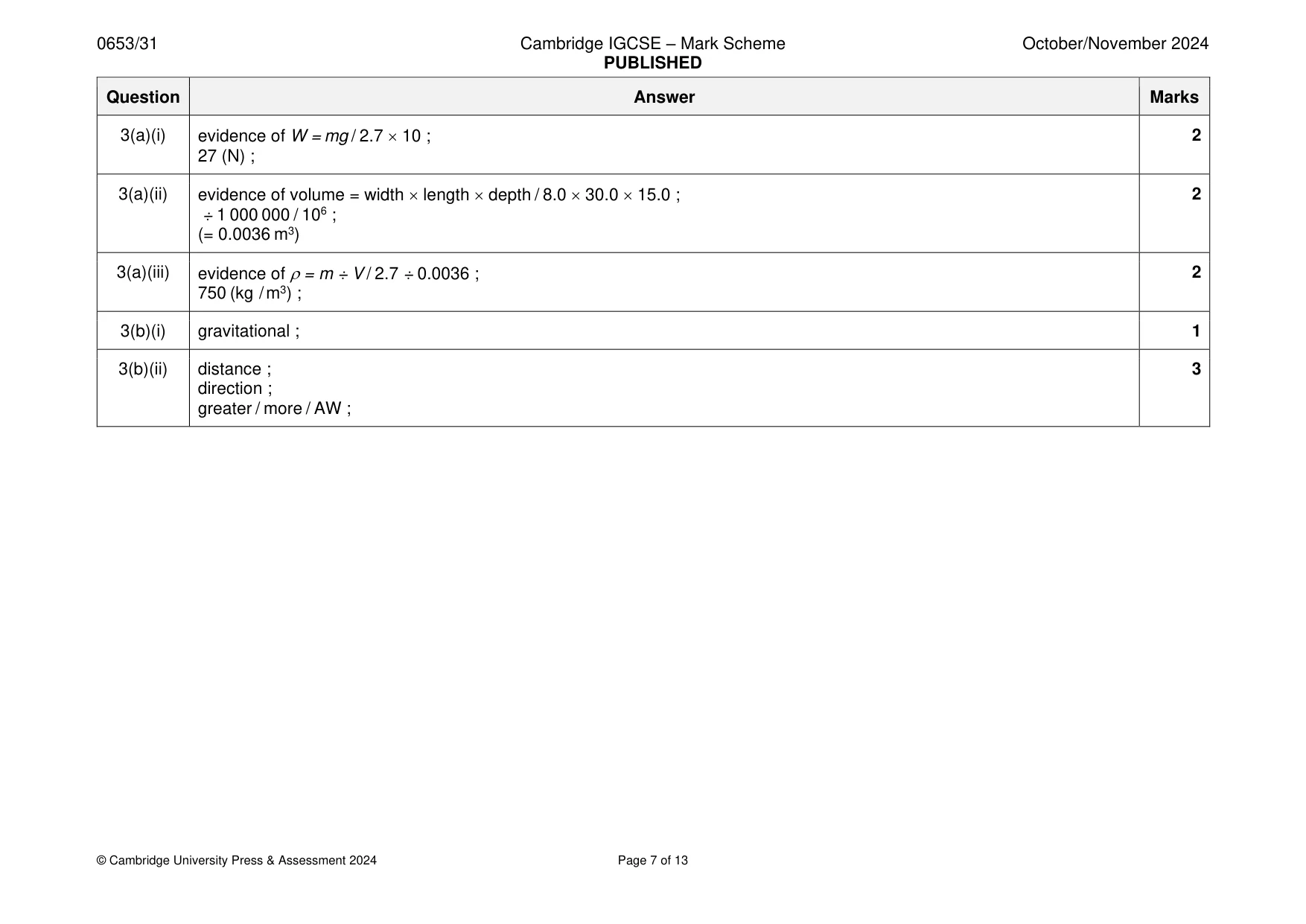
Mark scheme: 3(a)(i) evidence of W = mg / 2.7 10 ; 2 27 (N) ; 3(a)(ii) evidence of volume = width length depth / 8.0 30.0 15.0 ; 2 ÷ 1 000 000 / 106 ; (= 0.0036 m3) 3(a)(iii) evidence of = m ÷ V / 2.7 ÷ 0.0036 ; 2 750 (kg / m3) ; 3(b)(i) gravitational ; 1 3(b)(ii) distance ; 3 direction ; greater / more / AW ;
Q4 · Anaemia is caused by a deficiency of iron in the diet
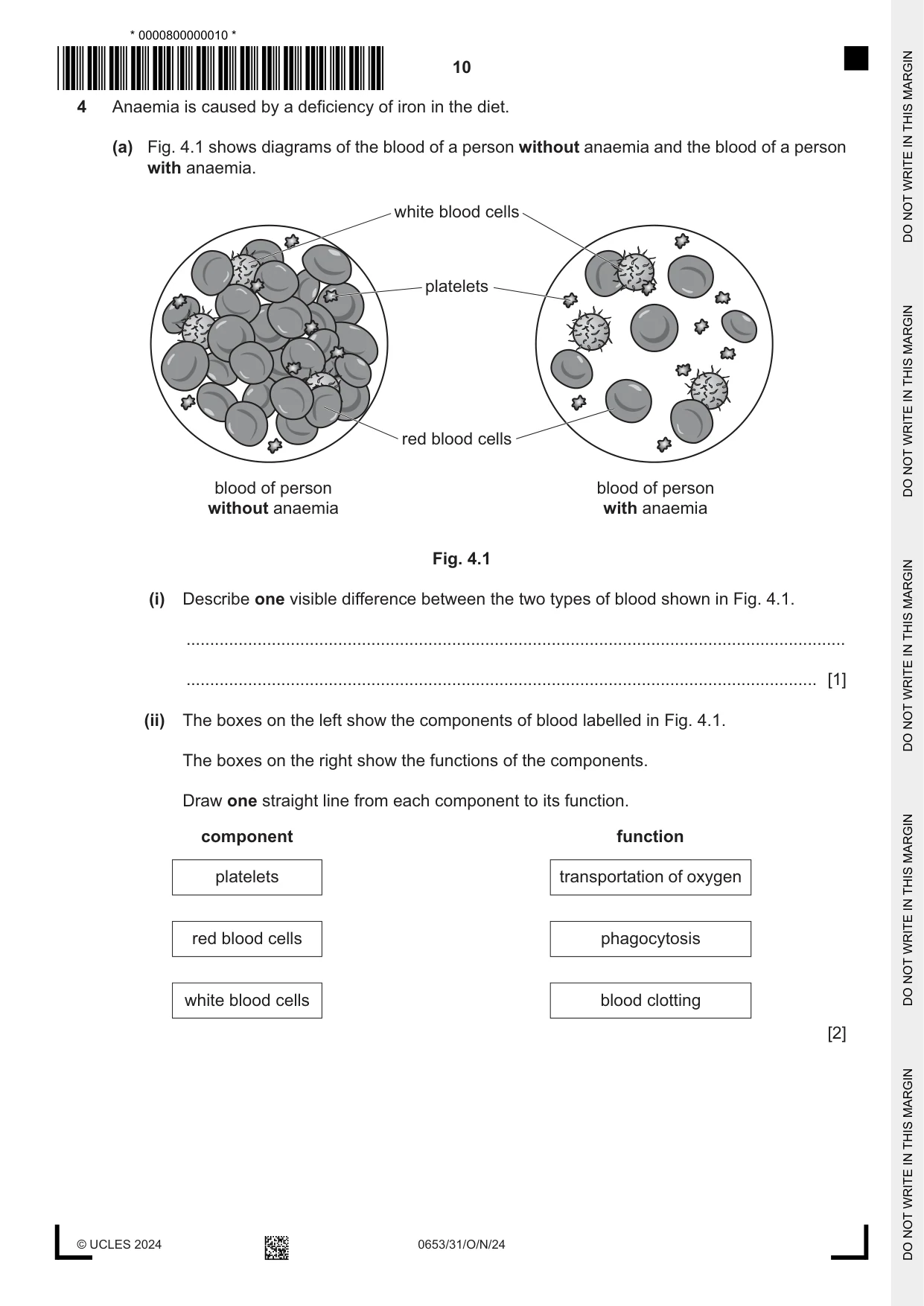
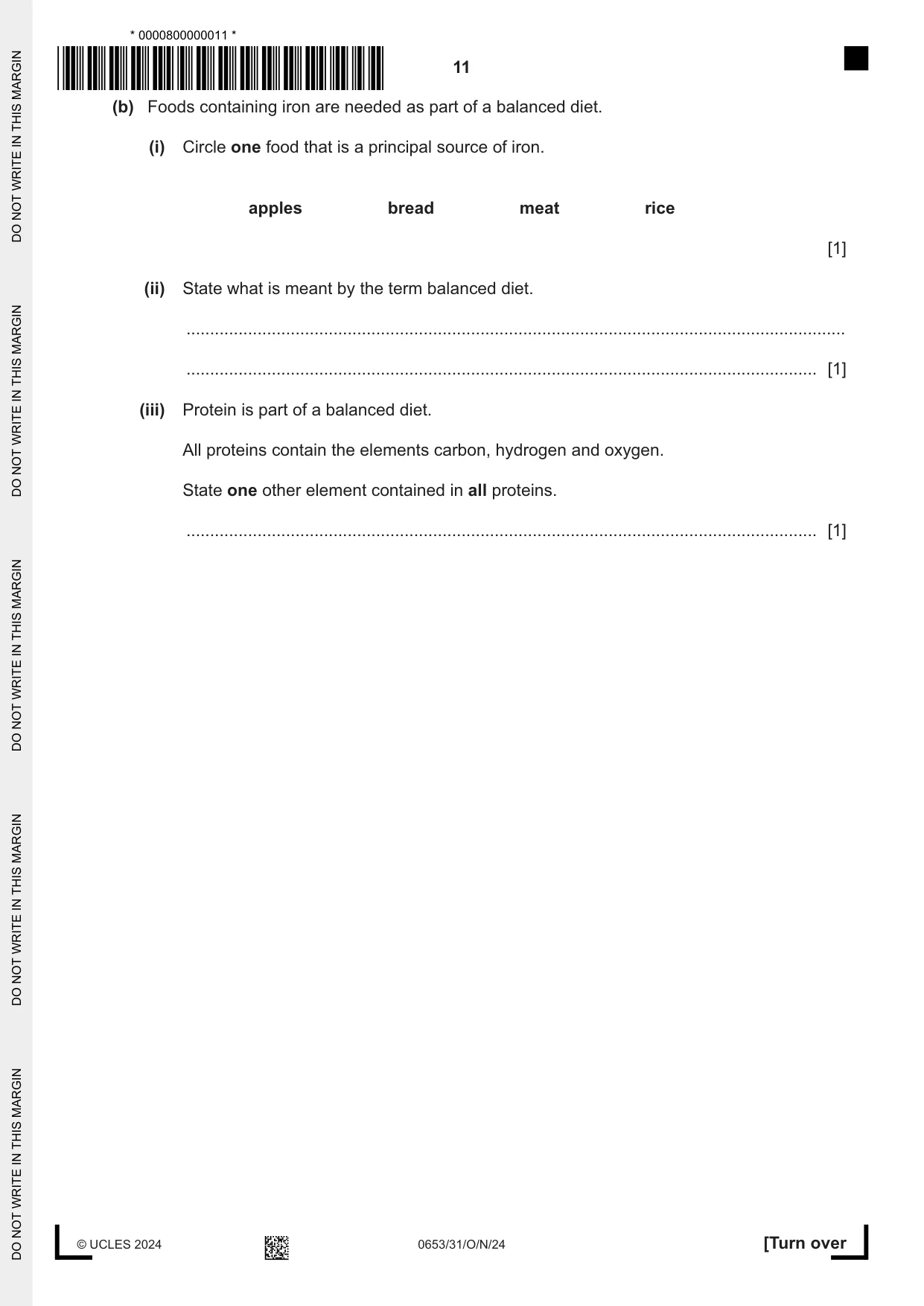
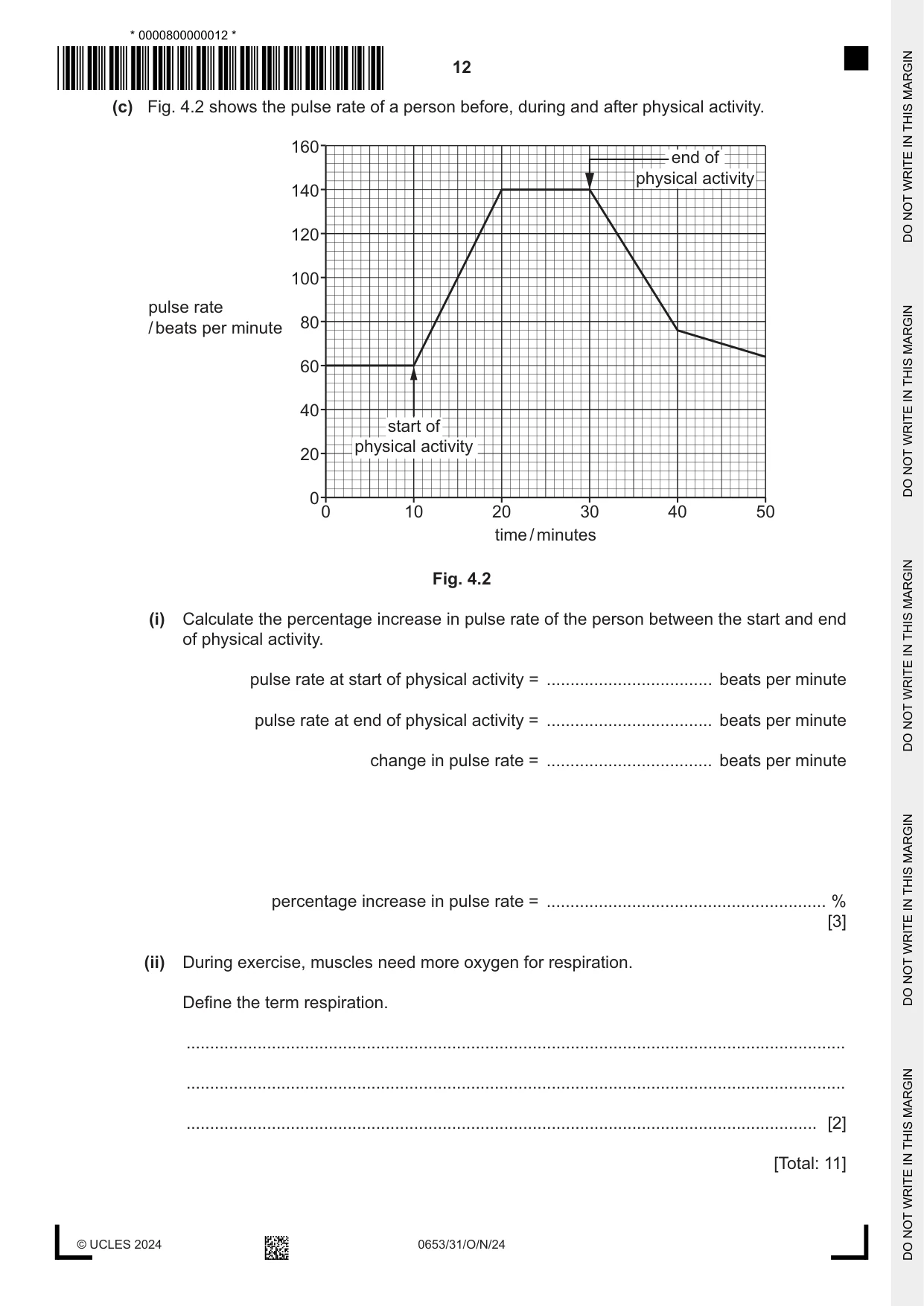
4 Anaemia is caused by a deficiency of iron in the diet. (a) Fig. 4.1 shows diagrams of the blood of a person without anaemia and the blood of a person with anaemia. white blood cells platelets red blood cells blood of person blood of person without anaemia with anaemia Fig. 4.1 (i) Describe one visible difference between the two types of blood shown in Fig. 4.1. ........................................................................................................................................... ..................................................................................................................................... [1] (ii) The boxes on the left show the components of blood labelled in Fig. 4.1. The boxes on the right show the functions of the components. Draw one straight line from each component to its function. component function platelets transportation of oxygen red blood cells phagocytosis white blood cells blood clotting [2] (b) Foods containing iron are needed as part of a balanced diet. (i) Circle one food that is a principal source of iron. apples bread meat rice [1] (ii) State what is meant by the term balanced diet. ........................................................................................................................................... ..................................................................................................................................... [1] (iii) Protein is part of a balanced diet. All proteins contain the elements carbon, hydrogen and oxygen. State one other element contained in all proteins. ..................................................................................................................................... [1] (c) Fig. 4.2 shows the pulse rate of a person before, during and after physical activity. 160 end of physical activity 140 120 100 pulse rate 80 / beats per minute 60 40 start of physical activity 20 0 0 10 20 30 40 50 time / minutes Fig. 4.2 (i) Calculate the percentage increase in pulse rate of the person between the start and end of physical activity. pulse rate at start of physical activity = ................................... beats per minute pulse rate at end of physical activity = ................................... beats per minute change in pulse rate = ................................... beats per minute percentage increase in pulse rate = ........................................................... % [3] (ii) During exercise, muscles need more oxygen for respiration. Define the term respiration. ........................................................................................................................................... ........................................................................................................................................... ..................................................................................................................................... [2] [Total: 11]
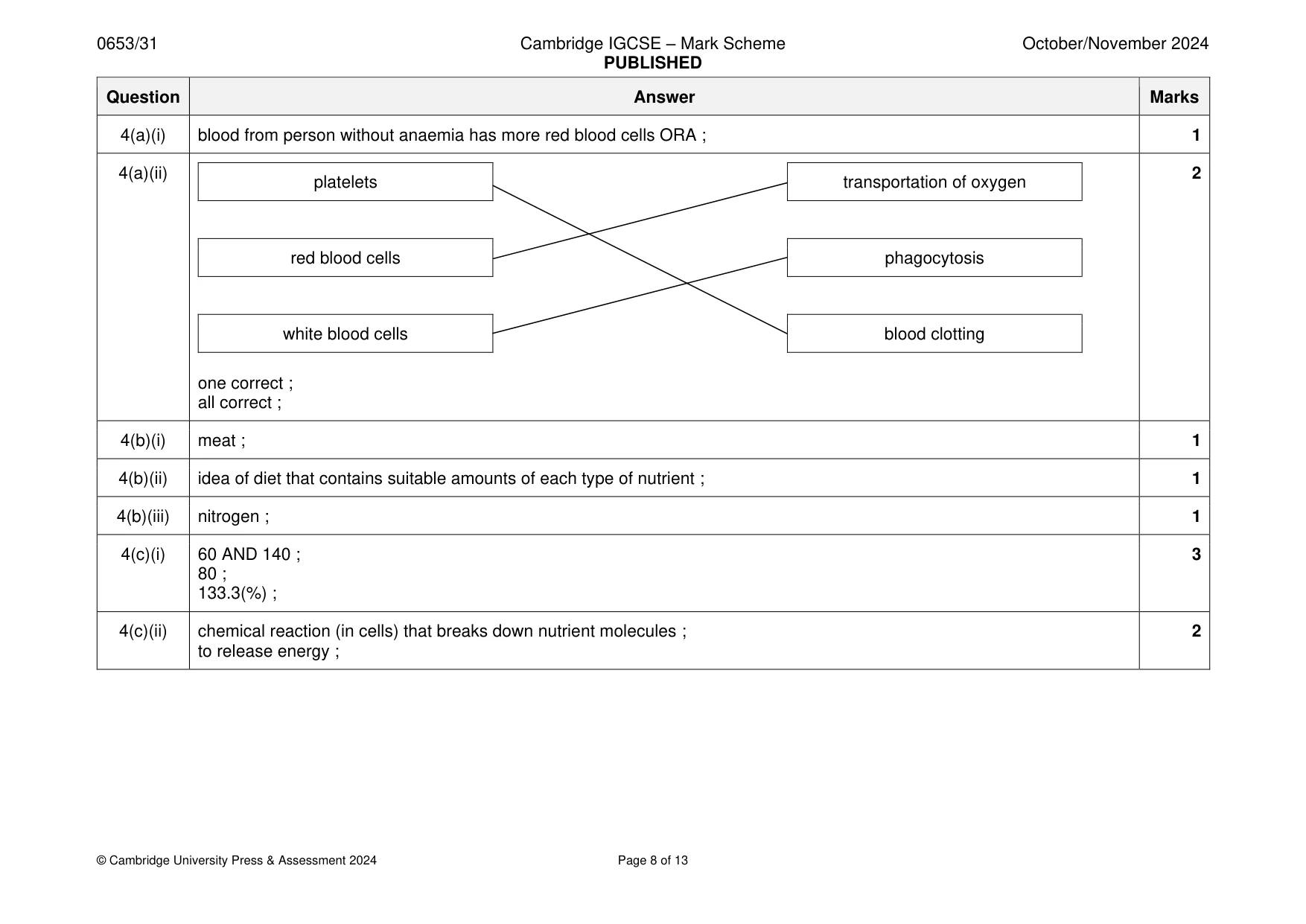
Mark scheme: 4(a)(i) blood from person without anaemia has more red blood cells ORA ; 1 4(a)(ii) 2 platelets transportation of oxygen red blood cells phagocytosis white blood cells blood clotting one correct ; all correct ; 4(b)(i) meat ; 1 4(b)(ii) idea of diet that contains suitable amounts of each type of nutrient ; 1 4(b)(iii) nitrogen ; 1 4(c)(i) 60 AND 140 ; 3 80 ; 133.3(%) ; 4(c)(ii) chemical reaction (in cells) that breaks down nutrient molecules ; 2 to release energy ;
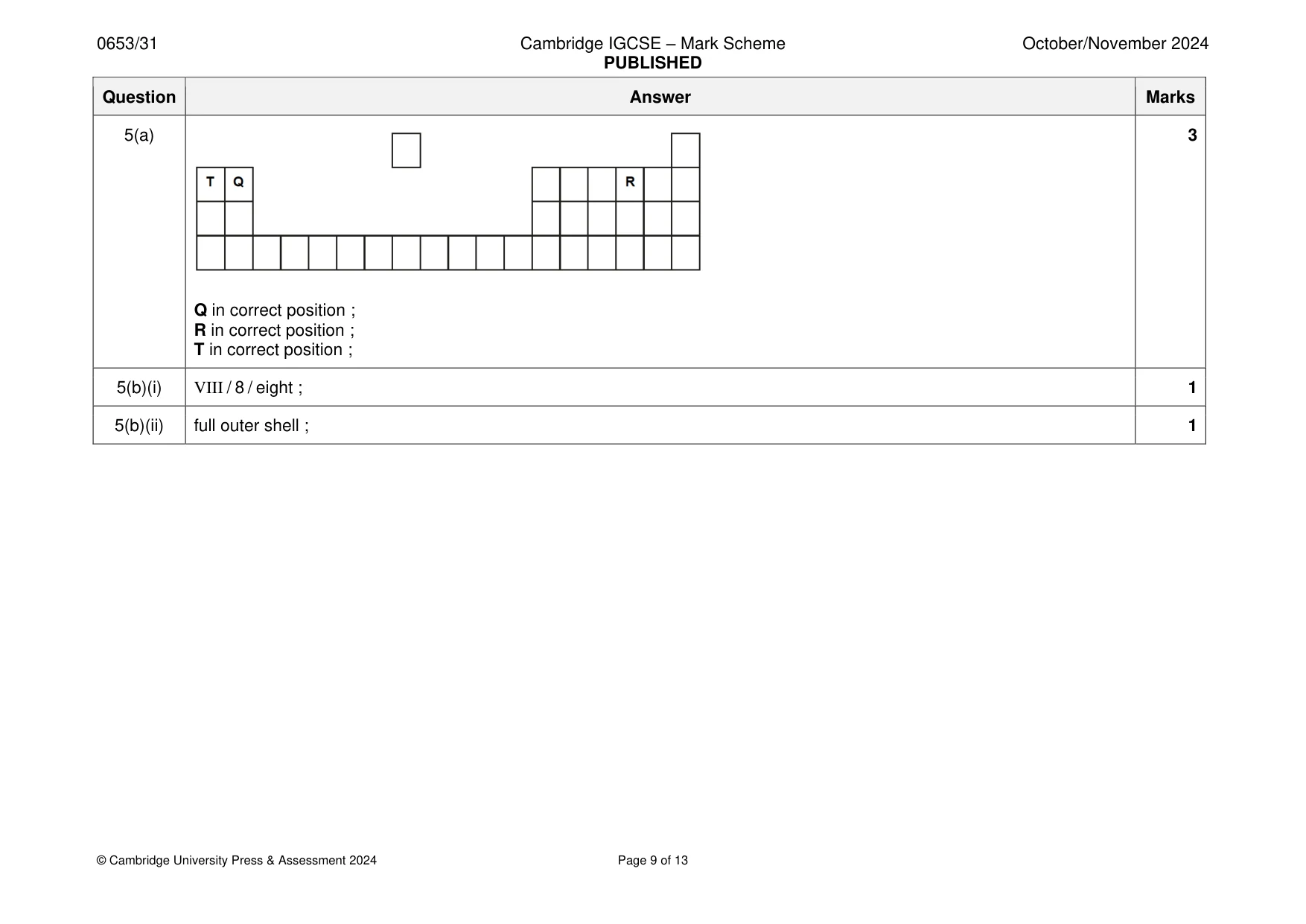
Q5 · The first four periods of the Periodic Table with the data for the elements removed
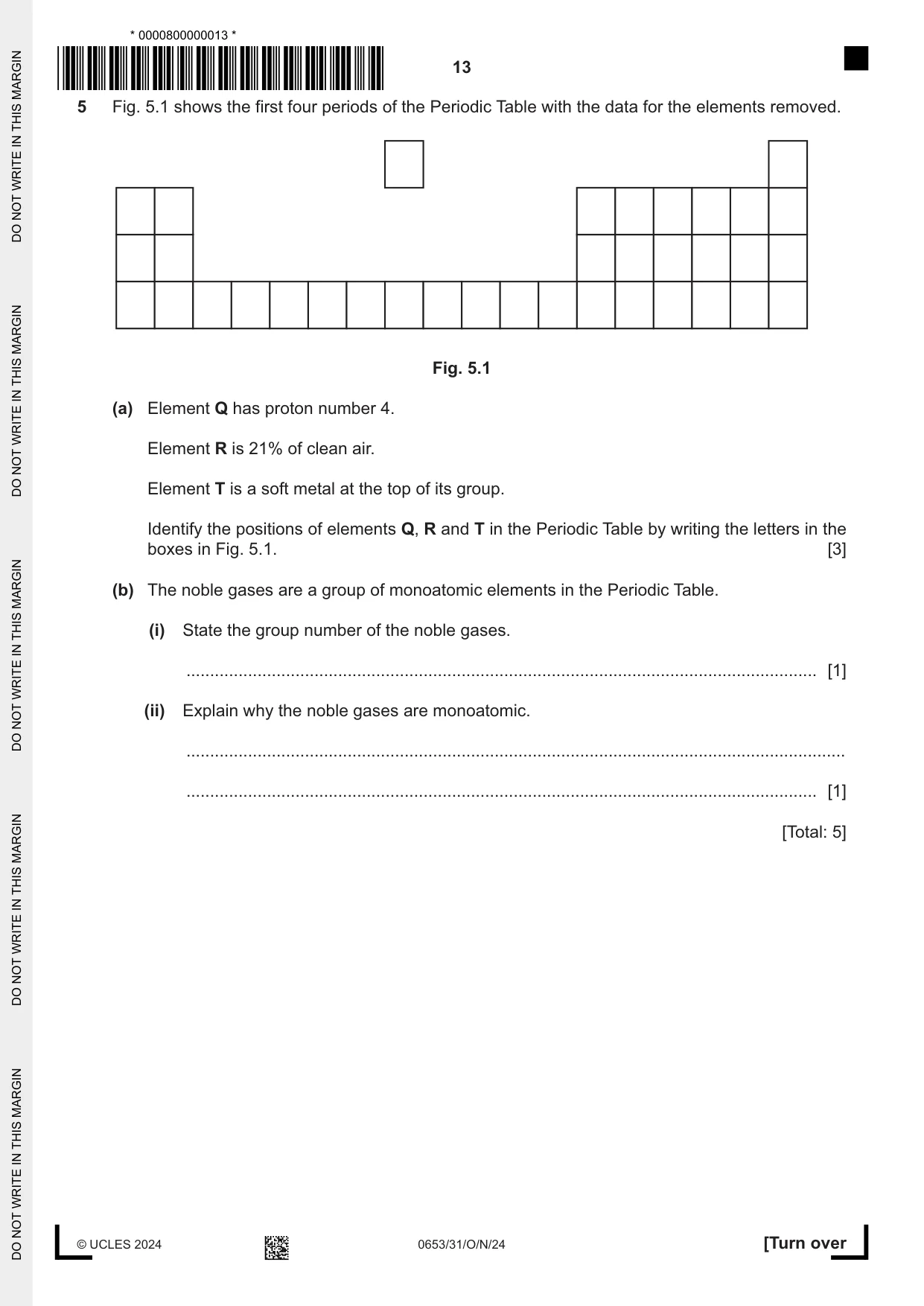
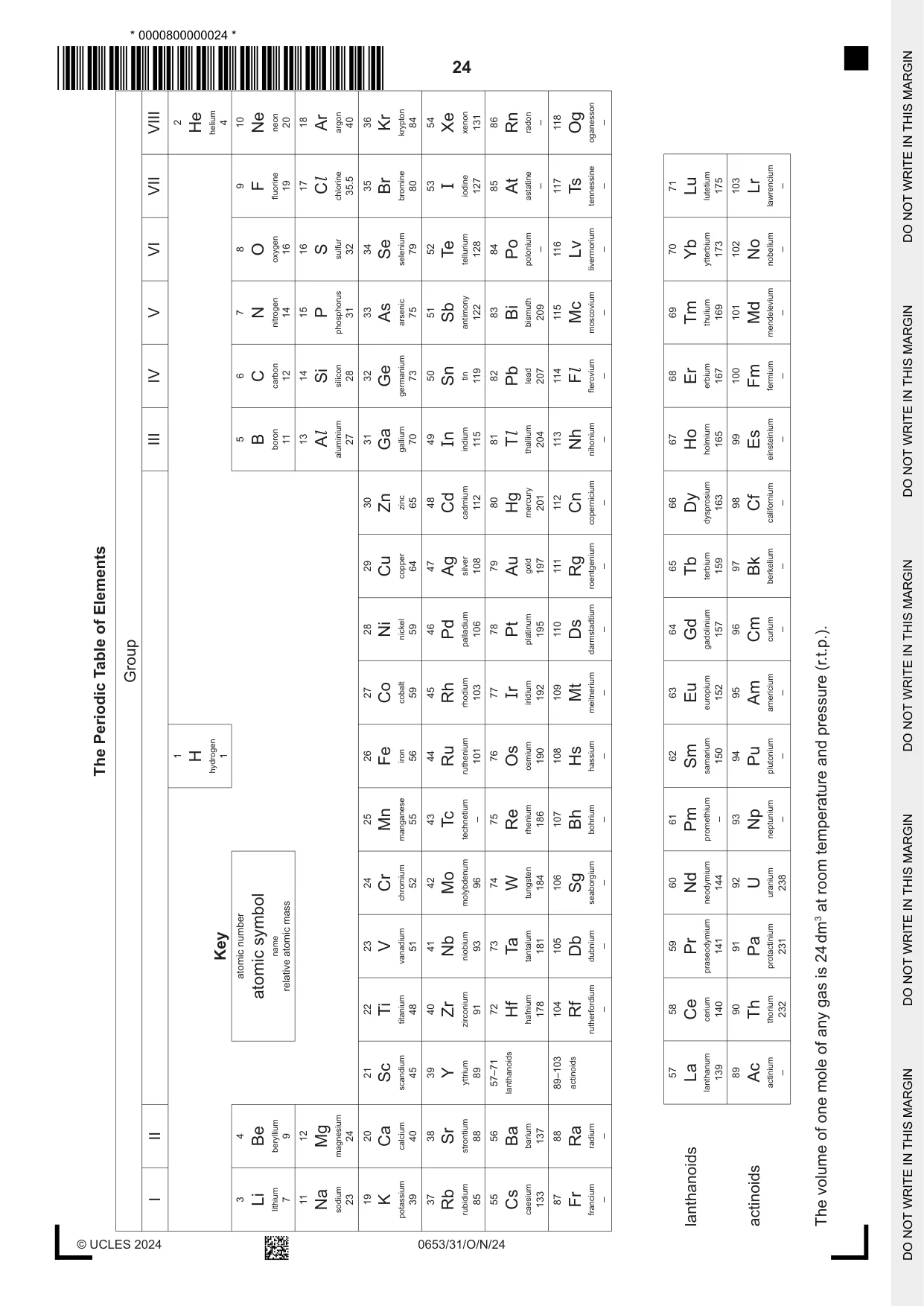
5 Fig. 5.1 shows the first four periods of the Periodic Table with the data for the elements removed. Fig. 5.1 (a) Element Q has proton number 4. Element R is 21% of clean air. Element T is a soft metal at the top of its group. Identify the positions of elements Q, R and T in the Periodic Table by writing the letters in the boxes in Fig. 5.1. [3] (b) The noble gases are a group of monoatomic elements in the Periodic Table. (i) State the group number of the noble gases. ..................................................................................................................................... [1] (ii) Explain why the noble gases are monoatomic. ........................................................................................................................................... ..................................................................................................................................... [1] [Total: 5]
Mark scheme: 5(a) 3 Q in correct position ; R in correct position ; T in correct position ; 5(b)(i) VIII / 8 / eight ; 1 5(b)(ii) full outer shell ; 1
Q6 · Copper is a metal
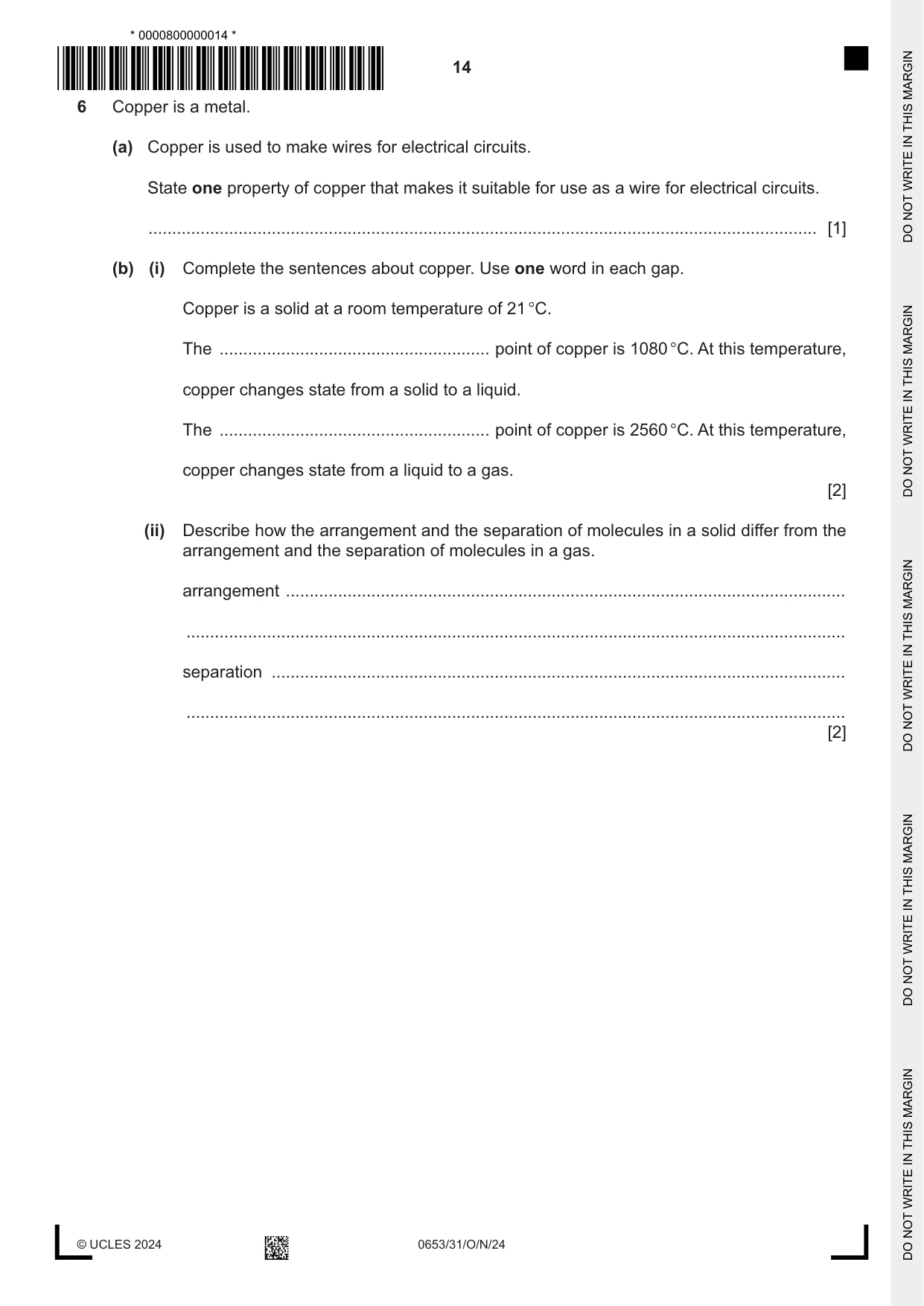
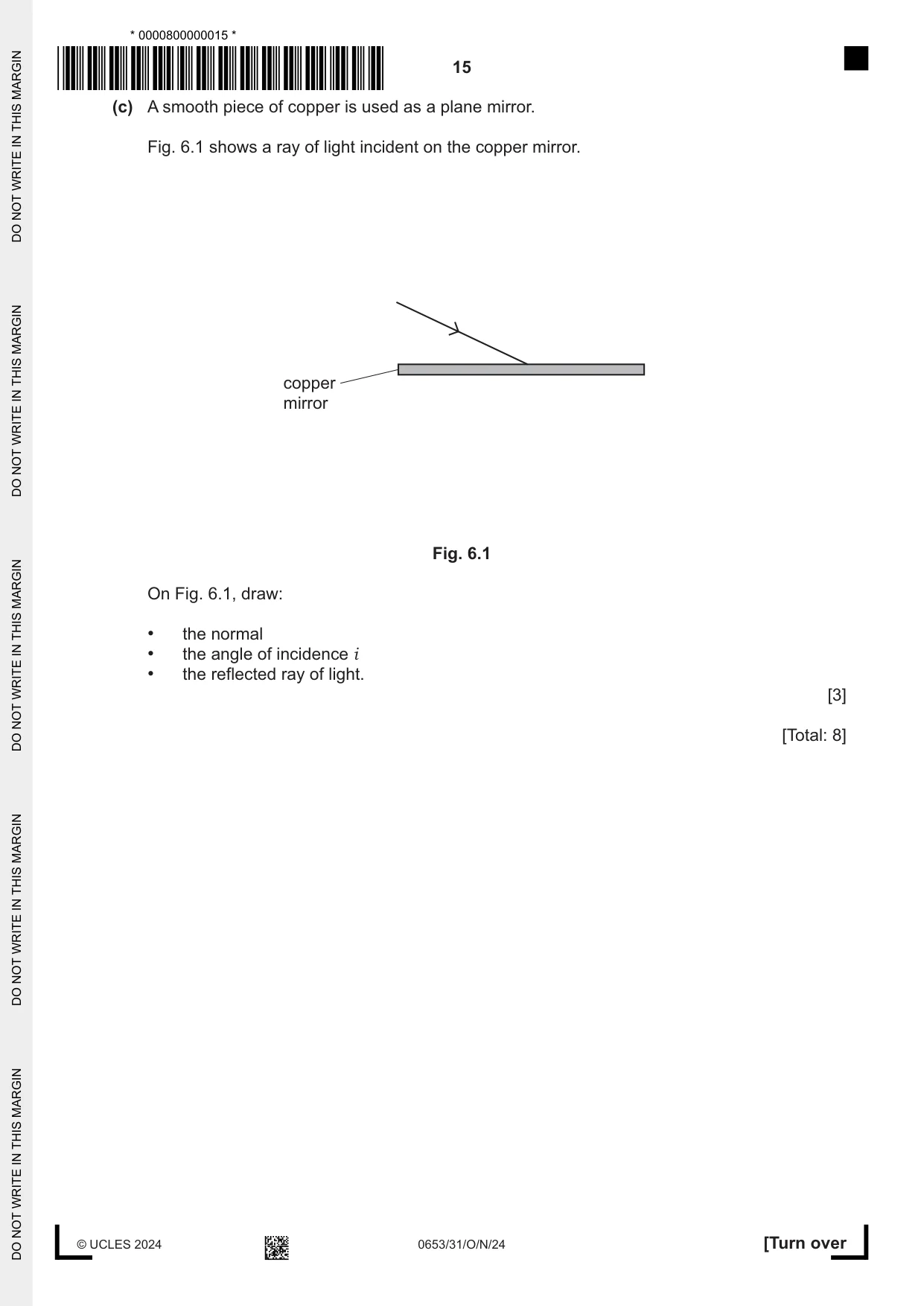
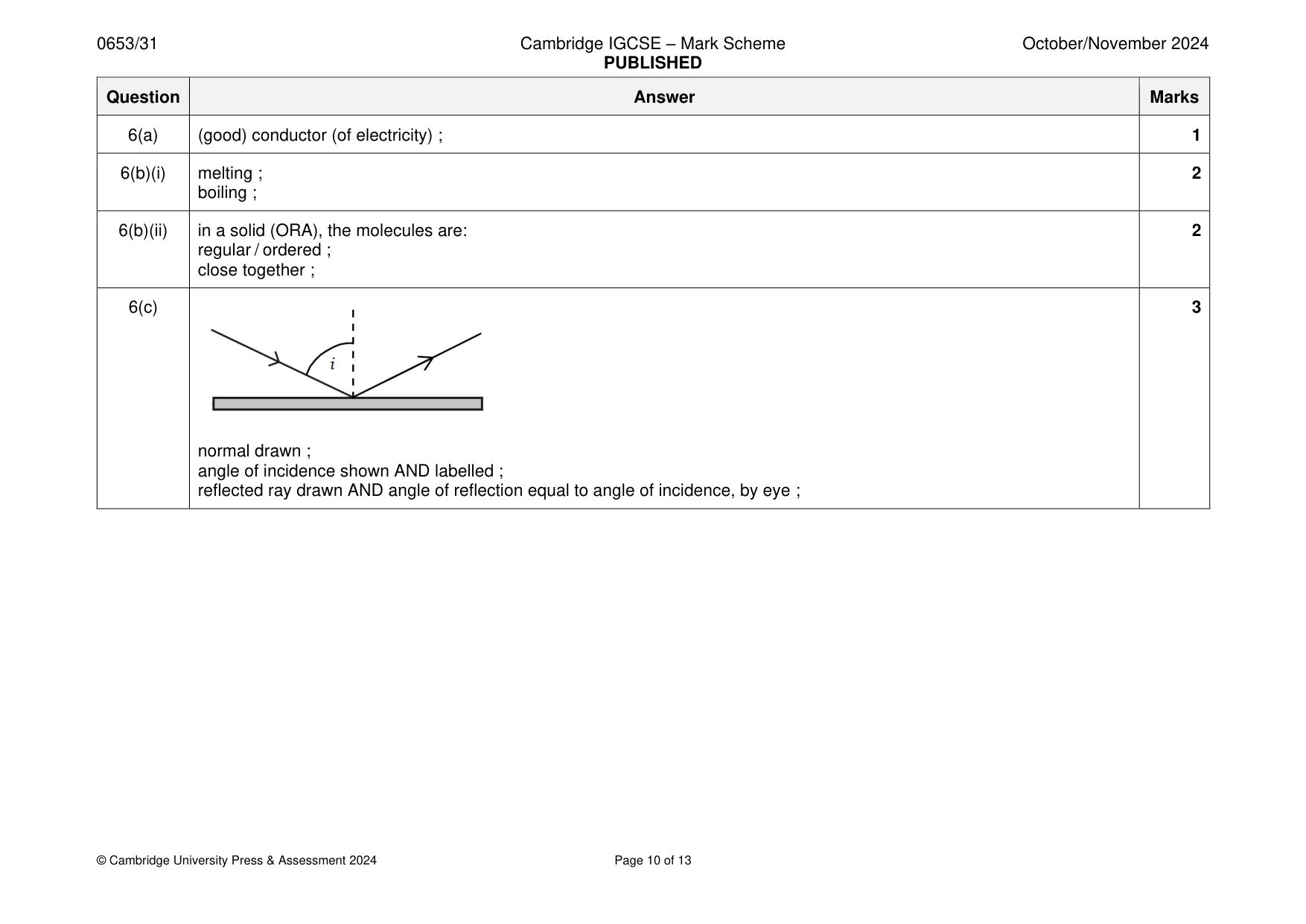
6 Copper is a metal. (a) Copper is used to make wires for electrical circuits. State one property of copper that makes it suitable for use as a wire for electrical circuits. ............................................................................................................................................. [1] (b) (i) Complete the sentences about copper. Use one word in each gap. Copper is a solid at a room temperature of 21 °C. The ......................................................... point of copper is 1080 °C. At this temperature, copper changes state from a solid to a liquid. The ......................................................... point of copper is 2560 °C. At this temperature, copper changes state from a liquid to a gas. [2] (ii) Describe how the arrangement and the separation of molecules in a solid differ from the arrangement and the separation of molecules in a gas. arrangement ...................................................................................................................... ........................................................................................................................................... separation ......................................................................................................................... ........................................................................................................................................... [2] (c) A smooth piece of copper is used as a plane mirror. Fig. 6.1 shows a ray of light incident on the copper mirror. copper mirror Fig. 6.1 On Fig. 6.1, draw: • the normal • the angle of incidence i • the reflected ray of light. [3] [Total: 8]
Mark scheme: 6(a) (good) conductor (of electricity) ; 1 6(b)(i) melting ; 2 boiling ; 6(b)(ii) in a solid (ORA), the molecules are: 2 regular / ordered ; close together ; 6(c) 3 normal drawn ; angle of incidence shown AND labelled ; reflected ray drawn AND angle of reflection equal to angle of incidence, by eye ;
Q7 · A student’s drawing of a cross-section of a leaf
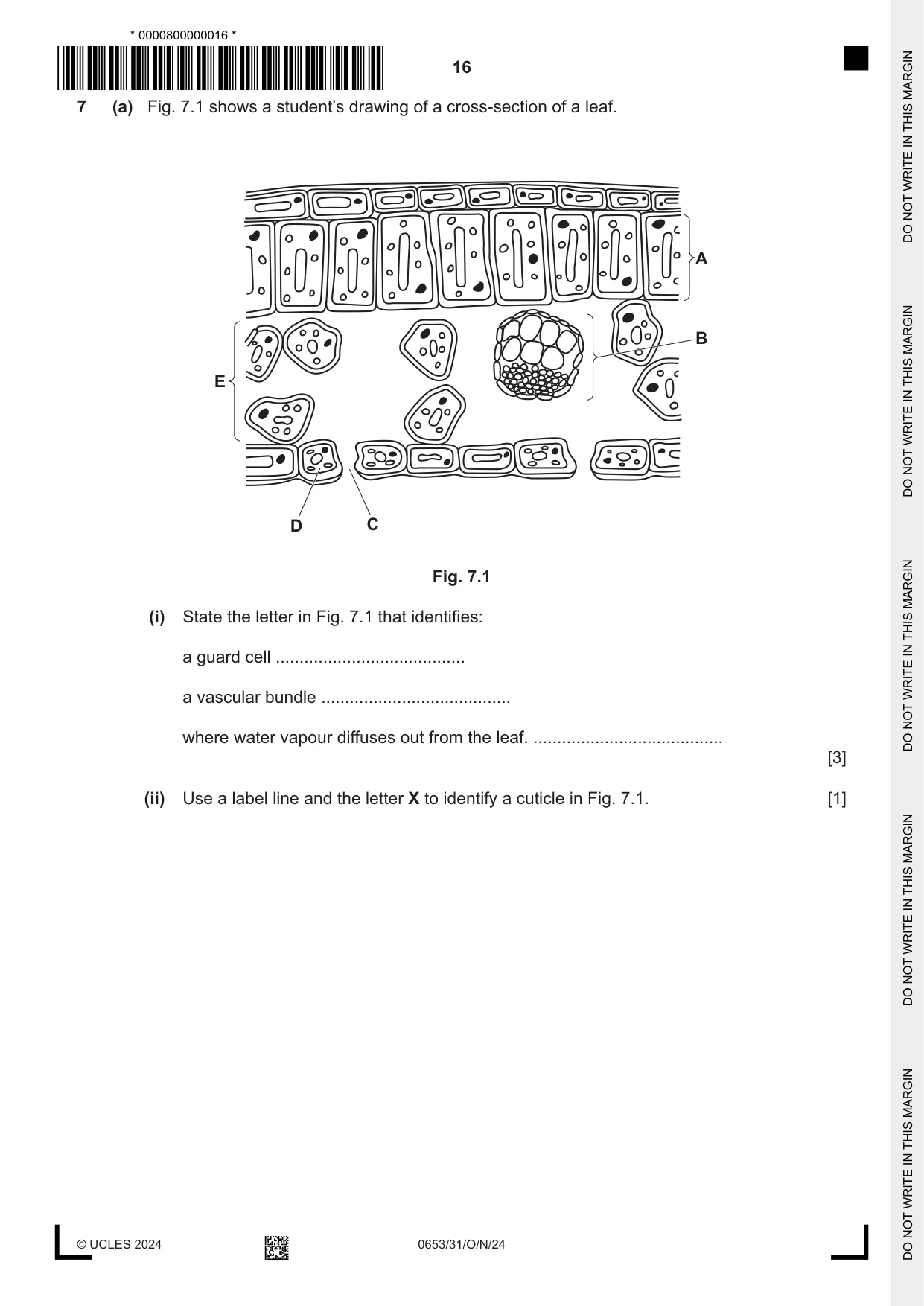
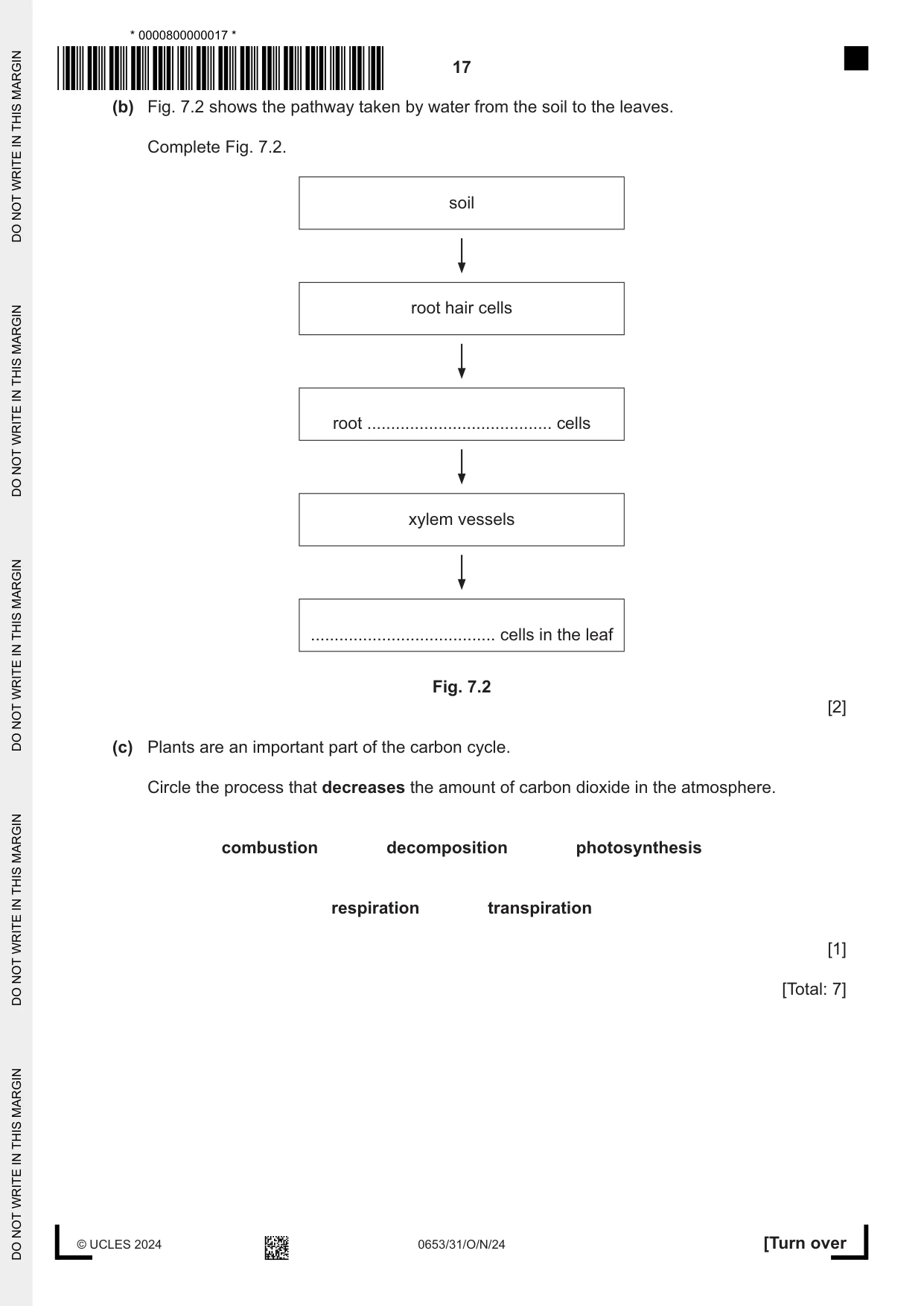
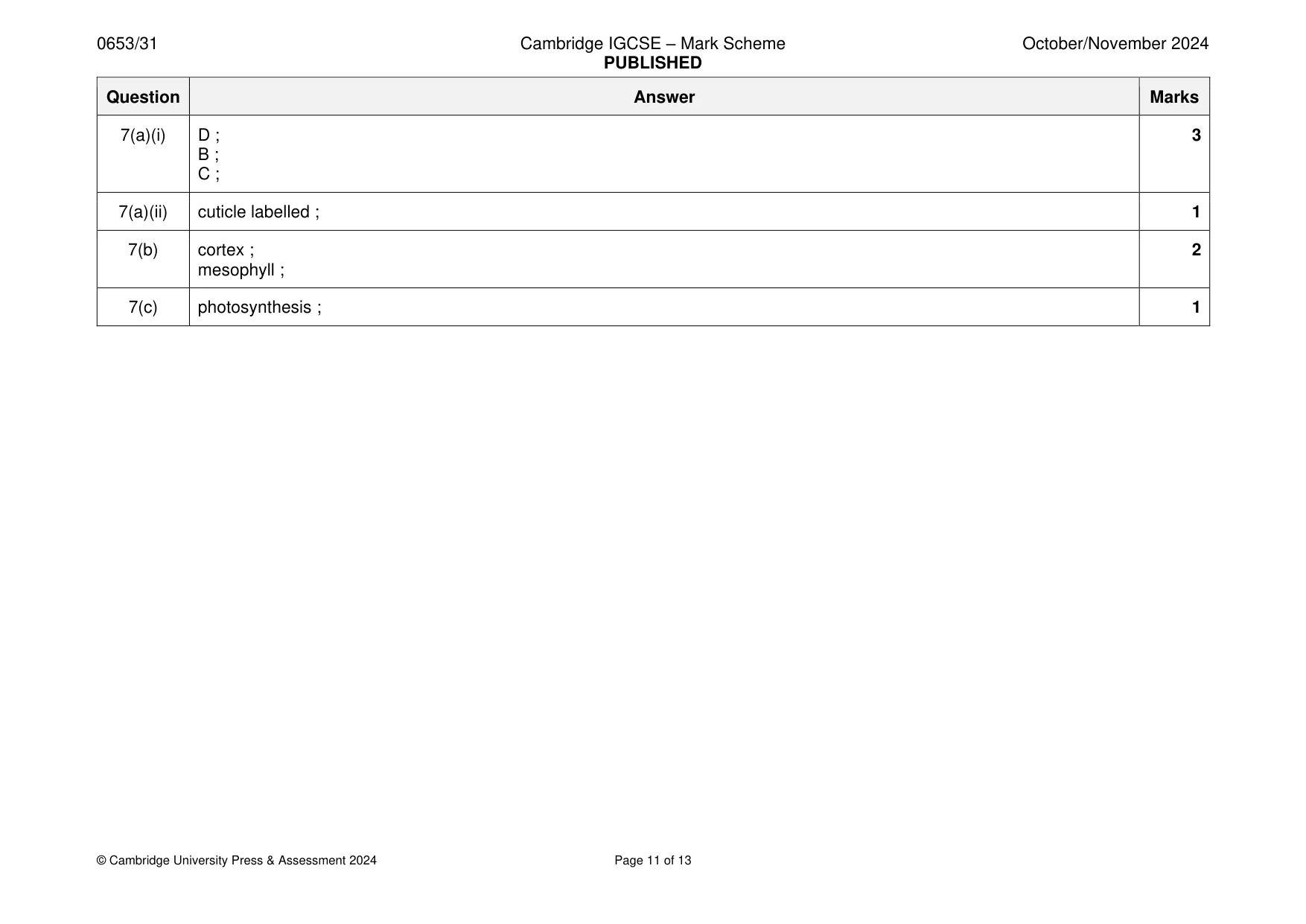
7 (a) Fig. 7.1 shows a student’s drawing of a cross-section of a leaf. A B E D C Fig. 7.1 (i) State the letter in Fig. 7.1 that identifies: a guard cell ........................................ a vascular bundle ........................................ where water vapour diffuses out from the leaf. ........................................ [3] (ii) Use a label line and the letter X to identify a cuticle in Fig. 7.1. [1] (b) Fig. 7.2 shows the pathway taken by water from the soil to the leaves. Complete Fig. 7.2. soil root hair cells root ....................................... cells xylem vessels ....................................... cells in the leaf Fig. 7.2 [2] (c) Plants are an important part of the carbon cycle. Circle the process that decreases the amount of carbon dioxide in the atmosphere. combustion decomposition photosynthesis respiration transpiration [1] [Total: 7]
Mark scheme: 7(a)(i) D ; 3 B ; C ; 7(a)(ii) cuticle labelled ; 1 7(b) cortex ; 2 mesophyll ; 7(c) photosynthesis ; 1
Q8 · Complete the sentences about fuels
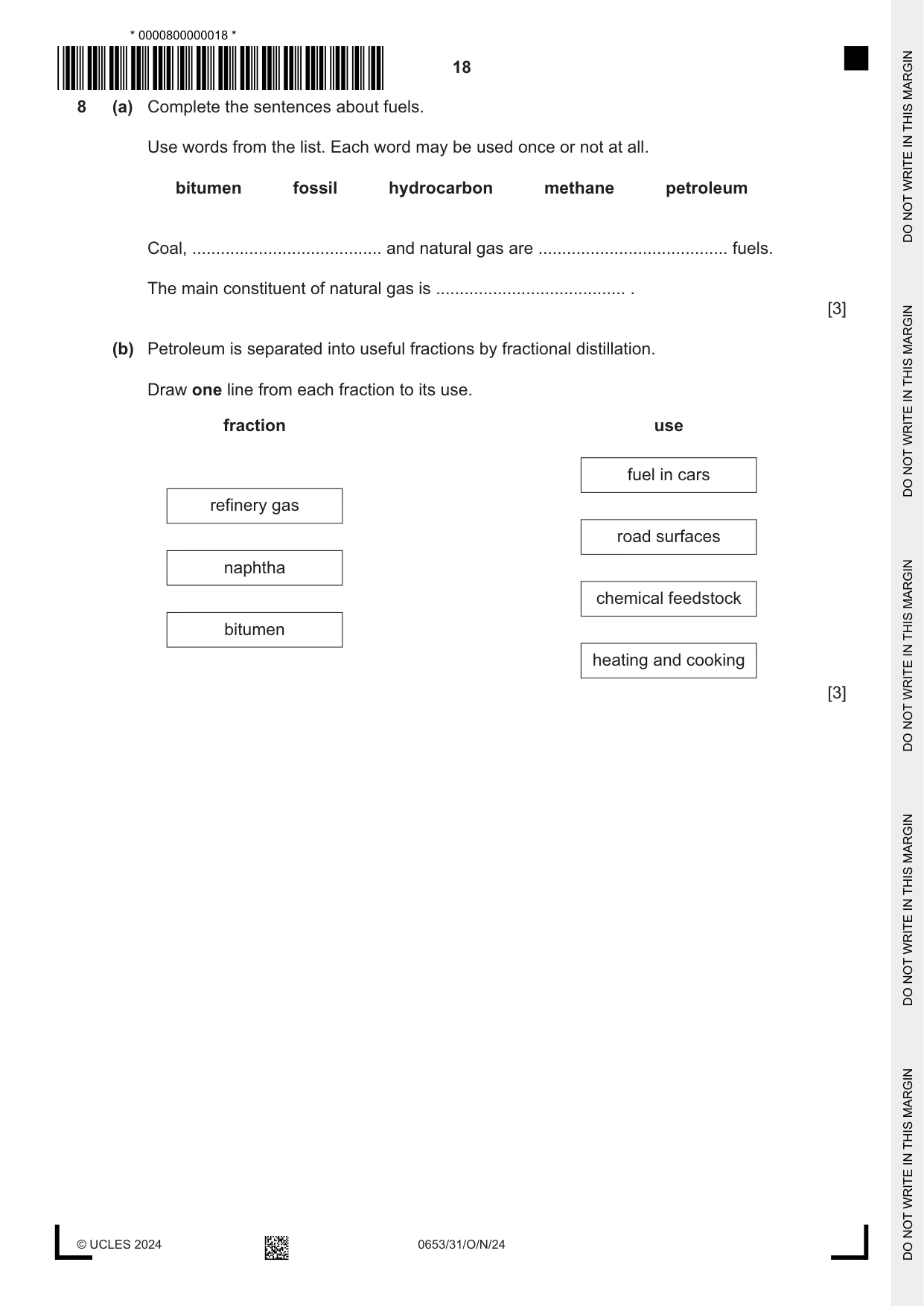
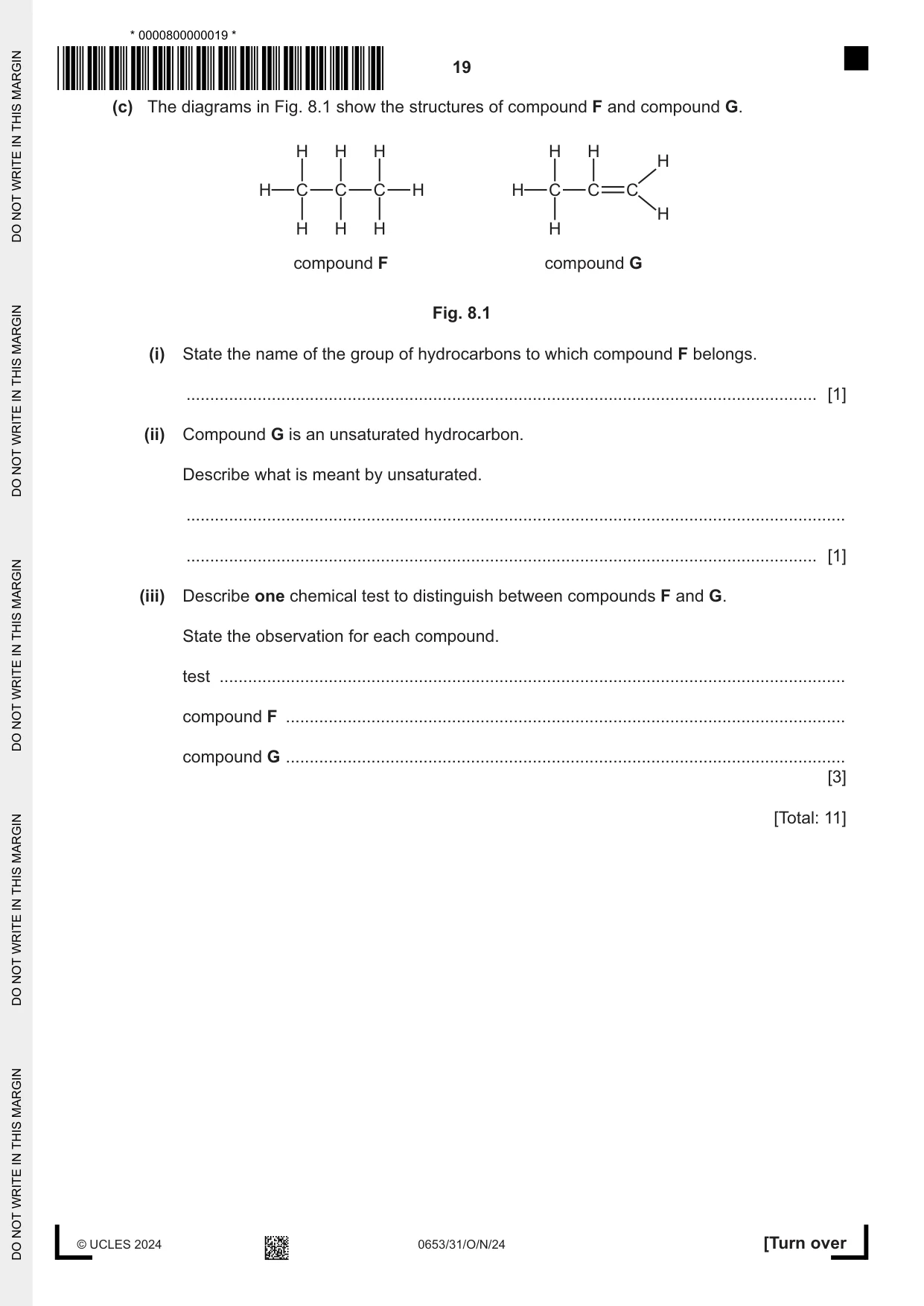
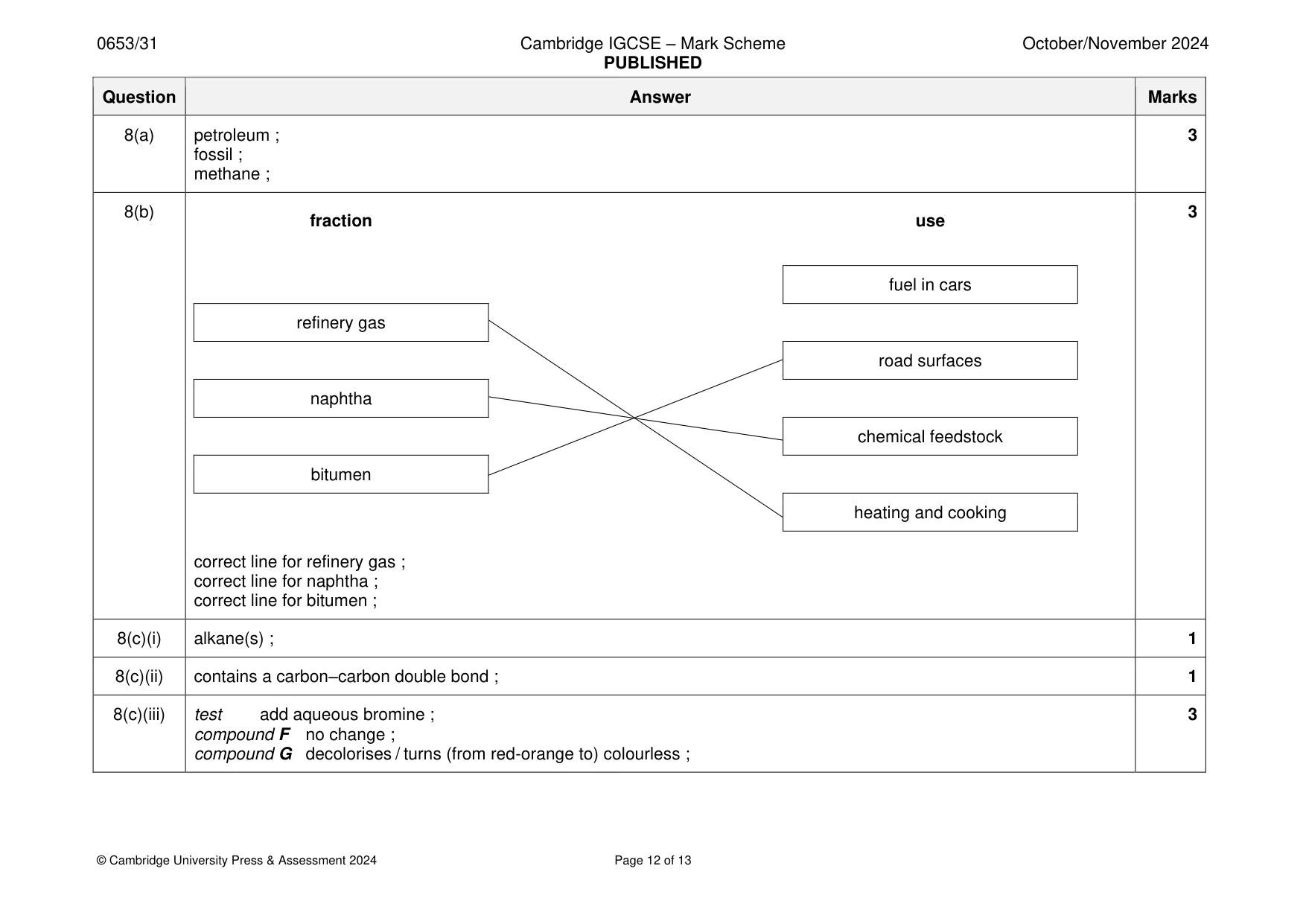
8 (a) Complete the sentences about fuels. Use words from the list. Each word may be used once or not at all. bitumen fossil hydrocarbon methane petroleum Coal, ........................................ and natural gas are ........................................ fuels. The main constituent of natural gas is ........................................ . [3] (b) Petroleum is separated into useful fractions by fractional distillation. Draw one line from each fraction to its use. fraction use fuel in cars refinery gas road surfaces naphtha chemical feedstock bitumen heating and cooking [3] (c) The diagrams in Fig. 8.1 show the structures of compound F and compound G. H H H H H H H C C C H H C C C H H H H H compound F compound G Fig. 8.1 (i) State the name of the group of hydrocarbons to which compound F belongs. ..................................................................................................................................... [1] (ii) Compound G is an unsaturated hydrocarbon. Describe what is meant by unsaturated. ........................................................................................................................................... ..................................................................................................................................... [1] (iii) Describe one chemical test to distinguish between compounds F and G. State the observation for each compound. test .................................................................................................................................... compound F ...................................................................................................................... compound G ...................................................................................................................... [3] [Total: 11]
Mark scheme: 8(a) petroleum ; 3 fossil ; methane ; 8(b) 3 fraction use fuel in cars refinery gas road surfaces naphtha chemical feedstock bitumen heating and cooking correct line for refinery gas ; correct line for naphtha ; correct line for bitumen ; 8(c)(i) alkane(s) ; 1 8(c)(ii) contains a carbon–carbon double bond ; 1 8(c)(iii) test add aqueous bromine ; 3 compound F no change ; compound G decolorises / turns (from red-orange to) colourless ;
Q9 · An electrical circuit used to investigate the resistance of a lamp
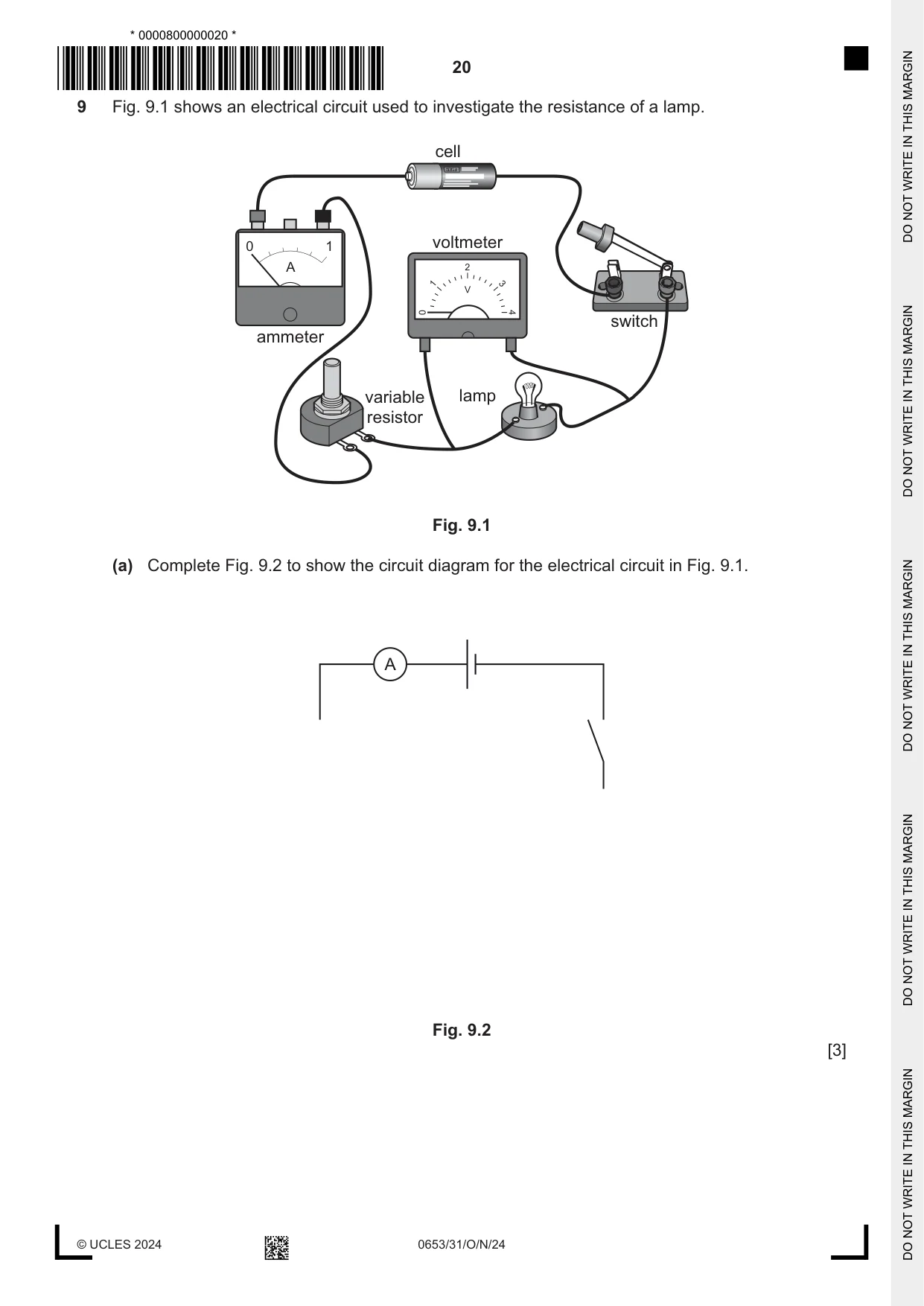
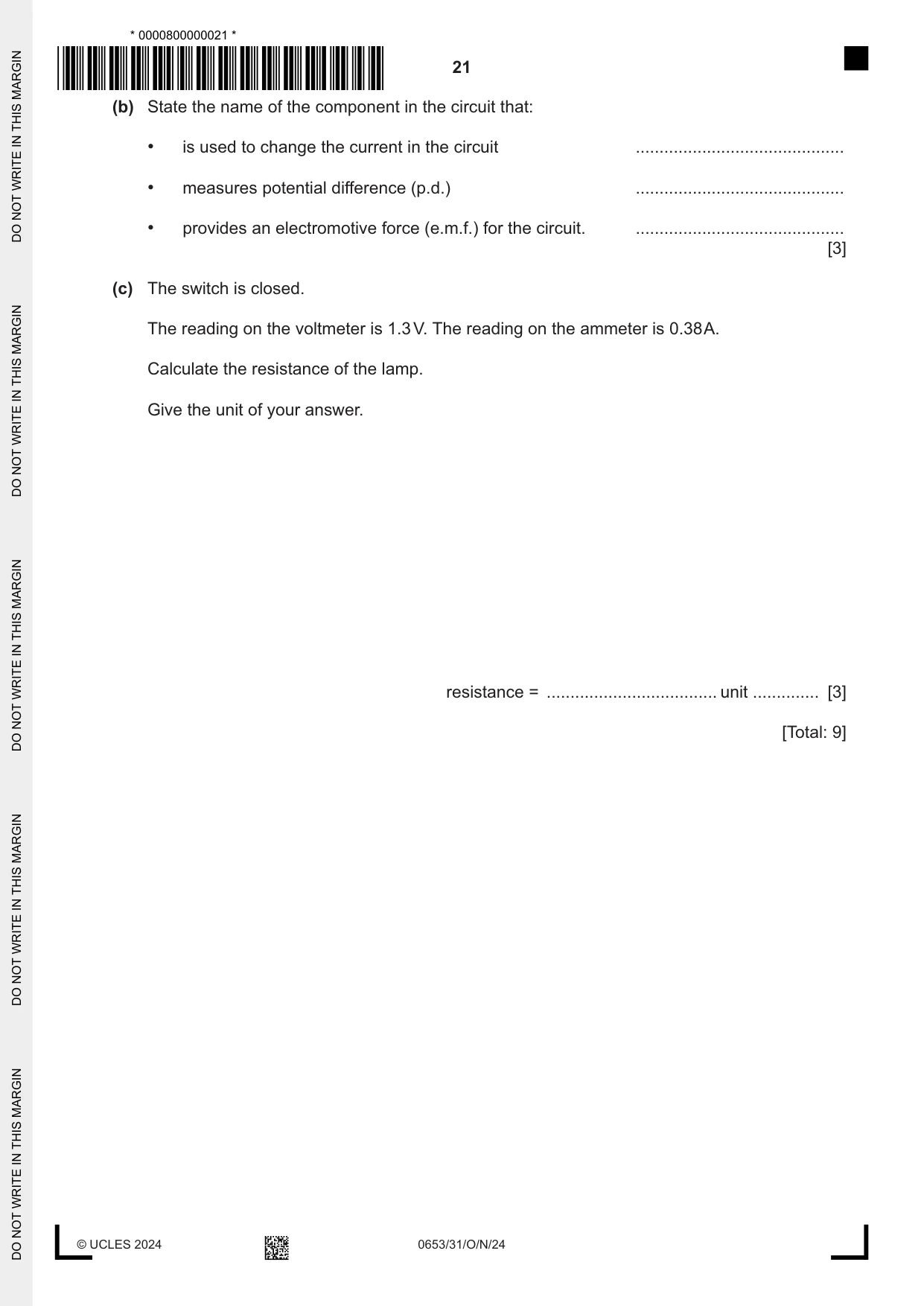
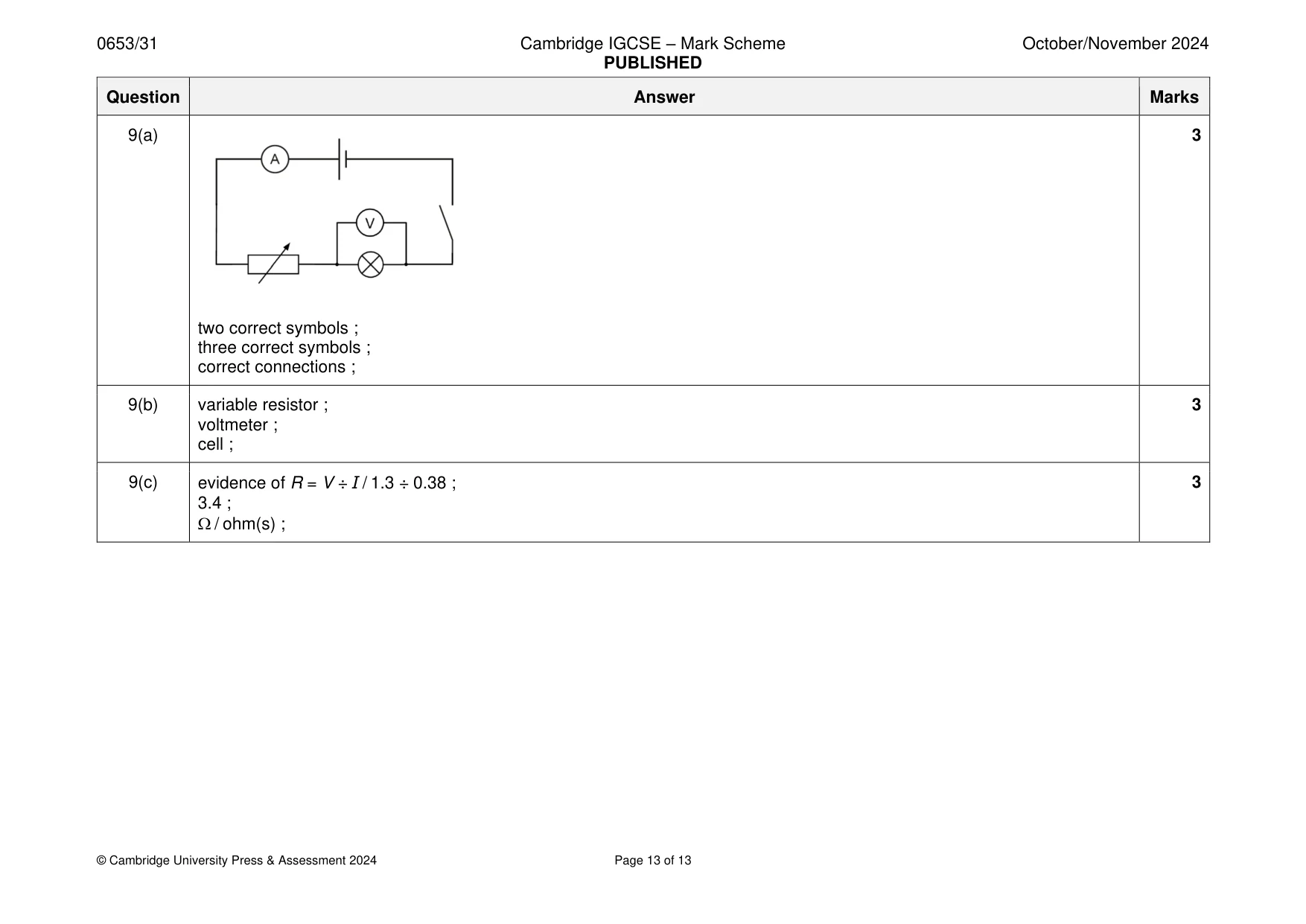
9 Fig. 9.1 shows an electrical circuit used to investigate the resistance of a lamp. cell 0 1 voltmeter A switch ammeter variable lamp resistor Fig. 9.1 (a) Complete Fig. 9.2 to show the circuit diagram for the electrical circuit in Fig. 9.1. A Fig. 9.2 [3] (b) State the name of the component in the circuit that: • is used to change the current in the circuit ............................................ • measures potential difference (p.d.) ............................................ • provides an electromotive force (e.m.f.) for the circuit. ............................................ [3] (c) The switch is closed. The reading on the voltmeter is 1.3 V. The reading on the ammeter is 0.38 A. Calculate the resistance of the lamp. Give the unit of your answer. resistance = .................................... unit .............. [3] [Total: 9]
Mark scheme: 9(a) 3 two correct symbols ; three correct symbols ; correct connections ; 9(b) variable resistor ; 3 voltmeter ; cell ; 9(c) evidence of R = V ÷ I / 1.3 ÷ 0.38 ; 3 3.4 ; / ohm(s) ;
What was in this paper
The subtopics covered by these 9 questions, and how many questions each got. Open one in a new tab to see every Cambridge question on it.
What you needed in this session
Cambridge’s own grade thresholds for 2024 Oct/Nov, Paper 3 · Variant 1. A higher threshold means an easier paper — the bar moves with how the cohort did.