Cambridge IGCSE Science - Combined 0653 — 2019 May/June Paper 3 · Variant 2
0653/32/M/J/19 · 9 questions · 80 marks · ≈90 min
The question paper and its mark scheme, free to read here and free to download. This is Cambridge’s own paper, exactly as it was sat.
Question paper20 pages
Mark scheme9 pages
Answers below. Sit the paper first if you are practising.
Questions as text
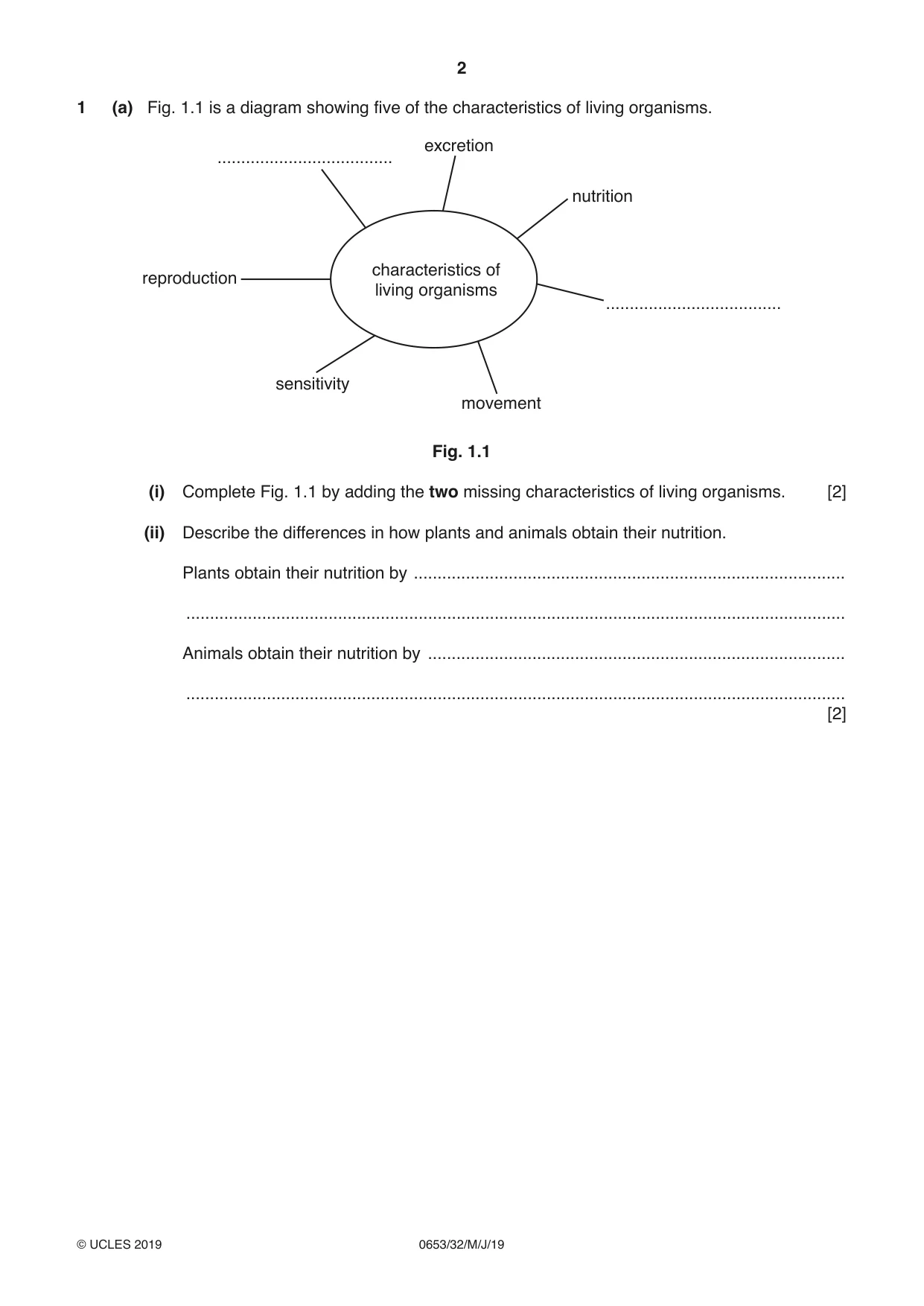
Q1 · A diagram showing five of the characteristics of living organisms
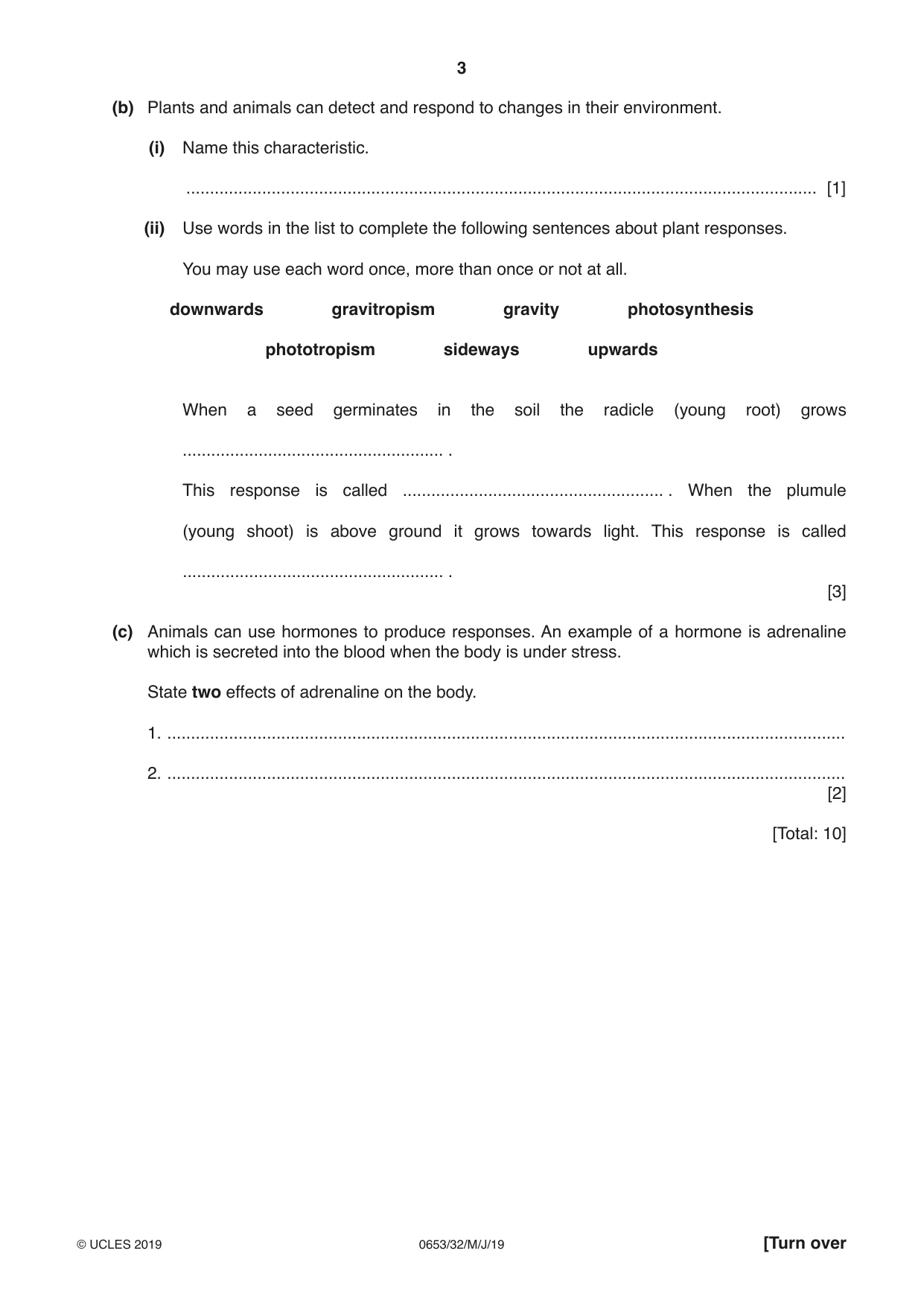
1 (a) Fig. 1.1 is a diagram showing five of the characteristics of living organisms. excretion ..................................... nutrition characteristics of reproduction living organisms ..................................... sensitivity movement Fig. 1.1 (i) Complete Fig. 1.1 by adding the two missing characteristics of living organisms. [2] (ii) Describe the differences in how plants and animals obtain their nutrition. Plants obtain their nutrition by ........................................................................................... ........................................................................................................................................... Animals obtain their nutrition by ........................................................................................ ........................................................................................................................................... [2] (b) Plants and animals can detect and respond to changes in their environment. (i) Name this characteristic. ..................................................................................................................................... [1] (ii) Use words in the list to complete the following sentences about plant responses. You may use each word once, more than once or not at all. downwards gravitropism gravity photosynthesis phototropism sideways upwards When a seed germinates in the soil the radicle (young root) grows ....................................................... . This response is called ....................................................... . When the plumule (young shoot) is above ground it grows towards light. This response is called ....................................................... . [3] (c) Animals can use hormones to produce responses. An example of a hormone is adrenaline which is secreted into the blood when the body is under stress. State two effects of adrenaline on the body. 1. ............................................................................................................................................... 2. ............................................................................................................................................... [2] [Total: 10]
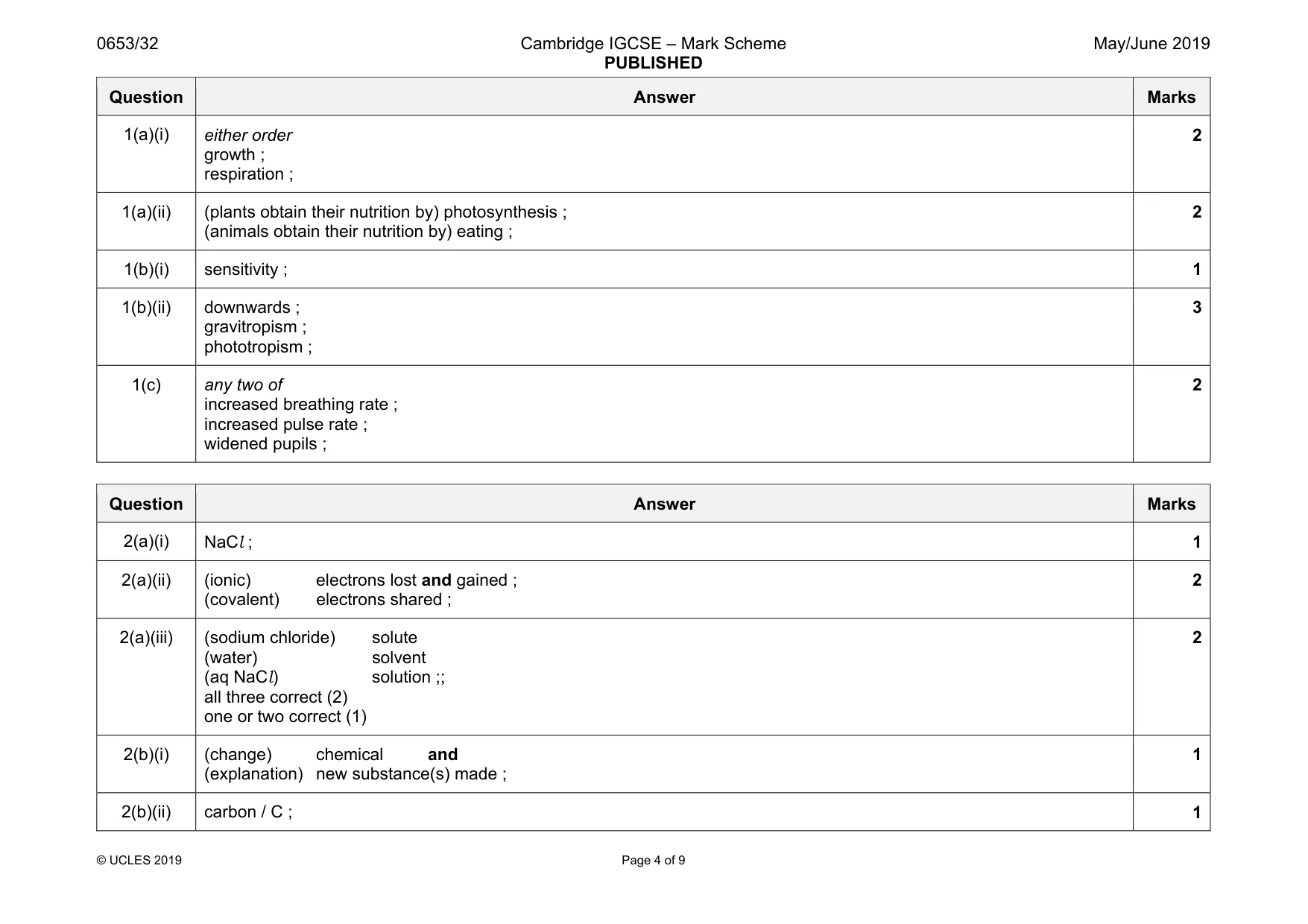
Mark scheme: 1(a)(i) either order growth ; respiration ; 2 1(a)(ii) (plants obtain their nutrition by) photosynthesis ; (animals obtain their nutrition by) eating ; 2 1(b)(i) sensitivity ; 1 1(b)(ii) downwards ; gravitropism ; phototropism ; 3 1(c) any two of increased breathing rate ; increased pulse rate ; widened pupils ; 2
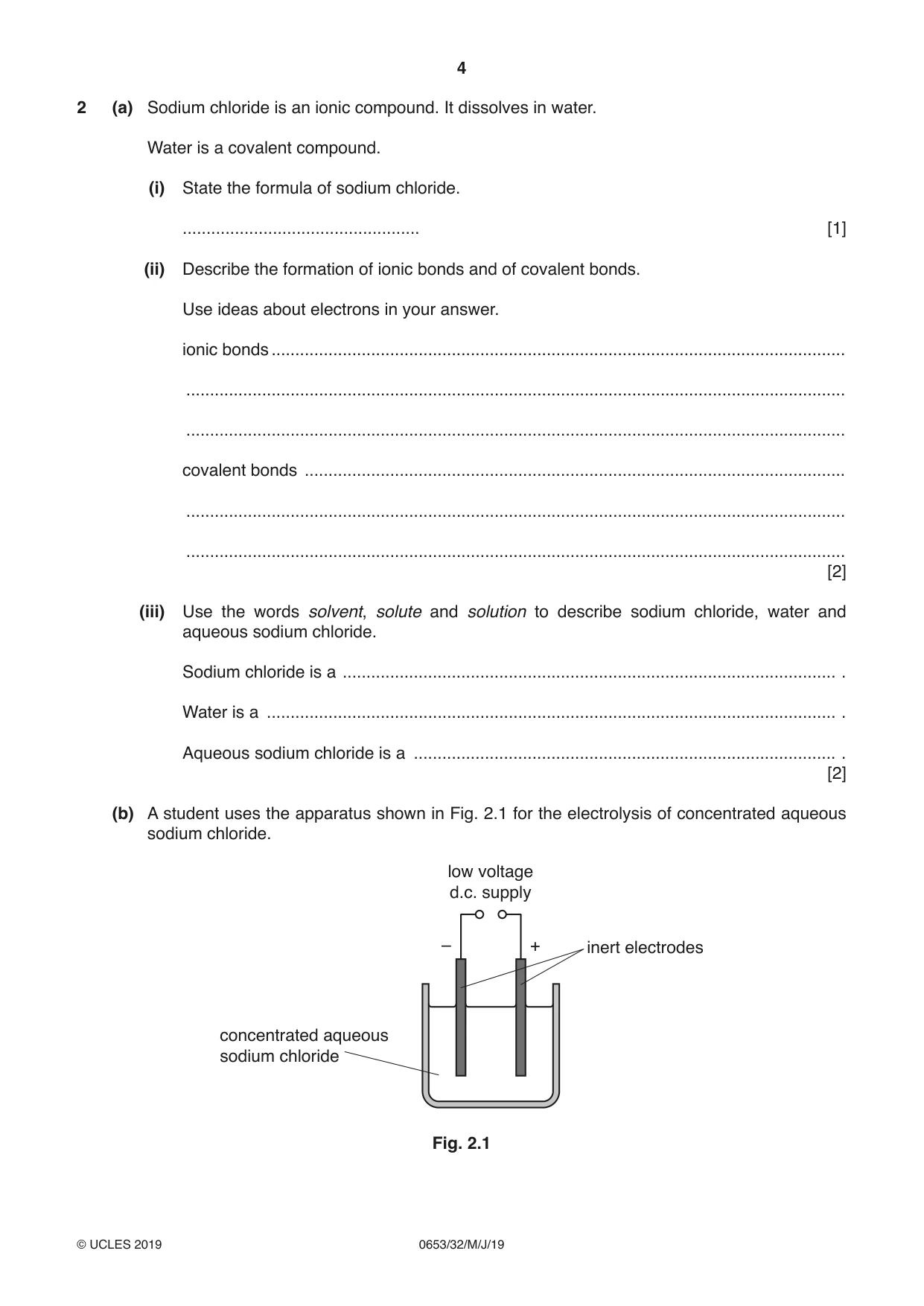
Q2 · Sodium chloride is an ionic compound
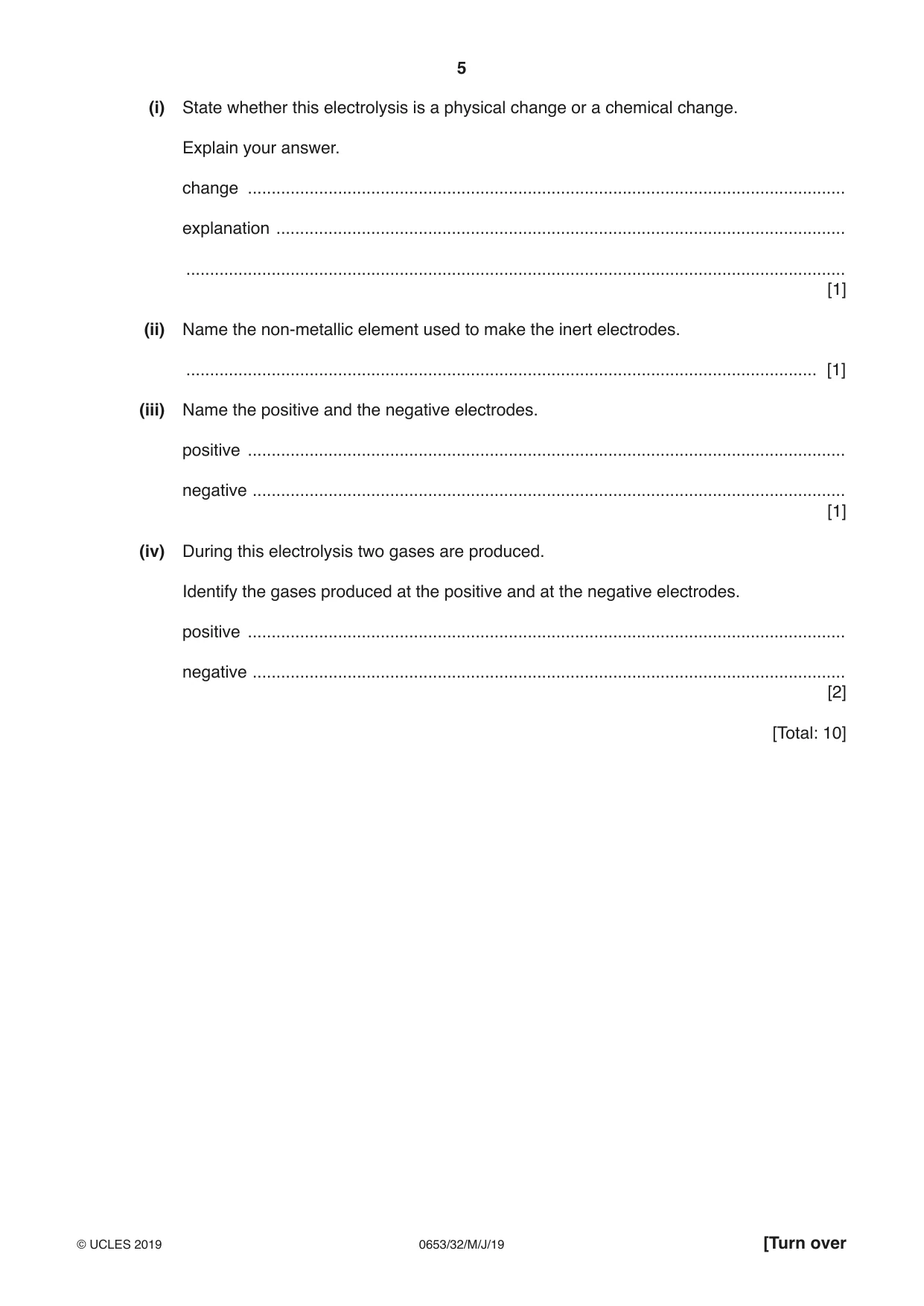
2 (a) Sodium chloride is an ionic compound. It dissolves in water. Water is a covalent compound. (i) State the formula of sodium chloride. .................................................. [1] (ii) Describe the formation of ionic bonds and of covalent bonds. Use ideas about electrons in your answer. ionic bonds ......................................................................................................................... ........................................................................................................................................... ........................................................................................................................................... covalent bonds .................................................................................................................. ........................................................................................................................................... ........................................................................................................................................... [2] (iii) Use the words solvent, solute and solution to describe sodium chloride, water and aqueous sodium chloride. Sodium chloride is a ........................................................................................................ . Water is a ........................................................................................................................ . Aqueous sodium chloride is a ......................................................................................... . [2] (b) A student uses the apparatus shown in Fig. 2.1 for the electrolysis of concentrated aqueous sodium chloride. low voltage d.c. supply – + inert electrodes concentrated aqueous sodium chloride Fig. 2.1 (i) State whether this electrolysis is a physical change or a chemical change. Explain your answer. change .............................................................................................................................. explanation ........................................................................................................................ ........................................................................................................................................... [1] (ii) Name the non-metallic element used to make the inert electrodes. ..................................................................................................................................... [1] (iii) Name the positive and the negative electrodes. positive .............................................................................................................................. negative ............................................................................................................................. [1] (iv) During this electrolysis two gases are produced. Identify the gases produced at the positive and at the negative electrodes. positive .............................................................................................................................. negative ............................................................................................................................. [2] [Total: 10]
Mark scheme: 2(a)(i) 1 2(a)(ii) (ionic) electrons lost and gained ; (covalent) electrons shared ; 2 2(a)(iii) (sodium chloride) solute (water) solvent (aq NaCl) solution ;; all three correct (2) one or two correct (1) 2 2(b)(i) (change) chemical and (explanation) new substance(s) made ; 1 2(b)(ii) carbon / C ; 1 Question Answer Marks 2(b)(iii) (positive) anode and (negative) cathode ; 1 2(b)(iv) (positive) chlorine / Cl2 ; (negative) hydrogen / H2 ; 2
Q3 · Below is a list of some types of wave
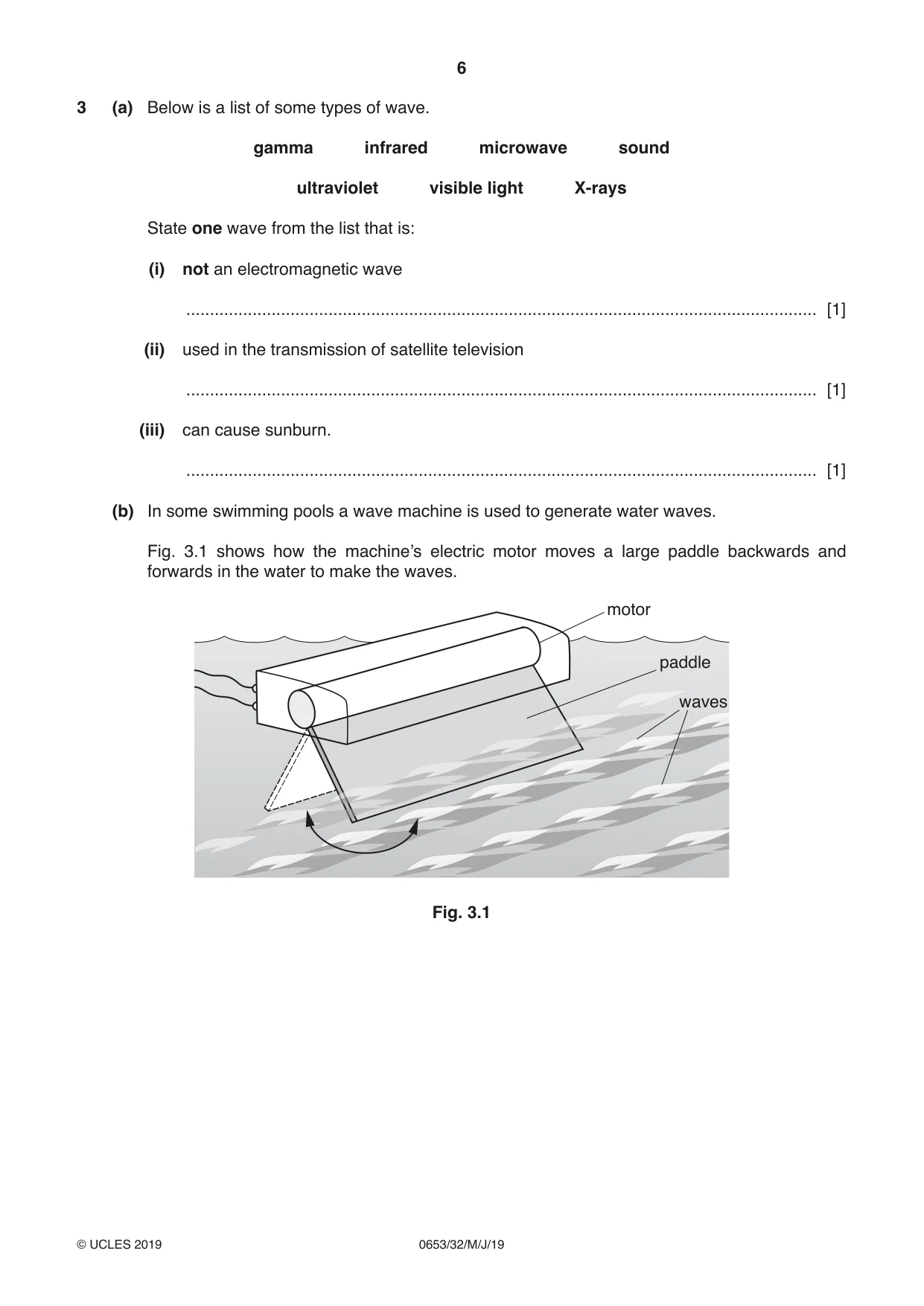
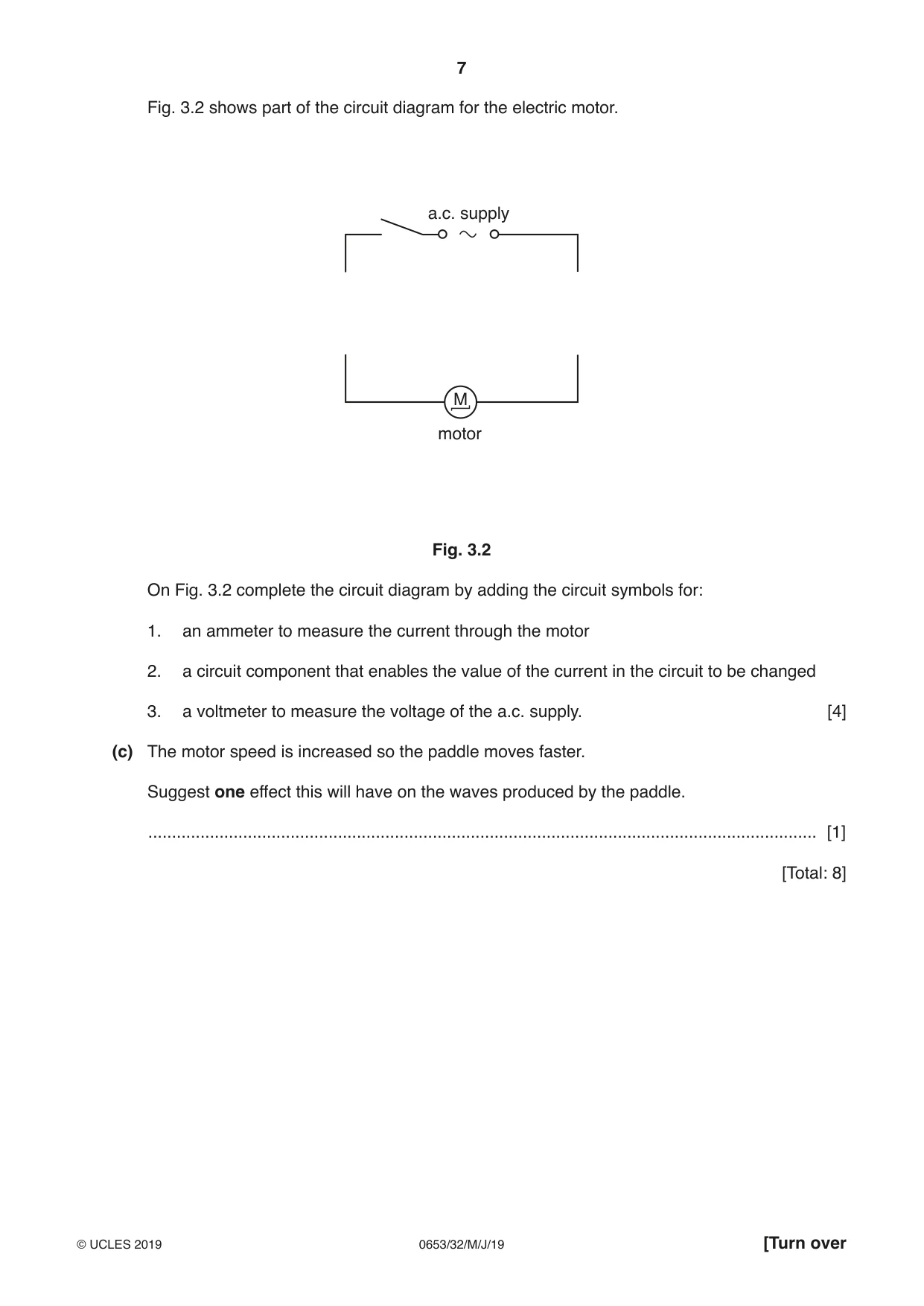
3 (a) Below is a list of some types of wave. gamma infrared microwave sound ultraviolet visible light X-rays State one wave from the list that is: (i) not an electromagnetic wave ..................................................................................................................................... [1] (ii) used in the transmission of satellite television ..................................................................................................................................... [1] (iii) can cause sunburn. ..................................................................................................................................... [1] (b) In some swimming pools a wave machine is used to generate water waves. Fig. 3.1 shows how the machine’s electric motor moves a large paddle backwards and forwards in the water to make the waves. motor paddle waves Fig. 3.1 Fig. 3.2 shows part of the circuit diagram for the electric motor. a.c. supply M motor Fig. 3.2 On Fig. 3.2 complete the circuit diagram by adding the circuit symbols for: 1. an ammeter to measure the current through the motor 2. a circuit component that enables the value of the current in the circuit to be changed 3. a voltmeter to measure the voltage of the a.c. supply. [4] (c) The motor speed is increased so the paddle moves faster. Suggest one effect this will have on the waves produced by the paddle. ............................................................................................................................................. [1] [Total: 8]
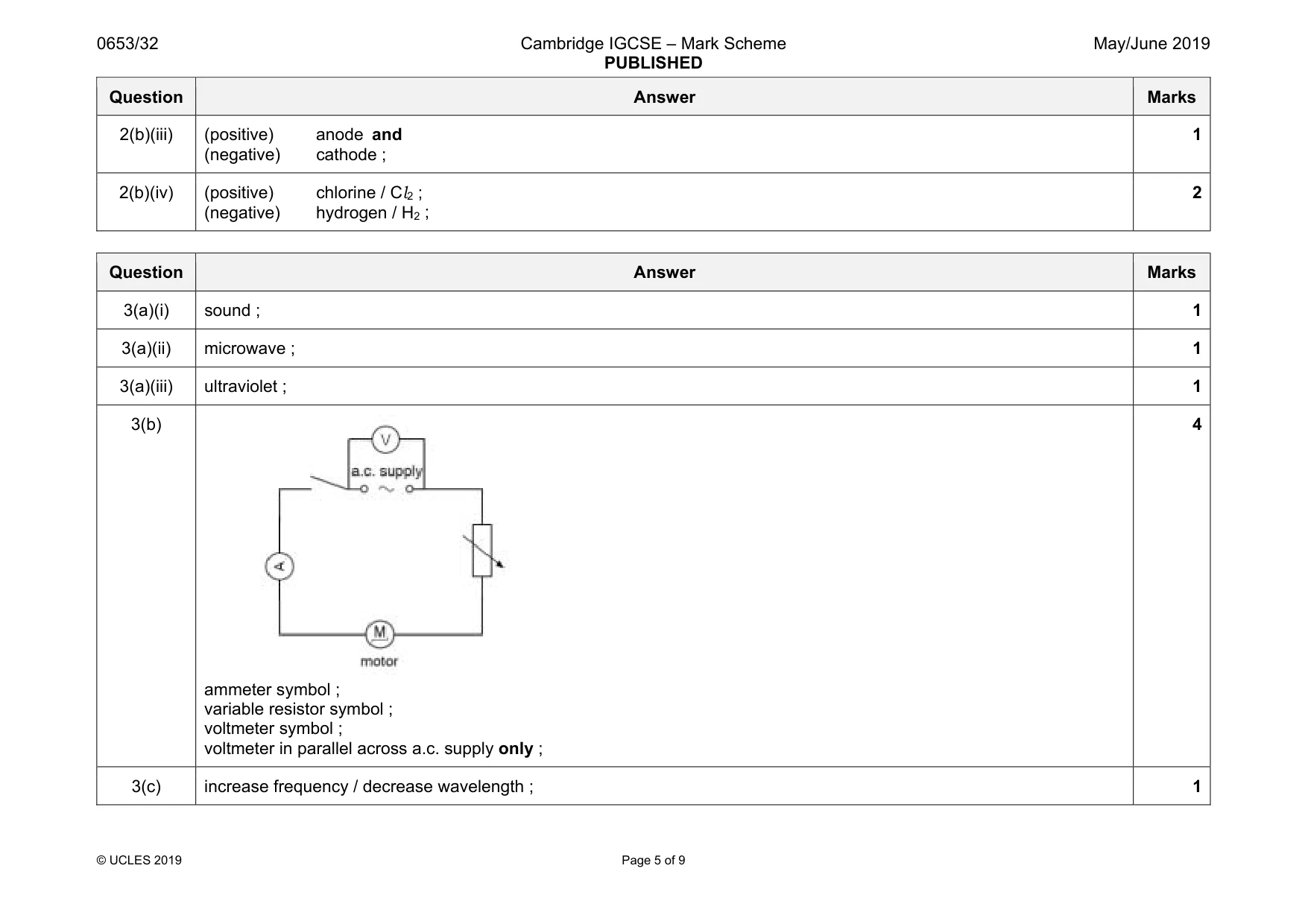
Mark scheme: 3(a)(i) sound ; 1 3(a)(ii) microwave ; 1 3(a)(iii) ultraviolet ; 1 3(b) ammeter symbol ; variable resistor symbol ; voltmeter symbol ; voltmeter in parallel across a.c. supply only ; 4 3(c) increase frequency / decrease wavelength ; 1
Q4 · When a banana is peeled the exposed surface turns from white to brown, as shown in Fig
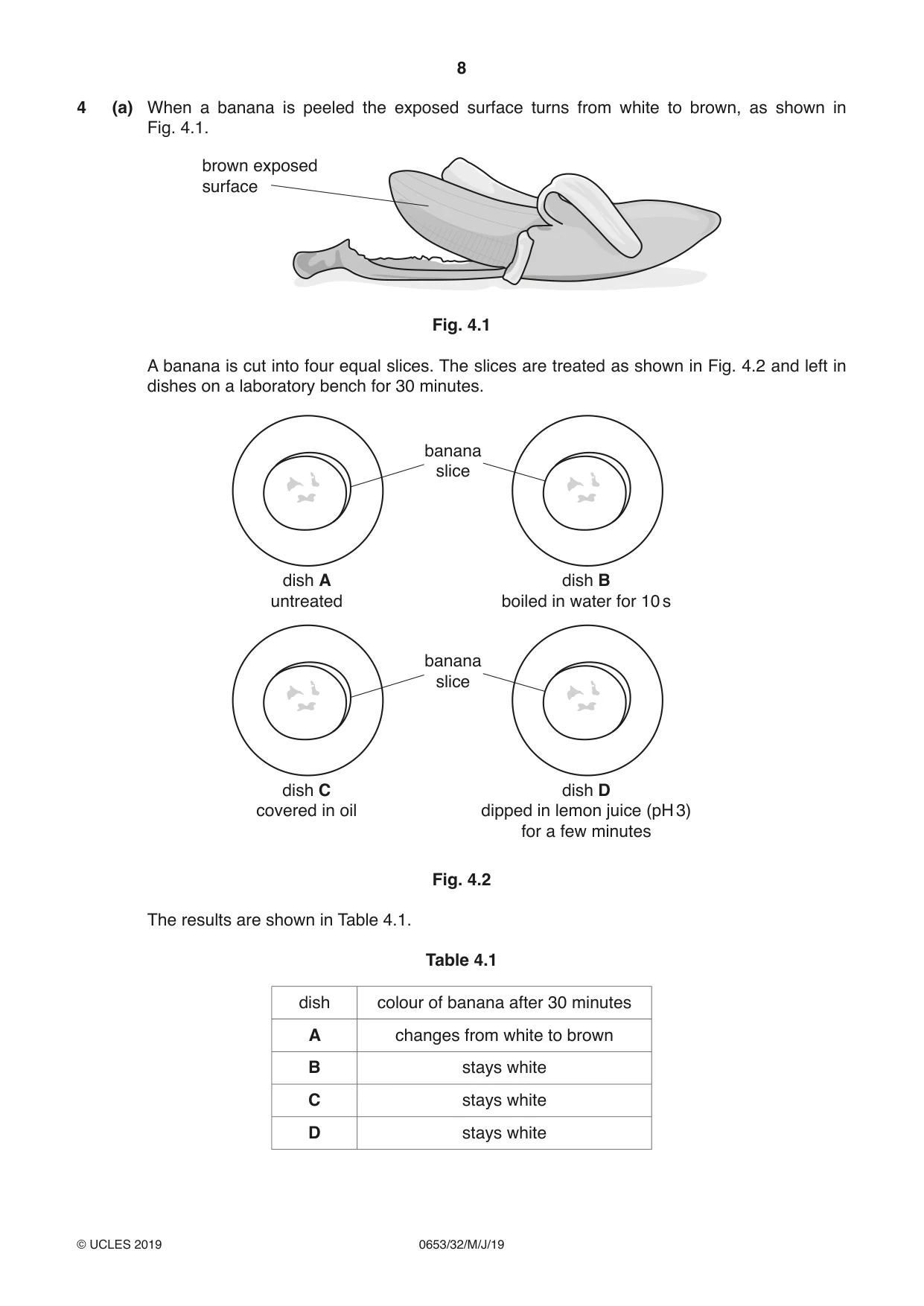
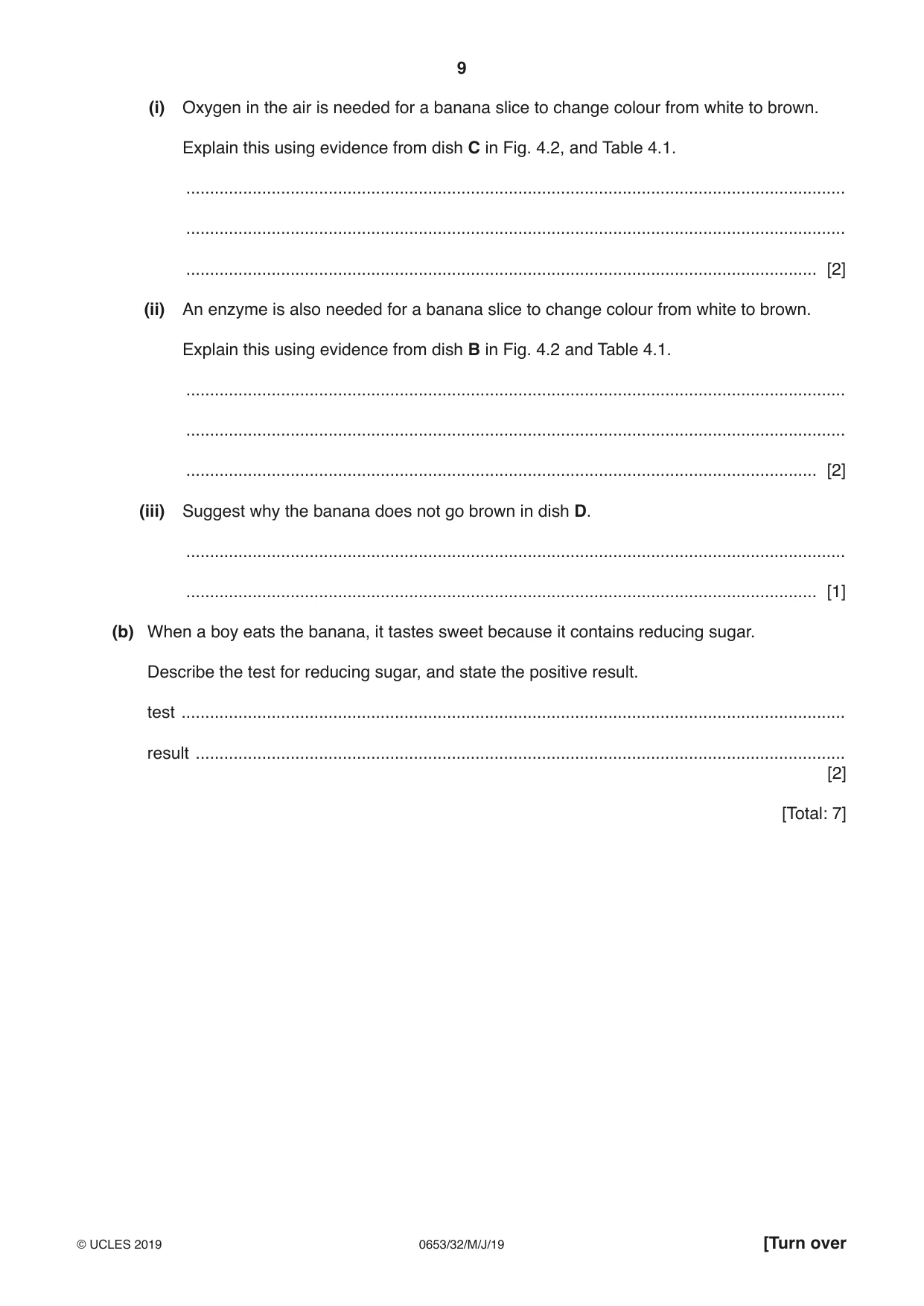
4 (a) When a banana is peeled the exposed surface turns from white to brown, as shown in Fig. 4.1. brown exposed surface Fig. 4.1 A banana is cut into four equal slices. The slices are treated as shown in Fig. 4.2 and left in dishes on a laboratory bench for 30 minutes. banana slice dish A dish B untreated boiled in water for 10 s banana slice dish C dish D covered in oil dipped in lemon juice (pH 3) for a few minutes Fig. 4.2 The results are shown in Table 4.1. Table 4.1 dish colour of banana after 30 minutes A changes from white to brown B stays white C stays white D stays white (i) Oxygen in the air is needed for a banana slice to change colour from white to brown. Explain this using evidence from dish C in Fig. 4.2, and Table 4.1. ........................................................................................................................................... ........................................................................................................................................... ..................................................................................................................................... [2] (ii) An enzyme is also needed for a banana slice to change colour from white to brown. Explain this using evidence from dish B in Fig. 4.2 and Table 4.1. ........................................................................................................................................... ........................................................................................................................................... ..................................................................................................................................... [2] (iii) Suggest why the banana does not go brown in dish D. ........................................................................................................................................... ..................................................................................................................................... [1] (b) When a boy eats the banana, it tastes sweet because it contains reducing sugar. Describe the test for reducing sugar, and state the positive result. test ............................................................................................................................................ result ......................................................................................................................................... [2] [Total: 7]
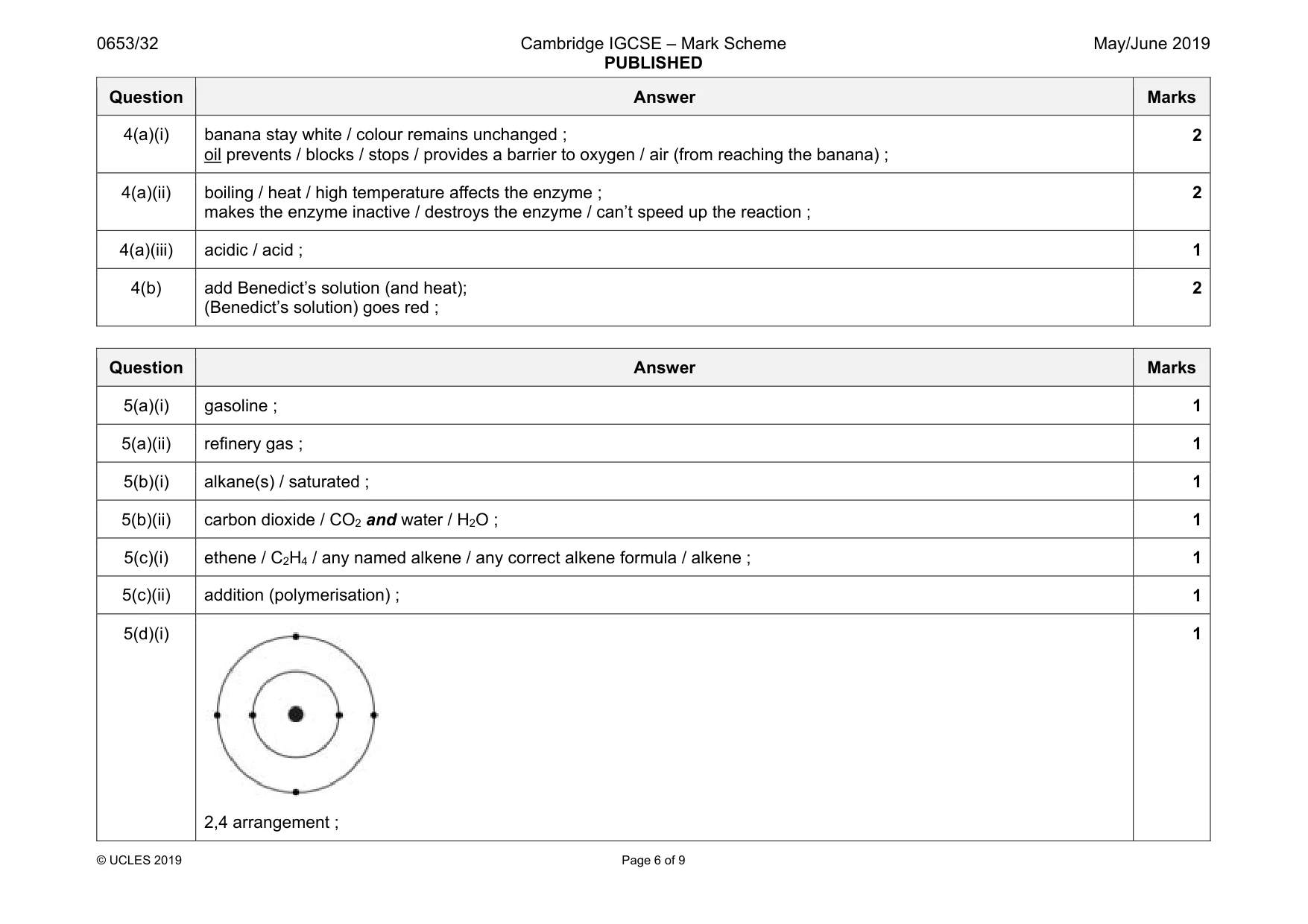
Mark scheme: 4(a)(i) banana stay white / colour remains unchanged ; oil prevents / blocks / stops / provides a barrier to oxygen / air (from reaching the banana) ; 2 4(a)(ii) boiling / heat / high temperature affects the enzyme ; makes the enzyme inactive / destroys the enzyme / can’t speed up the reaction ; 2 4(a)(iii) acidic / acid ; 1 4(b) add Benedict’s solution (and heat); (Benedict’s solution) goes red ; 2
Question 5
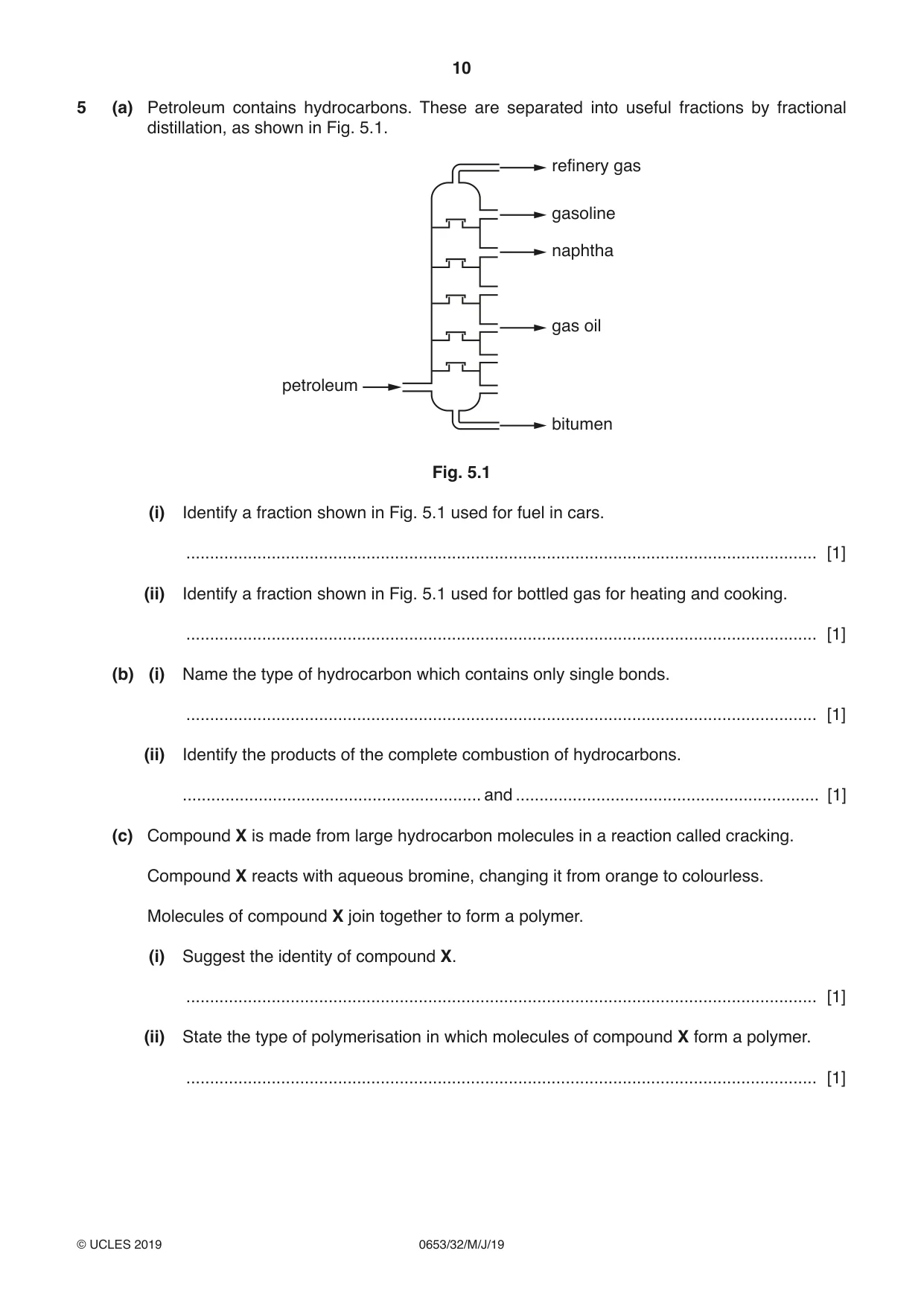
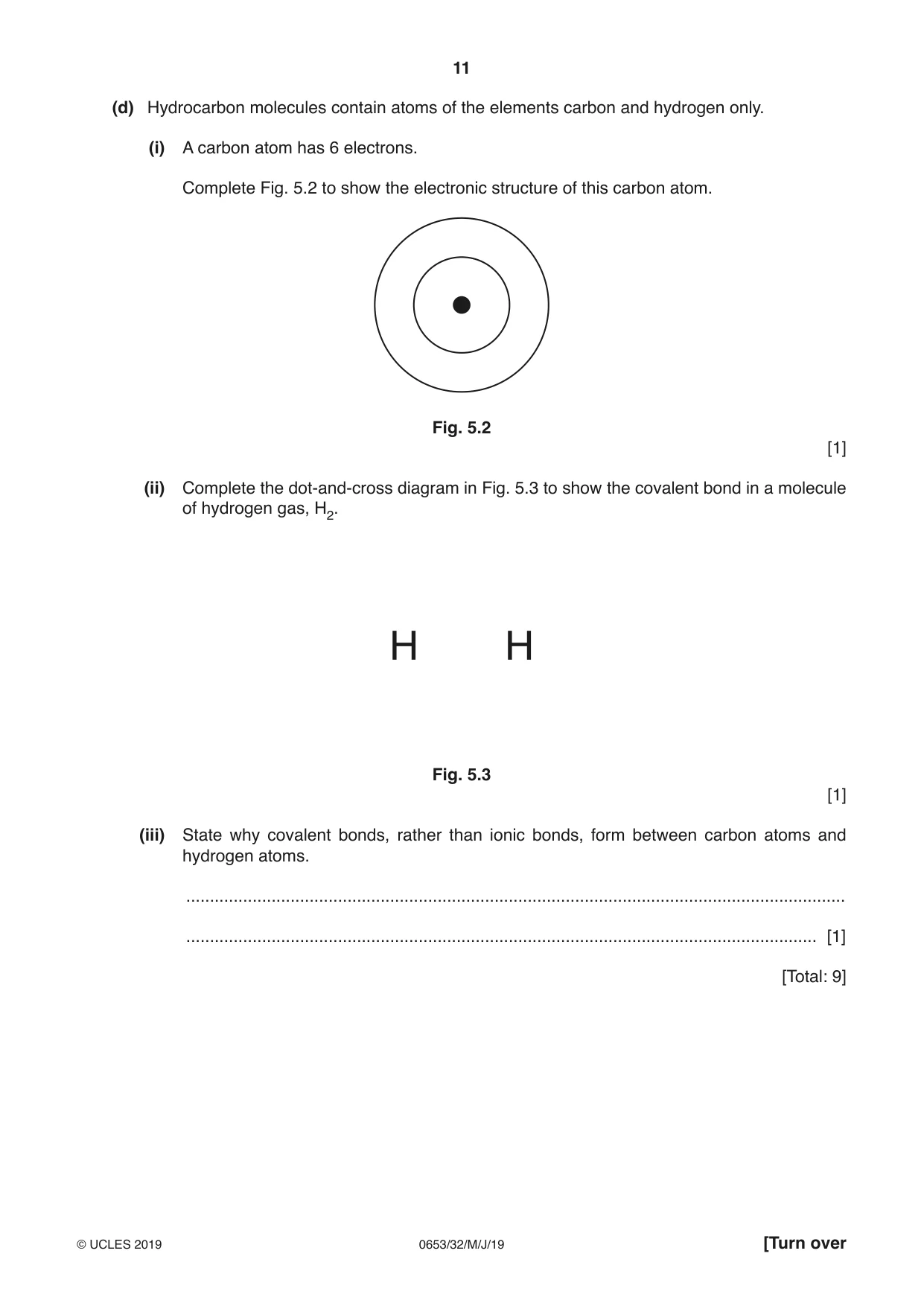
5 (a) Petroleum contains hydrocarbons. These are separated into useful fractions by fractional distillation, as shown in Fig. 5.1. refinery gas gasoline naphtha gas oil petroleum bitumen Fig. 5.1 (i) Identify a fraction shown in Fig. 5.1 used for fuel in cars. ..................................................................................................................................... [1] (ii) Identify a fraction shown in Fig. 5.1 used for bottled gas for heating and cooking. ..................................................................................................................................... [1] (b) (i) Name the type of hydrocarbon which contains only single bonds. ..................................................................................................................................... [1] (ii) Identify the products of the complete combustion of hydrocarbons. ............................................................... and ................................................................ [1] (c) Compound X is made from large hydrocarbon molecules in a reaction called cracking. Compound X reacts with aqueous bromine, changing it from orange to colourless. Molecules of compound X join together to form a polymer. (i) Suggest the identity of compound X. ..................................................................................................................................... [1] (ii) State the type of polymerisation in which molecules of compound X form a polymer. ..................................................................................................................................... [1] (d) Hydrocarbon molecules contain atoms of the elements carbon and hydrogen only. (i) A carbon atom has 6 electrons. Complete Fig. 5.2 to show the electronic structure of this carbon atom. Fig. 5.2 [1] (ii) Complete the dot-and-cross diagram in Fig. 5.3 to show the covalent bond in a molecule of hydrogen gas, H2. H H Fig. 5.3 [1] (iii) State why covalent bonds, rather than ionic bonds, form between carbon atoms and hydrogen atoms. ........................................................................................................................................... ..................................................................................................................................... [1] [Total: 9]
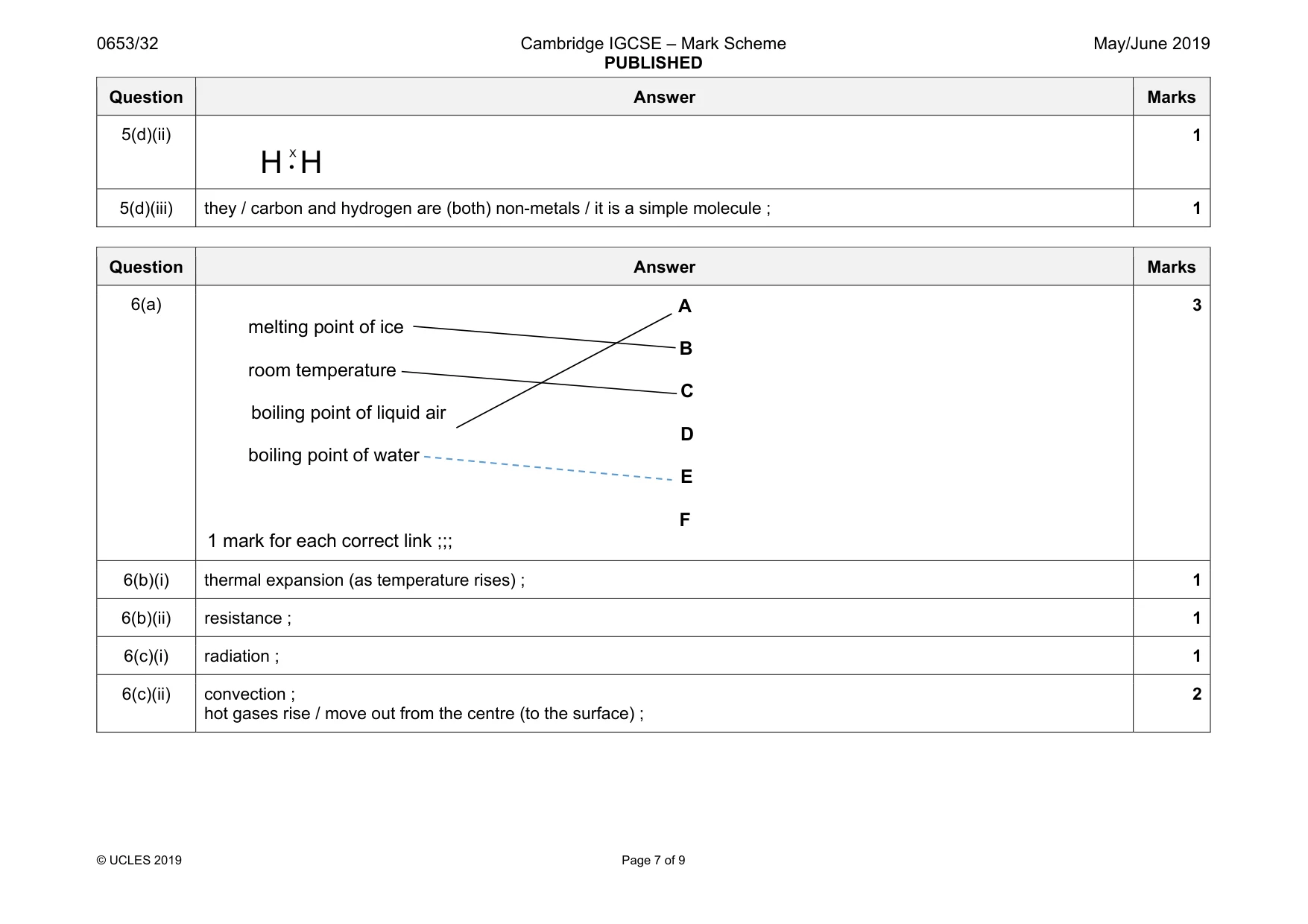
Mark scheme: 5(a)(i) gasoline ; 1 5(a)(ii) refinery gas ; 1 5(b)(i) alkane(s) / saturated ; 1 5(b)(ii) carbon dioxide / CO2 and water / H2O ; 1 5(c)(i) ethene / C2H4 / any named alkene / any correct alkene formula / alkene ; 1 5(c)(ii) addition (polymerisation) ; 1 5(d)(i) 2,4 arrangement ; 1 Question Answer Marks 5(d)(ii) H H 1 5(d)(iii) they / carbon and hydrogen are (both) non-metals / it is a simple molecule ; 1 X •
Q6 · The Celsius temperature scale from −273 °C up to 300 °C
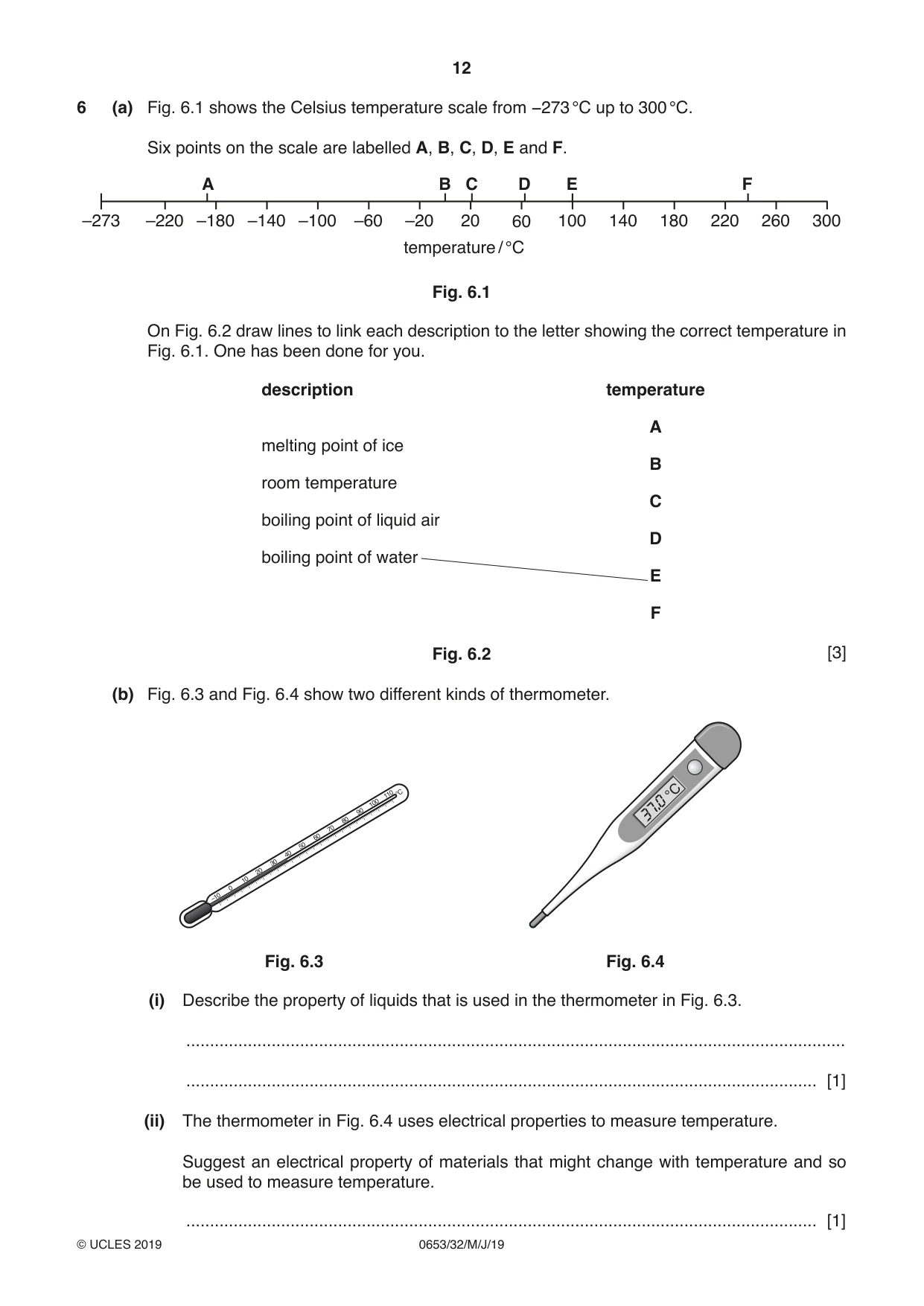
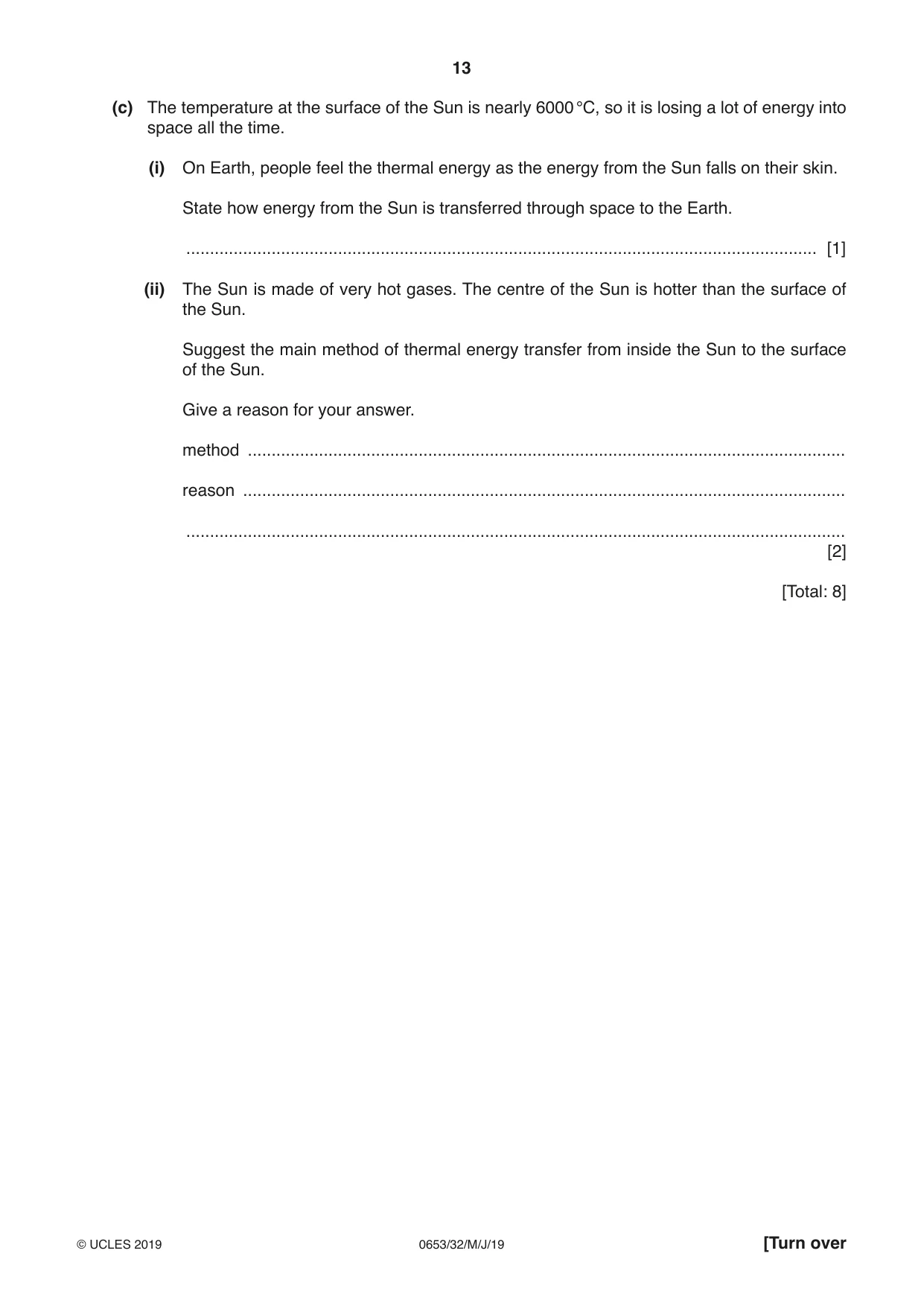
6 (a) Fig. 6.1 shows the Celsius temperature scale from −273 °C up to 300 °C. Six points on the scale are labelled A, B, C, D, E and F. A B C D E F –273 –220 –180 –140 –100 –60 –20 20 60 100 140 180 220 260 300 temperature / °C Fig. 6.1 On Fig. 6.2 draw lines to link each description to the letter showing the correct temperature in Fig. 6.1. One has been done for you. description temperature A melting point of ice B room temperature C boiling point of liquid air D boiling point of water E F Fig. 6.2 [3] (b) Fig. 6.3 and Fig. 6.4 show two different kinds of thermometer. 110°C °C 100 90 80 70 60 50 40 30 20 10 0 –10 Fig. 6.3 Fig. 6.4 (i) Describe the property of liquids that is used in the thermometer in Fig. 6.3. ........................................................................................................................................... ..................................................................................................................................... [1] (ii) The thermometer in Fig. 6.4 uses electrical properties to measure temperature. Suggest an electrical property of materials that might change with temperature and so be used to measure temperature. ..................................................................................................................................... [1] (c) The temperature at the surface of the Sun is nearly 6000 °C, so it is losing a lot of energy into space all the time. (i) On Earth, people feel the thermal energy as the energy from the Sun falls on their skin. State how energy from the Sun is transferred through space to the Earth. ..................................................................................................................................... [1] (ii) The Sun is made of very hot gases. The centre of the Sun is hotter than the surface of the Sun. Suggest the main method of thermal energy transfer from inside the Sun to the surface of the Sun. Give a reason for your answer. method .............................................................................................................................. reason ............................................................................................................................... ........................................................................................................................................... [2] [Total: 8]
Mark scheme: 6(a) A melting point of ice B room temperature C boiling point of liquid air D boiling point of water E F 1 mark for each correct link ;;; 3 6(b)(i) thermal expansion (as temperature rises) ; 1 6(b)(ii) resistance ; 1 6(c)(i) radiation ; 1 6(c)(ii) convection ; hot gases rise / move out from the centre (to the surface) ; 2
Q7 · A person’s balanced diet must contain all nutrients in the correct amounts according to…
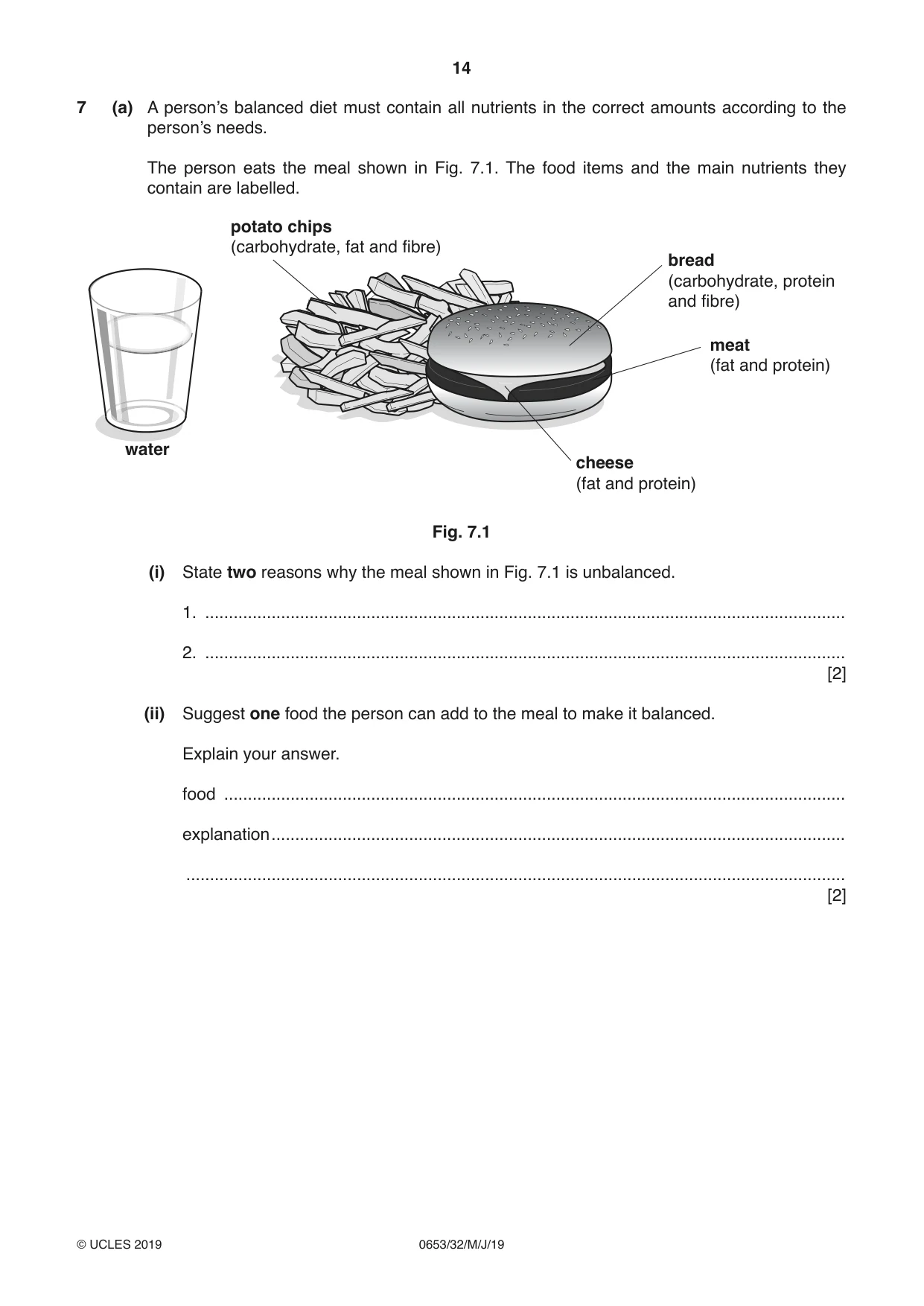
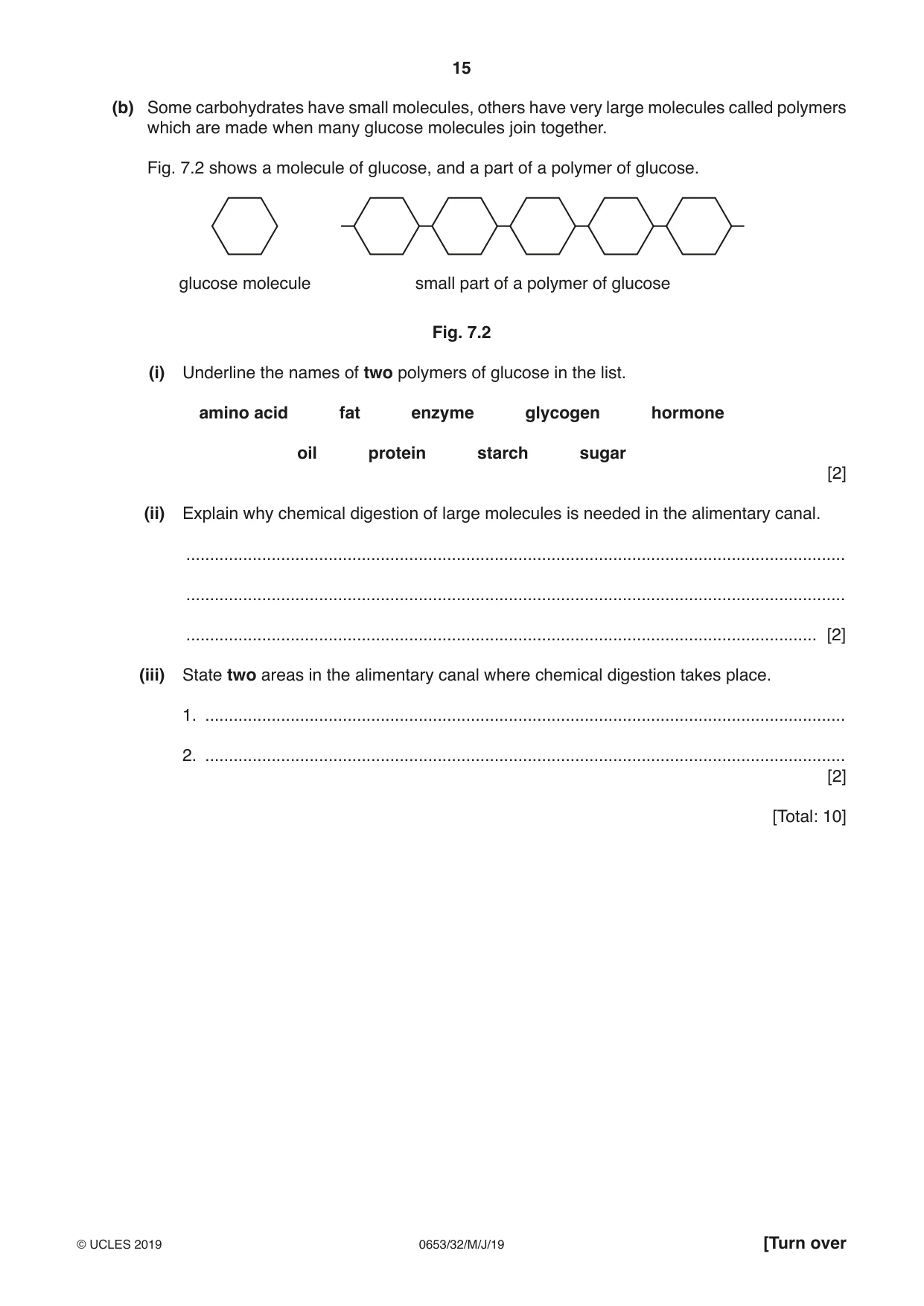
7 (a) A person’s balanced diet must contain all nutrients in the correct amounts according to the person’s needs. The person eats the meal shown in Fig. 7.1. The food items and the main nutrients they contain are labelled. potato chips (carbohydrate, fat and fibre) bread (carbohydrate, protein and fibre) meat (fat and protein) water cheese (fat and protein) Fig. 7.1 (i) State two reasons why the meal shown in Fig. 7.1 is unbalanced. 1. ....................................................................................................................................... 2. ....................................................................................................................................... [2] (ii) Suggest one food the person can add to the meal to make it balanced. Explain your answer. food ................................................................................................................................... explanation ......................................................................................................................... ........................................................................................................................................... [2] (b) Some carbohydrates have small molecules, others have very large molecules called polymers which are made when many glucose molecules join together. Fig. 7.2 shows a molecule of glucose, and a part of a polymer of glucose. glucose molecule small part of a polymer of glucose Fig. 7.2 (i) Underline the names of two polymers of glucose in the list. amino acid fat enzyme glycogen hormone oil protein starch sugar [2] (ii) Explain why chemical digestion of large molecules is needed in the alimentary canal. ........................................................................................................................................... ........................................................................................................................................... ..................................................................................................................................... [2] (iii) State two areas in the alimentary canal where chemical digestion takes place. 1. ....................................................................................................................................... 2. ....................................................................................................................................... [2] [Total: 10]
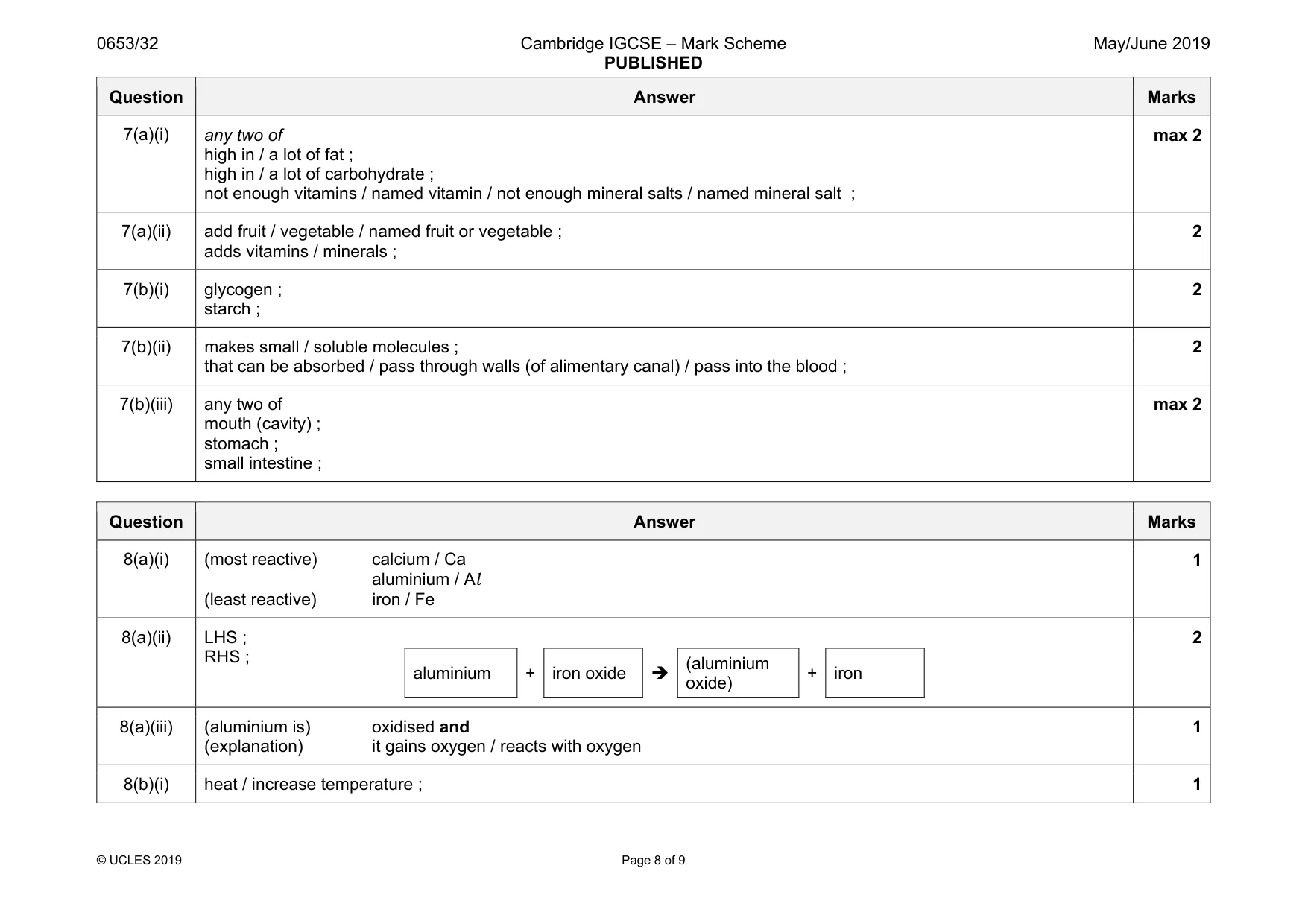
Mark scheme: 7(a)(i) any two of high in / a lot of fat ; high in / a lot of carbohydrate ; not enough vitamins / named vitamin / not enough mineral salts / named mineral salt ; max 2 7(a)(ii) add fruit / vegetable / named fruit or vegetable ; adds vitamins / minerals ; 2 7(b)(i) glycogen ; starch ; 2 7(b)(ii) makes small / soluble molecules ; that can be absorbed / pass through walls (of alimentary canal) / pass into the blood ; 2 7(b)(iii) any two of mouth (cavity) ; stomach ; small intestine ; max 2
Q8 · Aluminium reacts with iron oxide to form iron in an exothermic reaction
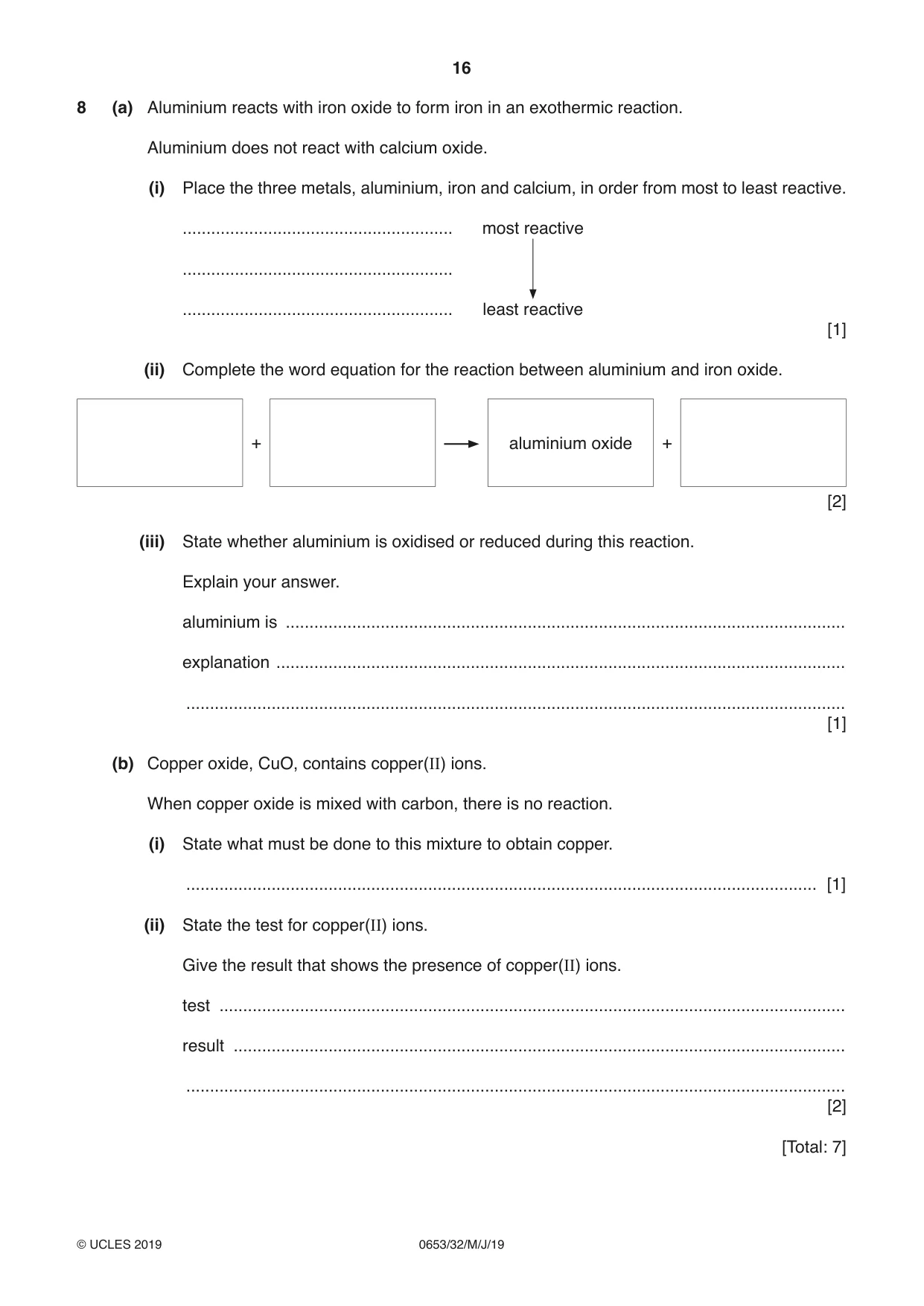
8 (a) Aluminium reacts with iron oxide to form iron in an exothermic reaction. Aluminium does not react with calcium oxide. (i) Place the three metals, aluminium, iron and calcium, in order from most to least reactive. ......................................................... most reactive ......................................................... ......................................................... least reactive [1] (ii) Complete the word equation for the reaction between aluminium and iron oxide. + aluminium oxide + [2] (iii) State whether aluminium is oxidised or reduced during this reaction. Explain your answer. aluminium is ...................................................................................................................... explanation ........................................................................................................................ ........................................................................................................................................... [1] (b) Copper oxide, CuO, contains copper(II) ions. When copper oxide is mixed with carbon, there is no reaction. (i) State what must be done to this mixture to obtain copper. ..................................................................................................................................... [1] (ii) State the test for copper(II) ions. Give the result that shows the presence of copper(II) ions. test .................................................................................................................................... result ................................................................................................................................. ........................................................................................................................................... [2] [Total: 7]
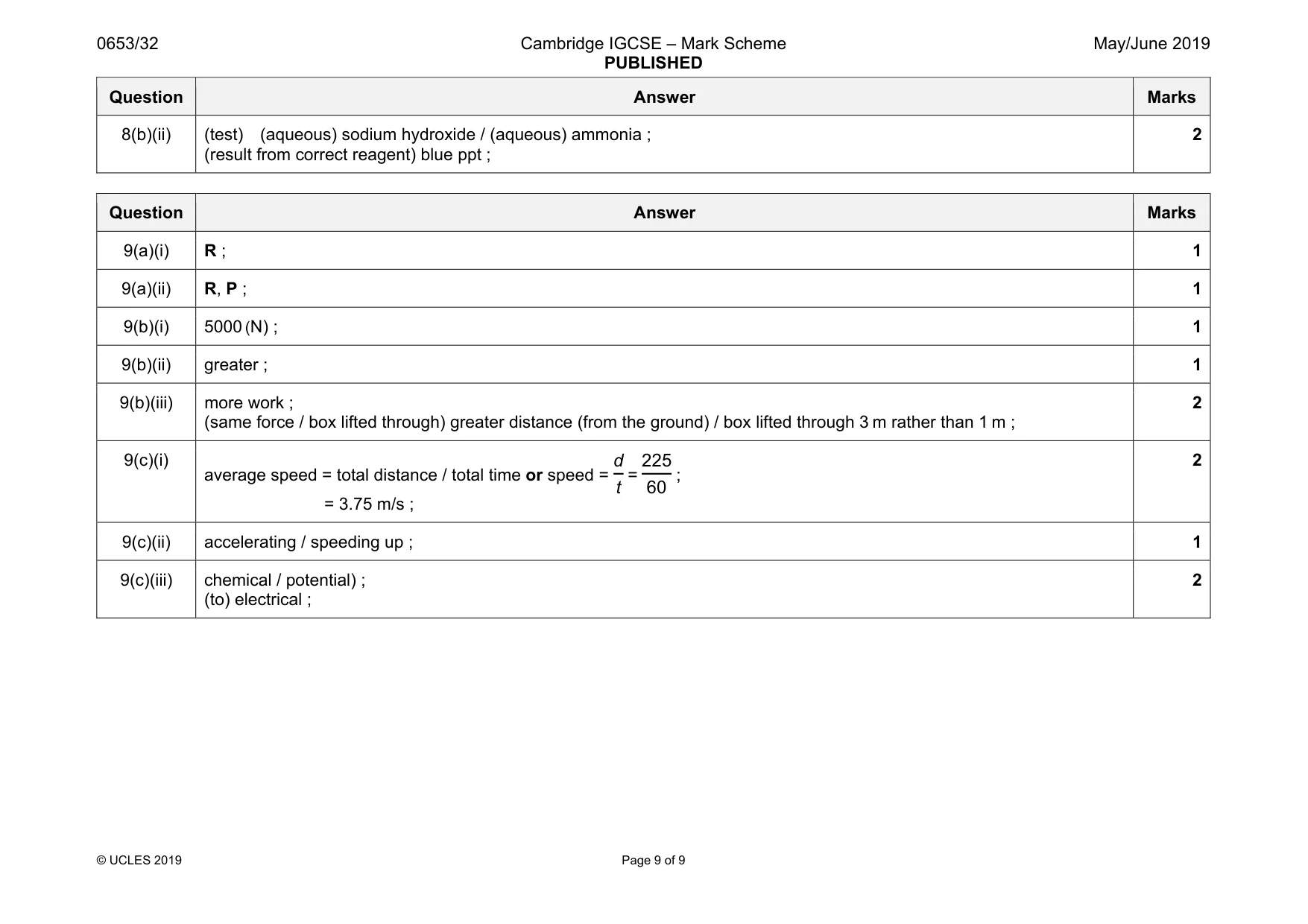
Mark scheme: 8(a)(i) (most reactive) calcium / Ca aluminium / Al (least reactive) iron / Fe 1 8(a)(ii) LHS ; RHS ; aluminium + iron oxide Î (aluminium oxide) + iron 2 8(a)(iii) (aluminium is) oxidised and (explanation) it gains oxygen / reacts with oxygen 1 8(b)(i) heat / increase temperature ; 1 Question Answer Marks 8(b)(ii) (test) (aqueous) sodium hydroxide / (aqueous) ammonia ; (result from correct reagent) blue ppt ; 2
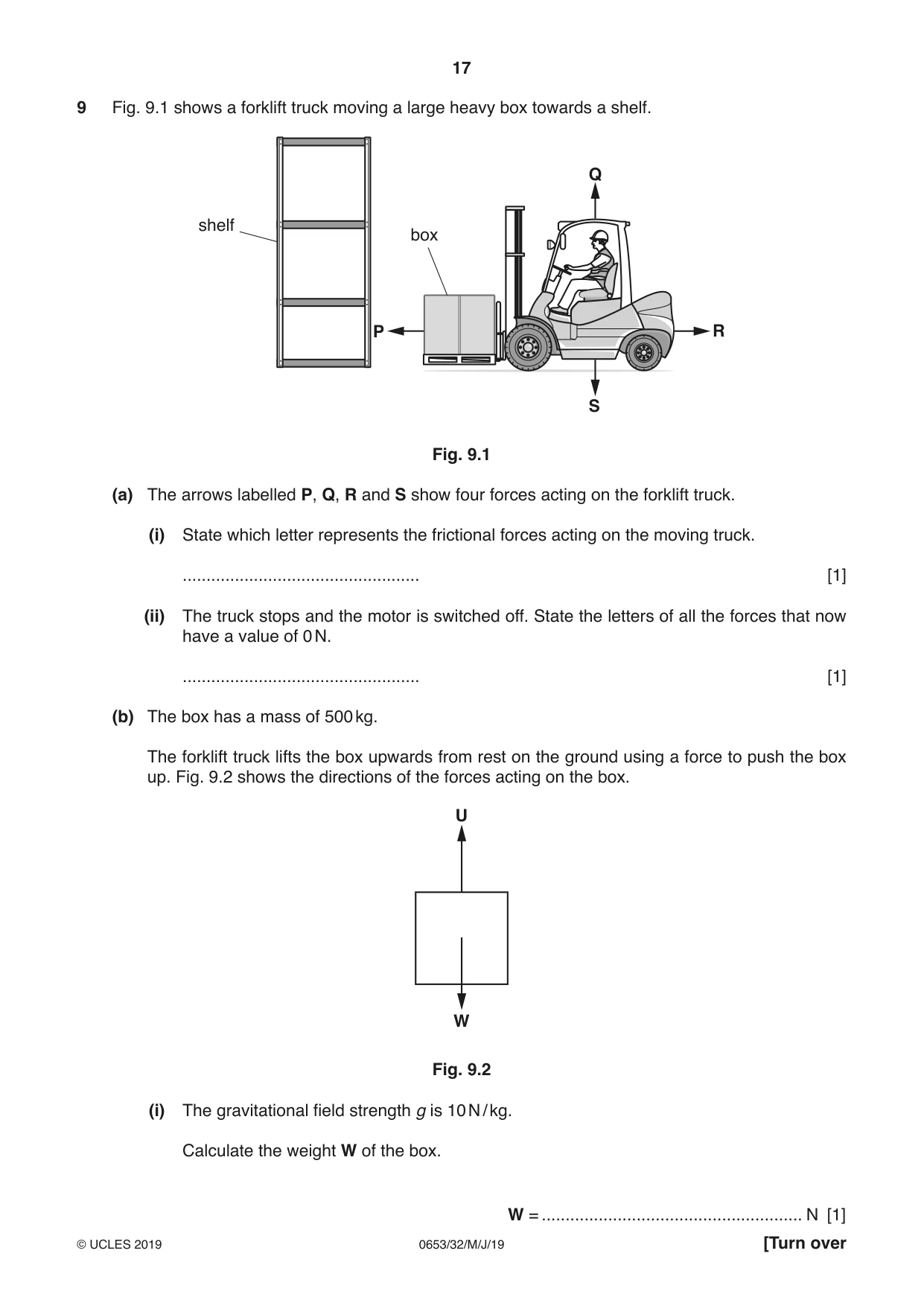
Q9 · A forklift truck moving a large heavy box towards a shelf
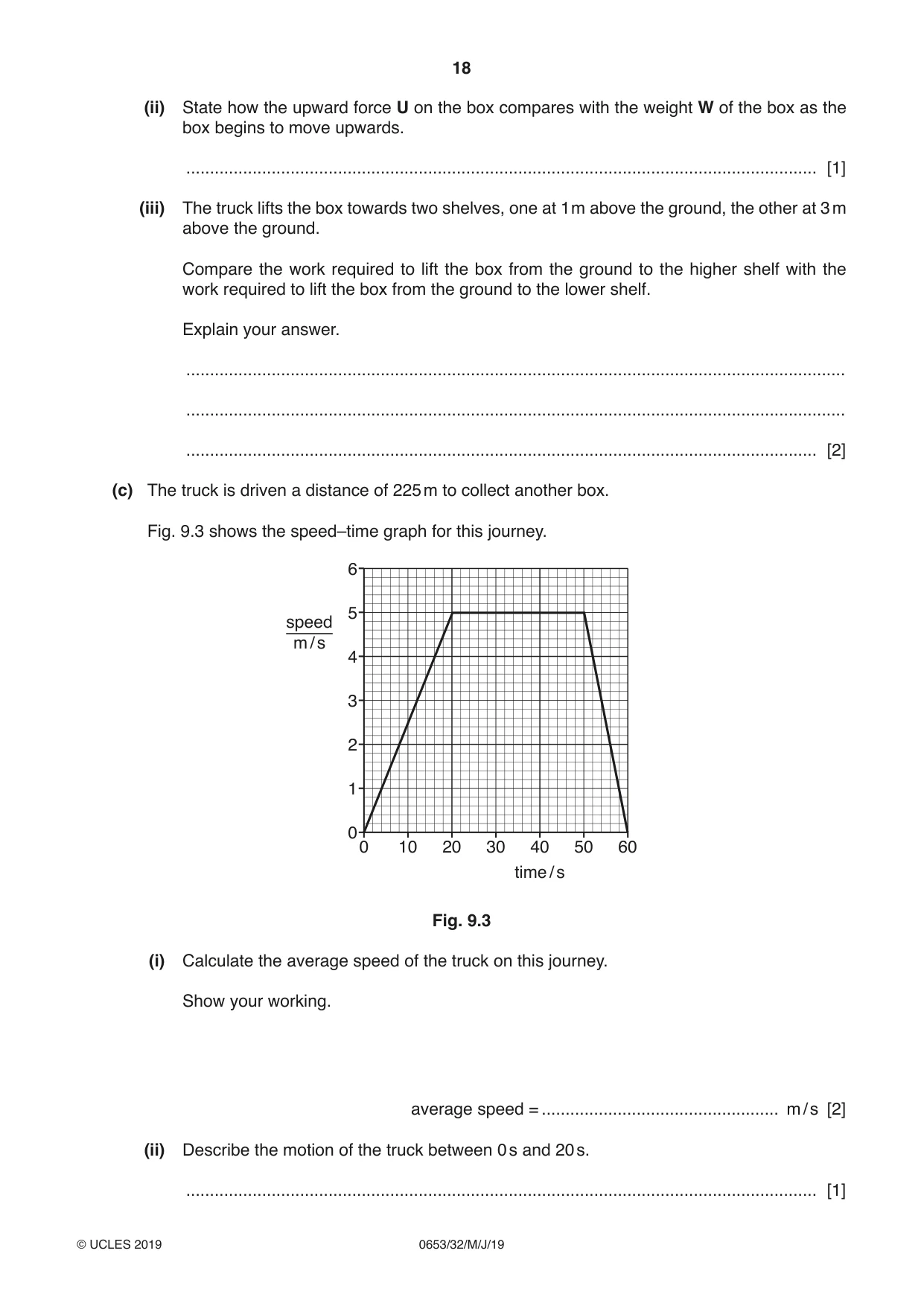
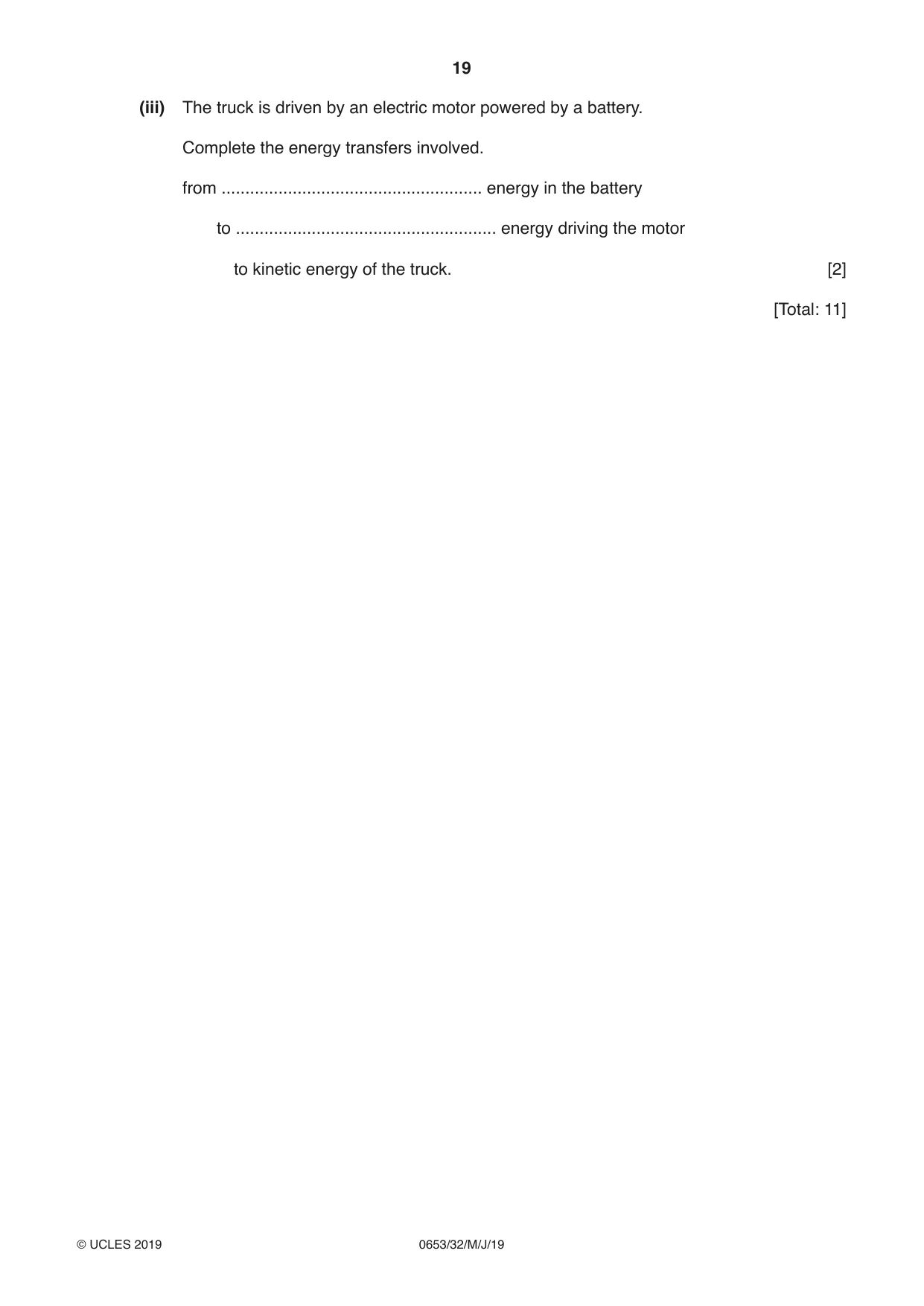
9 Fig. 9.1 shows a forklift truck moving a large heavy box towards a shelf. Q shelf box P R S Fig. 9.1 (a) The arrows labelled P, Q, R and S show four forces acting on the forklift truck. (i) State which letter represents the frictional forces acting on the moving truck. .................................................. [1] (ii) The truck stops and the motor is switched off. State the letters of all the forces that now have a value of 0 N. .................................................. [1] (b) The box has a mass of 500 kg. The forklift truck lifts the box upwards from rest on the ground using a force to push the box up. Fig. 9.2 shows the directions of the forces acting on the box. U W Fig. 9.2 (i) The gravitational field strength g is 10 N / kg. Calculate the weight W of the box. W = ....................................................... N [1] (ii) State how the upward force U on the box compares with the weight W of the box as the box begins to move upwards. ..................................................................................................................................... [1] (iii) The truck lifts the box towards two shelves, one at 1 m above the ground, the other at 3 m above the ground. Compare the work required to lift the box from the ground to the higher shelf with the work required to lift the box from the ground to the lower shelf. Explain your answer. ........................................................................................................................................... ........................................................................................................................................... ..................................................................................................................................... [2] (c) The truck is driven a distance of 225 m to collect another box. Fig. 9.3 shows the speed–time graph for this journey. 6 5 speed m / s 4 3 2 1 0 0 10 20 30 40 50 60 time / s Fig. 9.3 (i) Calculate the average speed of the truck on this journey. Show your working. average speed = .................................................. m / s [2] (ii) Describe the motion of the truck between 0 s and 20 s. ..................................................................................................................................... [1] (iii) The truck is driven by an electric motor powered by a battery. Complete the energy transfers involved. from ....................................................... energy in the battery to ....................................................... energy driving the motor to kinetic energy of the truck. [2] [Total: 11]
Mark scheme: 9(a)(i) R ; 1 9(a)(ii) R, P ; 1 9(b)(i) 5000 (N) ; 1 9(b)(ii) greater ; 1 9(b)(iii) more work ; (same force / box lifted through) greater distance (from the ground) / box lifted through 3 m rather than 1 m ; 2 9(c)(i) average speed = total distance / total time or speed = d t = 225 60 ; = 3.75 m/s ; 2 9(c)(ii) accelerating / speeding up ; 1 9(c)(iii) chemical / potential) ; (to) electrical ; 2
What was in this paper
The subtopics covered by these 9 questions, and how many questions each got. Open one in a new tab to see every Cambridge question on it.
What you needed in this session
Cambridge’s own grade thresholds for 2019 May/June, Paper 3 · Variant 2. A higher threshold means an easier paper — the bar moves with how the cohort did.