Cambridge IGCSE Science - Combined 0653 — 2023 May/June Paper 3 · Variant 3
0653/33/M/J/23 · 9 questions · 80 marks · ≈90 min
The question paper and its mark scheme, free to read here and free to download. This is Cambridge’s own paper, exactly as it was sat.
Question paper20 pages

Mark scheme11 pages
Answers below. Sit the paper first if you are practising.
Questions as text
Q1 · The boxes on the left show different characteristics of living organisms
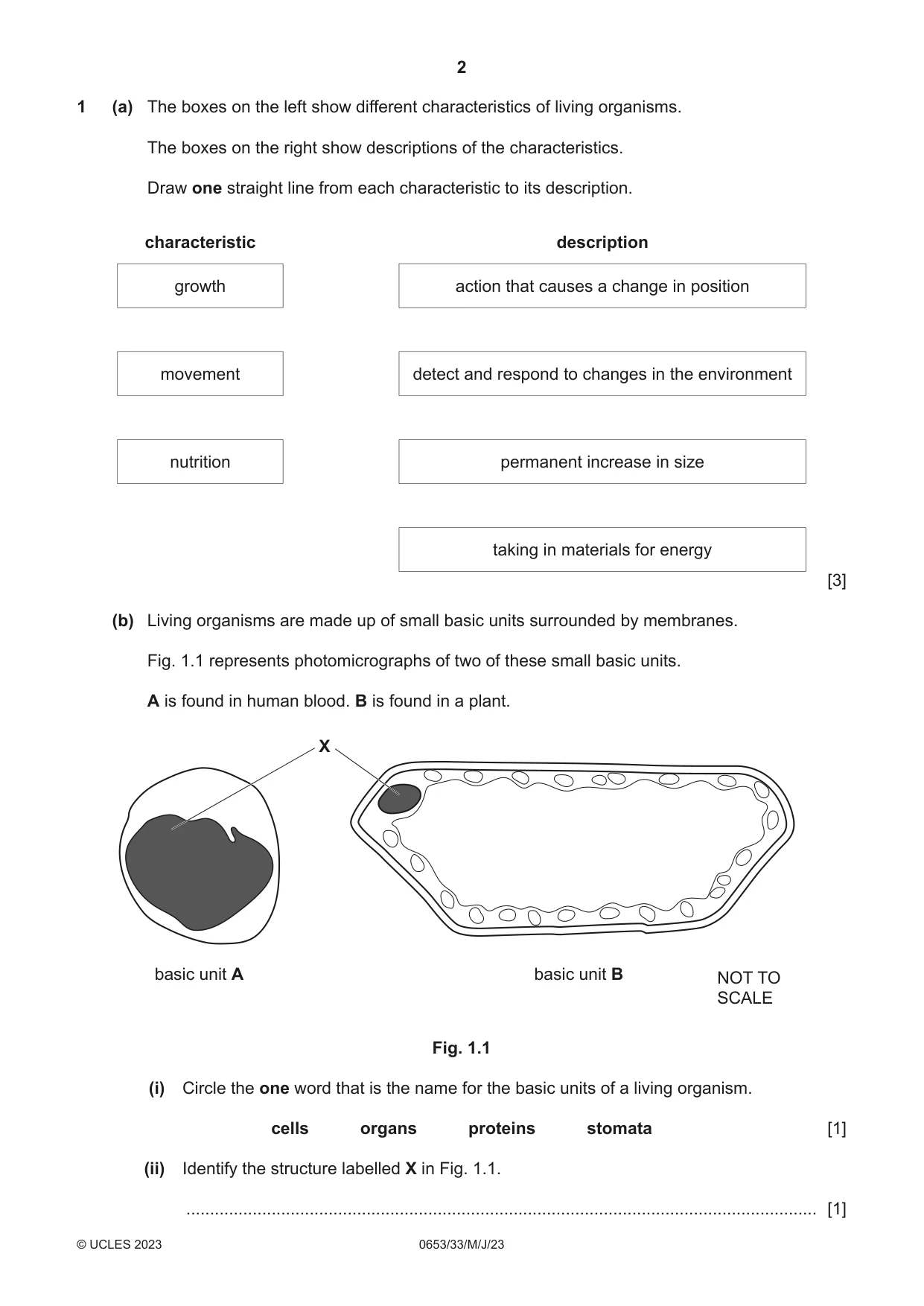
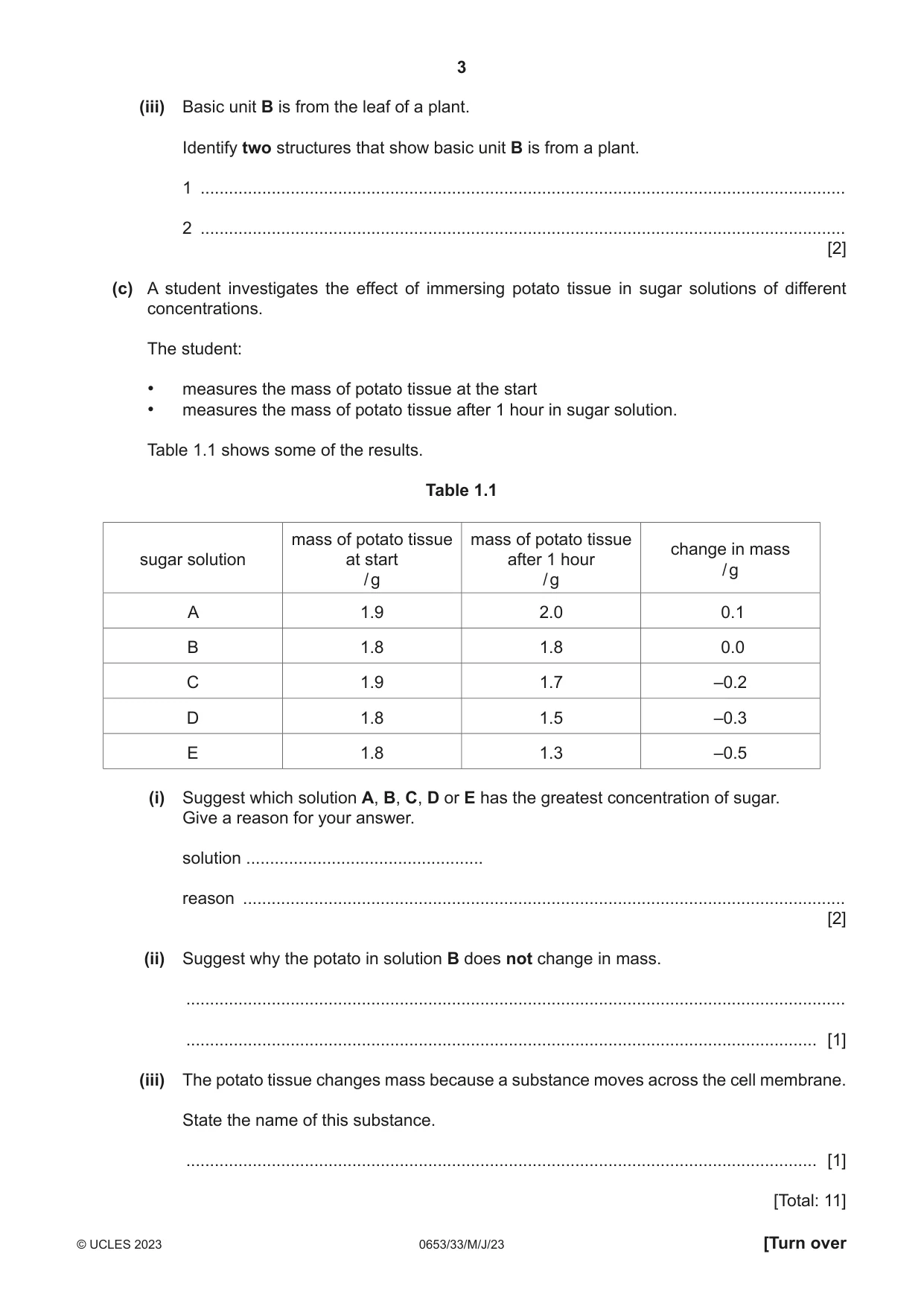
1 (a) The boxes on the left show different characteristics of living organisms. The boxes on the right show descriptions of the characteristics. Draw one straight line from each characteristic to its description. characteristic description growth action that causes a change in position movement detect and respond to changes in the environment nutrition permanent increase in size taking in materials for energy [3] (b) Living organisms are made up of small basic units surrounded by membranes. Fig. 1.1 represents photomicrographs of two of these small basic units. A is found in human blood. B is found in a plant. X basic unit A basic unit B NOT TO SCALE Fig. 1.1 (i) Circle the one word that is the name for the basic units of a living organism. cells organs proteins stomata [1] (ii) Identify the structure labelled X in Fig. 1.1. ..................................................................................................................................... [1] (iii) Basic unit B is from the leaf of a plant. Identify two structures that show basic unit B is from a plant. 1 ........................................................................................................................................ 2 ........................................................................................................................................ [2] (c) A student investigates the effect of immersing potato tissue in sugar solutions of different concentrations. The student: • measures the mass of potato tissue at the start • measures the mass of potato tissue after 1 hour in sugar solution. Table 1.1 shows some of the results. Table 1.1 mass of potato tissue mass of potato tissue change in mass sugar solution at start after 1 hour / g / g / g A 1.9 2.0 0.1 B 1.8 1.8 0.0 C 1.9 1.7 –0.2 D 1.8 1.5 –0.3 E 1.8 1.3 –0.5 (i) Suggest which solution A, B, C, D or E has the greatest concentration of sugar. Give a reason for your answer. solution .................................................. reason ............................................................................................................................... [2] (ii) Suggest why the potato in solution B does not change in mass. ........................................................................................................................................... ..................................................................................................................................... [1] (iii) The potato tissue changes mass because a substance moves across the cell membrane. State the name of this substance. ..................................................................................................................................... [1] [Total: 11]
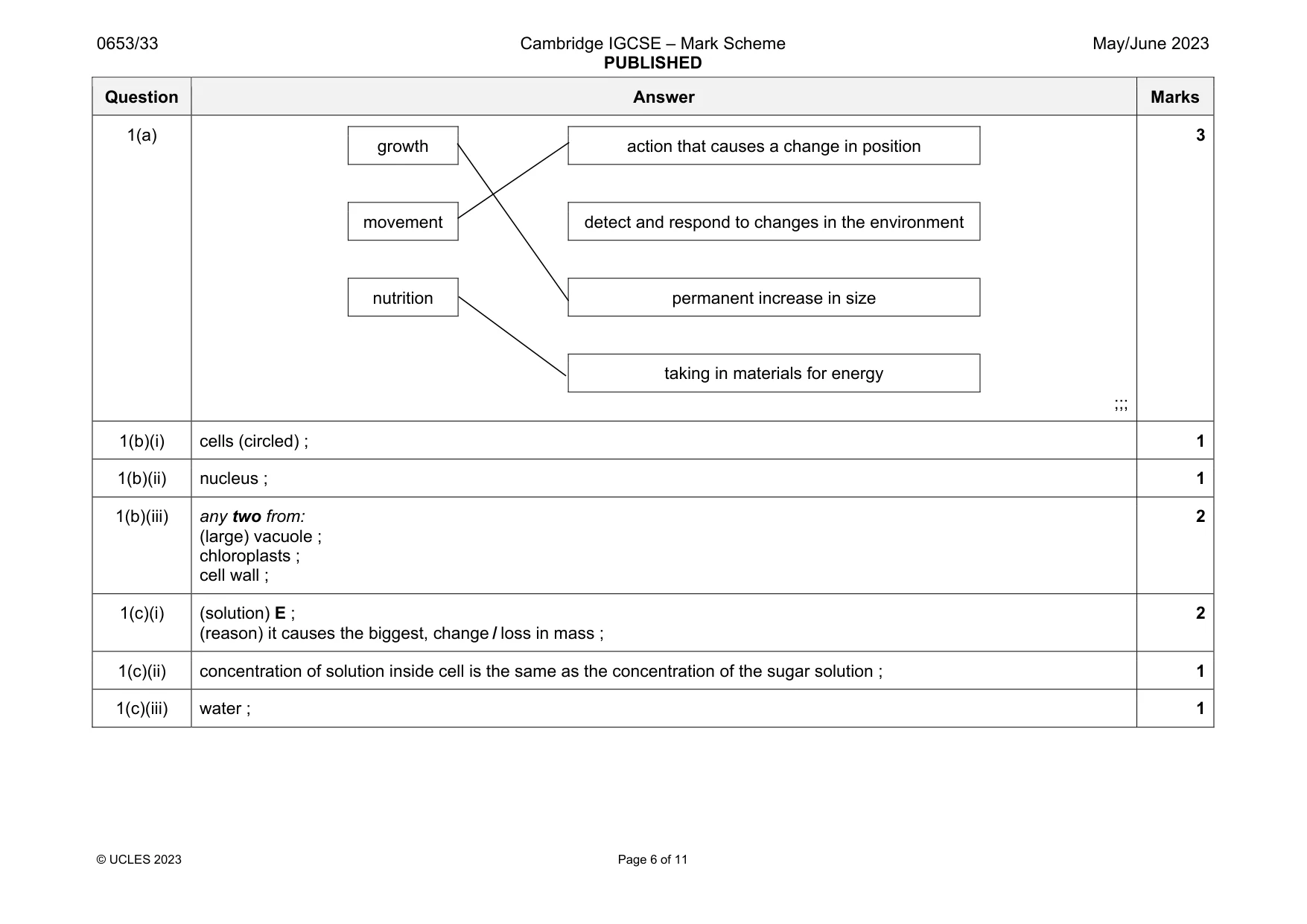
Mark scheme: 1(a) growth action that causes a change in position movement detect and respond to changes in the environment nutrition permanent increase in size taking in materials for energy ;;; 3 1(b)(i) cells (circled) ; 1 1(b)(ii) nucleus ; 1 1(b)(iii) any two from: (large) vacuole ; chloroplasts ; cell wall ; 2 1(c)(i) (solution) E ; (reason) it causes the biggest, change / loss in mass ; 2 1(c)(ii) concentration of solution inside cell is the same as the concentration of the sugar solution ; 1 1(c)(iii) water ; 1
Q2 · A student investigates the combustion of natural gas, as shown in Fig
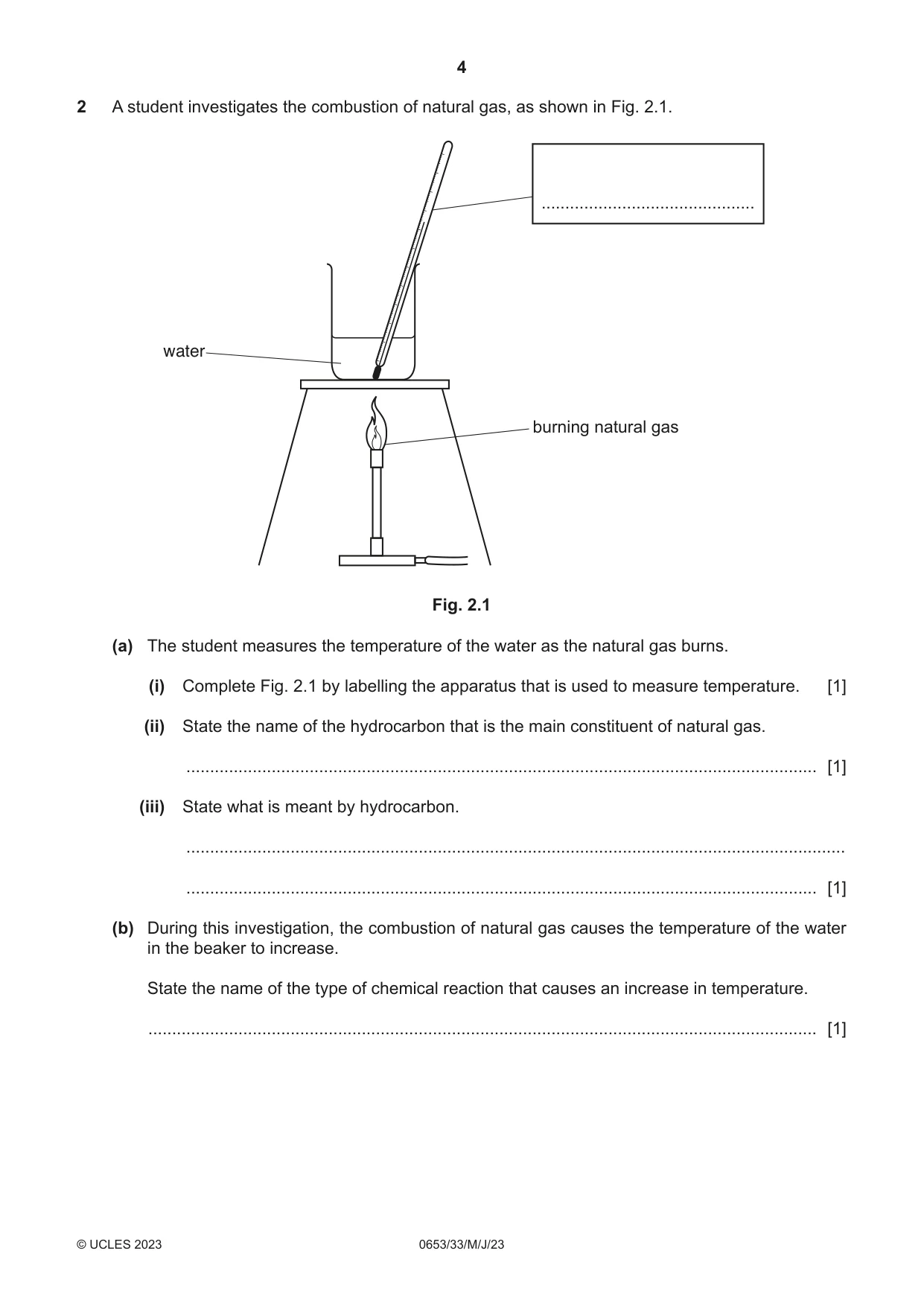
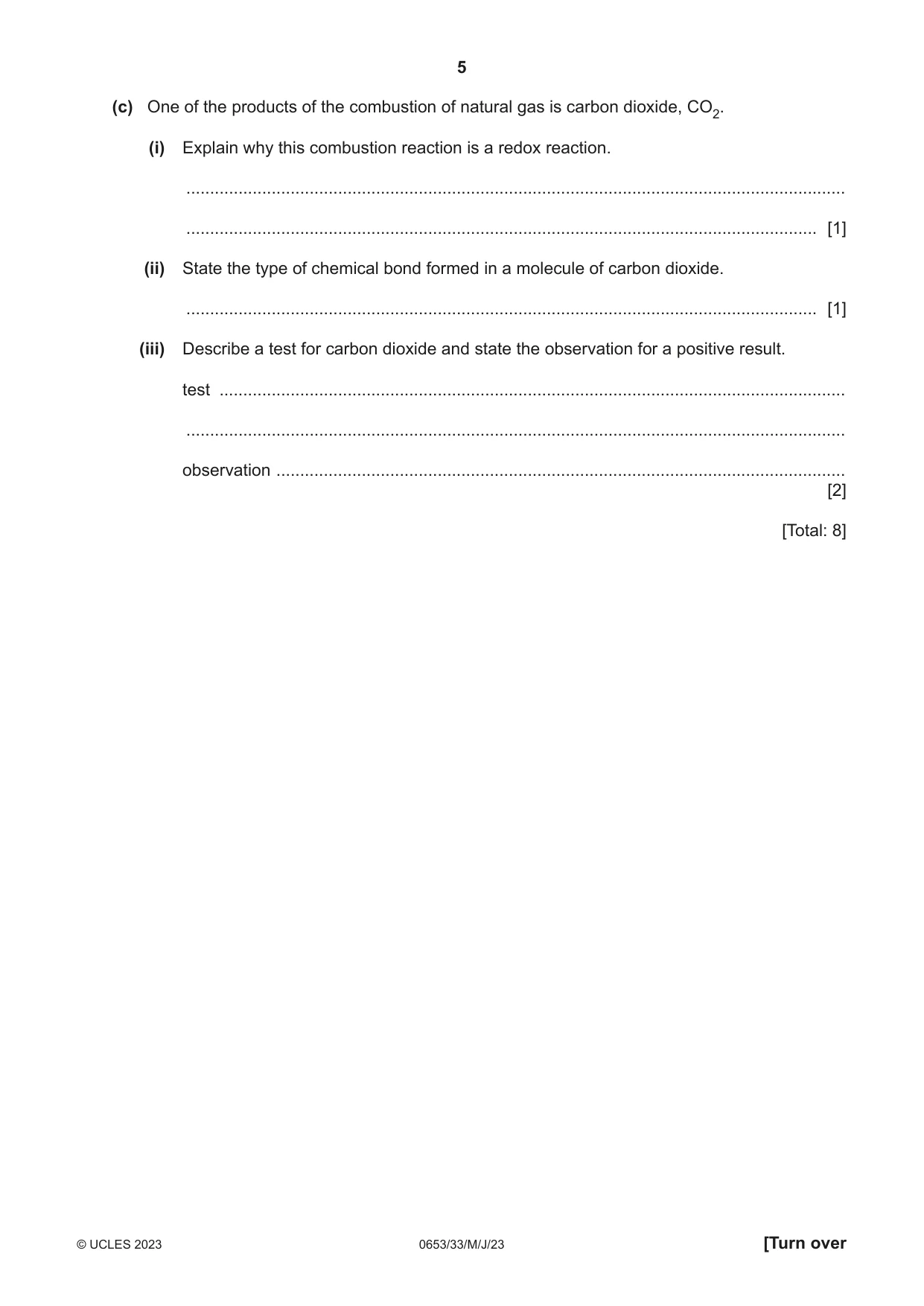
2 A student investigates the combustion of natural gas, as shown in Fig. 2.1. ............................................. water burning natural gas Fig. 2.1 (a) The student measures the temperature of the water as the natural gas burns. (i) Complete Fig. 2.1 by labelling the apparatus that is used to measure temperature. [1] (ii) State the name of the hydrocarbon that is the main constituent of natural gas. ..................................................................................................................................... [1] (iii) State what is meant by hydrocarbon. ........................................................................................................................................... ..................................................................................................................................... [1] (b) During this investigation, the combustion of natural gas causes the temperature of the water in the beaker to increase. State the name of the type of chemical reaction that causes an increase in temperature. ............................................................................................................................................. [1] (c) One of the products of the combustion of natural gas is carbon dioxide, CO2. (i) Explain why this combustion reaction is a redox reaction. ........................................................................................................................................... ..................................................................................................................................... [1] (ii) State the type of chemical bond formed in a molecule of carbon dioxide. ..................................................................................................................................... [1] (iii) Describe a test for carbon dioxide and state the observation for a positive result. test .................................................................................................................................... ........................................................................................................................................... observation ........................................................................................................................ [2] [Total: 8]
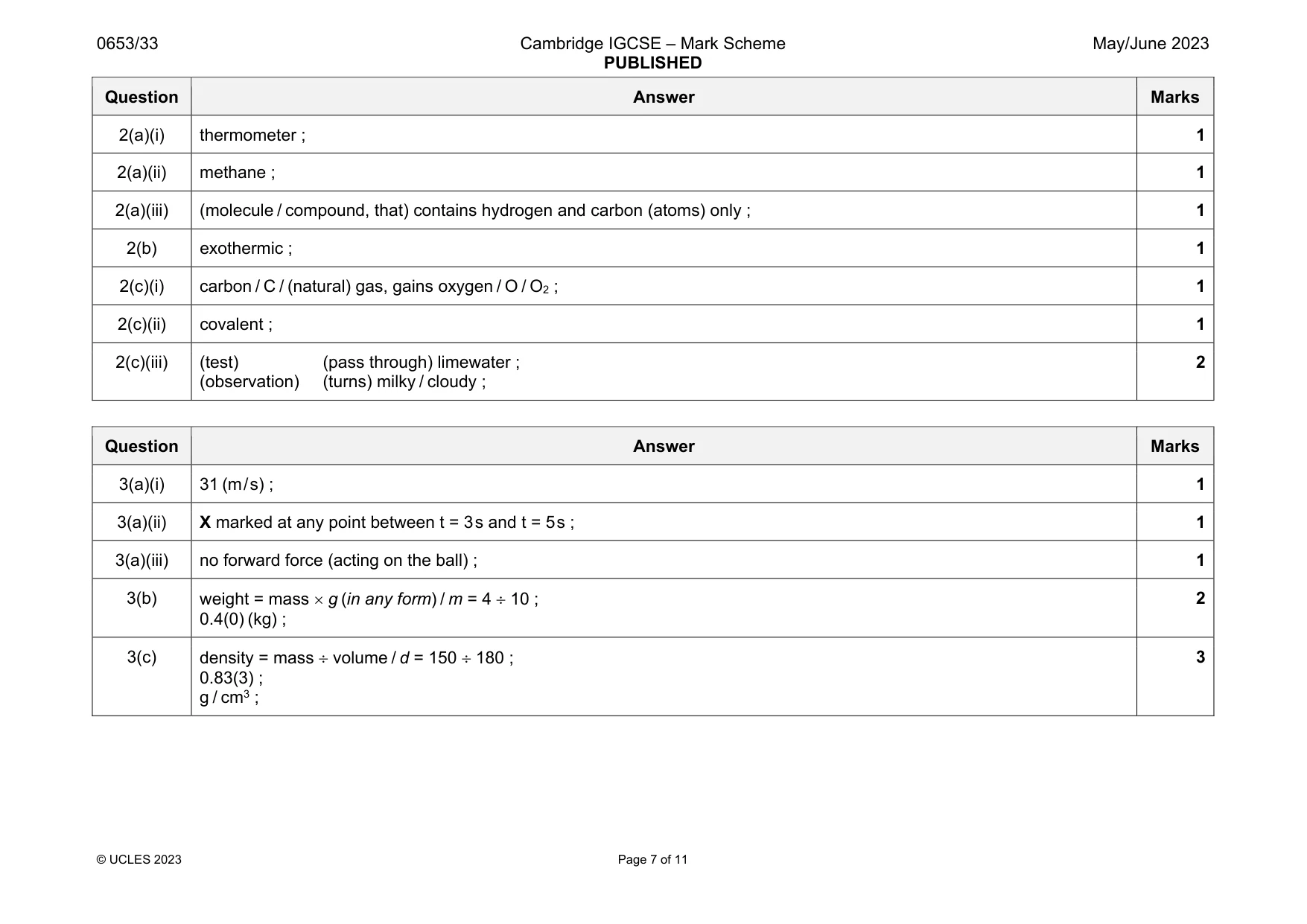
Mark scheme: 2(a)(i) thermometer ; 1 2(a)(ii) methane ; 1 2(a)(iii) (molecule / compound, that) contains hydrogen and carbon (atoms) only ; 1 2(b) exothermic ; 1 2(c)(i) carbon / C / (natural) gas, gains oxygen / O / O2 ; 1 2(c)(ii) covalent ; 1 2(c)(iii) (test) (pass through) limewater ; (observation) (turns) milky / cloudy ; 2
Q3 · A football player kicking a football
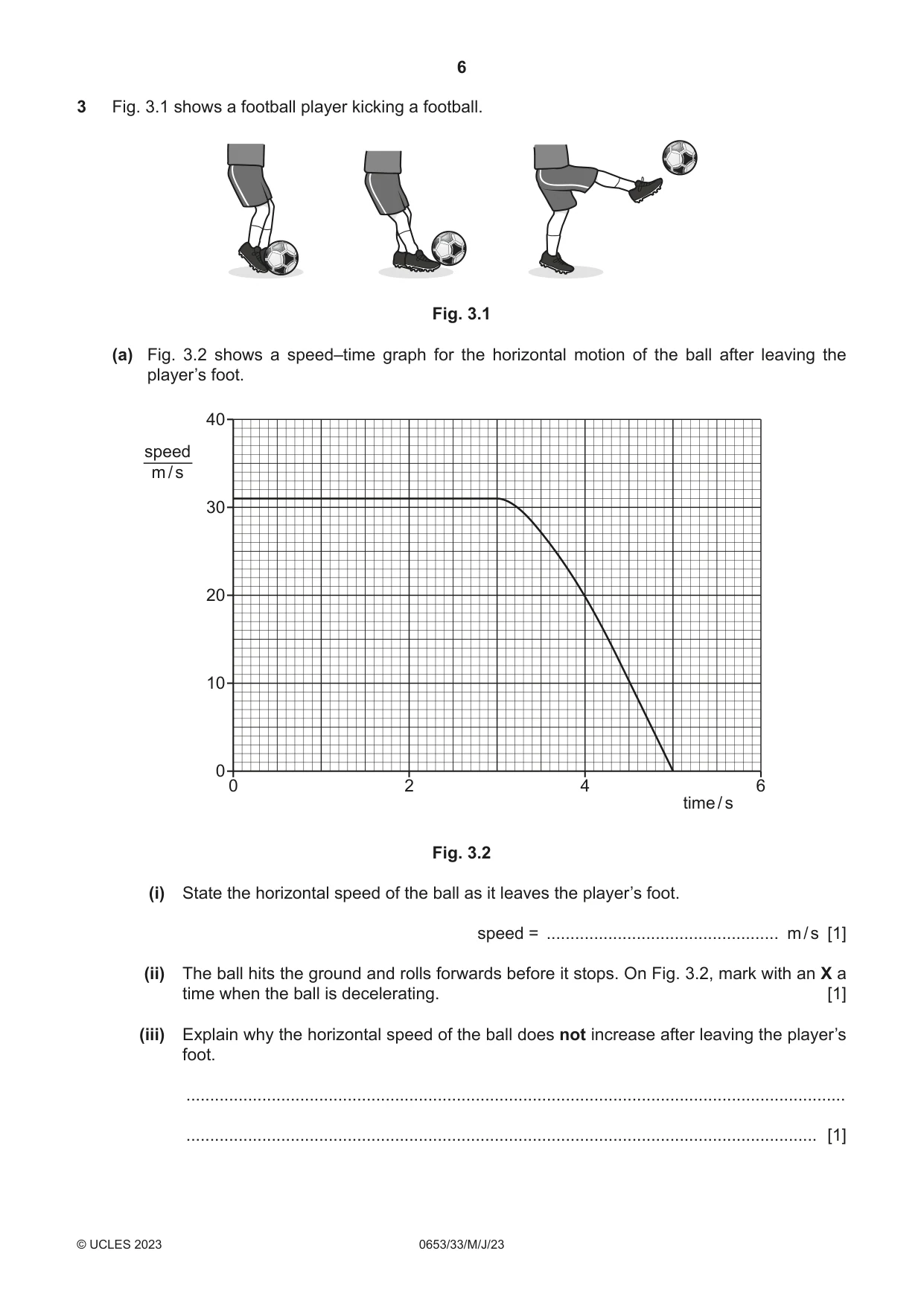
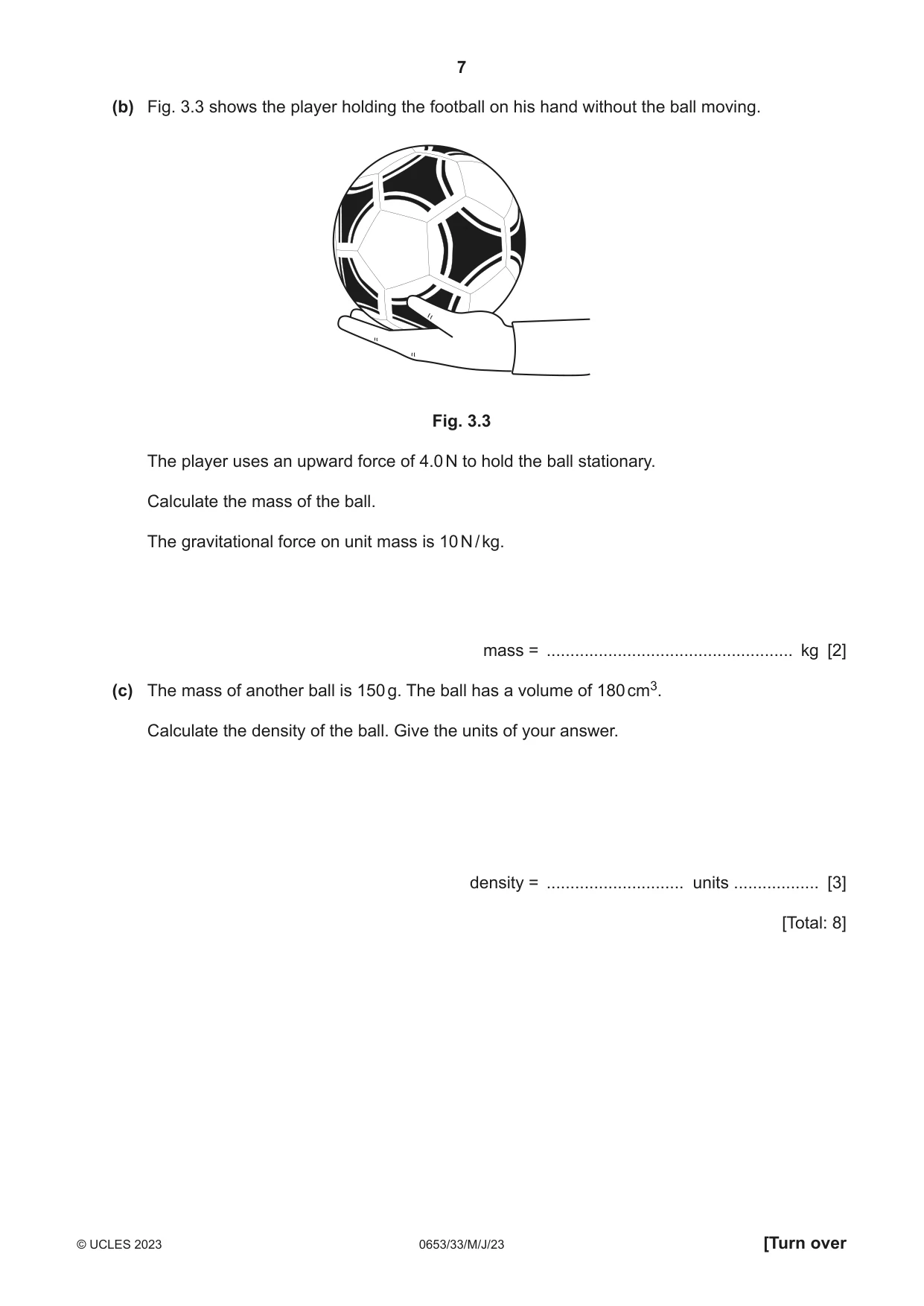
3 Fig. 3.1 shows a football player kicking a football. Fig. 3.1 (a) Fig. 3.2 shows a speed–time graph for the horizontal motion of the ball after leaving the player’s foot. 40 speed m / s 30 20 10 0 0 2 4 6 time / s Fig. 3.2 (i) State the horizontal speed of the ball as it leaves the player’s foot. speed = ................................................. m / s [1] (ii) The ball hits the ground and rolls forwards before it stops. On Fig. 3.2, mark with an X a time when the ball is decelerating. [1] (iii) Explain why the horizontal speed of the ball does not increase after leaving the player’s foot. ........................................................................................................................................... ..................................................................................................................................... [1] (b) Fig. 3.3 shows the player holding the football on his hand without the ball moving. Fig. 3.3 The player uses an upward force of 4.0 N to hold the ball stationary. Calculate the mass of the ball. The gravitational force on unit mass is 10 N / kg. mass = .................................................... kg [2] (c) The mass of another ball is 150 g. The ball has a volume of 180 cm3. Calculate the density of the ball. Give the units of your answer. density = ............................. units .................. [3] [Total: 8]
Mark scheme: 3(a)(i) 31 (m / s) ; 1 3(a)(ii) X marked at any point between t = 3 s and t = 5 s ; 1 3(a)(iii) no forward force (acting on the ball) ; 1 3(b) weight = mass g (in any form) / m = 4 10 ; 0.4(0) (kg) ; 2 3(c) density = mass volume / d = 150 180 ; 0.83(3) ; g / cm3 ; 3
Q4 · A diagram of the alimentary canal and associated organs
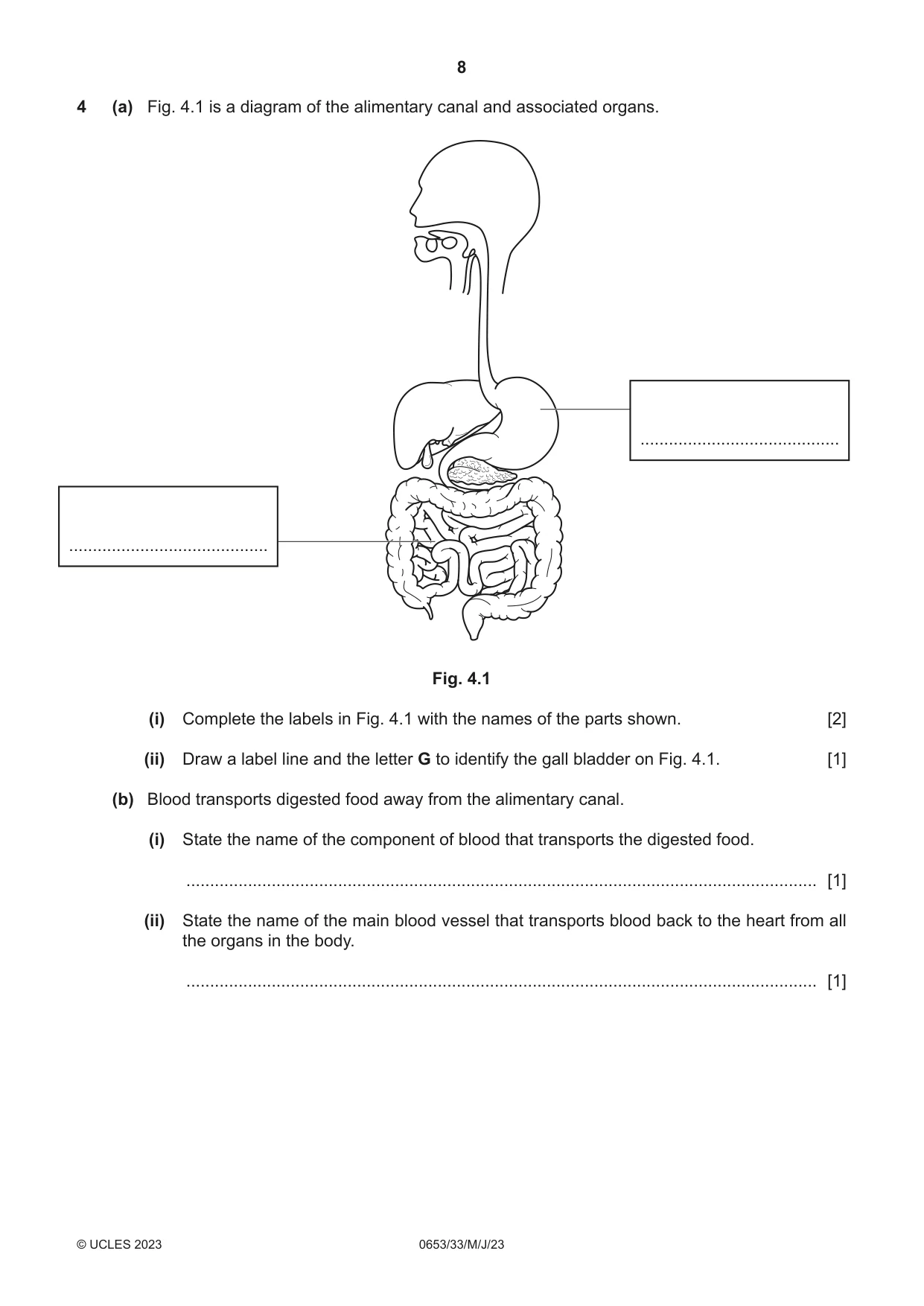
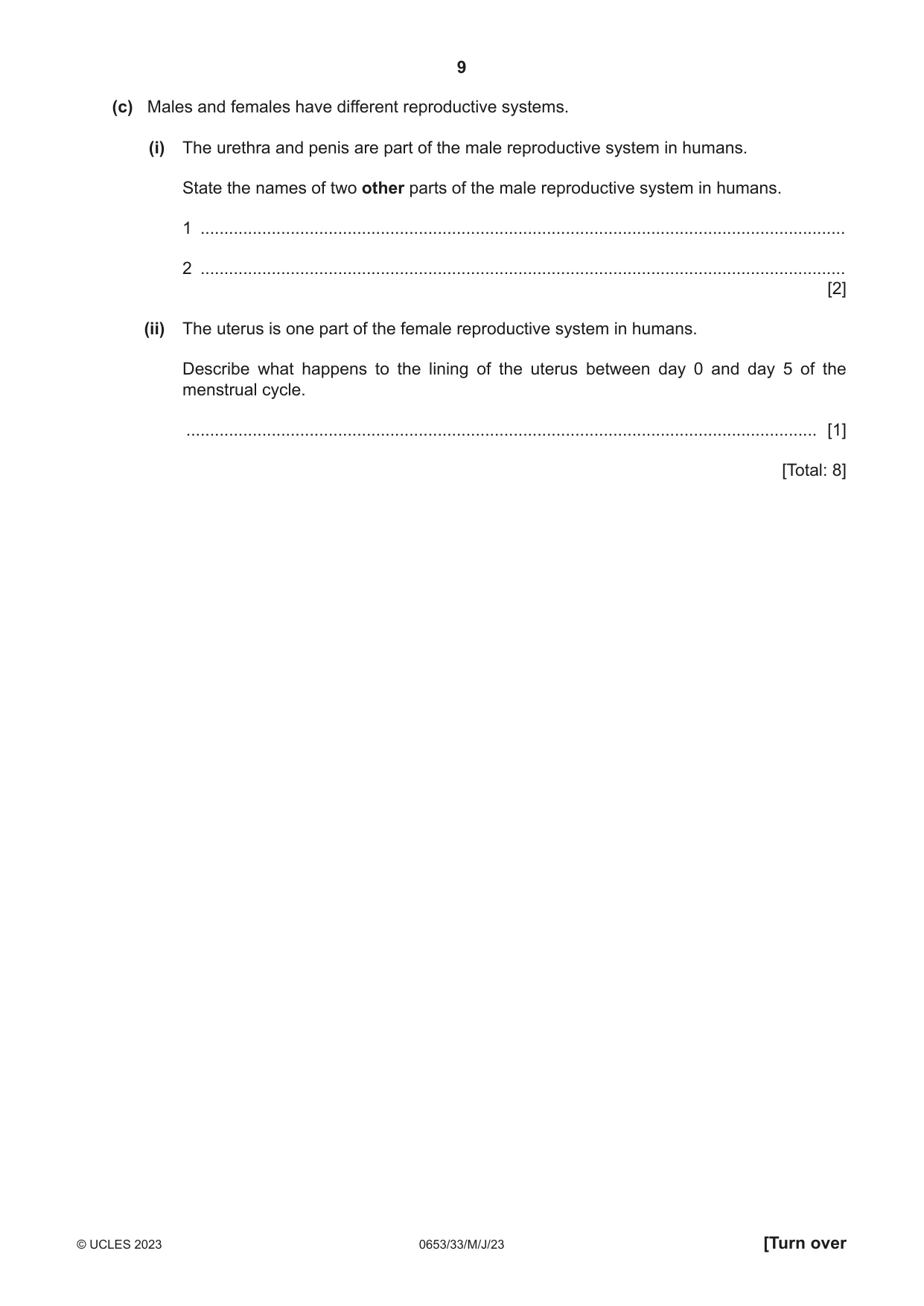
4 (a) Fig. 4.1 is a diagram of the alimentary canal and associated organs. .......................................... .......................................... Fig. 4.1 (i) Complete the labels in Fig. 4.1 with the names of the parts shown. [2] (ii) Draw a label line and the letter G to identify the gall bladder on Fig. 4.1. [1] (b) Blood transports digested food away from the alimentary canal. (i) State the name of the component of blood that transports the digested food. ..................................................................................................................................... [1] (ii) State the name of the main blood vessel that transports blood back to the heart from all the organs in the body. ..................................................................................................................................... [1] (c) Males and females have different reproductive systems. (i) The urethra and penis are part of the male reproductive system in humans. State the names of two other parts of the male reproductive system in humans. 1 ........................................................................................................................................ 2 ........................................................................................................................................ [2] (ii) The uterus is one part of the female reproductive system in humans. Describe what happens to the lining of the uterus between day 0 and day 5 of the menstrual cycle. ..................................................................................................................................... [1] [Total: 8]
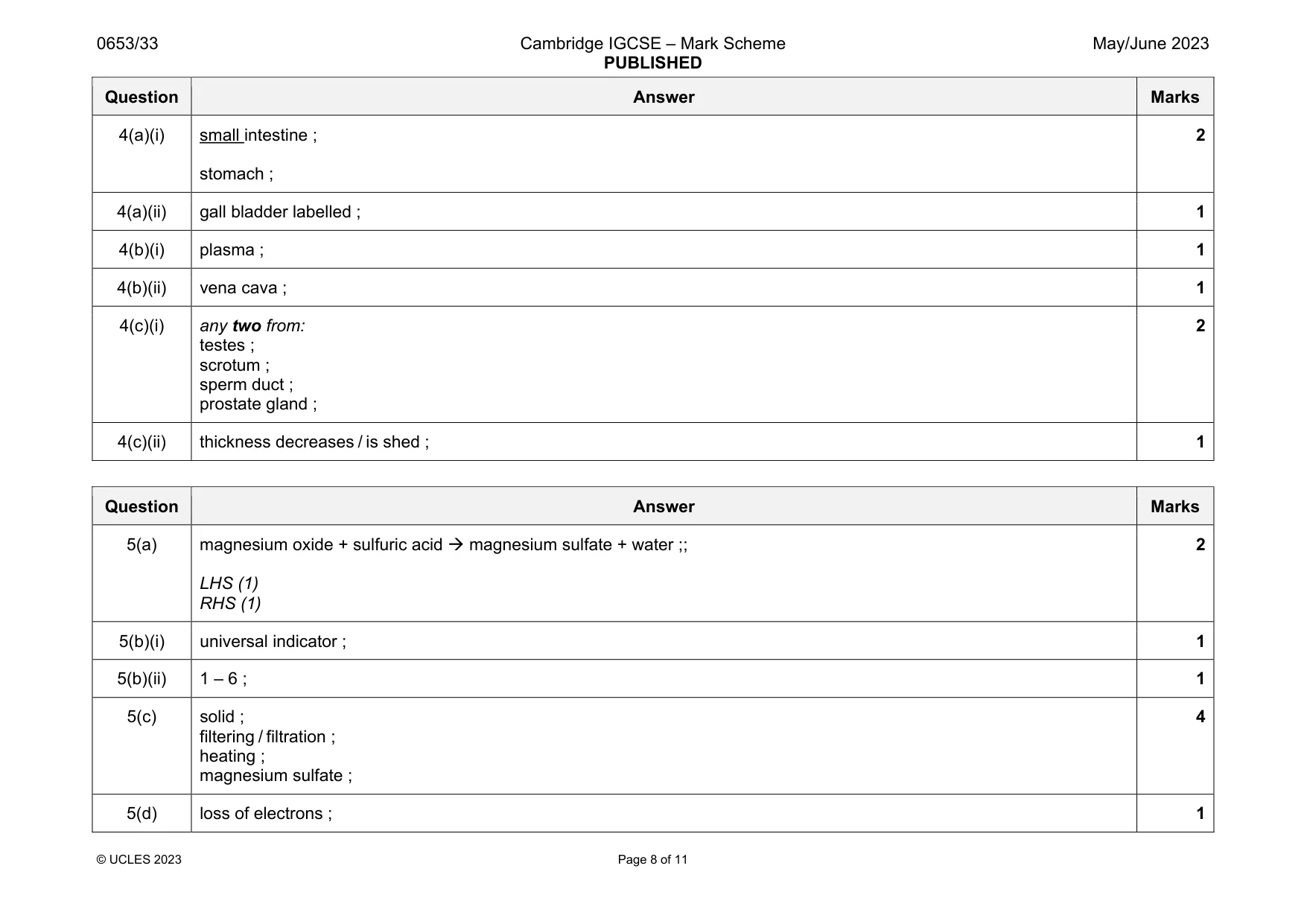
Mark scheme: 4(a)(i) small intestine ; stomach ; 2 4(a)(ii) gall bladder labelled ; 1 4(b)(i) plasma ; 1 4(b)(ii) vena cava ; 1 4(c)(i) any two from: testes ; scrotum ; sperm duct ; prostate gland ; 2 4(c)(ii) thickness decreases / is shed ; 1
Q5 · Magnesium sulfate is produced by reacting excess magnesium oxide with dilute sulfuric acid
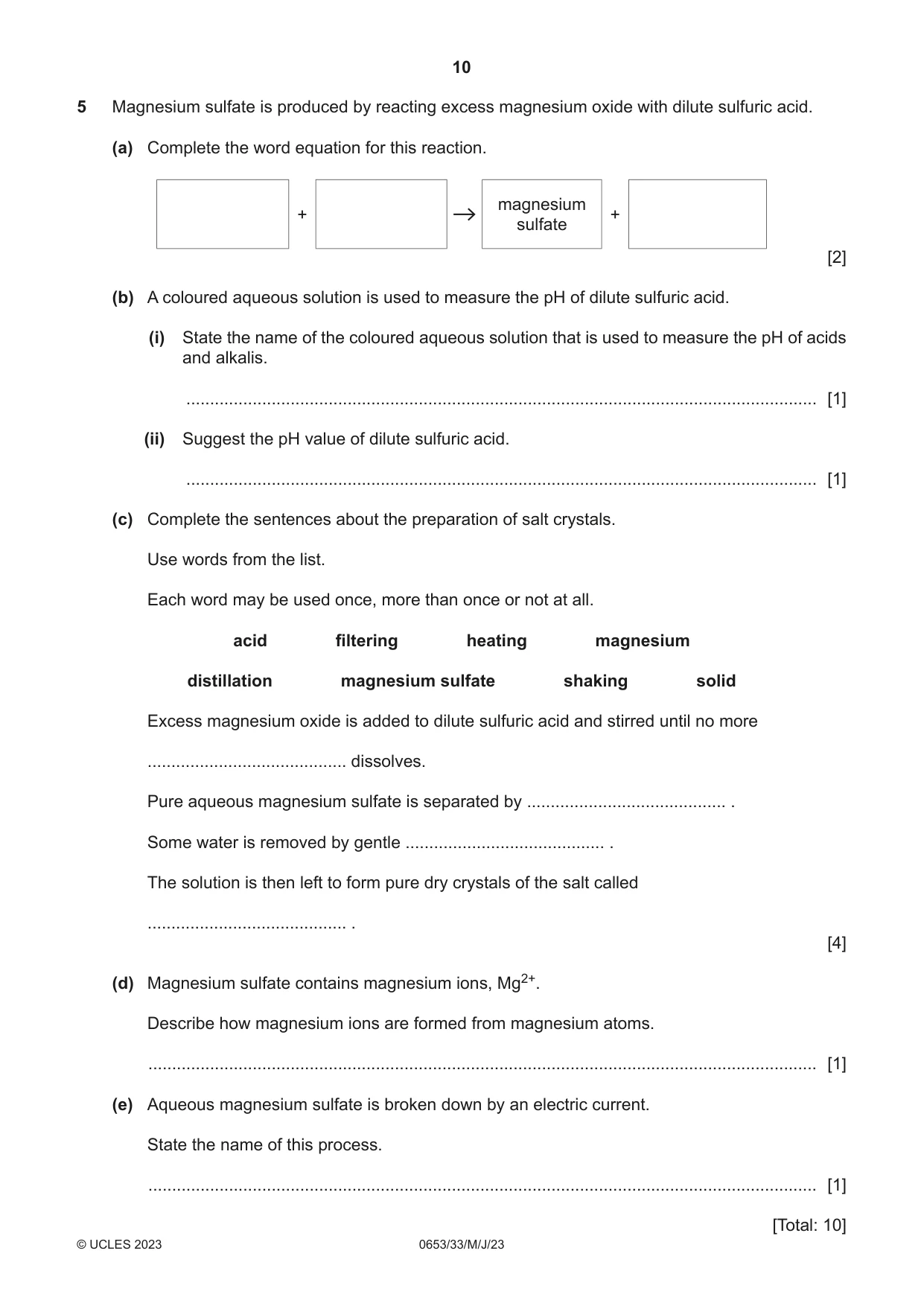
5 Magnesium sulfate is produced by reacting excess magnesium oxide with dilute sulfuric acid. (a) Complete the word equation for this reaction. magnesium + + sulfate [2] (b) A coloured aqueous solution is used to measure the pH of dilute sulfuric acid. (i) State the name of the coloured aqueous solution that is used to measure the pH of acids and alkalis. ..................................................................................................................................... [1] (ii) Suggest the pH value of dilute sulfuric acid. ..................................................................................................................................... [1] (c) Complete the sentences about the preparation of salt crystals. Use words from the list. Each word may be used once, more than once or not at all. acid filtering heating magnesium distillation magnesium sulfate shaking solid Excess magnesium oxide is added to dilute sulfuric acid and stirred until no more .......................................... dissolves. Pure aqueous magnesium sulfate is separated by .......................................... . Some water is removed by gentle .......................................... . The solution is then left to form pure dry crystals of the salt called .......................................... . [4] (d) Magnesium sulfate contains magnesium ions, Mg2+. Describe how magnesium ions are formed from magnesium atoms. ............................................................................................................................................. [1] (e) Aqueous magnesium sulfate is broken down by an electric current. State the name of this process. ............................................................................................................................................. [1] [Total: 10]
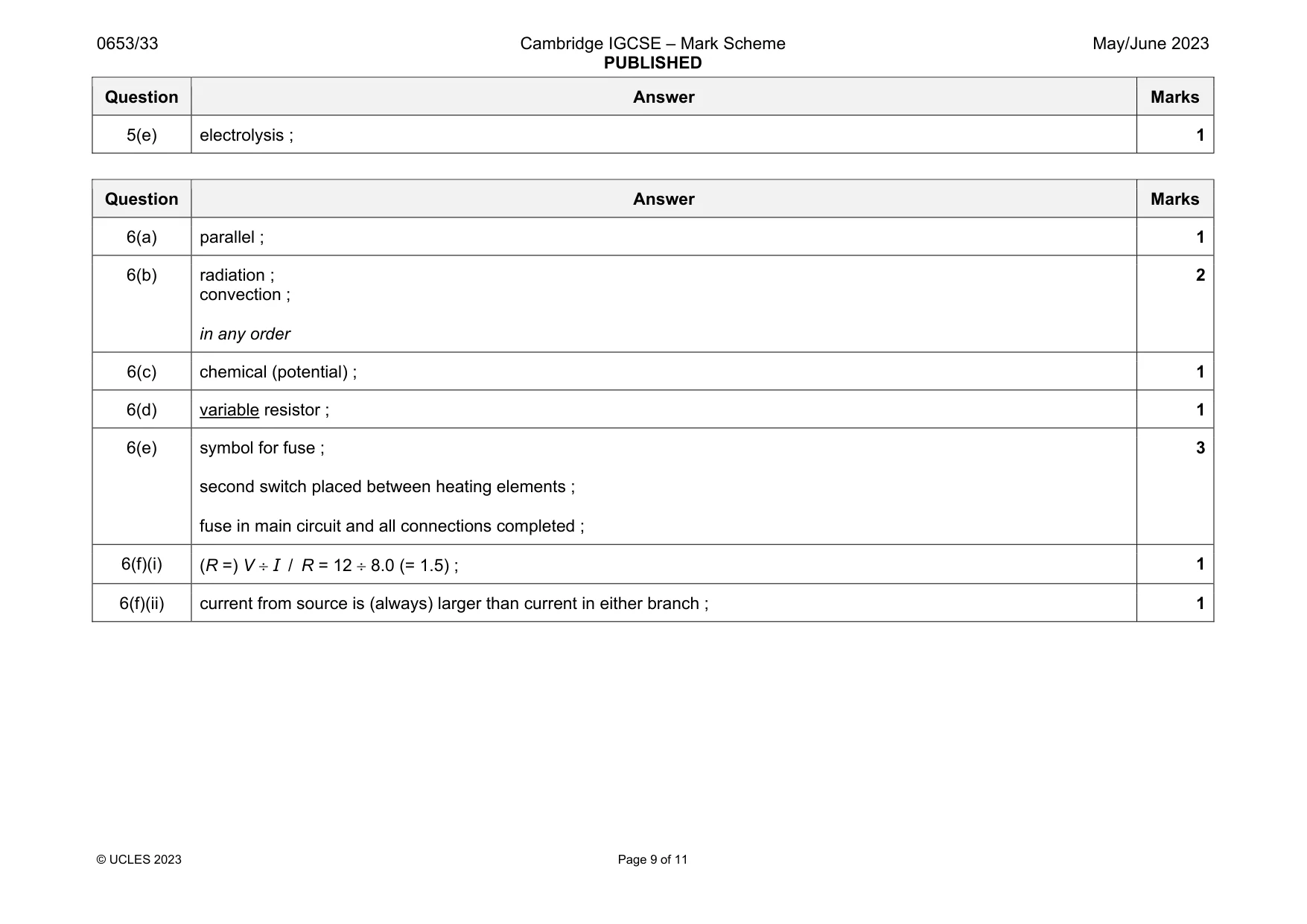
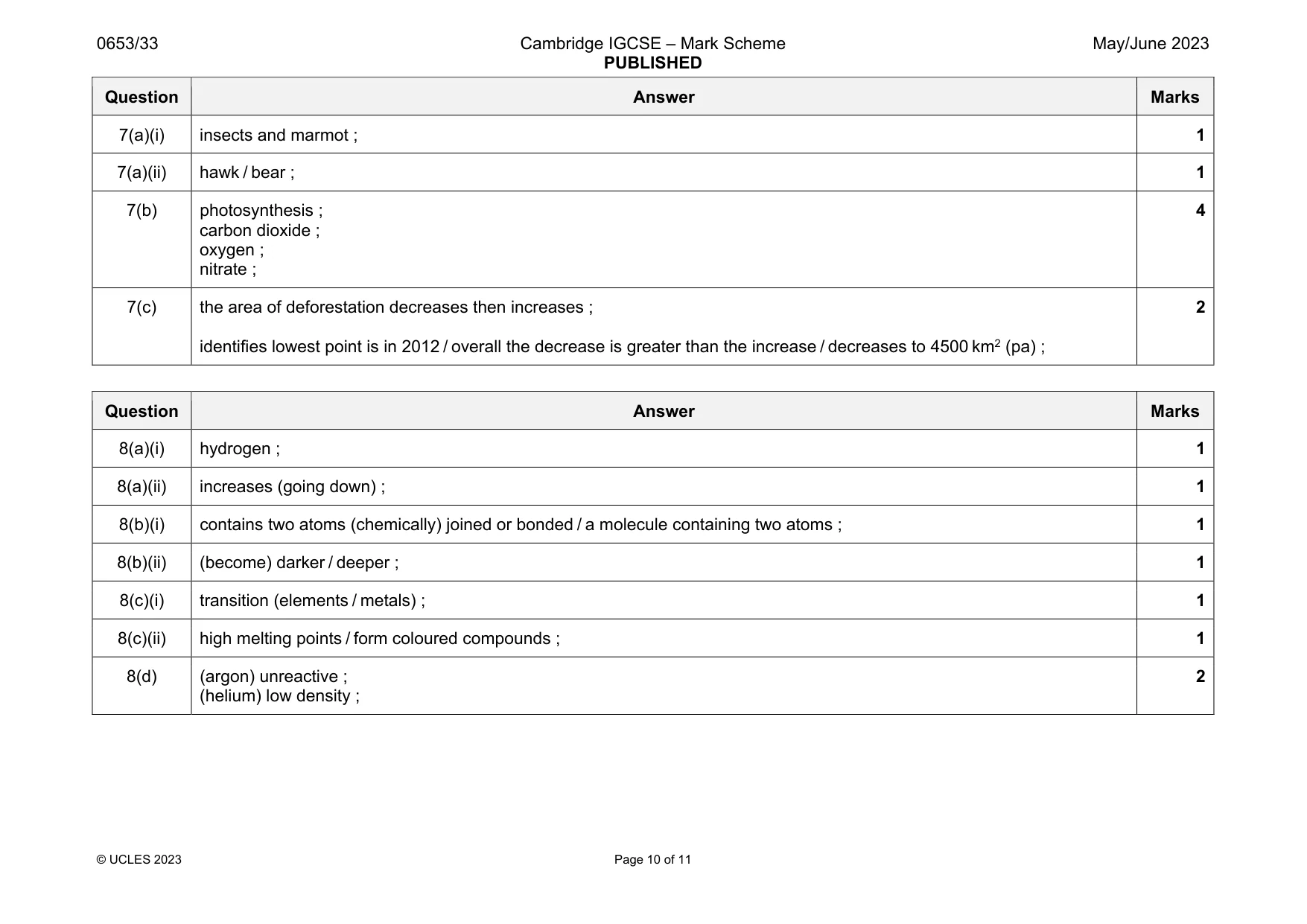
Mark scheme: 5(a) magnesium oxide + sulfuric acid magnesium sulfate + water ;; LHS (1) RHS (1) 5(b)(i) universal indicator ; 1 5(b)(ii) 1 – 6 ; 1 5(c) solid ; filtering / filtration ; heating ; magnesium sulfate ; 4 5(d) loss of electrons ; 1 Question Answer Marks 5(e) electrolysis ; 1
Q6 · A car battery connected to an electric heater used in a caravan
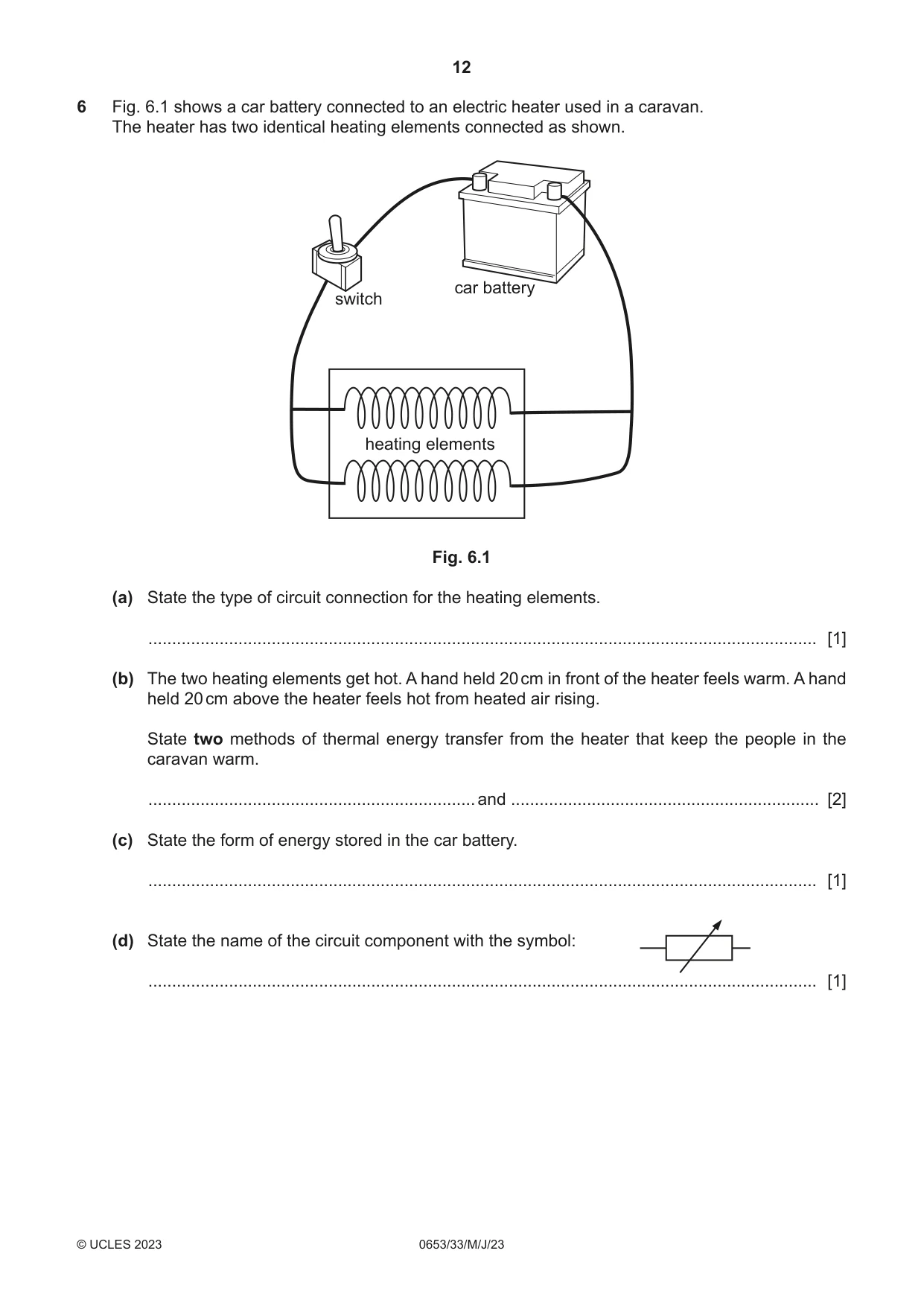
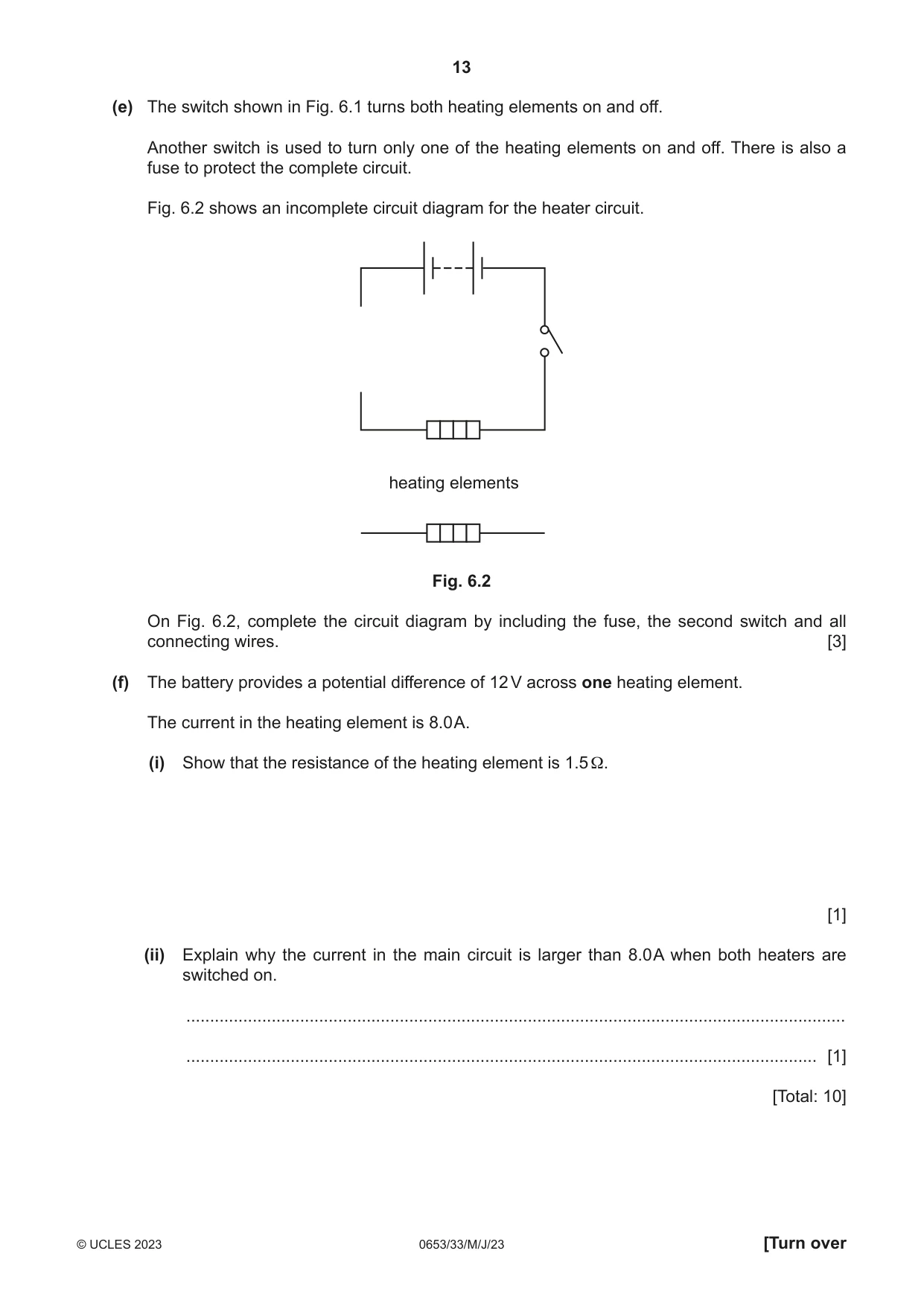
6 Fig. 6.1 shows a car battery connected to an electric heater used in a caravan. The heater has two identical heating elements connected as shown. car battery switch heating elements Fig. 6.1 (a) State the type of circuit connection for the heating elements. ............................................................................................................................................. [1] (b) The two heating elements get hot. A hand held 20 cm in front of the heater feels warm. A hand held 20 cm above the heater feels hot from heated air rising. State two methods of thermal energy transfer from the heater that keep the people in the caravan warm. .....................................................................and ................................................................. [2] (c) State the form of energy stored in the car battery. ............................................................................................................................................. [1] (d) State the name of the circuit component with the symbol: ............................................................................................................................................. [1] (e) The switch shown in Fig. 6.1 turns both heating elements on and off. Another switch is used to turn only one of the heating elements on and off. There is also a fuse to protect the complete circuit. Fig. 6.2 shows an incomplete circuit diagram for the heater circuit. heating elements Fig. 6.2 On Fig. 6.2, complete the circuit diagram by including the fuse, the second switch and all connecting wires. [3] (f) The battery provides a potential difference of 12 V across one heating element. The current in the heating element is 8.0 A. (i) Show that the resistance of the heating element is 1.5 Ω. [1] (ii) Explain why the current in the main circuit is larger than 8.0 A when both heaters are switched on. ........................................................................................................................................... ..................................................................................................................................... [1] [Total: 10]
Mark scheme: 6(a) parallel ; 1 6(b) radiation ; convection ; in any order 2 6(c) chemical (potential) ; 1 6(d) variable resistor ; 1 6(e) symbol for fuse ; second switch placed between heating elements ; fuse in main circuit and all connections completed ; 3 6(f)(i) (R =) V I / R = 12 8.0 (= 1.5) ; 1 6(f)(ii) current from source is (always) larger than current in either branch ; 1
Q7 · Part of a food web
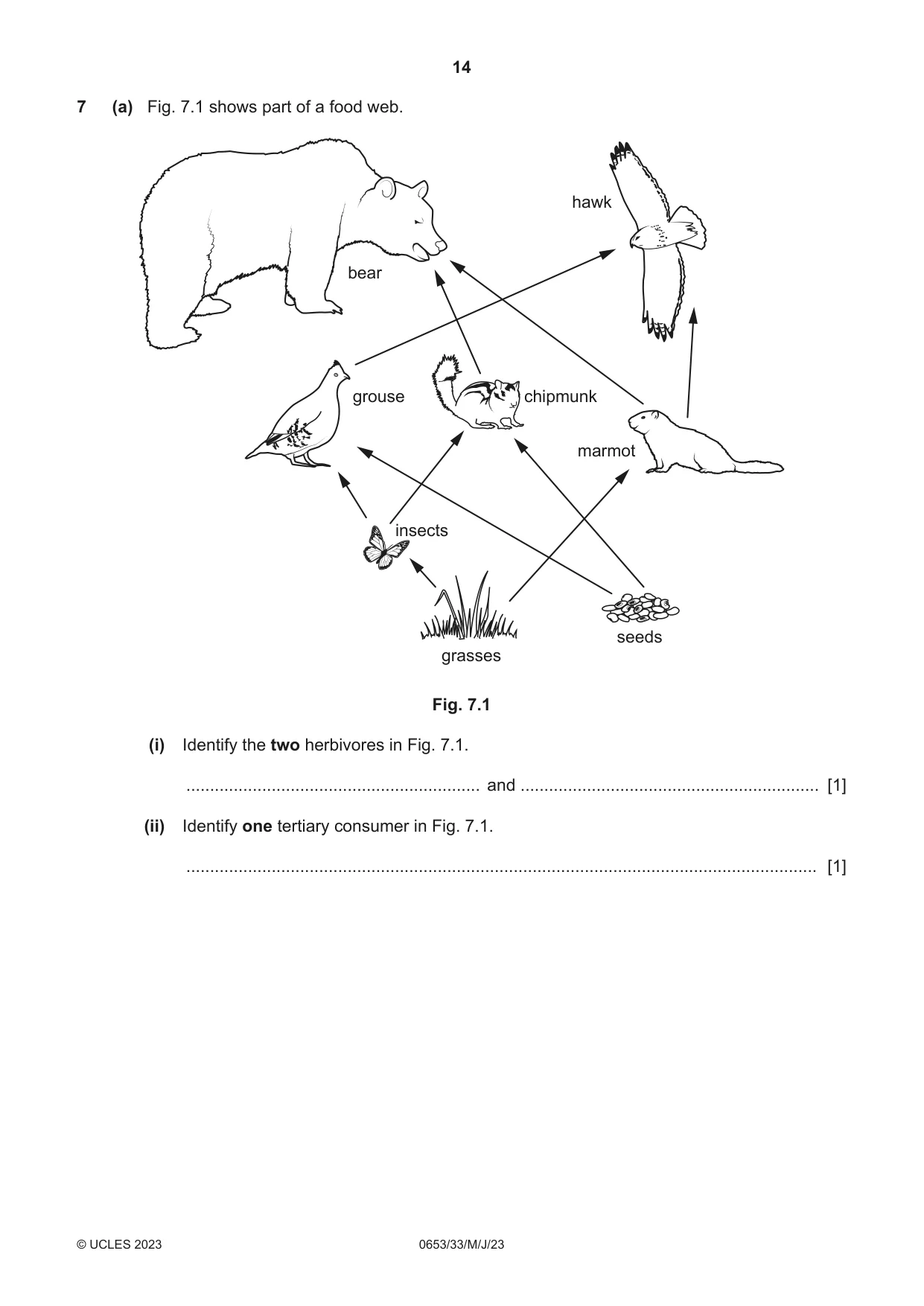
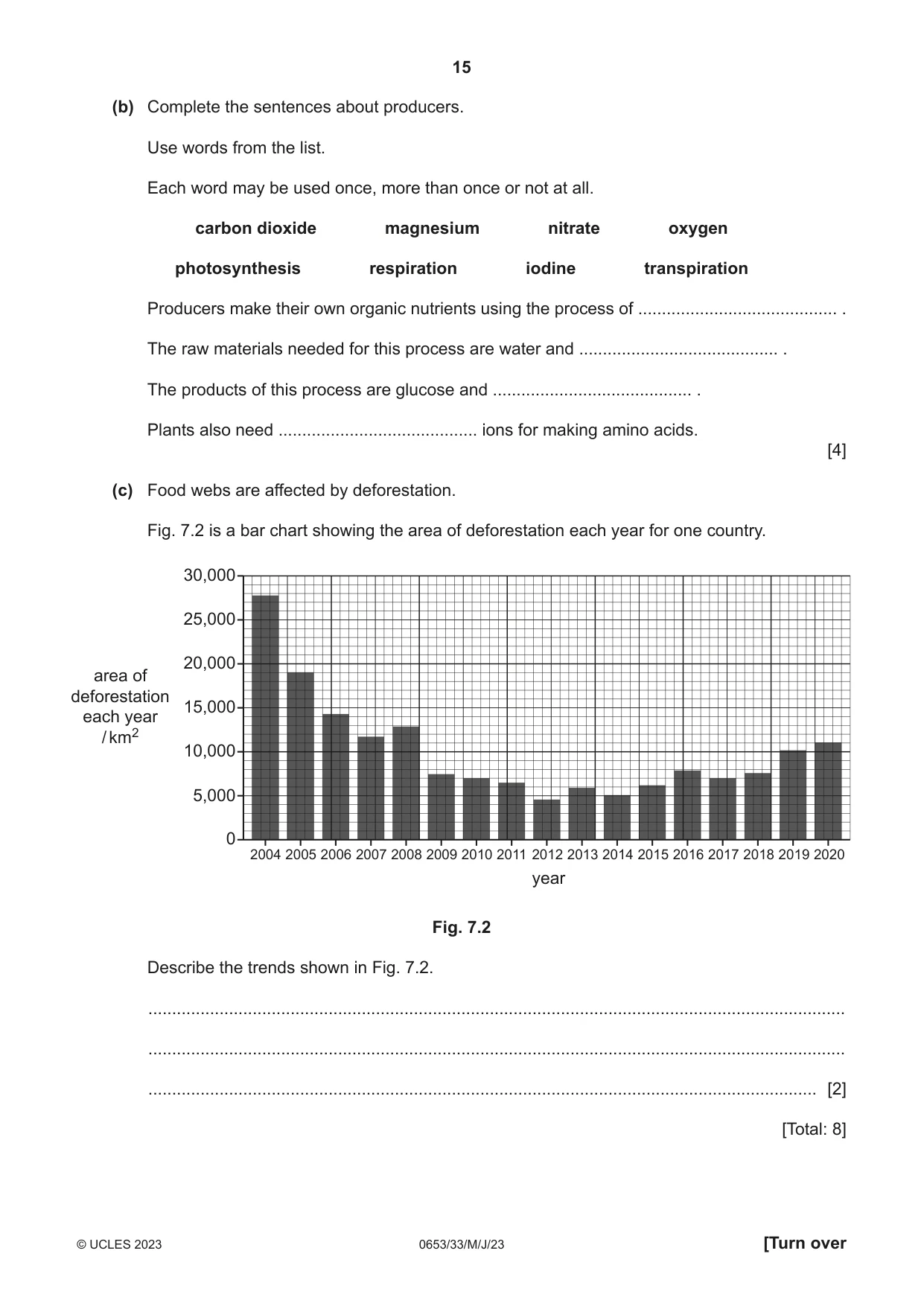
7 (a) Fig. 7.1 shows part of a food web. hawk bear grouse chipmunk marmot insects seeds grasses Fig. 7.1 (i) Identify the two herbivores in Fig. 7.1. .............................................................. and ............................................................... [1] (ii) Identify one tertiary consumer in Fig. 7.1. ..................................................................................................................................... [1] (b) Complete the sentences about producers. Use words from the list. Each word may be used once, more than once or not at all. carbon dioxide magnesium nitrate oxygen photosynthesis respiration iodine transpiration Producers make their own organic nutrients using the process of .......................................... . The raw materials needed for this process are water and .......................................... . The products of this process are glucose and .......................................... . Plants also need .......................................... ions for making amino acids. [4] (c) Food webs are affected by deforestation. Fig. 7.2 is a bar chart showing the area of deforestation each year for one country. 30,000 25,000 20,000 area of deforestation 15,000 each year / km2 10,000 5,000 0 2004 2005 2006 2007 2008 2009 2010 2011 2012 2013 2014 2015 2016 2017 2018 2019 2020 year Fig. 7.2 Describe the trends shown in Fig. 7.2. ................................................................................................................................................... ................................................................................................................................................... ............................................................................................................................................. [2] [Total: 8]
Mark scheme: 7(a)(i) insects and marmot ; 1 7(a)(ii) hawk / bear ; 1 7(b) photosynthesis ; carbon dioxide ; oxygen ; nitrate ; 4 7(c) the area of deforestation decreases then increases ; identifies lowest point is in 2012 / overall the decrease is greater than the increase / decreases to 4500 km2 (pa) ; 2
Q8 · The Periodic Table contains groups and collections of different elements
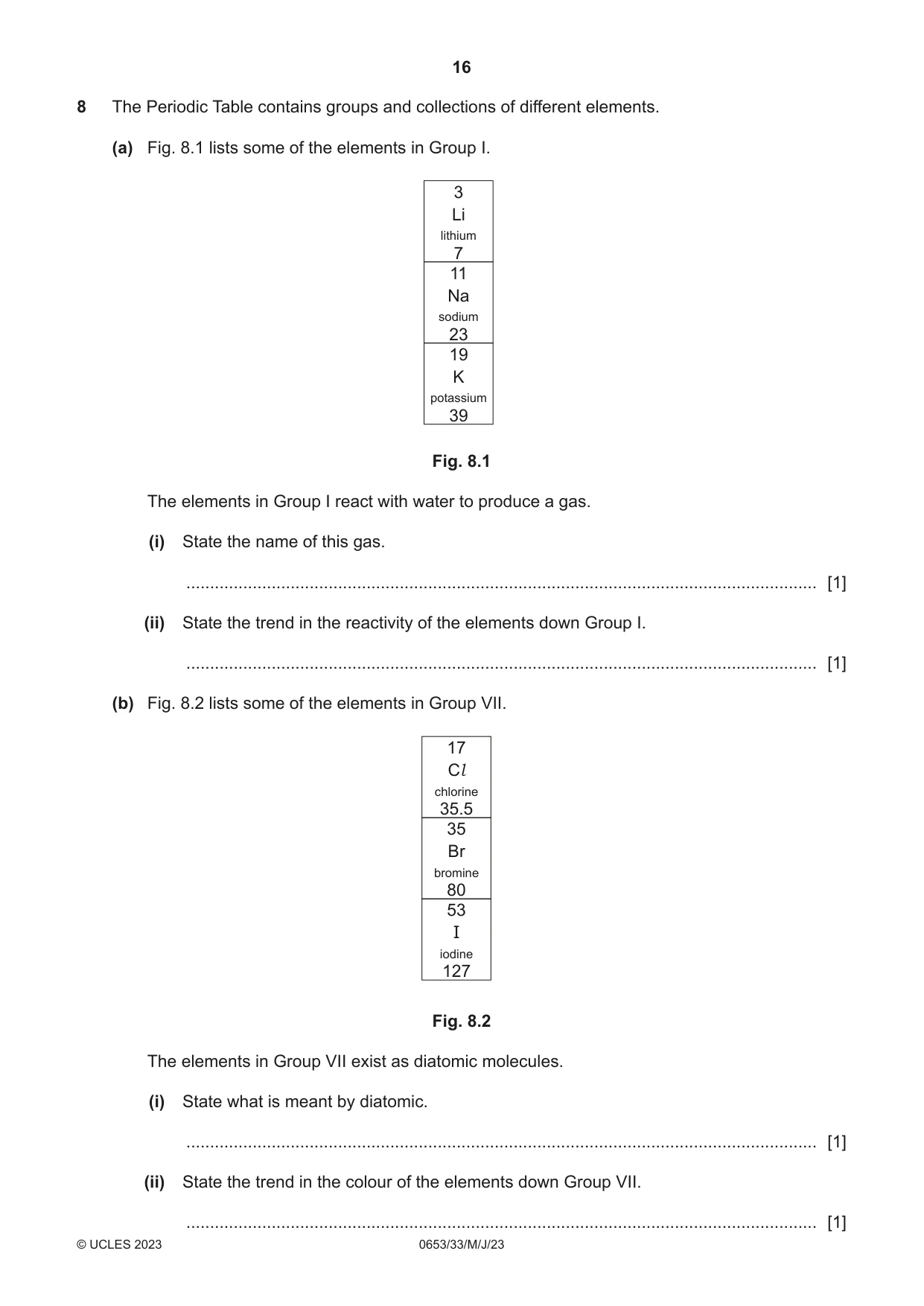
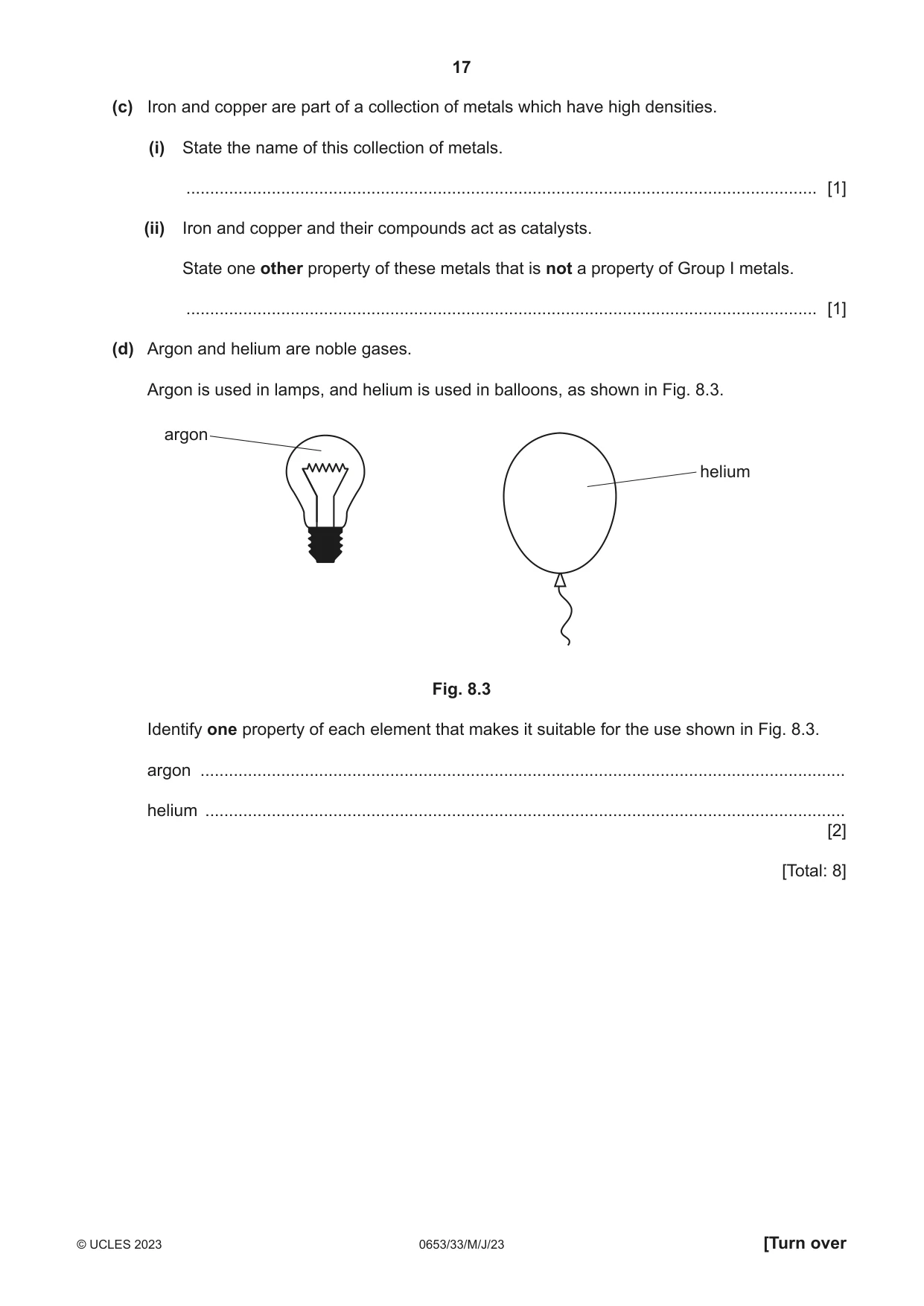
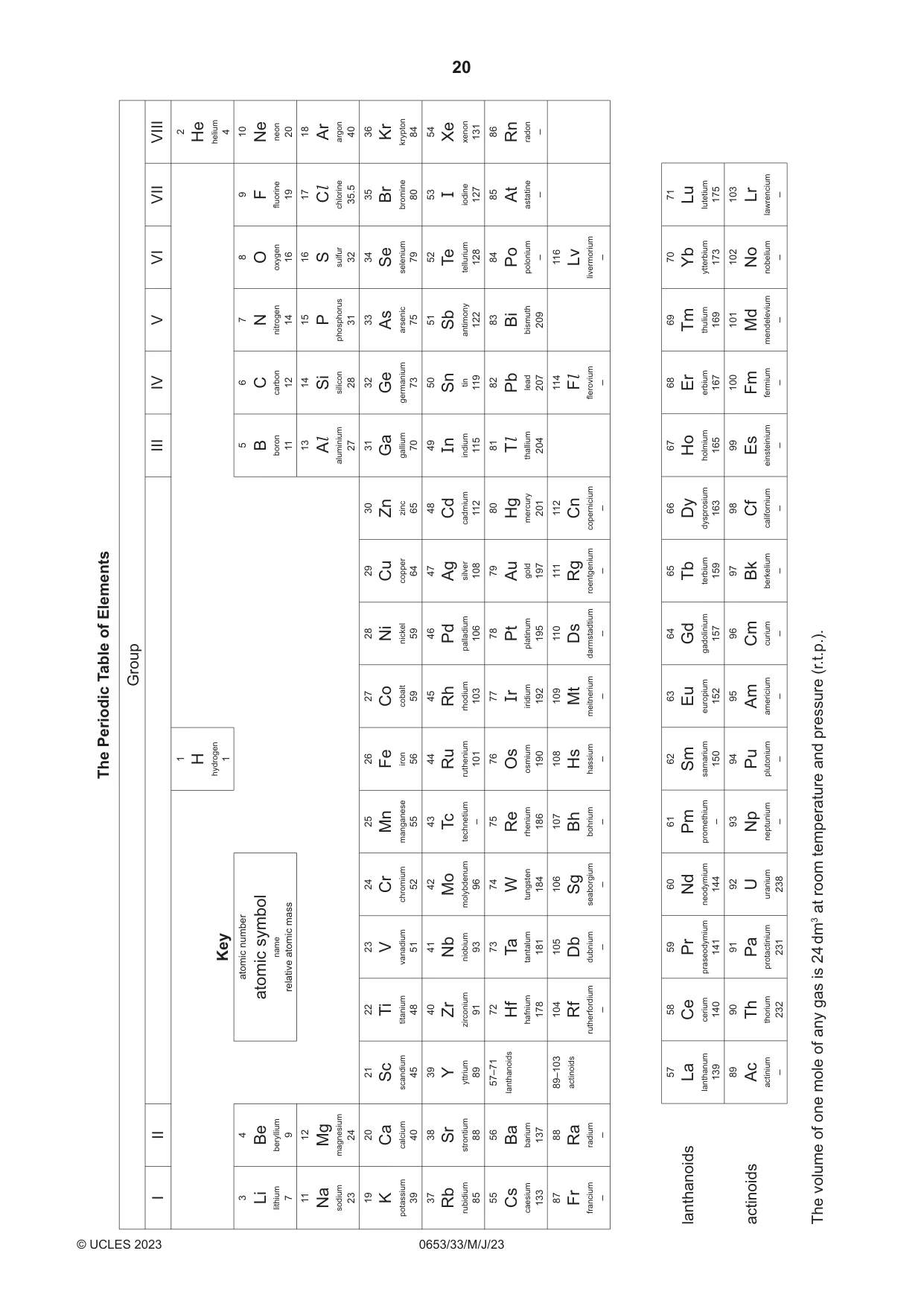
8 The Periodic Table contains groups and collections of different elements. (a) Fig. 8.1 lists some of the elements in Group I. 3 Li lithium 7 11 Na sodium 23 19 K potassium 39 Fig. 8.1 The elements in Group I react with water to produce a gas. (i) State the name of this gas. ..................................................................................................................................... [1] (ii) State the trend in the reactivity of the elements down Group I. ..................................................................................................................................... [1] (b) Fig. 8.2 lists some of the elements in Group VII. 17 Cl chlorine 35.5 35 Br bromine 80 53 I iodine 127 Fig. 8.2 The elements in Group VII exist as diatomic molecules. (i) State what is meant by diatomic. ..................................................................................................................................... [1] (ii) State the trend in the colour of the elements down Group VII. ..................................................................................................................................... [1] (c) Iron and copper are part of a collection of metals which have high densities. (i) State the name of this collection of metals. ..................................................................................................................................... [1] (ii) Iron and copper and their compounds act as catalysts. State one other property of these metals that is not a property of Group I metals. ..................................................................................................................................... [1] (d) Argon and helium are noble gases. Argon is used in lamps, and helium is used in balloons, as shown in Fig. 8.3. argon helium Fig. 8.3 Identify one property of each element that makes it suitable for the use shown in Fig. 8.3. argon ........................................................................................................................................ helium ....................................................................................................................................... [2] [Total: 8]
Mark scheme: 8(a)(i) hydrogen ; 1 8(a)(ii) increases (going down) ; 1 8(b)(i) contains two atoms (chemically) joined or bonded / a molecule containing two atoms ; 1 8(b)(ii) (become) darker / deeper ; 1 8(c)(i) transition (elements / metals) ; 1 8(c)(ii) high melting points / form coloured compounds ; 1 8(d) (argon) unreactive ; (helium) low density ; 2
Q9 · A person’s voice emits sound in the form of longitudinal waves
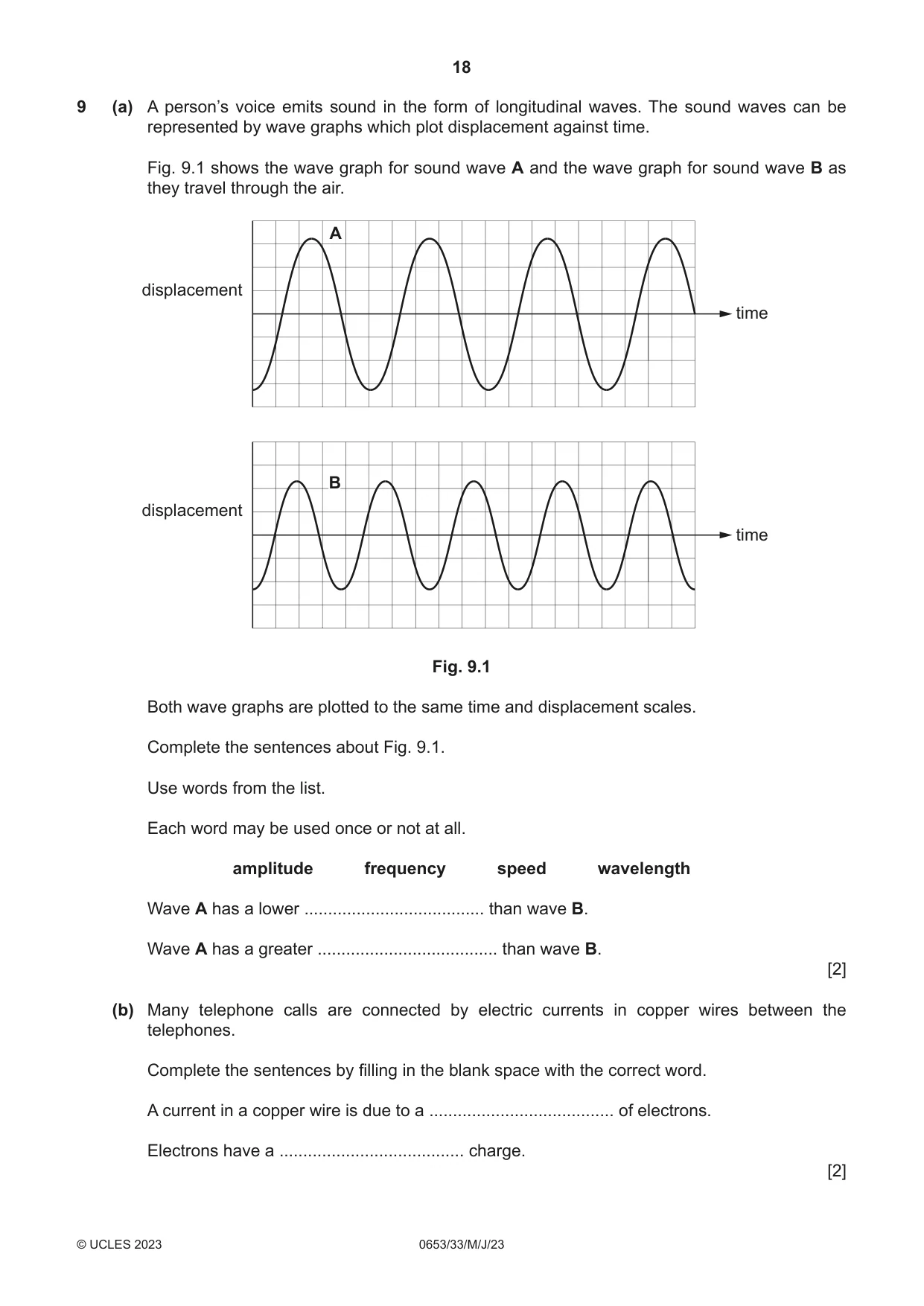
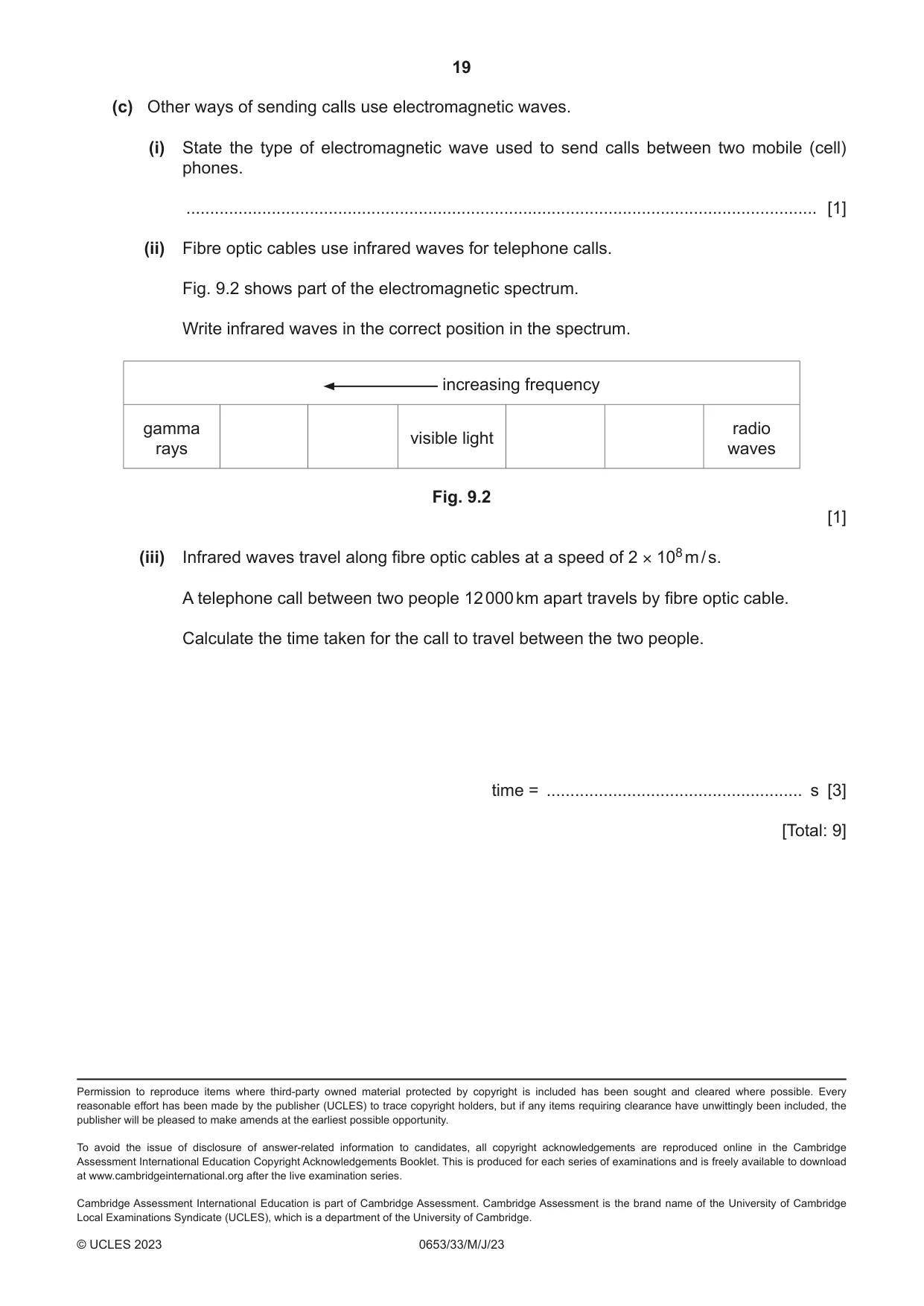
9 (a) A person’s voice emits sound in the form of longitudinal waves. The sound waves can be represented by wave graphs which plot displacement against time. Fig. 9.1 shows the wave graph for sound wave A and the wave graph for sound wave B as they travel through the air. A displacement time B displacement time Fig. 9.1 Both wave graphs are plotted to the same time and displacement scales. Complete the sentences about Fig. 9.1. Use words from the list. Each word may be used once or not at all. amplitude frequency speed wavelength Wave A has a lower ...................................... than wave B. Wave A has a greater ...................................... than wave B. [2] (b) Many telephone calls are connected by electric currents in copper wires between the telephones. Complete the sentences by filling in the blank space with the correct word. A current in a copper wire is due to a ....................................... of electrons. Electrons have a ....................................... charge. [2] (c) Other ways of sending calls use electromagnetic waves. (i) State the type of electromagnetic wave used to send calls between two mobile (cell) phones. ..................................................................................................................................... [1] (ii) Fibre optic cables use infrared waves for telephone calls. Fig. 9.2 shows part of the electromagnetic spectrum. Write infrared waves in the correct position in the spectrum. increasing frequency gamma radio visible light rays waves Fig. 9.2 [1] (iii) Infrared waves travel along fibre optic cables at a speed of 2 × 10⁸ m / s. A telephone call between two people 12 000 km apart travels by fibre optic cable. Calculate the time taken for the call to travel between the two people. time = ...................................................... s [3] [Total: 9]
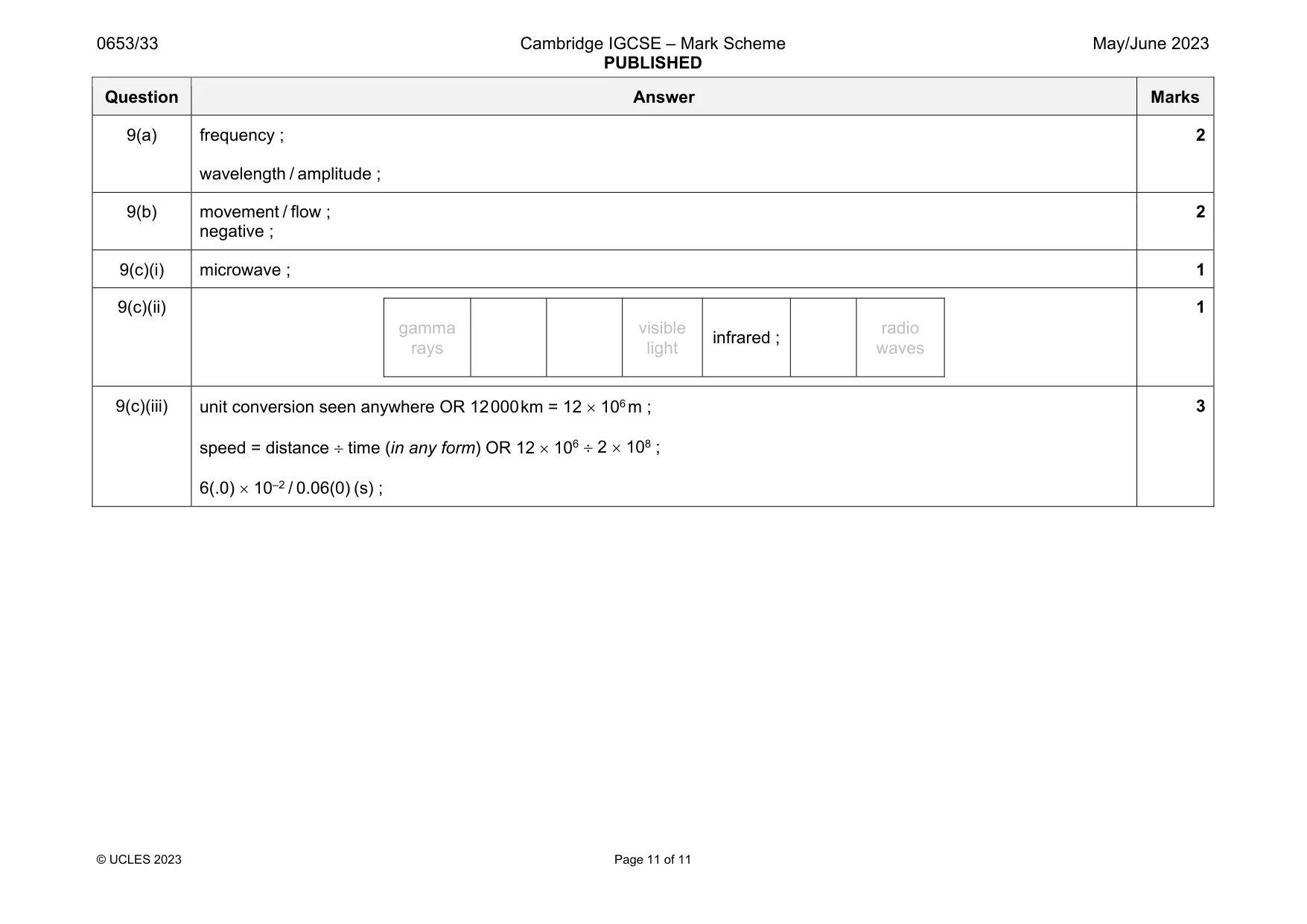
Mark scheme: 9(a) frequency ; wavelength / amplitude ; 2 9(b) movement / flow ; negative ; 2 9(c)(i) microwave ; 1 9(c)(ii) gamma rays visible light infrared ; radio waves 1 9(c)(iii) unit conversion seen anywhere OR 12 000 km = 12 106 m ; speed = distance time (in any form) OR 12 106 2 108 ; 6(.0) 10–2 / 0.06(0) (s) ; 3
What was in this paper
The subtopics covered by these 9 questions, and how many questions each got. Open one in a new tab to see every Cambridge question on it.
What you needed in this session
Cambridge’s own grade thresholds for 2023 May/June, Paper 3 · Variant 3. A higher threshold means an easier paper — the bar moves with how the cohort did.