Cambridge IGCSE Science - Combined 0653 — 2021 May/June Paper 3 · Variant 1
0653/31/M/J/21 · 9 questions · 80 marks · ≈90 min
The question paper and its mark scheme, free to read here and free to download. This is Cambridge’s own paper, exactly as it was sat.
Question paper20 pages

Mark scheme11 pages
Answers below. Sit the paper first if you are practising.
Questions as text
Q1 · The boxes on the left show characteristics of living organisms
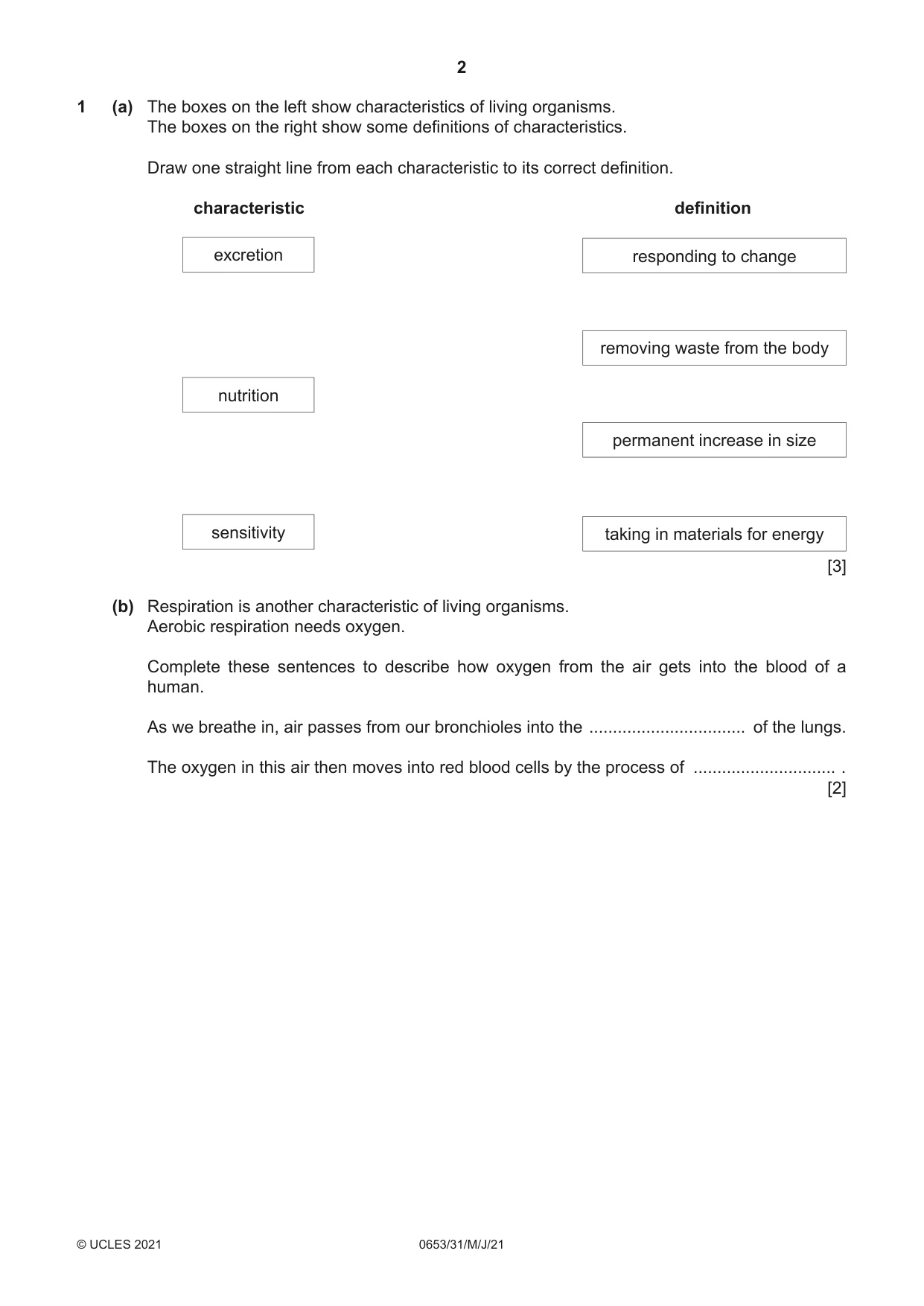
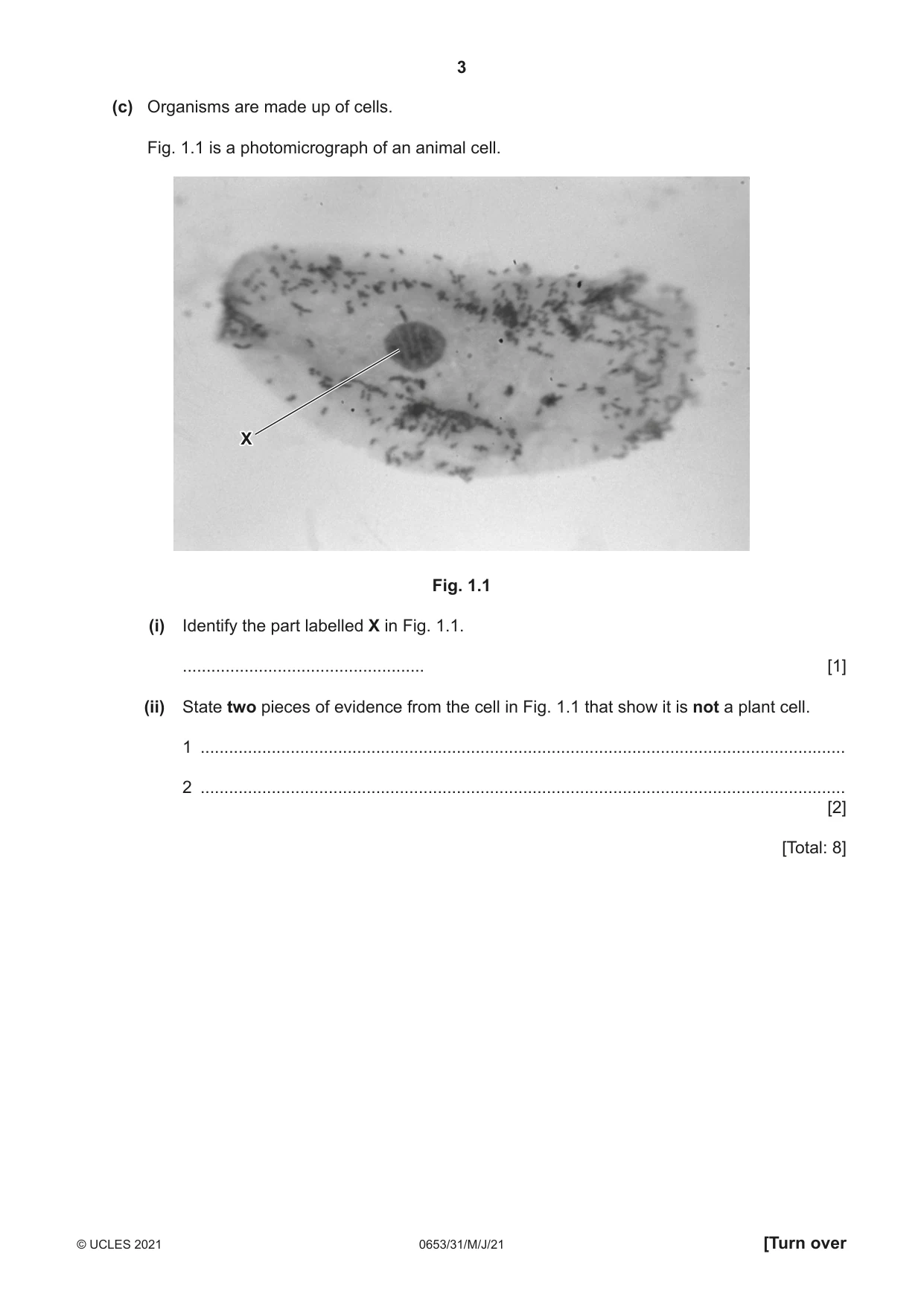
1 (a) The boxes on the left show characteristics of living organisms. The boxes on the right show some definitions of characteristics. Draw one straight line from each characteristic to its correct definition. characteristic definition excretion responding to change removing waste from the body nutrition permanent increase in size sensitivity taking in materials for energy [3] (b) Respiration is another characteristic of living organisms. Aerobic respiration needs oxygen. Complete these sentences to describe how oxygen from the air gets into the blood of a human. As we breathe in, air passes from our bronchioles into the ................................. of the lungs. The oxygen in this air then moves into red blood cells by the process of .............................. . [2] (c) Organisms are made up of cells. Fig. 1.1 is a photomicrograph of an animal cell. X Fig. 1.1 (i) Identify the part labelled X in Fig. 1.1. ................................................... [1] (ii) State two pieces of evidence from the cell in Fig. 1.1 that show it is not a plant cell. 1 ........................................................................................................................................ 2 ........................................................................................................................................ [2] [Total: 8]
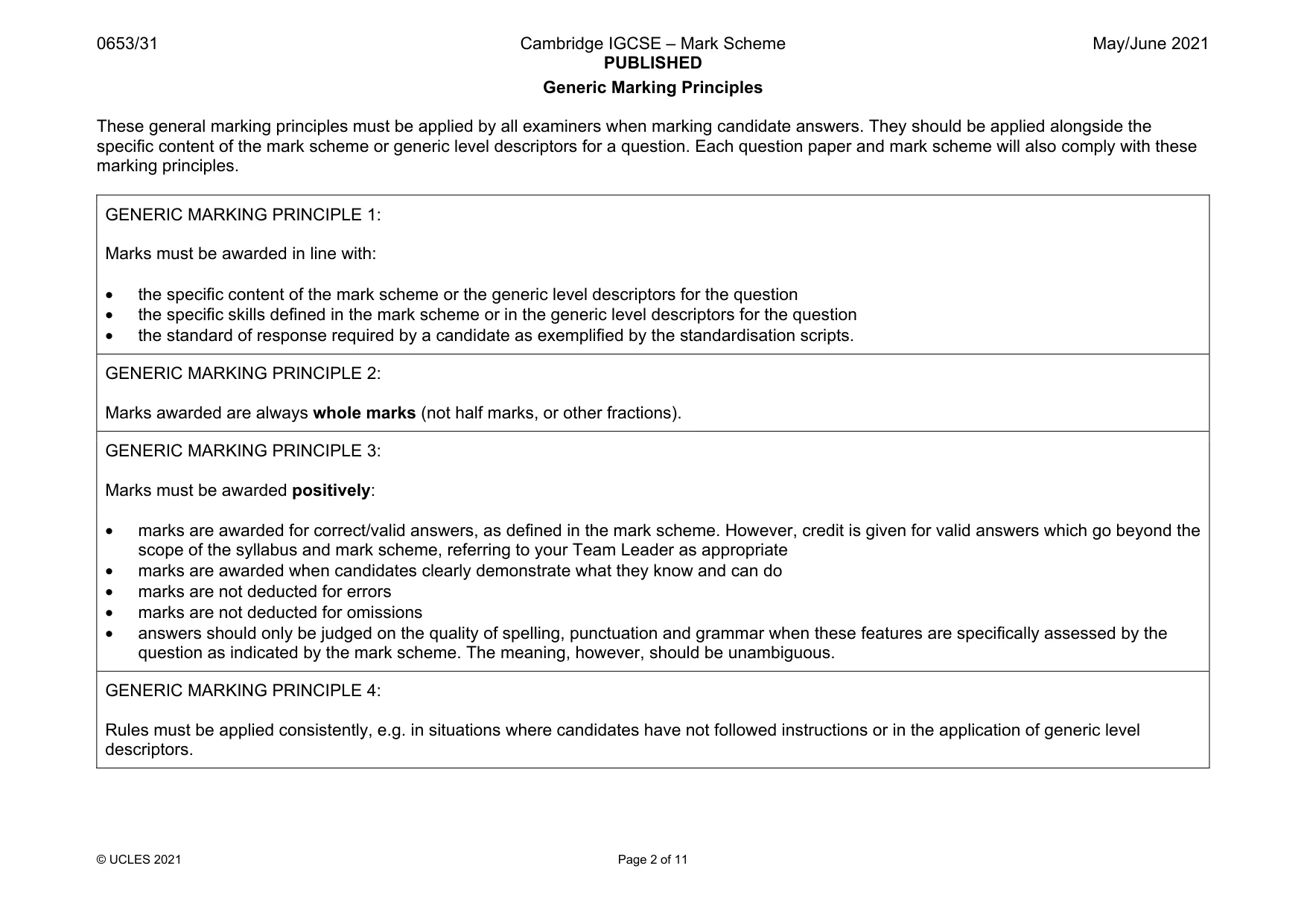
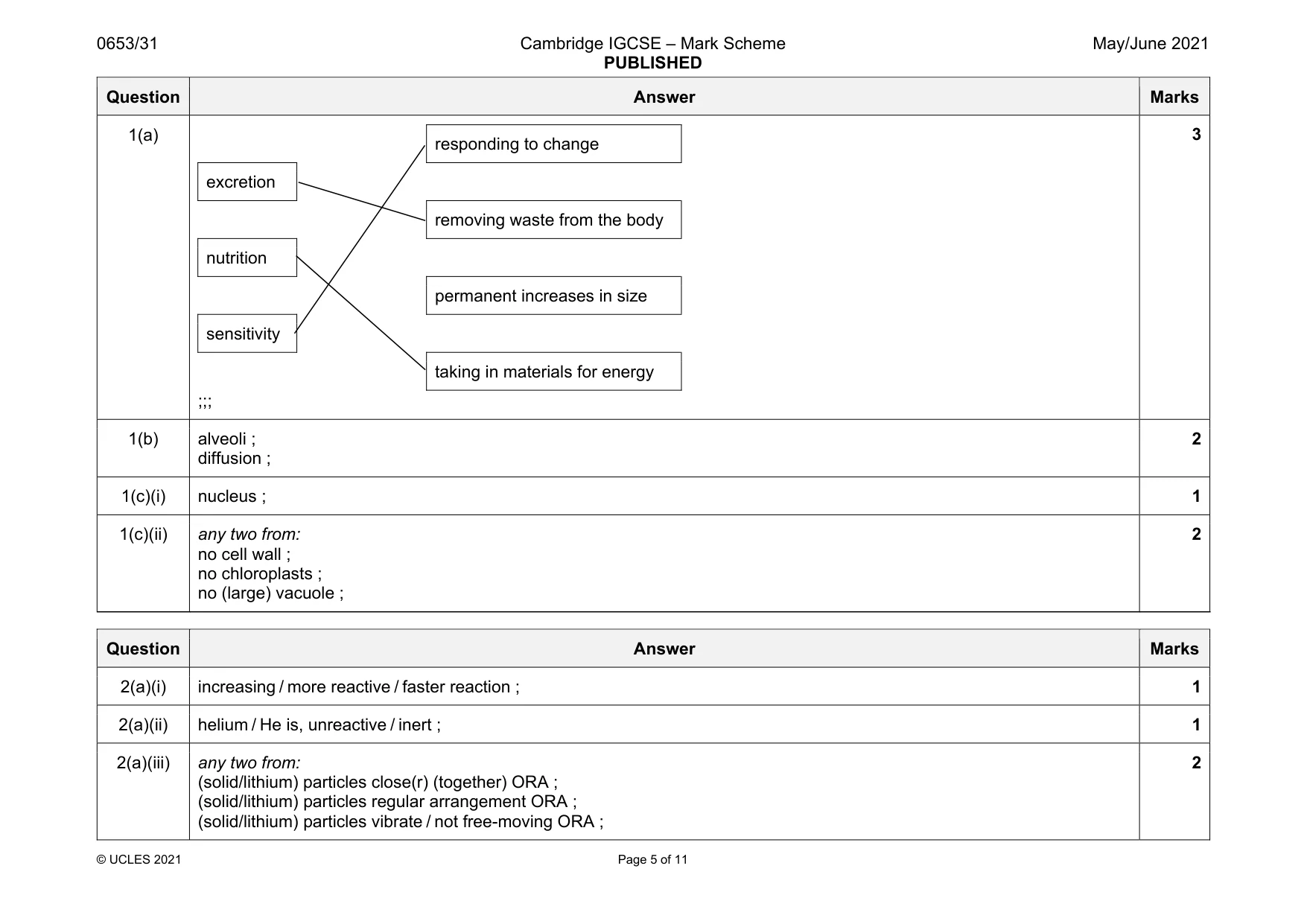
Mark scheme: 1(a) responding to change excretion removing waste from the body nutrition permanent increases in size sensitivity taking in materials for energy ;;; 1(b) alveoli ; diffusion ; 2 1(c)(i) nucleus ; 1 1(c)(ii) any two from: no cell wall ; no chloroplasts ; no (large) vacuole ; 2
Q2 · Part of Group I of the Periodic Table
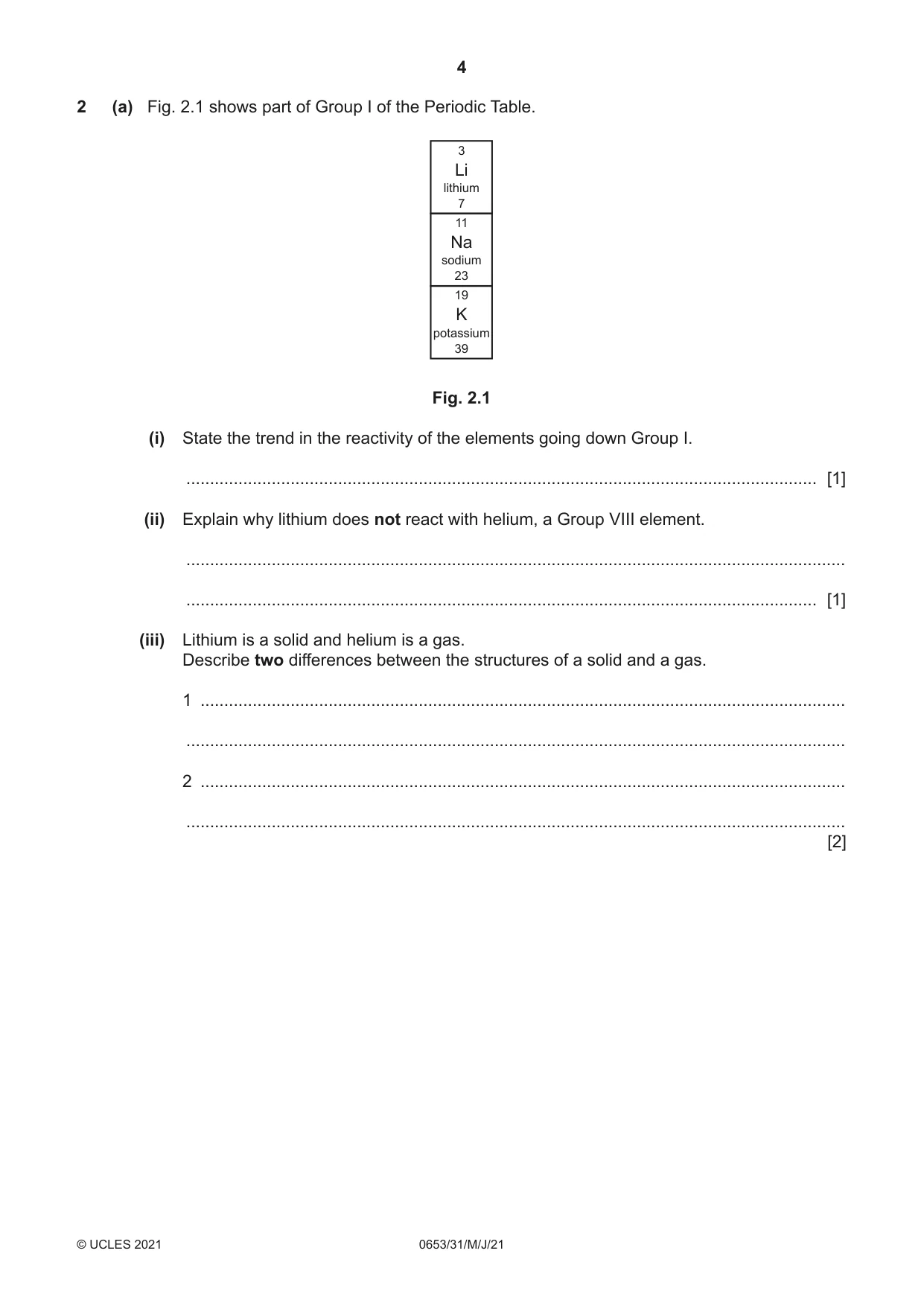
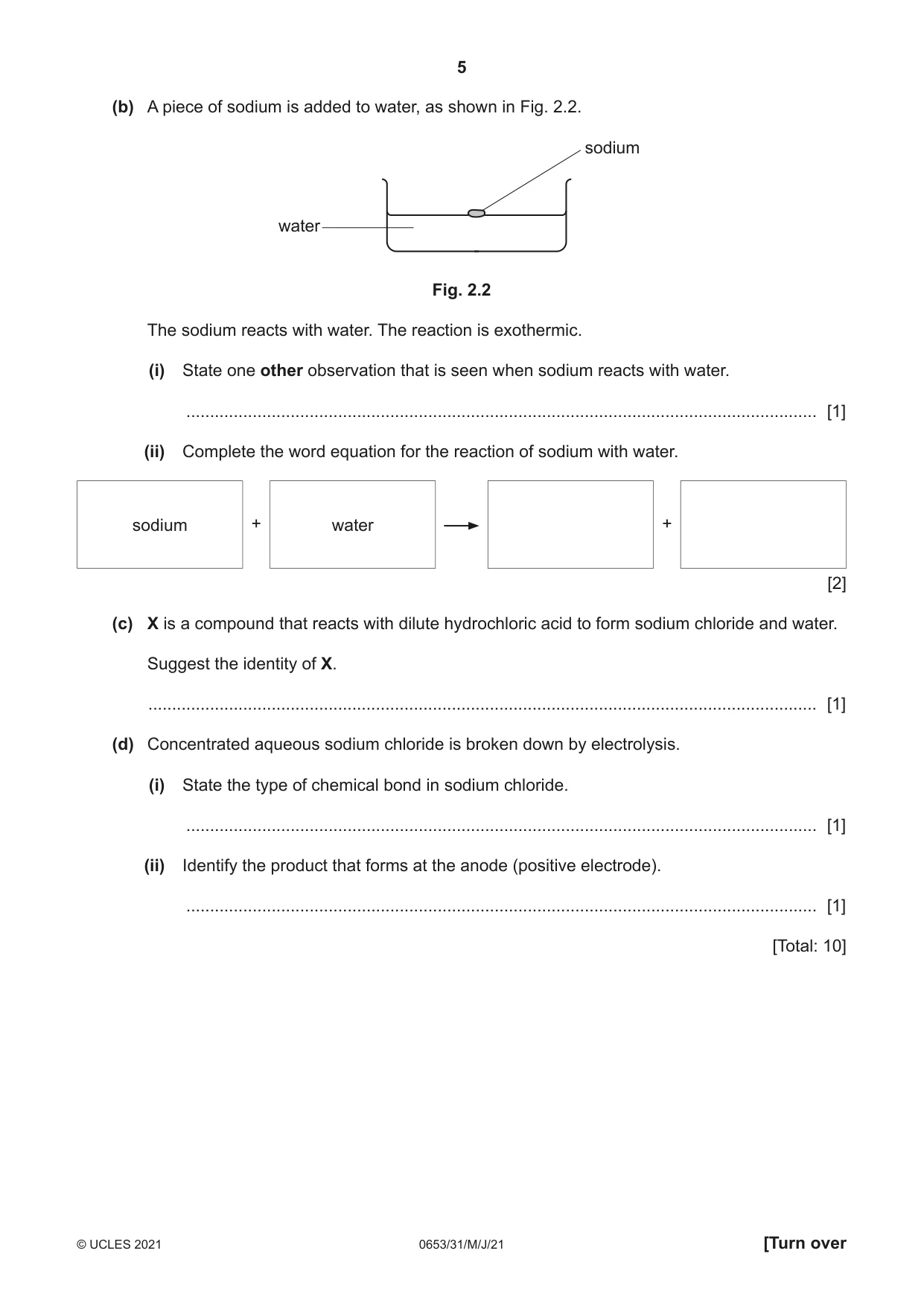
2 (a) Fig. 2.1 shows part of Group I of the Periodic Table. 3 Li lithium 7 11 Na sodium 23 19 K potassium 39 Fig. 2.1 (i) State the trend in the reactivity of the elements going down Group I. ..................................................................................................................................... [1] (ii) Explain why lithium does not react with helium, a Group VIII element. ........................................................................................................................................... ..................................................................................................................................... [1] (iii) Lithium is a solid and helium is a gas. Describe two differences between the structures of a solid and a gas. 1 ........................................................................................................................................ ........................................................................................................................................... 2 ........................................................................................................................................ ........................................................................................................................................... [2] (b) A piece of sodium is added to water, as shown in Fig. 2.2. sodium water Fig. 2.2 The sodium reacts with water. The reaction is exothermic. (i) State one other observation that is seen when sodium reacts with water. ..................................................................................................................................... [1] (ii) Complete the word equation for the reaction of sodium with water. sodium + water + [2] (c) X is a compound that reacts with dilute hydrochloric acid to form sodium chloride and water. Suggest the identity of X. ............................................................................................................................................. [1] (d) Concentrated aqueous sodium chloride is broken down by electrolysis. (i) State the type of chemical bond in sodium chloride. ..................................................................................................................................... [1] (ii) Identify the product that forms at the anode (positive electrode). ..................................................................................................................................... [1] [Total: 10]
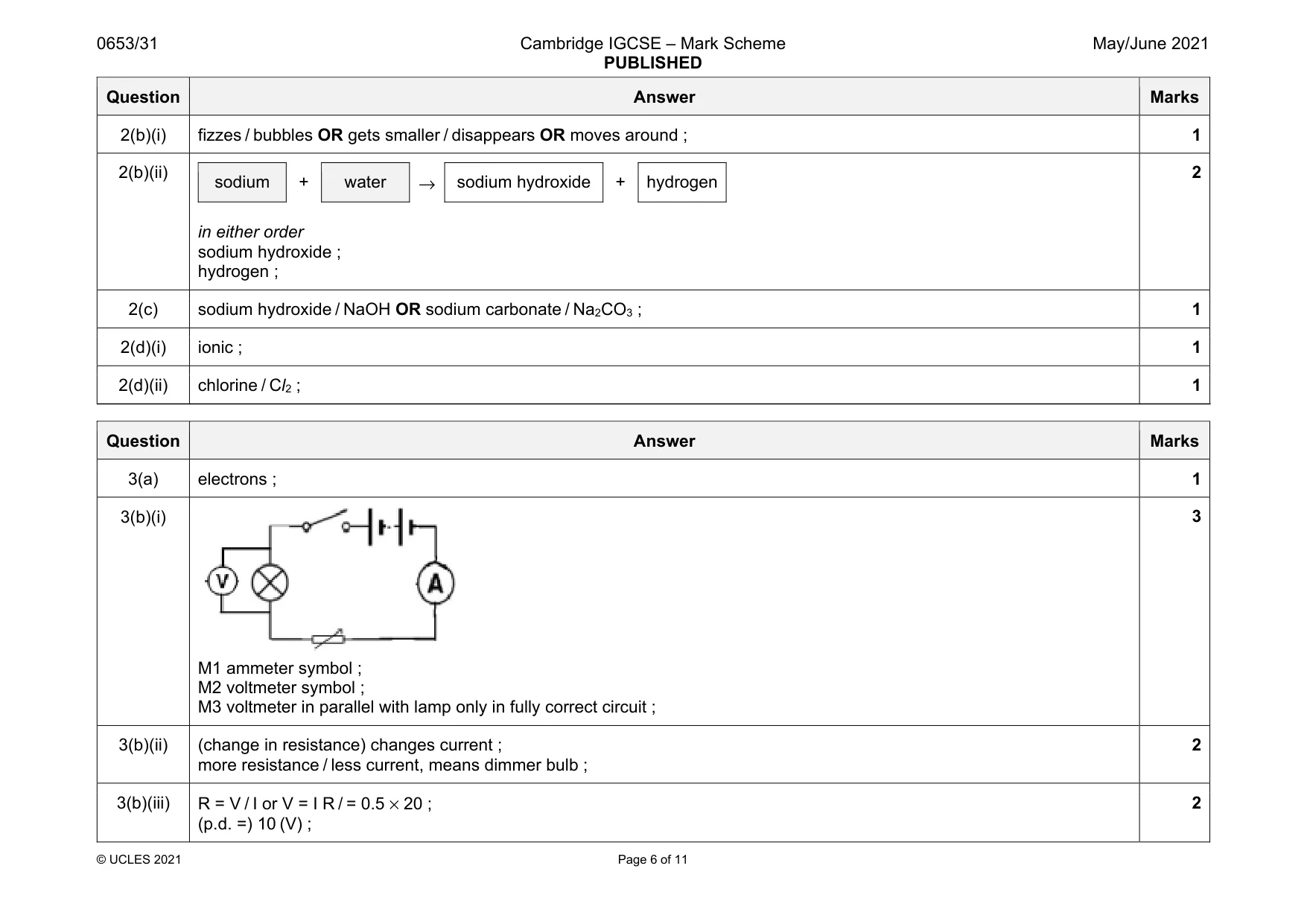
Mark scheme: 2(a)(i) increasing / more reactive / faster reaction ; 1 2(a)(ii) helium / He is, unreactive / inert ; 1 2(a)(iii) any two from: (solid/lithium) particles close(r) (together) ORA ; (solid/lithium) particles regular arrangement ORA ; (solid/lithium) particles vibrate / not free-moving ORA ; 2 Question Answer Marks 2(b)(i) fizzes / bubbles OR gets smaller / disappears OR moves around ; 1 2(b)(ii) sodium + water → sodium hydroxide + hydrogen in either order sodium hydroxide ; hydrogen ; 2 2(c) sodium hydroxide / NaOH OR sodium carbonate / Na2CO3 ; 1 2(d)(i) ionic ; 1 2(d)(ii) chlorine / Cl2 ; 1
Q3 · State the name of the particles that flow in an electric current in a metal wire
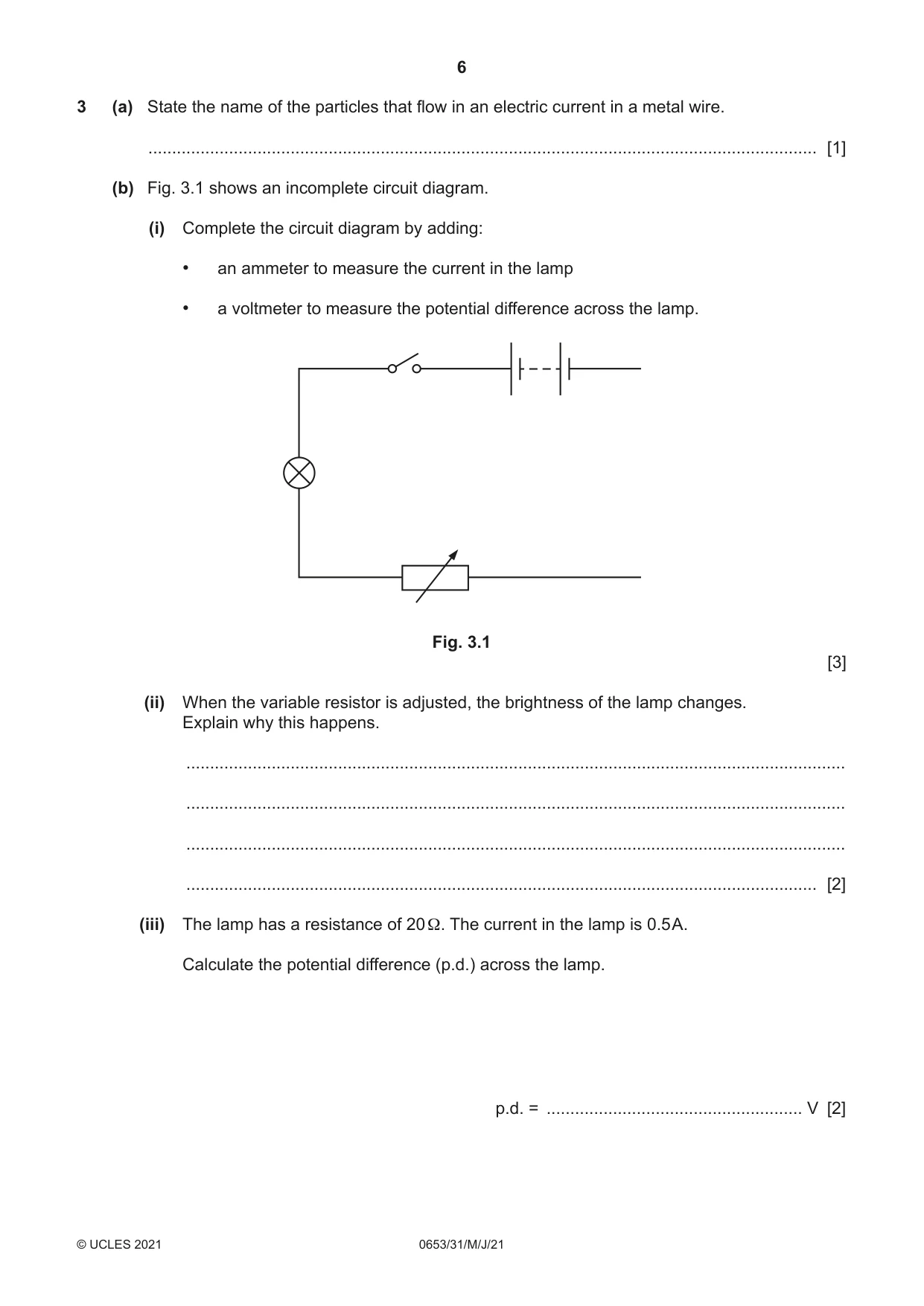
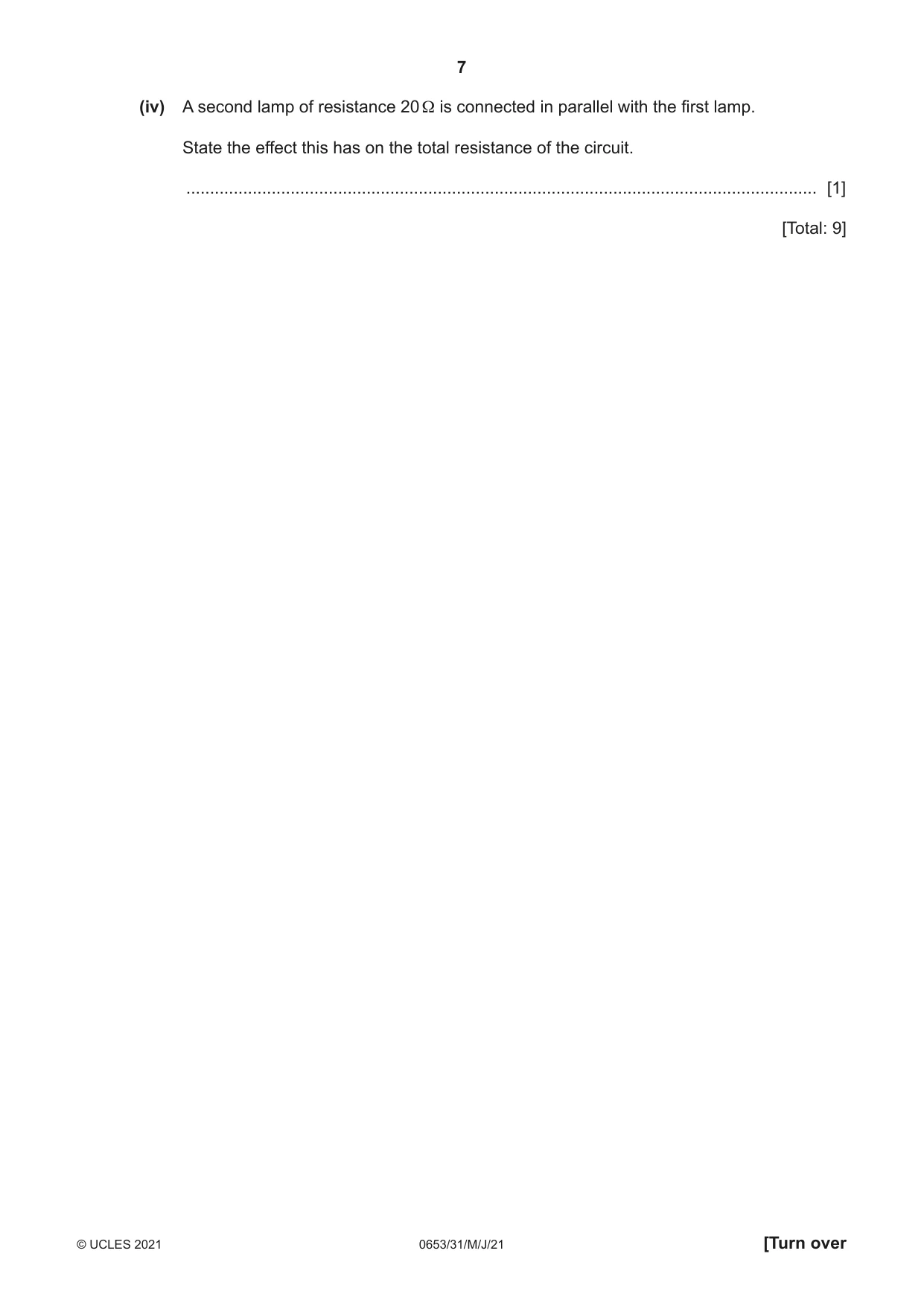
3 (a) State the name of the particles that flow in an electric current in a metal wire. ............................................................................................................................................. [1] (b) Fig. 3.1 shows an incomplete circuit diagram. (i) Complete the circuit diagram by adding: • an ammeter to measure the current in the lamp • a voltmeter to measure the potential difference across the lamp. Fig. 3.1 [3] (ii) When the variable resistor is adjusted, the brightness of the lamp changes. Explain why this happens. ........................................................................................................................................... ........................................................................................................................................... ........................................................................................................................................... ..................................................................................................................................... [2] (iii) The lamp has a resistance of 20 Ω. The current in the lamp is 0.5 A. Calculate the potential difference (p.d.) across the lamp. p.d. = ...................................................... V [2] (iv) A second lamp of resistance 20 Ω is connected in parallel with the first lamp. State the effect this has on the total resistance of the circuit. ..................................................................................................................................... [1] [Total: 9]
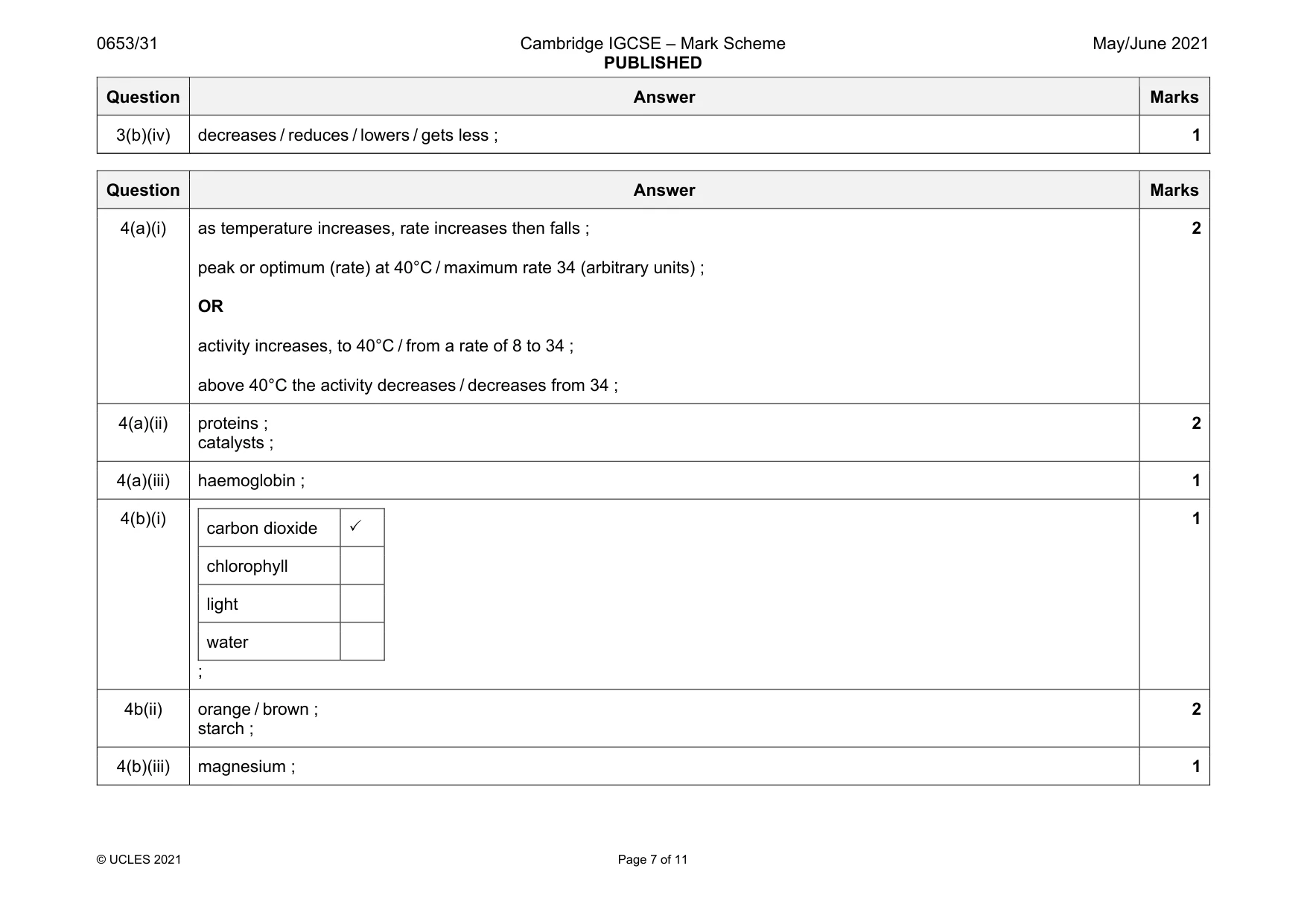
Mark scheme: 3(a) electrons ; 1 3(b)(i) M1 ammeter symbol ; M2 voltmeter symbol ; M3 voltmeter in parallel with lamp only in fully correct circuit ; 3 3(b)(ii) (change in resistance) changes current ; more resistance / less current, means dimmer bulb ; 2 3(b)(iii) R = V / I or V = I R / = 0.5 × 20 ; (p.d. =) 10 (V) ; 2 Question Answer Marks 3(b)(iv) decreases / reduces / lowers / gets less ; 1
Q4 · A student investigates the effect of temperature on enzyme activity
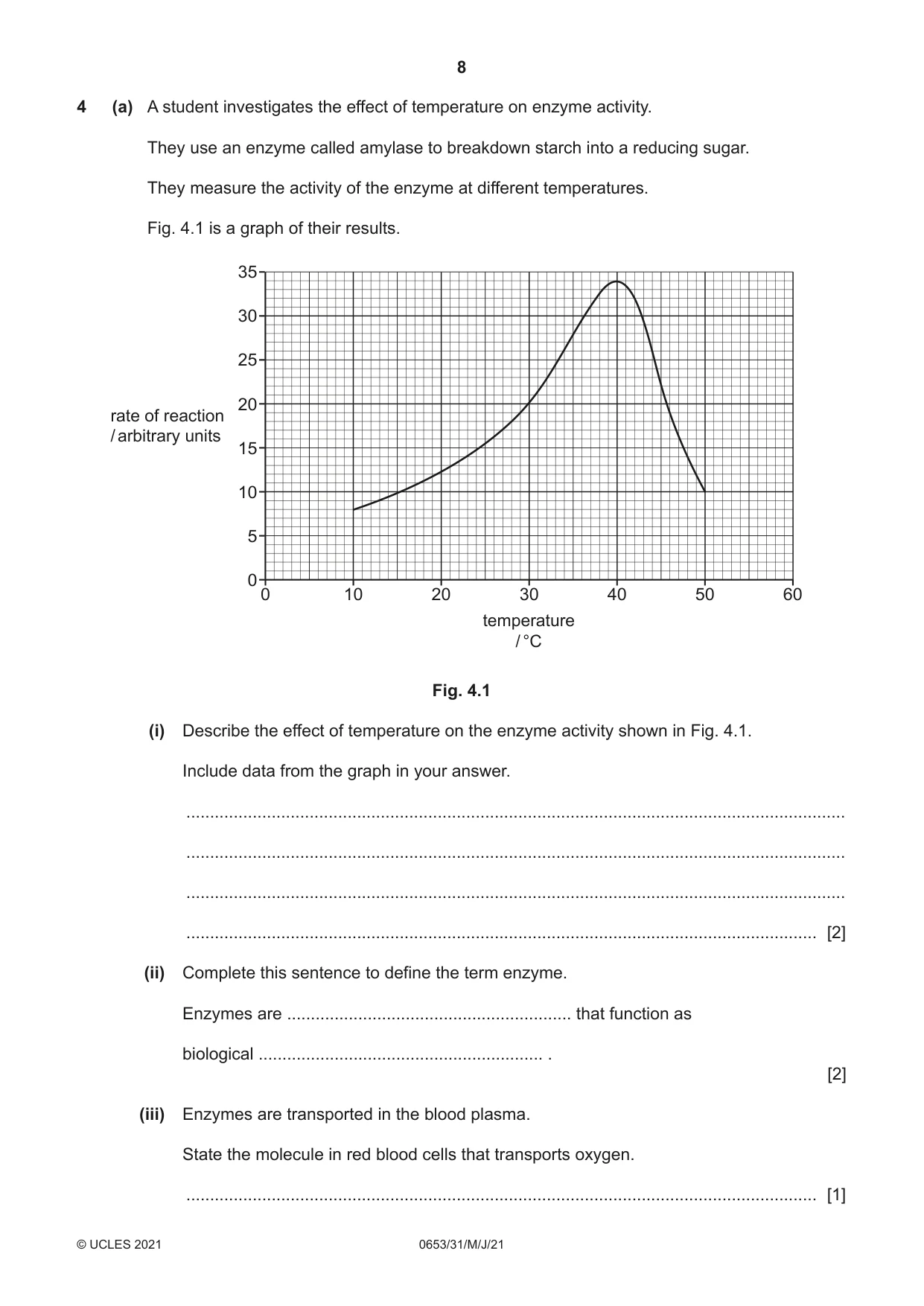
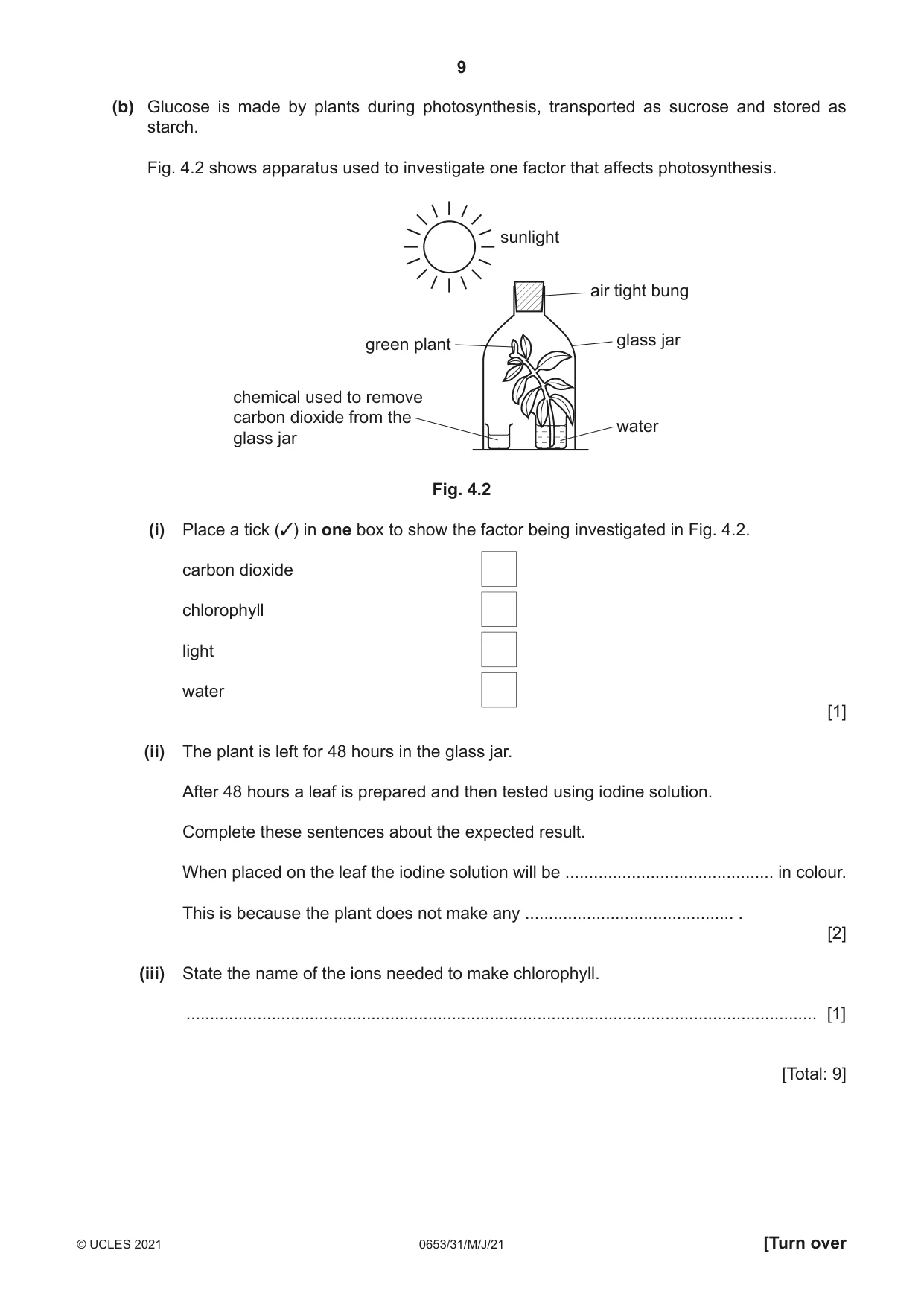
4 (a) A student investigates the effect of temperature on enzyme activity. They use an enzyme called amylase to breakdown starch into a reducing sugar. They measure the activity of the enzyme at different temperatures. Fig. 4.1 is a graph of their results. 35 30 25 20 rate of reaction / arbitrary units 15 10 5 0 0 10 20 30 40 50 60 temperature / °C Fig. 4.1 (i) Describe the effect of temperature on the enzyme activity shown in Fig. 4.1. Include data from the graph in your answer. ........................................................................................................................................... ........................................................................................................................................... ........................................................................................................................................... ..................................................................................................................................... [2] (ii) Complete this sentence to define the term enzyme. Enzymes are ............................................................ that function as biological ............................................................ . [2] (iii) Enzymes are transported in the blood plasma. State the molecule in red blood cells that transports oxygen. ..................................................................................................................................... [1] (b) Glucose is made by plants during photosynthesis, transported as sucrose and stored as starch. Fig. 4.2 shows apparatus used to investigate one factor that affects photosynthesis. sunlight air tight bung green plant glass jar chemical used to remove carbon dioxide from the water glass jar Fig. 4.2 (i) Place a tick (✓) in one box to show the factor being investigated in Fig. 4.2. carbon dioxide chlorophyll light water [1] (ii) The plant is left for 48 hours in the glass jar. After 48 hours a leaf is prepared and then tested using iodine solution. Complete these sentences about the expected result. When placed on the leaf the iodine solution will be ............................................ in colour. This is because the plant does not make any ............................................ . [2] (iii) State the name of the ions needed to make chlorophyll. ..................................................................................................................................... [1] [Total: 9]
Mark scheme: 4(a)(i) as temperature increases, rate increases then falls ; peak or optimum (rate) at 40°C / maximum rate 34 (arbitrary units) ; OR activity increases, to 40°C / from a rate of 8 to 34 ; above 40°C the activity decreases / decreases from 34 ; 2 4(a)(ii) proteins ; catalysts ; 2 4(a)(iii) haemoglobin ; 1 4(b)(i) carbon dioxide chlorophyll light water ; 1 4b(ii) orange / brown ; starch ; 2 4(b)(iii) magnesium ; 1
Q5 · Petroleum is a mixture of hydrocarbons
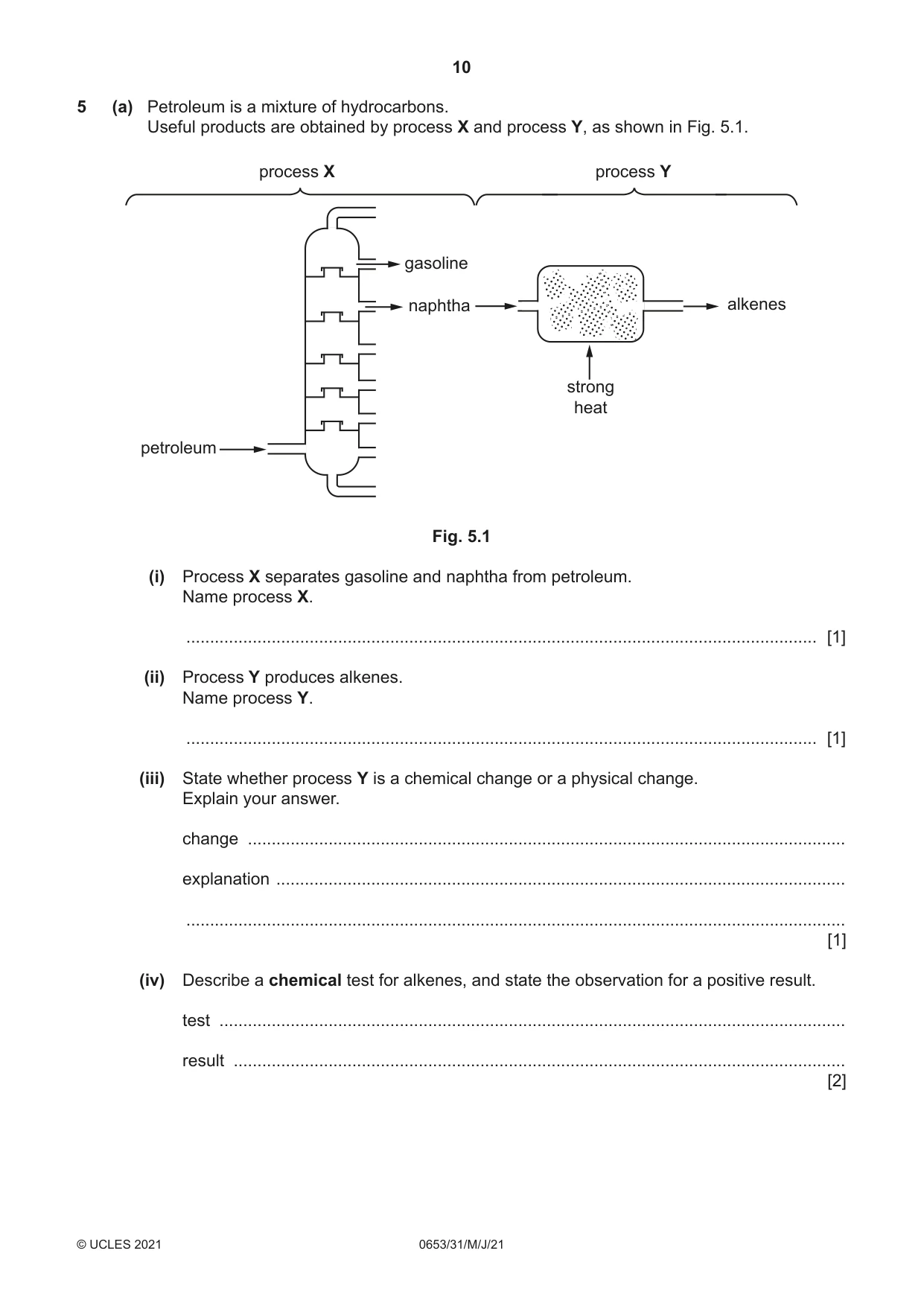
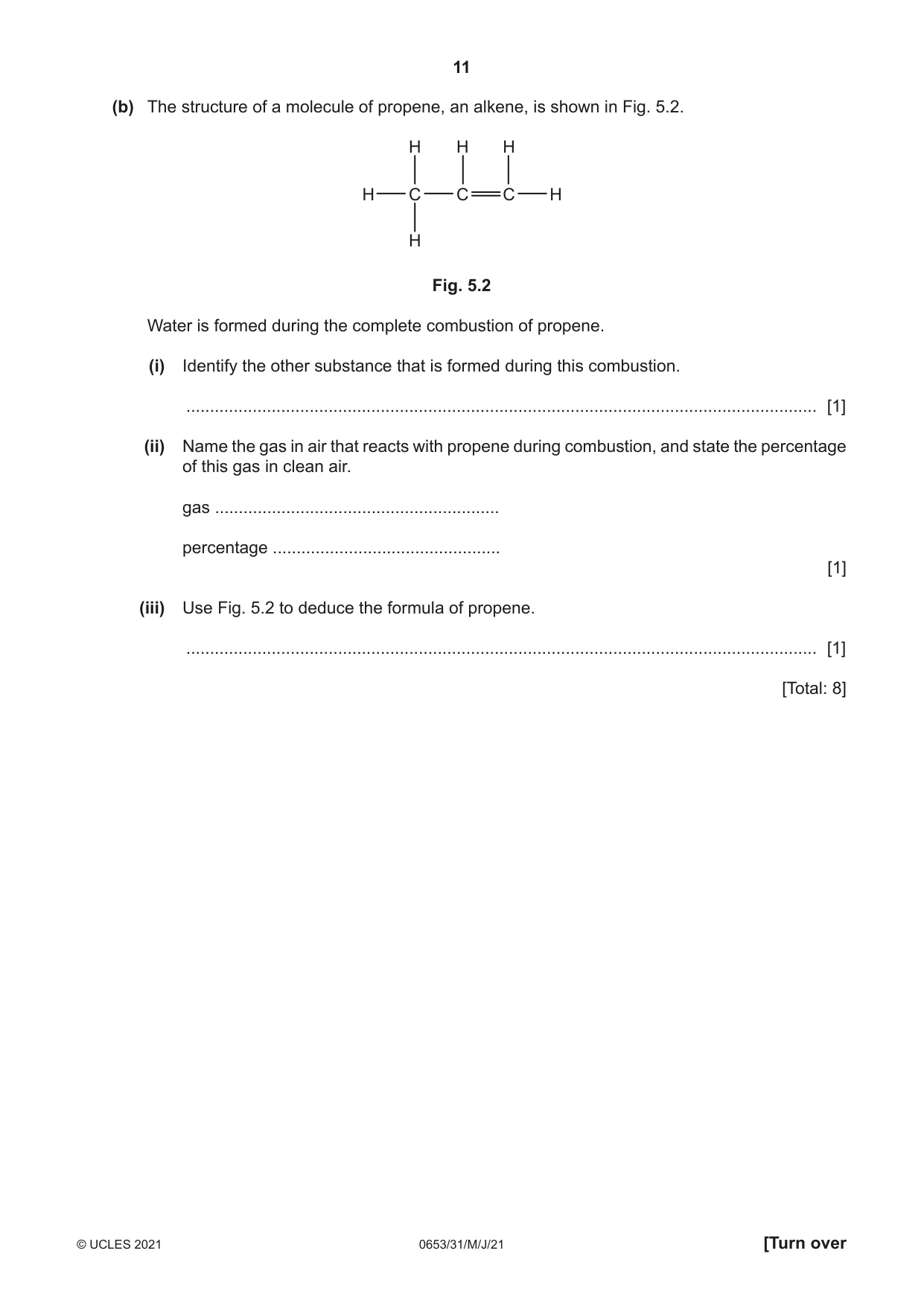
5 (a) Petroleum is a mixture of hydrocarbons. Useful products are obtained by process X and process Y, as shown in Fig. 5.1. process X process Y gasoline naphthanaphtha alkenes strong heat petroleum Fig. 5.1 (i) Process X separates gasoline and naphtha from petroleum. Name process X. ..................................................................................................................................... [1] (ii) Process Y produces alkenes. Name process Y. ..................................................................................................................................... [1] (iii) State whether process Y is a chemical change or a physical change. Explain your answer. change .............................................................................................................................. explanation ........................................................................................................................ ........................................................................................................................................... [1] (iv) Describe a chemical test for alkenes, and state the observation for a positive result. test .................................................................................................................................... result ................................................................................................................................. [2] (b) The structure of a molecule of propene, an alkene, is shown in Fig. 5.2. H H H H C C C H H Fig. 5.2 Water is formed during the complete combustion of propene. (i) Identify the other substance that is formed during this combustion. ..................................................................................................................................... [1] (ii) Name the gas in air that reacts with propene during combustion, and state the percentage of this gas in clean air. gas ............................................................ percentage ................................................ [1] (iii) Use Fig. 5.2 to deduce the formula of propene. ..................................................................................................................................... [1] [Total: 8]
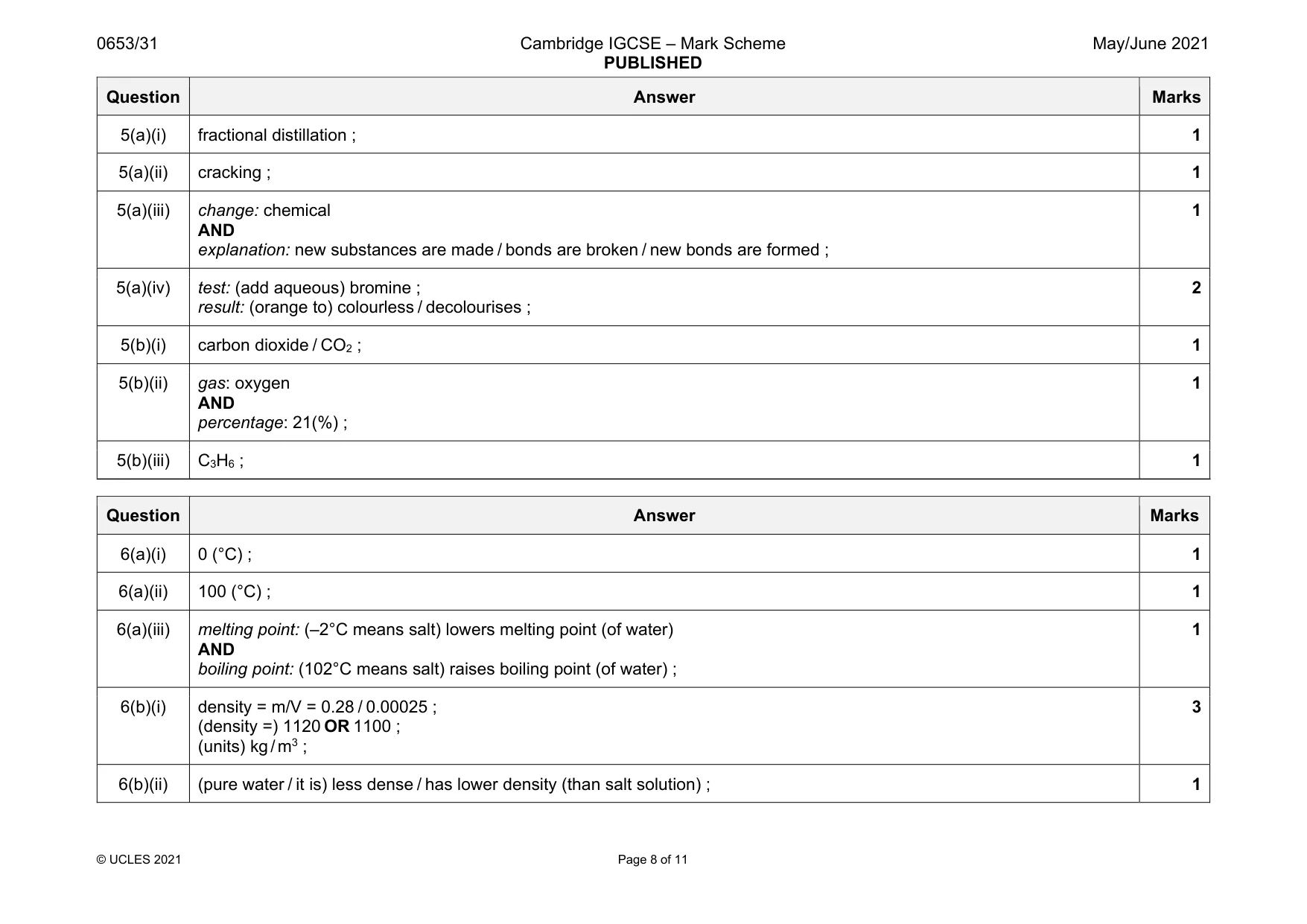
Mark scheme: 5(a)(i) fractional distillation ; 1 5(a)(ii) cracking ; 1 5(a)(iii) change: chemical AND explanation: new substances are made / bonds are broken / new bonds are formed ; 1 5(a)(iv) test: (add aqueous) bromine ; result: (orange to) colourless / decolourises ; 2 5(b)(i) carbon dioxide / CO2 ; 1 5(b)(ii) gas: oxygen AND percentage: 21(%) ; 1 5(b)(iii) C3H6 ; 1
Q6 · A thermometer in a solution of salt in water
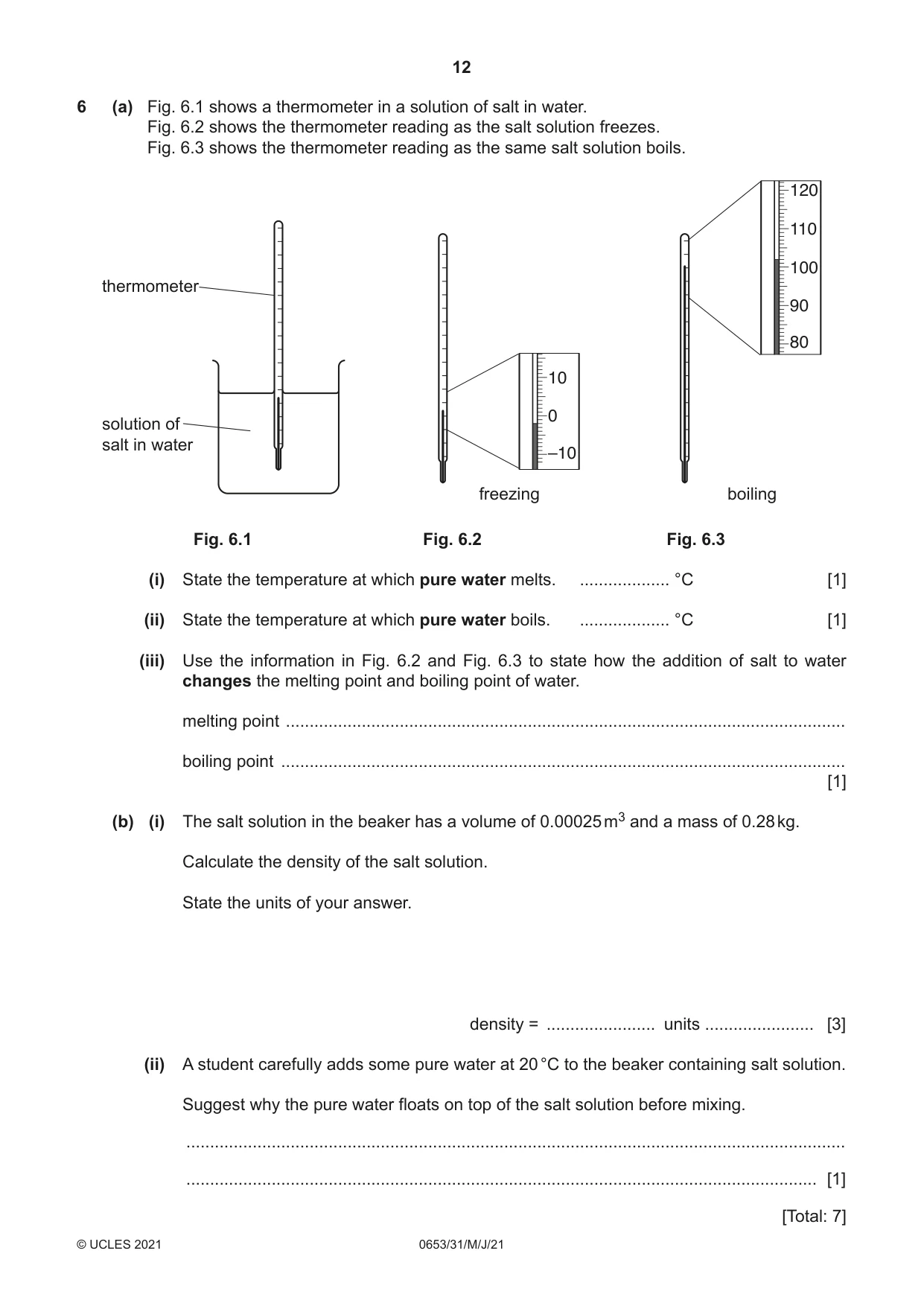
6 (a) Fig. 6.1 shows a thermometer in a solution of salt in water. Fig. 6.2 shows the thermometer reading as the salt solution freezes. Fig. 6.3 shows the thermometer reading as the same salt solution boils. 120 110 100 thermometer 90 80 10 0 solution of salt in water –10 freezing boiling Fig. 6.1 Fig. 6.2 Fig. 6.3 (i) State the temperature at which pure water melts. ................... °C [1] (ii) State the temperature at which pure water boils. ................... °C [1] (iii) Use the information in Fig. 6.2 and Fig. 6.3 to state how the addition of salt to water changes the melting point and boiling point of water. melting point ...................................................................................................................... boiling point ....................................................................................................................... [1] (b) (i) The salt solution in the beaker has a volume of 0.00025 m3 and a mass of 0.28 kg. Calculate the density of the salt solution. State the units of your answer. density = ....................... units ....................... [3] (ii) A student carefully adds some pure water at 20 °C to the beaker containing salt solution. Suggest why the pure water floats on top of the salt solution before mixing. ........................................................................................................................................... ..................................................................................................................................... [1] [Total: 7]
Mark scheme: 6(a)(i) 0 (°C) ; 1 6(a)(ii) 100 (°C) ; 1 6(a)(iii) melting point: (–2°C means salt) lowers melting point (of water) AND boiling point: (102°C means salt) raises boiling point (of water) ; 1 6(b)(i) density = m/V = 0.28 / 0.00025 ; (density =) 1120 OR 1100 ; (units) kg / m3 ; 3 6(b)(ii) (pure water / it is) less dense / has lower density (than salt solution) ; 1
Q7 · A diagram of the alimentary canal and associated organs
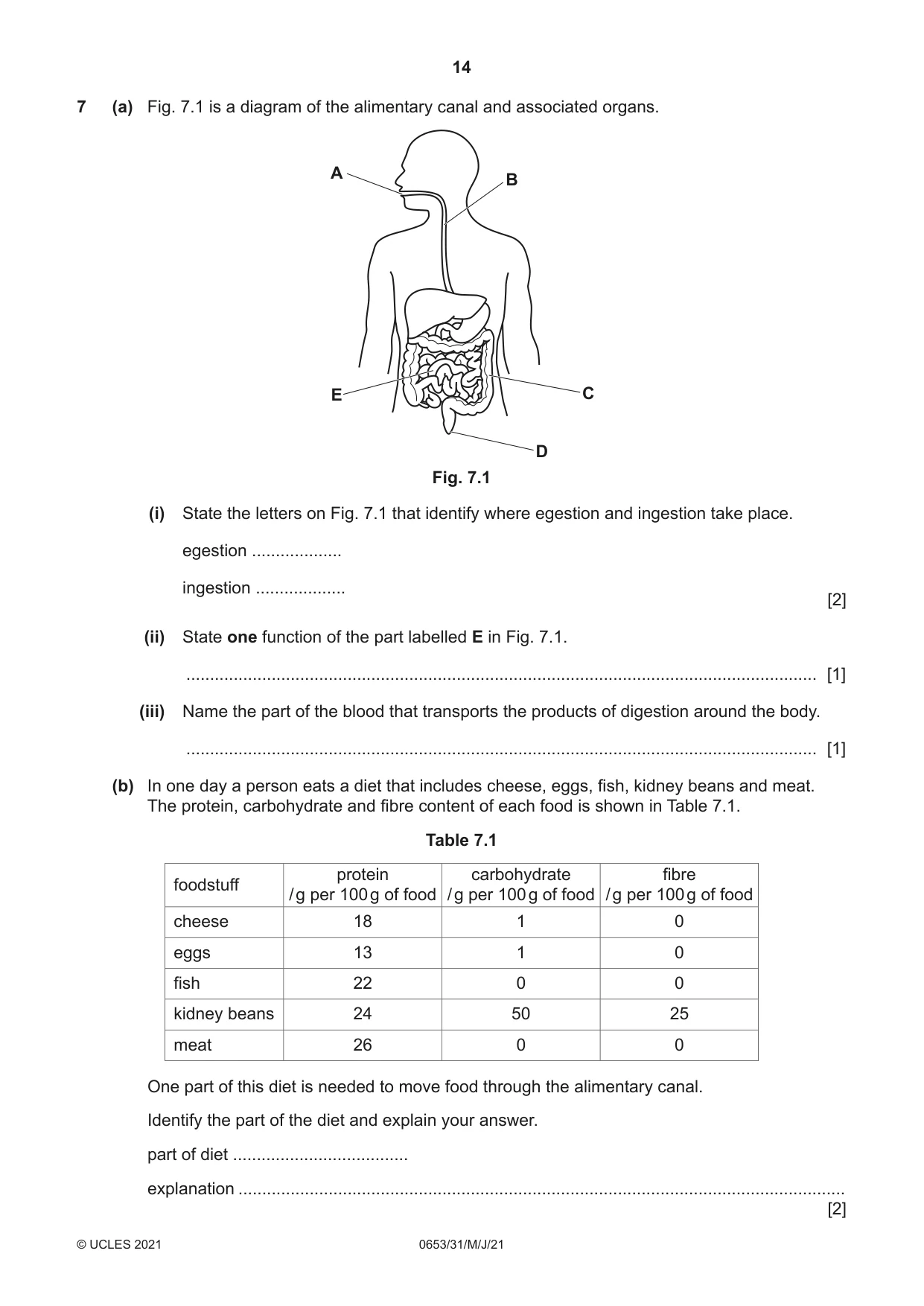
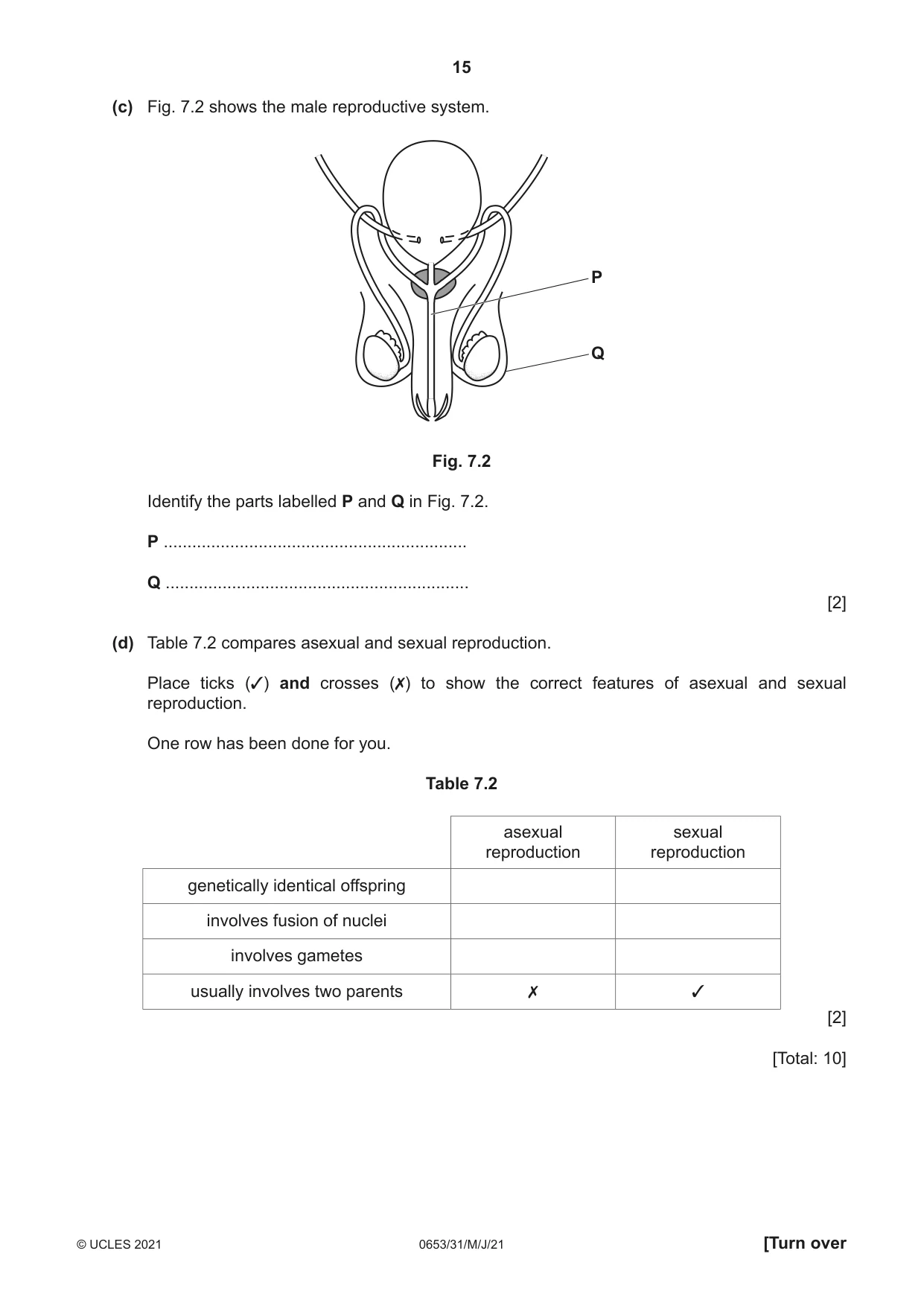
7 (a) Fig. 7.1 is a diagram of the alimentary canal and associated organs. A B E C D Fig. 7.1 (i) State the letters on Fig. 7.1 that identify where egestion and ingestion take place. egestion ................... ingestion ................... [2] (ii) State one function of the part labelled E in Fig. 7.1. ..................................................................................................................................... [1] (iii) Name the part of the blood that transports the products of digestion around the body. ..................................................................................................................................... [1] (b) In one day a person eats a diet that includes cheese, eggs, fish, kidney beans and meat. The protein, carbohydrate and fibre content of each food is shown in Table 7.1. Table 7.1 protein carbohydrate fibre foodstuff / g per 100 g of food / g per 100 g of food / g per 100 g of food cheese 18 1 0 eggs 13 1 0 fish 22 0 0 kidney beans 24 50 25 meat 26 0 0 One part of this diet is needed to move food through the alimentary canal. Identify the part of the diet and explain your answer. part of diet ..................................... explanation ................................................................................................................................ [2] (c) Fig. 7.2 shows the male reproductive system. P Q Fig. 7.2 Identify the parts labelled P and Q in Fig. 7.2. P ................................................................ Q ................................................................ [2] (d) Table 7.2 compares asexual and sexual reproduction. Place ticks (✓) and crosses (✗) to show the correct features of asexual and sexual reproduction. One row has been done for you. Table 7.2 asexual sexual reproduction reproduction genetically identical offspring involves fusion of nuclei involves gametes usually involves two parents ✗ ✓ [2] [Total: 10]
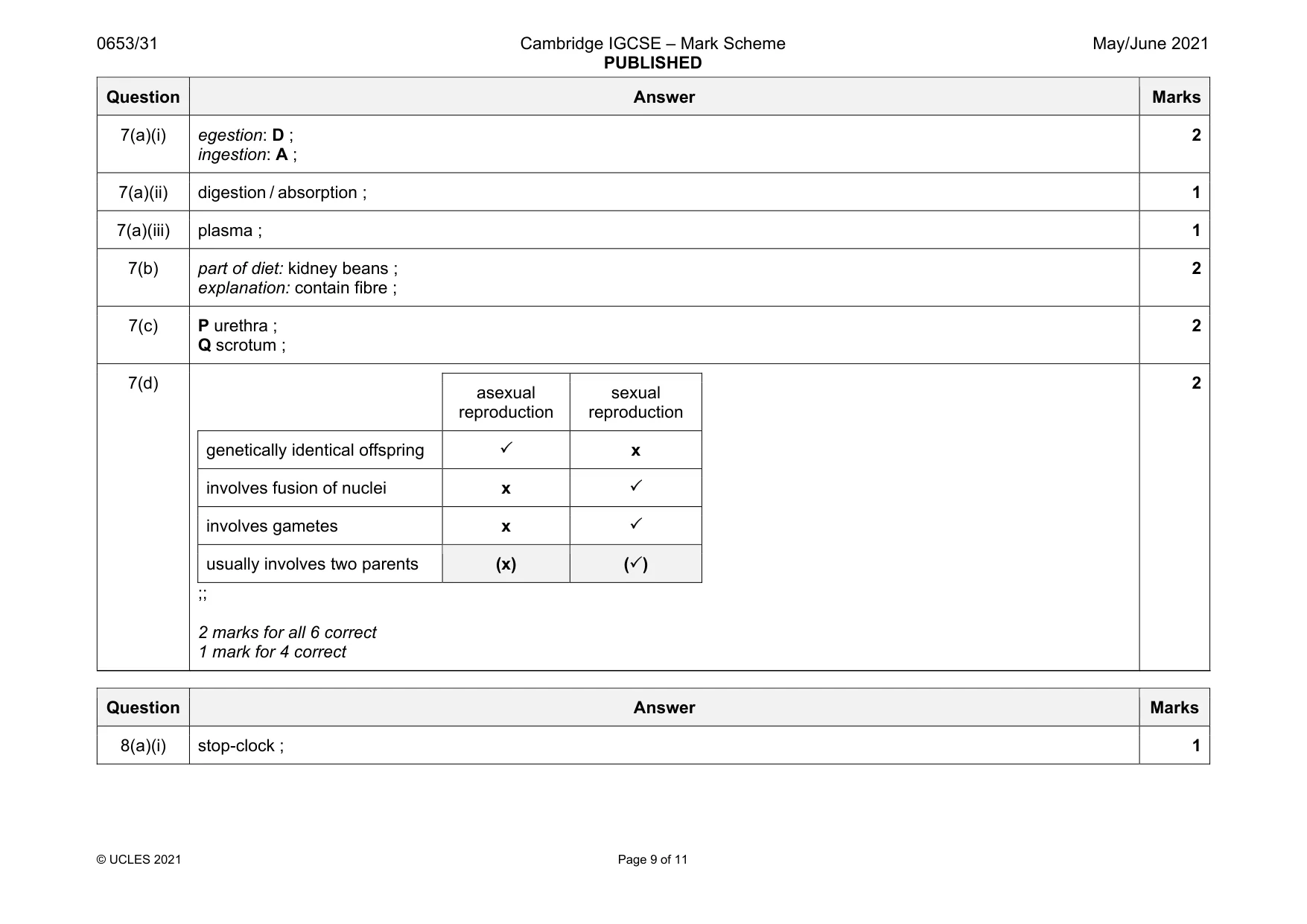
Mark scheme: 7(a)(i) egestion: D ; ingestion: A ; 2 7(a)(ii) digestion / absorption ; 1 7(a)(iii) plasma ; 1 7(b) part of diet: kidney beans ; explanation: contain fibre ; 2 7(c) P urethra ; Q scrotum ; 2 7(d) asexual reproduction sexual reproduction genetically identical offspring x involves fusion of nuclei x involves gametes x usually involves two parents (x) () ;; 2 marks for all 6 correct 1 mark for 4 correct 2
Q8 · A student reacts a piece of magnesium with dilute hydrochloric acid, as shown in Fig
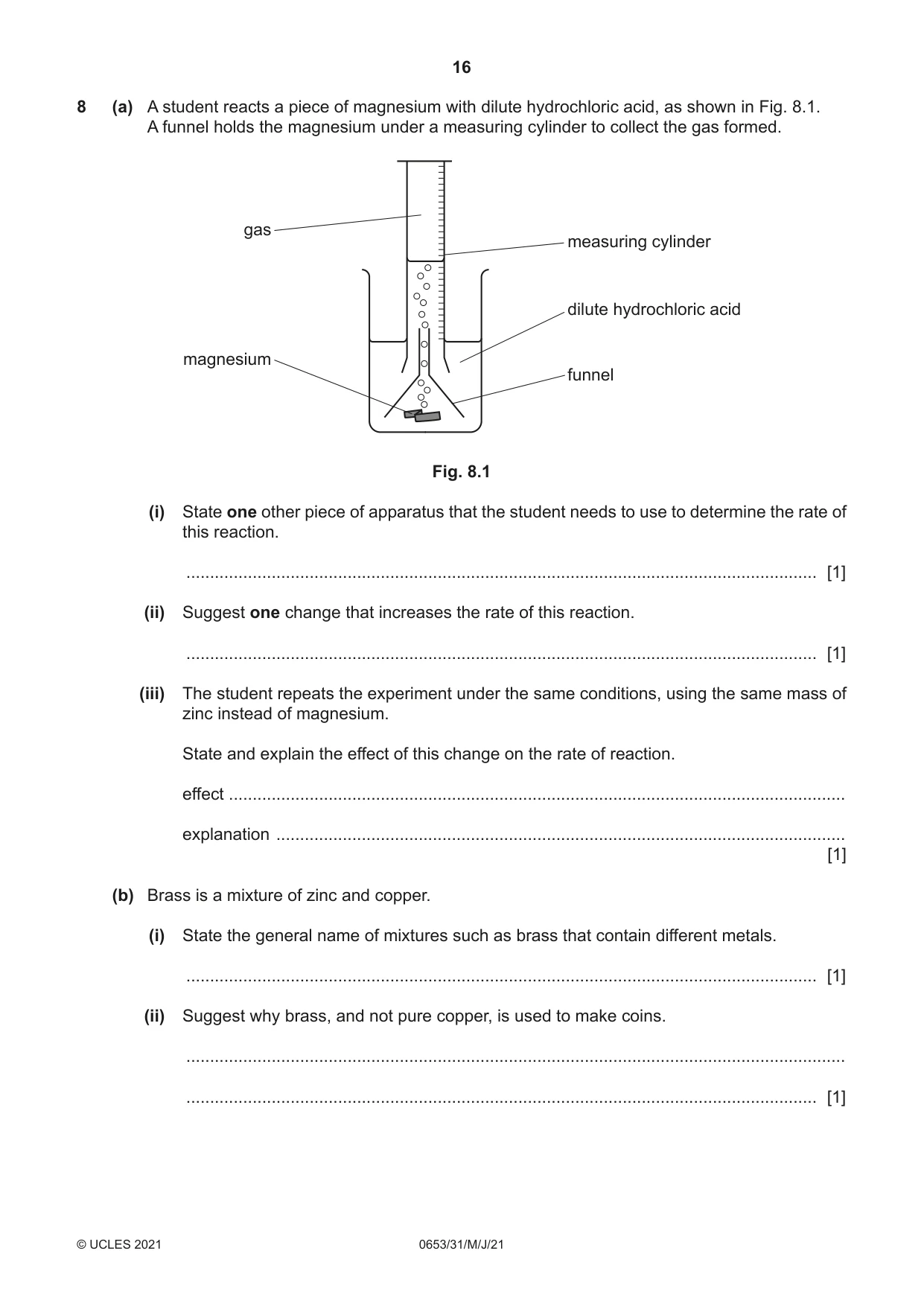
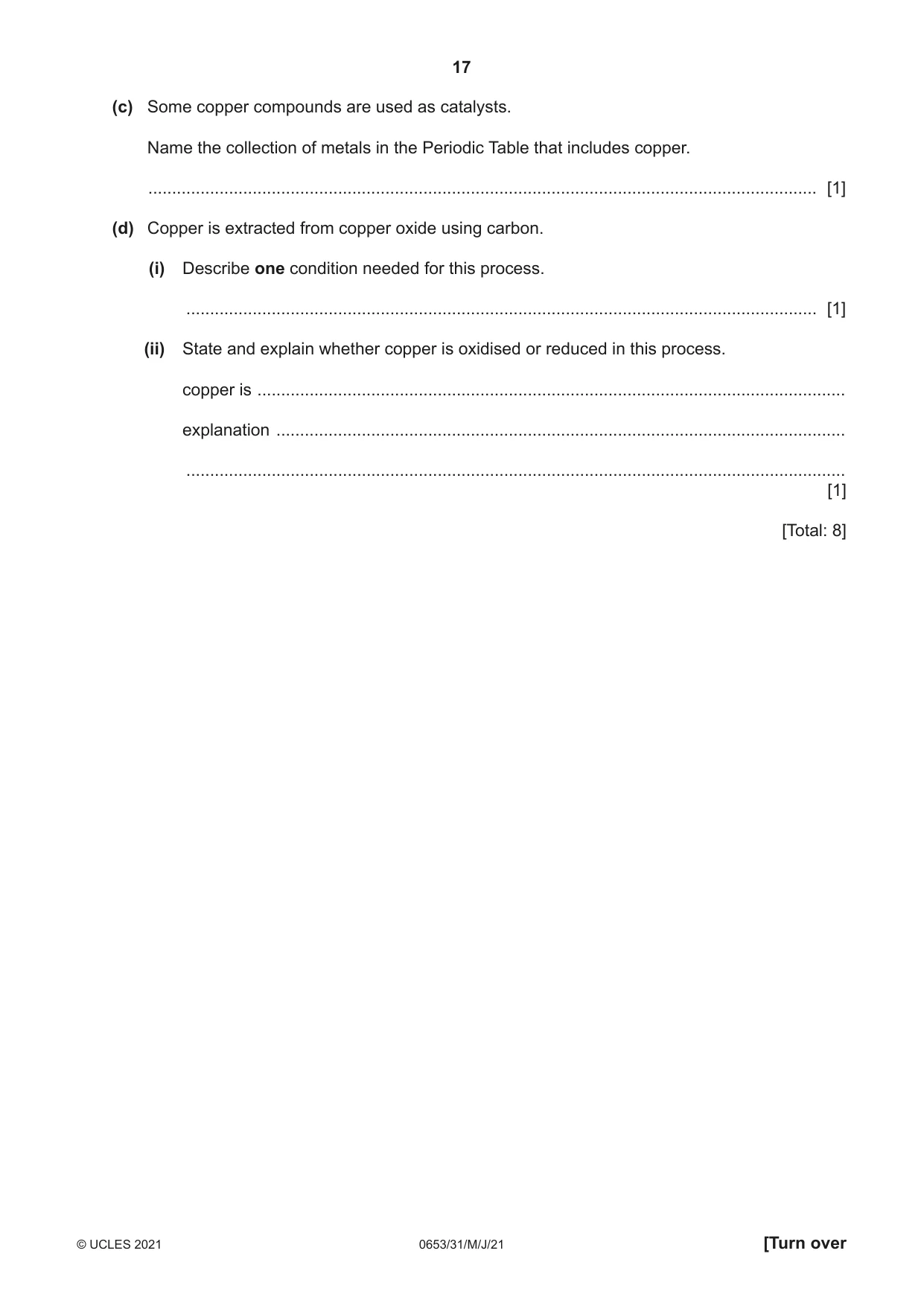
8 (a) A student reacts a piece of magnesium with dilute hydrochloric acid, as shown in Fig. 8.1. A funnel holds the magnesium under a measuring cylinder to collect the gas formed. gas measuring cylinder dilute hydrochloric acid magnesium funnel Fig. 8.1 (i) State one other piece of apparatus that the student needs to use to determine the rate of this reaction. ..................................................................................................................................... [1] (ii) Suggest one change that increases the rate of this reaction. ..................................................................................................................................... [1] (iii) The student repeats the experiment under the same conditions, using the same mass of zinc instead of magnesium. State and explain the effect of this change on the rate of reaction. effect .................................................................................................................................. explanation ........................................................................................................................ [1] (b) Brass is a mixture of zinc and copper. (i) State the general name of mixtures such as brass that contain different metals. ..................................................................................................................................... [1] (ii) Suggest why brass, and not pure copper, is used to make coins. ........................................................................................................................................... ..................................................................................................................................... [1] (c) Some copper compounds are used as catalysts. Name the collection of metals in the Periodic Table that includes copper. ............................................................................................................................................. [1] (d) Copper is extracted from copper oxide using carbon. (i) Describe one condition needed for this process. ..................................................................................................................................... [1] (ii) State and explain whether copper is oxidised or reduced in this process. copper is ............................................................................................................................ explanation ........................................................................................................................ ........................................................................................................................................... [1] [Total: 8]
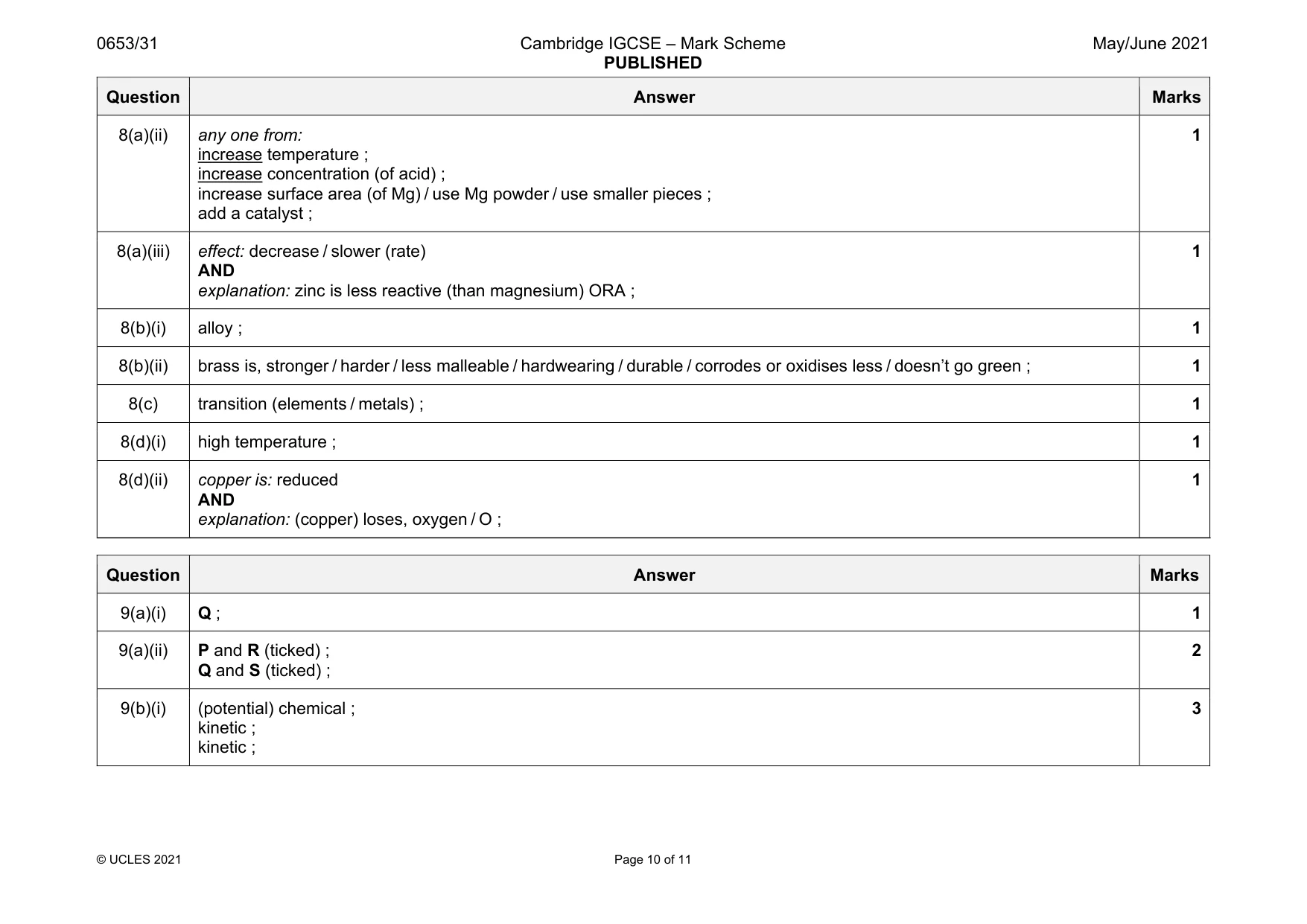
Mark scheme: 8(a)(i) stop-clock ; 1 Question Answer Marks 8(a)(ii) any one from: increase temperature ; increase concentration (of acid) ; increase surface area (of Mg) / use Mg powder / use smaller pieces ; add a catalyst ; 1 8(a)(iii) effect: decrease / slower (rate) AND explanation: zinc is less reactive (than magnesium) ORA ; 1 8(b)(i) alloy ; 1 8(b)(ii) brass is, stronger / harder / less malleable / hardwearing / durable / corrodes or oxidises less / doesn’t go green ; 1 8(c) transition (elements / metals) ; 1 8(d)(i) high temperature ; 1 8(d)(ii) copper is: reduced AND explanation: (copper) loses, oxygen / O ; 1
Q9 · A motor boat moving forward across the sea
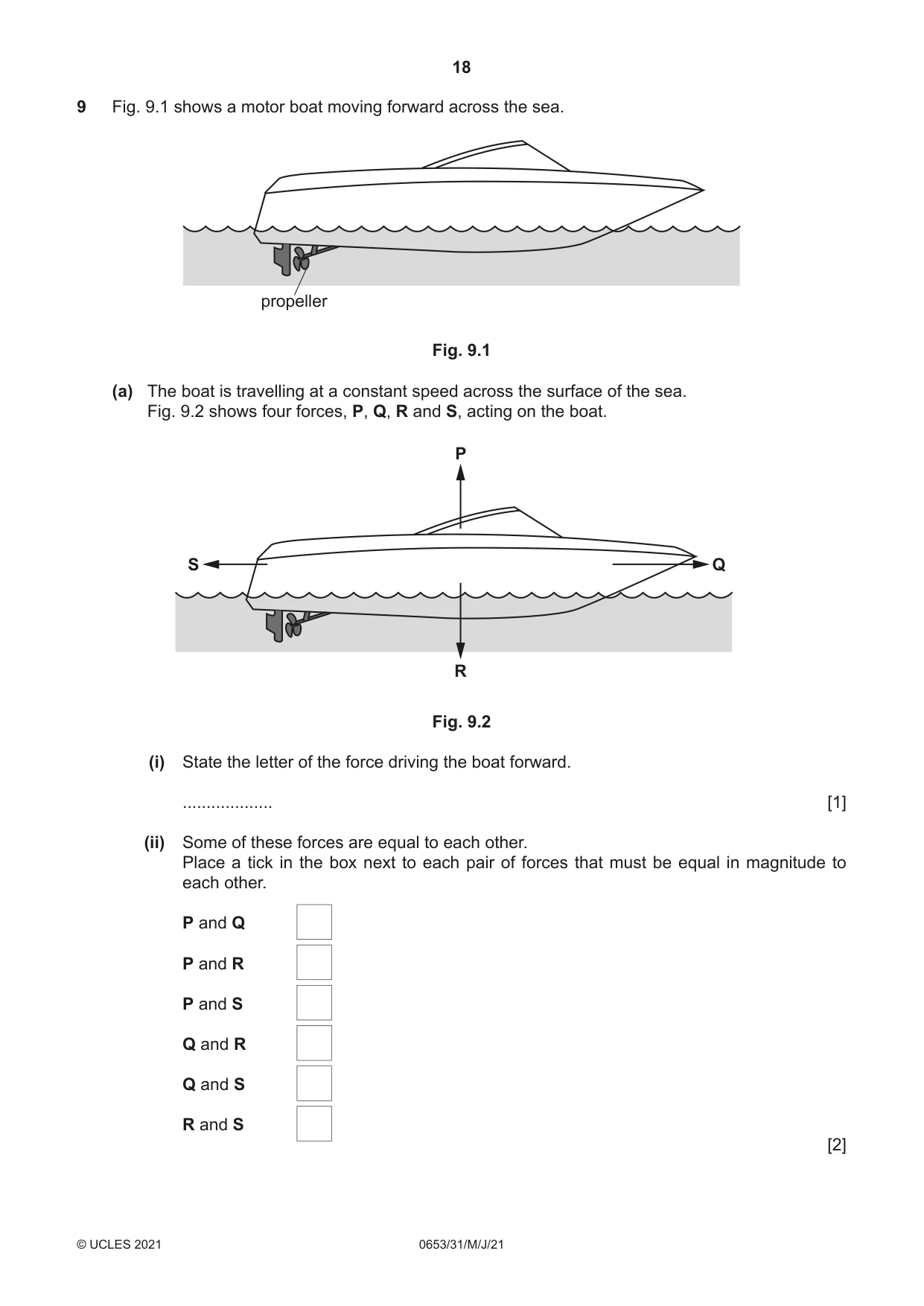
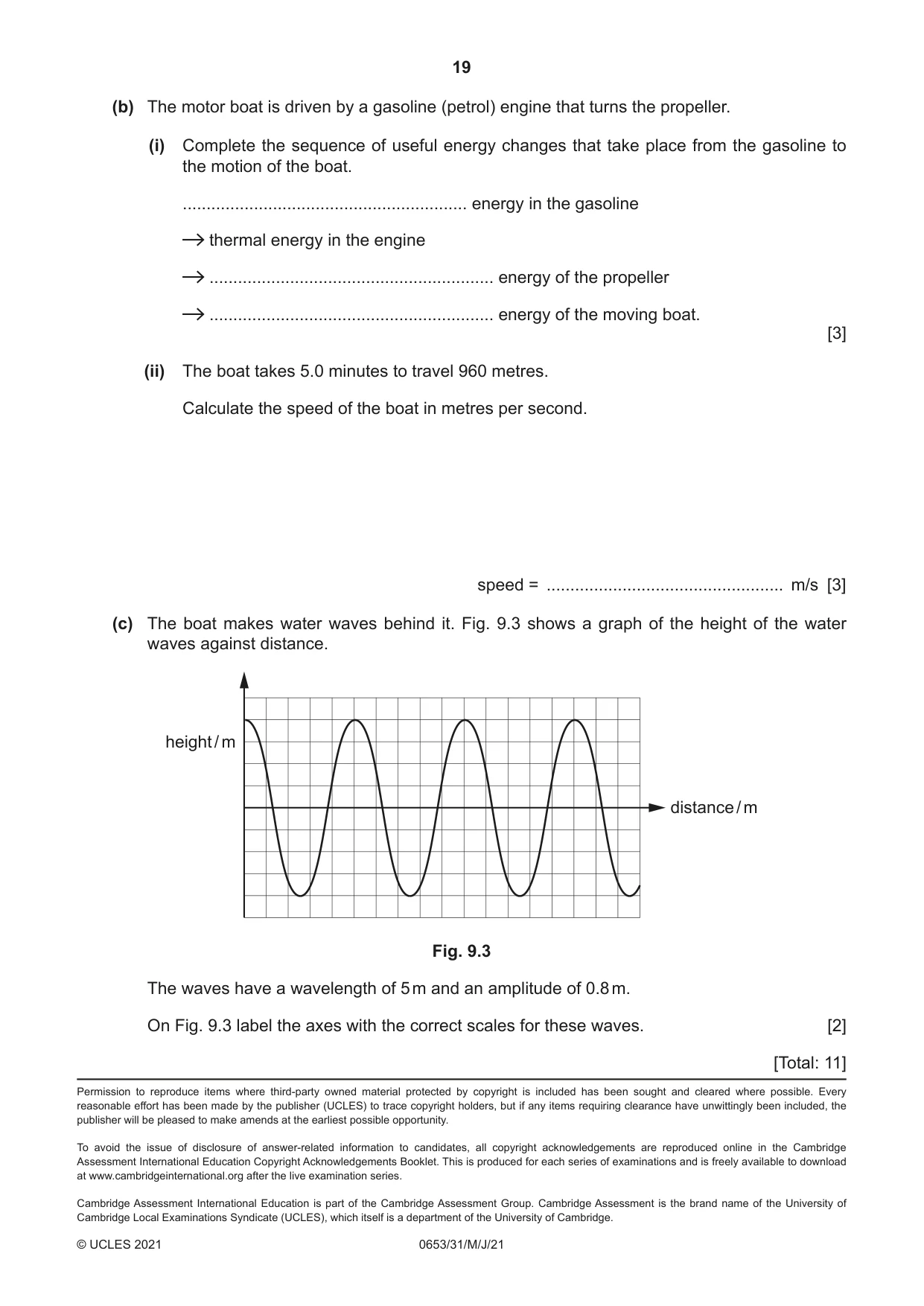
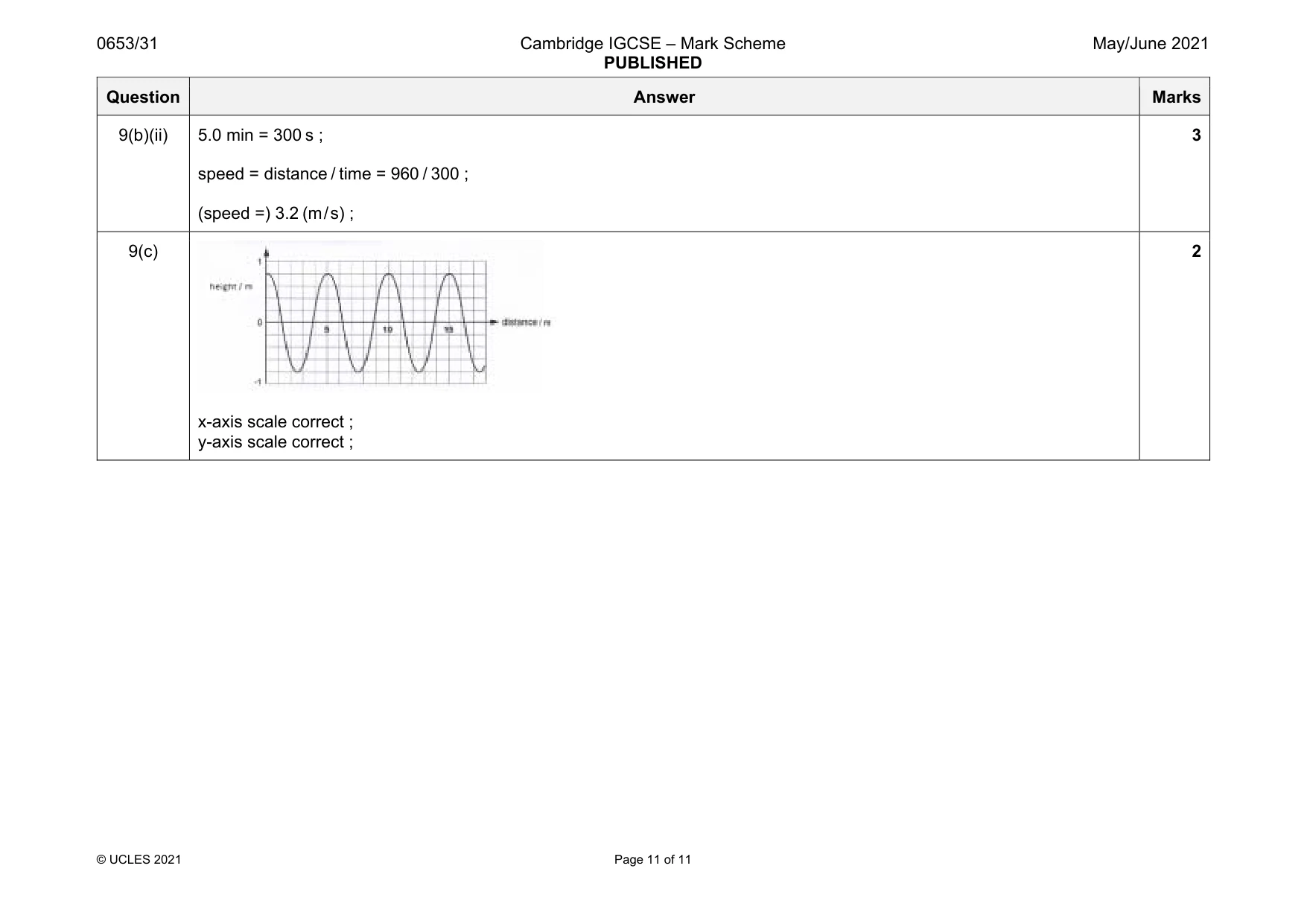
9 Fig. 9.1 shows a motor boat moving forward across the sea. propeller Fig. 9.1 (a) The boat is travelling at a constant speed across the surface of the sea. Fig. 9.2 shows four forces, P, Q, R and S, acting on the boat. P S Q R Fig. 9.2 (i) State the letter of the force driving the boat forward. ................... [1] (ii) Some of these forces are equal to each other. Place a tick in the box next to each pair of forces that must be equal in magnitude to each other. P and Q P and R P and S Q and R Q and S R and S [2] (b) The motor boat is driven by a gasoline (petrol) engine that turns the propeller. (i) Complete the sequence of useful energy changes that take place from the gasoline to the motion of the boat. ............................................................ energy in the gasoline thermal energy in the engine ............................................................ energy of the propeller ............................................................ energy of the moving boat. [3] (ii) The boat takes 5.0 minutes to travel 960 metres. Calculate the speed of the boat in metres per second. speed = .................................................. m/s [3] (c) The boat makes water waves behind it. Fig. 9.3 shows a graph of the height of the water waves against distance. height / m distance / m Fig. 9.3 The waves have a wavelength of 5 m and an amplitude of 0.8 m. On Fig. 9.3 label the axes with the correct scales for these waves. [2] [Total: 11]
Mark scheme: 9(a)(i) Q ; 1 9(a)(ii) P and R (ticked) ; Q and S (ticked) ; 2 9(b)(i) (potential) chemical ; kinetic ; kinetic ; 3 Question Answer Marks 9(b)(ii) 5.0 min = 300 s ; speed = distance / time = 960 / 300 ; (speed =) 3.2 (m / s) ; 3 9(c) x-axis scale correct ; y-axis scale correct ; 2
What was in this paper
The subtopics covered by these 9 questions, and how many questions each got. Open one in a new tab to see every Cambridge question on it.
What you needed in this session
Cambridge’s own grade thresholds for 2021 May/June, Paper 3 · Variant 1. A higher threshold means an easier paper — the bar moves with how the cohort did.