Cambridge IGCSE Science - Combined 0653 — 2020 Feb/March Paper 3 · Variant 2
0653/32/F/M/20 · 9 questions · 80 marks · ≈90 min
The question paper and its mark scheme, free to read here and free to download. This is Cambridge’s own paper, exactly as it was sat.
Question paper24 pages


Mark scheme12 pages
Answers below. Sit the paper first if you are practising.
Questions as text
Q1 · A diagram of a human heart
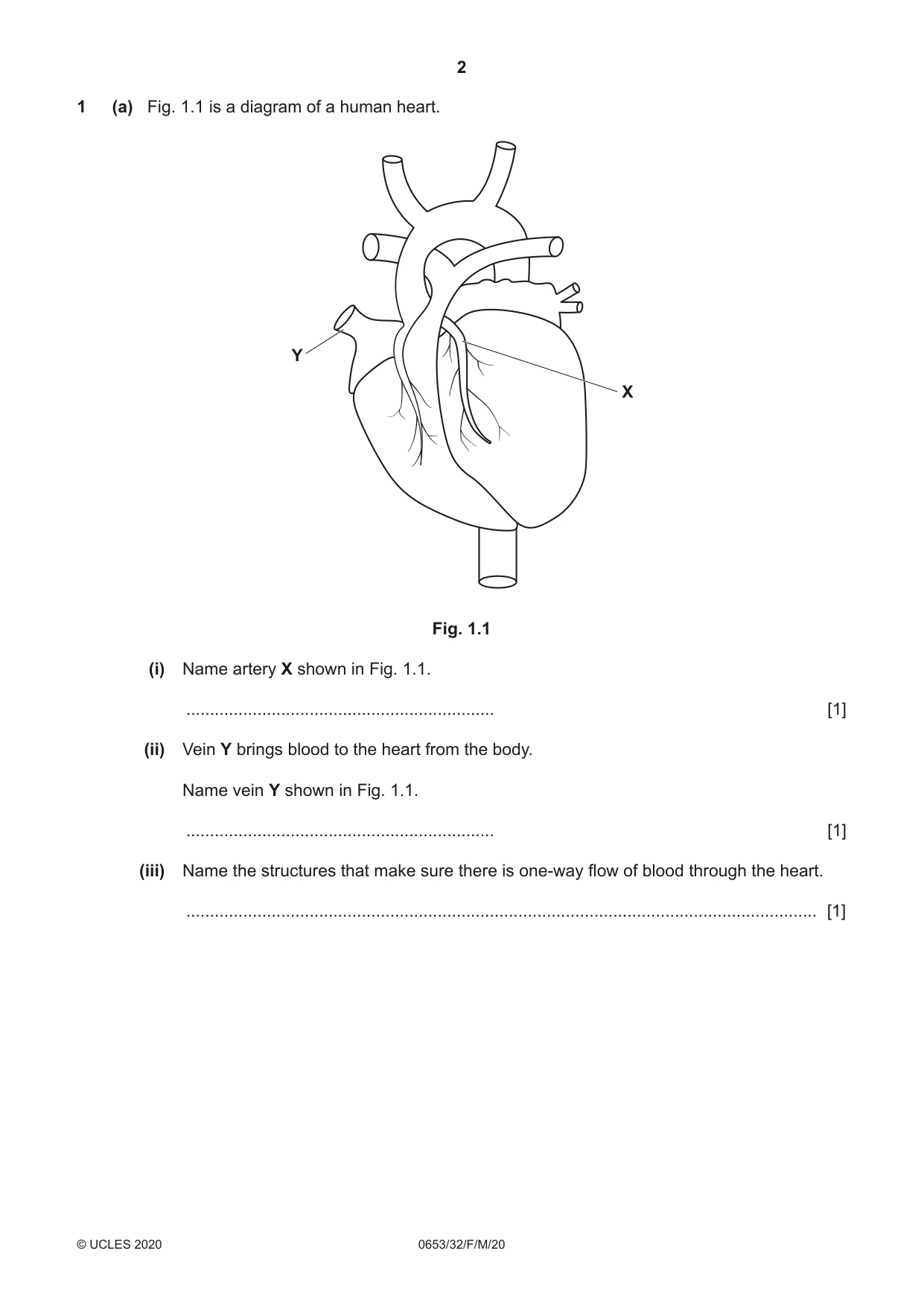
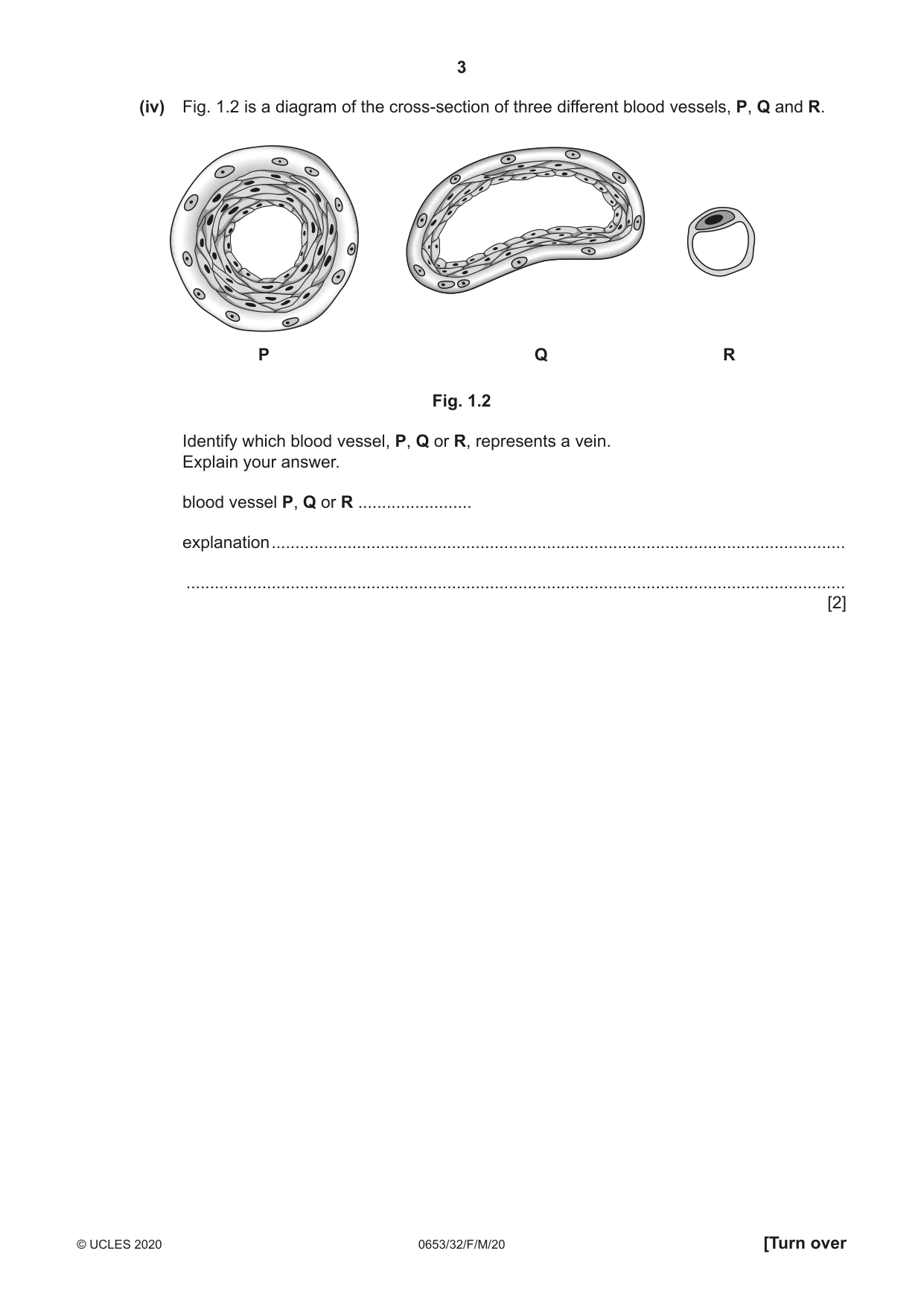
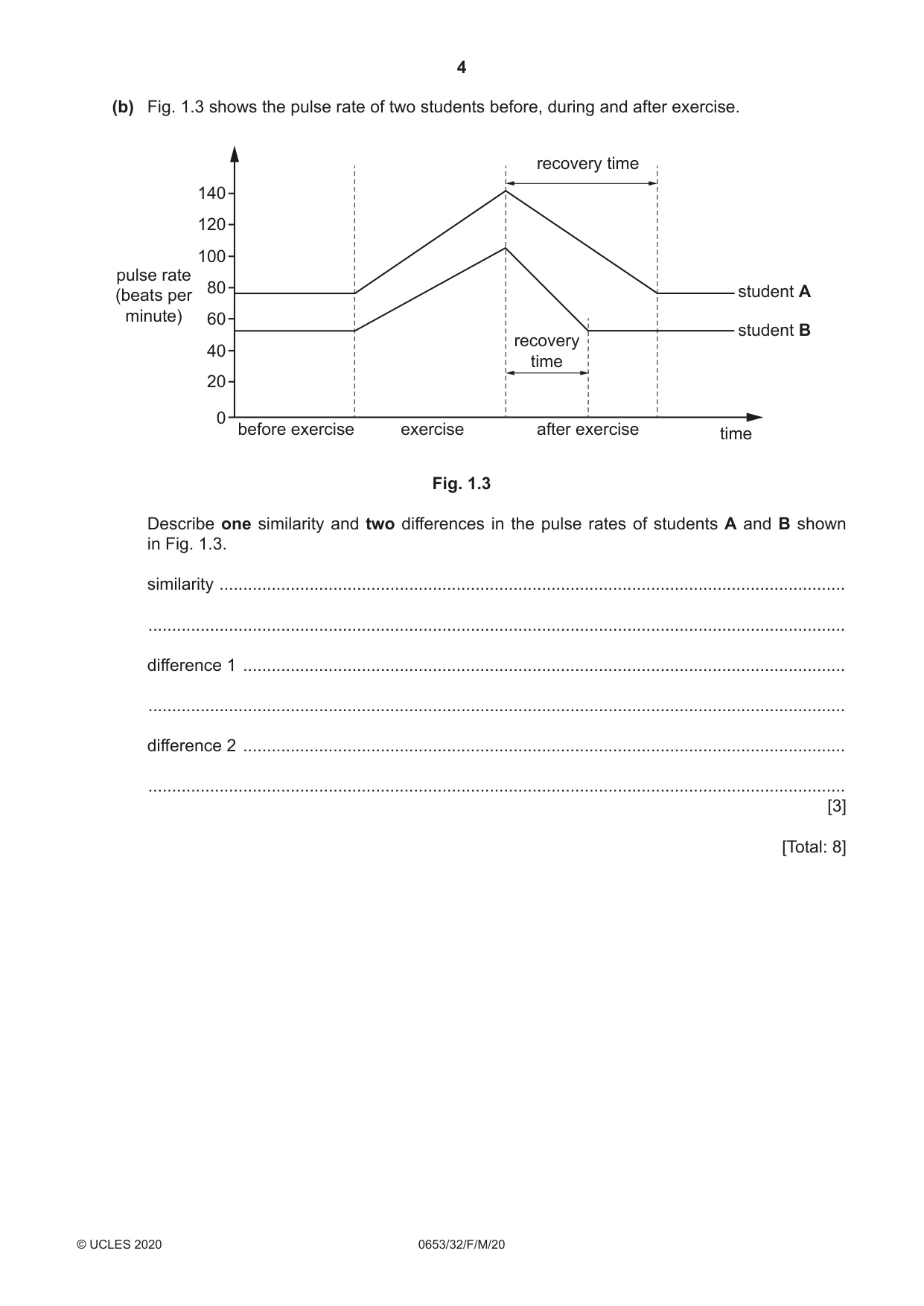
1 (a) Fig. 1.1 is a diagram of a human heart. Y X Fig. 1.1 (i) Name artery X shown in Fig. 1.1. ................................................................. [1] (ii) Vein Y brings blood to the heart from the body. Name vein Y shown in Fig. 1.1. ................................................................. [1] (iii) Name the structures that make sure there is one-way flow of blood through the heart. ..................................................................................................................................... [1] (iv) Fig. 1.2 is a diagram of the cross-section of three different blood vessels, P, Q and R. P Q R Fig. 1.2 Identify which blood vessel, P, Q or R, represents a vein. Explain your answer. blood vessel P, Q or R ........................ explanation ......................................................................................................................... ........................................................................................................................................... [2] (b) Fig. 1.3 shows the pulse rate of two students before, during and after exercise. recovery time 140 120 100 pulse rate 80 student A(beats per minute) 60 student B recovery 40 time 20 0 before exercise exercise after exercise time Fig. 1.3 Describe one similarity and two differences in the pulse rates of students A and B shown in Fig. 1.3. similarity .................................................................................................................................... ................................................................................................................................................... difference 1 ............................................................................................................................... ................................................................................................................................................... difference 2 ............................................................................................................................... ................................................................................................................................................... [3] [Total: 8]
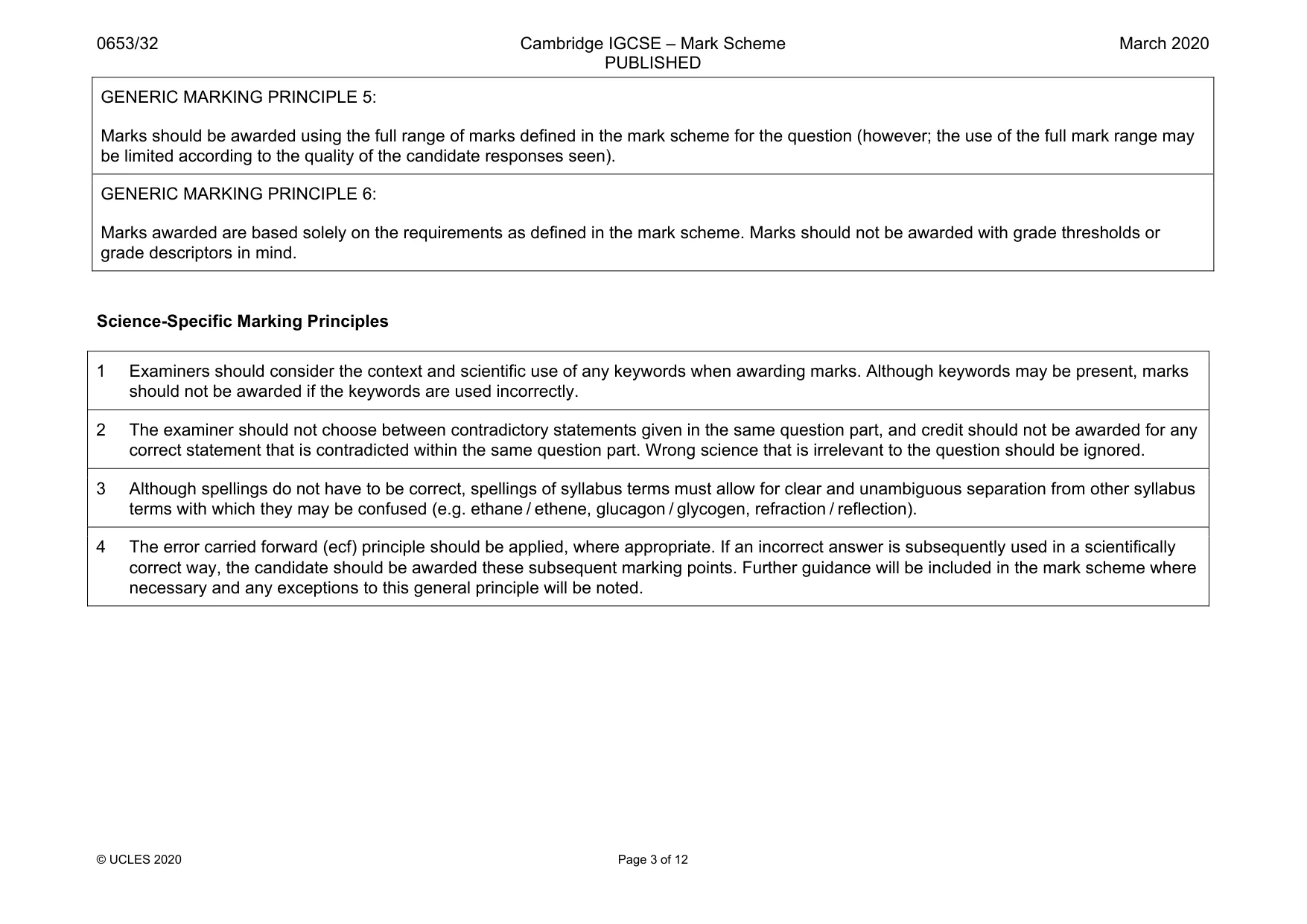
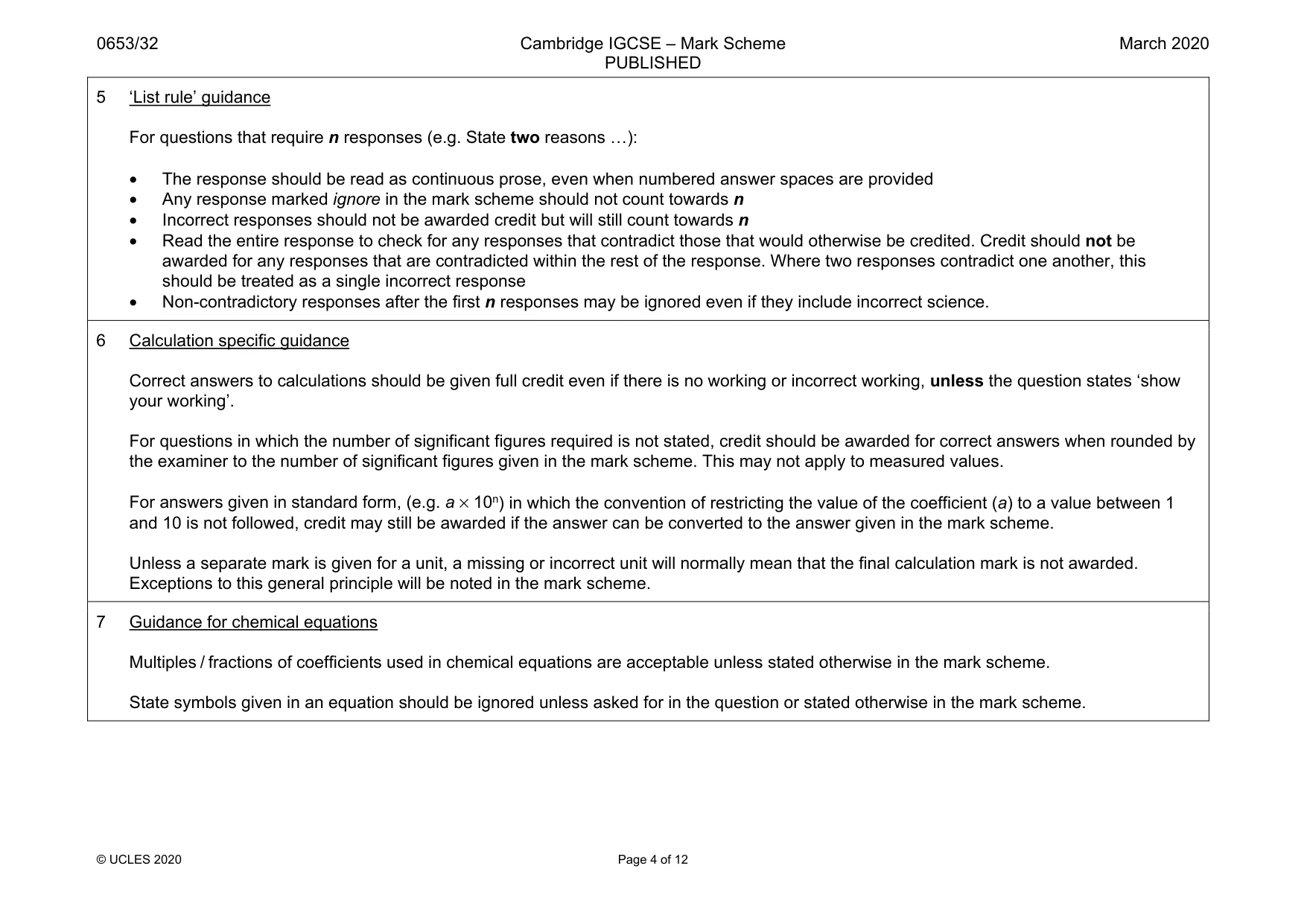
Mark scheme: 1(a)(i) coronary ; 1 1(a)(ii) vena cava ; 1 1(a)(iii) valves ; 1 1(a)(iv) Q ; and any one from: has a large lumen ; has a thin (muscle) wall ; 2 1(b) (similarity) any one from: pulse rates increase during exercise ; pulse rates decrease after exercise ; pulse rates return, to normal / to rate before exercise ; (differences) any two from: Student A has higher pulse rate (before or during or after exercise) / ora ; Student A has higher increase in pulse rate (during exercise) / ora ; Student A has longer recovery time / ora ; 3
Q2 · A student investigates three solid elements, X, Y and Z
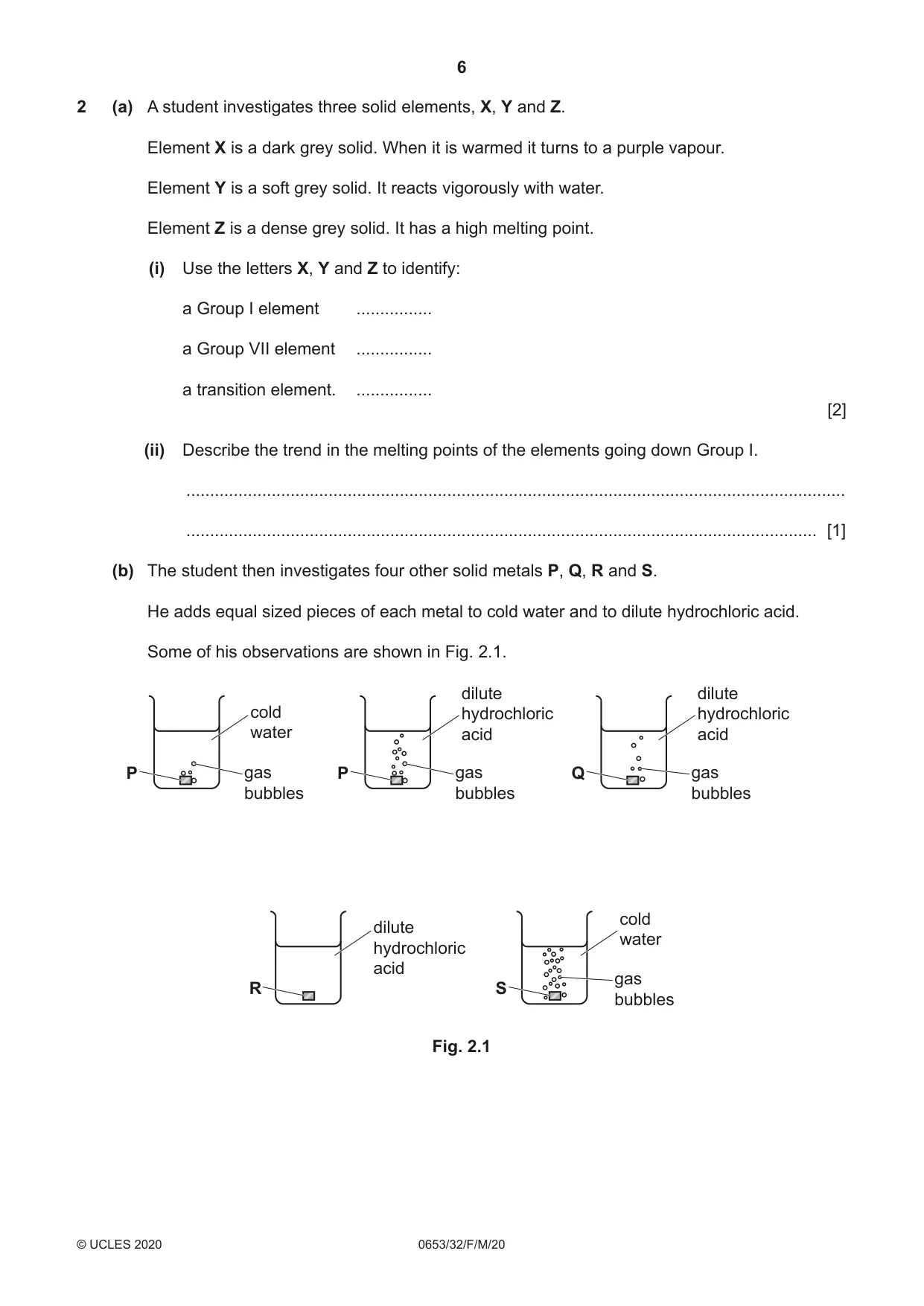
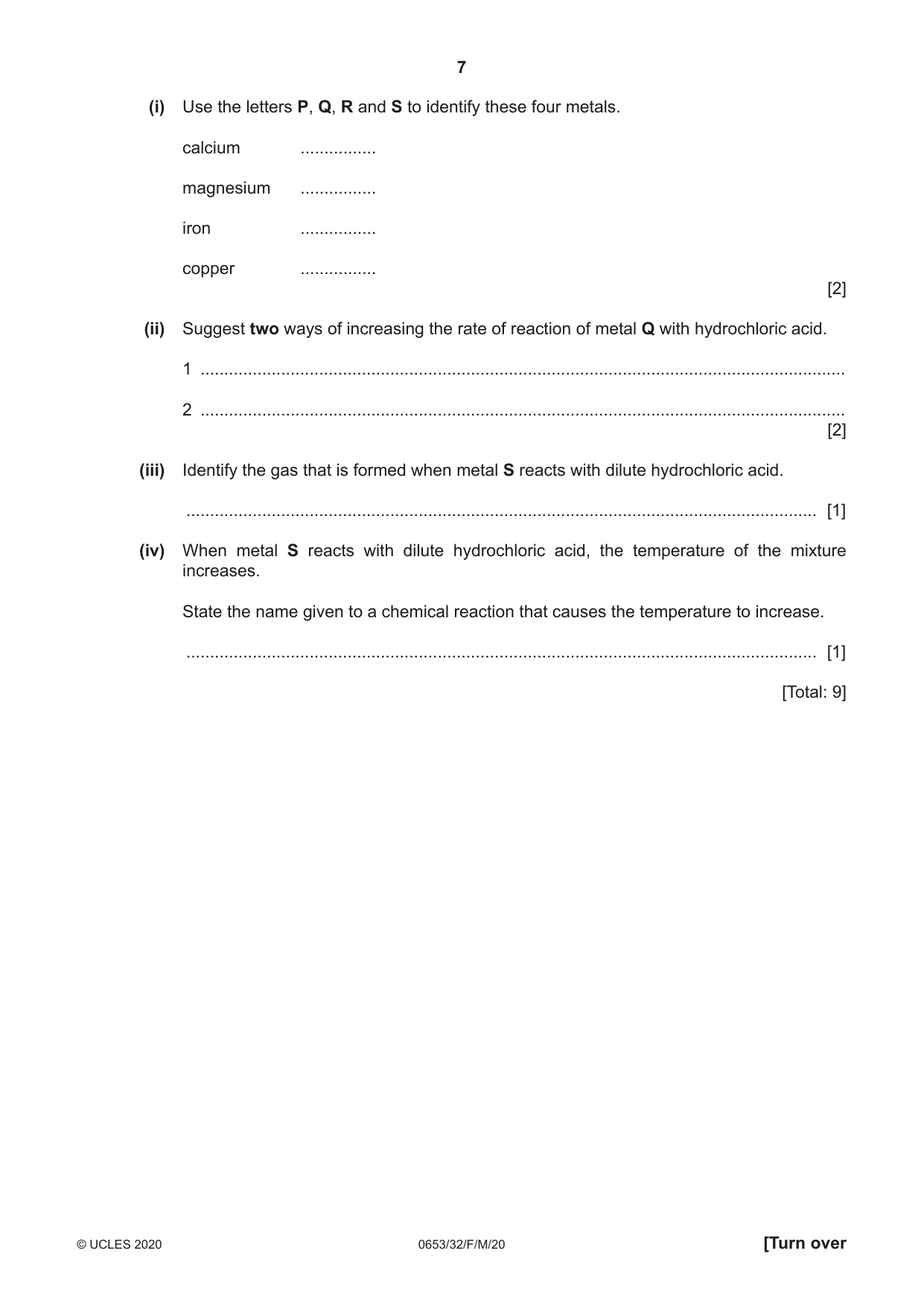
2 (a) A student investigates three solid elements, X, Y and Z. Element X is a dark grey solid. When it is warmed it turns to a purple vapour. Element Y is a soft grey solid. It reacts vigorously with water. Element Z is a dense grey solid. It has a high melting point. (i) Use the letters X, Y and Z to identify: a Group I element ................ a Group VII element ................ a transition element. ................ [2] (ii) Describe the trend in the melting points of the elements going down Group I. ........................................................................................................................................... ..................................................................................................................................... [1] (b) The student then investigates four other solid metals P, Q, R and S. He adds equal sized pieces of each metal to cold water and to dilute hydrochloric acid. Some of his observations are shown in Fig. 2.1. dilute dilute cold hydrochloric hydrochloric water acid acid P gas P gas Q gas bubbles bubbles bubbles cold dilute water hydrochloric acid gas R S bubbles Fig. 2.1 (i) Use the letters P, Q, R and S to identify these four metals. calcium ................ magnesium ................ iron ................ copper ................ [2] (ii) Suggest two ways of increasing the rate of reaction of metal Q with hydrochloric acid. 1 ........................................................................................................................................ 2 ........................................................................................................................................ [2] (iii) Identify the gas that is formed when metal S reacts with dilute hydrochloric acid. ..................................................................................................................................... [1] (iv) When metal S reacts with dilute hydrochloric acid, the temperature of the mixture increases. State the name given to a chemical reaction that causes the temperature to increase. ..................................................................................................................................... [1] [Total: 9]
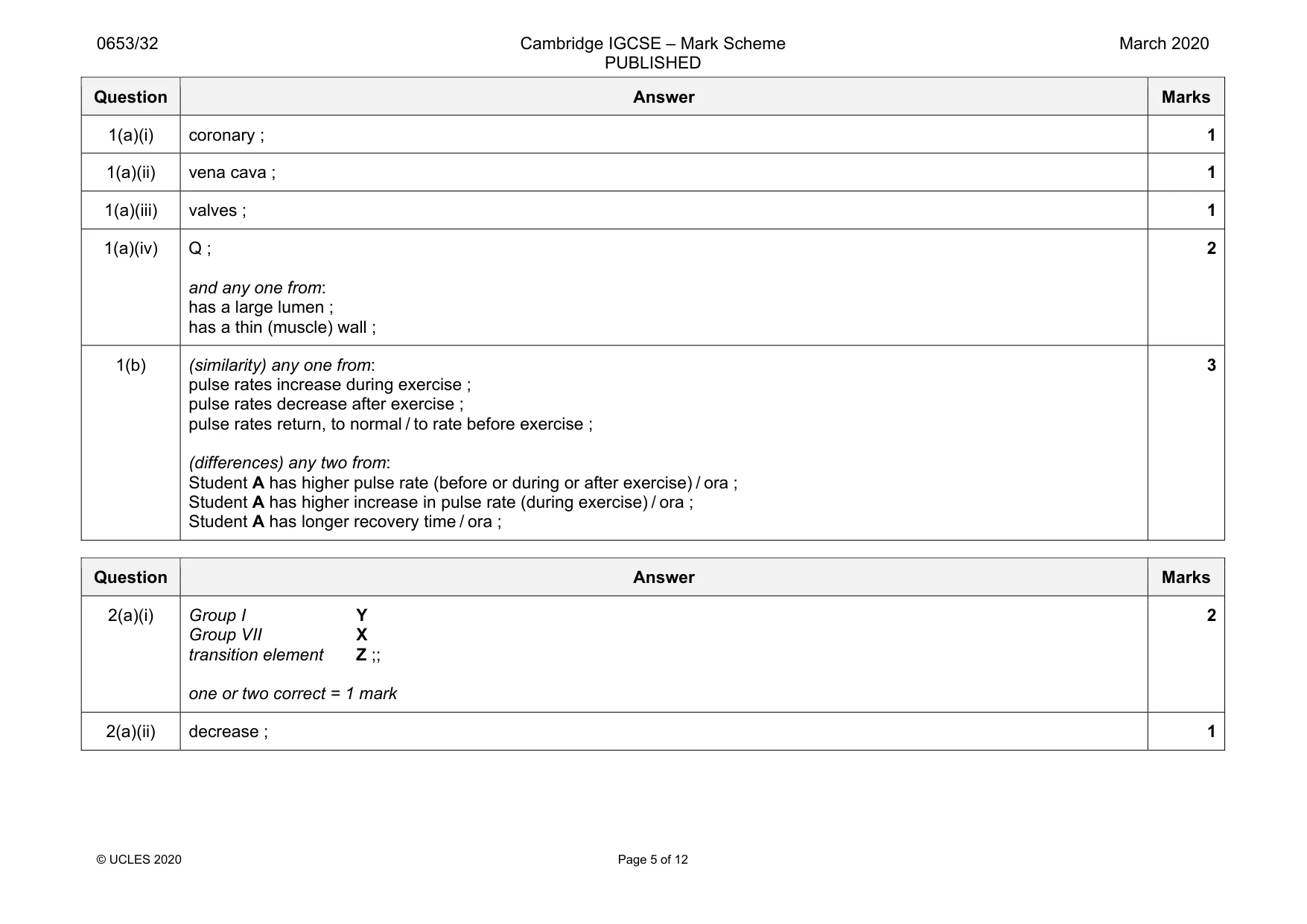
Mark scheme: 2(a)(i) Group I Y Group VII X transition element Z ;; one or two correct = 1 mark 2 2(a)(ii) decrease ; 1 Question Answer Marks 2(b)(i) calcium S magnesium P iron Q copper R ;; magnesium correct = 1 mark 2 2(b)(ii) any two from: increase concentration ; increase temperature ; (use a) catalyst ; Increase surface area of metal / (use) powder / smaller pieces (of metal) ; max 2 2(b)(iii) hydrogen / H2 ; 1 2(b)(iv) exothermic ; 1
Q3 · Liquid (molten) iron being poured from a furnace into a mould to form a rectangular block…
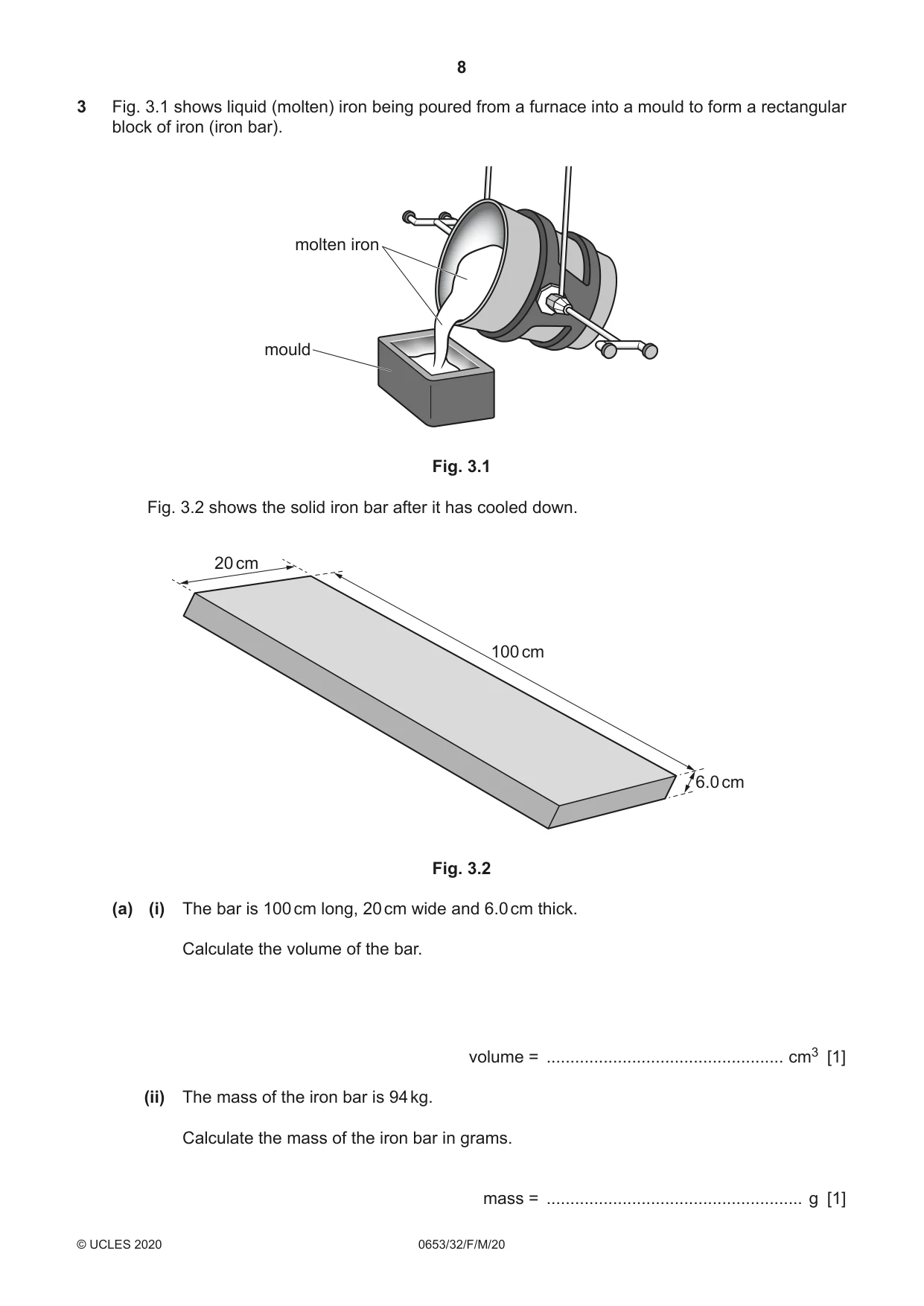
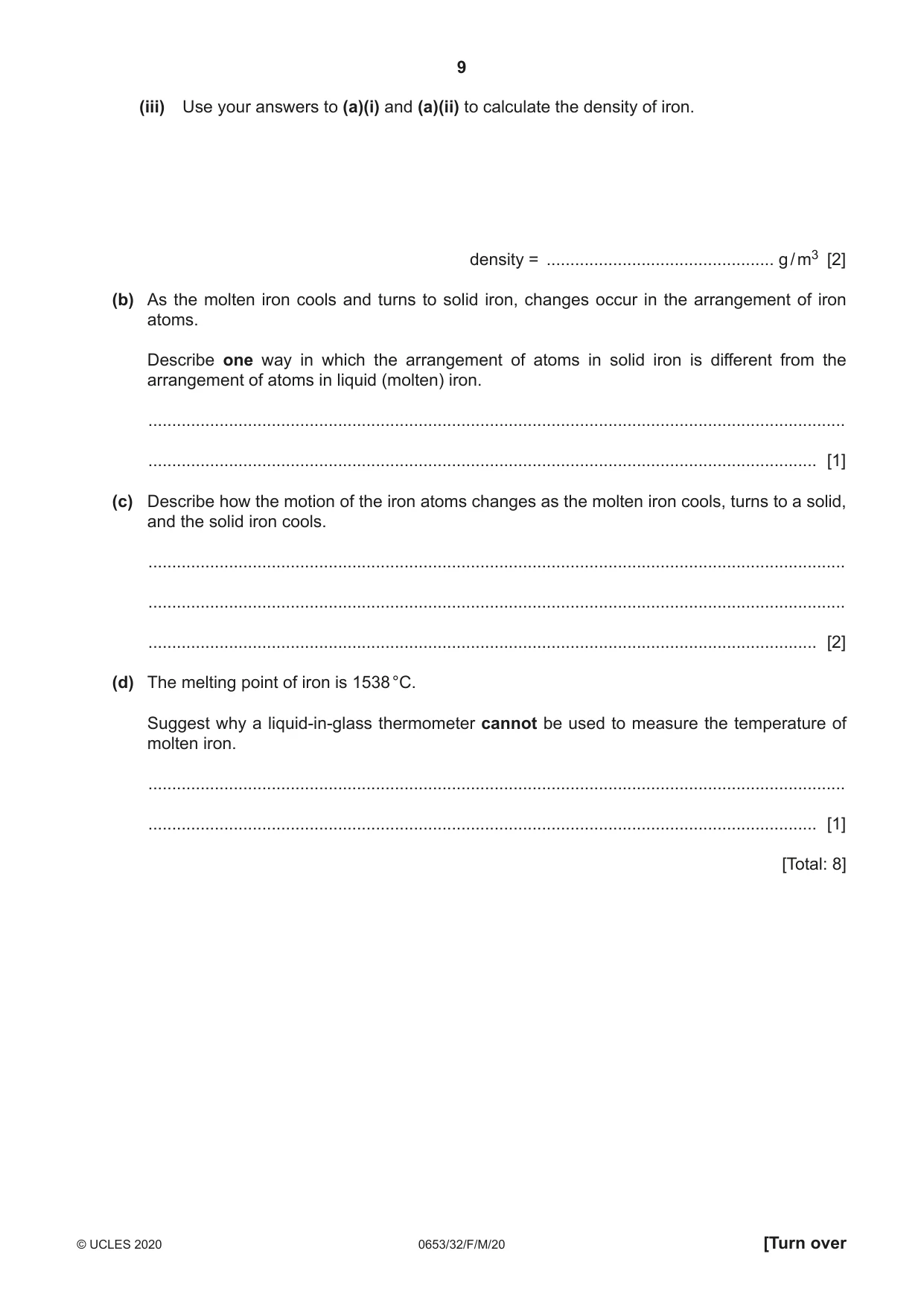
3 Fig. 3.1 shows liquid (molten) iron being poured from a furnace into a mould to form a rectangular block of iron (iron bar). molten iron mould Fig. 3.1 Fig. 3.2 shows the solid iron bar after it has cooled down. 20 cm 100 cm 6.0 cm Fig. 3.2 (a) (i) The bar is 100 cm long, 20 cm wide and 6.0 cm thick. Calculate the volume of the bar. volume = .................................................. cm3 [1] (ii) The mass of the iron bar is 94 kg. Calculate the mass of the iron bar in grams. mass = ...................................................... g [1] (iii) Use your answers to (a)(i) and (a)(ii) to calculate the density of iron. density = ................................................ g / m3 [2] (b) As the molten iron cools and turns to solid iron, changes occur in the arrangement of iron atoms. Describe one way in which the arrangement of atoms in solid iron is different from the arrangement of atoms in liquid (molten) iron. ................................................................................................................................................... ............................................................................................................................................. [1] (c) Describe how the motion of the iron atoms changes as the molten iron cools, turns to a solid, and the solid iron cools. ................................................................................................................................................... ................................................................................................................................................... ............................................................................................................................................. [2] (d) The melting point of iron is 1538 °C. Suggest why a liquid-in-glass thermometer cannot be used to measure the temperature of molten iron. ................................................................................................................................................... ............................................................................................................................................. [1] [Total: 8]
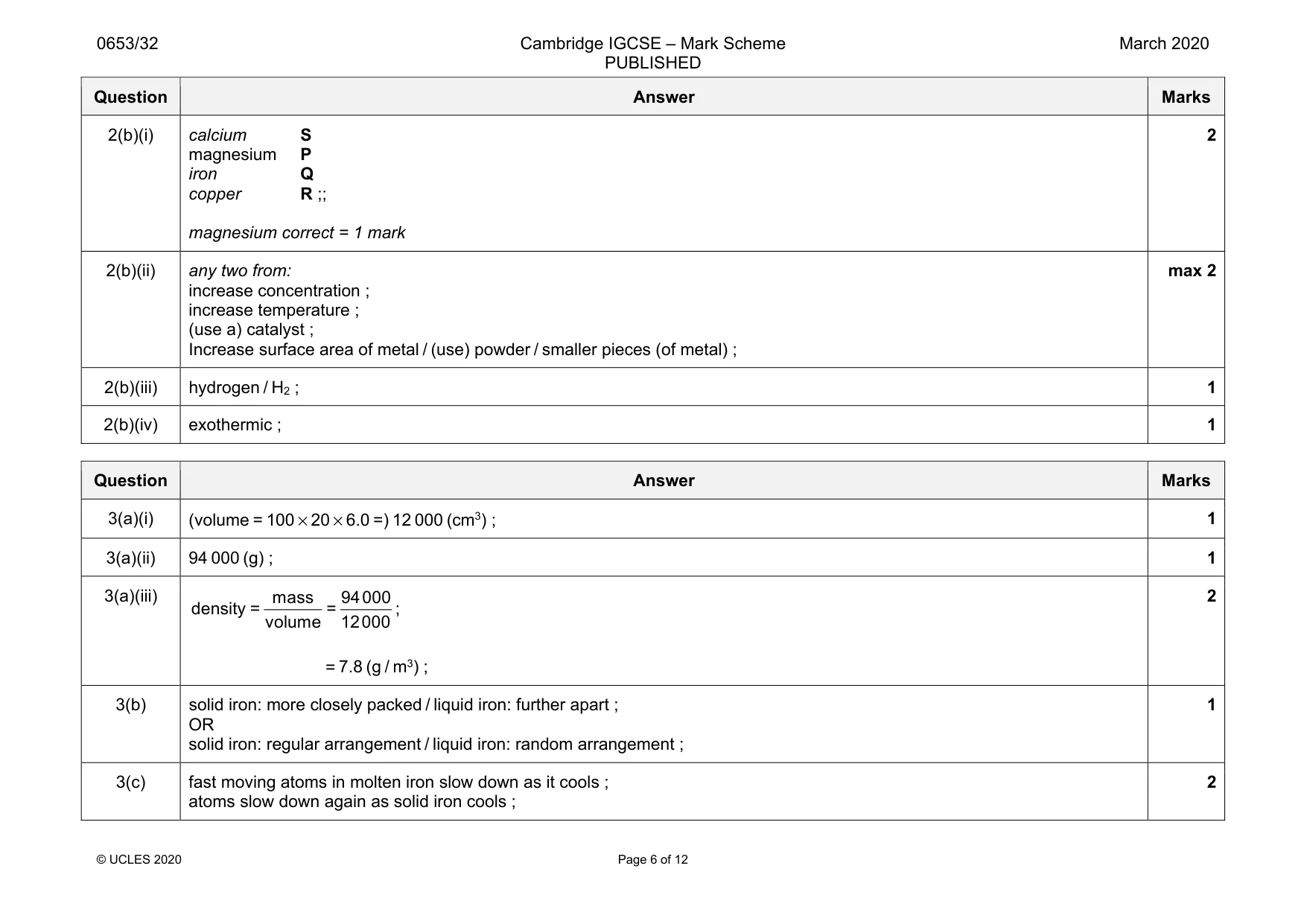
Mark scheme: 3(a)(i) (volume = 100 × 20 × 6.0 =) 12 000 (cm3) ; 1 3(a)(ii) 94 000 (g) ; 1 3(a)(iii) mass 94000 density = = ; volume 12000 = 7.8 (g / m3) ; 2 3(b) solid iron: more closely packed / liquid iron: further apart ; OR solid iron: regular arrangement / liquid iron: random arrangement ; 1 3(c) fast moving atoms in molten iron slow down as it cools ; atoms slow down again as solid iron cools ; 2 Question Answer Marks 3(d) glass would melt or break / mercury or liquid would boil ; 1
Q4 · A cross-section of a leaf as viewed under a microscope
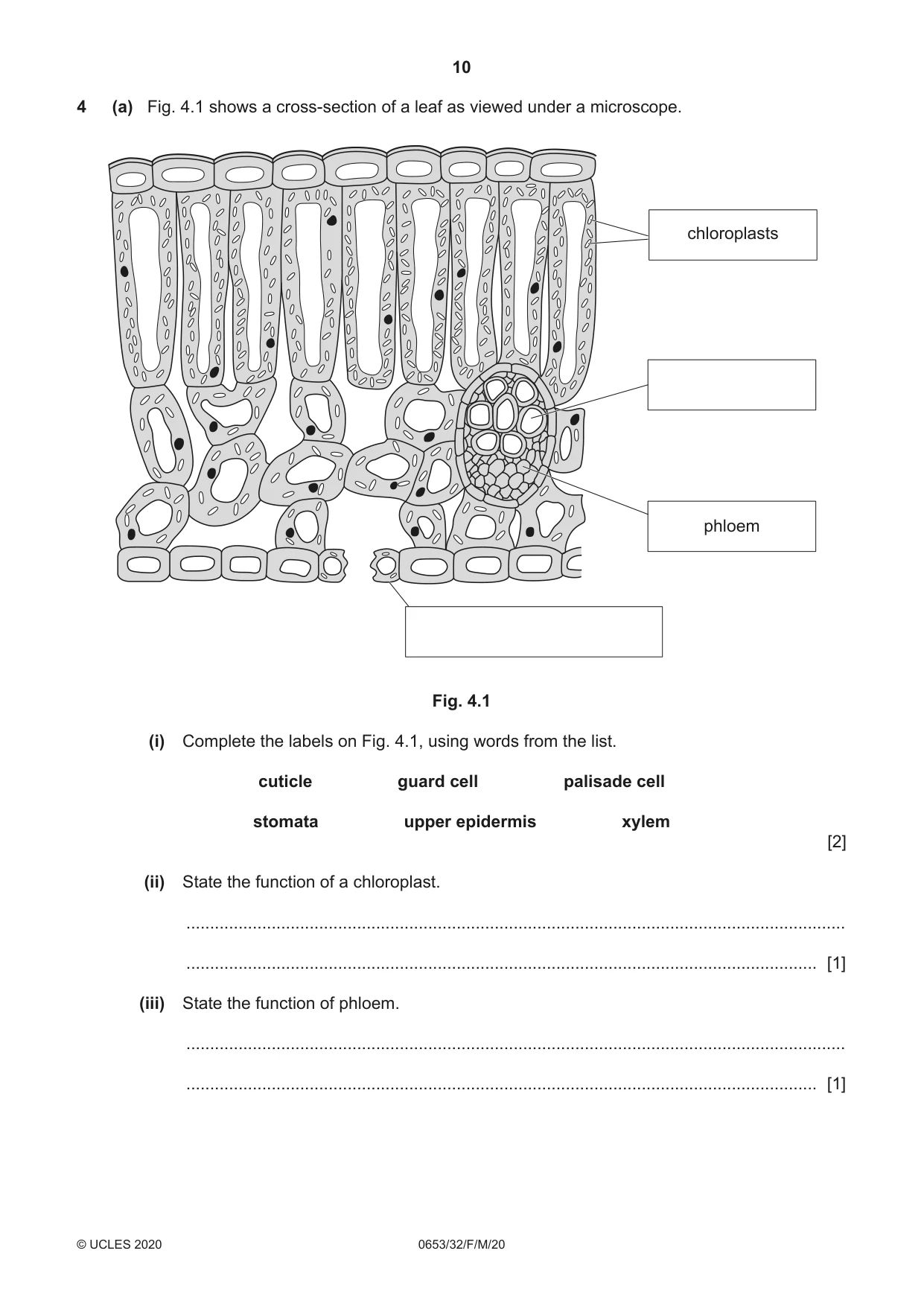
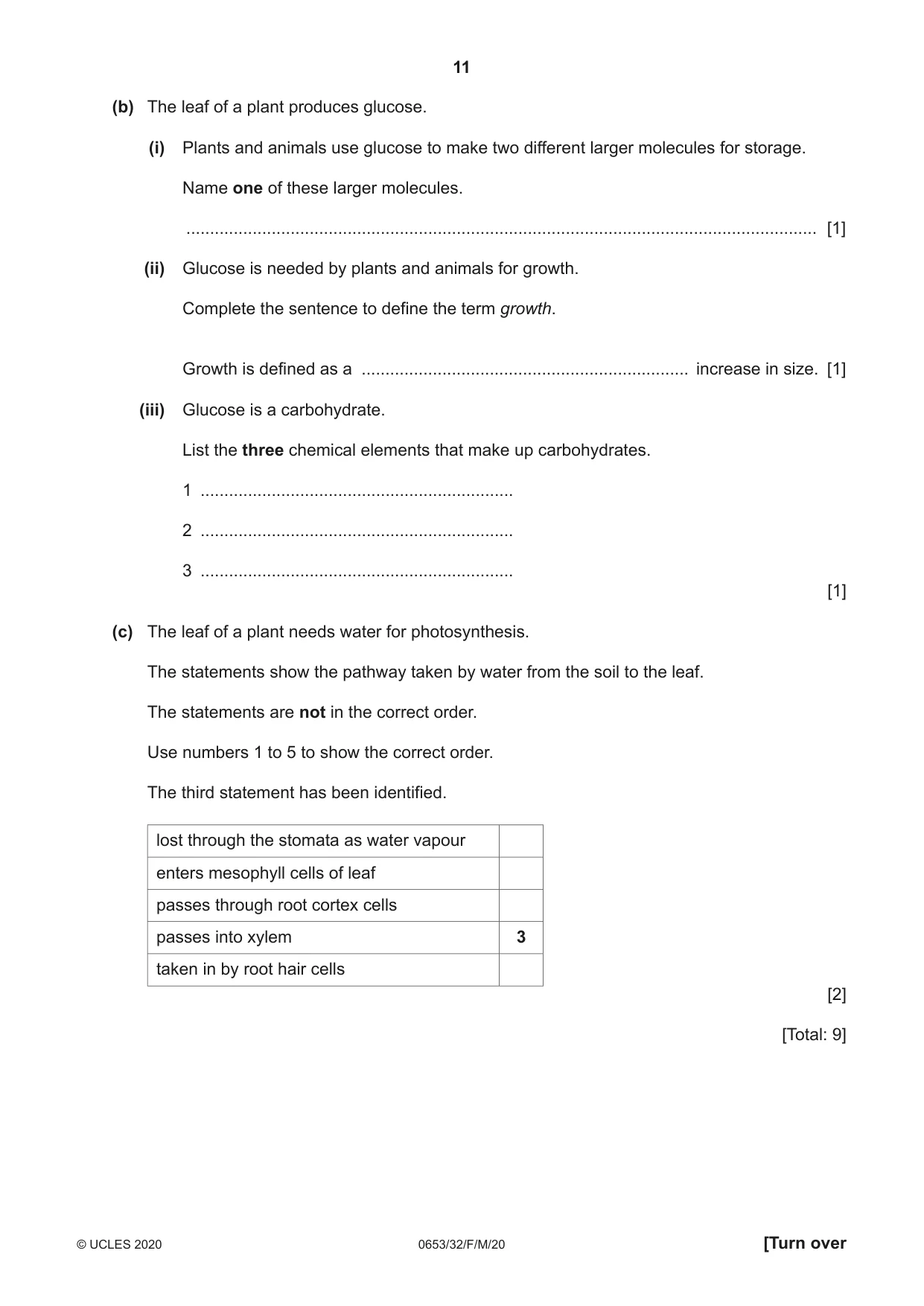
4 (a) Fig. 4.1 shows a cross-section of a leaf as viewed under a microscope. chloroplasts phloem Fig. 4.1 (i) Complete the labels on Fig. 4.1, using words from the list. cuticle guard cell palisade cell stomata upper epidermis xylem [2] (ii) State the function of a chloroplast. ........................................................................................................................................... ..................................................................................................................................... [1] (iii) State the function of phloem. ........................................................................................................................................... ..................................................................................................................................... [1] (b) The leaf of a plant produces glucose. (i) Plants and animals use glucose to make two different larger molecules for storage. Name one of these larger molecules. ..................................................................................................................................... [1] (ii) Glucose is needed by plants and animals for growth. Complete the sentence to define the term growth. Growth is defined as a ..................................................................... increase in size. [1] (iii) Glucose is a carbohydrate. List the three chemical elements that make up carbohydrates. 1 .................................................................. 2 .................................................................. 3 .................................................................. [1] (c) The leaf of a plant needs water for photosynthesis. The statements show the pathway taken by water from the soil to the leaf. The statements are not in the correct order. Use numbers 1 to 5 to show the correct order. The third statement has been identified. lost through the stomata as water vapour enters mesophyll cells of leaf passes through root cortex cells passes into xylem 3 taken in by root hair cells [2] [Total: 9]
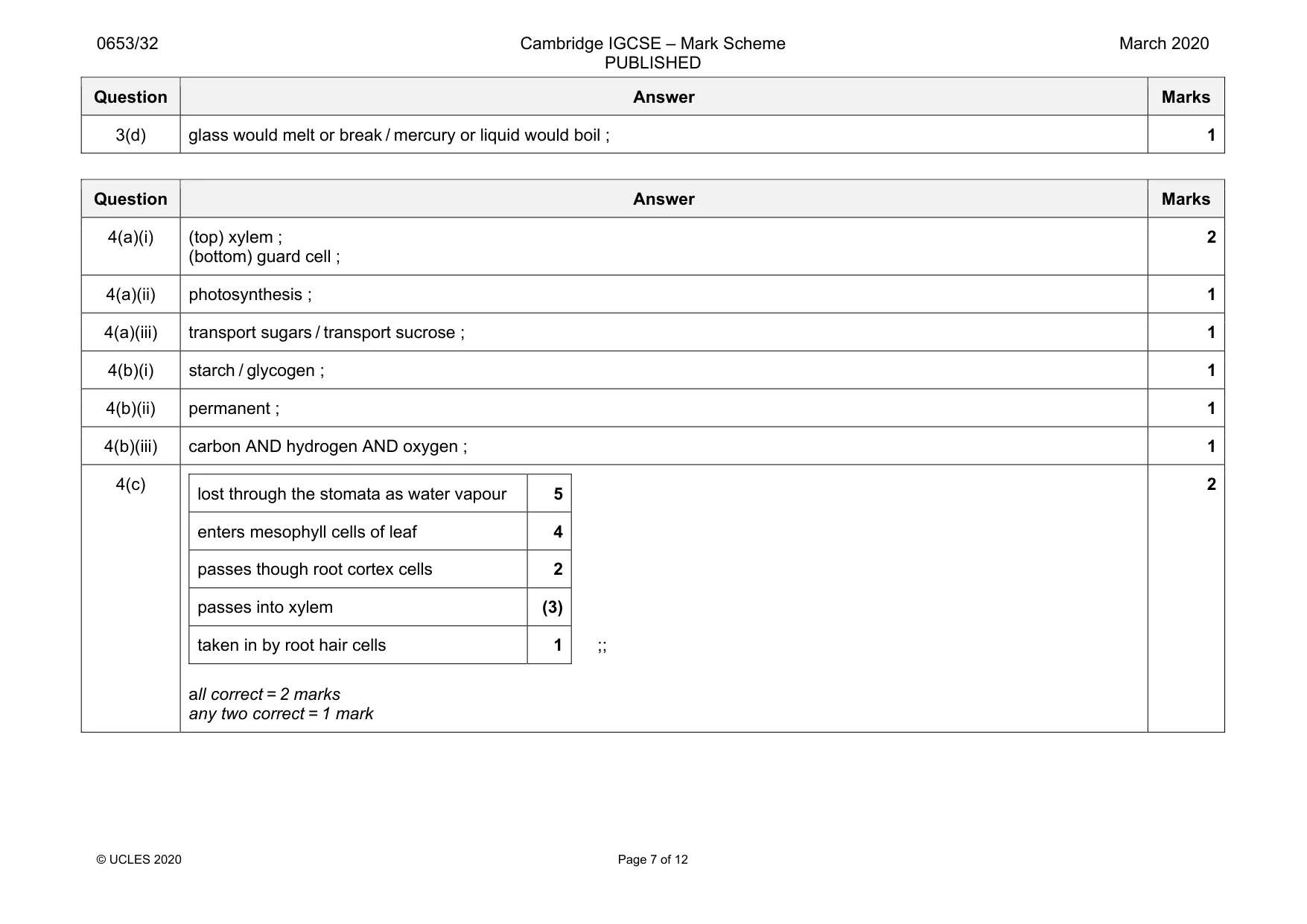
Mark scheme: 4(a)(i) (top) xylem ; (bottom) guard cell ; 2 4(a)(ii) photosynthesis ; 1 4(a)(iii) transport sugars / transport sucrose ; 1 4(b)(i) starch / glycogen ; 1 4(b)(ii) permanent ; 1 4(b)(iii) carbon AND hydrogen AND oxygen ; 1 4(c) lost through the stomata as water vapour 5 enters mesophyll cells of leaf 4 passes though root cortex cells 2 passes into xylem (3) taken in by root hair cells 1 ;; all correct = 2 marks any two correct = 1 mark 2
Q5 · Refinery gas, gasoline and gas oil are fuels obtained from petroleum in the process shown…
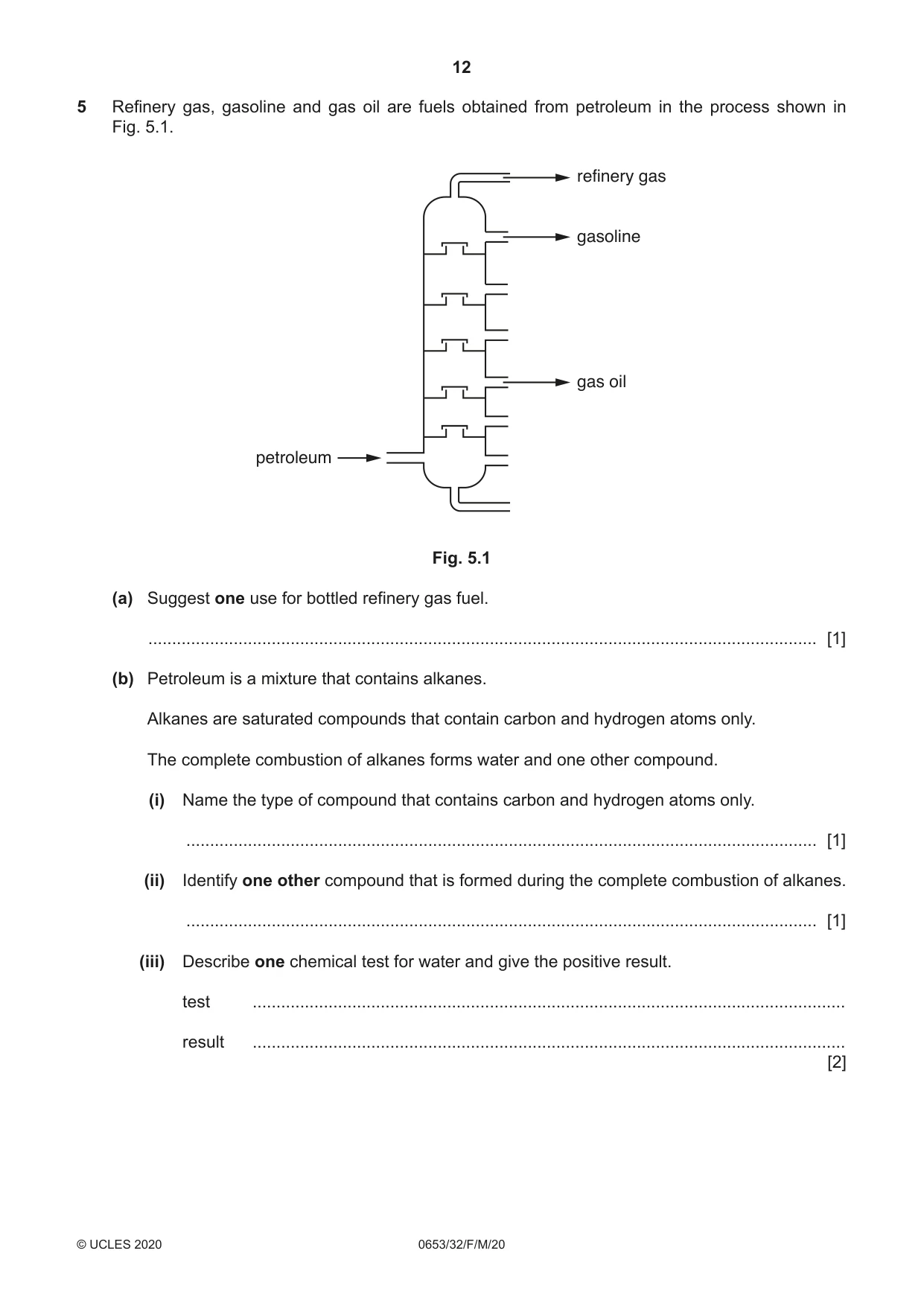
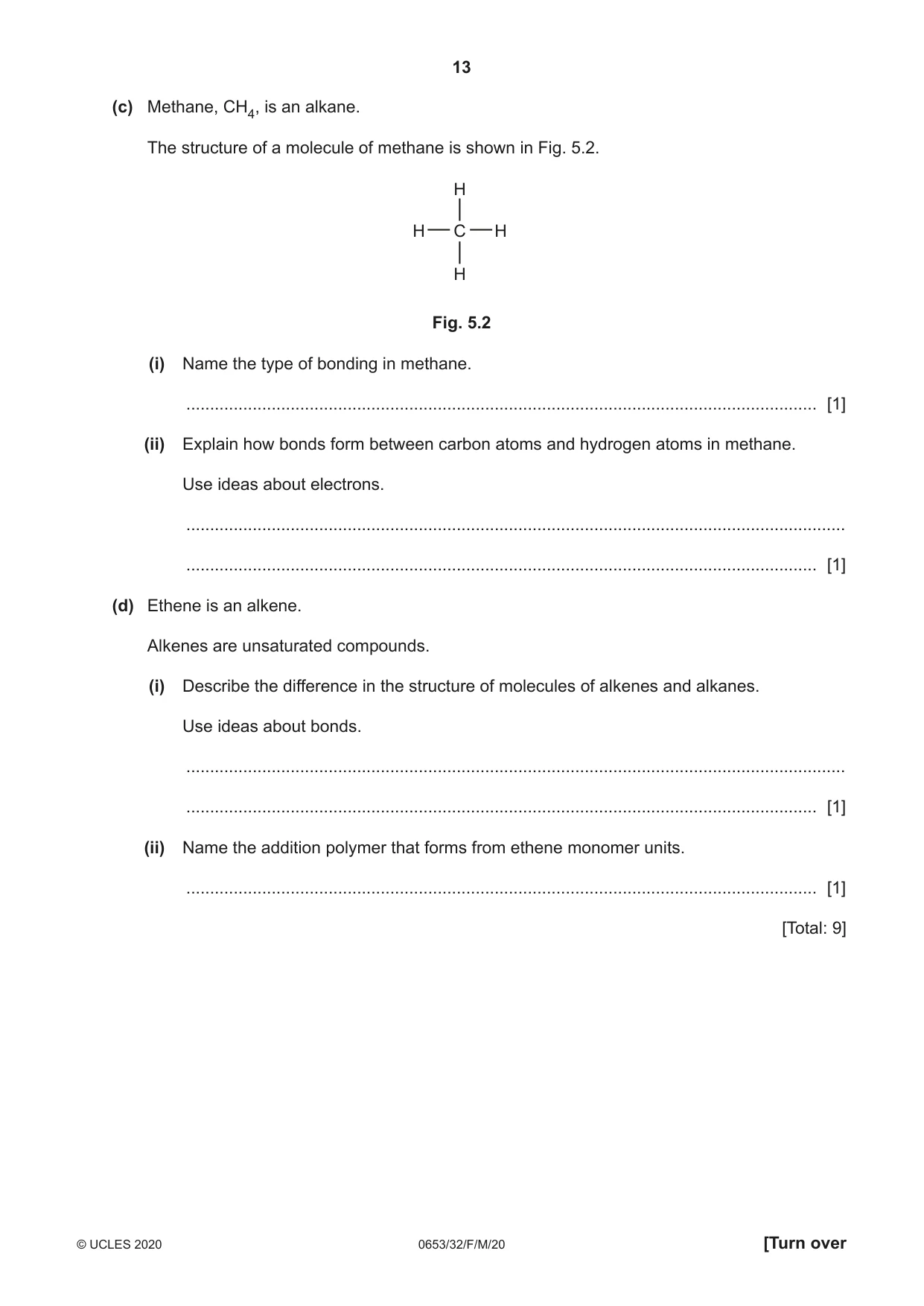
5 Refinery gas, gasoline and gas oil are fuels obtained from petroleum in the process shown in Fig. 5.1. refinery gas gasoline gas oil petroleum Fig. 5.1 (a) Suggest one use for bottled refinery gas fuel. ............................................................................................................................................. [1] (b) Petroleum is a mixture that contains alkanes. Alkanes are saturated compounds that contain carbon and hydrogen atoms only. The complete combustion of alkanes forms water and one other compound. (i) Name the type of compound that contains carbon and hydrogen atoms only. ..................................................................................................................................... [1] (ii) Identify one other compound that is formed during the complete combustion of alkanes. ..................................................................................................................................... [1] (iii) Describe one chemical test for water and give the positive result. test ............................................................................................................................. result ............................................................................................................................. [2] (c) Methane, CH4, is an alkane. The structure of a molecule of methane is shown in Fig. 5.2. H H C H H Fig. 5.2 (i) Name the type of bonding in methane. ..................................................................................................................................... [1] (ii) Explain how bonds form between carbon atoms and hydrogen atoms in methane. Use ideas about electrons. ........................................................................................................................................... ..................................................................................................................................... [1] (d) Ethene is an alkene. Alkenes are unsaturated compounds. (i) Describe the difference in the structure of molecules of alkenes and alkanes. Use ideas about bonds. ........................................................................................................................................... ..................................................................................................................................... [1] (ii) Name the addition polymer that forms from ethene monomer units. ..................................................................................................................................... [1] [Total: 9]
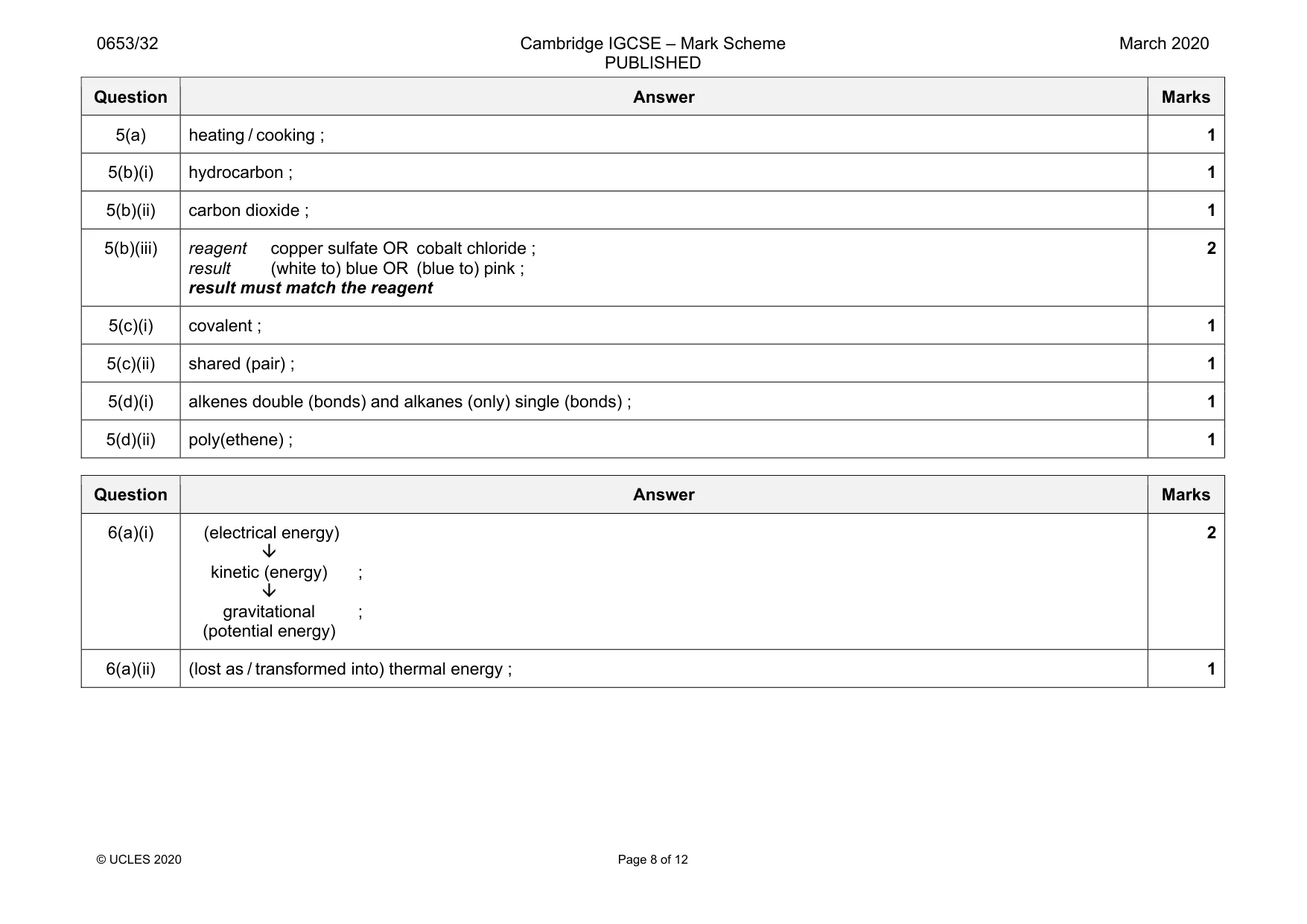
Mark scheme: 5(a) heating / cooking ; 1 5(b)(i) hydrocarbon ; 1 5(b)(ii) carbon dioxide ; 1 5(b)(iii) reagent copper sulfate OR cobalt chloride ; result (white to) blue OR (blue to) pink ; result must match the reagent 2 5(c)(i) covalent ; 1 5(c)(ii) shared (pair) ; 1 5(d)(i) alkenes double (bonds) and alkanes (only) single (bonds) ; 1 5(d)(ii) poly(ethene) ; 1
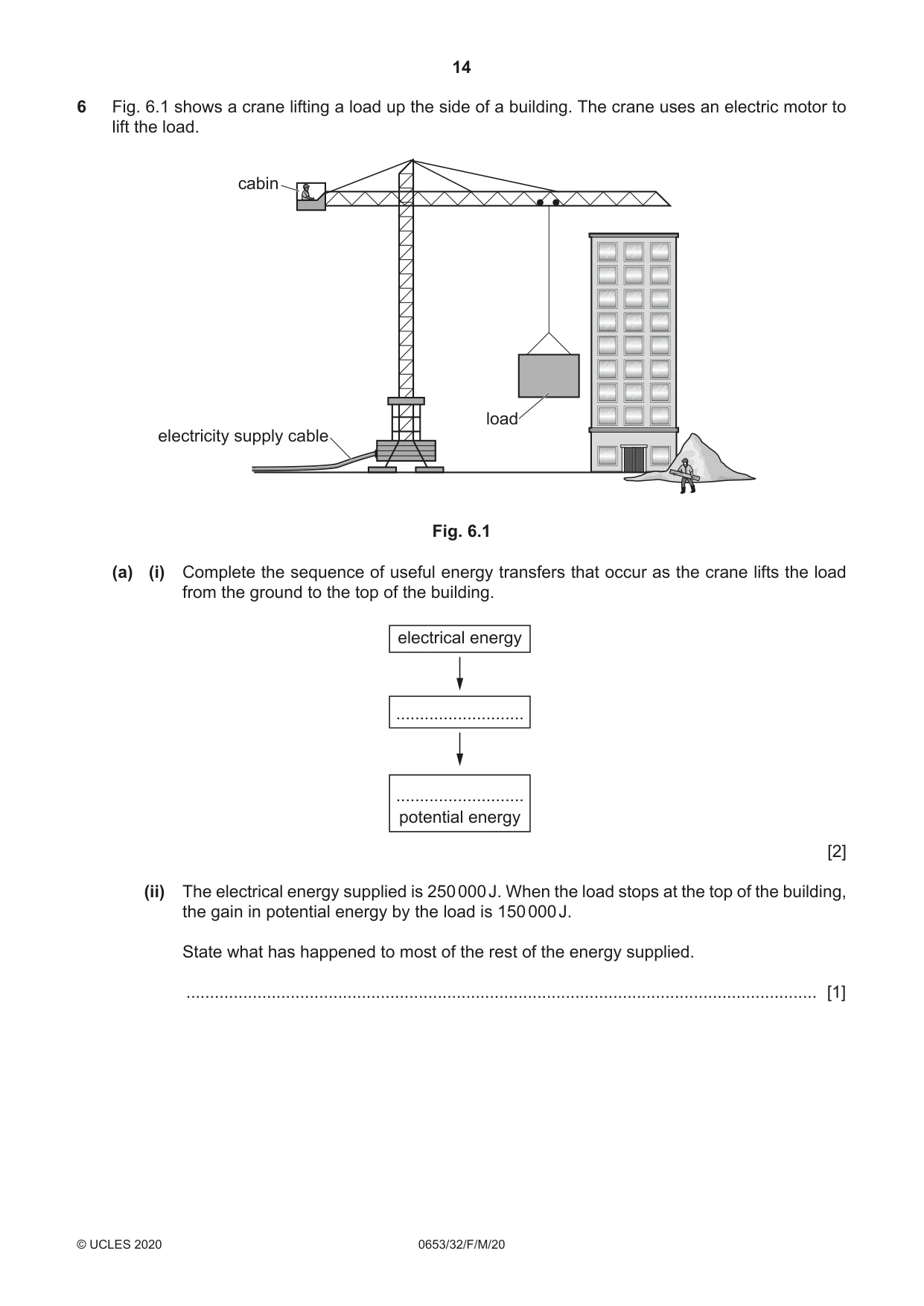
Q6 · A crane lifting a load up the side of a building
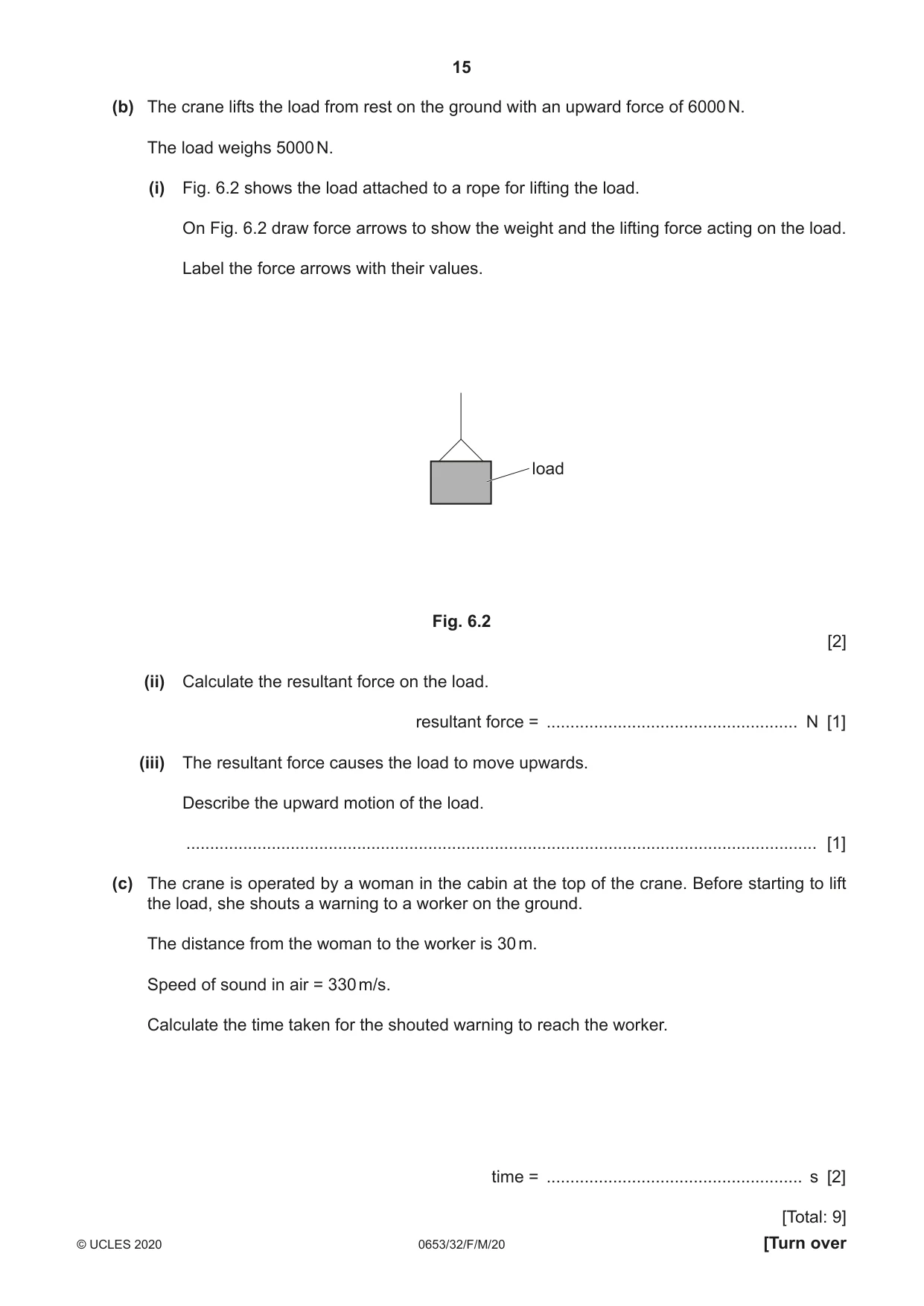
6 Fig. 6.1 shows a crane lifting a load up the side of a building. The crane uses an electric motor to lift the load. cabin load electricity supply cable Fig. 6.1 (a) (i) Complete the sequence of useful energy transfers that occur as the crane lifts the load from the ground to the top of the building. electrical energy ........................... ........................... potential energy [2] (ii) The electrical energy supplied is 250 000 J. When the load stops at the top of the building, the gain in potential energy by the load is 150 000 J. State what has happened to most of the rest of the energy supplied. ..................................................................................................................................... [1] (b) The crane lifts the load from rest on the ground with an upward force of 6000 N. The load weighs 5000 N. (i) Fig. 6.2 shows the load attached to a rope for lifting the load. On Fig. 6.2 draw force arrows to show the weight and the lifting force acting on the load. Label the force arrows with their values. load Fig. 6.2 [2] (ii) Calculate the resultant force on the load. resultant force = ..................................................... N [1] (iii) The resultant force causes the load to move upwards. Describe the upward motion of the load. ..................................................................................................................................... [1] (c) The crane is operated by a woman in the cabin at the top of the crane. Before starting to lift the load, she shouts a warning to a worker on the ground. The distance from the woman to the worker is 30 m. Speed of sound in air = 330 m/s. Calculate the time taken for the shouted warning to reach the worker. time = ...................................................... s [2] [Total: 9]
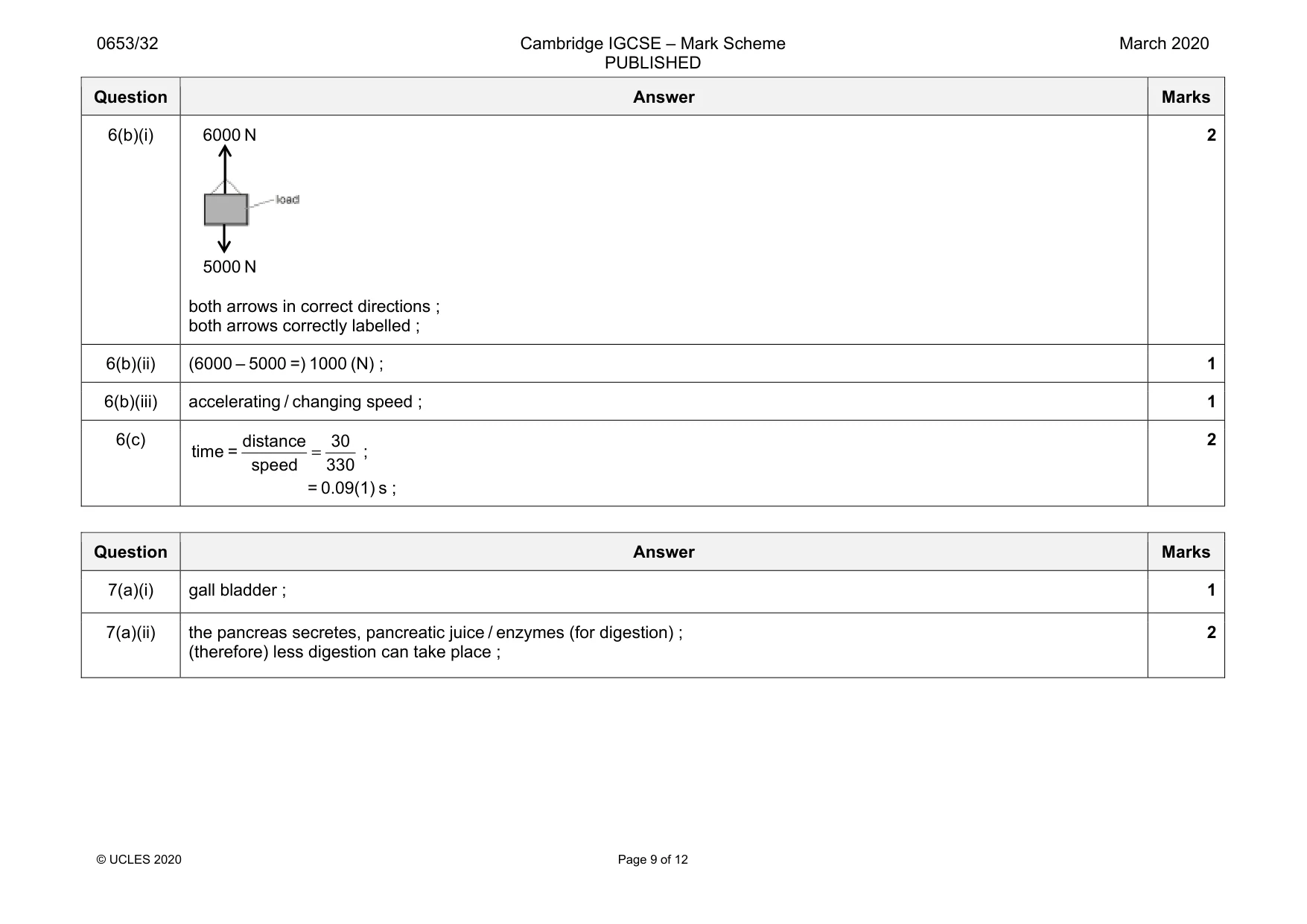
Mark scheme: 6(a)(i) (electrical energy) kinetic (energy) ; gravitational (potential energy) ; 2 6(a)(ii) (lost as / transformed into) thermal energy ; 1 Question Answer Marks 6(b)(i) 6000 N 5000 N both arrows in correct directions ; both arrows correctly labelled ; 2 6(b)(ii) (6000 – 5000 =) 1000 (N) ; 1 6(b)(iii) accelerating / changing speed ; 1 6(c) distance 30 time = speed 330 = ; = 0.09(1) s ; 2
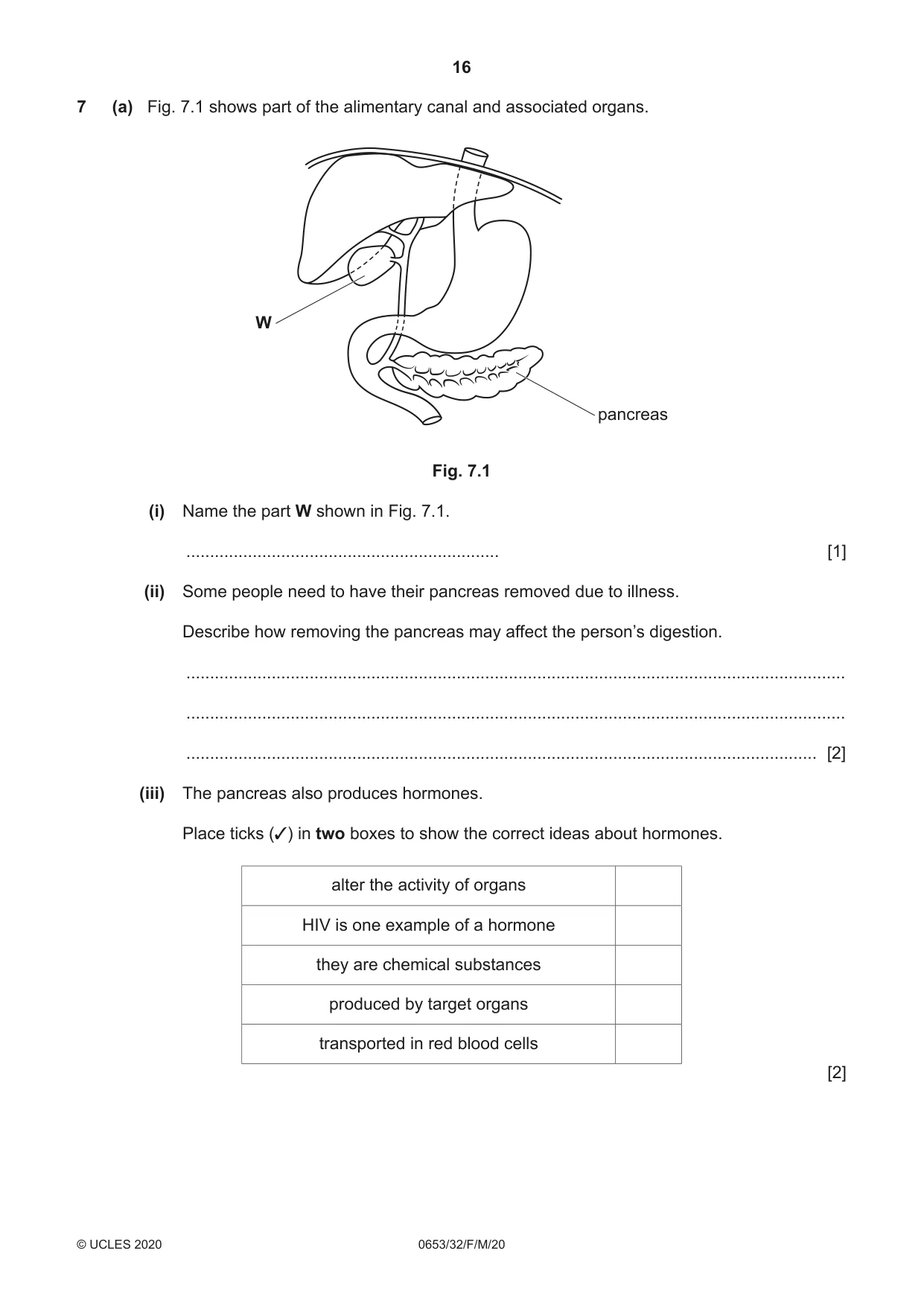
Q7 · Part of the alimentary canal and associated organs
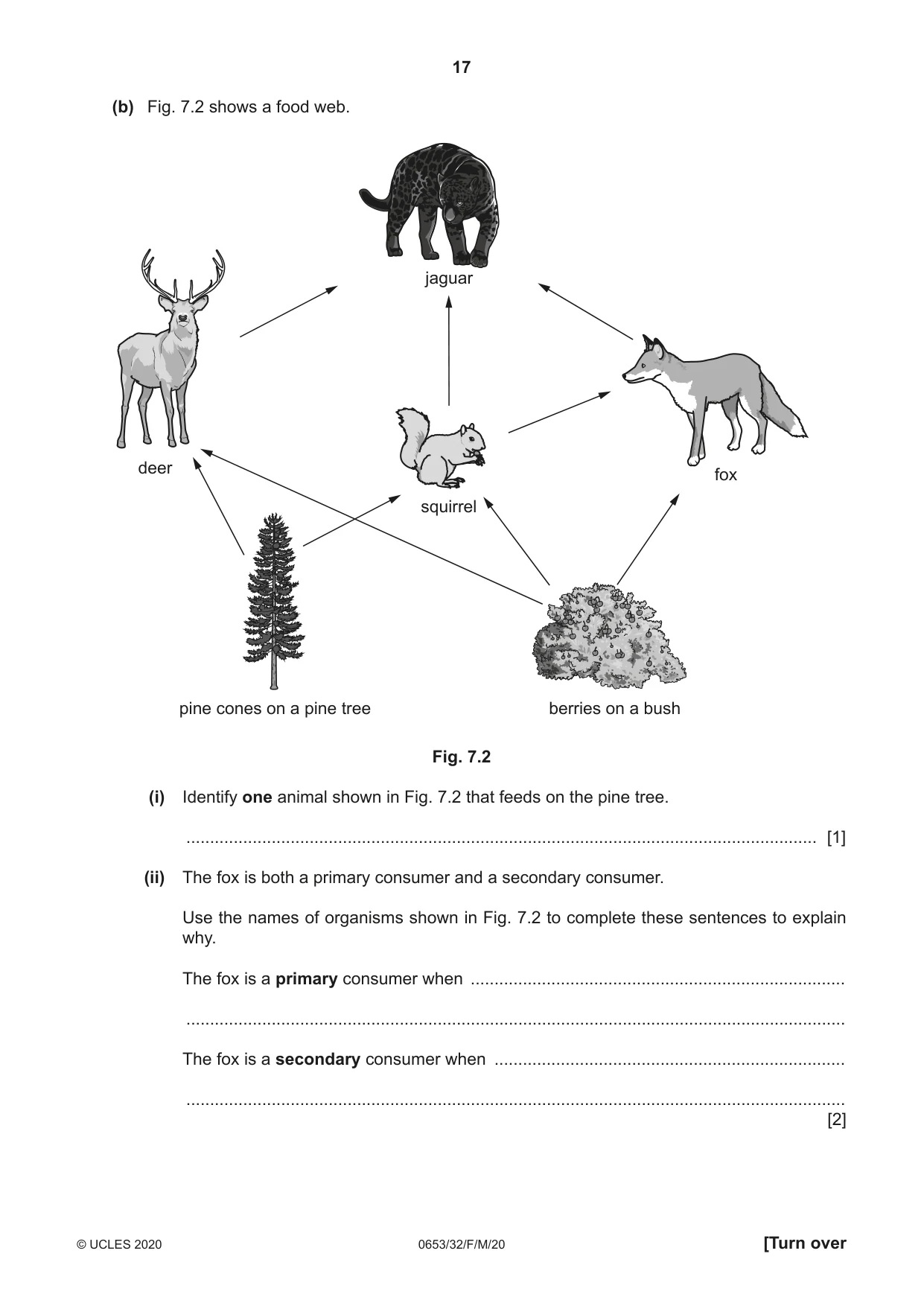
7 (a) Fig. 7.1 shows part of the alimentary canal and associated organs. W pancreas Fig. 7.1 (i) Name the part W shown in Fig. 7.1. .................................................................. [1] (ii) Some people need to have their pancreas removed due to illness. Describe how removing the pancreas may affect the person’s digestion. ........................................................................................................................................... ........................................................................................................................................... ..................................................................................................................................... [2] (iii) The pancreas also produces hormones. Place ticks (✓) in two boxes to show the correct ideas about hormones. alter the activity of organs HIV is one example of a hormone they are chemical substances produced by target organs transported in red blood cells [2] (b) Fig. 7.2 shows a food web. jaguar deer fox squirrel pine cones on a pine tree berries on a bush Fig. 7.2 (i) Identify one animal shown in Fig. 7.2 that feeds on the pine tree. ..................................................................................................................................... [1] (ii) The fox is both a primary consumer and a secondary consumer. Use the names of organisms shown in Fig. 7.2 to complete these sentences to explain why. The fox is a primary consumer when ............................................................................... ........................................................................................................................................... The fox is a secondary consumer when .......................................................................... ........................................................................................................................................... [2] (iii) Berries contain seeds. Seeds germinate and grow into new plants. State two environmental conditions needed for germination of seeds. 1 ........................................................................................................................................ 2 ........................................................................................................................................ [2] [Total: 10]
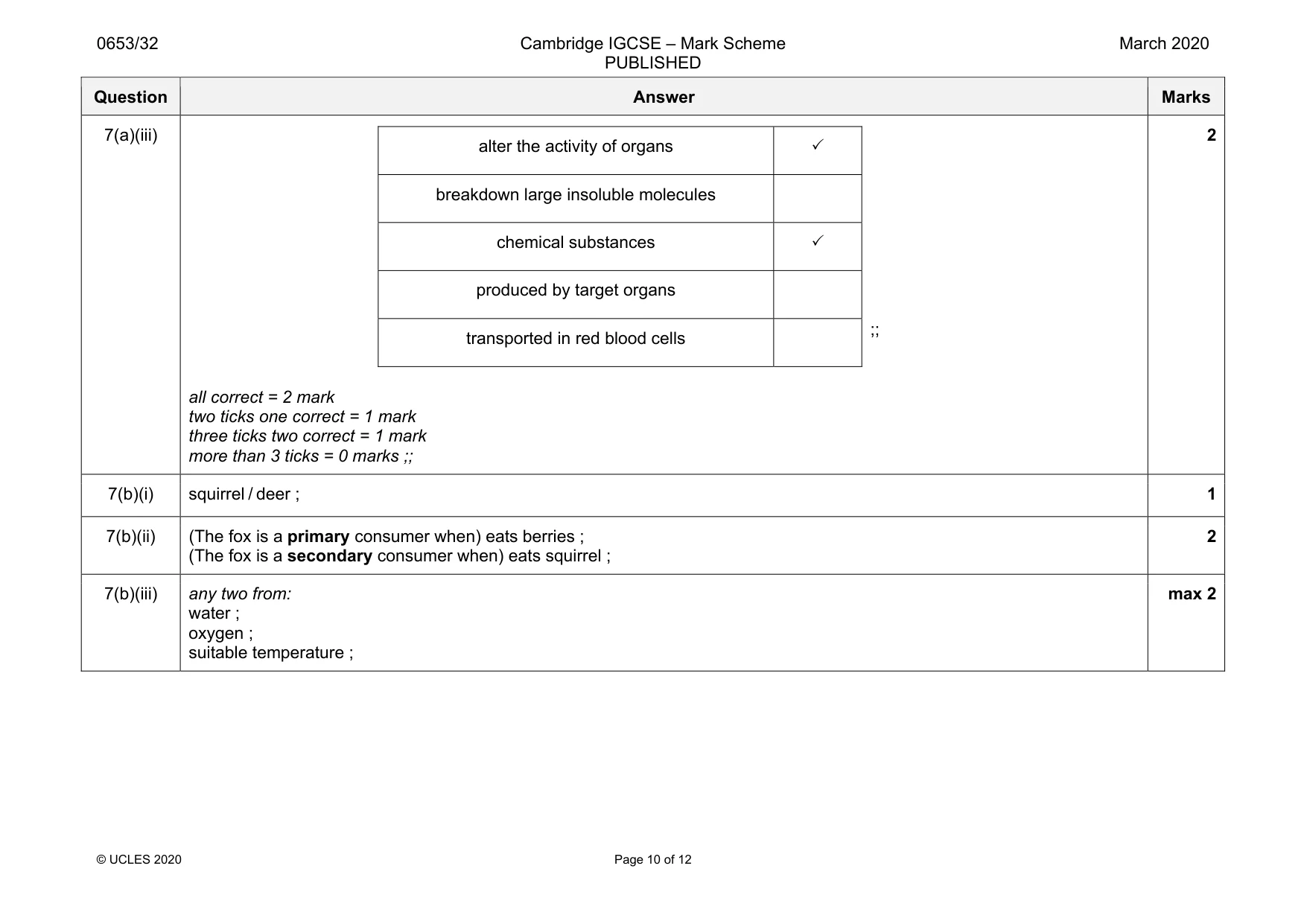
Mark scheme: 7(a)(i) gall bladder ; 1 7(a)(ii) the pancreas secretes, pancreatic juice / enzymes (for digestion) ; (therefore) less digestion can take place ; 2 Question Answer Marks 7(a)(iii) alter the activity of organs breakdown large insoluble molecules chemical substances produced by target organs transported in red blood cells ;; all correct = 2 mark two ticks one correct = 1 mark three ticks two correct = 1 mark more than 3 ticks = 0 marks ;; 2 7(b)(i) squirrel / deer ; 1 7(b)(ii) (The fox is a primary consumer when) eats berries ; (The fox is a secondary consumer when) eats squirrel ; 2 7(b)(iii) any two from: water ; oxygen ; suitable temperature ; max 2
Q8 · Sodium chloride, NaCl, is an ionic compound
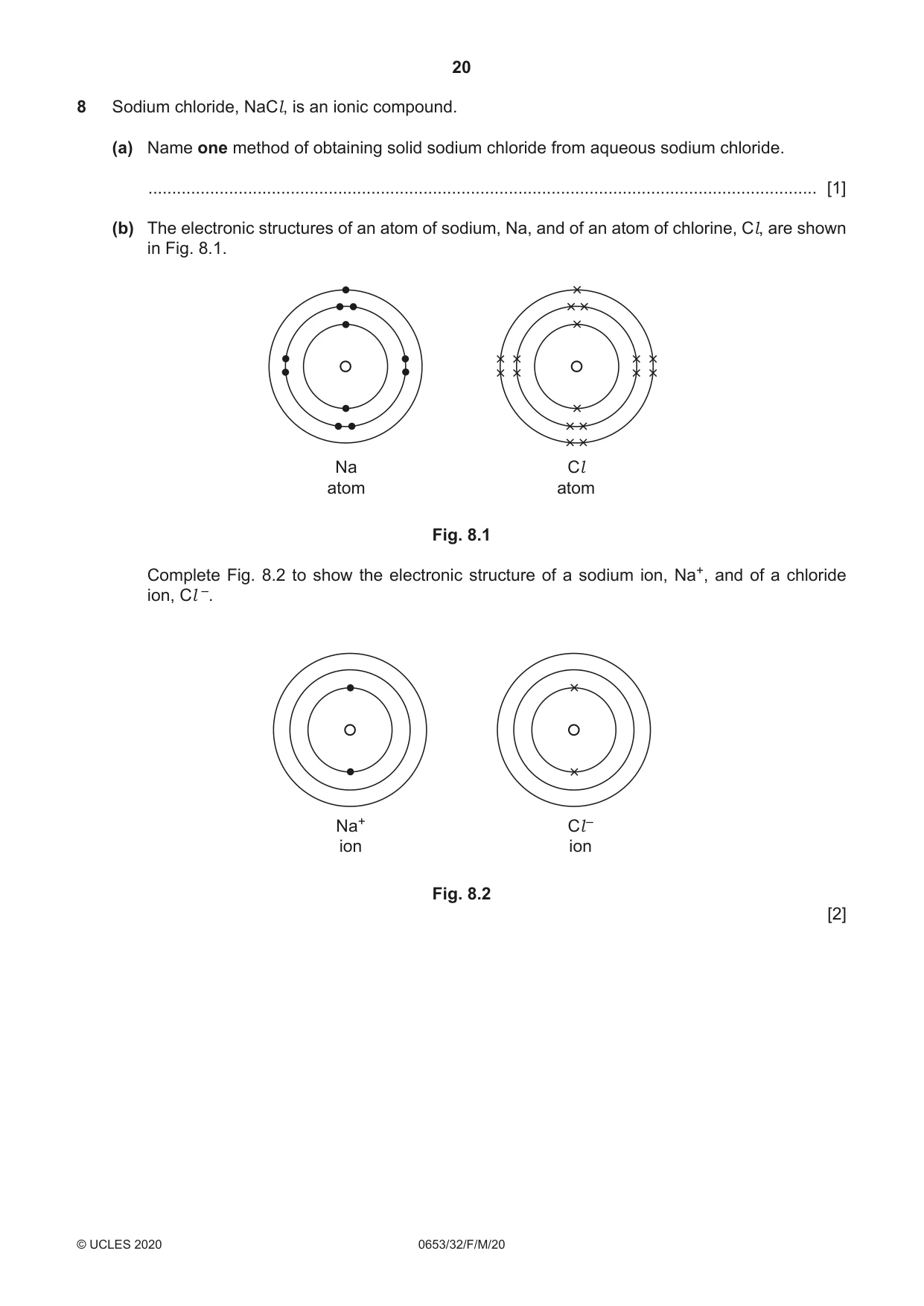
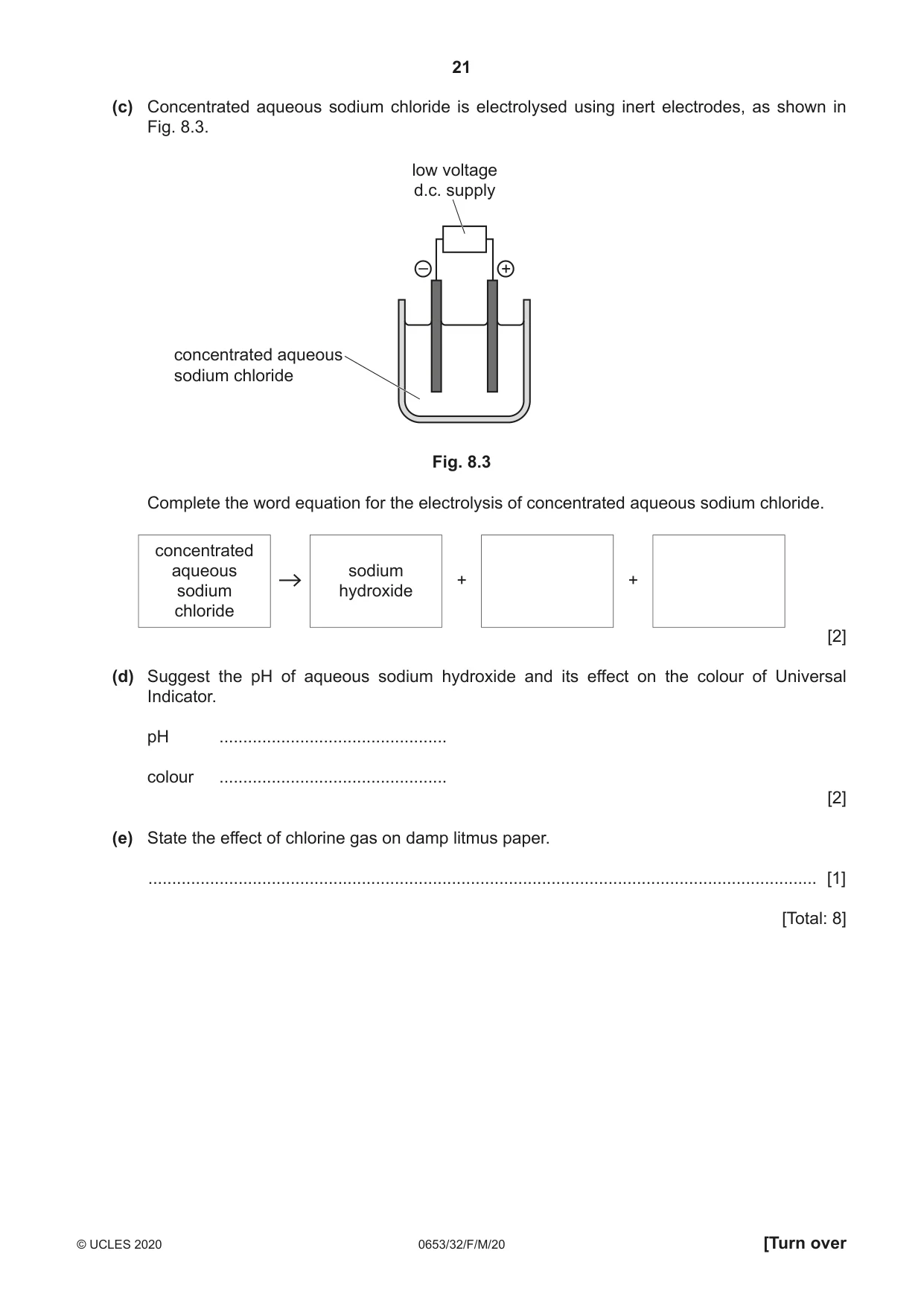
8 Sodium chloride, NaCl, is an ionic compound. (a) Name one method of obtaining solid sodium chloride from aqueous sodium chloride. ............................................................................................................................................. [1] (b) The electronic structures of an atom of sodium, Na, and of an atom of chlorine, Cl, are shown in Fig. 8.1. Na Cl atom atom Fig. 8.1 Complete Fig. 8.2 to show the electronic structure of a sodium ion, Na+, and of a chloride ion, Cl –. Na+ Cl – ion ion Fig. 8.2 [2] (c) Concentrated aqueous sodium chloride is electrolysed using inert electrodes, as shown in Fig. 8.3. low voltage d.c. supply – + concentrated aqueous sodium chloride Fig. 8.3 Complete the word equation for the electrolysis of concentrated aqueous sodium chloride. concentrated aqueous sodium + + sodium hydroxide chloride [2] (d) Suggest the pH of aqueous sodium hydroxide and its effect on the colour of Universal Indicator. pH ................................................ colour ................................................ [2] (e) State the effect of chlorine gas on damp litmus paper. ............................................................................................................................................. [1] [Total: 8]
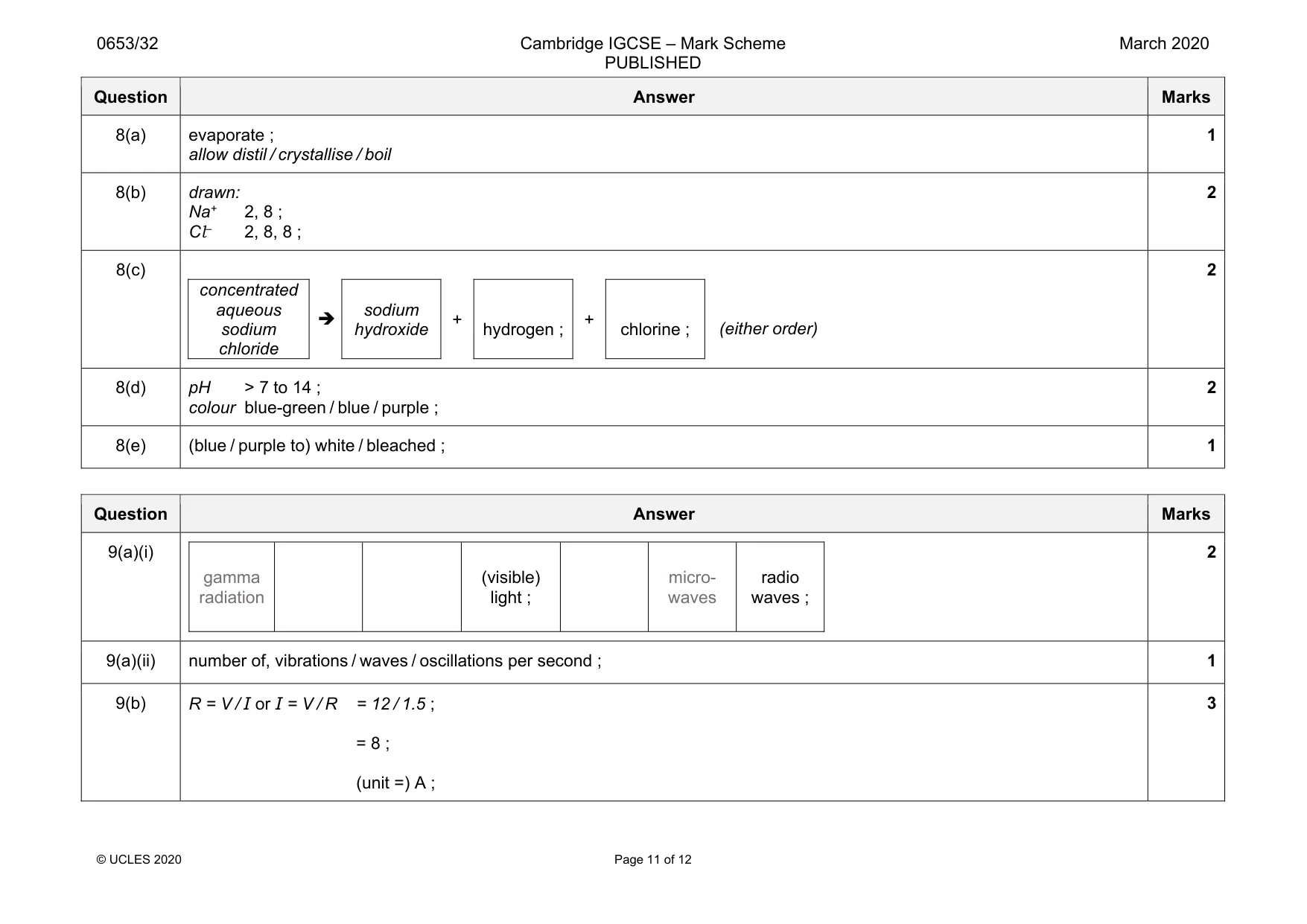
Mark scheme: 8(a) evaporate ; allow distil / crystallise / boil 1 8(b) drawn: Na+ 2, 8 ; Cl– 2, 8, 8 ; 2 8(c) (either order) concentrated aqueous sodium chloride sodium hydroxide + hydrogen ; + chlorine ; 2 8(d) pH > 7 to 14 ; colour blue-green / blue / purple ; 2 8(e) (blue / purple to) white / bleached ; 1
Question 9
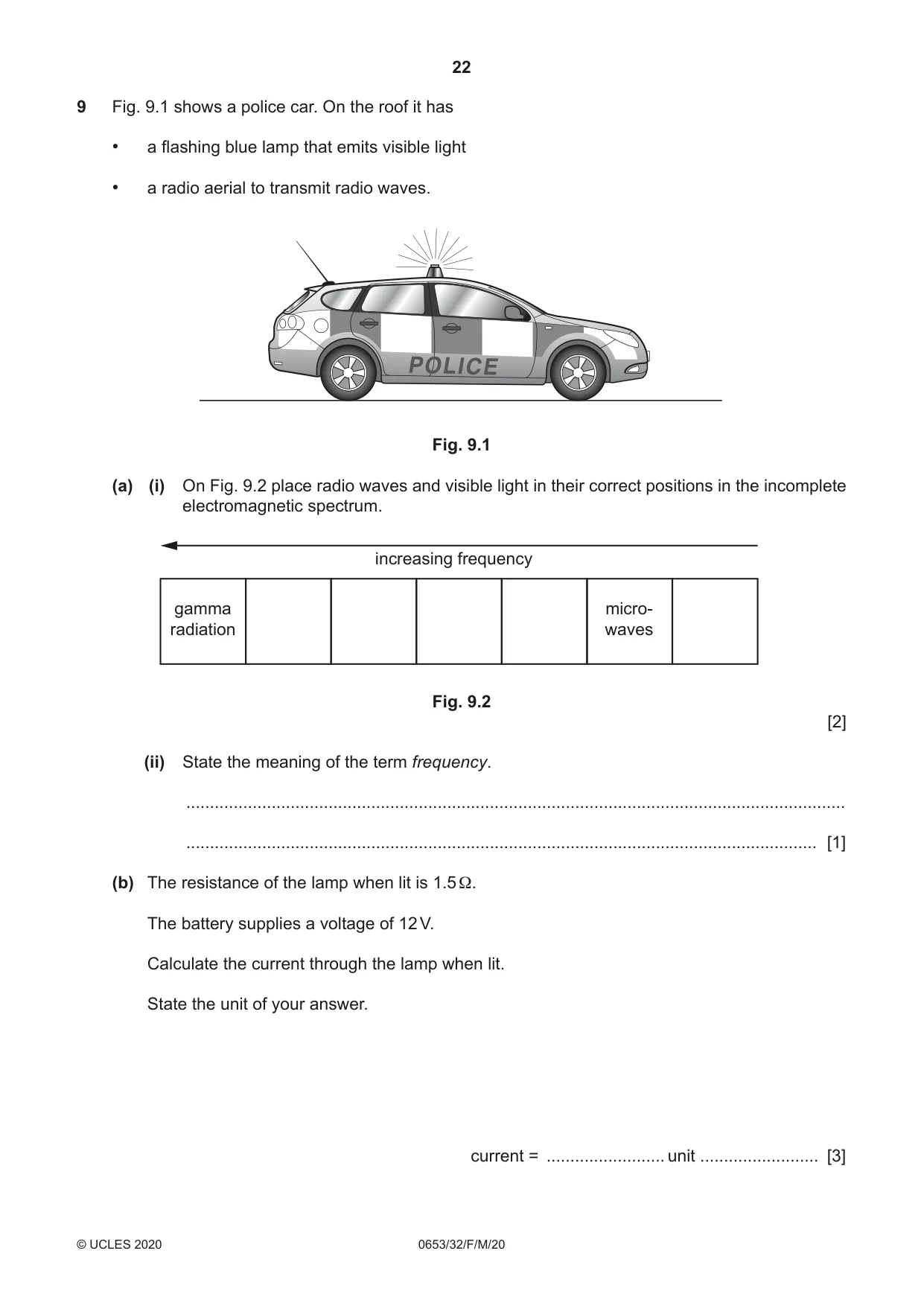
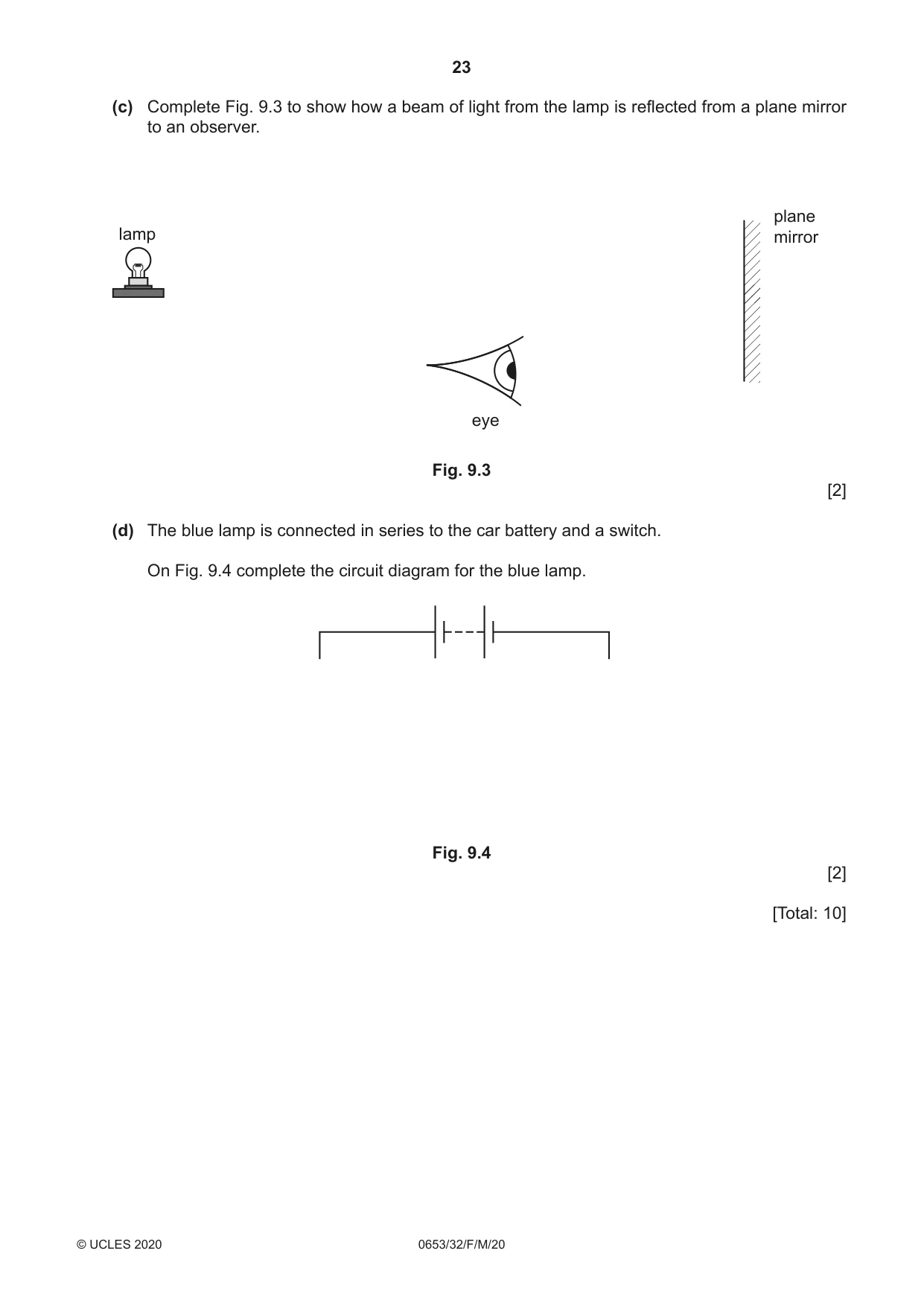
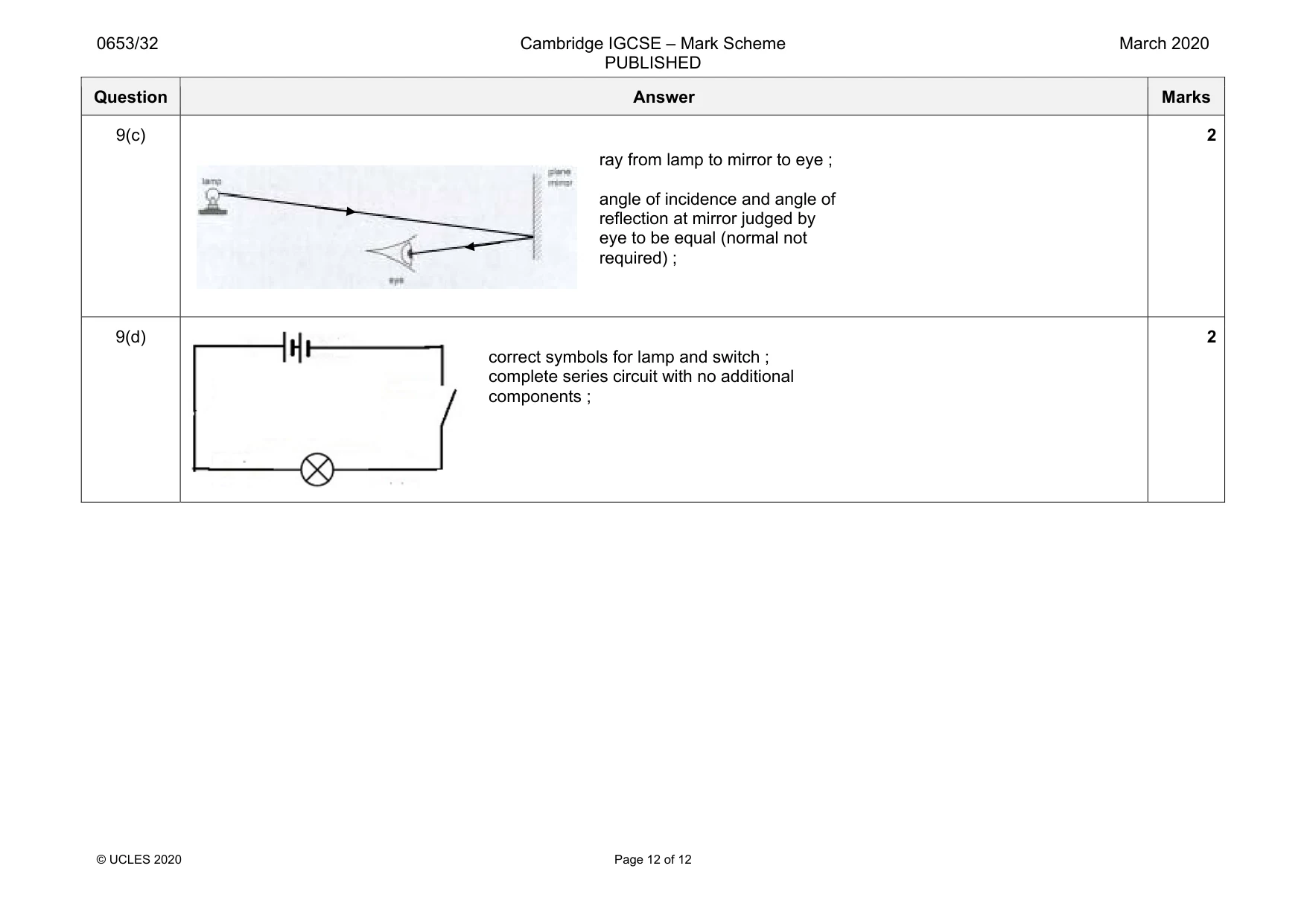
9 Fig. 9.1 shows a police car. On the roof it has • a flashing blue lamp that emits visible light • a radio aerial to transmit radio waves. P O L I C E Fig. 9.1 (a) (i) On Fig. 9.2 place radio waves and visible light in their correct positions in the incomplete electromagnetic spectrum. increasing frequency gamma micro- radiation waves Fig. 9.2 [2] (ii) State the meaning of the term frequency. ........................................................................................................................................... ..................................................................................................................................... [1] (b) The resistance of the lamp when lit is 1.5 Ω. The battery supplies a voltage of 12 V. Calculate the current through the lamp when lit. State the unit of your answer. current = ......................... unit ......................... [3] (c) Complete Fig. 9.3 to show how a beam of light from the lamp is reflected from a plane mirror to an observer. plane lamp mirror eye Fig. 9.3 [2] (d) The blue lamp is connected in series to the car battery and a switch. On Fig. 9.4 complete the circuit diagram for the blue lamp. Fig. 9.4 [2] [Total: 10]
Mark scheme: 9(a)(i) gamma radiation (visible) light ; micro- waves radio waves ; 2 9(a)(ii) number of, vibrations / waves / oscillations per second ; 1 9(b) R = V / I or I = V / R = 12 / 1.5 ; = 8 ; (unit =) A ; 3 Question Answer Marks 9(c) 2 9(d) 2 ray from lamp to mirror to eye ; angle of incidence and angle of reflection at mirror judged by eye to be equal (normal not required) ; correct symbols for lamp and switch ; complete series circuit with no additional components ;
What was in this paper
The subtopics covered by these 9 questions, and how many questions each got. Open one in a new tab to see every Cambridge question on it.
What you needed in this session
Cambridge’s own grade thresholds for 2020 Feb/March, Paper 3 · Variant 2. A higher threshold means an easier paper — the bar moves with how the cohort did.