Cambridge IGCSE Science - Combined 0653 — 2020 May/June Paper 3 · Variant 1
0653/31/M/J/20 · 9 questions · 80 marks · ≈90 min
The question paper and its mark scheme, free to read here and free to download. This is Cambridge’s own paper, exactly as it was sat.
Question paper24 pages


Mark scheme10 pages
Answers below. Sit the paper first if you are practising.
Questions as text
Q1 · The structure of a human heart
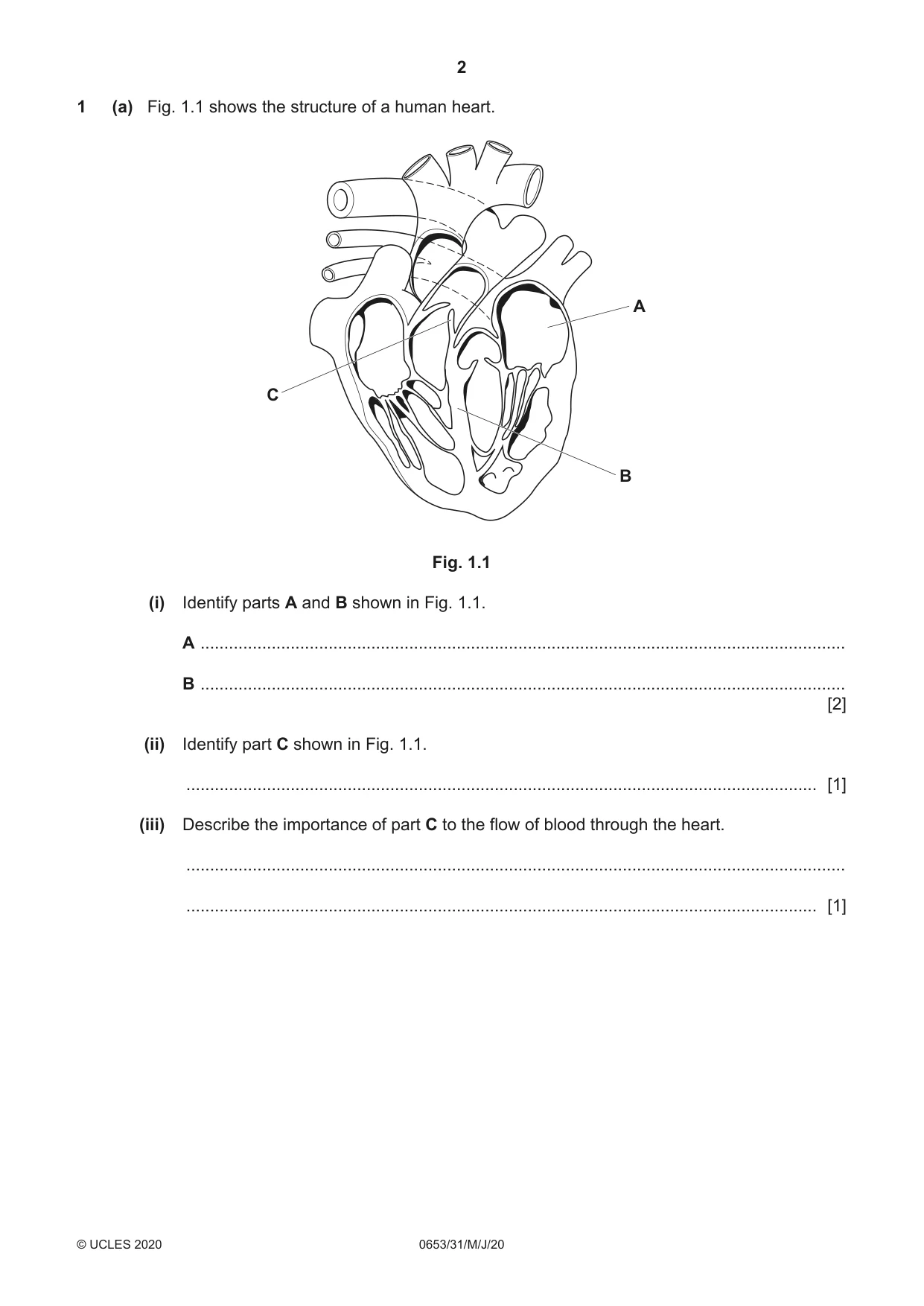
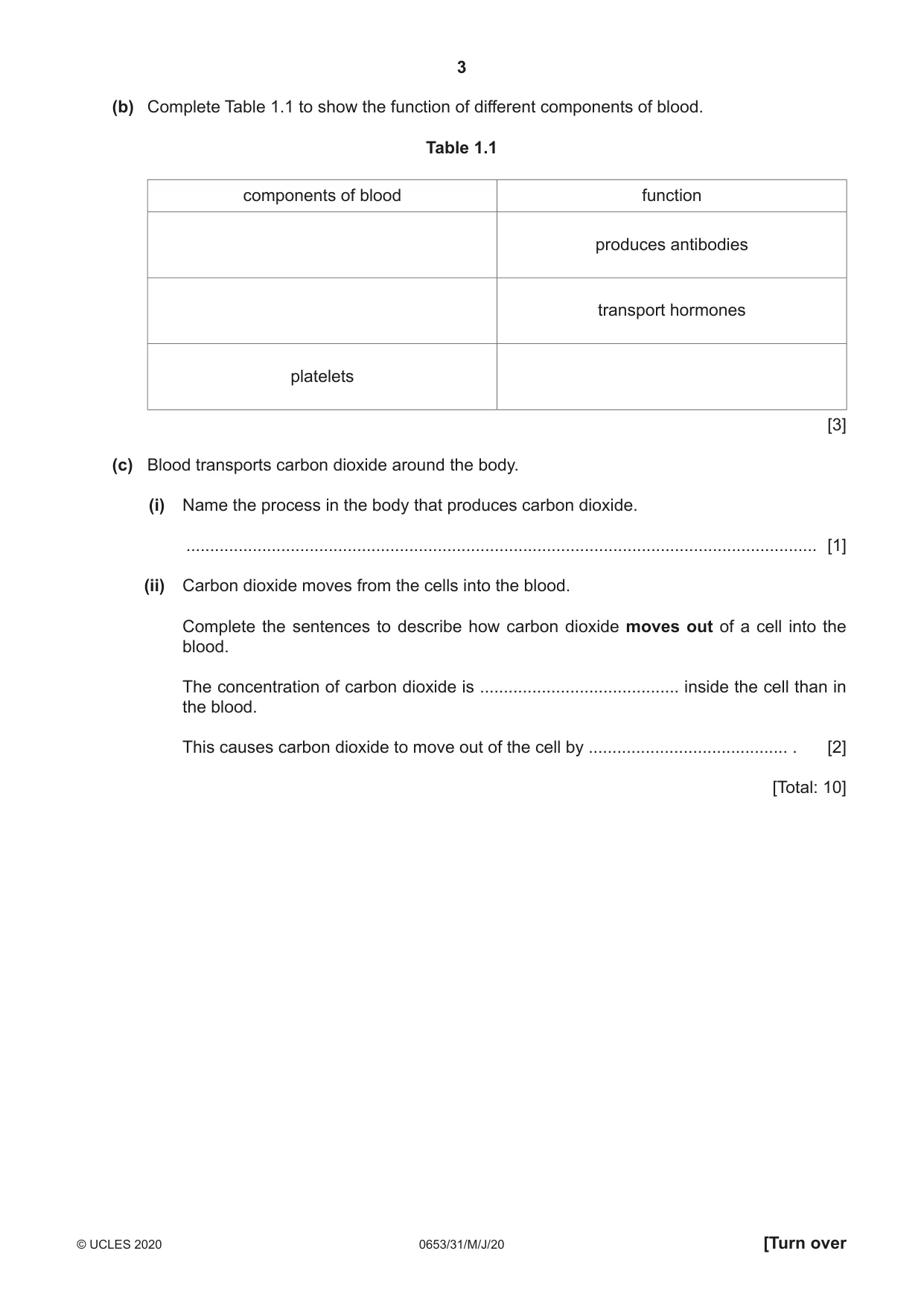
1 (a) Fig. 1.1 shows the structure of a human heart. A C B Fig. 1.1 (i) Identify parts A and B shown in Fig. 1.1. A ........................................................................................................................................ B ........................................................................................................................................ [2] (ii) Identify part C shown in Fig. 1.1. ..................................................................................................................................... [1] (iii) Describe the importance of part C to the flow of blood through the heart. ........................................................................................................................................... ..................................................................................................................................... [1] (b) Complete Table 1.1 to show the function of different components of blood. Table 1.1 components of blood function produces antibodies transport hormones platelets [3] (c) Blood transports carbon dioxide around the body. (i) Name the process in the body that produces carbon dioxide. ..................................................................................................................................... [1] (ii) Carbon dioxide moves from the cells into the blood. Complete the sentences to describe how carbon dioxide moves out of a cell into the blood. The concentration of carbon dioxide is .......................................... inside the cell than in the blood. This causes carbon dioxide to move out of the cell by .......................................... . [2] [Total: 10]
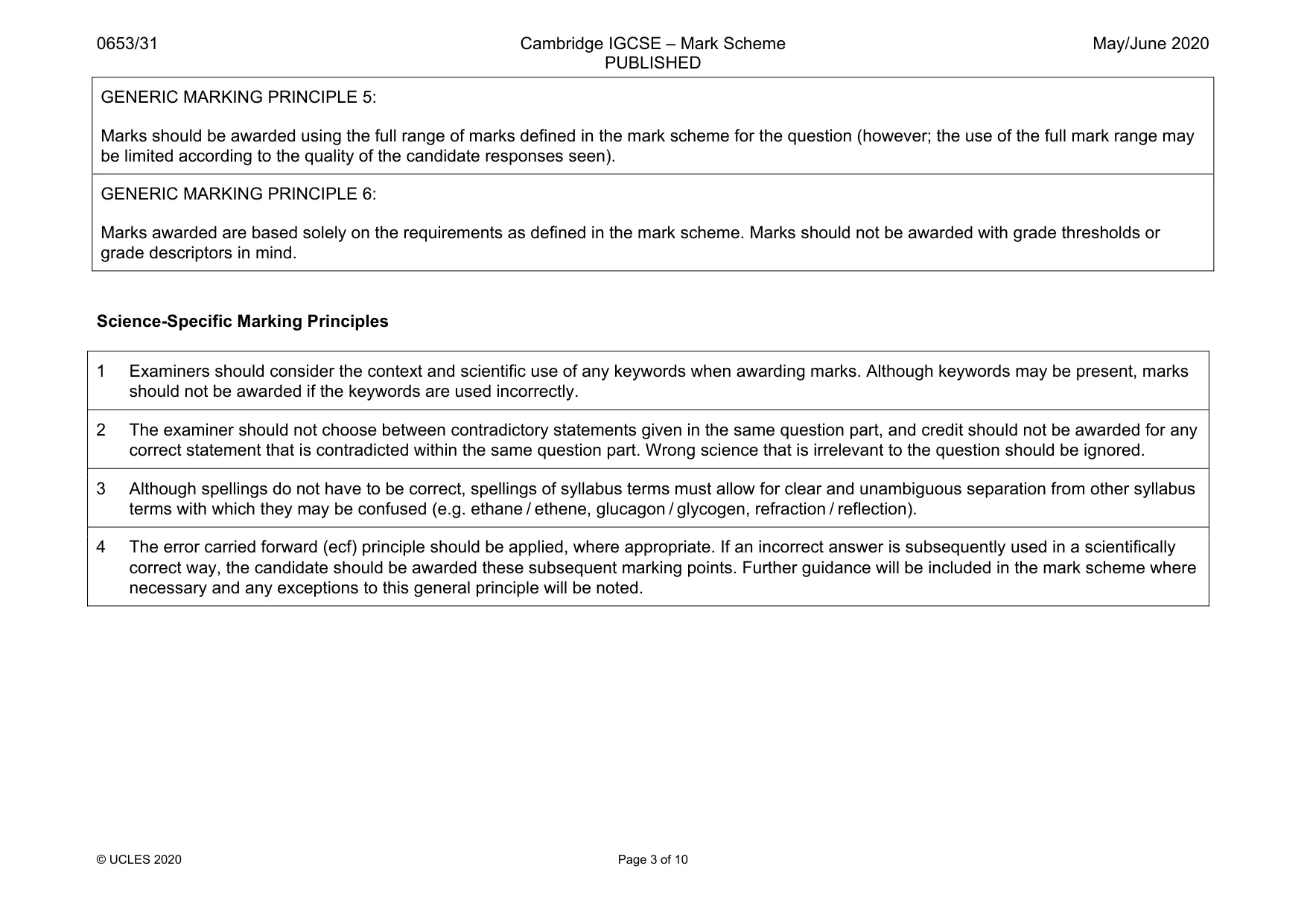
Mark scheme: 1(a)(i) A (left) atrium ; B septum ; 2 1(a)(ii) valve ; 1 1(a)(iii) makes sure the blood flows in one direction / prevents backflow ; 1 1(b) white blood cells (produces antibodies) ; plasma (transports hormones) ; (platelets) blood clotting ; 3 1(c)(i) respiration ; 1 1(c)(ii) higher / greater ; diffusion ; 2
Q2 · A teacher uses the apparatus shown in Fig
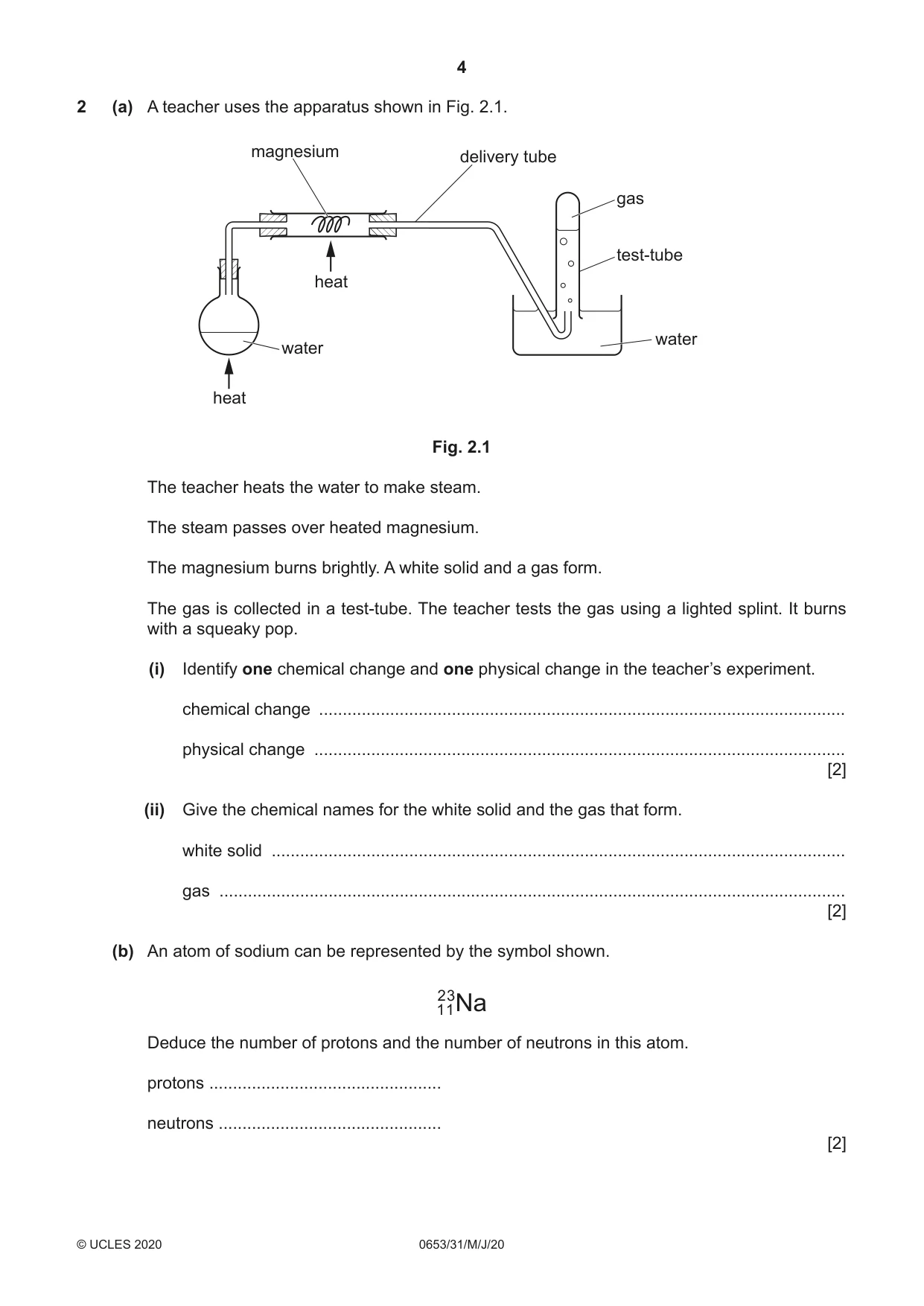
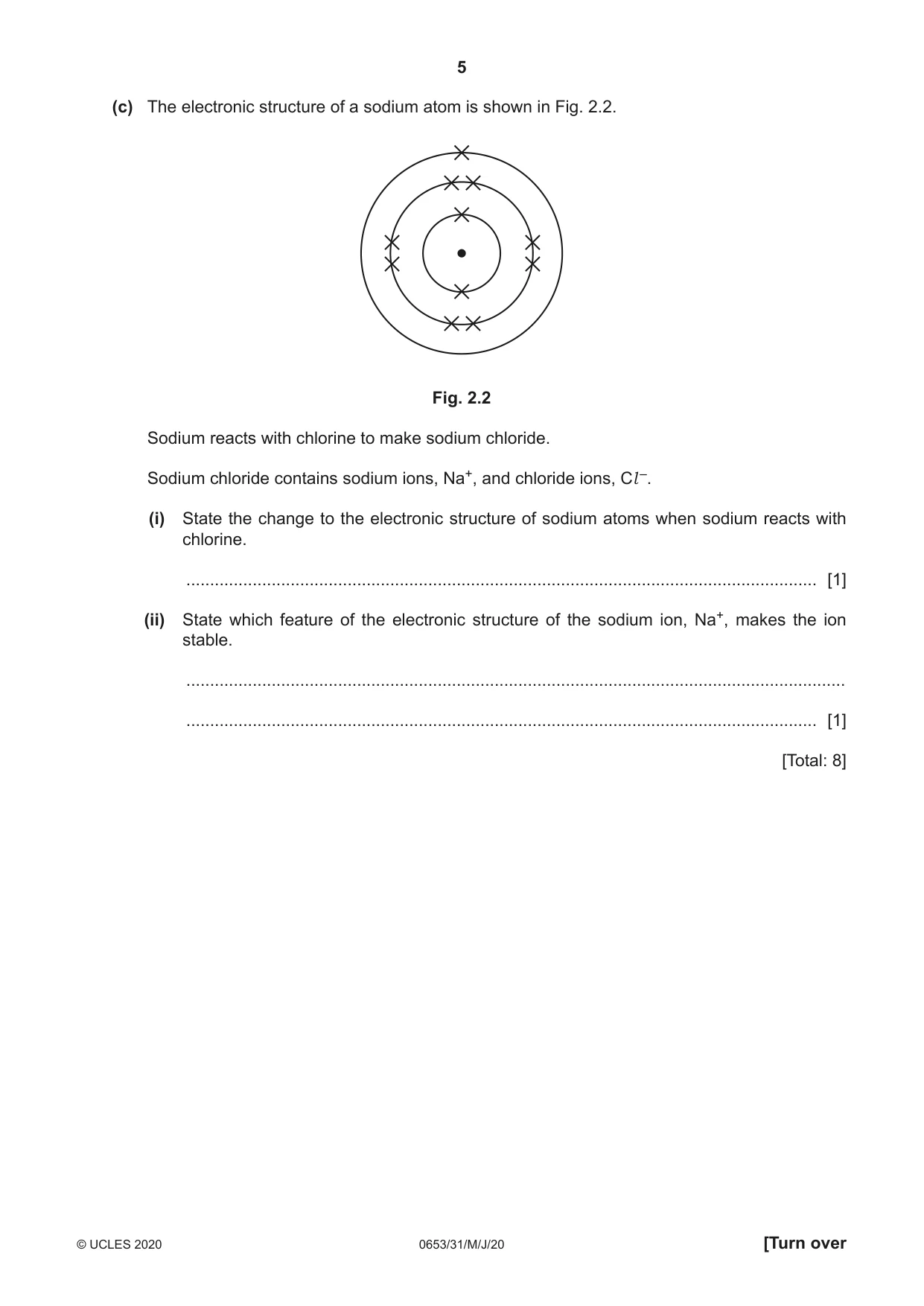
2 (a) A teacher uses the apparatus shown in Fig. 2.1. magnesium delivery tube gas test-tube heat water water heat Fig. 2.1 The teacher heats the water to make steam. The steam passes over heated magnesium. The magnesium burns brightly. A white solid and a gas form. The gas is collected in a test-tube. The teacher tests the gas using a lighted splint. It burns with a squeaky pop. (i) Identify one chemical change and one physical change in the teacher’s experiment. chemical change ............................................................................................................... physical change ................................................................................................................ [2] (ii) Give the chemical names for the white solid and the gas that form. white solid ......................................................................................................................... gas .................................................................................................................................... [2] (b) An atom of sodium can be represented by the symbol shown. 2 1 13Na Deduce the number of protons and the number of neutrons in this atom. protons ................................................. neutrons ............................................... [2] (c) The electronic structure of a sodium atom is shown in Fig. 2.2. Fig. 2.2 Sodium reacts with chlorine to make sodium chloride. Sodium chloride contains sodium ions, Na+, and chloride ions, Cl –. (i) State the change to the electronic structure of sodium atoms when sodium reacts with chlorine. ..................................................................................................................................... [1] (ii) State which feature of the electronic structure of the sodium ion, Na+, makes the ion stable. ........................................................................................................................................... ..................................................................................................................................... [1] [Total: 8]
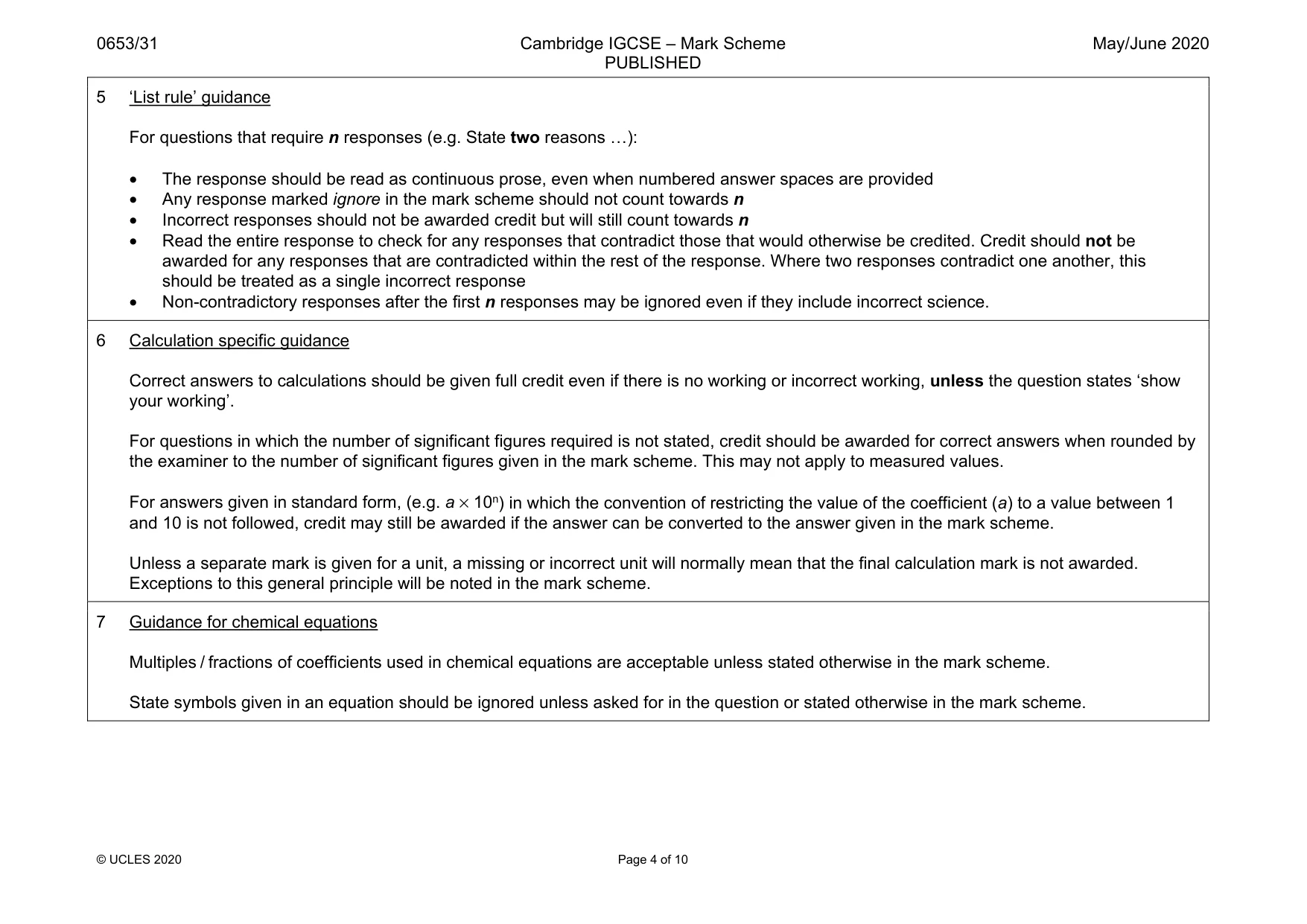
Mark scheme: 2(a)(i) (chemical change) burning / combustion / gas test ; (physical change) boiling / water to steam ; 2 2(a)(ii) (white solid) magnesium oxide ; (gas) hydrogen ; 2 2(b) (protons) 11 ; (neutrons) 12 ; 2 2(c)(i) loses one electron / loses outer electron ; 1 2(c)(ii) full outer shell / same as noble gas (electronic structure) ; 1
Q3 · A rocket about to transport a large mirror into orbit around the Earth
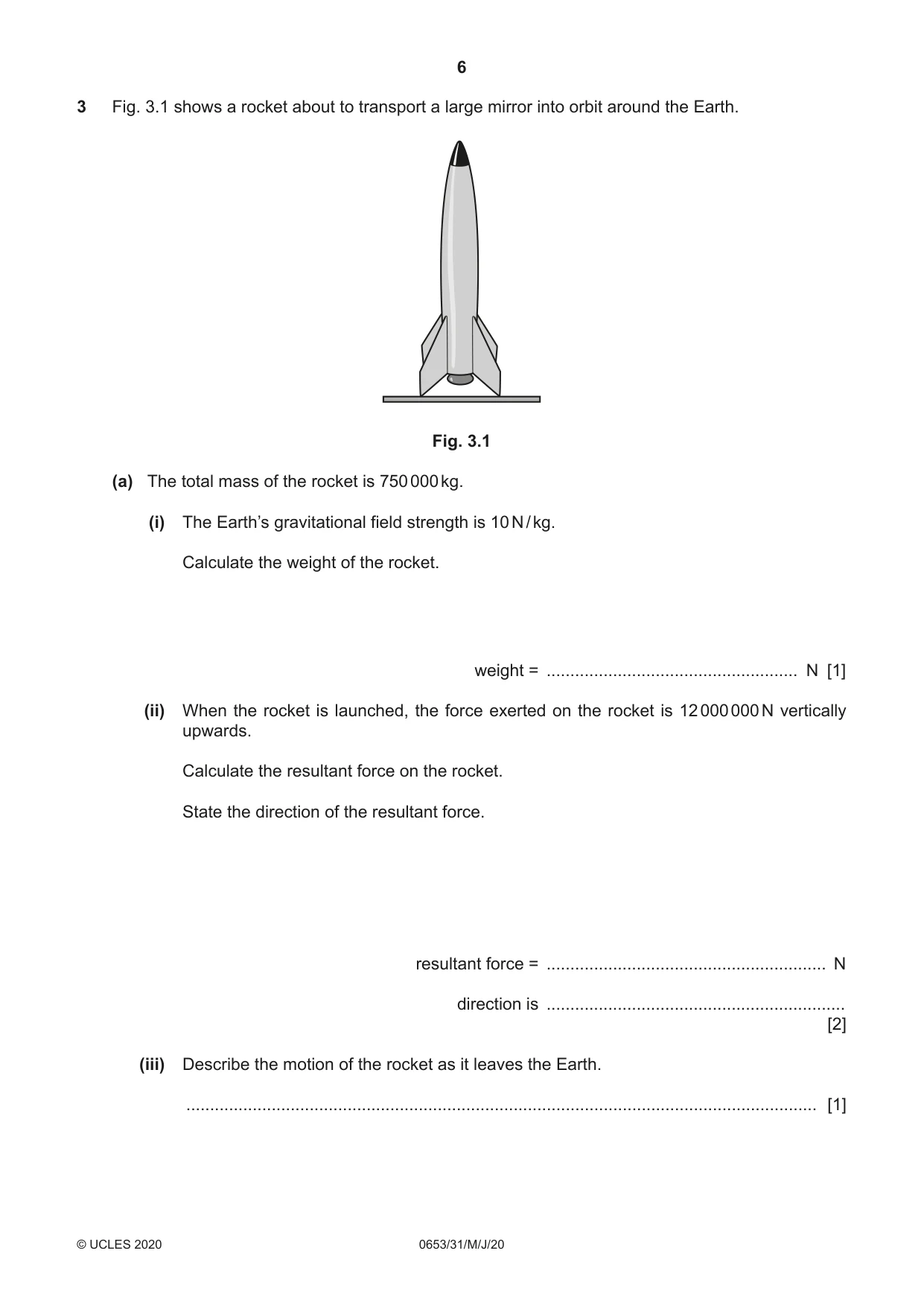
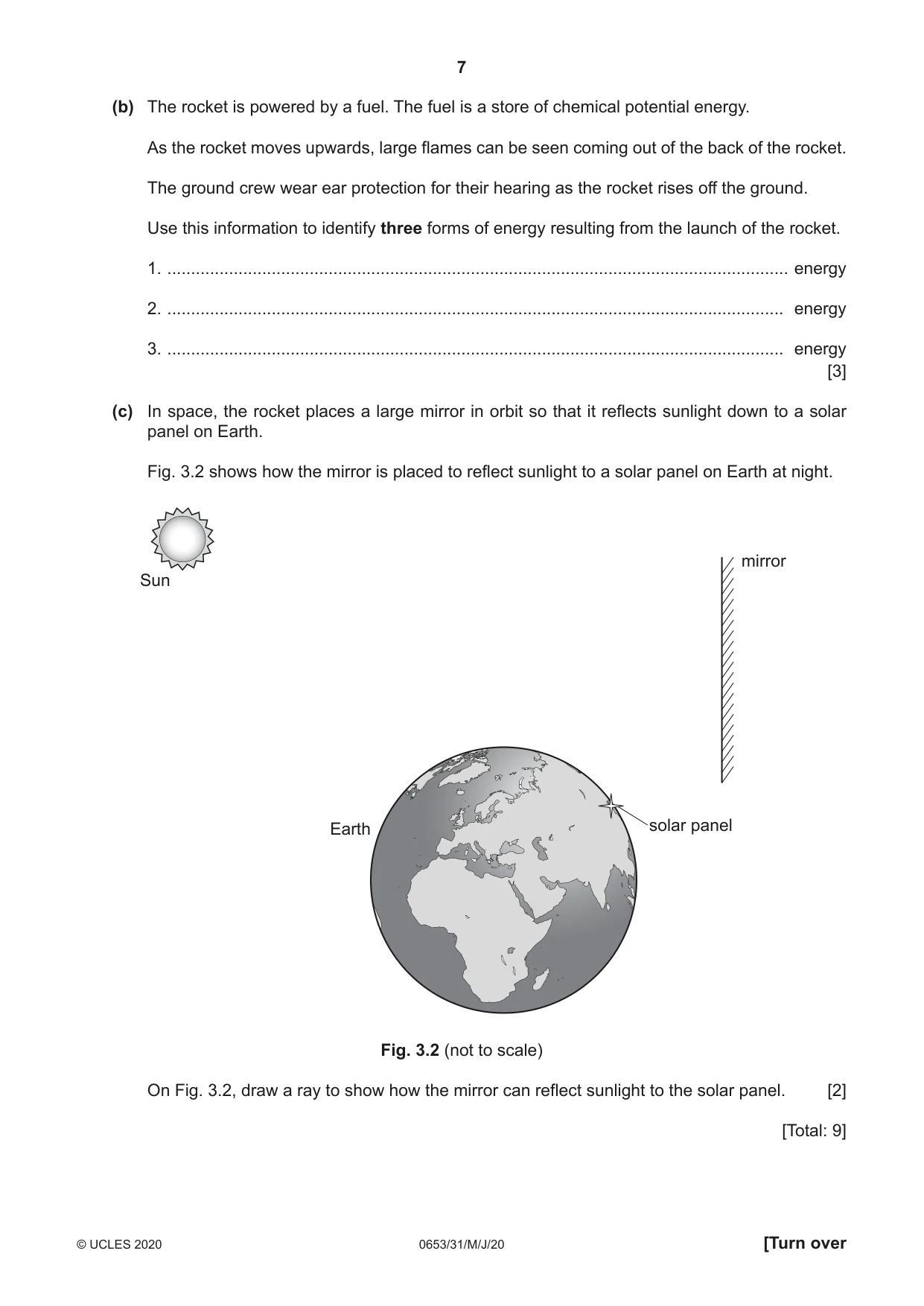
3 Fig. 3.1 shows a rocket about to transport a large mirror into orbit around the Earth. Fig. 3.1 (a) The total mass of the rocket is 750 000 kg. (i) The Earth’s gravitational field strength is 10 N / kg. Calculate the weight of the rocket. weight = ..................................................... N [1] (ii) When the rocket is launched, the force exerted on the rocket is 12 000 000 N vertically upwards. Calculate the resultant force on the rocket. State the direction of the resultant force. resultant force = ........................................................... N direction is ............................................................... [2] (iii) Describe the motion of the rocket as it leaves the Earth. ..................................................................................................................................... [1] (b) The rocket is powered by a fuel. The fuel is a store of chemical potential energy. As the rocket moves upwards, large flames can be seen coming out of the back of the rocket. The ground crew wear ear protection for their hearing as the rocket rises off the ground. Use this information to identify three forms of energy resulting from the launch of the rocket. 1. ................................................................................................................................... energy 2. .................................................................................................................................. energy 3. .................................................................................................................................. energy [3] (c) In space, the rocket places a large mirror in orbit so that it reflects sunlight down to a solar panel on Earth. Fig. 3.2 shows how the mirror is placed to reflect sunlight to a solar panel on Earth at night. mirror Sun Earth solar panel Fig. 3.2 (not to scale) On Fig. 3.2, draw a ray to show how the mirror can reflect sunlight to the solar panel. [2] [Total: 9]
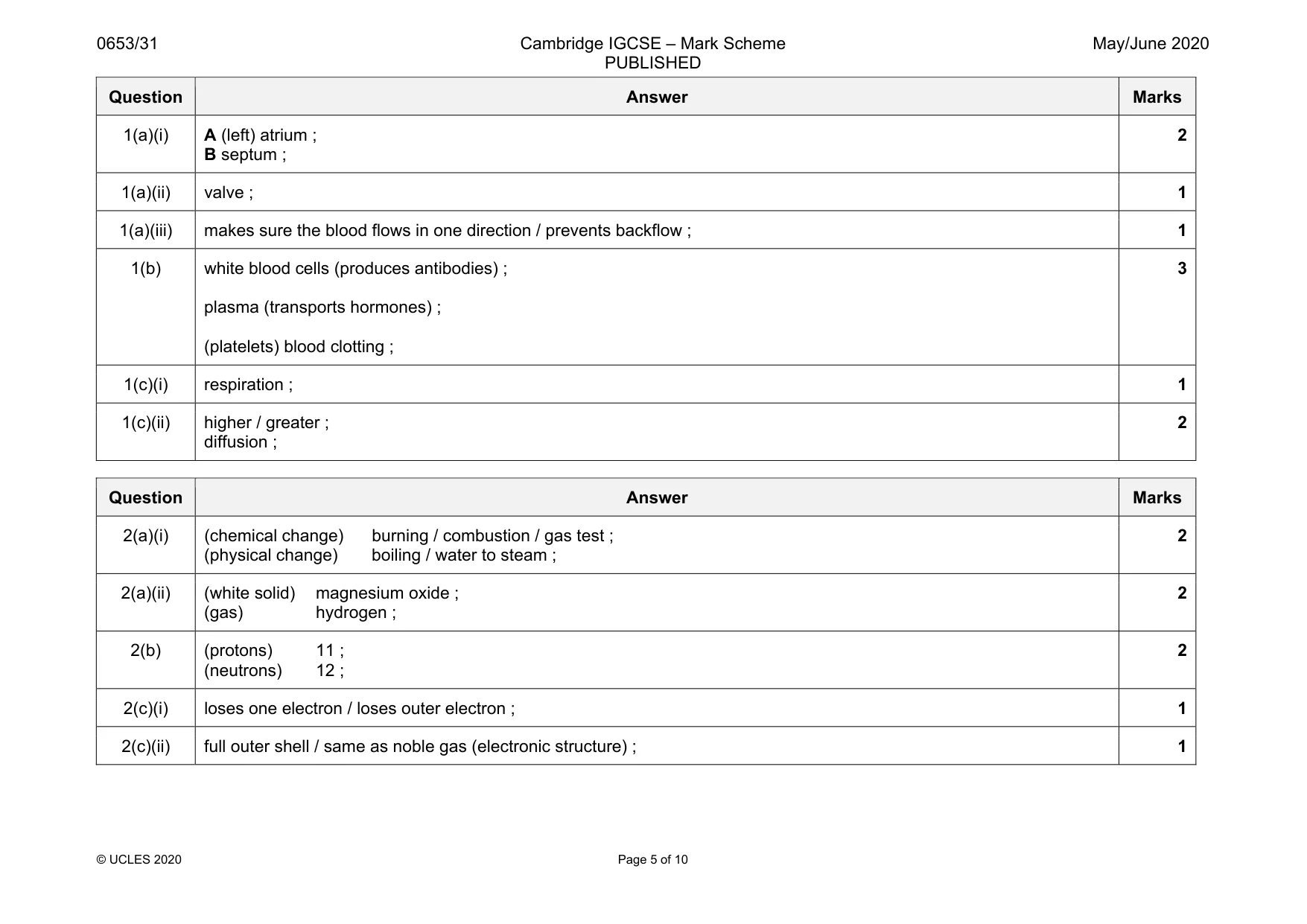
Mark scheme: 3(a)(i) (weight = 750000 × 10 =) 7500000 (N) ; 1 3(a)(ii) (resultant force = 12 000 000 – 7 500 000 =) 4 500 000 (N) ; (vertically) upwards ; 2 3(a)(iii) accelerating / increasing speed ; 1 3(b) any three from: gravitational potential ; kinetic ; light ; sound ; thermal / heat ; max 3 3(c) ray from Sun to mirror reflected to solar panel ; angle of incidence equal to angle of reflection by visual inspection ; 2
Q4 · A graph showing the vitamin C content in 100 g of different foods
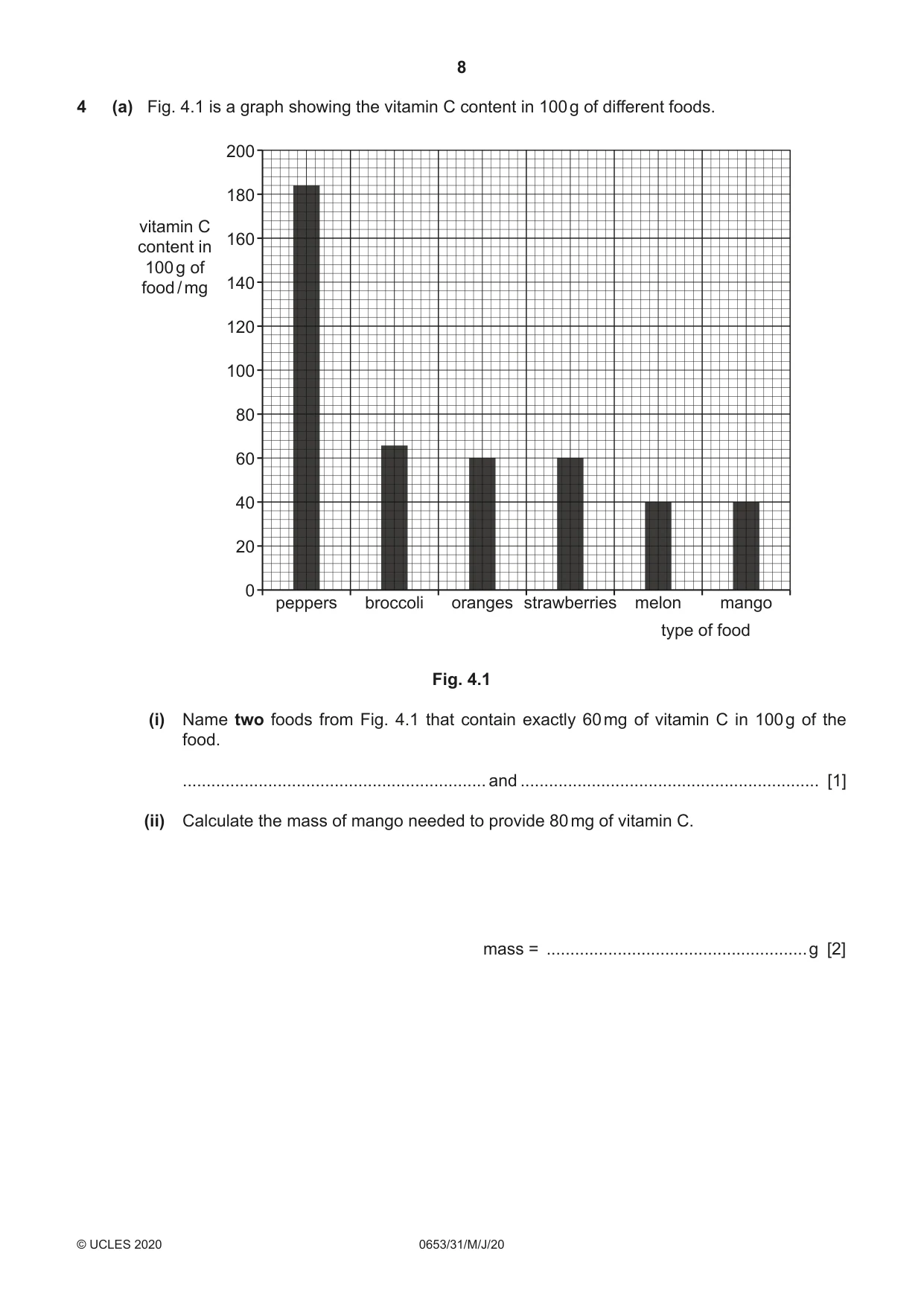
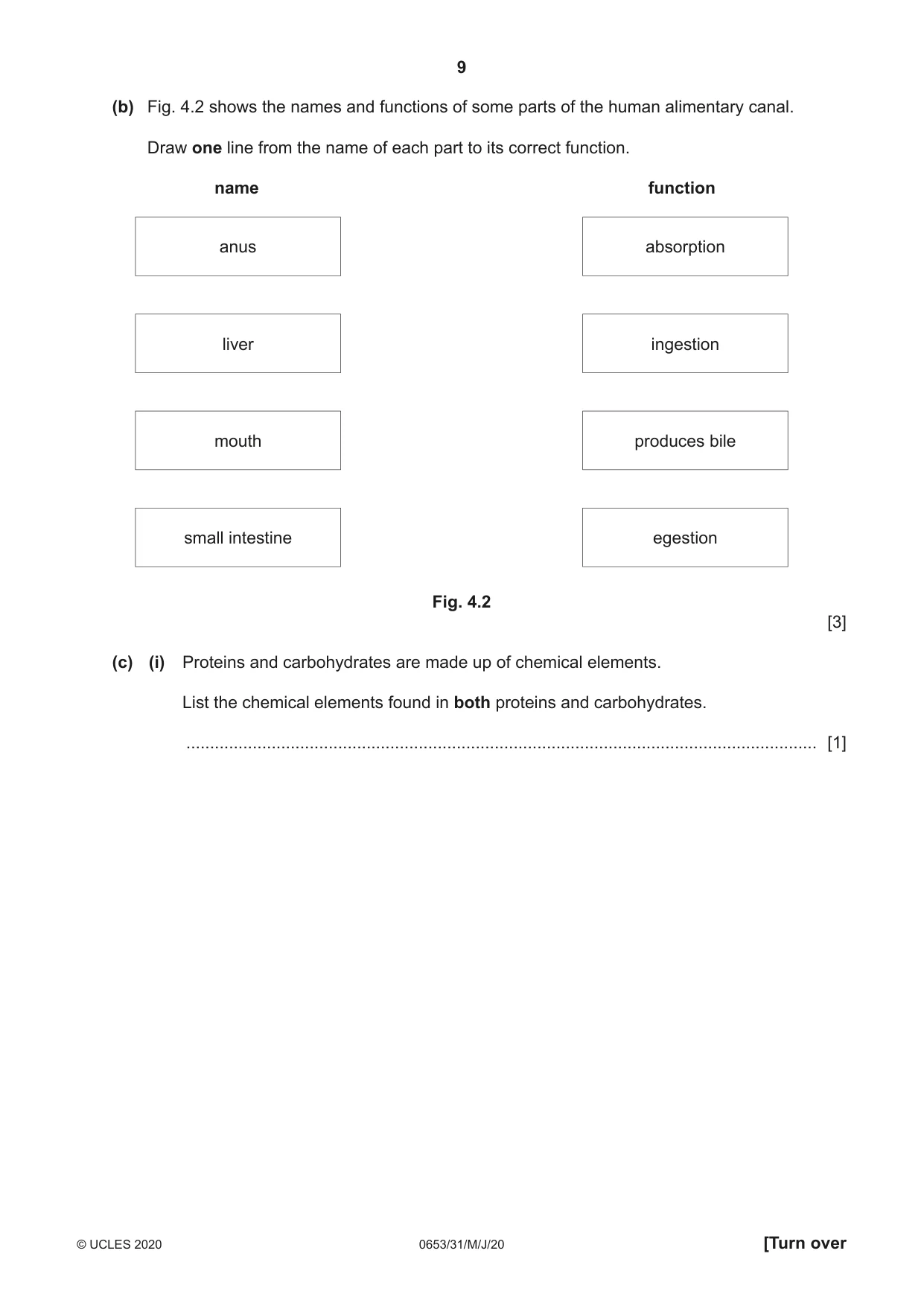
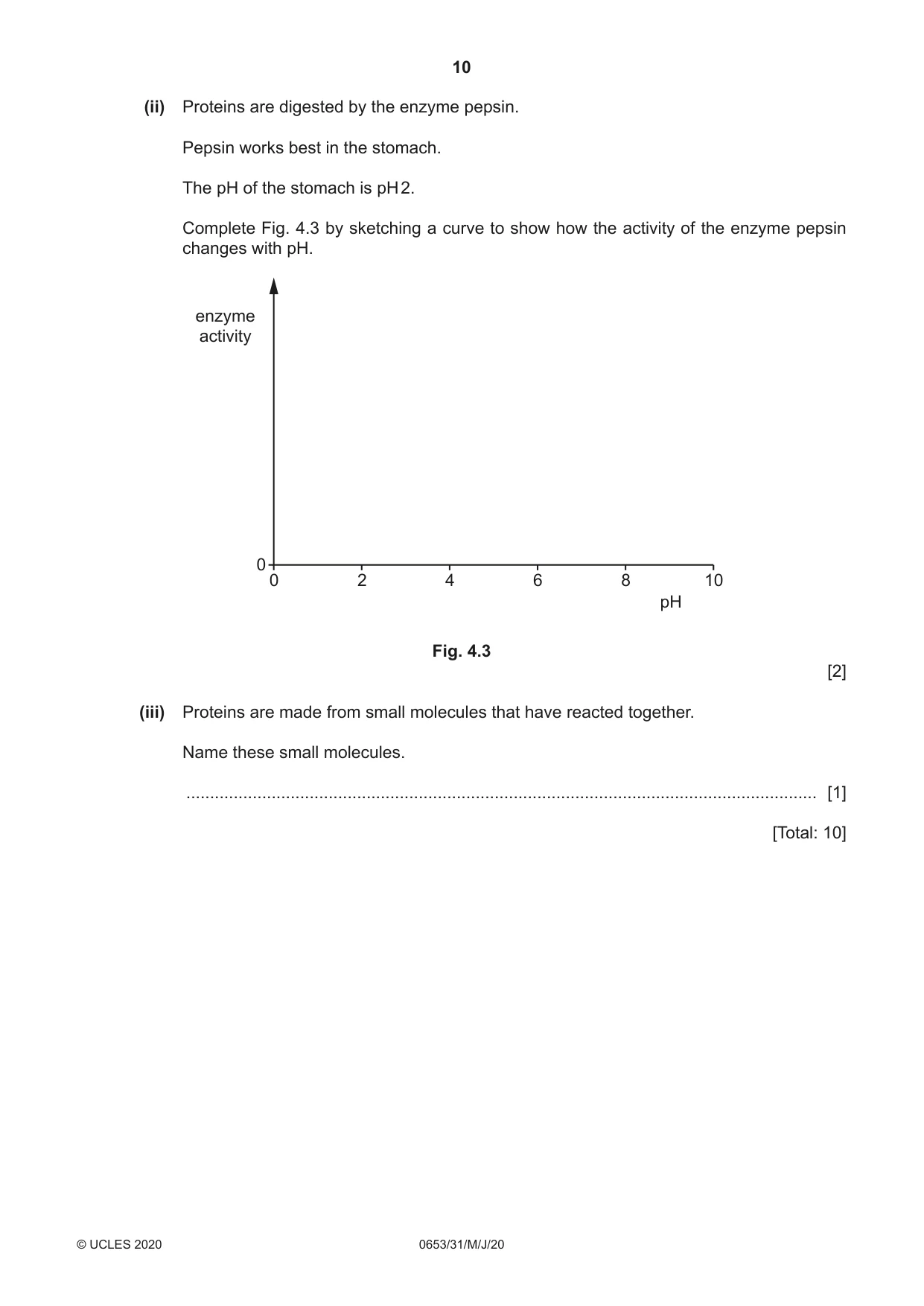
4 (a) Fig. 4.1 is a graph showing the vitamin C content in 100 g of different foods. 200 180 vitamin C 160 content in 100 g of food / mg 140 120 100 80 60 40 20 0 peppers broccoli oranges strawberries melon mango type of food Fig. 4.1 (i) Name two foods from Fig. 4.1 that contain exactly 60 mg of vitamin C in 100 g of the food. ................................................................ and ............................................................... [1] (ii) Calculate the mass of mango needed to provide 80 mg of vitamin C. mass = .......................................................g [2] (b) Fig. 4.2 shows the names and functions of some parts of the human alimentary canal. Draw one line from the name of each part to its correct function. name function anus absorption liver ingestion mouth produces bile small intestine egestion Fig. 4.2 [3] (c) (i) Proteins and carbohydrates are made up of chemical elements. List the chemical elements found in both proteins and carbohydrates. ..................................................................................................................................... [1] (ii) Proteins are digested by the enzyme pepsin. Pepsin works best in the stomach. The pH of the stomach is pH 2. Complete Fig. 4.3 by sketching a curve to show how the activity of the enzyme pepsin changes with pH. enzyme activity 0 0 2 4 6 8 10 pH Fig. 4.3 [2] (iii) Proteins are made from small molecules that have reacted together. Name these small molecules. ..................................................................................................................................... [1] [Total: 10]
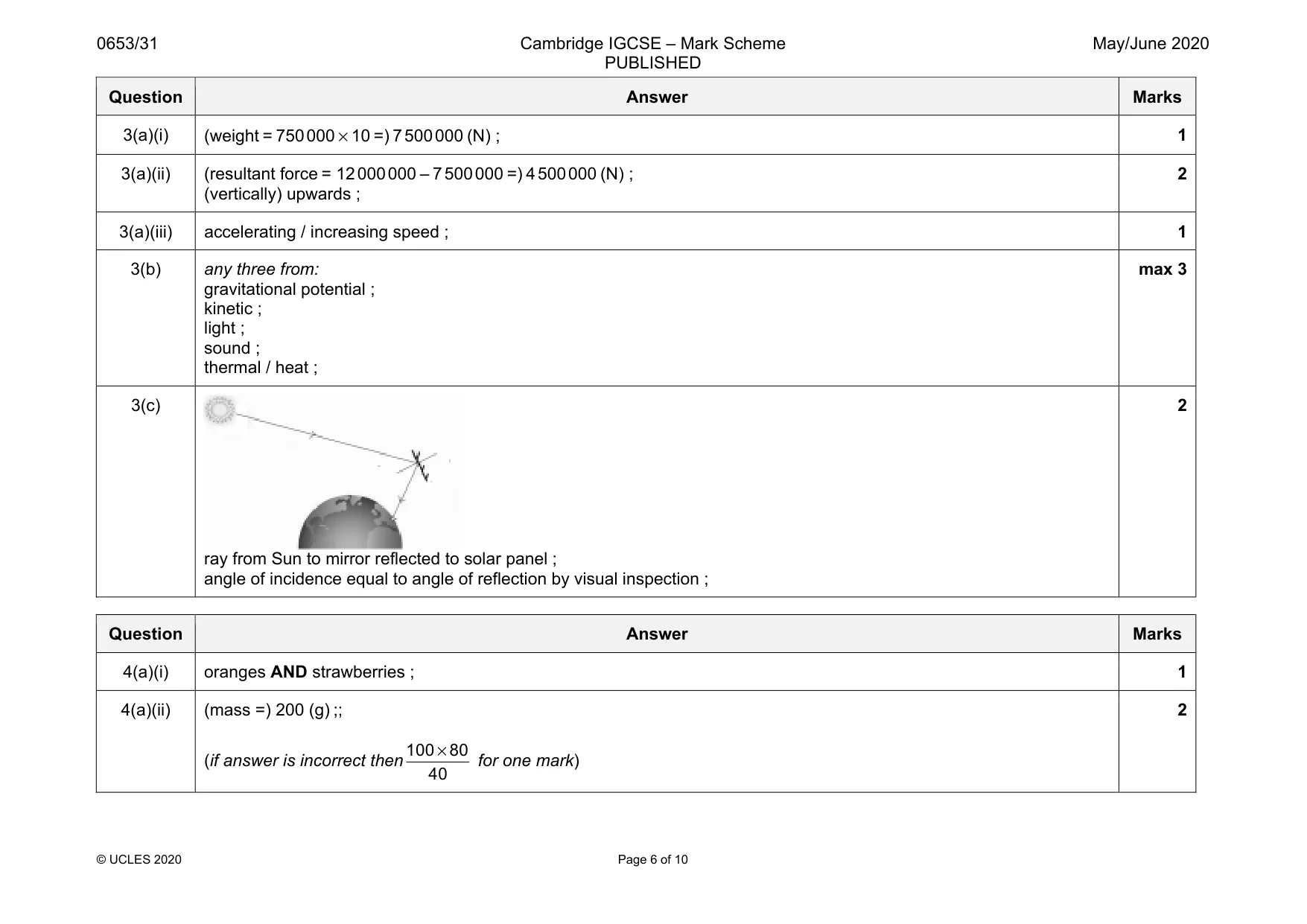
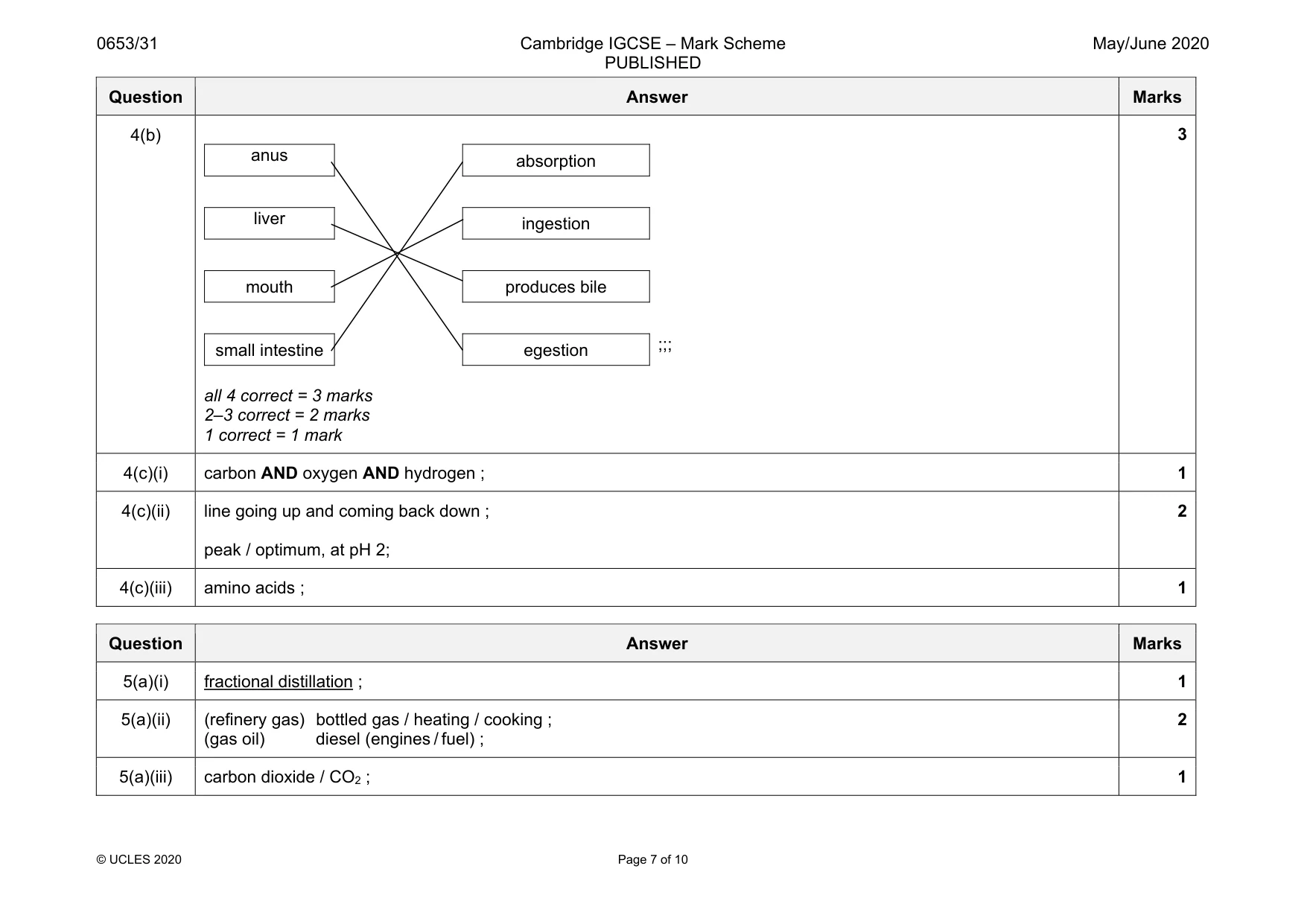
Mark scheme: 4(a)(i) oranges AND strawberries ; 1 4(a)(ii) (mass =) 200 (g) ;; (if answer is incorrect then 100 80 40 × for one mark) 2 Question Answer Marks 4(b) anus absorption liver ingestion mouth produces bile small intestine egestion ;;; all 4 correct = 3 marks 2–3 correct = 2 marks 1 correct = 1 mark 3 4(c)(i) carbon AND oxygen AND hydrogen ; 1 4(c)(ii) line going up and coming back down ; peak / optimum, at pH 2; 2 4(c)(iii) amino acids ; 1
Q5 · Petroleum is separated using the process shown in Fig
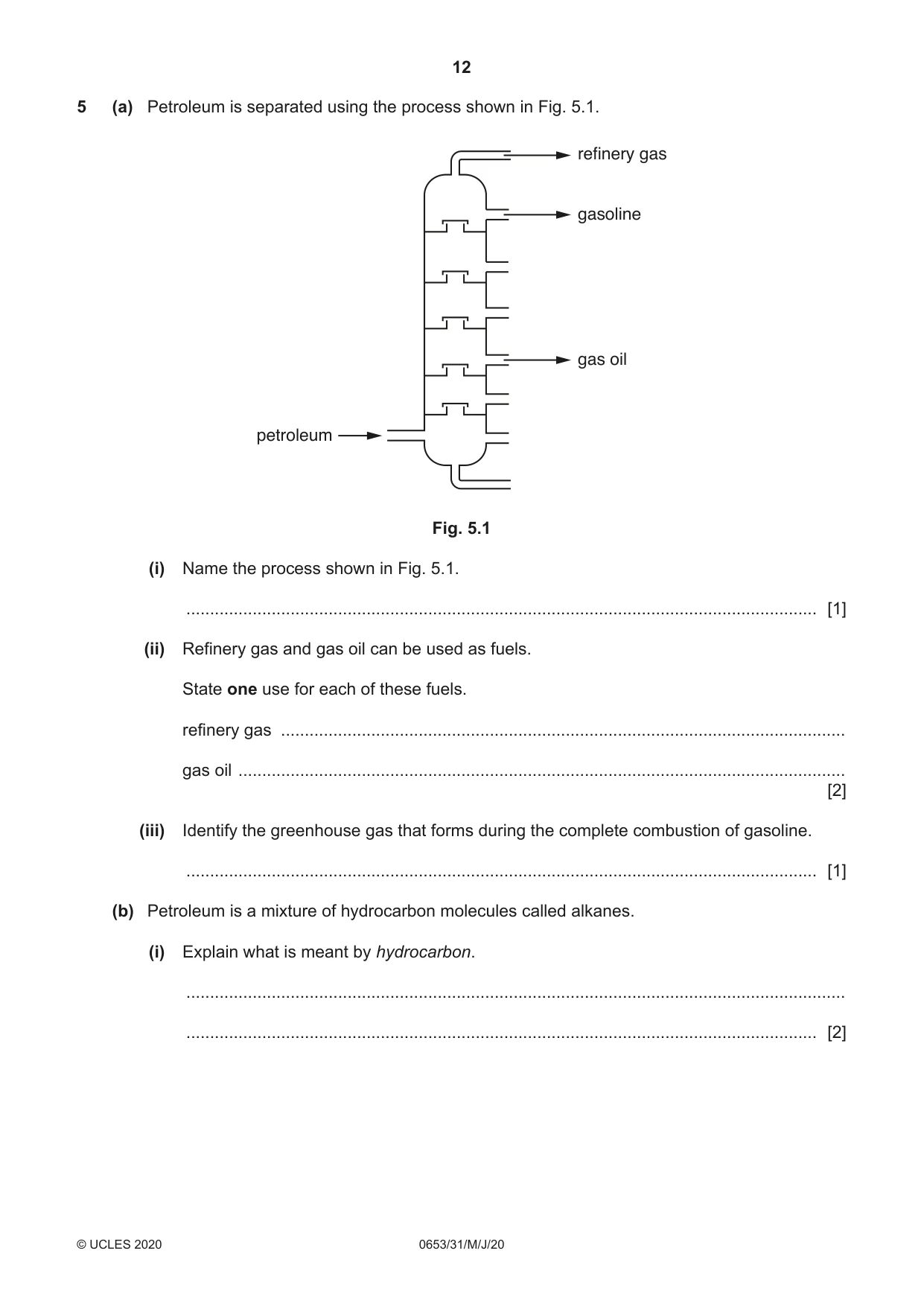
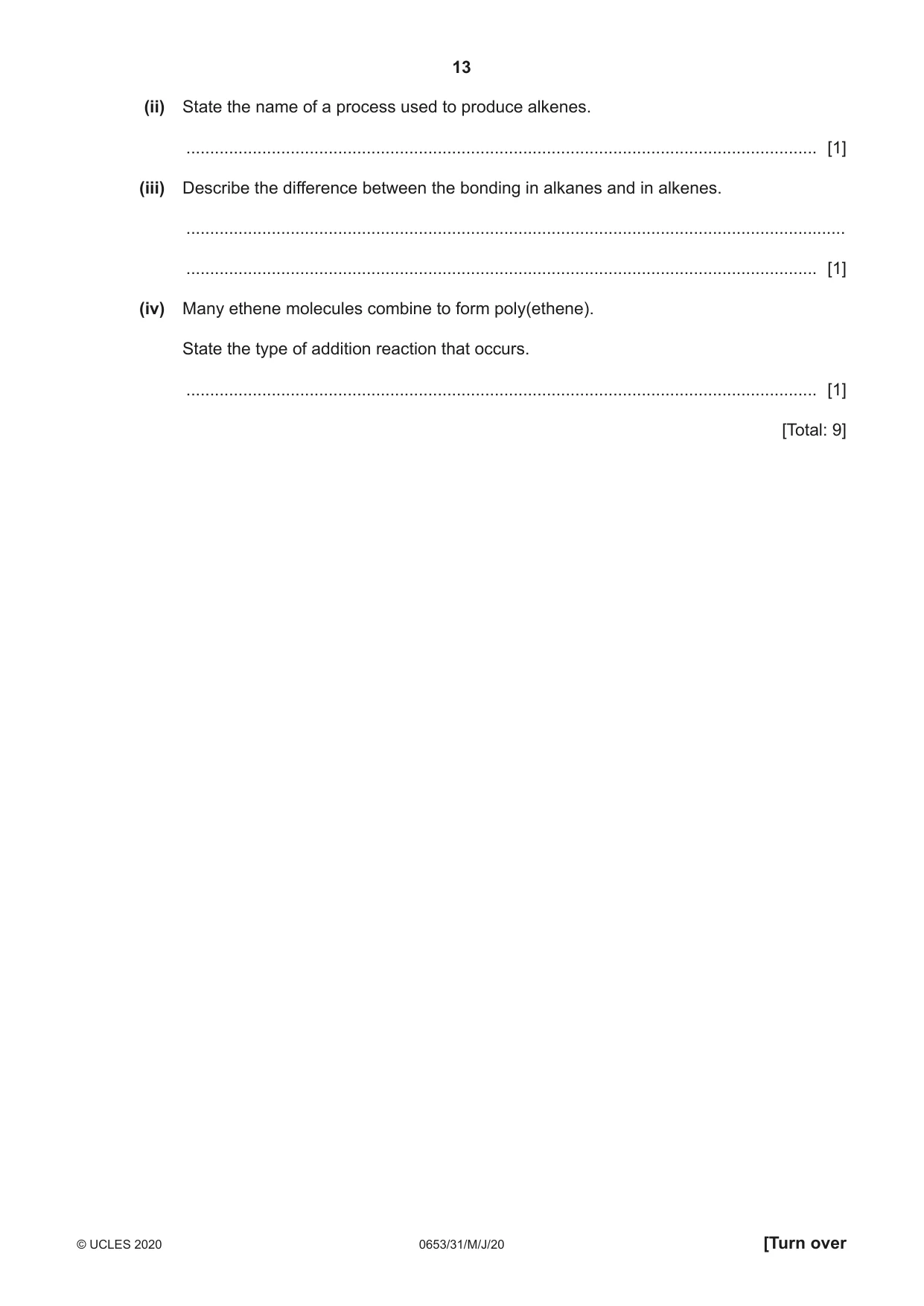
5 (a) Petroleum is separated using the process shown in Fig. 5.1. refinery gas gasoline gas oil petroleum Fig. 5.1 (i) Name the process shown in Fig. 5.1. ..................................................................................................................................... [1] (ii) Refinery gas and gas oil can be used as fuels. State one use for each of these fuels. refinery gas ....................................................................................................................... gas oil ................................................................................................................................ [2] (iii) Identify the greenhouse gas that forms during the complete combustion of gasoline. ..................................................................................................................................... [1] (b) Petroleum is a mixture of hydrocarbon molecules called alkanes. (i) Explain what is meant by hydrocarbon. ........................................................................................................................................... ..................................................................................................................................... [2] (ii) State the name of a process used to produce alkenes. ..................................................................................................................................... [1] (iii) Describe the difference between the bonding in alkanes and in alkenes. ........................................................................................................................................... ..................................................................................................................................... [1] (iv) Many ethene molecules combine to form poly(ethene). State the type of addition reaction that occurs. ..................................................................................................................................... [1] [Total: 9]
Mark scheme: 5(a)(i) fractional distillation ; 1 5(a)(ii) (refinery gas) bottled gas / heating / cooking ; (gas oil) diesel (engines / fuel) ; 2 5(a)(iii) carbon dioxide / CO2 ; 1 Question Answer Marks 5(b)(i) (molecules / compounds) contain carbon and hydrogen (atoms) ; only ; 2 5(b)(ii) cracking ; 1 5(b)(iii) alkanes contain only single (bonds) / alkenes contain double (bonds) ; 1 5(b)(iv) (addition) polymerisation ; 1
Q6 · A bucket of crushed ice used to cool drinks
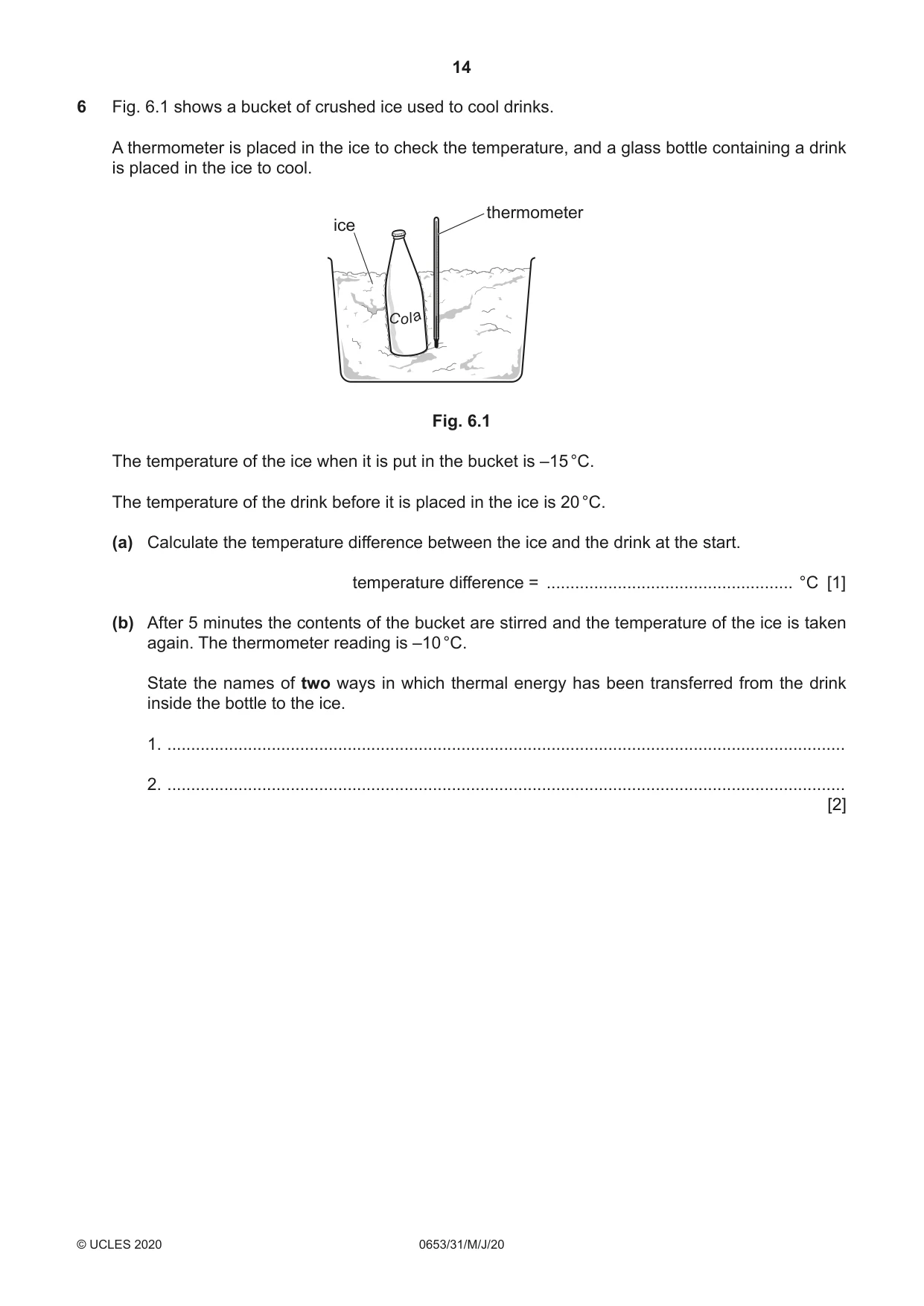
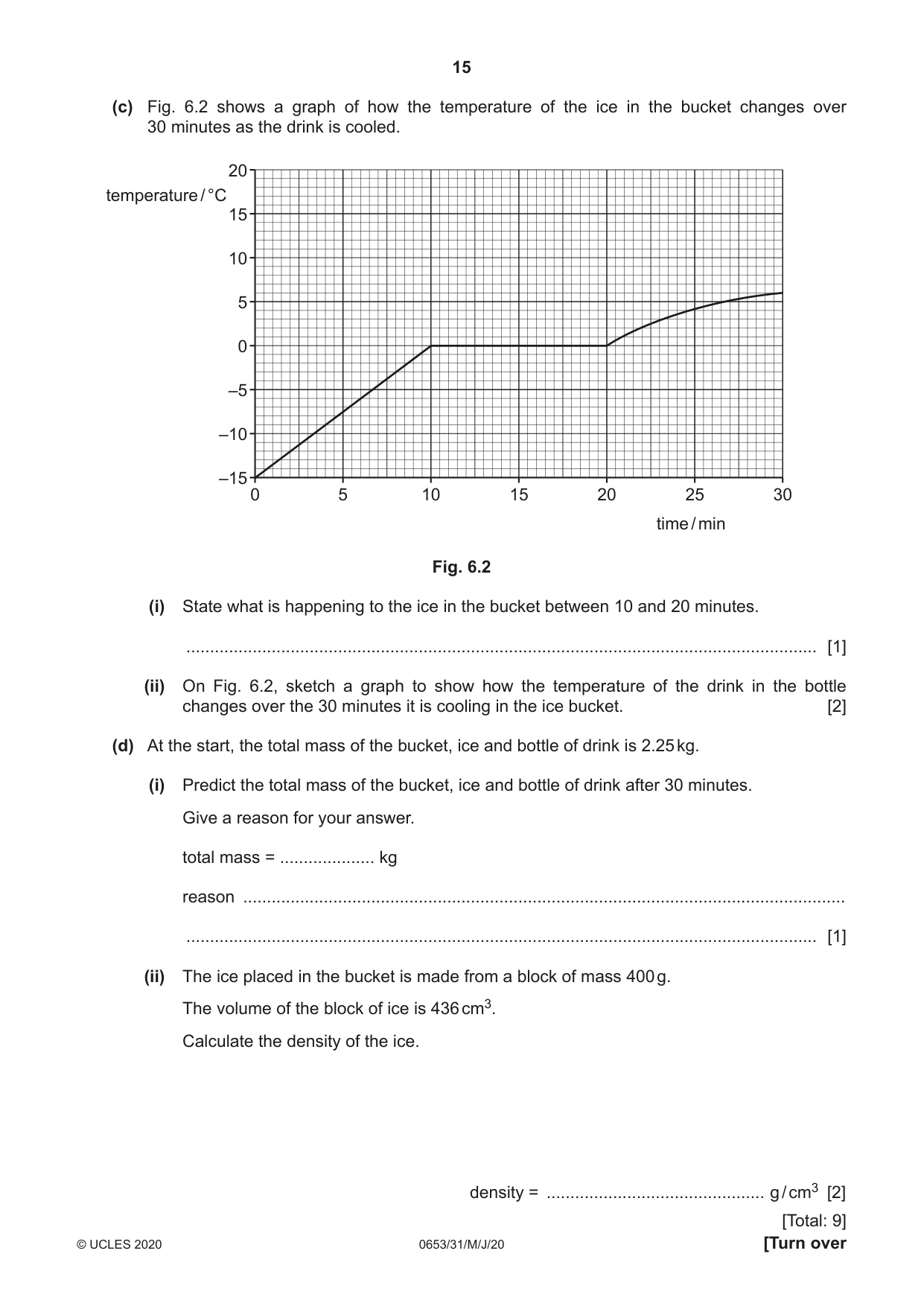
6 Fig. 6.1 shows a bucket of crushed ice used to cool drinks. A thermometer is placed in the ice to check the temperature, and a glass bottle containing a drink is placed in the ice to cool. thermometer ice Fig. 6.1 The temperature of the ice when it is put in the bucket is –15 °C. The temperature of the drink before it is placed in the ice is 20 °C. (a) Calculate the temperature difference between the ice and the drink at the start. temperature difference = .................................................... °C [1] (b) After 5 minutes the contents of the bucket are stirred and the temperature of the ice is taken again. The thermometer reading is –10 °C. State the names of two ways in which thermal energy has been transferred from the drink inside the bottle to the ice. 1. ............................................................................................................................................... 2. ............................................................................................................................................... [2] (c) Fig. 6.2 shows a graph of how the temperature of the ice in the bucket changes over 30 minutes as the drink is cooled. 20 temperature / °C 15 10 5 0 –5 –10 –15 0 5 10 15 20 25 30 time / min Fig. 6.2 (i) State what is happening to the ice in the bucket between 10 and 20 minutes. ..................................................................................................................................... [1] (ii) On Fig. 6.2, sketch a graph to show how the temperature of the drink in the bottle changes over the 30 minutes it is cooling in the ice bucket. [2] (d) At the start, the total mass of the bucket, ice and bottle of drink is 2.25 kg. (i) Predict the total mass of the bucket, ice and bottle of drink after 30 minutes. Give a reason for your answer. total mass = .................... kg reason ............................................................................................................................... ..................................................................................................................................... [1] (ii) The ice placed in the bucket is made from a block of mass 400 g. The volume of the block of ice is 436 cm3. Calculate the density of the ice. density = .............................................. g / cm3 [2] [Total: 9]
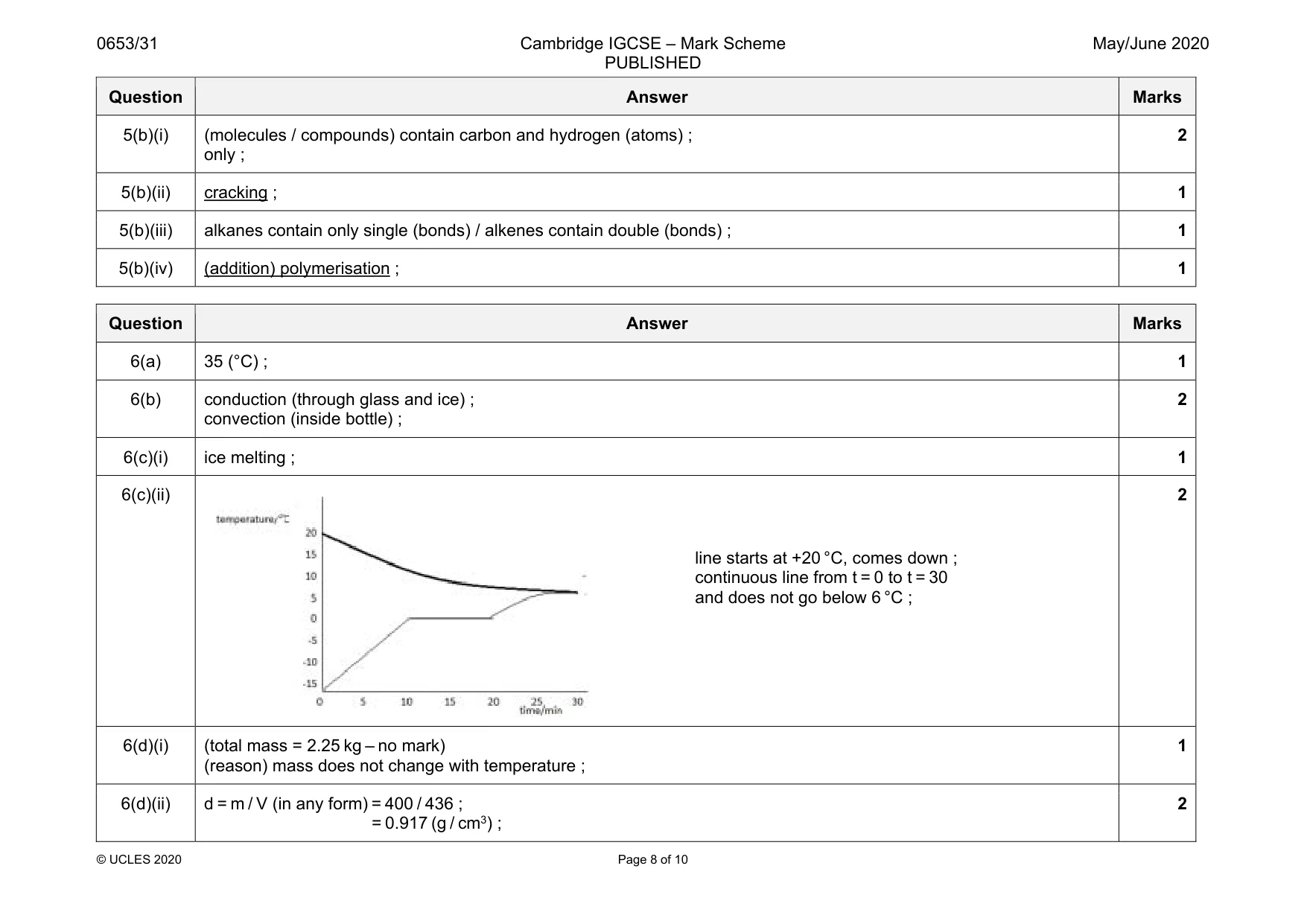
Mark scheme: 6(a) 35 (°C) ; 1 6(b) conduction (through glass and ice) ; convection (inside bottle) ; 2 6(c)(i) ice melting ; 1 6(c)(ii) 2 6(d)(i) (total mass = 2.25 kg – no mark) (reason) mass does not change with temperature ; 1 6(d)(ii) d = m / V (in any form) = 400 / 436 ; = 0.917 (g / cm3) ; 2 line starts at +20 °C, comes down ; continuous line from t = 0 to t = 30 and does not go below 6 °C ;
Question 7
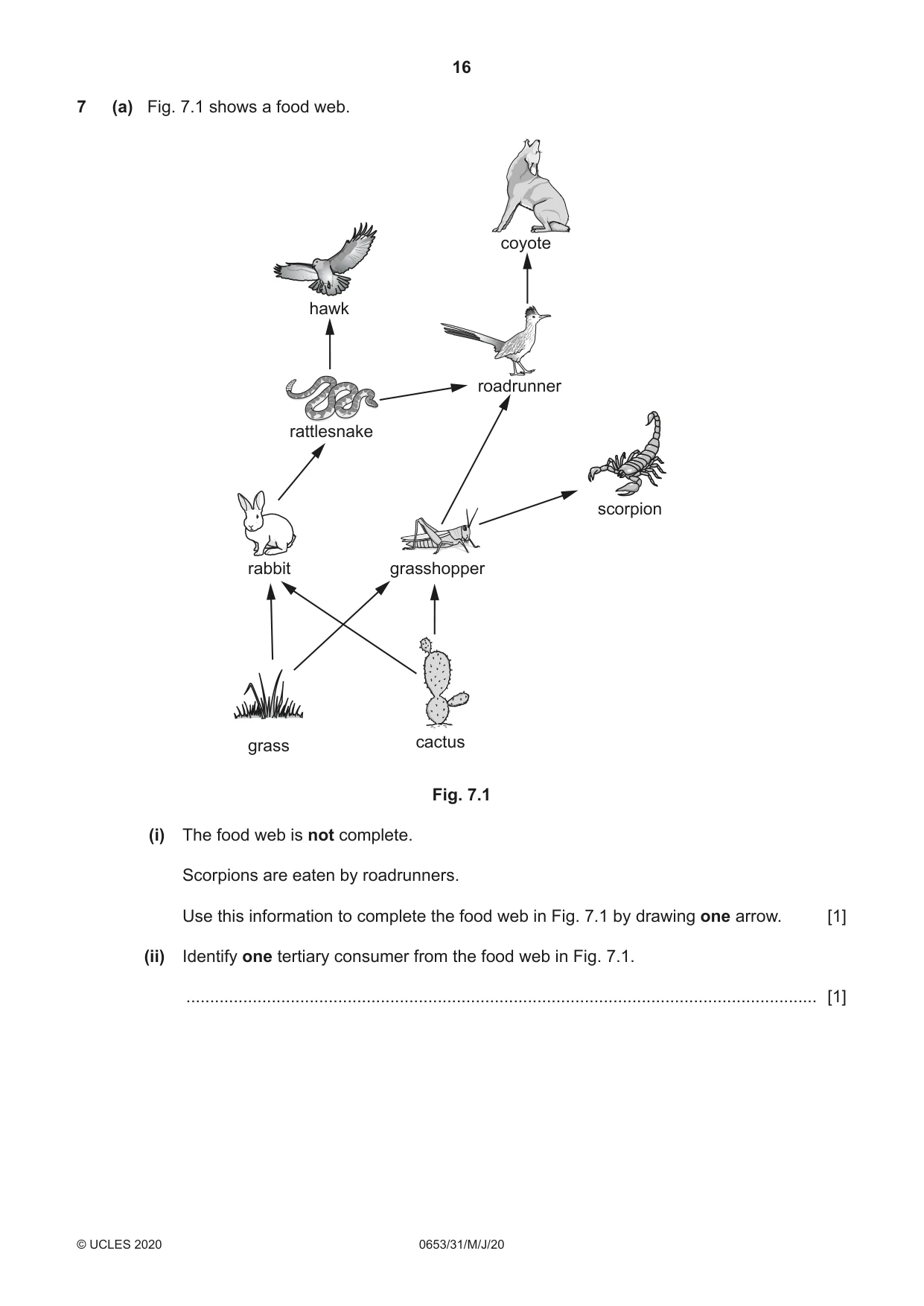
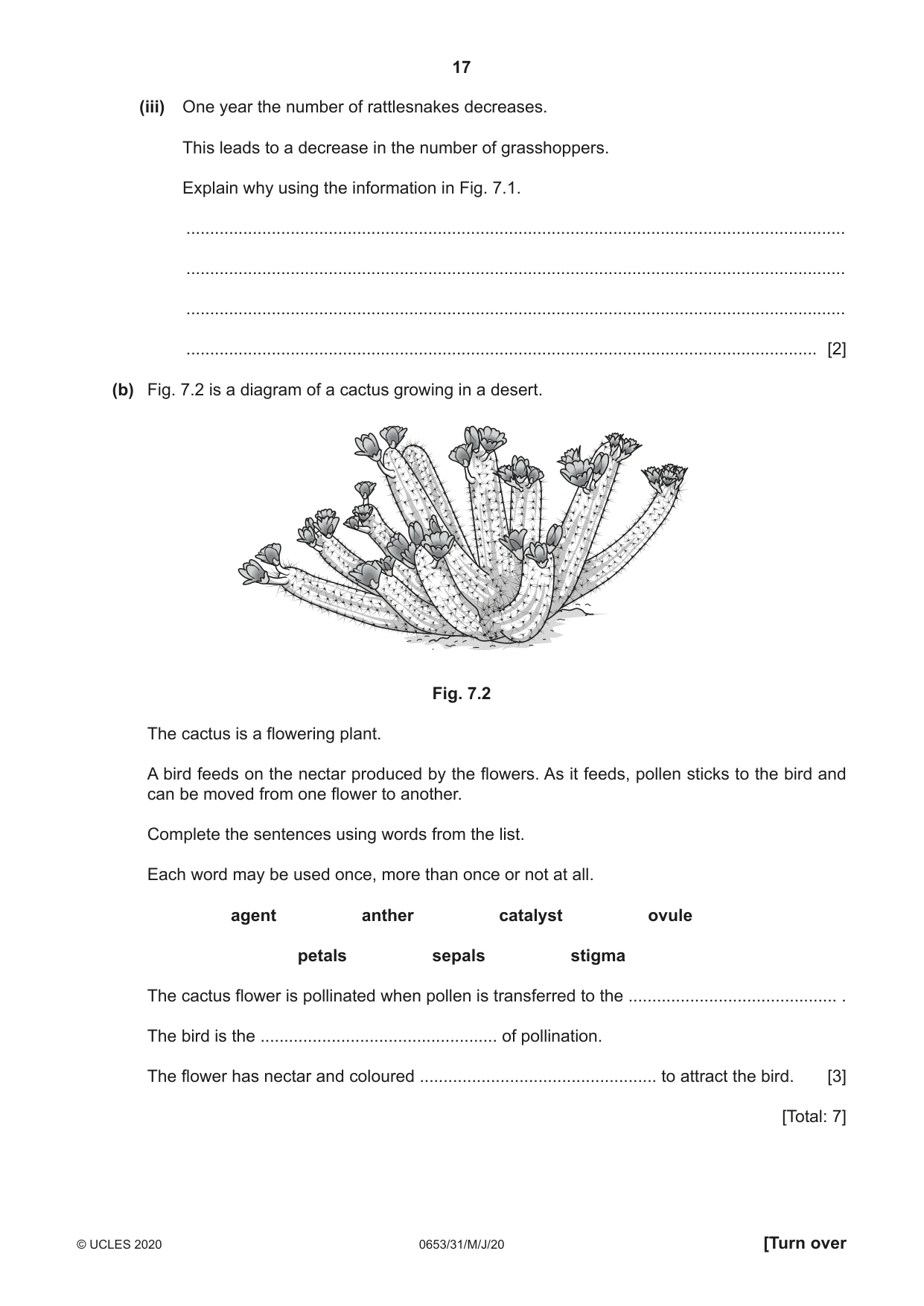
7 (a) Fig. 7.1 shows a food web. coyote hawk roadrunner rattlesnake scorpion rabbit grasshopper grass cactus Fig. 7.1 (i) The food web is not complete. Scorpions are eaten by roadrunners. Use this information to complete the food web in Fig. 7.1 by drawing one arrow. [1] (ii) Identify one tertiary consumer from the food web in Fig. 7.1. ..................................................................................................................................... [1] (iii) One year the number of rattlesnakes decreases. This leads to a decrease in the number of grasshoppers. Explain why using the information in Fig. 7.1. ........................................................................................................................................... ........................................................................................................................................... ........................................................................................................................................... ..................................................................................................................................... [2] (b) Fig. 7.2 is a diagram of a cactus growing in a desert. Fig. 7.2 The cactus is a flowering plant. A bird feeds on the nectar produced by the flowers. As it feeds, pollen sticks to the bird and can be moved from one flower to another. Complete the sentences using words from the list. Each word may be used once, more than once or not at all. agent anther catalyst ovule petals sepals stigma The cactus flower is pollinated when pollen is transferred to the ............................................ . The bird is the .................................................. of pollination. The flower has nectar and coloured .................................................. to attract the bird. [3] [Total: 7]
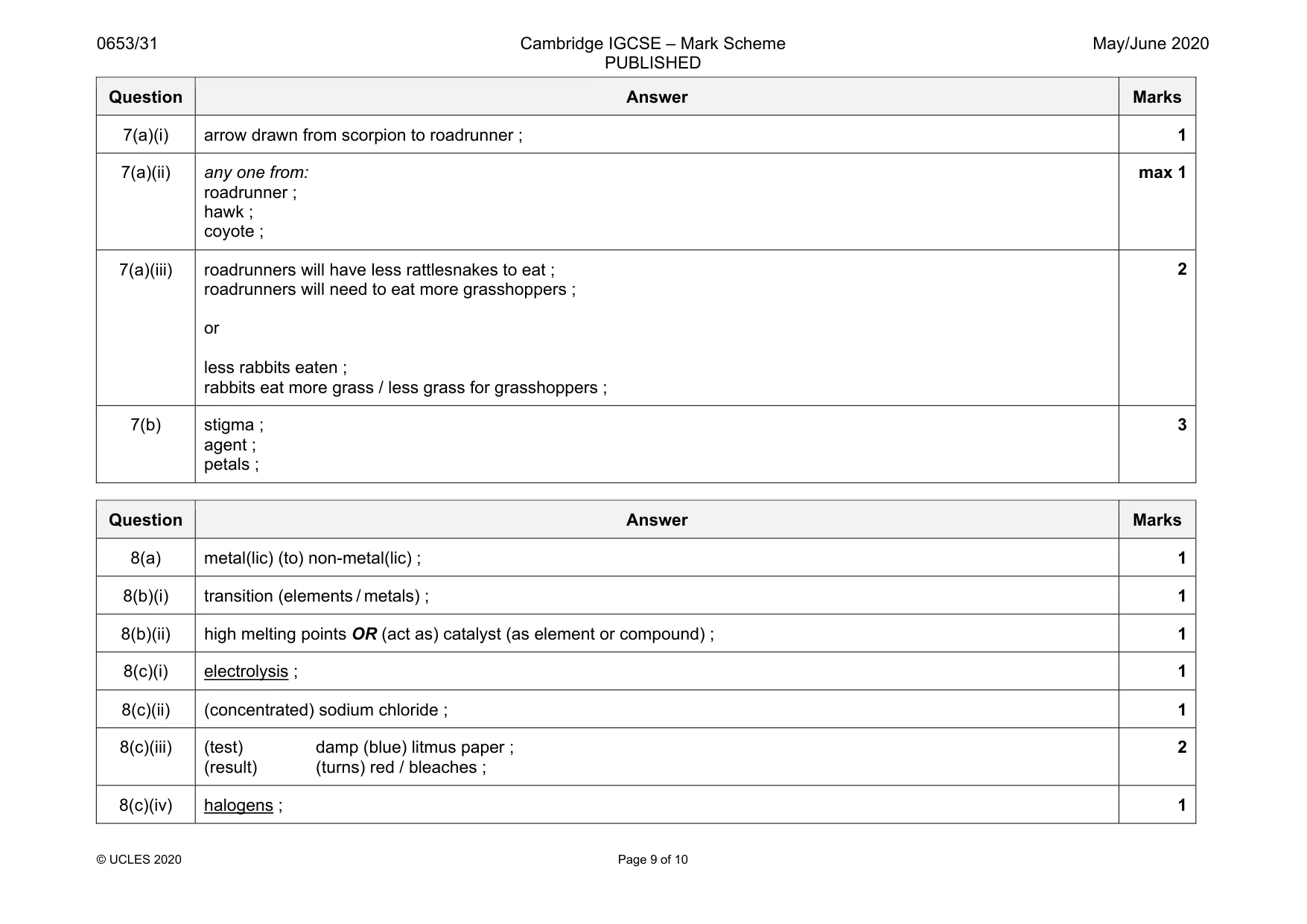
Mark scheme: 7(a)(i) arrow drawn from scorpion to roadrunner ; 1 7(a)(ii) any one from: roadrunner ; hawk ; coyote ; max 1 7(a)(iii) roadrunners will have less rattlesnakes to eat ; roadrunners will need to eat more grasshoppers ; or less rabbits eaten ; rabbits eat more grass / less grass for grasshoppers ; 2 7(b) stigma ; agent ; petals ; 3
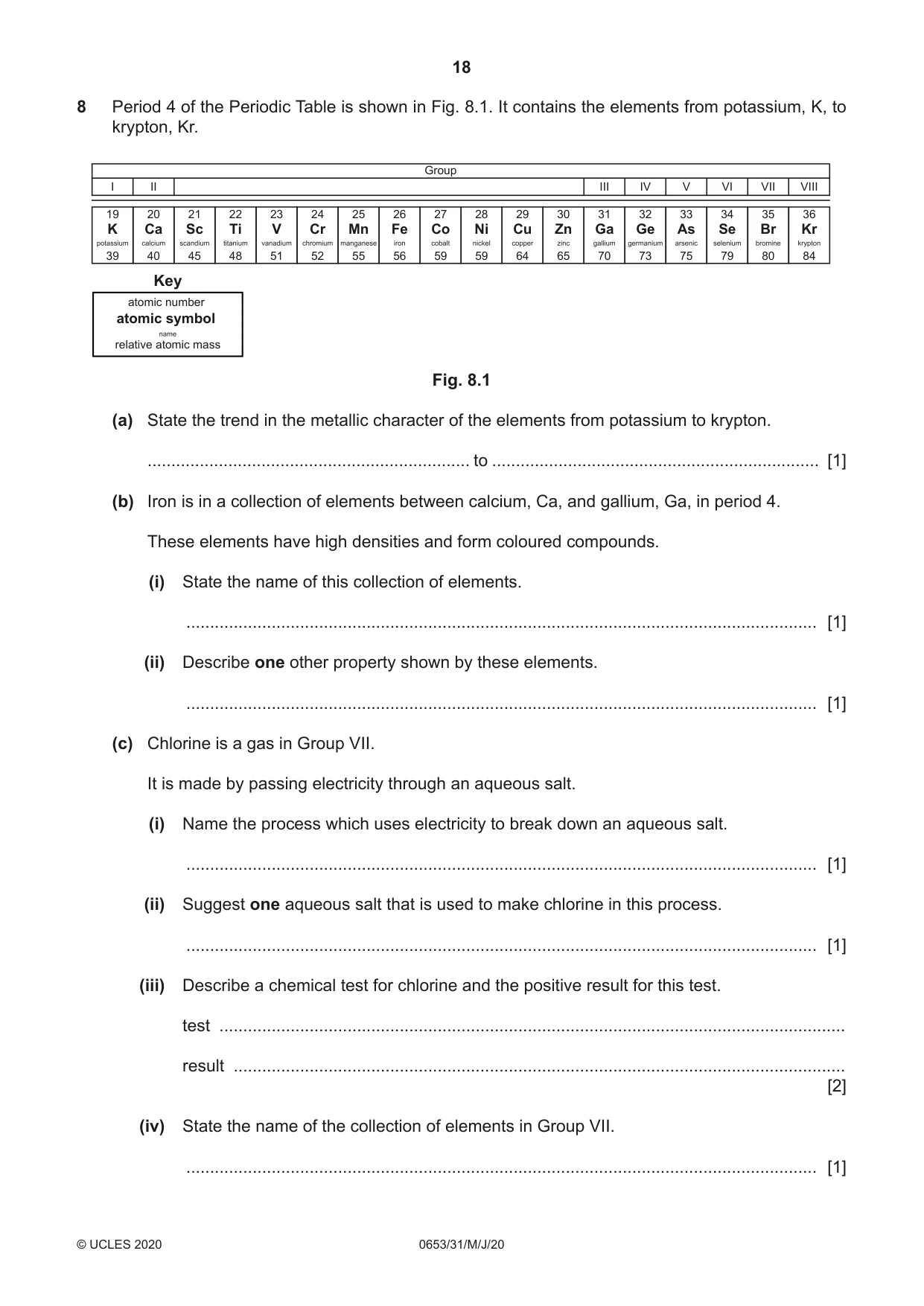
Q8 · Period 4 of the Periodic Table is shown in Fig
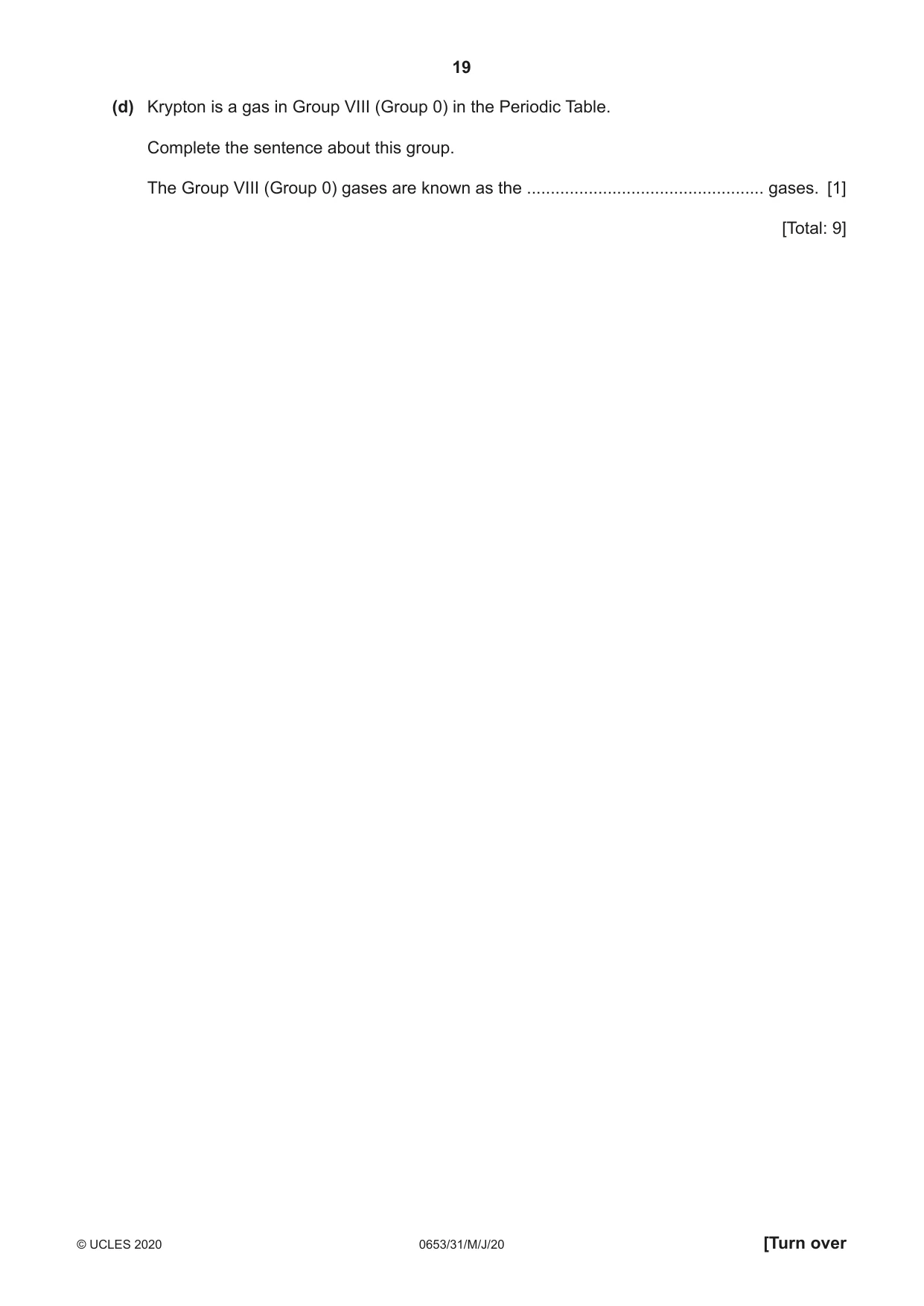
8 Period 4 of the Periodic Table is shown in Fig. 8.1. It contains the elements from potassium, K, to krypton, Kr. Group I II III IV V VI VII VIII 19 20 21 22 23 24 25 26 27 28 29 30 31 32 33 34 35 36 K Ca Sc Ti V Cr Mn Fe Co Ni Cu Zn Ga Ge As Se Br Kr 39 40 45 48 51 52 55 56 59 59 64 65 70 73 75 79 80 84 Key atomic number atomic symbol relative atomic mass Fig. 8.1 (a) State the trend in the metallic character of the elements from potassium to krypton. .................................................................... to ..................................................................... [1] (b) Iron is in a collection of elements between calcium, Ca, and gallium, Ga, in period 4. These elements have high densities and form coloured compounds. (i) State the name of this collection of elements. ..................................................................................................................................... [1] (ii) Describe one other property shown by these elements. ..................................................................................................................................... [1] (c) Chlorine is a gas in Group VII. It is made by passing electricity through an aqueous salt. (i) Name the process which uses electricity to break down an aqueous salt. ..................................................................................................................................... [1] (ii) Suggest one aqueous salt that is used to make chlorine in this process. ..................................................................................................................................... [1] (iii) Describe a chemical test for chlorine and the positive result for this test. test .................................................................................................................................... result ................................................................................................................................. [2] (iv) State the name of the collection of elements in Group VII. ..................................................................................................................................... [1] (d) Krypton is a gas in Group VIII (Group 0) in the Periodic Table. Complete the sentence about this group. The Group VIII (Group 0) gases are known as the .................................................. gases. [1] [Total: 9]
Mark scheme: 8(a) metal(lic) (to) non-metal(lic) ; 1 8(b)(i) transition (elements / metals) ; 1 8(b)(ii) high melting points OR (act as) catalyst (as element or compound) ; 1 8(c)(i) electrolysis ; 1 8(c)(ii) (concentrated) sodium chloride ; 1 8(c)(iii) (test) damp (blue) litmus paper ; (result) (turns) red / bleaches ; 2 8(c)(iv) halogens ; 1 Question Answer Marks 8(d) noble ; 1
Q9 · A mobile (cell) phone and a loudspeaker
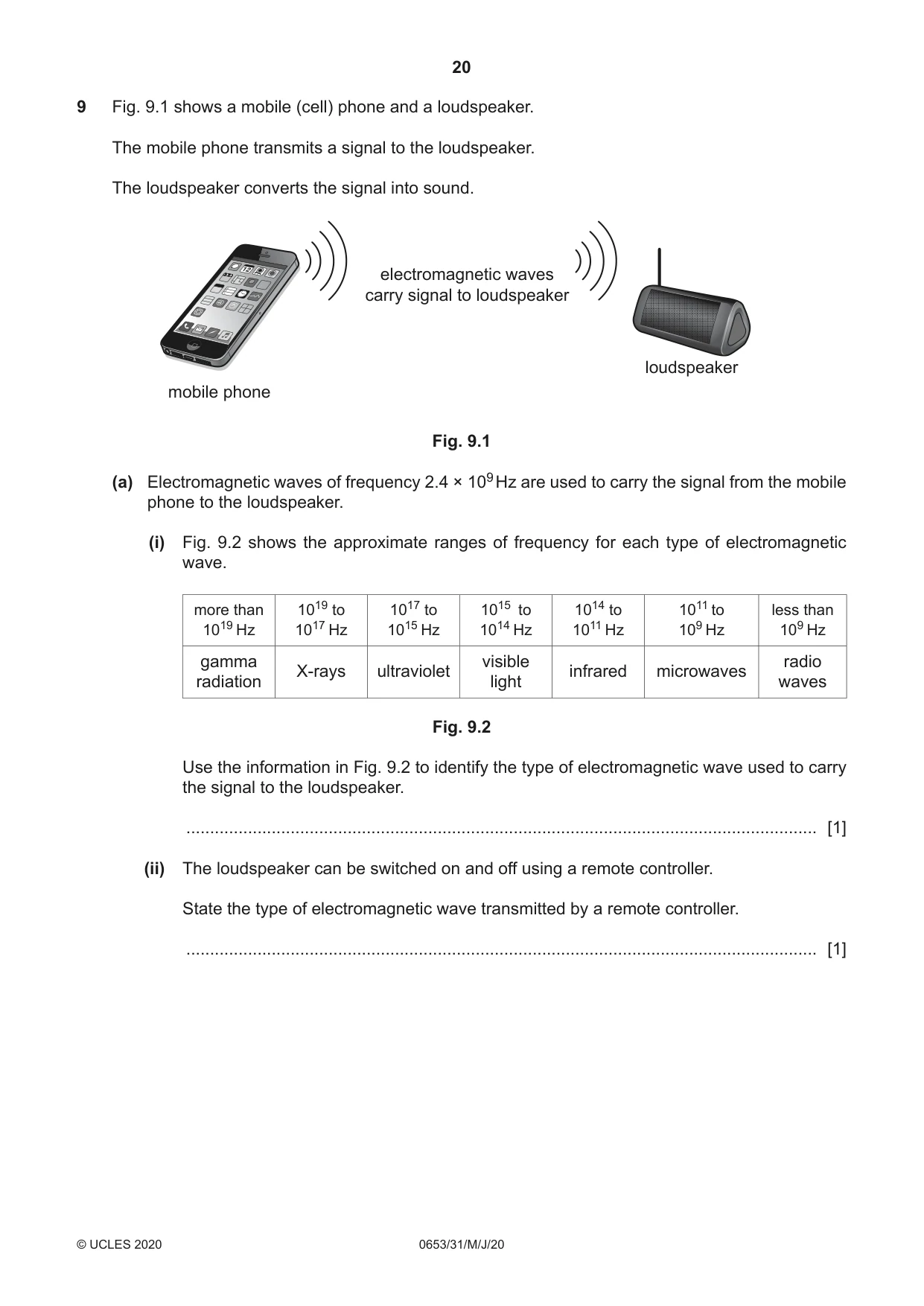
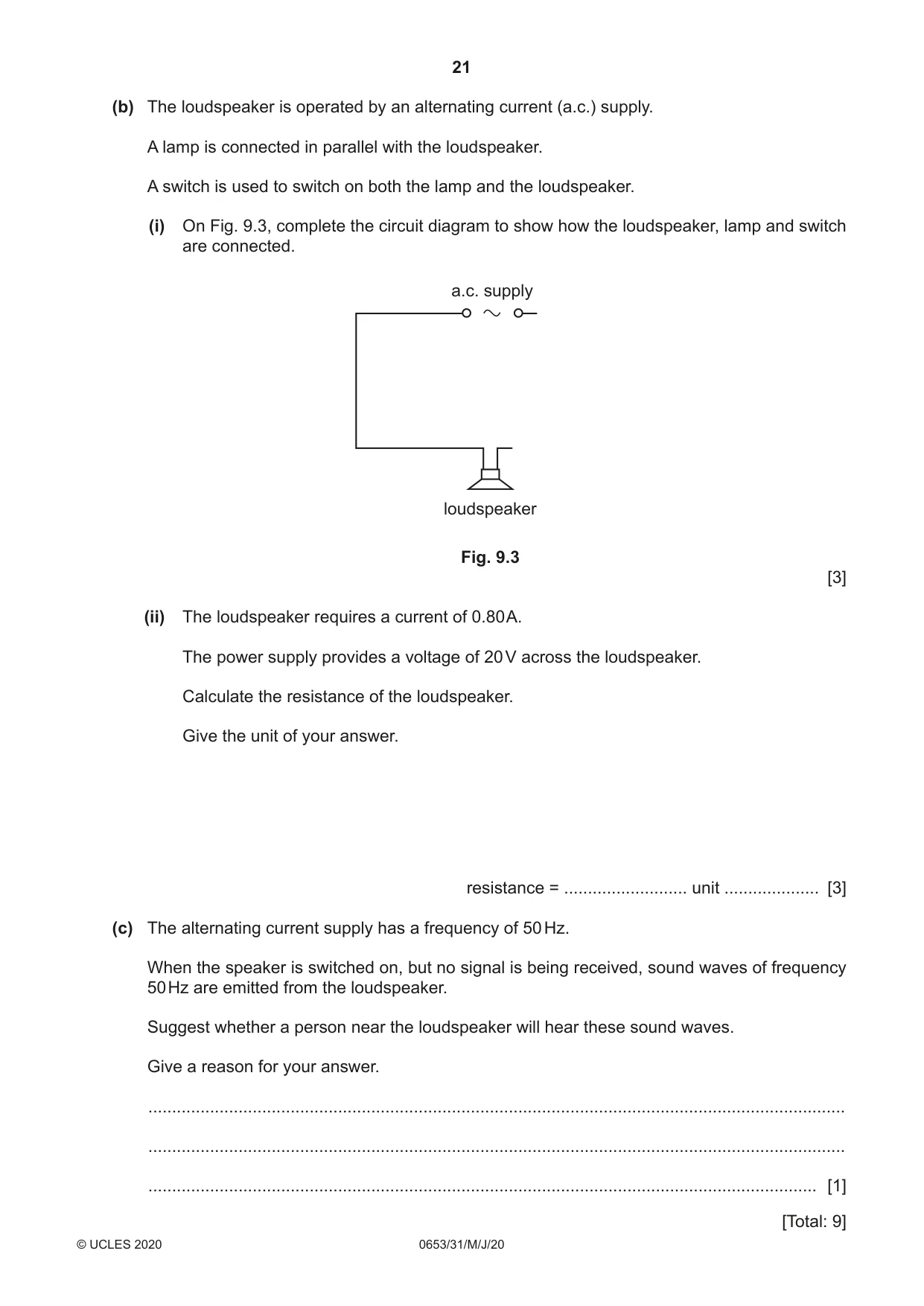
9 Fig. 9.1 shows a mobile (cell) phone and a loudspeaker. The mobile phone transmits a signal to the loudspeaker. The loudspeaker converts the signal into sound. electromagnetic waves carry signal to loudspeaker loudspeaker mobile phone Fig. 9.1 (a) Electromagnetic waves of frequency 2.4 × 10⁹ Hz are used to carry the signal from the mobile phone to the loudspeaker. (i) Fig. 9.2 shows the approximate ranges of frequency for each type of electromagnetic wave. more than 1019 to 1017 to 1015 to 1014 to 1011 to less than 1019 Hz 1017 Hz 1015 Hz 1014 Hz 1011 Hz 109 Hz 109 Hz gamma visible radio X-rays ultraviolet infrared microwaves radiation light waves Fig. 9.2 Use the information in Fig. 9.2 to identify the type of electromagnetic wave used to carry the signal to the loudspeaker. ..................................................................................................................................... [1] (ii) The loudspeaker can be switched on and off using a remote controller. State the type of electromagnetic wave transmitted by a remote controller. ..................................................................................................................................... [1] (b) The loudspeaker is operated by an alternating current (a.c.) supply. A lamp is connected in parallel with the loudspeaker. A switch is used to switch on both the lamp and the loudspeaker. (i) On Fig. 9.3, complete the circuit diagram to show how the loudspeaker, lamp and switch are connected. a.c. supply loudspeaker Fig. 9.3 [3] (ii) The loudspeaker requires a current of 0.80 A. The power supply provides a voltage of 20 V across the loudspeaker. Calculate the resistance of the loudspeaker. Give the unit of your answer. resistance = .......................... unit .................... [3] (c) The alternating current supply has a frequency of 50 Hz. When the speaker is switched on, but no signal is being received, sound waves of frequency 50 Hz are emitted from the loudspeaker. Suggest whether a person near the loudspeaker will hear these sound waves. Give a reason for your answer. ................................................................................................................................................... ................................................................................................................................................... ............................................................................................................................................. [1]
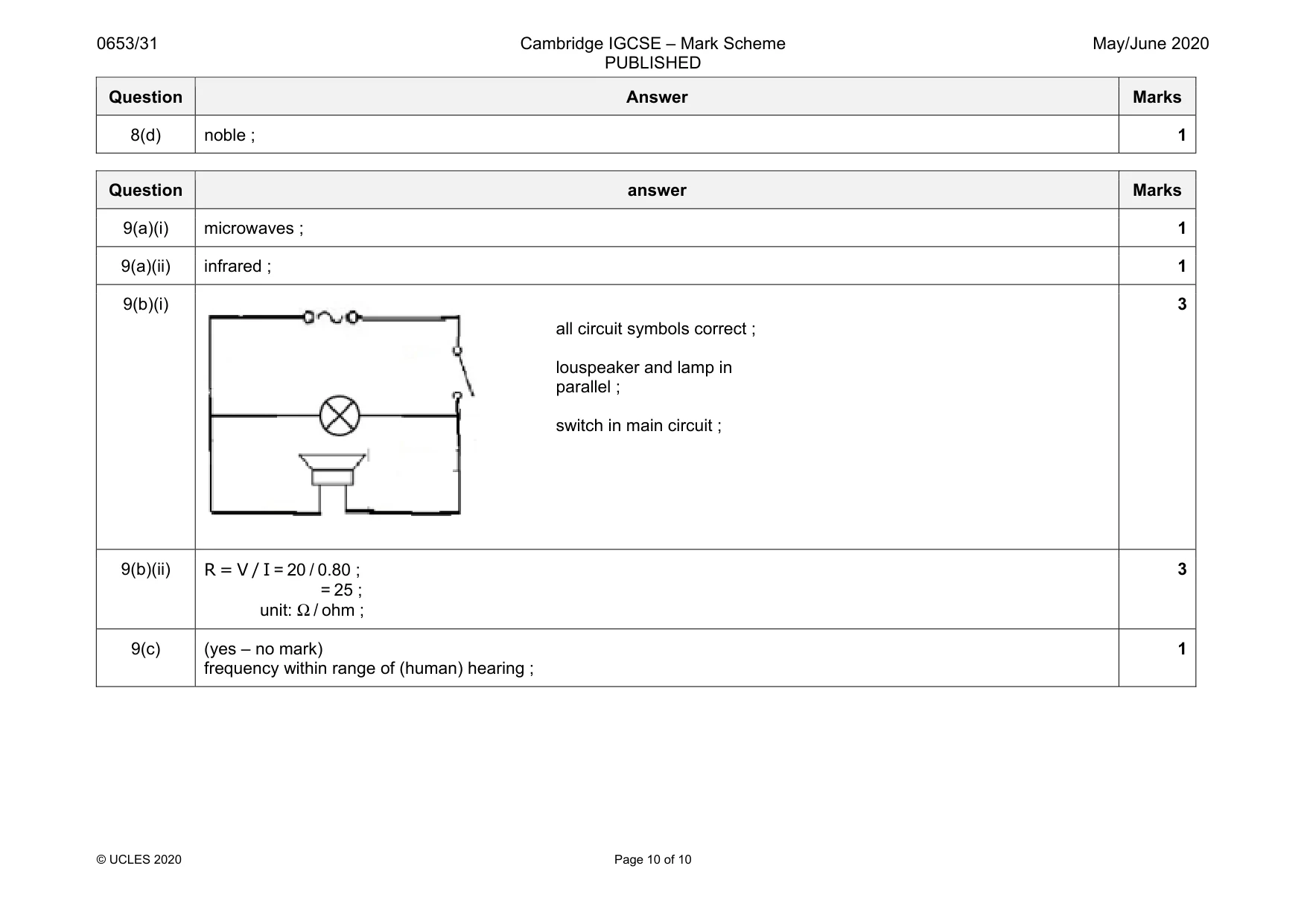
Mark scheme: 9(a)(i) microwaves ; 1 9(a)(ii) infrared ; 1 9(b)(i) 3 9(b)(ii) R = V / I = 20 / 0.80 ; = 25 ; unit: Ω / ohm ; 3 9(c) (yes – no mark) frequency within range of (human) hearing ; 1 all circuit symbols correct ; louspeaker and lamp in parallel ; switch in main circuit ;
What was in this paper
The subtopics covered by these 9 questions, and how many questions each got. Open one in a new tab to see every Cambridge question on it.