Cambridge IGCSE Science - Combined 0653 — 2024 Oct/Nov Paper 3 · Variant 2
0653/32/O/N/24 · 9 questions · 80 marks · ≈90 min
The question paper and its mark scheme, free to read here and free to download. This is Cambridge’s own paper, exactly as it was sat.
Question paper24 pages



Mark scheme13 pages
Answers below. Sit the paper first if you are practising.
Questions as text
Q1 · The alimentary canal and associated organs of a human
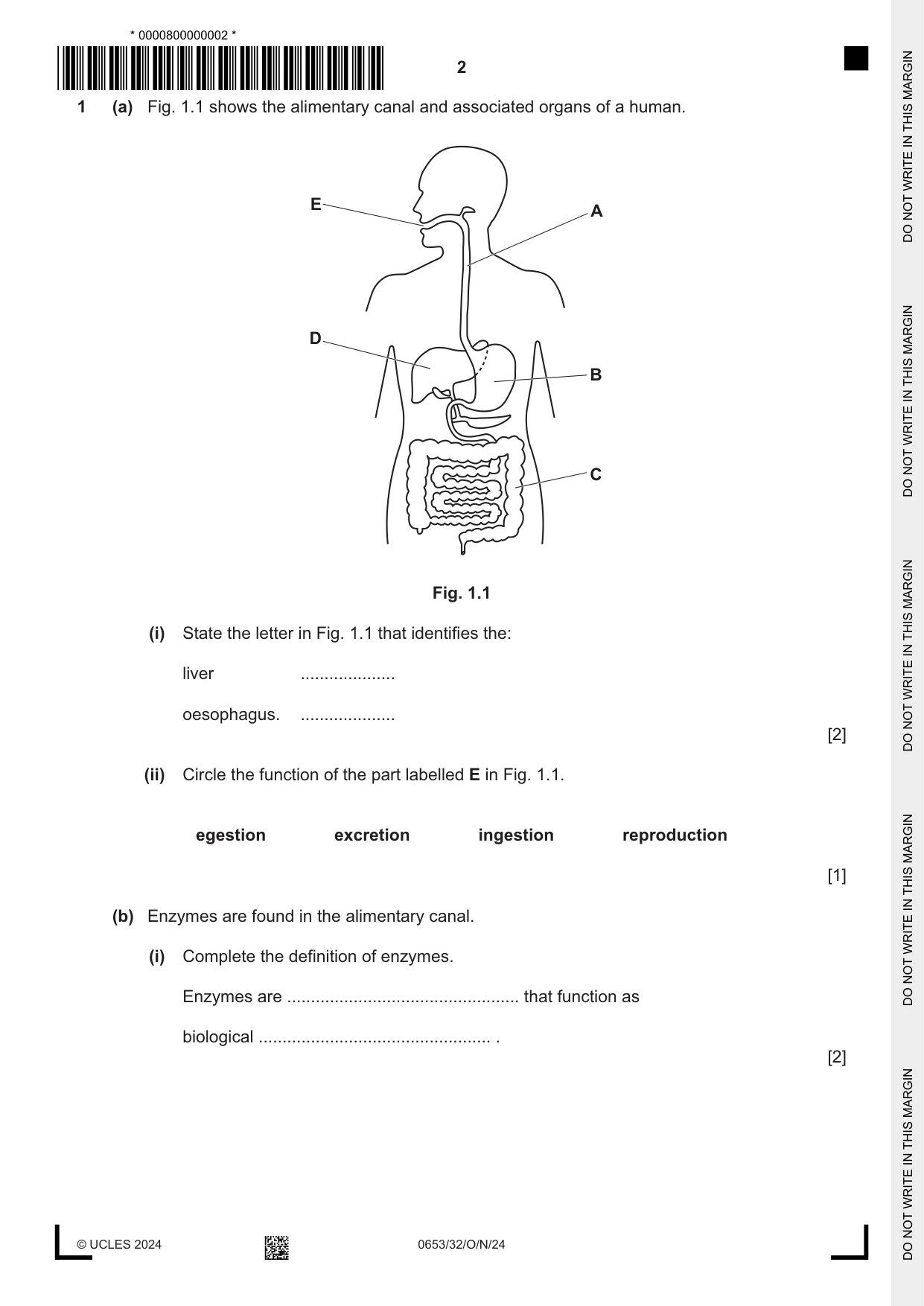
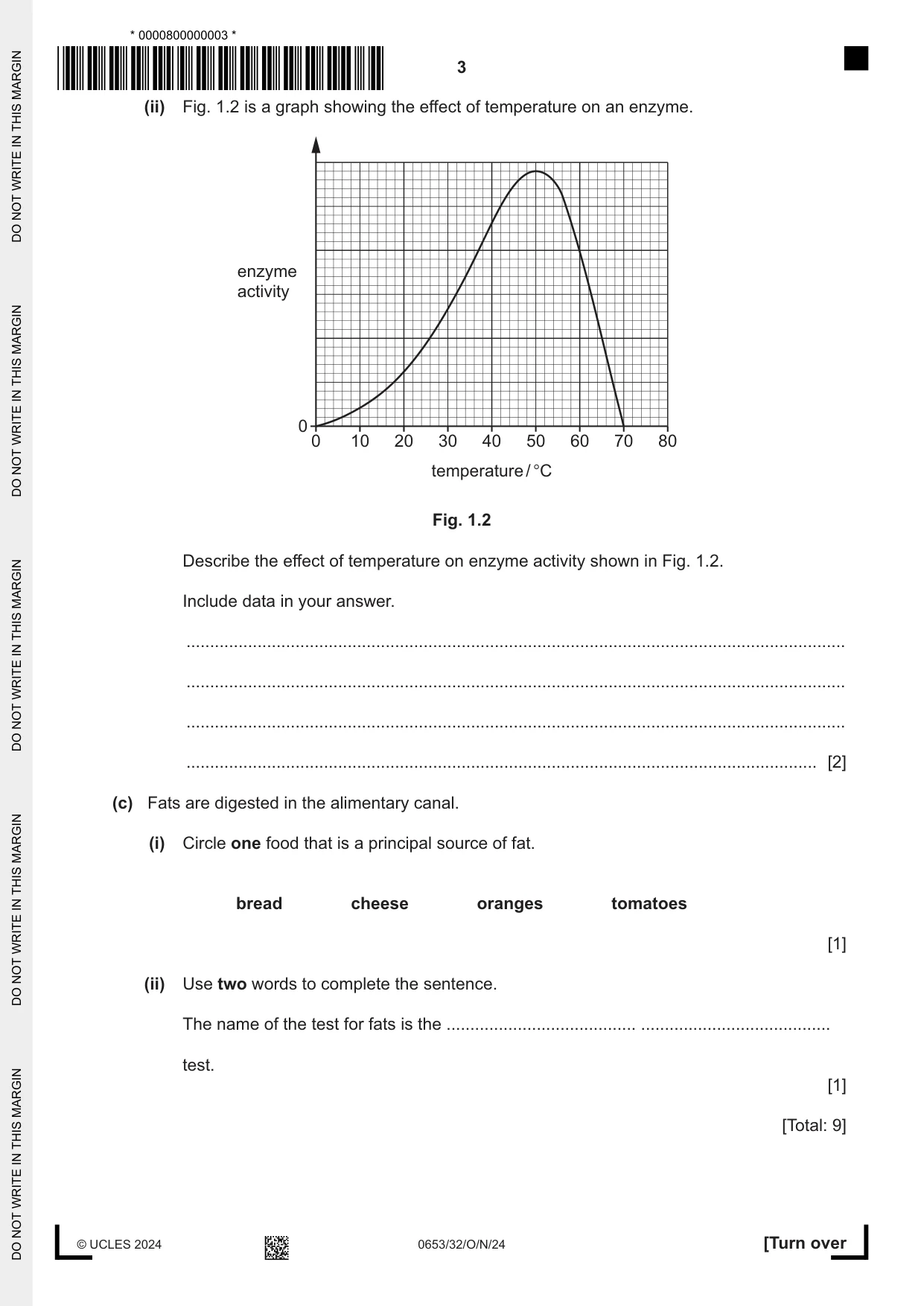
1 (a) Fig. 1.1 shows the alimentary canal and associated organs of a human. E A D B C Fig. 1.1 (i) State the letter in Fig. 1.1 that identifies the: liver .................... oesophagus. .................... [2] (ii) Circle the function of the part labelled E in Fig. 1.1. egestion excretion ingestion reproduction [1] (b) Enzymes are found in the alimentary canal. (i) Complete the definition of enzymes. Enzymes are ................................................. that function as biological ................................................. . [2] (ii) Fig. 1.2 is a graph showing the effect of temperature on an enzyme. enzyme activity 0 0 10 20 30 40 50 60 70 80 temperature / °C Fig. 1.2 Describe the effect of temperature on enzyme activity shown in Fig. 1.2. Include data in your answer. ........................................................................................................................................... ........................................................................................................................................... ........................................................................................................................................... ..................................................................................................................................... [2] (c) Fats are digested in the alimentary canal. (i) Circle one food that is a principal source of fat. bread cheese oranges tomatoes [1] (ii) Use two words to complete the sentence. The name of the test for fats is the ........................................ ........................................ test. [1] [Total: 9]
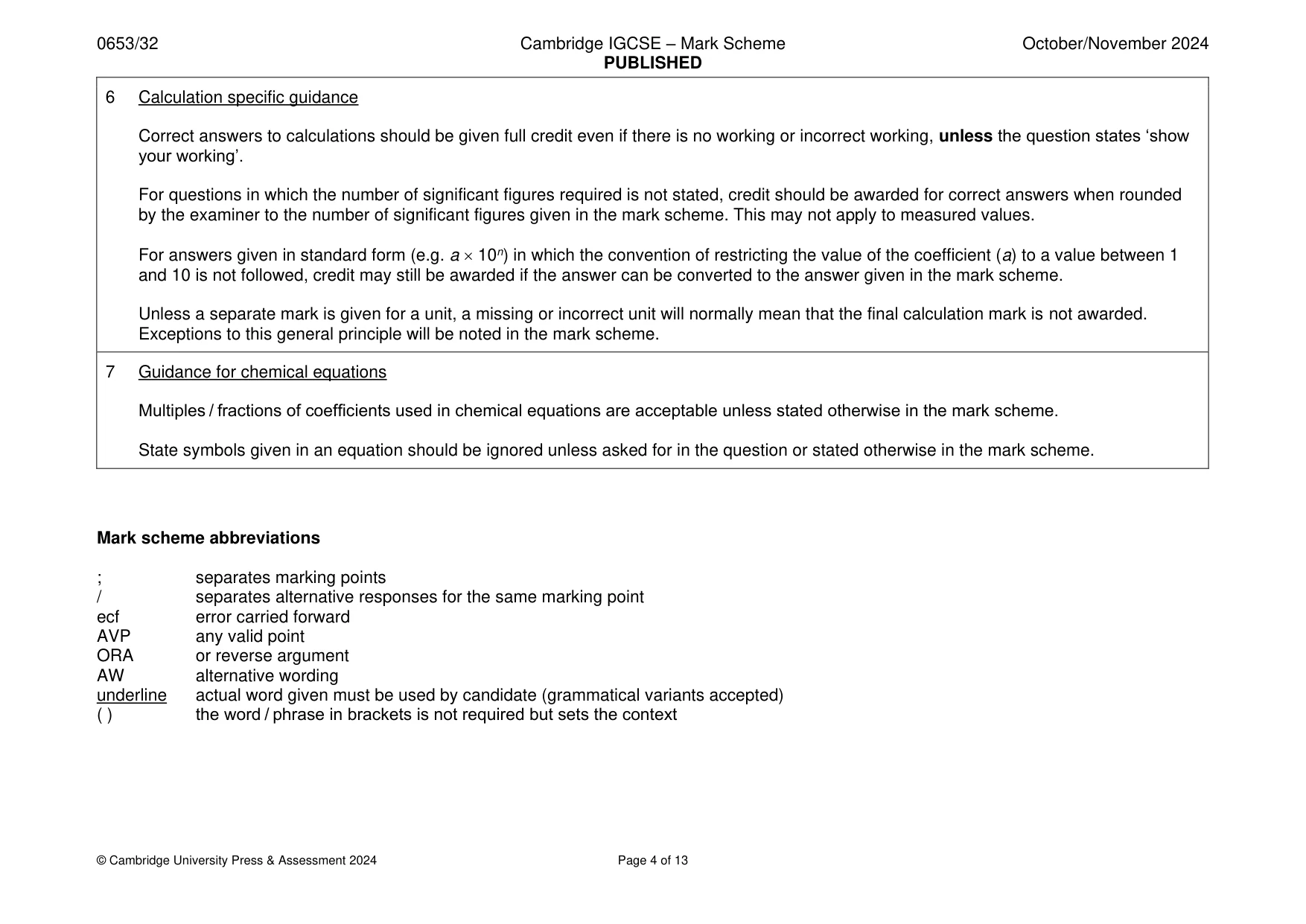
Mark scheme: Question Answer Marks 1(a)(i) D ; 2 A ; 1(a)(ii) ingestion ; 1 1(b)(i) proteins ; 2 catalysts ; 1(b)(ii) idea that as temperature increases, enzyme activity increases then decreases ; 2 peaks at 50(C) / AW ; 1(c)(i) cheese ; 1 1(c)(ii) ethanol emulsion ; 1
Q2 · A student investigates the rate of reaction between pieces of calcium metal and dilute…
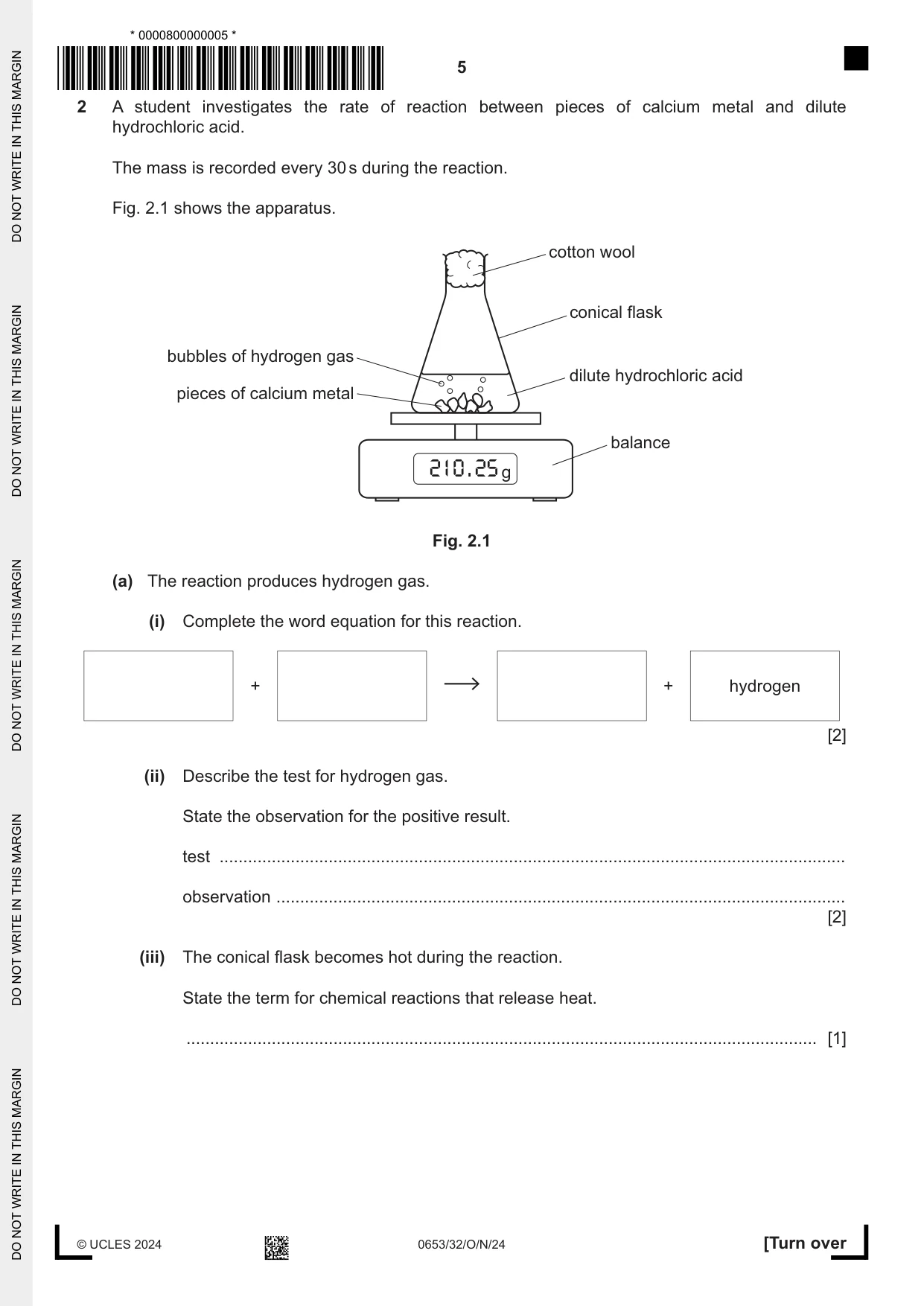
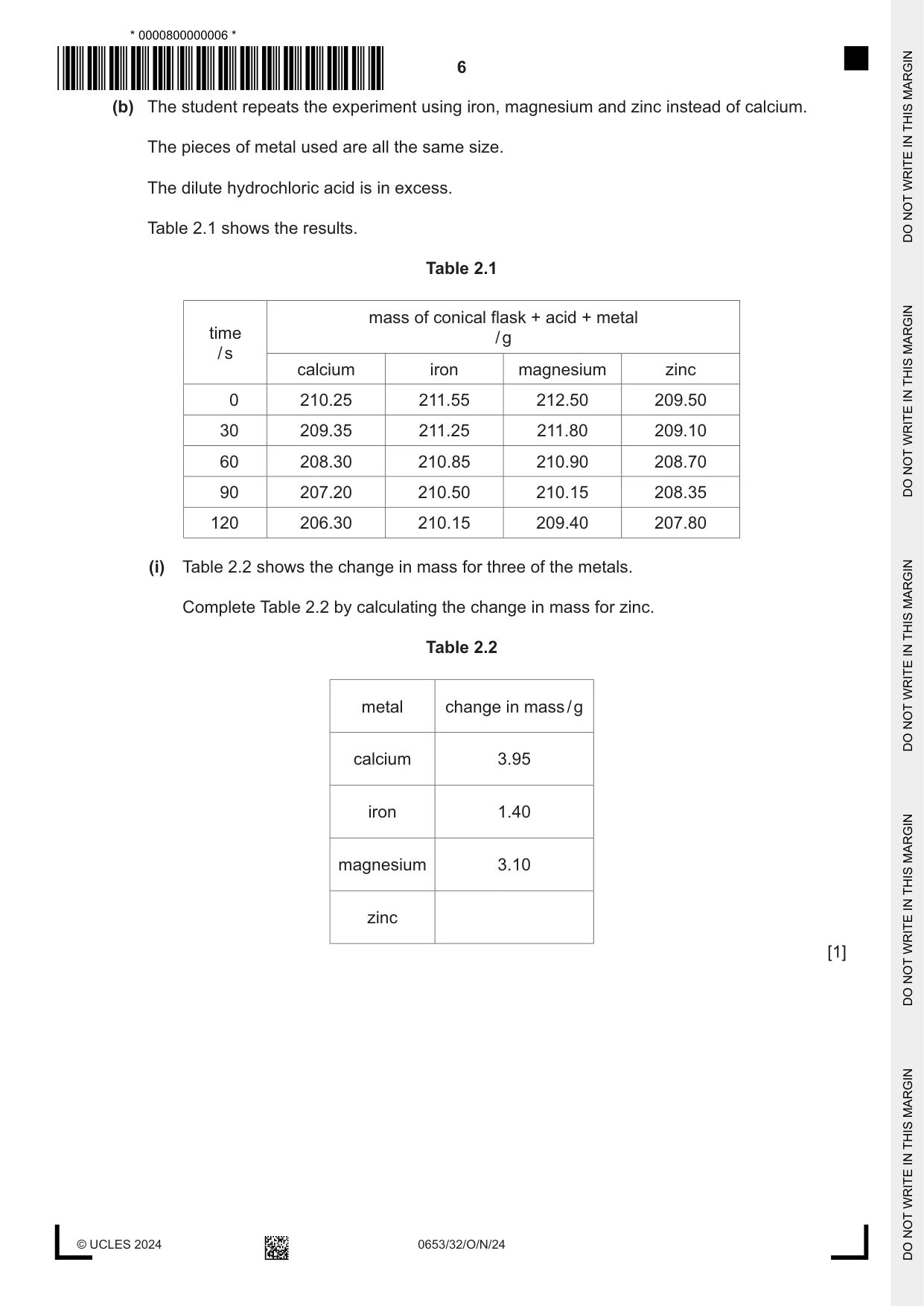
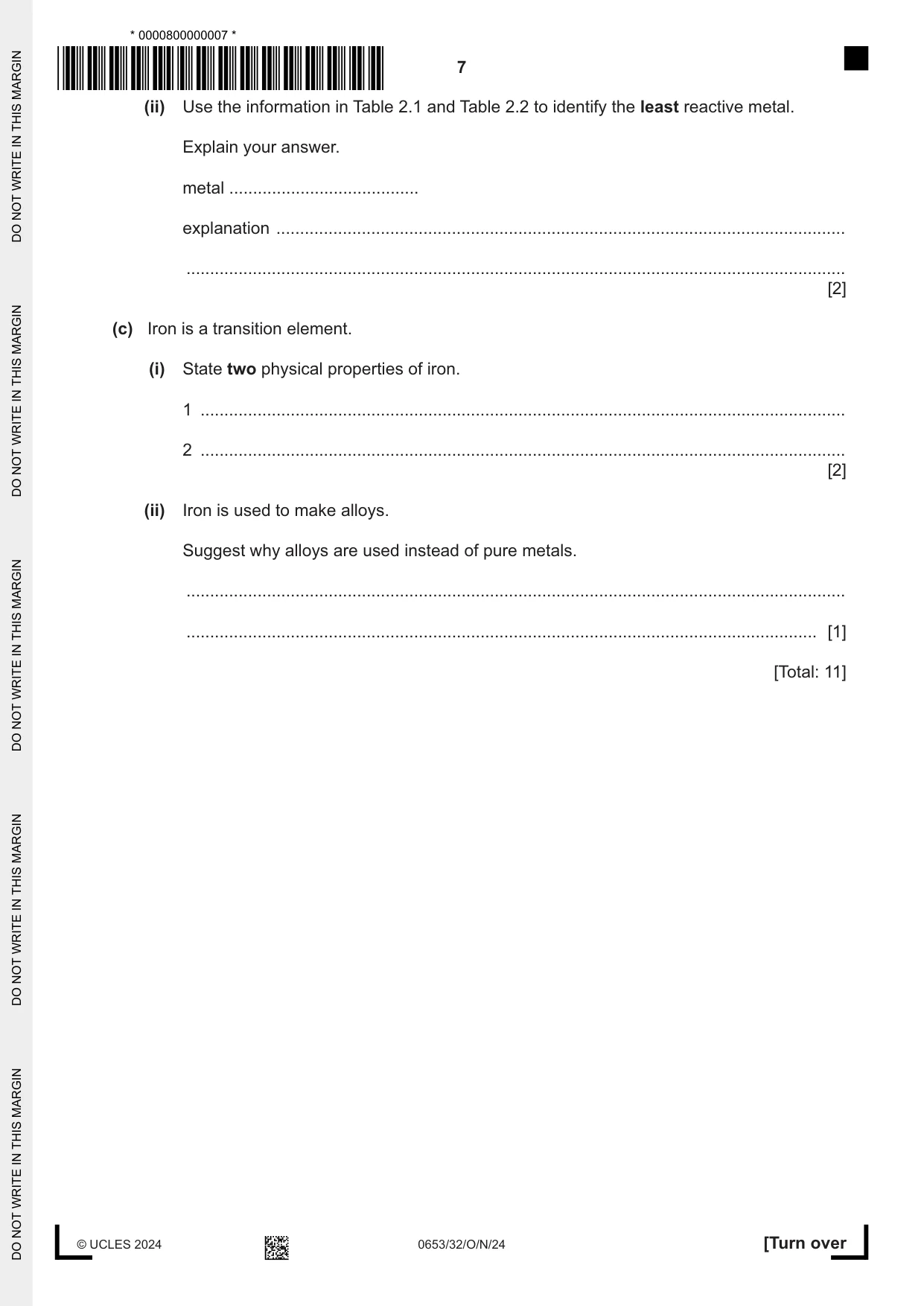
2 A student investigates the rate of reaction between pieces of calcium metal and dilute hydrochloric acid. The mass is recorded every 30 s during the reaction. Fig. 2.1 shows the apparatus. cotton wool conical flask bubbles of hydrogen gas dilute hydrochloric acid pieces of calcium metal balance 210 . 25 g Fig. 2.1 (a) The reaction produces hydrogen gas. (i) Complete the word equation for this reaction. + + hydrogen [2] (ii) Describe the test for hydrogen gas. State the observation for the positive result. test .................................................................................................................................... observation ........................................................................................................................ [2] (iii) The conical flask becomes hot during the reaction. State the term for chemical reactions that release heat. ..................................................................................................................................... [1] (b) The student repeats the experiment using iron, magnesium and zinc instead of calcium. The pieces of metal used are all the same size. The dilute hydrochloric acid is in excess. Table 2.1 shows the results. Table 2.1 mass of conical flask + acid + metal time / g / s calcium iron magnesium zinc 0 210.25 211.55 212.50 209.50 30 209.35 211.25 211.80 209.10 60 208.30 210.85 210.90 208.70 90 207.20 210.50 210.15 208.35 120 206.30 210.15 209.40 207.80 (i) Table 2.2 shows the change in mass for three of the metals. Complete Table 2.2 by calculating the change in mass for zinc. Table 2.2 metal change in mass / g calcium 3.95 iron 1.40 magnesium 3.10 zinc [1] (ii) Use the information in Table 2.1 and Table 2.2 to identify the least reactive metal. Explain your answer. metal ........................................ explanation ........................................................................................................................ ........................................................................................................................................... [2] (c) Iron is a transition element. (i) State two physical properties of iron. 1 ........................................................................................................................................ 2 ........................................................................................................................................ [2] (ii) Iron is used to make alloys. Suggest why alloys are used instead of pure metals. ........................................................................................................................................... ..................................................................................................................................... [1] [Total: 11]
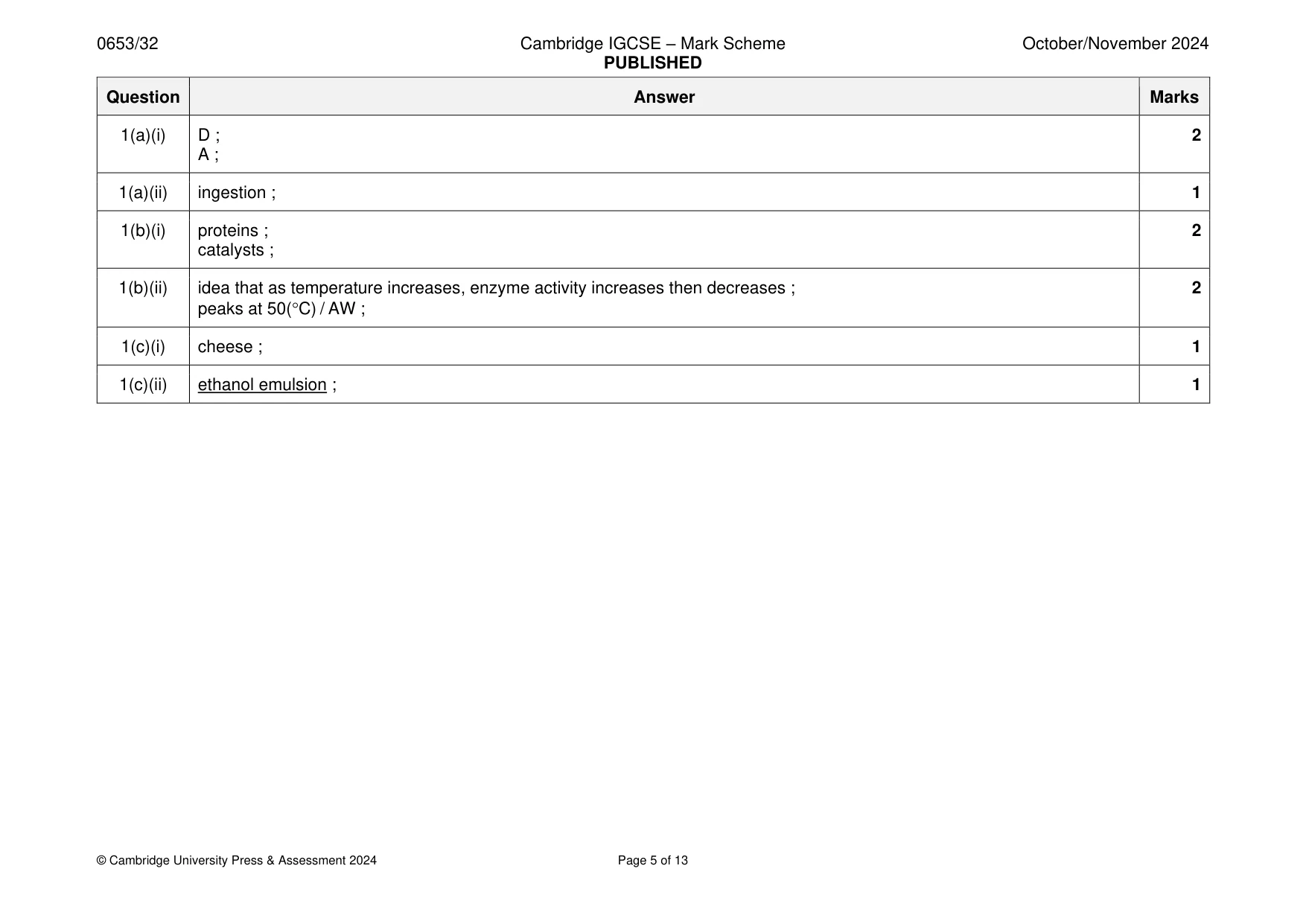
Mark scheme: 2(a)(i) calcium AND hydrochloric acid ; 2 calcium chloride ; 2(a)(ii) lighted splint ; 2 pop(s) ; 2(a)(iii) exothermic ; 1 2(b)(i) 1.70 (g) ; 1 2(b)(ii) iron ; 2 smallest change in mass ; 2(c)(i) any two from: 2 high melting point ; malleable ; good conductor of heat ; good conductor of electricity ; 2(c)(ii) general statement that alloys have, better / different / desired, properties OR 1 named property, e.g. harder, greater resistance to corrosion, stronger ;
Q3 · The electrical symbol for a circuit component
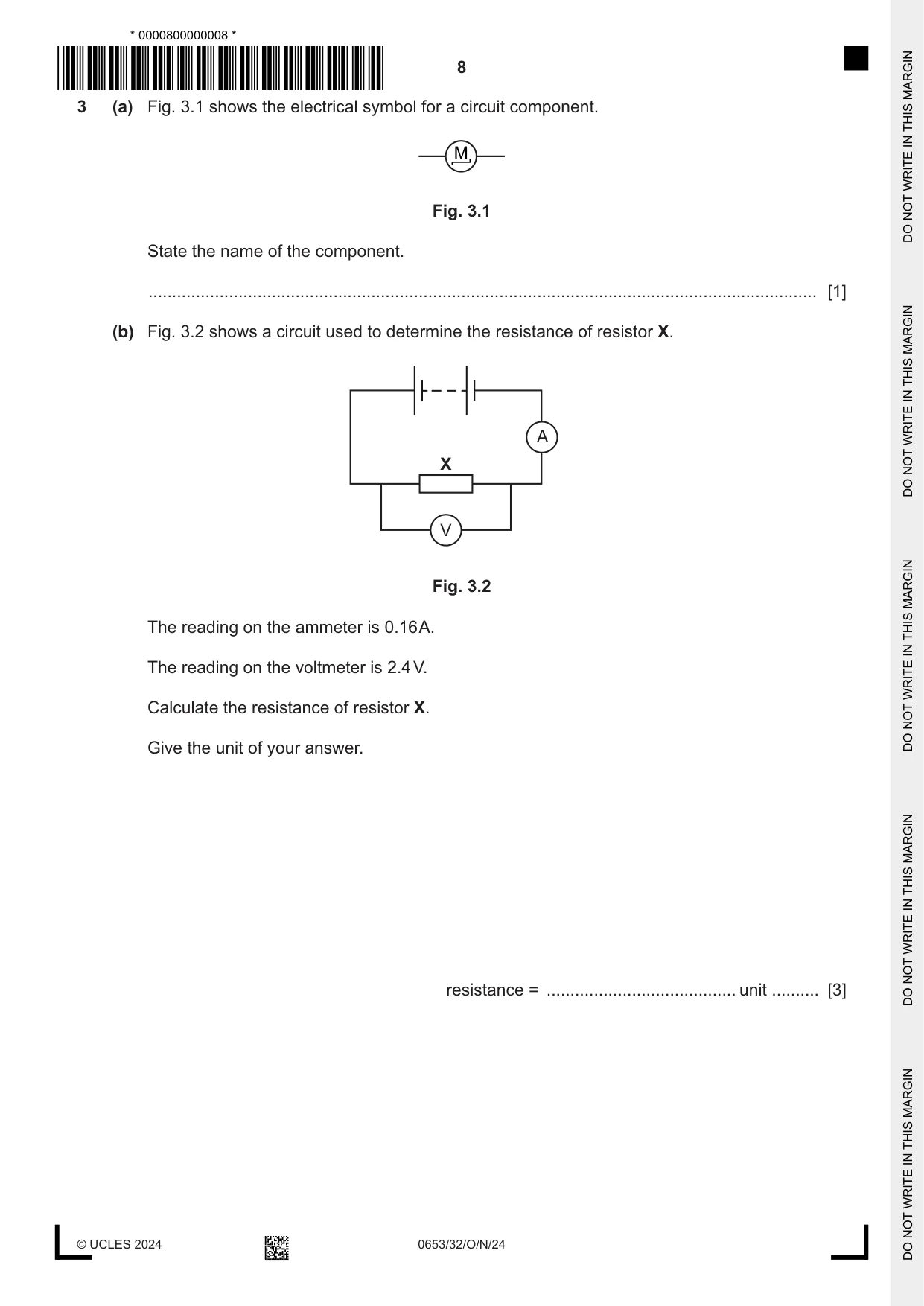
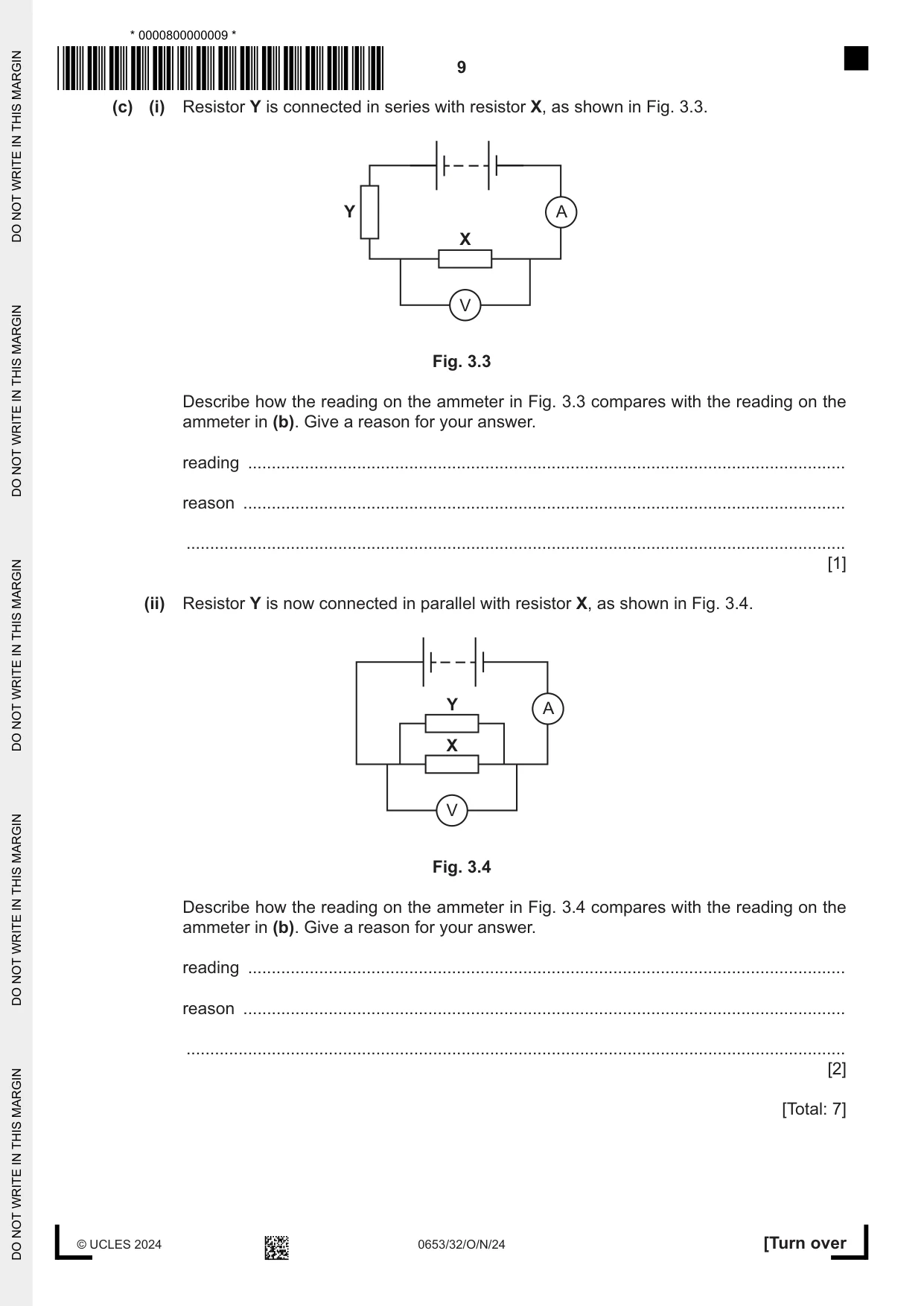
3 (a) Fig. 3.1 shows the electrical symbol for a circuit component. M Fig. 3.1 State the name of the component. ............................................................................................................................................. [1] (b) Fig. 3.2 shows a circuit used to determine the resistance of resistor X. A X V Fig. 3.2 The reading on the ammeter is 0.16 A. The reading on the voltmeter is 2.4 V. Calculate the resistance of resistor X. Give the unit of your answer. resistance = ........................................ unit .......... [3] (c) (i) Resistor Y is connected in series with resistor X, as shown in Fig. 3.3. Y A X V Fig. 3.3 Describe how the reading on the ammeter in Fig. 3.3 compares with the reading on the ammeter in (b). Give a reason for your answer. reading .............................................................................................................................. reason ............................................................................................................................... ........................................................................................................................................... [1] (ii) Resistor Y is now connected in parallel with resistor X, as shown in Fig. 3.4. Y A X V Fig. 3.4 Describe how the reading on the ammeter in Fig. 3.4 compares with the reading on the ammeter in (b). Give a reason for your answer. reading .............................................................................................................................. reason ............................................................................................................................... ........................................................................................................................................... [2] [Total: 7]
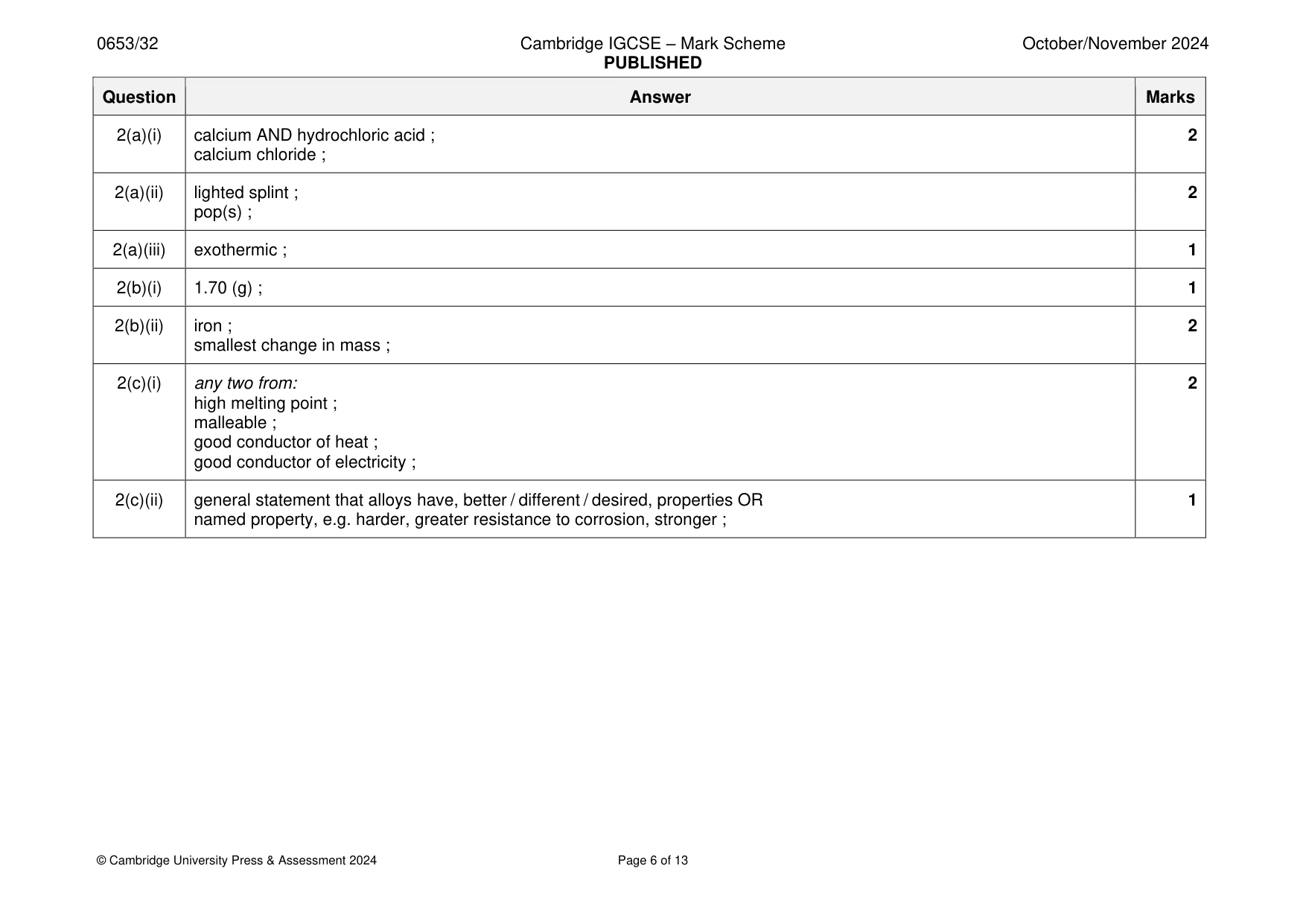
Mark scheme: 3(a) (electric) motor ; 1 3(b) evidence of, R = V I / 2.4 0.16 ; 3 15 ; / ohm(s) ; 3(c)(i) reading decreases AND 1 reason combined resistance of two resistors in series increases the total resistance / AW ; 3(c)(ii) reading increases ; 2 reason combined resistance of two resistors in parallel decreases the total resistance / AW ;
Q4 · A diagram of the circulatory system in humans where the arrows show the direction of…
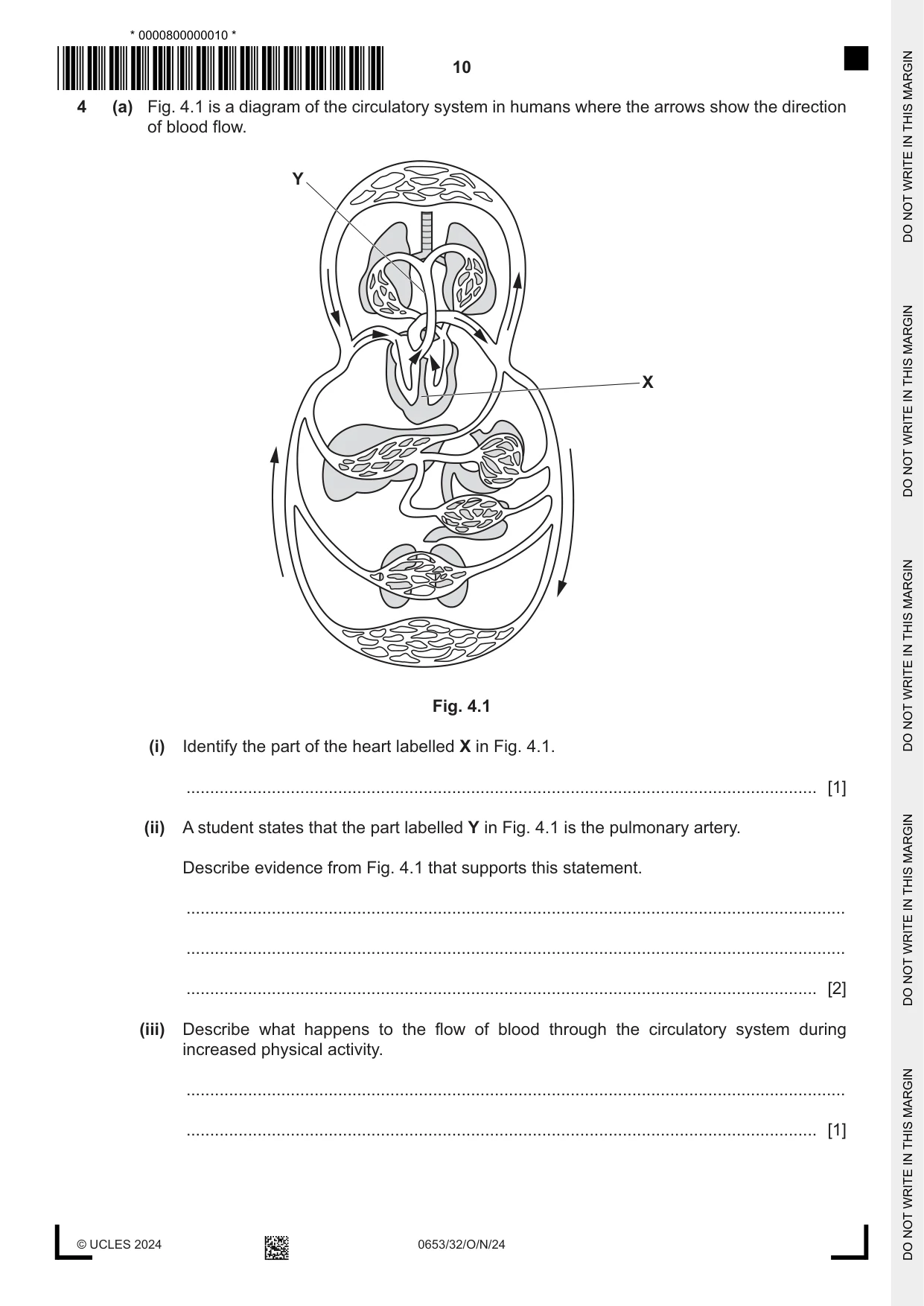
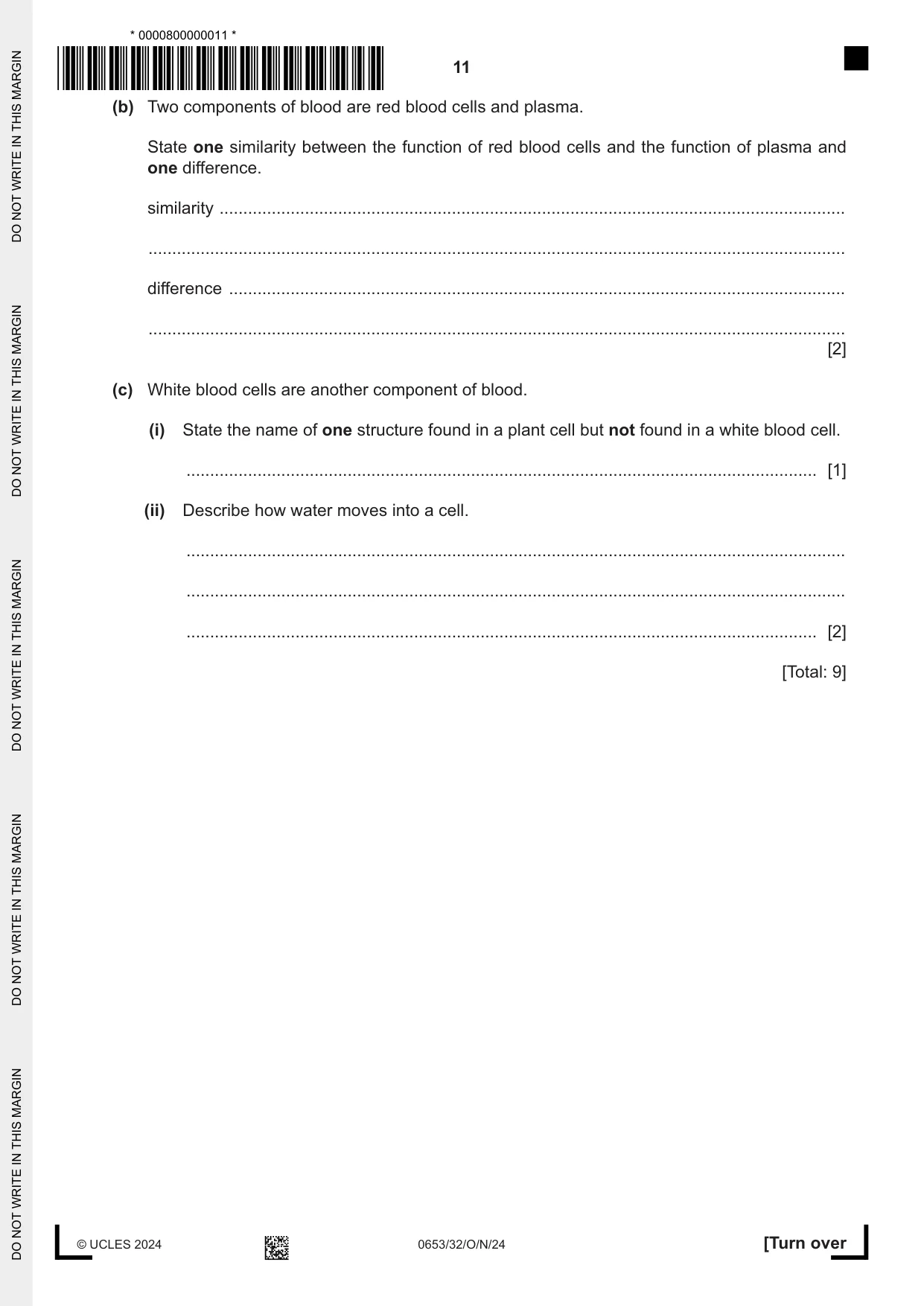
4 (a) Fig. 4.1 is a diagram of the circulatory system in humans where the arrows show the direction of blood flow. Y X Fig. 4.1 (i) Identify the part of the heart labelled X in Fig. 4.1. ..................................................................................................................................... [1] (ii) A student states that the part labelled Y in Fig. 4.1 is the pulmonary artery. Describe evidence from Fig. 4.1 that supports this statement. ........................................................................................................................................... ........................................................................................................................................... ..................................................................................................................................... [2] (iii) Describe what happens to the flow of blood through the circulatory system during increased physical activity. ........................................................................................................................................... ..................................................................................................................................... [1] (b) Two components of blood are red blood cells and plasma. State one similarity between the function of red blood cells and the function of plasma and one difference. similarity .................................................................................................................................... ................................................................................................................................................... difference .................................................................................................................................. ................................................................................................................................................... [2] (c) White blood cells are another component of blood. (i) State the name of one structure found in a plant cell but not found in a white blood cell. ..................................................................................................................................... [1] (ii) Describe how water moves into a cell. ........................................................................................................................................... ........................................................................................................................................... ..................................................................................................................................... [2] [Total: 9]
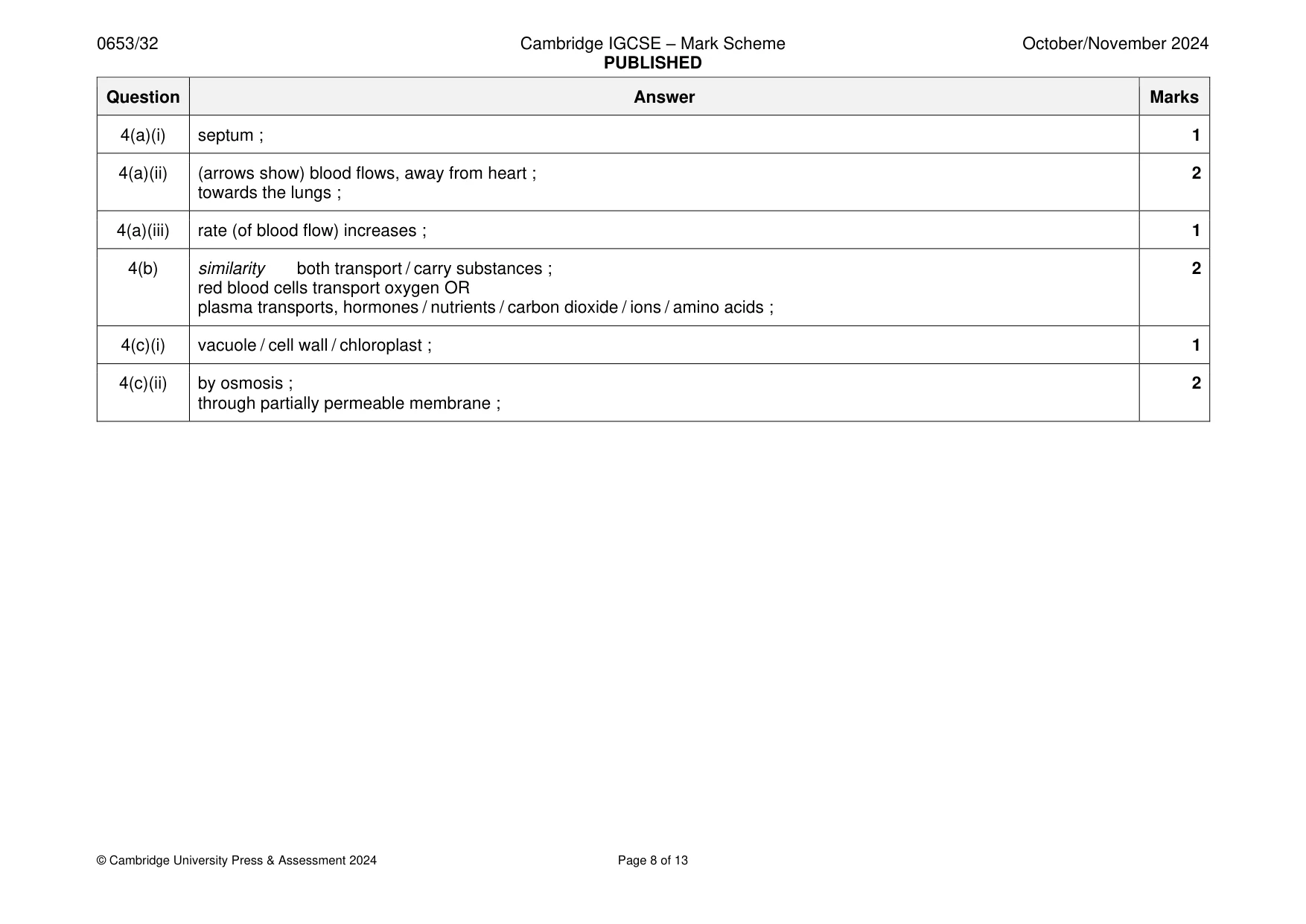
Mark scheme: 4(a)(i) septum ; 1 4(a)(ii) (arrows show) blood flows, away from heart ; 2 towards the lungs ; 4(a)(iii) rate (of blood flow) increases ; 1 4(b) similarity both transport / carry substances ; 2 red blood cells transport oxygen OR plasma transports, hormones / nutrients / carbon dioxide / ions / amino acids ; 4(c)(i) vacuole / cell wall / chloroplast ; 1 4(c)(ii) by osmosis ; 2 through partially permeable membrane ;
Q5 · Complete the sentences about air
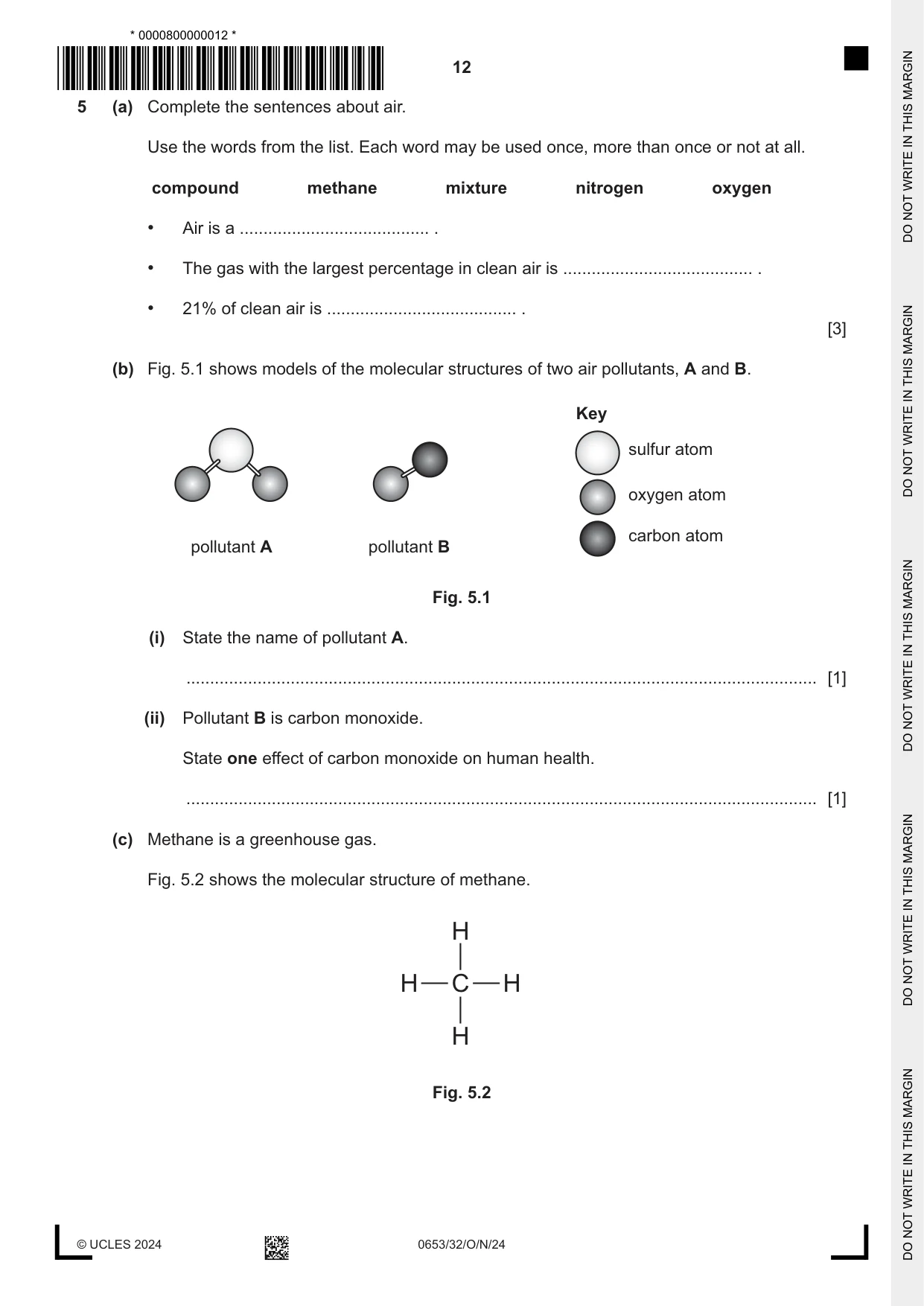
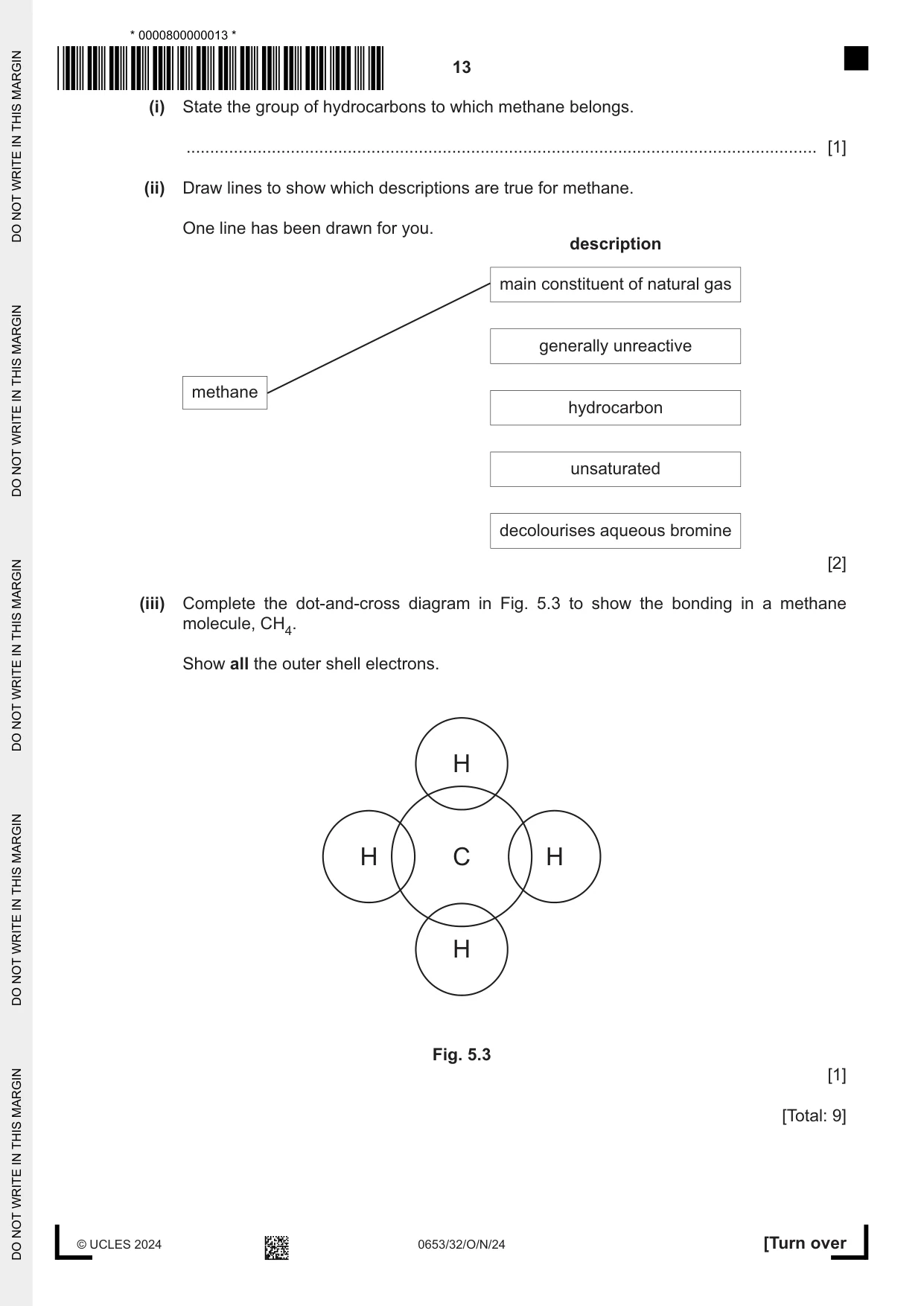
5 (a) Complete the sentences about air. Use the words from the list. Each word may be used once, more than once or not at all. compound methane mixture nitrogen oxygen • Air is a ........................................ . • The gas with the largest percentage in clean air is ........................................ . • 21% of clean air is ........................................ . [3] (b) Fig. 5.1 shows models of the molecular structures of two air pollutants, A and B. Key sulfur atom oxygen atom carbon atom pollutant A pollutant B Fig. 5.1 (i) State the name of pollutant A. ..................................................................................................................................... [1] (ii) Pollutant B is carbon monoxide. State one effect of carbon monoxide on human health. ..................................................................................................................................... [1] (c) Methane is a greenhouse gas. Fig. 5.2 shows the molecular structure of methane. H H C H H Fig. 5.2 (i) State the group of hydrocarbons to which methane belongs. ..................................................................................................................................... [1] (ii) Draw lines to show which descriptions are true for methane. One line has been drawn for you. description main constituent of natural gas generally unreactive methane hydrocarbon unsaturated decolourises aqueous bromine [2] (iii) Complete the dot-and-cross diagram in Fig. 5.3 to show the bonding in a methane molecule, CH4. Show all the outer shell electrons. H H C H H Fig. 5.3 [1] [Total: 9]
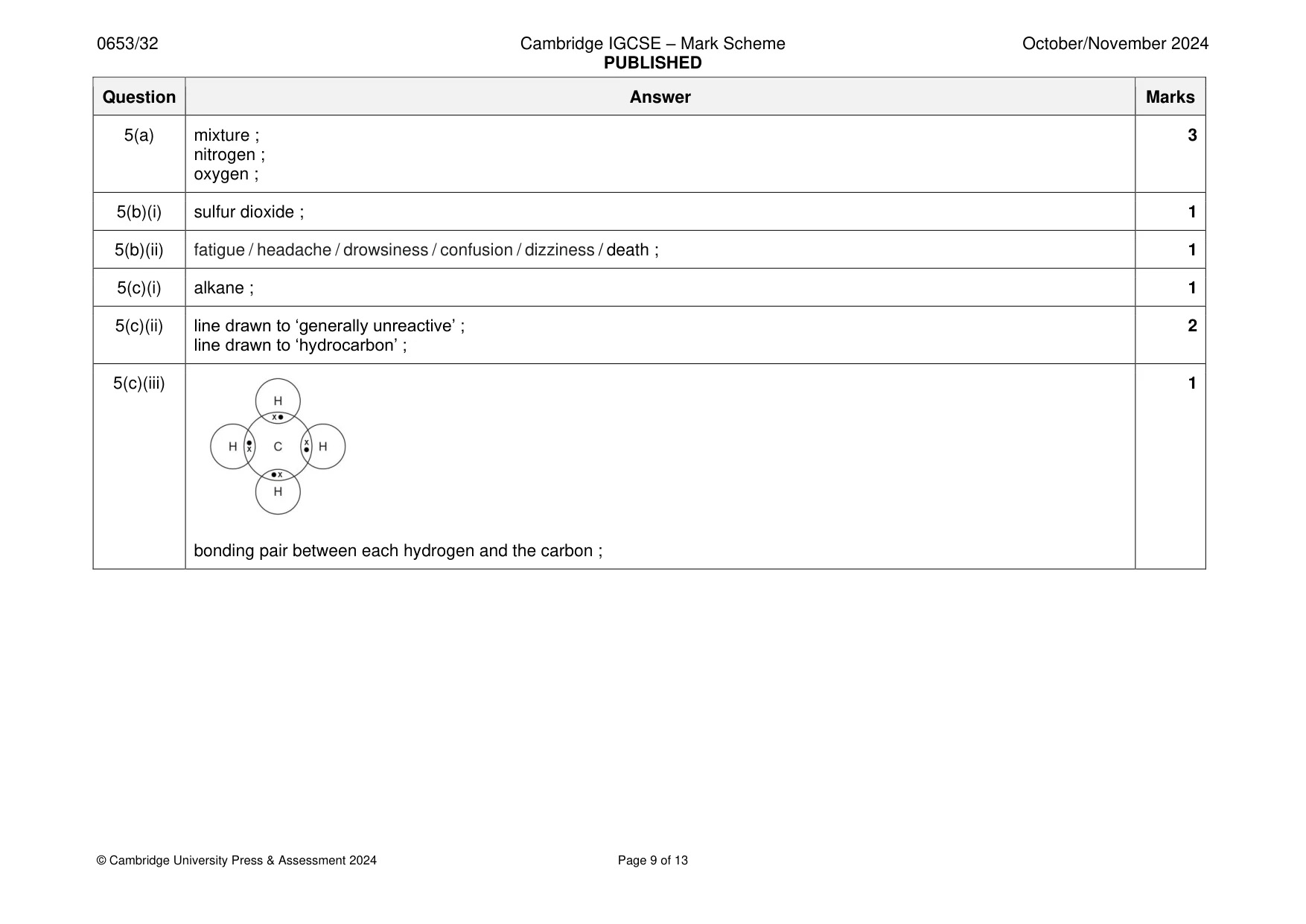
Mark scheme: 5(a) mixture ; 3 nitrogen ; oxygen ; 5(b)(i) sulfur dioxide ; 1 5(b)(ii) fatigue / headache / drowsiness / confusion / dizziness / death ; 1 5(c)(i) alkane ; 1 5(c)(ii) line drawn to ‘generally unreactive’ ; 2 line drawn to ‘hydrocarbon’ ; 5(c)(iii) 1 bonding pair between each hydrogen and the carbon ;
Q6 · A horse pulling a cart along a flat, horizontal road
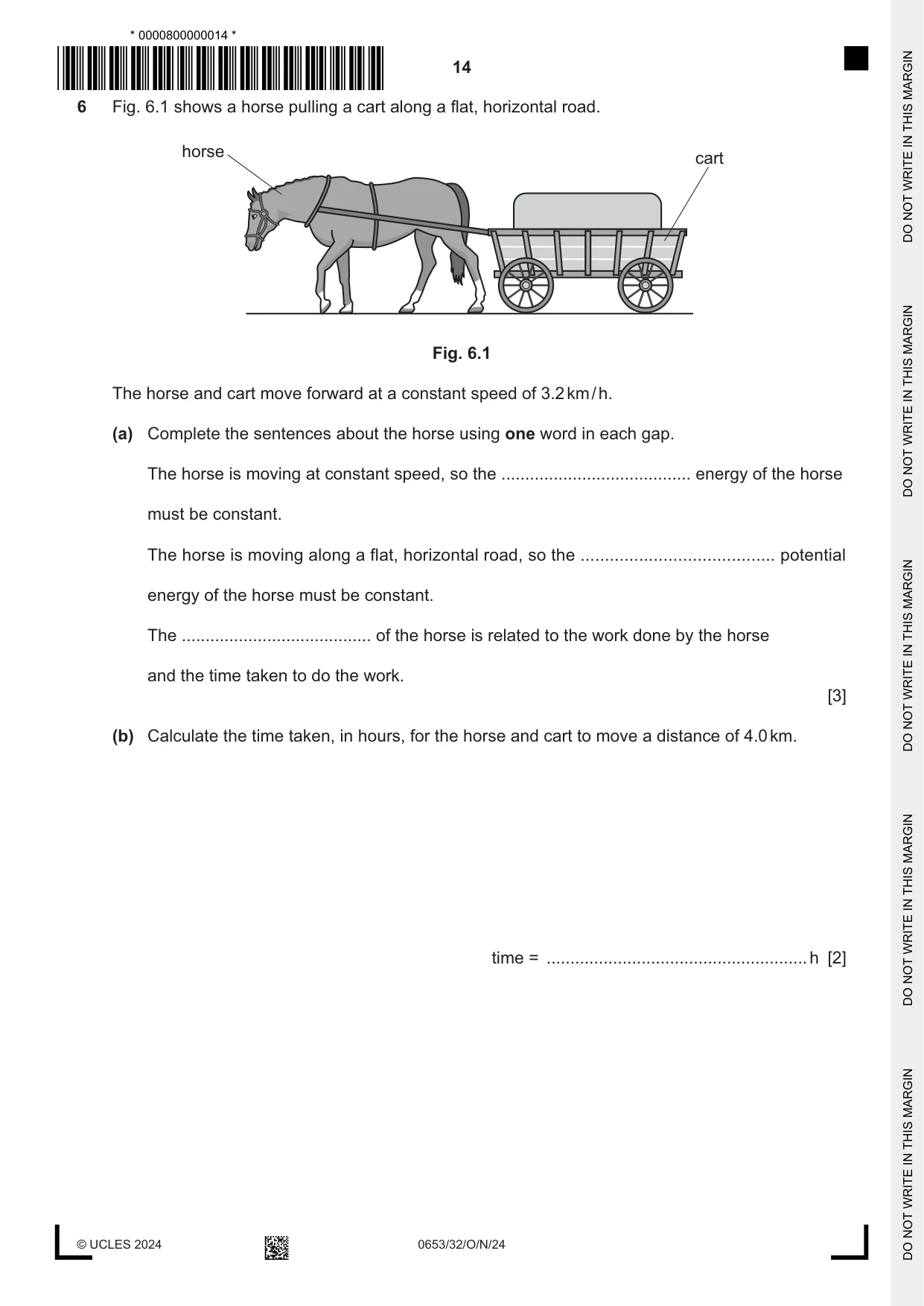
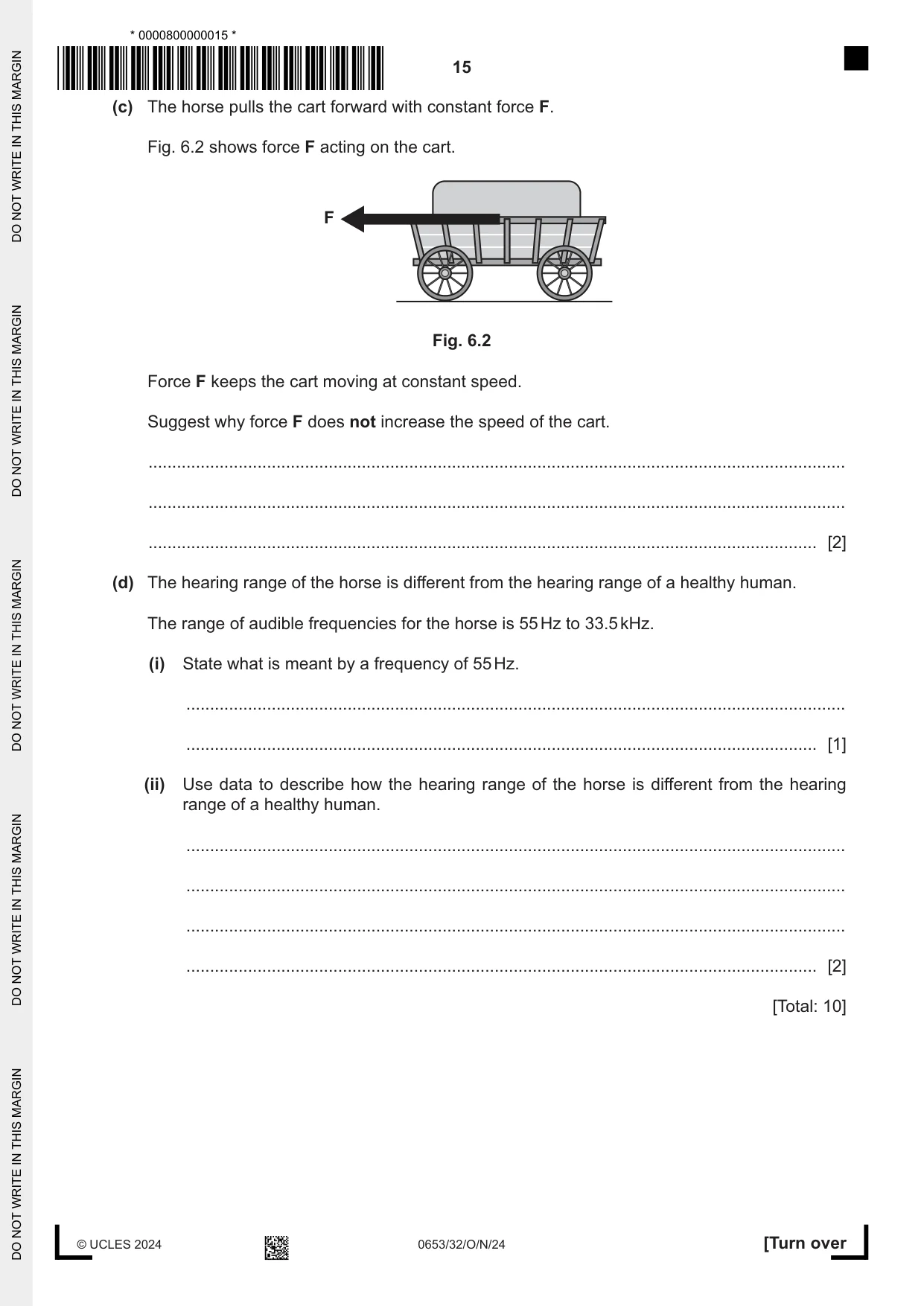
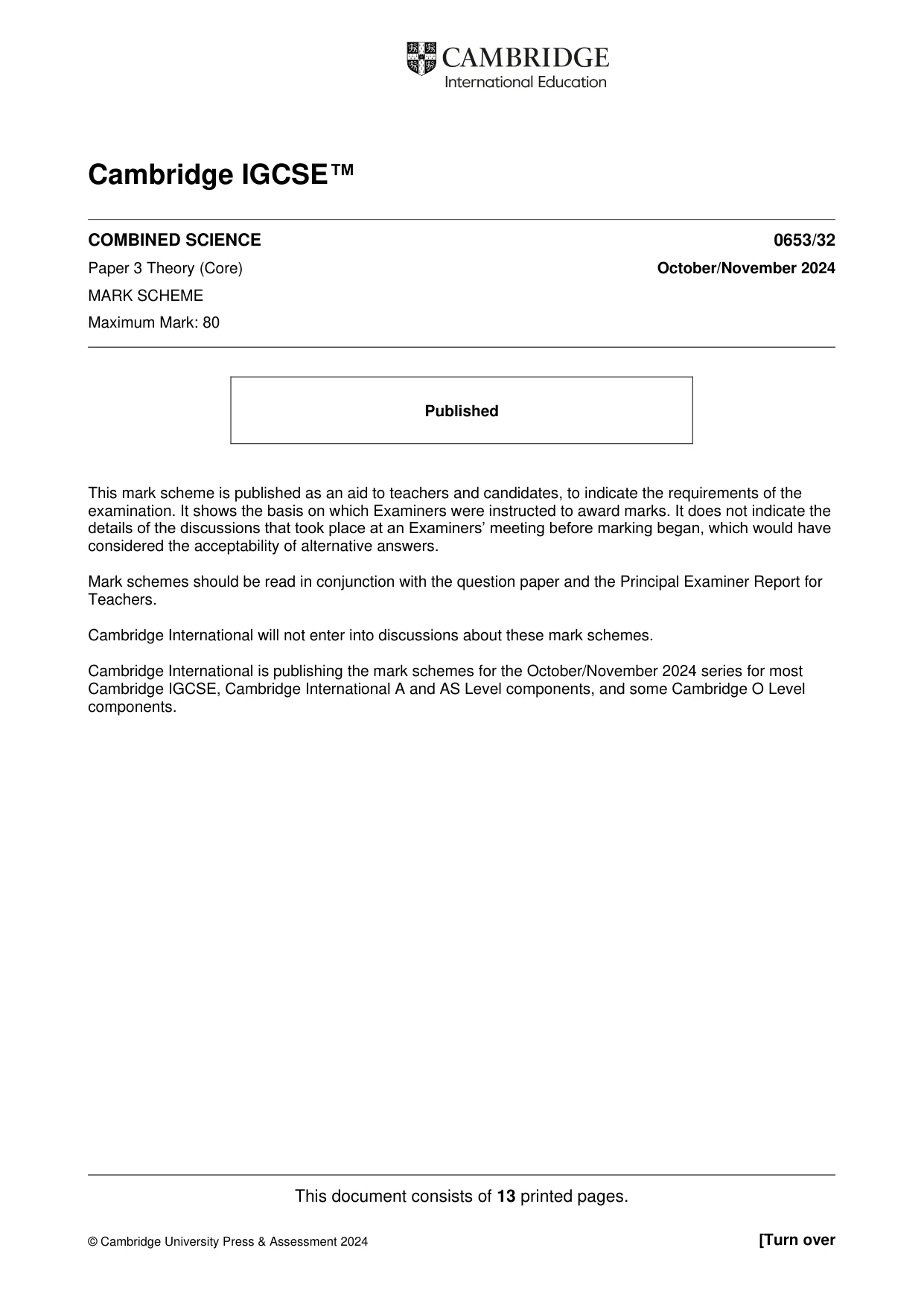
6 Fig. 6.1 shows a horse pulling a cart along a flat, horizontal road. horse cart Fig. 6.1 The horse and cart move forward at a constant speed of 3.2 km / h. (a) Complete the sentences about the horse using one word in each gap. The horse is moving at constant speed, so the ........................................ energy of the horse must be constant. The horse is moving along a flat, horizontal road, so the ........................................ potential energy of the horse must be constant. The ........................................ of the horse is related to the work done by the horse and the time taken to do the work. [3] (b) Calculate the time taken, in hours, for the horse and cart to move a distance of 4.0 km. time = ....................................................... h [2] (c) The horse pulls the cart forward with constant force F. Fig. 6.2 shows force F acting on the cart. F Fig. 6.2 Force F keeps the cart moving at constant speed. Suggest why force F does not increase the speed of the cart. ................................................................................................................................................... ................................................................................................................................................... ............................................................................................................................................. [2] (d) The hearing range of the horse is different from the hearing range of a healthy human. The range of audible frequencies for the horse is 55 Hz to 33.5 kHz. (i) State what is meant by a frequency of 55 Hz. ........................................................................................................................................... ..................................................................................................................................... [1] (ii) Use data to describe how the hearing range of the horse is different from the hearing range of a healthy human. ........................................................................................................................................... ........................................................................................................................................... ........................................................................................................................................... ..................................................................................................................................... [2] [Total: 10]
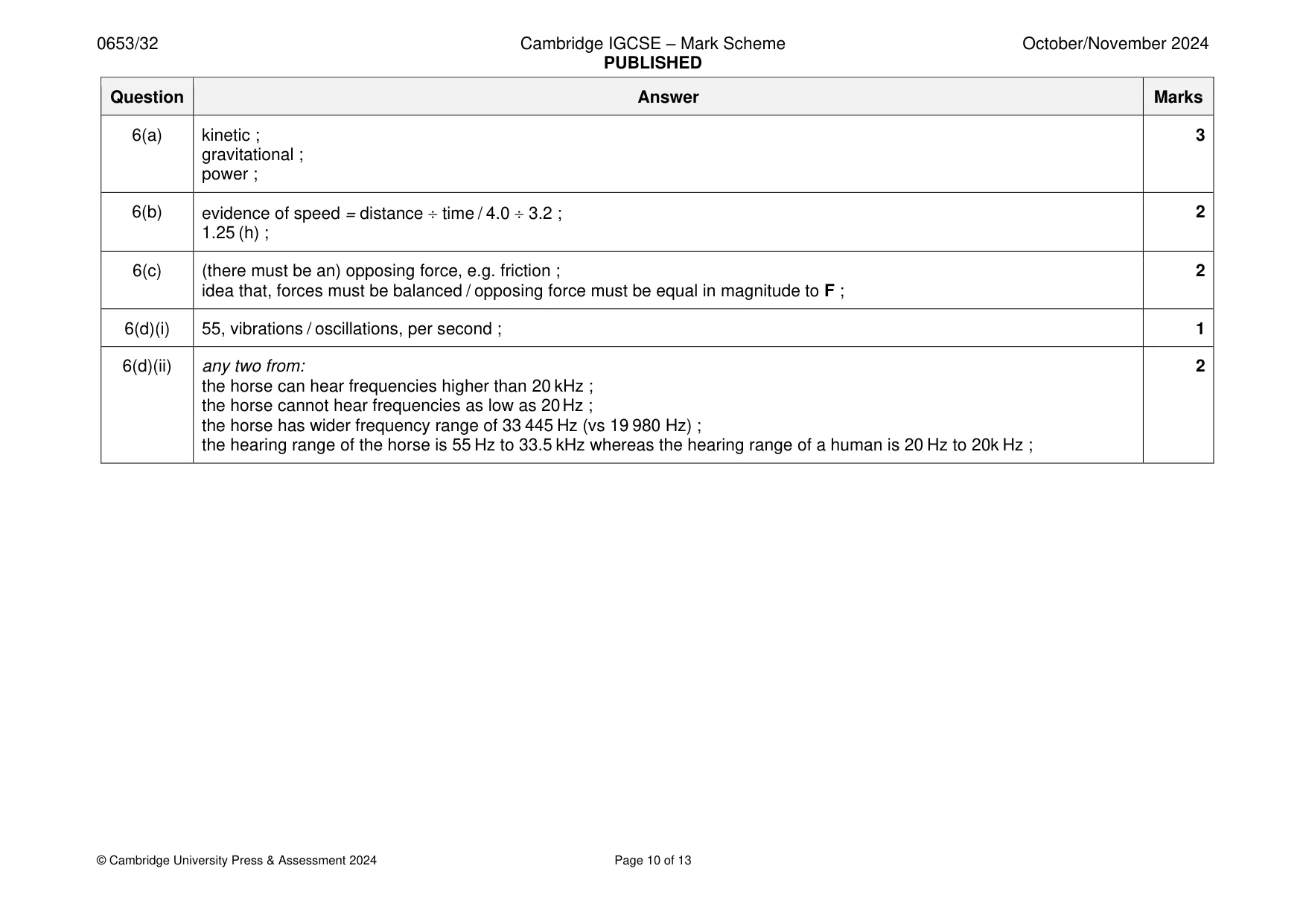
Mark scheme: 6(a) kinetic ; 3 gravitational ; power ; 6(b) evidence of speed = distance time / 4.0 3.2 ; 2 1.25 (h) ; 6(c) (there must be an) opposing force, e.g. friction ; 2 idea that, forces must be balanced / opposing force must be equal in magnitude to F ; 6(d)(i) 55, vibrations / oscillations, per second ; 1 6(d)(ii) any two from: 2 the horse can hear frequencies higher than 20 kHz ; the horse cannot hear frequencies as low as 20 Hz ; the horse has wider frequency range of 33 445 Hz (vs 19 980 Hz) ; the hearing range of the horse is 55 Hz to 33.5 kHz whereas the hearing range of a human is 20 Hz to 20k Hz ;
Q7 · Plants manufacture carbohydrates by the process of photosynthesis
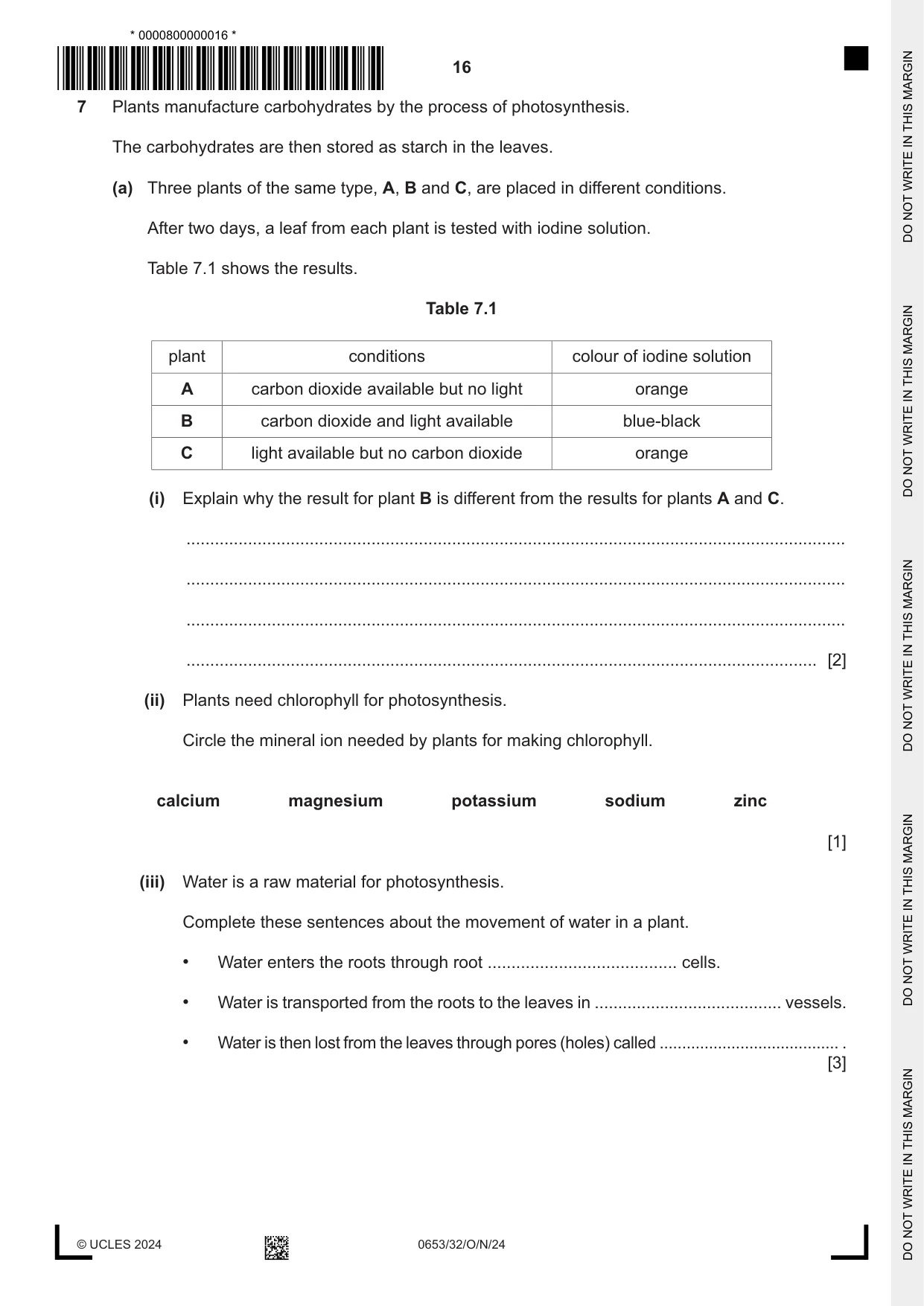
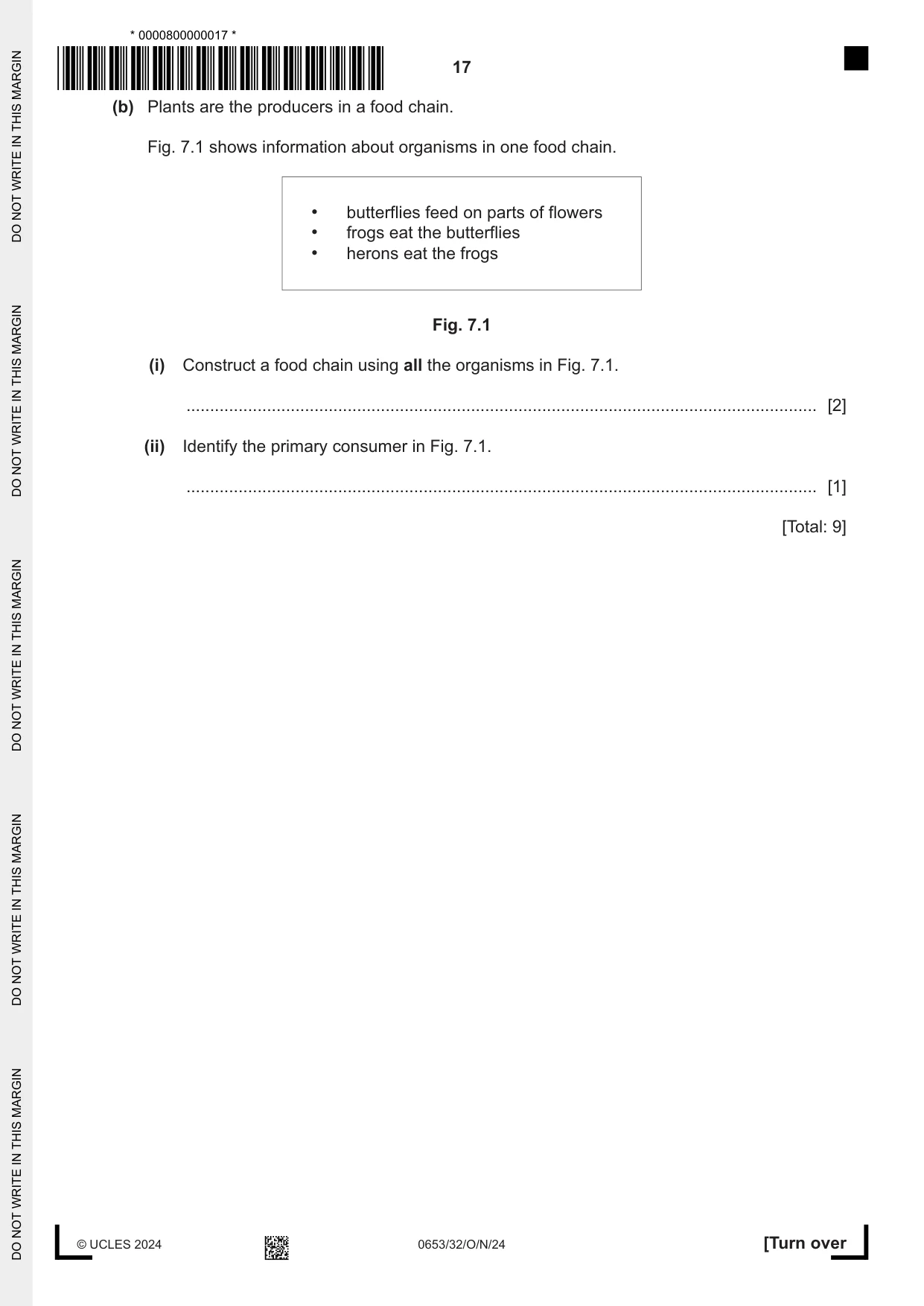
7 Plants manufacture carbohydrates by the process of photosynthesis. The carbohydrates are then stored as starch in the leaves. (a) Three plants of the same type, A, B and C, are placed in different conditions. After two days, a leaf from each plant is tested with iodine solution. Table 7.1 shows the results. Table 7.1 plant conditions colour of iodine solution A carbon dioxide available but no light orange B carbon dioxide and light available blue-black C light available but no carbon dioxide orange (i) Explain why the result for plant B is different from the results for plants A and C. ........................................................................................................................................... ........................................................................................................................................... ........................................................................................................................................... ..................................................................................................................................... [2] (ii) Plants need chlorophyll for photosynthesis. Circle the mineral ion needed by plants for making chlorophyll. calcium magnesium potassium sodium zinc [1] (iii) Water is a raw material for photosynthesis. Complete these sentences about the movement of water in a plant. • Water enters the roots through root ........................................ cells. • Water is transported from the roots to the leaves in ........................................ vessels. • Water is then lost from the leaves through pores (holes) called ........................................ . [3] (b) Plants are the producers in a food chain. Fig. 7.1 shows information about organisms in one food chain. • butterflies feed on parts of flowers • frogs eat the butterflies • herons eat the frogs Fig. 7.1 (i) Construct a food chain using all the organisms in Fig. 7.1. ..................................................................................................................................... [2] (ii) Identify the primary consumer in Fig. 7.1. ..................................................................................................................................... [1] [Total: 9]
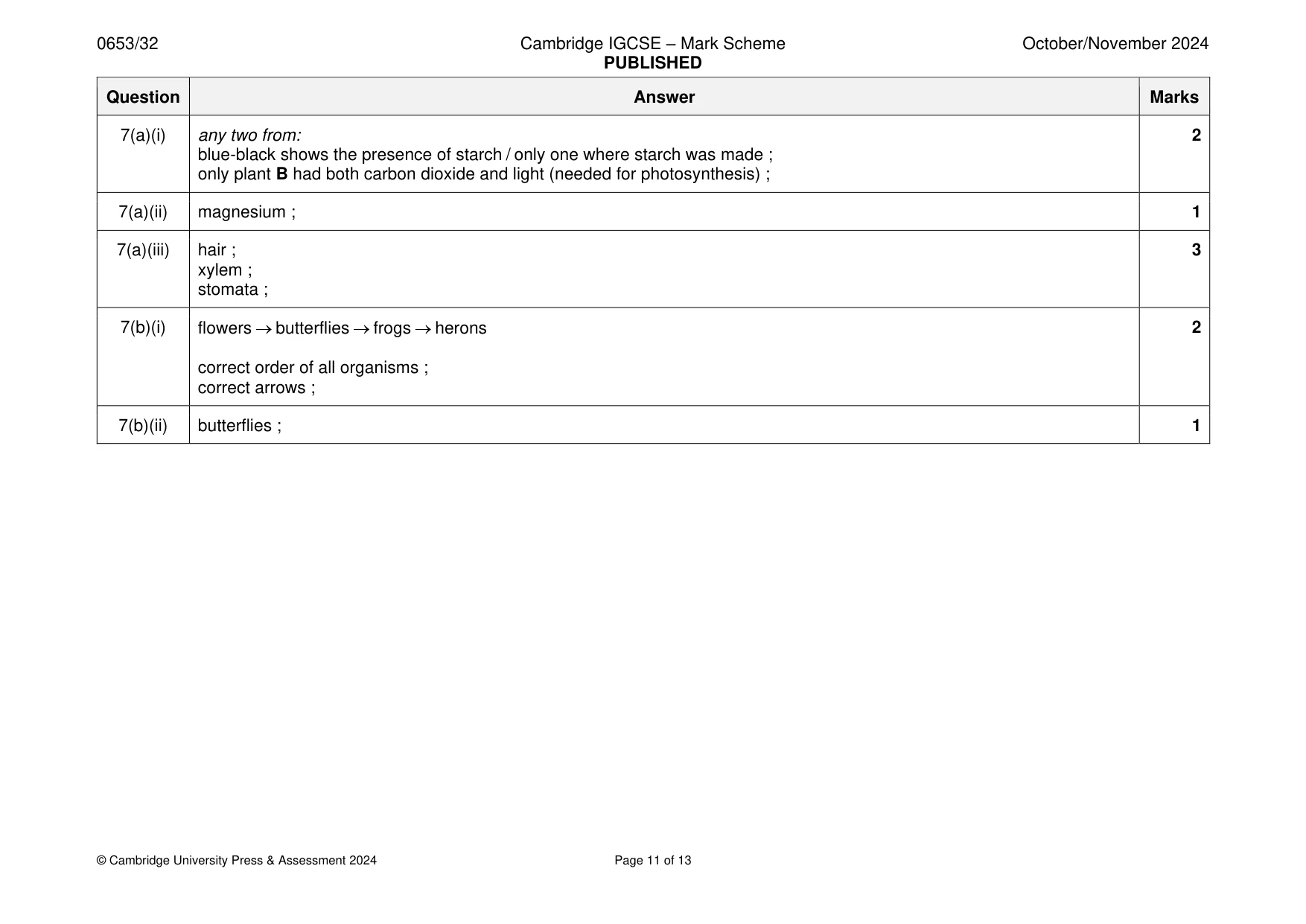
Mark scheme: 7(a)(i) any two from: 2 blue-black shows the presence of starch / only one where starch was made ; only plant B had both carbon dioxide and light (needed for photosynthesis) ; 7(a)(ii) magnesium ; 1 7(a)(iii) hair ; 3 xylem ; stomata ; 7(b)(i) flowers → butterflies → frogs → herons 2 correct order of all organisms ; correct arrows ; 7(b)(ii) butterflies ; 1
Q8 · Apparatus for the electrolysis of dilute sulfuric acid using inert electrodes
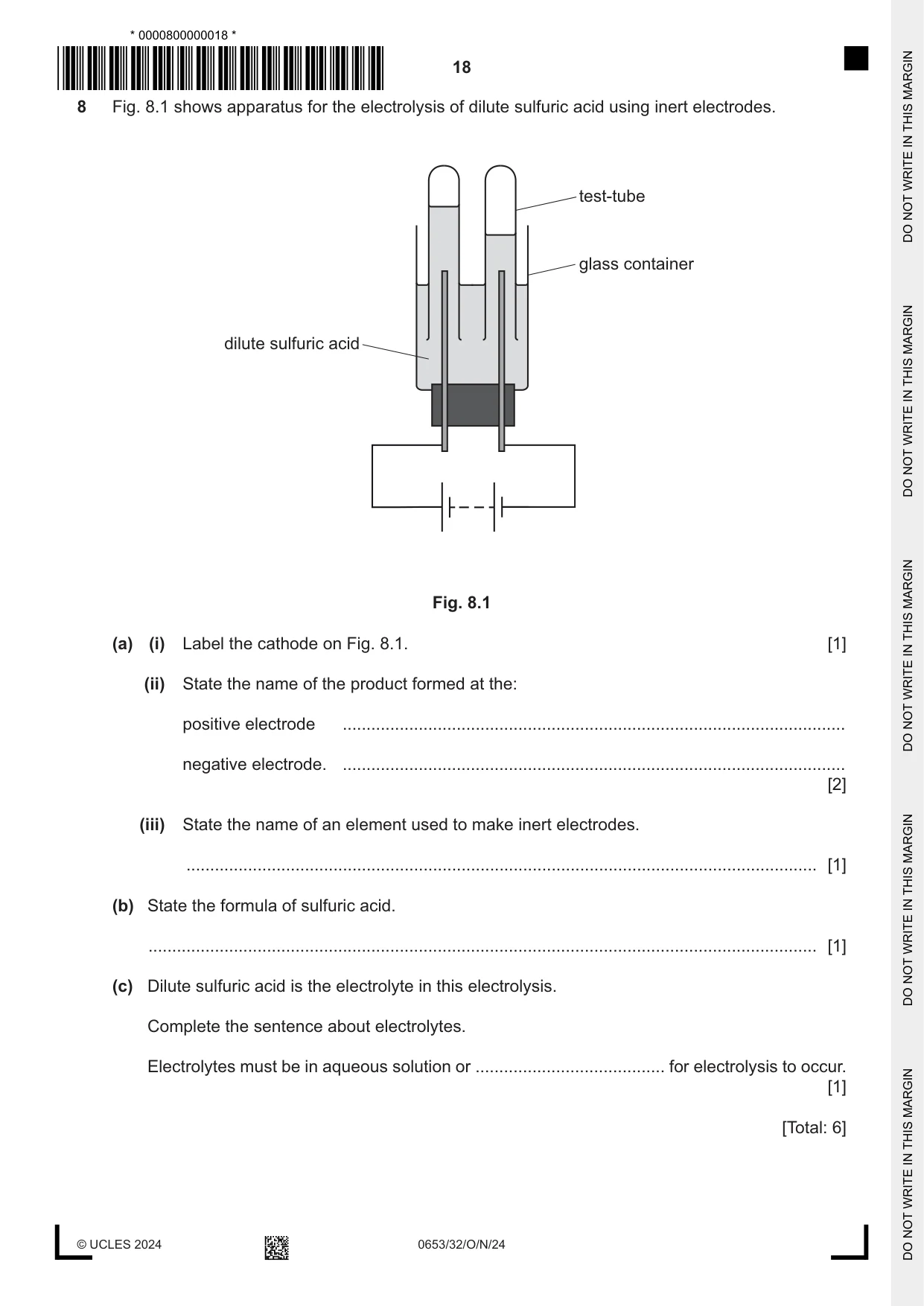
8 Fig. 8.1 shows apparatus for the electrolysis of dilute sulfuric acid using inert electrodes. test-tube glass container dilute sulfuric acid Fig. 8.1 (a) (i) Label the cathode on Fig. 8.1. [1] (ii) State the name of the product formed at the: positive electrode .......................................................................................................... negative electrode. .......................................................................................................... [2] (iii) State the name of an element used to make inert electrodes. ..................................................................................................................................... [1] (b) State the formula of sulfuric acid. ............................................................................................................................................. [1] (c) Dilute sulfuric acid is the electrolyte in this electrolysis. Complete the sentence about electrolytes. Electrolytes must be in aqueous solution or ........................................ for electrolysis to occur. [1] [Total: 6]
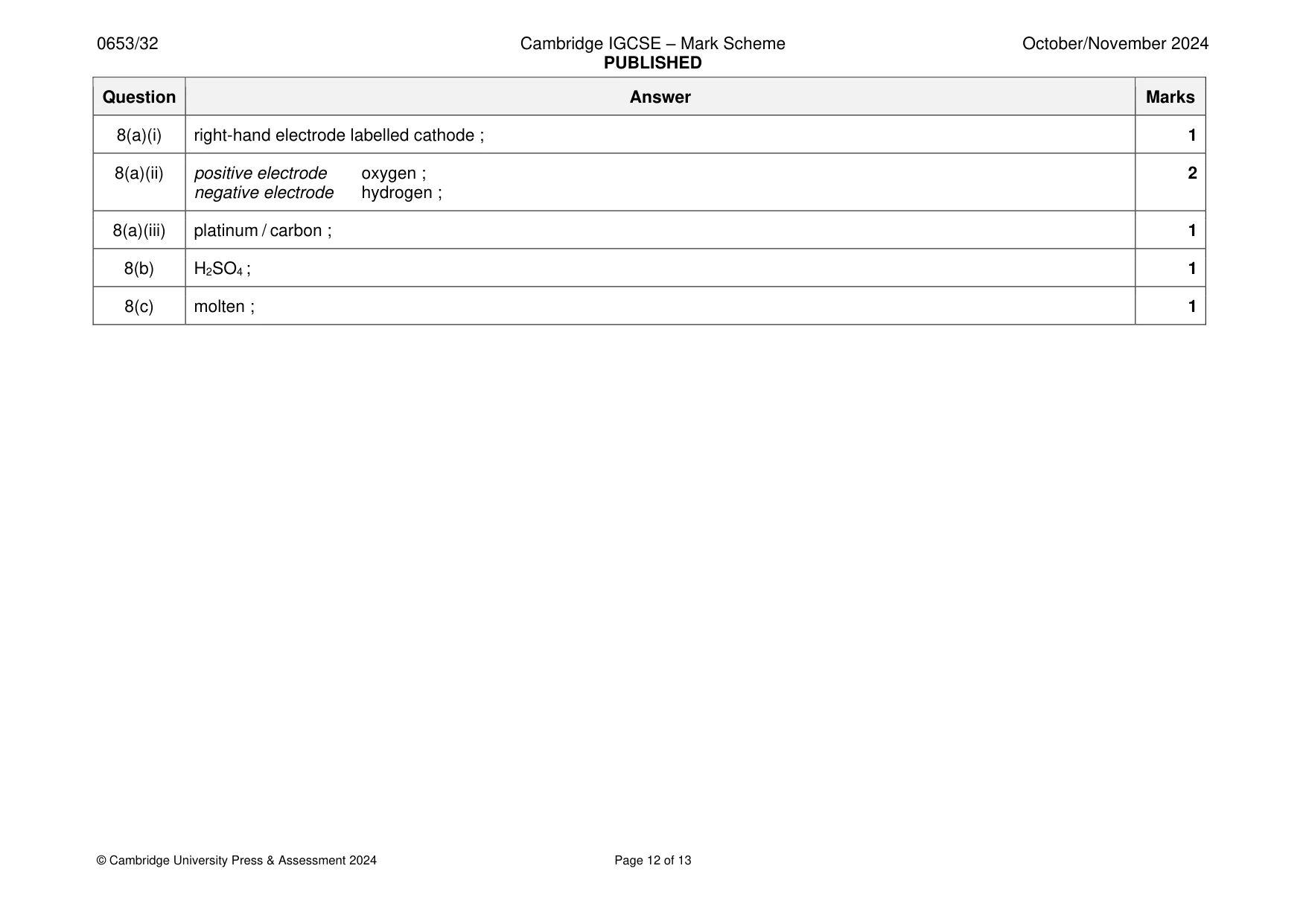
Mark scheme: 8(a)(i) right-hand electrode labelled cathode ; 1 8(a)(ii) positive electrode oxygen ; 2 negative electrode hydrogen ; 8(a)(iii) platinum / carbon ; 1 8(b) H2SO4 ; 1 8(c) molten ; 1
Q9 · A candle made of wax
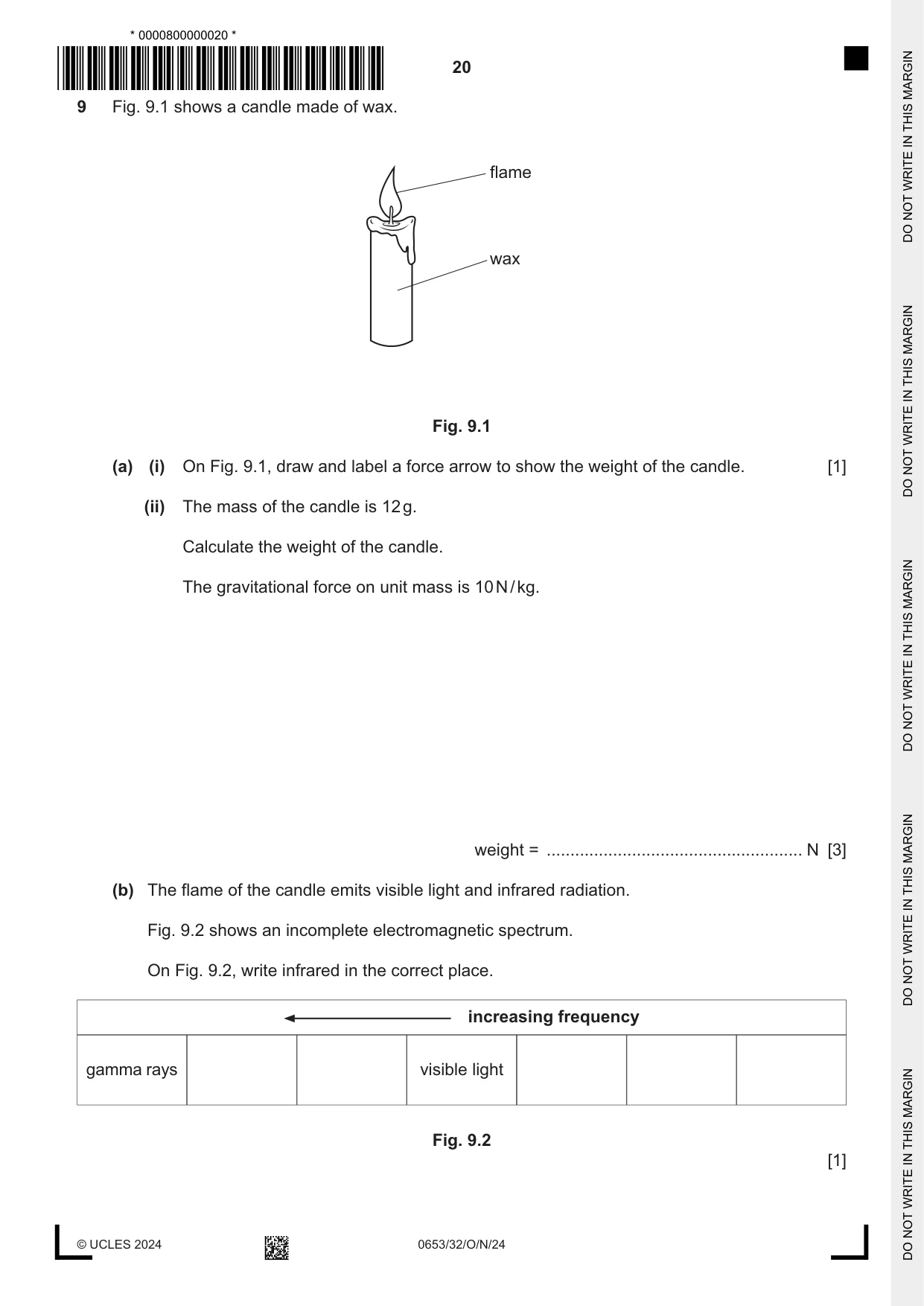
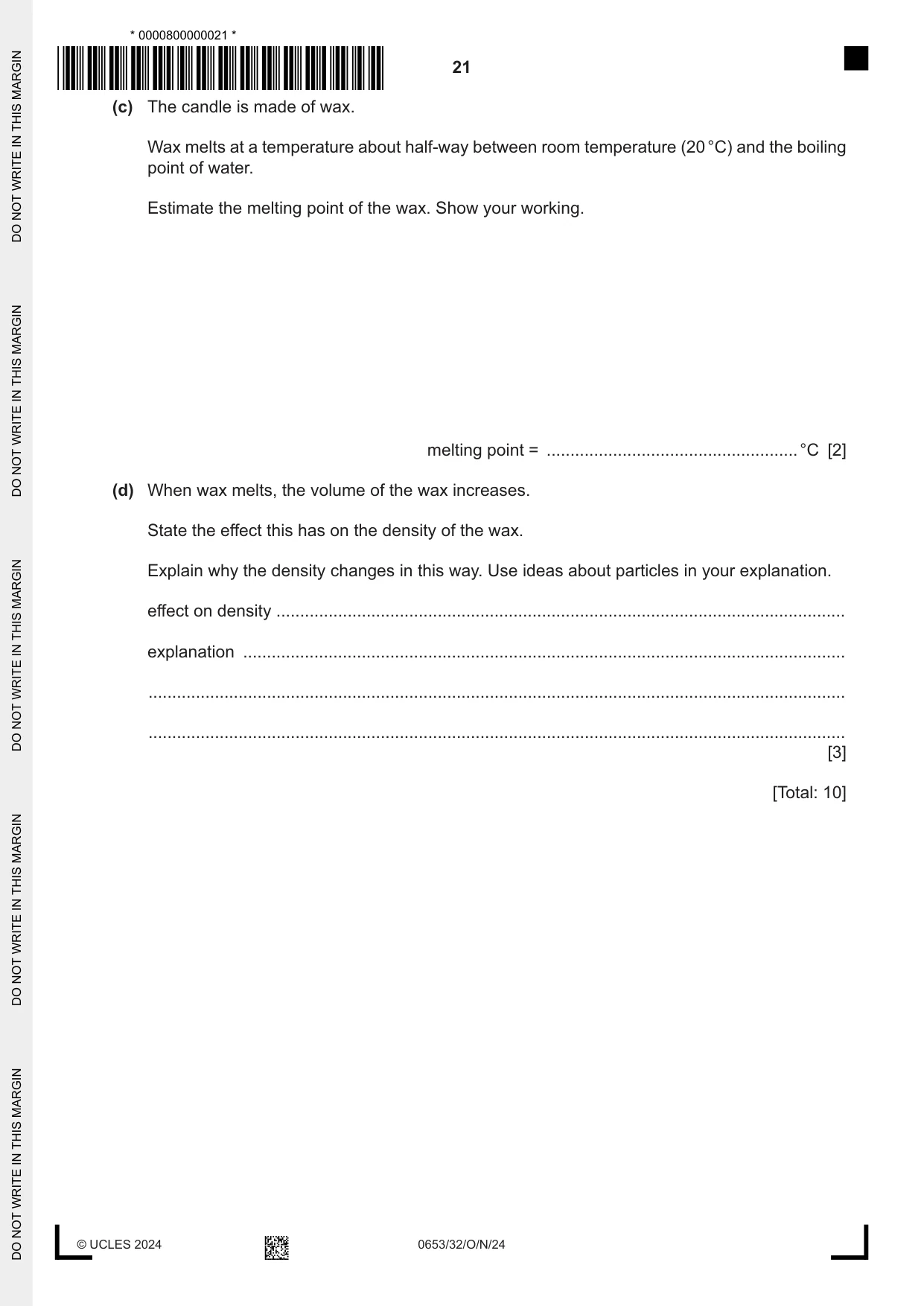
9 Fig. 9.1 shows a candle made of wax. flame wax Fig. 9.1 (a) (i) On Fig. 9.1, draw and label a force arrow to show the weight of the candle. [1] (ii) The mass of the candle is 12 g. Calculate the weight of the candle. The gravitational force on unit mass is 10 N / kg. weight = ...................................................... N [3] (b) The flame of the candle emits visible light and infrared radiation. Fig. 9.2 shows an incomplete electromagnetic spectrum. On Fig. 9.2, write infrared in the correct place. increasing frequency gamma rays visible light Fig. 9.2 [1] (c) The candle is made of wax. Wax melts at a temperature about half-way between room temperature (20 °C) and the boiling point of water. Estimate the melting point of the wax. Show your working. melting point = ..................................................... °C [2] (d) When wax melts, the volume of the wax increases. State the effect this has on the density of the wax. Explain why the density changes in this way. Use ideas about particles in your explanation. effect on density ........................................................................................................................ explanation ............................................................................................................................... ................................................................................................................................................... ................................................................................................................................................... [3] [Total: 10]
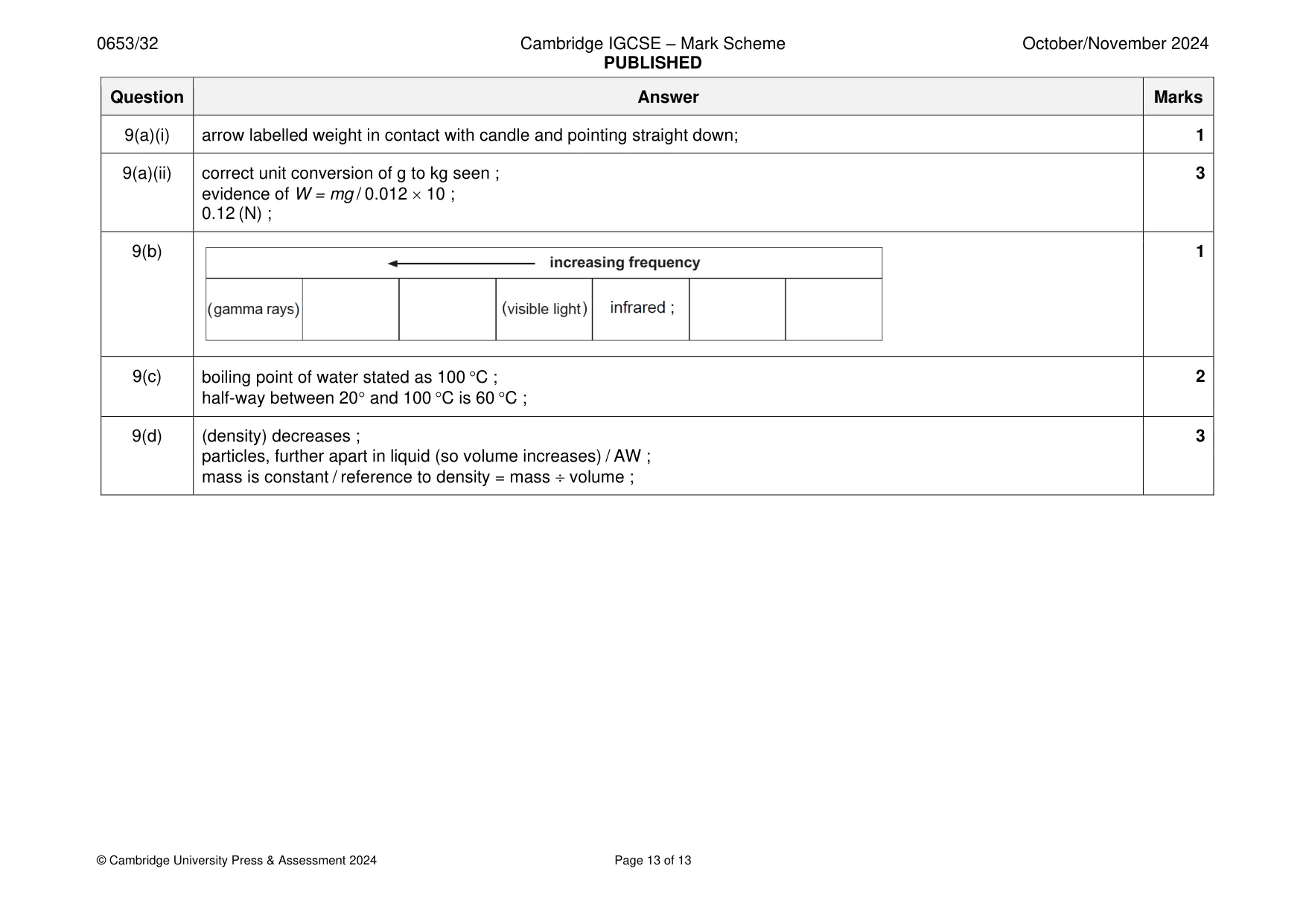
Mark scheme: 9(a)(i) arrow labelled weight in contact with candle and pointing straight down; 1 9(a)(ii) correct unit conversion of g to kg seen ; 3 evidence of W = mg / 0.012 10 ; 0.12 (N) ; 9(b) 1 9(c) boiling point of water stated as 100 C ; 2 half-way between 20 and 100 C is 60 C ; 9(d) (density) decreases ; 3 particles, further apart in liquid (so volume increases) / AW ; mass is constant / reference to density = mass volume ;
What was in this paper
The subtopics covered by these 9 questions, and how many questions each got. Open one in a new tab to see every Cambridge question on it.
What you needed in this session
Cambridge’s own grade thresholds for 2024 Oct/Nov, Paper 3 · Variant 2. A higher threshold means an easier paper — the bar moves with how the cohort did.