Cambridge IGCSE Science - Combined 0653 — 2024 May/June Paper 3 · Variant 1
0653/31/M/J/24 · 9 questions · 80 marks · ≈90 min
The question paper and its mark scheme, free to read here and free to download. This is Cambridge’s own paper, exactly as it was sat.
Question paper24 pages



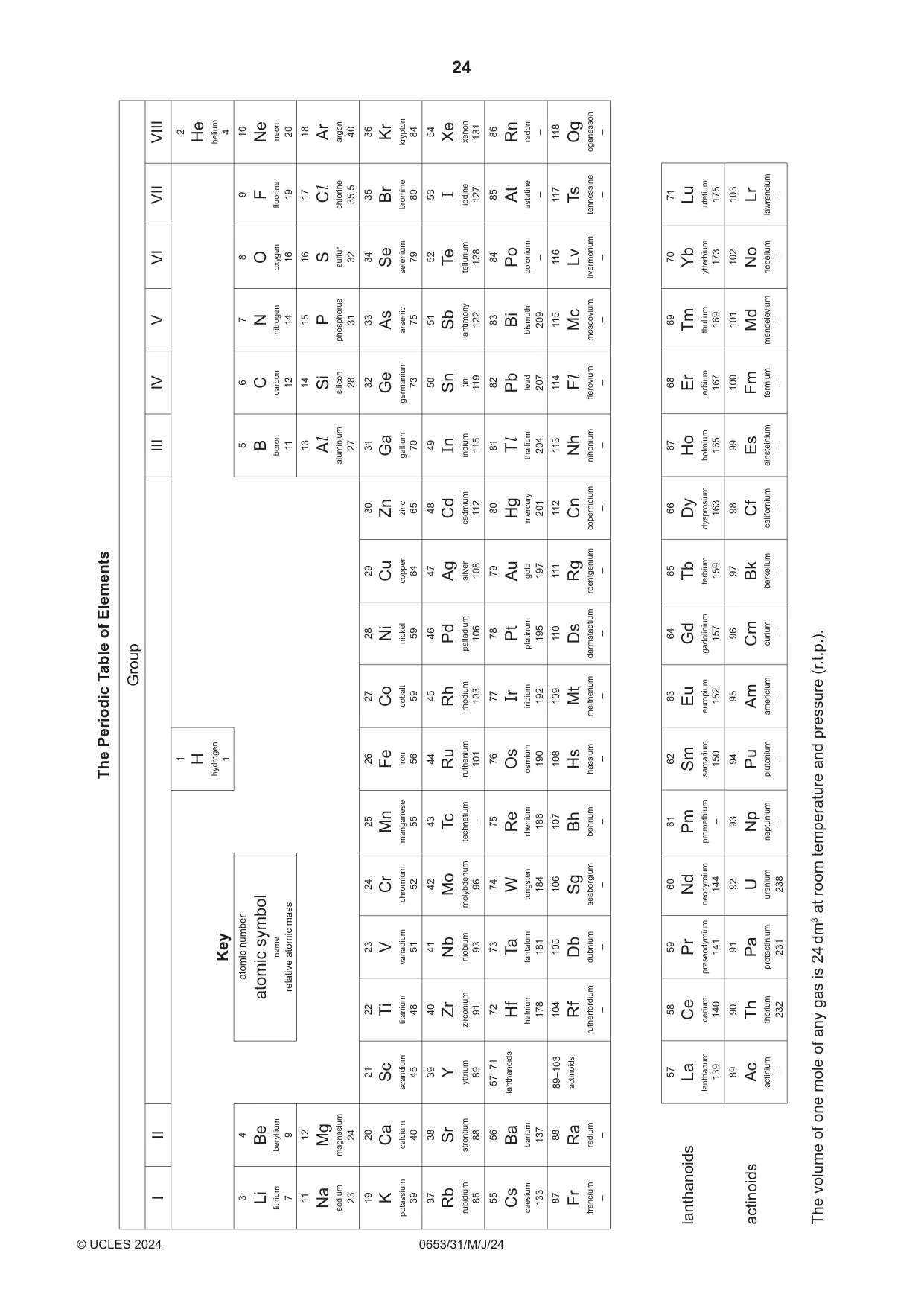
Mark scheme10 pages
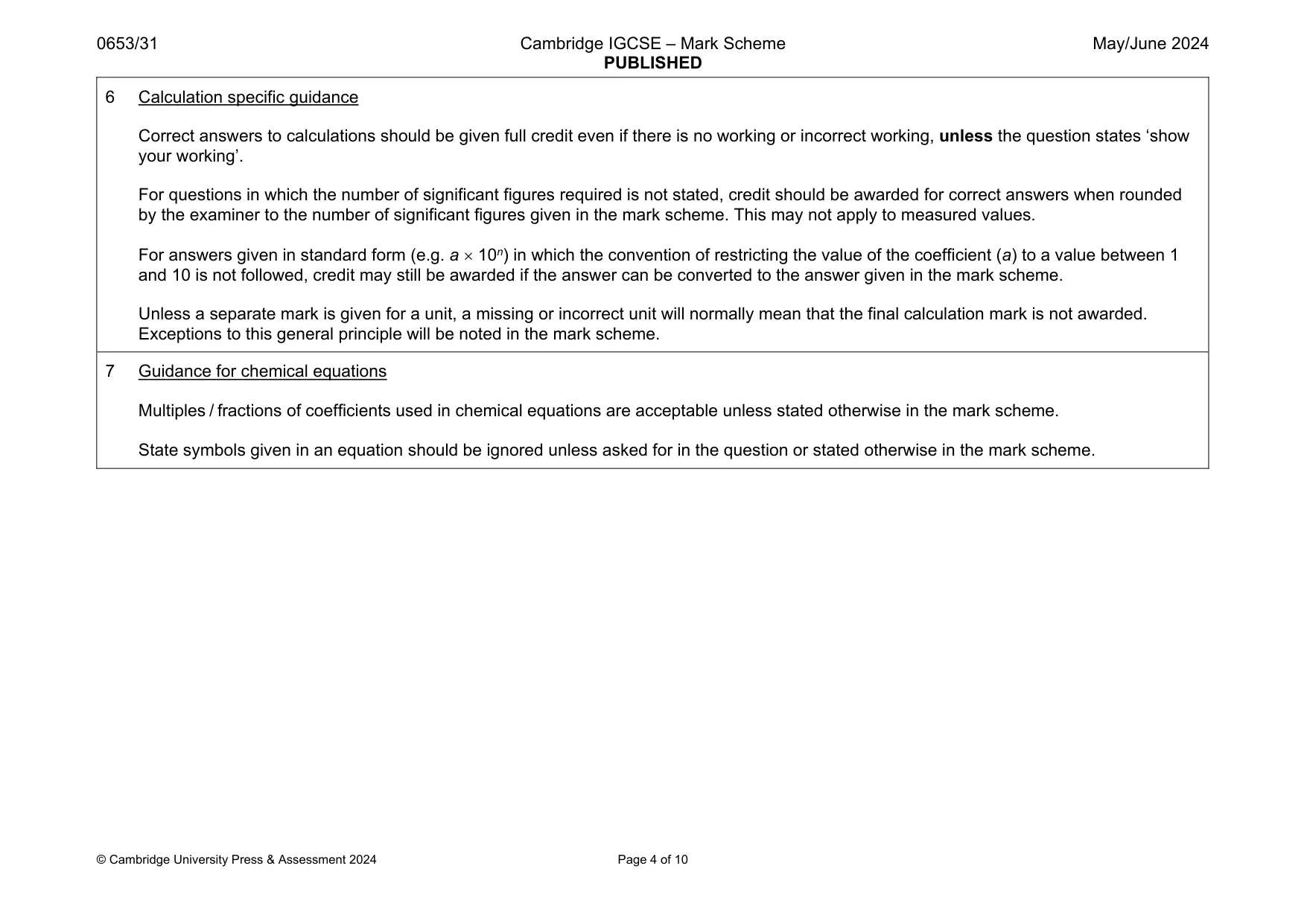
Answers below. Sit the paper first if you are practising.
Questions as text
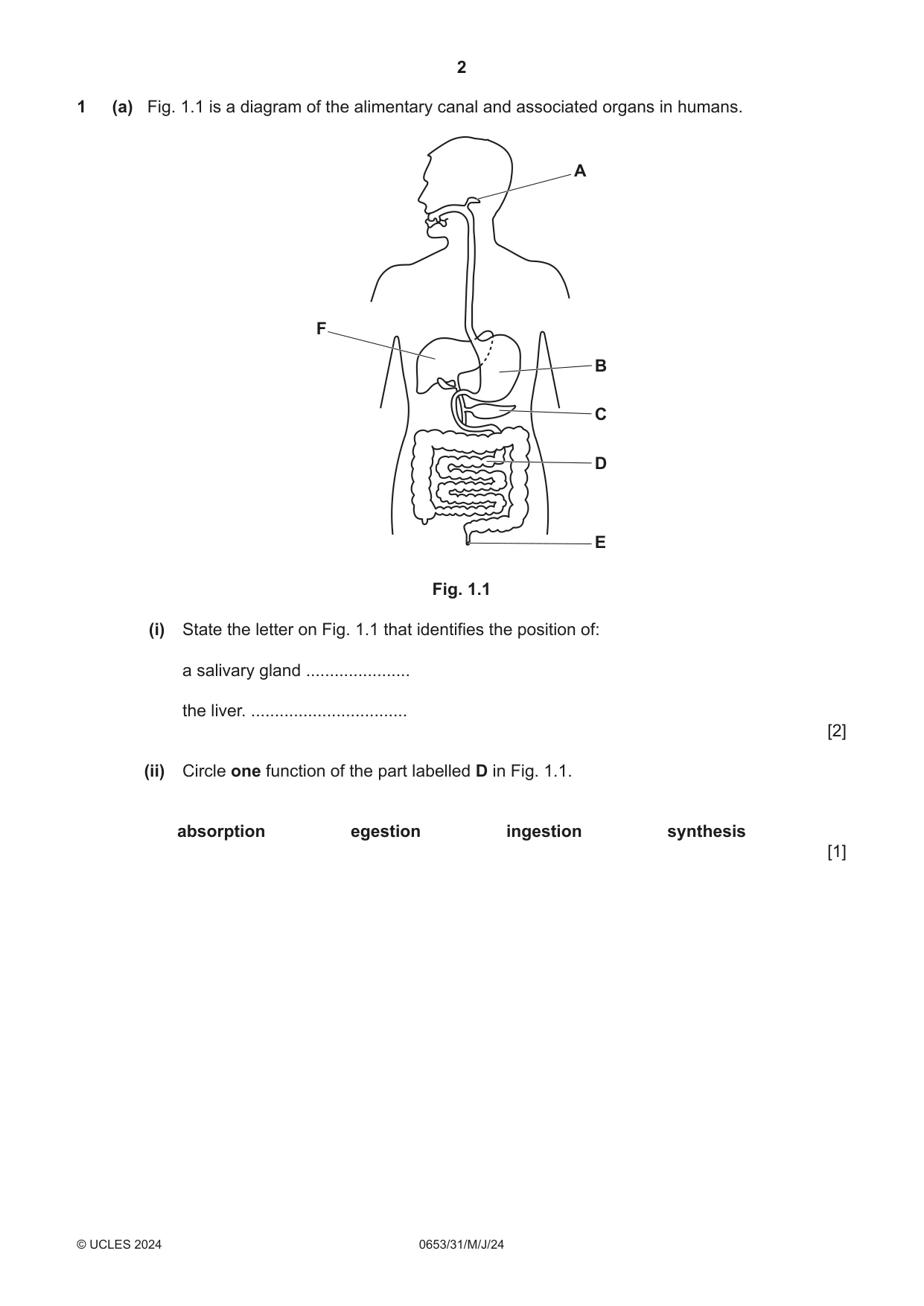
Q1 · A diagram of the alimentary canal and associated organs in humans
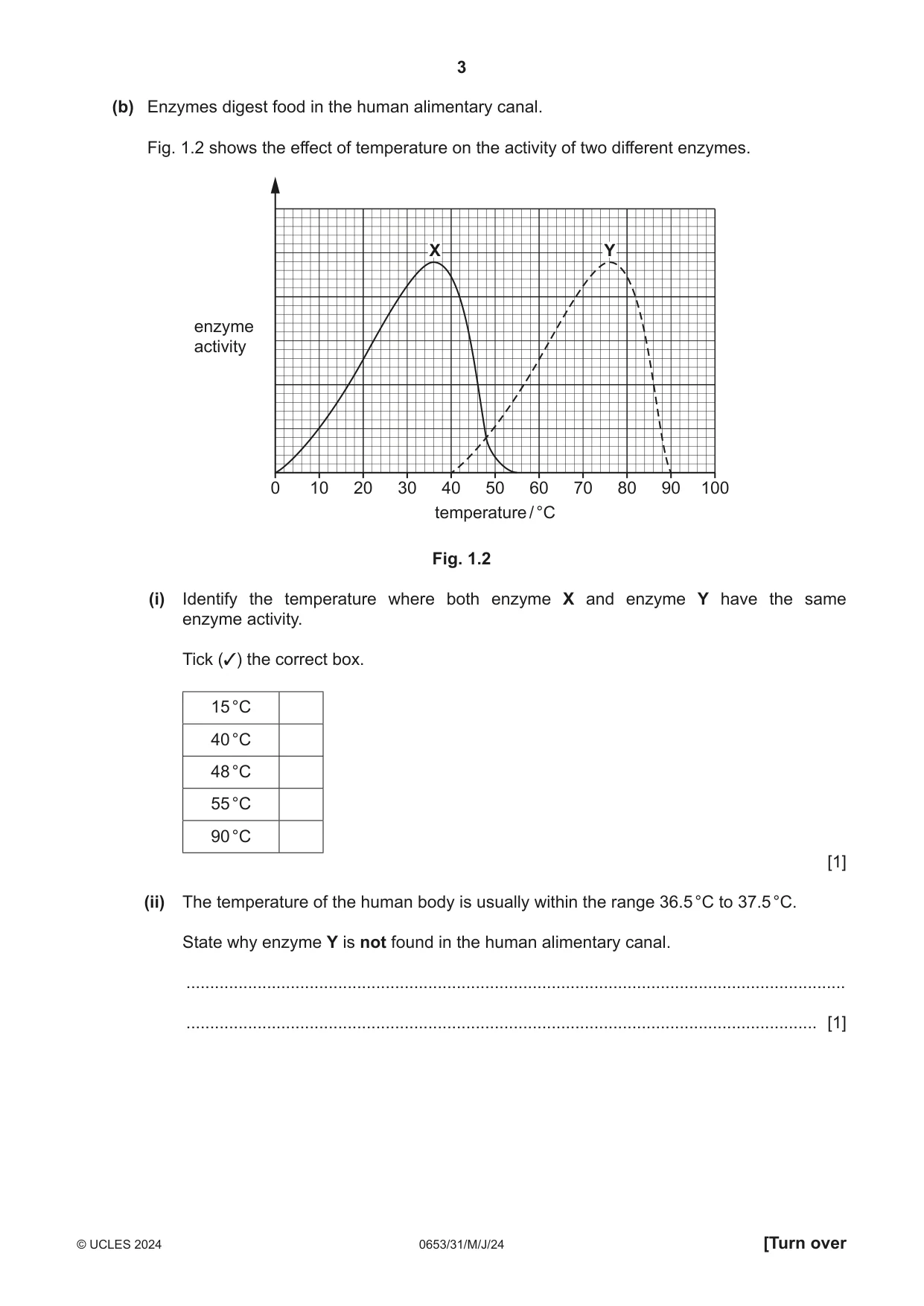
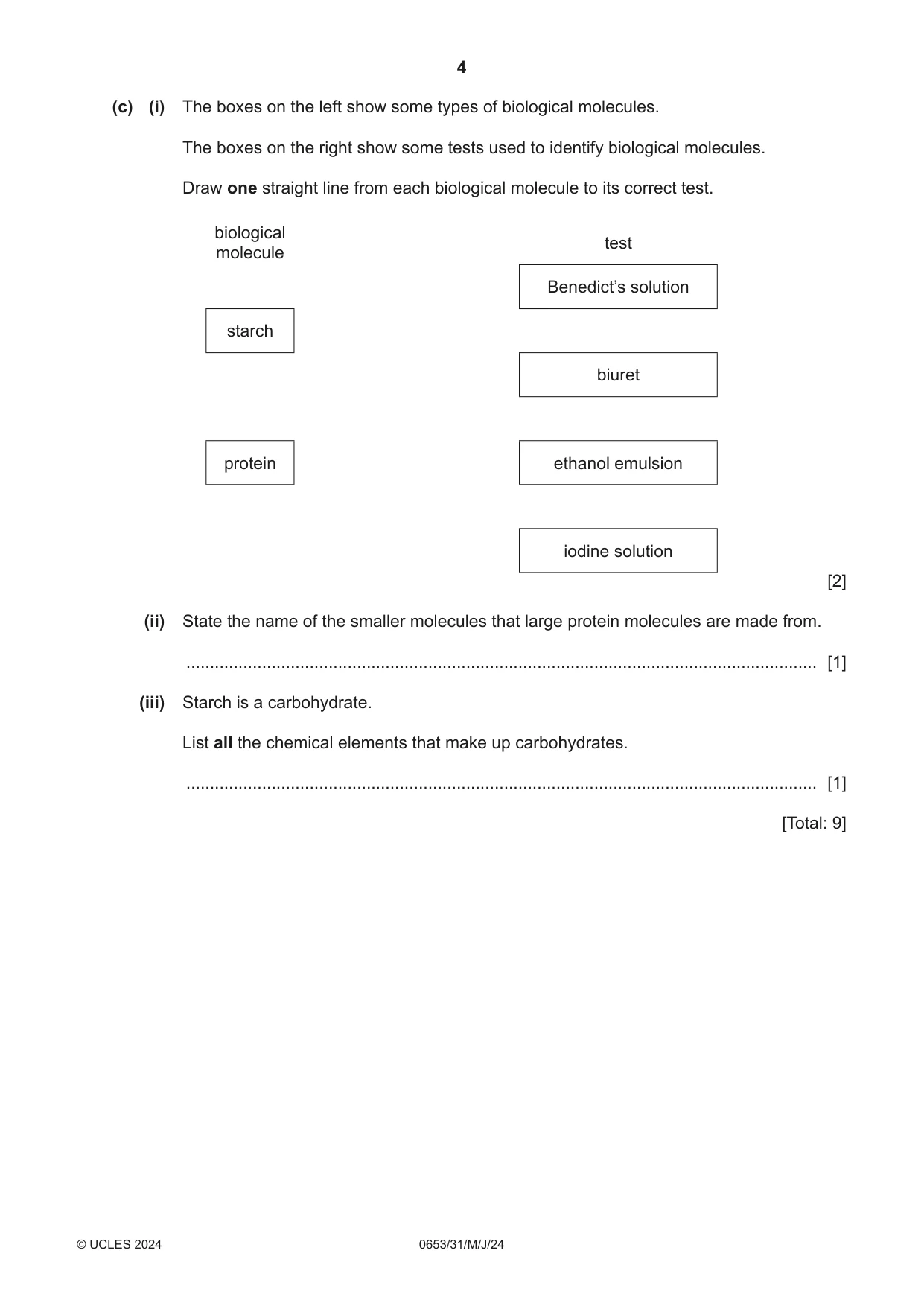
1 (a) Fig. 1.1 is a diagram of the alimentary canal and associated organs in humans. A F B C D E Fig. 1.1 (i) State the letter on Fig. 1.1 that identifies the position of: a salivary gland ...................... the liver. ................................. [2] (ii) Circle one function of the part labelled D in Fig. 1.1. absorption egestion ingestion synthesis [1] (b) Enzymes digest food in the human alimentary canal. Fig. 1.2 shows the effect of temperature on the activity of two different enzymes. X Y enzyme activity 0 10 20 30 40 50 60 70 80 90 100 temperature / °C Fig. 1.2 (i) Identify the temperature where both enzyme X and enzyme Y have the same enzyme activity. Tick (✓) the correct box. 15 °C 40 °C 48 °C 55 °C 90 °C [1] (ii) The temperature of the human body is usually within the range 36.5 °C to 37.5 °C. State why enzyme Y is not found in the human alimentary canal. ........................................................................................................................................... ..................................................................................................................................... [1] (c) (i) The boxes on the left show some types of biological molecules. The boxes on the right show some tests used to identify biological molecules. Draw one straight line from each biological molecule to its correct test. biological test molecule Benedict’s solution starch biuret protein ethanol emulsion iodine solution [2] (ii) State the name of the smaller molecules that large protein molecules are made from. ..................................................................................................................................... [1] (iii) Starch is a carbohydrate. List all the chemical elements that make up carbohydrates. ..................................................................................................................................... [1] [Total: 9]
Mark scheme: 1(a)(i) A ; F ; 2 1(a)(ii) absorption (circled) ; 1 1(b)(i) 48 °C (ticked) ; 1 1(b)(ii) inactive in that temperature range (36.5–37.5 °C) / active at temperatures above body temperature ; 1 1(c)(i) Benedict’s solution starch biuret protein ethanol emulsion iodine solution one mark for each correct answer ;; 2 1(c)(ii) amino acids ; 1 1(c)(iii) carbon and hydrogen and oxygen ; 1
Q2 · The elements chlorine, bromine and iodine are diatomic covalent molecules
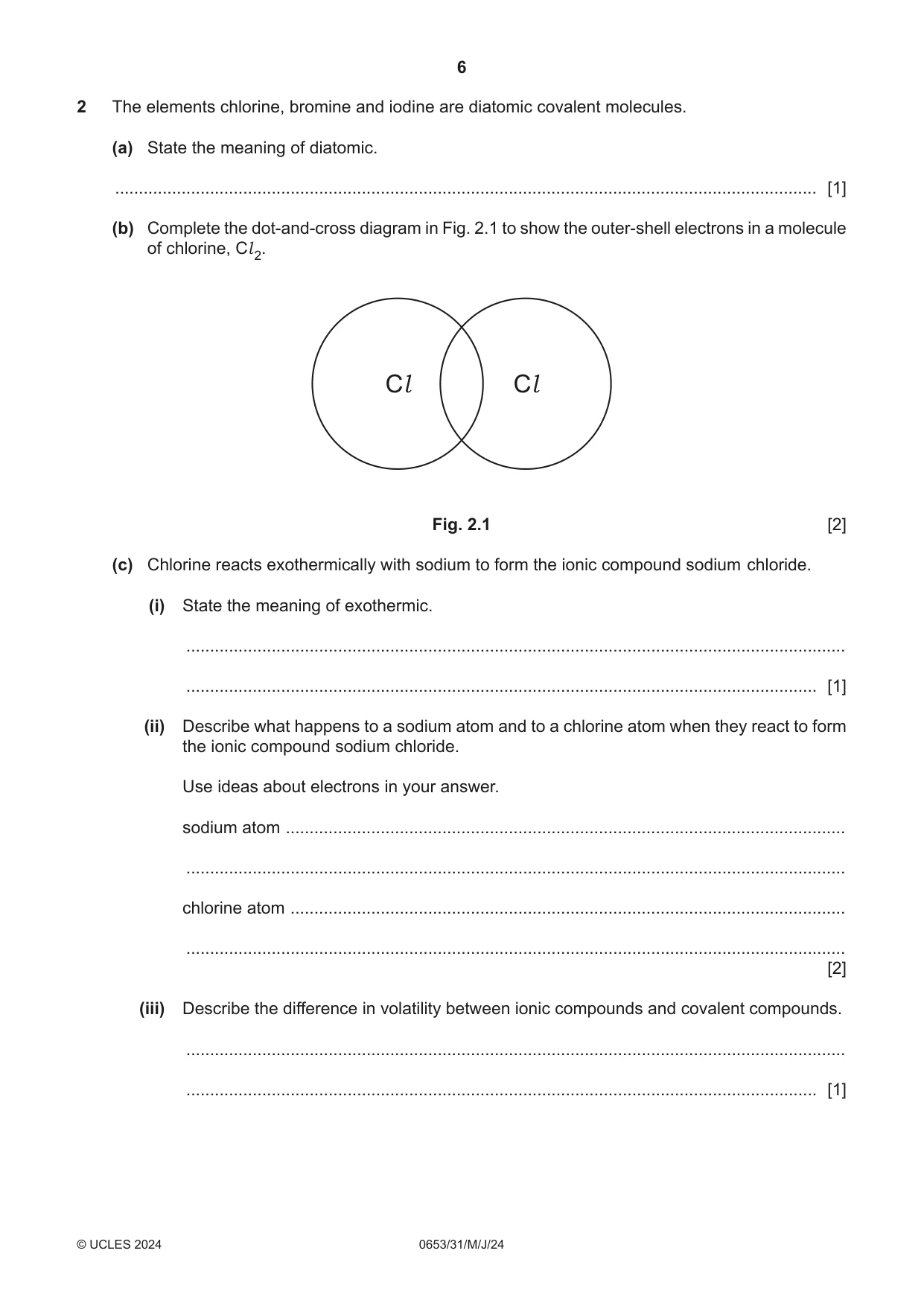
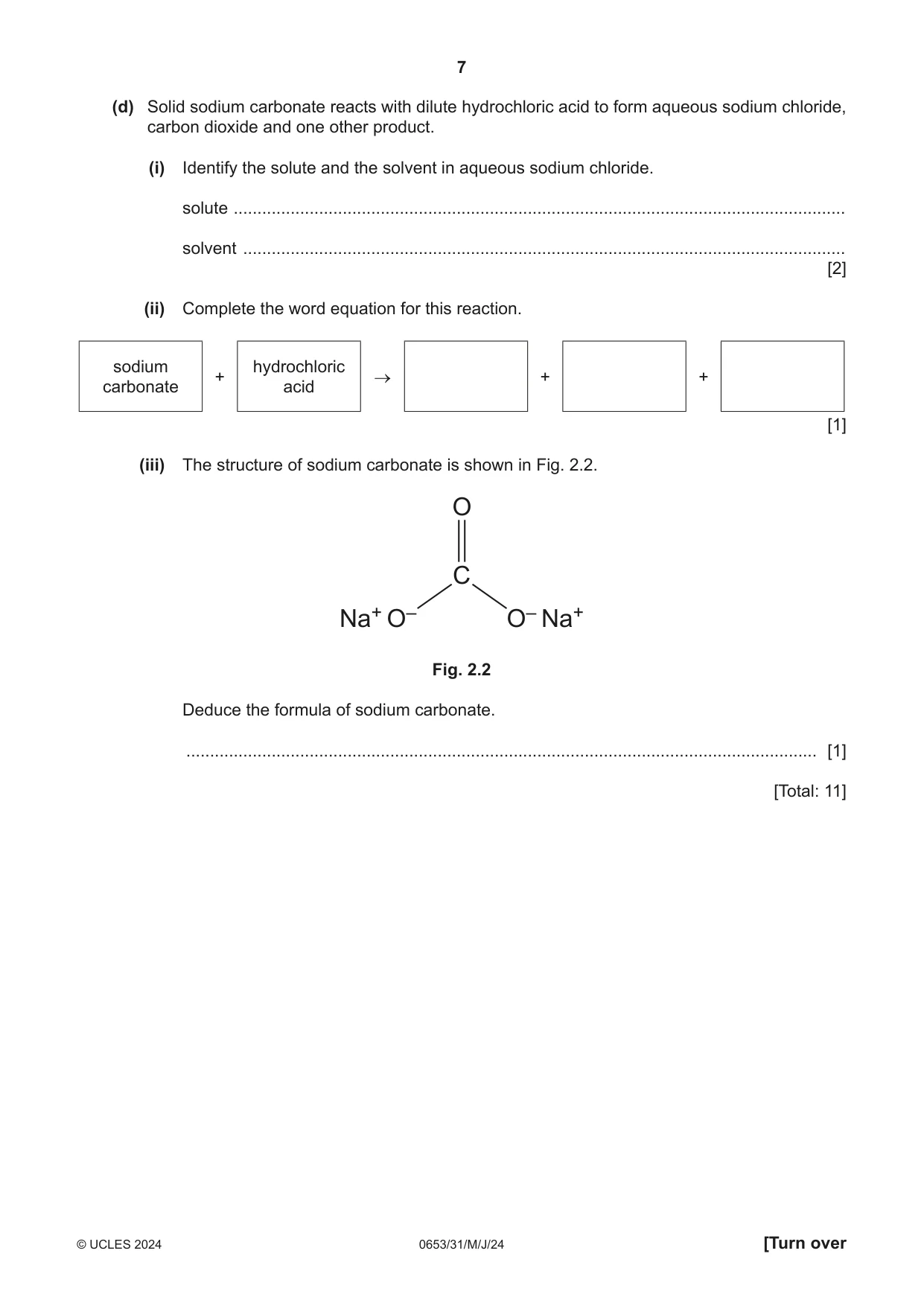
2 The elements chlorine, bromine and iodine are diatomic covalent molecules. (a) State the meaning of diatomic. .................................................................................................................................................... [1] (b) Complete the dot-and-cross diagram in Fig. 2.1 to show the outer-shell electrons in a molecule of chlorine, Cl2. Cl Cl Fig. 2.1 [2] (c) Chlorine reacts exothermically with sodium to form the ionic compound sodium chloride. (i) State the meaning of exothermic. ........................................................................................................................................... ..................................................................................................................................... [1] (ii) Describe what happens to a sodium atom and to a chlorine atom when they react to form the ionic compound sodium chloride. Use ideas about electrons in your answer. sodium atom ...................................................................................................................... ........................................................................................................................................... chlorine atom ..................................................................................................................... ........................................................................................................................................... [2] (iii) Describe the difference in volatility between ionic compounds and covalent compounds. ........................................................................................................................................... ..................................................................................................................................... [1] (d) Solid sodium carbonate reacts with dilute hydrochloric acid to form aqueous sodium chloride, carbon dioxide and one other product. (i) Identify the solute and the solvent in aqueous sodium chloride. solute ................................................................................................................................. solvent ............................................................................................................................... [2] (ii) Complete the word equation for this reaction. sodium hydrochloric + + +carbonate acid [1] (iii) The structure of sodium carbonate is shown in Fig. 2.2. O C Na+ O– O– Na+ Fig. 2.2 Deduce the formula of sodium carbonate. ..................................................................................................................................... [1] [Total: 11]
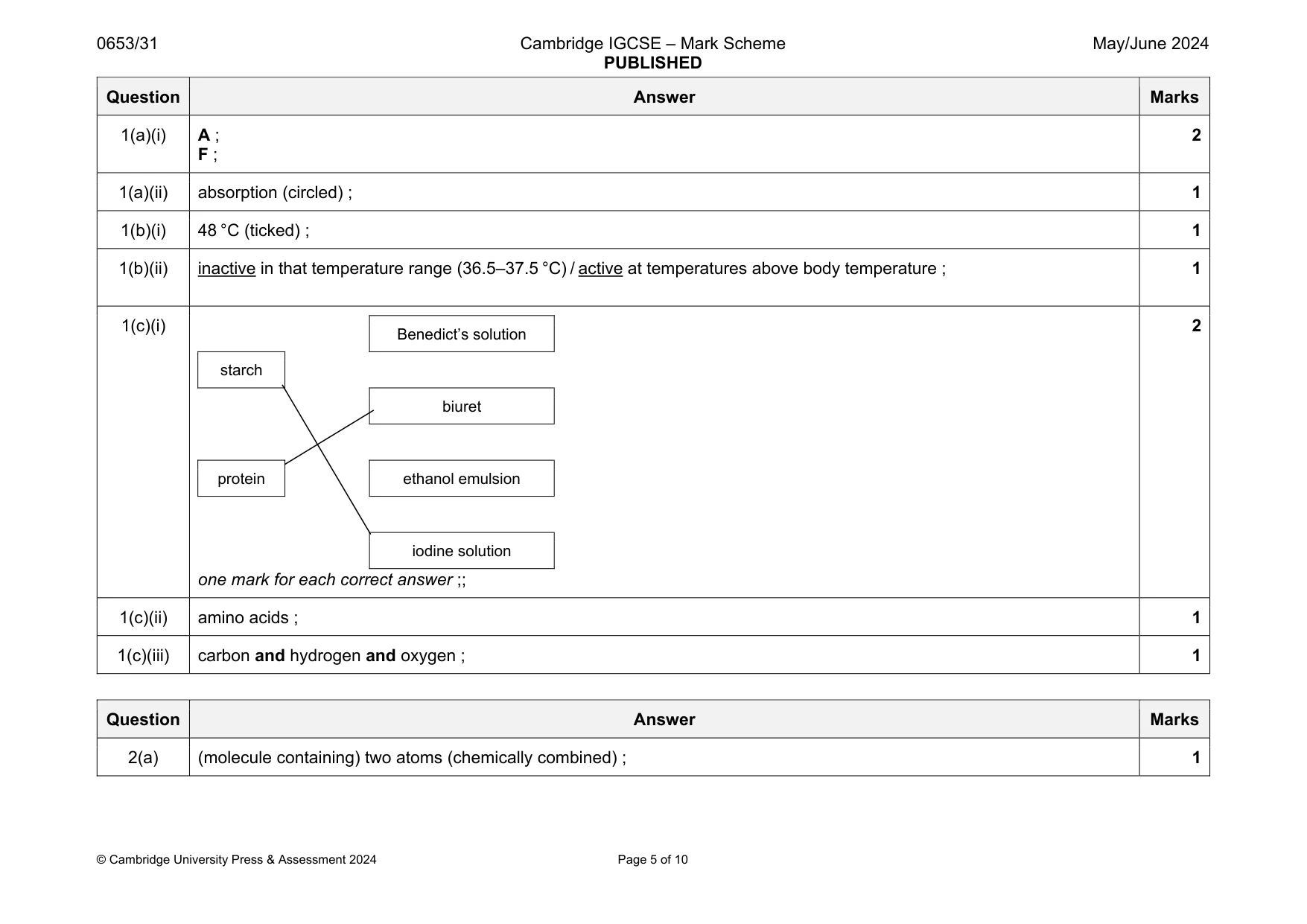
Mark scheme: 2(a) (molecule containing) two atoms (chemically combined) ; 1 Question Answer Marks 2(b) one shared pair of electrons ; three lone pairs / six non-bonding electrons on each atom and all else correct ; 2 2(c)(i) (reaction that) gives out thermal energy ; 1 2(c)(ii) (sodium atom) loses one electron ; (chlorine atom) gains one electron ; 2 2(c)(iii) covalent are more (volatile) ; 1 2(d)(i) (solute) sodium chloride / NaCl ; (solvent) water / H2O ; 2 2(d)(ii) ; 1 2(d)(iii) Na2CO3 ; 1
Q3 · An aluminium pan containing water, being heated on a hotplate of a cooker
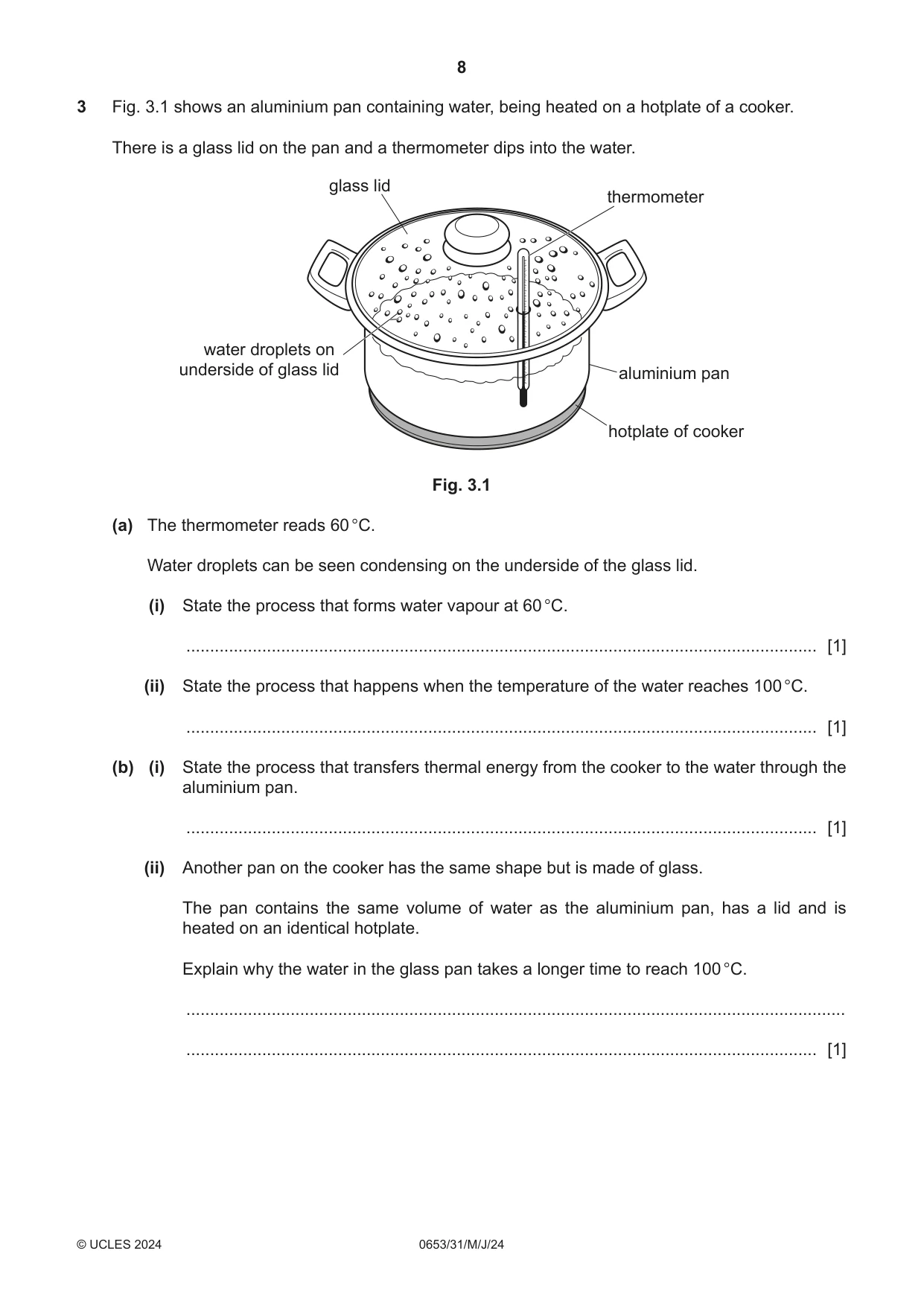
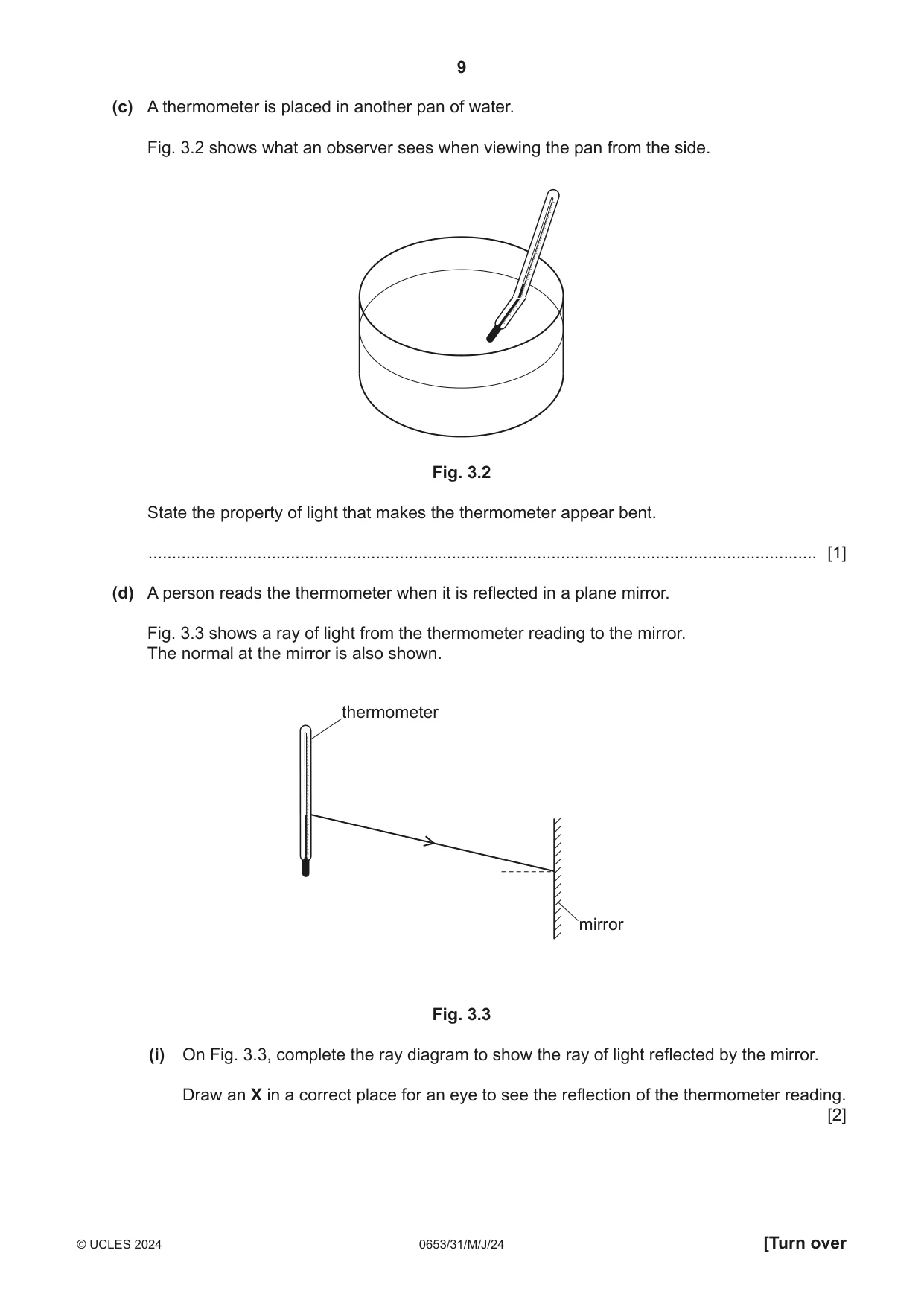
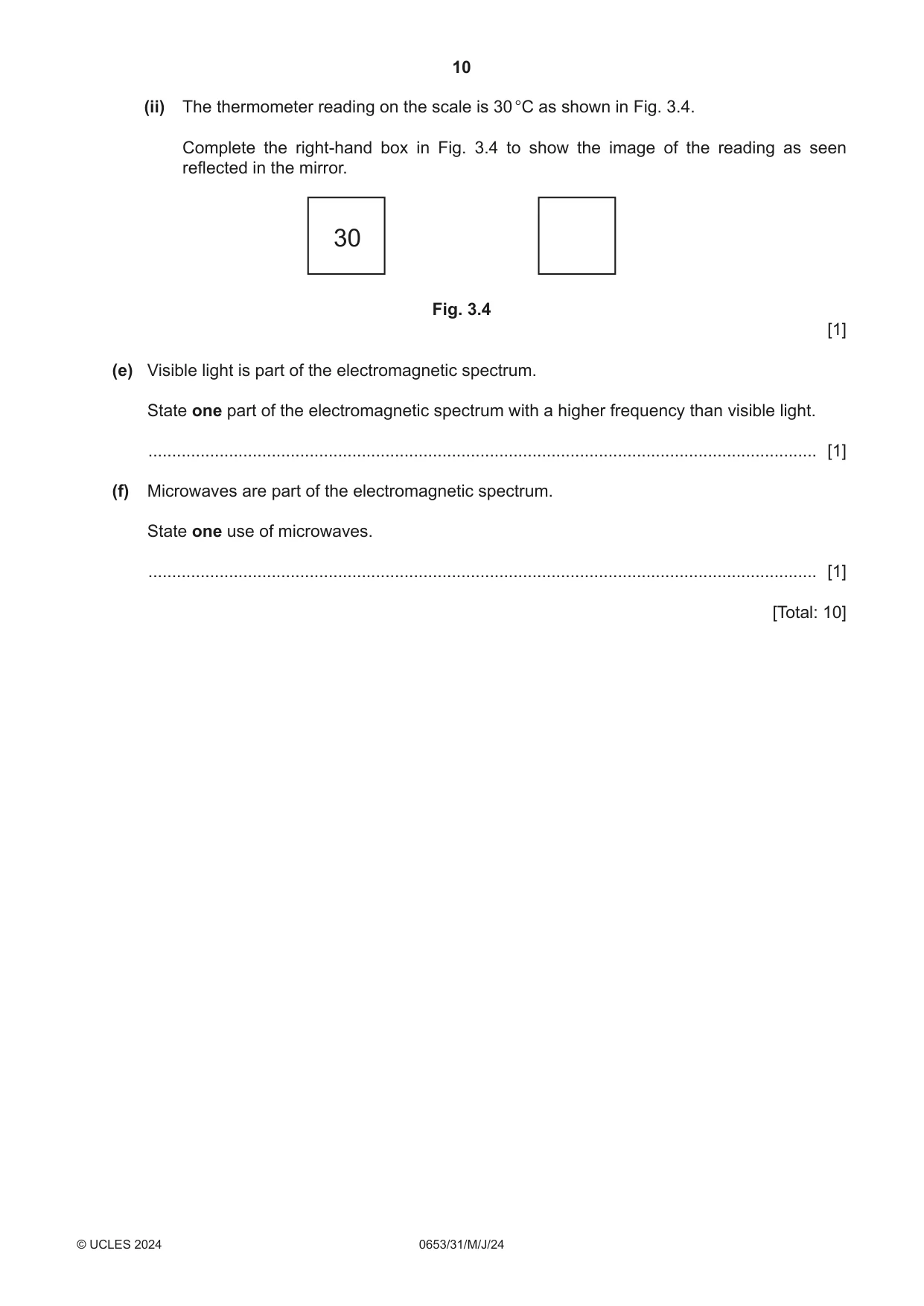
3 Fig. 3.1 shows an aluminium pan containing water, being heated on a hotplate of a cooker. There is a glass lid on the pan and a thermometer dips into the water. glass lid thermometer water droplets on underside of glass lid aluminium pan hotplate of cooker Fig. 3.1 (a) The thermometer reads 60 °C. Water droplets can be seen condensing on the underside of the glass lid. (i) State the process that forms water vapour at 60 °C. ..................................................................................................................................... [1] (ii) State the process that happens when the temperature of the water reaches 100 °C. ..................................................................................................................................... [1] (b) (i) State the process that transfers thermal energy from the cooker to the water through the aluminium pan. ..................................................................................................................................... [1] (ii) Another pan on the cooker has the same shape but is made of glass. The pan contains the same volume of water as the aluminium pan, has a lid and is heated on an identical hotplate. Explain why the water in the glass pan takes a longer time to reach 100 °C. ........................................................................................................................................... ..................................................................................................................................... [1] (c) A thermometer is placed in another pan of water. Fig. 3.2 shows what an observer sees when viewing the pan from the side. Fig. 3.2 State the property of light that makes the thermometer appear bent. ............................................................................................................................................. [1] (d) A person reads the thermometer when it is reflected in a plane mirror. Fig. 3.3 shows a ray of light from the thermometer reading to the mirror. The normal at the mirror is also shown. thermometer mirror Fig. 3.3 (i) On Fig. 3.3, complete the ray diagram to show the ray of light reflected by the mirror. Draw an X in a correct place for an eye to see the reflection of the thermometer reading. [2] (ii) The thermometer reading on the scale is 30 °C as shown in Fig. 3.4. Complete the right-hand box in Fig. 3.4 to show the image of the reading as seen reflected in the mirror. 30 Fig. 3.4 [1] (e) Visible light is part of the electromagnetic spectrum. State one part of the electromagnetic spectrum with a higher frequency than visible light. ............................................................................................................................................. [1] (f) Microwaves are part of the electromagnetic spectrum. State one use of microwaves. ............................................................................................................................................. [1] [Total: 10]
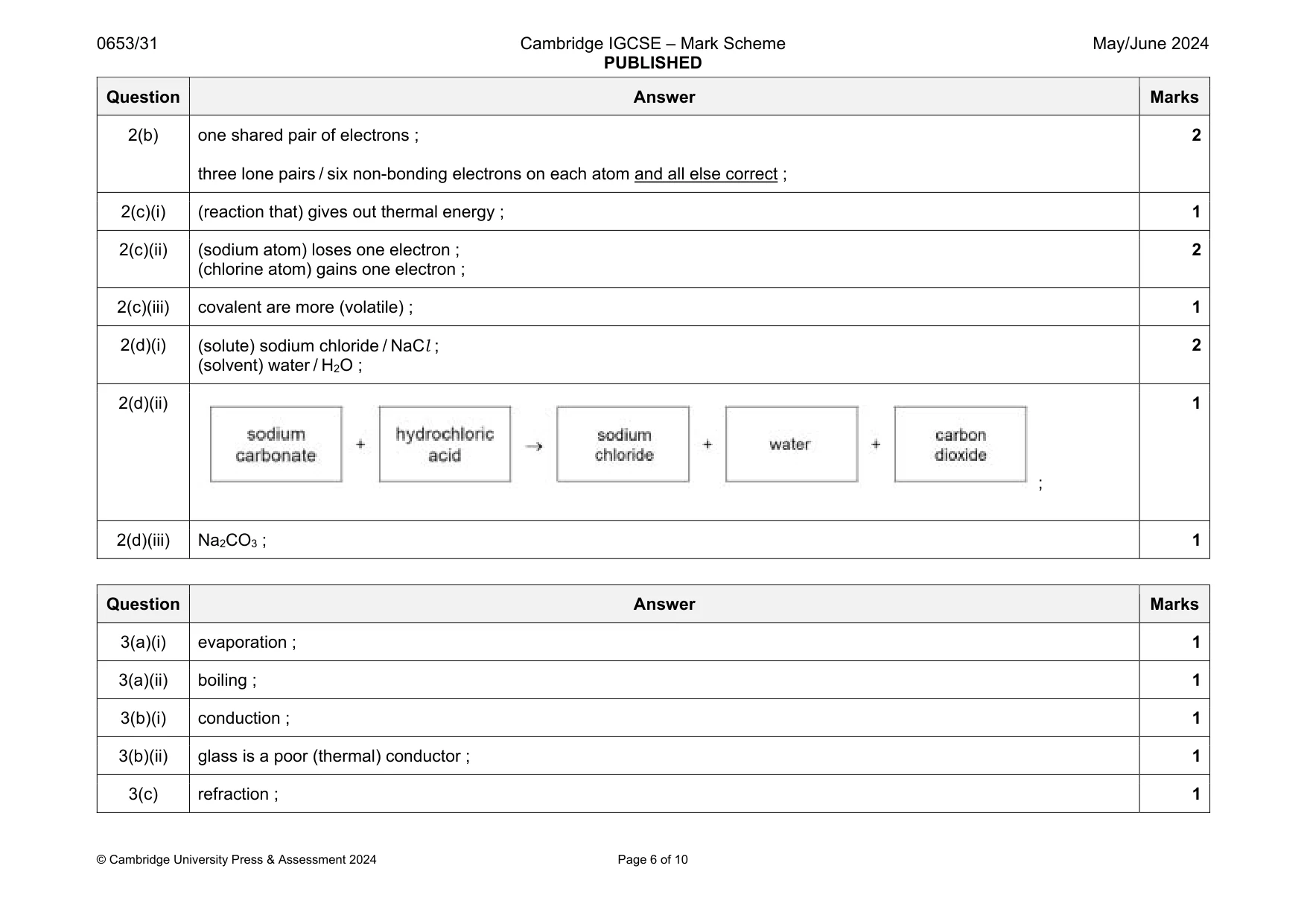
Mark scheme: 3(a)(i) evaporation ; 1 3(a)(ii) boiling ; 1 3(b)(i) conduction ; 1 3(b)(ii) glass is a poor (thermal) conductor ; 1 3(c) refraction ; 1 Question Answer Marks 3(d)(i) angle of reflection equal to angle of incidence judged by inspection ; centre of X drawn reflected ray ; 2 3(d)(ii) ; 1 3(e) ultraviolet / X-ray / gamma (ray) ; 1 3(f) mobile phone signals / cooking / satellite TV / radar ; 1 0ɛ
Q4 · The pathway taken by water through a plant root
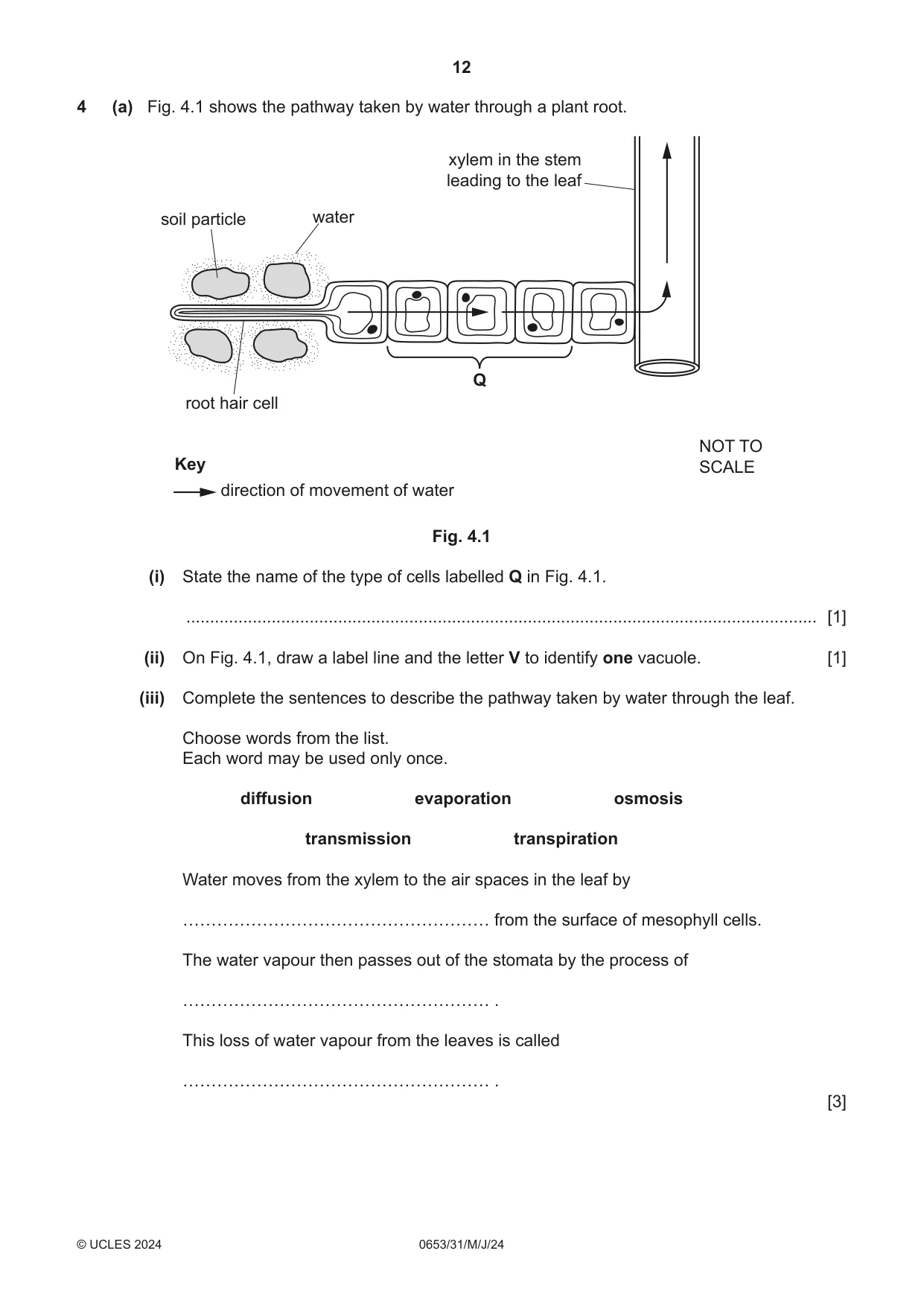
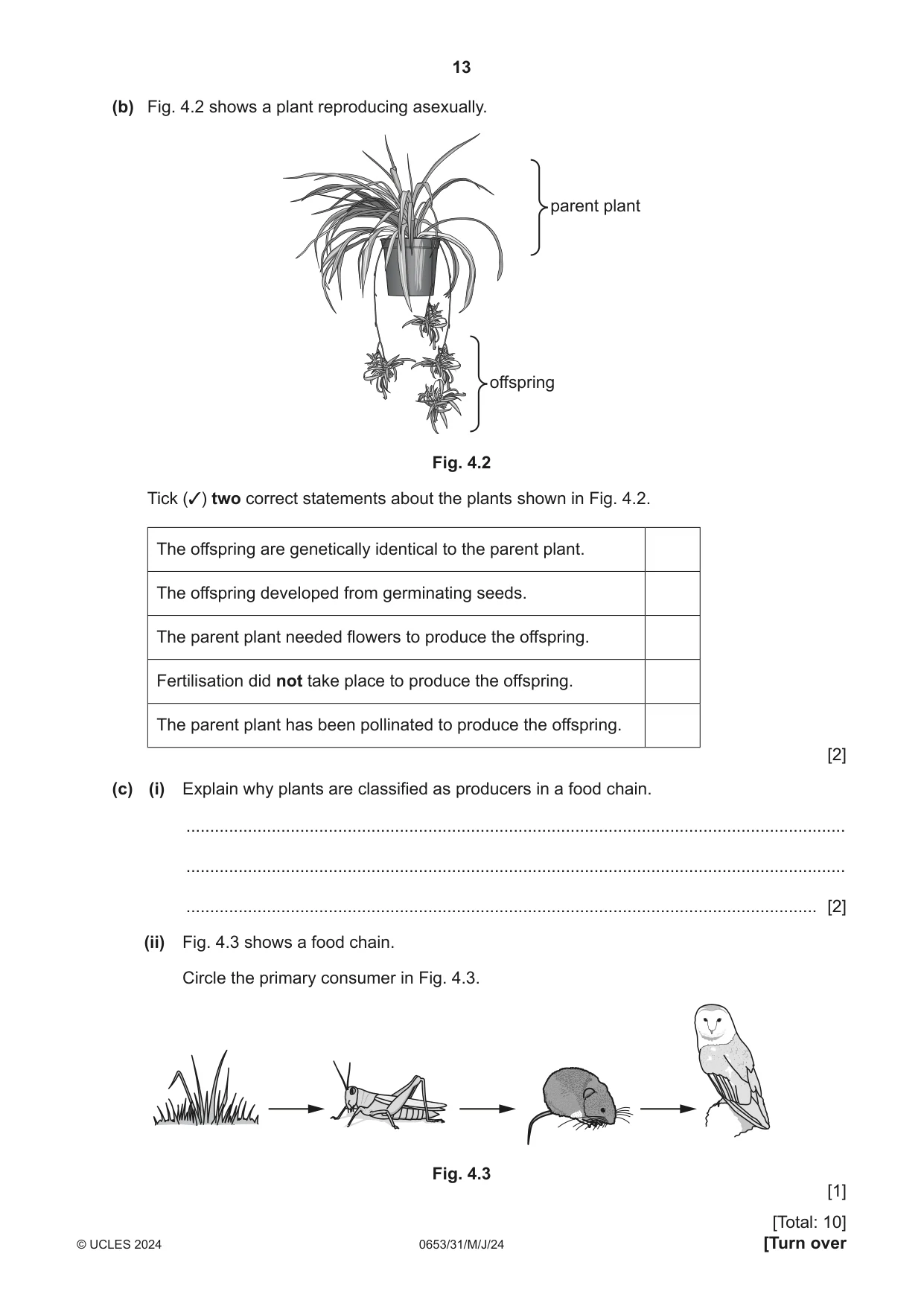
4 (a) Fig. 4.1 shows the pathway taken by water through a plant root. xylem in the stem leading to the leaf soil particle water Q root hair cell NOT TO Key SCALE direction of movement of water Fig. 4.1 (i) State the name of the type of cells labelled Q in Fig. 4.1. ..................................................................................................................................... [1] (ii) On Fig. 4.1, draw a label line and the letter V to identify one vacuole. [1] (iii) Complete the sentences to describe the pathway taken by water through the leaf. Choose words from the list. Each word may be used only once. diffusion evaporation osmosis transmission transpiration Water moves from the xylem to the air spaces in the leaf by ……………………………………………… from the surface of mesophyll cells. The water vapour then passes out of the stomata by the process of This loss of water vapour from the leaves is called [3] (b) Fig. 4.2 shows a plant reproducing asexually. parent plant offspring Fig. 4.2 Tick (✓) two correct statements about the plants shown in Fig. 4.2. The offspring are genetically identical to the parent plant. The offspring developed from germinating seeds. The parent plant needed flowers to produce the offspring. Fertilisation did not take place to produce the offspring. The parent plant has been pollinated to produce the offspring. [2] (c) (i) Explain why plants are classified as producers in a food chain. ........................................................................................................................................... ........................................................................................................................................... ..................................................................................................................................... [2] (ii) Fig. 4.3 shows a food chain. Circle the primary consumer in Fig. 4.3. Fig. 4.3 [1] [Total: 10]
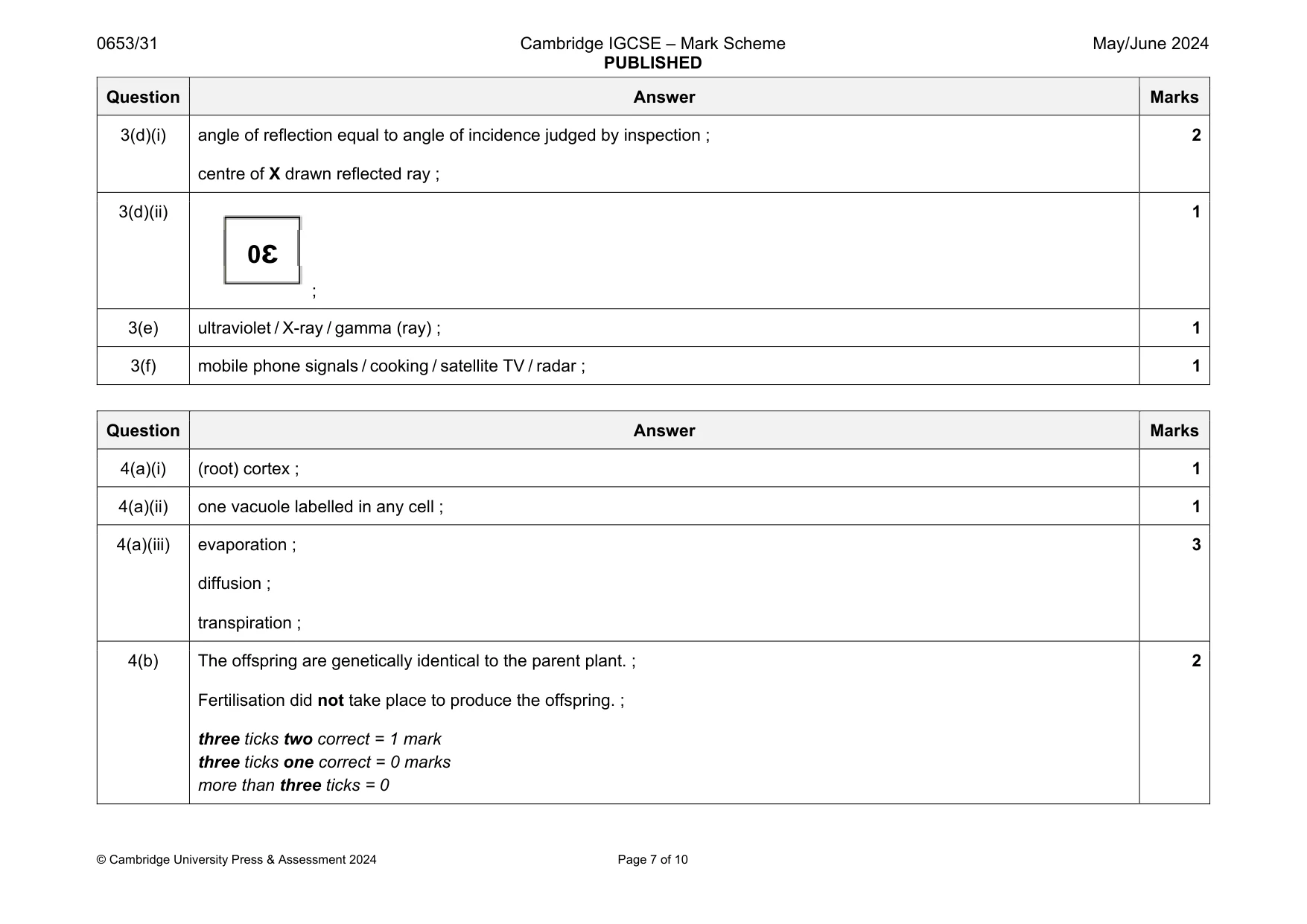
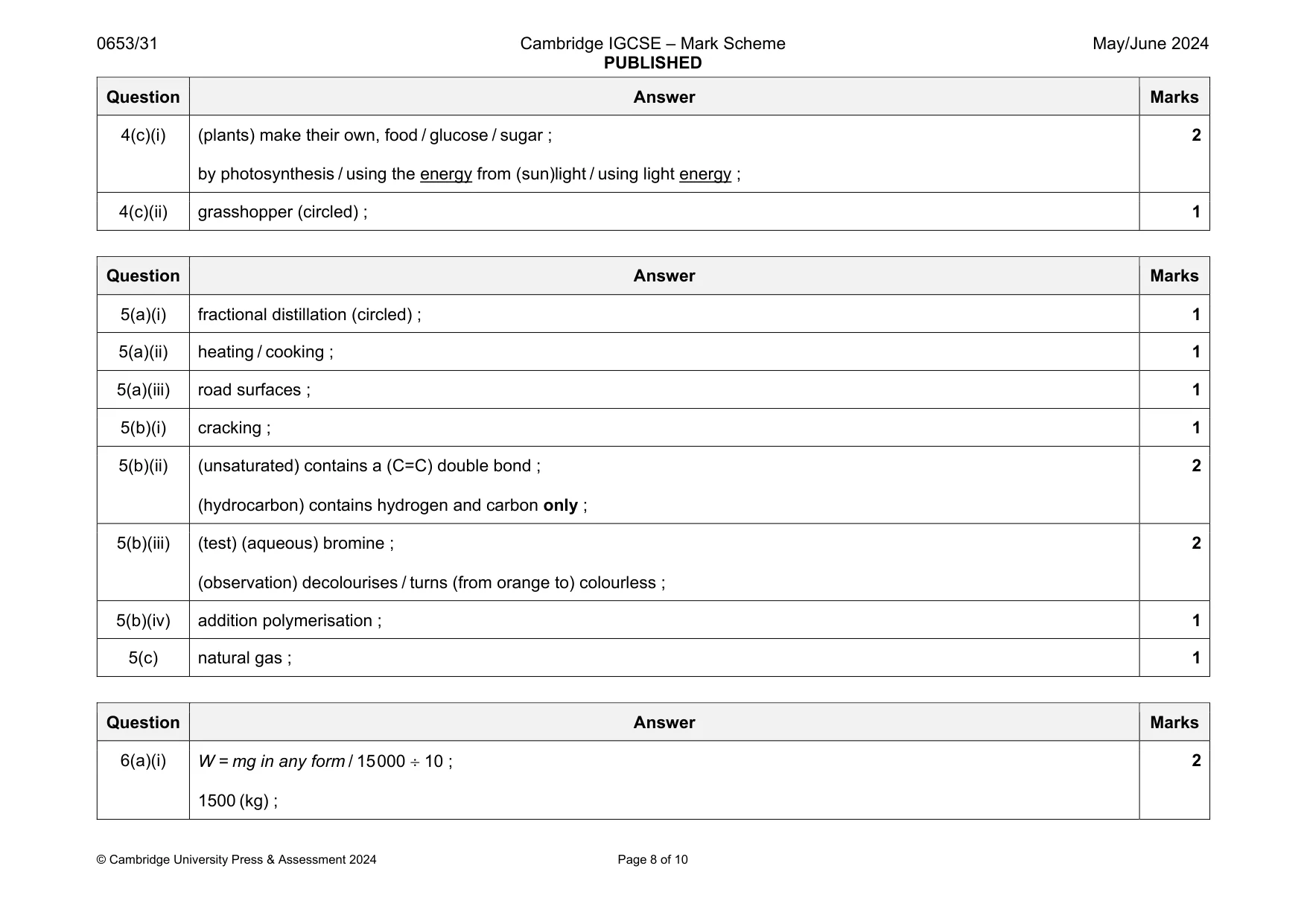
Mark scheme: 4(a)(i) (root) cortex ; 1 4(a)(ii) one vacuole labelled in any cell ; 1 4(a)(iii) evaporation ; diffusion ; transpiration ; 3 4(b) The offspring are genetically identical to the parent plant. ; Fertilisation did not take place to produce the offspring. ; three ticks two correct = 1 mark three ticks one correct = 0 marks more than three ticks = 0 2 Question Answer Marks 4(c)(i) (plants) make their own, food / glucose / sugar ; by photosynthesis / using the energy from (sun)light / using light energy ; 2 4(c)(ii) grasshopper (circled) ; 1
Q5 · Petroleum is a mixture of hydrocarbons
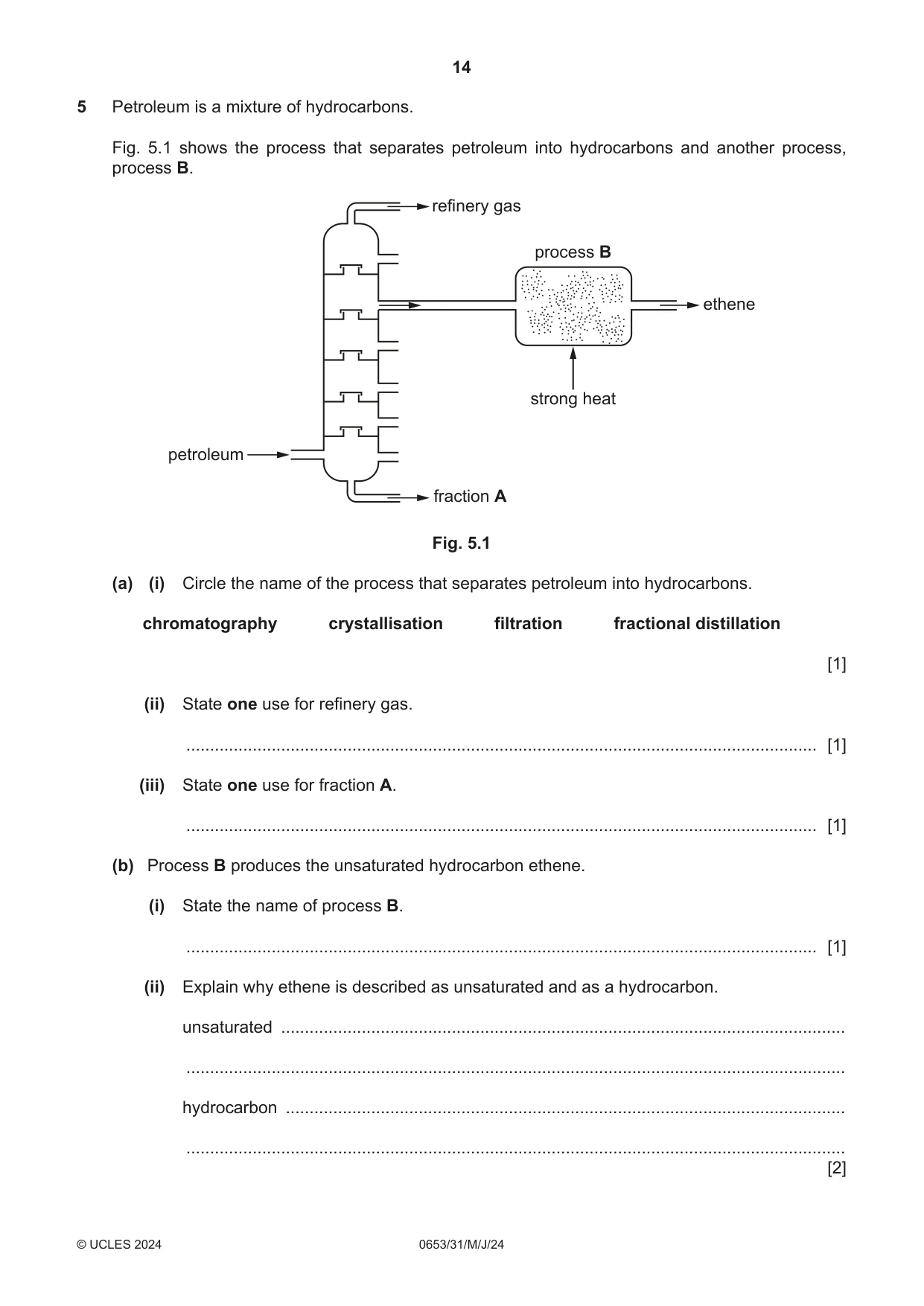
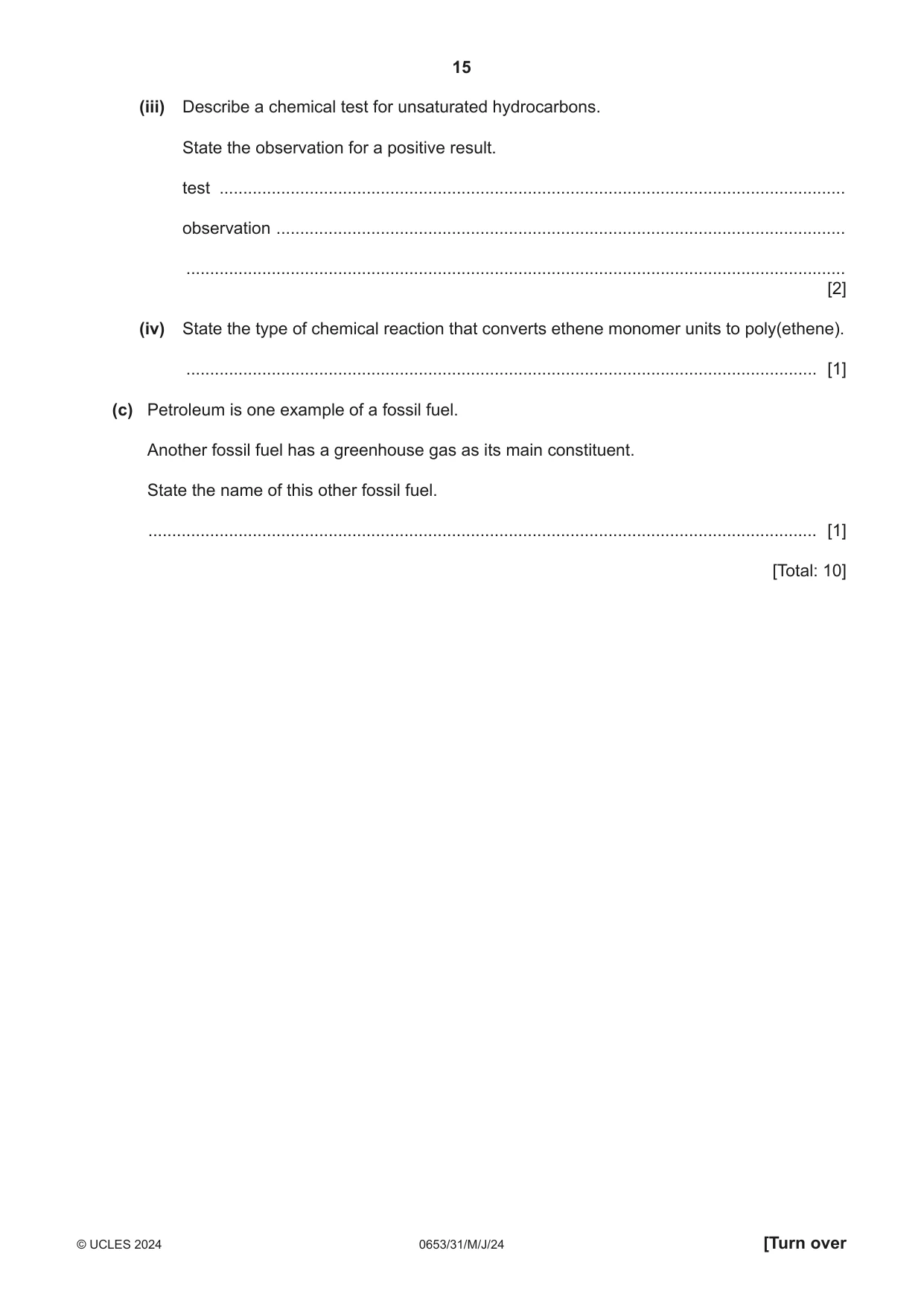
5 Petroleum is a mixture of hydrocarbons. Fig. 5.1 shows the process that separates petroleum into hydrocarbons and another process, process B. refinery gas process B ethene strong heat petroleum fraction A Fig. 5.1 (a) (i) Circle the name of the process that separates petroleum into hydrocarbons. chromatography crystallisation filtration fractional distillation [1] (ii) State one use for refinery gas. ..................................................................................................................................... [1] (iii) State one use for fraction A. ..................................................................................................................................... [1] (b) Process B produces the unsaturated hydrocarbon ethene. (i) State the name of process B. ..................................................................................................................................... [1] (ii) Explain why ethene is described as unsaturated and as a hydrocarbon. unsaturated ....................................................................................................................... ........................................................................................................................................... hydrocarbon ...................................................................................................................... ........................................................................................................................................... [2] (iii) Describe a chemical test for unsaturated hydrocarbons. State the observation for a positive result. test .................................................................................................................................... observation ........................................................................................................................ ........................................................................................................................................... [2] (iv) State the type of chemical reaction that converts ethene monomer units to poly(ethene). ..................................................................................................................................... [1] (c) Petroleum is one example of a fossil fuel. Another fossil fuel has a greenhouse gas as its main constituent. State the name of this other fossil fuel. ............................................................................................................................................. [1] [Total: 10]
Mark scheme: 5(a)(i) fractional distillation (circled) ; 1 5(a)(ii) heating / cooking ; 1 5(a)(iii) road surfaces ; 1 5(b)(i) cracking ; 1 5(b)(ii) (unsaturated) contains a (C=C) double bond ; (hydrocarbon) contains hydrogen and carbon only ; 2 5(b)(iii) (test) (aqueous) bromine ; (observation) decolourises / turns (from orange to) colourless ; 2 5(b)(iv) addition polymerisation ; 1 5(c) natural gas ; 1
Q6 · A mechanical crane using force P to lift a box from the ground to the top of a building
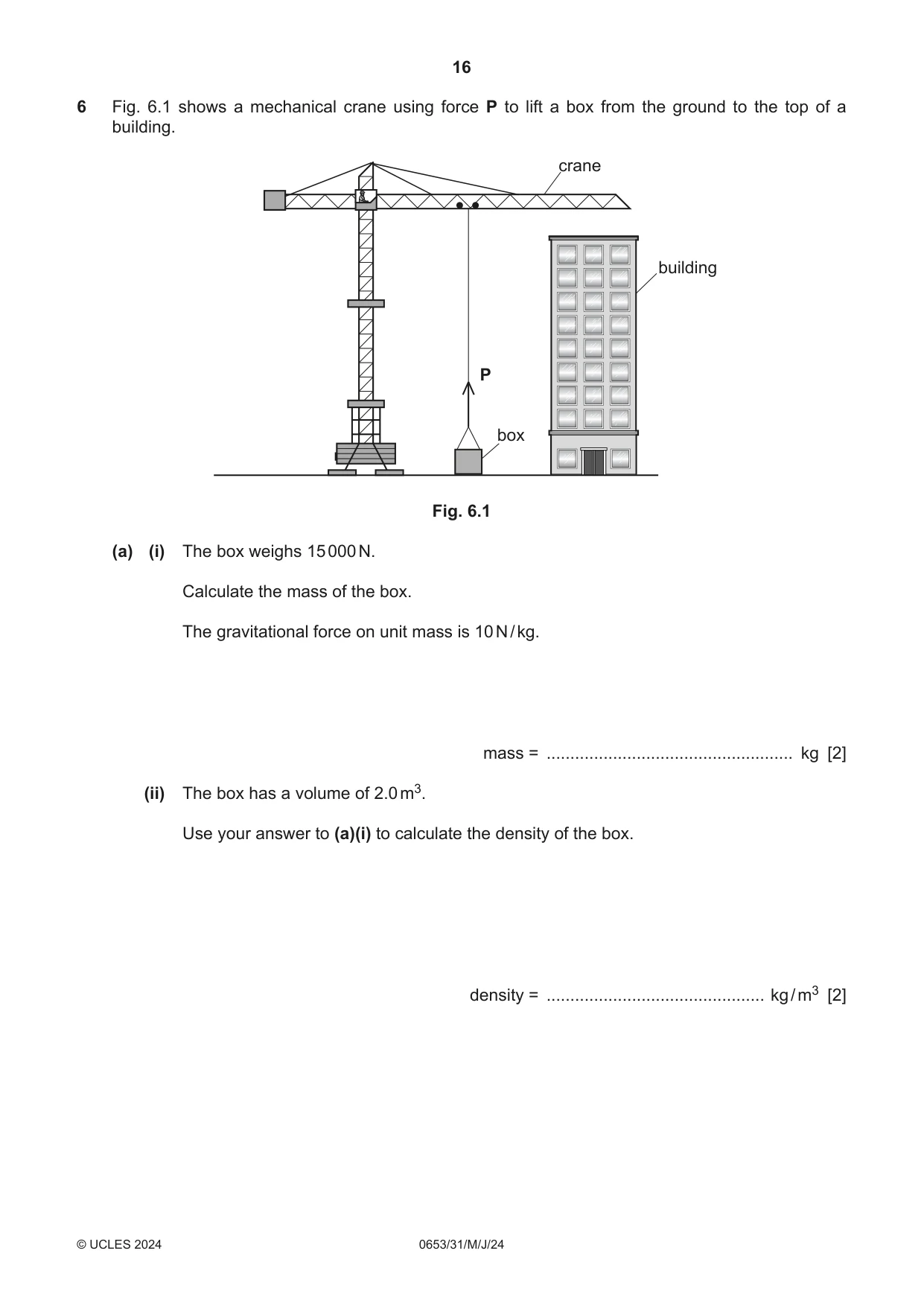
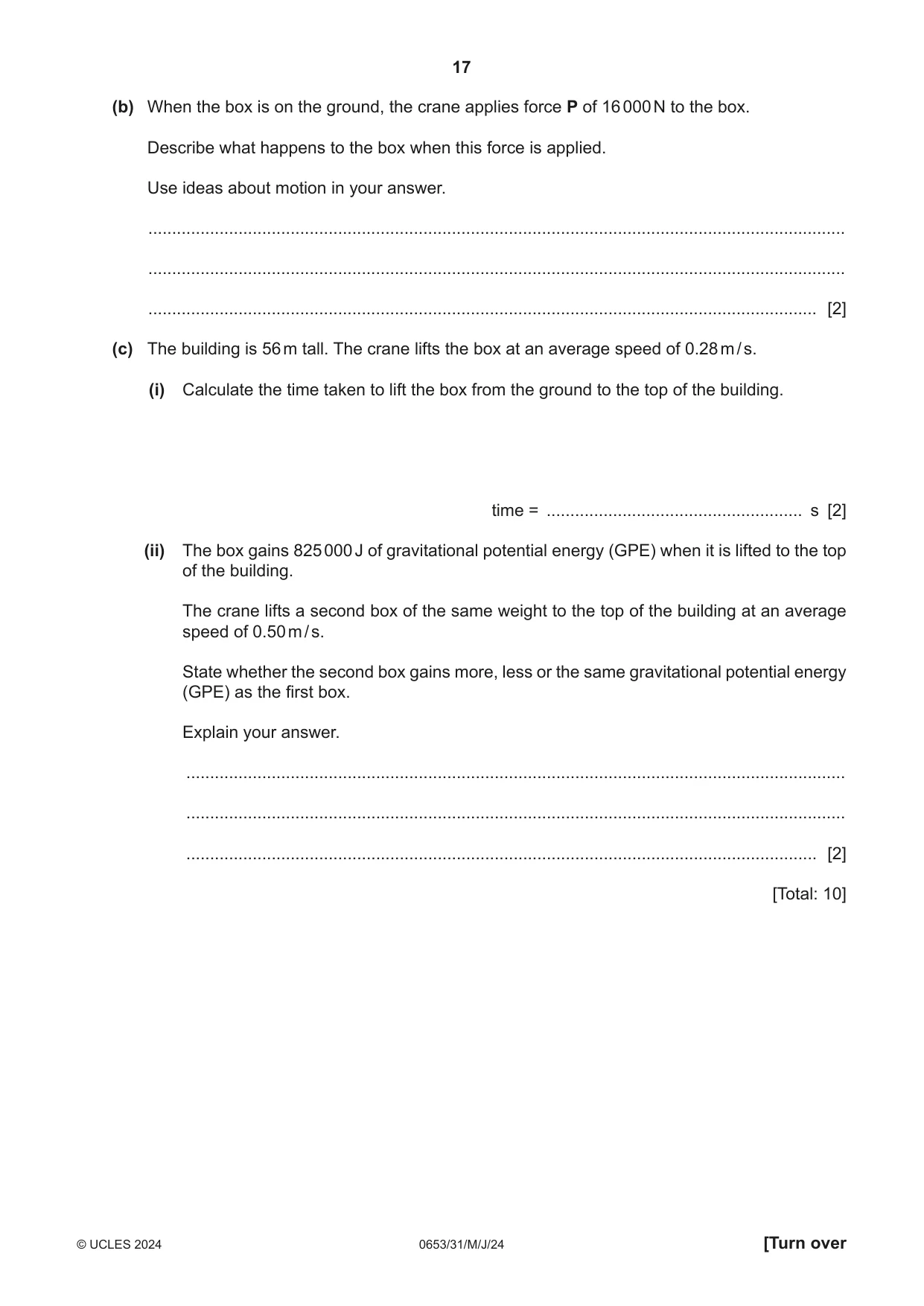
6 Fig. 6.1 shows a mechanical crane using force P to lift a box from the ground to the top of a building. crane building P box Fig. 6.1 (a) (i) The box weighs 15 000 N. Calculate the mass of the box. The gravitational force on unit mass is 10 N / kg. mass = .................................................... kg [2] (ii) The box has a volume of 2.0 m3. Use your answer to (a)(i) to calculate the density of the box. density = .............................................. kg / m3 [2] (b) When the box is on the ground, the crane applies force P of 16 000 N to the box. Describe what happens to the box when this force is applied. Use ideas about motion in your answer. ................................................................................................................................................... ................................................................................................................................................... ............................................................................................................................................. [2] (c) The building is 56 m tall. The crane lifts the box at an average speed of 0.28 m / s. (i) Calculate the time taken to lift the box from the ground to the top of the building. time = ...................................................... s [2] (ii) The box gains 825 000 J of gravitational potential energy (GPE) when it is lifted to the top of the building. The crane lifts a second box of the same weight to the top of the building at an average speed of 0.50 m / s. State whether the second box gains more, less or the same gravitational potential energy (GPE) as the first box. Explain your answer. ........................................................................................................................................... ........................................................................................................................................... ..................................................................................................................................... [2] [Total: 10]
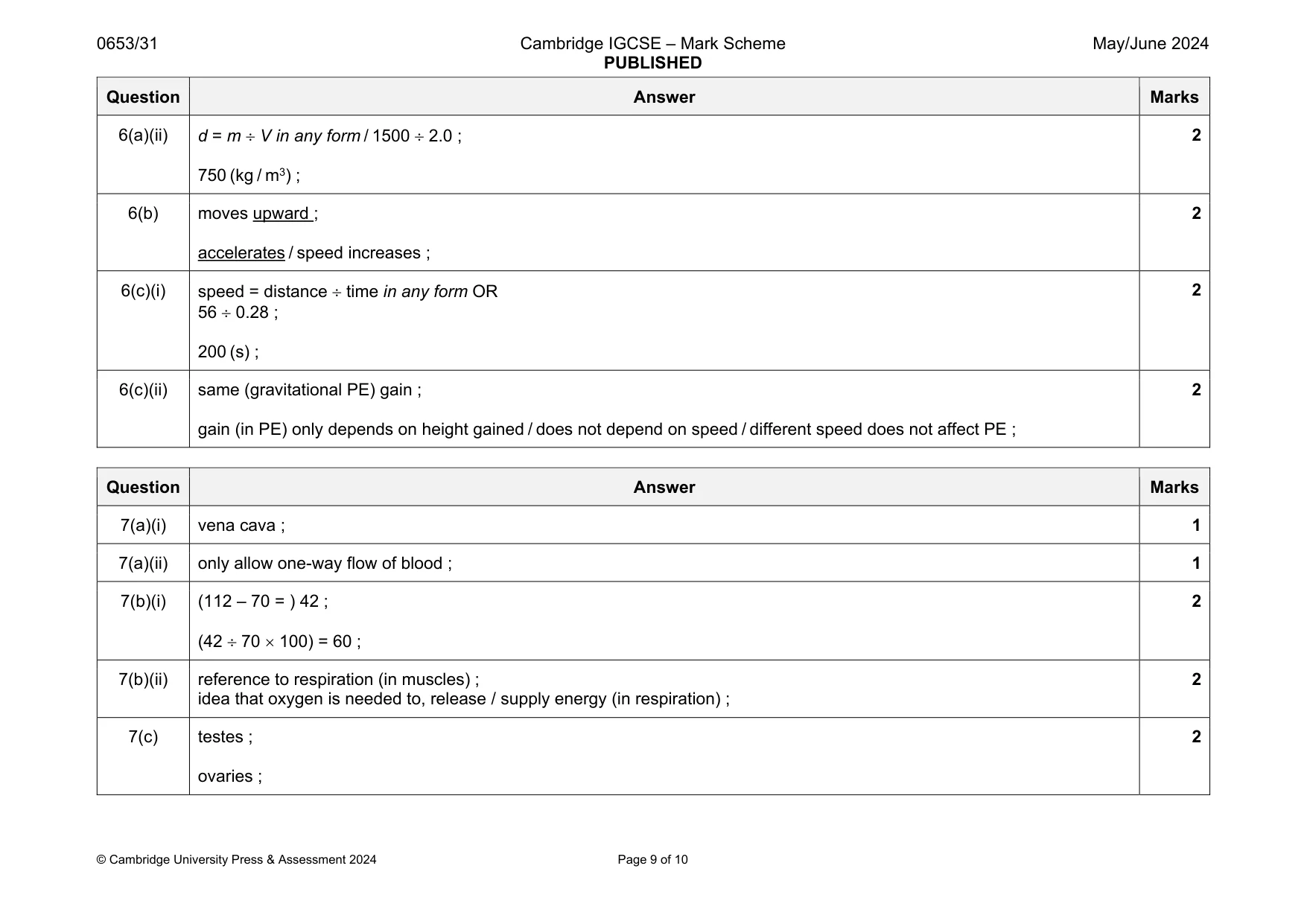
Mark scheme: 6(a)(i) 1500 (kg) ; 2 Question Answer Marks 6(a)(ii) d = m V in any form / 1500 2.0 ; 750 (kg / m3) ; 2 6(b) moves upward ; accelerates / speed increases ; 2 6(c)(i) speed = distance time in any form OR 56 0.28 ; 200 (s) ; 2 6(c)(ii) same (gravitational PE) gain ; gain (in PE) only depends on height gained / does not depend on speed / different speed does not affect PE ; 2
Q7 · Part of the human circulatory system
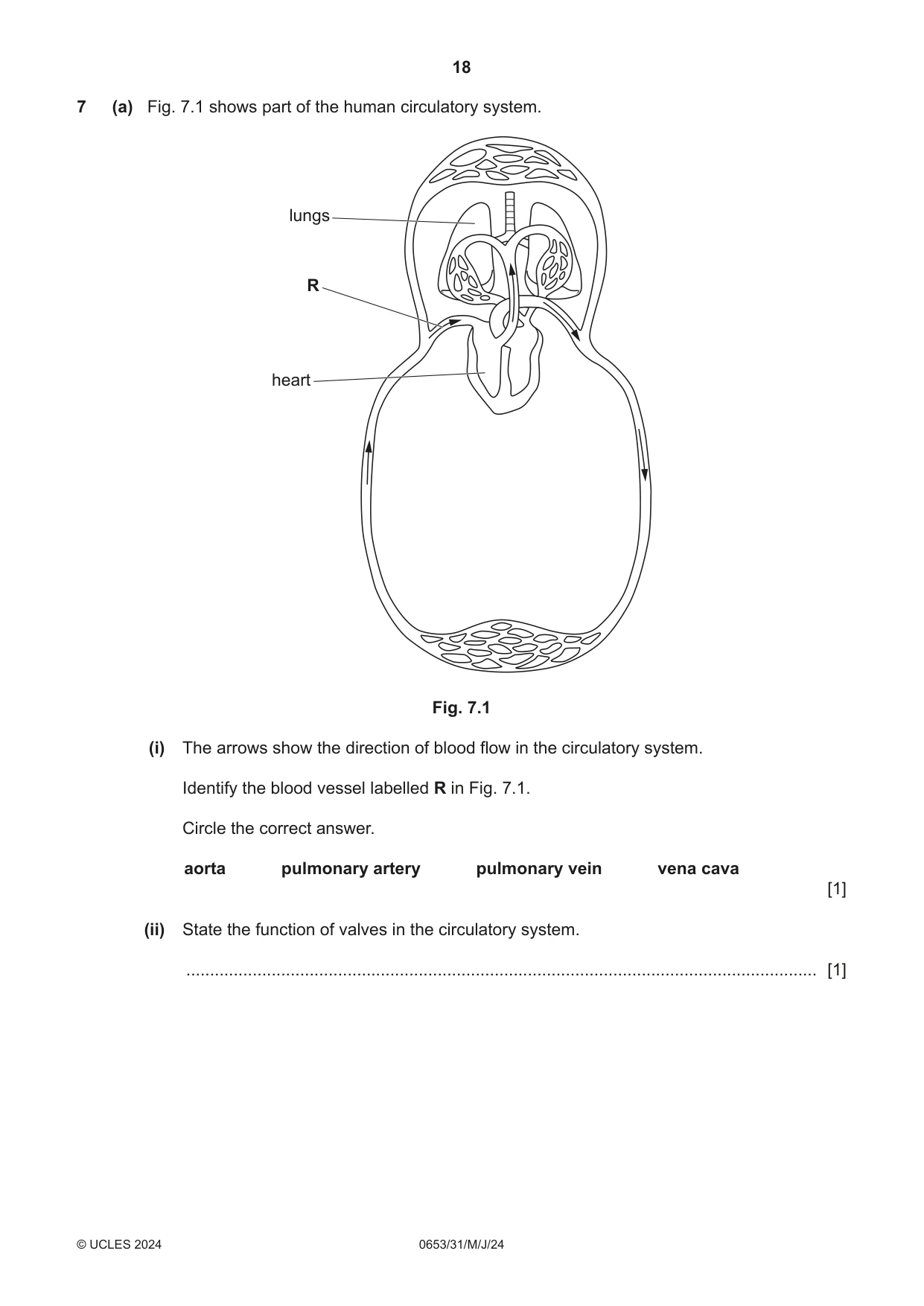
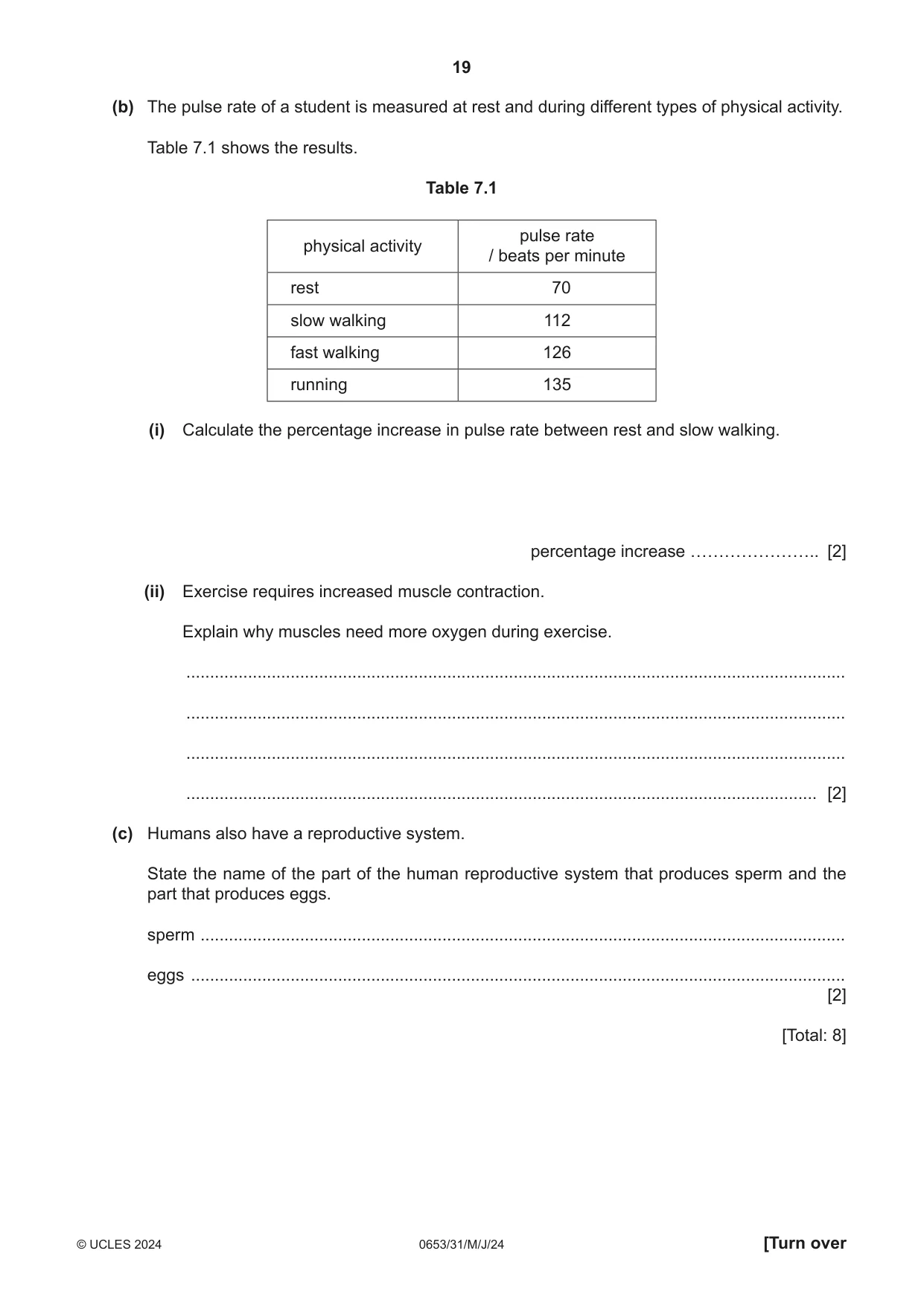
7 (a) Fig. 7.1 shows part of the human circulatory system. lungs R heart Fig. 7.1 (i) The arrows show the direction of blood flow in the circulatory system. Identify the blood vessel labelled R in Fig. 7.1. Circle the correct answer. aorta pulmonary artery pulmonary vein vena cava [1] (ii) State the function of valves in the circulatory system. ..................................................................................................................................... [1] (b) The pulse rate of a student is measured at rest and during different types of physical activity. Table 7.1 shows the results. Table 7.1 pulse rate physical activity / beats per minute rest 70 slow walking 112 fast walking 126 running 135 (i) Calculate the percentage increase in pulse rate between rest and slow walking. percentage increase ………………….. [2] (ii) Exercise requires increased muscle contraction. Explain why muscles need more oxygen during exercise. ........................................................................................................................................... ........................................................................................................................................... ........................................................................................................................................... ..................................................................................................................................... [2] (c) Humans also have a reproductive system. State the name of the part of the human reproductive system that produces sperm and the part that produces eggs. sperm ........................................................................................................................................ eggs .......................................................................................................................................... [2] [Total: 8]
Mark scheme: 7(a)(i) vena cava ; 1 7(a)(ii) only allow one-way flow of blood ; 1 7(b)(i) (112 – 70 = ) 42 ; (42 70 100) = 60 ; 2 7(b)(ii) reference to respiration (in muscles) ; idea that oxygen is needed to, release / supply energy (in respiration) ; 2 7(c) testes ; ovaries ; 2
Q8 · Solid zinc and dilute sulfuric acid react to form zinc sulfate and hydrogen gas
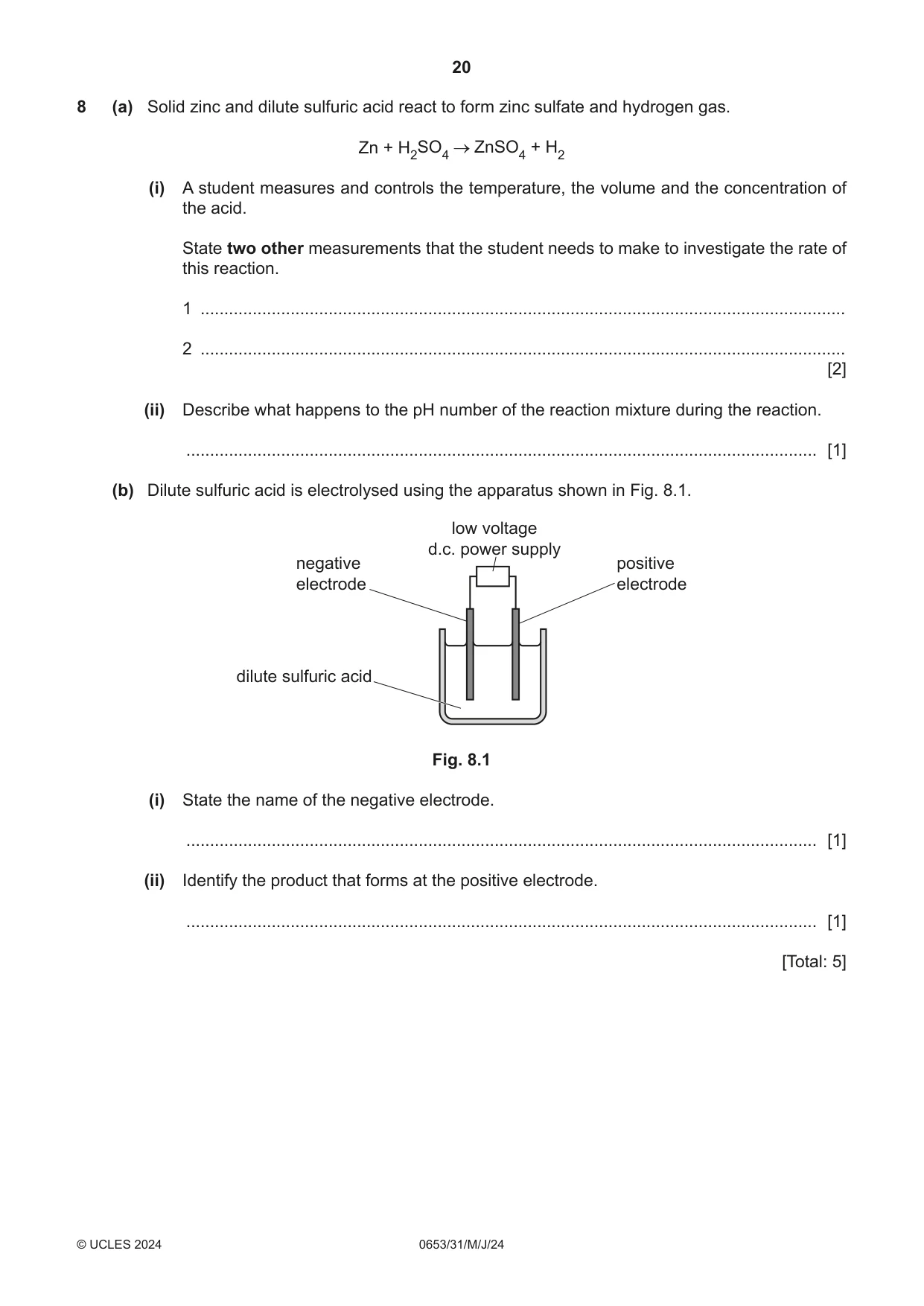
8 (a) Solid zinc and dilute sulfuric acid react to form zinc sulfate and hydrogen gas. Zn + H2SO4 ZnSO4 + H2 (i) A student measures and controls the temperature, the volume and the concentration of the acid. State two other measurements that the student needs to make to investigate the rate of this reaction. 1 ........................................................................................................................................ 2 ........................................................................................................................................ [2] (ii) Describe what happens to the pH number of the reaction mixture during the reaction. ..................................................................................................................................... [1] (b) Dilute sulfuric acid is electrolysed using the apparatus shown in Fig. 8.1. low voltage d.c. power supply negative positive electrode electrode dilute sulfuric acid Fig. 8.1 (i) State the name of the negative electrode. ..................................................................................................................................... [1] (ii) Identify the product that forms at the positive electrode. ..................................................................................................................................... [1] [Total: 5]
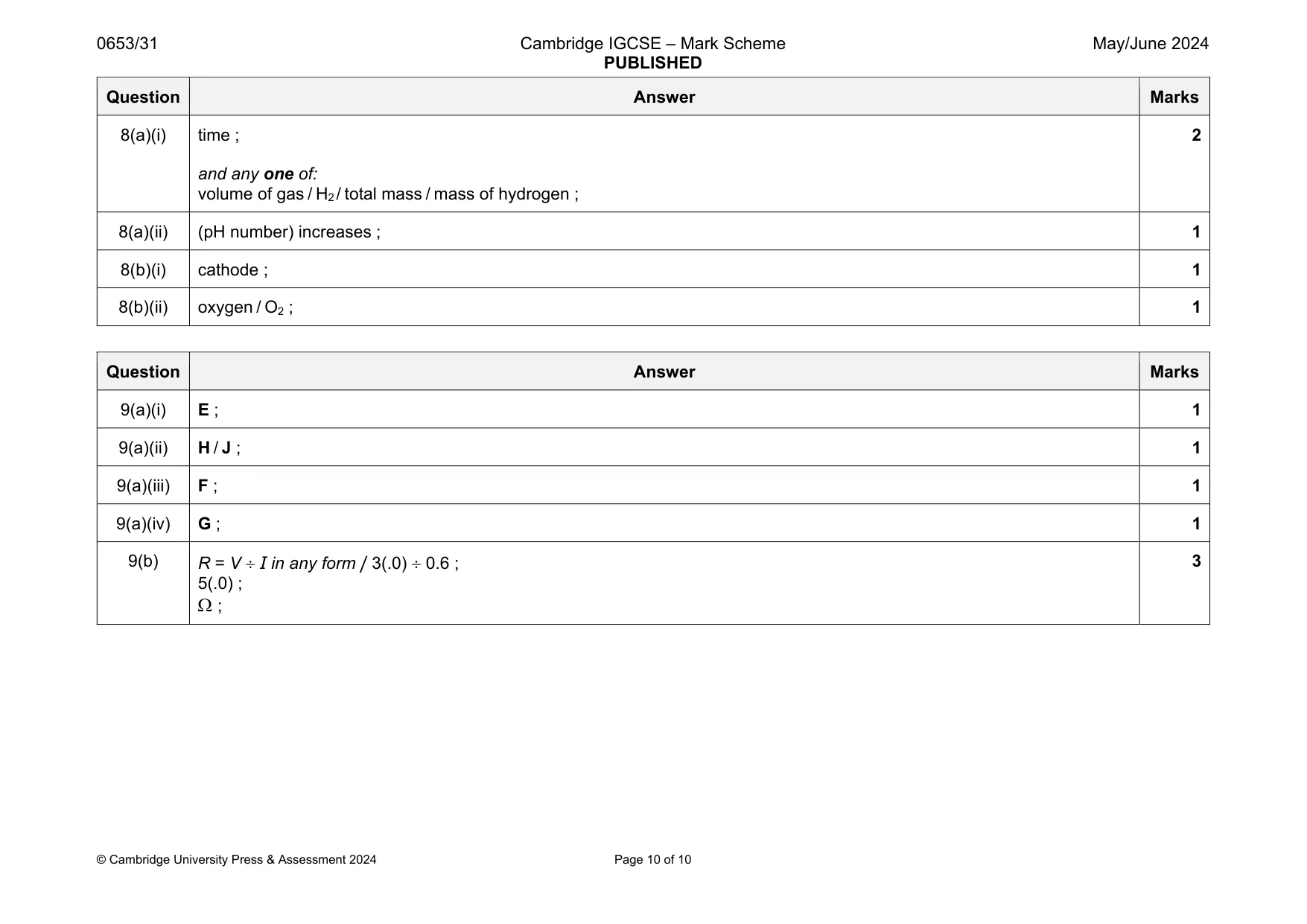
Mark scheme: 8(a)(i) time ; and any one of: volume of gas / H2/ total mass / mass of hydrogen ; 2 8(a)(ii) (pH number) increases ; 1 8(b)(i) cathode ; 1 8(b)(ii) oxygen / O2 ; 1
Q9 · An electrical circuit with components labelled E, F, G, H and J
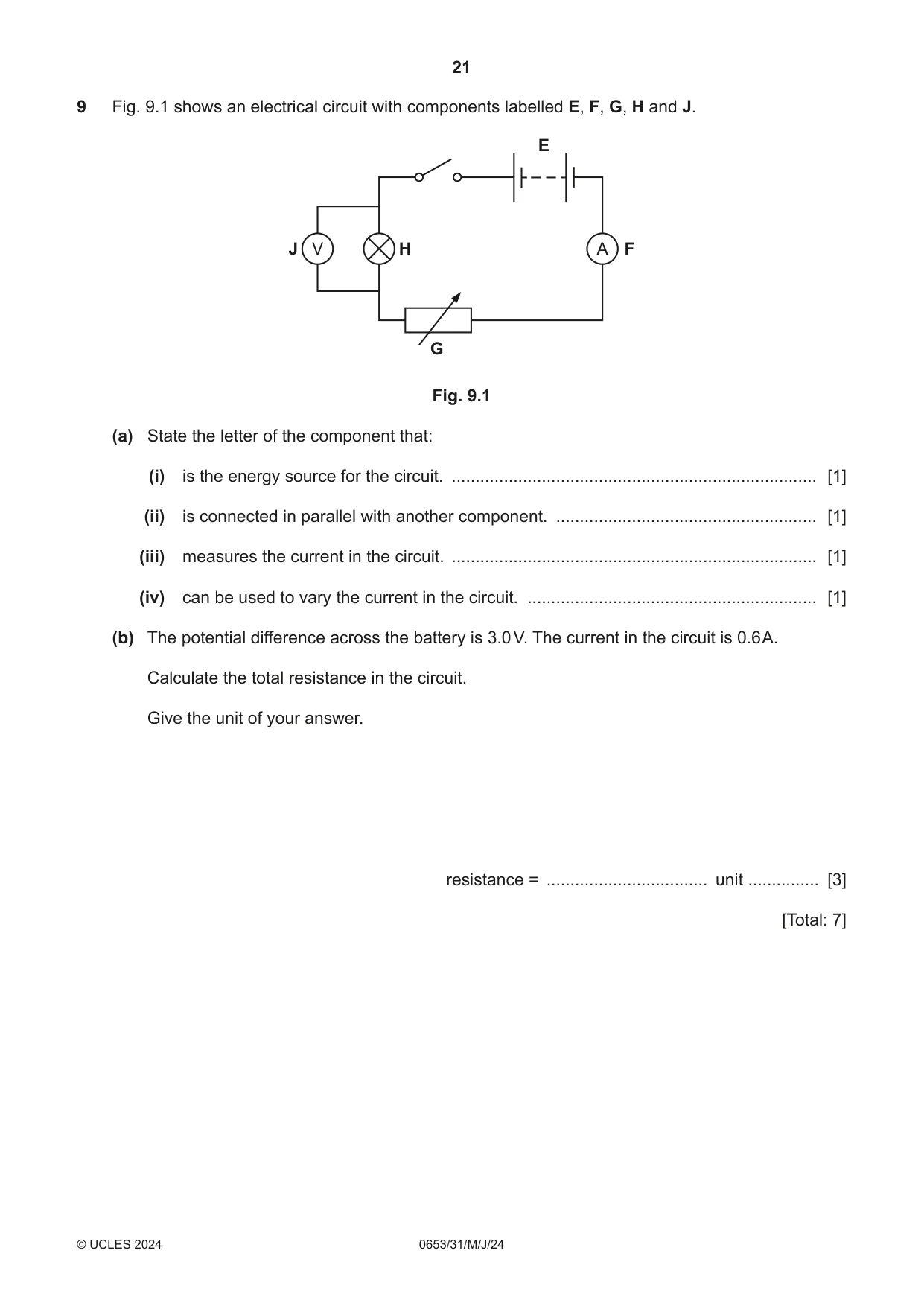
9 Fig. 9.1 shows an electrical circuit with components labelled E, F, G, H and J. E J V H A F G Fig. 9.1 (a) State the letter of the component that: (i) is the energy source for the circuit. ............................................................................. [1] (ii) is connected in parallel with another component. ....................................................... [1] (iii) measures the current in the circuit. ............................................................................. [1] (iv) can be used to vary the current in the circuit. ............................................................. [1] (b) The potential difference across the battery is 3.0 V. The current in the circuit is 0.6 A. Calculate the total resistance in the circuit. Give the unit of your answer. resistance = .................................. unit ............... [3] [Total: 7]
Mark scheme: 9(a)(i) E ; 1 9(a)(ii) H / J ; 1 9(a)(iii) F ; 1 9(a)(iv) G ; 1 9(b) R = V I in any form / 3(.0) 0.6 ; 5(.0) ; ; 3
What was in this paper
The subtopics covered by these 9 questions, and how many questions each got. Open one in a new tab to see every Cambridge question on it.
What you needed in this session
Cambridge’s own grade thresholds for 2024 May/June, Paper 3 · Variant 1. A higher threshold means an easier paper — the bar moves with how the cohort did.