Cambridge IGCSE Science - Combined 0653 — 2018 May/June Paper 3 · Variant 3
0653/33/M/J/18 · 9 questions · 80 marks · ≈90 min
The question paper and its mark scheme, free to read here and free to download. This is Cambridge’s own paper, exactly as it was sat.
Question paper24 pages



Mark scheme11 pages
Answers below. Sit the paper first if you are practising.
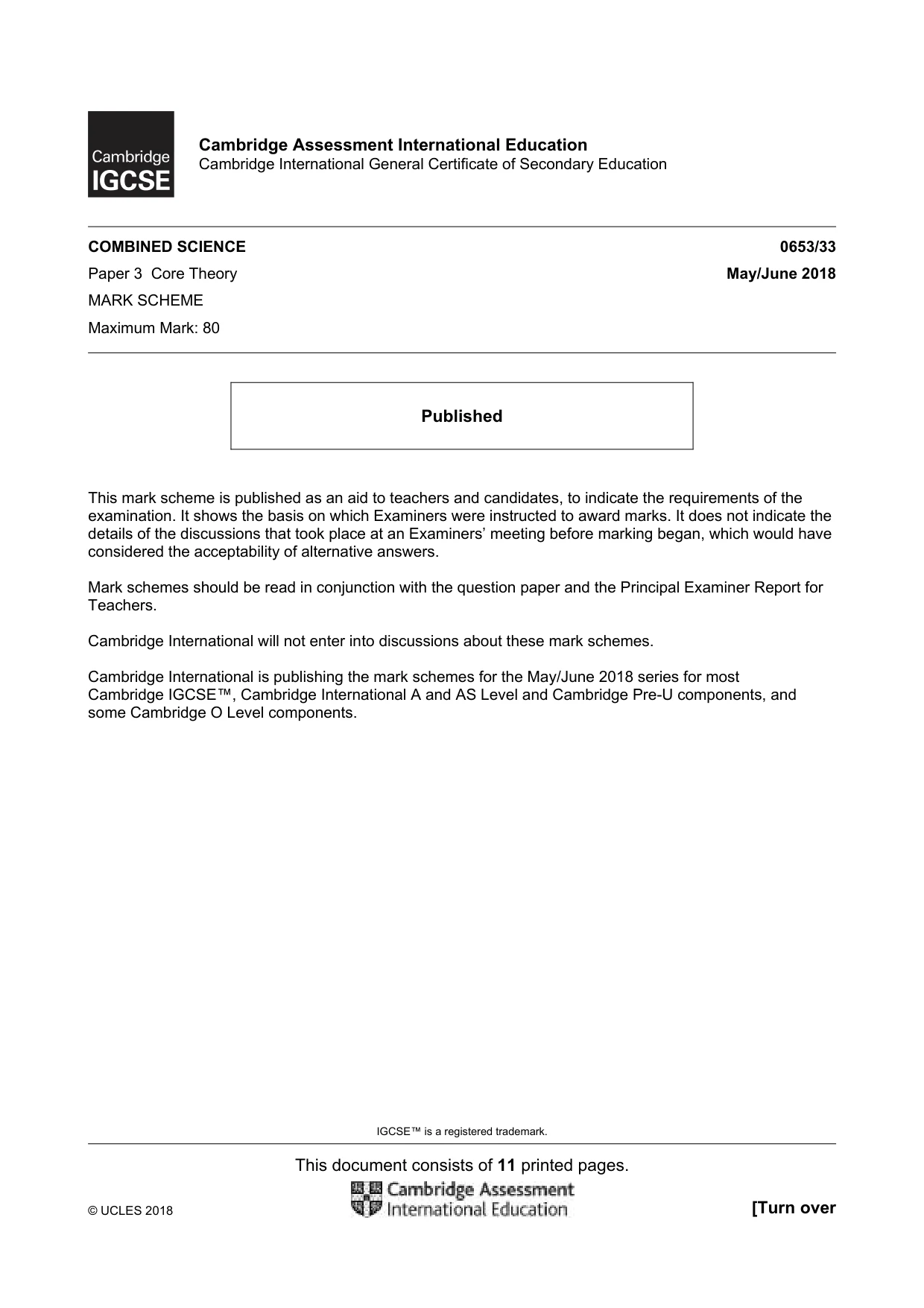
Questions as text
Q1 · The boxes on the left show some structures of the alimentary canal and associated organs
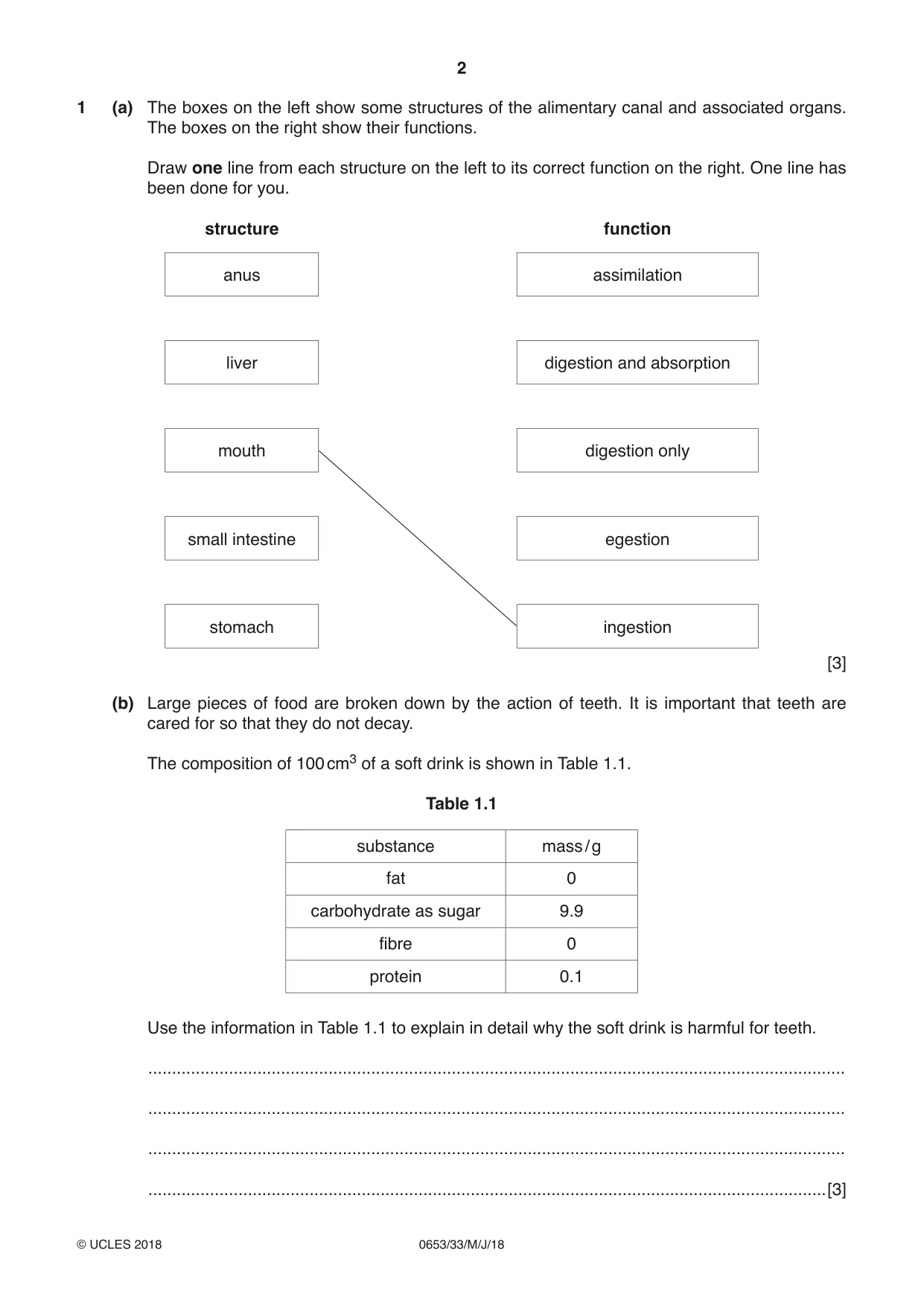
1 (a) The boxes on the left show some structures of the alimentary canal and associated organs. The boxes on the right show their functions. Draw one line from each structure on the left to its correct function on the right. One line has been done for you. structure function anus assimilation liver digestion and absorption mouth digestion only small intestine egestion stomach ingestion [3] (b) Large pieces of food are broken down by the action of teeth. It is important that teeth are cared for so that they do not decay. The composition of 100 cm3 of a soft drink is shown in Table 1.1. Table 1.1 substance mass / g fat 0 carbohydrate as sugar 9.9 fibre 0 protein 0.1 Use the information in Table 1.1 to explain in detail why the soft drink is harmful for teeth. ................................................................................................................................................... ................................................................................................................................................... ................................................................................................................................................... ...............................................................................................................................................[3] (c) State two ways in which people can care for their teeth. 1. ............................................................................................................................................... 2. ............................................................................................................................................... [2]
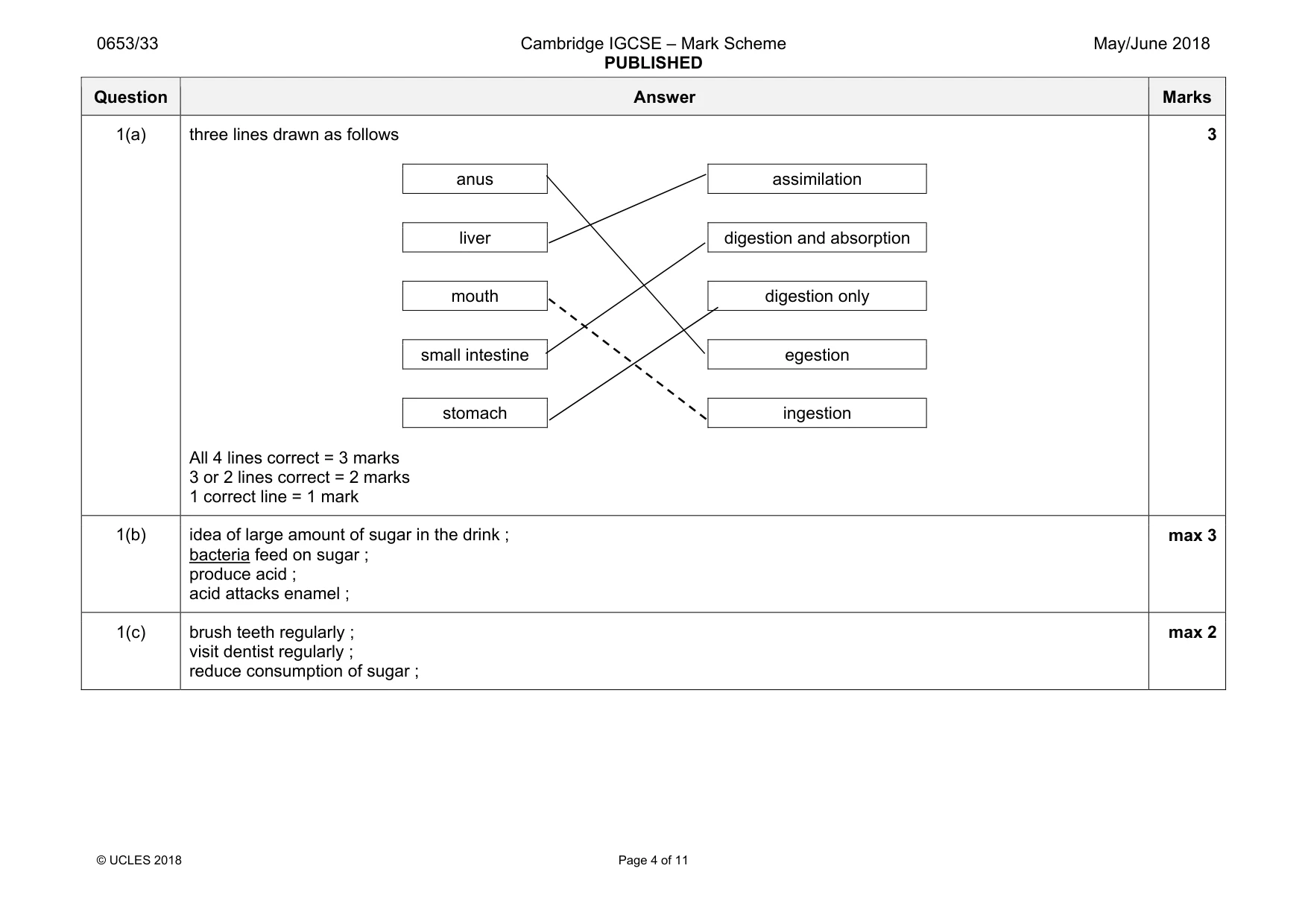
Mark scheme: 1(a) three lines drawn as follows anus assimilation liver digestion and absorption mouth digestion only small intestine egestion stomach ingestion All 4 lines correct = 3 marks 3 or 2 lines correct = 2 marks 1 correct line = 1 mark 3 1(b) idea of large amount of sugar in the drink ; bacteria feed on sugar ; produce acid ; acid attacks enamel ; max 3 1(c) brush teeth regularly ; visit dentist regularly ; reduce consumption of sugar ; max 2 Que estion Answer Ma arks
Q2 · A student investigates the combustion of a hydrocarbon, as shown in Fig
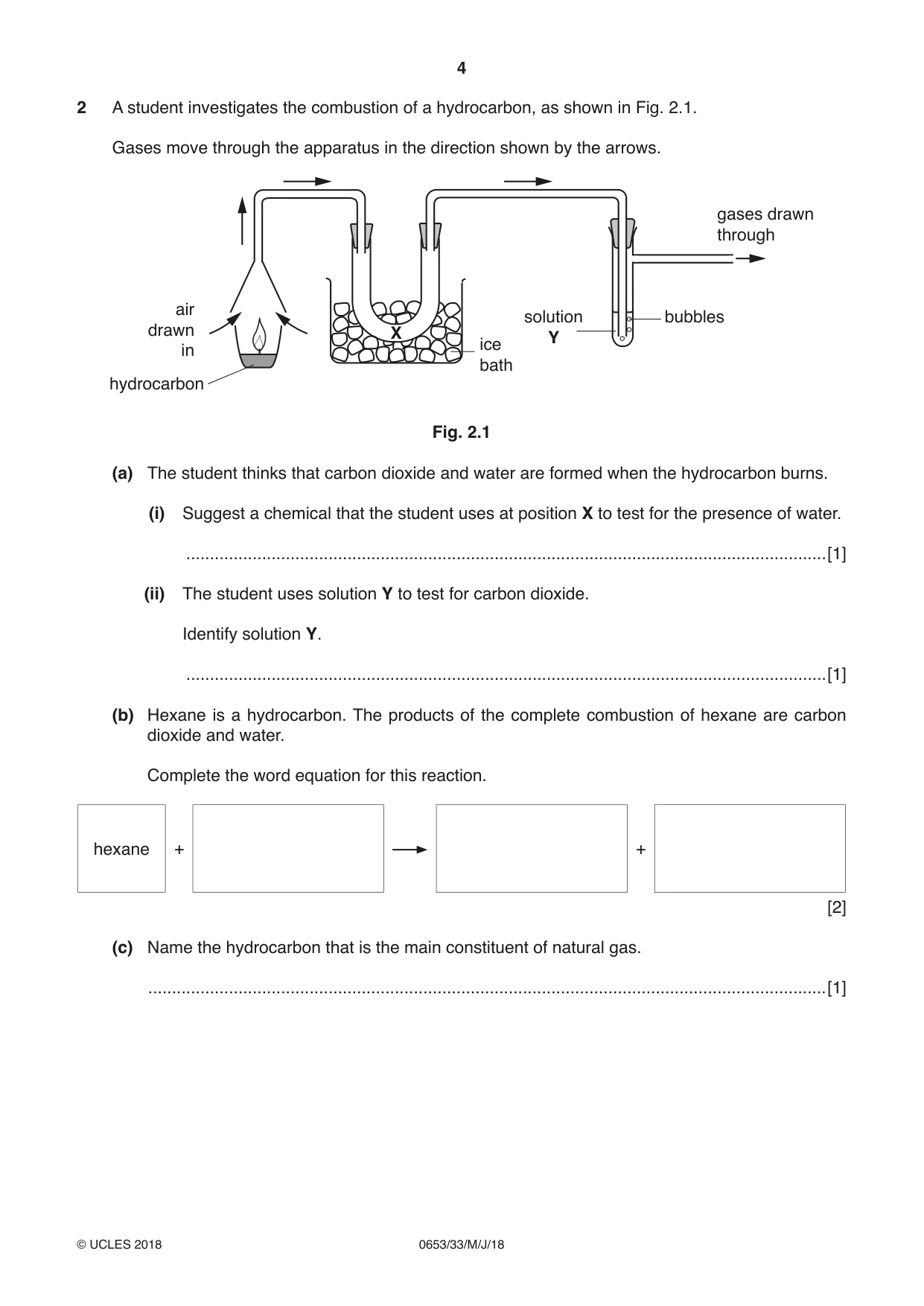
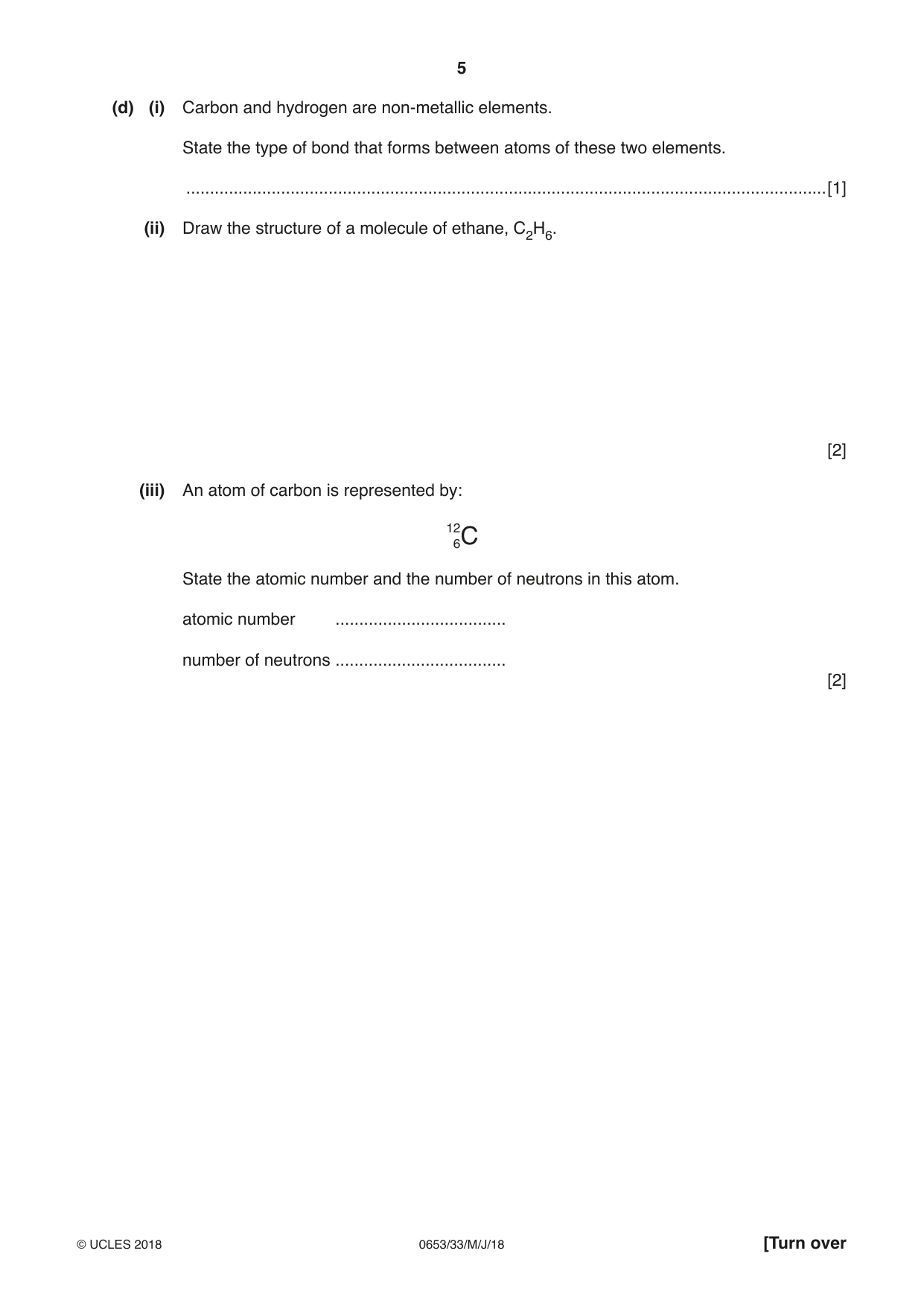
2 A student investigates the combustion of a hydrocarbon, as shown in Fig. 2.1. Gases move through the apparatus in the direction shown by the arrows. gases drawn through X air solution bubbles drawn X Y ice in bath hydrocarbon Fig. 2.1 (a) The student thinks that carbon dioxide and water are formed when the hydrocarbon burns. (i) Suggest a chemical that the student uses at position X to test for the presence of water. .......................................................................................................................................[1] (ii) The student uses solution Y to test for carbon dioxide. Identify solution Y. .......................................................................................................................................[1] (b) Hexane is a hydrocarbon. The products of the complete combustion of hexane are carbon dioxide and water. Complete the word equation for this reaction. hexane + + [2] (c) Name the hydrocarbon that is the main constituent of natural gas. ...............................................................................................................................................[1] (d) (i) Carbon and hydrogen are non‑metallic elements. State the type of bond that forms between atoms of these two elements. .......................................................................................................................................[1] (ii) Draw the structure of a molecule of ethane, C2H6. [2] (iii) An atom of carbon is represented by: 126C State the atomic number and the number of neutrons in this atom. atomic number .................................... number of neutrons .................................... [2]
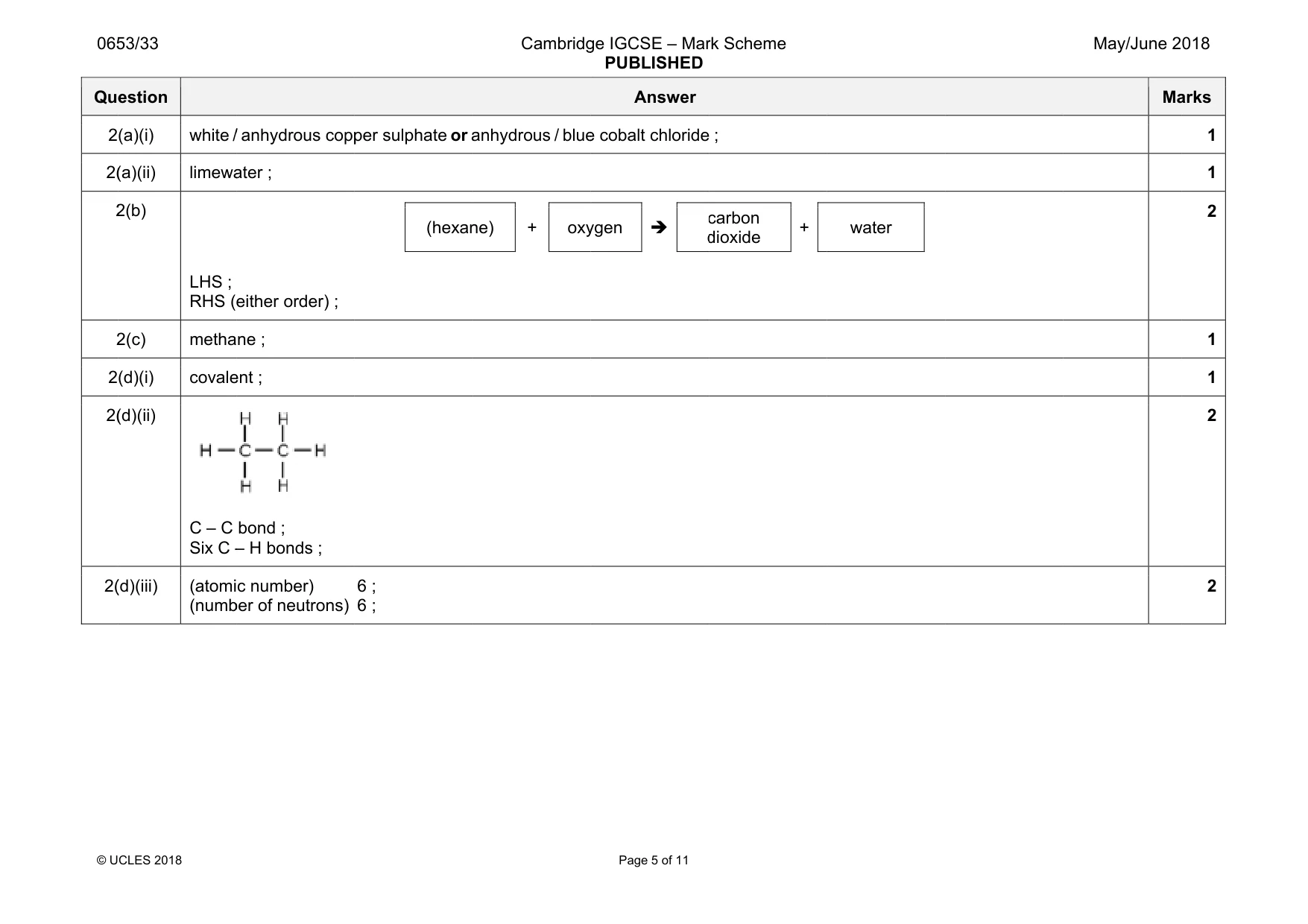
Mark scheme: 2 2( 2 2 2 2( 2( (a)(i) white / (a)(ii) limewa 2(b) LHS ; RHS ( 2(c) metha (d)(i) covale (d)(ii) C – C Six C – (d)(iii) (atomi (numb / anhydrous copp ater ; either order) ; ne ; ent ; bond ; – H bonds ; c number) ber of neutrons) per sulphate or a (hexan 6 ; 6 ; anhydrous / blue ne) + oxy e cobalt chloride ygen Î c d ; carbon dioxide + water 1 1 2 1 1 2 2
Q3 · A crane carrying a load
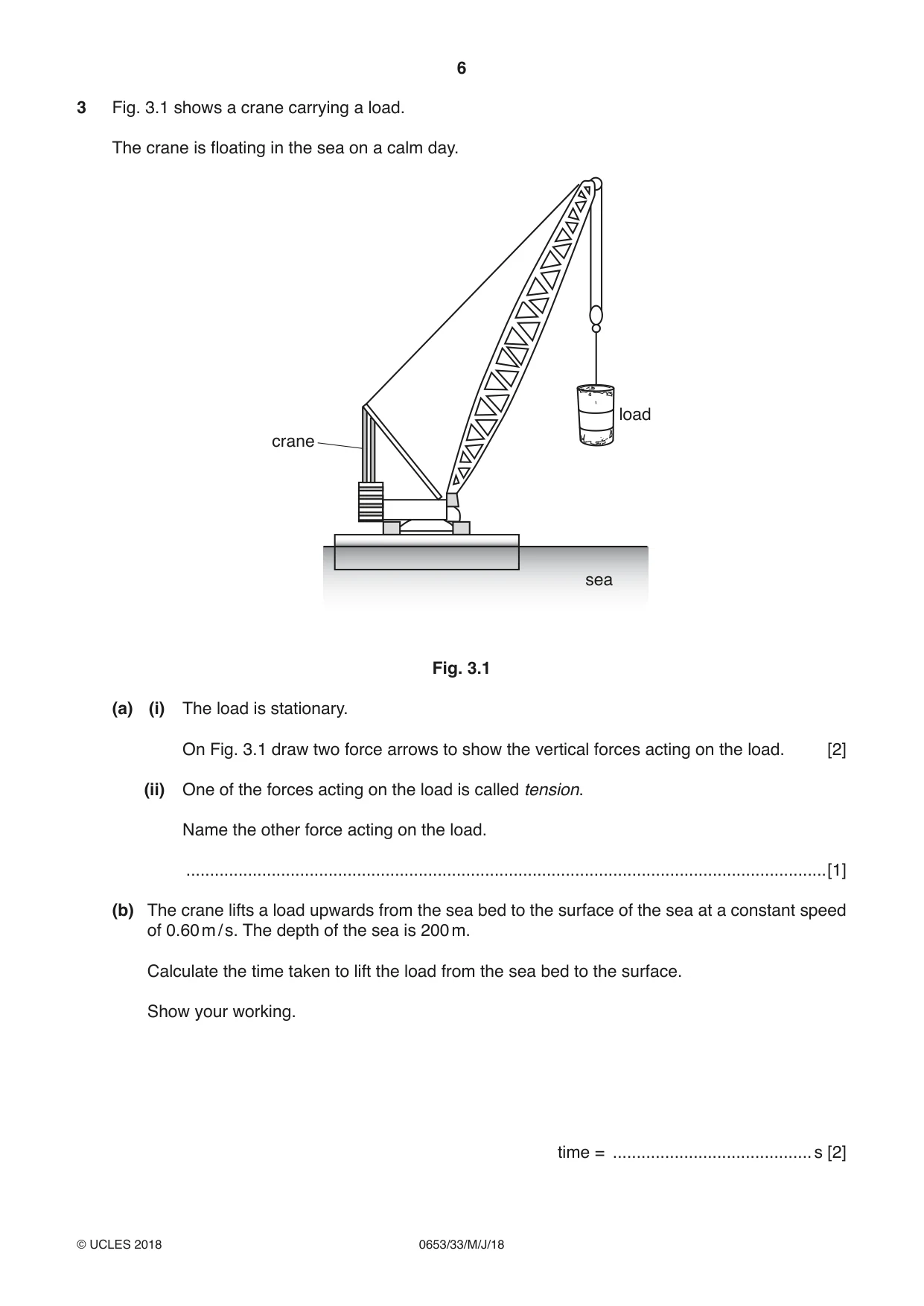
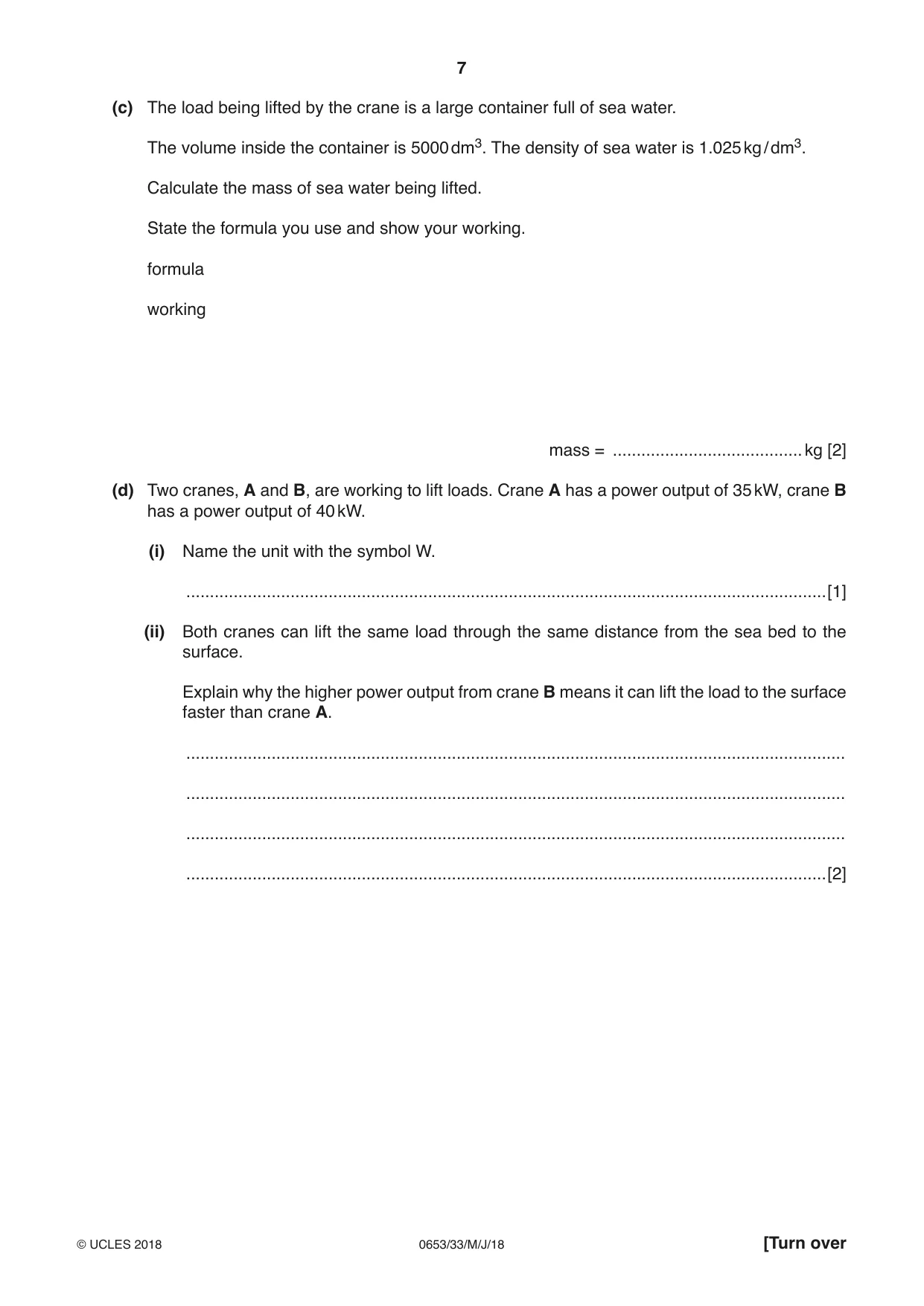
3 Fig. 3.1 shows a crane carrying a load. The crane is floating in the sea on a calm day. load crane sea Fig. 3.1 (a) (i) The load is stationary. On Fig. 3.1 draw two force arrows to show the vertical forces acting on the load. [2] (ii) One of the forces acting on the load is called tension. Name the other force acting on the load. .......................................................................................................................................[1] (b) The crane lifts a load upwards from the sea bed to the surface of the sea at a constant speed of 0.60 m / s. The depth of the sea is 200 m. Calculate the time taken to lift the load from the sea bed to the surface. Show your working. time = ..........................................s [2] (c) The load being lifted by the crane is a large container full of sea water. The volume inside the container is 5000 dm3. The density of sea water is 1.025 kg / dm3. Calculate the mass of sea water being lifted. State the formula you use and show your working. formula working mass = ........................................kg [2] (d) Two cranes, A and B, are working to lift loads. Crane A has a power output of 35 kW, crane B has a power output of 40 kW. (i) Name the unit with the symbol W. .......................................................................................................................................[1] (ii) Both cranes can lift the same load through the same distance from the sea bed to the surface. Explain why the higher power output from crane B means it can lift the load to the surface faster than crane A. ........................................................................................................................................... ........................................................................................................................................... ........................................................................................................................................... .......................................................................................................................................[2]
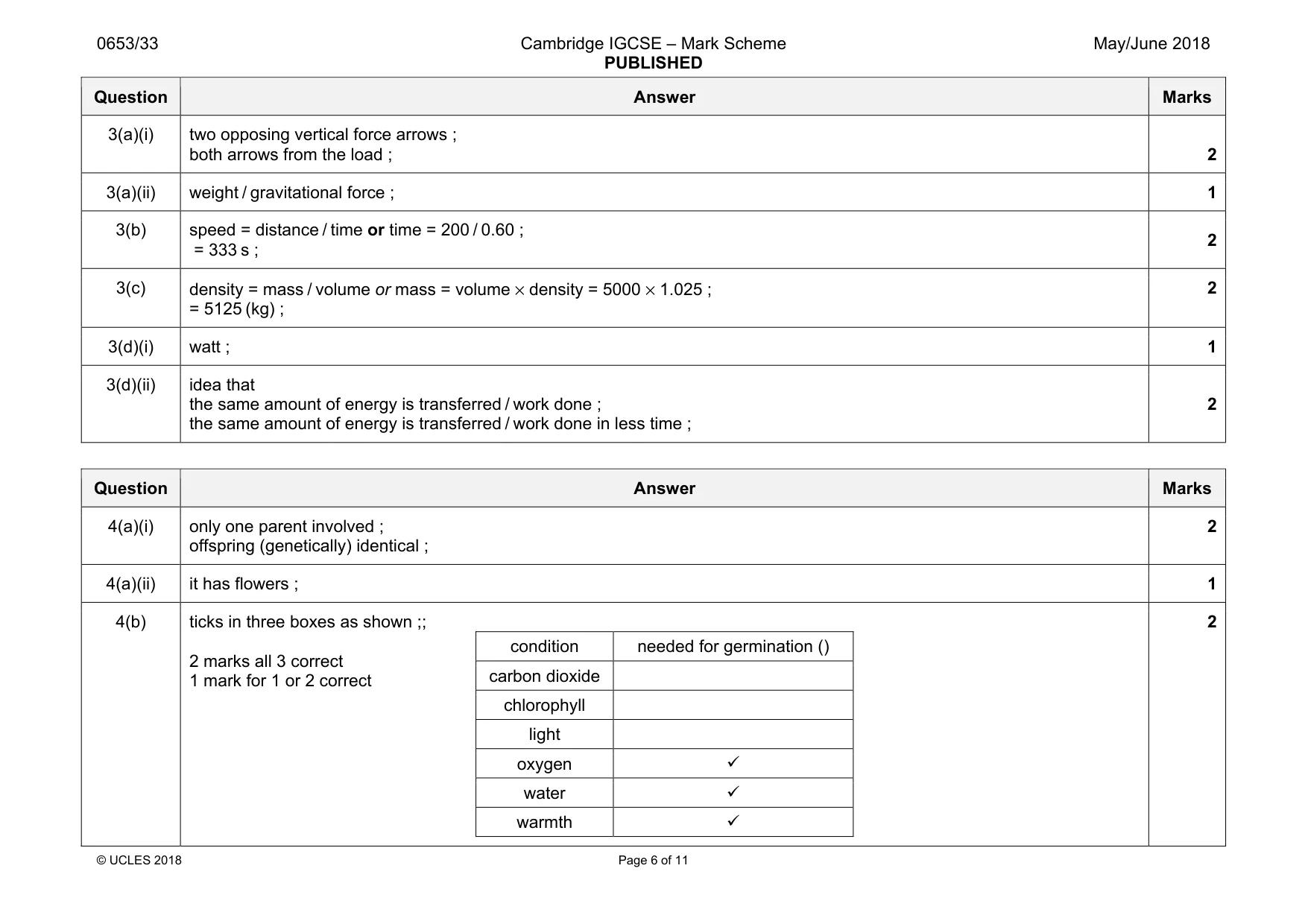
Mark scheme: 3(a)(i) two opposing vertical force arrows ; both arrows from the load ; 2 3(a)(ii) weight / gravitational force ; 1 3(b) speed = distance / time or time = 200 / 0.60 ; = 333 s ; 2 3(c) density = mass / volume or mass = volume × density = 5000 × 1.025 ; = 5125 (kg) ; 2 3(d)(i) watt ; 1 3(d)(ii) idea that the same amount of energy is transferred / work done ; the same amount of energy is transferred / work done in less time ; 2
Q4 · Gardeners can increase the numbers of plants by splitting a parent plant in two…
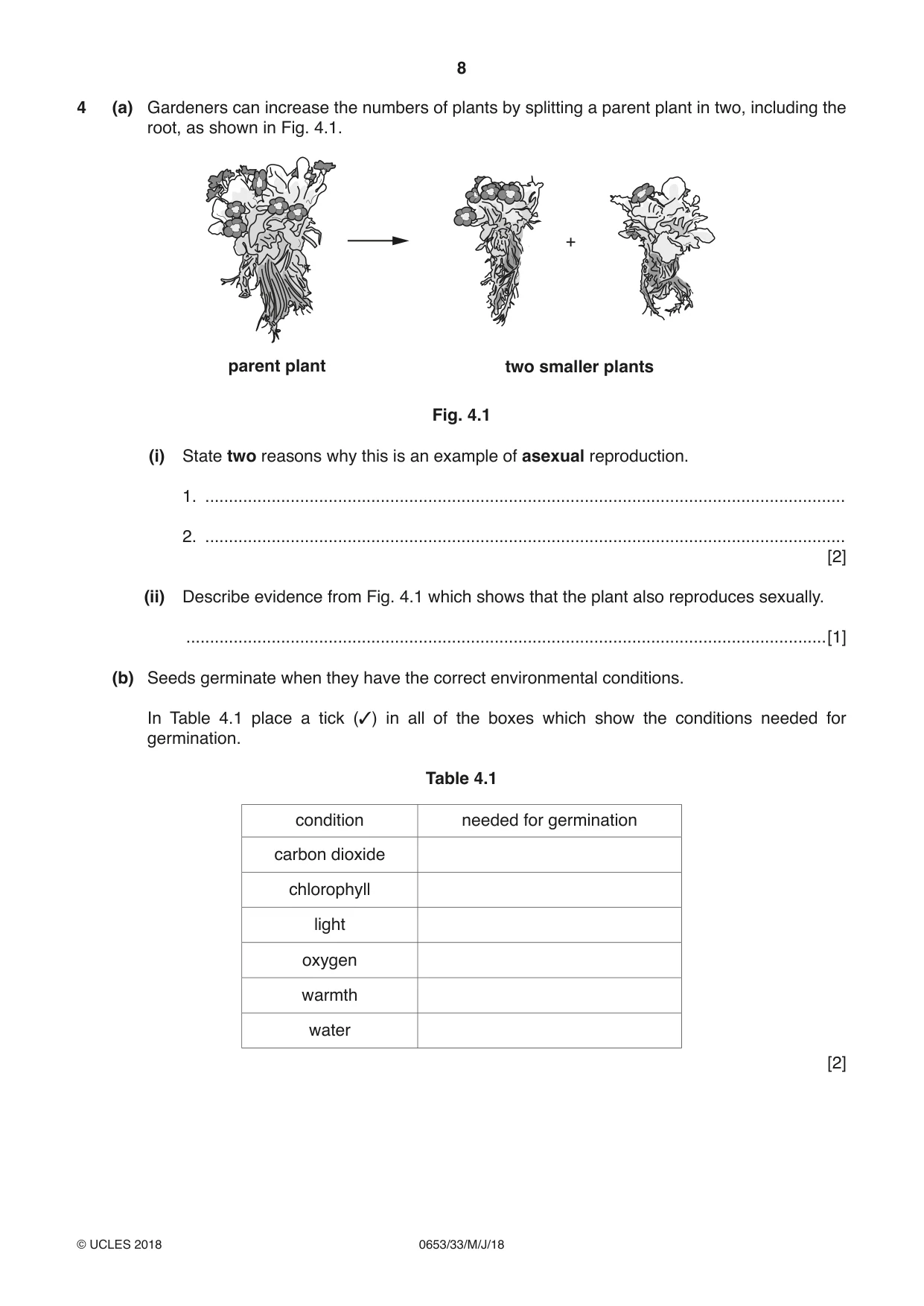
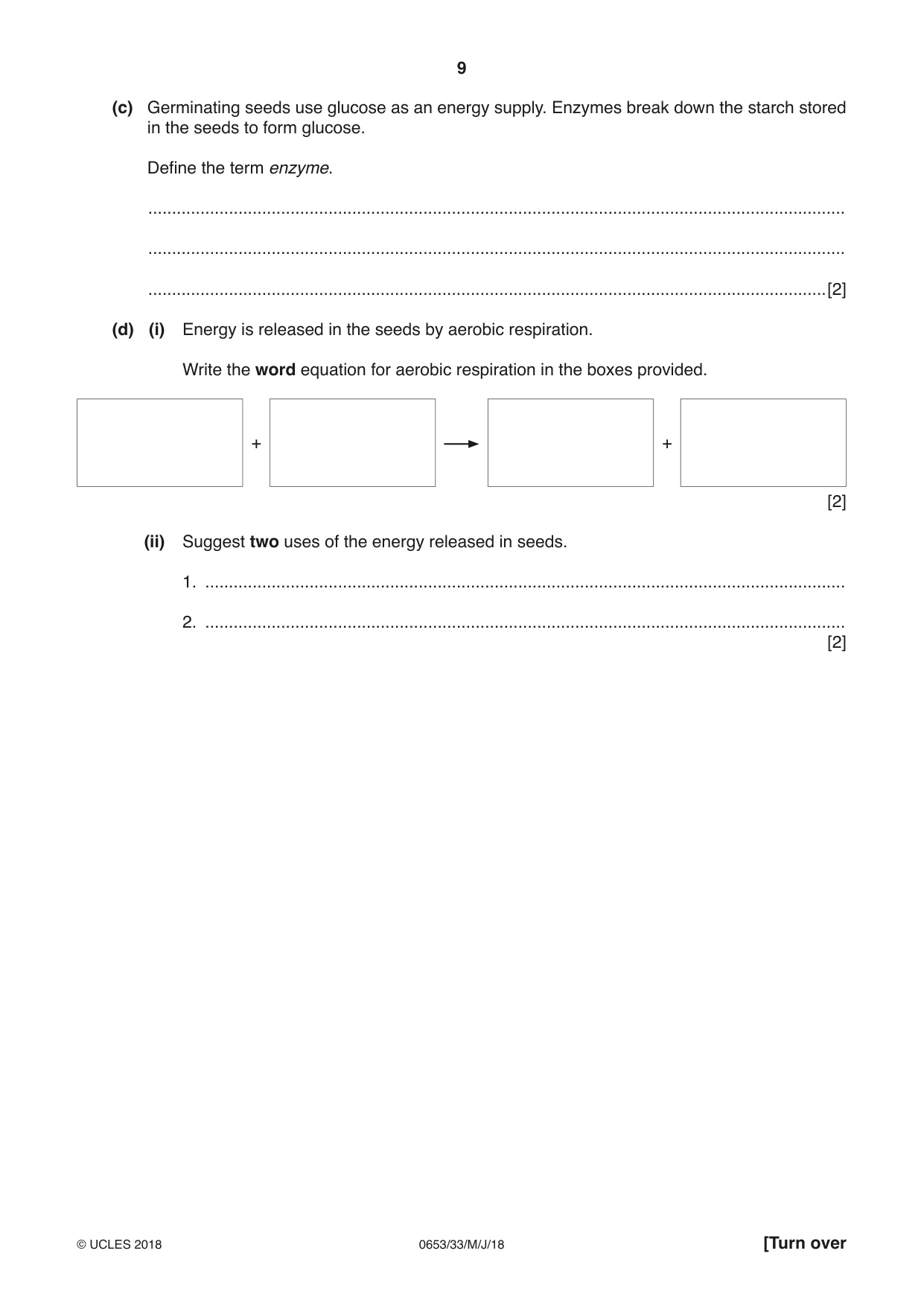
4 (a) Gardeners can increase the numbers of plants by splitting a parent plant in two, including the root, as shown in Fig. 4.1. + parent plant two smaller plants Fig. 4.1 (i) State two reasons why this is an example of asexual reproduction. 1. ....................................................................................................................................... 2. ....................................................................................................................................... [2] (ii) Describe evidence from Fig. 4.1 which shows that the plant also reproduces sexually. .......................................................................................................................................[1] (b) Seeds germinate when they have the correct environmental conditions. In Table 4.1 place a tick (✓) in all of the boxes which show the conditions needed for germination. Table 4.1 condition needed for germination carbon dioxide chlorophyll light oxygen warmth water [2] (c) Germinating seeds use glucose as an energy supply. Enzymes break down the starch stored in the seeds to form glucose. Define the term enzyme. ................................................................................................................................................... ................................................................................................................................................... ...............................................................................................................................................[2] (d) (i) Energy is released in the seeds by aerobic respiration. Write the word equation for aerobic respiration in the boxes provided. + + [2] (ii) Suggest two uses of the energy released in seeds. 1. ....................................................................................................................................... 2. ....................................................................................................................................... [2]
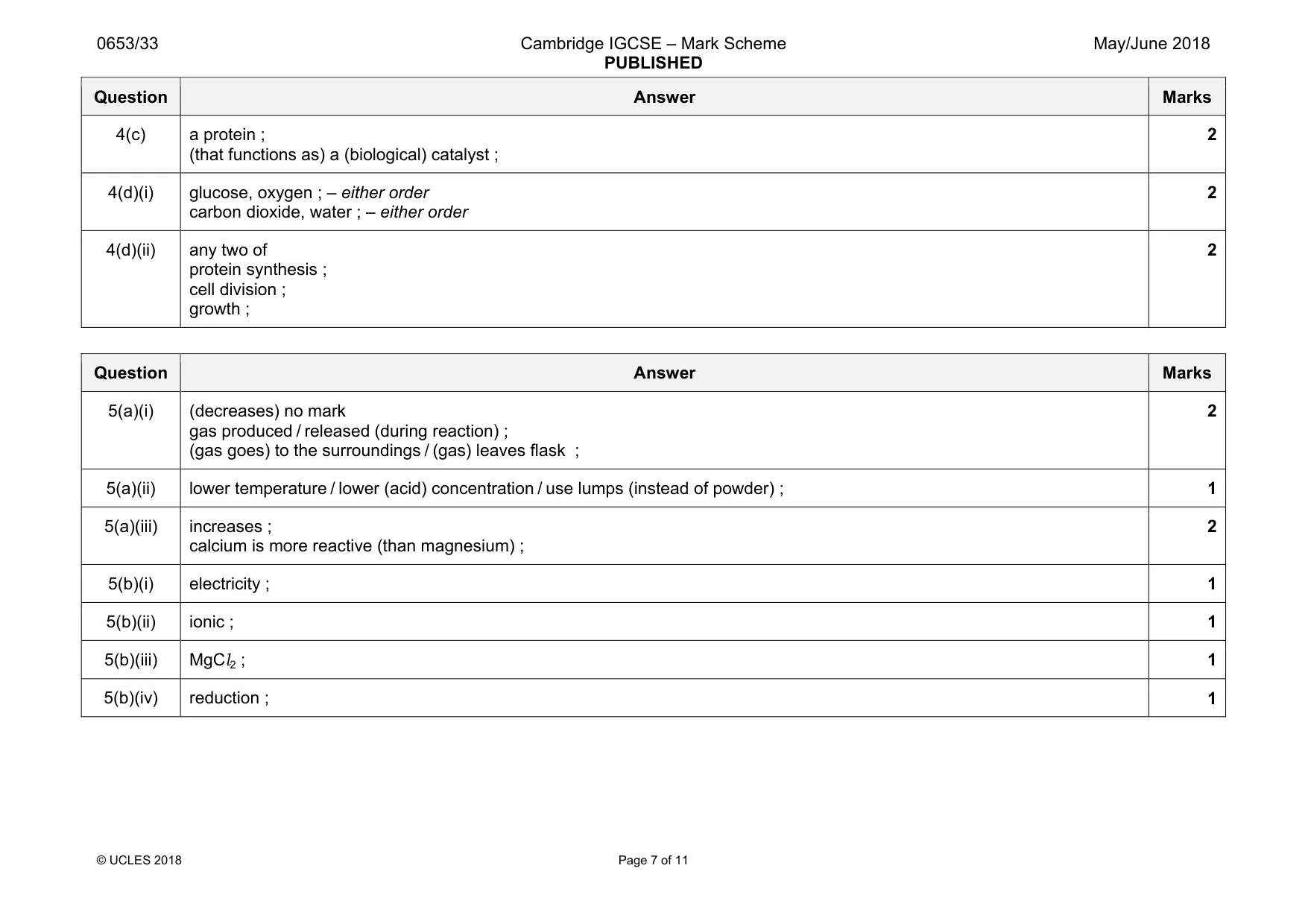
Mark scheme: 4(a)(i) only one parent involved ; offspring (genetically) identical ; 2 4(a)(ii) it has flowers ; 1 4(b) ticks in three boxes as shown ;; 2 marks all 3 correct 1 mark for 1 or 2 correct condition needed for germination () carbon dioxide chlorophyll light oxygen 9 water 9 warmth 9 2 Question Answer Marks 4(c) a protein ; (that functions as) a (biological) catalyst ; 2 4(d)(i) glucose, oxygen ; – either order carbon dioxide, water ; – either order 2 4(d)(ii) any two of protein synthesis ; cell division ; growth ; 2
Q5 · A student adds magnesium powder to dilute hydrochloric acid
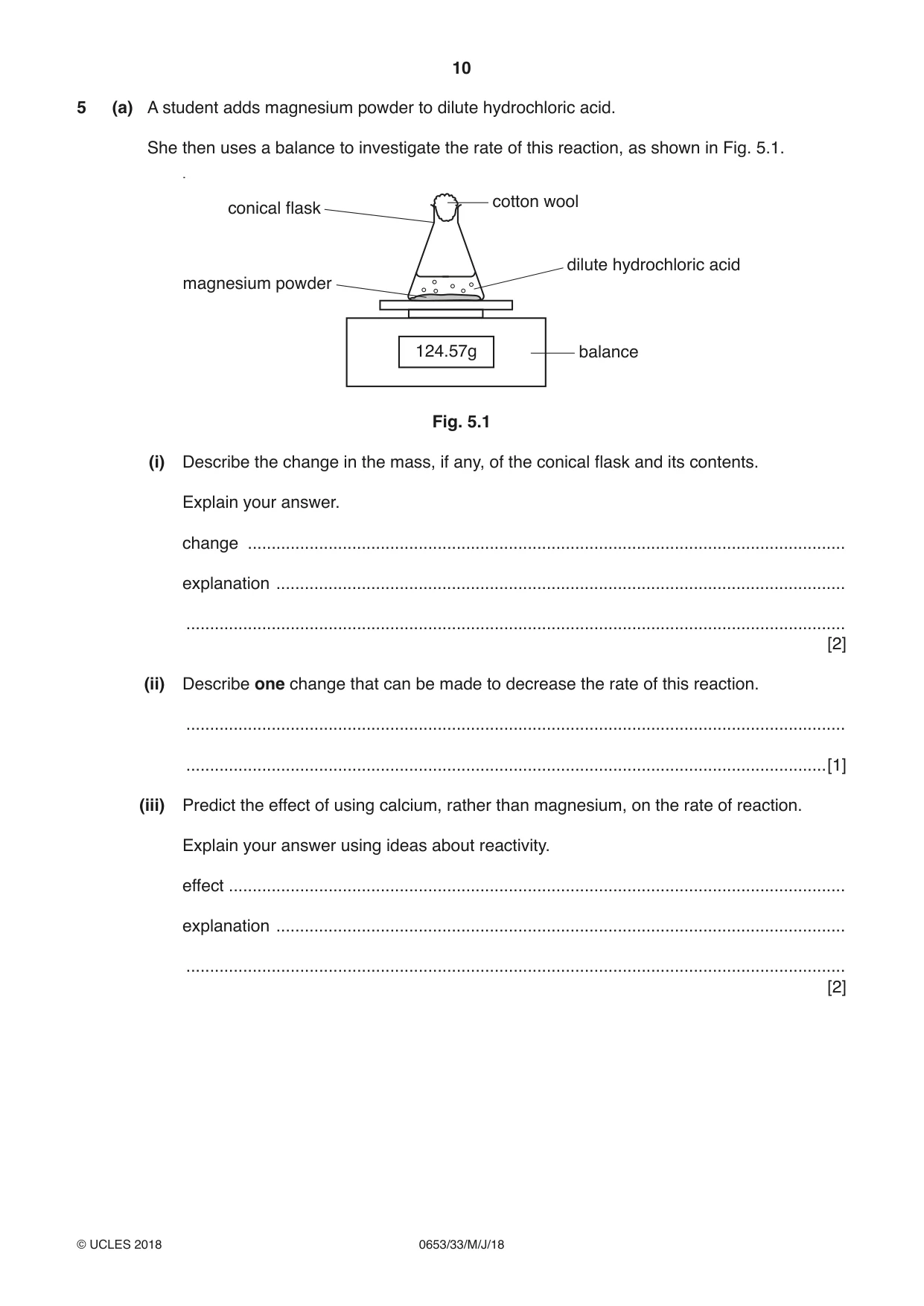
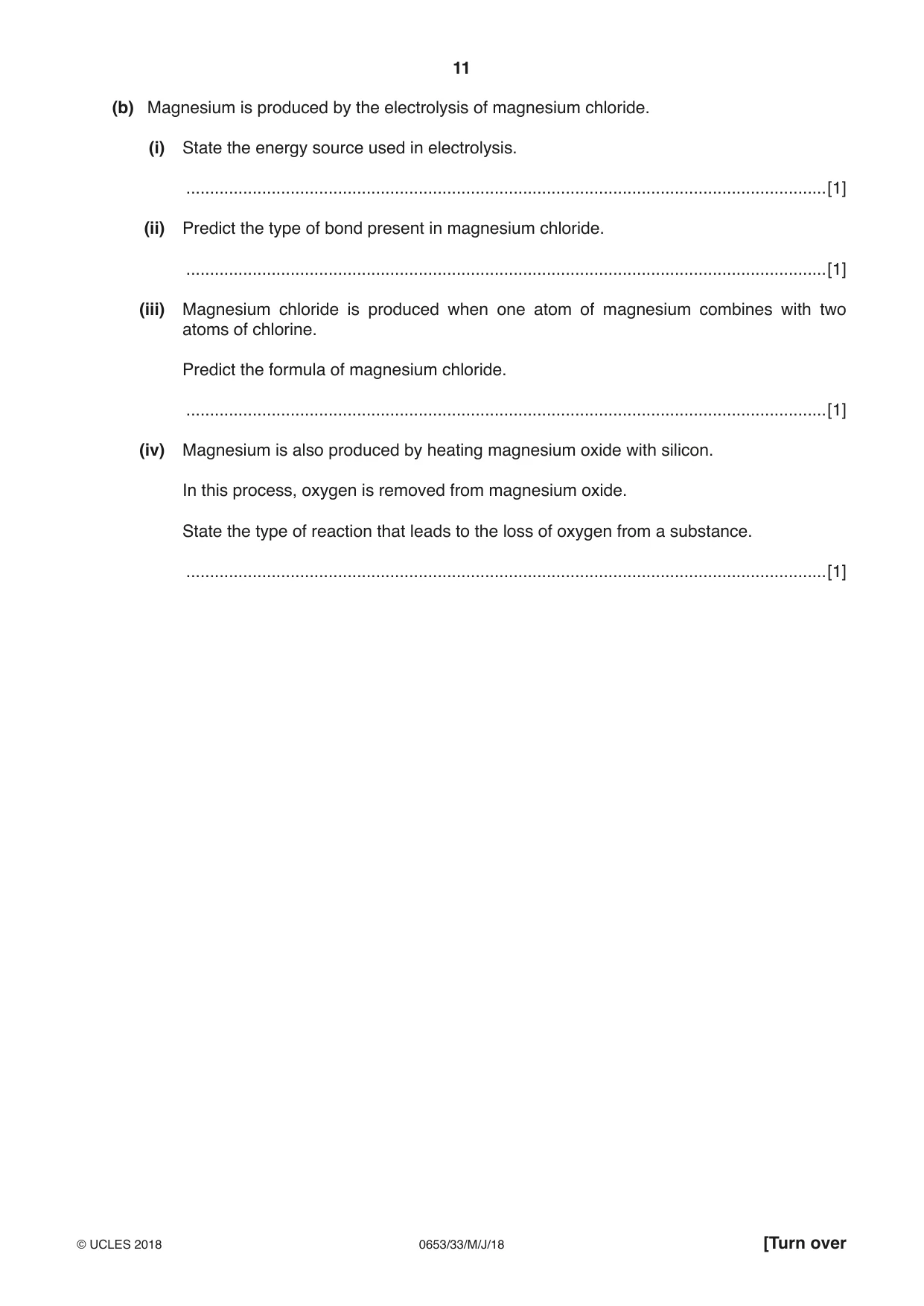
5 (a) A student adds magnesium powder to dilute hydrochloric acid. She then uses a balance to investigate the rate of this reaction, as shown in Fig. 5.1. cotton wool conical flask dilute hydrochloric acid magnesium powder 124.57g balance Fig. 5.1 (i) Describe the change in the mass, if any, of the conical flask and its contents. Explain your answer. change .............................................................................................................................. explanation ........................................................................................................................ ........................................................................................................................................... [2] (ii) Describe one change that can be made to decrease the rate of this reaction. ........................................................................................................................................... .......................................................................................................................................[1] (iii) Predict the effect of using calcium, rather than magnesium, on the rate of reaction. Explain your answer using ideas about reactivity. effect .................................................................................................................................. explanation ........................................................................................................................ ........................................................................................................................................... [2] (b) Magnesium is produced by the electrolysis of magnesium chloride. (i) State the energy source used in electrolysis. .......................................................................................................................................[1] (ii) Predict the type of bond present in magnesium chloride. .......................................................................................................................................[1] (iii) Magnesium chloride is produced when one atom of magnesium combines with two atoms of chlorine. Predict the formula of magnesium chloride. .......................................................................................................................................[1] (iv) Magnesium is also produced by heating magnesium oxide with silicon. In this process, oxygen is removed from magnesium oxide. State the type of reaction that leads to the loss of oxygen from a substance. .......................................................................................................................................[1]
Mark scheme: 5(a)(i) (decreases) no mark gas produced / released (during reaction) ; (gas goes) to the surroundings / (gas) leaves flask ; 2 5(a)(ii) lower temperature / lower (acid) concentration / use lumps (instead of powder) ; 1 5(a)(iii) increases ; calcium is more reactive (than magnesium) ; 2 5(b)(i) electricity ; 1 5(b)(ii) ionic ; 1 5(b)(iii) MgCl2 ; 1 5(b)(iv) reduction ; 1 Que estion Answer Ma arks
Q6 · An incomplete electromagnetic spectrum linked to some uses of different parts of the…
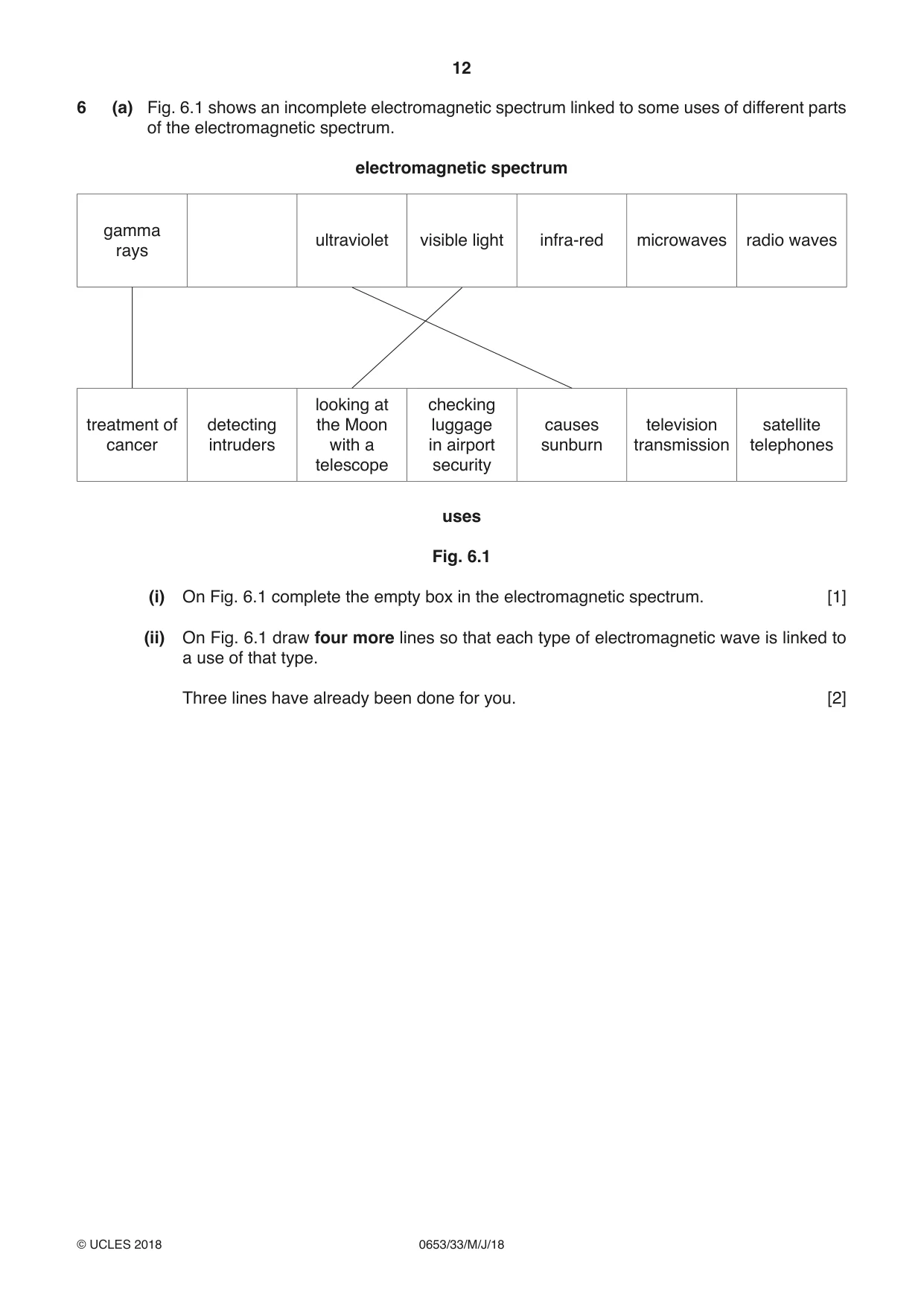
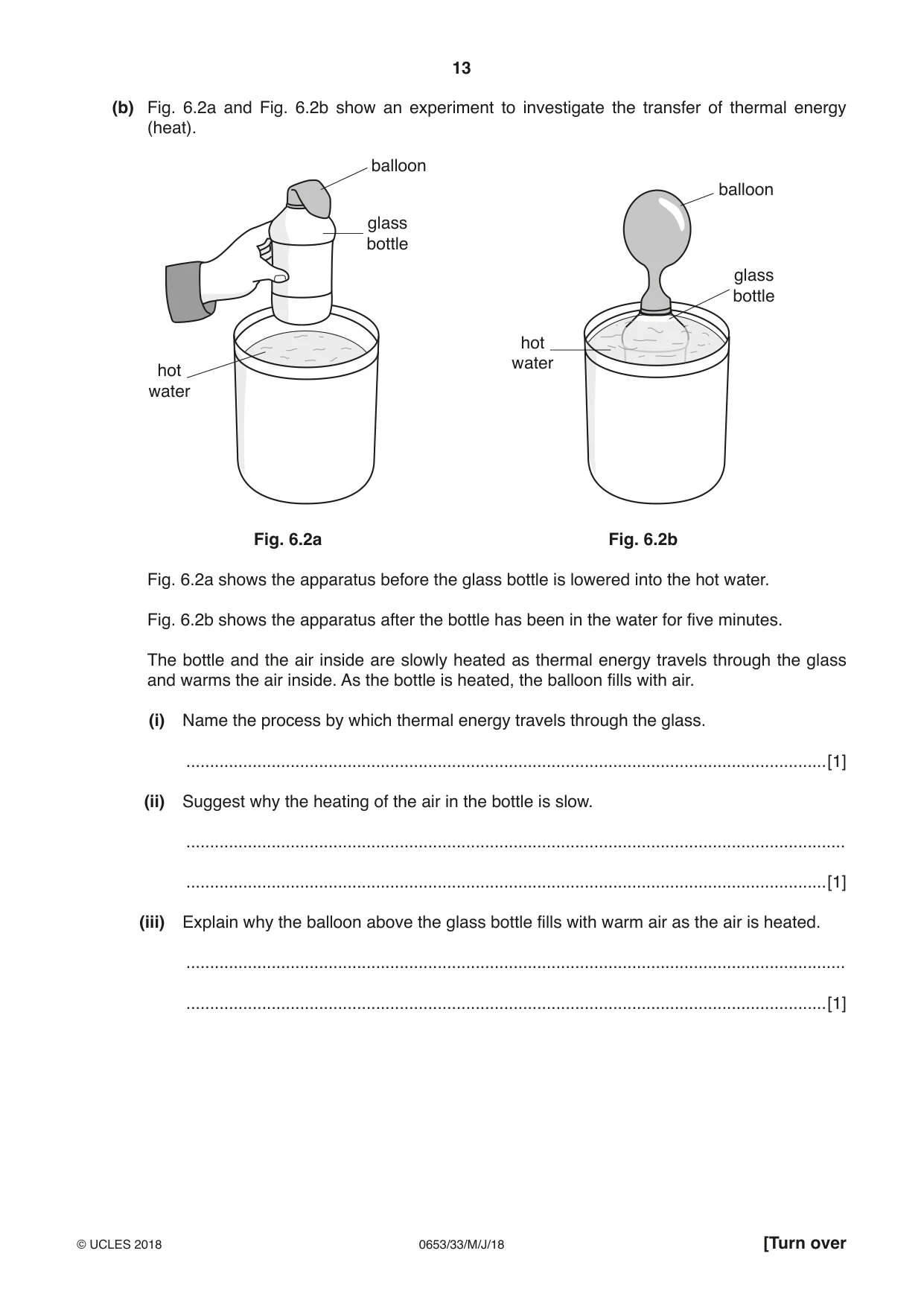
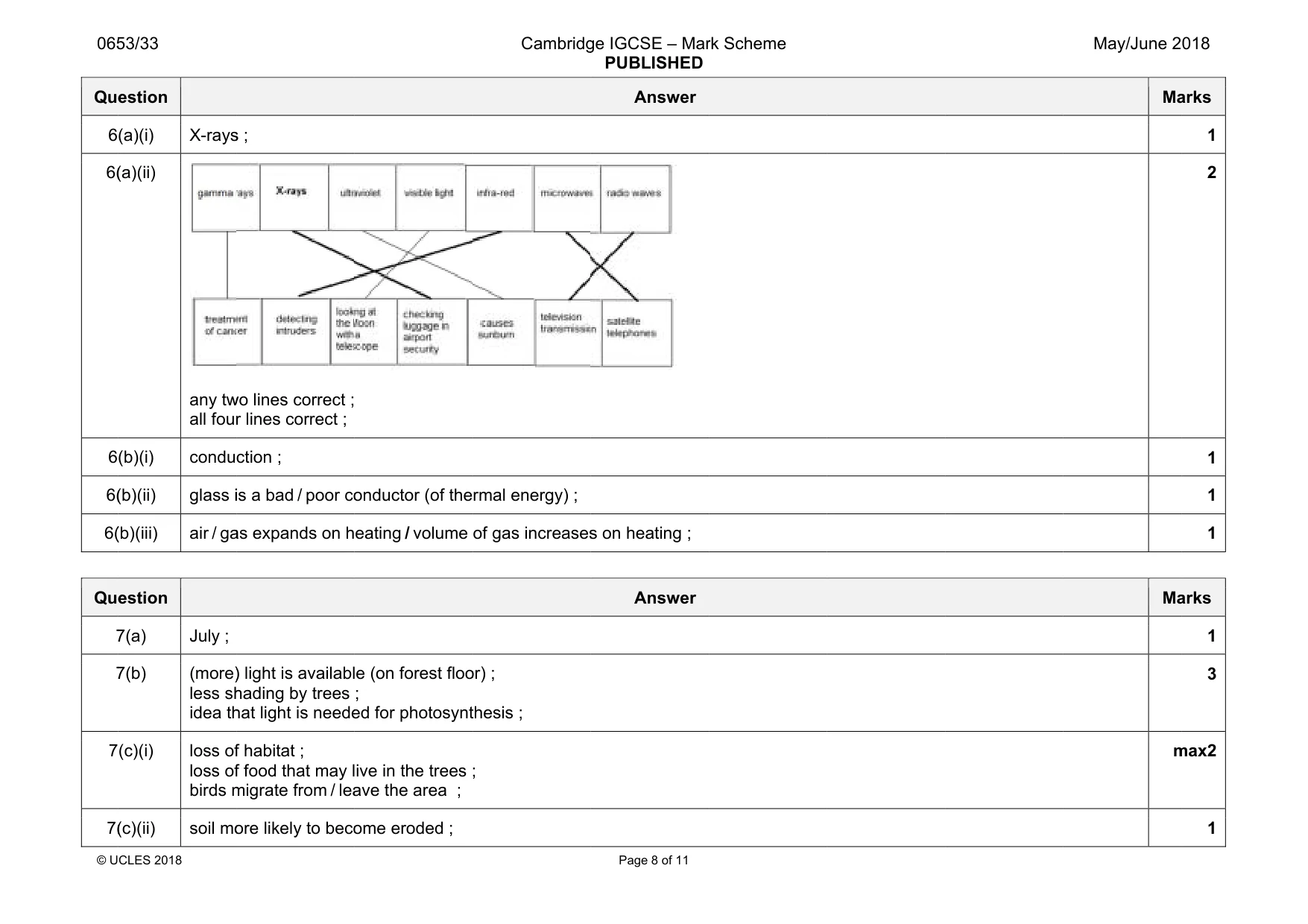
6 (a) Fig. 6.1 shows an incomplete electromagnetic spectrum linked to some uses of different parts of the electromagnetic spectrum. electromagnetic spectrum gamma ultraviolet visible light infra‑red microwaves radio waves rays looking at checking treatment of detecting the Moon luggage causes television satellite cancer intruders with a in airport sunburn transmission telephones telescope security uses Fig. 6.1 (i) On Fig. 6.1 complete the empty box in the electromagnetic spectrum. [1] (ii) On Fig. 6.1 draw four more lines so that each type of electromagnetic wave is linked to a use of that type. Three lines have already been done for you. [2] (b) Fig. 6.2a and Fig. 6.2b show an experiment to investigate the transfer of thermal energy (heat). balloon balloon glass bottle glass bottle hot water hot water Fig. 6.2a Fig. 6.2b Fig. 6.2a shows the apparatus before the glass bottle is lowered into the hot water. Fig. 6.2b shows the apparatus after the bottle has been in the water for five minutes. The bottle and the air inside are slowly heated as thermal energy travels through the glass and warms the air inside. As the bottle is heated, the balloon fills with air. (i) Name the process by which thermal energy travels through the glass. .......................................................................................................................................[1] (ii) Suggest why the heating of the air in the bottle is slow. ........................................................................................................................................... .......................................................................................................................................[1] (iii) Explain why the balloon above the glass bottle fills with warm air as the air is heated. ........................................................................................................................................... .......................................................................................................................................[1]
Mark scheme: 6 6( 6 6( 6( Que (a)(i) X-rays (a)(ii) any tw all four (b)(i) condu (b)(ii) glass i (b)(iii) air / ga estion s ; wo lines correct ; r lines correct ; ction ; is a bad / poor co as expands on h onductor (of the eating / volume rmal energy) ; of gas increases s on heating ; Answer Ma 1 2 1 1 1 arks
Q7 · The rate of photosynthesis in trees in a European forest changes during the year
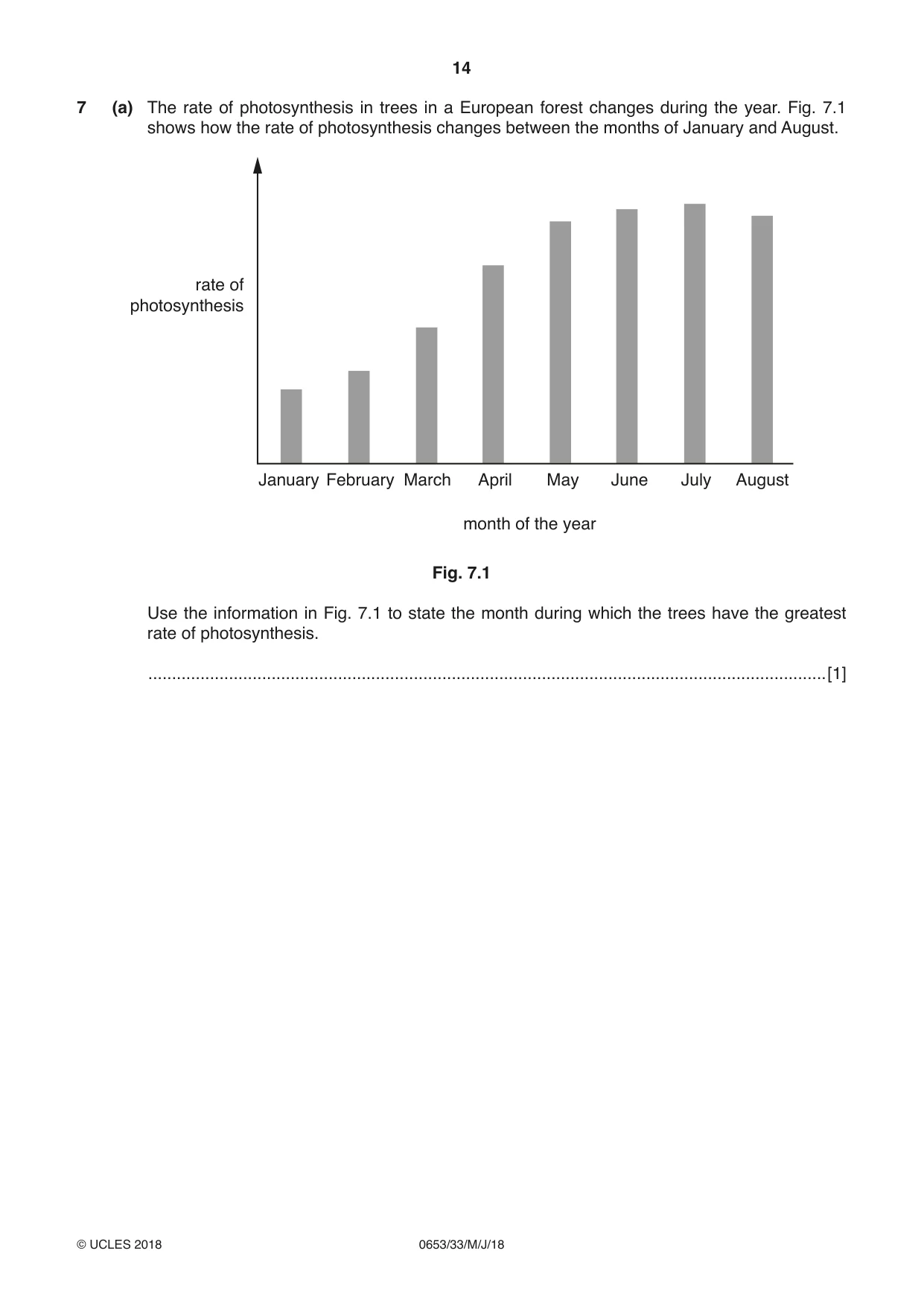
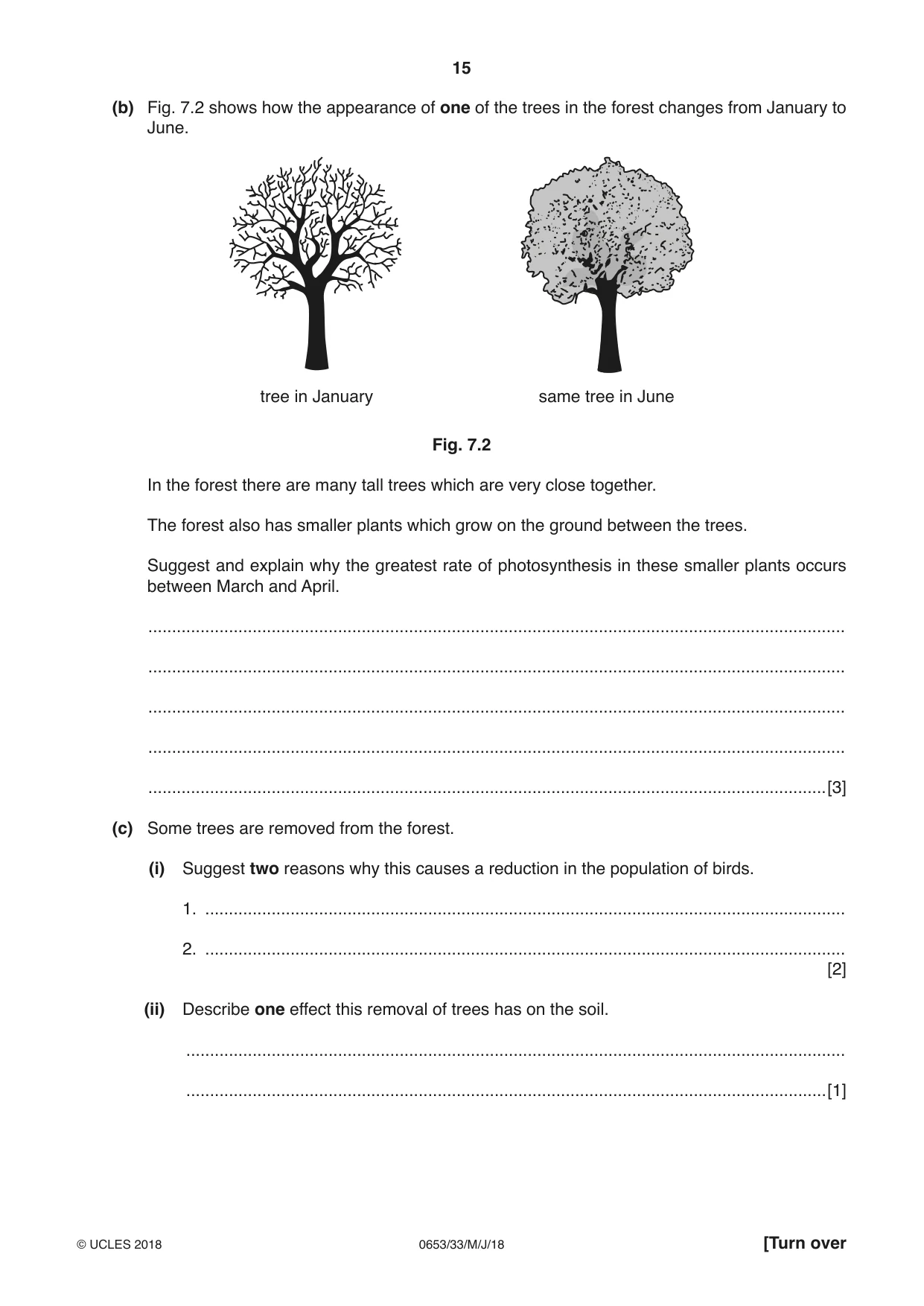
7 (a) The rate of photosynthesis in trees in a European forest changes during the year. Fig. 7.1 shows how the rate of photosynthesis changes between the months of January and August. rate of photosynthesis January February March April May June July August month of the year Fig. 7.1 Use the information in Fig. 7.1 to state the month during which the trees have the greatest rate of photosynthesis. ...............................................................................................................................................[1] (b) Fig. 7.2 shows how the appearance of one of the trees in the forest changes from January to June. tree in January same tree in June Fig. 7.2 In the forest there are many tall trees which are very close together. The forest also has smaller plants which grow on the ground between the trees. Suggest and explain why the greatest rate of photosynthesis in these smaller plants occurs between March and April. ................................................................................................................................................... ................................................................................................................................................... ................................................................................................................................................... ................................................................................................................................................... ...............................................................................................................................................[3] (c) Some trees are removed from the forest. (i) Suggest two reasons why this causes a reduction in the population of birds. 1. ....................................................................................................................................... 2. ....................................................................................................................................... [2] (ii) Describe one effect this removal of trees has on the soil. ........................................................................................................................................... .......................................................................................................................................[1]
Mark scheme: 7 7 7 7( 7(a) July ; 7(b) (more) less sh idea th (c)(i) loss of loss of birds m (c)(ii) soil mo ) light is availabl hading by trees hat light is neede f habitat ; f food that may l migrate from / lea ore likely to beco e (on forest floo ; ed for photosynt ive in the trees ave the area ; ome eroded ; or) ; thesis ; ; m 1 3 max2 1
Q8 · Period 3 of the Periodic Table contains the elements from sodium to argon
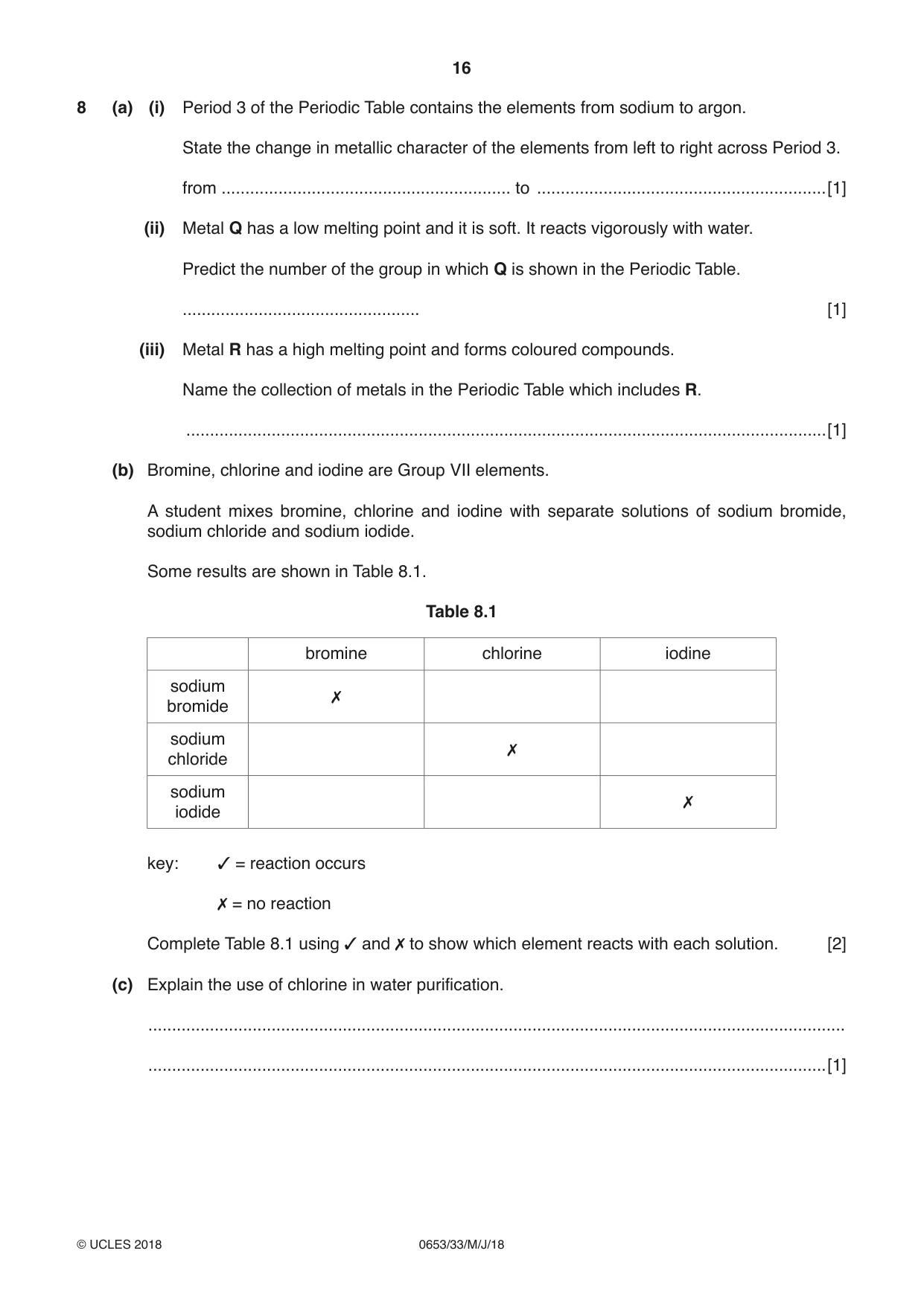
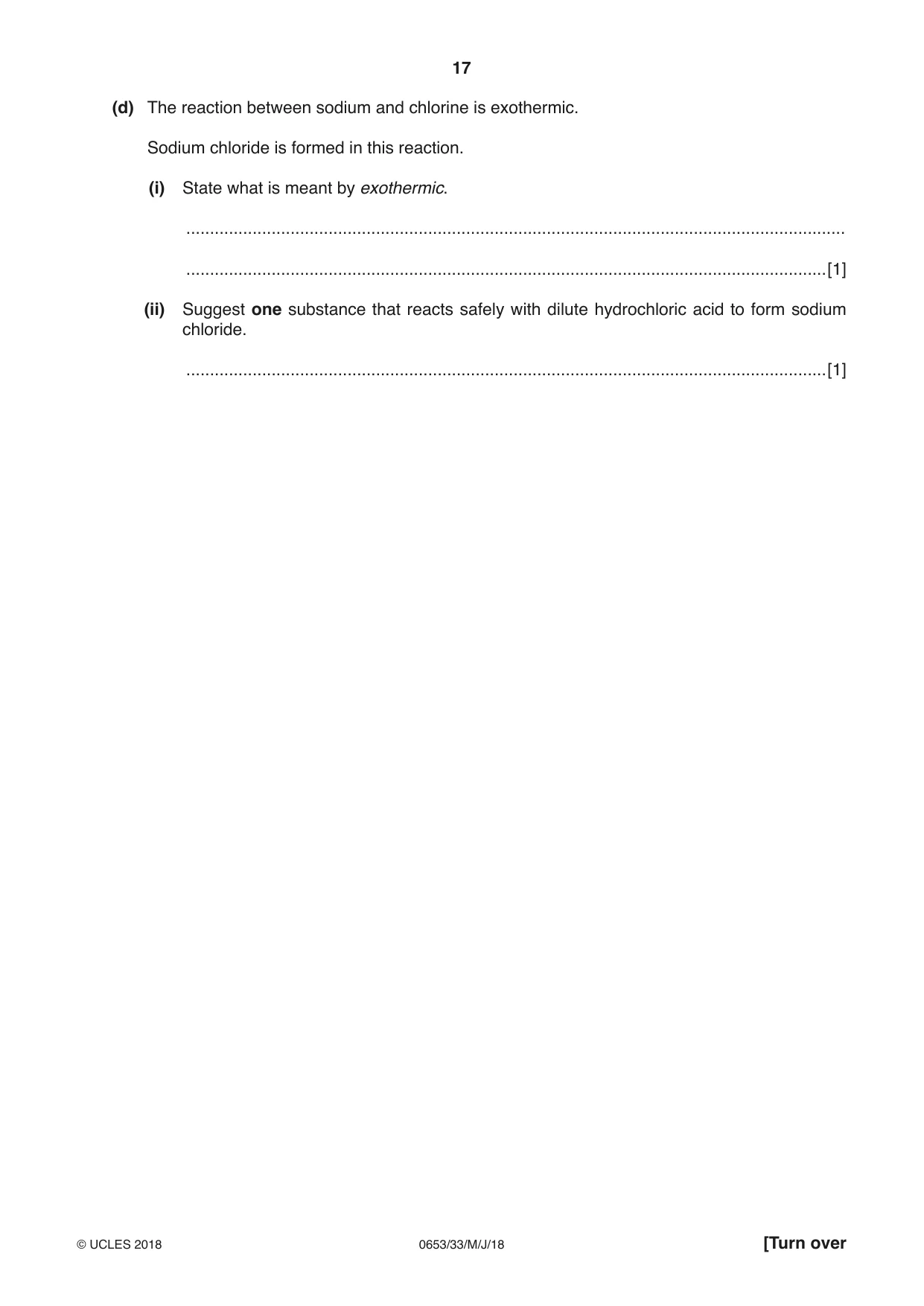
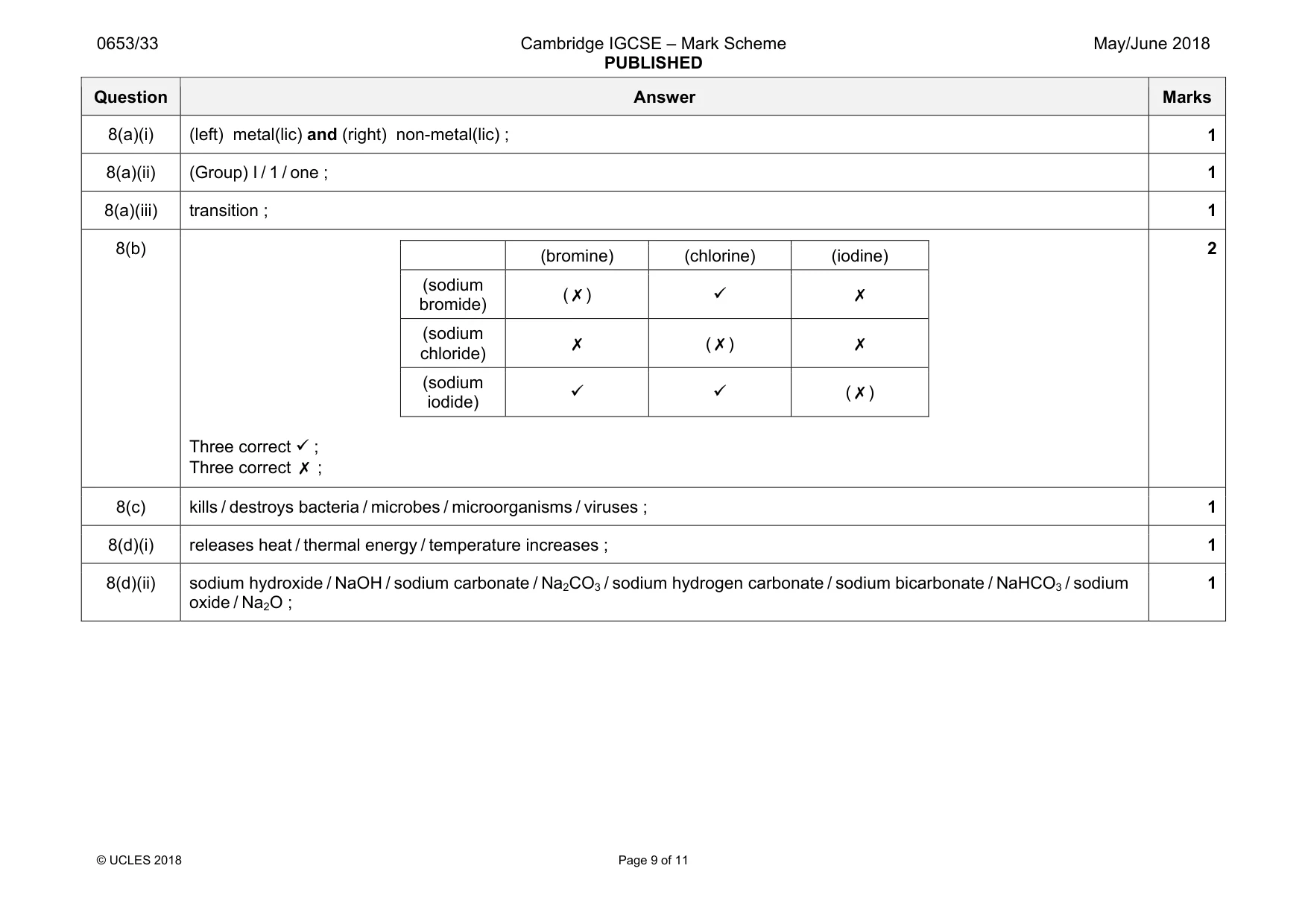
8 (a) (i) Period 3 of the Periodic Table contains the elements from sodium to argon. State the change in metallic character of the elements from left to right across Period 3. from ............................................................. to .............................................................[1] (ii) Metal Q has a low melting point and it is soft. It reacts vigorously with water. Predict the number of the group in which Q is shown in the Periodic Table. .................................................. [1] (iii) Metal R has a high melting point and forms coloured compounds. Name the collection of metals in the Periodic Table which includes R. .......................................................................................................................................[1] (b) Bromine, chlorine and iodine are Group VII elements. A student mixes bromine, chlorine and iodine with separate solutions of sodium bromide, sodium chloride and sodium iodide. Some results are shown in Table 8.1. Table 8.1 bromine chlorine iodine sodium ✗ bromide sodium ✗ chloride sodium ✗ iodide key: ✓ = reaction occurs ✗ = no reaction Complete Table 8.1 using ✓ and ✗ to show which element reacts with each solution. [2] (c) Explain the use of chlorine in water purification. ................................................................................................................................................... ...............................................................................................................................................[1] (d) The reaction between sodium and chlorine is exothermic. Sodium chloride is formed in this reaction. (i) State what is meant by exothermic. ........................................................................................................................................... .......................................................................................................................................[1] (ii) Suggest one substance that reacts safely with dilute hydrochloric acid to form sodium chloride. .......................................................................................................................................[1]
Mark scheme: 8(a)(i) (left) metal(lic) and (right) non-metal(lic) ; 1 8(a)(ii) (Group) I / 1 / one ; 1 8(a)(iii) transition ; 1 8(b) (bromine) (chlorine) (iodine) (sodium bromide) (✗) 9 ✗ (sodium chloride) ✗ (✗) ✗ (sodium iodide) 9 9 (✗) Three correct 9 ; Three correct ✗ ; 2 8(c) kills / destroys bacteria / microbes / microorganisms / viruses ; 1 8(d)(i) releases heat / thermal energy / temperature increases ; 1 8(d)(ii) sodium hydroxide / NaOH / sodium carbonate / Na2CO3 / sodium hydrogen carbonate / sodium bicarbonate / NaHCO3 / sodium oxide / Na2O ; 1
Q9 · A simple circuit set up to investigate the current through an electric motor
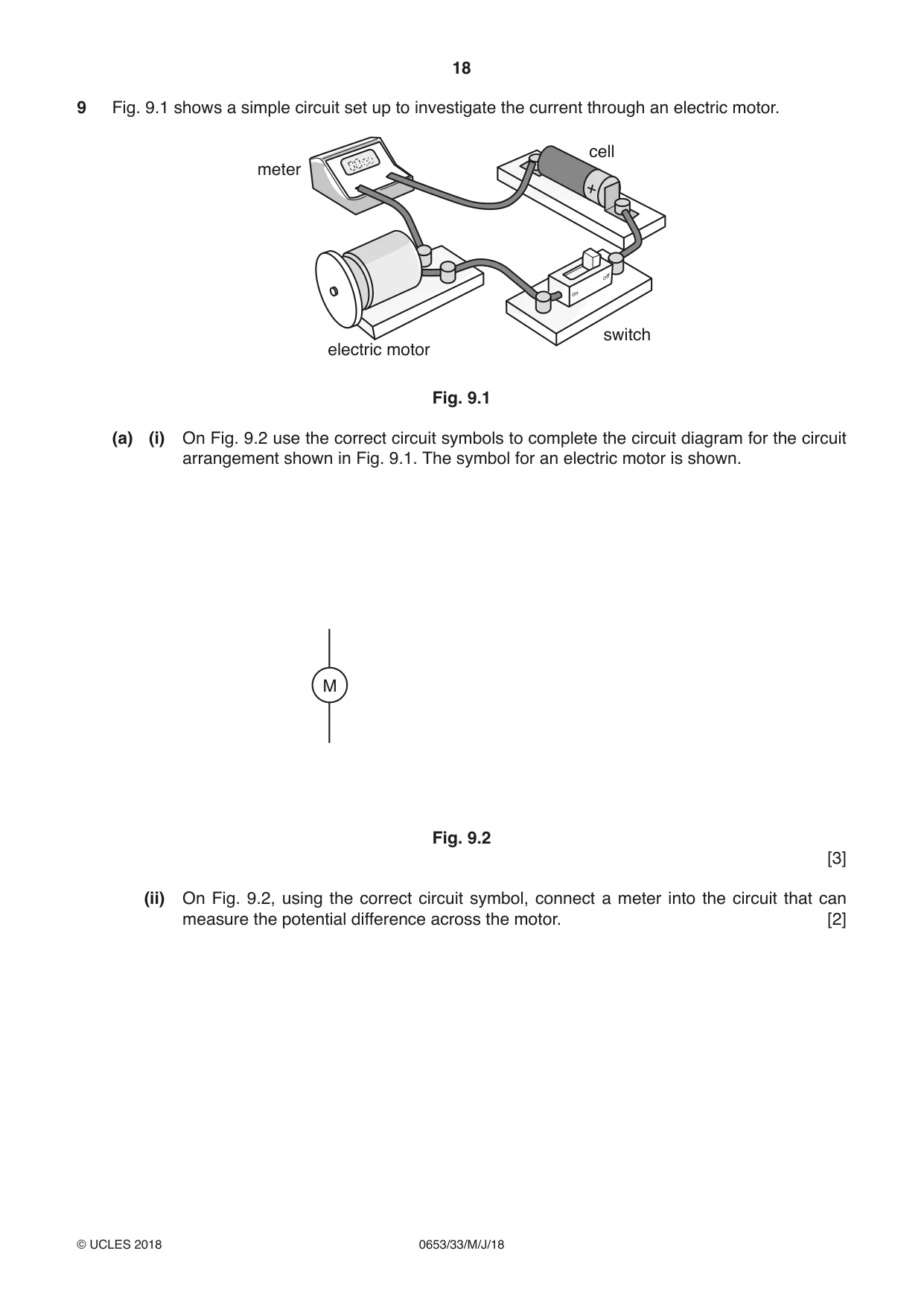
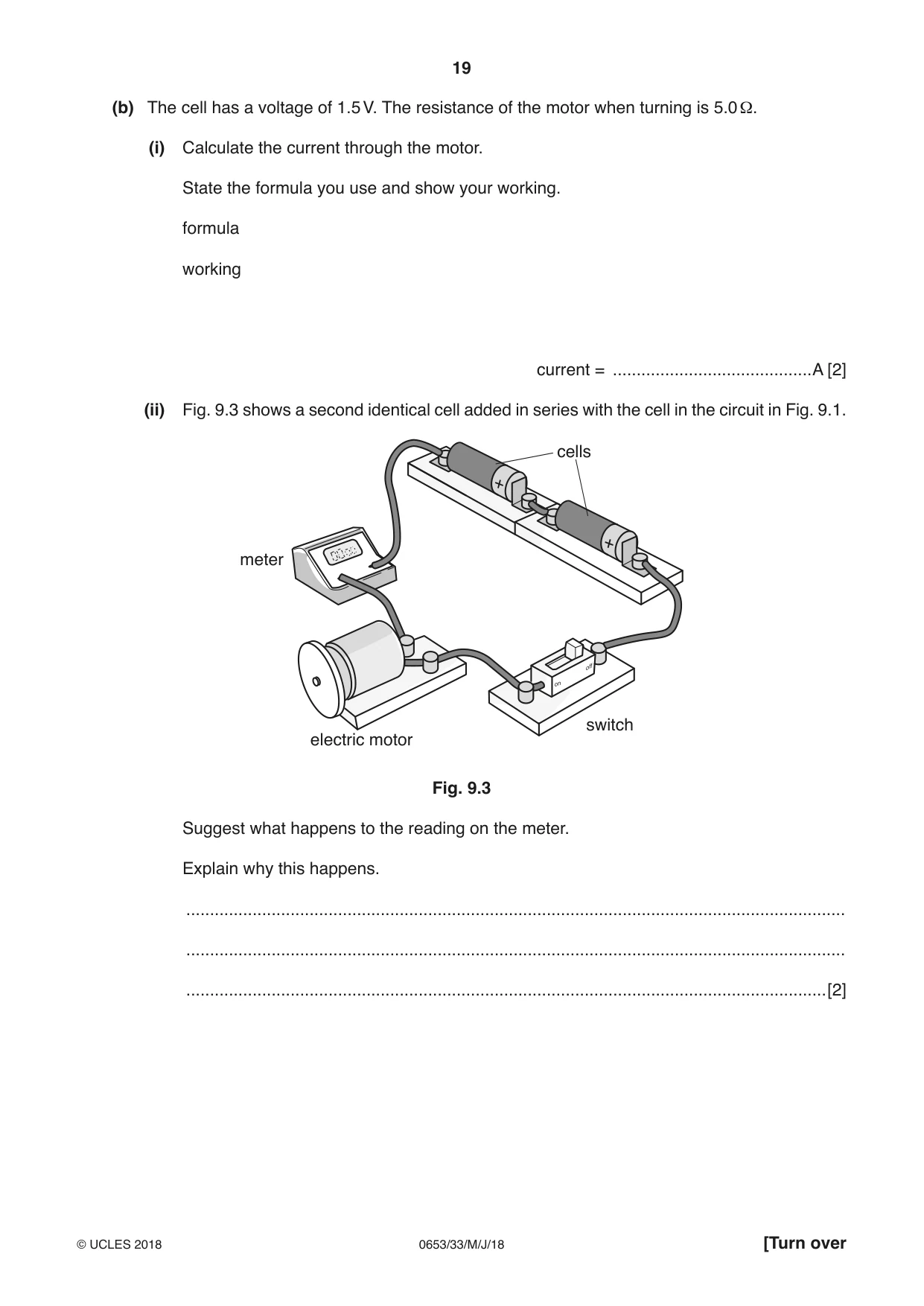
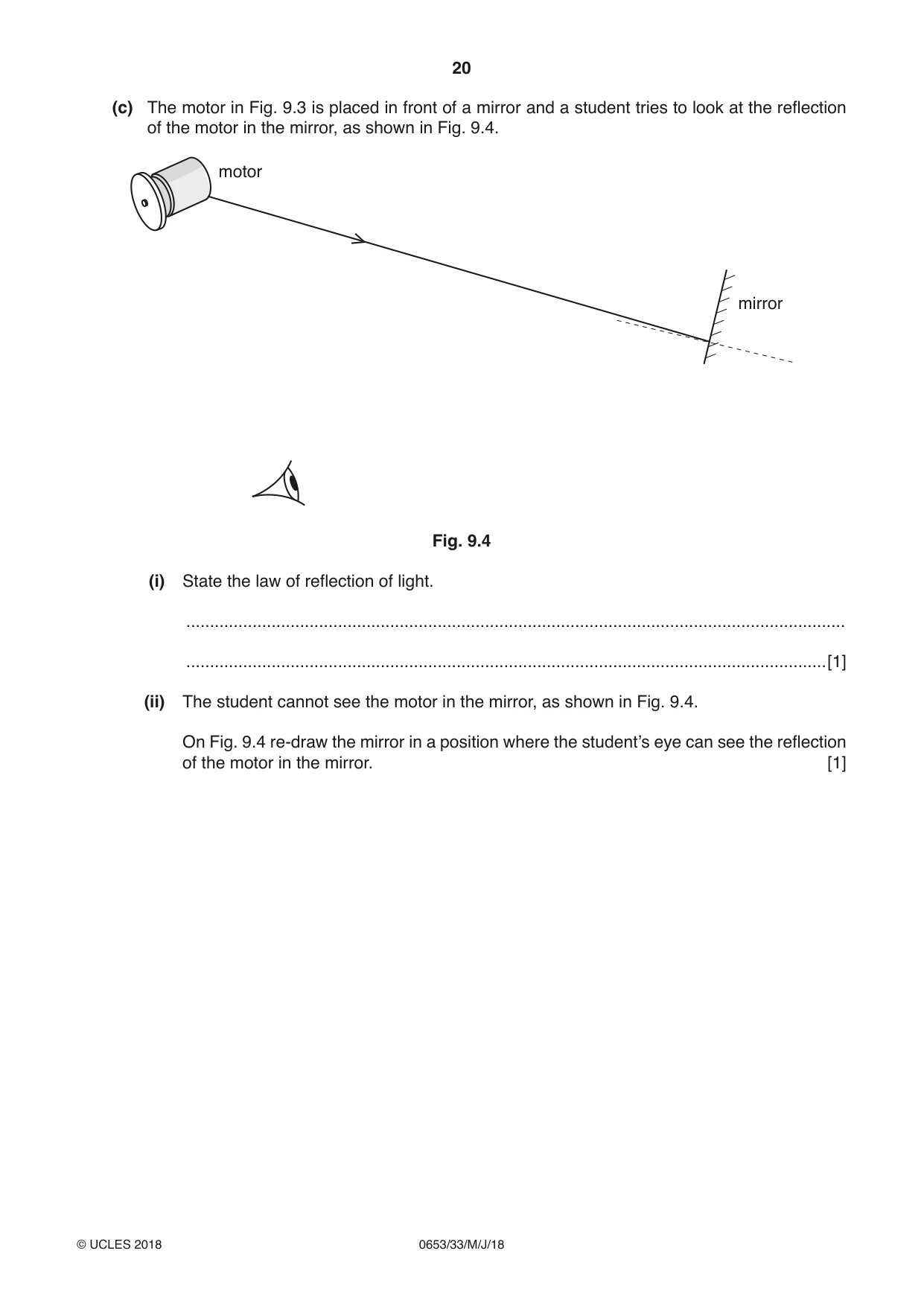
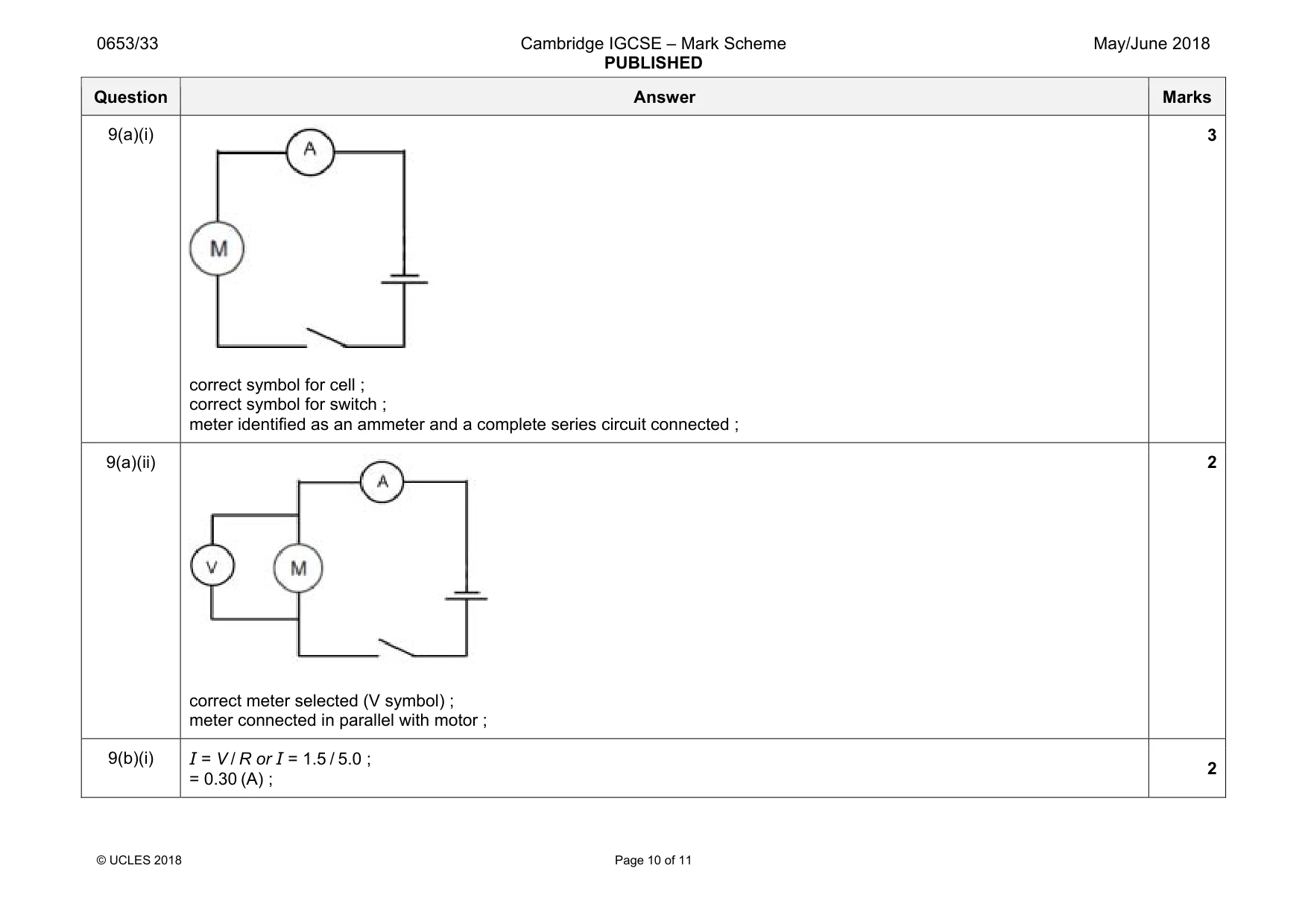
9 Fig. 9.1 shows a simple circuit set up to investigate the current through an electric motor. cell meter + off switch electric motor Fig. 9.1 (a) (i) On Fig. 9.2 use the correct circuit symbols to complete the circuit diagram for the circuit arrangement shown in Fig. 9.1. The symbol for an electric motor is shown. M Fig. 9.2 [3] (ii) On Fig. 9.2, using the correct circuit symbol, connect a meter into the circuit that can measure the potential difference across the motor. [2] (b) The cell has a voltage of 1.5 V. The resistance of the motor when turning is 5.0 Ω. (i) Calculate the current through the motor. State the formula you use and show your working. formula working current = ..........................................A [2] (ii) Fig. 9.3 shows a second identical cell added in series with the cell in the circuit in Fig. 9.1. cells + + meter off switch electric motor Fig. 9.3 Suggest what happens to the reading on the meter. Explain why this happens. ........................................................................................................................................... ........................................................................................................................................... .......................................................................................................................................[2] (c) The motor in Fig. 9.3 is placed in front of a mirror and a student tries to look at the reflection of the motor in the mirror, as shown in Fig. 9.4. motor mirror Fig. 9.4 (i) State the law of reflection of light. ........................................................................................................................................... .......................................................................................................................................[1] (ii) The student cannot see the motor in the mirror, as shown in Fig. 9.4. On Fig. 9.4 re‑draw the mirror in a position where the student’s eye can see the reflection of the motor in the mirror. [1]
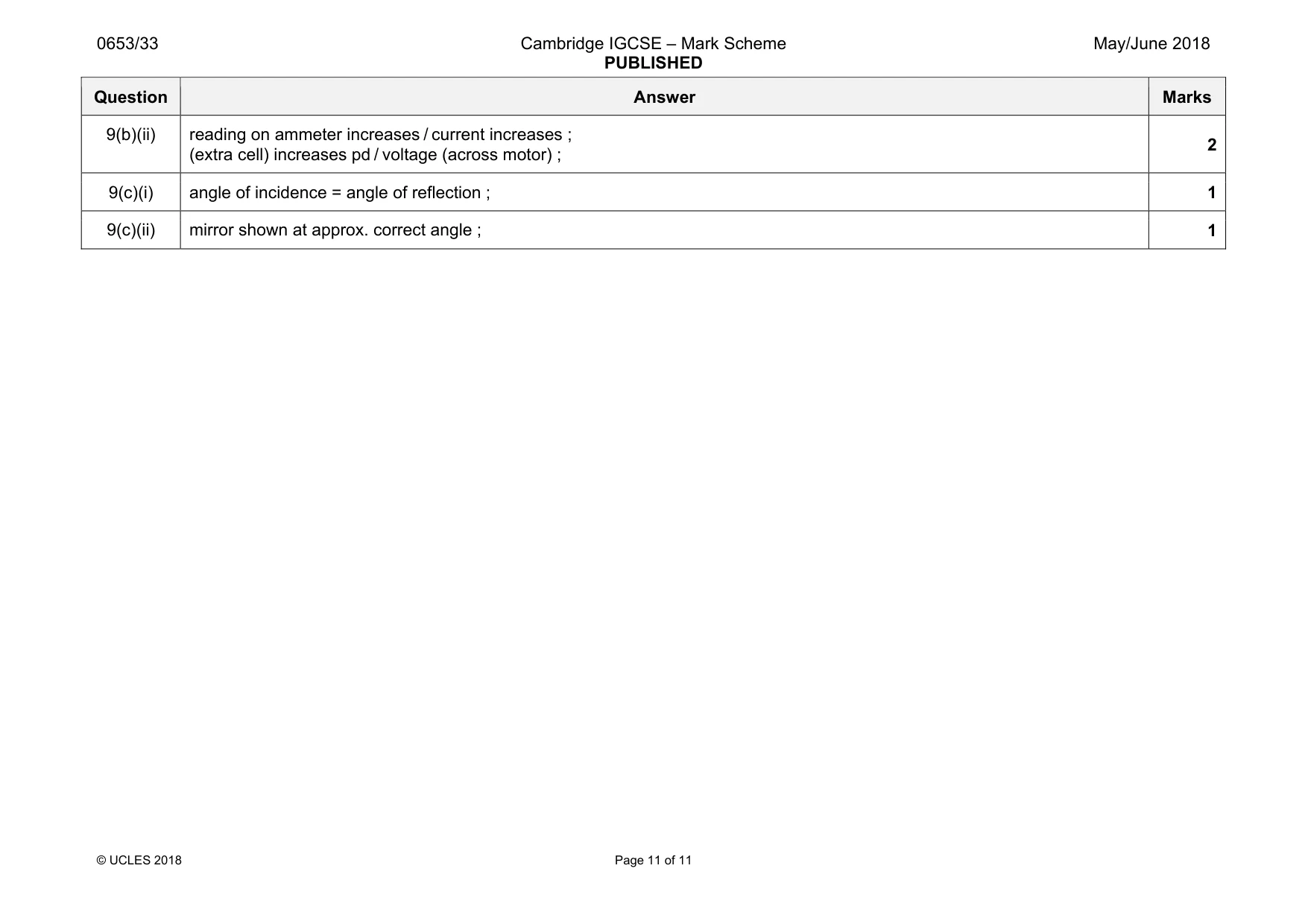
Mark scheme: 9(a)(i) correct symbol for cell ; correct symbol for switch ; meter identified as an ammeter and a complete series circuit connected ; 3 9(a)(ii) correct meter selected (V symbol) ; meter connected in parallel with motor ; 2 9(b)(i) I = V / R or I = 1.5 / 5.0 ; = 0.30 (A) ; 2 Question Answer Marks 9(b)(ii) reading on ammeter increases / current increases ; (extra cell) increases pd / voltage (across motor) ; 2 9(c)(i) angle of incidence = angle of reflection ; 1 9(c)(ii) mirror shown at approx. correct angle ; 1
What was in this paper
The subtopics covered by these 9 questions, and how many questions each got. Open one in a new tab to see every Cambridge question on it.
What you needed in this session
Cambridge’s own grade thresholds for 2018 May/June, Paper 3 · Variant 3. A higher threshold means an easier paper — the bar moves with how the cohort did.