Cambridge IGCSE Science - Combined 0653 — 2023 Oct/Nov Paper 3 · Variant 3
0653/33/O/N/23 · 9 questions · 80 marks · ≈90 min
The question paper and its mark scheme, free to read here and free to download. This is Cambridge’s own paper, exactly as it was sat.
Question paper24 pages



Mark scheme12 pages
Answers below. Sit the paper first if you are practising.
Questions as text
Q1 · A diagram of the human gas exchange system
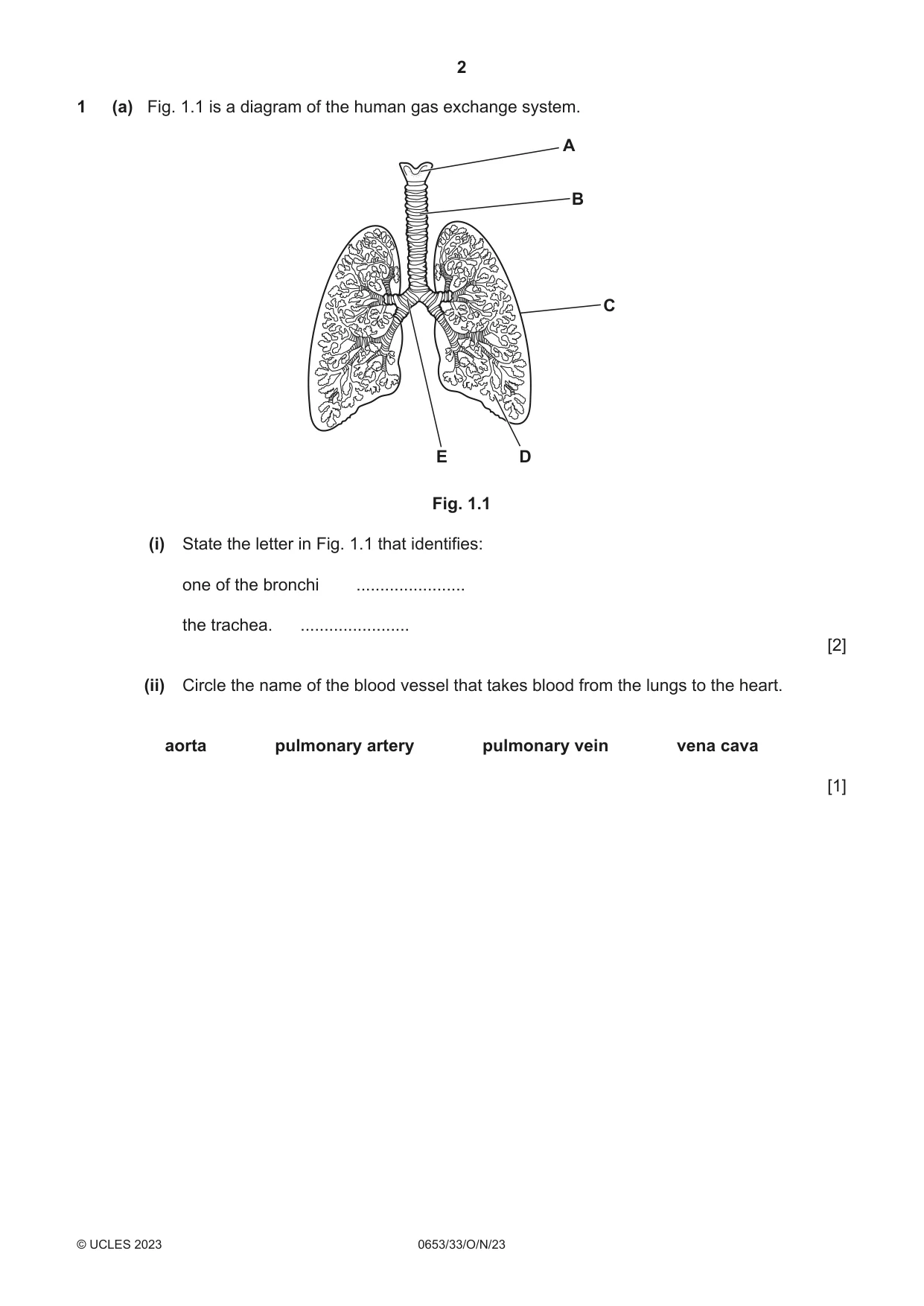
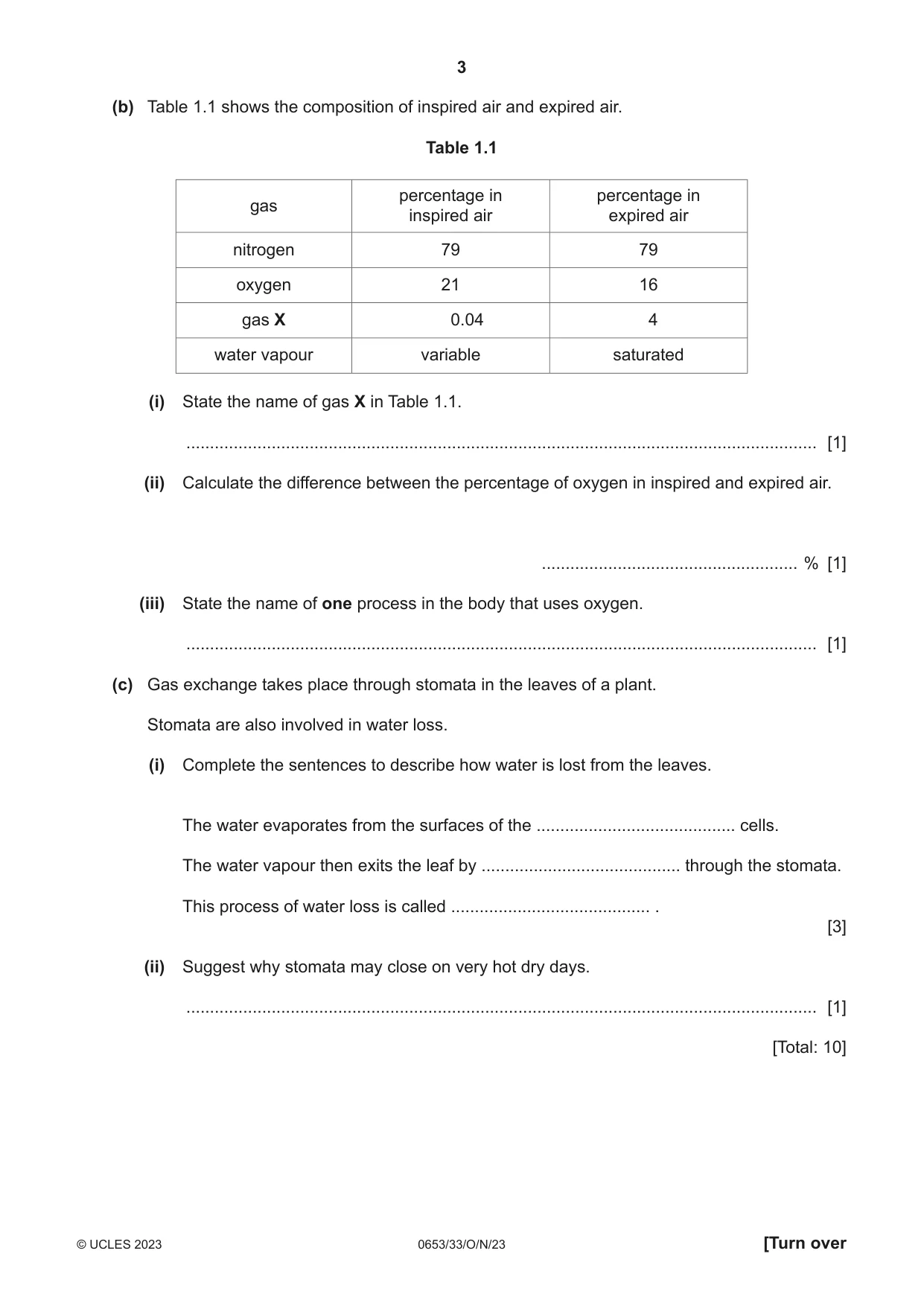
1 (a) Fig. 1.1 is a diagram of the human gas exchange system. A B C E D Fig. 1.1 (i) State the letter in Fig. 1.1 that identifies: one of the bronchi ....................... the trachea. ....................... [2] (ii) Circle the name of the blood vessel that takes blood from the lungs to the heart. aorta pulmonary artery pulmonary vein vena cava [1] (b) Table 1.1 shows the composition of inspired air and expired air. Table 1.1 percentage in percentage in gas inspired air expired air nitrogen 79 79 oxygen 21 16 gas X 0.04 4 water vapour variable saturated (i) State the name of gas X in Table 1.1. ..................................................................................................................................... [1] (ii) Calculate the difference between the percentage of oxygen in inspired and expired air. ...................................................... % [1] (iii) State the name of one process in the body that uses oxygen. ..................................................................................................................................... [1] (c) Gas exchange takes place through stomata in the leaves of a plant. Stomata are also involved in water loss. (i) Complete the sentences to describe how water is lost from the leaves. The water evaporates from the surfaces of the .......................................... cells. The water vapour then exits the leaf by .......................................... through the stomata. This process of water loss is called .......................................... . [3] (ii) Suggest why stomata may close on very hot dry days. ..................................................................................................................................... [1] [Total: 10]
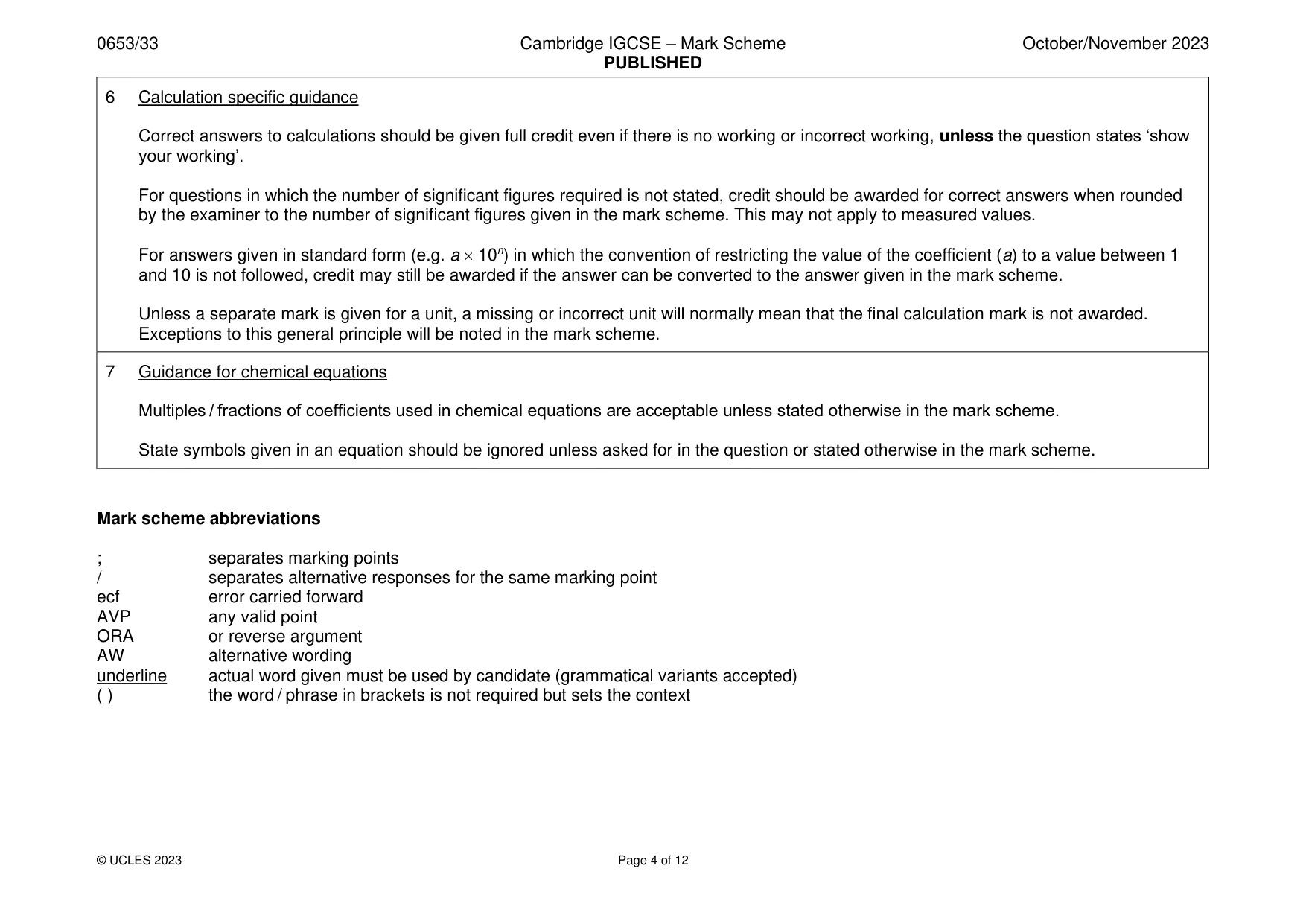
Mark scheme: Question Answer Marks 1(a)(i) E ; 2 B ; 1(a)(ii) pulmonary vein ; 1 1(b)(i) carbon dioxide ; 1 1(b)(ii) 5 ; 1 1(b)(iii) (aerobic) respiration ; 1 1(c)(i) mesophyll ; 3 diffusion / diffusing ; transpiration ; 1(c)(ii) to reduce water loss ; 1
Q2 · A student investigates the reactions of four metals with dilute hydrochloric acid, HCl
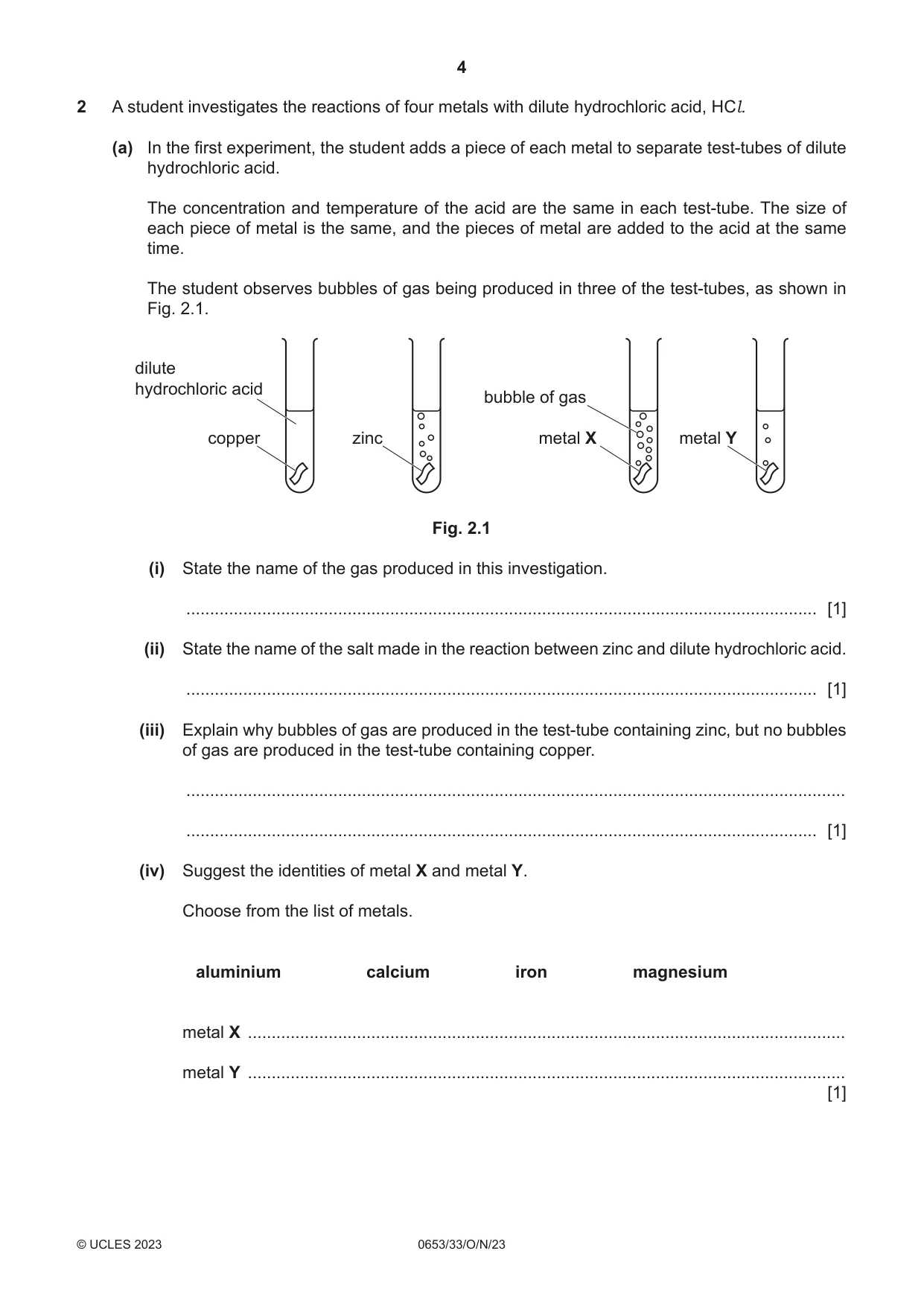
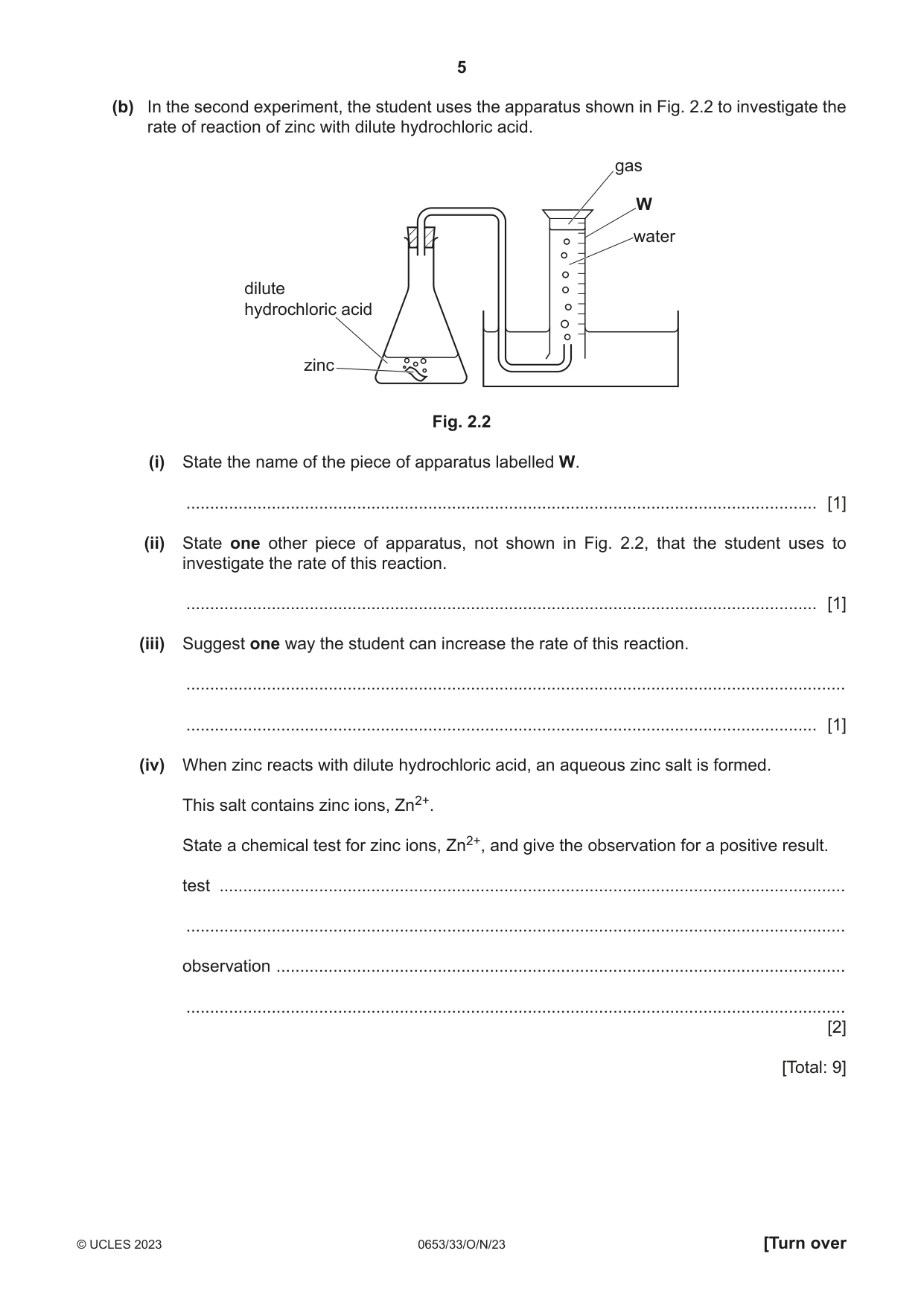
2 A student investigates the reactions of four metals with dilute hydrochloric acid, HCl. (a) In the first experiment, the student adds a piece of each metal to separate test-tubes of dilute hydrochloric acid. The concentration and temperature of the acid are the same in each test-tube. The size of each piece of metal is the same, and the pieces of metal are added to the acid at the same time. The student observes bubbles of gas being produced in three of the test-tubes, as shown in Fig. 2.1. dilute hydrochloric acid bubble of gas copper zinc metal X metal Y Fig. 2.1 (i) State the name of the gas produced in this investigation. ..................................................................................................................................... [1] (ii) State the name of the salt made in the reaction between zinc and dilute hydrochloric acid. ..................................................................................................................................... [1] (iii) Explain why bubbles of gas are produced in the test-tube containing zinc, but no bubbles of gas are produced in the test-tube containing copper. ........................................................................................................................................... ..................................................................................................................................... [1] (iv) Suggest the identities of metal X and metal Y. Choose from the list of metals. aluminium calcium iron magnesium metal X .............................................................................................................................. metal Y .............................................................................................................................. [1] (b) In the second experiment, the student uses the apparatus shown in Fig. 2.2 to investigate the rate of reaction of zinc with dilute hydrochloric acid. gas W water dilute hydrochloric acid zinc Fig. 2.2 (i) State the name of the piece of apparatus labelled W. ..................................................................................................................................... [1] (ii) State one other piece of apparatus, not shown in Fig. 2.2, that the student uses to investigate the rate of this reaction. ..................................................................................................................................... [1] (iii) Suggest one way the student can increase the rate of this reaction. ........................................................................................................................................... ..................................................................................................................................... [1] (iv) When zinc reacts with dilute hydrochloric acid, an aqueous zinc salt is formed. This salt contains zinc ions, Zn2+. State a chemical test for zinc ions, Zn2+, and give the observation for a positive result. test .................................................................................................................................... ........................................................................................................................................... observation ........................................................................................................................ ........................................................................................................................................... [2] [Total: 9]
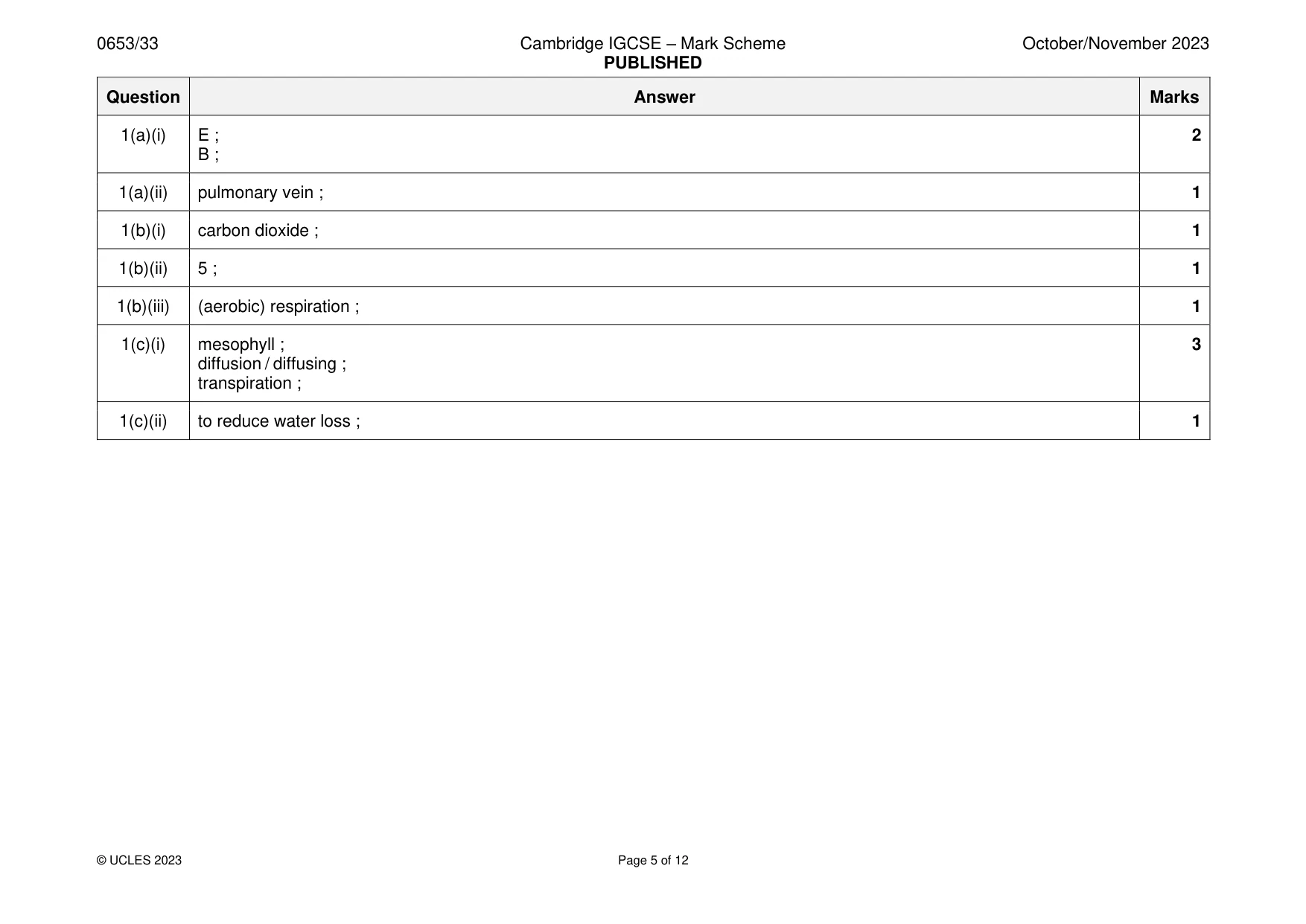
Mark scheme: 2(a)(i) hydrogen ; 1 2(a)(ii) zinc chloride ; 1 2(a)(iii) zinc is more reactive (than copper / hydrogen) ORA ; 1 2(a)(iv) metal X: calcium / aluminium / magnesium ; 1 metal Y: iron ; 2(b)(i) measuring cylinder ; 1 2(b)(ii) stop-watch / timer ; 1 2(b)(iii) any one from: 1 increase concentration (of acid) ; increase temperature ; increase surface area of zinc / use smaller zinc pieces ; use a catalyst ; 2(b)(iv) test: aqueous sodium hydroxide / aqueous ammonia ; 2 result: white precipitate / solid AND solid is soluble in excess solution ;
Q3 · A truck carrying a load moving horizontally along a flat level road
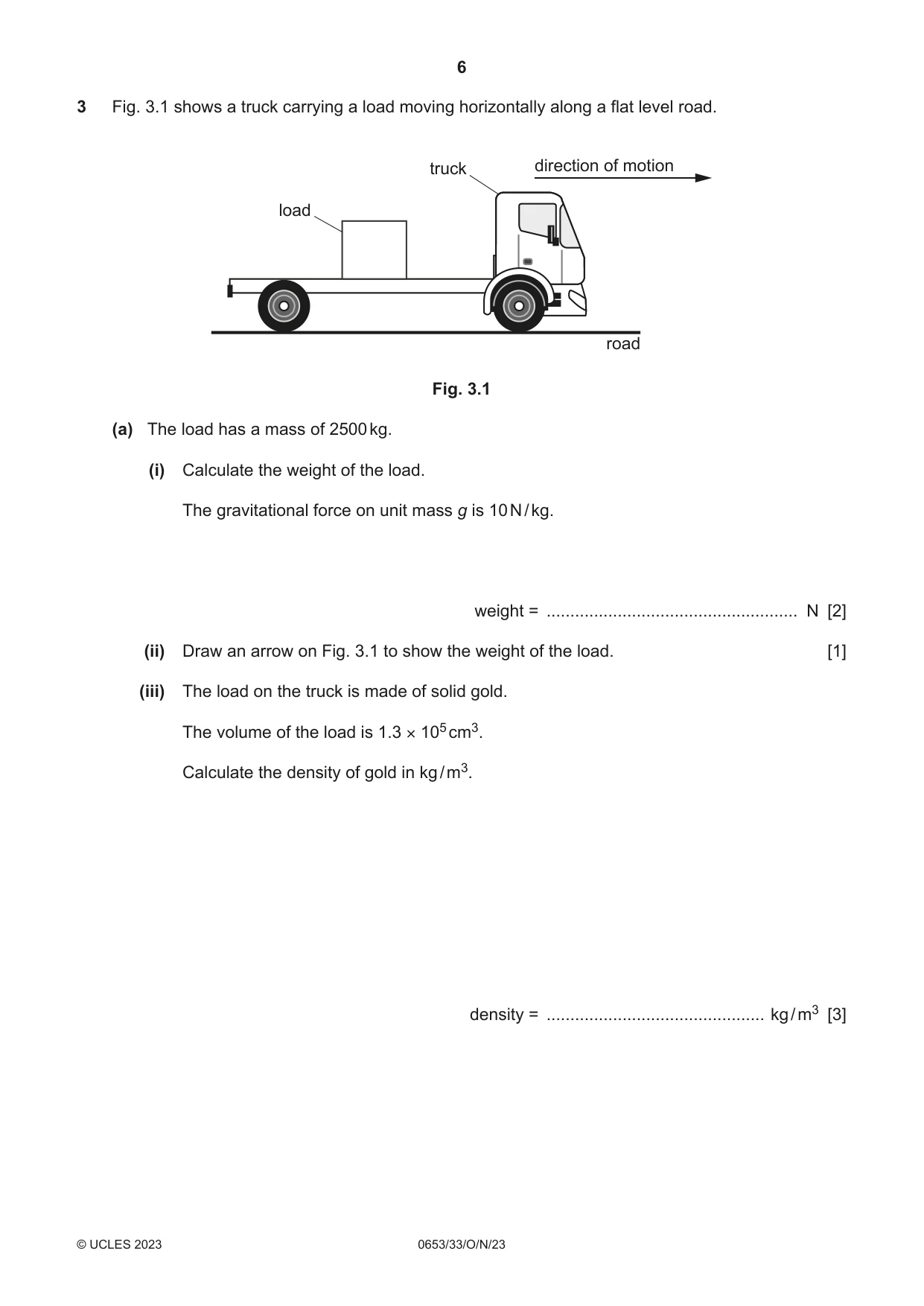
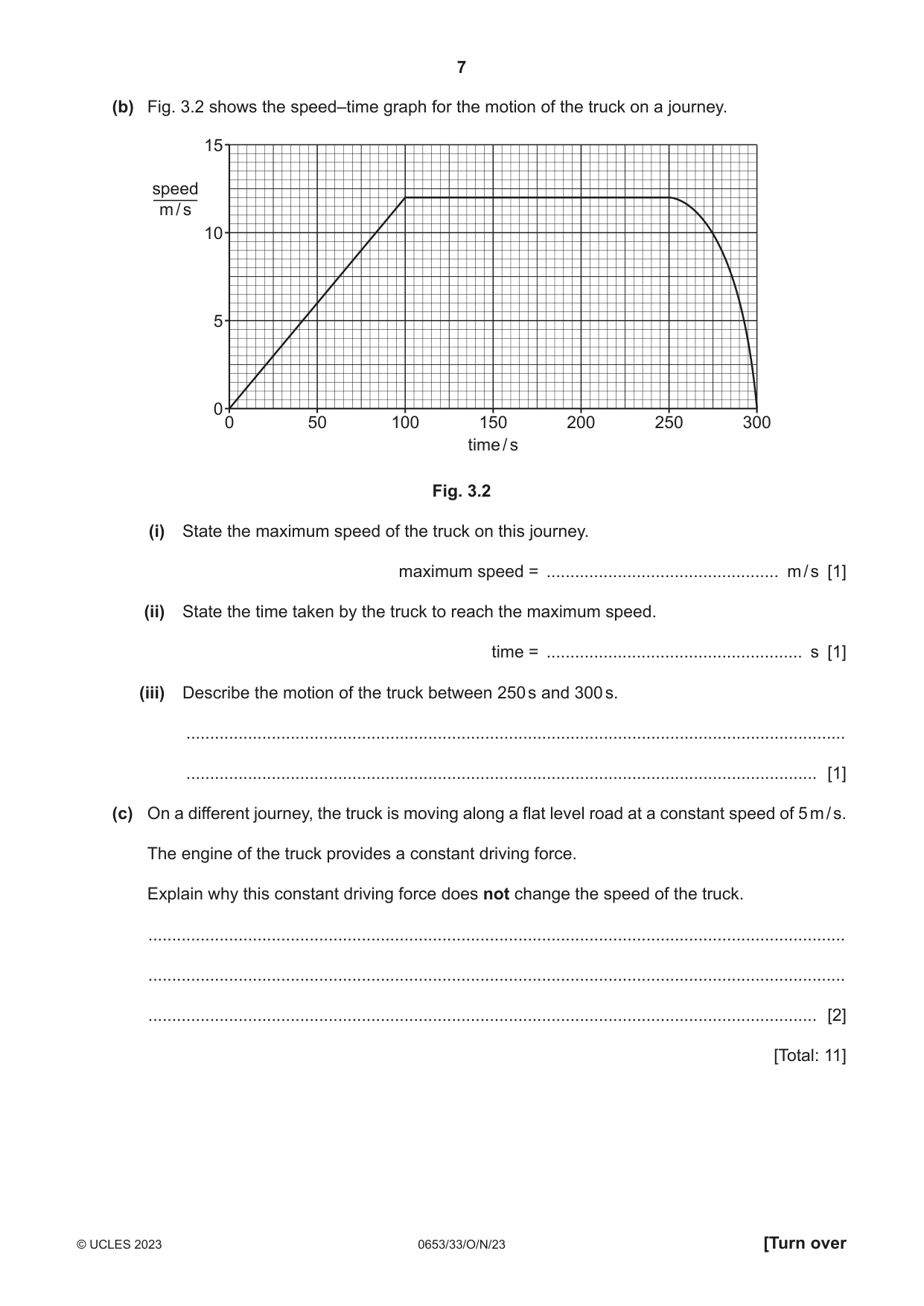
3 Fig. 3.1 shows a truck carrying a load moving horizontally along a flat level road. truck direction of motion load road Fig. 3.1 (a) The load has a mass of 2500 kg. (i) Calculate the weight of the load. The gravitational force on unit mass g is 10 N / kg. weight = ..................................................... N [2] (ii) Draw an arrow on Fig. 3.1 to show the weight of the load. [1] (iii) The load on the truck is made of solid gold. The volume of the load is 1.3 × 105 cm3. Calculate the density of gold in kg / m3. density = .............................................. kg / m3 [3] (b) Fig. 3.2 shows the speed–time graph for the motion of the truck on a journey. 15 speed m / s 10 5 0 0 50 100 150 200 250 300 time / s Fig. 3.2 (i) State the maximum speed of the truck on this journey. maximum speed = ................................................. m / s [1] (ii) State the time taken by the truck to reach the maximum speed. time = ...................................................... s [1] (iii) Describe the motion of the truck between 250 s and 300 s. ........................................................................................................................................... ..................................................................................................................................... [1] (c) On a different journey, the truck is moving along a flat level road at a constant speed of 5 m / s. The engine of the truck provides a constant driving force. Explain why this constant driving force does not change the speed of the truck. ................................................................................................................................................... ................................................................................................................................................... ............................................................................................................................................. [2] [Total: 11]
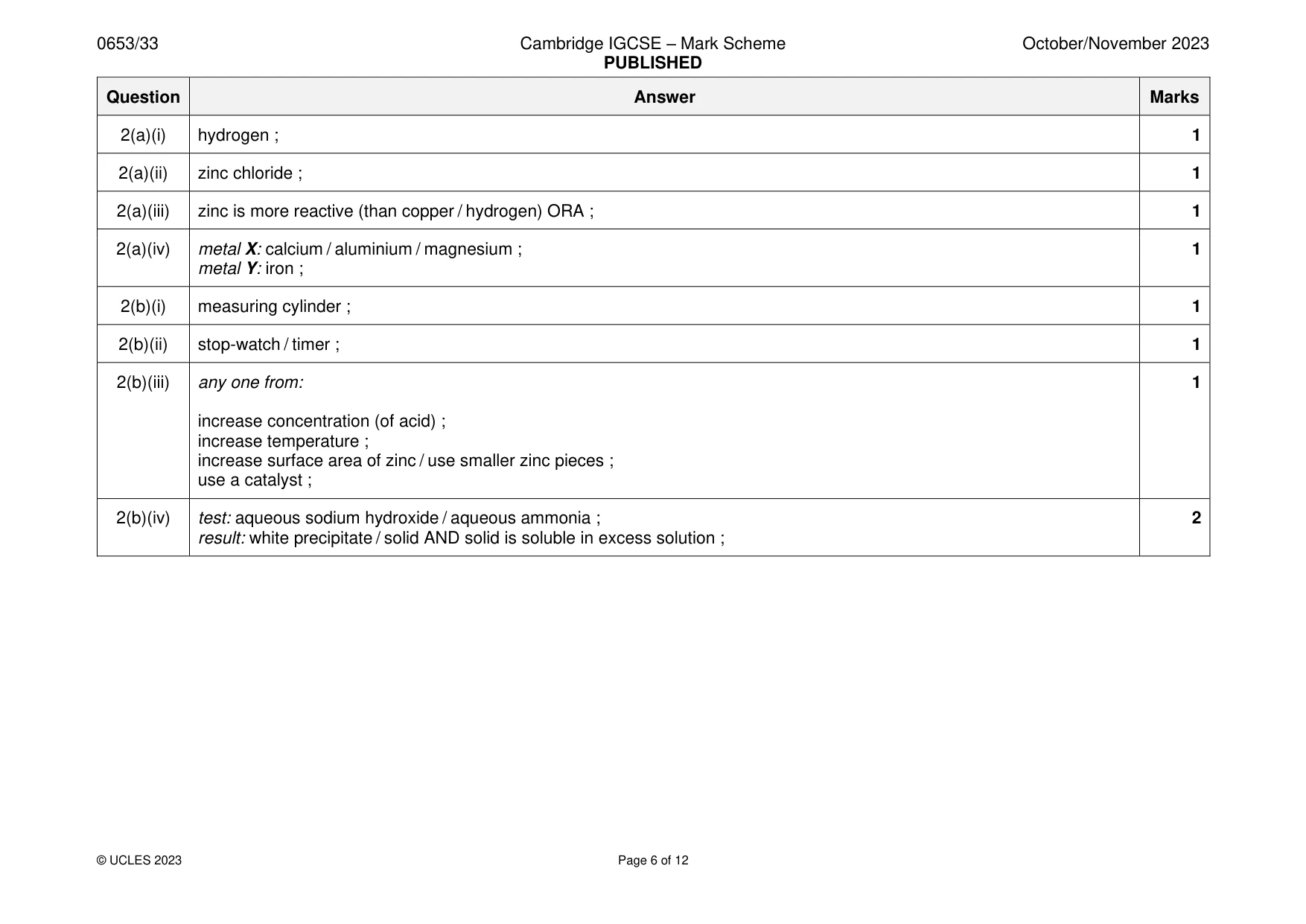
Mark scheme: 3(a)(i) evidence of, W = mg / 2500 10 ; 2 25 000 (N) ; 3(a)(ii) arrow touching load and vertically downwards ; 1 3(a)(iii) conversion of volume to m3 correct / 1.3 105 ÷ 106 = 0.13 m3 ; 3 m evidence of, = / 2500 ÷ 0.13 ; V 19 000 (kg / m3) ; 3(b)(i) 12 (m / s) ; 1 3(b)(ii) 100 (s) ; 1 3(b)(iii) (non-constant) deceleration / decreasing in speed ; 1 3(c) idea of, frictional / resistive / opposing, force(s) ; 2 no resultant force ;
Q4 · A food web for one ecosystem
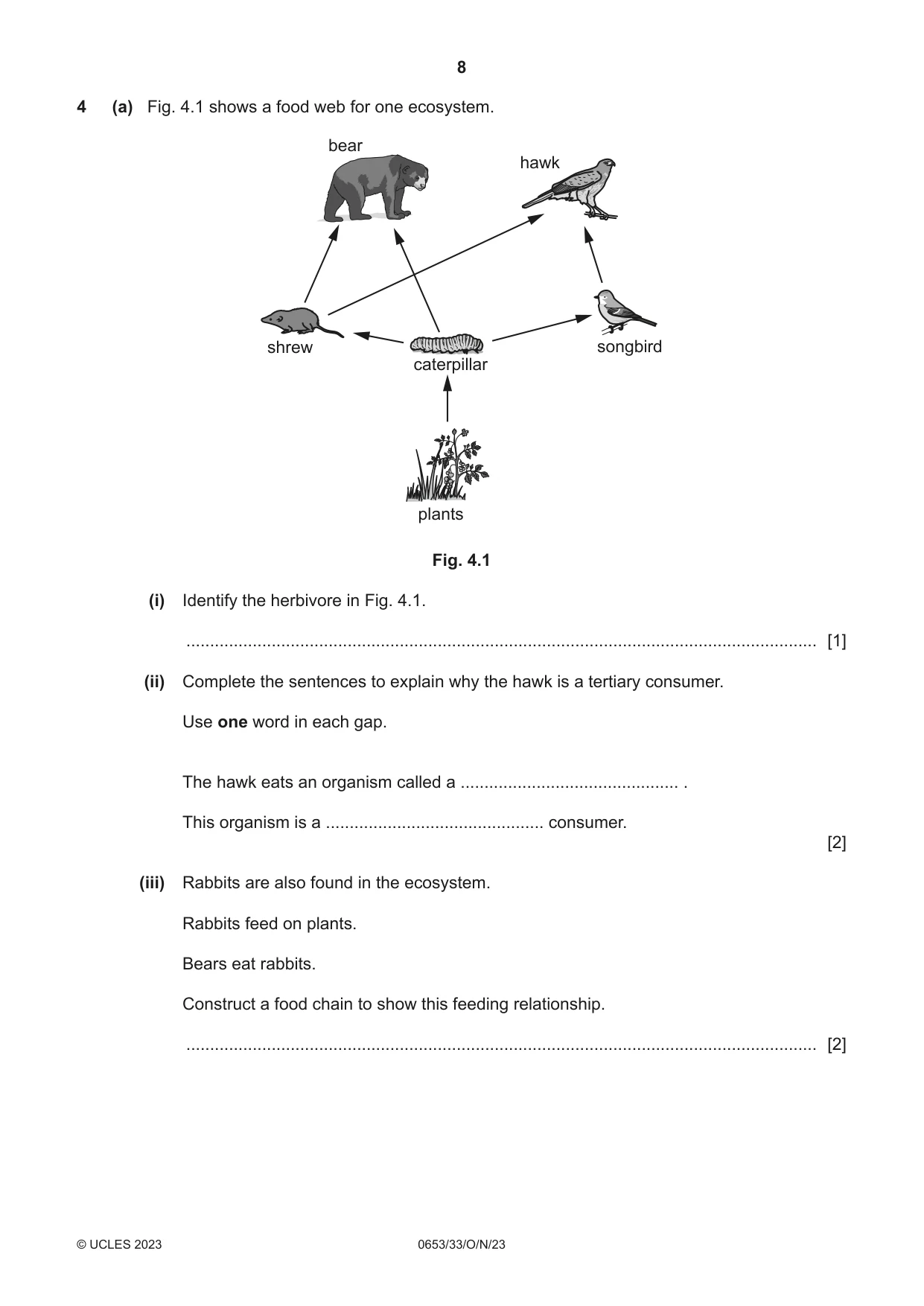
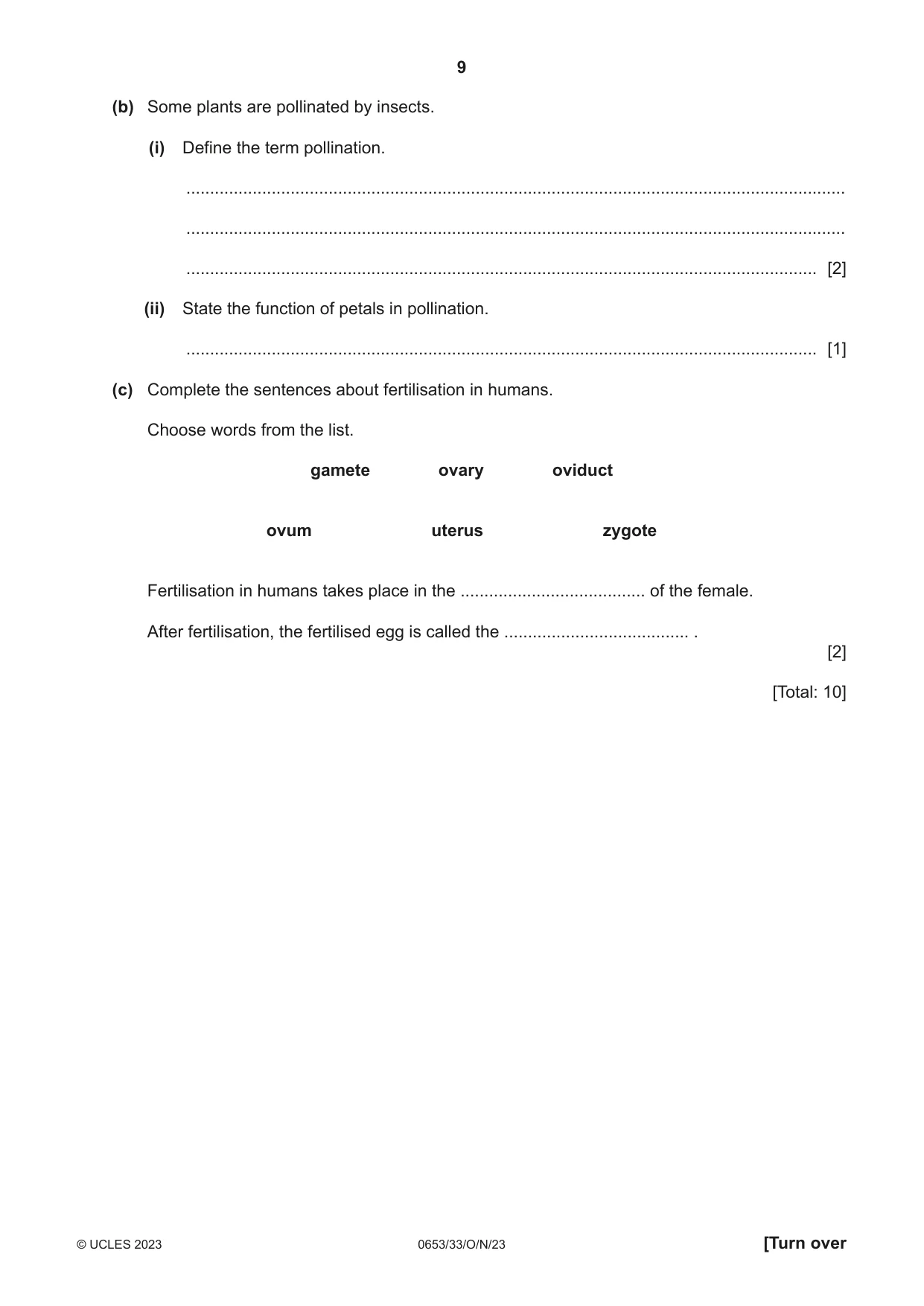
4 (a) Fig. 4.1 shows a food web for one ecosystem. bear hawk shrew songbird caterpillar plants Fig. 4.1 (i) Identify the herbivore in Fig. 4.1. ..................................................................................................................................... [1] (ii) Complete the sentences to explain why the hawk is a tertiary consumer. Use one word in each gap. The hawk eats an organism called a .............................................. . This organism is a .............................................. consumer. [2] (iii) Rabbits are also found in the ecosystem. Rabbits feed on plants. Bears eat rabbits. Construct a food chain to show this feeding relationship. ..................................................................................................................................... [2] (b) Some plants are pollinated by insects. (i) Define the term pollination. ........................................................................................................................................... ........................................................................................................................................... ..................................................................................................................................... [2] (ii) State the function of petals in pollination. ..................................................................................................................................... [1] (c) Complete the sentences about fertilisation in humans. Choose words from the list. gamete ovary oviduct ovum uterus zygote Fertilisation in humans takes place in the ....................................... of the female. After fertilisation, the fertilised egg is called the ....................................... . [2] [Total: 10]
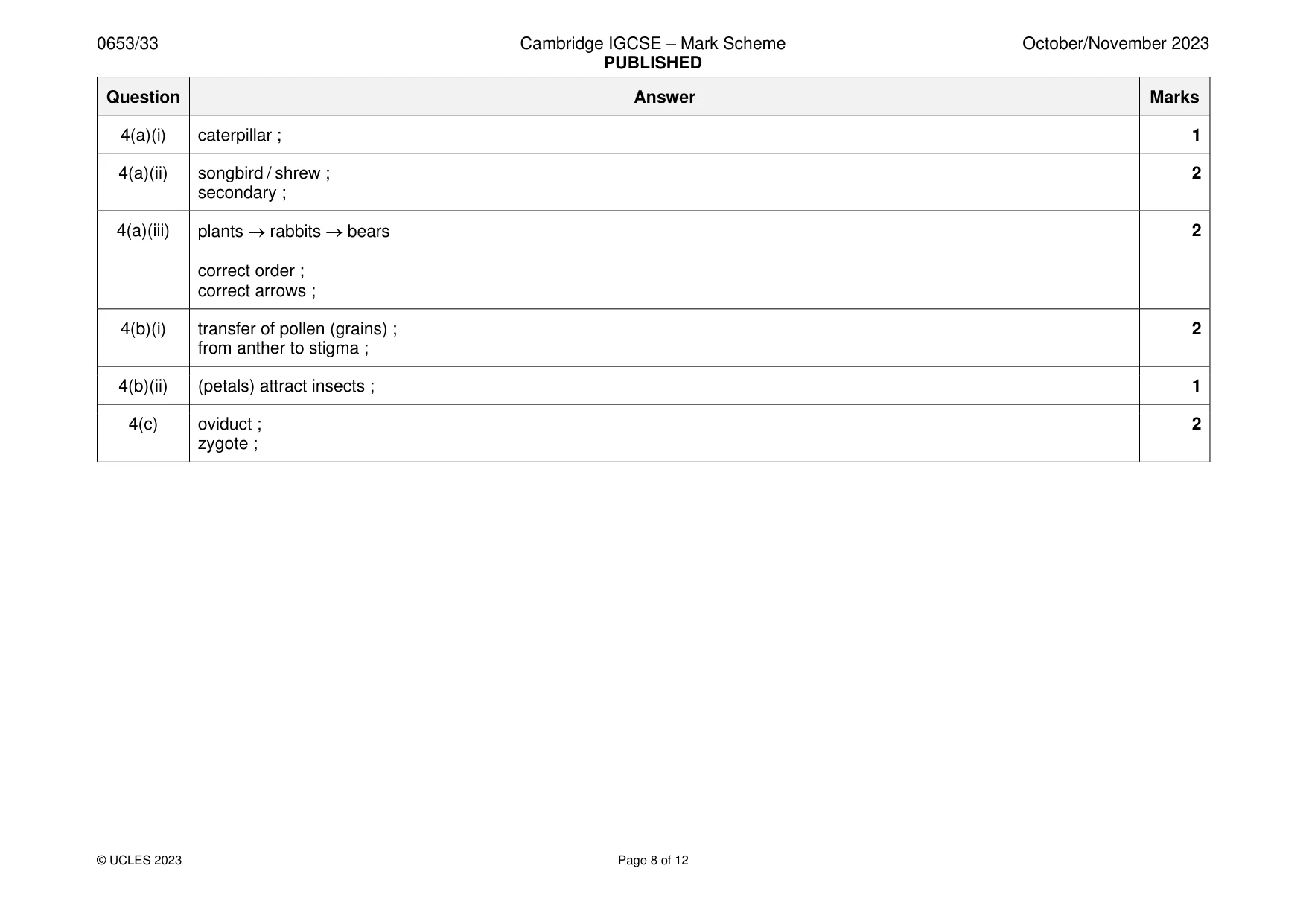
Mark scheme: 4(a)(i) caterpillar ; 1 4(a)(ii) songbird / shrew ; 2 secondary ; 4(a)(iii) plants → rabbits → bears 2 correct order ; correct arrows ; 4(b)(i) transfer of pollen (grains) ; 2 from anther to stigma ; 4(b)(ii) (petals) attract insects ; 1 4(c) oviduct ; 2 zygote ;
Q5 · Natural gas and petroleum are fossil fuels
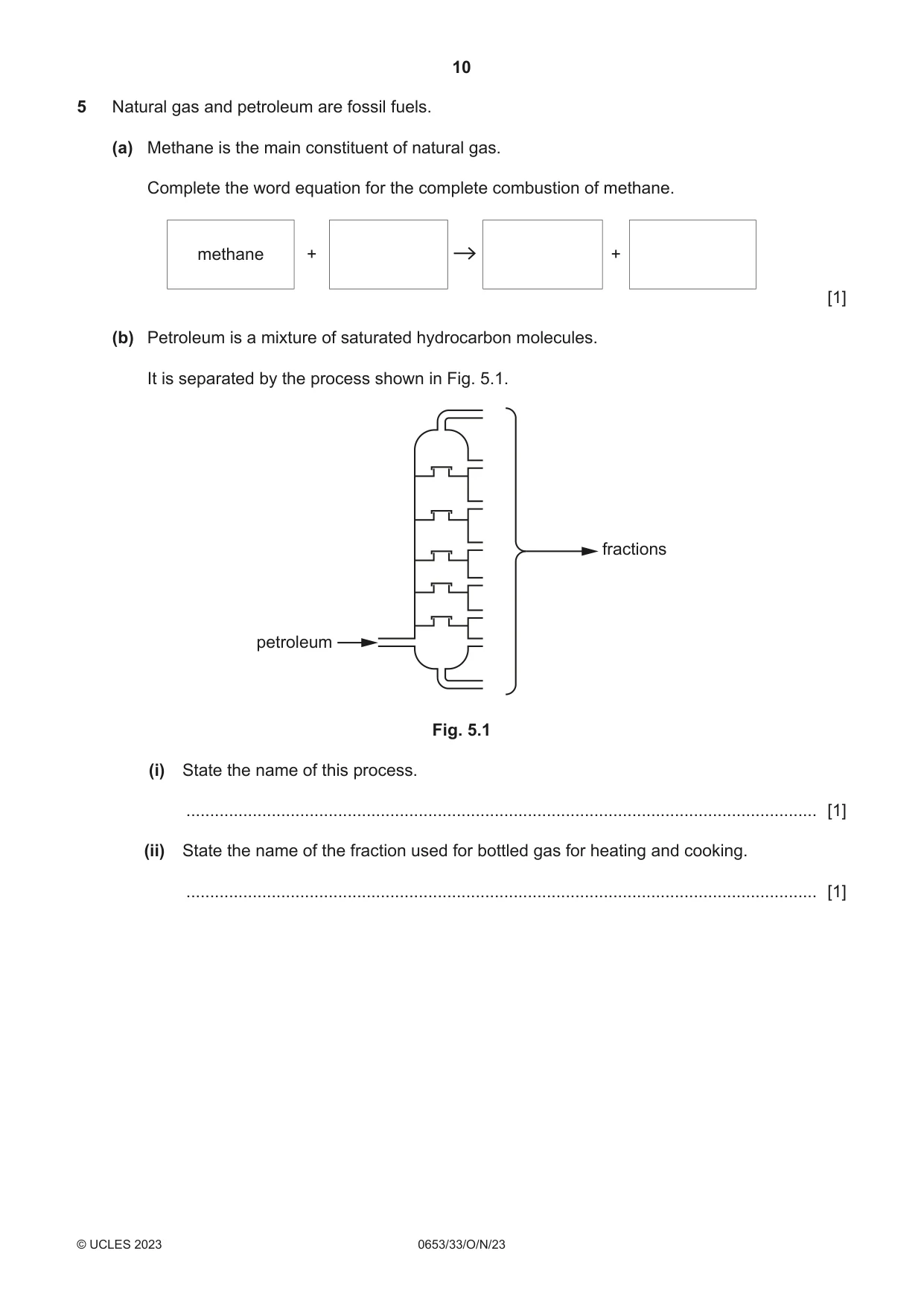
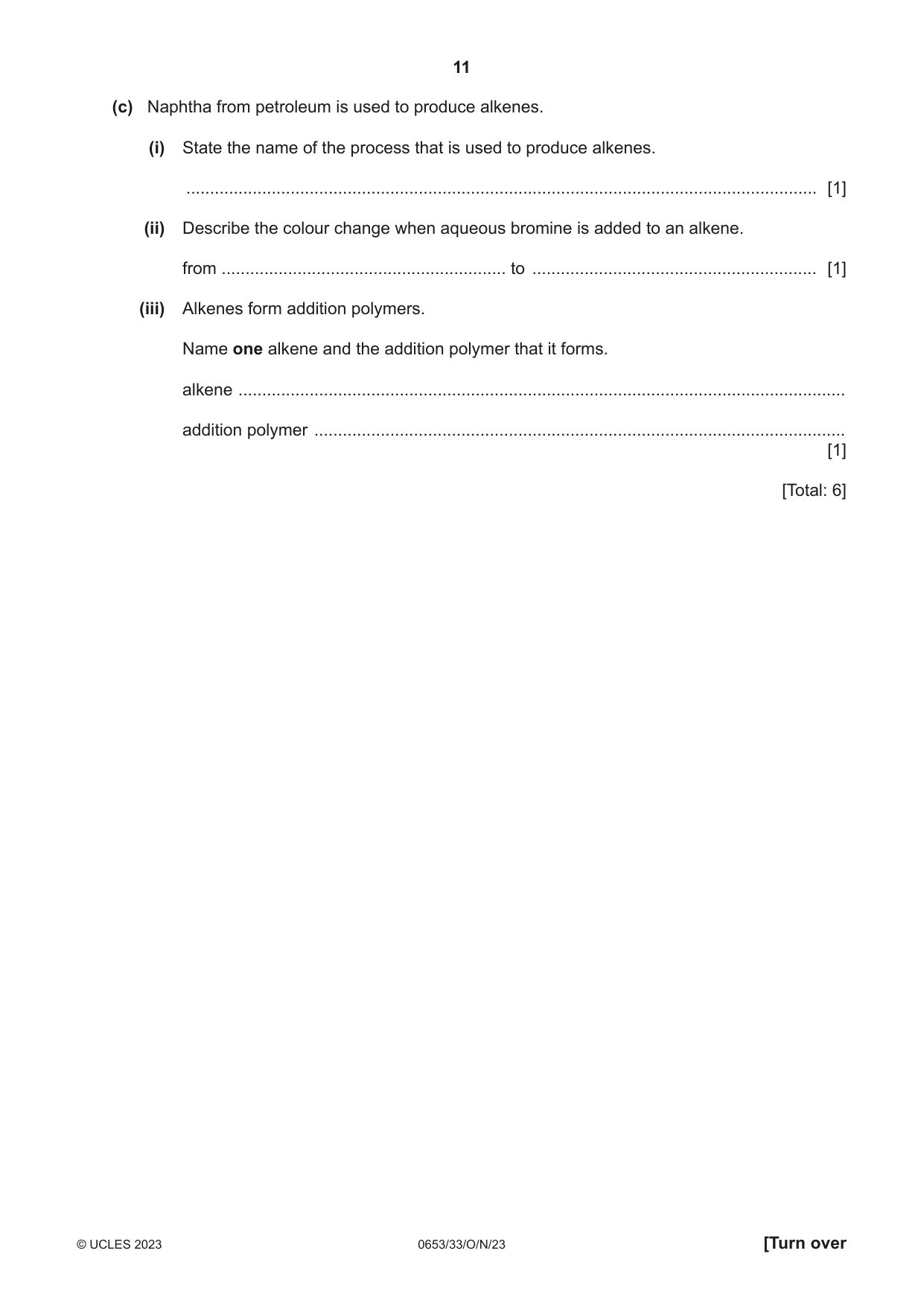
5 Natural gas and petroleum are fossil fuels. (a) Methane is the main constituent of natural gas. Complete the word equation for the complete combustion of methane. methane + + [1] (b) Petroleum is a mixture of saturated hydrocarbon molecules. It is separated by the process shown in Fig. 5.1. fractions petroleum Fig. 5.1 (i) State the name of this process. ..................................................................................................................................... [1] (ii) State the name of the fraction used for bottled gas for heating and cooking. ..................................................................................................................................... [1] (c) Naphtha from petroleum is used to produce alkenes. (i) State the name of the process that is used to produce alkenes. ..................................................................................................................................... [1] (ii) Describe the colour change when aqueous bromine is added to an alkene. from ............................................................ to ............................................................ [1] (iii) Alkenes form addition polymers. Name one alkene and the addition polymer that it forms. alkene ................................................................................................................................ addition polymer ................................................................................................................ [1] [Total: 6]
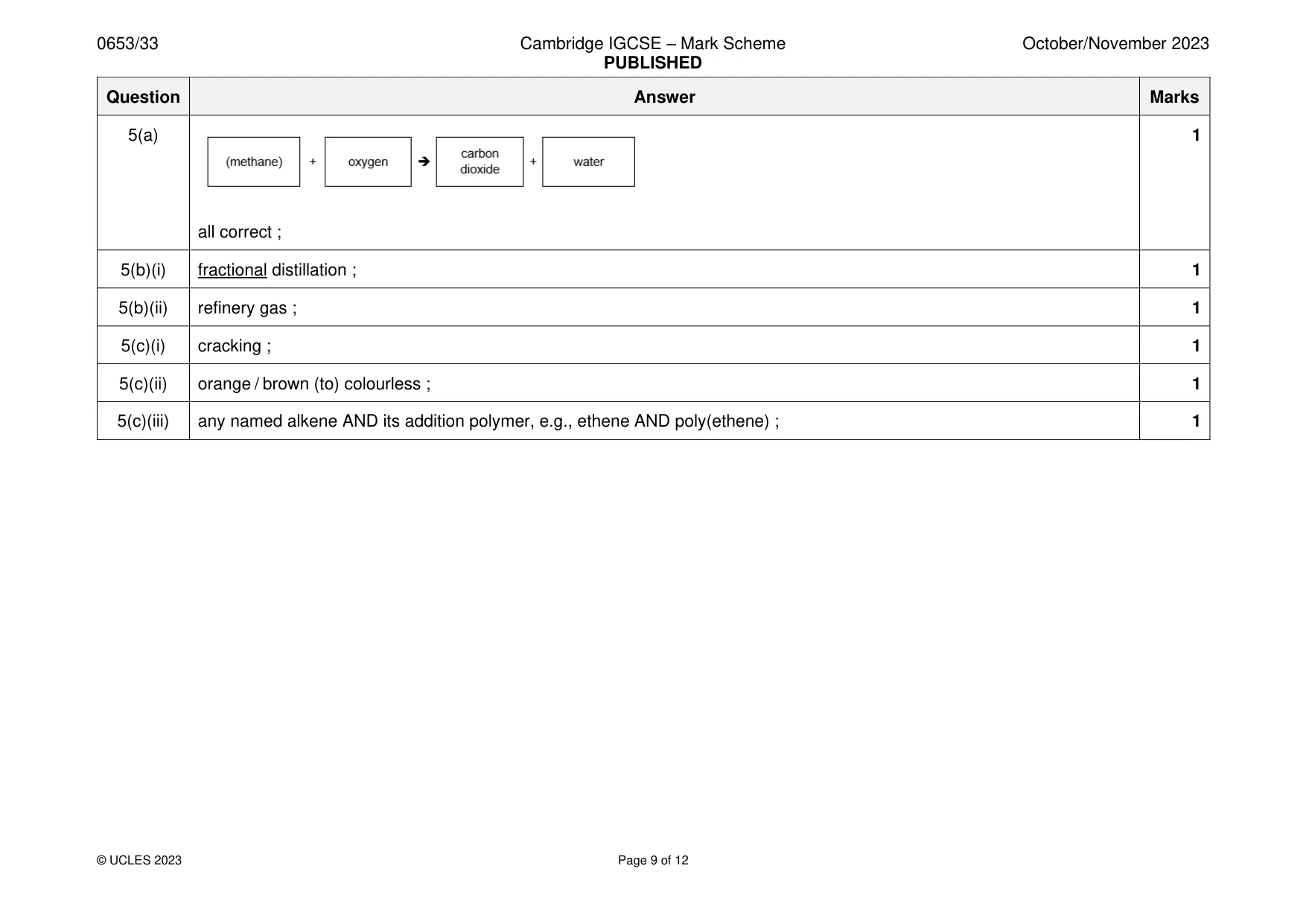
Mark scheme: 5(a) 1 all correct ; 5(b)(i) fractional distillation ; 1 5(b)(ii) refinery gas ; 1 5(c)(i) cracking ; 1 5(c)(ii) orange / brown (to) colourless ; 1 5(c)(iii) any named alkene AND its addition polymer, e.g., ethene AND poly(ethene) ; 1
Q6 · A wind turbine used to generate electricity for the electrical system of a house
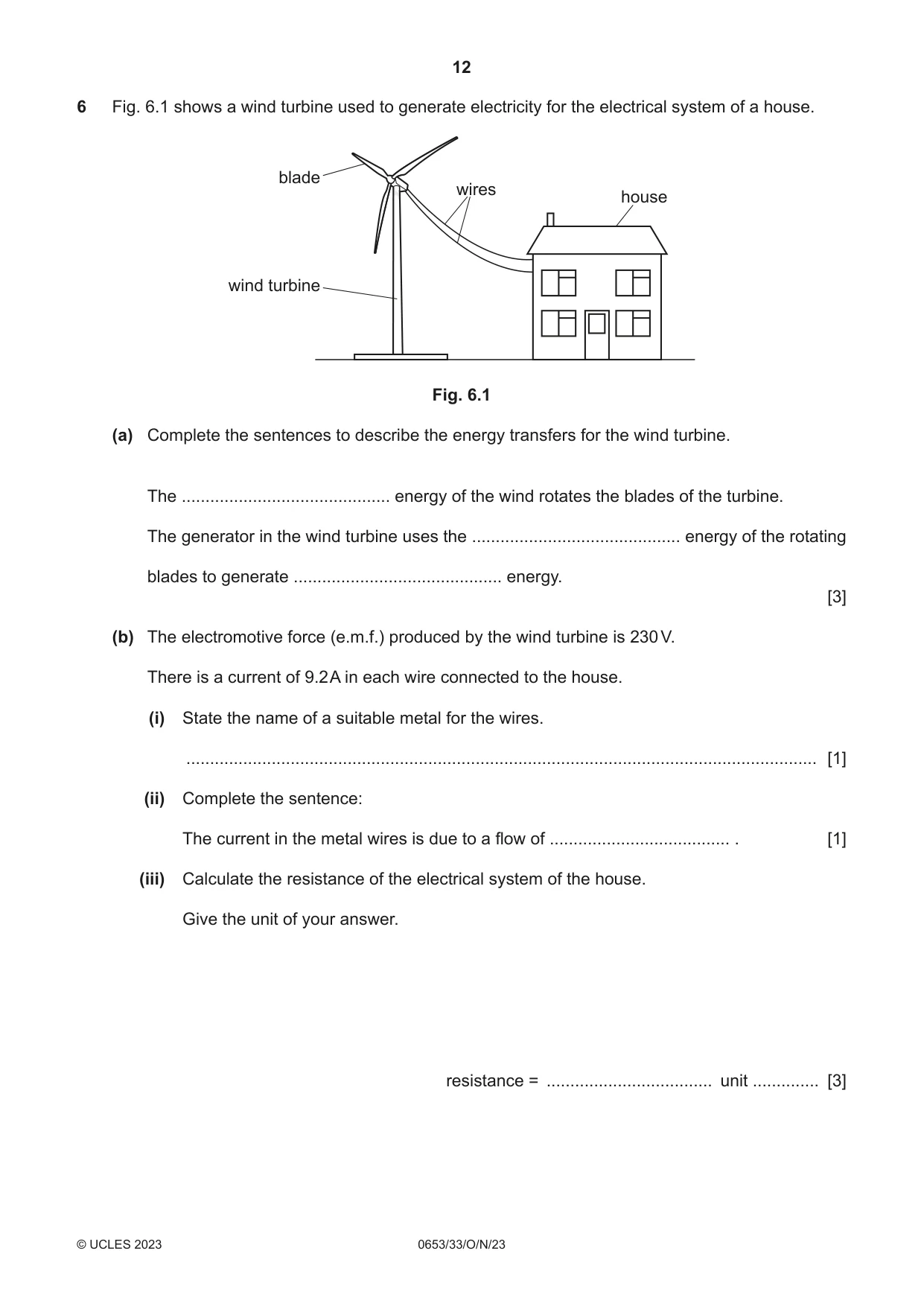
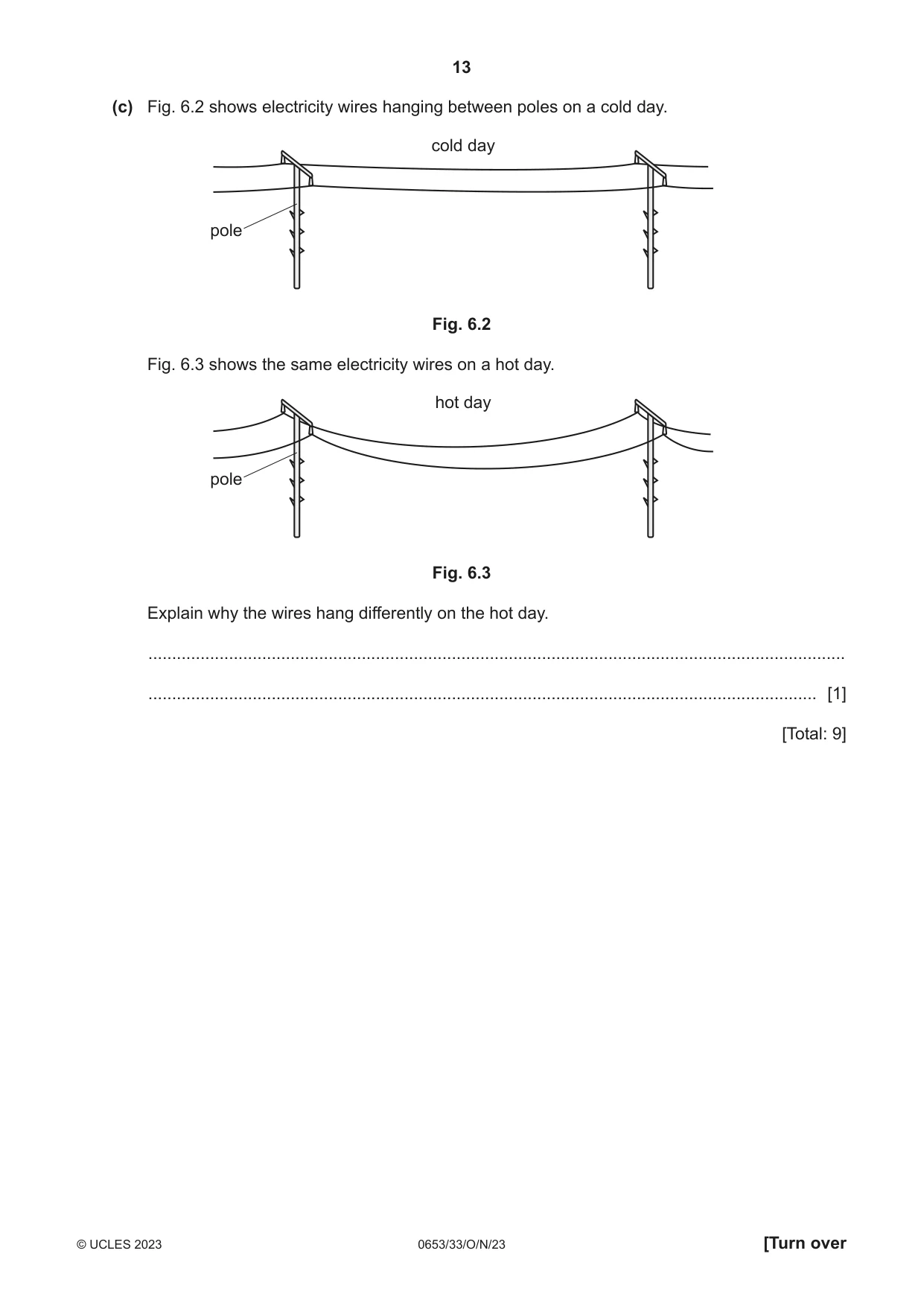
6 Fig. 6.1 shows a wind turbine used to generate electricity for the electrical system of a house. blade wires house wind turbine Fig. 6.1 (a) Complete the sentences to describe the energy transfers for the wind turbine. The ............................................ energy of the wind rotates the blades of the turbine. The generator in the wind turbine uses the ............................................ energy of the rotating blades to generate ............................................ energy. [3] (b) The electromotive force (e.m.f.) produced by the wind turbine is 230 V. There is a current of 9.2 A in each wire connected to the house. (i) State the name of a suitable metal for the wires. ..................................................................................................................................... [1] (ii) Complete the sentence: The current in the metal wires is due to a flow of ...................................... . [1] (iii) Calculate the resistance of the electrical system of the house. Give the unit of your answer. resistance = ................................... unit .............. [3] (c) Fig. 6.2 shows electricity wires hanging between poles on a cold day. cold day pole Fig. 6.2 Fig. 6.3 shows the same electricity wires on a hot day. hot day pole Fig. 6.3 Explain why the wires hang differently on the hot day. ................................................................................................................................................... ............................................................................................................................................. [1] [Total: 9]
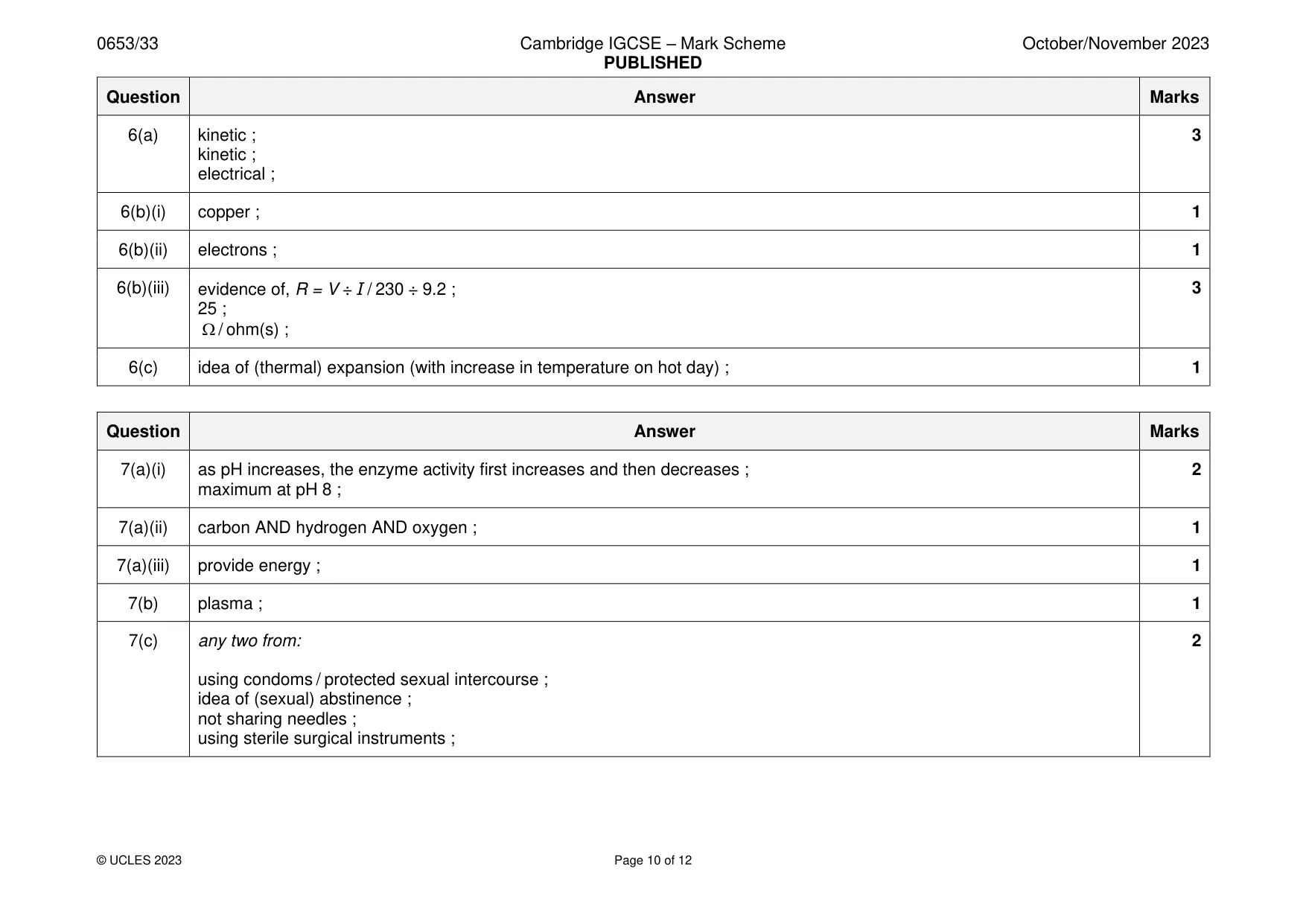
Mark scheme: 6(a) kinetic ; 3 kinetic ; electrical ; 6(b)(i) copper ; 1 6(b)(ii) electrons ; 1 6(b)(iii) evidence of, R = V ÷ I / 230 ÷ 9.2 ; 3 25 ; / ohm(s) ; 6(c) idea of (thermal) expansion (with increase in temperature on hot day) ; 1
Q7 · Carbohydrates are part of a balanced diet for humans
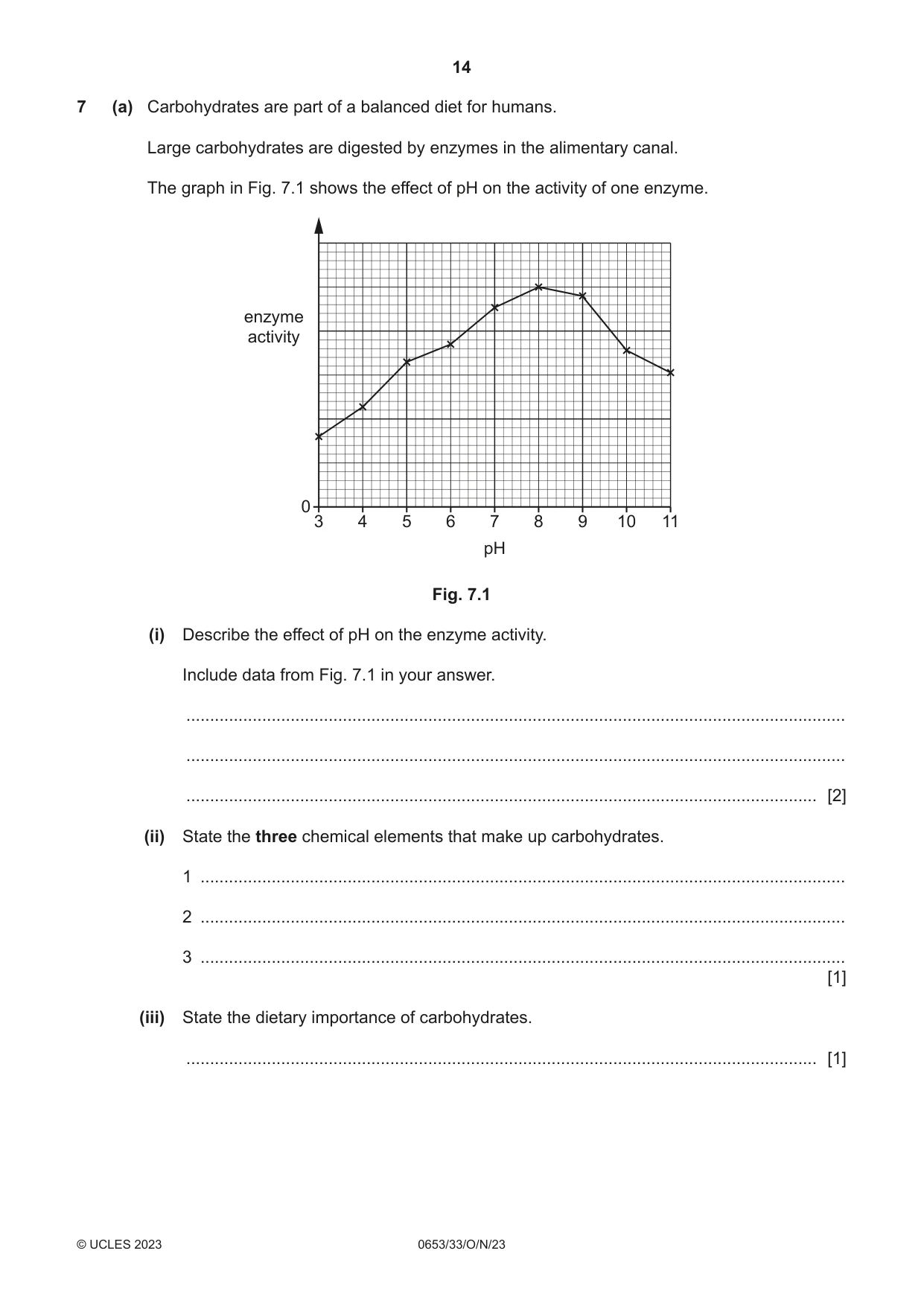
7 (a) Carbohydrates are part of a balanced diet for humans. Large carbohydrates are digested by enzymes in the alimentary canal. The graph in Fig. 7.1 shows the effect of pH on the activity of one enzyme. enzyme activity 0 3 4 5 6 7 8 9 10 11 pH Fig. 7.1 (i) Describe the effect of pH on the enzyme activity. Include data from Fig. 7.1 in your answer. ........................................................................................................................................... ........................................................................................................................................... ..................................................................................................................................... [2] (ii) State the three chemical elements that make up carbohydrates. 1 ........................................................................................................................................ 2 ........................................................................................................................................ 3 ........................................................................................................................................ [1] (iii) State the dietary importance of carbohydrates. ..................................................................................................................................... [1] (b) Digested food is transported in the blood. State the name of the component of blood that transports digested food. ............................................................................................................................................. [1] (c) Blood can be tested for the presence of human immunodeficiency virus (HIV) in the body. State two ways that the spread of HIV is controlled. 1 ................................................................................................................................................ 2 ................................................................................................................................................ [2] [Total: 7]
Mark scheme: 7(a)(i) as pH increases, the enzyme activity first increases and then decreases ; 2 maximum at pH 8 ; 7(a)(ii) carbon AND hydrogen AND oxygen ; 1 7(a)(iii) provide energy ; 1 7(b) plasma ; 1 7(c) any two from: 2 using condoms / protected sexual intercourse ; idea of (sexual) abstinence ; not sharing needles ; using sterile surgical instruments ;
Q8 · Chlorine exists as diatomic molecules
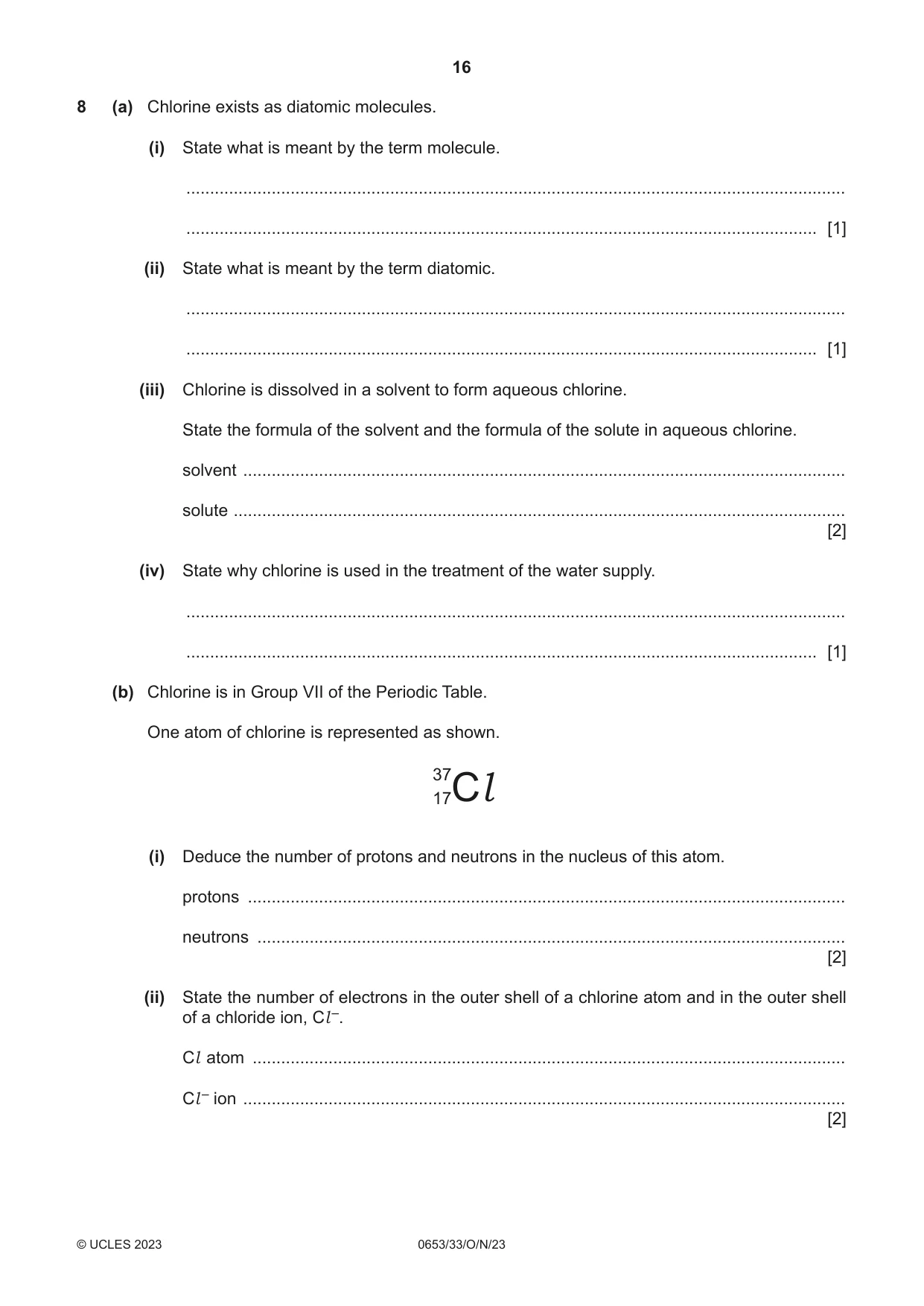
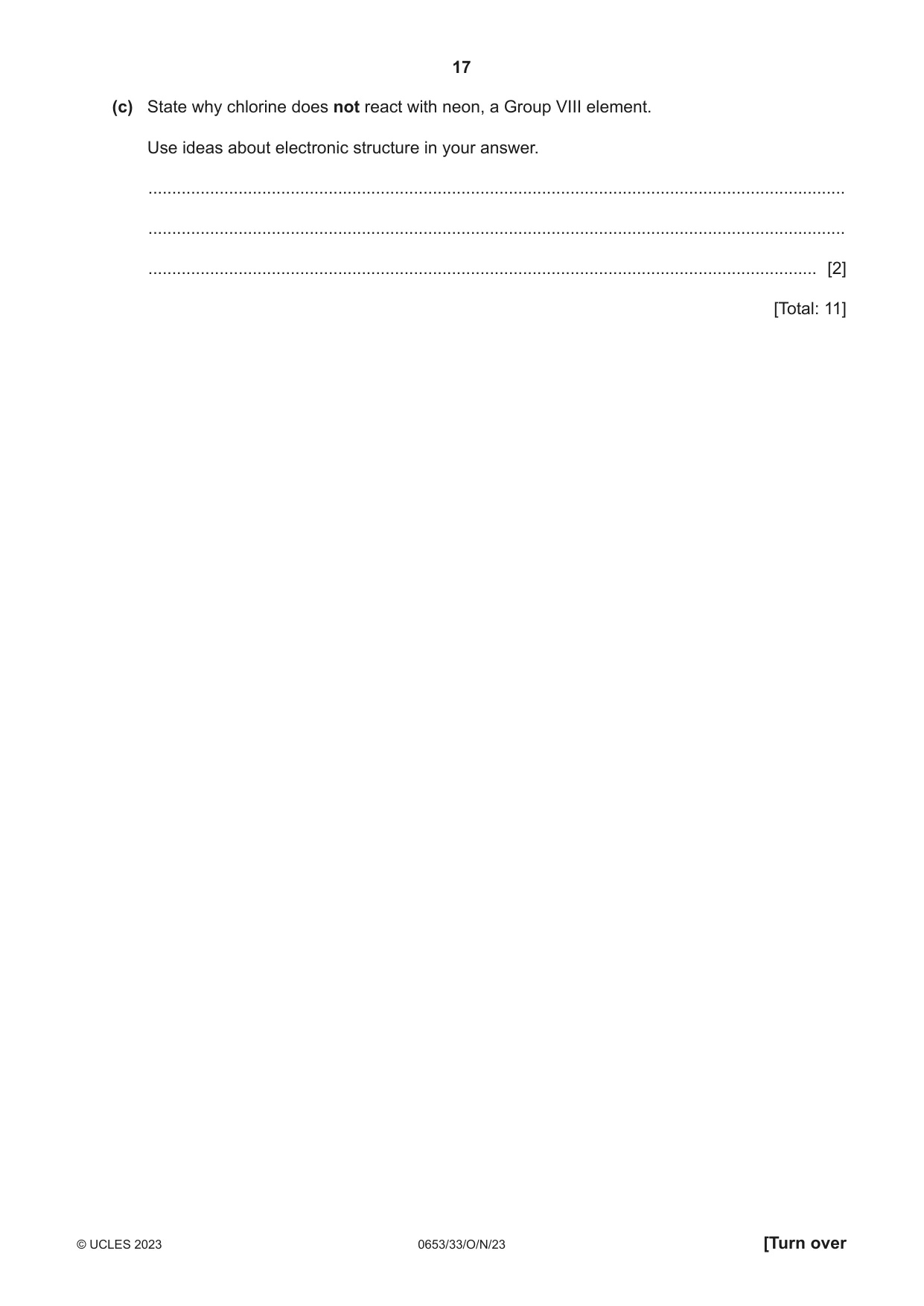
8 (a) Chlorine exists as diatomic molecules. (i) State what is meant by the term molecule. ........................................................................................................................................... ..................................................................................................................................... [1] (ii) State what is meant by the term diatomic. ........................................................................................................................................... ..................................................................................................................................... [1] (iii) Chlorine is dissolved in a solvent to form aqueous chlorine. State the formula of the solvent and the formula of the solute in aqueous chlorine. solvent ............................................................................................................................... solute ................................................................................................................................. [2] (iv) State why chlorine is used in the treatment of the water supply. ........................................................................................................................................... ..................................................................................................................................... [1] (b) Chlorine is in Group VII of the Periodic Table. One atom of chlorine is represented as shown. 3717Cl (i) Deduce the number of protons and neutrons in the nucleus of this atom. protons .............................................................................................................................. neutrons ............................................................................................................................ [2] (ii) State the number of electrons in the outer shell of a chlorine atom and in the outer shell of a chloride ion, Cl –. Cl atom ............................................................................................................................. Cl – ion ............................................................................................................................... [2] (c) State why chlorine does not react with neon, a Group VIII element. Use ideas about electronic structure in your answer. ................................................................................................................................................... ................................................................................................................................................... ............................................................................................................................................. [2] [Total: 11]
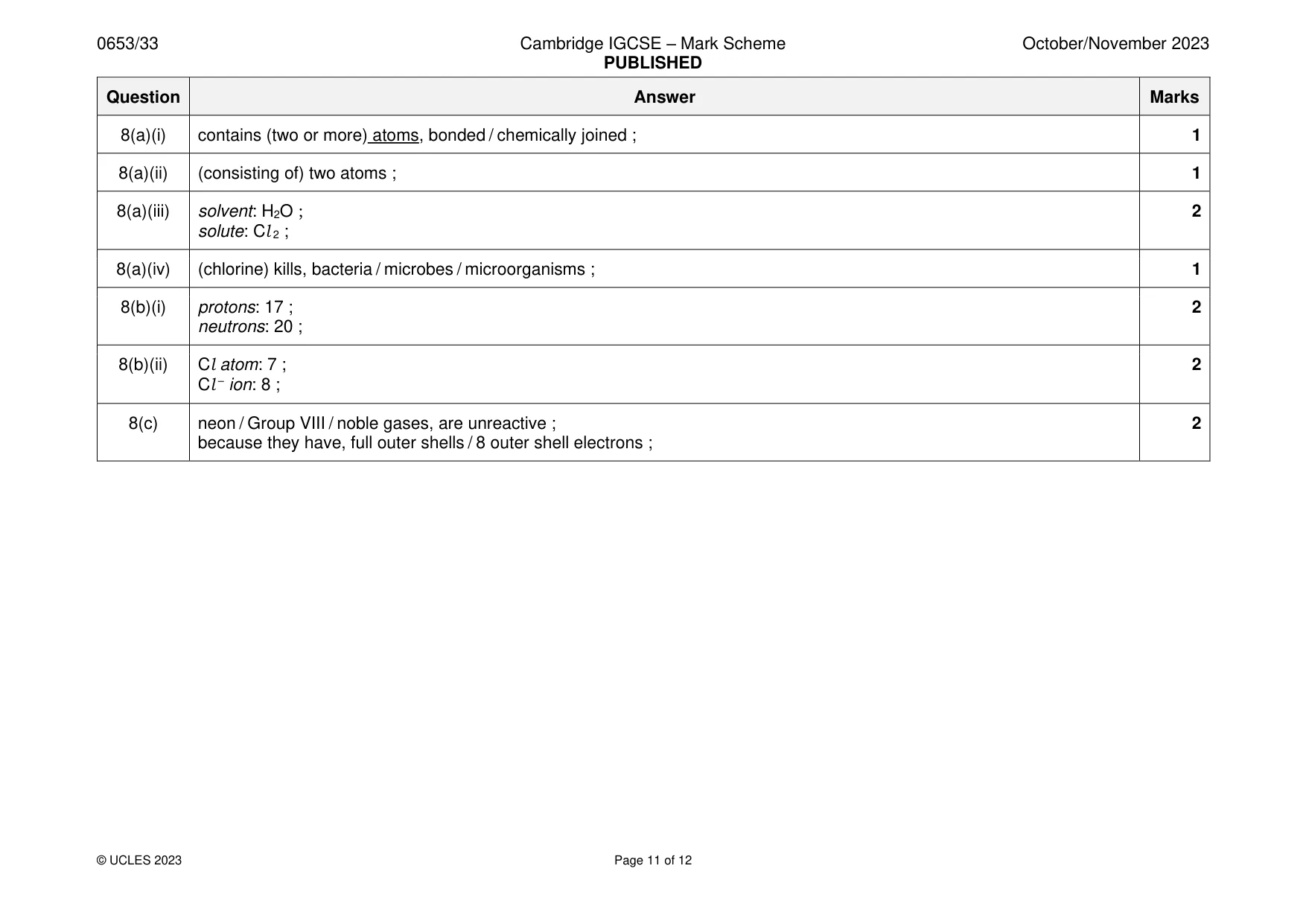
Mark scheme: 8(a)(i) contains (two or more) atoms, bonded / chemically joined ; 1 8(a)(ii) (consisting of) two atoms ; 1 8(a)(iii) solvent: H2O ; 2 solute: Cl 2 ; 8(a)(iv) (chlorine) kills, bacteria / microbes / microorganisms ; 1 8(b)(i) protons: 17 ; 2 neutrons: 20 ; 8(b)(ii) Cl atom: 7 ; 2 Cl – ion: 8 ; 8(c) neon / Group VIII / noble gases, are unreactive ; 2 because they have, full outer shells / 8 outer shell electrons ;
Q9 · A lighthouse used at night to warn ships of dangerous rocks in the water
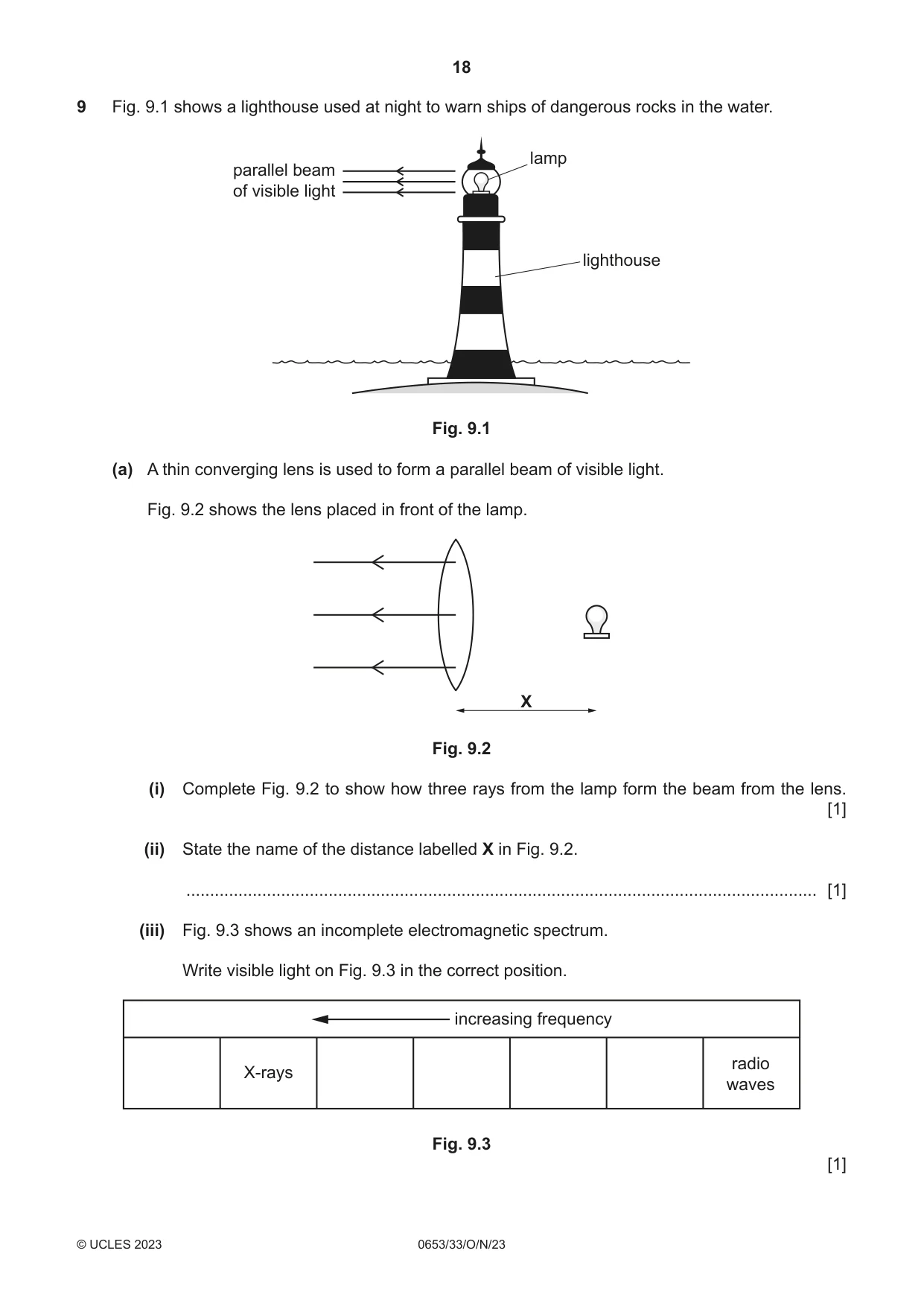
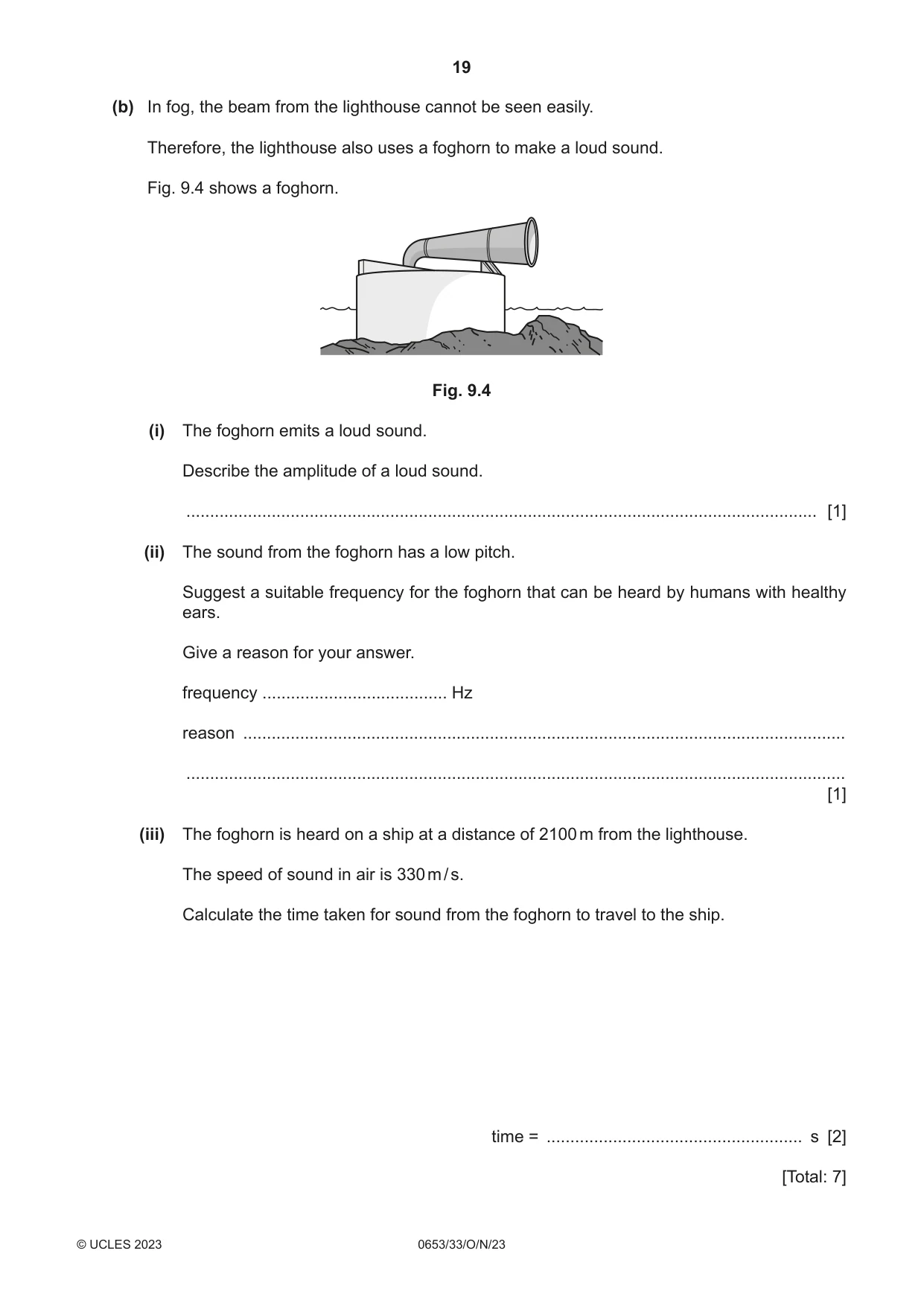
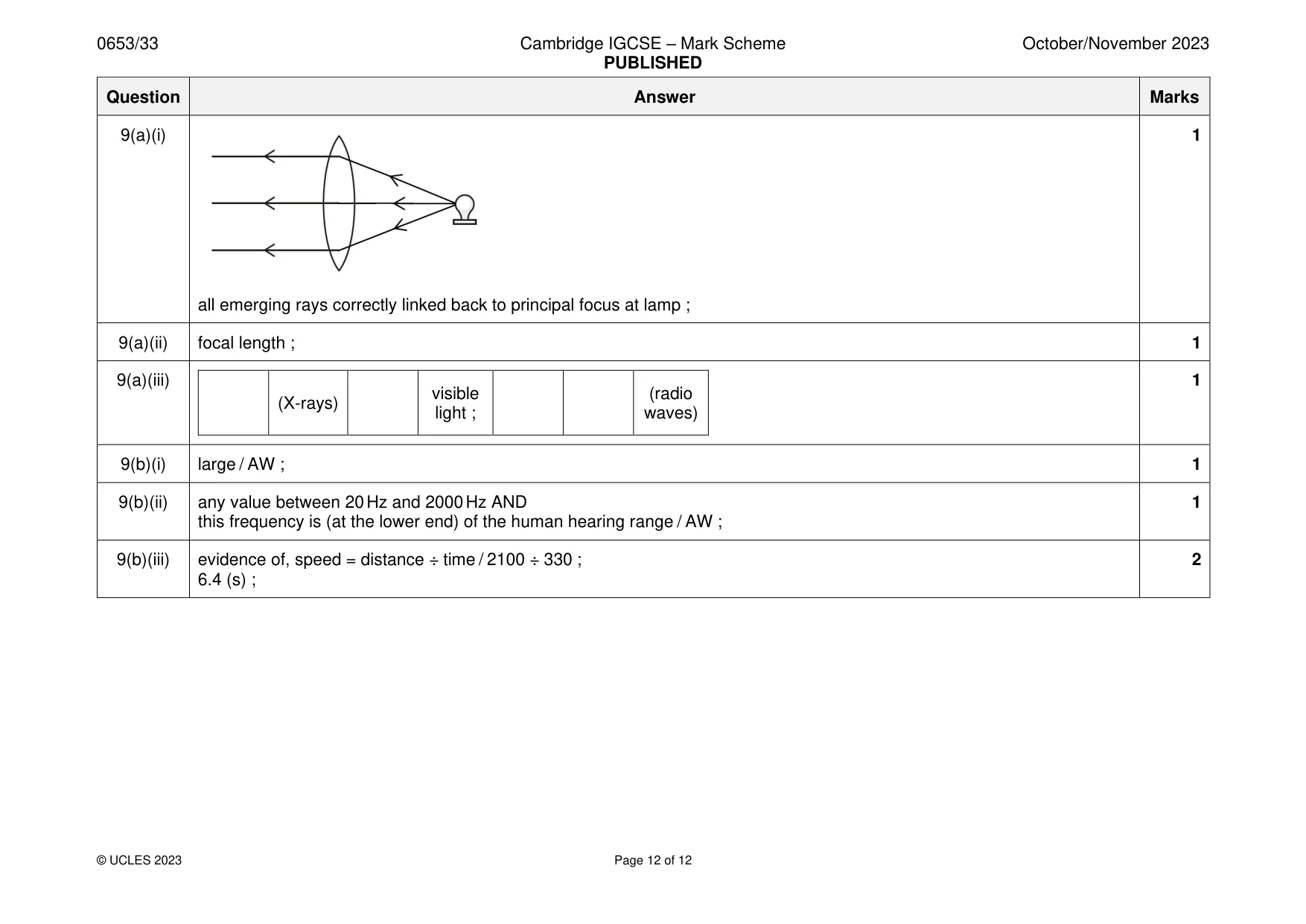
9 Fig. 9.1 shows a lighthouse used at night to warn ships of dangerous rocks in the water. lamp parallel beam of visible light lighthouse Fig. 9.1 (a) A thin converging lens is used to form a parallel beam of visible light. Fig. 9.2 shows the lens placed in front of the lamp. X Fig. 9.2 (i) Complete Fig. 9.2 to show how three rays from the lamp form the beam from the lens. [1] (ii) State the name of the distance labelled X in Fig. 9.2. ..................................................................................................................................... [1] (iii) Fig. 9.3 shows an incomplete electromagnetic spectrum. Write visible light on Fig. 9.3 in the correct position. increasing frequency radio X-rays waves Fig. 9.3 [1] (b) In fog, the beam from the lighthouse cannot be seen easily. Therefore, the lighthouse also uses a foghorn to make a loud sound. Fig. 9.4 shows a foghorn. Fig. 9.4 (i) The foghorn emits a loud sound. Describe the amplitude of a loud sound. ..................................................................................................................................... [1] (ii) The sound from the foghorn has a low pitch. Suggest a suitable frequency for the foghorn that can be heard by humans with healthy ears. Give a reason for your answer. frequency ....................................... Hz reason ............................................................................................................................... ........................................................................................................................................... [1] (iii) The foghorn is heard on a ship at a distance of 2100 m from the lighthouse. The speed of sound in air is 330 m / s. Calculate the time taken for sound from the foghorn to travel to the ship. time = ...................................................... s [2] [Total: 7]
Mark scheme: 9(a)(i) 1 all emerging rays correctly linked back to principal focus at lamp ; 9(a)(ii) focal length ; 1 9(a)(iii) 1 visible (radio (X-rays) light ; waves) 9(b)(i) large / AW ; 1 9(b)(ii) any value between 20 Hz and 2000 Hz AND 1 this frequency is (at the lower end) of the human hearing range / AW ; 9(b)(iii) evidence of, speed = distance ÷ time / 2100 ÷ 330 ; 2 6.4 (s) ;
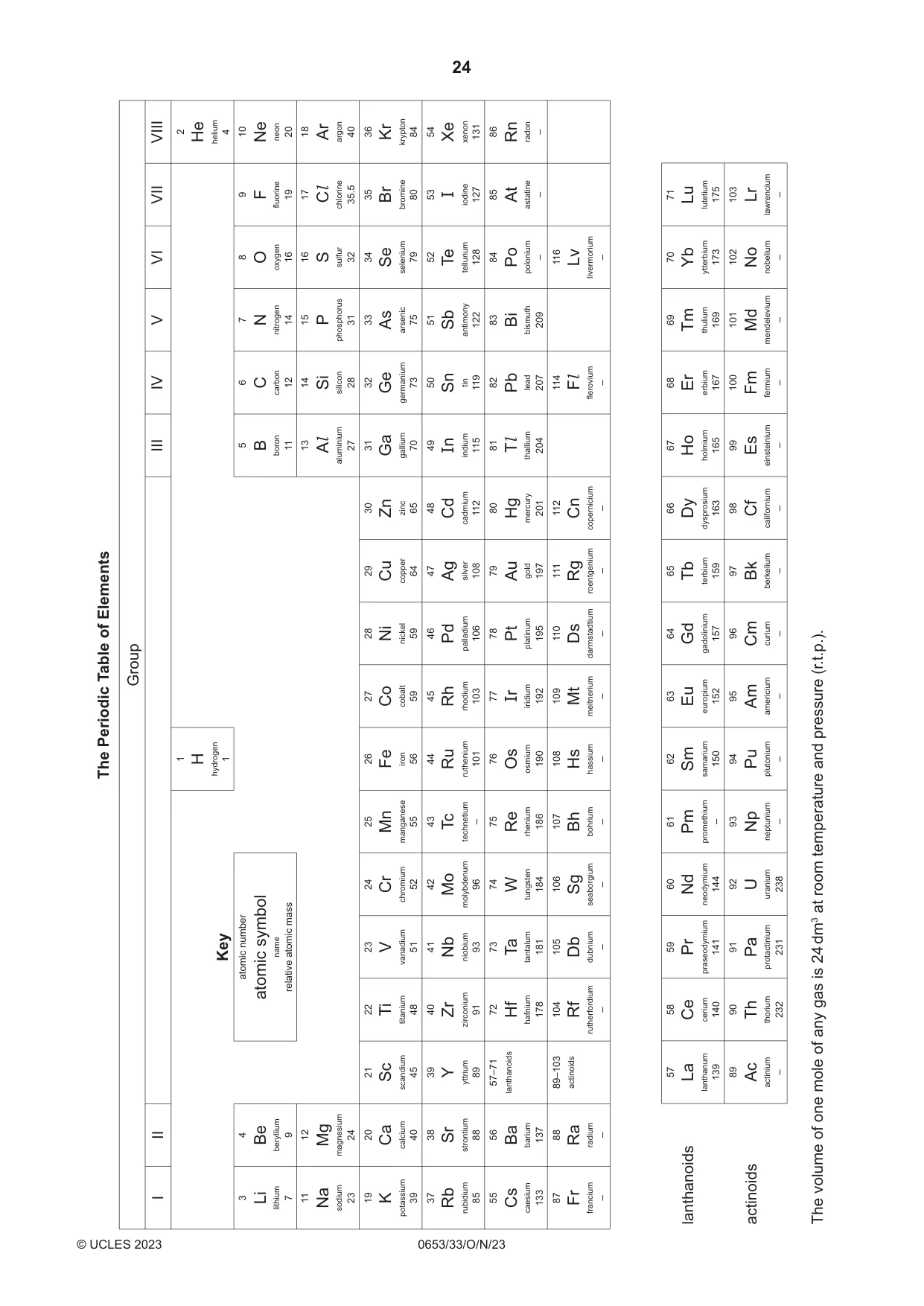
What was in this paper
The subtopics covered by these 9 questions, and how many questions each got. Open one in a new tab to see every Cambridge question on it.
What you needed in this session
Cambridge’s own grade thresholds for 2023 Oct/Nov, Paper 3 · Variant 3. A higher threshold means an easier paper — the bar moves with how the cohort did.