Cambridge IGCSE Science - Combined 0653 — 2025 May/June Paper 3 · Variant 3
0653/33/M/J/25 · 9 questions · 80 marks · 75 min
The question paper and its mark scheme, free to read here and free to download. This is Cambridge’s own paper, exactly as it was sat.
Question paper20 pages

Mark scheme12 pages
Answers below. Sit the paper first if you are practising.
Questions as text
Q1 · A diagram of the female reproductive system
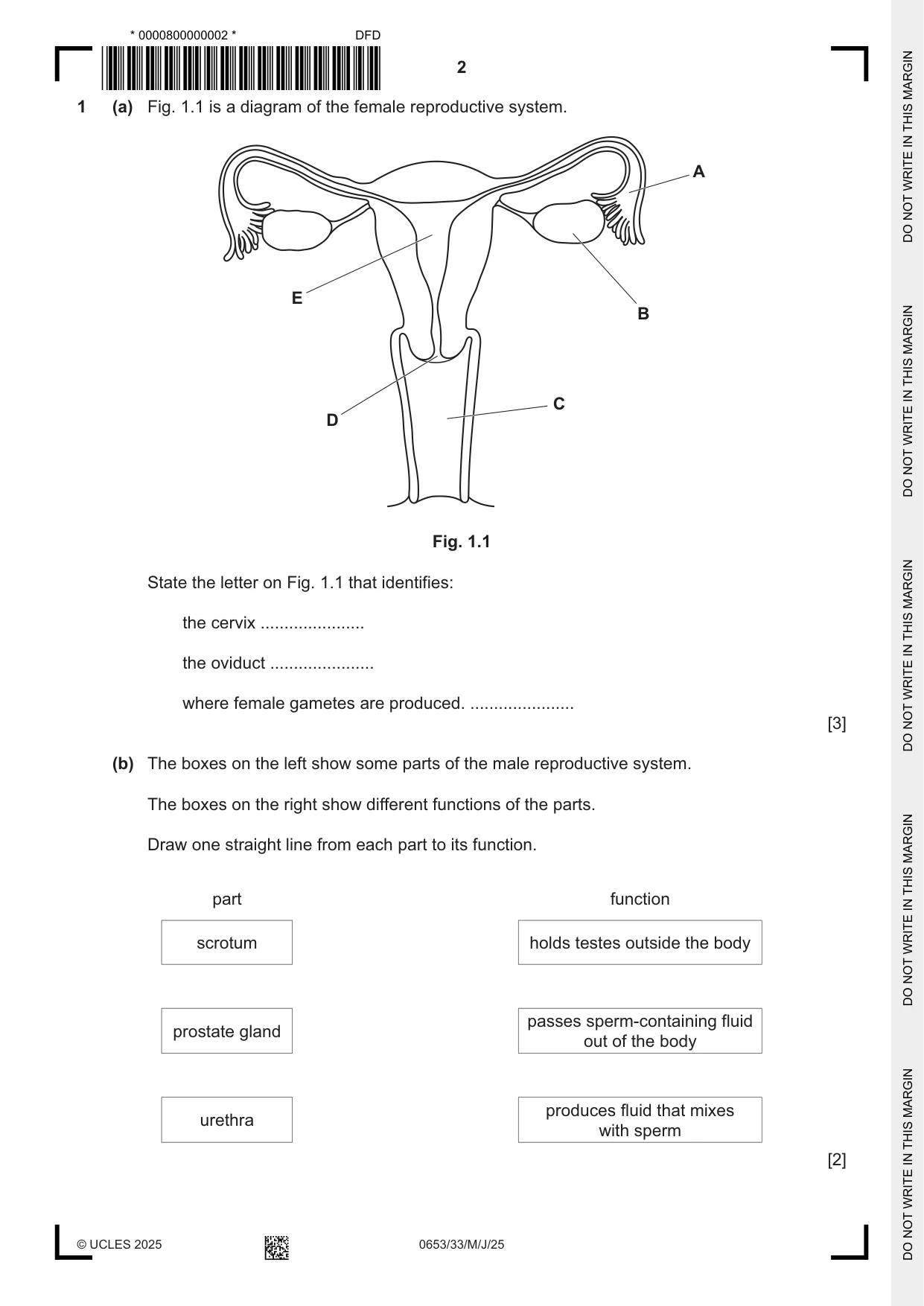
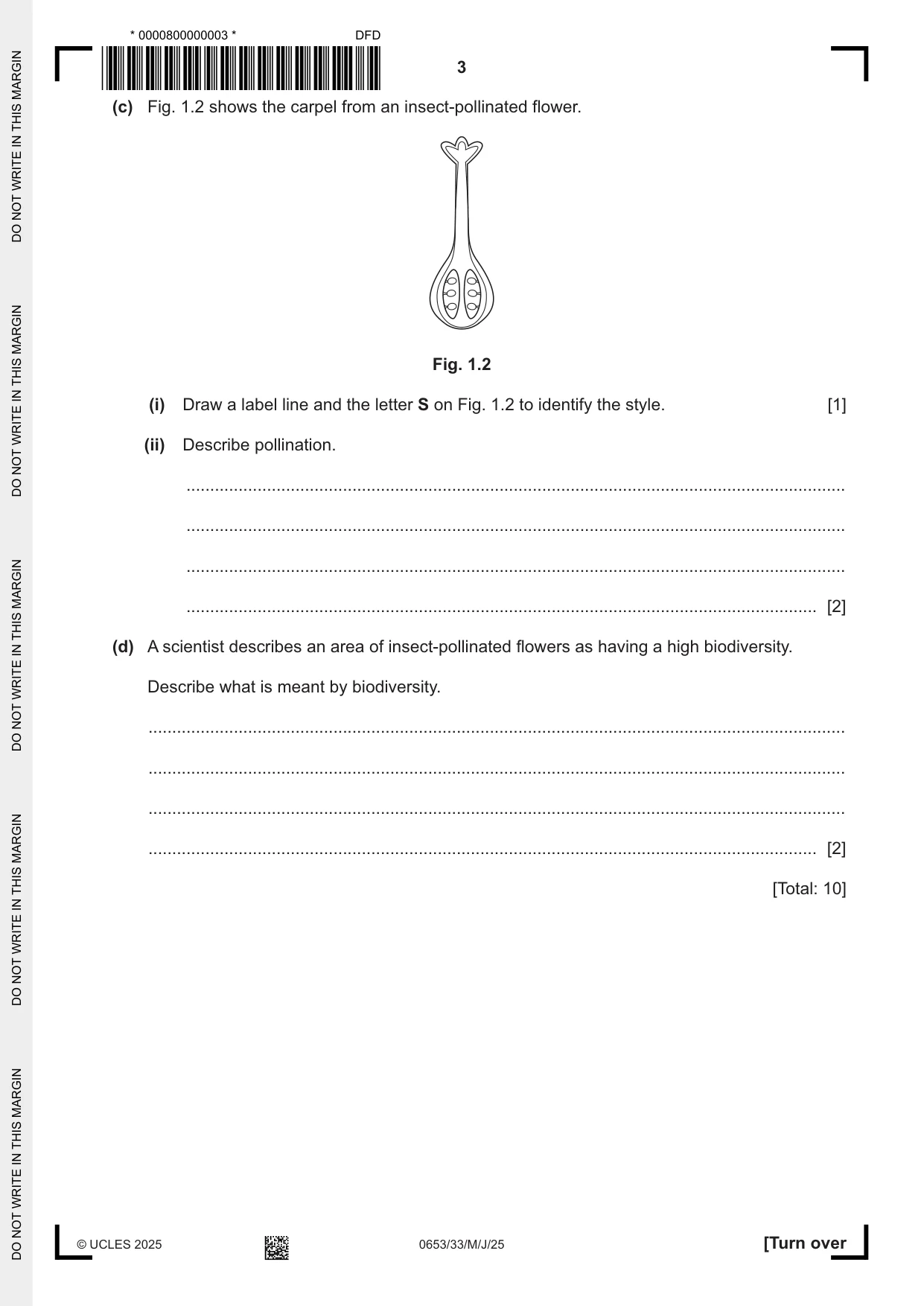
1 (a) Fig. 1.1 is a diagram of the female reproductive system. A E B C D Fig. 1.1 State the letter on Fig. 1.1 that identifies: the cervix ...................... the oviduct ...................... where female gametes are produced. ...................... [3] (b) The boxes on the left show some parts of the male reproductive system. The boxes on the right show different functions of the parts. Draw one straight line from each part to its function. part function scrotum holds testes outside the body passes sperm-containing fluid prostate gland out of the body produces fluid that mixes urethra with sperm [2] (c) Fig. 1.2 shows the carpel from an insect-pollinated flower. Fig. 1.2 (i) Draw a label line and the letter S on Fig. 1.2 to identify the style. [1] (ii) Describe pollination. ........................................................................................................................................... ........................................................................................................................................... ........................................................................................................................................... ..................................................................................................................................... [2] (d) A scientist describes an area of insect-pollinated flowers as having a high biodiversity. Describe what is meant by biodiversity. ................................................................................................................................................... ................................................................................................................................................... ................................................................................................................................................... ............................................................................................................................................. [2] [Total: 10]
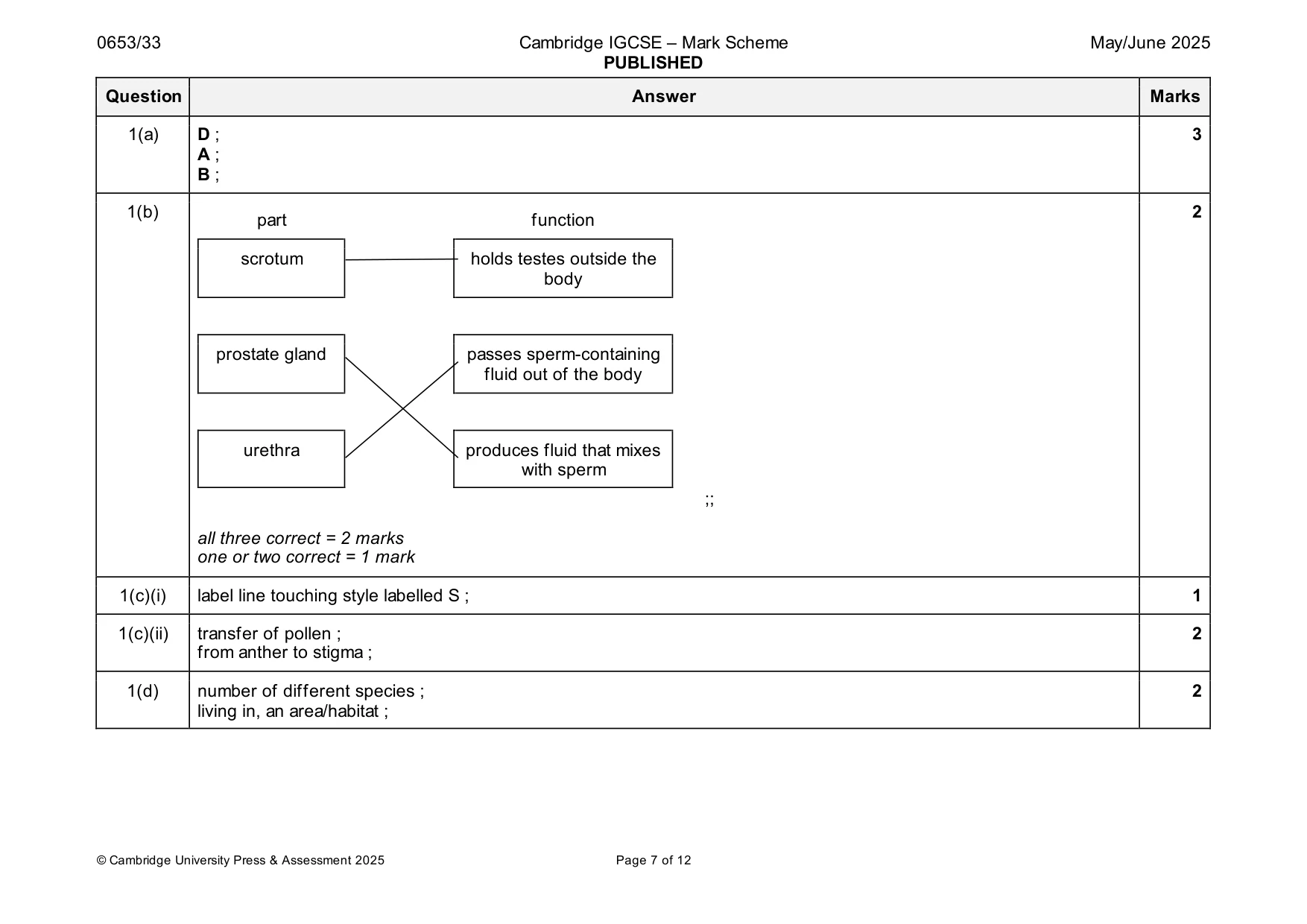
Mark scheme: Question Answer Marks 1(a) D ; 3 A ; B ; 1(b) 2 part function scrotum holds testes outside the body prostate gland passes sperm-containing fluid out of the body urethra produces fluid that mixes with sperm ;; all three correct = 2 marks one or two correct = 1 mark 1(c)(i) label line touching style labelled S ; 1 1(c)(ii) transfer of pollen ; 2 from anther to stigma ; 1(d) number of different species ; 2 living in, an area/habitat ;
Q2 · A student investigates the effect of different physical activity on heart rate
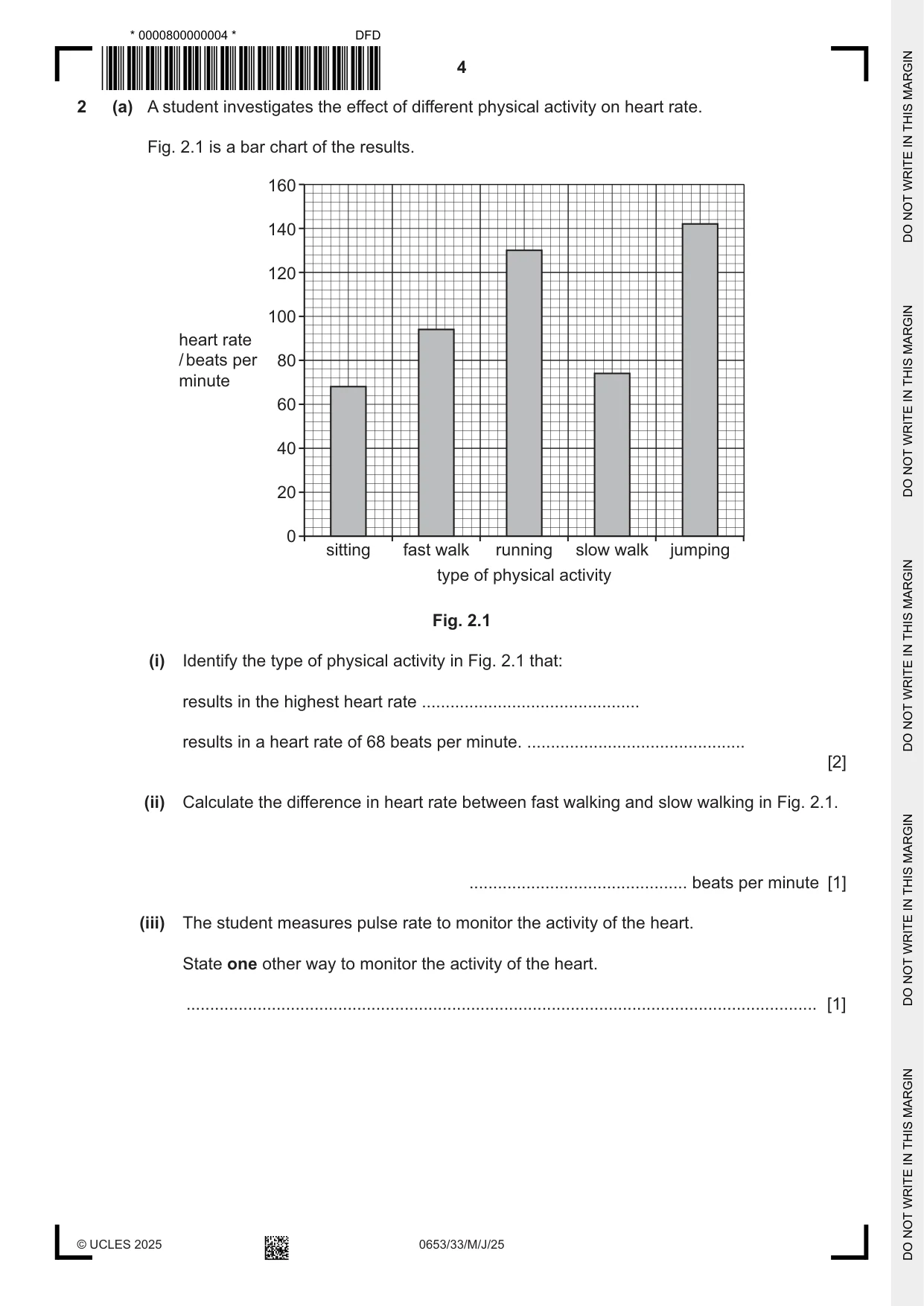
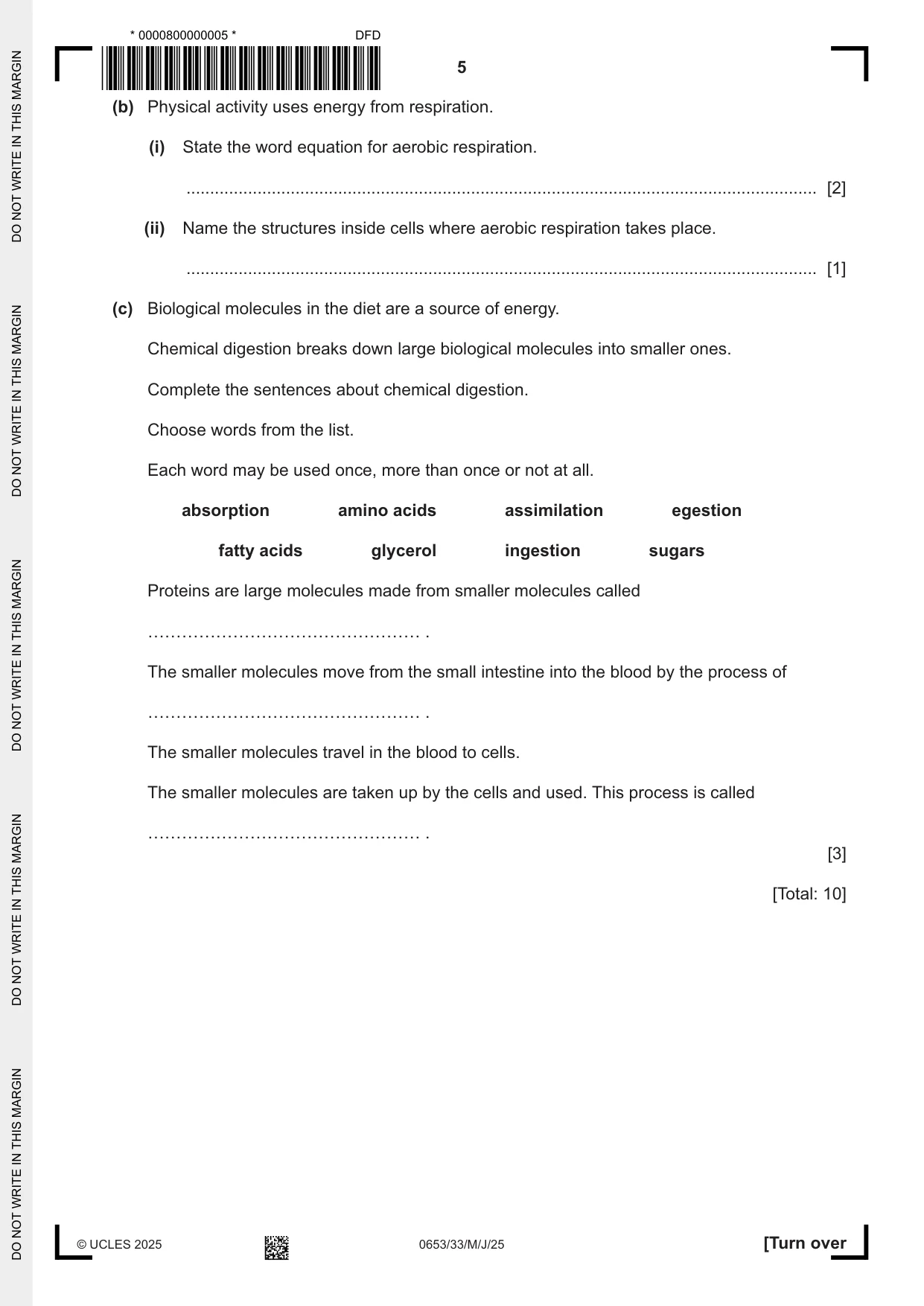
2 (a) A student investigates the effect of different physical activity on heart rate. Fig. 2.1 is a bar chart of the results. 160 140 120 100 heart rate / beats per 80 minute 60 40 20 0 sitting fast walk running slow walk jumping type of physical activity Fig. 2.1 (i) Identify the type of physical activity in Fig. 2.1 that: results in the highest heart rate .............................................. results in a heart rate of 68 beats per minute. .............................................. [2] (ii) Calculate the difference in heart rate between fast walking and slow walking in Fig. 2.1. .............................................. beats per minute [1] (iii) The student measures pulse rate to monitor the activity of the heart. State one other way to monitor the activity of the heart. ..................................................................................................................................... [1] (b) Physical activity uses energy from respiration. (i) State the word equation for aerobic respiration. ..................................................................................................................................... [2] (ii) Name the structures inside cells where aerobic respiration takes place. ..................................................................................................................................... [1] (c) Biological molecules in the diet are a source of energy. Chemical digestion breaks down large biological molecules into smaller ones. Complete the sentences about chemical digestion. Choose words from the list. Each word may be used once, more than once or not at all. absorption amino acids assimilation egestion fatty acids glycerol ingestion sugars Proteins are large molecules made from smaller molecules called The smaller molecules move from the small intestine into the blood by the process of The smaller molecules travel in the blood to cells. The smaller molecules are taken up by the cells and used. This process is called [3] [Total: 10]
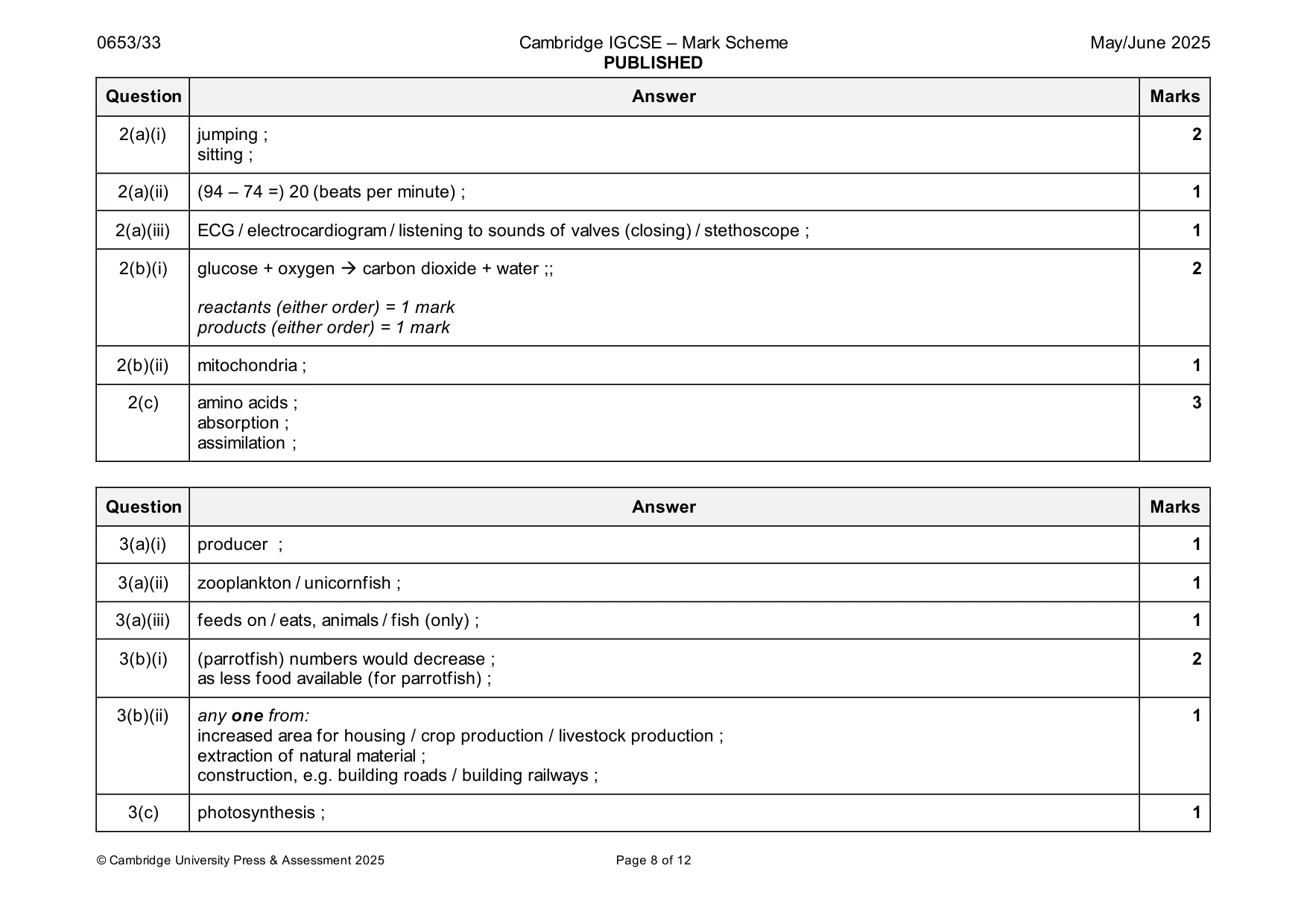
Mark scheme: 2(a)(i) jumping ; 2 sitting ; 2(a)(ii) (94 – 74 =) 20 (beats per minute) ; 1 2(a)(iii) ECG / electrocardiogram / listening to sounds of valves (closing) / stethoscope ; 1 2(b)(i) glucose + oxygen carbon dioxide + water ;; 2 reactants (either order) = 1 mark products (either order) = 1 mark 2(b)(ii) mitochondria ; 1 2(c) amino acids ; 3 absorption ; assimilation ;
Q3 · Part of a food web from a coral reef habitat
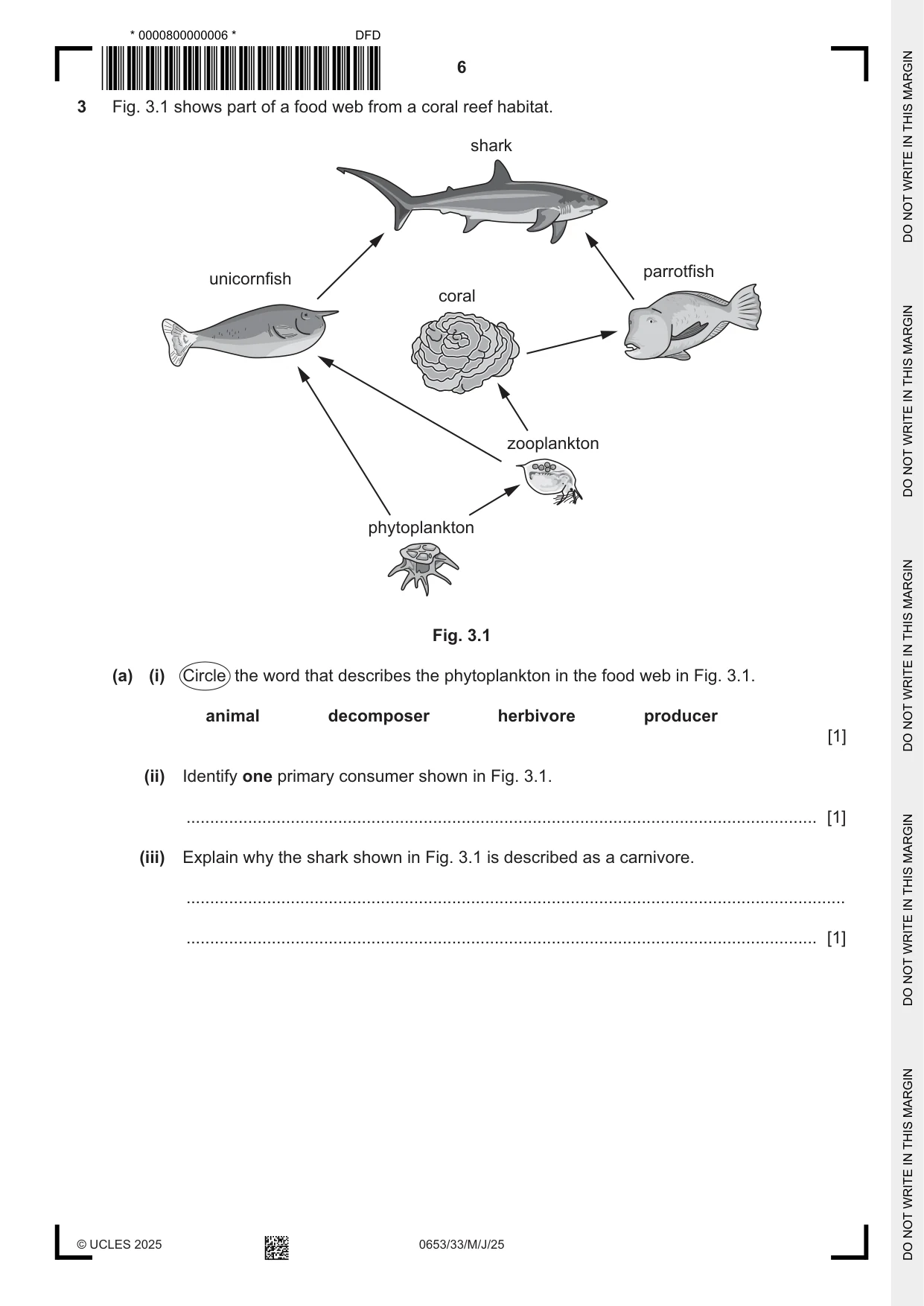
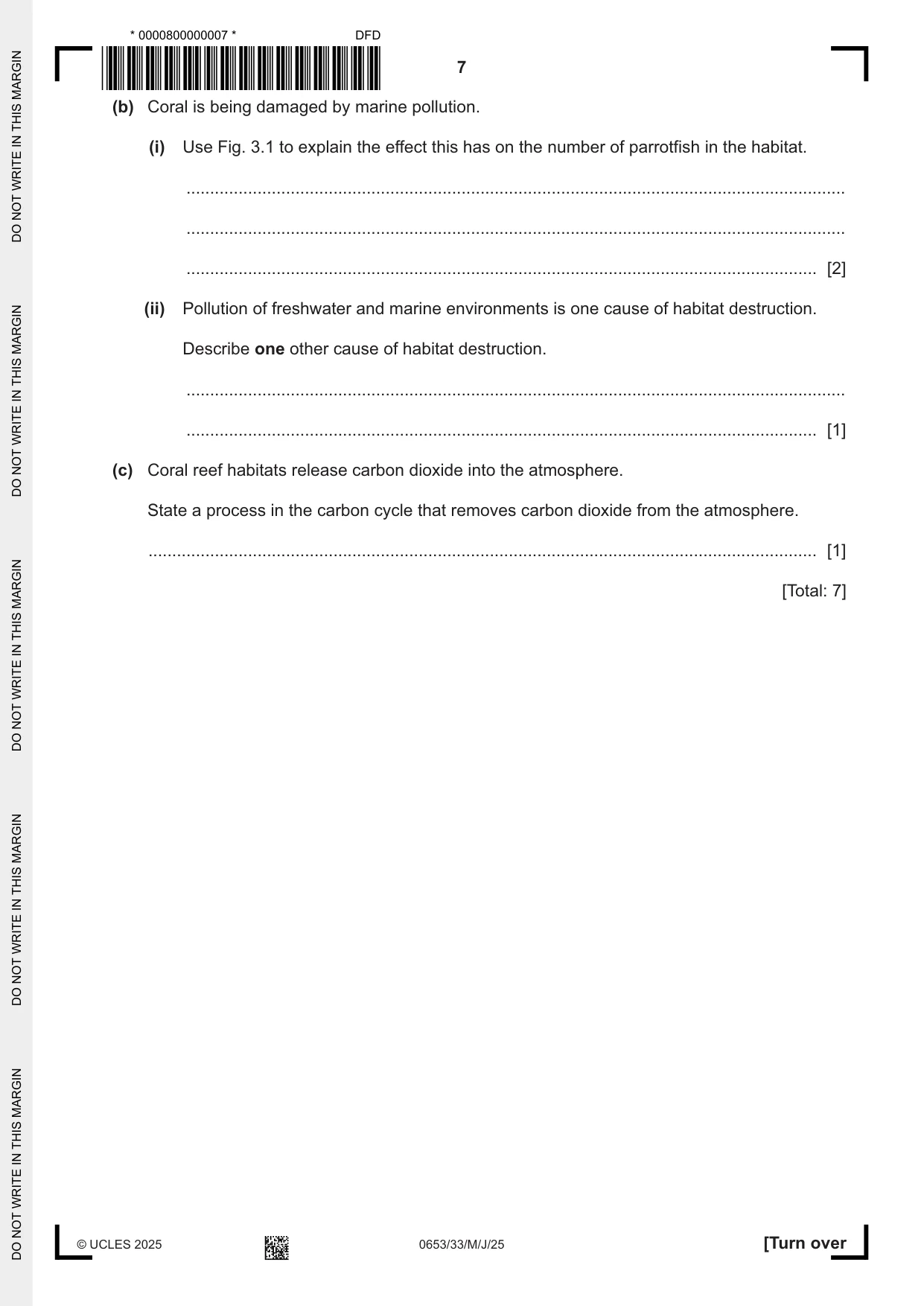
3 Fig. 3.1 shows part of a food web from a coral reef habitat. shark parrotfish unicornfish coral zooplankton phytoplankton Fig. 3.1 (a) (i) Circle the word that describes the phytoplankton in the food web in Fig. 3.1. animal decomposer herbivore producer [1] (ii) Identify one primary consumer shown in Fig. 3.1. ..................................................................................................................................... [1] (iii) Explain why the shark shown in Fig. 3.1 is described as a carnivore. ........................................................................................................................................... ..................................................................................................................................... [1] (b) Coral is being damaged by marine pollution. (i) Use Fig. 3.1 to explain the effect this has on the number of parrotfish in the habitat. ........................................................................................................................................... ........................................................................................................................................... ..................................................................................................................................... [2] (ii) Pollution of freshwater and marine environments is one cause of habitat destruction. Describe one other cause of habitat destruction. ........................................................................................................................................... ..................................................................................................................................... [1] (c) Coral reef habitats release carbon dioxide into the atmosphere. State a process in the carbon cycle that removes carbon dioxide from the atmosphere. ............................................................................................................................................. [1] [Total: 7]
Mark scheme: 3(a)(i) producer ; 1 3(a)(ii) zooplankton / unicornfish ; 1 3(a)(iii) feeds on / eats, animals / fish (only) ; 1 3(b)(i) (parrotfish) numbers would decrease ; 2 as less food available (for parrotfish) ; 3(b)(ii) any one from: 1 increased area for housing / crop production / livestock production ; extraction of natural material ; construction, e.g. building roads / building railways ; 3(c) photosynthesis ; 1
Q4 · Lithium fluoride, LiF, is an ionic compound
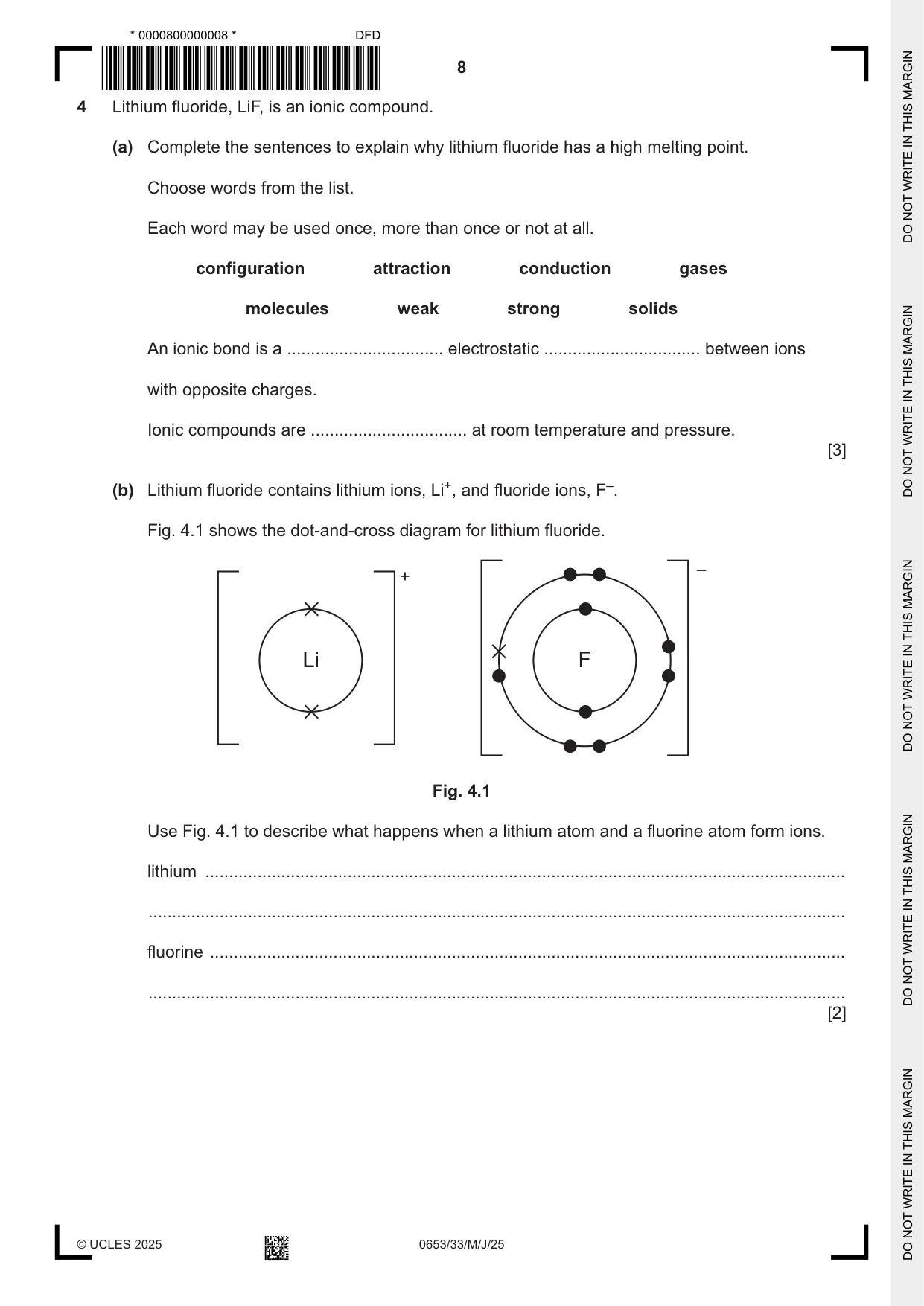
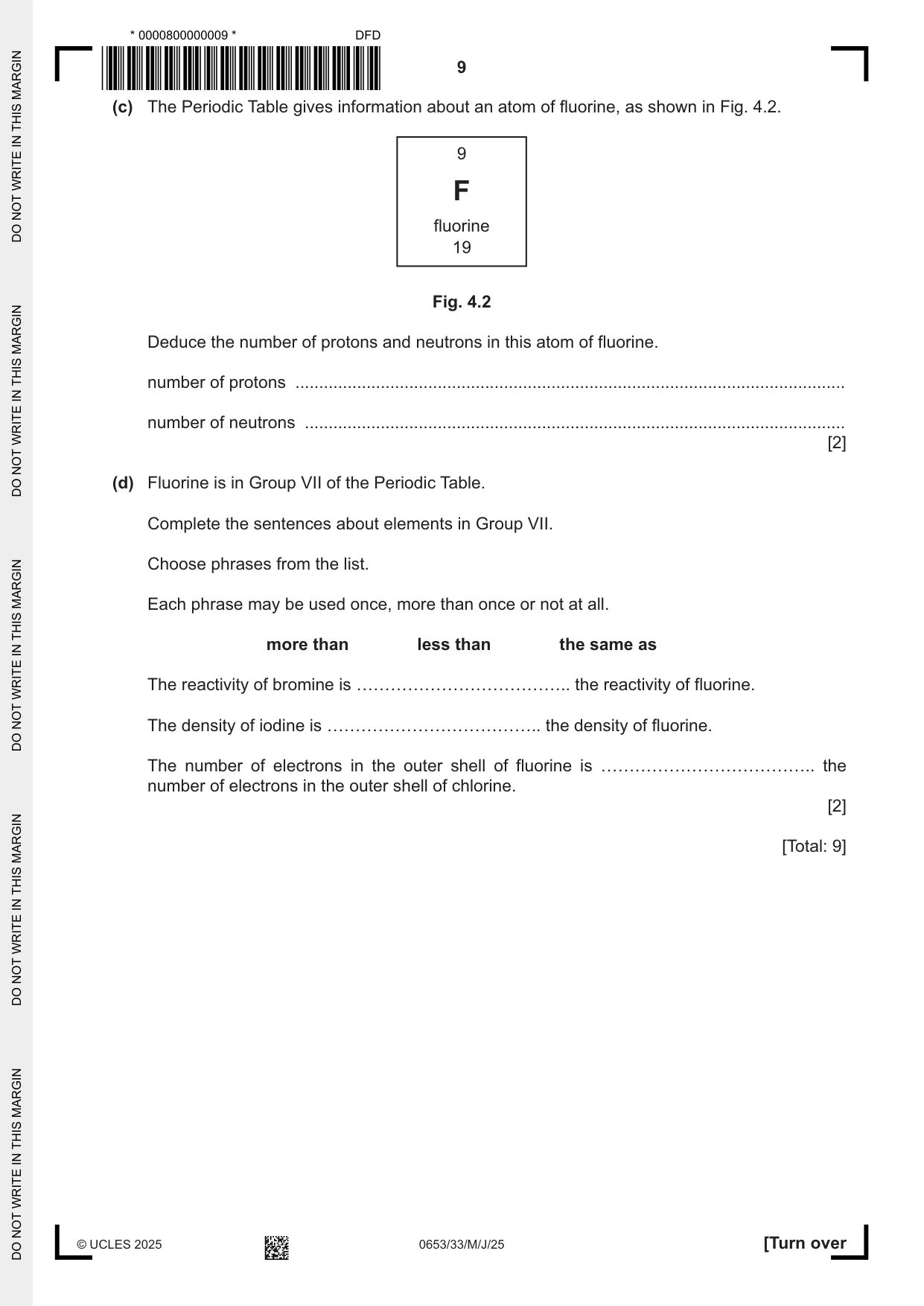
4 Lithium fluoride, LiF, is an ionic compound. (a) Complete the sentences to explain why lithium fluoride has a high melting point. Choose words from the list. Each word may be used once, more than once or not at all. configuration attraction conduction gases molecules weak strong solids An ionic bond is a ................................. electrostatic ................................. between ions with opposite charges. Ionic compounds are ................................. at room temperature and pressure. [3] (b) Lithium fluoride contains lithium ions, Li+, and fluoride ions, F–. Fig. 4.1 shows the dot-and-cross diagram for lithium fluoride. – + Li F Fig. 4.1 Use Fig. 4.1 to describe what happens when a lithium atom and a fluorine atom form ions. lithium ....................................................................................................................................... ................................................................................................................................................... fluorine ...................................................................................................................................... ................................................................................................................................................... [2] (c) The Periodic Table gives information about an atom of fluorine, as shown in Fig. 4.2. 9 F fluorine 19 Fig. 4.2 Deduce the number of protons and neutrons in this atom of fluorine. number of protons .................................................................................................................... number of neutrons .................................................................................................................. [2] (d) Fluorine is in Group VII of the Periodic Table. Complete the sentences about elements in Group VII. Choose phrases from the list. Each phrase may be used once, more than once or not at all. more than less than the same as The reactivity of bromine is ……………………………….. the reactivity of fluorine. The density of iodine is ……………………………….. the density of fluorine. The number of electrons in the outer shell of fluorine is ……………………………….. the number of electrons in the outer shell of chlorine. [2] [Total: 9]
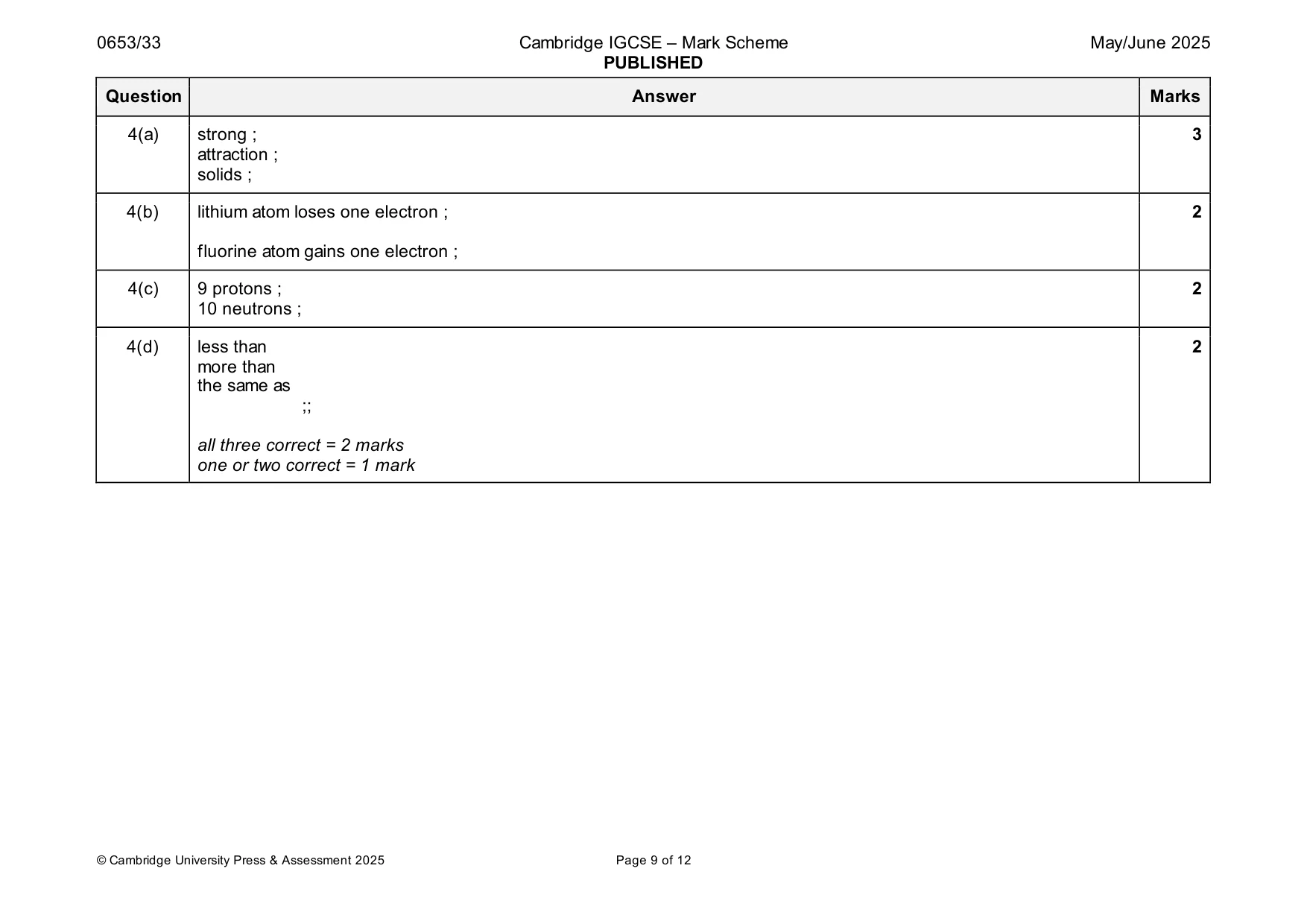
Mark scheme: 4(a) strong ; 3 attraction ; solids ; 4(b) lithium atom loses one electron ; 2 fluorine atom gains one electron ; 4(c) 9 protons ; 2 10 neutrons ; 4(d) less than 2 more than the same as ;; all three correct = 2 marks one or two correct = 1 mark
Q5 · Dilute sulfuric acid is used in an electrolysis experiment
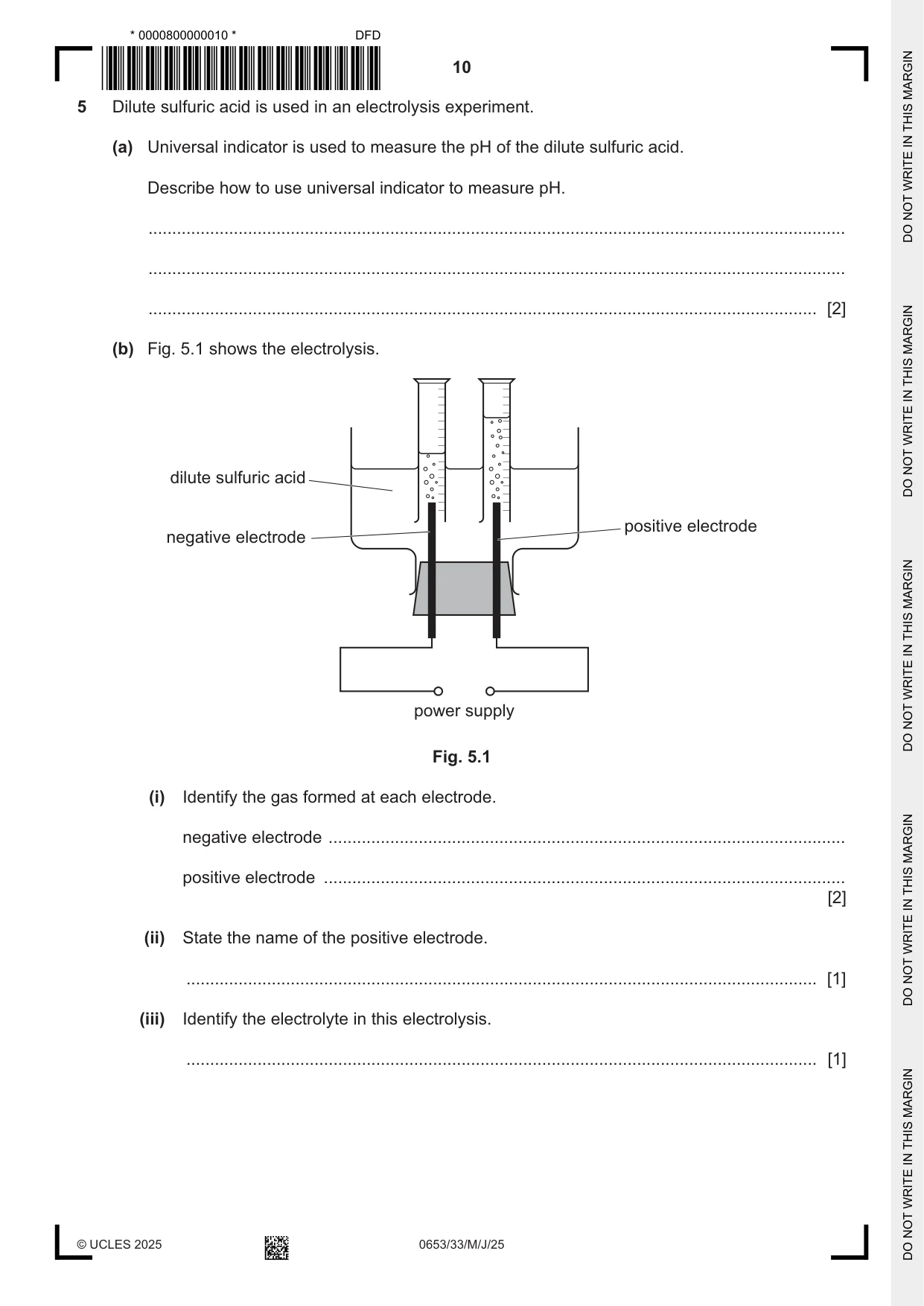
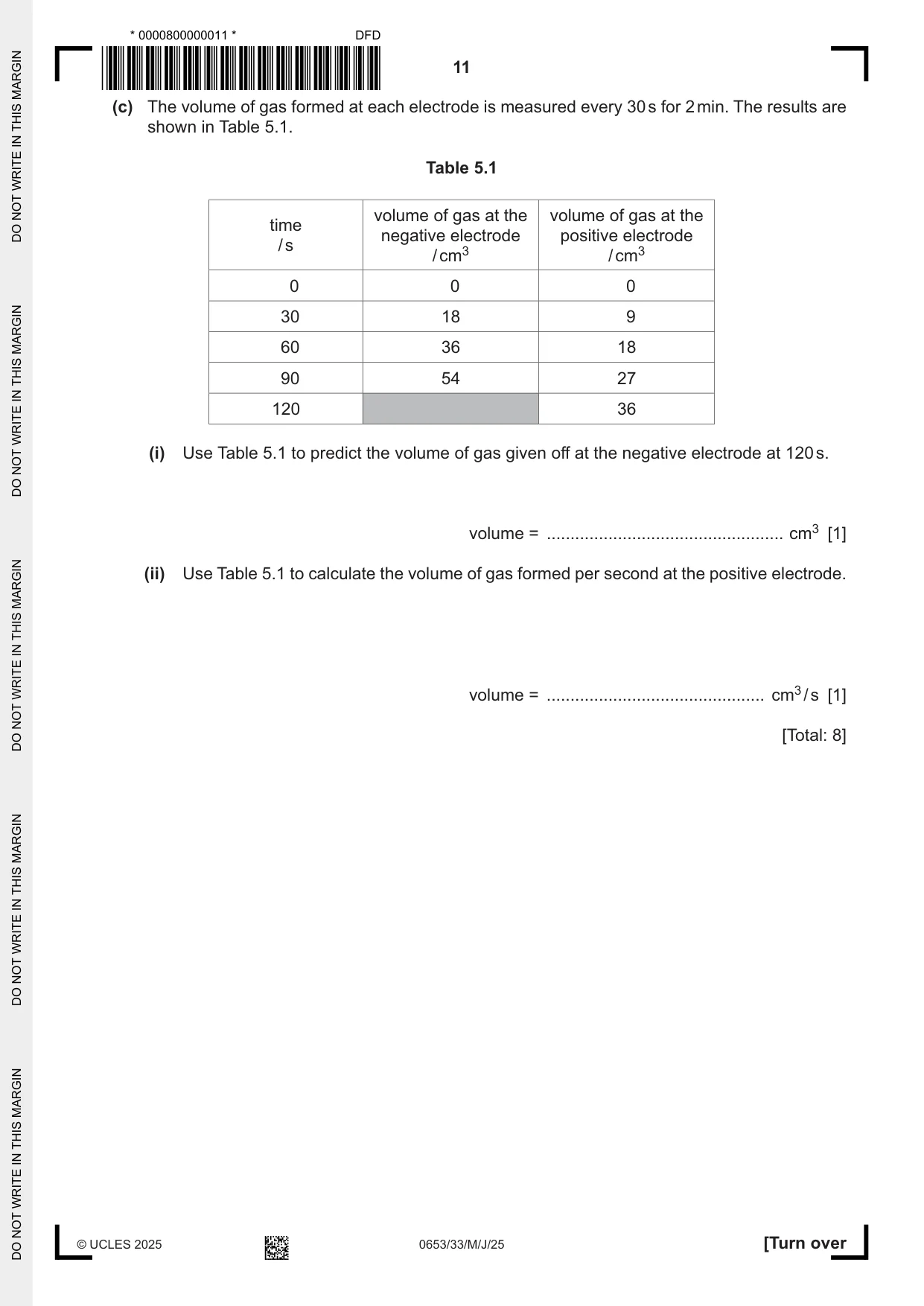
5 Dilute sulfuric acid is used in an electrolysis experiment. (a) Universal indicator is used to measure the pH of the dilute sulfuric acid. Describe how to use universal indicator to measure pH. ................................................................................................................................................... ................................................................................................................................................... ............................................................................................................................................. [2] (b) Fig. 5.1 shows the electrolysis. dilute sulfuric acid positive electrode negative electrode power supply Fig. 5.1 (i) Identify the gas formed at each electrode. negative electrode ............................................................................................................. positive electrode .............................................................................................................. [2] (ii) State the name of the positive electrode. ..................................................................................................................................... [1] (iii) Identify the electrolyte in this electrolysis. ..................................................................................................................................... [1] (c) The volume of gas formed at each electrode is measured every 30 s for 2 min. The results are shown in Table 5.1. Table 5.1 volume of gas at the volume of gas at the time negative electrode positive electrode / s / cm3 / cm3 0 0 0 30 18 9 60 36 18 90 54 27 120 36 (i) Use Table 5.1 to predict the volume of gas given off at the negative electrode at 120 s. volume = .................................................. cm3 [1] (ii) Use Table 5.1 to calculate the volume of gas formed per second at the positive electrode. volume = .............................................. cm3 / s [1] [Total: 8]
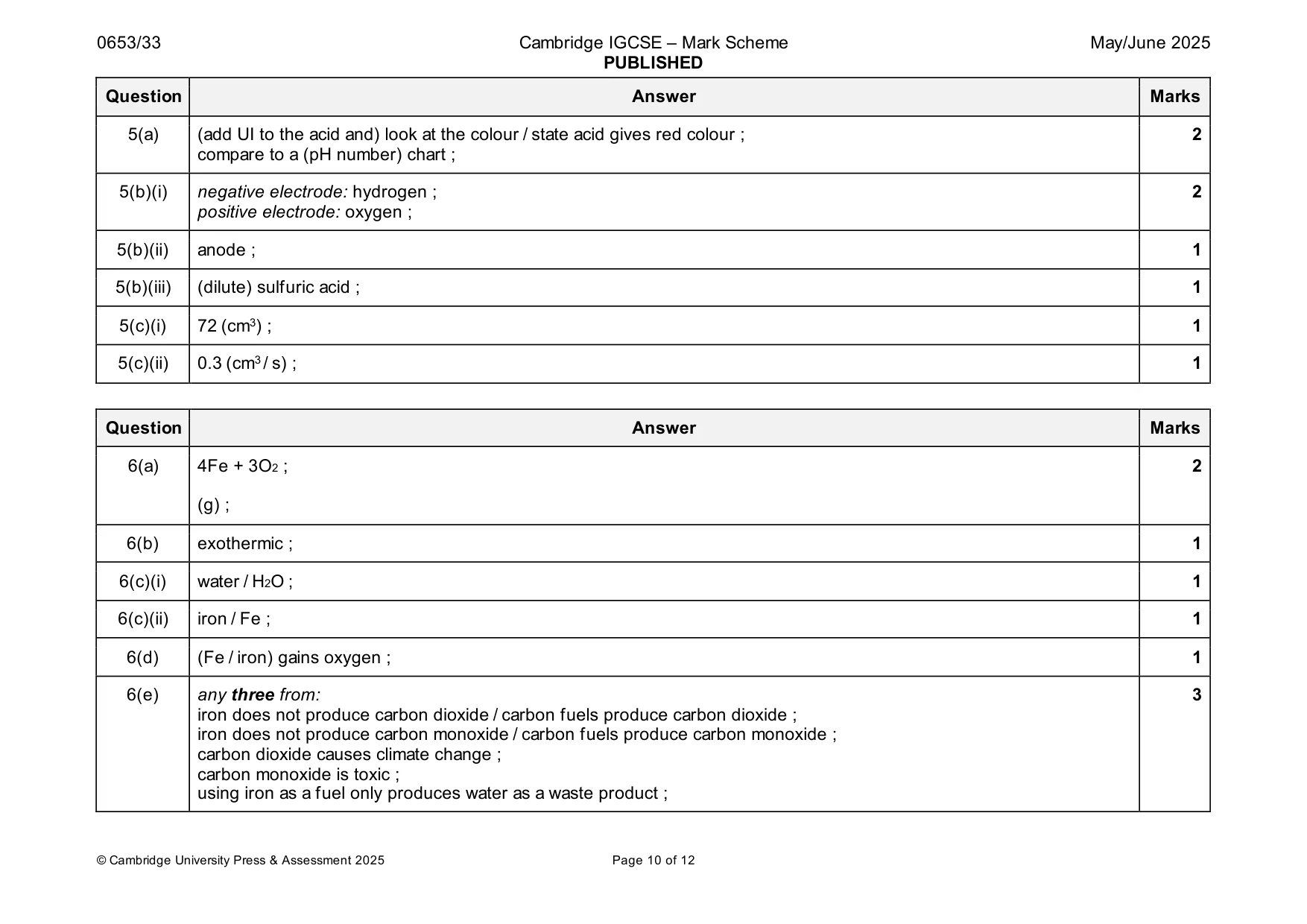
Mark scheme: 5(a) (add UI to the acid and) look at the colour / state acid gives red colour ; 2 compare to a (pH number) chart ; 5(b)(i) negative electrode: hydrogen ; 2 positive electrode: oxygen ; 5(b)(ii) anode ; 1 5(b)(iii) (dilute) sulfuric acid ; 1 5(c)(i) 72 (cm3) ; 1 5(c)(ii) 0.3 (cm3 / s) ; 1
Q6 · Scientists are investigating the use of iron as a fuel in cars
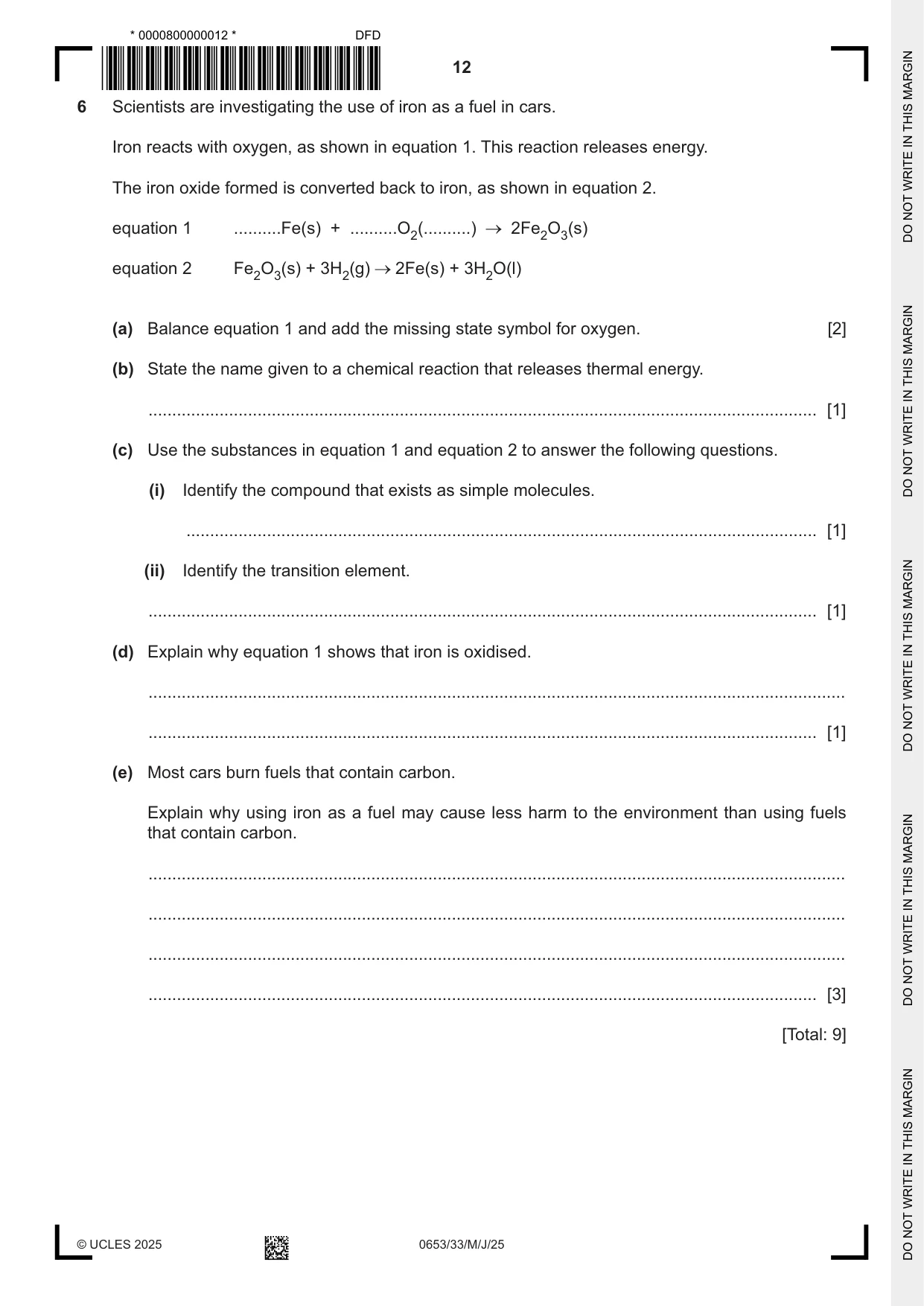
6 Scientists are investigating the use of iron as a fuel in cars. Iron reacts with oxygen, as shown in equation 1. This reaction releases energy. The iron oxide formed is converted back to iron, as shown in equation 2. equation 1 ..........Fe(s) + ..........O2(..........) 2Fe2O3(s) equation 2 Fe2O3(s) + 3H2(g) 2Fe(s) + 3H2O(l) (a) Balance equation 1 and add the missing state symbol for oxygen. [2] (b) State the name given to a chemical reaction that releases thermal energy. ............................................................................................................................................. [1] (c) Use the substances in equation 1 and equation 2 to answer the following questions. (i) Identify the compound that exists as simple molecules. ..................................................................................................................................... [1] (ii) Identify the transition element. ............................................................................................................................................. [1] (d) Explain why equation 1 shows that iron is oxidised. ................................................................................................................................................... ............................................................................................................................................. [1] (e) Most cars burn fuels that contain carbon. Explain why using iron as a fuel may cause less harm to the environment than using fuels that contain carbon. ................................................................................................................................................... ................................................................................................................................................... ................................................................................................................................................... ............................................................................................................................................. [3] [Total: 9]
Mark scheme: 6(a) 4Fe + 3O2 ; 2 (g) ; 6(b) exothermic ; 1 6(c)(i) water / H2O ; 1 6(c)(ii) iron / Fe ; 1 6(d) (Fe / iron) gains oxygen ; 1 6(e) any three from: 3 iron does not produce carbon dioxide / carbon fuels produce carbon dioxide ; iron does not produce carbon monoxide / carbon fuels produce carbon monoxide ; carbon dioxide causes climate change ; carbon monoxide is toxic ; using iron as a fuel only produces water as a waste product ;
Q7 · A toy car, powered by a battery
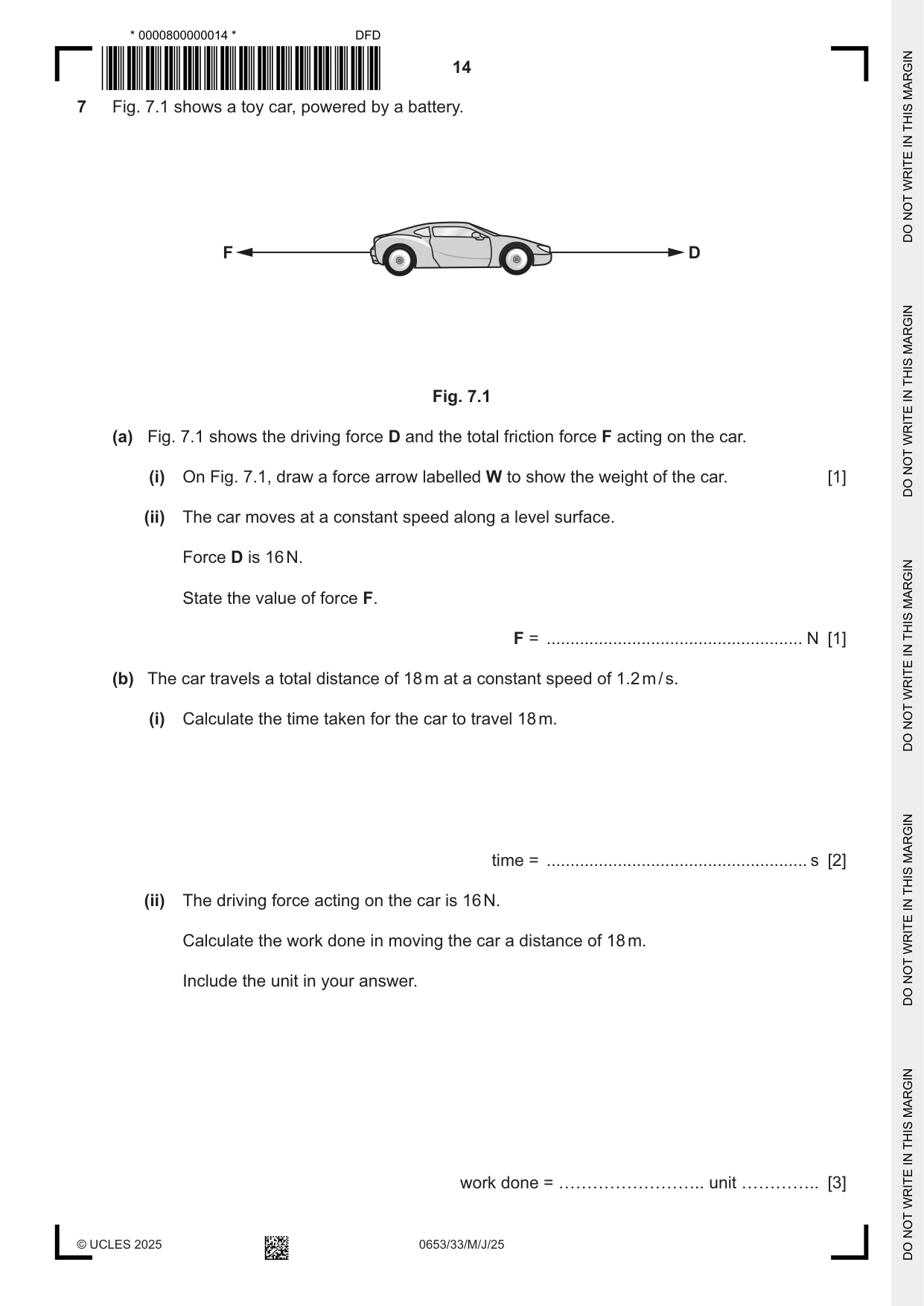
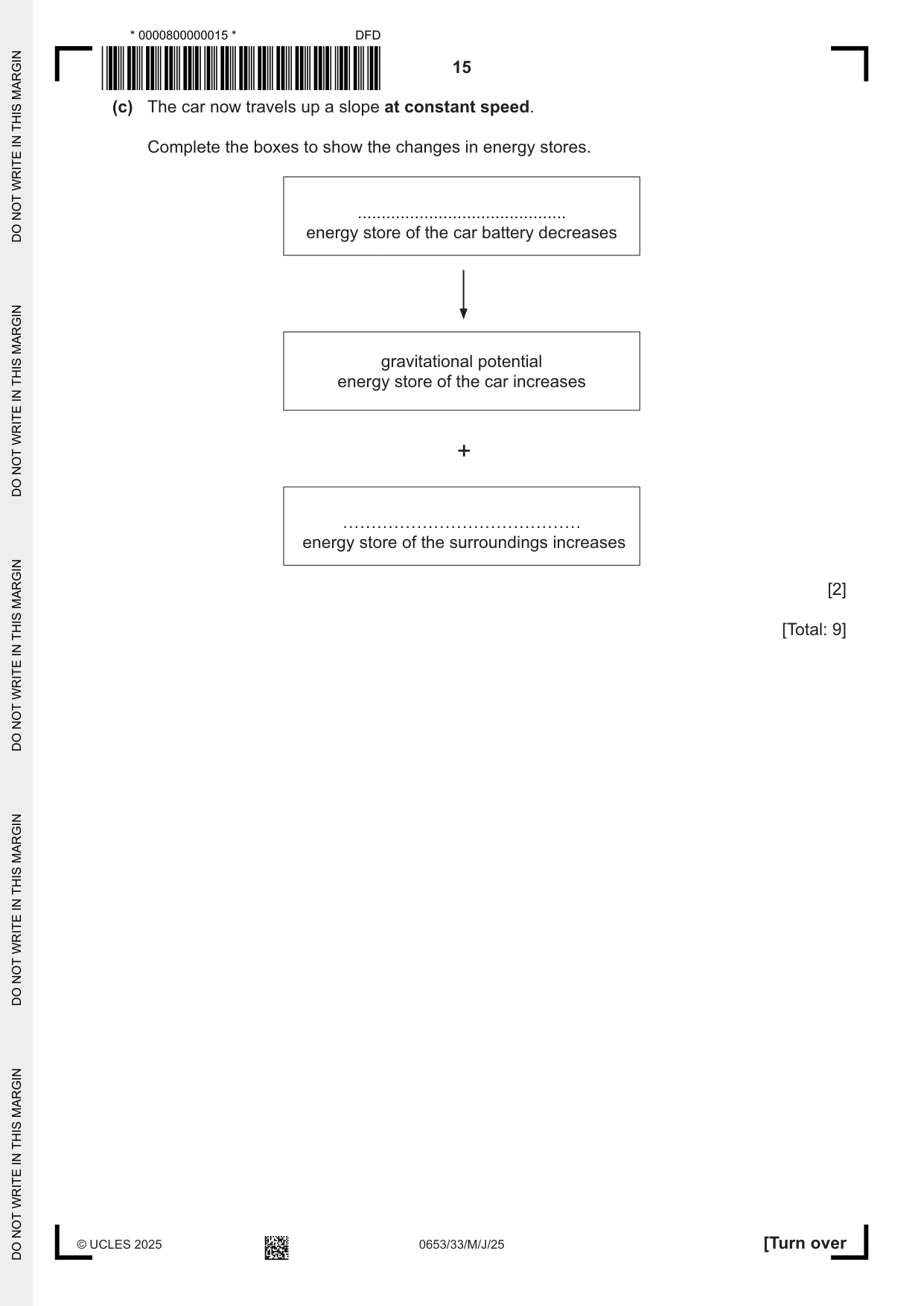
7 Fig. 7.1 shows a toy car, powered by a battery. F D Fig. 7.1 (a) Fig. 7.1 shows the driving force D and the total friction force F acting on the car. (i) On Fig. 7.1, draw a force arrow labelled W to show the weight of the car. [1] (ii) The car moves at a constant speed along a level surface. Force D is 16 N. State the value of force F. F = ...................................................... N [1] (b) The car travels a total distance of 18 m at a constant speed of 1.2 m / s. (i) Calculate the time taken for the car to travel 18 m. time = ....................................................... s [2] (ii) The driving force acting on the car is 16 N. Calculate the work done in moving the car a distance of 18 m. Include the unit in your answer. work done = …………………….. unit ………….. [3] (c) The car now travels up a slope at constant speed. Complete the boxes to show the changes in energy stores. ............................................ energy store of the car battery decreases gravitational potential energy store of the car increases + energy store of the surroundings increases [2] [Total: 9]
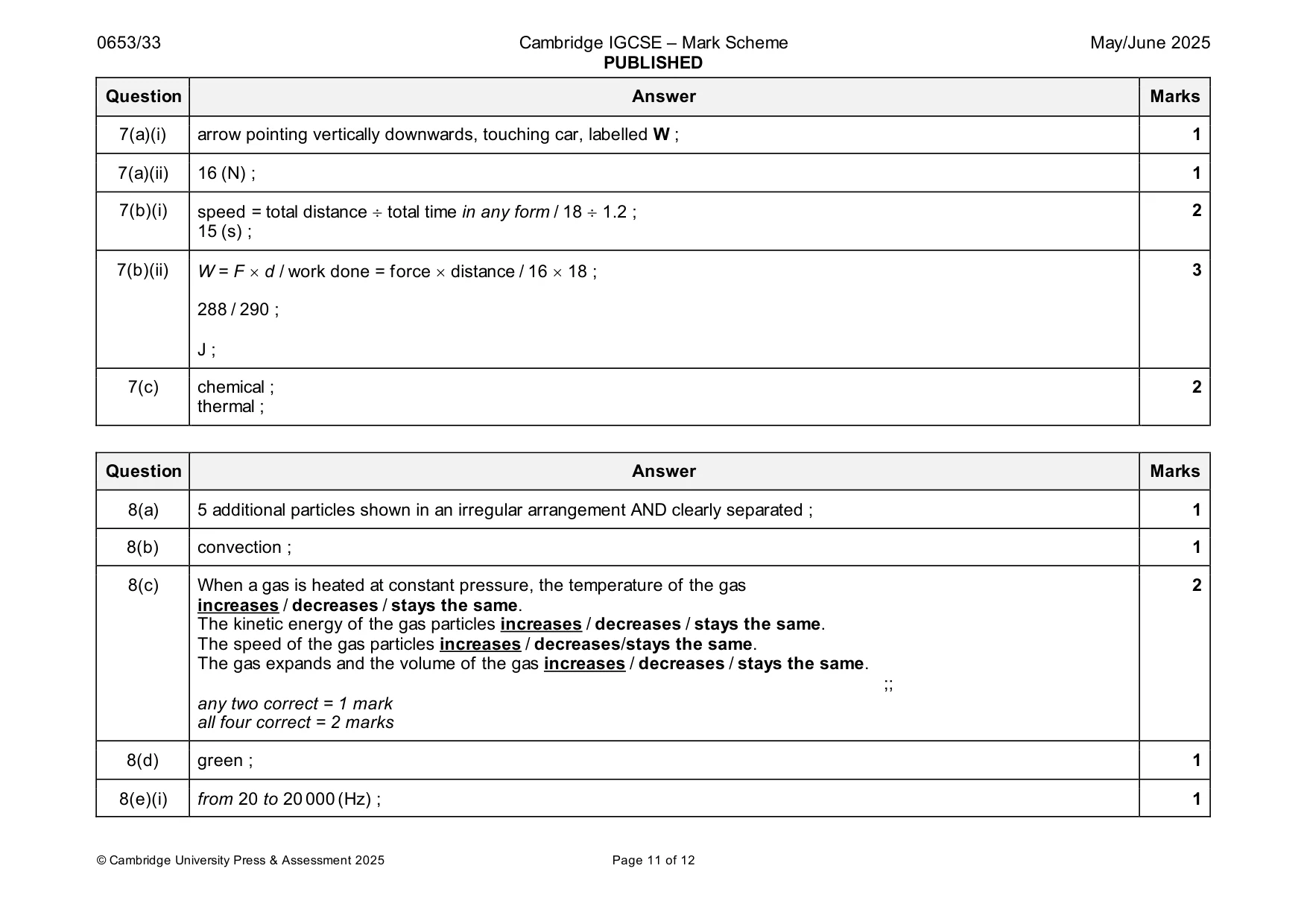
Mark scheme: 7(a)(i) arrow pointing vertically downwards, touching car, labelled W ; 1 7(a)(ii) 16 (N) ; 1 7(b)(i) speed = total distance ÷ total time in any form / 18 ÷ 1.2 ; 2 15 (s) ; 7(b)(ii) W = F × d / work done = force × distance / 16 × 18 ; 3 288 / 290 ; J ; 7(c) chemical ; 2 thermal ;
Q8 · A Bunsen burner with the air hole closed, burning with a yellow flame
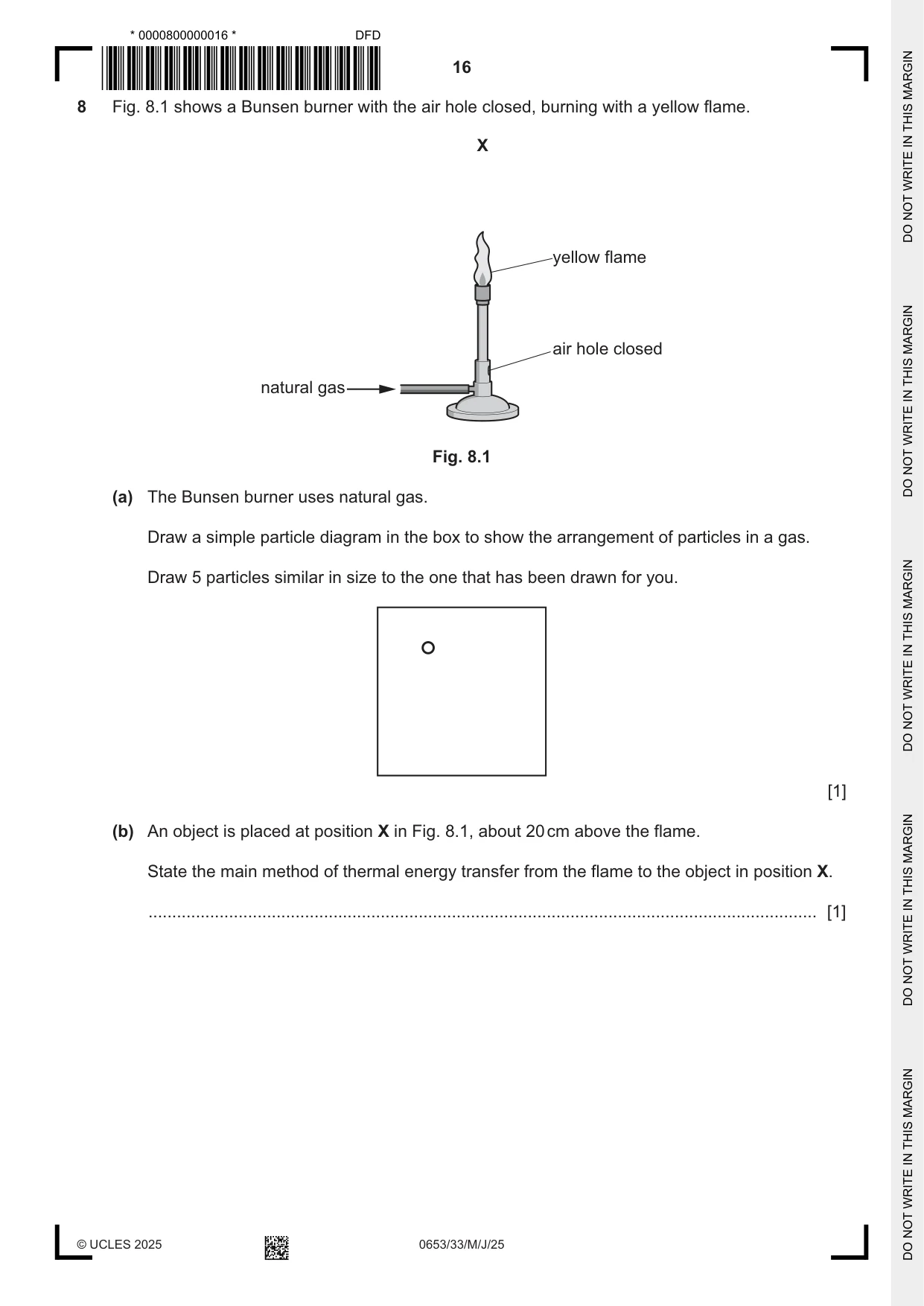
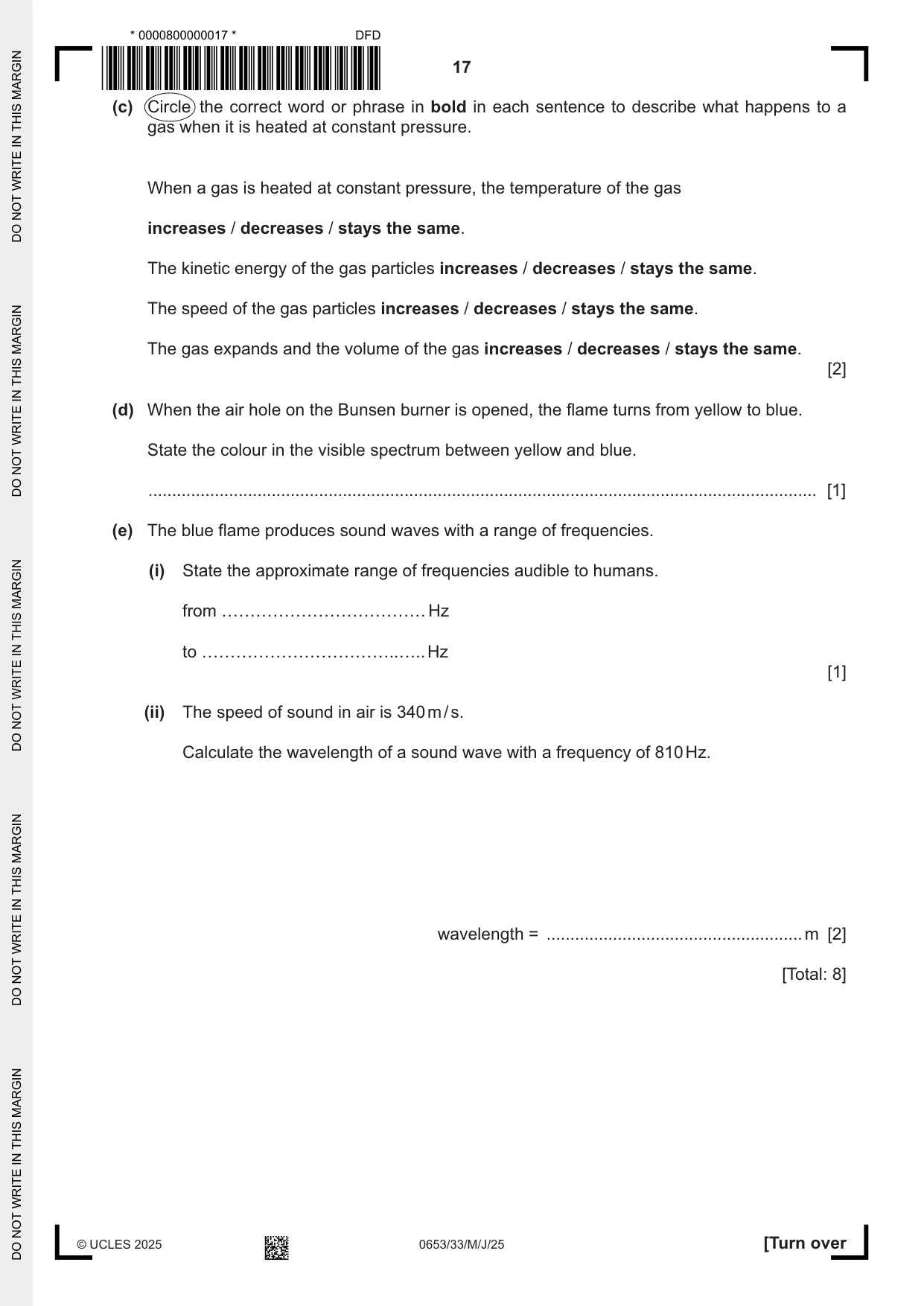
8 Fig. 8.1 shows a Bunsen burner with the air hole closed, burning with a yellow flame. X yellow flame air hole closed natural gas Fig. 8.1 (a) The Bunsen burner uses natural gas. Draw a simple particle diagram in the box to show the arrangement of particles in a gas. Draw 5 particles similar in size to the one that has been drawn for you. [1] (b) An object is placed at position X in Fig. 8.1, about 20 cm above the flame. State the main method of thermal energy transfer from the flame to the object in position X. ............................................................................................................................................. [1] (c) Circle the correct word or phrase in bold in each sentence to describe what happens to a gas when it is heated at constant pressure. When a gas is heated at constant pressure, the temperature of the gas increases / decreases / stays the same. The kinetic energy of the gas particles increases / decreases / stays the same. The speed of the gas particles increases / decreases / stays the same. The gas expands and the volume of the gas increases / decreases / stays the same. [2] (d) When the air hole on the Bunsen burner is opened, the flame turns from yellow to blue. State the colour in the visible spectrum between yellow and blue. ............................................................................................................................................. [1] (e) The blue flame produces sound waves with a range of frequencies. (i) State the approximate range of frequencies audible to humans. from ……………………………… Hz to ……………………………..….. Hz [1] (ii) The speed of sound in air is 340 m / s. Calculate the wavelength of a sound wave with a frequency of 810 Hz. wavelength = ...................................................... m [2] [Total: 8]
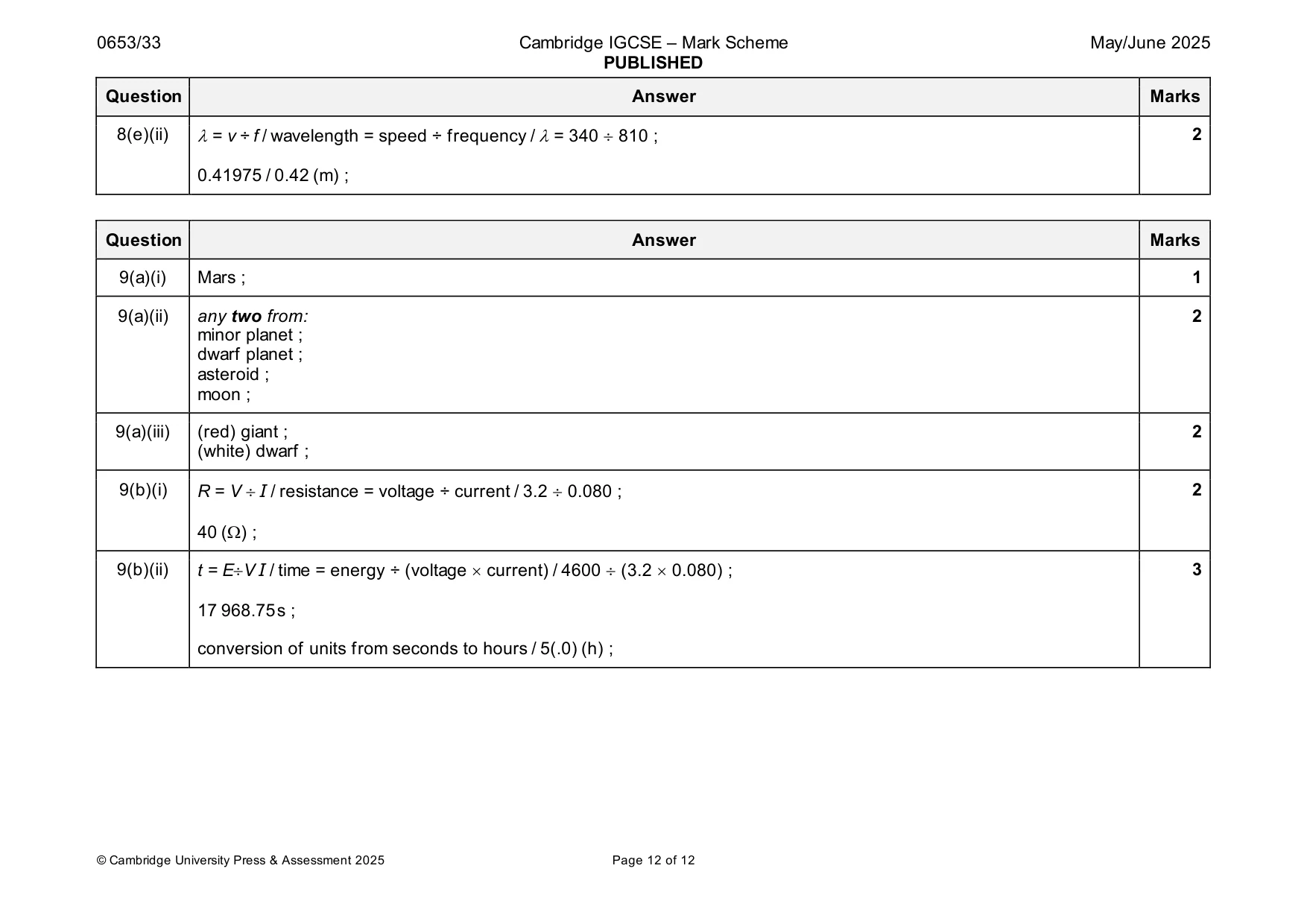
Mark scheme: 8(a) 5 additional particles shown in an irregular arrangement AND clearly separated ; 1 8(b) convection ; 1 8(c) When a gas is heated at constant pressure, the temperature of the gas 2 increases / decreases / stays the same. The kinetic energy of the gas particles increases / decreases / stays the same. The speed of the gas particles increases / decreases/stays the same. The gas expands and the volume of the gas increases / decreases / stays the same. ;; any two correct = 1 mark all four correct = 2 marks 8(d) green ; 1 8(e)(i) from 20 to 20 000 (Hz) ; 1 8(e)(ii) λ= v ÷ f / wavelength = speed ÷ frequency / λ= 340 ÷ 810 ; 2 0.41975 / 0.42 (m) ;
Q9 · A large telescope used for studying the Solar System
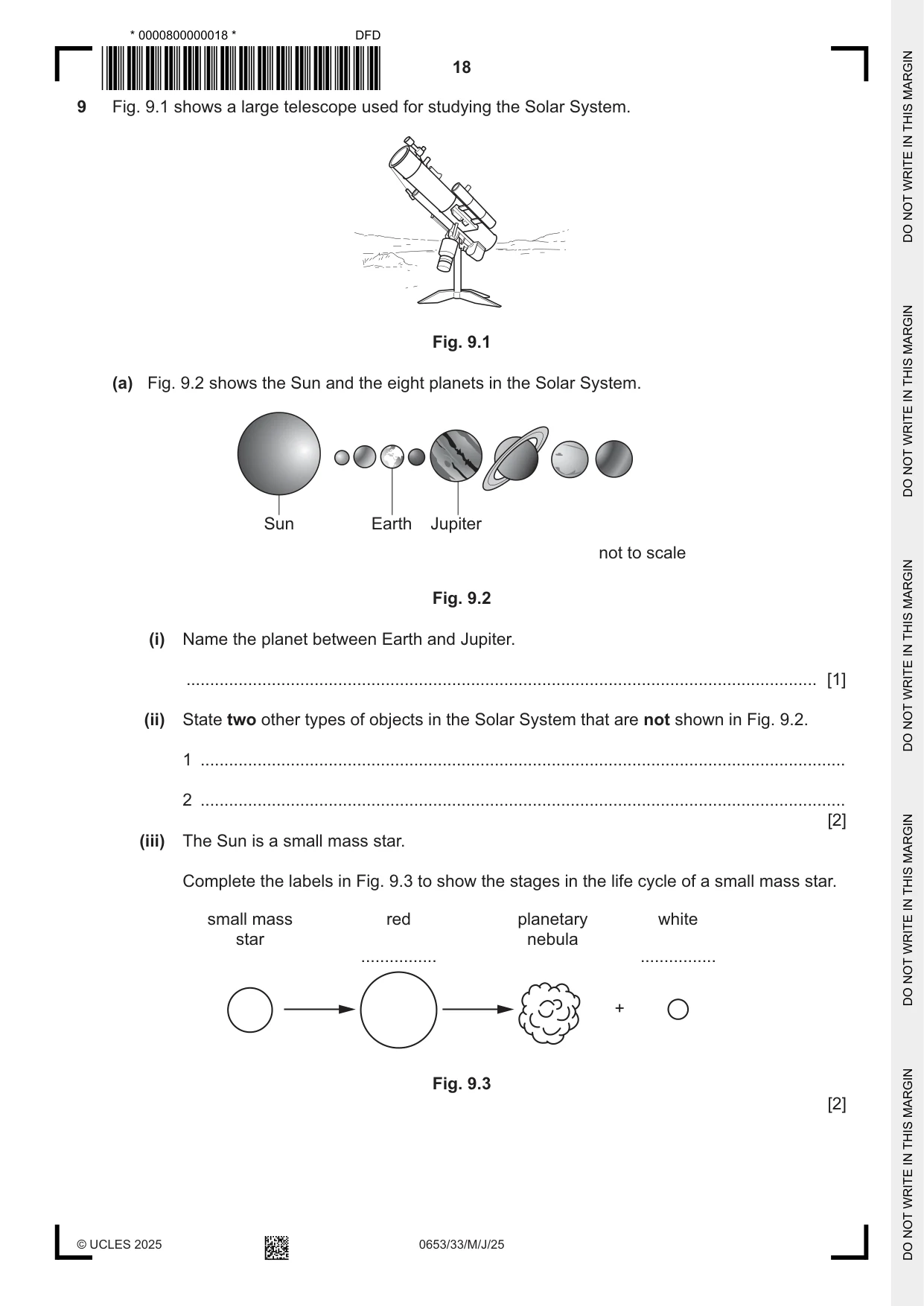
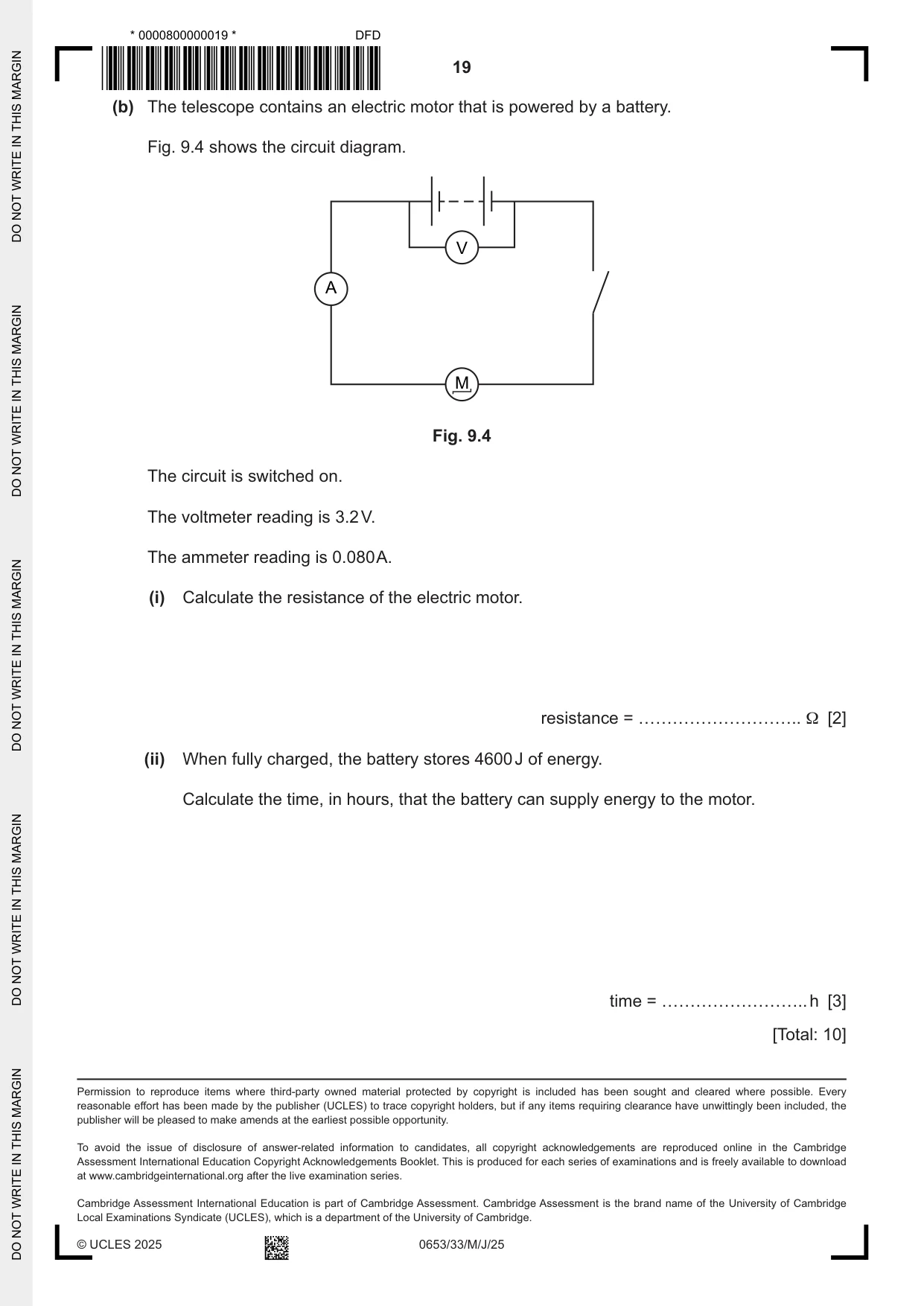
9 Fig. 9.1 shows a large telescope used for studying the Solar System. Fig. 9.1 (a) Fig. 9.2 shows the Sun and the eight planets in the Solar System. Sun Earth Jupiter not to scale Fig. 9.2 (i) Name the planet between Earth and Jupiter. ..................................................................................................................................... [1] (ii) State two other types of objects in the Solar System that are not shown in Fig. 9.2. 1 ........................................................................................................................................ 2 ........................................................................................................................................ [2] (iii) The Sun is a small mass star. Complete the labels in Fig. 9.3 to show the stages in the life cycle of a small mass star. small mass red planetary white star nebula ................ ................ + Fig. 9.3 [2] (b) The telescope contains an electric motor that is powered by a battery. Fig. 9.4 shows the circuit diagram. V A M Fig. 9.4 The circuit is switched on. The voltmeter reading is 3.2 V. The ammeter reading is 0.080 A. (i) Calculate the resistance of the electric motor. resistance = ……………………….. Ω [2] (ii) When fully charged, the battery stores 4600 J of energy. Calculate the time, in hours, that the battery can supply energy to the motor. time = …………………….. h [3] [Total: 10]
Mark scheme: 9(a)(i) Mars ; 1 9(a)(ii) any two from: 2 minor planet ; dwarf planet ; asteroid ; moon ; 9(a)(iii) (red) giant ; 2 (white) dwarf ; 9(b)(i) R = V ÷ I / resistance = voltage ÷ current / 3.2 ÷ 0.080 ; 2 40 (Ω) ; 9(b)(ii) t = E÷V I / time = energy ÷ (voltage × current) / 4600 ÷ (3.2 × 0.080) ; 3 17 968.75 s ; conversion of units from seconds to hours / 5(.0) (h) ;
What was in this paper
The subtopics covered by these 9 questions, and how many questions each got. Open one in a new tab to see every Cambridge question on it.
What you needed in this session
Cambridge’s own grade thresholds for 2025 May/June, Paper 3 · Variant 3. A higher threshold means an easier paper — the bar moves with how the cohort did.