Cambridge IGCSE Science - Combined 0653 — 2022 Feb/March Paper 3 · Variant 2
0653/32/F/M/22 · 9 questions · 80 marks · ≈90 min
The question paper and its mark scheme, free to read here and free to download. This is Cambridge’s own paper, exactly as it was sat.
Question paper24 pages


Mark scheme10 pages
Answers below. Sit the paper first if you are practising.
Questions as text
Q1 · A diagram of a root hair cell
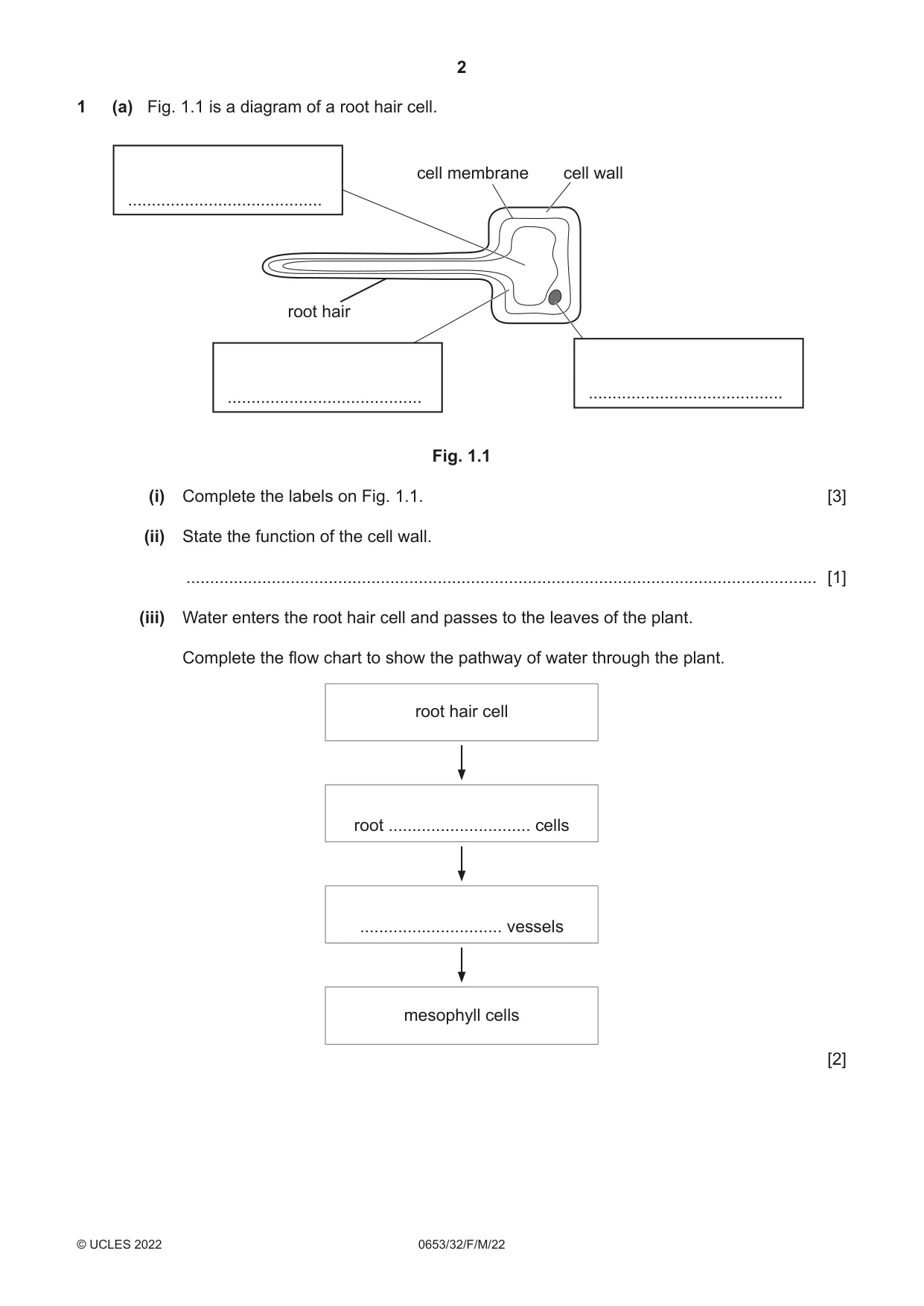
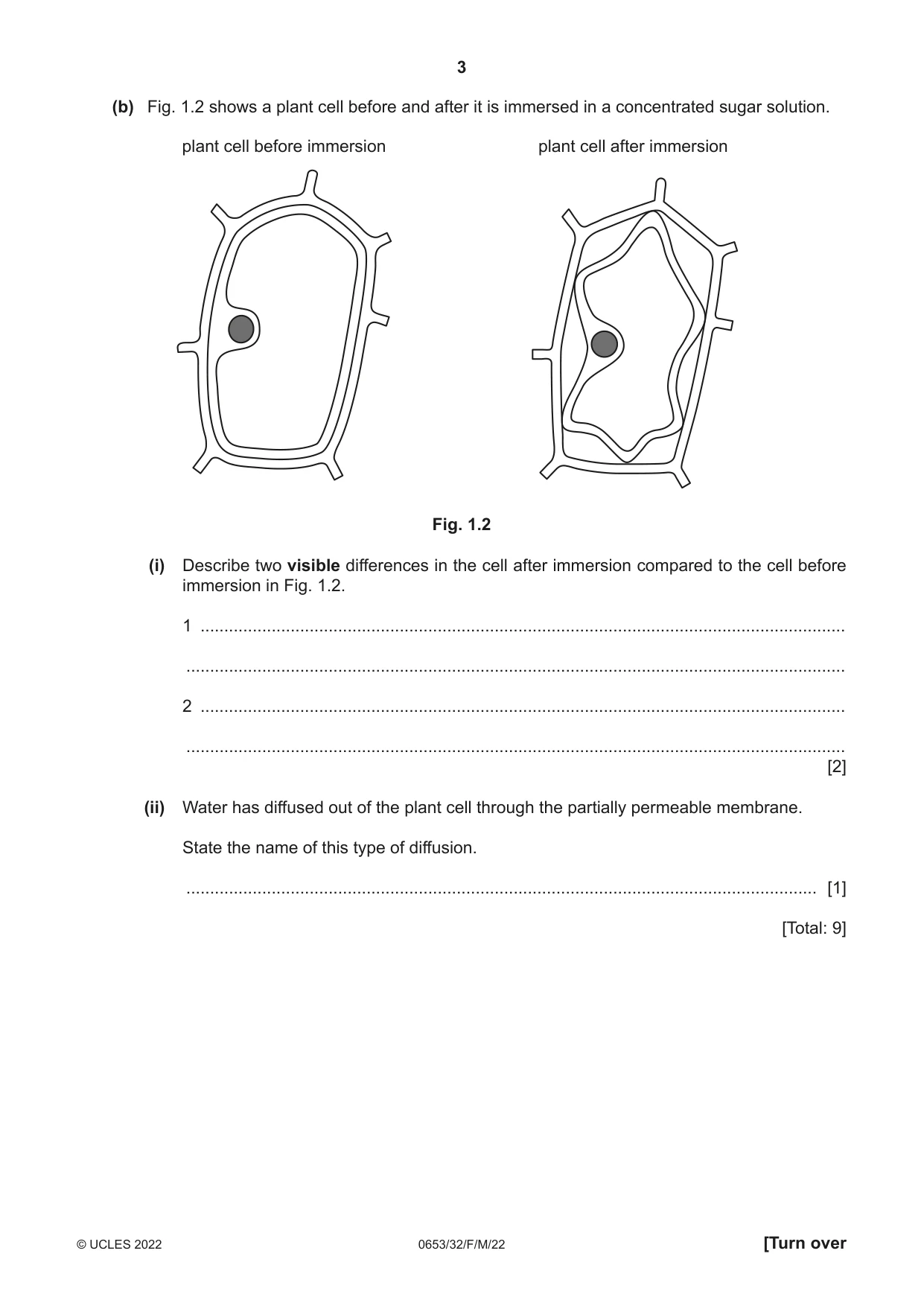
1 (a) Fig. 1.1 is a diagram of a root hair cell. cell membrane cell wall ......................................... root hair ......................................... ......................................... Fig. 1.1 (i) Complete the labels on Fig. 1.1. [3] (ii) State the function of the cell wall. ..................................................................................................................................... [1] (iii) Water enters the root hair cell and passes to the leaves of the plant. Complete the flow chart to show the pathway of water through the plant. root hair cell root .............................. cells .............................. vessels mesophyll cells [2] (b) Fig. 1.2 shows a plant cell before and after it is immersed in a concentrated sugar solution. plant cell before immersion plant cell after immersion Fig. 1.2 (i) Describe two visible differences in the cell after immersion compared to the cell before immersion in Fig. 1.2. 1 ........................................................................................................................................ ........................................................................................................................................... 2 ........................................................................................................................................ ........................................................................................................................................... [2] (ii) Water has diffused out of the plant cell through the partially permeable membrane. State the name of this type of diffusion. ..................................................................................................................................... [1] [Total: 9]
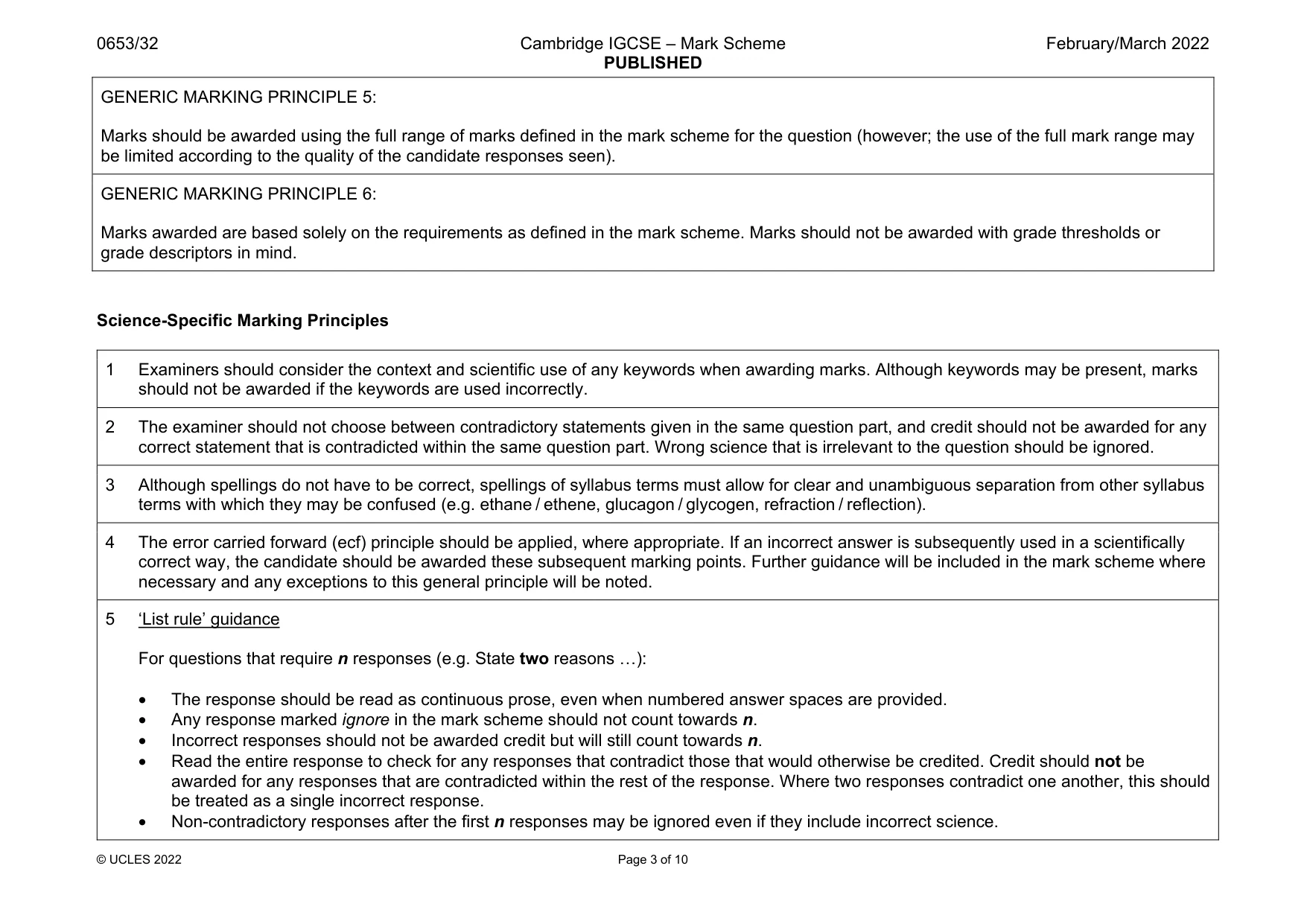
Mark scheme: 1(a)(i) vacuole ; cytoplasm ; nucleus ; 3 1(a)(ii) support / strengthen the cell ; 1 1(a)(iii) cortex ; xylem ; 2 1(b)(i) any two from: (whole cell is) smaller / narrower ; smaller vacuole ; membrane pulled away from wall ; 2 1(b)(ii) osmosis ; 1
Q2 · A student has two samples of pure water in test-tubes A and B, and two samples of impure…
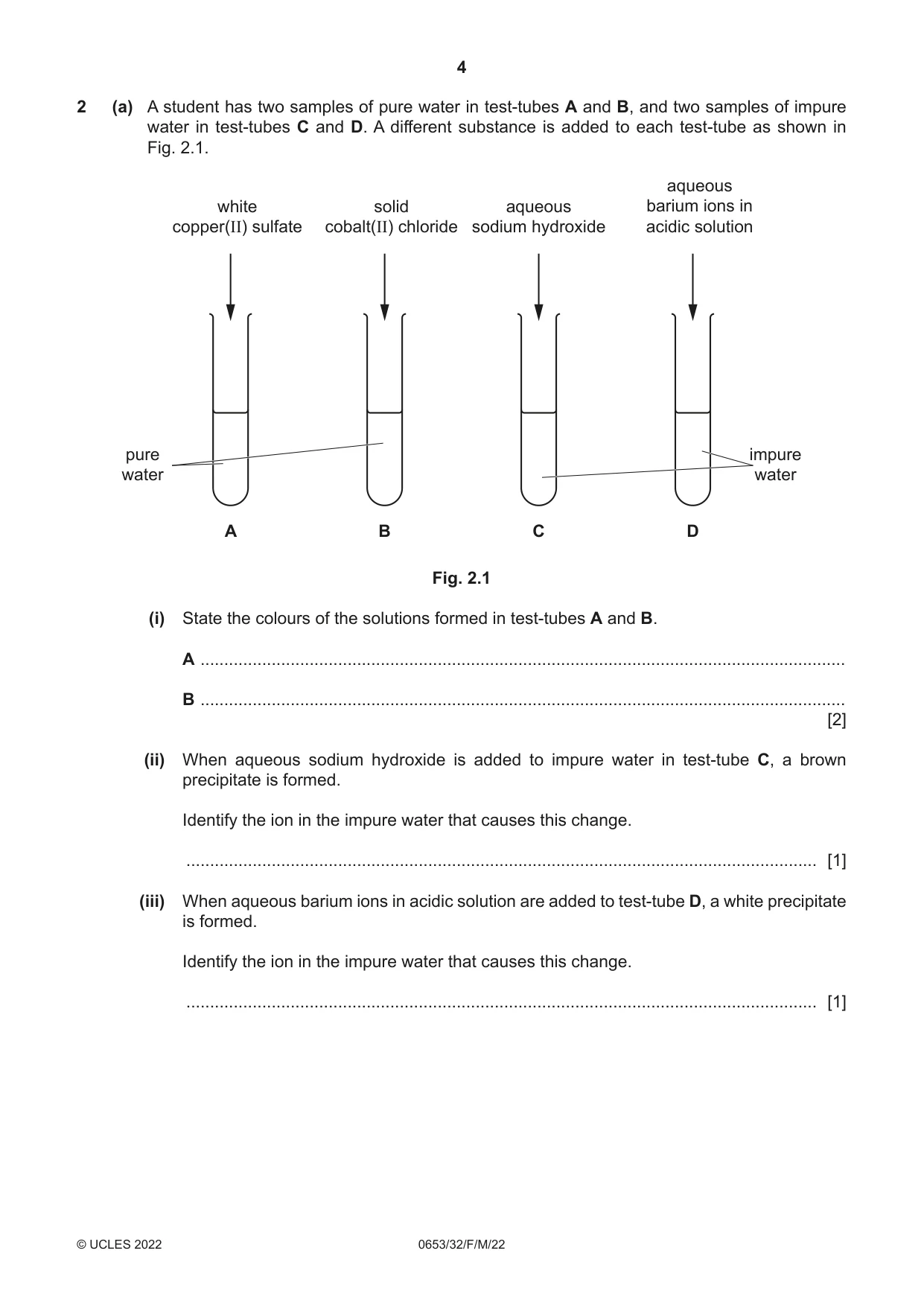
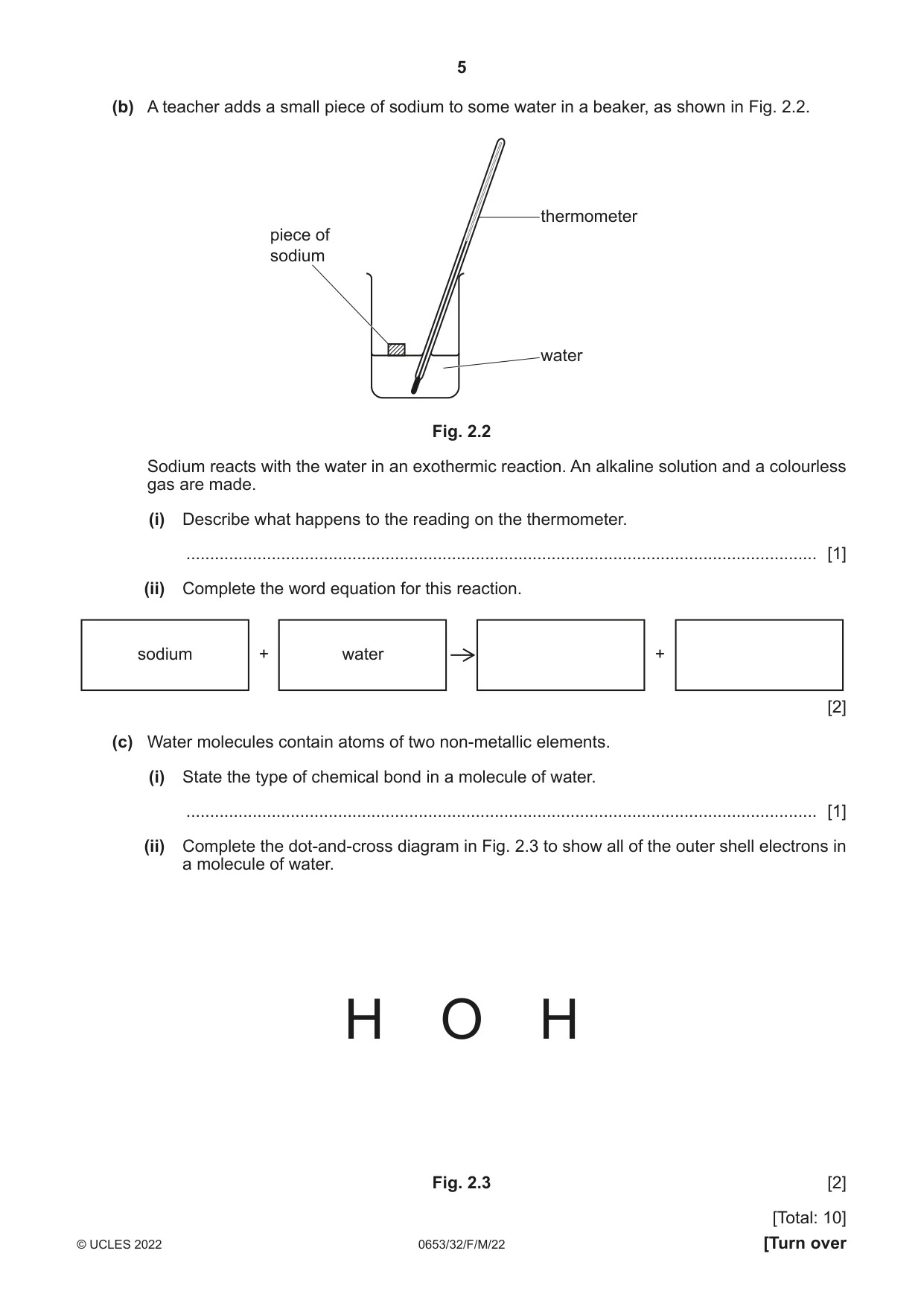
2 (a) A student has two samples of pure water in test-tubes A and B, and two samples of impure water in test-tubes C and D. A different substance is added to each test-tube as shown in Fig. 2.1. aqueous white solid aqueous barium ions in copper(II) sulfate cobalt(II) chloride sodium hydroxide acidic solution pure impure water water A B C D Fig. 2.1 (i) State the colours of the solutions formed in test-tubes A and B. A ........................................................................................................................................ B ........................................................................................................................................ [2] (ii) When aqueous sodium hydroxide is added to impure water in test-tube C, a brown precipitate is formed. Identify the ion in the impure water that causes this change. ..................................................................................................................................... [1] (iii) When aqueous barium ions in acidic solution are added to test-tube D, a white precipitate is formed. Identify the ion in the impure water that causes this change. ..................................................................................................................................... [1] (b) A teacher adds a small piece of sodium to some water in a beaker, as shown in Fig. 2.2. thermometer piece of sodium water Fig. 2.2 Sodium reacts with the water in an exothermic reaction. An alkaline solution and a colourless gas are made. (i) Describe what happens to the reading on the thermometer. ..................................................................................................................................... [1] (ii) Complete the word equation for this reaction. sodium + water + [2] (c) Water molecules contain atoms of two non-metallic elements. (i) State the type of chemical bond in a molecule of water. ..................................................................................................................................... [1] (ii) Complete the dot-and-cross diagram in Fig. 2.3 to show all of the outer shell electrons in a molecule of water. H O H Fig. 2.3 [2] [Total: 10]
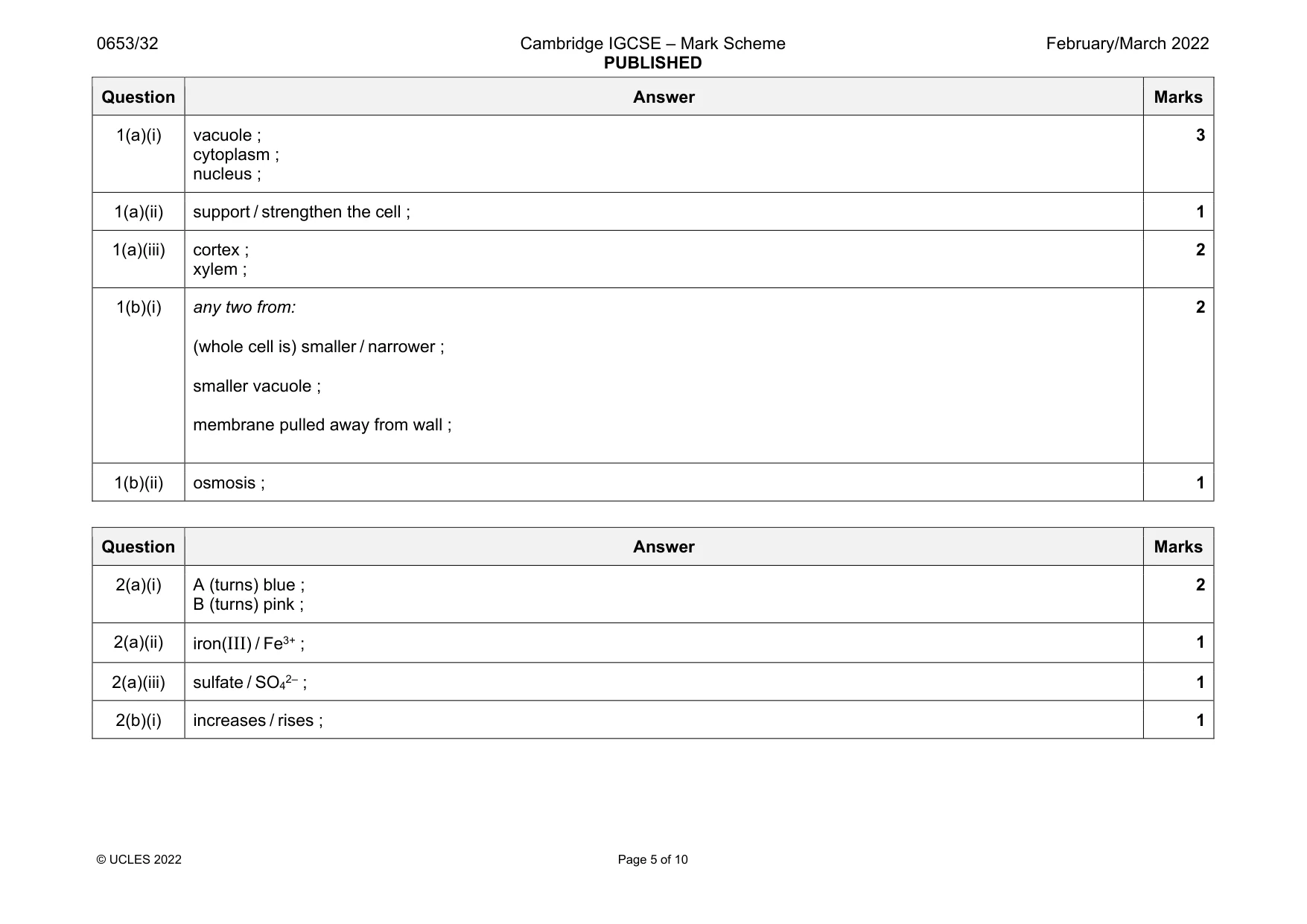
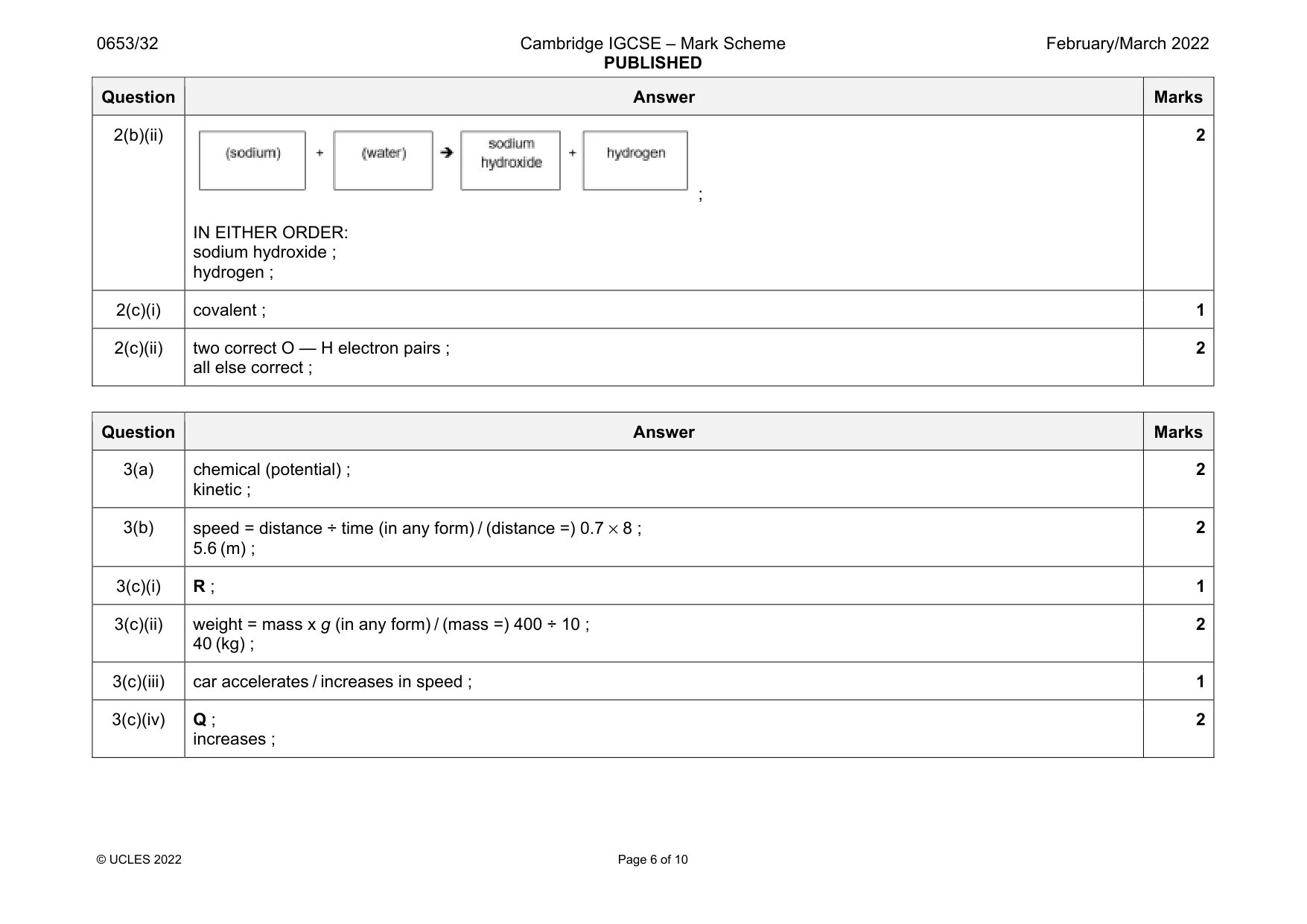
Mark scheme: 2(a)(i) A (turns) blue ; B (turns) pink ; 2 2(a)(ii) iron(III) / Fe3+ ; 1 2(a)(iii) sulfate / SO42– ; 1 2(b)(i) increases / rises ; 1 Question Answer Marks 2(b)(ii) ; IN EITHER ORDER: sodium hydroxide ; hydrogen ; 2 2(c)(i) covalent ; 1 2(c)(ii) two correct O — H electron pairs ; all else correct ; 2
Q3 · A child in a moving toy car
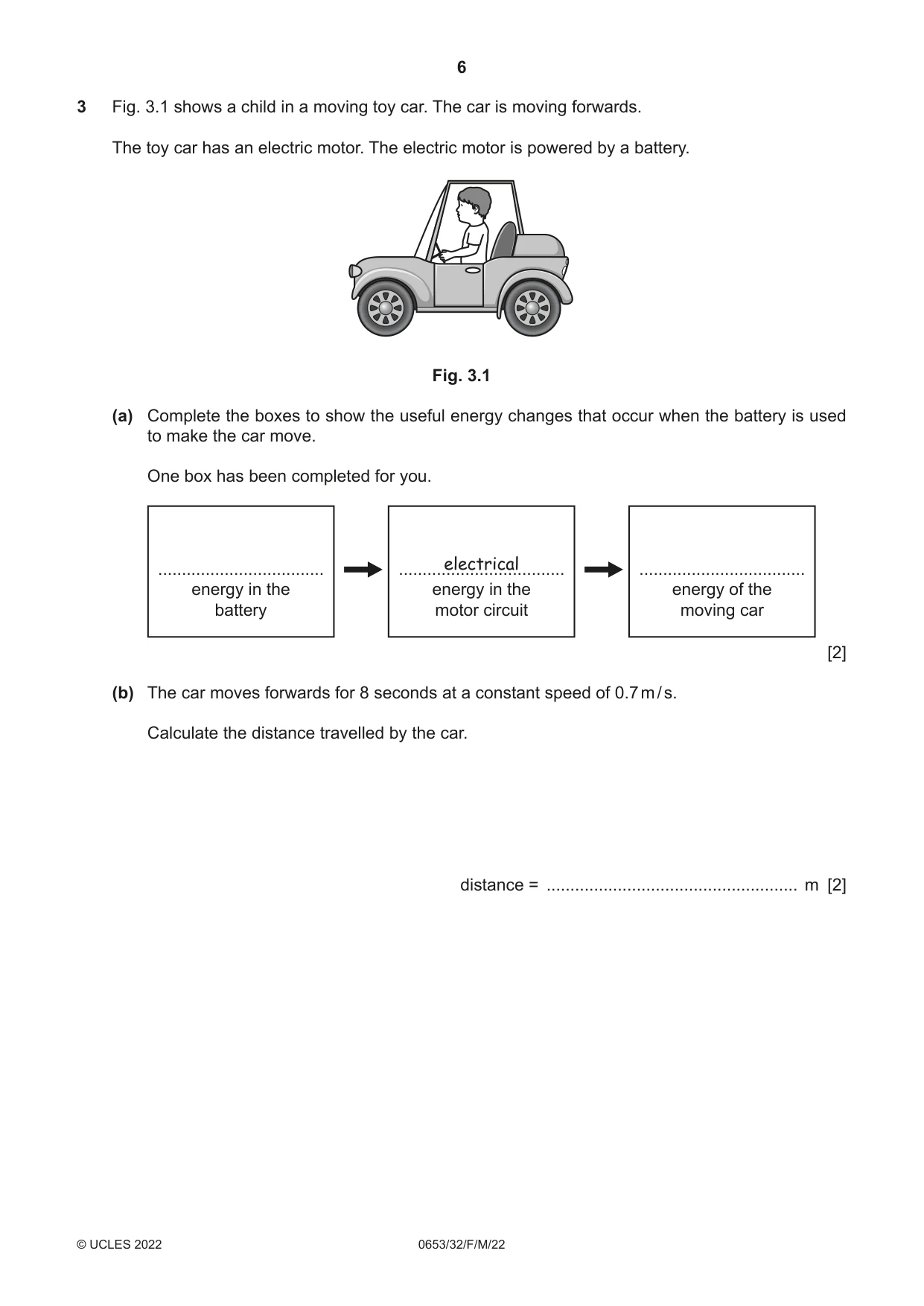
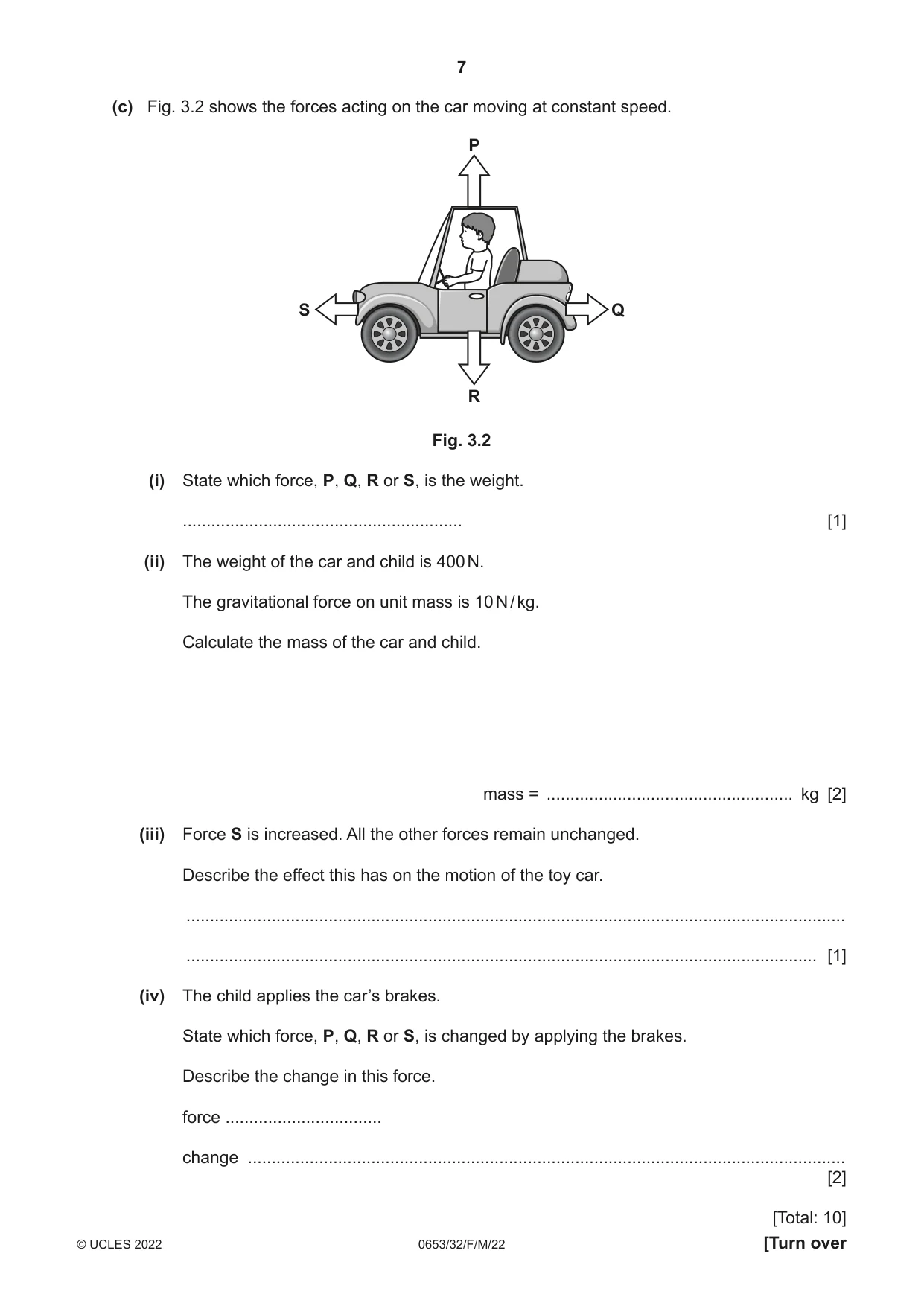
3 Fig. 3.1 shows a child in a moving toy car. The car is moving forwards. The toy car has an electric motor. The electric motor is powered by a battery. Fig. 3.1 (a) Complete the boxes to show the useful energy changes that occur when the battery is used to make the car move. One box has been completed for you. electrical ................................... ................................... ................................... energy in the energy in the energy of the battery motor circuit moving car [2] (b) The car moves forwards for 8 seconds at a constant speed of 0.7 m / s. Calculate the distance travelled by the car. distance = ..................................................... m [2] (c) Fig. 3.2 shows the forces acting on the car moving at constant speed. P S Q R Fig. 3.2 (i) State which force, P, Q, R or S, is the weight. ........................................................... [1] (ii) The weight of the car and child is 400 N. The gravitational force on unit mass is 10 N / kg. Calculate the mass of the car and child. mass = .................................................... kg [2] (iii) Force S is increased. All the other forces remain unchanged. Describe the effect this has on the motion of the toy car. ........................................................................................................................................... ..................................................................................................................................... [1] (iv) The child applies the car’s brakes. State which force, P, Q, R or S, is changed by applying the brakes. Describe the change in this force. force ................................. change .............................................................................................................................. [2] [Total: 10]
Mark scheme: 3(a) chemical (potential) ; kinetic ; 2 3(b) speed = distance ÷ time (in any form) / (distance =) 0.7 × 8 ; 5.6 (m) ; 2 3(c)(i) R ; 1 3(c)(ii) weight = mass x g (in any form) / (mass =) 400 ÷ 10 ; 40 (kg) ; 2 3(c)(iii) car accelerates / increases in speed ; 1 3(c)(iv) Q ; increases ; 2
Q4 · The boxes on the left show some of the components of blood
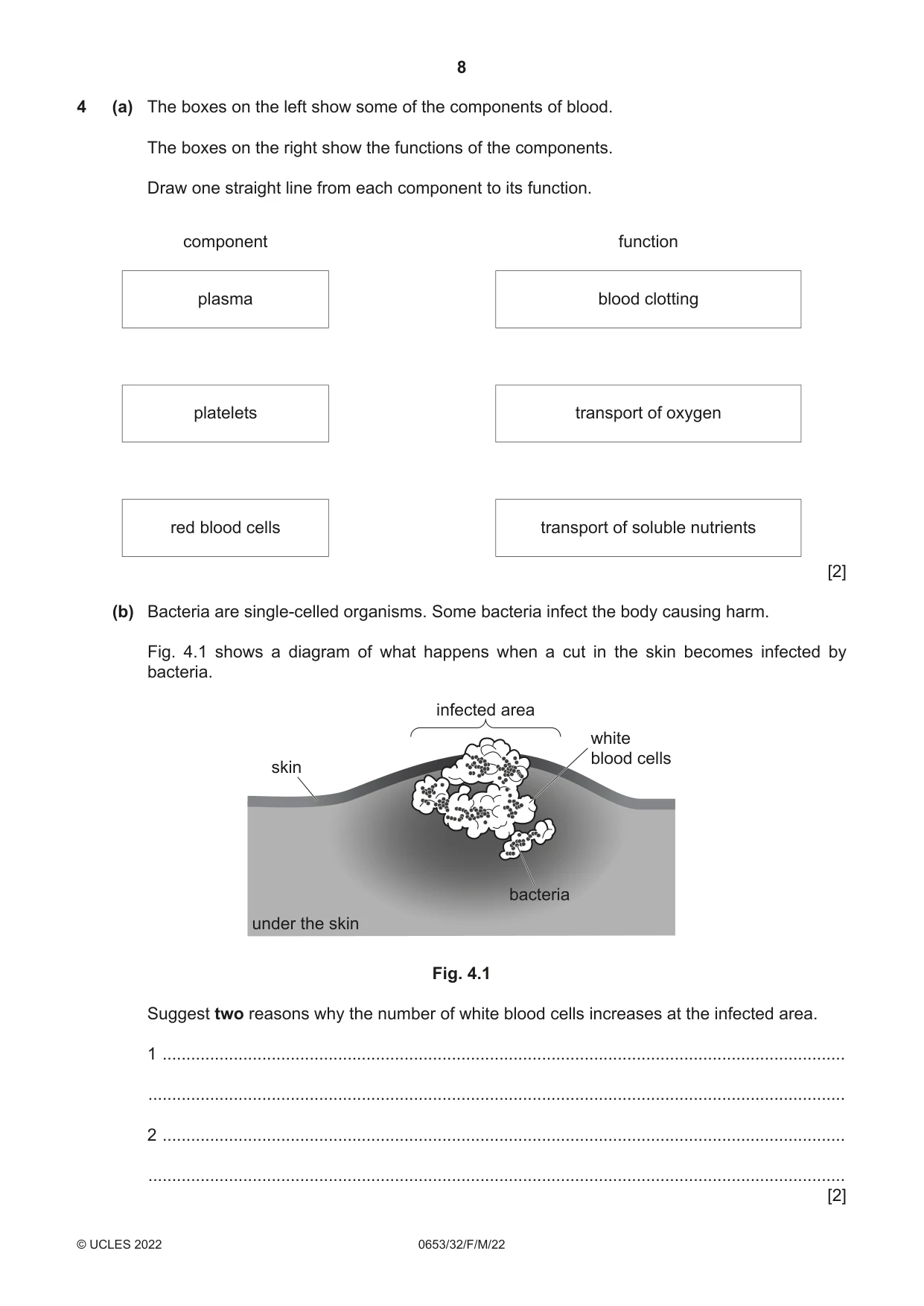
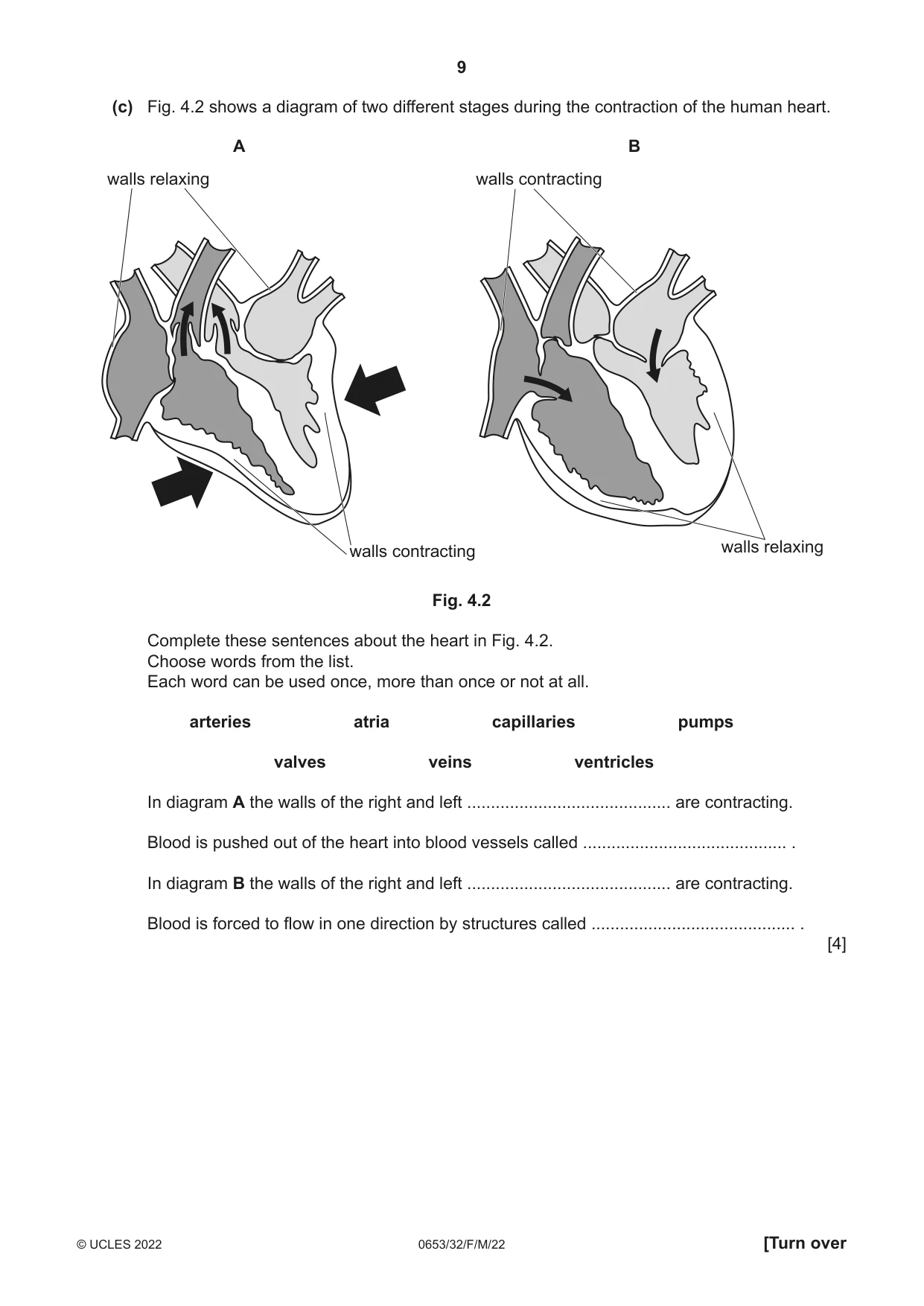
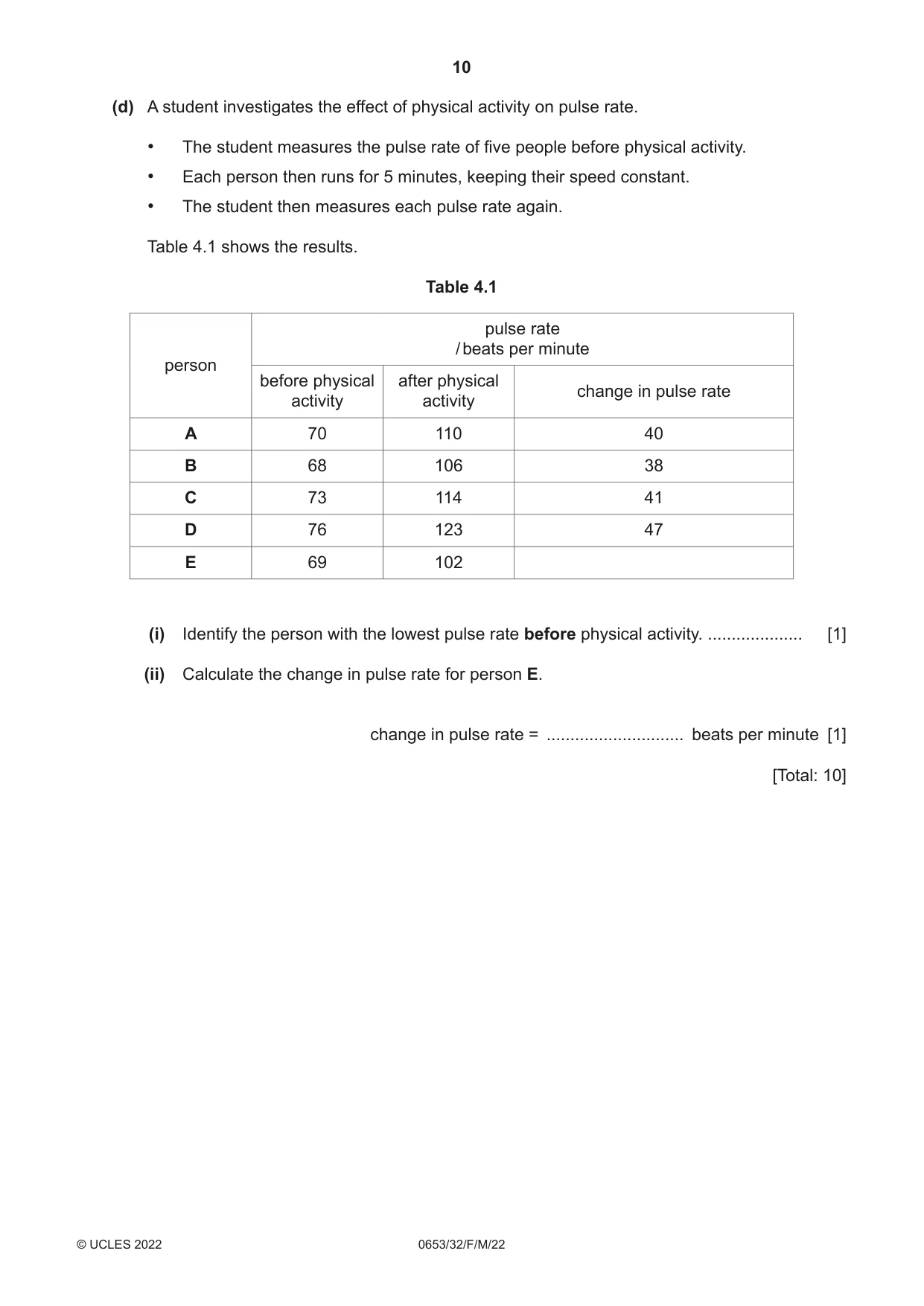
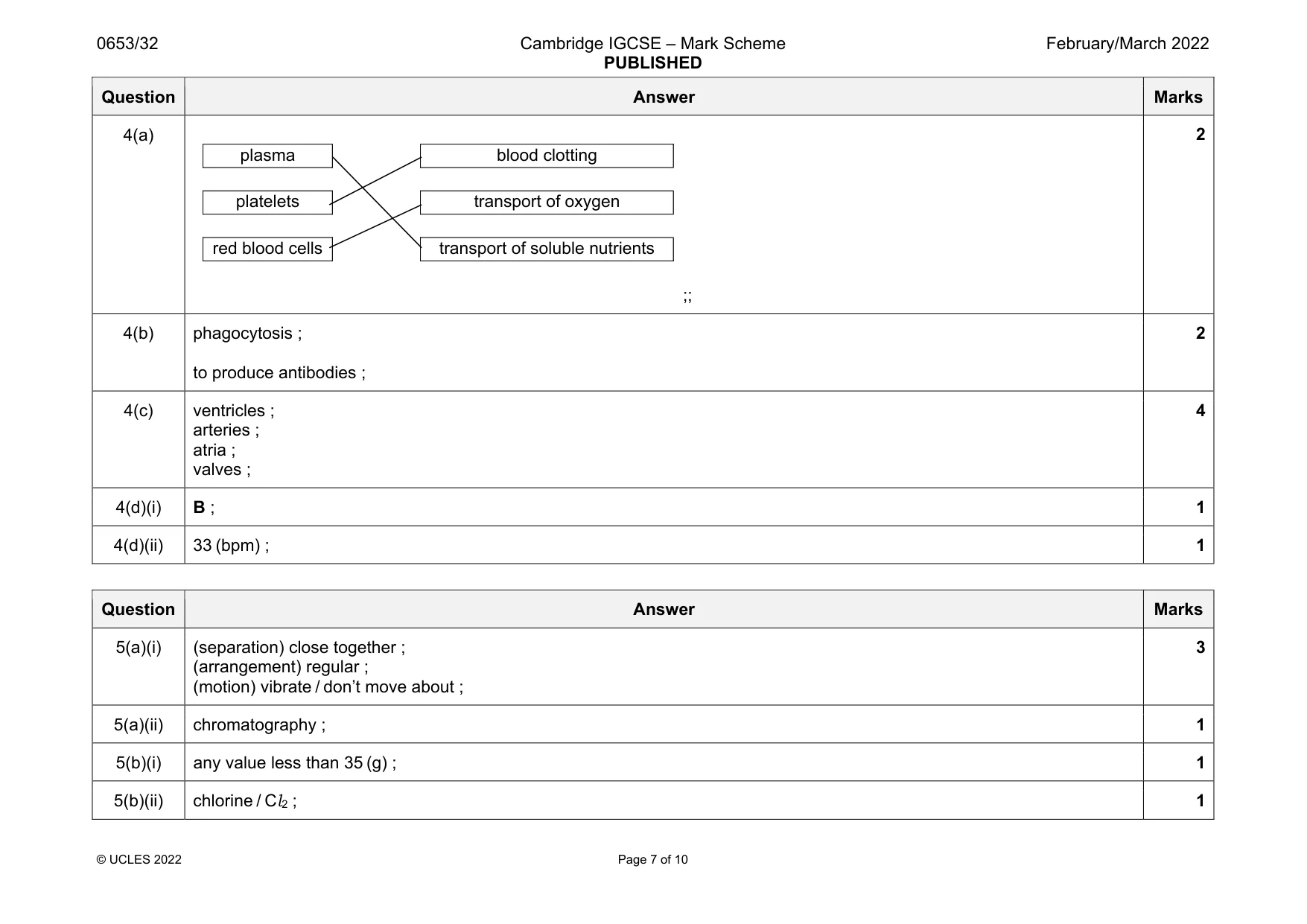
4 (a) The boxes on the left show some of the components of blood. The boxes on the right show the functions of the components. Draw one straight line from each component to its function. component function plasma blood clotting platelets transport of oxygen red blood cells transport of soluble nutrients [2] (b) Bacteria are single-celled organisms. Some bacteria infect the body causing harm. Fig. 4.1 shows a diagram of what happens when a cut in the skin becomes infected by bacteria. infected area white blood cells skin bacteria under the skin Fig. 4.1 Suggest two reasons why the number of white blood cells increases at the infected area. 1 ................................................................................................................................................ ................................................................................................................................................... 2 ................................................................................................................................................ ................................................................................................................................................... [2] (c) Fig. 4.2 shows a diagram of two different stages during the contraction of the human heart. A B walls relaxing walls contracting walls contracting walls relaxing Fig. 4.2 Complete these sentences about the heart in Fig. 4.2. Choose words from the list. Each word can be used once, more than once or not at all. arteries atria capillaries pumps valves veins ventricles In diagram A the walls of the right and left ........................................... are contracting. Blood is pushed out of the heart into blood vessels called ........................................... . In diagram B the walls of the right and left ........................................... are contracting. Blood is forced to flow in one direction by structures called ........................................... . [4] (d) A student investigates the effect of physical activity on pulse rate. • The student measures the pulse rate of five people before physical activity. • Each person then runs for 5 minutes, keeping their speed constant. • The student then measures each pulse rate again. Table 4.1 shows the results. Table 4.1 pulse rate / beats per minute person before physical after physical change in pulse rate activity activity A 70 110 40 B 68 106 38 C 73 114 41 D 76 123 47 E 69 102 (i) Identify the person with the lowest pulse rate before physical activity. .................... [1] (ii) Calculate the change in pulse rate for person E. change in pulse rate = ............................. beats per minute [1] [Total: 10]
Mark scheme: 4(a) plasma blood clotting platelets transport of oxygen red blood cells transport of soluble nutrients ;; 4(b) phagocytosis ; to produce antibodies ; 2 4(c) ventricles ; arteries ; atria ; valves ; 4 4(d)(i) B ; 1 4(d)(ii) 33 (bpm) ; 1
Q5 · A salt solution is made by dissolving solid salt in water
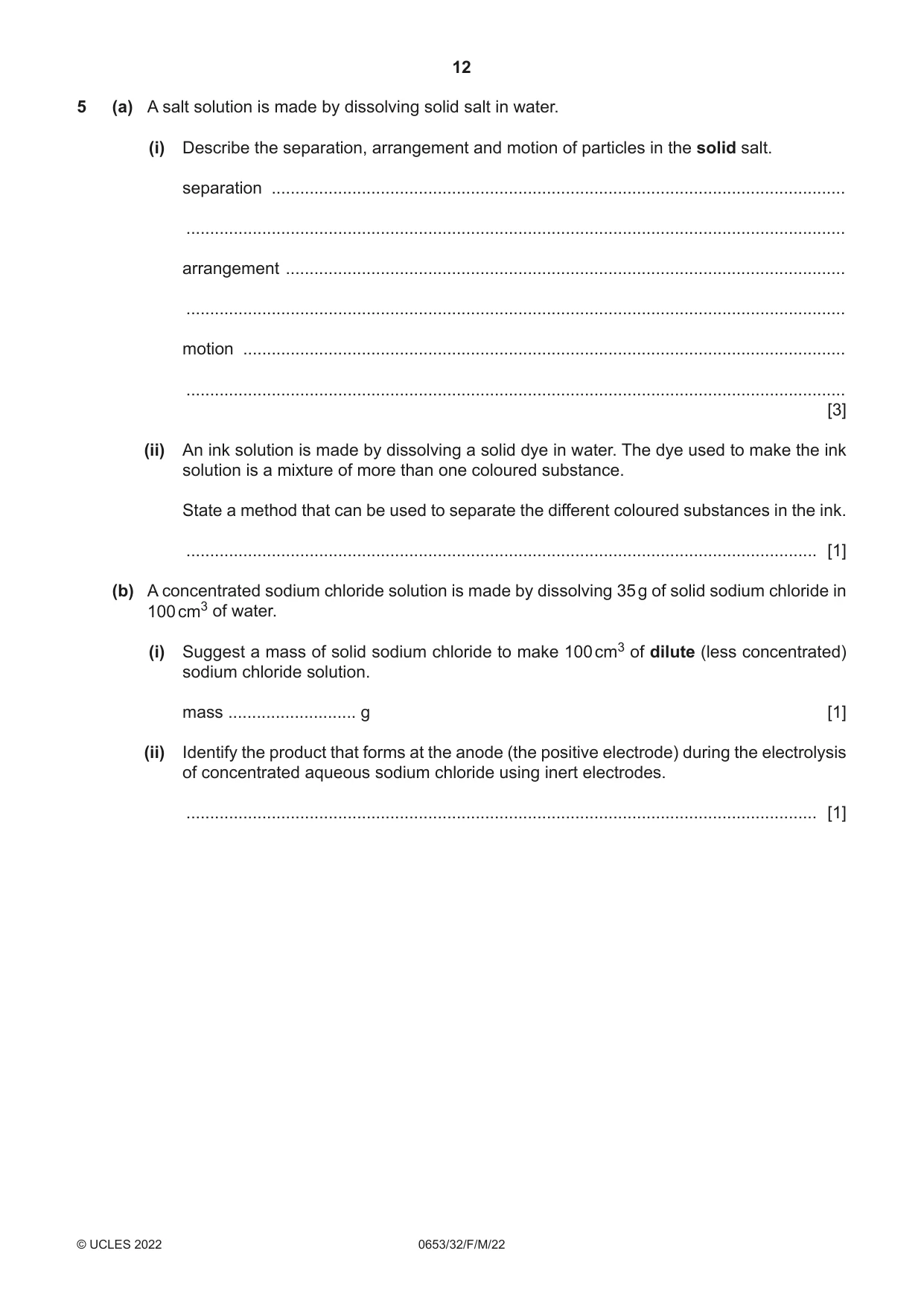
5 (a) A salt solution is made by dissolving solid salt in water. (i) Describe the separation, arrangement and motion of particles in the solid salt. separation ......................................................................................................................... ........................................................................................................................................... arrangement ...................................................................................................................... ........................................................................................................................................... motion ............................................................................................................................... ........................................................................................................................................... [3] (ii) An ink solution is made by dissolving a solid dye in water. The dye used to make the ink solution is a mixture of more than one coloured substance. State a method that can be used to separate the different coloured substances in the ink. ..................................................................................................................................... [1] (b) A concentrated sodium chloride solution is made by dissolving 35 g of solid sodium chloride in 100 cm3 of water. (i) Suggest a mass of solid sodium chloride to make 100 cm3 of dilute (less concentrated) sodium chloride solution. mass ........................... g [1] (ii) Identify the product that forms at the anode (the positive electrode) during the electrolysis of concentrated aqueous sodium chloride using inert electrodes. ..................................................................................................................................... [1] (c) Petroleum is a liquid fossil fuel. (i) Name one solid fossil fuel. ..................................................................................................................................... [1] (ii) State the process used to separate hydrocarbons in petroleum. ..................................................................................................................................... [1] (iii) Describe one difference in the chemical properties of saturated hydrocarbons and unsaturated hydrocarbons. ........................................................................................................................................... ..................................................................................................................................... [1] [Total: 9]
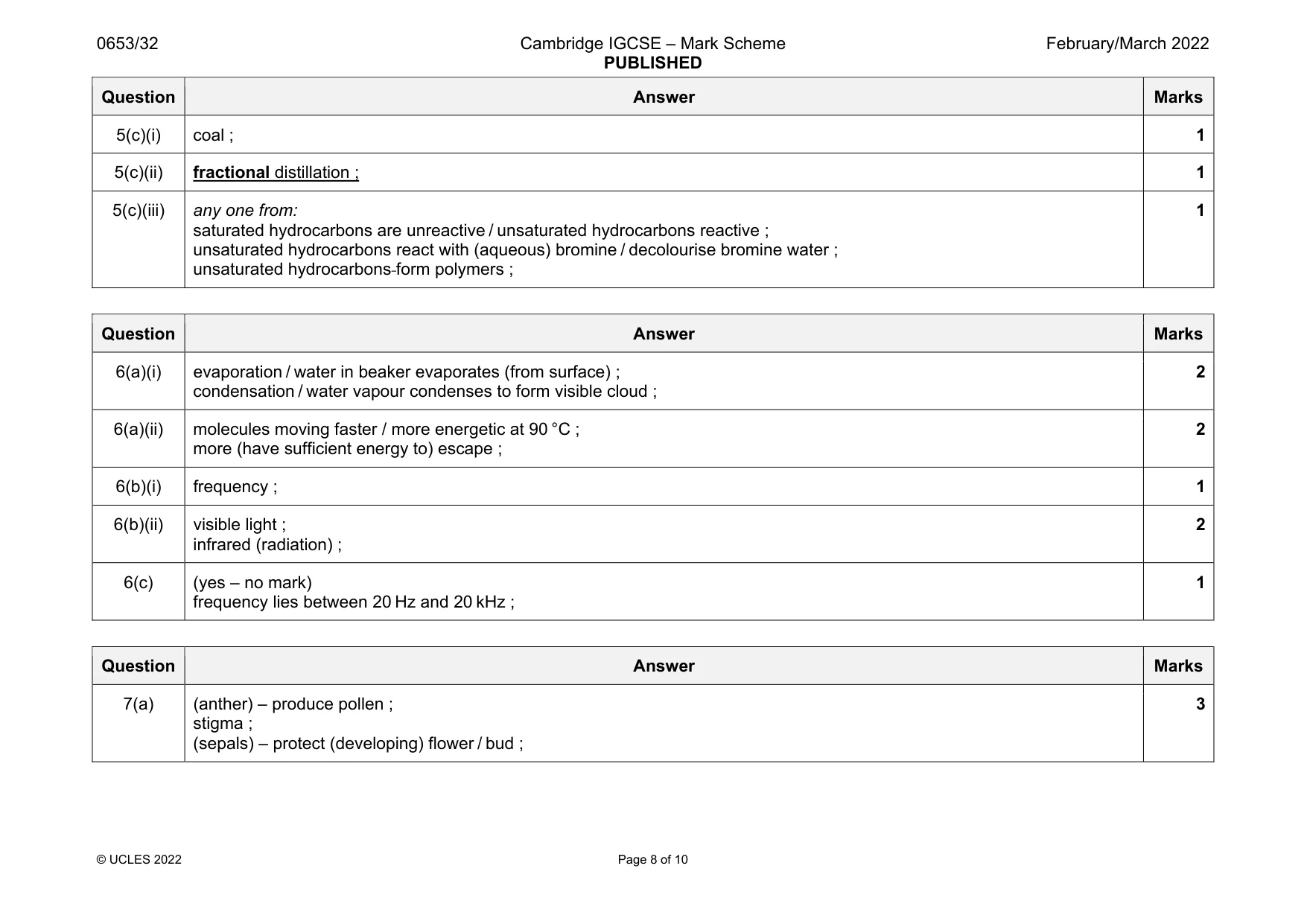
Mark scheme: 5(a)(i) (separation) close together ; (arrangement) regular ; (motion) vibrate / don’t move about ; 3 5(a)(ii) chromatography ; 1 5(b)(i) any value less than 35 (g) ; 1 5(b)(ii) chlorine / Cl2 ; 1 Question Answer Marks 5(c)(i) coal ; 1 5(c)(ii) fractional distillation ; 1 5(c)(iii) any one from: saturated hydrocarbons are unreactive / unsaturated hydrocarbons reactive ; unsaturated hydrocarbons react with (aqueous) bromine / decolourise bromine water ; unsaturated hydrocarbons form polymers ; 1
Q6 · A thermometer in a beaker of water
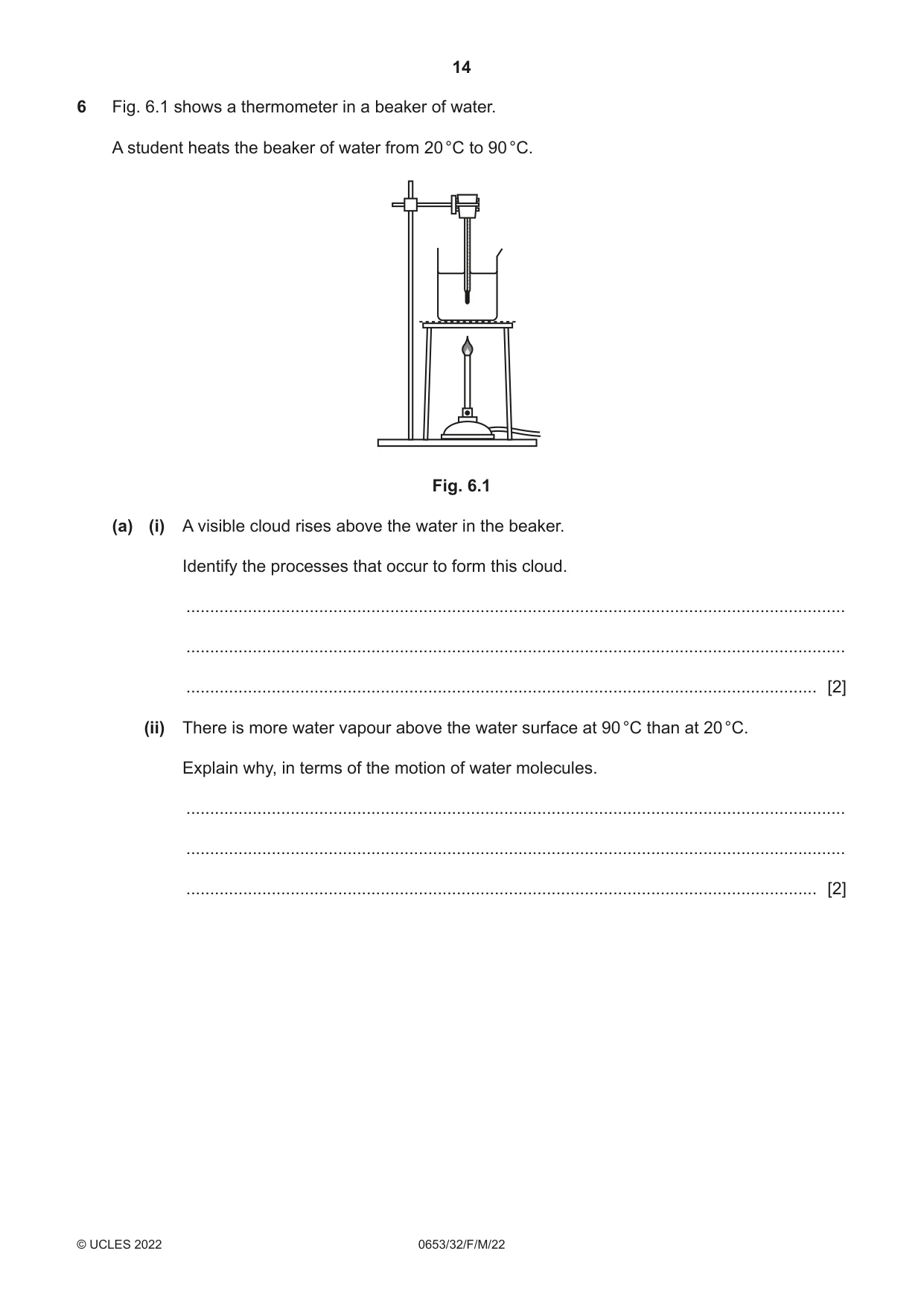
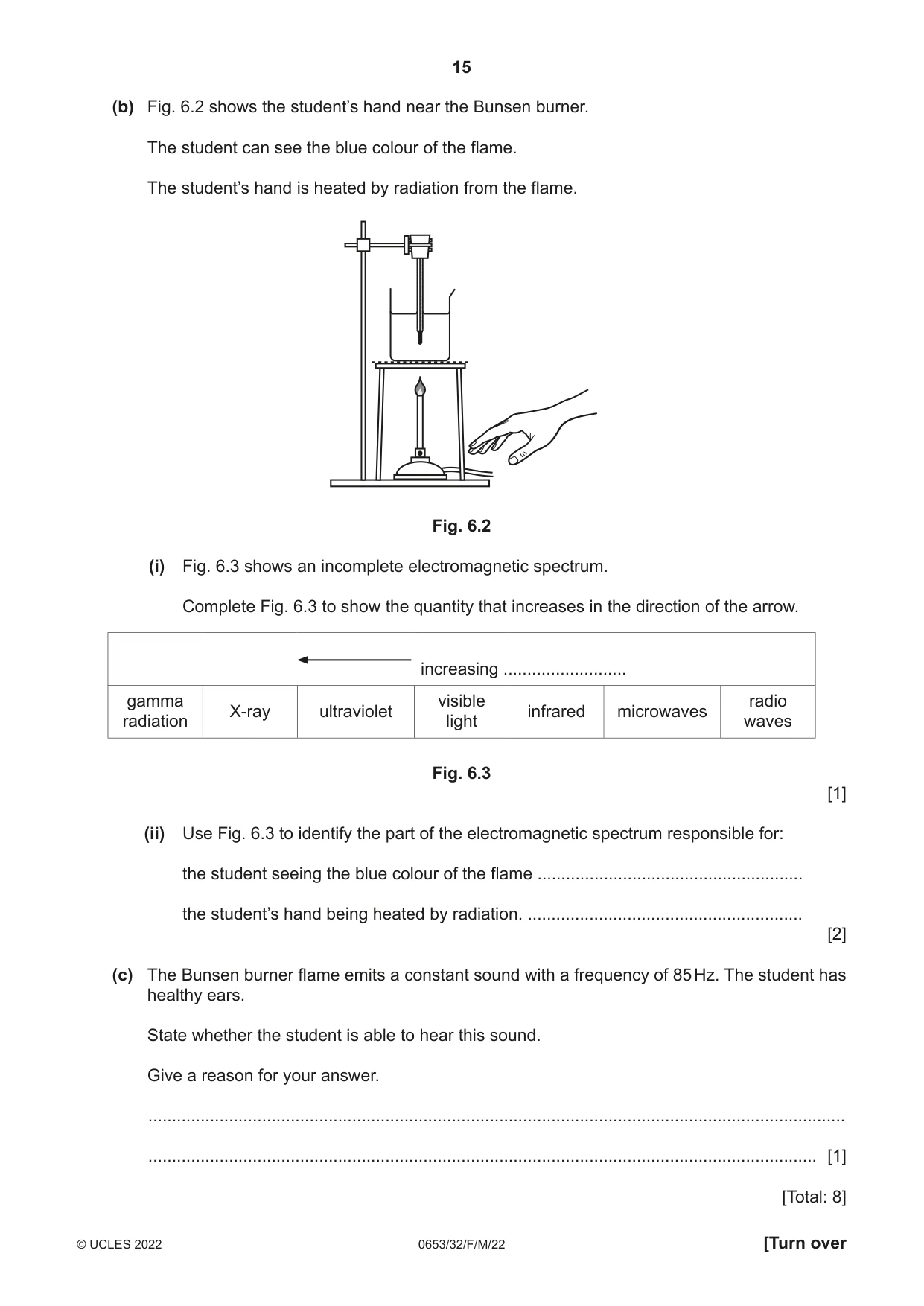
6 Fig. 6.1 shows a thermometer in a beaker of water. A student heats the beaker of water from 20 °C to 90 °C. Fig. 6.1 (a) (i) A visible cloud rises above the water in the beaker. Identify the processes that occur to form this cloud. ........................................................................................................................................... ........................................................................................................................................... ..................................................................................................................................... [2] (ii) There is more water vapour above the water surface at 90 °C than at 20 °C. Explain why, in terms of the motion of water molecules. ........................................................................................................................................... ........................................................................................................................................... ..................................................................................................................................... [2] (b) Fig. 6.2 shows the student’s hand near the Bunsen burner. The student can see the blue colour of the flame. The student’s hand is heated by radiation from the flame. Fig. 6.2 (i) Fig. 6.3 shows an incomplete electromagnetic spectrum. Complete Fig. 6.3 to show the quantity that increases in the direction of the arrow. increasing .......................... gamma visible radio X-ray ultraviolet infrared microwaves radiation light waves Fig. 6.3 [1] (ii) Use Fig. 6.3 to identify the part of the electromagnetic spectrum responsible for: the student seeing the blue colour of the flame ........................................................ the student’s hand being heated by radiation. .......................................................... [2] (c) The Bunsen burner flame emits a constant sound with a frequency of 85 Hz. The student has healthy ears. State whether the student is able to hear this sound. Give a reason for your answer. ................................................................................................................................................... ............................................................................................................................................. [1] [Total: 8]
Mark scheme: 6(a)(i) evaporation / water in beaker evaporates (from surface) ; condensation / water vapour condenses to form visible cloud ; 2 6(a)(ii) molecules moving faster / more energetic at 90 °C ; more (have sufficient energy to) escape ; 2 6(b)(i) frequency ; 1 6(b)(ii) visible light ; infrared (radiation) ; 2 6(c) (yes – no mark) frequency lies between 20 Hz and 20 kHz ; 1
Q7 · A photograph of a butterfly feeding on a lavender flower
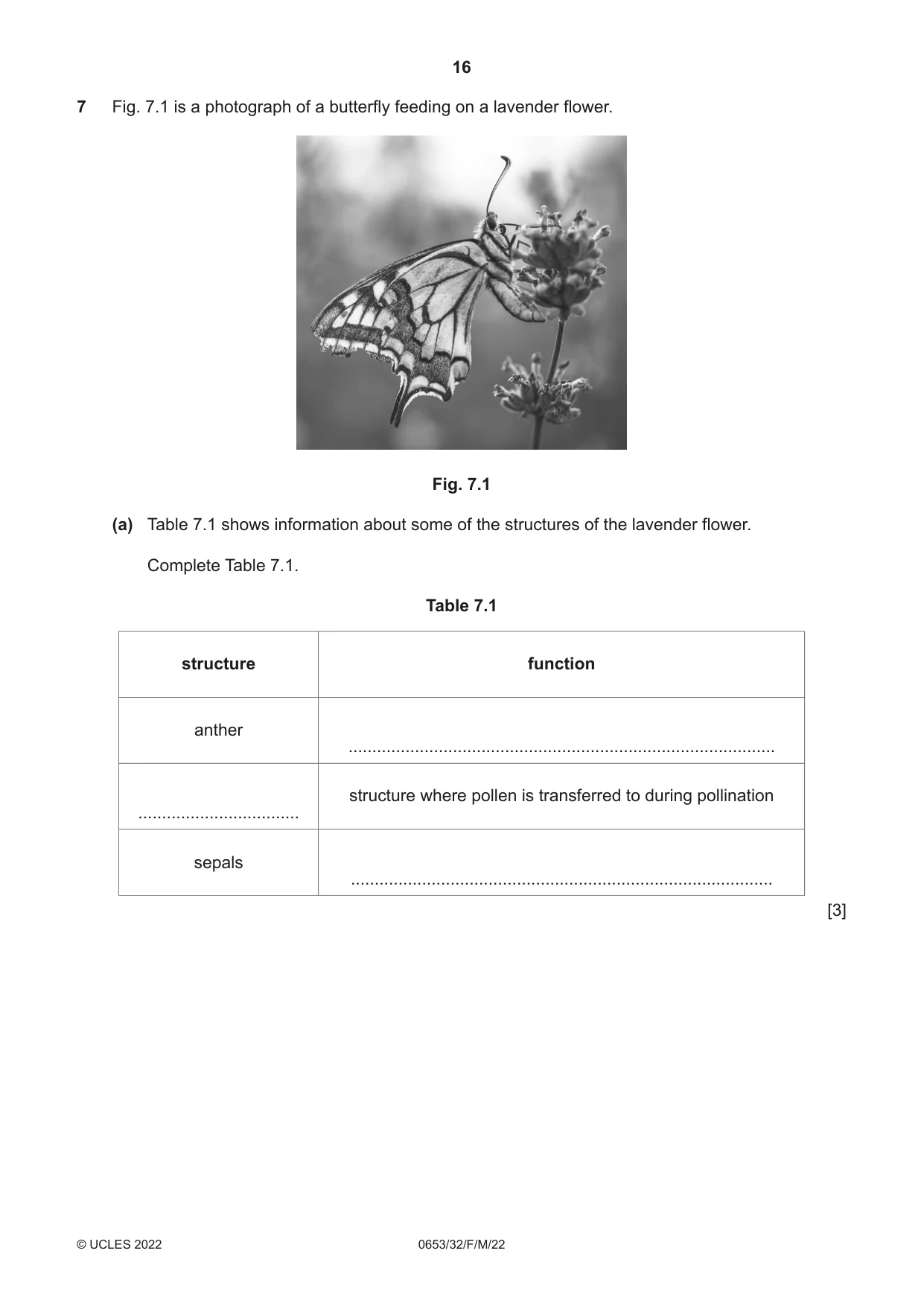
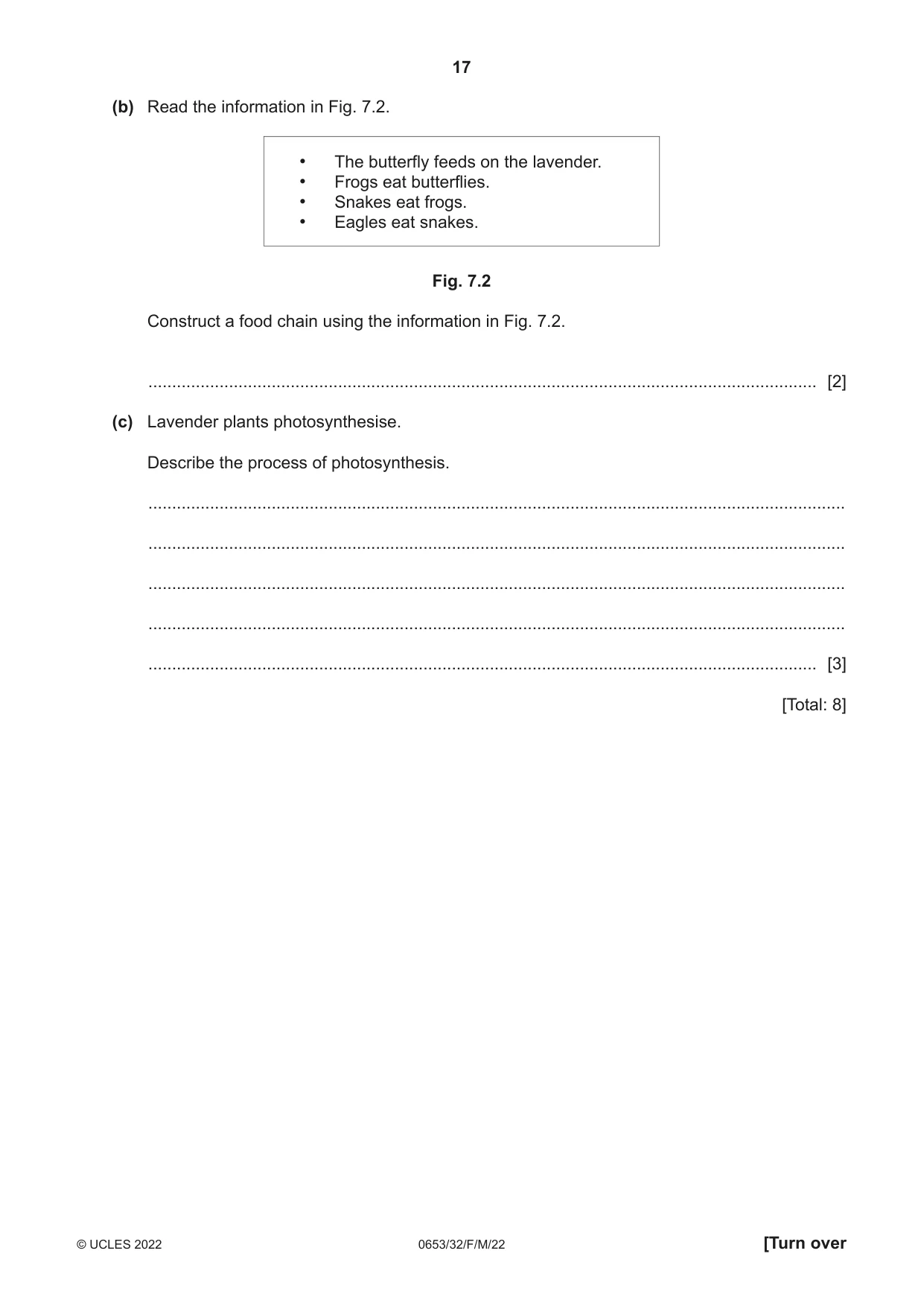
7 Fig. 7.1 is a photograph of a butterfly feeding on a lavender flower. Fig. 7.1 (a) Table 7.1 shows information about some of the structures of the lavender flower. Complete Table 7.1. Table 7.1 structure function anther .......................................................................................... structure where pollen is transferred to during pollination .................................. sepals ......................................................................................... [3] (b) Read the information in Fig. 7.2. • The butterfly feeds on the lavender. • Frogs eat butterflies. • Snakes eat frogs. • Eagles eat snakes. Fig. 7.2 Construct a food chain using the information in Fig. 7.2. ............................................................................................................................................. [2] (c) Lavender plants photosynthesise. Describe the process of photosynthesis. ................................................................................................................................................... ................................................................................................................................................... ................................................................................................................................................... ................................................................................................................................................... ............................................................................................................................................. [3] [Total: 8]
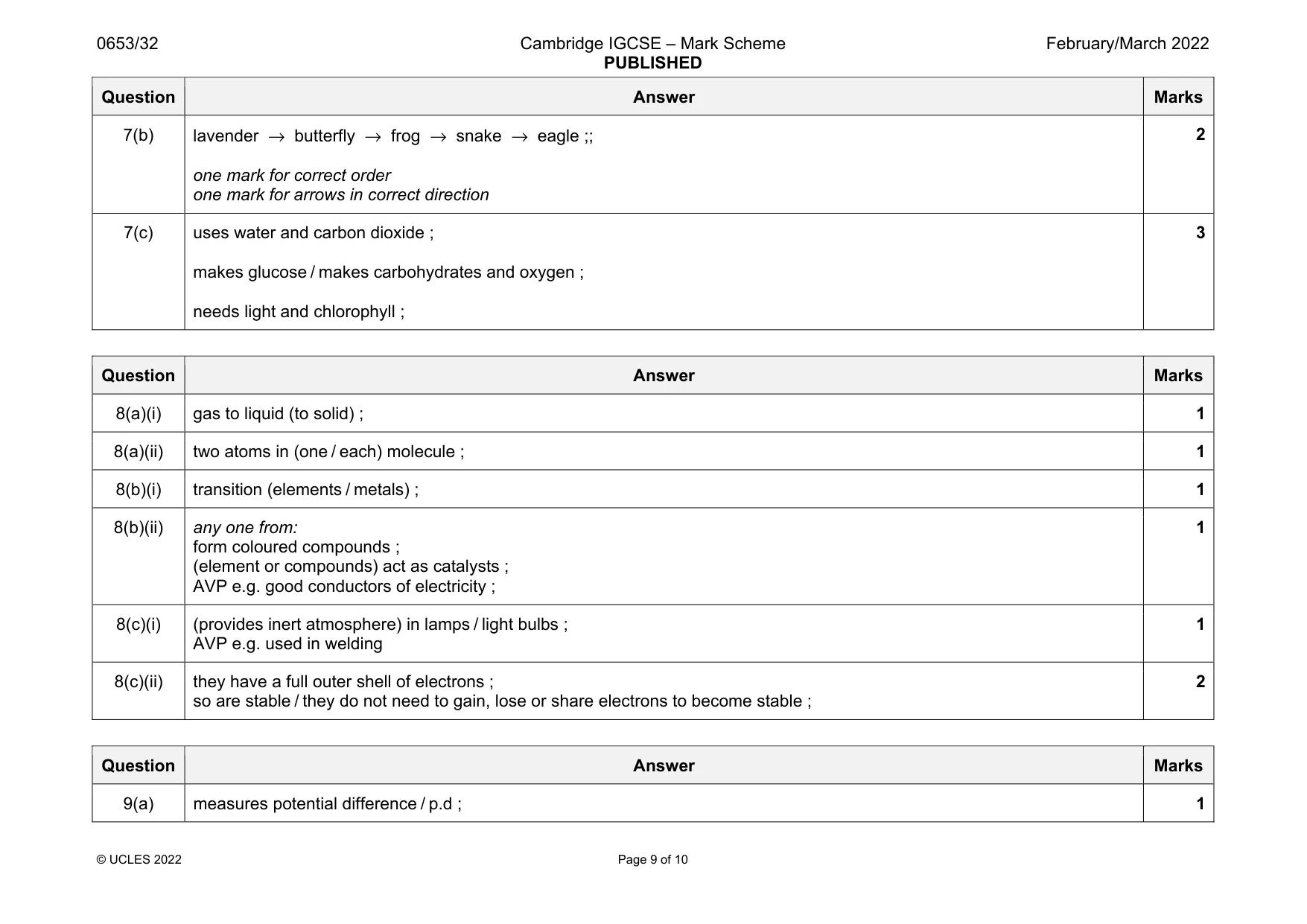
Mark scheme: 7(a) (anther) – produce pollen ; stigma ; (sepals) – protect (developing) flower / bud ; 3 Question Answer Marks 7(b) lavender → butterfly → frog → snake → eagle ;; one mark for correct order one mark for arrows in correct direction 2 7(c) uses water and carbon dioxide ; makes glucose / makes carbohydrates and oxygen ; needs light and chlorophyll ; 3
Q8 · Part of the Periodic Table is shown in Fig
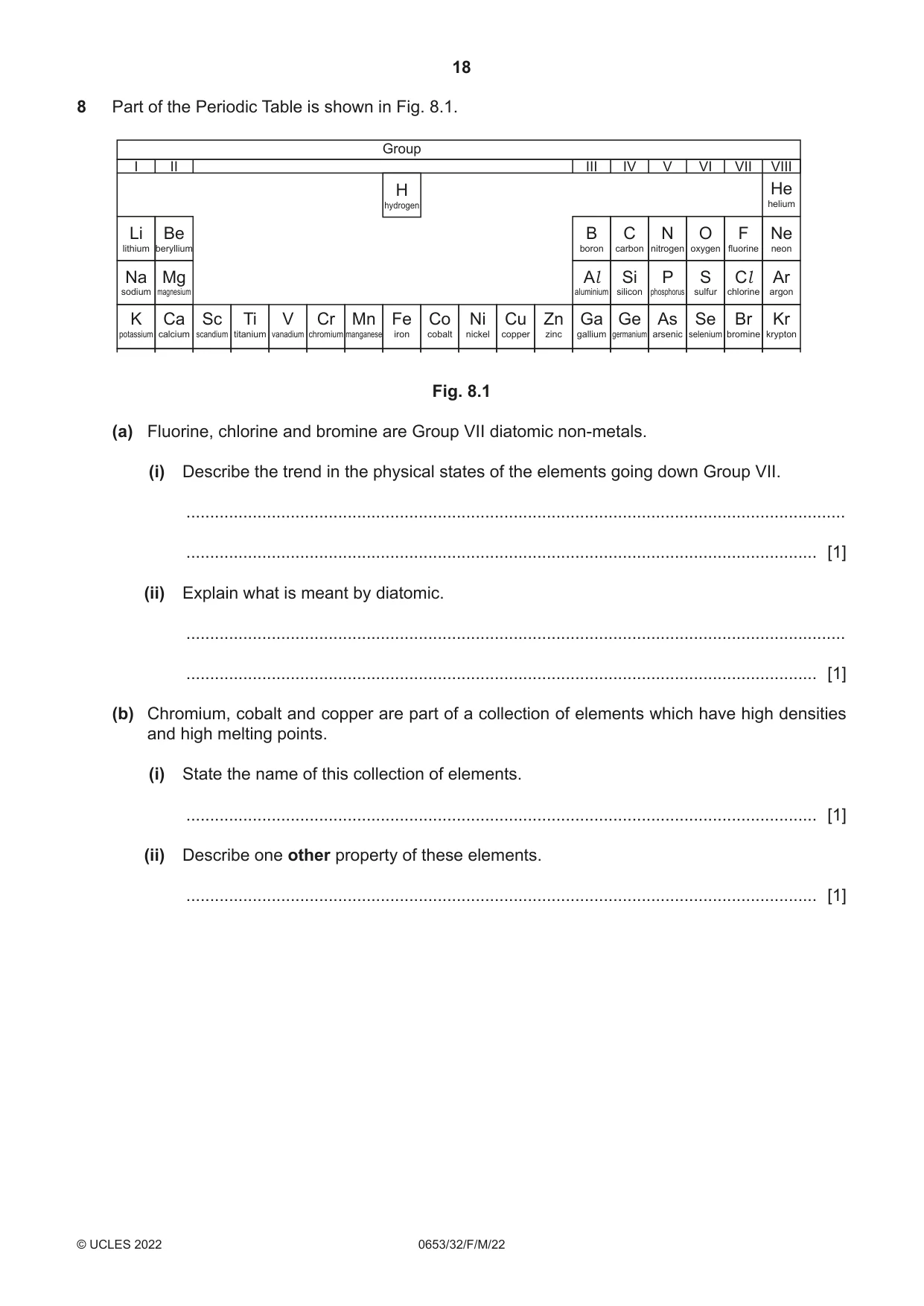
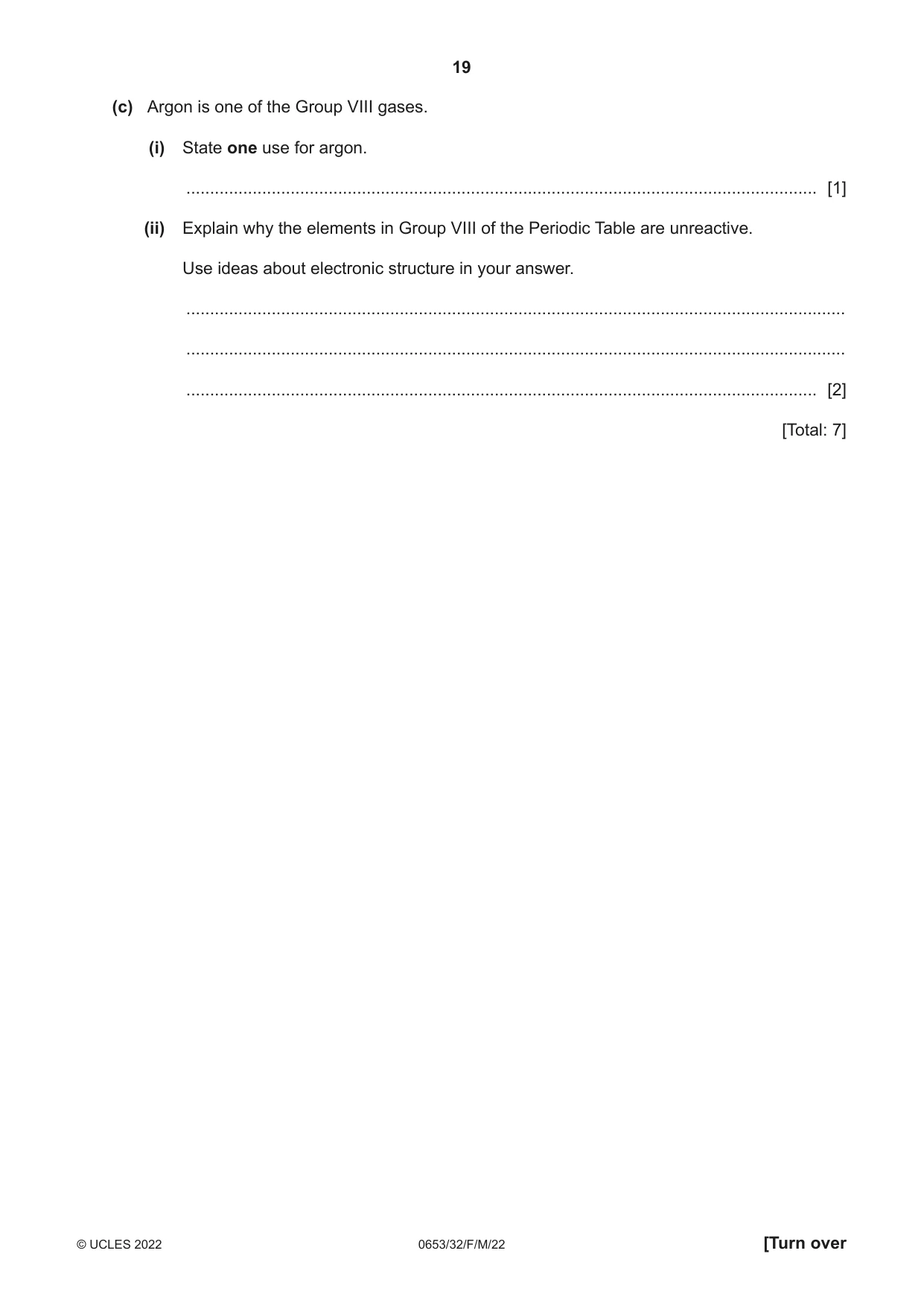
8 Part of the Periodic Table is shown in Fig. 8.1. Group I II III IV V VI VII VIII H He hydrogen helium Li Be B C N O F Ne lithium beryllium boron carbon nitrogen oxygen fluorine neon Na Mg Al Si P S Cl Ar sodium magnesium aluminium silicon phosphorus sulfur chlorine argon K Ca Sc Ti V Cr Mn Fe Co Ni Cu Zn Ga Ge As Se Br Kr potassium calcium scandium titanium vanadium chromium manganese iron cobalt nickel copper zinc gallium germanium arsenic selenium bromine krypton Fig. 8.1 (a) Fluorine, chlorine and bromine are Group VII diatomic non-metals. (i) Describe the trend in the physical states of the elements going down Group VII. ........................................................................................................................................... ..................................................................................................................................... [1] (ii) Explain what is meant by diatomic. ........................................................................................................................................... ..................................................................................................................................... [1] (b) Chromium, cobalt and copper are part of a collection of elements which have high densities and high melting points. (i) State the name of this collection of elements. ..................................................................................................................................... [1] (ii) Describe one other property of these elements. ..................................................................................................................................... [1] (c) Argon is one of the Group VIII gases. (i) State one use for argon. ..................................................................................................................................... [1] (ii) Explain why the elements in Group VIII of the Periodic Table are unreactive. Use ideas about electronic structure in your answer. ........................................................................................................................................... ........................................................................................................................................... ..................................................................................................................................... [2] [Total: 7]
Mark scheme: 8(a)(i) gas to liquid (to solid) ; 1 8(a)(ii) two atoms in (one / each) molecule ; 1 8(b)(i) transition (elements / metals) ; 1 8(b)(ii) any one from: form coloured compounds ; (element or compounds) act as catalysts ; AVP e.g. good conductors of electricity ; 1 8(c)(i) (provides inert atmosphere) in lamps / light bulbs ; AVP e.g. used in welding 1 8(c)(ii) they have a full outer shell of electrons ; so are stable / they do not need to gain, lose or share electrons to become stable ; 2
Q9 · A circuit used to supply a current to an electric motor
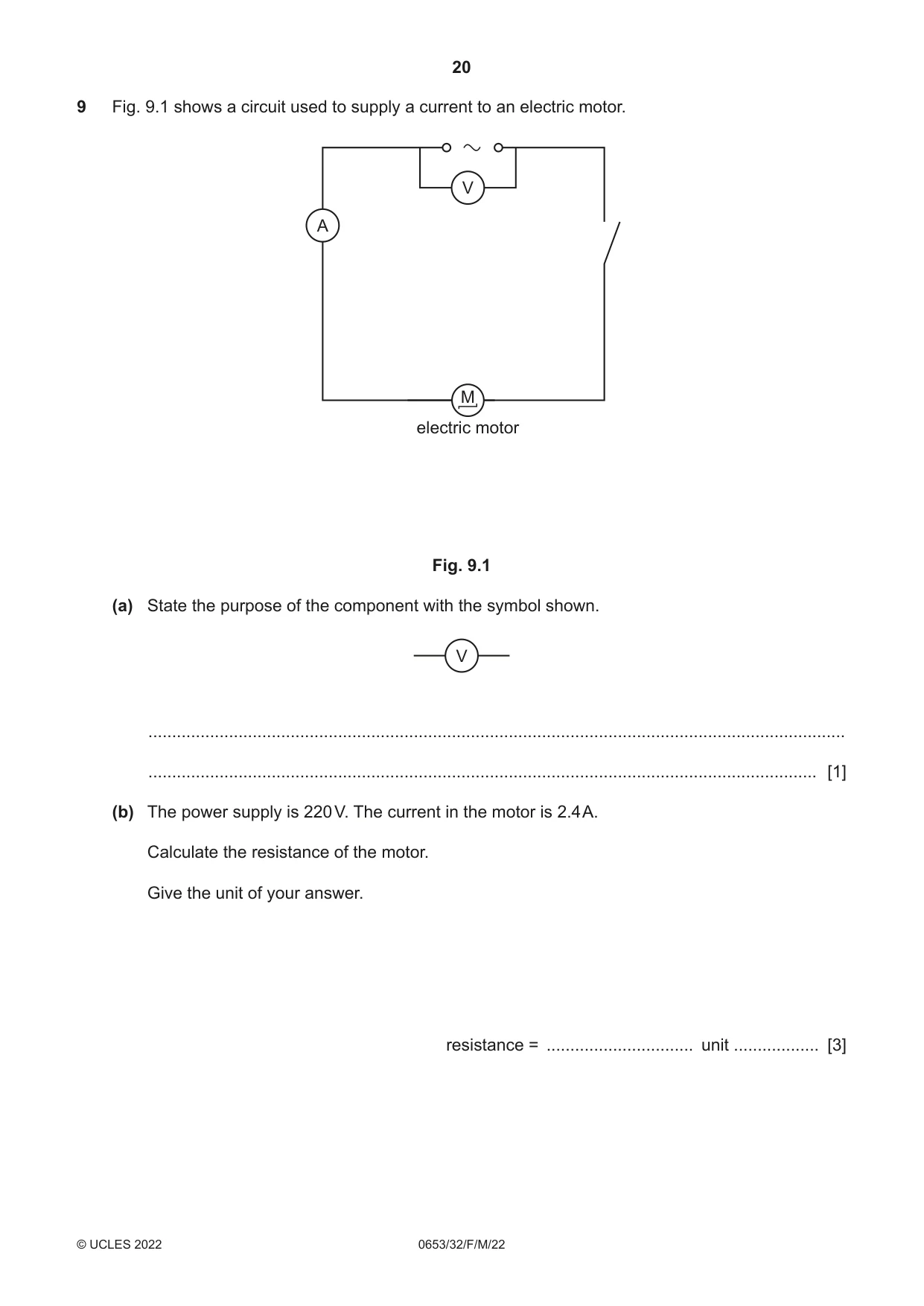
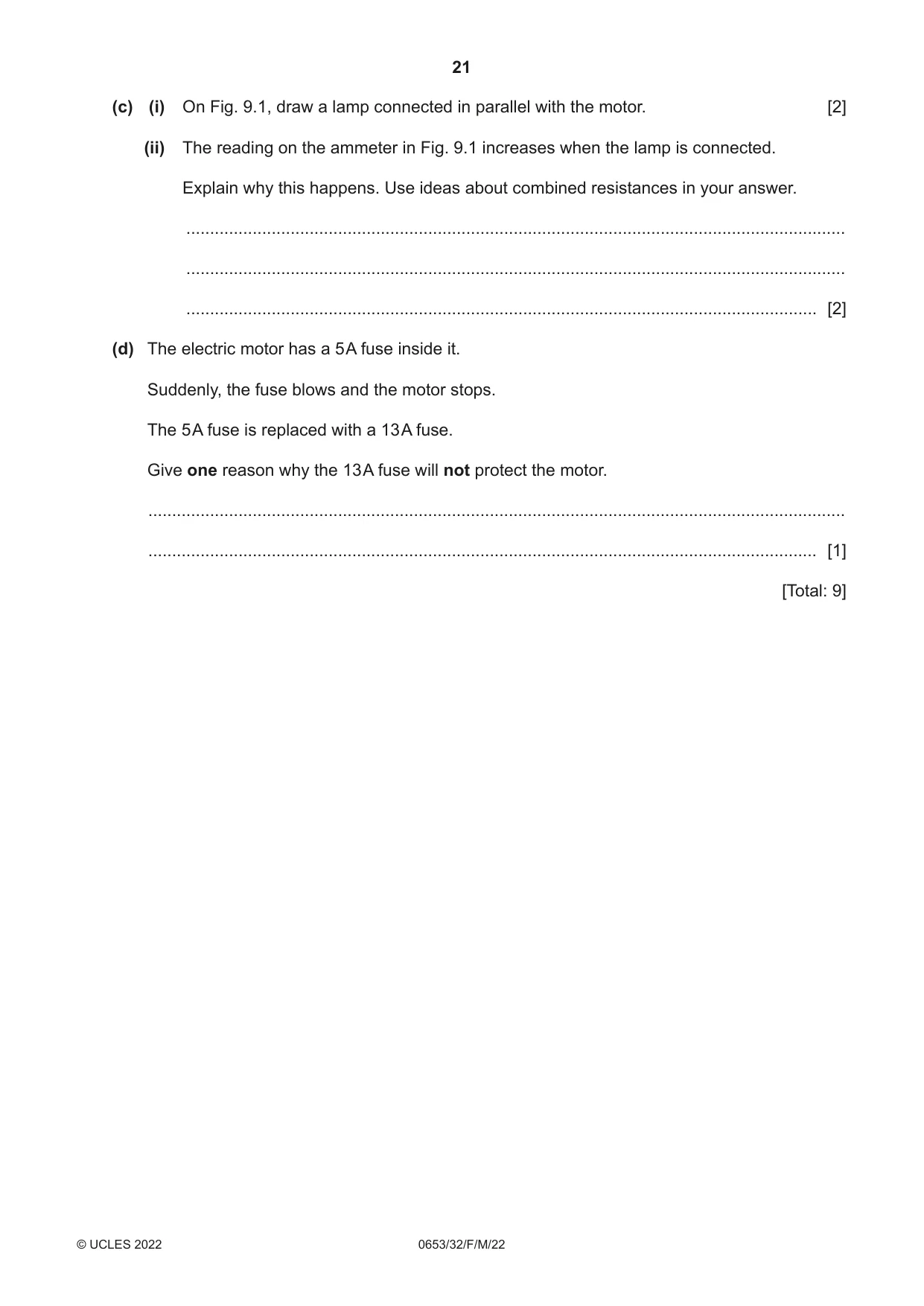
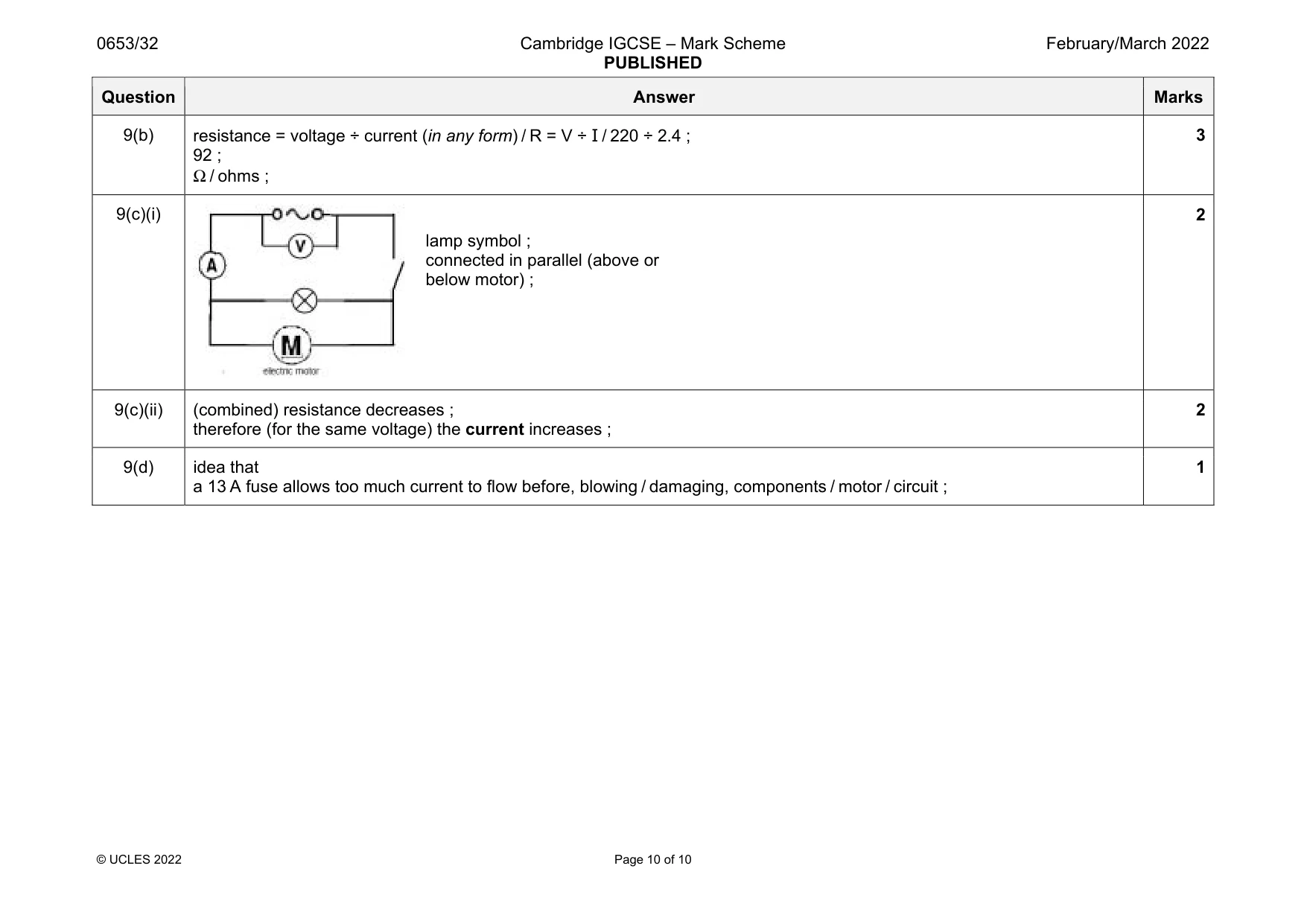
9 Fig. 9.1 shows a circuit used to supply a current to an electric motor. V A M electric motor Fig. 9.1 (a) State the purpose of the component with the symbol shown. V ................................................................................................................................................... ............................................................................................................................................. [1] (b) The power supply is 220 V. The current in the motor is 2.4 A. Calculate the resistance of the motor. Give the unit of your answer. resistance = ............................... unit .................. [3] (c) (i) On Fig. 9.1, draw a lamp connected in parallel with the motor. [2] (ii) The reading on the ammeter in Fig. 9.1 increases when the lamp is connected. Explain why this happens. Use ideas about combined resistances in your answer. ........................................................................................................................................... ........................................................................................................................................... ..................................................................................................................................... [2] (d) The electric motor has a 5 A fuse inside it. Suddenly, the fuse blows and the motor stops. The 5 A fuse is replaced with a 13 A fuse. Give one reason why the 13 A fuse will not protect the motor. ................................................................................................................................................... ............................................................................................................................................. [1] [Total: 9]
Mark scheme: 9(a) measures potential difference / p.d ; 1 Question Answer Marks 9(b) resistance = voltage ÷ current (in any form) / R = V ÷ I / 220 ÷ 2.4 ; 92 ; Ω / ohms ; 3 9(c)(i) 2 9(c)(ii) (combined) resistance decreases ; therefore (for the same voltage) the current increases ; 2 9(d) idea that a 13 A fuse allows too much current to flow before, blowing / damaging, components / motor / circuit ; 1 lamp symbol ; connected in parallel (above or below motor) ;
What was in this paper
The subtopics covered by these 9 questions, and how many questions each got. Open one in a new tab to see every Cambridge question on it.
What you needed in this session
Cambridge’s own grade thresholds for 2022 Feb/March, Paper 3 · Variant 2. A higher threshold means an easier paper — the bar moves with how the cohort did.