Cambridge IGCSE Science - Combined 0653 — 2025 May/June Paper 3 · Variant 2
0653/32/M/J/25 · 9 questions · 80 marks · 75 min
The question paper and its mark scheme, free to read here and free to download. This is Cambridge’s own paper, exactly as it was sat.
Question paper20 pages
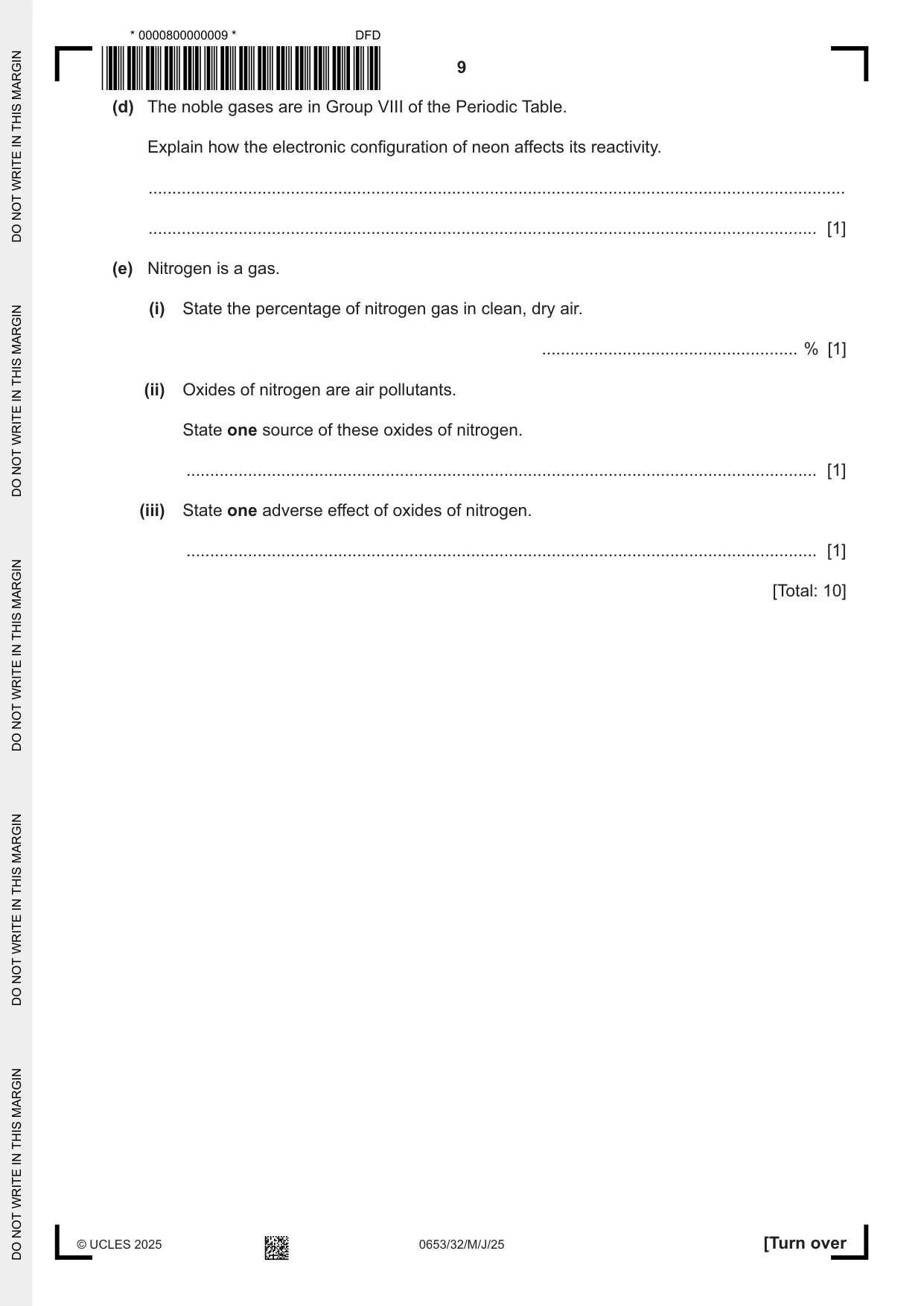
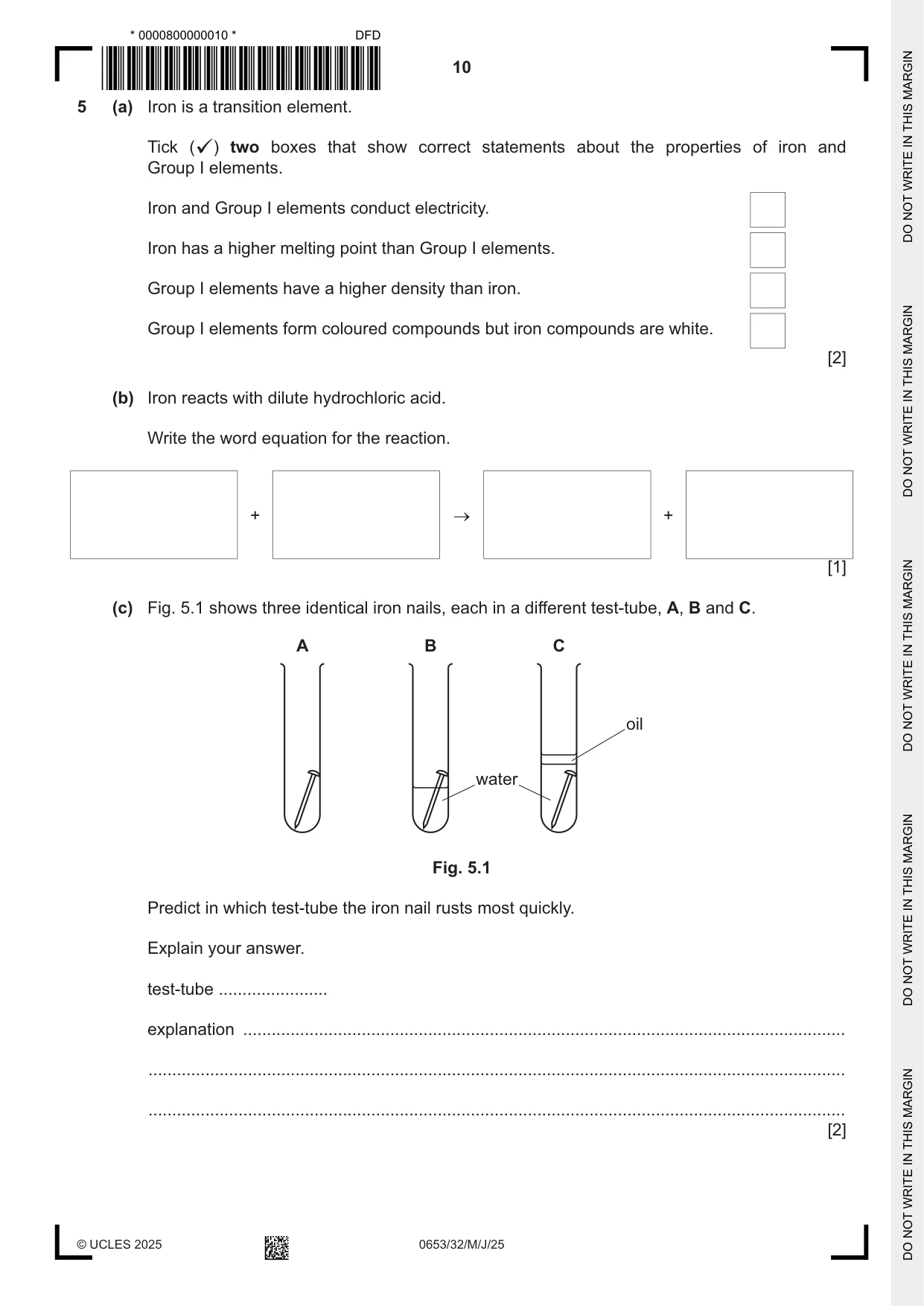
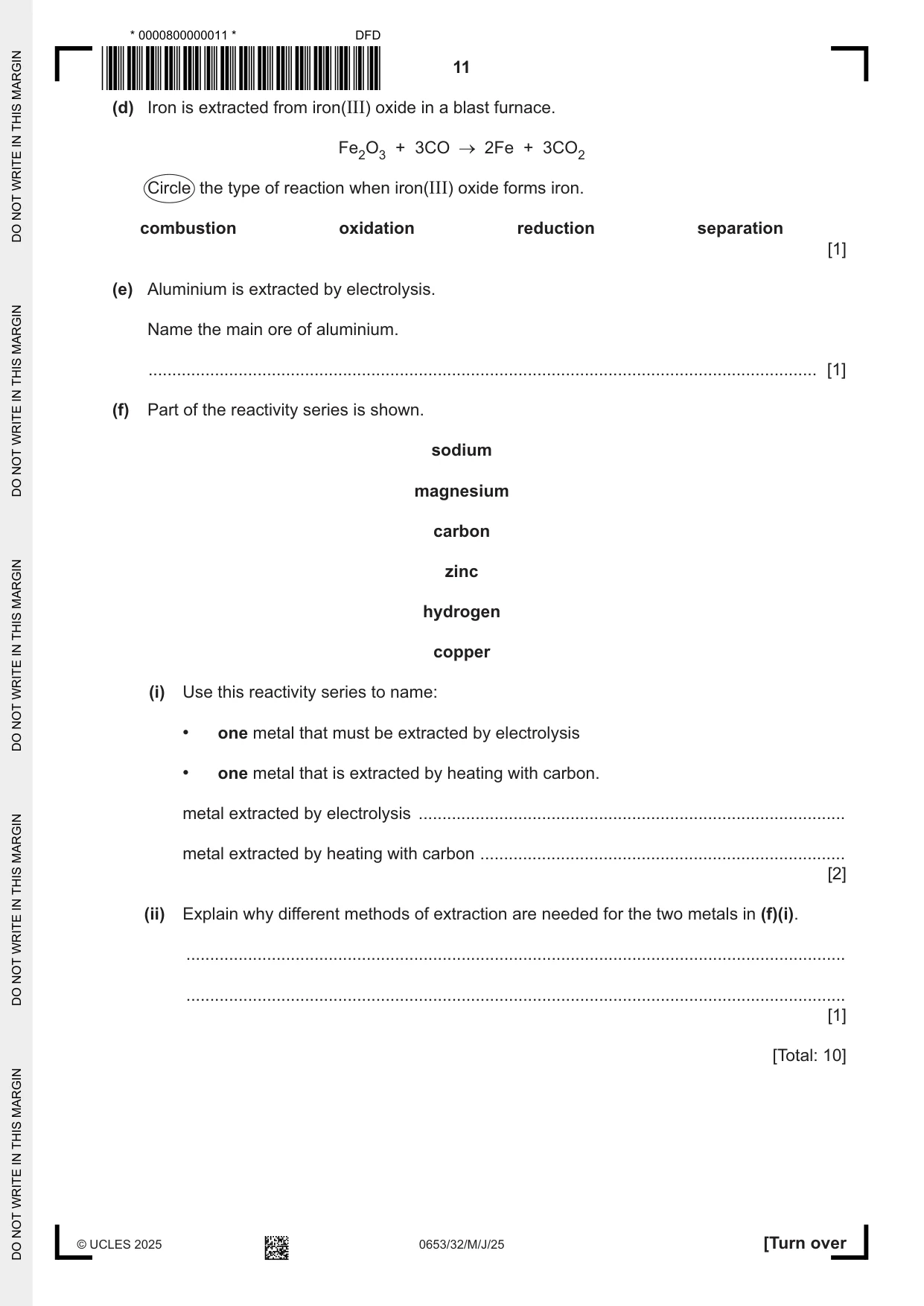
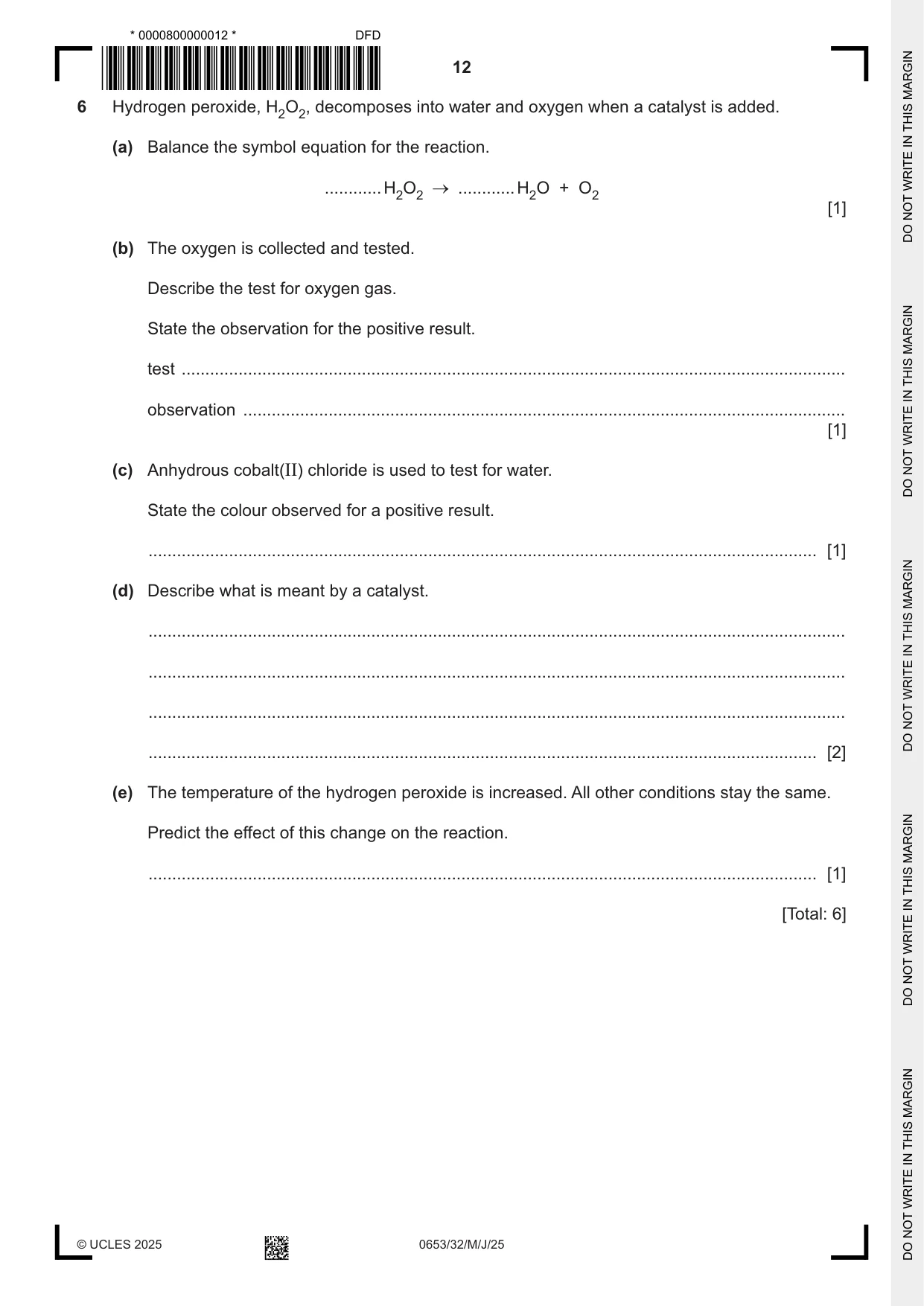

Mark scheme12 pages
Answers below. Sit the paper first if you are practising.
Questions as text
Q1 · A white blood cell
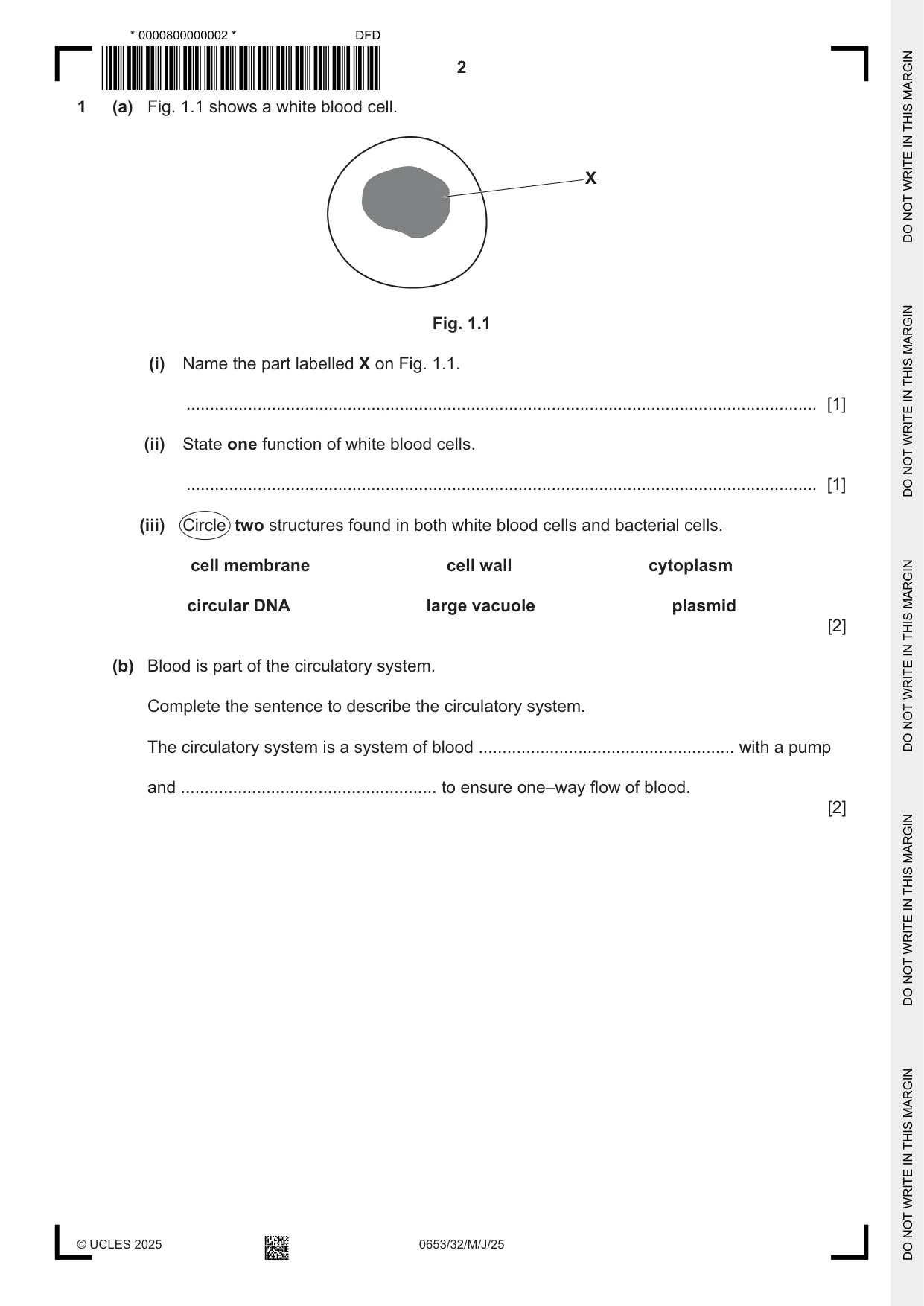
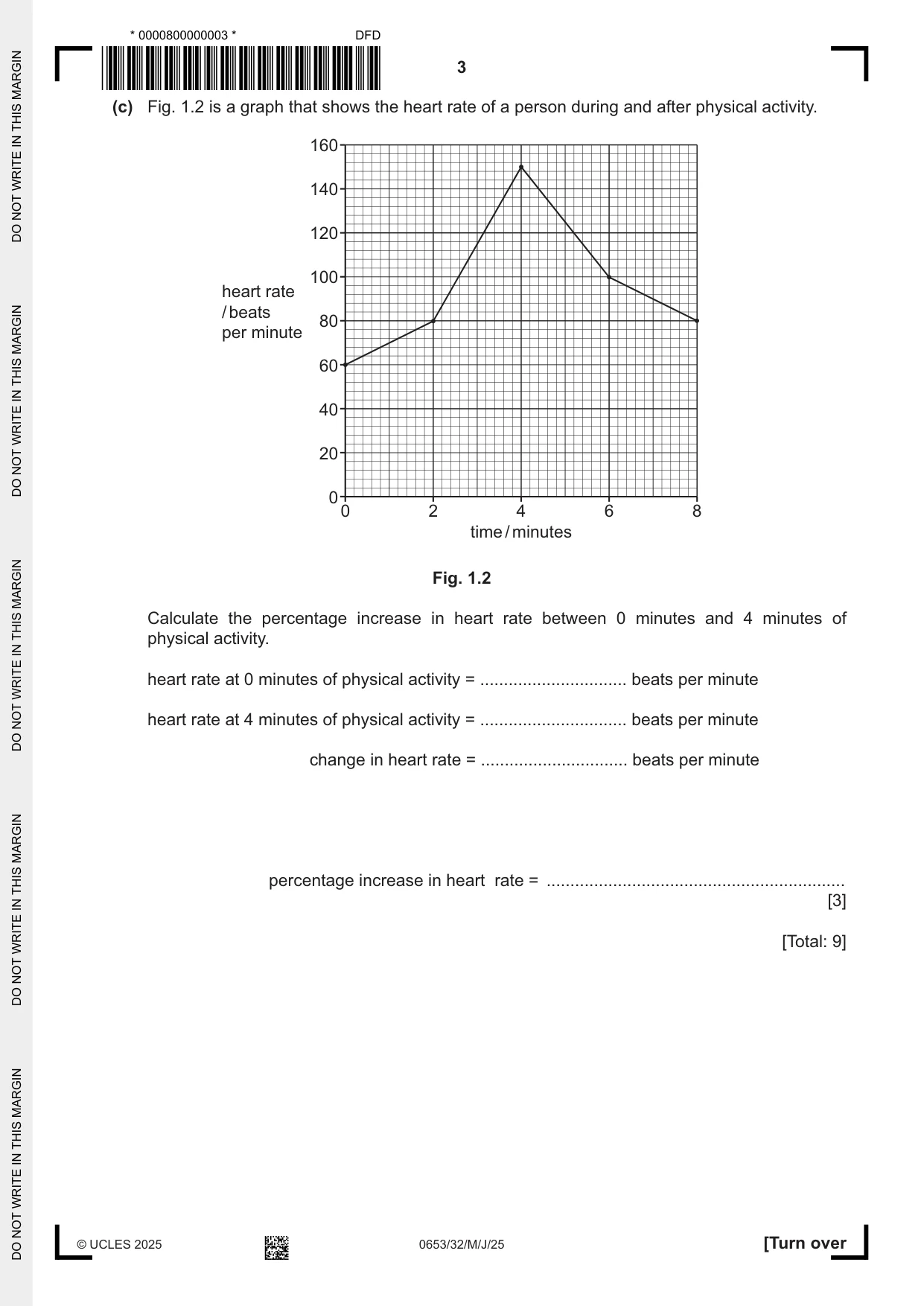
1 (a) Fig. 1.1 shows a white blood cell. X Fig. 1.1 (i) Name the part labelled X on Fig. 1.1. ..................................................................................................................................... [1] (ii) State one function of white blood cells. ..................................................................................................................................... [1] (iii) Circle two structures found in both white blood cells and bacterial cells. cell membrane cell wall cytoplasm circular DNA large vacuole plasmid [2] (b) Blood is part of the circulatory system. Complete the sentence to describe the circulatory system. The circulatory system is a system of blood ...................................................... with a pump and ...................................................... to ensure one–way flow of blood. [2] (c) Fig. 1.2 is a graph that shows the heart rate of a person during and after physical activity. 160 140 120 100 heart rate / beats 80 per minute 60 40 20 00 2 4 6 8 time / minutes Fig. 1.2 Calculate the percentage increase in heart rate between 0 minutes and 4 minutes of physical activity. heart rate at 0 minutes of physical activity = ............................... beats per minute heart rate at 4 minutes of physical activity = ............................... beats per minute change in heart rate = ............................... beats per minute percentage increase in heart rate = ............................................................... [3] [Total: 9]
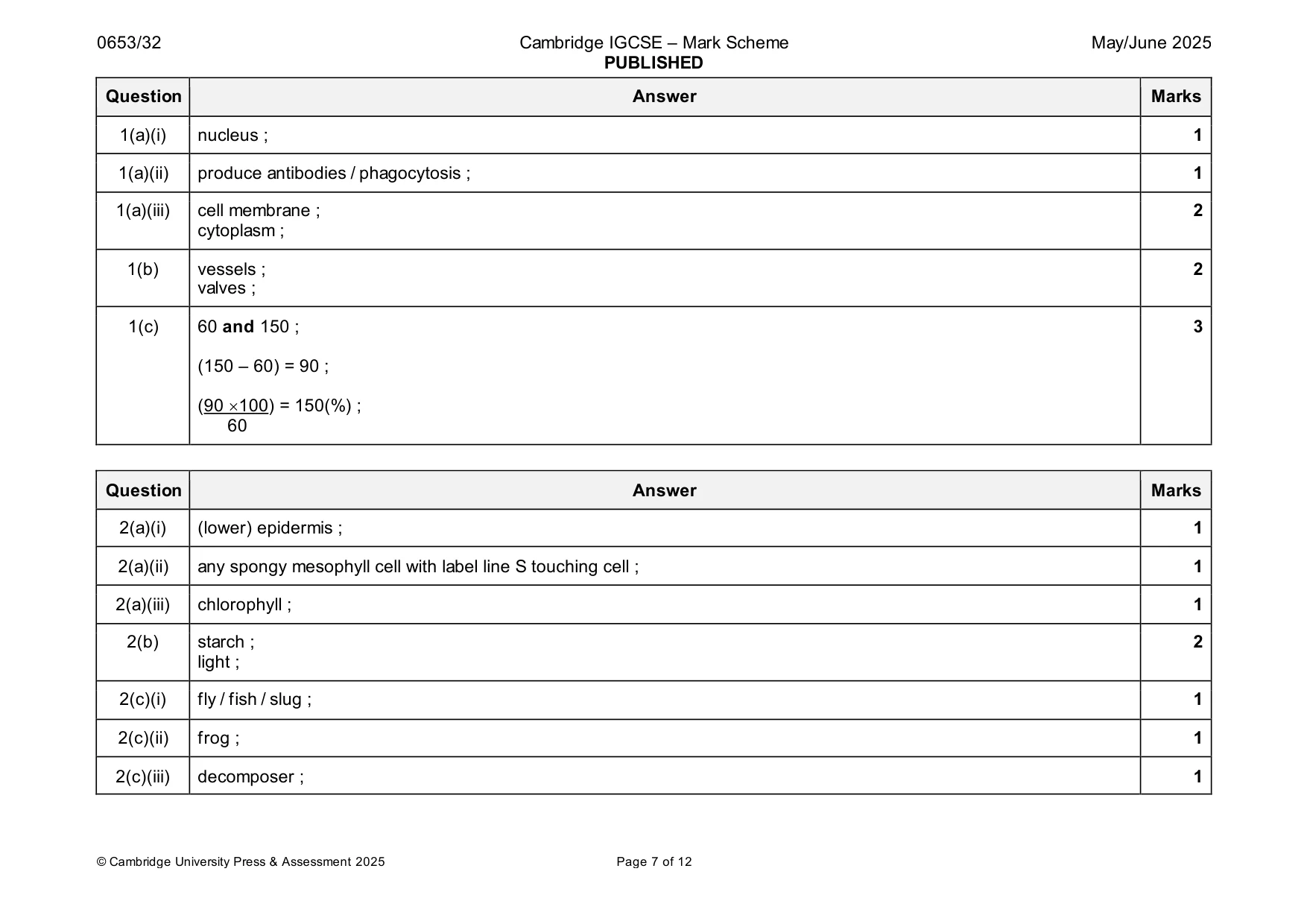
Mark scheme: Question Answer Marks 1(a)(i) nucleus ; 1 1(a)(ii) produce antibodies / phagocytosis ; 1 1(a)(iii) cell membrane ; 2 cytoplasm ; 1(b) vessels ; 2 valves ; 1(c) 60 and 150 ; 3 (150 – 60) = 90 ; (90 100) = 150(%) ; 60
Q2 · A diagram of a cross-section through a leaf
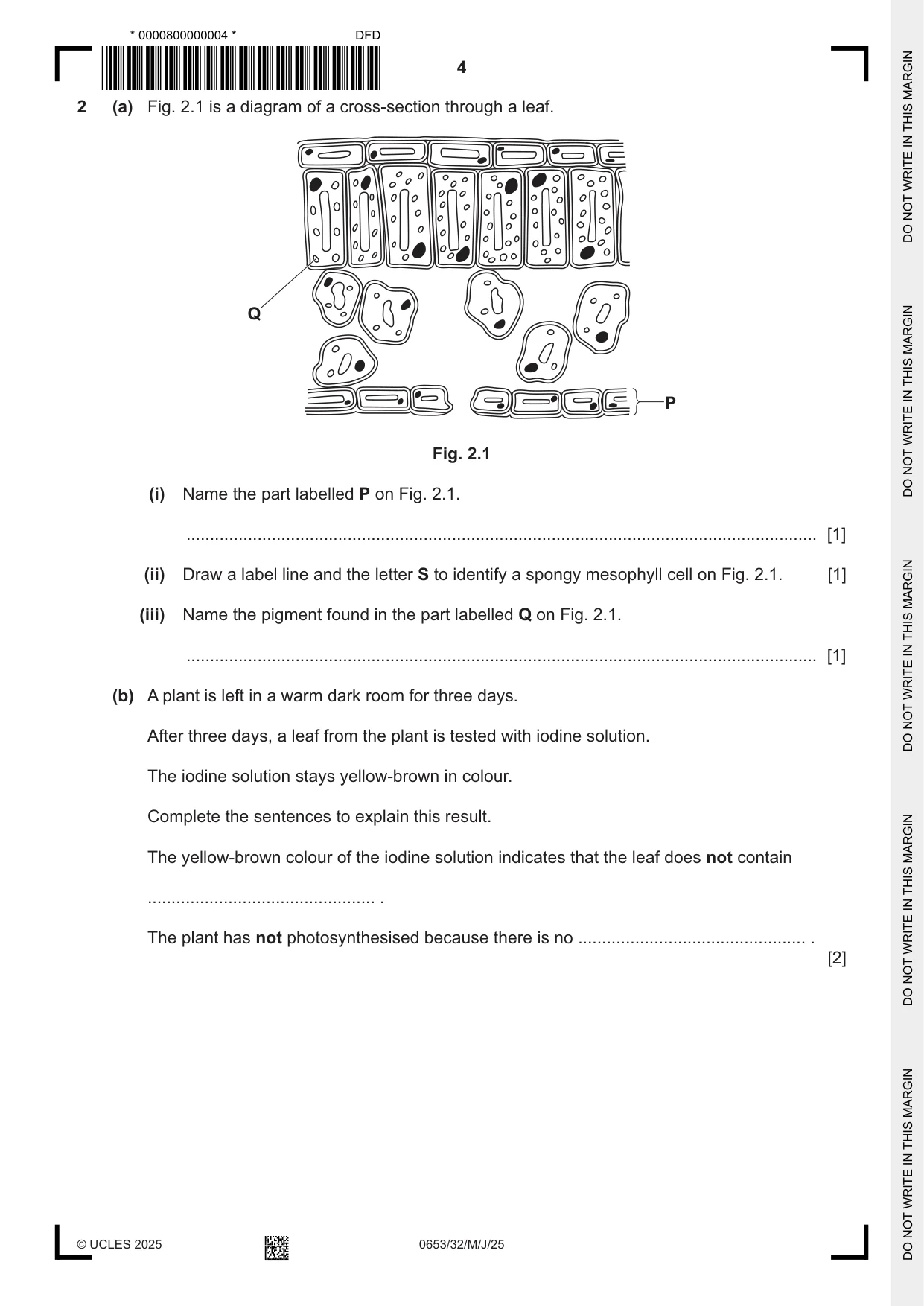
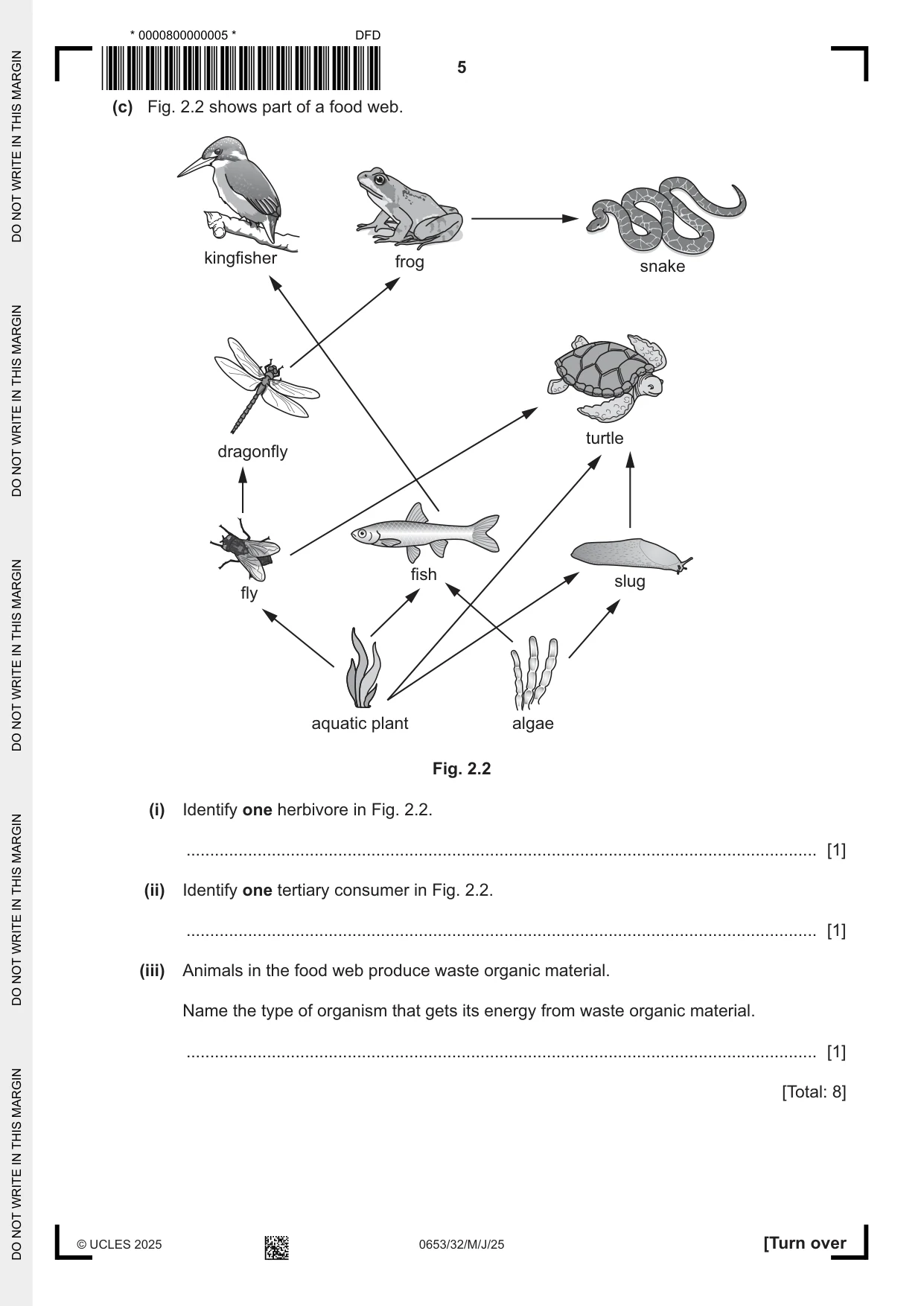
2 (a) Fig. 2.1 is a diagram of a cross-section through a leaf. Q P Fig. 2.1 (i) Name the part labelled P on Fig. 2.1. ..................................................................................................................................... [1] (ii) Draw a label line and the letter S to identify a spongy mesophyll cell on Fig. 2.1. [1] (iii) Name the pigment found in the part labelled Q on Fig. 2.1. ..................................................................................................................................... [1] (b) A plant is left in a warm dark room for three days. After three days, a leaf from the plant is tested with iodine solution. The iodine solution stays yellow-brown in colour. Complete the sentences to explain this result. The yellow-brown colour of the iodine solution indicates that the leaf does not contain ................................................ . The plant has not photosynthesised because there is no ................................................ . [2] (c) Fig. 2.2 shows part of a food web. kingfisher frog snake turtle dragonfly fish slug fly aquatic plant algae Fig. 2.2 (i) Identify one herbivore in Fig. 2.2. ..................................................................................................................................... [1] (ii) Identify one tertiary consumer in Fig. 2.2. ..................................................................................................................................... [1] (iii) Animals in the food web produce waste organic material. Name the type of organism that gets its energy from waste organic material. ..................................................................................................................................... [1] [Total: 8]
Mark scheme: 2(a)(i) (lower) epidermis ; 1 2(a)(ii) any spongy mesophyll cell with label line S touching cell ; 1 2(a)(iii) chlorophyll ; 1 2(b) starch ; 2 light ; 2(c)(i) fly / fish / slug ; 1 2(c)(ii) frog ; 1 2(c)(iii) decomposer ; 1
Q3 · Nutrition is one of the characteristics of living organisms
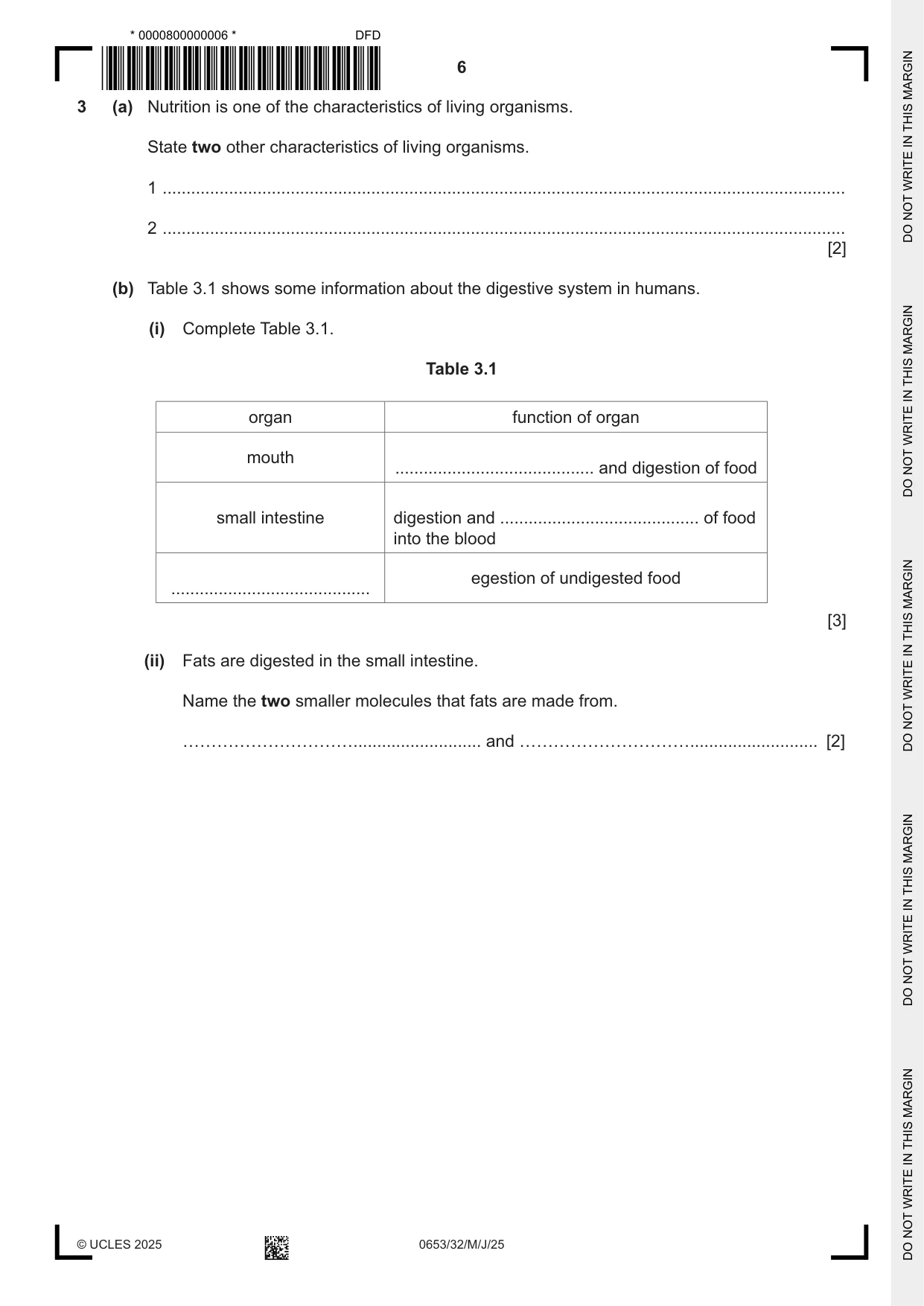
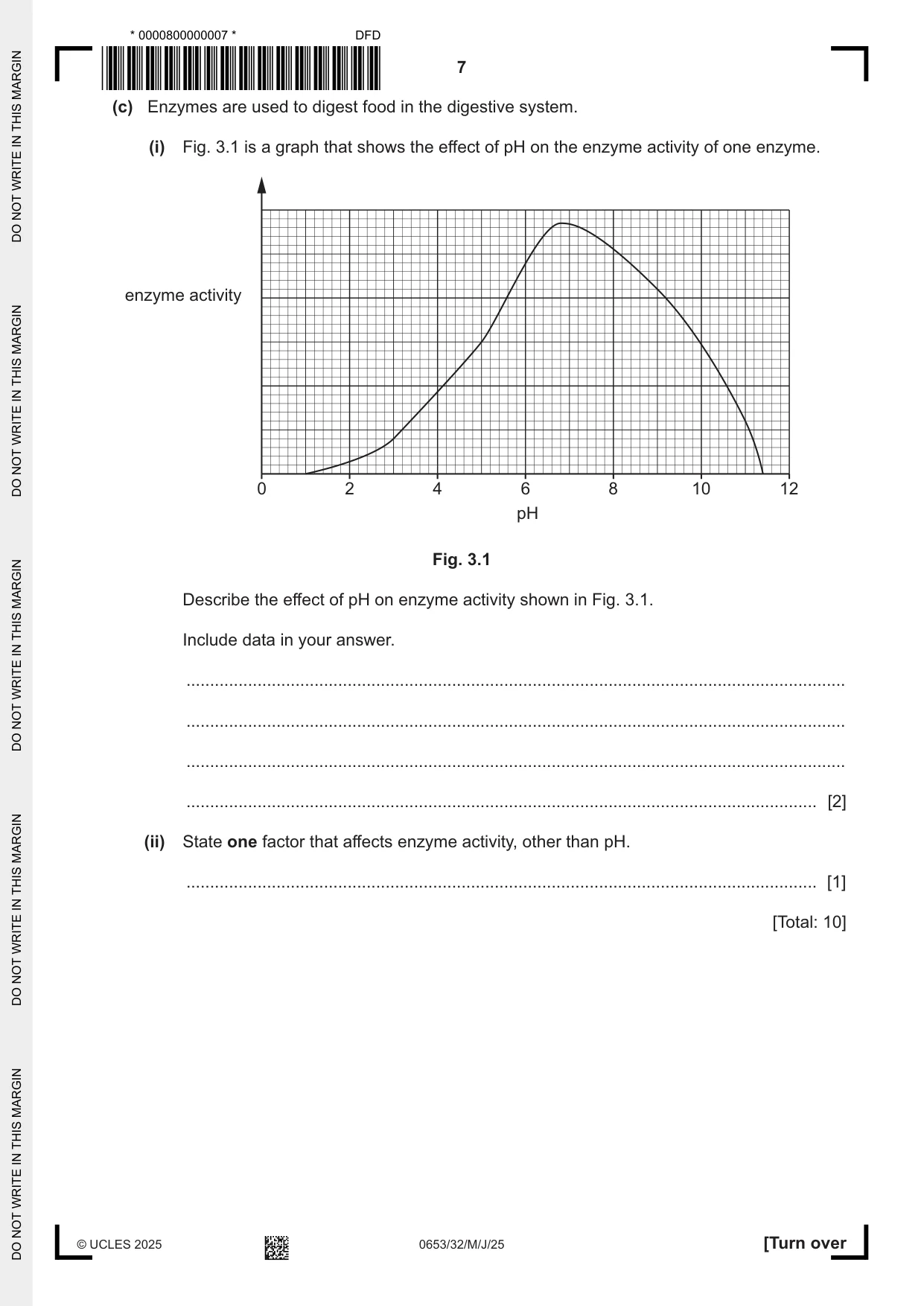
3 (a) Nutrition is one of the characteristics of living organisms. State two other characteristics of living organisms. 1 ................................................................................................................................................ 2 ................................................................................................................................................ [2] (b) Table 3.1 shows some information about the digestive system in humans. (i) Complete Table 3.1. Table 3.1 organ function of organ mouth .......................................... and digestion of food small intestine digestion and .......................................... of food into the blood egestion of undigested food .......................................... [3] (ii) Fats are digested in the small intestine. Name the two smaller molecules that fats are made from. …………………………........................... and …………………………........................... [2] (c) Enzymes are used to digest food in the digestive system. (i) Fig. 3.1 is a graph that shows the effect of pH on the enzyme activity of one enzyme. enzyme activity 0 2 4 6 8 10 12 pH Fig. 3.1 Describe the effect of pH on enzyme activity shown in Fig. 3.1. Include data in your answer. ........................................................................................................................................... ........................................................................................................................................... ........................................................................................................................................... ..................................................................................................................................... [2] (ii) State one factor that affects enzyme activity, other than pH. ..................................................................................................................................... [1] [Total: 10]
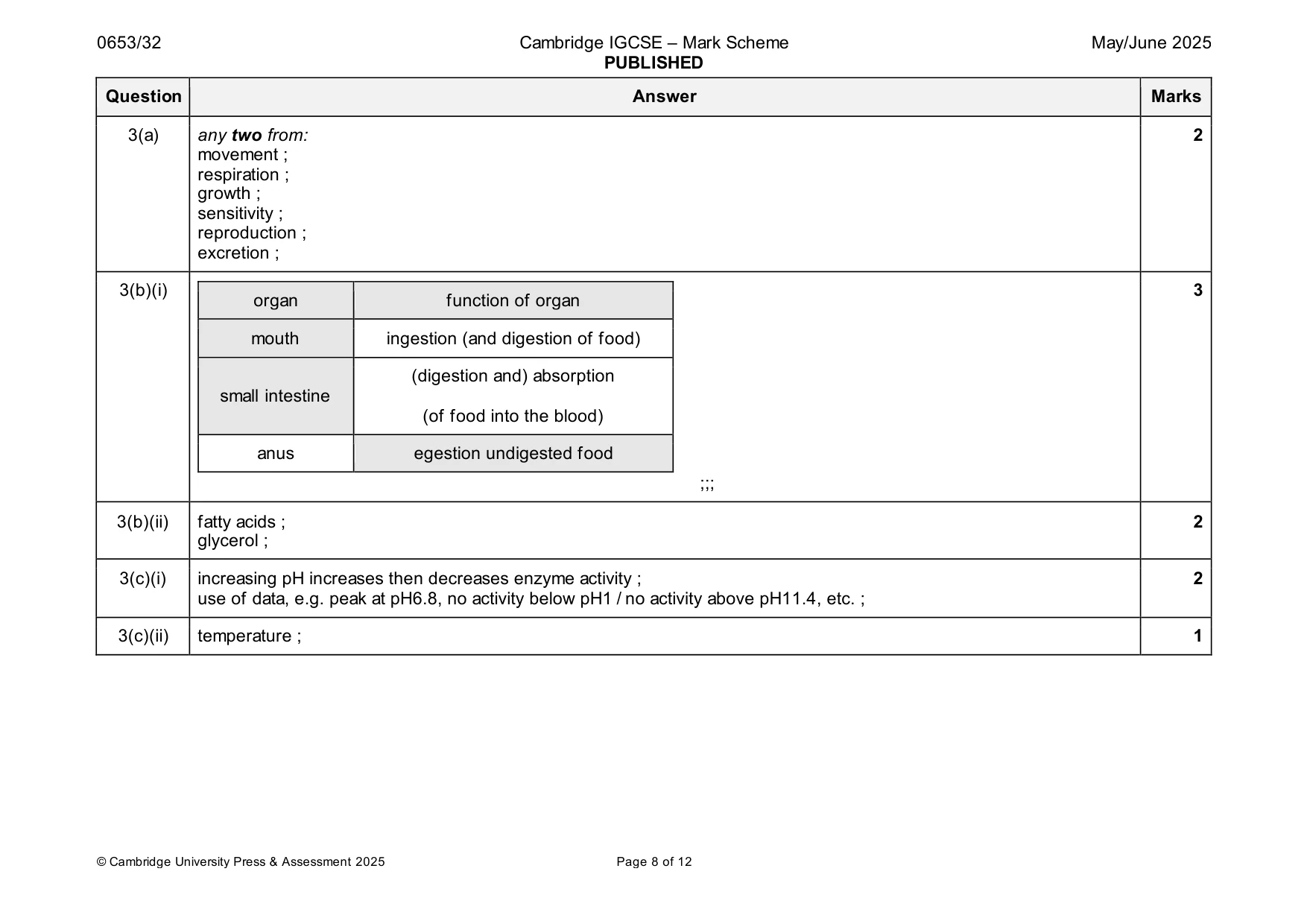
Mark scheme: 3(a) any two from: 2 movement ; respiration ; growth ; sensitivity ; reproduction ; excretion ; 3(b)(i) 3 organ function of organ mouth ingestion (and digestion of food) (digestion and) absorption small intestine (of food into the blood) anus egestion undigested food ;;; 3(b)(ii) fatty acids ; 2 glycerol ; 3(c)(i) increasing pH increases then decreases enzyme activity ; 2 use of data, e.g. peak at pH6.8, no activity below pH1 / no activity above pH11.4, etc. ; 3(c)(ii) temperature ; 1
Q4 · Solid sodium reacts with water
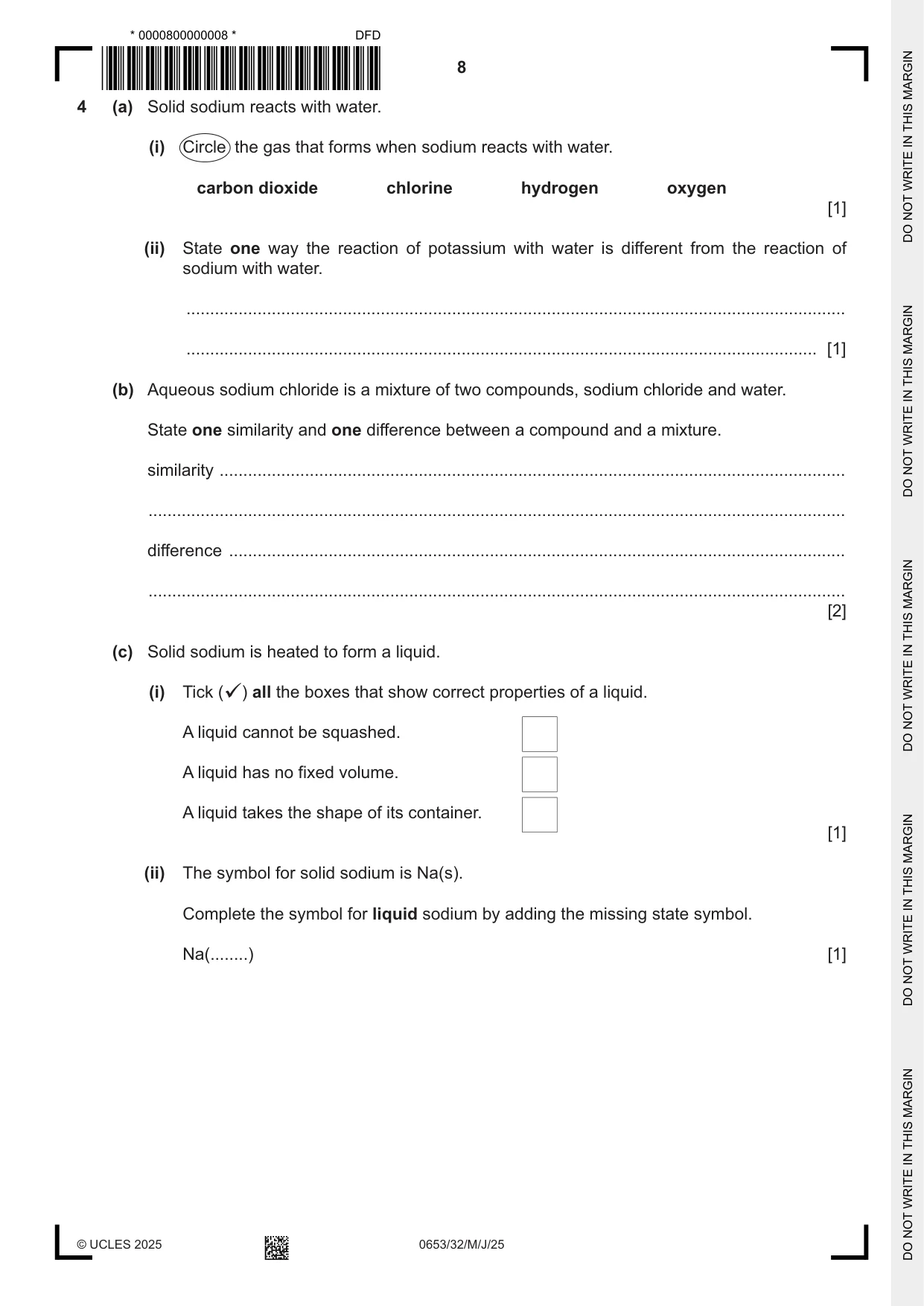
4 (a) Solid sodium reacts with water. (i) Circle the gas that forms when sodium reacts with water. carbon dioxide chlorine hydrogen oxygen [1] (ii) State one way the reaction of potassium with water is different from the reaction of sodium with water. ........................................................................................................................................... ..................................................................................................................................... [1] (b) Aqueous sodium chloride is a mixture of two compounds, sodium chloride and water. State one similarity and one difference between a compound and a mixture. similarity .................................................................................................................................... ................................................................................................................................................... difference .................................................................................................................................. ................................................................................................................................................... [2] (c) Solid sodium is heated to form a liquid. (i) Tick () all the boxes that show correct properties of a liquid. A liquid cannot be squashed. A liquid has no fixed volume. A liquid takes the shape of its container. [1] (ii) The symbol for solid sodium is Na(s). Complete the symbol for liquid sodium by adding the missing state symbol. Na(........) [1] (d) The noble gases are in Group VIII of the Periodic Table. Explain how the electronic configuration of neon affects its reactivity. ................................................................................................................................................... ............................................................................................................................................. [1] (e) Nitrogen is a gas. (i) State the percentage of nitrogen gas in clean, dry air. ...................................................... % [1] (ii) Oxides of nitrogen are air pollutants. State one source of these oxides of nitrogen. ..................................................................................................................................... [1] (iii) State one adverse effect of oxides of nitrogen. ..................................................................................................................................... [1] [Total: 10]
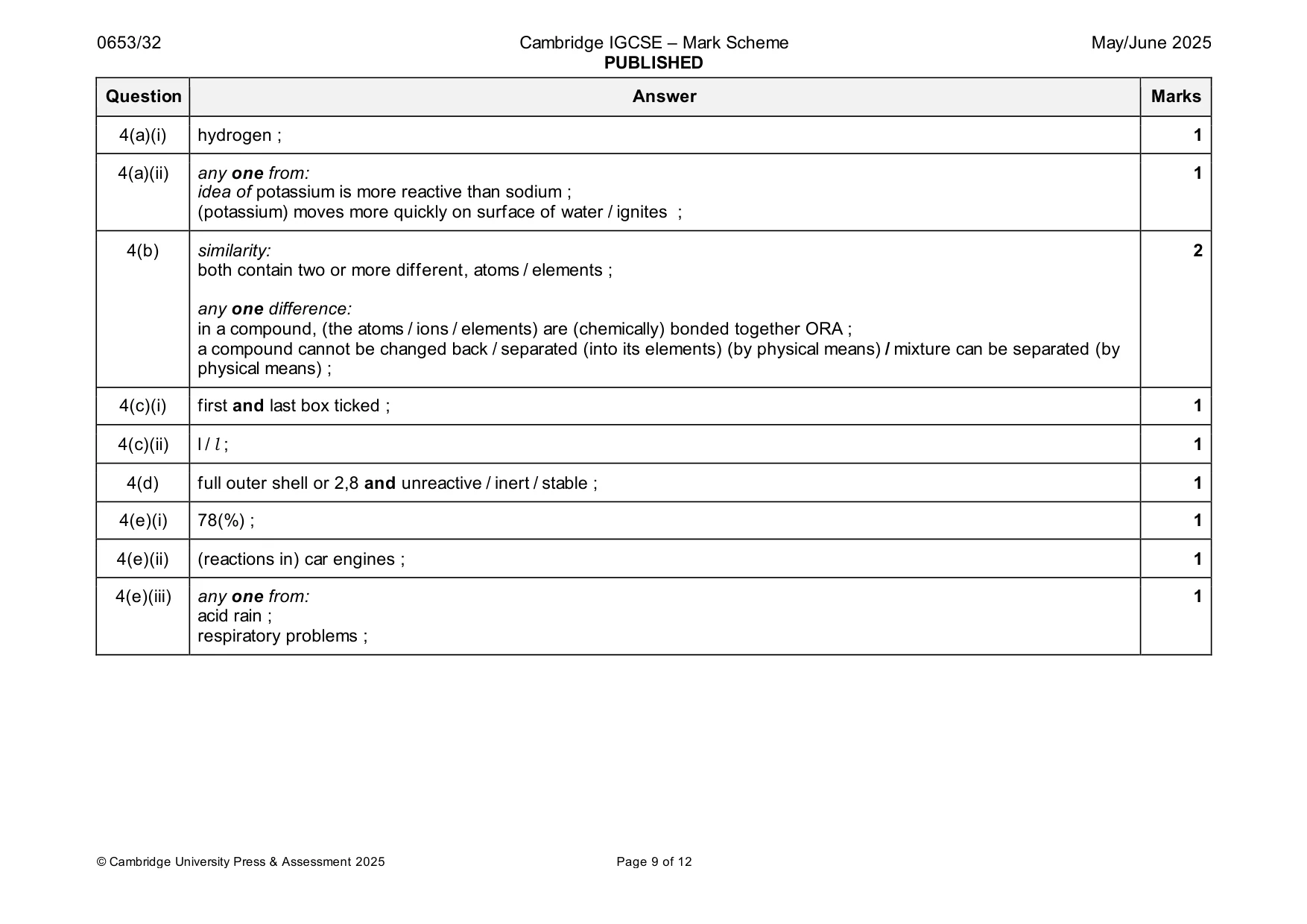
Mark scheme: 4(a)(i) hydrogen ; 1 4(a)(ii) any one from: 1 idea of potassium is more reactive than sodium ; (potassium) moves more quickly on surface of water / ignites ; 4(b) similarity: 2 both contain two or more different, atoms / elements ; any one difference: in a compound, (the atoms / ions / elements) are (chemically) bonded together ORA ; a compound cannot be changed back / separated (into its elements) (by physical means) / mixture can be separated (by physical means) ; 4(c)(i) first and last box ticked ; 1 4(c)(ii) l / l ; 1 4(d) full outer shell or 2,8 and unreactive / inert / stable ; 1 4(e)(i) 78(%) ; 1 4(e)(ii) (reactions in) car engines ; 1 4(e)(iii) any one from: 1 acid rain ; respiratory problems ;
Q5 · Iron is a transition element
5 (a) Iron is a transition element. Tick () two boxes that show correct statements about the properties of iron and Group I elements. Iron and Group I elements conduct electricity. Iron has a higher melting point than Group I elements. Group I elements have a higher density than iron. Group I elements form coloured compounds but iron compounds are white. [2] (b) Iron reacts with dilute hydrochloric acid. Write the word equation for the reaction. + + [1] (c) Fig. 5.1 shows three identical iron nails, each in a different test-tube, A, B and C. A B C oil water Fig. 5.1 Predict in which test-tube the iron nail rusts most quickly. Explain your answer. test-tube ....................... explanation ............................................................................................................................... ................................................................................................................................................... ................................................................................................................................................... [2] (d) Iron is extracted from iron(III) oxide in a blast furnace. Fe2O3 + 3CO 2Fe + 3CO2 Circle the type of reaction when iron(III) oxide forms iron. combustion oxidation reduction separation [1] (e) Aluminium is extracted by electrolysis. Name the main ore of aluminium. ............................................................................................................................................. [1] (f) Part of the reactivity series is shown. sodium magnesium carbon zinc hydrogen copper (i) Use this reactivity series to name: • one metal that must be extracted by electrolysis • one metal that is extracted by heating with carbon. metal extracted by electrolysis .......................................................................................... metal extracted by heating with carbon ............................................................................. [2] (ii) Explain why different methods of extraction are needed for the two metals in (f)(i). ........................................................................................................................................... ........................................................................................................................................... [1] [Total: 10]
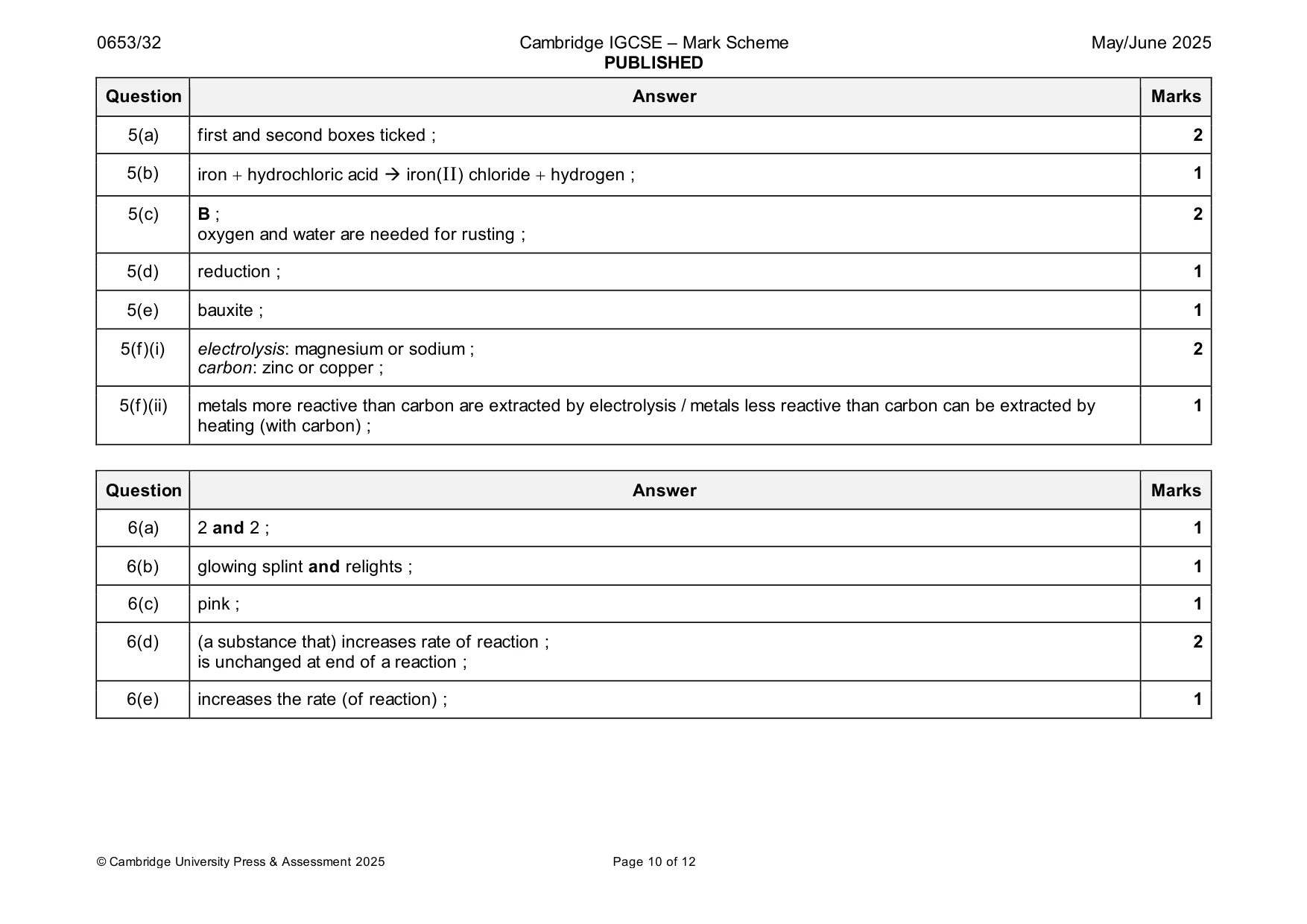
Mark scheme: 5(a) first and second boxes ticked ; 2 5(b) iron + hydrochloric acid → iron(II) chloride + hydrogen ; 1 5(c) B ; 2 oxygen and water are needed for rusting ; 5(d) reduction ; 1 5(e) bauxite ; 1 5(f)(i) electrolysis: magnesium or sodium ; 2 carbon: zinc or copper ; 5(f)(ii) metals more reactive than carbon are extracted by electrolysis / metals less reactive than carbon can be extracted by 1 heating (with carbon) ;
Q6 · Hydrogen peroxide, H2O2, decomposes into water and oxygen when a catalyst is added
6 Hydrogen peroxide, H2O2, decomposes into water and oxygen when a catalyst is added. (a) Balance the symbol equation for the reaction. ............ H2O2 ............ H2O + O2 [1] (b) The oxygen is collected and tested. Describe the test for oxygen gas. State the observation for the positive result. test ............................................................................................................................................ observation ............................................................................................................................... [1] (c) Anhydrous cobalt(II) chloride is used to test for water. State the colour observed for a positive result. ............................................................................................................................................. [1] (d) Describe what is meant by a catalyst. ................................................................................................................................................... ................................................................................................................................................... ................................................................................................................................................... ............................................................................................................................................. [2] (e) The temperature of the hydrogen peroxide is increased. All other conditions stay the same. Predict the effect of this change on the reaction. ............................................................................................................................................. [1] [Total: 6]
Mark scheme: 6(a) 2 and 2 ; 1 6(b) glowing splint and relights ; 1 6(c) pink ; 1 6(d) (a substance that) increases rate of reaction ; 2 is unchanged at end of a reaction ; 6(e) increases the rate (of reaction) ; 1
Q7 · A tram powered by electricity supplied through overhead cables
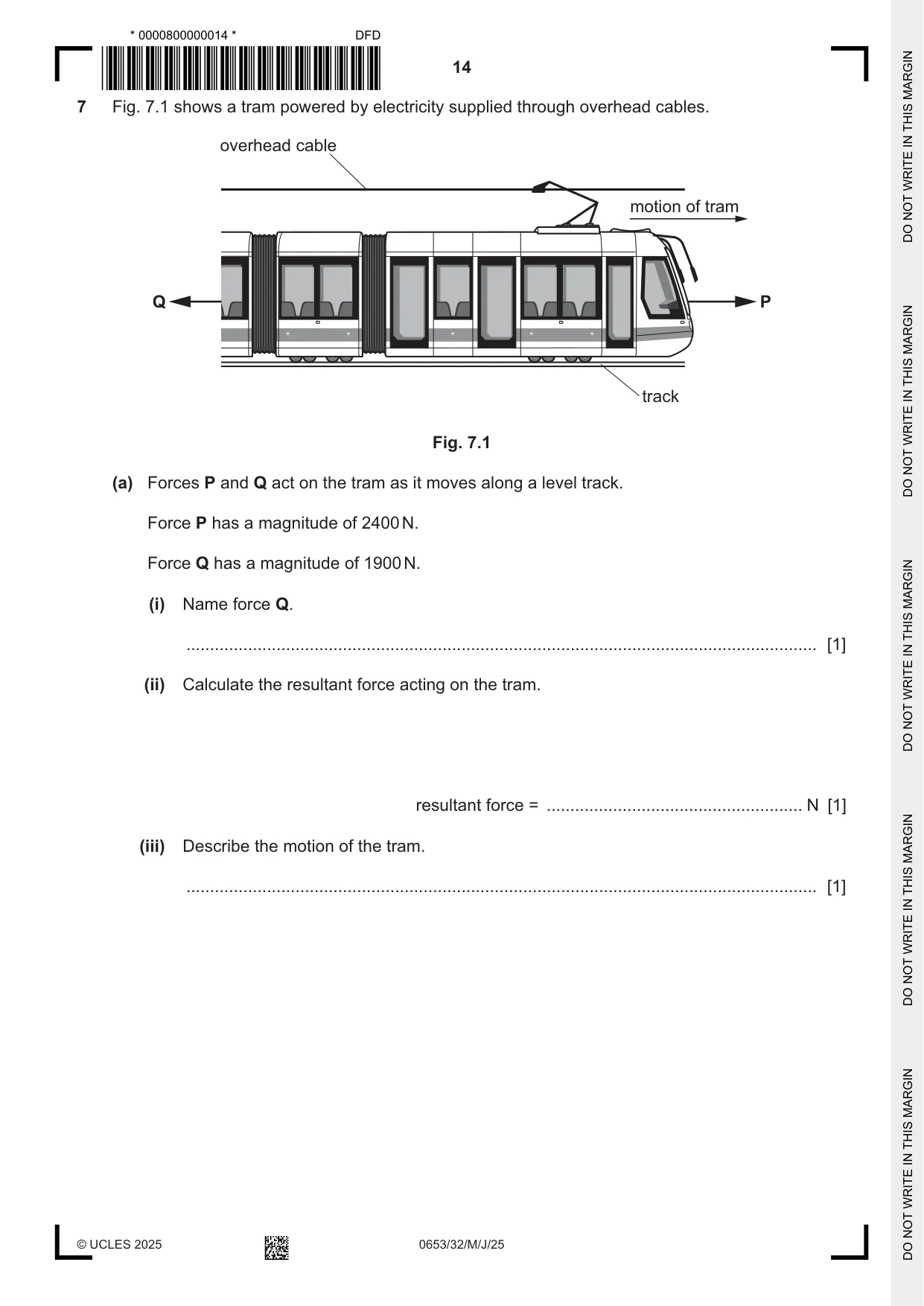
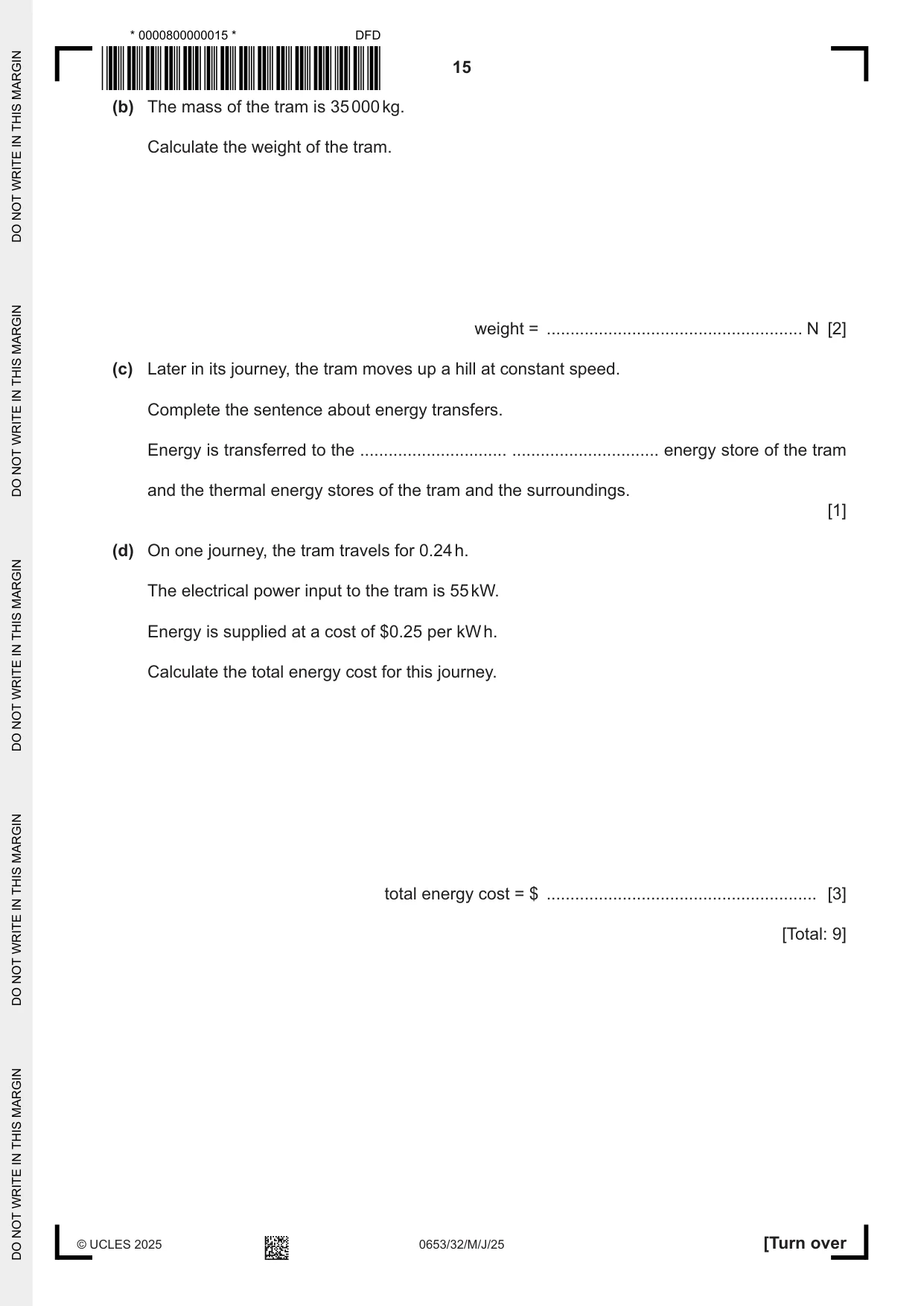
7 Fig. 7.1 shows a tram powered by electricity supplied through overhead cables. overhead cable motion of tram Q P track Fig. 7.1 (a) Forces P and Q act on the tram as it moves along a level track. Force P has a magnitude of 2400 N. Force Q has a magnitude of 1900 N. (i) Name force Q. ..................................................................................................................................... [1] (ii) Calculate the resultant force acting on the tram. resultant force = ...................................................... N [1] (iii) Describe the motion of the tram. ..................................................................................................................................... [1] (b) The mass of the tram is 35 000 kg. Calculate the weight of the tram. weight = ...................................................... N [2] (c) Later in its journey, the tram moves up a hill at constant speed. Complete the sentence about energy transfers. Energy is transferred to the ............................... ............................... energy store of the tram and the thermal energy stores of the tram and the surroundings. [1] (d) On one journey, the tram travels for 0.24 h. The electrical power input to the tram is 55 kW. Energy is supplied at a cost of $0.25 per kW h. Calculate the total energy cost for this journey. total energy cost = $ ......................................................... [3] [Total: 9]
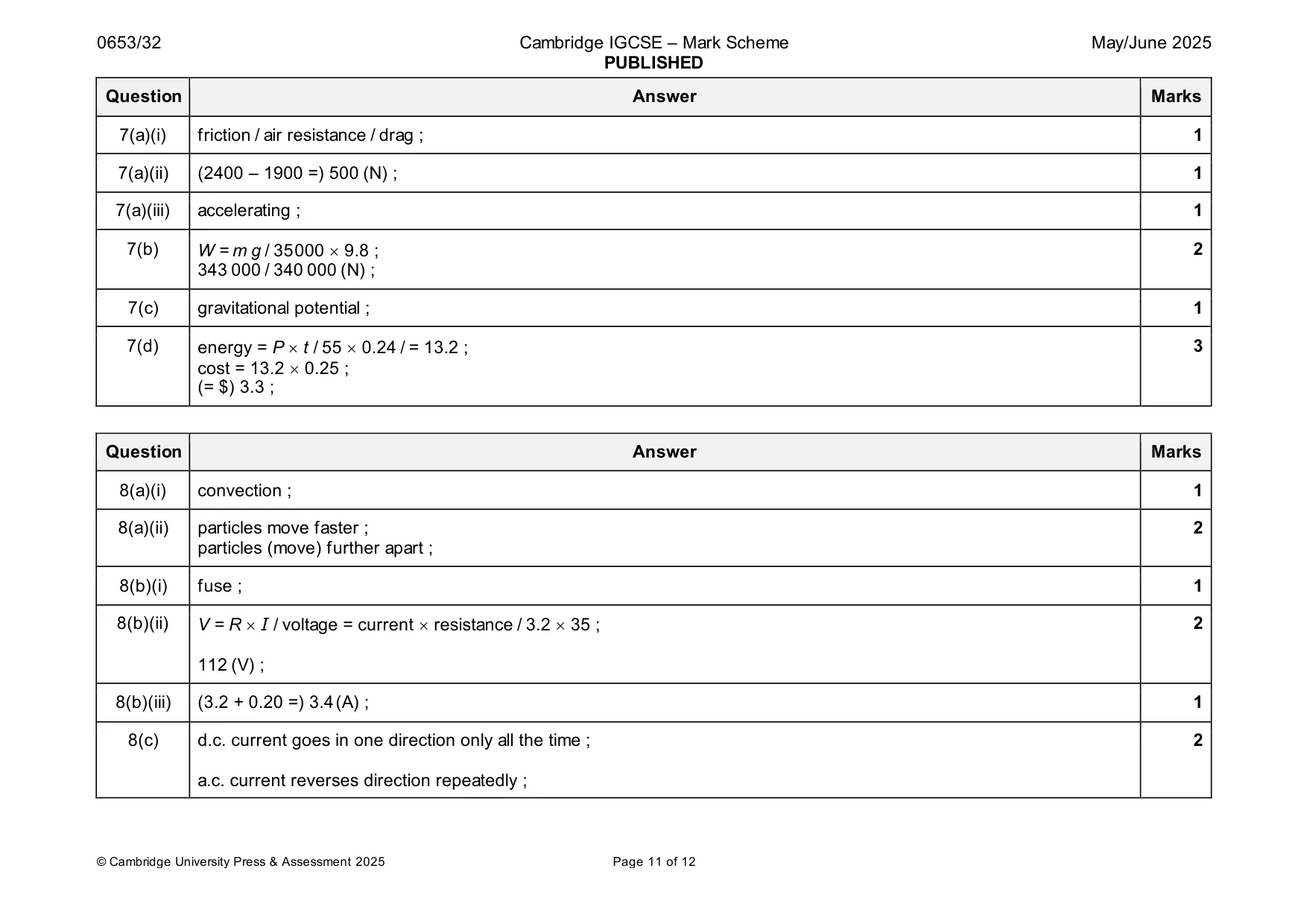
Mark scheme: 7(a)(i) friction / air resistance / drag ; 1 7(a)(ii) (2400 – 1900 =) 500 (N) ; 1 7(a)(iii) accelerating ; 1 7(b) W = m g / 35 000 9.8 ; 2 343 000 / 340 000 (N) ; 7(c) gravitational potential ; 1 7(d) energy = P t / 55 0.24 / = 13.2 ; 3 cost = 13.2 0.25 ; (= $) 3.3 ;
Q8 · An electric heater that heats a room
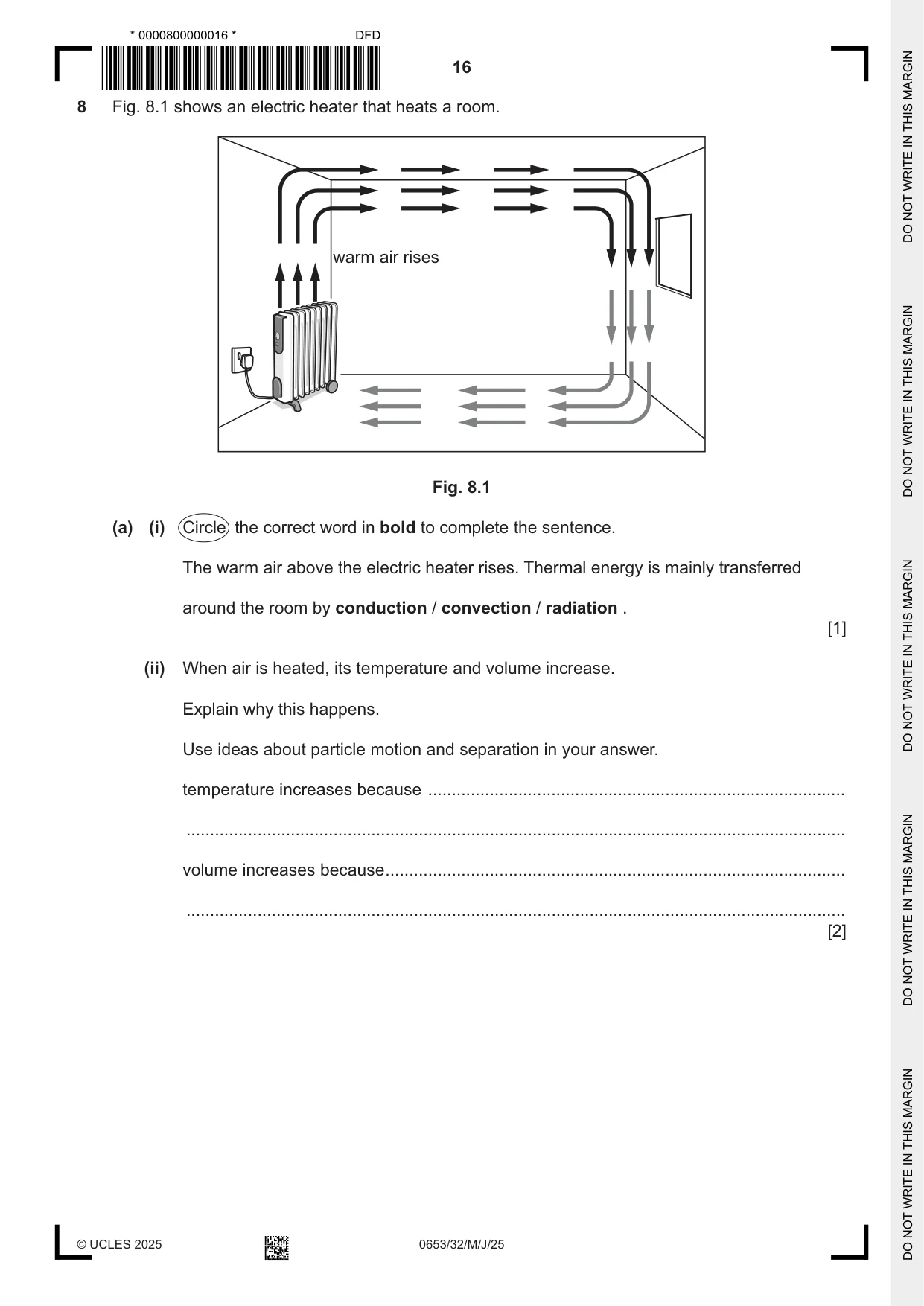
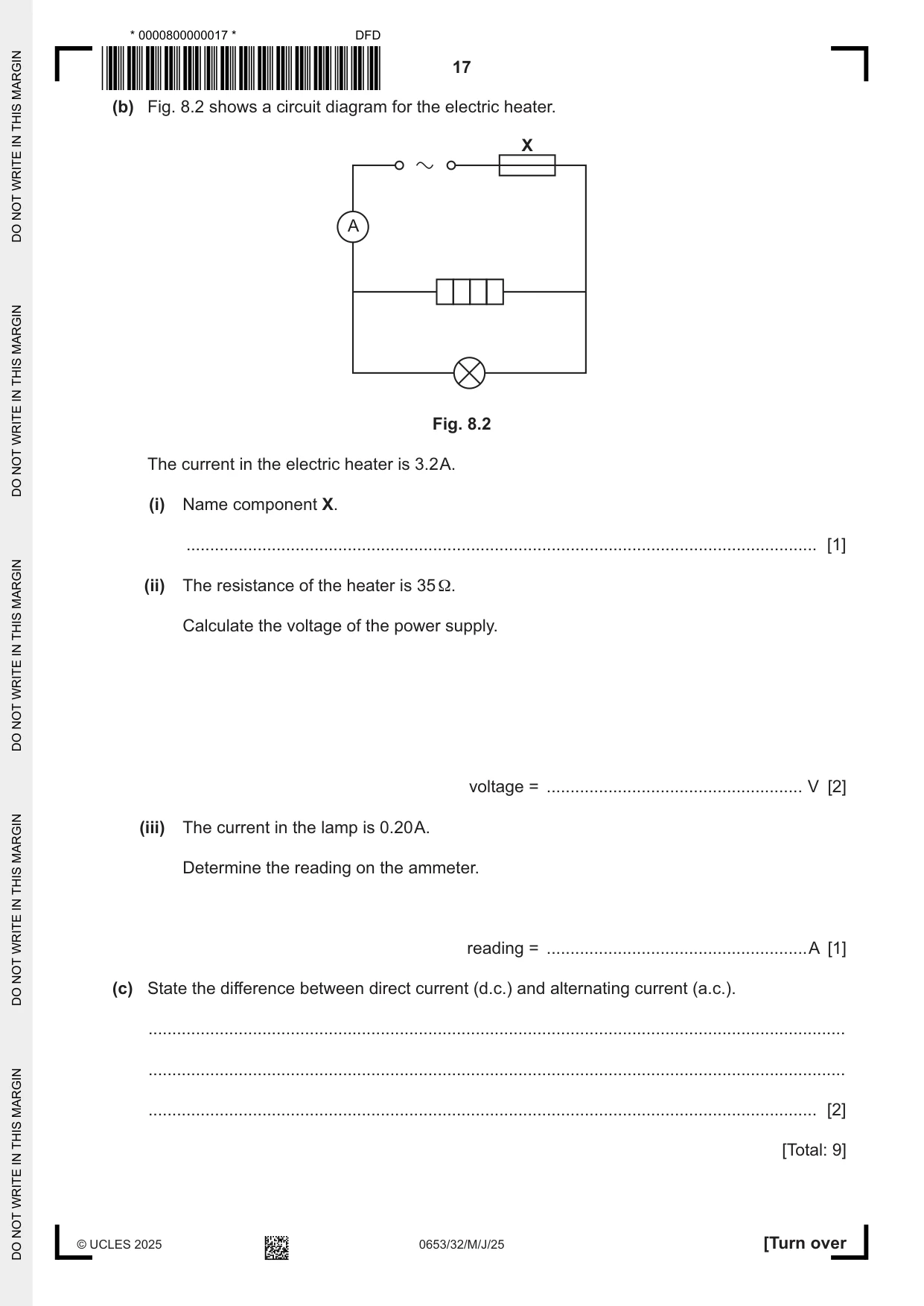
8 Fig. 8.1 shows an electric heater that heats a room. warm air rises Fig. 8.1 (a) (i) Circle the correct word in bold to complete the sentence. The warm air above the electric heater rises. Thermal energy is mainly transferred around the room by conduction / convection / radiation . [1] (ii) When air is heated, its temperature and volume increase. Explain why this happens. Use ideas about particle motion and separation in your answer. temperature increases because ........................................................................................ ........................................................................................................................................... volume increases because ................................................................................................. ........................................................................................................................................... [2] (b) Fig. 8.2 shows a circuit diagram for the electric heater. X A Fig. 8.2 The current in the electric heater is 3.2 A. (i) Name component X. ..................................................................................................................................... [1] (ii) The resistance of the heater is 35 Ω. Calculate the voltage of the power supply. voltage = ...................................................... V [2] (iii) The current in the lamp is 0.20 A. Determine the reading on the ammeter. reading = ....................................................... A [1] (c) State the difference between direct current (d.c.) and alternating current (a.c.). ................................................................................................................................................... ................................................................................................................................................... ............................................................................................................................................. [2] [Total: 9]
Mark scheme: 8(a)(i) convection ; 1 8(a)(ii) particles move faster ; 2 particles (move) further apart ; 8(b)(i) fuse ; 1 8(b)(ii) V = R I / voltage = current resistance / 3.2 35 ; 2 112 (V) ; 8(b)(iii) (3.2 + 0.20 =) 3.4 (A) ; 1 8(c) d.c. current goes in one direction only all the time ; 2 a.c. current reverses direction repeatedly ;
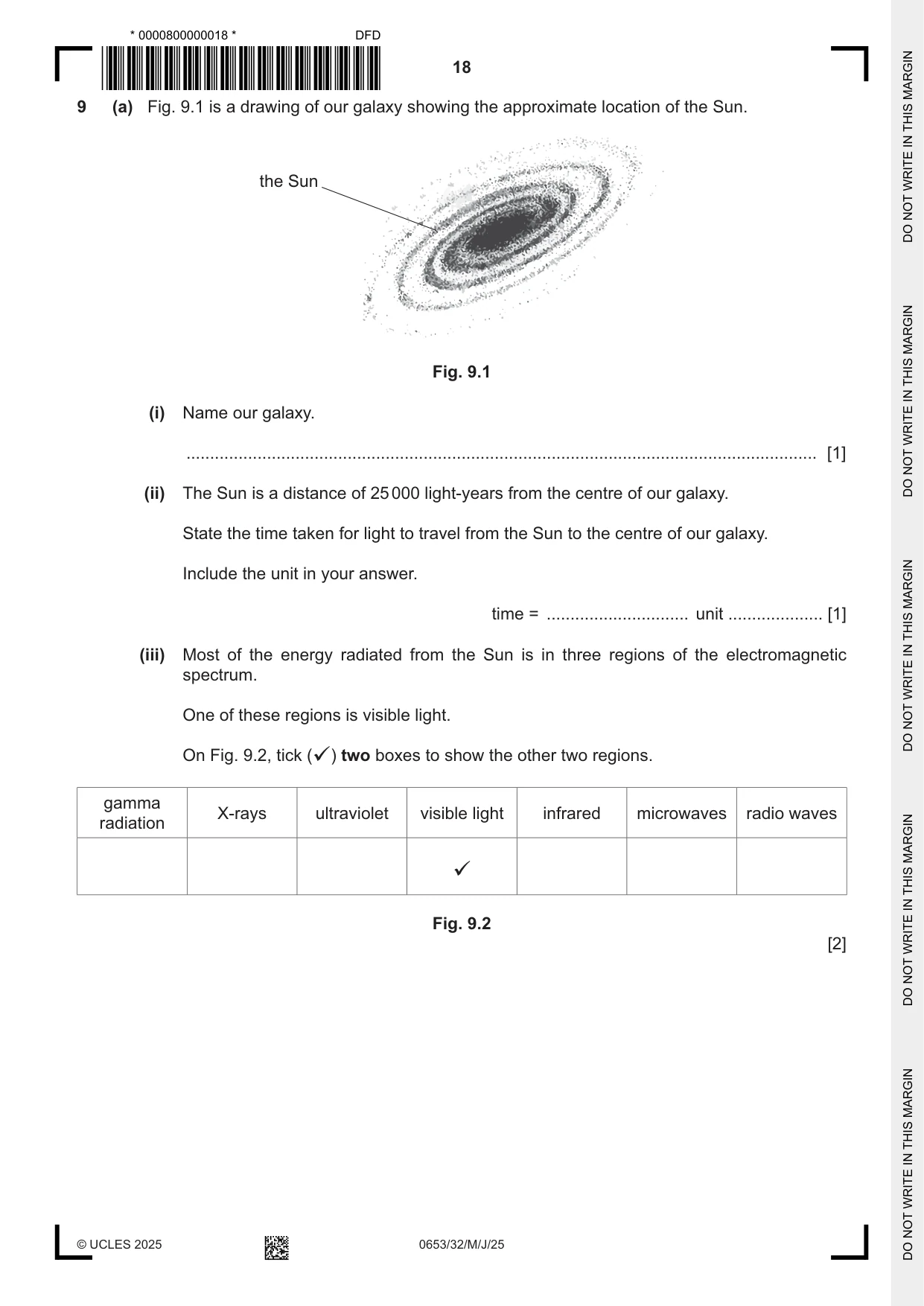
Q9 · A drawing of our galaxy showing the approximate location of the Sun
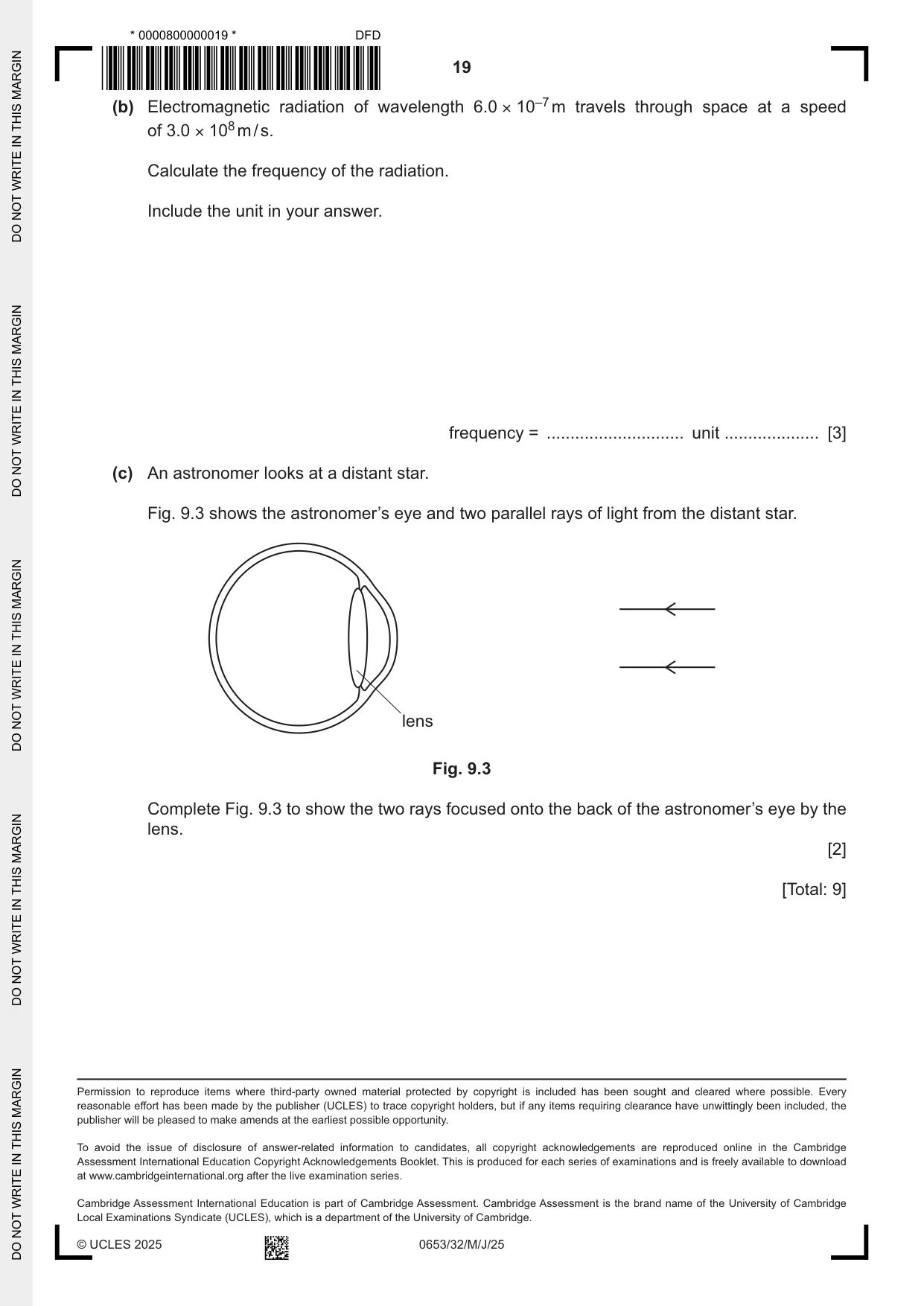
9 (a) Fig. 9.1 is a drawing of our galaxy showing the approximate location of the Sun. the Sun Fig. 9.1 (i) Name our galaxy. ..................................................................................................................................... [1] (ii) The Sun is a distance of 25 000 light-years from the centre of our galaxy. State the time taken for light to travel from the Sun to the centre of our galaxy. Include the unit in your answer. time = .............................. unit .................... [1] (iii) Most of the energy radiated from the Sun is in three regions of the electromagnetic spectrum. One of these regions is visible light. On Fig. 9.2, tick () two boxes to show the other two regions. gamma X-rays ultraviolet visible light infrared microwaves radio waves radiation Fig. 9.2 [2] (b) Electromagnetic radiation of wavelength 6.0 × 10⁻⁷ m travels through space at a speed of 3.0 × 10⁸ m / s. Calculate the frequency of the radiation. Include the unit in your answer. frequency = ............................. unit .................... [3] (c) An astronomer looks at a distant star. Fig. 9.3 shows the astronomer’s eye and two parallel rays of light from the distant star. lens Fig. 9.3 Complete Fig. 9.3 to show the two rays focused onto the back of the astronomer’s eye by the lens. [2] [Total: 9]
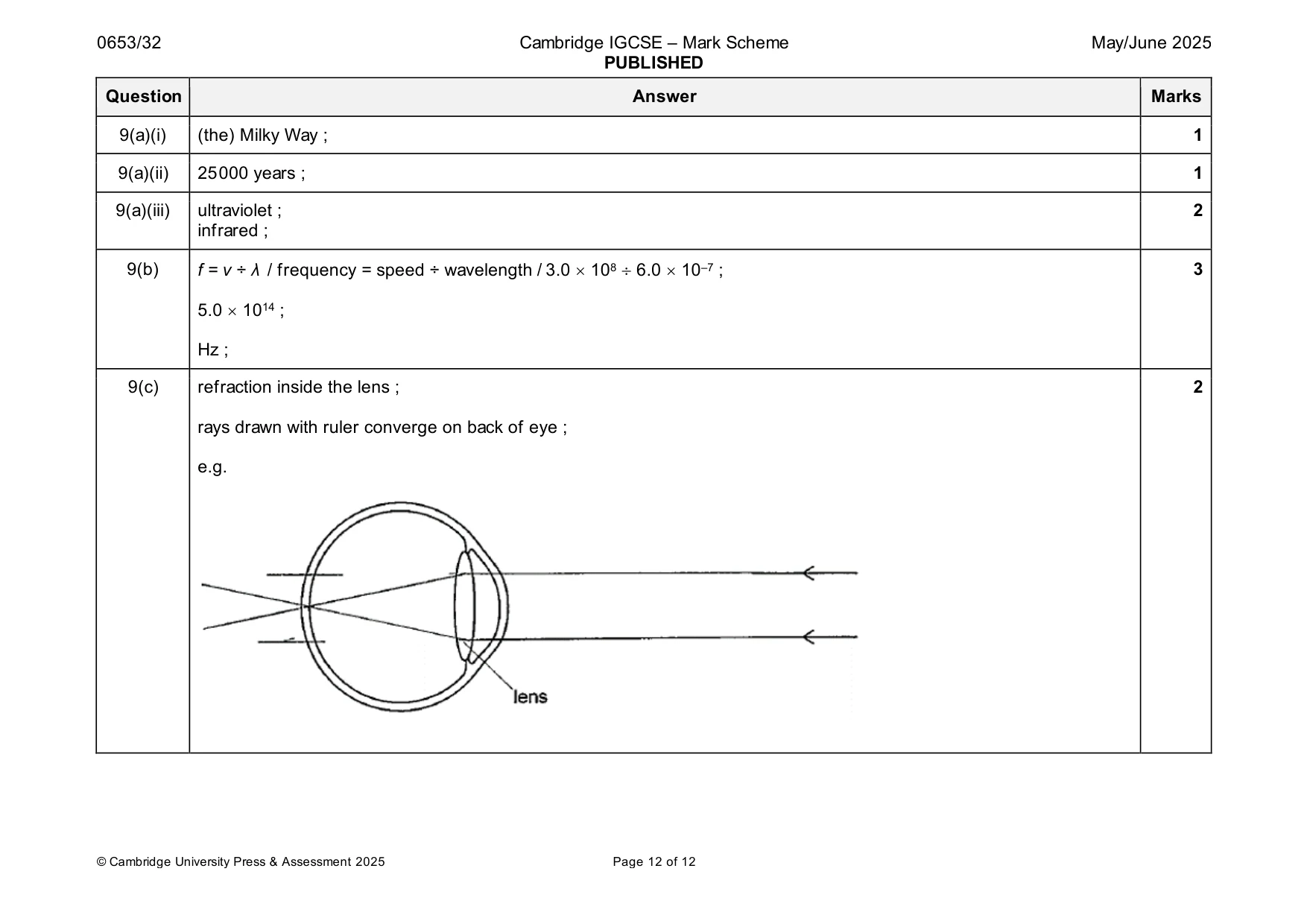
Mark scheme: 9(a)(i) (the) Milky Way ; 1 9(a)(ii) 25 000 years ; 1 9(a)(iii) ultraviolet ; 2 infrared ; 9(b) f = v ÷ λ / frequency = speed ÷ wavelength / 3.0 108 6.0 10–7 ; 3 5.0 1014 ; Hz ; 9(c) refraction inside the lens ; 2 rays drawn with ruler converge on back of eye ; e.g.
What was in this paper
The subtopics covered by these 9 questions, and how many questions each got. Open one in a new tab to see every Cambridge question on it.
What you needed in this session
Cambridge’s own grade thresholds for 2025 May/June, Paper 3 · Variant 2. A higher threshold means an easier paper — the bar moves with how the cohort did.