Cambridge IGCSE Science - Combined 0653 — 2020 Oct/Nov Paper 3 · Variant 2
0653/32/O/N/20 · 9 questions · 80 marks · ≈90 min
The question paper and its mark scheme, free to read here and free to download. This is Cambridge’s own paper, exactly as it was sat.
Question paper20 pages
Mark scheme10 pages
Answers below. Sit the paper first if you are practising.
Questions as text
Q1 · A food web for a pond habitat
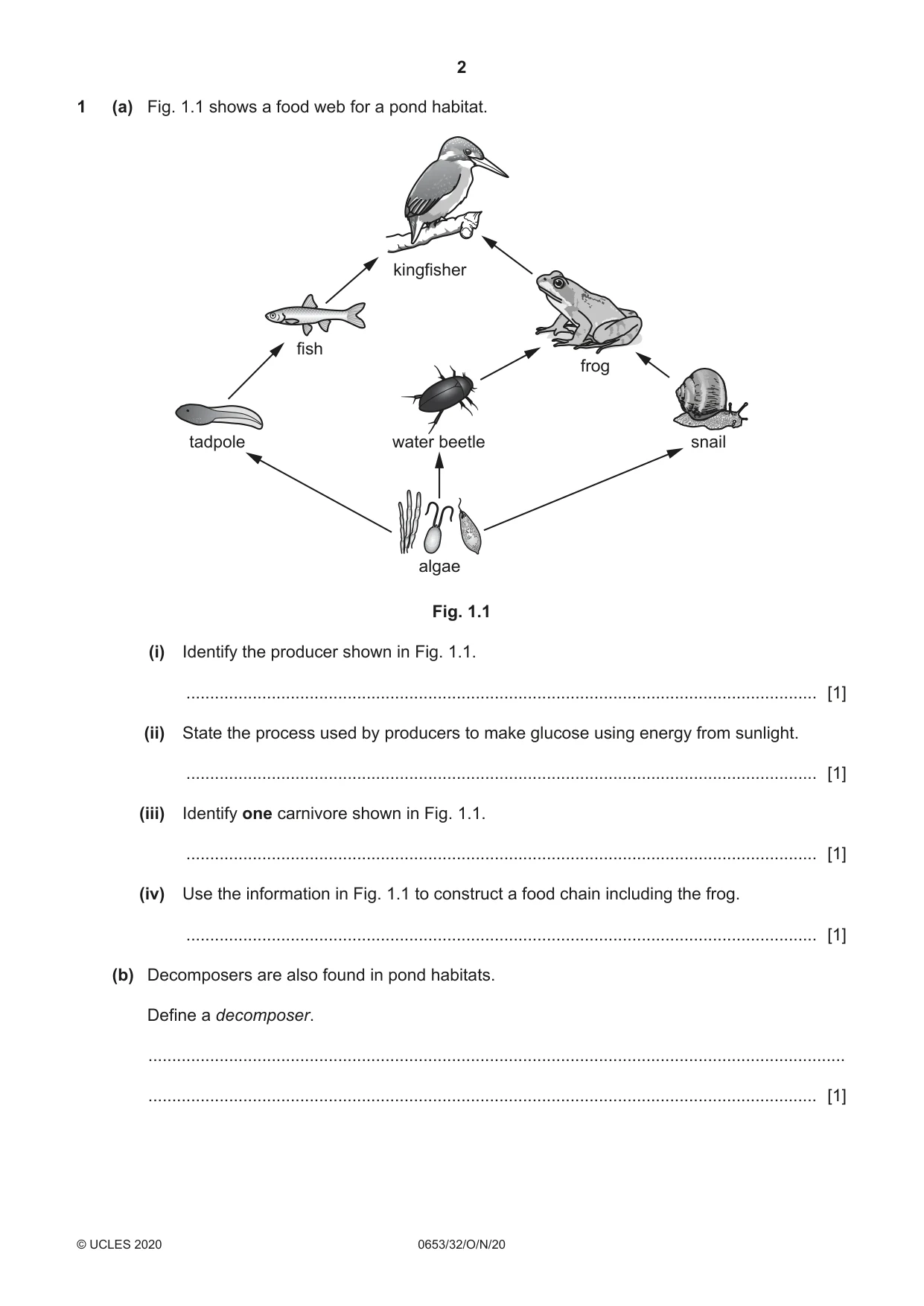
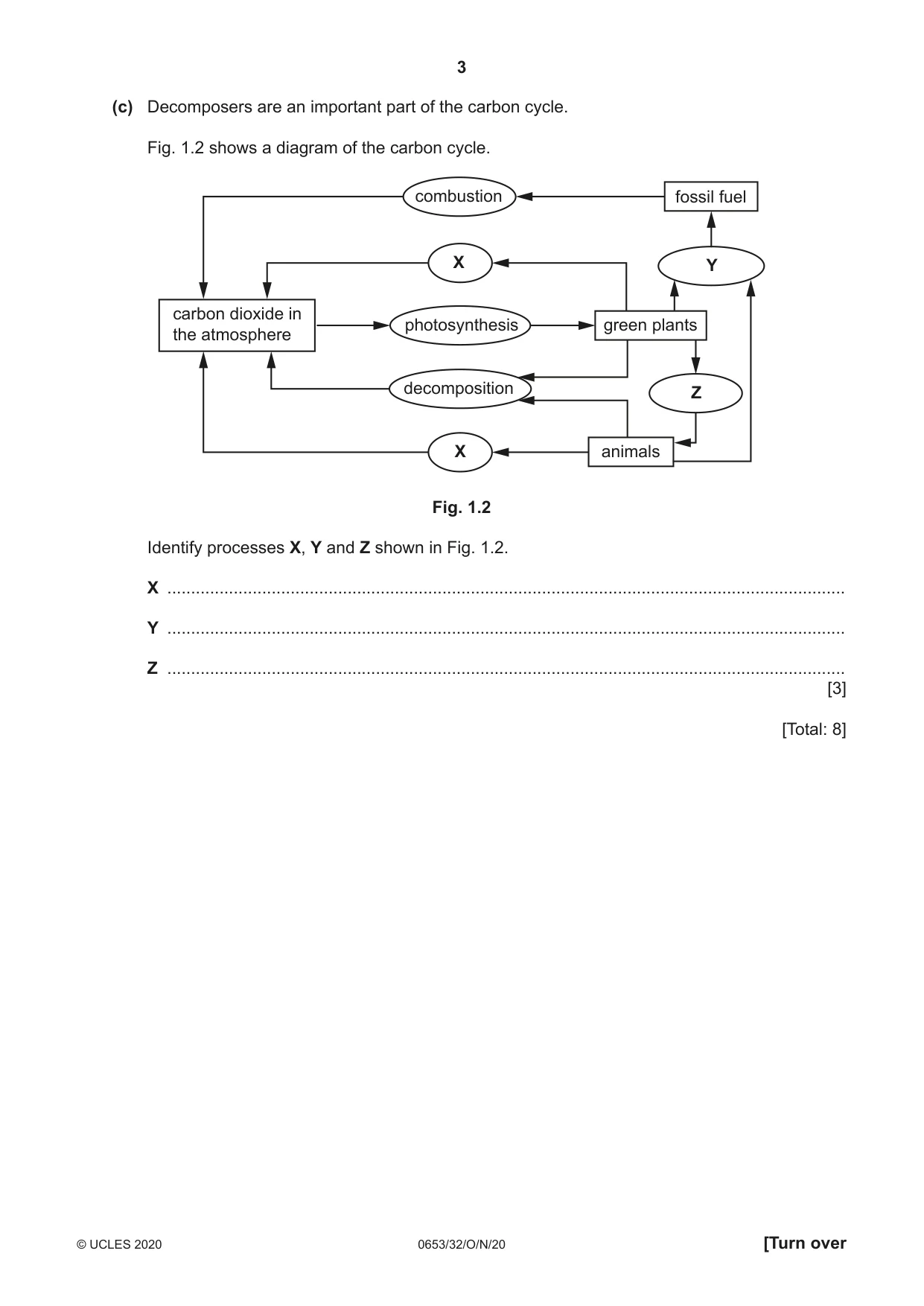
1 (a) Fig. 1.1 shows a food web for a pond habitat. kingfisher fish frog tadpole water beetle snail algae Fig. 1.1 (i) Identify the producer shown in Fig. 1.1. ..................................................................................................................................... [1] (ii) State the process used by producers to make glucose using energy from sunlight. ..................................................................................................................................... [1] (iii) Identify one carnivore shown in Fig. 1.1. ..................................................................................................................................... [1] (iv) Use the information in Fig. 1.1 to construct a food chain including the frog. ..................................................................................................................................... [1] (b) Decomposers are also found in pond habitats. Define a decomposer. ................................................................................................................................................... ............................................................................................................................................. [1] (c) Decomposers are an important part of the carbon cycle. Fig. 1.2 shows a diagram of the carbon cycle. combustion fossil fuel X Y carbon dioxide in photosynthesis green plants the atmosphere decomposition Z X animals Fig. 1.2 Identify processes X, Y and Z shown in Fig. 1.2. X ............................................................................................................................................... Y ............................................................................................................................................... Z ............................................................................................................................................... [3] [Total: 8]
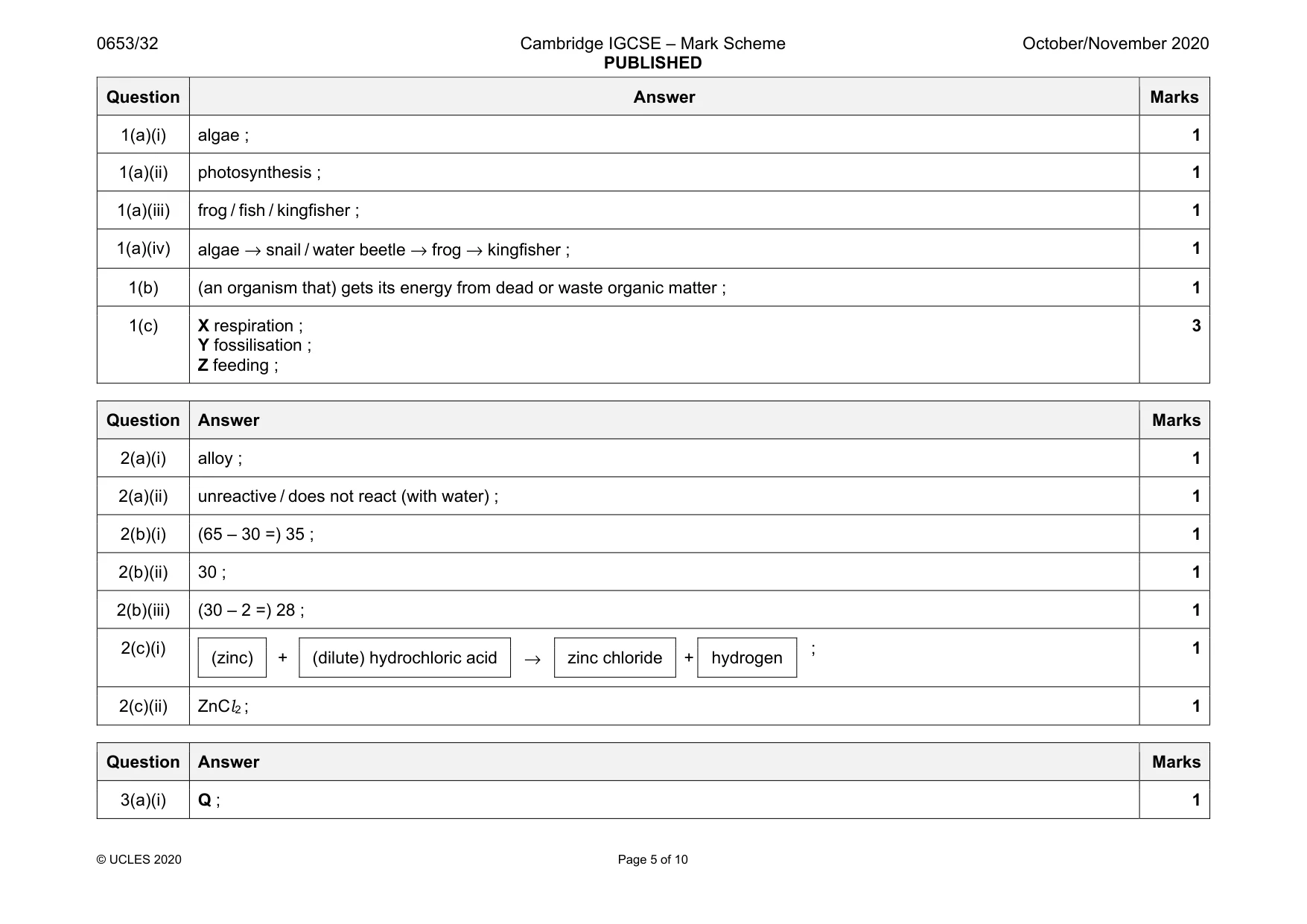
Mark scheme: 1(a)(i) algae ; 1 1(a)(ii) photosynthesis ; 1 1(a)(iii) frog / fish / kingfisher ; 1 1(a)(iv) algae → snail / water beetle → frog → kingfisher ; 1 1(b) (an organism that) gets its energy from dead or waste organic matter ; 1 1(c) X respiration ; Y fossilisation ; Z feeding ; 3 Question Answer Marks
Q2 · Brass is a mixture of copper and zinc
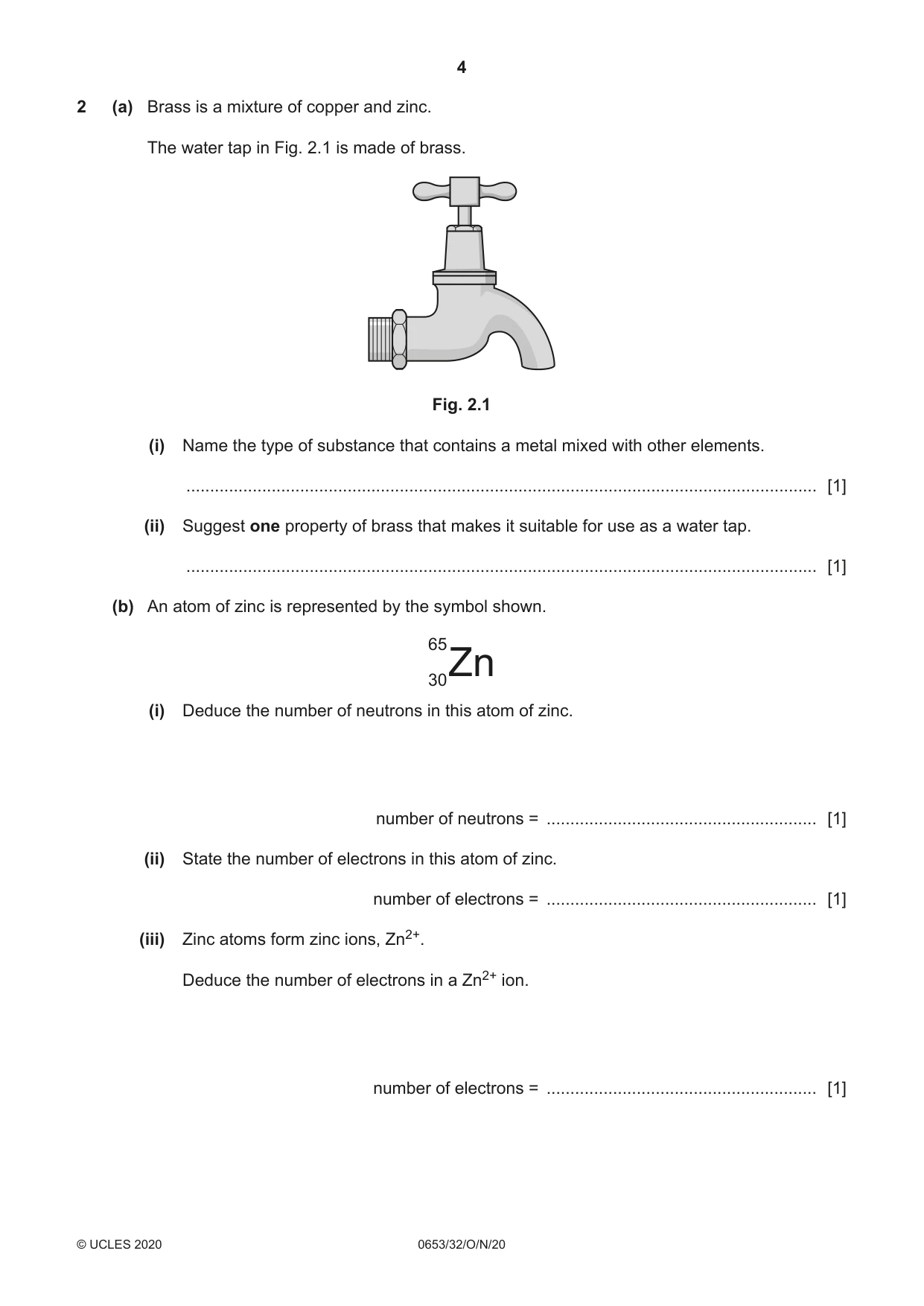
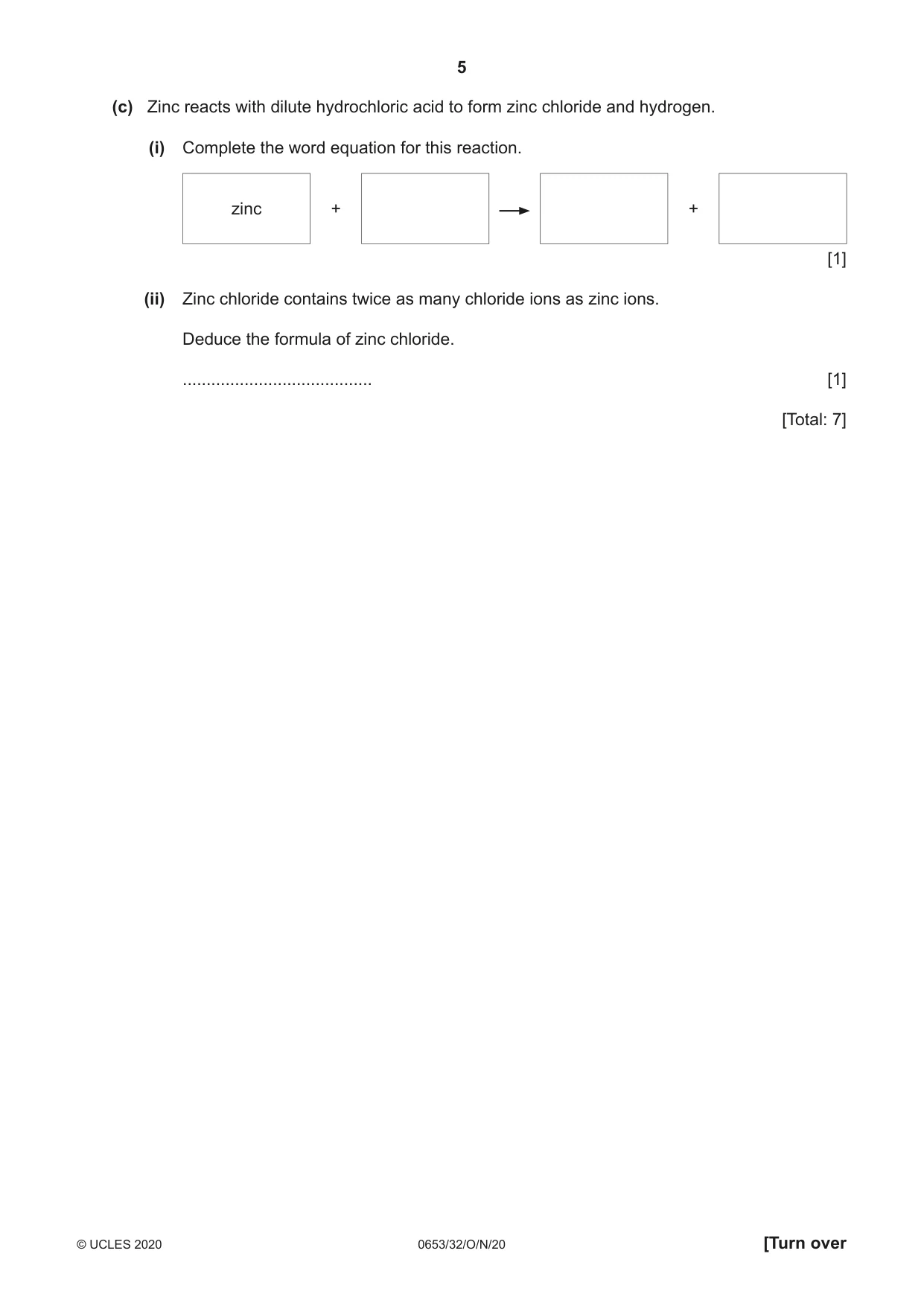
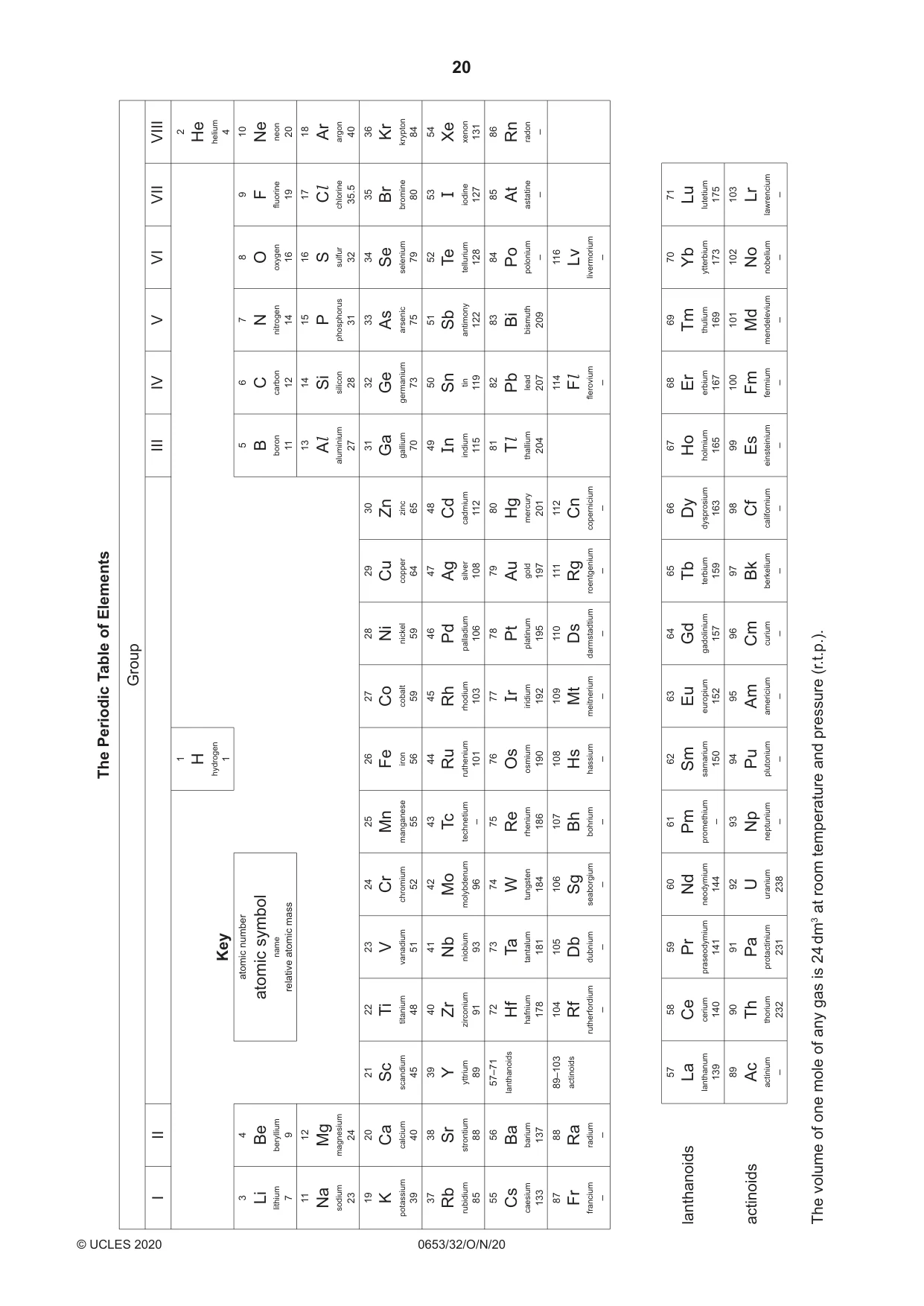
2 (a) Brass is a mixture of copper and zinc. The water tap in Fig. 2.1 is made of brass. Fig. 2.1 (i) Name the type of substance that contains a metal mixed with other elements. ..................................................................................................................................... [1] (ii) Suggest one property of brass that makes it suitable for use as a water tap. ..................................................................................................................................... [1] (b) An atom of zinc is represented by the symbol shown. 6530Zn (i) Deduce the number of neutrons in this atom of zinc. number of neutrons = ......................................................... [1] (ii) State the number of electrons in this atom of zinc. number of electrons = ......................................................... [1] (iii) Zinc atoms form zinc ions, Zn2+. Deduce the number of electrons in a Zn2+ ion. number of electrons = ......................................................... [1] (c) Zinc reacts with dilute hydrochloric acid to form zinc chloride and hydrogen. (i) Complete the word equation for this reaction. zinc + + [1] (ii) Zinc chloride contains twice as many chloride ions as zinc ions. Deduce the formula of zinc chloride. ........................................ [1] [Total: 7]
Mark scheme: 2(a)(i) alloy ; 1 2(a)(ii) unreactive / does not react (with water) ; 1 2(b)(i) (65 – 30 =) 35 ; 1 2(b)(ii) 30 ; 1 2(b)(iii) (30 – 2 =) 28 ; 1 2(c)(i) ; (zinc) + (dilute) hydrochloric acid → zinc chloride + hydrogen 1 2(c)(ii) ZnCl2 ; 1 Question Answer Marks
Q3 · The forces acting on a wheelbarrow full of sand as a man pushes it along a straight path…
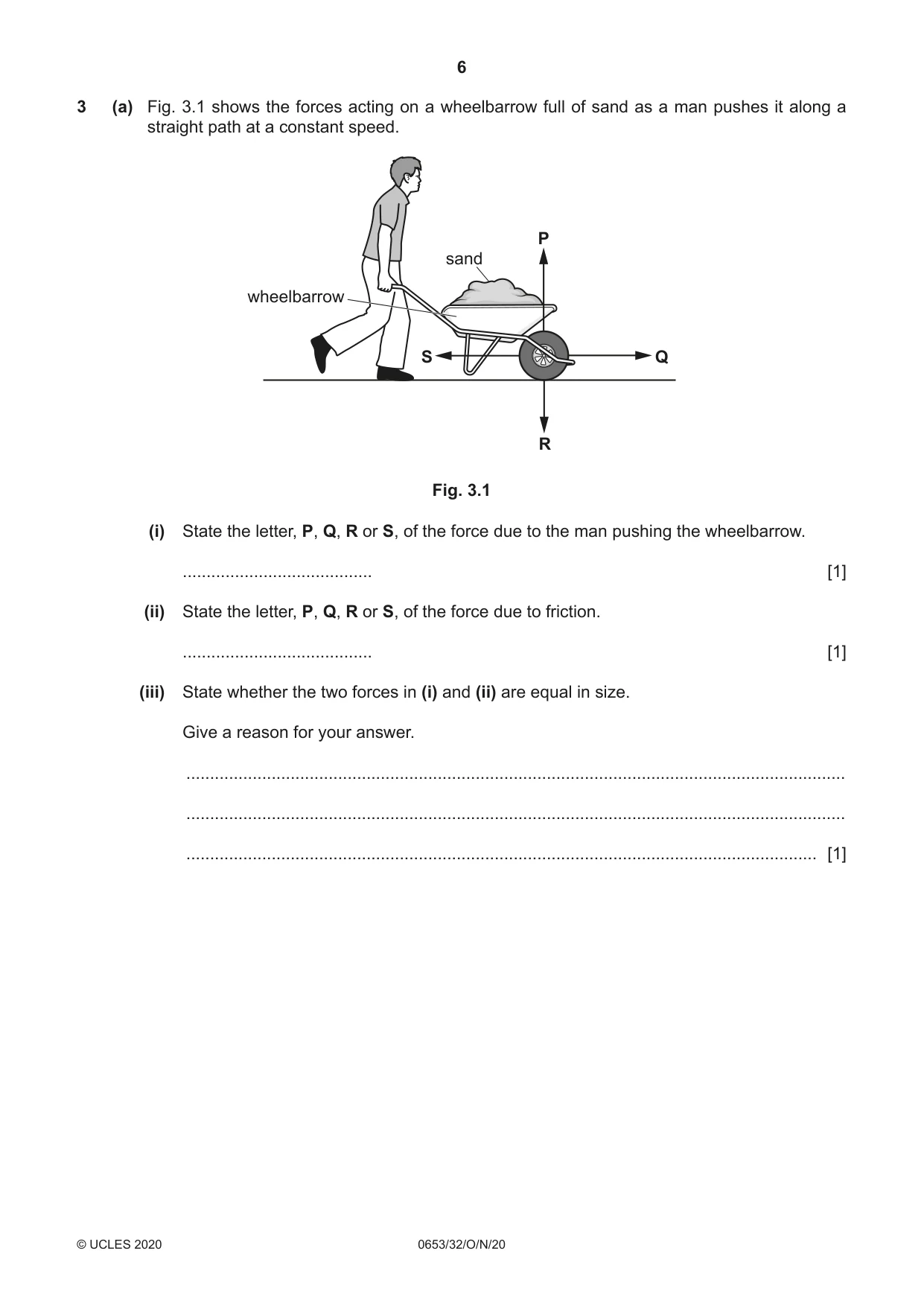
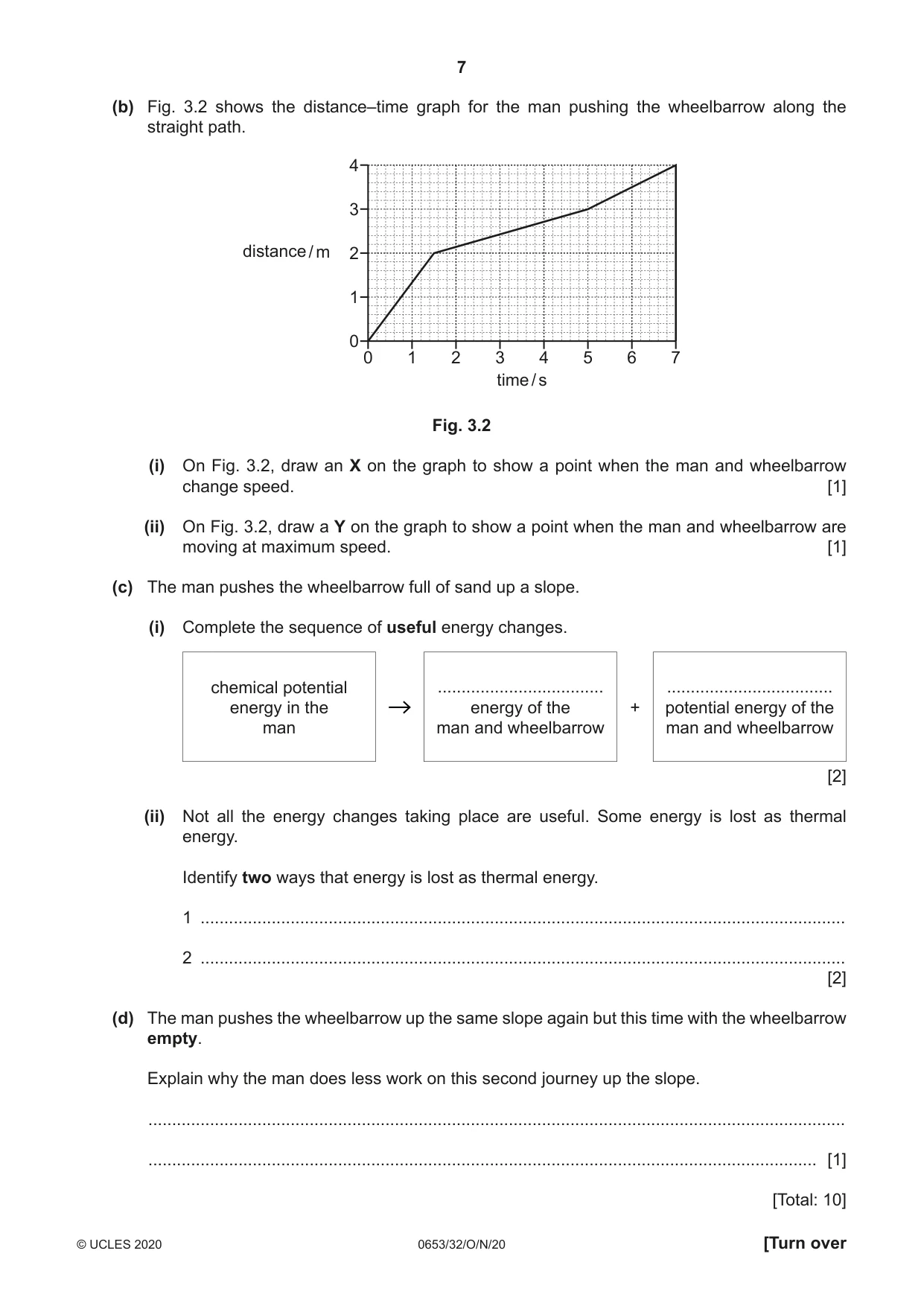
3 (a) Fig. 3.1 shows the forces acting on a wheelbarrow full of sand as a man pushes it along a straight path at a constant speed. P sand wheelbarrow S Q R Fig. 3.1 (i) State the letter, P, Q, R or S, of the force due to the man pushing the wheelbarrow. ........................................ [1] (ii) State the letter, P, Q, R or S, of the force due to friction. ........................................ [1] (iii) State whether the two forces in (i) and (ii) are equal in size. Give a reason for your answer. ........................................................................................................................................... ........................................................................................................................................... ..................................................................................................................................... [1] (b) Fig. 3.2 shows the distance–time graph for the man pushing the wheelbarrow along the straight path. 4 3 distance / m 2 1 0 0 1 2 3 4 5 6 7 time / s Fig. 3.2 (i) On Fig. 3.2, draw an X on the graph to show a point when the man and wheelbarrow change speed. [1] (ii) On Fig. 3.2, draw a Y on the graph to show a point when the man and wheelbarrow are moving at maximum speed. [1] (c) The man pushes the wheelbarrow full of sand up a slope. (i) Complete the sequence of useful energy changes. chemical potential ................................... ................................... energy in the energy of the + potential energy of the man man and wheelbarrow man and wheelbarrow [2] (ii) Not all the energy changes taking place are useful. Some energy is lost as thermal energy. Identify two ways that energy is lost as thermal energy. 1 ........................................................................................................................................ 2 ........................................................................................................................................ [2] (d) The man pushes the wheelbarrow up the same slope again but this time with the wheelbarrow empty. Explain why the man does less work on this second journey up the slope. ................................................................................................................................................... ............................................................................................................................................. [1] [Total: 10]
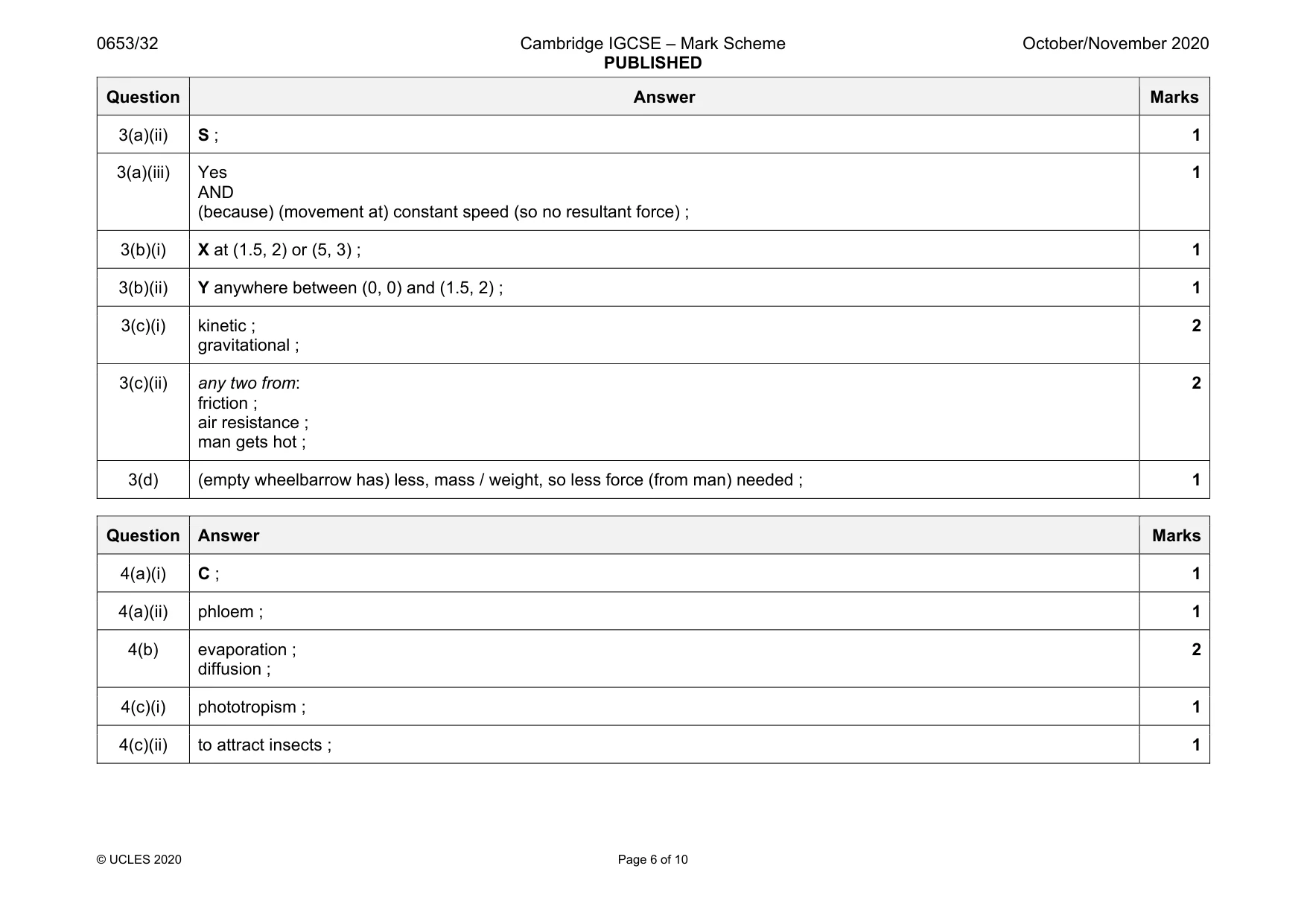
Mark scheme: 3(a)(i) Q ; 1 Question Answer Marks 3(a)(ii) S ; 1 3(a)(iii) Yes AND (because) (movement at) constant speed (so no resultant force) ; 1 3(b)(i) X at (1.5, 2) or (5, 3) ; 1 3(b)(ii) Y anywhere between (0, 0) and (1.5, 2) ; 1 3(c)(i) kinetic ; gravitational ; 2 3(c)(ii) any two from: friction ; air resistance ; man gets hot ; 2 3(d) (empty wheelbarrow has) less, mass / weight, so less force (from man) needed ; 1 Question Answer Marks
Q4 · A cross-section of a plant stem as seen under a microscope
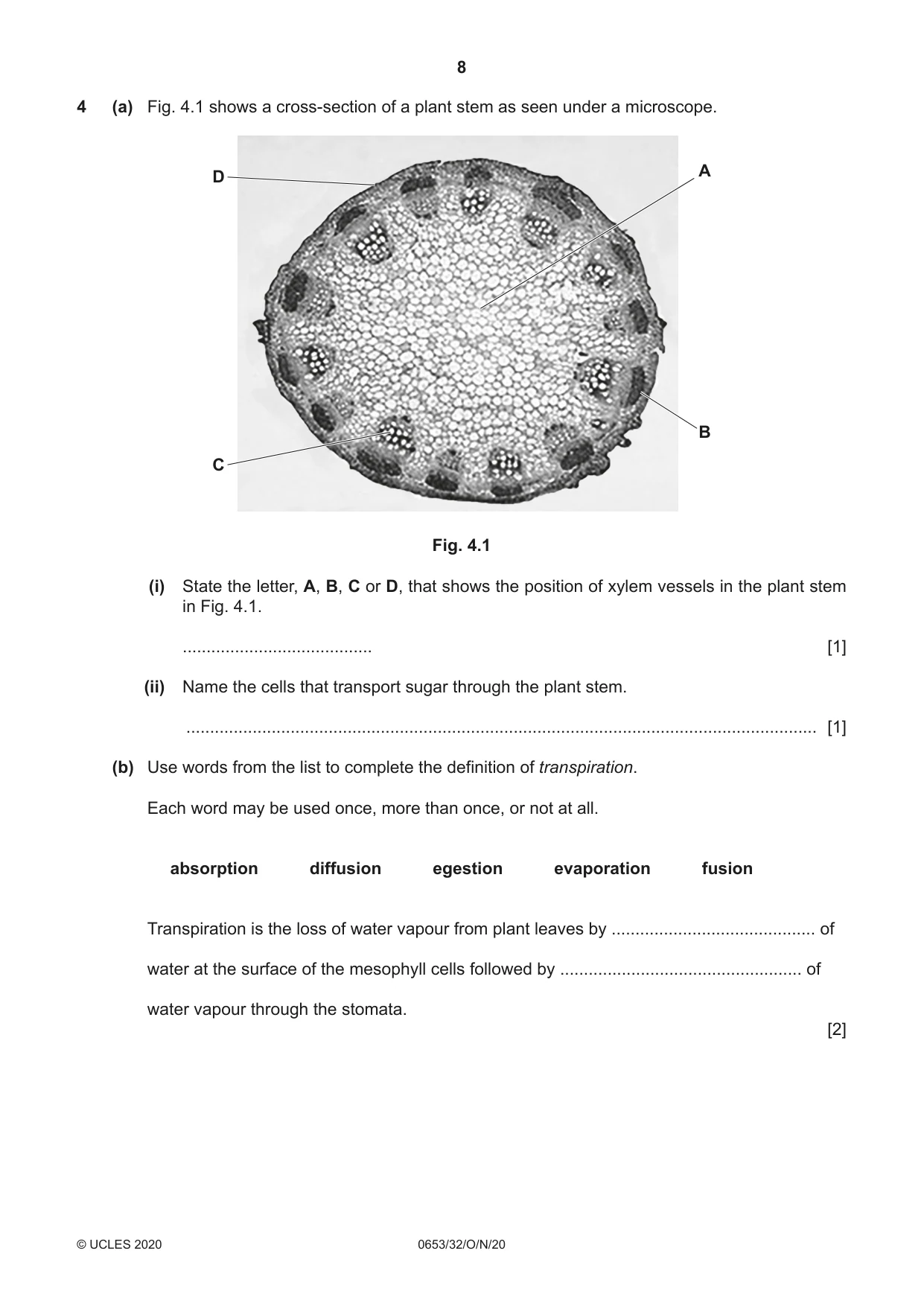
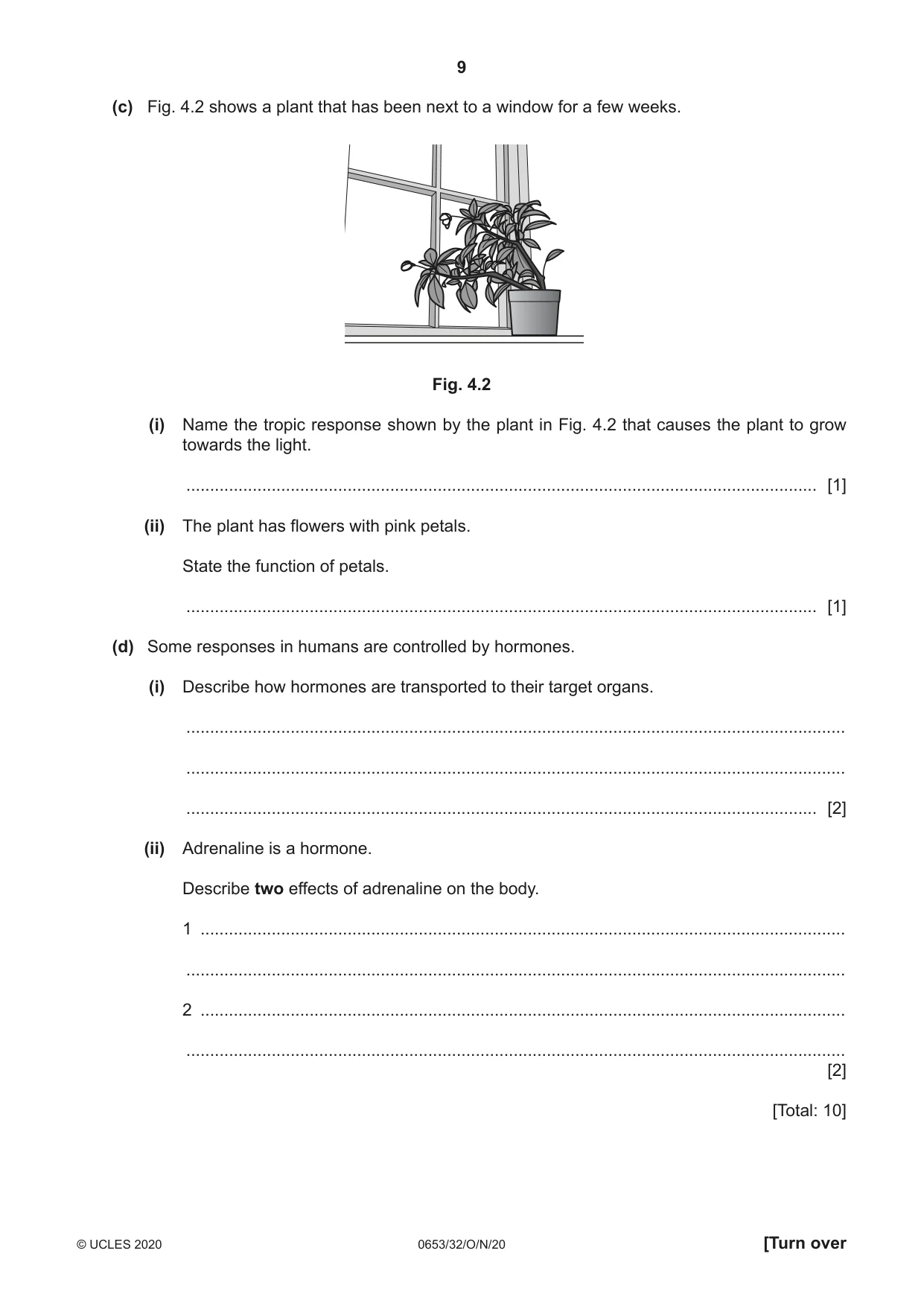
4 (a) Fig. 4.1 shows a cross-section of a plant stem as seen under a microscope. A D B C Fig. 4.1 (i) State the letter, A, B, C or D, that shows the position of xylem vessels in the plant stem in Fig. 4.1. ........................................ [1] (ii) Name the cells that transport sugar through the plant stem. ..................................................................................................................................... [1] (b) Use words from the list to complete the definition of transpiration. Each word may be used once, more than once, or not at all. absorption diffusion egestion evaporation fusion Transpiration is the loss of water vapour from plant leaves by ........................................... of water at the surface of the mesophyll cells followed by ................................................... of water vapour through the stomata. [2] (c) Fig. 4.2 shows a plant that has been next to a window for a few weeks. Fig. 4.2 (i) Name the tropic response shown by the plant in Fig. 4.2 that causes the plant to grow towards the light. ..................................................................................................................................... [1] (ii) The plant has flowers with pink petals. State the function of petals. ..................................................................................................................................... [1] (d) Some responses in humans are controlled by hormones. (i) Describe how hormones are transported to their target organs. ........................................................................................................................................... ........................................................................................................................................... ..................................................................................................................................... [2] (ii) Adrenaline is a hormone. Describe two effects of adrenaline on the body. 1 ........................................................................................................................................ ........................................................................................................................................... 2 ........................................................................................................................................ ........................................................................................................................................... [2] [Total: 10]
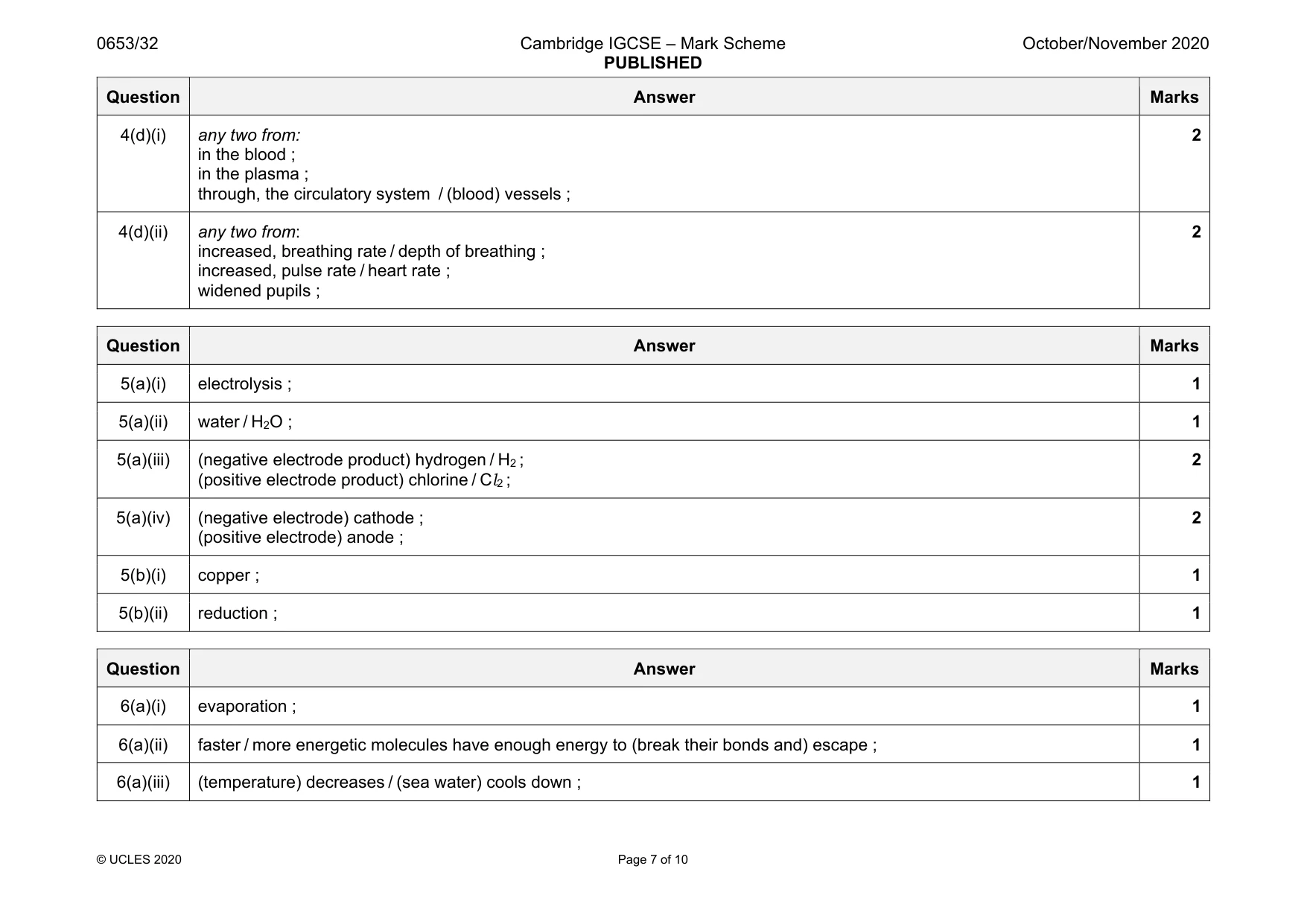
Mark scheme: 4(a)(i) C ; 1 4(a)(ii) phloem ; 1 4(b) evaporation ; diffusion ; 2 4(c)(i) phototropism ; 1 4(c)(ii) to attract insects ; 1 Question Answer Marks 4(d)(i) any two from: in the blood ; in the plasma ; through, the circulatory system / (blood) vessels ; 2 4(d)(ii) any two from: increased, breathing rate / depth of breathing ; increased, pulse rate / heart rate ; widened pupils ; 2
Q5 · In an experiment, carbon electrodes are used to pass an electric current through…
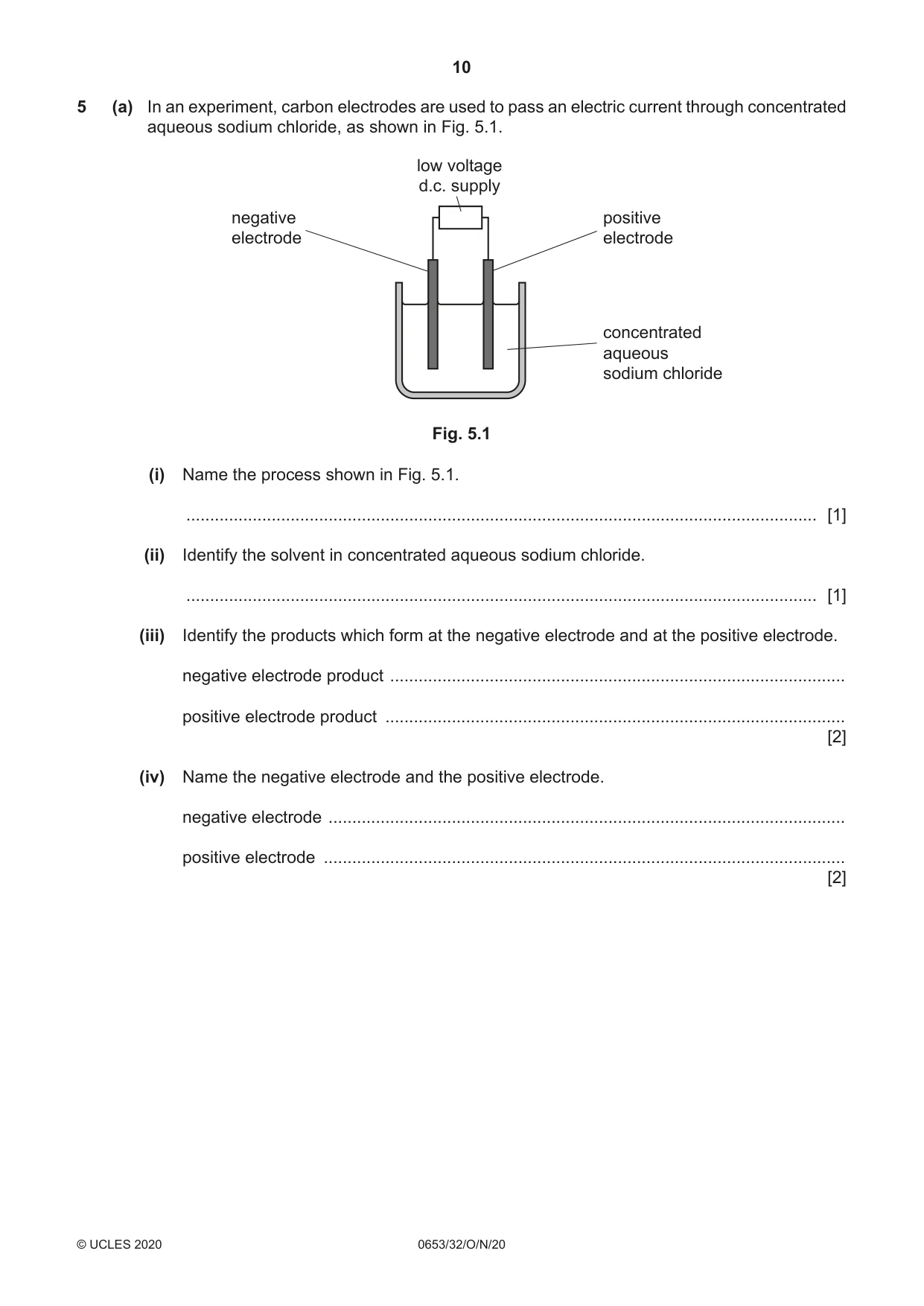
5 (a) In an experiment, carbon electrodes are used to pass an electric current through concentrated aqueous sodium chloride, as shown in Fig. 5.1. low voltage d.c. supply negative positive electrode electrode concentrated aqueous sodium chloride Fig. 5.1 (i) Name the process shown in Fig. 5.1. ..................................................................................................................................... [1] (ii) Identify the solvent in concentrated aqueous sodium chloride. ..................................................................................................................................... [1] (iii) Identify the products which form at the negative electrode and at the positive electrode. negative electrode product ................................................................................................ positive electrode product ................................................................................................. [2] (iv) Name the negative electrode and the positive electrode. negative electrode ............................................................................................................. positive electrode .............................................................................................................. [2] (b) Some metals are extracted from their ores by heating with carbon. (i) Identify one metal that is extracted from its ore by this method. ..................................................................................................................................... [1] (ii) In this extraction process, oxygen is removed from the metal. State the type of chemical reaction that involves the loss of oxygen. ..................................................................................................................................... [1] [Total: 8]
Mark scheme: 5(a)(i) electrolysis ; 1 5(a)(ii) water / H2O ; 1 5(a)(iii) (negative electrode product) hydrogen / H2 ; (positive electrode product) chlorine / Cl2 ; 2 5(a)(iv) (negative electrode) cathode ; (positive electrode) anode ; 2 5(b)(i) copper ; 1 5(b)(ii) reduction ; 1
Q6 · A device called a ‘solar still’
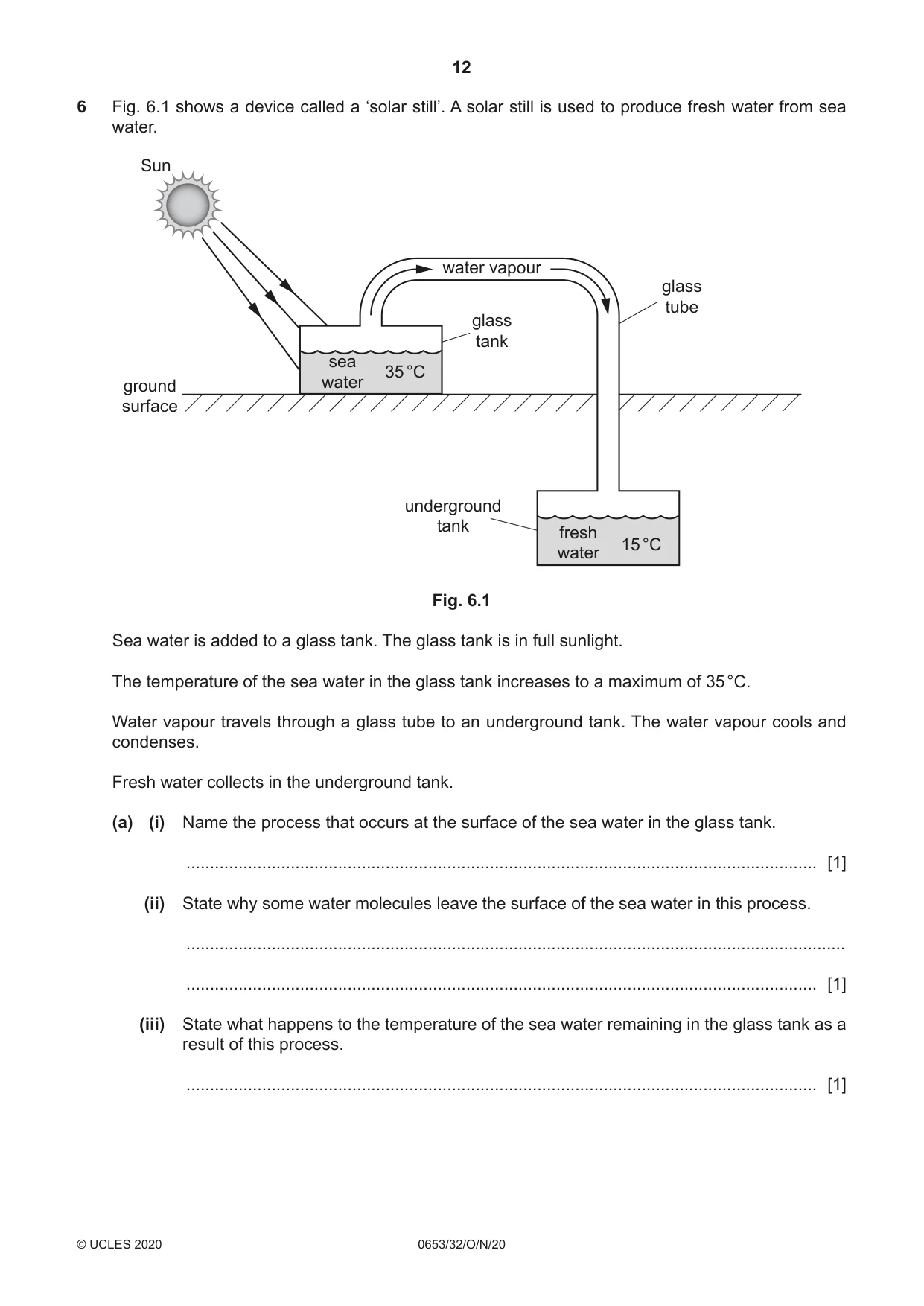
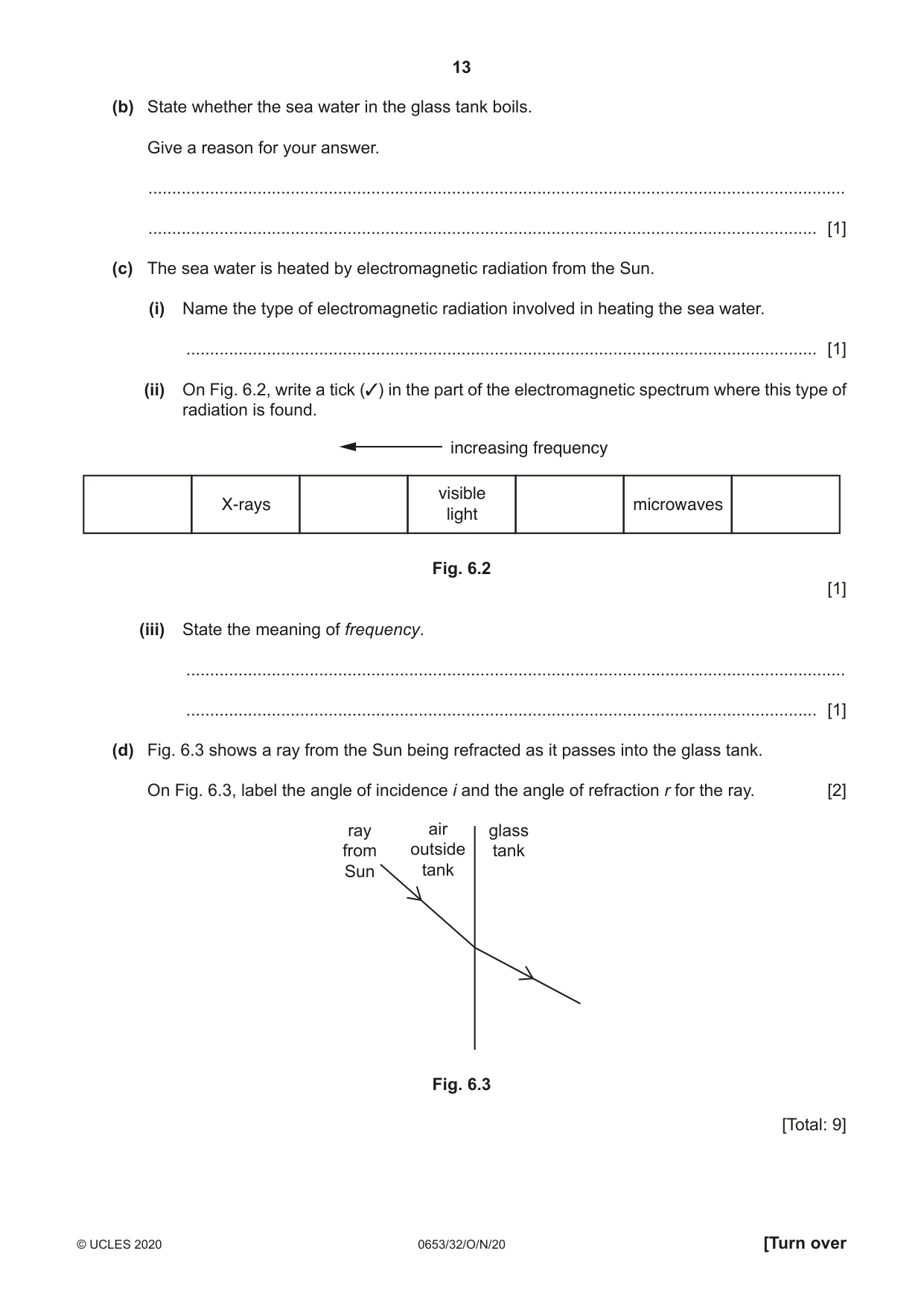
6 Fig. 6.1 shows a device called a ‘solar still’. A solar still is used to produce fresh water from sea water. Sun water vapour glass tube glass tank sea 35 °C ground water surface underground tank fresh 15 °C water Fig. 6.1 Sea water is added to a glass tank. The glass tank is in full sunlight. The temperature of the sea water in the glass tank increases to a maximum of 35 °C. Water vapour travels through a glass tube to an underground tank. The water vapour cools and condenses. Fresh water collects in the underground tank. (a) (i) Name the process that occurs at the surface of the sea water in the glass tank. ..................................................................................................................................... [1] (ii) State why some water molecules leave the surface of the sea water in this process. ........................................................................................................................................... ..................................................................................................................................... [1] (iii) State what happens to the temperature of the sea water remaining in the glass tank as a result of this process. ..................................................................................................................................... [1] (b) State whether the sea water in the glass tank boils. Give a reason for your answer. ................................................................................................................................................... ............................................................................................................................................. [1] (c) The sea water is heated by electromagnetic radiation from the Sun. (i) Name the type of electromagnetic radiation involved in heating the sea water. ..................................................................................................................................... [1] (ii) On Fig. 6.2, write a tick (3) in the part of the electromagnetic spectrum where this type of radiation is found. increasing frequency visible X-rays microwaves light Fig. 6.2 [1] (iii) State the meaning of frequency. ........................................................................................................................................... ..................................................................................................................................... [1] (d) Fig. 6.3 shows a ray from the Sun being refracted as it passes into the glass tank. On Fig. 6.3, label the angle of incidence i and the angle of refraction r for the ray. [2] ray air glass from outside tank Sun tank Fig. 6.3 [Total: 9]
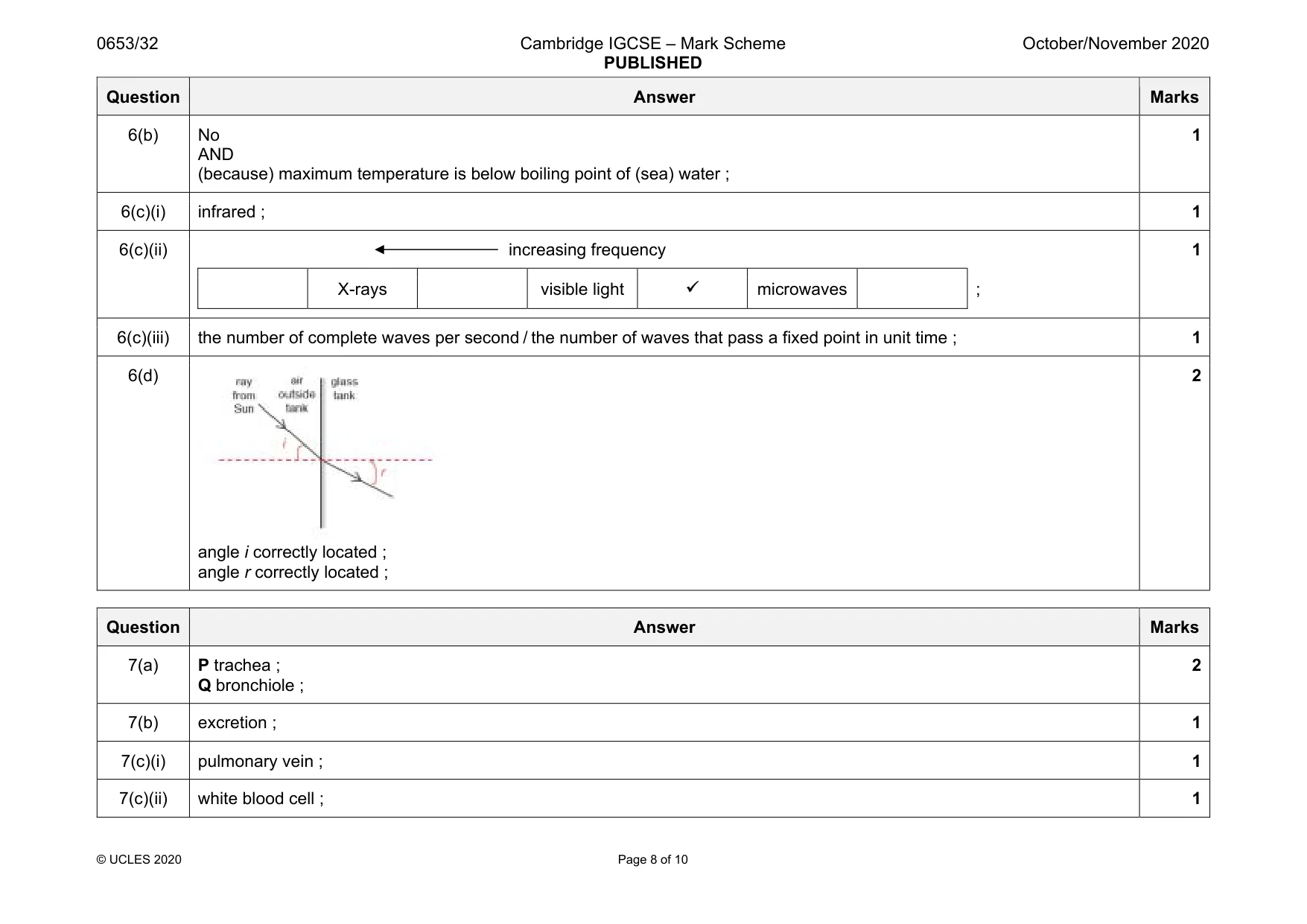
Mark scheme: 6(a)(i) evaporation ; 1 6(a)(ii) faster / more energetic molecules have enough energy to (break their bonds and) escape ; 1 6(a)(iii) (temperature) decreases / (sea water) cools down ; 1 Question Answer Marks 6(b) No AND (because) maximum temperature is below boiling point of (sea) water ; 1 6(c)(i) infrared ; 1 6(c)(ii) increasing frequency X-rays visible light microwaves ; 1 6(c)(iii) the number of complete waves per second / the number of waves that pass a fixed point in unit time ; 1 6(d) angle i correctly located ; angle r correctly located ; 2
Q7 · Parts of the human gas exchange system
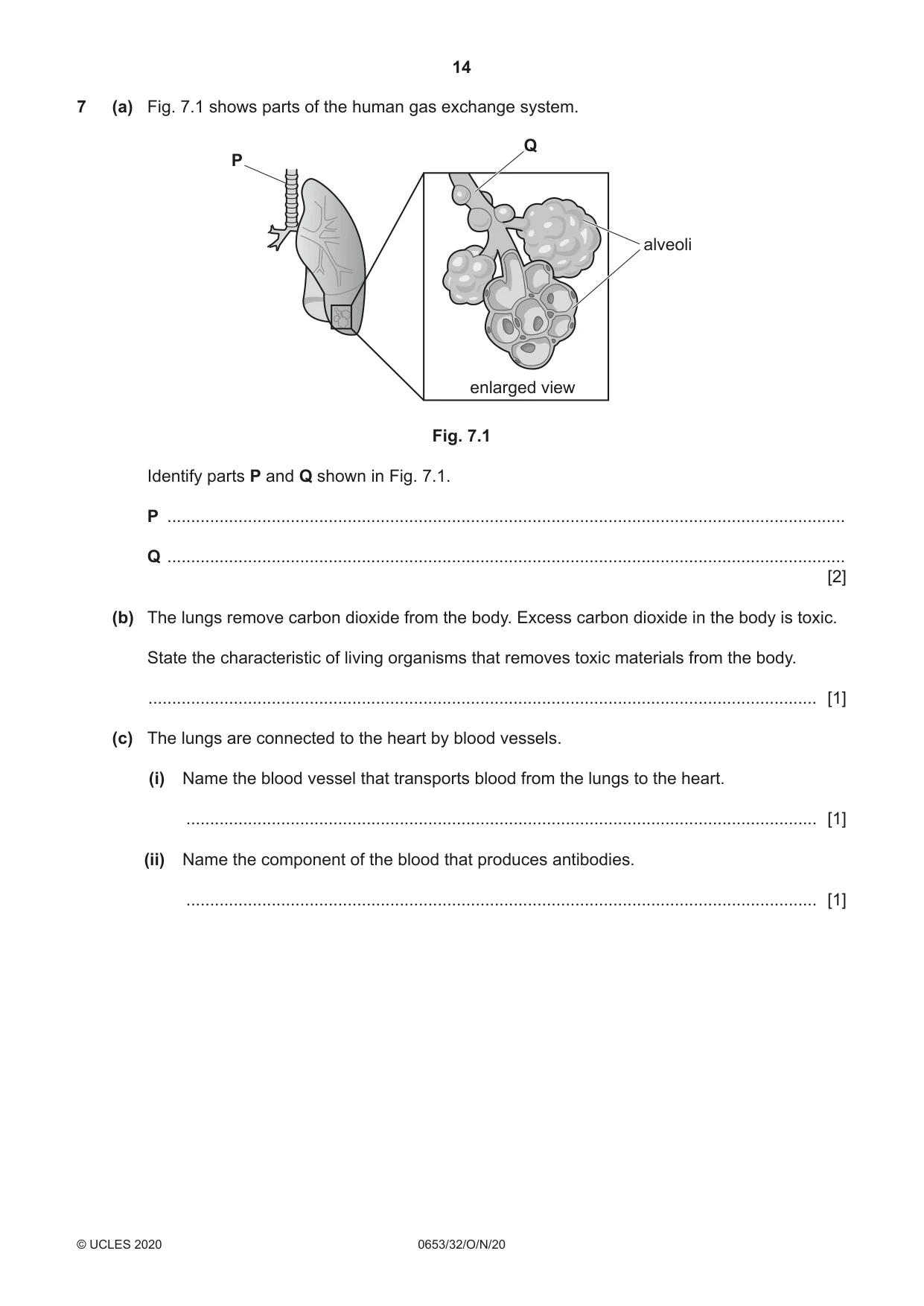
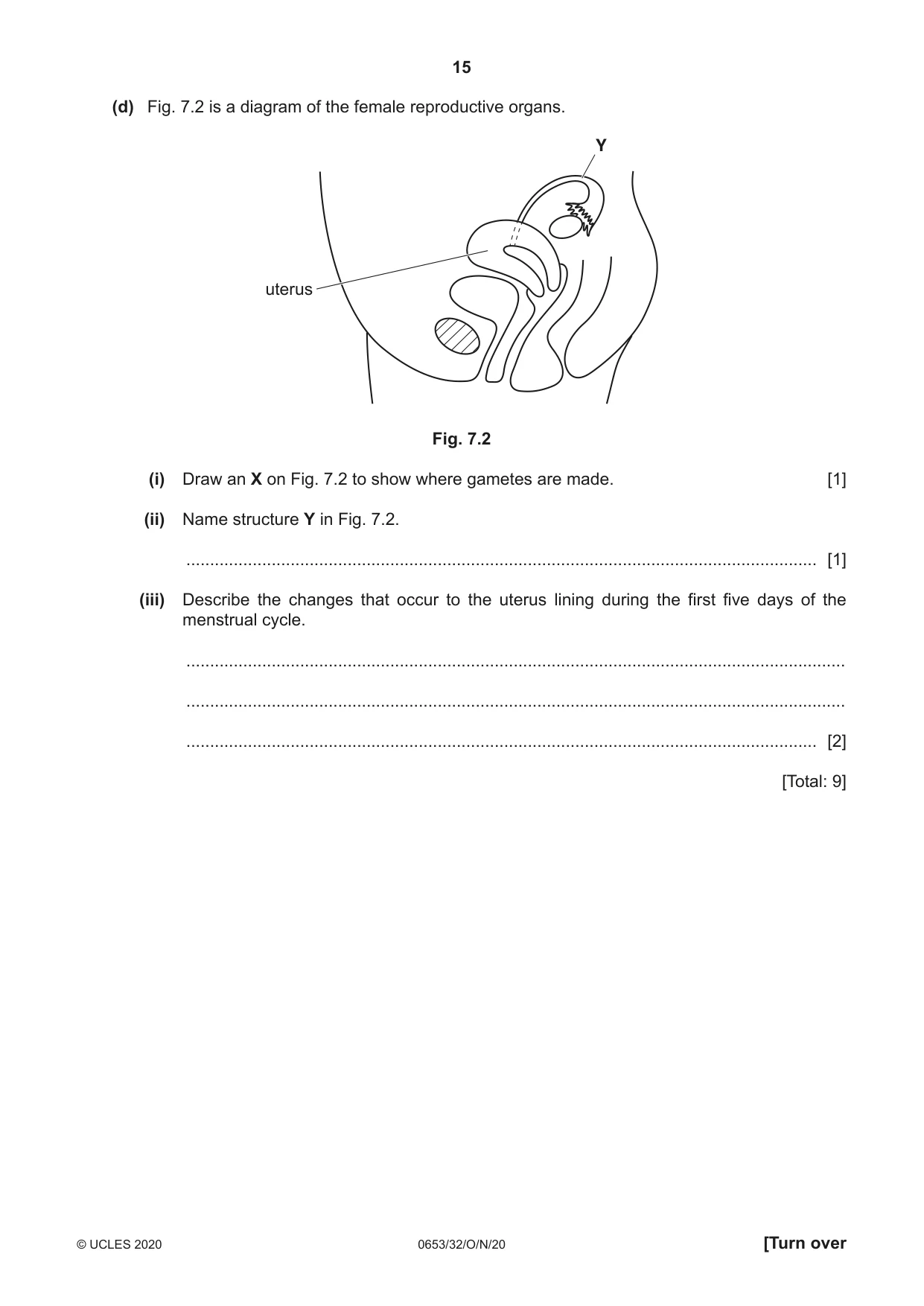
7 (a) Fig. 7.1 shows parts of the human gas exchange system. Q P alveoli enlarged view Fig. 7.1 Identify parts P and Q shown in Fig. 7.1. P ............................................................................................................................................... Q ............................................................................................................................................... [2] (b) The lungs remove carbon dioxide from the body. Excess carbon dioxide in the body is toxic. State the characteristic of living organisms that removes toxic materials from the body. ............................................................................................................................................. [1] (c) The lungs are connected to the heart by blood vessels. (i) Name the blood vessel that transports blood from the lungs to the heart. ..................................................................................................................................... [1] (ii) Name the component of the blood that produces antibodies. ..................................................................................................................................... [1] (d) Fig. 7.2 is a diagram of the female reproductive organs. Y uterus Fig. 7.2 (i) Draw an X on Fig. 7.2 to show where gametes are made. [1] (ii) Name structure Y in Fig. 7.2. ..................................................................................................................................... [1] (iii) Describe the changes that occur to the uterus lining during the first five days of the menstrual cycle. ........................................................................................................................................... ........................................................................................................................................... ..................................................................................................................................... [2] [Total: 9]
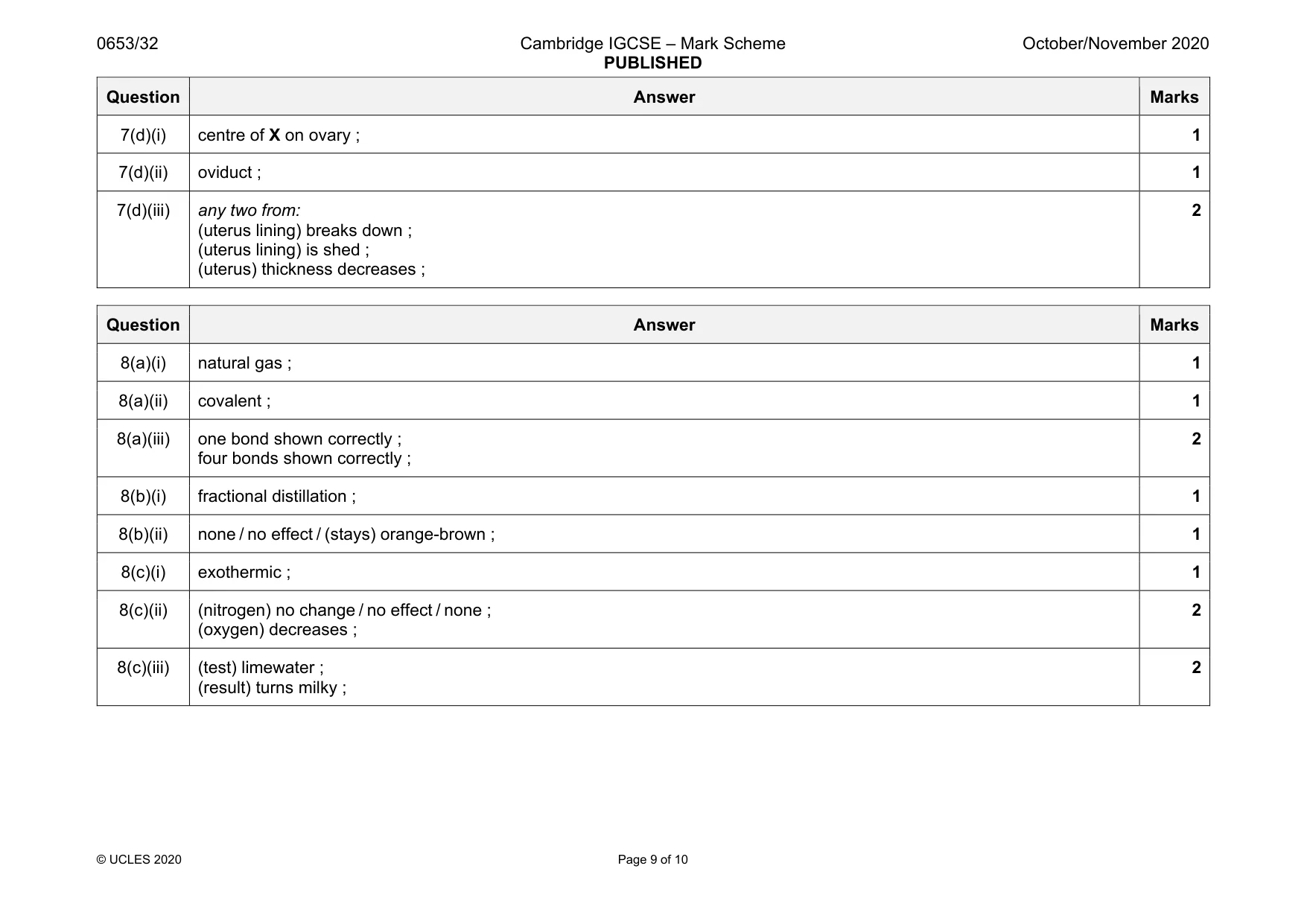
Mark scheme: 7(a) P trachea ; Q bronchiole ; 2 7(b) excretion ; 1 7(c)(i) pulmonary vein ; 1 7(c)(ii) white blood cell ; 1 Question Answer Marks 7(d)(i) centre of X on ovary ; 1 7(d)(ii) oviduct ; 1 7(d)(iii) any two from: (uterus lining) breaks down ; (uterus lining) is shed ; (uterus) thickness decreases ; 2
Q8 · Methane, CH4, is an alkane
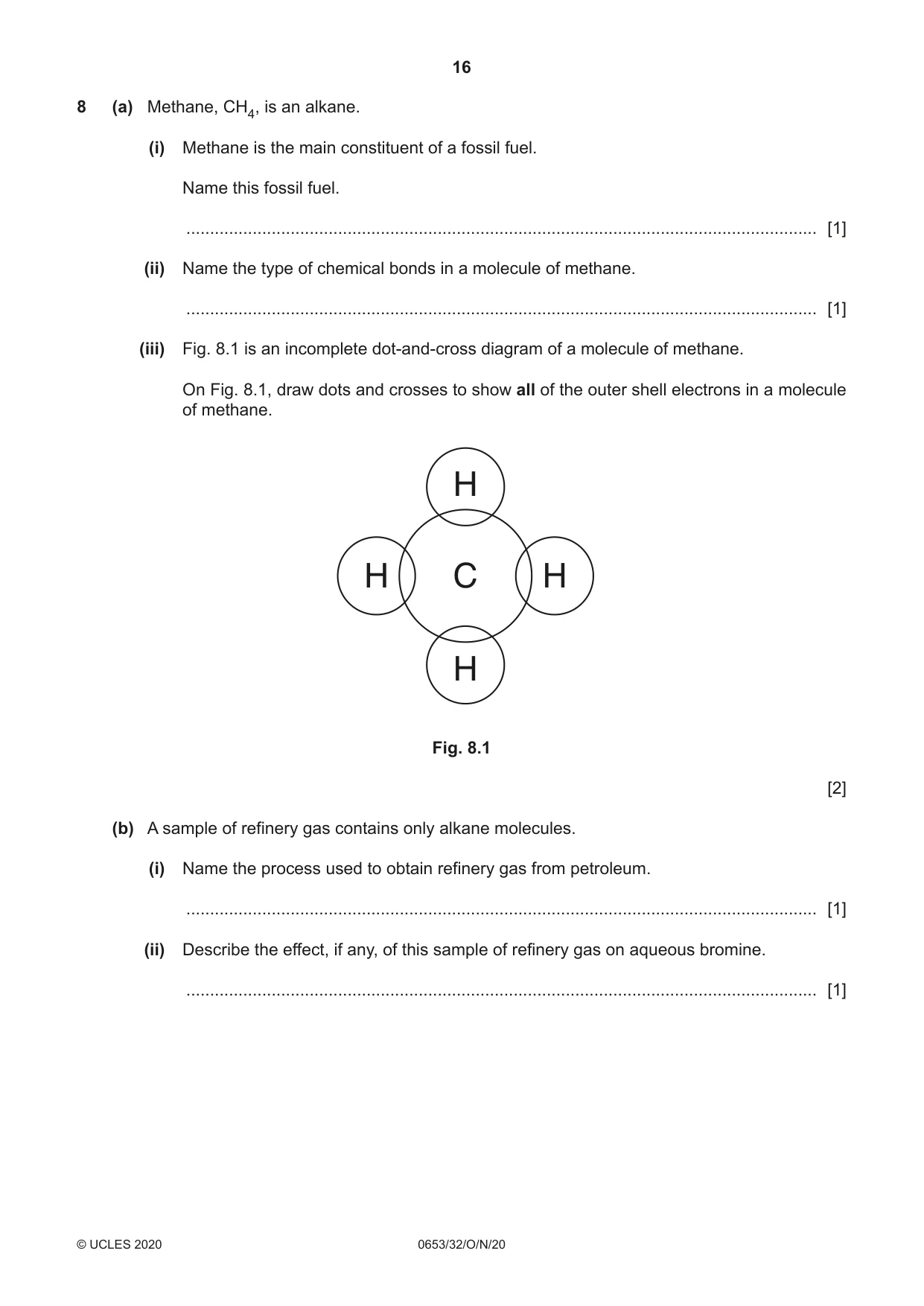
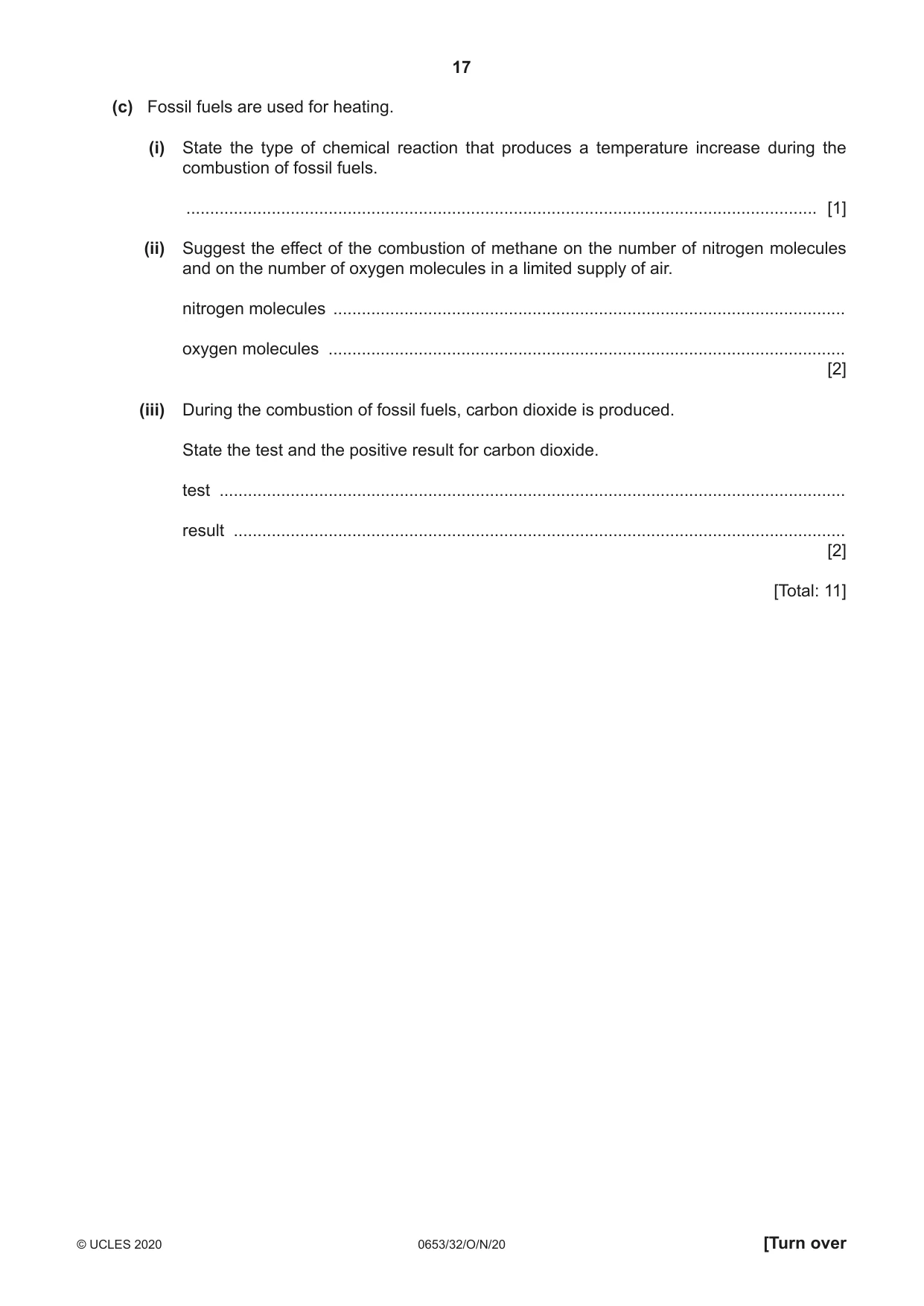
8 (a) Methane, CH4, is an alkane. (i) Methane is the main constituent of a fossil fuel. Name this fossil fuel. ..................................................................................................................................... [1] (ii) Name the type of chemical bonds in a molecule of methane. ..................................................................................................................................... [1] (iii) Fig. 8.1 is an incomplete dot-and-cross diagram of a molecule of methane. On Fig. 8.1, draw dots and crosses to show all of the outer shell electrons in a molecule of methane. H H C H H Fig. 8.1 [2] (b) A sample of refinery gas contains only alkane molecules. (i) Name the process used to obtain refinery gas from petroleum. ..................................................................................................................................... [1] (ii) Describe the effect, if any, of this sample of refinery gas on aqueous bromine. ..................................................................................................................................... [1] (c) Fossil fuels are used for heating. (i) State the type of chemical reaction that produces a temperature increase during the combustion of fossil fuels. ..................................................................................................................................... [1] (ii) Suggest the effect of the combustion of methane on the number of nitrogen molecules and on the number of oxygen molecules in a limited supply of air. nitrogen molecules ............................................................................................................ oxygen molecules ............................................................................................................. [2] (iii) During the combustion of fossil fuels, carbon dioxide is produced. State the test and the positive result for carbon dioxide. test .................................................................................................................................... result ................................................................................................................................. [2] [Total: 11]
Mark scheme: 8(a)(i) natural gas ; 1 8(a)(ii) covalent ; 1 8(a)(iii) one bond shown correctly ; four bonds shown correctly ; 2 8(b)(i) fractional distillation ; 1 8(b)(ii) none / no effect / (stays) orange-brown ; 1 8(c)(i) exothermic ; 1 8(c)(ii) (nitrogen) no change / no effect / none ; (oxygen) decreases ; 2 8(c)(iii) (test) limewater ; (result) turns milky ; 2
Q9 · The front door of a house has an electric bell and a lamp
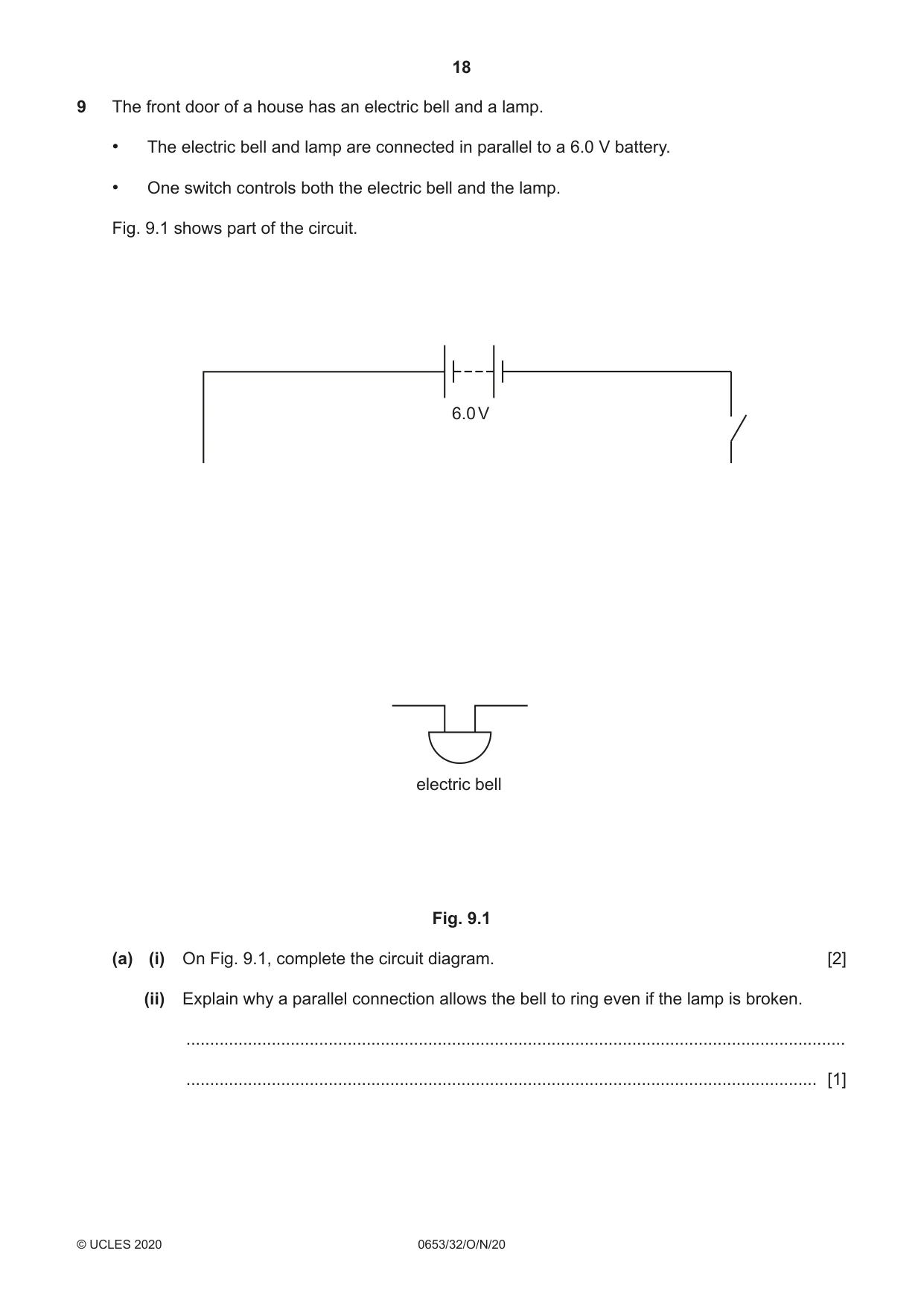
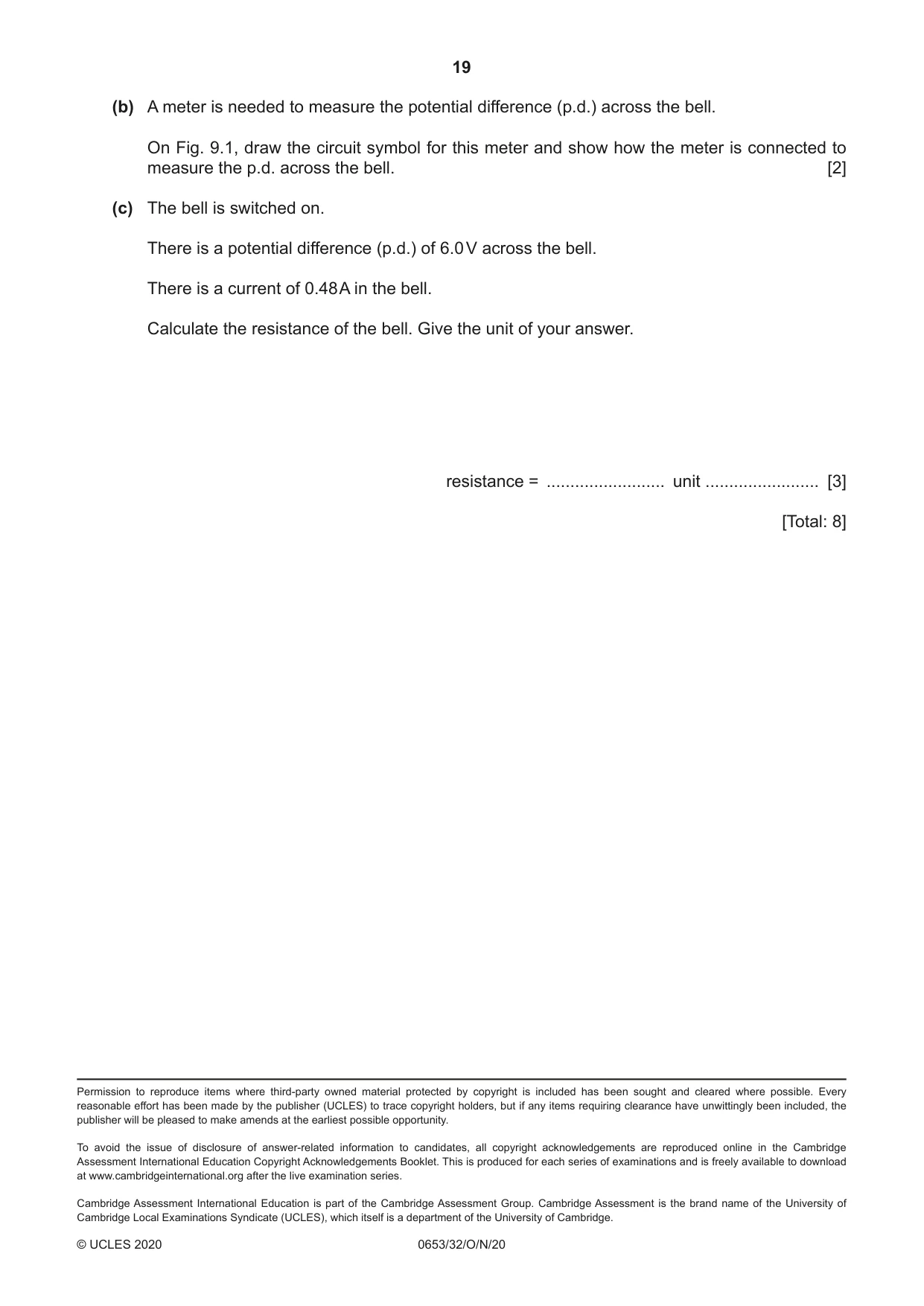
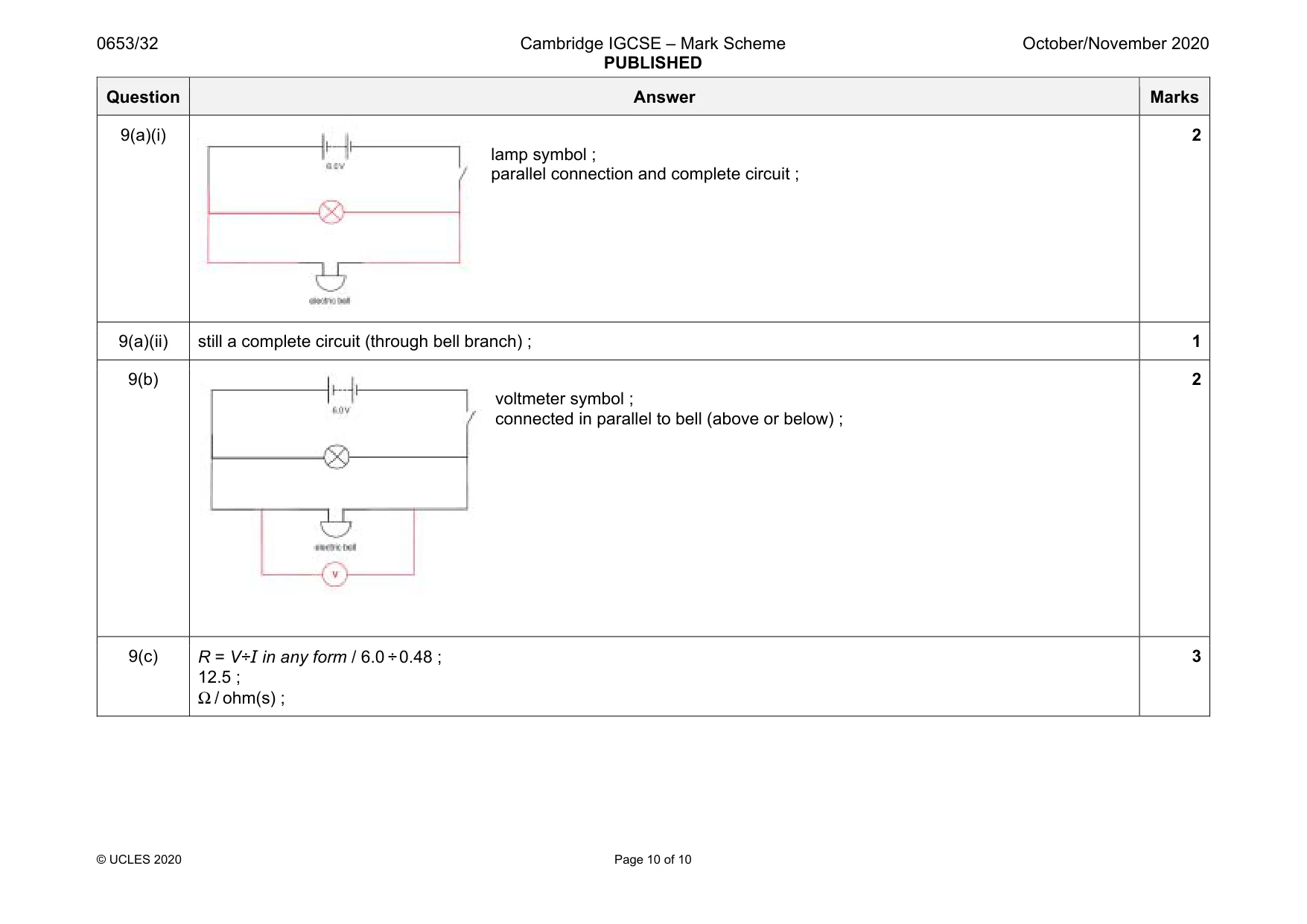
9 The front door of a house has an electric bell and a lamp. • The electric bell and lamp are connected in parallel to a 6.0 V battery. • One switch controls both the electric bell and the lamp. Fig. 9.1 shows part of the circuit. 6.0 V electric bell Fig. 9.1 (a) (i) On Fig. 9.1, complete the circuit diagram. [2] (ii) Explain why a parallel connection allows the bell to ring even if the lamp is broken. ........................................................................................................................................... ..................................................................................................................................... [1] (b) A meter is needed to measure the potential difference (p.d.) across the bell. On Fig. 9.1, draw the circuit symbol for this meter and show how the meter is connected to measure the p.d. across the bell. [2] (c) The bell is switched on. There is a potential difference (p.d.) of 6.0 V across the bell. There is a current of 0.48 A in the bell. Calculate the resistance of the bell. Give the unit of your answer. resistance = ......................... unit ........................ [3] [Total: 8]
Mark scheme: 9(a)(i) lamp symbol ; parallel connection and complete circuit ; 2 9(a)(ii) still a complete circuit (through bell branch) ; 1 9(b) voltmeter symbol ; connected in parallel to bell (above or below) ; 2 9(c) R = V÷I in any form / 6.0 ÷ 0.48 ; 12.5 ; Ω / ohm(s) ; 3
What was in this paper
The subtopics covered by these 9 questions, and how many questions each got. Open one in a new tab to see every Cambridge question on it.
What you needed in this session
Cambridge’s own grade thresholds for 2020 Oct/Nov, Paper 3 · Variant 2. A higher threshold means an easier paper — the bar moves with how the cohort did.