Cambridge IGCSE Science - Combined 0653 — 2023 Oct/Nov Paper 3 · Variant 1
0653/31/O/N/23 · 9 questions · 80 marks · ≈90 min
The question paper and its mark scheme, free to read here and free to download. This is Cambridge’s own paper, exactly as it was sat.
Question paper20 pages
Mark scheme11 pages
Answers below. Sit the paper first if you are practising.
Questions as text
Q1 · The female reproductive system in humans
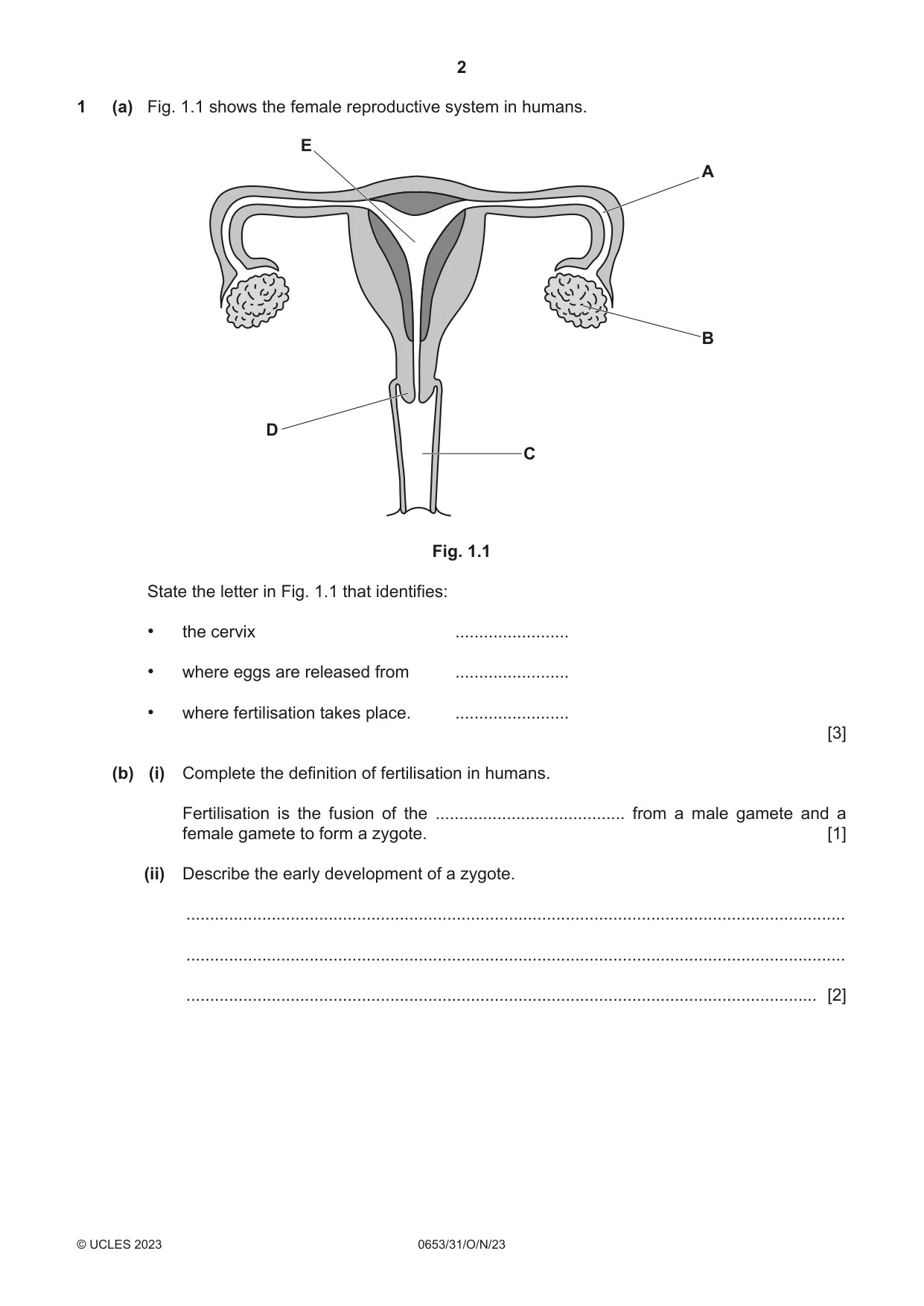
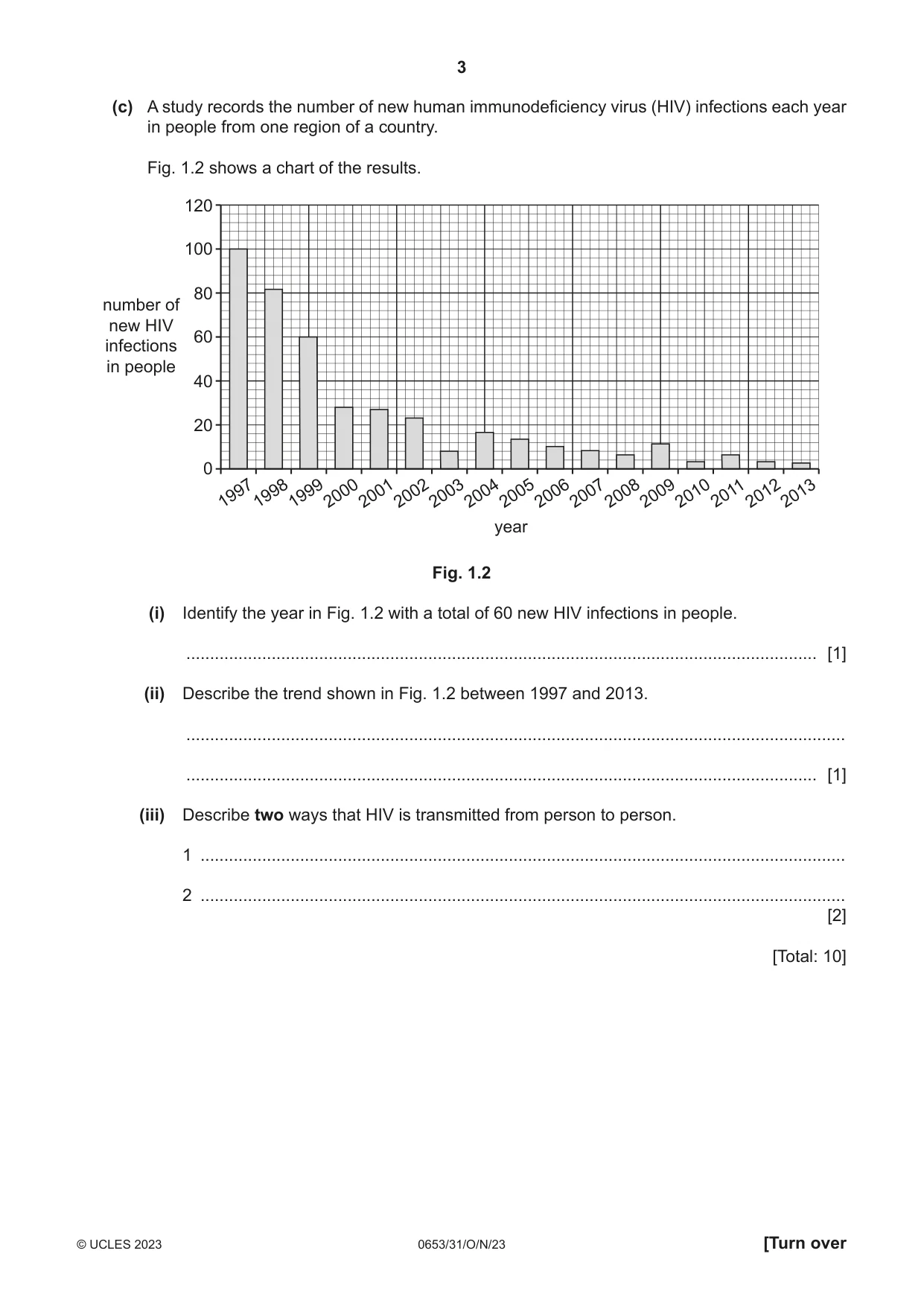
1 (a) Fig. 1.1 shows the female reproductive system in humans. E A B D C Fig. 1.1 State the letter in Fig. 1.1 that identifies: • the cervix ........................ • where eggs are released from ........................ • where fertilisation takes place. ........................ [3] (b) (i) Complete the definition of fertilisation in humans. Fertilisation is the fusion of the ........................................ from a male gamete and a female gamete to form a zygote. [1] (ii) Describe the early development of a zygote. ........................................................................................................................................... ........................................................................................................................................... ..................................................................................................................................... [2] (c) A study records the number of new human immunodeficiency virus (HIV) infections each year in people from one region of a country. Fig. 1.2 shows a chart of the results. 120 100 80number of new HIV 60infections in people 40 20 0 19971998199920002001200220032004200520062007200820092010201120122013 year Fig. 1.2 (i) Identify the year in Fig. 1.2 with a total of 60 new HIV infections in people. ..................................................................................................................................... [1] (ii) Describe the trend shown in Fig. 1.2 between 1997 and 2013. ........................................................................................................................................... ..................................................................................................................................... [1] (iii) Describe two ways that HIV is transmitted from person to person. 1 ........................................................................................................................................ 2 ........................................................................................................................................ [2] [Total: 10]
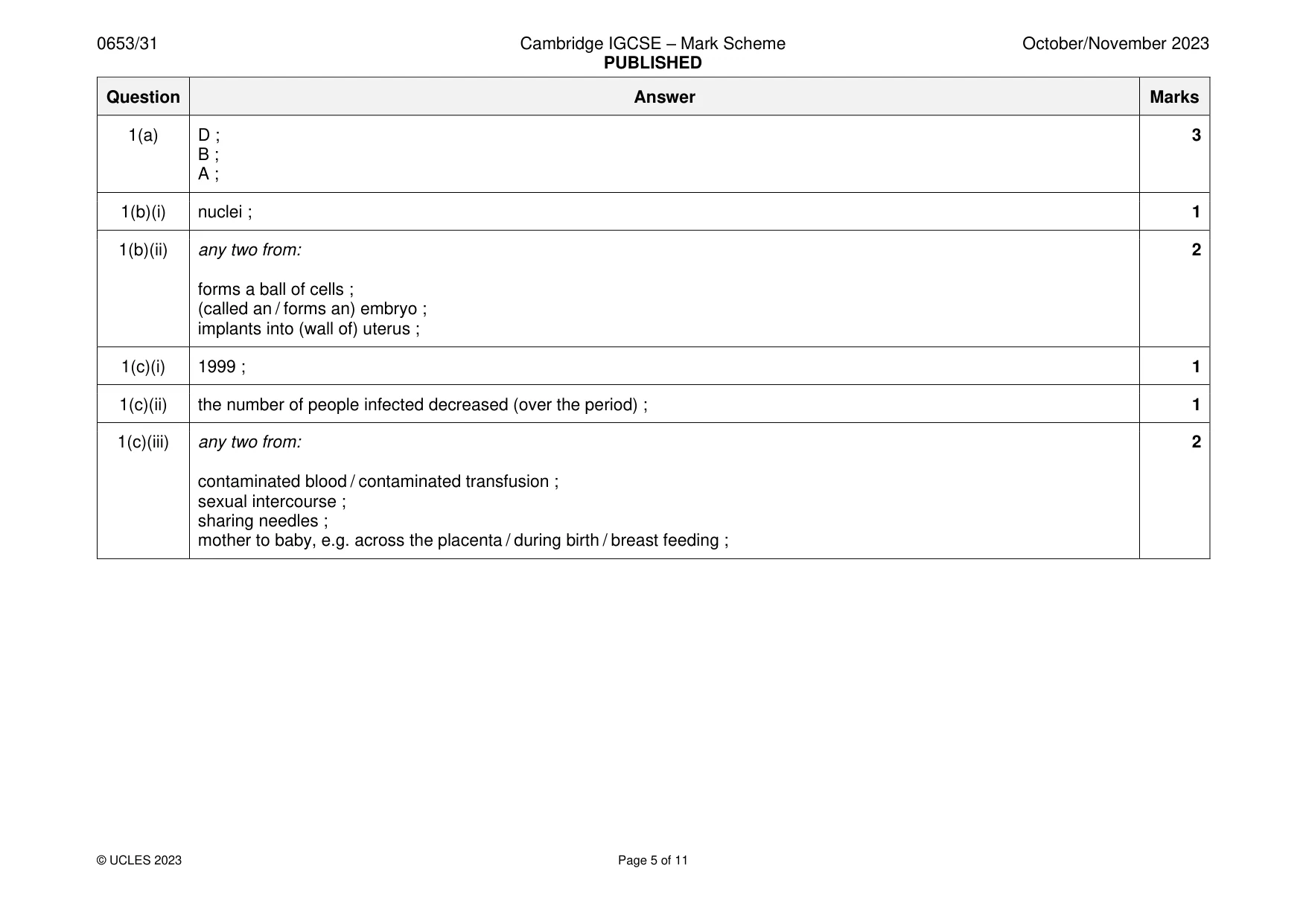
Mark scheme: Question Answer Marks 1(a) D ; 3 B ; A ; 1(b)(i) nuclei ; 1 1(b)(ii) any two from: 2 forms a ball of cells ; (called an / forms an) embryo ; implants into (wall of) uterus ; 1(c)(i) 1999 ; 1 1(c)(ii) the number of people infected decreased (over the period) ; 1 1(c)(iii) any two from: 2 contaminated blood / contaminated transfusion ; sexual intercourse ; sharing needles ; mother to baby, e.g. across the placenta / during birth / breast feeding ;
Q2 · A student dissolves sodium carbonate, Na2CO3, in water to form aqueous sodium carbonate
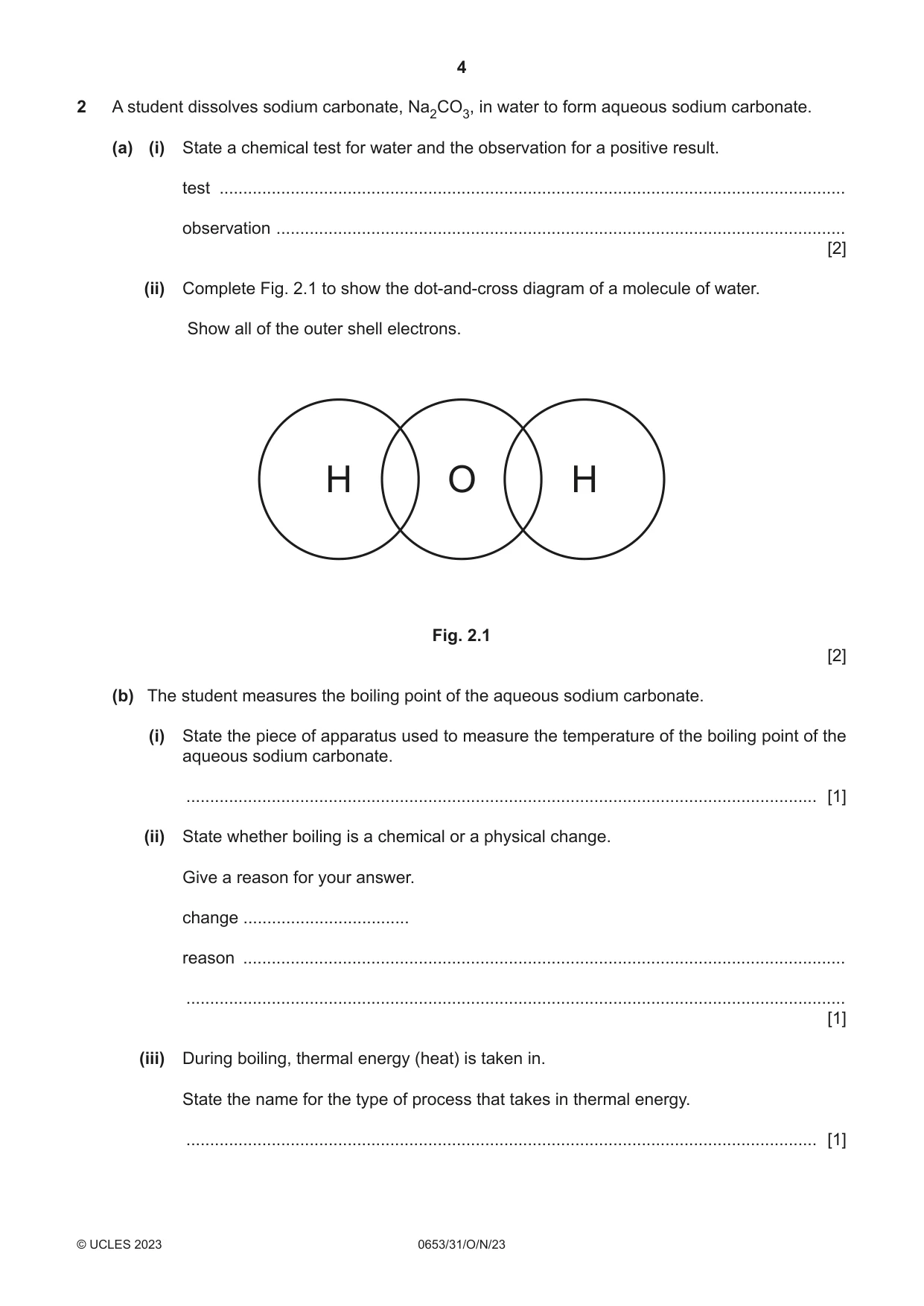
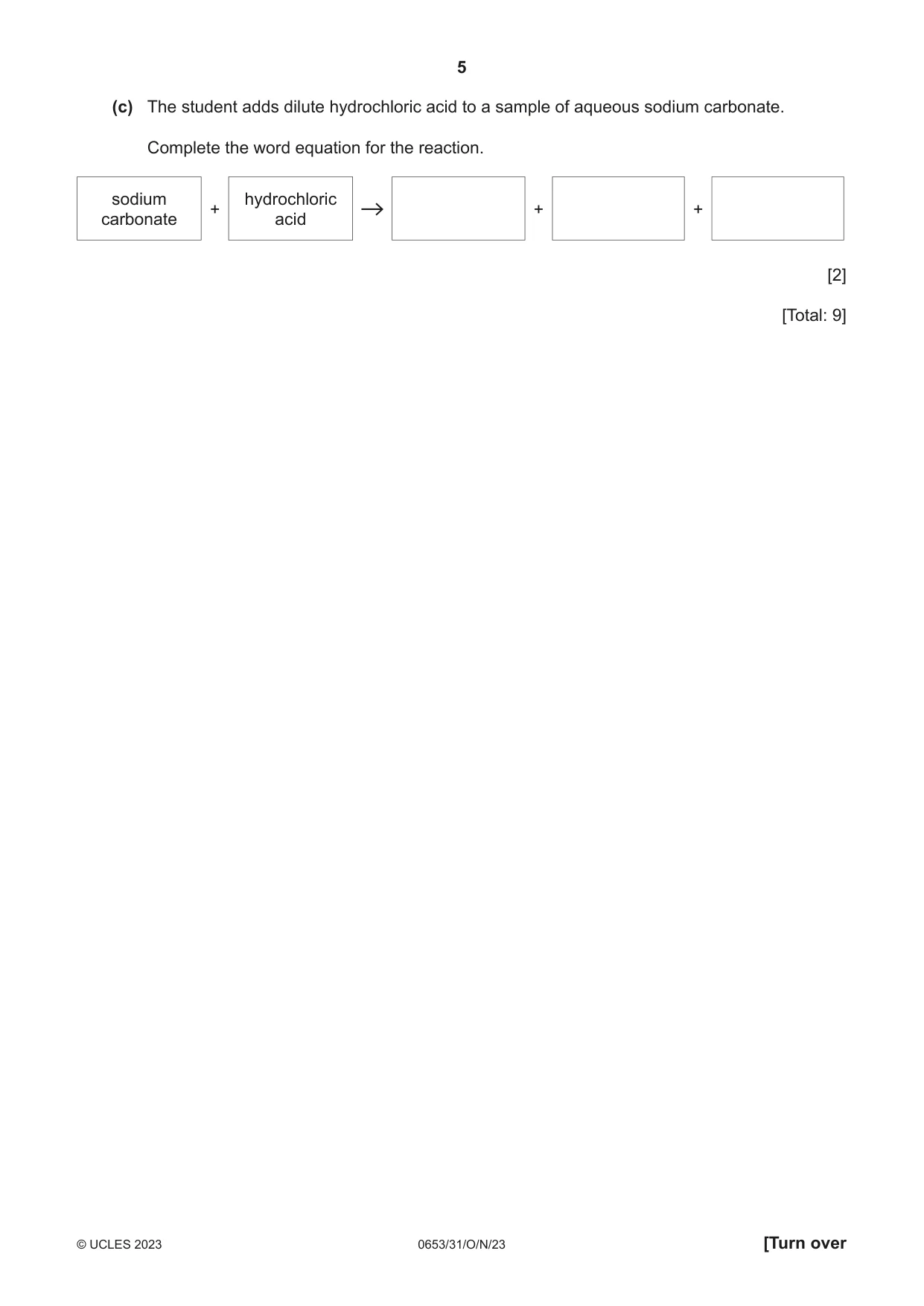
2 A student dissolves sodium carbonate, Na2CO3, in water to form aqueous sodium carbonate. (a) (i) State a chemical test for water and the observation for a positive result. test .................................................................................................................................... observation ........................................................................................................................ [2] (ii) Complete Fig. 2.1 to show the dot-and-cross diagram of a molecule of water. Show all of the outer shell electrons. H O H Fig. 2.1 [2] (b) The student measures the boiling point of the aqueous sodium carbonate. (i) State the piece of apparatus used to measure the temperature of the boiling point of the aqueous sodium carbonate. ..................................................................................................................................... [1] (ii) State whether boiling is a chemical or a physical change. Give a reason for your answer. change ................................... reason ............................................................................................................................... ........................................................................................................................................... [1] (iii) During boiling, thermal energy (heat) is taken in. State the name for the type of process that takes in thermal energy. ..................................................................................................................................... [1] (c) The student adds dilute hydrochloric acid to a sample of aqueous sodium carbonate. Complete the word equation for the reaction. sodium hydrochloric + + +carbonate acid [2] [Total: 9]
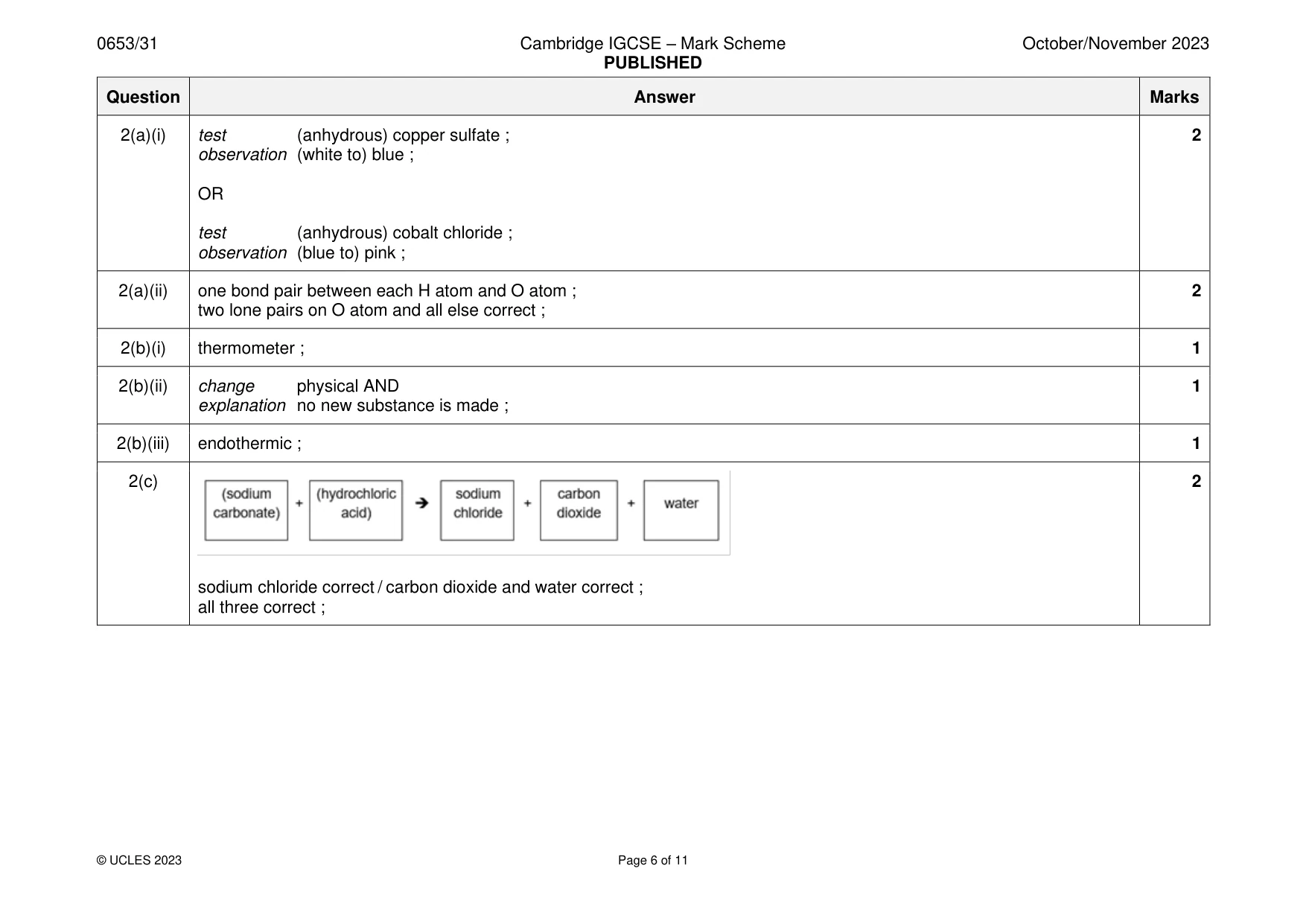
Mark scheme: 2(a)(i) test (anhydrous) copper sulfate ; 2 observation (white to) blue ; OR test (anhydrous) cobalt chloride ; observation (blue to) pink ; 2(a)(ii) one bond pair between each H atom and O atom ; 2 two lone pairs on O atom and all else correct ; 2(b)(i) thermometer ; 1 2(b)(ii) change physical AND 1 explanation no new substance is made ; 2(b)(iii) endothermic ; 1 2(c) 2 sodium chloride correct / carbon dioxide and water correct ; all three correct ;
Q3 · The forces acting on an aircraft in flight
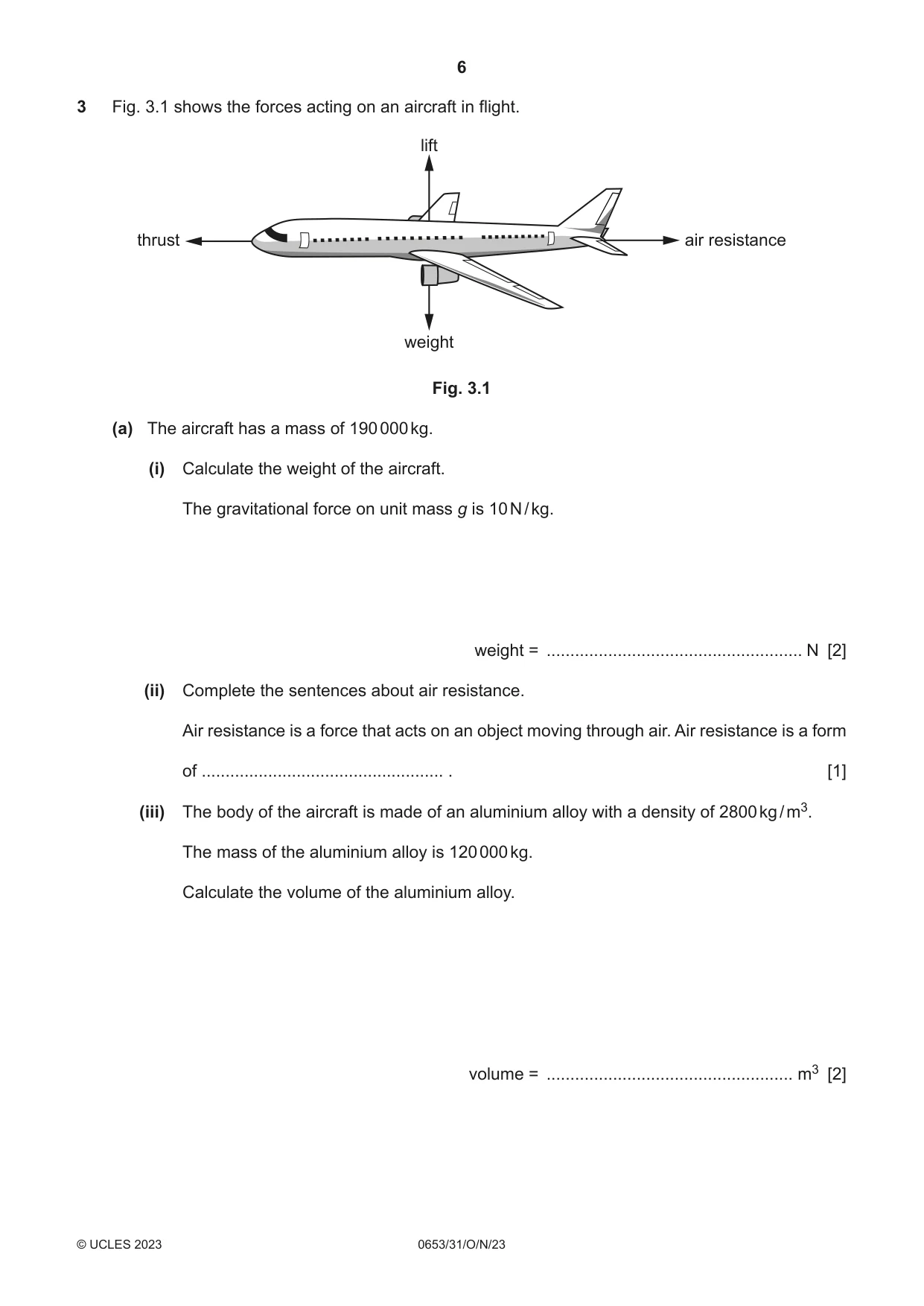
3 Fig. 3.1 shows the forces acting on an aircraft in flight. lift thrust air resistance weight Fig. 3.1 (a) The aircraft has a mass of 190 000 kg. (i) Calculate the weight of the aircraft. The gravitational force on unit mass g is 10 N / kg. weight = ...................................................... N [2] (ii) Complete the sentences about air resistance. Air resistance is a force that acts on an object moving through air. Air resistance is a form of ................................................... . [1] (iii) The body of the aircraft is made of an aluminium alloy with a density of 2800 kg / m3. The mass of the aluminium alloy is 120 000 kg. Calculate the volume of the aluminium alloy. volume = .................................................... m3 [2] (b) Complete the sentences about energy transfers. The aircraft uses fuel for combustion. When the aircraft climbs higher at a constant speed, energy is transferred from ......................................................... energy to ......................................................... energy. [2] (c) The aircraft travels a distance of 1950 km in a time of 4 h 15 min. Calculate the average speed for this journey in km / h. speed = ............................................... km / h [3] [Total: 10]
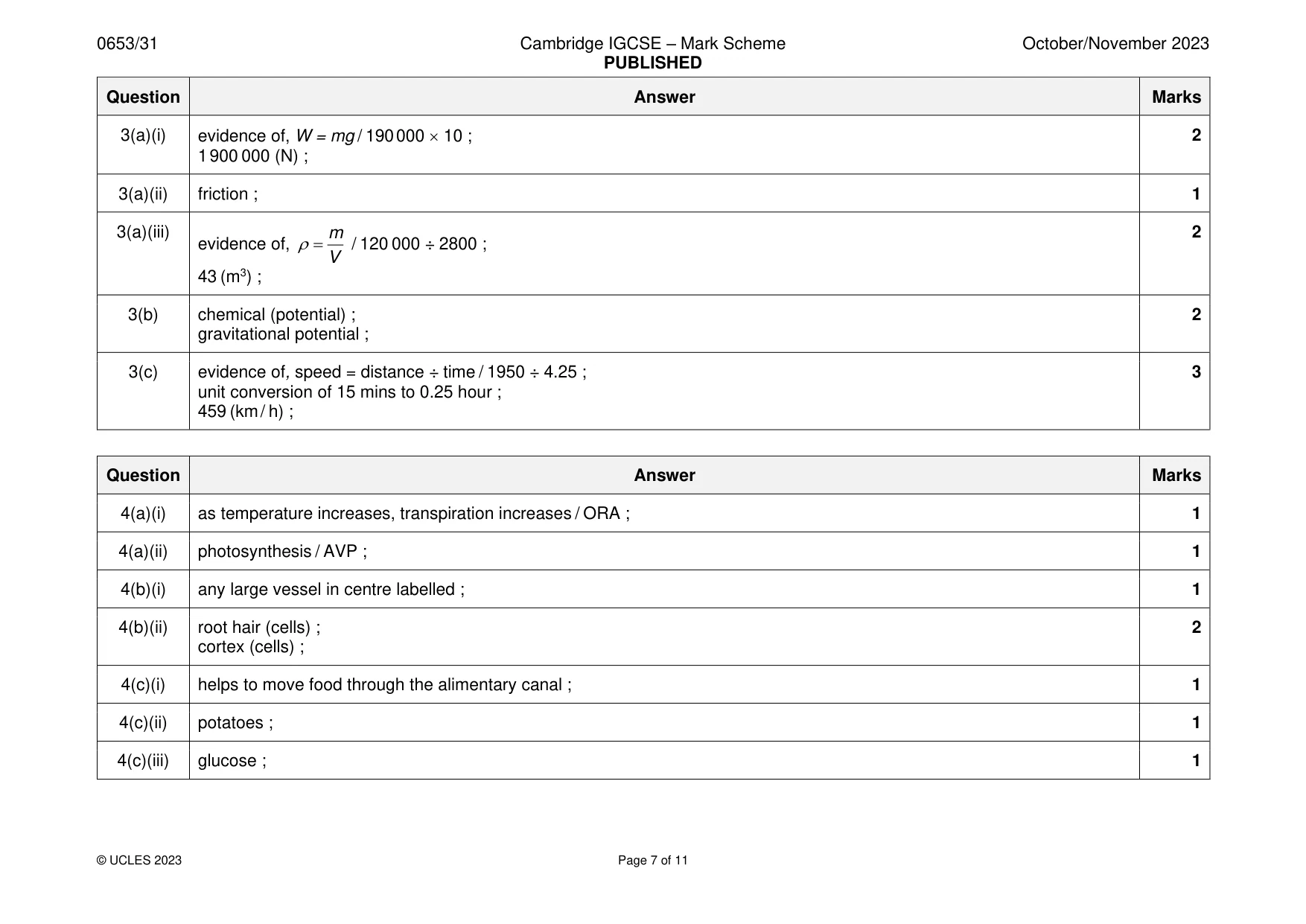
Mark scheme: 3(a)(i) evidence of, W = mg / 190 000 10 ; 2 1 900 000 (N) ; 3(a)(ii) friction ; 1 3(a)(iii) m 2 evidence of, = / 120 000 ÷ 2800 ; V 43 (m3) ; 3(b) chemical (potential) ; 2 gravitational potential ; 3(c) evidence of, speed = distance ÷ time / 1950 ÷ 4.25 ; 3 unit conversion of 15 mins to 0.25 hour ; 459 (km / h) ;
Q4 · Transpiration is loss of water vapour from plant leaves
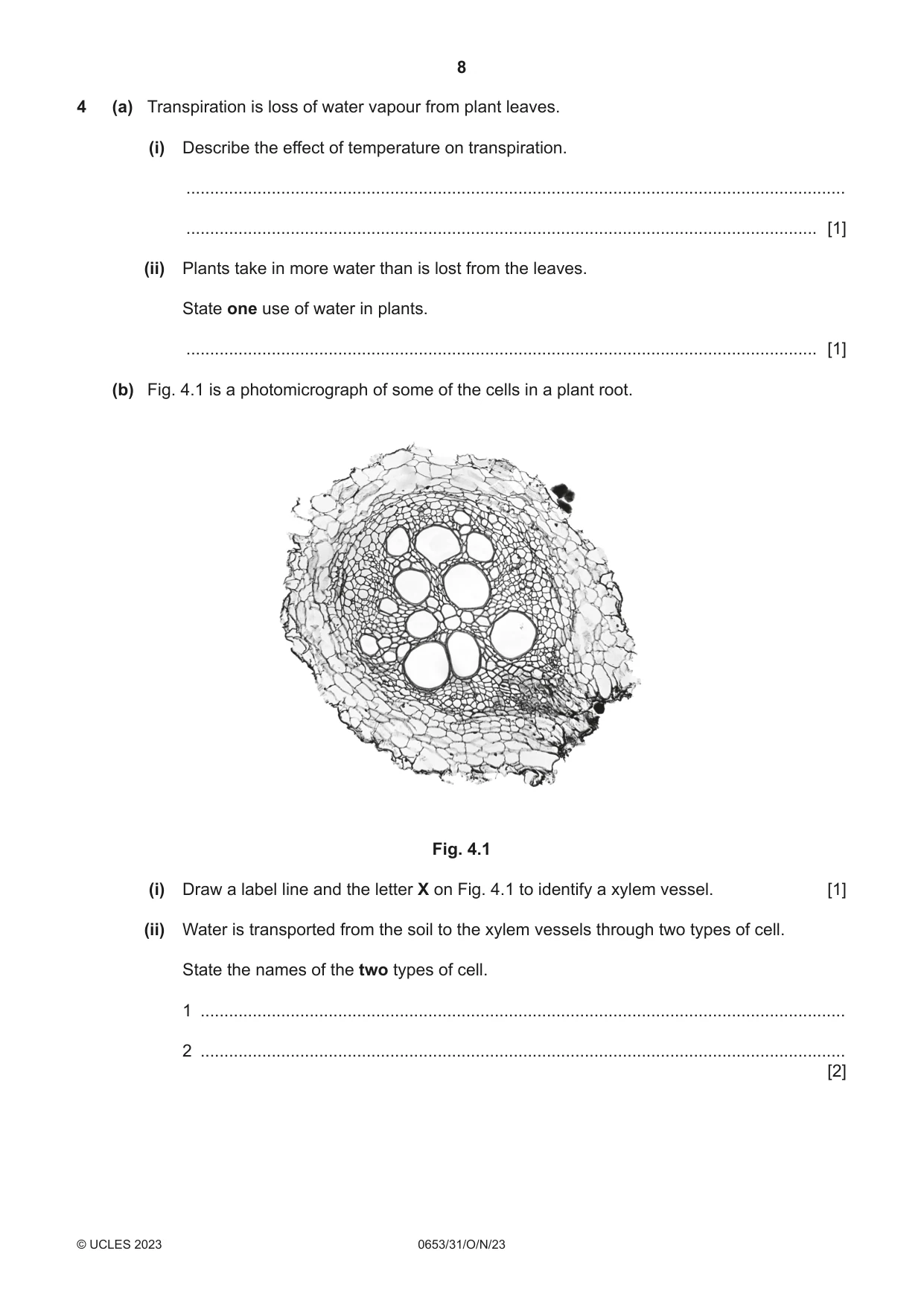
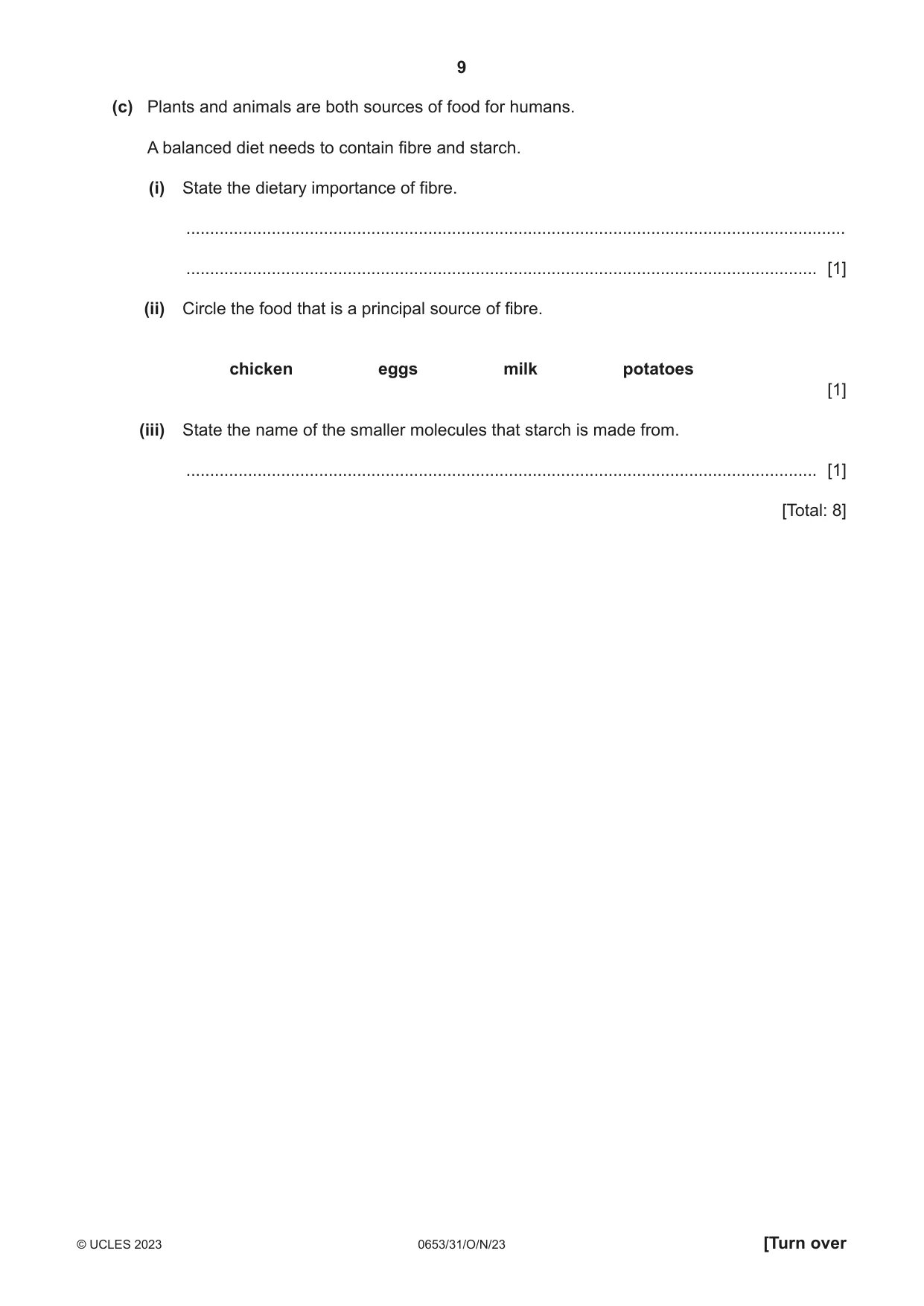
4 (a) Transpiration is loss of water vapour from plant leaves. (i) Describe the effect of temperature on transpiration. ........................................................................................................................................... ..................................................................................................................................... [1] (ii) Plants take in more water than is lost from the leaves. State one use of water in plants. ..................................................................................................................................... [1] (b) Fig. 4.1 is a photomicrograph of some of the cells in a plant root. Fig. 4.1 (i) Draw a label line and the letter X on Fig. 4.1 to identify a xylem vessel. [1] (ii) Water is transported from the soil to the xylem vessels through two types of cell. State the names of the two types of cell. 1 ........................................................................................................................................ 2 ........................................................................................................................................ [2] (c) Plants and animals are both sources of food for humans. A balanced diet needs to contain fibre and starch. (i) State the dietary importance of fibre. ........................................................................................................................................... ..................................................................................................................................... [1] (ii) Circle the food that is a principal source of fibre. chicken eggs milk potatoes [1] (iii) State the name of the smaller molecules that starch is made from. ..................................................................................................................................... [1] [Total: 8]
Mark scheme: 4(a)(i) as temperature increases, transpiration increases / ORA ; 1 4(a)(ii) photosynthesis / AVP ; 1 4(b)(i) any large vessel in centre labelled ; 1 4(b)(ii) root hair (cells) ; 2 cortex (cells) ; 4(c)(i) helps to move food through the alimentary canal ; 1 4(c)(ii) potatoes ; 1 4(c)(iii) glucose ; 1
Q5 · Copper is a transition element
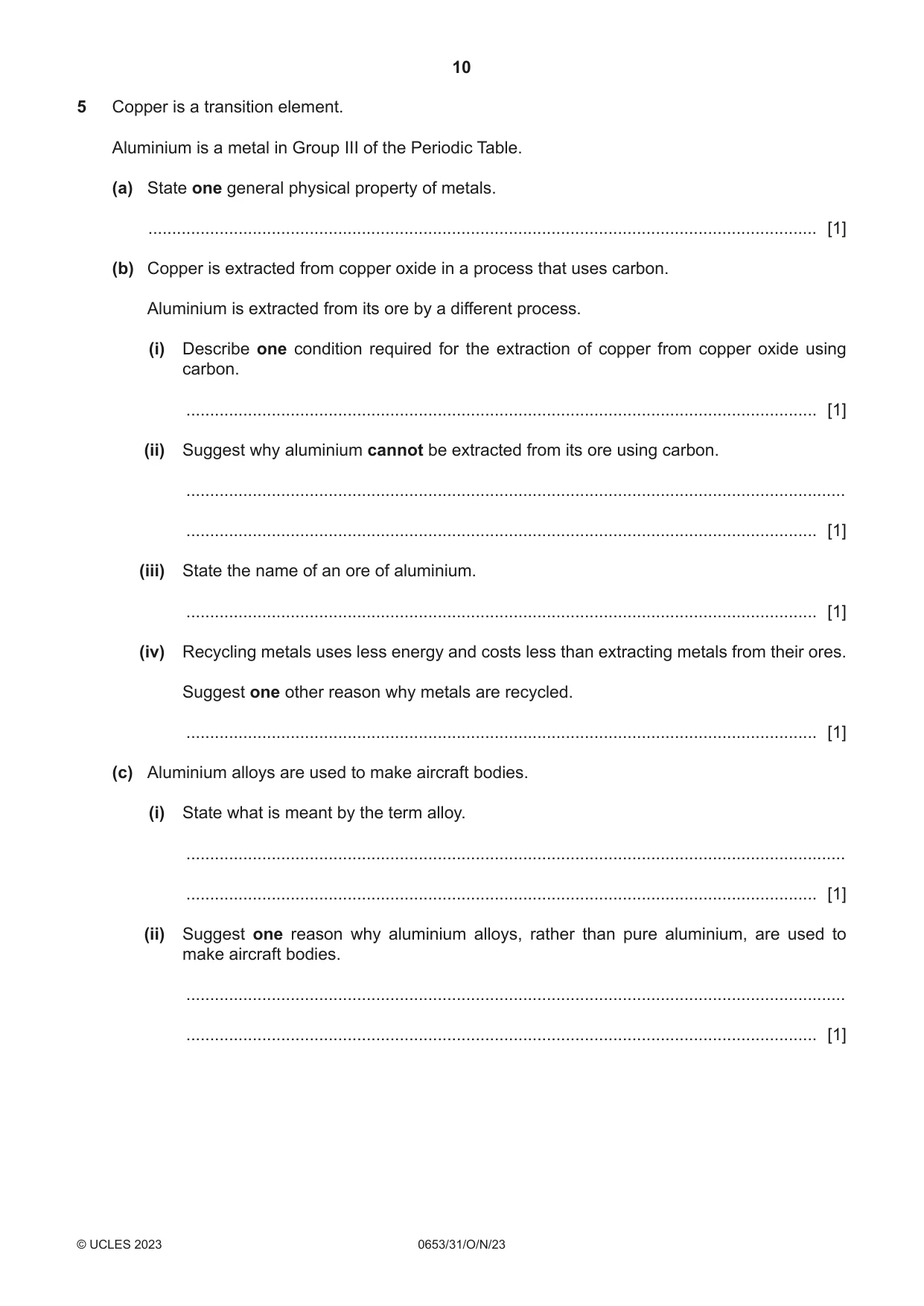
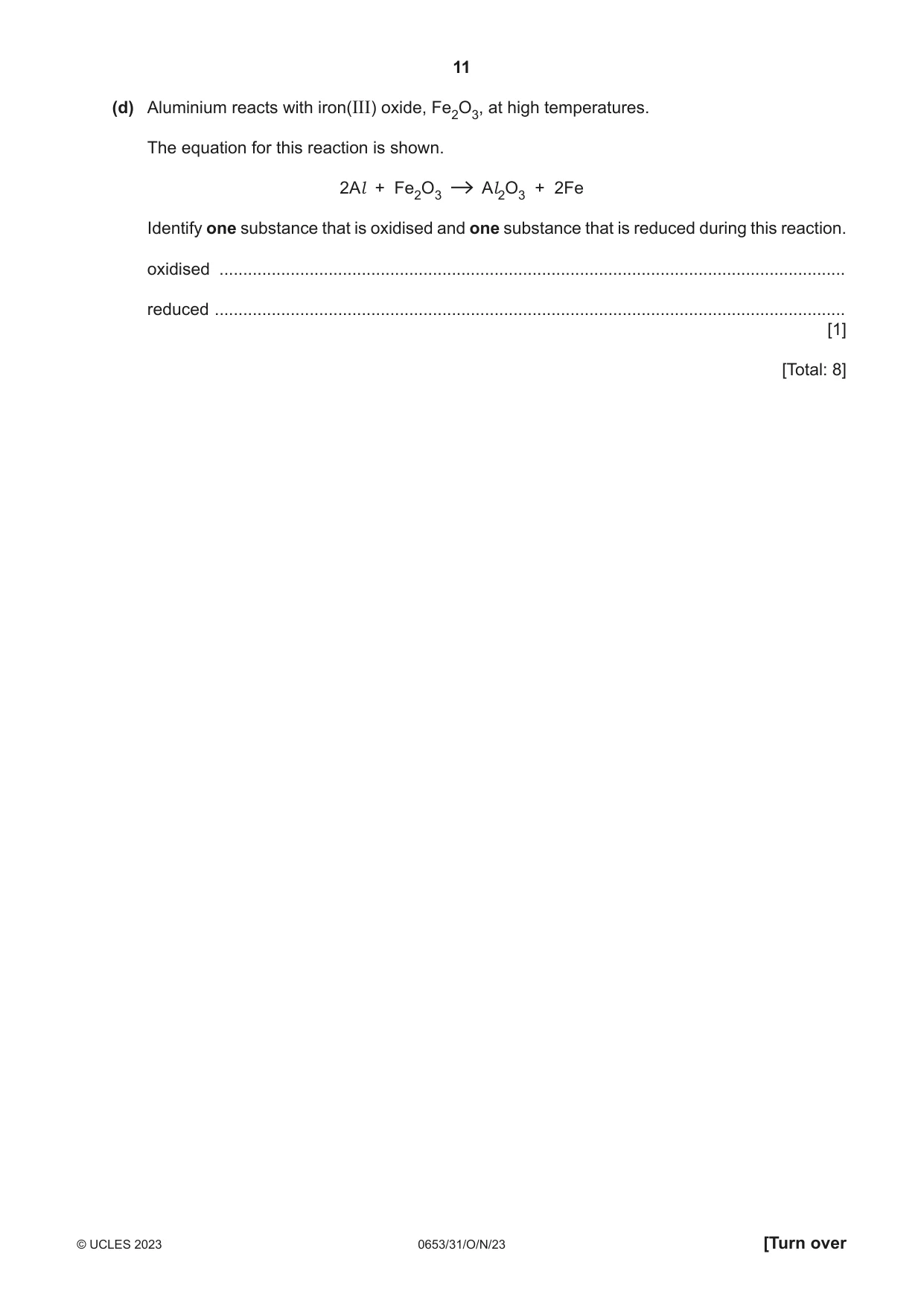
5 Copper is a transition element. Aluminium is a metal in Group III of the Periodic Table. (a) State one general physical property of metals. ............................................................................................................................................. [1] (b) Copper is extracted from copper oxide in a process that uses carbon. Aluminium is extracted from its ore by a different process. (i) Describe one condition required for the extraction of copper from copper oxide using carbon. ..................................................................................................................................... [1] (ii) Suggest why aluminium cannot be extracted from its ore using carbon. ........................................................................................................................................... ..................................................................................................................................... [1] (iii) State the name of an ore of aluminium. ..................................................................................................................................... [1] (iv) Recycling metals uses less energy and costs less than extracting metals from their ores. Suggest one other reason why metals are recycled. ..................................................................................................................................... [1] (c) Aluminium alloys are used to make aircraft bodies. (i) State what is meant by the term alloy. ........................................................................................................................................... ..................................................................................................................................... [1] (ii) Suggest one reason why aluminium alloys, rather than pure aluminium, are used to make aircraft bodies. ........................................................................................................................................... ..................................................................................................................................... [1] (d) Aluminium reacts with iron(III) oxide, Fe2O3, at high temperatures. The equation for this reaction is shown. 2Al + Fe2O3 Al2O3 + 2Fe Identify one substance that is oxidised and one substance that is reduced during this reaction. oxidised .................................................................................................................................... reduced ..................................................................................................................................... [1] [Total: 8]
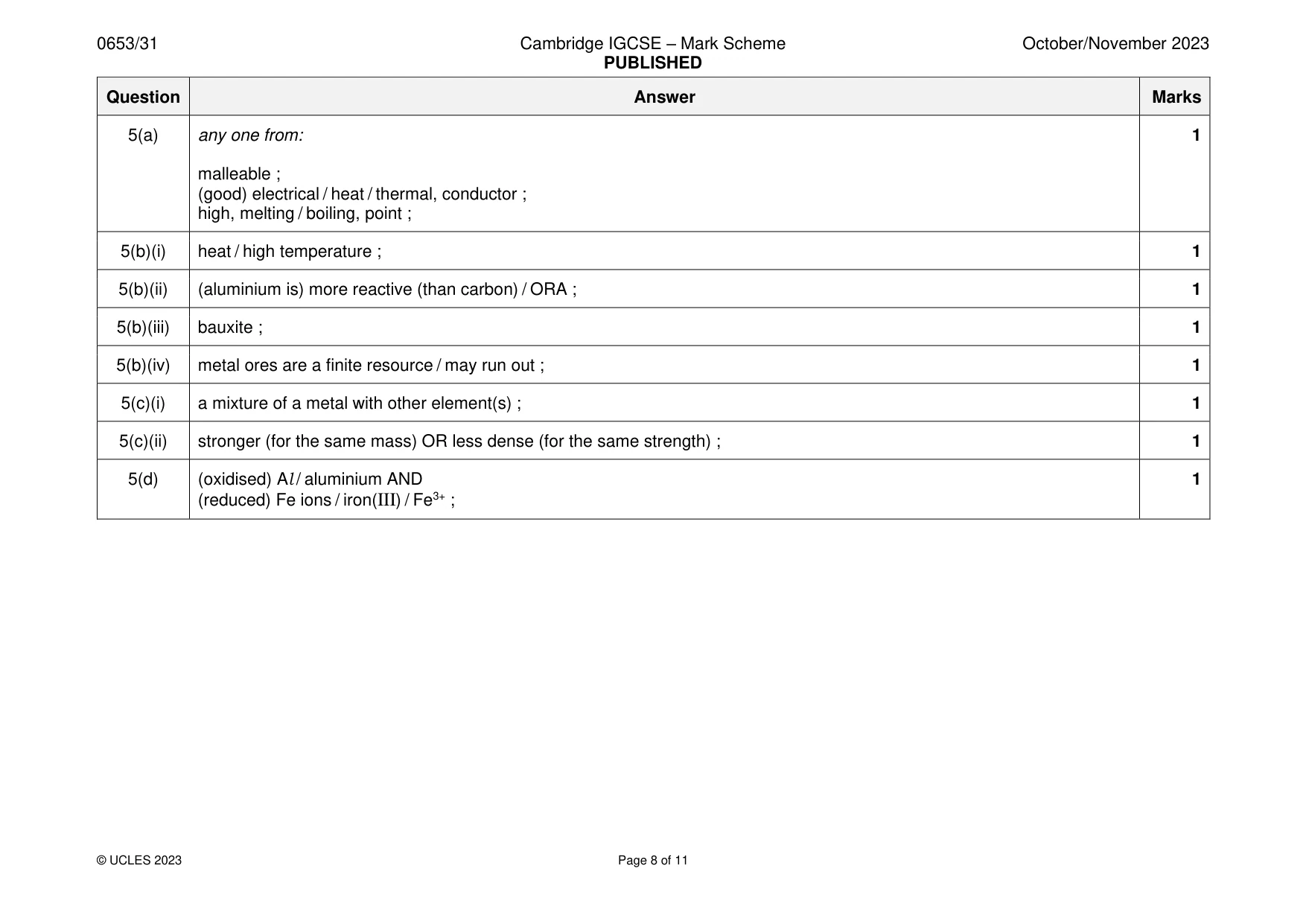
Mark scheme: 5(a) any one from: 1 malleable ; (good) electrical / heat / thermal, conductor ; high, melting / boiling, point ; 5(b)(i) heat / high temperature ; 1 5(b)(ii) (aluminium is) more reactive (than carbon) / ORA ; 1 5(b)(iii) bauxite ; 1 5(b)(iv) metal ores are a finite resource / may run out ; 1 5(c)(i) a mixture of a metal with other element(s) ; 1 5(c)(ii) stronger (for the same mass) OR less dense (for the same strength) ; 1 5(d) (oxidised) Al / aluminium AND 1 (reduced) Fe ions / iron(III) / Fe3+ ;
Q6 · A student determines the resistance of resistor R
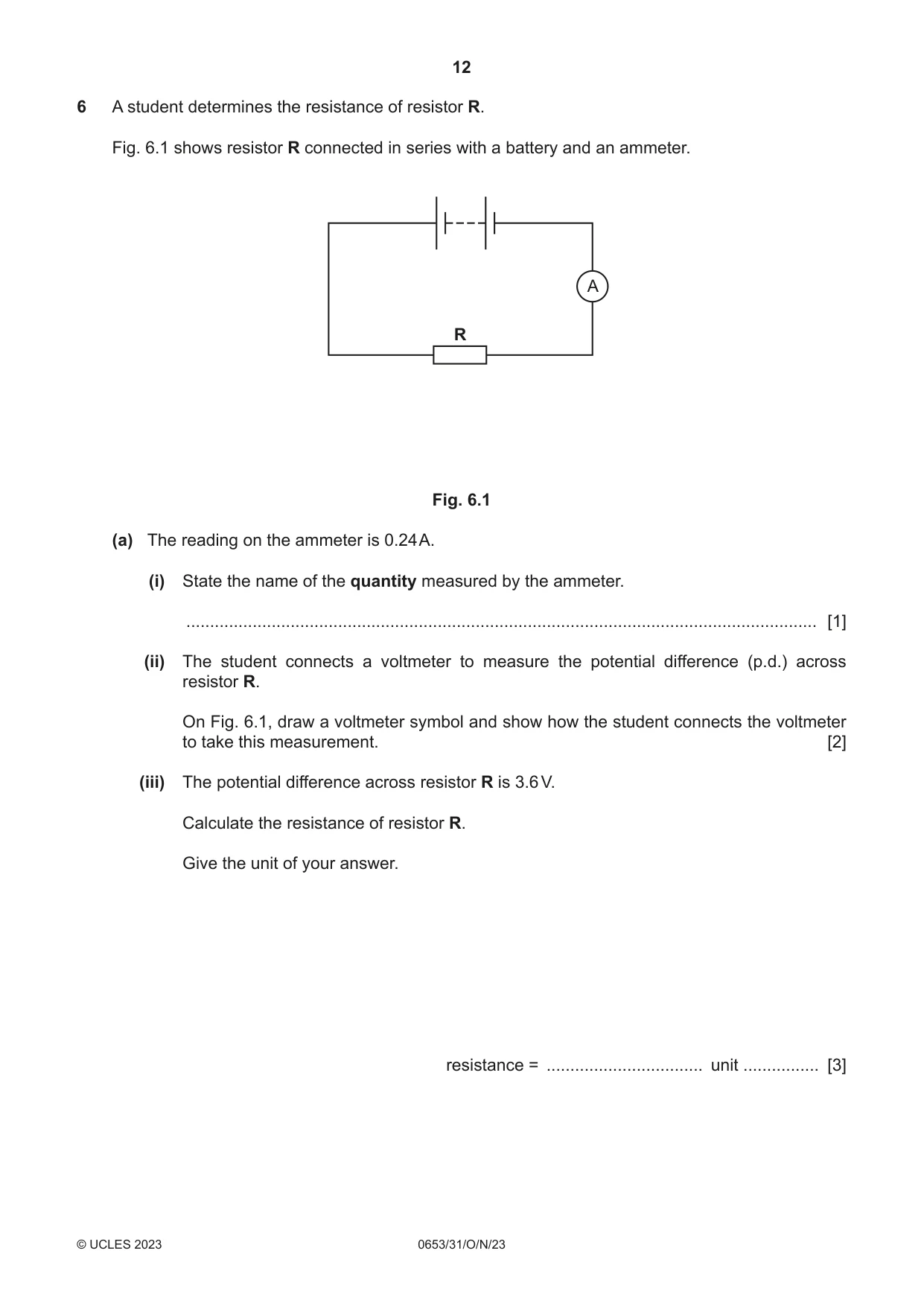
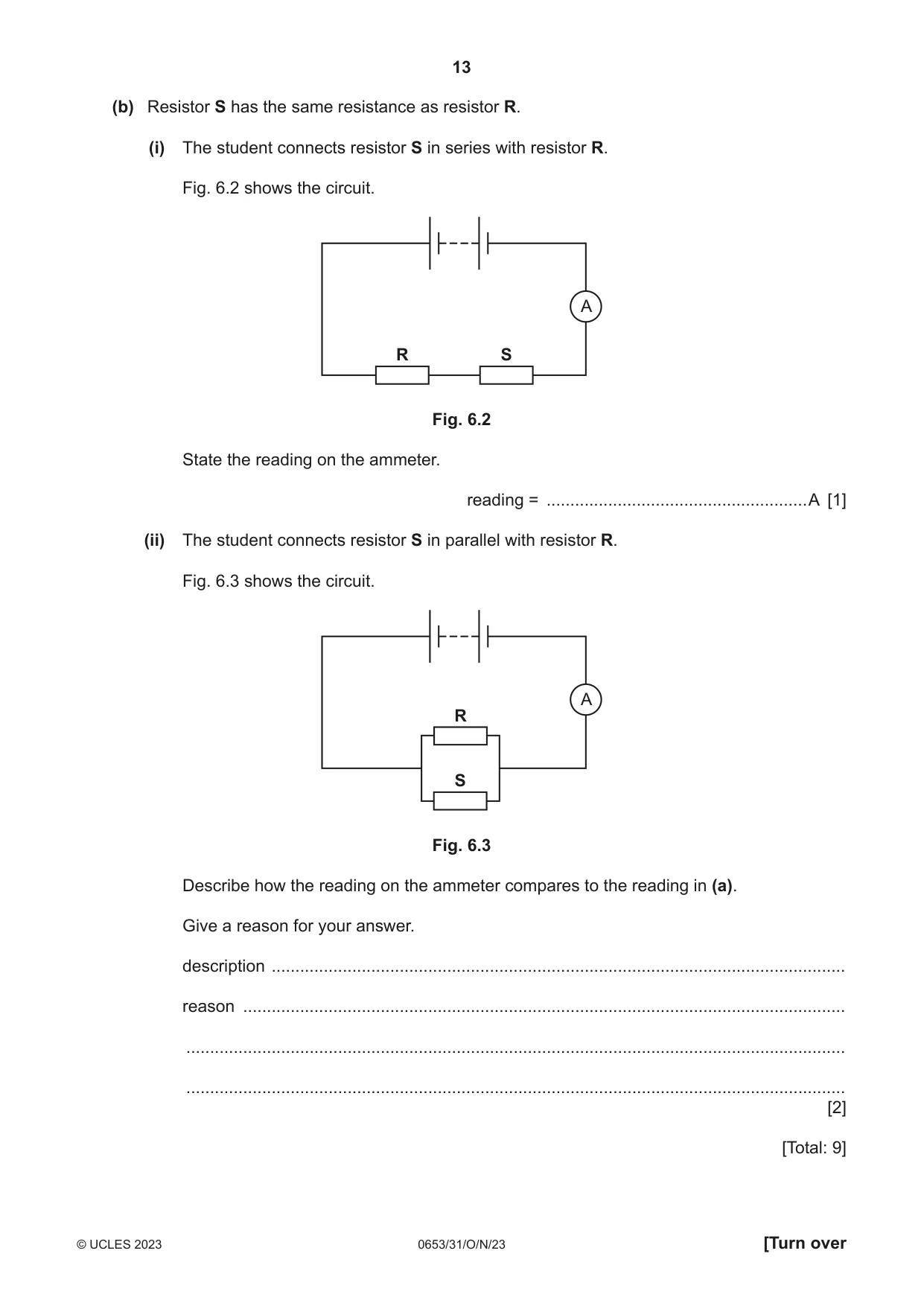
6 A student determines the resistance of resistor R. Fig. 6.1 shows resistor R connected in series with a battery and an ammeter. A R Fig. 6.1 (a) The reading on the ammeter is 0.24 A. (i) State the name of the quantity measured by the ammeter. ..................................................................................................................................... [1] (ii) The student connects a voltmeter to measure the potential difference (p.d.) across resistor R. On Fig. 6.1, draw a voltmeter symbol and show how the student connects the voltmeter to take this measurement. [2] (iii) The potential difference across resistor R is 3.6 V. Calculate the resistance of resistor R. Give the unit of your answer. resistance = ................................. unit ................ [3] (b) Resistor S has the same resistance as resistor R. (i) The student connects resistor S in series with resistor R. Fig. 6.2 shows the circuit. A R S Fig. 6.2 State the reading on the ammeter. reading = ....................................................... A [1] (ii) The student connects resistor S in parallel with resistor R. Fig. 6.3 shows the circuit. A R S Fig. 6.3 Describe how the reading on the ammeter compares to the reading in (a). Give a reason for your answer. description ......................................................................................................................... reason ............................................................................................................................... ........................................................................................................................................... ........................................................................................................................................... [2] [Total: 9]
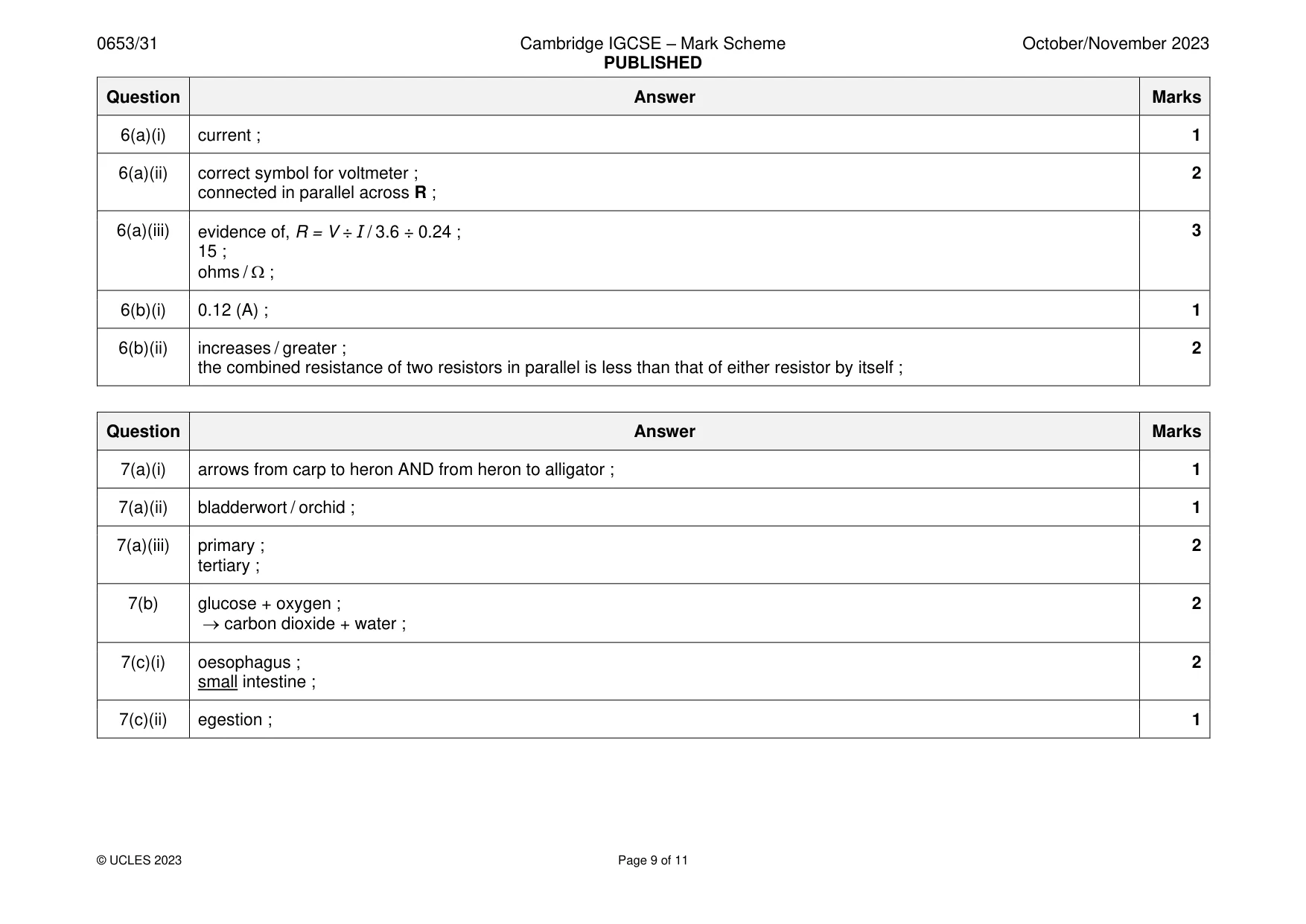
Mark scheme: 6(a)(i) current ; 1 6(a)(ii) correct symbol for voltmeter ; 2 connected in parallel across R ; 6(a)(iii) evidence of, R = V ÷ I / 3.6 ÷ 0.24 ; 3 15 ; ohms / ; 6(b)(i) 0.12 (A) ; 1 6(b)(ii) increases / greater ; 2 the combined resistance of two resistors in parallel is less than that of either resistor by itself ;
Question 7
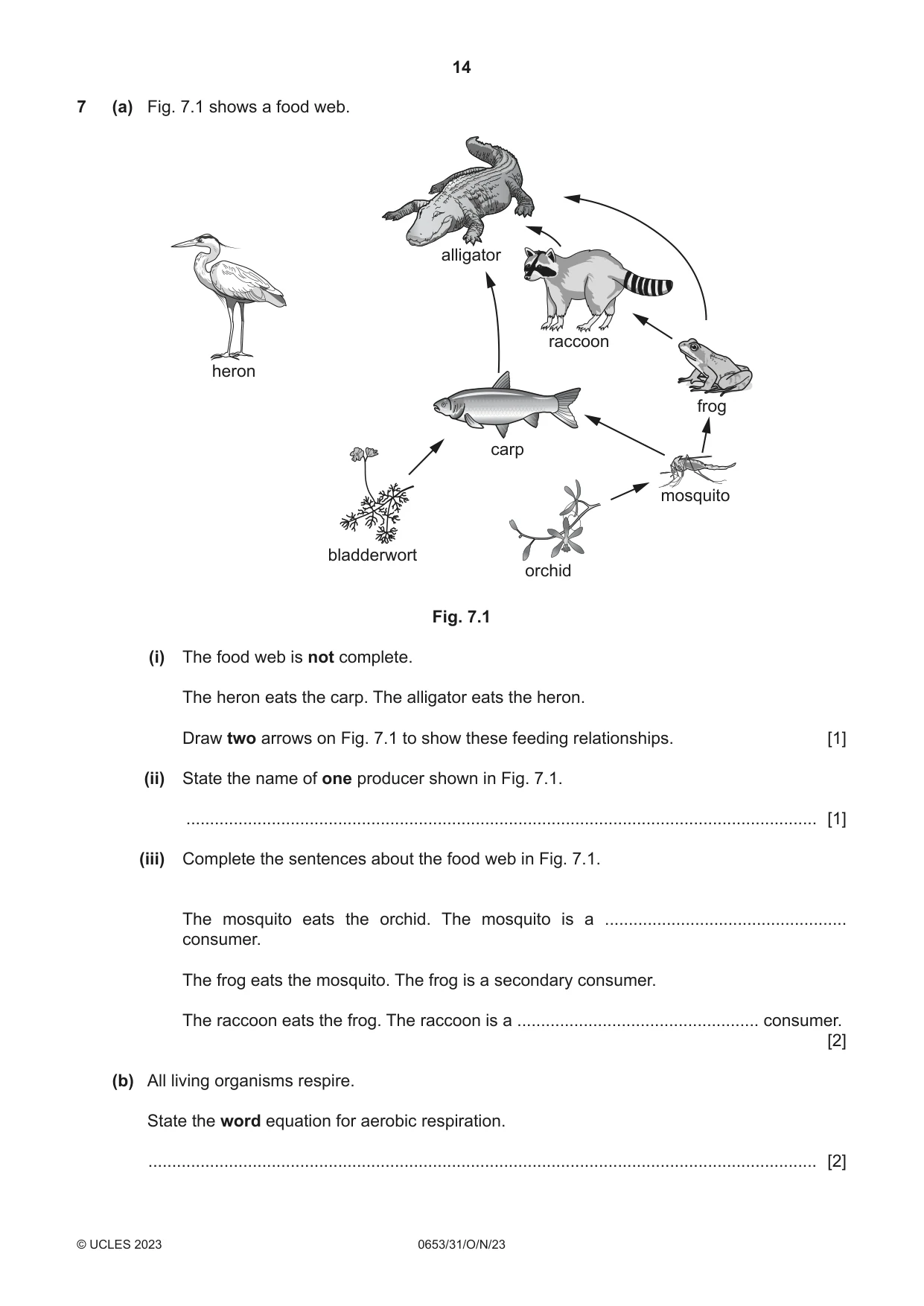
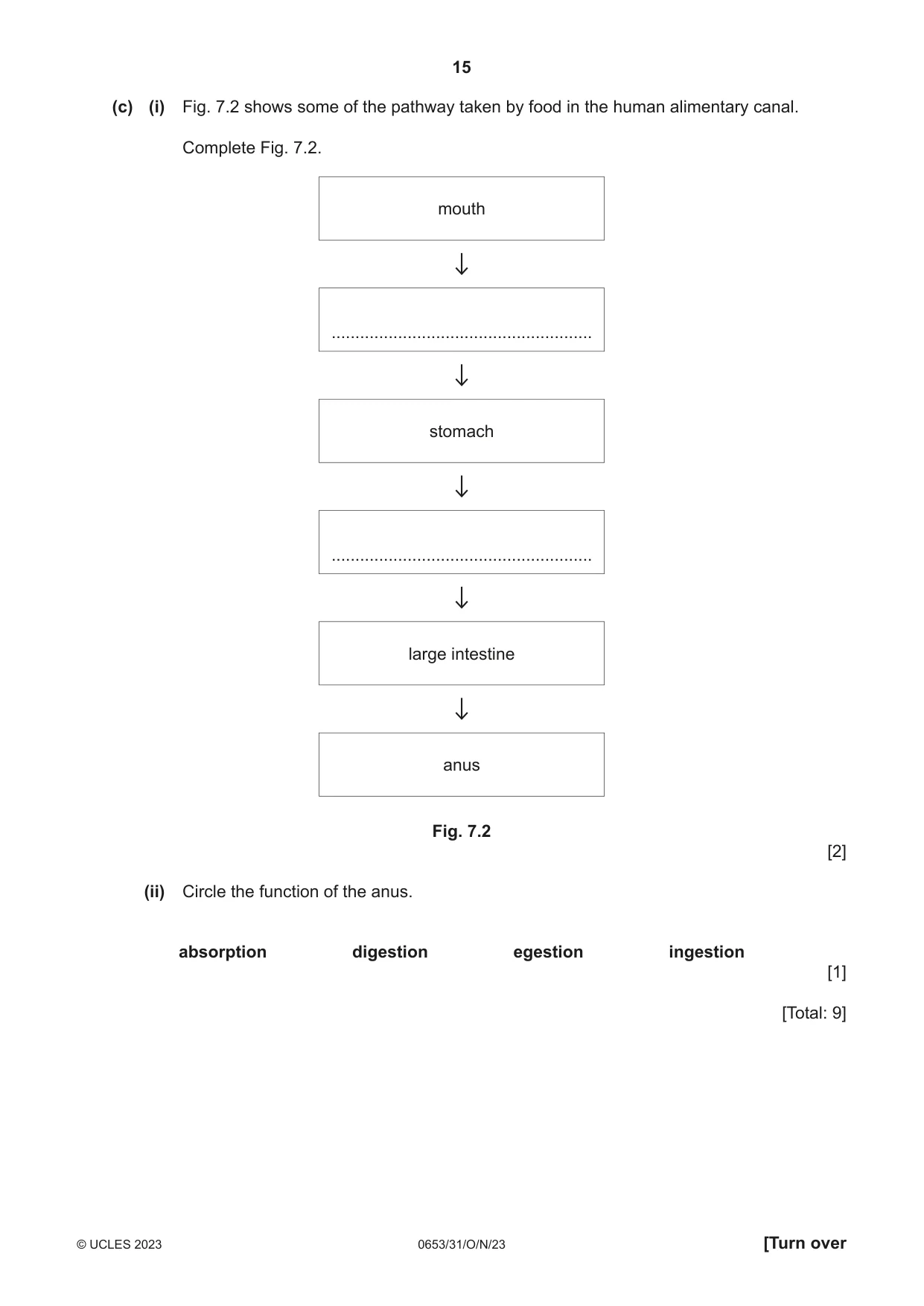
7 (a) Fig. 7.1 shows a food web. alligator raccoon heron frog carp mosquito bladderwort orchid Fig. 7.1 (i) The food web is not complete. The heron eats the carp. The alligator eats the heron. Draw two arrows on Fig. 7.1 to show these feeding relationships. [1] (ii) State the name of one producer shown in Fig. 7.1. ..................................................................................................................................... [1] (iii) Complete the sentences about the food web in Fig. 7.1. The mosquito eats the orchid. The mosquito is a ................................................... consumer. The frog eats the mosquito. The frog is a secondary consumer. The raccoon eats the frog. The raccoon is a ................................................... consumer. [2] (b) All living organisms respire. State the word equation for aerobic respiration. ............................................................................................................................................. [2] (c) (i) Fig. 7.2 shows some of the pathway taken by food in the human alimentary canal. Complete Fig. 7.2. mouth ....................................................... stomach ....................................................... large intestine anus Fig. 7.2 [2] (ii) Circle the function of the anus. absorption digestion egestion ingestion [1] [Total: 9]
Mark scheme: 7(a)(i) arrows from carp to heron AND from heron to alligator ; 1 7(a)(ii) bladderwort / orchid ; 1 7(a)(iii) primary ; 2 tertiary ; 7(b) glucose + oxygen ; 2 → carbon dioxide + water ; 7(c)(i) oesophagus ; 2 small intestine ; 7(c)(ii) egestion ; 1
Q8 · Chlorine is in Group VII of the Periodic Table
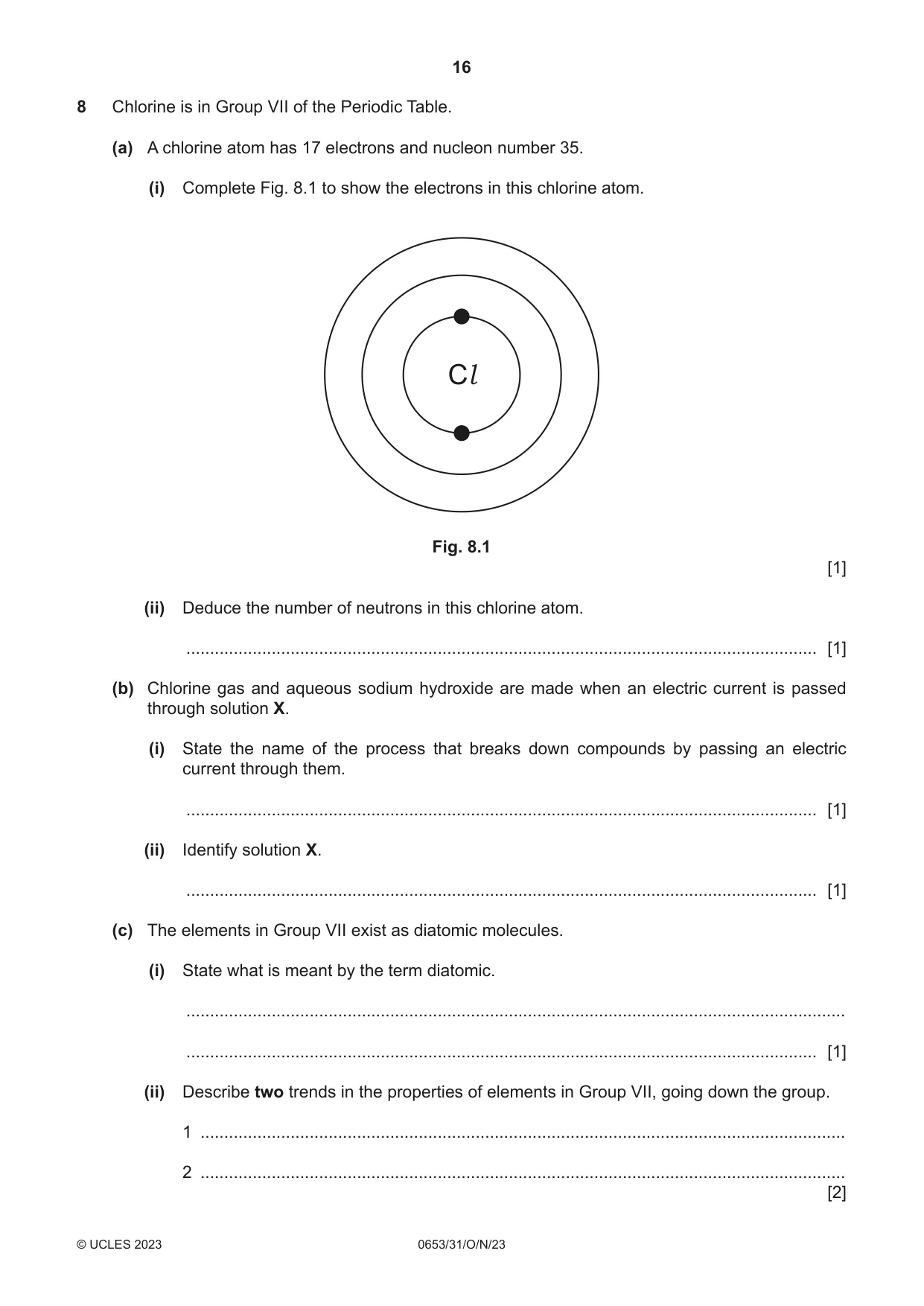
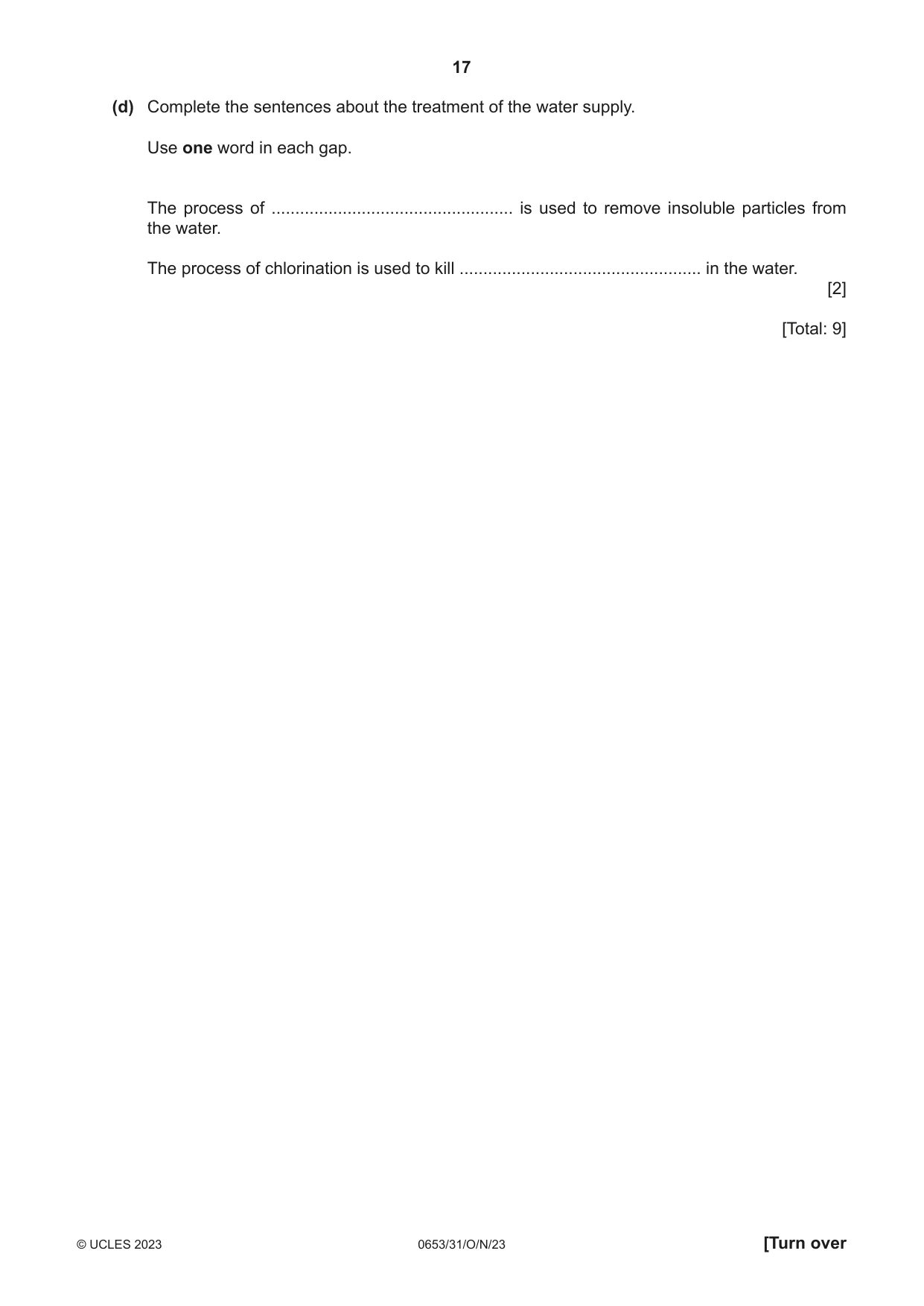
8 Chlorine is in Group VII of the Periodic Table. (a) A chlorine atom has 17 electrons and nucleon number 35. (i) Complete Fig. 8.1 to show the electrons in this chlorine atom. Cl Fig. 8.1 [1] (ii) Deduce the number of neutrons in this chlorine atom. ..................................................................................................................................... [1] (b) Chlorine gas and aqueous sodium hydroxide are made when an electric current is passed through solution X. (i) State the name of the process that breaks down compounds by passing an electric current through them. ..................................................................................................................................... [1] (ii) Identify solution X. ..................................................................................................................................... [1] (c) The elements in Group VII exist as diatomic molecules. (i) State what is meant by the term diatomic. ........................................................................................................................................... ..................................................................................................................................... [1] (ii) Describe two trends in the properties of elements in Group VII, going down the group. 1 ........................................................................................................................................ 2 ........................................................................................................................................ [2] (d) Complete the sentences about the treatment of the water supply. Use one word in each gap. The process of ................................................... is used to remove insoluble particles from the water. The process of chlorination is used to kill ................................................... in the water. [2] [Total: 9]
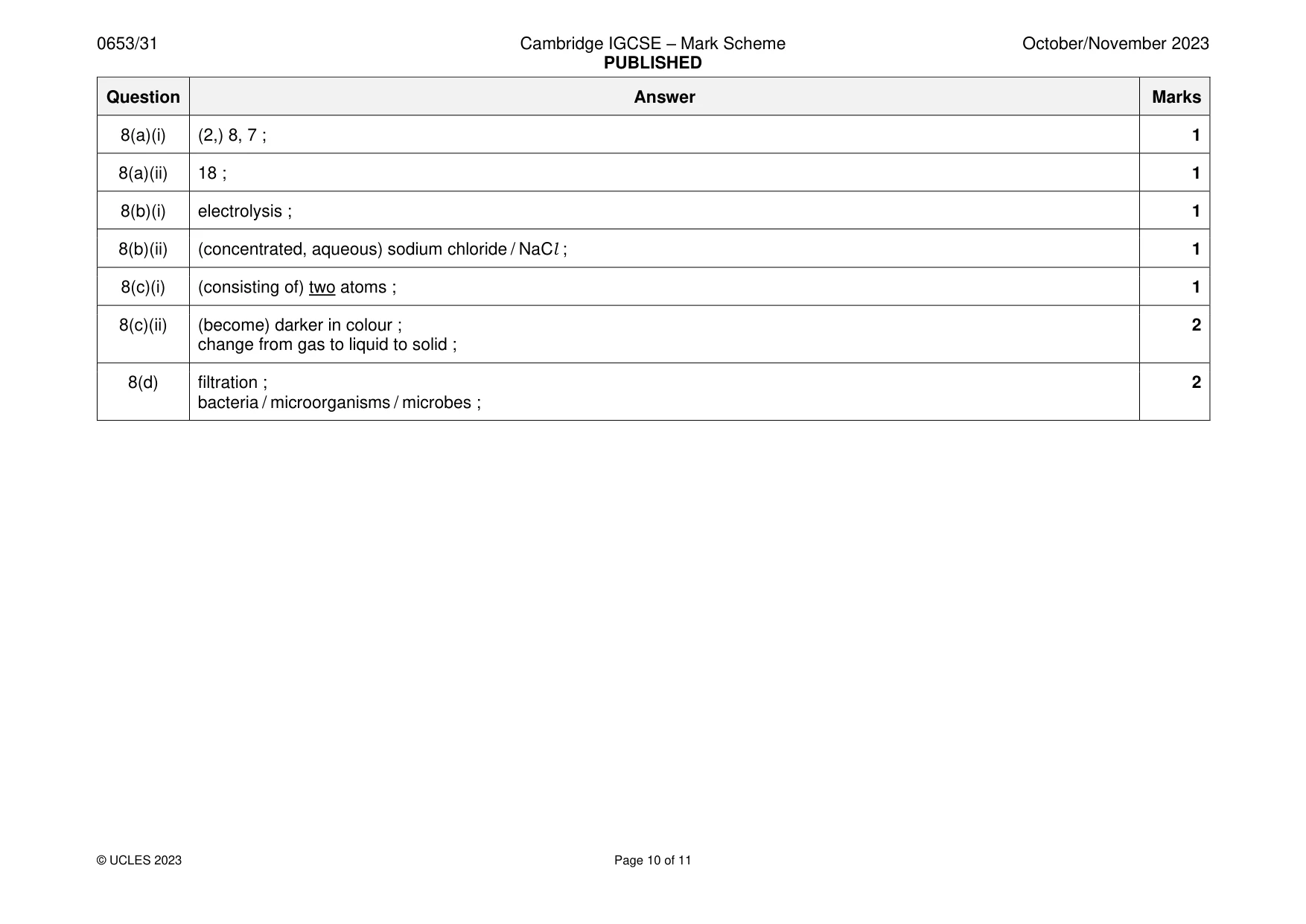
Mark scheme: 8(a)(i) (2,) 8, 7 ; 1 8(a)(ii) 18 ; 1 8(b)(i) electrolysis ; 1 8(b)(ii) (concentrated, aqueous) sodium chloride / NaCl ; 1 8(c)(i) (consisting of) two atoms ; 1 8(c)(ii) (become) darker in colour ; 2 change from gas to liquid to solid ; 8(d) filtration ; 2 bacteria / microorganisms / microbes ;
Q9 · Many security measures are used in airports, including security scans of baggage…
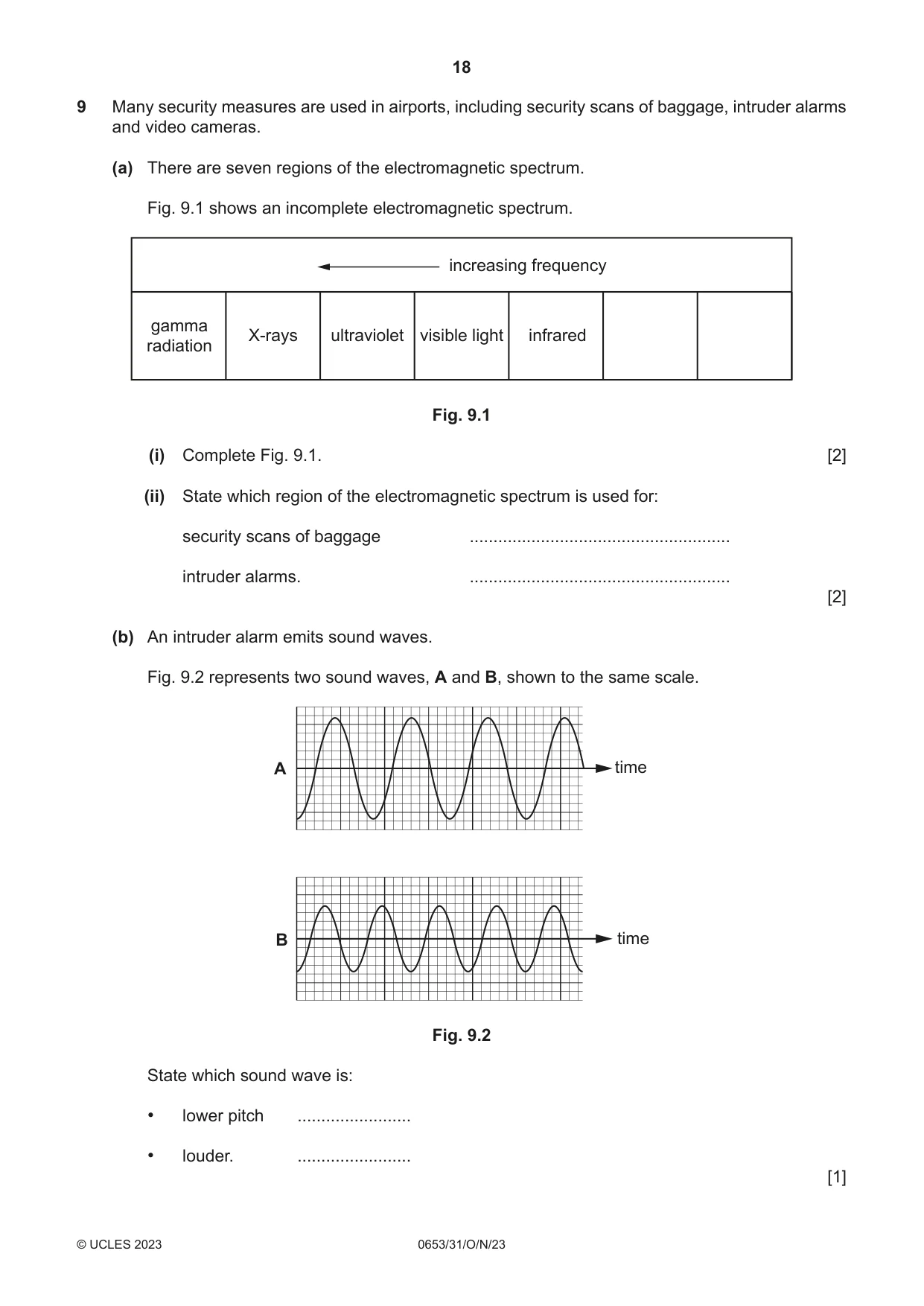
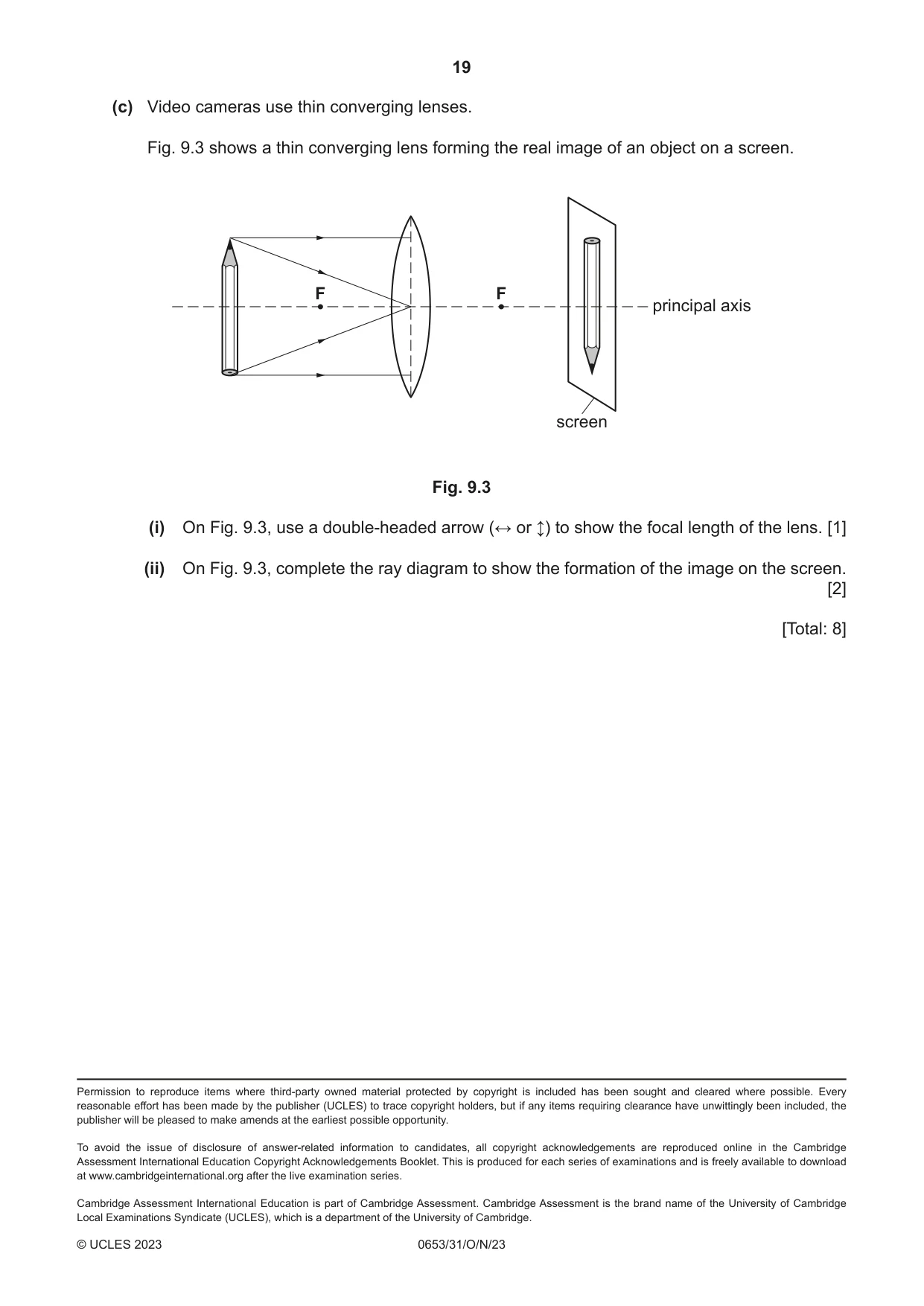
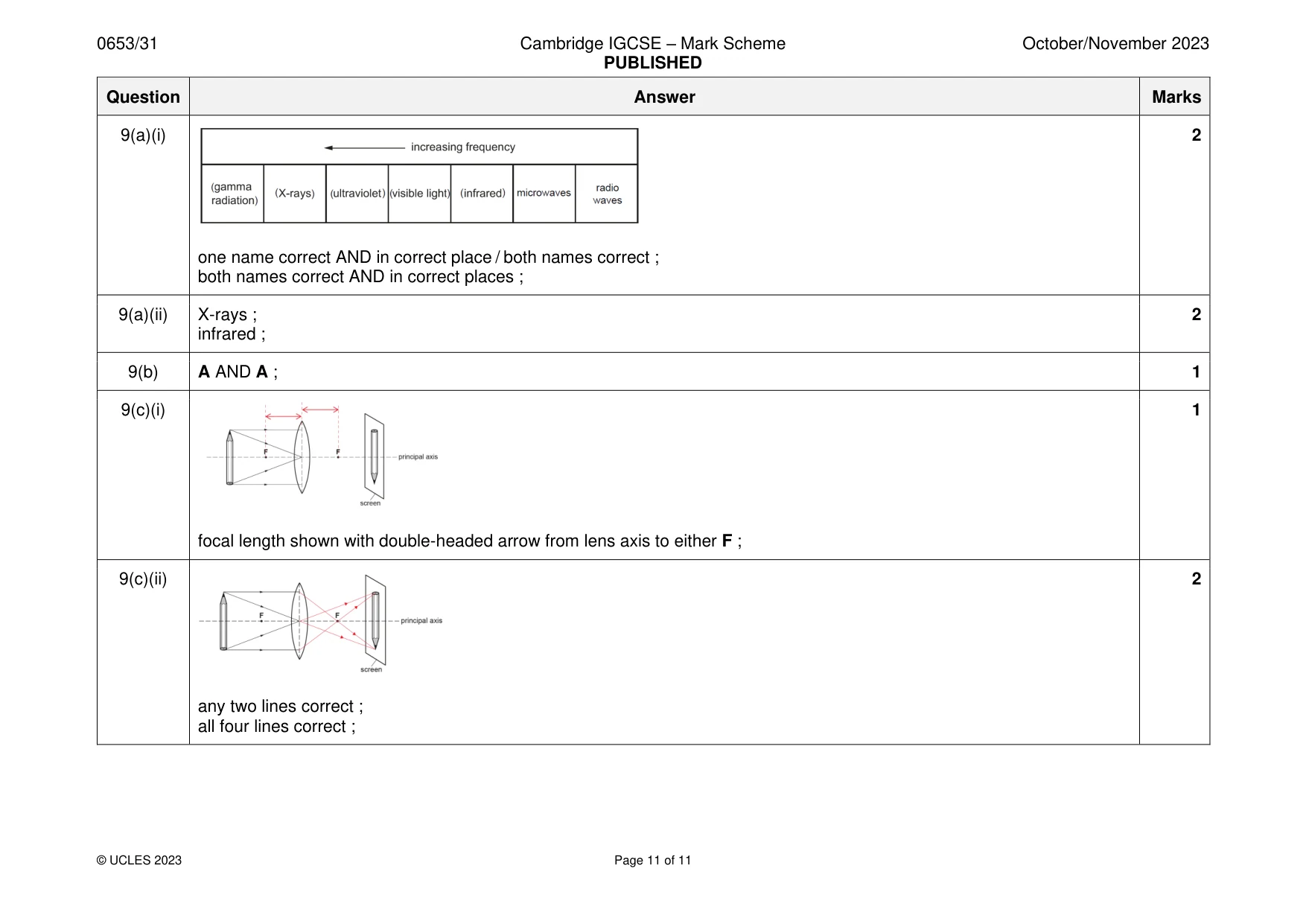
9 Many security measures are used in airports, including security scans of baggage, intruder alarms and video cameras. (a) There are seven regions of the electromagnetic spectrum. Fig. 9.1 shows an incomplete electromagnetic spectrum. increasing frequency gamma X-rays ultraviolet visible light infrared radiation Fig. 9.1 (i) Complete Fig. 9.1. [2] (ii) State which region of the electromagnetic spectrum is used for: security scans of baggage ....................................................... intruder alarms. ....................................................... [2] (b) An intruder alarm emits sound waves. Fig. 9.2 represents two sound waves, A and B, shown to the same scale. A time B time Fig. 9.2 State which sound wave is: • lower pitch ........................ • louder. ........................ [1] (c) Video cameras use thin converging lenses. Fig. 9.3 shows a thin converging lens forming the real image of an object on a screen. F F principal axis screen Fig. 9.3 (i) On Fig. 9.3, use a double-headed arrow (↔ or ↕) to show the focal length of the lens. [1] (ii) On Fig. 9.3, complete the ray diagram to show the formation of the image on the screen. [2] [Total: 8]
Mark scheme: 9(a)(i) 2 one name correct AND in correct place / both names correct ; both names correct AND in correct places ; 9(a)(ii) X-rays ; 2 infrared ; 9(b) A AND A ; 1 9(c)(i) 1 focal length shown with double-headed arrow from lens axis to either F ; 9(c)(ii) 2 any two lines correct ; all four lines correct ;
What was in this paper
The subtopics covered by these 9 questions, and how many questions each got. Open one in a new tab to see every Cambridge question on it.
What you needed in this session
Cambridge’s own grade thresholds for 2023 Oct/Nov, Paper 3 · Variant 1. A higher threshold means an easier paper — the bar moves with how the cohort did.