Cambridge IGCSE Science - Combined 0653 — 2022 May/June Paper 3 · Variant 2
0653/32/M/J/22 · 9 questions · 80 marks · ≈90 min
The question paper and its mark scheme, free to read here and free to download. This is Cambridge’s own paper, exactly as it was sat.
Question paper24 pages


Mark scheme10 pages
Answers below. Sit the paper first if you are practising.
Questions as text
Q1 · A diagram of the human gas exchange system
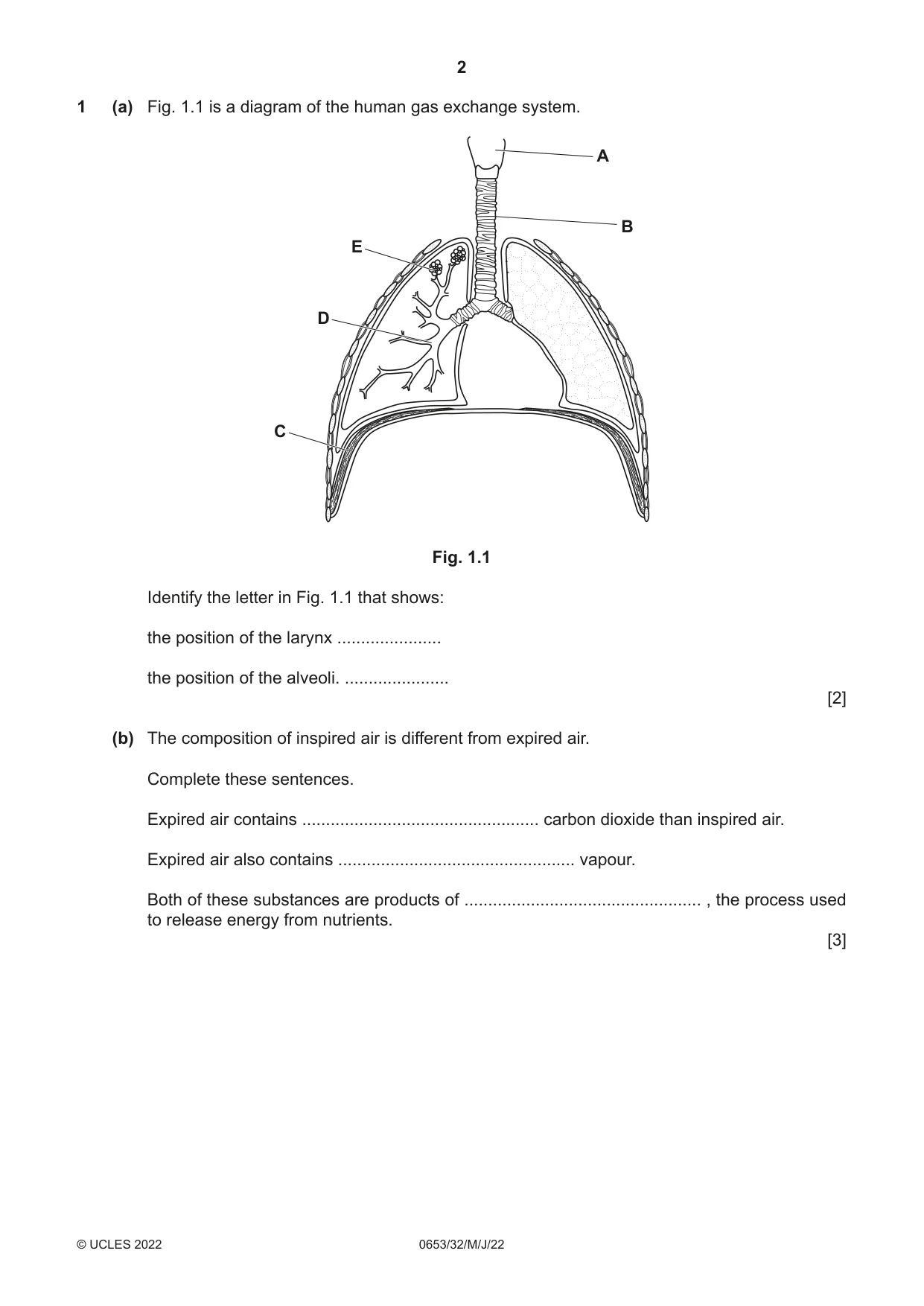
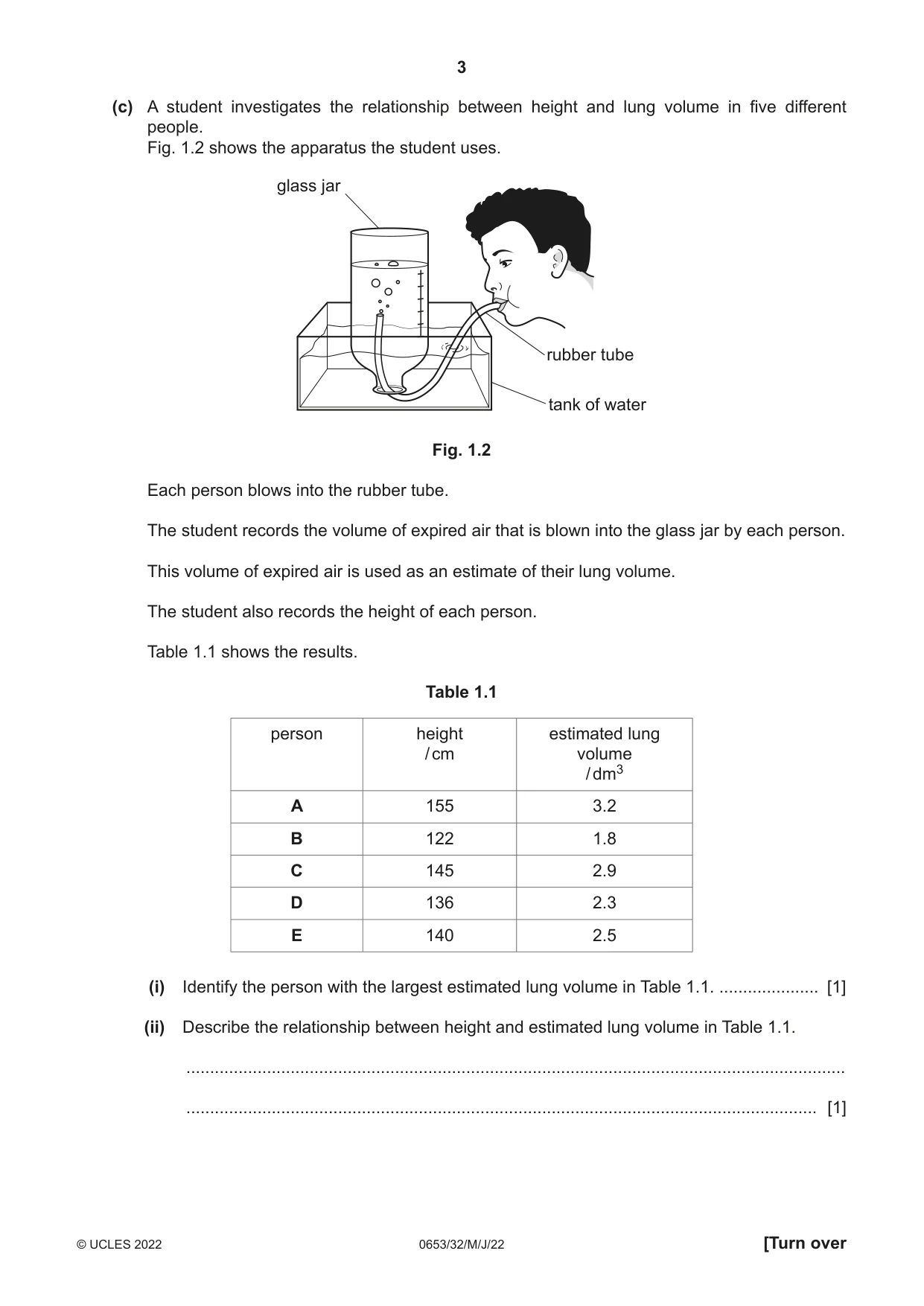
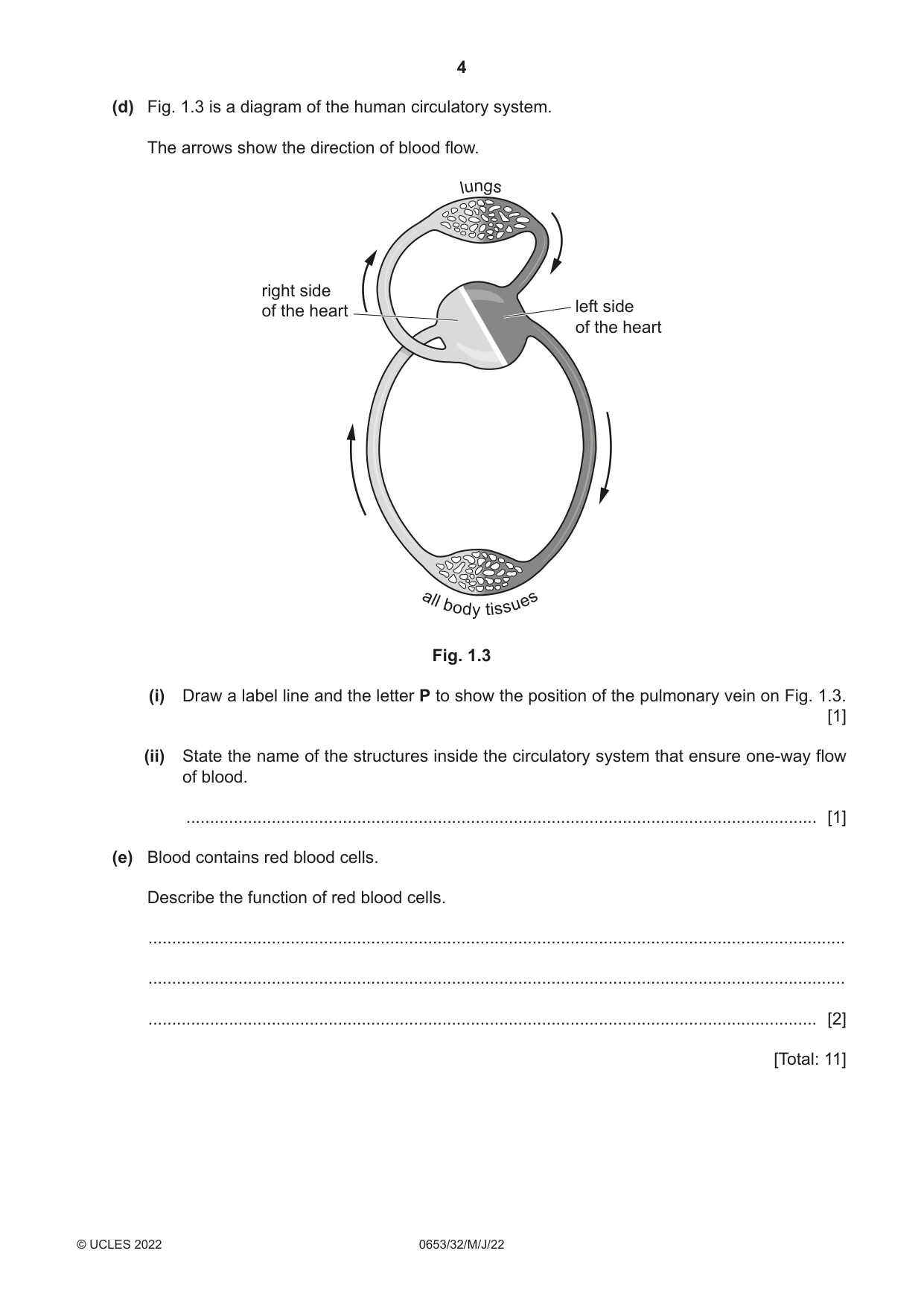
1 (a) Fig. 1.1 is a diagram of the human gas exchange system. A B E D C Fig. 1.1 Identify the letter in Fig. 1.1 that shows: the position of the larynx ...................... the position of the alveoli. ...................... [2] (b) The composition of inspired air is different from expired air. Complete these sentences. Expired air contains .................................................. carbon dioxide than inspired air. Expired air also contains .................................................. vapour. Both of these substances are products of .................................................. , the process used to release energy from nutrients. [3] (c) A student investigates the relationship between height and lung volume in five different people. Fig. 1.2 shows the apparatus the student uses. glass jar rubber tube tank of water Fig. 1.2 Each person blows into the rubber tube. The student records the volume of expired air that is blown into the glass jar by each person. This volume of expired air is used as an estimate of their lung volume. The student also records the height of each person. Table 1.1 shows the results. Table 1.1 person height estimated lung / cm volume / dm3 A 155 3.2 B 122 1.8 C 145 2.9 D 136 2.3 E 140 2.5 (i) Identify the person with the largest estimated lung volume in Table 1.1. ..................... [1] (ii) Describe the relationship between height and estimated lung volume in Table 1.1. ........................................................................................................................................... ..................................................................................................................................... [1] (d) Fig. 1.3 is a diagram of the human circulatory system. The arrows show the direction of blood flow. lungs right side of the heart left side of the heart all body tissues Fig. 1.3 (i) Draw a label line and the letter P to show the position of the pulmonary vein on Fig. 1.3. [1] (ii) State the name of the structures inside the circulatory system that ensure one-way flow of blood. ..................................................................................................................................... [1] (e) Blood contains red blood cells. Describe the function of red blood cells. ................................................................................................................................................... ................................................................................................................................................... ............................................................................................................................................. [2] [Total: 11]
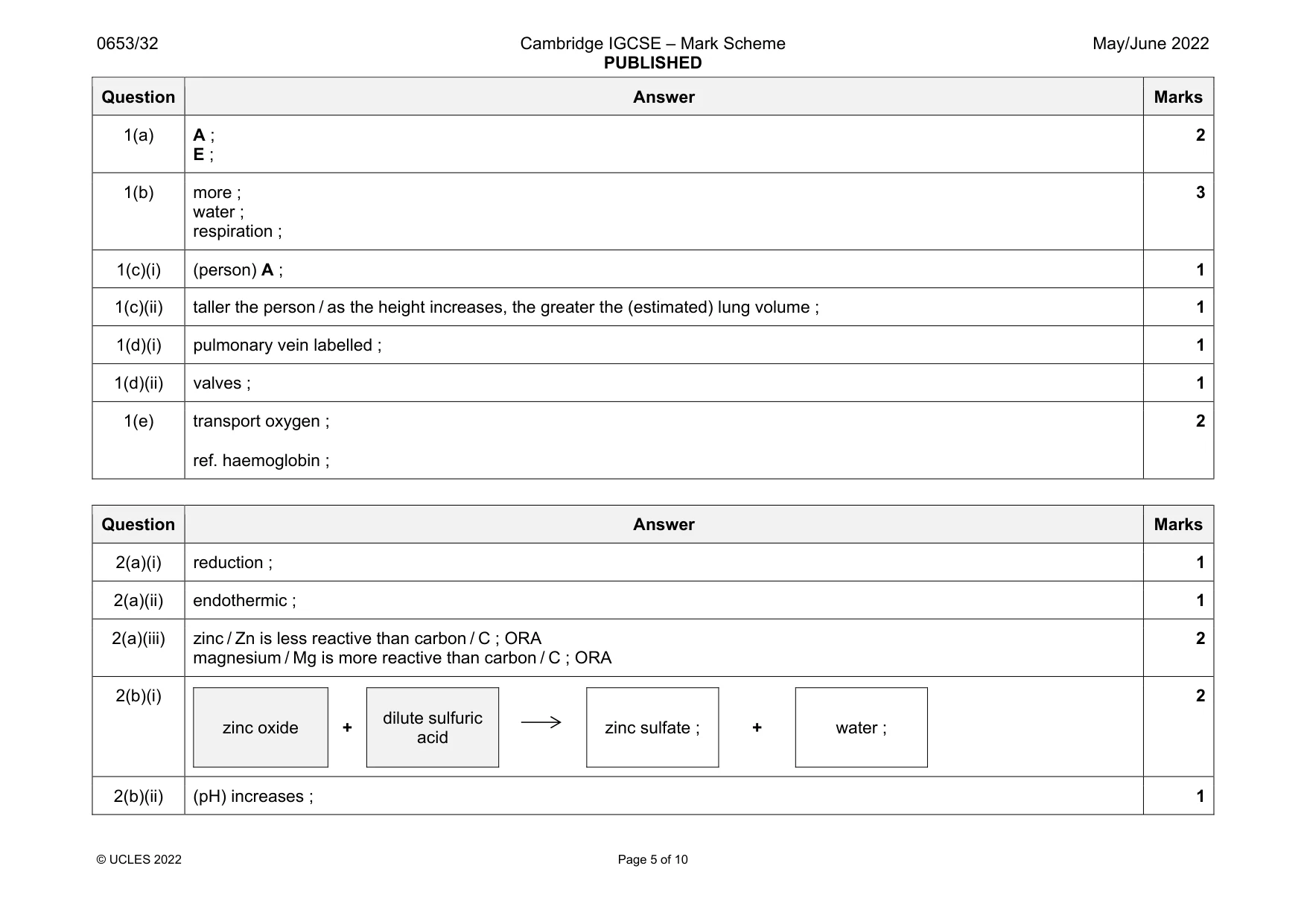
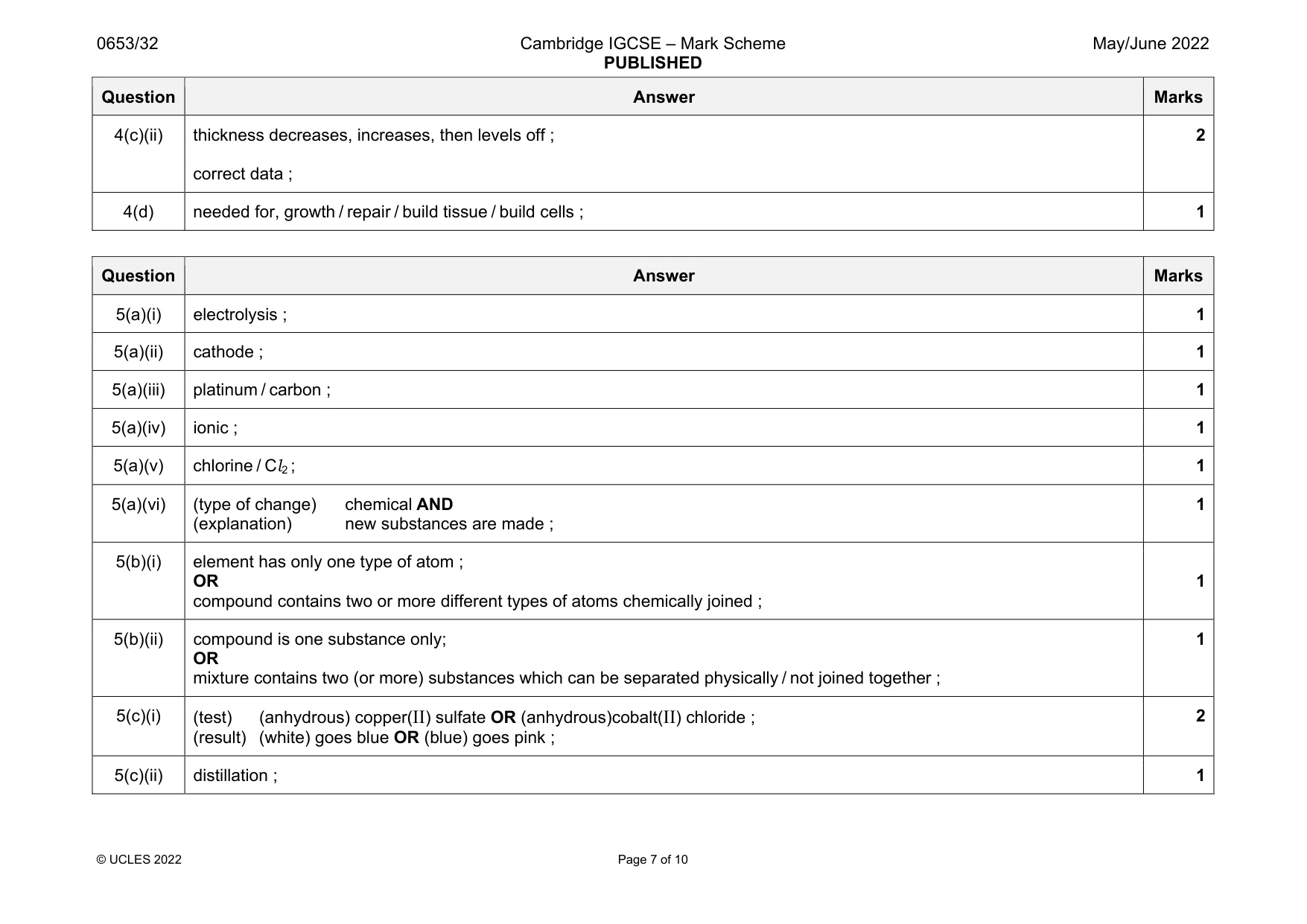
Mark scheme: 1(a) A ; E ; 2 1(b) more ; water ; respiration ; 3 1(c)(i) (person) A ; 1 1(c)(ii) taller the person / as the height increases, the greater the (estimated) lung volume ; 1 1(d)(i) pulmonary vein labelled ; 1 1(d)(ii) valves ; 1 1(e) transport oxygen ; ref. haemoglobin ; 2
Q2 · Zinc is extracted from zinc oxide by heating with carbon
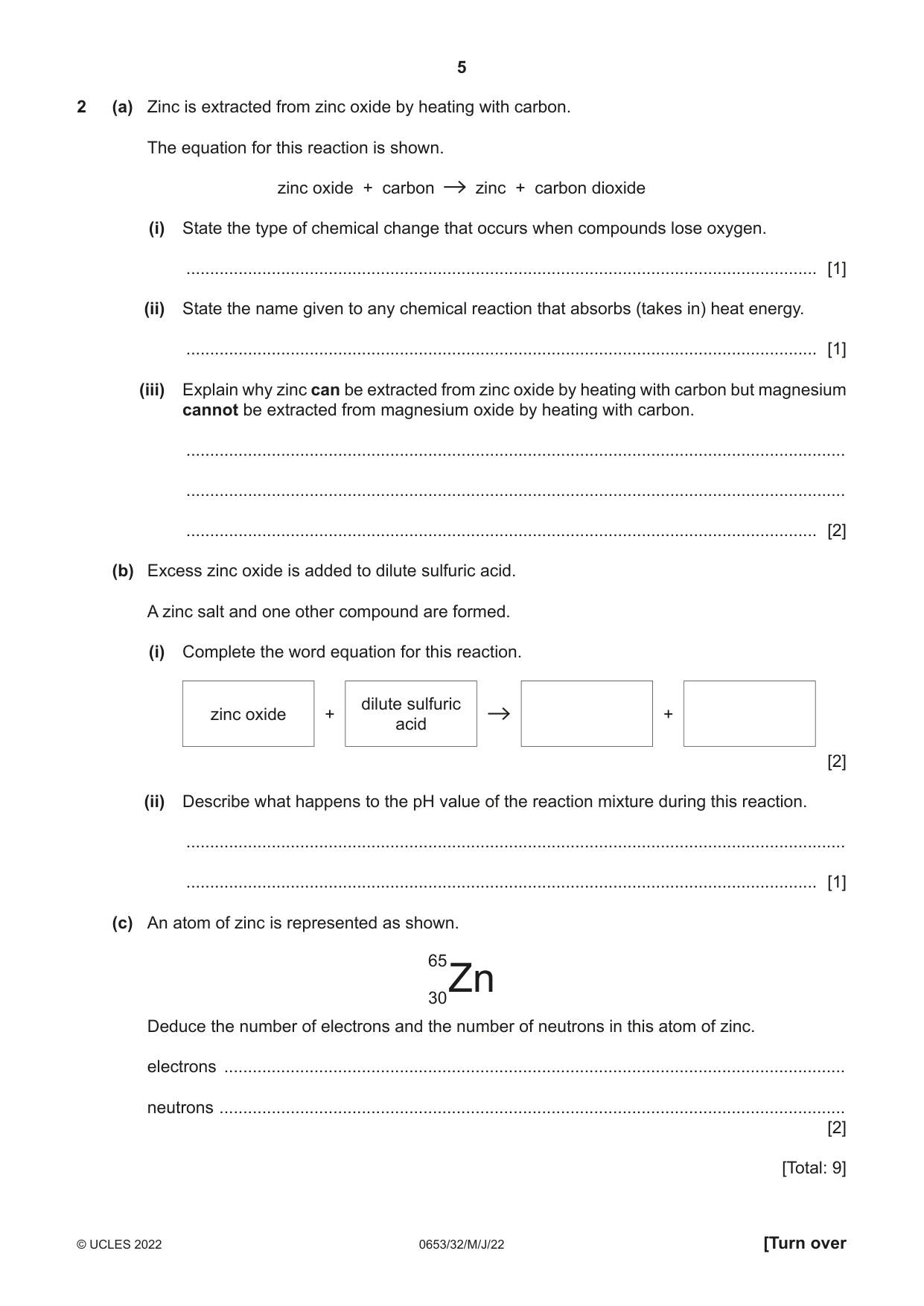
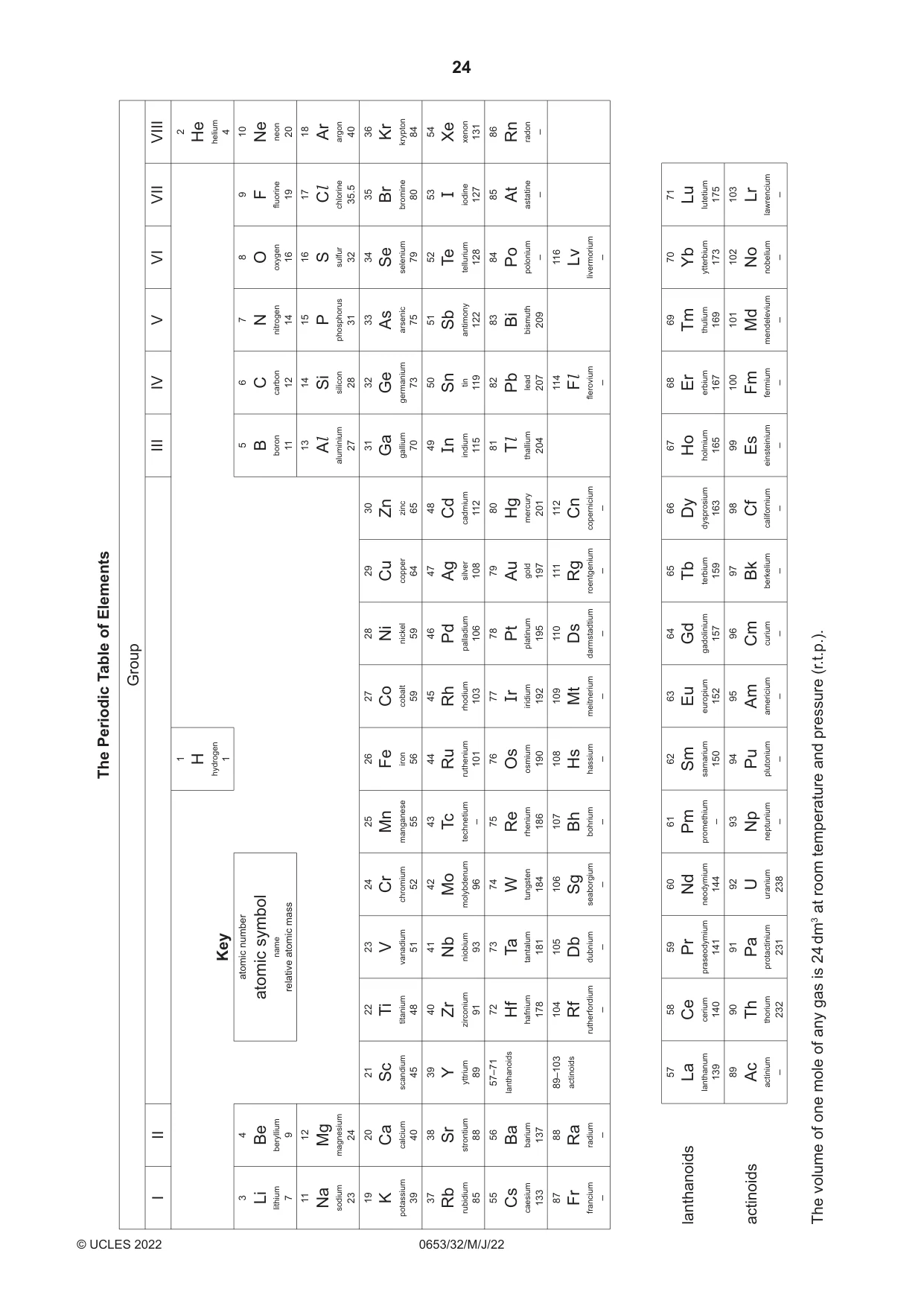
2 (a) Zinc is extracted from zinc oxide by heating with carbon. The equation for this reaction is shown. zinc oxide + carbon zinc + carbon dioxide (i) State the type of chemical change that occurs when compounds lose oxygen. ..................................................................................................................................... [1] (ii) State the name given to any chemical reaction that absorbs (takes in) heat energy. ..................................................................................................................................... [1] (iii) Explain why zinc can be extracted from zinc oxide by heating with carbon but magnesium cannot be extracted from magnesium oxide by heating with carbon. ........................................................................................................................................... ........................................................................................................................................... ..................................................................................................................................... [2] (b) Excess zinc oxide is added to dilute sulfuric acid. A zinc salt and one other compound are formed. (i) Complete the word equation for this reaction. dilute sulfuric zinc oxide + + acid [2] (ii) Describe what happens to the pH value of the reaction mixture during this reaction. ........................................................................................................................................... ..................................................................................................................................... [1] (c) An atom of zinc is represented as shown. 6530Zn Deduce the number of electrons and the number of neutrons in this atom of zinc. electrons ................................................................................................................................... neutrons .................................................................................................................................... [2] [Total: 9]
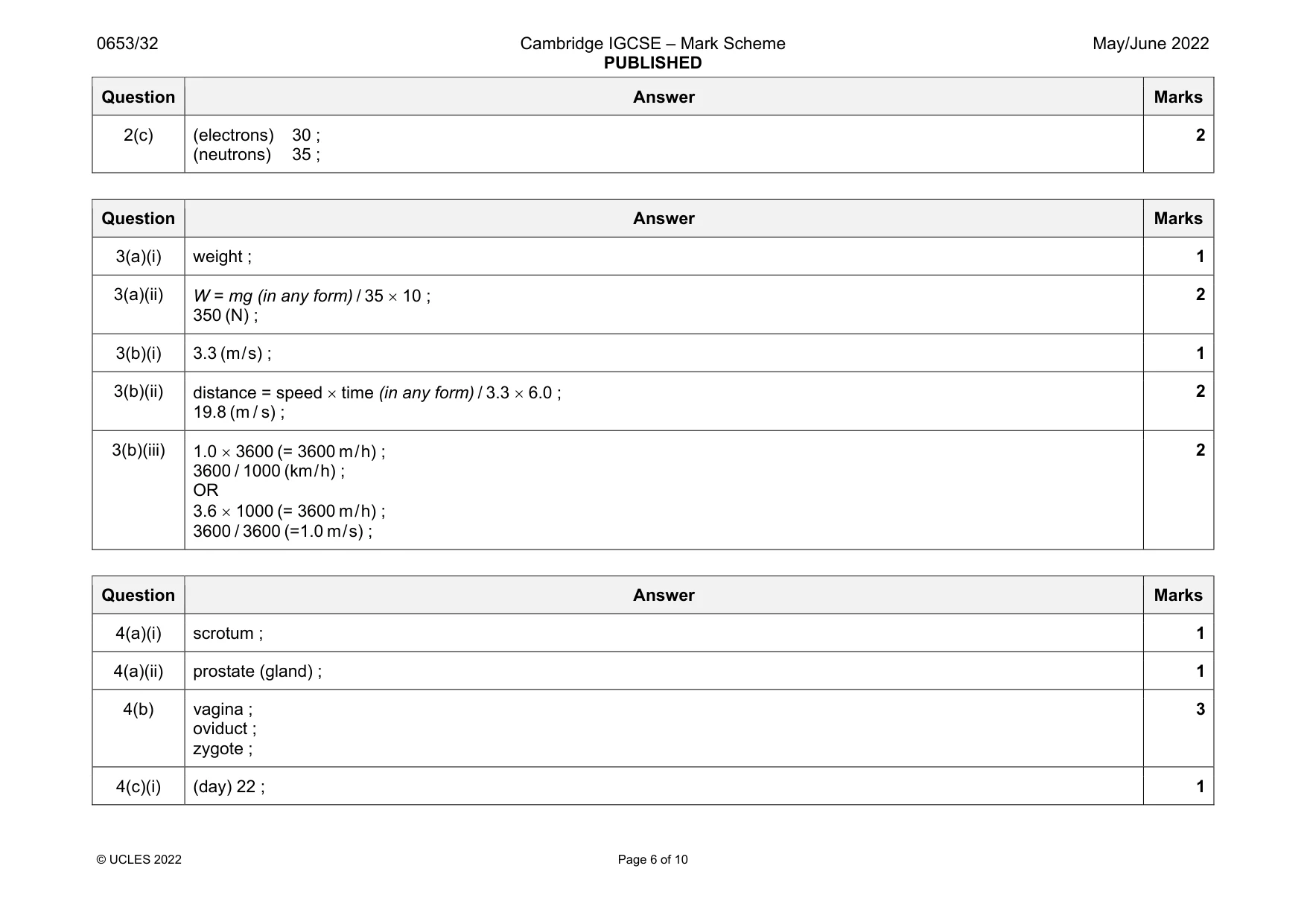
Mark scheme: 2(a)(i) reduction ; 1 2(a)(ii) endothermic ; 1 2(a)(iii) zinc / Zn is less reactive than carbon / C ; ORA magnesium / Mg is more reactive than carbon / C ; ORA 2 2(b)(i) zinc oxide + dilute sulfuric acid zinc sulfate ; + water ; 2 2(b)(ii) (pH) increases ; 1 Question Answer Marks 2(c) (electrons) 30 ; (neutrons) 35 ; 2
Q3 · The forces acting as a student rides on a moving scooter
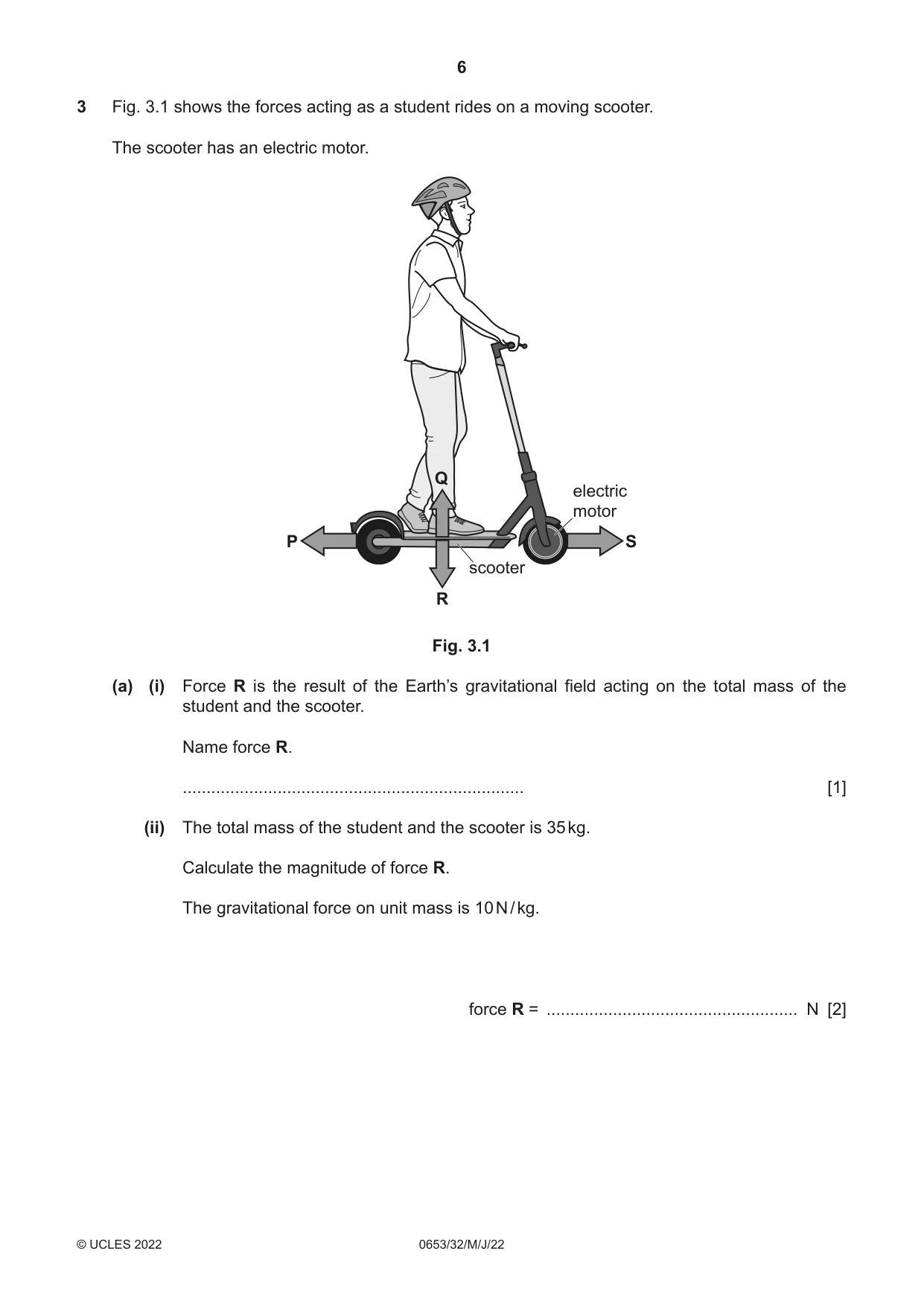
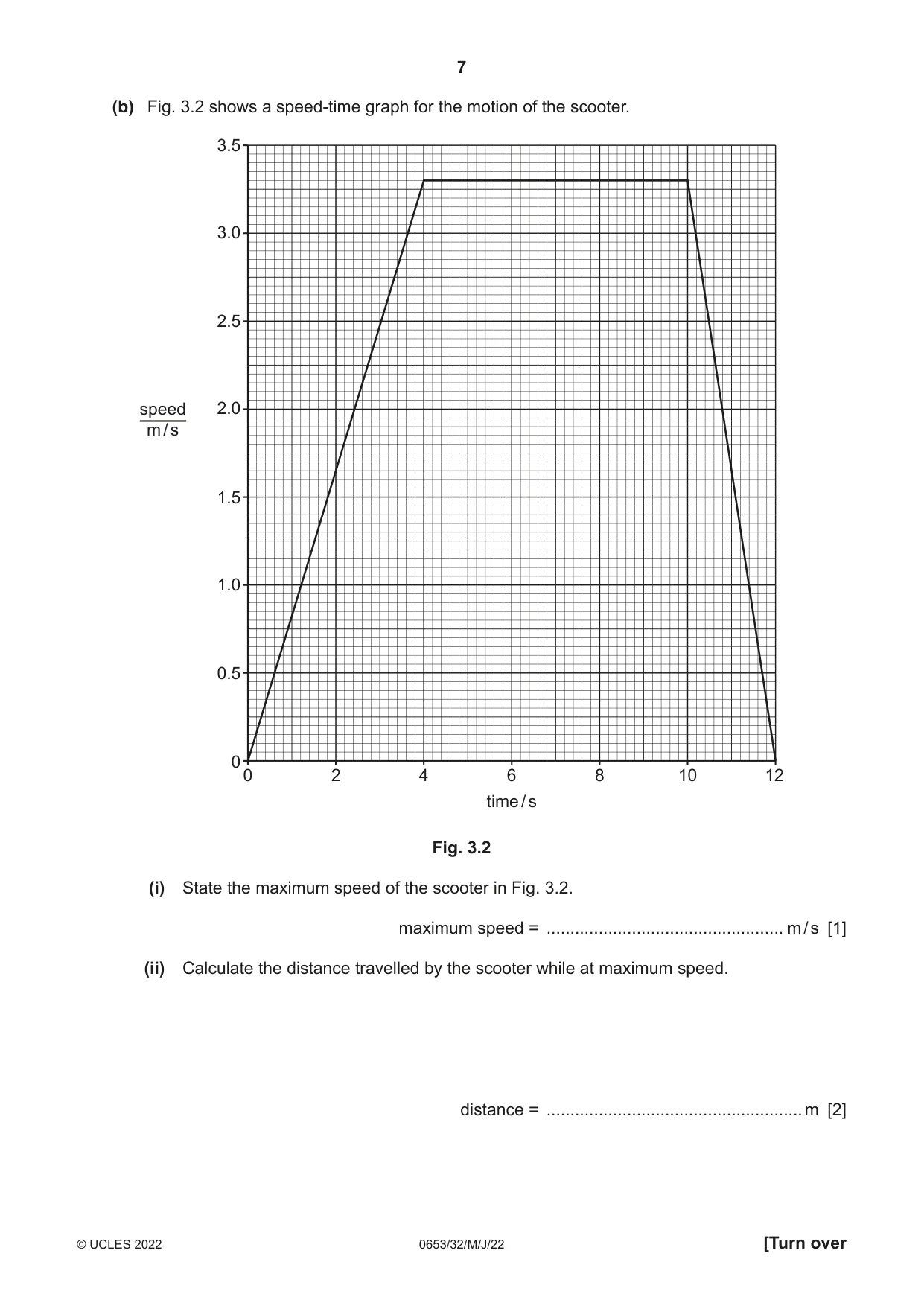
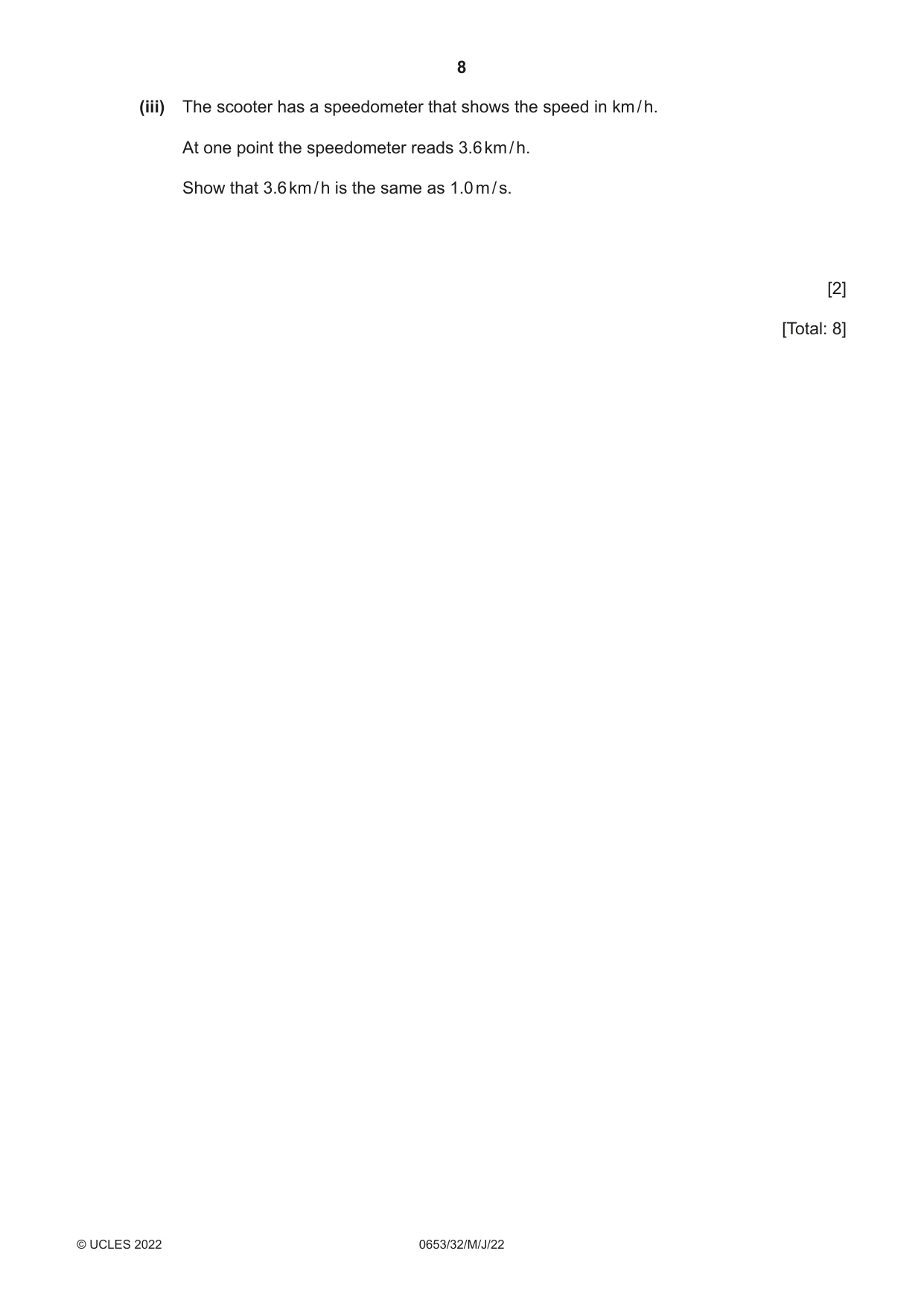
3 Fig. 3.1 shows the forces acting as a student rides on a moving scooter. The scooter has an electric motor. Q electric motor P S scooter R Fig. 3.1 (a) (i) Force R is the result of the Earth’s gravitational field acting on the total mass of the student and the scooter. Name force R. ........................................................................ [1] (ii) The total mass of the student and the scooter is 35 kg. Calculate the magnitude of force R. The gravitational force on unit mass is 10 N / kg. force R = ..................................................... N [2] (b) Fig. 3.2 shows a speed-time graph for the motion of the scooter. 3.5 3.0 2.5 speed 2.0 m / s 1.5 1.0 0.5 00 2 4 6 8 10 12 time / s Fig. 3.2 (i) State the maximum speed of the scooter in Fig. 3.2. maximum speed = .................................................. m / s [1] (ii) Calculate the distance travelled by the scooter while at maximum speed. distance = ...................................................... m [2] (iii) The scooter has a speedometer that shows the speed in km / h. At one point the speedometer reads 3.6 km / h. Show that 3.6 km / h is the same as 1.0 m / s. [2] [Total: 8]
Mark scheme: 3(a)(i) weight ; 1 3(a)(ii) W = mg (in any form) / 35 10 ; 350 (N) ; 2 3(b)(i) 3.3 (m / s) ; 1 3(b)(ii) distance = speed time (in any form) / 3.3 6.0 ; 19.8 (m / s) ; 2 3(b)(iii) 1.0 3600 (= 3600 m / h) ; 3600 / 1000 (km / h) ; OR 3.6 1000 (= 3600 m / h) ; 3600 / 3600 (=1.0 m / s) ; 2
Q4 · A diagram of the male reproductive system in humans
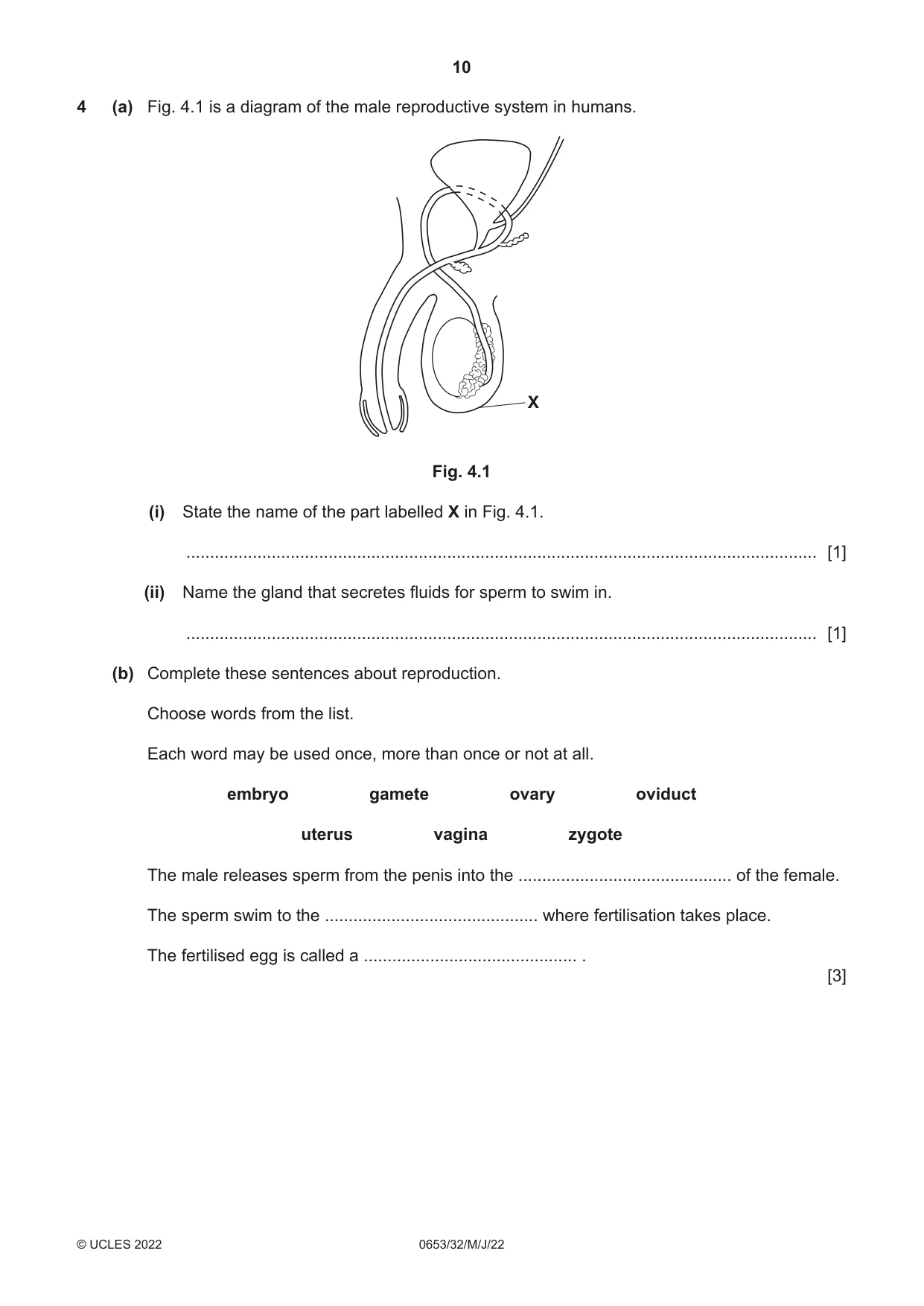
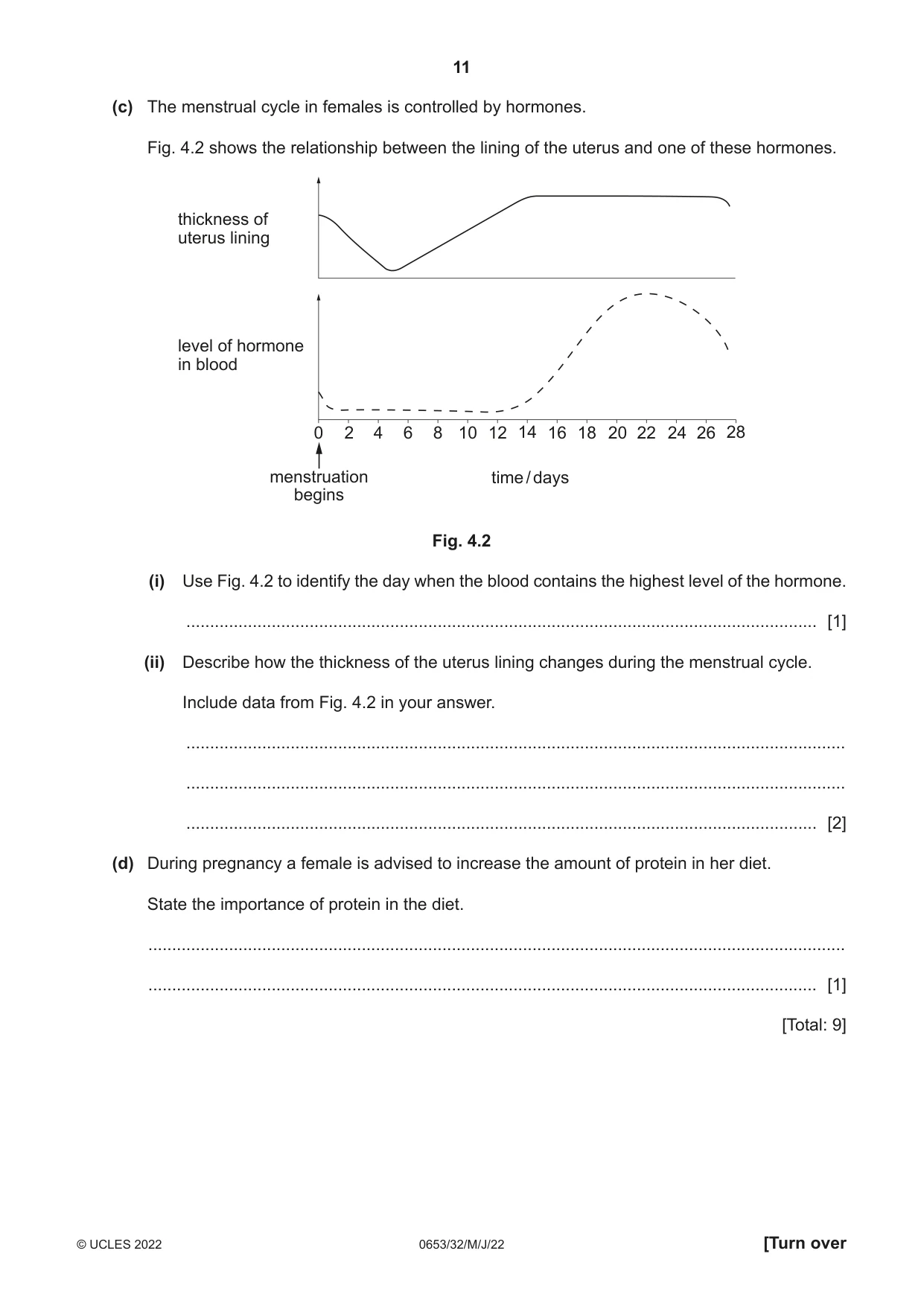
4 (a) Fig. 4.1 is a diagram of the male reproductive system in humans. X Fig. 4.1 (i) State the name of the part labelled X in Fig. 4.1. ..................................................................................................................................... [1] (ii) Name the gland that secretes fluids for sperm to swim in. ..................................................................................................................................... [1] (b) Complete these sentences about reproduction. Choose words from the list. Each word may be used once, more than once or not at all. embryo gamete ovary oviduct uterus vagina zygote The male releases sperm from the penis into the ............................................. of the female. The sperm swim to the ............................................. where fertilisation takes place. The fertilised egg is called a ............................................. . [3] (c) The menstrual cycle in females is controlled by hormones. Fig. 4.2 shows the relationship between the lining of the uterus and one of these hormones. thickness of uterus lining level of hormone in blood 0 2 4 6 8 10 12 14 16 18 20 22 24 26 28 menstruation time / days begins Fig. 4.2 (i) Use Fig. 4.2 to identify the day when the blood contains the highest level of the hormone. ..................................................................................................................................... [1] (ii) Describe how the thickness of the uterus lining changes during the menstrual cycle. Include data from Fig. 4.2 in your answer. ........................................................................................................................................... ........................................................................................................................................... ..................................................................................................................................... [2] (d) During pregnancy a female is advised to increase the amount of protein in her diet. State the importance of protein in the diet. ................................................................................................................................................... ............................................................................................................................................. [1] [Total: 9]
Mark scheme: 4(a)(i) scrotum ; 1 4(a)(ii) prostate (gland) ; 1 4(b) vagina ; oviduct ; zygote ; 3 4(c)(i) (day) 22 ; 1 Question Answer Marks 4(c)(ii) thickness decreases, increases, then levels off ; correct data ; 2 4(d) needed for, growth / repair / build tissue / build cells ; 1
Q5 · An electric current is passed through an aqueous solution of compound X using inert…
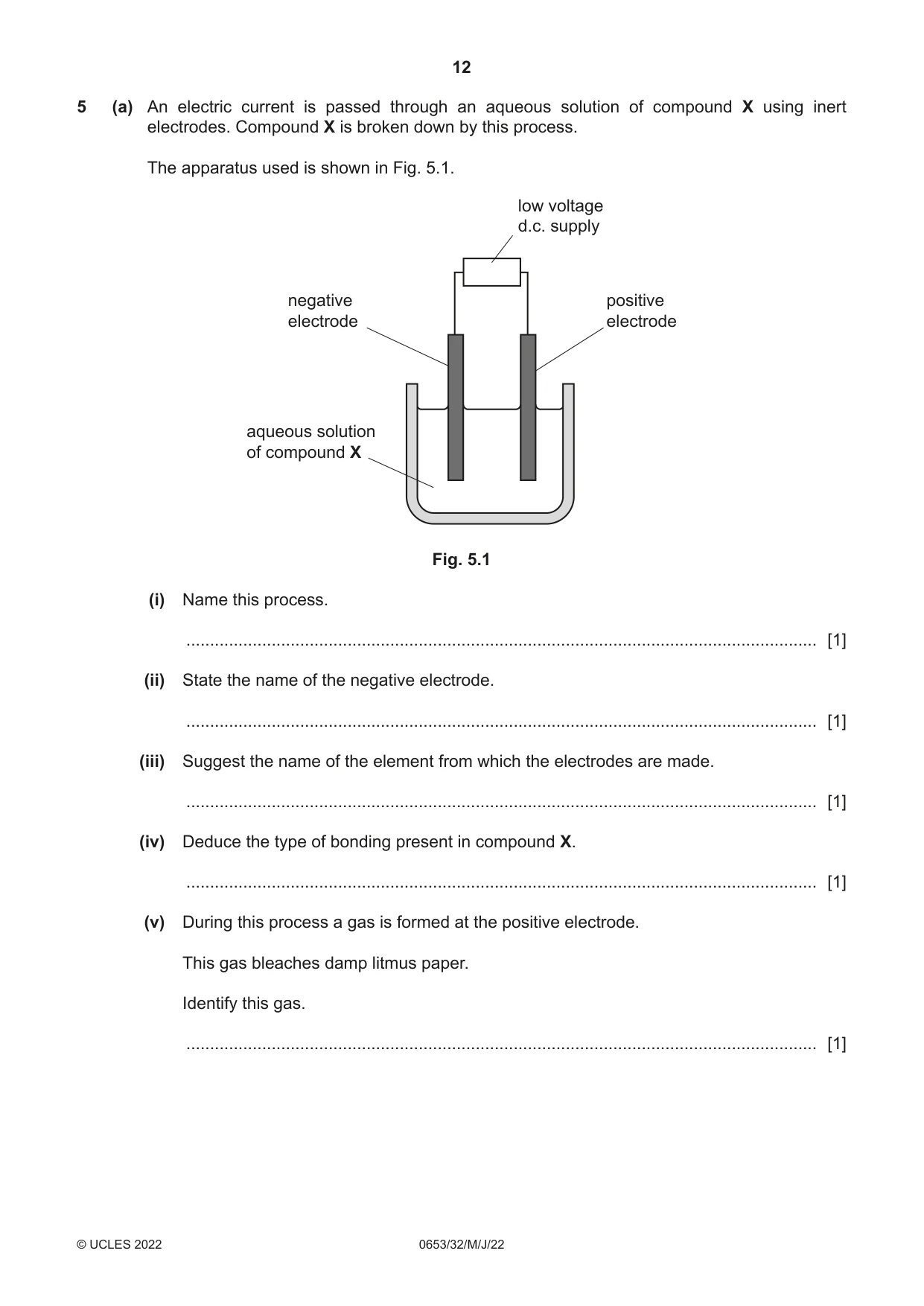
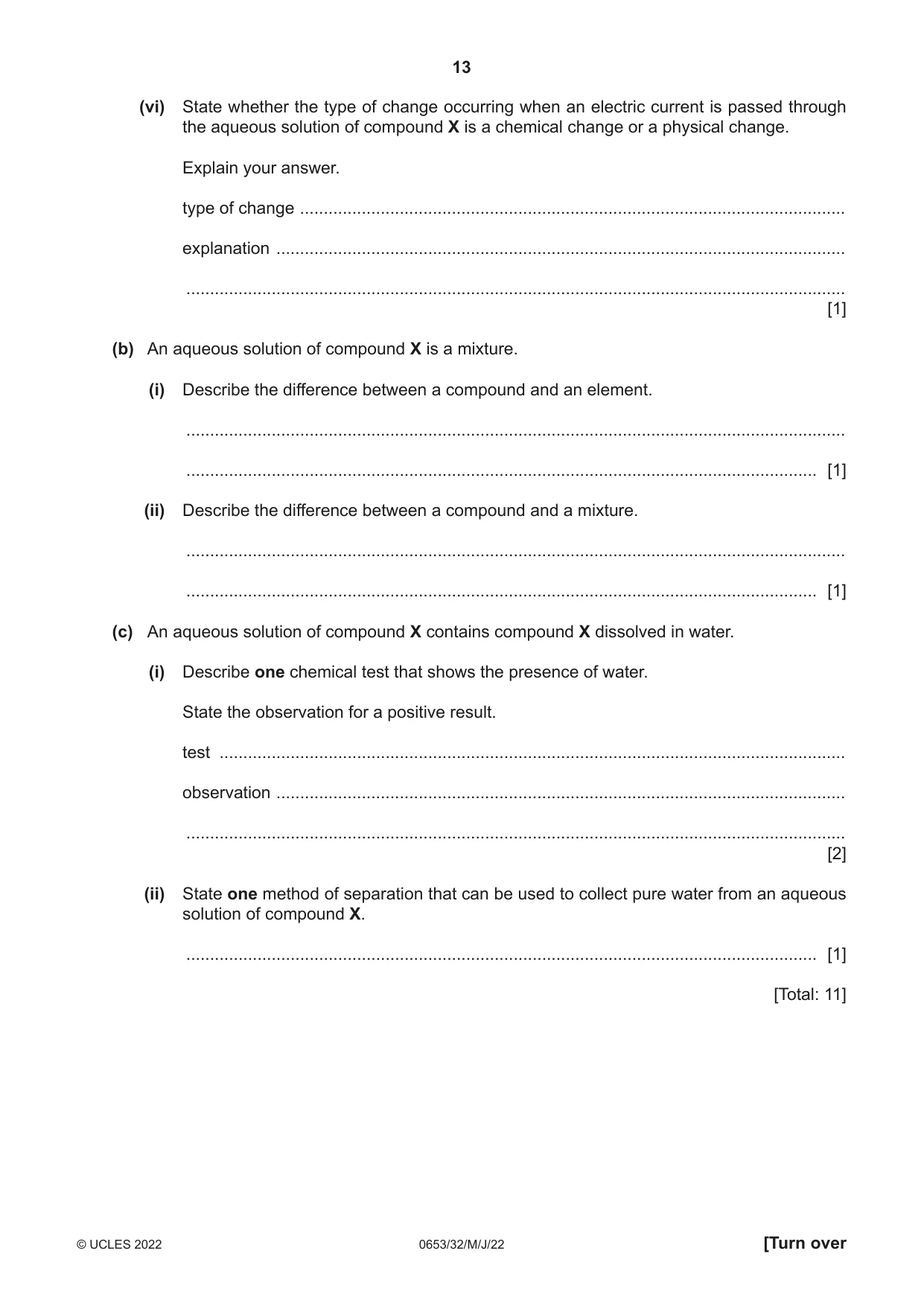
5 (a) An electric current is passed through an aqueous solution of compound X using inert electrodes. Compound X is broken down by this process. The apparatus used is shown in Fig. 5.1. low voltage d.c. supply negative positive electrode electrode aqueous solution of compound X Fig. 5.1 (i) Name this process. ..................................................................................................................................... [1] (ii) State the name of the negative electrode. ..................................................................................................................................... [1] (iii) Suggest the name of the element from which the electrodes are made. ..................................................................................................................................... [1] (iv) Deduce the type of bonding present in compound X. ..................................................................................................................................... [1] (v) During this process a gas is formed at the positive electrode. This gas bleaches damp litmus paper. Identify this gas. ..................................................................................................................................... [1] (vi) State whether the type of change occurring when an electric current is passed through the aqueous solution of compound X is a chemical change or a physical change. Explain your answer. type of change ................................................................................................................... explanation ........................................................................................................................ ........................................................................................................................................... [1] (b) An aqueous solution of compound X is a mixture. (i) Describe the difference between a compound and an element. ........................................................................................................................................... ..................................................................................................................................... [1] (ii) Describe the difference between a compound and a mixture. ........................................................................................................................................... ..................................................................................................................................... [1] (c) An aqueous solution of compound X contains compound X dissolved in water. (i) Describe one chemical test that shows the presence of water. State the observation for a positive result. test .................................................................................................................................... observation ........................................................................................................................ ........................................................................................................................................... [2] (ii) State one method of separation that can be used to collect pure water from an aqueous solution of compound X. ..................................................................................................................................... [1] [Total: 11]
Mark scheme: 5(a)(i) electrolysis ; 1 5(a)(ii) cathode ; 1 5(a)(iii) platinum / carbon ; 1 5(a)(iv) ionic ; 1 5(a)(v) chlorine / Cl2 ; 1 5(a)(vi) (type of change) chemical AND (explanation) new substances are made ; 1 5(b)(i) element has only one type of atom ; OR compound contains two or more different types of atoms chemically joined ; 1 5(b)(ii) compound is one substance only; OR mixture contains two (or more) substances which can be separated physically / not joined together ; 1 5(c)(i) (test) (anhydrous) copper(II) sulfate OR (anhydrous)cobalt(II) chloride ; (result) (white) goes blue OR (blue) goes pink ; 2 5(c)(ii) distillation ; 1
Q6 · A heat lamp used to keep newborn chicks warm
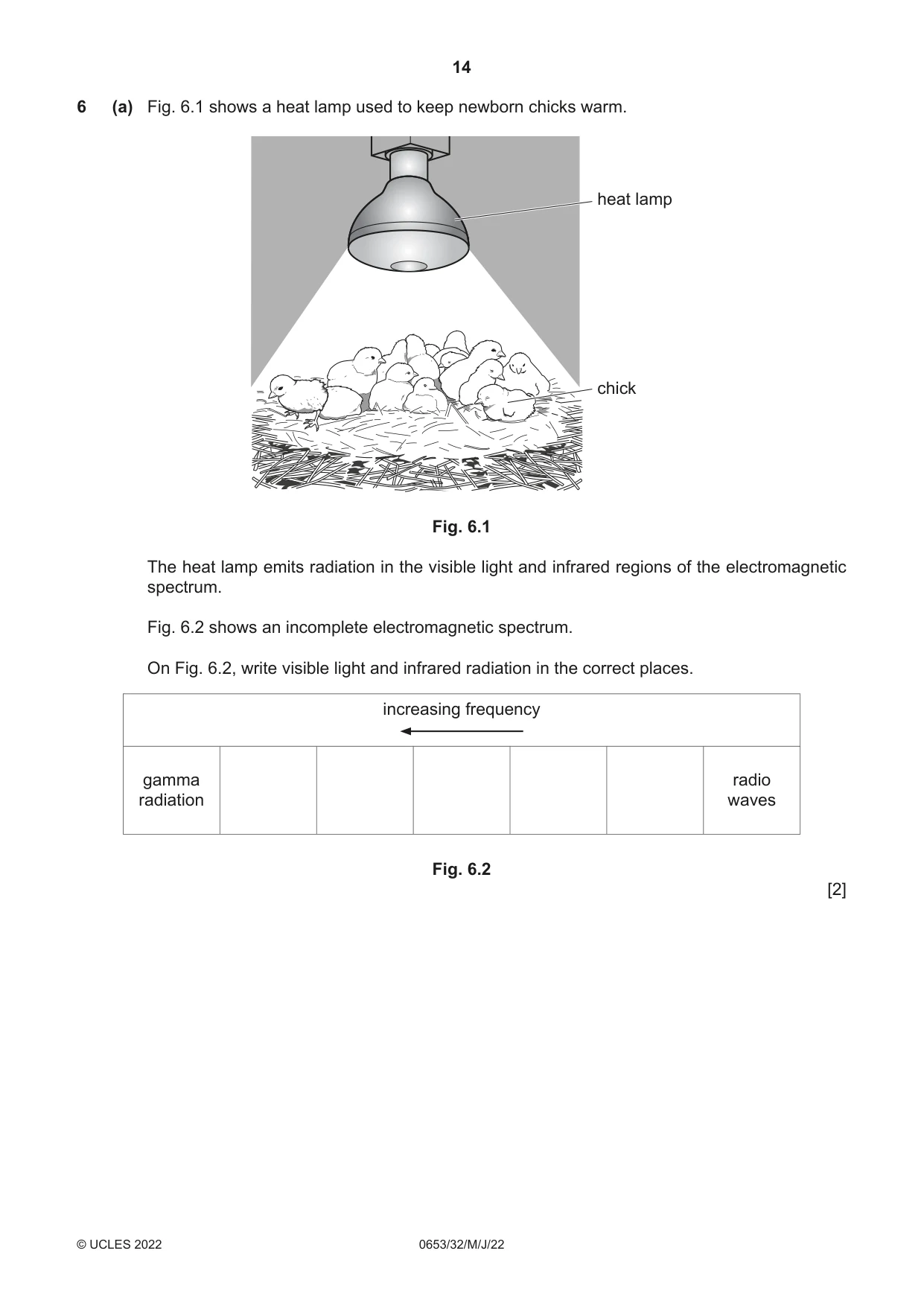
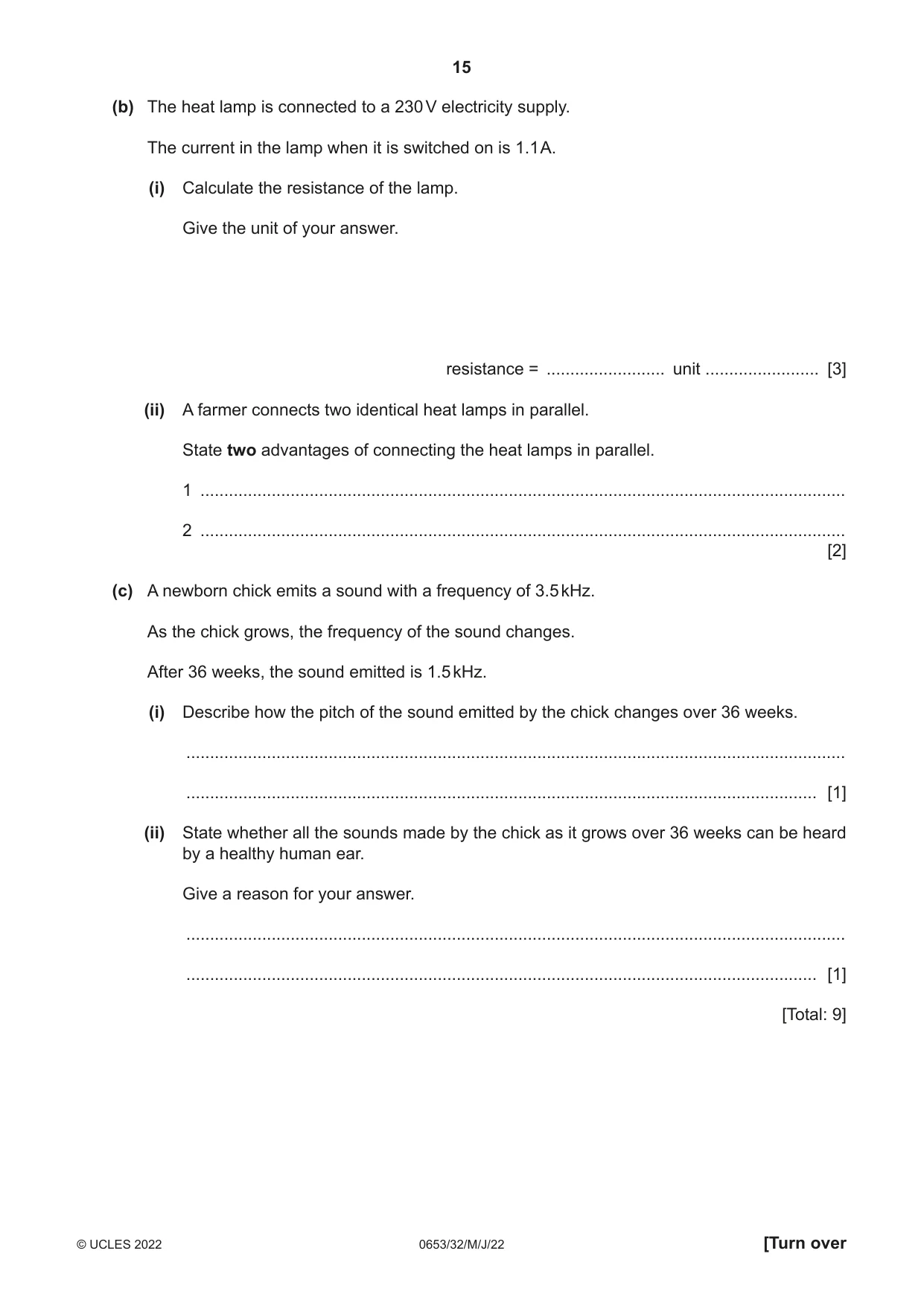
6 (a) Fig. 6.1 shows a heat lamp used to keep newborn chicks warm. heat lamp chick Fig. 6.1 The heat lamp emits radiation in the visible light and infrared regions of the electromagnetic spectrum. Fig. 6.2 shows an incomplete electromagnetic spectrum. On Fig. 6.2, write visible light and infrared radiation in the correct places. increasing frequency gamma radio radiation waves Fig. 6.2 [2] (b) The heat lamp is connected to a 230 V electricity supply. The current in the lamp when it is switched on is 1.1 A. (i) Calculate the resistance of the lamp. Give the unit of your answer. resistance = ......................... unit ........................ [3] (ii) A farmer connects two identical heat lamps in parallel. State two advantages of connecting the heat lamps in parallel. 1 ........................................................................................................................................ 2 ........................................................................................................................................ [2] (c) A newborn chick emits a sound with a frequency of 3.5 kHz. As the chick grows, the frequency of the sound changes. After 36 weeks, the sound emitted is 1.5 kHz. (i) Describe how the pitch of the sound emitted by the chick changes over 36 weeks. ........................................................................................................................................... ..................................................................................................................................... [1] (ii) State whether all the sounds made by the chick as it grows over 36 weeks can be heard by a healthy human ear. Give a reason for your answer. ........................................................................................................................................... ..................................................................................................................................... [1] [Total: 9]
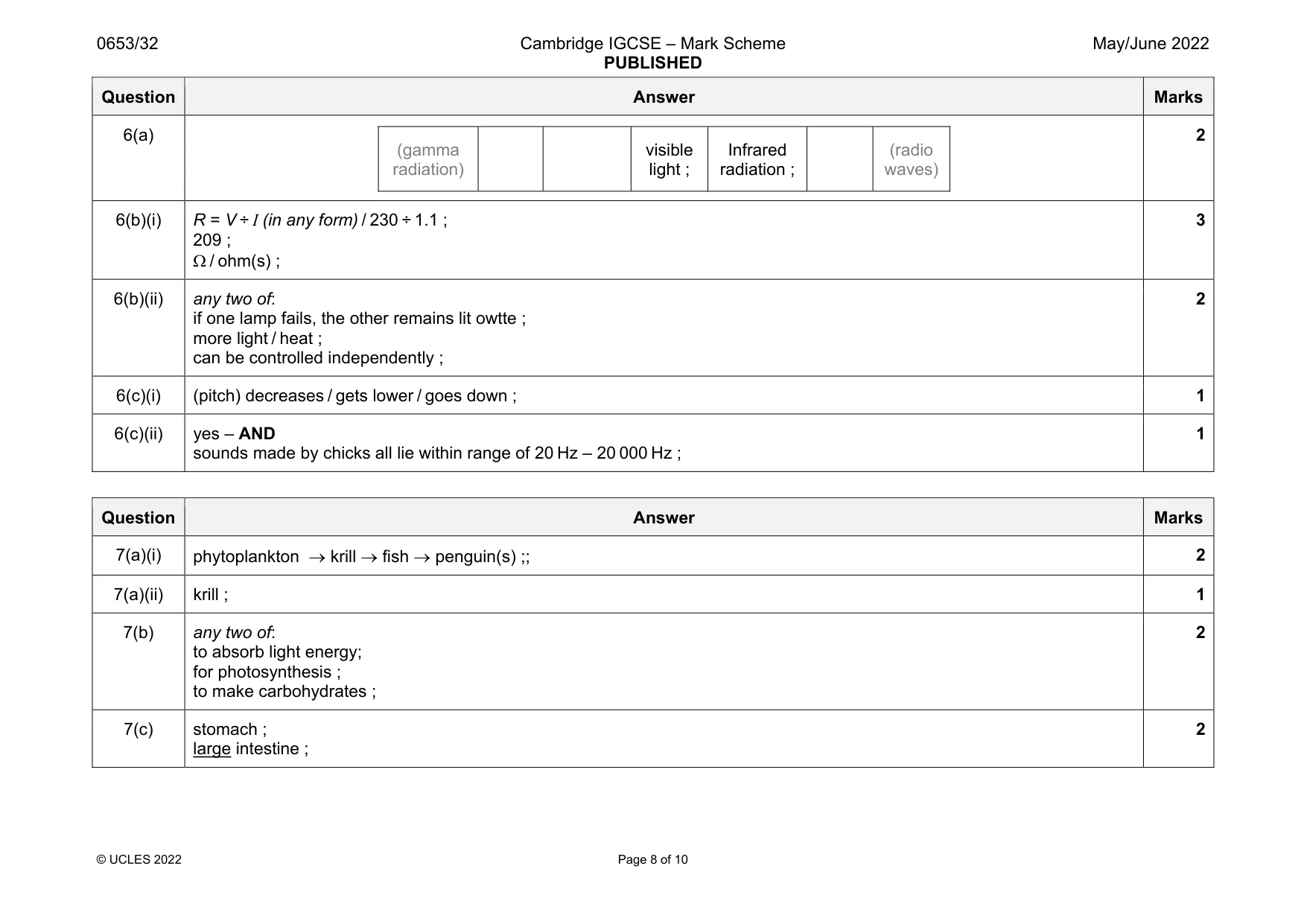
Mark scheme: 6(a) (gamma radiation) visible light ; Infrared radiation ; (radio waves) 2 6(b)(i) R = V ÷ I (in any form) / 230 ÷ 1.1 ; 209 ; / ohm(s) ; 3 6(b)(ii) any two of: if one lamp fails, the other remains lit owtte ; more light / heat ; can be controlled independently ; 2 6(c)(i) (pitch) decreases / gets lower / goes down ; 1 6(c)(ii) yes – AND sounds made by chicks all lie within range of 20 Hz – 20 000 Hz ; 1
Q7 · Information about four organisms living in an ocean habitat
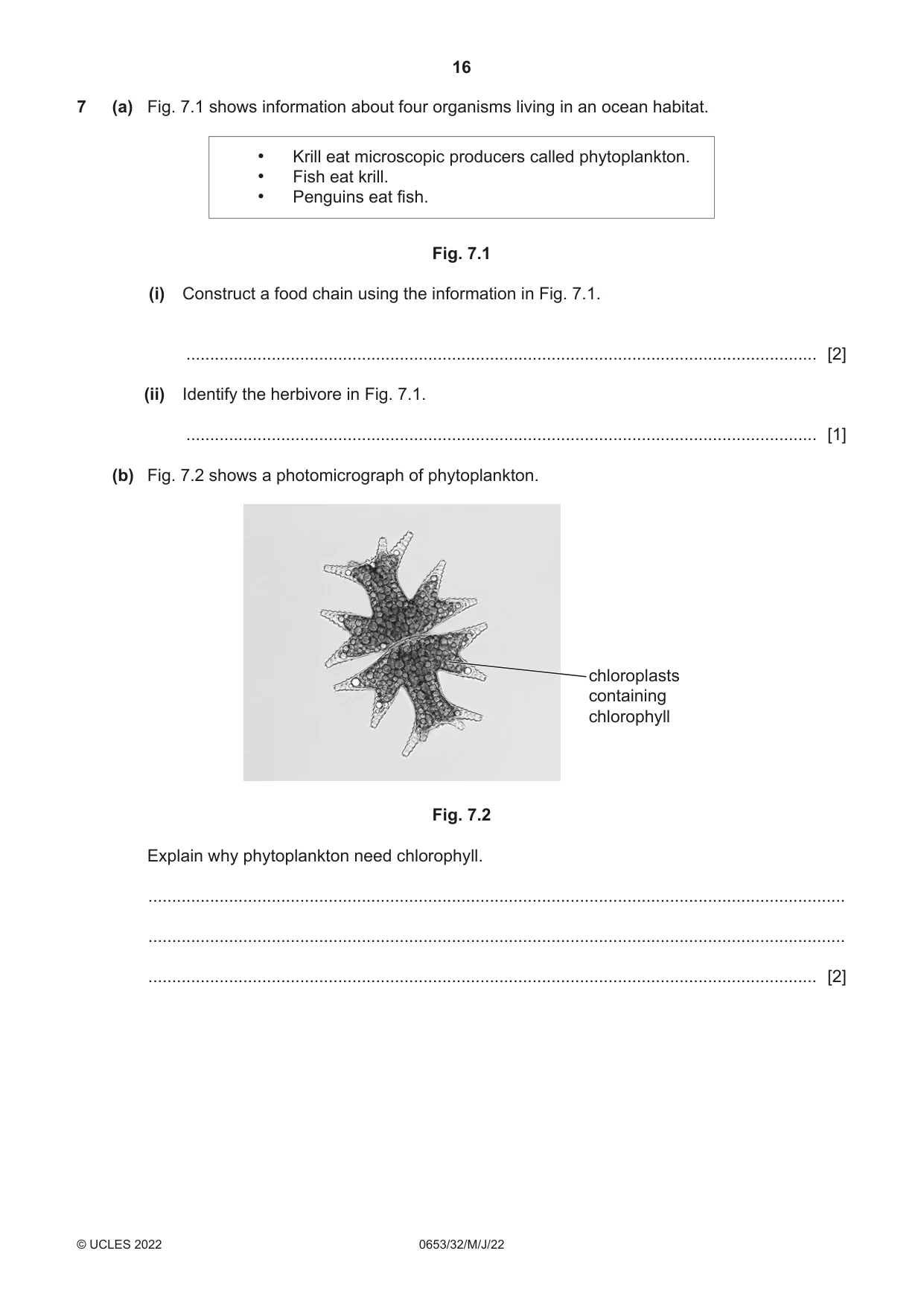
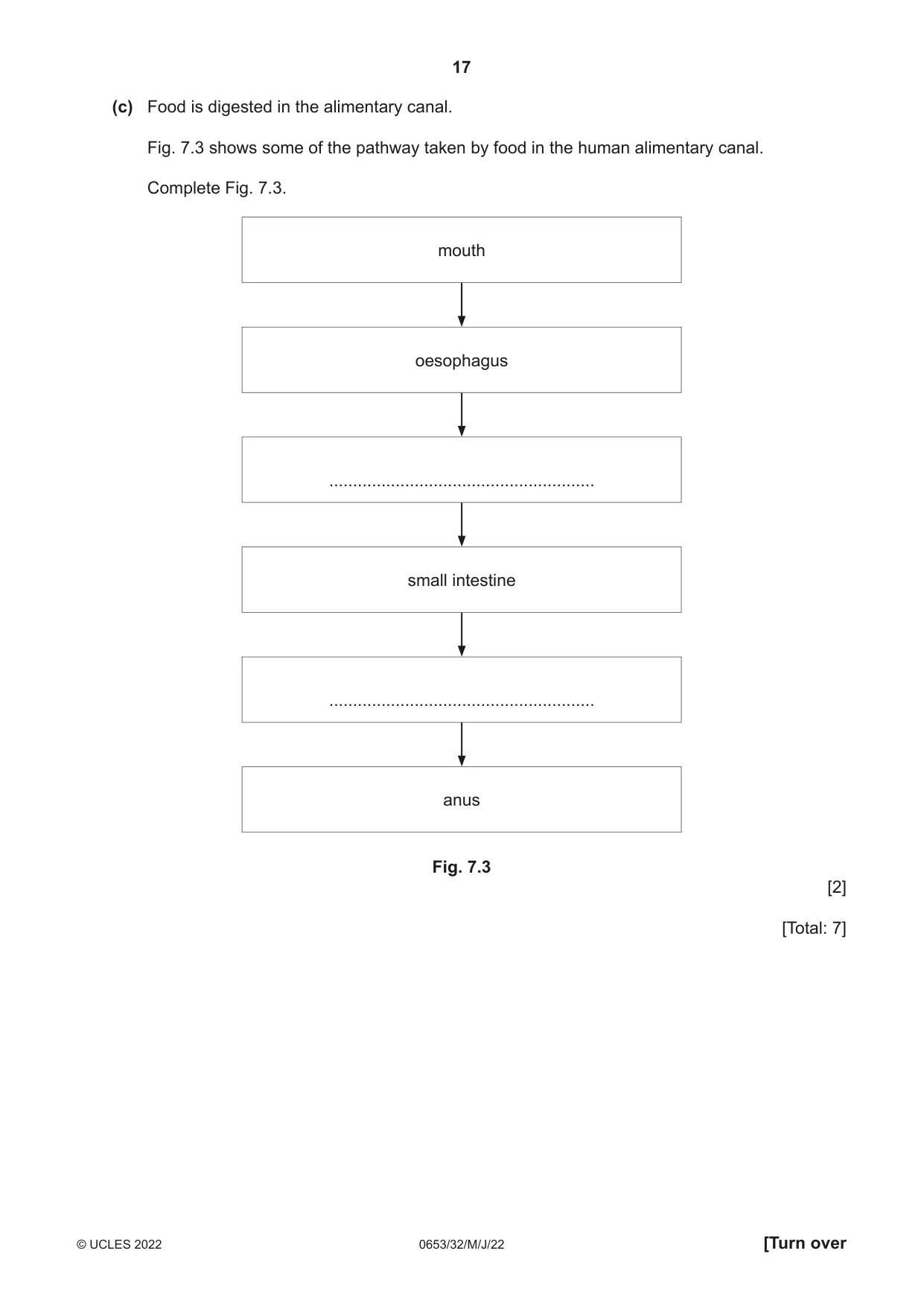
7 (a) Fig. 7.1 shows information about four organisms living in an ocean habitat. • Krill eat microscopic producers called phytoplankton. • Fish eat krill. • Penguins eat fish. Fig. 7.1 (i) Construct a food chain using the information in Fig. 7.1. ..................................................................................................................................... [2] (ii) Identify the herbivore in Fig. 7.1. ..................................................................................................................................... [1] (b) Fig. 7.2 shows a photomicrograph of phytoplankton. chloroplasts containing chlorophyll Fig. 7.2 Explain why phytoplankton need chlorophyll. ................................................................................................................................................... ................................................................................................................................................... ............................................................................................................................................. [2] (c) Food is digested in the alimentary canal. Fig. 7.3 shows some of the pathway taken by food in the human alimentary canal. Complete Fig. 7.3. mouth oesophagus ........................................................ small intestine ........................................................ anus Fig. 7.3 [2] [Total: 7]
Mark scheme: 7(a)(i) 2 7(a)(ii) krill ; 1 7(b) any two of: to absorb light energy; for photosynthesis ; to make carbohydrates ; 2 7(c) stomach ; large intestine ; 2
Q8 · The molecular structures and names of three compounds are shown in Fig
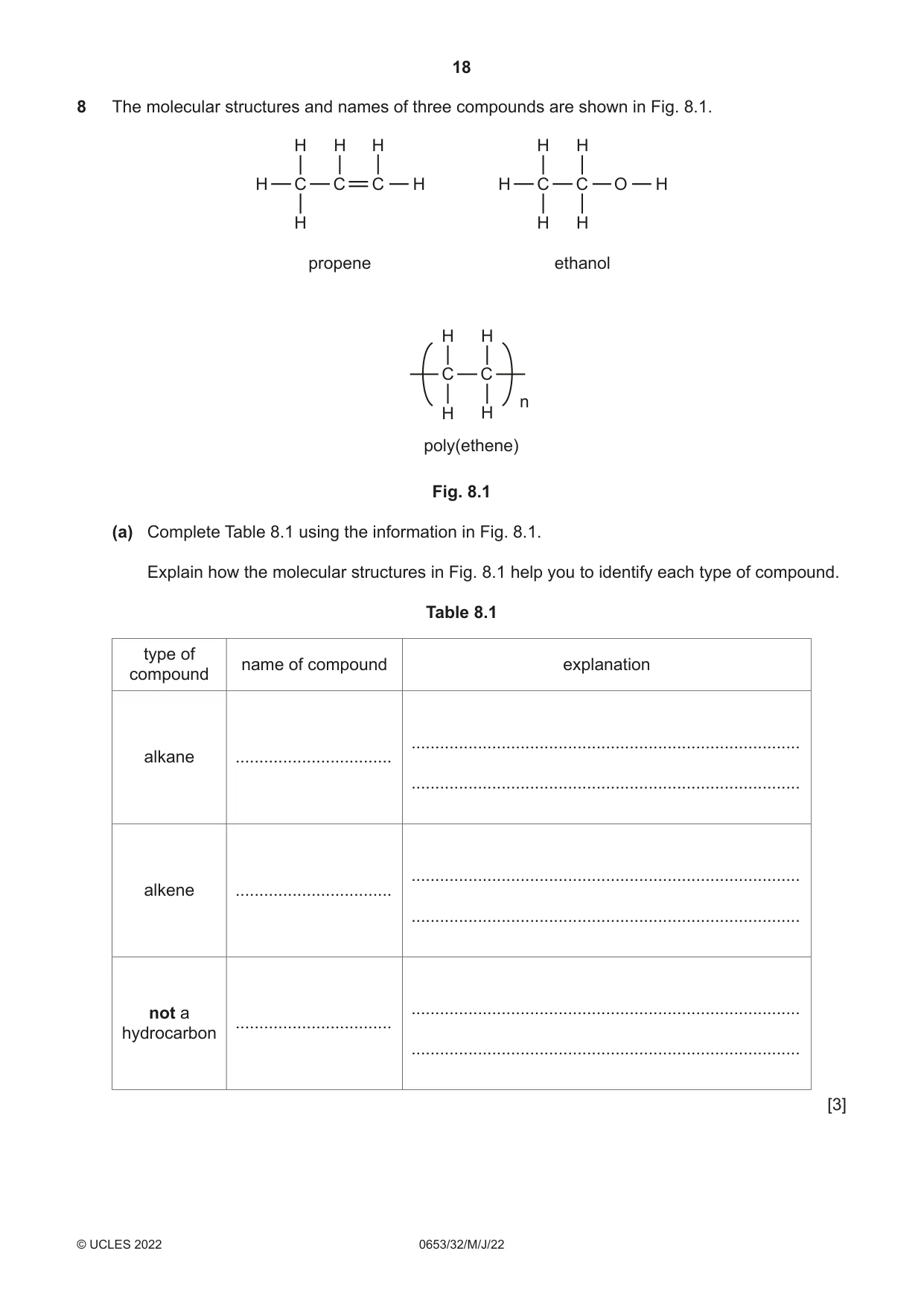
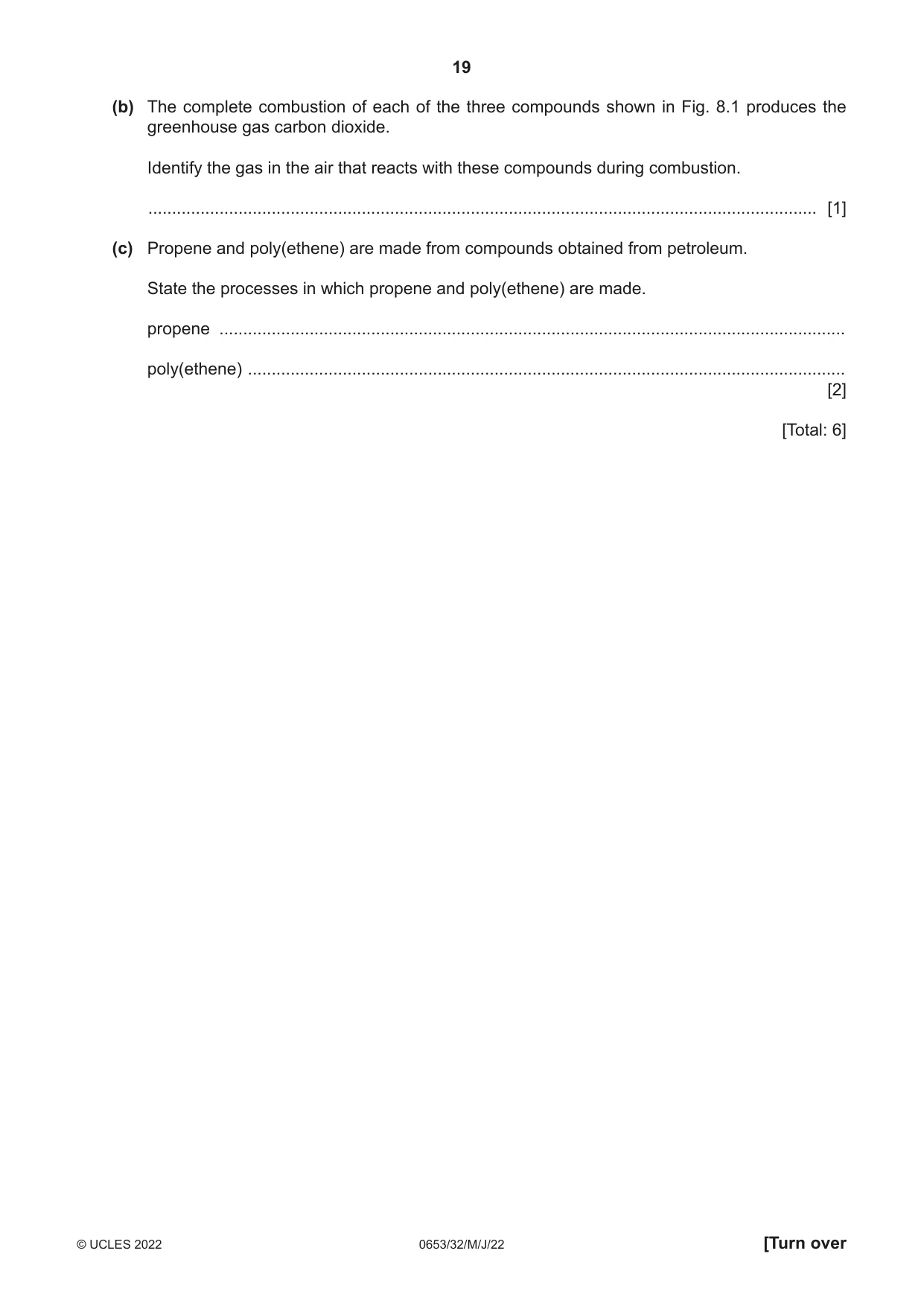
8 The molecular structures and names of three compounds are shown in Fig. 8.1. H H H H H H C C C H H C C O H H H H propene ethanol H H C C n H H poly(ethene) Fig. 8.1 (a) Complete Table 8.1 using the information in Fig. 8.1. Explain how the molecular structures in Fig. 8.1 help you to identify each type of compound. Table 8.1 type of name of compound explanation compound .................................................................................. alkane ................................. .................................................................................. .................................................................................. alkene ................................. .................................................................................. not a .................................................................................. ................................. hydrocarbon .................................................................................. [3] (b) The complete combustion of each of the three compounds shown in Fig. 8.1 produces the greenhouse gas carbon dioxide. Identify the gas in the air that reacts with these compounds during combustion. ............................................................................................................................................. [1] (c) Propene and poly(ethene) are made from compounds obtained from petroleum. State the processes in which propene and poly(ethene) are made. propene .................................................................................................................................... poly(ethene) .............................................................................................................................. [2] [Total: 6]
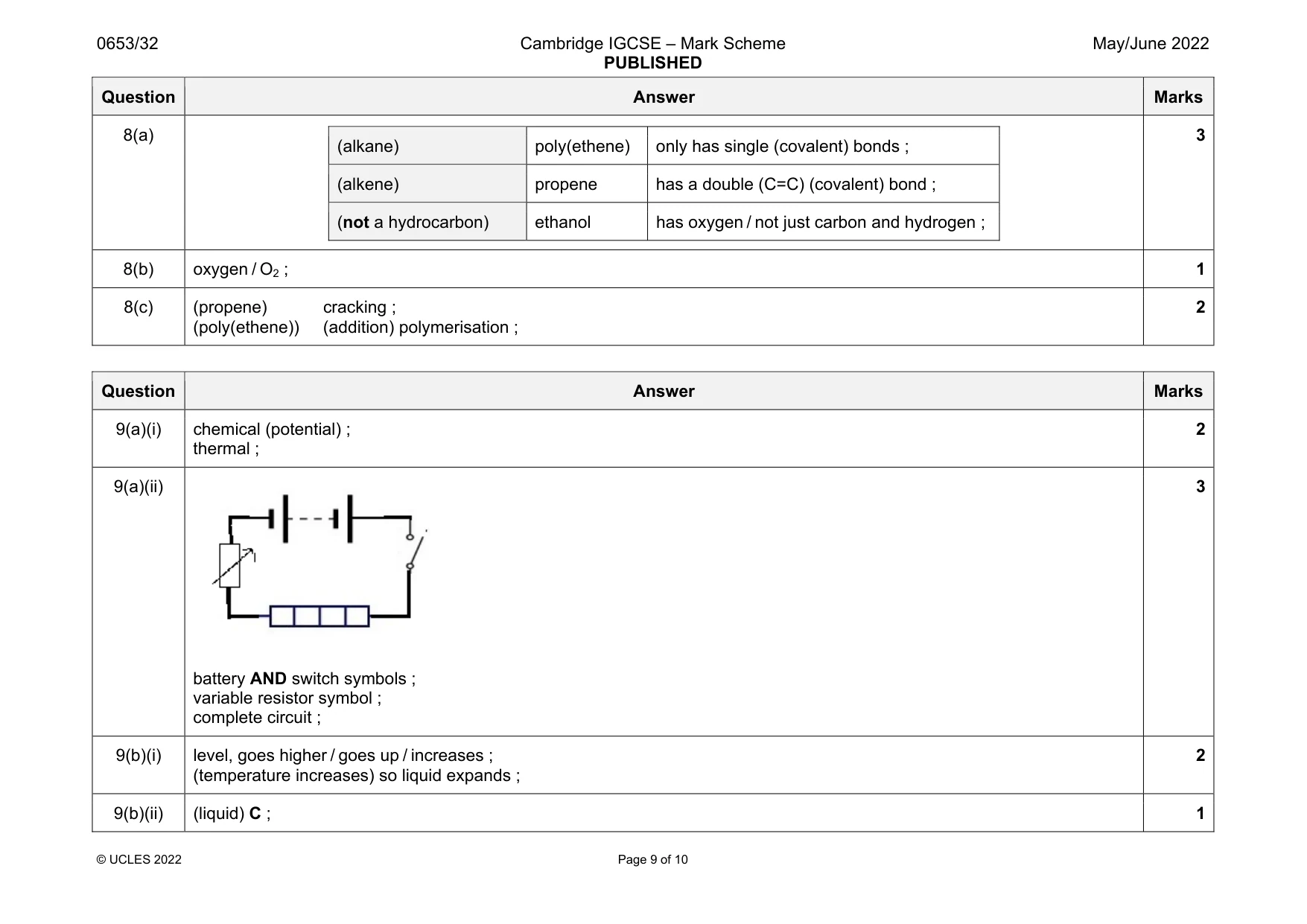
Mark scheme: 8(a) (alkane) poly(ethene) only has single (covalent) bonds ; (alkene) propene has a double (C=C) (covalent) bond ; (not a hydrocarbon) ethanol has oxygen / not just carbon and hydrogen ; 3 8(b) oxygen / O2 ; 1 8(c) (propene) cracking ; (poly(ethene)) (addition) polymerisation ; 2
Q9 · Some water is heated in a beaker using an electric heater
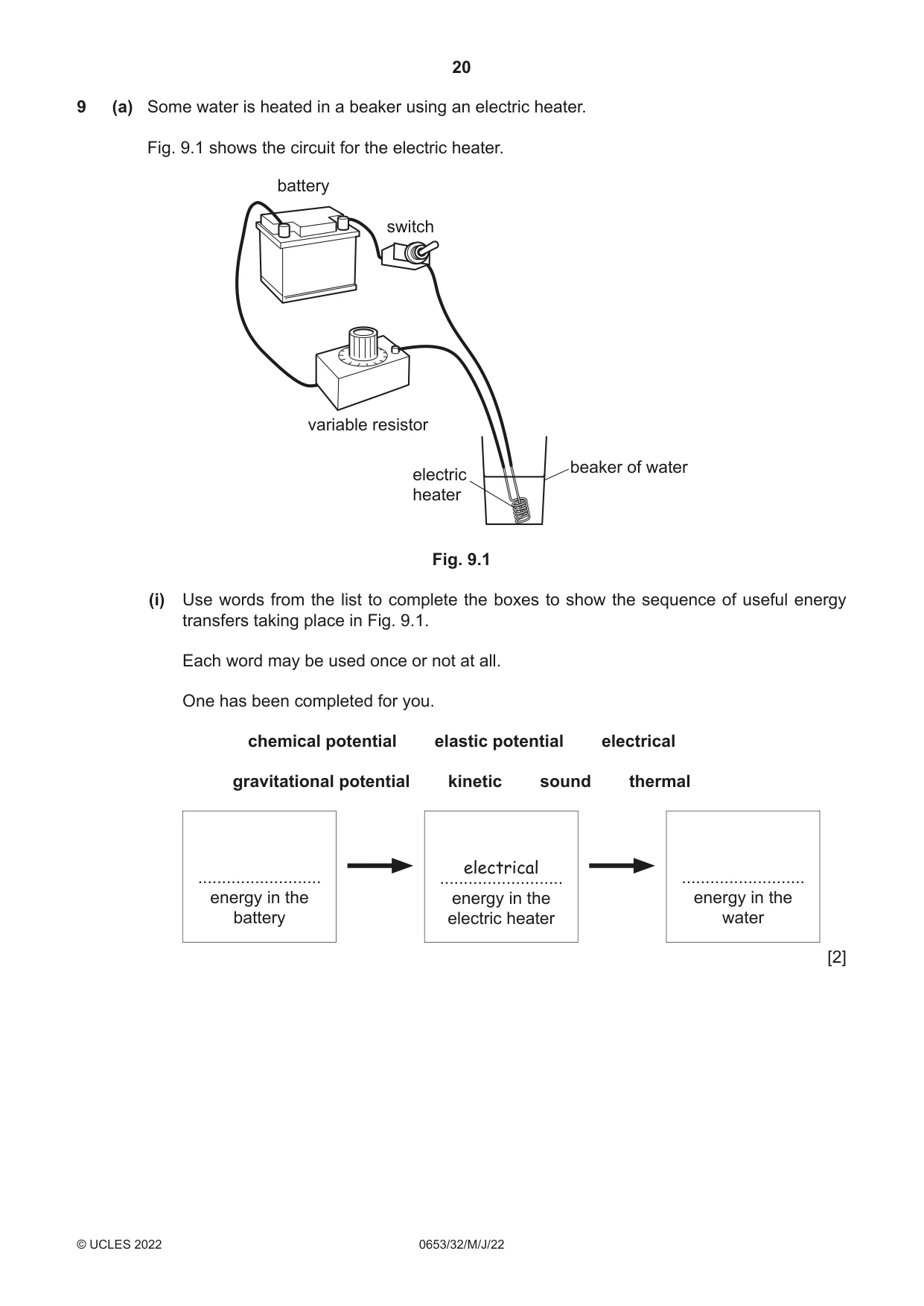
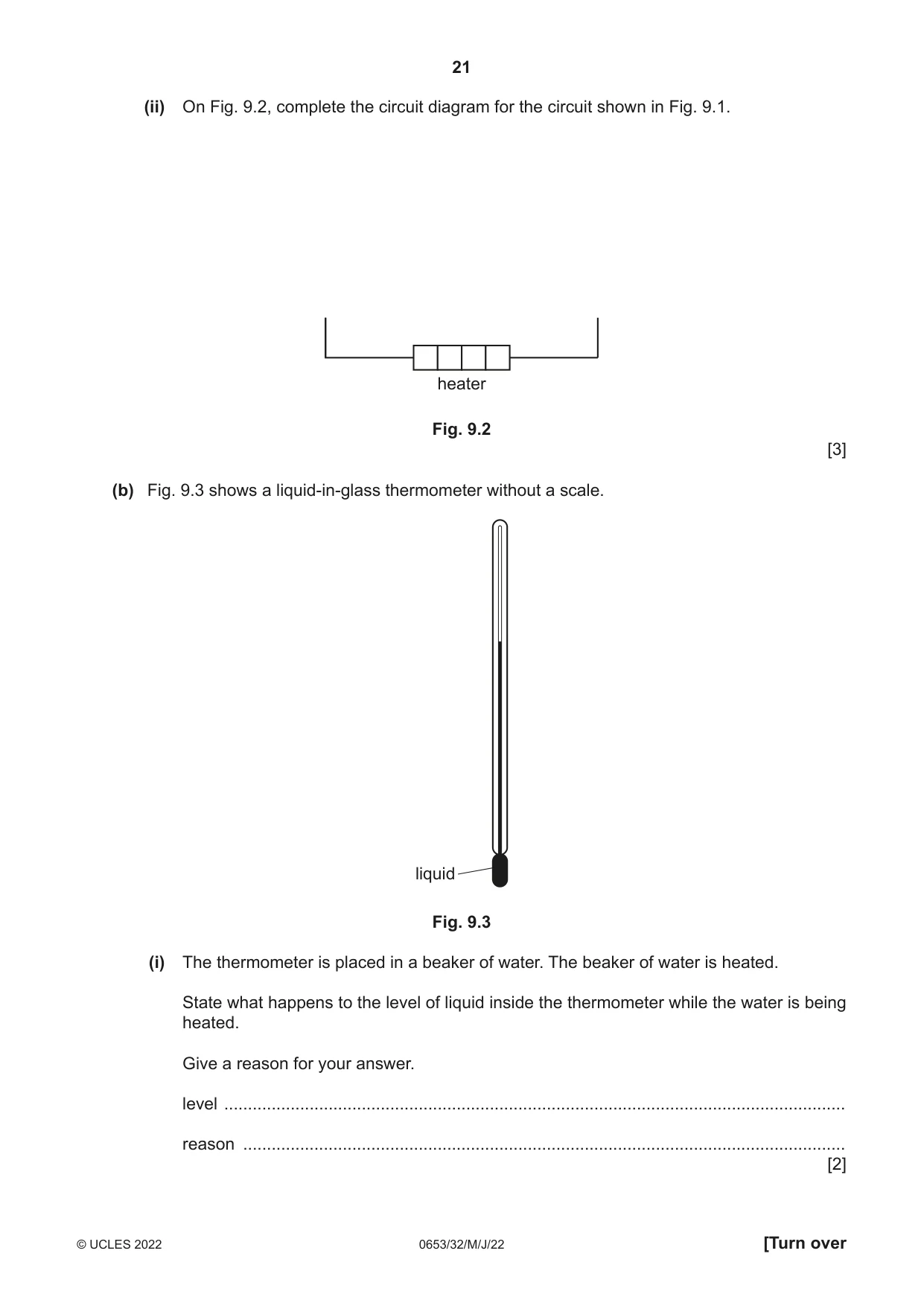
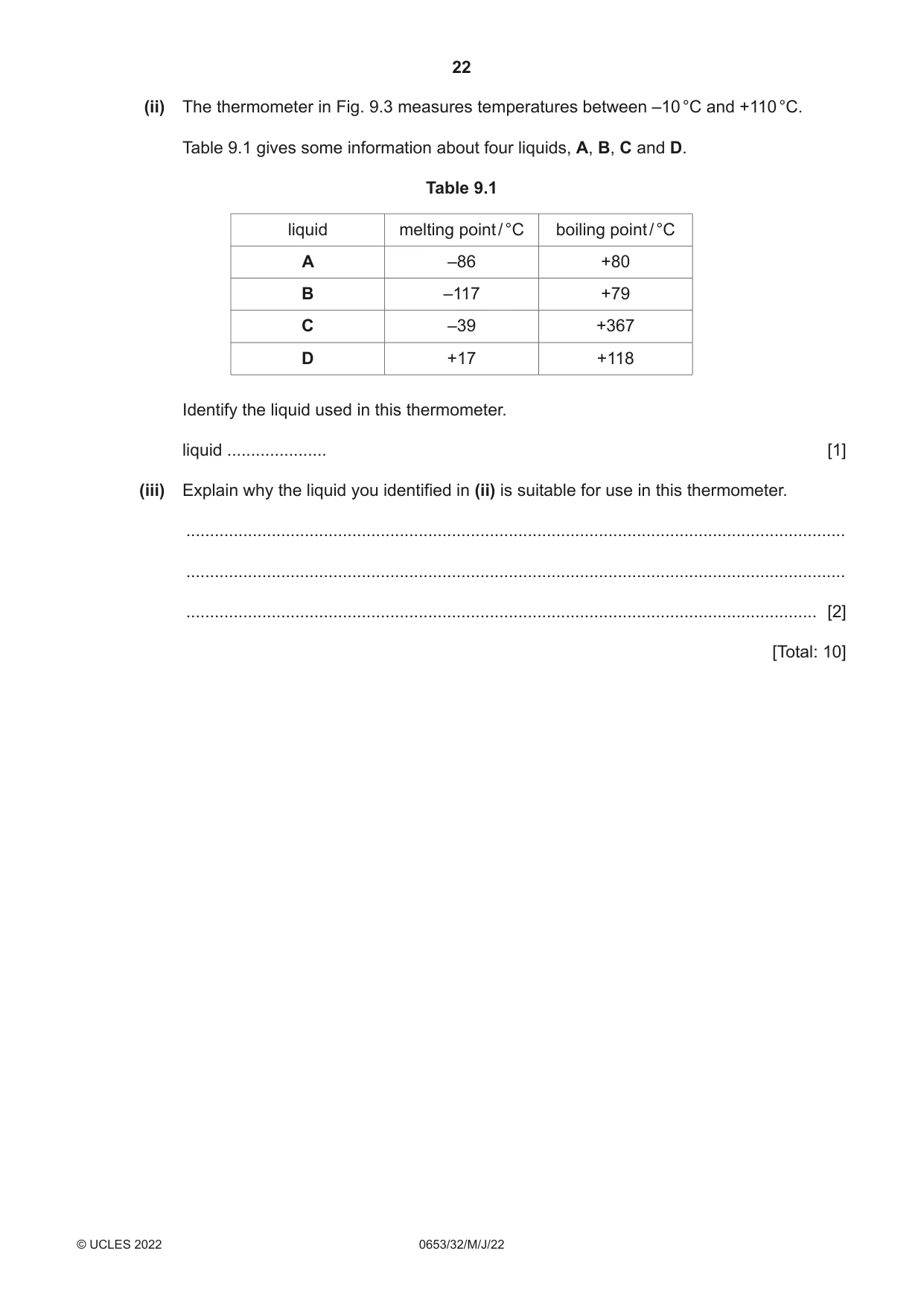
9 (a) Some water is heated in a beaker using an electric heater. Fig. 9.1 shows the circuit for the electric heater. battery switch variable resistor beaker of water electric heater Fig. 9.1 (i) Use words from the list to complete the boxes to show the sequence of useful energy transfers taking place in Fig. 9.1. Each word may be used once or not at all. One has been completed for you. chemical potential elastic potential electrical gravitational potential kinetic sound thermal electrical .......................... .......................... .......................... energy in the energy in the energy in the battery electric heater water [2] (ii) On Fig. 9.2, complete the circuit diagram for the circuit shown in Fig. 9.1. heater Fig. 9.2 [3] (b) Fig. 9.3 shows a liquid-in-glass thermometer without a scale. liquid Fig. 9.3 (i) The thermometer is placed in a beaker of water. The beaker of water is heated. State what happens to the level of liquid inside the thermometer while the water is being heated. Give a reason for your answer. level ................................................................................................................................... reason ............................................................................................................................... [2] (ii) The thermometer in Fig. 9.3 measures temperatures between –10 °C and +110 °C. Table 9.1 gives some information about four liquids, A, B, C and D. Table 9.1 liquid melting point / °C boiling point / °C A –86 +80 B –117 +79 C –39 +367 D +17 +118 Identify the liquid used in this thermometer. liquid ..................... [1] (iii) Explain why the liquid you identified in (ii) is suitable for use in this thermometer. ........................................................................................................................................... ........................................................................................................................................... ..................................................................................................................................... [2] [Total: 10]
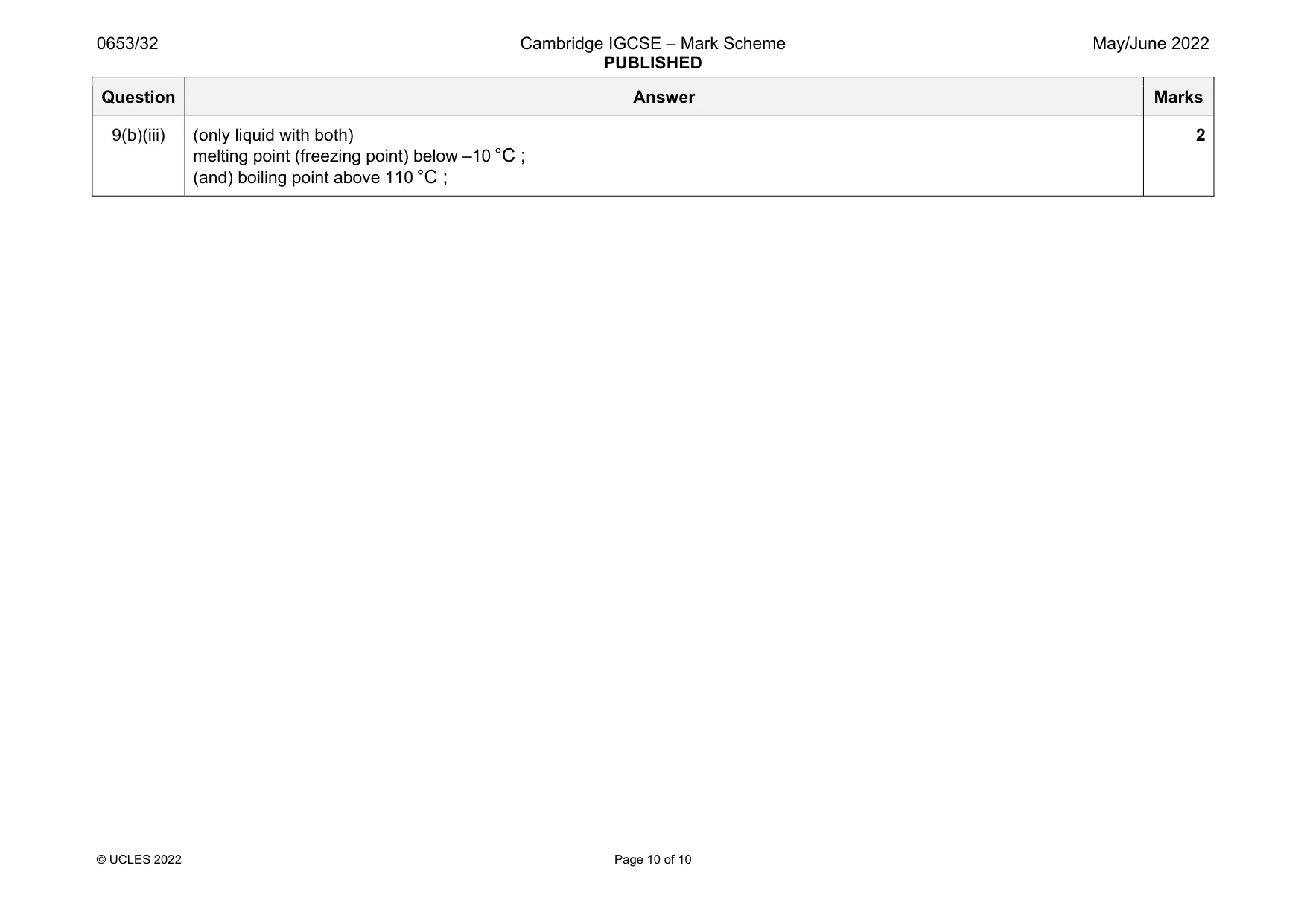
Mark scheme: 9(a)(i) chemical (potential) ; thermal ; 2 9(a)(ii) battery AND switch symbols ; variable resistor symbol ; complete circuit ; 3 9(b)(i) level, goes higher / goes up / increases ; (temperature increases) so liquid expands ; 2 9(b)(ii) (liquid) C ; 1 Question Answer Marks 9(b)(iii) (only liquid with both) melting point (freezing point) below –10 °C ; (and) boiling point above 110 °C ; 2
What was in this paper
The subtopics covered by these 9 questions, and how many questions each got. Open one in a new tab to see every Cambridge question on it.
What you needed in this session
Cambridge’s own grade thresholds for 2022 May/June, Paper 3 · Variant 2. A higher threshold means an easier paper — the bar moves with how the cohort did.