Cambridge IGCSE Science - Combined 0653 — 2025 Feb/March Paper 3 · Variant 2
0653/32/F/M/25 · 9 questions · 80 marks · 75 min
The question paper and its mark scheme, free to read here and free to download. This is Cambridge’s own paper, exactly as it was sat.
Question paper20 pages

Mark scheme12 pages
Answers below. Sit the paper first if you are practising.
Questions as text
Q1 · The main organs of the digestive system
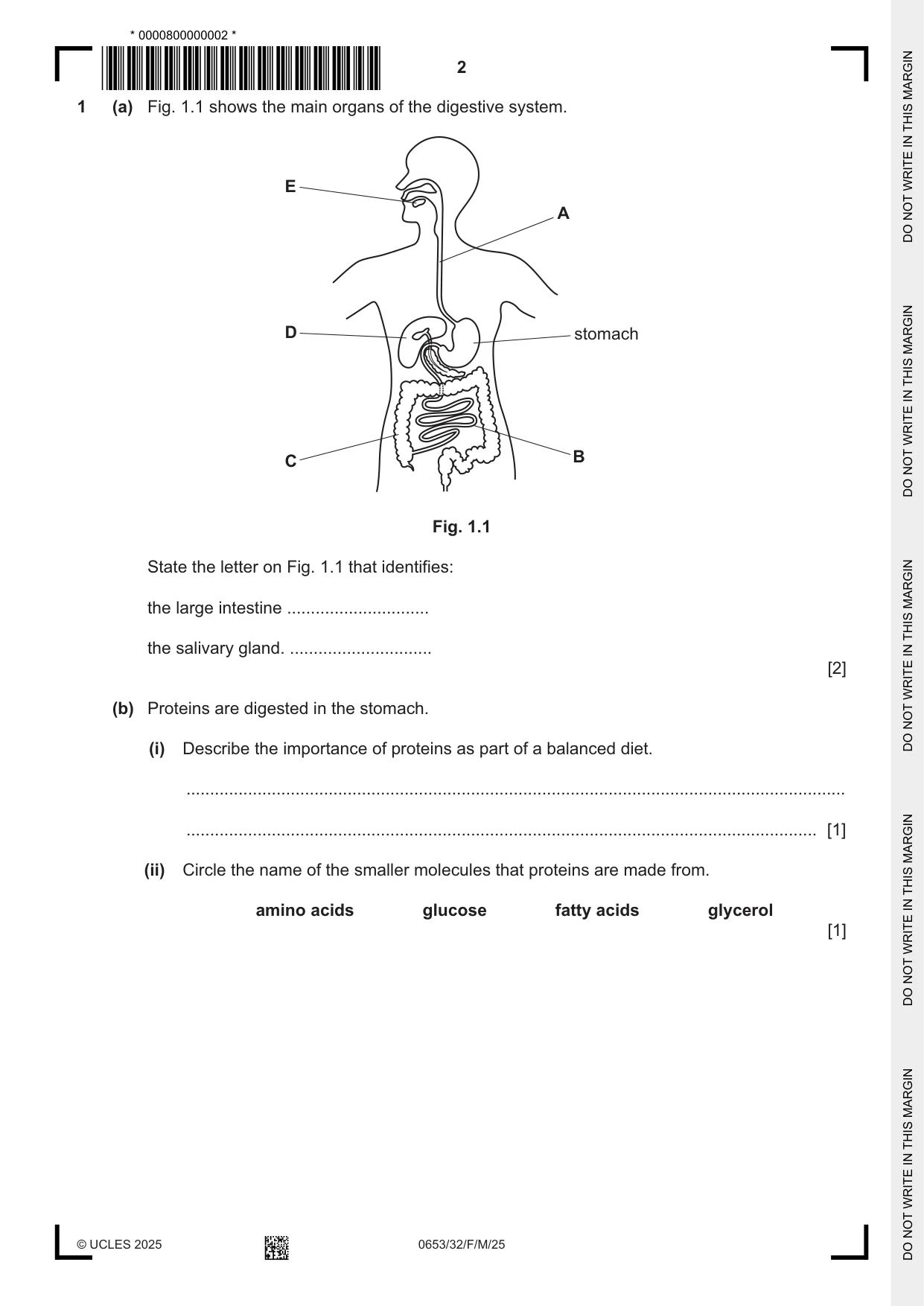
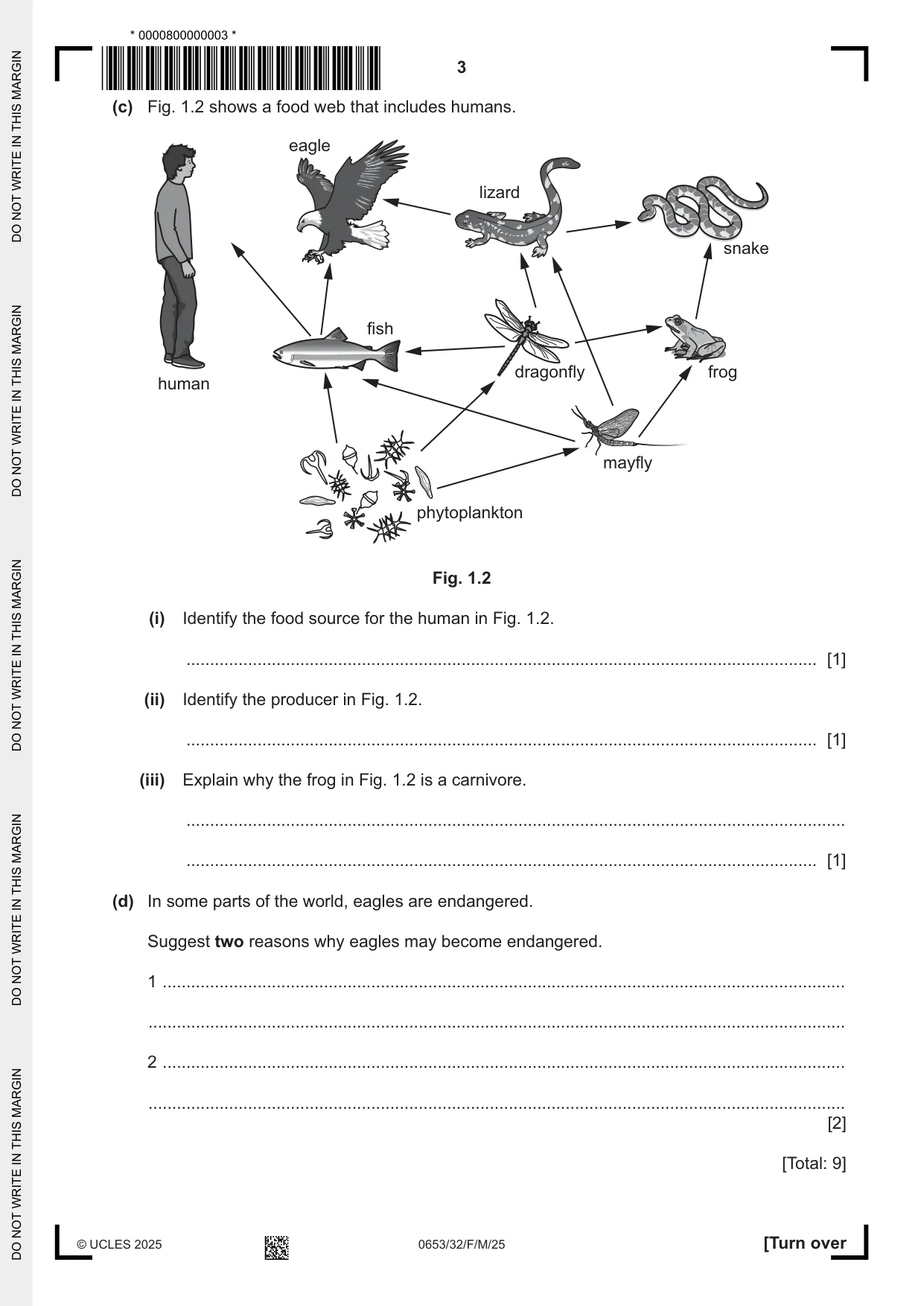
1 (a) Fig. 1.1 shows the main organs of the digestive system. E A D stomach C B Fig. 1.1 State the letter on Fig. 1.1 that identifies: the large intestine .............................. the salivary gland. .............................. [2] (b) Proteins are digested in the stomach. (i) Describe the importance of proteins as part of a balanced diet. ........................................................................................................................................... ..................................................................................................................................... [1] (ii) Circle the name of the smaller molecules that proteins are made from. amino acids glucose fatty acids glycerol [1] (c) Fig. 1.2 shows a food web that includes humans. eagle lizard snake fish dragonfly frog human mayfly phytoplankton Fig. 1.2 (i) Identify the food source for the human in Fig. 1.2. ..................................................................................................................................... [1] (ii) Identify the producer in Fig. 1.2. ..................................................................................................................................... [1] (iii) Explain why the frog in Fig. 1.2 is a carnivore. ........................................................................................................................................... ..................................................................................................................................... [1] (d) In some parts of the world, eagles are endangered. Suggest two reasons why eagles may become endangered. 1 ................................................................................................................................................ ................................................................................................................................................... 2 ................................................................................................................................................ ................................................................................................................................................... [2] [Total: 9]
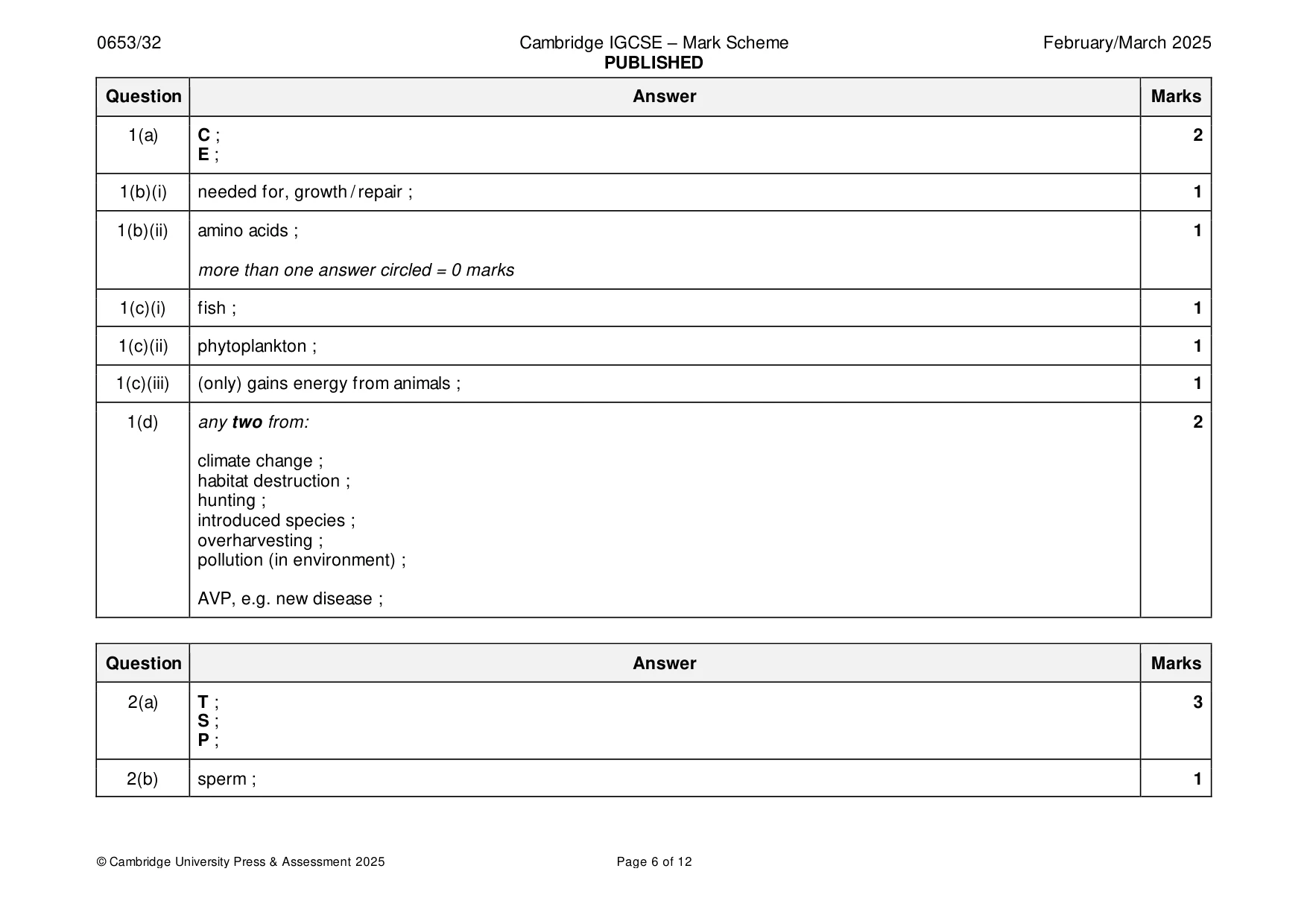
Mark scheme: Question Answer Marks 1(a) C ; 2 E ; 1(b)(i) needed for, growth / repair ; 1 1(b)(ii) amino acids ; 1 more than one answer circled = 0 marks 1(c)(i) fish ; 1 1(c)(ii) phytoplankton ; 1 1(c)(iii) (only) gains energy from animals ; 1 1(d) any two from: 2 climate change ; habitat destruction ; hunting ; introduced species ; overharvesting ; pollution (in environment) ; AVP, e.g. new disease ;
Q2 · The structure of an insect-pollinated flower
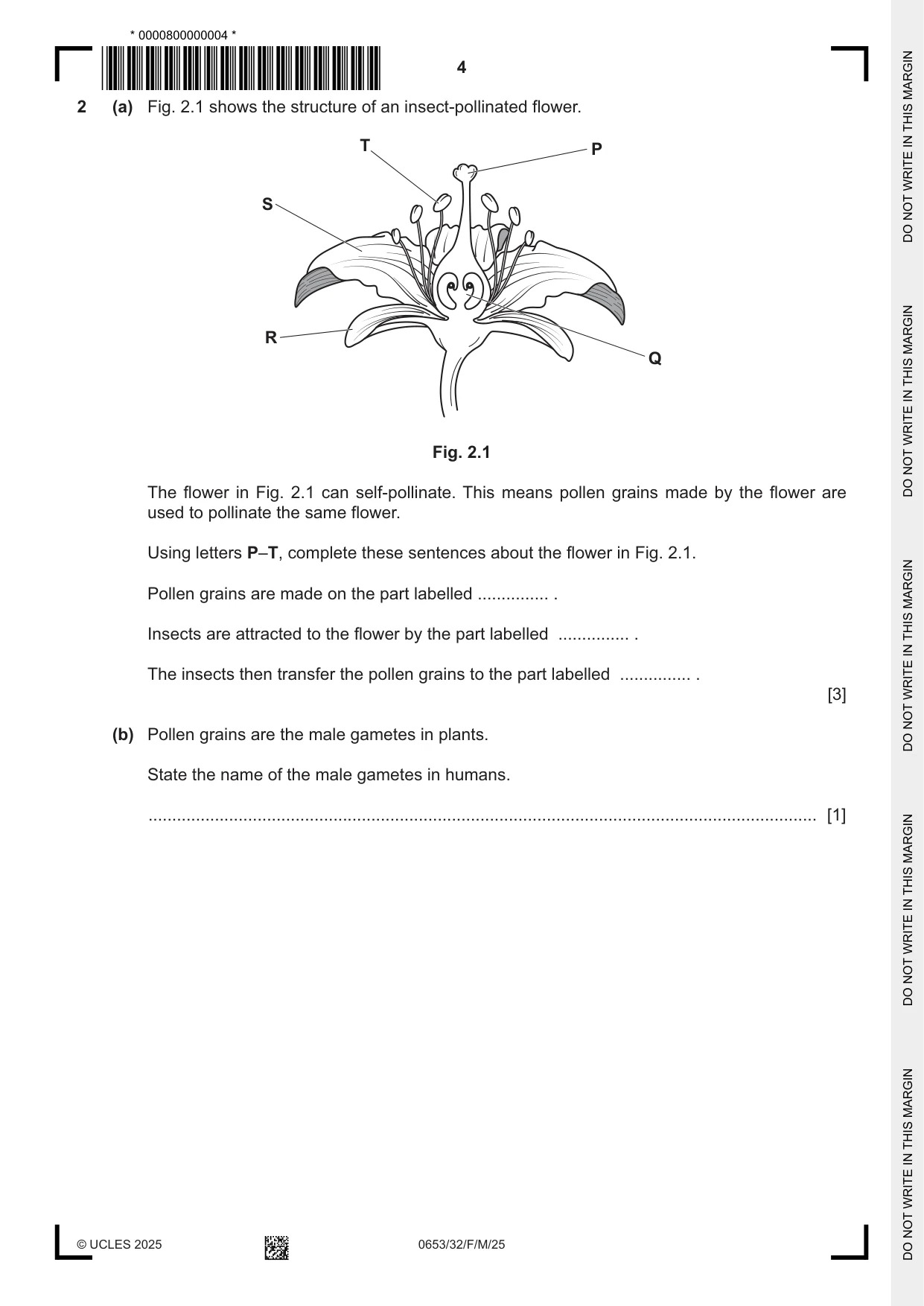
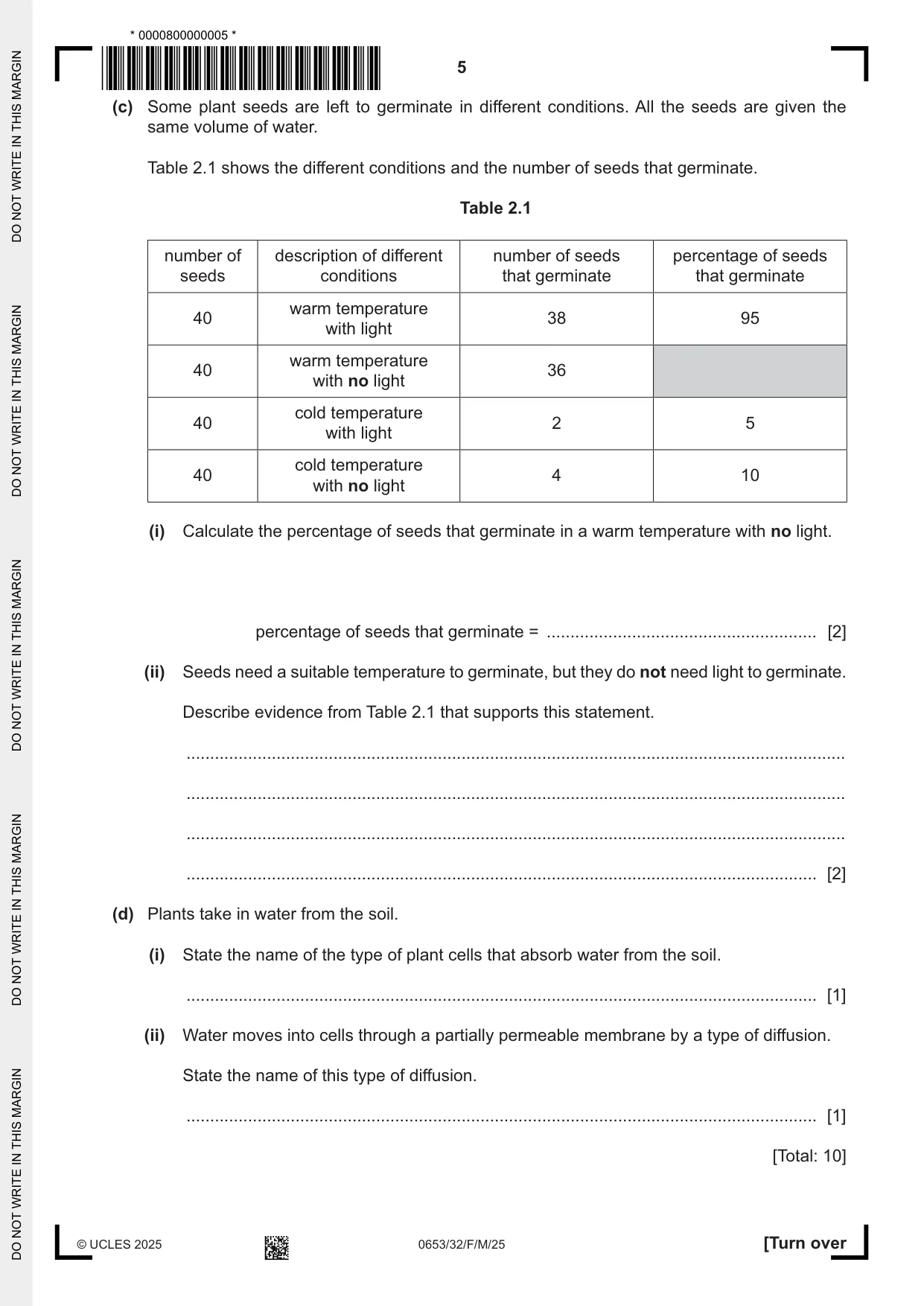
2 (a) Fig. 2.1 shows the structure of an insect-pollinated flower. T P S R Q Fig. 2.1 The flower in Fig. 2.1 can self-pollinate. This means pollen grains made by the flower are used to pollinate the same flower. Using letters P–T, complete these sentences about the flower in Fig. 2.1. Pollen grains are made on the part labelled ............... . Insects are attracted to the flower by the part labelled ............... . The insects then transfer the pollen grains to the part labelled ............... . [3] (b) Pollen grains are the male gametes in plants. State the name of the male gametes in humans. ............................................................................................................................................. [1] (c) Some plant seeds are left to germinate in different conditions. All the seeds are given the same volume of water. Table 2.1 shows the different conditions and the number of seeds that germinate. Table 2.1 number of description of different number of seeds percentage of seeds seeds conditions that germinate that germinate warm temperature 40 38 95 with light warm temperature 40 36 with no light cold temperature 40 2 5 with light cold temperature 40 4 10 with no light (i) Calculate the percentage of seeds that germinate in a warm temperature with no light. percentage of seeds that germinate = ......................................................... [2] (ii) Seeds need a suitable temperature to germinate, but they do not need light to germinate. Describe evidence from Table 2.1 that supports this statement. ........................................................................................................................................... ........................................................................................................................................... ........................................................................................................................................... ..................................................................................................................................... [2] (d) Plants take in water from the soil. (i) State the name of the type of plant cells that absorb water from the soil. ..................................................................................................................................... [1] (ii) Water moves into cells through a partially permeable membrane by a type of diffusion. State the name of this type of diffusion. ..................................................................................................................................... [1] [Total: 10]
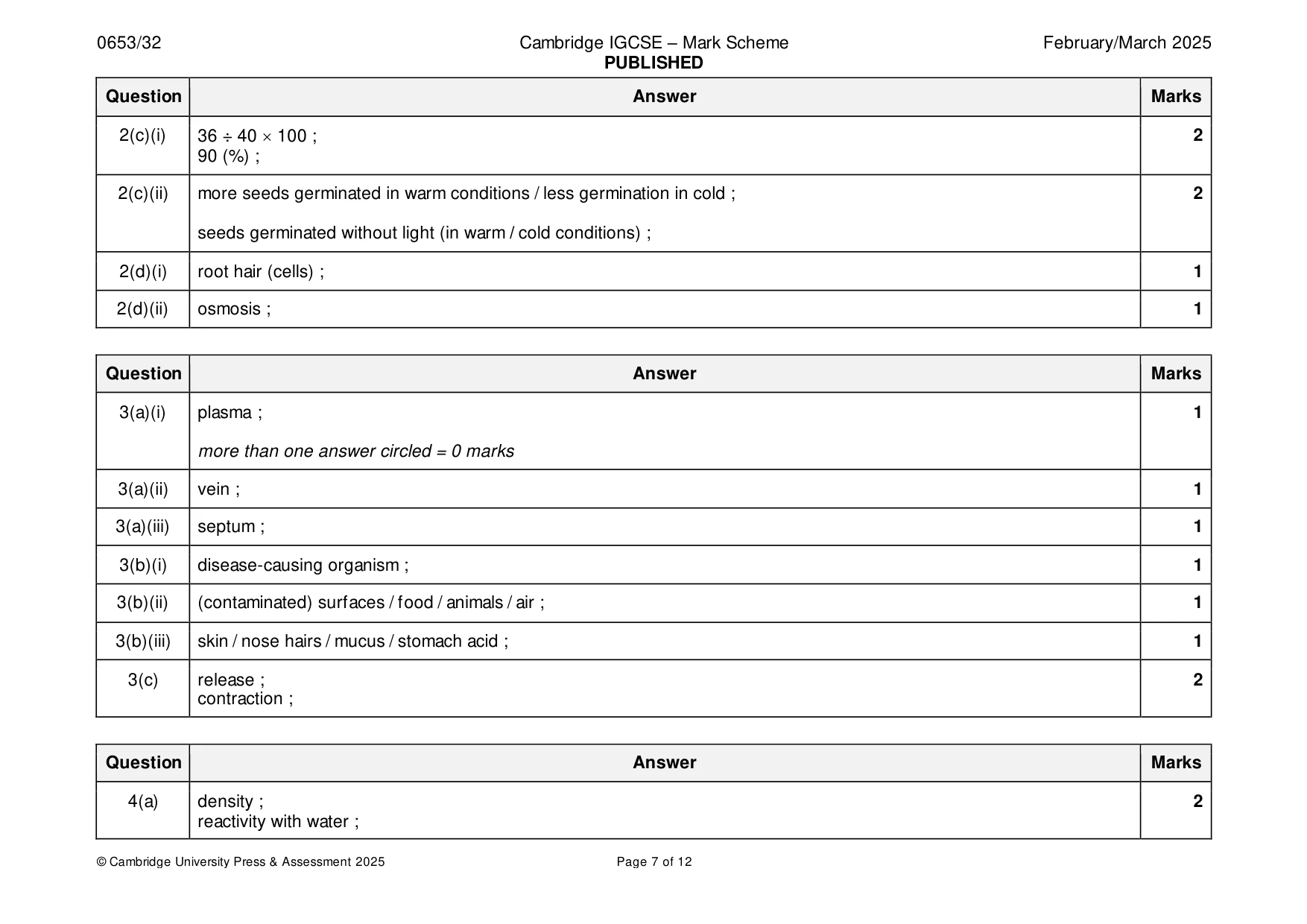
Mark scheme: 2(a) T ; 3 S ; P ; 2(b) sperm ; 1 2(c)(i) 36 ÷ 40 100 ; 2 90 (%) ; 2(c)(ii) more seeds germinated in warm conditions / less germination in cold ; 2 seeds germinated without light (in warm / cold conditions) ; 2(d)(i) root hair (cells) ; 1 2(d)(ii) osmosis ; 1
Q3 · Blood contains different components
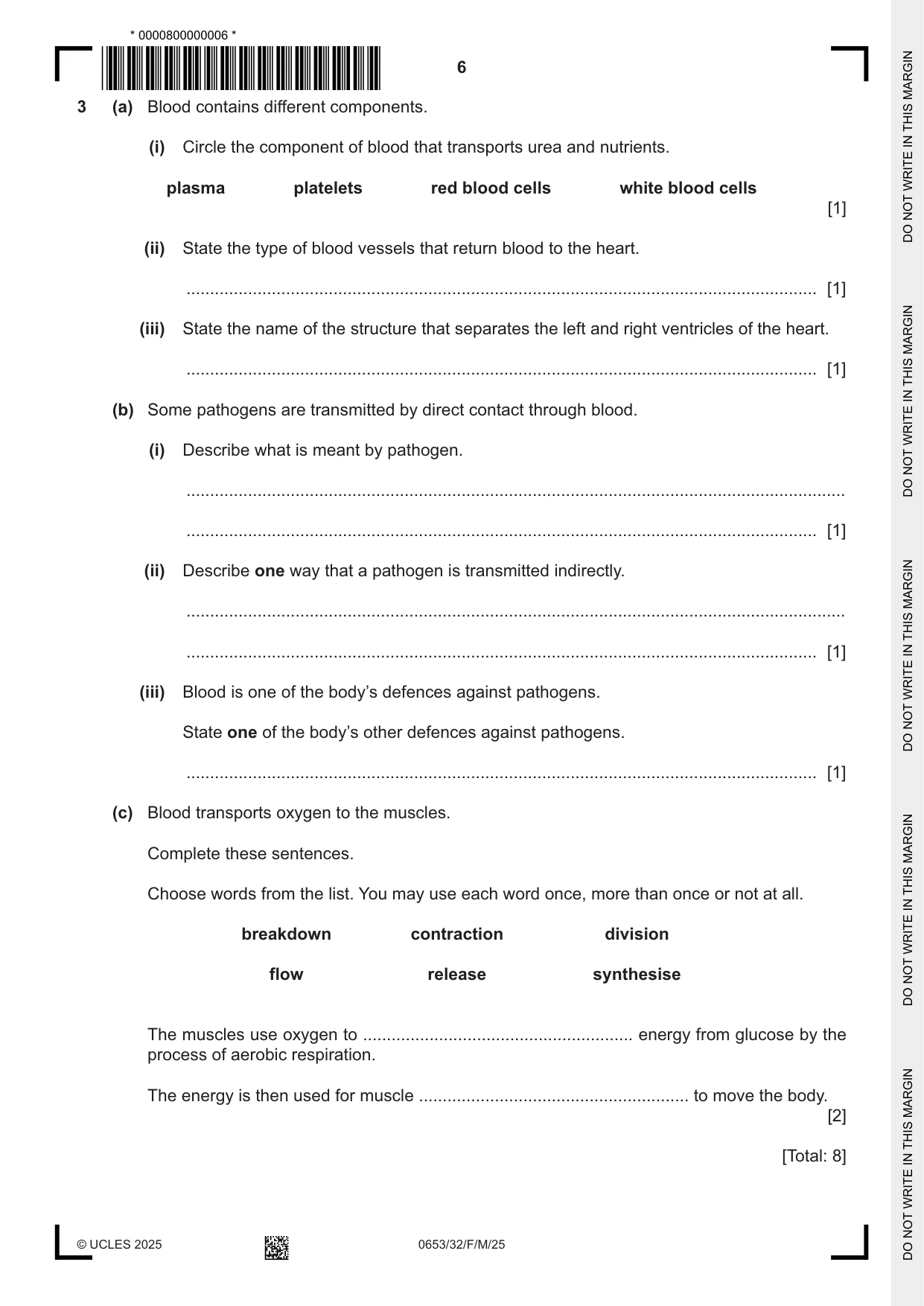
3 (a) Blood contains different components. (i) Circle the component of blood that transports urea and nutrients. plasma platelets red blood cells white blood cells [1] (ii) State the type of blood vessels that return blood to the heart. ..................................................................................................................................... [1] (iii) State the name of the structure that separates the left and right ventricles of the heart. ..................................................................................................................................... [1] (b) Some pathogens are transmitted by direct contact through blood. (i) Describe what is meant by pathogen. ........................................................................................................................................... ..................................................................................................................................... [1] (ii) Describe one way that a pathogen is transmitted indirectly. ........................................................................................................................................... ..................................................................................................................................... [1] (iii) Blood is one of the body’s defences against pathogens. State one of the body’s other defences against pathogens. ..................................................................................................................................... [1] (c) Blood transports oxygen to the muscles. Complete these sentences. Choose words from the list. You may use each word once, more than once or not at all. breakdown contraction division flow release synthesise The muscles use oxygen to ......................................................... energy from glucose by the process of aerobic respiration. The energy is then used for muscle ......................................................... to move the body. [2] [Total: 8]
Mark scheme: 3(a)(i) plasma ; 1 more than one answer circled = 0 marks 3(a)(ii) vein ; 1 3(a)(iii) septum ; 1 3(b)(i) disease-causing organism ; 1 3(b)(ii) (contaminated) surfaces / food / animals / air ; 1 3(b)(iii) skin / nose hairs / mucus / stomach acid ; 1 3(c) release ; 2 contraction ;
Q4 · Lithium, sodium and potassium are elements in Group I of the Periodic Table
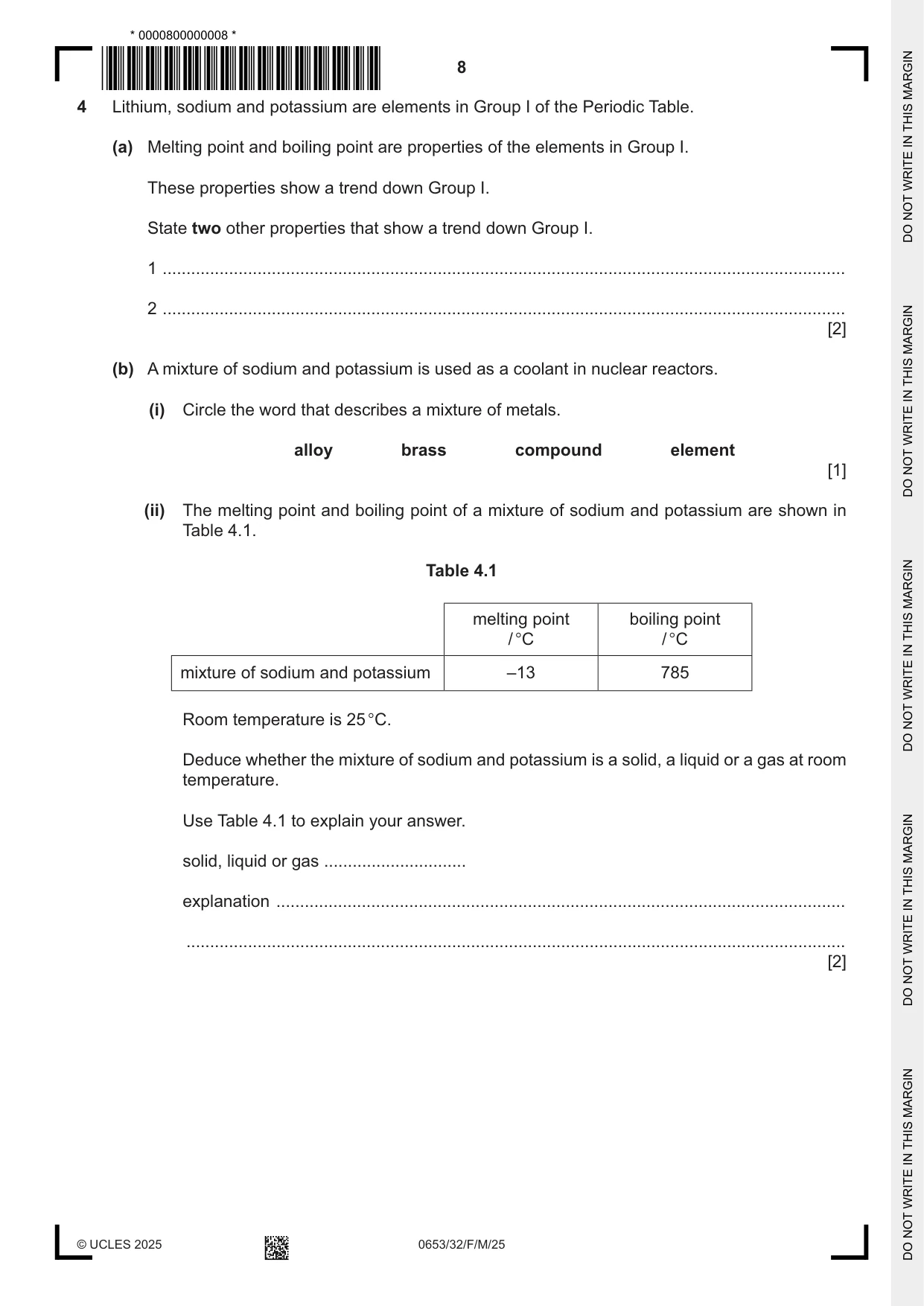
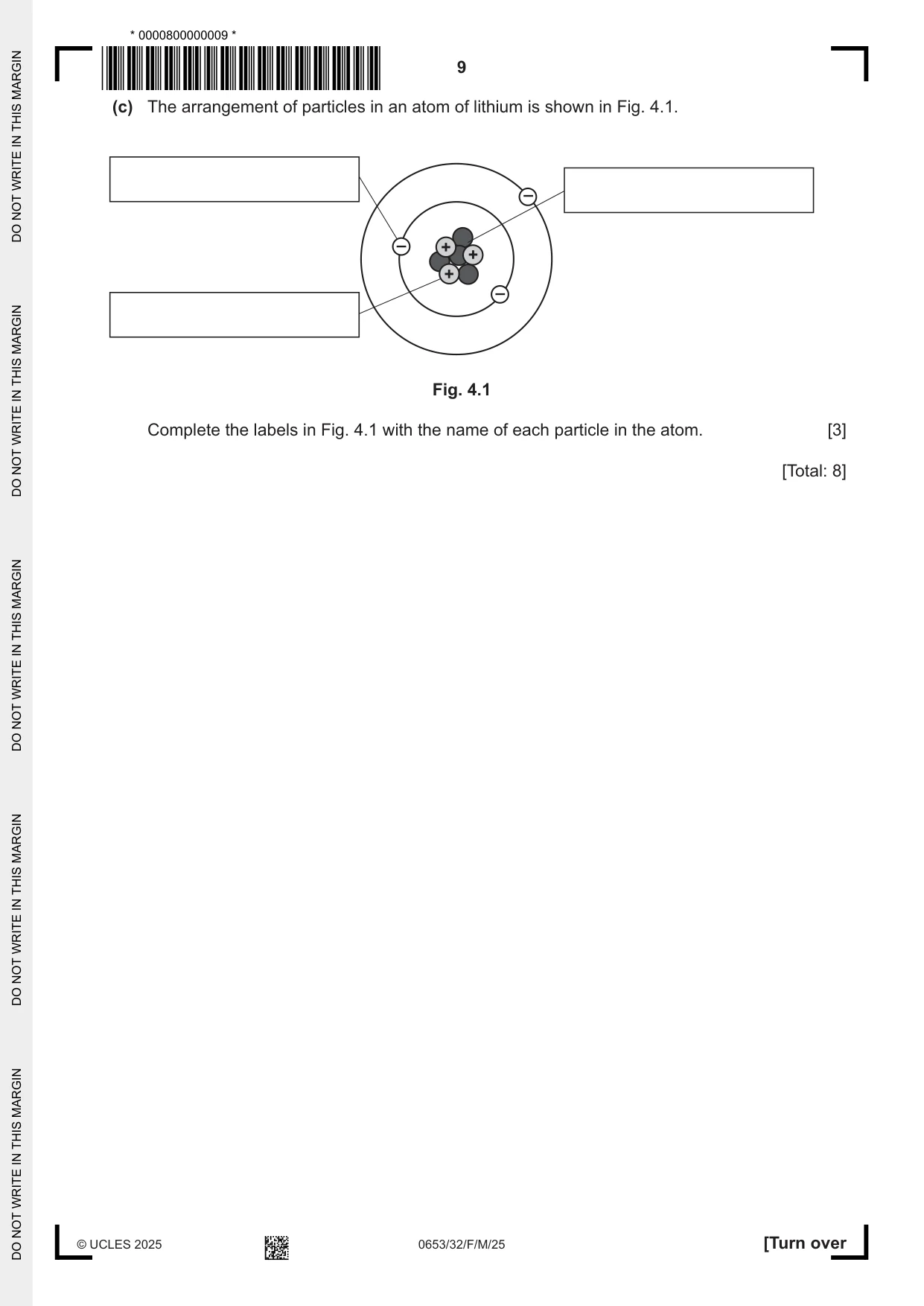
4 Lithium, sodium and potassium are elements in Group I of the Periodic Table. (a) Melting point and boiling point are properties of the elements in Group I. These properties show a trend down Group I. State two other properties that show a trend down Group I. 1 ................................................................................................................................................ 2 ................................................................................................................................................ [2] (b) A mixture of sodium and potassium is used as a coolant in nuclear reactors. (i) Circle the word that describes a mixture of metals. alloy brass compound element [1] (ii) The melting point and boiling point of a mixture of sodium and potassium are shown in Table 4.1. Table 4.1 melting point boiling point / °C / °C mixture of sodium and potassium –13 785 Room temperature is 25 °C. Deduce whether the mixture of sodium and potassium is a solid, a liquid or a gas at room temperature. Use Table 4.1 to explain your answer. solid, liquid or gas .............................. explanation ........................................................................................................................ ........................................................................................................................................... [2] (c) The arrangement of particles in an atom of lithium is shown in Fig. 4.1. – – + + + – Fig. 4.1 Complete the labels in Fig. 4.1 with the name of each particle in the atom. [3] [Total: 8]
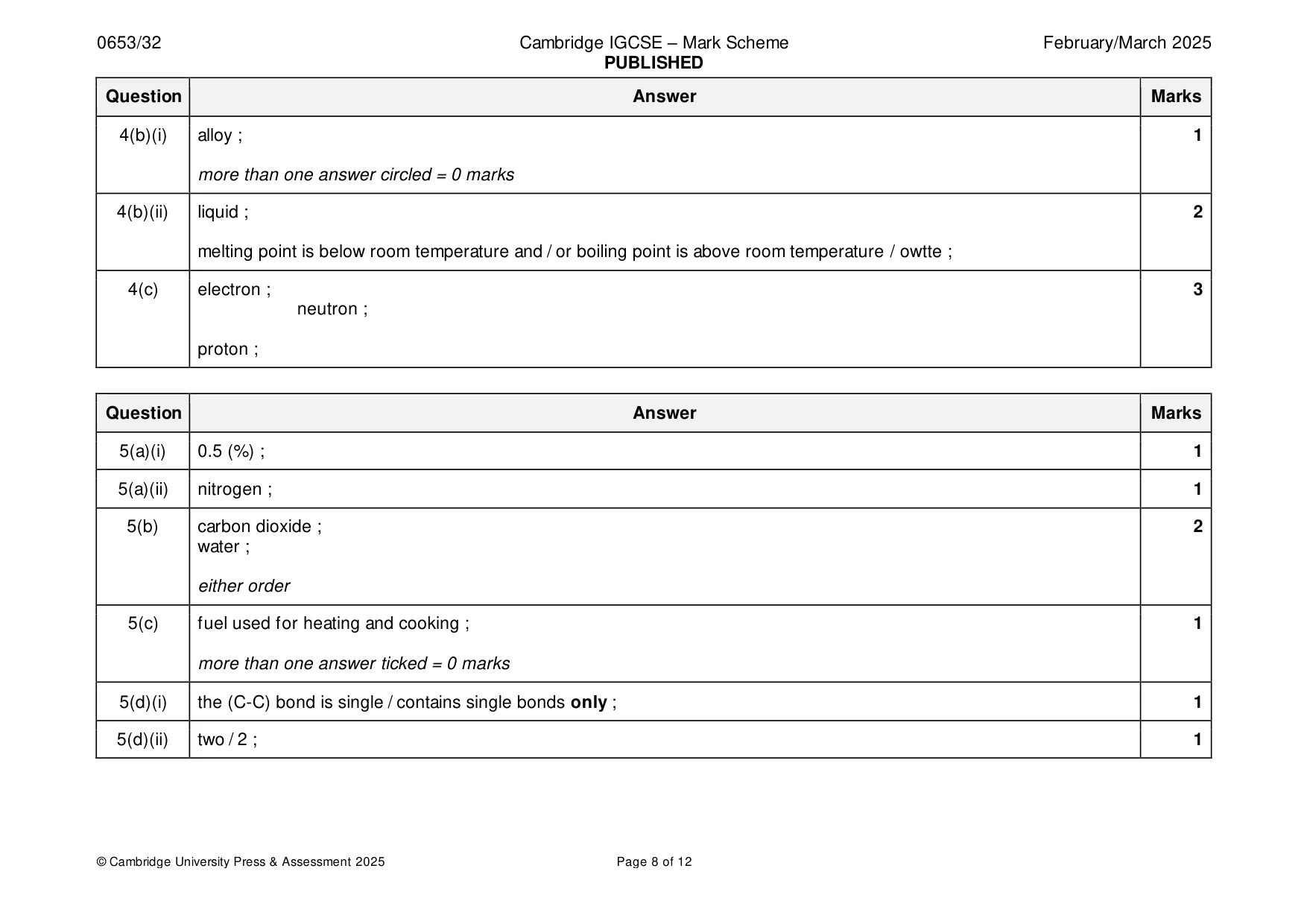
Mark scheme: 4(a) density ; 2 reactivity with water ; 4(b)(i) alloy ; 1 more than one answer circled = 0 marks 4(b)(ii) liquid ; 2 melting point is below room temperature and / or boiling point is above room temperature / owtte ; 4(c) electron ; 3 neutron ; proton ;
Q5 · The percentage of gases in a sample of natural gas
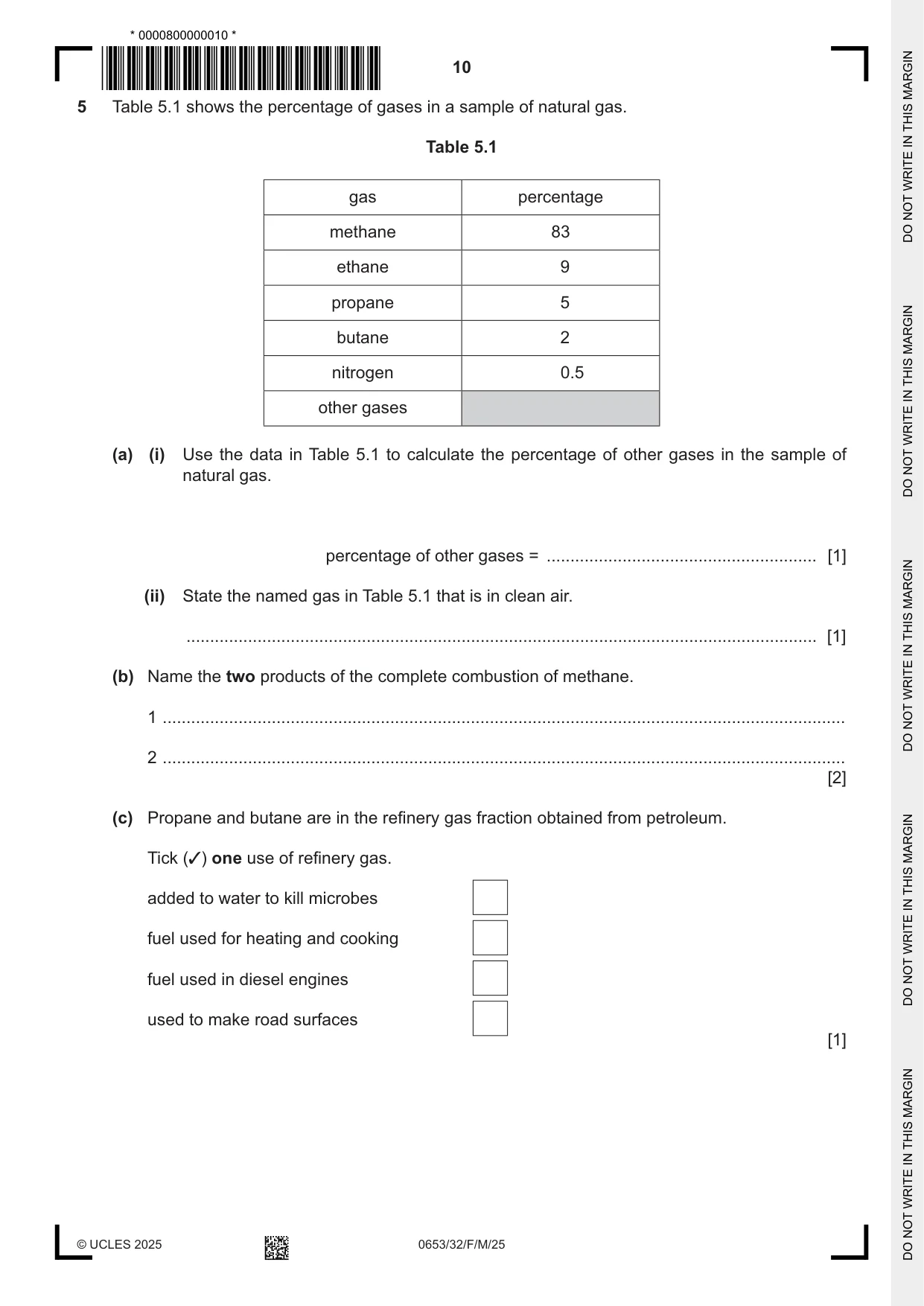
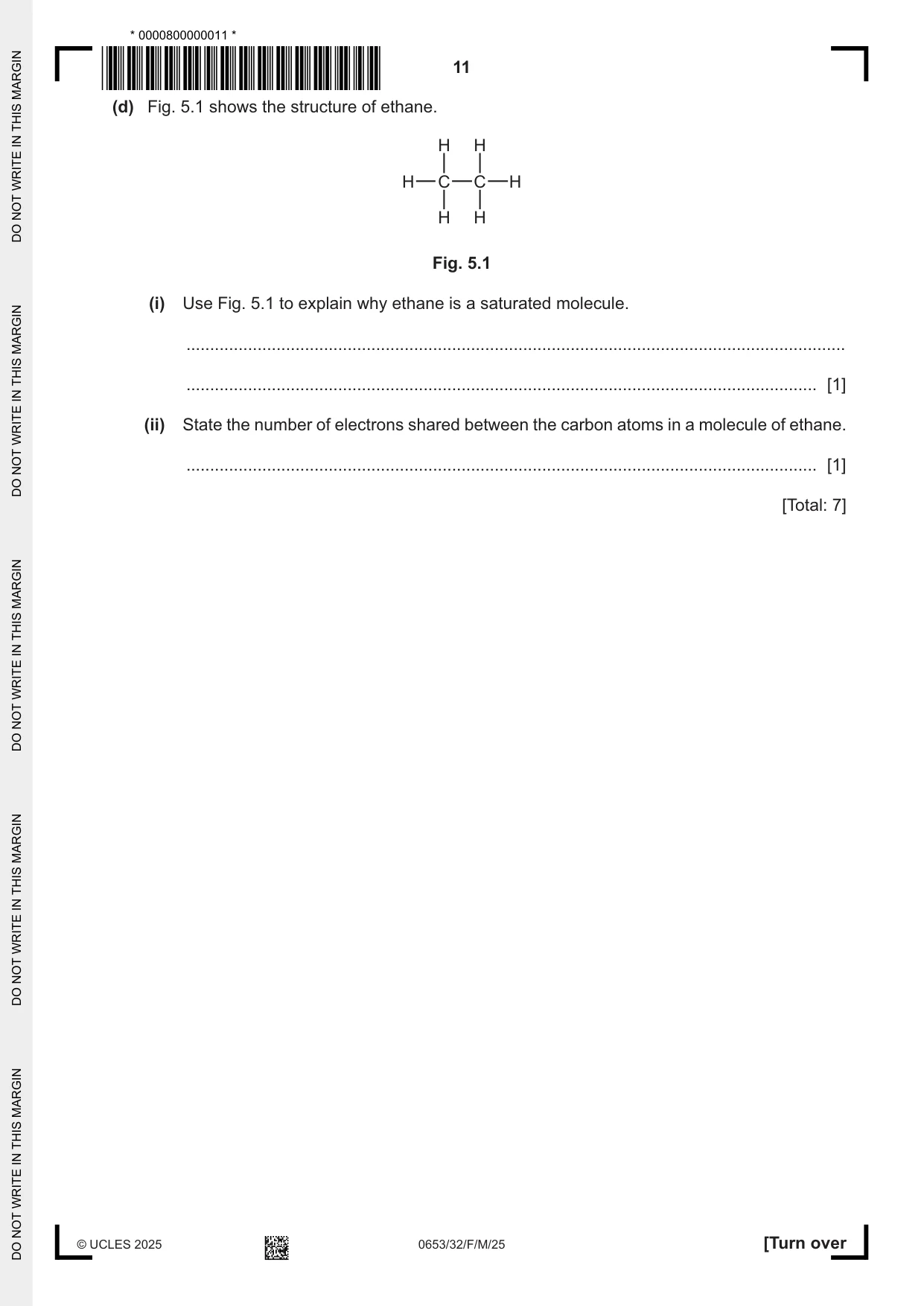
5 Table 5.1 shows the percentage of gases in a sample of natural gas. Table 5.1 gas percentage methane 83 ethane 9 propane 5 butane 2 nitrogen 0.5 other gases (a) (i) Use the data in Table 5.1 to calculate the percentage of other gases in the sample of natural gas. percentage of other gases = ......................................................... [1] (ii) State the named gas in Table 5.1 that is in clean air. ..................................................................................................................................... [1] (b) Name the two products of the complete combustion of methane. 1 ................................................................................................................................................ 2 ................................................................................................................................................ [2] (c) Propane and butane are in the refinery gas fraction obtained from petroleum. Tick (3) one use of refinery gas. added to water to kill microbes fuel used for heating and cooking fuel used in diesel engines used to make road surfaces [1] (d) Fig. 5.1 shows the structure of ethane. H H H C C H H H Fig. 5.1 (i) Use Fig. 5.1 to explain why ethane is a saturated molecule. ........................................................................................................................................... ..................................................................................................................................... [1] (ii) State the number of electrons shared between the carbon atoms in a molecule of ethane. ..................................................................................................................................... [1] [Total: 7]
Mark scheme: 5(a)(i) 0.5 (%) ; 1 5(a)(ii) nitrogen ; 1 5(b) carbon dioxide ; 2 water ; either order 5(c) fuel used for heating and cooking ; 1 more than one answer ticked = 0 marks 5(d)(i) the (C-C) bond is single / contains single bonds only ; 1 5(d)(ii) two / 2 ; 1
Q6 · The products and observations at the electrodes in the electrolysis of three electrolytes
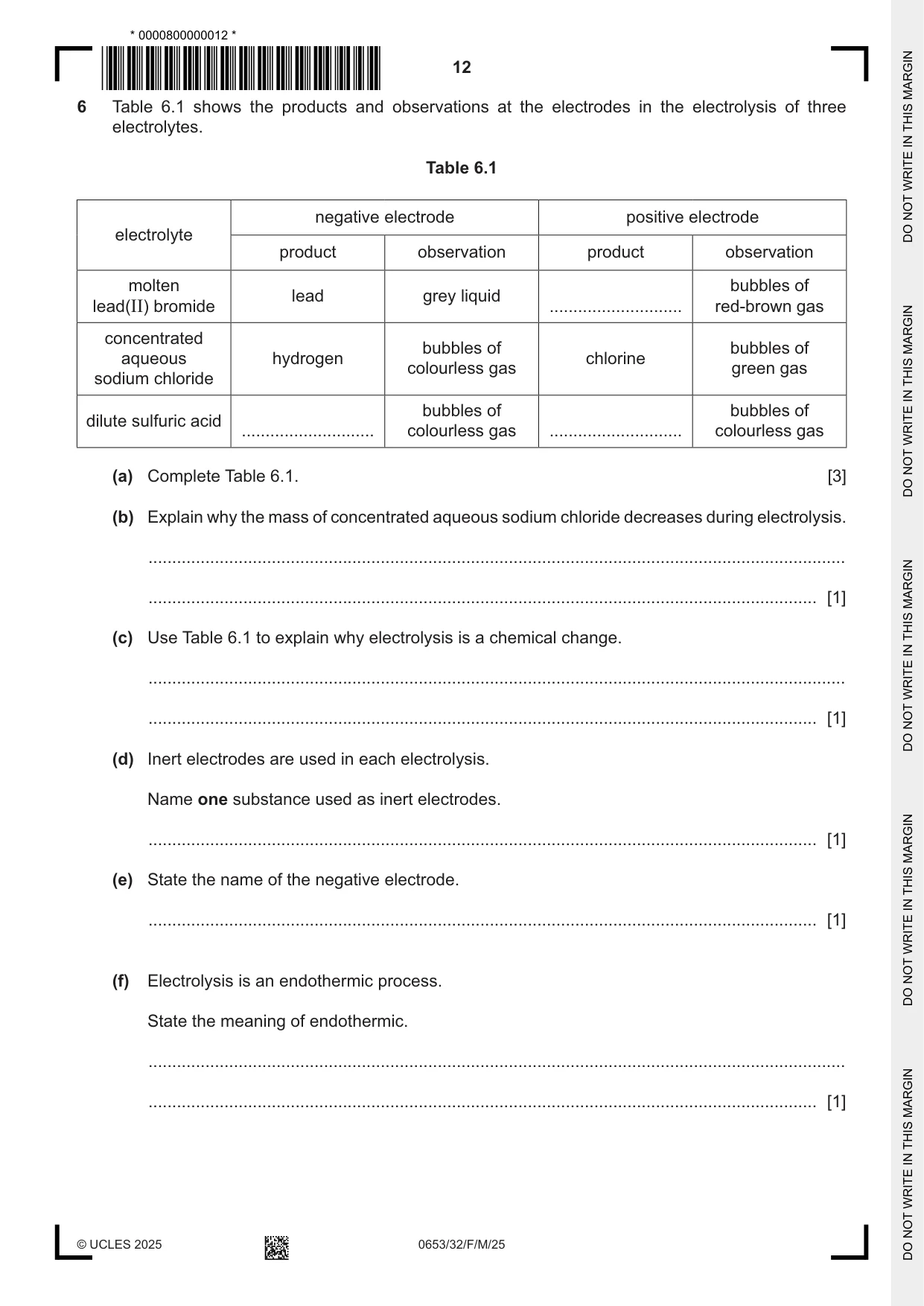
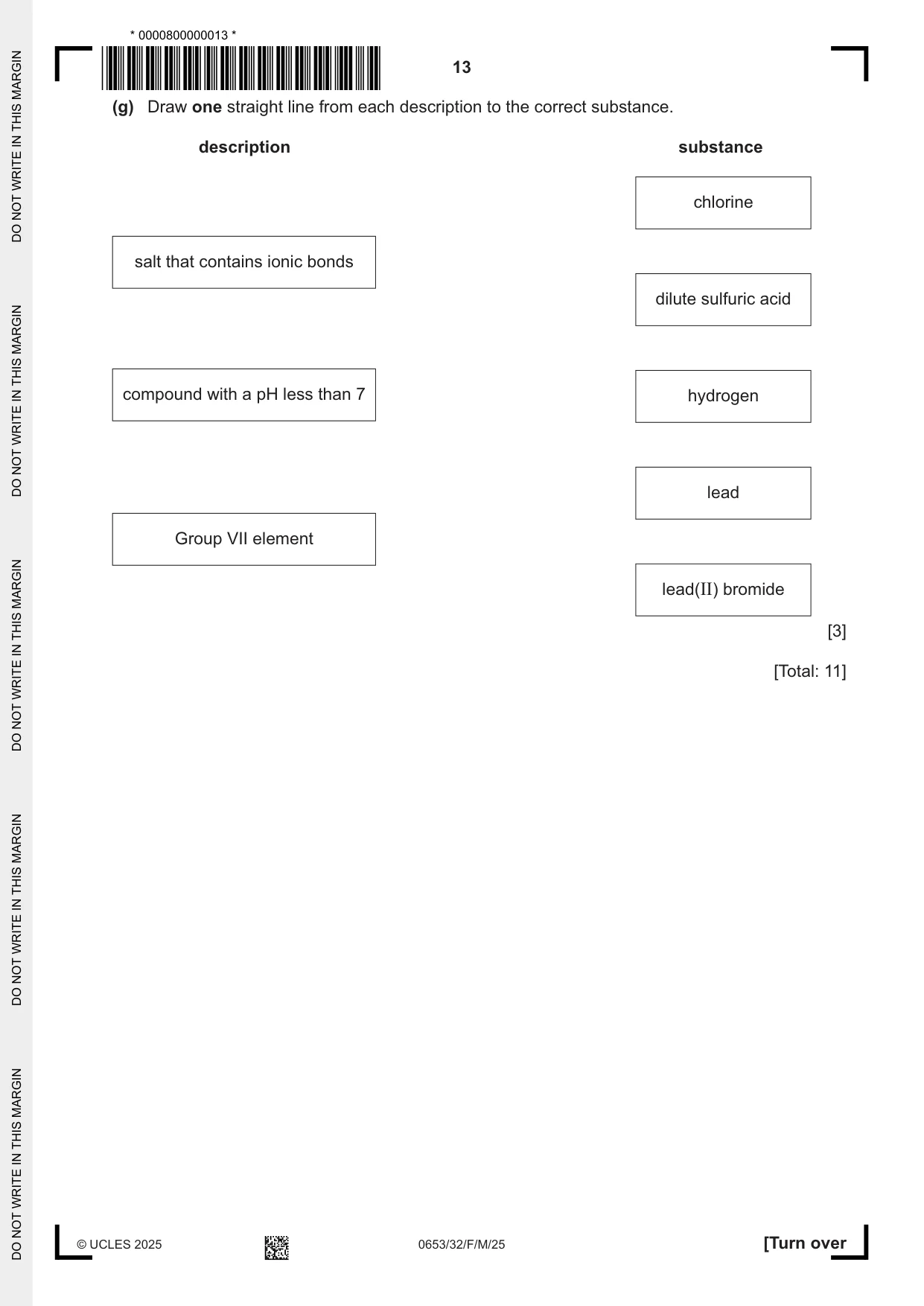
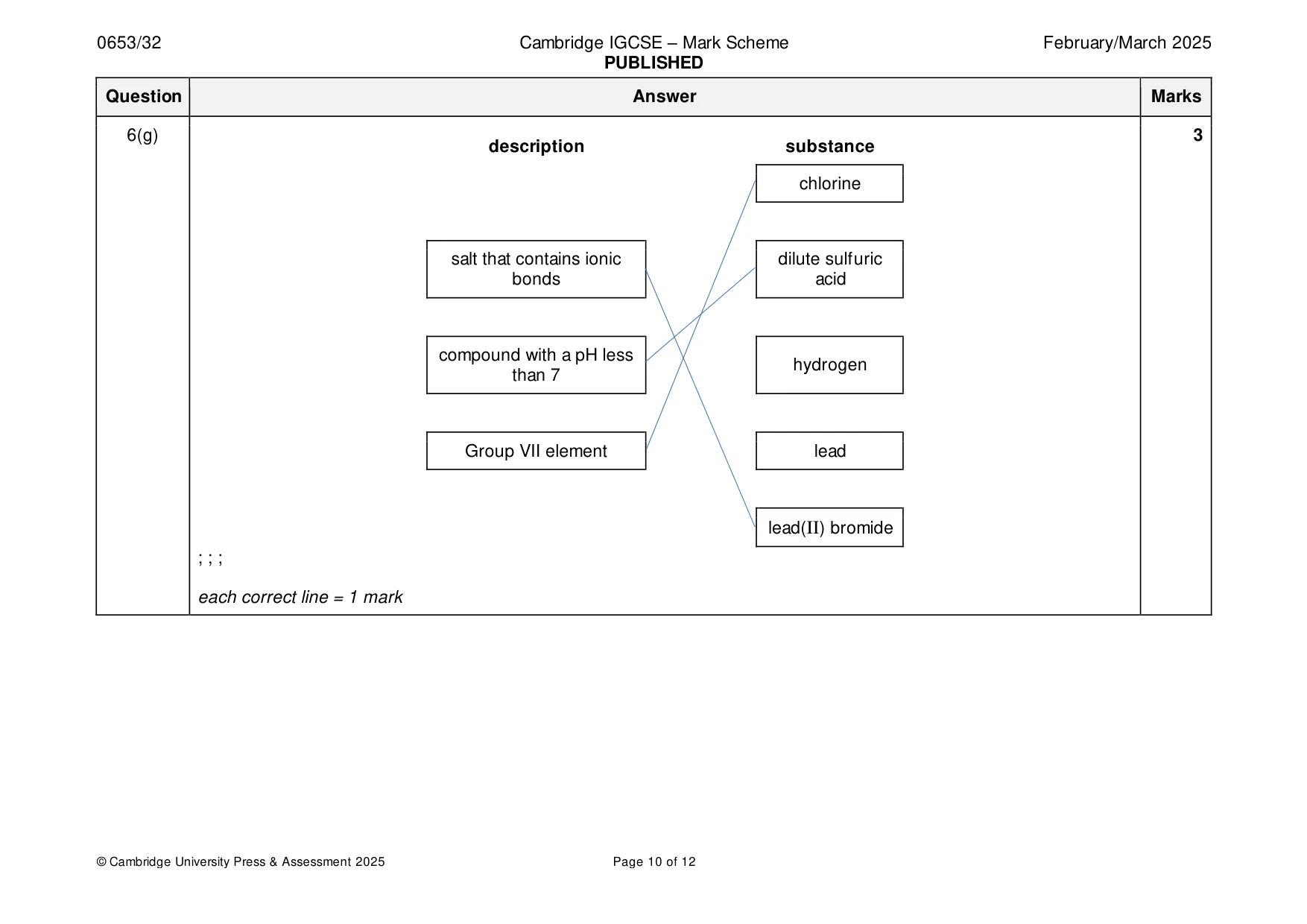
6 Table 6.1 shows the products and observations at the electrodes in the electrolysis of three electrolytes. Table 6.1 negative electrode positive electrode electrolyte product observation product observation molten bubbles of lead grey liquid lead(II) bromide ............................ red-brown gas concentrated bubbles of bubbles of aqueous hydrogen chlorine colourless gas green gas sodium chloride bubbles of bubbles of dilute sulfuric acid ............................ colourless gas ............................ colourless gas (a) Complete Table 6.1. [3] (b) Explain why the mass of concentrated aqueous sodium chloride decreases during electrolysis. ................................................................................................................................................... ............................................................................................................................................. [1] (c) Use Table 6.1 to explain why electrolysis is a chemical change. ................................................................................................................................................... ............................................................................................................................................. [1] (d) Inert electrodes are used in each electrolysis. Name one substance used as inert electrodes. ............................................................................................................................................. [1] (e) State the name of the negative electrode. ............................................................................................................................................. [1] (f) Electrolysis is an endothermic process. State the meaning of endothermic. ................................................................................................................................................... ............................................................................................................................................. [1] (g) Draw one straight line from each description to the correct substance. description substance chlorine salt that contains ionic bonds dilute sulfuric acid compound with a pH less than 7 hydrogen lead Group VII element lead(II) bromide [3] [Total: 11]
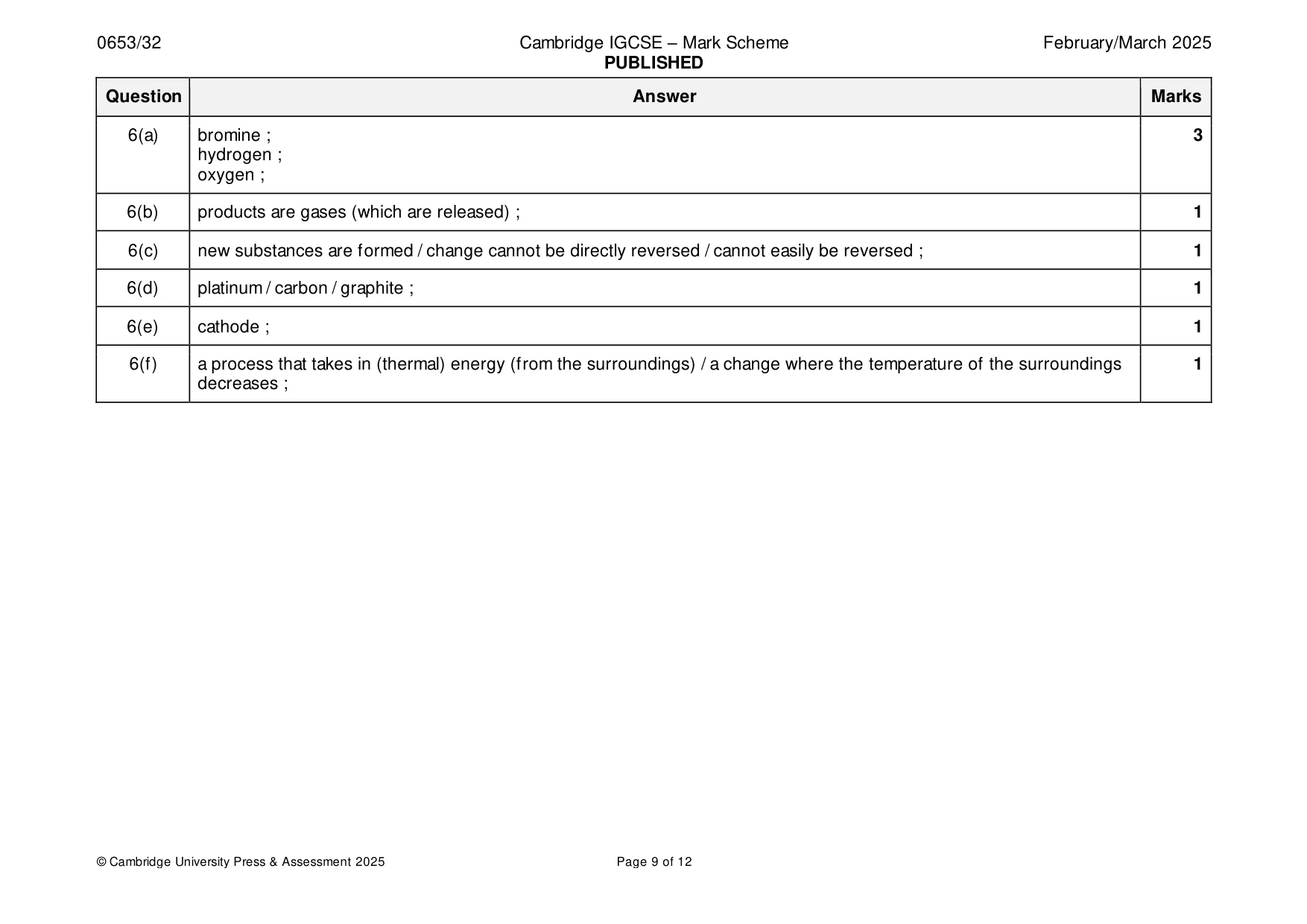
Mark scheme: 6(a) bromine ; 3 hydrogen ; oxygen ; 6(b) products are gases (which are released) ; 1 6(c) new substances are formed / change cannot be directly reversed / cannot easily be reversed ; 1 6(d) platinum / carbon / graphite ; 1 6(e) cathode ; 1 6(f) a process that takes in (thermal) energy (from the surroundings) / a change where the temperature of the surroundings 1 decreases ; 6(g) 3 description substance chlorine salt that contains ionic dilute sulfuric bonds acid compound with a pH less hydrogen than 7 Group VII element lead lead(II) bromide ; ; ; each correct line = 1 mark
Q7 · An electric motor is connected to a battery
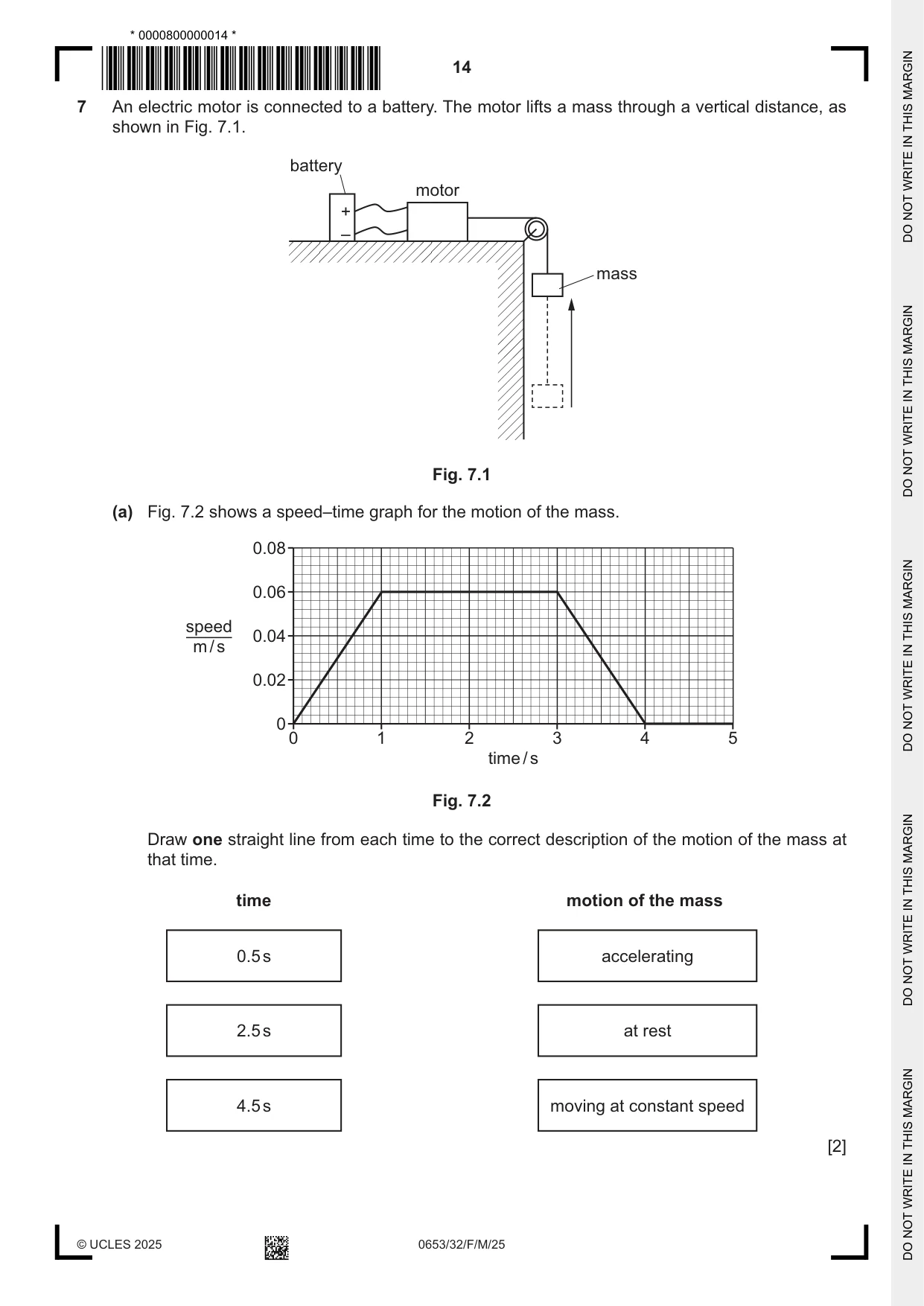
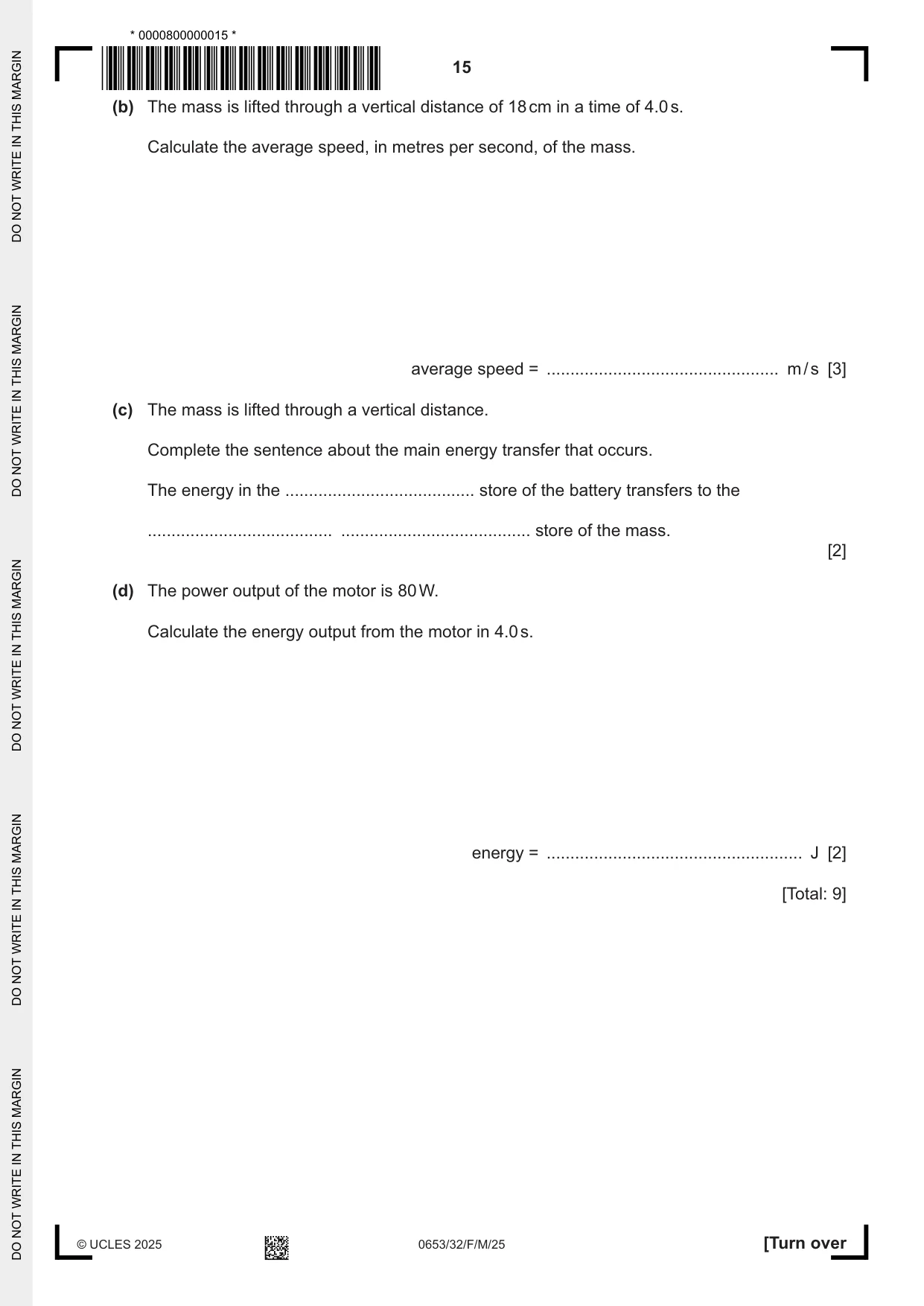
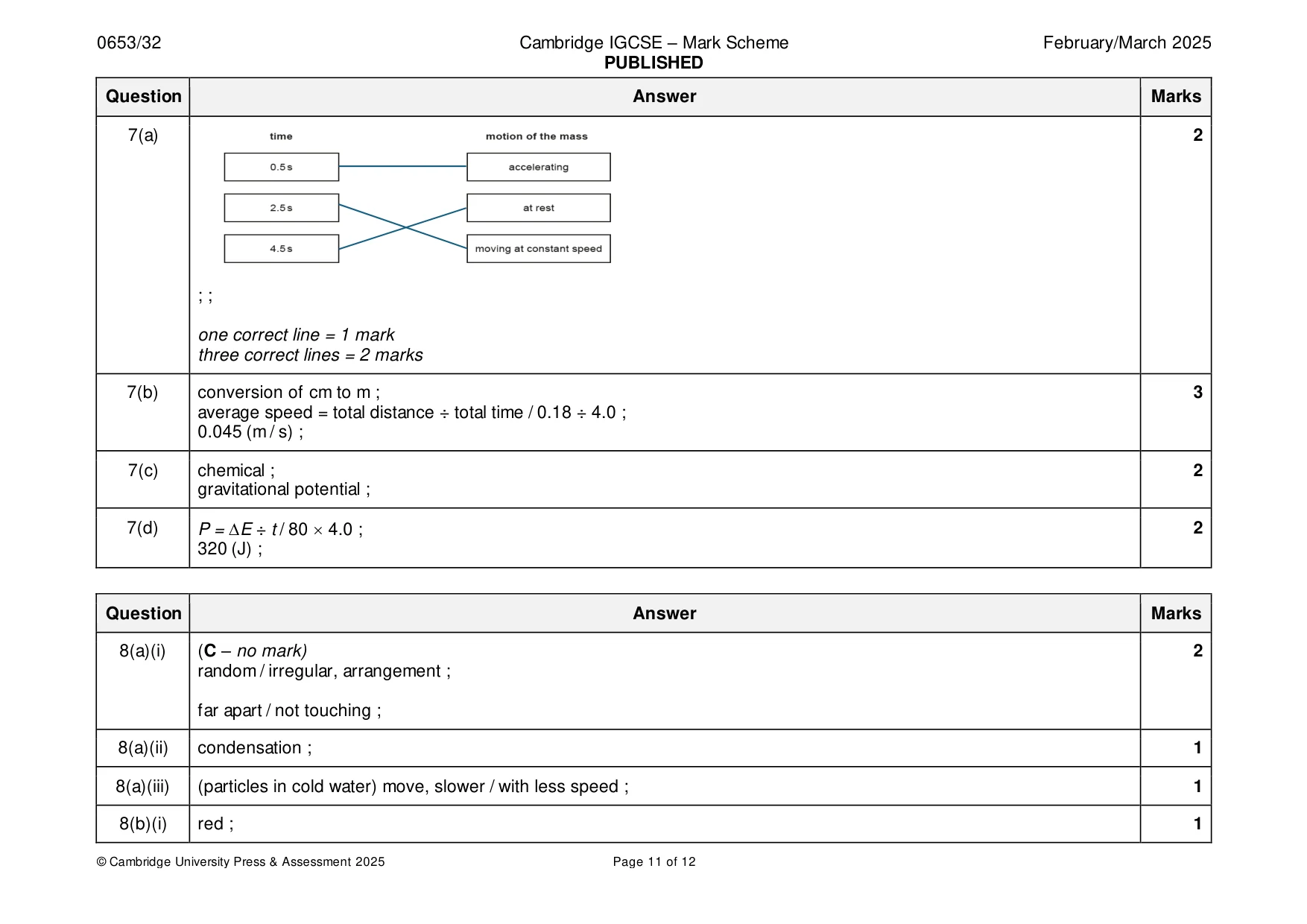
7 An electric motor is connected to a battery. The motor lifts a mass through a vertical distance, as shown in Fig. 7.1. battery motor + – mass Fig. 7.1 (a) Fig. 7.2 shows a speed–time graph for the motion of the mass. 0.08 0.06 speed 0.04 m / s 0.02 0 0 1 2 3 4 5 time / s Fig. 7.2 Draw one straight line from each time to the correct description of the motion of the mass at that time. time motion of the mass 0.5 s accelerating 2.5 s at rest 4.5 s moving at constant speed [2] (b) The mass is lifted through a vertical distance of 18 cm in a time of 4.0 s. Calculate the average speed, in metres per second, of the mass. average speed = ................................................. m / s [3] (c) The mass is lifted through a vertical distance. Complete the sentence about the main energy transfer that occurs. The energy in the ........................................ store of the battery transfers to the ....................................... ........................................ store of the mass. [2] (d) The power output of the motor is 80 W. Calculate the energy output from the motor in 4.0 s. energy = ...................................................... J [2] [Total: 9]
Mark scheme: 7(a) 2 ; ; one correct line = 1 mark three correct lines = 2 marks 7(b) conversion of cm to m ; 3 average speed = total distance ÷ total time / 0.18 ÷ 4.0 ; 0.045 (m / s) ; 7(c) chemical ; 2 gravitational potential ; 7(d) P = E ÷ t / 80 4.0 ; 2 320 (J) ;
Q8 · Three diagrams, A, B and C, of particles in the three states of matter
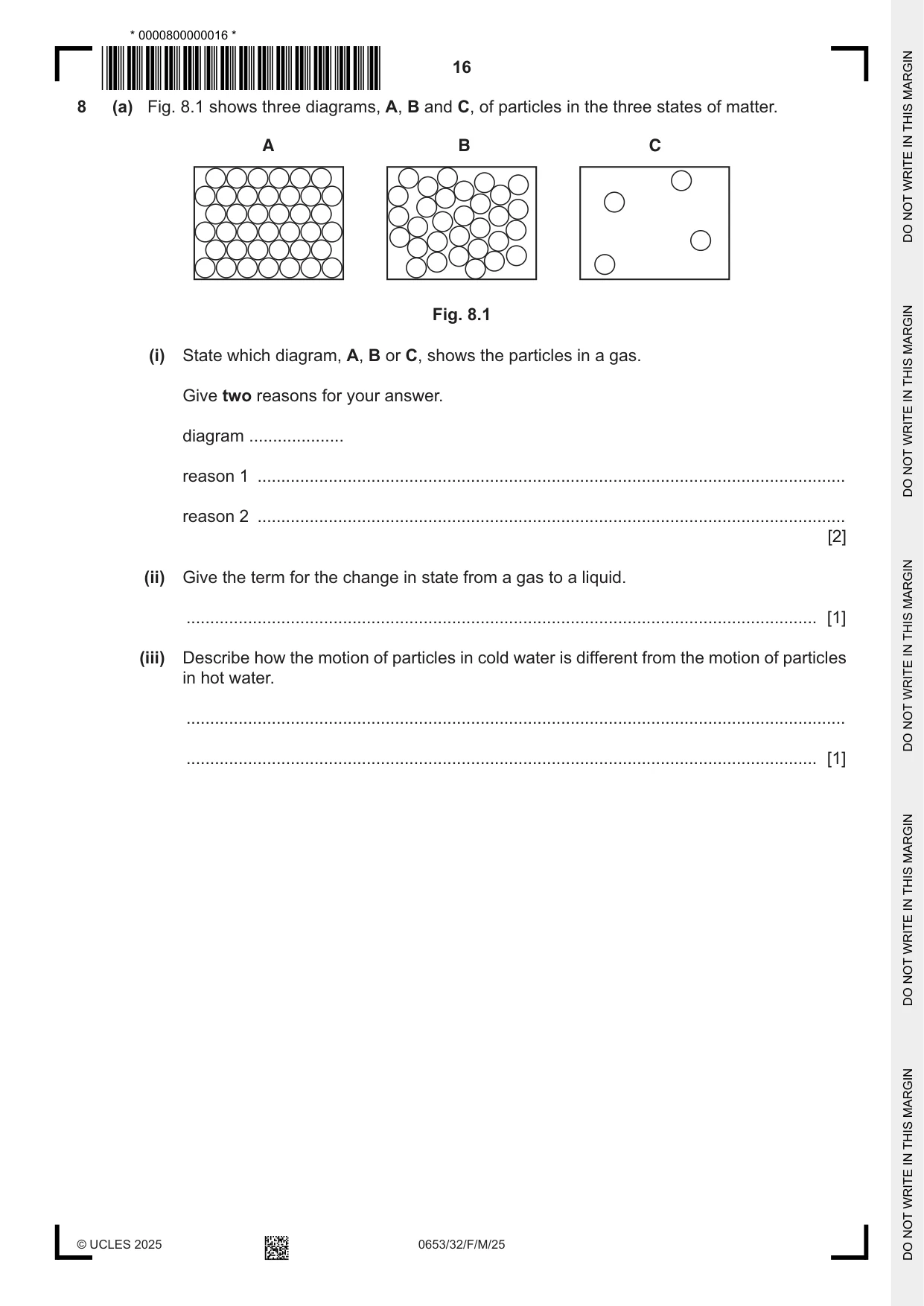
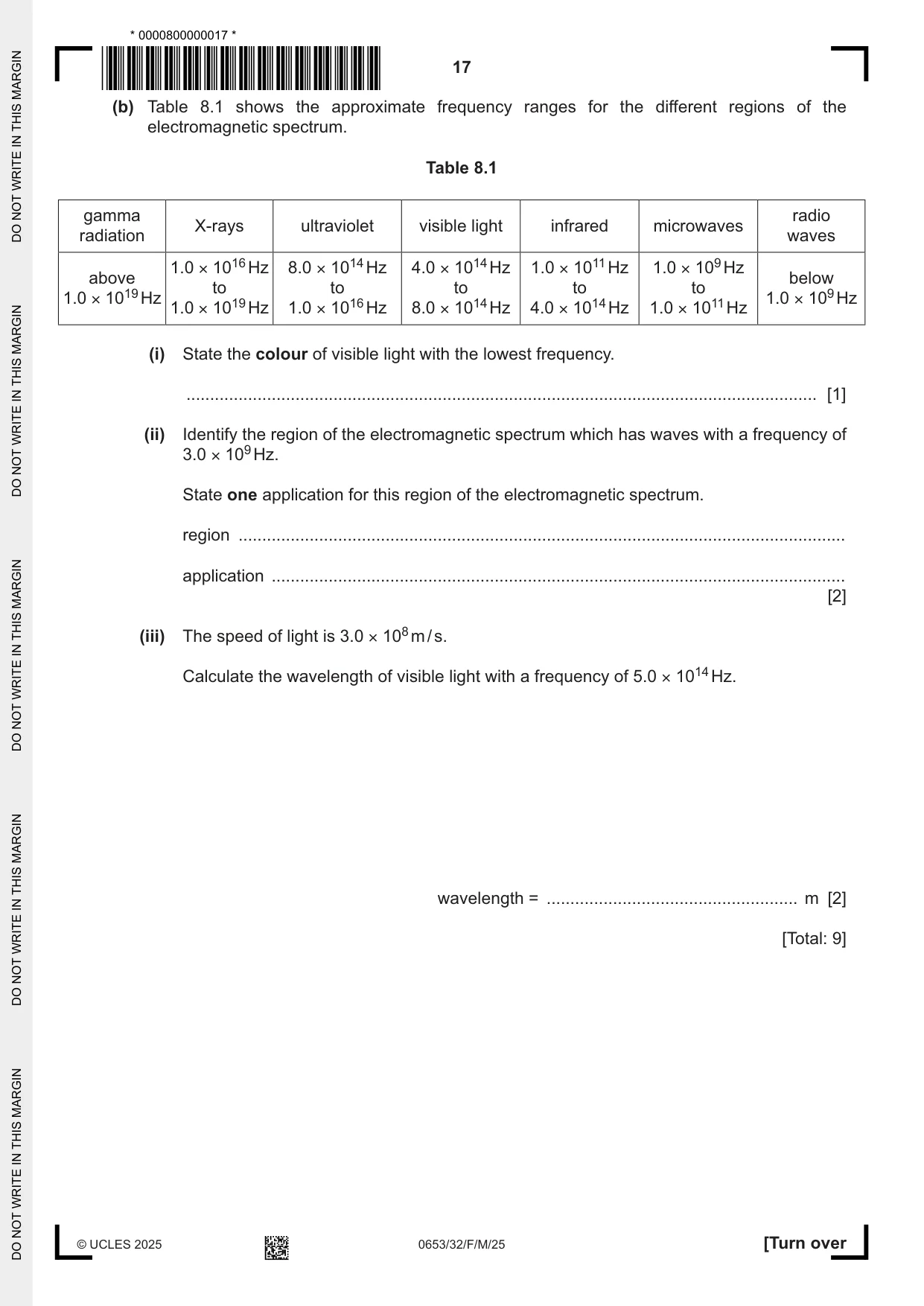
8 (a) Fig. 8.1 shows three diagrams, A, B and C, of particles in the three states of matter. A B C Fig. 8.1 (i) State which diagram, A, B or C, shows the particles in a gas. Give two reasons for your answer. diagram .................... reason 1 ............................................................................................................................ reason 2 ............................................................................................................................ [2] (ii) Give the term for the change in state from a gas to a liquid. ..................................................................................................................................... [1] (iii) Describe how the motion of particles in cold water is different from the motion of particles in hot water. ........................................................................................................................................... ..................................................................................................................................... [1] (b) Table 8.1 shows the approximate frequency ranges for the different regions of the electromagnetic spectrum. Table 8.1 gamma radio X-rays ultraviolet visible light infrared microwaves radiation waves 1.0 × 10¹⁶ Hz 8.0 × 10¹⁴ Hz 4.0 × 10¹⁴ Hz 1.0 × 10¹¹ Hz 1.0 × 10⁹ Hz above below to to to to to 1.0 × 10¹⁹ Hz 1.0 × 10⁹ Hz 1.0 × 10¹⁹ Hz 1.0 × 10¹⁶ Hz 8.0 × 10¹⁴ Hz 4.0 × 10¹⁴ Hz 1.0 × 10¹¹ Hz (i) State the colour of visible light with the lowest frequency. ..................................................................................................................................... [1] (ii) Identify the region of the electromagnetic spectrum which has waves with a frequency of 3.0 × 10⁹ Hz. State one application for this region of the electromagnetic spectrum. region ................................................................................................................................ application ......................................................................................................................... [2] (iii) The speed of light is 3.0 × 10⁸ m / s. Calculate the wavelength of visible light with a frequency of 5.0 × 10¹⁴ Hz. wavelength = ..................................................... m [2] [Total: 9]
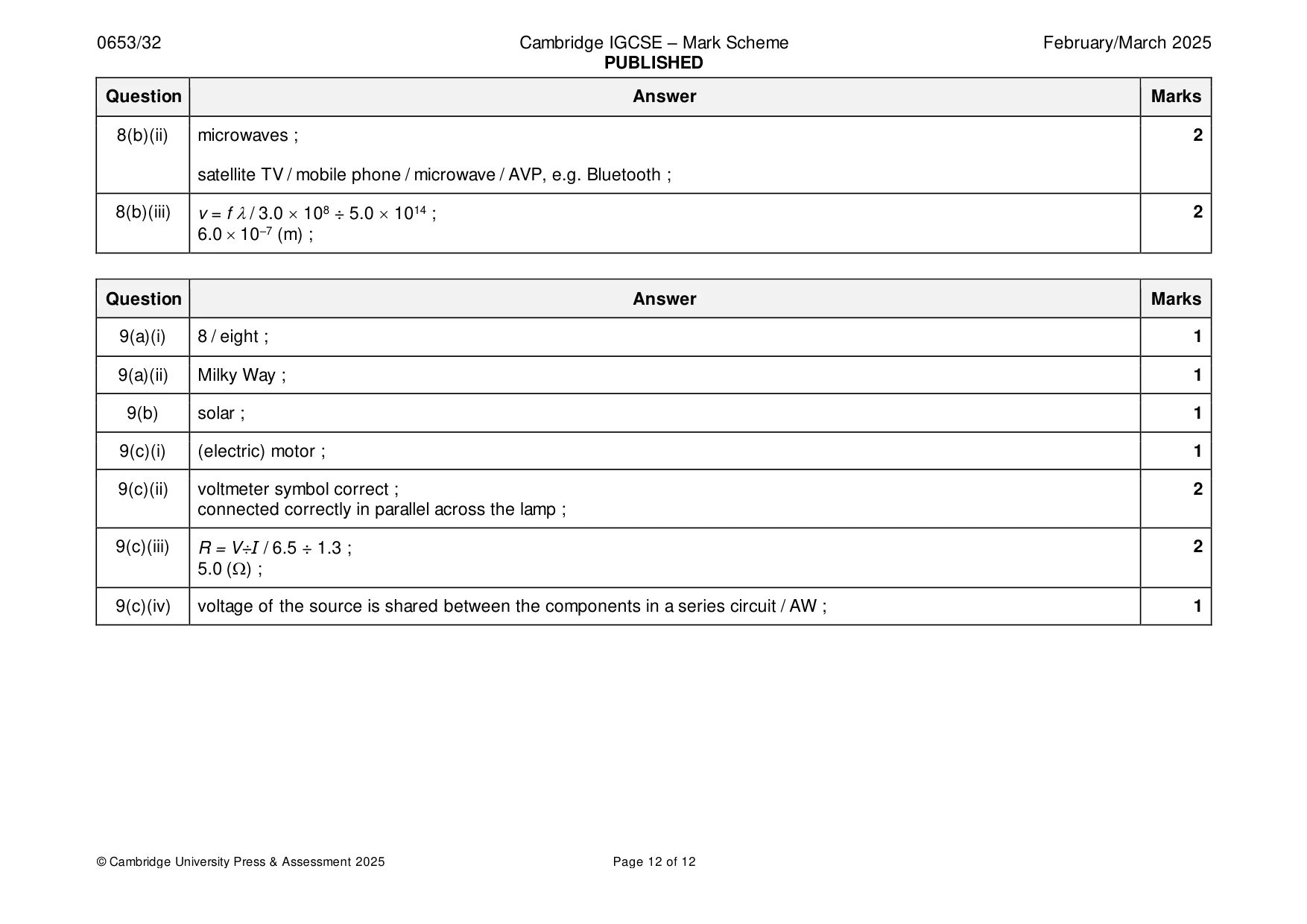
Mark scheme: 8(a)(i) (C – no mark) 2 random / irregular, arrangement ; far apart / not touching ; 8(a)(ii) condensation ; 1 8(a)(iii) (particles in cold water) move, slower / with less speed ; 1 8(b)(i) red ; 1 8(b)(ii) microwaves ; 2 satellite TV / mobile phone / microwave / AVP, e.g. Bluetooth ; 8(b)(iii) v = f / 3.0 108 ÷ 5.0 1014 ; 2 6.0 10–7 (m) ;
Q9 · A spacecraft travels through space from Earth to Mars
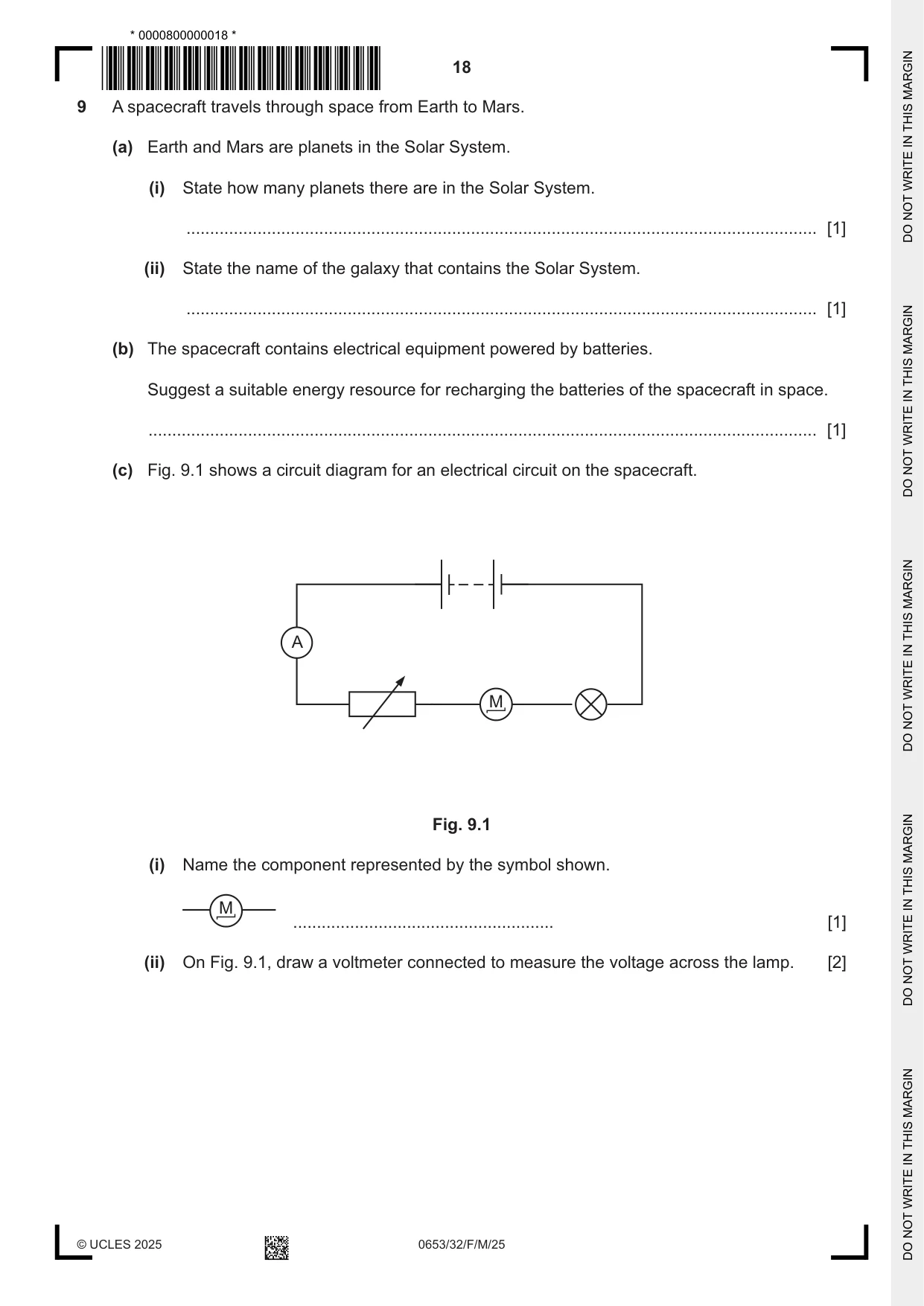
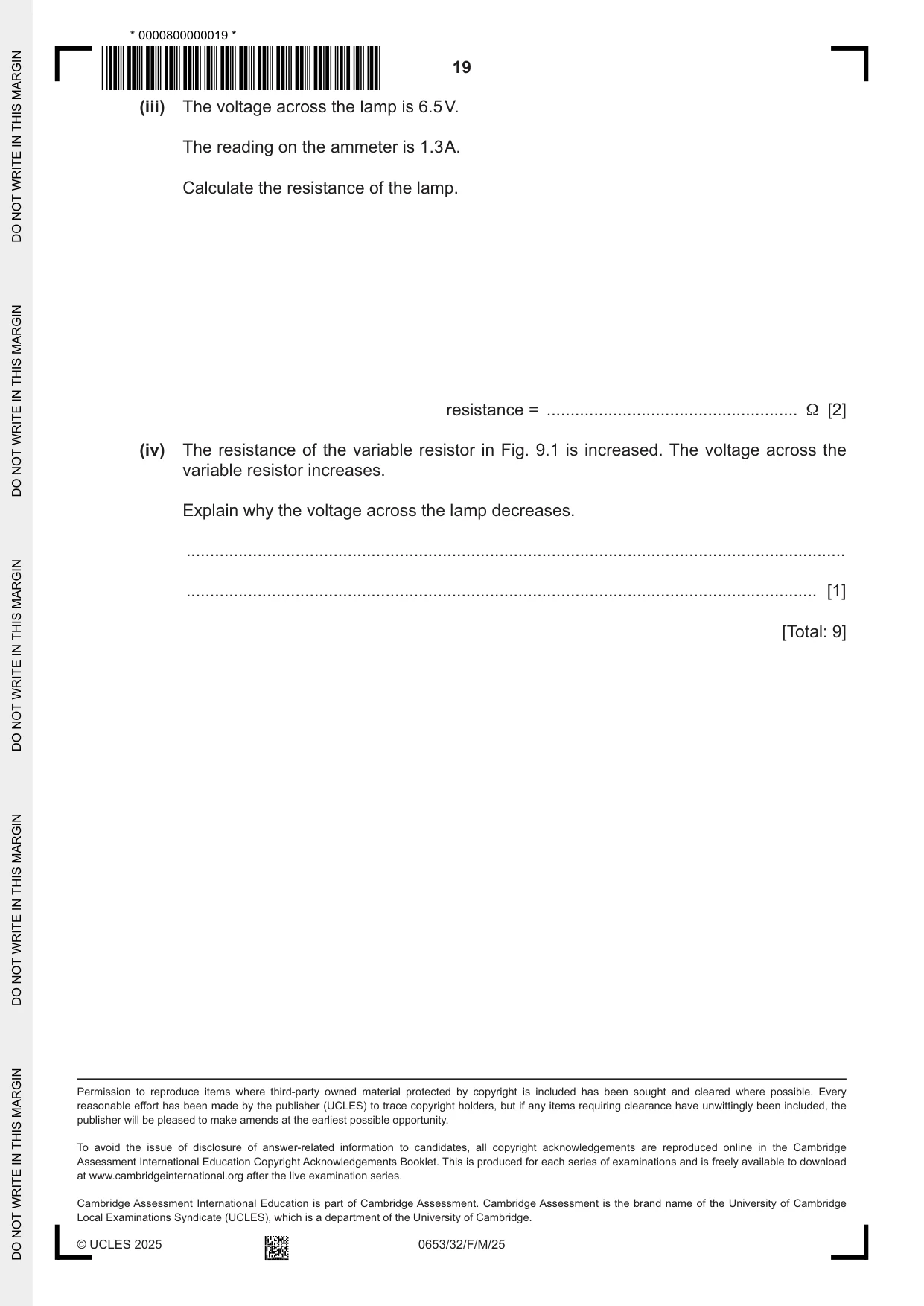
9 A spacecraft travels through space from Earth to Mars. (a) Earth and Mars are planets in the Solar System. (i) State how many planets there are in the Solar System. ..................................................................................................................................... [1] (ii) State the name of the galaxy that contains the Solar System. ..................................................................................................................................... [1] (b) The spacecraft contains electrical equipment powered by batteries. Suggest a suitable energy resource for recharging the batteries of the spacecraft in space. ............................................................................................................................................. [1] (c) Fig. 9.1 shows a circuit diagram for an electrical circuit on the spacecraft. A M Fig. 9.1 (i) Name the component represented by the symbol shown. M ....................................................... [1] (ii) On Fig. 9.1, draw a voltmeter connected to measure the voltage across the lamp. [2] (iii) The voltage across the lamp is 6.5 V. The reading on the ammeter is 1.3 A. Calculate the resistance of the lamp. resistance = ..................................................... Ω [2] (iv) The resistance of the variable resistor in Fig. 9.1 is increased. The voltage across the variable resistor increases. Explain why the voltage across the lamp decreases. ........................................................................................................................................... ..................................................................................................................................... [1] [Total: 9]
Mark scheme: 9(a)(i) 8 / eight ; 1 9(a)(ii) Milky Way ; 1 9(b) solar ; 1 9(c)(i) (electric) motor ; 1 9(c)(ii) voltmeter symbol correct ; 2 connected correctly in parallel across the lamp ; 9(c)(iii) R = V÷I / 6.5 ÷ 1.3 ; 2 5.0 () ; 9(c)(iv) voltage of the source is shared between the components in a series circuit / AW ; 1
What was in this paper
The subtopics covered by these 9 questions, and how many questions each got. Open one in a new tab to see every Cambridge question on it.
What you needed in this session
Cambridge’s own grade thresholds for 2025 Feb/March, Paper 3 · Variant 2. A higher threshold means an easier paper — the bar moves with how the cohort did.