Cambridge IGCSE Science - Combined 0653 — 2020 Oct/Nov Paper 3 · Variant 1
0653/31/O/N/20 · 9 questions · 80 marks · ≈90 min
The question paper and its mark scheme, free to read here and free to download. This is Cambridge’s own paper, exactly as it was sat.
Question paper20 pages

Mark scheme10 pages
Answers below. Sit the paper first if you are practising.
Questions as text
Q1 · A diagram of some parts of the body
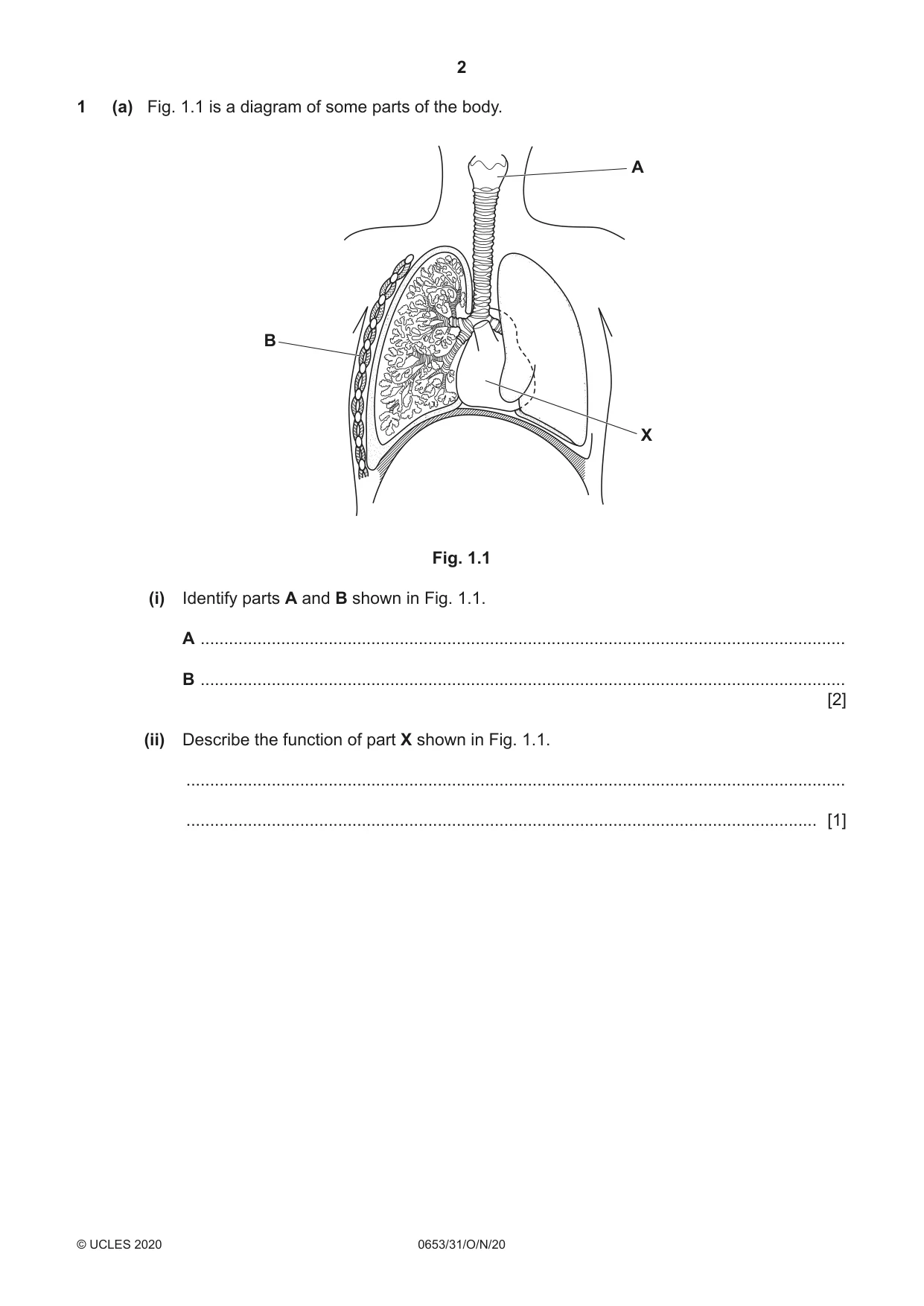
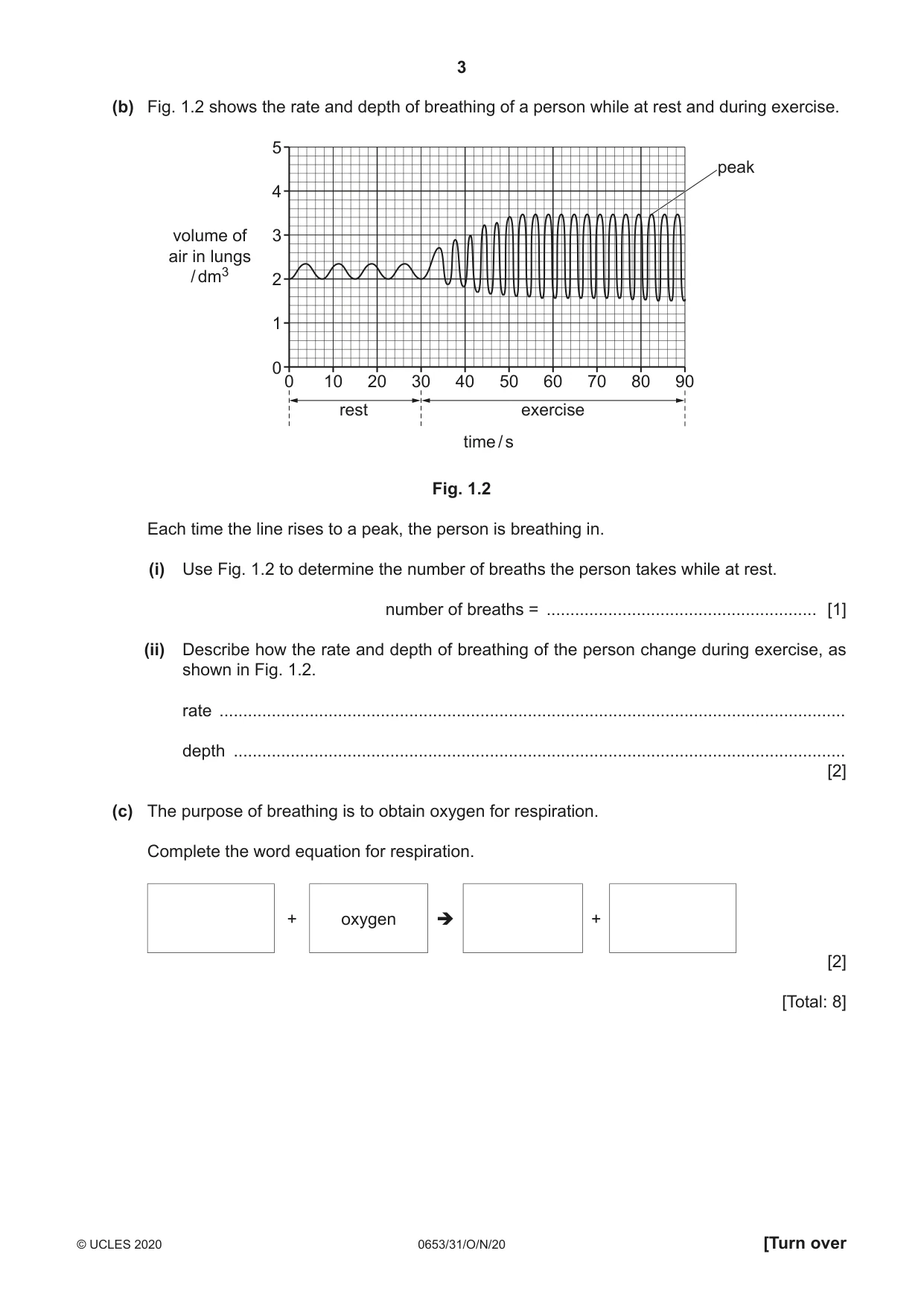
1 (a) Fig. 1.1 is a diagram of some parts of the body. A B X Fig. 1.1 (i) Identify parts A and B shown in Fig. 1.1. A ........................................................................................................................................ B ........................................................................................................................................ [2] (ii) Describe the function of part X shown in Fig. 1.1. ........................................................................................................................................... ..................................................................................................................................... [1] (b) Fig. 1.2 shows the rate and depth of breathing of a person while at rest and during exercise. 5 peak 4 volume of 3 air in lungs / dm3 2 1 0 0 10 20 30 40 50 60 70 80 90 rest exercise time / s Fig. 1.2 Each time the line rises to a peak, the person is breathing in. (i) Use Fig. 1.2 to determine the number of breaths the person takes while at rest. number of breaths = ......................................................... [1] (ii) Describe how the rate and depth of breathing of the person change during exercise, as shown in Fig. 1.2. rate .................................................................................................................................... depth ................................................................................................................................. [2] (c) The purpose of breathing is to obtain oxygen for respiration. Complete the word equation for respiration. + oxygen + [2] [Total: 8]
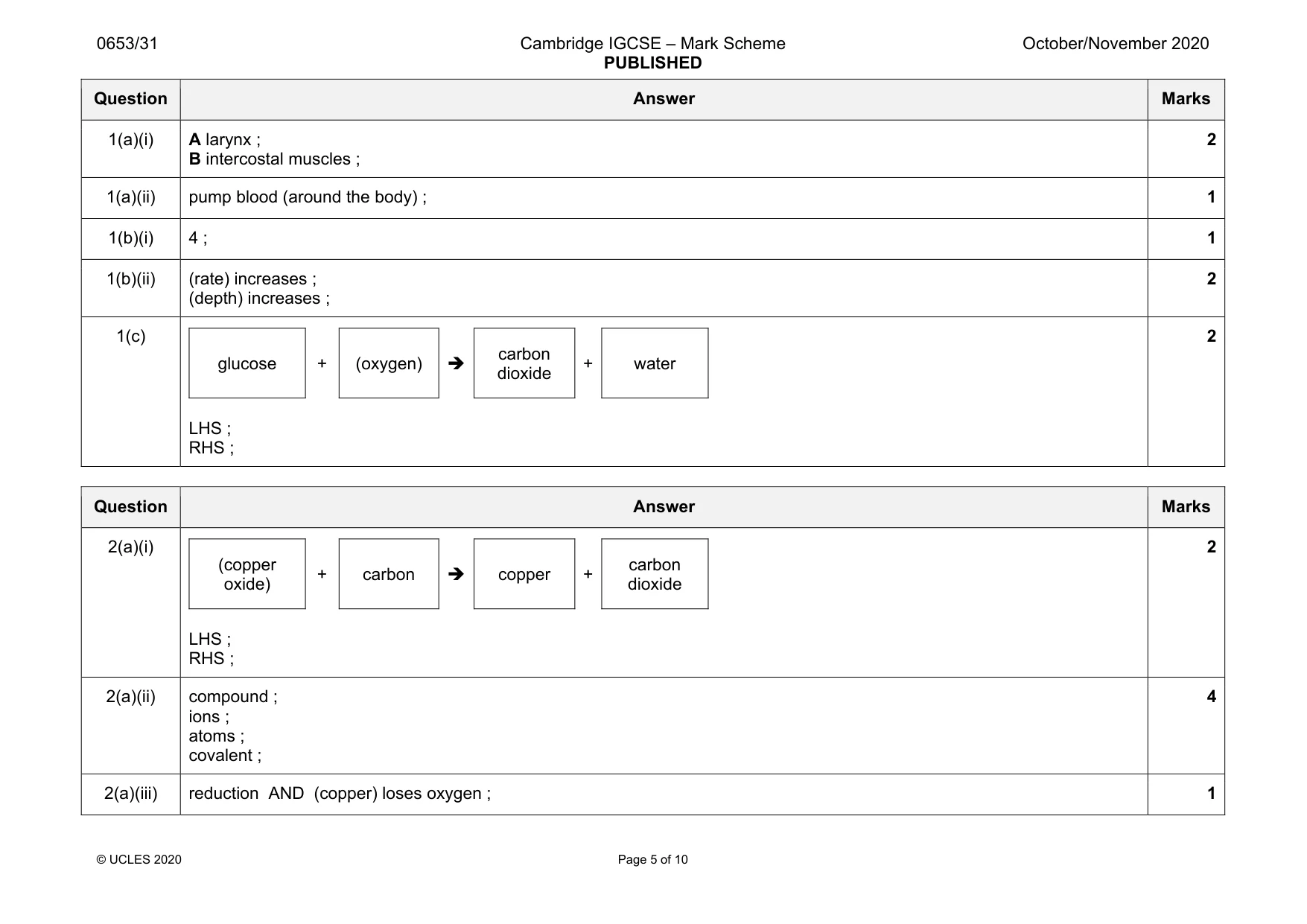
Mark scheme: 1(a)(i) B intercostal muscles ; 2 1(a)(ii) pump blood (around the body) ; 1 1(b)(i) 4 ; 1 1(b)(ii) (rate) increases ; (depth) increases ; 2 1(c) glucose + (oxygen) carbon dioxide + water LHS ; RHS ; 2
Q2 · Copper is extracted from copper oxide by heating with carbon, as shown in Fig
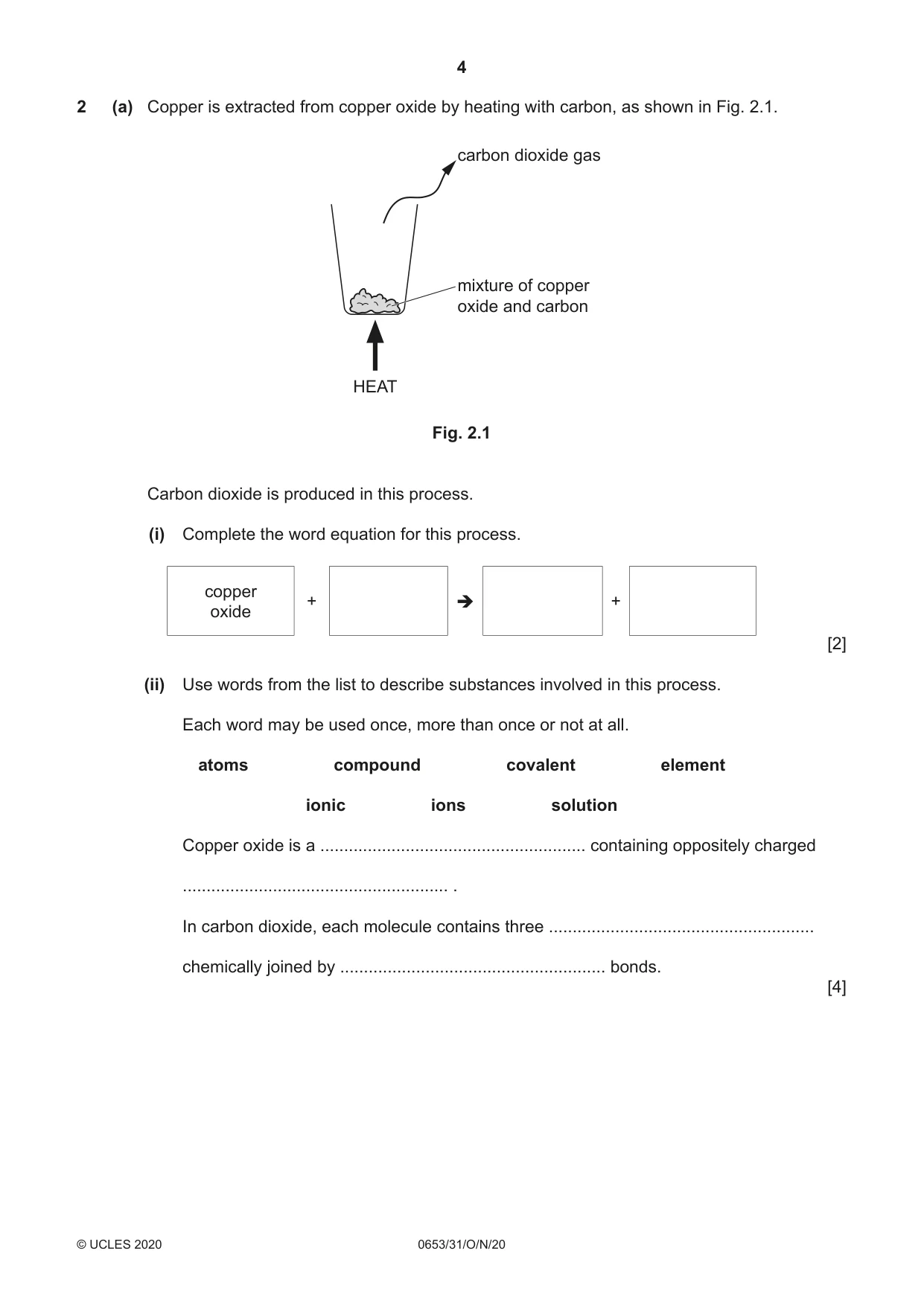
2 (a) Copper is extracted from copper oxide by heating with carbon, as shown in Fig. 2.1. carbon dioxide gas mixture of copper oxide and carbon HEAT Fig. 2.1 Carbon dioxide is produced in this process. (i) Complete the word equation for this process. copper + + oxide [2] (ii) Use words from the list to describe substances involved in this process. Each word may be used once, more than once or not at all. atoms compound covalent element ionic ions solution Copper oxide is a ........................................................ containing oppositely charged ........................................................ . In carbon dioxide, each molecule contains three ........................................................ chemically joined by ........................................................ bonds. [4] (iii) State whether the change from copper oxide to copper during this process is oxidation or reduction. Explain your answer. change .............................................................................................................................. explanation ........................................................................................................................ ........................................................................................................................................... [1] (b) Aluminium is extracted from the ore bauxite. (i) State the method of extraction of aluminium from bauxite. ..................................................................................................................................... [1] (ii) An atom of aluminium is represented by the symbol shown. 2713Al Deduce the number of electrons and the number of neutrons in this atom. electrons ........................ neutrons ........................ [2] [Total: 10]
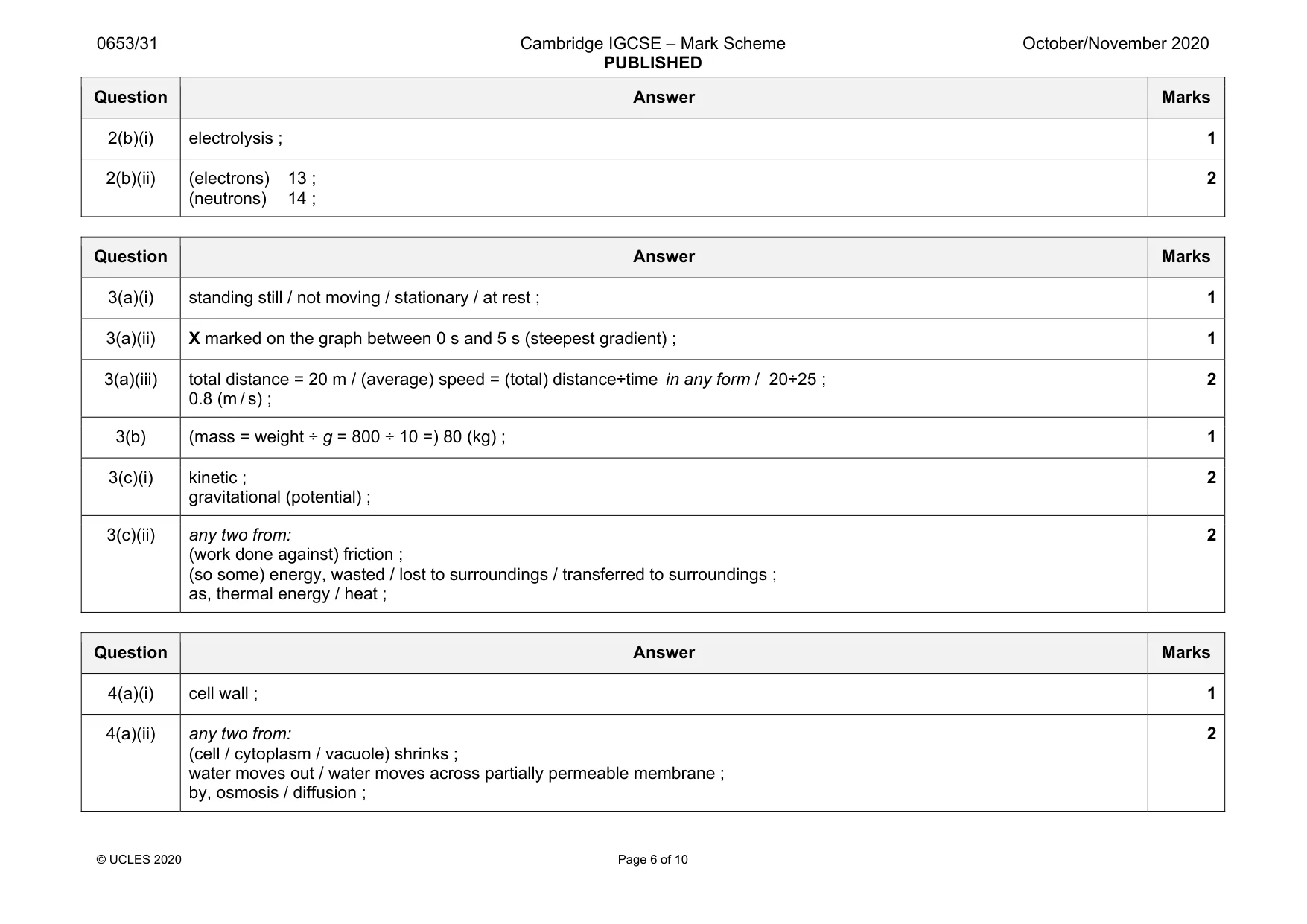
Mark scheme: 2(a)(i) (copper oxide) + carbon copper + carbon dioxide LHS ; RHS ; 2(a)(ii) compound ; ions ; atoms ; covalent ; 4 2(a)(iii) reduction AND (copper) loses oxygen ; 1 Question Answer Marks 2(b)(i) electrolysis ; 1 2(b)(ii) (electrons) 13 ; (neutrons) 14 ; 2
Q3 · The distance–time graph for a man
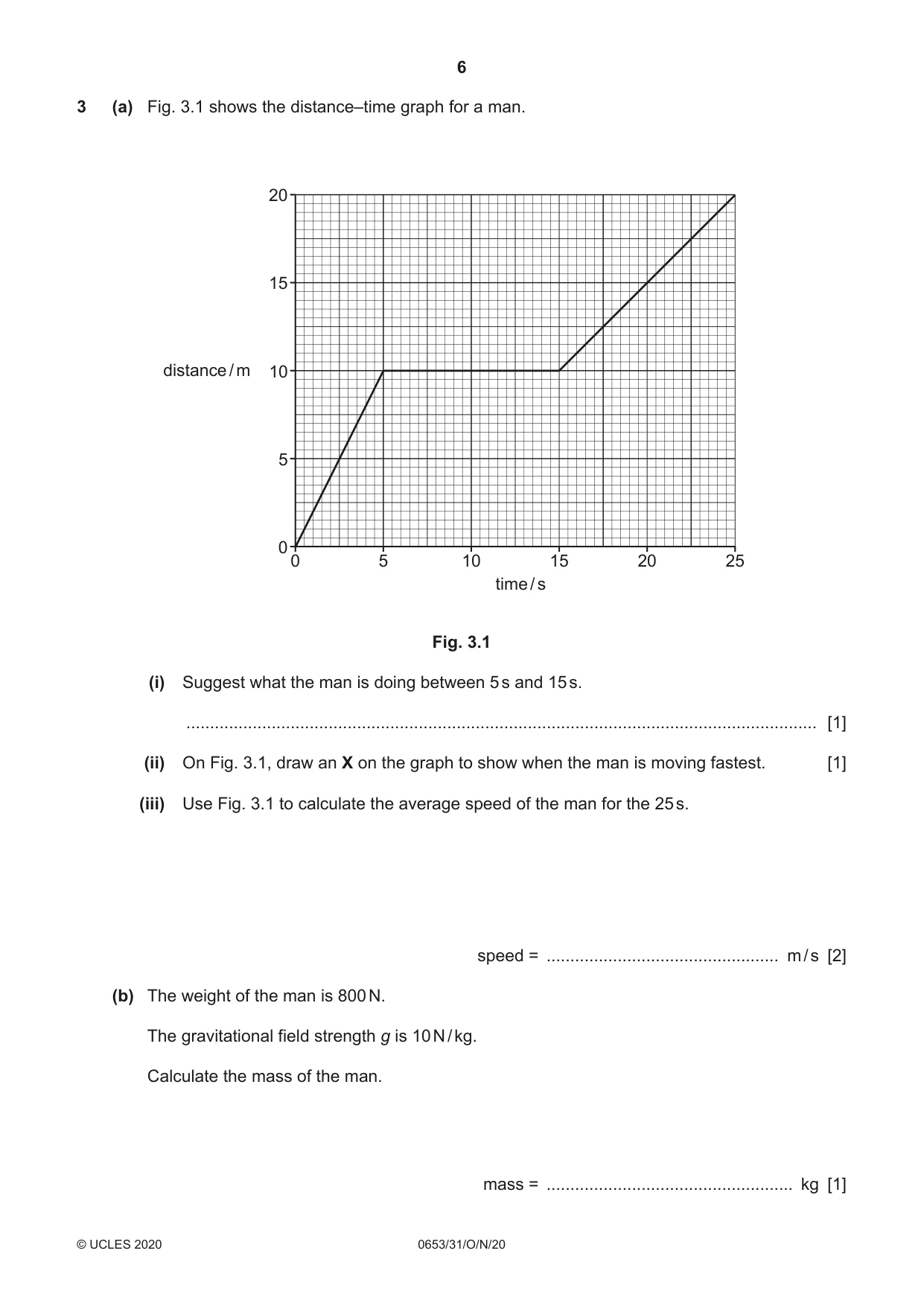
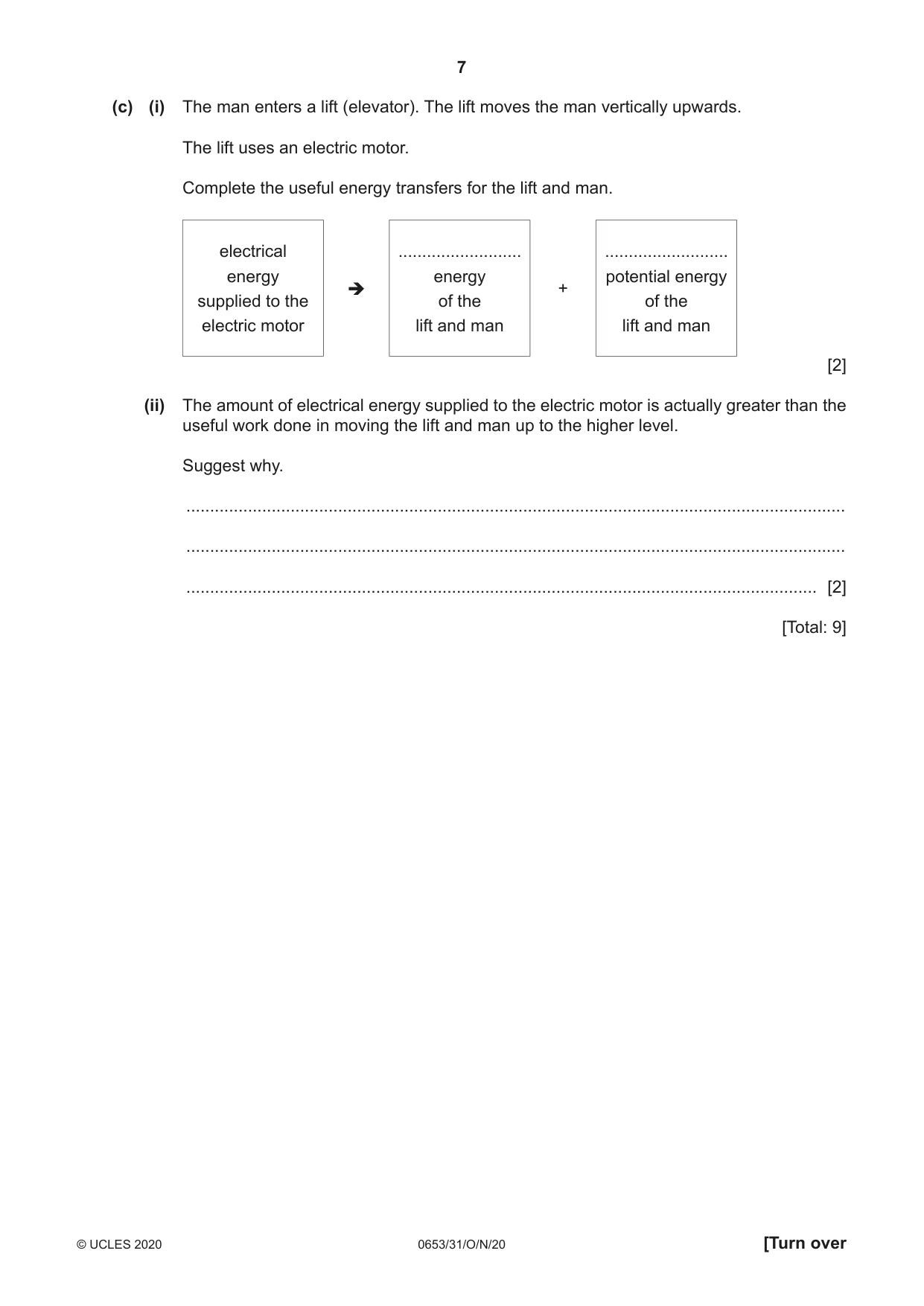
3 (a) Fig. 3.1 shows the distance–time graph for a man. 20 15 distance / m 10 5 0 0 5 10 15 20 25 time / s Fig. 3.1 (i) Suggest what the man is doing between 5 s and 15 s. ..................................................................................................................................... [1] (ii) On Fig. 3.1, draw an X on the graph to show when the man is moving fastest. [1] (iii) Use Fig. 3.1 to calculate the average speed of the man for the 25 s. speed = ................................................. m / s [2] (b) The weight of the man is 800 N. The gravitational field strength g is 10 N / kg. Calculate the mass of the man. mass = .................................................... kg [1] (c) (i) The man enters a lift (elevator). The lift moves the man vertically upwards. The lift uses an electric motor. Complete the useful energy transfers for the lift and man. electrical .......................... .......................... energy energy potential energy + supplied to the of the of the electric motor lift and man lift and man [2] (ii) The amount of electrical energy supplied to the electric motor is actually greater than the useful work done in moving the lift and man up to the higher level. Suggest why. ........................................................................................................................................... ........................................................................................................................................... ..................................................................................................................................... [2] [Total: 9]
Mark scheme: 3(a)(i) standing still / not moving / stationary / at rest ; 1 3(a)(ii) X marked on the graph between 0 s and 5 s (steepest gradient) ; 1 3(a)(iii) total distance = 20 m / (average) speed = (total) distance÷time in any form / 20÷25 ; 0.8 (m / s) ; 2 3(b) (mass = weight ÷ g = 800 ÷ 10 =) 80 (kg) ; 1 3(c)(i) kinetic ; gravitational (potential) ; 2 3(c)(ii) any two from: (work done against) friction ; (so some) energy, wasted / lost to surroundings / transferred to surroundings ; as, thermal energy / heat ; 2
Q4 · Diagrams of a plant cell before and after the cell is immersed in concentrated sugar…
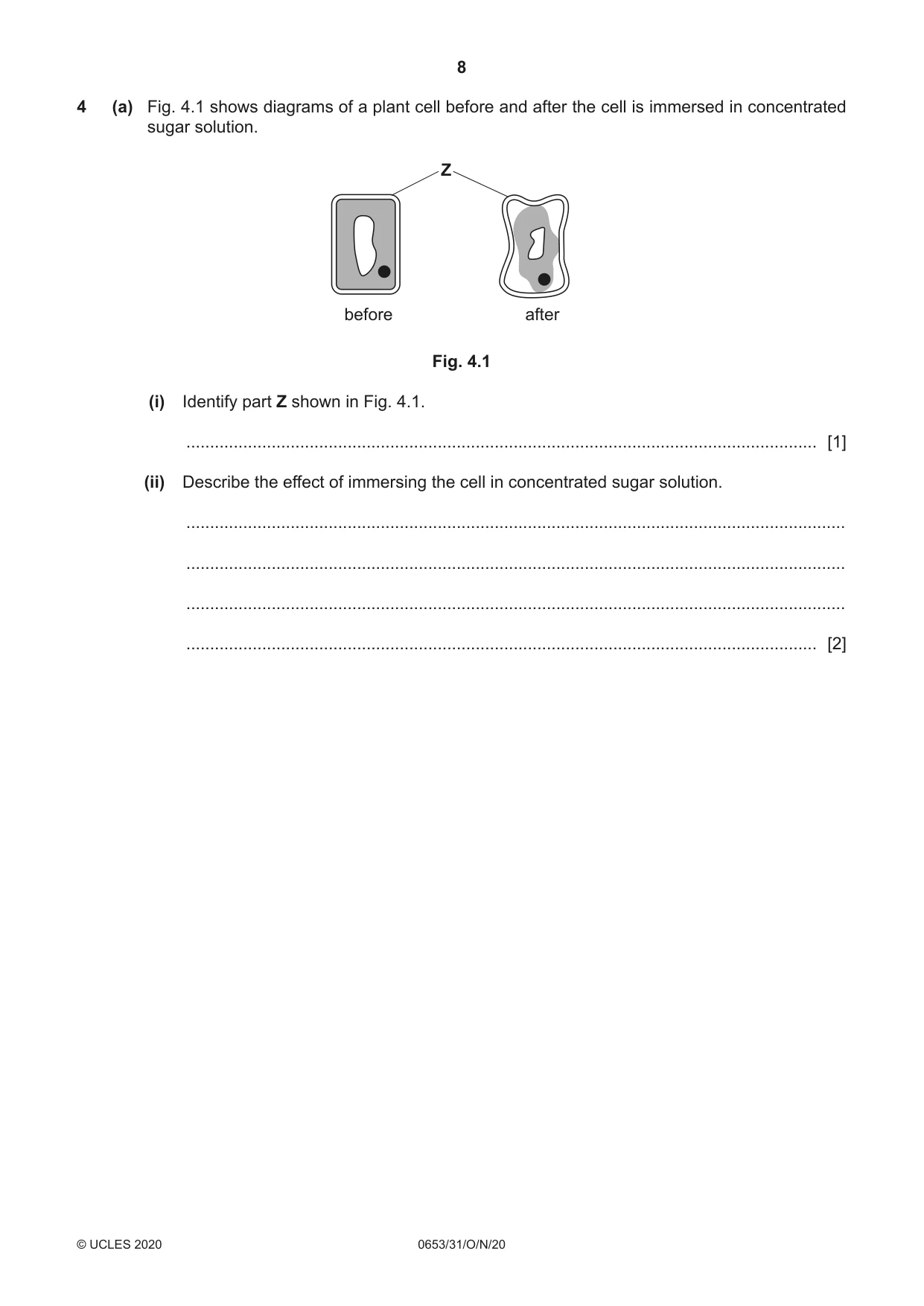
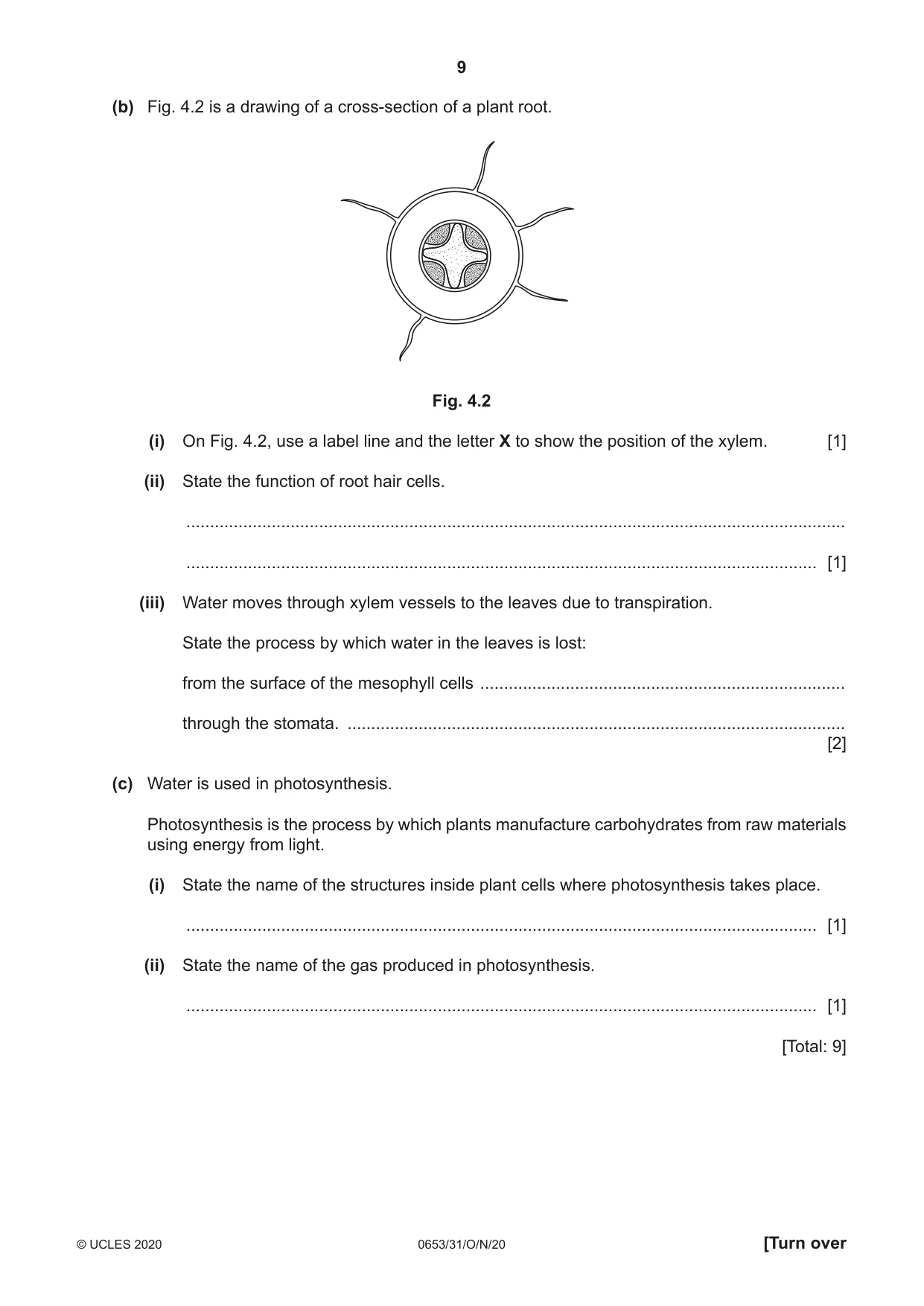
4 (a) Fig. 4.1 shows diagrams of a plant cell before and after the cell is immersed in concentrated sugar solution. Z before after Fig. 4.1 (i) Identify part Z shown in Fig. 4.1. ..................................................................................................................................... [1] (ii) Describe the effect of immersing the cell in concentrated sugar solution. ........................................................................................................................................... ........................................................................................................................................... ........................................................................................................................................... ..................................................................................................................................... [2] (b) Fig. 4.2 is a drawing of a cross-section of a plant root. Fig. 4.2 (i) On Fig. 4.2, use a label line and the letter X to show the position of the xylem. [1] (ii) State the function of root hair cells. ........................................................................................................................................... ..................................................................................................................................... [1] (iii) Water moves through xylem vessels to the leaves due to transpiration. State the process by which water in the leaves is lost: from the surface of the mesophyll cells ............................................................................. through the stomata. ......................................................................................................... [2] (c) Water is used in photosynthesis. Photosynthesis is the process by which plants manufacture carbohydrates from raw materials using energy from light. (i) State the name of the structures inside plant cells where photosynthesis takes place. ..................................................................................................................................... [1] (ii) State the name of the gas produced in photosynthesis. ..................................................................................................................................... [1] [Total: 9]
Mark scheme: 4(a)(i) cell wall ; 1 4(a)(ii) any two from: (cell / cytoplasm / vacuole) shrinks ; water moves out / water moves across partially permeable membrane ; by, osmosis / diffusion ; 2 Question Answer Marks 4(b)(i) label line in any xylem cell ; 1 4(b)(ii) take in, water / mineral ions ; 1 4(b)(iii) evaporation ; diffusion ; 2 4(c)(i) chloroplasts ; 1 4(c)(ii) oxygen ; 1
Q5 · Air is a mixture of different gases
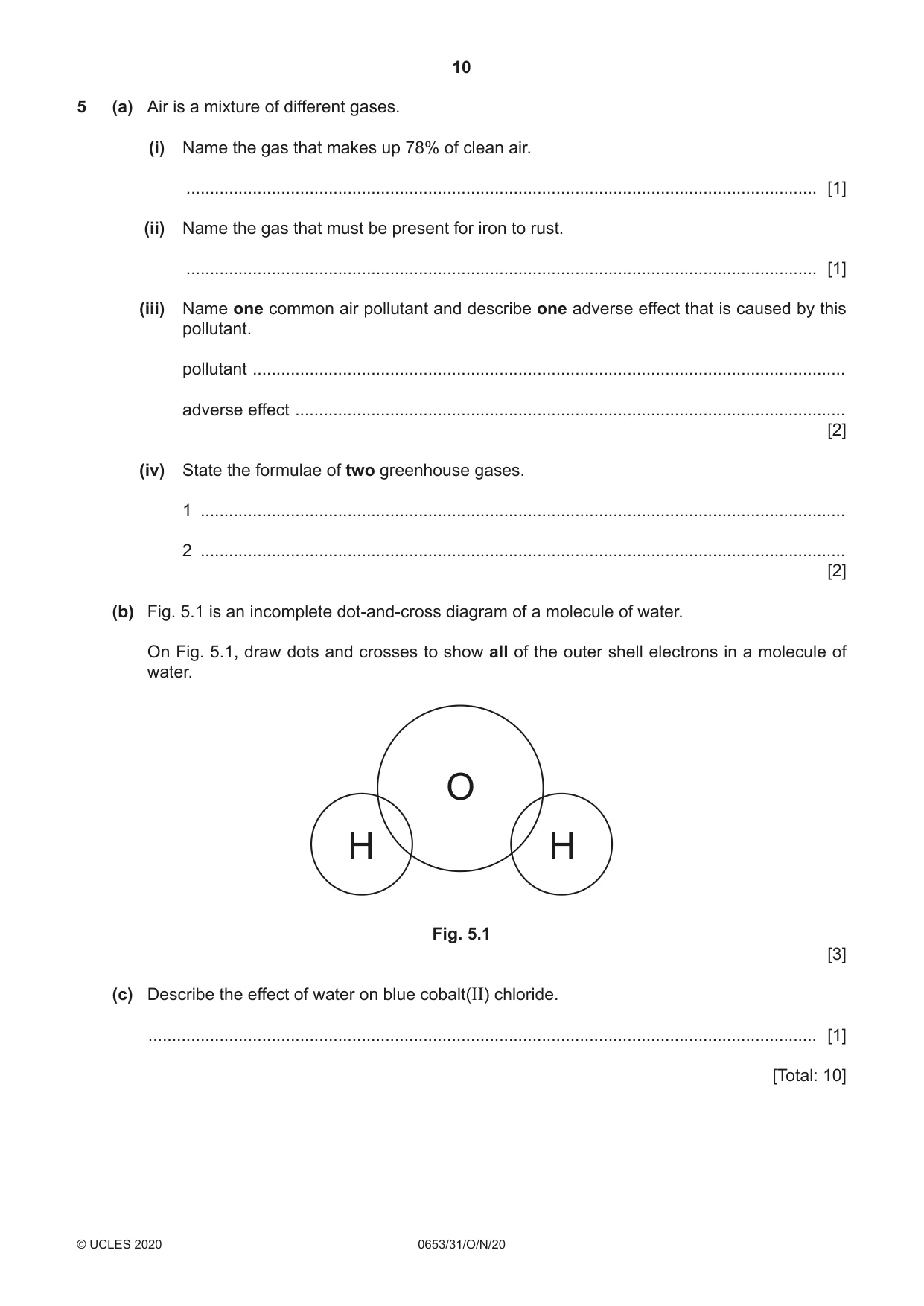
5 (a) Air is a mixture of different gases. (i) Name the gas that makes up 78% of clean air. ..................................................................................................................................... [1] (ii) Name the gas that must be present for iron to rust. ..................................................................................................................................... [1] (iii) Name one common air pollutant and describe one adverse effect that is caused by this pollutant. pollutant ............................................................................................................................. adverse effect .................................................................................................................... [2] (iv) State the formulae of two greenhouse gases. 1 ........................................................................................................................................ 2 ........................................................................................................................................ [2] (b) Fig. 5.1 is an incomplete dot-and-cross diagram of a molecule of water. On Fig. 5.1, draw dots and crosses to show all of the outer shell electrons in a molecule of water. O H H Fig. 5.1 [3] (c) Describe the effect of water on blue cobalt(II) chloride. ............................................................................................................................................. [1] [Total: 10]
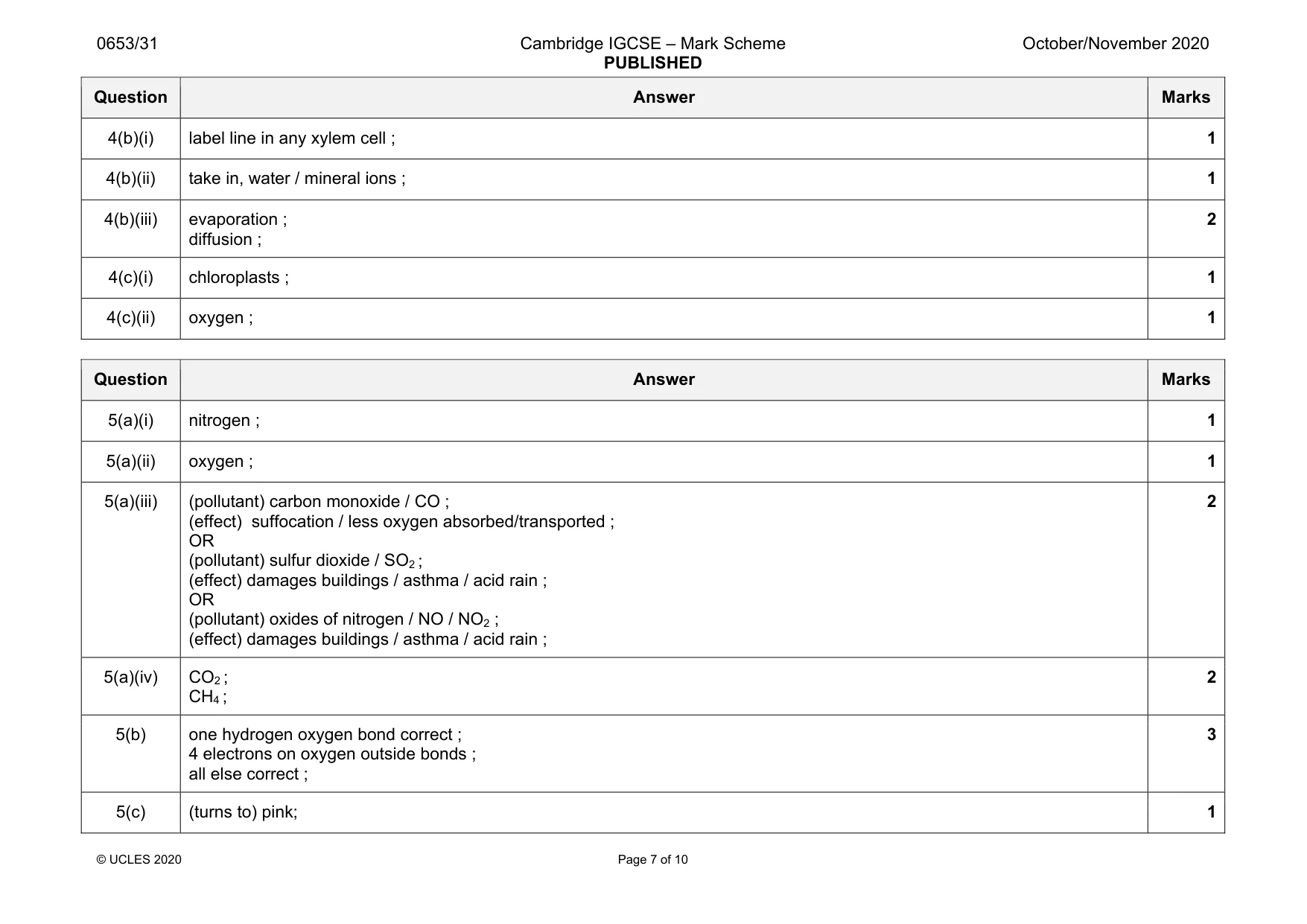
Mark scheme: 5(a)(i) nitrogen ; 1 5(a)(ii) oxygen ; 1 5(a)(iii) (pollutant) carbon monoxide / CO ; (effect) suffocation / less oxygen absorbed/transported ; OR (pollutant) sulfur dioxide / SO2 ; (effect) damages buildings / asthma / acid rain ; OR (pollutant) oxides of nitrogen / NO / NO2 ; (effect) damages buildings / asthma / acid rain ; 2 5(a)(iv) CO2 ; CH4 ; 2 5(b) one hydrogen oxygen bond correct ; 4 electrons on oxygen outside bonds ; all else correct ; 3 5(c) (turns to) pink; 1
Q6 · A girl using a bicycle pump to add air to a bicycle tyre
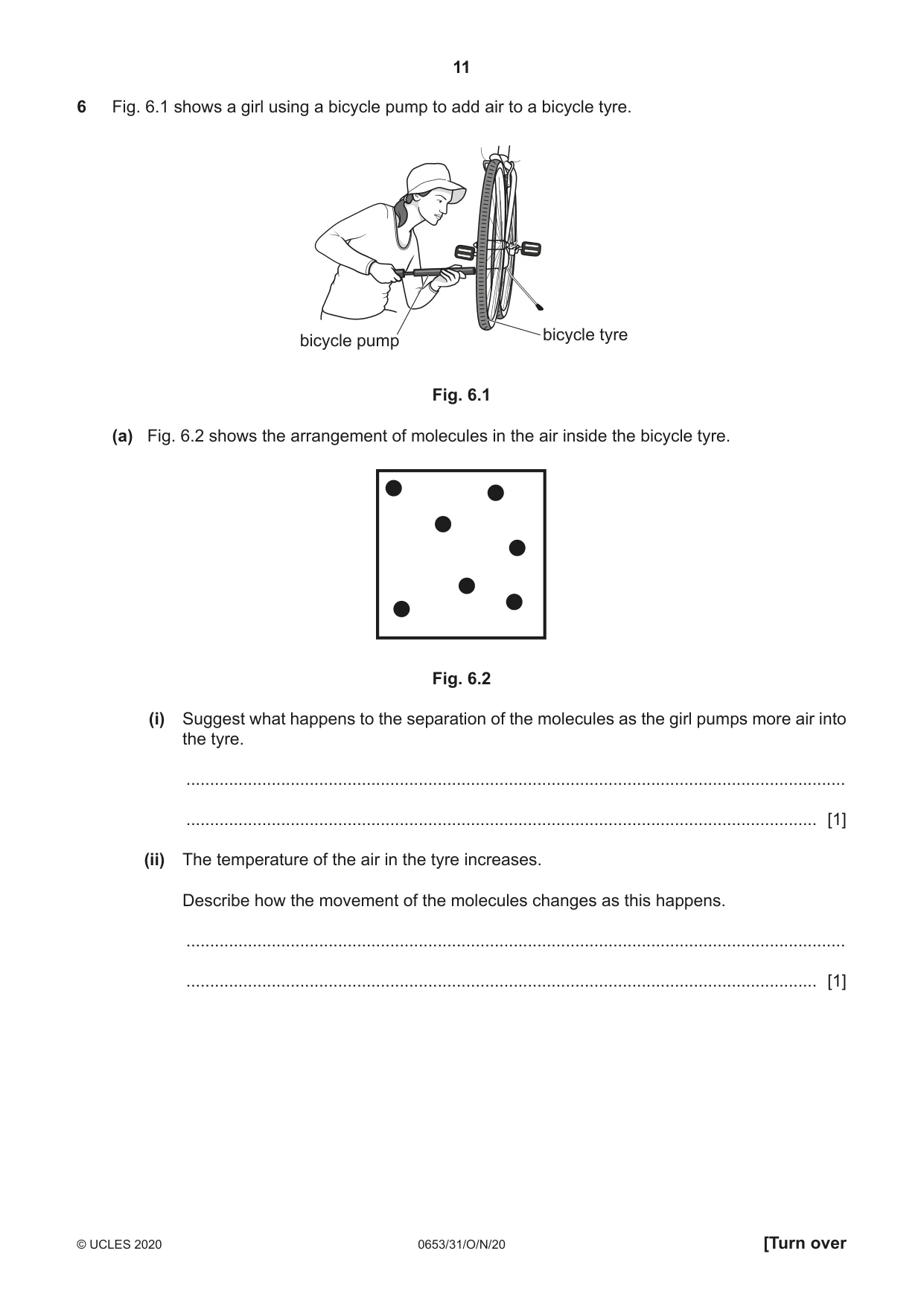
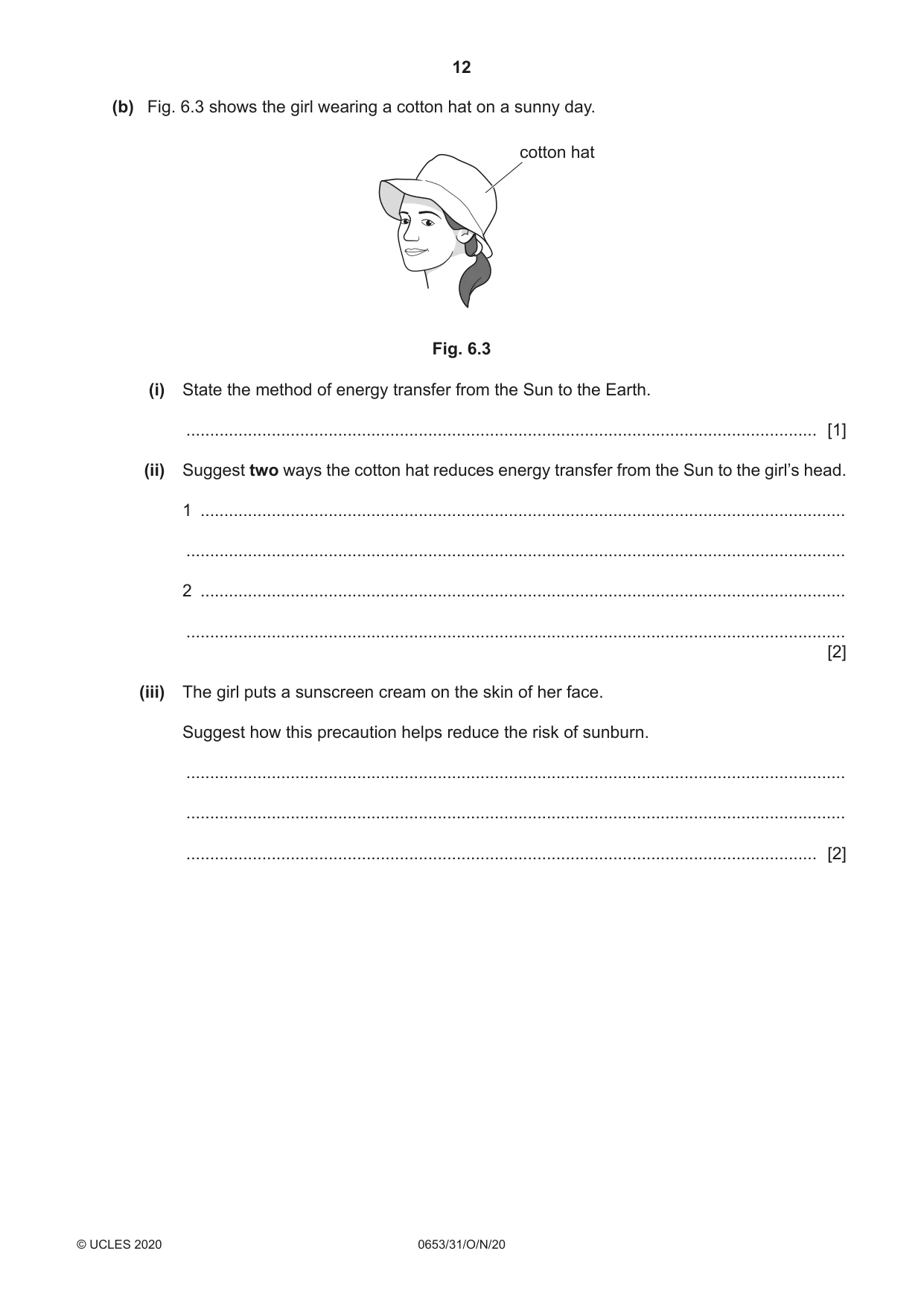
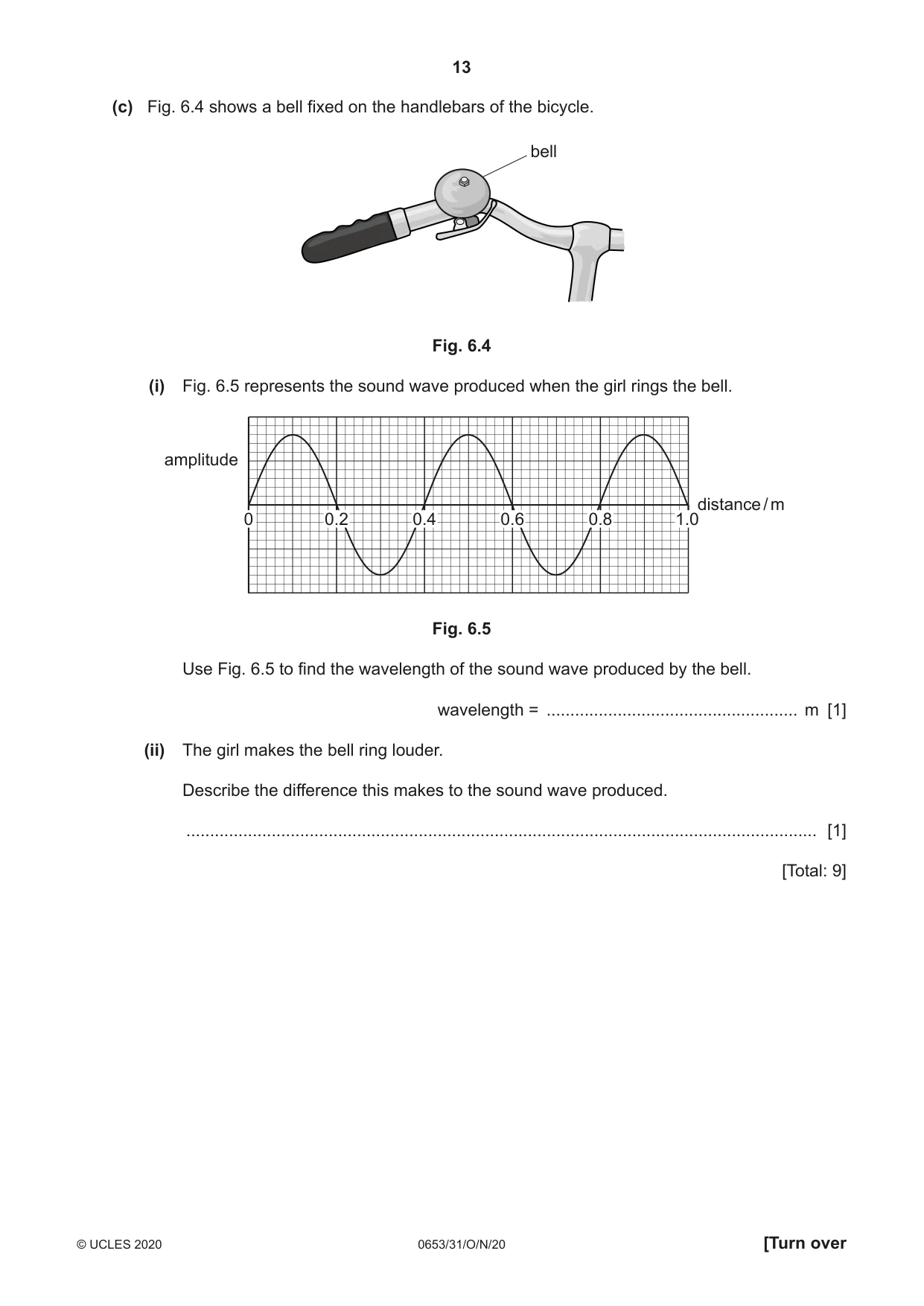
6 Fig. 6.1 shows a girl using a bicycle pump to add air to a bicycle tyre. bicycle tyre bicycle pump Fig. 6.1 (a) Fig. 6.2 shows the arrangement of molecules in the air inside the bicycle tyre. Fig. 6.2 (i) Suggest what happens to the separation of the molecules as the girl pumps more air into the tyre. ........................................................................................................................................... ..................................................................................................................................... [1] (ii) The temperature of the air in the tyre increases. Describe how the movement of the molecules changes as this happens. ........................................................................................................................................... ..................................................................................................................................... [1] (b) Fig. 6.3 shows the girl wearing a cotton hat on a sunny day. cotton hat Fig. 6.3 (i) State the method of energy transfer from the Sun to the Earth. ..................................................................................................................................... [1] (ii) Suggest two ways the cotton hat reduces energy transfer from the Sun to the girl’s head. 1 ........................................................................................................................................ ........................................................................................................................................... 2 ........................................................................................................................................ ........................................................................................................................................... [2] (iii) The girl puts a sunscreen cream on the skin of her face. Suggest how this precaution helps reduce the risk of sunburn. ........................................................................................................................................... ........................................................................................................................................... ..................................................................................................................................... [2] (c) Fig. 6.4 shows a bell fixed on the handlebars of the bicycle. bell Fig. 6.4 (i) Fig. 6.5 represents the sound wave produced when the girl rings the bell. amplitude distance / m 0 0.2 0.4 0.6 0.8 1.0 Fig. 6.5 Use Fig. 6.5 to find the wavelength of the sound wave produced by the bell. wavelength = ..................................................... m [1] (ii) The girl makes the bell ring louder. Describe the difference this makes to the sound wave produced. ..................................................................................................................................... [1] [Total: 9]
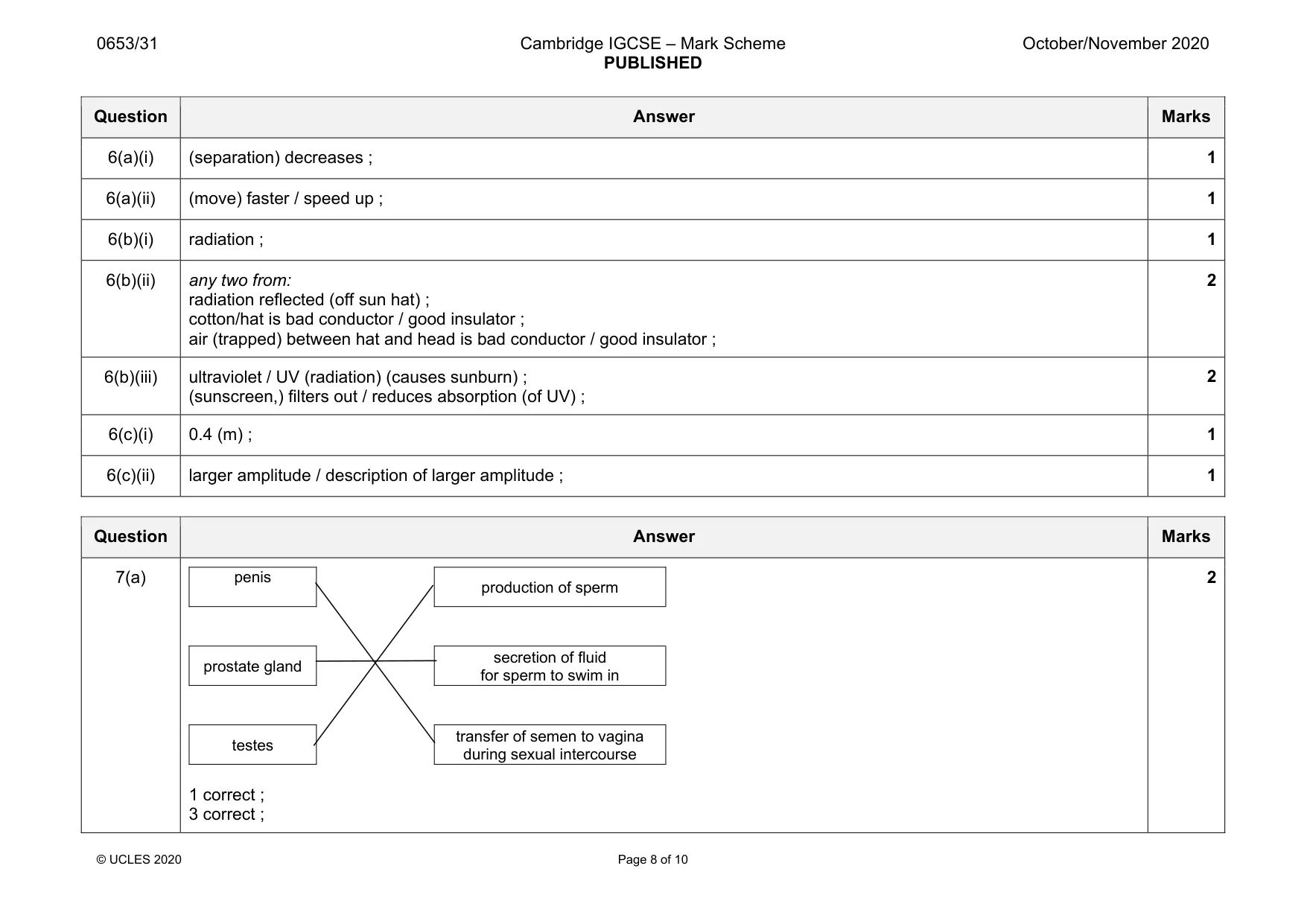
Mark scheme: 6(a)(i) (separation) decreases ; 1 6(a)(ii) (move) faster / speed up ; 1 6(b)(i) radiation ; 1 6(b)(ii) any two from: radiation reflected (off sun hat) ; cotton/hat is bad conductor / good insulator ; air (trapped) between hat and head is bad conductor / good insulator ; 2 6(b)(iii) ultraviolet / UV (radiation) (causes sunburn) ; (sunscreen,) filters out / reduces absorption (of UV) ; 2 6(c)(i) 0.4 (m) ; 1 6(c)(ii) larger amplitude / description of larger amplitude ; 1
Q7 · The boxes on the left show some parts of the male reproductive system in humans
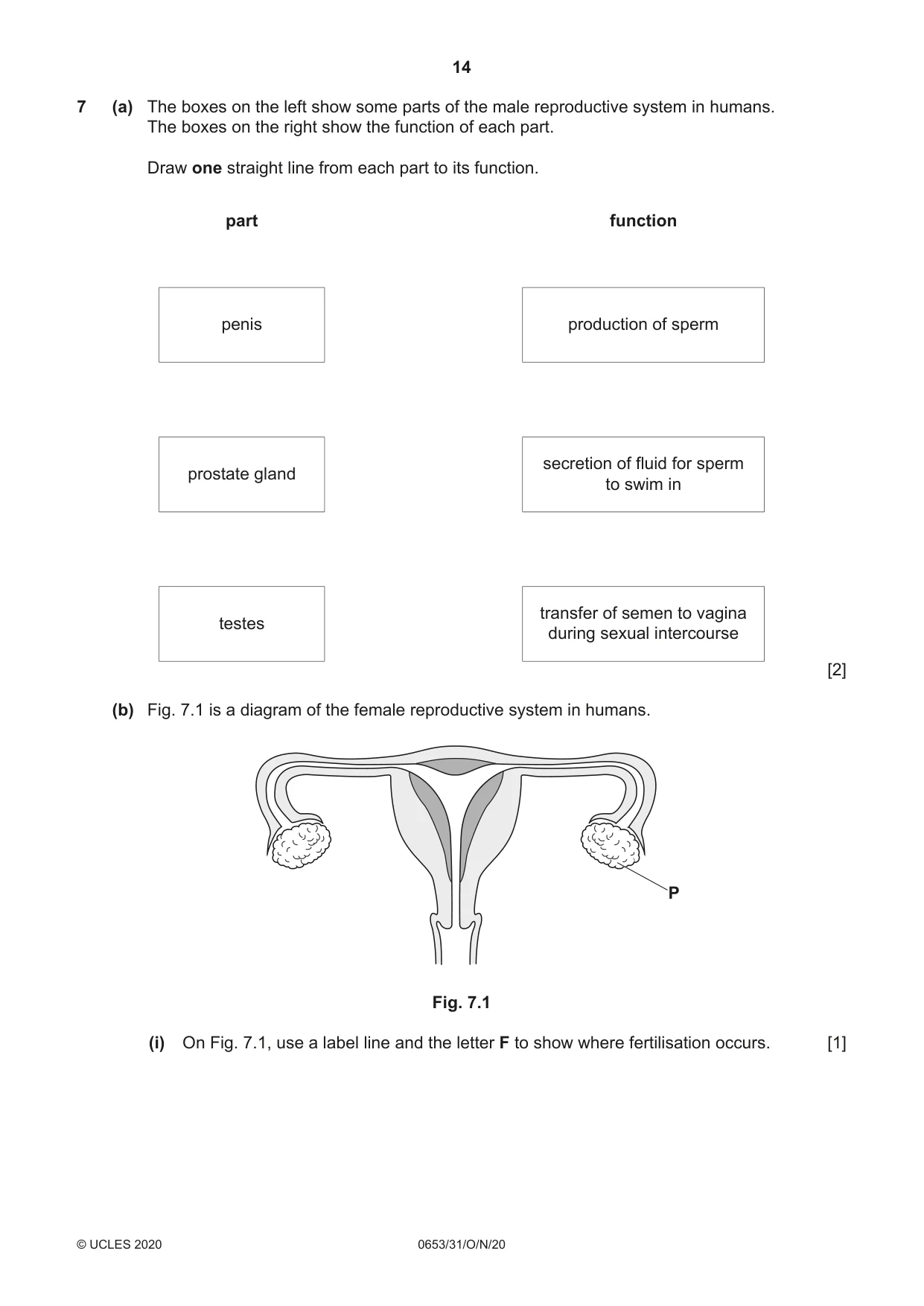
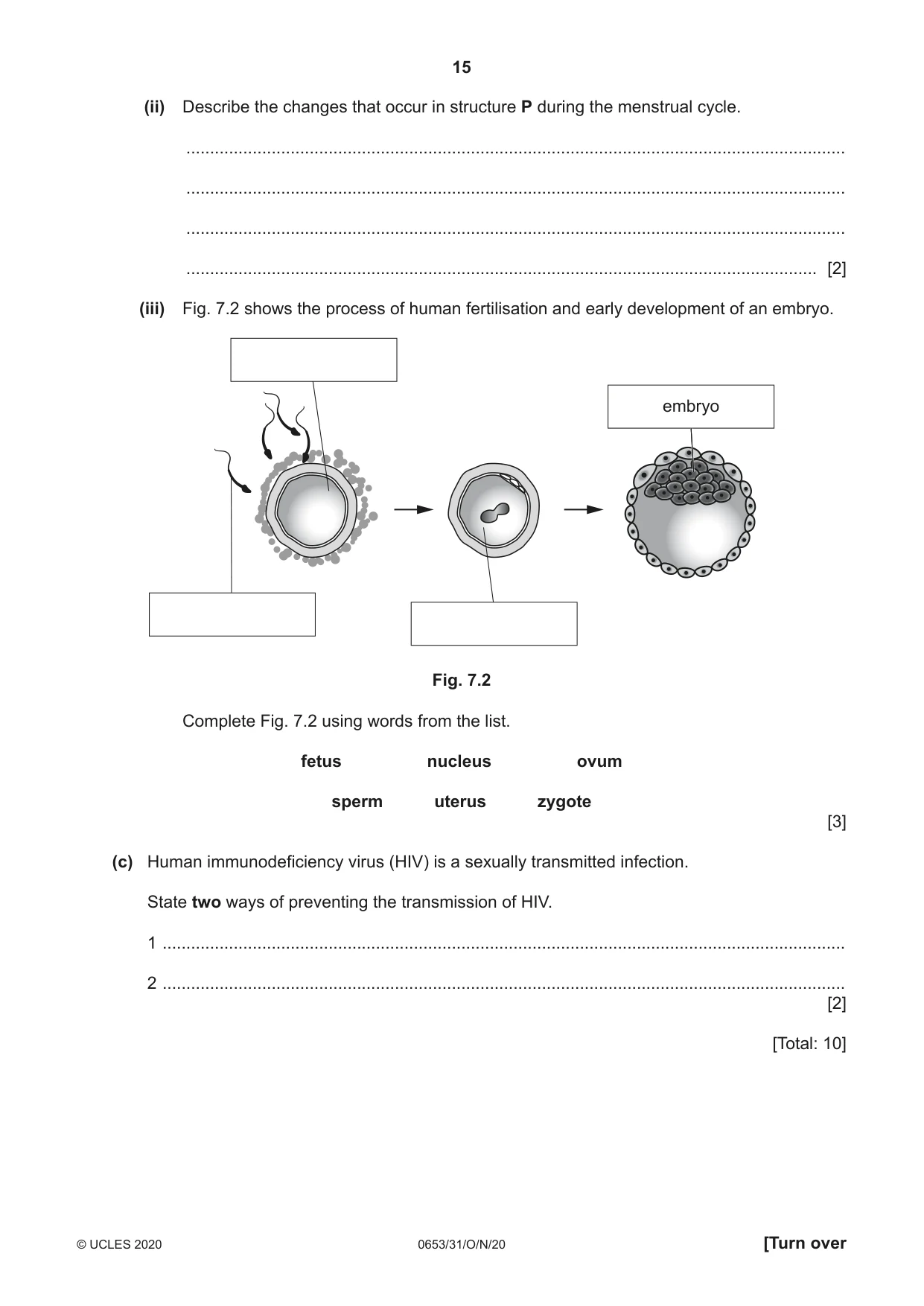
7 (a) The boxes on the left show some parts of the male reproductive system in humans. The boxes on the right show the function of each part. Draw one straight line from each part to its function. part function penis production of sperm secretion of fluid for sperm prostate gland to swim in transfer of semen to vagina testes during sexual intercourse [2] (b) Fig. 7.1 is a diagram of the female reproductive system in humans. P Fig. 7.1 (i) On Fig. 7.1, use a label line and the letter F to show where fertilisation occurs. [1] (ii) Describe the changes that occur in structure P during the menstrual cycle. ........................................................................................................................................... ........................................................................................................................................... ........................................................................................................................................... ..................................................................................................................................... [2] (iii) Fig. 7.2 shows the process of human fertilisation and early development of an embryo. embryo Fig. 7.2 Complete Fig. 7.2 using words from the list. fetus nucleus ovum sperm uterus zygote [3] (c) Human immunodeficiency virus (HIV) is a sexually transmitted infection. State two ways of preventing the transmission of HIV. 1 ................................................................................................................................................ 2 ................................................................................................................................................ [2] [Total: 10]
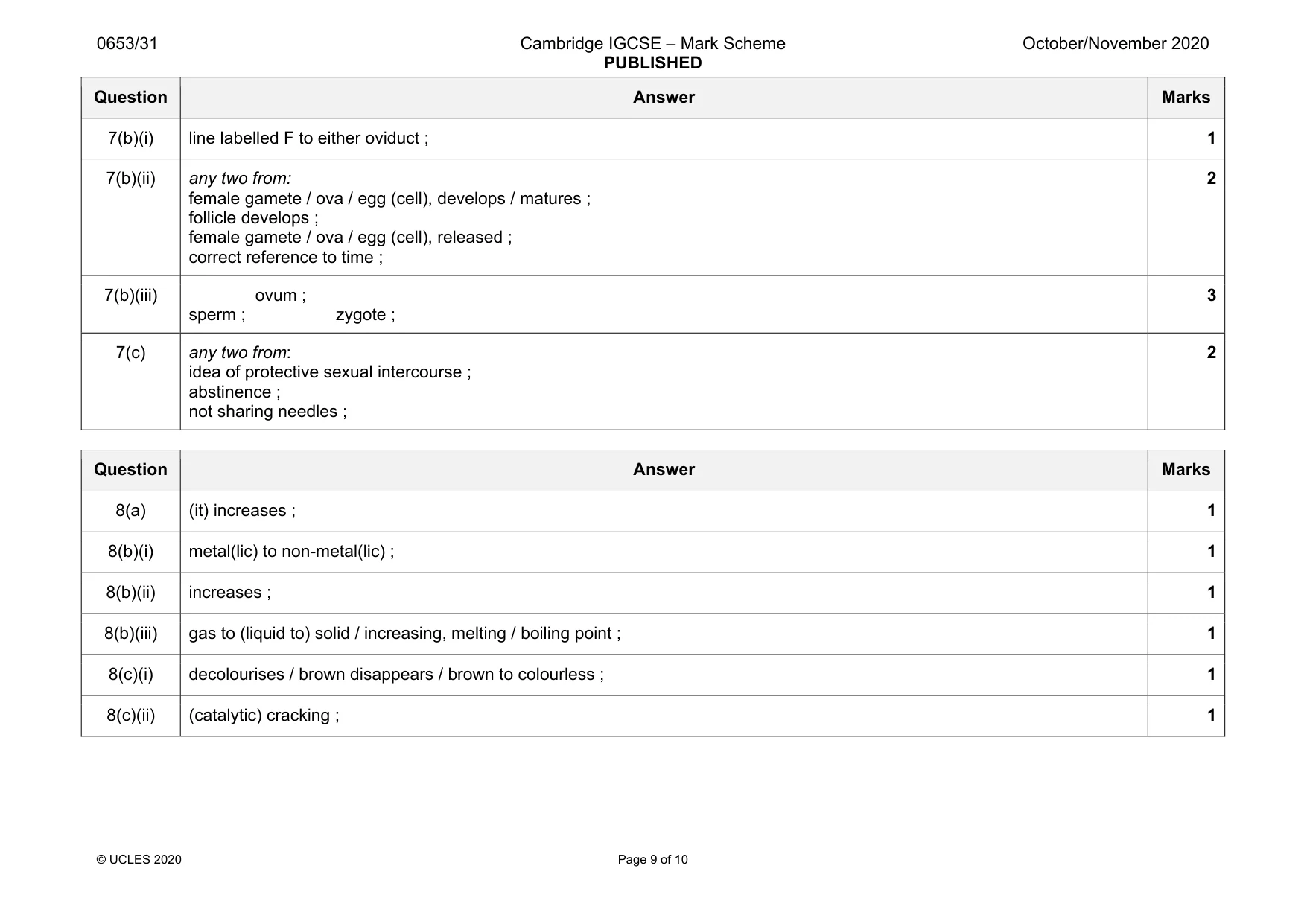
Mark scheme: 7(a) penis production of sperm prostate gland secretion of fluid for sperm to swim in testes transfer of semen to vagina during sexual intercourse 1 correct ; 3 correct ; 2 Question Answer Marks 7(b)(i) line labelled F to either oviduct ; 1 7(b)(ii) any two from: female gamete / ova / egg (cell), develops / matures ; follicle develops ; female gamete / ova / egg (cell), released ; correct reference to time ; 2 7(b)(iii) ovum ; sperm ; zygote ; 3 7(c) any two from: idea of protective sexual intercourse ; abstinence ; not sharing needles ; 2
Q8 · Sodium chloride is made when aqueous sodium hydroxide is mixed with dilute hydrochloric…
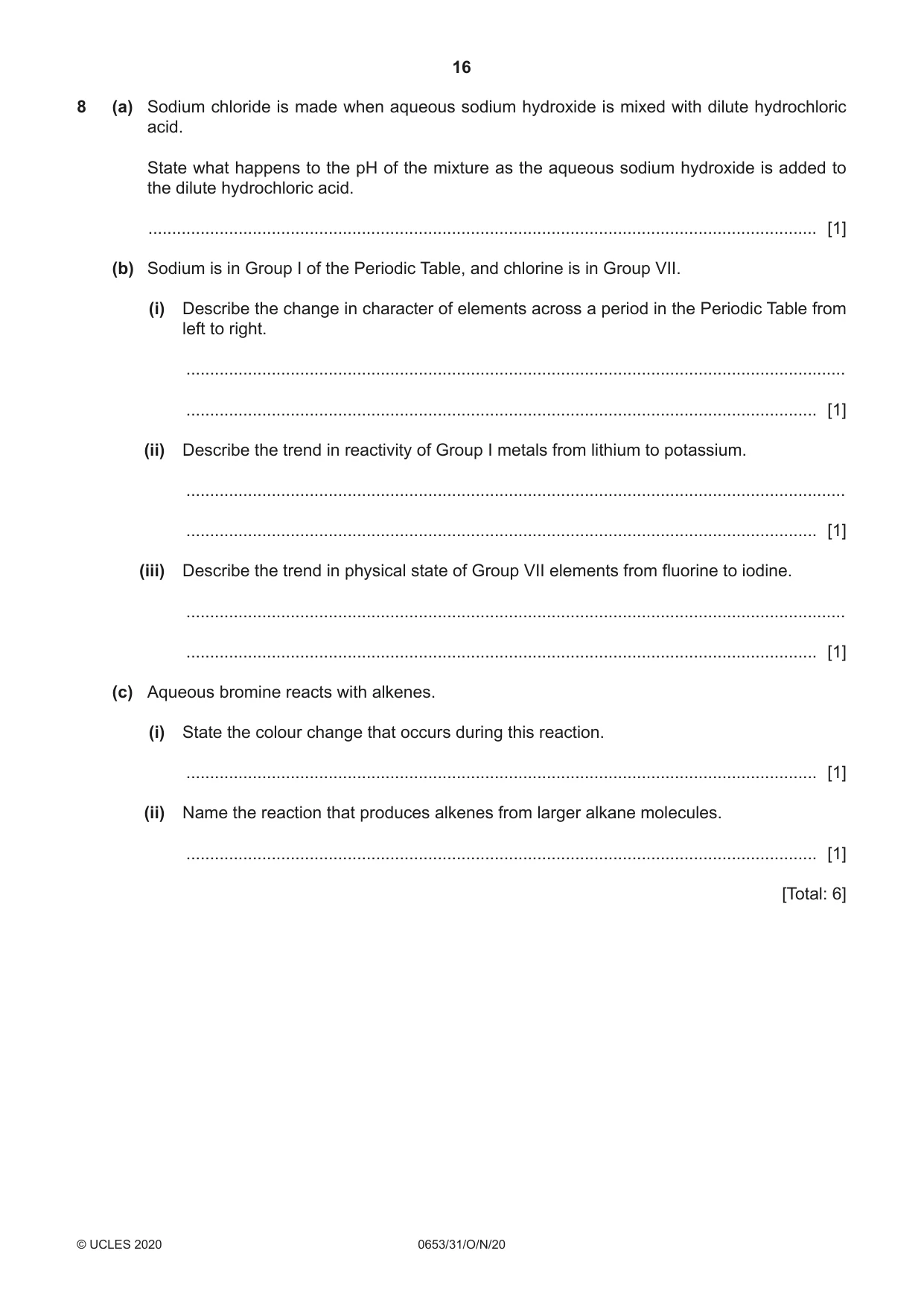
8 (a) Sodium chloride is made when aqueous sodium hydroxide is mixed with dilute hydrochloric acid. State what happens to the pH of the mixture as the aqueous sodium hydroxide is added to the dilute hydrochloric acid. ............................................................................................................................................. [1] (b) Sodium is in Group I of the Periodic Table, and chlorine is in Group VII. (i) Describe the change in character of elements across a period in the Periodic Table from left to right. ........................................................................................................................................... ..................................................................................................................................... [1] (ii) Describe the trend in reactivity of Group I metals from lithium to potassium. ........................................................................................................................................... ..................................................................................................................................... [1] (iii) Describe the trend in physical state of Group VII elements from fluorine to iodine. ........................................................................................................................................... ..................................................................................................................................... [1] (c) Aqueous bromine reacts with alkenes. (i) State the colour change that occurs during this reaction. ..................................................................................................................................... [1] (ii) Name the reaction that produces alkenes from larger alkane molecules. ..................................................................................................................................... [1] [Total: 6]
Mark scheme: 8(a) 1 8(b)(i) metal(lic) to non-metal(lic) ; 1 8(b)(ii) increases ; 1 8(b)(iii) gas to (liquid to) solid / increasing, melting / boiling point ; 1 8(c)(i) decolourises / brown disappears / brown to colourless ; 1 8(c)(ii) (catalytic) cracking ; 1
Q9 · An electric toaster that is used for toasting slices of bread
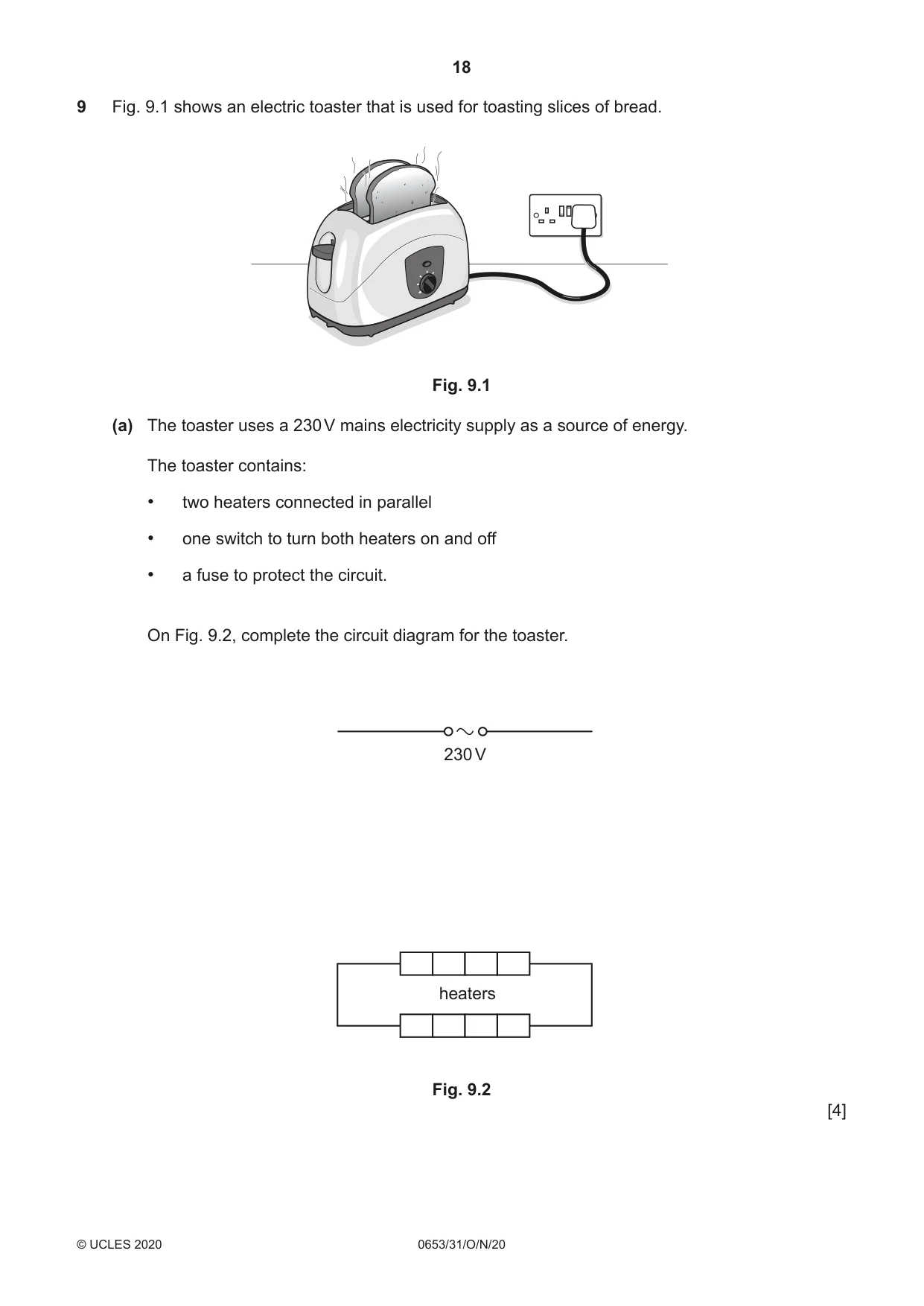
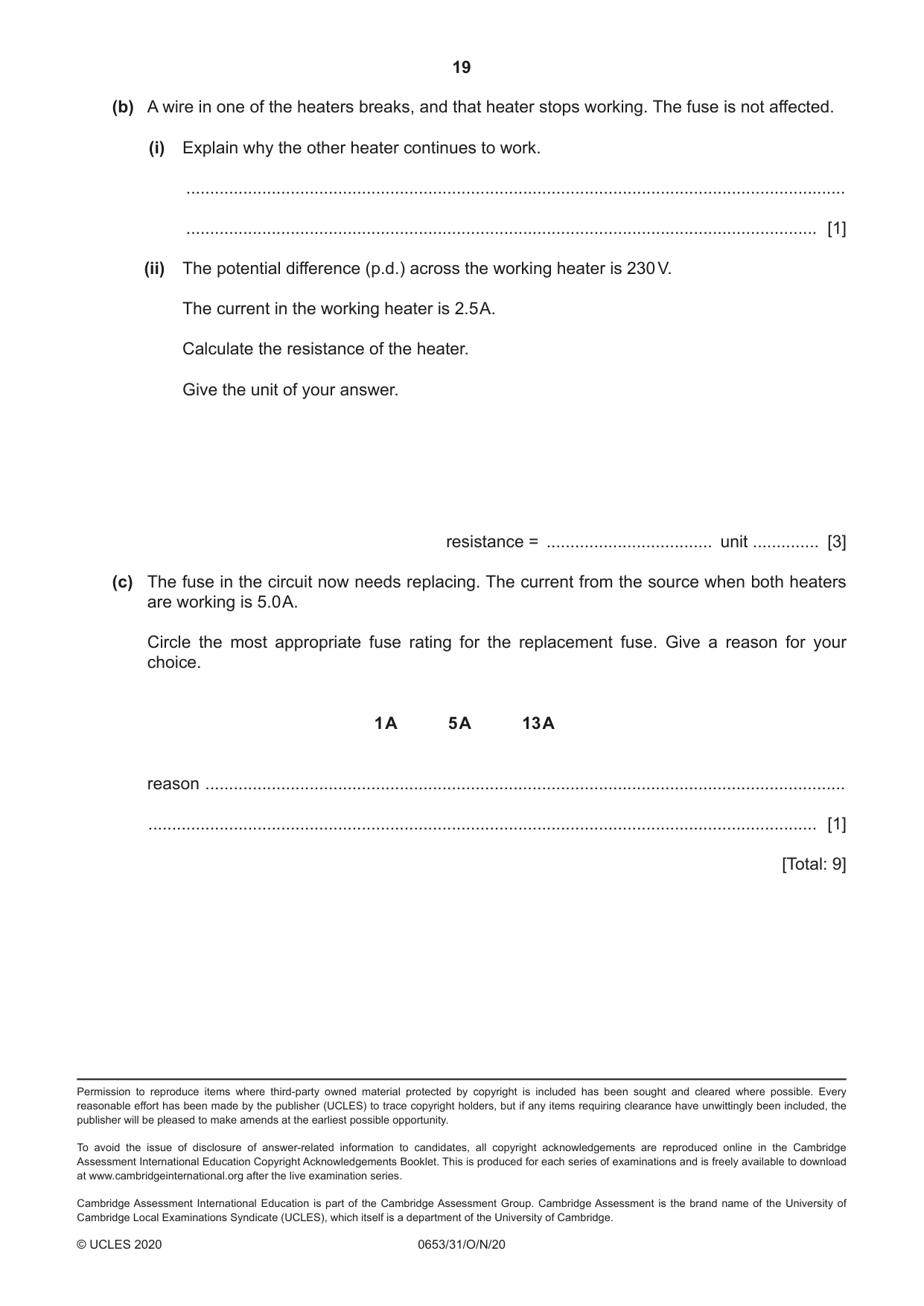
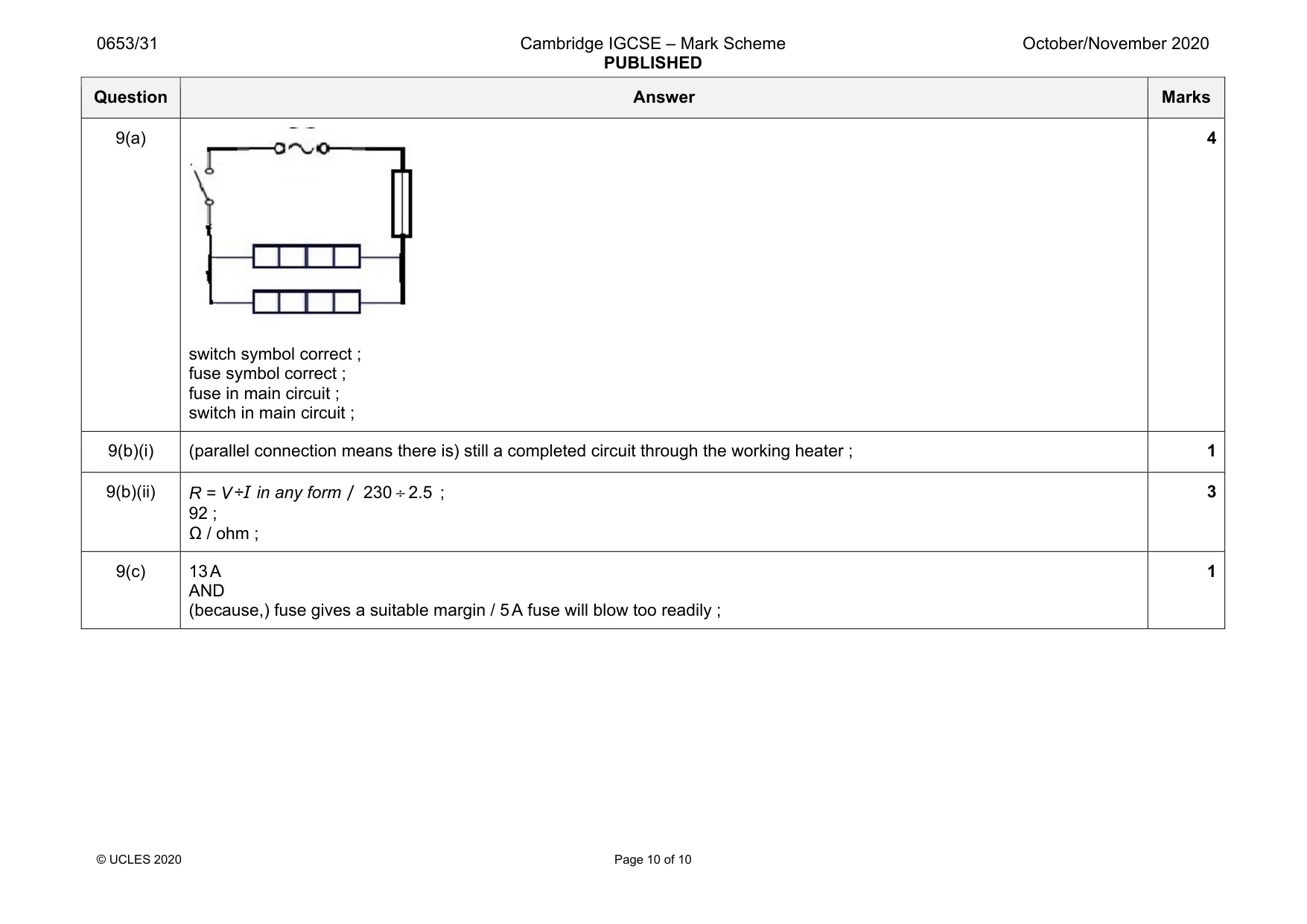
9 Fig. 9.1 shows an electric toaster that is used for toasting slices of bread. Fig. 9.1 (a) The toaster uses a 230 V mains electricity supply as a source of energy. The toaster contains: • two heaters connected in parallel • one switch to turn both heaters on and off • a fuse to protect the circuit. On Fig. 9.2, complete the circuit diagram for the toaster. 230 V heaters Fig. 9.2 [4] (b) A wire in one of the heaters breaks, and that heater stops working. The fuse is not affected. (i) Explain why the other heater continues to work. ........................................................................................................................................... ..................................................................................................................................... [1] (ii) The potential difference (p.d.) across the working heater is 230 V. The current in the working heater is 2.5 A. Calculate the resistance of the heater. Give the unit of your answer. resistance = ................................... unit .............. [3] (c) The fuse in the circuit now needs replacing. The current from the source when both heaters are working is 5.0 A. Circle the most appropriate fuse rating for the replacement fuse. Give a reason for your choice. 1 A 5 A 13 A reason ....................................................................................................................................... ............................................................................................................................................. [1] [Total: 9]
Mark scheme: 9(a) switch symbol correct ; fuse symbol correct ; fuse in main circuit ; switch in main circuit ; 4 9(b)(i) (parallel connection means there is) still a completed circuit through the working heater ; 1 9(b)(ii) R = V ÷I in any form / 230 2.5 ÷ ; 92 ; Ω / ohm ; 3 9(c) 13 A AND (because,) fuse gives a suitable margin / 5 A fuse will blow too readily ; 1
What was in this paper
The subtopics covered by these 9 questions, and how many questions each got. Open one in a new tab to see every Cambridge question on it.
What you needed in this session
Cambridge’s own grade thresholds for 2020 Oct/Nov, Paper 3 · Variant 1. A higher threshold means an easier paper — the bar moves with how the cohort did.