Cambridge IGCSE Science - Combined 0653 — 2021 May/June Paper 3 · Variant 2
0653/32/M/J/21 · 9 questions · 80 marks · ≈90 min
The question paper and its mark scheme, free to read here and free to download. This is Cambridge’s own paper, exactly as it was sat.
Question paper24 pages
Mark scheme10 pages
Answers below. Sit the paper first if you are practising.
Questions as text
Q1 · Reproduction is one of the characteristics of living organisms
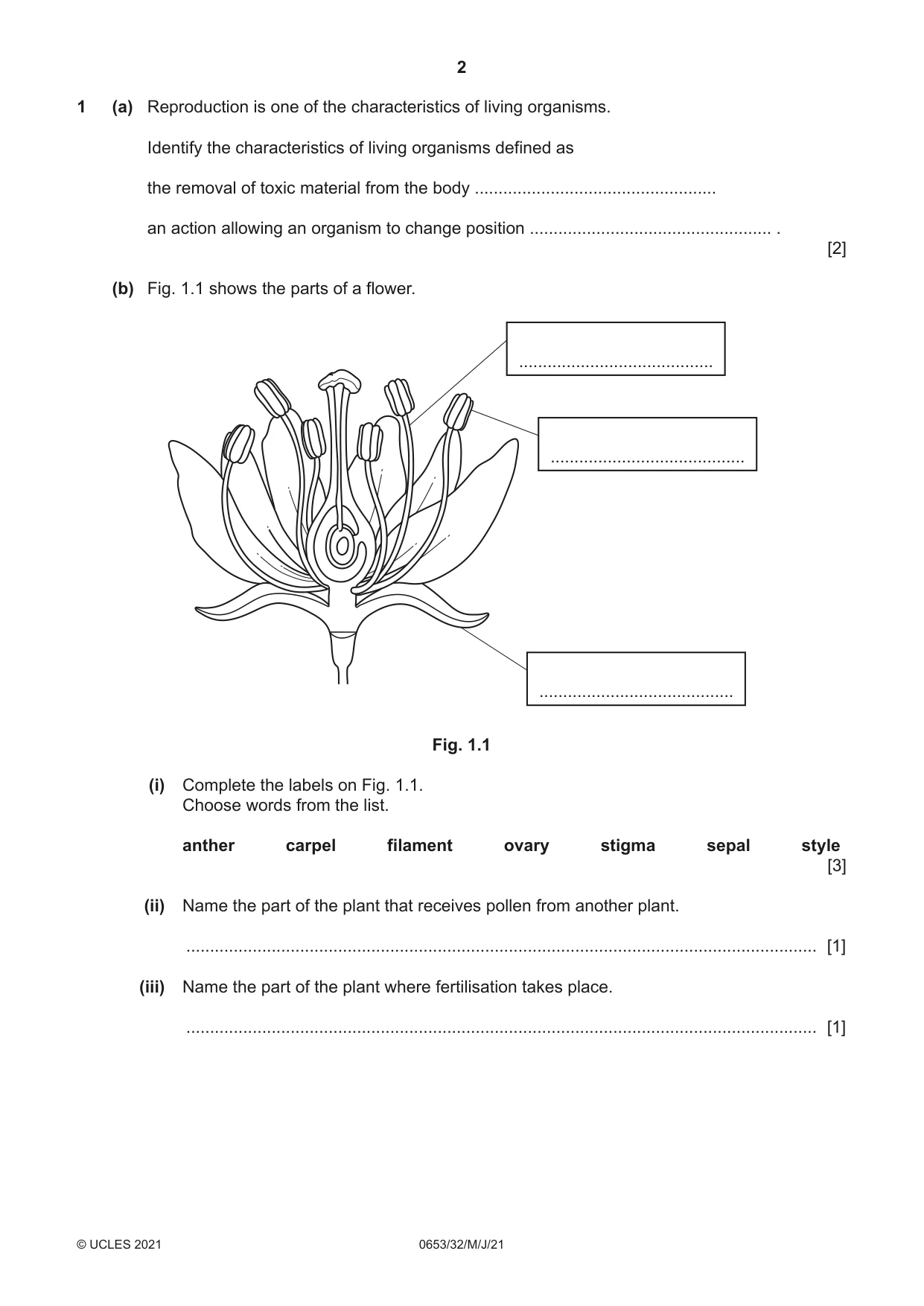
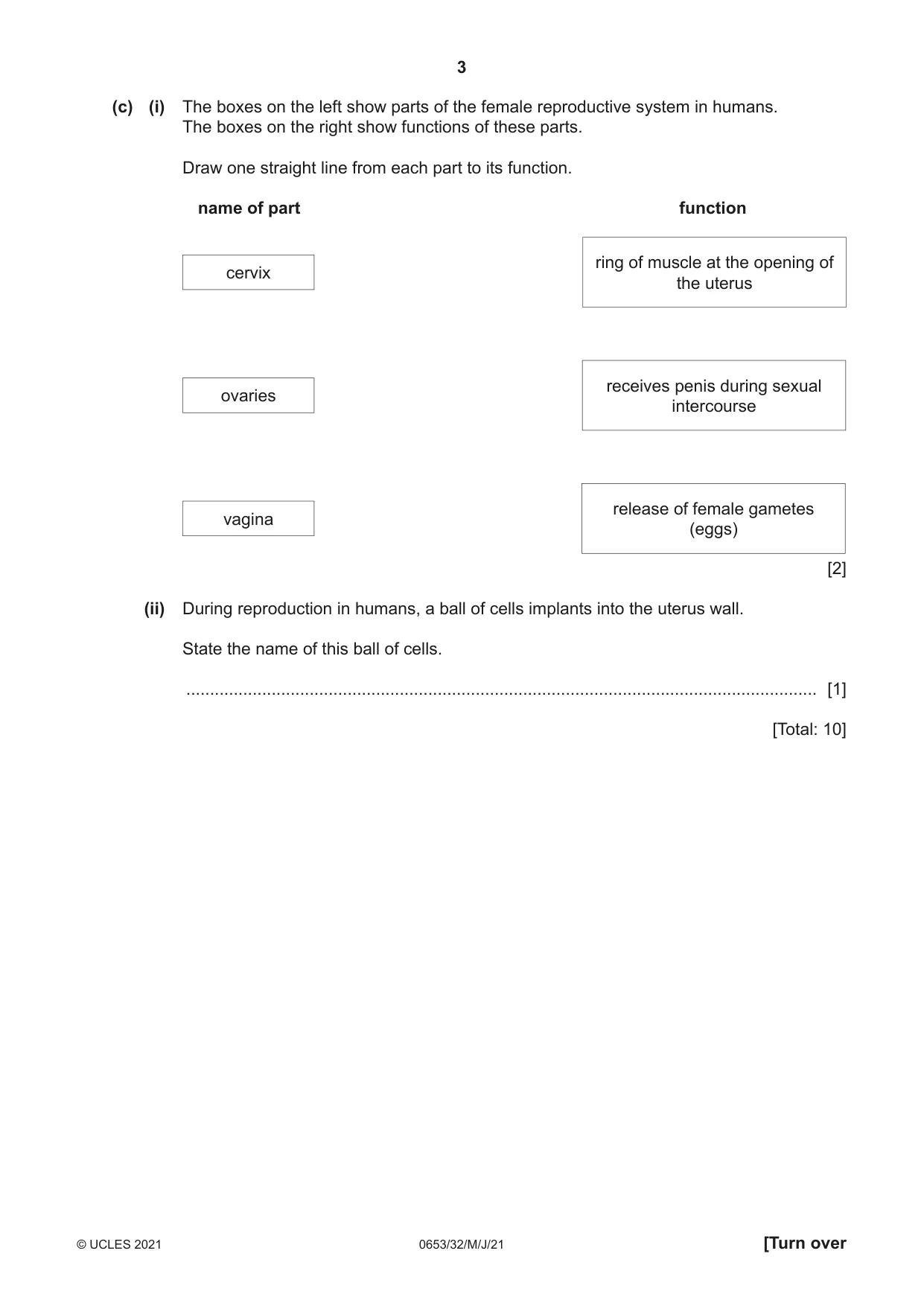
1 (a) Reproduction is one of the characteristics of living organisms. Identify the characteristics of living organisms defined as the removal of toxic material from the body ................................................... an action allowing an organism to change position ................................................... . [2] (b) Fig. 1.1 shows the parts of a flower. ......................................... ......................................... ......................................... Fig. 1.1 (i) Complete the labels on Fig. 1.1. Choose words from the list. anther carpel filament ovary stigma sepal style [3] (ii) Name the part of the plant that receives pollen from another plant. ..................................................................................................................................... [1] (iii) Name the part of the plant where fertilisation takes place. ..................................................................................................................................... [1] (c) (i) The boxes on the left show parts of the female reproductive system in humans. The boxes on the right show functions of these parts. Draw one straight line from each part to its function. name of part function ring of muscle at the opening of cervix the uterus receives penis during sexual ovaries intercourse release of female gametes vagina (eggs) [2] (ii) During reproduction in humans, a ball of cells implants into the uterus wall. State the name of this ball of cells. ..................................................................................................................................... [1] [Total: 10]
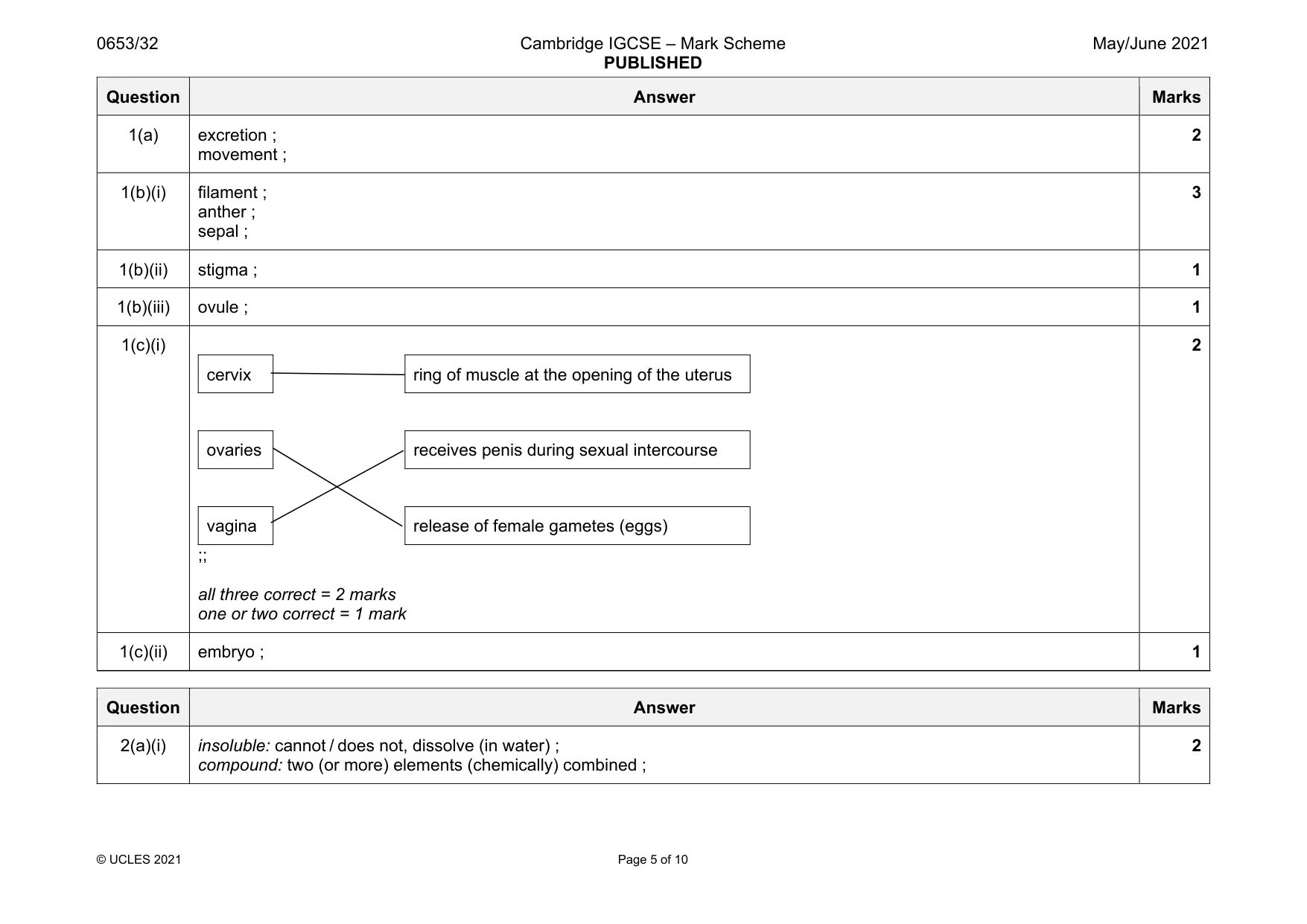
Mark scheme: 1(a) excretion ; movement ; 2 1(b)(i) filament ; anther ; sepal ; 3 1(b)(ii) stigma ; 1 1(b)(iii) ovule ; 1 1(c)(i) cervix ring of muscle at the opening of the uterus ovaries receives penis during sexual intercourse vagina release of female gametes (eggs) ;; all three correct = 2 marks one or two correct = 1 mark 2 1(c)(ii) embryo ; 1
Q2 · A mixture contains water, dissolved sodium chloride and an insoluble solid compound
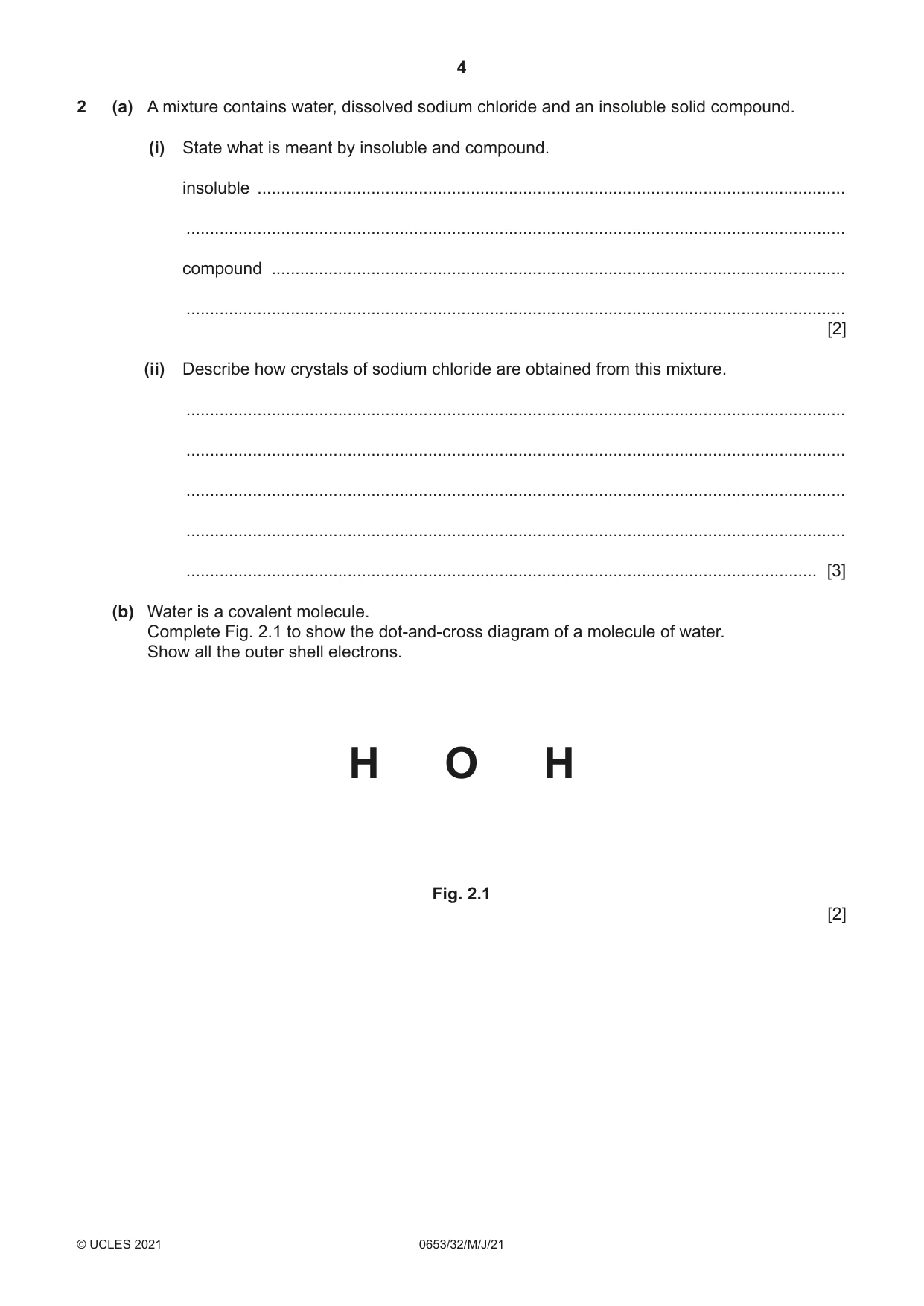
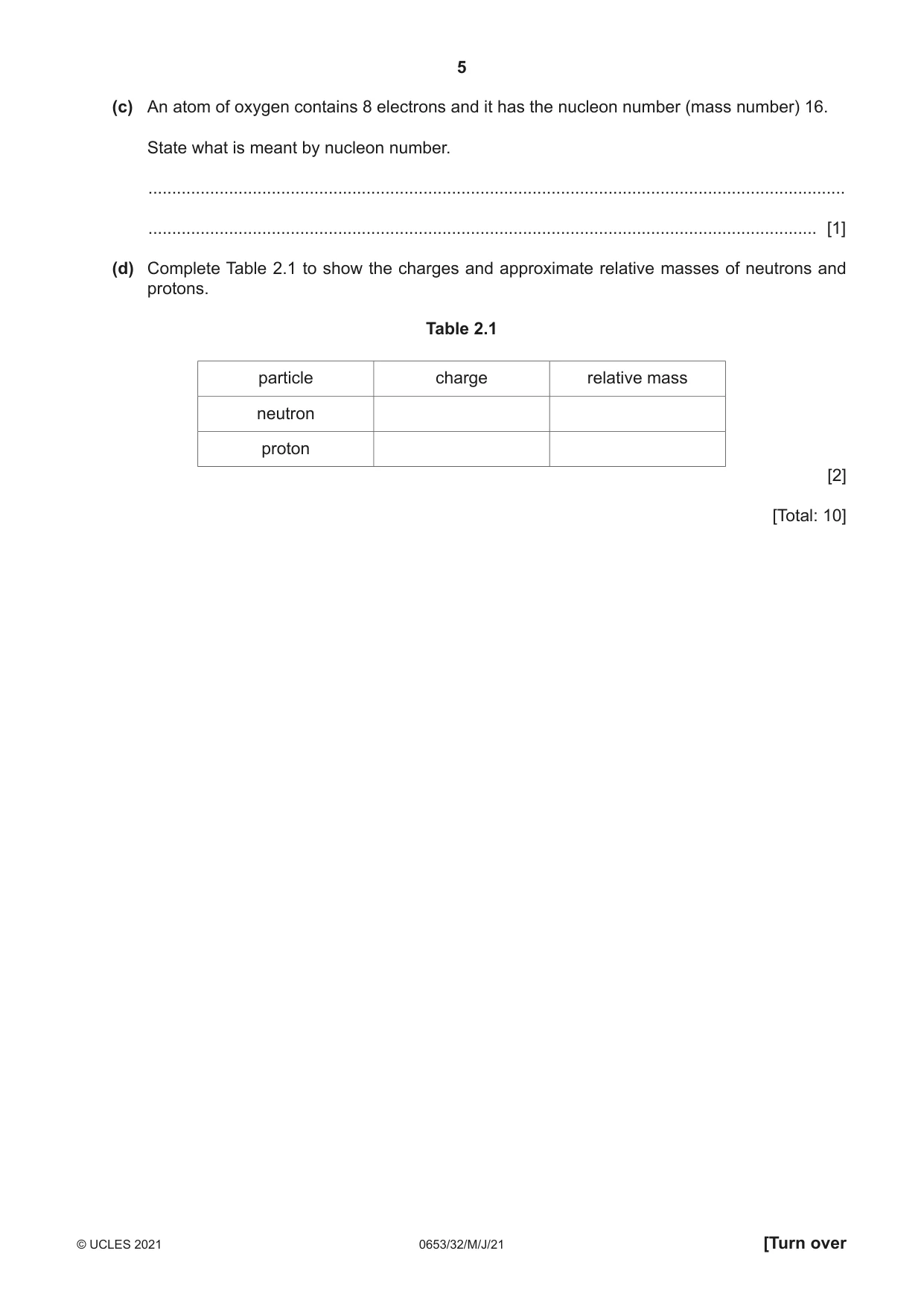
2 (a) A mixture contains water, dissolved sodium chloride and an insoluble solid compound. (i) State what is meant by insoluble and compound. insoluble ............................................................................................................................ ........................................................................................................................................... compound ......................................................................................................................... ........................................................................................................................................... [2] (ii) Describe how crystals of sodium chloride are obtained from this mixture. ........................................................................................................................................... ........................................................................................................................................... ........................................................................................................................................... ........................................................................................................................................... ..................................................................................................................................... [3] (b) Water is a covalent molecule. Complete Fig. 2.1 to show the dot-and-cross diagram of a molecule of water. Show all the outer shell electrons. H O H Fig. 2.1 [2] (c) An atom of oxygen contains 8 electrons and it has the nucleon number (mass number) 16. State what is meant by nucleon number. ................................................................................................................................................... ............................................................................................................................................. [1] (d) Complete Table 2.1 to show the charges and approximate relative masses of neutrons and protons. Table 2.1 particle charge relative mass neutron proton [2] [Total: 10]
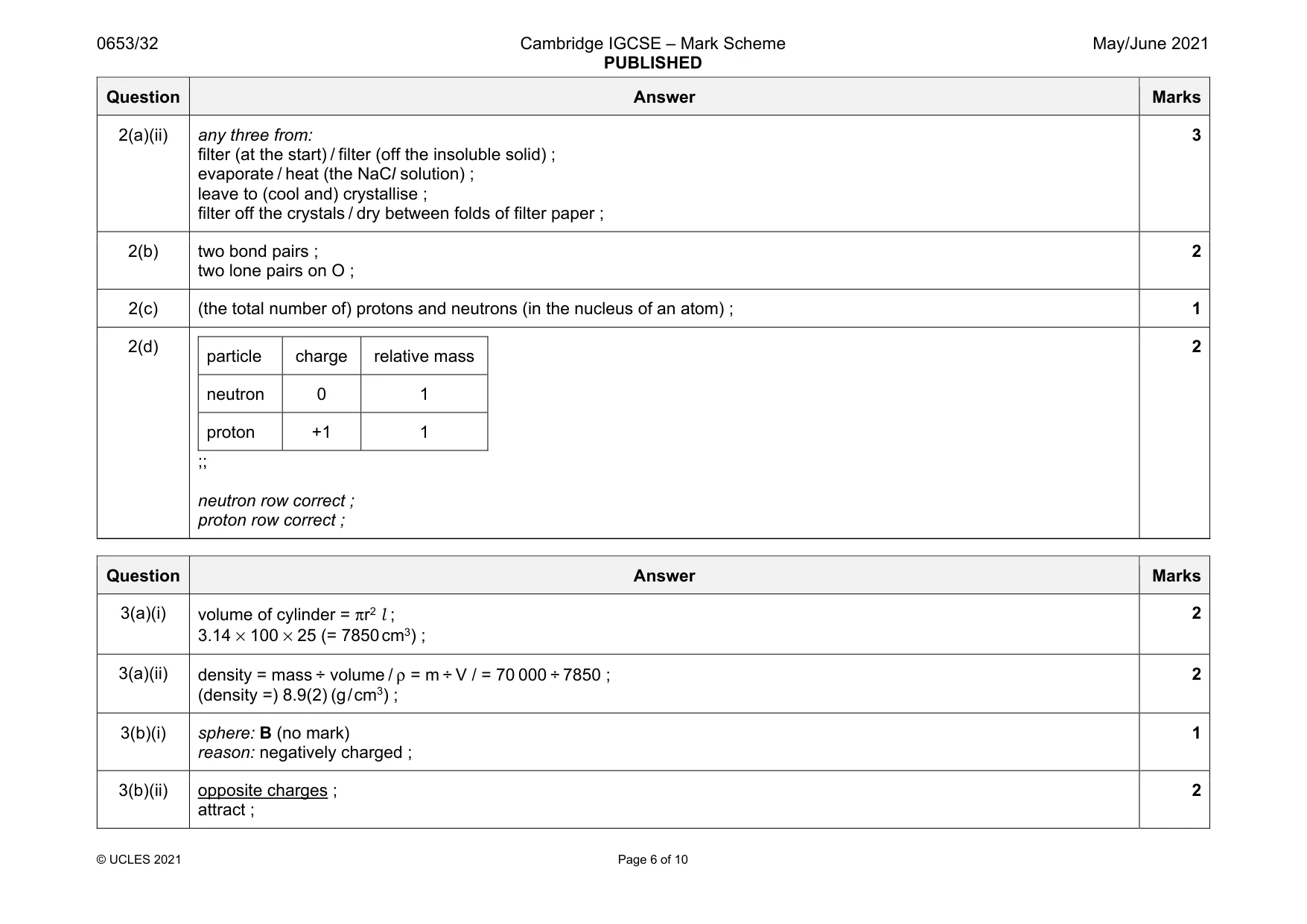
Mark scheme: 2(a)(i) insoluble: cannot / does not, dissolve (in water) ; compound: two (or more) elements (chemically) combined ; 2 Question Answer Marks 2(a)(ii) any three from: filter (at the start) / filter (off the insoluble solid) ; evaporate / heat (the NaCl solution) ; leave to (cool and) crystallise ; filter off the crystals / dry between folds of filter paper ; 3 2(b) two bond pairs ; two lone pairs on O ; 2 2(c) (the total number of) protons and neutrons (in the nucleus of an atom) ; 1 2(d) particle charge relative mass neutron 0 1 proton +1 1 ;; neutron row correct ; proton row correct ; 2
Q3 · A cylinder made of solid copper
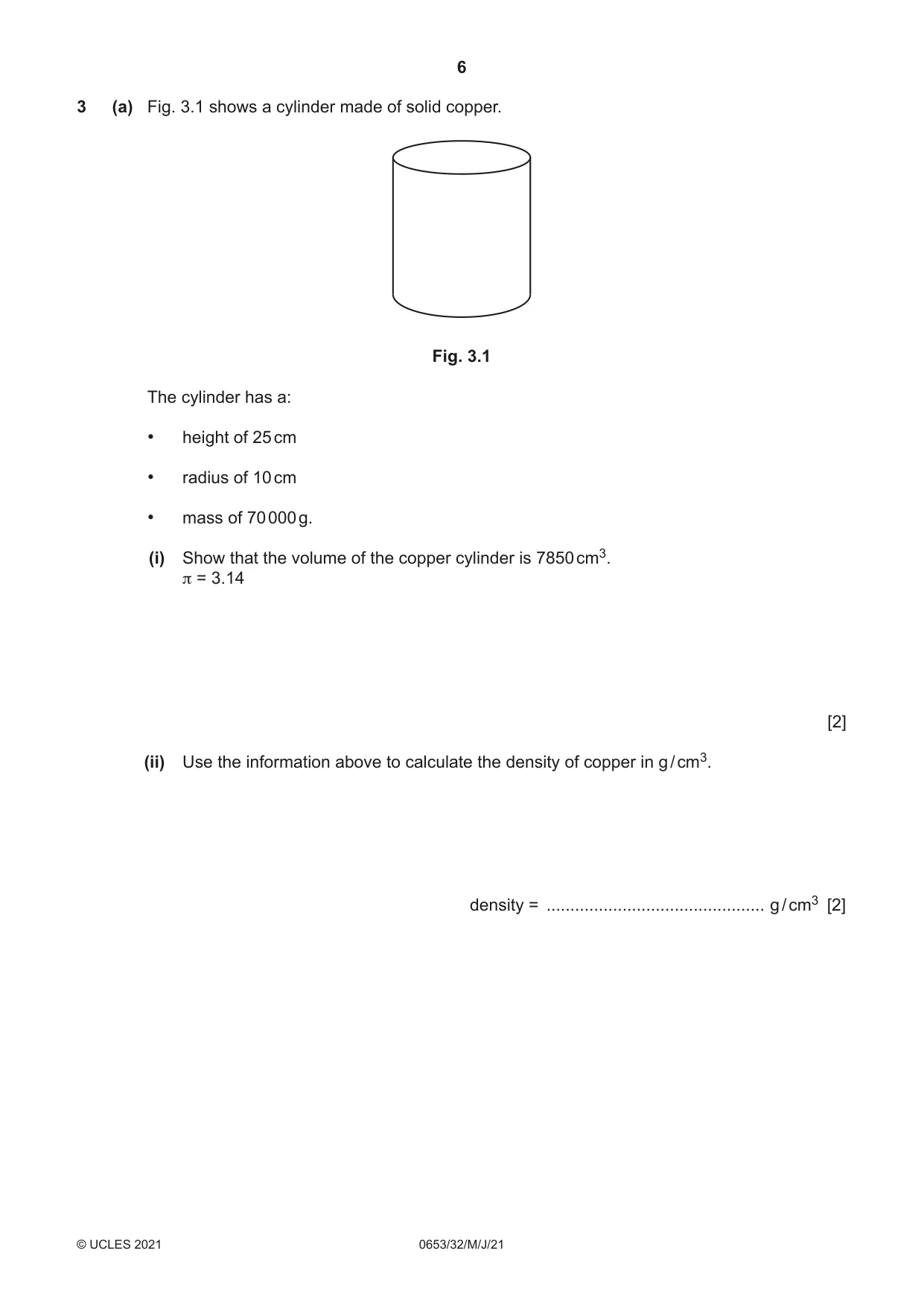
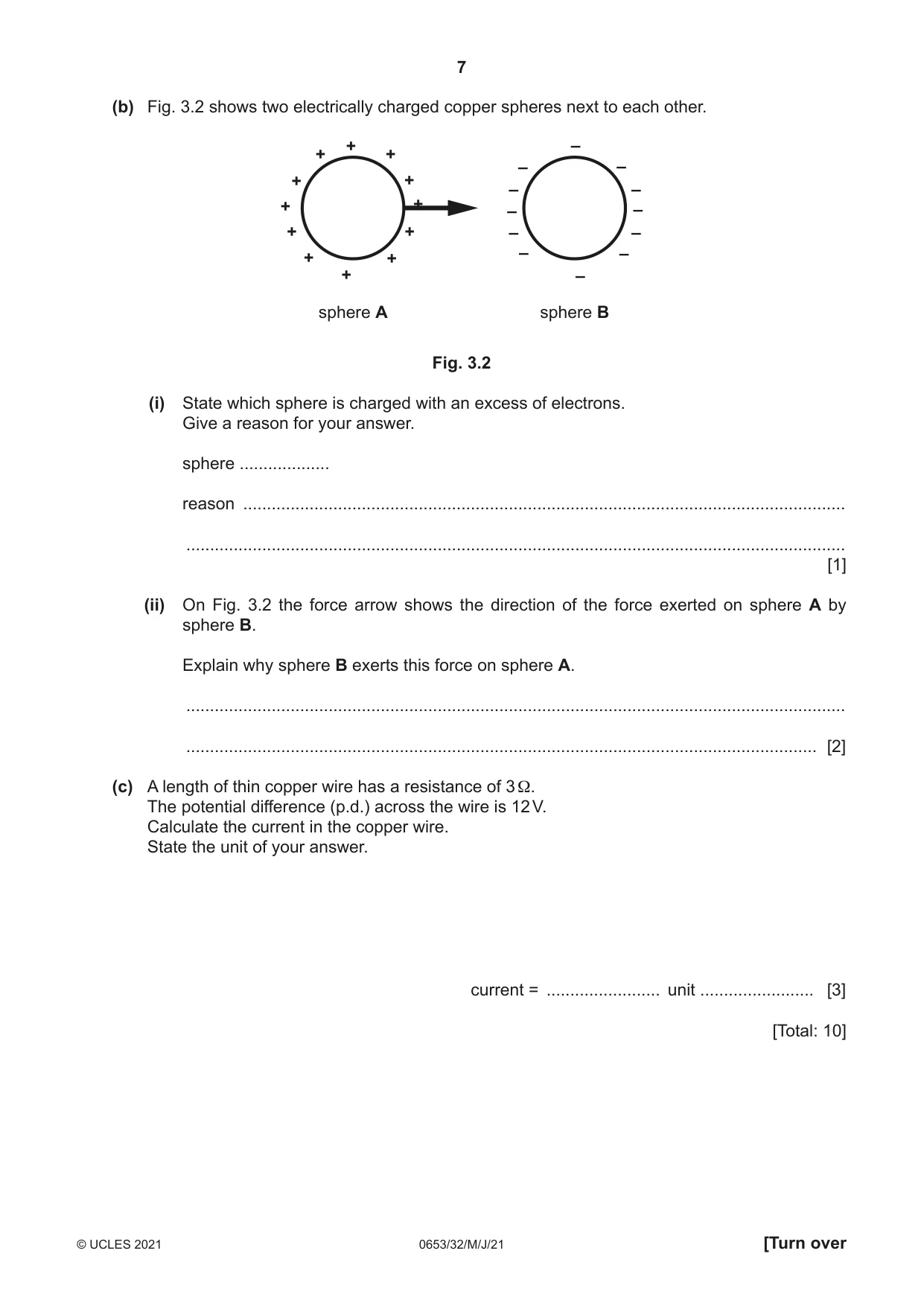
3 (a) Fig. 3.1 shows a cylinder made of solid copper. Fig. 3.1 The cylinder has a: • height of 25 cm • radius of 10 cm • mass of 70 000 g. (i) Show that the volume of the copper cylinder is 7850 cm3. π = 3.14 [2] (ii) Use the information above to calculate the density of copper in g / cm3. density = .............................................. g / cm3 [2] (b) Fig. 3.2 shows two electrically charged copper spheres next to each other. + – + + – – + + – – + + – – + + – – – – + + + – sphere A sphere B Fig. 3.2 (i) State which sphere is charged with an excess of electrons. Give a reason for your answer. sphere ................... reason ............................................................................................................................... ........................................................................................................................................... [1] (ii) On Fig. 3.2 the force arrow shows the direction of the force exerted on sphere A by sphere B. Explain why sphere B exerts this force on sphere A. ........................................................................................................................................... ..................................................................................................................................... [2] (c) A length of thin copper wire has a resistance of 3 Ω. The potential difference (p.d.) across the wire is 12 V. Calculate the current in the copper wire. State the unit of your answer. current = ........................ unit ........................ [3] [Total: 10]
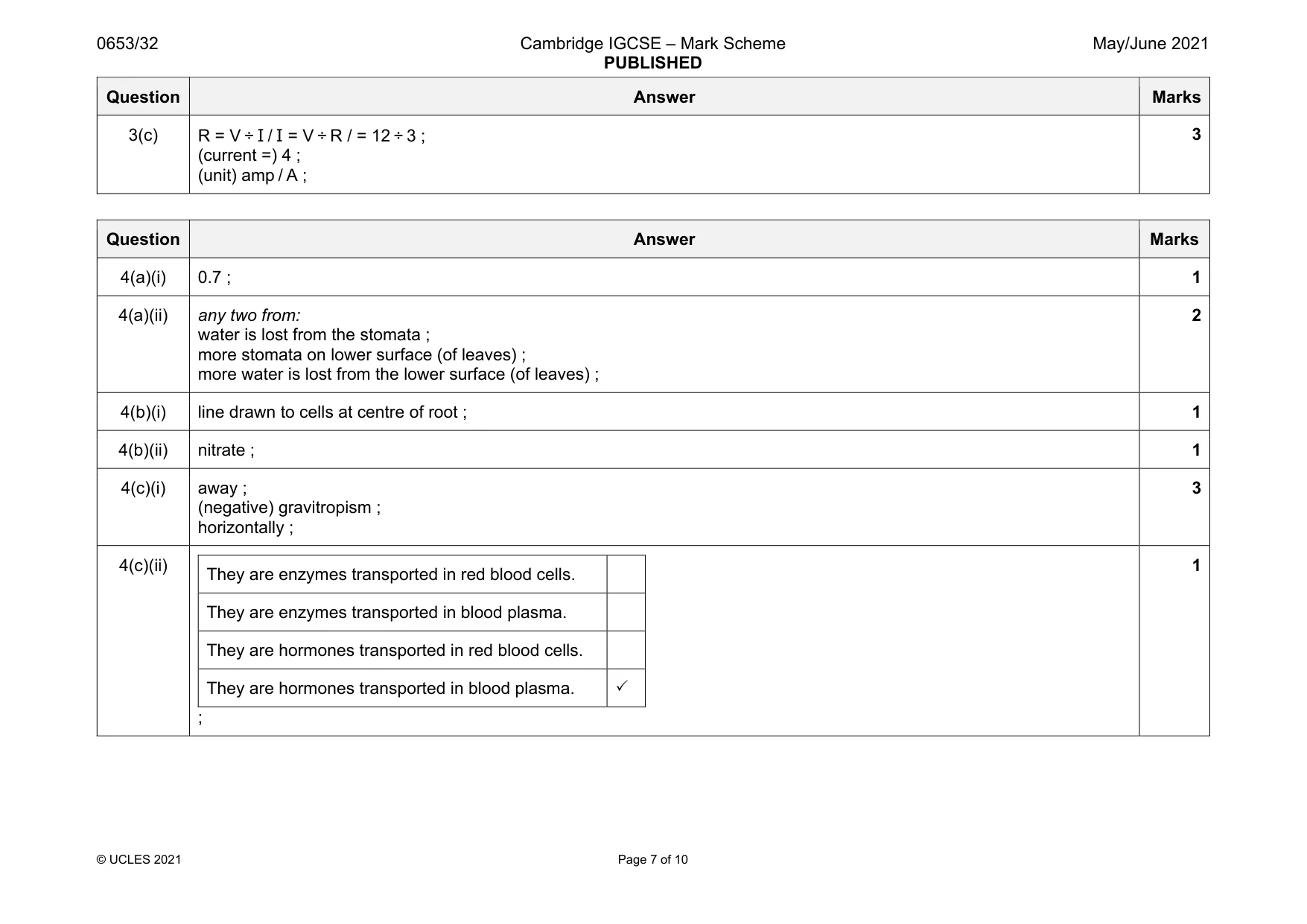
Mark scheme: 3(a)(i) volume of cylinder = πr2 l ; 3.14 × 100 × 25 (= 7850 cm3) ; 3(a)(ii) density = mass ÷ volume / ρ = m ÷ V / = 70 000 ÷ 7850 ; (density =) 8.9(2) (g / cm3) ; 2 3(b)(i) sphere: B (no mark) reason: negatively charged ; 1 3(b)(ii) opposite charges ; attract ; 2 Question Answer Marks 3(c) R = V ÷ I / I = V ÷ R / = 12 ÷ 3 ; (current =) 4 ; (unit) amp / A ; 3
Q4 · A student investigates water loss from the leaves of a plant
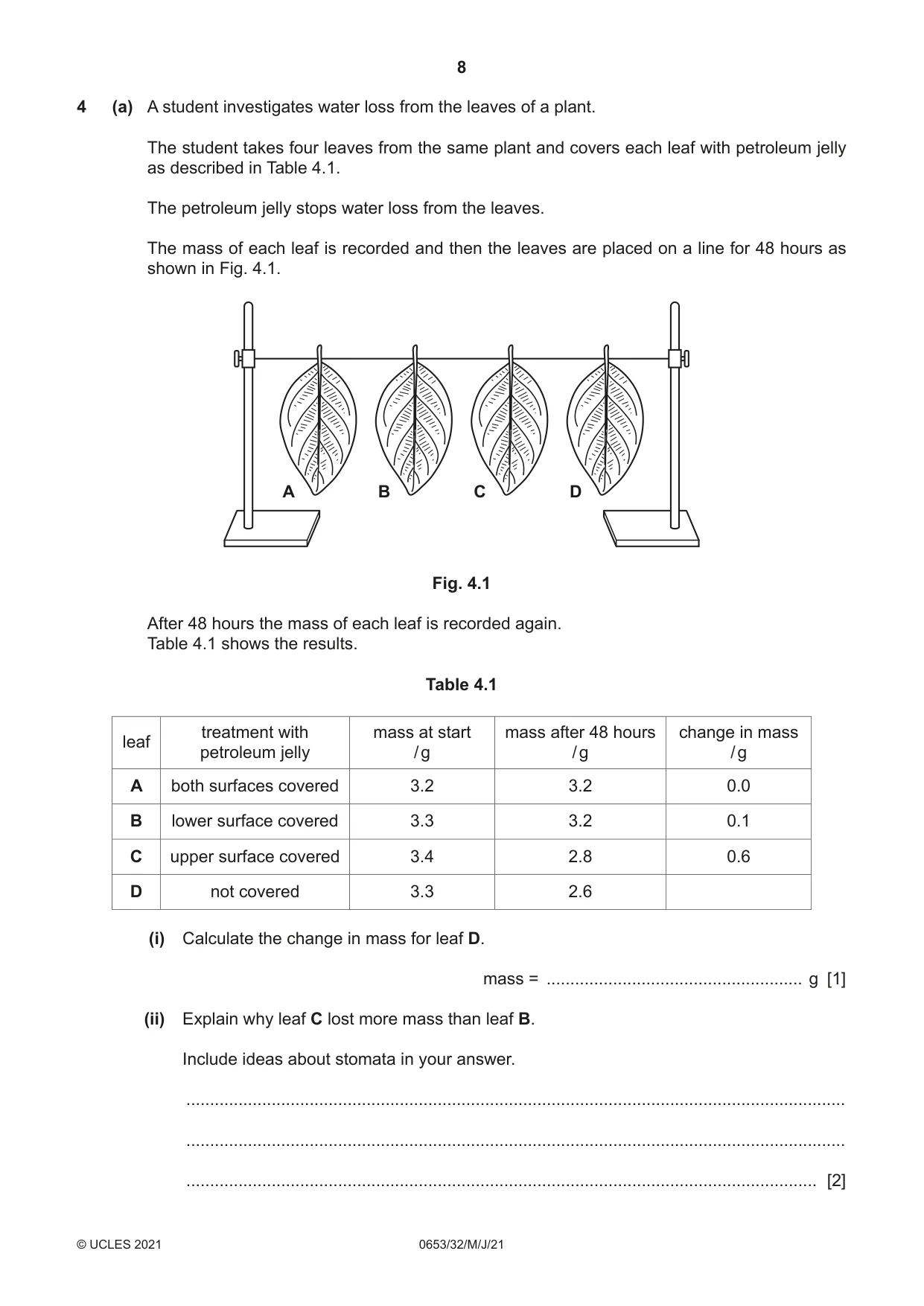
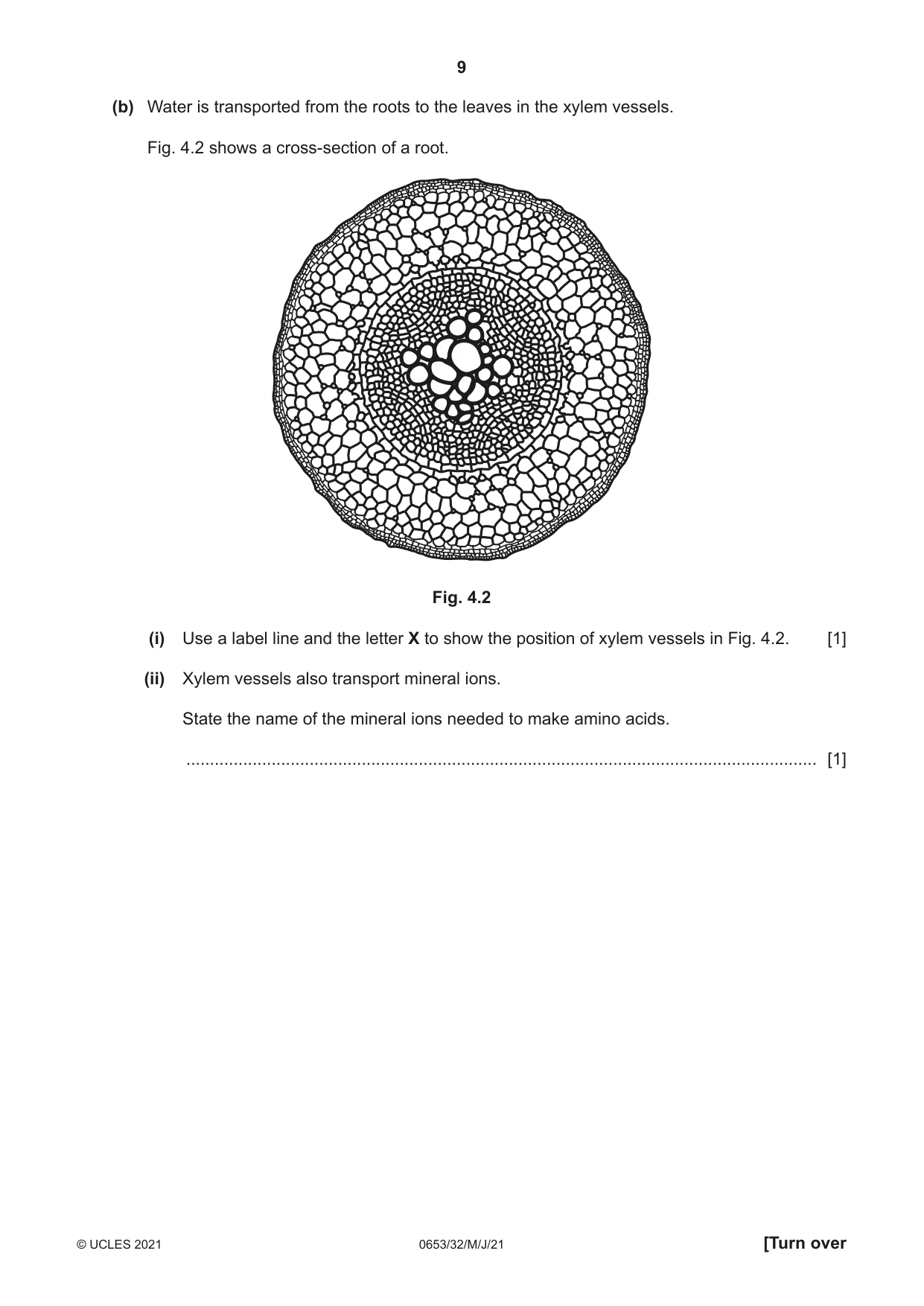
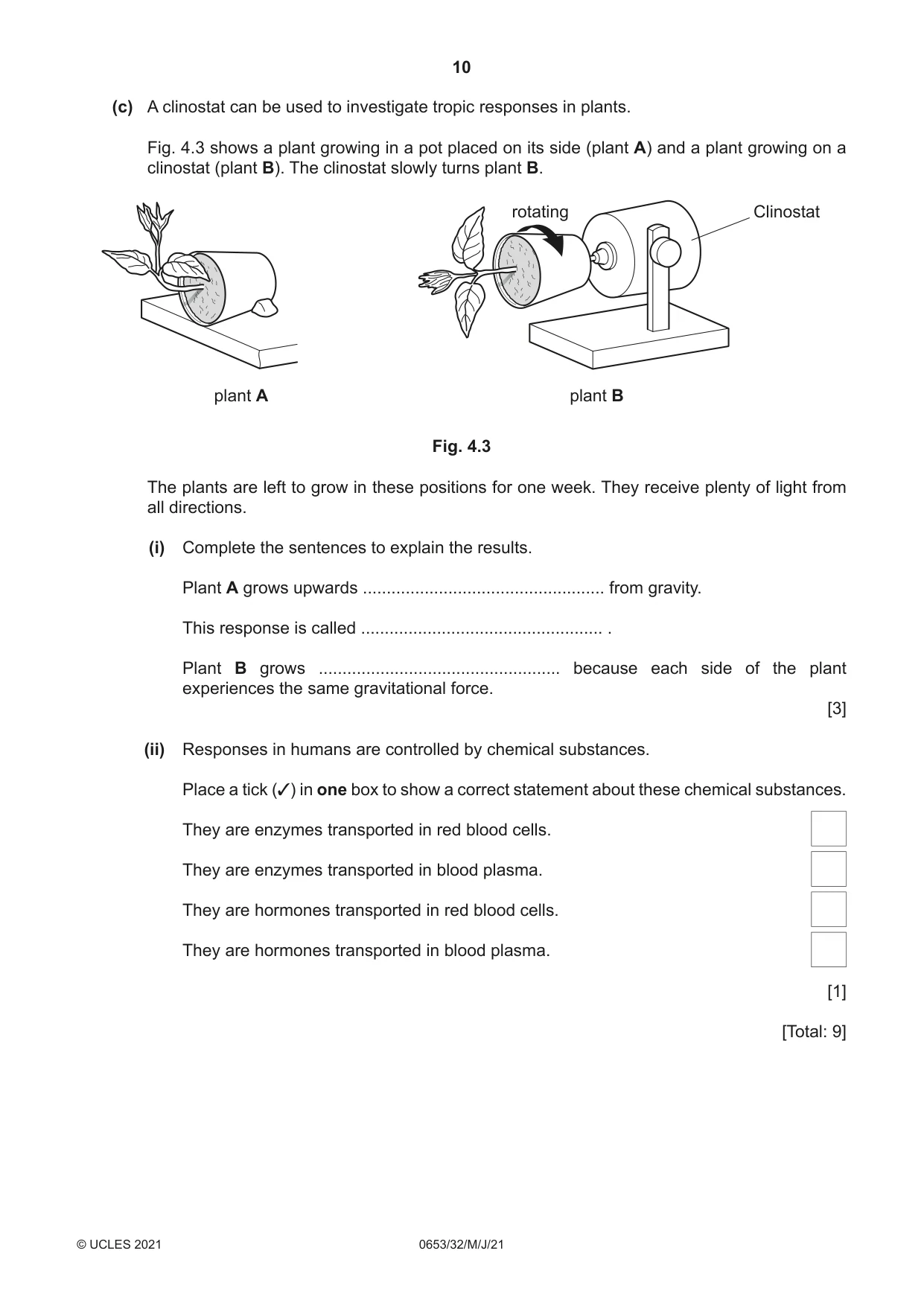
4 (a) A student investigates water loss from the leaves of a plant. The student takes four leaves from the same plant and covers each leaf with petroleum jelly as described in Table 4.1. The petroleum jelly stops water loss from the leaves. The mass of each leaf is recorded and then the leaves are placed on a line for 48 hours as shown in Fig. 4.1. A B C D Fig. 4.1 After 48 hours the mass of each leaf is recorded again. Table 4.1 shows the results. Table 4.1 treatment with mass at start mass after 48 hours change in mass leaf petroleum jelly / g / g / g A both surfaces covered 3.2 3.2 0.0 B lower surface covered 3.3 3.2 0.1 C upper surface covered 3.4 2.8 0.6 D not covered 3.3 2.6 (i) Calculate the change in mass for leaf D. mass = ...................................................... g [1] (ii) Explain why leaf C lost more mass than leaf B. Include ideas about stomata in your answer. ........................................................................................................................................... ........................................................................................................................................... ..................................................................................................................................... [2] (b) Water is transported from the roots to the leaves in the xylem vessels. Fig. 4.2 shows a cross-section of a root. Fig. 4.2 (i) Use a label line and the letter X to show the position of xylem vessels in Fig. 4.2. [1] (ii) Xylem vessels also transport mineral ions. State the name of the mineral ions needed to make amino acids. ..................................................................................................................................... [1] (c) A clinostat can be used to investigate tropic responses in plants. Fig. 4.3 shows a plant growing in a pot placed on its side (plant A) and a plant growing on a clinostat (plant B). The clinostat slowly turns plant B. rotating Clinostat plant A plant B Fig. 4.3 The plants are left to grow in these positions for one week. They receive plenty of light from all directions. (i) Complete the sentences to explain the results. Plant A grows upwards ................................................... from gravity. This response is called ................................................... . Plant B grows ................................................... because each side of the plant experiences the same gravitational force. [3] (ii) Responses in humans are controlled by chemical substances. Place a tick (✓) in one box to show a correct statement about these chemical substances. They are enzymes transported in red blood cells. They are enzymes transported in blood plasma. They are hormones transported in red blood cells. They are hormones transported in blood plasma. [1] [Total: 9]
Mark scheme: 4(a)(i) 0.7 ; 1 4(a)(ii) any two from: water is lost from the stomata ; more stomata on lower surface (of leaves) ; more water is lost from the lower surface (of leaves) ; 2 4(b)(i) line drawn to cells at centre of root ; 1 4(b)(ii) nitrate ; 1 4(c)(i) away ; (negative) gravitropism ; horizontally ; 3 4(c)(ii) They are enzymes transported in red blood cells. They are enzymes transported in blood plasma. They are hormones transported in red blood cells. They are hormones transported in blood plasma. ; 1
Q5 · A student investigates the reaction between dilute hydrochloric acid and a 5.0 g piece of…
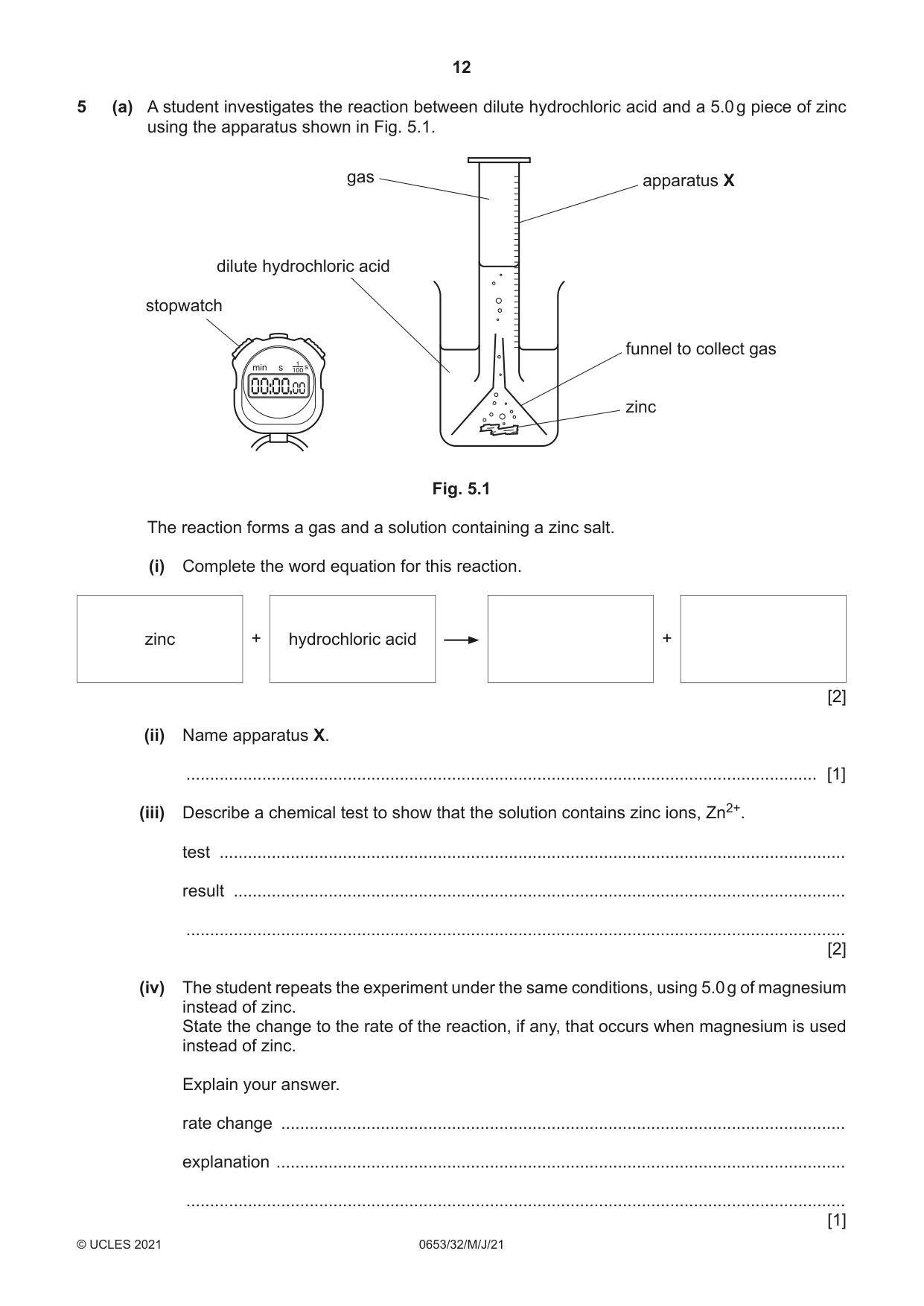
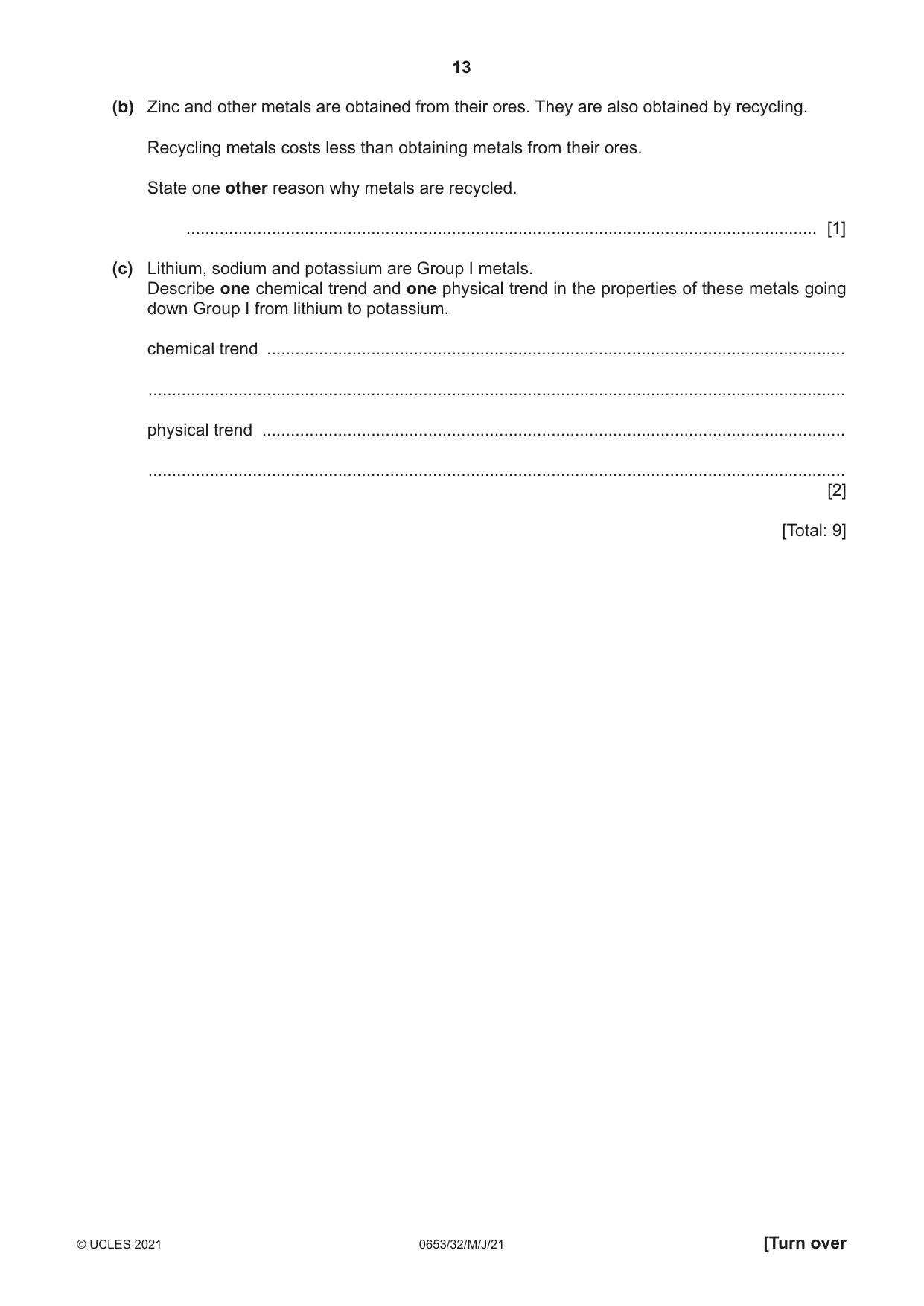
5 (a) A student investigates the reaction between dilute hydrochloric acid and a 5.0 g piece of zinc using the apparatus shown in Fig. 5.1. gas apparatus X dilute hydrochloric acid stopwatch funnel to collect gas zinc Fig. 5.1 The reaction forms a gas and a solution containing a zinc salt. (i) Complete the word equation for this reaction. zinc + hydrochloric acid + [2] (ii) Name apparatus X. ..................................................................................................................................... [1] (iii) Describe a chemical test to show that the solution contains zinc ions, Zn2+. test .................................................................................................................................... result ................................................................................................................................. ........................................................................................................................................... [2] (iv) The student repeats the experiment under the same conditions, using 5.0 g of magnesium instead of zinc. State the change to the rate of the reaction, if any, that occurs when magnesium is used instead of zinc. Explain your answer. rate change ....................................................................................................................... explanation ........................................................................................................................ ........................................................................................................................................... [1] (b) Zinc and other metals are obtained from their ores. They are also obtained by recycling. Recycling metals costs less than obtaining metals from their ores. State one other reason why metals are recycled. ..................................................................................................................................... [1] (c) Lithium, sodium and potassium are Group I metals. Describe one chemical trend and one physical trend in the properties of these metals going down Group I from lithium to potassium. chemical trend .......................................................................................................................... ................................................................................................................................................... physical trend ........................................................................................................................... ................................................................................................................................................... [2] [Total: 9]
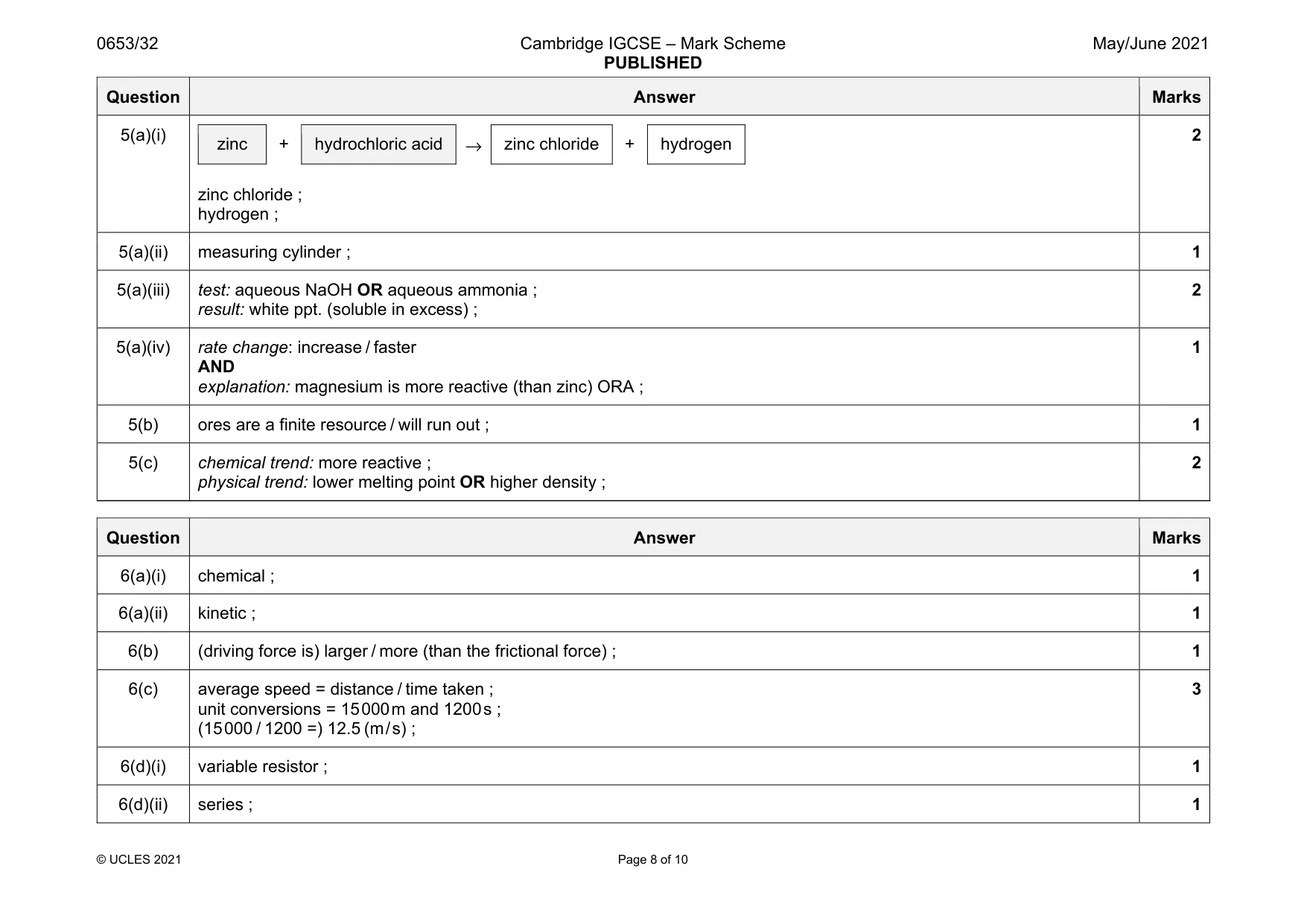
Mark scheme: 5(a)(i) zinc + hydrochloric acid → zinc chloride + hydrogen zinc chloride ; hydrogen ; 2 5(a)(ii) measuring cylinder ; 1 5(a)(iii) test: aqueous NaOH OR aqueous ammonia ; result: white ppt. (soluble in excess) ; 2 5(a)(iv) rate change: increase / faster AND explanation: magnesium is more reactive (than zinc) ORA ; 1 5(b) ores are a finite resource / will run out ; 1 5(c) chemical trend: more reactive ; physical trend: lower melting point OR higher density ; 2
Q6 · A battery-powered electric bus
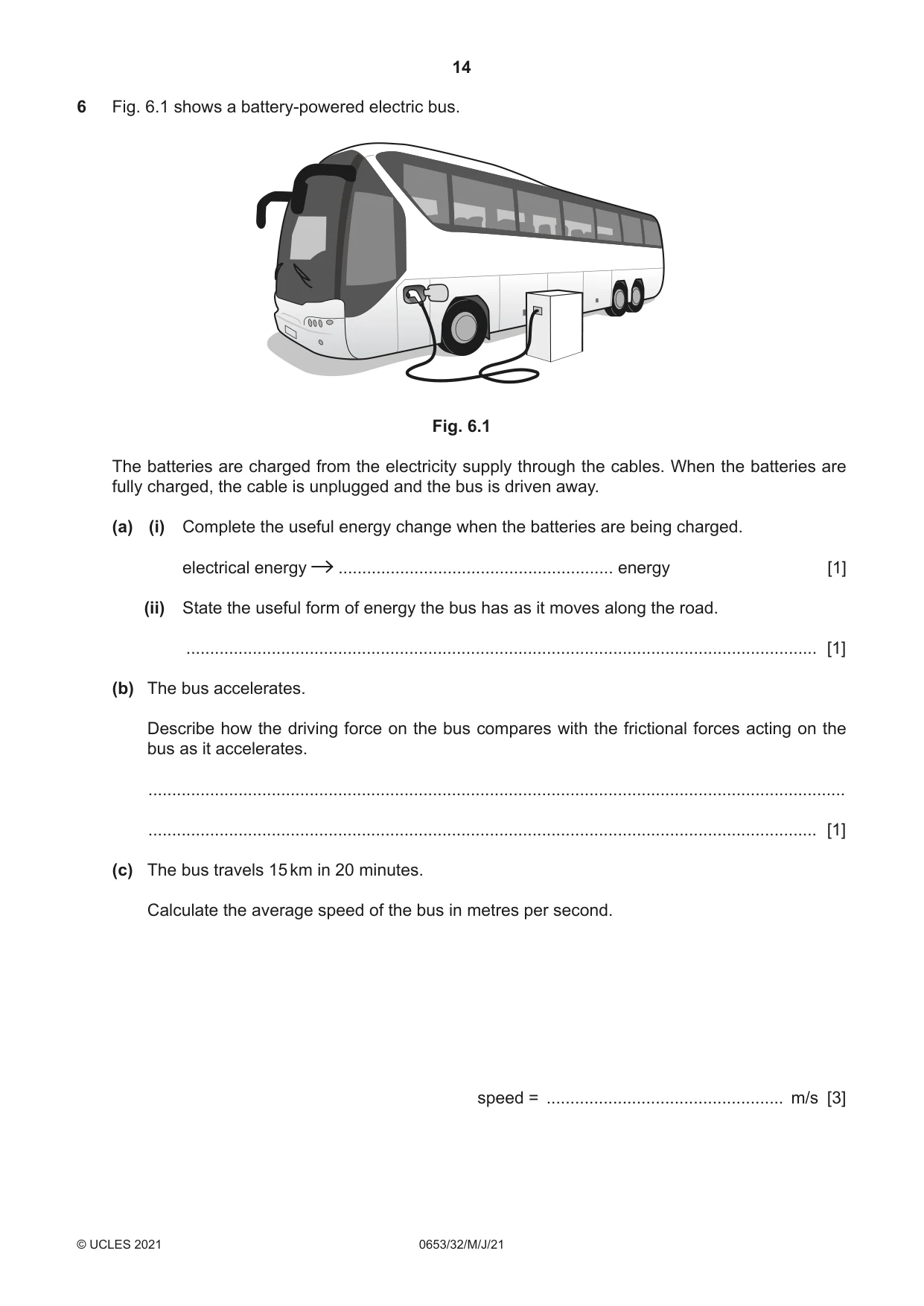
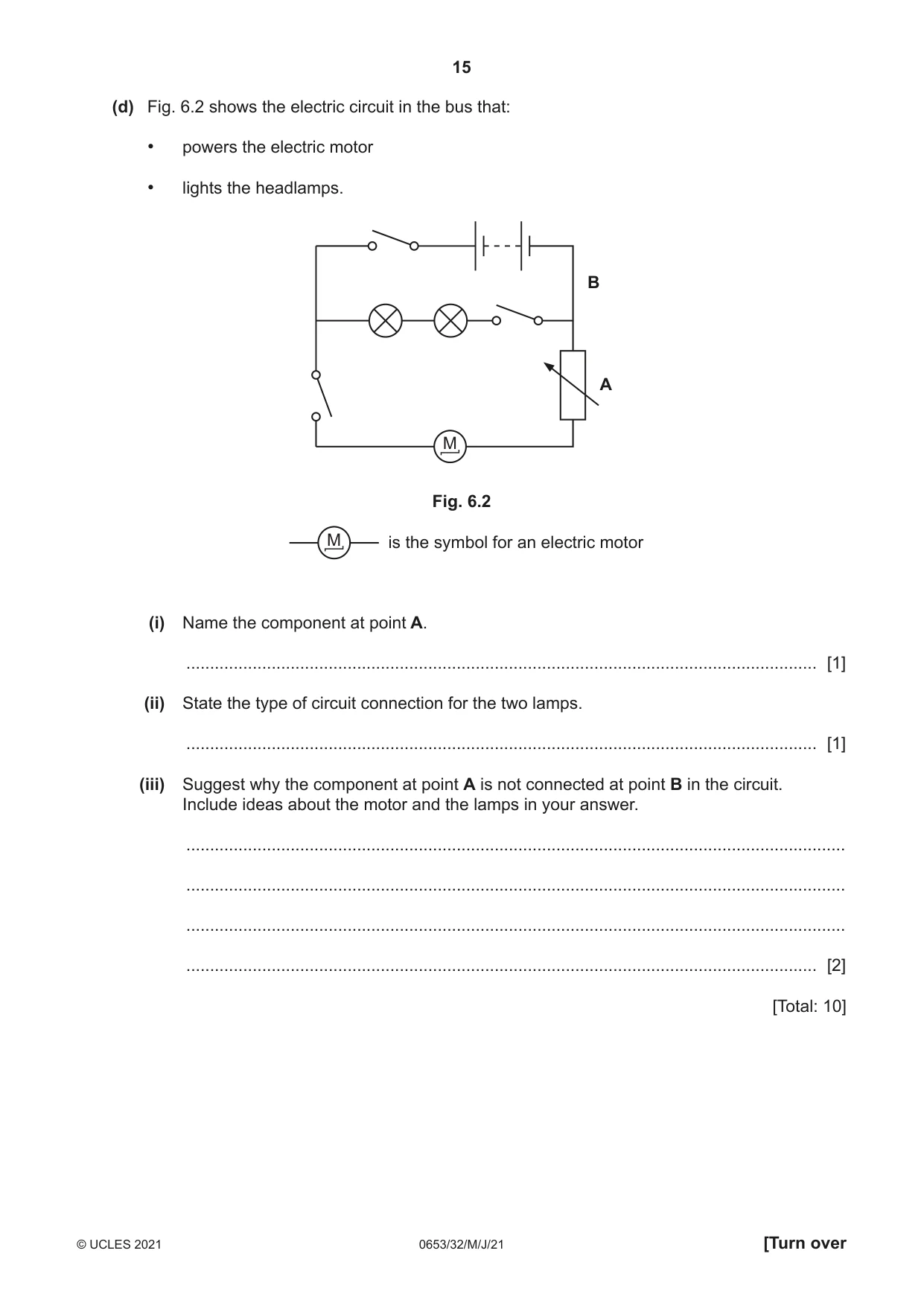
6 Fig. 6.1 shows a battery-powered electric bus. Fig. 6.1 The batteries are charged from the electricity supply through the cables. When the batteries are fully charged, the cable is unplugged and the bus is driven away. (a) (i) Complete the useful energy change when the batteries are being charged. electrical energy .......................................................... energy [1] (ii) State the useful form of energy the bus has as it moves along the road. ..................................................................................................................................... [1] (b) The bus accelerates. Describe how the driving force on the bus compares with the frictional forces acting on the bus as it accelerates. ................................................................................................................................................... ............................................................................................................................................. [1] (c) The bus travels 15 km in 20 minutes. Calculate the average speed of the bus in metres per second. speed = .................................................. m/s [3] (d) Fig. 6.2 shows the electric circuit in the bus that: • powers the electric motor • lights the headlamps. B A M Fig. 6.2 M is the symbol for an electric motor (i) Name the component at point A. ..................................................................................................................................... [1] (ii) State the type of circuit connection for the two lamps. ..................................................................................................................................... [1] (iii) Suggest why the component at point A is not connected at point B in the circuit. Include ideas about the motor and the lamps in your answer. ........................................................................................................................................... ........................................................................................................................................... ........................................................................................................................................... ..................................................................................................................................... [2] [Total: 10]
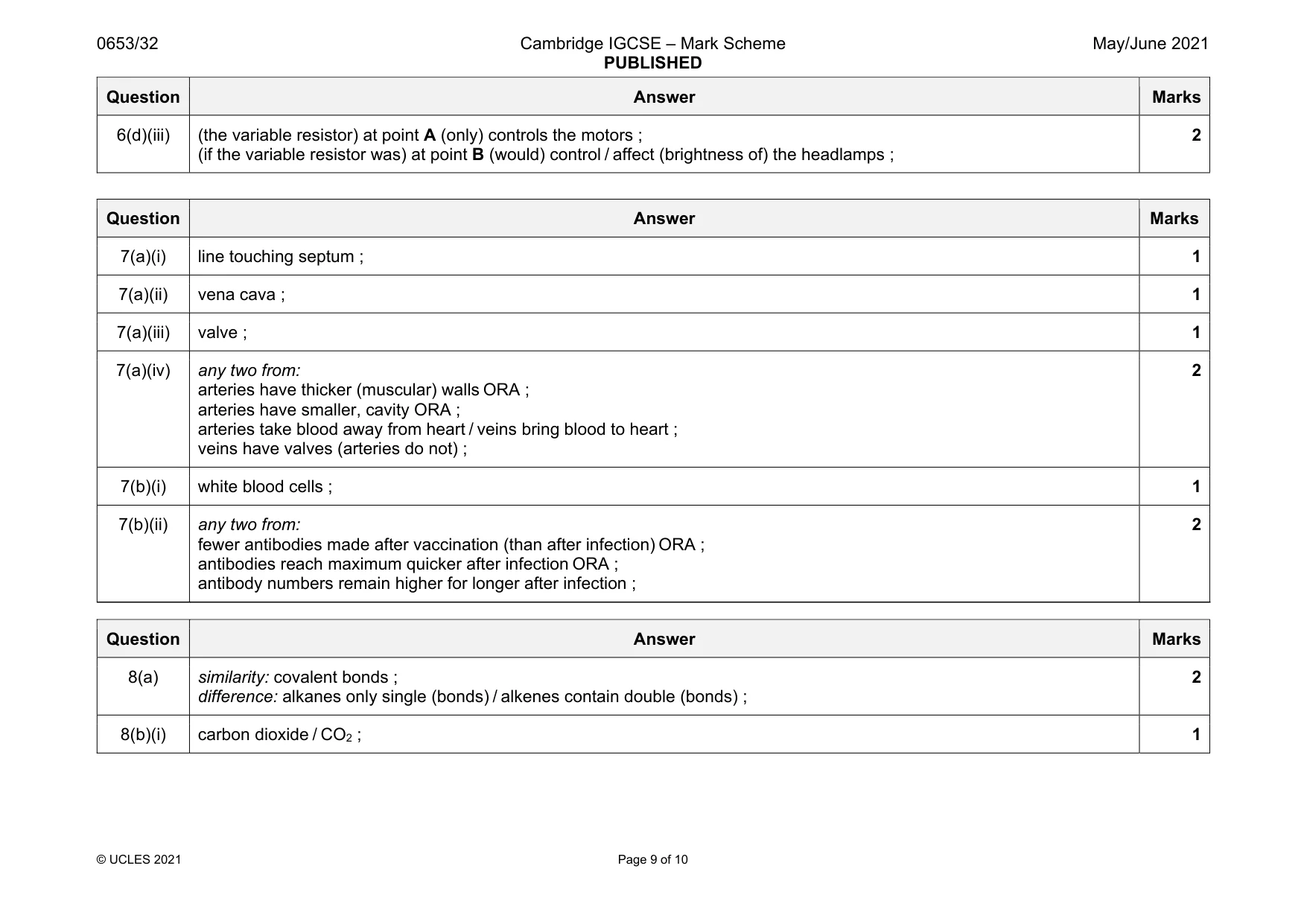
Mark scheme: 6(a)(i) chemical ; 1 6(a)(ii) kinetic ; 1 6(b) (driving force is) larger / more (than the frictional force) ; 1 6(c) average speed = distance / time taken ; unit conversions = 15 000 m and 1200 s ; (15 000 / 1200 =) 12.5 (m / s) ; 3 6(d)(i) variable resistor ; 1 6(d)(ii) series ; 1 Question Answer Marks 6(d)(iii) (the variable resistor) at point A (only) controls the motors ; (if the variable resistor was) at point B (would) control / affect (brightness of) the headlamps ; 2
Q7 · A diagram of the human heart
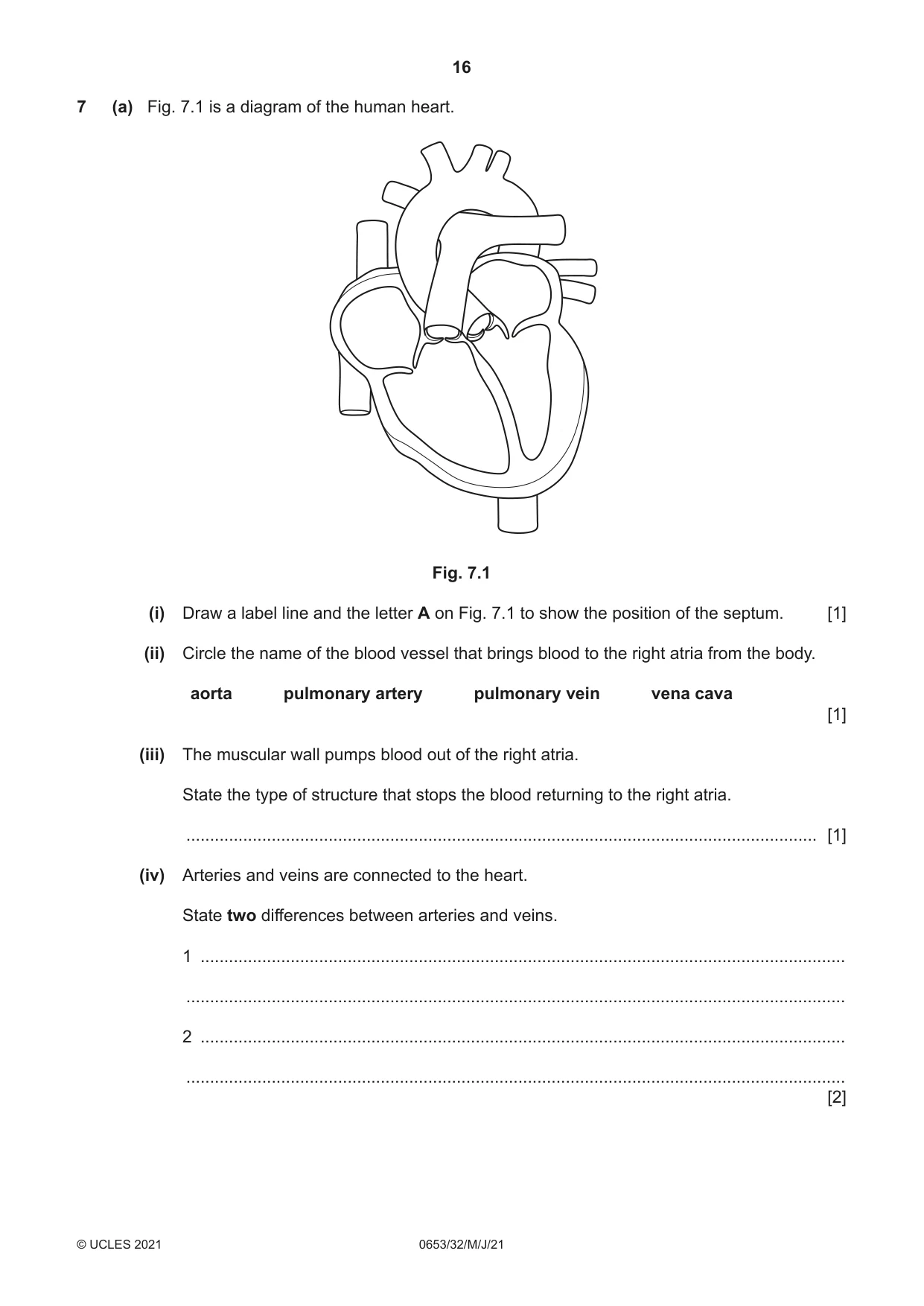
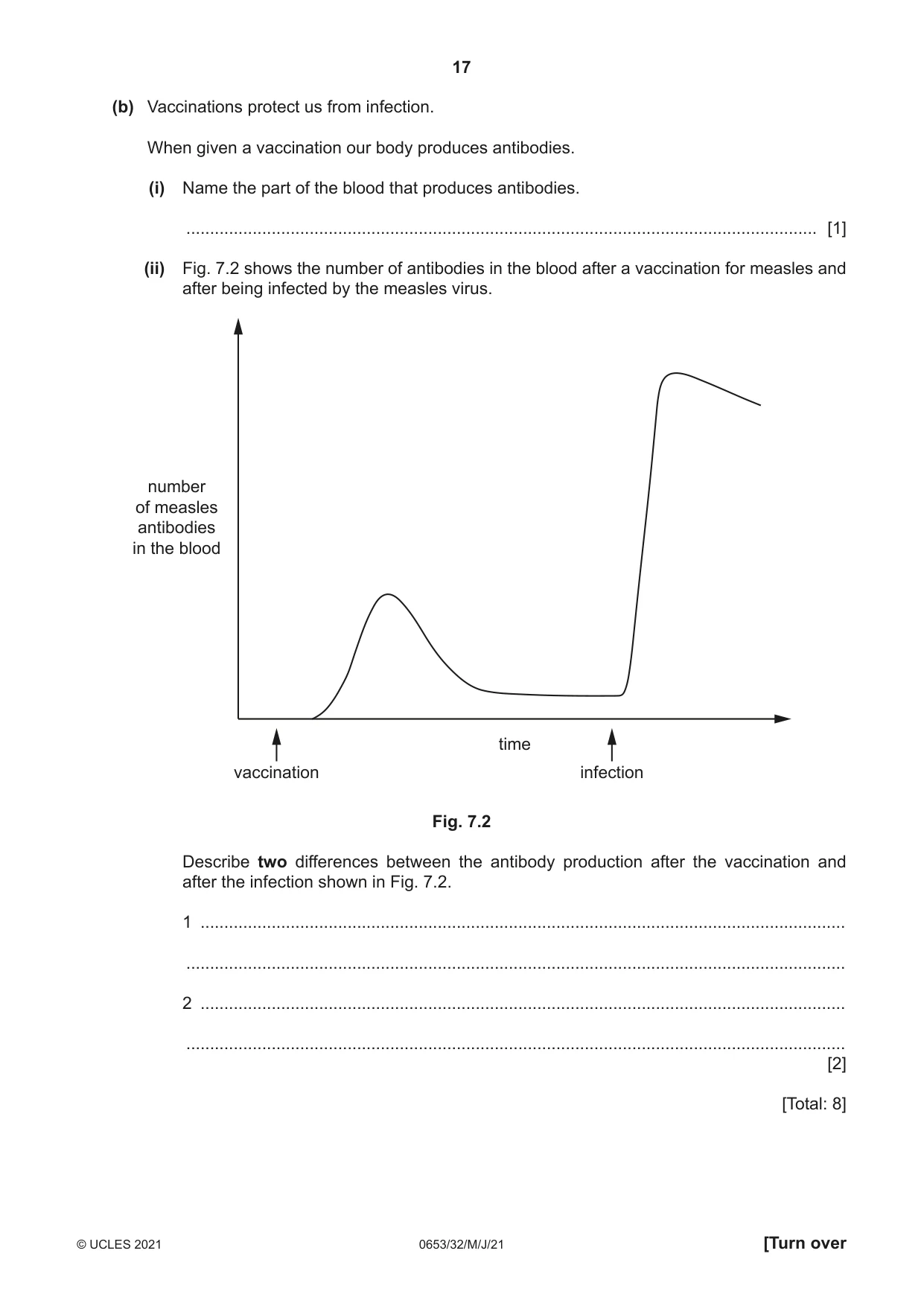
7 (a) Fig. 7.1 is a diagram of the human heart. Fig. 7.1 (i) Draw a label line and the letter A on Fig. 7.1 to show the position of the septum. [1] (ii) Circle the name of the blood vessel that brings blood to the right atria from the body. aorta pulmonary artery pulmonary vein vena cava [1] (iii) The muscular wall pumps blood out of the right atria. State the type of structure that stops the blood returning to the right atria. ..................................................................................................................................... [1] (iv) Arteries and veins are connected to the heart. State two differences between arteries and veins. 1 ........................................................................................................................................ ........................................................................................................................................... 2 ........................................................................................................................................ ........................................................................................................................................... [2] (b) Vaccinations protect us from infection. When given a vaccination our body produces antibodies. (i) Name the part of the blood that produces antibodies. ..................................................................................................................................... [1] (ii) Fig. 7.2 shows the number of antibodies in the blood after a vaccination for measles and after being infected by the measles virus. number of measles antibodies in the blood time vaccination infection Fig. 7.2 Describe two differences between the antibody production after the vaccination and after the infection shown in Fig. 7.2. 1 ........................................................................................................................................ ........................................................................................................................................... 2 ........................................................................................................................................ ........................................................................................................................................... [2] [Total: 8]
Mark scheme: 7(a)(i) line touching septum ; 1 7(a)(ii) vena cava ; 1 7(a)(iii) valve ; 1 7(a)(iv) any two from: arteries have thicker (muscular) walls ORA ; arteries have smaller, cavity ORA ; arteries take blood away from heart / veins bring blood to heart ; veins have valves (arteries do not) ; 2 7(b)(i) white blood cells ; 1 7(b)(ii) any two from: fewer antibodies made after vaccination (than after infection) ORA ; antibodies reach maximum quicker after infection ORA ; antibody numbers remain higher for longer after infection ; 2
Q8 · The structures of ethane and of ethene are shown in Fig
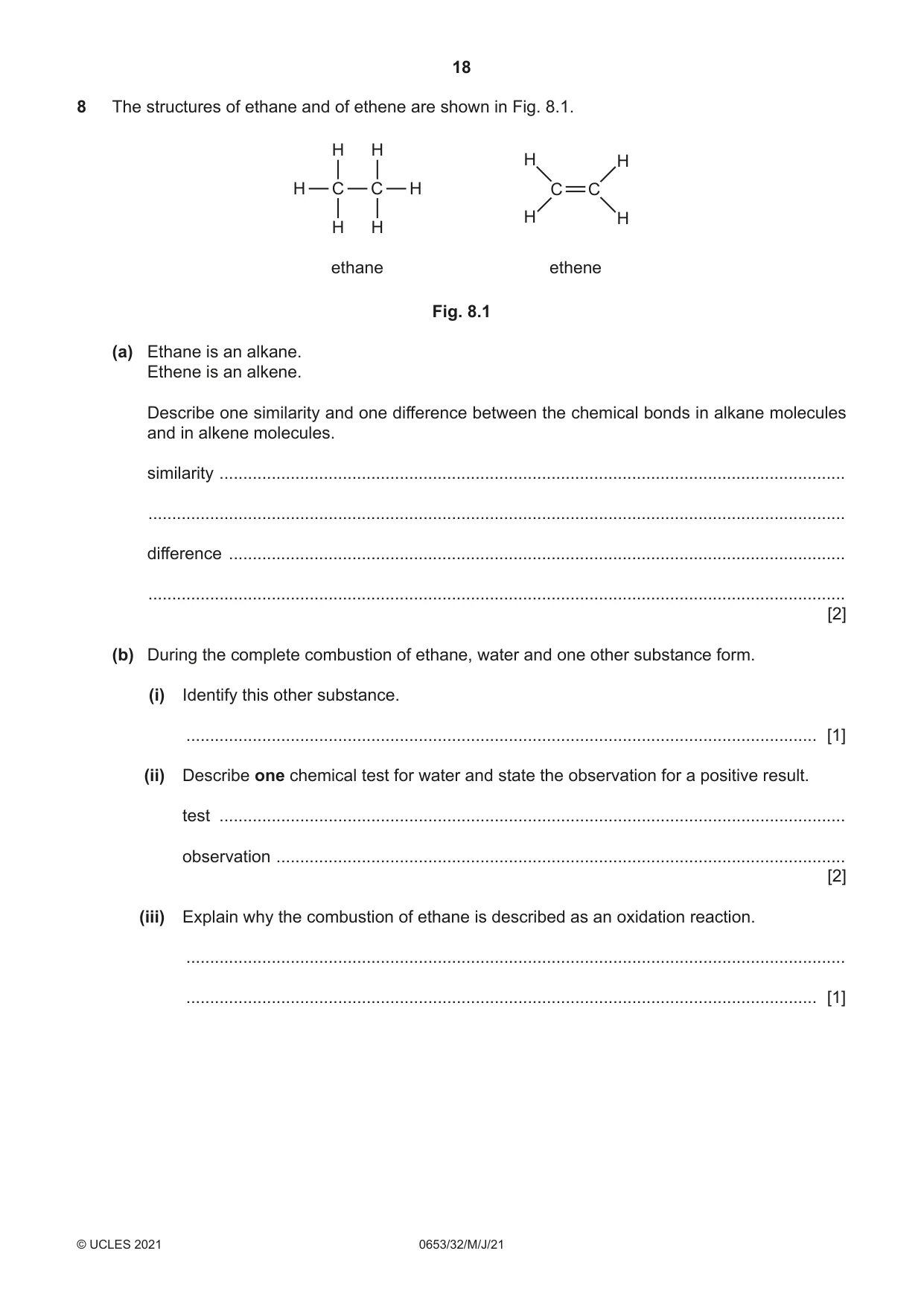
8 The structures of ethane and of ethene are shown in Fig. 8.1. H H H H H C C H C C H H H H ethane ethene Fig. 8.1 (a) Ethane is an alkane. Ethene is an alkene. Describe one similarity and one difference between the chemical bonds in alkane molecules and in alkene molecules. similarity .................................................................................................................................... ................................................................................................................................................... difference .................................................................................................................................. ................................................................................................................................................... [2] (b) During the complete combustion of ethane, water and one other substance form. (i) Identify this other substance. ..................................................................................................................................... [1] (ii) Describe one chemical test for water and state the observation for a positive result. test .................................................................................................................................... observation ........................................................................................................................ [2] (iii) Explain why the combustion of ethane is described as an oxidation reaction. ........................................................................................................................................... ..................................................................................................................................... [1] (c) Fractional distillation of petroleum produces naphtha. Cracking naphtha produces ethene. Addition polymerisation of ethene produces polymer Y. Name polymer Y. ............................................................................................................................................. [1] [Total: 7]
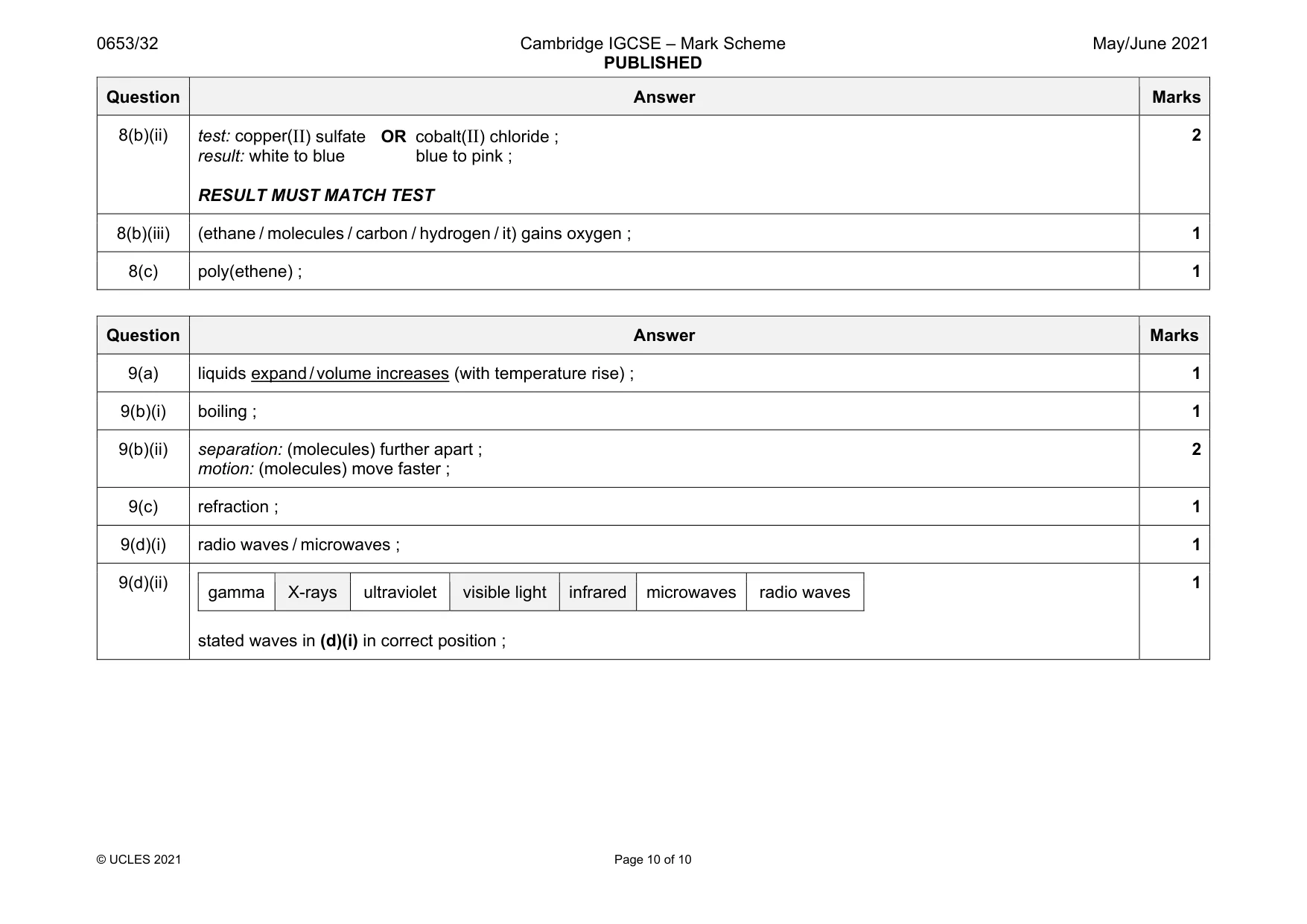
Mark scheme: 8(a) similarity: covalent bonds ; difference: alkanes only single (bonds) / alkenes contain double (bonds) ; 2 8(b)(i) carbon dioxide / CO2 ; 1 Question Answer Marks 8(b)(ii) test: copper(II) sulfate OR cobalt(II) chloride ; result: white to blue blue to pink ; RESULT MUST MATCH TEST 2 8(b)(iii) (ethane / molecules / carbon / hydrogen / it) gains oxygen ; 1 8(c) poly(ethene) ; 1
Q9 · Thermal energy being transferred to a beaker full of water
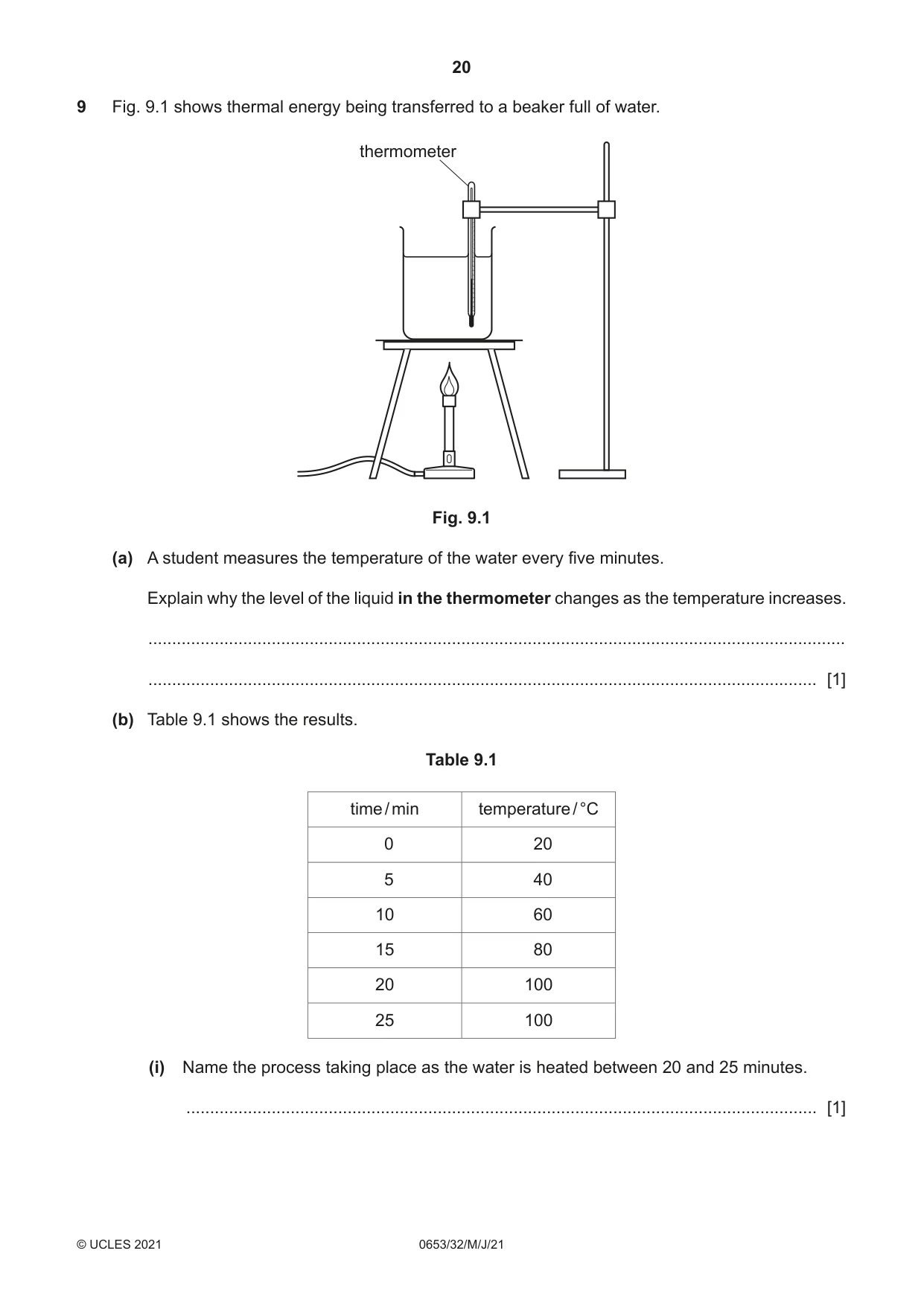
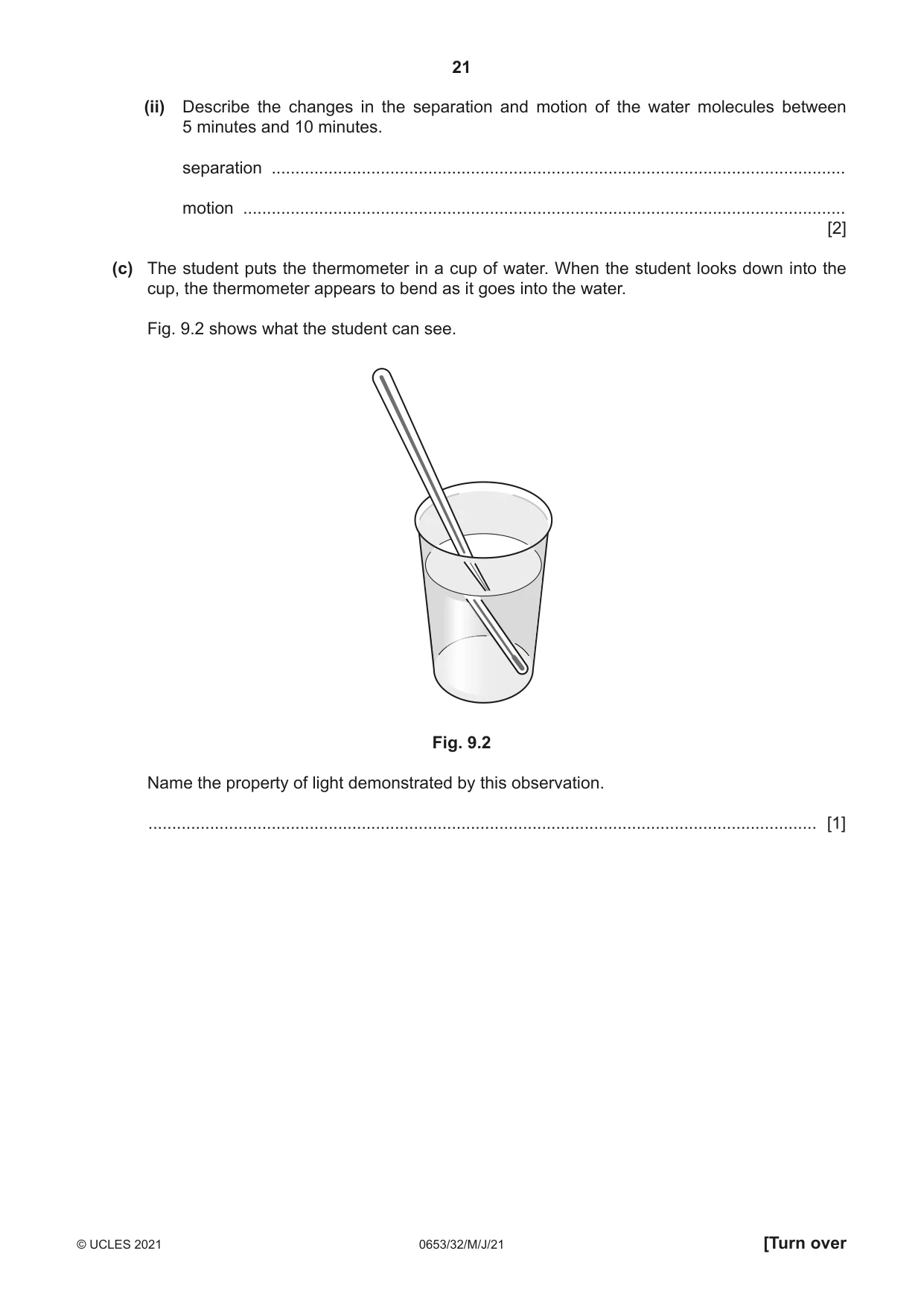
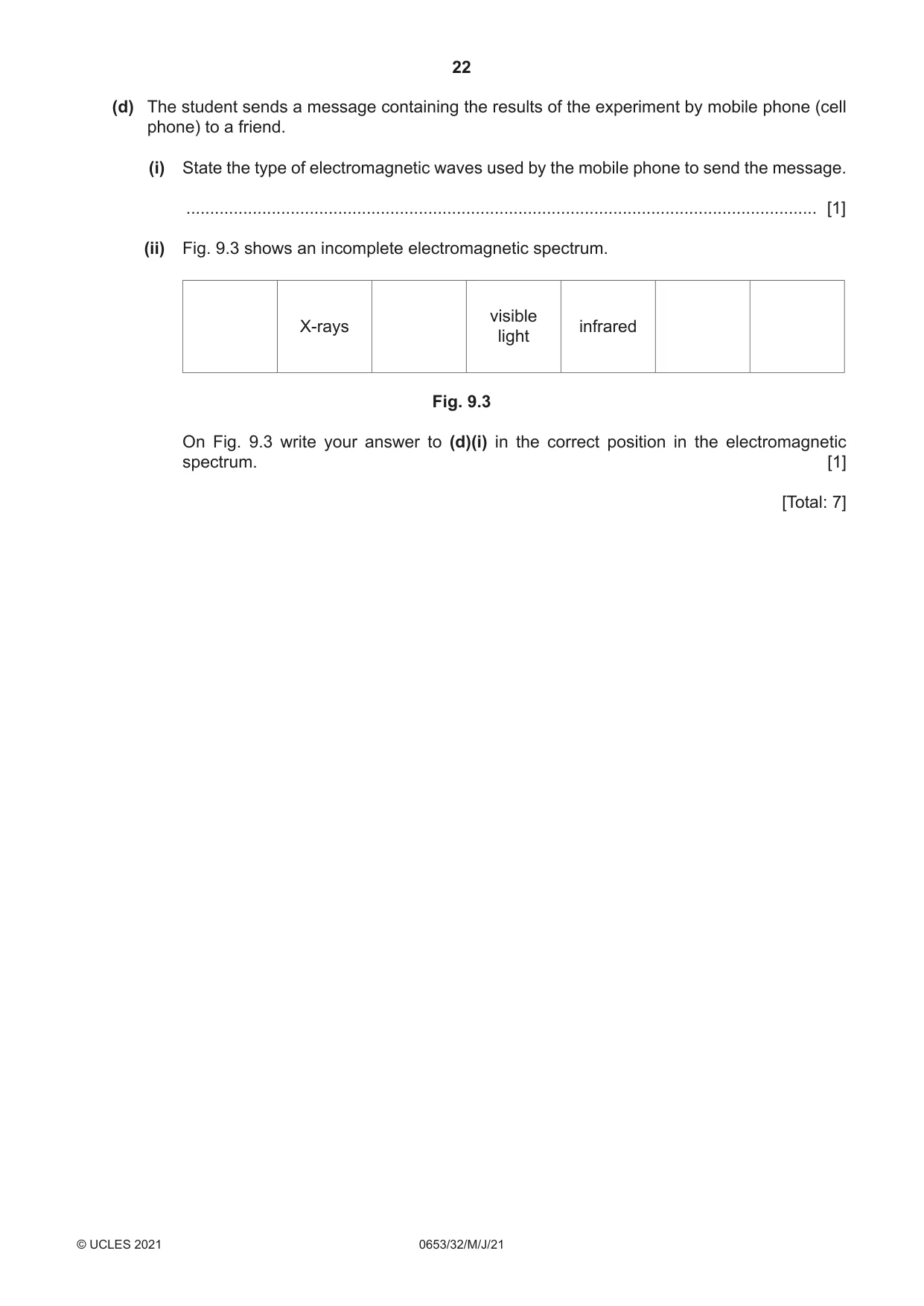
9 Fig. 9.1 shows thermal energy being transferred to a beaker full of water. thermometer Fig. 9.1 (a) A student measures the temperature of the water every five minutes. Explain why the level of the liquid in the thermometer changes as the temperature increases. ................................................................................................................................................... ............................................................................................................................................. [1] (b) Table 9.1 shows the results. Table 9.1 time / min temperature / °C 0 20 5 40 10 60 15 80 20 100 25 100 (i) Name the process taking place as the water is heated between 20 and 25 minutes. ..................................................................................................................................... [1] (ii) Describe the changes in the separation and motion of the water molecules between 5 minutes and 10 minutes. separation ......................................................................................................................... motion ............................................................................................................................... [2] (c) The student puts the thermometer in a cup of water. When the student looks down into the cup, the thermometer appears to bend as it goes into the water. Fig. 9.2 shows what the student can see. Fig. 9.2 Name the property of light demonstrated by this observation. ............................................................................................................................................. [1] (d) The student sends a message containing the results of the experiment by mobile phone (cell phone) to a friend. (i) State the type of electromagnetic waves used by the mobile phone to send the message. ..................................................................................................................................... [1] (ii) Fig. 9.3 shows an incomplete electromagnetic spectrum. visible X-rays infrared light Fig. 9.3 On Fig. 9.3 write your answer to (d)(i) in the correct position in the electromagnetic spectrum. [1] [Total: 7]
Mark scheme: 9(a) liquids expand / volume increases (with temperature rise) ; 1 9(b)(i) boiling ; 1 9(b)(ii) separation: (molecules) further apart ; motion: (molecules) move faster ; 2 9(c) refraction ; 1 9(d)(i) radio waves / microwaves ; 1 9(d)(ii) gamma X-rays ultraviolet visible light infrared microwaves radio waves stated waves in (d)(i) in correct position ; 1
What was in this paper
The subtopics covered by these 9 questions, and how many questions each got. Open one in a new tab to see every Cambridge question on it.
What you needed in this session
Cambridge’s own grade thresholds for 2021 May/June, Paper 3 · Variant 2. A higher threshold means an easier paper — the bar moves with how the cohort did.