Cambridge IGCSE Science - Combined 0653 — 2019 Oct/Nov Paper 3 · Variant 3
0653/33/O/N/19 · 9 questions · 80 marks · ≈90 min
The question paper and its mark scheme, free to read here and free to download. This is Cambridge’s own paper, exactly as it was sat.
Question paper20 pages

Mark scheme9 pages
Answers below. Sit the paper first if you are practising.
Questions as text
Question 1
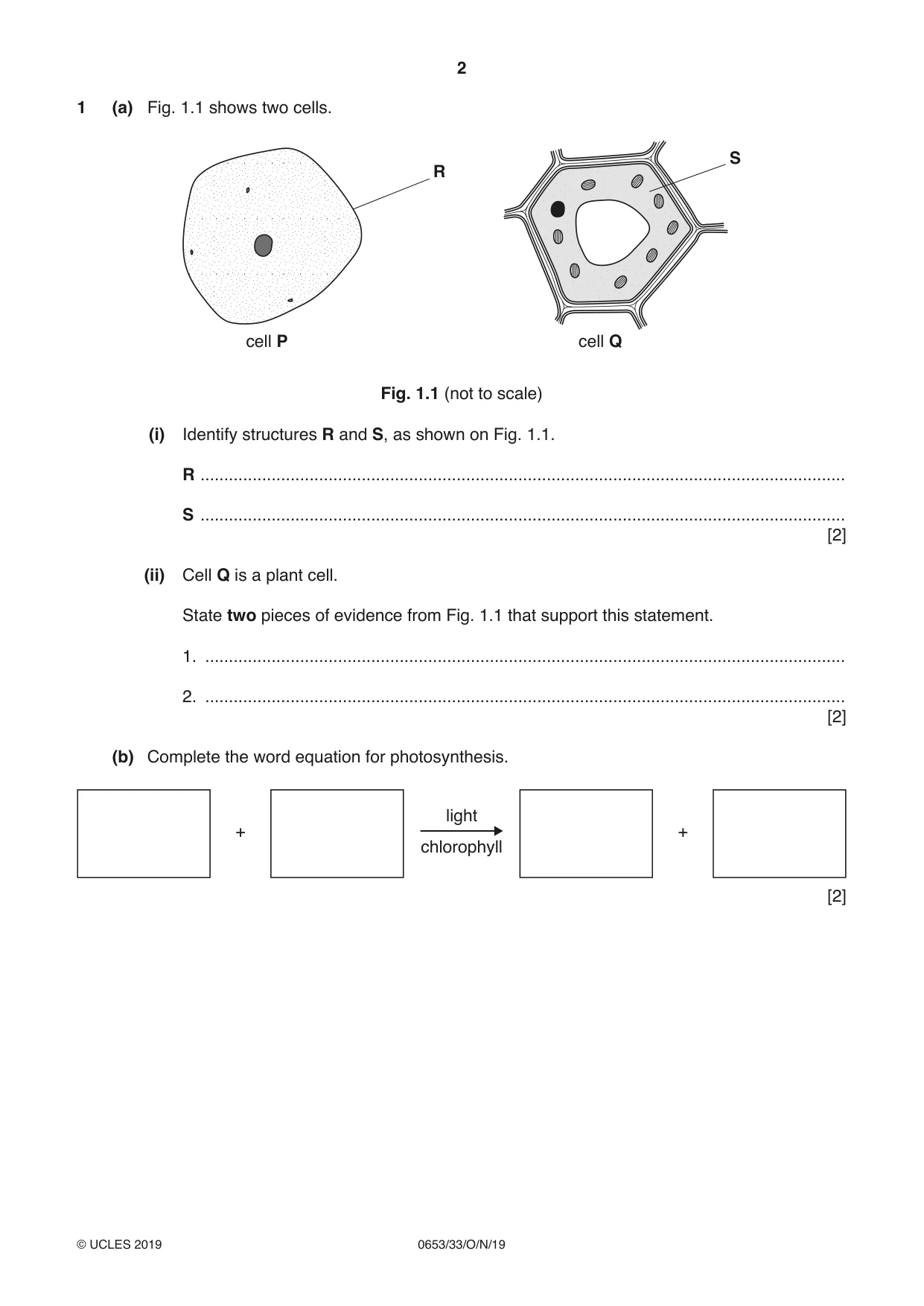
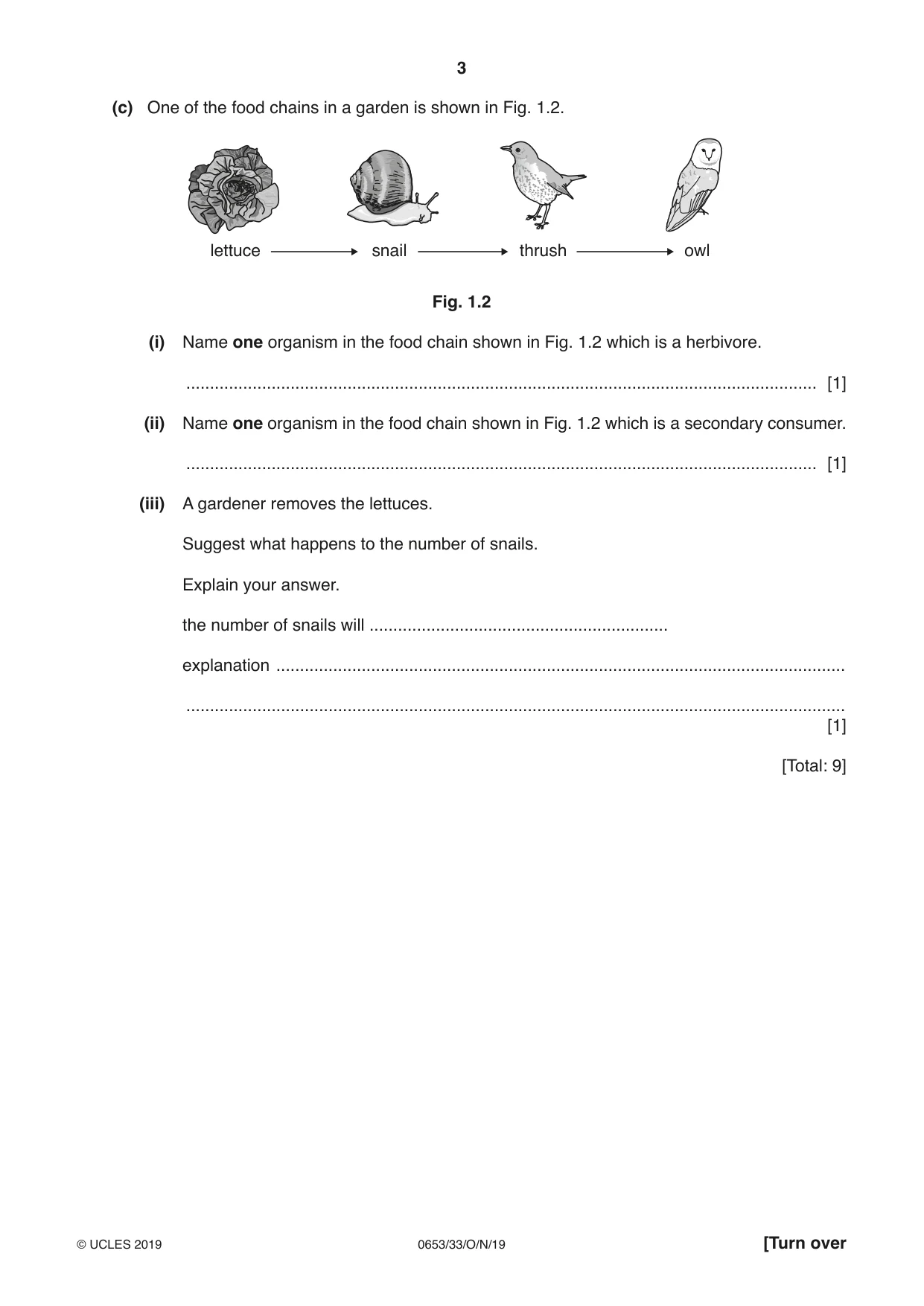
1 (a) Fig. 1.1 shows two cells. S R cell P cell Q Fig. 1.1 (not to scale) (i) Identify structures R and S, as shown on Fig. 1.1. R ........................................................................................................................................ S ........................................................................................................................................ [2] (ii) Cell Q is a plant cell. State two pieces of evidence from Fig. 1.1 that support this statement. 1. ....................................................................................................................................... 2. ....................................................................................................................................... [2] (b) Complete the word equation for photosynthesis. light + + chlorophyll [2] (c) One of the food chains in a garden is shown in Fig. 1.2. lettuce snail thrush owl Fig. 1.2 (i) Name one organism in the food chain shown in Fig. 1.2 which is a herbivore. ..................................................................................................................................... [1] (ii) Name one organism in the food chain shown in Fig. 1.2 which is a secondary consumer. ..................................................................................................................................... [1] (iii) A gardener removes the lettuces. Suggest what happens to the number of snails. Explain your answer. the number of snails will ............................................................... explanation ........................................................................................................................ ........................................................................................................................................... [1] [Total: 9]
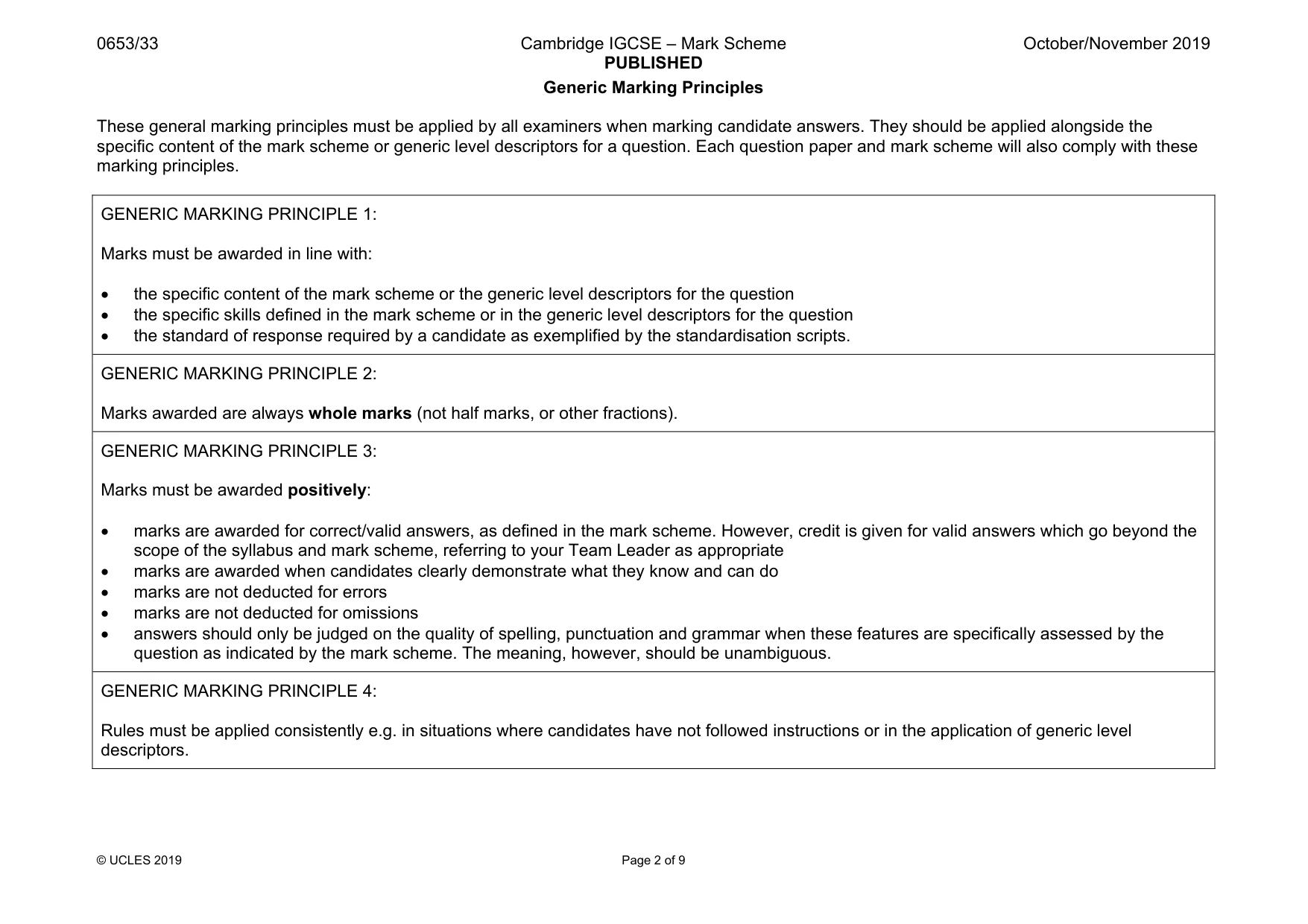
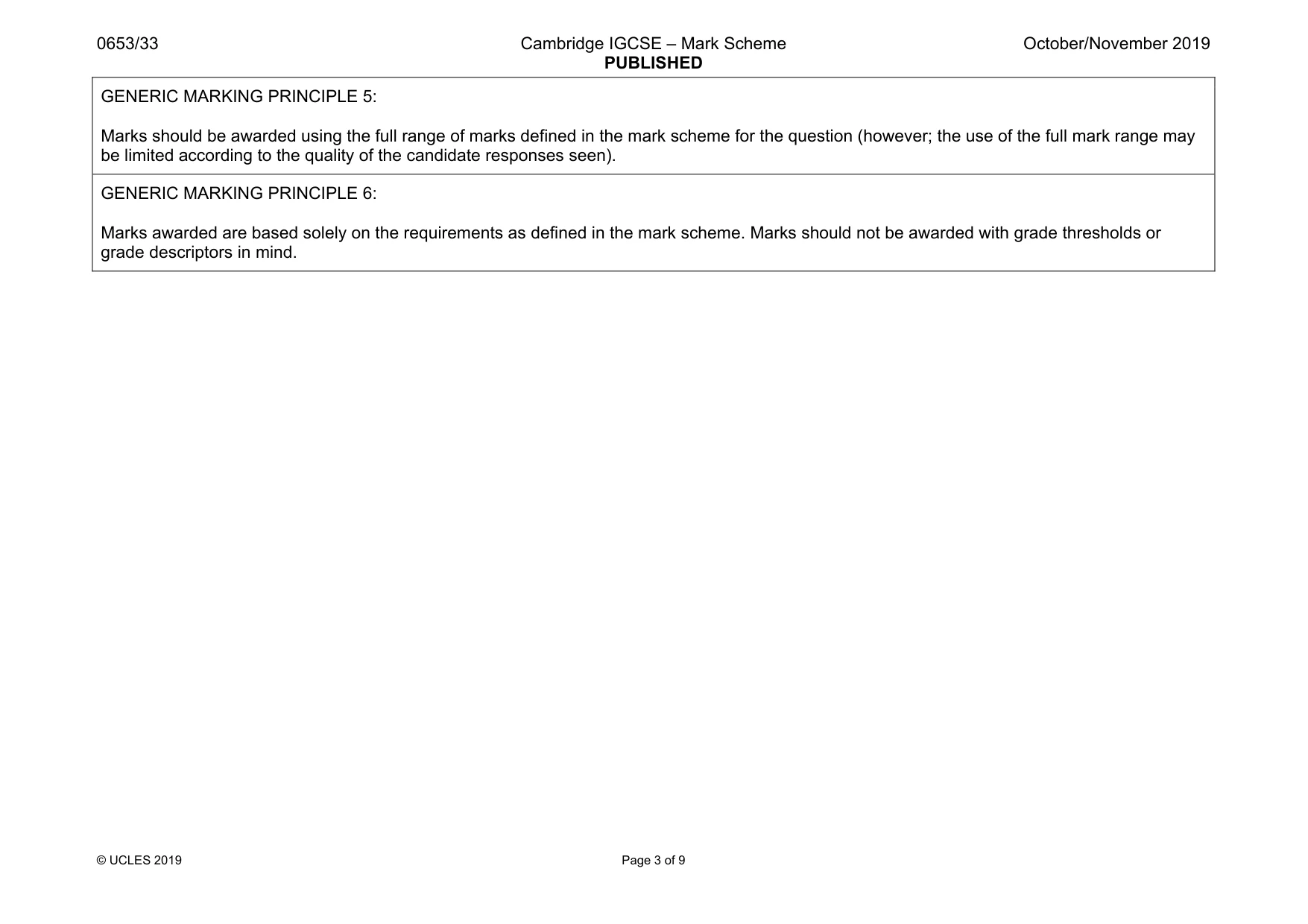
Mark scheme: 1(a)(i) R cell membrane ; S cytoplasm ; 2 1(a)(ii) any two from: (it has a) cell wall ; (it has a large) vacuole ; (it has) chloroplasts ; 2 1(b) (LHS) carbon dioxide + water ; (RHS) glucose + oxygen ; 2 1(c)(i) snail ; 1 1(c)(ii) thrush ; 1 1(c)(iii) decrease and (they have) less food / no food ; 1
Q2 · Petroleum is a mixture of compounds which are separated in a fractional distillation…
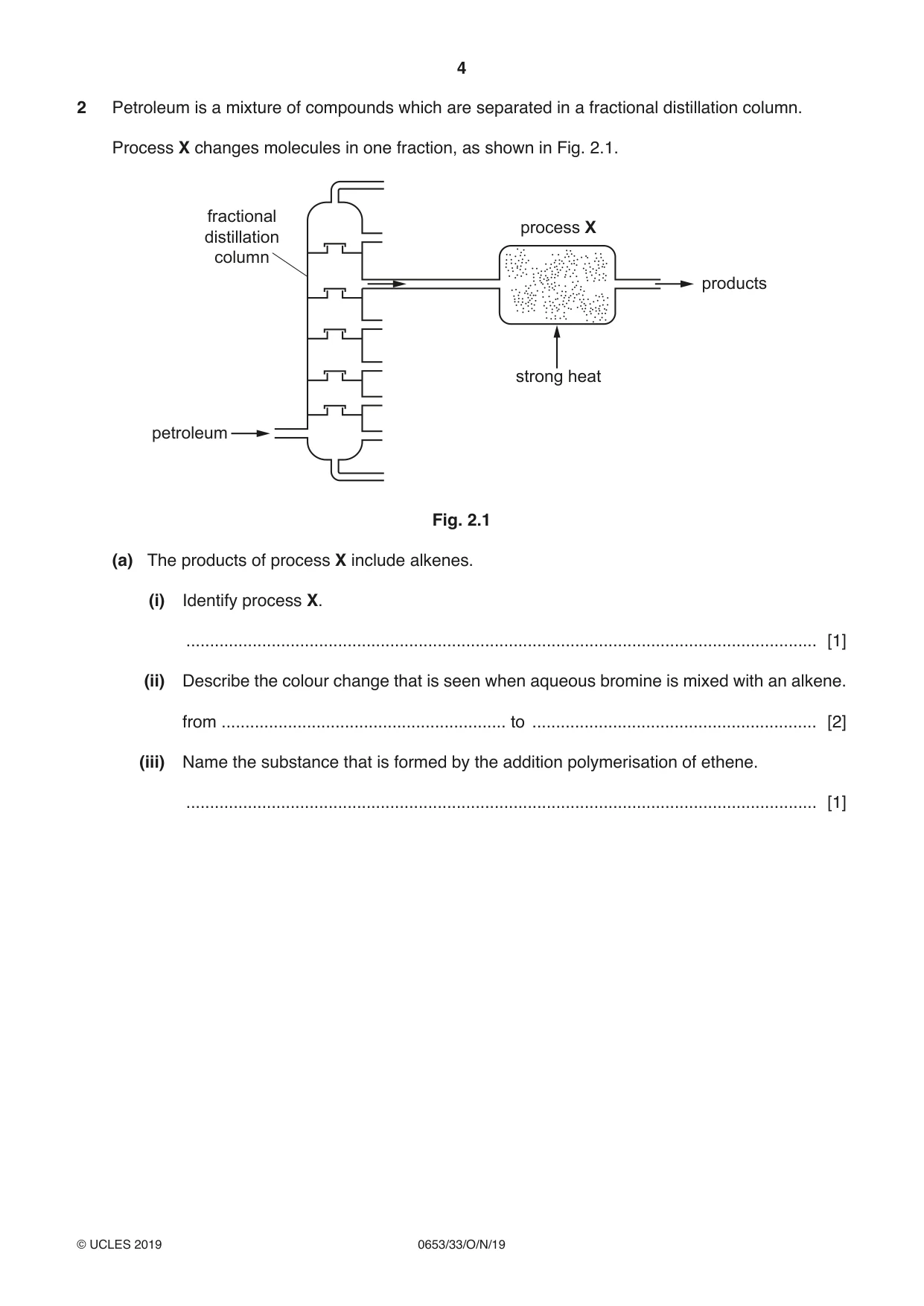
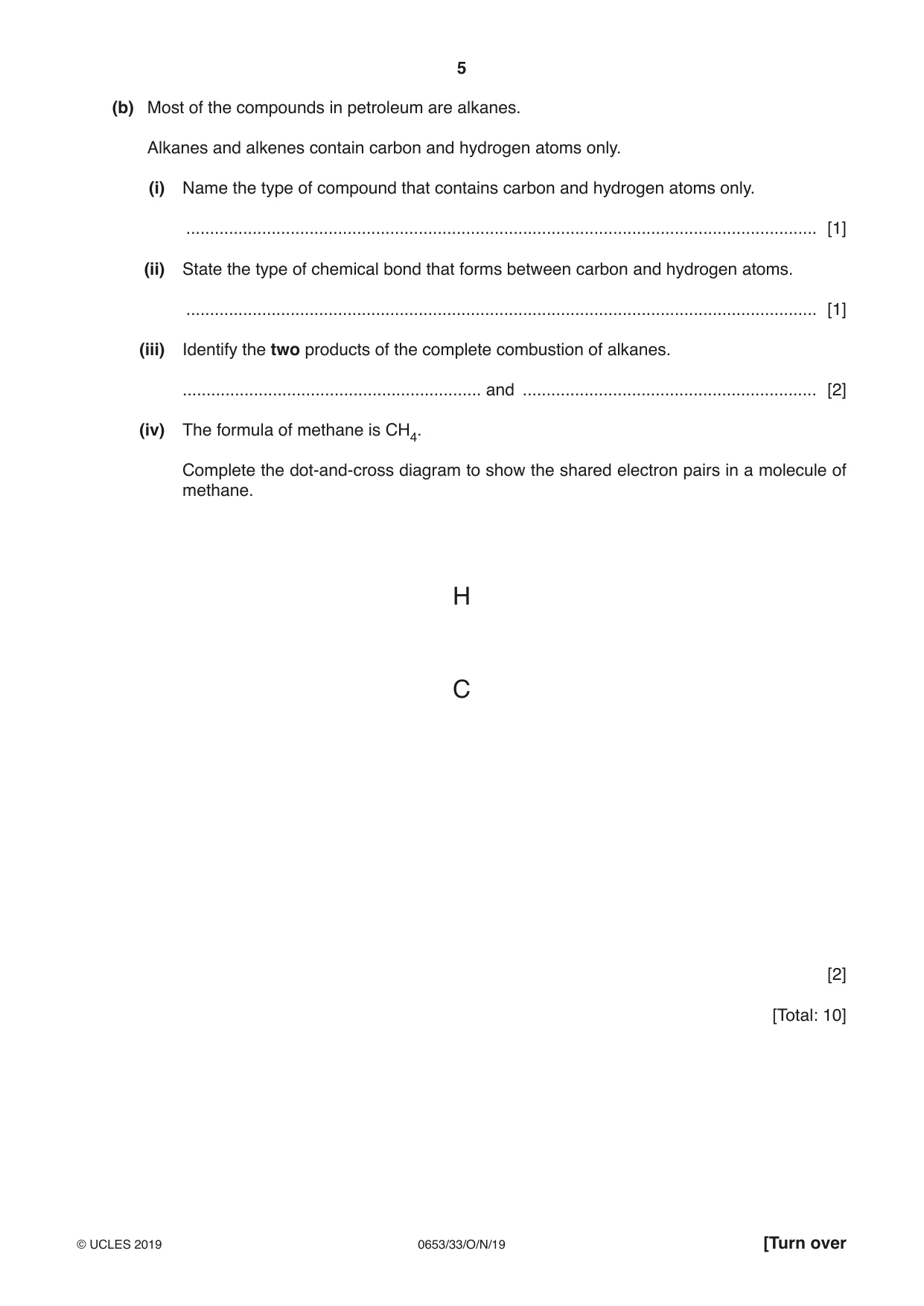
2 Petroleum is a mixture of compounds which are separated in a fractional distillation column. Process X changes molecules in one fraction, as shown in Fig. 2.1. fractional process X distillation column products strong heat petroleum Fig. 2.1 (a) The products of process X include alkenes. (i) Identify process X. ..................................................................................................................................... [1] (ii) Describe the colour change that is seen when aqueous bromine is mixed with an alkene. from ............................................................ to ............................................................ [2] (iii) Name the substance that is formed by the addition polymerisation of ethene. ..................................................................................................................................... [1] (b) Most of the compounds in petroleum are alkanes. Alkanes and alkenes contain carbon and hydrogen atoms only. (i) Name the type of compound that contains carbon and hydrogen atoms only. ..................................................................................................................................... [1] (ii) State the type of chemical bond that forms between carbon and hydrogen atoms. ..................................................................................................................................... [1] (iii) Identify the two products of the complete combustion of alkanes. ............................................................... and .............................................................. [2] (iv) The formula of methane is CH4. Complete the dot‑and‑cross diagram to show the shared electron pairs in a molecule of methane. H C [2] [Total: 10]
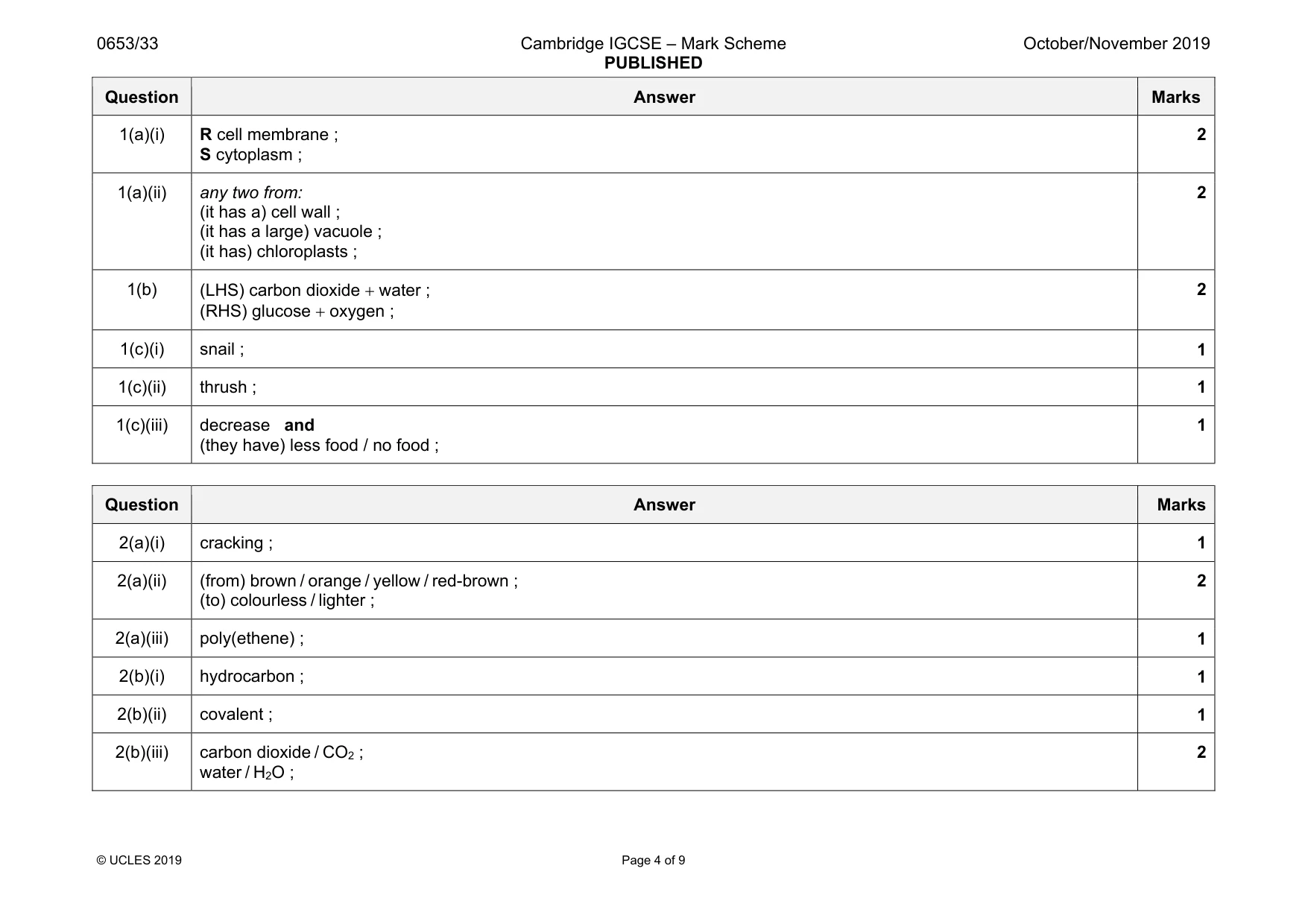
Mark scheme: 2(a)(i) cracking ; 1 2(a)(ii) (from) brown / orange / yellow / red-brown ; (to) colourless / lighter ; 2 2(a)(iii) poly(ethene) ; 1 2(b)(i) hydrocarbon ; 1 2(b)(ii) covalent ; 1 2(b)(iii) carbon dioxide / CO2 ; water / H2O ; 2 Question Answer Marks 2(b)(iv) three further hydrogen atoms drawn around the carbon atom ; one pair of electrons between each hydrogen and the carbon ; 2
Q3 · A game played on a sloping board
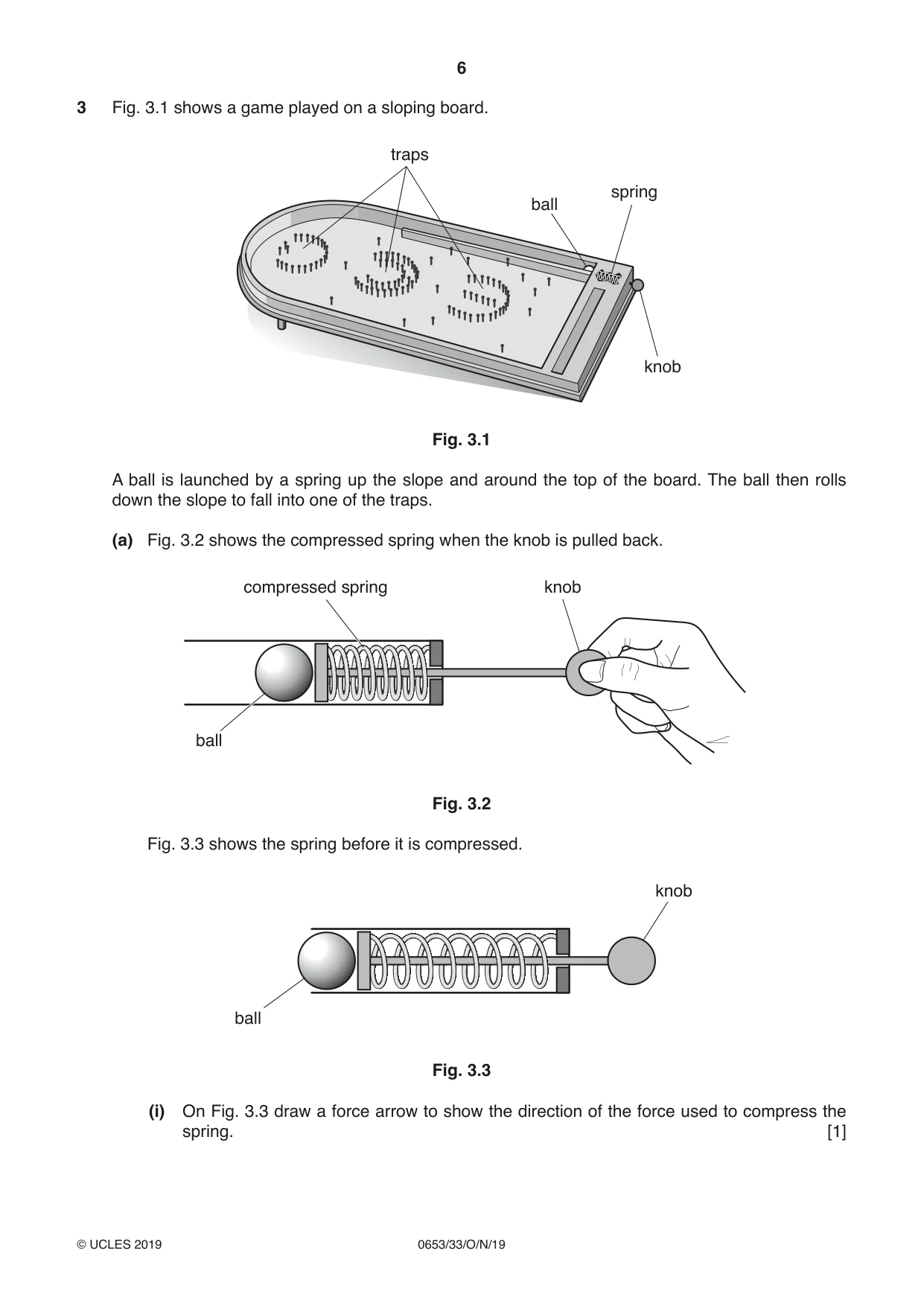
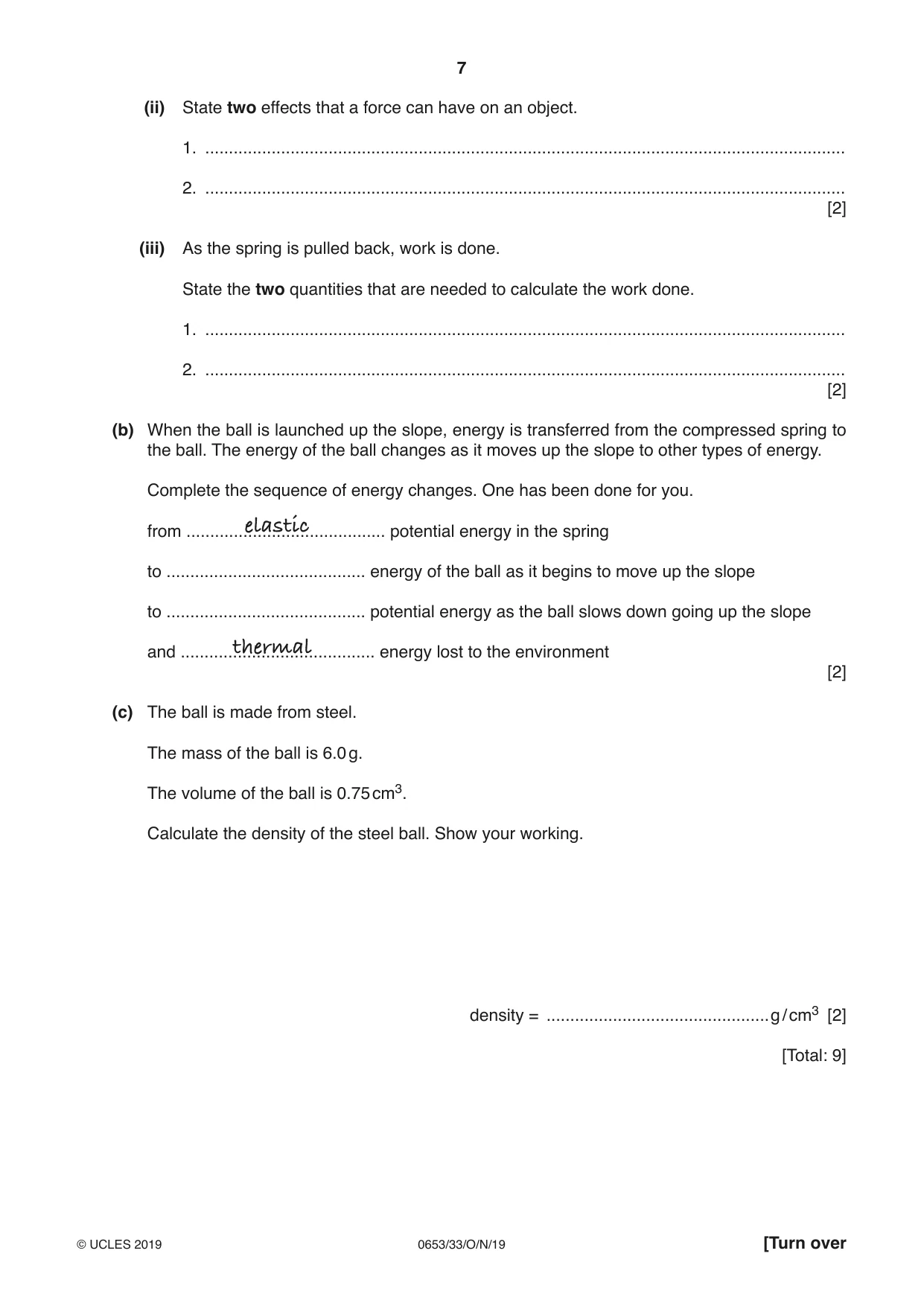
3 Fig. 3.1 shows a game played on a sloping board. traps spring ball knob Fig. 3.1 A ball is launched by a spring up the slope and around the top of the board. The ball then rolls down the slope to fall into one of the traps. (a) Fig. 3.2 shows the compressed spring when the knob is pulled back. compressed spring knob ball Fig. 3.2 Fig. 3.3 shows the spring before it is compressed. knob ball Fig. 3.3 (i) On Fig. 3.3 draw a force arrow to show the direction of the force used to compress the spring. [1] (ii) State two effects that a force can have on an object. 1. ....................................................................................................................................... 2. ....................................................................................................................................... [2] (iii) As the spring is pulled back, work is done. State the two quantities that are needed to calculate the work done. 1. ....................................................................................................................................... 2. ....................................................................................................................................... [2] (b) When the ball is launched up the slope, energy is transferred from the compressed spring to the ball. The energy of the ball changes as it moves up the slope to other types of energy. Complete the sequence of energy changes. One has been done for you. from ..........................................elastic potential energy in the spring to .......................................... energy of the ball as it begins to move up the slope to .......................................... potential energy as the ball slows down going up the slope and .........................................thermal energy lost to the environment [2] (c) The ball is made from steel. The mass of the ball is 6.0 g. The volume of the ball is 0.75 cm3. Calculate the density of the steel ball. Show your working. density = ...............................................g / cm3 [2] [Total: 9]
Mark scheme: 3(a)(i) horizontal arrow to the right ; 1 3(a)(ii) any two from: changes (object’s) shape ; changes (object’s) size ; changes (object’s) motion ; 2 3(a)(iii) force (applied) ; distance (moved) ; 2 3(b) kinetic ; gravitational ; 2 3(c) density = mass / volume or density = 6.0 (g) / 0.75 (cm3) ; = 8.0 or 8 (g/cm3) ; 2
Q4 · A diagram of an insect‑pollinated flower
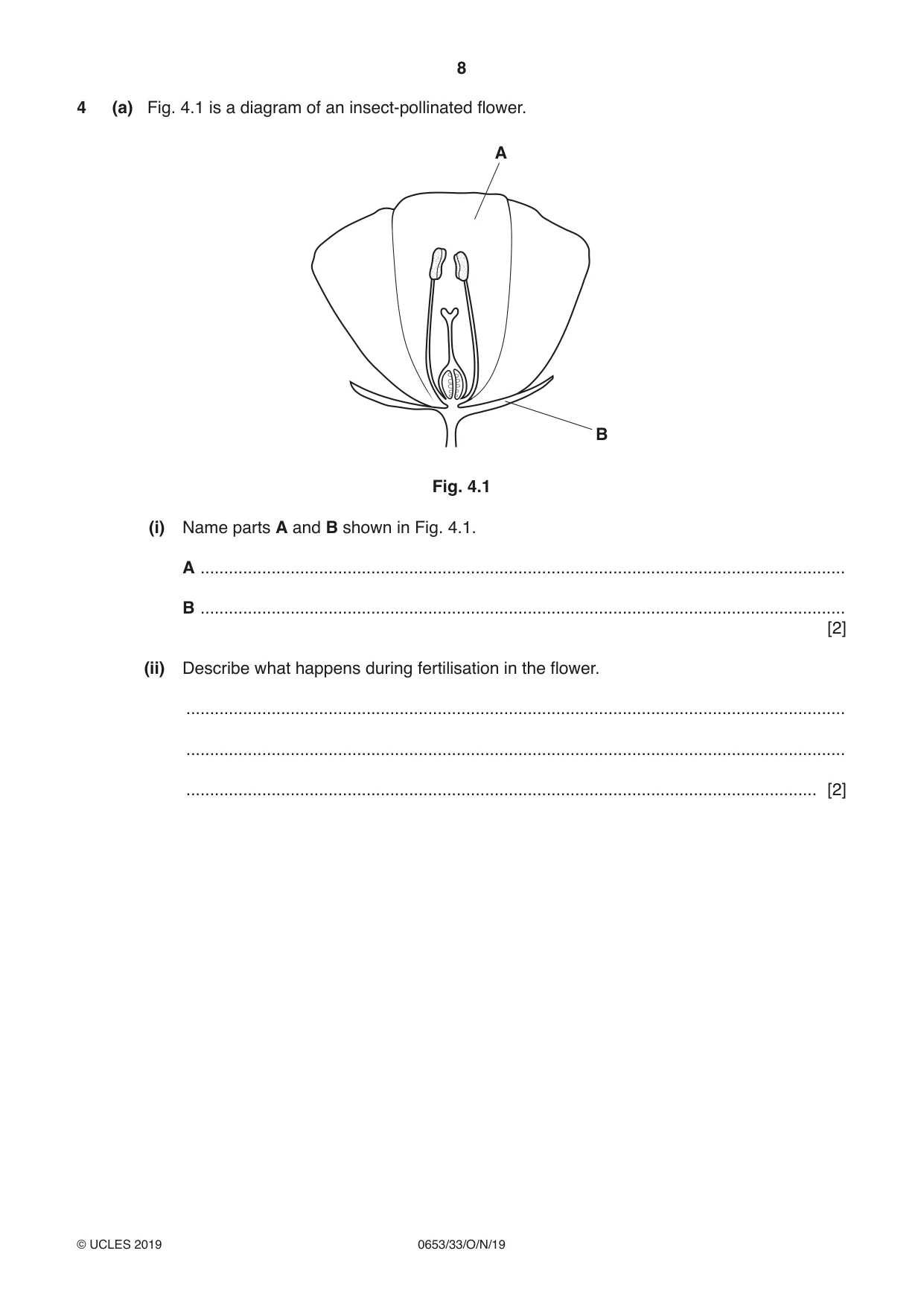
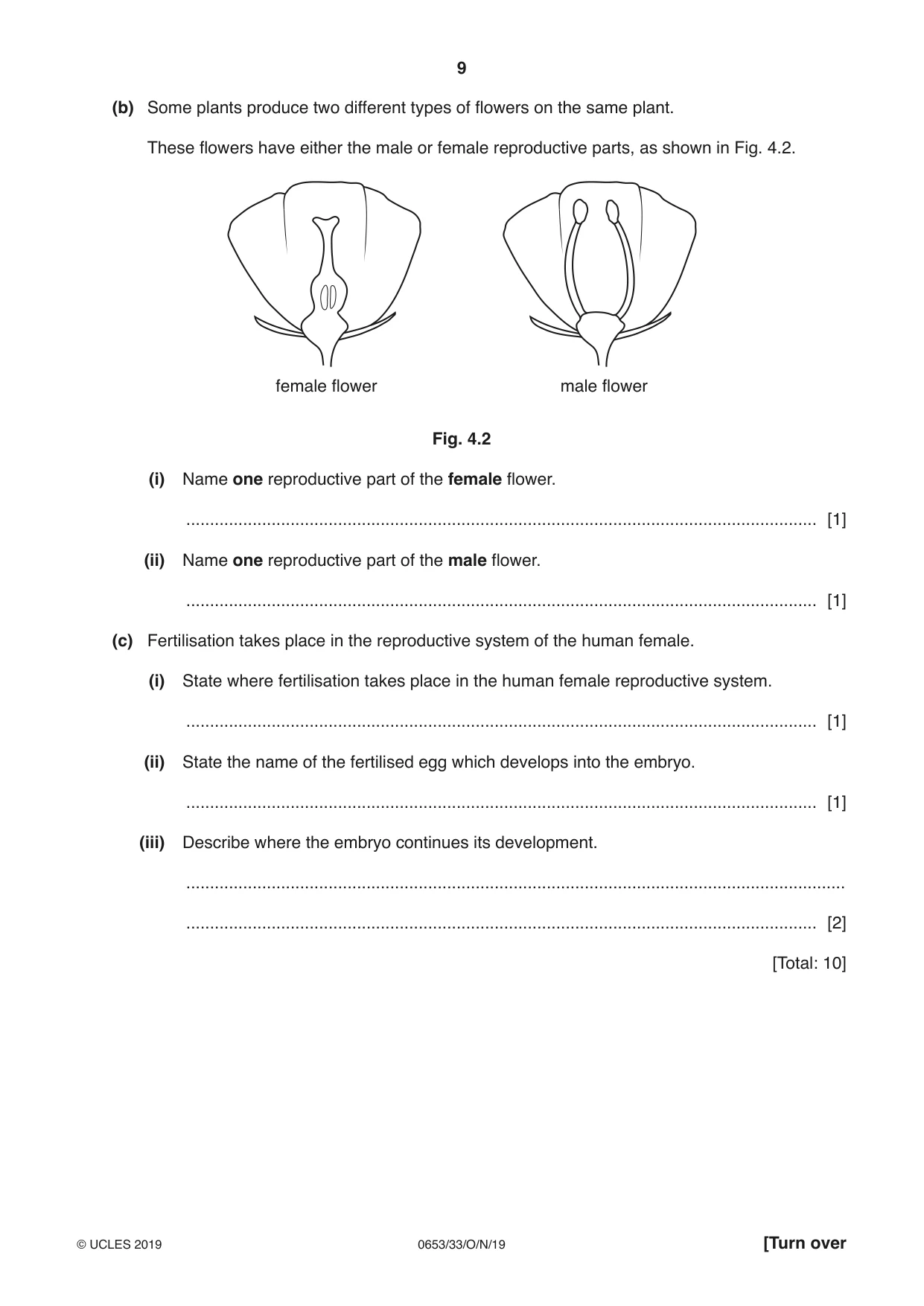
4 (a) Fig. 4.1 is a diagram of an insect‑pollinated flower. A B Fig. 4.1 (i) Name parts A and B shown in Fig. 4.1. A ........................................................................................................................................ B ........................................................................................................................................ [2] (ii) Describe what happens during fertilisation in the flower. ........................................................................................................................................... ........................................................................................................................................... ..................................................................................................................................... [2] (b) Some plants produce two different types of flowers on the same plant. These flowers have either the male or female reproductive parts, as shown in Fig. 4.2. female flower male flower Fig. 4.2 (i) Name one reproductive part of the female flower. ..................................................................................................................................... [1] (ii) Name one reproductive part of the male flower. ..................................................................................................................................... [1] (c) Fertilisation takes place in the reproductive system of the human female. (i) State where fertilisation takes place in the human female reproductive system. ..................................................................................................................................... [1] (ii) State the name of the fertilised egg which develops into the embryo. ..................................................................................................................................... [1] (iii) Describe where the embryo continues its development. ........................................................................................................................................... ..................................................................................................................................... [2] [Total: 10]
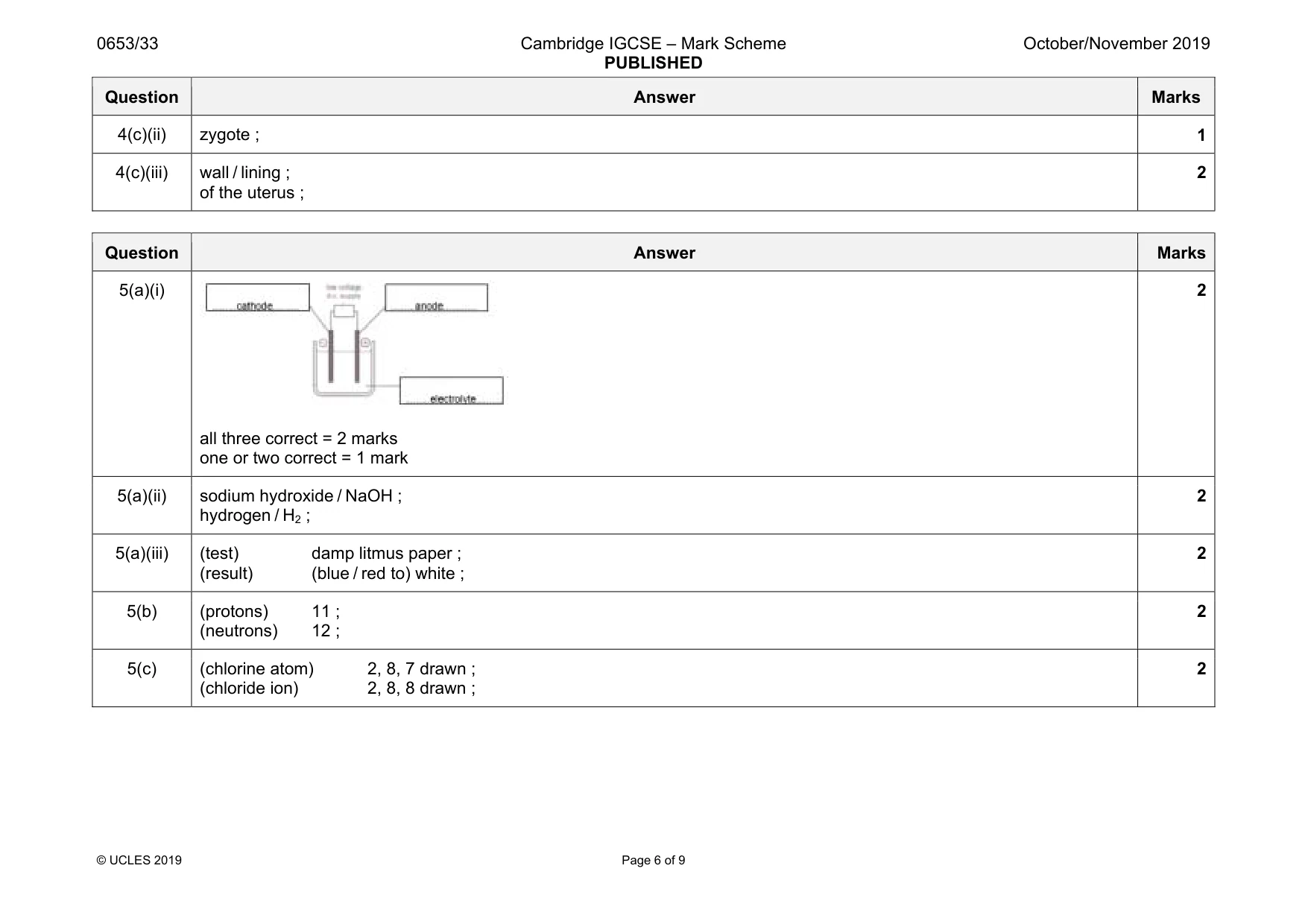
Mark scheme: 4(a)(i) A petal ; B sepal ; 2 4(a)(ii) pollen nucleus fuses ; with a nucleus in the ovule ; 2 4(b)(i) stigma / carpel / style / ovary ; 1 4(b)(ii) anthers / stamen ; 1 4(c)(i) oviduct ; 1 Question Answer Marks 4(c)(ii) zygote ; 1 4(c)(iii) wall / lining ; of the uterus ; 2
Q5 · The electrolysis of concentrated aqueous sodium chloride is shown in Fig
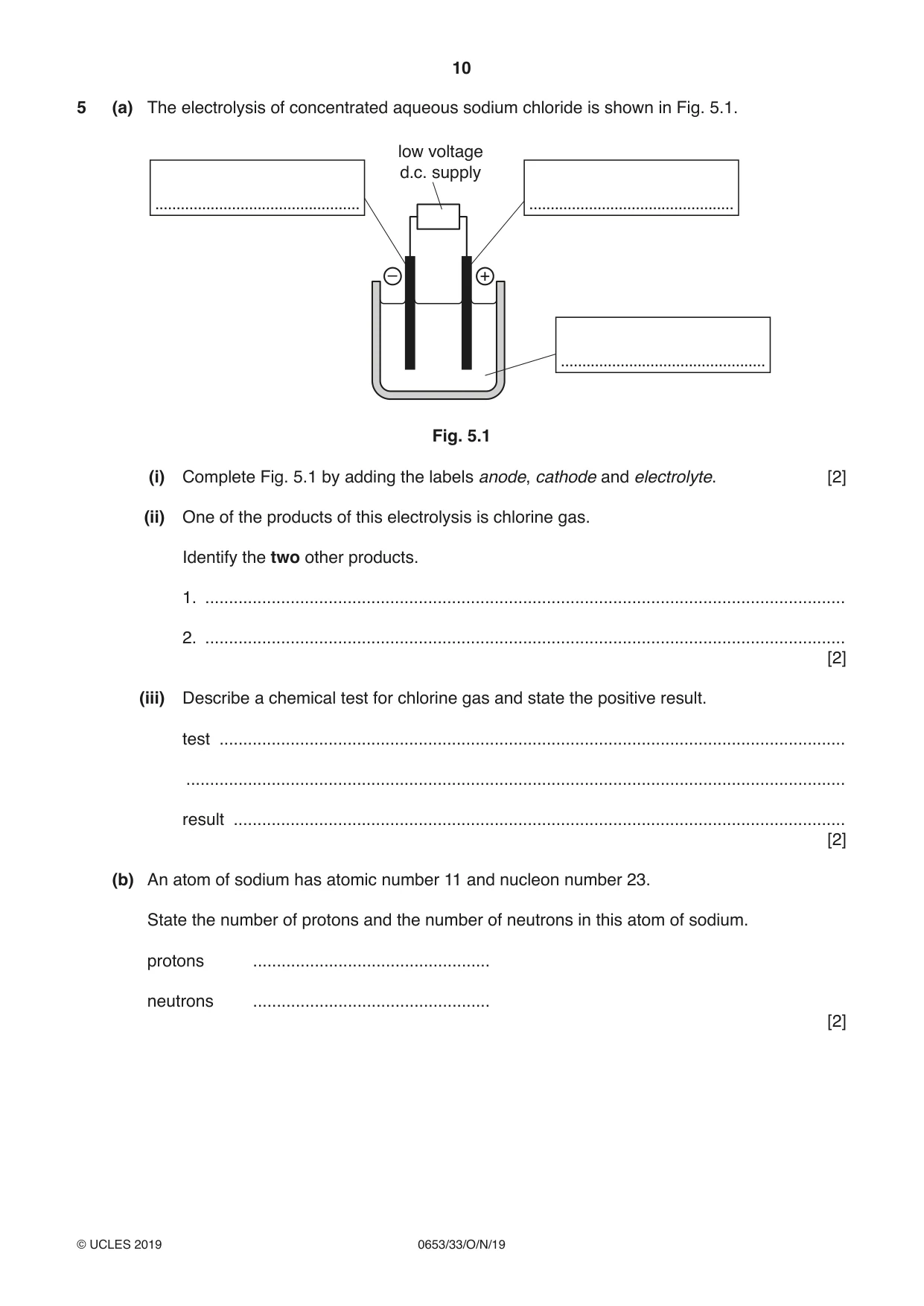
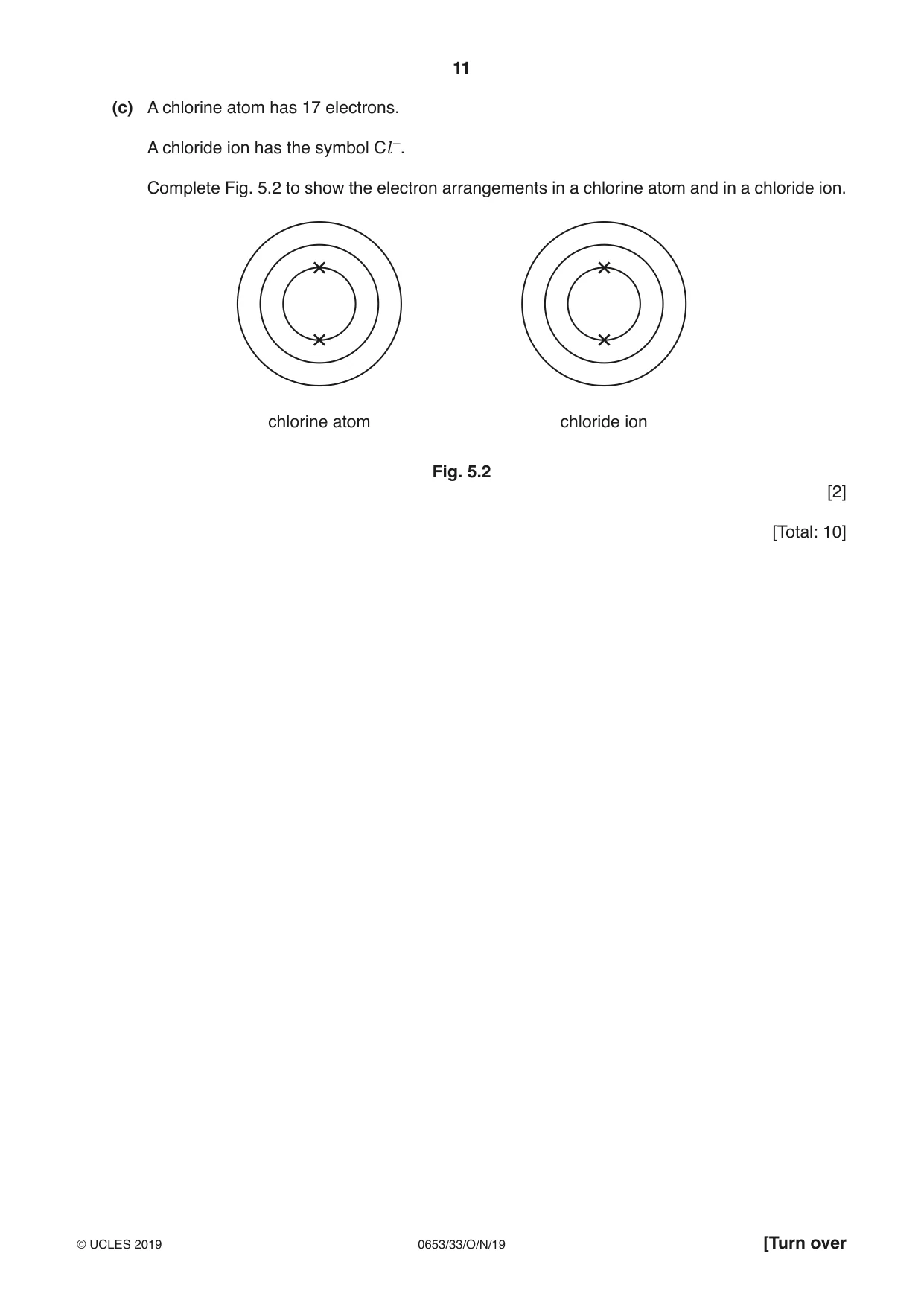
5 (a) The electrolysis of concentrated aqueous sodium chloride is shown in Fig. 5.1. low voltage d.c. supply ................................................ ................................................ – + ................................................ Fig. 5.1 (i) Complete Fig. 5.1 by adding the labels anode, cathode and electrolyte. [2] (ii) One of the products of this electrolysis is chlorine gas. Identify the two other products. 1. ....................................................................................................................................... 2. ....................................................................................................................................... [2] (iii) Describe a chemical test for chlorine gas and state the positive result. test .................................................................................................................................... ........................................................................................................................................... result ................................................................................................................................. [2] (b) An atom of sodium has atomic number 11 and nucleon number 23. State the number of protons and the number of neutrons in this atom of sodium. protons .................................................. neutrons .................................................. [2] (c) A chlorine atom has 17 electrons. A chloride ion has the symbol Cl –. Complete Fig. 5.2 to show the electron arrangements in a chlorine atom and in a chloride ion. × × × × chlorine atom chloride ion Fig. 5.2 [2] [Total: 10]
Mark scheme: 5(a)(i) all three correct = 2 marks one or two correct = 1 mark 2 5(a)(ii) sodium hydroxide / NaOH ; hydrogen / H2 ; 2 5(a)(iii) (test) damp litmus paper ; (result) (blue / red to) white ; 2 5(b) (protons) 11 ; (neutrons) 12 ; 2 5(c) (chlorine atom) 2, 8, 7 drawn ; (chloride ion) 2, 8, 8 drawn ; 2
Q6 · An electric hair dryer
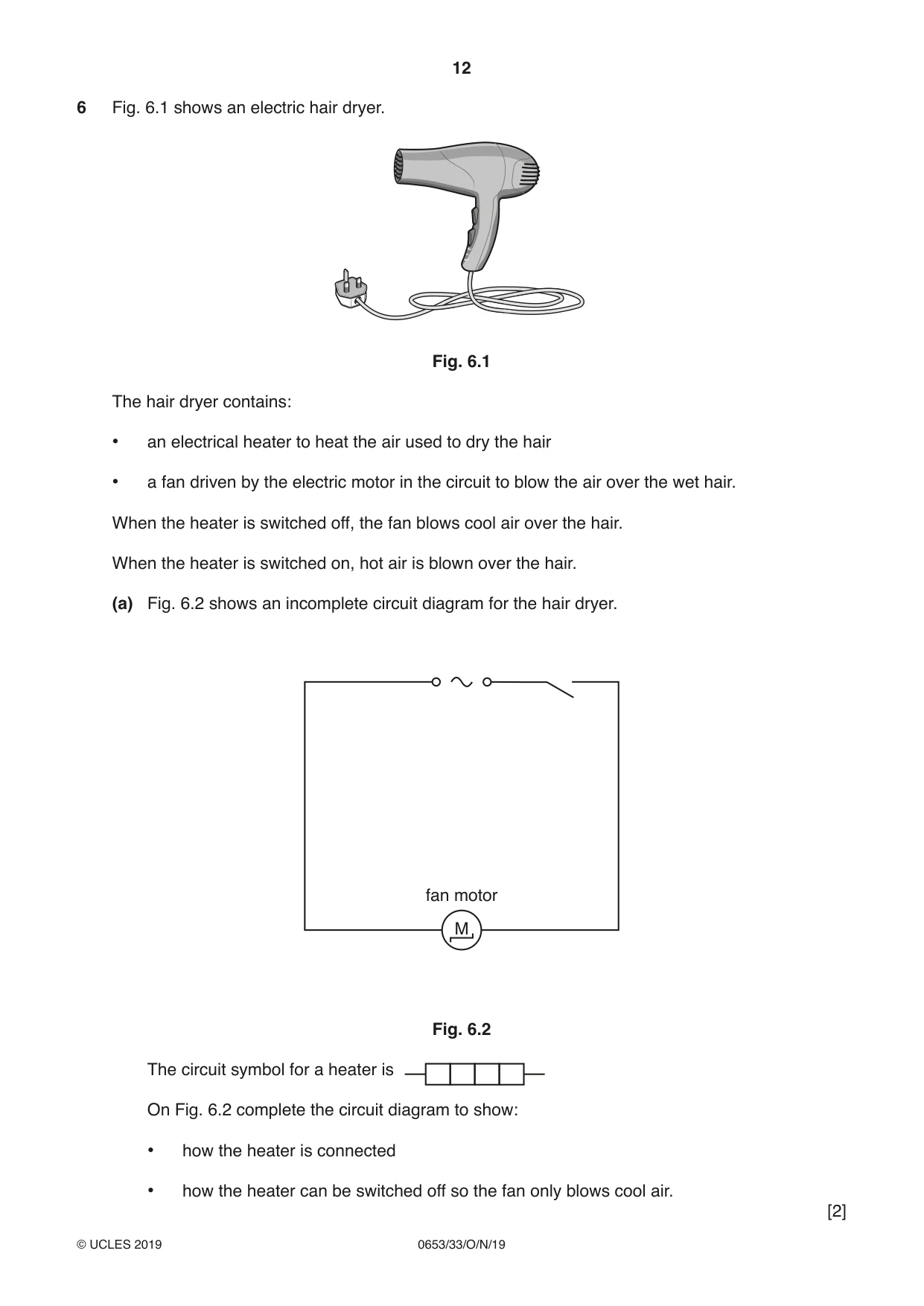
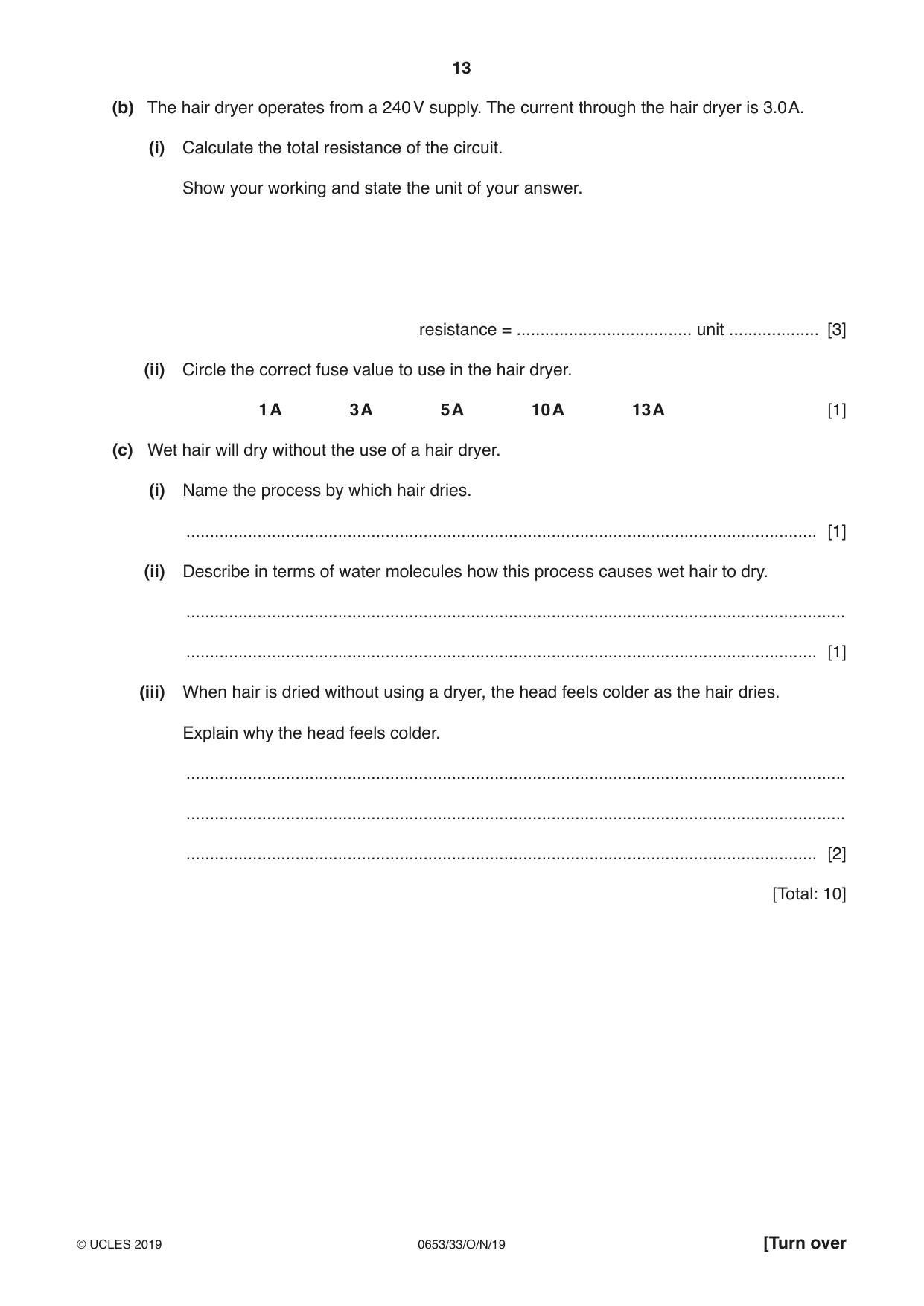
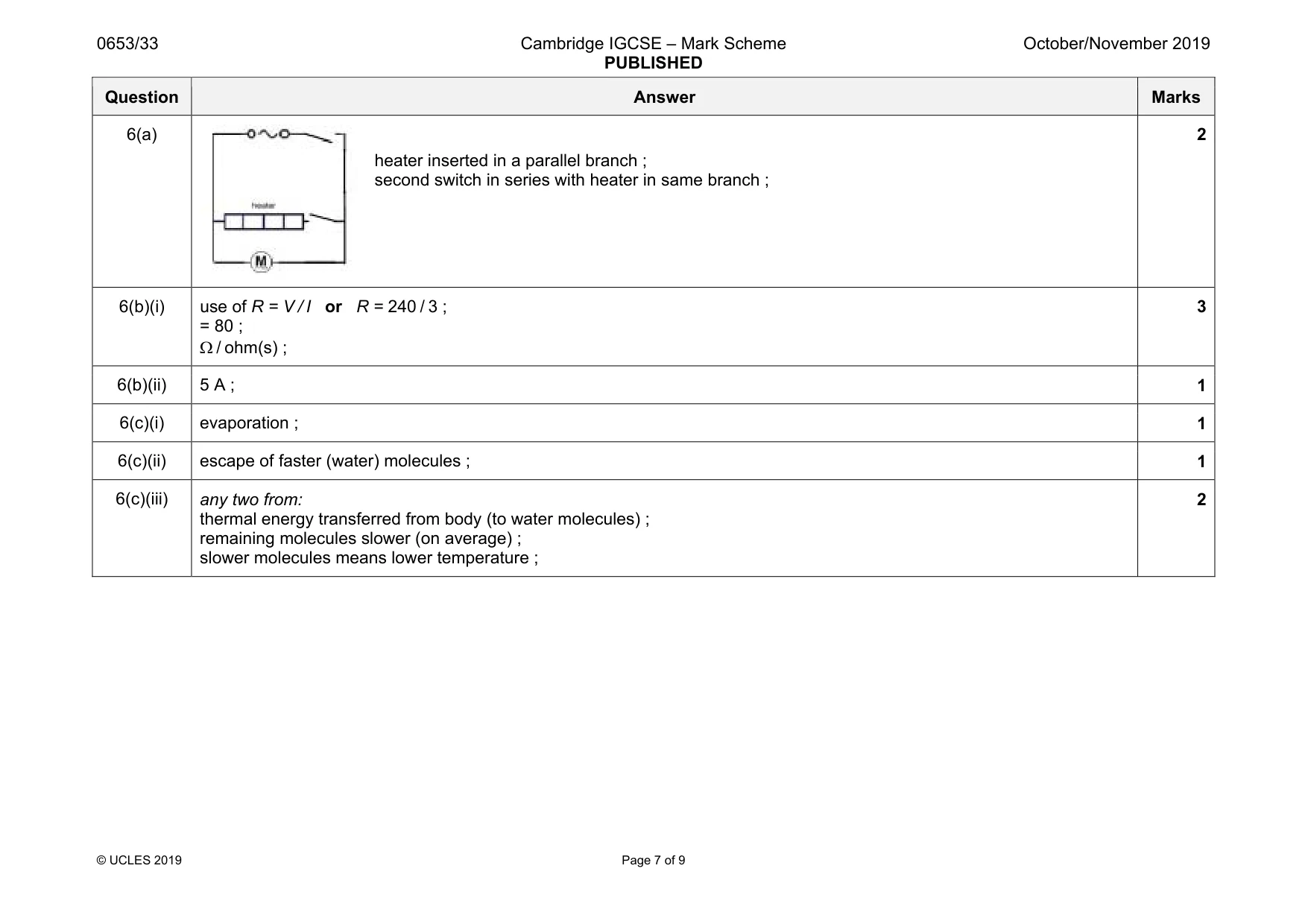
6 Fig. 6.1 shows an electric hair dryer. Fig. 6.1 The hair dryer contains: • an electrical heater to heat the air used to dry the hair • a fan driven by the electric motor in the circuit to blow the air over the wet hair. When the heater is switched off, the fan blows cool air over the hair. When the heater is switched on, hot air is blown over the hair. (a) Fig. 6.2 shows an incomplete circuit diagram for the hair dryer. fan motor M Fig. 6.2 The circuit symbol for a heater is On Fig. 6.2 complete the circuit diagram to show: • how the heater is connected • how the heater can be switched off so the fan only blows cool air. [2] (b) The hair dryer operates from a 240 V supply. The current through the hair dryer is 3.0 A. (i) Calculate the total resistance of the circuit. Show your working and state the unit of your answer. resistance = ..................................... unit ................... [3] (ii) Circle the correct fuse value to use in the hair dryer. 1 A 3 A 5 A 10 A 13 A [1] (c) Wet hair will dry without the use of a hair dryer. (i) Name the process by which hair dries. ..................................................................................................................................... [1] (ii) Describe in terms of water molecules how this process causes wet hair to dry. ........................................................................................................................................... ..................................................................................................................................... [1] (iii) When hair is dried without using a dryer, the head feels colder as the hair dries. Explain why the head feels colder. ........................................................................................................................................... ........................................................................................................................................... ..................................................................................................................................... [2] [Total: 10]
Mark scheme: 6(a) 2 6(b)(i) use of R = V / I or R = 240 / 3 ; = 80 ; Ω / ohm(s) ; 3 6(b)(ii) 5 A ; 1 6(c)(i) evaporation ; 1 6(c)(ii) escape of faster (water) molecules ; 1 6(c)(iii) any two from: thermal energy transferred from body (to water molecules) ; remaining molecules slower (on average) ; slower molecules means lower temperature ; 2 heater inserted in a parallel branch ; second switch in series with heater in same branch ;
Q7 · Chemical digestion occurs in the alimentary canal
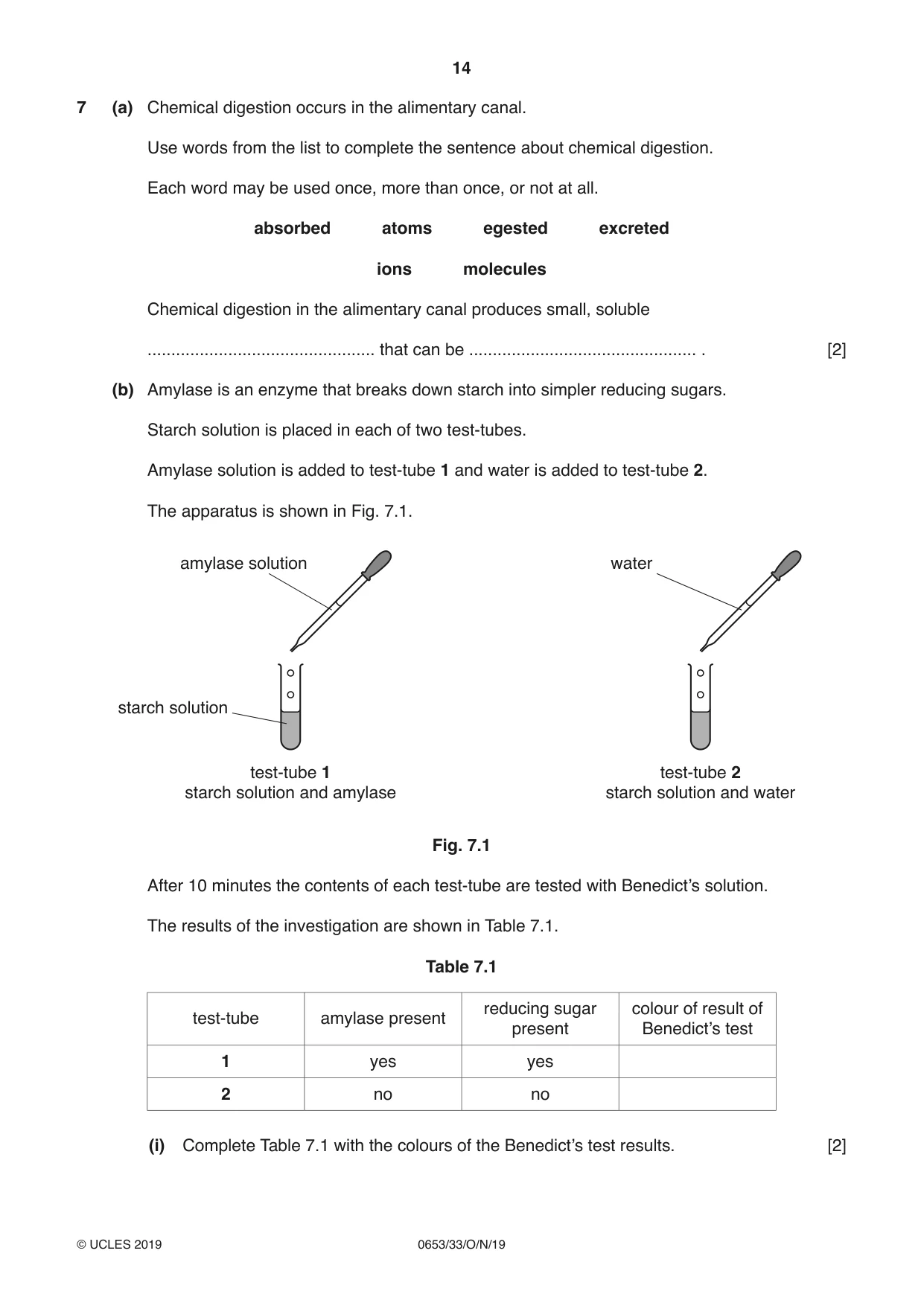
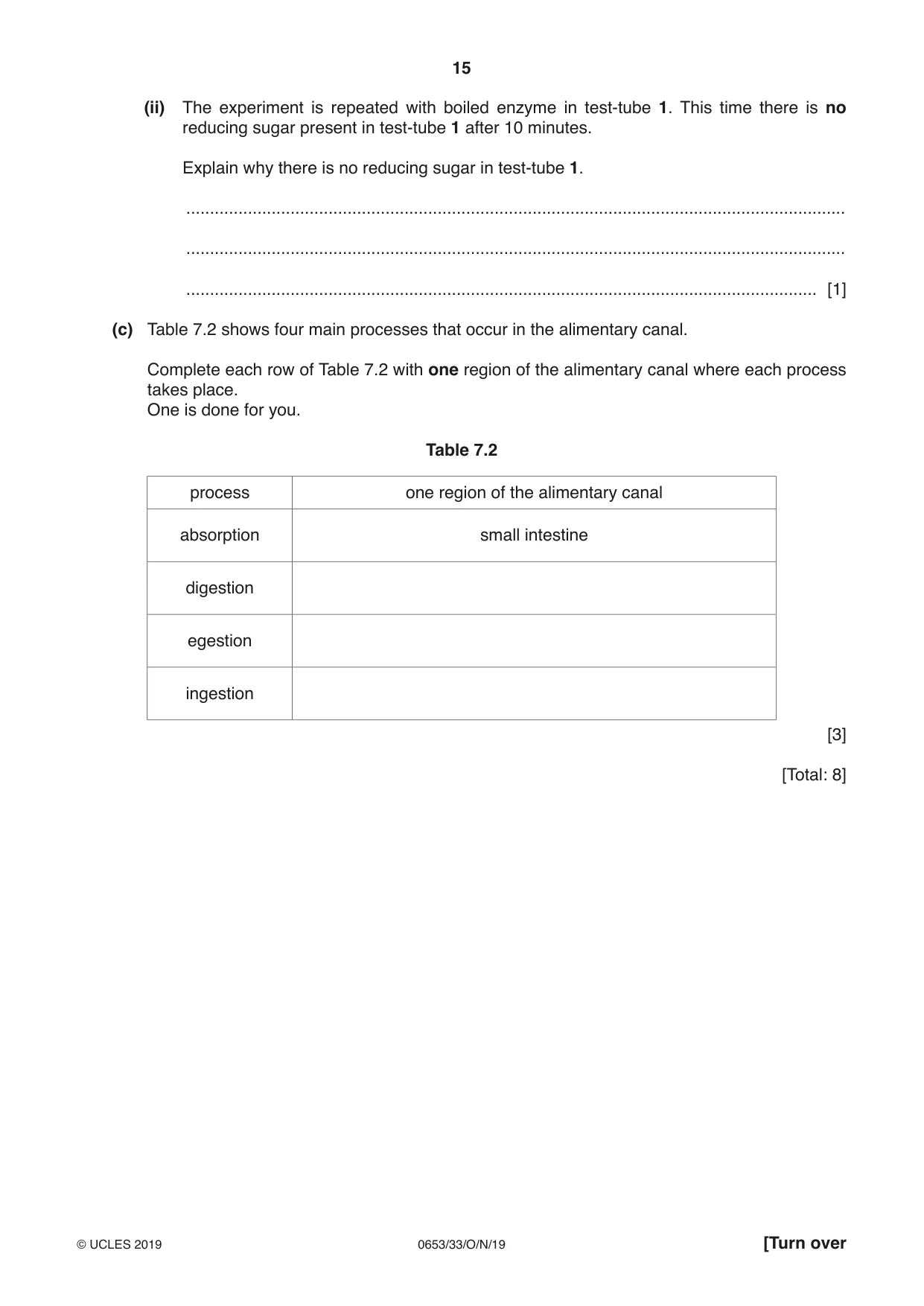
7 (a) Chemical digestion occurs in the alimentary canal. Use words from the list to complete the sentence about chemical digestion. Each word may be used once, more than once, or not at all. absorbed atoms egested excreted ions molecules Chemical digestion in the alimentary canal produces small, soluble ................................................ that can be ................................................ . [2] (b) Amylase is an enzyme that breaks down starch into simpler reducing sugars. Starch solution is placed in each of two test‑tubes. Amylase solution is added to test‑tube 1 and water is added to test‑tube 2. The apparatus is shown in Fig. 7.1. amylase solution water starch solution test-tube 1 test-tube 2 starch solution and amylase starch solution and water Fig. 7.1 After 10 minutes the contents of each test‑tube are tested with Benedict’s solution. The results of the investigation are shown in Table 7.1. Table 7.1 reducing sugar colour of result of test‑tube amylase present present Benedict’s test 1 yes yes 2 no no (i) Complete Table 7.1 with the colours of the Benedict’s test results. [2] (ii) The experiment is repeated with boiled enzyme in test‑tube 1. This time there is no reducing sugar present in test‑tube 1 after 10 minutes. Explain why there is no reducing sugar in test‑tube 1. ........................................................................................................................................... ........................................................................................................................................... ..................................................................................................................................... [1] (c) Table 7.2 shows four main processes that occur in the alimentary canal. Complete each row of Table 7.2 with one region of the alimentary canal where each process takes place. One is done for you. Table 7.2 process one region of the alimentary canal absorption small intestine digestion egestion ingestion [3] [Total: 8]
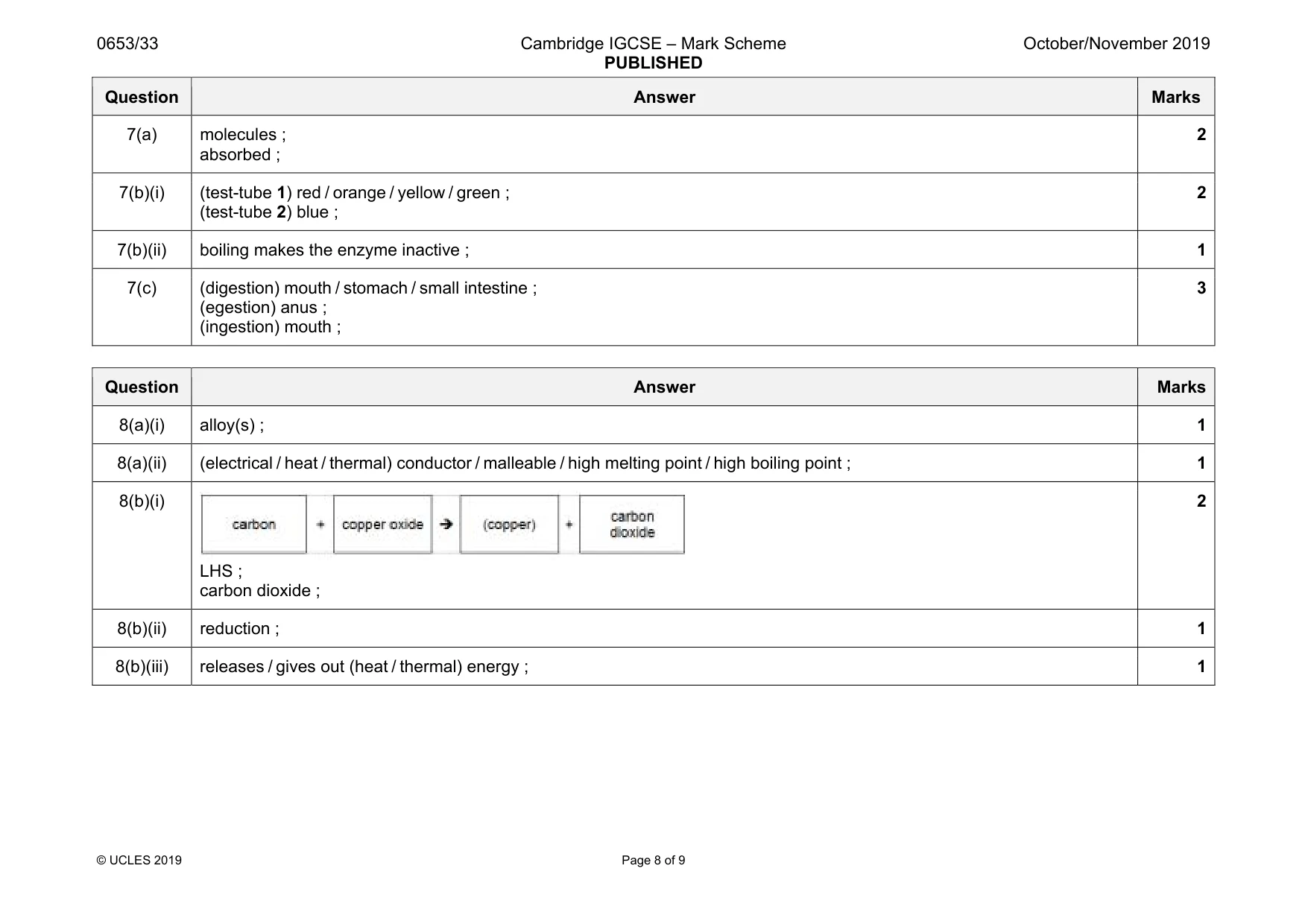
Mark scheme: 7(a) molecules ; absorbed ; 2 7(b)(i) (test-tube 1) red / orange / yellow / green ; (test-tube 2) blue ; 2 7(b)(ii) boiling makes the enzyme inactive ; 1 7(c) (digestion) mouth / stomach / small intestine ; (egestion) anus ; (ingestion) mouth ; 3
Q8 · Duralumin is a mixture of aluminium and copper
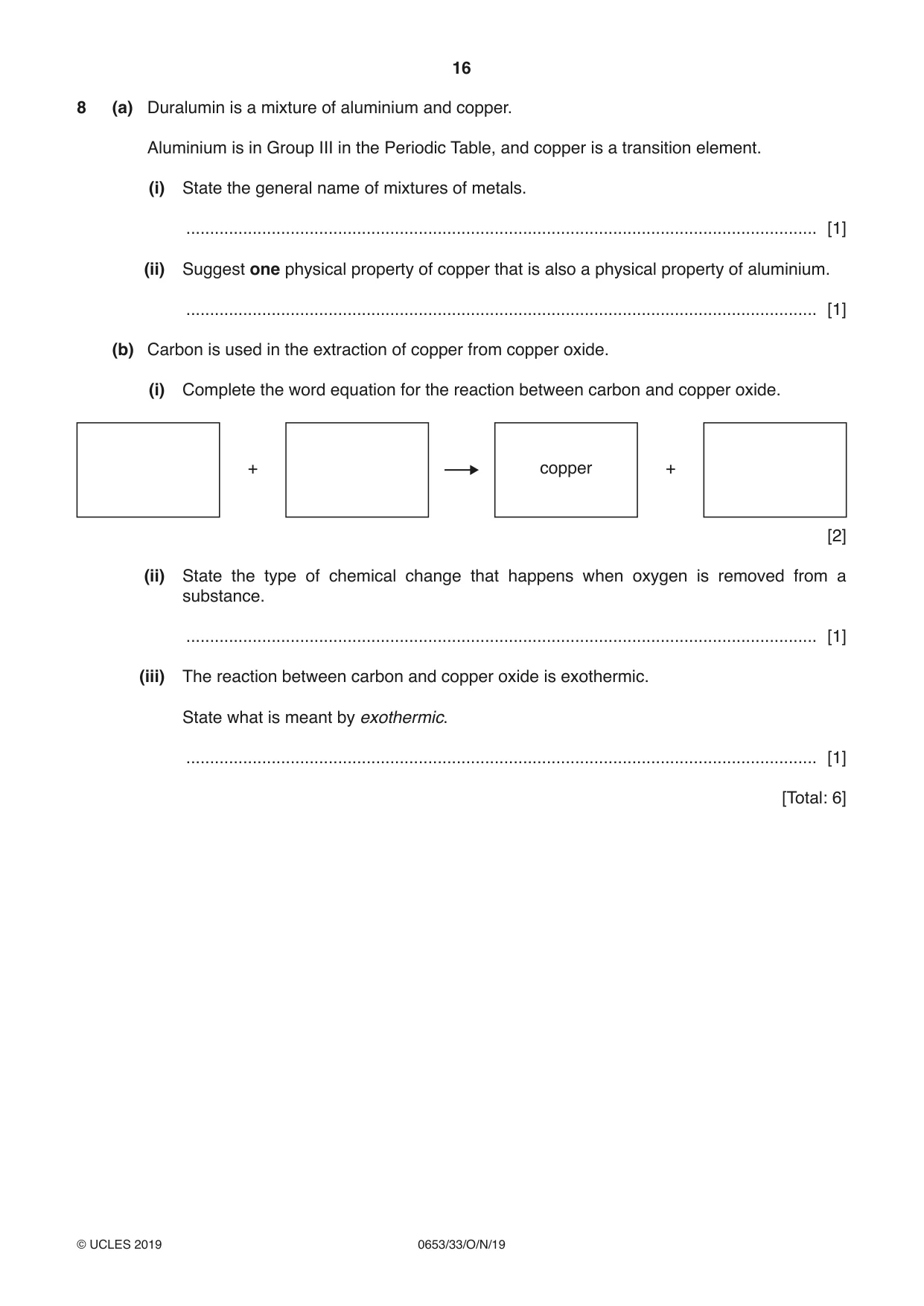
8 (a) Duralumin is a mixture of aluminium and copper. Aluminium is in Group III in the Periodic Table, and copper is a transition element. (i) State the general name of mixtures of metals. ..................................................................................................................................... [1] (ii) Suggest one physical property of copper that is also a physical property of aluminium. ..................................................................................................................................... [1] (b) Carbon is used in the extraction of copper from copper oxide. (i) Complete the word equation for the reaction between carbon and copper oxide. + copper + [2] (ii) State the type of chemical change that happens when oxygen is removed from a substance. ..................................................................................................................................... [1] (iii) The reaction between carbon and copper oxide is exothermic. State what is meant by exothermic. ..................................................................................................................................... [1] [Total: 6]
Mark scheme: 8(a)(i) alloy(s) ; 1 8(a)(ii) (electrical / heat / thermal) conductor / malleable / high melting point / high boiling point ; 1 8(b)(i) LHS ; carbon dioxide ; 2 8(b)(ii) reduction ; 1 8(b)(iii) releases / gives out (heat / thermal) energy ; 1
Q9 · A lightning flash, which is a form of electrostatic discharge
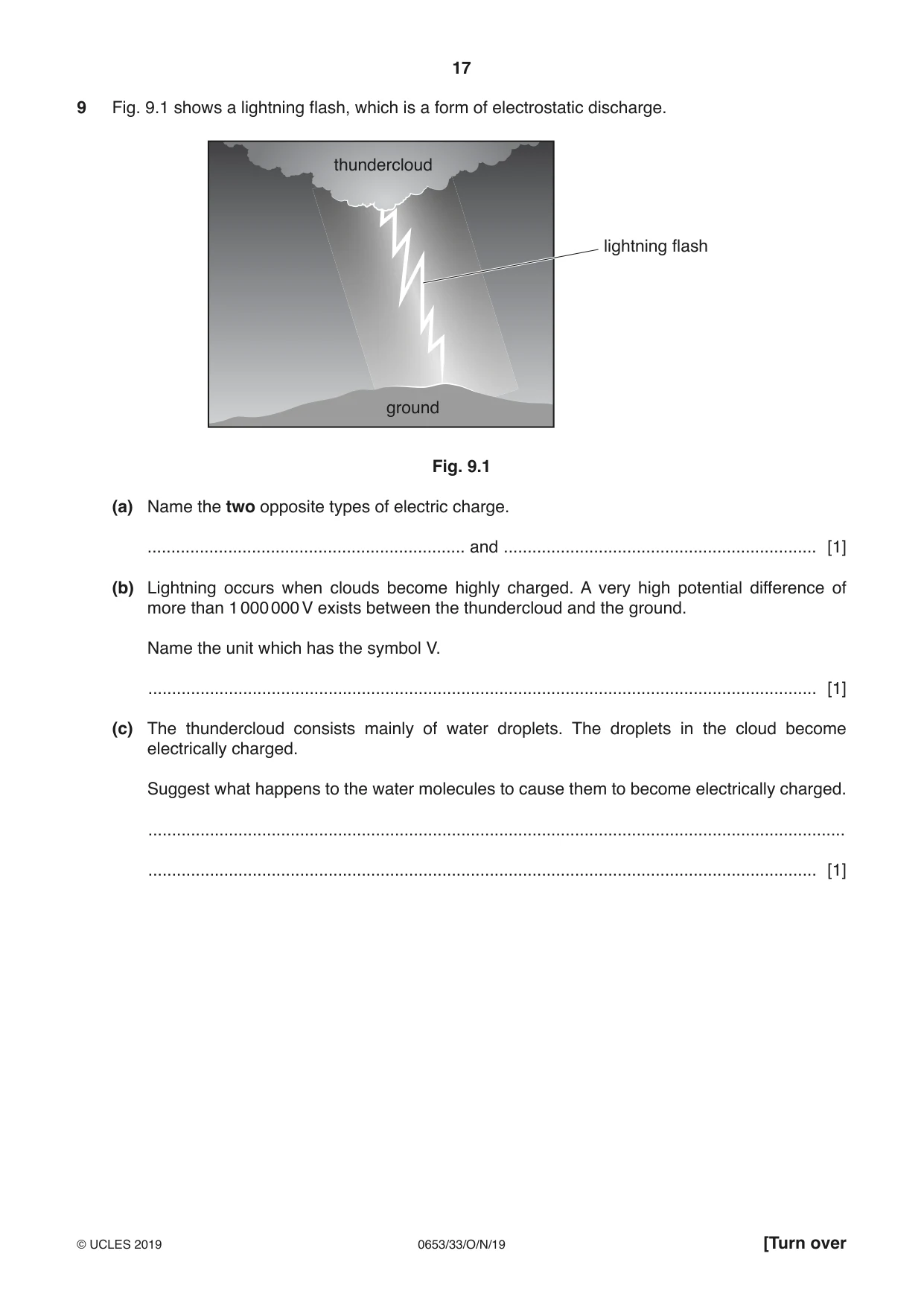
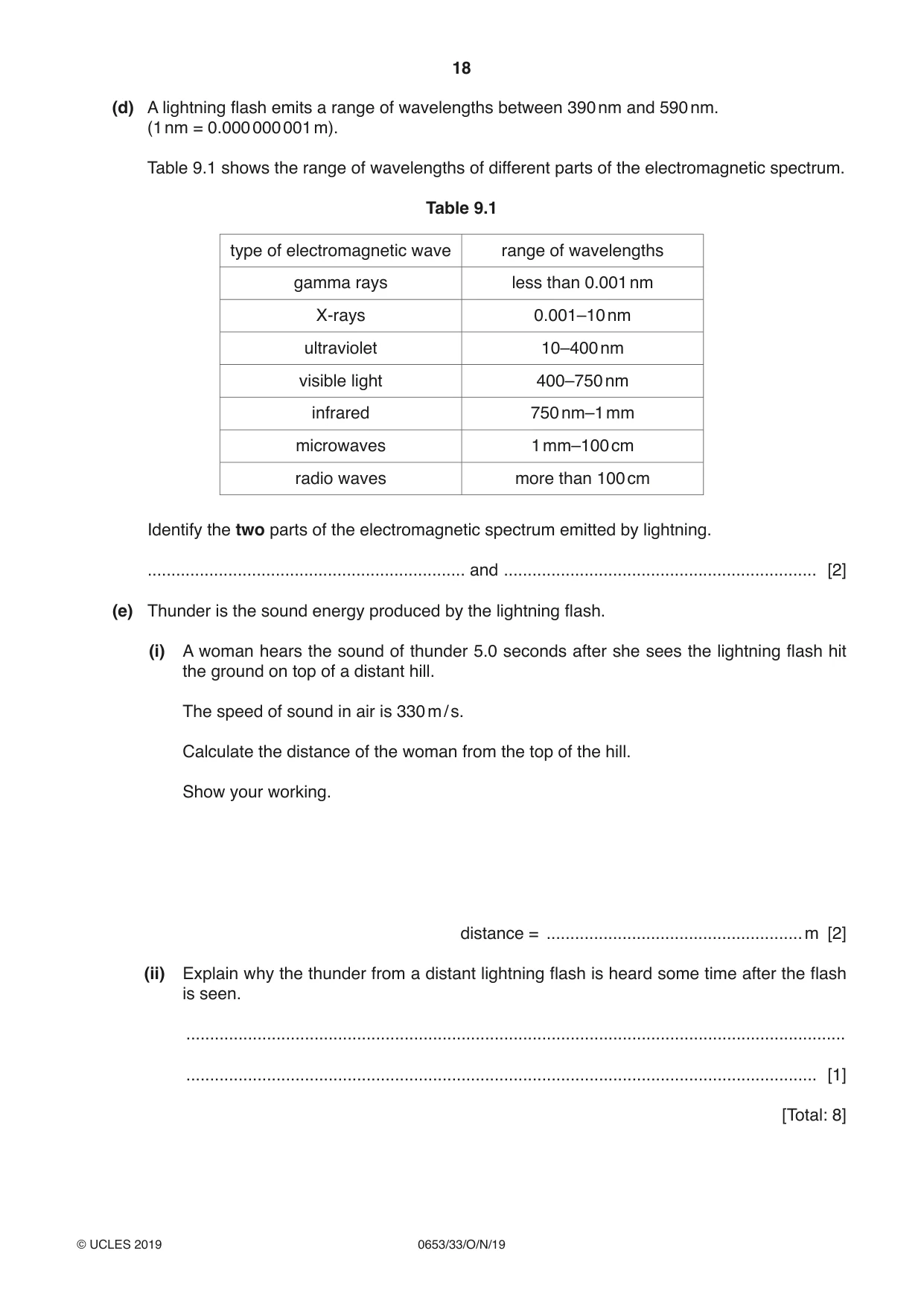
9 Fig. 9.1 shows a lightning flash, which is a form of electrostatic discharge. thundercloud lightning flash ground Fig. 9.1 (a) Name the two opposite types of electric charge. ................................................................... and .................................................................. [1] (b) Lightning occurs when clouds become highly charged. A very high potential difference of more than 1 000 000 V exists between the thundercloud and the ground. Name the unit which has the symbol V. ............................................................................................................................................. [1] (c) The thundercloud consists mainly of water droplets. The droplets in the cloud become electrically charged. Suggest what happens to the water molecules to cause them to become electrically charged. ................................................................................................................................................... ............................................................................................................................................. [1] (d) A lightning flash emits a range of wavelengths between 390 nm and 590 nm. (1 nm = 0.000 000 001 m). Table 9.1 shows the range of wavelengths of different parts of the electromagnetic spectrum. Table 9.1 type of electromagnetic wave range of wavelengths gamma rays less than 0.001 nm X‑rays 0.001–10 nm ultraviolet 10–400 nm visible light 400–750 nm infrared 750 nm–1 mm microwaves 1 mm–100 cm radio waves more than 100 cm Identify the two parts of the electromagnetic spectrum emitted by lightning. ................................................................... and .................................................................. [2] (e) Thunder is the sound energy produced by the lightning flash. (i) A woman hears the sound of thunder 5.0 seconds after she sees the lightning flash hit the ground on top of a distant hill. The speed of sound in air is 330 m / s. Calculate the distance of the woman from the top of the hill. Show your working. distance = ......................................................m [2] (ii) Explain why the thunder from a distant lightning flash is heard some time after the flash is seen. ........................................................................................................................................... ..................................................................................................................................... [1] [Total: 8]
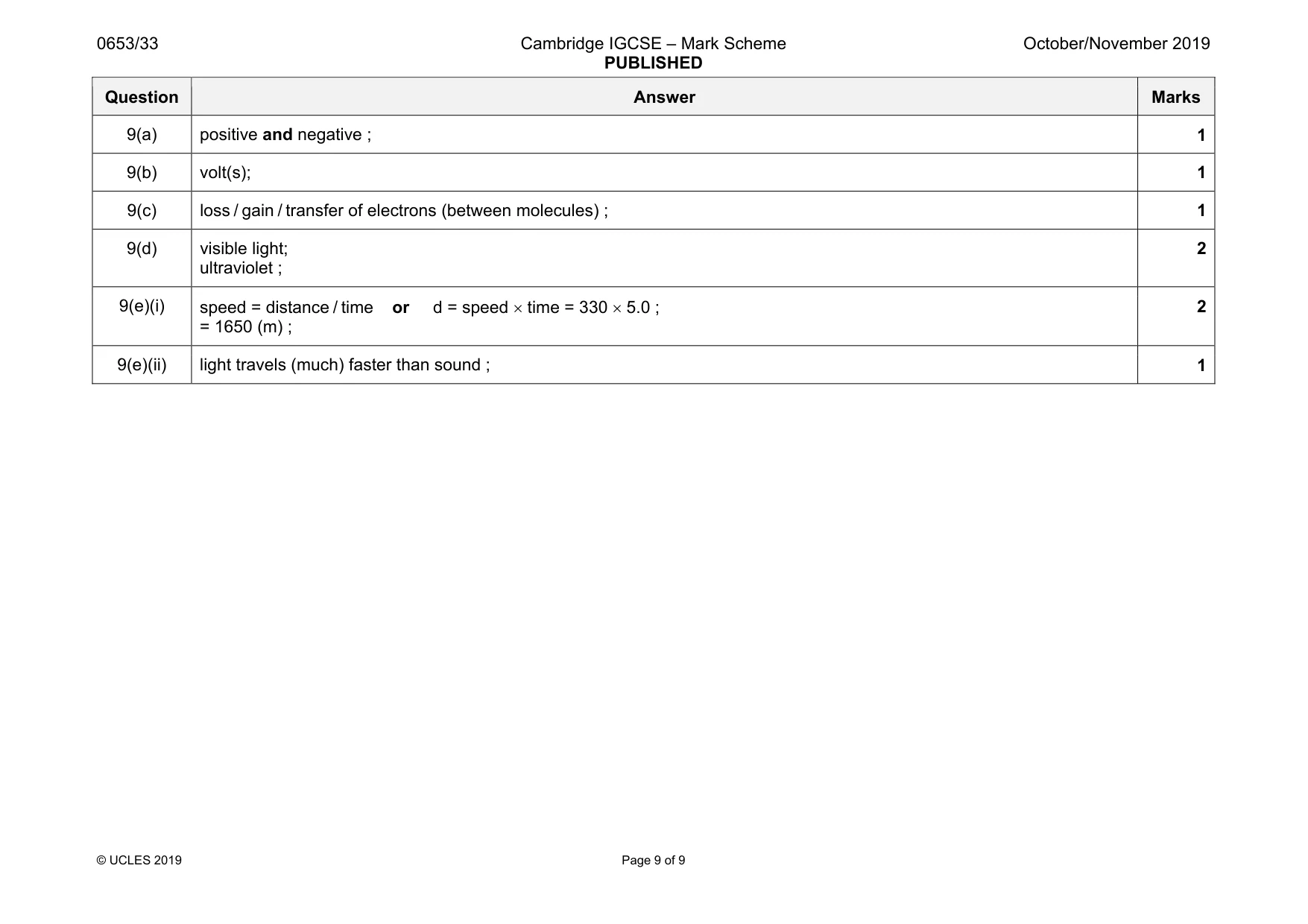
Mark scheme: 9(a) positive and negative ; 1 9(b) volt(s); 1 9(c) loss / gain / transfer of electrons (between molecules) ; 1 9(d) visible light; ultraviolet ; 2 9(e)(i) speed = distance / time or d = speed × time = 330 × 5.0 ; = 1650 (m) ; 2 9(e)(ii) light travels (much) faster than sound ; 1
What was in this paper
The subtopics covered by these 9 questions, and how many questions each got. Open one in a new tab to see every Cambridge question on it.
What you needed in this session
Cambridge’s own grade thresholds for 2019 Oct/Nov, Paper 3 · Variant 3. A higher threshold means an easier paper — the bar moves with how the cohort did.