Cambridge IGCSE Science - Combined 0653 — 2019 May/June Paper 3 · Variant 1
0653/31/M/J/19 · 9 questions · 80 marks · ≈90 min
The question paper and its mark scheme, free to read here and free to download. This is Cambridge’s own paper, exactly as it was sat.
Question paper20 pages
Mark scheme10 pages
Answers below. Sit the paper first if you are practising.
Questions as text
Q1 · Plants make their own food in leaves by the process of photosynthesis
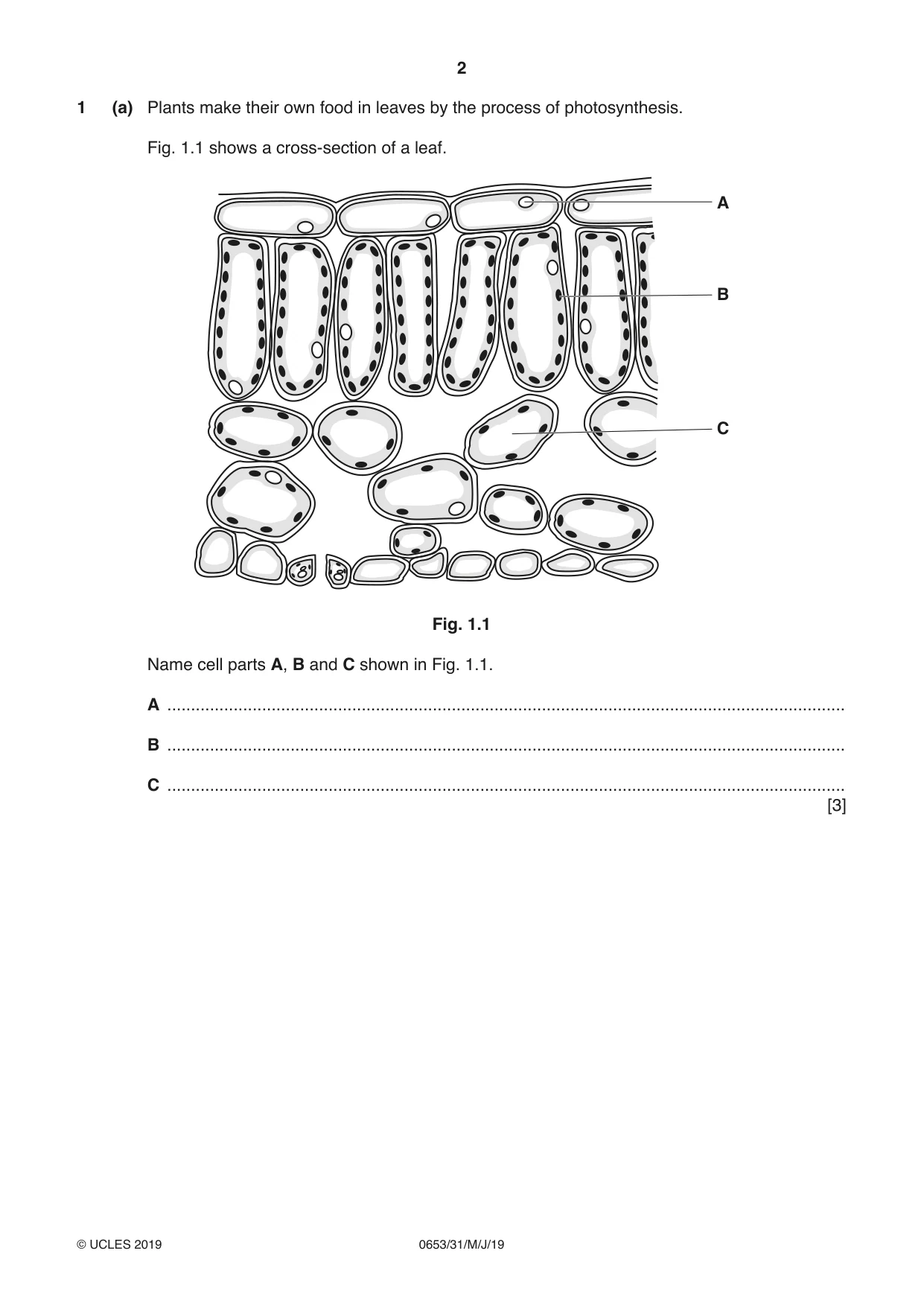
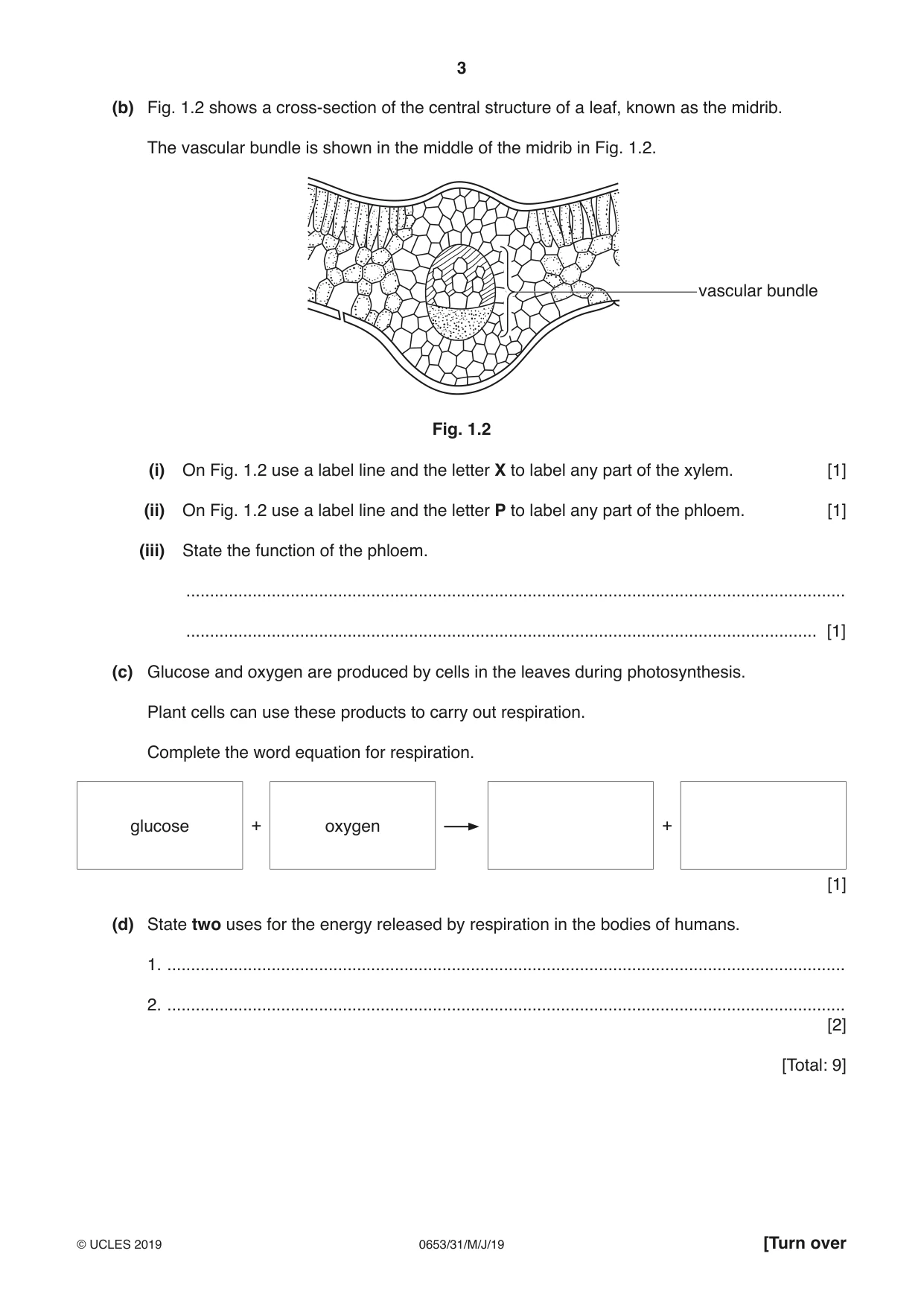
1 (a) Plants make their own food in leaves by the process of photosynthesis. Fig. 1.1 shows a cross-section of a leaf. A B C Fig. 1.1 Name cell parts A, B and C shown in Fig. 1.1. A ............................................................................................................................................... B ............................................................................................................................................... C ............................................................................................................................................... [3] (b) Fig. 1.2 shows a cross-section of the central structure of a leaf, known as the midrib. The vascular bundle is shown in the middle of the midrib in Fig. 1.2. vascular bundle Fig. 1.2 (i) On Fig. 1.2 use a label line and the letter X to label any part of the xylem. [1] (ii) On Fig. 1.2 use a label line and the letter P to label any part of the phloem. [1] (iii) State the function of the phloem. ........................................................................................................................................... ..................................................................................................................................... [1] (c) Glucose and oxygen are produced by cells in the leaves during photosynthesis. Plant cells can use these products to carry out respiration. Complete the word equation for respiration. glucose + oxygen + [1] (d) State two uses for the energy released by respiration in the bodies of humans. 1. ............................................................................................................................................... 2. ............................................................................................................................................... [2] [Total: 9]
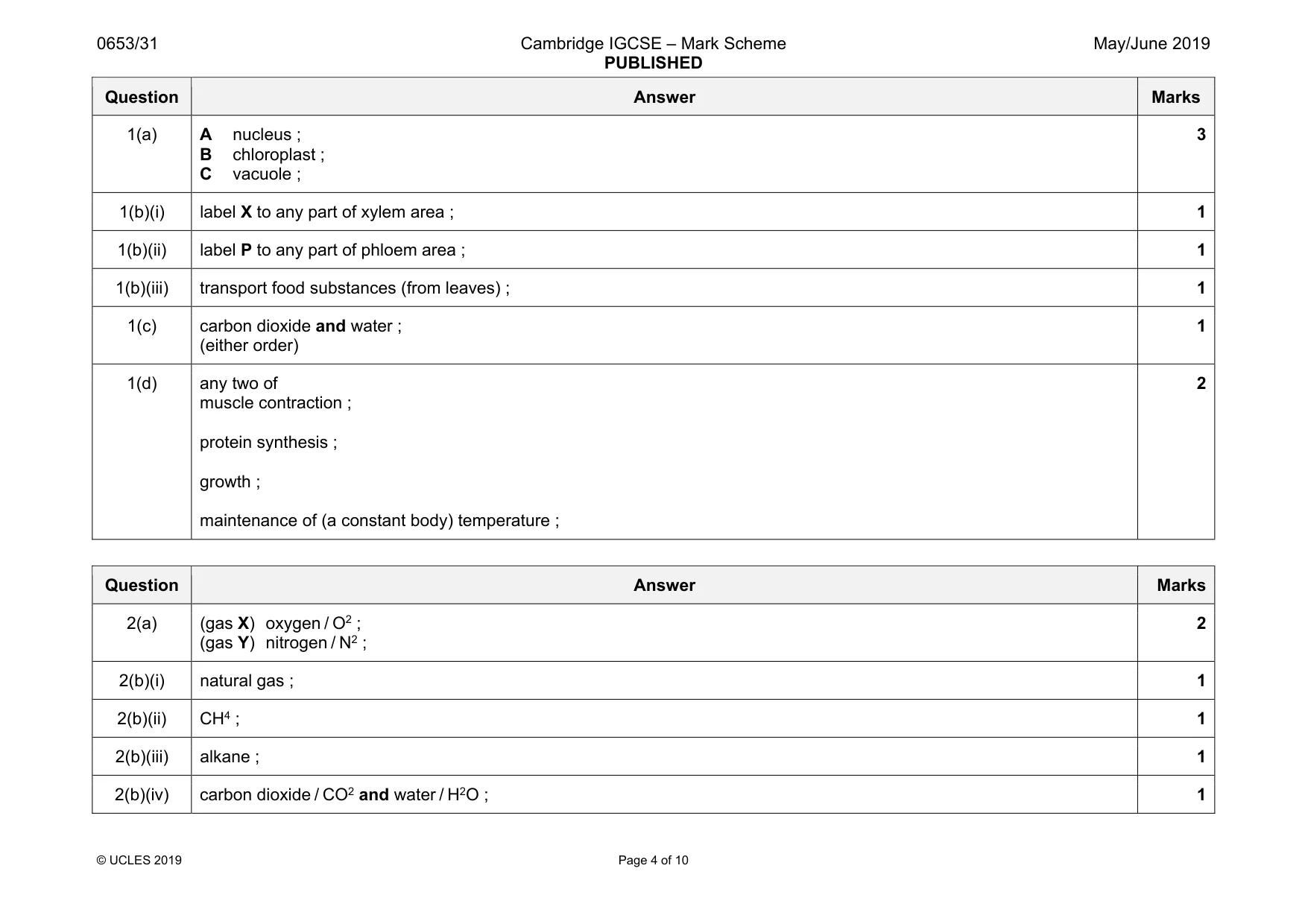
Mark scheme: 1(a) A nucleus ; B chloroplast ; C vacuole ; 3 1(b)(i) label X to any part of xylem area ; 1 1(b)(ii) label P to any part of phloem area ; 1 1(b)(iii) transport food substances (from leaves) ; 1 1(c) carbon dioxide and water ; (either order) 1 1(d) any two of muscle contraction ; protein synthesis ; growth ; maintenance of (a constant body) temperature ; 2
Q2 · The composition of clean air is shown in Fig
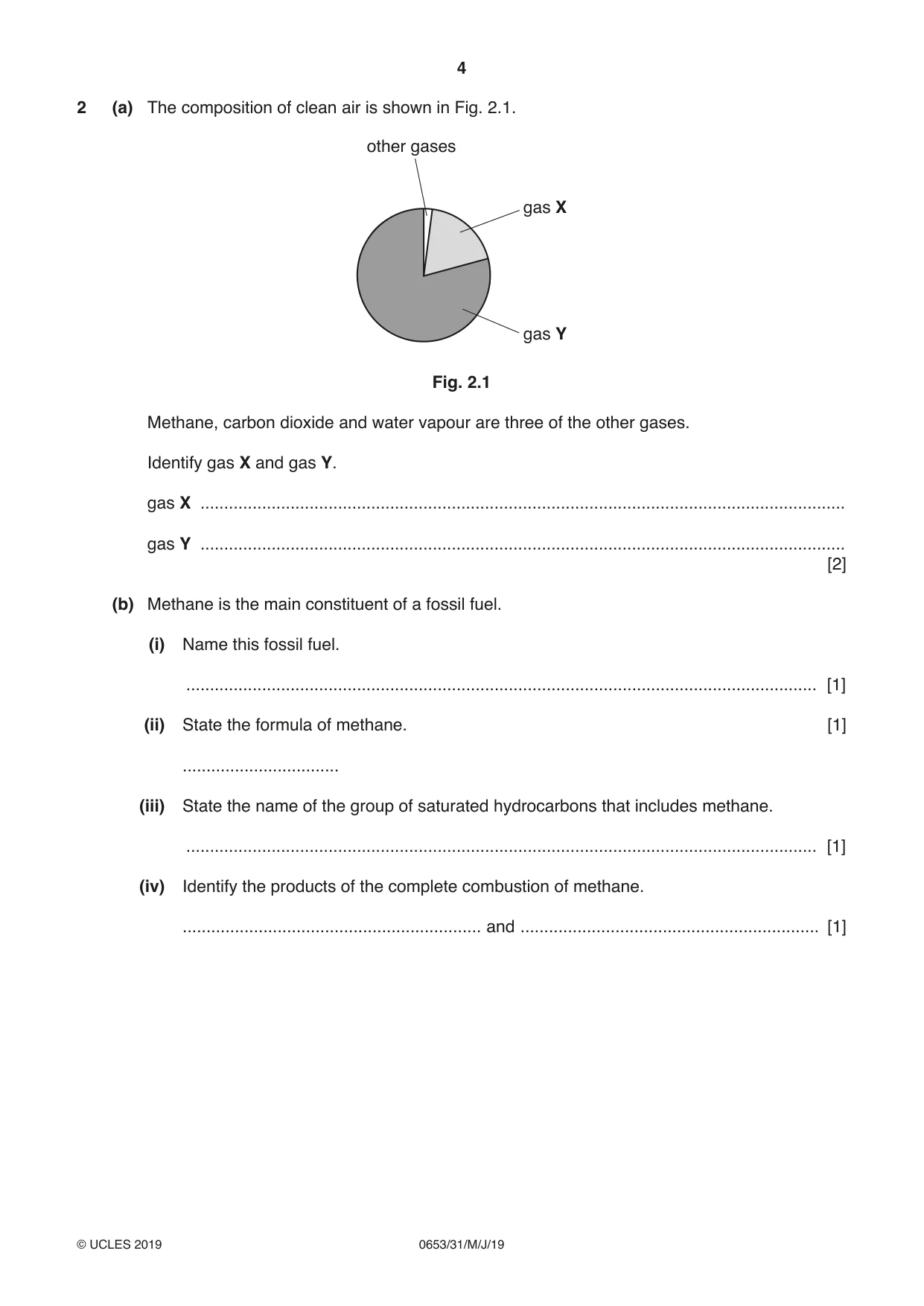
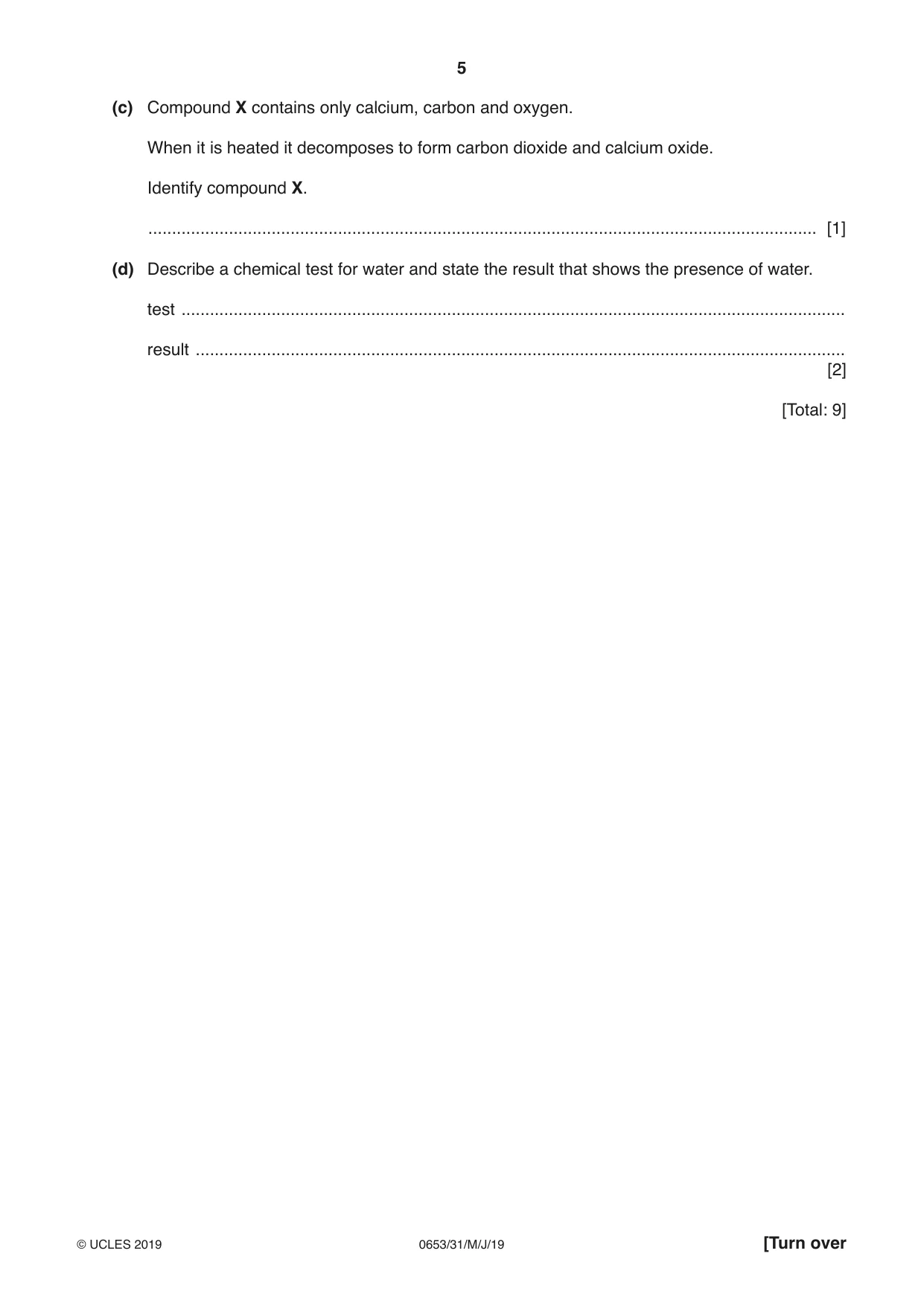
2 (a) The composition of clean air is shown in Fig. 2.1. other gases gas X gas Y Fig. 2.1 Methane, carbon dioxide and water vapour are three of the other gases. Identify gas X and gas Y. gas X ........................................................................................................................................ gas Y ........................................................................................................................................ [2] (b) Methane is the main constituent of a fossil fuel. (i) Name this fossil fuel. ..................................................................................................................................... [1] (ii) State the formula of methane. [1] ................................. (iii) State the name of the group of saturated hydrocarbons that includes methane. ..................................................................................................................................... [1] (iv) Identify the products of the complete combustion of methane. ............................................................... and ............................................................... [1] (c) Compound X contains only calcium, carbon and oxygen. When it is heated it decomposes to form carbon dioxide and calcium oxide. Identify compound X. ............................................................................................................................................. [1] (d) Describe a chemical test for water and state the result that shows the presence of water. test ............................................................................................................................................ result ......................................................................................................................................... [2] [Total: 9]
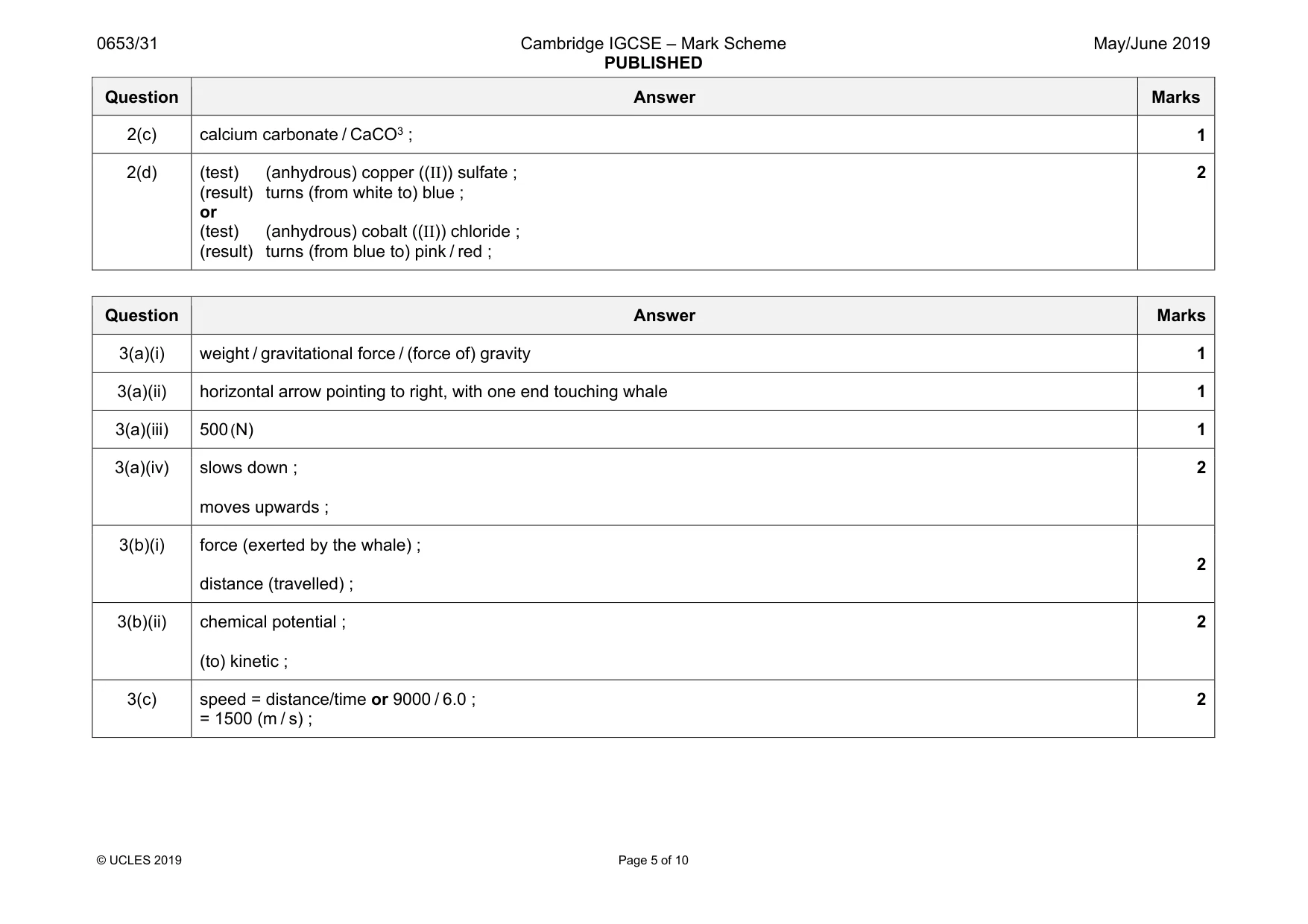
Mark scheme: 2(a) (gas X) oxygen / O2 ; (gas Y) nitrogen / N2 ; 2 2(b)(i) natural gas ; 1 2(b)(ii) CH4 ; 1 2(b)(iii) alkane ; 1 2(b)(iv) carbon dioxide / CO2 and water / H2O ; 1 Question Answer Marks 2(c) calcium carbonate / CaCO3 ; 1 2(d) (test) (anhydrous) copper ((II)) sulfate ; (result) turns (from white to) blue ; or (test) (anhydrous) cobalt ((II)) chloride ; (result) turns (from blue to) pink / red ; 2
Q3 · A whale swimming underwater
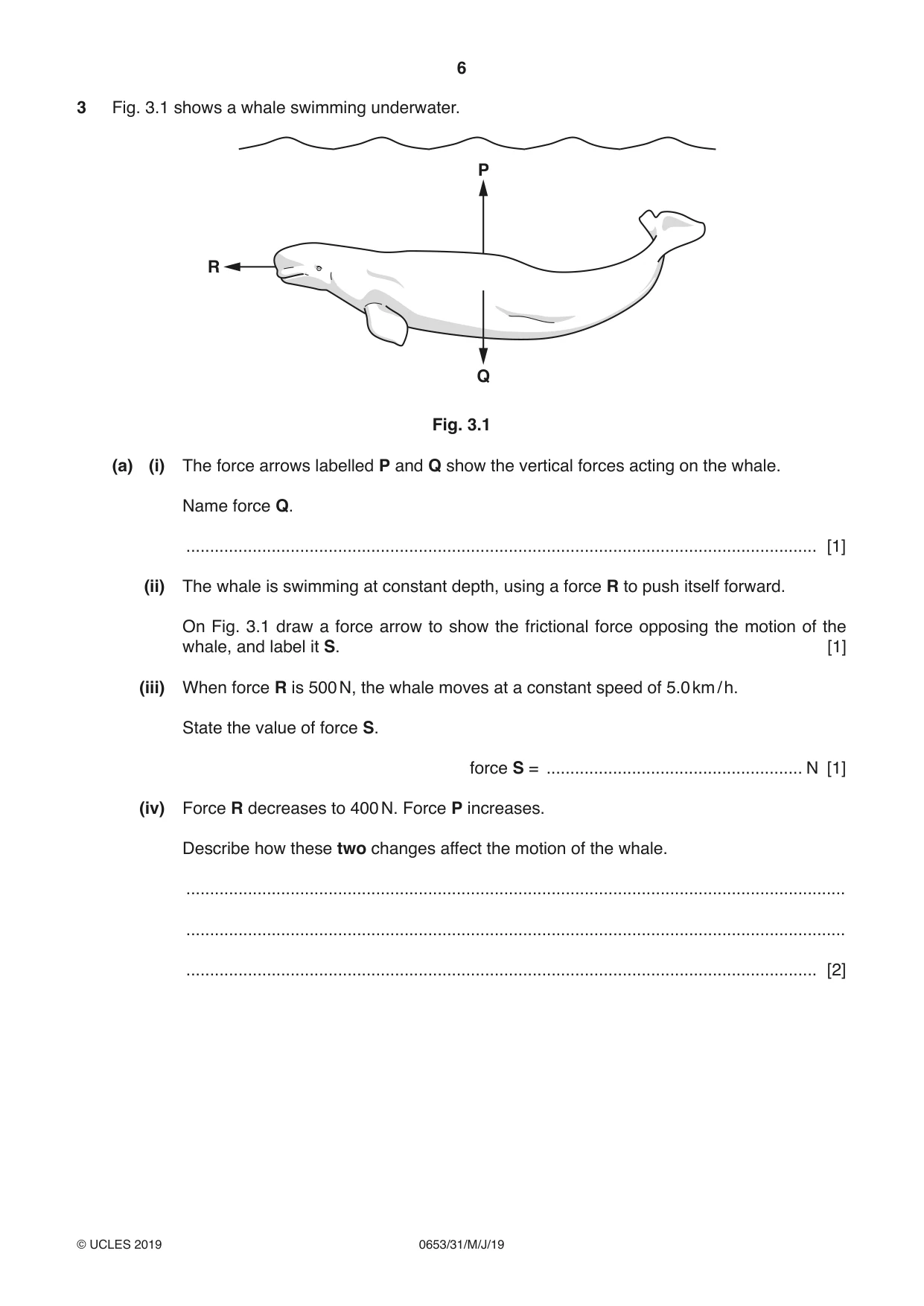
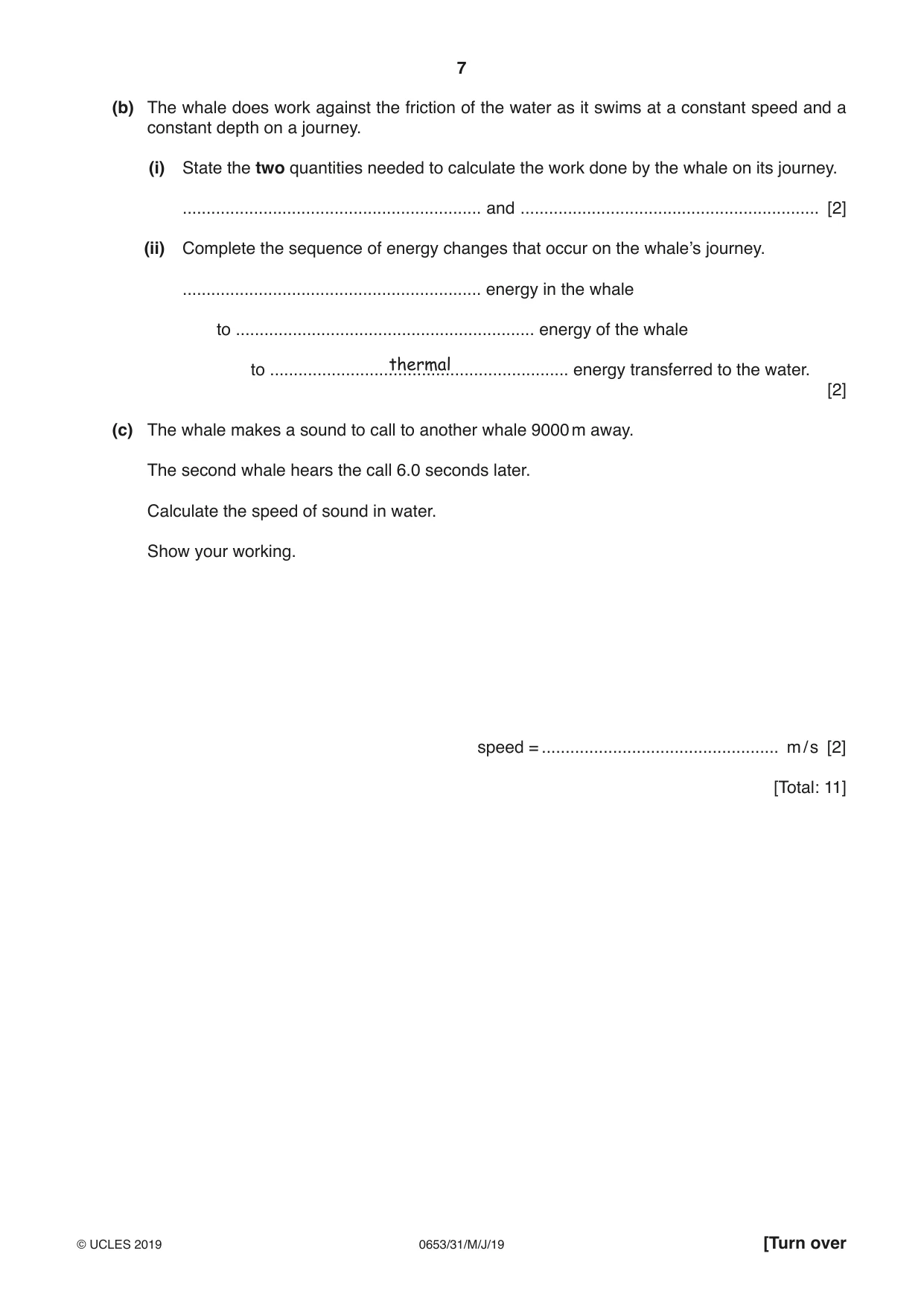
3 Fig. 3.1 shows a whale swimming underwater. P R Q Fig. 3.1 (a) (i) The force arrows labelled P and Q show the vertical forces acting on the whale. Name force Q. ..................................................................................................................................... [1] (ii) The whale is swimming at constant depth, using a force R to push itself forward. On Fig. 3.1 draw a force arrow to show the frictional force opposing the motion of the whale, and label it S. [1] (iii) When force R is 500 N, the whale moves at a constant speed of 5.0 km / h. State the value of force S. force S = ...................................................... N [1] (iv) Force R decreases to 400 N. Force P increases. Describe how these two changes affect the motion of the whale. ........................................................................................................................................... ........................................................................................................................................... ..................................................................................................................................... [2] (b) The whale does work against the friction of the water as it swims at a constant speed and a constant depth on a journey. (i) State the two quantities needed to calculate the work done by the whale on its journey. ............................................................... and ............................................................... [2] (ii) Complete the sequence of energy changes that occur on the whale’s journey. ............................................................... energy in the whale to ............................................................... energy of the whale thermal to ............................................................... energy transferred to the water. [2] (c) The whale makes a sound to call to another whale 9000 m away. The second whale hears the call 6.0 seconds later. Calculate the speed of sound in water. Show your working. speed = .................................................. m / s [2] [Total: 11]
Mark scheme: 3(a)(i) weight / gravitational force / (force of) gravity 1 3(a)(ii) horizontal arrow pointing to right, with one end touching whale 1 3(a)(iii) 500 (N) 1 3(a)(iv) slows down ; moves upwards ; 2 3(b)(i) force (exerted by the whale) ; distance (travelled) ; 2 3(b)(ii) chemical potential ; (to) kinetic ; 2 3(c) speed = distance/time or 9000 / 6.0 ; = 1500 (m / s) ; 2
Q4 · A diagram of the male reproductive system
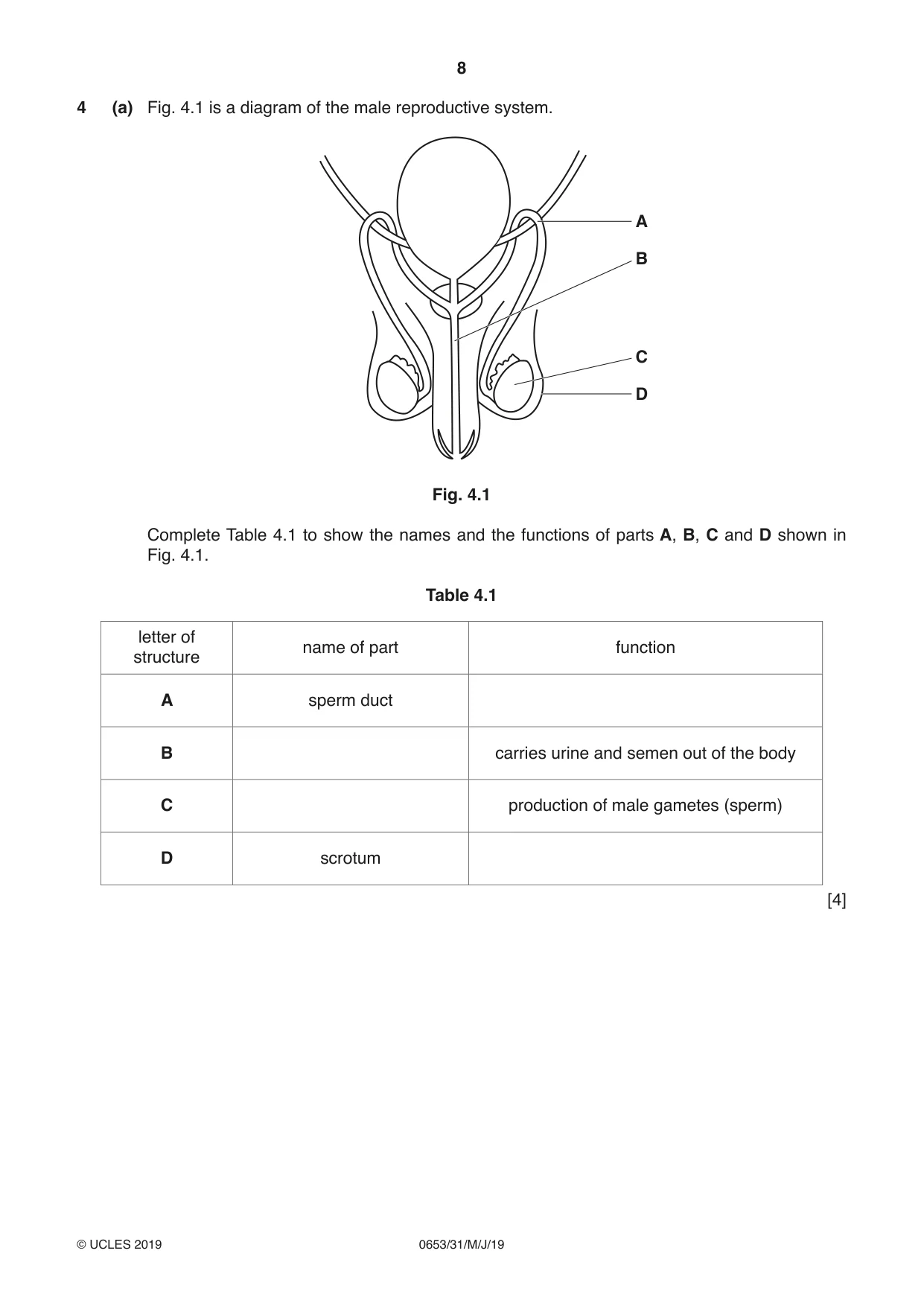
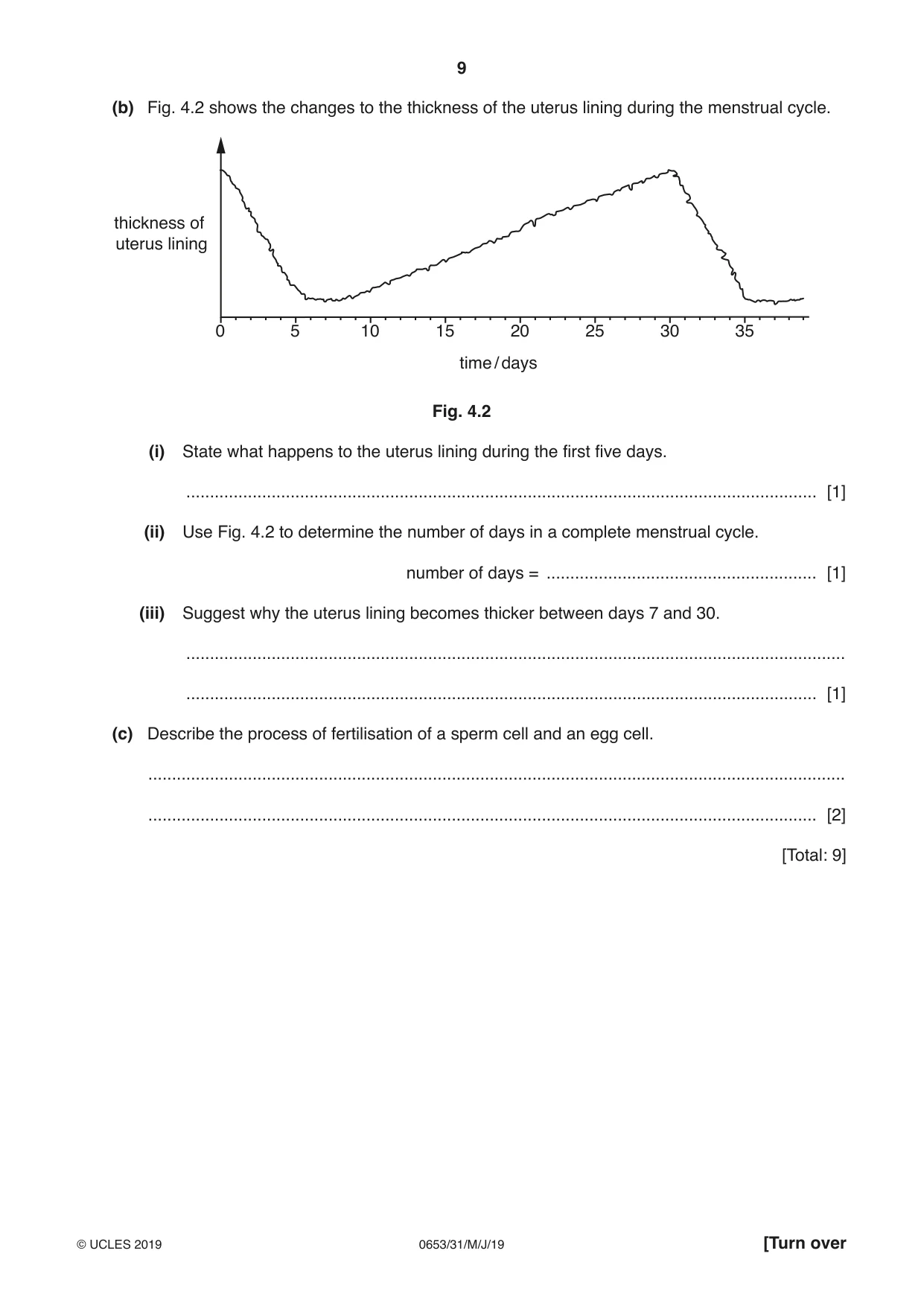
4 (a) Fig. 4.1 is a diagram of the male reproductive system. A B C D Fig. 4.1 Complete Table 4.1 to show the names and the functions of parts A, B, C and D shown in Fig. 4.1. Table 4.1 letter of name of part function structure A sperm duct B carries urine and semen out of the body C production of male gametes (sperm) D scrotum [4] (b) Fig. 4.2 shows the changes to the thickness of the uterus lining during the menstrual cycle. thickness of uterus lining 0 5 10 15 20 25 30 35 time / days Fig. 4.2 (i) State what happens to the uterus lining during the first five days. ..................................................................................................................................... [1] (ii) Use Fig. 4.2 to determine the number of days in a complete menstrual cycle. number of days = ......................................................... [1] (iii) Suggest why the uterus lining becomes thicker between days 7 and 30. ........................................................................................................................................... ..................................................................................................................................... [1] (c) Describe the process of fertilisation of a sperm cell and an egg cell. ................................................................................................................................................... ............................................................................................................................................. [2] [Total: 9]
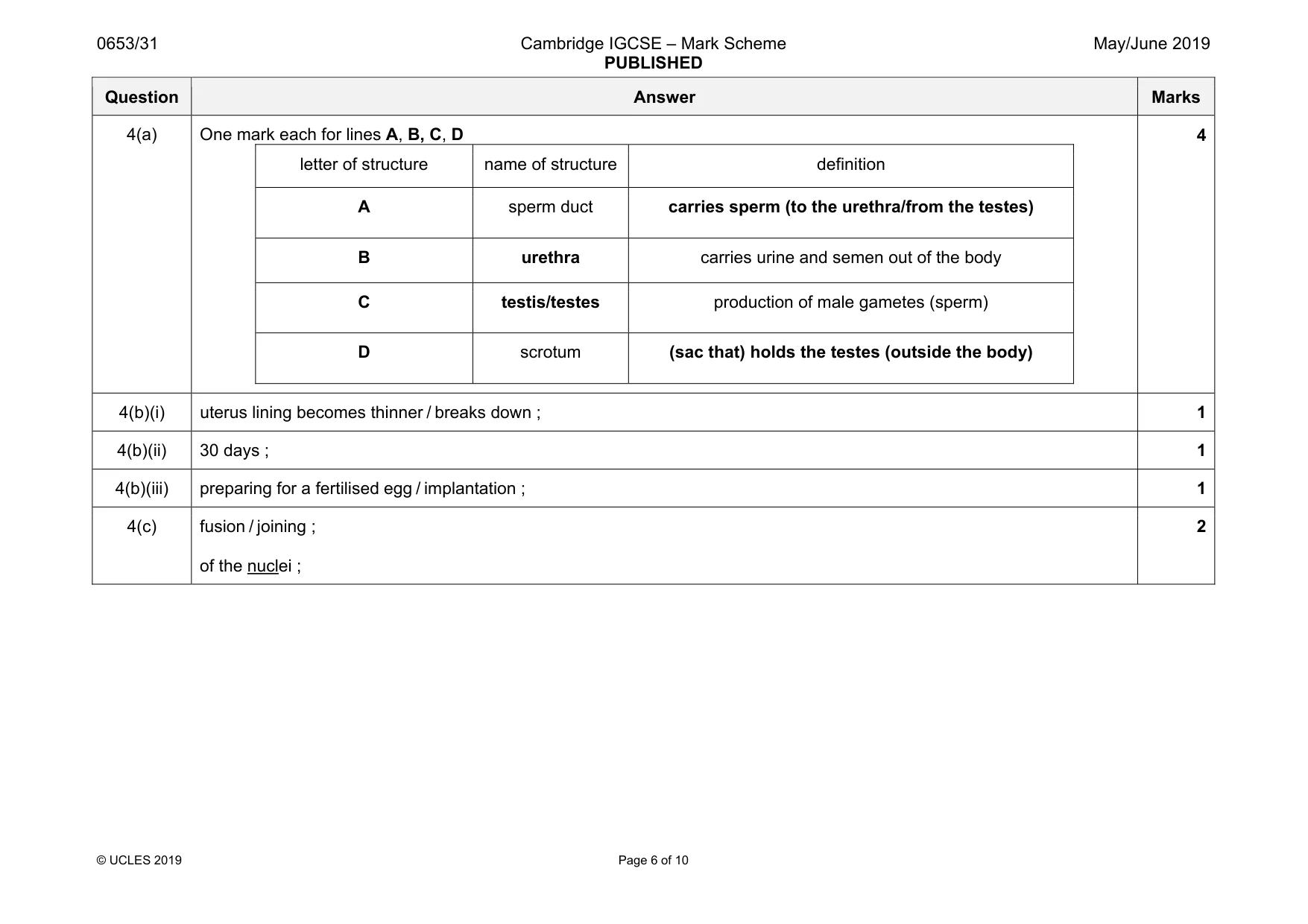
Mark scheme: 4(a) One mark each for lines A, B, C, D letter of structure name of structure definition A sperm duct carries sperm (to the urethra/from the testes) B urethra carries urine and semen out of the body C testis/testes production of male gametes (sperm) D scrotum (sac that) holds the testes (outside the body) 4 4(b)(i) uterus lining becomes thinner / breaks down ; 1 4(b)(ii) 30 days ; 1 4(b)(iii) preparing for a fertilised egg / implantation ; 1 4(c) fusion / joining ; of the nuclei ; 2
Q5 · A student investigates the reactivities of four metals, calcium, magnesium, tin and zinc
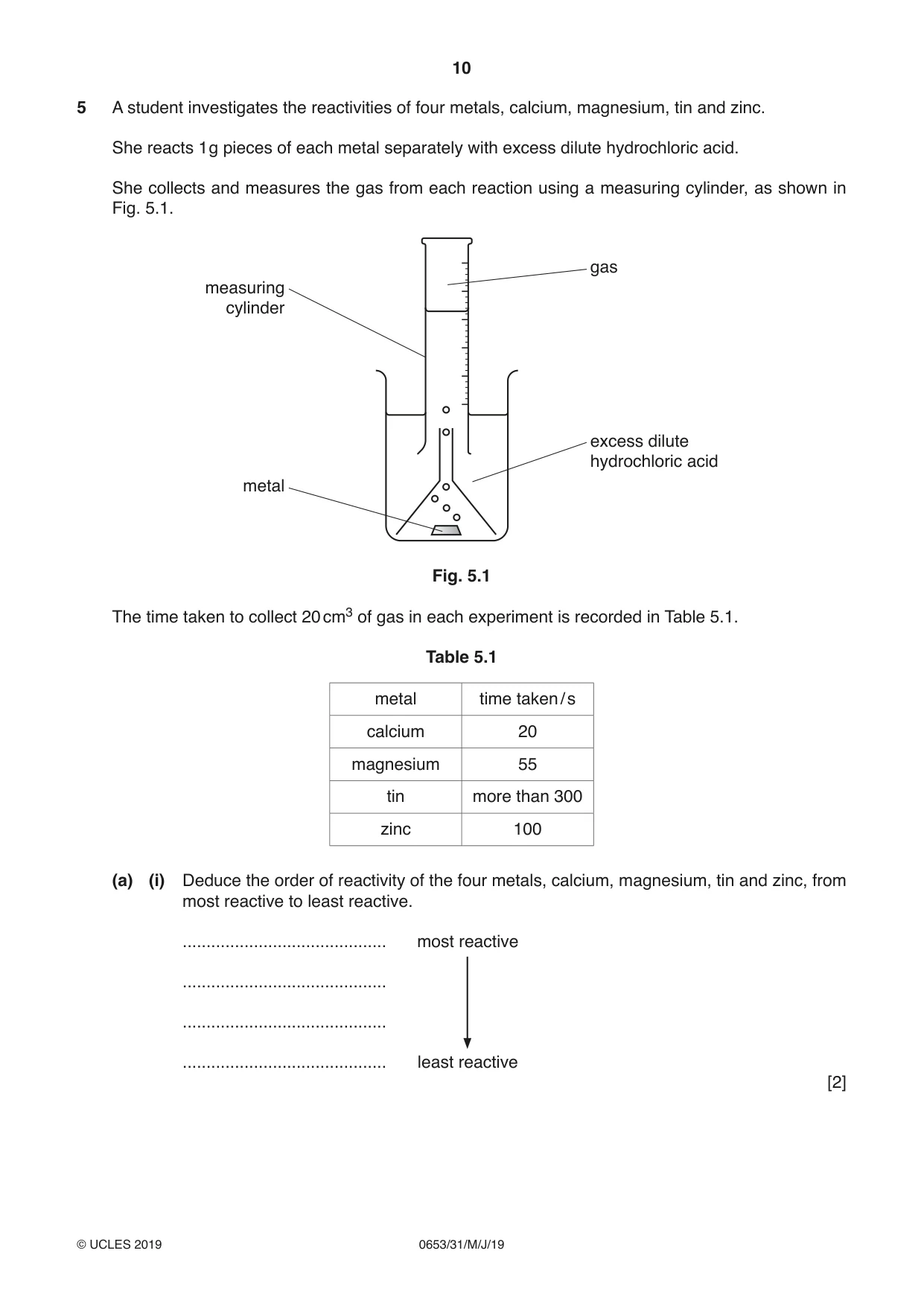
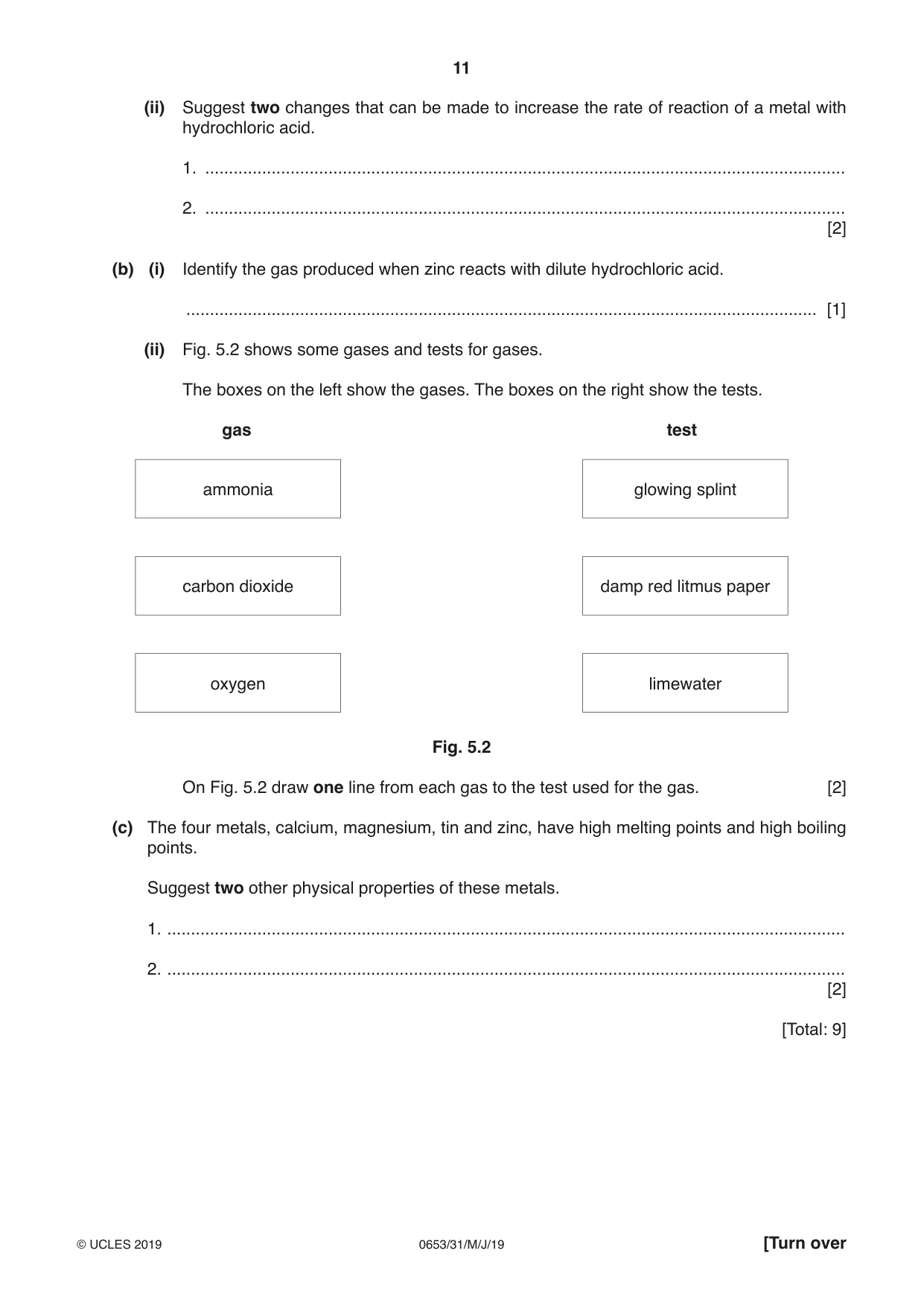
5 A student investigates the reactivities of four metals, calcium, magnesium, tin and zinc. She reacts 1 g pieces of each metal separately with excess dilute hydrochloric acid. She collects and measures the gas from each reaction using a measuring cylinder, as shown in Fig. 5.1. gas measuring cylinder excess dilute hydrochloric acid metal Fig. 5.1 The time taken to collect 20 cm3 of gas in each experiment is recorded in Table 5.1. Table 5.1 metal time taken / s calcium 20 magnesium 55 tin more than 300 zinc 100 (a) (i) Deduce the order of reactivity of the four metals, calcium, magnesium, tin and zinc, from most reactive to least reactive. ........................................... most reactive ........................................... ........................................... ........................................... least reactive [2] (ii) Suggest two changes that can be made to increase the rate of reaction of a metal with hydrochloric acid. 1. ....................................................................................................................................... 2. ....................................................................................................................................... [2] (b) (i) Identify the gas produced when zinc reacts with dilute hydrochloric acid. ..................................................................................................................................... [1] (ii) Fig. 5.2 shows some gases and tests for gases. The boxes on the left show the gases. The boxes on the right show the tests. gas test ammonia glowing splint carbon dioxide damp red litmus paper oxygen limewater Fig. 5.2 On Fig. 5.2 draw one line from each gas to the test used for the gas. [2] (c) The four metals, calcium, magnesium, tin and zinc, have high melting points and high boiling points. Suggest two other physical properties of these metals. 1. ............................................................................................................................................... 2. ............................................................................................................................................... [2] [Total: 9]
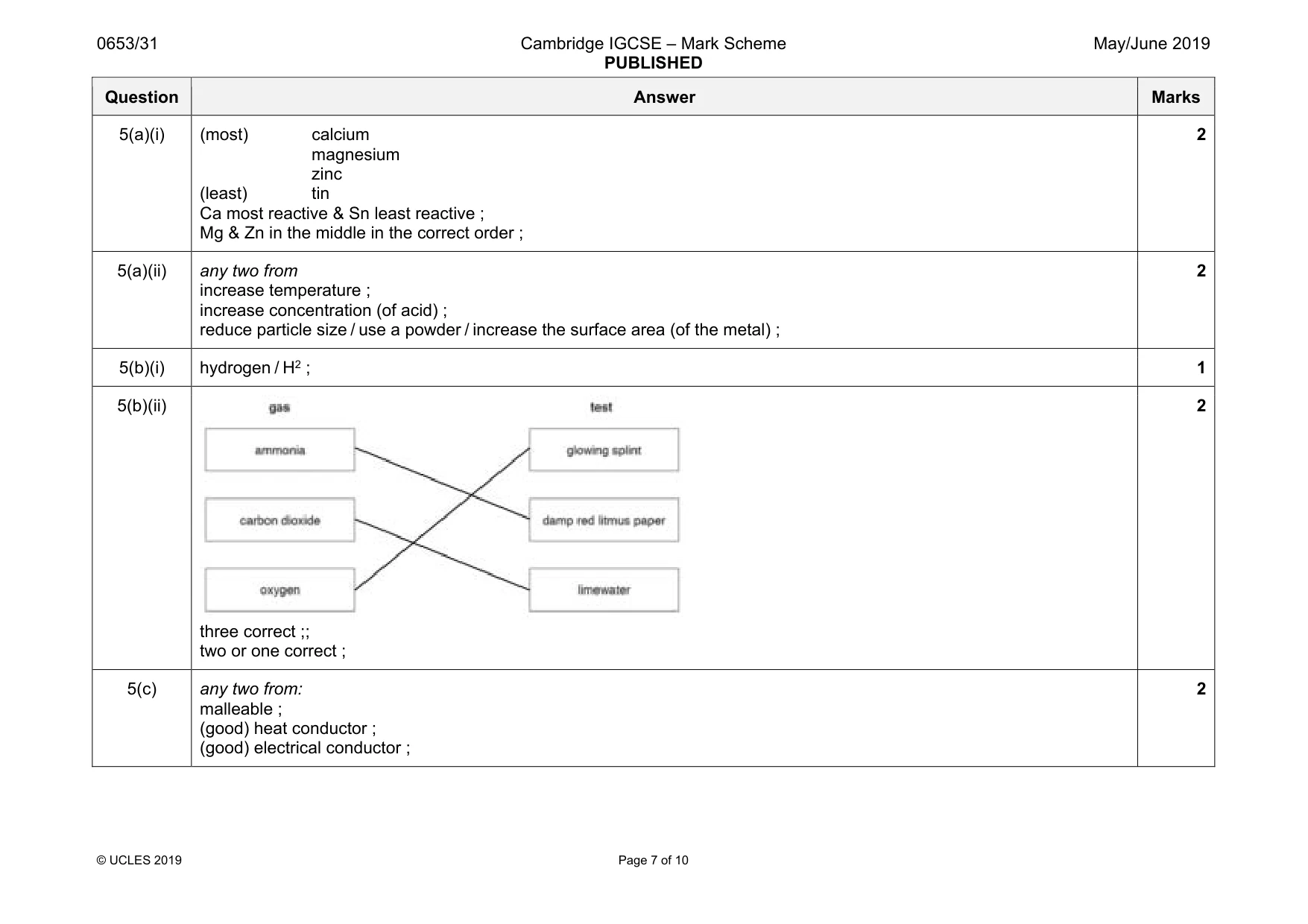
Mark scheme: 5(a)(i) (most) calcium magnesium zinc (least) tin Ca most reactive & Sn least reactive ; Mg & Zn in the middle in the correct order ; 2 5(a)(ii) any two from increase temperature ; increase concentration (of acid) ; reduce particle size / use a powder / increase the surface area (of the metal) ; 2 5(b)(i) hydrogen / H2 ; 1 5(b)(ii) three correct ;; two or one correct ; 2 5(c) any two from: malleable ; (good) heat conductor ; (good) electrical conductor ; 2
Q6 · An electrical device used in kitchens to kill insects
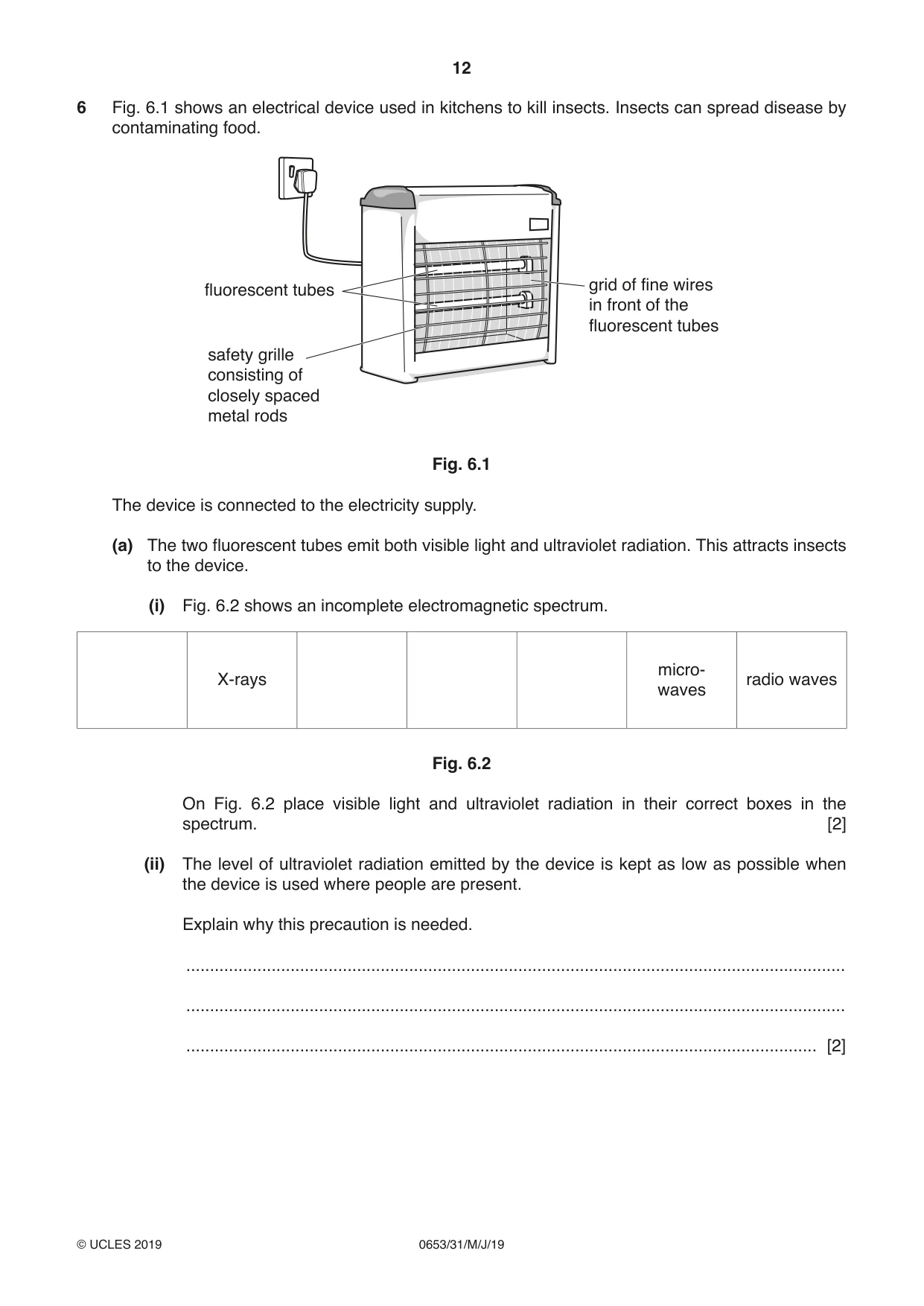
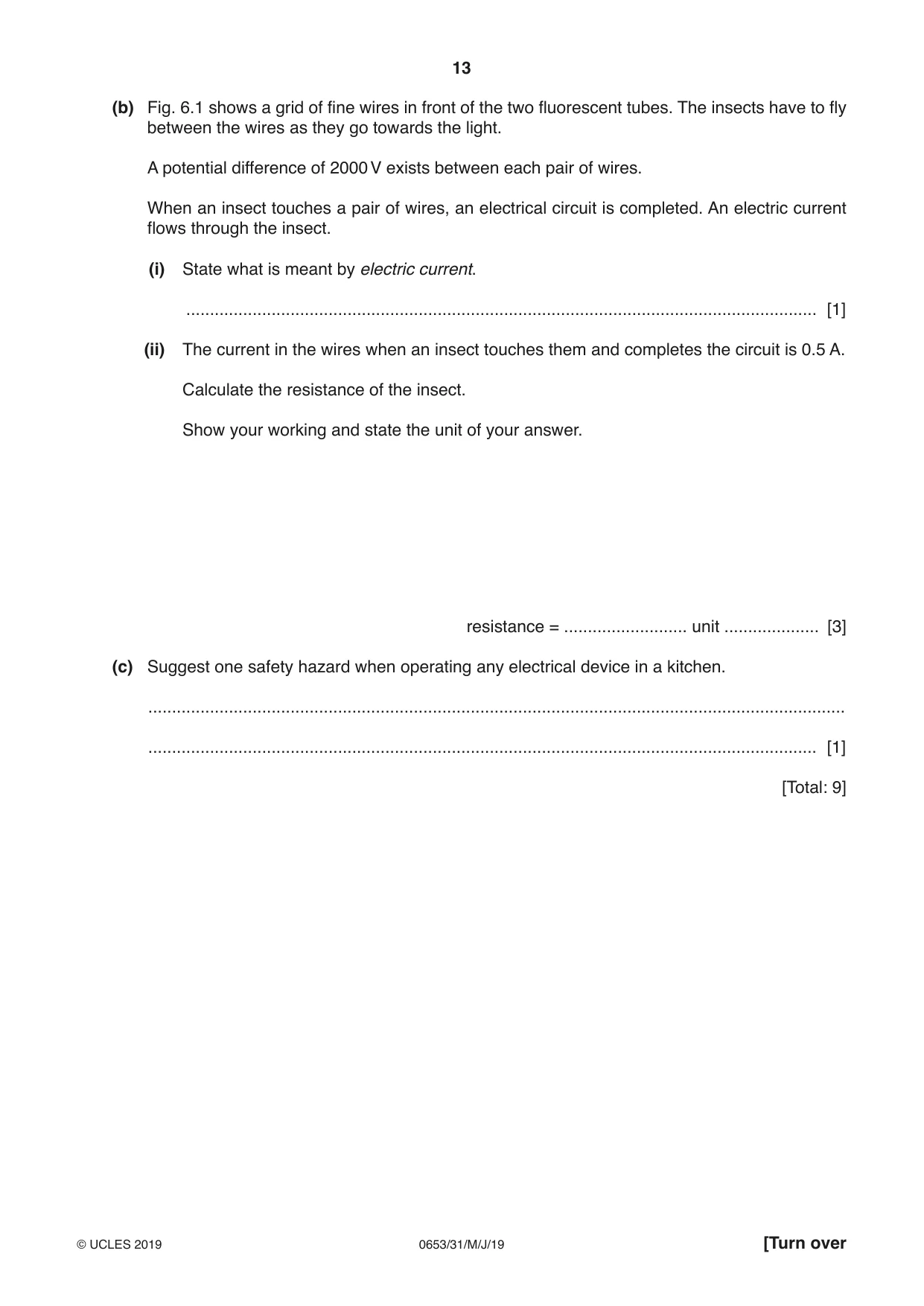
6 Fig. 6.1 shows an electrical device used in kitchens to kill insects. Insects can spread disease by contaminating food. grid of fine wires fluorescent tubes in front of the fluorescent tubes safety grille consisting of closely spaced metal rods Fig. 6.1 The device is connected to the electricity supply. (a) The two fluorescent tubes emit both visible light and ultraviolet radiation. This attracts insects to the device. (i) Fig. 6.2 shows an incomplete electromagnetic spectrum. micro- X-rays radio waves waves Fig. 6.2 On Fig. 6.2 place visible light and ultraviolet radiation in their correct boxes in the spectrum. [2] (ii) The level of ultraviolet radiation emitted by the device is kept as low as possible when the device is used where people are present. Explain why this precaution is needed. ........................................................................................................................................... ........................................................................................................................................... ..................................................................................................................................... [2] (b) Fig. 6.1 shows a grid of fine wires in front of the two fluorescent tubes. The insects have to fly between the wires as they go towards the light. A potential difference of 2000 V exists between each pair of wires. When an insect touches a pair of wires, an electrical circuit is completed. An electric current flows through the insect. (i) State what is meant by electric current. ..................................................................................................................................... [1] (ii) The current in the wires when an insect touches them and completes the circuit is 0.5 A. Calculate the resistance of the insect. Show your working and state the unit of your answer. resistance = .......................... unit .................... [3] (c) Suggest one safety hazard when operating any electrical device in a kitchen. ................................................................................................................................................... ............................................................................................................................................. [1] [Total: 9]
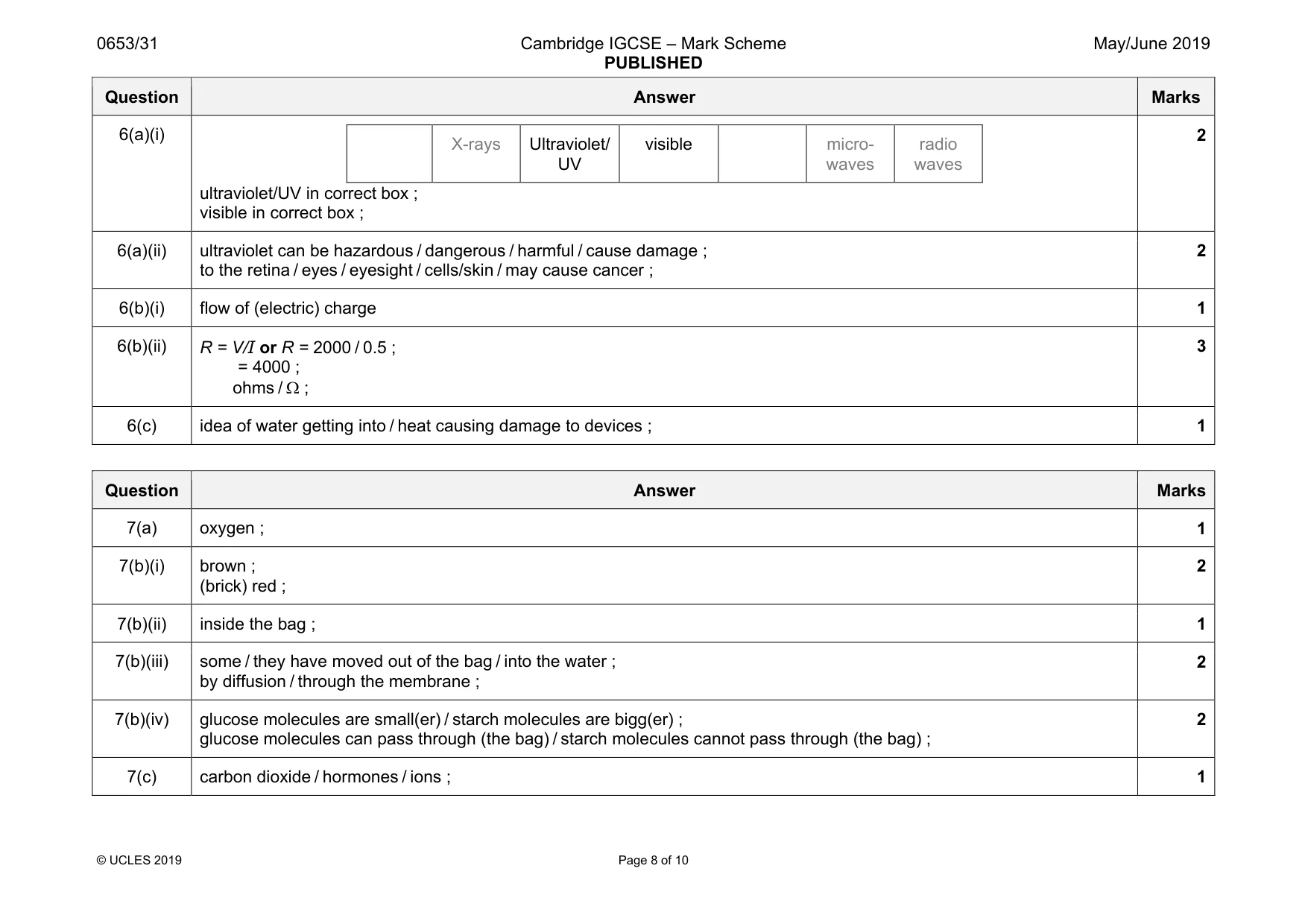
Mark scheme: 6(a)(i) X-rays Ultraviolet/ UV visible micro- waves radio waves ultraviolet/UV in correct box ; visible in correct box ; 2 6(a)(ii) ultraviolet can be hazardous / dangerous / harmful / cause damage ; to the retina / eyes / eyesight / cells/skin / may cause cancer ; 2 6(b)(i) flow of (electric) charge 1 6(b)(ii) R = V/I or R = 2000 / 0.5 ; = 4000 ; ohms / Ω ; 3 6(c) idea of water getting into / heat causing damage to devices ; 1
Q7 · Cell membranes are partially permeable
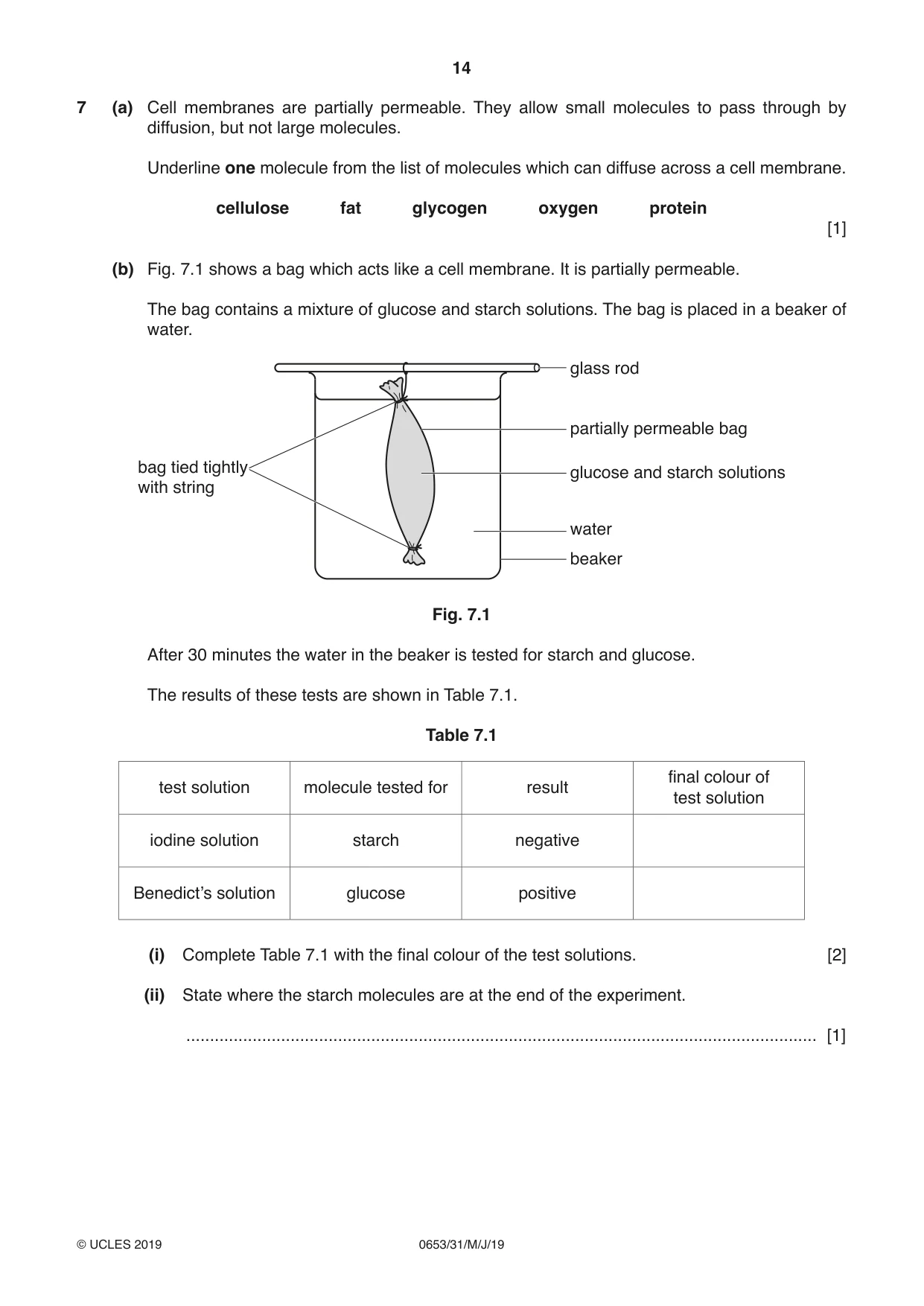
7 (a) Cell membranes are partially permeable. They allow small molecules to pass through by diffusion, but not large molecules. Underline one molecule from the list of molecules which can diffuse across a cell membrane. cellulose fat glycogen oxygen protein [1] (b) Fig. 7.1 shows a bag which acts like a cell membrane. It is partially permeable. The bag contains a mixture of glucose and starch solutions. The bag is placed in a beaker of water. glass rod partially permeable bag bag tied tightly glucose and starch solutions with string water beaker Fig. 7.1 After 30 minutes the water in the beaker is tested for starch and glucose. The results of these tests are shown in Table 7.1. Table 7.1 final colour of test solution molecule tested for result test solution iodine solution starch negative Benedict’s solution glucose positive (i) Complete Table 7.1 with the final colour of the test solutions. [2] (ii) State where the starch molecules are at the end of the experiment. ..................................................................................................................................... [1] (iii) Describe what has happened to the glucose molecules during the experiment. ........................................................................................................................................... ........................................................................................................................................... ..................................................................................................................................... [2] (iv) Use the information in Table 7.1 to compare the sizes of the glucose molecule and the starch molecule. Explain your answer. sizes of molecules ............................................................................................................. explanation ........................................................................................................................ ........................................................................................................................................... ........................................................................................................................................... [2] (c) The plasma is the component of blood which carries soluble nutrients around the body. Name one other substance that is transported by the plasma. ............................................................................................................................................. [1] [Total: 9]
Mark scheme: 7(a) oxygen ; 1 7(b)(i) brown ; (brick) red ; 2 7(b)(ii) inside the bag ; 1 7(b)(iii) some / they have moved out of the bag / into the water ; by diffusion / through the membrane ; 2 7(b)(iv) glucose molecules are small(er) / starch molecules are bigg(er) ; glucose molecules can pass through (the bag) / starch molecules cannot pass through (the bag) ; 2 7(c) carbon dioxide / hormones / ions ; 1
Q8 · An atom of aluminium is represented by the symbol: 2 1 37Al State the number of protons…
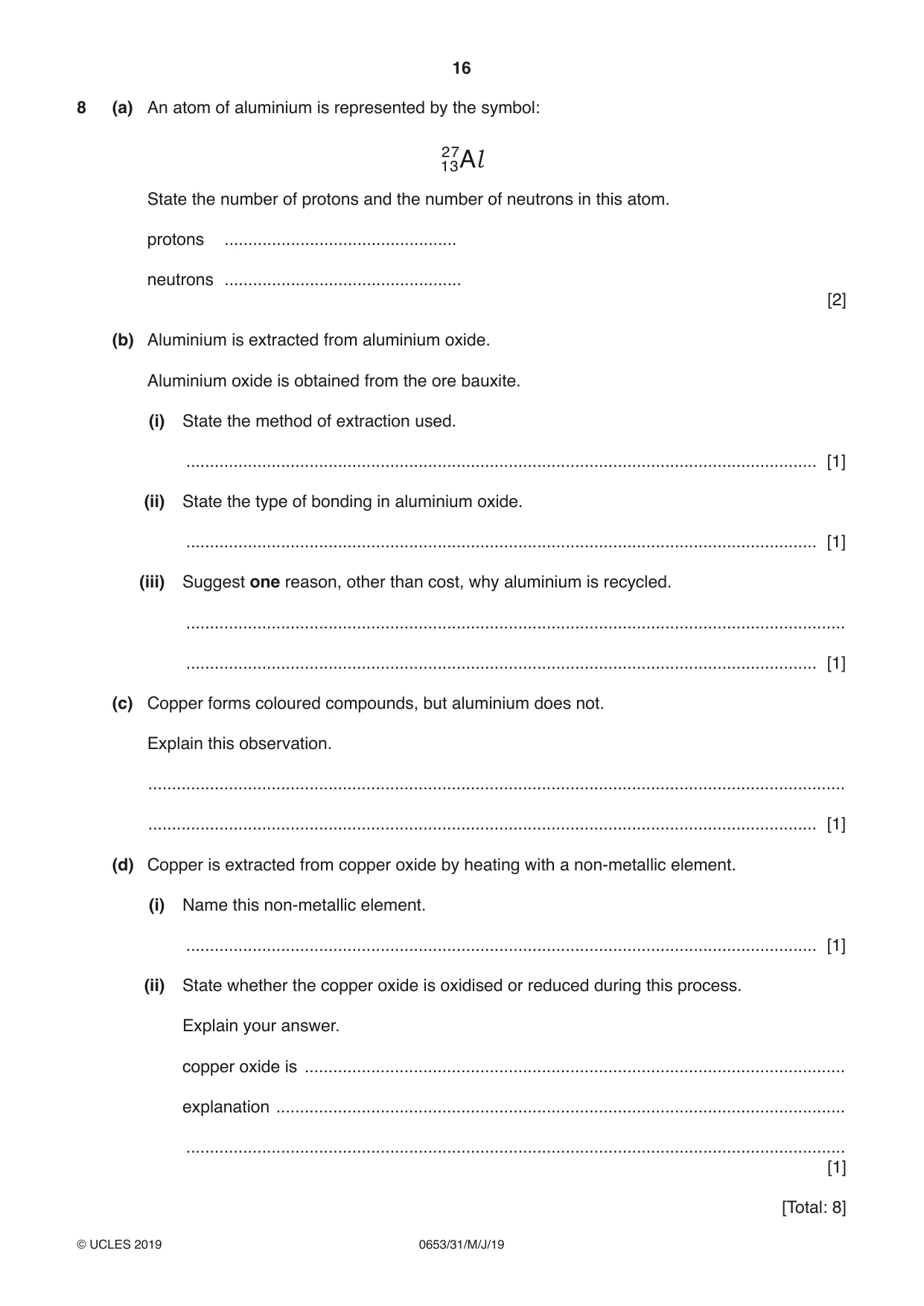
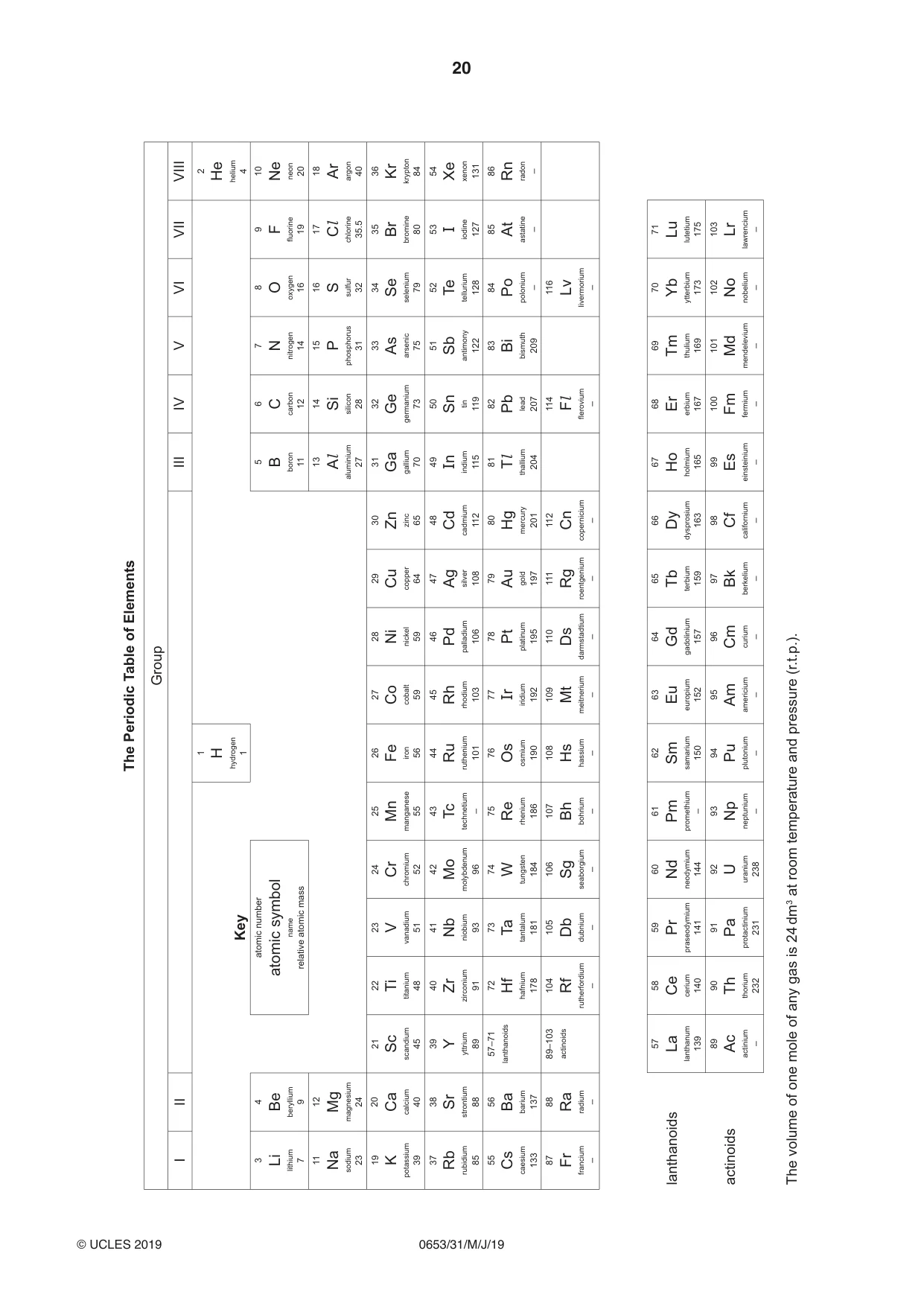
8 (a) An atom of aluminium is represented by the symbol: 2 1 37Al State the number of protons and the number of neutrons in this atom. protons ................................................. neutrons .................................................. [2] (b) Aluminium is extracted from aluminium oxide. Aluminium oxide is obtained from the ore bauxite. (i) State the method of extraction used. ..................................................................................................................................... [1] (ii) State the type of bonding in aluminium oxide. ..................................................................................................................................... [1] (iii) Suggest one reason, other than cost, why aluminium is recycled. ........................................................................................................................................... ..................................................................................................................................... [1] (c) Copper forms coloured compounds, but aluminium does not. Explain this observation. ................................................................................................................................................... ............................................................................................................................................. [1] (d) Copper is extracted from copper oxide by heating with a non-metallic element. (i) Name this non-metallic element. ..................................................................................................................................... [1] (ii) State whether the copper oxide is oxidised or reduced during this process. Explain your answer. copper oxide is .................................................................................................................. explanation ........................................................................................................................ ........................................................................................................................................... [1] [Total: 8]
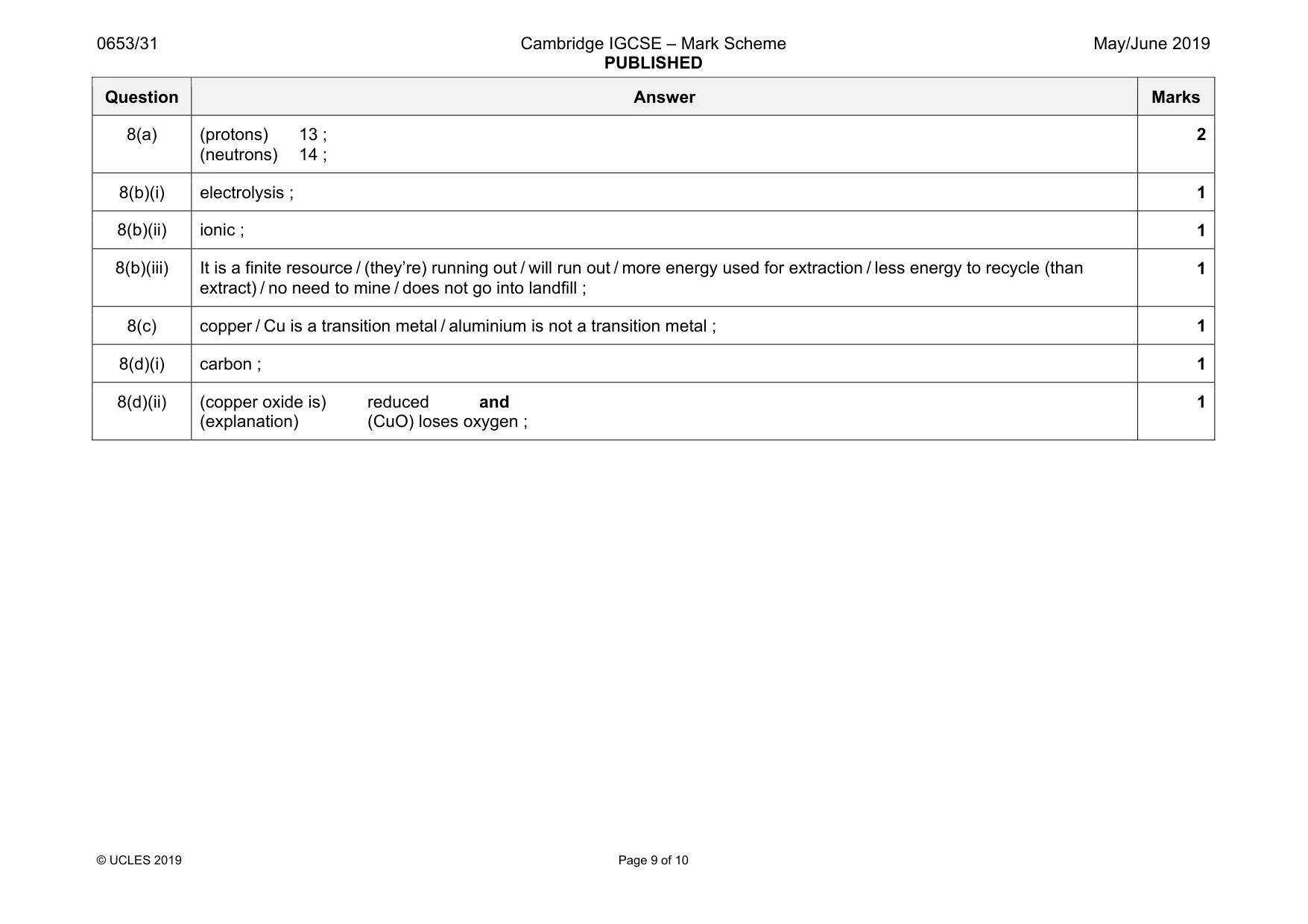
Mark scheme: 8(a) (protons) 13 ; (neutrons) 14 ; 2 8(b)(i) electrolysis ; 1 8(b)(ii) ionic ; 1 8(b)(iii) It is a finite resource / (they’re) running out / will run out / more energy used for extraction / less energy to recycle (than extract) / no need to mine / does not go into landfill ; 1 8(c) copper / Cu is a transition metal / aluminium is not a transition metal ; 1 8(d)(i) carbon ; 1 8(d)(ii) (copper oxide is) reduced and (explanation) (CuO) loses oxygen ; 1
Q9 · A laboratory water-bath used to keep experiments at a constant temperature
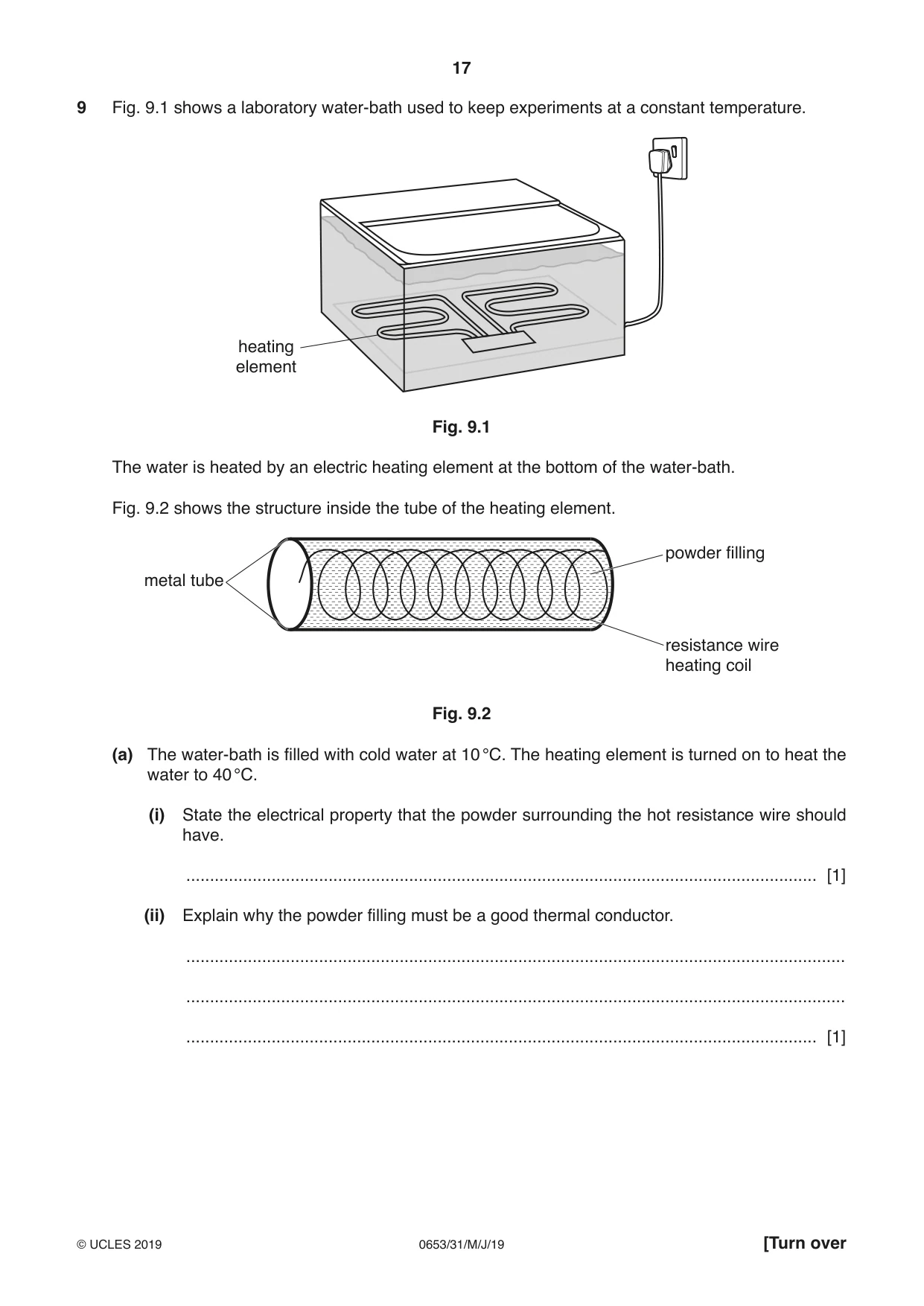
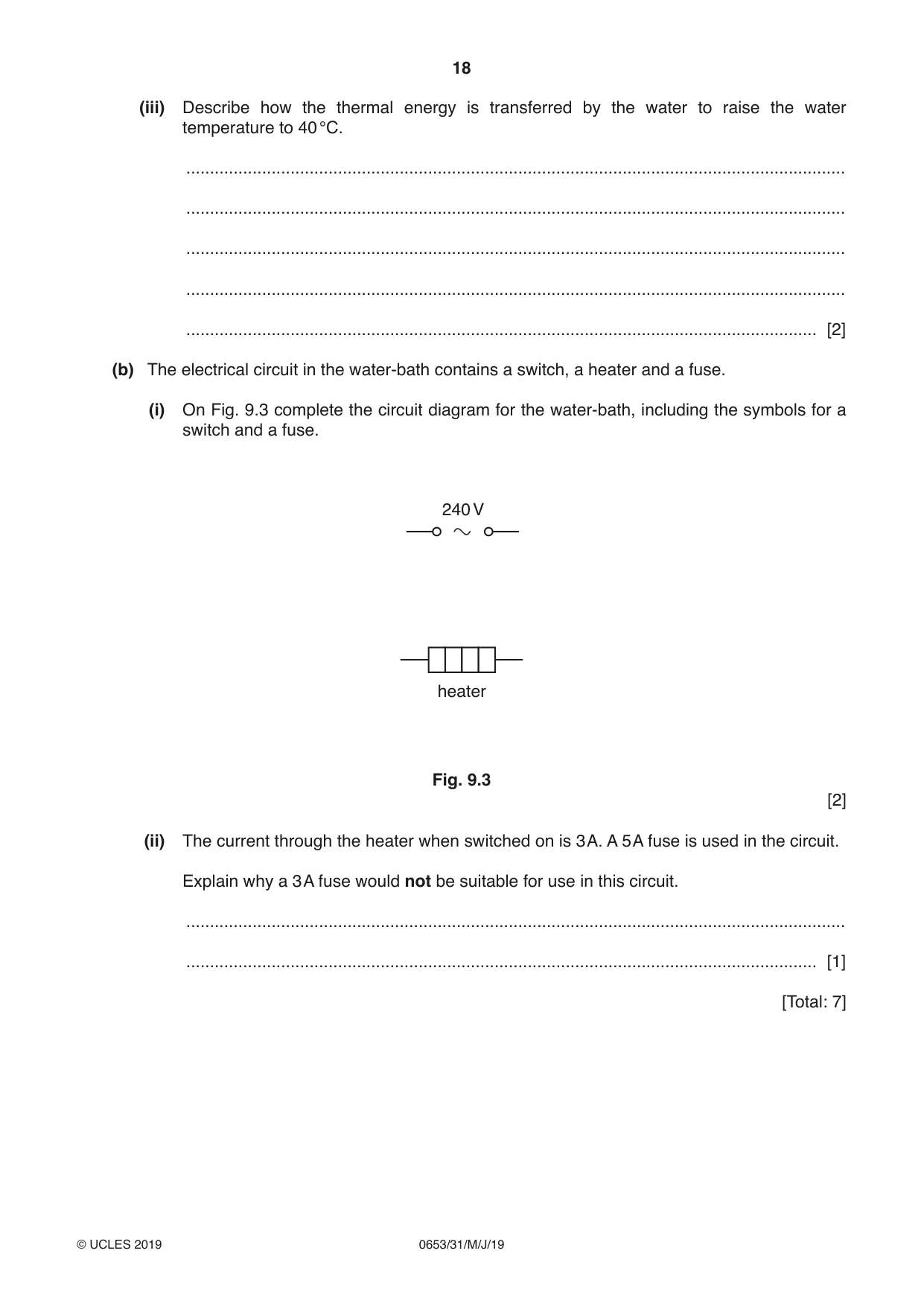
9 Fig. 9.1 shows a laboratory water-bath used to keep experiments at a constant temperature. heating element Fig. 9.1 The water is heated by an electric heating element at the bottom of the water-bath. Fig. 9.2 shows the structure inside the tube of the heating element. powder filling metal tube resistance wire heating coil Fig. 9.2 (a) The water-bath is filled with cold water at 10 °C. The heating element is turned on to heat the water to 40 °C. (i) State the electrical property that the powder surrounding the hot resistance wire should have. ..................................................................................................................................... [1] (ii) Explain why the powder filling must be a good thermal conductor. ........................................................................................................................................... ........................................................................................................................................... ..................................................................................................................................... [1] (iii) Describe how the thermal energy is transferred by the water to raise the water temperature to 40 °C. ........................................................................................................................................... ........................................................................................................................................... ........................................................................................................................................... ........................................................................................................................................... ..................................................................................................................................... [2] (b) The electrical circuit in the water-bath contains a switch, a heater and a fuse. (i) On Fig. 9.3 complete the circuit diagram for the water-bath, including the symbols for a switch and a fuse. 240 V heater Fig. 9.3 [2] (ii) The current through the heater when switched on is 3 A. A 5 A fuse is used in the circuit. Explain why a 3 A fuse would not be suitable for use in this circuit. ........................................................................................................................................... ..................................................................................................................................... [1] [Total: 7]
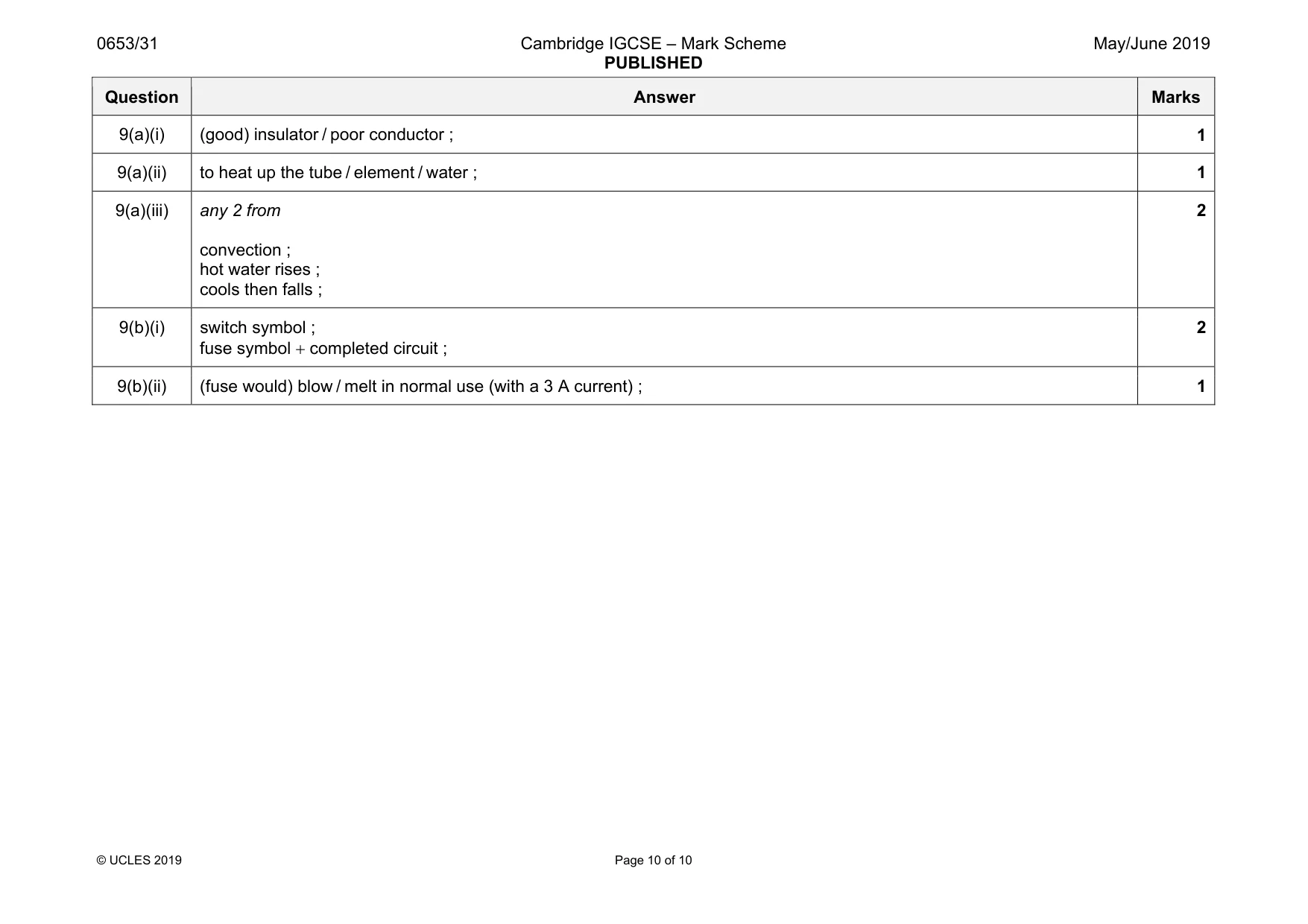
Mark scheme: 9(a)(i) (good) insulator / poor conductor ; 1 9(a)(ii) to heat up the tube / element / water ; 1 9(a)(iii) any 2 from convection ; hot water rises ; cools then falls ; 2 9(b)(i) switch symbol ; fuse symbol + completed circuit ; 2 9(b)(ii) (fuse would) blow / melt in normal use (with a 3 A current) ; 1
What was in this paper
The subtopics covered by these 9 questions, and how many questions each got. Open one in a new tab to see every Cambridge question on it.
What you needed in this session
Cambridge’s own grade thresholds for 2019 May/June, Paper 3 · Variant 1. A higher threshold means an easier paper — the bar moves with how the cohort did.