Cambridge IGCSE Science - Combined 0653 — 2025 Oct/Nov Paper 3 · Variant 1
0653/31/O/N/25 · 9 questions · 80 marks · 75 min
The question paper and its mark scheme, free to read here and free to download. This is Cambridge’s own paper, exactly as it was sat.
Question paper20 pages
Mark scheme14 pages
Answers below. Sit the paper first if you are practising.
Questions as text
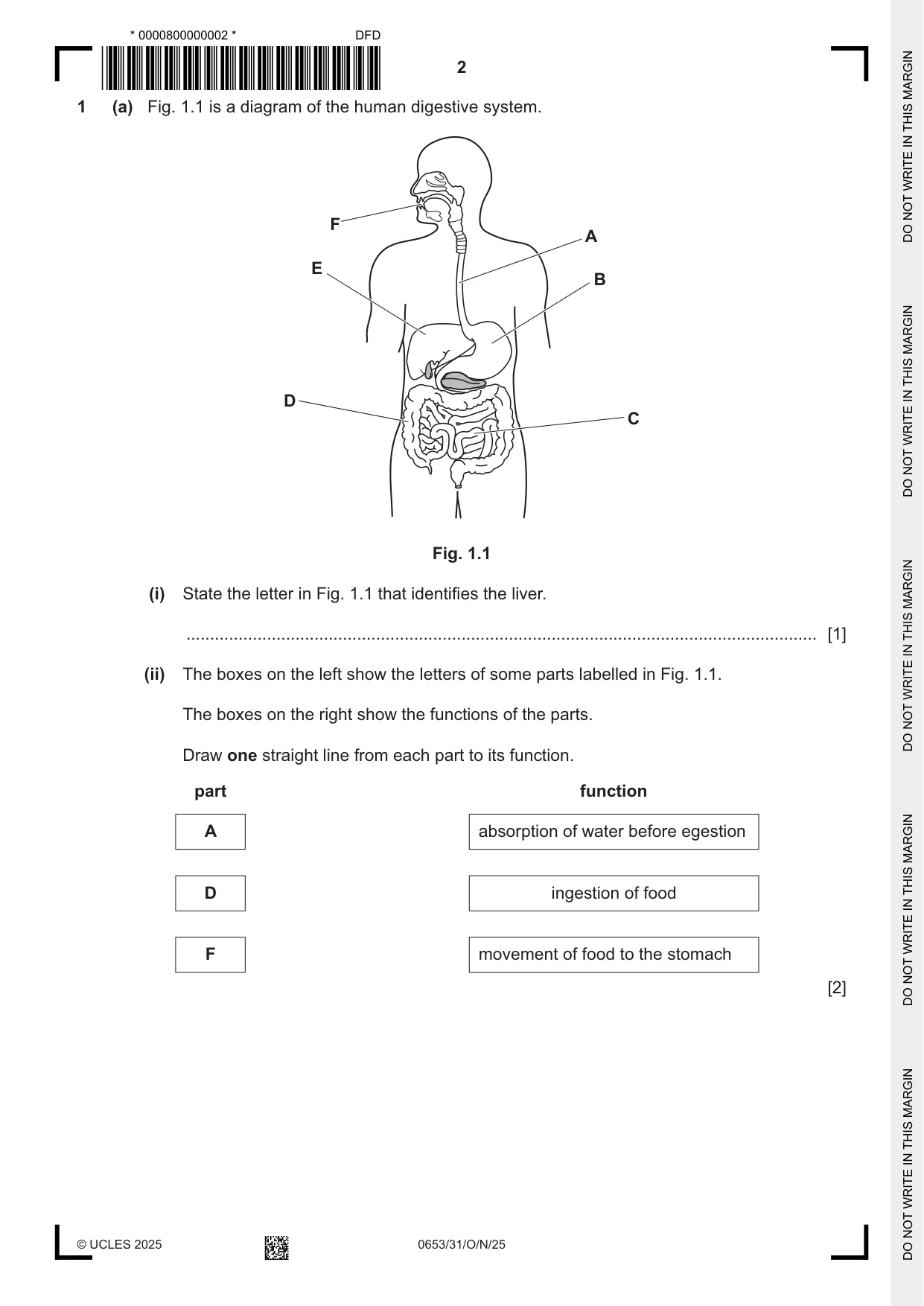
Q1 · A diagram of the human digestive system
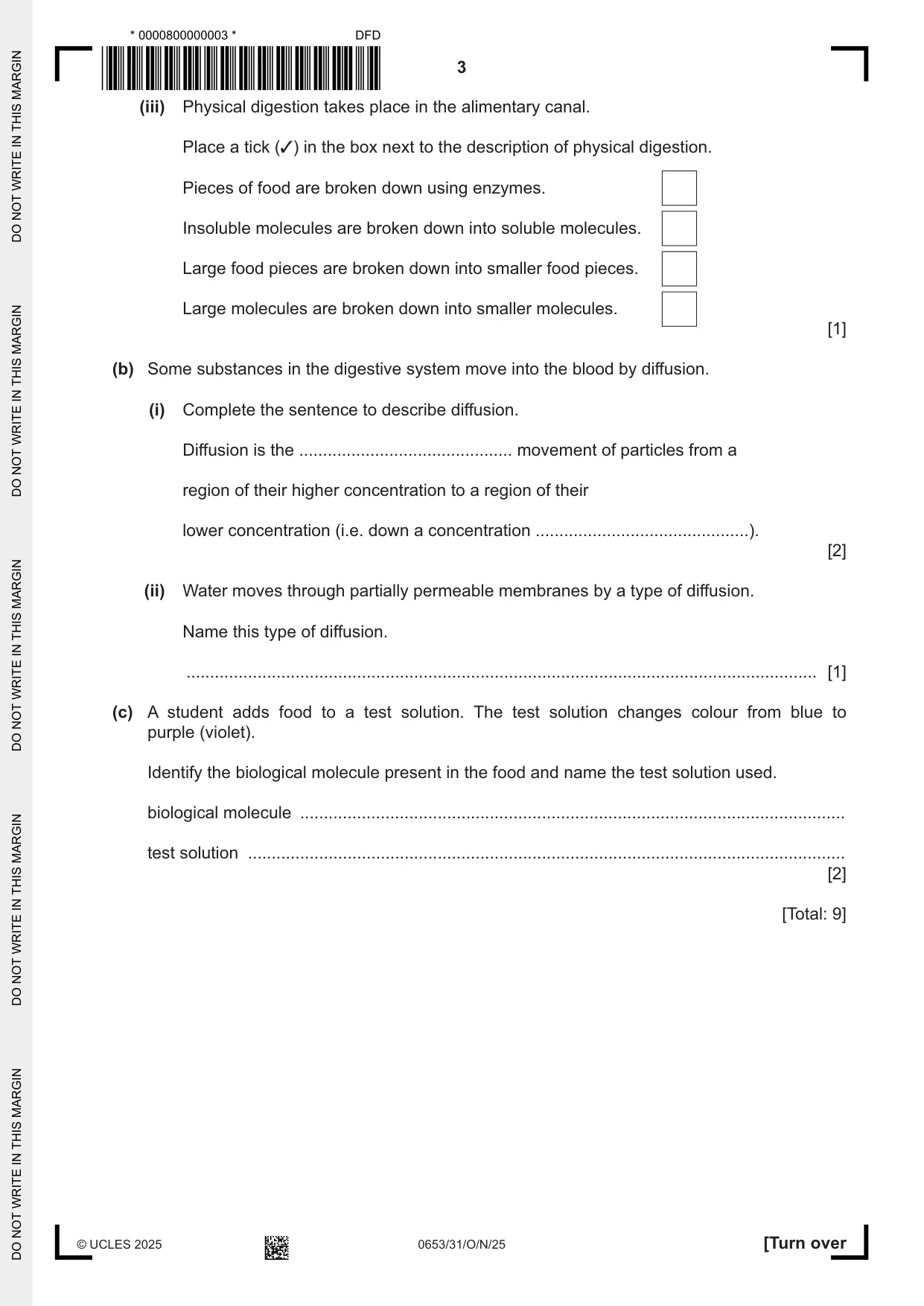
1 (a) Fig. 1.1 is a diagram of the human digestive system. F A E B D C Fig. 1.1 (i) State the letter in Fig. 1.1 that identifies the liver. ..................................................................................................................................... [1] (ii) The boxes on the left show the letters of some parts labelled in Fig. 1.1. The boxes on the right show the functions of the parts. Draw one straight line from each part to its function. part function A absorption of water before egestion D ingestion of food F movement of food to the stomach [2] (iii) Physical digestion takes place in the alimentary canal. Place a tick (✓) in the box next to the description of physical digestion. Pieces of food are broken down using enzymes. Insoluble molecules are broken down into soluble molecules. Large food pieces are broken down into smaller food pieces. Large molecules are broken down into smaller molecules. [1] (b) Some substances in the digestive system move into the blood by diffusion. (i) Complete the sentence to describe diffusion. Diffusion is the ............................................. movement of particles from a region of their higher concentration to a region of their lower concentration (i.e. down a concentration .............................................). [2] (ii) Water moves through partially permeable membranes by a type of diffusion. Name this type of diffusion. ..................................................................................................................................... [1] (c) A student adds food to a test solution. The test solution changes colour from blue to purple (violet). Identify the biological molecule present in the food and name the test solution used. biological molecule ................................................................................................................... test solution .............................................................................................................................. [2] [Total: 9]
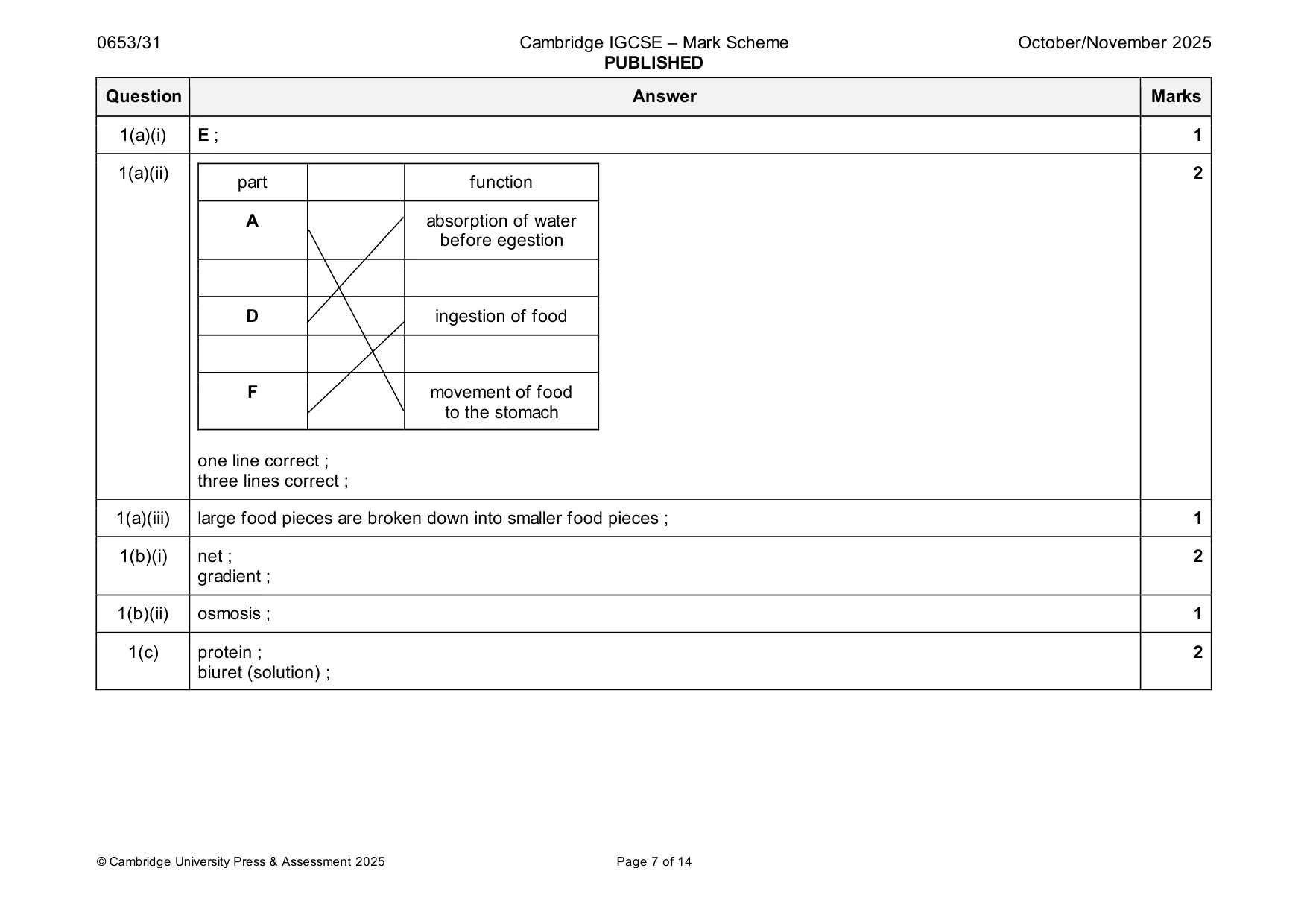
Mark scheme: Question Answer Marks 1(a)(i) E ; 1 1(a)(ii) 2 part function A absorption of water before egestion D ingestion of food F movement of food to the stomach one line correct ; three lines correct ; 1(a)(iii) large food pieces are broken down into smaller food pieces ; 1 1(b)(i) net ; 2 gradient ; 1(b)(ii) osmosis ; 1 1(c) protein ; 2 biuret (solution) ;
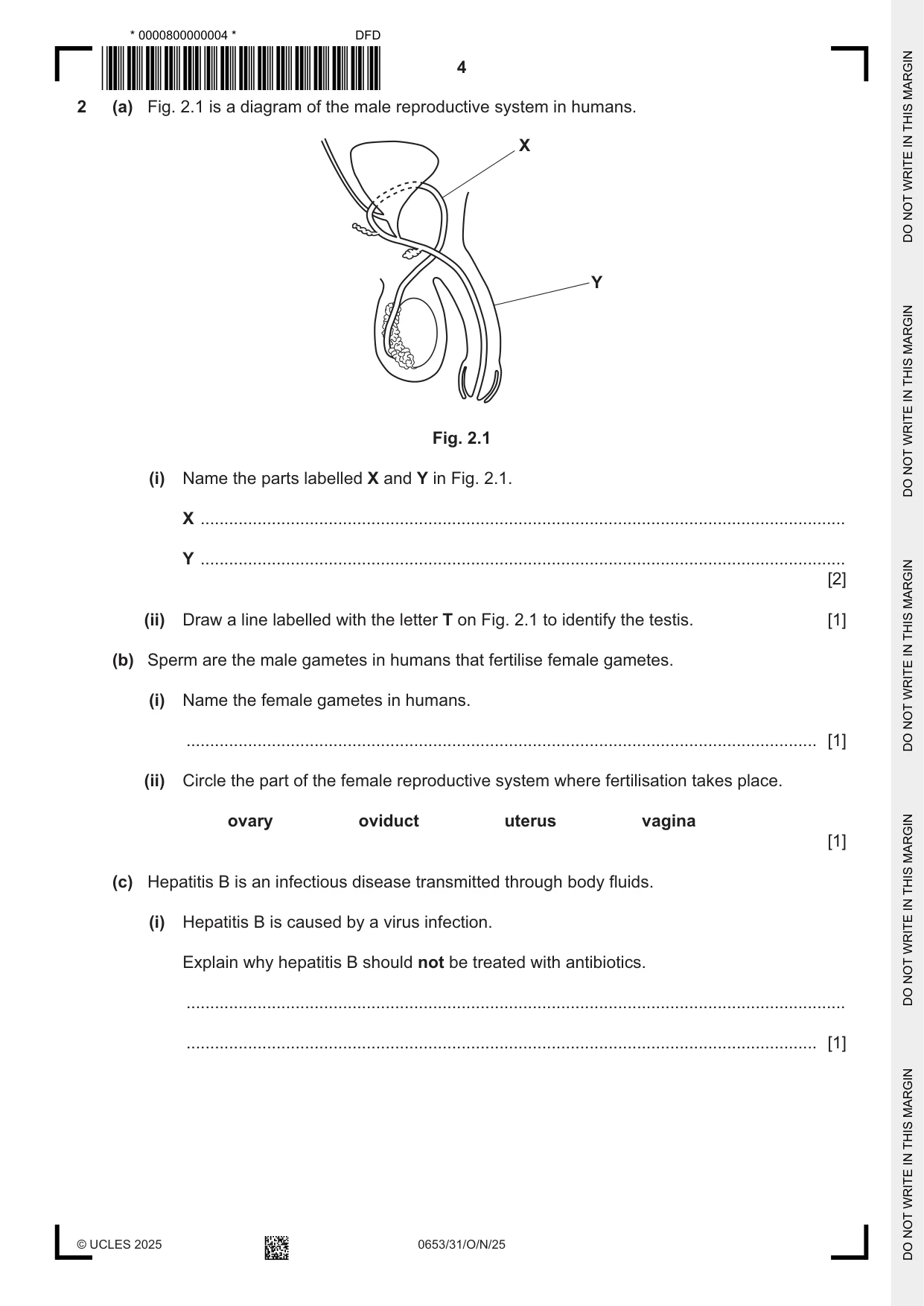
Q2 · A diagram of the male reproductive system in humans
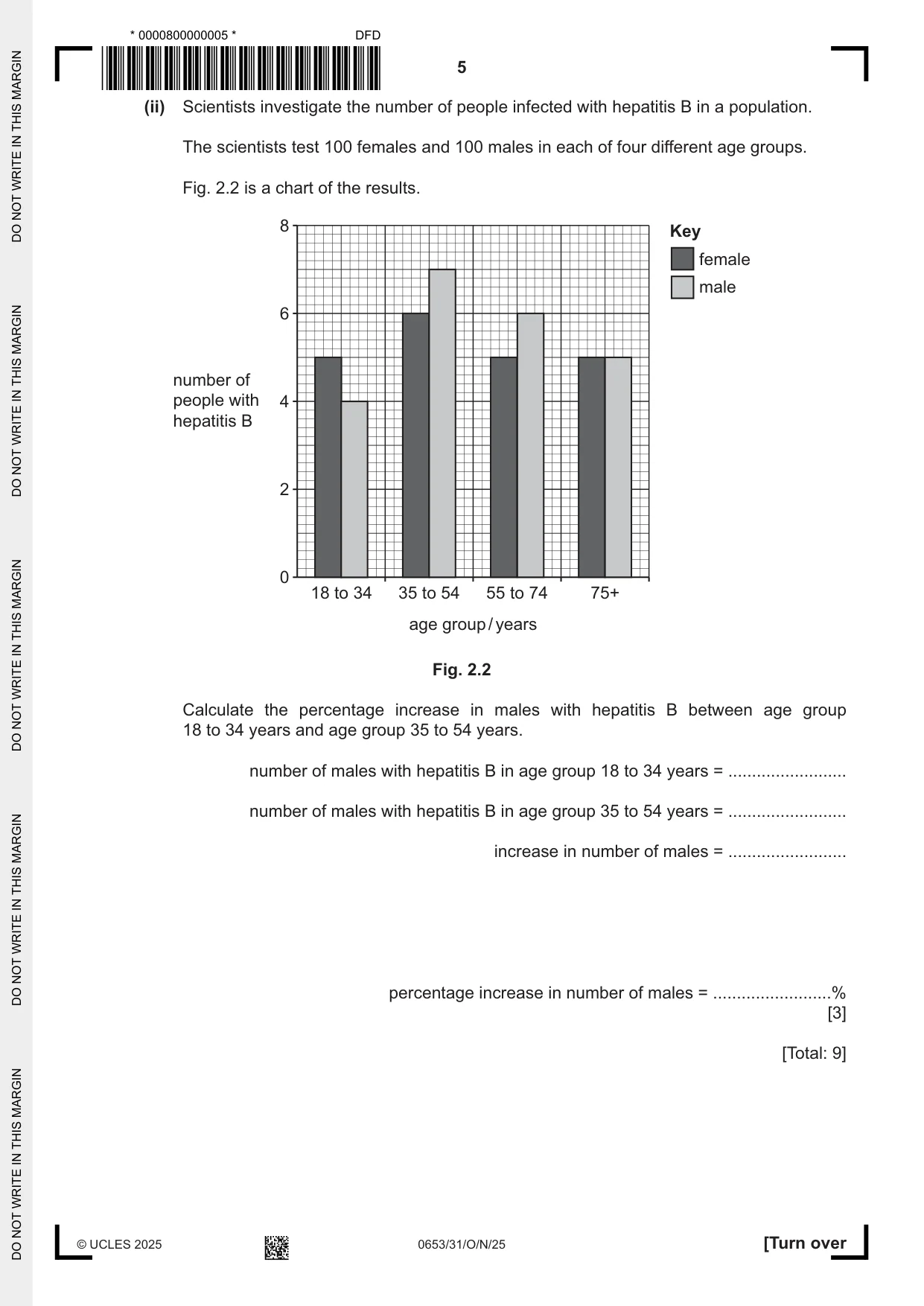
2 (a) Fig. 2.1 is a diagram of the male reproductive system in humans. X Y Fig. 2.1 (i) Name the parts labelled X and Y in Fig. 2.1. X ........................................................................................................................................ Y ........................................................................................................................................ [2] (ii) Draw a line labelled with the letter T on Fig. 2.1 to identify the testis. [1] (b) Sperm are the male gametes in humans that fertilise female gametes. (i) Name the female gametes in humans. ..................................................................................................................................... [1] (ii) Circle the part of the female reproductive system where fertilisation takes place. ovary oviduct uterus vagina [1] (c) Hepatitis B is an infectious disease transmitted through body fluids. (i) Hepatitis B is caused by a virus infection. Explain why hepatitis B should not be treated with antibiotics. ........................................................................................................................................... ..................................................................................................................................... [1] (ii) Scientists investigate the number of people infected with hepatitis B in a population. The scientists test 100 females and 100 males in each of four different age groups. Fig. 2.2 is a chart of the results. 8 Key female male 6 number of people with 4 hepatitis B 2 0 18 to 34 35 to 54 55 to 74 75+ age group / years Fig. 2.2 Calculate the percentage increase in males with hepatitis B between age group 18 to 34 years and age group 35 to 54 years. number of males with hepatitis B in age group 18 to 34 years = ......................... number of males with hepatitis B in age group 35 to 54 years = ......................... increase in number of males = ......................... percentage increase in number of males = .........................% [3] [Total: 9]
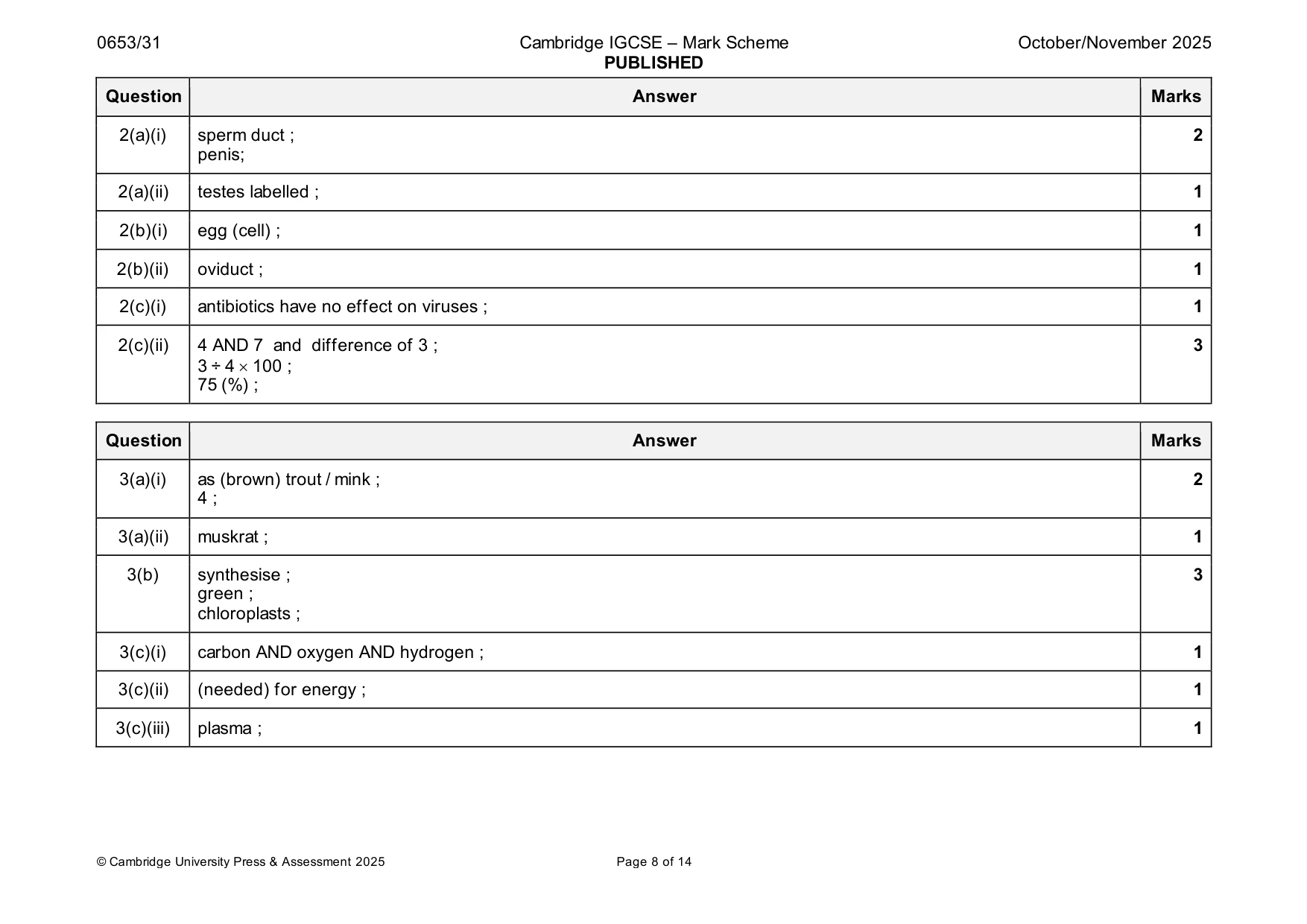
Mark scheme: 2(a)(i) sperm duct ; 2 penis; 2(a)(ii) testes labelled ; 1 2(b)(i) egg (cell) ; 1 2(b)(ii) oviduct ; 1 2(c)(i) antibiotics have no effect on viruses ; 1 2(c)(ii) 4 AND 7 and difference of 3 ; 3 3 ÷ 4 100 ; 75 (%) ;
Question 3
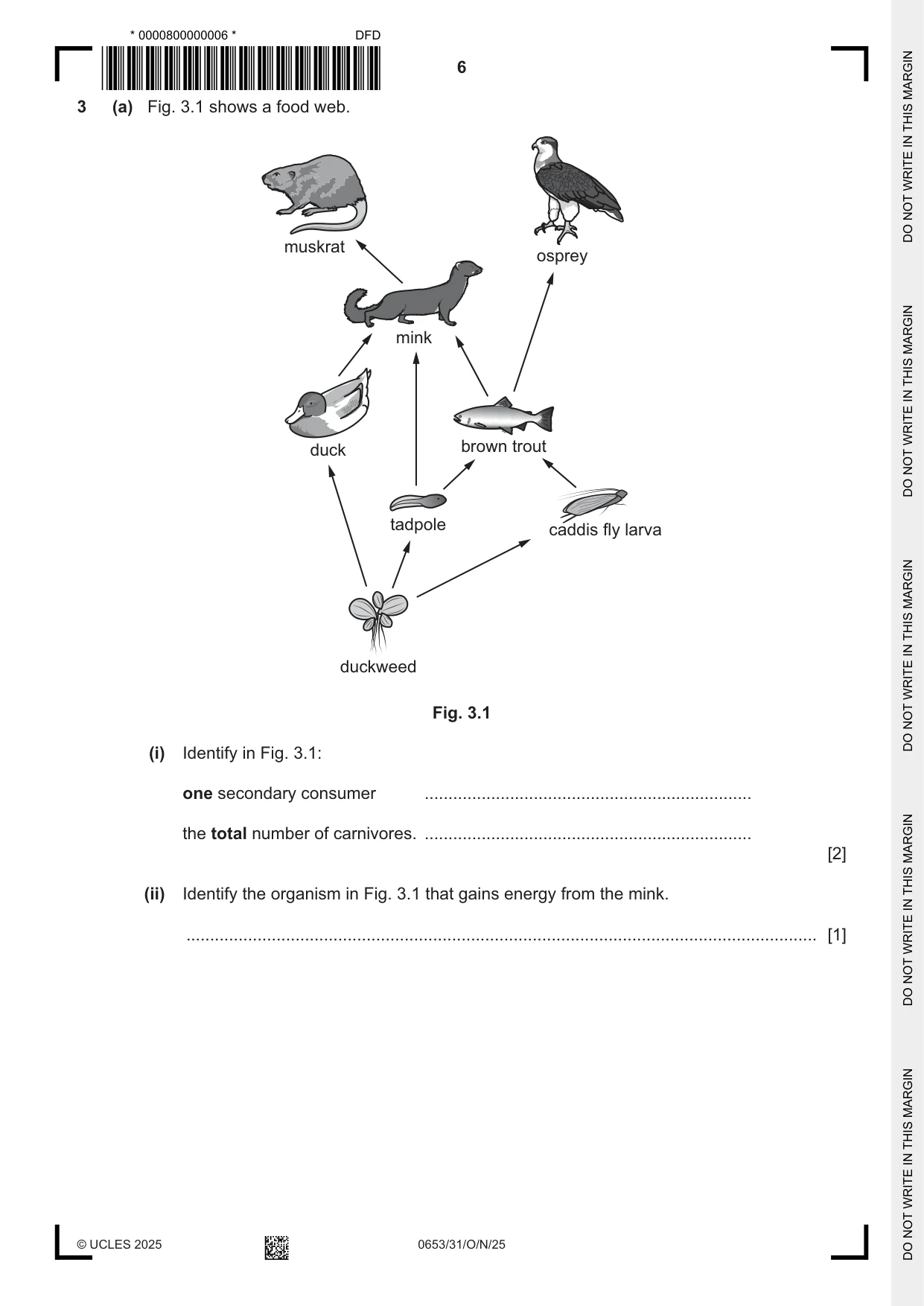
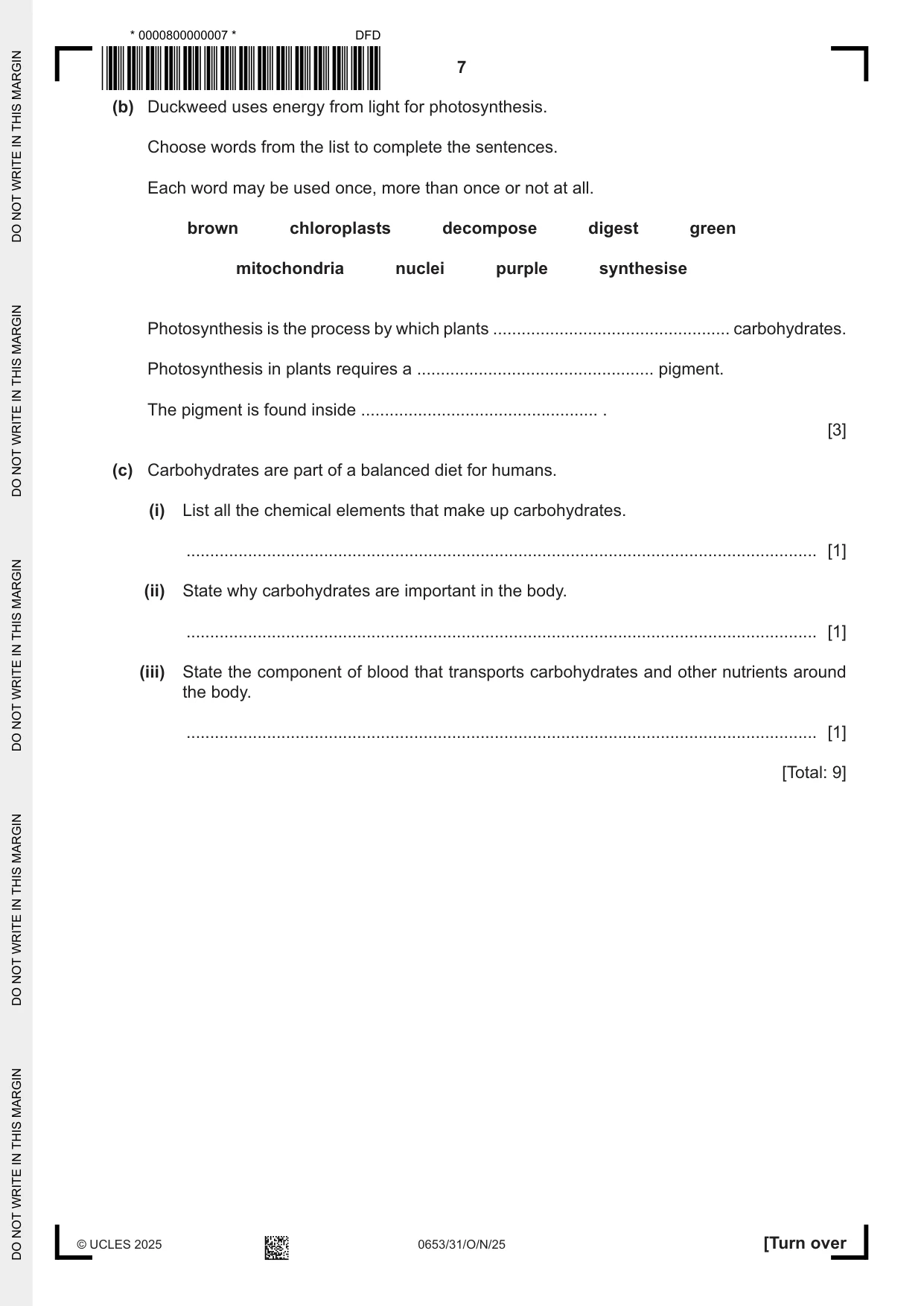
3 (a) Fig. 3.1 shows a food web. muskrat osprey mink duck brown trout tadpole caddis fly larva duckweed Fig. 3.1 (i) Identify in Fig. 3.1: one secondary consumer ..................................................................... the total number of carnivores. ..................................................................... [2] (ii) Identify the organism in Fig. 3.1 that gains energy from the mink. ..................................................................................................................................... [1] (b) Duckweed uses energy from light for photosynthesis. Choose words from the list to complete the sentences. Each word may be used once, more than once or not at all. brown chloroplasts decompose digest green mitochondria nuclei purple synthesise Photosynthesis is the process by which plants .................................................. carbohydrates. Photosynthesis in plants requires a .................................................. pigment. The pigment is found inside .................................................. . [3] (c) Carbohydrates are part of a balanced diet for humans. (i) List all the chemical elements that make up carbohydrates. ..................................................................................................................................... [1] (ii) State why carbohydrates are important in the body. ..................................................................................................................................... [1] (iii) State the component of blood that transports carbohydrates and other nutrients around the body. ..................................................................................................................................... [1] [Total: 9]
Mark scheme: 3(a)(i) as (brown) trout / mink ; 2 4 ; 3(a)(ii) muskrat ; 1 3(b) synthesise ; 3 green ; chloroplasts ; 3(c)(i) carbon AND oxygen AND hydrogen ; 1 3(c)(ii) (needed) for energy ; 1 3(c)(iii) plasma ; 1
Q4 · Aqueous hydrogen peroxide, H2O2, breaks down to form oxygen and water
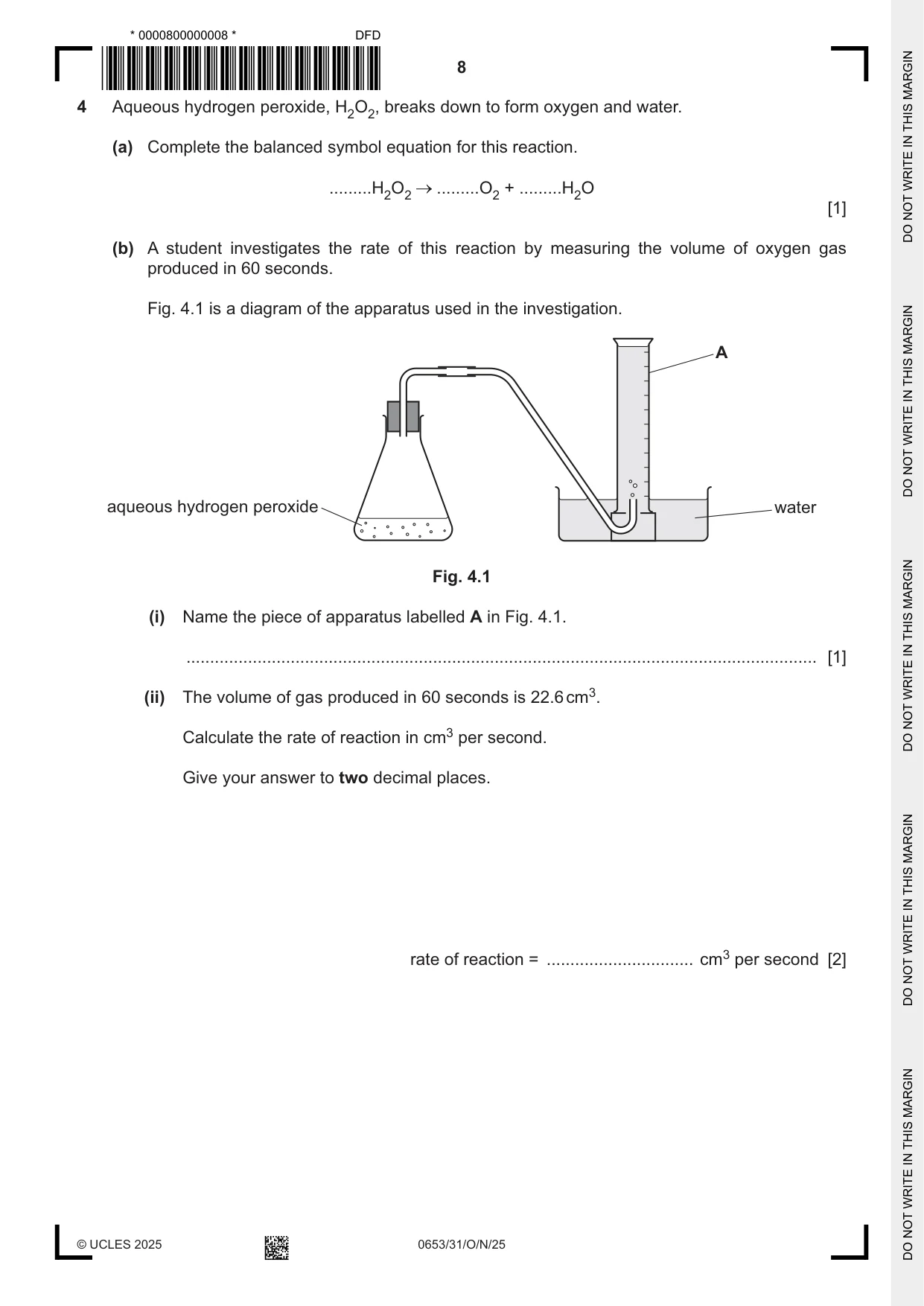
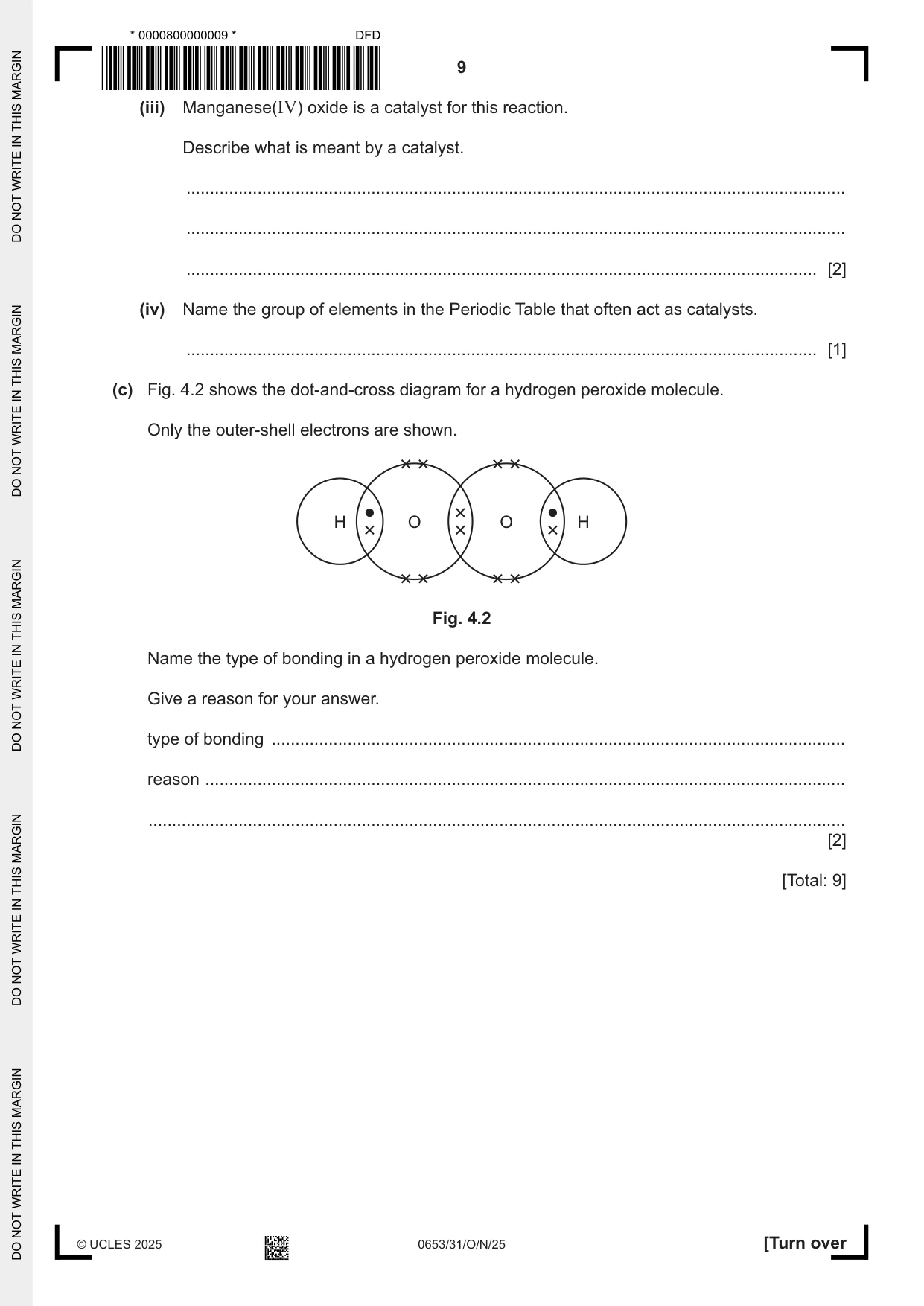
4 Aqueous hydrogen peroxide, H2O2, breaks down to form oxygen and water. (a) Complete the balanced symbol equation for this reaction. .........H2O2 .........O2 + .........H2O [1] (b) A student investigates the rate of this reaction by measuring the volume of oxygen gas produced in 60 seconds. Fig. 4.1 is a diagram of the apparatus used in the investigation. A aqueous hydrogen peroxide water Fig. 4.1 (i) Name the piece of apparatus labelled A in Fig. 4.1. ..................................................................................................................................... [1] (ii) The volume of gas produced in 60 seconds is 22.6 cm3. Calculate the rate of reaction in cm3 per second. Give your answer to two decimal places. rate of reaction = ............................... cm3 per second [2] (iii) Manganese(IV) oxide is a catalyst for this reaction. Describe what is meant by a catalyst. ........................................................................................................................................... ........................................................................................................................................... ..................................................................................................................................... [2] (iv) Name the group of elements in the Periodic Table that often act as catalysts. ..................................................................................................................................... [1] (c) Fig. 4.2 shows the dot-and-cross diagram for a hydrogen peroxide molecule. Only the outer-shell electrons are shown. H O O H Fig. 4.2 Name the type of bonding in a hydrogen peroxide molecule. Give a reason for your answer. type of bonding ......................................................................................................................... reason ....................................................................................................................................... ................................................................................................................................................... [2] [Total: 9]
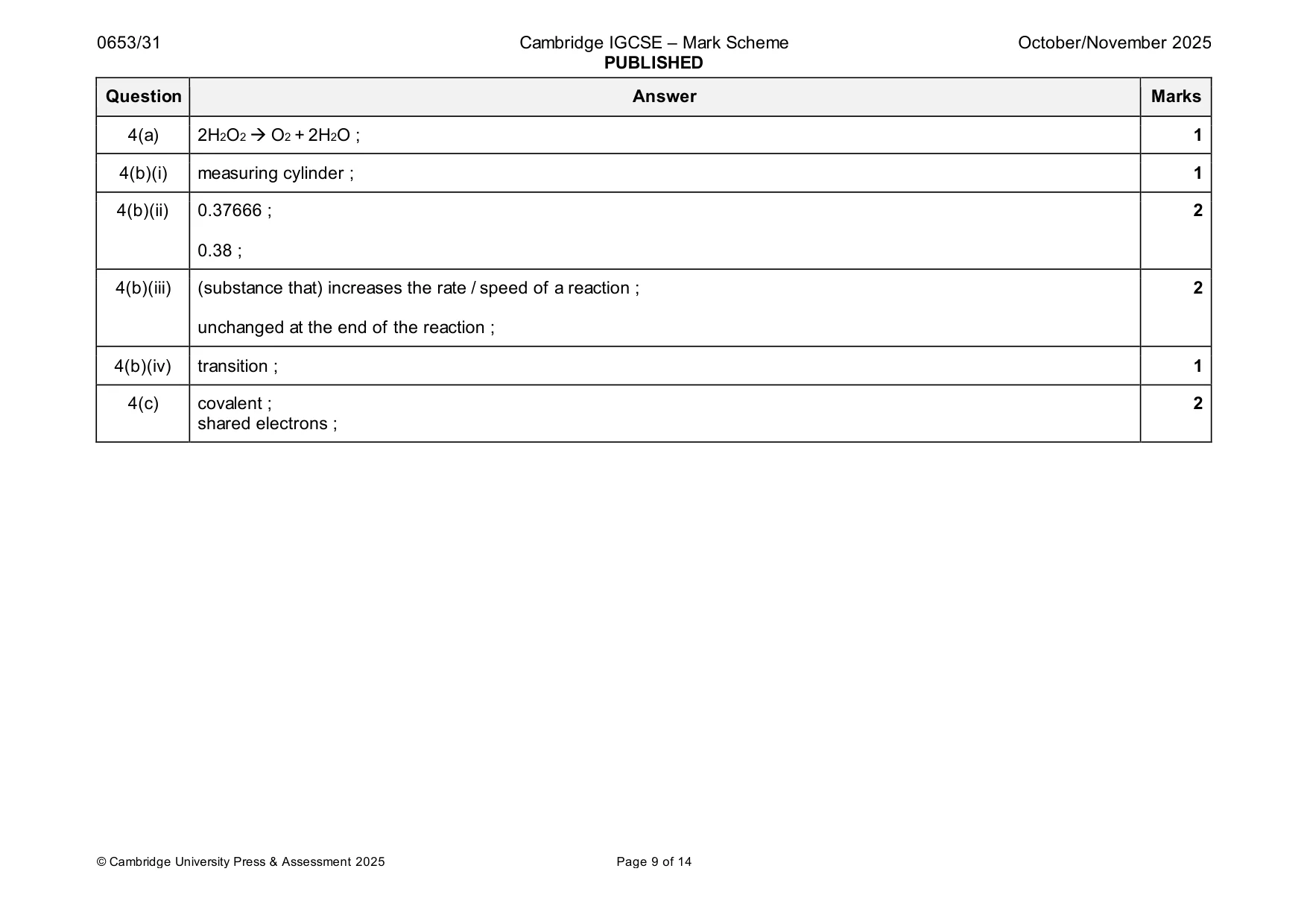
Mark scheme: 4(a) 2H2O2 → O2 + 2H2O ; 1 4(b)(i) measuring cylinder ; 1 4(b)(ii) 0.37666 ; 2 0.38 ; 4(b)(iii) (substance that) increases the rate / speed of a reaction ; 2 unchanged at the end of the reaction ; 4(b)(iv) transition ; 1 4(c) covalent ; 2 shared electrons ;
Q5 · Three substances and models used to represent them
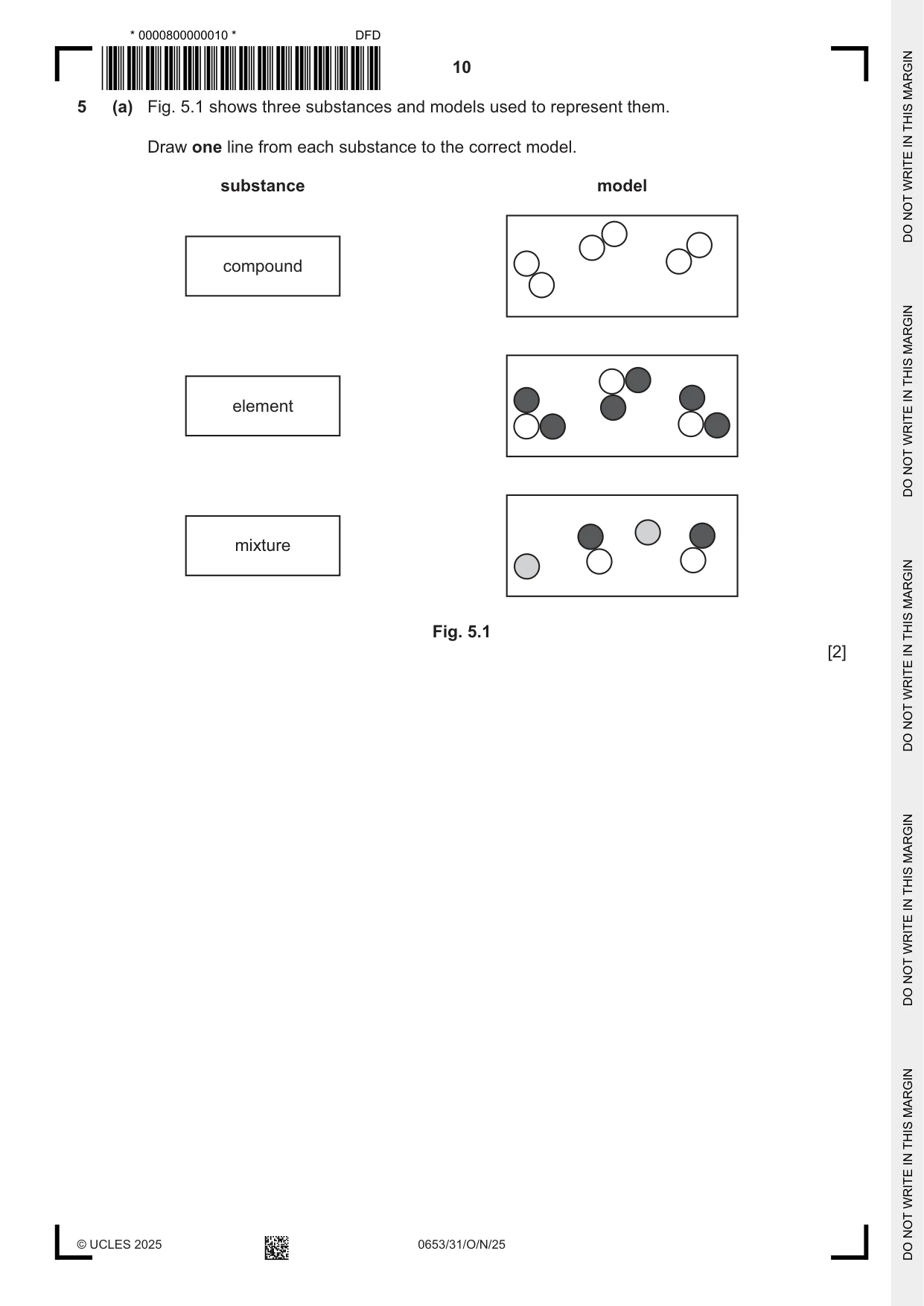
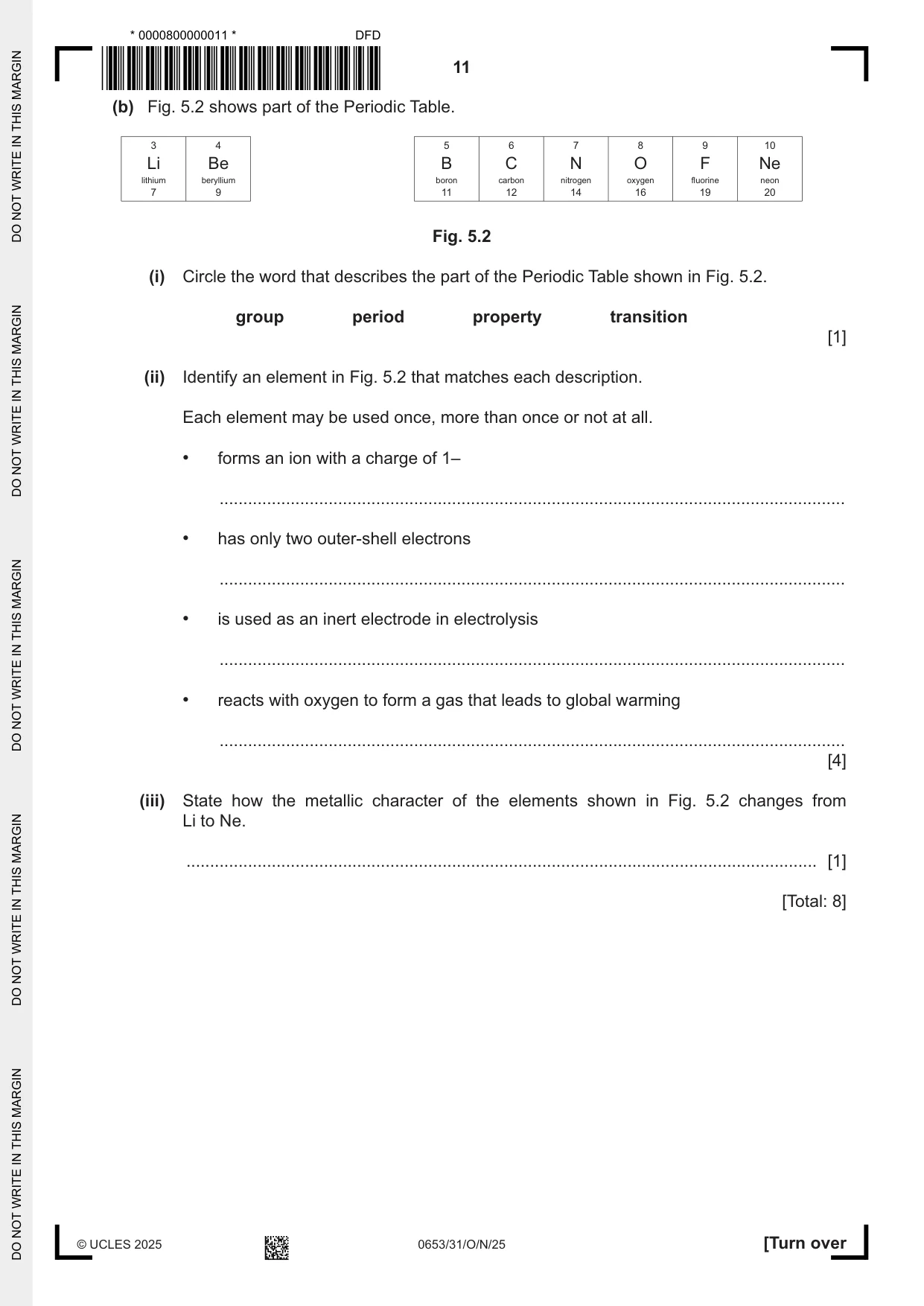
5 (a) Fig. 5.1 shows three substances and models used to represent them. Draw one line from each substance to the correct model. substance model compound element mixture Fig. 5.1 [2] (b) Fig. 5.2 shows part of the Periodic Table. 3 4 5 6 7 8 9 10 Li Be B C N O F Ne lithium beryllium boron carbon nitrogen oxygen fluorine neon 7 9 11 12 14 16 19 20 Fig. 5.2 (i) Circle the word that describes the part of the Periodic Table shown in Fig. 5.2. group period property transition [1] (ii) Identify an element in Fig. 5.2 that matches each description. Each element may be used once, more than once or not at all. • forms an ion with a charge of 1– .................................................................................................................................... • has only two outer-shell electrons .................................................................................................................................... • is used as an inert electrode in electrolysis .................................................................................................................................... • reacts with oxygen to form a gas that leads to global warming .................................................................................................................................... [4] (iii) State how the metallic character of the elements shown in Fig. 5.2 changes from Li to Ne. ..................................................................................................................................... [1] [Total: 8]
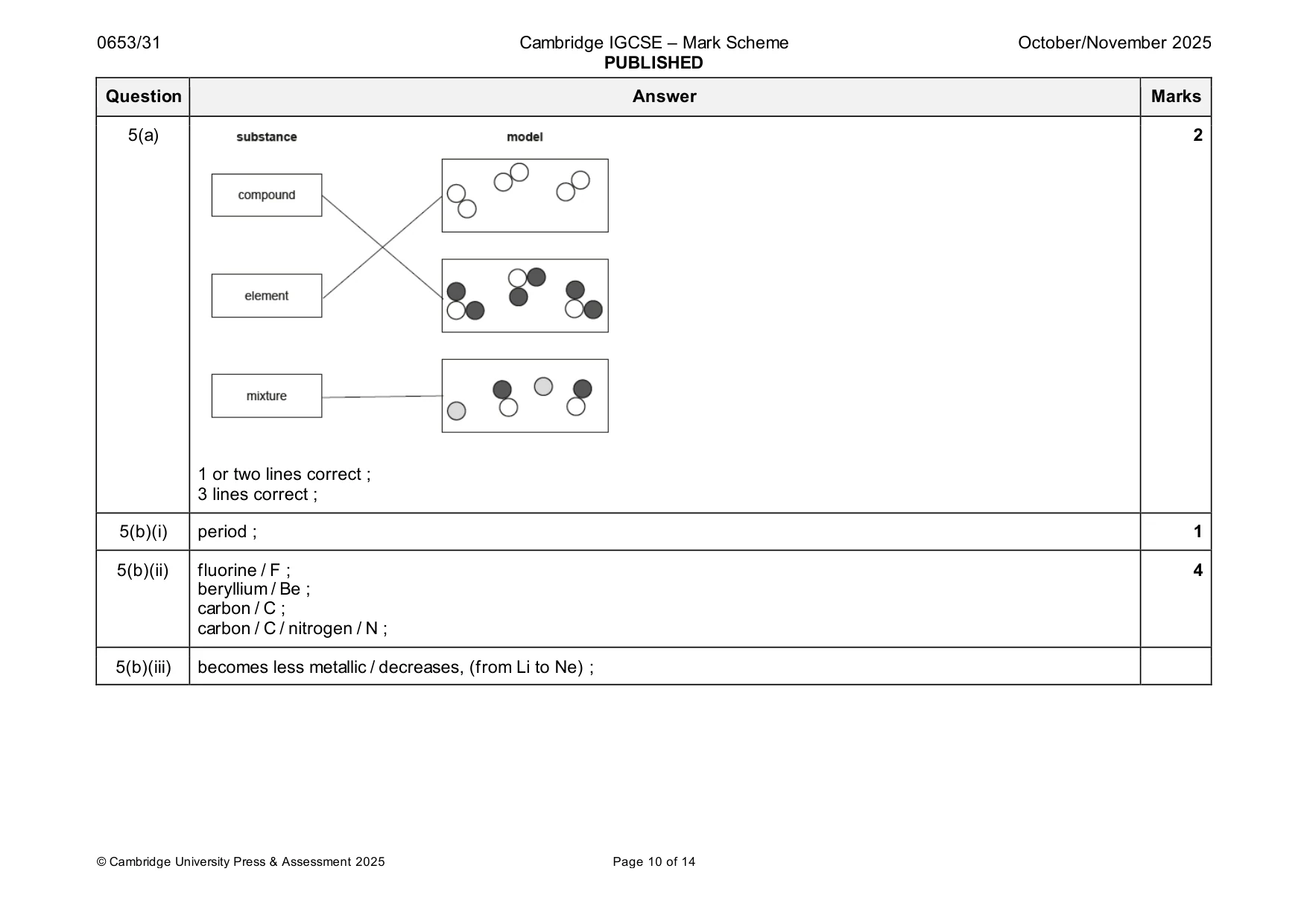
Mark scheme: 5(a) 2 1 or two lines correct ; 3 lines correct ; 5(b)(i) period ; 1 5(b)(ii) fluorine / F ; 4 beryllium / Be ; carbon / C ; carbon / C / nitrogen / N ; 5(b)(iii) becomes less metallic / decreases, (from Li to Ne) ;
Q6 · The combustion of magnesium ribbon in air
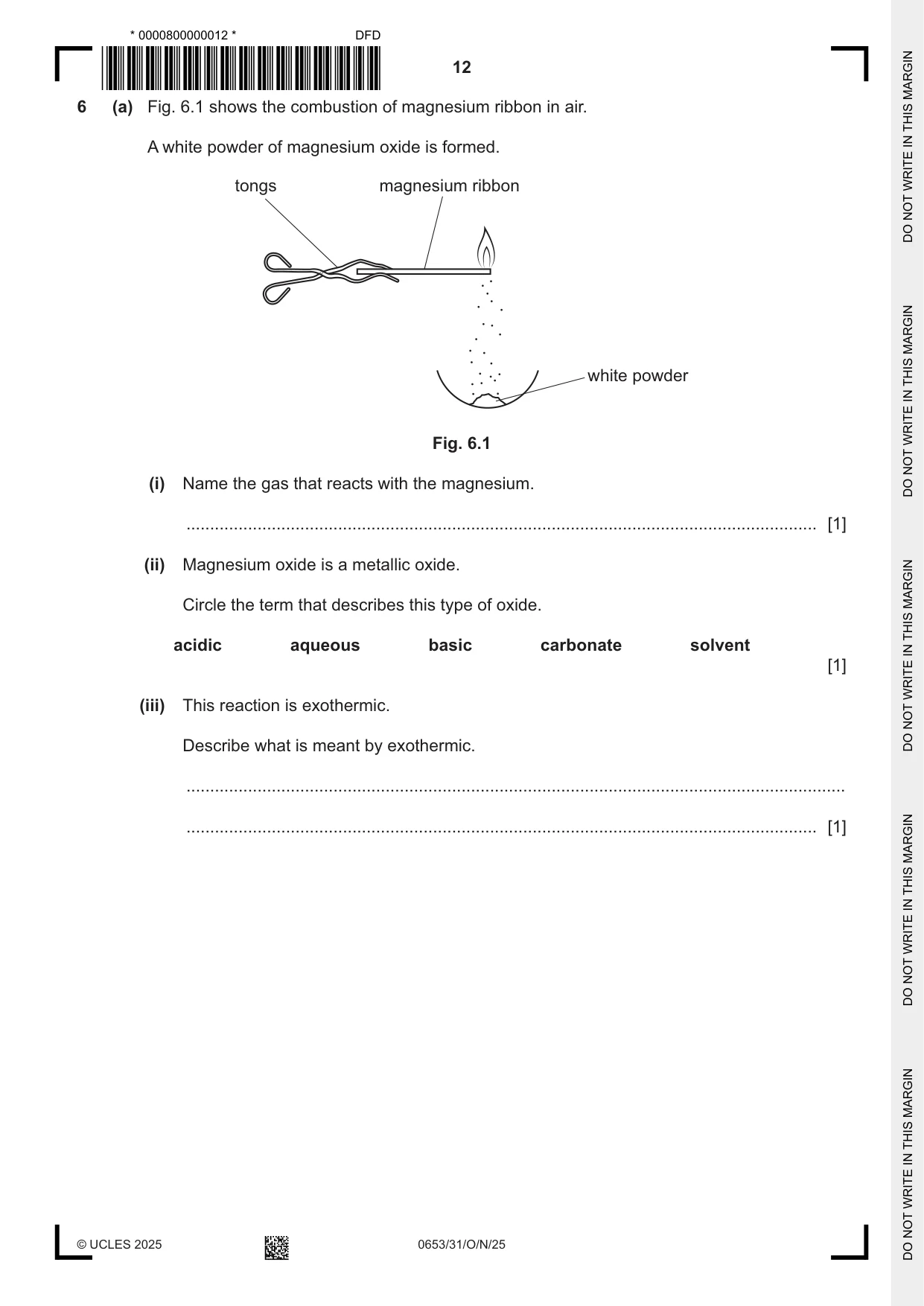
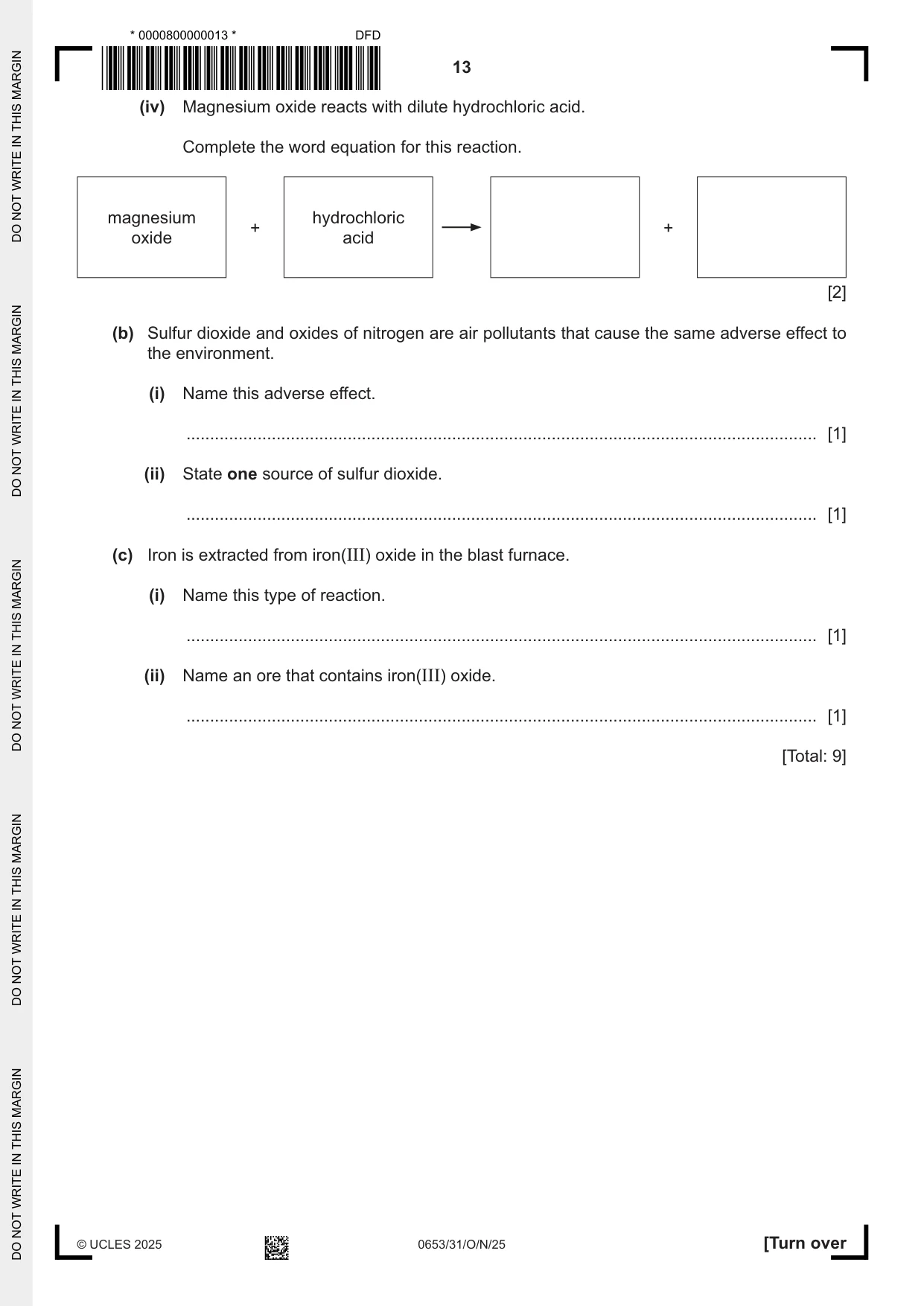
6 (a) Fig. 6.1 shows the combustion of magnesium ribbon in air. A white powder of magnesium oxide is formed. tongs magnesium ribbon white powder Fig. 6.1 (i) Name the gas that reacts with the magnesium. ..................................................................................................................................... [1] (ii) Magnesium oxide is a metallic oxide. Circle the term that describes this type of oxide. acidic aqueous basic carbonate solvent [1] (iii) This reaction is exothermic. Describe what is meant by exothermic. ........................................................................................................................................... ..................................................................................................................................... [1] (iv) Magnesium oxide reacts with dilute hydrochloric acid. Complete the word equation for this reaction. magnesium hydrochloric + + oxide acid [2] (b) Sulfur dioxide and oxides of nitrogen are air pollutants that cause the same adverse effect to the environment. (i) Name this adverse effect. ..................................................................................................................................... [1] (ii) State one source of sulfur dioxide. ..................................................................................................................................... [1] (c) Iron is extracted from iron(III) oxide in the blast furnace. (i) Name this type of reaction. ..................................................................................................................................... [1] (ii) Name an ore that contains iron(III) oxide. ..................................................................................................................................... [1] [Total: 9]
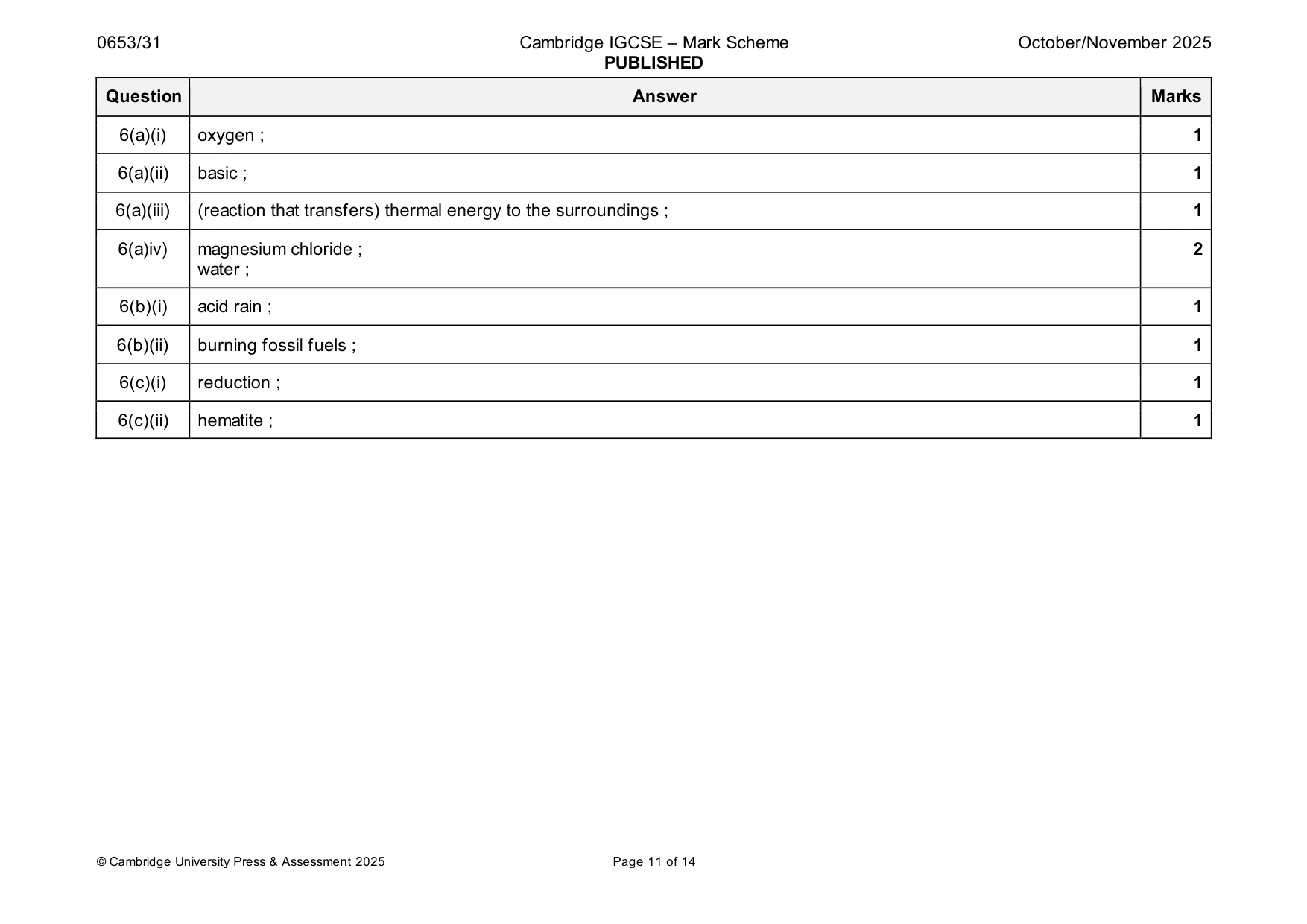
Mark scheme: 6(a)(i) oxygen ; 1 6(a)(ii) basic ; 1 6(a)(iii) (reaction that transfers) thermal energy to the surroundings ; 1 6(a)iv) magnesium chloride ; 2 water ; 6(b)(i) acid rain ; 1 6(b)(ii) burning fossil fuels ; 1 6(c)(i) reduction ; 1 6(c)(ii) hematite ; 1
Q7 · A student rides a bicycle along a straight, level road
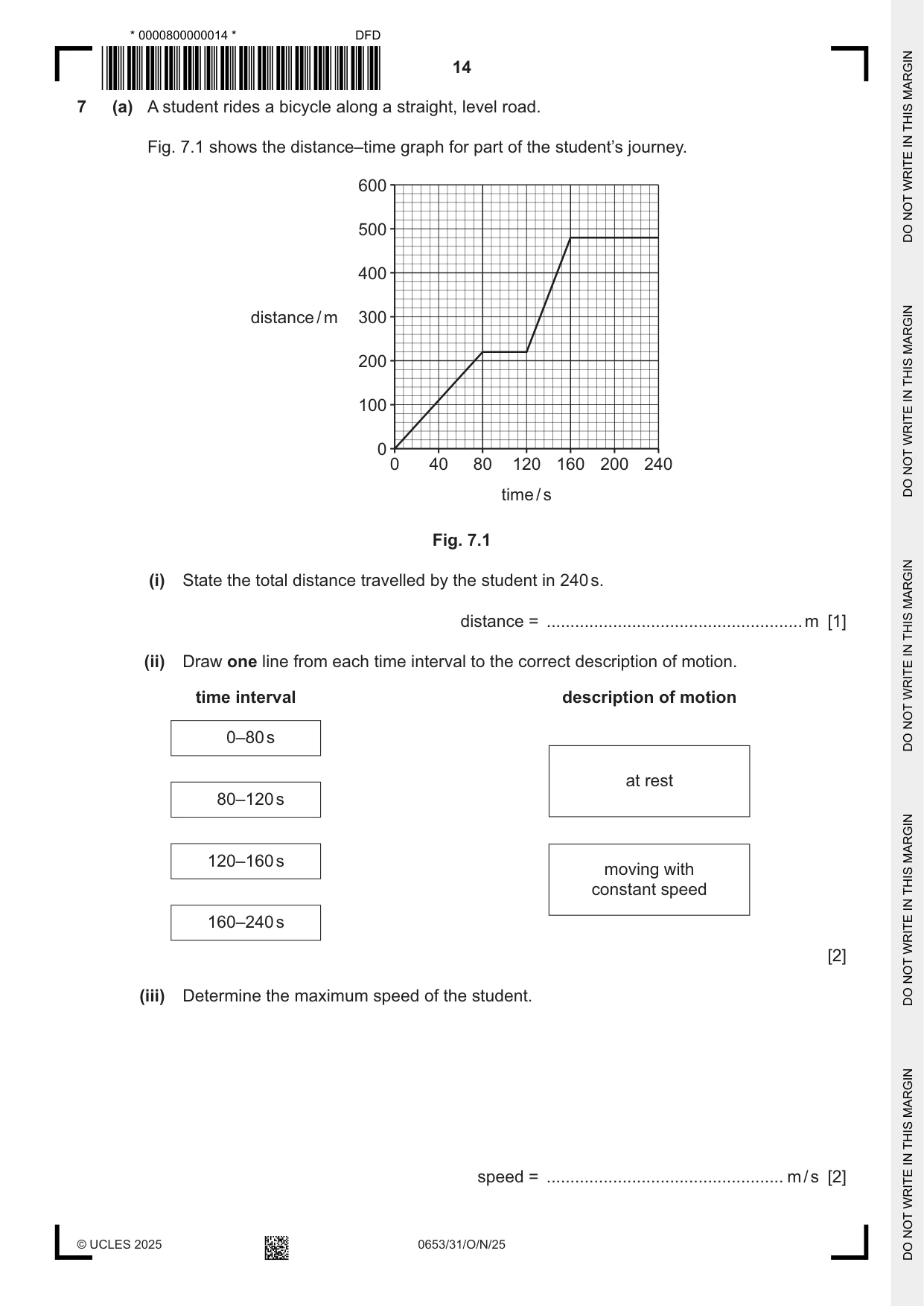
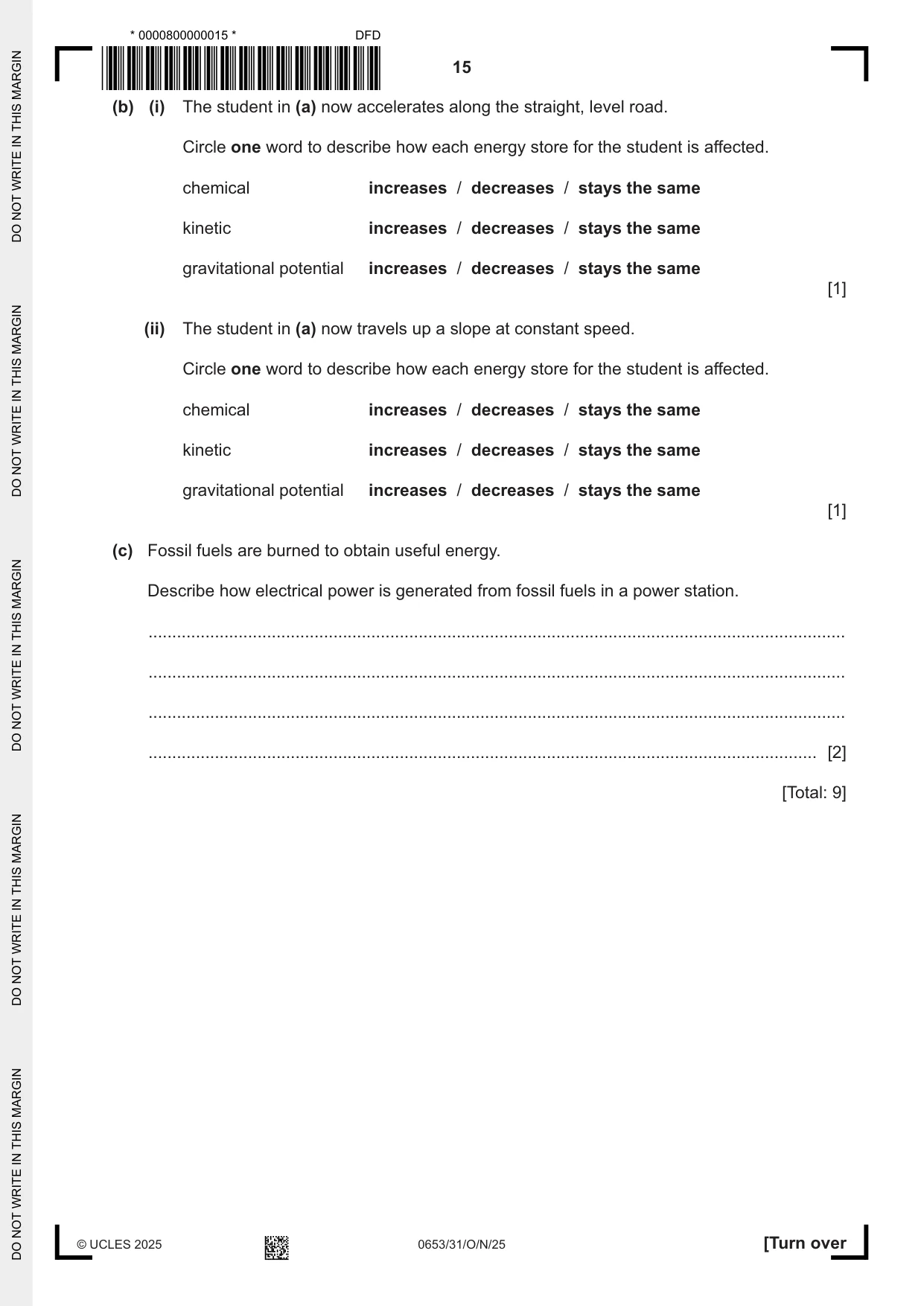
7 (a) A student rides a bicycle along a straight, level road. Fig. 7.1 shows the distance–time graph for part of the student’s journey. 600 500 400 distance / m 300 200 100 0 0 40 80 120 160 200 240 time / s Fig. 7.1 (i) State the total distance travelled by the student in 240 s. distance = ...................................................... m [1] (ii) Draw one line from each time interval to the correct description of motion. time interval description of motion 0–80 s at rest 80–120 s 120–160 s moving with constant speed 160–240 s [2] (iii) Determine the maximum speed of the student. speed = .................................................. m / s [2] (b) (i) The student in (a) now accelerates along the straight, level road. Circle one word to describe how each energy store for the student is affected. chemical increases / decreases / stays the same kinetic increases / decreases / stays the same gravitational potential increases / decreases / stays the same [1] (ii) The student in (a) now travels up a slope at constant speed. Circle one word to describe how each energy store for the student is affected. chemical increases / decreases / stays the same kinetic increases / decreases / stays the same gravitational potential increases / decreases / stays the same [1] (c) Fossil fuels are burned to obtain useful energy. Describe how electrical power is generated from fossil fuels in a power station. ................................................................................................................................................... ................................................................................................................................................... ................................................................................................................................................... ............................................................................................................................................. [2] [Total: 9]
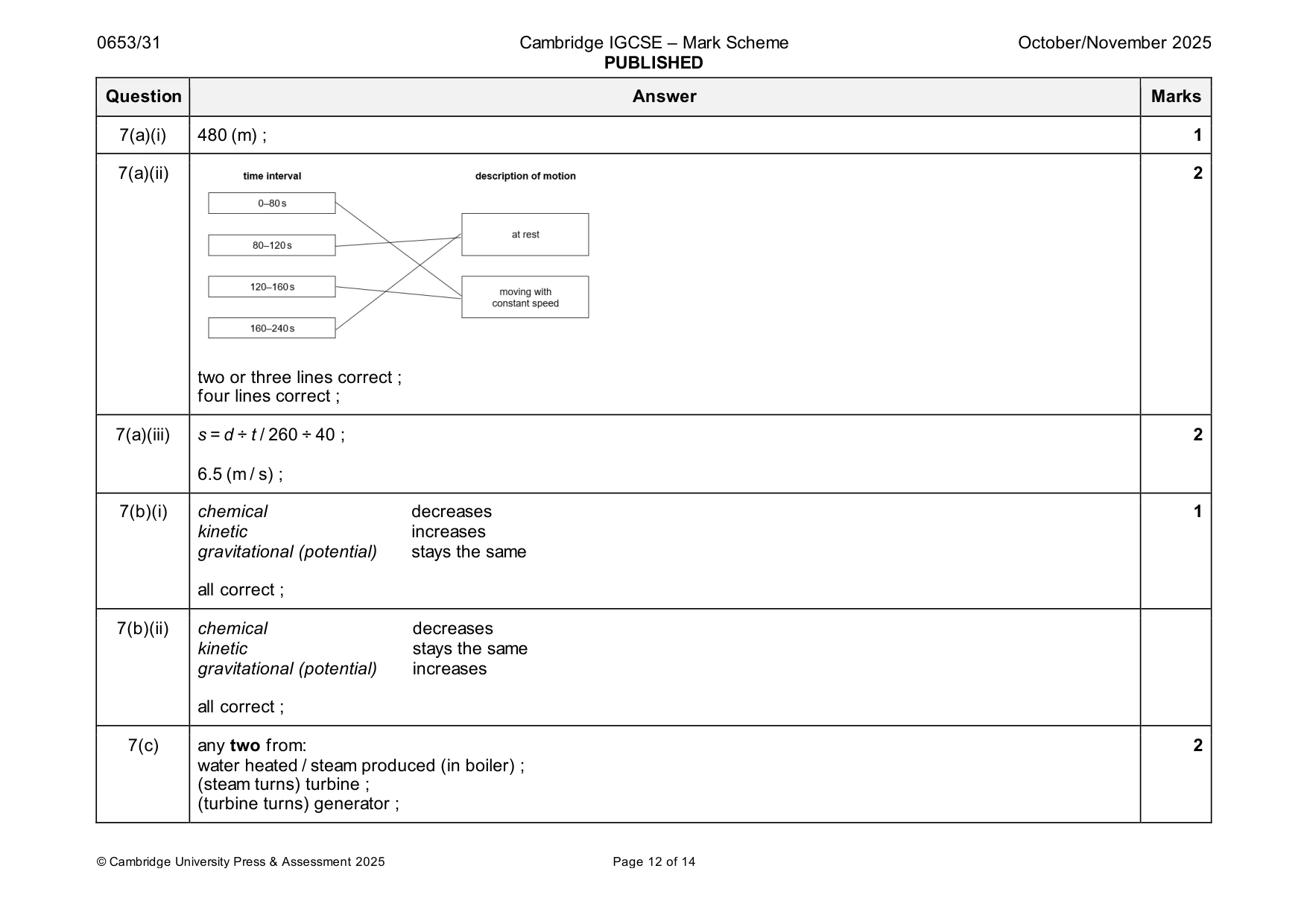
Mark scheme: 7(a)(i) 480 (m) ; 1 7(a)(ii) 2 two or three lines correct ; four lines correct ; 7(a)(iii) s = d ÷ t / 260 ÷ 40 ; 2 6.5 (m / s) ; 7(b)(i) chemical decreases 1 kinetic increases gravitational (potential) stays the same all correct ; 7(b)(ii) chemical decreases kinetic stays the same gravitational (potential) increases all correct ; 7(c) any two from: 2 water heated / steam produced (in boiler) ; (steam turns) turbine ; (turbine turns) generator ;
Q8 · A student writes some statements about the arrangement, separation and motion of…
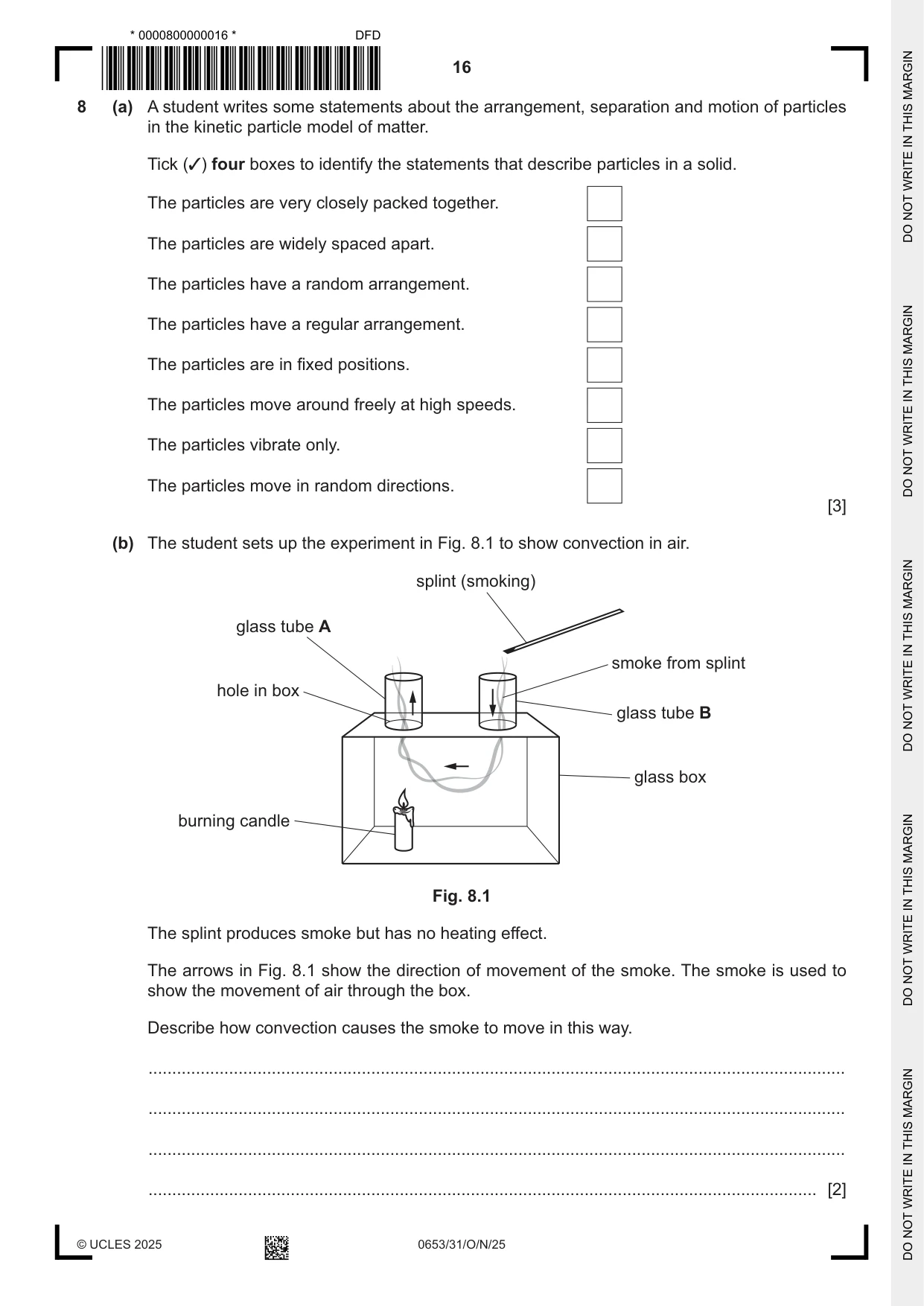
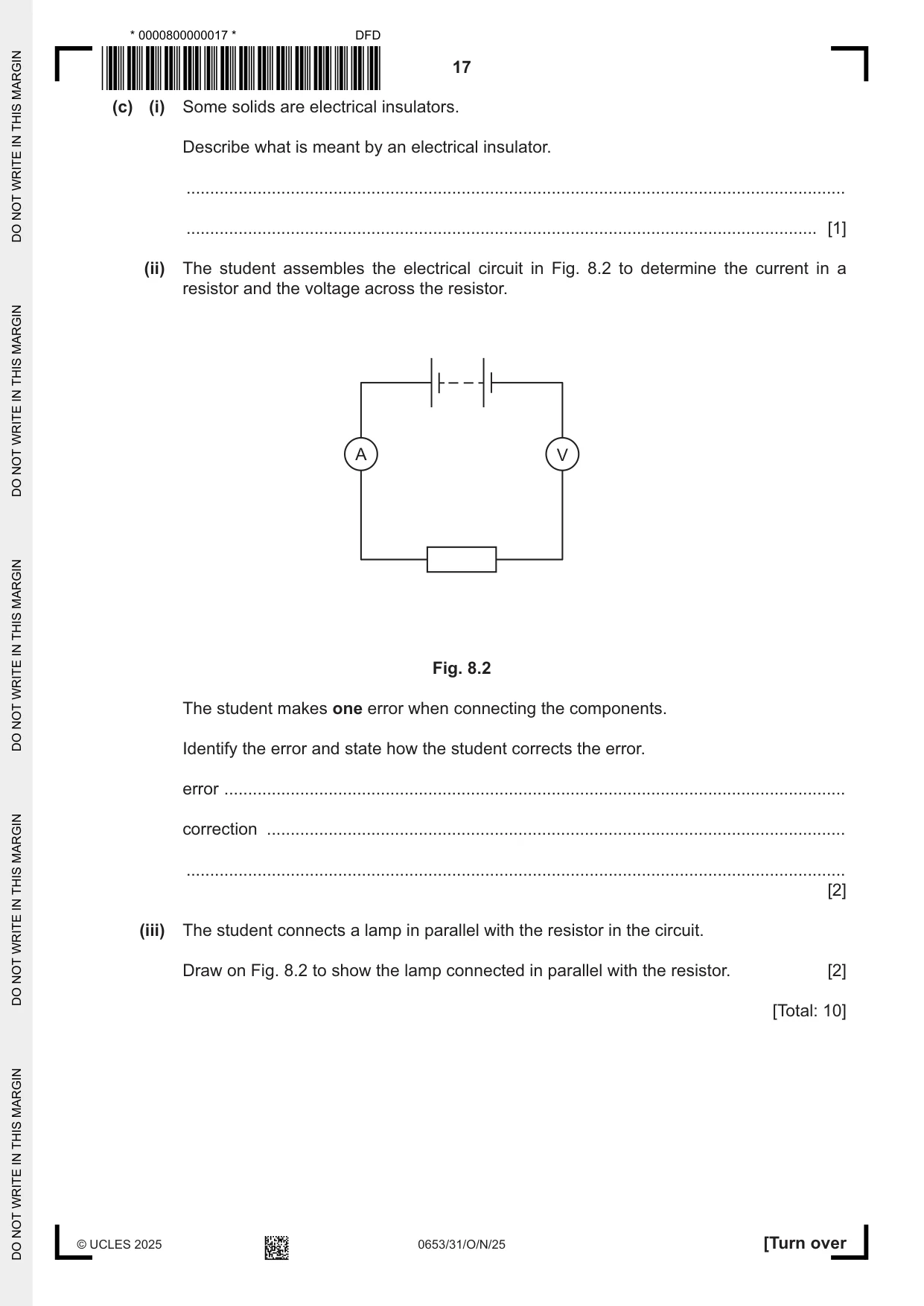
8 (a) A student writes some statements about the arrangement, separation and motion of particles in the kinetic particle model of matter. Tick (✓) four boxes to identify the statements that describe particles in a solid. The particles are very closely packed together. The particles are widely spaced apart. The particles have a random arrangement. The particles have a regular arrangement. The particles are in fixed positions. The particles move around freely at high speeds. The particles vibrate only. The particles move in random directions. [3] (b) The student sets up the experiment in Fig. 8.1 to show convection in air. splint (smoking) glass tube A smoke from splint hole in box glass tube B glass box burning candle Fig. 8.1 The splint produces smoke but has no heating effect. The arrows in Fig. 8.1 show the direction of movement of the smoke. The smoke is used to show the movement of air through the box. Describe how convection causes the smoke to move in this way. ................................................................................................................................................... ................................................................................................................................................... ................................................................................................................................................... ............................................................................................................................................. [2] (c) (i) Some solids are electrical insulators. Describe what is meant by an electrical insulator. ........................................................................................................................................... ..................................................................................................................................... [1] (ii) The student assembles the electrical circuit in Fig. 8.2 to determine the current in a resistor and the voltage across the resistor. A V Fig. 8.2 The student makes one error when connecting the components. Identify the error and state how the student corrects the error. error ................................................................................................................................... correction .......................................................................................................................... ........................................................................................................................................... [2] (iii) The student connects a lamp in parallel with the resistor in the circuit. Draw on Fig. 8.2 to show the lamp connected in parallel with the resistor. [2] [Total: 10]
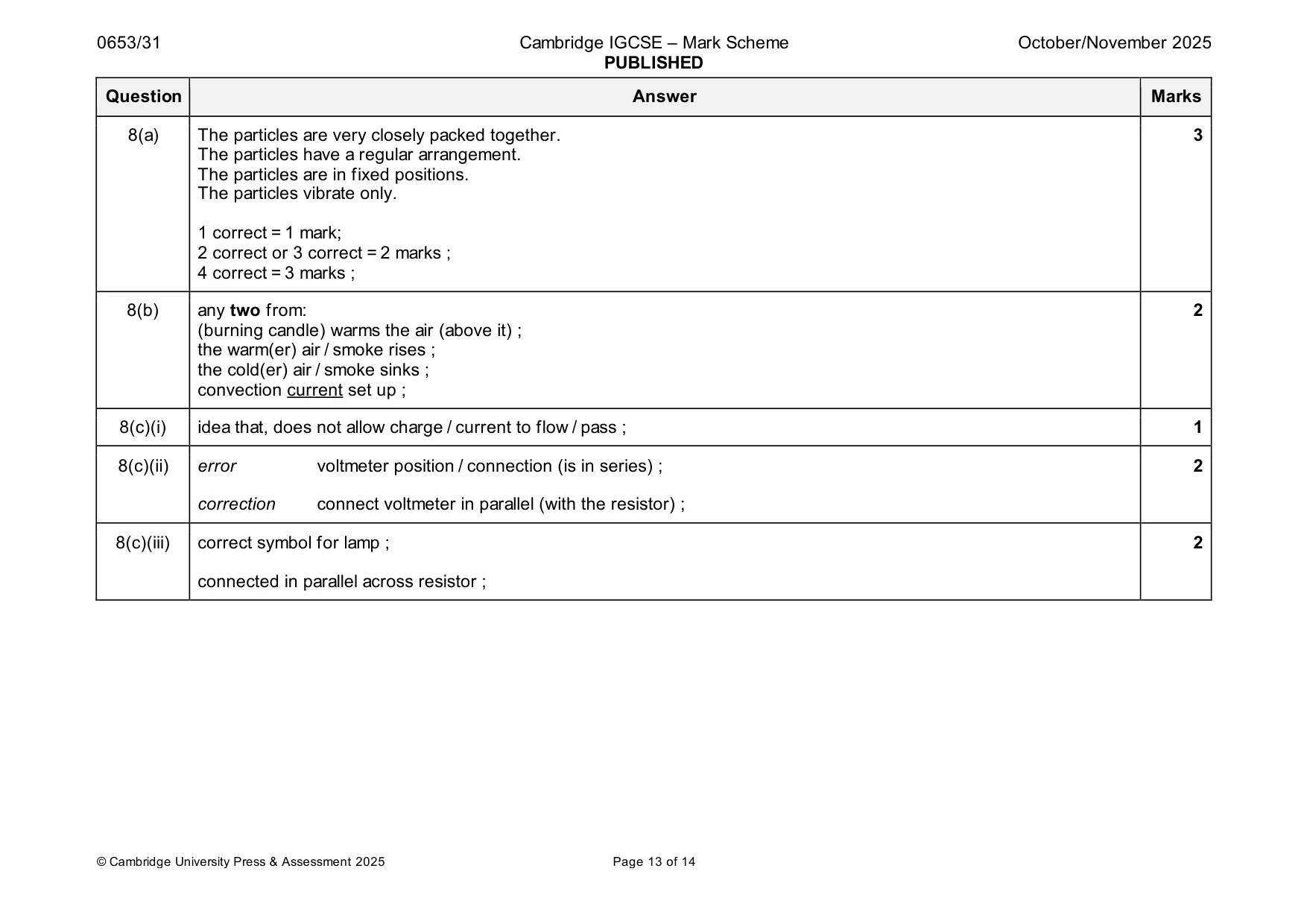
Mark scheme: 8(a) The particles are very closely packed together. 3 The particles have a regular arrangement. The particles are in fixed positions. The particles vibrate only. 1 correct = 1 mark; 2 correct or 3 correct = 2 marks ; 4 correct = 3 marks ; 8(b) any two from: 2 (burning candle) warms the air (above it) ; the warm(er) air / smoke rises ; the cold(er) air / smoke sinks ; convection current set up ; 8(c)(i) idea that, does not allow charge / current to flow / pass ; 1 8(c)(ii) error voltmeter position / connection (is in series) ; 2 correction connect voltmeter in parallel (with the resistor) ; 8(c)(iii) correct symbol for lamp ; 2 connected in parallel across resistor ;
Question 9
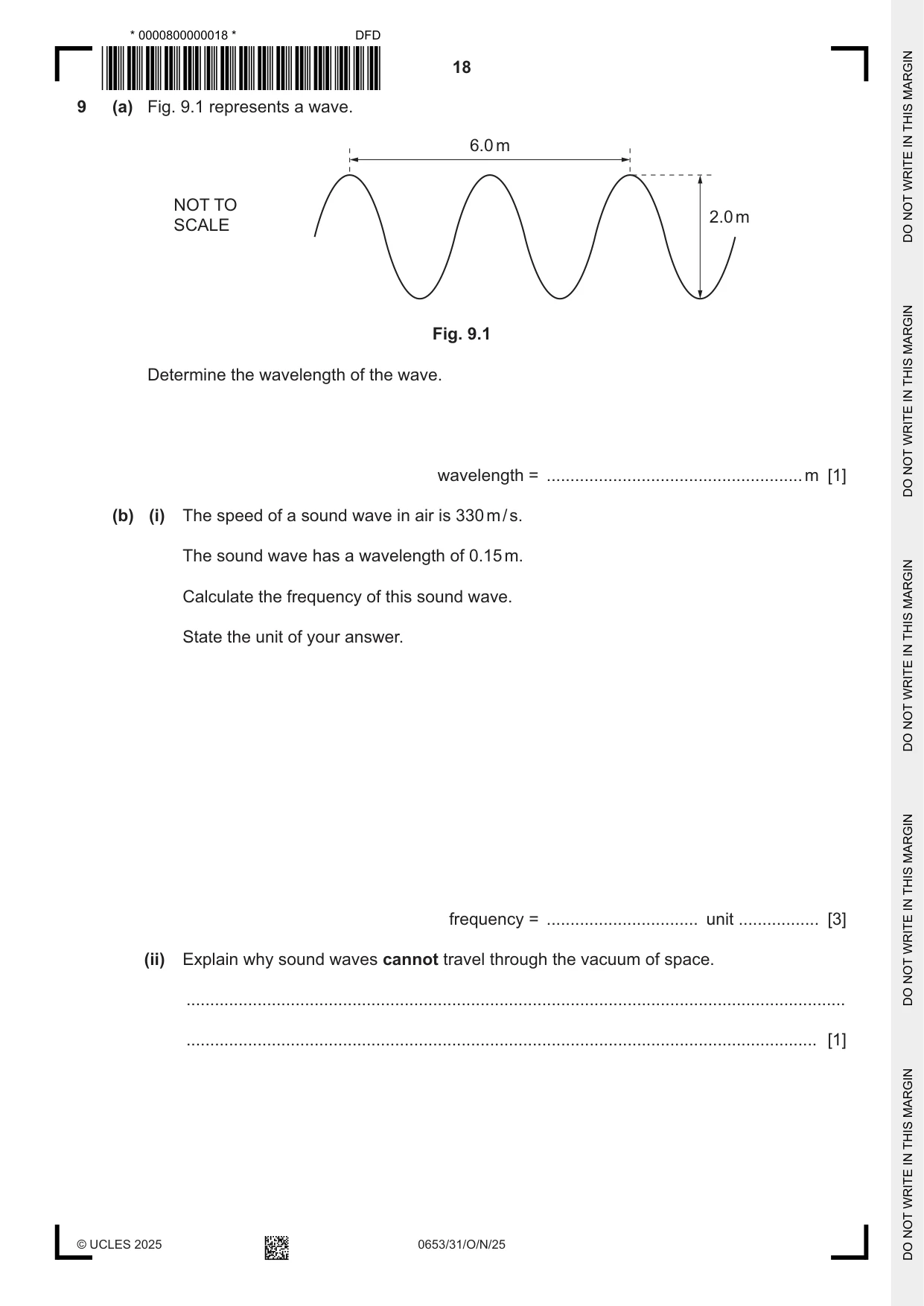
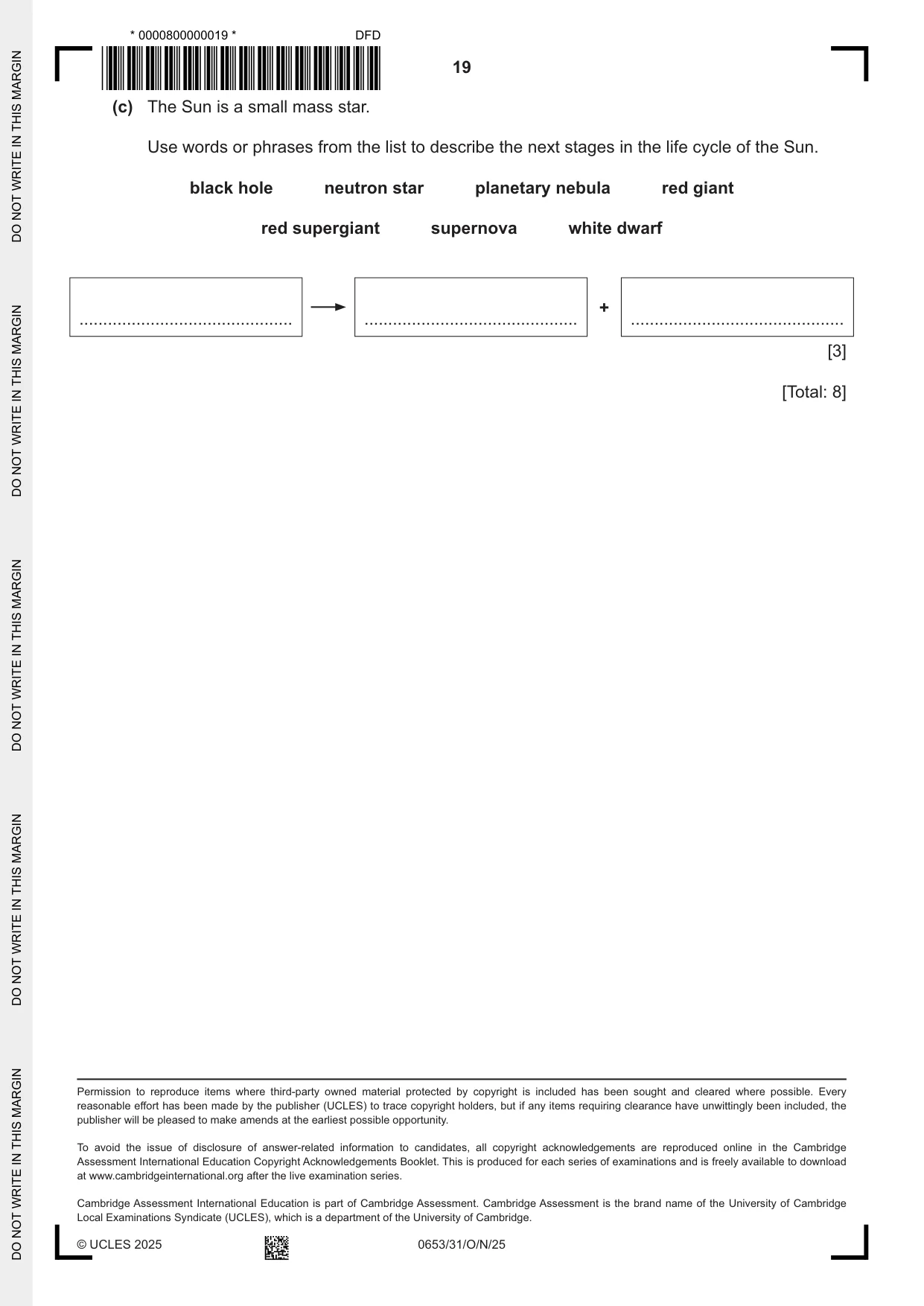
9 (a) Fig. 9.1 represents a wave. 6.0 m NOT TO 2.0 m SCALE Fig. 9.1 Determine the wavelength of the wave. wavelength = ...................................................... m [1] (b) (i) The speed of a sound wave in air is 330 m / s. The sound wave has a wavelength of 0.15 m. Calculate the frequency of this sound wave. State the unit of your answer. frequency = ................................ unit ................. [3] (ii) Explain why sound waves cannot travel through the vacuum of space. ........................................................................................................................................... ..................................................................................................................................... [1] (c) The Sun is a small mass star. Use words or phrases from the list to describe the next stages in the life cycle of the Sun. black hole neutron star planetary nebula red giant red supergiant supernova white dwarf + ............................................. ............................................. ............................................. [3] [Total: 8]
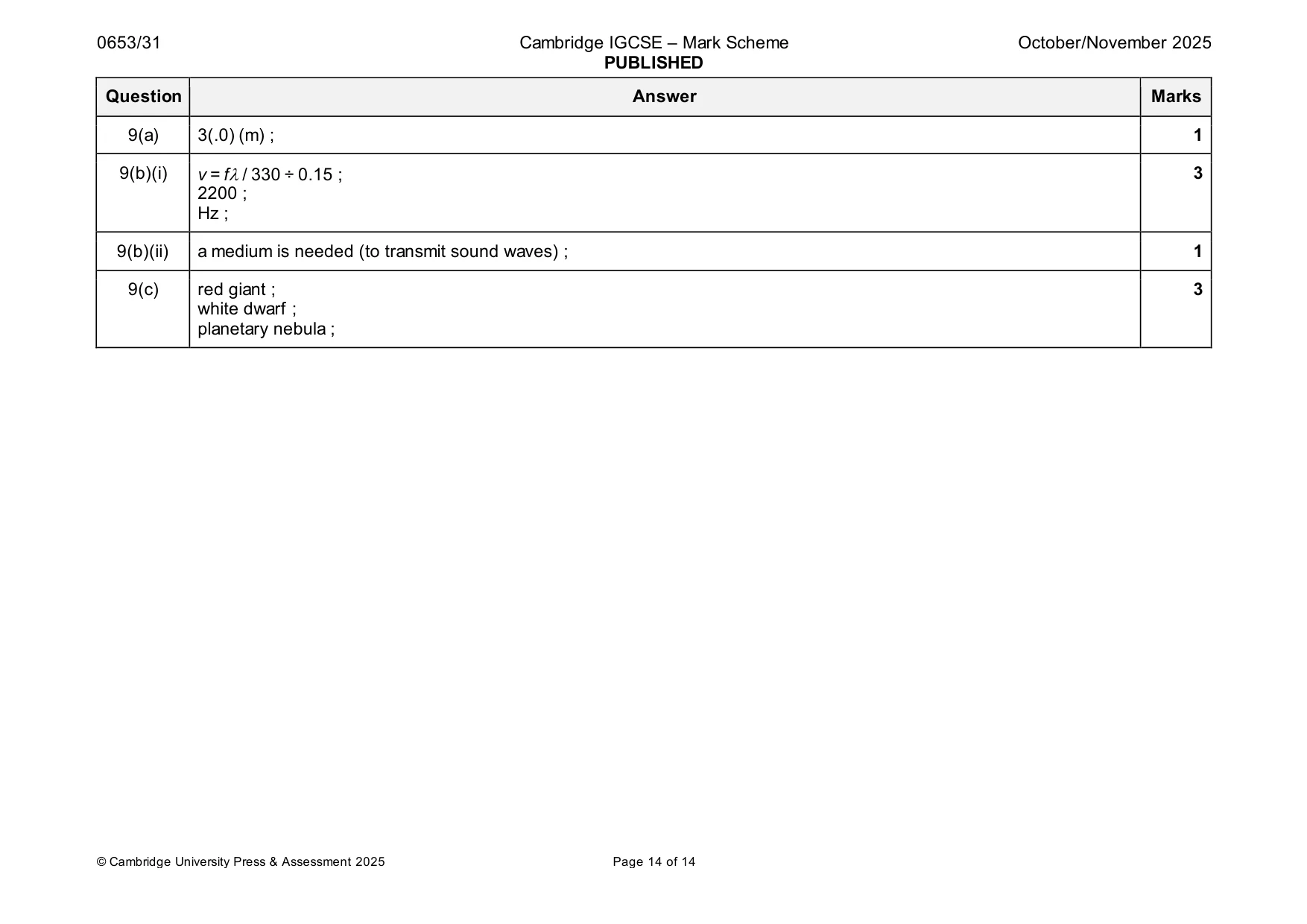
Mark scheme: 9(a) 3(.0) (m) ; 1 9(b)(i) v = f / 330 ÷ 0.15 ; 3 2200 ; Hz ; 9(b)(ii) a medium is needed (to transmit sound waves) ; 1 9(c) red giant ; 3 white dwarf ; planetary nebula ;
What was in this paper
The subtopics covered by these 9 questions, and how many questions each got. Open one in a new tab to see every Cambridge question on it.
What you needed in this session
Cambridge’s own grade thresholds for 2025 Oct/Nov, Paper 3 · Variant 1. A higher threshold means an easier paper — the bar moves with how the cohort did.