Cambridge IGCSE Science - Combined 0653 — 2023 Feb/March Paper 3 · Variant 2
0653/32/F/M/23 · 9 questions · 80 marks · ≈90 min
The question paper and its mark scheme, free to read here and free to download. This is Cambridge’s own paper, exactly as it was sat.
Question paper20 pages

Mark scheme10 pages
Answers below. Sit the paper first if you are practising.
Questions as text
Q1 · The alimentary canal of a human and a bear are similar
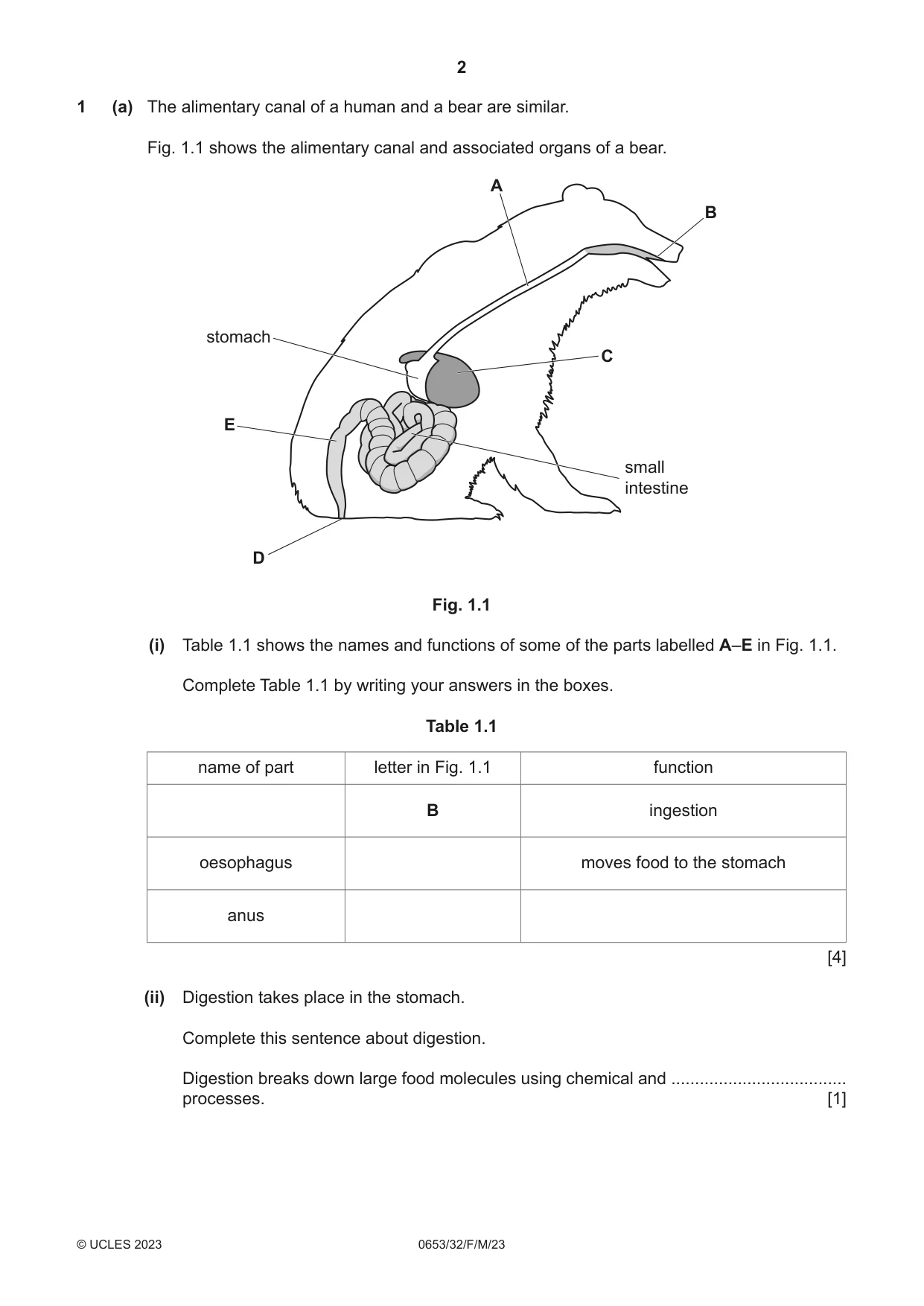
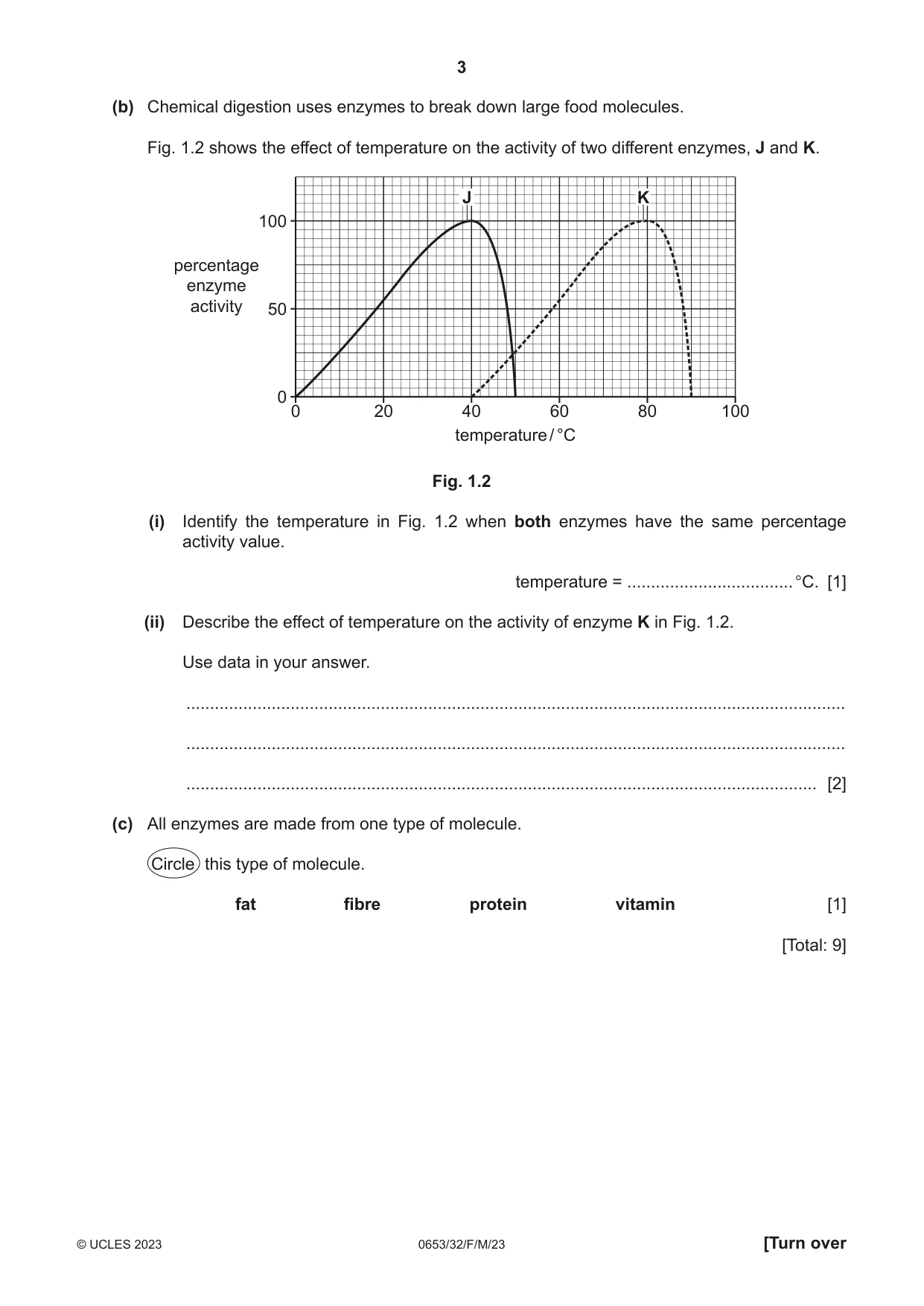
1 (a) The alimentary canal of a human and a bear are similar. Fig. 1.1 shows the alimentary canal and associated organs of a bear. A B stomach C E small intestine D Fig. 1.1 (i) Table 1.1 shows the names and functions of some of the parts labelled A–E in Fig. 1.1. Complete Table 1.1 by writing your answers in the boxes. Table 1.1 name of part letter in Fig. 1.1 function B ingestion oesophagus moves food to the stomach anus [4] (ii) Digestion takes place in the stomach. Complete this sentence about digestion. Digestion breaks down large food molecules using chemical and ..................................... processes. [1] (b) Chemical digestion uses enzymes to break down large food molecules. Fig. 1.2 shows the effect of temperature on the activity of two different enzymes, J and K. J K 100 percentage enzyme activity 50 0 0 20 40 60 80 100 temperature / °C Fig. 1.2 (i) Identify the temperature in Fig. 1.2 when both enzymes have the same percentage activity value. temperature = ................................... °C. [1] (ii) Describe the effect of temperature on the activity of enzyme K in Fig. 1.2. Use data in your answer. ........................................................................................................................................... ........................................................................................................................................... ..................................................................................................................................... [2] (c) All enzymes are made from one type of molecule. Circle this type of molecule. fat fibre protein vitamin [1] [Total: 9]
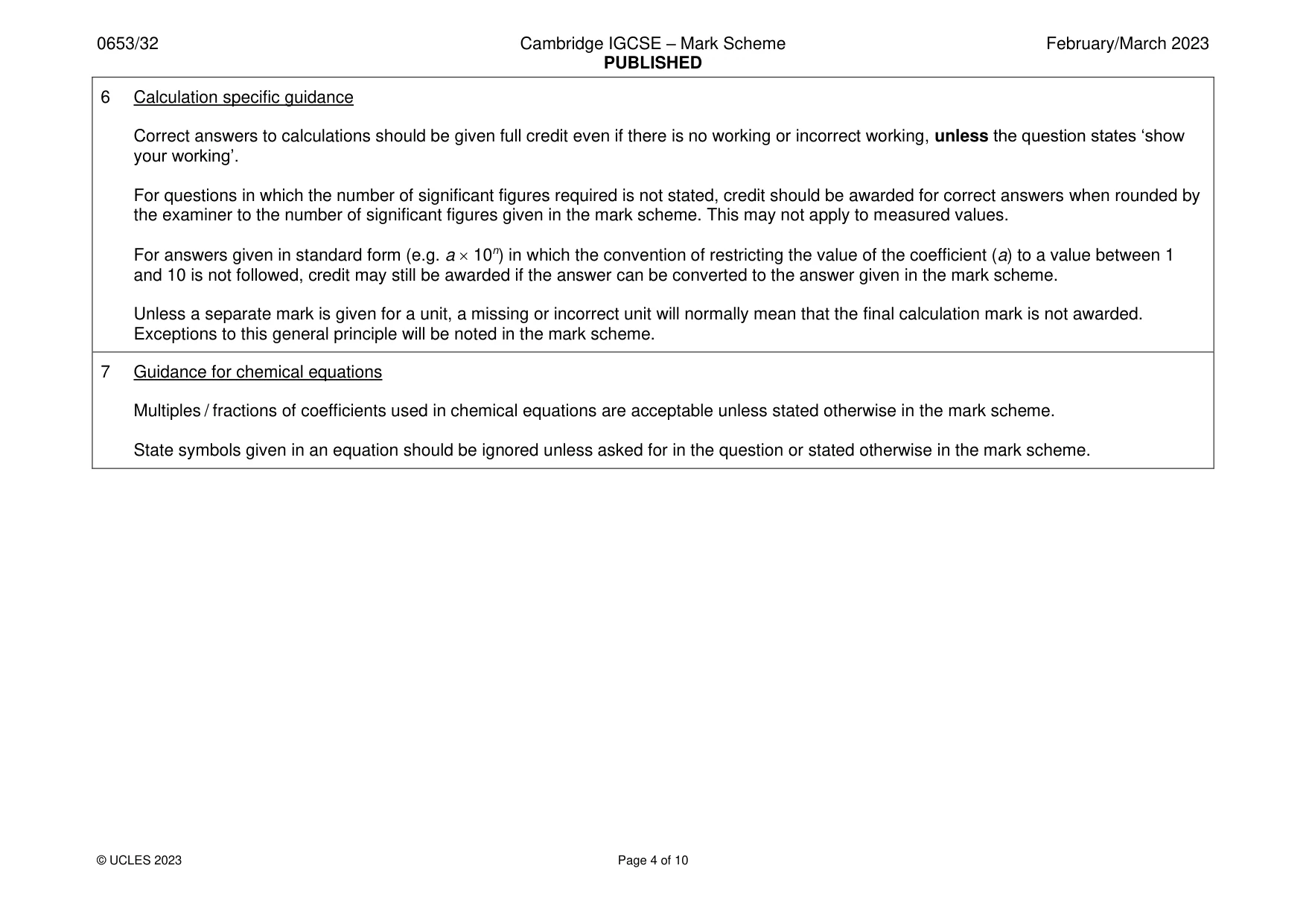
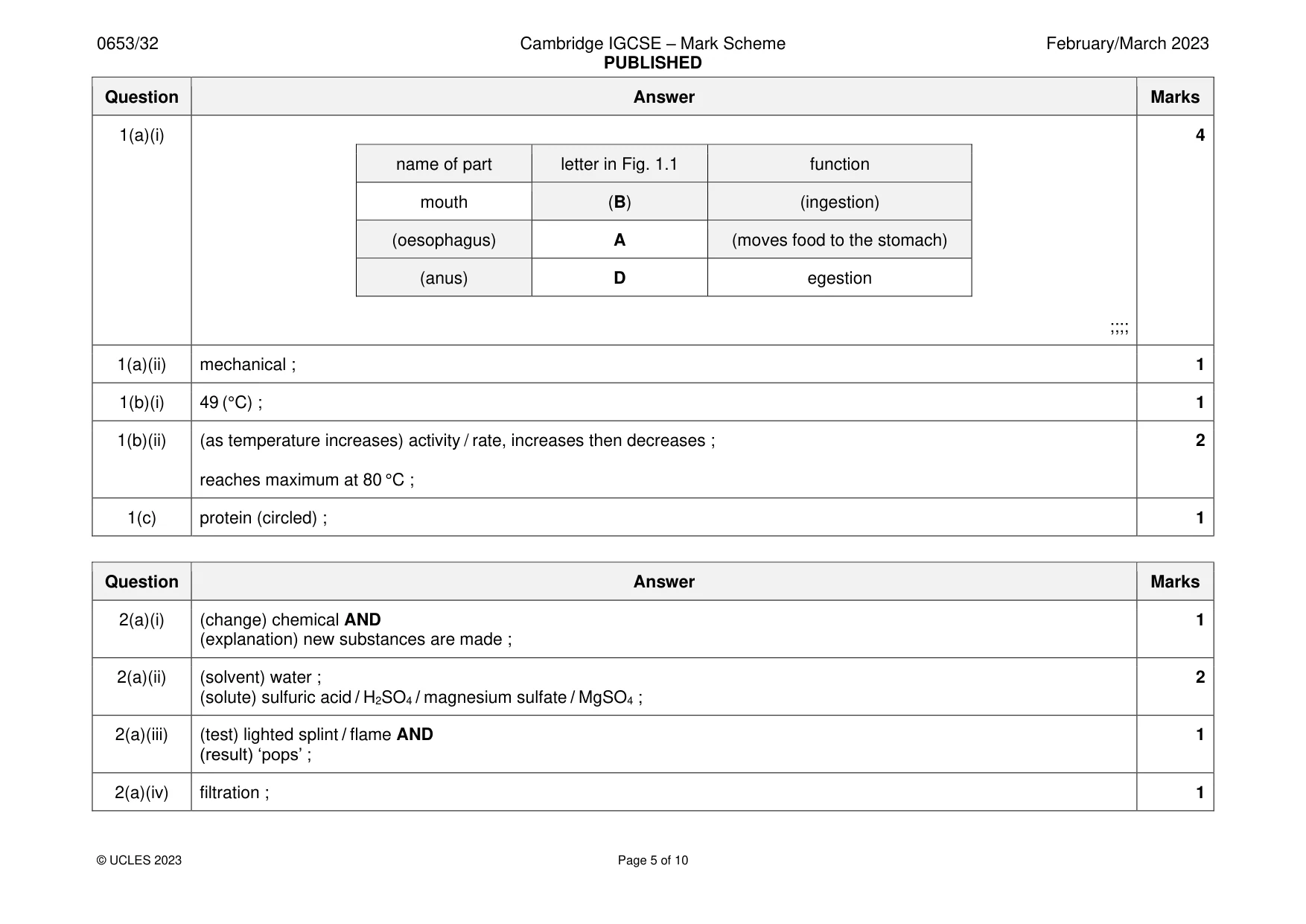
Mark scheme: Question Answer Marks 1(a)(i) 4 name of part letter in Fig. 1.1 function mouth (B) (ingestion) (oesophagus) A (moves food to the stomach) (anus) D egestion ;;;; 1(a)(ii) mechanical ; 1 1(b)(i) 49 (°C) ; 1 1(b)(ii) (as temperature increases) activity / rate, increases then decreases ; 2 reaches maximum at 80 °C ; 1(c) protein (circled) ; 1
Q2 · A student adds excess magnesium to dilute sulfuric acid
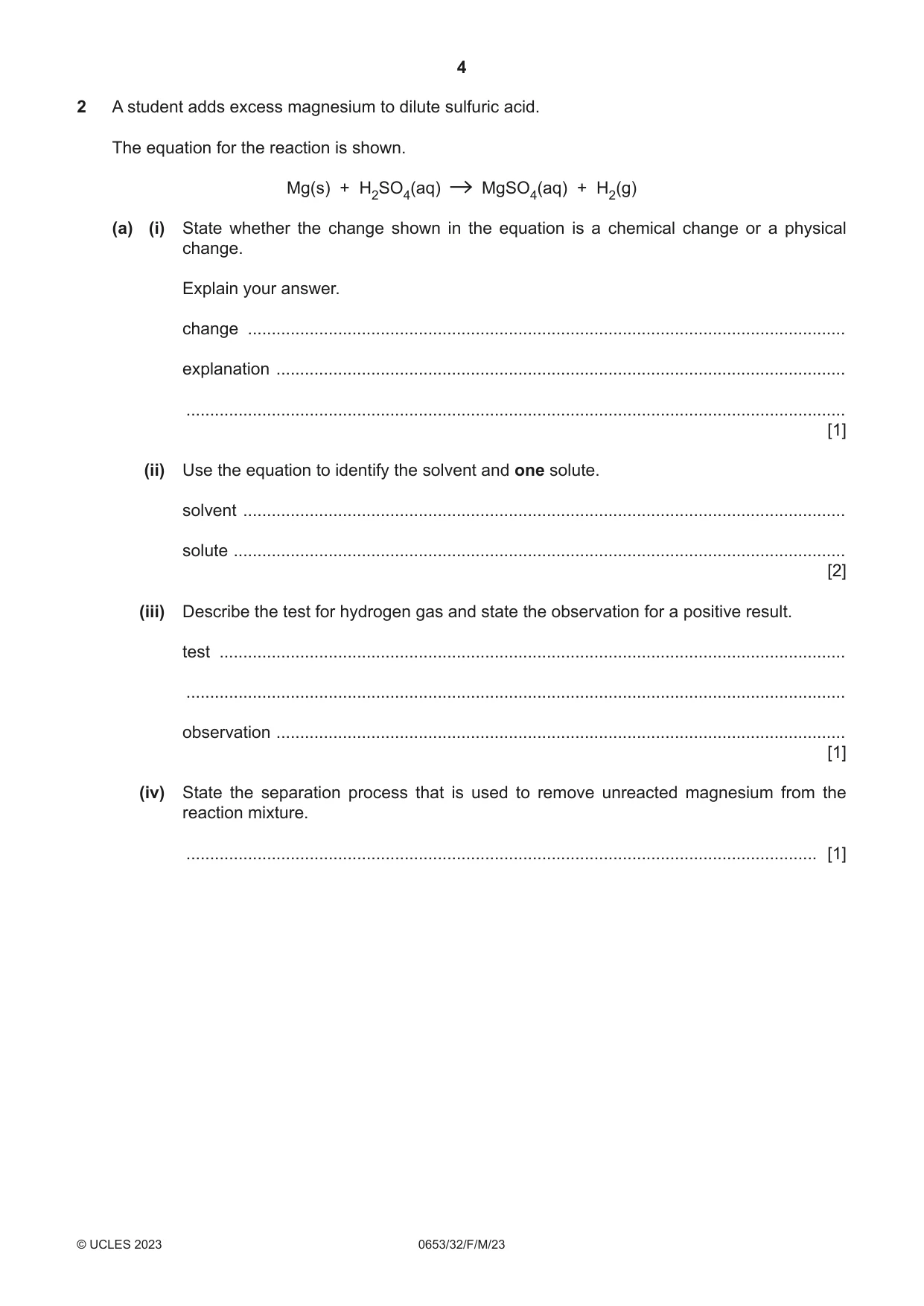
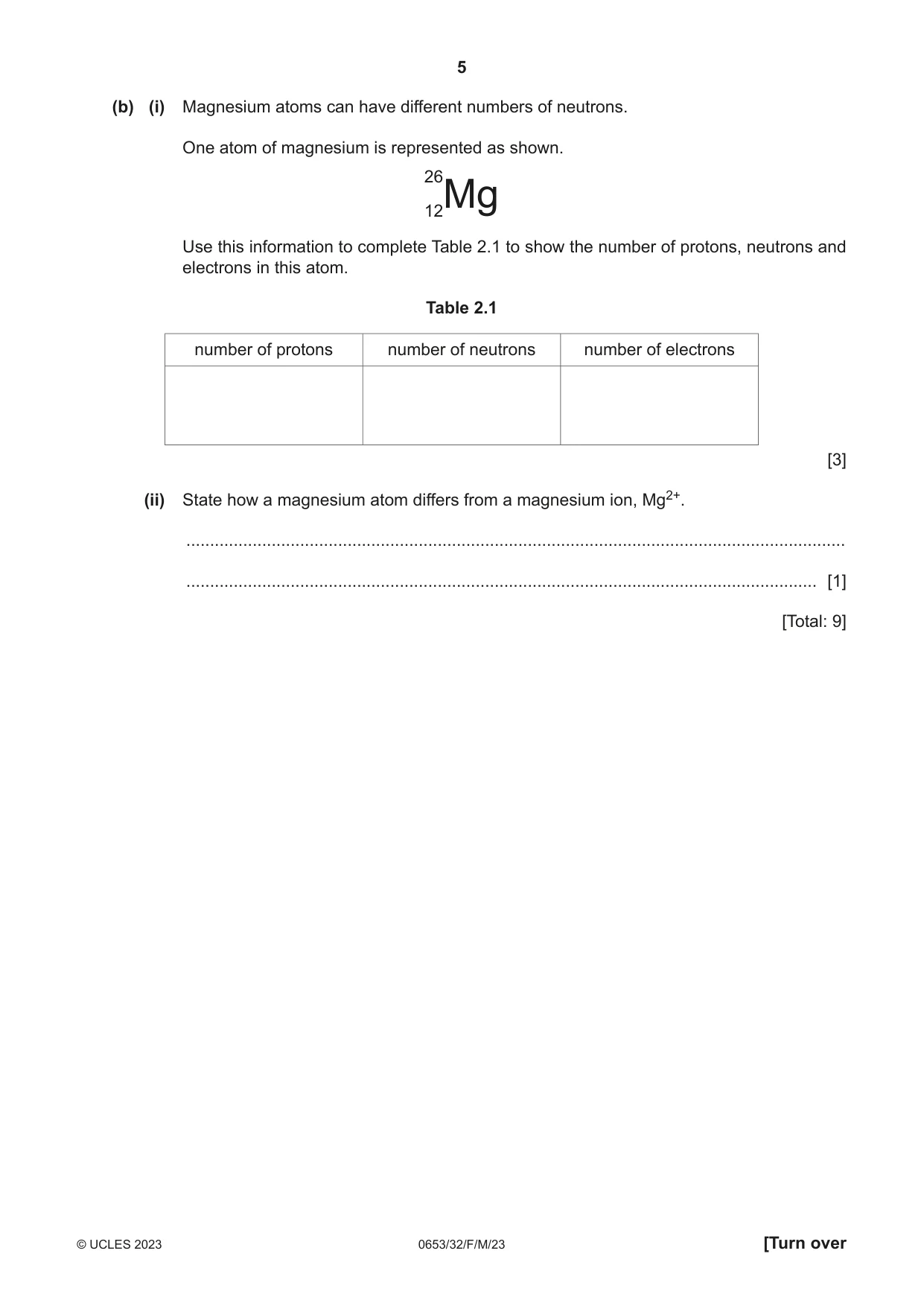
2 A student adds excess magnesium to dilute sulfuric acid. The equation for the reaction is shown. Mg(s) + H2SO4(aq) MgSO4(aq) + H2(g) (a) (i) State whether the change shown in the equation is a chemical change or a physical change. Explain your answer. change .............................................................................................................................. explanation ........................................................................................................................ ........................................................................................................................................... [1] (ii) Use the equation to identify the solvent and one solute. solvent ............................................................................................................................... solute ................................................................................................................................. [2] (iii) Describe the test for hydrogen gas and state the observation for a positive result. test .................................................................................................................................... ........................................................................................................................................... observation ........................................................................................................................ [1] (iv) State the separation process that is used to remove unreacted magnesium from the reaction mixture. ..................................................................................................................................... [1] (b) (i) Magnesium atoms can have different numbers of neutrons. One atom of magnesium is represented as shown. 2612Mg Use this information to complete Table 2.1 to show the number of protons, neutrons and electrons in this atom. Table 2.1 number of protons number of neutrons number of electrons [3] (ii) State how a magnesium atom differs from a magnesium ion, Mg2+. ........................................................................................................................................... ..................................................................................................................................... [1] [Total: 9]
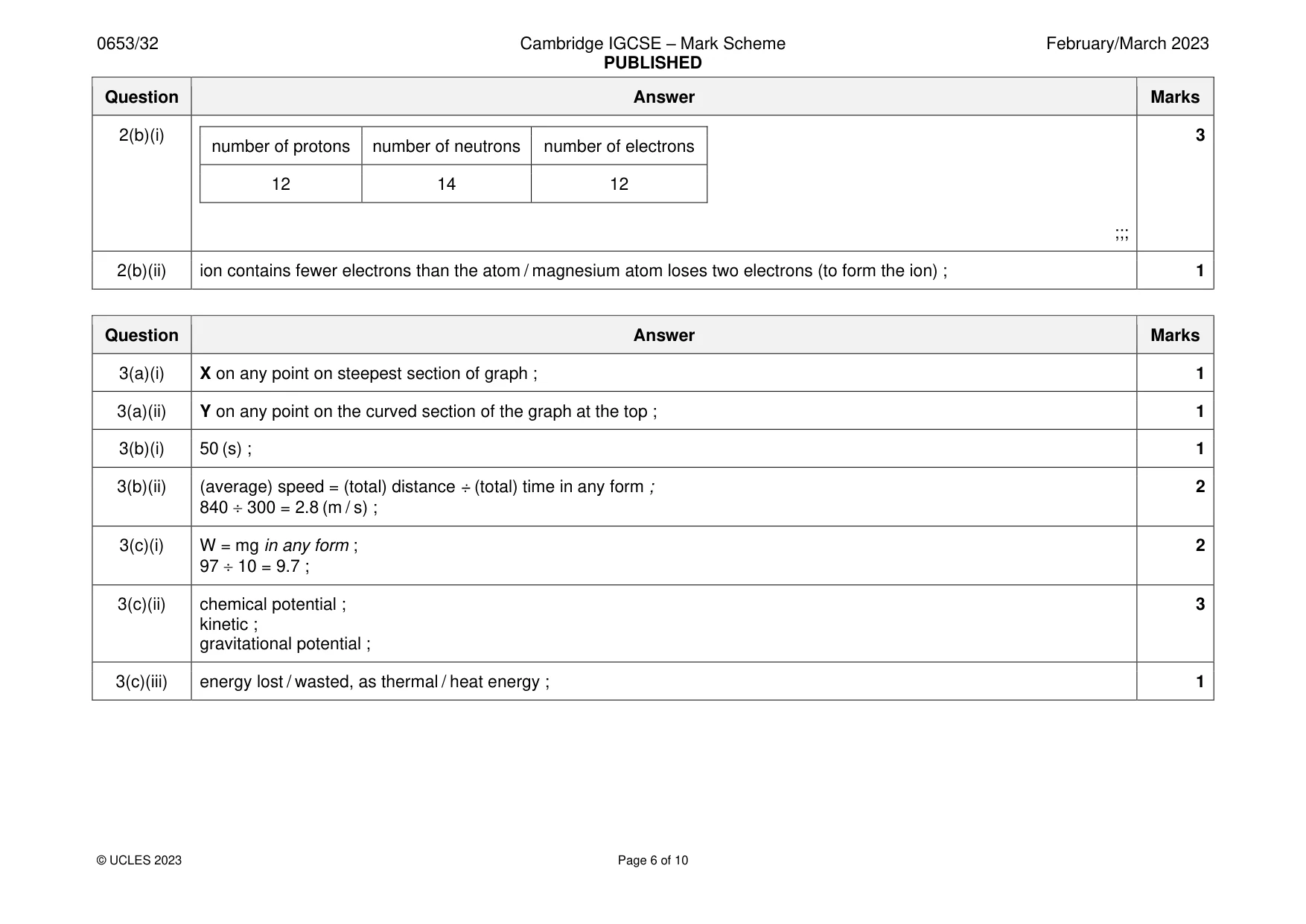
Mark scheme: 2(a)(i) (change) chemical AND 1 (explanation) new substances are made ; 2(a)(ii) (solvent) water ; 2 (solute) sulfuric acid / H2SO4 / magnesium sulfate / MgSO4 ; 2(a)(iii) (test) lighted splint / flame AND 1 (result) ‘pops’ ; 2(a)(iv) filtration ; 1 2(b)(i) 3 number of protons number of neutrons number of electrons 12 14 12 ;;; 2(b)(ii) ion contains fewer electrons than the atom / magnesium atom loses two electrons (to form the ion) ; 1
Q3 · A distance–time graph for a student riding a bicycle
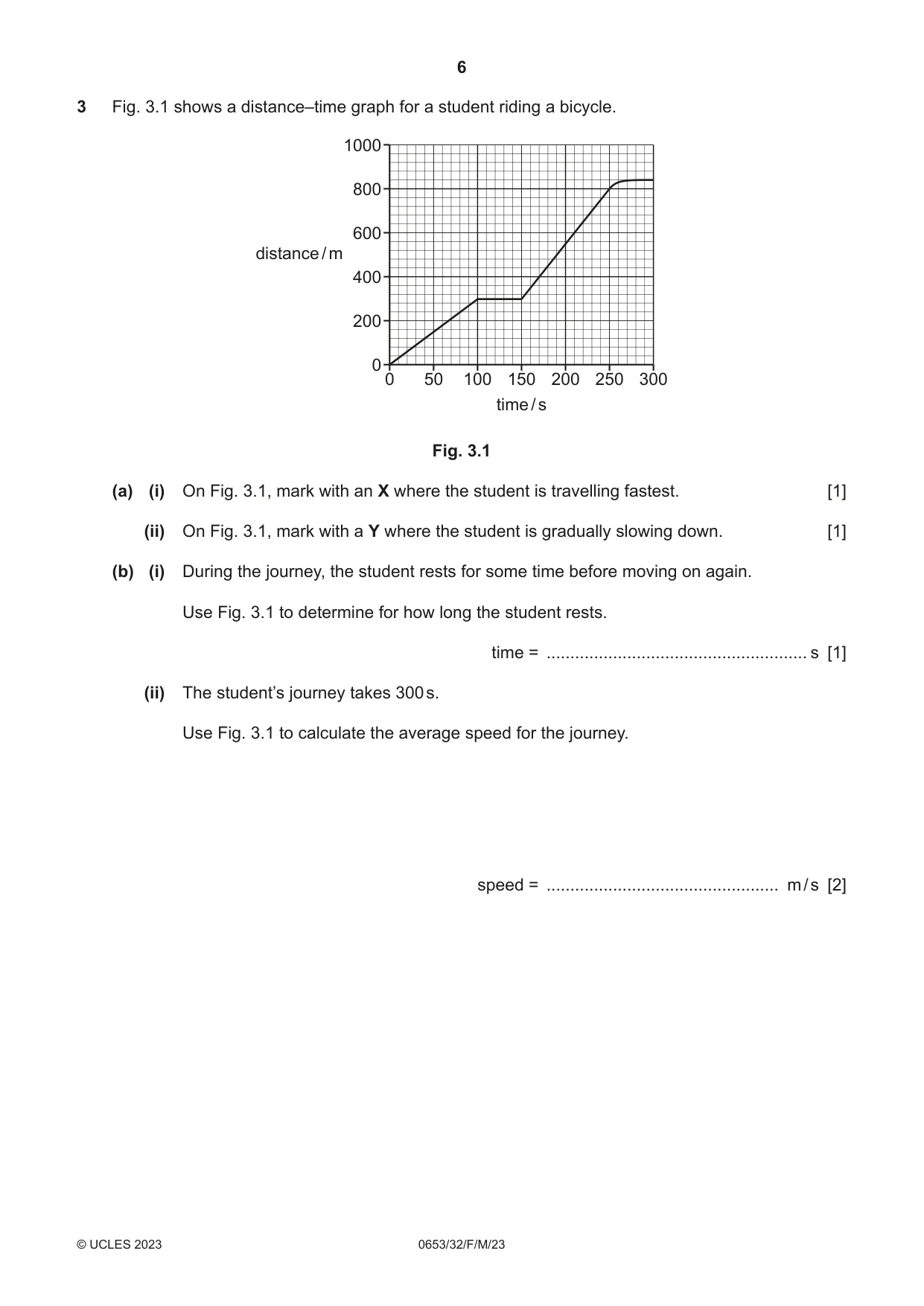
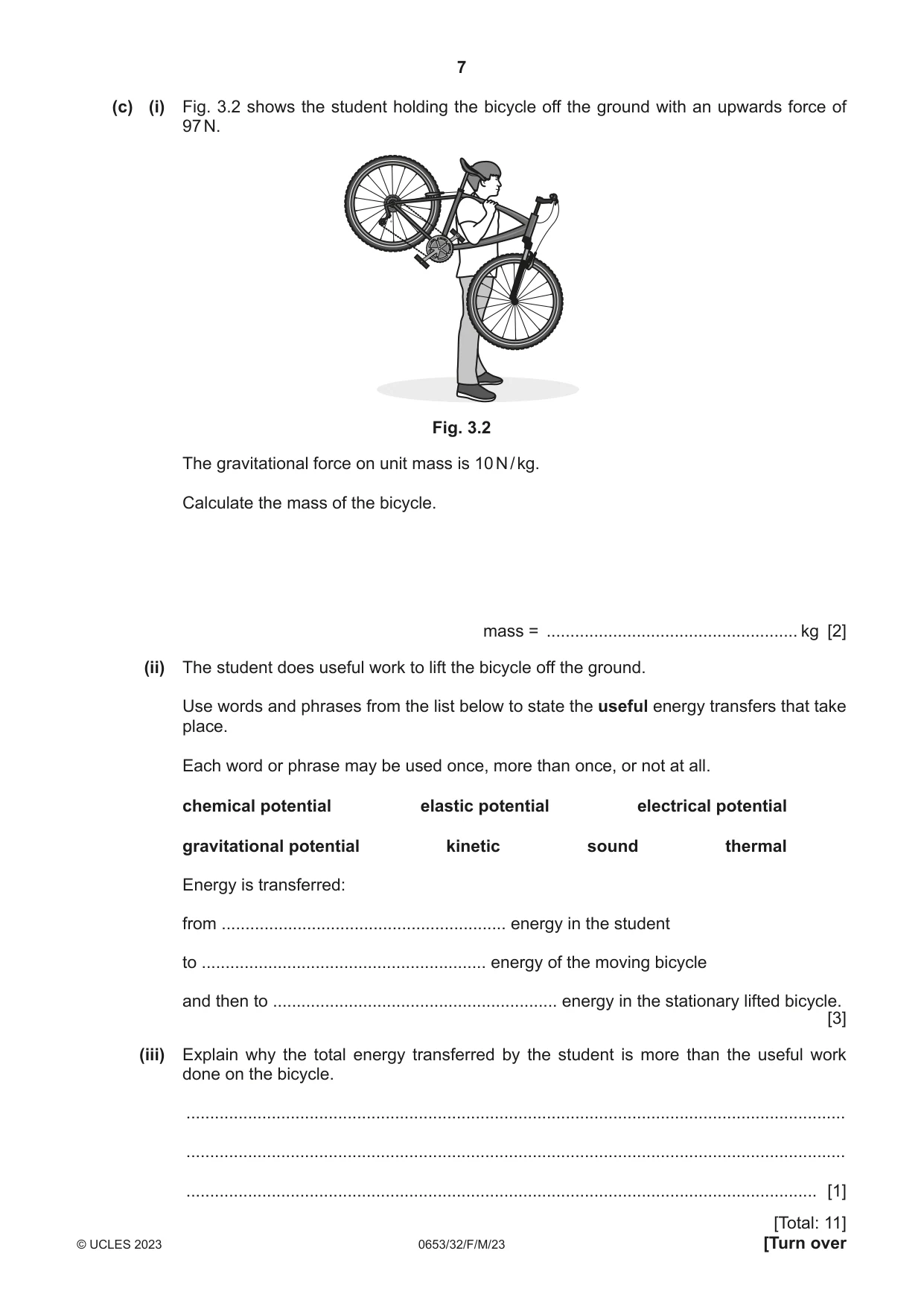
3 Fig. 3.1 shows a distance–time graph for a student riding a bicycle. 1000 800 600 distance / m 400 200 0 0 50 100 150 200 250 300 time / s Fig. 3.1 (a) (i) On Fig. 3.1, mark with an X where the student is travelling fastest. [1] (ii) On Fig. 3.1, mark with a Y where the student is gradually slowing down. [1] (b) (i) During the journey, the student rests for some time before moving on again. Use Fig. 3.1 to determine for how long the student rests. time = ....................................................... s [1] (ii) The student’s journey takes 300 s. Use Fig. 3.1 to calculate the average speed for the journey. speed = ................................................. m / s [2] (c) (i) Fig. 3.2 shows the student holding the bicycle off the ground with an upwards force of 97 N. Fig. 3.2 The gravitational force on unit mass is 10 N / kg. Calculate the mass of the bicycle. mass = ..................................................... kg [2] (ii) The student does useful work to lift the bicycle off the ground. Use words and phrases from the list below to state the useful energy transfers that take place. Each word or phrase may be used once, more than once, or not at all. chemical potential elastic potential electrical potential gravitational potential kinetic sound thermal Energy is transferred: from ............................................................ energy in the student to ............................................................ energy of the moving bicycle and then to ............................................................ energy in the stationary lifted bicycle. [3] (iii) Explain why the total energy transferred by the student is more than the useful work done on the bicycle. ........................................................................................................................................... ........................................................................................................................................... ..................................................................................................................................... [1]
Mark scheme: 3(a)(i) X on any point on steepest section of graph ; 1 3(a)(ii) Y on any point on the curved section of the graph at the top ; 1 3(b)(i) 50 (s) ; 1 3(b)(ii) (average) speed = (total) distance ÷ (total) time in any form ; 2 840 300 = 2.8 (m / s) ; 3(c)(i) W = mg in any form ; 2 97 10 = 9.7 ; 3(c)(ii) chemical potential ; 3 kinetic ; gravitational potential ; 3(c)(iii) energy lost / wasted, as thermal / heat energy ; 1
Q4 · The boxes on the left name some parts of the male reproductive system in humans
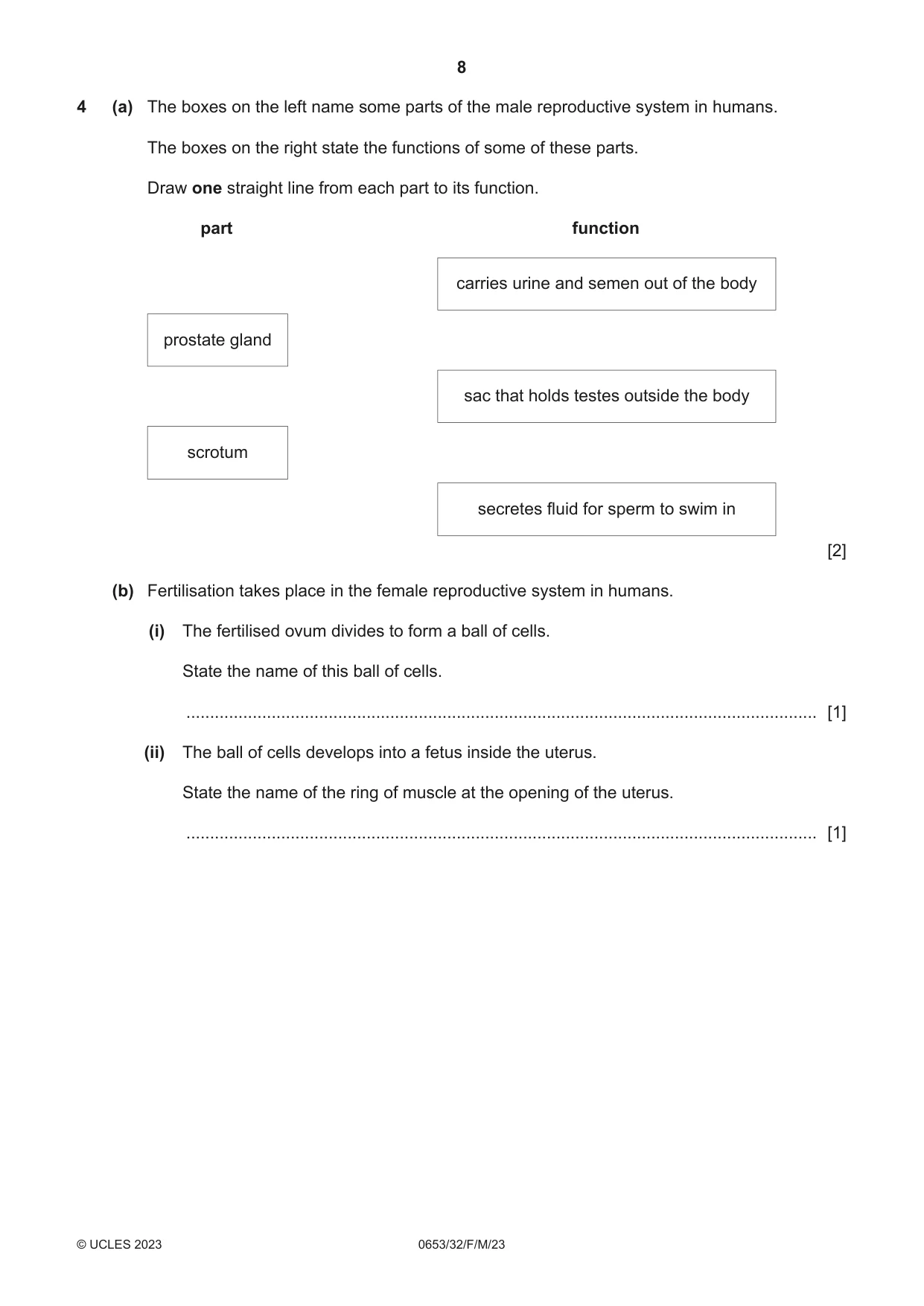
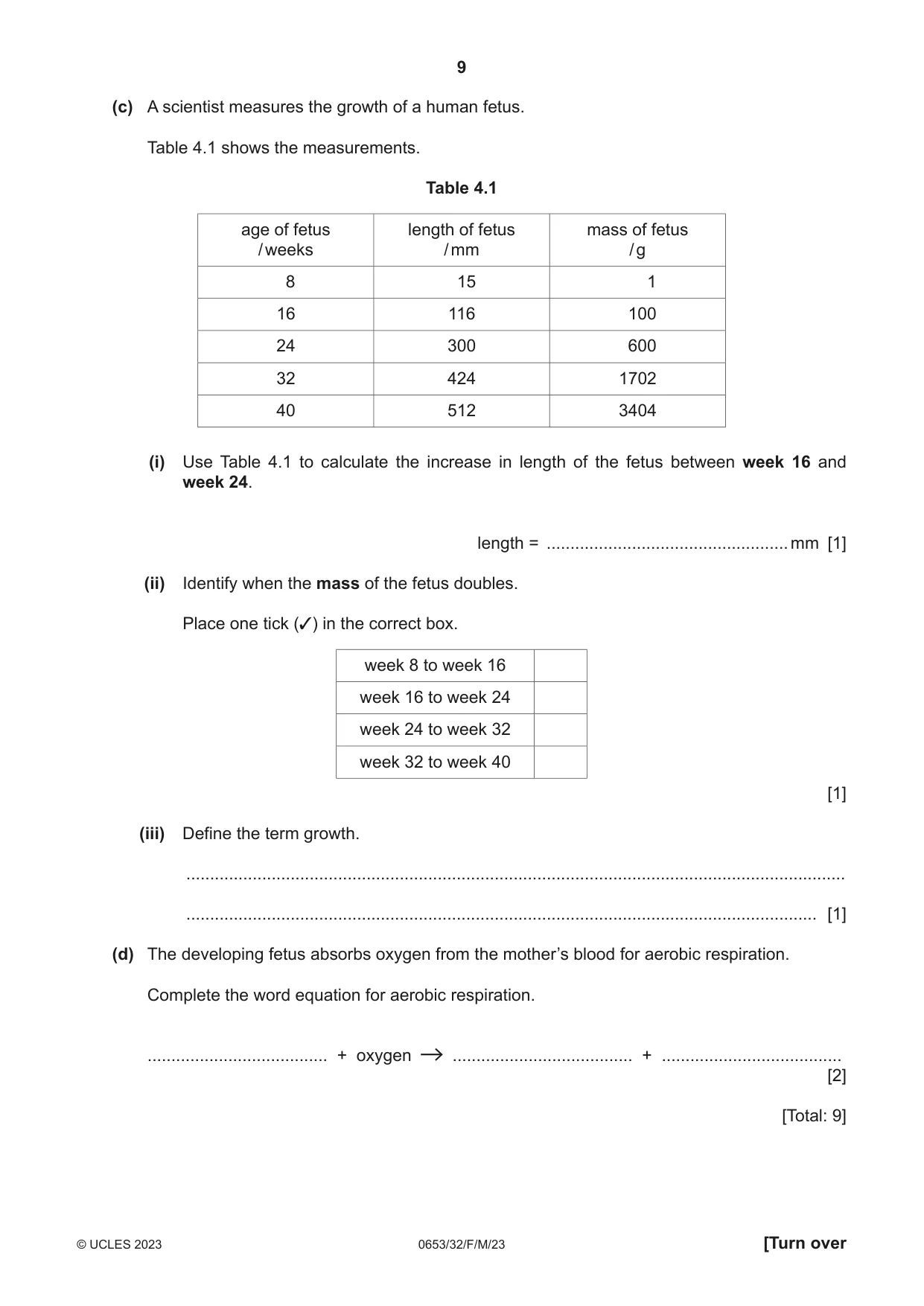
4 (a) The boxes on the left name some parts of the male reproductive system in humans. The boxes on the right state the functions of some of these parts. Draw one straight line from each part to its function. part function carries urine and semen out of the body prostate gland sac that holds testes outside the body scrotum secretes fluid for sperm to swim in [2] (b) Fertilisation takes place in the female reproductive system in humans. (i) The fertilised ovum divides to form a ball of cells. State the name of this ball of cells. ..................................................................................................................................... [1] (ii) The ball of cells develops into a fetus inside the uterus. State the name of the ring of muscle at the opening of the uterus. ..................................................................................................................................... [1] (c) A scientist measures the growth of a human fetus. Table 4.1 shows the measurements. Table 4.1 age of fetus length of fetus mass of fetus / weeks / mm / g 8 15 1 16 116 100 24 300 600 32 424 1702 40 512 3404 (i) Use Table 4.1 to calculate the increase in length of the fetus between week 16 and week 24. length = ................................................... mm [1] (ii) Identify when the mass of the fetus doubles. Place one tick (✓) in the correct box. week 8 to week 16 week 16 to week 24 week 24 to week 32 week 32 to week 40 [1] (iii) Define the term growth. ........................................................................................................................................... ..................................................................................................................................... [1] (d) The developing fetus absorbs oxygen from the mother’s blood for aerobic respiration. Complete the word equation for aerobic respiration. ...................................... + oxygen ...................................... + ...................................... [2] [Total: 9]
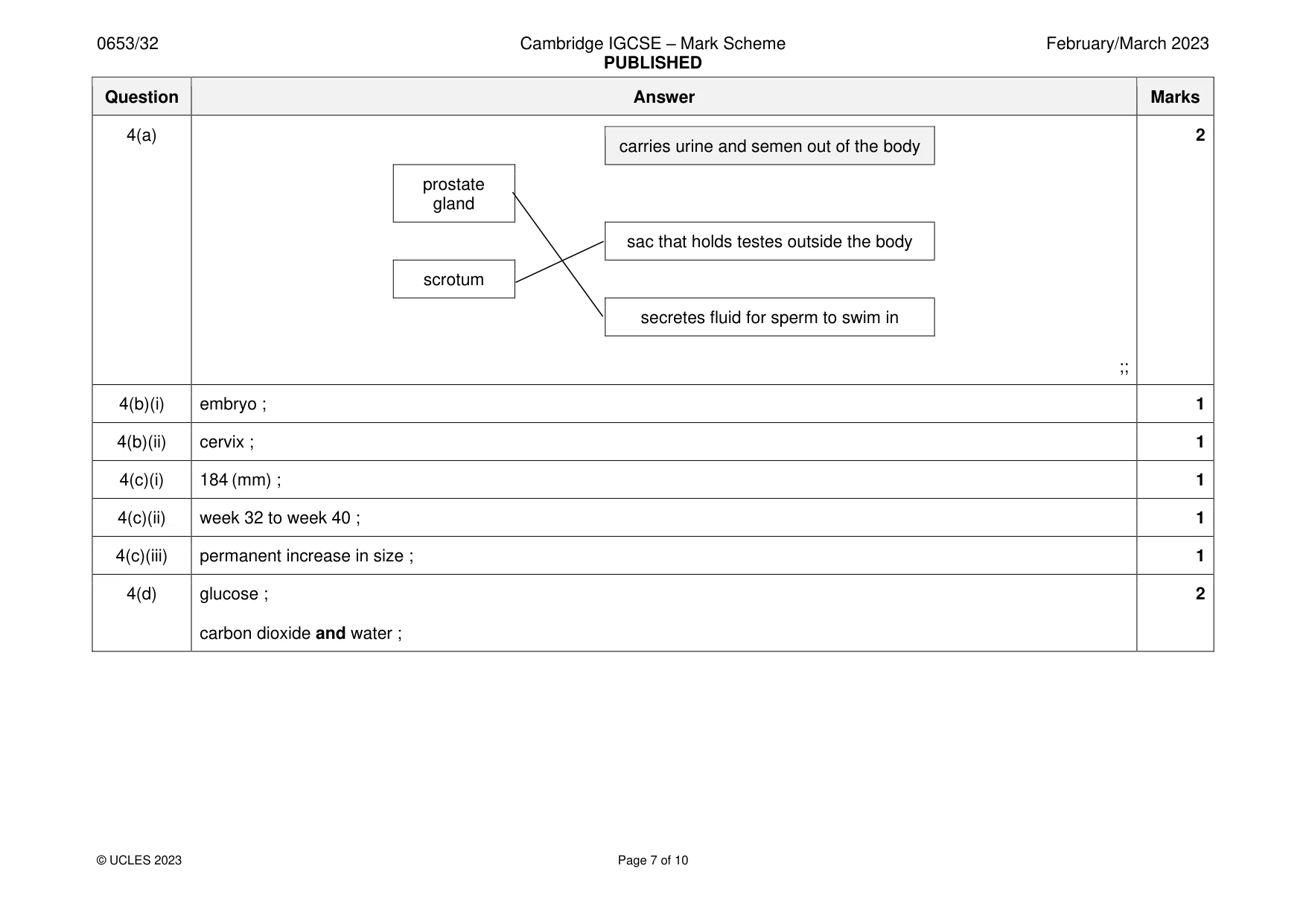
Mark scheme: 4(a) 2 carries urine and semen out of the body prostate gland sac that holds testes outside the body scrotum secretes fluid for sperm to swim in ;; 4(b)(i) embryo ; 1 4(b)(ii) cervix ; 1 4(c)(i) 184 (mm) ; 1 4(c)(ii) week 32 to week 40 ; 1 4(c)(iii) permanent increase in size ; 1 4(d) glucose ; 2 carbon dioxide and water ;
Q5 · Copper is a transition element
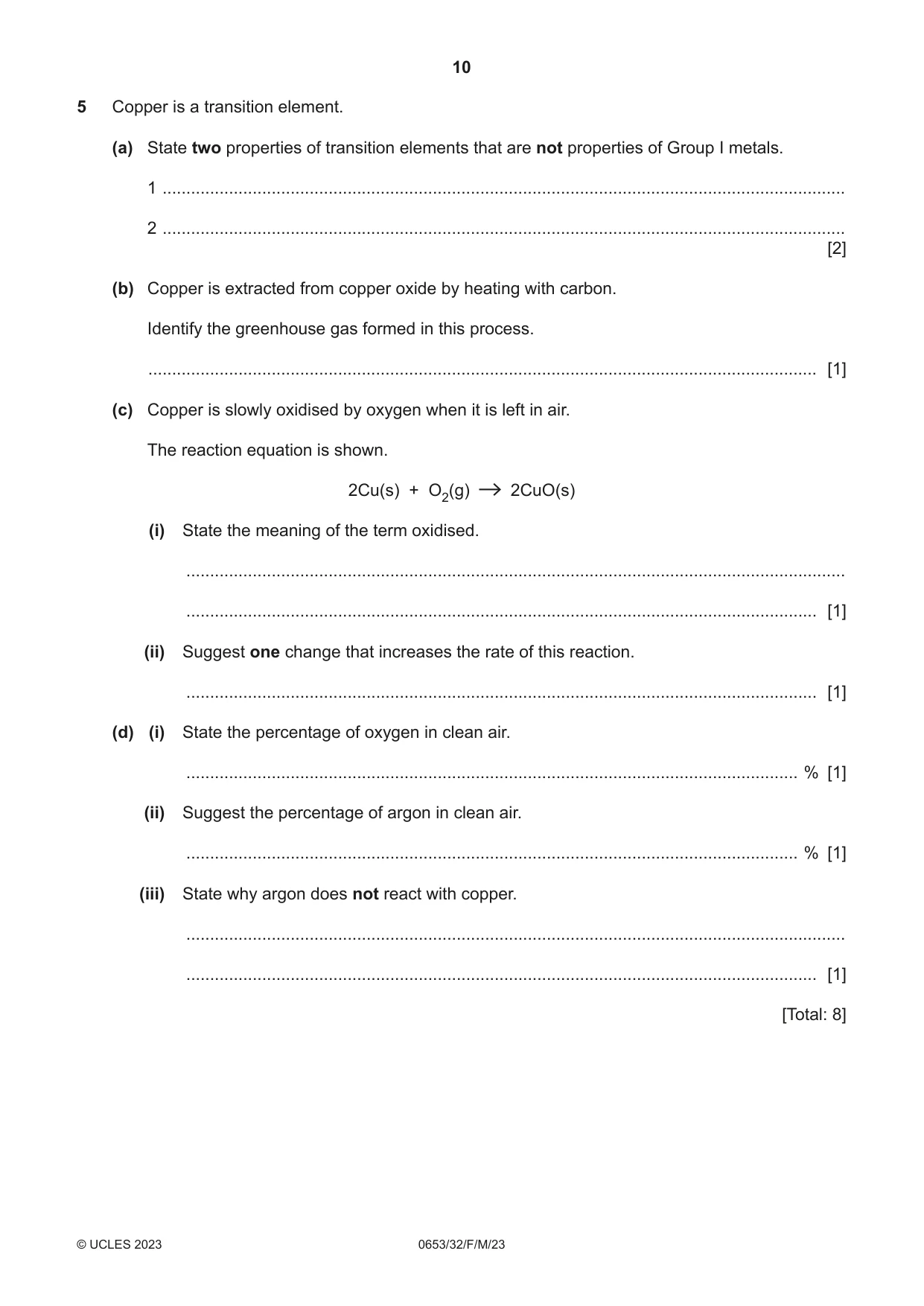
5 Copper is a transition element. (a) State two properties of transition elements that are not properties of Group I metals. 1 ................................................................................................................................................ 2 ................................................................................................................................................ [2] (b) Copper is extracted from copper oxide by heating with carbon. Identify the greenhouse gas formed in this process. ............................................................................................................................................. [1] (c) Copper is slowly oxidised by oxygen when it is left in air. The reaction equation is shown. 2Cu(s) + O2(g) 2CuO(s) (i) State the meaning of the term oxidised. ........................................................................................................................................... ..................................................................................................................................... [1] (ii) Suggest one change that increases the rate of this reaction. ..................................................................................................................................... [1] (d) (i) State the percentage of oxygen in clean air. ................................................................................................................................. % [1] (ii) Suggest the percentage of argon in clean air. ................................................................................................................................. % [1] (iii) State why argon does not react with copper. ........................................................................................................................................... ..................................................................................................................................... [1] [Total: 8]
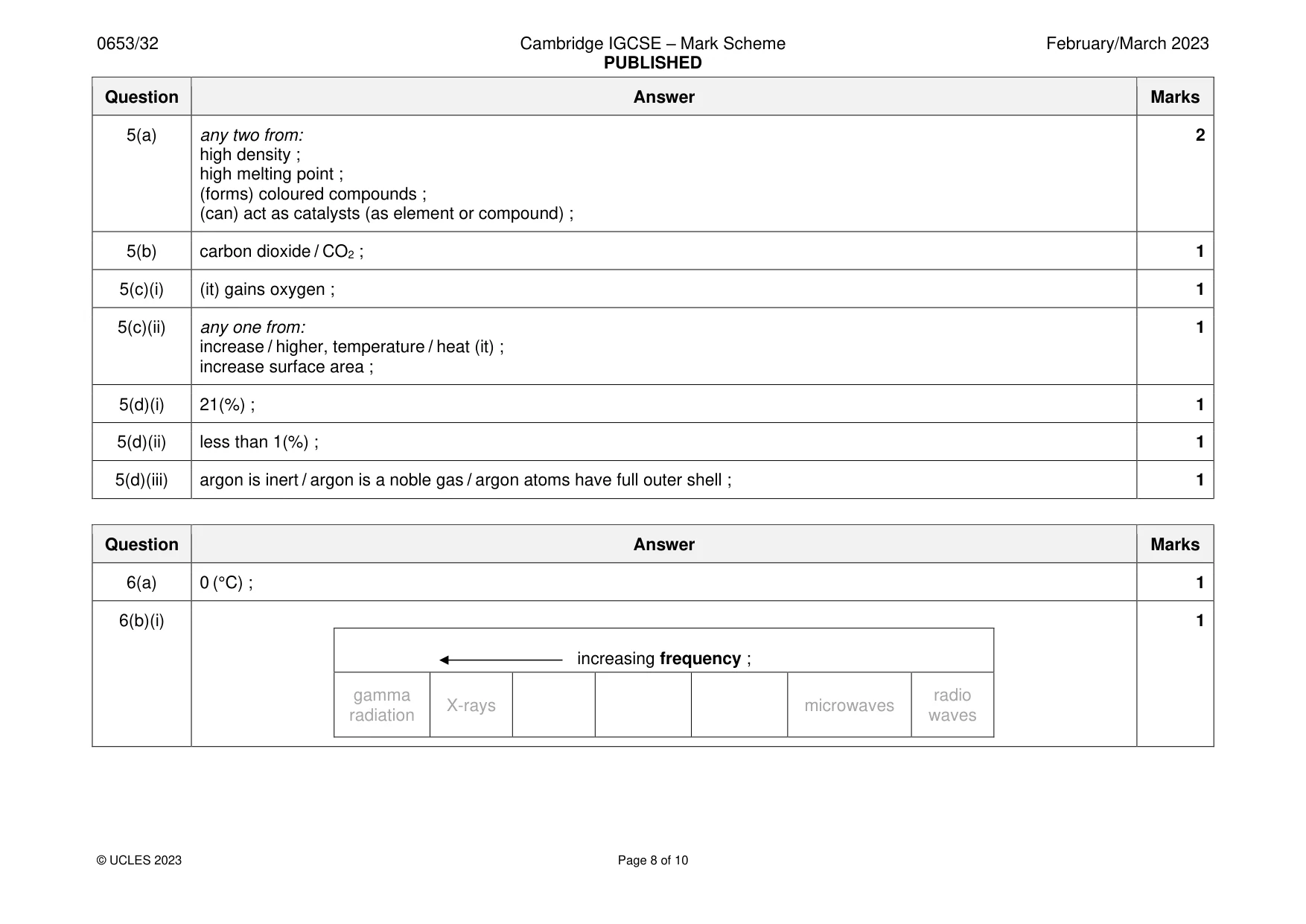
Mark scheme: 5(a) any two from: 2 high density ; high melting point ; (forms) coloured compounds ; (can) act as catalysts (as element or compound) ; 5(b) carbon dioxide / CO2 ; 1 5(c)(i) (it) gains oxygen ; 1 5(c)(ii) any one from: 1 increase / higher, temperature / heat (it) ; increase surface area ; 5(d)(i) 21(%) ; 1 5(d)(ii) less than 1(%) ; 1 5(d)(iii) argon is inert / argon is a noble gas / argon atoms have full outer shell ; 1
Q6 · A house in the Himalayas
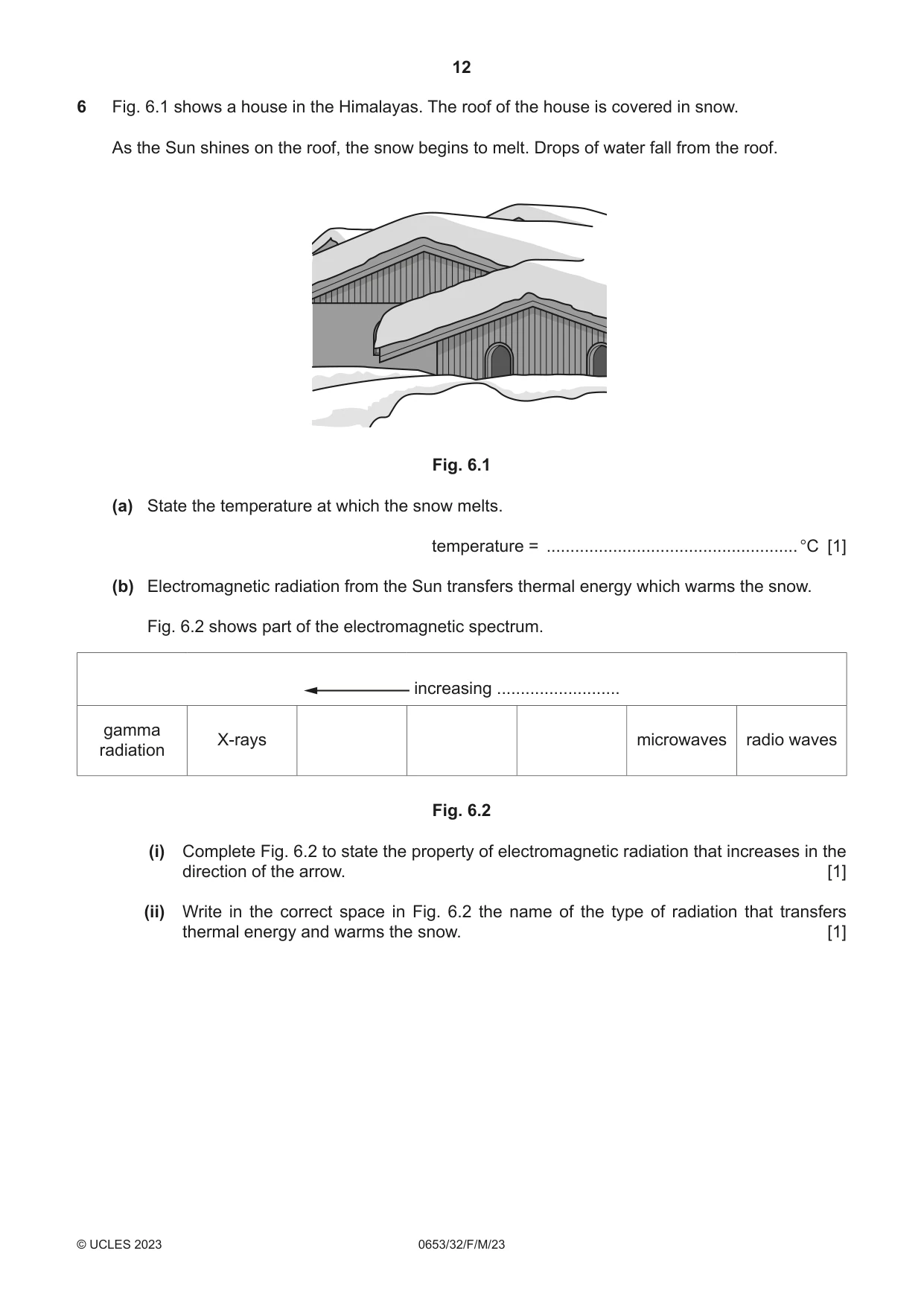
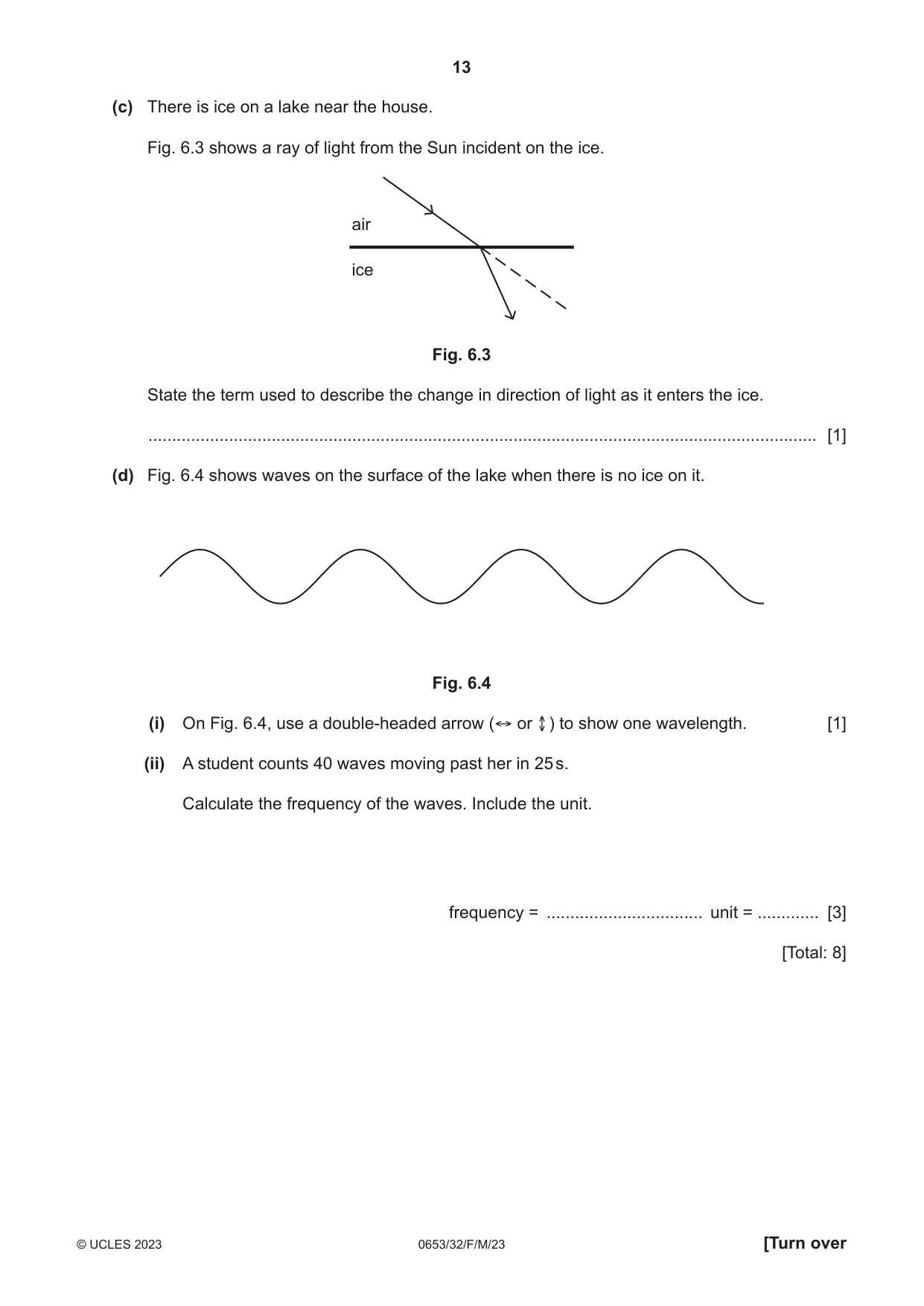
6 Fig. 6.1 shows a house in the Himalayas. The roof of the house is covered in snow. As the Sun shines on the roof, the snow begins to melt. Drops of water fall from the roof. Fig. 6.1 (a) State the temperature at which the snow melts. temperature = ..................................................... °C [1] (b) Electromagnetic radiation from the Sun transfers thermal energy which warms the snow. Fig. 6.2 shows part of the electromagnetic spectrum. increasing .......................... gamma X‑rays microwaves radio waves radiation Fig. 6.2 (i) Complete Fig. 6.2 to state the property of electromagnetic radiation that increases in the direction of the arrow. [1] (ii) Write in the correct space in Fig. 6.2 the name of the type of radiation that transfers thermal energy and warms the snow. [1] (c) There is ice on a lake near the house. Fig. 6.3 shows a ray of light from the Sun incident on the ice. air ice Fig. 6.3 State the term used to describe the change in direction of light as it enters the ice. ............................................................................................................................................. [1] (d) Fig. 6.4 shows waves on the surface of the lake when there is no ice on it. Fig. 6.4 (i) On Fig. 6.4, use a double‑headed arrow (↔ or↔) to show one wavelength. [1] (ii) A student counts 40 waves moving past her in 25 s. Calculate the frequency of the waves. Include the unit. frequency = ................................. unit = ............. [3] [Total: 8]
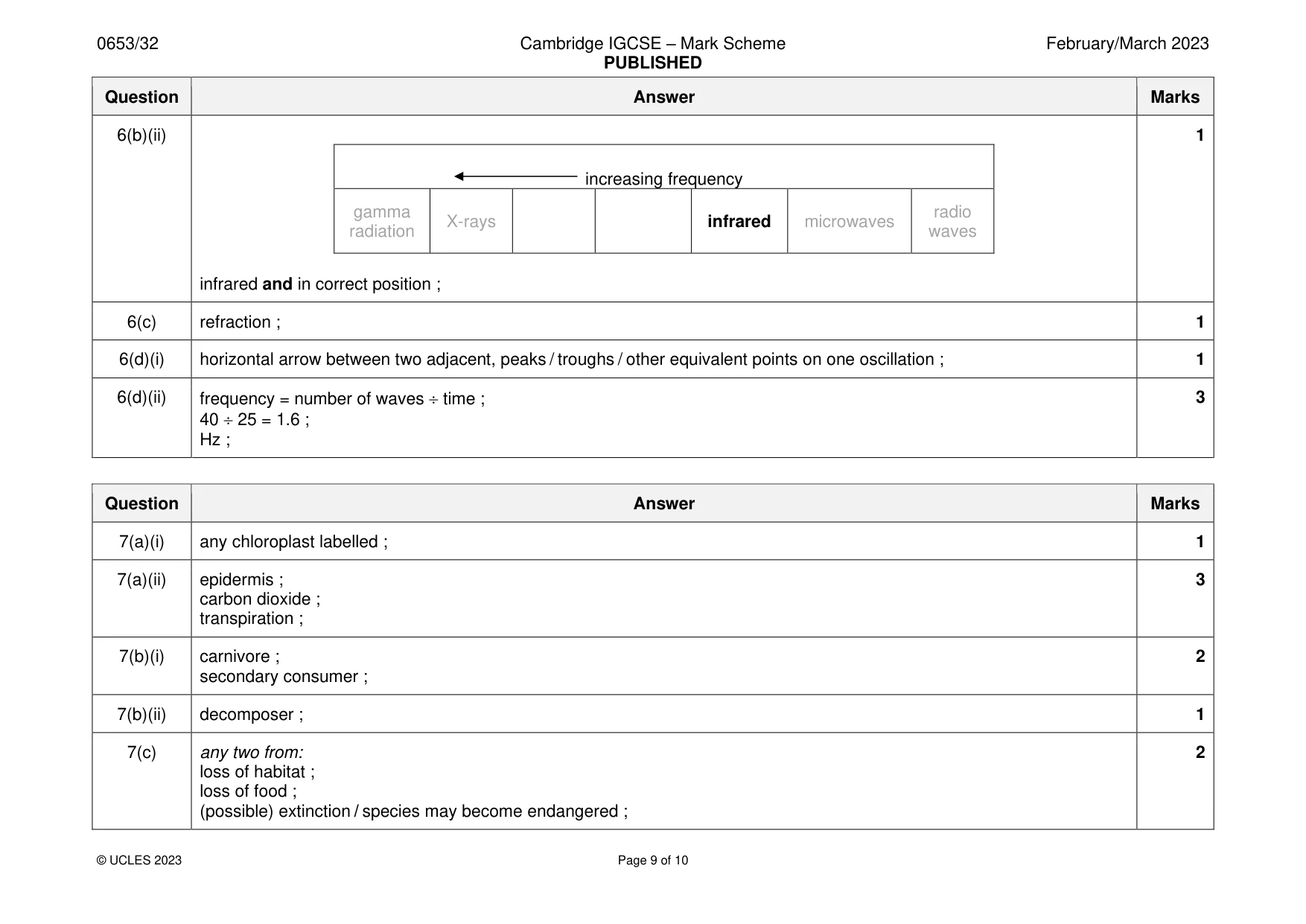
Mark scheme: 6(a) 0 (°C) ; 1 6(b)(i) 1 increasing frequency ; gamma radio X-rays microwaves radiation waves 6(b)(ii) 1 increasing frequency gamma radio X-rays infrared microwaves radiation waves infrared and in correct position ; 6(c) refraction ; 1 6(d)(i) horizontal arrow between two adjacent, peaks / troughs / other equivalent points on one oscillation ; 1 6(d)(ii) frequency = number of waves time ; 3 40 25 = 1.6 ; Hz ;
Q7 · A diagram of two guard cells surrounding an open stoma from a plant leaf
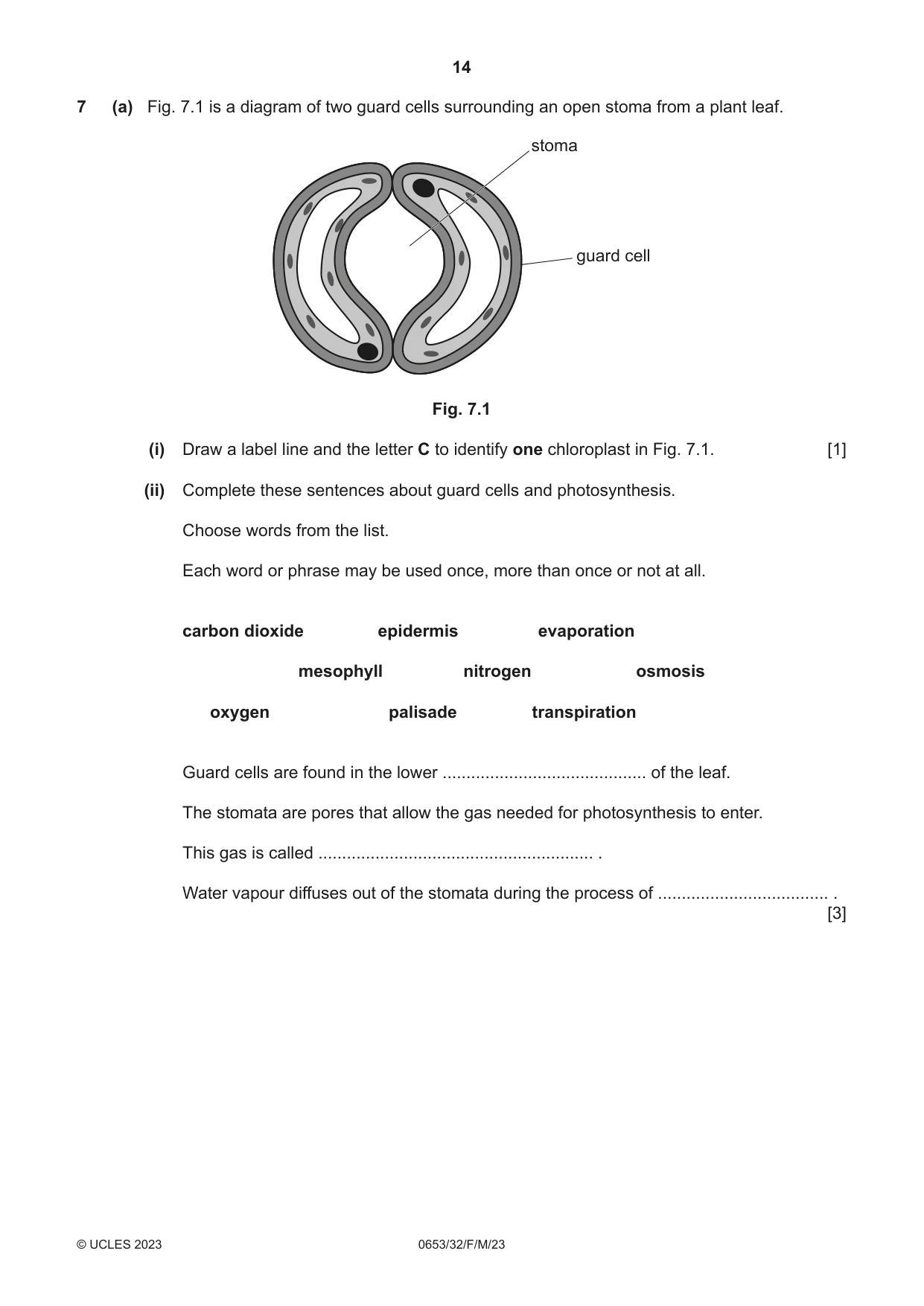
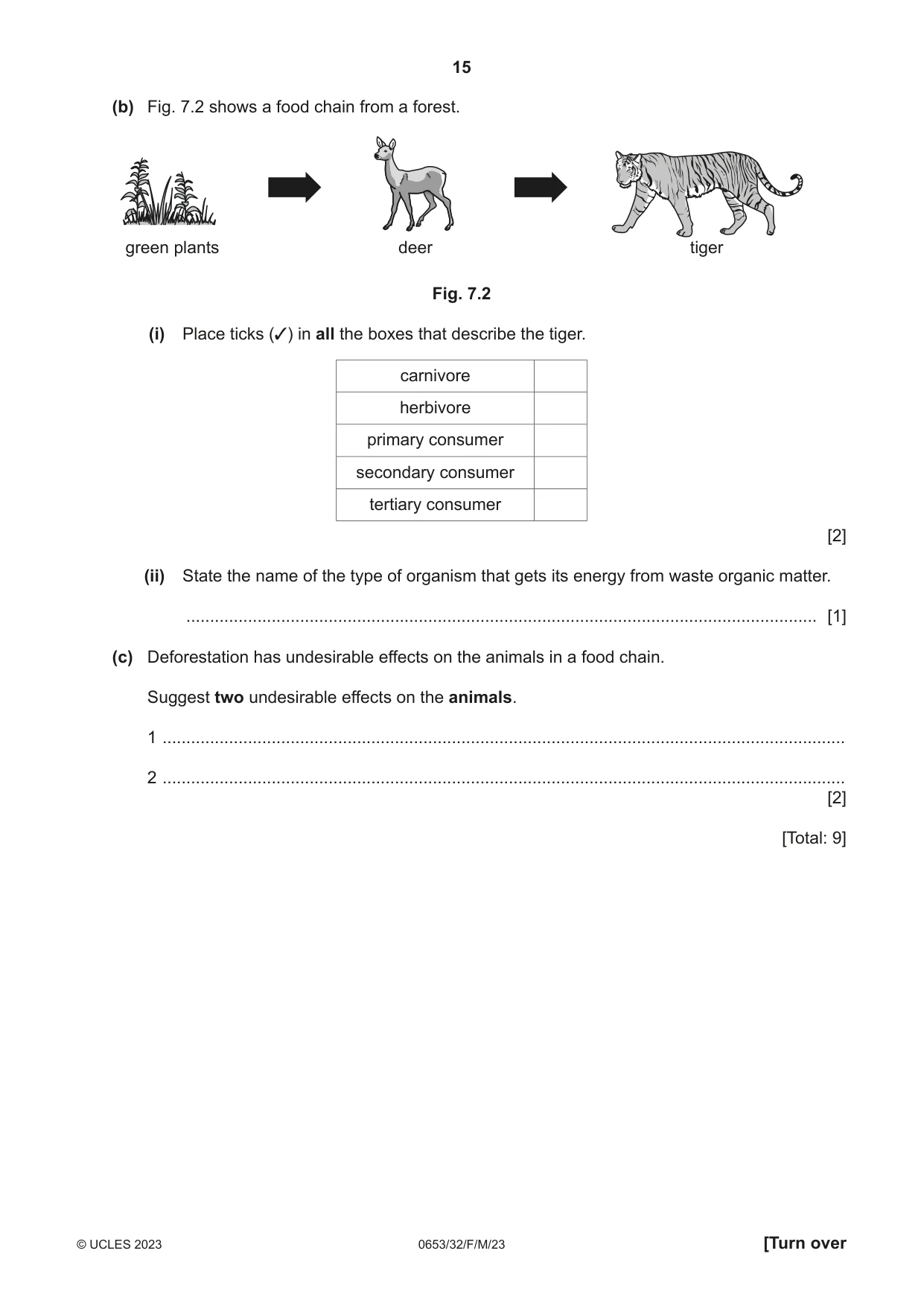
7 (a) Fig. 7.1 is a diagram of two guard cells surrounding an open stoma from a plant leaf. stoma guard cell Fig. 7.1 (i) Draw a label line and the letter C to identify one chloroplast in Fig. 7.1. [1] (ii) Complete these sentences about guard cells and photosynthesis. Choose words from the list. Each word or phrase may be used once, more than once or not at all. carbon dioxide epidermis evaporation mesophyll nitrogen osmosis oxygen palisade transpiration Guard cells are found in the lower ........................................... of the leaf. The stomata are pores that allow the gas needed for photosynthesis to enter. This gas is called .......................................................... . Water vapour diffuses out of the stomata during the process of .................................... . [3] (b) Fig. 7.2 shows a food chain from a forest. green plants deer tiger Fig. 7.2 (i) Place ticks (✓) in all the boxes that describe the tiger. carnivore herbivore primary consumer secondary consumer tertiary consumer [2] (ii) State the name of the type of organism that gets its energy from waste organic matter. ..................................................................................................................................... [1] (c) Deforestation has undesirable effects on the animals in a food chain. Suggest two undesirable effects on the animals. 1 ................................................................................................................................................ 2 ................................................................................................................................................ [2] [Total: 9]
Mark scheme: 7(a)(i) any chloroplast labelled ; 1 7(a)(ii) epidermis ; 3 carbon dioxide ; transpiration ; 7(b)(i) carnivore ; 2 secondary consumer ; 7(b)(ii) decomposer ; 1 7(c) any two from: 2 loss of habitat ; loss of food ; (possible) extinction / species may become endangered ;
Q8 · Methane, CH4, and ethene, C2H4, are hydrocarbons
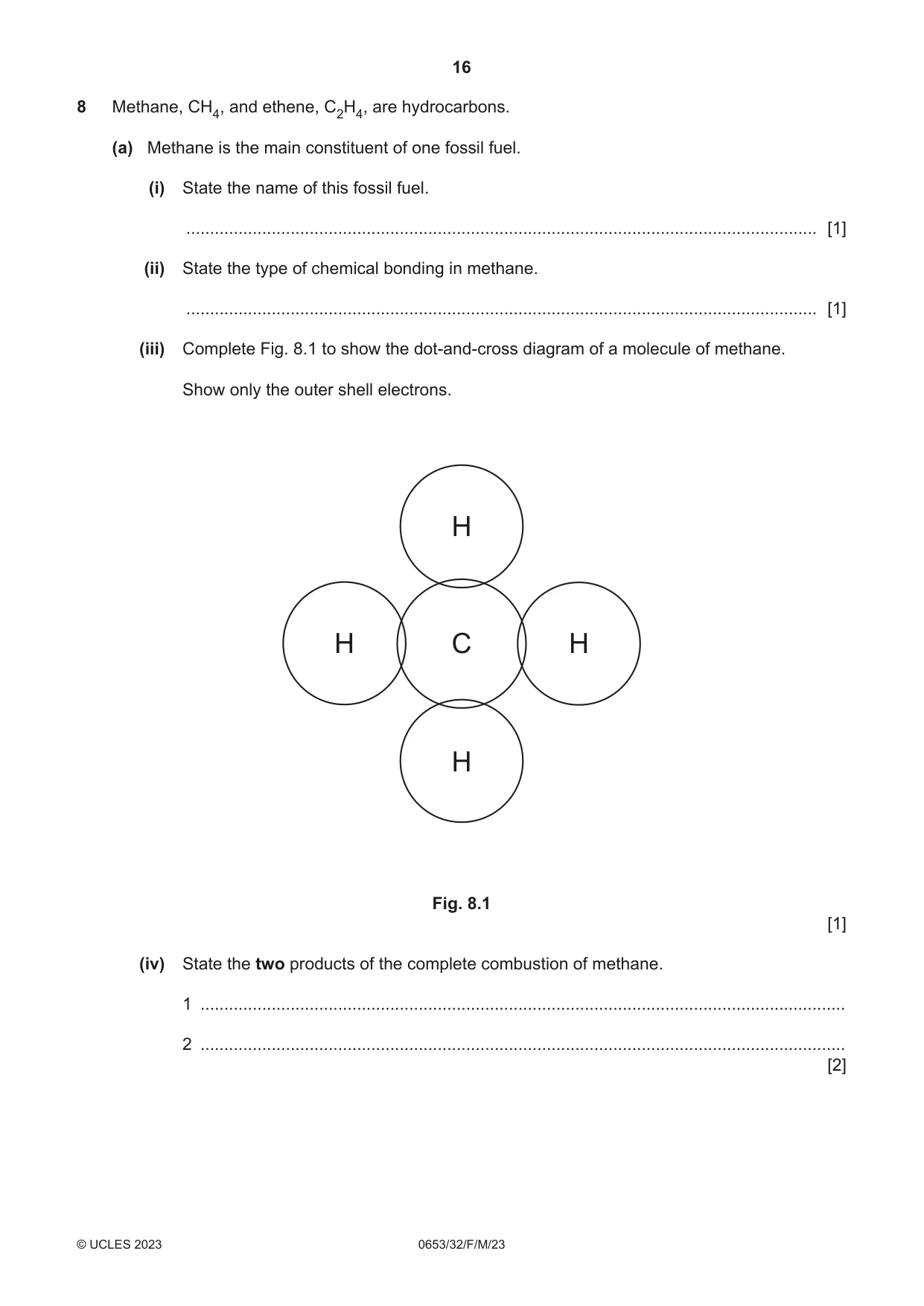
8 Methane, CH4, and ethene, C2H4, are hydrocarbons. (a) Methane is the main constituent of one fossil fuel. (i) State the name of this fossil fuel. ..................................................................................................................................... [1] (ii) State the type of chemical bonding in methane. ..................................................................................................................................... [1] (iii) Complete Fig. 8.1 to show the dot‑and‑cross diagram of a molecule of methane. Show only the outer shell electrons. H H C H H Fig. 8.1 [1] (iv) State the two products of the complete combustion of methane. 1 ........................................................................................................................................ 2 ........................................................................................................................................ [2] (b) Ethene is an unsaturated hydrocarbon. (i) State what is meant by the terms unsaturated and hydrocarbon. unsaturated ....................................................................................................................... ........................................................................................................................................... hydrocarbon ...................................................................................................................... ........................................................................................................................................... [2] (ii) State the process that produces ethene and other unsaturated hydrocarbon molecules from alkanes. ..................................................................................................................................... [1] (c) Hydrocarbon W turns aqueous bromine colourless. State whether hydrocarbon W is saturated or unsaturated. Give a reason for your answer. hydrocarbon W ......................................................................................................................... reason ....................................................................................................................................... ................................................................................................................................................... [1] [Total: 9]
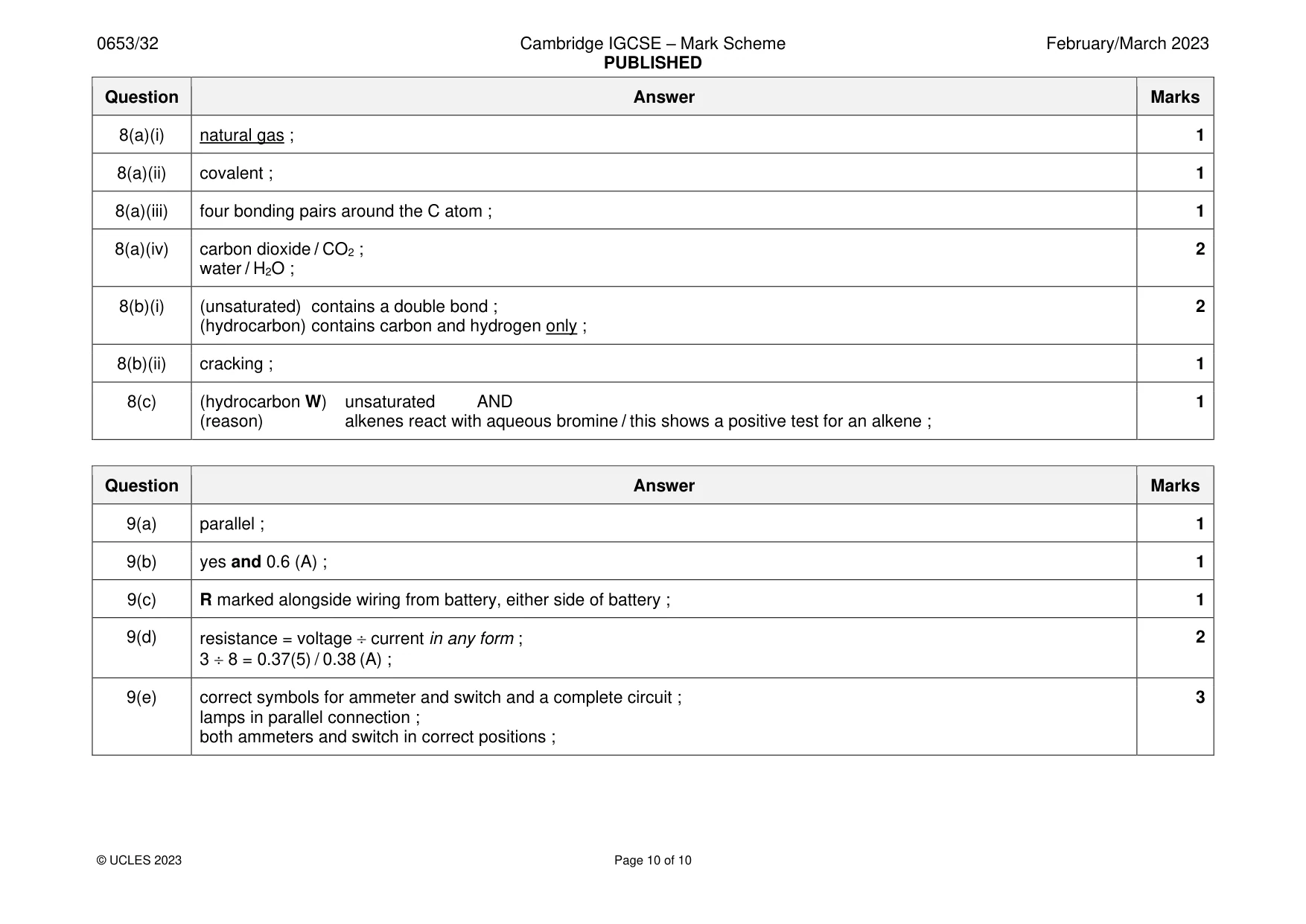
Mark scheme: 8(a)(i) natural gas ; 1 8(a)(ii) covalent ; 1 8(a)(iii) four bonding pairs around the C atom ; 1 8(a)(iv) carbon dioxide / CO2 ; 2 water / H2O ; 8(b)(i) (unsaturated) contains a double bond ; 2 (hydrocarbon) contains carbon and hydrogen only ; 8(b)(ii) cracking ; 1 8(c) (hydrocarbon W) unsaturated AND 1 (reason) alkenes react with aqueous bromine / this shows a positive test for an alkene ;
Question 9
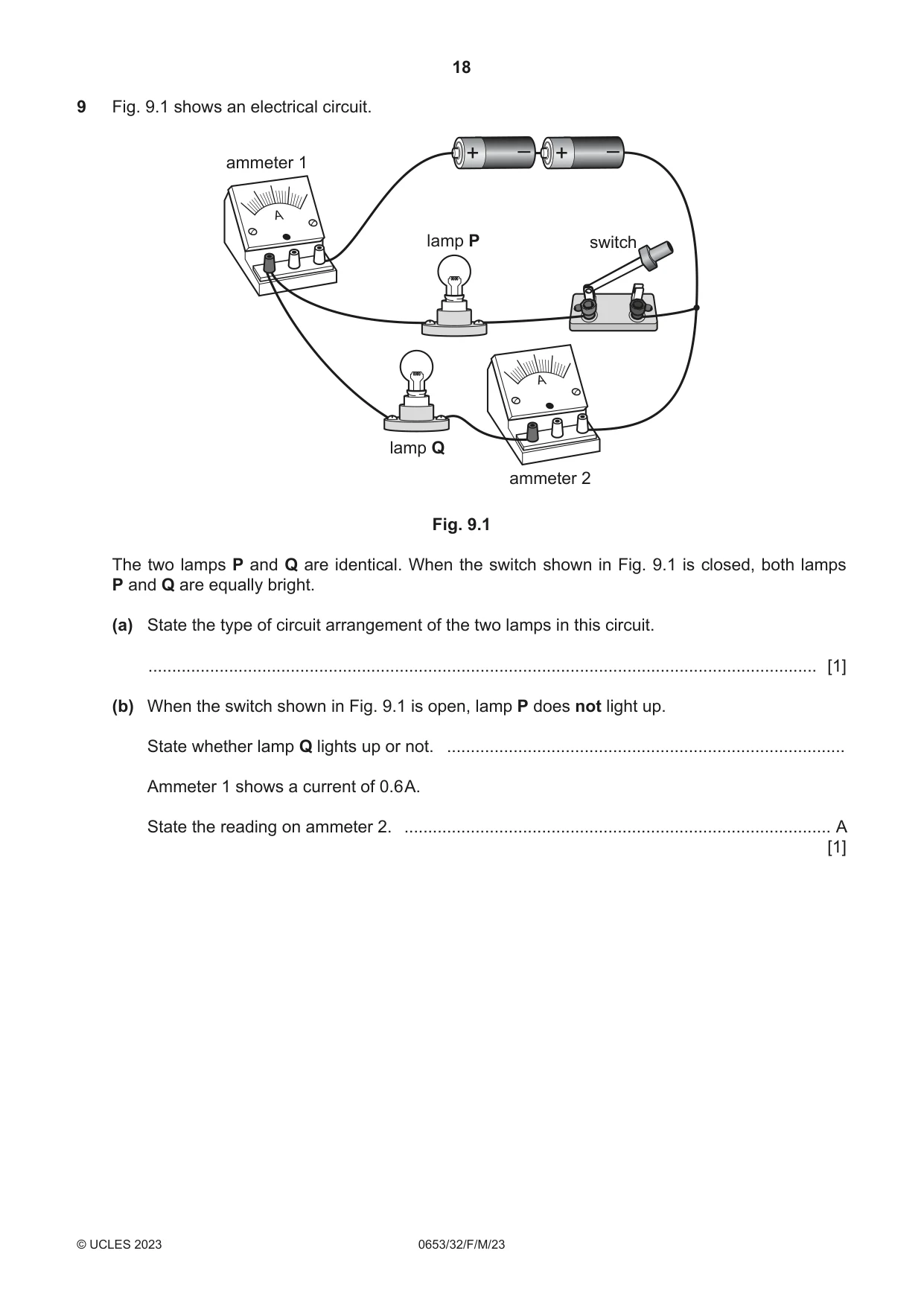
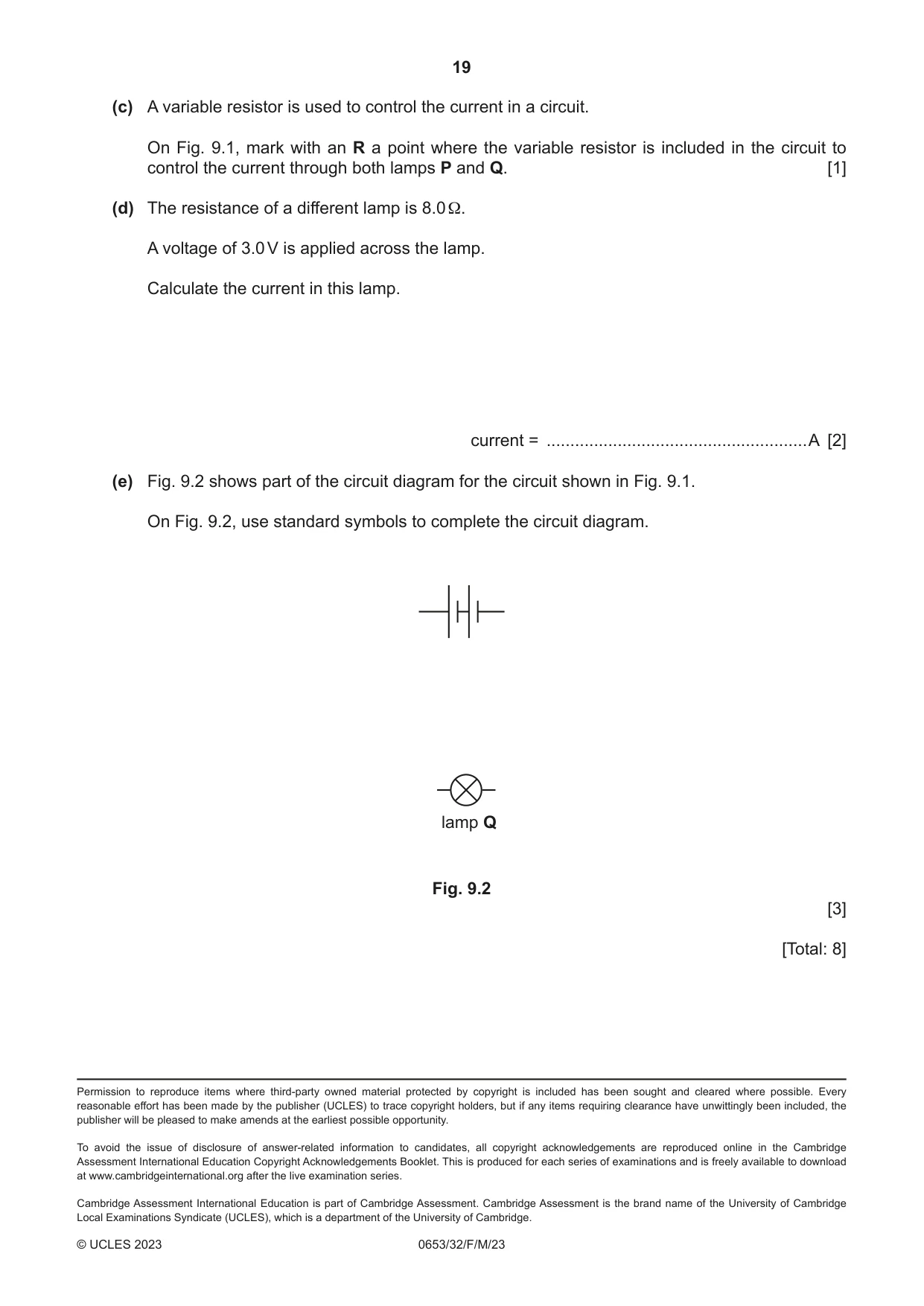
9 Fig. 9.1 shows an electrical circuit. + – + – ammeter 1 A lamp P switch A lamp Q ammeter 2 Fig. 9.1 The two lamps P and Q are identical. When the switch shown in Fig. 9.1 is closed, both lamps P and Q are equally bright. (a) State the type of circuit arrangement of the two lamps in this circuit. ............................................................................................................................................. [1] (b) When the switch shown in Fig. 9.1 is open, lamp P does not light up. State whether lamp Q lights up or not. .................................................................................... Ammeter 1 shows a current of 0.6 A. State the reading on ammeter 2. .......................................................................................... A [1] (c) A variable resistor is used to control the current in a circuit. On Fig. 9.1, mark with an R a point where the variable resistor is included in the circuit to control the current through both lamps P and Q. [1] (d) The resistance of a different lamp is 8.0 Ω. A voltage of 3.0 V is applied across the lamp. Calculate the current in this lamp. current = ....................................................... A [2] (e) Fig. 9.2 shows part of the circuit diagram for the circuit shown in Fig. 9.1. On Fig. 9.2, use standard symbols to complete the circuit diagram. lamp Q Fig. 9.2 [3] [Total: 8]
Mark scheme: 9(a) parallel ; 1 9(b) yes and 0.6 (A) ; 1 9(c) R marked alongside wiring from battery, either side of battery ; 1 9(d) resistance = voltage current in any form ; 2 3 8 = 0.37(5) / 0.38 (A) ; 9(e) correct symbols for ammeter and switch and a complete circuit ; 3 lamps in parallel connection ; both ammeters and switch in correct positions ;
What was in this paper
The subtopics covered by these 9 questions, and how many questions each got. Open one in a new tab to see every Cambridge question on it.
What you needed in this session
Cambridge’s own grade thresholds for 2023 Feb/March, Paper 3 · Variant 2. A higher threshold means an easier paper — the bar moves with how the cohort did.