Questions as text
Q1 · Chlorine reacts with hot concentrated aqueous sodium hydroxide according to the equation… 9701/11 Oct/Nov 2005
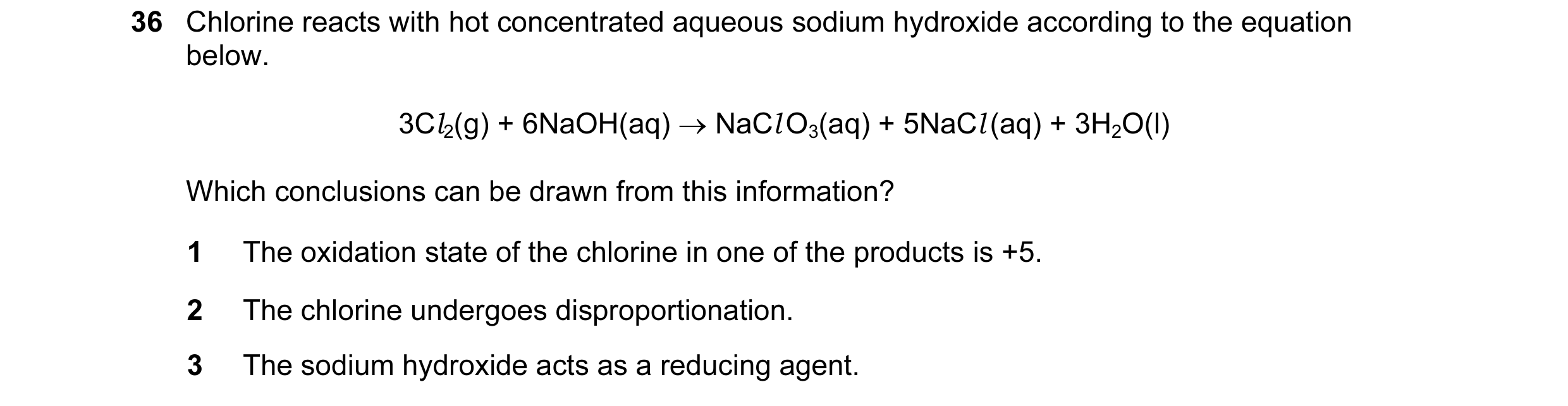
36 Chlorine reacts with hot concentrated aqueous sodium hydroxide according to the equation below. 3Cl2(g) + 6NaOH(aq) → NaCl O3(aq) + 5NaCl (aq) + 3H2O(l) Which conclusions can be drawn from this information? 1 The oxidation state of the chlorine in one of the products is +5. 2 The chlorine undergoes disproportionation. 3 The sodium hydroxide acts as a reducing agent.
1 marks
Answer: B
This question in 9701/11 Oct/Nov 2005
Q2 · Swimming pool water can be kept free of harmful bacteria by adding aqueous sodium… 9701/11 May/June 2006
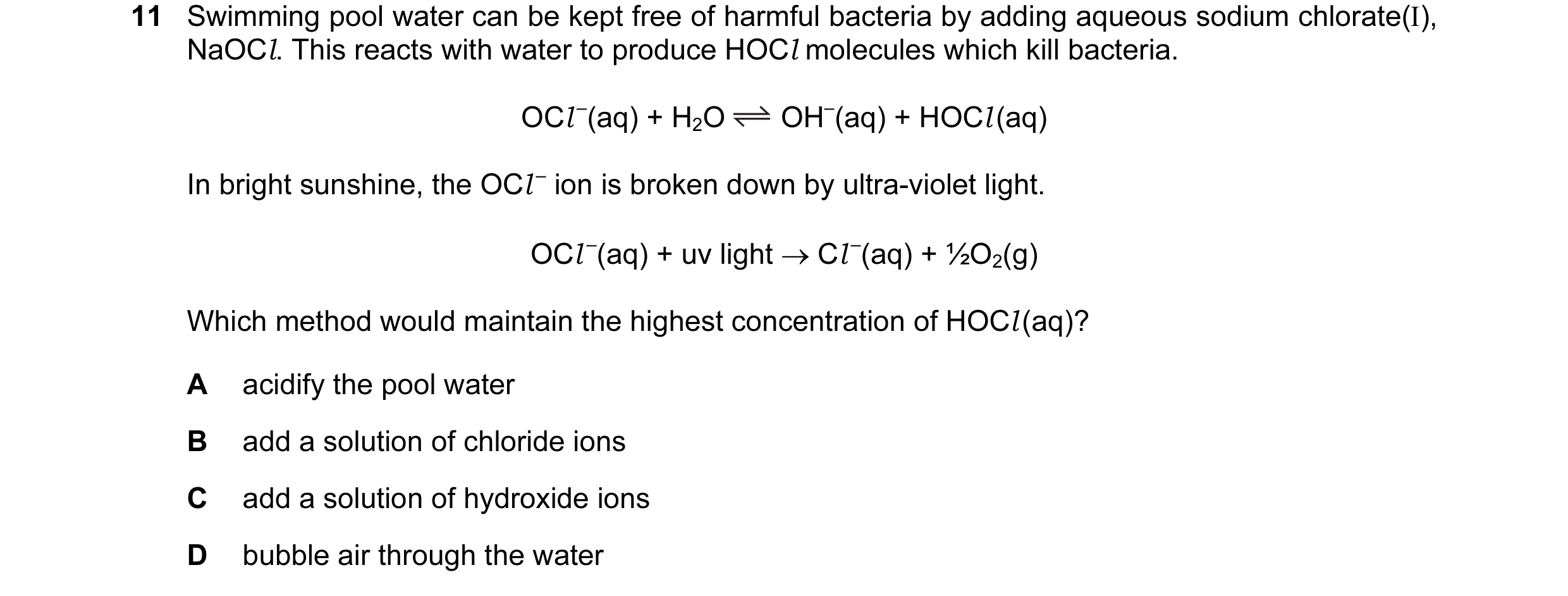
11 Swimming pool water can be kept free of harmful bacteria by adding aqueous sodium chlorate(I), NaOCl. This reacts with water to produce HOCl molecules which kill bacteria. OCl –(aq) + H2O OH–(aq) + HOCl (aq) In bright sunshine, the OCl – ion is broken down by ultra-violet light. OCl –(aq) + uv light → Cl –(aq) + ½O2(g) Which method would maintain the highest concentration of HOCl (aq)? A acidify the pool water B add a solution of chloride ions C add a solution of hydroxide ions D bubble air through the water
1 marks
Answer: A
This question in 9701/11 May/June 2006
Q3 · What happens when chlorine is bubbled through aqueous sodium hydroxide solution? 9701/11 Oct/Nov 2006
35 What happens when chlorine is bubbled through aqueous sodium hydroxide solution? 1 In cold solution, ClO–(aq) ions are formed. 2 In hot solution, ClO3 –(aq) ions are formed. 3 Disproportionation of chlorine occurs in both cold and hot aqueous solutions.
1 marks
Answer: A
This question in 9701/11 Oct/Nov 2006
Q4 · Swimming pool water can be kept free of harmful bacteria by adding aqueous sodium… 9701/13 May/June 2010
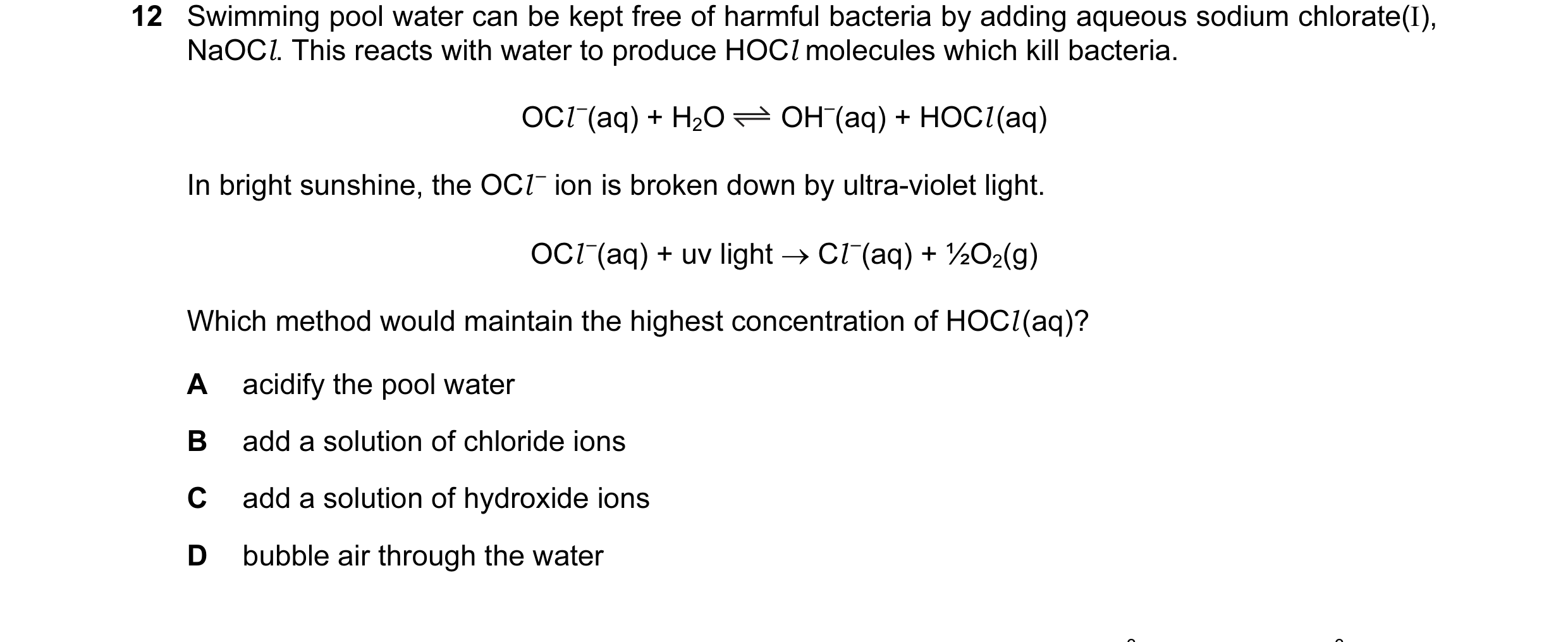
12 Swimming pool water can be kept free of harmful bacteria by adding aqueous sodium chlorate(I), NaOCl. This reacts with water to produce HOCl molecules which kill bacteria. OCl –(aq) + H2O OH–(aq) + HOCl (aq) In bright sunshine, the OCl – ion is broken down by ultra-violet light. OCl –(aq) + uv light → Cl –(aq) + ½O2(g) Which method would maintain the highest concentration of HOCl (aq)? A acidify the pool water B add a solution of chloride ions C add a solution of hydroxide ions D bubble air through the water
1 marks
Answer: A
This question in 9701/13 May/June 2010
Q5 · Every year millions of tonnes each of chlorine and sodium hydroxide are manufactured by… 9701/11 Oct/Nov 2010
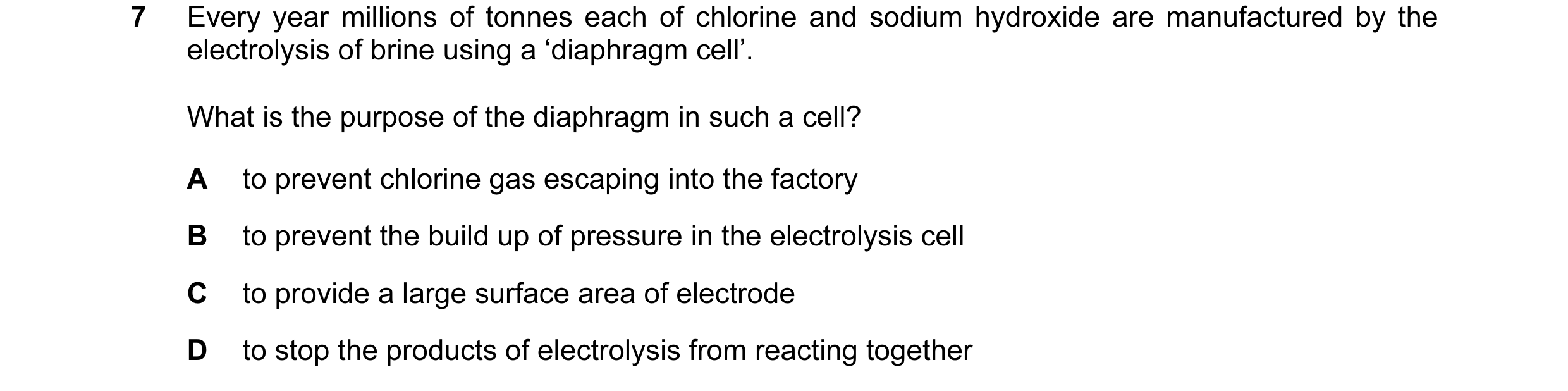
1 Every year millions of tonnes each of chlorine and sodium hydroxide are manufactured by the electrolysis of brine using a ‘diaphragm cell’. What is the purpose of the diaphragm in such a cell? A to prevent chlorine gas escaping into the factory B to prevent the build up of pressure in the electrolysis cell C to provide a large surface area of electrode D to stop the products of electrolysis from reacting together
1 marks
Answer: D
This question in 9701/11 Oct/Nov 2010
Q6 · Disproportionation is the term used to describe a reaction in which a reactant is… 9701/11 Oct/Nov 2010
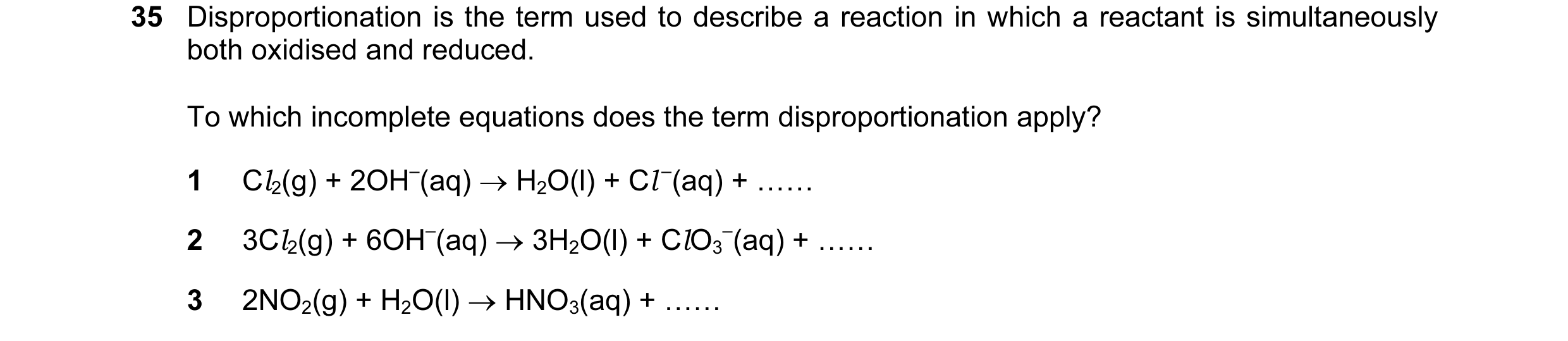
35 Disproportionation is the term used to describe a reaction in which a reactant is simultaneously both oxidised and reduced. To which incomplete equations does the term disproportionation apply? 1 Cl2(g) + 2OH–(aq) → H2O(l) + Cl –(aq) + …… 2 3Cl2(g) + 6OH–(aq) → 3H2O(l) + ClO3 –(aq) + …… 3 2NO2(g) + H2O(l) → HNO3(aq) + ……
1 marks
Answer: A
This question in 9701/11 Oct/Nov 2010
Q7 · Every year millions of tonnes each of chlorine and sodium hydroxide are manufactured by… 9701/13 Oct/Nov 2010
7 Every year millions of tonnes each of chlorine and sodium hydroxide are manufactured by the electrolysis of brine using a ‘diaphragm cell’. What is the purpose of the diaphragm in such a cell? A to prevent chlorine gas escaping into the factory B to prevent the build up of pressure in the electrolysis cell C to provide a large surface area of electrode D to stop the products of electrolysis from reacting together
1 marks
Answer: D
This question in 9701/13 Oct/Nov 2010
Q8 · Disproportionation is the term used to describe a reaction in which a reactant is… 9701/13 Oct/Nov 2010
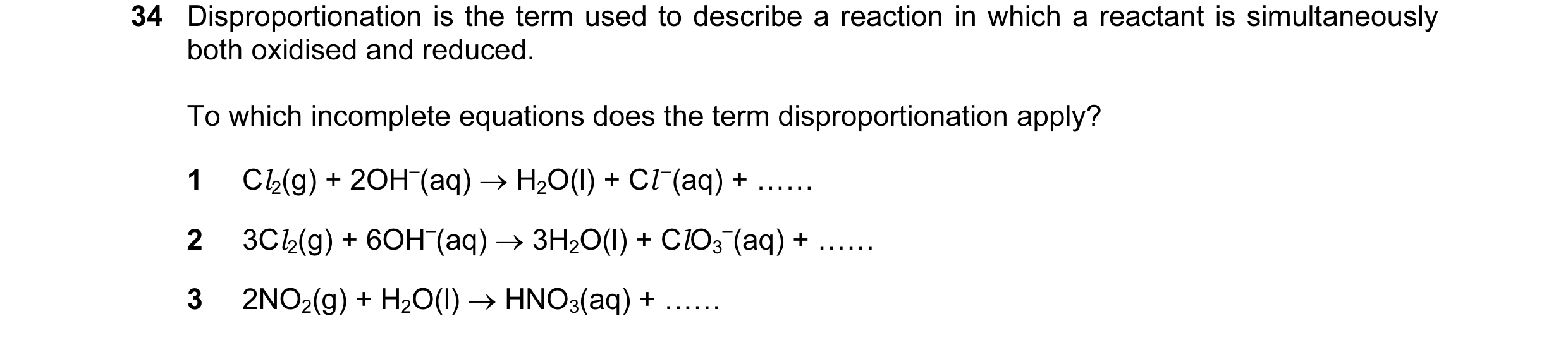
34 Disproportionation is the term used to describe a reaction in which a reactant is simultaneously both oxidised and reduced. To which incomplete equations does the term disproportionation apply? 1 Cl2(g) + 2OH–(aq) → H2O(l) + Cl –(aq) + …… 2 3Cl2(g) + 6OH–(aq) → 3H2O(l) + ClO3 –(aq) + …… 3 2NO2(g) + H2O(l) → HNO3(aq) + ……
1 marks
Answer: A
This question in 9701/13 Oct/Nov 2010
Q9 · When chlorine and aqueous sodium hydroxide are heated together the following overall… 9701/11 Oct/Nov 2011
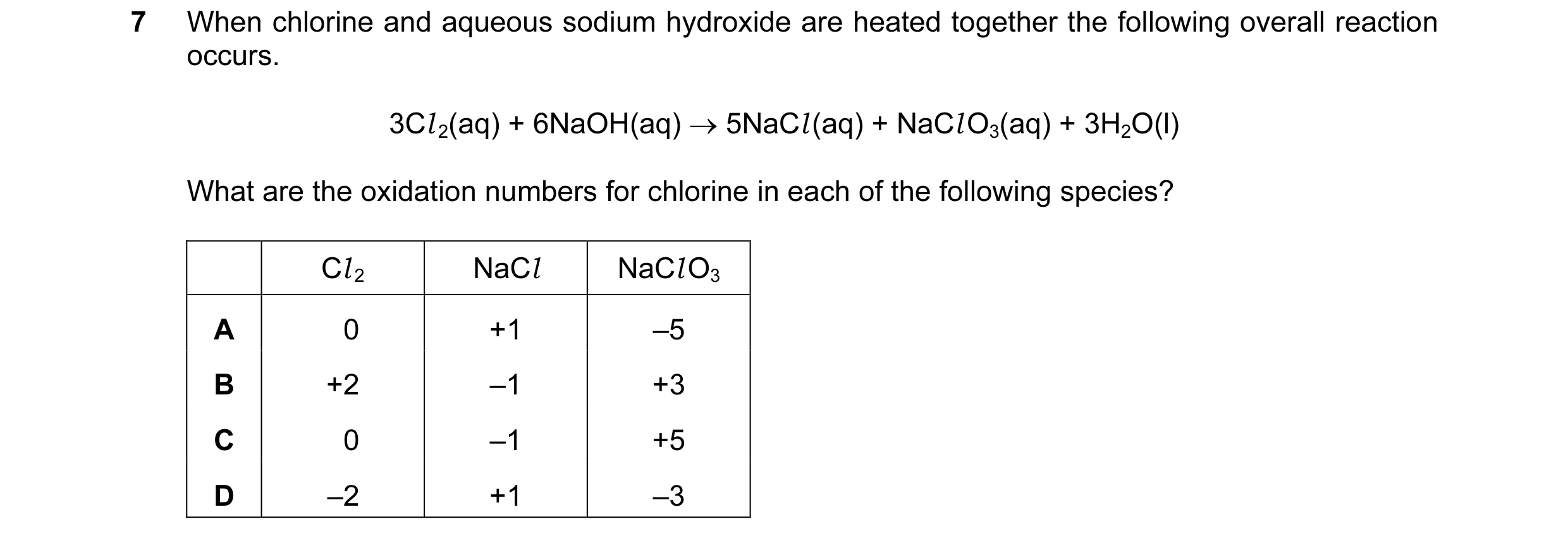
7 When chlorine and aqueous sodium hydroxide are heated together the following overall reaction occurs. 3Cl 2(aq) + 6NaOH(aq) → 5NaCl (aq) + NaCl O3(aq) + 3H2O(l) What are the oxidation numbers for chlorine in each of the following species? Cl 2 NaCl NaCl O3 A 0 +1 –5 B +2 –1 +3 C 0 –1 +5 D –2 +1 –3
1 marks
Answer: C
This question in 9701/11 Oct/Nov 2011
Q10 · Aqueous sodium chloride (brine) is electrolysed by using inert electrodes in a cell which… 9701/11 Oct/Nov 2011
16 Aqueous sodium chloride (brine) is electrolysed by using inert electrodes in a cell which is stirred so that products of electrolysis react with each other. The cell is kept cold. Which pair of substances is among the major products? A hydrogen and chlorine B hydrogen and sodium chlorate(I) C hydrogen and sodium chlorate(V) D sodium hydroxide and chlorine
1 marks
Answer: B
This question in 9701/11 Oct/Nov 2011
Q11 · Chlorine can be manufactured from brine in a diaphragm cell 9701/12 Oct/Nov 2011
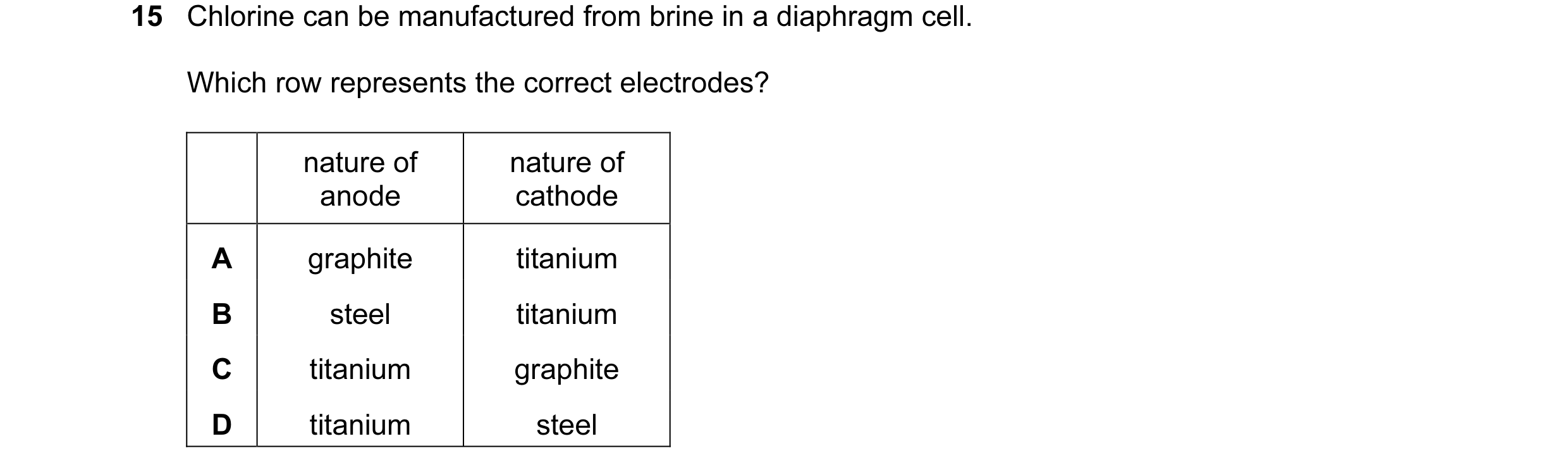
15 Chlorine can be manufactured from brine in a diaphragm cell. Which row represents the correct electrodes? nature of nature of anode cathode A graphite titanium B steel titanium C titanium graphite D titanium steel
1 marks
This question in 9701/12 Oct/Nov 2011
Q12 · When chlorine and aqueous sodium hydroxide are heated together the following overall… 9701/13 Oct/Nov 2011
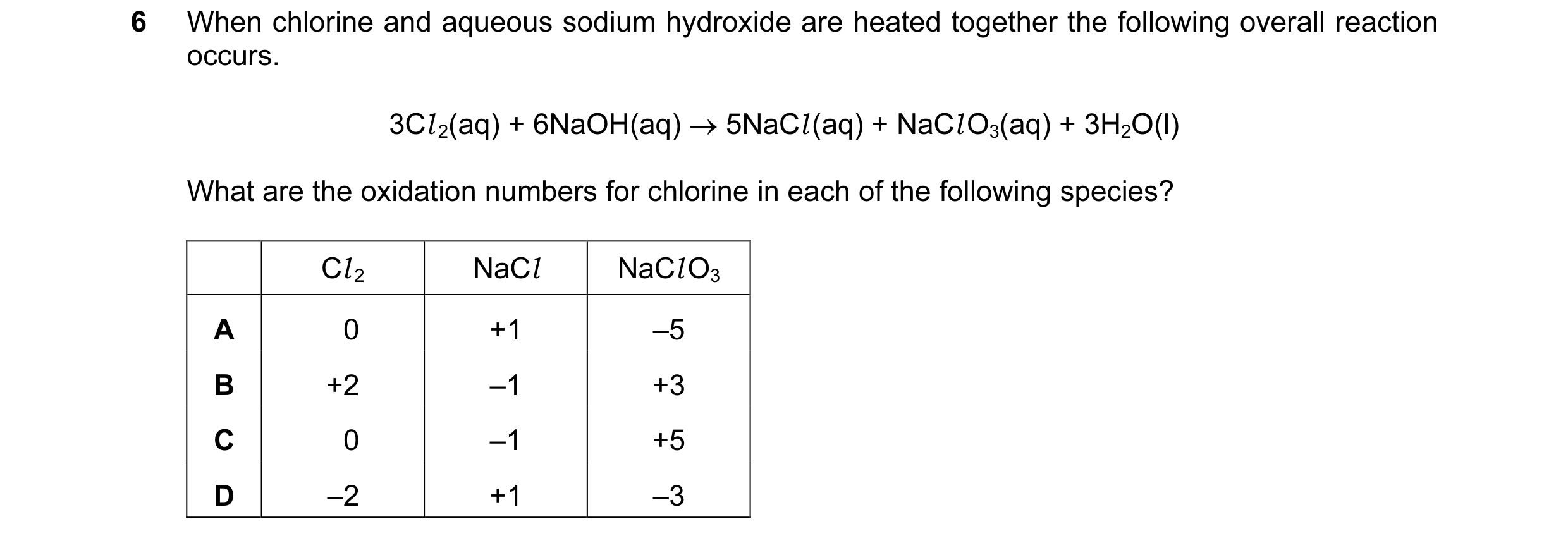
6 When chlorine and aqueous sodium hydroxide are heated together the following overall reaction occurs. 3Cl 2(aq) + 6NaOH(aq) → 5NaCl (aq) + NaCl O3(aq) + 3H2O(l) What are the oxidation numbers for chlorine in each of the following species? Cl 2 NaCl NaCl O3 A 0 +1 –5 B +2 –1 +3 C 0 –1 +5 D –2 +1 –3
1 marks
Answer: C
This question in 9701/13 Oct/Nov 2011
Q13 · Aqueous sodium chloride (brine) is electrolysed by using inert electrodes in a cell which… 9701/13 Oct/Nov 2011
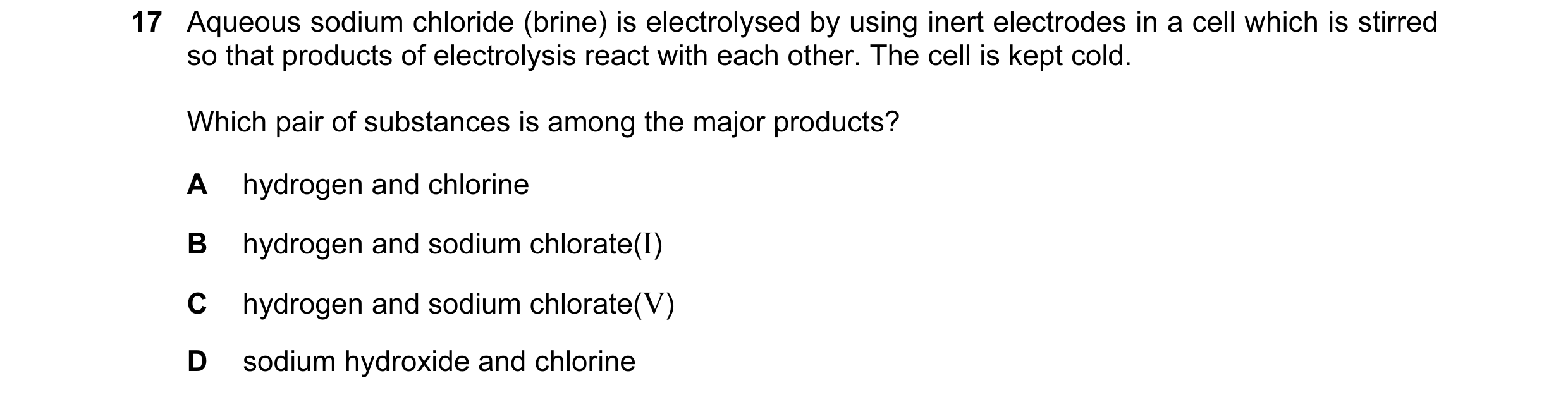
17 Aqueous sodium chloride (brine) is electrolysed by using inert electrodes in a cell which is stirred so that products of electrolysis react with each other. The cell is kept cold. Which pair of substances is among the major products? A hydrogen and chlorine B hydrogen and sodium chlorate(I) C hydrogen and sodium chlorate(V) D sodium hydroxide and chlorine
1 marks
Answer: B
This question in 9701/13 Oct/Nov 2011
Q14 · In the treatment of domestic water supplies, chlorine is added to the water to form HCl O 9701/11 May/June 2012
16 In the treatment of domestic water supplies, chlorine is added to the water to form HCl O. Cl 2(aq) + H2O(I) → H+(aq) + Cl –(aq) + HCl O(aq) The HCl O reacts further to give Cl O– ions. HCl O(aq) + H2O(I) → H3O+(aq) + Cl O–(aq) Both HCl O and Cl O– kill bacteria by oxidation. What is the overall change in oxidation number of chlorine when forming the Cl O– ion from the aqueous chlorine? A –1 B 0 C +1 D +2
1 marks
Answer: C
This question in 9701/11 May/June 2012
Q15 · In the treatment of domestic water supplies, chlorine is added to the water to form HCl O 9701/13 May/June 2012
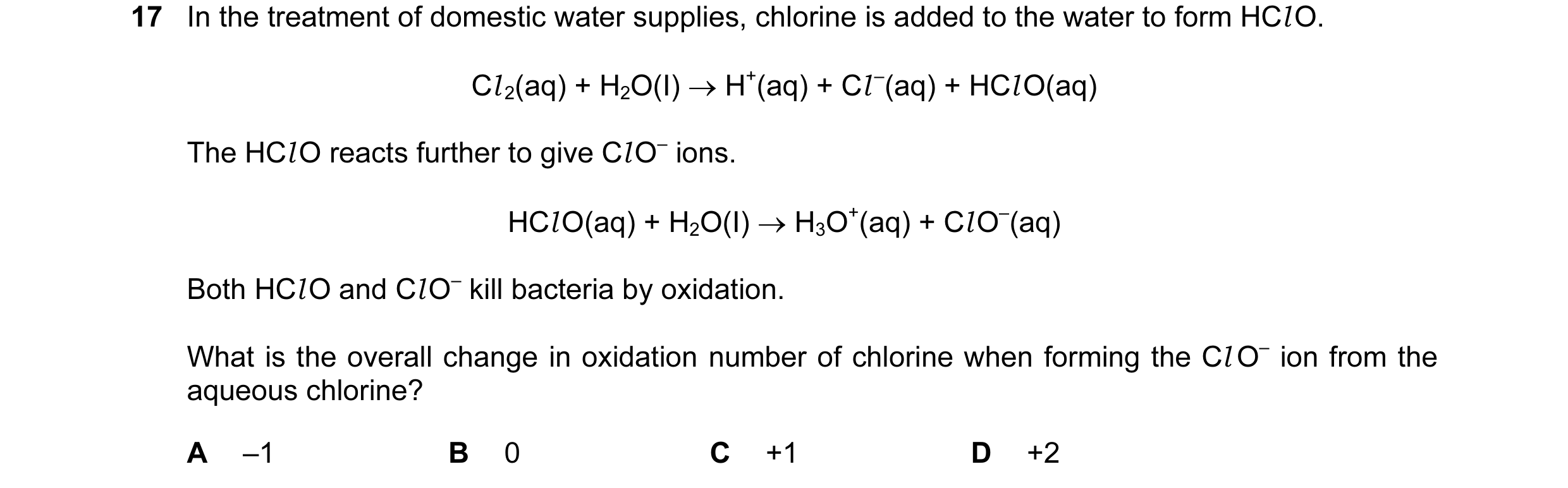
17 In the treatment of domestic water supplies, chlorine is added to the water to form HCl O. Cl 2(aq) + H2O(I) → H+(aq) + Cl –(aq) + HCl O(aq) The HCl O reacts further to give Cl O– ions. HCl O(aq) + H2O(I) → H3O+(aq) + Cl O–(aq) Both HCl O and Cl O– kill bacteria by oxidation. What is the overall change in oxidation number of chlorine when forming the Cl O– ion from the aqueous chlorine? A –1 B 0 C +1 D +2
1 marks
Answer: C
This question in 9701/13 May/June 2012
Q16 · Use of the Data Booklet is relevant to this question 9701/12 May/June 2014
19 Use of the Data Booklet is relevant to this question. In an experiment, 0.125 mol of chlorine gas, Cl 2, is reacted with an excess of cold aqueous sodium hydroxide. One of the products is a compound of sodium, oxygen, and chlorine. Which mass of this product is formed? A 9.31 g B 13.3 g C 18.6 g D 26.6 g
1 marks
Answer: A
This question in 9701/12 May/June 2014
Q17 · Use of the Data Booklet is relevant to this question 9701/13 May/June 2014
17 Use of the Data Booklet is relevant to this question. In an experiment, 0.6 mol of chlorine gas, Cl 2, is reacted with an excess of hot aqueous sodium hydroxide. One of the products is a compound of sodium, oxygen and chlorine. Which mass of this product is formed? A 21.3 g B 44.7 g C 63.9 g D 128 g
1 marks
Answer: A
This question in 9701/13 May/June 2014
Q18 · Chlorine gas reacts with cold aqueous sodium hydroxide 9701/11 Oct/Nov 2014
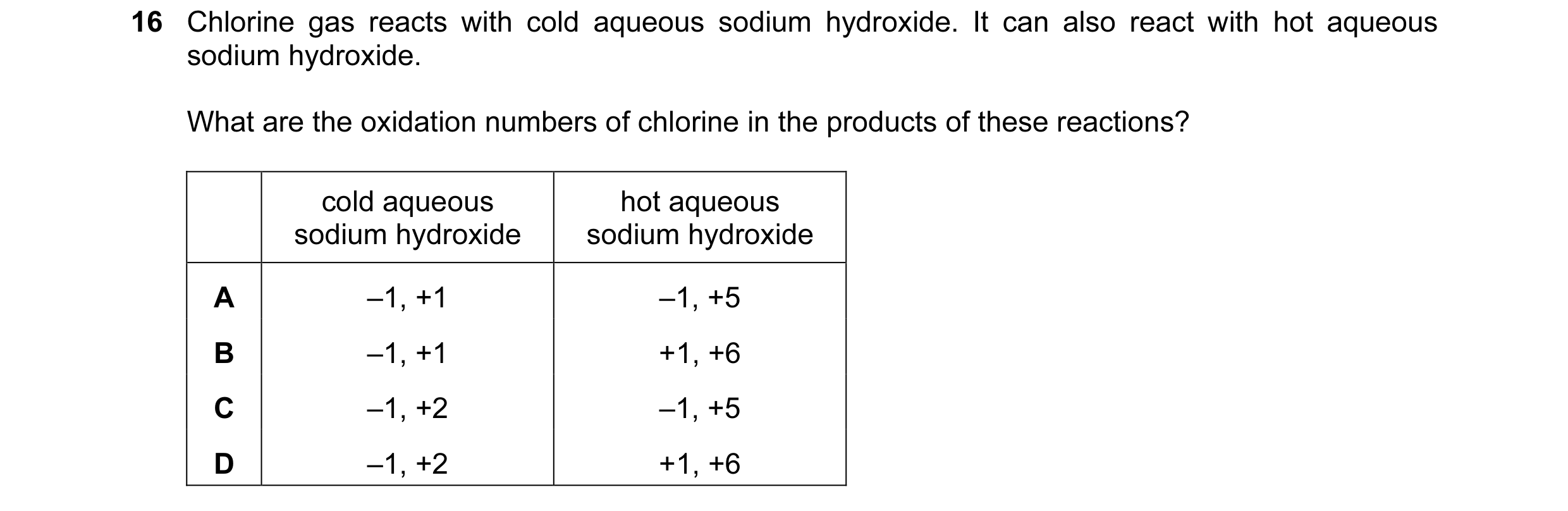
16 Chlorine gas reacts with cold aqueous sodium hydroxide. It can also react with hot aqueous sodium hydroxide. What are the oxidation numbers of chlorine in the products of these reactions? cold aqueous hot aqueous sodium hydroxide sodium hydroxide A –1, +1 –1, +5 B –1, +1 +1, +6 C –1, +2 –1, +5 D –1, +2 +1, +6
1 marks
Answer: A
This question in 9701/11 Oct/Nov 2014
Q19 · Chlorine gas reacts with cold aqueous sodium hydroxide 9701/12 Oct/Nov 2014
16 Chlorine gas reacts with cold aqueous sodium hydroxide. It can also react with hot aqueous sodium hydroxide. What are the oxidation numbers of chlorine in the products of these reactions? cold aqueous hot aqueous sodium hydroxide sodium hydroxide A –1, +1 –1, +5 B –1, +1 +1, +6 C –1, +2 –1, +5 D –1, +2 +1, +6
1 marks
Answer: A
This question in 9701/12 Oct/Nov 2014
Q20 · In a solution that contains both Br2 and Cl 2, a process takes place that produces BrO3… 9701/13 Oct/Nov 2014
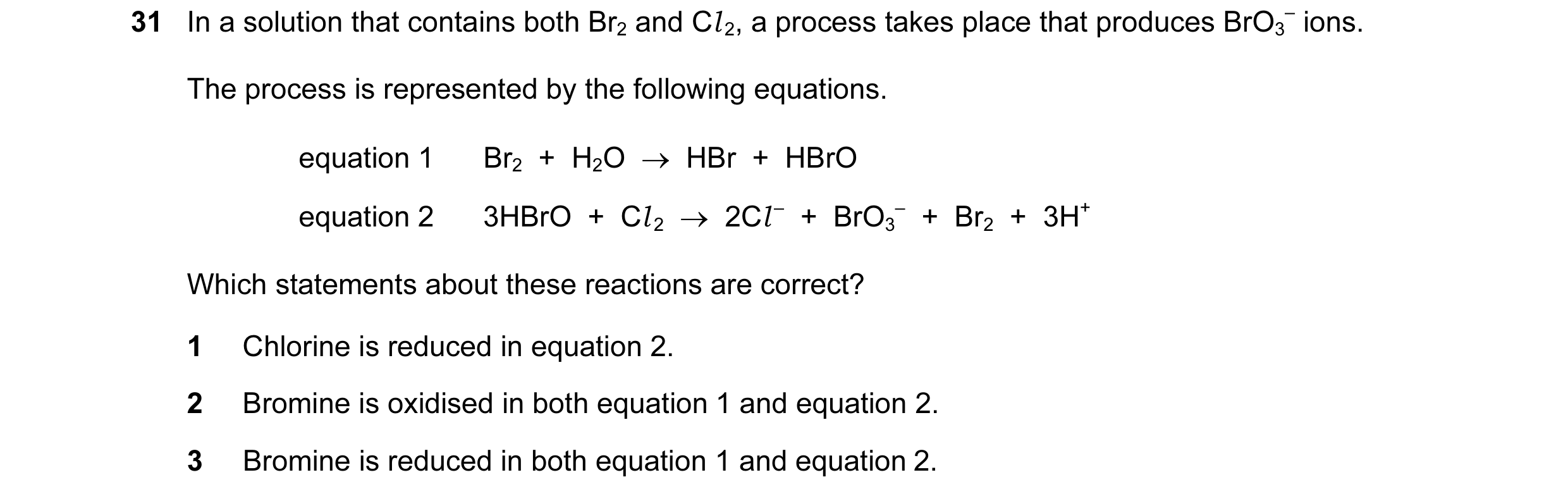
31 In a solution that contains both Br2 and Cl 2, a process takes place that produces BrO3 – ions. The process is represented by the following equations. equation 1 Br2 + H2O → HBr + HBrO equation 2 3HBrO + Cl 2 → 2Cl – + BrO3 – + Br2 + 3H+ Which statements about these reactions are correct? 1 Chlorine is reduced in equation 2. 2 Bromine is oxidised in both equation 1 and equation 2. 3 Bromine is reduced in both equation 1 and equation 2.
1 marks
Answer: A
This question in 9701/13 Oct/Nov 2014
Q21 · Chlorine is widely used in water treatment plants 9701/11 May/June 2015
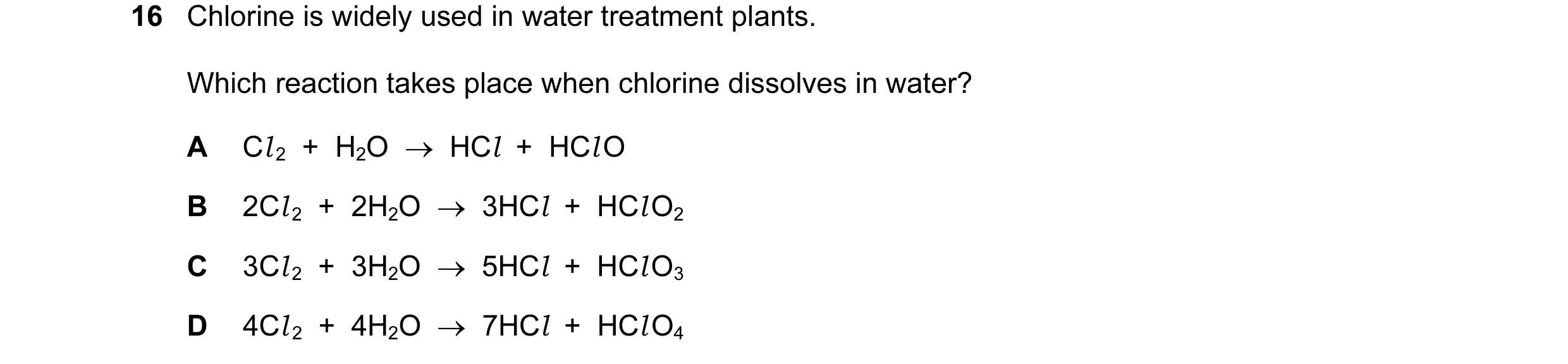
16 Chlorine is widely used in water treatment plants. Which reaction takes place when chlorine dissolves in water? A Cl 2 + H2O → HCl + HCl O B 2Cl 2 + 2H2O → 3HCl + HCl O2 C 3Cl 2 + 3H2O → 5HCl + HCl O3 D 4Cl 2 + 4H2O → 7HCl + HCl O4
1 marks
Answer: A
This question in 9701/11 May/June 2015
Q22 · The diagram shows a diaphragm cell used for the electrolysis of brine 9701/12 May/June 2015
16 The diagram shows a diaphragm cell used for the electrolysis of brine. Brine is concentrated aqueous sodium chloride. brine P Q R S exit pipe _ cathode anode + diaphragm A solution of sodium chlorate(I), commonly used as bleach, can be made by mixing which two substances? A P and R B P and S C Q and R D Q and S
1 marks
Answer: B
This question in 9701/12 May/June 2015
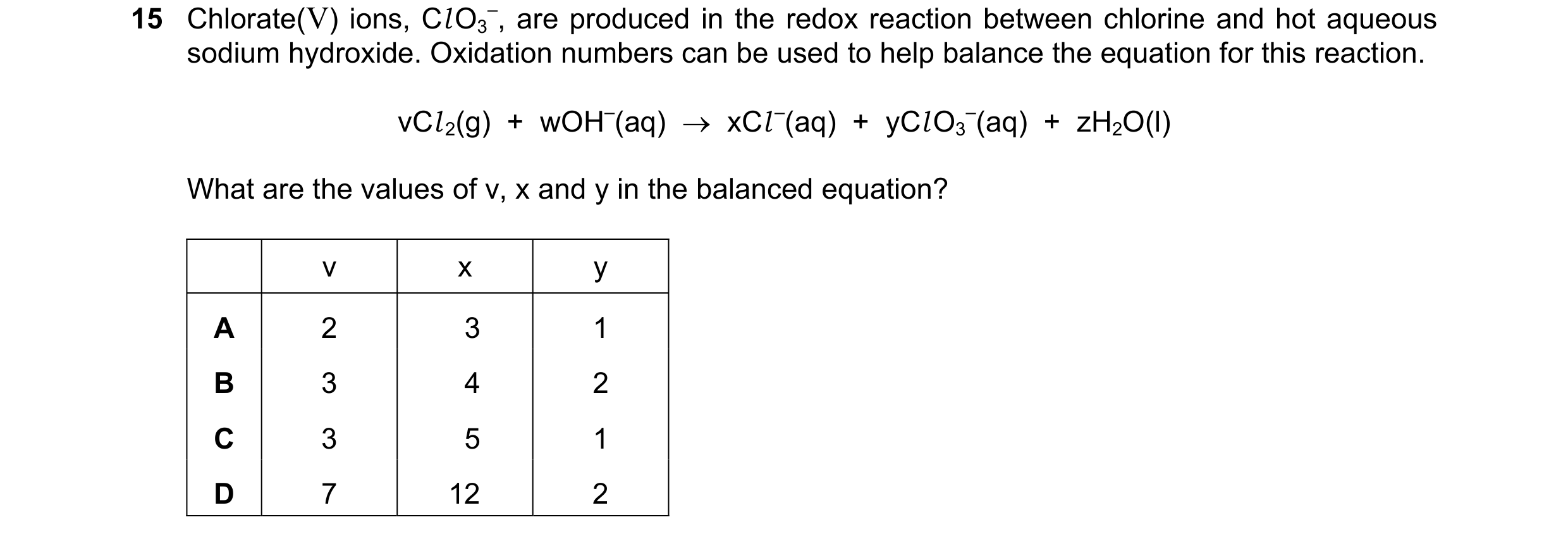
Q23 · Chlorate(V) ions, Cl O3 –, are produced in the redox reaction between chlorine and hot… 9701/12 May/June 2015
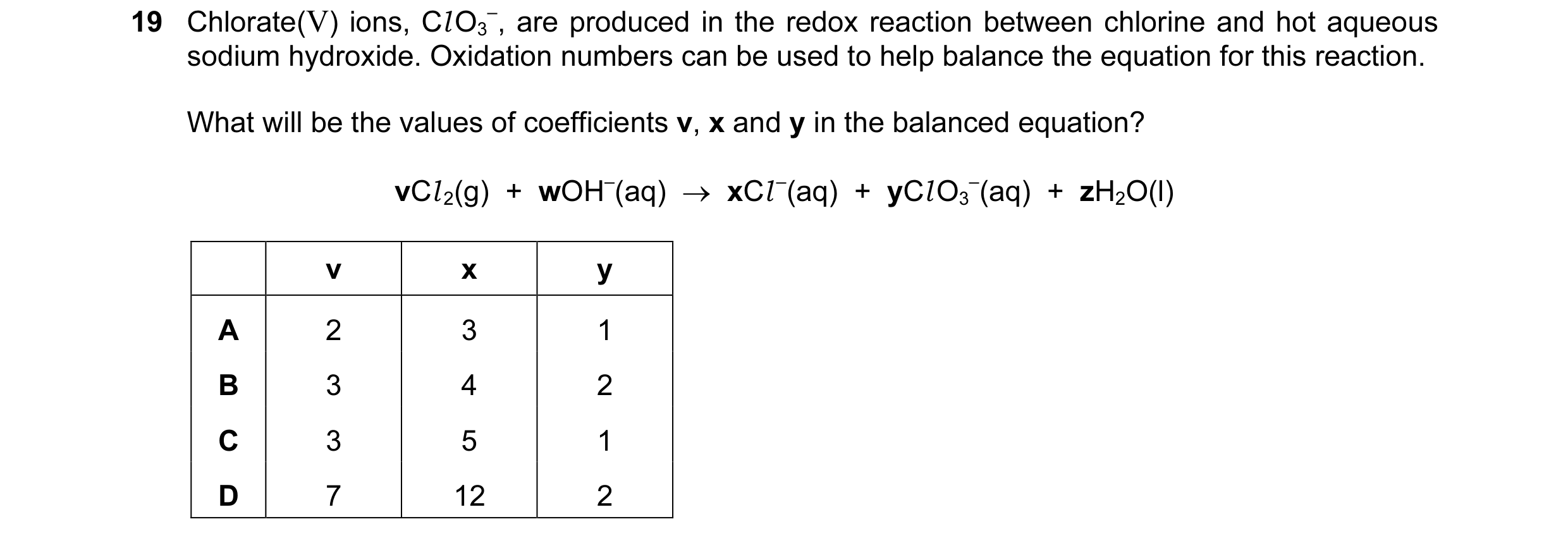
19 Chlorate(V) ions, Cl O3 –, are produced in the redox reaction between chlorine and hot aqueous sodium hydroxide. Oxidation numbers can be used to help balance the equation for this reaction. What will be the values of coefficients v, x and y in the balanced equation? vCl 2(g) + wOH–(aq) → xCl –(aq) + yCl O3 –(aq) + zH2O(l) v x y A 2 3 1 B 3 4 2 C 3 5 1 D 7 12 2
1 marks
Answer: C
This question in 9701/12 May/June 2015
Q24 · Chlorine gas is widely used to treat contaminated water 9701/12 Feb/March 2016
14 Chlorine gas is widely used to treat contaminated water. Which species present in water when chlorine gas has been added is responsible for killing bacteria? A Cl O2 – B Cl – C HCl D OCl –
1 marks
Answer: D
This question in 9701/12 Feb/March 2016
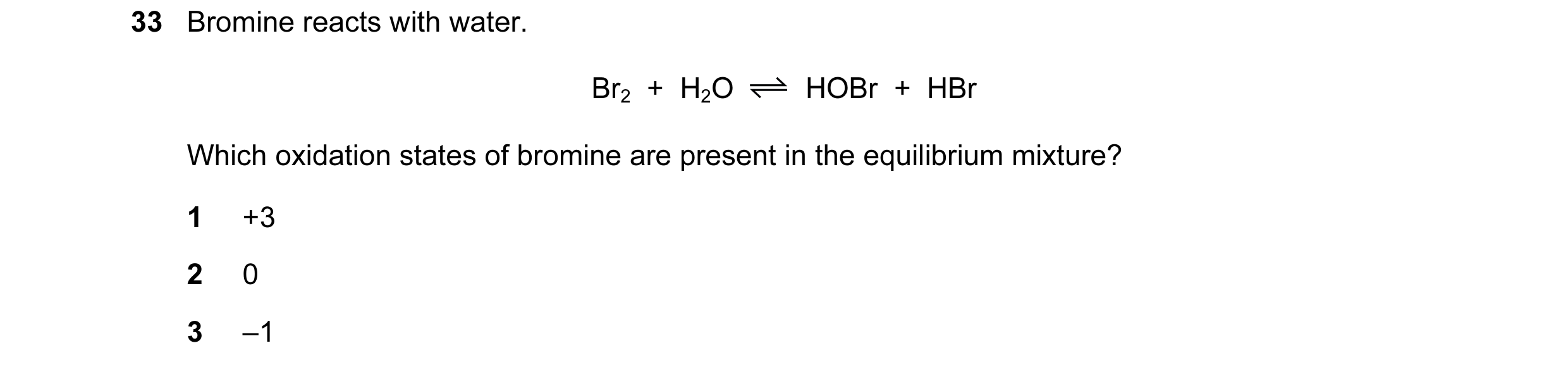
Q25 · Bromine reacts with water 9701/11 May/June 2016
33 Bromine reacts with water. Br2 + H2O HOBr + HBr Which oxidation states of bromine are present in the equilibrium mixture? 1 +3 2 0 3 –1
1 marks
Answer: C
This question in 9701/11 May/June 2016
Q26 · In the treatment of domestic water supplies, chlorine is added to the water to form HCl O 9701/12 May/June 2016
9 In the treatment of domestic water supplies, chlorine is added to the water to form HCl O. Cl 2(aq) + H2O(I) → H+(aq) + Cl –(aq) + HCl O(aq) The HCl O reacts further to give Cl O– ions. HCl O(aq) + H2O(I) H3O+(aq) + Cl O–(aq) Both HCl O and Cl O– kill bacteria by oxidation. What is the change in oxidation number of chlorine when forming the Cl O– ion from aqueous chlorine? A –1 B 0 C +1 D +2
1 marks
Answer: C
This question in 9701/12 May/June 2016
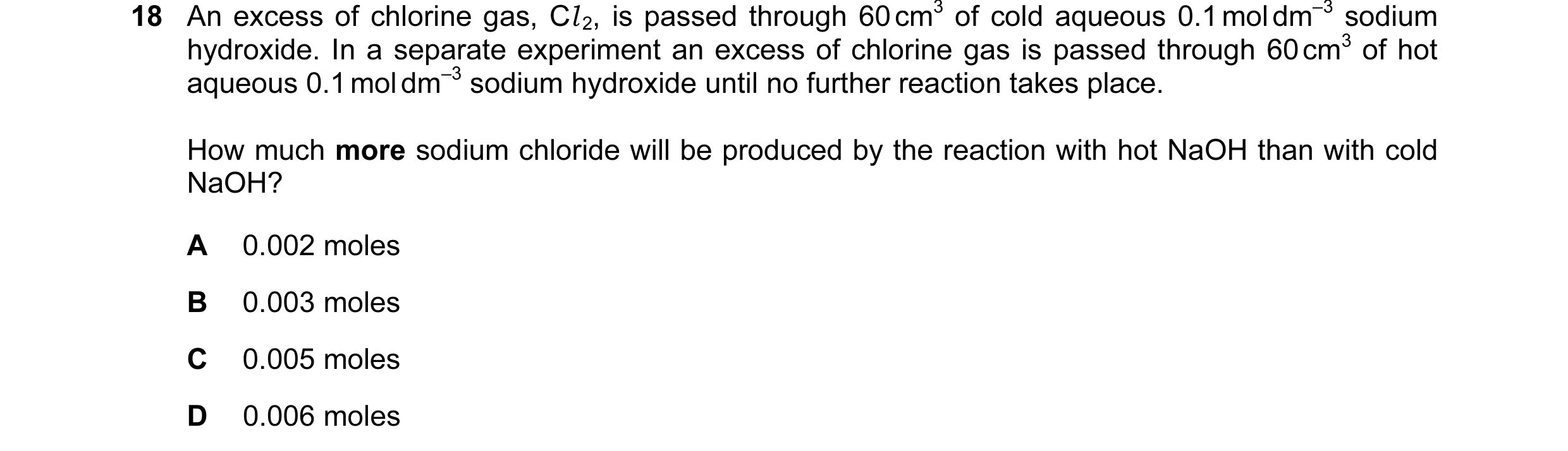
Q27 · An excess of chlorine gas, Cl 2, is passed through 60 cm3 of cold aqueous 0.1 mol dm–3… 9701/12 May/June 2016
18 An excess of chlorine gas, Cl 2, is passed through 60 cm3 of cold aqueous 0.1 mol dm–3 sodium hydroxide. In a separate experiment an excess of chlorine gas is passed through 60 cm3 of hot aqueous 0.1 mol dm–3 sodium hydroxide until no further reaction takes place. How much more sodium chloride will be produced by the reaction with hot NaOH than with cold NaOH? A 0.002 moles B 0.003 moles C 0.005 moles D 0.006 moles
1 marks
Answer: A
This question in 9701/12 May/June 2016
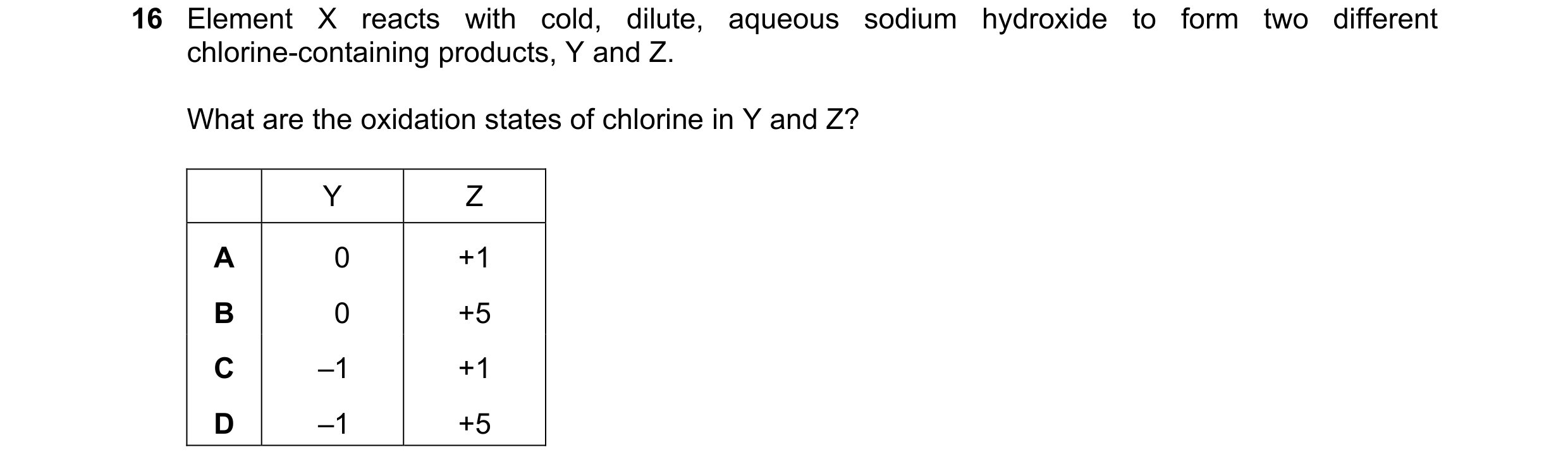
Q28 · Element X reacts with cold, dilute, aqueous sodium hydroxide to form two different… 9701/12 May/June 2017
16 Element X reacts with cold, dilute, aqueous sodium hydroxide to form two different chlorine-containing products, Y and Z. What are the oxidation states of chlorine in Y and Z? Y Z A 0 +1 B 0 +5 C –1 +1 D –1 +5
1 marks
Answer: C
This question in 9701/12 May/June 2017
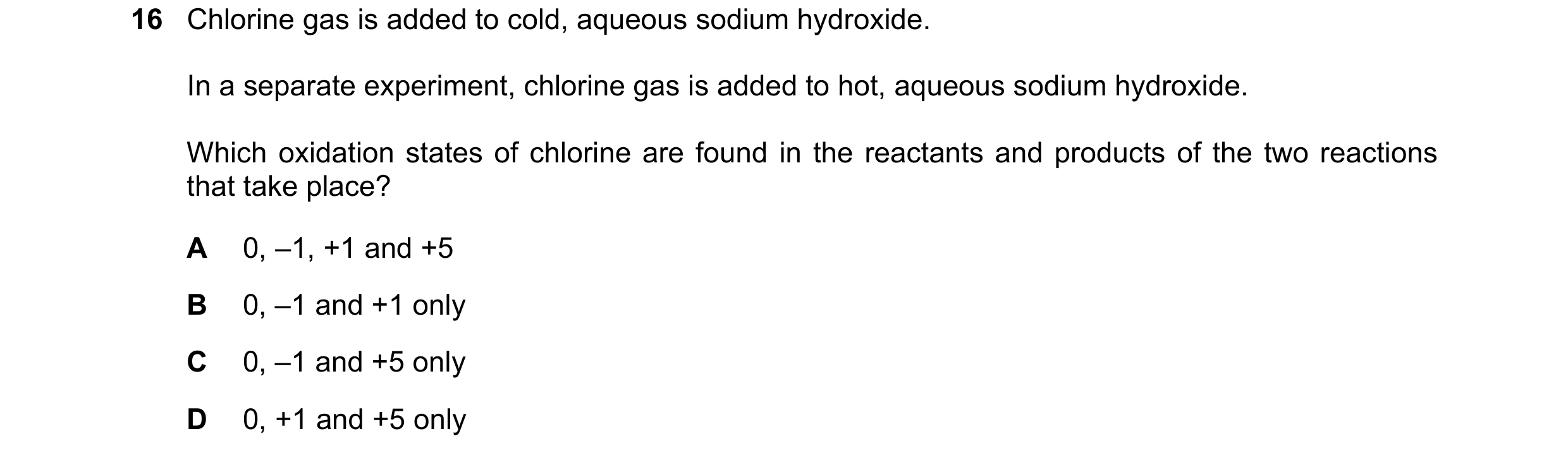
Q29 · Chlorine gas is added to cold, aqueous sodium hydroxide 9701/13 May/June 2017
16 Chlorine gas is added to cold, aqueous sodium hydroxide. In a separate experiment, chlorine gas is added to hot, aqueous sodium hydroxide. Which oxidation states of chlorine are found in the reactants and products of the two reactions that take place? A 0, –1, +1 and +5 B 0, –1 and +1 only C 0, –1 and +5 only D 0, +1 and +5 only
1 marks
Answer: A
This question in 9701/13 May/June 2017
Q30 · 71.0 g of chlorine, Cl 2, react with an excess of sodium hydroxide solution at a… 9701/11 Oct/Nov 2017
17 71.0 g of chlorine, Cl 2, react with an excess of sodium hydroxide solution at a particular temperature. The reaction produces exactly 35.5 g of product X. What is product X? A H2O B NaCl C NaCl O D NaCl O3
1 marks
Answer: D
This question in 9701/11 Oct/Nov 2017
Q31 · In an experiment, 0.125 mol of chlorine gas, Cl 2, is reacted with an excess of cold… 9701/12 Oct/Nov 2017
16 In an experiment, 0.125 mol of chlorine gas, Cl 2, is reacted with an excess of cold, aqueous sodium hydroxide. One of the products is a compound of sodium, oxygen and chlorine. Which mass of this product is formed? A 9.31 g B 13.3 g C 18.6 g D 26.6 g
1 marks
Answer: A
This question in 9701/12 Oct/Nov 2017
Q32 · 71.0 g of chlorine, Cl 2, react with an excess of sodium hydroxide solution at a… 9701/13 Oct/Nov 2017
17 71.0 g of chlorine, Cl 2, react with an excess of sodium hydroxide solution at a particular temperature. The reaction produces exactly 35.5 g of product X. What is product X? A H2O B NaCl C NaCl O D NaCl O3
1 marks
Answer: D
This question in 9701/13 Oct/Nov 2017
Q33 · Chlorine reacts with hot aqueous sodium hydroxide 9701/12 Feb/March 2018
35 Chlorine reacts with hot aqueous sodium hydroxide. Which oxidation states does chlorine show in the products of this reaction? 1 –1 2 +3 3 +1
1 marks
Answer: D
This question in 9701/12 Feb/March 2018
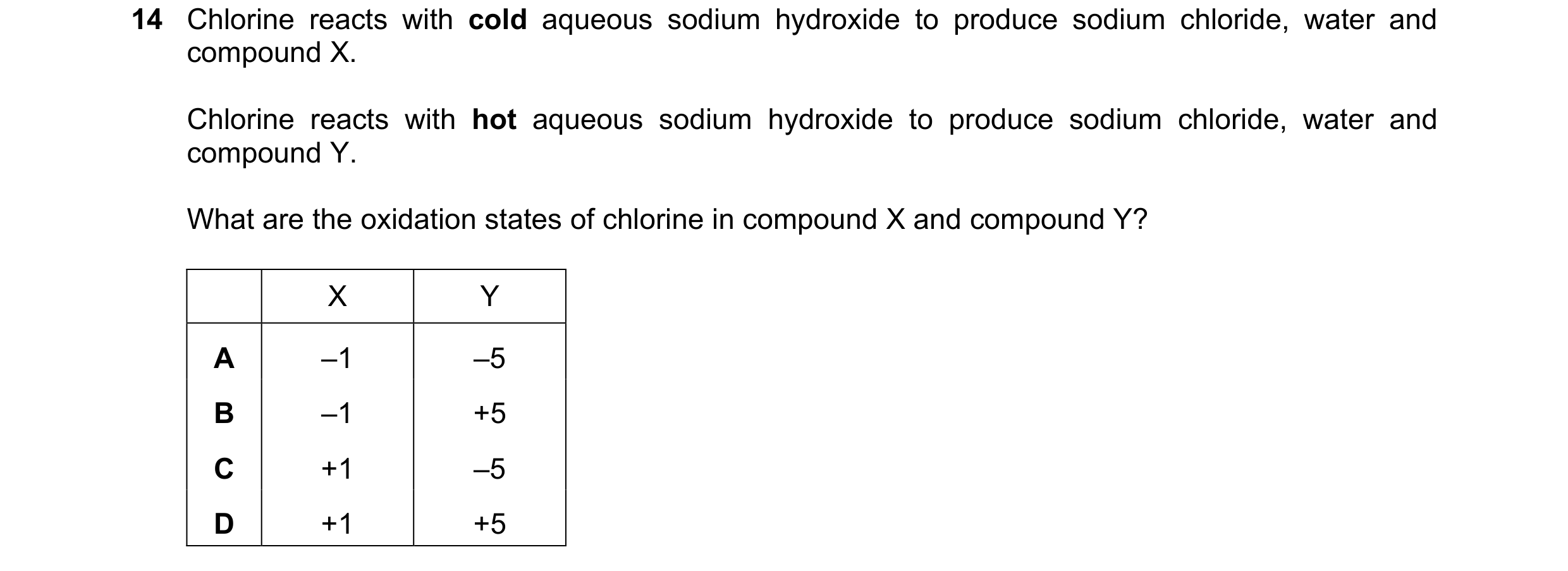
Q34 · Chlorine reacts with cold aqueous sodium hydroxide to produce sodium chloride, water and… 9701/11 May/June 2018
14 Chlorine reacts with cold aqueous sodium hydroxide to produce sodium chloride, water and compound X. Chlorine reacts with hot aqueous sodium hydroxide to produce sodium chloride, water and compound Y. What are the oxidation states of chlorine in compound X and compound Y? X Y A –1 –5 B –1 +5 C +1 –5 D +1 +5
1 marks
Answer: D
This question in 9701/11 May/June 2018
Q35 · Three samples of chlorine gas each contain 0.710 g of chlorine 9701/12 May/June 2018
35 Three samples of chlorine gas each contain 0.710 g of chlorine. Each sample is reacted with a reagent. ● In the first reaction a sample is reacted completely with hydrogen gas. ● In the second reaction a sample is reacted completely with cold NaOH(aq). ● In the third reaction a sample is reacted completely with hot NaOH(aq). Which masses of the named products would be formed? 1 Exactly 0.730 g of HCl form in the first reaction. 2 Exactly 0.585 g of NaCl form in the second reaction. 3 Exactly 0.975 g of NaCl form in the third reaction.
1 marks
Answer: A
This question in 9701/12 May/June 2018
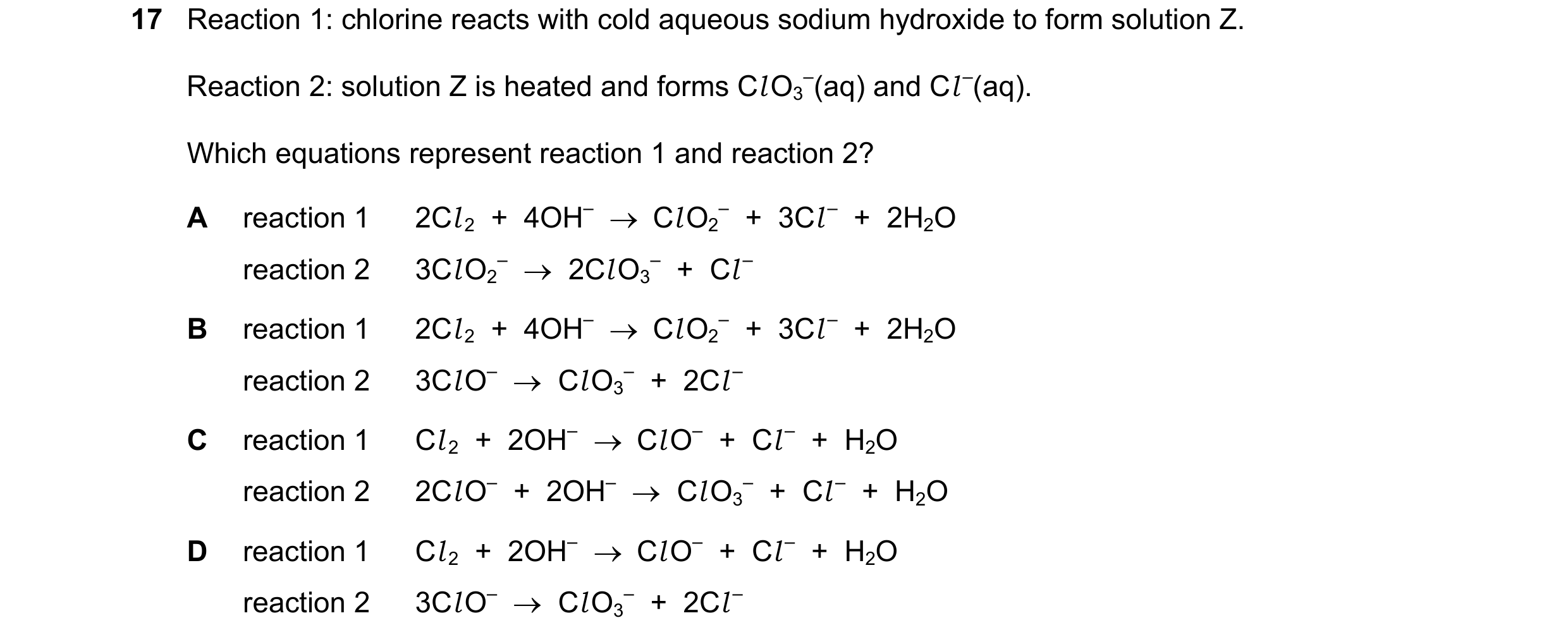
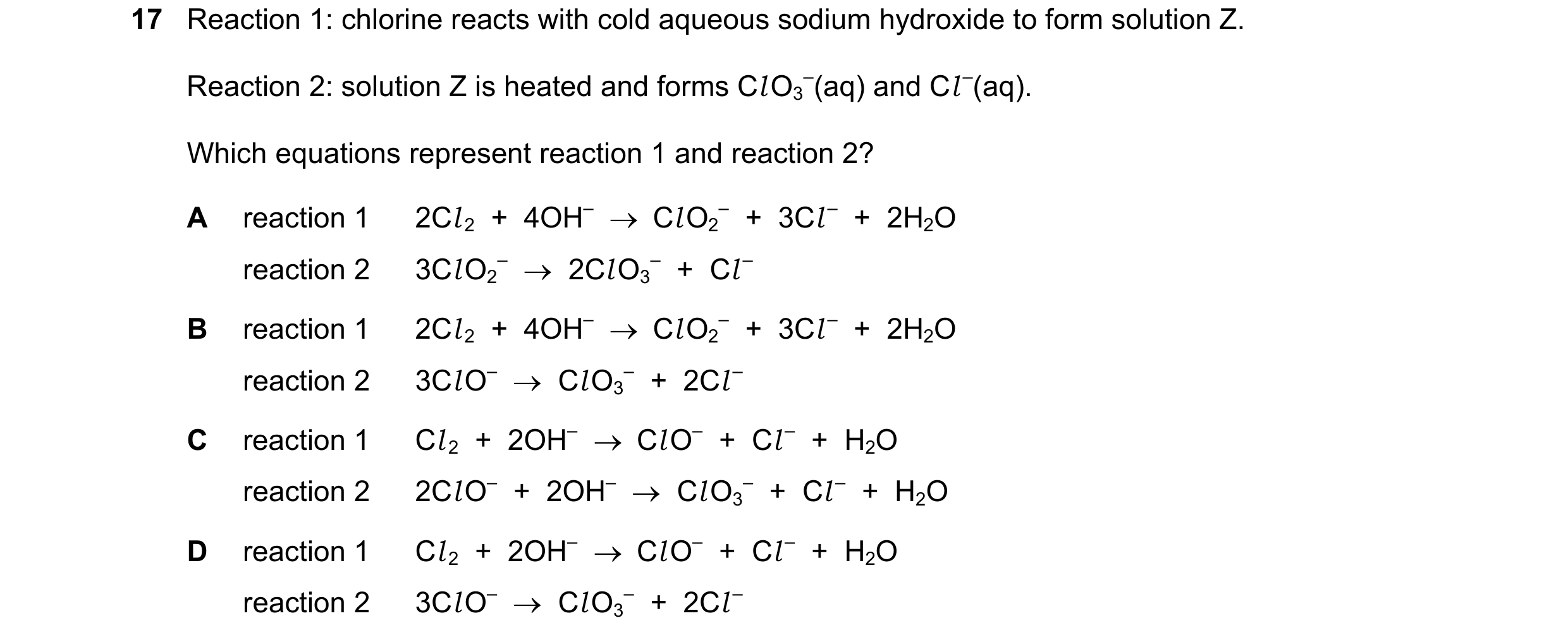
Q36 · Reaction 1: chlorine reacts with cold aqueous sodium hydroxide to form solution Z 9701/11 Oct/Nov 2018
17 Reaction 1: chlorine reacts with cold aqueous sodium hydroxide to form solution Z. Reaction 2: solution Z is heated and forms Cl O3 –(aq) and Cl –(aq). Which equations represent reaction 1 and reaction 2? A reaction 1 2Cl 2 + 4OH– → Cl O2 – + 3Cl – + 2H2O reaction 2 3Cl O2 – → 2Cl O3 – + Cl – B reaction 1 2Cl 2 + 4OH– → Cl O2 – + 3Cl – + 2H2O reaction 2 3Cl O– → Cl O3 – + 2Cl – C reaction 1 Cl 2 + 2OH– → Cl O– + Cl – + H2O reaction 2 2Cl O– + 2OH– → Cl O3 – + Cl – + H2O D reaction 1 Cl 2 + 2OH– → Cl O– + Cl – + H2O reaction 2 3Cl O– → Cl O3 – + 2Cl –
1 marks
Answer: D
This question in 9701/11 Oct/Nov 2018
Q37 · Chlorine reacts with both hot and cold sodium hydroxide to form products containing… 9701/12 Oct/Nov 2018
17 Chlorine reacts with both hot and cold sodium hydroxide to form products containing chlorine. Cold sodium hydroxide forms sodium chlorate(X) and hot sodium hydroxide forms sodium chlorate(Y). X and Y are oxidation numbers. Which equation is correct? A Y = X – 6 B Y = X – 4 C Y = X + 4 D Y = X + 6
1 marks
Answer: C
This question in 9701/12 Oct/Nov 2018
Q38 · Reaction 1: chlorine reacts with cold aqueous sodium hydroxide to form solution Z 9701/13 Oct/Nov 2018
17 Reaction 1: chlorine reacts with cold aqueous sodium hydroxide to form solution Z. Reaction 2: solution Z is heated and forms Cl O3 –(aq) and Cl –(aq). Which equations represent reaction 1 and reaction 2? A reaction 1 2Cl 2 + 4OH– → Cl O2 – + 3Cl – + 2H2O reaction 2 3Cl O2 – → 2Cl O3 – + Cl – B reaction 1 2Cl 2 + 4OH– → Cl O2 – + 3Cl – + 2H2O reaction 2 3Cl O– → Cl O3 – + 2Cl – C reaction 1 Cl 2 + 2OH– → Cl O– + Cl – + H2O reaction 2 2Cl O– + 2OH– → Cl O3 – + Cl – + H2O D reaction 1 Cl 2 + 2OH– → Cl O– + Cl – + H2O reaction 2 3Cl O– → Cl O3 – + 2Cl –
1 marks
Answer: D
This question in 9701/13 Oct/Nov 2018
Q39 · The reaction of bromine with warm NaOH(aq) produces products with the same oxidation… 9701/11 May/June 2019
17 The reaction of bromine with warm NaOH(aq) produces products with the same oxidation numbers, in the same ratios, as the reaction of chlorine with hot NaOH(aq). In one reaction between bromine and warm NaOH(aq), 30.2 g of a product containing sodium, bromine and oxygen is produced. Which mass of NaOH has reacted? A 8.00 g B 10.2 g C 20.3 g D 48.0 g
1 marks
Answer: D
This question in 9701/11 May/June 2019
Q40 · An excess of chlorine was bubbled into 100 cm3 of hot 6.0 mol dm–3 sodium hydroxide 9701/12 May/June 2019
17 An excess of chlorine was bubbled into 100 cm3 of hot 6.0 mol dm–3 sodium hydroxide. How many moles of sodium chloride would be produced in the reaction? A 0.3 B 0.5 C 0.6 D 1.2
1 marks
Answer: B
This question in 9701/12 May/June 2019
Q41 · Which statements about sodium chloride are correct? 9701/13 May/June 2019
35 Which statements about sodium chloride are correct? 1 It is a product of the reaction between chlorine and cold aqueous sodium hydroxide. 2 It is a product of the reaction between chlorine and hot aqueous sodium hydroxide. 3 It is a product of the reaction between chlorine and aqueous sodium bromide.
1 marks
Answer: A
This question in 9701/13 May/June 2019
Q42 · Which statements are correct? 9701/11 Oct/Nov 2019
35 Which statements are correct? 1 Chloride ions are oxidised when concentrated sulfuric acid is added to NaCl (s). 2 A disproportionation reaction takes place when chlorine is added to cold NaOH(aq). 3 An acidic solution forms when chlorine is added to water.
1 marks
Answer: C
This question in 9701/11 Oct/Nov 2019
Q43 · Chlorate(V) ions, Cl O3 –, are produced in the redox reaction between chlorine and hot… 9701/12 Oct/Nov 2019
15 Chlorate(V) ions, Cl O3 –, are produced in the redox reaction between chlorine and hot aqueous sodium hydroxide. Oxidation numbers can be used to help balance the equation for this reaction. vCl 2(g) + wOH–(aq) → xCl –(aq) + yCl O3 –(aq) + zH2O(l) What are the values of v, x and y in the balanced equation? v x y A 2 3 1 B 3 4 2 C 3 5 1 D 7 12 2
1 marks
Answer: C
This question in 9701/12 Oct/Nov 2019
Q44 · Which statements are correct? 9701/13 Oct/Nov 2019
35 Which statements are correct? 1 Chloride ions are oxidised when concentrated sulfuric acid is added to NaCl (s). 2 A disproportionation reaction takes place when chlorine is added to cold NaOH(aq). 3 An acidic solution forms when chlorine is added to water.
1 marks
Answer: C
This question in 9701/13 Oct/Nov 2019
Q45 · Hot aqueous sodium hydroxide reacts with chlorine 9701/12 Feb/March 2020
14 Hot aqueous sodium hydroxide reacts with chlorine. 6NaOH(aq) + 3Cl 2(g) → 5NaCl (aq) + NaCl O3(aq) + 3H2O(I) Which statement is correct? A The oxidation numbers of chlorine and hydrogen both change in the reaction. B The oxidation numbers of chlorine in the products are –1 and +1. C If the aqueous sodium hydroxide is cold the reaction produces NaCl O instead of NaCl O3. D Sodium undergoes disproportionation in this reaction.
1 marks
Answer: C
This question in 9701/12 Feb/March 2020
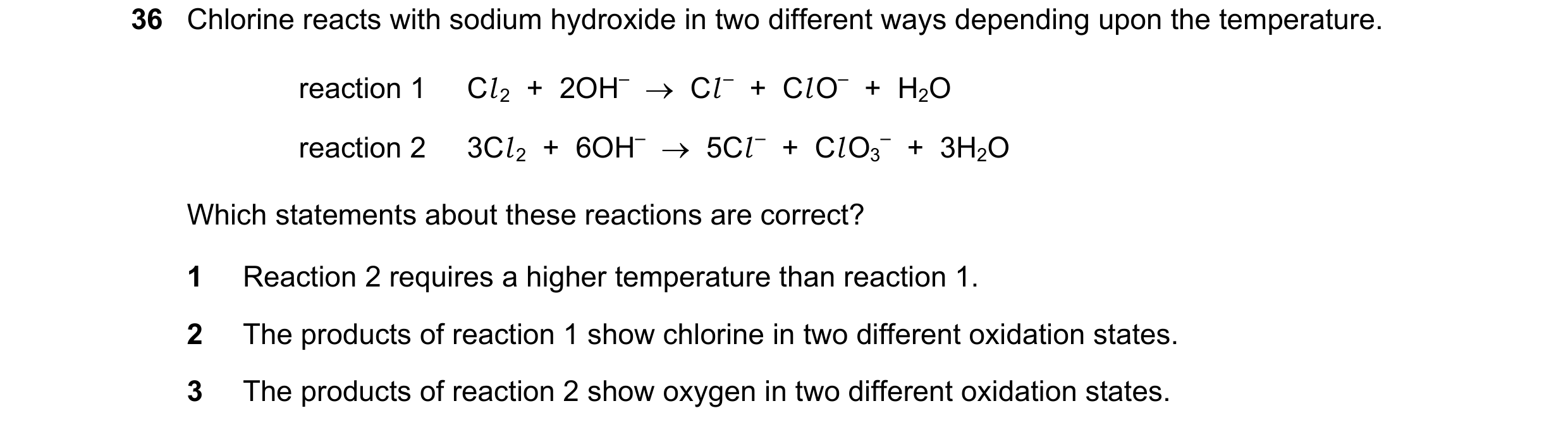
Q46 · Chlorine reacts with sodium hydroxide in two different ways depending upon the temperature 9701/11 May/June 2020
36 Chlorine reacts with sodium hydroxide in two different ways depending upon the temperature. reaction 1 Cl 2 + 2OH– → Cl – + Cl O– + H2O reaction 2 3Cl 2 + 6OH– → 5Cl – + Cl O3 – + 3H2O Which statements about these reactions are correct? 1 Reaction 2 requires a higher temperature than reaction 1. 2 The products of reaction 1 show chlorine in two different oxidation states. 3 The products of reaction 2 show oxygen in two different oxidation states.
1 marks
Answer: B
This question in 9701/11 May/June 2020
Q47 · When solid KCl O3 is heated in the absence of air, a mixture of two chlorine compounds in… 9701/13 May/June 2020
10 When solid KCl O3 is heated in the absence of air, a mixture of two chlorine compounds in the mole ratio of 3 : 1 is formed. Chlorine is the only element whose oxidation number changes in this reaction. What could be the oxidation numbers of chlorine in the two compounds that are formed? A +3 and –1 B +6 and +4 C +7 and –1 D +7 and +1
1 marks
Answer: C
This question in 9701/13 May/June 2020
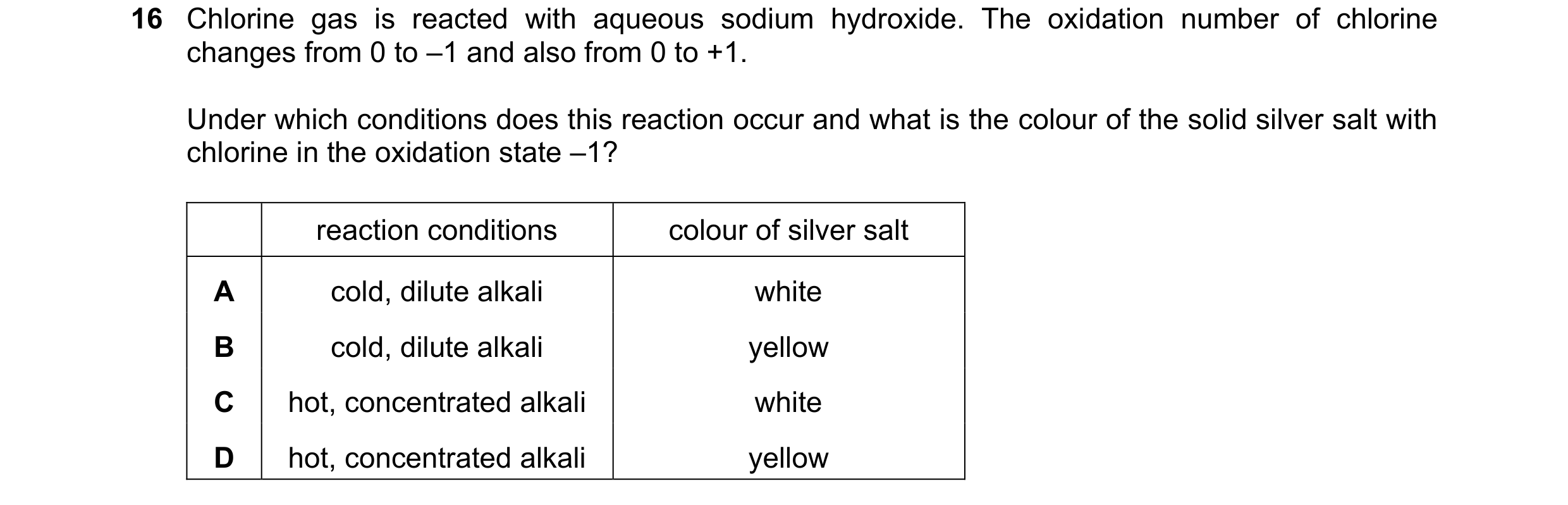
Q48 · Chlorine gas is reacted with aqueous sodium hydroxide 9701/12 Feb/March 2021
16 Chlorine gas is reacted with aqueous sodium hydroxide. The oxidation number of chlorine changes from 0 to –1 and also from 0 to +1. Under which conditions does this reaction occur and what is the colour of the solid silver salt with chlorine in the oxidation state –1? reaction conditions colour of silver salt A cold, dilute alkali white B cold, dilute alkali yellow C hot, concentrated alkali white D hot, concentrated alkali yellow
1 marks
Answer: A
This question in 9701/12 Feb/March 2021
Q49 · Chlorine gas is widely used to treat contaminated water 9701/12 May/June 2021
17 Chlorine gas is widely used to treat contaminated water. When chlorine is added to water, which chemical species present is responsible for killing bacteria? A Cl O2 – B Cl – C HCl D Cl O–
1 marks
Answer: D
This question in 9701/12 May/June 2021
Q50 · Which reagents produce a solution of sodium chlorate(V)? 9701/13 May/June 2021
35 Which reagents produce a solution of sodium chlorate(V)? 1 chlorine and hot concentrated sodium hydroxide solution 2 chlorine and cold dilute sodium hydroxide solution 3 chlorine dissolved in water at room temperature
1 marks
Answer: D
This question in 9701/13 May/June 2021
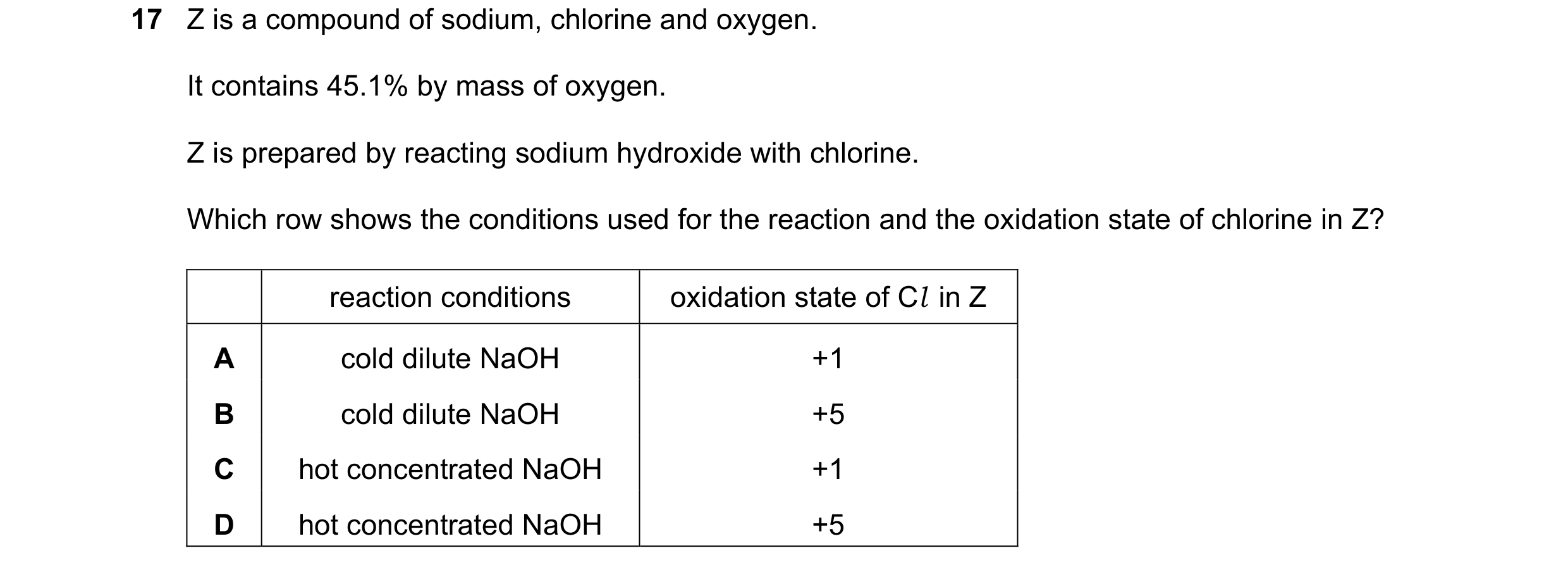
Q51 · Z is a compound of sodium, chlorine and oxygen 9701/11 Oct/Nov 2021
17 Z is a compound of sodium, chlorine and oxygen. It contains 45.1% by mass of oxygen. Z is prepared by reacting sodium hydroxide with chlorine. Which row shows the conditions used for the reaction and the oxidation state of chlorine in Z? reaction conditions oxidation state of Cl in Z A cold dilute NaOH +1 B cold dilute NaOH +5 C hot concentrated NaOH +1 D hot concentrated NaOH +5
1 marks
Answer: D
This question in 9701/11 Oct/Nov 2021
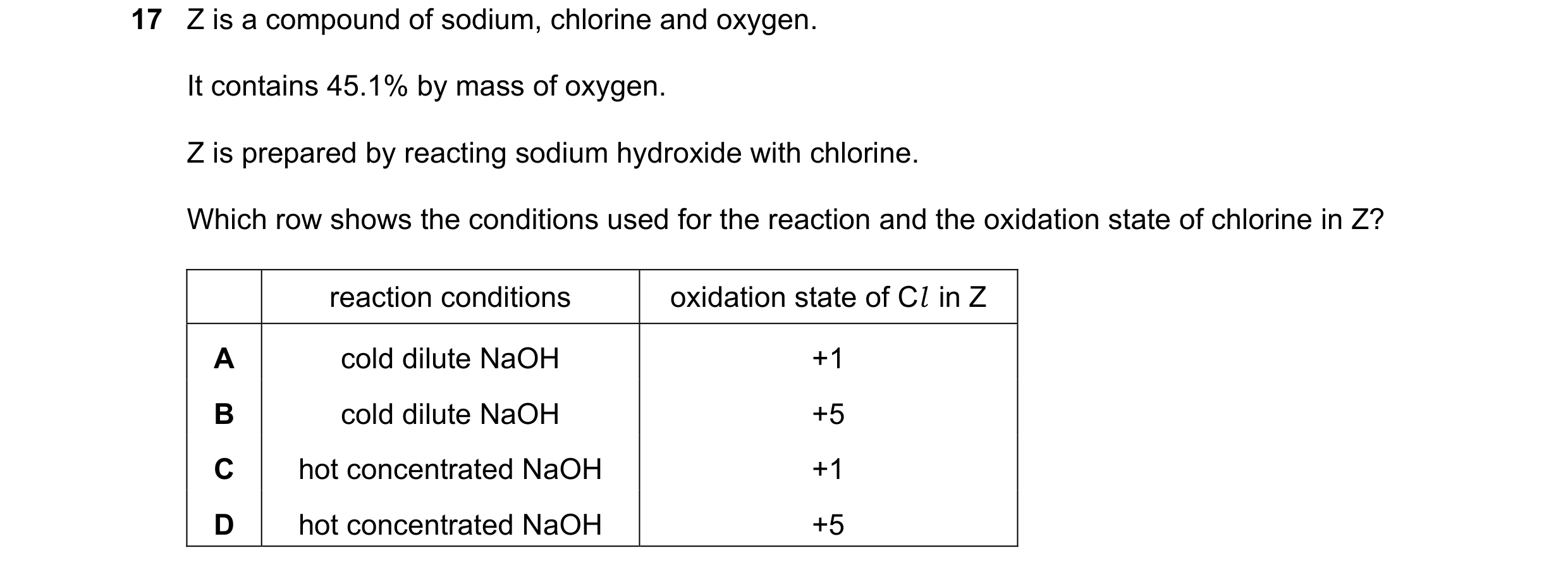
Q52 · Z is a compound of sodium, chlorine and oxygen 9701/13 Oct/Nov 2021
17 Z is a compound of sodium, chlorine and oxygen. It contains 45.1% by mass of oxygen. Z is prepared by reacting sodium hydroxide with chlorine. Which row shows the conditions used for the reaction and the oxidation state of chlorine in Z? reaction conditions oxidation state of Cl in Z A cold dilute NaOH +1 B cold dilute NaOH +5 C hot concentrated NaOH +1 D hot concentrated NaOH +5
1 marks
Answer: D
This question in 9701/13 Oct/Nov 2021
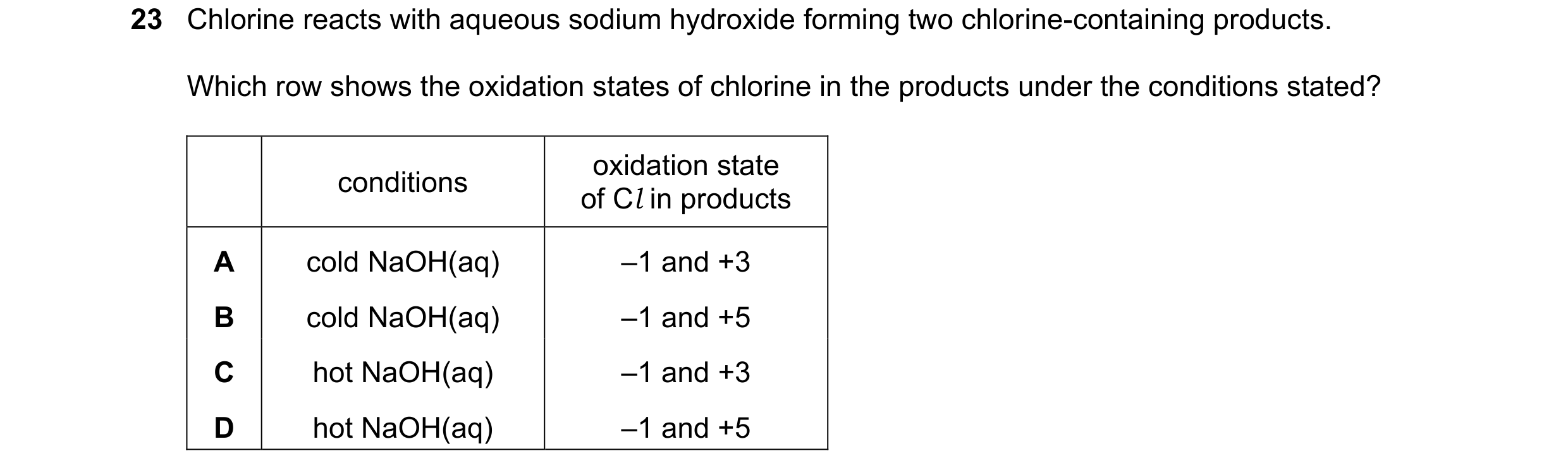
Q53 · Chlorine reacts with aqueous sodium hydroxide forming two chlorine-containing products 9701/12 May/June 2022
23 Chlorine reacts with aqueous sodium hydroxide forming two chlorine-containing products. Which row shows the oxidation states of chlorine in the products under the conditions stated? oxidation state conditions of Cl in products A cold NaOH(aq) –1 and +3 B cold NaOH(aq) –1 and +5 C hot NaOH(aq) –1 and +3 D hot NaOH(aq) –1 and +5
1 marks
Answer: D
This question in 9701/12 May/June 2022
Q54 · Chlorine is bubbled through 100 cm3 of hot 4.0 mol dm–3 sodium hydroxide until the… 9701/11 Oct/Nov 2022
22 Chlorine is bubbled through 100 cm3 of hot 4.0 mol dm–3 sodium hydroxide until the reaction is complete. 6NaOH(aq) + xCl 2(aq) → yNaCl (aq) + zNaCl O3(aq) + 3H2O(l) Which row is correct? [Na+](aq) after x reaction / mol dm–3 A 3 4.0 B 3 less than 4.0 C 6 4.0 D 6 less than 4.0
1 marks
Answer: B
This question in 9701/11 Oct/Nov 2022
Q55 · What is the oxidation state of the chlorine-containing species that kills bacteria in… 9701/12 Oct/Nov 2022
21 What is the oxidation state of the chlorine-containing species that kills bacteria in drinking water? A –1 B +1 C +3 D +5
1 marks
Answer: B
This question in 9701/12 Oct/Nov 2022
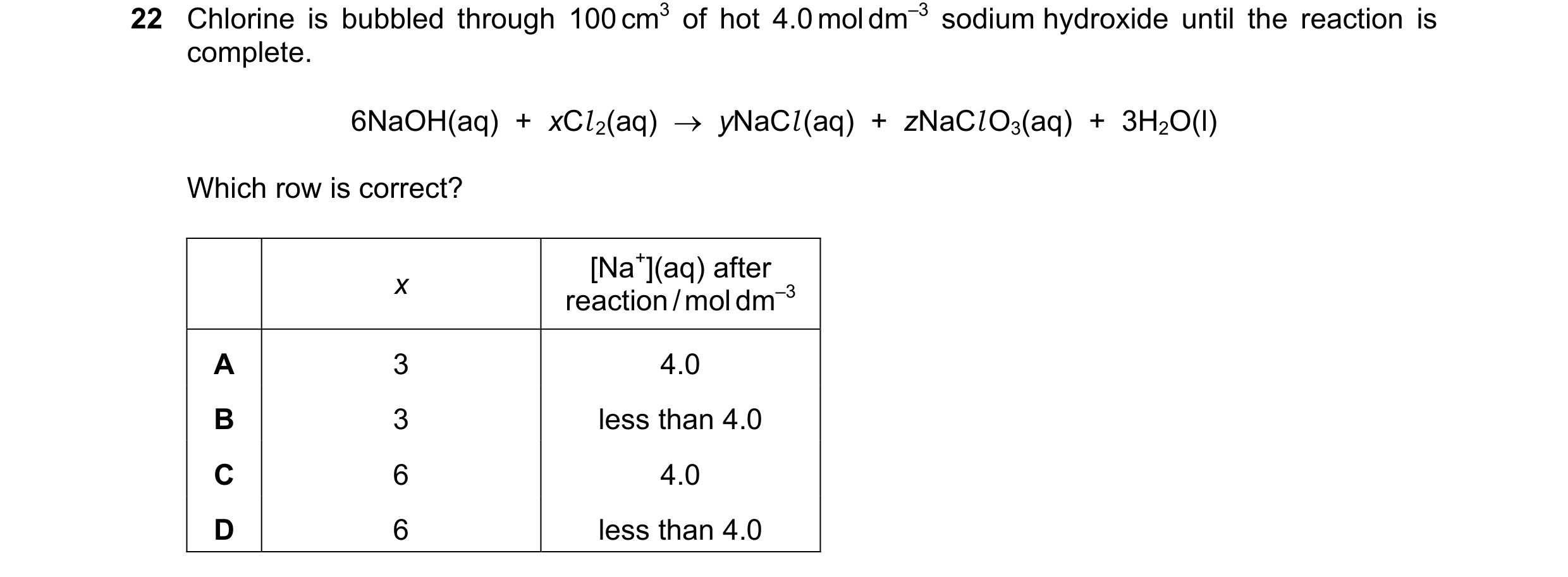
Q56 · Chlorine is bubbled through 100 cm3 of hot 4.0 mol dm–3 sodium hydroxide until the… 9701/13 Oct/Nov 2022
22 Chlorine is bubbled through 100 cm3 of hot 4.0 mol dm–3 sodium hydroxide until the reaction is complete. 6NaOH(aq) + xCl 2(aq) yNaCl (aq) + zNaCl O3(aq) + 3H2O(l) Which row is correct? [Na+](aq) after x reaction / mol dm–3 A 3 4.0 B 3 less than 4.0 C 6 4.0 D 6 less than 4.0
1 marks
Answer: B
This question in 9701/13 Oct/Nov 2022
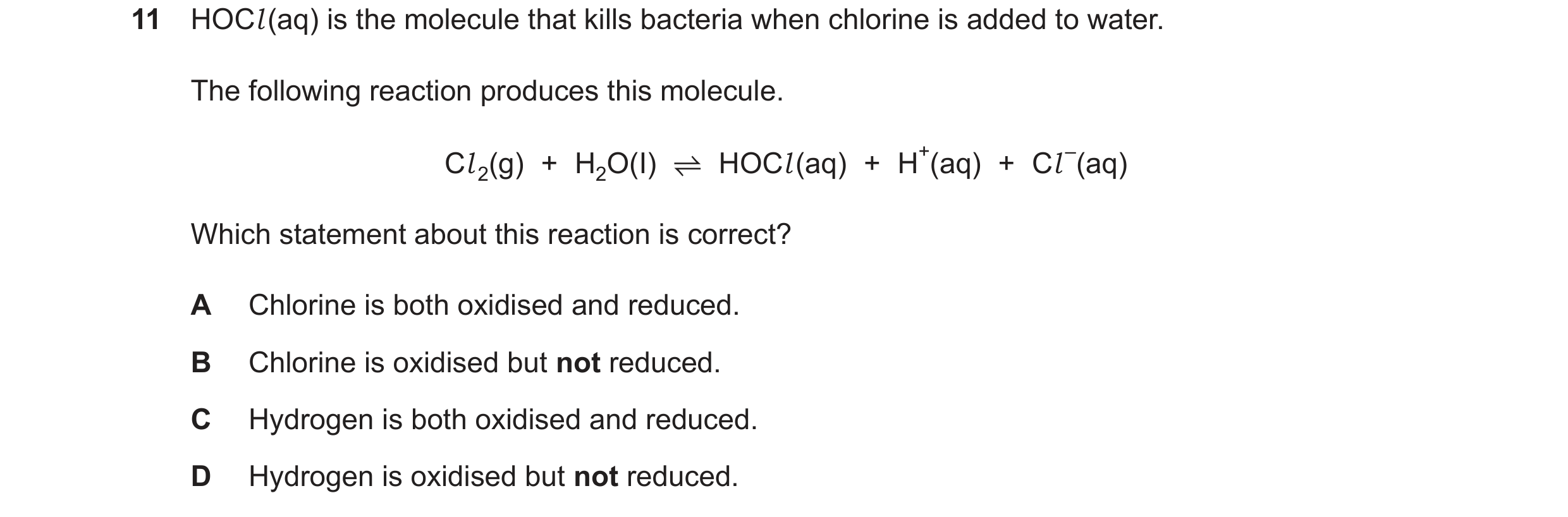
Q57 · HOCl(aq) is the molecule that kills bacteria when chlorine is added to water 9701/11 Oct/Nov 2023
11 HOCl(aq) is the molecule that kills bacteria when chlorine is added to water. The following reaction produces this molecule. Cl 2(g) + H2O(I) ⇋HOCl(aq) + H+(aq) + Cl –(aq) Which statement about this reaction is correct? A Chlorine is both oxidised and reduced. B Chlorine is oxidised but not reduced. C Hydrogen is both oxidised and reduced. D Hydrogen is oxidised but not reduced.
1 marks
Answer: A
This question in 9701/11 Oct/Nov 2023
Q58 · HOCl(aq) is the molecule that kills bacteria when chlorine is added to water 9701/13 Oct/Nov 2023
11 HOCl(aq) is the molecule that kills bacteria when chlorine is added to water. The following reaction produces this molecule. Cl 2(g) + H2O(I) ⇋HOCl(aq) + H+(aq) + Cl –(aq) Which statement about this reaction is correct? A Chlorine is both oxidised and reduced. B Chlorine is oxidised but not reduced. C Hydrogen is both oxidised and reduced. D Hydrogen is oxidised but not reduced.
1 marks
Answer: A
This question in 9701/13 Oct/Nov 2023
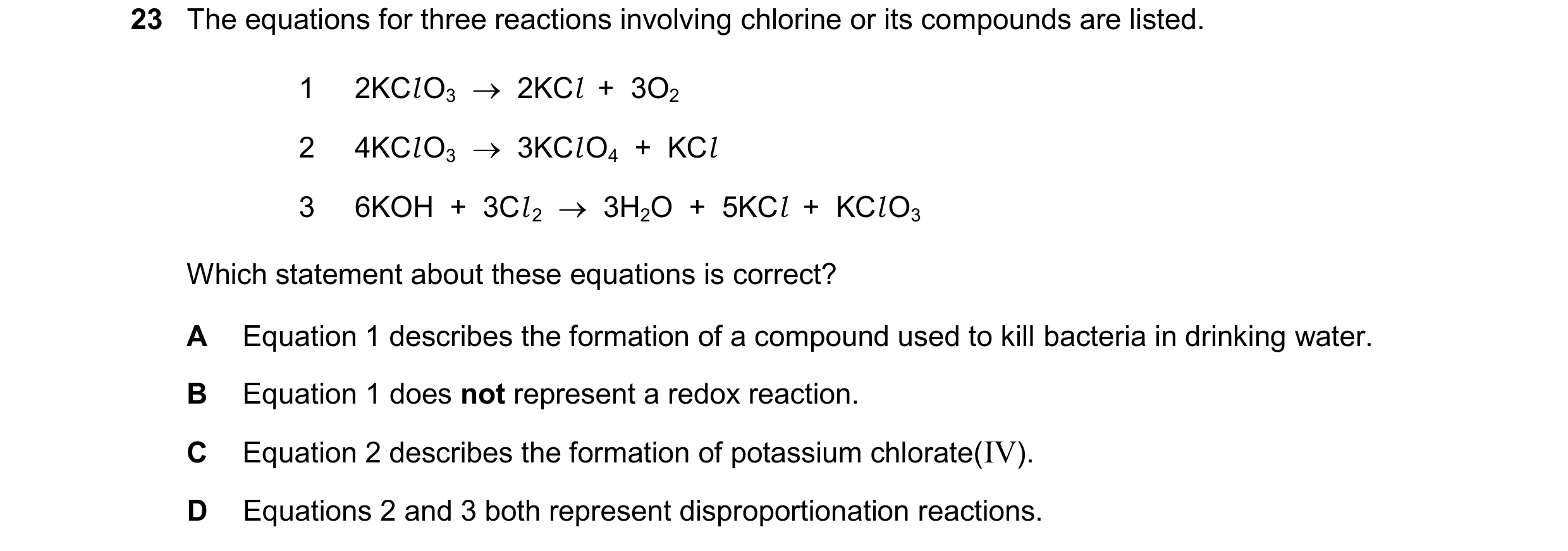
Q59 · The equations for three reactions involving chlorine or its compounds are listed 9701/12 Feb/March 2024
23 The equations for three reactions involving chlorine or its compounds are listed. 1 2KCl O3 2KCl + 3O2 2 4KCl O3 3KCl O4 + KCl 3 6KOH + 3Cl 2 3H2O + 5KCl + KCl O3 Which statement about these equations is correct? A Equation 1 describes the formation of a compound used to kill bacteria in drinking water. B Equation 1 does not represent a redox reaction. C Equation 2 describes the formation of potassium chlorate(IV). D Equations 2 and 3 both represent disproportionation reactions.
1 marks
Answer: D
This question in 9701/12 Feb/March 2024
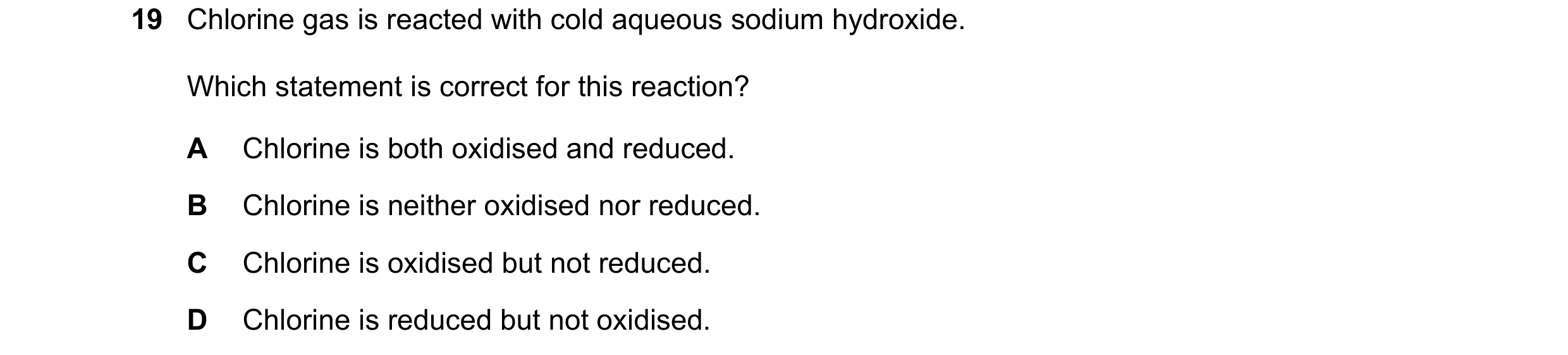
Q60 · Chlorine gas is reacted with cold aqueous sodium hydroxide 9701/12 May/June 2024
19 Chlorine gas is reacted with cold aqueous sodium hydroxide. Which statement is correct for this reaction? A Chlorine is both oxidised and reduced. B Chlorine is neither oxidised nor reduced. C Chlorine is oxidised but not reduced. D Chlorine is reduced but not oxidised.
1 marks
Answer: A
This question in 9701/12 May/June 2024
Q61 · The name ‘chlorate’ is used for an anion consisting of chlorine and oxygen only 9701/12 Oct/Nov 2024
23 The name ‘chlorate’ is used for an anion consisting of chlorine and oxygen only. In a molecule of ICl, the iodine atom has oxidation number x and the chlorine atom has oxidation number y. When ICl is added to H2O, iodine is reduced. 4ICl + 2H2O 4HCl + O2 + 2I2 Which statement about the value of x or y is correct? A x is the same as the oxidation number of Cl in the chlorate ion formed when Cl 2(aq) is added to cold NaOH(aq). B x is the same as the oxidation number of Cl in the chlorate ion formed when Cl 2(aq) is added to hot NaOH(aq). C y is the same as the oxidation number of Cl in the chlorate ion formed when Cl 2(aq) is added to cold NaOH(aq). D y is the same as the oxidation number of Cl in the chlorate ion formed when Cl 2(aq) is added to hot NaOH(aq).
1 marks
Answer: A
This question in 9701/12 Oct/Nov 2024
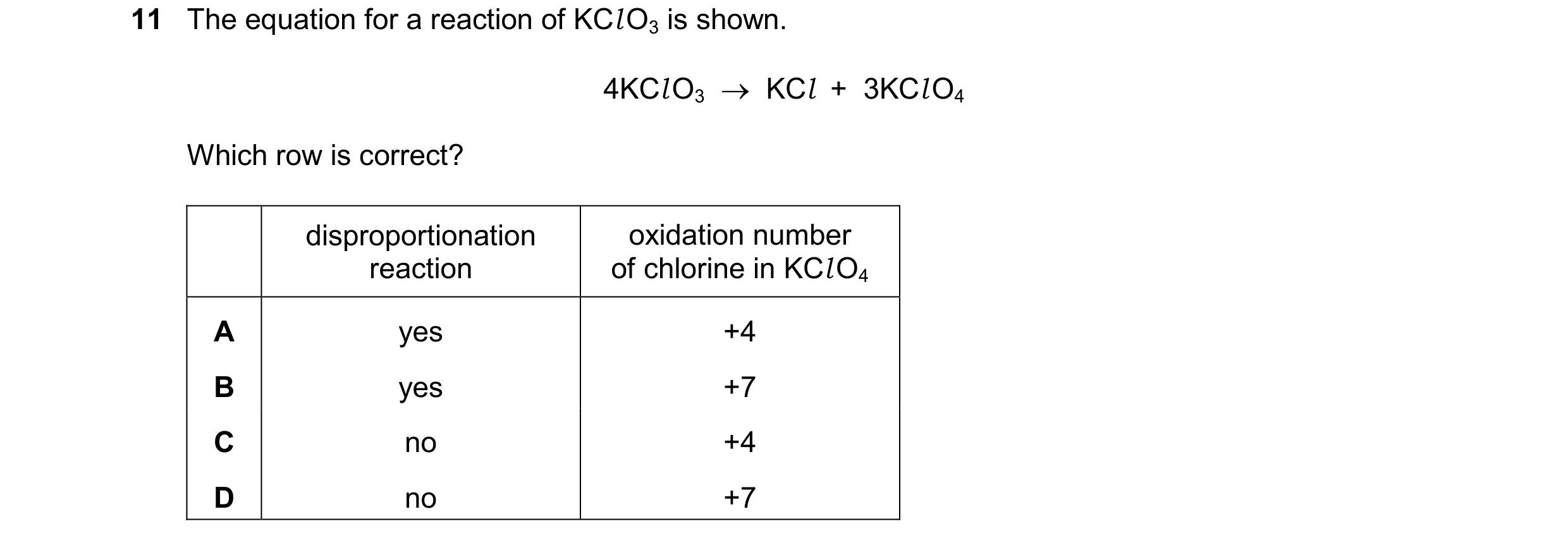
Q62 · The equation for a reaction of KCl O3 is shown 9701/12 Feb/March 2025
11 The equation for a reaction of KCl O3 is shown. 4KCl O3 KCl + 3KCl O4 Which row is correct? disproportionation oxidation number reaction of chlorine in KCl O4 A yes +4 B yes +7 C no +4 D no +7
1 marks
Answer: B
This question in 9701/12 Feb/March 2025
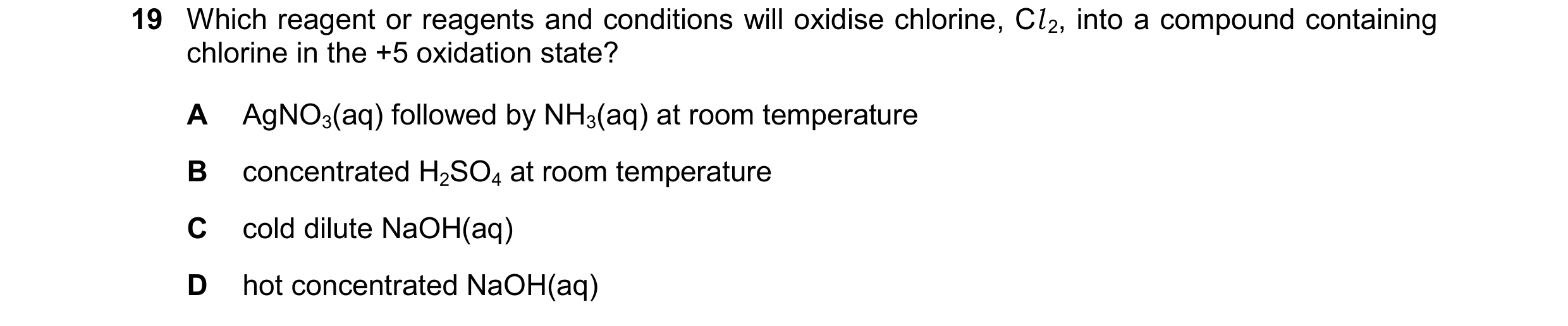
Q63 · Which reagent or reagents and conditions will oxidise chlorine, Cl2, into a compound… 9701/11 May/June 2025
19 Which reagent or reagents and conditions will oxidise chlorine, Cl2, into a compound containing chlorine in the +5 oxidation state? A AgNO3(aq) followed by NH3(aq) at room temperature B concentrated H2SO4 at room temperature C cold dilute NaOH(aq) D hot concentrated NaOH(aq)
1 marks
Answer: D
This question in 9701/11 May/June 2025
Q64 · Which anions are formed when chlorine is passed into cold aqueous potassium hydroxide? 9701/14 May/June 2025
23 Which anions are formed when chlorine is passed into cold aqueous potassium hydroxide? A Cl – and Cl O– B Cl – and Cl O3 – C Cl – and Cl O4 – D Cl O– and Cl O3 –
1 marks
Answer: A
This question in 9701/14 May/June 2025

 1 / 15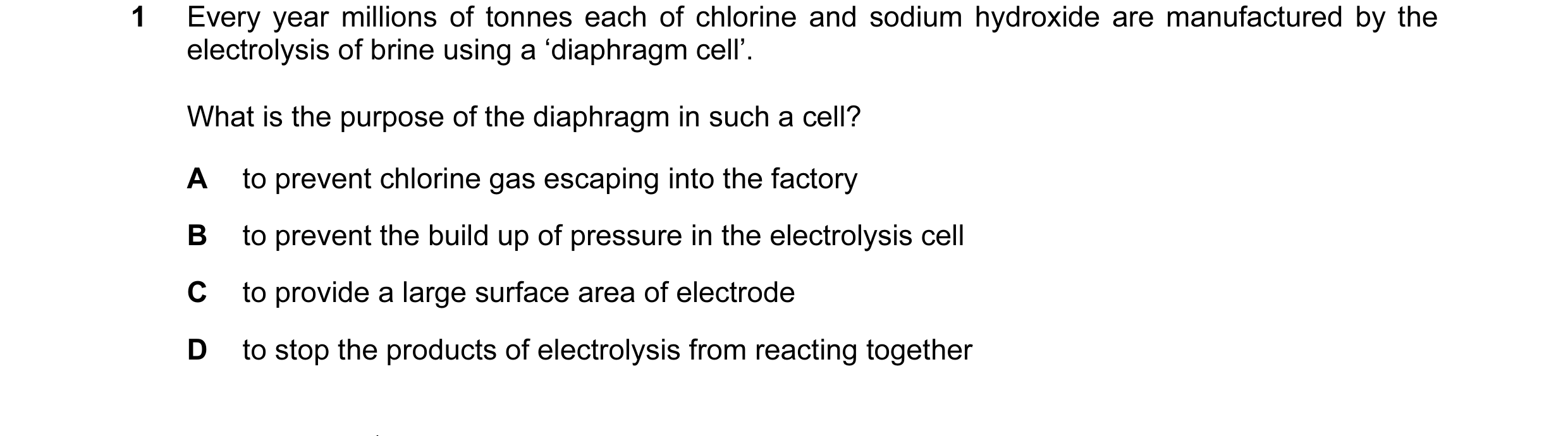
 2 / 15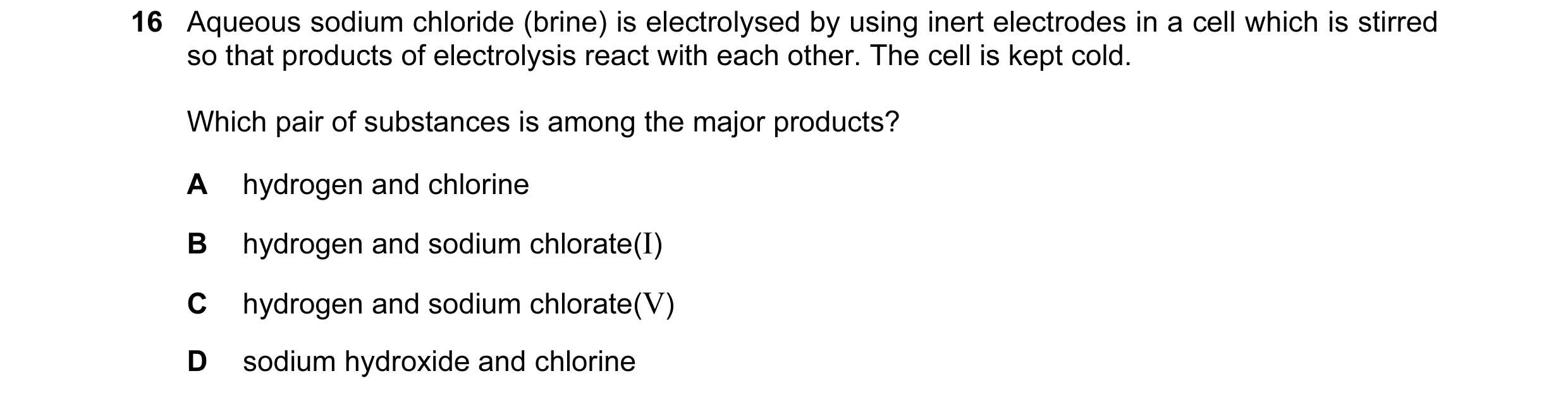
 3 / 15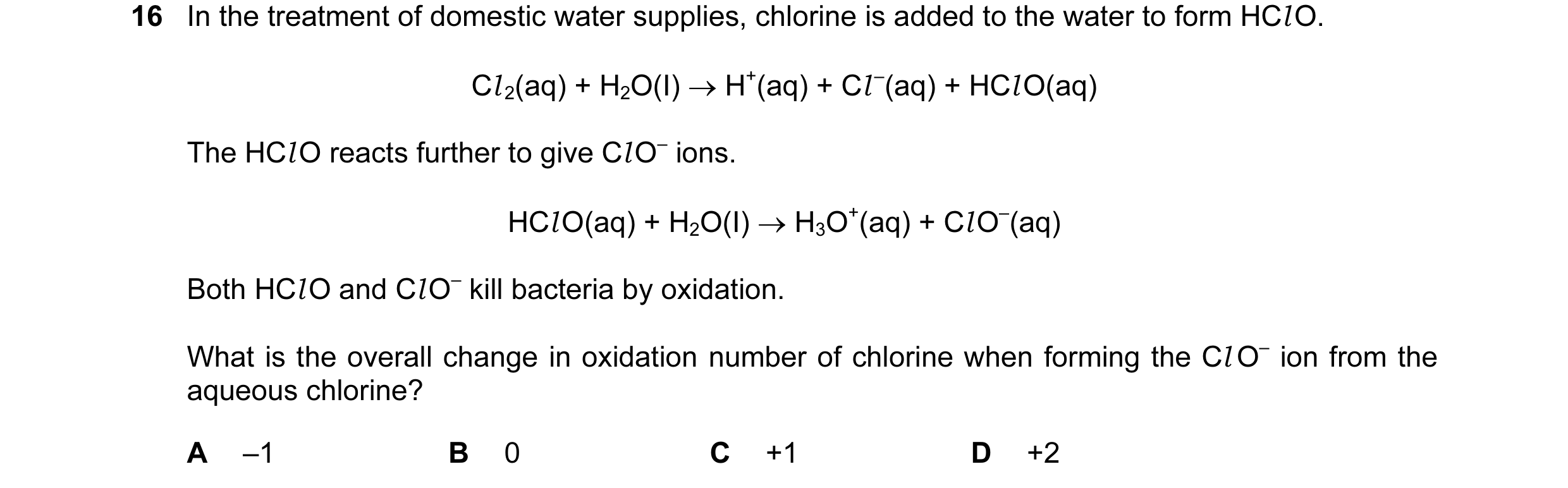


 4 / 15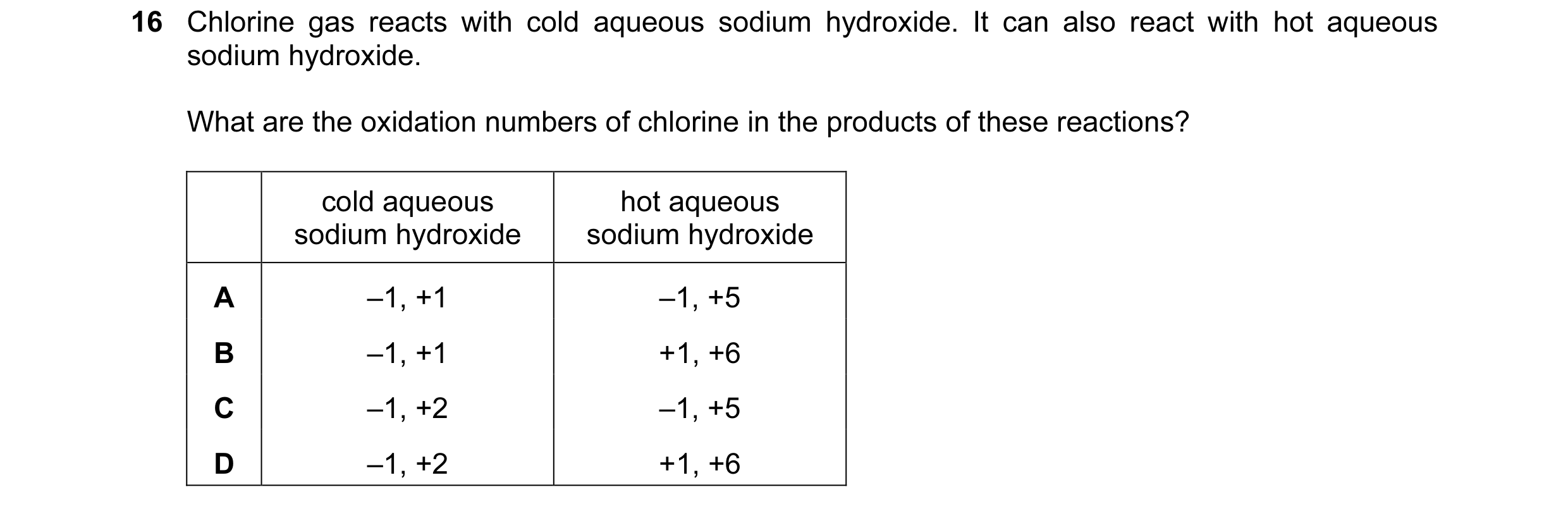
 5 / 15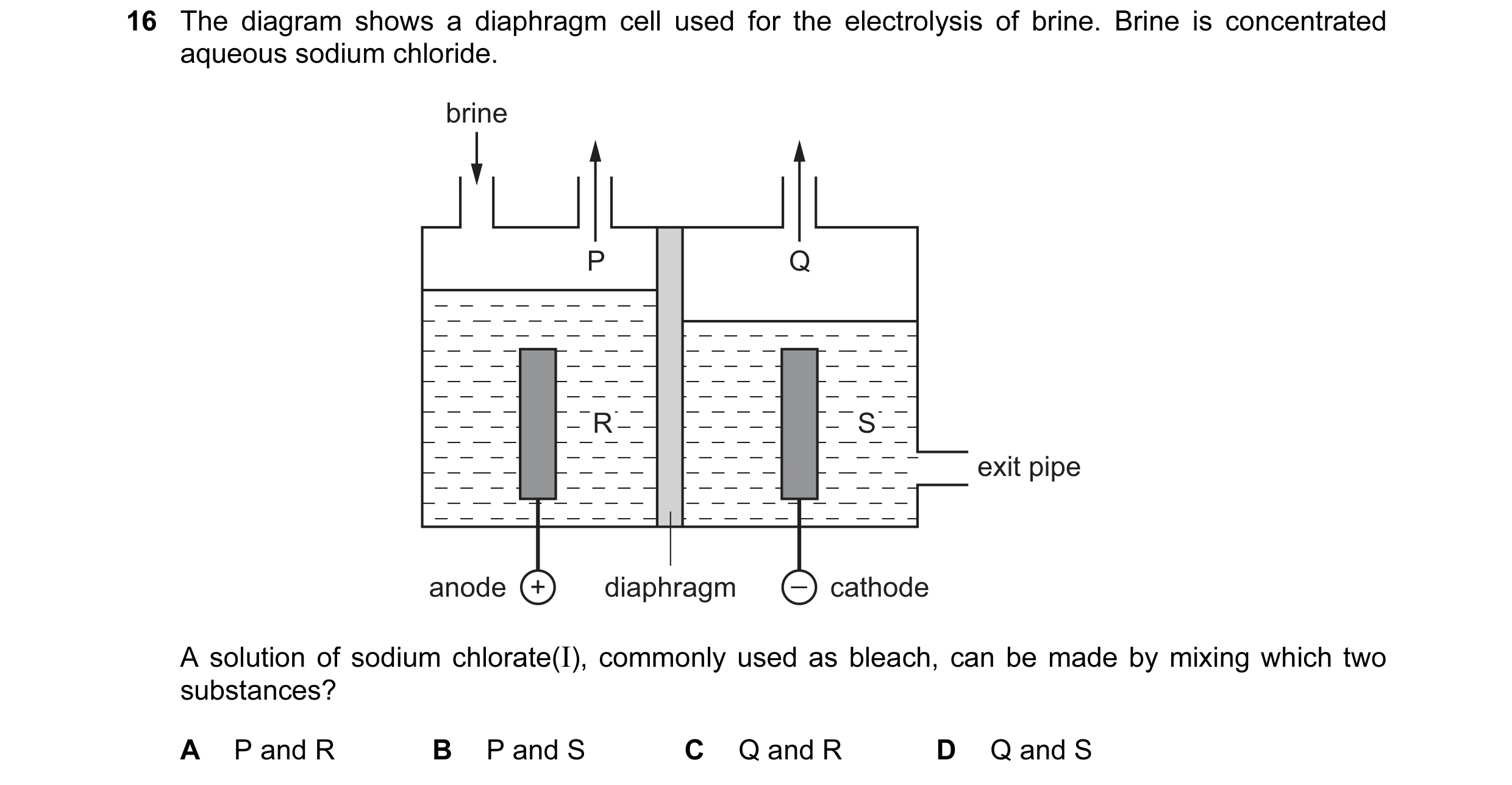

 6 / 15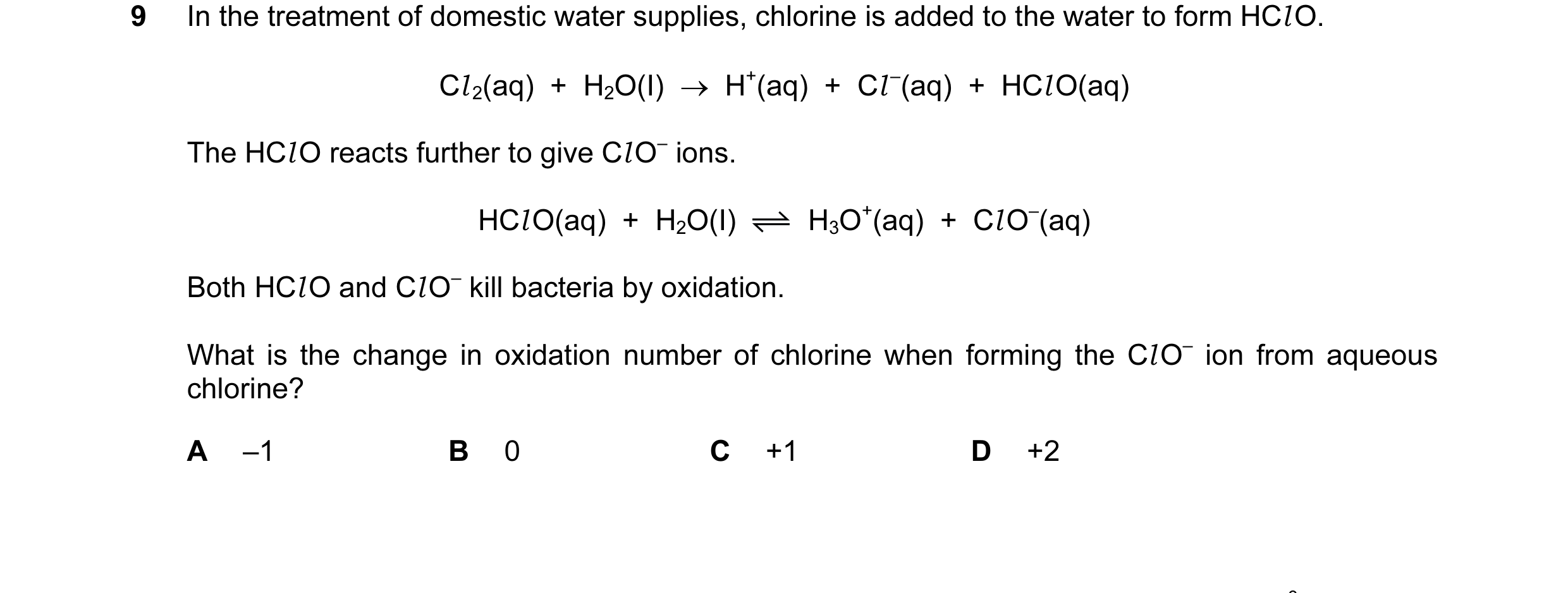
 7 / 15



 8 / 15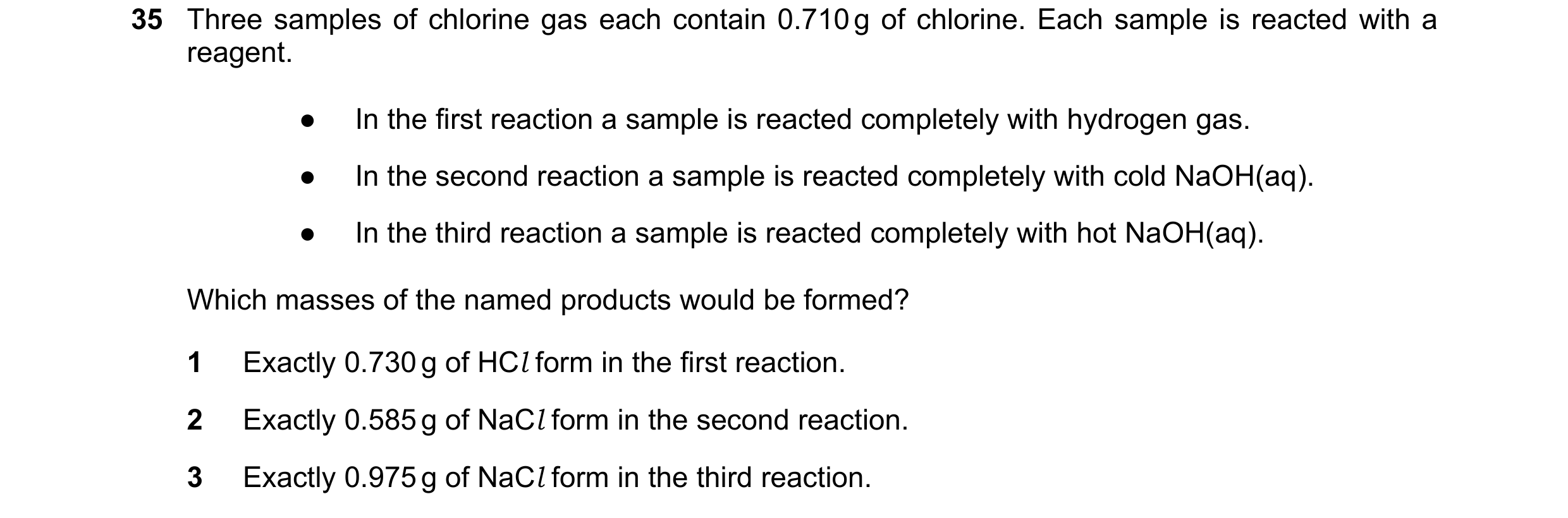

 9 / 15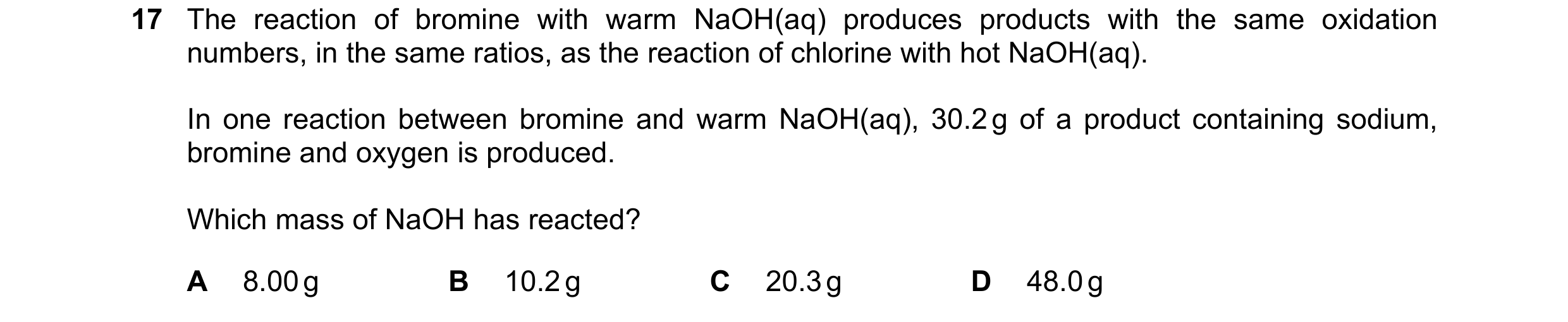



 10 / 15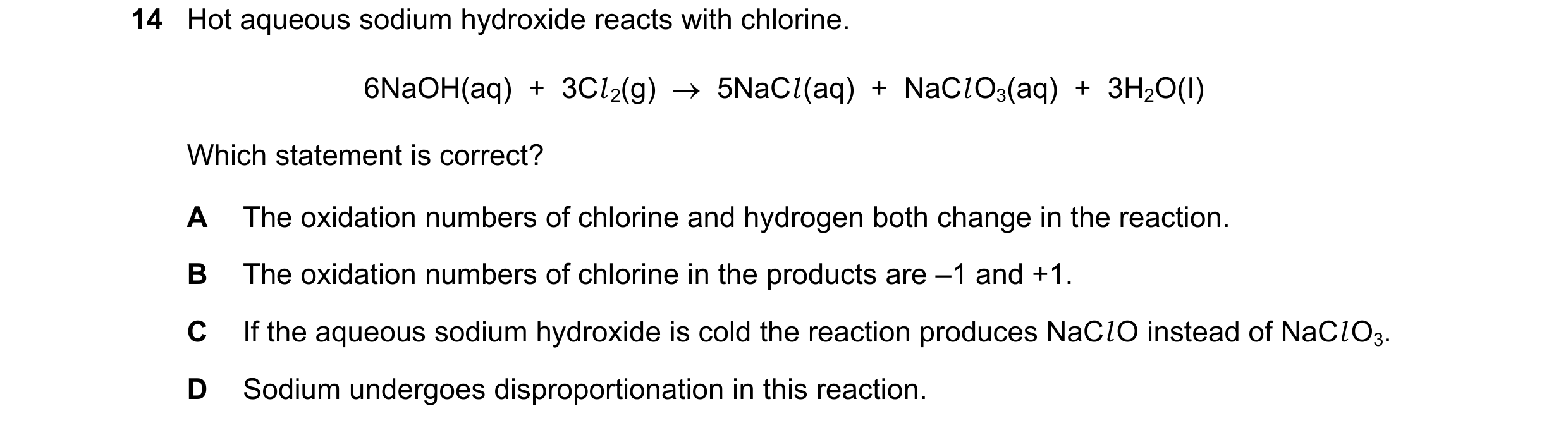

 11 / 15
 12 / 15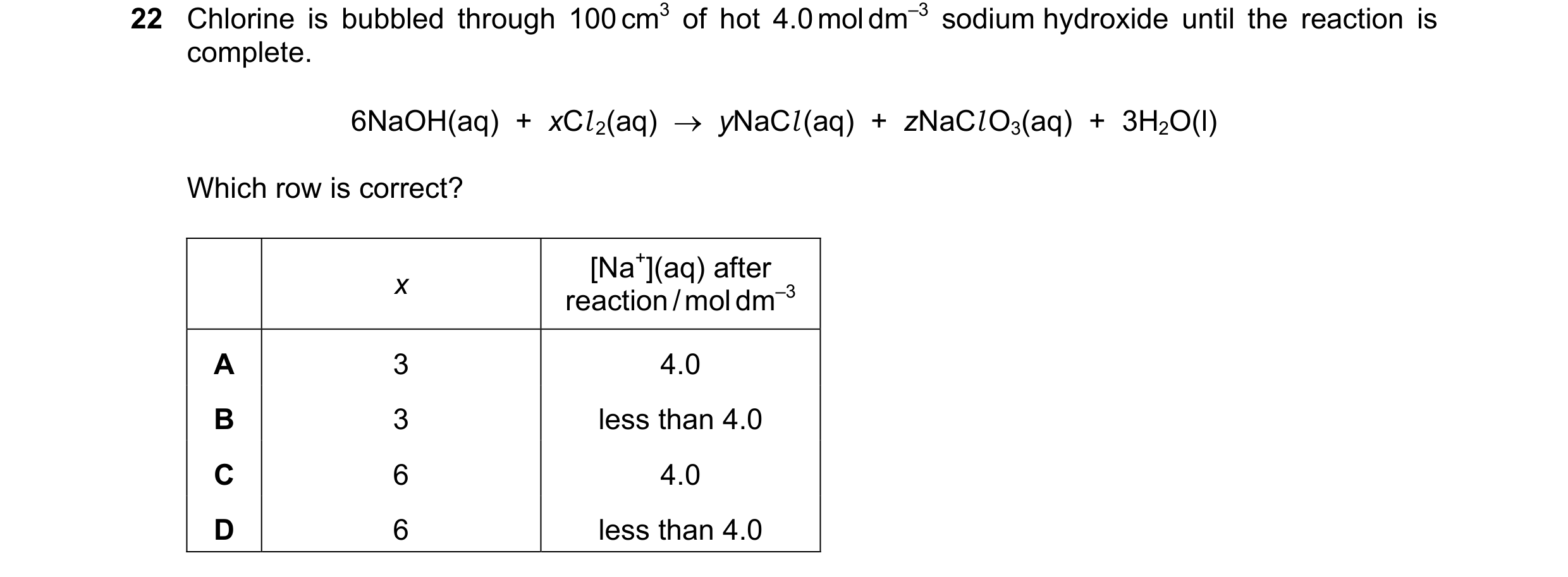

 13 / 15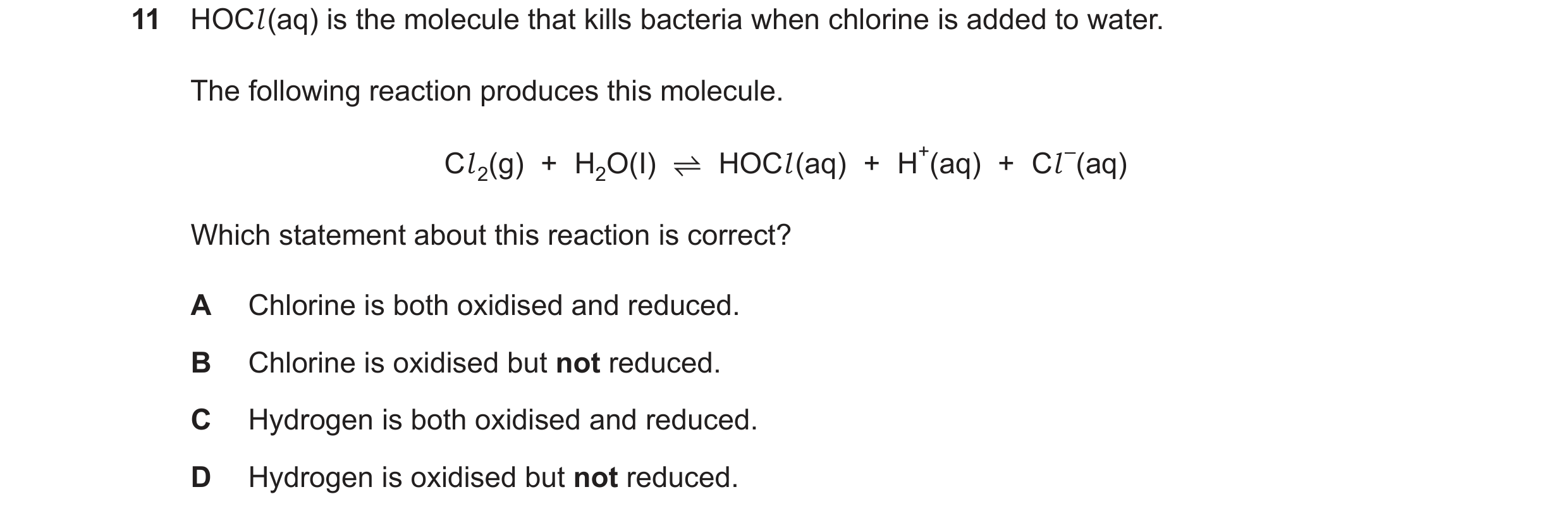
 14 / 15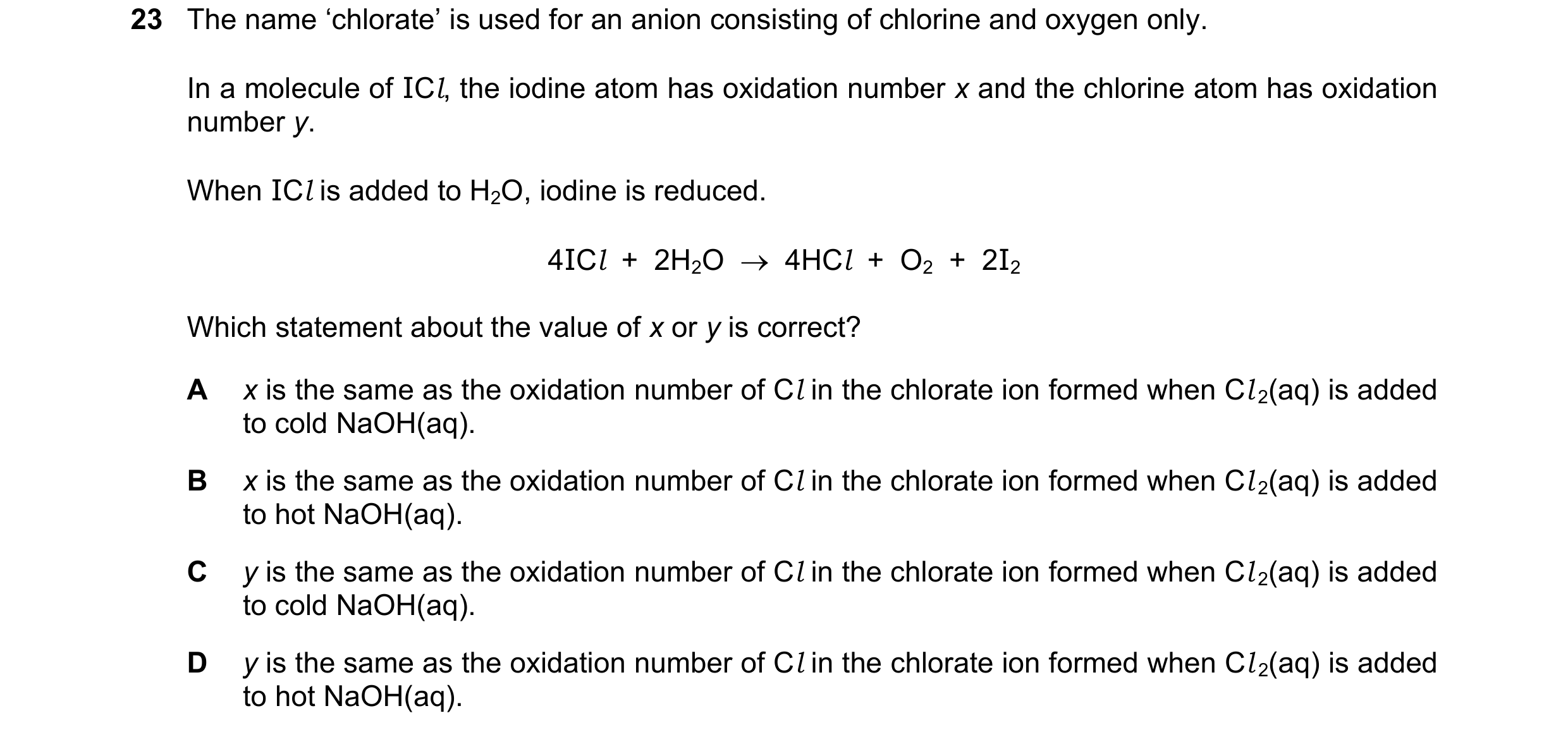
 15 / 15