Cambridge IGCSE Sciences - Co-ordinated (Double) 0654 — 2020 May/June Paper 2 · Variant 3
0654/23/M/J/20 · 40 questions · 40 marks · ≈45 min
The question paper and its mark scheme, free to read here and free to download. This is Cambridge’s own paper, exactly as it was sat.
Question paper16 pages

Mark scheme3 pages
Answers below. Sit the paper first if you are practising.
Questions as text
Q1 · A scientist is studying a living organism
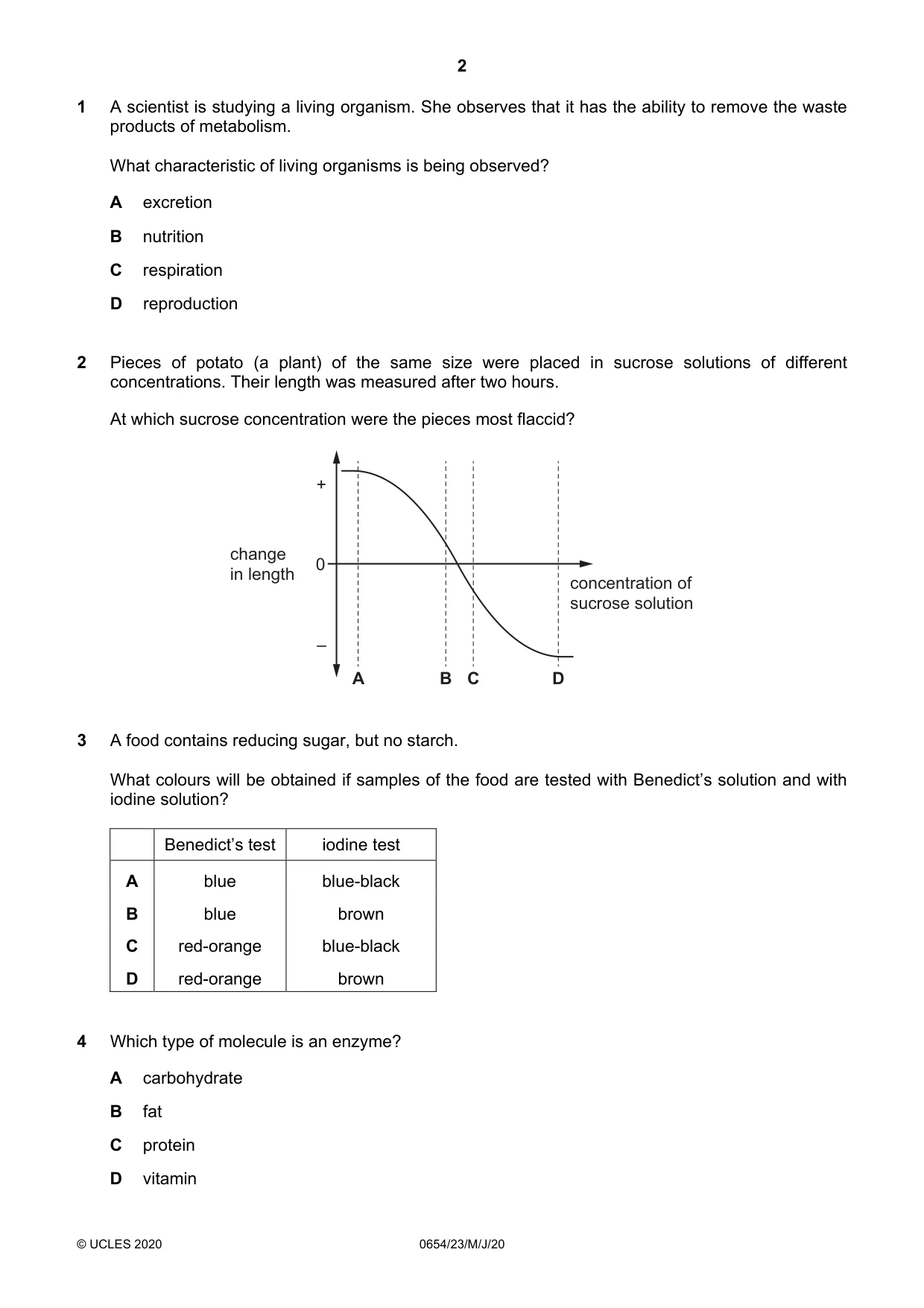
1 A scientist is studying a living organism. She observes that it has the ability to remove the waste products of metabolism. What characteristic of living organisms is being observed? A excretion B nutrition C respiration D reproduction
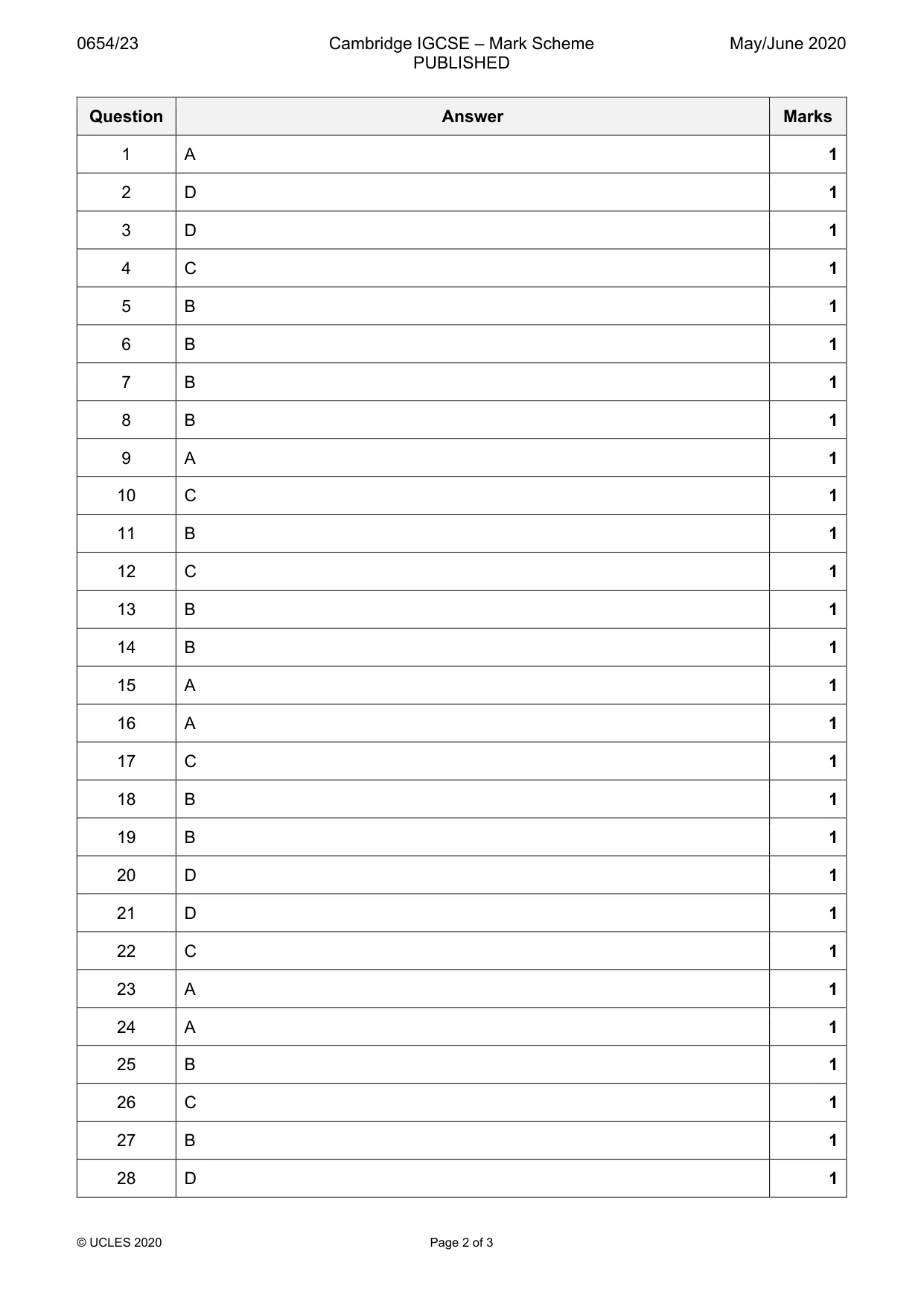
Mark scheme: A
Q2 · Pieces of potato (a plant) of the same size were placed in sucrose solutions of different…
2 Pieces of potato (a plant) of the same size were placed in sucrose solutions of different concentrations. Their length was measured after two hours. At which sucrose concentration were the pieces most flaccid? + change 0 in length concentration of sucrose solution – A B C D
Mark scheme: D
Q3 · A food contains reducing sugar, but no starch
3 A food contains reducing sugar, but no starch. What colours will be obtained if samples of the food are tested with Benedict’s solution and with iodine solution? Benedict’s test iodine test A blue blue-black B blue brown C red-orange blue-black D red-orange brown
Mark scheme: D
Q4 · Which type of molecule is an enzyme?
4 Which type of molecule is an enzyme? A carbohydrate B fat C protein D vitamin
Mark scheme: C
Q5 · Which part of a leaf is involved in opening and closing the stomata during gas exchange?
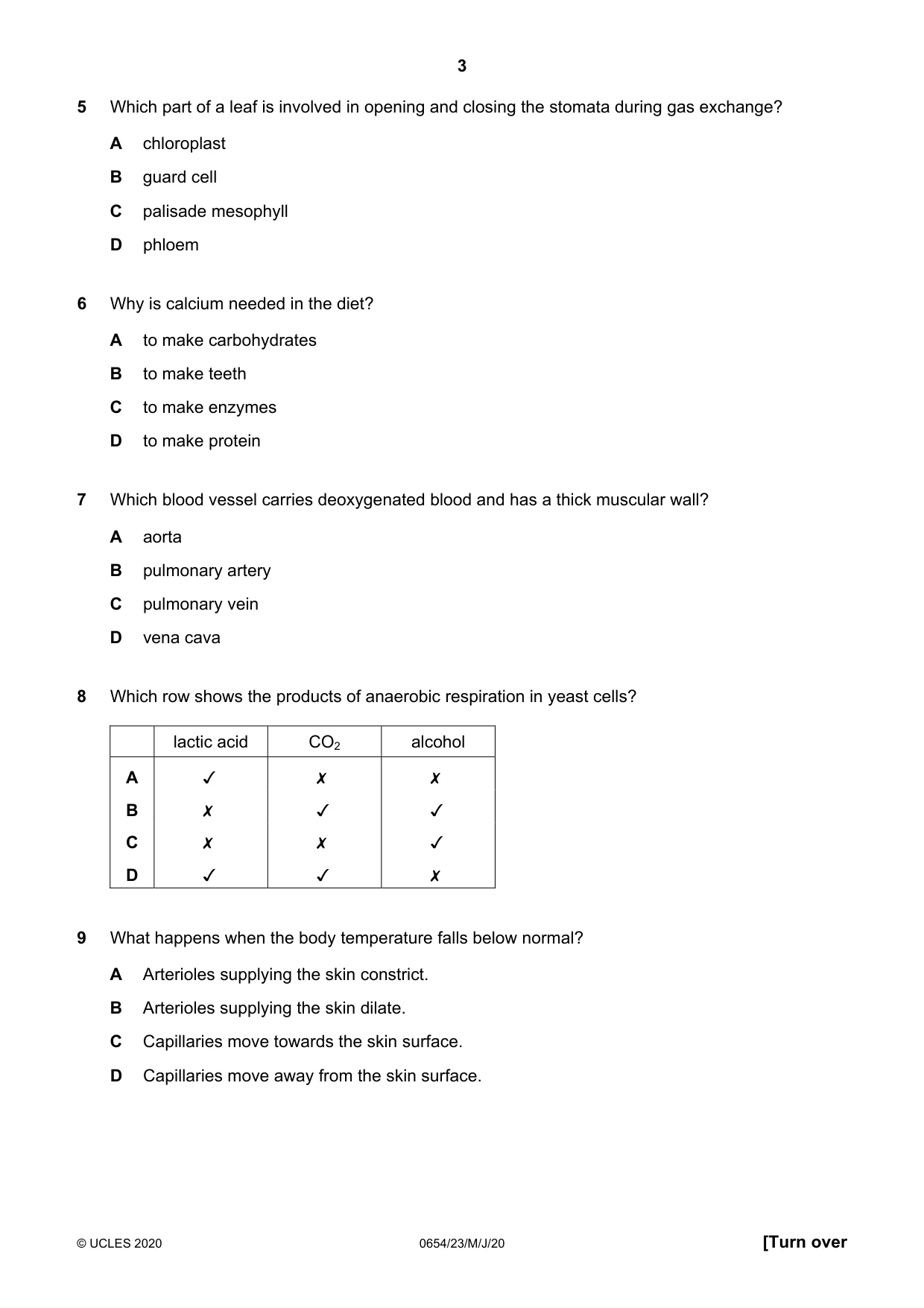
5 Which part of a leaf is involved in opening and closing the stomata during gas exchange? A chloroplast B guard cell C palisade mesophyll D phloem
Mark scheme: B
Q6 · Why is calcium needed in the diet?
6 Why is calcium needed in the diet? A to make carbohydrates B to make teeth C to make enzymes D to make protein
Mark scheme: B
Q7 · Which blood vessel carries deoxygenated blood and has a thick muscular wall?
7 Which blood vessel carries deoxygenated blood and has a thick muscular wall? A aorta B pulmonary artery C pulmonary vein D vena cava
Mark scheme: B
Q8 · Which row shows the products of anaerobic respiration in yeast cells?
8 Which row shows the products of anaerobic respiration in yeast cells? lactic acid CO, alcohol A v x x B x Jv J Cc x x J D Jv Jv x
Mark scheme: B
Q9 · What happens when the body temperature falls below normal?
9 What happens when the body temperature falls below normal? A Arterioles supplying the skin constrict. B Arterioles supplying the skin dilate. C Capillaries move towards the skin surface. D Capillaries move away from the skin surface.
Mark scheme: A
Q10 · The diagram shows a section through a pea flower
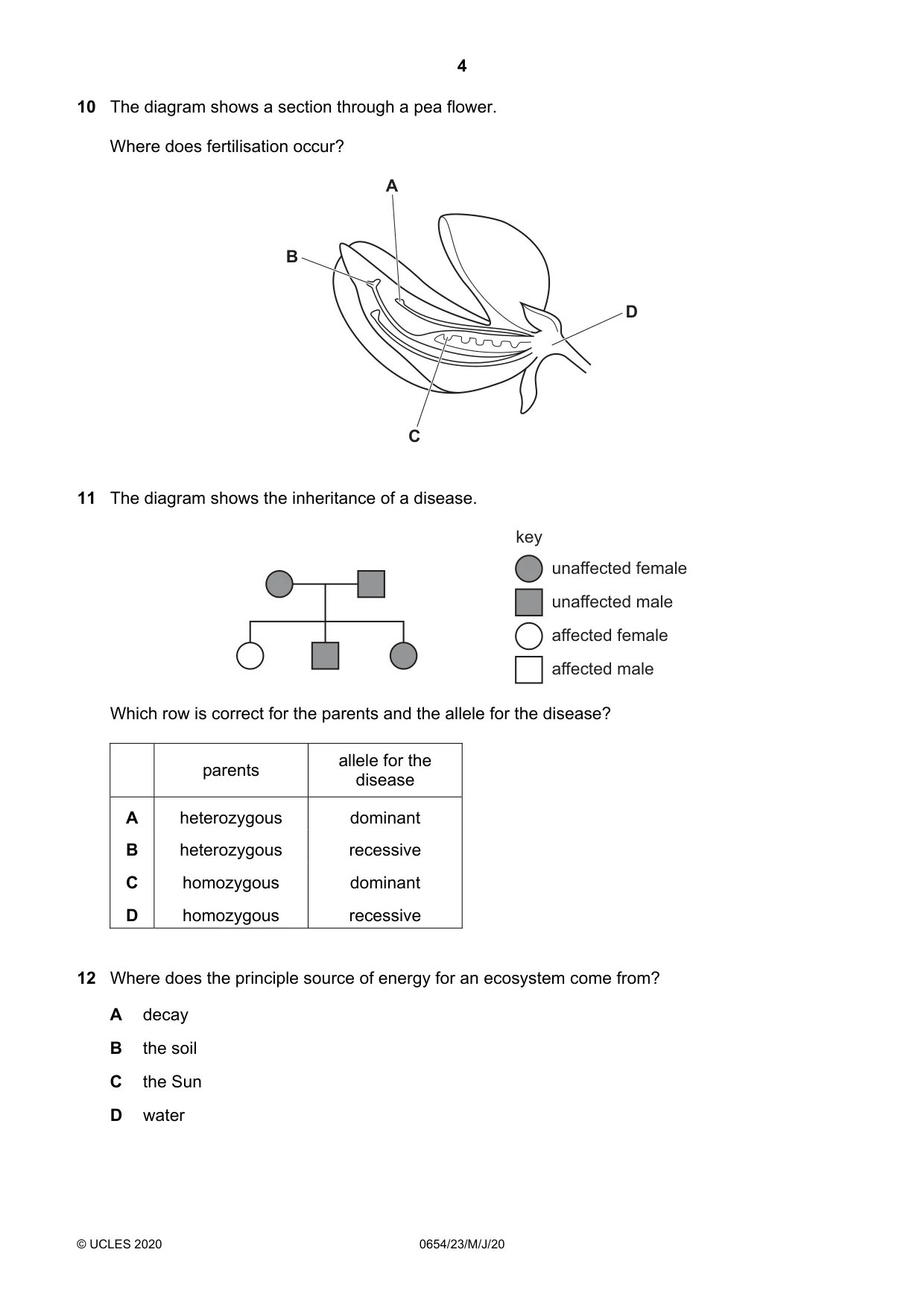
10 The diagram shows a section through a pea flower. Where does fertilisation occur? A B D C
Mark scheme: C
Q11 · The diagram shows the inheritance of a disease
11 The diagram shows the inheritance of a disease. key unaffected female unaffected male affected female affected male Which row is correct for the parents and the allele for the disease? allele for the parents disease A heterozygous dominant B heterozygous recessive C homozygous dominant D homozygous recessive
Mark scheme: B
Q12 · Where does the principle source of energy for an ecosystem come from?
12 Where does the principle source of energy for an ecosystem come from? A decay B the soil C the Sun D water
Mark scheme: C
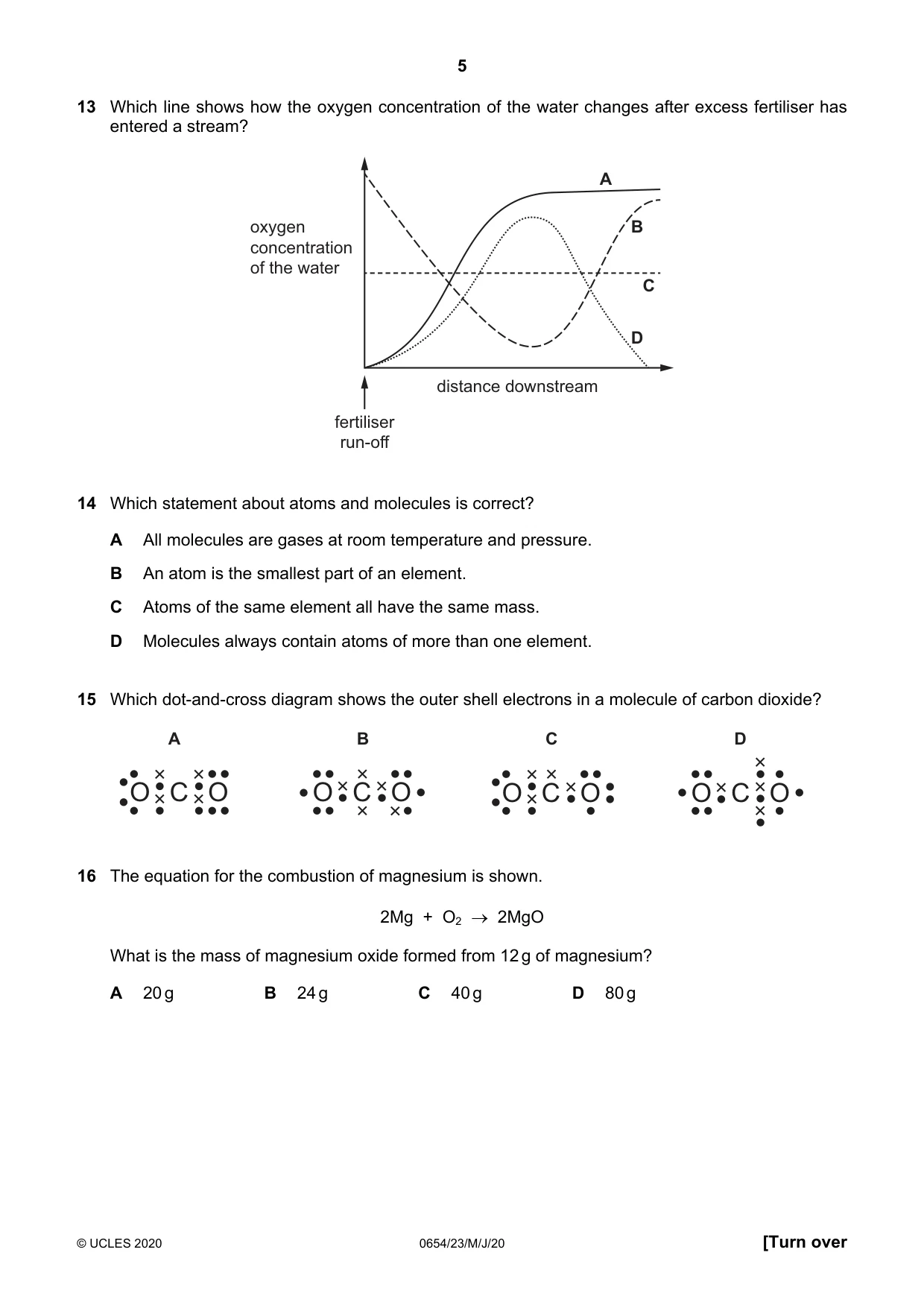
Q13 · Which line shows how the oxygen concentration of the water changes after excess…
13 Which line shows how the oxygen concentration of the water changes after excess fertiliser has entered a stream? A oxygen B concentration of the water C D distance downstream fertiliser run-off
Mark scheme: B
Q14 · Which statement about atoms and molecules is correct?
14 Which statement about atoms and molecules is correct? A All molecules are gases at room temperature and pressure. B An atom is the smallest part of an element. C Atoms of the same element all have the same mass. D Molecules always contain atoms of more than one element.
Mark scheme: B
Q15 · Which dot-and-cross diagram shows the outer shell electrons in a molecule of carbon…
15 Which dot-and-cross diagram shows the outer shell electrons in a molecule of carbon dioxide? A B C D O C O O C O O C O O C O
Mark scheme: A
Q16 · The equation for the combustion of magnesium is shown
16 The equation for the combustion of magnesium is shown. 2Mg + O2 → 2MgO What is the mass of magnesium oxide formed from 12 g of magnesium? A 20 g B 24 g C 40 g D 80 g
Mark scheme: A
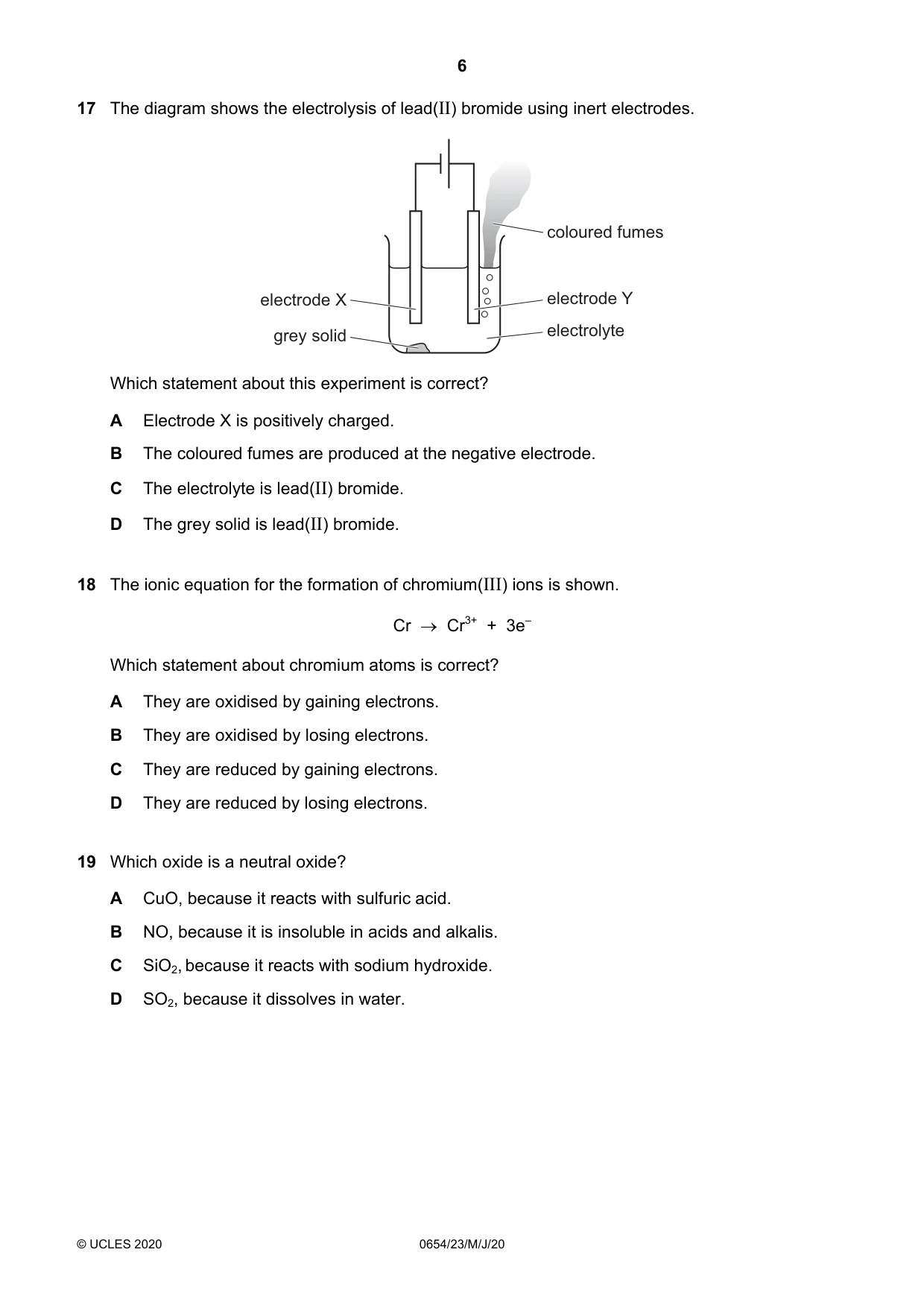
Q17 · The diagram shows the electrolysis of lead(II) bromide using inert electrodes
17 The diagram shows the electrolysis of lead(II) bromide using inert electrodes. coloured fumes electrode X electrode Y grey solid electrolyte Which statement about this experiment is correct? A Electrode X is positively charged. B The coloured fumes are produced at the negative electrode. C The electrolyte is lead(II) bromide. D The grey solid is lead(II) bromide.
Mark scheme: C
Q18 · The ionic equation for the formation of chromium(III) ions is shown
18 The ionic equation for the formation of chromium(III) ions is shown. Cr → Cr3+ + 3e– Which statement about chromium atoms is correct? A They are oxidised by gaining electrons. B They are oxidised by losing electrons. C They are reduced by gaining electrons. D They are reduced by losing electrons.
Mark scheme: B
Q19 · Which oxide is a neutral oxide?
19 Which oxide is a neutral oxide? A CuO, because it reacts with sulfuric acid. B NO, because it is insoluble in acids and alkalis. C SiO2, because it reacts with sodium hydroxide. D SO2, because it dissolves in water.
Mark scheme: B
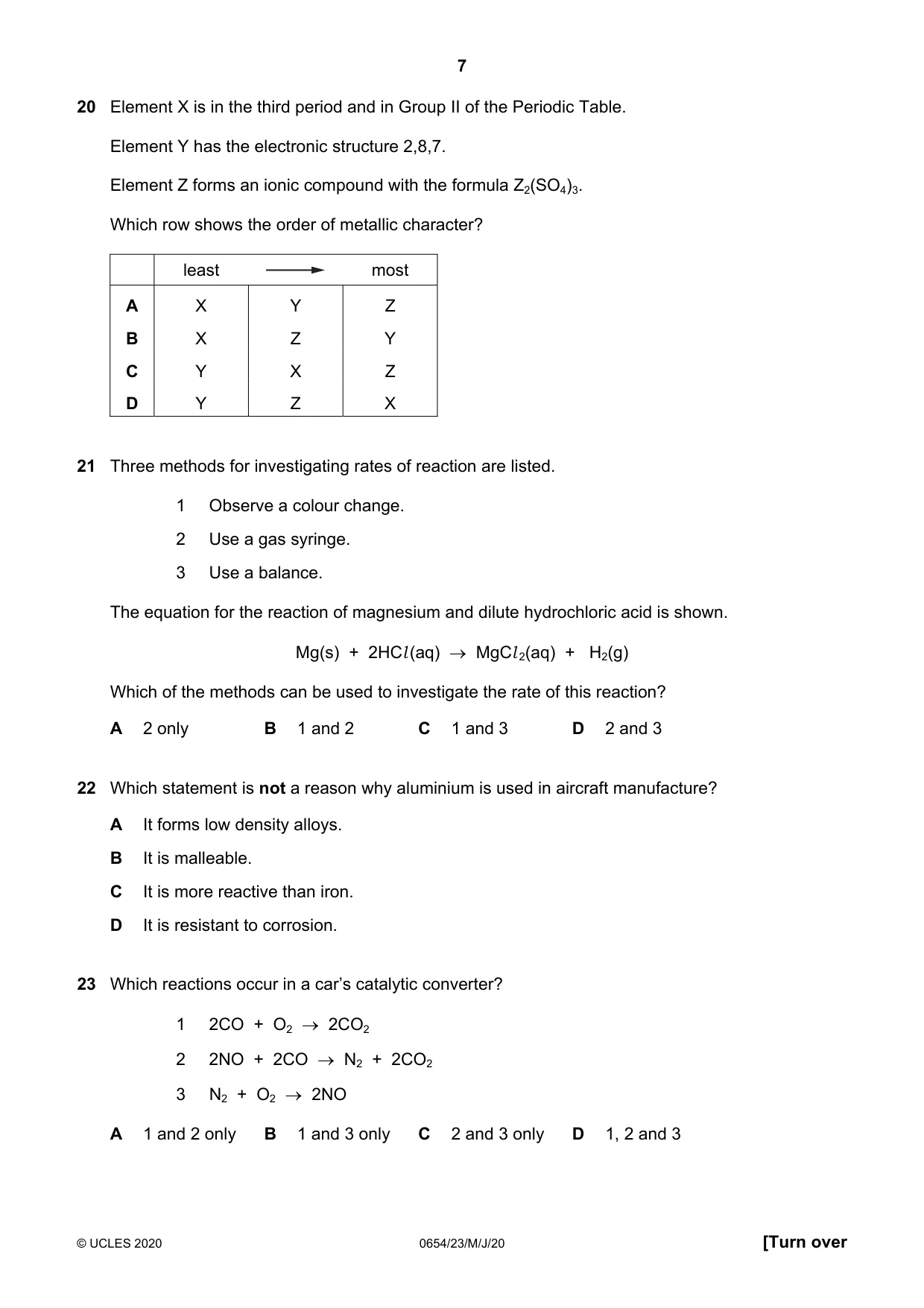
Q20 · Element X is in the third period and in Group II of the Periodic Table
20 Element X is in the third period and in Group II of the Periodic Table. Element Y has the electronic structure 2,8,7. Element Z forms an ionic compound with the formula Z2(SO4)3. Which row shows the order of metallic character? least most A X Y Z B X Z Y C Y X Z D Y Z X
Mark scheme: D
Q21 · Three methods for investigating rates of reaction are listed
21 Three methods for investigating rates of reaction are listed. 1 Observe a colour change. 2 Use a gas syringe. 3 Use a balance. The equation for the reaction of magnesium and dilute hydrochloric acid is shown. Mg(s) + 2HCl (aq) → MgCl 2(aq) + H2(g) Which of the methods can be used to investigate the rate of this reaction? A 2 only B 1 and 2 C 1 and 3 D 2 and 3
Mark scheme: D
Q22 · Which statement is not a reason why aluminium is used in aircraft manufacture?
22 Which statement is not a reason why aluminium is used in aircraft manufacture? A It forms low density alloys. B It is malleable. C It is more reactive than iron. D It is resistant to corrosion.
Mark scheme: C
Q23 · Which reactions occur in a car’s catalytic converter?
23 Which reactions occur in a car’s catalytic converter? 1 2CO + O2 → 2CO2 2 2NO + 2CO → N2 + 2CO2 3 N2 + O2 → 2NO A 1 and 2 only B 1 and 3 only C 2 and 3 only D 1, 2 and 3
Mark scheme: A
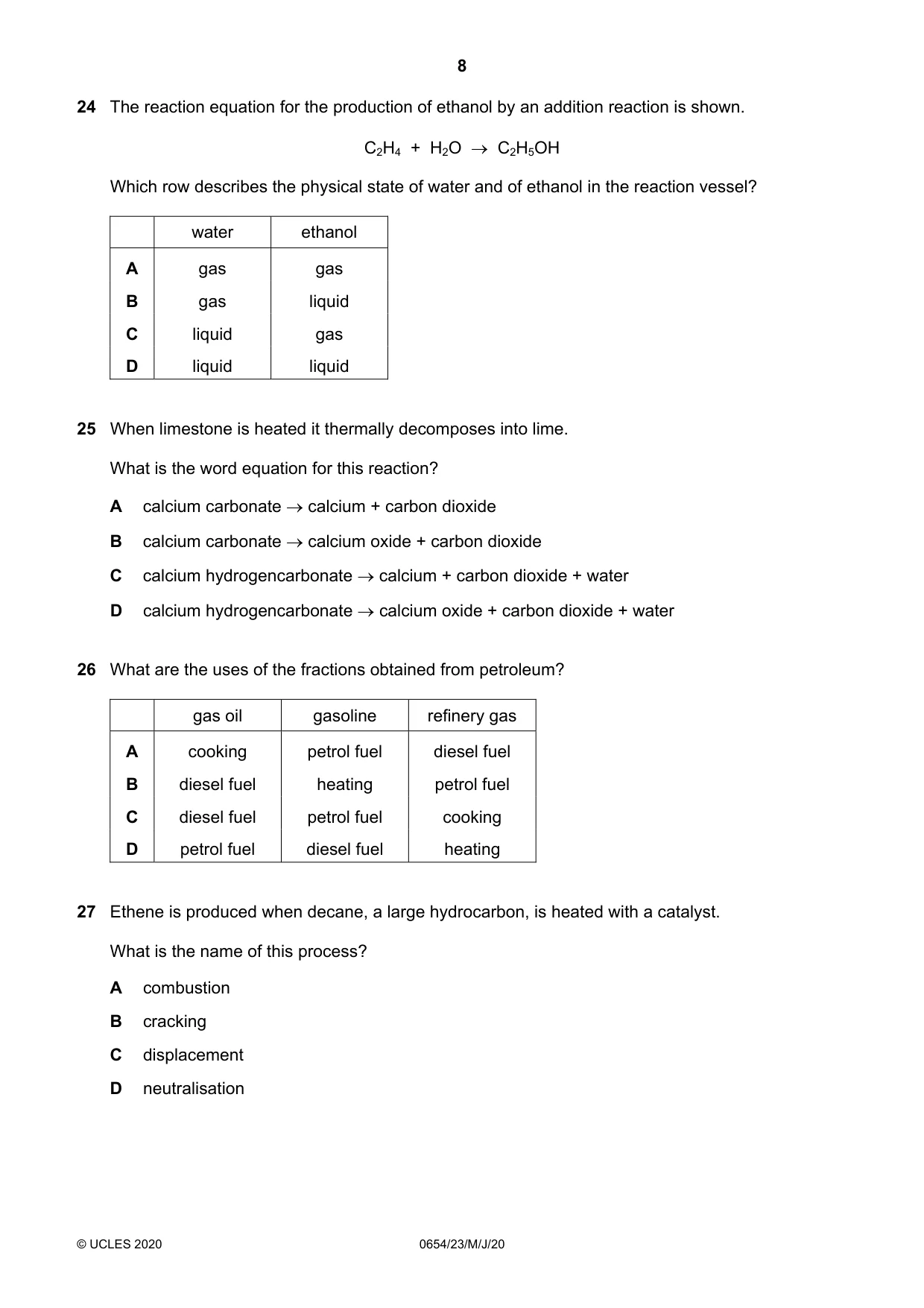
Q24 · The reaction equation for the production of ethanol by an addition reaction is shown
24 The reaction equation for the production of ethanol by an addition reaction is shown. C2H4 + H2O → C2H5OH Which row describes the physical state of water and of ethanol in the reaction vessel? water ethanol A gas gas B gas liquid C liquid gas D liquid liquid
Mark scheme: A
Q25 · When limestone is heated it thermally decomposes into lime
25 When limestone is heated it thermally decomposes into lime. What is the word equation for this reaction? A calcium carbonate → calcium + carbon dioxide B calcium carbonate → calcium oxide + carbon dioxide C calcium hydrogencarbonate → calcium + carbon dioxide + water D calcium hydrogencarbonate → calcium oxide + carbon dioxide + water
Mark scheme: B
Q26 · What are the uses of the fractions obtained from petroleum?
26 What are the uses of the fractions obtained from petroleum? gas oil gasoline refinery gas A cooking petrol fuel diesel fuel B diesel fuel heating petrol fuel C diesel fuel petrol fuel cooking D petrol fuel diesel fuel heating
Mark scheme: C
Q27 · Ethene is produced when decane, a large hydrocarbon, is heated with a catalyst
27 Ethene is produced when decane, a large hydrocarbon, is heated with a catalyst. What is the name of this process? A combustion B cracking C displacement D neutralisation
Mark scheme: B
Q28 · A man carries a suitcase of mass of 30 kg
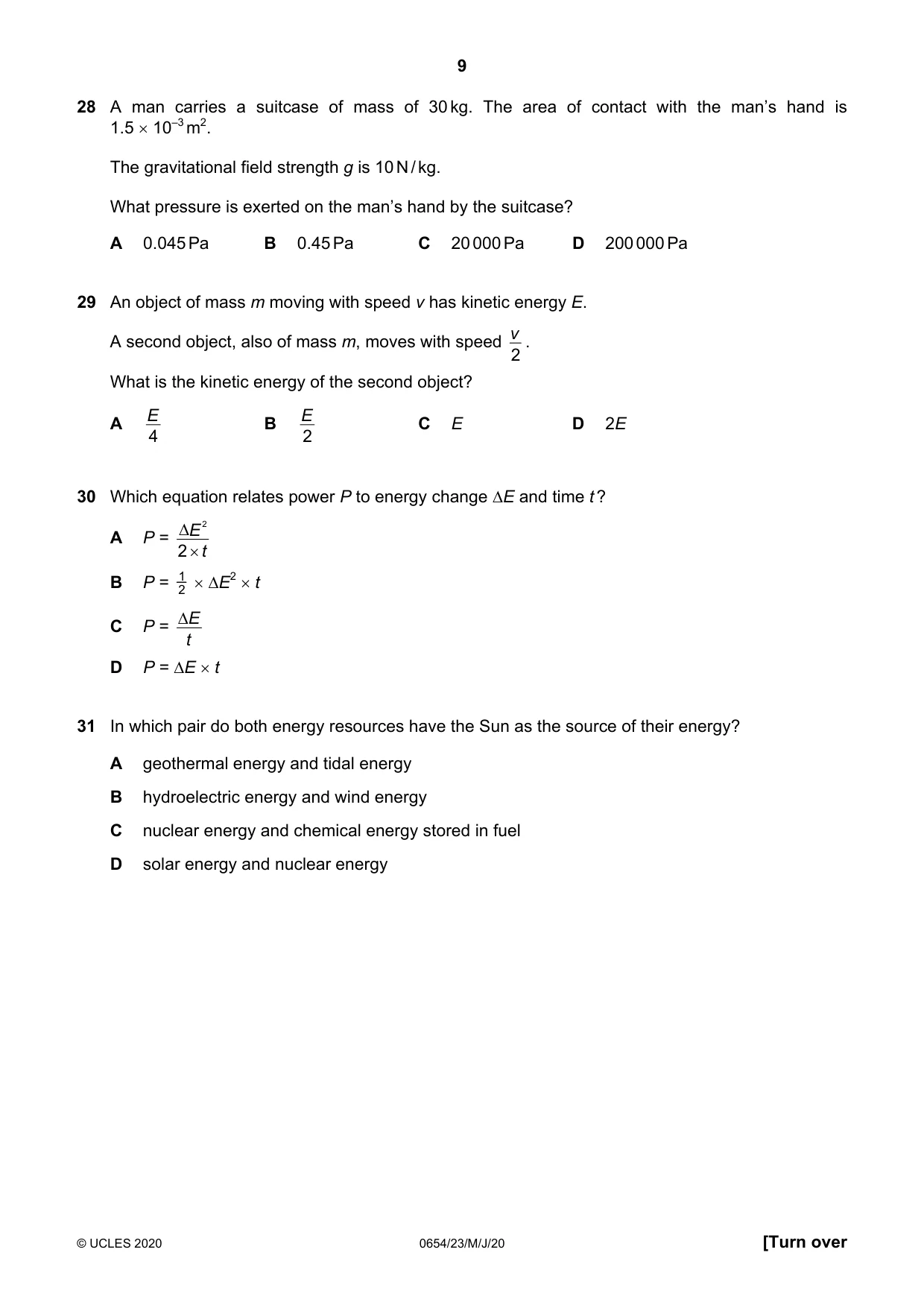
28 A man carries a suitcase of mass of 30 kg. The area of contact with the man’s hand is 1.5 × 10⁻³ m2. The gravitational field strength g is 10 N / kg. What pressure is exerted on the man’s hand by the suitcase? A 0.045 Pa B 0.45 Pa C 20 000 Pa D 200 000 Pa
Mark scheme: D
Q29 · An object of mass m moving with speed v has kinetic energy E
29 An object of mass m moving with speed v has kinetic energy E. v . A second object, also of mass m, moves with speed 2 What is the kinetic energy of the second object? E E A B C E D 2E 4 2
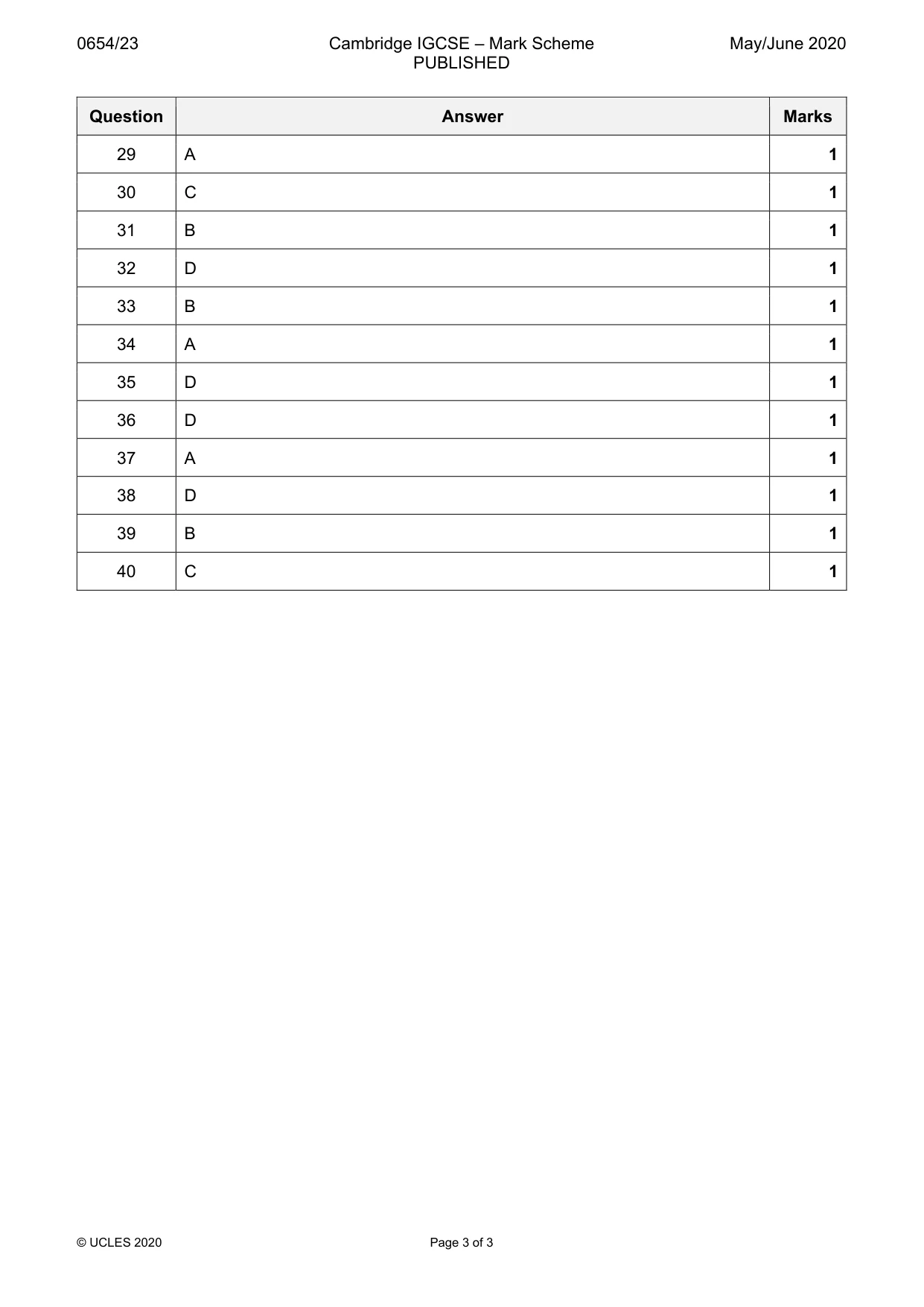
Mark scheme: A
Q30 · Which equation relates power P to energy change ∆E and time t ?
30 Which equation relates power P to energy change ∆E and time t ? ∆ E 2 A P = × 2 t B P = 1 2 × ∆E2 × t ∆ E C P = t D P = ∆E × t
Mark scheme: C
Q31 · In which pair do both energy resources have the Sun as the source of their energy?
31 In which pair do both energy resources have the Sun as the source of their energy? A geothermal energy and tidal energy B hydroelectric energy and wind energy C nuclear energy and chemical energy stored in fuel D solar energy and nuclear energy
Mark scheme: B
Q32 · A hot water tank is fitted with two identical heaters P and Q
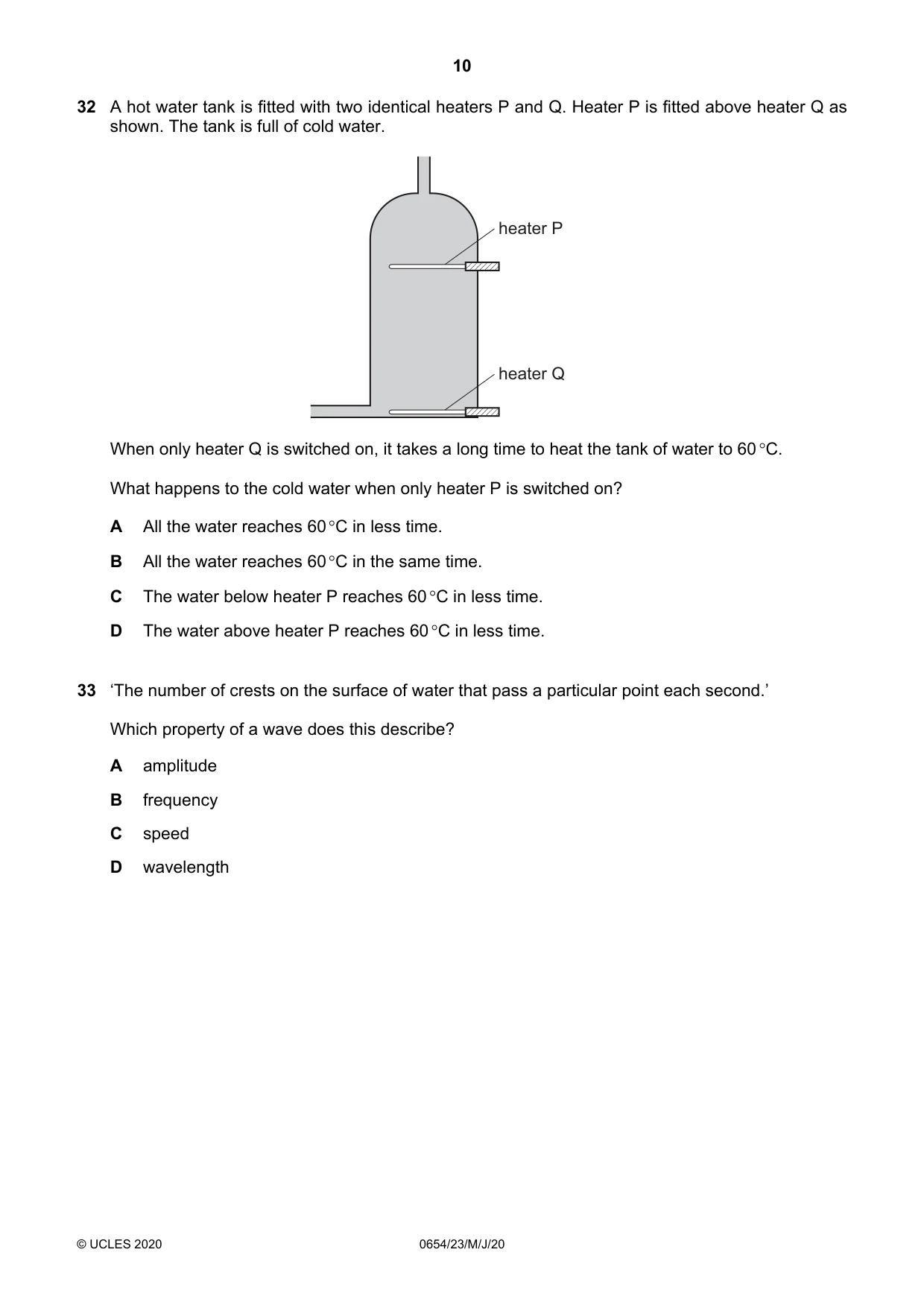
32 A hot water tank is fitted with two identical heaters P and Q. Heater P is fitted above heater Q as shown. The tank is full of cold water. heater P heater Q When only heater Q is switched on, it takes a long time to heat the tank of water to 60 °C. What happens to the cold water when only heater P is switched on? A All the water reaches 60 °C in less time. B All the water reaches 60 °C in the same time. C The water below heater P reaches 60 °C in less time. D The water above heater P reaches 60 °C in less time.
Mark scheme: D
Q33 · ‘The number of crests on the surface of water that pass a particular point each second.’…
33 ‘The number of crests on the surface of water that pass a particular point each second.’ Which property of a wave does this describe? A amplitude B frequency C speed D wavelength
Mark scheme: B
Q34 · Which ray diagram represents the formation of a virtual image I of an object O?
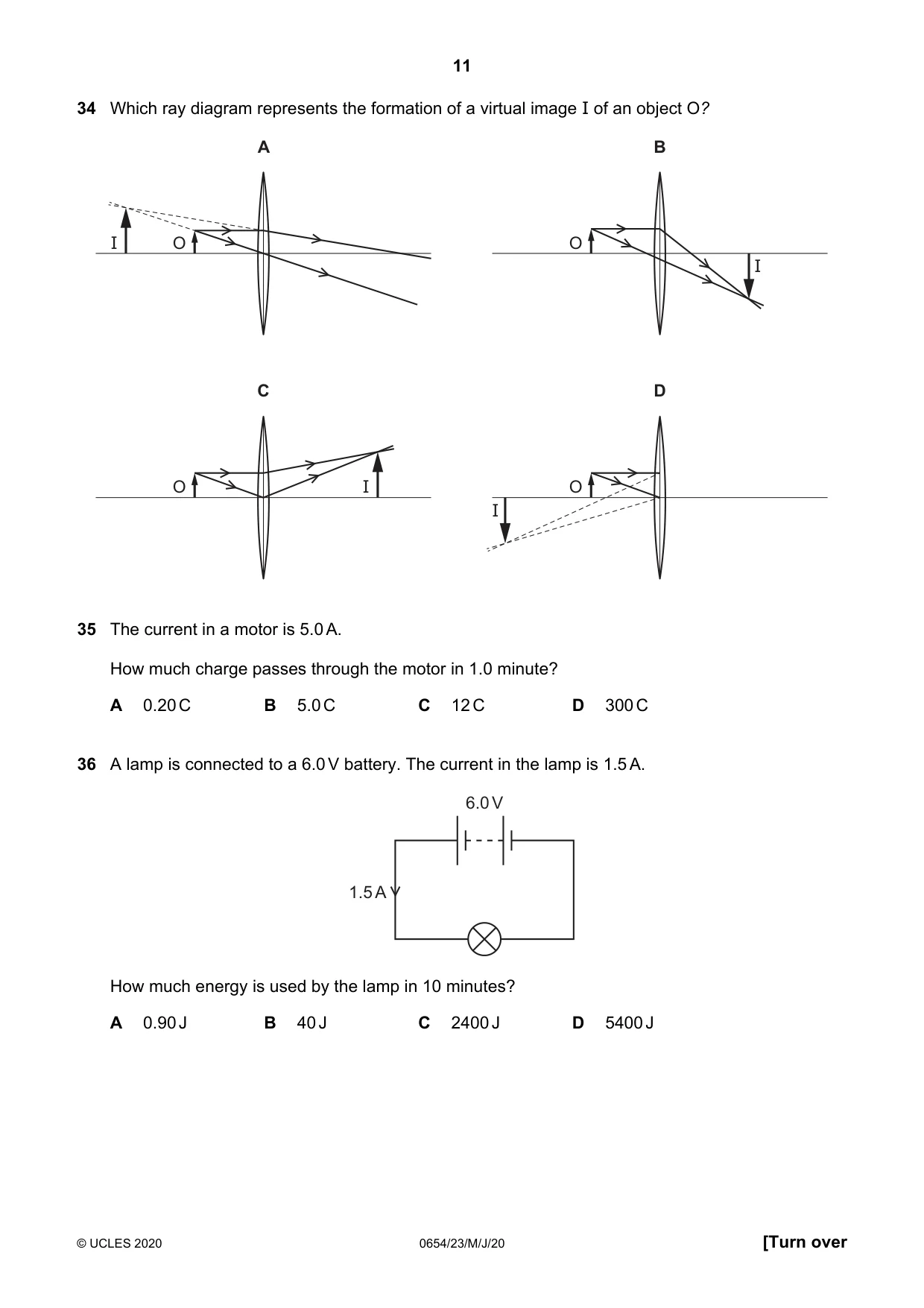
34 Which ray diagram represents the formation of a virtual image I of an object O? A B I O O I C D O I O I
Mark scheme: A
Q35 · The current in a motor is 5.0 A
35 The current in a motor is 5.0 A. How much charge passes through the motor in 1.0 minute? A 0.20 C B 5.0 C C 12 C D 300 C
Mark scheme: D
Q36 · A lamp is connected to a 6.0 V battery
36 A lamp is connected to a 6.0 V battery. The current in the lamp is 1.5 A. 6.0 V 1.5 A How much energy is used by the lamp in 10 minutes? A 0.90 J B 40 J C 2400 J D 5400 J
Mark scheme: D
Q37 · A fuse is a safety device for use in an electrical circuit
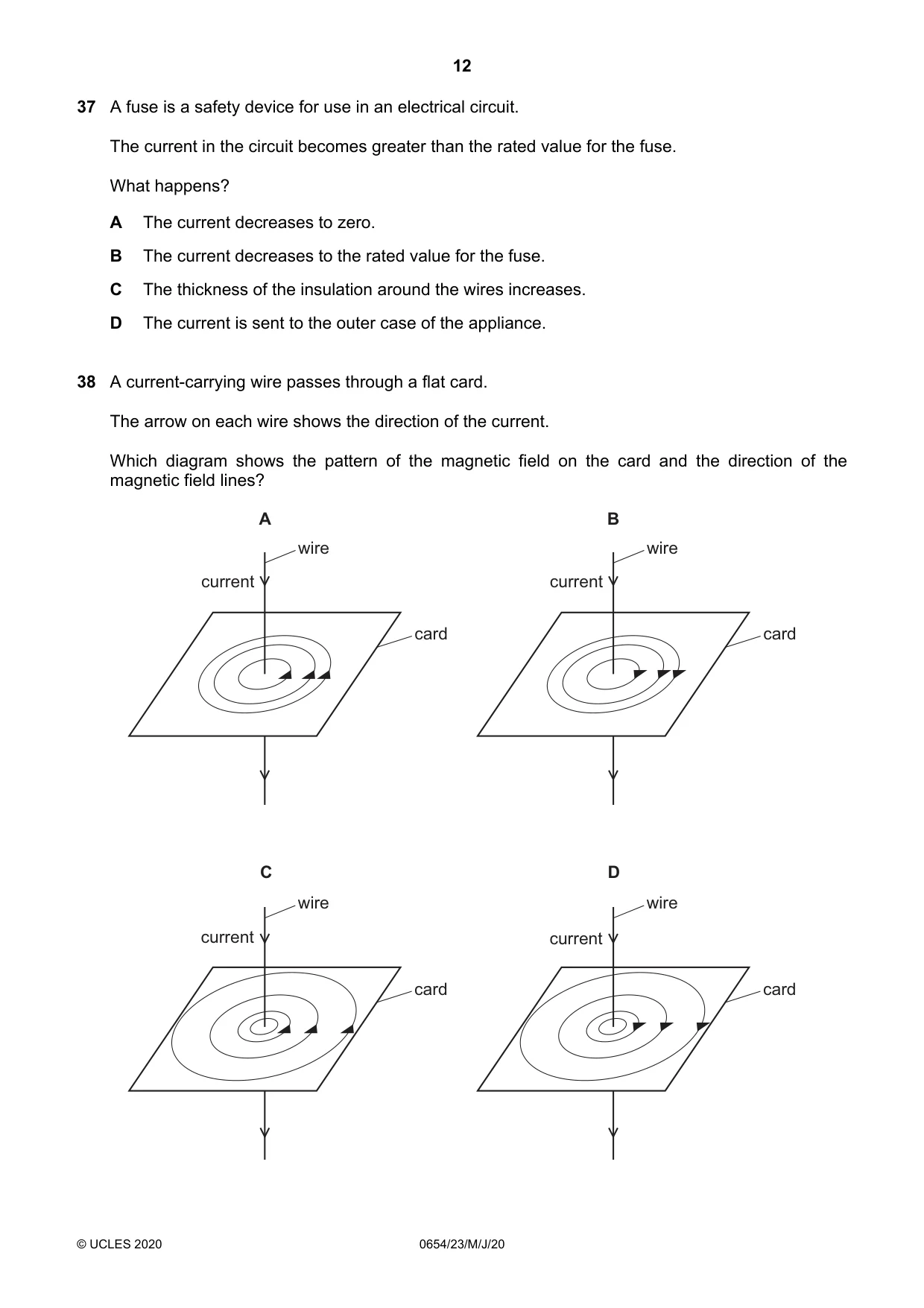
37 A fuse is a safety device for use in an electrical circuit. The current in the circuit becomes greater than the rated value for the fuse. What happens? A The current decreases to zero. B The current decreases to the rated value for the fuse. C The thickness of the insulation around the wires increases. D The current is sent to the outer case of the appliance.
Mark scheme: A
Q38 · A current-carrying wire passes through a flat card
38 A current-carrying wire passes through a flat card. The arrow on each wire shows the direction of the current. Which diagram shows the pattern of the magnetic field on the card and the direction of the magnetic field lines? A B wire wire current current card card C D wire wire current current card card
Mark scheme: D
Q39 · A power station produces electricity at a voltage of 25 kV
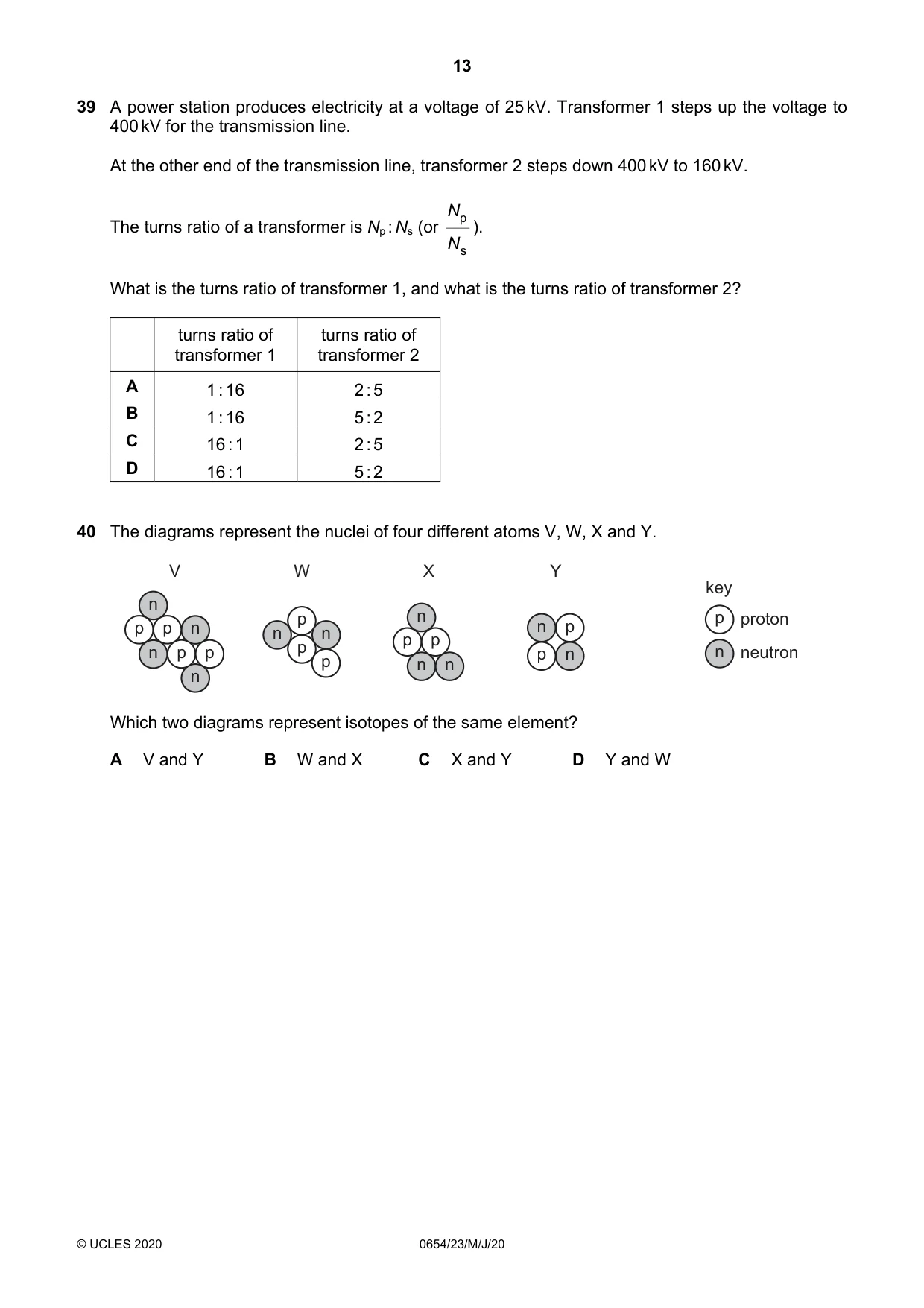
39 A power station produces electricity at a voltage of 25 kV. Transformer 1 steps up the voltage to 400 kV for the transmission line. At the other end of the transmission line, transformer 2 steps down 400 kV to 160 kV. N The turns ratio of a transformer is Np : Ns (or p ). N s What is the turns ratio of transformer 1, and what is the turns ratio of transformer 2? turns ratio of turns ratio of transformer 1 transformer 2 A 1 : 16 2 : 5 B 1 : 16 5 : 2 C 16 : 1 2 : 5 D 16 : 1 5 : 2
Mark scheme: B
Q40 · The diagrams represent the nuclei of four different atoms V, W, X and Y
40 The diagrams represent the nuclei of four different atoms V, W, X and Y. V W X Y key n p n p proton p p n n n n p p p p n p p p n n neutron p n n n Which two diagrams represent isotopes of the same element? A V and Y B W and X C X and Y D Y and W
Mark scheme: C
What was in this paper
The subtopics covered by these 40 questions, and how many questions each got. Open one in a new tab to see every Cambridge question on it.
3Electrical quantities2Fuels2Oxides2Air quality and climate1Alkenes1Arrangement of elements1Biological molecules1Blood vessels1Characteristics of living organisms1Diet1Electrical safety1Electrolysis1Electromagnetic effects1Elements, compounds and mixtures1Energy flow1Enzymes1Gas exchange in humans1General properties of waves1Habitat destruction1Homeostasis1Light1Monohybrid inheritance1Osmosis1Pressure1Properties of metals1Rate of reaction1Redox1Respiration1Sexual reproduction in plants1Simple molecules and covalent bonds1Simple phenomena of magnetism1The mole and the Avogadro constant1The nucleus1Transfer of thermal energy1