Cambridge IGCSE Sciences - Co-ordinated (Double) 0654 — 2022 Oct/Nov Paper 2 · Variant 2
0654/22/O/N/22 · 40 questions · 40 marks · ≈45 min
The question paper and its mark scheme, free to read here and free to download. This is Cambridge’s own paper, exactly as it was sat.
Question paper16 pages
Mark scheme3 pages
Answers below. Sit the paper first if you are practising.
Questions as text
Q1 · What do plants need for their nutrition?
1 What do plants need for their nutrition? A carbon dioxide, ions, organic compounds and light B carbon dioxide, ions, organic compounds and water C carbon dioxide, ions, light and water D carbon dioxide, organic compounds, light and water
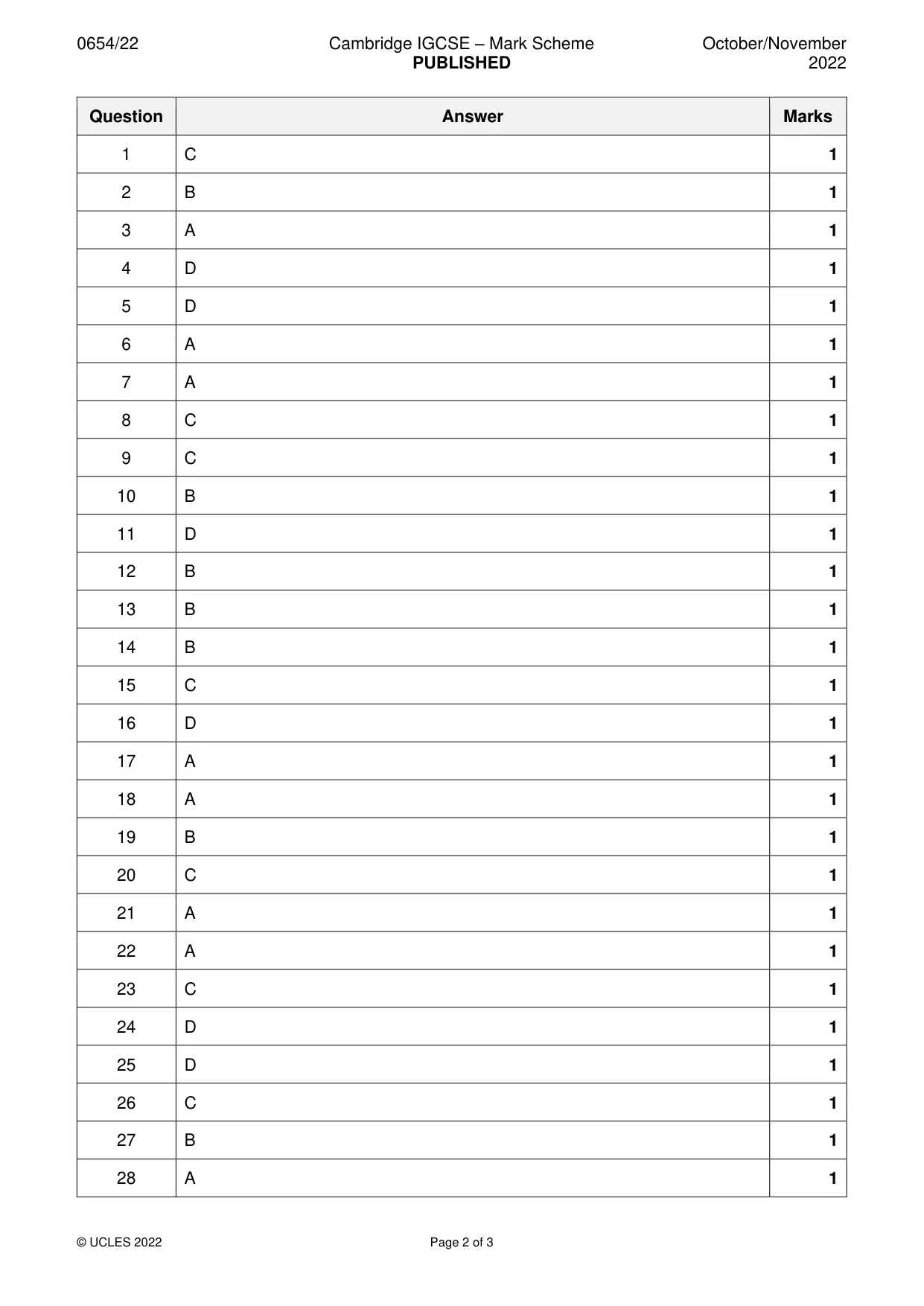
Mark scheme: C
Q2 · What is found in plant cells but not in animal cells?
2 What is found in plant cells but not in animal cells? A cell membrane B cell wall C nucleus D cytoplasm
Mark scheme: B
Q3 · Glycerol is a component of which large molecules?
3 Glycerol is a component of which large molecules? A fats B glycogen C proteins D starch
Mark scheme: A
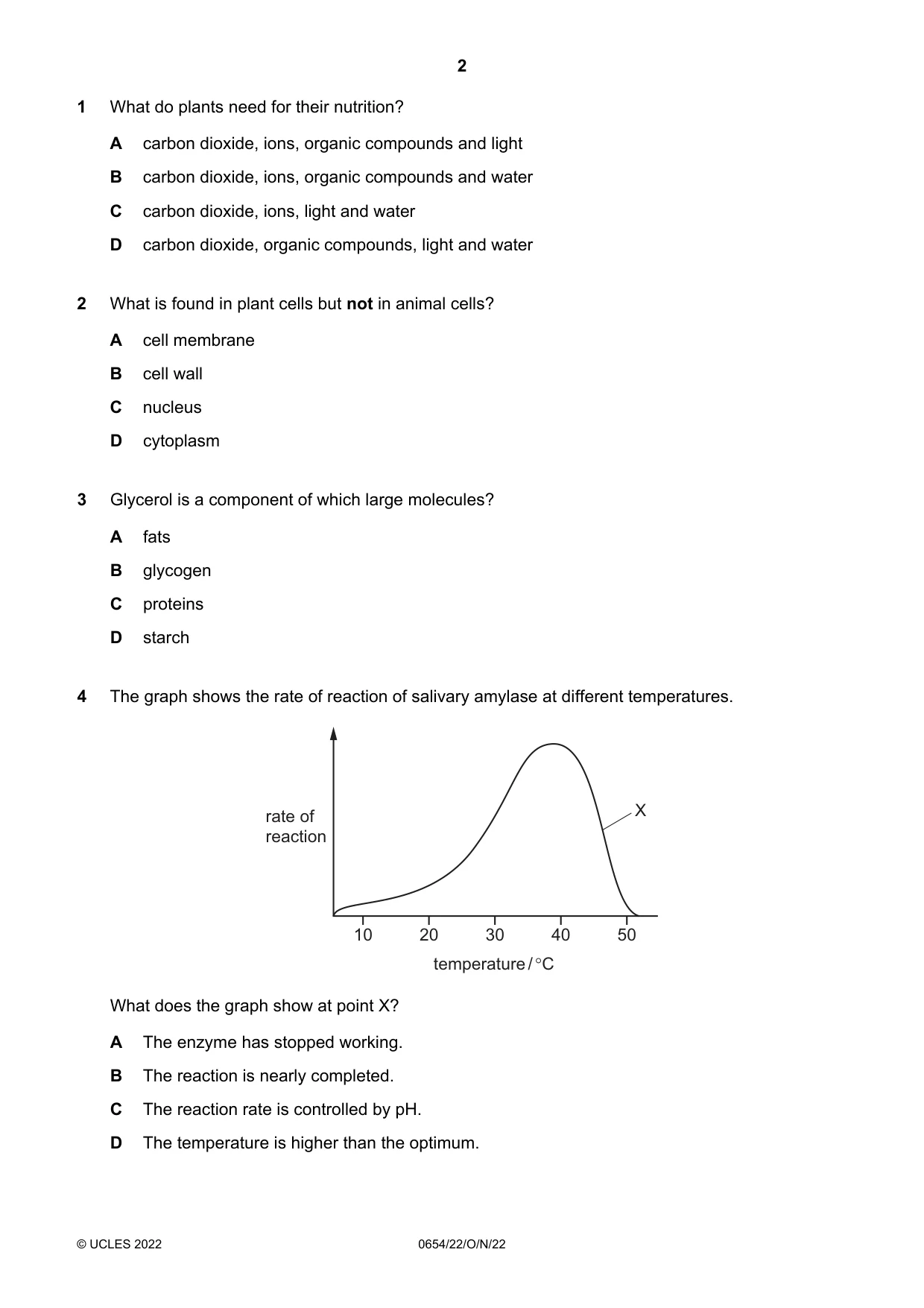
Q4 · The graph shows the rate of reaction of salivary amylase at different temperatures
4 The graph shows the rate of reaction of salivary amylase at different temperatures. rate of X reaction 10 20 30 40 50 temperature / °C What does the graph show at point X? A The enzyme has stopped working. B The reaction is nearly completed. C The reaction rate is controlled by pH. D The temperature is higher than the optimum.
Mark scheme: D
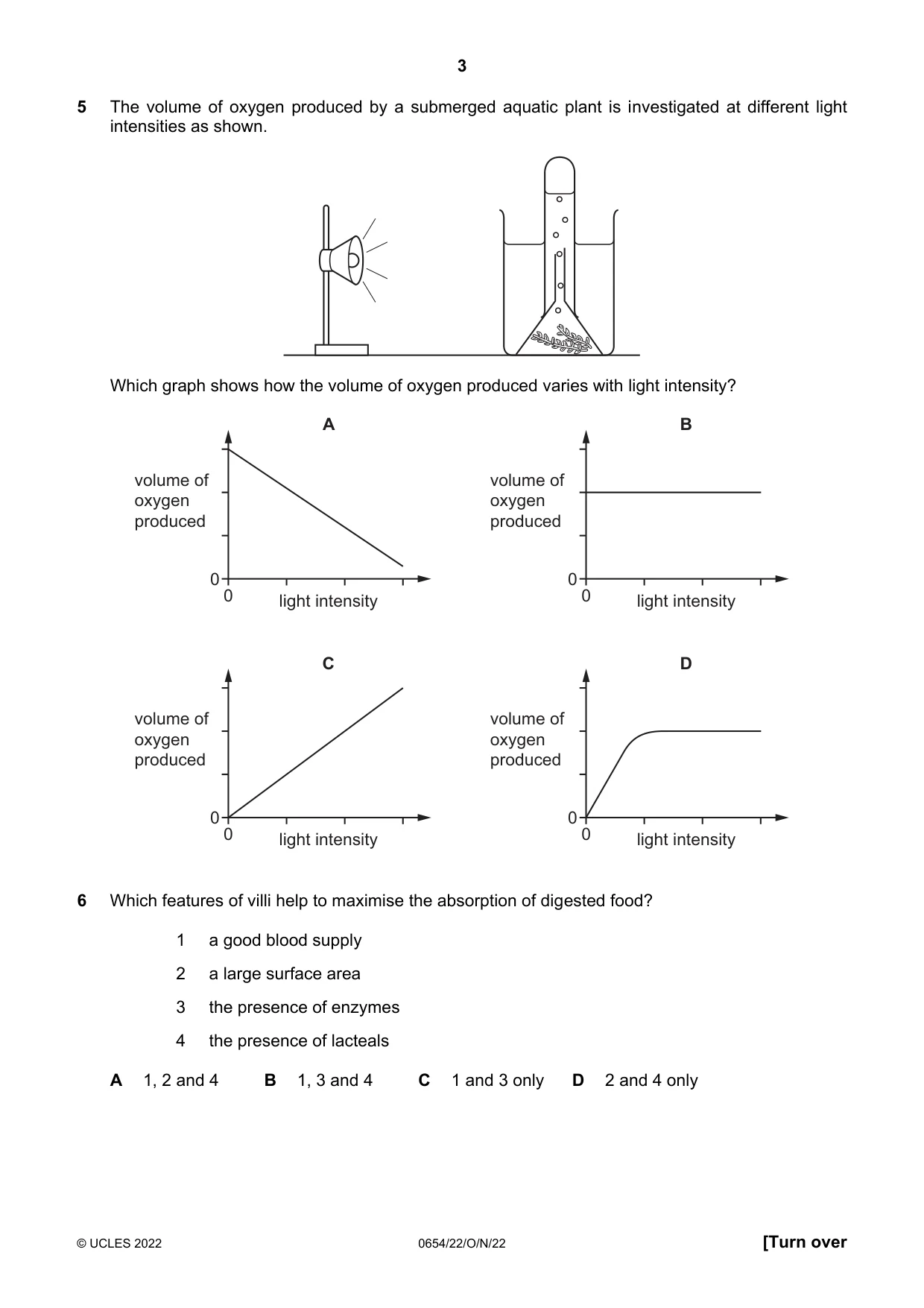
Q5 · The volume of oxygen produced by a submerged aquatic plant is investigated at different…
5 The volume of oxygen produced by a submerged aquatic plant is investigated at different light intensities as shown. Which graph shows how the volume of oxygen produced varies with light intensity? A B volume of volume of oxygen oxygen produced produced 0 0 0 light intensity 0 light intensity C D volume of volume of oxygen oxygen produced produced 0 0 0 light intensity 0 light intensity
Mark scheme: D
Q6 · Which features of villi help to maximise the absorption of digested food?
6 Which features of villi help to maximise the absorption of digested food? 1 a good blood supply 2 a large surface area 3 the presence of enzymes 4 the presence of lacteals A 1, 2 and 4 B 1, 3 and 4 C 1 and 3 only D 2 and 4 only
Mark scheme: A
Q7 · Which statement explains the effect of a higher temperature on the rate of transpiration?
7 Which statement explains the effect of a higher temperature on the rate of transpiration? A More water evaporates from the stomata, creating a water potential gradient that draws a column of water molecules up the xylem. B Less water evaporates from the stomata, creating a water potential gradient that draws a column of water molecules up the xylem. C More water evaporates from the stomata, creating a water potential gradient that draws a column of water molecules up the phloem. D Less water evaporates from the stomata, creating a water potential gradient that draws a column of water molecules up the phloem.
Mark scheme: A
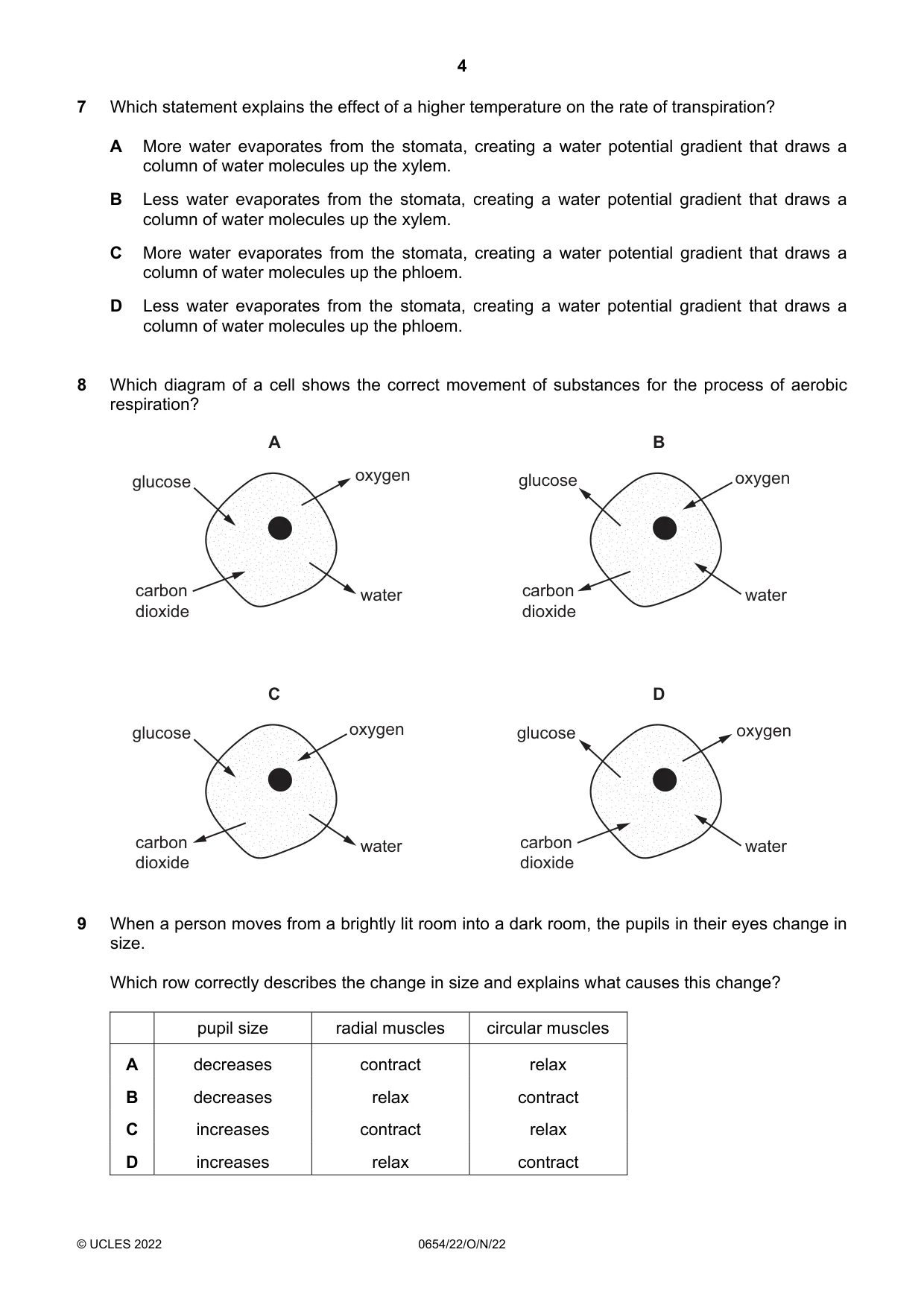
Q8 · Which diagram of a cell shows the correct movement of substances for the process of…
8 Which diagram of a cell shows the correct movement of substances for the process of aerobic respiration? A B glucose oxygen glucose oxygen carbon water carbon water dioxide dioxide C D glucose oxygen glucose oxygen carbon water carbon water dioxide dioxide
Mark scheme: C
Q9 · When a person moves from a brightly lit room into a dark room, the pupils in their eyes…
9 When a person moves from a brightly lit room into a dark room, the pupils in their eyes change in size. Which row correctly describes the change in size and explains what causes this change? pupil size radial muscles circular muscles A decreases contract relax B decreases relax contract C increases contract relax D increases relax contract
Mark scheme: C
Q10 · What is most likely to describe a flower that is wind-pollinated?
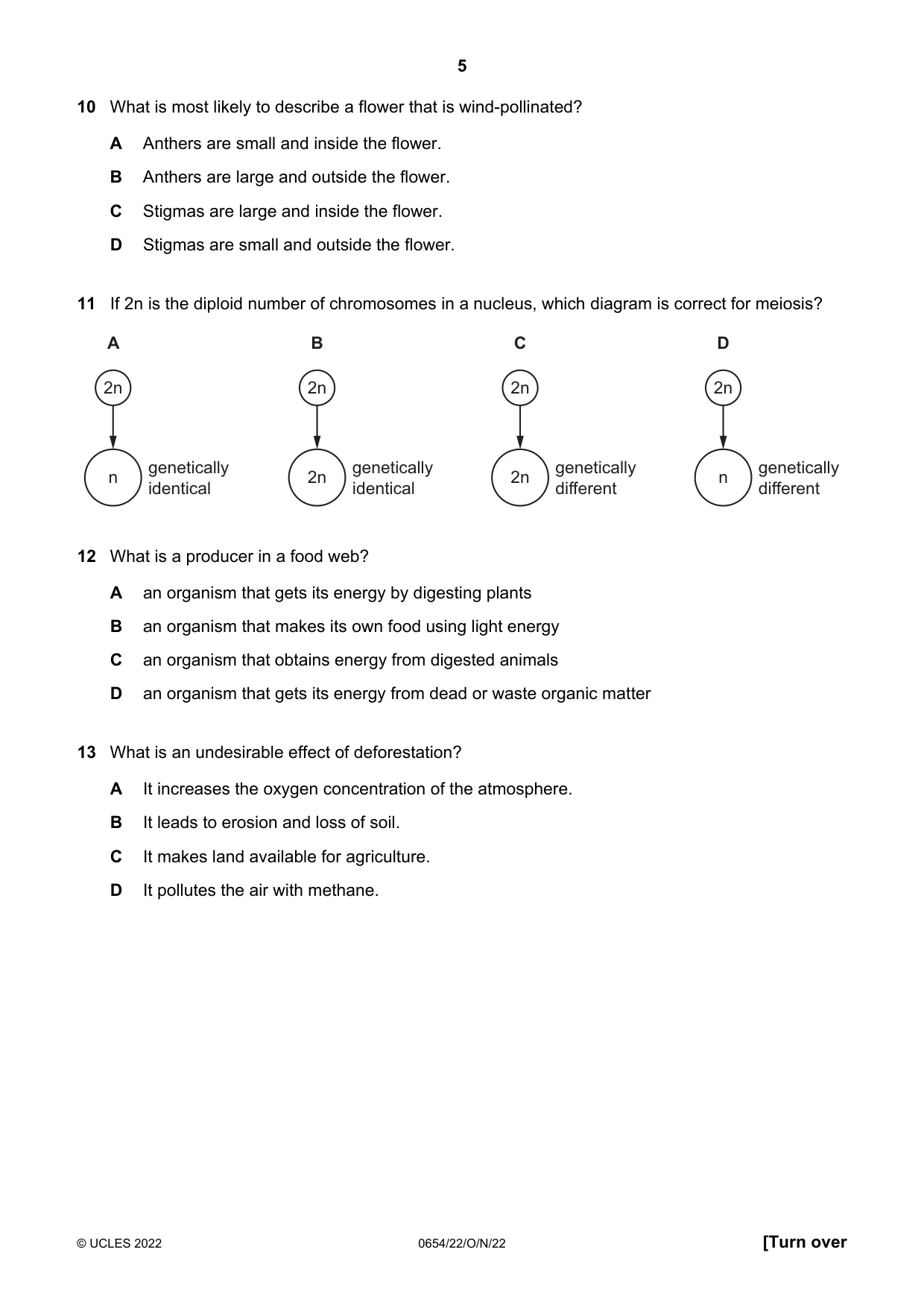
10 What is most likely to describe a flower that is wind-pollinated? A Anthers are small and inside the flower. B Anthers are large and outside the flower. C Stigmas are large and inside the flower. D Stigmas are small and outside the flower.
Mark scheme: B
Q11 · If 2n is the diploid number of chromosomes in a nucleus, which diagram is correct for…
11 If 2n is the diploid number of chromosomes in a nucleus, which diagram is correct for meiosis? A B C D 2n 2n 2n 2n genetically genetically genetically genetically n 2n 2n n identical identical different different
Mark scheme: D
Q12 · What is a producer in a food web?
12 What is a producer in a food web? A an organism that gets its energy by digesting plants B an organism that makes its own food using light energy C an organism that obtains energy from digested animals D an organism that gets its energy from dead or waste organic matter
Mark scheme: B
Q13 · What is an undesirable effect of deforestation?
13 What is an undesirable effect of deforestation? A It increases the oxygen concentration of the atmosphere. B It leads to erosion and loss of soil. C It makes land available for agriculture. D It pollutes the air with methane.
Mark scheme: B
Q14 · Which change is represented by the diagram?
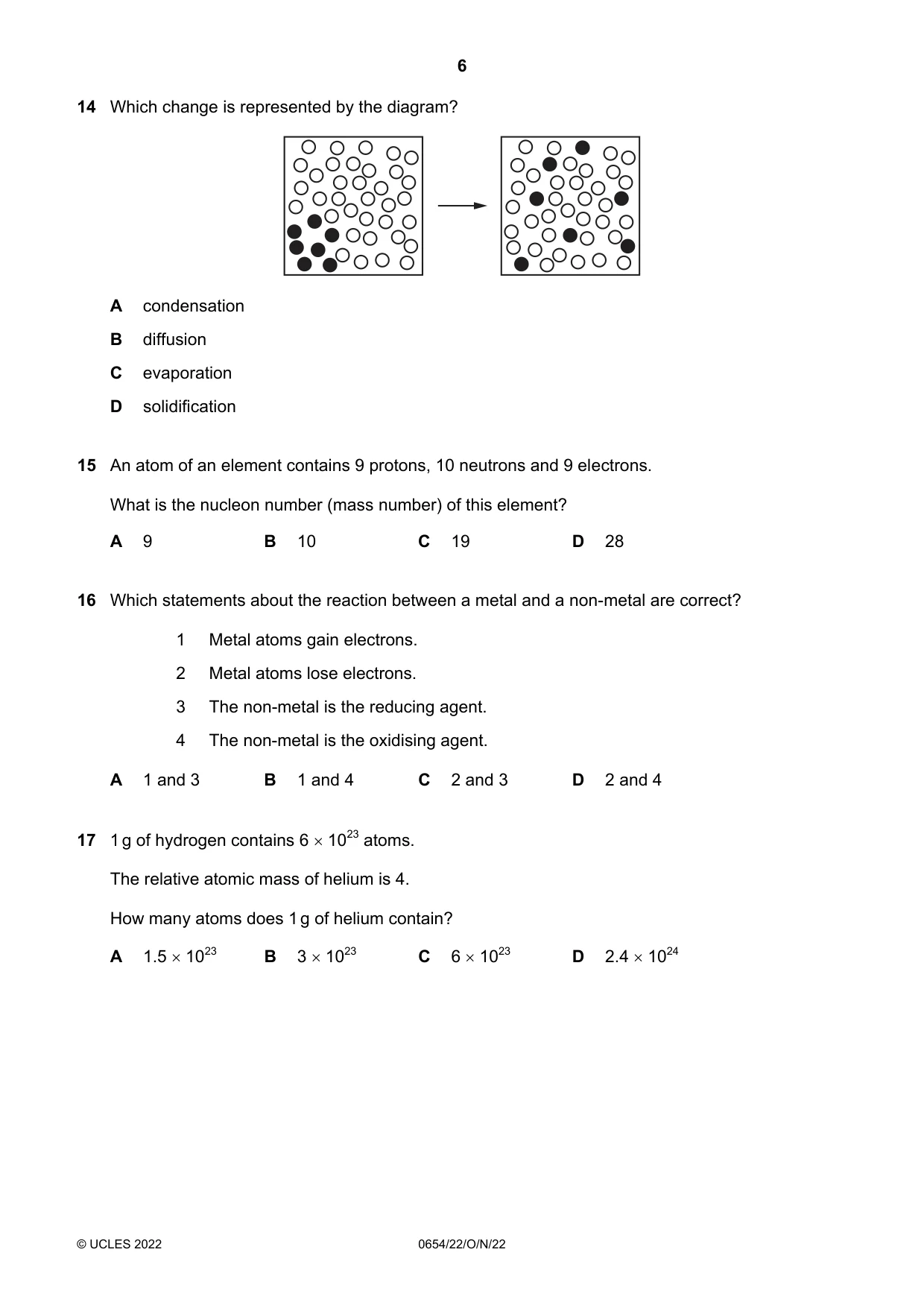
14 Which change is represented by the diagram? A condensation B diffusion C evaporation D solidification
Mark scheme: B
Q15 · An atom of an element contains 9 protons, 10 neutrons and 9 electrons
15 An atom of an element contains 9 protons, 10 neutrons and 9 electrons. What is the nucleon number (mass number) of this element? A 9 B 10 C 19 D 28
Mark scheme: C
Q16 · Which statements about the reaction between a metal and a non-metal are correct?
16 Which statements about the reaction between a metal and a non-metal are correct? 1 Metal atoms gain electrons. 2 Metal atoms lose electrons. 3 The non-metal is the reducing agent. 4 The non-metal is the oxidising agent. A 1 and 3 B 1 and 4 C 2 and 3 D 2 and 4
Mark scheme: D
Q17 · 1 g of hydrogen contains 6 1023 atoms
17 1 g of hydrogen contains 6 1023 atoms. The relative atomic mass of helium is 4. How many atoms does 1 g of helium contain? A 1.5 1023 B 3 1023 C 6 1023 D 2.4 1024
Mark scheme: A
Q18 · Which ions gain and lose electrons during the electrolysis of concentrated aqueous sodium…
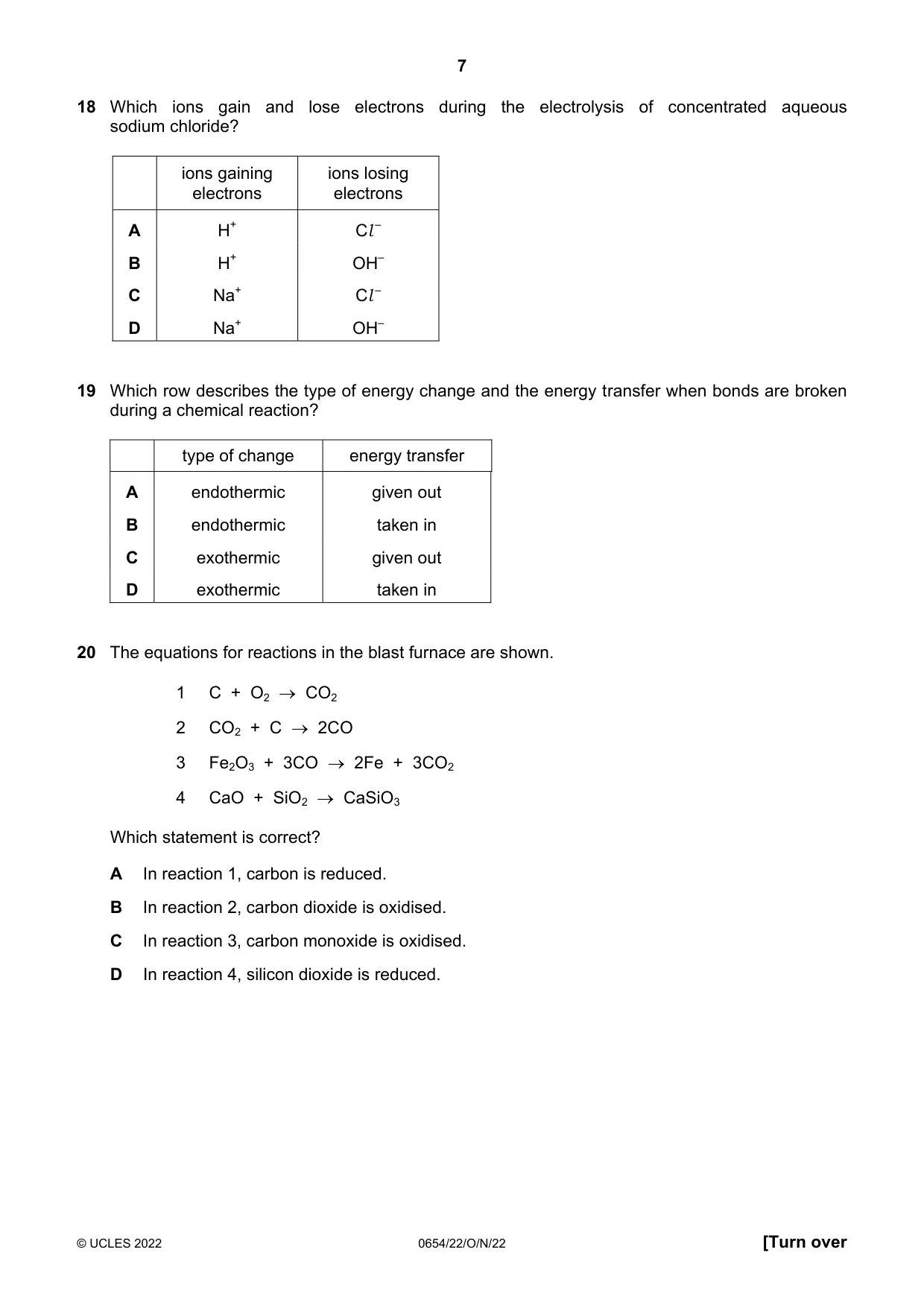
18 Which ions gain and lose electrons during the electrolysis of concentrated aqueous sodium chloride? ions gaining ions losing electrons electrons A H+ Cl – B H+ OH– C Na+ Cl – D Na+ OH–
Mark scheme: A
Q19 · Which row describes the type of energy change and the energy transfer when bonds are…
19 Which row describes the type of energy change and the energy transfer when bonds are broken during a chemical reaction? type of change energy transfer A endothermic given out B endothermic taken in C exothermic given out D exothermic taken in
Mark scheme: B
Q20 · The equations for reactions in the blast furnace are shown
20 The equations for reactions in the blast furnace are shown. 1 C + O2 CO2 2 CO2 + C 2CO 3 Fe2O3 + 3CO 2Fe + 3CO2 4 CaO + SiO2 CaSiO3 Which statement is correct? A In reaction 1, carbon is reduced. B In reaction 2, carbon dioxide is oxidised. C In reaction 3, carbon monoxide is oxidised. D In reaction 4, silicon dioxide is reduced.
Mark scheme: C
Q21 · Which statements about the elements in Group VII of the Periodic Table are correct?
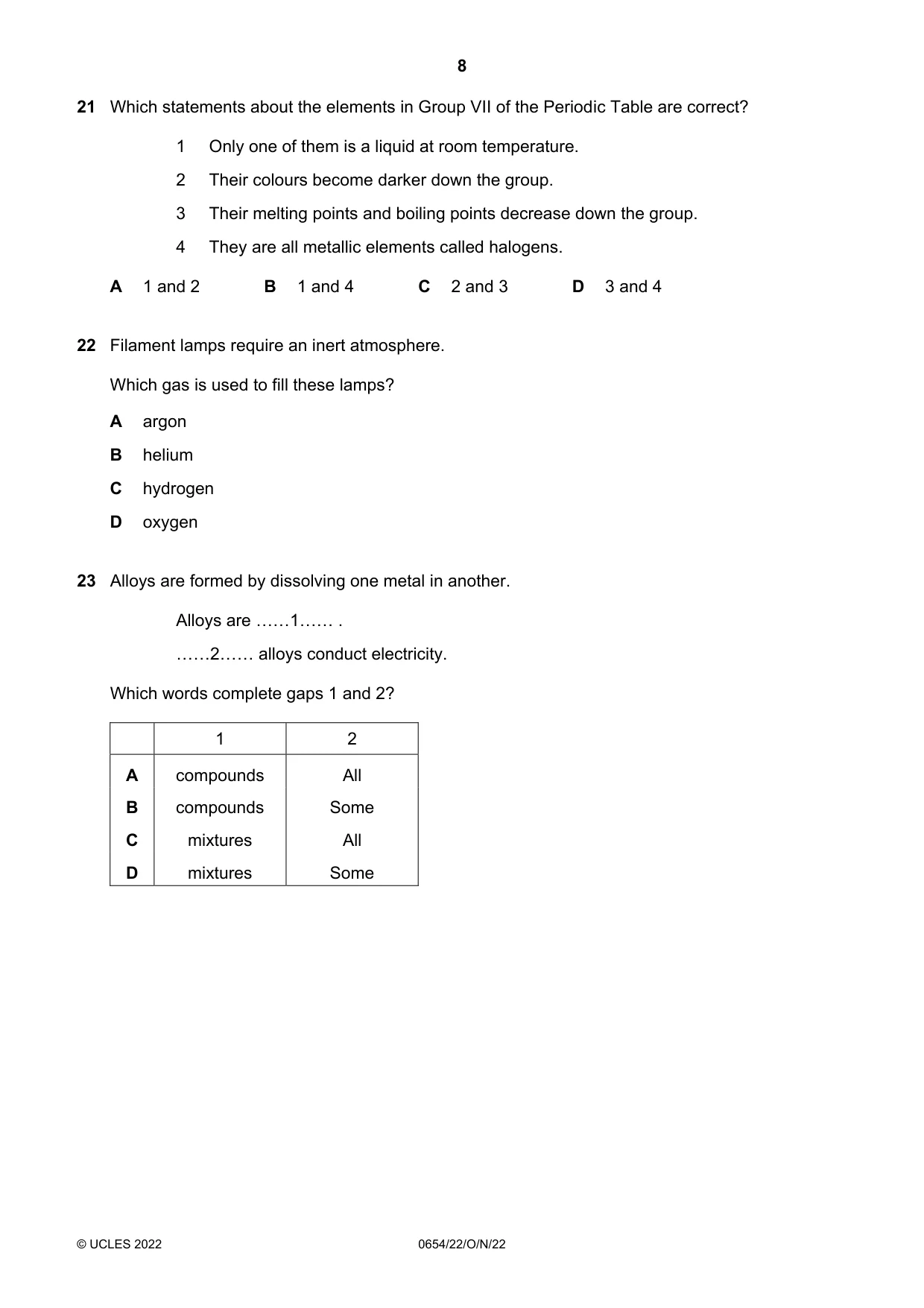
21 Which statements about the elements in Group VII of the Periodic Table are correct? 1 Only one of them is a liquid at room temperature. 2 Their colours become darker down the group. 3 Their melting points and boiling points decrease down the group. 4 They are all metallic elements called halogens. A 1 and 2 B 1 and 4 C 2 and 3 D 3 and 4
Mark scheme: A
Q22 · Filament lamps require an inert atmosphere
22 Filament lamps require an inert atmosphere. Which gas is used to fill these lamps? A argon B helium C hydrogen D oxygen
Mark scheme: A
Q23 · Alloys are formed by dissolving one metal in another
23 Alloys are formed by dissolving one metal in another. Alloys are ……1…… . ……2…… alloys conduct electricity. Which words complete gaps 1 and 2? 1 2 A compounds All B compounds Some C mixtures All D mixtures Some
Mark scheme: C
Q24 · Part of the reactivity series is shown
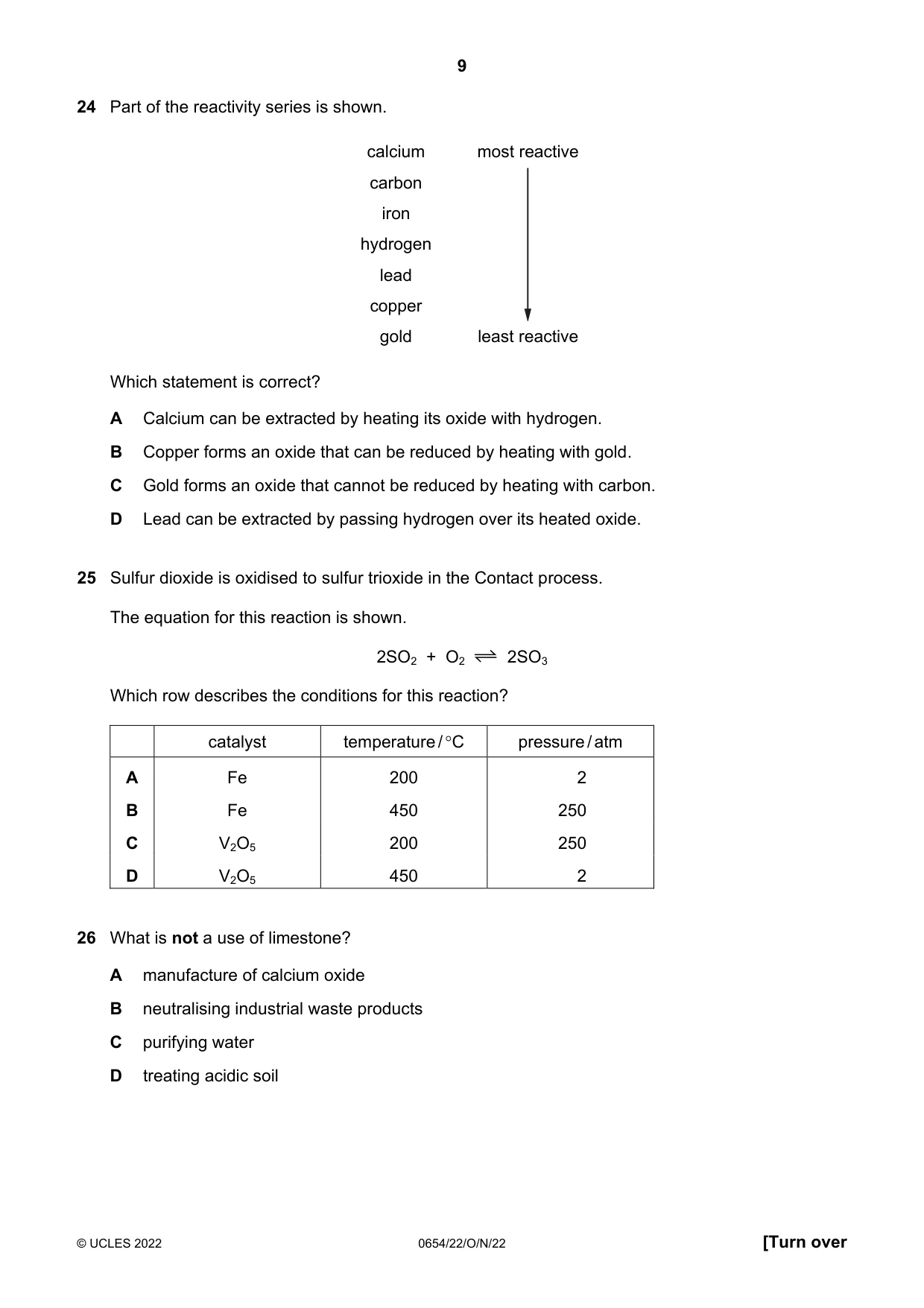
24 Part of the reactivity series is shown. calcium most reactive carbon iron hydrogen lead copper gold least reactive Which statement is correct? A Calcium can be extracted by heating its oxide with hydrogen. B Copper forms an oxide that can be reduced by heating with gold. C Gold forms an oxide that cannot be reduced by heating with carbon. D Lead can be extracted by passing hydrogen over its heated oxide.
Mark scheme: D
Q25 · Sulfur dioxide is oxidised to sulfur trioxide in the Contact process
25 Sulfur dioxide is oxidised to sulfur trioxide in the Contact process. The equation for this reaction is shown. 2SO2 + O2 2SO3 Which row describes the conditions for this reaction? catalyst temperature / C pressure / atm A Fe 200 2 B Fe 450 250 C V2O5 200 250 D V2O5 450 2
Mark scheme: D
Q26 · What is not a use of limestone?
26 What is not a use of limestone? A manufacture of calcium oxide B neutralising industrial waste products C purifying water D treating acidic soil
Mark scheme: C
Q27 · Which diagram represents the structure of nylon?
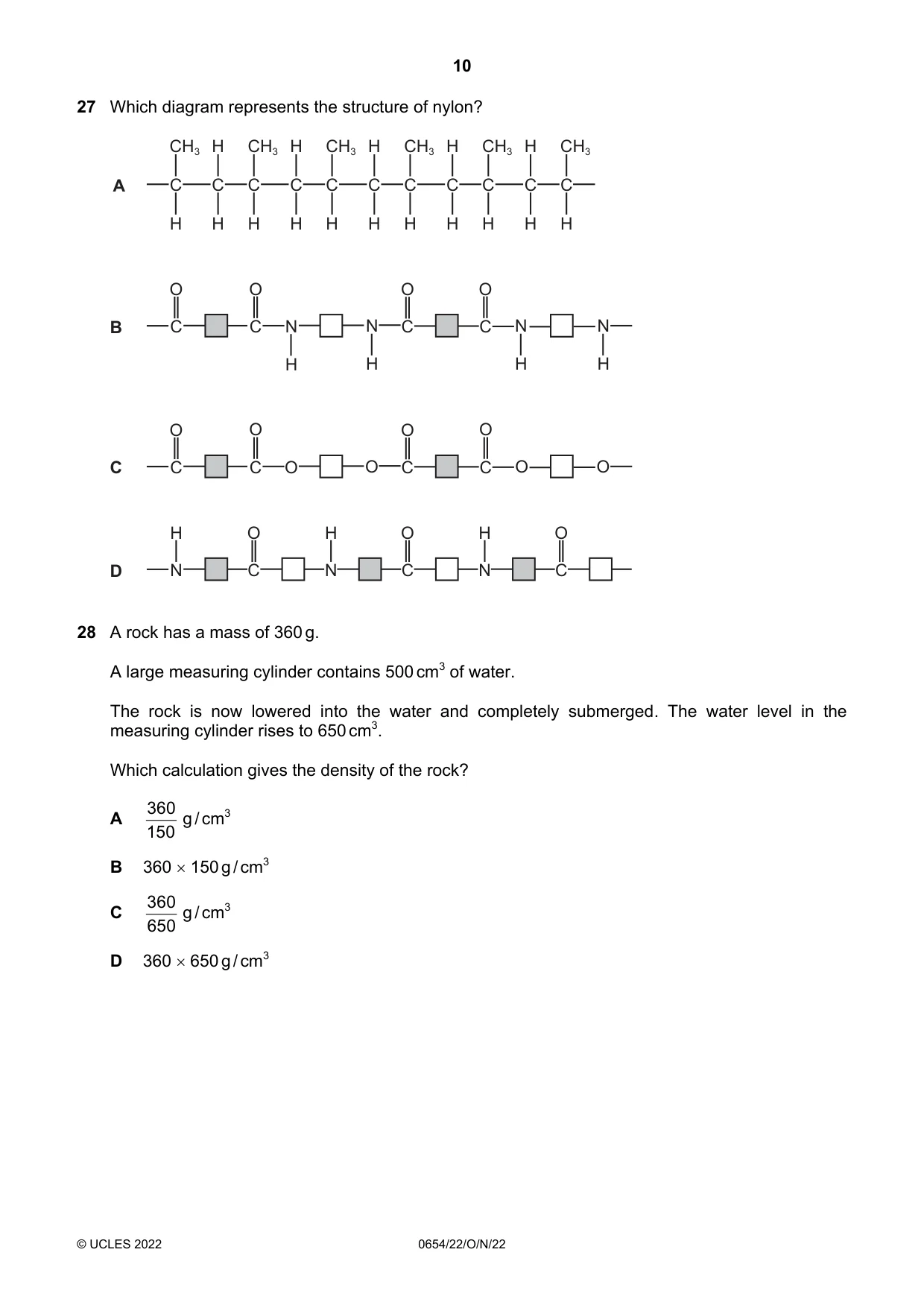
27 Which diagram represents the structure of nylon? CH3 H CH3 H CH3 H CH3 H CH3 H CH3 A C C C C C C C C C C C H H H H H H H H H H H O O O O B C C N N C C N N H H H H O O O O C C C O O C C O O H O H O H O D N C N C N C
Mark scheme: B
Q28 · A rock has a mass of 360 g
28 A rock has a mass of 360 g. A large measuring cylinder contains 500 cm3 of water. The rock is now lowered into the water and completely submerged. The water level in the measuring cylinder rises to 650 cm3. Which calculation gives the density of the rock? 360 A g / cm3 150 B 360 150 g / cm3 360 C g / cm3 650 D 360 650 g / cm3
Mark scheme: A
Q29 · The diagram shows a beam XY of length 100 cm
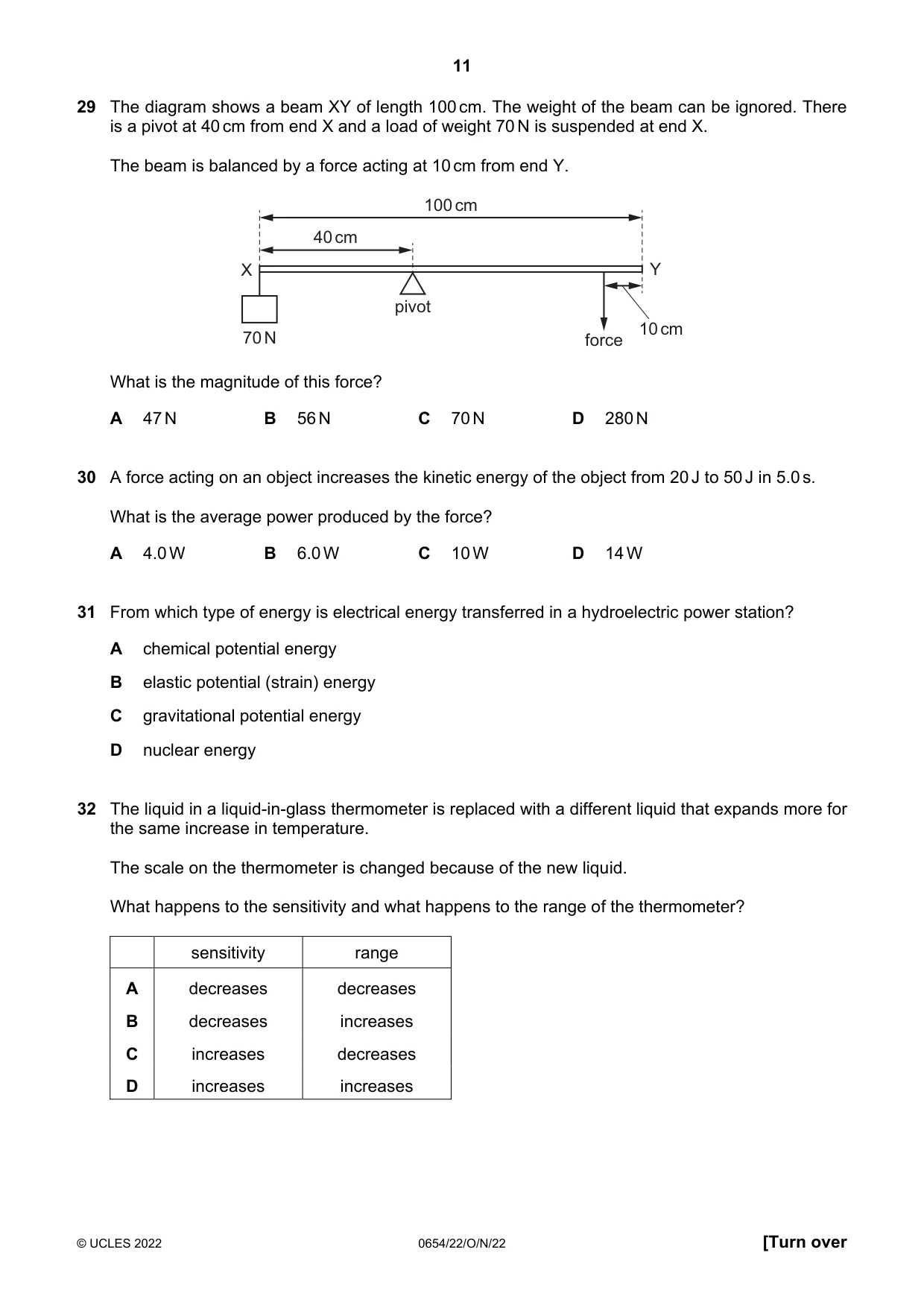
29 The diagram shows a beam XY of length 100 cm. The weight of the beam can be ignored. There is a pivot at 40 cm from end X and a load of weight 70 N is suspended at end X. The beam is balanced by a force acting at 10 cm from end Y. 100 cm 40 cm X Y pivot 10 cm 70 N force What is the magnitude of this force? A 47 N B 56 N C 70 N D 280 N
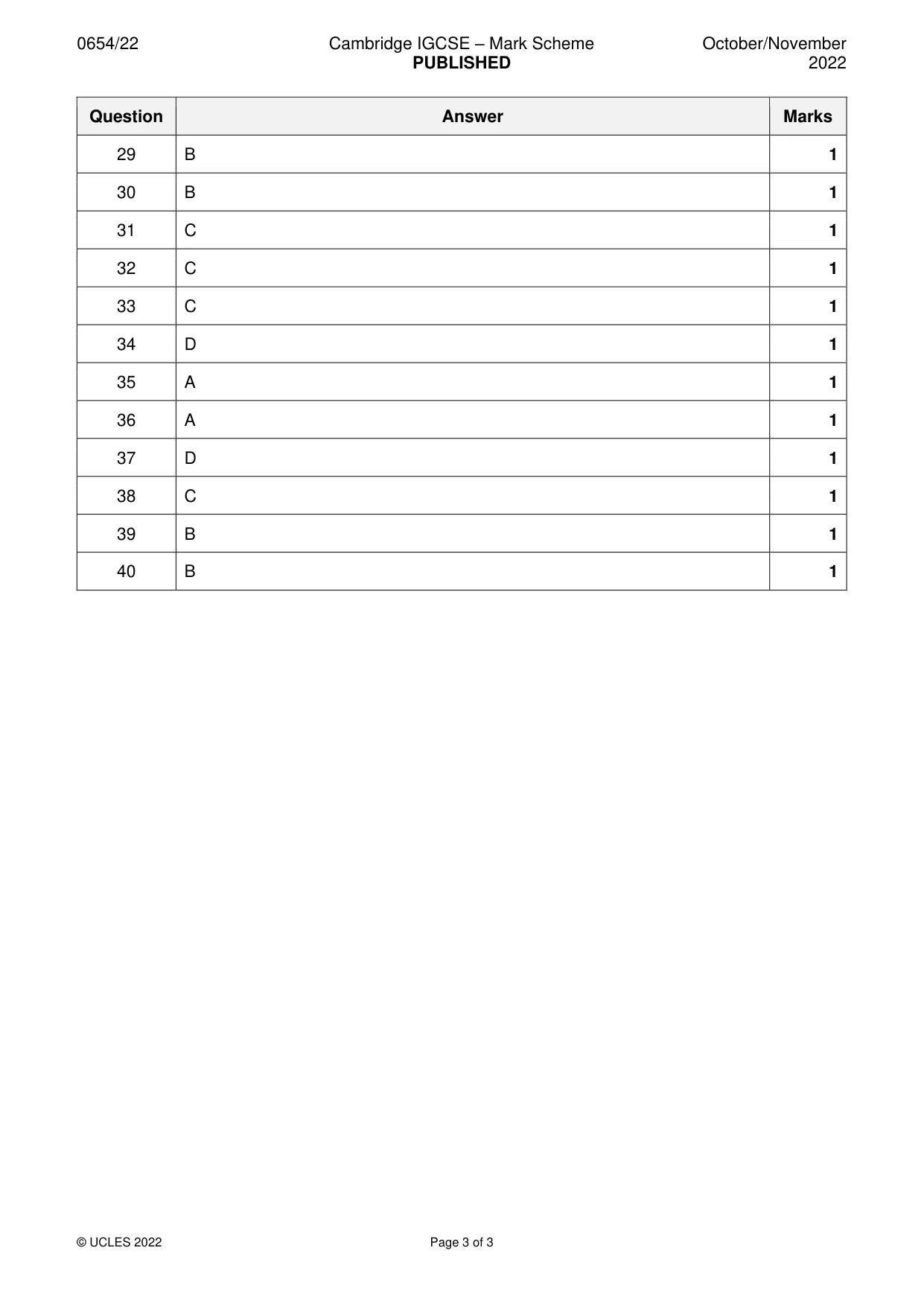
Mark scheme: B
Q30 · A force acting on an object increases the kinetic energy of the object from 20 J to 50 J…
30 A force acting on an object increases the kinetic energy of the object from 20 J to 50 J in 5.0 s. What is the average power produced by the force? A 4.0 W B 6.0 W C 10 W D 14 W
Mark scheme: B
Q31 · From which type of energy is electrical energy transferred in a hydroelectric power…
31 From which type of energy is electrical energy transferred in a hydroelectric power station? A chemical potential energy B elastic potential (strain) energy C gravitational potential energy D nuclear energy
Mark scheme: C
Q32 · The liquid in a liquid-in-glass thermometer is replaced with a different liquid that…
32 The liquid in a liquid-in-glass thermometer is replaced with a different liquid that expands more for the same increase in temperature. The scale on the thermometer is changed because of the new liquid. What happens to the sensitivity and what happens to the range of the thermometer? sensitivity range A decreases decreases B decreases increases C increases decreases D increases increases
Mark scheme: C
Q33 · One cause of air movement in the atmosphere is convection
33 One cause of air movement in the atmosphere is convection. Which statement describes air that rises in the atmosphere due to convection? A It is cooler and less dense than the surrounding air. B It is cooler and more dense than the surrounding air. C It is warmer and less dense than the surrounding air. D It is warmer and more dense than the surrounding air.
Mark scheme: C
Q34 · The critical angle for diamond in air is 25
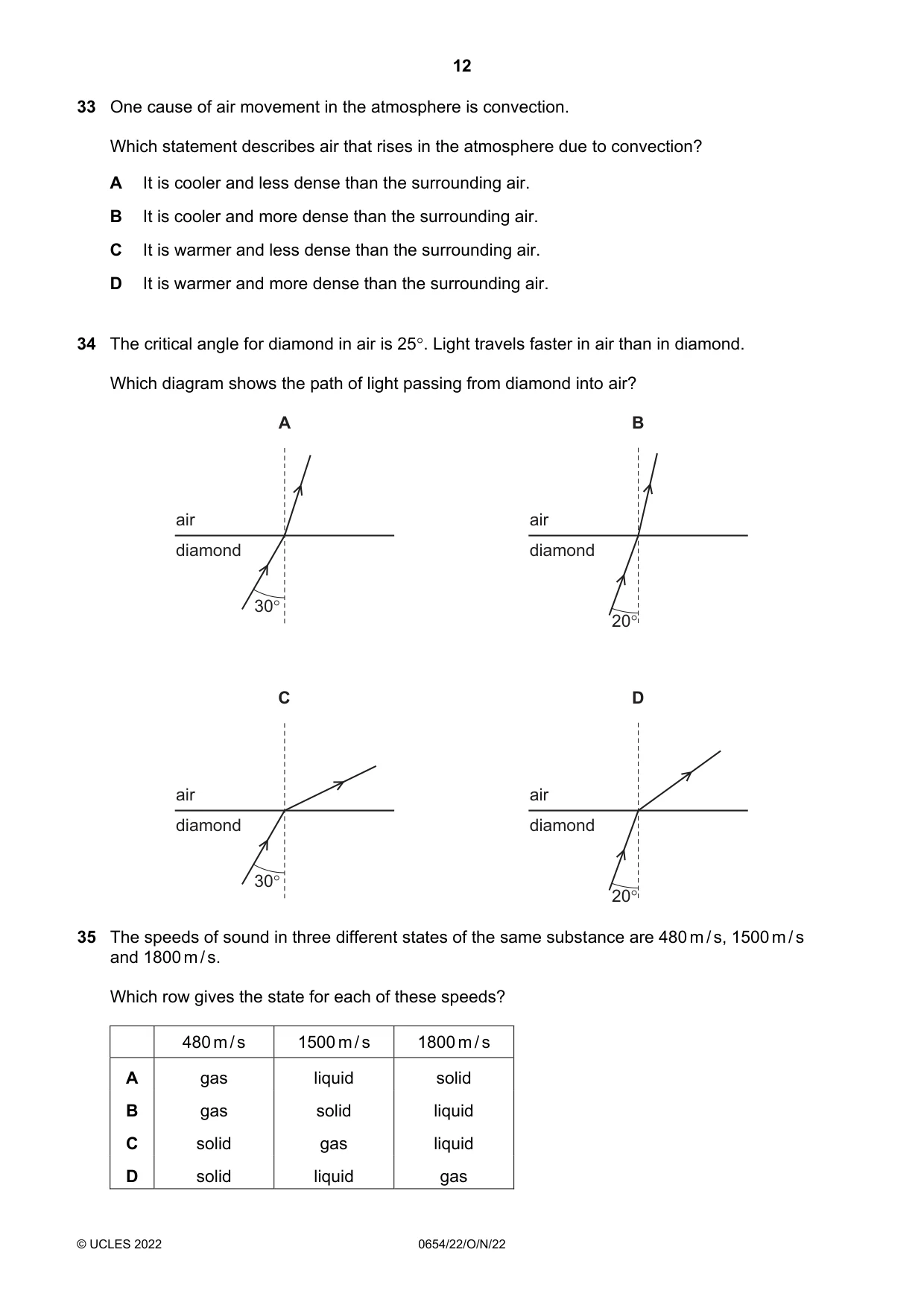
34 The critical angle for diamond in air is 25. Light travels faster in air than in diamond. Which diagram shows the path of light passing from diamond into air? A B air air diamond diamond 30° 20° C D air air diamond diamond 30° 20°
Mark scheme: D
Q35 · The speeds of sound in three different states of the same substance are 480 m / s, 1500 m…
35 The speeds of sound in three different states of the same substance are 480 m / s, 1500 m / s and 1800 m / s. Which row gives the state for each of these speeds? 480 m / s 1500 m / s 1800 m / s A gas liquid solid B gas solid liquid C solid gas liquid D solid liquid gas
Mark scheme: A
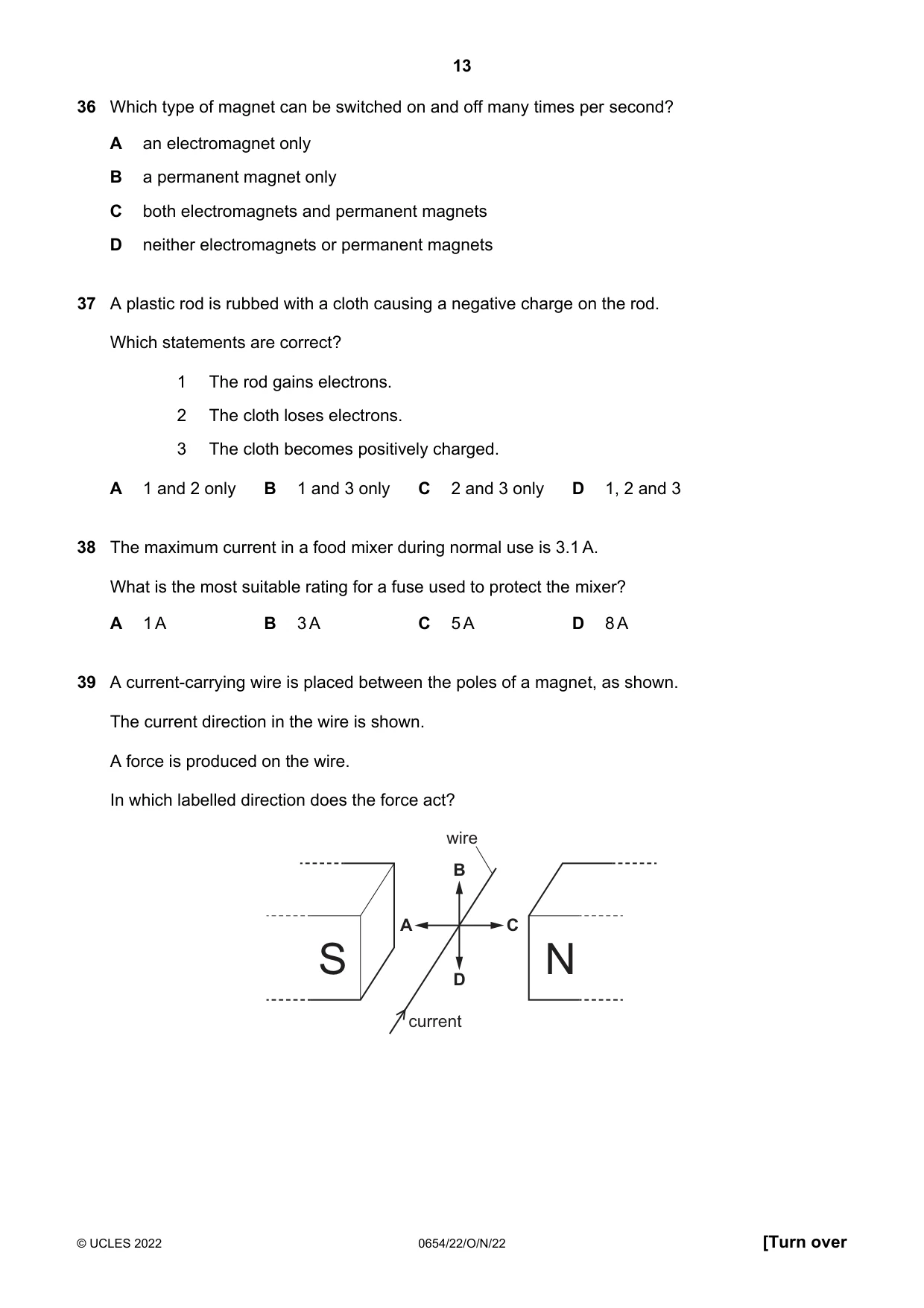
Q36 · Which type of magnet can be switched on and off many times per second?
36 Which type of magnet can be switched on and off many times per second? A an electromagnet only B a permanent magnet only C both electromagnets and permanent magnets D neither electromagnets or permanent magnets
Mark scheme: A
Q37 · A plastic rod is rubbed with a cloth causing a negative charge on the rod
37 A plastic rod is rubbed with a cloth causing a negative charge on the rod. Which statements are correct? 1 The rod gains electrons. 2 The cloth loses electrons. 3 The cloth becomes positively charged. A 1 and 2 only B 1 and 3 only C 2 and 3 only D 1, 2 and 3
Mark scheme: D
Q38 · The maximum current in a food mixer during normal use is 3.1 A
38 The maximum current in a food mixer during normal use is 3.1 A. What is the most suitable rating for a fuse used to protect the mixer? A 1 A B 3 A C 5 A D 8 A
Mark scheme: C
Q39 · A current-carrying wire is placed between the poles of a magnet, as shown
39 A current-carrying wire is placed between the poles of a magnet, as shown. The current direction in the wire is shown. A force is produced on the wire. In which labelled direction does the force act? wire B A C S N D current
Mark scheme: B
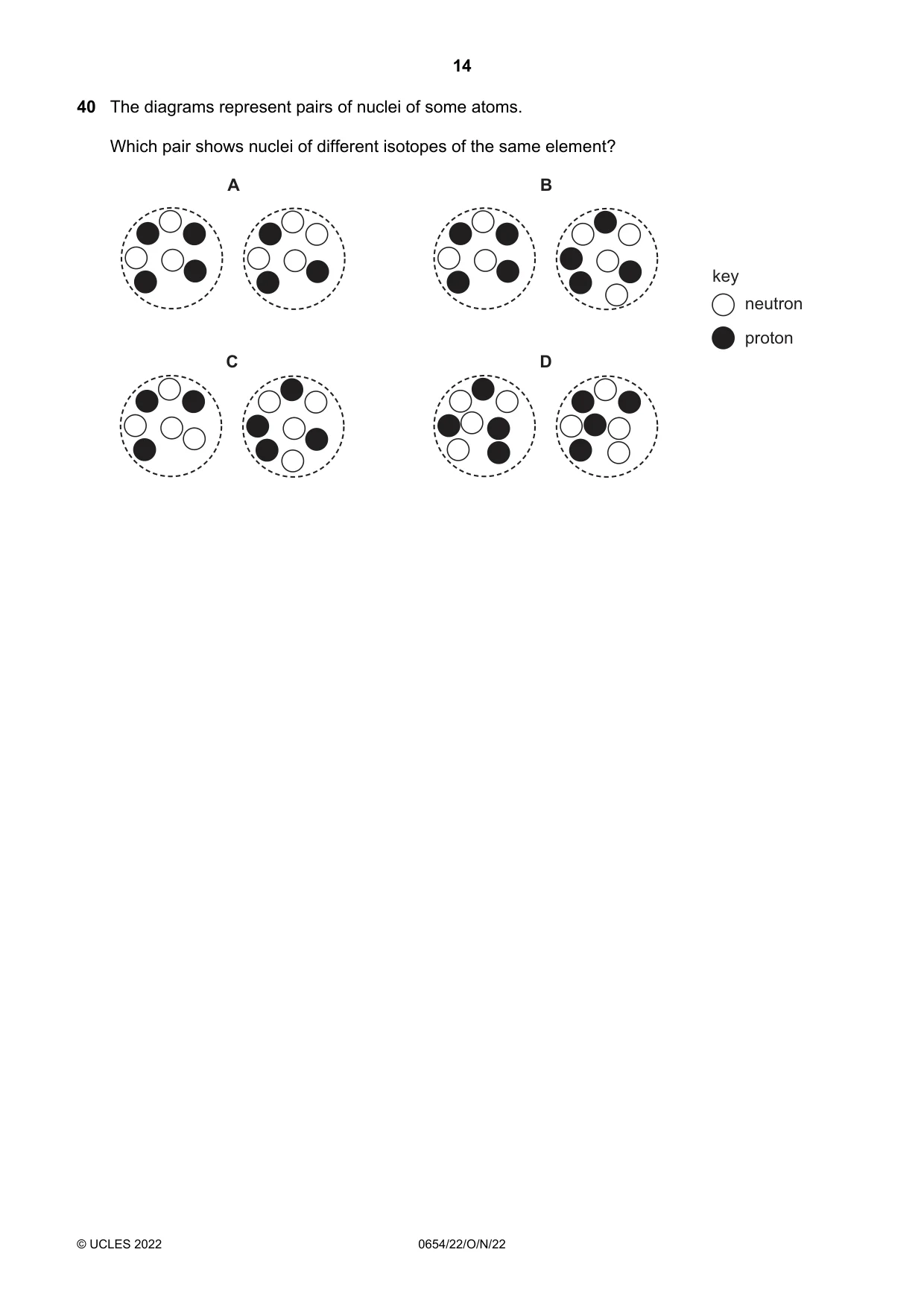
Q40 · The diagrams represent pairs of nuclei of some atoms
40 The diagrams represent pairs of nuclei of some atoms. Which pair shows nuclei of different isotopes of the same element? A B key neutron proton C D
Mark scheme: B
What was in this paper
The subtopics covered by these 40 questions, and how many questions each got. Open one in a new tab to see every Cambridge question on it.
2Photosynthesis2Simple phenomena of magnetism2Alloys and their properties1Atomic structure and the Periodic Table1Biological molecules1Cell division1Cell structure1Coordination and response1Density1Digestion1Electrical safety1Electrolysis1Electromagnetic effects1Enzymes1Exothermic and endothermic reactions1Extraction of metals1Food chains and food webs1Forces1Group VII properties1Habitat destruction1Isotopes1Light1Noble gases1Polymers1Rate of reaction1Reactivity series1Redox1Respiration1Sexual reproduction in plants1Solids, liquids and gases1Sound1The mole and the Avogadro constant1Thermal properties and temperature1Transfer of thermal energy1Transpiration1Water1What you needed in this session
Cambridge’s own grade thresholds for 2022 Oct/Nov, Paper 2 · Variant 2. A higher threshold means an easier paper — the bar moves with how the cohort did.