Cambridge IGCSE Sciences - Co-ordinated (Double) 0654 — 2025 Oct/Nov Paper 2 · Variant 2
0654/22/O/N/25 · 40 questions · 40 marks · 45 min
The question paper and its mark scheme, free to read here and free to download. This is Cambridge’s own paper, exactly as it was sat.
Question paper16 pages
Mark scheme3 pages
Answers below. Sit the paper first if you are practising.
Questions as text
Q1 · The length of an insect in a photograph is measured as 17 mm
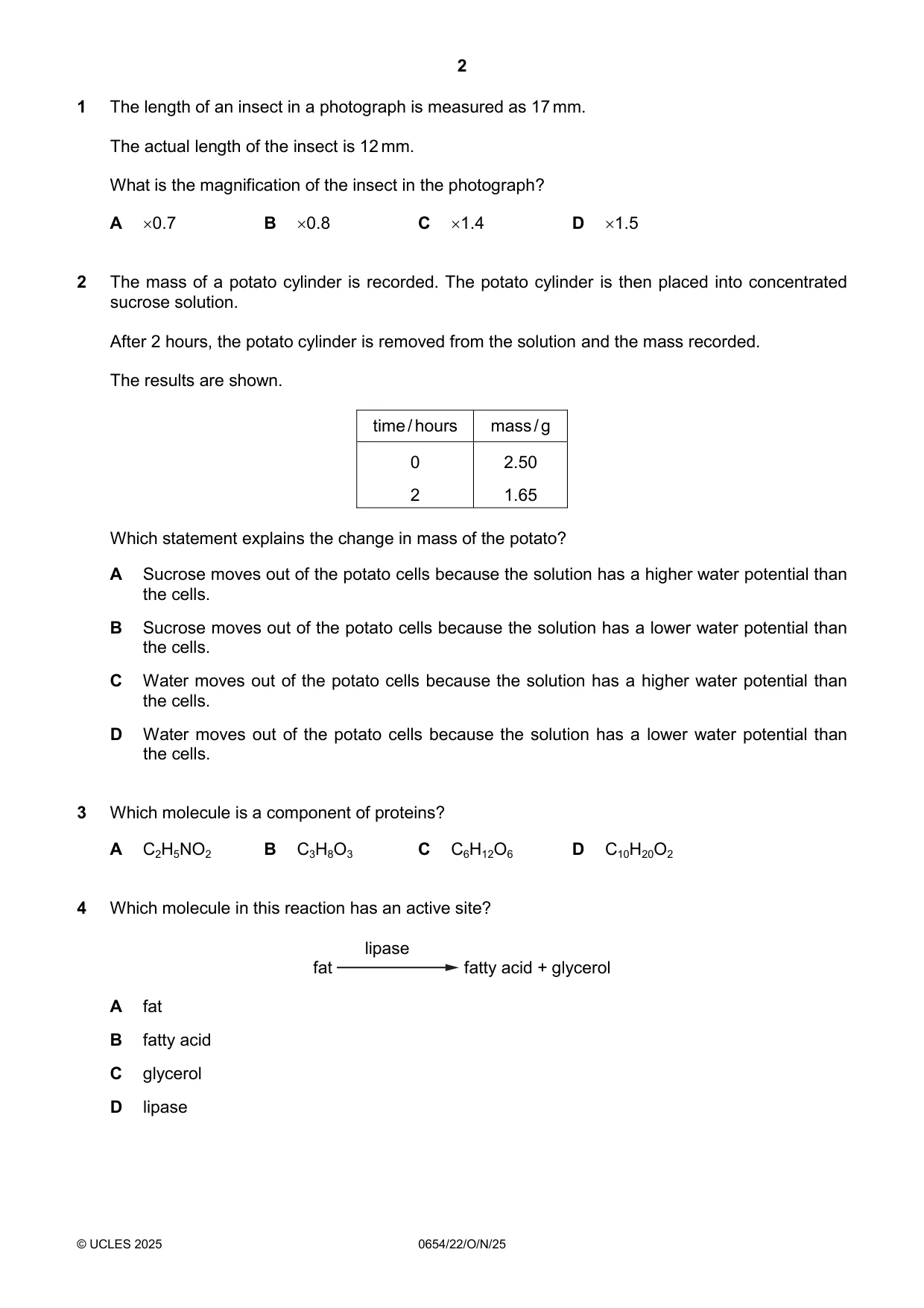
1 The length of an insect in a photograph is measured as 17 mm. The actual length of the insect is 12 mm. What is the magnification of the insect in the photograph? A 0.7 B 0.8 C 1.4 D 1.5
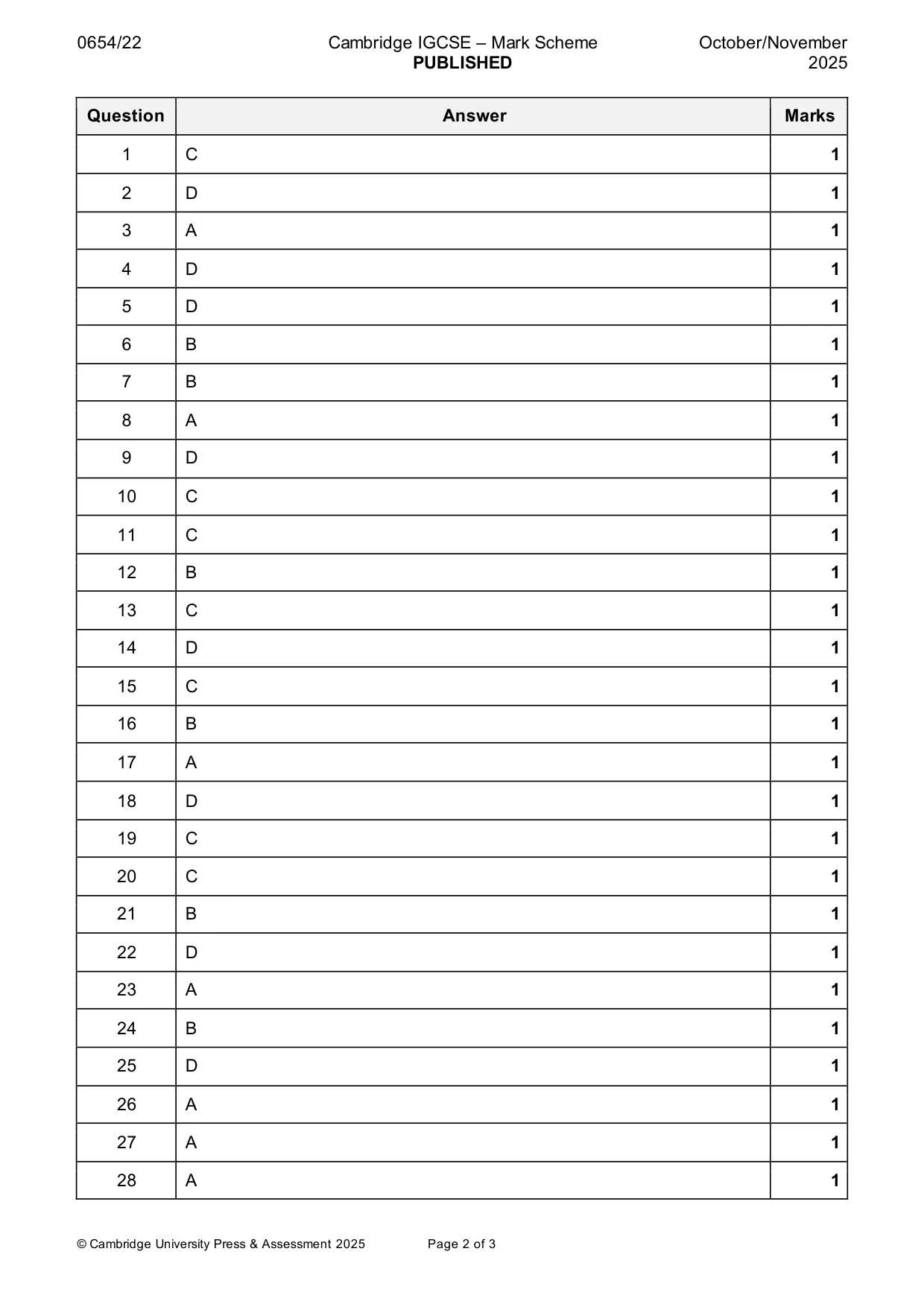
Mark scheme: C
Q2 · The mass of a potato cylinder is recorded
2 The mass of a potato cylinder is recorded. The potato cylinder is then placed into concentrated sucrose solution. After 2 hours, the potato cylinder is removed from the solution and the mass recorded. The results are shown. time / hours mass / g 0 2.50 2 1.65 Which statement explains the change in mass of the potato? A Sucrose moves out of the potato cells because the solution has a higher water potential than the cells. B Sucrose moves out of the potato cells because the solution has a lower water potential than the cells. C Water moves out of the potato cells because the solution has a higher water potential than the cells. D Water moves out of the potato cells because the solution has a lower water potential than the cells.
Mark scheme: D
Q3 · Which molecule is a component of proteins?
3 Which molecule is a component of proteins? A C2H5NO2 B C3H8O3 C C6H12O6 D C10H20O2
Mark scheme: A
Q4 · Which molecule in this reaction has an active site?
4 Which molecule in this reaction has an active site? lipase fat fatty acid + glycerol A fat B fatty acid C glycerol D lipase
Mark scheme: D
Q5 · Which row shows the effect of magnesium ion deficiency on plants?
5 Which row shows the effect of magnesium ion deficiency on plants? leaf colour growth A green good B green poor C yellow good D yellow poor
Mark scheme: D
Q6 · The diagram shows part of the human digestive system
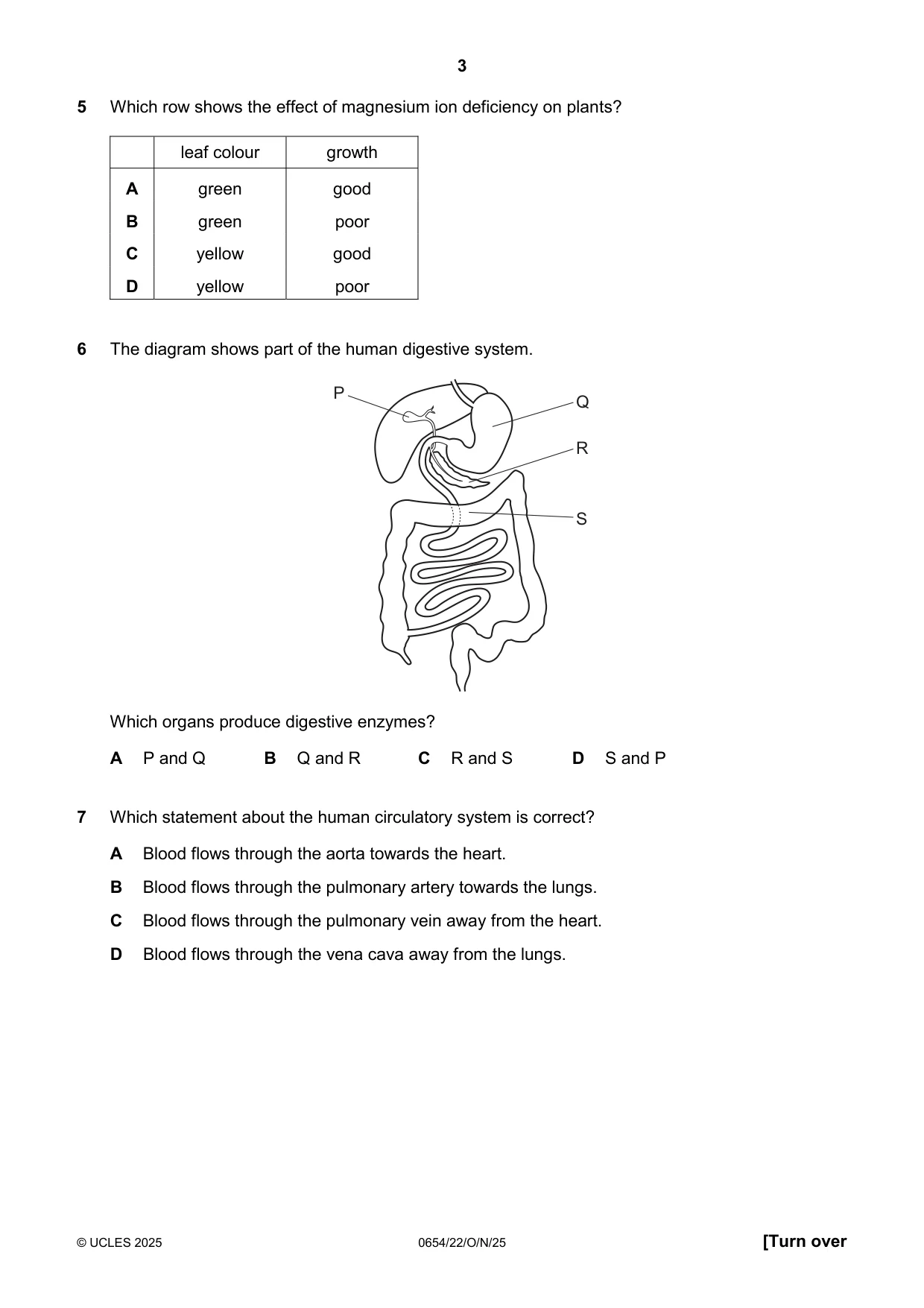
6 The diagram shows part of the human digestive system. P Q R S Which organs produce digestive enzymes? A P and Q B Q and R C R and S D S and P
Mark scheme: B
Q7 · Which statement about the human circulatory system is correct?
7 Which statement about the human circulatory system is correct? A Blood flows through the aorta towards the heart. B Blood flows through the pulmonary artery towards the lungs. C Blood flows through the pulmonary vein away from the heart. D Blood flows through the vena cava away from the lungs.
Mark scheme: B
Q8 · The diagram shows part of the breathing system in humans
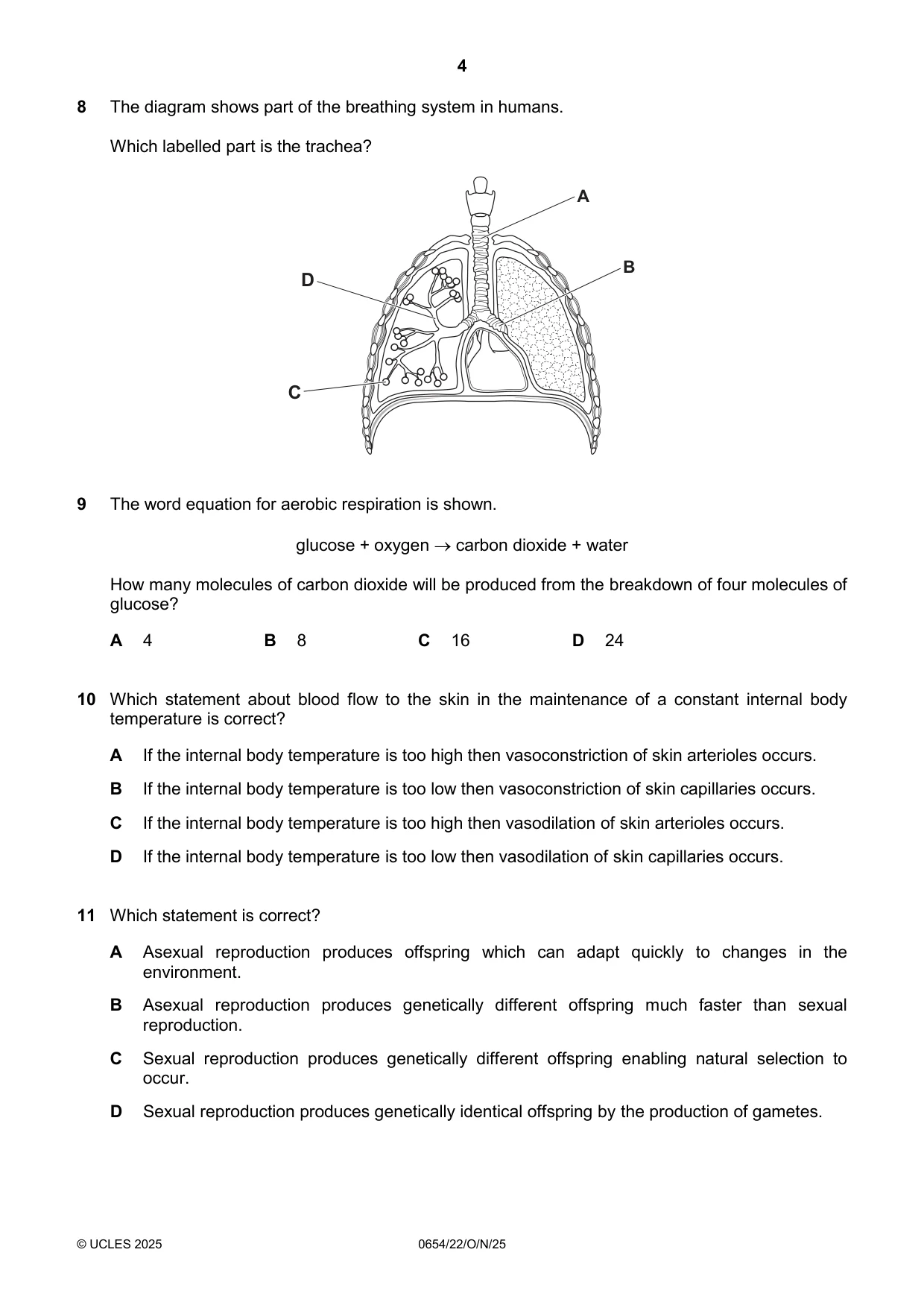
8 The diagram shows part of the breathing system in humans. Which labelled part is the trachea? A B D C
Mark scheme: A
Q9 · The word equation for aerobic respiration is shown
9 The word equation for aerobic respiration is shown. glucose + oxygen carbon dioxide + water How many molecules of carbon dioxide will be produced from the breakdown of four molecules of glucose? A 4 B 8 C 16 D 24
Mark scheme: D
Q10 · Which statement about blood flow to the skin in the maintenance of a constant internal…
10 Which statement about blood flow to the skin in the maintenance of a constant internal body temperature is correct? A If the internal body temperature is too high then vasoconstriction of skin arterioles occurs. B If the internal body temperature is too low then vasoconstriction of skin capillaries occurs. C If the internal body temperature is too high then vasodilation of skin arterioles occurs. D If the internal body temperature is too low then vasodilation of skin capillaries occurs.
Mark scheme: C
Q11 · Which statement is correct?
11 Which statement is correct? A Asexual reproduction produces offspring which can adapt quickly to changes in the environment. B Asexual reproduction produces genetically different offspring much faster than sexual reproduction. C Sexual reproduction produces genetically different offspring enabling natural selection to occur. D Sexual reproduction produces genetically identical offspring by the production of gametes.
Mark scheme: C
Q12 · Which combination of chromosomes produces a male in humans?
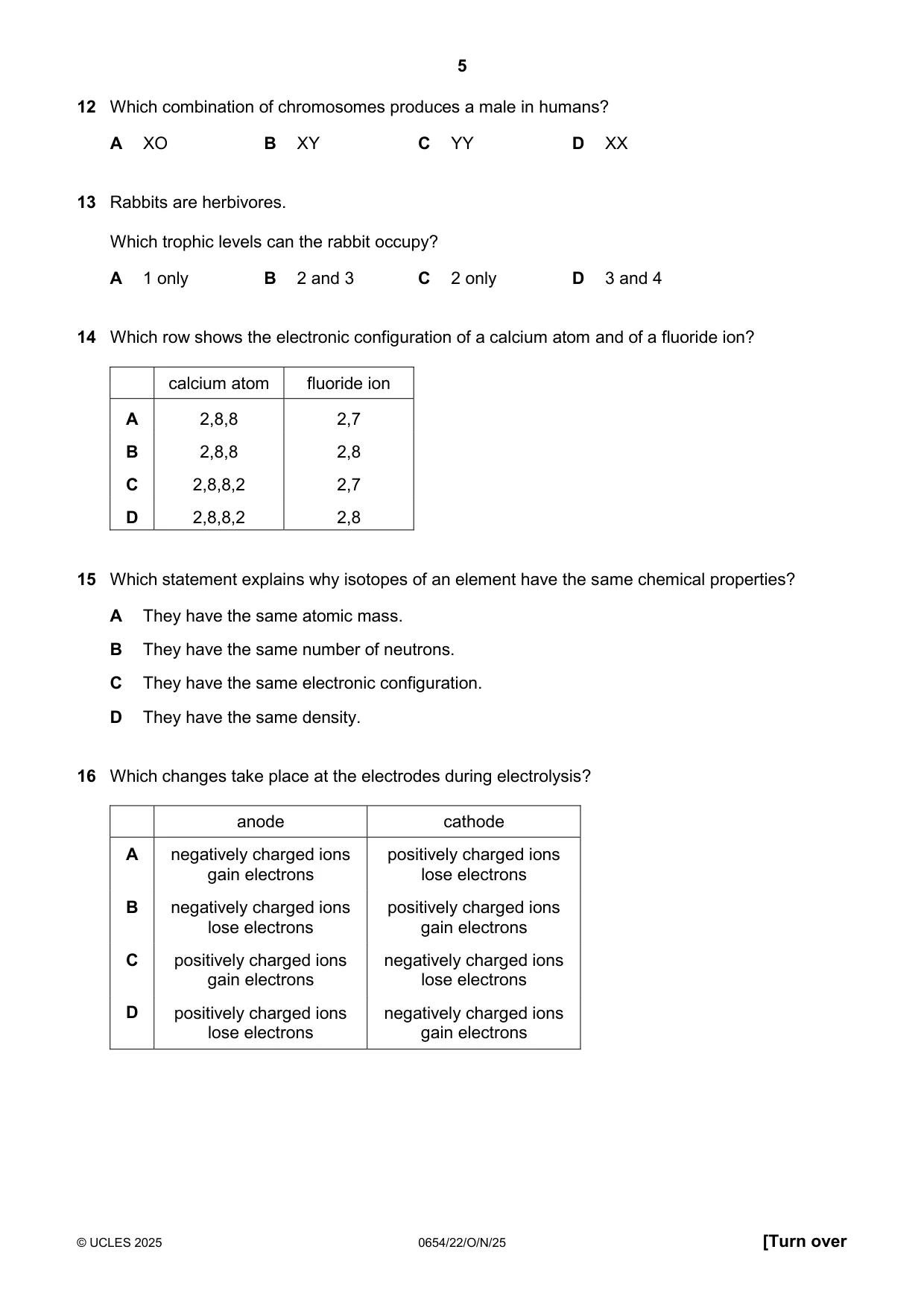
12 Which combination of chromosomes produces a male in humans? A XO B XY C YY D XX
Mark scheme: B
Question 13
13 Rabbits are herbivores. Which trophic levels can the rabbit occupy? A 1 only B 2 and 3 C 2 only D 3 and 4
Mark scheme: C
Q14 · Which row shows the electronic configuration of a calcium atom and of a fluoride ion?
14 Which row shows the electronic configuration of a calcium atom and of a fluoride ion? calcium atom fluoride ion A 2,8,8 2,7 B 2,8,8 2,8 C 2,8,8,2 2,7 D 2,8,8,2 2,8
Mark scheme: D
Q15 · Which statement explains why isotopes of an element have the same chemical properties?
15 Which statement explains why isotopes of an element have the same chemical properties? A They have the same atomic mass. B They have the same number of neutrons. C They have the same electronic configuration. D They have the same density.
Mark scheme: C
Q16 · Which changes take place at the electrodes during electrolysis?
16 Which changes take place at the electrodes during electrolysis? anode cathode A negatively charged ions positively charged ions gain electrons lose electrons B negatively charged ions positively charged ions lose electrons gain electrons C positively charged ions negatively charged ions gain electrons lose electrons D positively charged ions negatively charged ions lose electrons gain electrons
Mark scheme: B
Q17 · Which row shows the dot-and-cross diagrams for nitrogen and ethene?
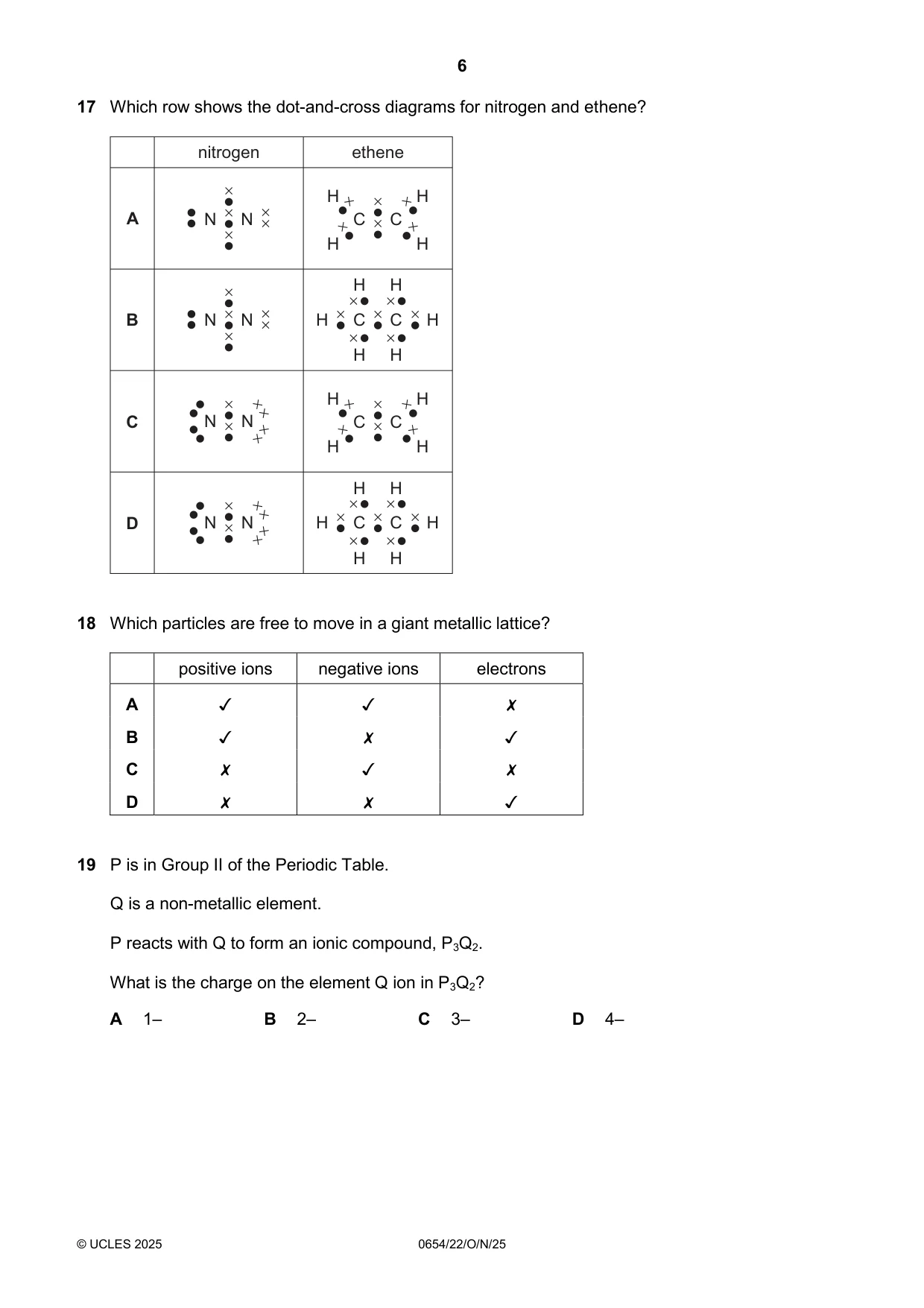
17 Which row shows the dot-and-cross diagrams for nitrogen and ethene? nitrogen ethene H H A N N C C H H H H B N N H C C H H H H H C N N C C H H H H D N N H C C H H H
Mark scheme: A
Q18 · Which particles are free to move in a giant metallic lattice?
18 Which particles are free to move in a giant metallic lattice? positive ions negative ions electrons 0 OUD > «x «KM <x \ x a aN
Mark scheme: D
Q19 · P is in Group II of the Periodic Table
19 P is in Group II of the Periodic Table. Q is a non-metallic element. P reacts with Q to form an ionic compound, P3Q2. What is the charge on the element Q ion in P3Q2? A 1– B 2– C 3– D 4–
Mark scheme: C
Q20 · Which statement about the Avogadro constant is correct?
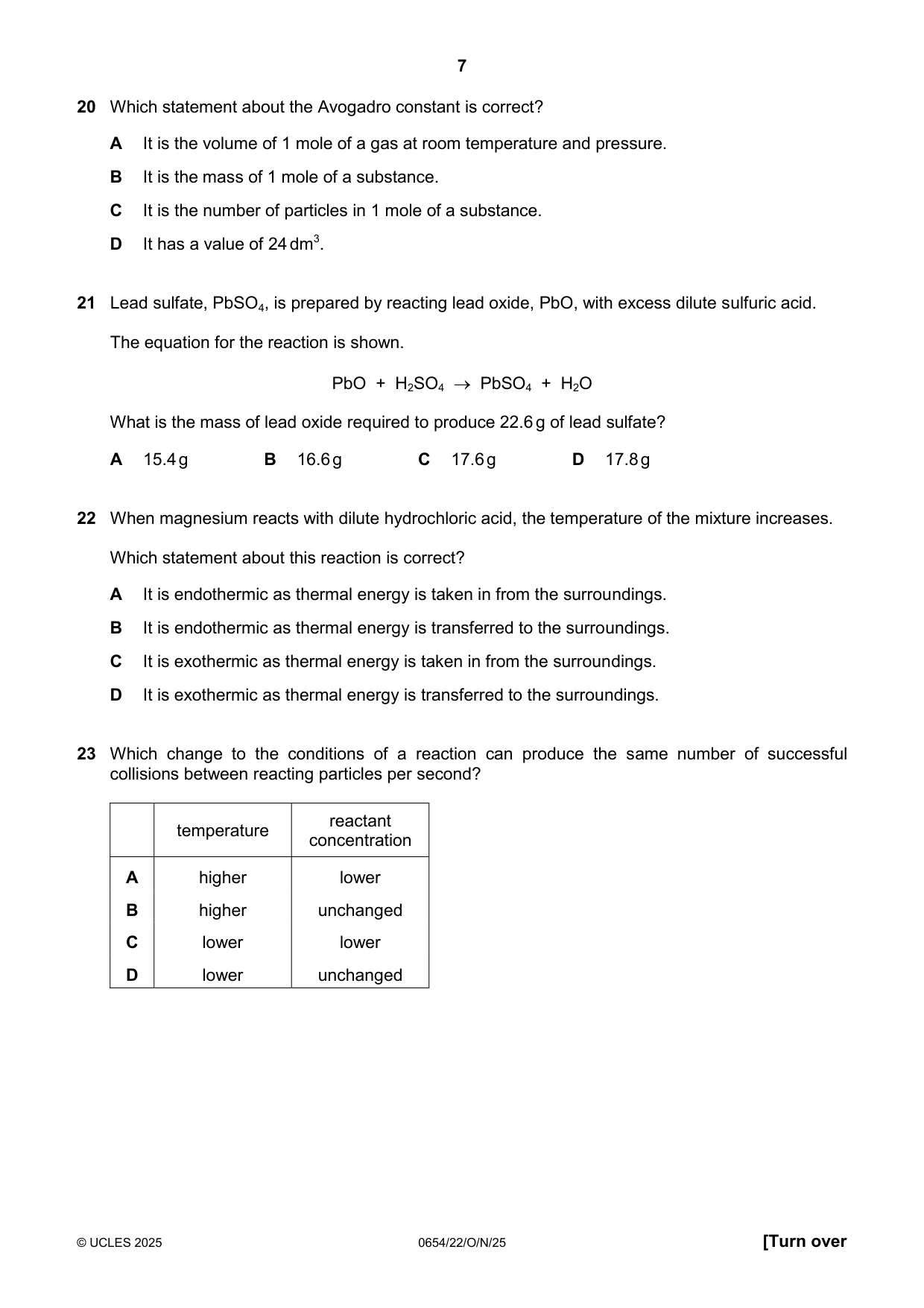
20 Which statement about the Avogadro constant is correct? A It is the volume of 1 mole of a gas at room temperature and pressure. B It is the mass of 1 mole of a substance. C It is the number of particles in 1 mole of a substance. D It has a value of 24 dm3.
Mark scheme: C
Q21 · Lead sulfate, PbSO4, is prepared by reacting lead oxide, PbO, with excess dilute sulfuric…
21 Lead sulfate, PbSO4, is prepared by reacting lead oxide, PbO, with excess dilute sulfuric acid. The equation for the reaction is shown. PbO + H2SO4 PbSO4 + H2O What is the mass of lead oxide required to produce 22.6 g of lead sulfate? A 15.4 g B 16.6 g C 17.6 g D 17.8 g
Mark scheme: B
Q22 · When magnesium reacts with dilute hydrochloric acid, the temperature of the mixture…
22 When magnesium reacts with dilute hydrochloric acid, the temperature of the mixture increases. Which statement about this reaction is correct? A It is endothermic as thermal energy is taken in from the surroundings. B It is endothermic as thermal energy is transferred to the surroundings. C It is exothermic as thermal energy is taken in from the surroundings. D It is exothermic as thermal energy is transferred to the surroundings.
Mark scheme: D
Q23 · Which change to the conditions of a reaction can produce the same number of successful…
23 Which change to the conditions of a reaction can produce the same number of successful collisions between reacting particles per second? reactant temperature concentration A higher lower B higher unchanged C lower lower D lower unchanged
Mark scheme: A
Q24 · Which statements about oxidation and reduction are correct?
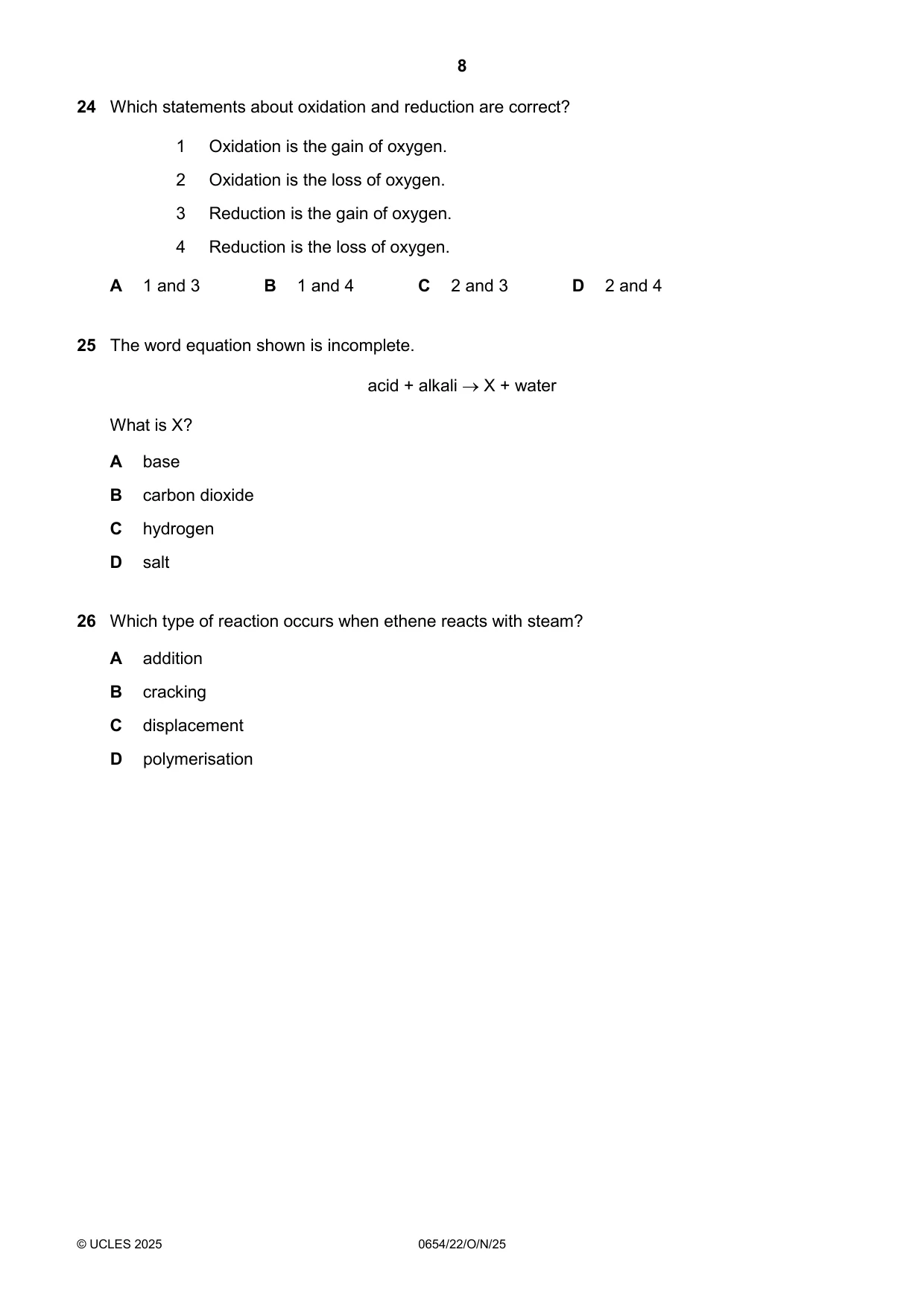
24 Which statements about oxidation and reduction are correct? 1 Oxidation is the gain of oxygen. 2 Oxidation is the loss of oxygen. 3 Reduction is the gain of oxygen. 4 Reduction is the loss of oxygen. A 1 and 3 B 1 and 4 C 2 and 3 D 2 and 4
Mark scheme: B
Q25 · The word equation shown is incomplete
25 The word equation shown is incomplete. acid + alkali X + water What is X? A base B carbon dioxide C hydrogen D salt
Mark scheme: D
More questions on The characteristic properties of acids and bases
Q26 · Which type of reaction occurs when ethene reacts with steam?
26 Which type of reaction occurs when ethene reacts with steam? A addition B cracking C displacement D polymerisation
Mark scheme: A
Q27 · The boiling points of three substances, W, X and Y, are shown
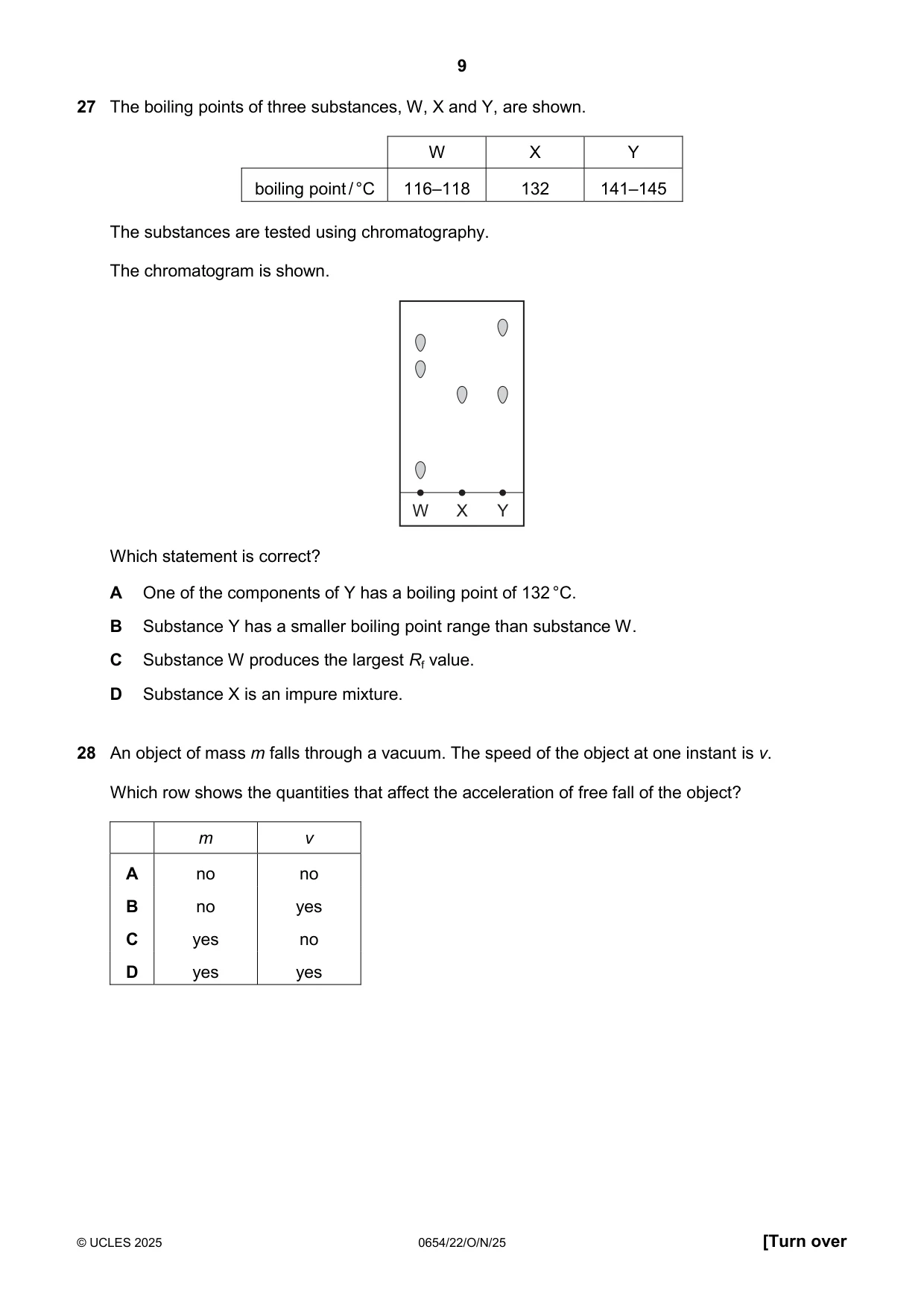
27 The boiling points of three substances, W, X and Y, are shown. W X Y boiling point / °C 116–118 132 141–145 The substances are tested using chromatography. The chromatogram is shown. W X Y Which statement is correct? A One of the components of Y has a boiling point of 132 °C. B Substance Y has a smaller boiling point range than substance W. C Substance W produces the largest Rf value. D Substance X is an impure mixture.
Mark scheme: A
Q28 · An object of mass m falls through a vacuum
28 An object of mass m falls through a vacuum. The speed of the object at one instant is v. Which row shows the quantities that affect the acceleration of free fall of the object? m v A no no B no yes C yes no D yes yes
Mark scheme: A
Q29 · The diagram shows the apparatus that a student uses to determine the centre of gravity of…
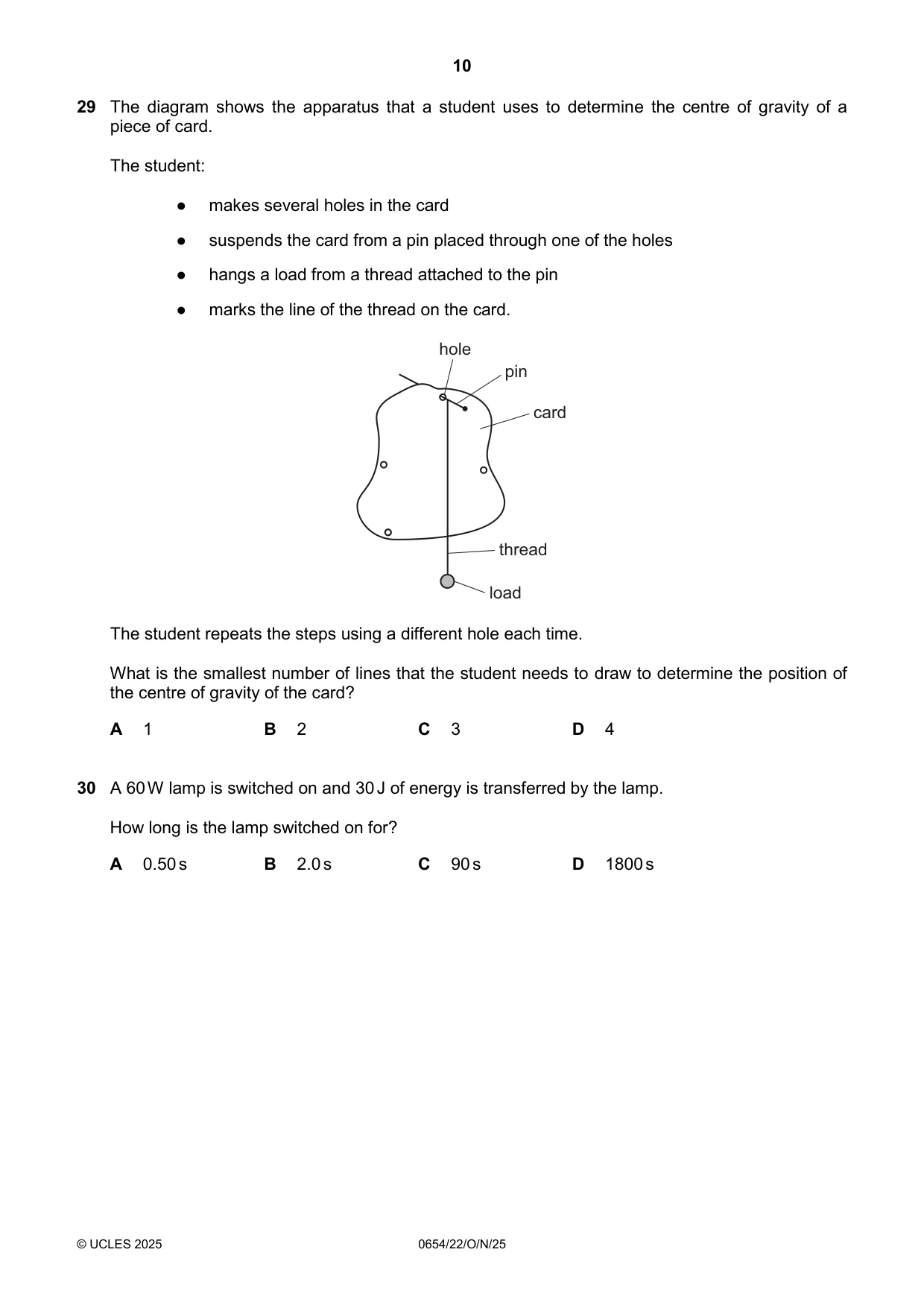
29 The diagram shows the apparatus that a student uses to determine the centre of gravity of a piece of card. The student: ● makes several holes in the card ● suspends the card from a pin placed through one of the holes ● hangs a load from a thread attached to the pin ● marks the line of the thread on the card. hole pin card thread load The student repeats the steps using a different hole each time. What is the smallest number of lines that the student needs to draw to determine the position of the centre of gravity of the card? A 1 B 2 C 3 D 4
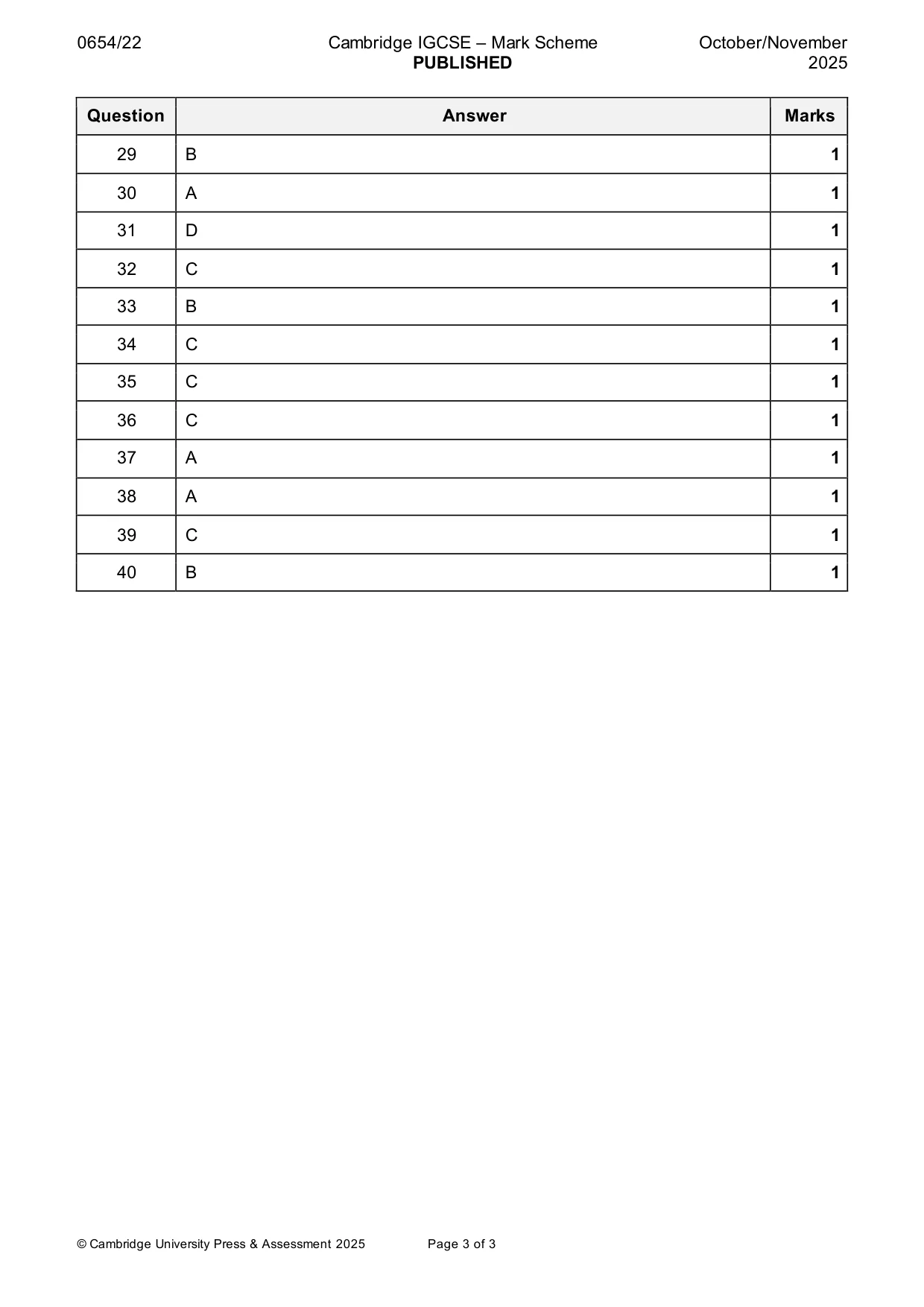
Mark scheme: B
Q30 · A 60 W lamp is switched on and 30 J of energy is transferred by the lamp
30 A 60 W lamp is switched on and 30 J of energy is transferred by the lamp. How long is the lamp switched on for? A 0.50 s B 2.0 s C 90 s D 1800 s
Mark scheme: A
Q31 · The temperature of a liquid in a beaker decreases because particles escape from the…
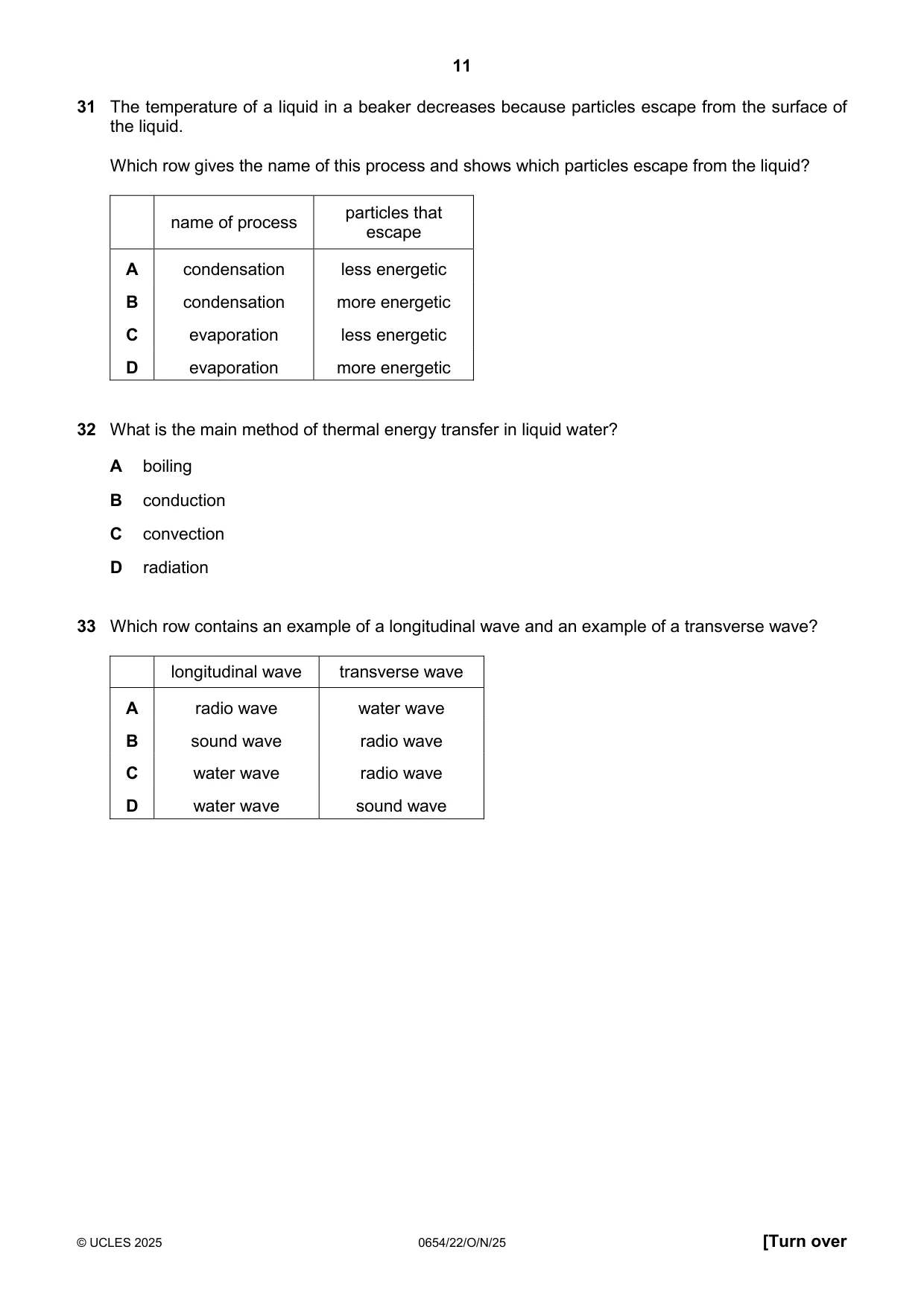
31 The temperature of a liquid in a beaker decreases because particles escape from the surface of the liquid. Which row gives the name of this process and shows which particles escape from the liquid? particles that name of process escape A condensation less energetic B condensation more energetic C evaporation less energetic D evaporation more energetic
Mark scheme: D
Q32 · What is the main method of thermal energy transfer in liquid water?
32 What is the main method of thermal energy transfer in liquid water? A boiling B conduction C convection D radiation
Mark scheme: C
Q33 · Which row contains an example of a longitudinal wave and an example of a transverse wave?
33 Which row contains an example of a longitudinal wave and an example of a transverse wave? longitudinal wave transverse wave A radio wave water wave B sound wave radio wave C water wave radio wave D water wave sound wave
Mark scheme: B
Q34 · The diagram shows a ray of light that passes from a vacuum into plastic
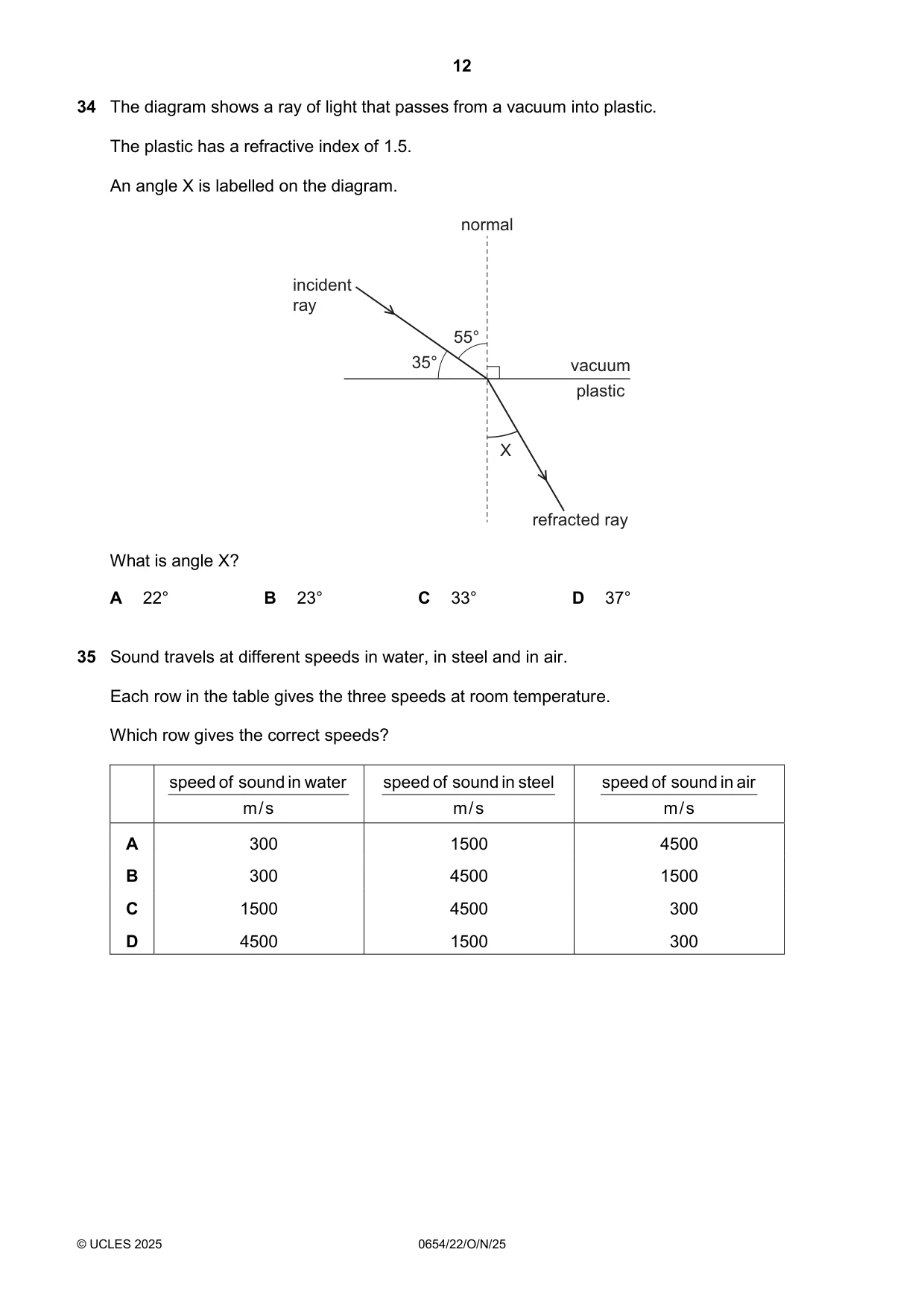
34 The diagram shows a ray of light that passes from a vacuum into plastic. The plastic has a refractive index of 1.5. An angle X is labelled on the diagram. normal incident ray 55° 35° vacuum plastic X refracted ray What is angle X? A 22° B 23° C 33° D 37°
Mark scheme: C
Q35 · Sound travels at different speeds in water, in steel and in air
35 Sound travels at different speeds in water, in steel and in air. Each row in the table gives the three speeds at room temperature. Which row gives the correct speeds? speed of sound in water speed of sound in steel speed of sound in air m / s m / s m / s A 300 1500 4500 B 300 4500 1500 C 1500 4500 300 D 4500 1500 300
Mark scheme: C
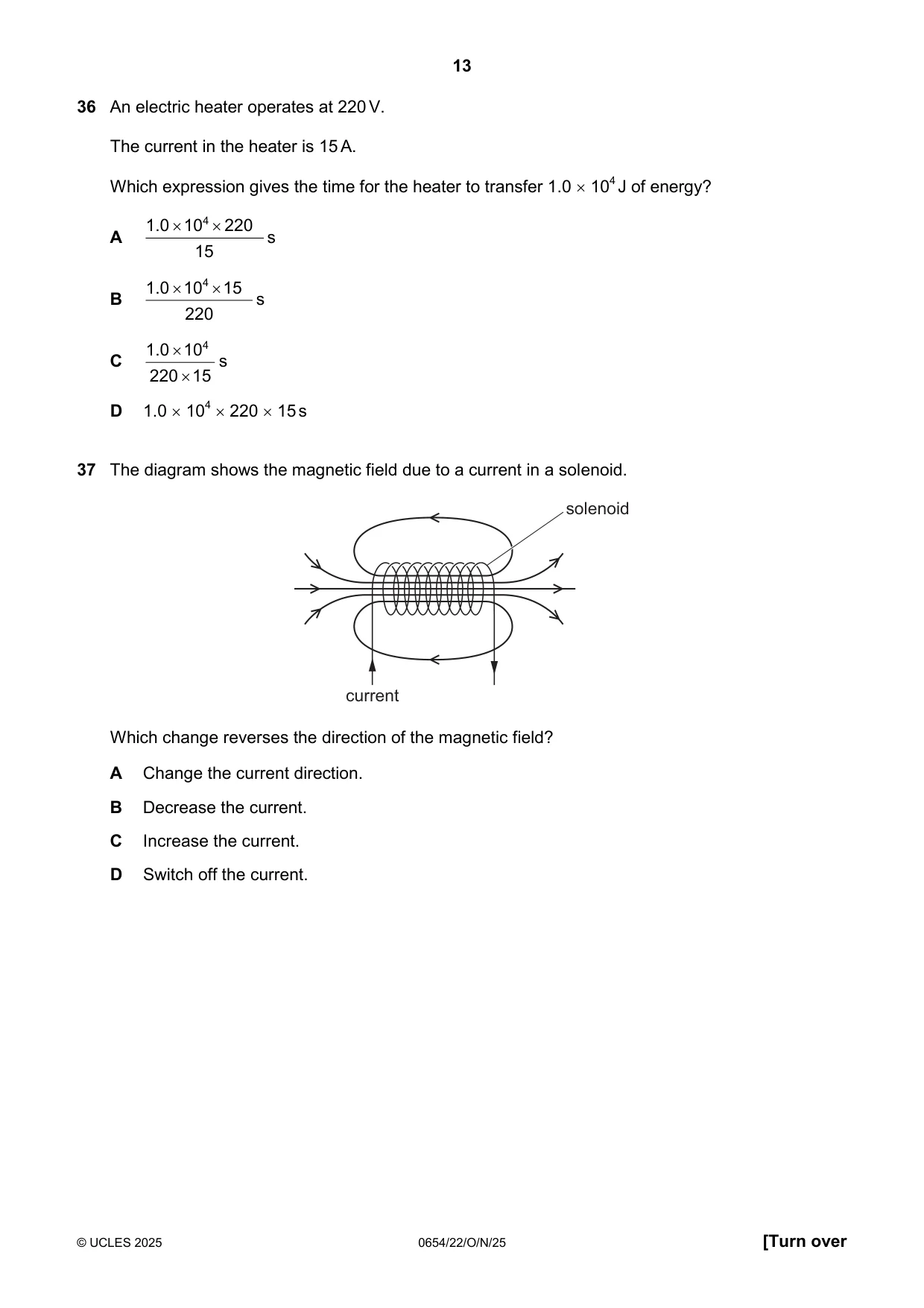
Q36 · An electric heater operates at 220 V
36 An electric heater operates at 220 V. The current in the heater is 15 A. Which expression gives the time for the heater to transfer 1.0 104 J of energy? 4 1.0 10 220 A s 15 4 1.0 10 15 B s 220 1.0 10 4 C s 220 15 D 1.0 104 220 15 s
Mark scheme: C
Q37 · The diagram shows the magnetic field due to a current in a solenoid
37 The diagram shows the magnetic field due to a current in a solenoid. solenoid current Which change reverses the direction of the magnetic field? A Change the current direction. B Decrease the current. C Increase the current. D Switch off the current.
Mark scheme: A
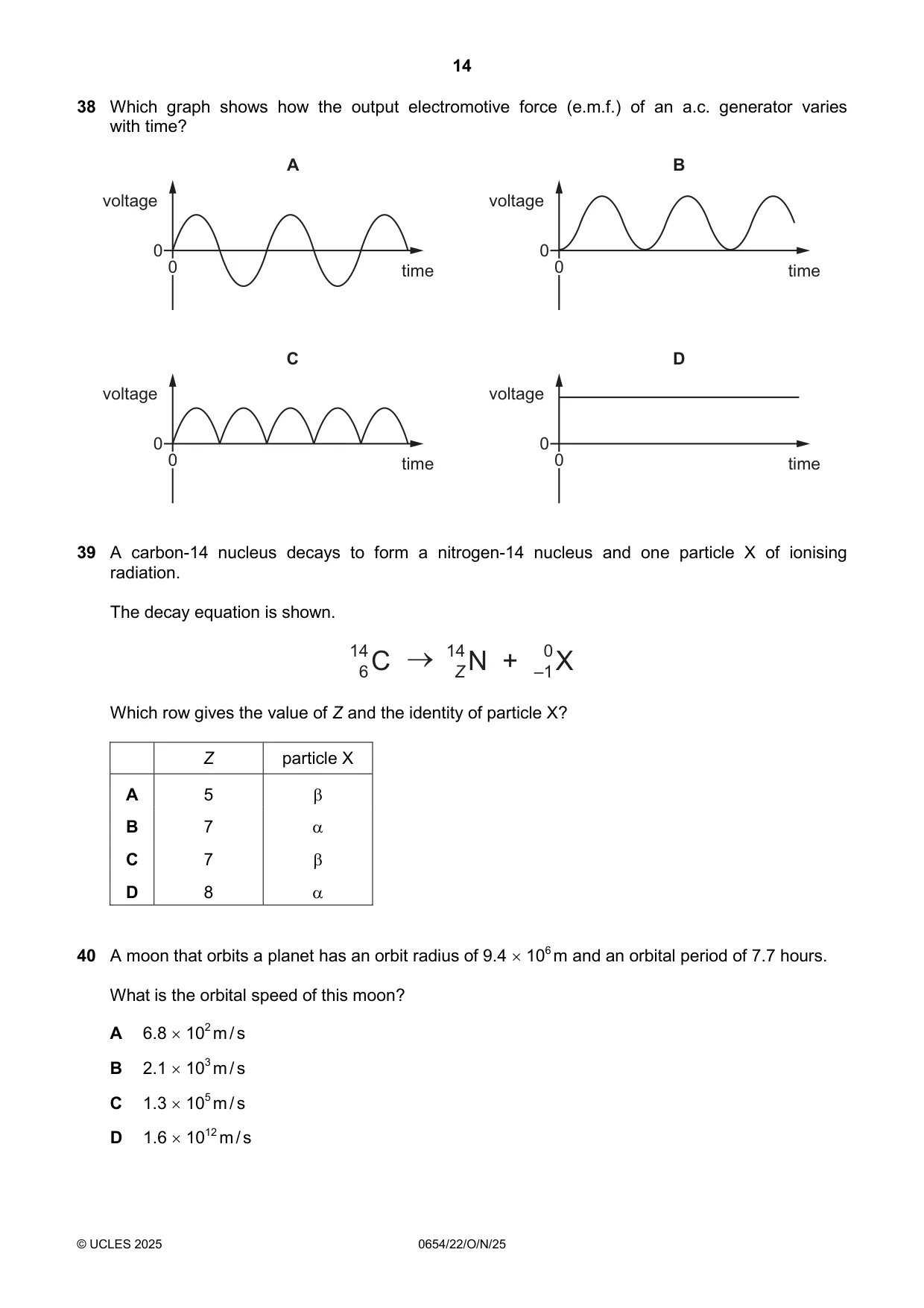
Q38 · Which graph shows how the output electromotive force (e.m.f.) of an a.c
38 Which graph shows how the output electromotive force (e.m.f.) of an a.c. generator varies with time? A B voltage voltage 0 0 0 time 0 time C D voltage voltage 0 0 0 time 0 time
Mark scheme: A
Q39 · A carbon-14 nucleus decays to form a nitrogen-14 nucleus and one particle X of ionising…
39 A carbon-14 nucleus decays to form a nitrogen-14 nucleus and one particle X of ionising radiation. The decay equation is shown. 14 6C 14 ZN + –1X 0 Which row gives the value of Z and the identity of particle X? Z particle X A 5 B 7 C 7 D 8
Mark scheme: C
Q40 · A moon that orbits a planet has an orbit radius of 9.4 106 m and an orbital period of…
40 A moon that orbits a planet has an orbit radius of 9.4 106 m and an orbital period of 7.7 hours. What is the orbital speed of this moon? A 6.8 102 m / s B 2.1 103 m / s C 1.3 105 m / s D 1.6 1012 m / s
Mark scheme: B
What was in this paper
The subtopics covered by these 40 questions, and how many questions each got. Open one in a new tab to see every Cambridge question on it.
2Alkenes1Asexual reproduction1Atomic structure and the Periodic Table1Biological molecules1Chromatography1Chromosomes and genes1Circulatory systems1Diet1Digestive system1Electrical quantities1Electrolysis1Electromagnetic effects1Energy, work and power1Enzymes1Exothermic and endothermic reactions1Food chains and food webs1Forces1Gas exchange in humans1General properties of waves1Homeostasis1Ions and ionic bonds1Isotopes1Kinetic particle model of matter1Light1Mass and weight1Metallic bonding1Osmosis1Radioactivity1Rate of reaction1Redox1Respiration1Simple molecules and covalent bonds1Simple phenomena of magnetism1Size of specimens1Sound1The characteristic properties of acids and bases1The Solar System1Transfer of thermal energy1What you needed in this session
Cambridge’s own grade thresholds for 2025 Oct/Nov, Paper 2 · Variant 2. A higher threshold means an easier paper — the bar moves with how the cohort did.