Cambridge IGCSE Sciences - Co-ordinated (Double) 0654 — 2023 May/June Paper 2 · Variant 3
0654/23/M/J/23 · 40 questions · 40 marks · ≈45 min
The question paper and its mark scheme, free to read here and free to download. This is Cambridge’s own paper, exactly as it was sat.
Question paper20 pages


Mark scheme3 pages
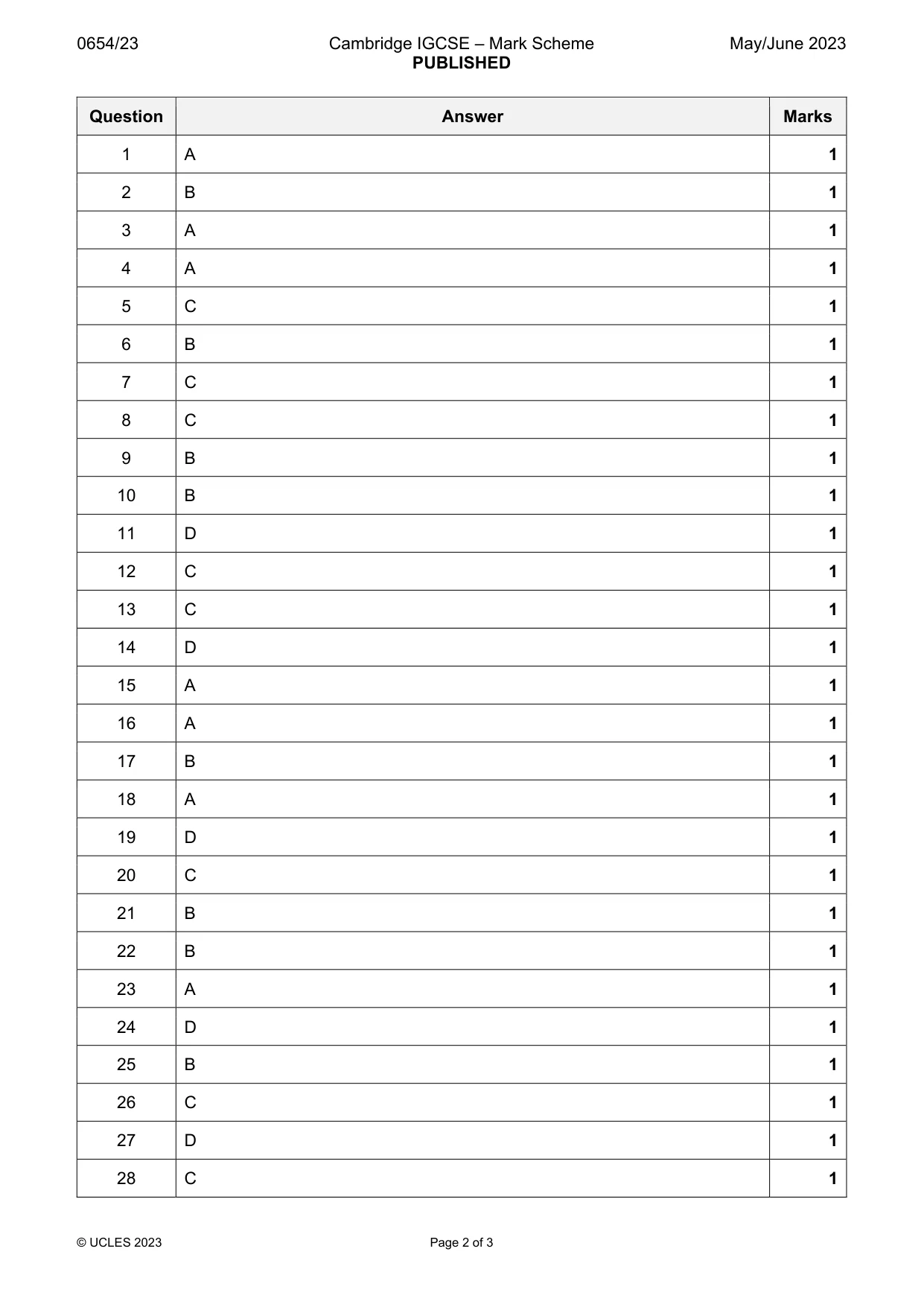
Answers below. Sit the paper first if you are practising.
Questions as text
Q1 · Which term is used to describe the removal of toxic materials from living organisms?
1 Which term is used to describe the removal of toxic materials from living organisms? A excretion B nutrition C respiration D secretion
Mark scheme: A
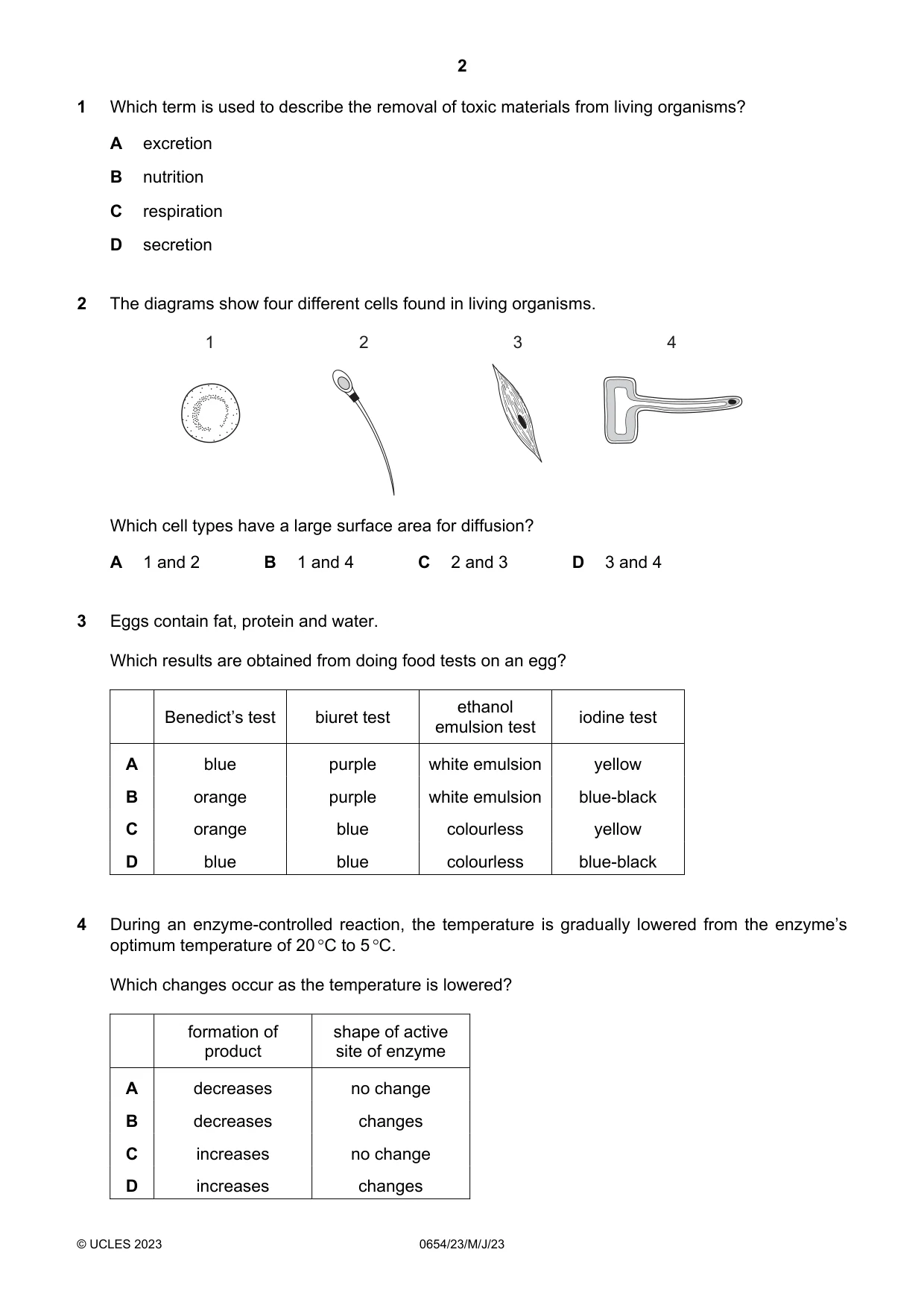
Q2 · The diagrams show four different cells found in living organisms
2 The diagrams show four different cells found in living organisms. 1 2 3 4 Which cell types have a large surface area for diffusion? A 1 and 2 B 1 and 4 C 2 and 3 D 3 and 4
Mark scheme: B
Q3 · Eggs contain fat, protein and water
3 Eggs contain fat, protein and water. Which results are obtained from doing food tests on an egg? ethanol Benedict’s test biuret test iodine test emulsion test A blue purple white emulsion yellow B orange purple white emulsion blue-black C orange blue colourless yellow D blue blue colourless blue-black
Mark scheme: A
Q4 · During an enzyme-controlled reaction, the temperature is gradually lowered from the…
4 During an enzyme-controlled reaction, the temperature is gradually lowered from the enzyme’s optimum temperature of 20 C to 5 C. Which changes occur as the temperature is lowered? formation of shape of active product site of enzyme A decreases no change B decreases changes C increases no change D increases changes
Mark scheme: A
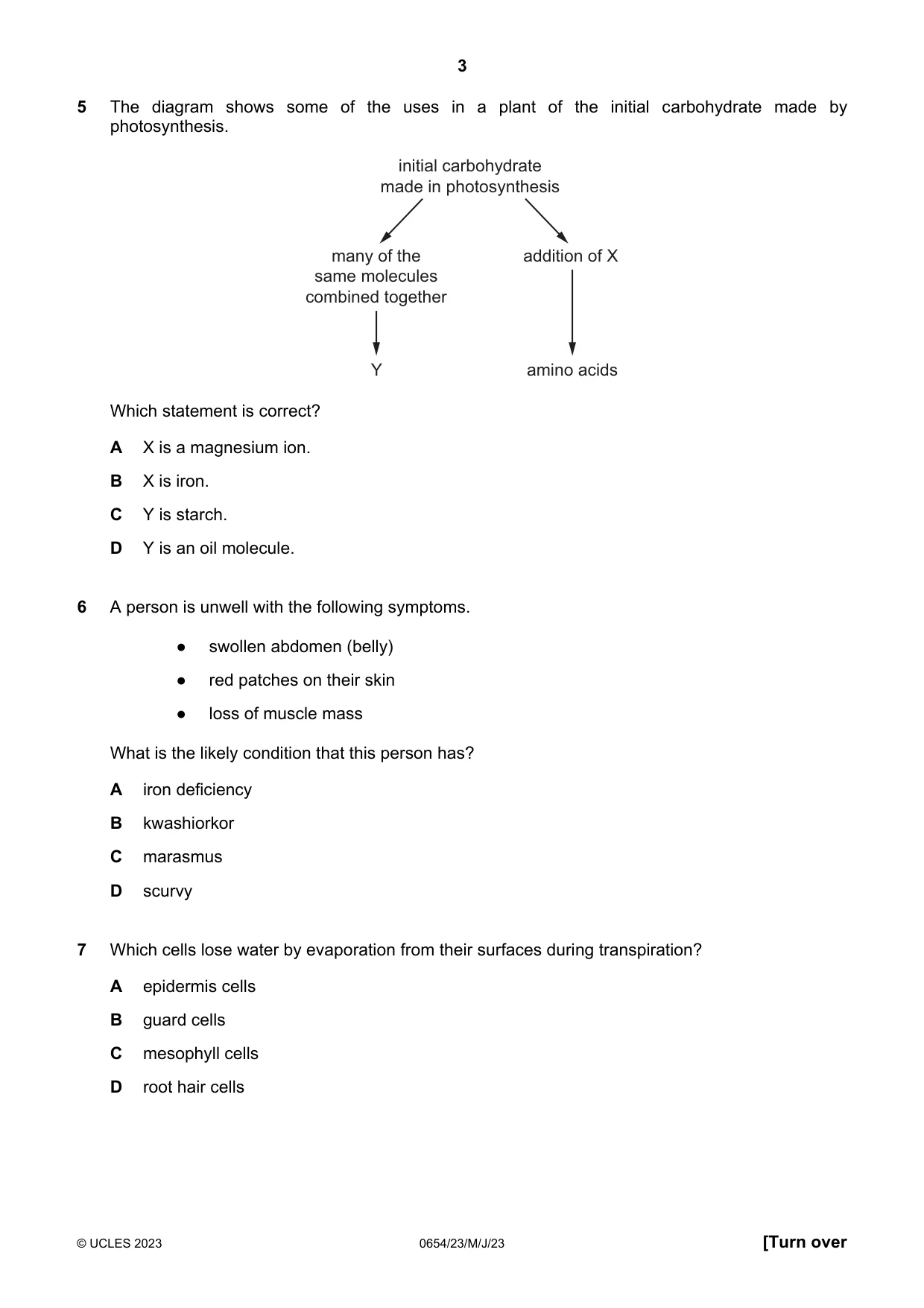
Q5 · The diagram shows some of the uses in a plant of the initial carbohydrate made by…
5 The diagram shows some of the uses in a plant of the initial carbohydrate made by photosynthesis. initial carbohydrate made in photosynthesis many of the addition of X same molecules combined together Y amino acids Which statement is correct? A X is a magnesium ion. B X is iron. C Y is starch. D Y is an oil molecule.
Mark scheme: C
Q6 · A person is unwell with the following symptoms
6 A person is unwell with the following symptoms. ● swollen abdomen (belly) ● red patches on their skin ● loss of muscle mass What is the likely condition that this person has? A iron deficiency B kwashiorkor C marasmus D scurvy
Mark scheme: B
Q7 · Which cells lose water by evaporation from their surfaces during transpiration?
7 Which cells lose water by evaporation from their surfaces during transpiration? A epidermis cells B guard cells C mesophyll cells D root hair cells
Mark scheme: C
Q8 · Endothermic reactions use up more energy than they release while exothermic reactions…
8 Endothermic reactions use up more energy than they release while exothermic reactions release energy overall. Which row describes the type of reaction that occurs in the process of photosynthesis and in the process of respiration? respiration photosynthesis A endothermic endothermic B endothermic exothermic C exothermic endothermic D exothermic exothermic
Mark scheme: C
Q9 · Which type of chemical is adrenaline?
9 Which type of chemical is adrenaline? A enzyme B hormone C mineral salt D vitamin
Mark scheme: B
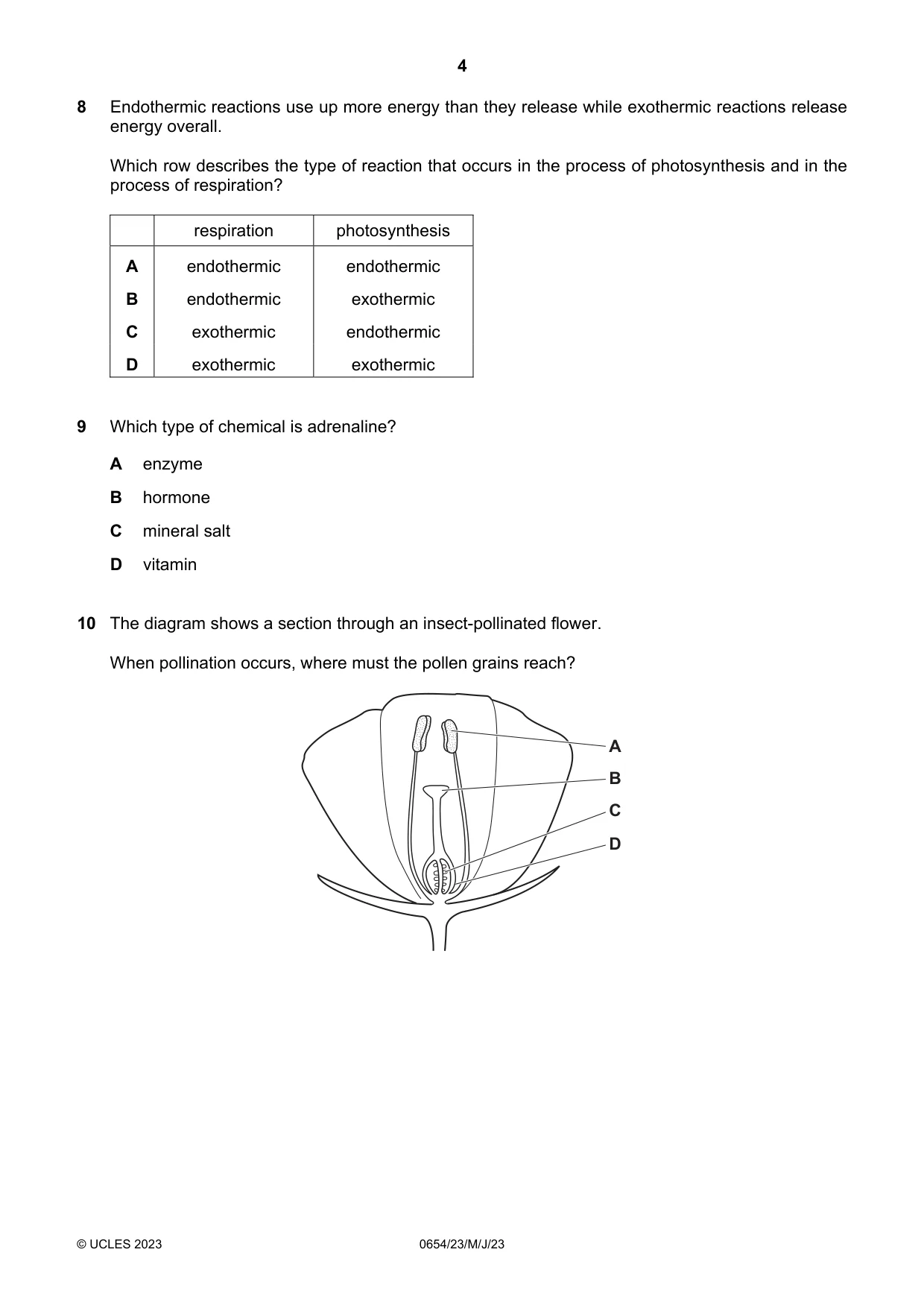
Q10 · The diagram shows a section through an insect-pollinated flower
10 The diagram shows a section through an insect-pollinated flower. When pollination occurs, where must the pollen grains reach? A B C D
Mark scheme: B
Q11 · A student writes down the statement shown
11 A student writes down the statement shown. ‘Selective breeding by natural selection is carried out over many generations to improve crop plants and domesticated animals.’ The statement is not correct. Which change makes the statement correct? A Change crop plants to flowering plants. B Change domesticated to wild. C Change generations to offspring. D Change natural to artificial.
Mark scheme: D
Q12 · The diagram shows a marine food web around a kelp (seaweed) forest
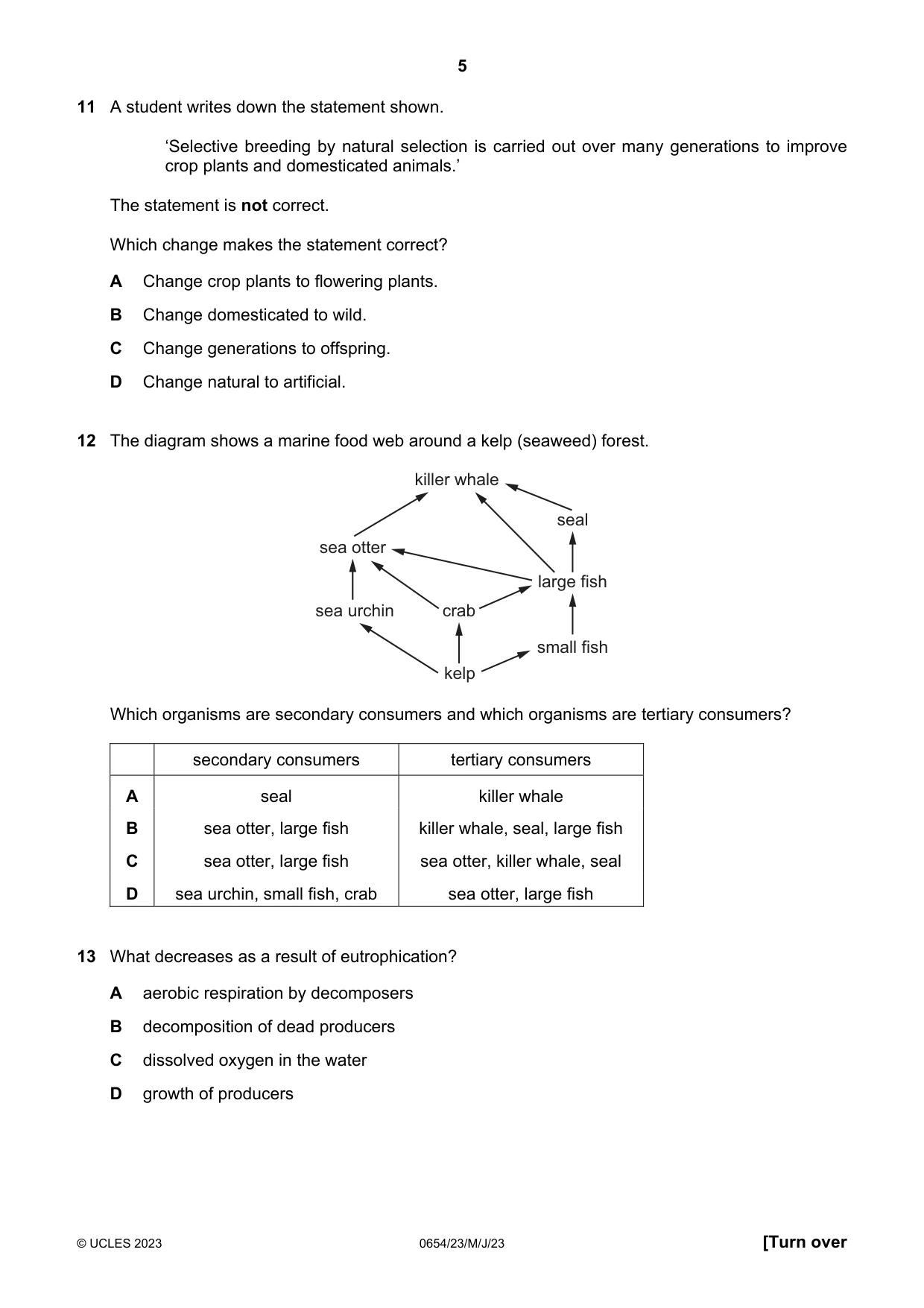
12 The diagram shows a marine food web around a kelp (seaweed) forest. killer whale seal sea otter large fish sea urchin crab small fish kelp Which organisms are secondary consumers and which organisms are tertiary consumers? secondary consumers tertiary consumers A seal killer whale B sea otter, large fish killer whale, seal, large fish C sea otter, large fish sea otter, killer whale, seal D sea urchin, small fish, crab sea otter, large fish
Mark scheme: C
Q13 · What decreases as a result of eutrophication?
13 What decreases as a result of eutrophication? A aerobic respiration by decomposers B decomposition of dead producers C dissolved oxygen in the water D growth of producers
Mark scheme: C
Q14 · A mixture of solid sulfur and solid sodium chloride is added to water and stirred
14 A mixture of solid sulfur and solid sodium chloride is added to water and stirred. Sulfur is insoluble in water. Sodium chloride is soluble in water. Which processes are used to obtain pure sodium chloride from the mixture? A distillation then chromatography B distillation then crystallisation C filtration then chromatography D filtration then crystallisation
Mark scheme: D
Q15 · An atom of indium has the atomic number 49 and the nucleon number 115
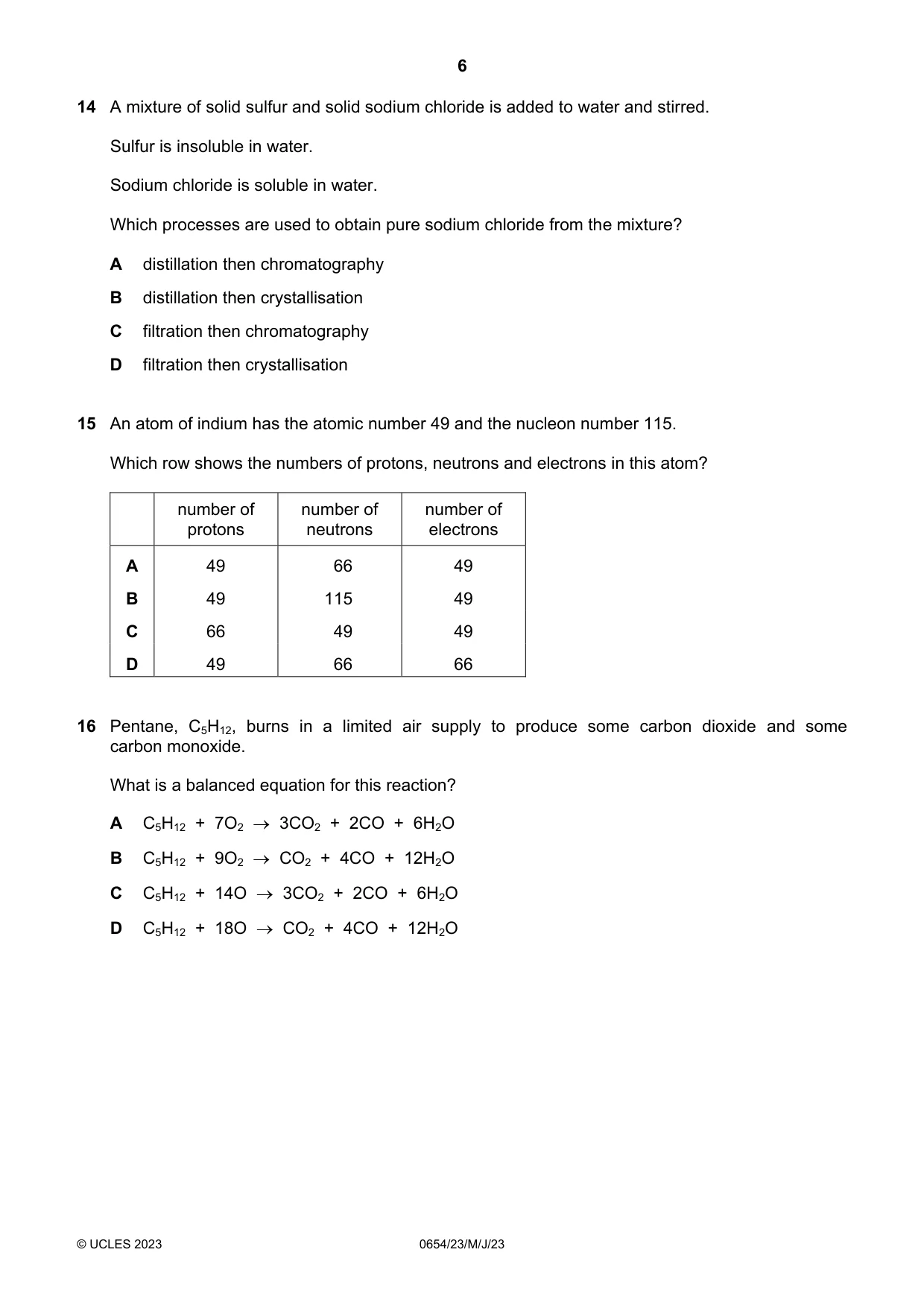
15 An atom of indium has the atomic number 49 and the nucleon number 115. Which row shows the numbers of protons, neutrons and electrons in this atom? number of number of number of protons neutrons electrons A 49 66 49 B 49 115 49 C 66 49 49 D 49 66 66
Mark scheme: A
Q16 · Pentane, C5H12, burns in a limited air supply to produce some carbon dioxide and some…
16 Pentane, C5H12, burns in a limited air supply to produce some carbon dioxide and some carbon monoxide. What is a balanced equation for this reaction? A C5H12 + 7O2 3CO2 + 2CO + 6H2O B C5H12 + 9O2 CO2 + 4CO + 12H2O C C5H12 + 14O 3CO2 + 2CO + 6H2O D C5H12 + 18O CO2 + 4CO + 12H2O
Mark scheme: A
Q17 · Copper is refined by electrolysis
17 Copper is refined by electrolysis. Which statements about this process are correct? 1 Aqueous copper(II) sulfate is the electrolyte. 2 Inert anodes are used. 3 Cu2+ ions are reduced at the cathode. 4 Pure copper is deposited at the anode. A 1 and 2 B 1 and 3 C 2 and 4 D 3 and 4
Mark scheme: B
Q18 · Which statement about chemical reactions is correct?
18 Which statement about chemical reactions is correct? A Endothermic reactions result in a temperature decrease. B Endothermic reactions result in a temperature increase. C Exothermic reactions always produce a large temperature rise. D Exothermic reactions always produce a small temperature rise.
Mark scheme: A
Q19 · Which row describes the effect of increasing temperature on the collisions between…
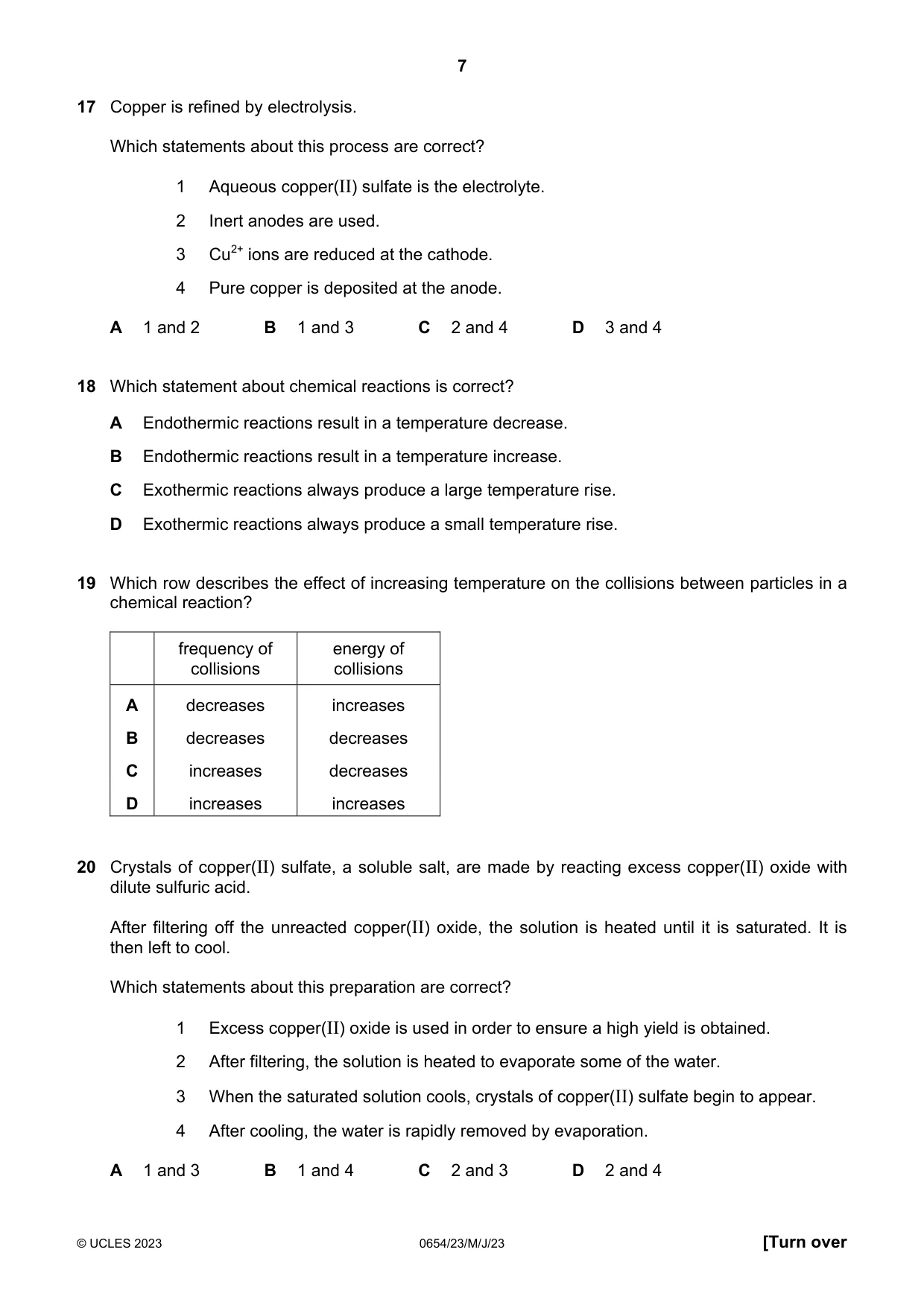
19 Which row describes the effect of increasing temperature on the collisions between particles in a chemical reaction? frequency of energy of collisions collisions A decreases increases B decreases decreases C increases decreases D increases increases
Mark scheme: D
Q20 · Crystals of copper(II) sulfate, a soluble salt, are made by reacting excess copper(II)…
20 Crystals of copper(II) sulfate, a soluble salt, are made by reacting excess copper(II) oxide with dilute sulfuric acid. After filtering off the unreacted copper(II) oxide, the solution is heated until it is saturated. It is then left to cool. Which statements about this preparation are correct? 1 Excess copper(II) oxide is used in order to ensure a high yield is obtained. 2 After filtering, the solution is heated to evaporate some of the water. 3 When the saturated solution cools, crystals of copper(II) sulfate begin to appear. 4 After cooling, the water is rapidly removed by evaporation. A 1 and 3 B 1 and 4 C 2 and 3 D 2 and 4
Mark scheme: C
Q21 · The first row of the transition elements is shown
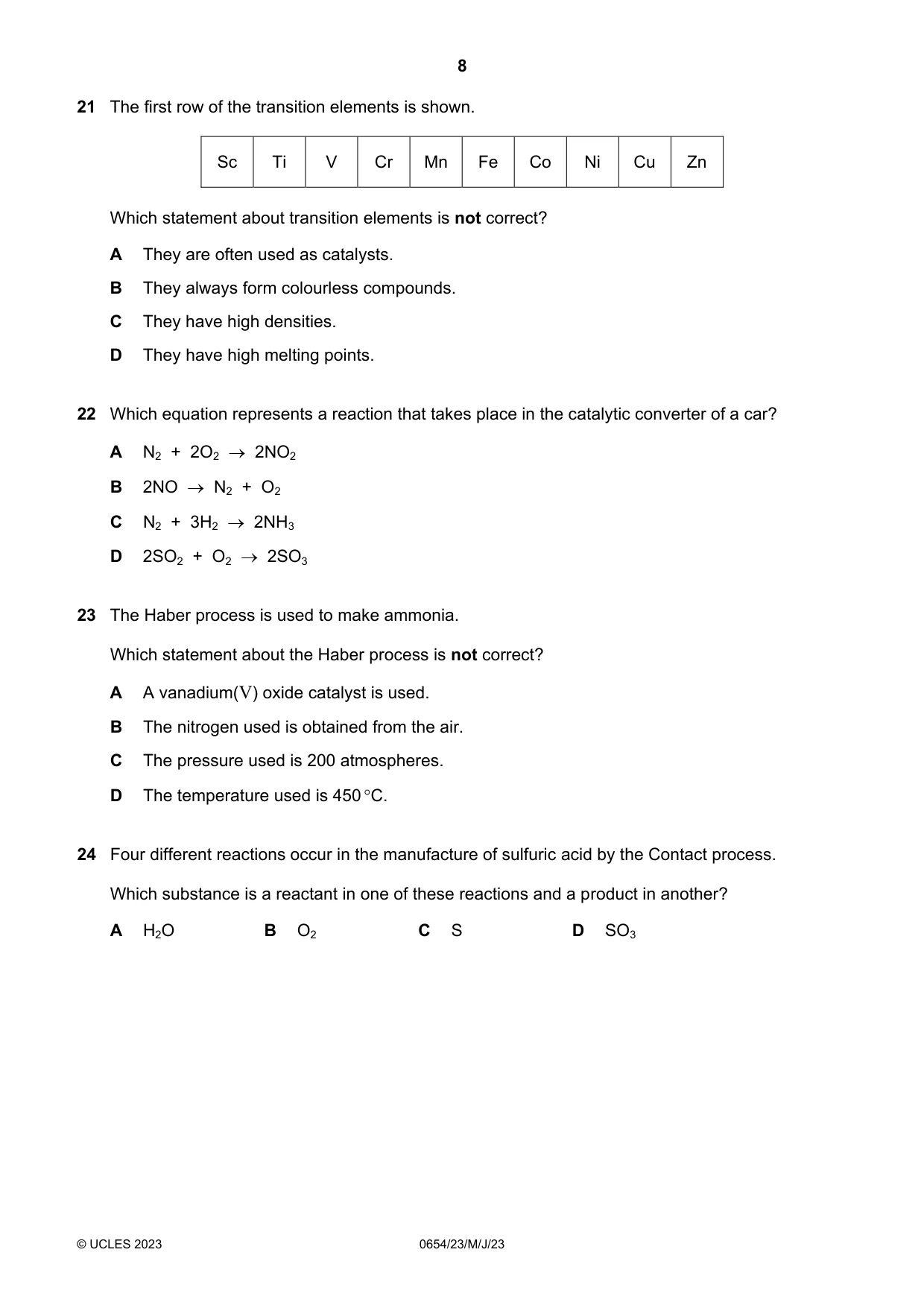
21 The first row of the transition elements is shown. Sc Ti V Cr Mn Fe Co Ni Cu Zn Which statement about transition elements is not correct? A They are often used as catalysts. B They always form colourless compounds. C They have high densities. D They have high melting points.
Mark scheme: B
Q22 · Which equation represents a reaction that takes place in the catalytic converter of a car?
22 Which equation represents a reaction that takes place in the catalytic converter of a car? A N2 + 2O2 2NO2 B 2NO N2 + O2 C N2 + 3H2 2NH3 D 2SO2 + O2 2SO3
Mark scheme: B
Q23 · The Haber process is used to make ammonia
23 The Haber process is used to make ammonia. Which statement about the Haber process is not correct? A A vanadium(V) oxide catalyst is used. B The nitrogen used is obtained from the air. C The pressure used is 200 atmospheres. D The temperature used is 450 C.
Mark scheme: A
Q24 · Four different reactions occur in the manufacture of sulfuric acid by the Contact process
24 Four different reactions occur in the manufacture of sulfuric acid by the Contact process. Which substance is a reactant in one of these reactions and a product in another? A H2O B O2 C S D SO3
Mark scheme: D
Q25 · When limestone is heated, it decomposes
25 When limestone is heated, it decomposes. Which row about limestone and the decomposition is correct? chemical name for limestone decomposition products A calcium carbonate calcium oxide only B calcium carbonate calcium oxide and carbon dioxide C calcium oxide calcium carbonate only D calcium oxide calcium carbonate and carbon dioxide
Mark scheme: B
Q26 · Which fraction obtained from petroleum is used as a feedstock for making chemicals?
26 Which fraction obtained from petroleum is used as a feedstock for making chemicals? A bitumen B gasoline C naphtha D refinery gas
Mark scheme: C
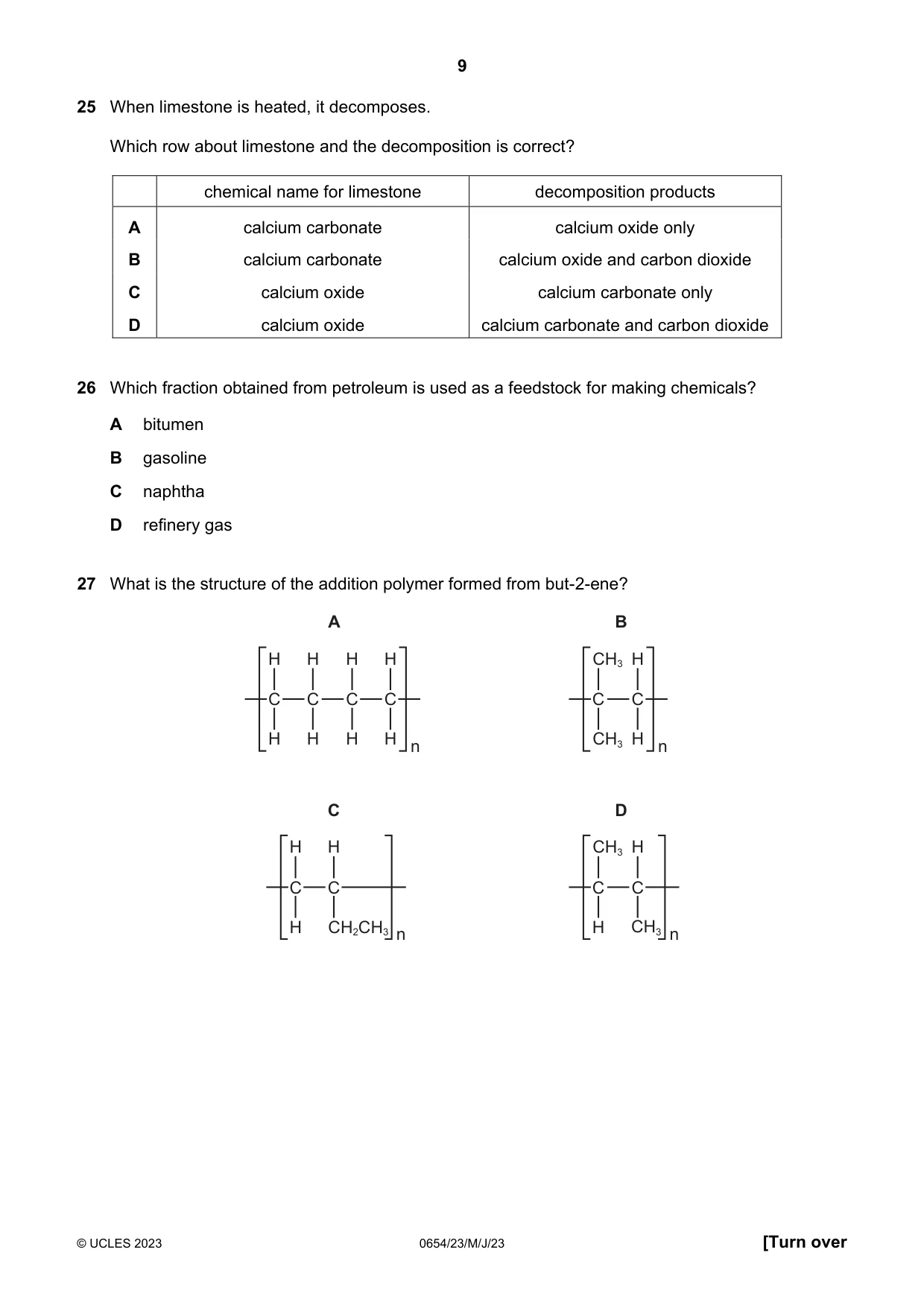
Q27 · What is the structure of the addition polymer formed from but-2-ene?
27 What is the structure of the addition polymer formed from but-2-ene? A B H H H H CH3 H C C C C C C H H H H n CH3 H n C D H H CH3 H C C C C H CH2CH3 n H CH3 n
Mark scheme: D
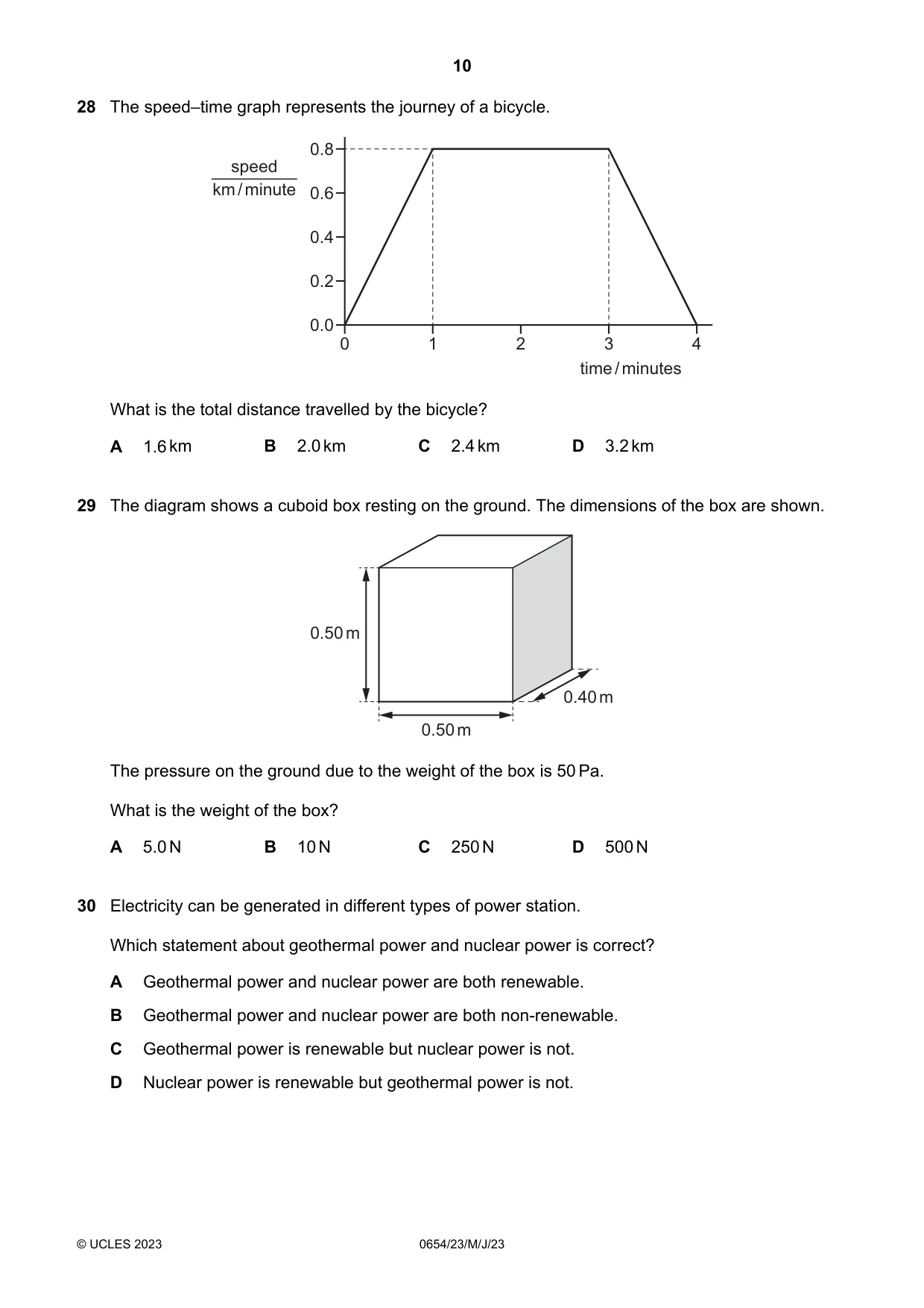
Q28 · The speed–time graph represents the journey of a bicycle
28 The speed–time graph represents the journey of a bicycle. 0.8 speed km / minute 0.6 0.4 0.2 0.0 0 1 2 3 4 time / minutes What is the total distance travelled by the bicycle? A 1.6 km B 2.0 km C 2.4 km D 3.2 km
Mark scheme: C
Q29 · The diagram shows a cuboid box resting on the ground
29 The diagram shows a cuboid box resting on the ground. The dimensions of the box are shown. 0.50 m 0.40 m 0.50 m The pressure on the ground due to the weight of the box is 50 Pa. What is the weight of the box? A 5.0 N B 10 N C 250 N D 500 N
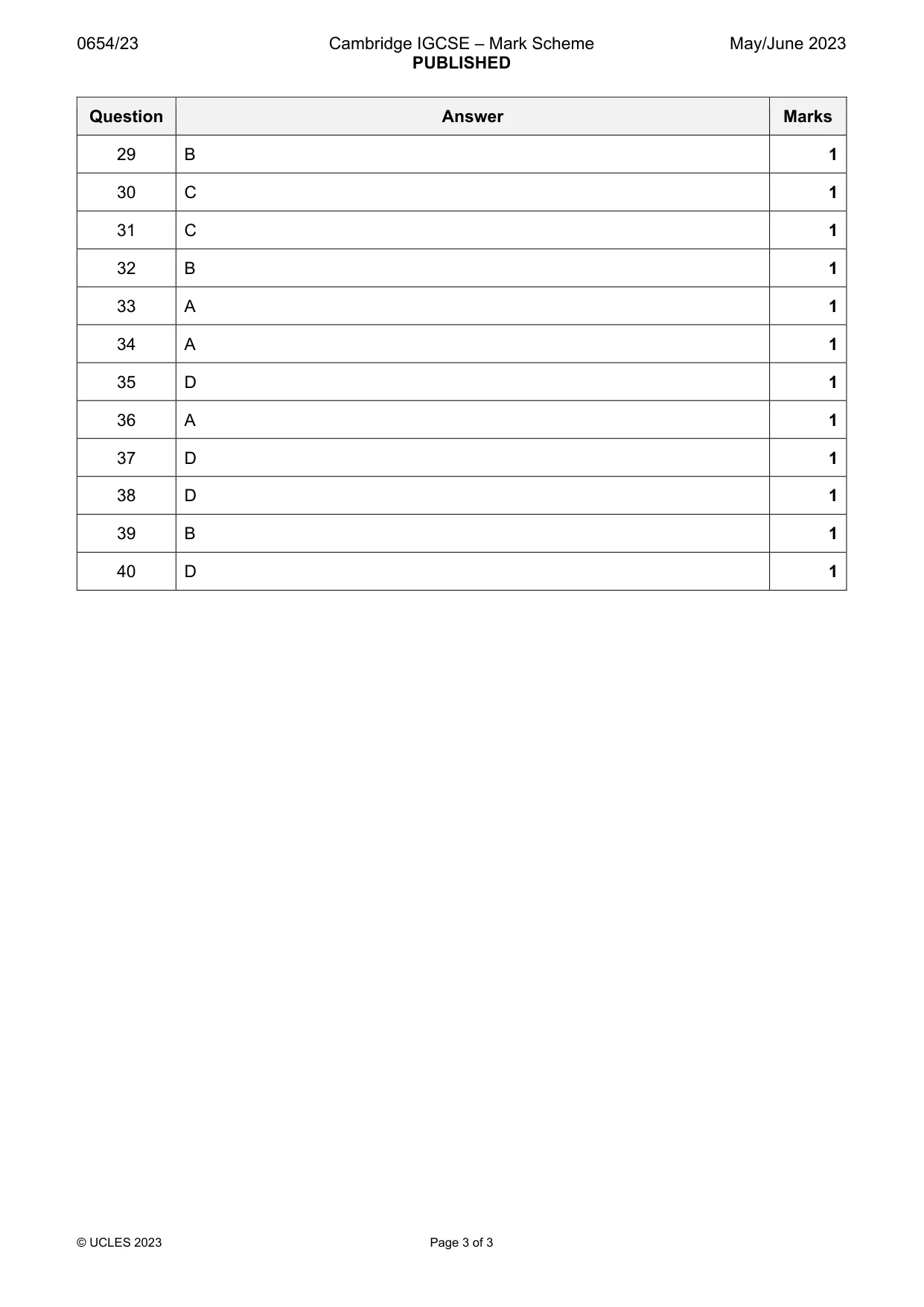
Mark scheme: B
Q30 · Electricity can be generated in different types of power station
30 Electricity can be generated in different types of power station. Which statement about geothermal power and nuclear power is correct? A Geothermal power and nuclear power are both renewable. B Geothermal power and nuclear power are both non-renewable. C Geothermal power is renewable but nuclear power is not. D Nuclear power is renewable but geothermal power is not.
Mark scheme: C
Q31 · What is the definition of efficiency?
31 What is the definition of efficiency? energy input A 100% useful energy output energy input B 100% wasted energy useful energy output C 100% energy input wasted energy D 100% energy input
Mark scheme: C
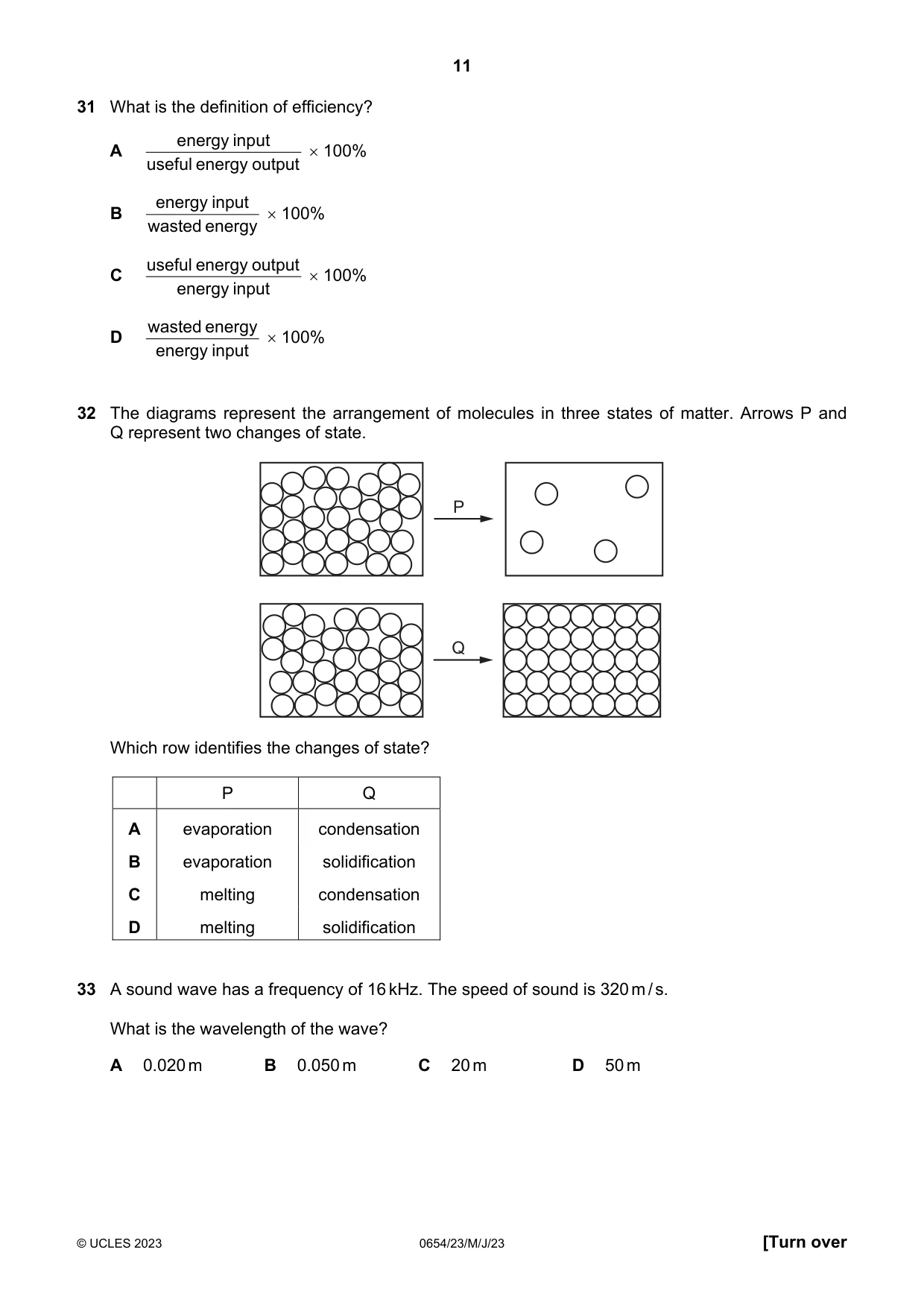
Q32 · The diagrams represent the arrangement of molecules in three states of matter
32 The diagrams represent the arrangement of molecules in three states of matter. Arrows P and Q represent two changes of state. P Q Which row identifies the changes of state? P Q A evaporation condensation B evaporation solidification C melting condensation D melting solidification
Mark scheme: B
Q33 · A sound wave has a frequency of 16 kHz
33 A sound wave has a frequency of 16 kHz. The speed of sound is 320 m / s. What is the wavelength of the wave? A 0.020 m B 0.050 m C 20 m D 50 m
Mark scheme: A
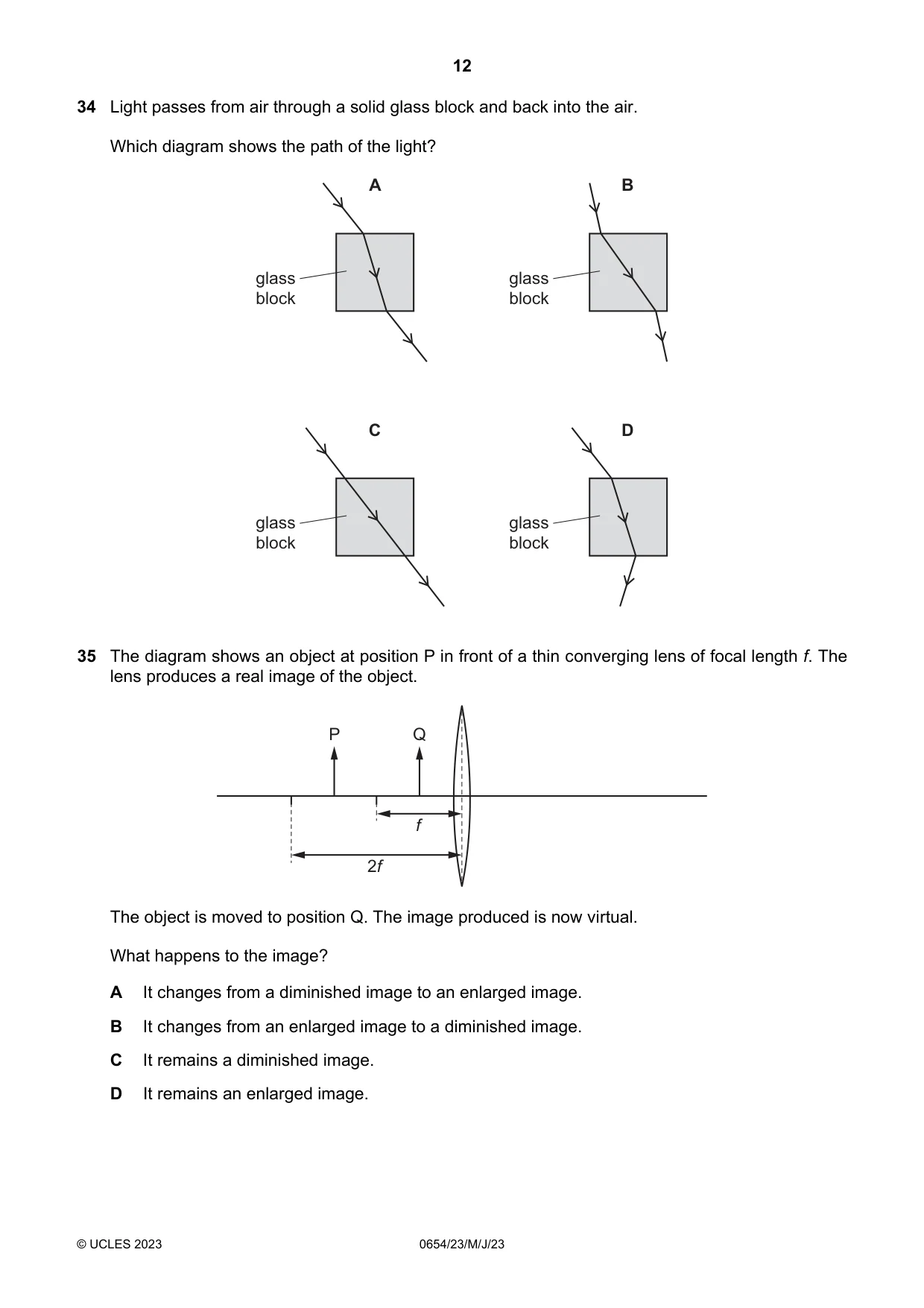
Q34 · Light passes from air through a solid glass block and back into the air
34 Light passes from air through a solid glass block and back into the air. Which diagram shows the path of the light? A B glass glass block block C D glass glass block block
Mark scheme: A
Q35 · The diagram shows an object at position P in front of a thin converging lens of focal…
35 The diagram shows an object at position P in front of a thin converging lens of focal length f. The lens produces a real image of the object. P Q f 2f The object is moved to position Q. The image produced is now virtual. What happens to the image? A It changes from a diminished image to an enlarged image. B It changes from an enlarged image to a diminished image. C It remains a diminished image. D It remains an enlarged image.
Mark scheme: D
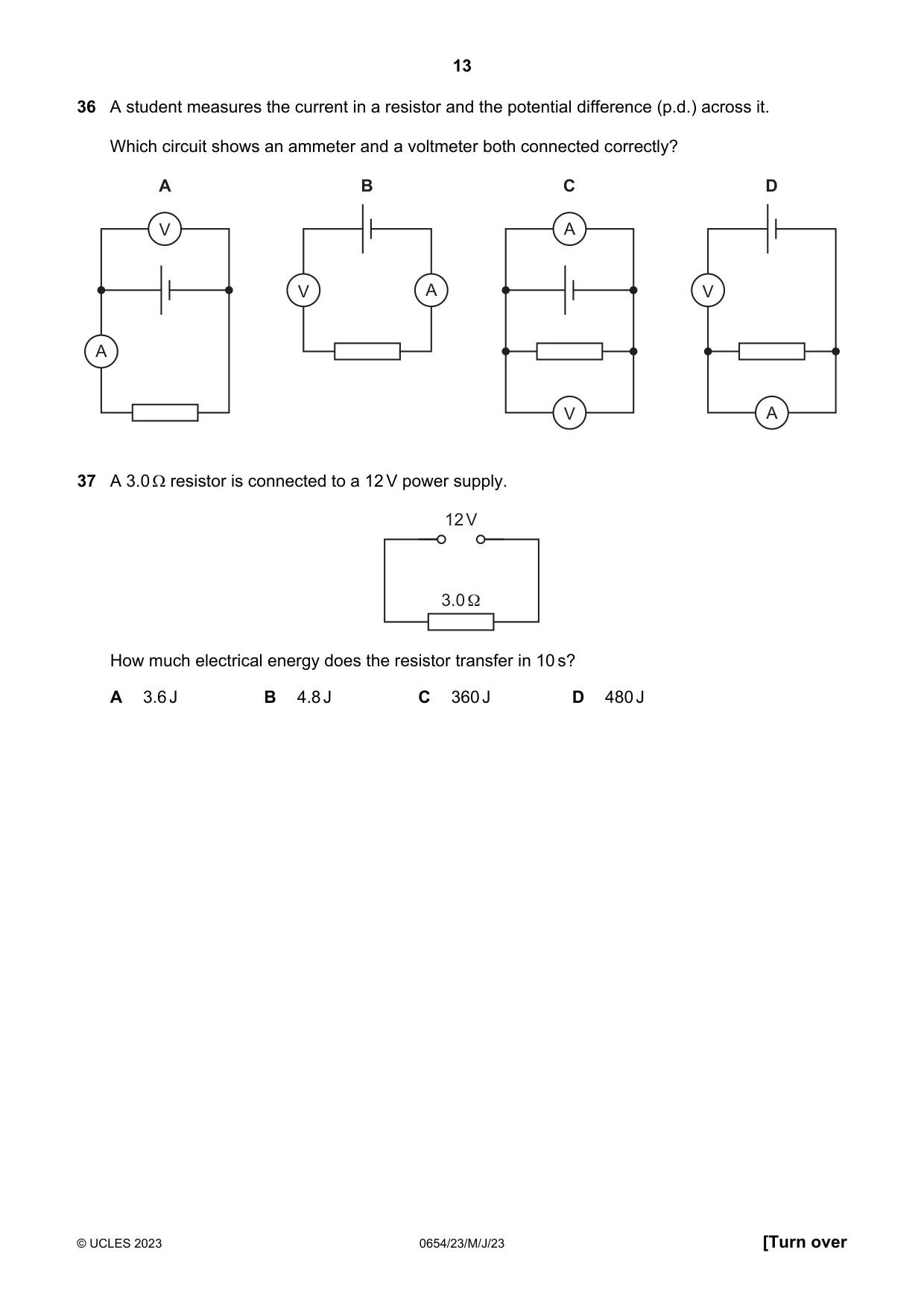
Q36 · A student measures the current in a resistor and the potential difference (p.d.) across it
36 A student measures the current in a resistor and the potential difference (p.d.) across it. Which circuit shows an ammeter and a voltmeter both connected correctly? A B C D V A V A V A V A
Mark scheme: A
Q37 · A 3.0 resistor is connected to a 12 V power supply
37 A 3.0 resistor is connected to a 12 V power supply. 12 V 3.0 Ω How much electrical energy does the resistor transfer in 10 s? A 3.6 J B 4.8 J C 360 J D 480 J
Mark scheme: D
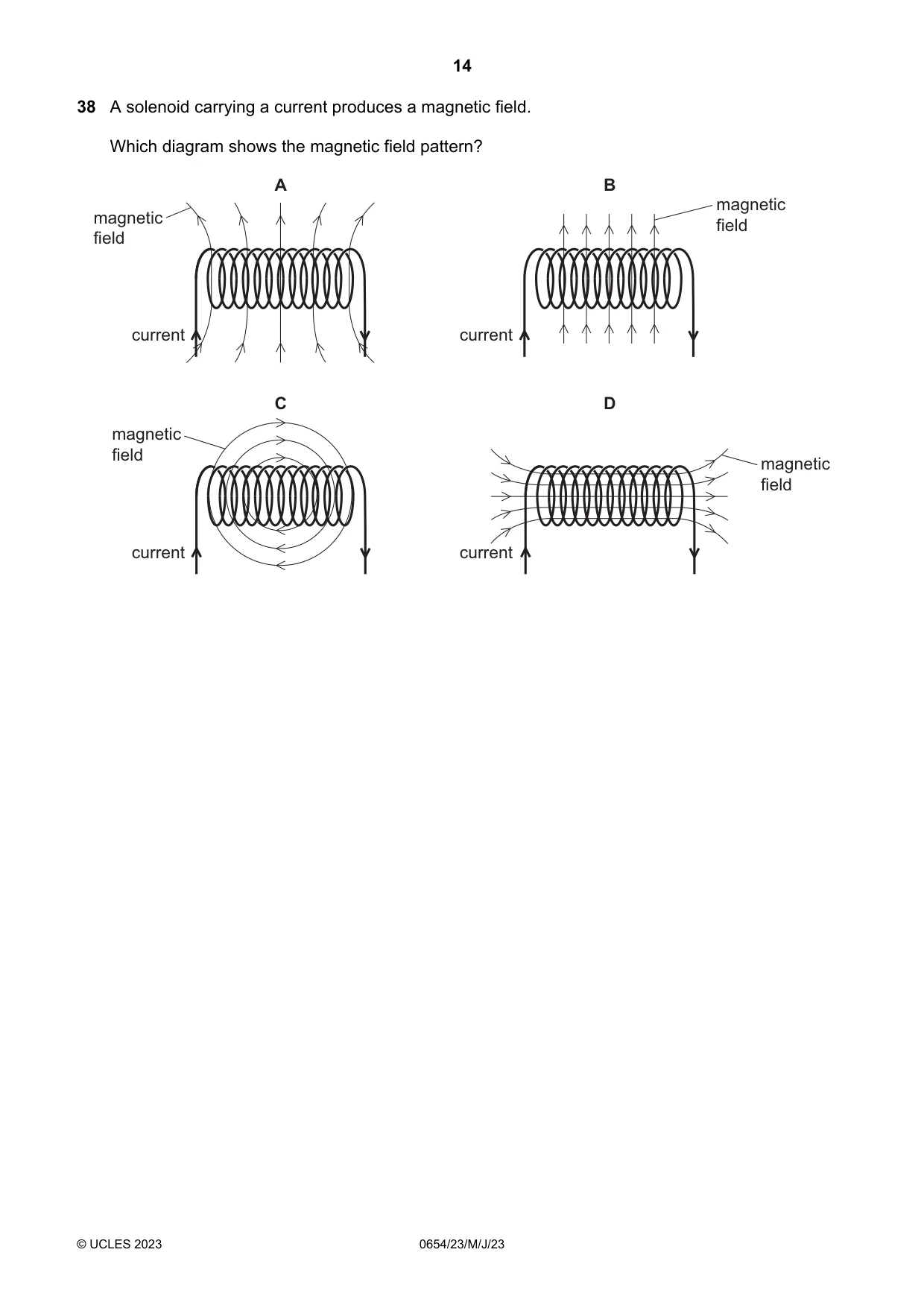
Q38 · A solenoid carrying a current produces a magnetic field
38 A solenoid carrying a current produces a magnetic field. Which diagram shows the magnetic field pattern? A B magnetic magnetic field field current current C D magnetic field magnetic field current current
Mark scheme: D
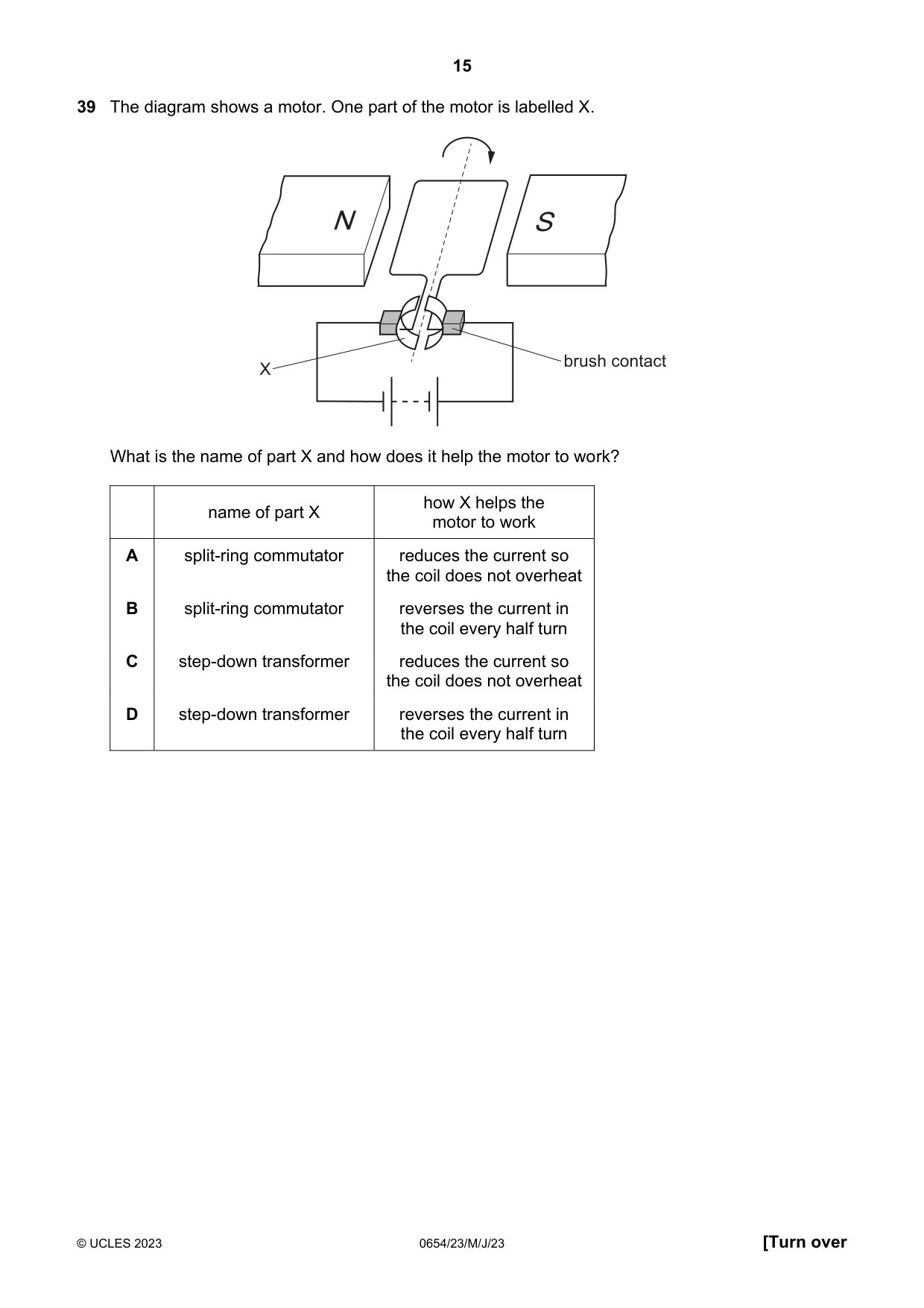
Q39 · The diagram shows a motor
39 The diagram shows a motor. One part of the motor is labelled X. N S brush contact X What is the name of part X and how does it help the motor to work? how X helps the name of part X motor to work A split-ring commutator reduces the current so the coil does not overheat B split-ring commutator reverses the current in the coil every half turn C step-down transformer reduces the current so the coil does not overheat D step-down transformer reverses the current in the coil every half turn
Mark scheme: B
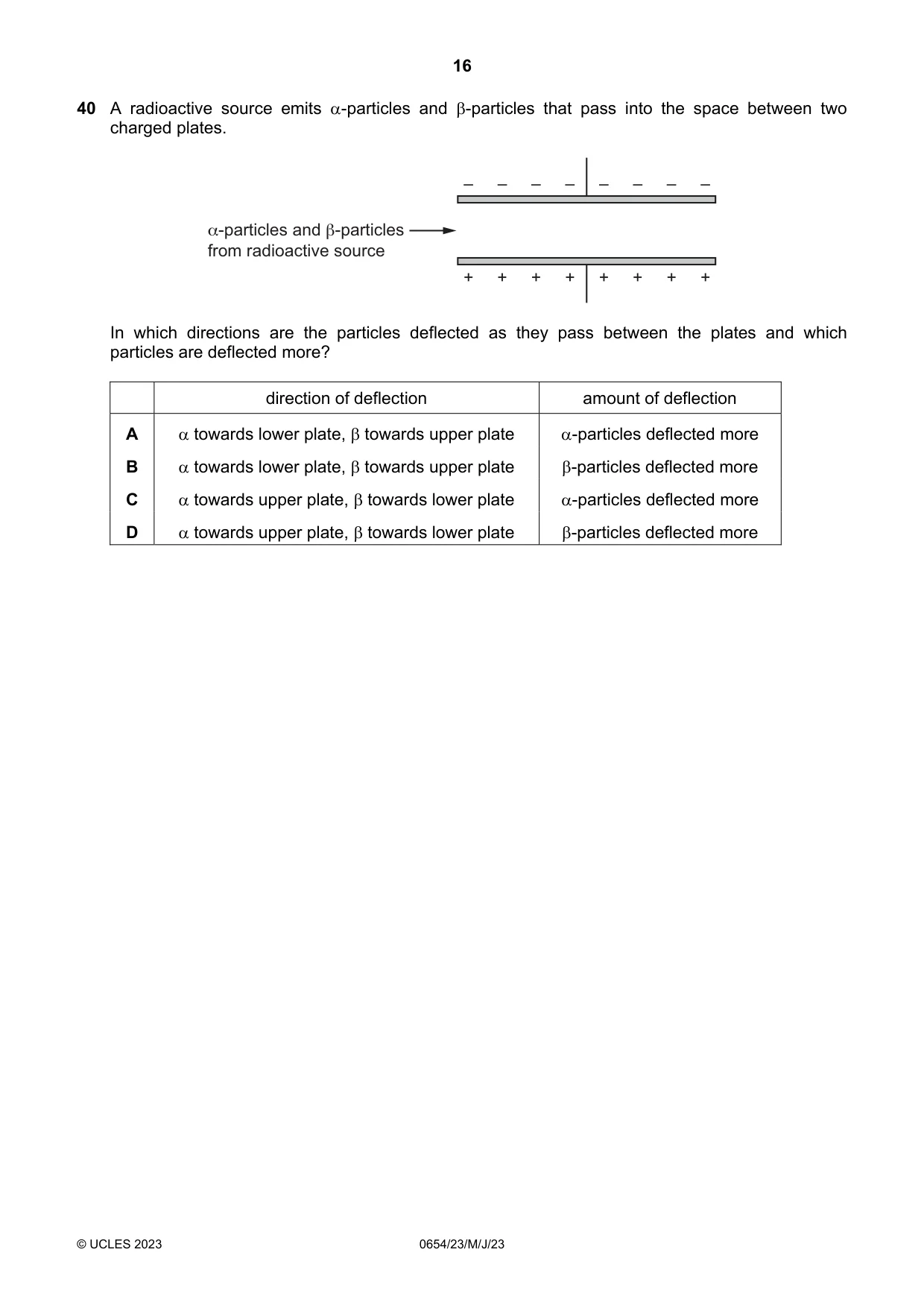
Q40 · A radioactive source emits -particles and -particles that pass into the space between…
40 A radioactive source emits -particles and -particles that pass into the space between two charged plates. – – – – – – – – α-particles and β-particles from radioactive source + + + + + + + + In which directions are the particles deflected as they pass between the plates and which particles are deflected more? direction of deflection amount of deflection A towards lower plate, towards upper plate -particles deflected more B towards lower plate, towards upper plate -particles deflected more C towards upper plate, towards lower plate -particles deflected more D towards upper plate, towards lower plate -particles deflected more
Mark scheme: D
What was in this paper
The subtopics covered by these 40 questions, and how many questions each got. Open one in a new tab to see every Cambridge question on it.
2Fuels2Light2Air quality and climate1Atomic structure and the Periodic Table1Biological molecules1Characteristics of living organisms1Diet1Diffusion1Electrical circuits1Electrical quantities1Electrolysis1Electromagnetic effects1Enzymes1Exothermic and endothermic reactions1Food chains and food webs1Formulas1General properties of waves1Habitat destruction1Hormones1Kinetic particle model of matter1Motion1Oxides1Photosynthesis1Physical and chemical changes1Polymers1Preparation of salts1Pressure1Radioactivity1Rate of reaction1Respiration1Selection1Separation and purification1Sexual reproduction in plants1Simple phenomena of magnetism1Transition elements1Transpiration1What you needed in this session
Cambridge’s own grade thresholds for 2023 May/June, Paper 2 · Variant 3. A higher threshold means an easier paper — the bar moves with how the cohort did.