Cambridge IGCSE Sciences - Co-ordinated (Double) 0654 — 2024 May/June Paper 2 · Variant 1
0654/21/M/J/24 · 40 questions · 40 marks · ≈45 min
The question paper and its mark scheme, free to read here and free to download. This is Cambridge’s own paper, exactly as it was sat.
Question paper16 pages
Mark scheme3 pages
Answers below. Sit the paper first if you are practising.
Questions as text
Q1 · Which processes are done by green plants?
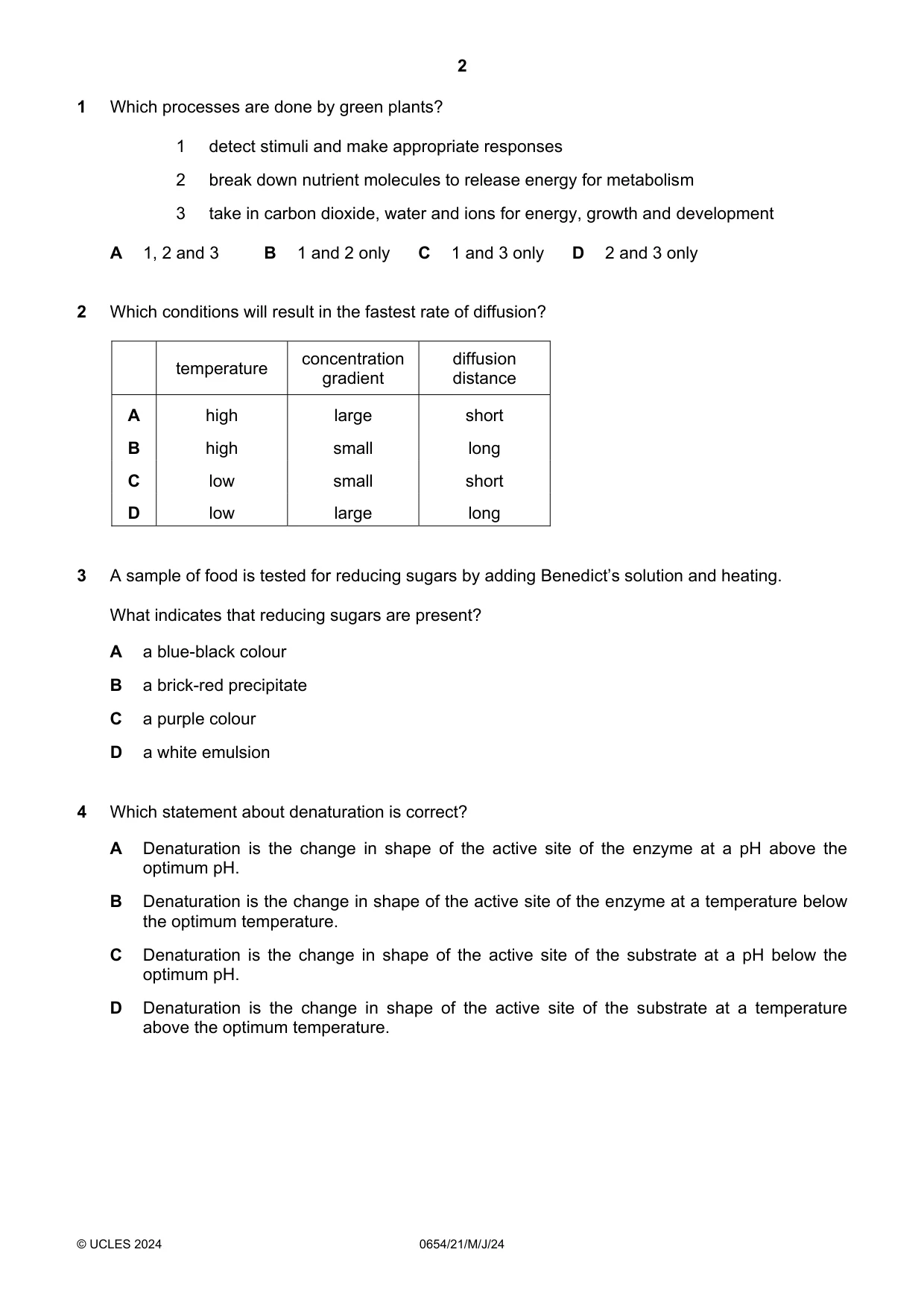
1 Which processes are done by green plants? 1 detect stimuli and make appropriate responses 2 break down nutrient molecules to release energy for metabolism 3 take in carbon dioxide, water and ions for energy, growth and development A 1, 2 and 3 B 1 and 2 only C 1 and 3 only D 2 and 3 only
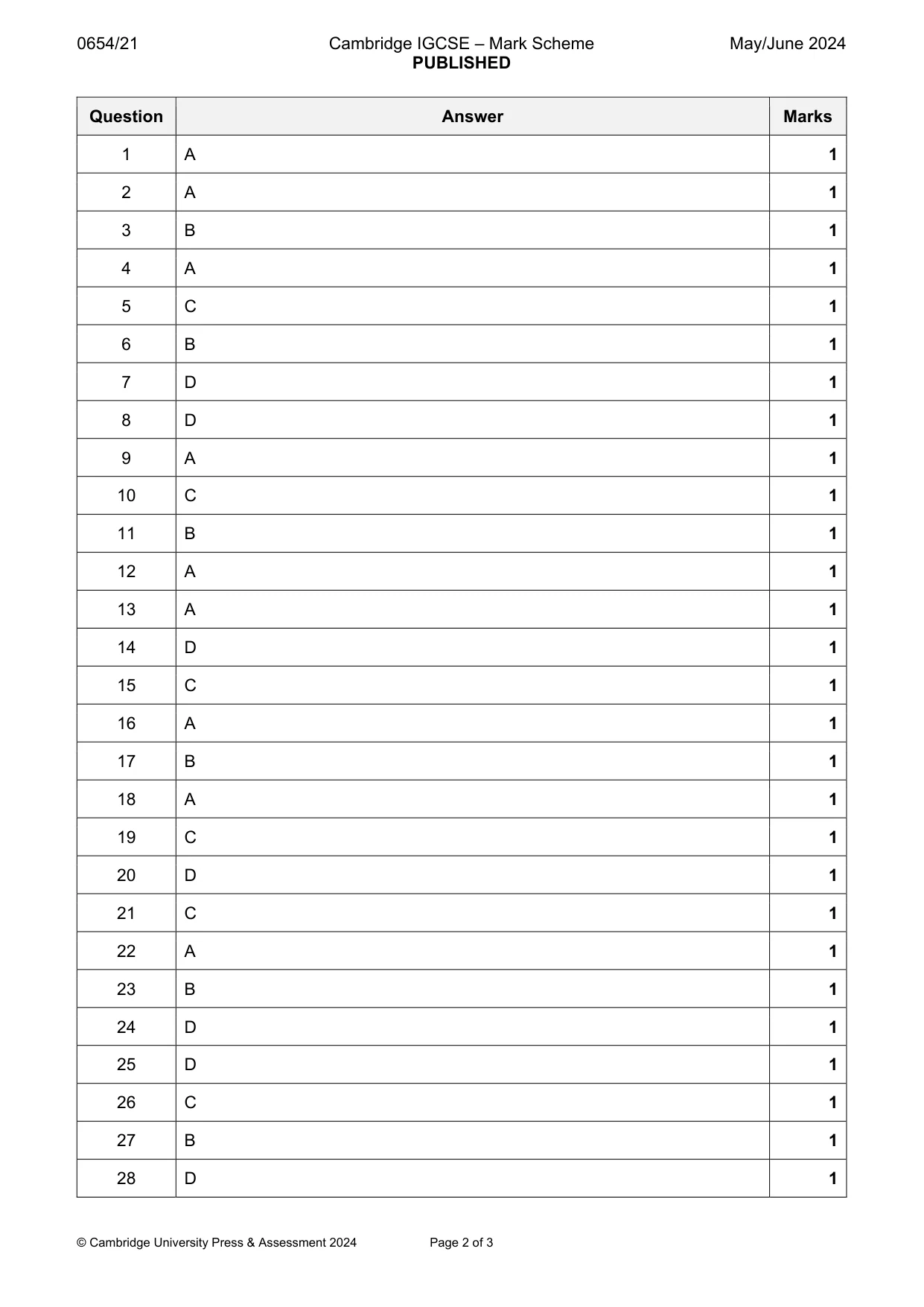
Mark scheme: A
Q2 · Which conditions will result in the fastest rate of diffusion?
2 Which conditions will result in the fastest rate of diffusion? concentration diffusion temperature gradient distance A high large short B high small long C low small short D low large long
Mark scheme: A
Q3 · A sample of food is tested for reducing sugars by adding Benedict’s solution and heating
3 A sample of food is tested for reducing sugars by adding Benedict’s solution and heating. What indicates that reducing sugars are present? A a blue-black colour B a brick-red precipitate C a purple colour D a white emulsion
Mark scheme: B
Q4 · Which statement about denaturation is correct?
4 Which statement about denaturation is correct? A Denaturation is the change in shape of the active site of the enzyme at a pH above the optimum pH. B Denaturation is the change in shape of the active site of the enzyme at a temperature below the optimum temperature. C Denaturation is the change in shape of the active site of the substrate at a pH below the optimum pH. D Denaturation is the change in shape of the active site of the substrate at a temperature above the optimum temperature.
Mark scheme: A
Q5 · The diagram shows a cross-section of a leaf of a plant
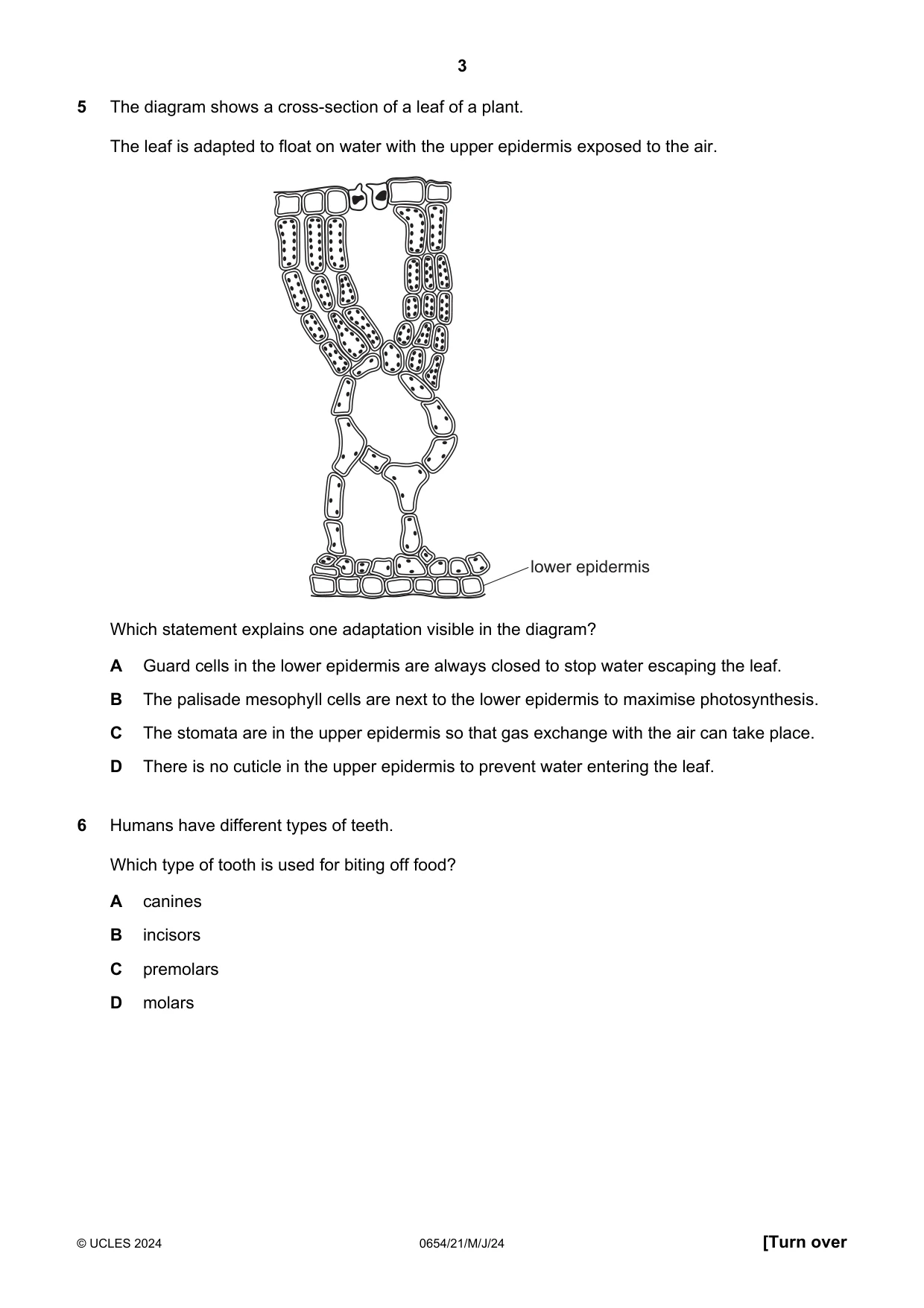
5 The diagram shows a cross-section of a leaf of a plant. The leaf is adapted to float on water with the upper epidermis exposed to the air. lower epidermis Which statement explains one adaptation visible in the diagram? A Guard cells in the lower epidermis are always closed to stop water escaping the leaf. B The palisade mesophyll cells are next to the lower epidermis to maximise photosynthesis. C The stomata are in the upper epidermis so that gas exchange with the air can take place. D There is no cuticle in the upper epidermis to prevent water entering the leaf.
Mark scheme: C
Q6 · Humans have different types of teeth
6 Humans have different types of teeth. Which type of tooth is used for biting off food? A canines B incisors C premolars D molars
Mark scheme: B
Q7 · A student investigates the effect of humidity on transpiration rate
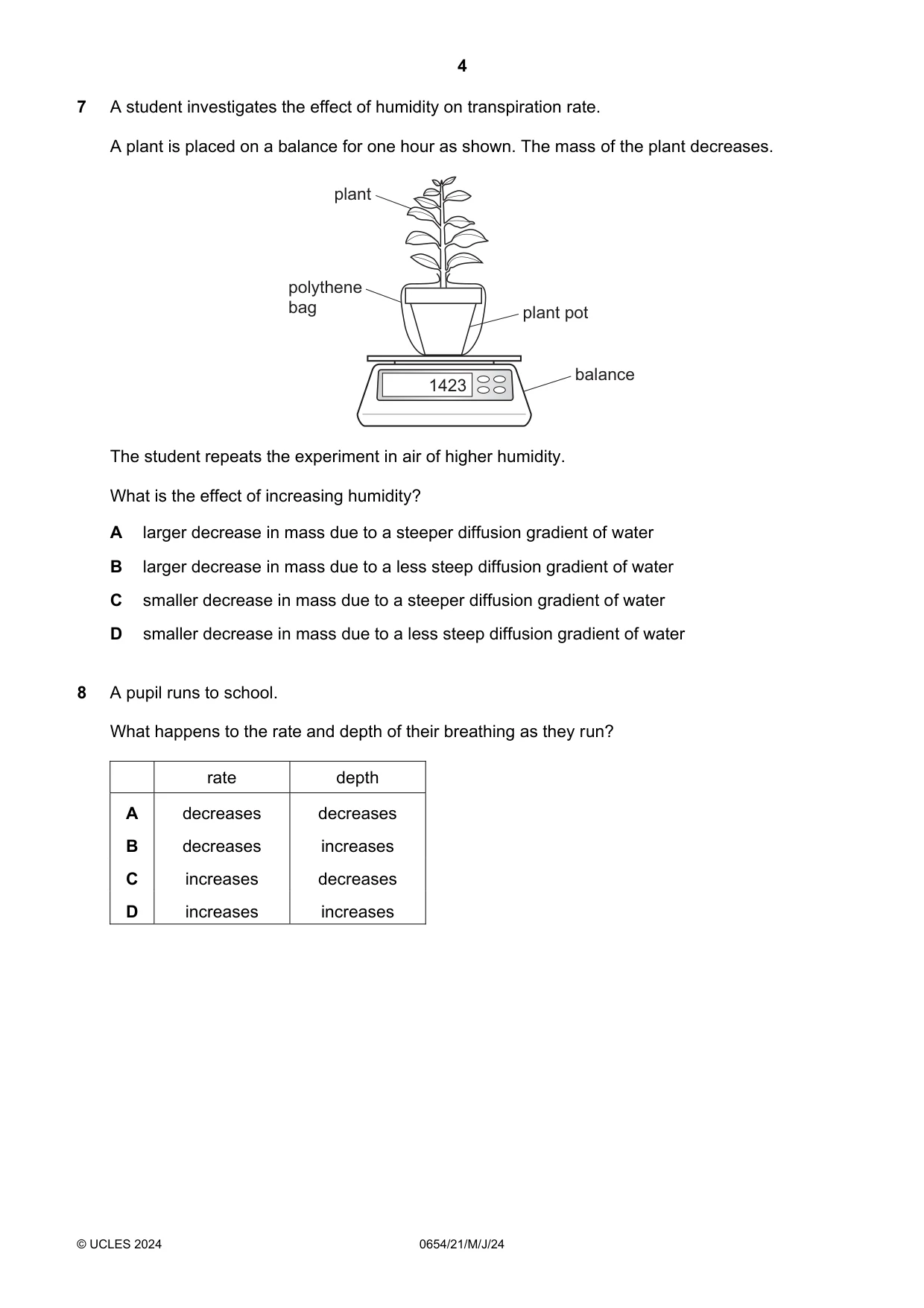
7 A student investigates the effect of humidity on transpiration rate. A plant is placed on a balance for one hour as shown. The mass of the plant decreases. plant polythene bag plant pot balance 1423 The student repeats the experiment in air of higher humidity. What is the effect of increasing humidity? A larger decrease in mass due to a steeper diffusion gradient of water B larger decrease in mass due to a less steep diffusion gradient of water C smaller decrease in mass due to a steeper diffusion gradient of water D smaller decrease in mass due to a less steep diffusion gradient of water
Mark scheme: D
Q8 · A pupil runs to school
8 A pupil runs to school. What happens to the rate and depth of their breathing as they run? rate depth A decreases decreases B decreases increases C increases decreases D increases increases
Mark scheme: D
Q9 · A person looks at a tree in the distance and then starts to read a book
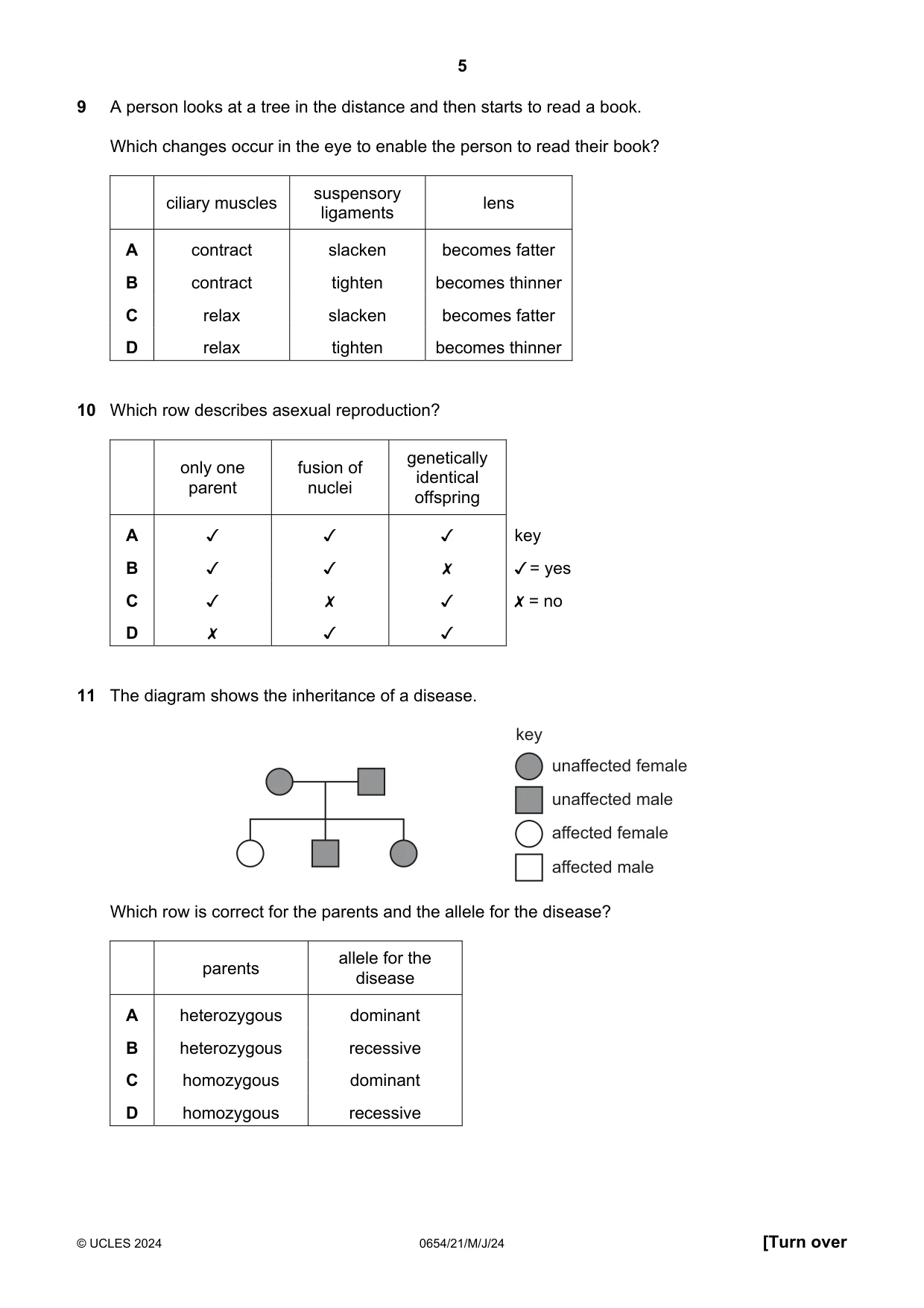
9 A person looks at a tree in the distance and then starts to read a book. Which changes occur in the eye to enable the person to read their book? suspensory ciliary muscles lens ligaments A contract slacken becomes fatter B contract tighten becomes thinner C relax slacken becomes fatter D relax tighten becomes thinner
Mark scheme: A
Q10 · Which row describes asexual reproduction?
10 Which row describes asexual reproduction? only one fusion of genetealy parent nuclei : offspring A v v v B v v x Cc v x v D x v v key /=yes X=n0o
Mark scheme: C
Q11 · The diagram shows the inheritance of a disease
11 The diagram shows the inheritance of a disease. key unaffected female unaffected male affected female affected male Which row is correct for the parents and the allele for the disease? allele for the parents disease A heterozygous dominant B heterozygous recessive C homozygous dominant D homozygous recessive
Mark scheme: B
Q12 · How does an organism in the first trophic level gain energy?
12 How does an organism in the first trophic level gain energy? A by absorbing energy from sunlight B by breaking down dead or waste organic matter C by eating organisms in the second trophic level D by eating plants
Mark scheme: A
Q13 · The list shows changes that occur in a lake which is polluted by fertiliser
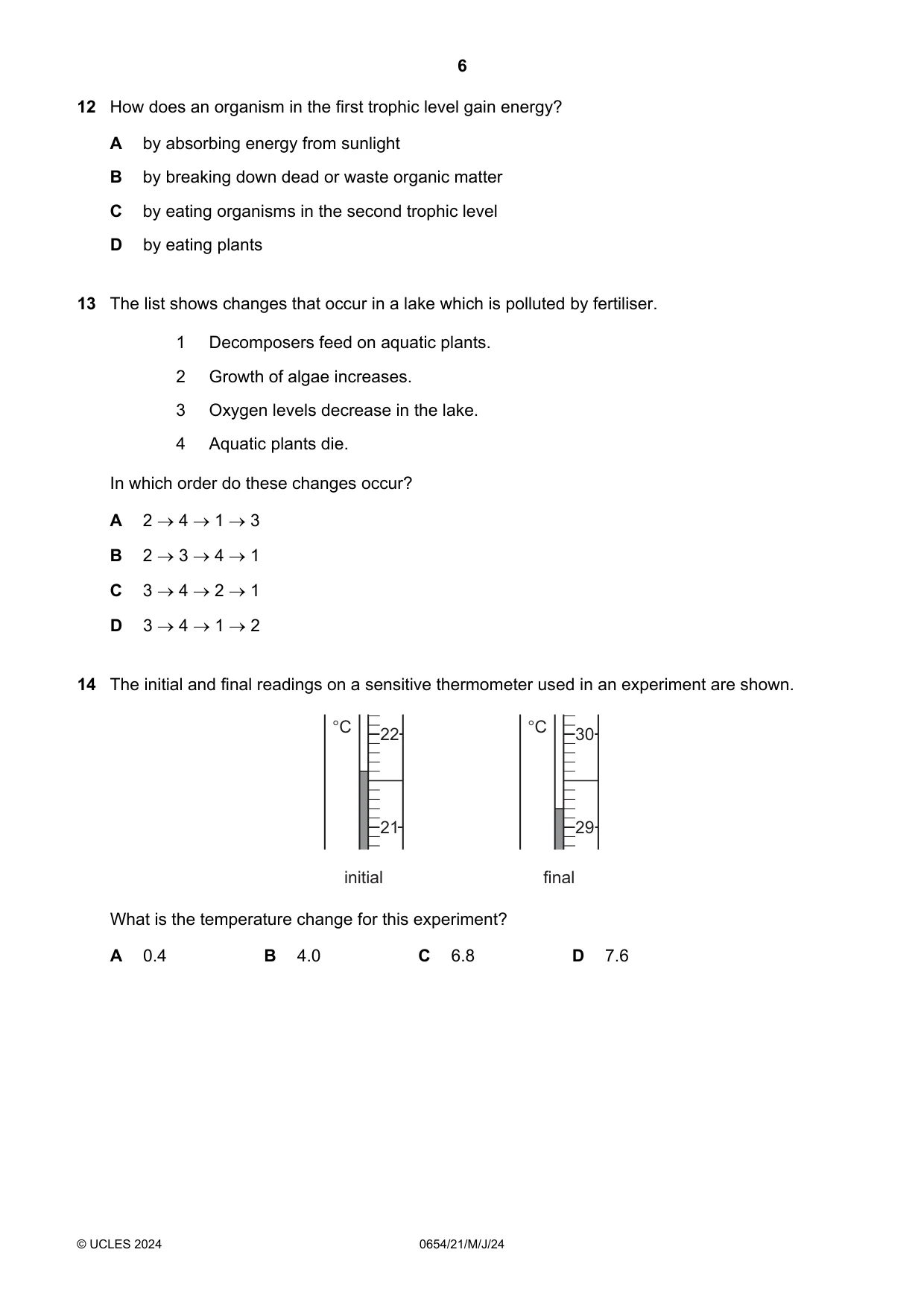
13 The list shows changes that occur in a lake which is polluted by fertiliser. 1 Decomposers feed on aquatic plants. 2 Growth of algae increases. 3 Oxygen levels decrease in the lake. 4 Aquatic plants die. In which order do these changes occur? A 2 4 1 3 B 2 3 4 1 C 3 4 2 1 D 3 4 1 2
Mark scheme: A
Q14 · The initial and final readings on a sensitive thermometer used in an experiment are shown
14 The initial and final readings on a sensitive thermometer used in an experiment are shown. °C 22 °C 30 21 29 initial final What is the temperature change for this experiment? A 0.4 B 4.0 C 6.8 D 7.6
Mark scheme: D
Q15 · The boiling point of ammonia is –33 C
15 The boiling point of ammonia is –33 C. The temperature of a sealed flask containing ammonia is changed from –35 C to –30 C. Which row describes and explains the type of change that happens in the flask? type of change explanation A chemical no new substance is formed B chemical hydrogen and nitrogen are formed C physical no new substance is formed D physical hydrogen and nitrogen are formed
Mark scheme: C
Q16 · Which dot-and-cross diagram represents the outer-shell electrons in a molecule of…
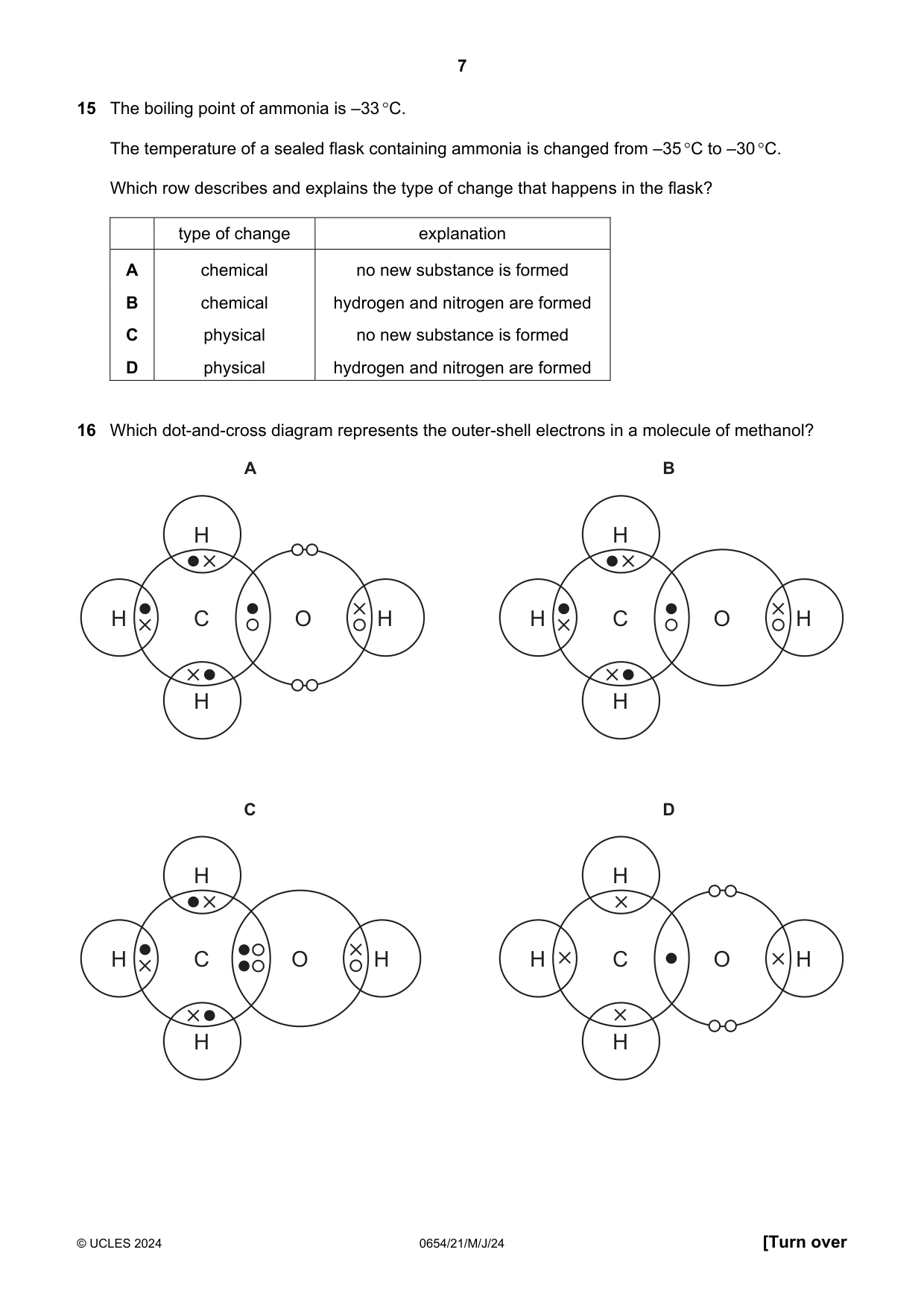
16 Which dot-and-cross diagram represents the outer-shell electrons in a molecule of methanol? A B H H H C O H H C O H H H C D H H H C O H H C O H H H
Mark scheme: A
Q17 · Which statements describe the structure of silicon(IV) oxide?
17 Which statements describe the structure of silicon(IV) oxide? 1 Each oxygen atom is attached to two silicon atoms. 2 Each oxygen atom is attached to four silicon atoms. 3 Each silicon atom is attached to two oxygen atoms. 4 Each silicon atom is attached to four oxygen atoms. A 1 and 3 B 1 and 4 C 2 and 3 D 2 and 4
Mark scheme: B
Q18 · The equation for the combustion of magnesium is shown
18 The equation for the combustion of magnesium is shown. 2Mg + O2 2MgO What is the mass of magnesium oxide formed from 12 g of magnesium? A 20 g B 24 g C 40 g D 80 g
Mark scheme: A
Q19 · Two electrolysis experiments are done using inert electrodes
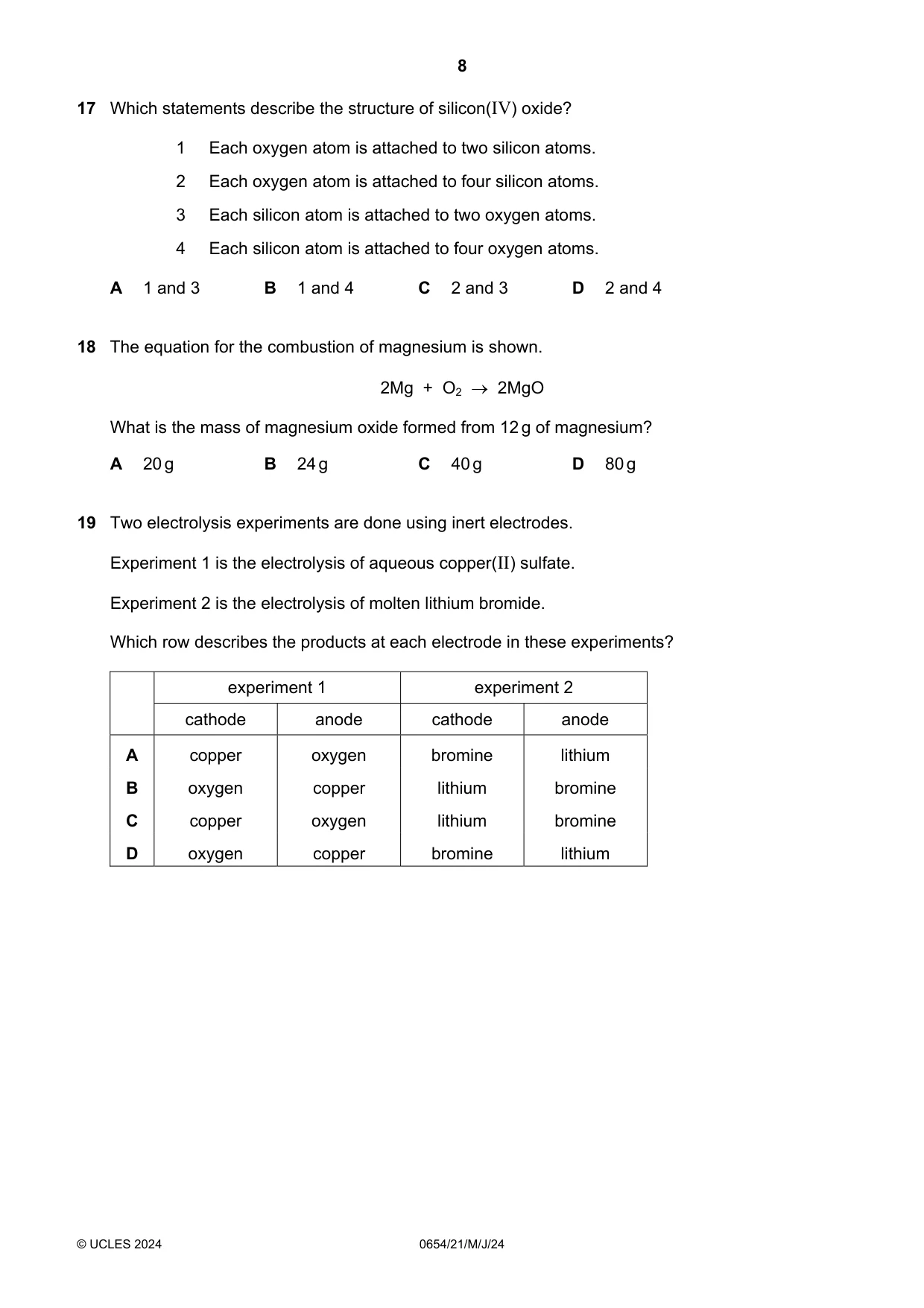
19 Two electrolysis experiments are done using inert electrodes. Experiment 1 is the electrolysis of aqueous copper(II) sulfate. Experiment 2 is the electrolysis of molten lithium bromide. Which row describes the products at each electrode in these experiments? experiment 1 experiment 2 cathode anode cathode anode A copper oxygen bromine lithium B oxygen copper lithium bromine C copper oxygen lithium bromine D oxygen copper bromine lithium
Mark scheme: C
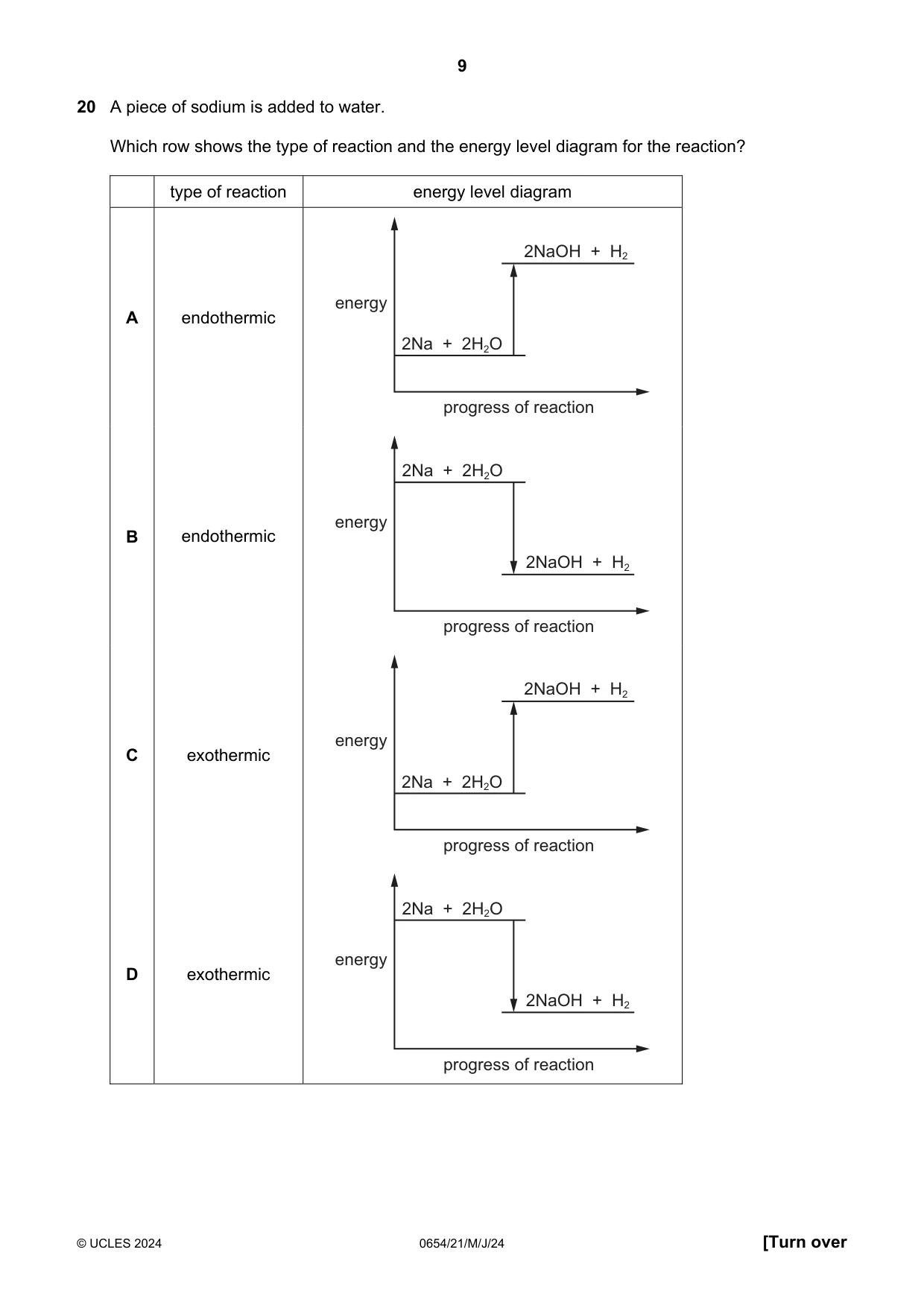
Q20 · A piece of sodium is added to water
20 A piece of sodium is added to water. Which row shows the type of reaction and the energy level diagram for the reaction? type of reaction energy level diagram 2NaOH + H2 energy A endothermic 2Na + 2H2O progress of reaction 2Na + 2H2O energy B endothermic 2NaOH + H2 progress of reaction 2NaOH + H2 energy C exothermic 2Na + 2H2O progress of reaction 2Na + 2H2O energy D exothermic 2NaOH + H2 progress of reaction
Mark scheme: D
Q21 · Magnesium ribbon is reacted with 50 cm3 of dilute hydrochloric acid
21 Magnesium ribbon is reacted with 50 cm3 of dilute hydrochloric acid. Which change does not increase the rate of the reaction? A Increase the concentration of the hydrochloric acid. B Increase the temperature of the hydrochloric acid. C Increase the volume of the hydrochloric acid. D Use powdered magnesium.
Mark scheme: C
Q22 · Which metal is used in the test for nitrate ions?
22 Which metal is used in the test for nitrate ions? A aluminium B copper C magnesium D tin
Mark scheme: A
Q23 · Element X is a dense solid with a high melting point
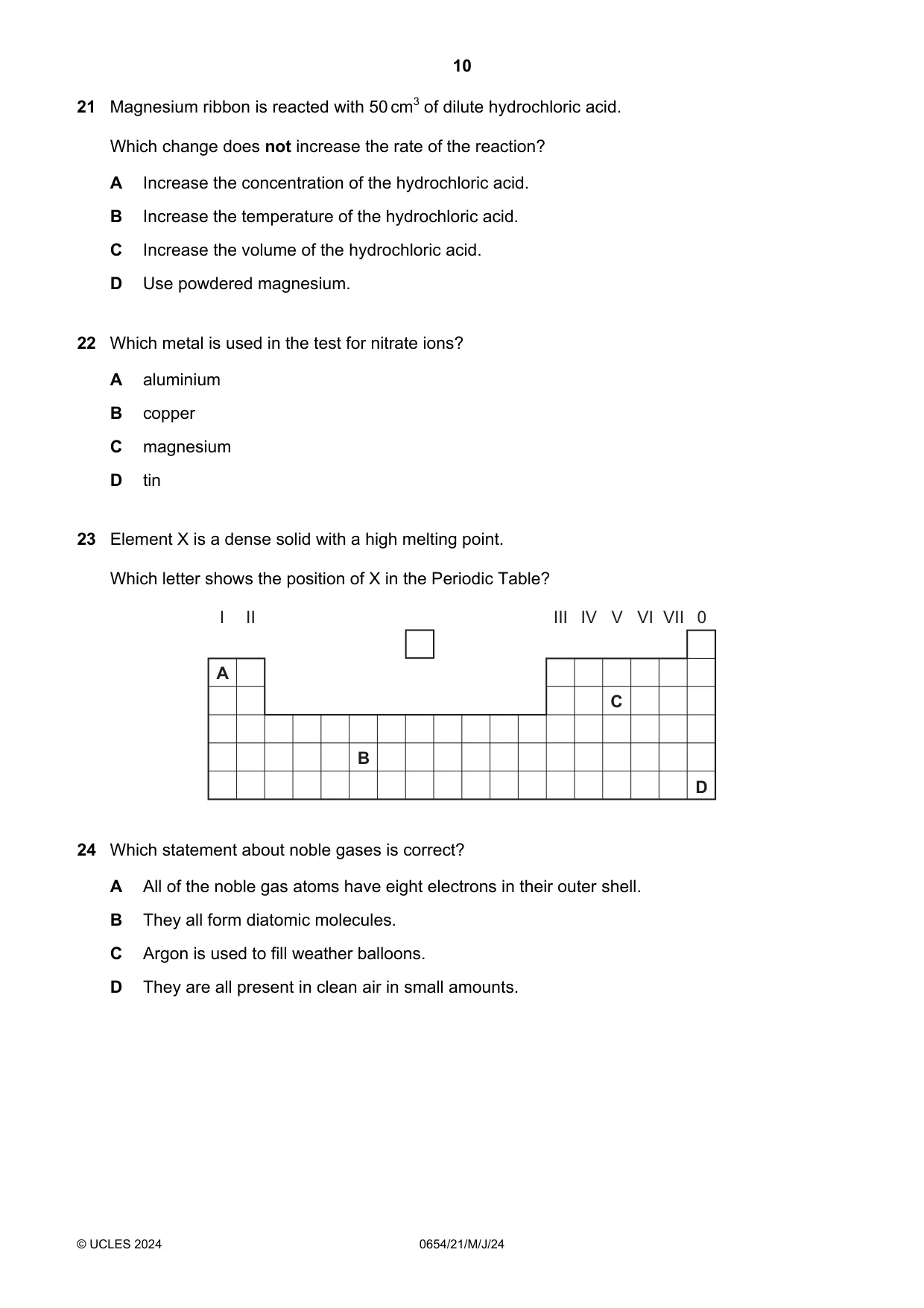
23 Element X is a dense solid with a high melting point. Which letter shows the position of X in the Periodic Table? I II III IV V VI VII 0 A C B D
Mark scheme: B
Q24 · Which statement about noble gases is correct?
24 Which statement about noble gases is correct? A All of the noble gas atoms have eight electrons in their outer shell. B They all form diatomic molecules. C Argon is used to fill weather balloons. D They are all present in clean air in small amounts.
Mark scheme: D
Q25 · Which statements about the Haber process are correct?
25 Which statements about the Haber process are correct? 1 The hydrogen used is obtained from the air. 2 The pressure used is about twice atmospheric pressure. 3 The catalyst used is iron. 4 The process takes place at a temperature of about 450 C. A 1 and 2 B 1 and 4 C 2 and 3 D 3 and 4
Mark scheme: D
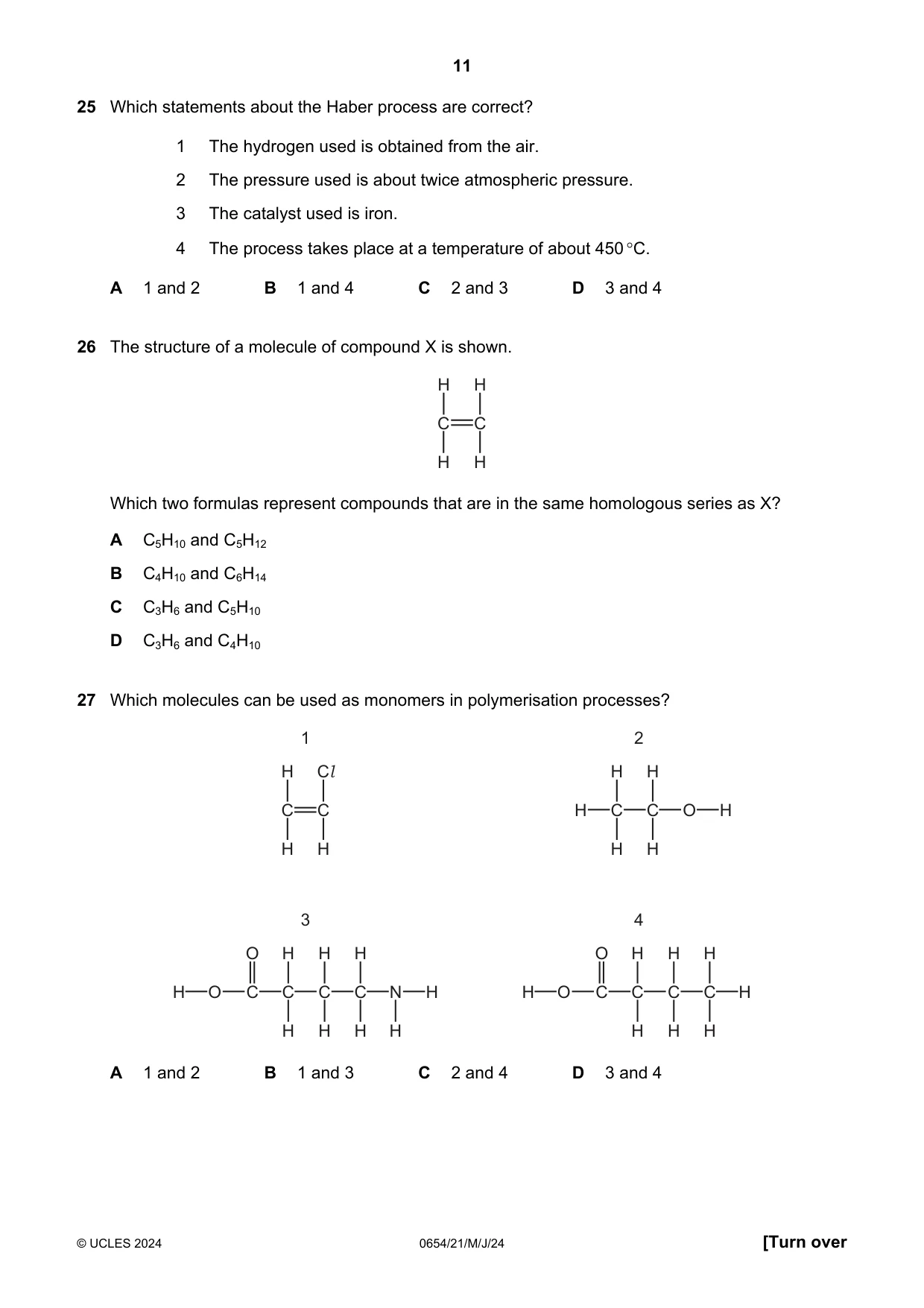
Q26 · The structure of a molecule of compound X is shown
26 The structure of a molecule of compound X is shown. H H C C H H Which two formulas represent compounds that are in the same homologous series as X? A C5H10 and C5H12 B C4H10 and C6H14 C C3H6 and C5H10 D C3H6 and C4H10
Mark scheme: C
Q27 · Which molecules can be used as monomers in polymerisation processes?
27 Which molecules can be used as monomers in polymerisation processes? 1 2 H Cl H H C C H C C O H H H H H 3 4 O H H H O H H H H O C C C C N H H O C C C C H H H H H H H H A 1 and 2 B 1 and 3 C 2 and 4 D 3 and 4
Mark scheme: B
Q28 · Which statement describes a system that is in equilibrium?
28 Which statement describes a system that is in equilibrium? A There is a resultant force and there is a resultant turning effect on the system. B There is a resultant force but there is no resultant turning effect on the system. C There is no resultant force but there is a resultant turning effect on the system. D There is no resultant force and there is no resultant turning effect on the system.
Mark scheme: D
Q29 · An irregularly shaped piece of aluminium is lowered into a measuring cylinder that…
29 An irregularly shaped piece of aluminium is lowered into a measuring cylinder that contains 43 cm3 of water. The aluminium is totally immersed in the water and the water level in the measuring cylinder rises to 51 cm3. The density of aluminium is 2.7 g / cm3. What is the mass of the aluminium? A 15.9 g B 18.9 g C 21.6 g D 127 g
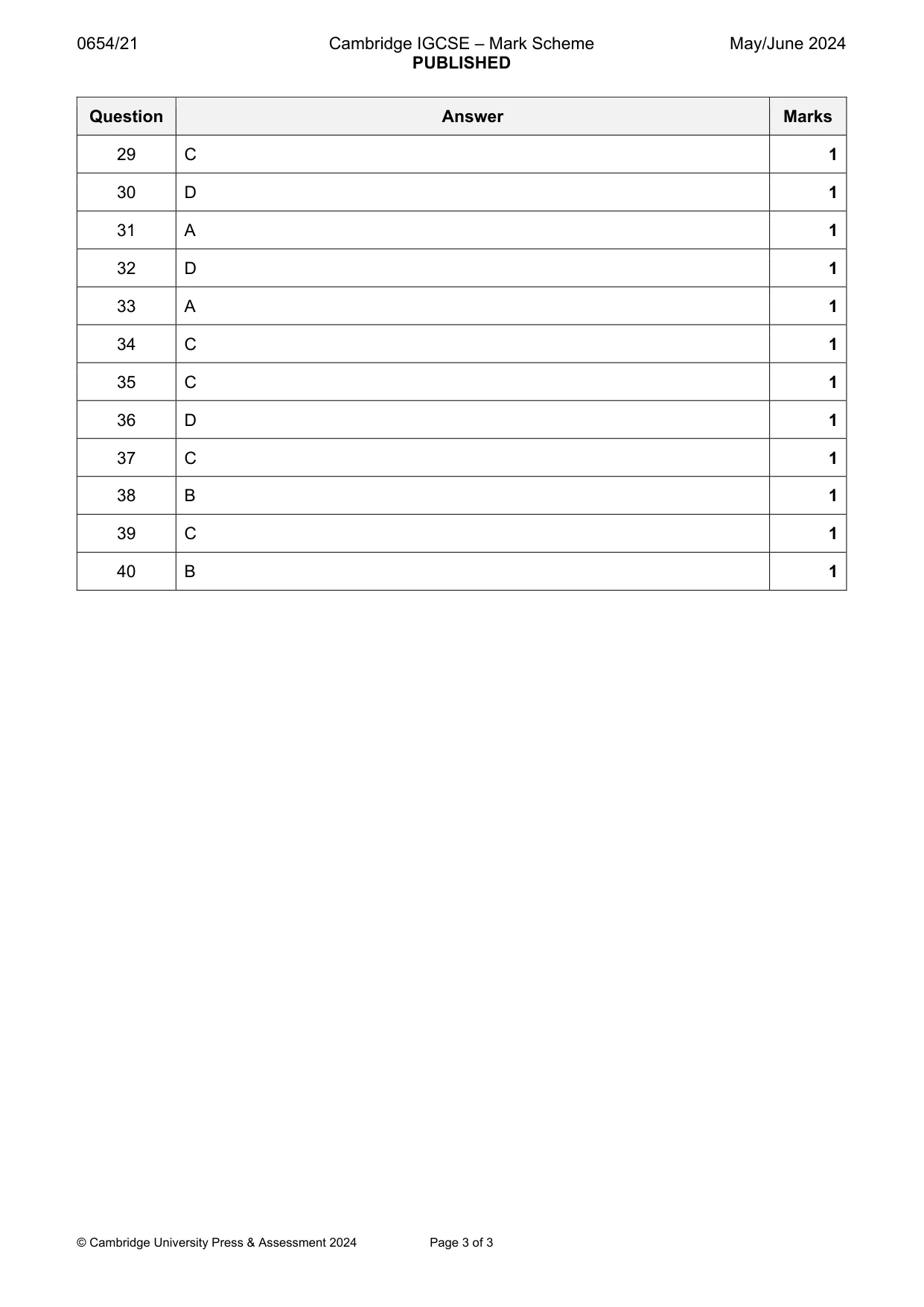
Mark scheme: C
Q30 · An object of mass 5.0 kg falls vertically from rest through a height of 13 m in a vacuum
30 An object of mass 5.0 kg falls vertically from rest through a height of 13 m in a vacuum. The gravitational field strength g is 10 N / kg. What is the final speed of the object? A 8.1 m / s B 10 m / s C 11 m / s D 16 m / s
Mark scheme: D
Q31 · For which energy resource is the Sun not the source of the energy?
31 For which energy resource is the Sun not the source of the energy? A geothermal B natural gas C water behind a hydroelectric dam D wind
Mark scheme: A
Q32 · In a room, hot air above a heater rises and is replaced by cool air that falls
32 In a room, hot air above a heater rises and is replaced by cool air that falls. What is the name of this process, and how does the density of the hot air compare with the density of the cool air? process density of hot air A conduction greater than cool air B conduction less than cool air C convection greater than cool air D convection less than cool air
Mark scheme: D
Q33 · A wave has an amplitude, a frequency and a wavelength
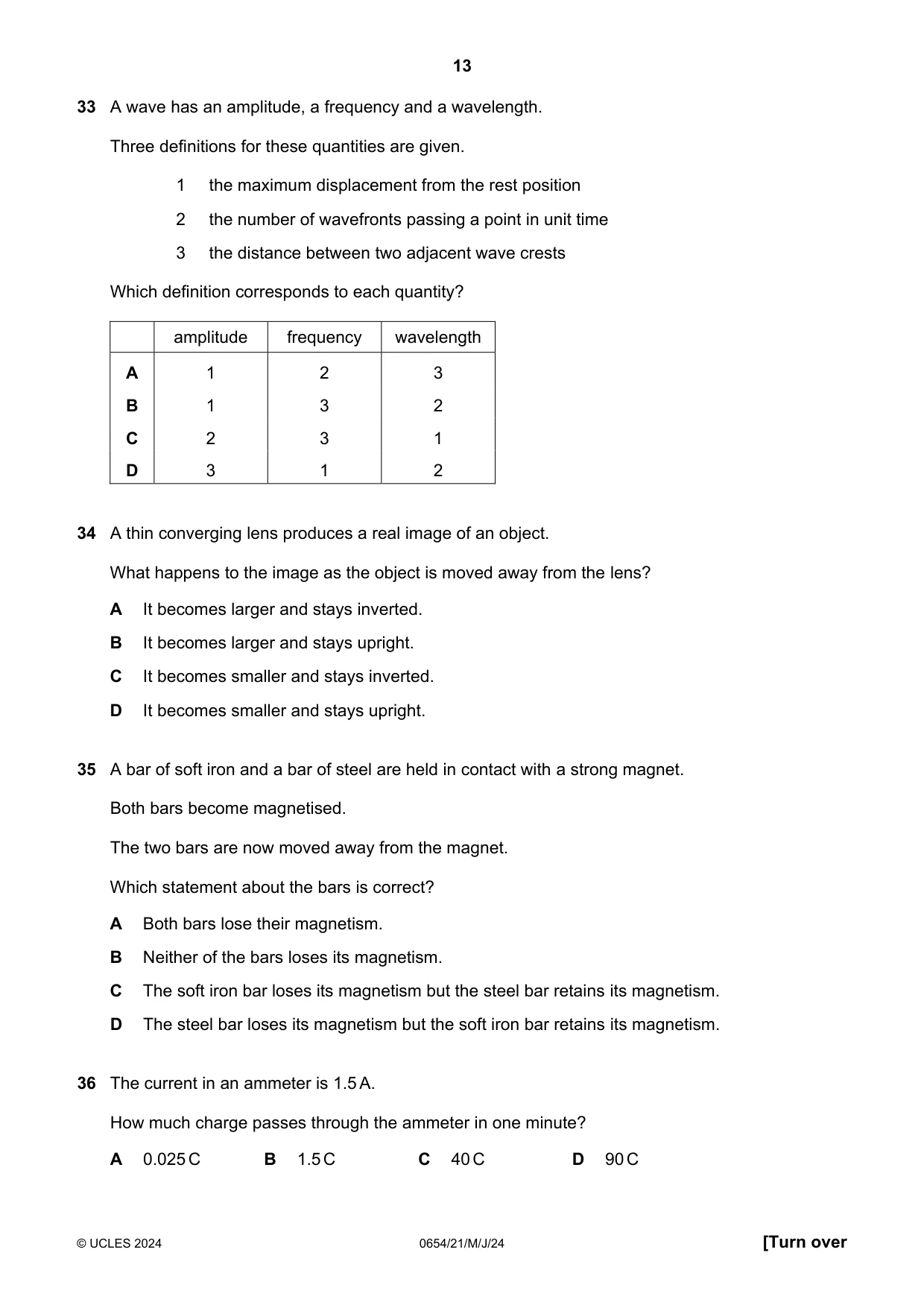
33 A wave has an amplitude, a frequency and a wavelength. Three definitions for these quantities are given. 1 the maximum displacement from the rest position 2 the number of wavefronts passing a point in unit time 3 the distance between two adjacent wave crests Which definition corresponds to each quantity? amplitude frequency wavelength A 1 2 3 B 1 3 2 C 2 3 1 D 3 1 2
Mark scheme: A
Q34 · A thin converging lens produces a real image of an object
34 A thin converging lens produces a real image of an object. What happens to the image as the object is moved away from the lens? A It becomes larger and stays inverted. B It becomes larger and stays upright. C It becomes smaller and stays inverted. D It becomes smaller and stays upright.
Mark scheme: C
Q35 · A bar of soft iron and a bar of steel are held in contact with a strong magnet
35 A bar of soft iron and a bar of steel are held in contact with a strong magnet. Both bars become magnetised. The two bars are now moved away from the magnet. Which statement about the bars is correct? A Both bars lose their magnetism. B Neither of the bars loses its magnetism. C The soft iron bar loses its magnetism but the steel bar retains its magnetism. D The steel bar loses its magnetism but the soft iron bar retains its magnetism.
Mark scheme: C
Q36 · The current in an ammeter is 1.5 A
36 The current in an ammeter is 1.5 A. How much charge passes through the ammeter in one minute? A 0.025 C B 1.5 C C 40 C D 90 C
Mark scheme: D
Q37 · Two resistors with different resistances are connected to a power supply
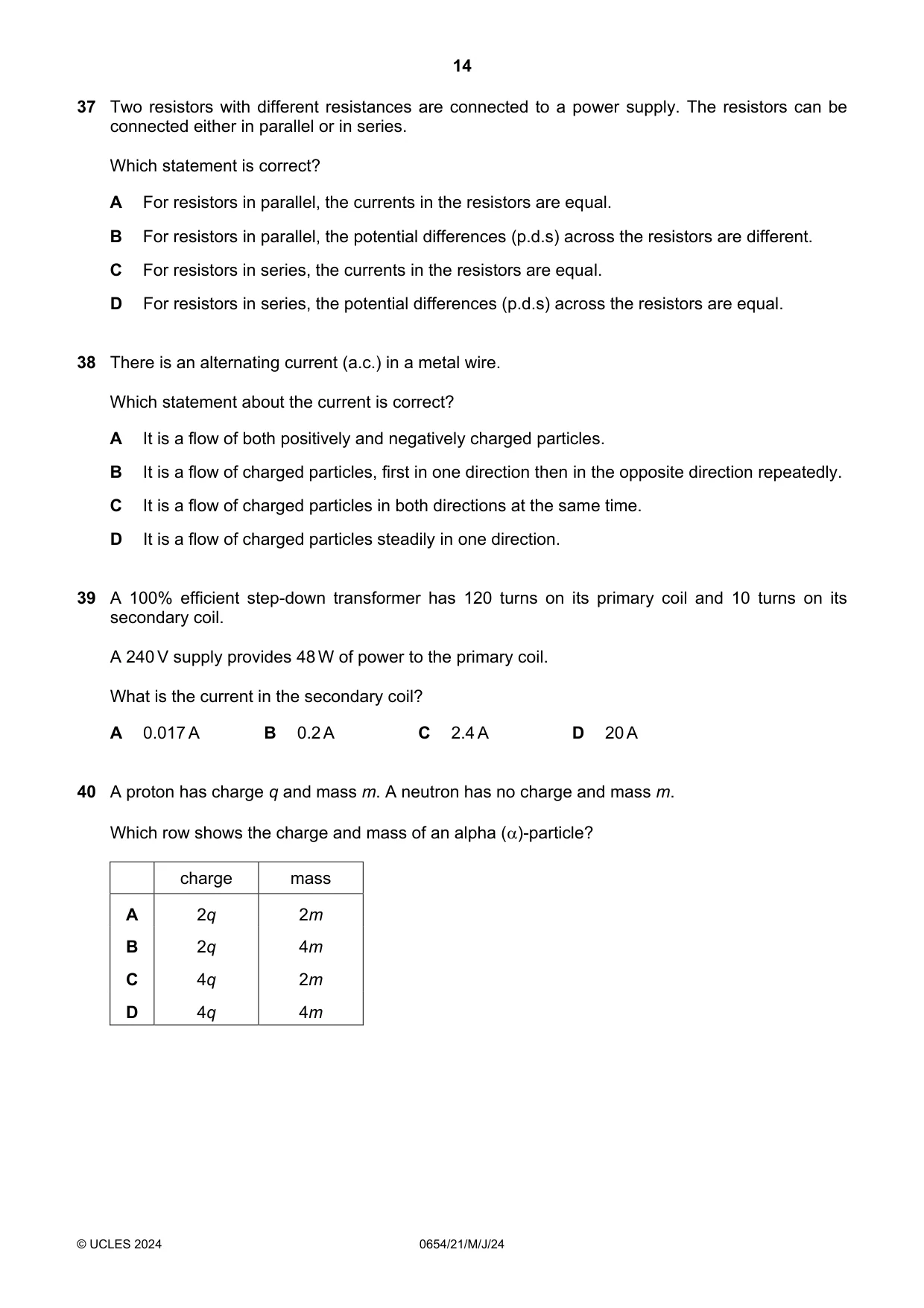
37 Two resistors with different resistances are connected to a power supply. The resistors can be connected either in parallel or in series. Which statement is correct? A For resistors in parallel, the currents in the resistors are equal. B For resistors in parallel, the potential differences (p.d.s) across the resistors are different. C For resistors in series, the currents in the resistors are equal. D For resistors in series, the potential differences (p.d.s) across the resistors are equal.
Mark scheme: C
Q38 · There is an alternating current (a.c.) in a metal wire
38 There is an alternating current (a.c.) in a metal wire. Which statement about the current is correct? A It is a flow of both positively and negatively charged particles. B It is a flow of charged particles, first in one direction then in the opposite direction repeatedly. C It is a flow of charged particles in both directions at the same time. D It is a flow of charged particles steadily in one direction.
Mark scheme: B
Q39 · A 100% efficient step-down transformer has 120 turns on its primary coil and 10 turns on…
39 A 100% efficient step-down transformer has 120 turns on its primary coil and 10 turns on its secondary coil. A 240 V supply provides 48 W of power to the primary coil. What is the current in the secondary coil? A 0.017 A B 0.2 A C 2.4 A D 20 A
Mark scheme: C
Q40 · A proton has charge q and mass m
40 A proton has charge q and mass m. A neutron has no charge and mass m. Which row shows the charge and mass of an alpha ()-particle? charge mass A 2q 2m B 2q 4m C 4q 2m D 4q 4m
Mark scheme: B
What was in this paper
The subtopics covered by these 40 questions, and how many questions each got. Open one in a new tab to see every Cambridge question on it.
2Energy, work and power2Rate of reaction2Alkenes1Asexual reproduction1Biological molecules1Characteristics of living organisms1Coordination and response1Density1Diffusion1Digestion1Electrical quantities1Electrolysis1Electromagnetic effects1Energy flow1Enzymes1Exothermic and endothermic reactions1Experimental design1Forces1Gas exchange in humans1General properties of waves1Giant covalent structures1Habitat destruction1Identification of ions and gases1Leaf structure1Light1Monohybrid inheritance1Noble gases1Physical and chemical changes1Polymers1Simple molecules and covalent bonds1Simple phenomena of magnetism1The mole and the Avogadro constant1The nucleus1Transfer of thermal energy1Transition elements1Transpiration1What you needed in this session
Cambridge’s own grade thresholds for 2024 May/June, Paper 2 · Variant 1. A higher threshold means an easier paper — the bar moves with how the cohort did.