Cambridge IGCSE Sciences - Co-ordinated (Double) 0654 — 2021 May/June Paper 2 · Variant 2
0654/22/M/J/21 · 40 questions · 40 marks · ≈45 min
The question paper and its mark scheme, free to read here and free to download. This is Cambridge’s own paper, exactly as it was sat.
Question paper16 pages



Mark scheme3 pages
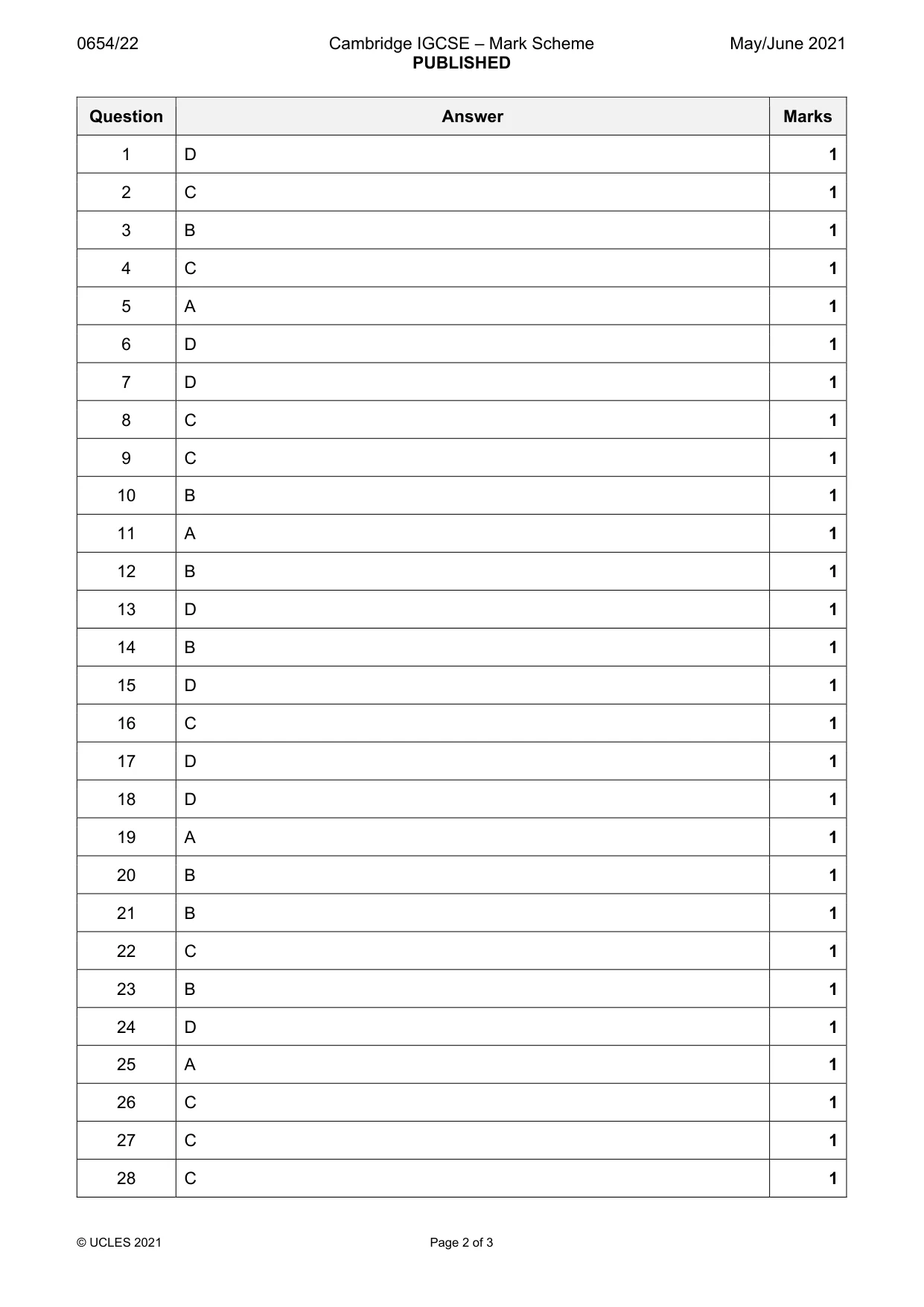
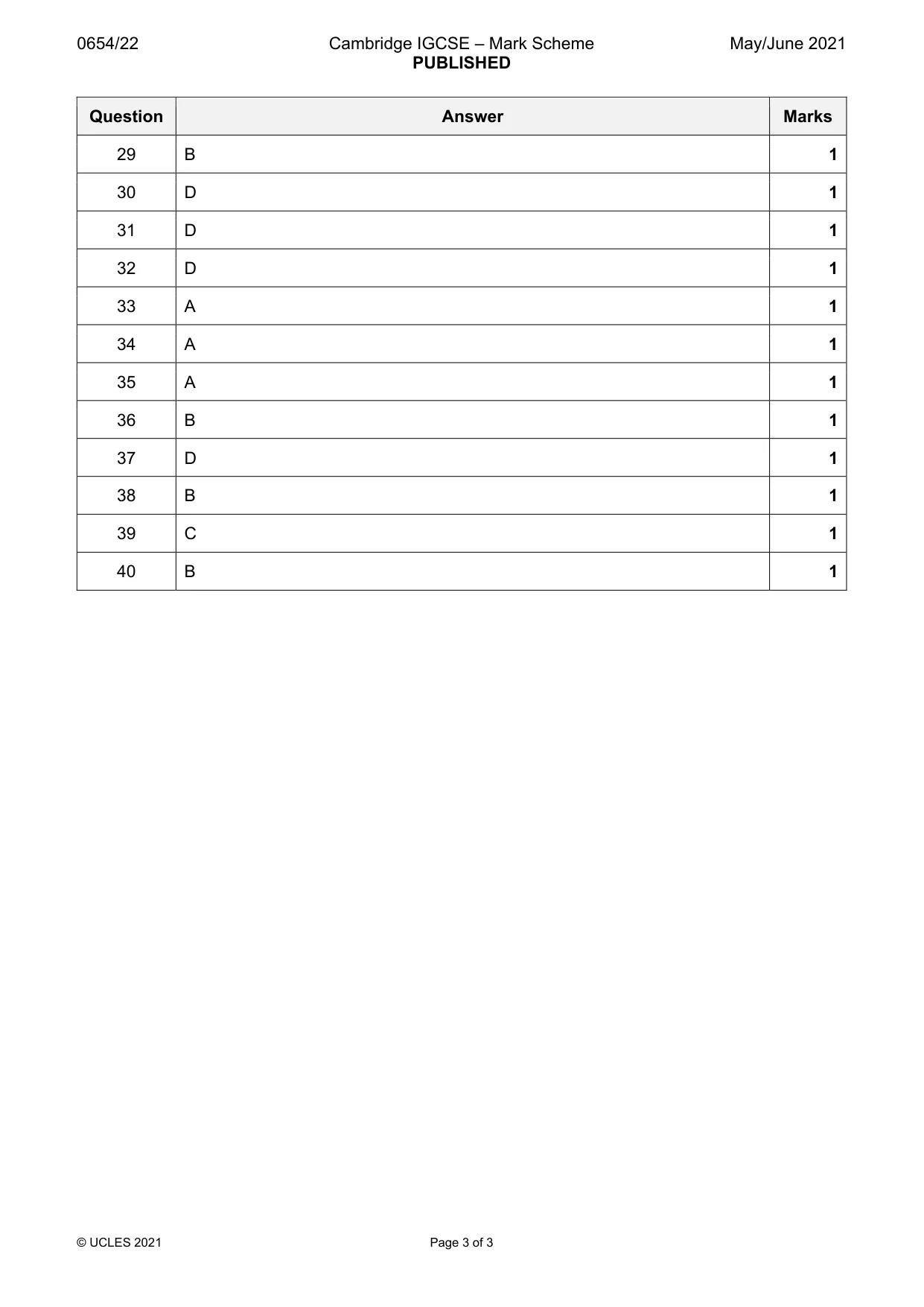
Answers below. Sit the paper first if you are practising.
Questions as text
Question 1
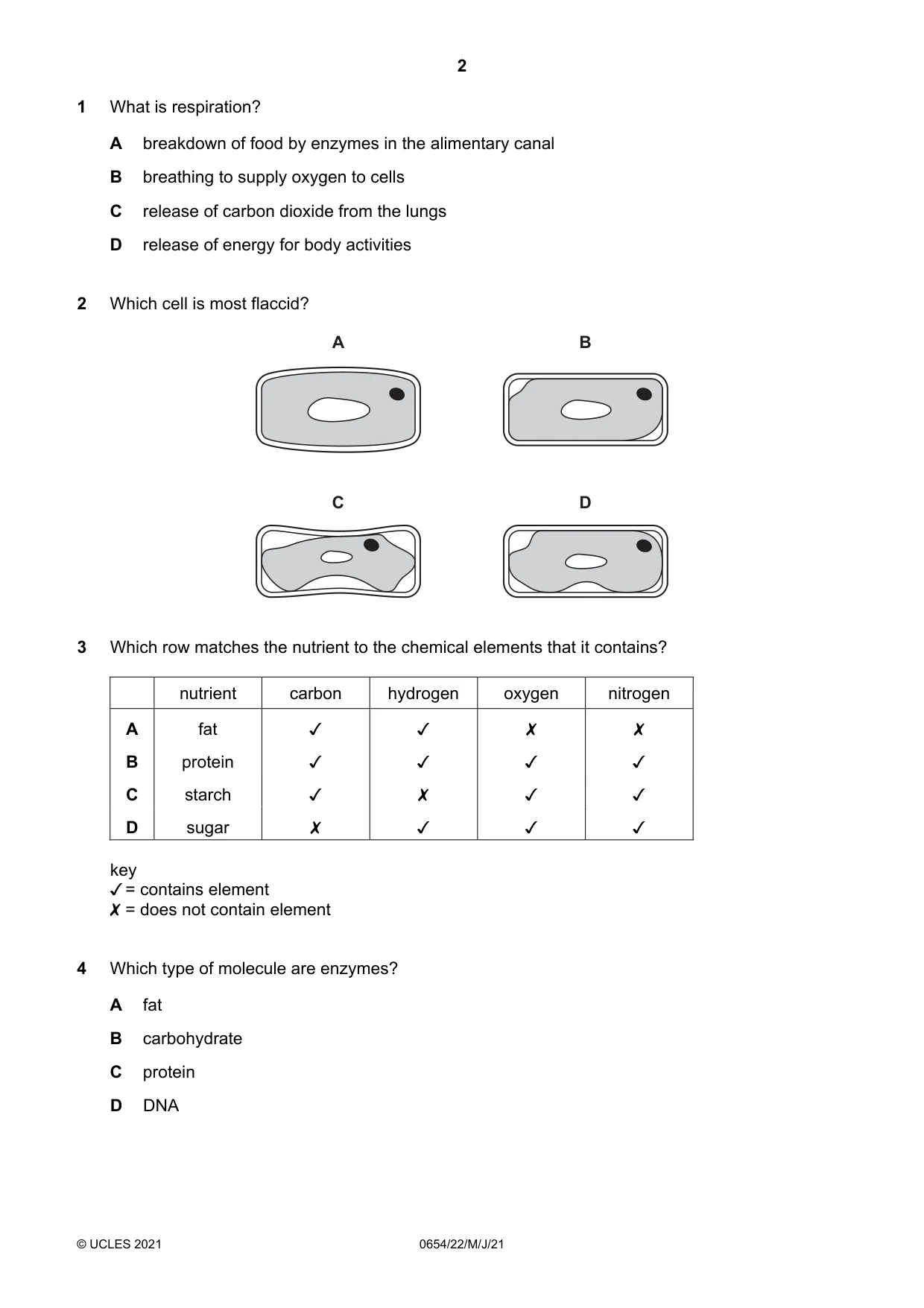
1 What is respiration? A breakdown of food by enzymes in the alimentary canal B breathing to supply oxygen to cells C release of carbon dioxide from the lungs D release of energy for body activities
Mark scheme: D
Q2 · Which cell is most flaccid?
2 Which cell is most flaccid? A B C D
Mark scheme: C
Q3 · Which row matches the nutrient to the chemical elements that it contains?
3. Which row matches the nutrient to the chemical elements that it contains? nutrient fat protein starch sugar carbon hydrogen oxygen nitrogen / = contains element X = does not contain element
Mark scheme: B
Q4 · Which type of molecule are enzymes?
4 Which type of molecule are enzymes? A fat B carbohydrate C protein D DNA
Mark scheme: C
Q5 · The balanced equation for photosynthesis is shown
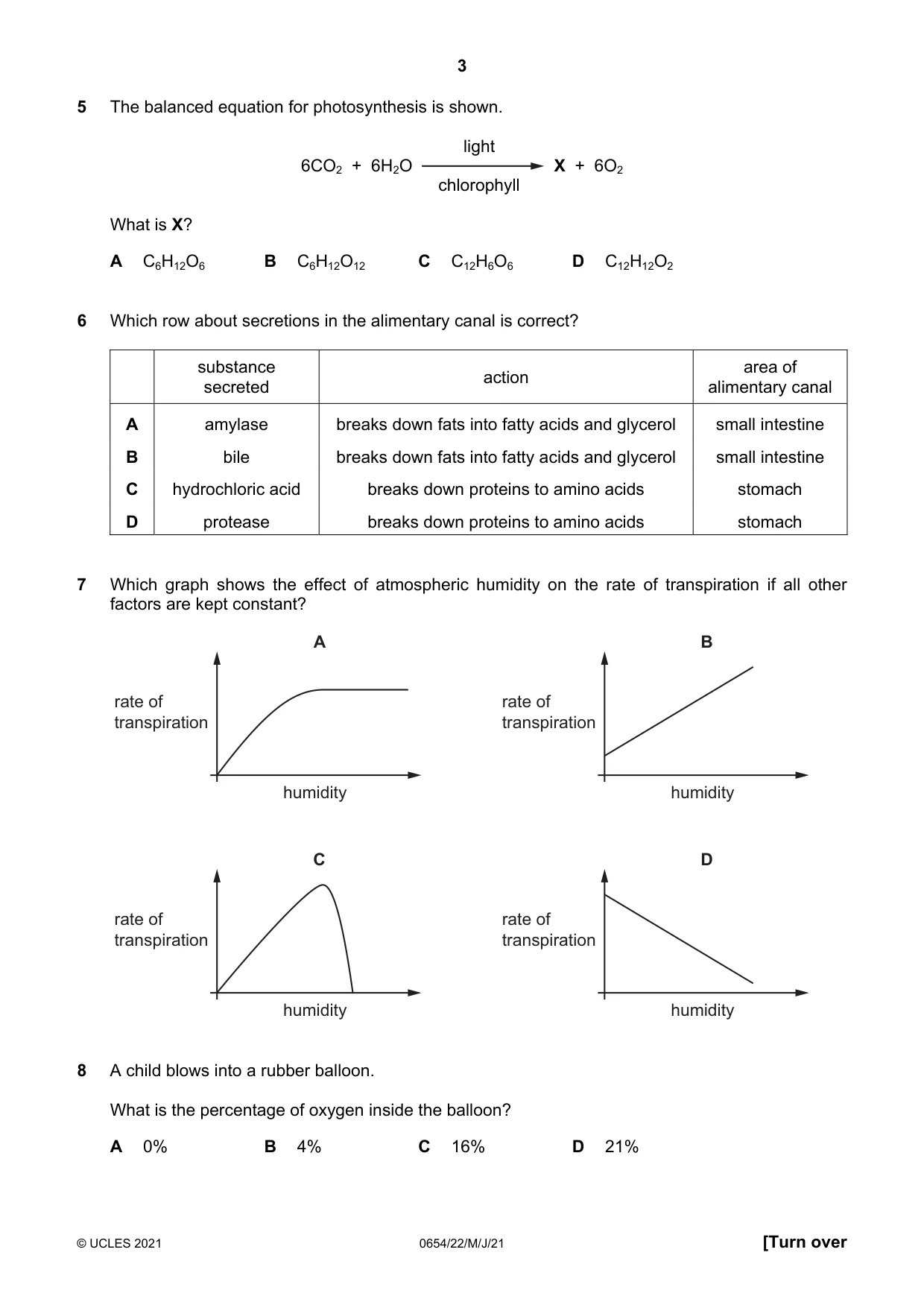
5 The balanced equation for photosynthesis is shown. light 6CO2 + 6H2O X + 6O2 chlorophyll What is X? A C6H12O6 B C6H12O12 C C12H6O6 D C12H12O2
Mark scheme: A
Q6 · Which row about secretions in the alimentary canal is correct?
6 Which row about secretions in the alimentary canal is correct? substance area of action secreted alimentary canal A amylase breaks down fats into fatty acids and glycerol small intestine B bile breaks down fats into fatty acids and glycerol small intestine C hydrochloric acid breaks down proteins to amino acids stomach D protease breaks down proteins to amino acids stomach
Mark scheme: D
Q7 · Which graph shows the effect of atmospheric humidity on the rate of transpiration if all…
7 Which graph shows the effect of atmospheric humidity on the rate of transpiration if all other factors are kept constant? A B rate of rate of transpiration transpiration humidity humidity C D rate of rate of transpiration transpiration humidity humidity
Mark scheme: D
Q8 · A child blows into a rubber balloon
8 A child blows into a rubber balloon. What is the percentage of oxygen inside the balloon? A 0% B 4% C 16% D 21%
Mark scheme: C
Q9 · A student is in a dangerous situation and adrenaline is released into the blood
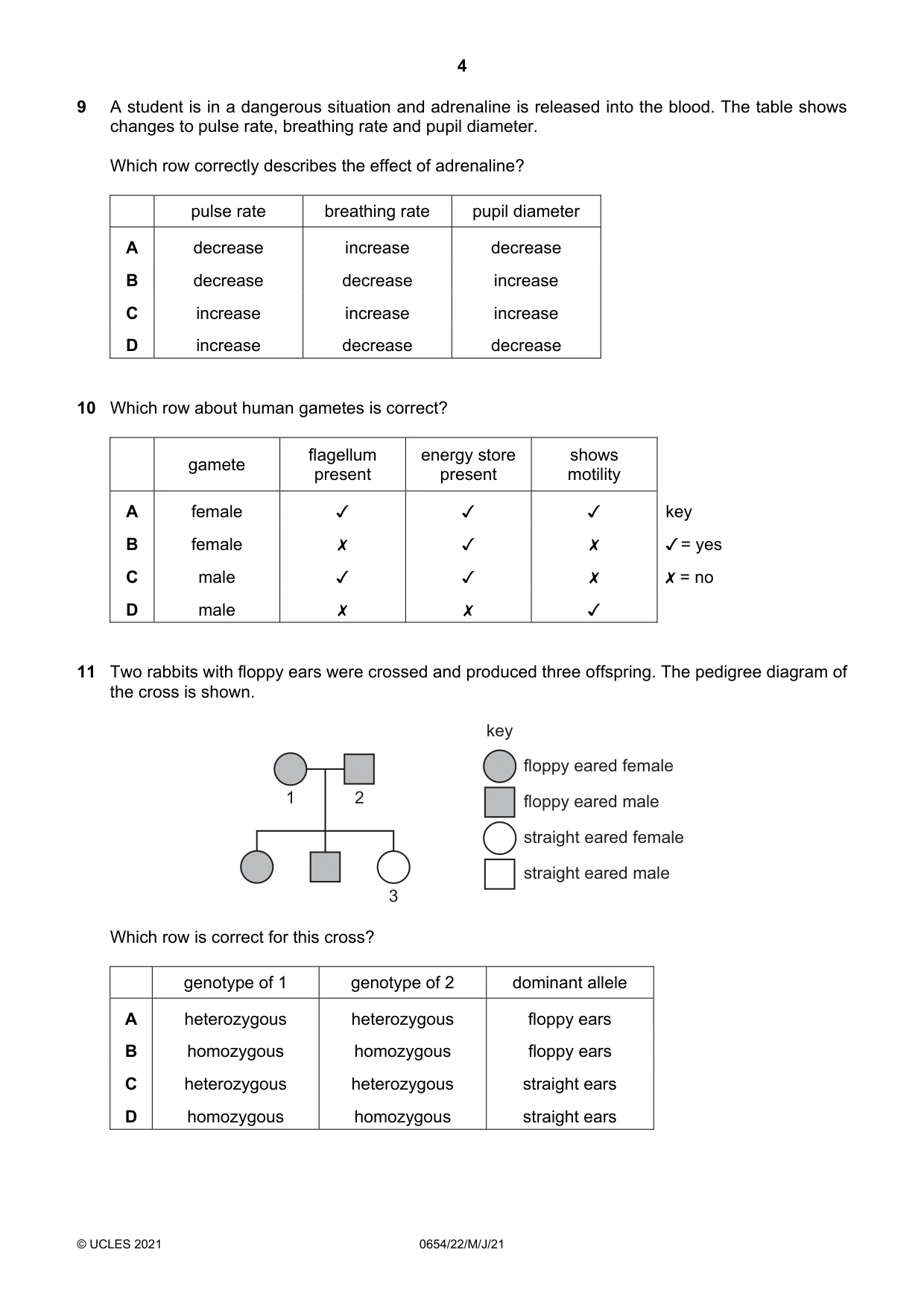
9 A student is in a dangerous situation and adrenaline is released into the blood. The table shows changes to pulse rate, breathing rate and pupil diameter. Which row correctly describes the effect of adrenaline? pulse rate breathing rate pupil diameter A decrease increase decrease B decrease decrease increase C increase increase increase D increase decrease decrease
Mark scheme: C
Q10 · Which row about human gametes is correct?
10 Which row about human gametes is correct? flagellum energy store shows gamete present present motility A female v v Jv B female Xx v x Cc male v v x D male x x v key /=yes X =no
Mark scheme: B
Q11 · Two rabbits with floppy ears were crossed and produced three offspring
11 Two rabbits with floppy ears were crossed and produced three offspring. The pedigree diagram of the cross is shown. key floppy eared female 1 2 floppy eared male straight eared female straight eared male 3 Which row is correct for this cross? genotype of 1 genotype of 2 dominant allele A heterozygous heterozygous floppy ears B homozygous homozygous floppy ears C heterozygous heterozygous straight ears D homozygous homozygous straight ears
Mark scheme: A
Q12 · Why do food chains usually have fewer than five trophic levels?
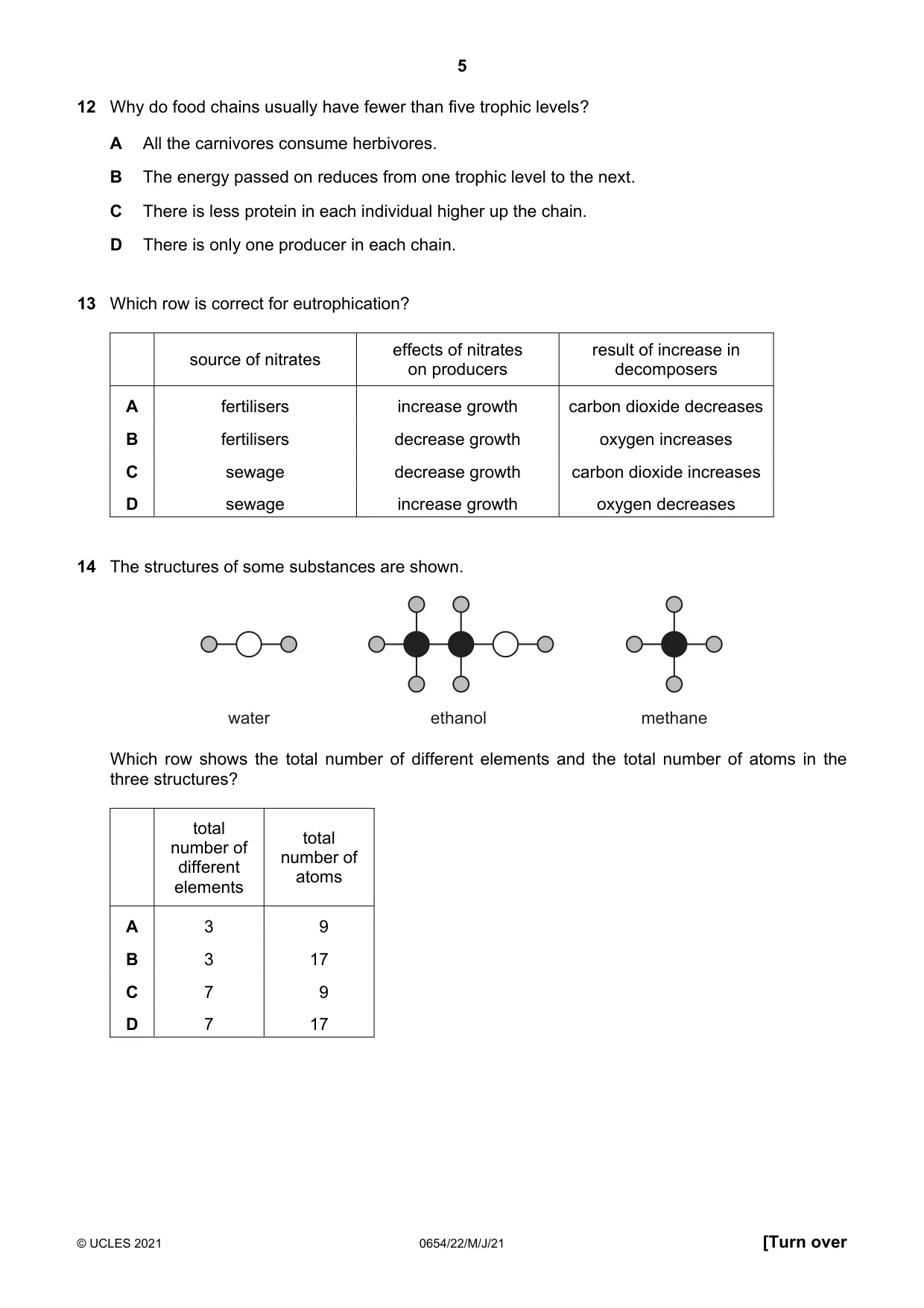
12 Why do food chains usually have fewer than five trophic levels? A All the carnivores consume herbivores. B The energy passed on reduces from one trophic level to the next. C There is less protein in each individual higher up the chain. D There is only one producer in each chain.
Mark scheme: B
Q13 · Which row is correct for eutrophication?
13 Which row is correct for eutrophication? effects of nitrates result of increase in source of nitrates on producers decomposers A fertilisers increase growth carbon dioxide decreases B fertilisers decrease growth oxygen increases C sewage decrease growth carbon dioxide increases D sewage increase growth oxygen decreases
Mark scheme: D
Q14 · The structures of some substances are shown
14 The structures of some substances are shown. water ethanol methane Which row shows the total number of different elements and the total number of atoms in the three structures? total total number of number of different atoms elements A 3 9 B 3 17 C 7 9 D 7 17
Mark scheme: B
Q15 · Which method can be used to separate graphite from dilute nitric acid?
15 Which method can be used to separate graphite from dilute nitric acid? A chromatography B crystallisation C distillation D filtration
Mark scheme: D
Q16 · Aqueous copper(II) sulfate is electrolysed using copper electrodes
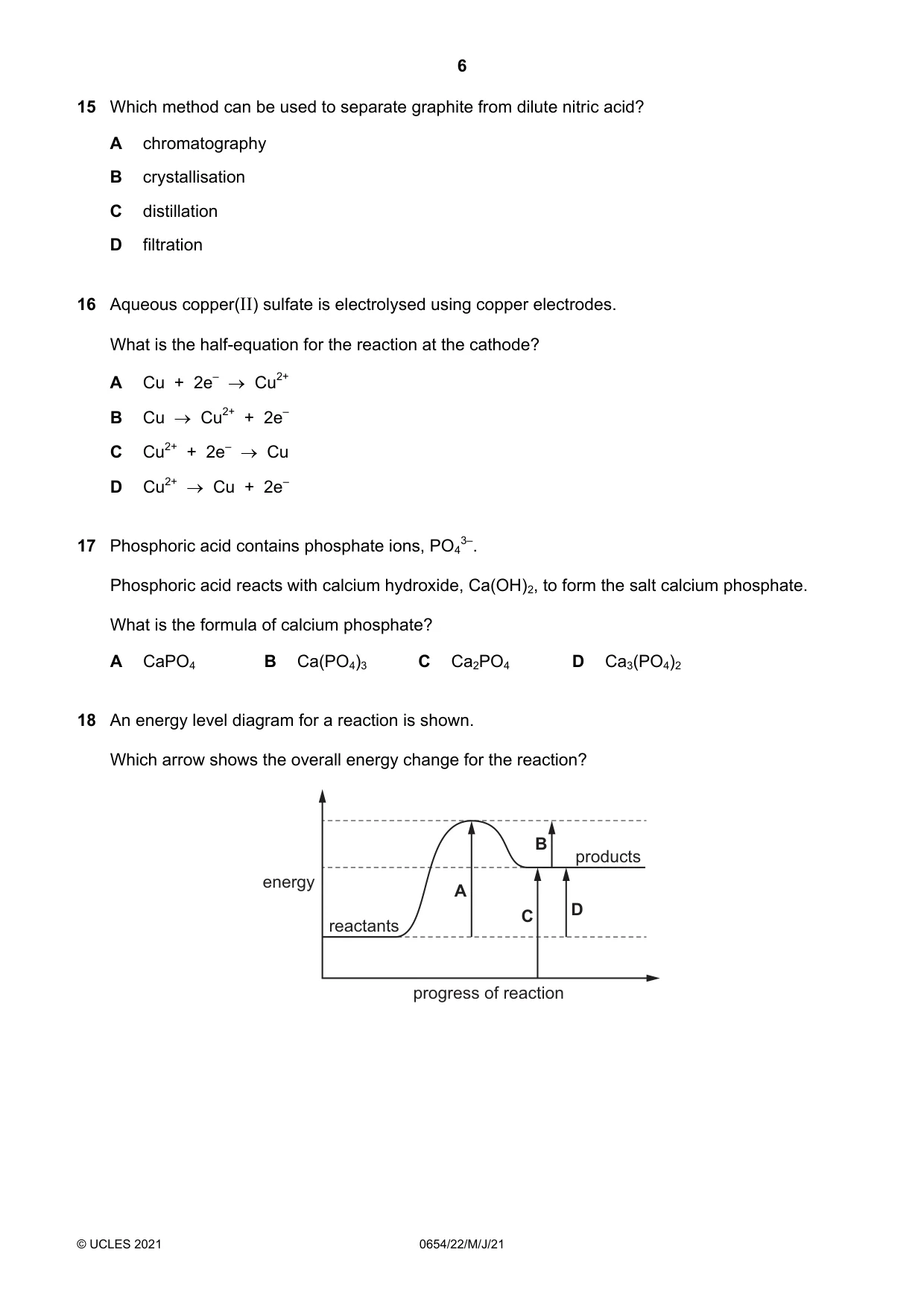
16 Aqueous copper(II) sulfate is electrolysed using copper electrodes. What is the half-equation for the reaction at the cathode? A Cu + 2e– Cu2+ B Cu Cu2+ + 2e– C Cu2+ + 2e– Cu D Cu2+ Cu + 2e–
Mark scheme: C
Q17 · Phosphoric acid contains phosphate ions, PO4 3–
17 Phosphoric acid contains phosphate ions, PO4 3–. Phosphoric acid reacts with calcium hydroxide, Ca(OH)2, to form the salt calcium phosphate. What is the formula of calcium phosphate? A CaPO4 B Ca(PO4)3 C Ca2PO4 D Ca3(PO4)2
Mark scheme: D
Q18 · An energy level diagram for a reaction is shown
18 An energy level diagram for a reaction is shown. Which arrow shows the overall energy change for the reaction? B products energy A C D reactants progress of reaction
Mark scheme: D
Q19 · Which changes show oxidation?
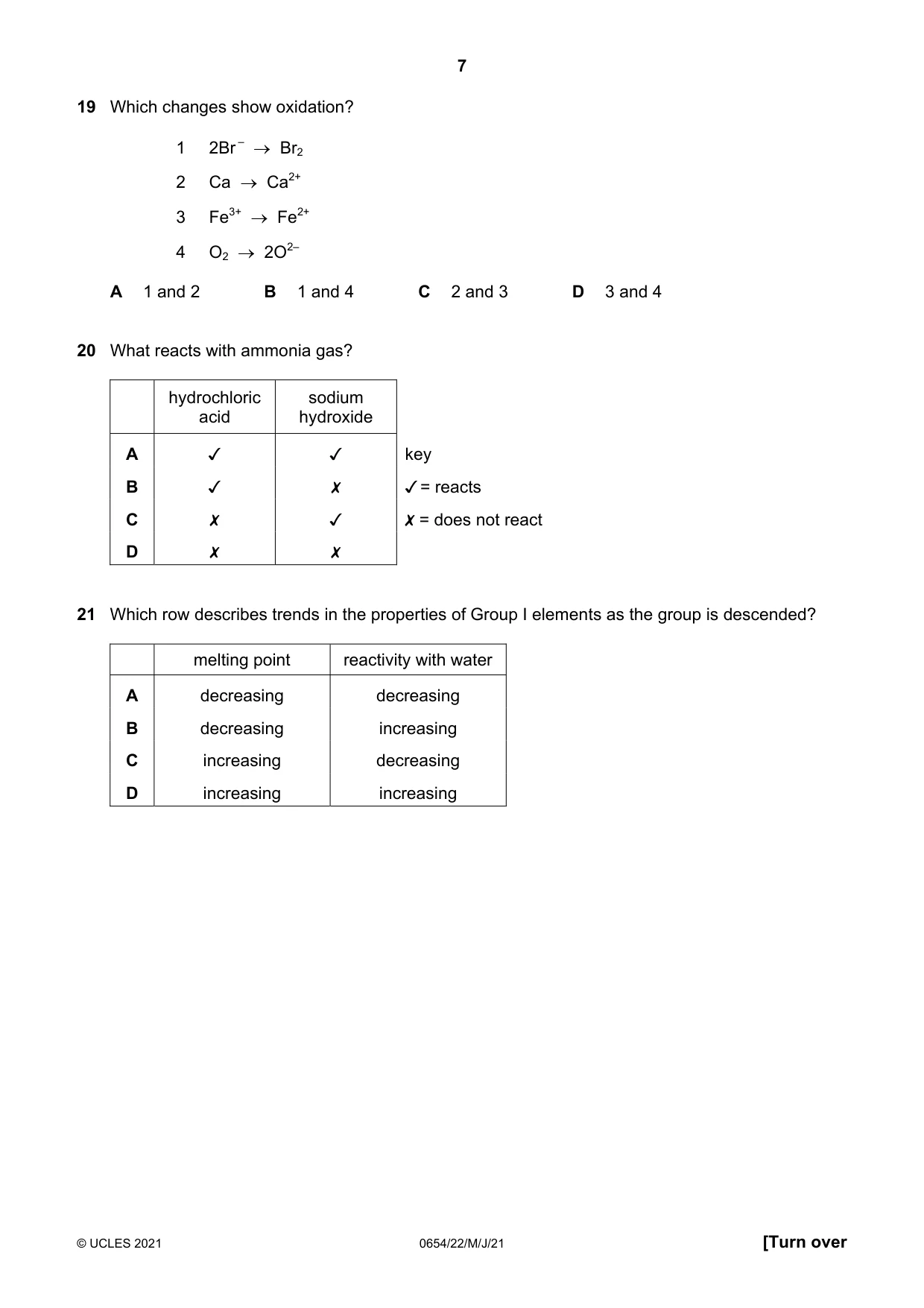
19 Which changes show oxidation? 1 2Br – Br2 2 Ca Ca2+ 3 Fe3+ Fe2+ 4 O2 2O2– A 1 and 2 B 1 and 4 C 2 and 3 D 3 and 4
Mark scheme: A
Q20 · What reacts with ammonia gas?
20 What reacts with ammonia gas? hydrochloric sodium acid hydroxide Jv Jv Jv x x Jv x x key Jv = reacts X = does not react
Mark scheme: B
More questions on The characteristic properties of acids and bases
Q21 · Which row describes trends in the properties of Group I elements as the group is…
21 Which row describes trends in the properties of Group I elements as the group is descended? melting point reactivity with water A decreasing decreasing B decreasing increasing C increasing decreasing D increasing increasing
Mark scheme: B
Q22 · Some observations from an investigation are shown
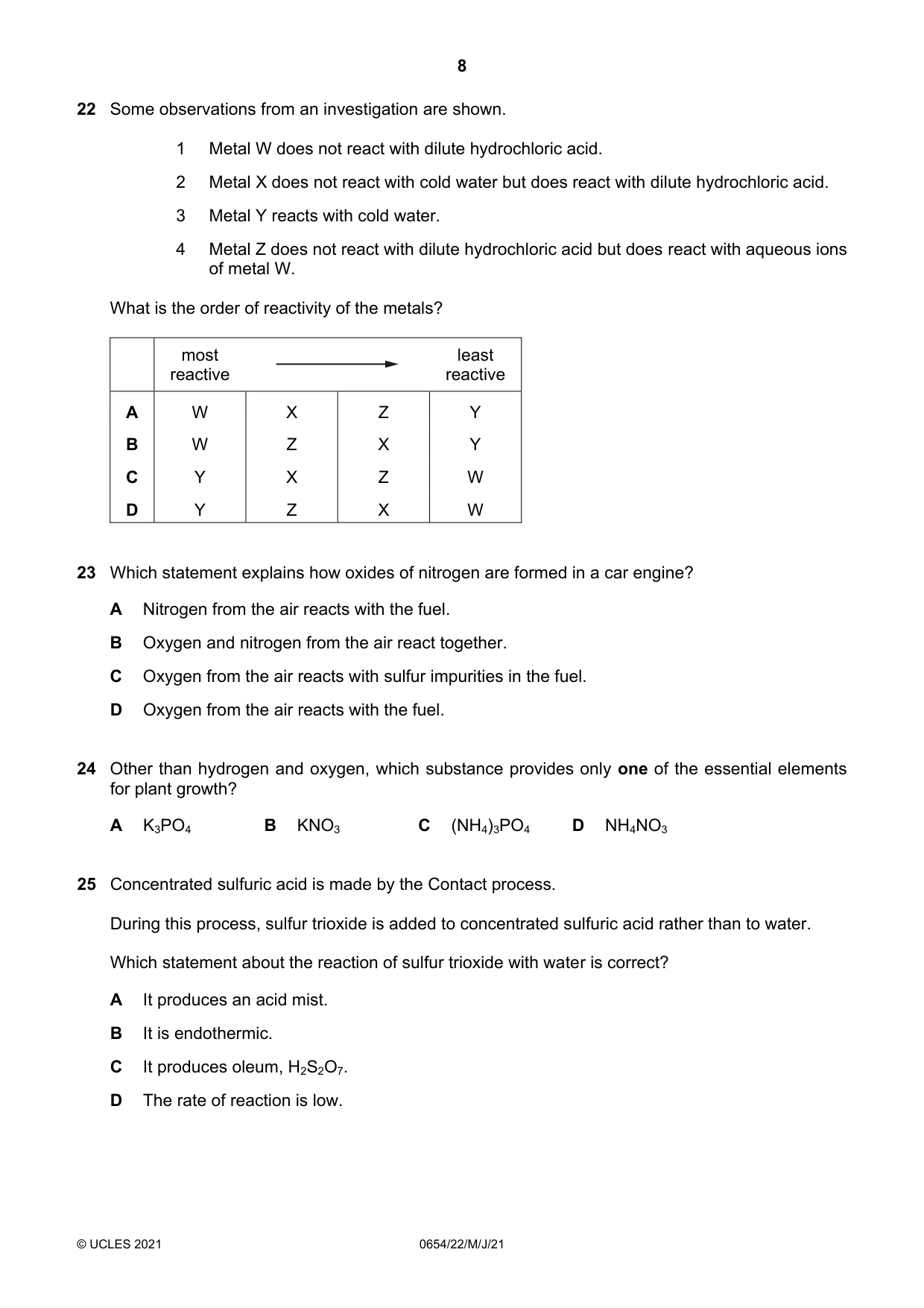
22 Some observations from an investigation are shown. 1 Metal W does not react with dilute hydrochloric acid. 2 Metal X does not react with cold water but does react with dilute hydrochloric acid. 3 Metal Y reacts with cold water. 4 Metal Z does not react with dilute hydrochloric acid but does react with aqueous ions of metal W. What is the order of reactivity of the metals? most least reactive reactive A W X Z Y B W Z X Y C Y X Z W D Y Z X W
Mark scheme: C
Q23 · Which statement explains how oxides of nitrogen are formed in a car engine?
23 Which statement explains how oxides of nitrogen are formed in a car engine? A Nitrogen from the air reacts with the fuel. B Oxygen and nitrogen from the air react together. C Oxygen from the air reacts with sulfur impurities in the fuel. D Oxygen from the air reacts with the fuel.
Mark scheme: B
Q24 · Other than hydrogen and oxygen, which substance provides only one of the essential…
24 Other than hydrogen and oxygen, which substance provides only one of the essential elements for plant growth? A K3PO4 B KNO3 C (NH4)3PO4 D NH4NO3
Mark scheme: D
Q25 · Concentrated sulfuric acid is made by the Contact process
25 Concentrated sulfuric acid is made by the Contact process. During this process, sulfur trioxide is added to concentrated sulfuric acid rather than to water. Which statement about the reaction of sulfur trioxide with water is correct? A It produces an acid mist. B It is endothermic. C It produces oleum, H2S2O7. D The rate of reaction is low.
Mark scheme: A
Q26 · What are the products of the thermal decomposition of calcium carbonate, CaCO3?
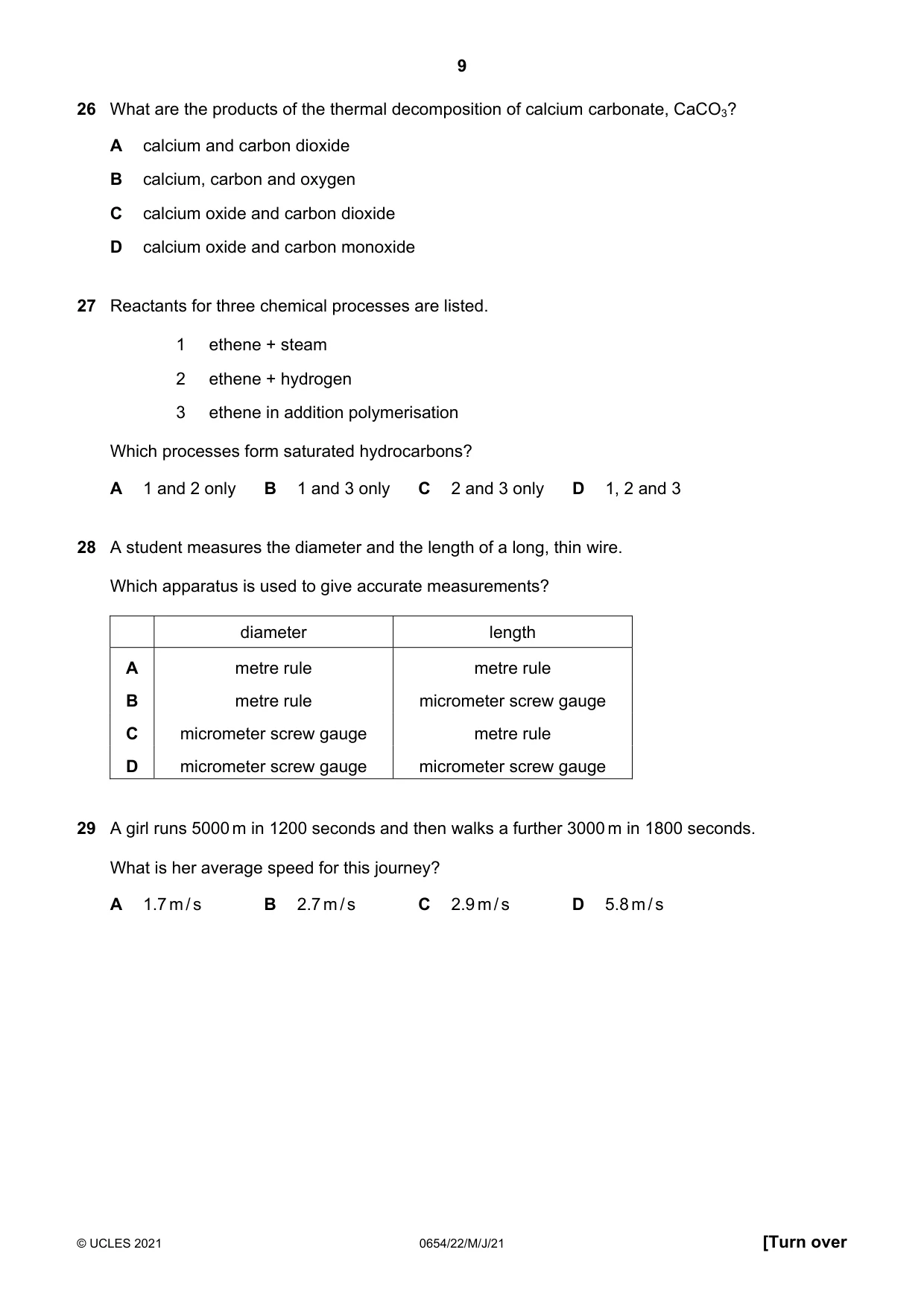
26 What are the products of the thermal decomposition of calcium carbonate, CaCO3? A calcium and carbon dioxide B calcium, carbon and oxygen C calcium oxide and carbon dioxide D calcium oxide and carbon monoxide
Mark scheme: C
Q27 · Reactants for three chemical processes are listed
27 Reactants for three chemical processes are listed. 1 ethene + steam 2 ethene + hydrogen 3 ethene in addition polymerisation Which processes form saturated hydrocarbons? A 1 and 2 only B 1 and 3 only C 2 and 3 only D 1, 2 and 3
Mark scheme: C
Q28 · A student measures the diameter and the length of a long, thin wire
28 A student measures the diameter and the length of a long, thin wire. Which apparatus is used to give accurate measurements? diameter length A metre rule metre rule B metre rule micrometer screw gauge C micrometer screw gauge metre rule D micrometer screw gauge micrometer screw gauge
Mark scheme: C
More questions on Physical quantities and measurement techniques
Q29 · A girl runs 5000 m in 1200 seconds and then walks a further 3000 m in 1800 seconds
29 A girl runs 5000 m in 1200 seconds and then walks a further 3000 m in 1800 seconds. What is her average speed for this journey? A 1.7 m / s B 2.7 m / s C 2.9 m / s D 5.8 m / s
Mark scheme: B
Q30 · Three objects X, Y and Z are at rest on a table
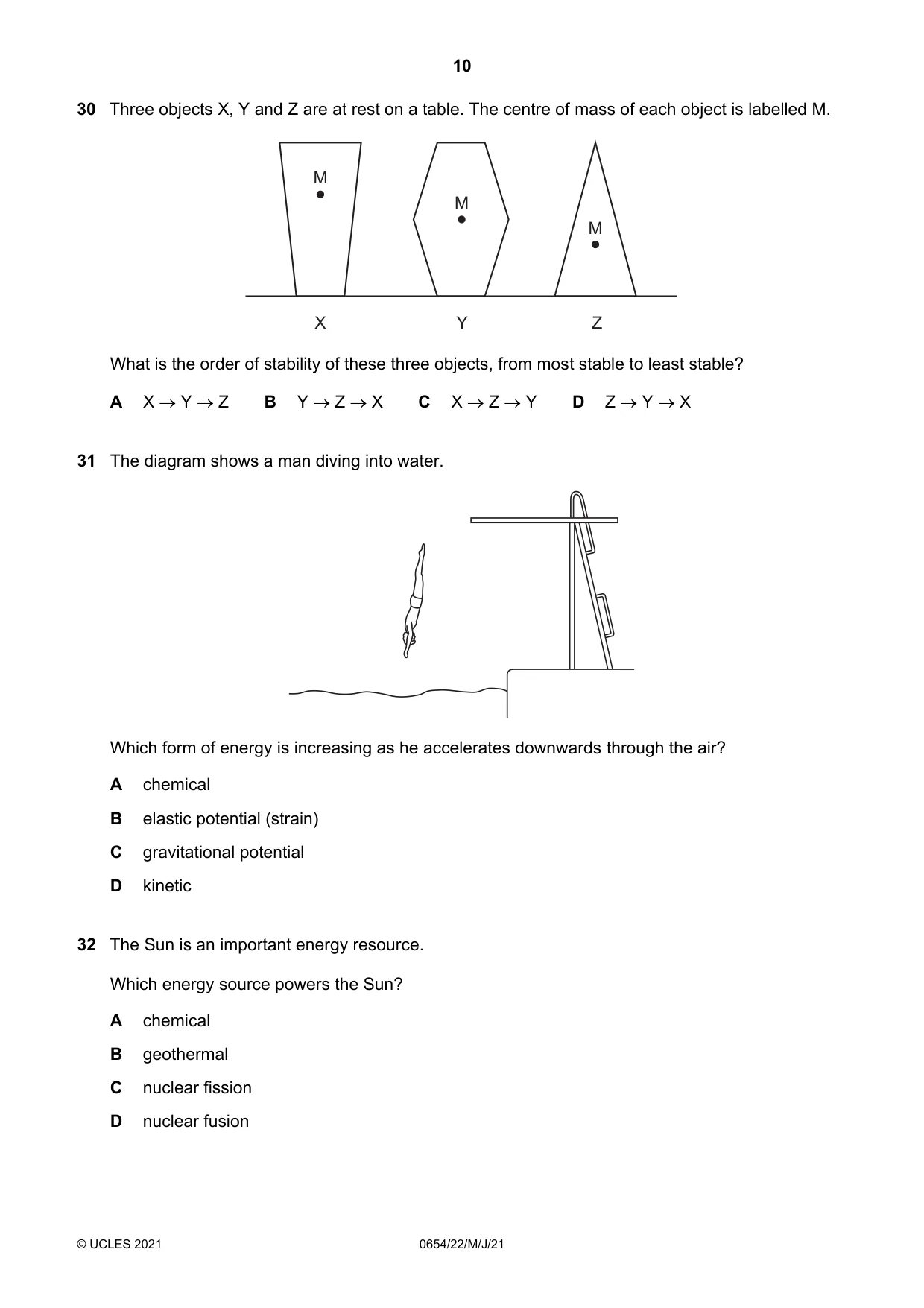
30 Three objects X, Y and Z are at rest on a table. The centre of mass of each object is labelled M. M M M X Y Z What is the order of stability of these three objects, from most stable to least stable? A X Y Z B Y Z X C X Z Y D Z Y X
Mark scheme: D
Q31 · The diagram shows a man diving into water
31 The diagram shows a man diving into water. Which form of energy is increasing as he accelerates downwards through the air? A chemical B elastic potential (strain) C gravitational potential D kinetic
Mark scheme: D
Q32 · The Sun is an important energy resource
32 The Sun is an important energy resource. Which energy source powers the Sun? A chemical B geothermal C nuclear fission D nuclear fusion
Mark scheme: D
Q33 · Which change increases the sensitivity of a liquid-in-glass thermometer?
33 Which change increases the sensitivity of a liquid-in-glass thermometer? A decreasing the diameter of the capillary bore B decreasing the length of the capillary bore C increasing the diameter of the capillary bore D increasing the length of the capillary bore
Mark scheme: A
Q34 · Four identical metal cans contain equal quantities of water at 80 C
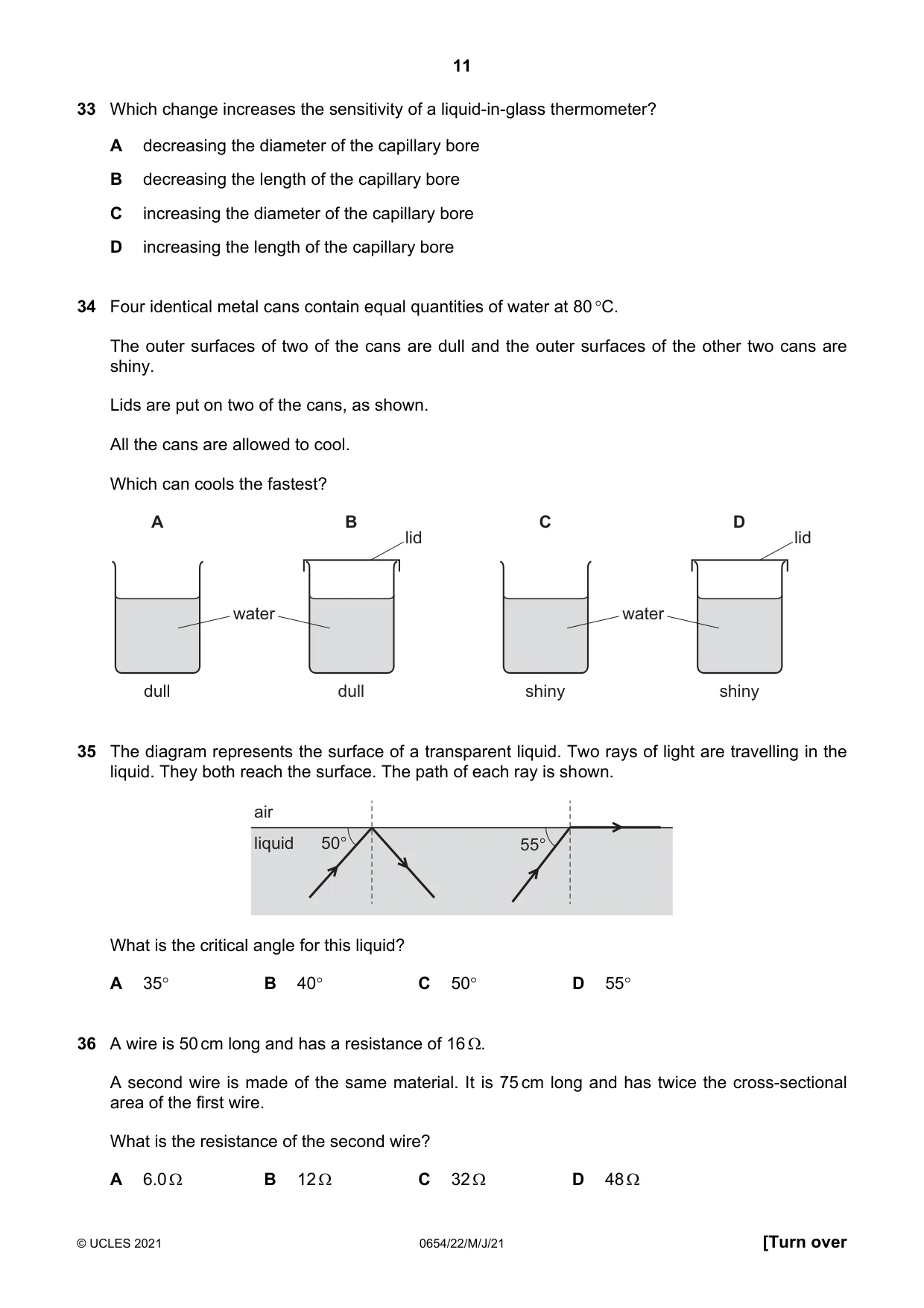
34 Four identical metal cans contain equal quantities of water at 80 C. The outer surfaces of two of the cans are dull and the outer surfaces of the other two cans are shiny. Lids are put on two of the cans, as shown. All the cans are allowed to cool. Which can cools the fastest? A B C D lid lid water water dull dull shiny shiny
Mark scheme: A
Q35 · The diagram represents the surface of a transparent liquid
35 The diagram represents the surface of a transparent liquid. Two rays of light are travelling in the liquid. They both reach the surface. The path of each ray is shown. air liquid 50° 55° What is the critical angle for this liquid? A 35 B 40 C 50 D 55
Mark scheme: A
Q36 · A wire is 50 cm long and has a resistance of 16
36 A wire is 50 cm long and has a resistance of 16 . A second wire is made of the same material. It is 75 cm long and has twice the cross-sectional area of the first wire. What is the resistance of the second wire? A 6.0 B 12 C 32 D 48
Mark scheme: B
Q37 · Which statements about the current–voltage characteristic of a filament lamp are correct?
37 Which statements about the current–voltage characteristic of a filament lamp are correct? 1 It is a curve. 2 It passes through the origin. 3 It shows current increasing as voltage increases. A 1 and 2 only B 1 and 3 only C 2 and 3 only D 1, 2 and 3
Mark scheme: D
Q38 · A student connects the circuit shown
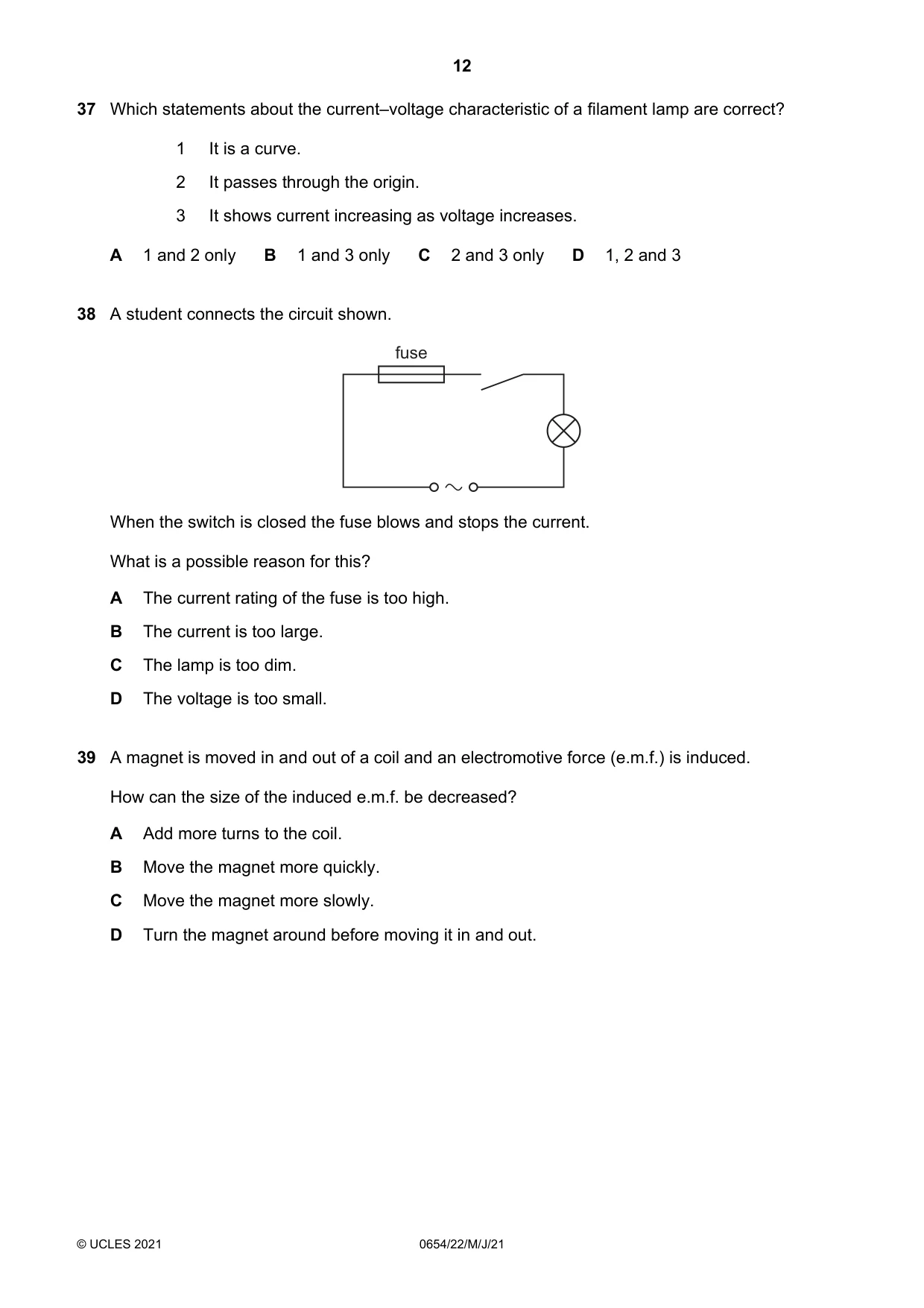
38 A student connects the circuit shown. fuse When the switch is closed the fuse blows and stops the current. What is a possible reason for this? A The current rating of the fuse is too high. B The current is too large. C The lamp is too dim. D The voltage is too small.
Mark scheme: B
Q39 · A magnet is moved in and out of a coil and an electromotive force (e.m.f.) is induced
39 A magnet is moved in and out of a coil and an electromotive force (e.m.f.) is induced. How can the size of the induced e.m.f. be decreased? A Add more turns to the coil. B Move the magnet more quickly. C Move the magnet more slowly. D Turn the magnet around before moving it in and out.
Mark scheme: C
Q40 · A radioactive nucleus emits a -particle
40 A radioactive nucleus emits a -particle. What happens to the proton number (atomic number) of the nucleus? A It stays the same. B It increases by 1. C It decreases by 2. D It decreases by 4.
Mark scheme: B
What was in this paper
The subtopics covered by these 40 questions, and how many questions each got. Open one in a new tab to see every Cambridge question on it.
2Air quality and climate1Alkenes1Biological molecules1Conservation1Coordination and response1Digestion1Electrical circuits1Electrical quantities1Electrical safety1Electrolysis1Electromagnetic effects1Elements, compounds and mixtures1Energy flow1Energy, work and power1Enzymes1Exothermic and endothermic reactions1Forces1Formulas1Gas exchange in humans1Group I properties1Light1Monohybrid inheritance1Motion1Osmosis1Photosynthesis1Physical and chemical changes1Physical quantities and measurement techniques1Radioactivity1Reactivity series1Redox1Respiration1Separation and purification1Sexual reproduction in humans1Stars and the Universe1The characteristic properties of acids and bases1Thermal properties and temperature1Transfer of thermal energy1Transpiration1What you needed in this session
Cambridge’s own grade thresholds for 2021 May/June, Paper 2 · Variant 2. A higher threshold means an easier paper — the bar moves with how the cohort did.