Cambridge IGCSE Sciences - Co-ordinated (Double) 0654 — 2024 May/June Paper 2 · Variant 3
0654/23/M/J/24 · 40 questions · 40 marks · ≈45 min
The question paper and its mark scheme, free to read here and free to download. This is Cambridge’s own paper, exactly as it was sat.
Question paper20 pages


Mark scheme3 pages
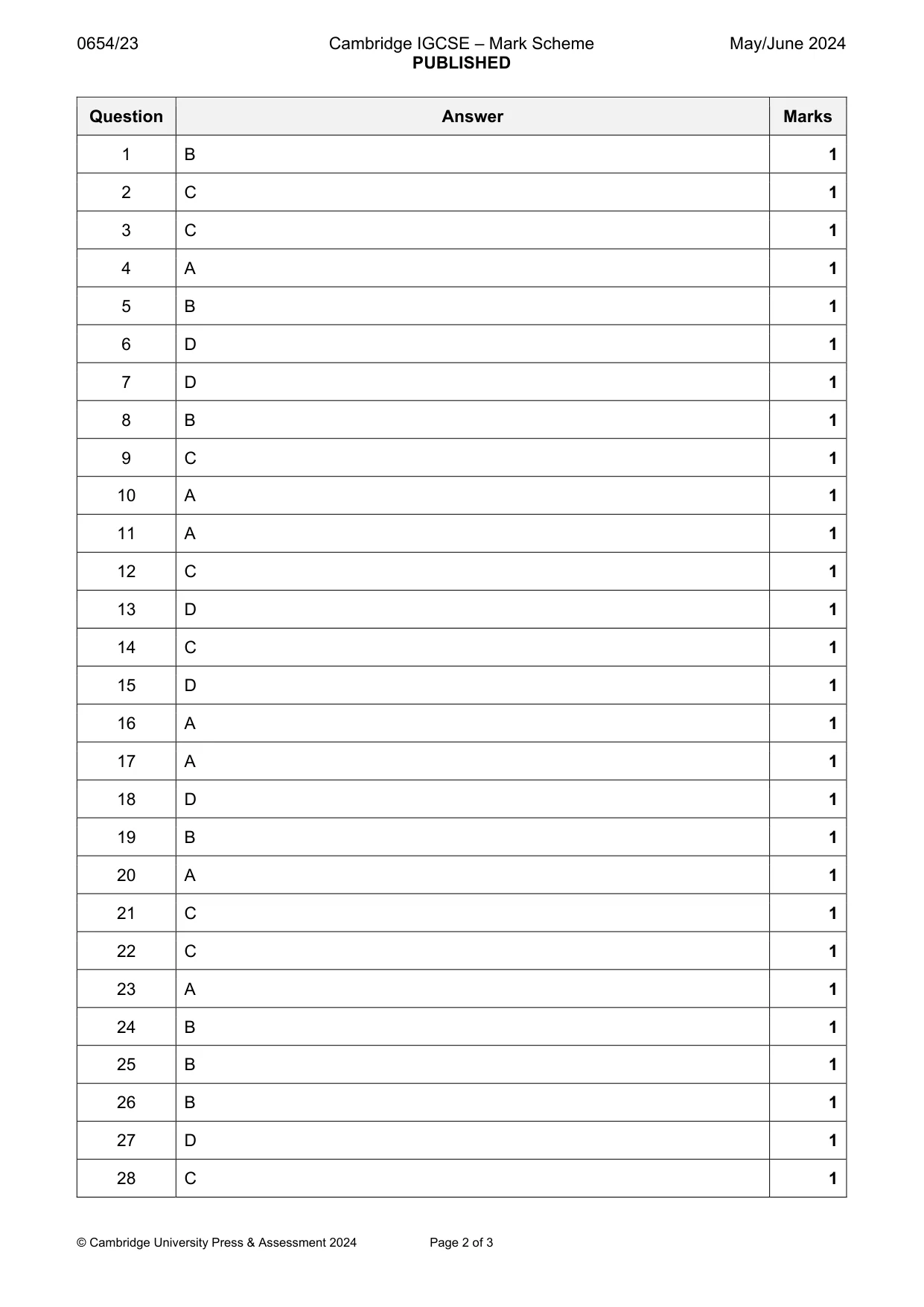
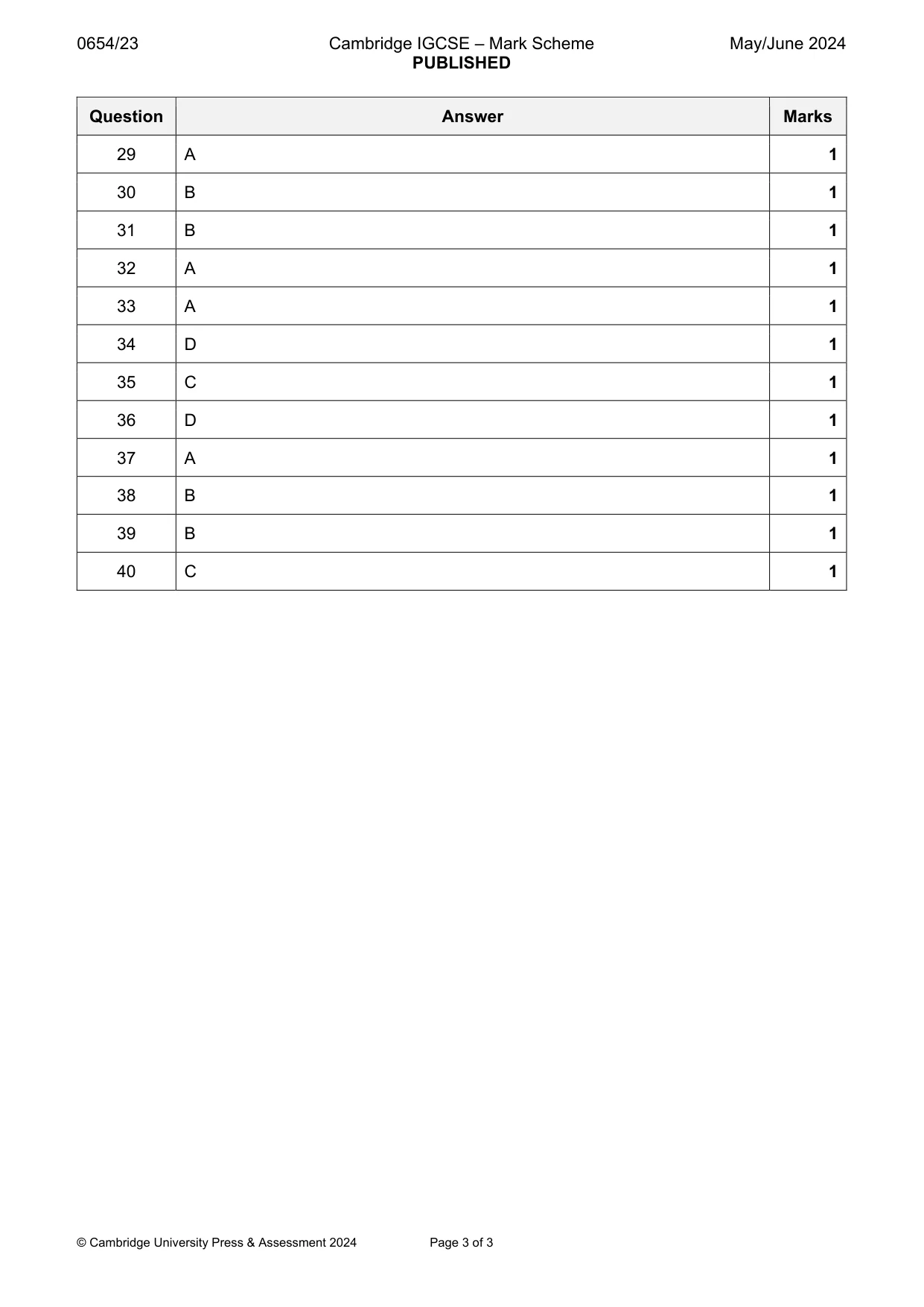
Answers below. Sit the paper first if you are practising.
Questions as text
Q1 · What do both animals and plants need to meet their nutritional requirements?
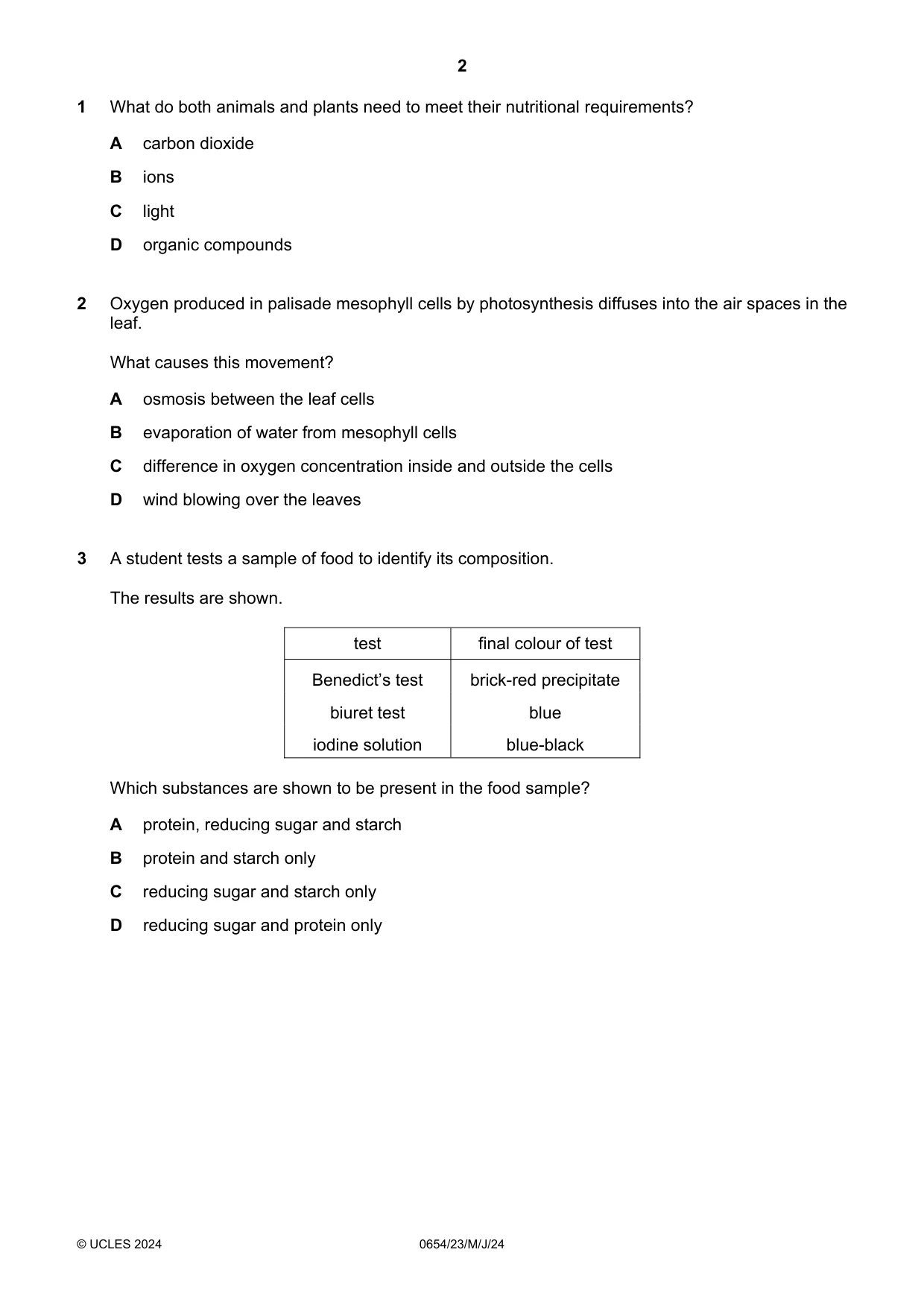
1 What do both animals and plants need to meet their nutritional requirements? A carbon dioxide B ions C light D organic compounds
Mark scheme: B
Q2 · Oxygen produced in palisade mesophyll cells by photosynthesis diffuses into the air…
2 Oxygen produced in palisade mesophyll cells by photosynthesis diffuses into the air spaces in the leaf. What causes this movement? A osmosis between the leaf cells B evaporation of water from mesophyll cells C difference in oxygen concentration inside and outside the cells D wind blowing over the leaves
Mark scheme: C
Q3 · A student tests a sample of food to identify its composition
3 A student tests a sample of food to identify its composition. The results are shown. test final colour of test Benedict’s test brick-red precipitate biuret test blue iodine solution blue-black Which substances are shown to be present in the food sample? A protein, reducing sugar and starch B protein and starch only C reducing sugar and starch only D reducing sugar and protein only
Mark scheme: C
Q4 · The diagram shows a functional human enzyme at 37 C
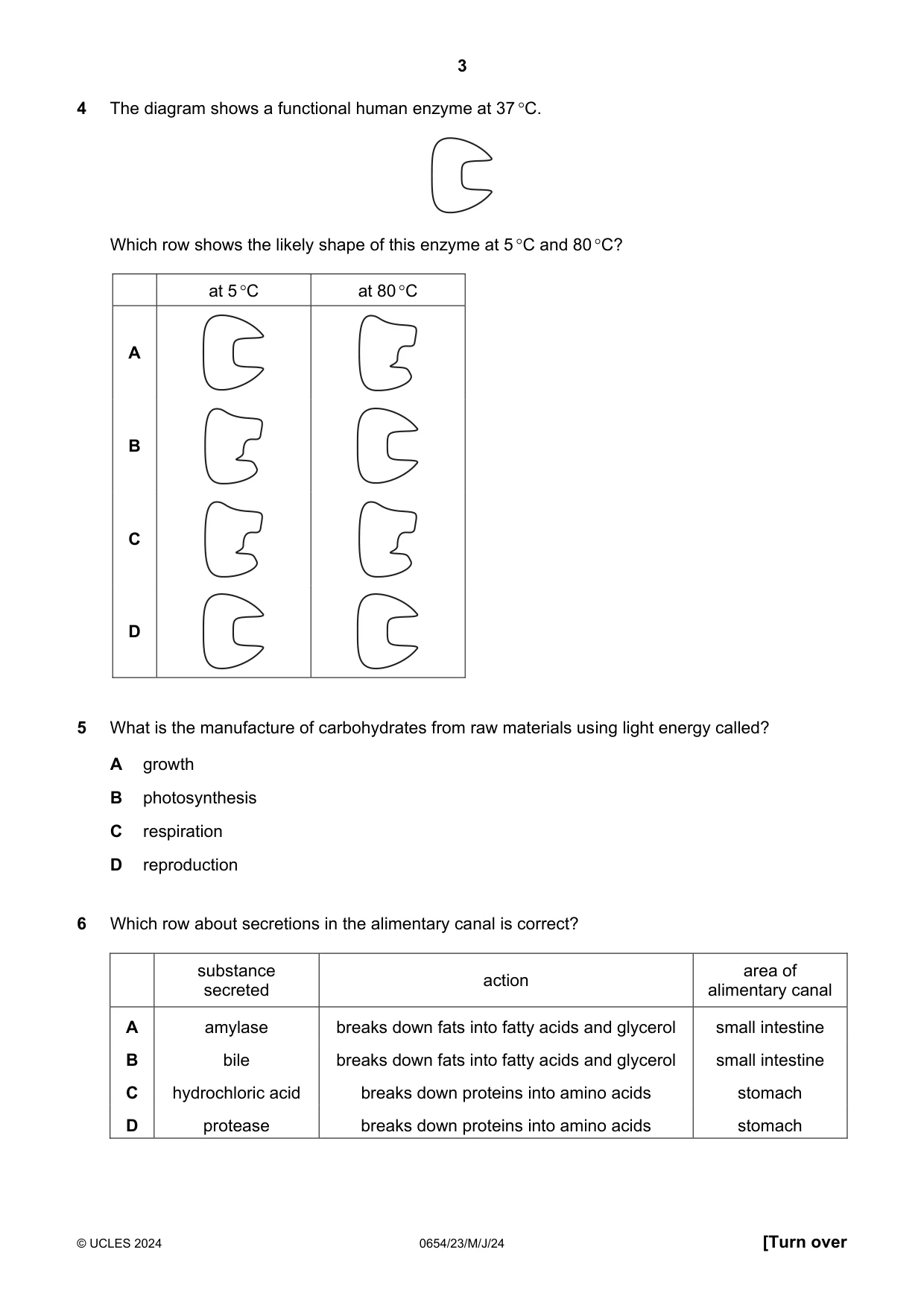
4 The diagram shows a functional human enzyme at 37 C. Which row shows the likely shape of this enzyme at 5 C and 80 C? at 5 C at 80 C A B C D
Mark scheme: A
Q5 · What is the manufacture of carbohydrates from raw materials using light energy called?
5 What is the manufacture of carbohydrates from raw materials using light energy called? A growth B photosynthesis C respiration D reproduction
Mark scheme: B
Q6 · Which row about secretions in the alimentary canal is correct?
6 Which row about secretions in the alimentary canal is correct? substance area of action secreted alimentary canal A amylase breaks down fats into fatty acids and glycerol small intestine B bile breaks down fats into fatty acids and glycerol small intestine C hydrochloric acid breaks down proteins into amino acids stomach D protease breaks down proteins into amino acids stomach
Mark scheme: D
Q7 · Which vessels carry blood towards the heart?
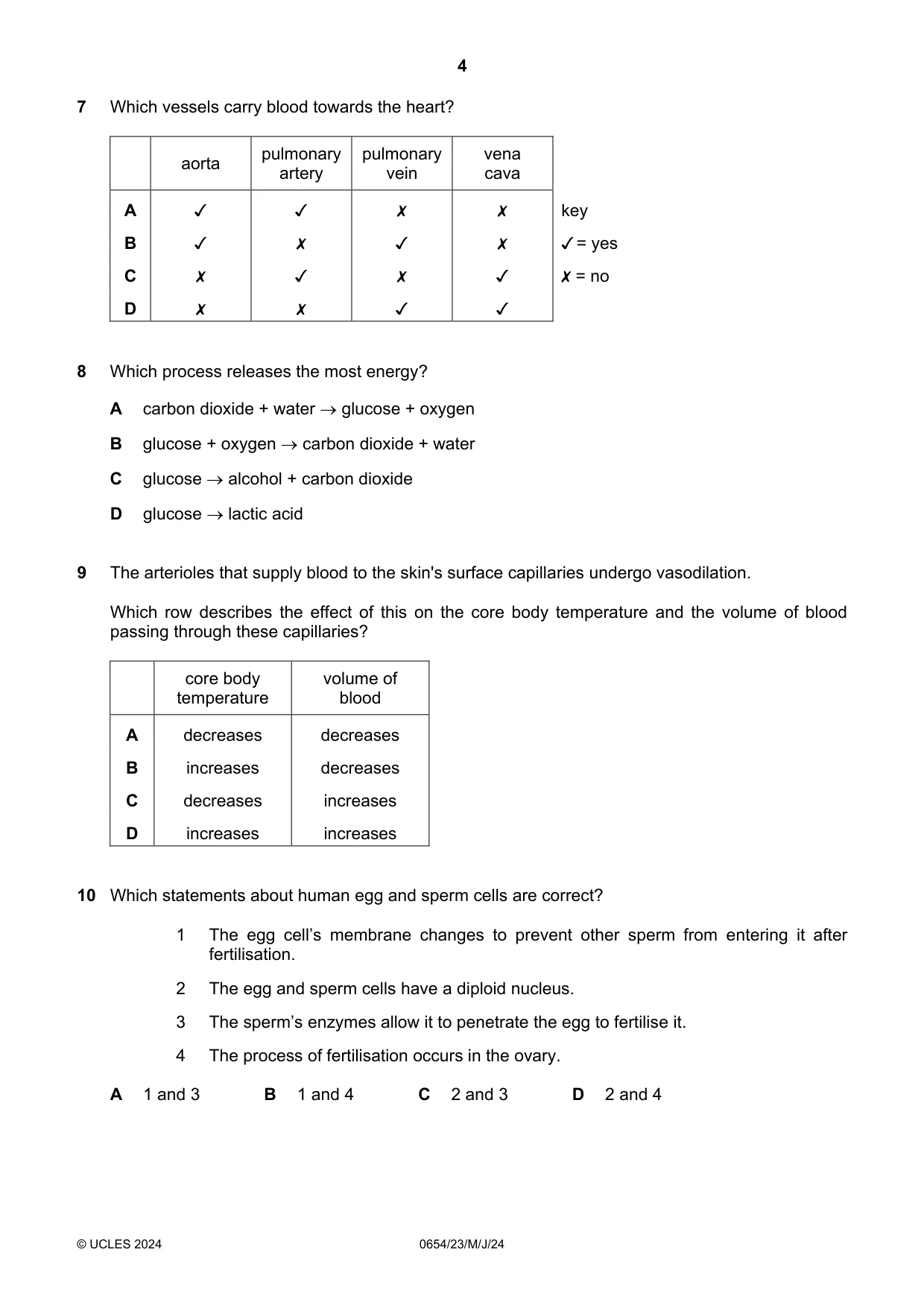
7 Which vessels carry blood towards the heart? A Jv Jv x x B Jv x Jv x Cc x Jv x Jv D x x Jv v key /=yes X =no
Mark scheme: D
Q8 · Which process releases the most energy?
8 Which process releases the most energy? A carbon dioxide + water glucose + oxygen B glucose + oxygen carbon dioxide + water C glucose alcohol + carbon dioxide D glucose lactic acid
Mark scheme: B
Q9 · The arterioles that supply blood to the skin's surface capillaries undergo vasodilation
9 The arterioles that supply blood to the skin's surface capillaries undergo vasodilation. Which row describes the effect of this on the core body temperature and the volume of blood passing through these capillaries? core body volume of temperature blood A decreases decreases B increases decreases C decreases increases D increases increases
Mark scheme: C
Q10 · Which statements about human egg and sperm cells are correct?
10 Which statements about human egg and sperm cells are correct? 1 The egg cell’s membrane changes to prevent other sperm from entering it after fertilisation. 2 The egg and sperm cells have a diploid nucleus. 3 The sperm’s enzymes allow it to penetrate the egg to fertilise it. 4 The process of fertilisation occurs in the ovary. A 1 and 3 B 1 and 4 C 2 and 3 D 2 and 4
Mark scheme: A
Q11 · Which row shows the sex chromosomes in humans?
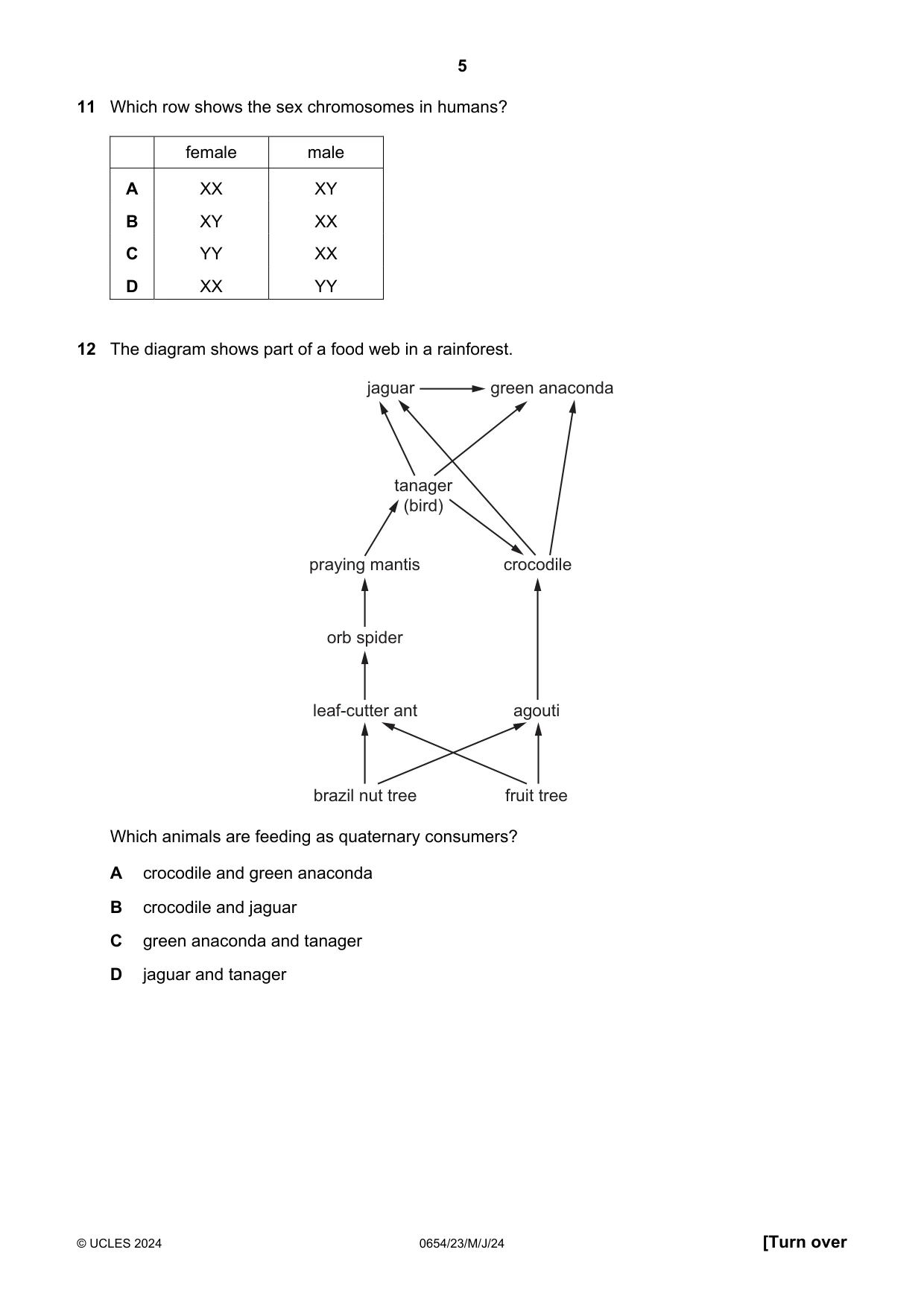
11 Which row shows the sex chromosomes in humans? female male A XX XY B XY XX C YY XX D XX YY
Mark scheme: A
Q12 · The diagram shows part of a food web in a rainforest
12 The diagram shows part of a food web in a rainforest. jaguar green anaconda tanager (bird) praying mantis crocodile orb spider leaf-cutter ant agouti brazil nut tree fruit tree Which animals are feeding as quaternary consumers? A crocodile and green anaconda B crocodile and jaguar C green anaconda and tanager D jaguar and tanager
Mark scheme: C
Q13 · The diagram shows part of the carbon cycle
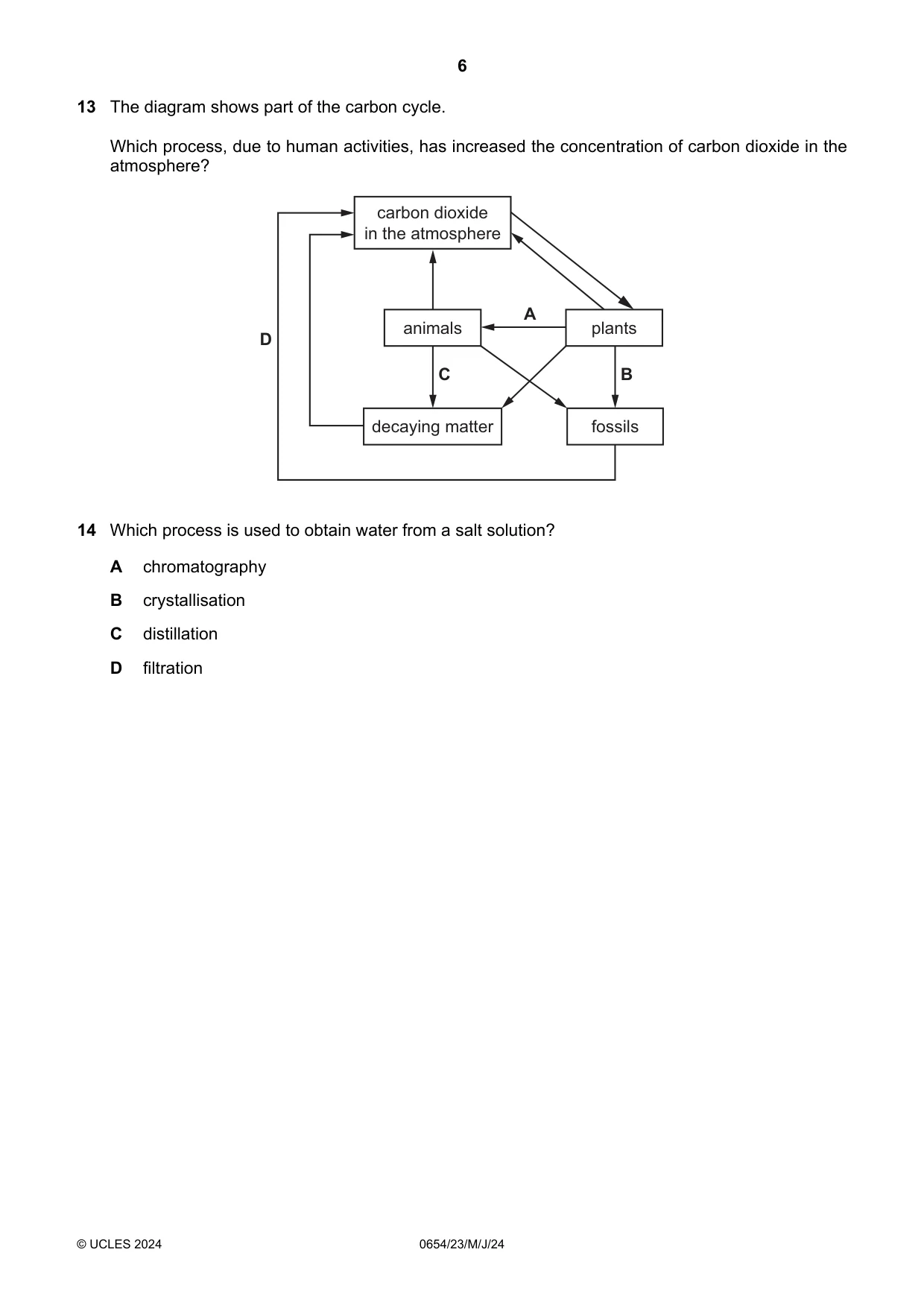
13 The diagram shows part of the carbon cycle. Which process, due to human activities, has increased the concentration of carbon dioxide in the atmosphere? carbon dioxide in the atmosphere A D animals plants C B decaying matter fossils
Mark scheme: D
Q14 · Which process is used to obtain water from a salt solution?
14 Which process is used to obtain water from a salt solution? A chromatography B crystallisation C distillation D filtration
Mark scheme: C
Q15 · One isotope of oxygen is represented by 16 O
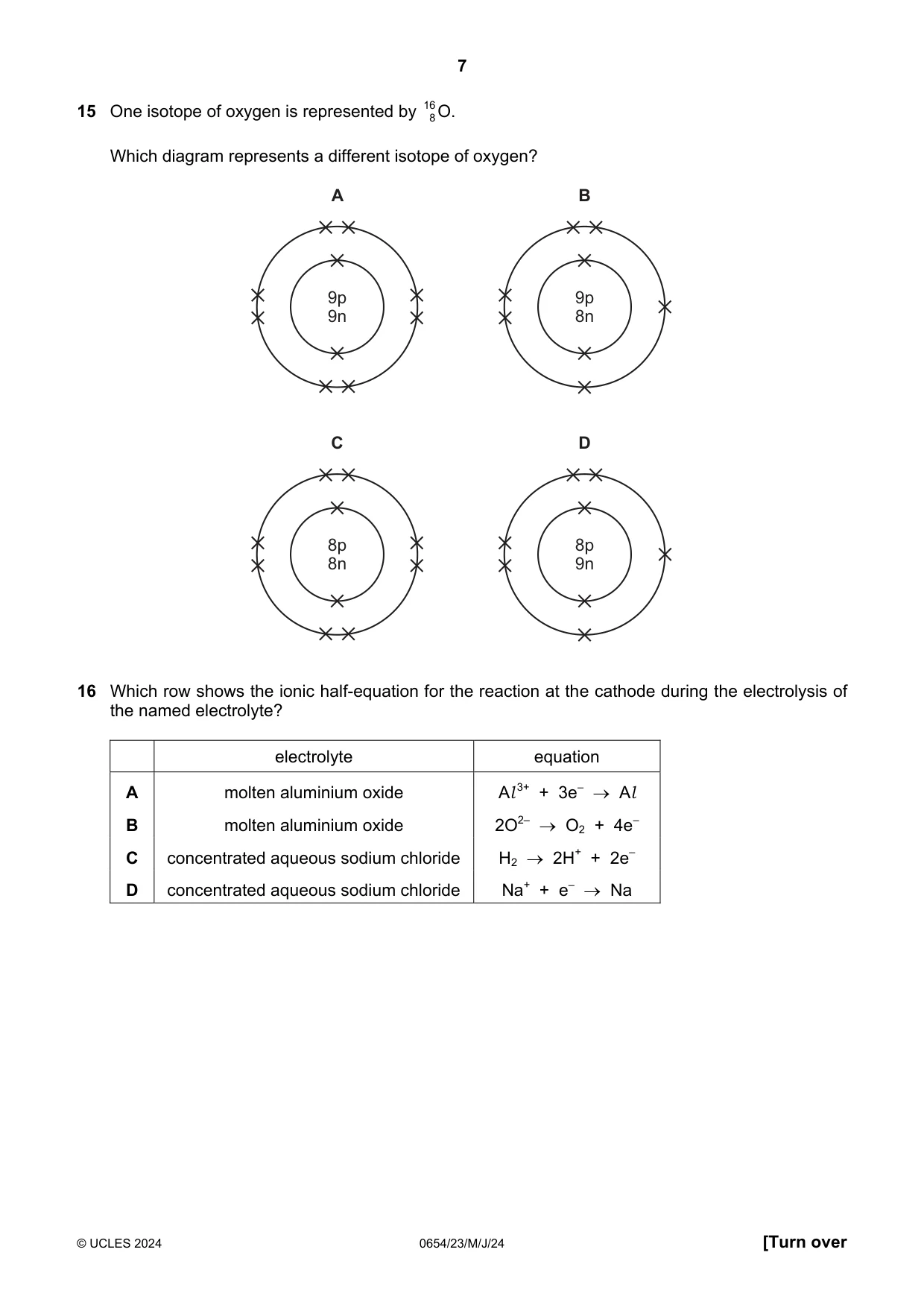
15 One isotope of oxygen is represented by 16 O. 8 Which diagram represents a different isotope of oxygen? A B 9p 9p 9n 8n C D 8p 8p 8n 9n
Mark scheme: D
Q16 · Which row shows the ionic half-equation for the reaction at the cathode during the…
16 Which row shows the ionic half-equation for the reaction at the cathode during the electrolysis of the named electrolyte? electrolyte equation A molten aluminium oxide Al 3+ + 3e– Al B molten aluminium oxide 2O2– O2 + 4e– C concentrated aqueous sodium chloride H2 2H+ + 2e– D concentrated aqueous sodium chloride Na+ + e– Na
Mark scheme: A
Q17 · When dilute hydrochloric acid reacts with calcium carbonate, carbon dioxide is produced
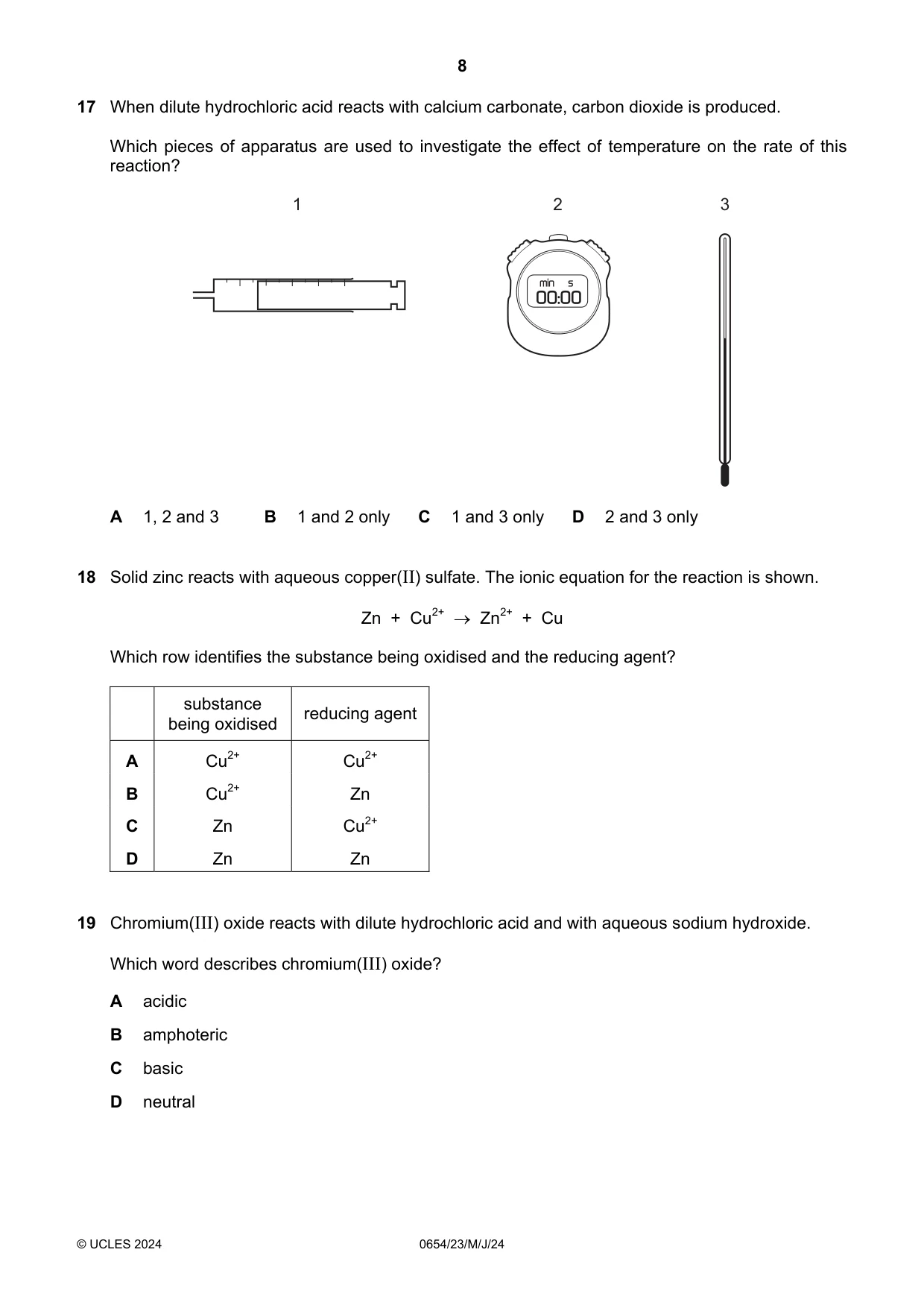
17 When dilute hydrochloric acid reacts with calcium carbonate, carbon dioxide is produced. Which pieces of apparatus are used to investigate the effect of temperature on the rate of this reaction? 1 2 3 A 1, 2 and 3 B 1 and 2 only C 1 and 3 only D 2 and 3 only
Mark scheme: A
Q18 · Solid zinc reacts with aqueous copper(II) sulfate
18 Solid zinc reacts with aqueous copper(II) sulfate. The ionic equation for the reaction is shown. Zn + Cu2+ Zn2+ + Cu Which row identifies the substance being oxidised and the reducing agent? substance reducing agent being oxidised A Cu2+ Cu2+ B Cu2+ Zn C Zn Cu2+ D Zn Zn
Mark scheme: D
Q19 · Chromium(III) oxide reacts with dilute hydrochloric acid and with aqueous sodium hydroxide
19 Chromium(III) oxide reacts with dilute hydrochloric acid and with aqueous sodium hydroxide. Which word describes chromium(III) oxide? A acidic B amphoteric C basic D neutral
Mark scheme: B
Q20 · Gas X turns limewater milky
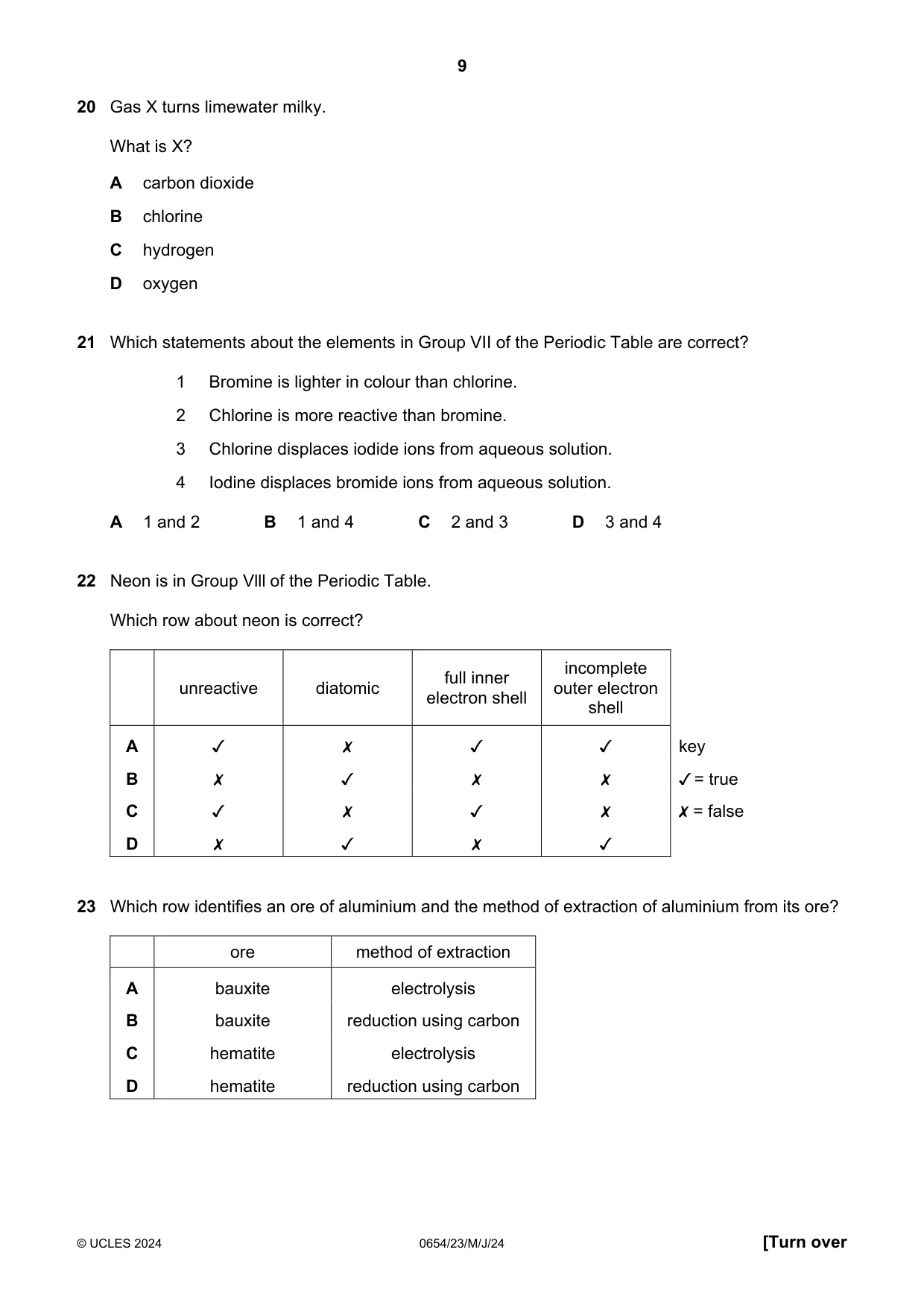
20 Gas X turns limewater milky. What is X? A carbon dioxide B chlorine C hydrogen D oxygen
Mark scheme: A
Q21 · Which statements about the elements in Group VII of the Periodic Table are correct?
21 Which statements about the elements in Group VII of the Periodic Table are correct? 1 Bromine is lighter in colour than chlorine. 2 Chlorine is more reactive than bromine. 3 Chlorine displaces iodide ions from aqueous solution. 4 Iodine displaces bromide ions from aqueous solution. A 1 and 2 B 1 and 4 C 2 and 3 D 3 and 4
Mark scheme: C
Q22 · Neon is in Group VIII of the Periodic Table
22 Neon is in Group VIII of the Periodic Table. Which row about neon is correct? full inner incomplete unreactive diatomic outer electron electron shell shell A Jv x Jv WA B x Jv x x Cc Jv x Jv x D x Jv x J key / = true X = false
Mark scheme: C
Q23 · Which row identifies an ore of aluminium and the method of extraction of aluminium from…
23 Which row identifies an ore of aluminium and the method of extraction of aluminium from its ore? ore method of extraction A bauxite electrolysis B bauxite reduction using carbon C hematite electrolysis D hematite reduction using carbon
Mark scheme: A
Q24 · Copper(II) sulfate and cobalt(II) chloride are used to test for water
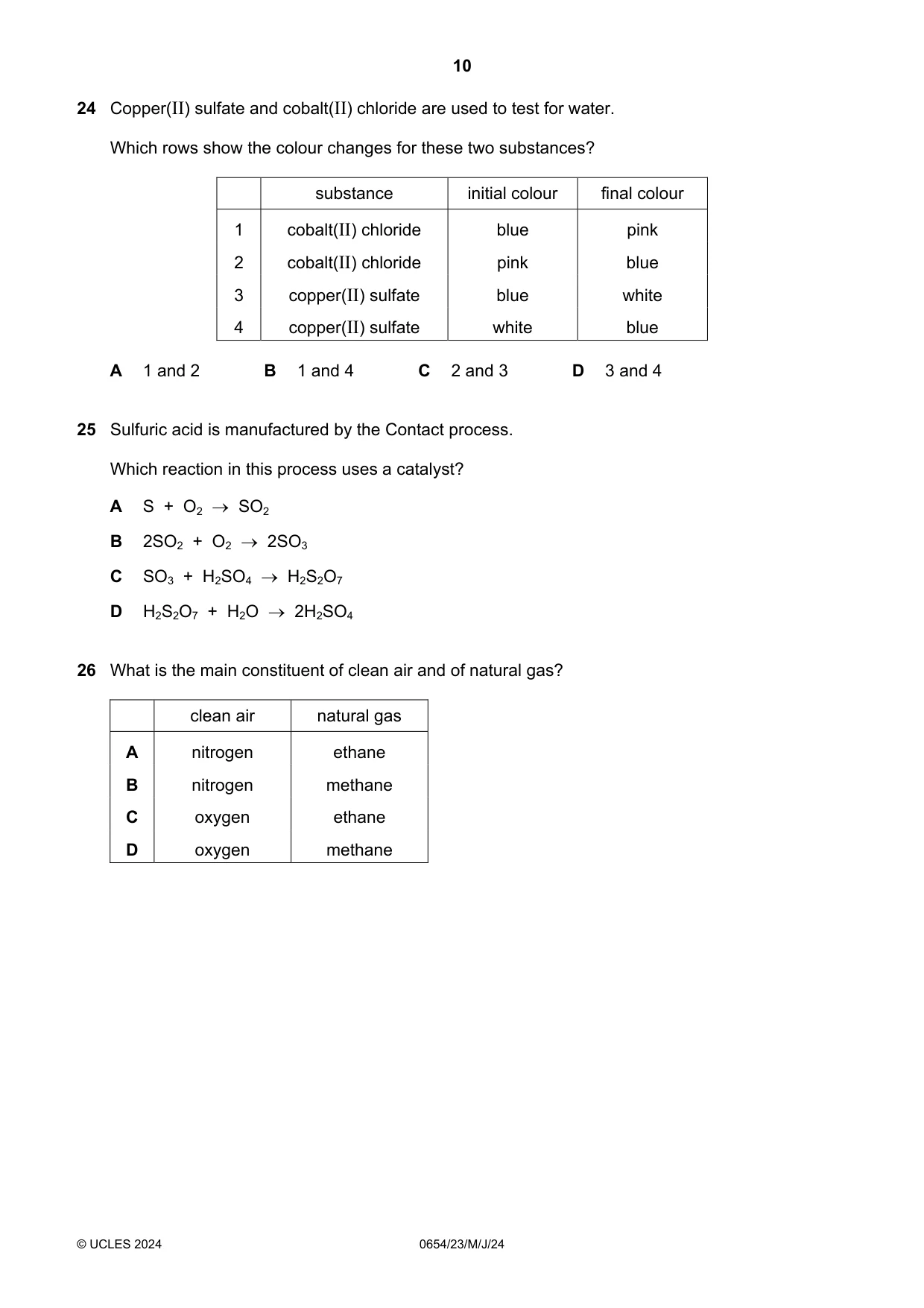
24 Copper(II) sulfate and cobalt(II) chloride are used to test for water. Which rows show the colour changes for these two substances? substance initial colour final colour 1 cobalt(II) chloride blue pink 2 cobalt(II) chloride pink blue 3 copper(II) sulfate blue white 4 copper(II) sulfate white blue A 1 and 2 B 1 and 4 C 2 and 3 D 3 and 4
Mark scheme: B
Q25 · Sulfuric acid is manufactured by the Contact process
25 Sulfuric acid is manufactured by the Contact process. Which reaction in this process uses a catalyst? A S + O2 SO2 B 2SO2 + O2 2SO3 C SO3 + H2SO4 H2S2O7 D H2S2O7 + H2O 2H2SO4
Mark scheme: B
Q26 · What is the main constituent of clean air and of natural gas?
26 What is the main constituent of clean air and of natural gas? clean air natural gas A nitrogen ethane B nitrogen methane C oxygen ethane D oxygen methane
Mark scheme: B
Q27 · The structure of a monomer is shown
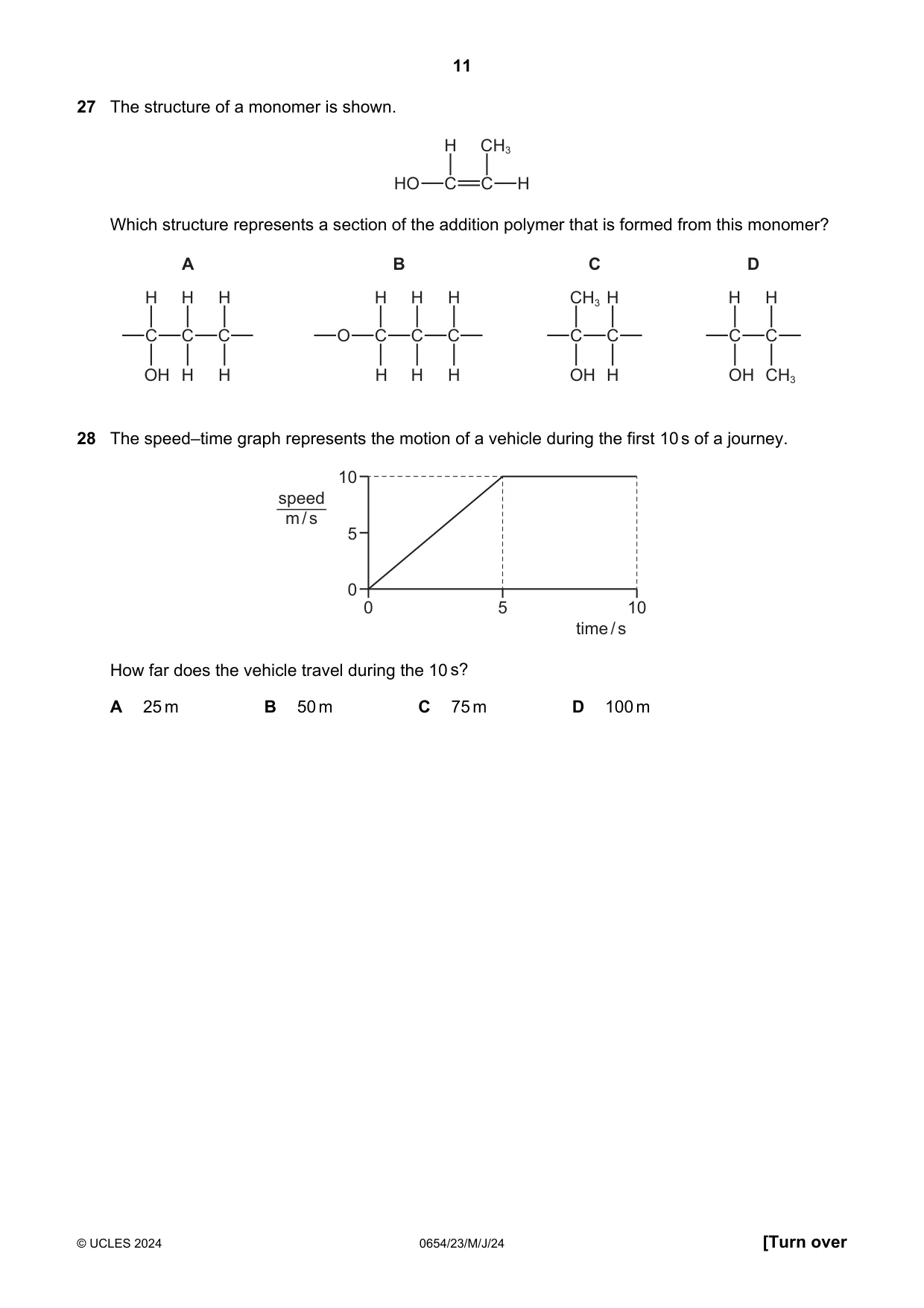
27 The structure of a monomer is shown. H CH3 HO C C H Which structure represents a section of the addition polymer that is formed from this monomer? A B C D H H H H H H CH3 H H H C C C O C C C C C C C OH H H H H H OH H OH CH3
Mark scheme: D
Q28 · The speed–time graph represents the motion of a vehicle during the first 10 s of a journey
28 The speed–time graph represents the motion of a vehicle during the first 10 s of a journey. 10 speed m / s 5 0 0 5 10 time / s How far does the vehicle travel during the 10 s? A 25 m B 50 m C 75 m D 100 m
Mark scheme: C
Q29 · The diagram shows a spring without a load and then with a load of mass 500 g suspended…
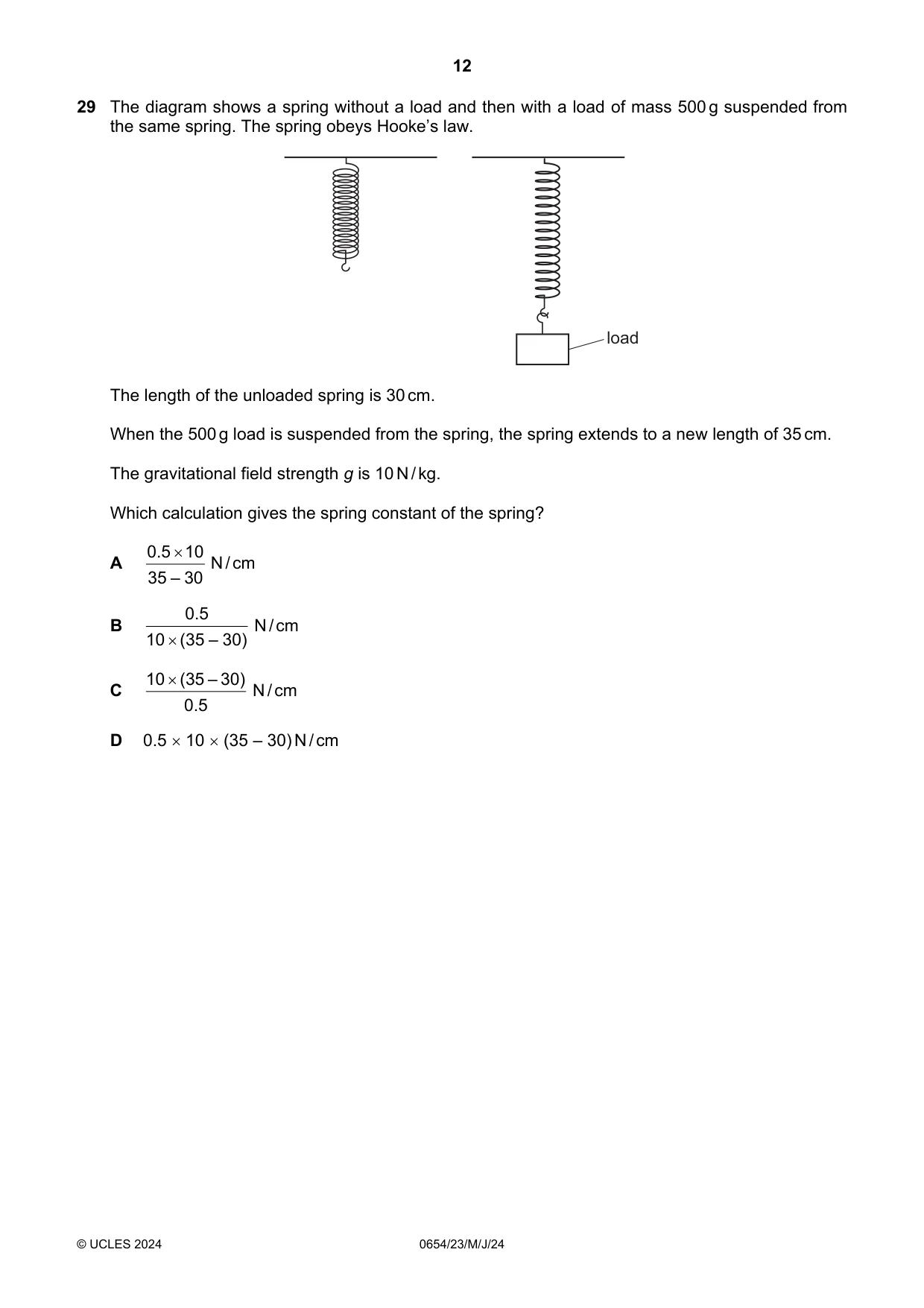
29 The diagram shows a spring without a load and then with a load of mass 500 g suspended from the same spring. The spring obeys Hooke’s law. load The length of the unloaded spring is 30 cm. When the 500 g load is suspended from the spring, the spring extends to a new length of 35 cm. The gravitational field strength g is 10 N / kg. Which calculation gives the spring constant of the spring? 0.5 10 A N / cm 35 – 30 0.5 B N / cm 10 (35 – 30) 10 (35 – 30) C N / cm 0.5 D 0.5 10 (35 – 30) N / cm
Mark scheme: A
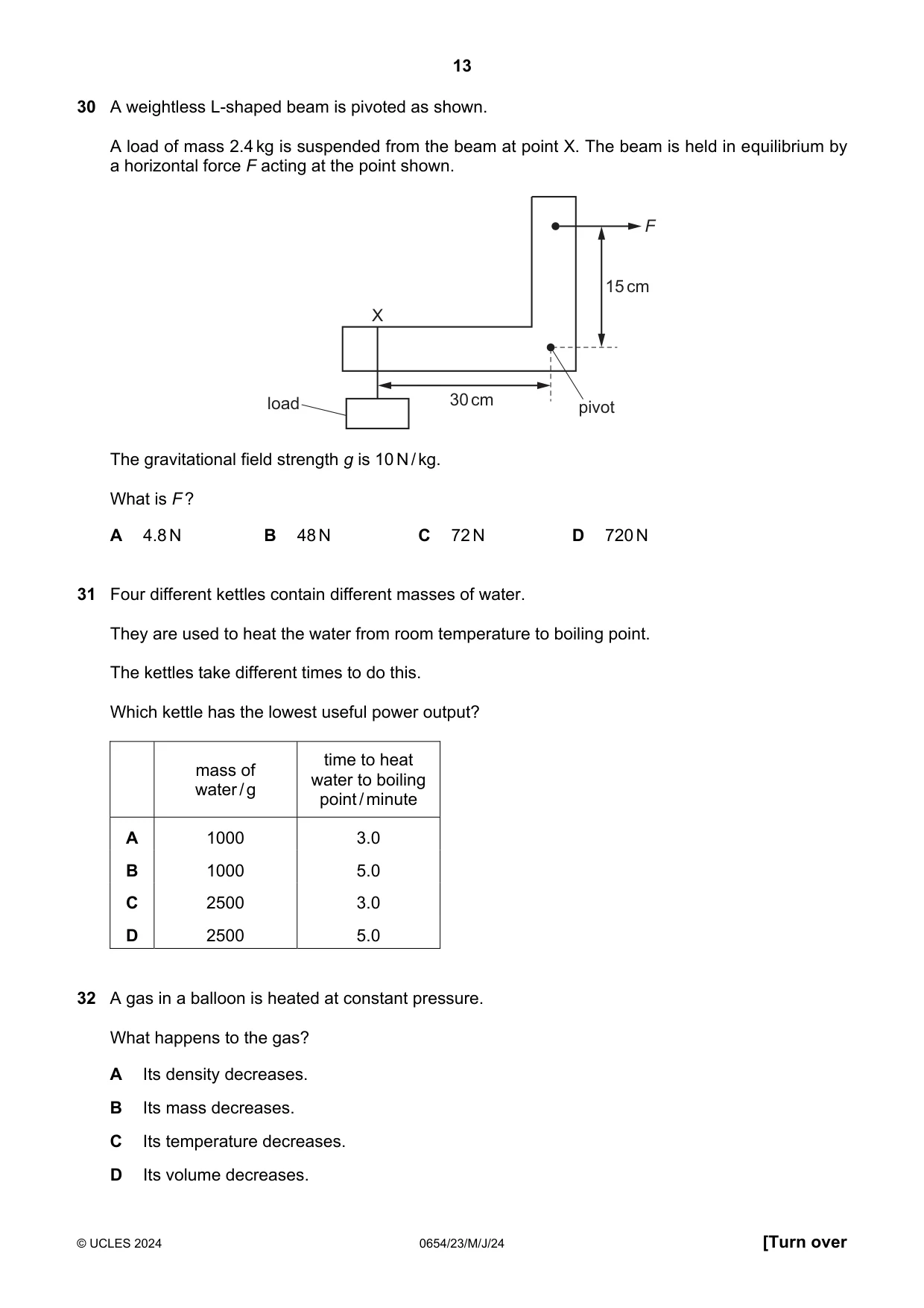
Q30 · A weightless L-shaped beam is pivoted as shown
30 A weightless L-shaped beam is pivoted as shown. A load of mass 2.4 kg is suspended from the beam at point X. The beam is held in equilibrium by a horizontal force F acting at the point shown. F 15 cm X load 30 cm pivot The gravitational field strength g is 10 N / kg. What is F ? A 4.8 N B 48 N C 72 N D 720 N
Mark scheme: B
Q31 · Four different kettles contain different masses of water
31 Four different kettles contain different masses of water. They are used to heat the water from room temperature to boiling point. The kettles take different times to do this. Which kettle has the lowest useful power output? time to heat mass of water to boiling water / g point / minute A 1000 3.0 B 1000 5.0 C 2500 3.0 D 2500 5.0
Mark scheme: B
Q32 · A gas in a balloon is heated at constant pressure
32 A gas in a balloon is heated at constant pressure. What happens to the gas? A Its density decreases. B Its mass decreases. C Its temperature decreases. D Its volume decreases.
Mark scheme: A
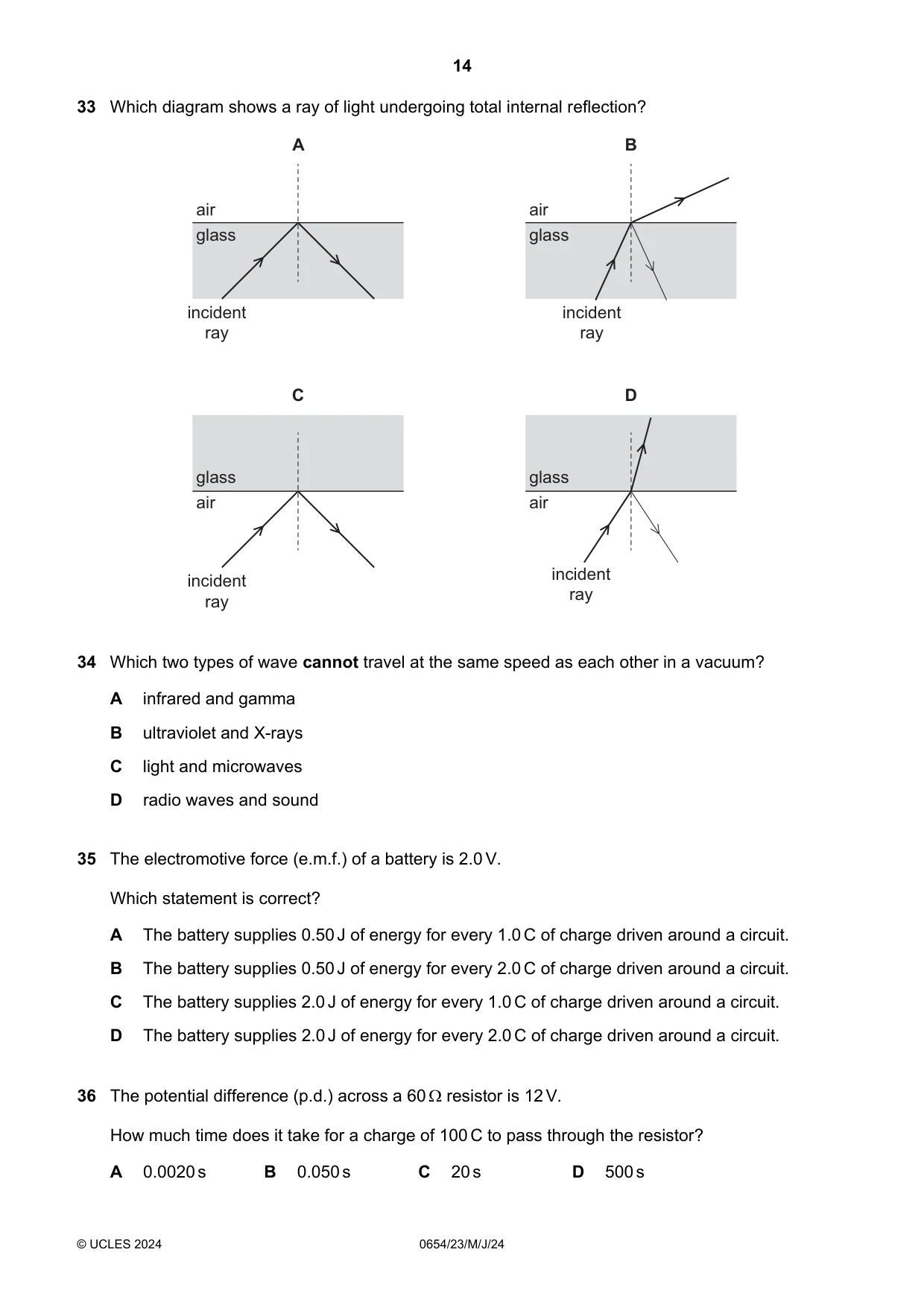
Q33 · Which diagram shows a ray of light undergoing total internal reflection?
33 Which diagram shows a ray of light undergoing total internal reflection? A B air air glass glass incident incident ray ray C D glass glass air air incident incident ray ray
Mark scheme: A
Q34 · Which two types of wave cannot travel at the same speed as each other in a vacuum?
34 Which two types of wave cannot travel at the same speed as each other in a vacuum? A infrared and gamma B ultraviolet and X-rays C light and microwaves D radio waves and sound
Mark scheme: D
Q35 · The electromotive force (e.m.f.) of a battery is 2.0 V
35 The electromotive force (e.m.f.) of a battery is 2.0 V. Which statement is correct? A The battery supplies 0.50 J of energy for every 1.0 C of charge driven around a circuit. B The battery supplies 0.50 J of energy for every 2.0 C of charge driven around a circuit. C The battery supplies 2.0 J of energy for every 1.0 C of charge driven around a circuit. D The battery supplies 2.0 J of energy for every 2.0 C of charge driven around a circuit.
Mark scheme: C
Q36 · The potential difference (p.d.) across a 60 resistor is 12 V
36 The potential difference (p.d.) across a 60 resistor is 12 V. How much time does it take for a charge of 100 C to pass through the resistor? A 0.0020 s B 0.050 s C 20 s D 500 s
Mark scheme: D
Q37 · A heater circuit is protected by a 10 A fuse
37 A heater circuit is protected by a 10 A fuse. How does the fuse protect the circuit? A It cuts off the current when the current in the heater is greater than 10 A. B It decreases the current in the heater to 10 A when the current is more than 10 A. C It increases the current in the heater to 10 A when the current is less than 10 A. D It maintains a constant temperature in the heater.
Mark scheme: A
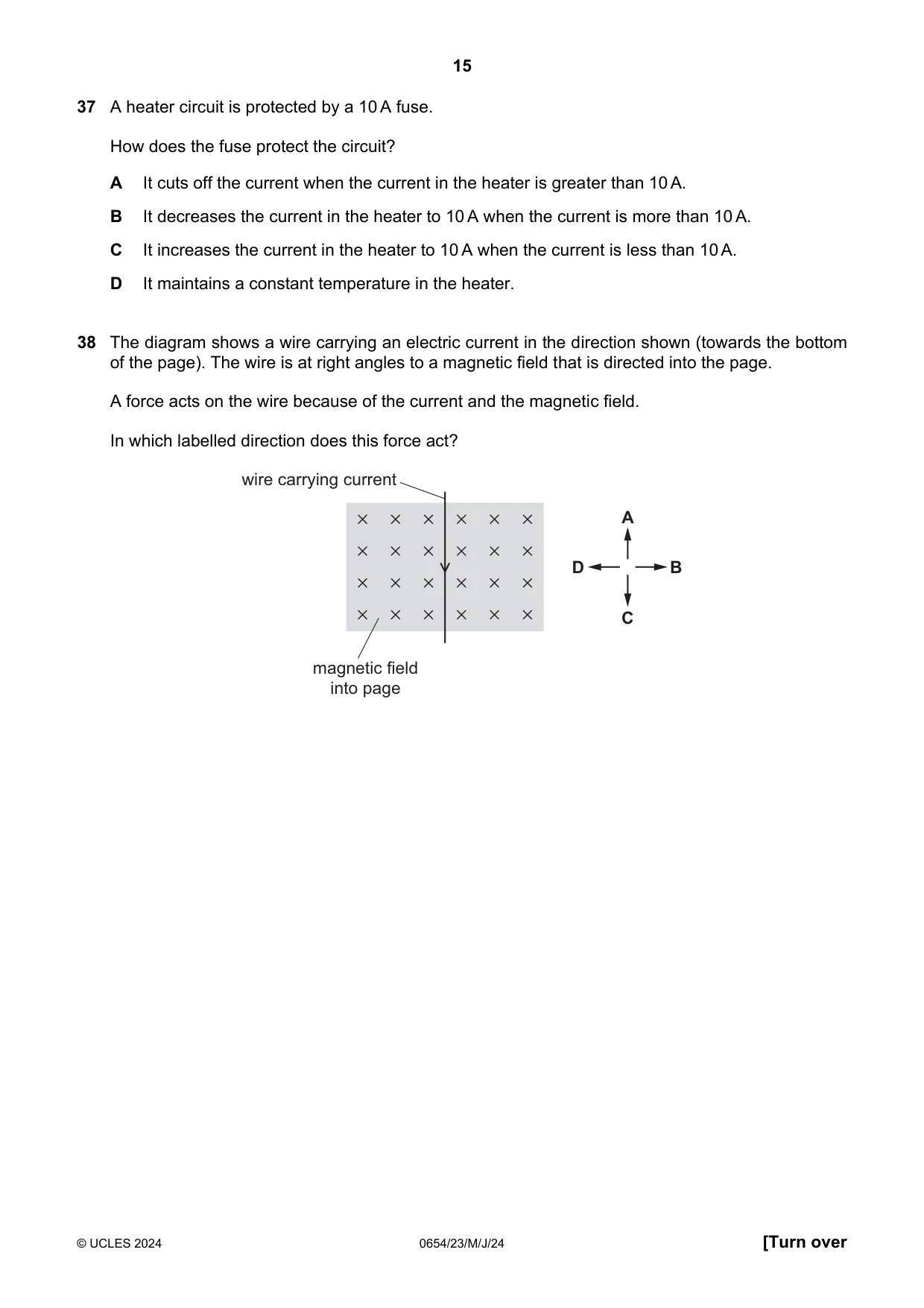
Q38 · The diagram shows a wire carrying an electric current in the direction shown (towards the…
38 The diagram shows a wire carrying an electric current in the direction shown (towards the bottom of the page). The wire is at right angles to a magnetic field that is directed into the page. A force acts on the wire because of the current and the magnetic field. In which labelled direction does this force act? wire carrying current A D B C magnetic field into page
Mark scheme: B
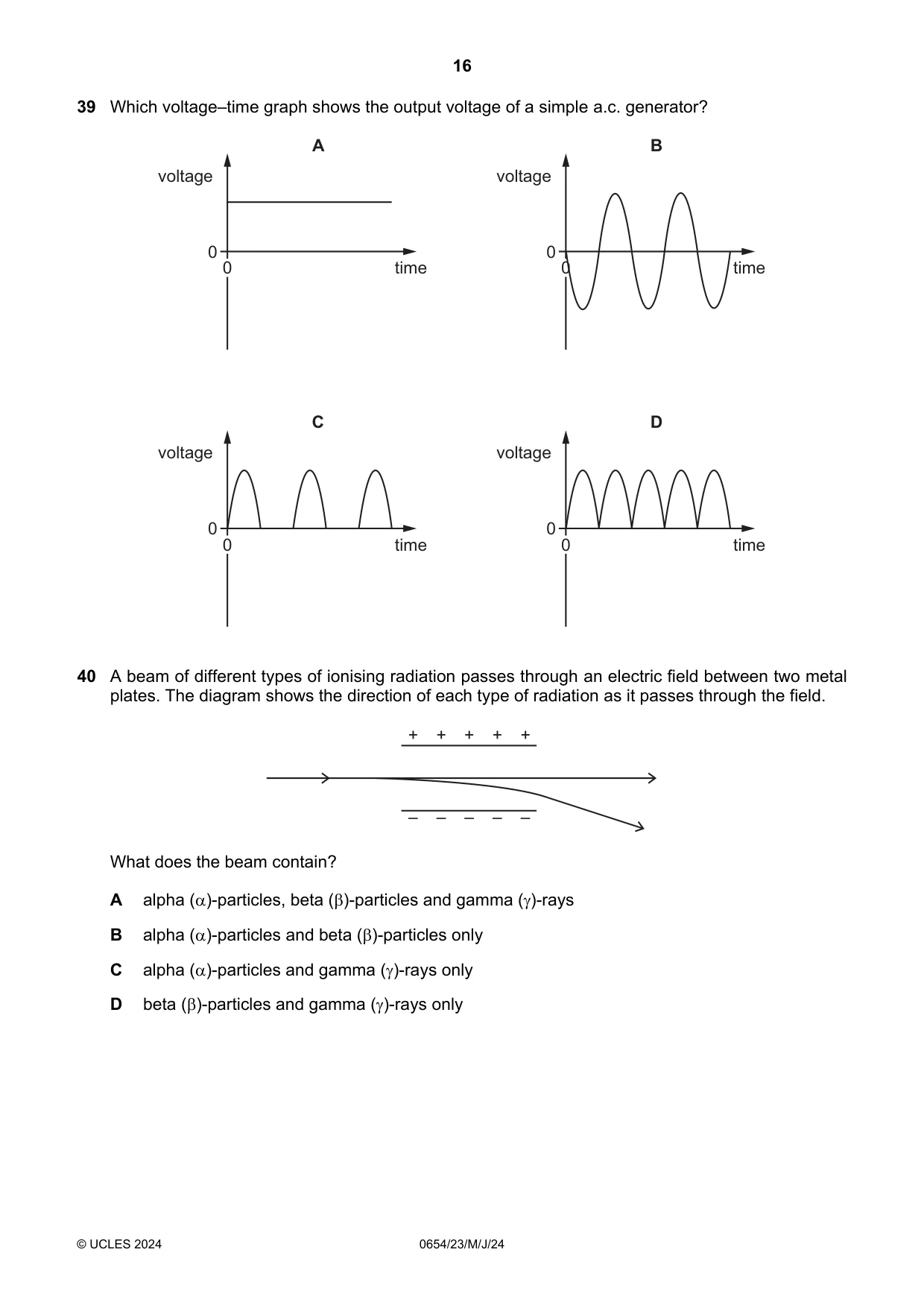
Q39 · Which voltage–time graph shows the output voltage of a simple a.c
39 Which voltage–time graph shows the output voltage of a simple a.c. generator? A B voltage voltage 0 0 0 time 0 time C D voltage voltage 0 0 0 time 0 time
Mark scheme: B
Q40 · A beam of different types of ionising radiation passes through an electric field between…
40 A beam of different types of ionising radiation passes through an electric field between two metal plates. The diagram shows the direction of each type of radiation as it passes through the field. + + + + + – – – – – What does the beam contain? A alpha ()-particles, beta ()-particles and gamma ()-rays B alpha ()-particles and beta ()-particles only C alpha ()-particles and gamma ()-rays only D beta ()-particles and gamma ()-rays only
Mark scheme: C
What was in this paper
The subtopics covered by these 40 questions, and how many questions each got. Open one in a new tab to see every Cambridge question on it.
2Electromagnetic effects2Forces2Rate of reaction2Air quality and climate1Biological molecules1Blood vessels1Carbon cycle1Characteristics of living organisms1Chromosomes and genes1Diffusion1Digestion1Electrical safety1Electrolysis1Electromagnetic spectrum1Energy, work and power1Enzymes1Extraction of metals1Food chains and food webs1Group VII properties1Homeostasis1Identification of ions and gases1Isotopes1Kinetic particle model of matter1Light1Motion1Noble gases1Oxides1Photosynthesis1Polymers1Radioactivity1Redox1Respiration1Separation and purification1Sexual reproduction in humans1Water1What you needed in this session
Cambridge’s own grade thresholds for 2024 May/June, Paper 2 · Variant 3. A higher threshold means an easier paper — the bar moves with how the cohort did.