Cambridge IGCSE Sciences - Co-ordinated (Double) 0654 — 2019 May/June Paper 2 · Variant 2
0654/22/M/J/19 · 40 questions · 40 marks · ≈45 min
The question paper and its mark scheme, free to read here and free to download. This is Cambridge’s own paper, exactly as it was sat.
Question paper20 pages



Mark scheme3 pages
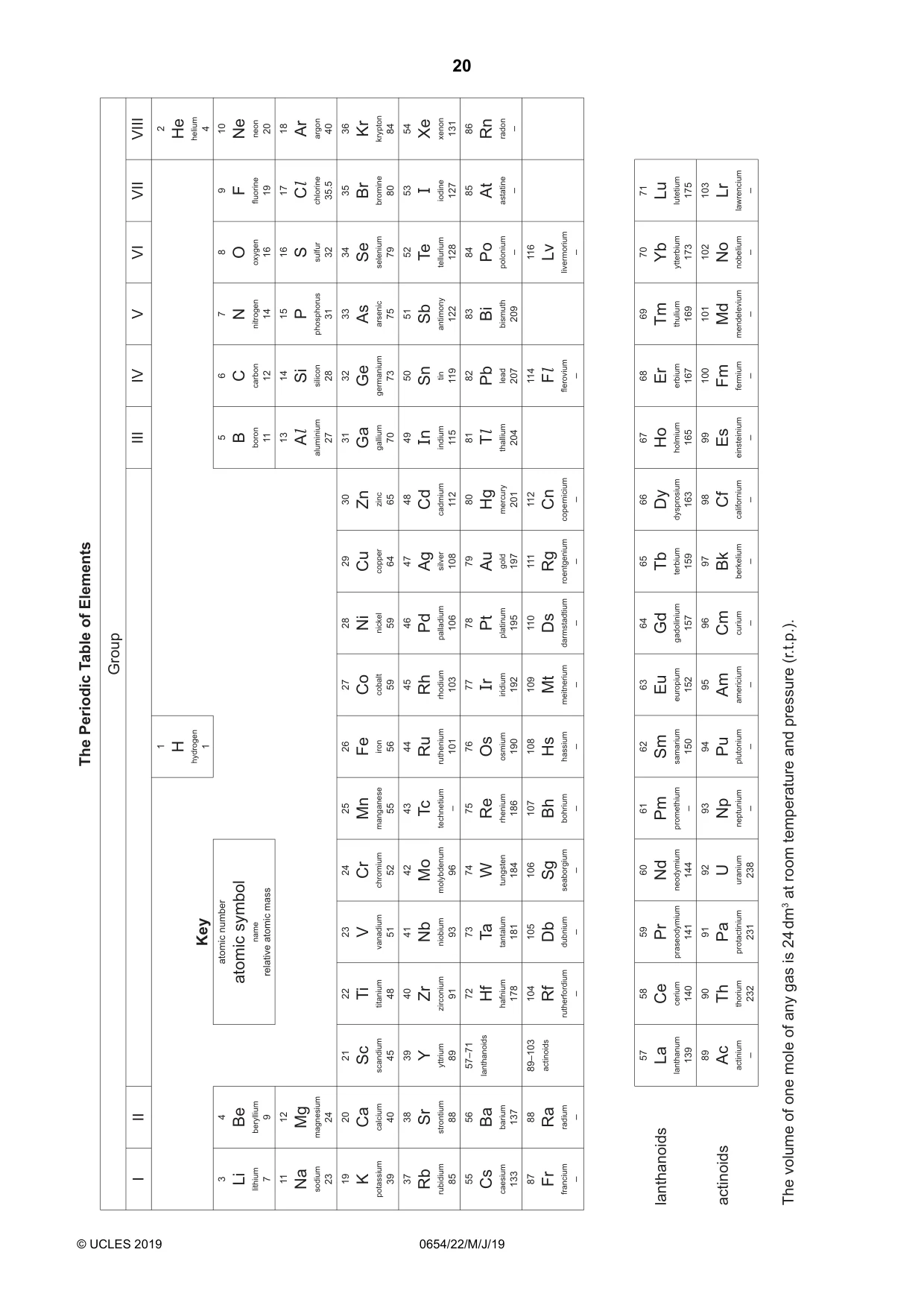
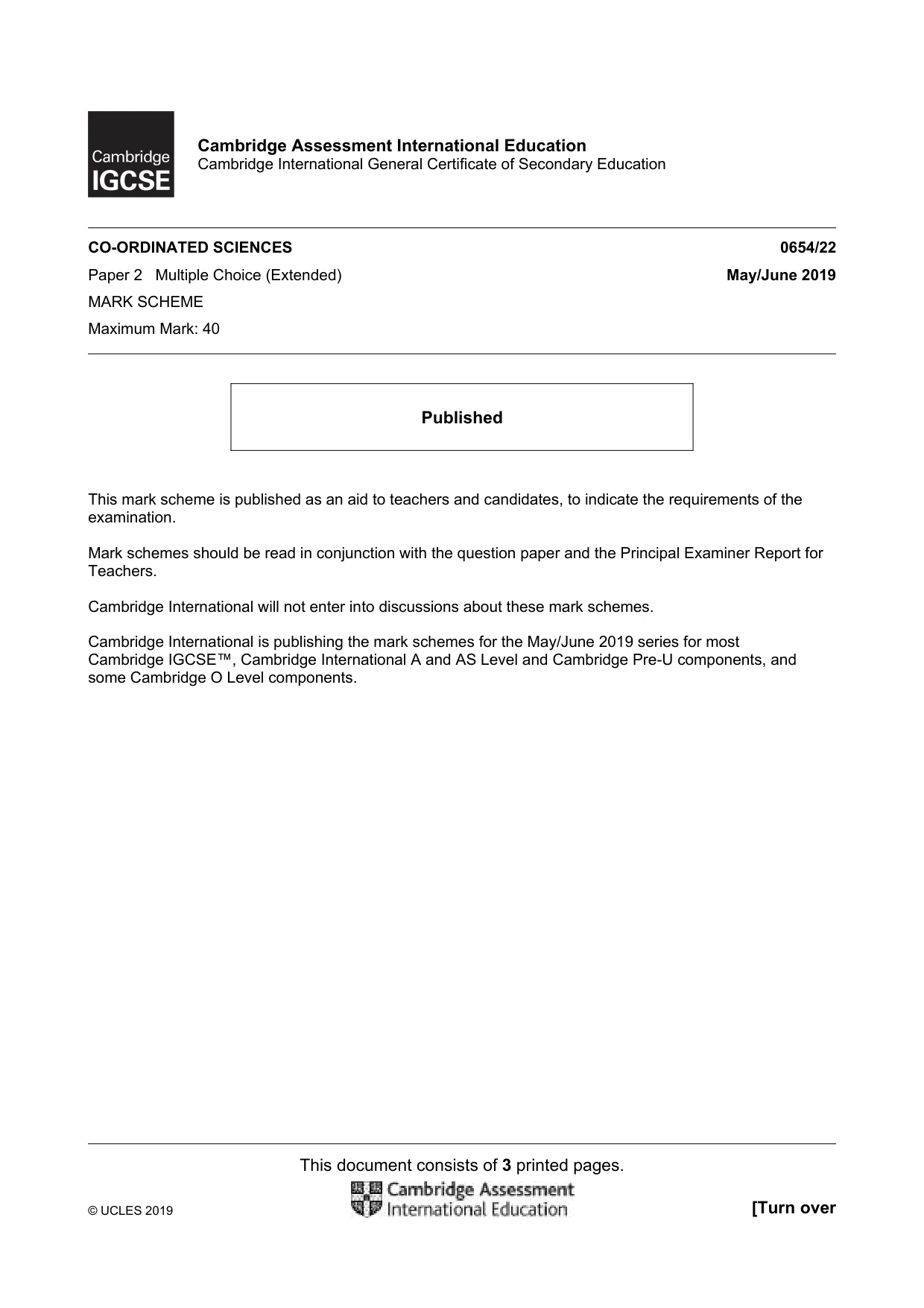
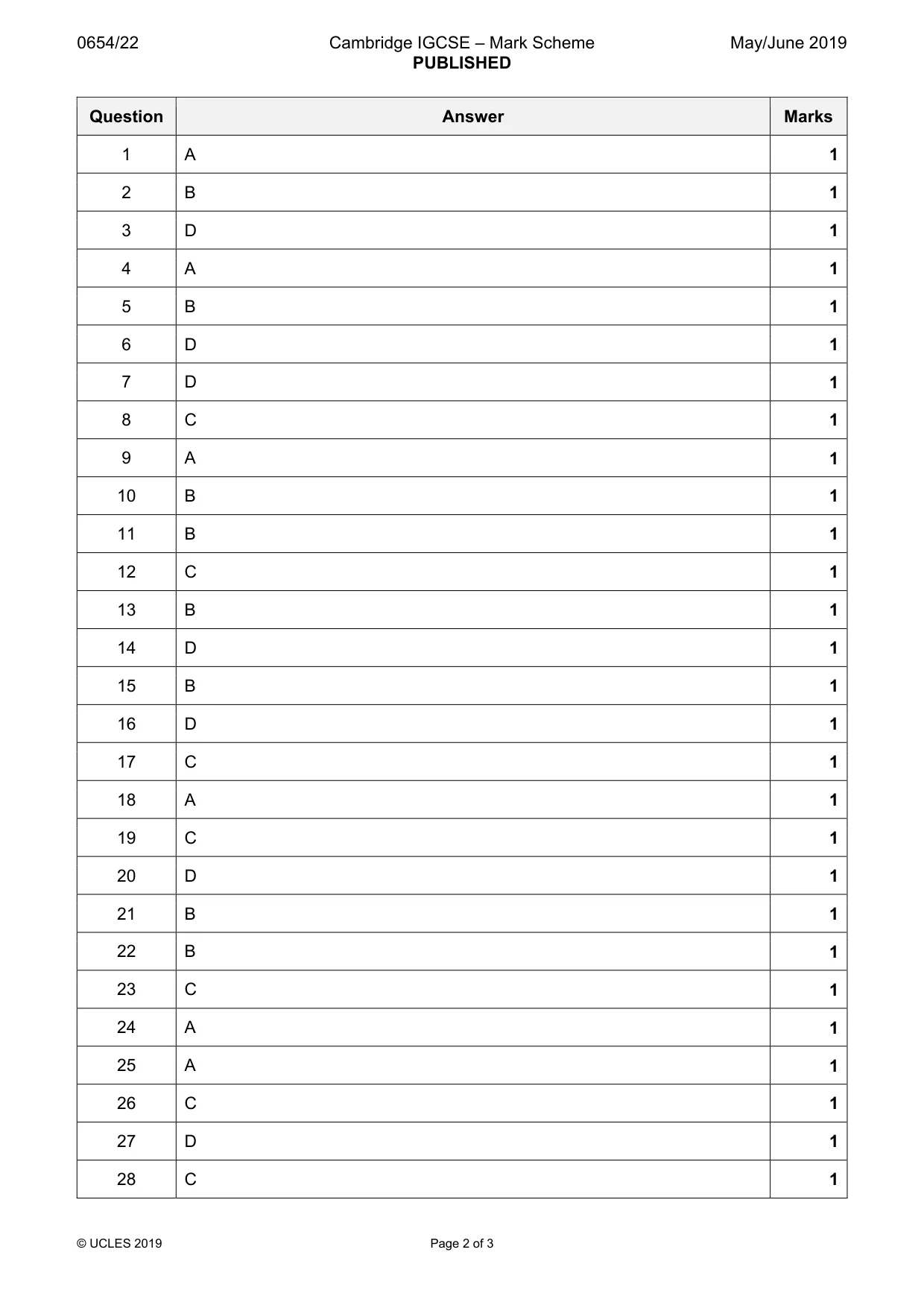
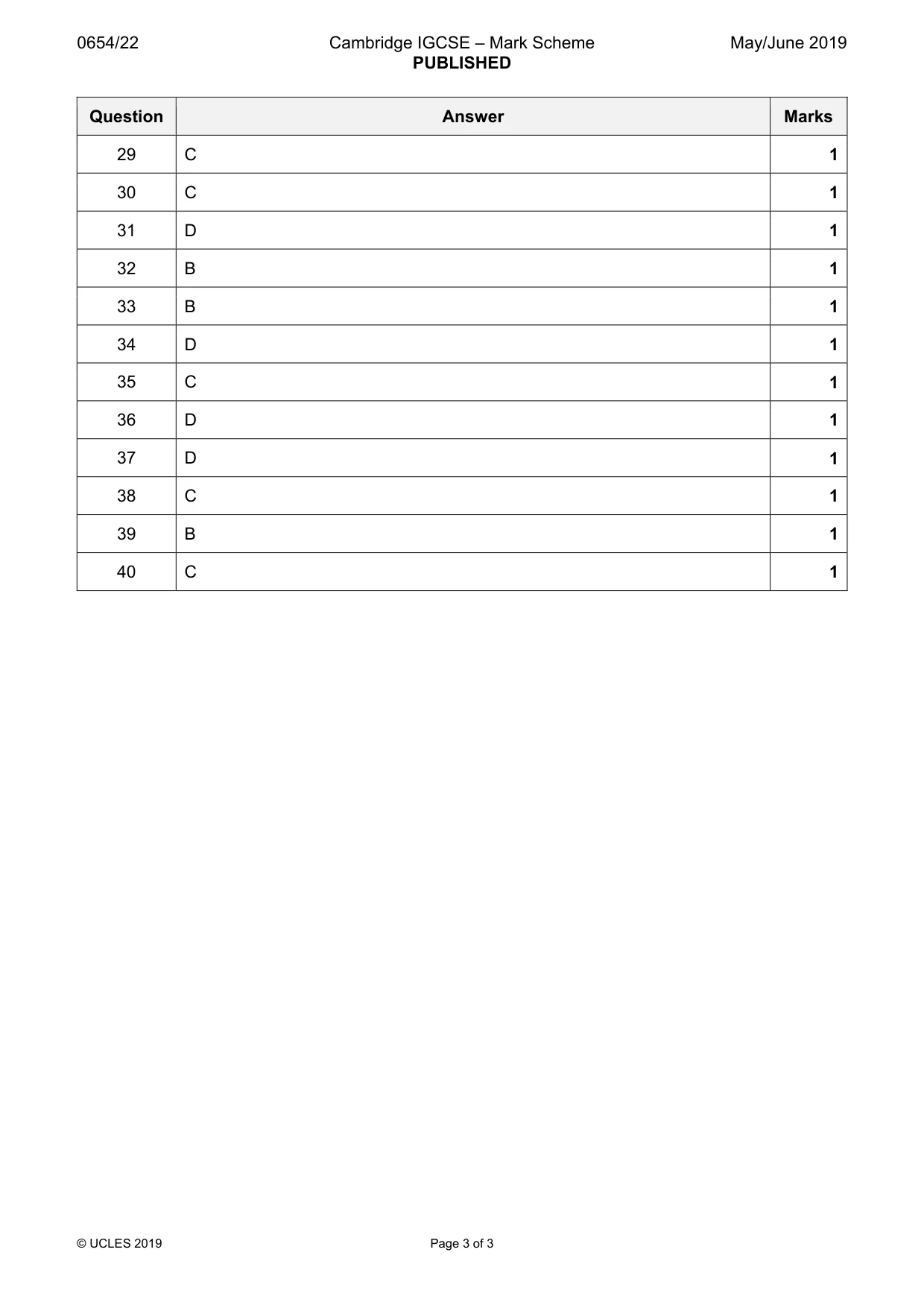
Answers below. Sit the paper first if you are practising.
Questions as text
Q1 · Which characteristic of living organisms is correctly matched to the description?
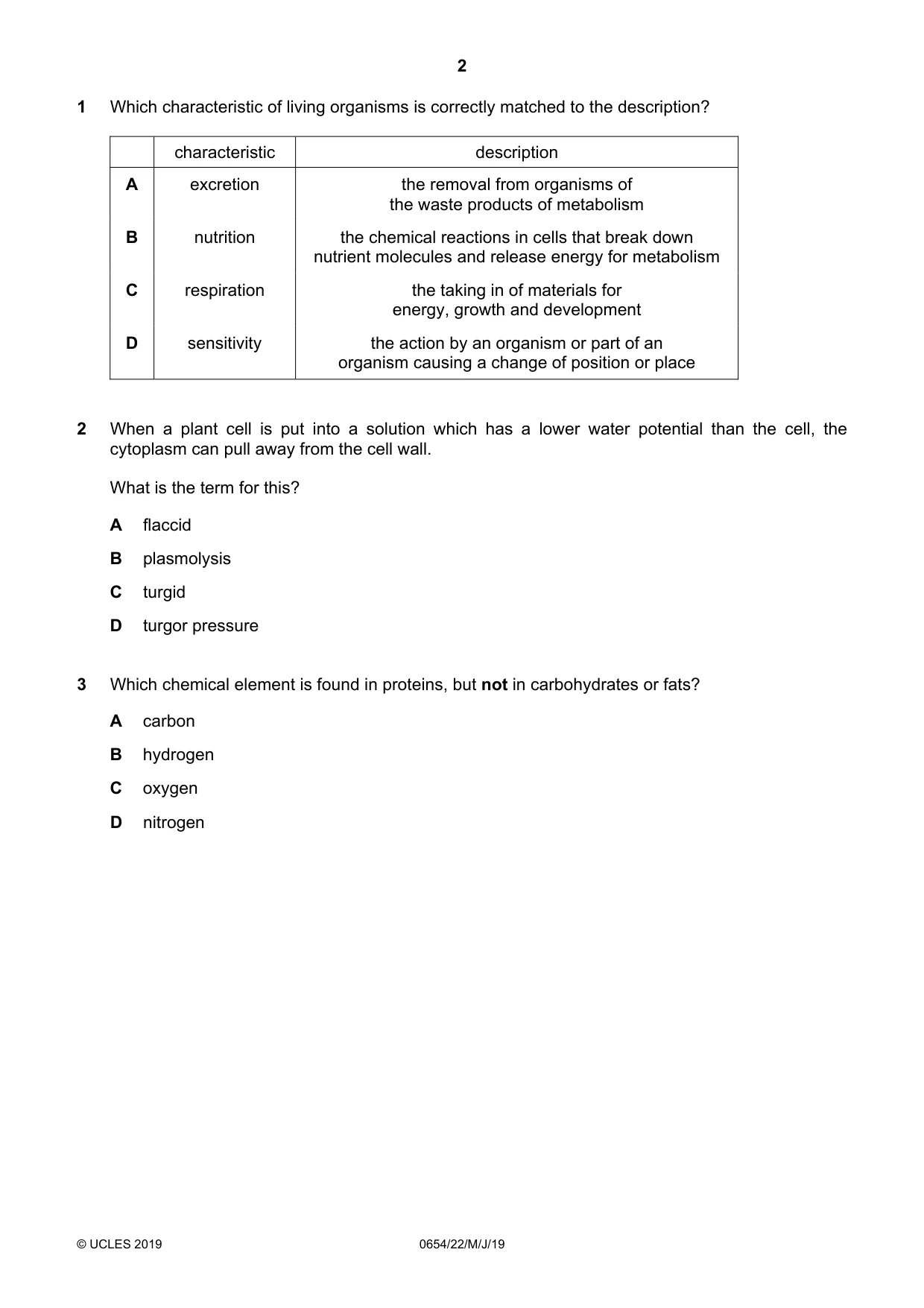
1 Which characteristic of living organisms is correctly matched to the description? characteristic description A excretion the removal from organisms of the waste products of metabolism B nutrition the chemical reactions in cells that break down nutrient molecules and release energy for metabolism C respiration the taking in of materials for energy, growth and development D sensitivity the action by an organism or part of an organism causing a change of position or place
Mark scheme: A
Q2 · When a plant cell is put into a solution which has a lower water potential than the cell…
2 When a plant cell is put into a solution which has a lower water potential than the cell, the cytoplasm can pull away from the cell wall. What is the term for this? A flaccid B plasmolysis C turgid D turgor pressure
Mark scheme: B
Q3 · Which chemical element is found in proteins, but not in carbohydrates or fats?
3 Which chemical element is found in proteins, but not in carbohydrates or fats? A carbon B hydrogen C oxygen D nitrogen
Mark scheme: D
Q4 · The graphs show the possible effects of temperature on the rate of reaction of an enzyme
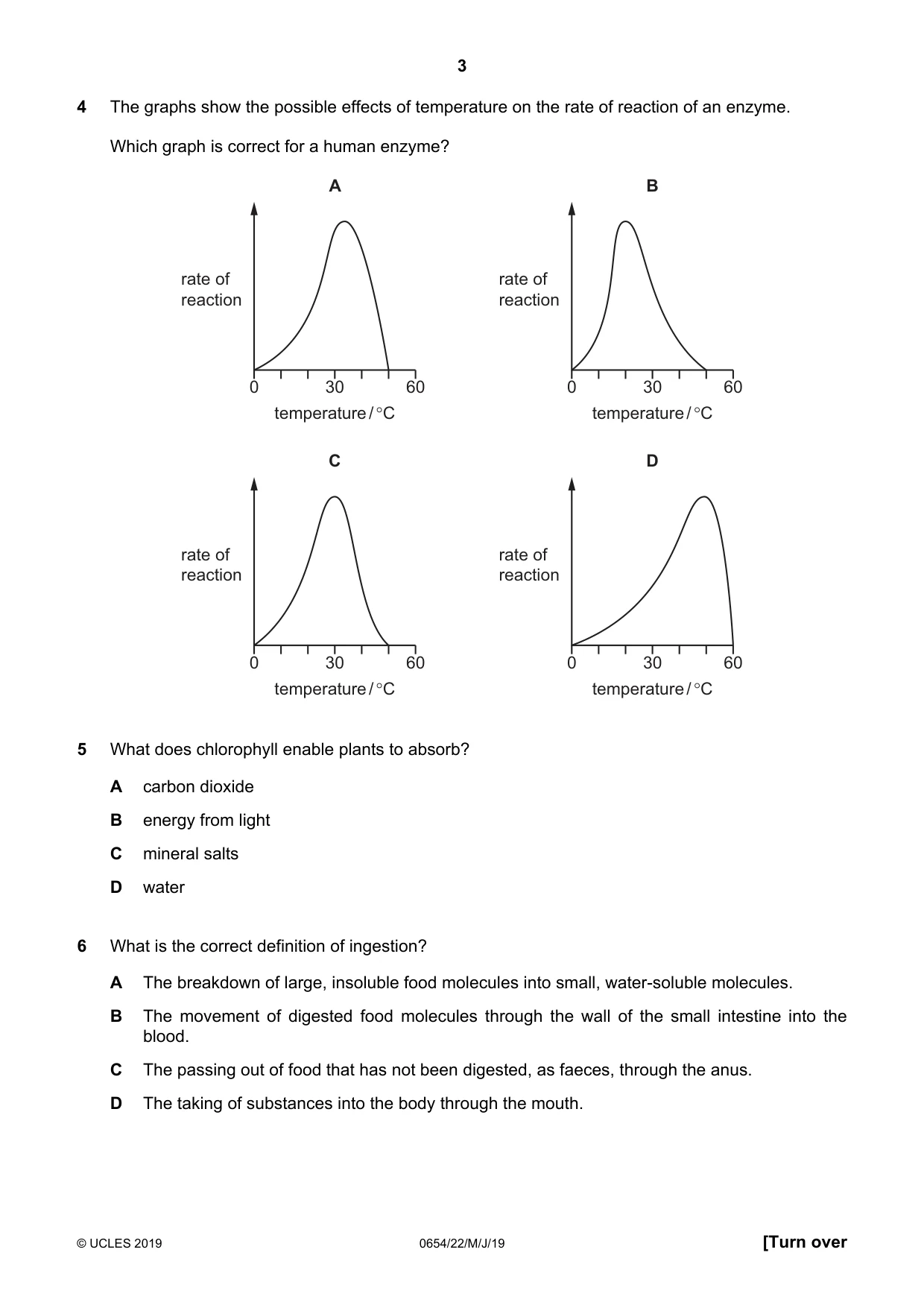
4 The graphs show the possible effects of temperature on the rate of reaction of an enzyme. Which graph is correct for a human enzyme? A B rate of rate of reaction reaction 0 30 60 0 30 60 temperature / °C temperature / °C C D rate of rate of reaction reaction 0 30 60 0 30 60 temperature / °C temperature / °C
Mark scheme: A
Q5 · What does chlorophyll enable plants to absorb?
5 What does chlorophyll enable plants to absorb? A carbon dioxide B energy from light C mineral salts D water
Mark scheme: B
Q6 · What is the correct definition of ingestion?
6 What is the correct definition of ingestion? A The breakdown of large, insoluble food molecules into small, water-soluble molecules. B The movement of digested food molecules through the wall of the small intestine into the blood. C The passing out of food that has not been digested, as faeces, through the anus. D The taking of substances into the body through the mouth.
Mark scheme: D
Q7 · Which row describes a part of the circulatory system in mammals?
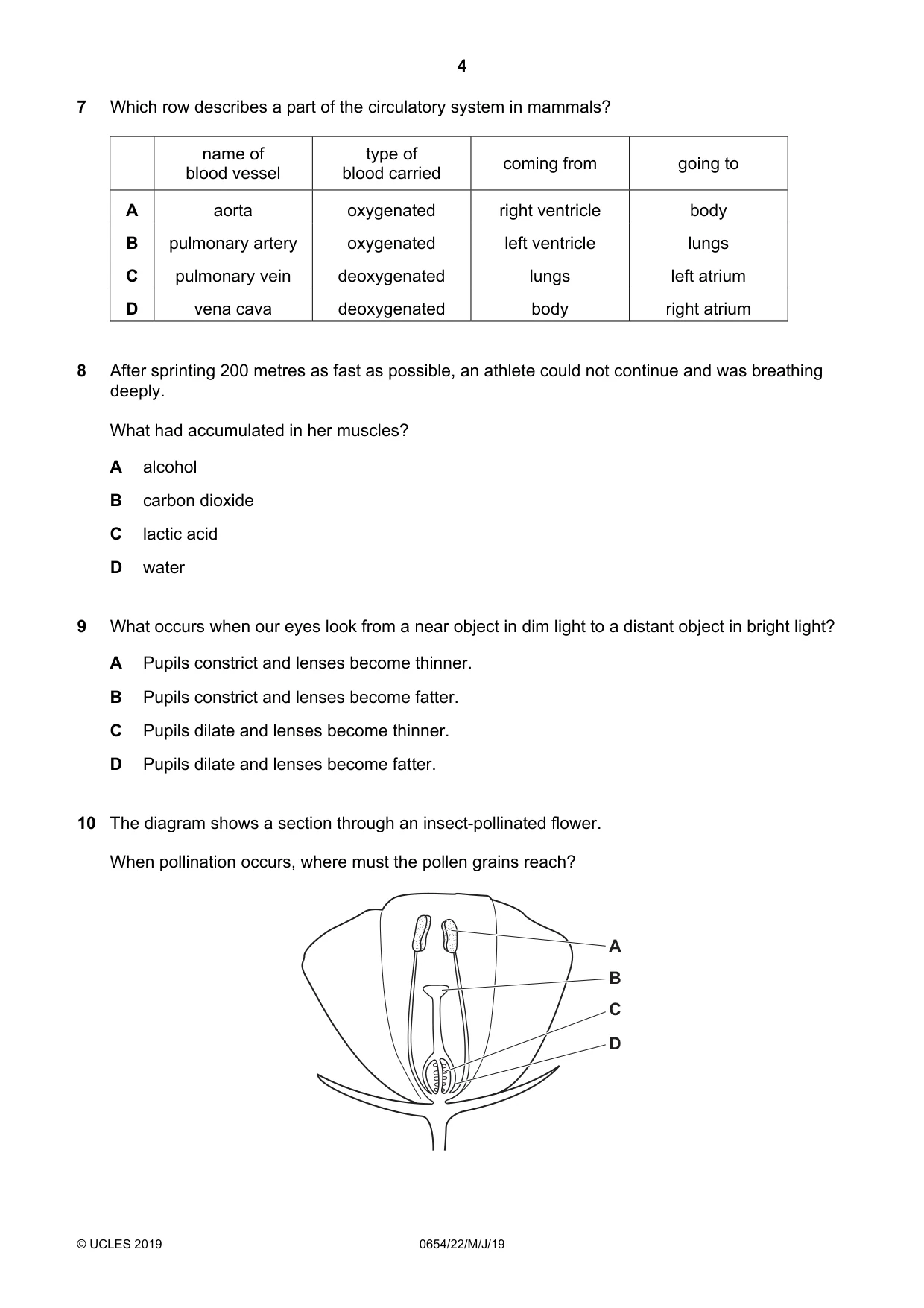
7 Which row describes a part of the circulatory system in mammals? name of type of coming from going to blood vessel blood carried A aorta oxygenated right ventricle body B pulmonary artery oxygenated left ventricle lungs C pulmonary vein deoxygenated lungs left atrium D vena cava deoxygenated body right atrium
Mark scheme: D
Q8 · After sprinting 200 metres as fast as possible, an athlete could not continue and was…
8 After sprinting 200 metres as fast as possible, an athlete could not continue and was breathing deeply. What had accumulated in her muscles? A alcohol B carbon dioxide C lactic acid D water
Mark scheme: C
Q9 · What occurs when our eyes look from a near object in dim light to a distant object in…
9 What occurs when our eyes look from a near object in dim light to a distant object in bright light? A Pupils constrict and lenses become thinner. B Pupils constrict and lenses become fatter. C Pupils dilate and lenses become thinner. D Pupils dilate and lenses become fatter.
Mark scheme: A
Q10 · The diagram shows a section through an insect-pollinated flower
10 The diagram shows a section through an insect-pollinated flower. When pollination occurs, where must the pollen grains reach? A B C D
Mark scheme: B
Q11 · Which sex chromosomes need to be present in a sperm cell to produce a male zygote?
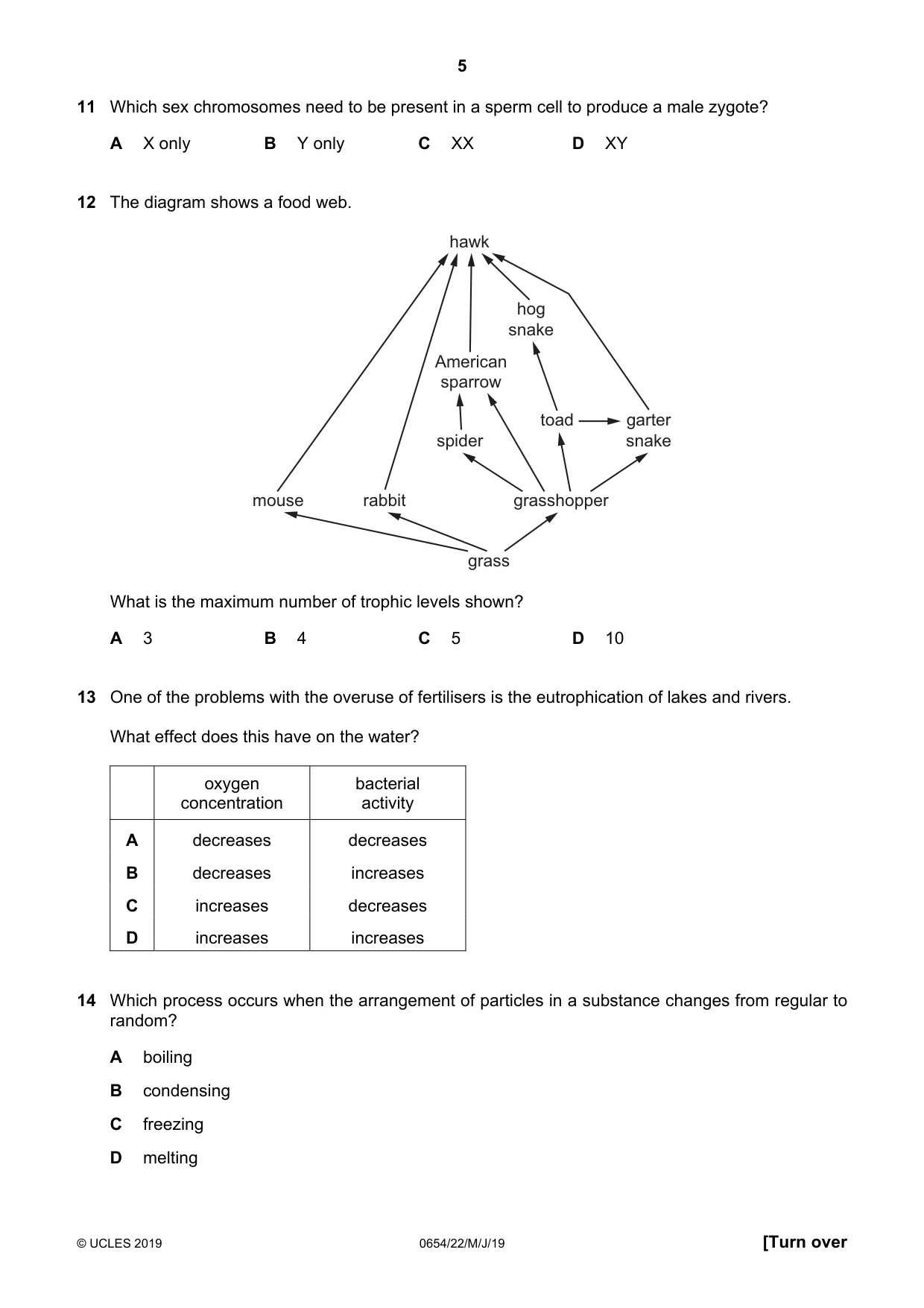
11 Which sex chromosomes need to be present in a sperm cell to produce a male zygote? A X only B Y only C XX D XY
Mark scheme: B
Q12 · The diagram shows a food web
12 The diagram shows a food web. hawk hog snake American sparrow toad garter spider snake mouse rabbit grasshopper grass What is the maximum number of trophic levels shown? A 3 B 4 C 5 D 10
Mark scheme: C
Q13 · One of the problems with the overuse of fertilisers is the eutrophication of lakes and…
13 One of the problems with the overuse of fertilisers is the eutrophication of lakes and rivers. What effect does this have on the water? oxygen bacterial concentration activity A decreases decreases B decreases increases C increases decreases D increases increases
Mark scheme: B
Q14 · Which process occurs when the arrangement of particles in a substance changes from…
14 Which process occurs when the arrangement of particles in a substance changes from regular to random? A boiling B condensing C freezing D melting
Mark scheme: D
Q15 · Two substances, X and Y, are heated and then cooled
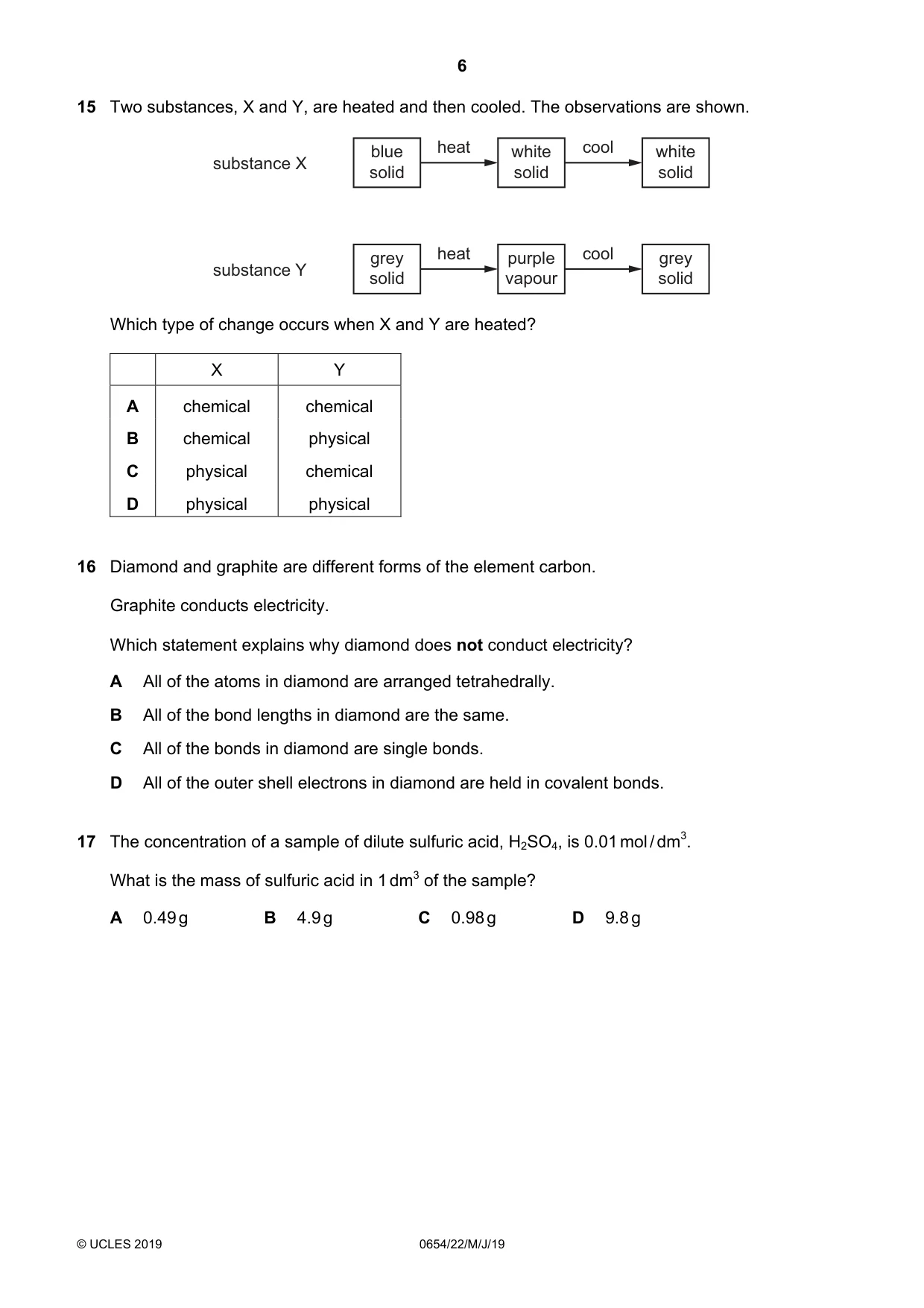
15 Two substances, X and Y, are heated and then cooled. The observations are shown. blue heat white cool white substance X solid solid solid grey heat purple cool grey substance Y solid vapour solid Which type of change occurs when X and Y are heated? X Y A chemical chemical B chemical physical C physical chemical D physical physical
Mark scheme: B
Q16 · Diamond and graphite are different forms of the element carbon
16 Diamond and graphite are different forms of the element carbon. Graphite conducts electricity. Which statement explains why diamond does not conduct electricity? A All of the atoms in diamond are arranged tetrahedrally. B All of the bond lengths in diamond are the same. C All of the bonds in diamond are single bonds. D All of the outer shell electrons in diamond are held in covalent bonds.
Mark scheme: D
Q17 · The concentration of a sample of dilute sulfuric acid, H2SO4, is 0.01 mol / dm3
17 The concentration of a sample of dilute sulfuric acid, H2SO4, is 0.01 mol / dm3. What is the mass of sulfuric acid in 1 dm3 of the sample? A 0.49 g B 4.9 g C 0.98 g D 9.8 g
Mark scheme: C
Q18 · Which row identifies the products of the electrolysis of the named electrolyte using…
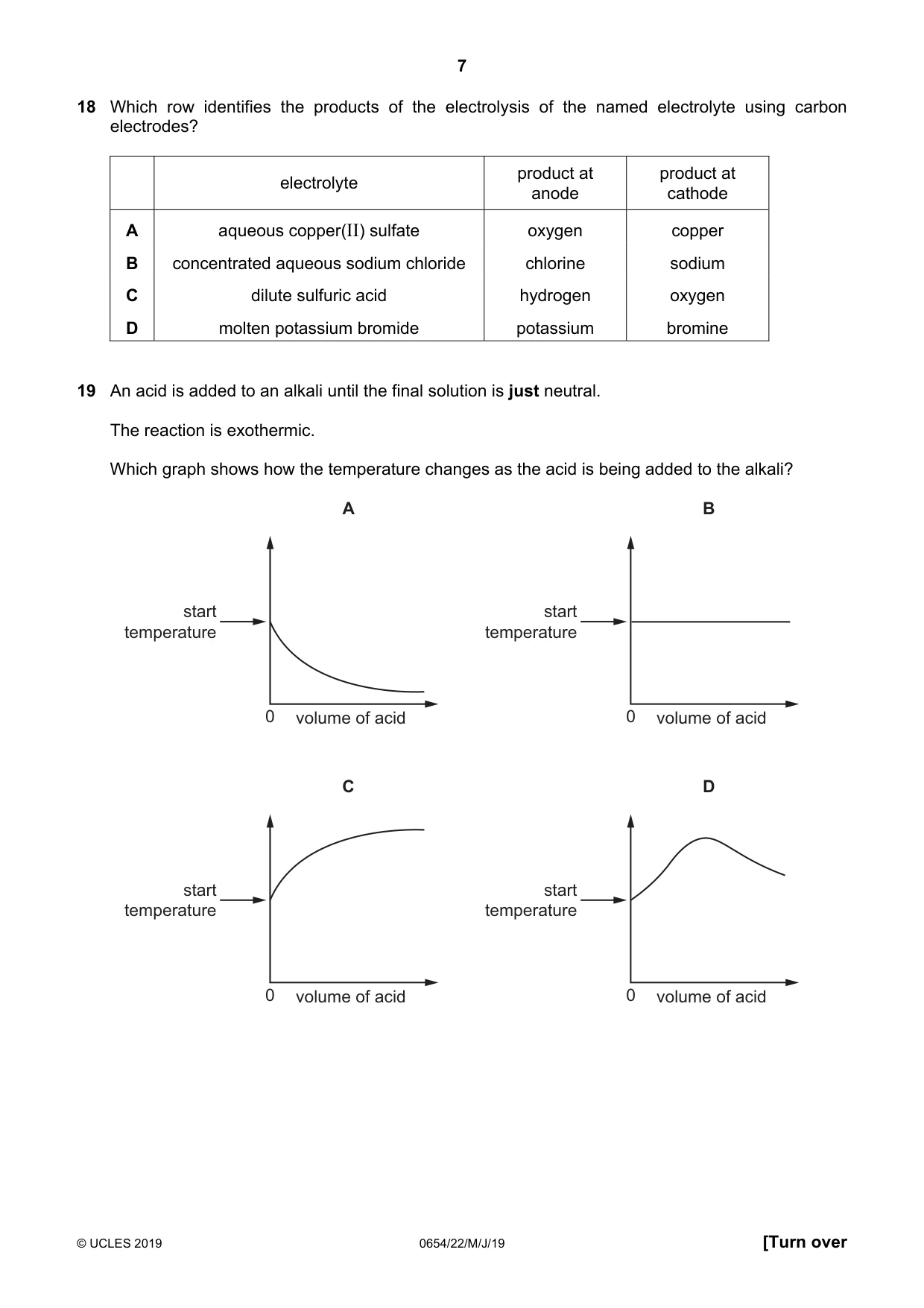
18 Which row identifies the products of the electrolysis of the named electrolyte using carbon electrodes? product at product at electrolyte anode cathode A aqueous copper(II) sulfate oxygen copper B concentrated aqueous sodium chloride chlorine sodium C dilute sulfuric acid hydrogen oxygen D molten potassium bromide potassium bromine
Mark scheme: A
Q19 · An acid is added to an alkali until the final solution is just neutral
19 An acid is added to an alkali until the final solution is just neutral. The reaction is exothermic. Which graph shows how the temperature changes as the acid is being added to the alkali? A B start start temperature temperature 0 volume of acid 0 volume of acid C D start start temperature temperature 0 volume of acid 0 volume of acid
Mark scheme: C
Q20 · Which statement explains why increasing the concentration of a reactant increases the…
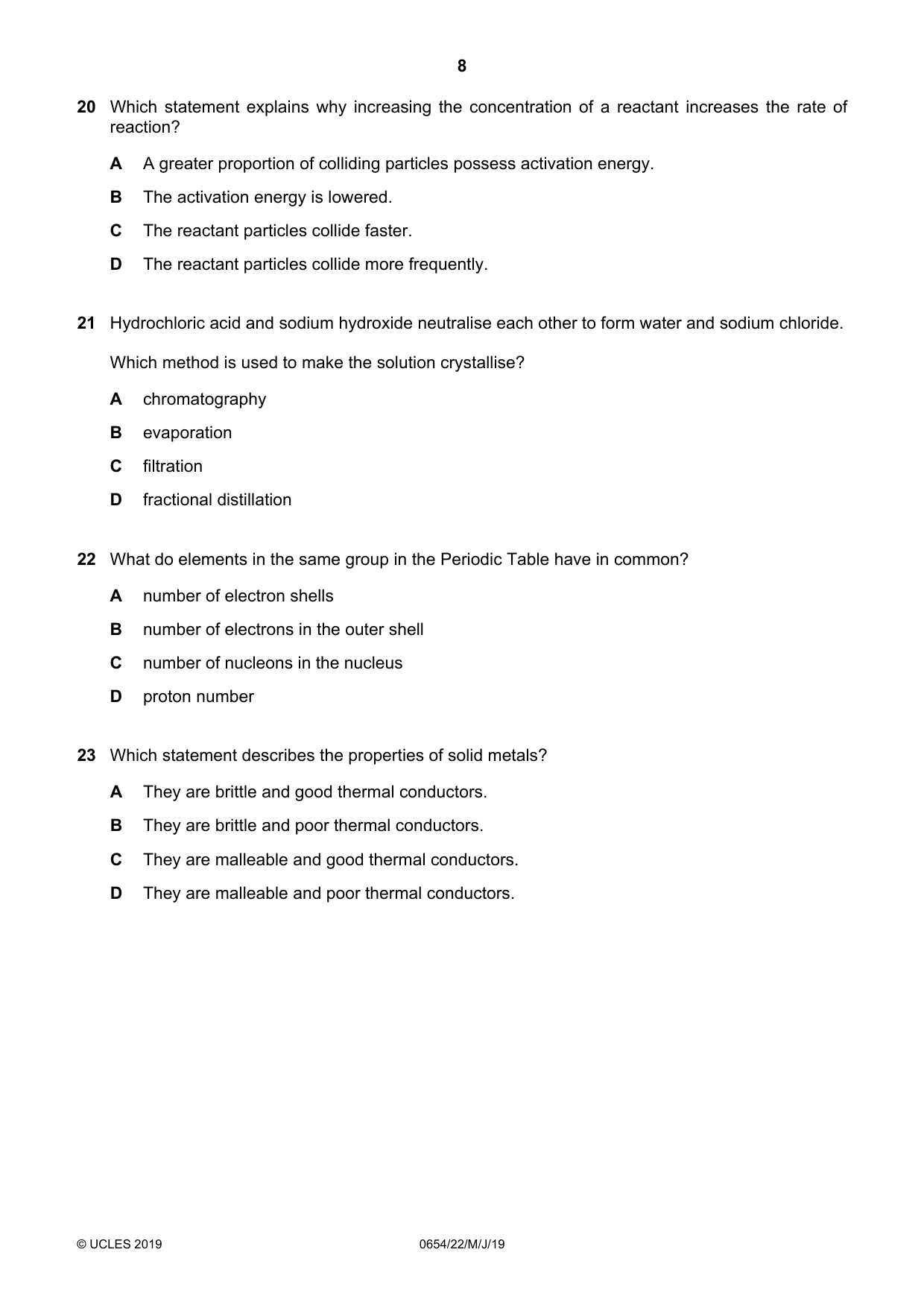
20 Which statement explains why increasing the concentration of a reactant increases the rate of reaction? A A greater proportion of colliding particles possess activation energy. B The activation energy is lowered. C The reactant particles collide faster. D The reactant particles collide more frequently.
Mark scheme: D
Q21 · Hydrochloric acid and sodium hydroxide neutralise each other to form water and sodium…
21 Hydrochloric acid and sodium hydroxide neutralise each other to form water and sodium chloride. Which method is used to make the solution crystallise? A chromatography B evaporation C filtration D fractional distillation
Mark scheme: B
Q22 · What do elements in the same group in the Periodic Table have in common?
22 What do elements in the same group in the Periodic Table have in common? A number of electron shells B number of electrons in the outer shell C number of nucleons in the nucleus D proton number
Mark scheme: B
Q23 · Which statement describes the properties of solid metals?
23 Which statement describes the properties of solid metals? A They are brittle and good thermal conductors. B They are brittle and poor thermal conductors. C They are malleable and good thermal conductors. D They are malleable and poor thermal conductors.
Mark scheme: C
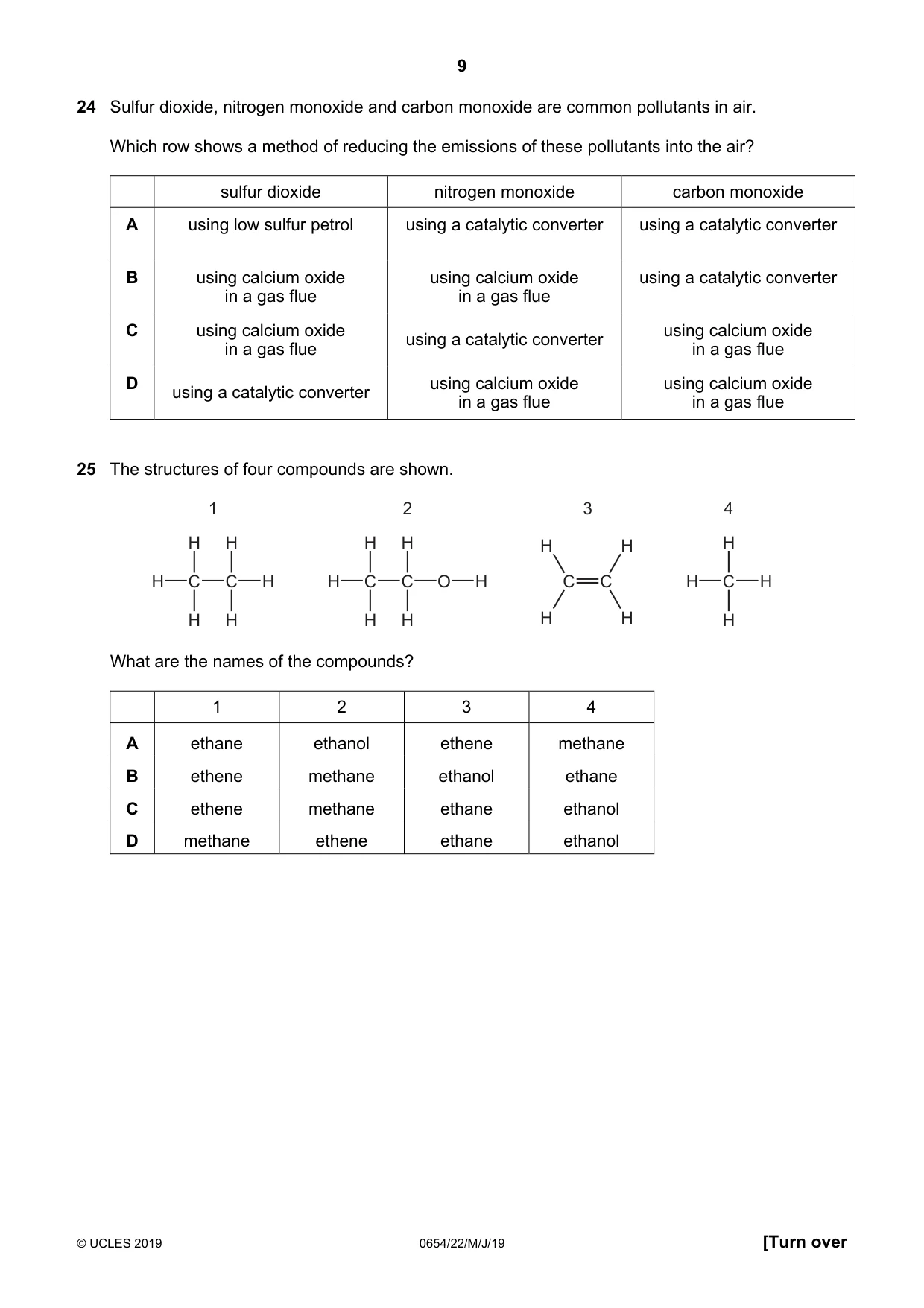
Q24 · Sulfur dioxide, nitrogen monoxide and carbon monoxide are common pollutants in air
24 Sulfur dioxide, nitrogen monoxide and carbon monoxide are common pollutants in air. Which row shows a method of reducing the emissions of these pollutants into the air? sulfur dioxide nitrogen monoxide carbon monoxide A using low sulfur petrol using a catalytic converter using a catalytic converter B using calcium oxide using calcium oxide using a catalytic converter in a gas flue in a gas flue C using calcium oxide using calcium oxide using a catalytic converter in a gas flue in a gas flue D using calcium oxide using calcium oxide using a catalytic converter in a gas flue in a gas flue
Mark scheme: A
Q25 · The structures of four compounds are shown
25 The structures of four compounds are shown. 1 2 3 4 H H H H H H H H C C H H C C O H C C H C H H H H H H H H What are the names of the compounds? 1 2 3 4 A ethane ethanol ethene methane B ethene methane ethanol ethane C ethene methane ethane ethanol D methane ethene ethane ethanol
Mark scheme: A
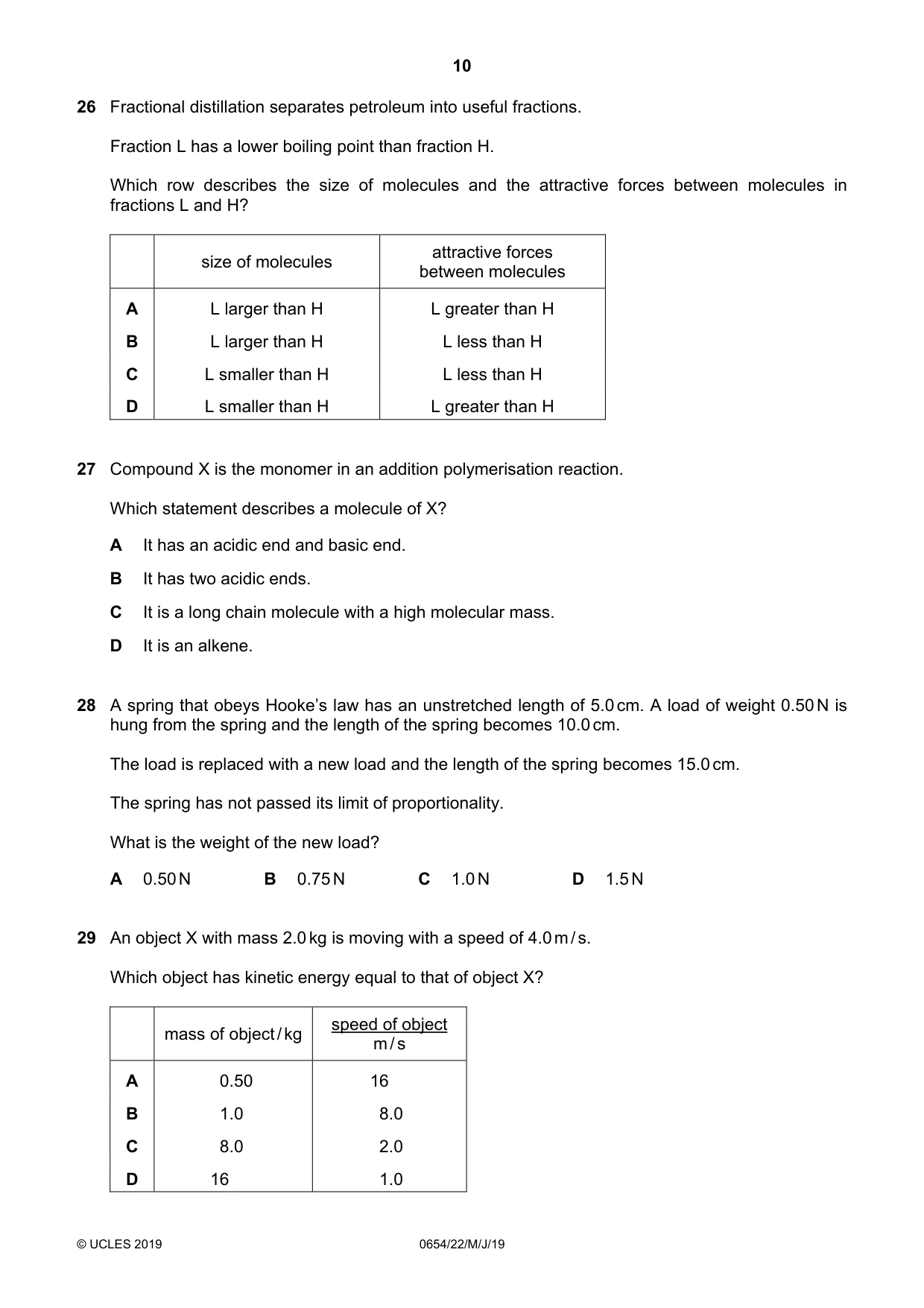
Q26 · Fractional distillation separates petroleum into useful fractions
26 Fractional distillation separates petroleum into useful fractions. Fraction L has a lower boiling point than fraction H. Which row describes the size of molecules and the attractive forces between molecules in fractions L and H? attractive forces size of molecules between molecules A L larger than H L greater than H B L larger than H L less than H C L smaller than H L less than H D L smaller than H L greater than H
Mark scheme: C
Q27 · Compound X is the monomer in an addition polymerisation reaction
27 Compound X is the monomer in an addition polymerisation reaction. Which statement describes a molecule of X? A It has an acidic end and basic end. B It has two acidic ends. C It is a long chain molecule with a high molecular mass. D It is an alkene.
Mark scheme: D
Q28 · A spring that obeys Hooke’s law has an unstretched length of 5.0 cm
28 A spring that obeys Hooke’s law has an unstretched length of 5.0 cm. A load of weight 0.50 N is hung from the spring and the length of the spring becomes 10.0 cm. The load is replaced with a new load and the length of the spring becomes 15.0 cm. The spring has not passed its limit of proportionality. What is the weight of the new load? A 0.50 N B 0.75 N C 1.0 N D 1.5 N
Mark scheme: C
Q29 · An object X with mass 2.0 kg is moving with a speed of 4.0 m / s
29 An object X with mass 2.0 kg is moving with a speed of 4.0 m / s. Which object has kinetic energy equal to that of object X? speed of object mass of object / kg m / s A 0.50 16 B 1.0 8.0 C 8.0 2.0 D 16 1.0
Mark scheme: C
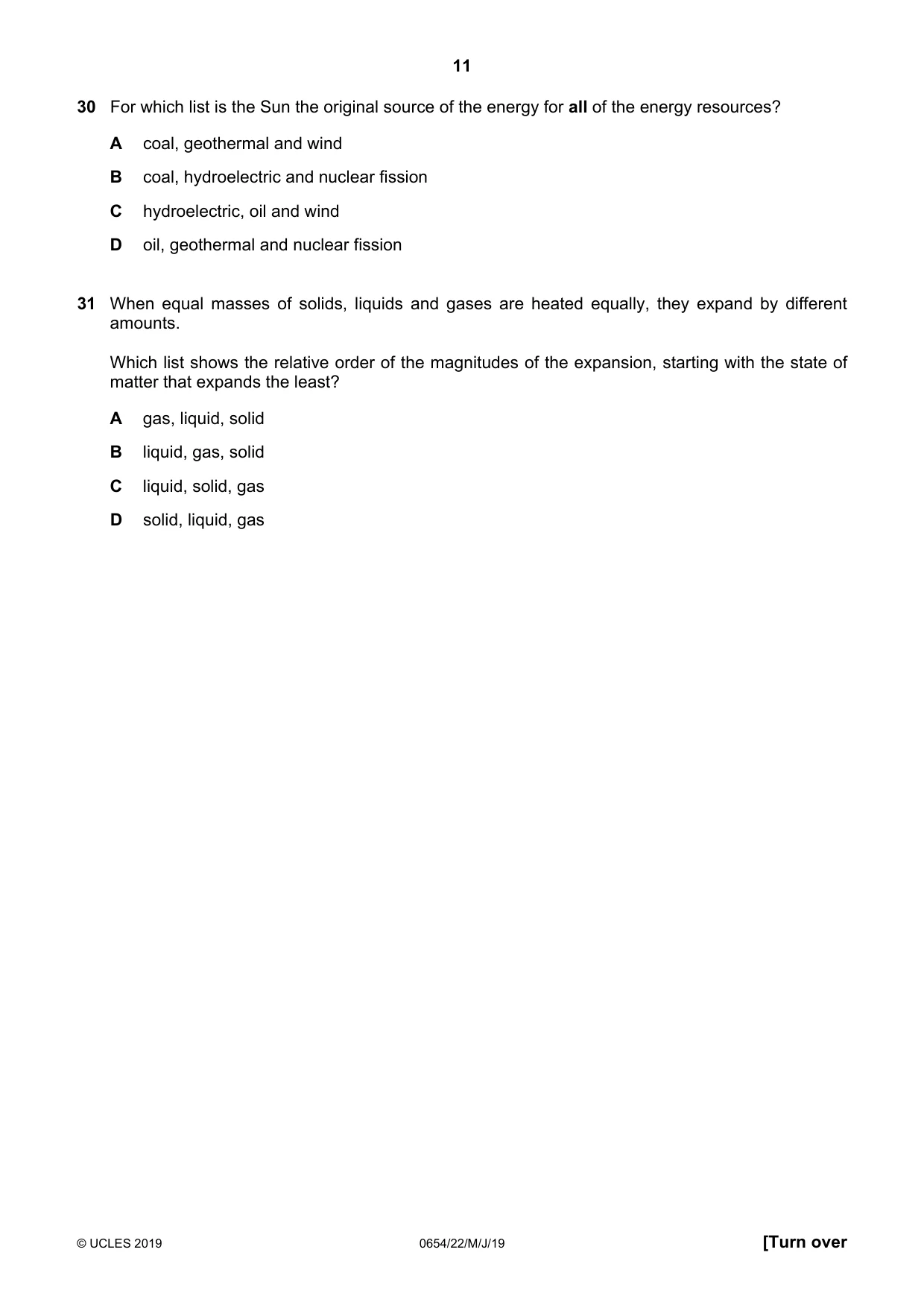
Q30 · For which list is the Sun the original source of the energy for all of the energy…
30 For which list is the Sun the original source of the energy for all of the energy resources? A coal, geothermal and wind B coal, hydroelectric and nuclear fission C hydroelectric, oil and wind D oil, geothermal and nuclear fission
Mark scheme: C
Q31 · When equal masses of solids, liquids and gases are heated equally, they expand by…
31 When equal masses of solids, liquids and gases are heated equally, they expand by different amounts. Which list shows the relative order of the magnitudes of the expansion, starting with the state of matter that expands the least? A gas, liquid, solid B liquid, gas, solid C liquid, solid, gas D solid, liquid, gas
Mark scheme: D
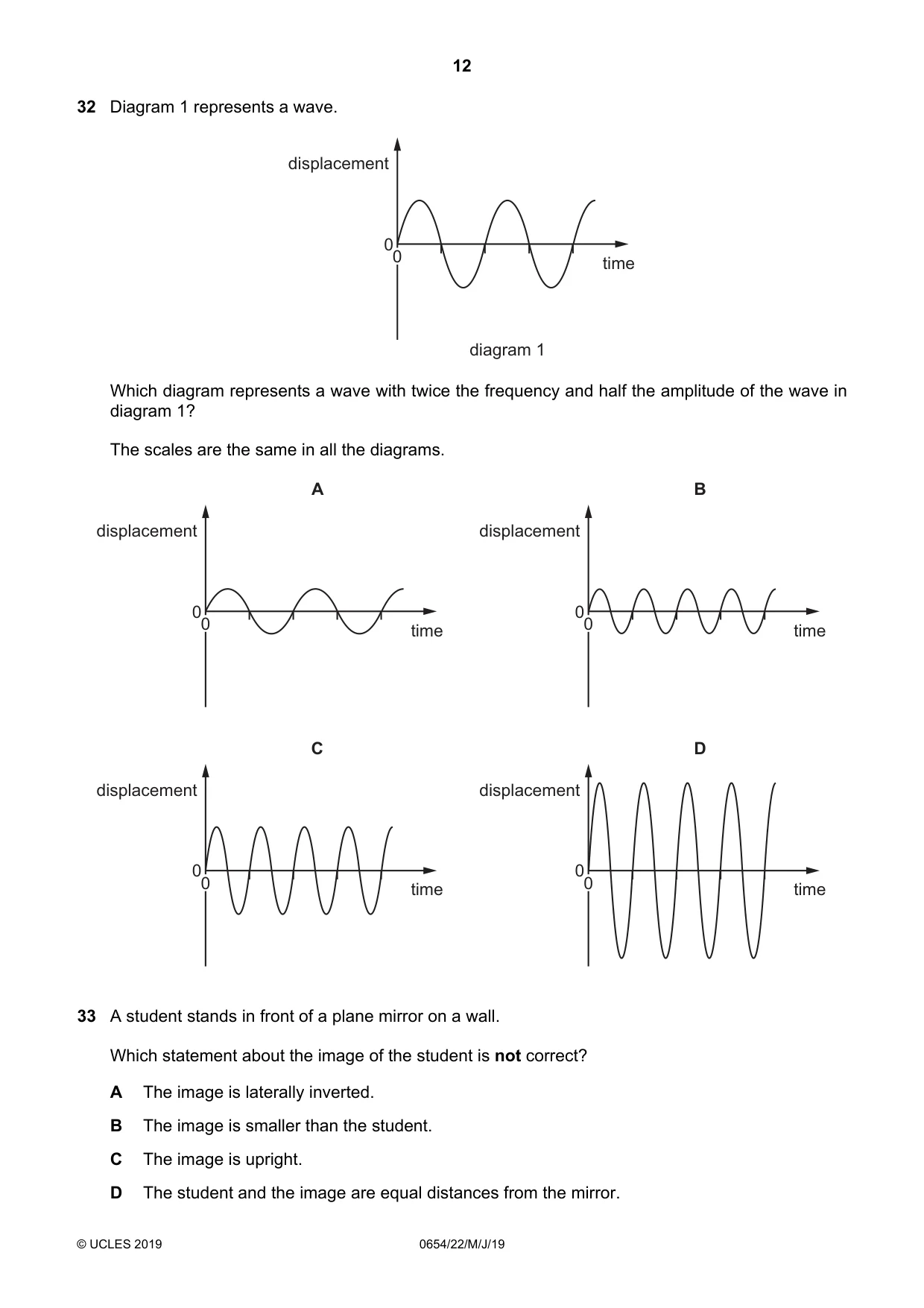
Question 32
32 Diagram 1 represents a wave. displacement 00 time diagram 1 Which diagram represents a wave with twice the frequency and half the amplitude of the wave in diagram 1? The scales are the same in all the diagrams. A B displacement displacement 00 00 time time C D displacement displacement 00 00 time time
Mark scheme: B
Q33 · A student stands in front of a plane mirror on a wall
33 A student stands in front of a plane mirror on a wall. Which statement about the image of the student is not correct? A The image is laterally inverted. B The image is smaller than the student. C The image is upright. D The student and the image are equal distances from the mirror.
Mark scheme: B
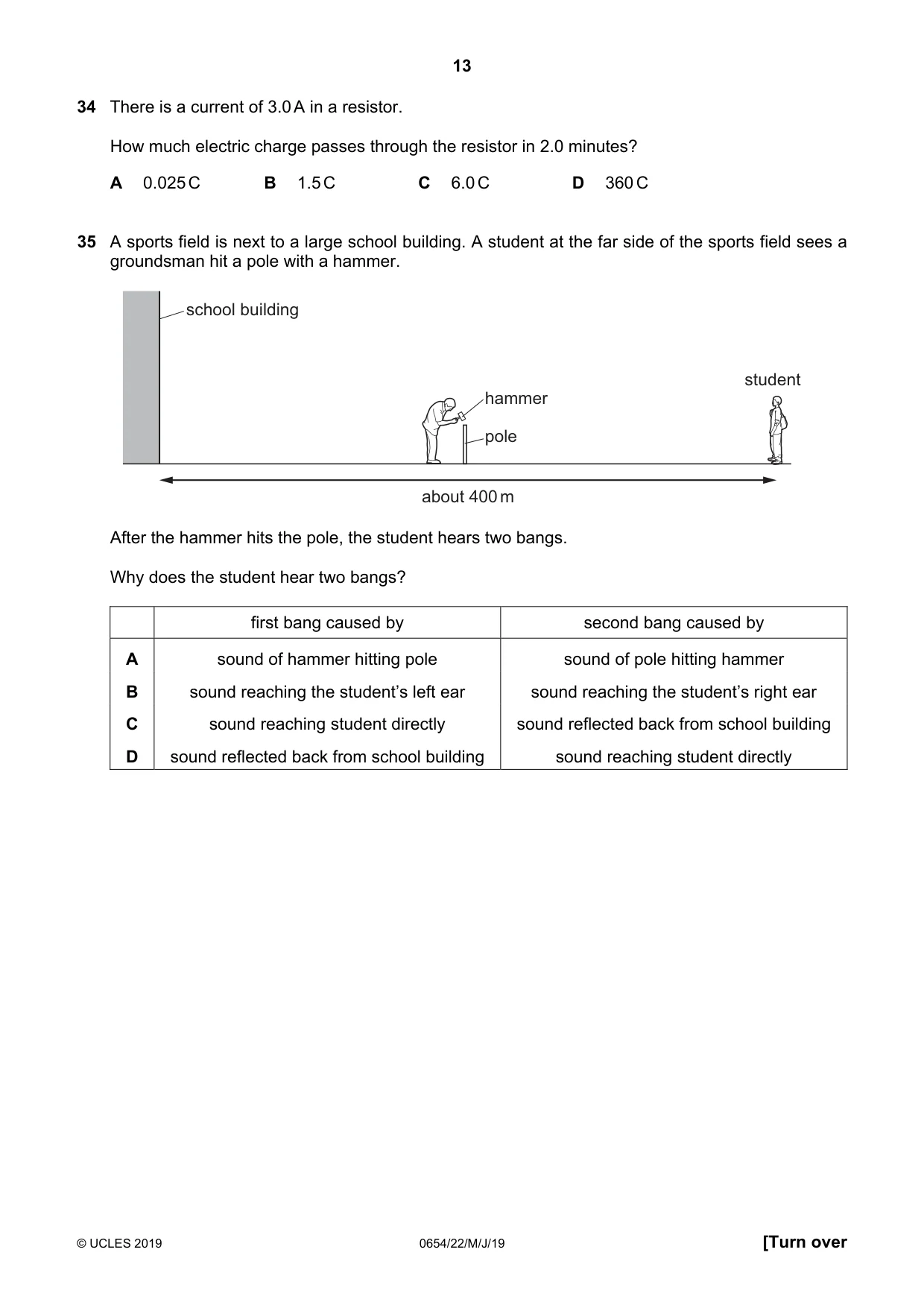
Q34 · There is a current of 3.0 A in a resistor
34 There is a current of 3.0 A in a resistor. How much electric charge passes through the resistor in 2.0 minutes? A 0.025 C B 1.5 C C 6.0 C D 360 C
Mark scheme: D
Q35 · A sports field is next to a large school building
35 A sports field is next to a large school building. A student at the far side of the sports field sees a groundsman hit a pole with a hammer. school building student hammer pole about 400 m After the hammer hits the pole, the student hears two bangs. Why does the student hear two bangs? first bang caused by second bang caused by A sound of hammer hitting pole sound of pole hitting hammer B sound reaching the student’s left ear sound reaching the student’s right ear C sound reaching student directly sound reflected back from school building D sound reflected back from school building sound reaching student directly
Mark scheme: C
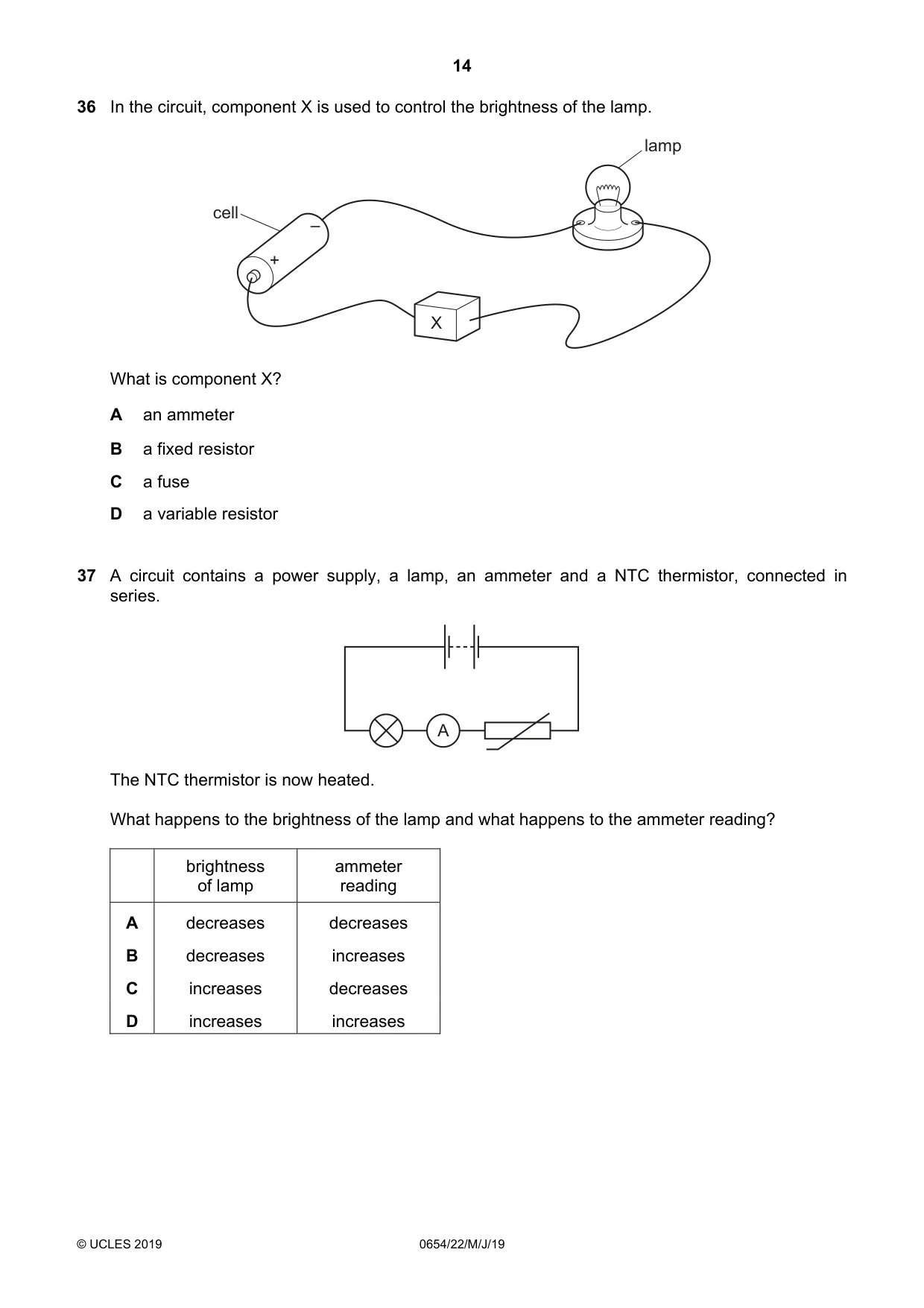
Q36 · In the circuit, component X is used to control the brightness of the lamp
36 In the circuit, component X is used to control the brightness of the lamp. lamp cell – + X What is component X? A an ammeter B a fixed resistor C a fuse D a variable resistor
Mark scheme: D
Q37 · A circuit contains a power supply, a lamp, an ammeter and a NTC thermistor, connected in…
37 A circuit contains a power supply, a lamp, an ammeter and a NTC thermistor, connected in series. A The NTC thermistor is now heated. What happens to the brightness of the lamp and what happens to the ammeter reading? brightness ammeter of lamp reading A decreases decreases B decreases increases C increases decreases D increases increases
Mark scheme: D
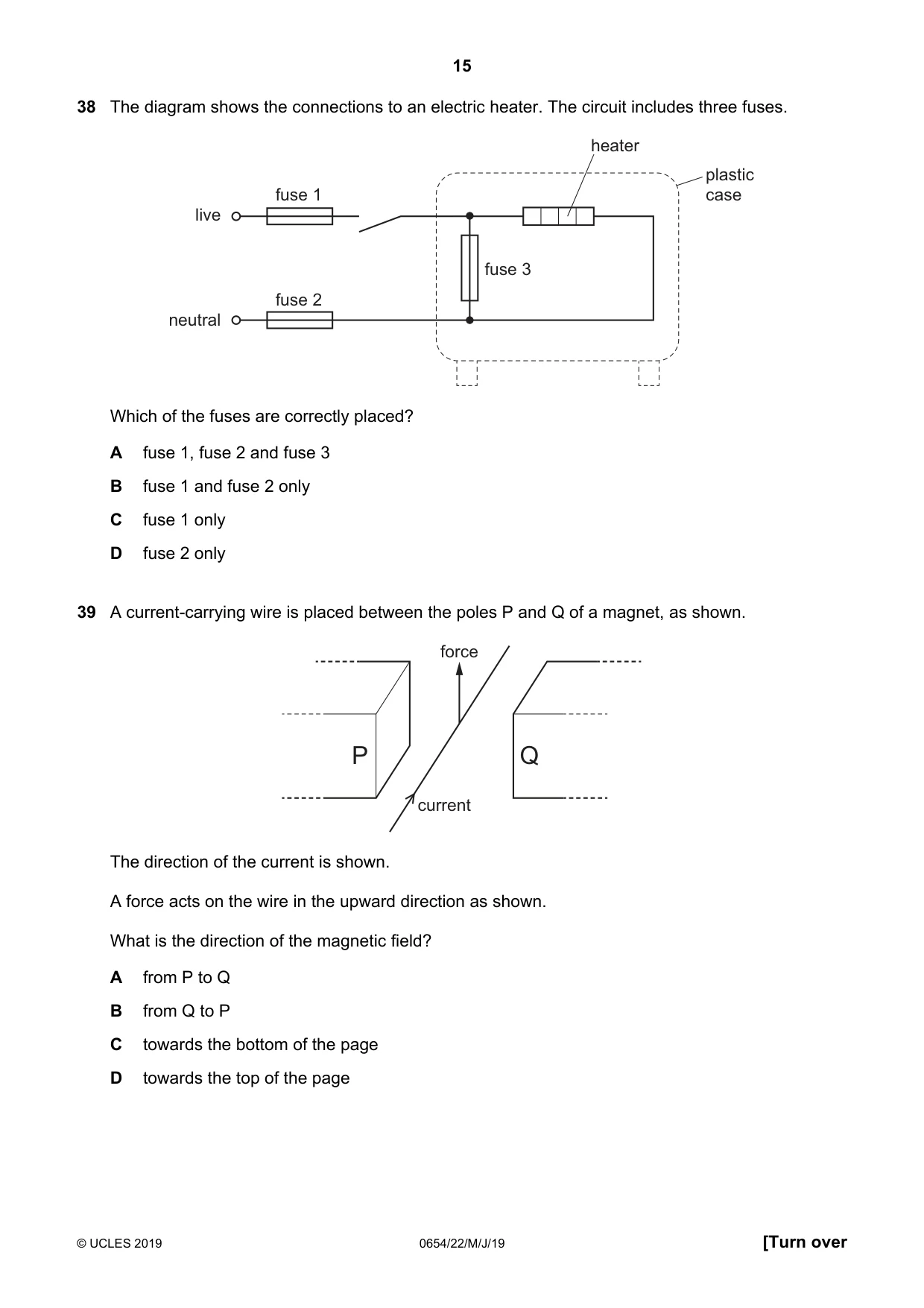
Q38 · The diagram shows the connections to an electric heater
38 The diagram shows the connections to an electric heater. The circuit includes three fuses. heater plastic fuse 1 case live fuse 3 fuse 2 neutral Which of the fuses are correctly placed? A fuse 1, fuse 2 and fuse 3 B fuse 1 and fuse 2 only C fuse 1 only D fuse 2 only
Mark scheme: C
Q39 · A current-carrying wire is placed between the poles P and Q of a magnet, as shown
39 A current-carrying wire is placed between the poles P and Q of a magnet, as shown. force P Q current The direction of the current is shown. A force acts on the wire in the upward direction as shown. What is the direction of the magnetic field? A from P to Q B from Q to P C towards the bottom of the page D towards the top of the page
Mark scheme: B
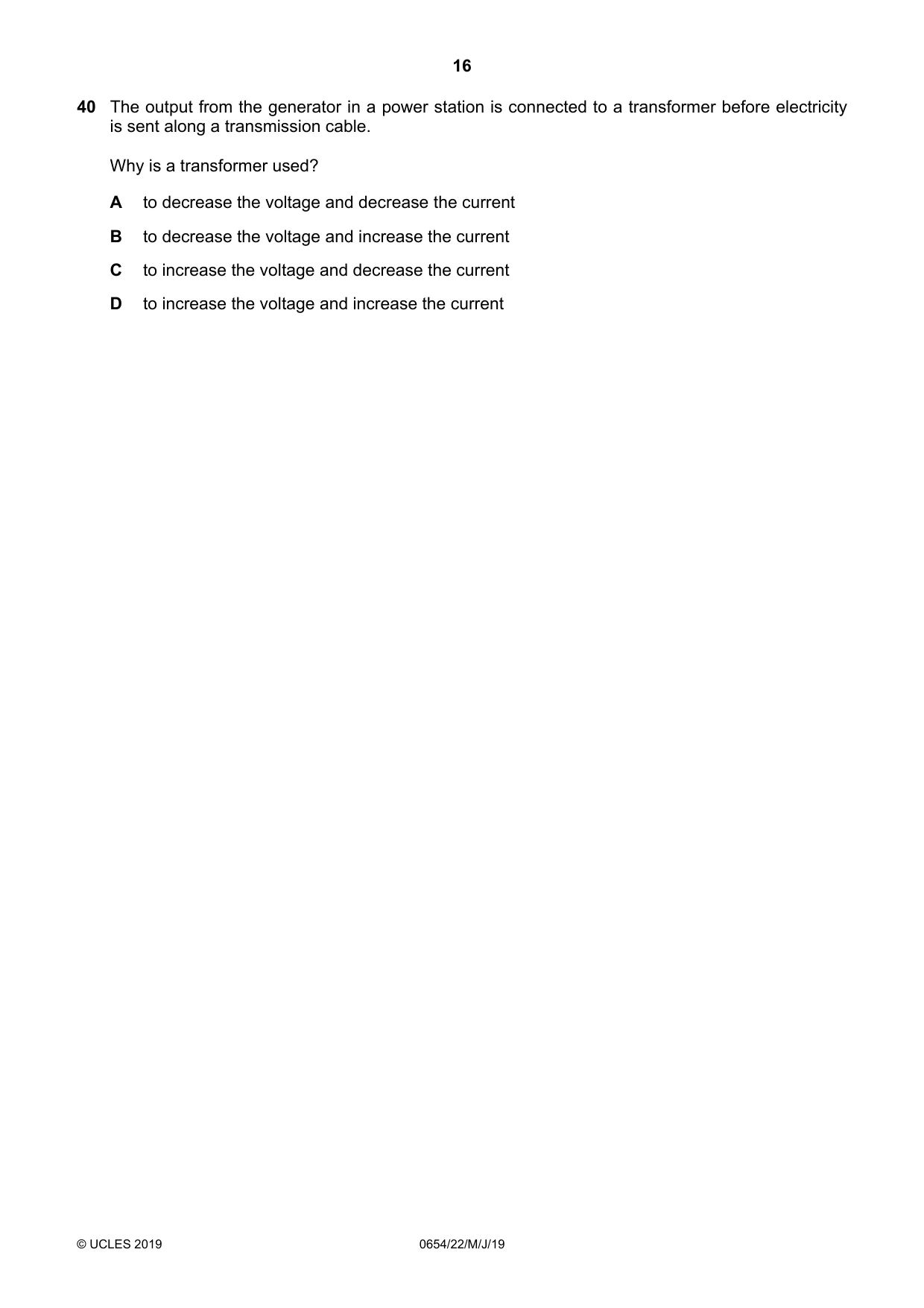
Q40 · The output from the generator in a power station is connected to a transformer before…
40 The output from the generator in a power station is connected to a transformer before electricity is sent along a transmission cable. Why is a transformer used? A to decrease the voltage and decrease the current B to decrease the voltage and increase the current C to increase the voltage and decrease the current D to increase the voltage and increase the current
Mark scheme: C
What was in this paper
The subtopics covered by these 40 questions, and how many questions each got. Open one in a new tab to see every Cambridge question on it.
2Electromagnetic effects2Energy, work and power2Air quality and climate1Arrangement of elements1Biological molecules1Characteristics of living organisms1Circulatory systems1Coordination and response1Digestion1Electrical quantities1Electrical safety1Electrolysis1Enzymes1Exothermic and endothermic reactions1Food chains and food webs1Forces1Fuels1General properties of waves1Giant covalent structures1Habitat destruction1Kinetic particle model of matter1Light1Naming organic compounds1Osmosis1Photosynthesis1Physical and chemical changes1Polymers1Properties of metals1Rate of reaction1Respiration1Separation and purification1Sexual reproduction in humans1Sexual reproduction in plants1Solids, liquids and gases1Sound1The mole and the Avogadro constant1What you needed in this session
Cambridge’s own grade thresholds for 2019 May/June, Paper 2 · Variant 2. A higher threshold means an easier paper — the bar moves with how the cohort did.