Cambridge IGCSE Sciences - Co-ordinated (Double) 0654 — 2024 Oct/Nov Paper 2 · Variant 3
0654/23/O/N/24 · 40 questions · 40 marks · ≈45 min
The question paper and its mark scheme, free to read here and free to download. This is Cambridge’s own paper, exactly as it was sat.
Question paper20 pages


Mark scheme3 pages
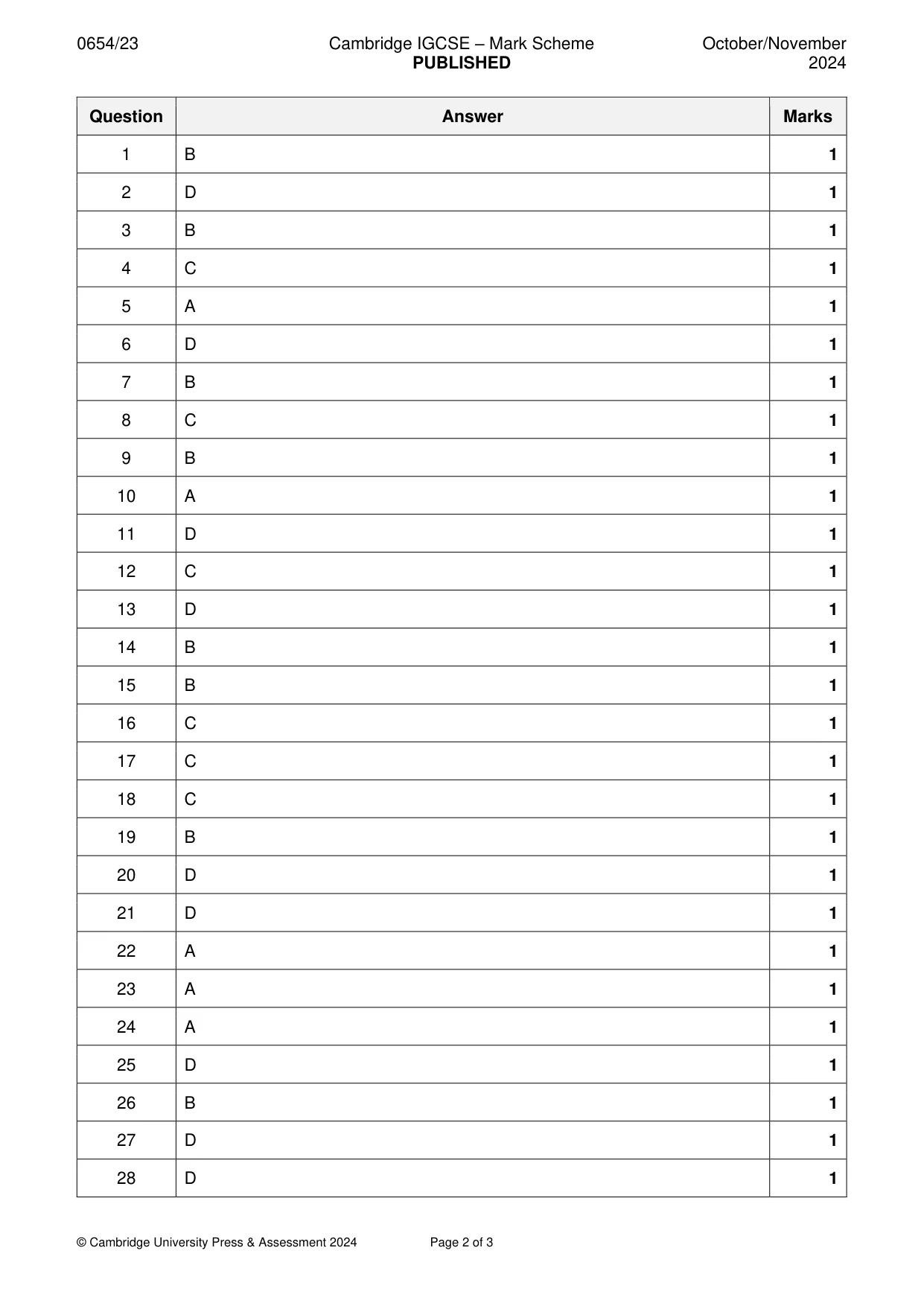
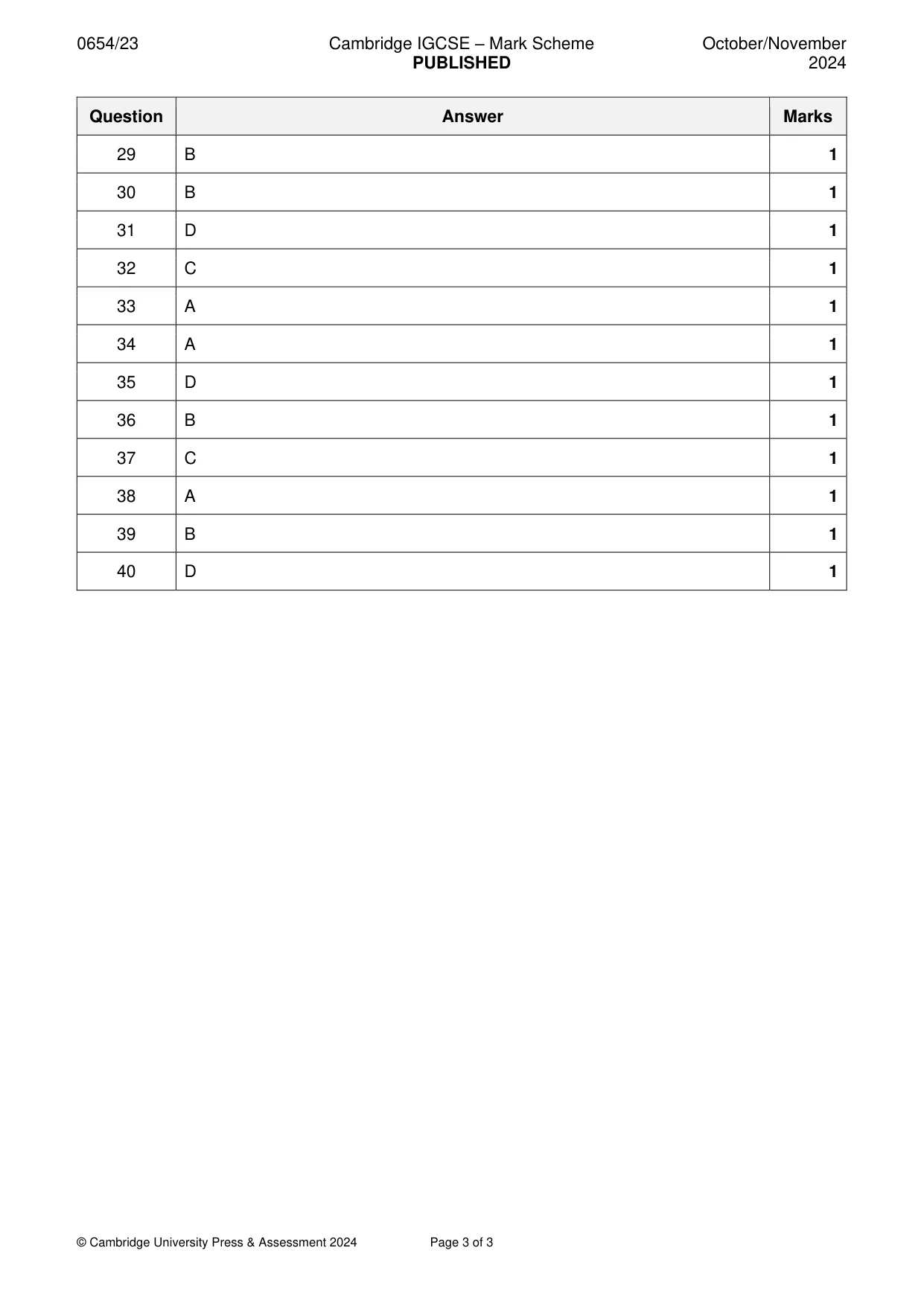
Answers below. Sit the paper first if you are practising.
Questions as text
Q1 · Soya seeds contain a lot of protein and are often fed to farm animals
1 Soya seeds contain a lot of protein and are often fed to farm animals. Which characteristic of living things will benefit from the soya seeds? A excretion B growth C movement D sensitivity
Mark scheme: B
Q2 · Pieces of potato of the same length were placed in sucrose solutions of different…
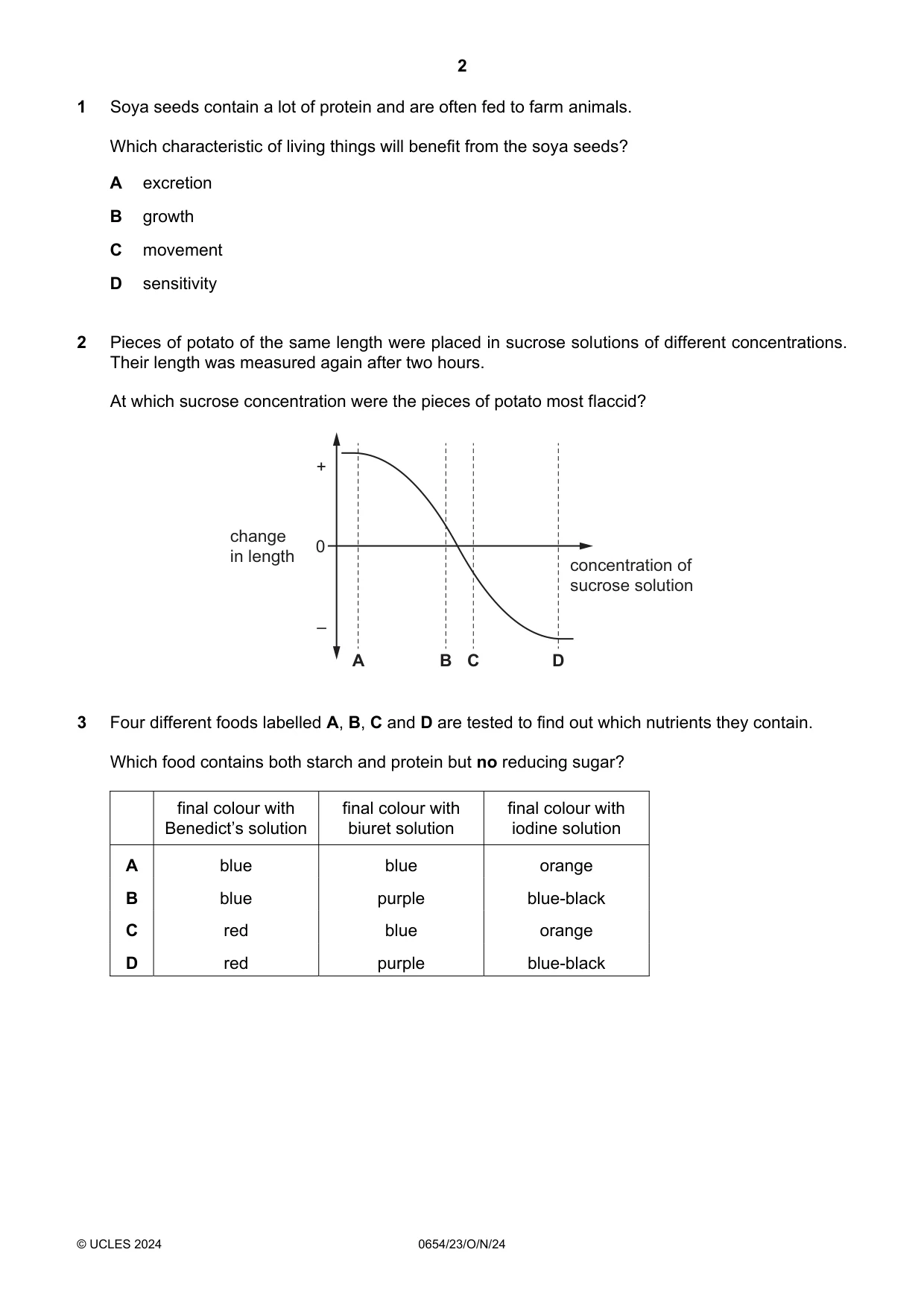
2 Pieces of potato of the same length were placed in sucrose solutions of different concentrations. Their length was measured again after two hours. At which sucrose concentration were the pieces of potato most flaccid? + change 0 in length concentration of sucrose solution – A B C D
Mark scheme: D
Q3 · Four different foods labelled A, B, C and D are tested to find out which nutrients they…
3 Four different foods labelled A, B, C and D are tested to find out which nutrients they contain. Which food contains both starch and protein but no reducing sugar? final colour with final colour with final colour with Benedict’s solution biuret solution iodine solution A blue blue orange B blue purple blue-black C red blue orange D red purple blue-black
Mark scheme: B
Q4 · When the phenol molecules in apples are exposed to air, they react with oxygen and the…
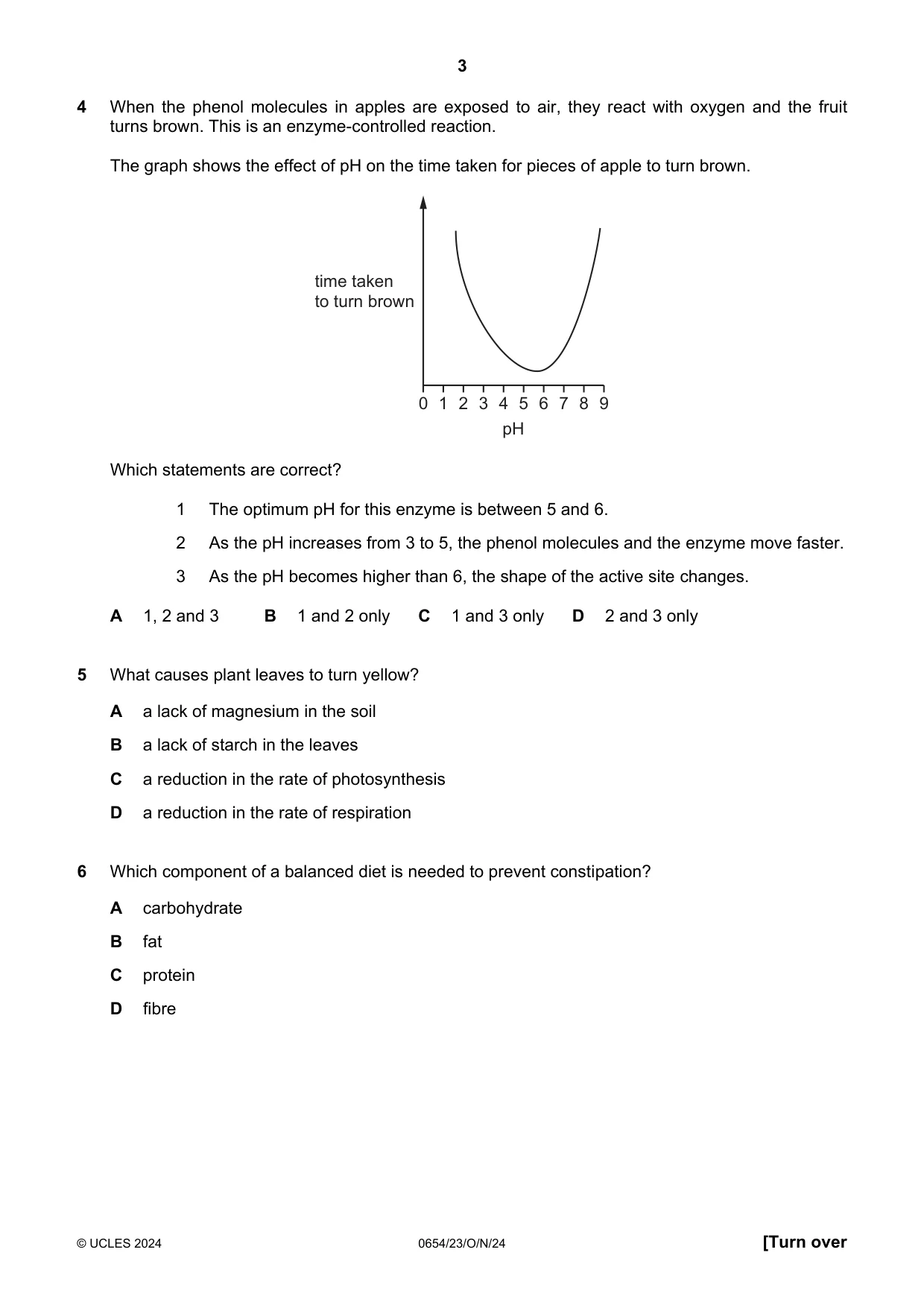
4 When the phenol molecules in apples are exposed to air, they react with oxygen and the fruit turns brown. This is an enzyme-controlled reaction. The graph shows the effect of pH on the time taken for pieces of apple to turn brown. time taken to turn brown 0 1 2 3 4 5 6 7 8 9 pH Which statements are correct? 1 The optimum pH for this enzyme is between 5 and 6. 2 As the pH increases from 3 to 5, the phenol molecules and the enzyme move faster. 3 As the pH becomes higher than 6, the shape of the active site changes. A 1, 2 and 3 B 1 and 2 only C 1 and 3 only D 2 and 3 only
Mark scheme: C
Q5 · What causes plant leaves to turn yellow?
5 What causes plant leaves to turn yellow? A a lack of magnesium in the soil B a lack of starch in the leaves C a reduction in the rate of photosynthesis D a reduction in the rate of respiration
Mark scheme: A
Q6 · Which component of a balanced diet is needed to prevent constipation?
6 Which component of a balanced diet is needed to prevent constipation? A carbohydrate B fat C protein D fibre
Mark scheme: D
Q7 · The diagram shows the life cycle of a plant that takes two years to grow from a seed and…
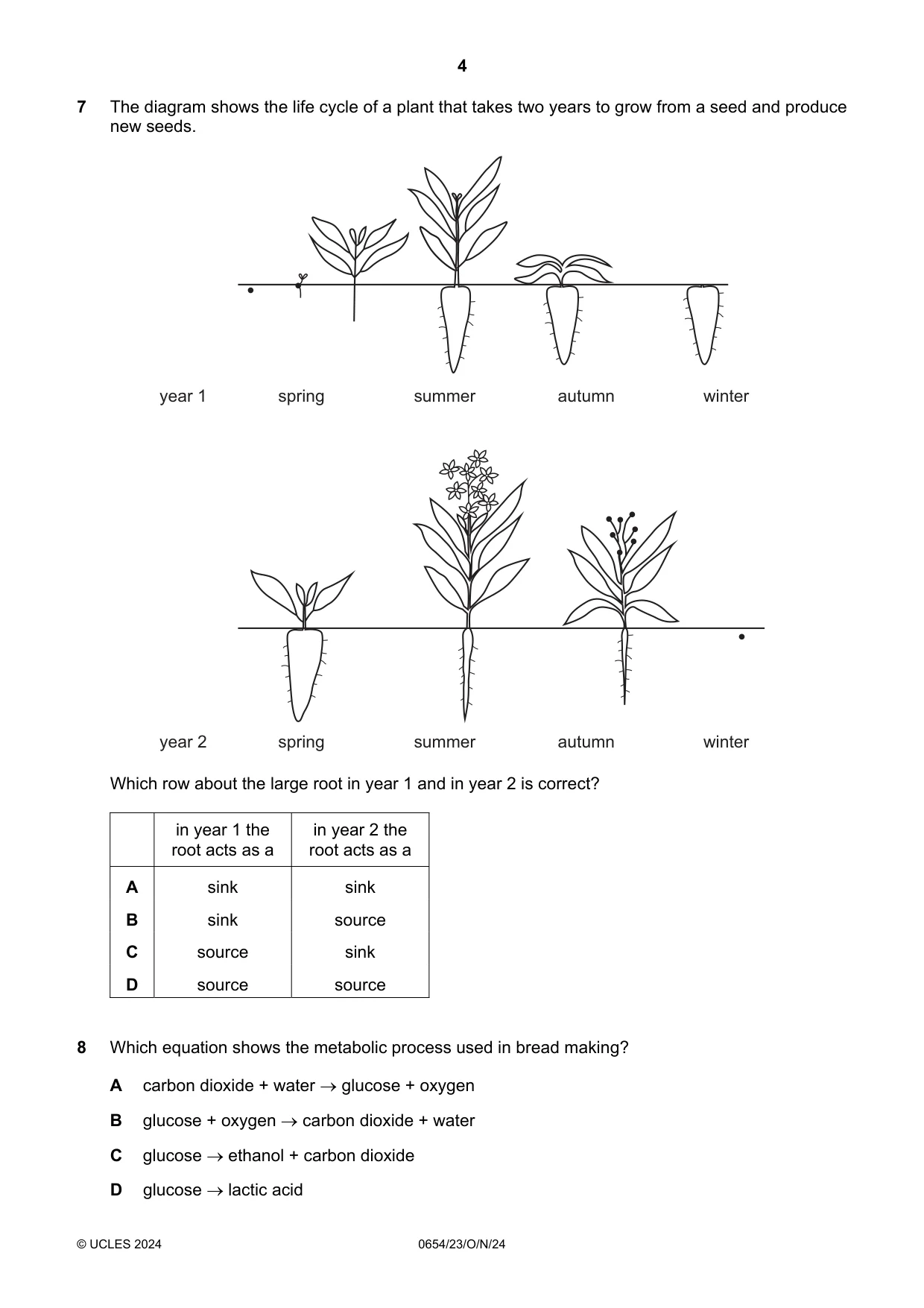
7 The diagram shows the life cycle of a plant that takes two years to grow from a seed and produce new seeds. year 1 spring summer autumn winter year 2 spring summer autumn winter Which row about the large root in year 1 and in year 2 is correct? in year 1 the in year 2 the root acts as a root acts as a A sink sink B sink source C source sink D source source
Mark scheme: B
Q8 · Which equation shows the metabolic process used in bread making?
8 Which equation shows the metabolic process used in bread making? A carbon dioxide + water glucose + oxygen B glucose + oxygen carbon dioxide + water C glucose ethanol + carbon dioxide D glucose lactic acid
Mark scheme: C
Q9 · What are examples of involuntary actions?
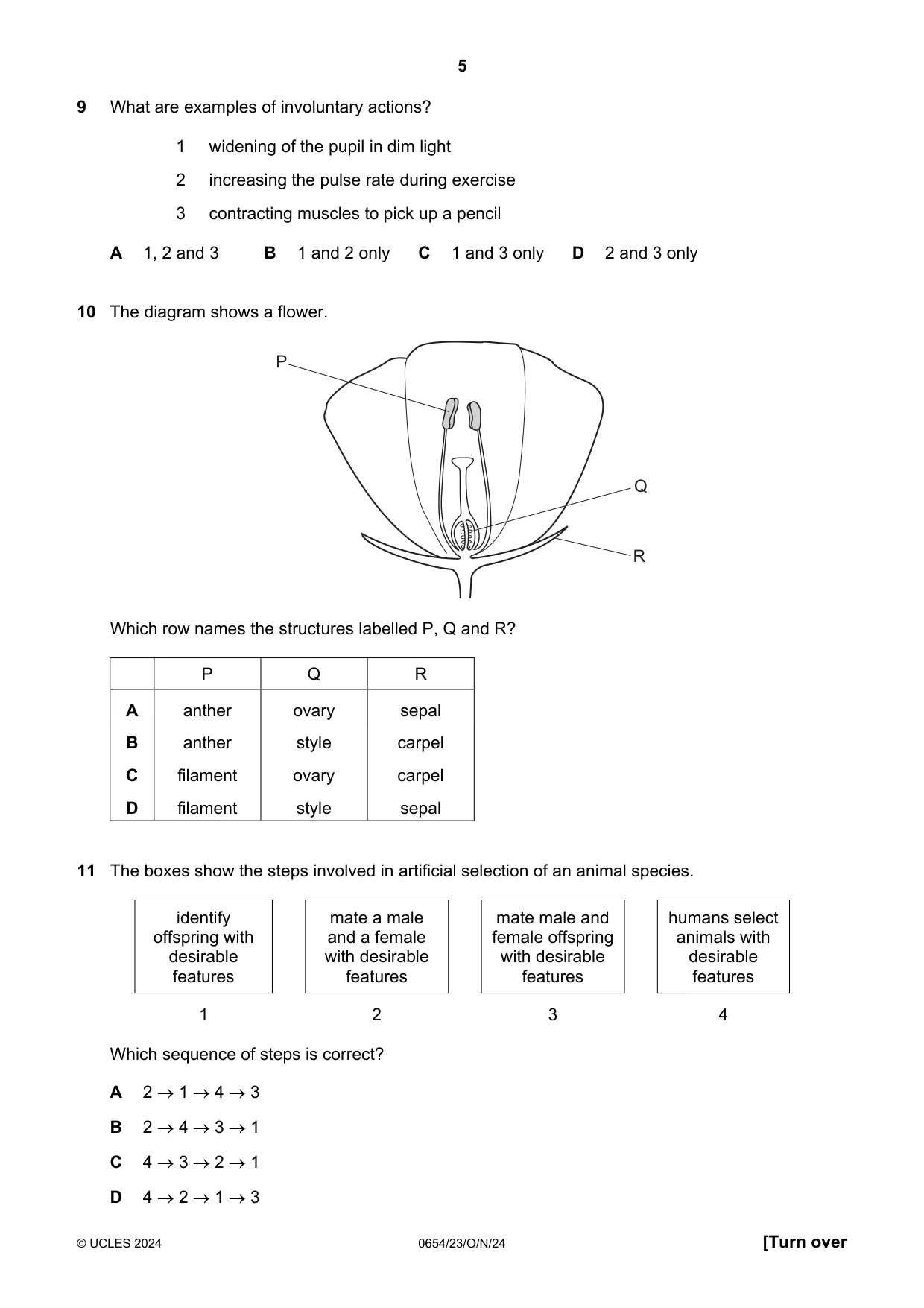
9 What are examples of involuntary actions? 1 widening of the pupil in dim light 2 increasing the pulse rate during exercise 3 contracting muscles to pick up a pencil A 1, 2 and 3 B 1 and 2 only C 1 and 3 only D 2 and 3 only
Mark scheme: B
Q10 · The diagram shows a flower
10 The diagram shows a flower. P Q R Which row names the structures labelled P, Q and R? P Q R A anther ovary sepal B anther style carpel C filament ovary carpel D filament style sepal
Mark scheme: A
Q11 · The boxes show the steps involved in artificial selection of an animal species
11 The boxes show the steps involved in artificial selection of an animal species. identify mate a male mate male and humans select offspring with and a female female offspring animals with desirable with desirable with desirable desirable features features features features 1 2 3 4 Which sequence of steps is correct? A 2 1 4 3 B 2 4 3 1 C 4 3 2 1 D 4 2 1 3
Mark scheme: D
Q12 · Which statement about all food chains is correct?
12 Which statement about all food chains is correct? A All the carnivores are producers. B All the consumers are carnivores. C All the herbivores are consumers. D All the producers are herbivores.
Mark scheme: C
Q13 · The release of fertiliser into rivers and lakes causes eutrophication which can lead to…
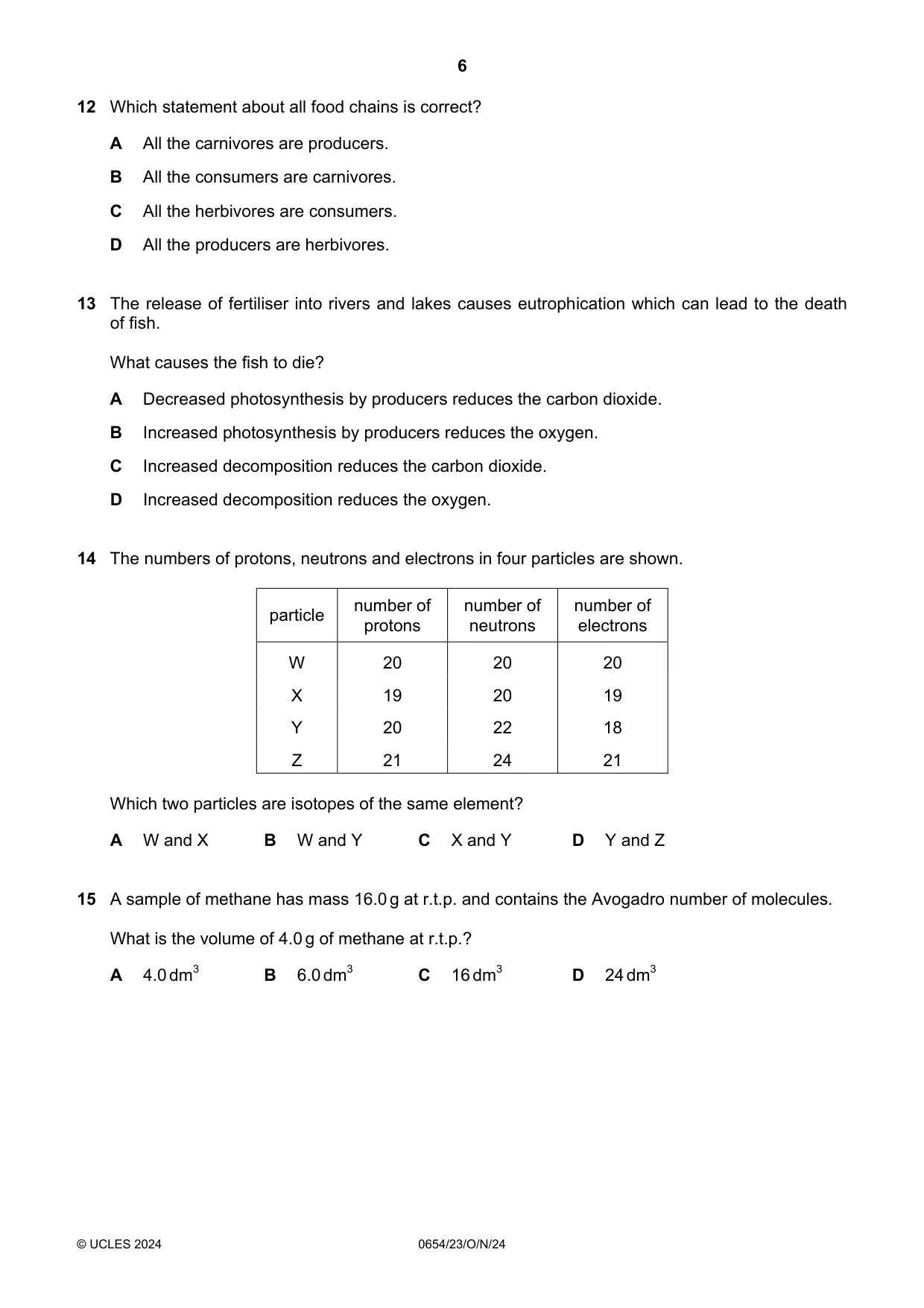
13 The release of fertiliser into rivers and lakes causes eutrophication which can lead to the death of fish. What causes the fish to die? A Decreased photosynthesis by producers reduces the carbon dioxide. B Increased photosynthesis by producers reduces the oxygen. C Increased decomposition reduces the carbon dioxide. D Increased decomposition reduces the oxygen.
Mark scheme: D
Q14 · The numbers of protons, neutrons and electrons in four particles are shown
14 The numbers of protons, neutrons and electrons in four particles are shown. number of number of number of particle protons neutrons electrons W 20 20 20 X 19 20 19 Y 20 22 18 Z 21 24 21 Which two particles are isotopes of the same element? A W and X B W and Y C X and Y D Y and Z
Mark scheme: B
Q15 · A sample of methane has mass 16.0 g at r.t.p
15 A sample of methane has mass 16.0 g at r.t.p. and contains the Avogadro number of molecules. What is the volume of 4.0 g of methane at r.t.p.? A 4.0 dm3 B 6.0 dm3 C 16 dm3 D 24 dm3
Mark scheme: B
Q16 · The diagram shows the electrolysis of molten lead(II) bromide using inert electrodes
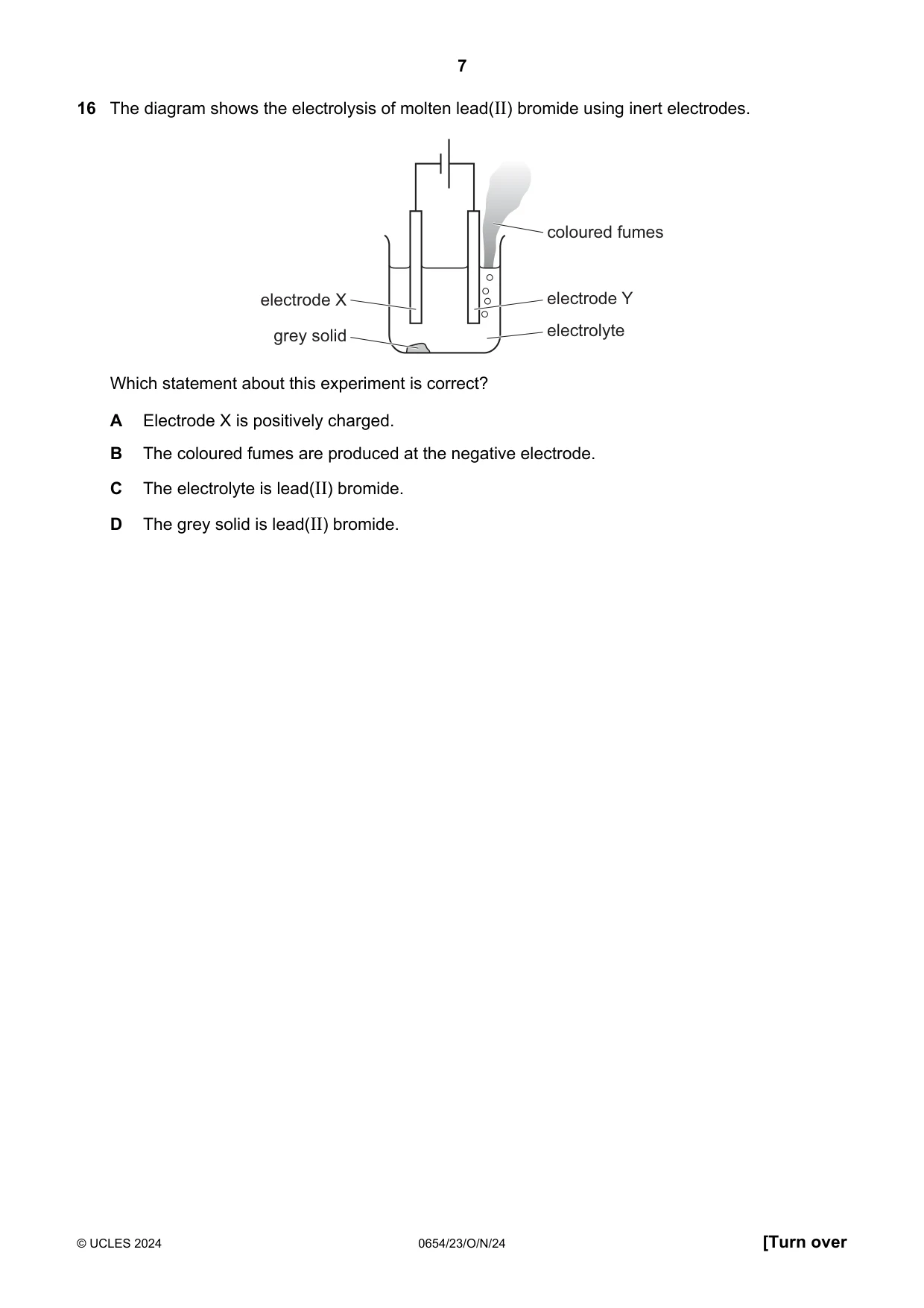
16 The diagram shows the electrolysis of molten lead(II) bromide using inert electrodes. coloured fumes electrode X electrode Y grey solid electrolyte Which statement about this experiment is correct? A Electrode X is positively charged. B The coloured fumes are produced at the negative electrode. C The electrolyte is lead(II) bromide. D The grey solid is lead(II) bromide.
Mark scheme: C
Q17 · Which energy level diagram shows the activation energy for an exothermic reaction?
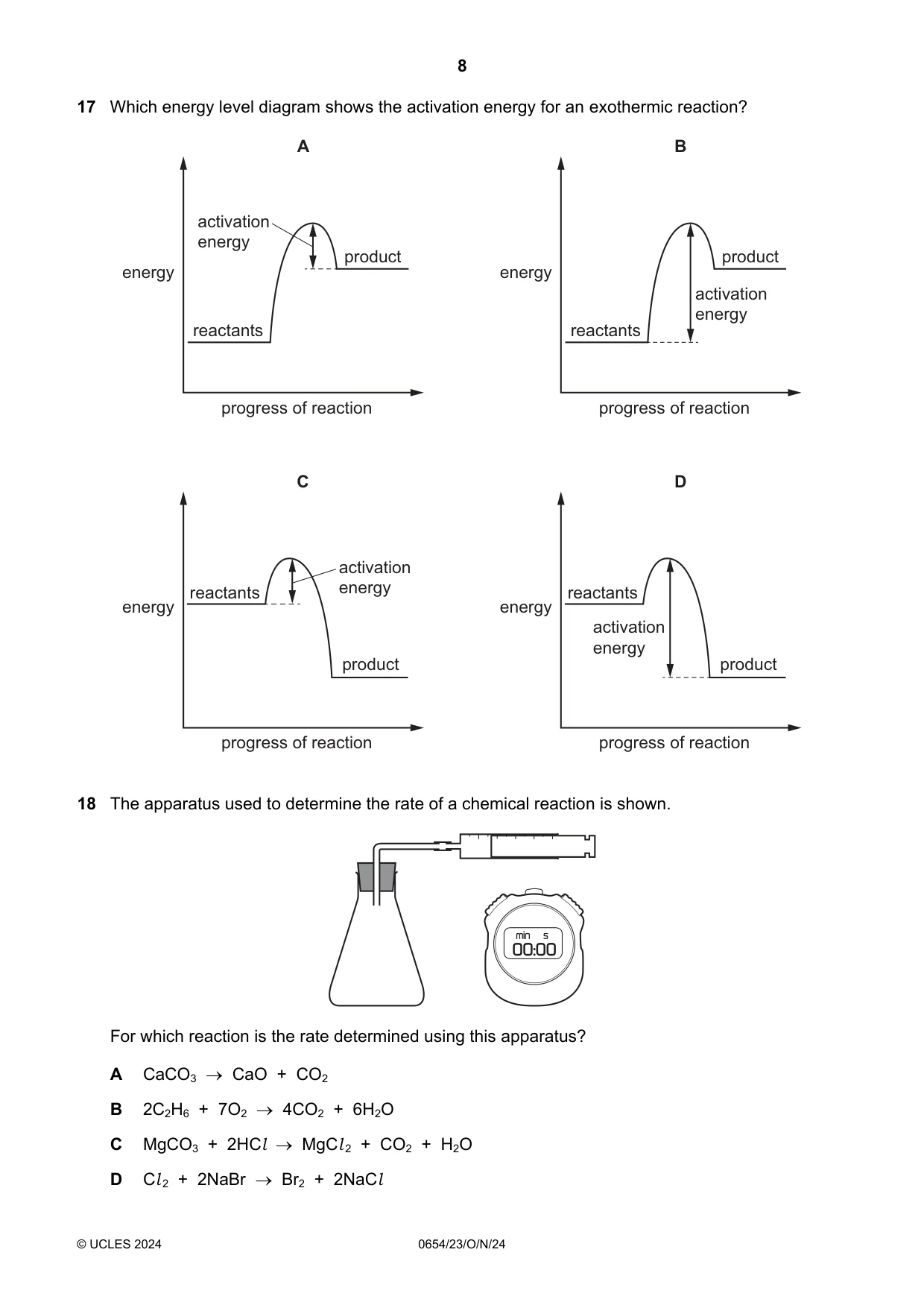
17 Which energy level diagram shows the activation energy for an exothermic reaction? A B activation energy product product energy energy activation energy reactants reactants progress of reaction progress of reaction C D activation reactants energy reactants energy energy activation energy product product progress of reaction progress of reaction
Mark scheme: C
Q18 · The apparatus used to determine the rate of a chemical reaction is shown
18 The apparatus used to determine the rate of a chemical reaction is shown. For which reaction is the rate determined using this apparatus? A CaCO3 CaO + CO2 B 2C2H6 + 7O2 4CO2 + 6H2O C MgCO3 + 2HCl MgCl 2 + CO2 + H2O D Cl 2 + 2NaBr Br2 + 2NaCl
Mark scheme: C
Q19 · The equation for the reaction between magnesium and zinc sulfate is shown
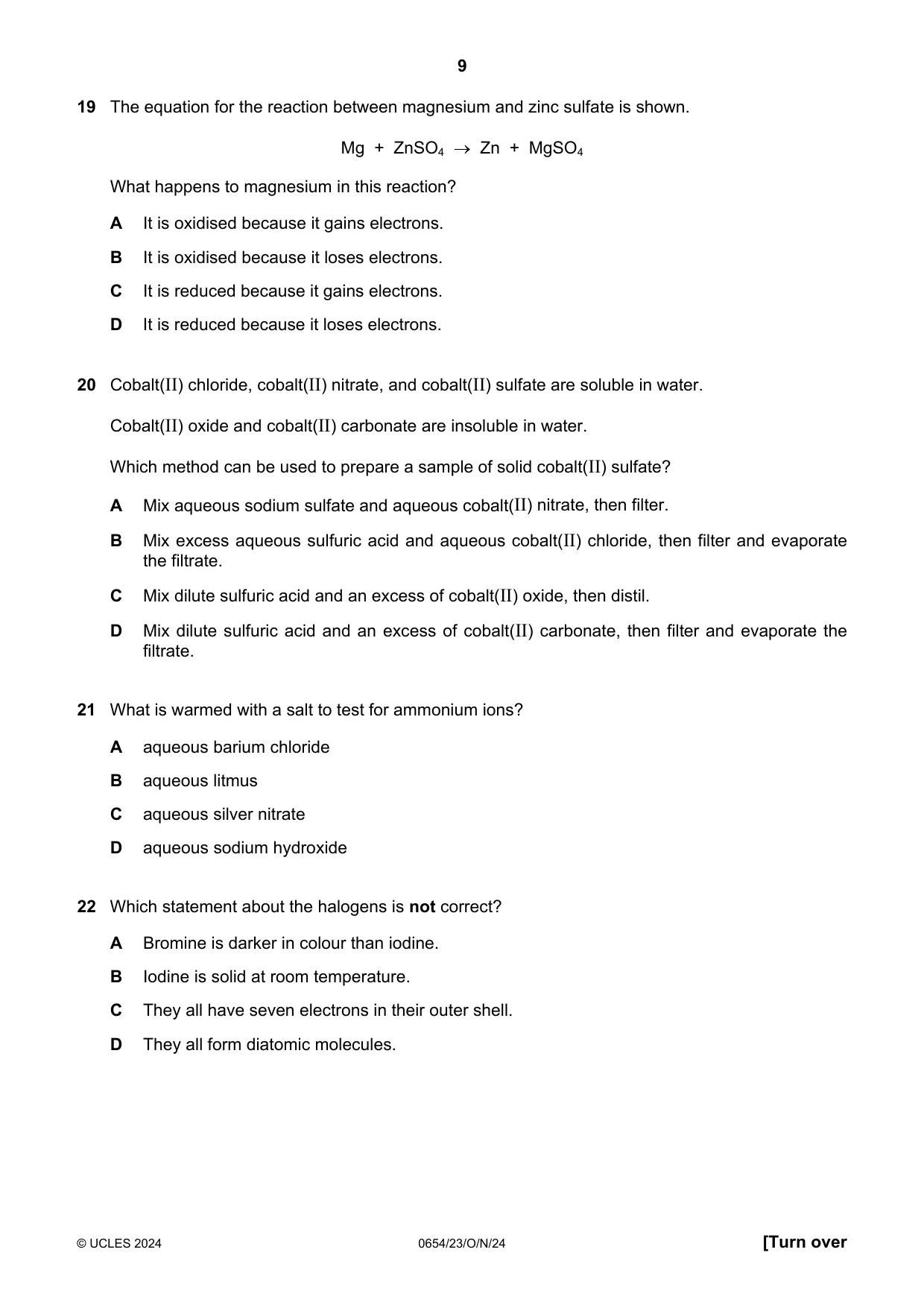
19 The equation for the reaction between magnesium and zinc sulfate is shown. Mg + ZnSO4 Zn + MgSO4 What happens to magnesium in this reaction? A It is oxidised because it gains electrons. B It is oxidised because it loses electrons. C It is reduced because it gains electrons. D It is reduced because it loses electrons.
Mark scheme: B
Q20 · Cobalt(II) chloride, cobalt(II) nitrate, and cobalt(II) sulfate are soluble in water
20 Cobalt(II) chloride, cobalt(II) nitrate, and cobalt(II) sulfate are soluble in water. Cobalt(II) oxide and cobalt(II) carbonate are insoluble in water. Which method can be used to prepare a sample of solid cobalt(II) sulfate? A Mix aqueous sodium sulfate and aqueous cobalt(II) nitrate, then filter. B Mix excess aqueous sulfuric acid and aqueous cobalt(II) chloride, then filter and evaporate the filtrate. C Mix dilute sulfuric acid and an excess of cobalt(II) oxide, then distil. D Mix dilute sulfuric acid and an excess of cobalt(II) carbonate, then filter and evaporate the filtrate.
Mark scheme: D
Q21 · What is warmed with a salt to test for ammonium ions?
21 What is warmed with a salt to test for ammonium ions? A aqueous barium chloride B aqueous litmus C aqueous silver nitrate D aqueous sodium hydroxide
Mark scheme: D
Q22 · Which statement about the halogens is not correct?
22 Which statement about the halogens is not correct? A Bromine is darker in colour than iodine. B Iodine is solid at room temperature. C They all have seven electrons in their outer shell. D They all form diatomic molecules.
Mark scheme: A
Q23 · Which statement describes a typical transition element?
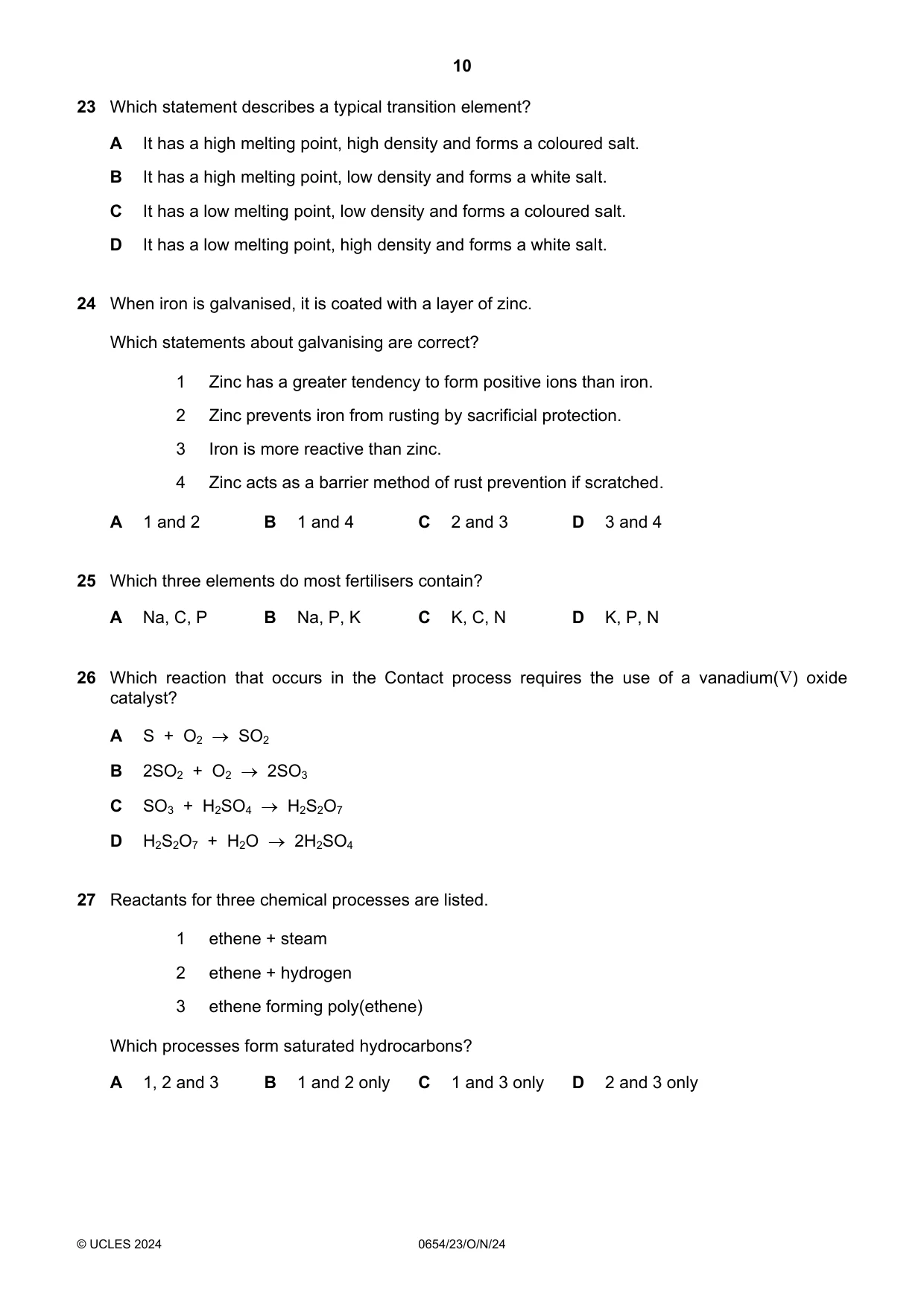
23 Which statement describes a typical transition element? A It has a high melting point, high density and forms a coloured salt. B It has a high melting point, low density and forms a white salt. C It has a low melting point, low density and forms a coloured salt. D It has a low melting point, high density and forms a white salt.
Mark scheme: A
Q24 · When iron is galvanised, it is coated with a layer of zinc
24 When iron is galvanised, it is coated with a layer of zinc. Which statements about galvanising are correct? 1 Zinc has a greater tendency to form positive ions than iron. 2 Zinc prevents iron from rusting by sacrificial protection. 3 Iron is more reactive than zinc. 4 Zinc acts as a barrier method of rust prevention if scratched. A 1 and 2 B 1 and 4 C 2 and 3 D 3 and 4
Mark scheme: A
Q25 · Which three elements do most fertilisers contain?
25 Which three elements do most fertilisers contain? A Na, C, P B Na, P, K C K, C, N D K, P, N
Mark scheme: D
Q26 · Which reaction that occurs in the Contact process requires the use of a vanadium(V) oxide…
26 Which reaction that occurs in the Contact process requires the use of a vanadium(V) oxide catalyst? A S + O2 SO2 B 2SO2 + O2 2SO3 C SO3 + H2SO4 H2S2O7 D H2S2O7 + H2O 2H2SO4
Mark scheme: B
Q27 · Reactants for three chemical processes are listed
27 Reactants for three chemical processes are listed. 1 ethene + steam 2 ethene + hydrogen 3 ethene forming poly(ethene) Which processes form saturated hydrocarbons? A 1, 2 and 3 B 1 and 2 only C 1 and 3 only D 2 and 3 only
Mark scheme: D
Q28 · The diagrams show four solid blocks of equal mass
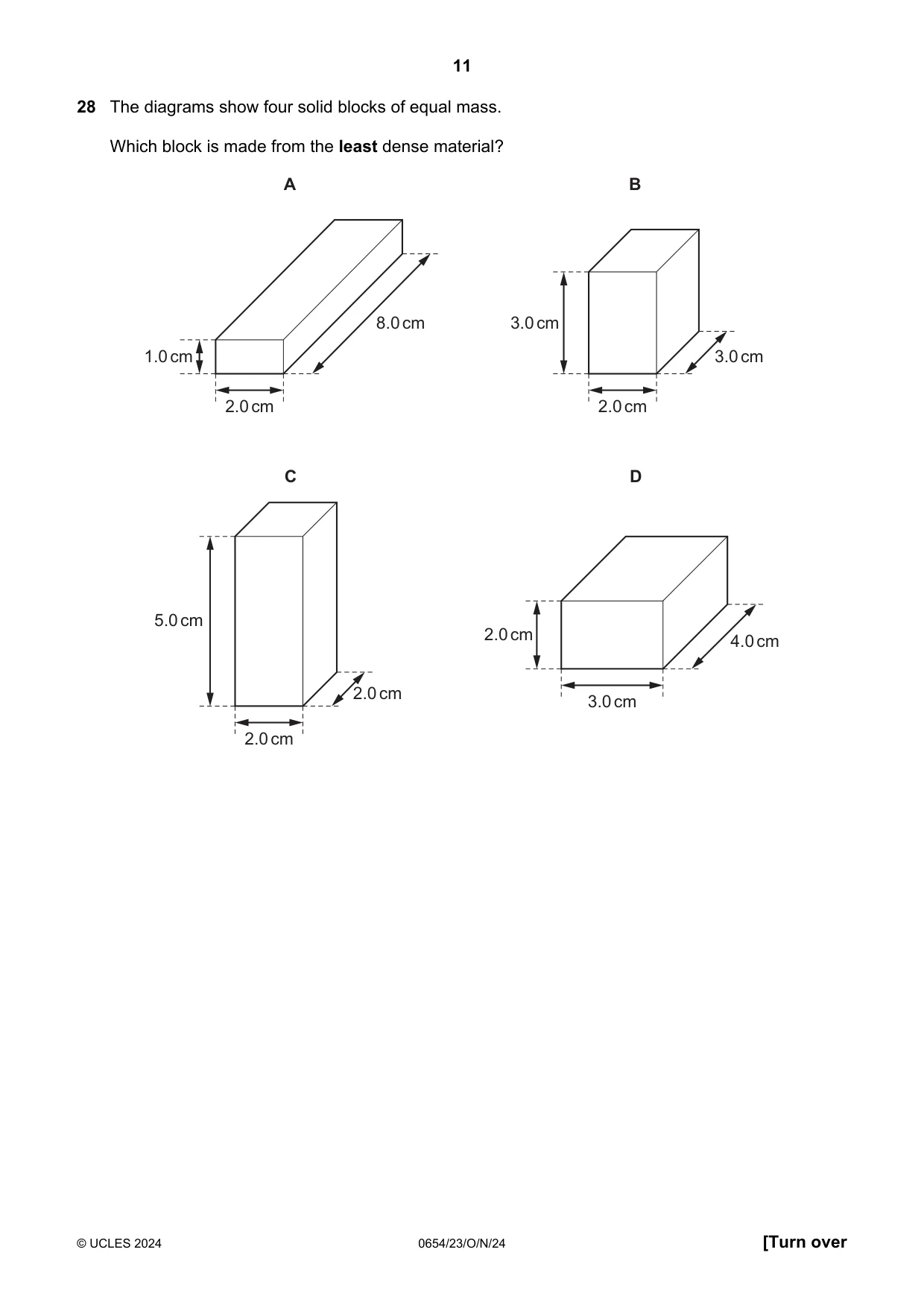
28 The diagrams show four solid blocks of equal mass. Which block is made from the least dense material? A B 8.0 cm 3.0 cm 1.0 cm 3.0 cm 2.0 cm 2.0 cm C D 5.0 cm 2.0 cm 4.0 cm 2.0 cm 3.0 cm 2.0 cm
Mark scheme: D
Q29 · A person uses a bar that is 3.0 m long to lift a rock of weight 900 N off the ground
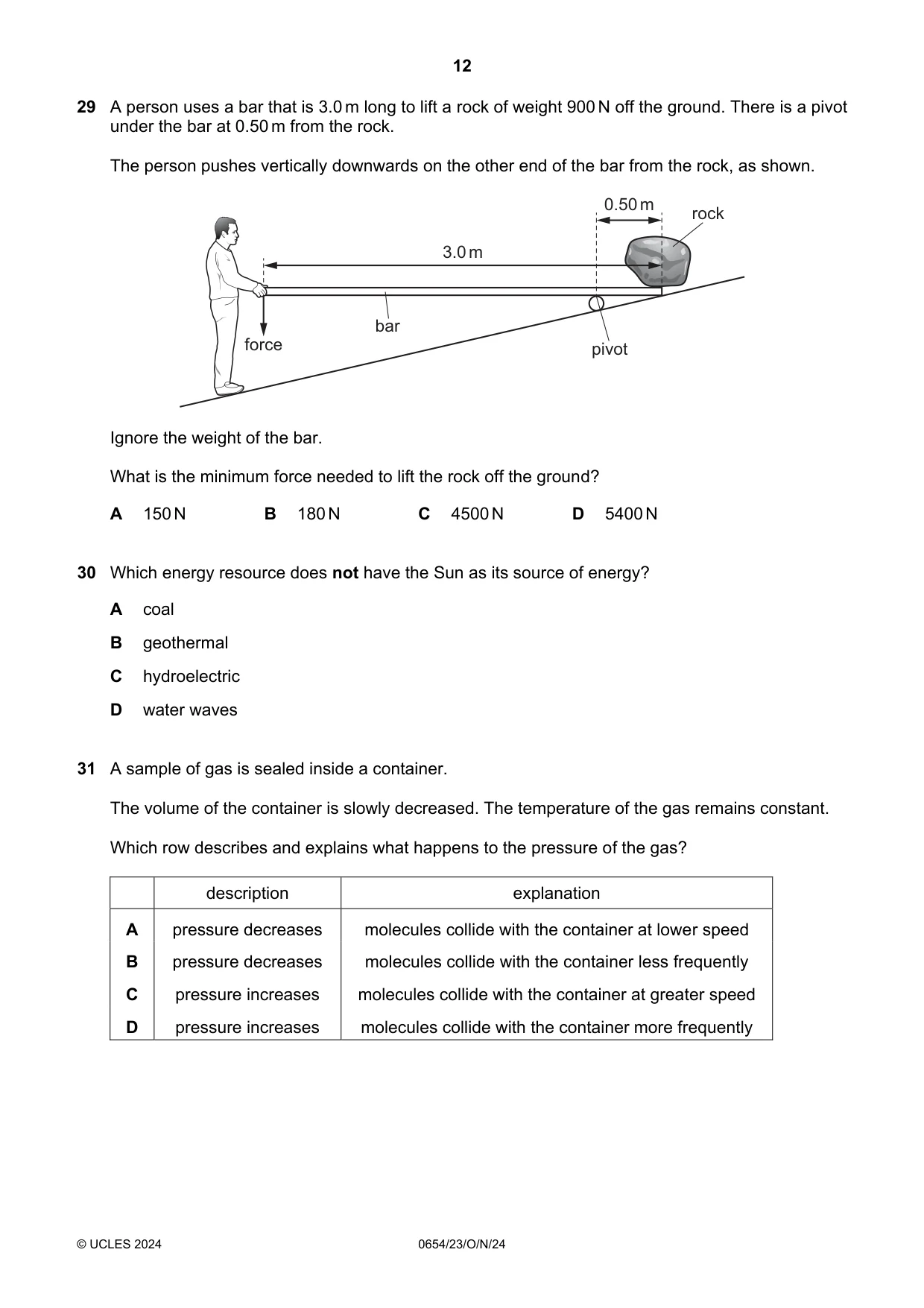
29 A person uses a bar that is 3.0 m long to lift a rock of weight 900 N off the ground. There is a pivot under the bar at 0.50 m from the rock. The person pushes vertically downwards on the other end of the bar from the rock, as shown. 0.50 m rock 3.0 m bar force pivot Ignore the weight of the bar. What is the minimum force needed to lift the rock off the ground? A 150 N B 180 N C 4500 N D 5400 N
Mark scheme: B
Q30 · Which energy resource does not have the Sun as its source of energy?
30 Which energy resource does not have the Sun as its source of energy? A coal B geothermal C hydroelectric D water waves
Mark scheme: B
Q31 · A sample of gas is sealed inside a container
31 A sample of gas is sealed inside a container. The volume of the container is slowly decreased. The temperature of the gas remains constant. Which row describes and explains what happens to the pressure of the gas? description explanation A pressure decreases molecules collide with the container at lower speed B pressure decreases molecules collide with the container less frequently C pressure increases molecules collide with the container at greater speed D pressure increases molecules collide with the container more frequently
Mark scheme: D
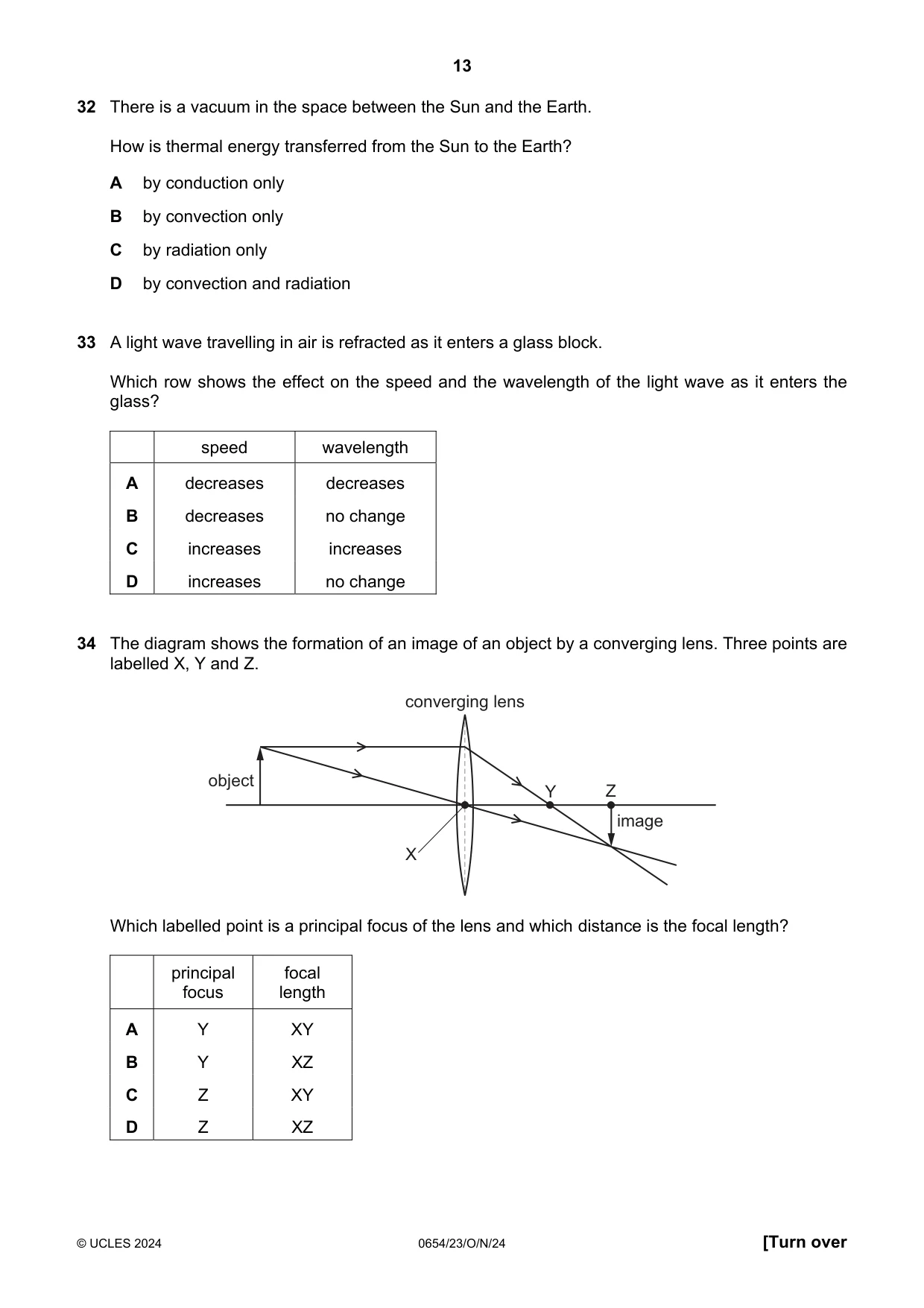
Q32 · There is a vacuum in the space between the Sun and the Earth
32 There is a vacuum in the space between the Sun and the Earth. How is thermal energy transferred from the Sun to the Earth? A by conduction only B by convection only C by radiation only D by convection and radiation
Mark scheme: C
Q33 · A light wave travelling in air is refracted as it enters a glass block
33 A light wave travelling in air is refracted as it enters a glass block. Which row shows the effect on the speed and the wavelength of the light wave as it enters the glass? speed wavelength A decreases decreases B decreases no change C increases increases D increases no change
Mark scheme: A
Q34 · The diagram shows the formation of an image of an object by a converging lens
34 The diagram shows the formation of an image of an object by a converging lens. Three points are labelled X, Y and Z. converging lens object Y Z image X Which labelled point is a principal focus of the lens and which distance is the focal length? principal focal focus length A Y XY B Y XZ C Z XY D Z XZ
Mark scheme: A
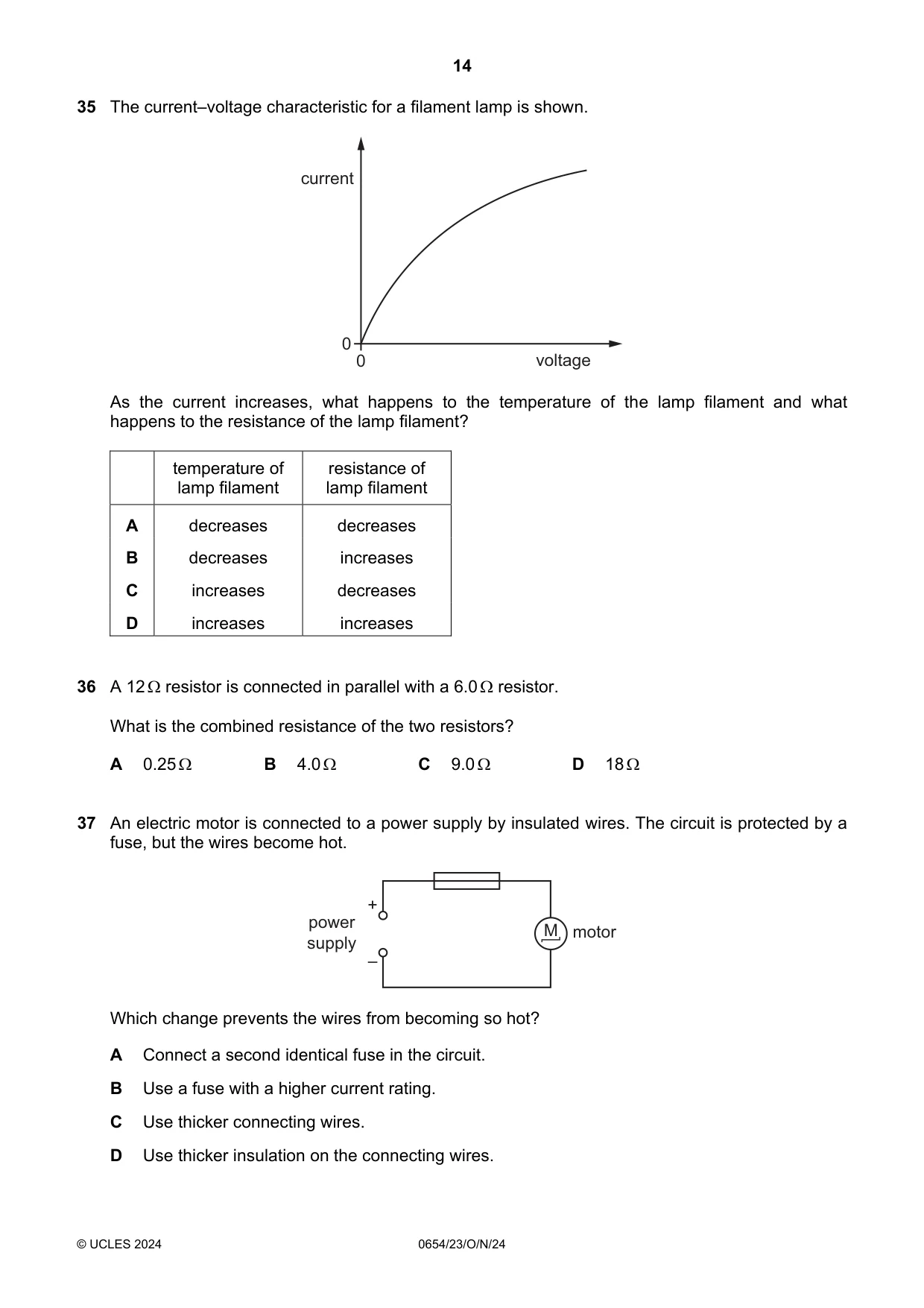
Q35 · The current–voltage characteristic for a filament lamp is shown
35 The current–voltage characteristic for a filament lamp is shown. current 0 0 voltage As the current increases, what happens to the temperature of the lamp filament and what happens to the resistance of the lamp filament? temperature of resistance of lamp filament lamp filament A decreases decreases B decreases increases C increases decreases D increases increases
Mark scheme: D
Q36 · A 12 resistor is connected in parallel with a 6.0 resistor
36 A 12 resistor is connected in parallel with a 6.0 resistor. What is the combined resistance of the two resistors? A 0.25 B 4.0 C 9.0 D 18
Mark scheme: B
Q37 · An electric motor is connected to a power supply by insulated wires
37 An electric motor is connected to a power supply by insulated wires. The circuit is protected by a fuse, but the wires become hot. + power M motor supply – Which change prevents the wires from becoming so hot? A Connect a second identical fuse in the circuit. B Use a fuse with a higher current rating. C Use thicker connecting wires. D Use thicker insulation on the connecting wires.
Mark scheme: C
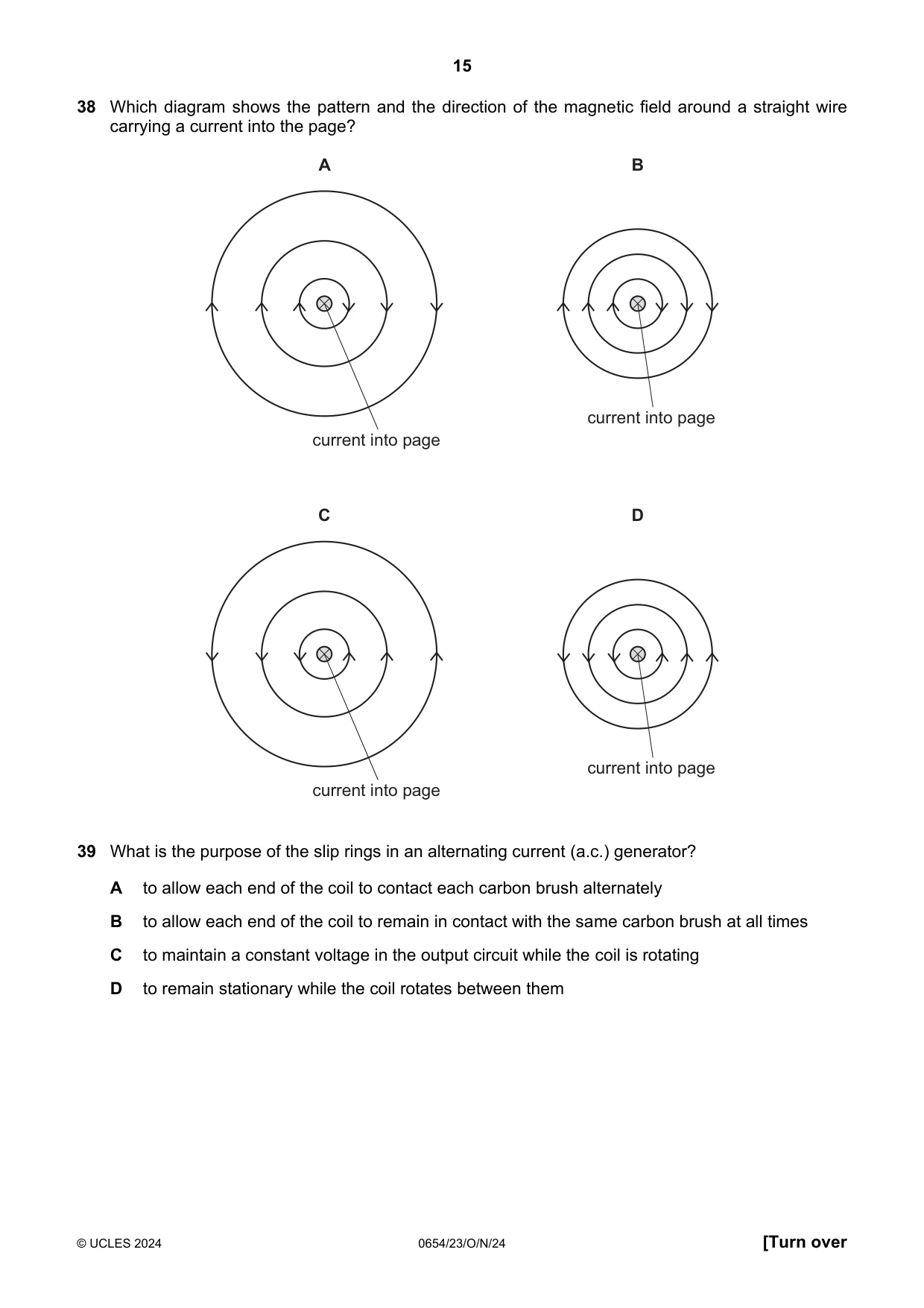
Q38 · Which diagram shows the pattern and the direction of the magnetic field around a straight…
38 Which diagram shows the pattern and the direction of the magnetic field around a straight wire carrying a current into the page? A B current into page current into page C D current into page current into page
Mark scheme: A
Q39 · What is the purpose of the slip rings in an alternating current (a.c.) generator?
39 What is the purpose of the slip rings in an alternating current (a.c.) generator? A to allow each end of the coil to contact each carbon brush alternately B to allow each end of the coil to remain in contact with the same carbon brush at all times C to maintain a constant voltage in the output circuit while the coil is rotating D to remain stationary while the coil rotates between them
Mark scheme: B
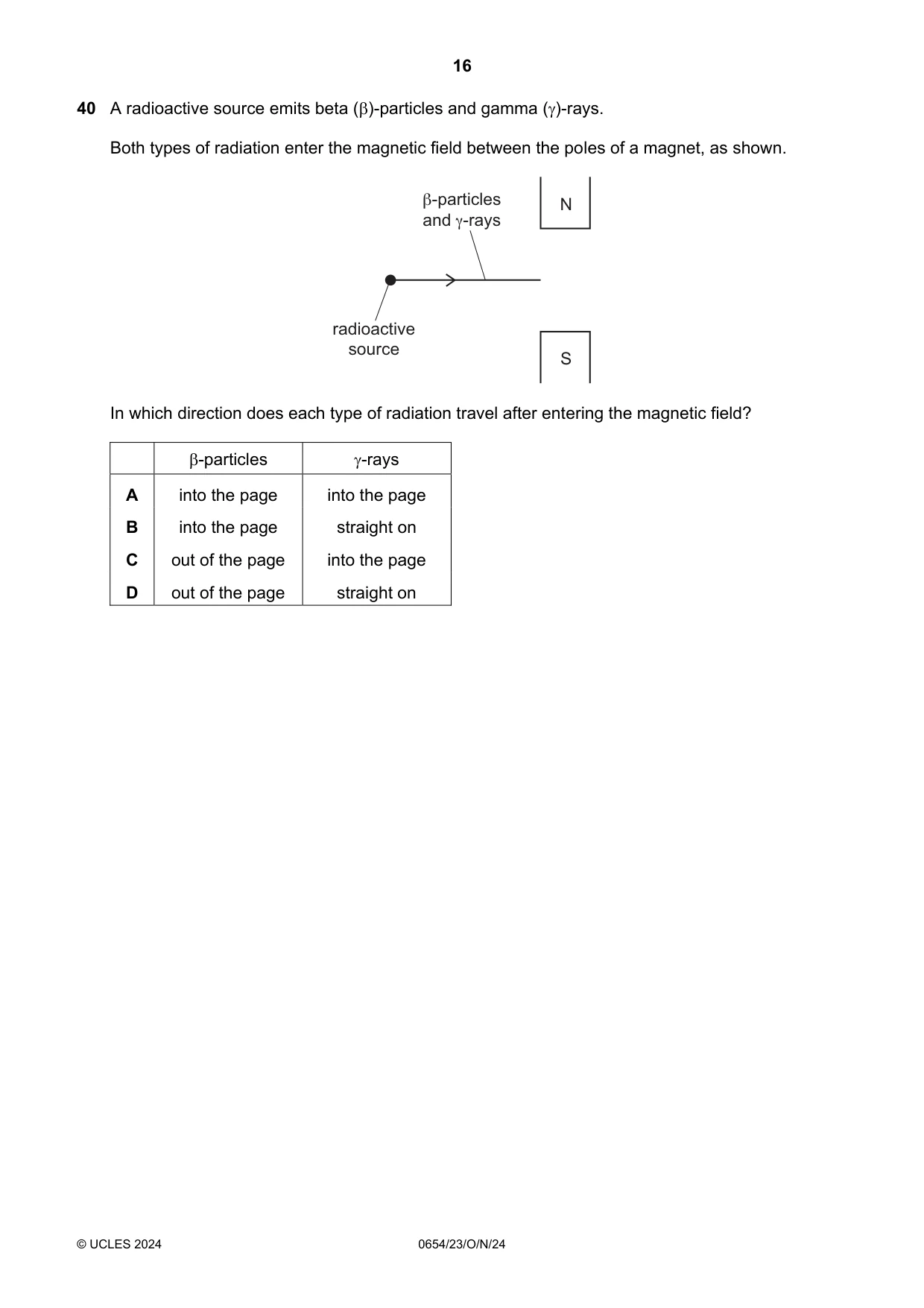
Q40 · A radioactive source emits beta ()-particles and gamma ()-rays
40 A radioactive source emits beta ()-particles and gamma ()-rays. Both types of radiation enter the magnetic field between the poles of a magnet, as shown. β-particles N and γ-rays radioactive source S In which direction does each type of radiation travel after entering the magnetic field? -particles -rays A into the page into the page B into the page straight on C out of the page into the page D out of the page straight on
Mark scheme: D
What was in this paper
The subtopics covered by these 40 questions, and how many questions each got. Open one in a new tab to see every Cambridge question on it.
2Rate of reaction2Alkenes1Biological molecules1Characteristics of living organisms1Coordination and response1Corrosion of metals1Density1Diet1Electrical circuits1Electrical quantities1Electrical safety1Electrolysis1Electromagnetic effects1Energy, work and power1Enzymes1Exothermic and endothermic reactions1Food chains and food webs1Forces1Group VII properties1Habitat destruction1Identification of ions and gases1Isotopes1Kinetic particle model of matter1Osmosis1Photosynthesis1Preparation of salts1Radioactivity1Redox1Respiration1Selection1Sexual reproduction in plants1Simple phenomena of magnetism1The mole and the Avogadro constant1Transfer of thermal energy1Transition elements1Translocation1Water1What you needed in this session
Cambridge’s own grade thresholds for 2024 Oct/Nov, Paper 2 · Variant 3. A higher threshold means an easier paper — the bar moves with how the cohort did.