Cambridge IGCSE Sciences - Co-ordinated (Double) 0654 — 2020 Oct/Nov Paper 2 · Variant 2
0654/22/O/N/20 · 40 questions · 40 marks · ≈45 min
The question paper and its mark scheme, free to read here and free to download. This is Cambridge’s own paper, exactly as it was sat.
Question paper16 pages
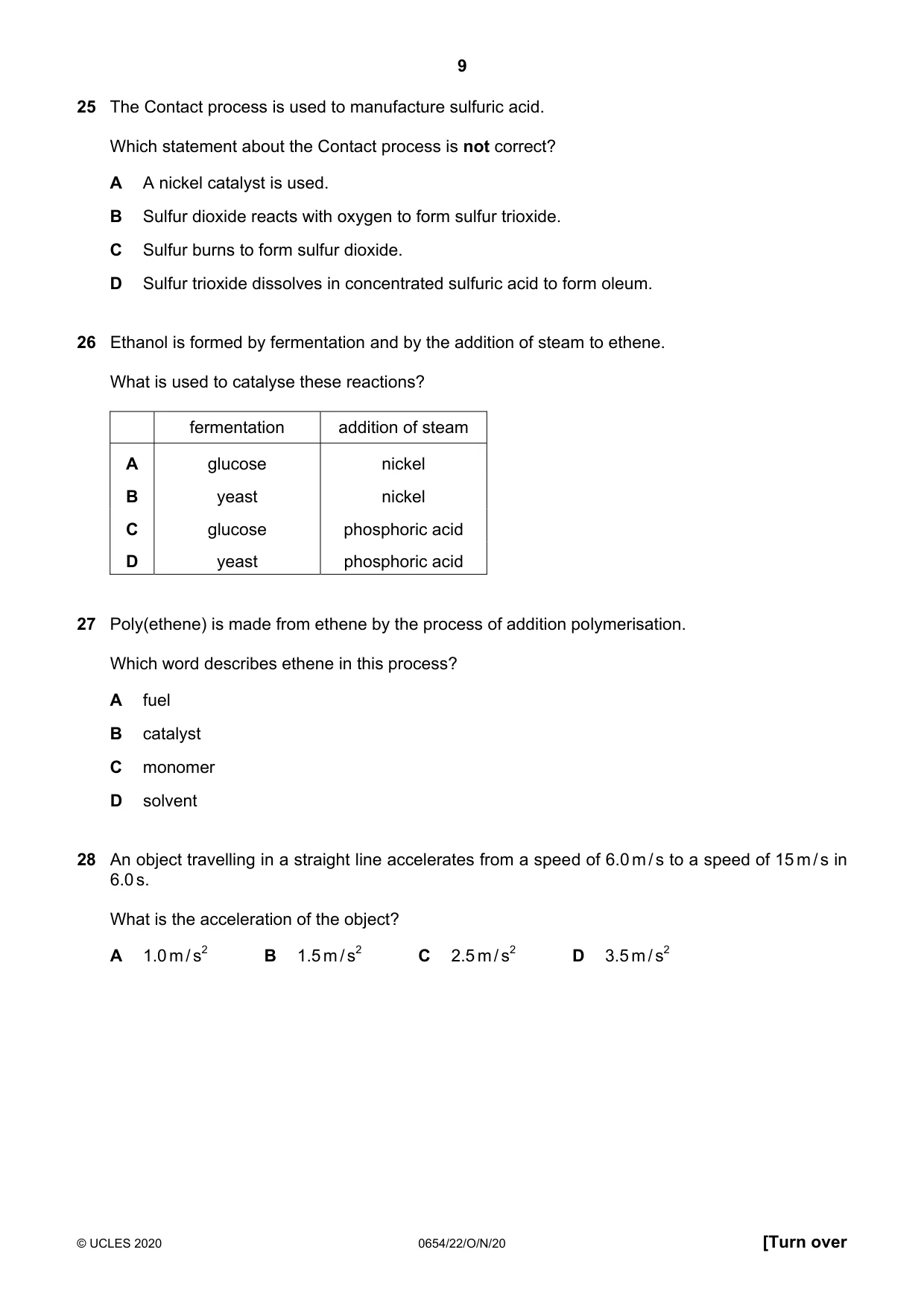
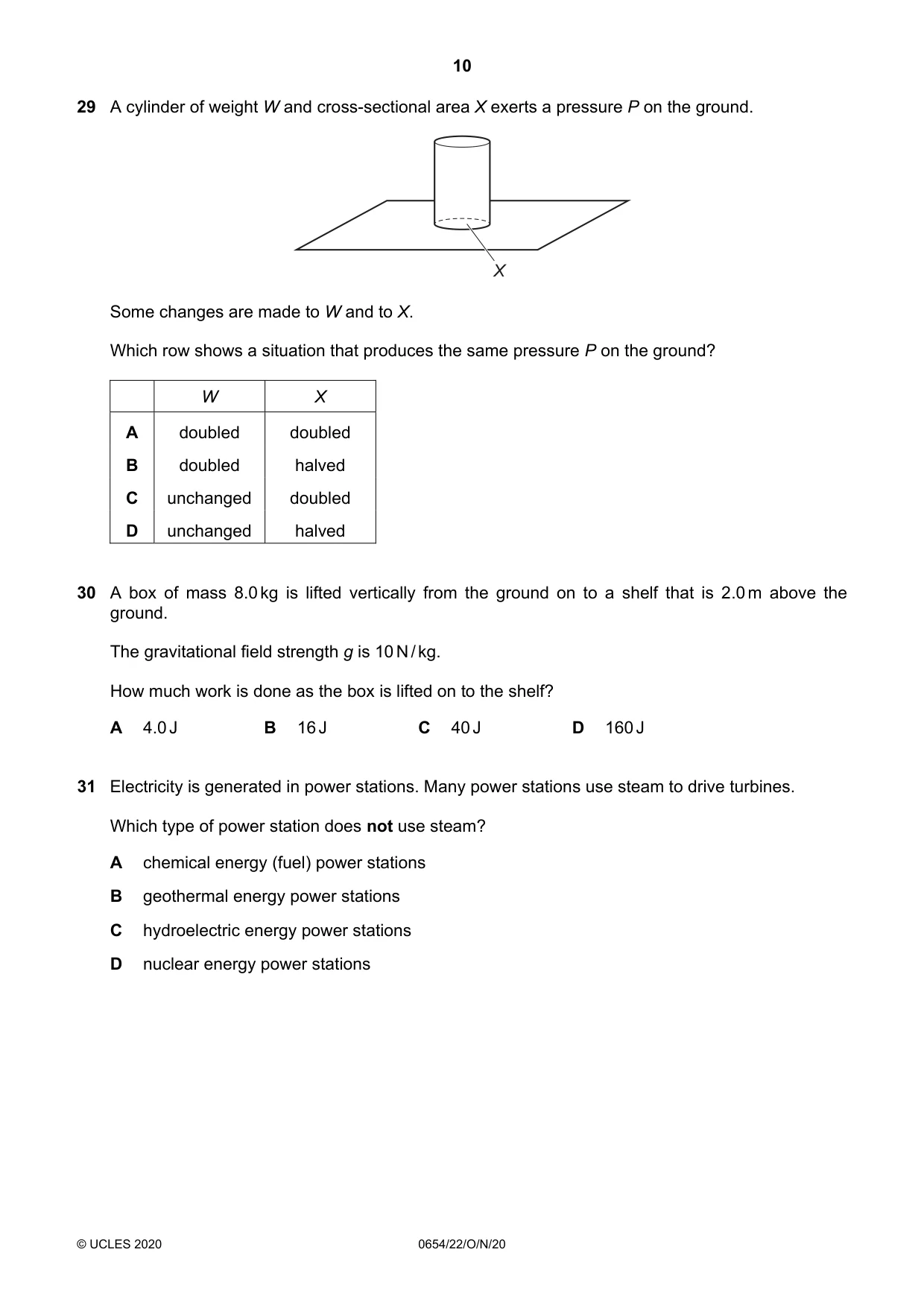
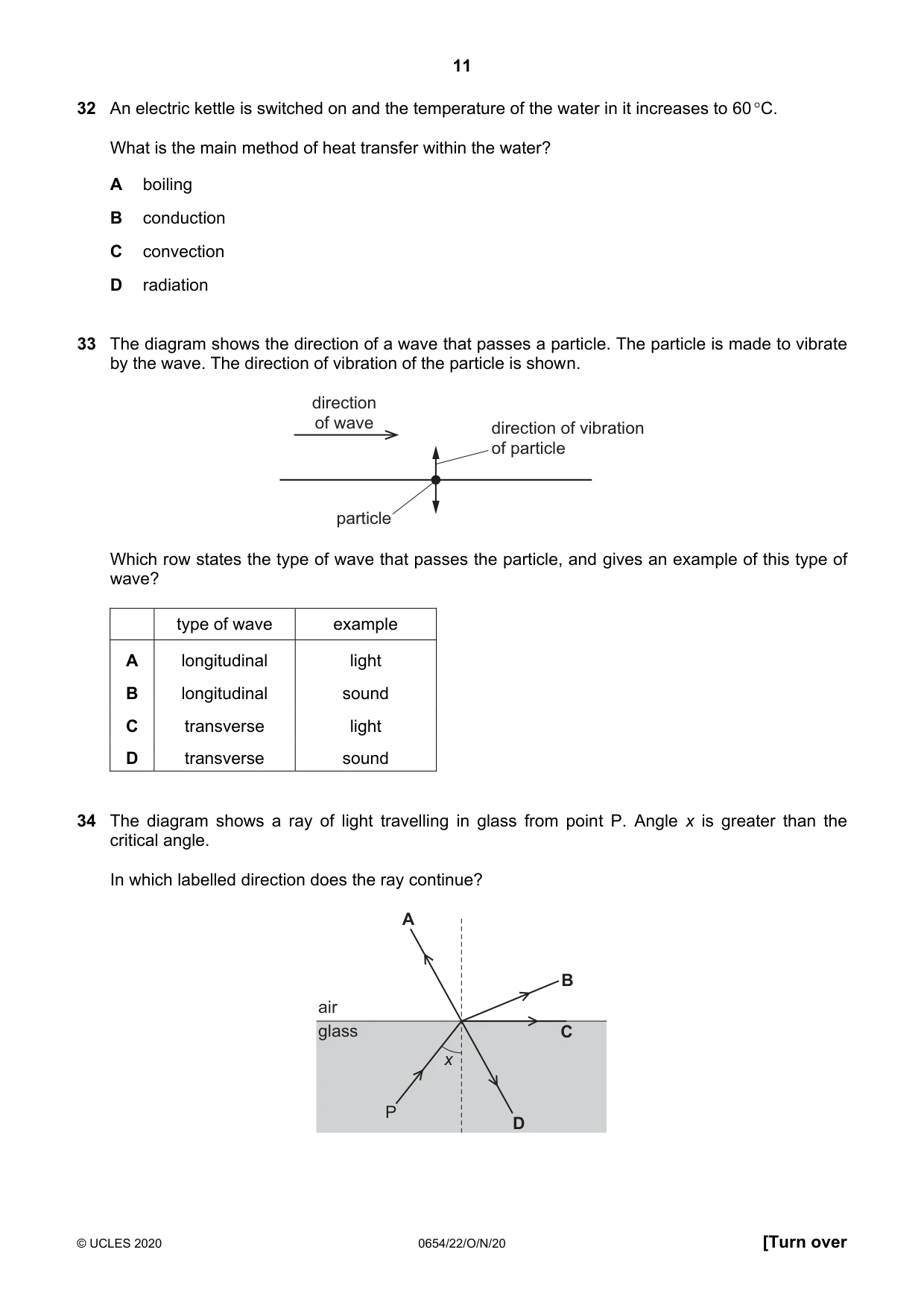
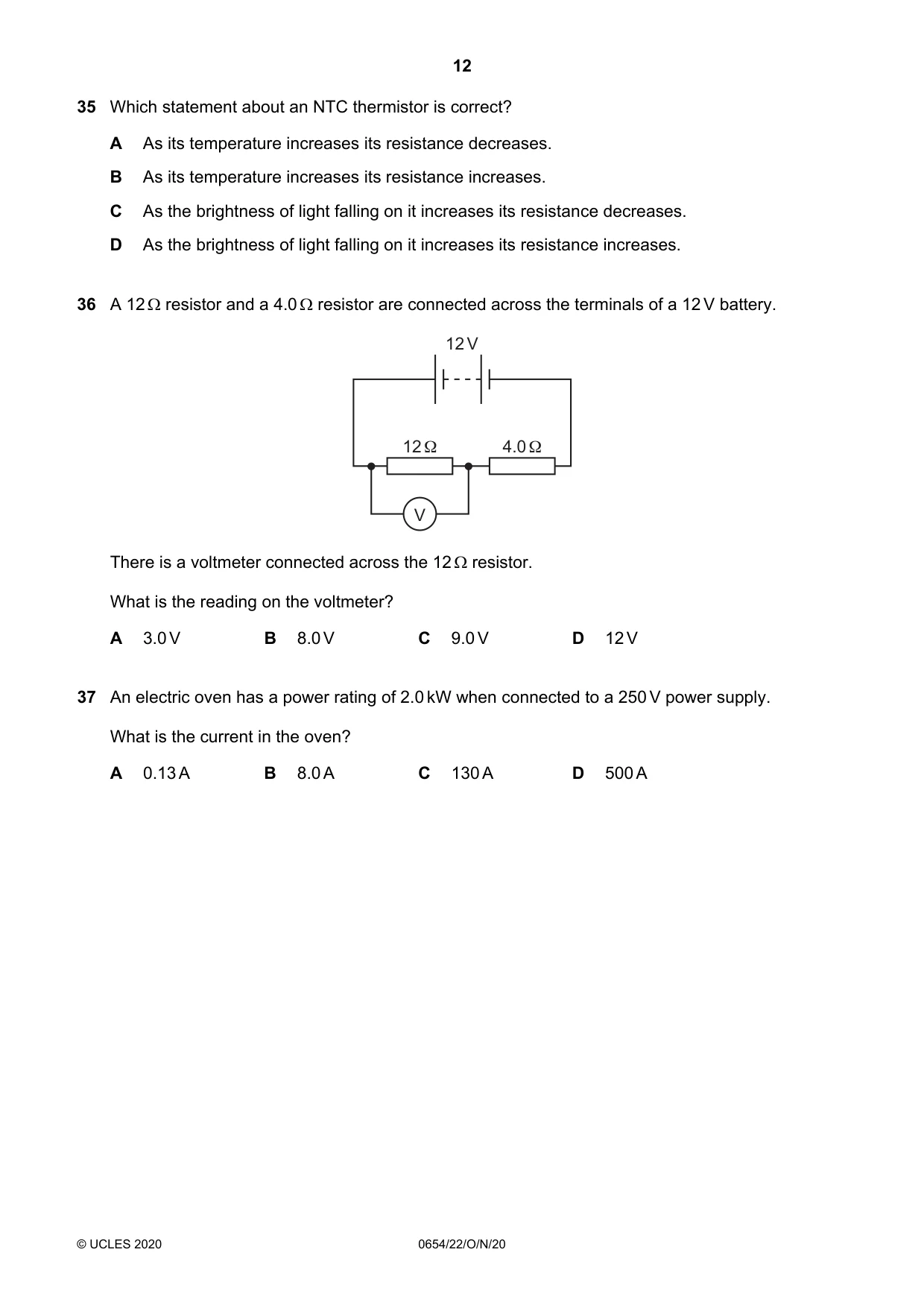

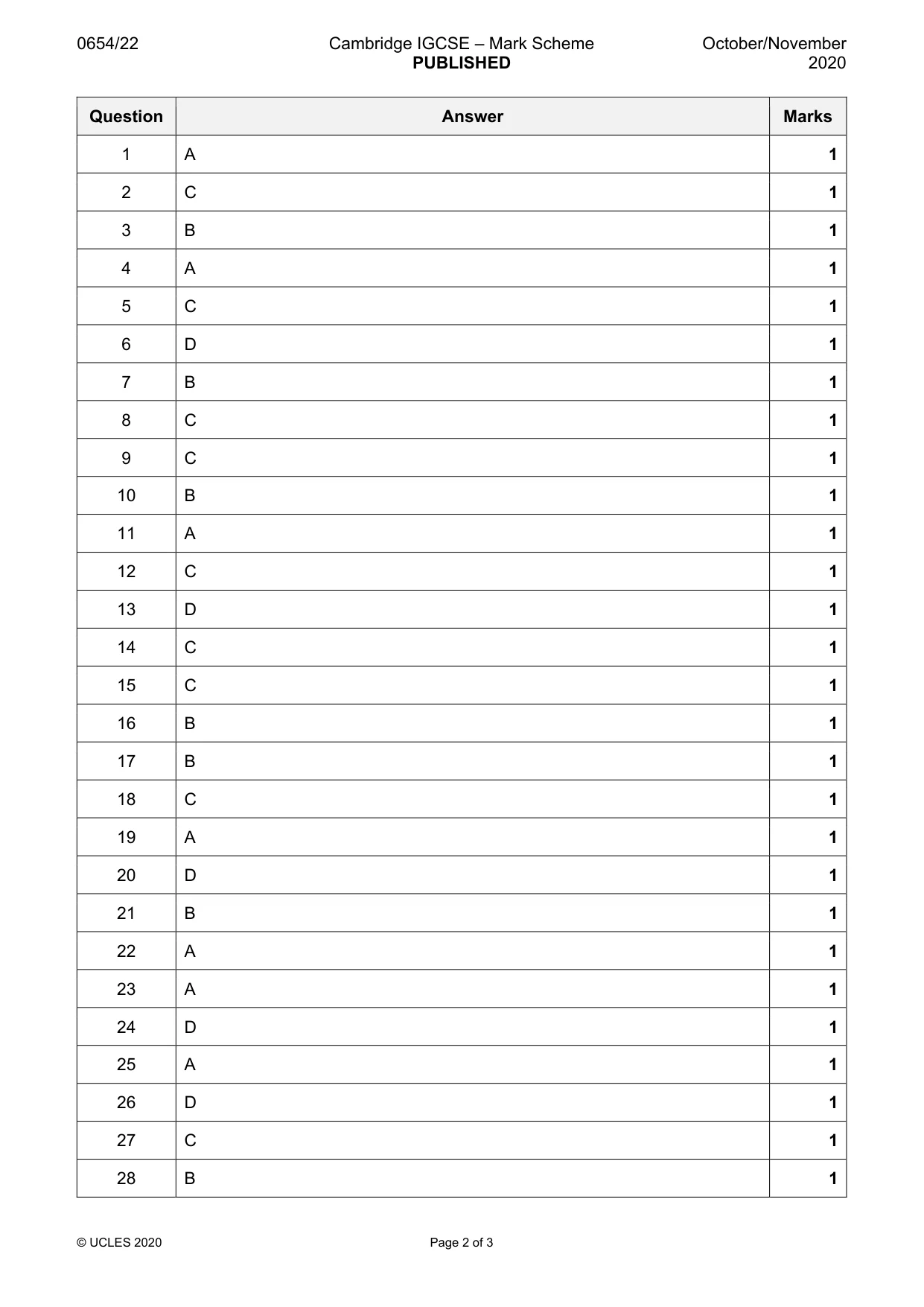
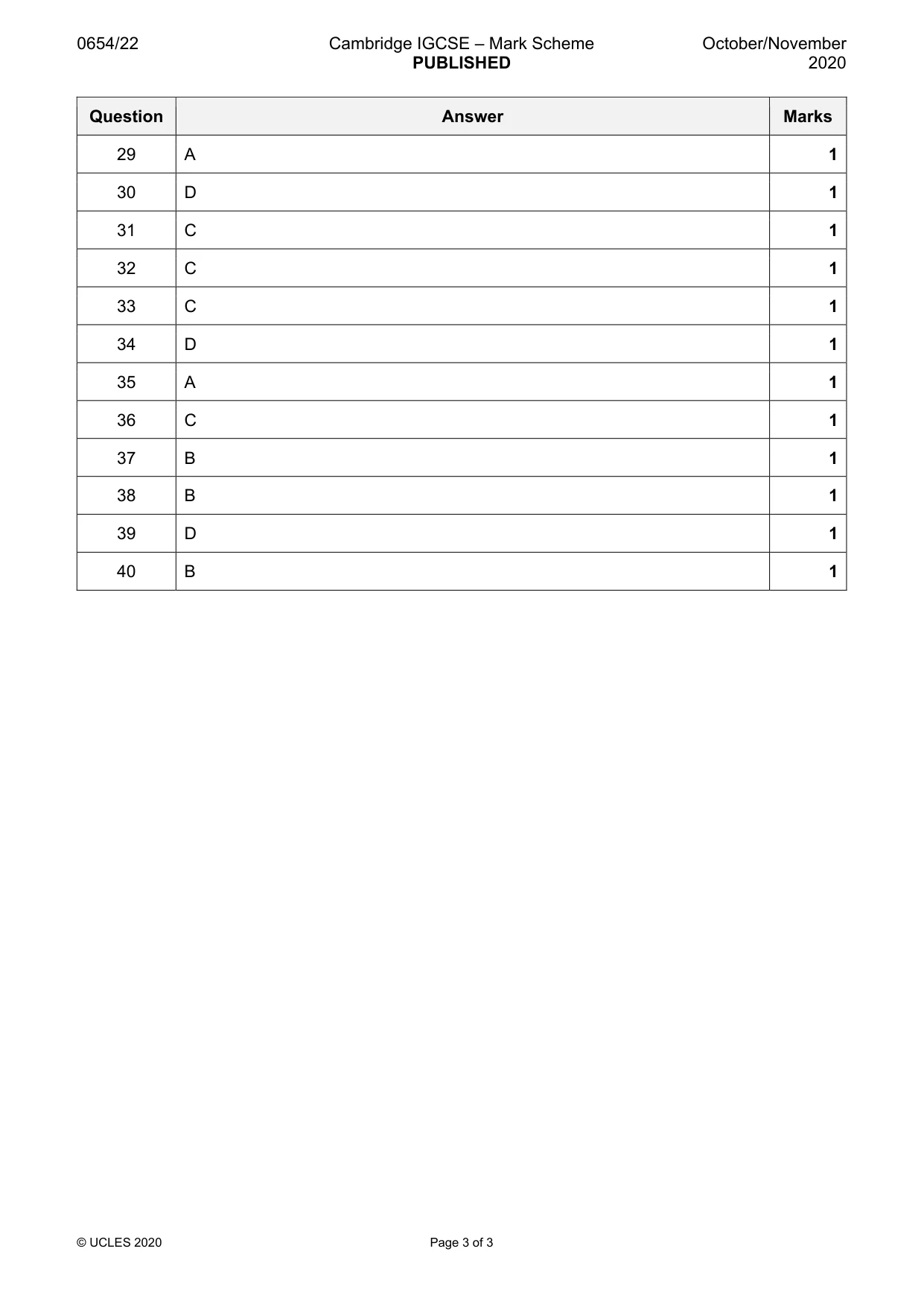
Mark scheme3 pages
Answers below. Sit the paper first if you are practising.
Questions as text
Q1 · A plant is placed on a windowsill
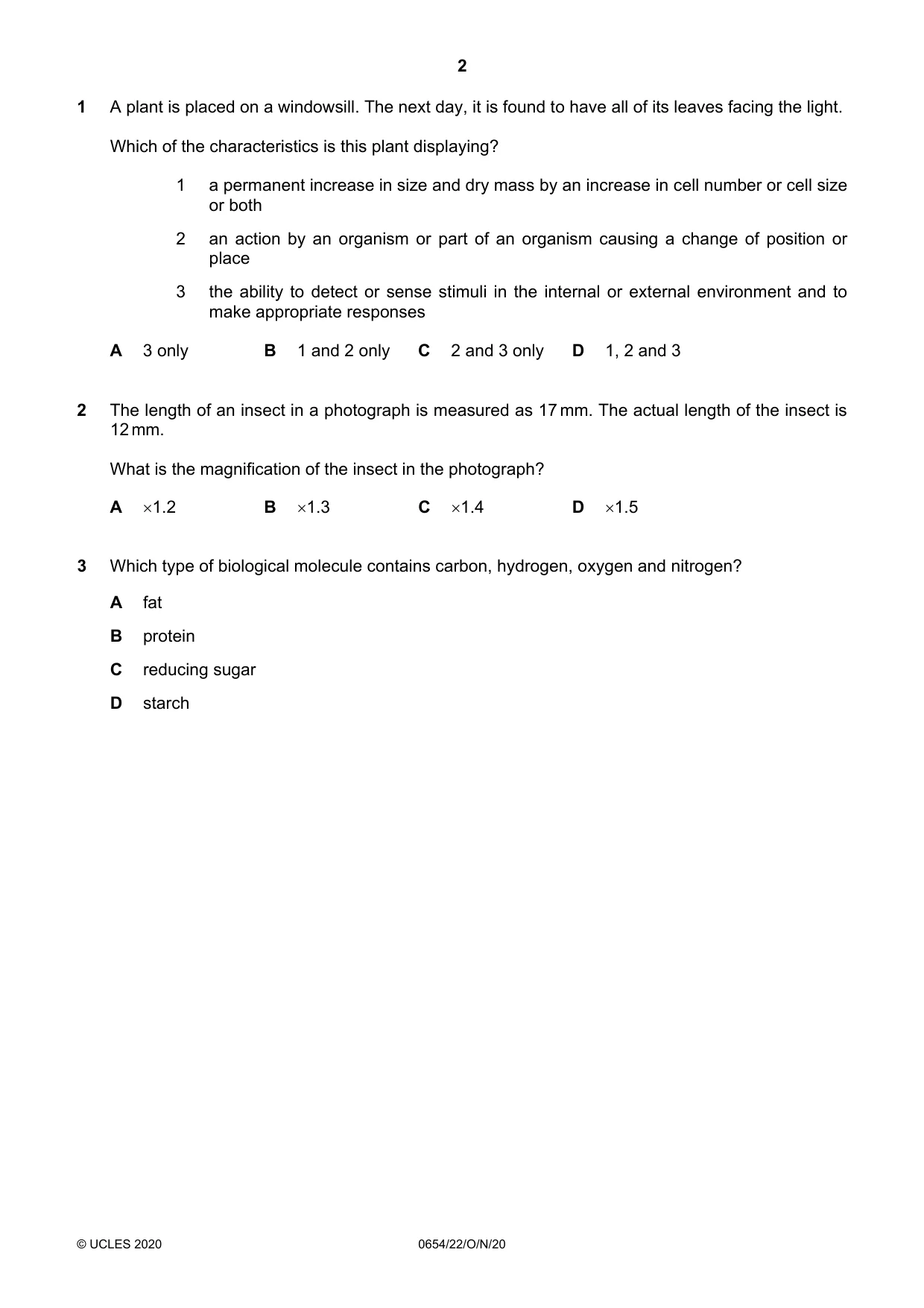
1 A plant is placed on a windowsill. The next day, it is found to have all of its leaves facing the light. Which of the characteristics is this plant displaying? 1 a permanent increase in size and dry mass by an increase in cell number or cell size or both 2 an action by an organism or part of an organism causing a change of position or place 3 the ability to detect or sense stimuli in the internal or external environment and to make appropriate responses A 3 only B 1 and 2 only C 2 and 3 only D 1, 2 and 3
Mark scheme: A
Q2 · The length of an insect in a photograph is measured as 17 mm
2 The length of an insect in a photograph is measured as 17 mm. The actual length of the insect is 12 mm. What is the magnification of the insect in the photograph? A 1.2 B 1.3 C 1.4 D 1.5
Mark scheme: C
Q3 · Which type of biological molecule contains carbon, hydrogen, oxygen and nitrogen?
3 Which type of biological molecule contains carbon, hydrogen, oxygen and nitrogen? A fat B protein C reducing sugar D starch
Mark scheme: B
Q4 · A mixture of starch and saliva was set up at four different temperatures
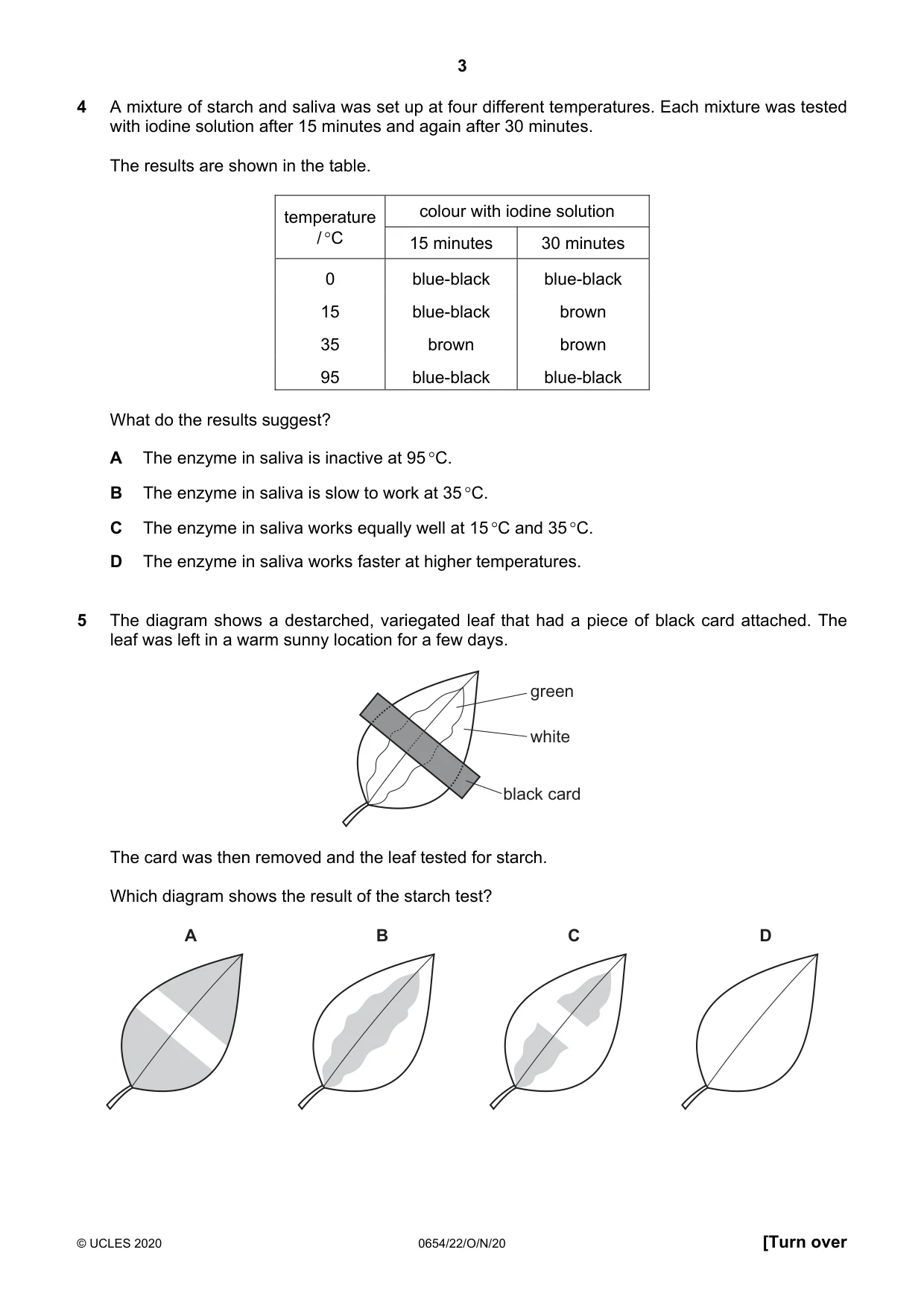
4 A mixture of starch and saliva was set up at four different temperatures. Each mixture was tested with iodine solution after 15 minutes and again after 30 minutes. The results are shown in the table. temperature colour with iodine solution / C 15 minutes 30 minutes 0 blue-black blue-black 15 blue-black brown 35 brown brown 95 blue-black blue-black What do the results suggest? A The enzyme in saliva is inactive at 95 C. B The enzyme in saliva is slow to work at 35 C. C The enzyme in saliva works equally well at 15 C and 35 C. D The enzyme in saliva works faster at higher temperatures.
Mark scheme: A
Q5 · The diagram shows a destarched, variegated leaf that had a piece of black card attached
5 The diagram shows a destarched, variegated leaf that had a piece of black card attached. The leaf was left in a warm sunny location for a few days. green white black card The card was then removed and the leaf tested for starch. Which diagram shows the result of the starch test? A B C D
Mark scheme: C
Q6 · Much of the internal surface of the human small intestine is covered with villi
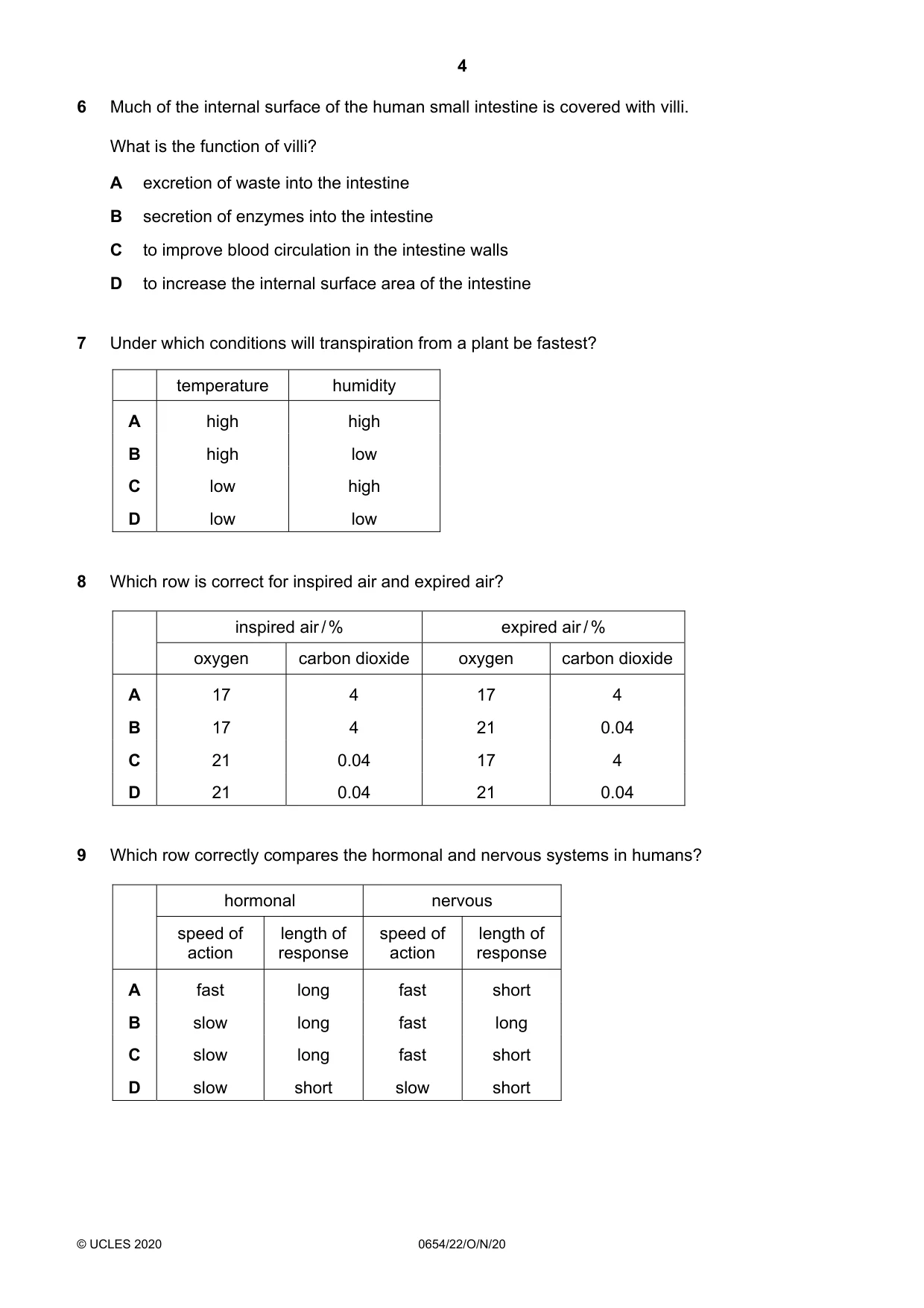
6 Much of the internal surface of the human small intestine is covered with villi. What is the function of villi? A excretion of waste into the intestine B secretion of enzymes into the intestine C to improve blood circulation in the intestine walls D to increase the internal surface area of the intestine
Mark scheme: D
Q7 · Under which conditions will transpiration from a plant be fastest?
7 Under which conditions will transpiration from a plant be fastest? temperature humidity A high high B high low C low high D low low
Mark scheme: B
Q8 · Which row is correct for inspired air and expired air?
8 Which row is correct for inspired air and expired air? inspired air / % expired air / % oxygen carbon dioxide oxygen carbon dioxide A 17 4 17 4 B 17 4 21 0.04 C 21 0.04 17 4 D 21 0.04 21 0.04
Mark scheme: C
Q9 · Which row correctly compares the hormonal and nervous systems in humans?
9 Which row correctly compares the hormonal and nervous systems in humans? hormonal nervous speed of length of speed of length of action response action response A fast long fast short B slow long fast long C slow long fast short D slow short slow short
Mark scheme: C
Q10 · In human reproduction, which cells are haploid?
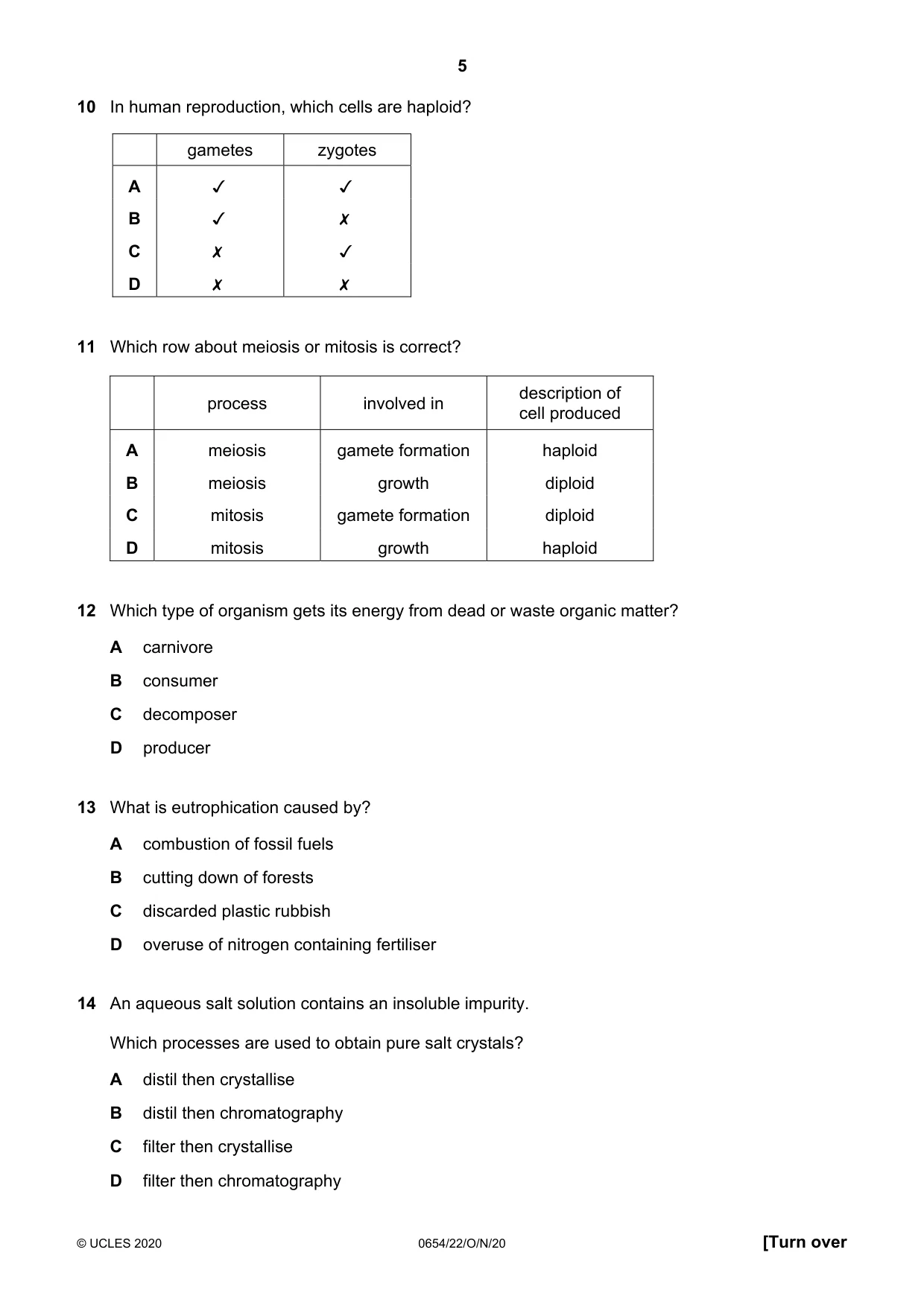
10 In human reproduction, which cells are haploid? gametes zygotes v v 00 WwW > v x x v x x
Mark scheme: B
Q11 · Which row about meiosis or mitosis is correct?
11 Which row about meiosis or mitosis is correct? description of process involved in cell produced A meiosis gamete formation haploid B meiosis growth diploid C mitosis gamete formation diploid D mitosis growth haploid
Mark scheme: A
Q12 · Which type of organism gets its energy from dead or waste organic matter?
12 Which type of organism gets its energy from dead or waste organic matter? A carnivore B consumer C decomposer D producer
Mark scheme: C
Q13 · What is eutrophication caused by?
13 What is eutrophication caused by? A combustion of fossil fuels B cutting down of forests C discarded plastic rubbish D overuse of nitrogen containing fertiliser
Mark scheme: D
Q14 · An aqueous salt solution contains an insoluble impurity
14 An aqueous salt solution contains an insoluble impurity. Which processes are used to obtain pure salt crystals? A distil then crystallise B distil then chromatography C filter then crystallise D filter then chromatography
Mark scheme: C
Q15 · Which dot-and-cross diagram represents a molecule of ammonia?
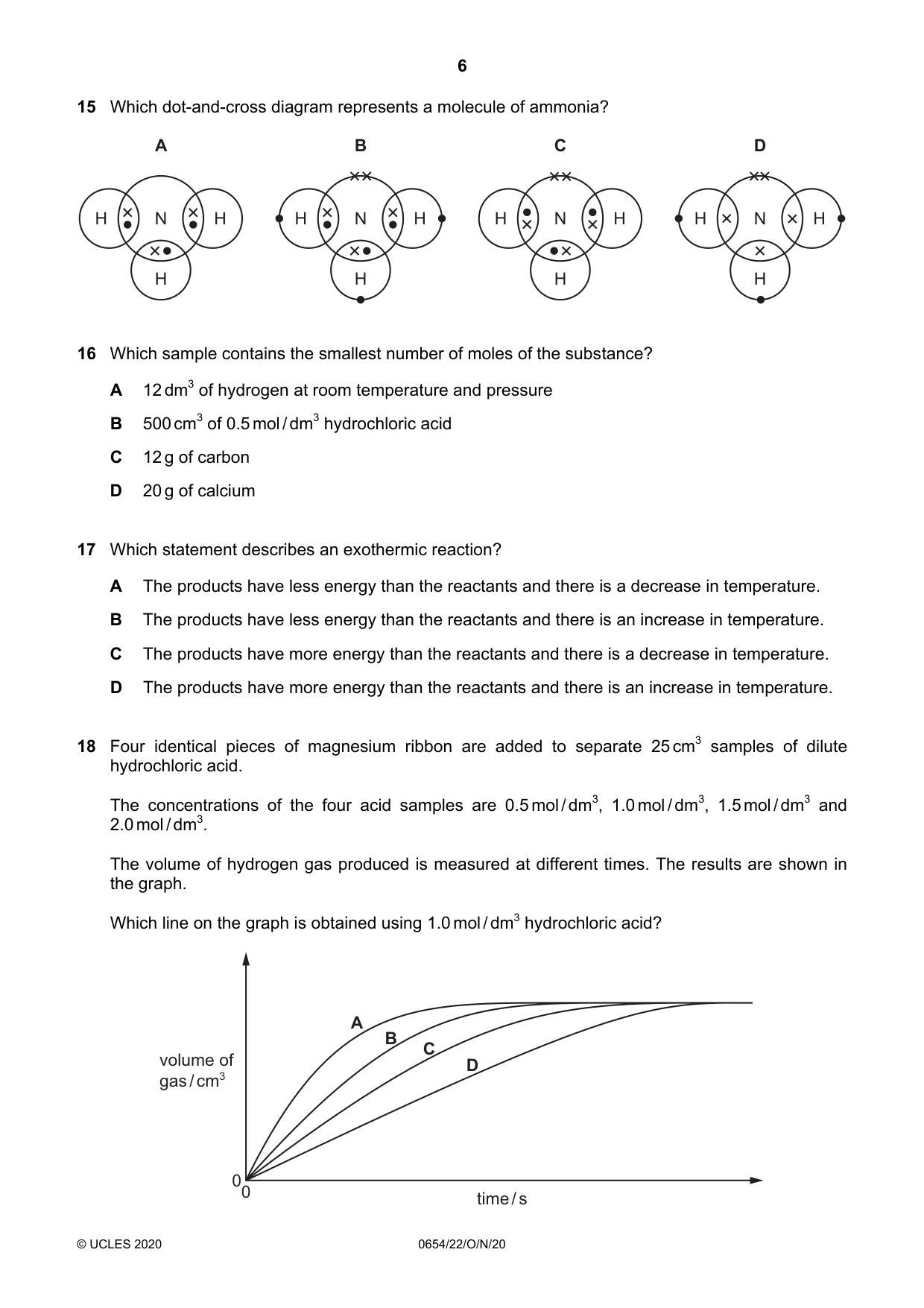
15 Which dot-and-cross diagram represents a molecule of ammonia? A B C D H N H H N H H N H H N H H H H H
Mark scheme: C
Q16 · Which sample contains the smallest number of moles of the substance?
16 Which sample contains the smallest number of moles of the substance? A 12 dm3 of hydrogen at room temperature and pressure B 500 cm3 of 0.5 mol / dm3 hydrochloric acid C 12 g of carbon D 20 g of calcium
Mark scheme: B
Q17 · Which statement describes an exothermic reaction?
17 Which statement describes an exothermic reaction? A The products have less energy than the reactants and there is a decrease in temperature. B The products have less energy than the reactants and there is an increase in temperature. C The products have more energy than the reactants and there is a decrease in temperature. D The products have more energy than the reactants and there is an increase in temperature.
Mark scheme: B
Q18 · Four identical pieces of magnesium ribbon are added to separate 25 cm3 samples of dilute…
18 Four identical pieces of magnesium ribbon are added to separate 25 cm3 samples of dilute hydrochloric acid. The concentrations of the four acid samples are 0.5 mol / dm3, 1.0 mol / dm3, 1.5 mol / dm3 and 2.0 mol / dm3. The volume of hydrogen gas produced is measured at different times. The results are shown in the graph. Which line on the graph is obtained using 1.0 mol / dm3 hydrochloric acid? A B C volume of D gas / cm3 00 time / s
Mark scheme: C
Q19 · Which word equation represents a redox reaction?
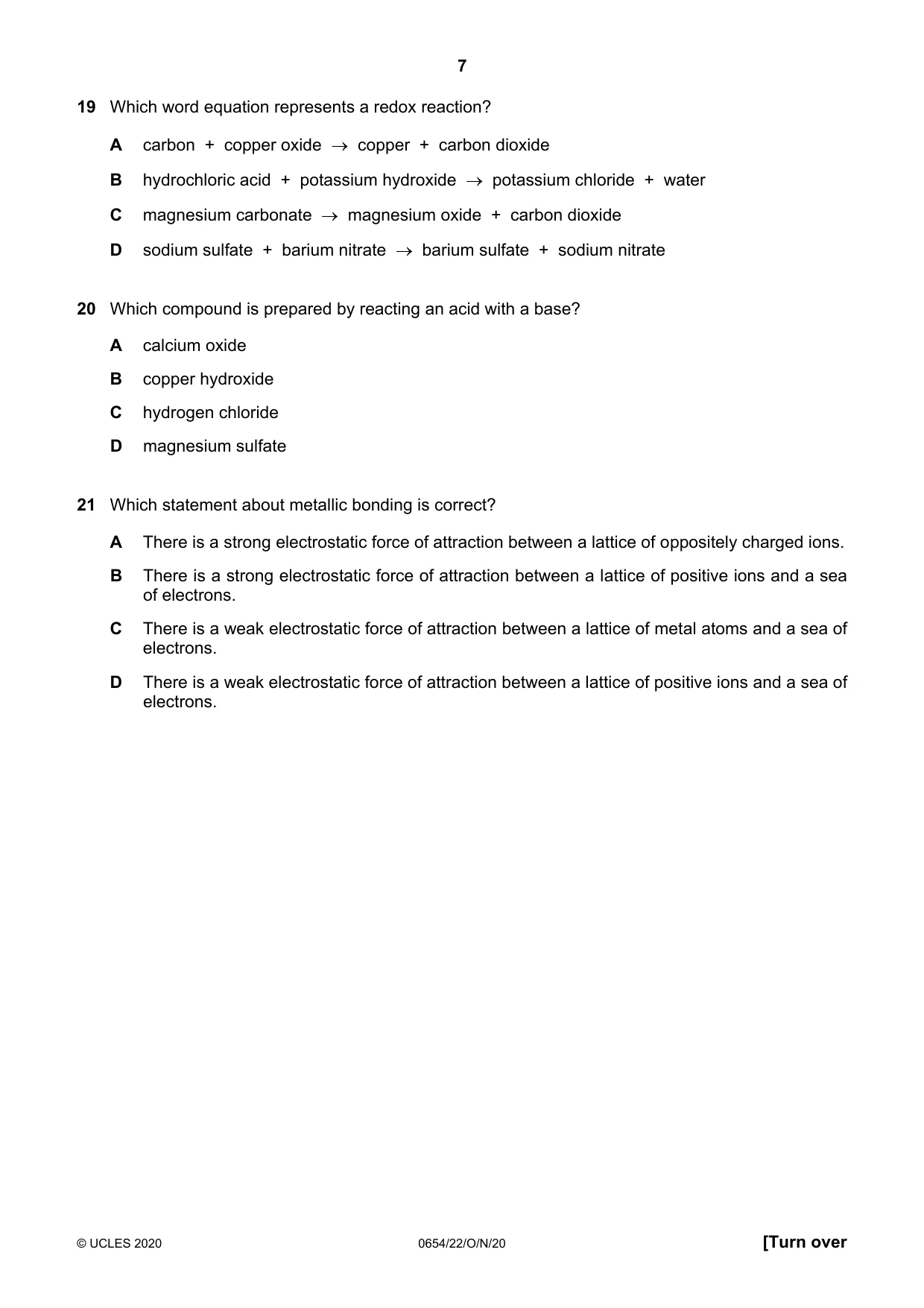
19 Which word equation represents a redox reaction? A carbon + copper oxide copper + carbon dioxide B hydrochloric acid + potassium hydroxide potassium chloride + water C magnesium carbonate magnesium oxide + carbon dioxide D sodium sulfate + barium nitrate barium sulfate + sodium nitrate
Mark scheme: A
Q20 · Which compound is prepared by reacting an acid with a base?
20 Which compound is prepared by reacting an acid with a base? A calcium oxide B copper hydroxide C hydrogen chloride D magnesium sulfate
Mark scheme: D
Q21 · Which statement about metallic bonding is correct?
21 Which statement about metallic bonding is correct? A There is a strong electrostatic force of attraction between a lattice of oppositely charged ions. B There is a strong electrostatic force of attraction between a lattice of positive ions and a sea of electrons. C There is a weak electrostatic force of attraction between a lattice of metal atoms and a sea of electrons. D There is a weak electrostatic force of attraction between a lattice of positive ions and a sea of electrons.
Mark scheme: B
Q22 · Four different metals are separately heated with their metal oxides
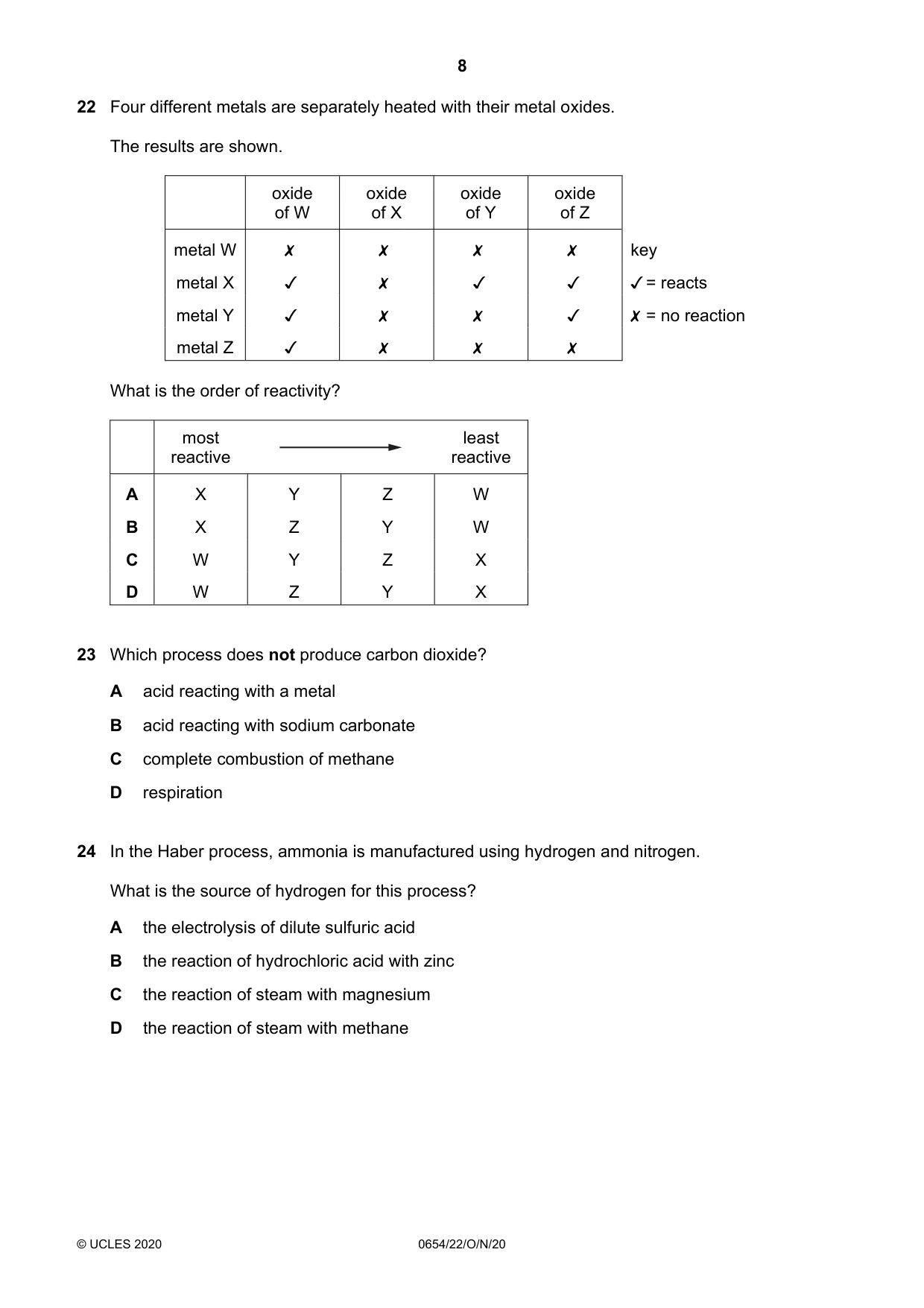
22 Four different metals are separately heated with their metal oxides. The results are shown. oxide oxide oxide oxide of W of X of Y of Z metal W x x x x metal X v x v v metal Y v x x v metal Z v Xx Xx x What is the order of reactivity? most least reactive reactive Y Z WwW Z Y WwW Y Z X Z Y X key J/ = reacts X = no reaction
Mark scheme: A
Q23 · Which process does not produce carbon dioxide?
23 Which process does not produce carbon dioxide? A acid reacting with a metal B acid reacting with sodium carbonate C complete combustion of methane D respiration
Mark scheme: A
Q24 · In the Haber process, ammonia is manufactured using hydrogen and nitrogen
24 In the Haber process, ammonia is manufactured using hydrogen and nitrogen. What is the source of hydrogen for this process? A the electrolysis of dilute sulfuric acid B the reaction of hydrochloric acid with zinc C the reaction of steam with magnesium D the reaction of steam with methane
Mark scheme: D
Q25 · The Contact process is used to manufacture sulfuric acid
25 The Contact process is used to manufacture sulfuric acid. Which statement about the Contact process is not correct? A A nickel catalyst is used. B Sulfur dioxide reacts with oxygen to form sulfur trioxide. C Sulfur burns to form sulfur dioxide. D Sulfur trioxide dissolves in concentrated sulfuric acid to form oleum.
Mark scheme: A
Q26 · Ethanol is formed by fermentation and by the addition of steam to ethene
26 Ethanol is formed by fermentation and by the addition of steam to ethene. What is used to catalyse these reactions? fermentation addition of steam A glucose nickel B yeast nickel C glucose phosphoric acid D yeast phosphoric acid
Mark scheme: D
Q27 · Poly(ethene) is made from ethene by the process of addition polymerisation
27 Poly(ethene) is made from ethene by the process of addition polymerisation. Which word describes ethene in this process? A fuel B catalyst C monomer D solvent
Mark scheme: C
Q28 · An object travelling in a straight line accelerates from a speed of 6.0 m / s to a speed…
28 An object travelling in a straight line accelerates from a speed of 6.0 m / s to a speed of 15 m / s in 6.0 s. What is the acceleration of the object? A 1.0 m / s2 B 1.5 m / s2 C 2.5 m / s2 D 3.5 m / s2
Mark scheme: B
Q29 · A cylinder of weight W and cross-sectional area X exerts a pressure P on the ground
29 A cylinder of weight W and cross-sectional area X exerts a pressure P on the ground. X Some changes are made to W and to X. Which row shows a situation that produces the same pressure P on the ground? W X A doubled doubled B doubled halved C unchanged doubled D unchanged halved
Mark scheme: A
Q30 · A box of mass 8.0 kg is lifted vertically from the ground on to a shelf that is 2.0 m…
30 A box of mass 8.0 kg is lifted vertically from the ground on to a shelf that is 2.0 m above the ground. The gravitational field strength g is 10 N / kg. How much work is done as the box is lifted on to the shelf? A 4.0 J B 16 J C 40 J D 160 J
Mark scheme: D
Q31 · Electricity is generated in power stations
31 Electricity is generated in power stations. Many power stations use steam to drive turbines. Which type of power station does not use steam? A chemical energy (fuel) power stations B geothermal energy power stations C hydroelectric energy power stations D nuclear energy power stations
Mark scheme: C
Q32 · An electric kettle is switched on and the temperature of the water in it increases to 60…
32 An electric kettle is switched on and the temperature of the water in it increases to 60 C. What is the main method of heat transfer within the water? A boiling B conduction C convection D radiation
Mark scheme: C
Q33 · The diagram shows the direction of a wave that passes a particle
33 The diagram shows the direction of a wave that passes a particle. The particle is made to vibrate by the wave. The direction of vibration of the particle is shown. direction of wave direction of vibration of particle particle Which row states the type of wave that passes the particle, and gives an example of this type of wave? type of wave example A longitudinal light B longitudinal sound C transverse light D transverse sound
Mark scheme: C
Q34 · The diagram shows a ray of light travelling in glass from point P
34 The diagram shows a ray of light travelling in glass from point P. Angle x is greater than the critical angle. In which labelled direction does the ray continue? A B air glass C x P D
Mark scheme: D
Q35 · Which statement about an NTC thermistor is correct?
35 Which statement about an NTC thermistor is correct? A As its temperature increases its resistance decreases. B As its temperature increases its resistance increases. C As the brightness of light falling on it increases its resistance decreases. D As the brightness of light falling on it increases its resistance increases.
Mark scheme: A
Q36 · A 12 resistor and a 4.0 resistor are connected across the terminals of a 12 V battery
36 A 12 resistor and a 4.0 resistor are connected across the terminals of a 12 V battery. 12 V 12 Ω 4.0 Ω V There is a voltmeter connected across the 12 resistor. What is the reading on the voltmeter? A 3.0 V B 8.0 V C 9.0 V D 12 V
Mark scheme: C
Q37 · An electric oven has a power rating of 2.0 kW when connected to a 250 V power supply
37 An electric oven has a power rating of 2.0 kW when connected to a 250 V power supply. What is the current in the oven? A 0.13 A B 8.0 A C 130 A D 500 A
Mark scheme: B
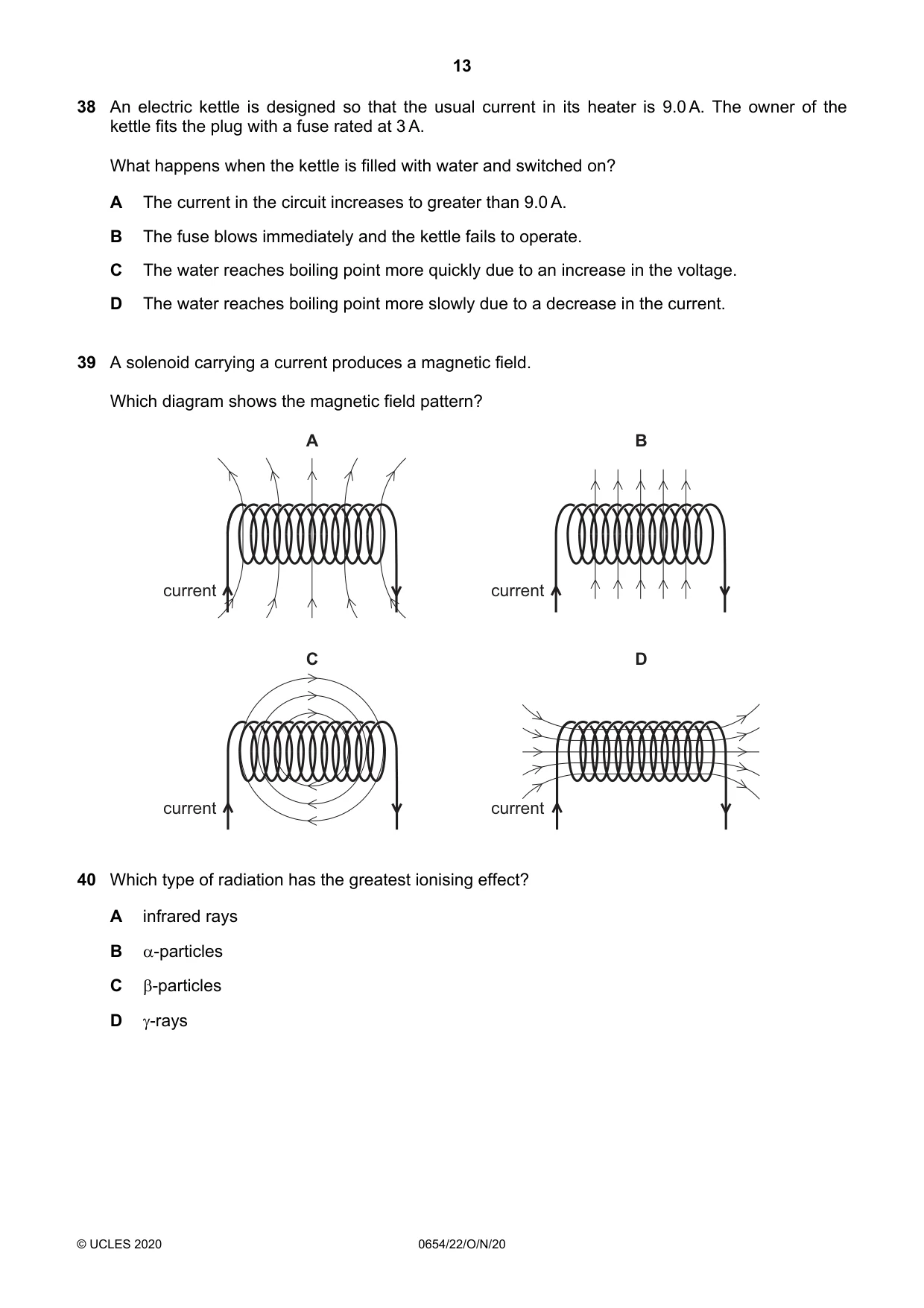
Q38 · An electric kettle is designed so that the usual current in its heater is 9.0 A
38 An electric kettle is designed so that the usual current in its heater is 9.0 A. The owner of the kettle fits the plug with a fuse rated at 3 A. What happens when the kettle is filled with water and switched on? A The current in the circuit increases to greater than 9.0 A. B The fuse blows immediately and the kettle fails to operate. C The water reaches boiling point more quickly due to an increase in the voltage. D The water reaches boiling point more slowly due to a decrease in the current.
Mark scheme: B
Q39 · A solenoid carrying a current produces a magnetic field
39 A solenoid carrying a current produces a magnetic field. Which diagram shows the magnetic field pattern? A B current current C D current current
Mark scheme: D
Q40 · Which type of radiation has the greatest ionising effect?
40 Which type of radiation has the greatest ionising effect? A infrared rays B -particles C -particles D -rays
Mark scheme: B
What was in this paper
The subtopics covered by these 40 questions, and how many questions each got. Open one in a new tab to see every Cambridge question on it.
2Energy, work and power2Air quality and climate1Alcohols1Biological molecules1Cell division1Characteristics of living organisms1Conservation1Coordination and response1Digestive system1Electrical quantities1Electrical safety1Enzymes1Exothermic and endothermic reactions1Food chains and food webs1Fuels1Gas exchange in humans1General properties of waves1Light1Metallic bonding1Motion1Photosynthesis1Polymers1Preparation of salts1Pressure1Radioactivity1Rate of reaction1Reactivity series1Redox1Separation and purification1Sexual reproduction in humans1Simple molecules and covalent bonds1Simple phenomena of magnetism1Size of specimens1The mole and the Avogadro constant1Transfer of thermal energy1Transition elements1Transpiration1What you needed in this session
Cambridge’s own grade thresholds for 2020 Oct/Nov, Paper 2 · Variant 2. A higher threshold means an easier paper — the bar moves with how the cohort did.