Cambridge IGCSE Sciences - Co-ordinated (Double) 0654 — 2019 May/June Paper 2 · Variant 3
0654/23/M/J/19 · 40 questions · 40 marks · ≈45 min
The question paper and its mark scheme, free to read here and free to download. This is Cambridge’s own paper, exactly as it was sat.
Question paper16 pages
Mark scheme3 pages
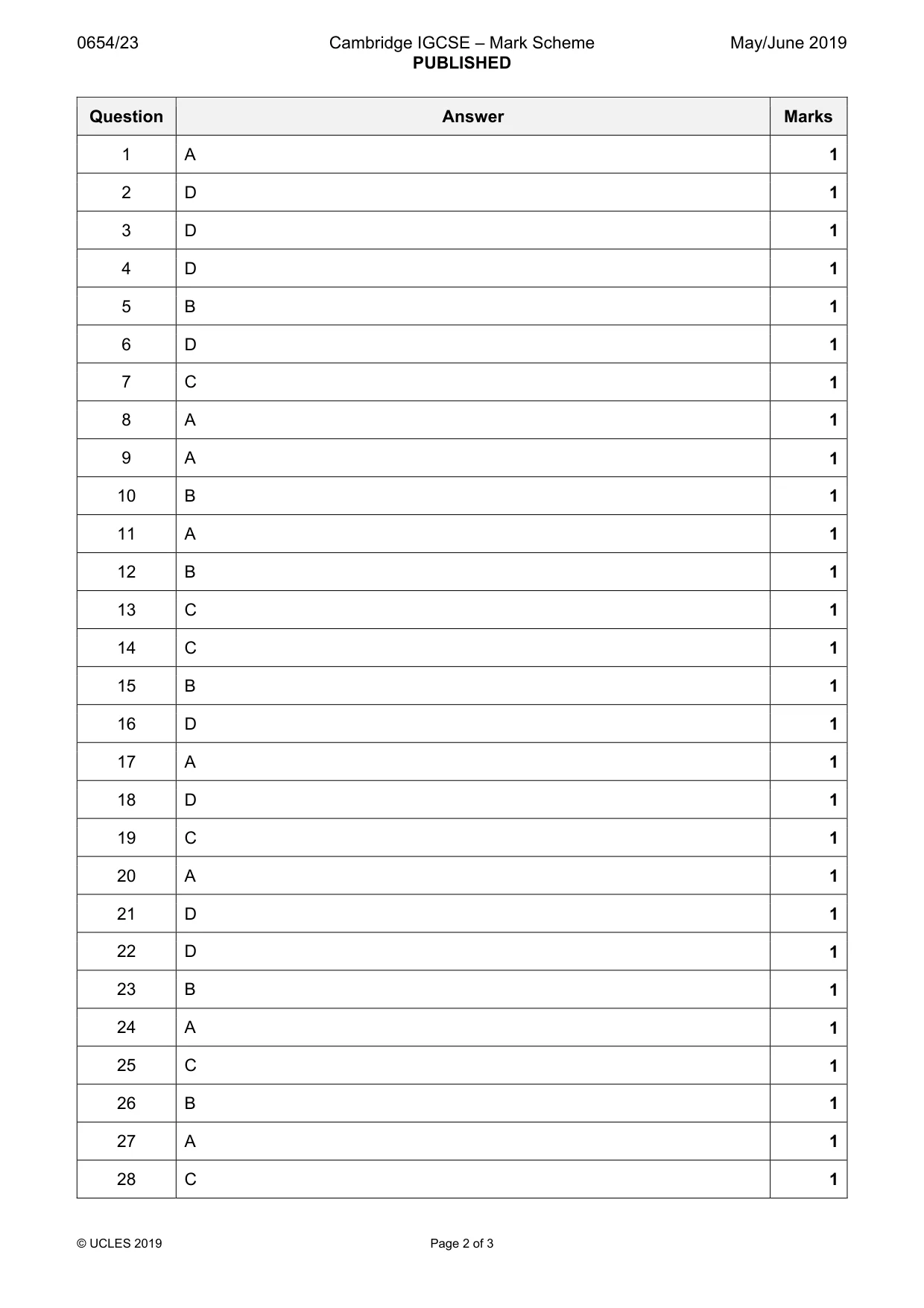
Answers below. Sit the paper first if you are practising.
Questions as text
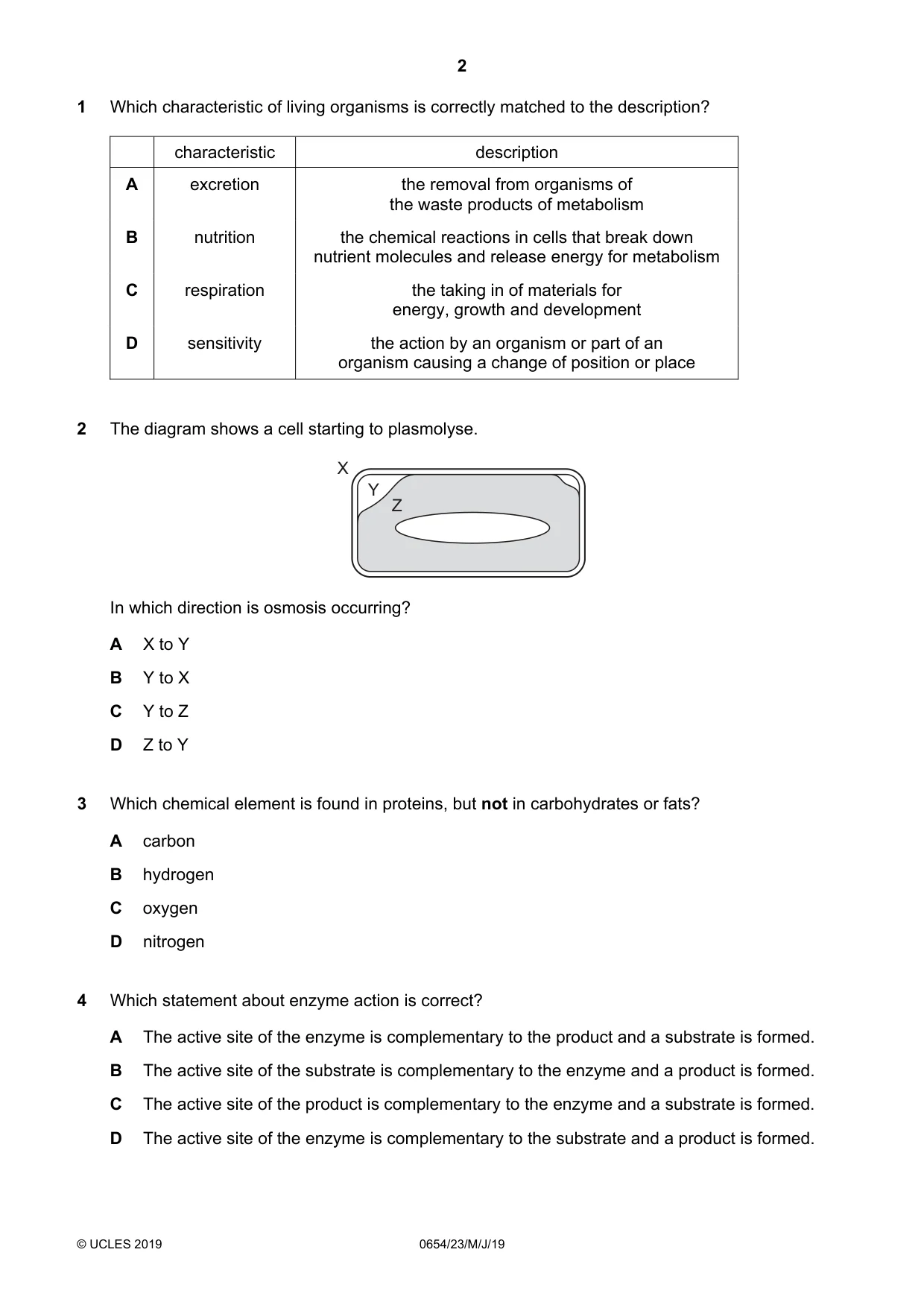
Q1 · Which characteristic of living organisms is correctly matched to the description?
1 Which characteristic of living organisms is correctly matched to the description? characteristic description A excretion the removal from organisms of the waste products of metabolism B nutrition the chemical reactions in cells that break down nutrient molecules and release energy for metabolism C respiration the taking in of materials for energy, growth and development D sensitivity the action by an organism or part of an organism causing a change of position or place
Mark scheme: A
Q2 · The diagram shows a cell starting to plasmolyse
2 The diagram shows a cell starting to plasmolyse. X Y Z In which direction is osmosis occurring? A X to Y B Y to X C Y to Z D Z to Y
Mark scheme: D
Q3 · Which chemical element is found in proteins, but not in carbohydrates or fats?
3 Which chemical element is found in proteins, but not in carbohydrates or fats? A carbon B hydrogen C oxygen D nitrogen
Mark scheme: D
Q4 · Which statement about enzyme action is correct?
4 Which statement about enzyme action is correct? A The active site of the enzyme is complementary to the product and a substrate is formed. B The active site of the substrate is complementary to the enzyme and a product is formed. C The active site of the product is complementary to the enzyme and a substrate is formed. D The active site of the enzyme is complementary to the substrate and a product is formed.
Mark scheme: D
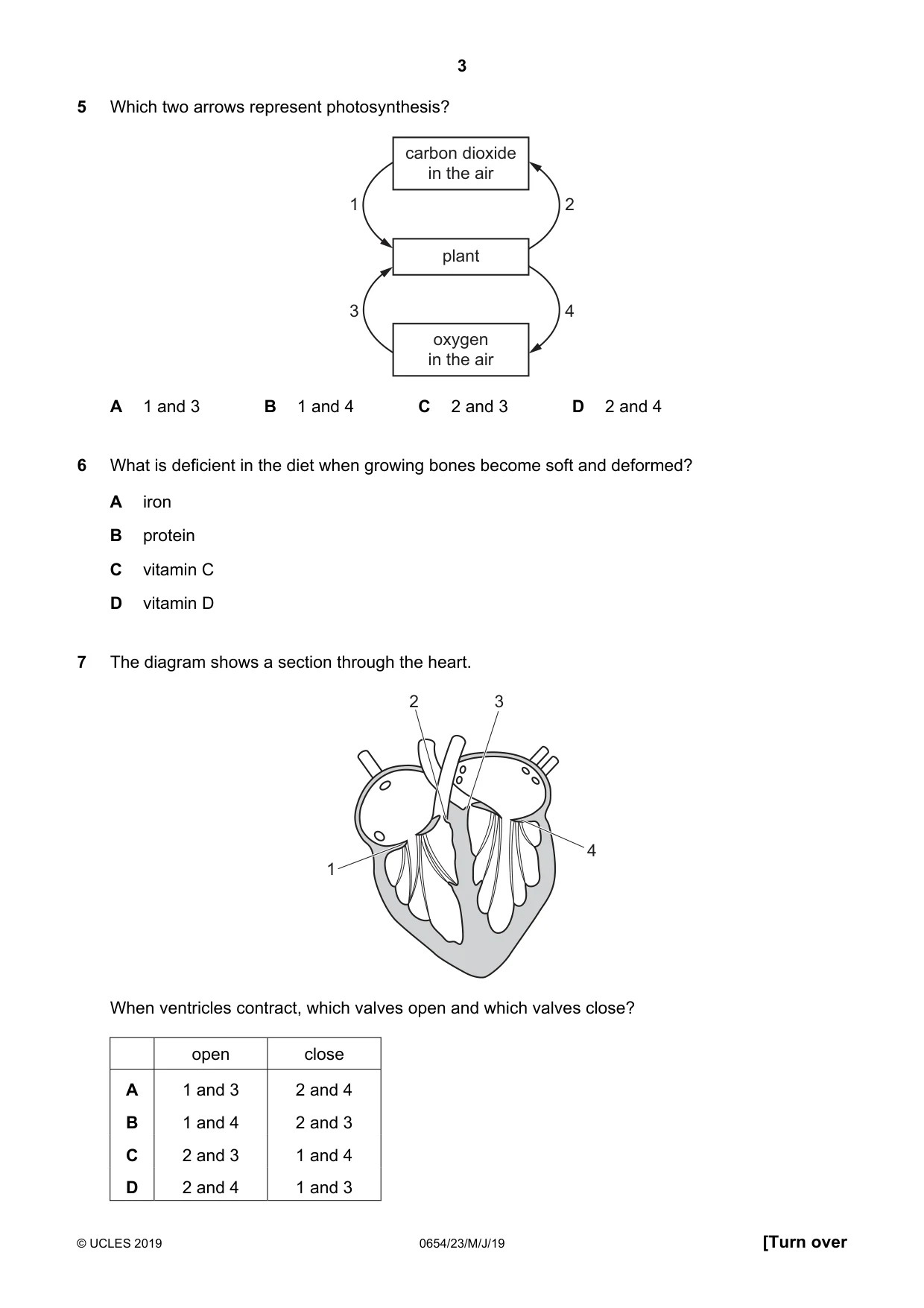
Q5 · Which two arrows represent photosynthesis?
5 Which two arrows represent photosynthesis? carbon dioxide in the air 1 2 plant 3 4 oxygen in the air A 1 and 3 B 1 and 4 C 2 and 3 D 2 and 4
Mark scheme: B
Q6 · What is deficient in the diet when growing bones become soft and deformed?
6 What is deficient in the diet when growing bones become soft and deformed? A iron B protein C vitamin C D vitamin D
Mark scheme: D
Q7 · The diagram shows a section through the heart
7 The diagram shows a section through the heart. 2 3 4 1 When ventricles contract, which valves open and which valves close? open close A 1 and 3 2 and 4 B 1 and 4 2 and 3 C 2 and 3 1 and 4 D 2 and 4 1 and 3
Mark scheme: C
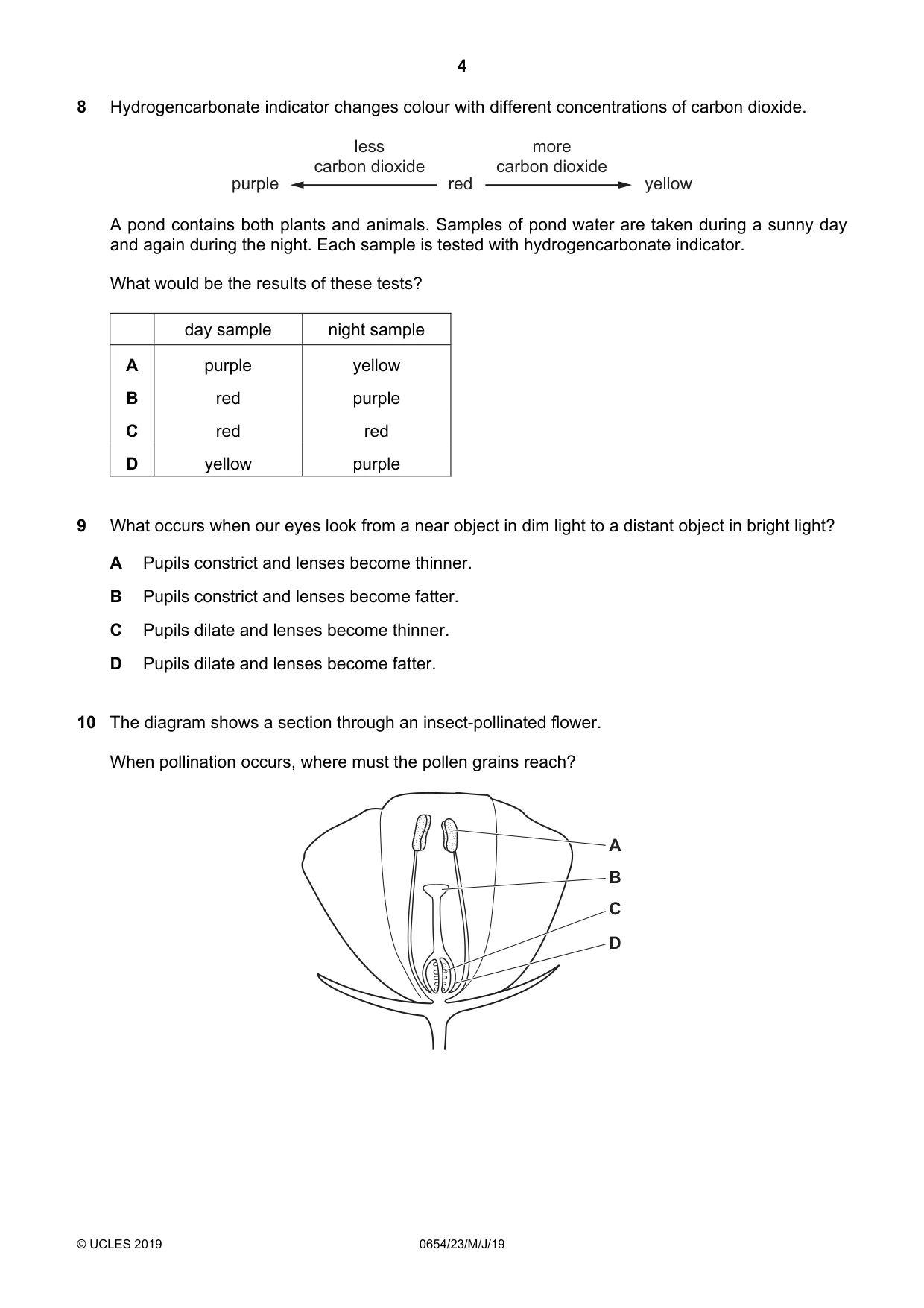
Q8 · Hydrogencarbonate indicator changes colour with different concentrations of carbon dioxide
8 Hydrogencarbonate indicator changes colour with different concentrations of carbon dioxide. less more carbon dioxide carbon dioxide purple red yellow A pond contains both plants and animals. Samples of pond water are taken during a sunny day and again during the night. Each sample is tested with hydrogencarbonate indicator. What would be the results of these tests? day sample night sample A purple yellow B red purple C red red D yellow purple
Mark scheme: A
Q9 · What occurs when our eyes look from a near object in dim light to a distant object in…
9 What occurs when our eyes look from a near object in dim light to a distant object in bright light? A Pupils constrict and lenses become thinner. B Pupils constrict and lenses become fatter. C Pupils dilate and lenses become thinner. D Pupils dilate and lenses become fatter.
Mark scheme: A
Q10 · The diagram shows a section through an insect-pollinated flower
10 The diagram shows a section through an insect-pollinated flower. When pollination occurs, where must the pollen grains reach? A B C D
Mark scheme: B
Q11 · Which human characteristic is not influenced by the environment?
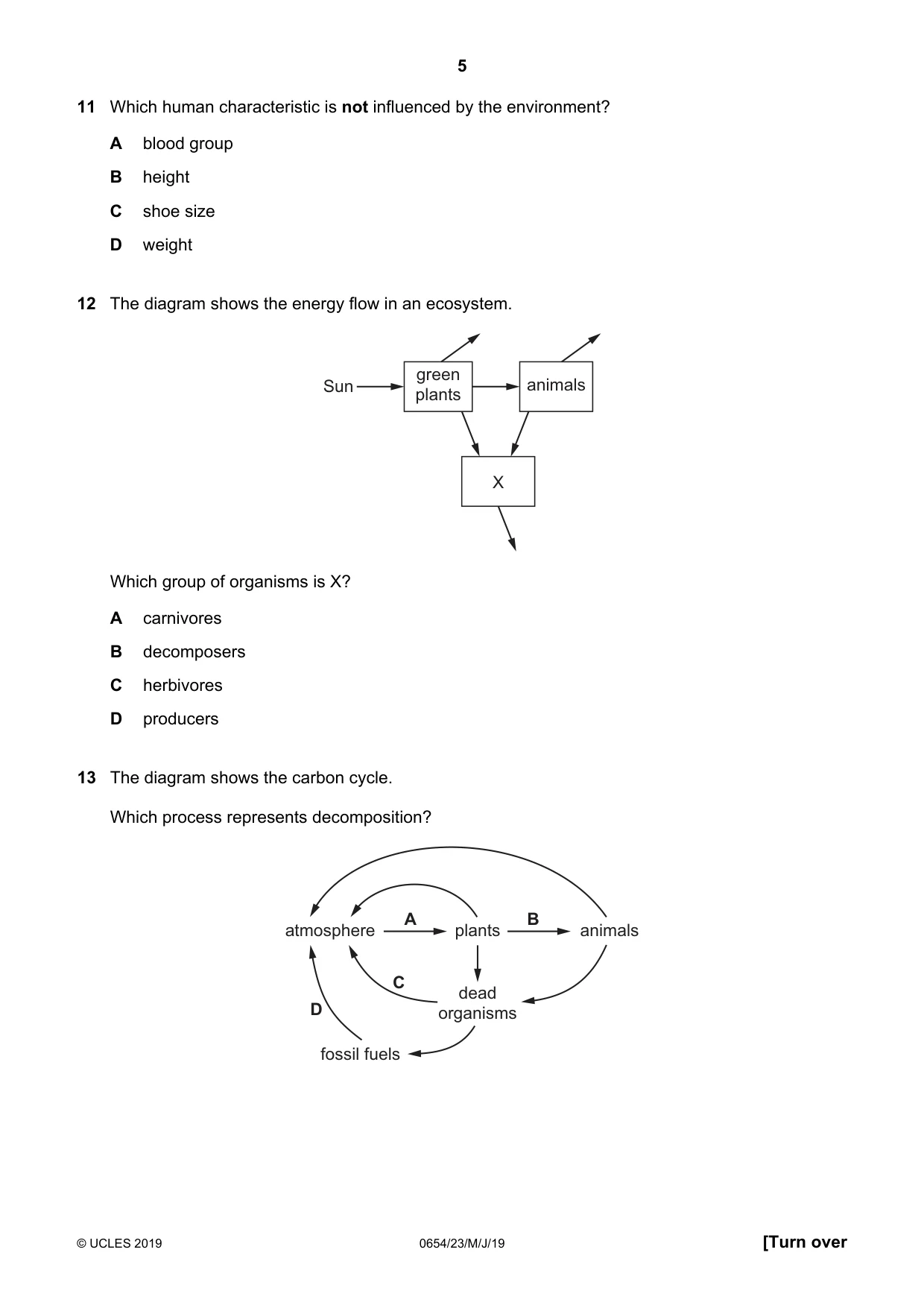
11 Which human characteristic is not influenced by the environment? A blood group B height C shoe size D weight
Mark scheme: A
Q12 · The diagram shows the energy flow in an ecosystem
12 The diagram shows the energy flow in an ecosystem. green Sun animals plants X Which group of organisms is X? A carnivores B decomposers C herbivores D producers
Mark scheme: B
Q13 · The diagram shows the carbon cycle
13 The diagram shows the carbon cycle. Which process represents decomposition? A B atmosphere plants animals C dead D organisms fossil fuels
Mark scheme: C
Q14 · Which method is used to assess the purity of an unknown solid substance?
14 Which method is used to assess the purity of an unknown solid substance? A Measure its density. B Measure its electrical conductivity. C Measure its melting point. D Measure its solubility in water.
Mark scheme: C
Q15 · Two substances, X and Y, are heated and then cooled
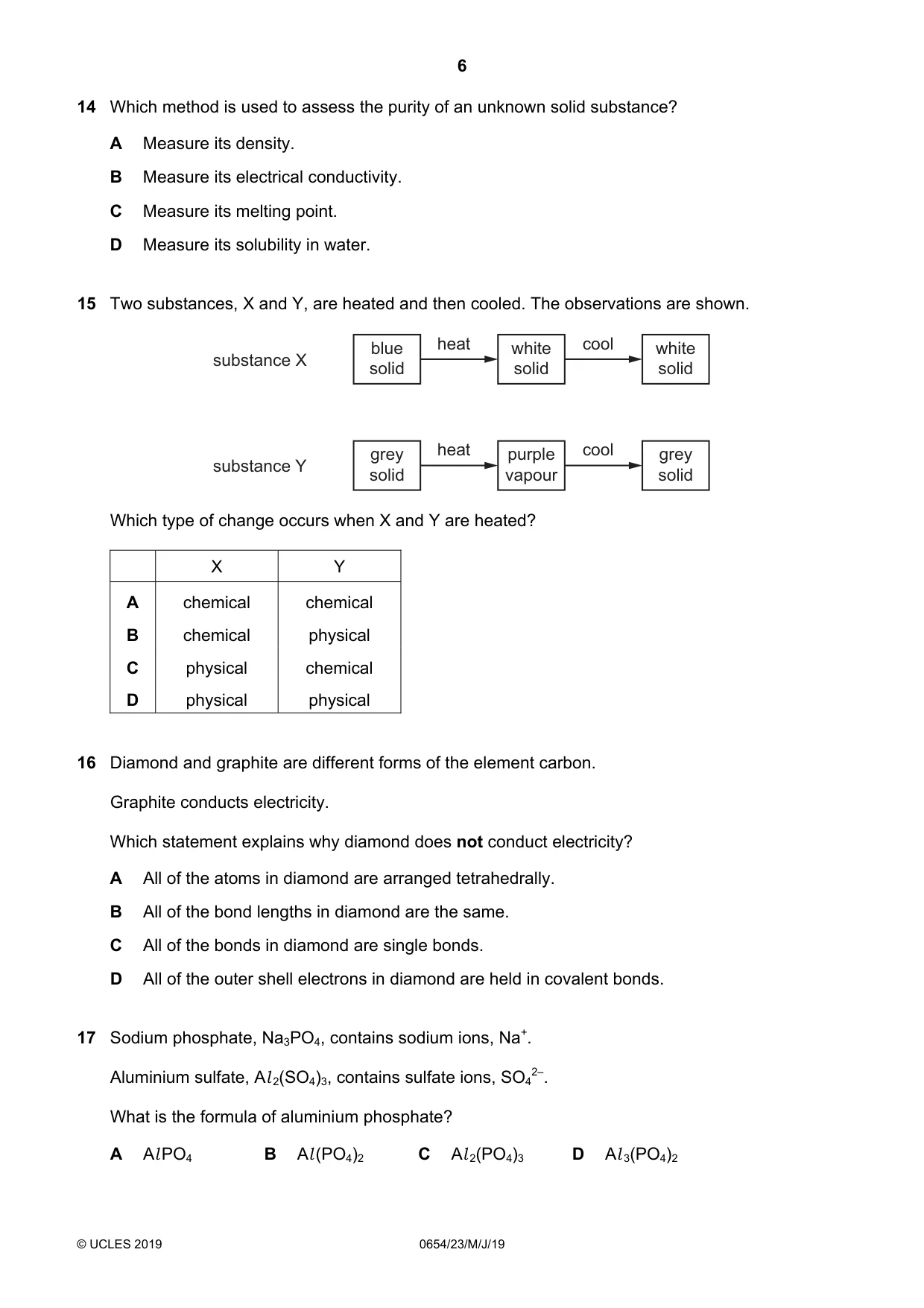
15 Two substances, X and Y, are heated and then cooled. The observations are shown. blue heat white cool white substance X solid solid solid grey heat purple cool grey substance Y solid vapour solid Which type of change occurs when X and Y are heated? X Y A chemical chemical B chemical physical C physical chemical D physical physical
Mark scheme: B
Q16 · Diamond and graphite are different forms of the element carbon
16 Diamond and graphite are different forms of the element carbon. Graphite conducts electricity. Which statement explains why diamond does not conduct electricity? A All of the atoms in diamond are arranged tetrahedrally. B All of the bond lengths in diamond are the same. C All of the bonds in diamond are single bonds. D All of the outer shell electrons in diamond are held in covalent bonds.
Mark scheme: D
Q17 · Sodium phosphate, Na3PO4, contains sodium ions, Na+
17 Sodium phosphate, Na3PO4, contains sodium ions, Na+. Aluminium sulfate, Al 2(SO4)3, contains sulfate ions, SO4 2–. What is the formula of aluminium phosphate? A Al PO4 B Al (PO4)2 C Al 2(PO4)3 D Al 3(PO4)2
Mark scheme: A
Q18 · When concentrated aqueous sodium chloride is electrolysed, the remaining solution turns…
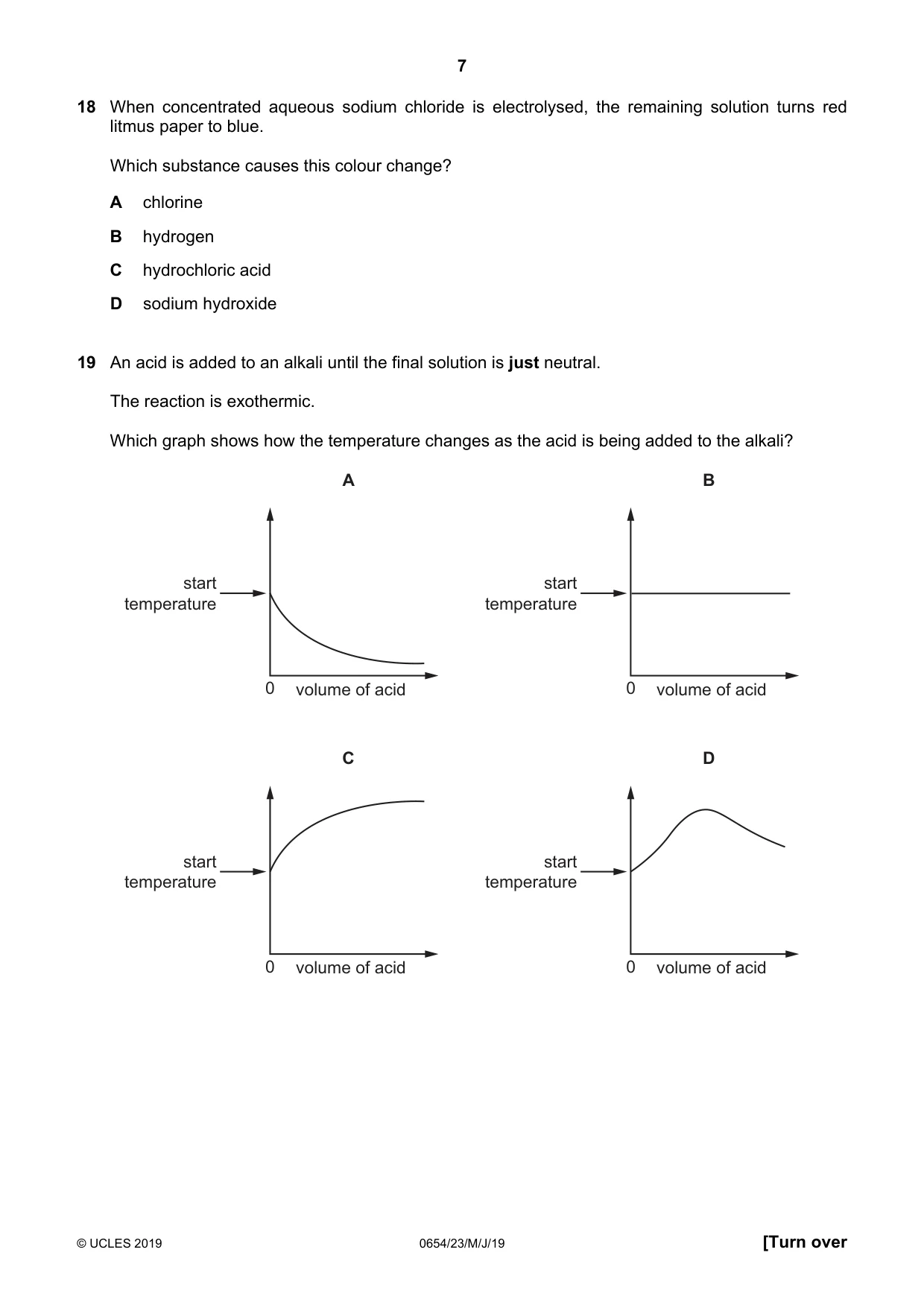
18 When concentrated aqueous sodium chloride is electrolysed, the remaining solution turns red litmus paper to blue. Which substance causes this colour change? A chlorine B hydrogen C hydrochloric acid D sodium hydroxide
Mark scheme: D
Q19 · An acid is added to an alkali until the final solution is just neutral
19 An acid is added to an alkali until the final solution is just neutral. The reaction is exothermic. Which graph shows how the temperature changes as the acid is being added to the alkali? A B start start temperature temperature 0 volume of acid 0 volume of acid C D start start temperature temperature 0 volume of acid 0 volume of acid
Mark scheme: C
Q20 · Which row describes the effect of increasing temperature on collisions between particles…
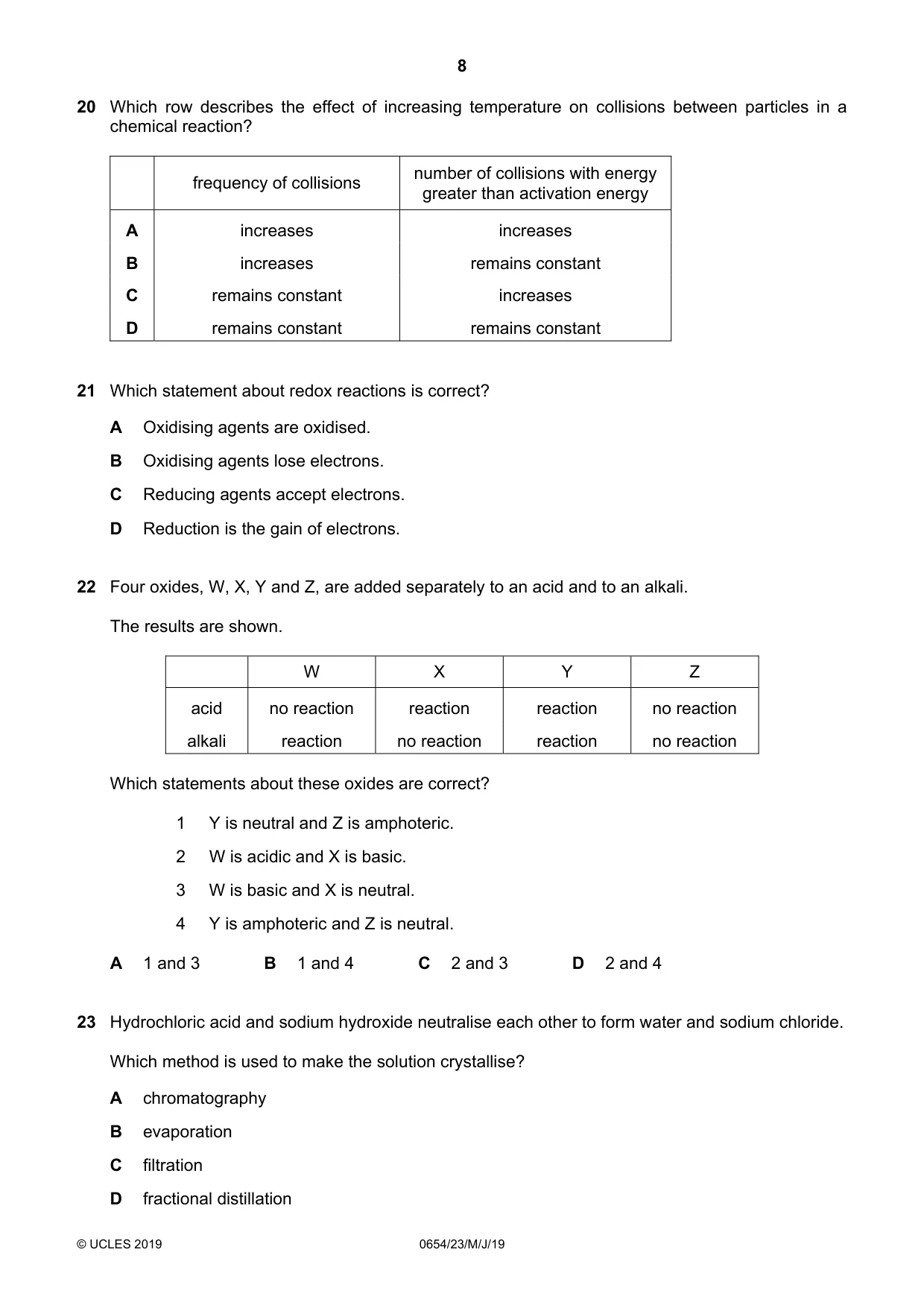
20 Which row describes the effect of increasing temperature on collisions between particles in a chemical reaction? number of collisions with energy frequency of collisions greater than activation energy A increases increases B increases remains constant C remains constant increases D remains constant remains constant
Mark scheme: A
Q21 · Which statement about redox reactions is correct?
21 Which statement about redox reactions is correct? A Oxidising agents are oxidised. B Oxidising agents lose electrons. C Reducing agents accept electrons. D Reduction is the gain of electrons.
Mark scheme: D
Q22 · Four oxides, W, X, Y and Z, are added separately to an acid and to an alkali
22 Four oxides, W, X, Y and Z, are added separately to an acid and to an alkali. The results are shown. W X Y Z acid no reaction reaction reaction no reaction alkali reaction no reaction reaction no reaction Which statements about these oxides are correct? 1 Y is neutral and Z is amphoteric. 2 W is acidic and X is basic. 3 W is basic and X is neutral. 4 Y is amphoteric and Z is neutral. A 1 and 3 B 1 and 4 C 2 and 3 D 2 and 4
Mark scheme: D
Q23 · Hydrochloric acid and sodium hydroxide neutralise each other to form water and sodium…
23 Hydrochloric acid and sodium hydroxide neutralise each other to form water and sodium chloride. Which method is used to make the solution crystallise? A chromatography B evaporation C filtration D fractional distillation
Mark scheme: B
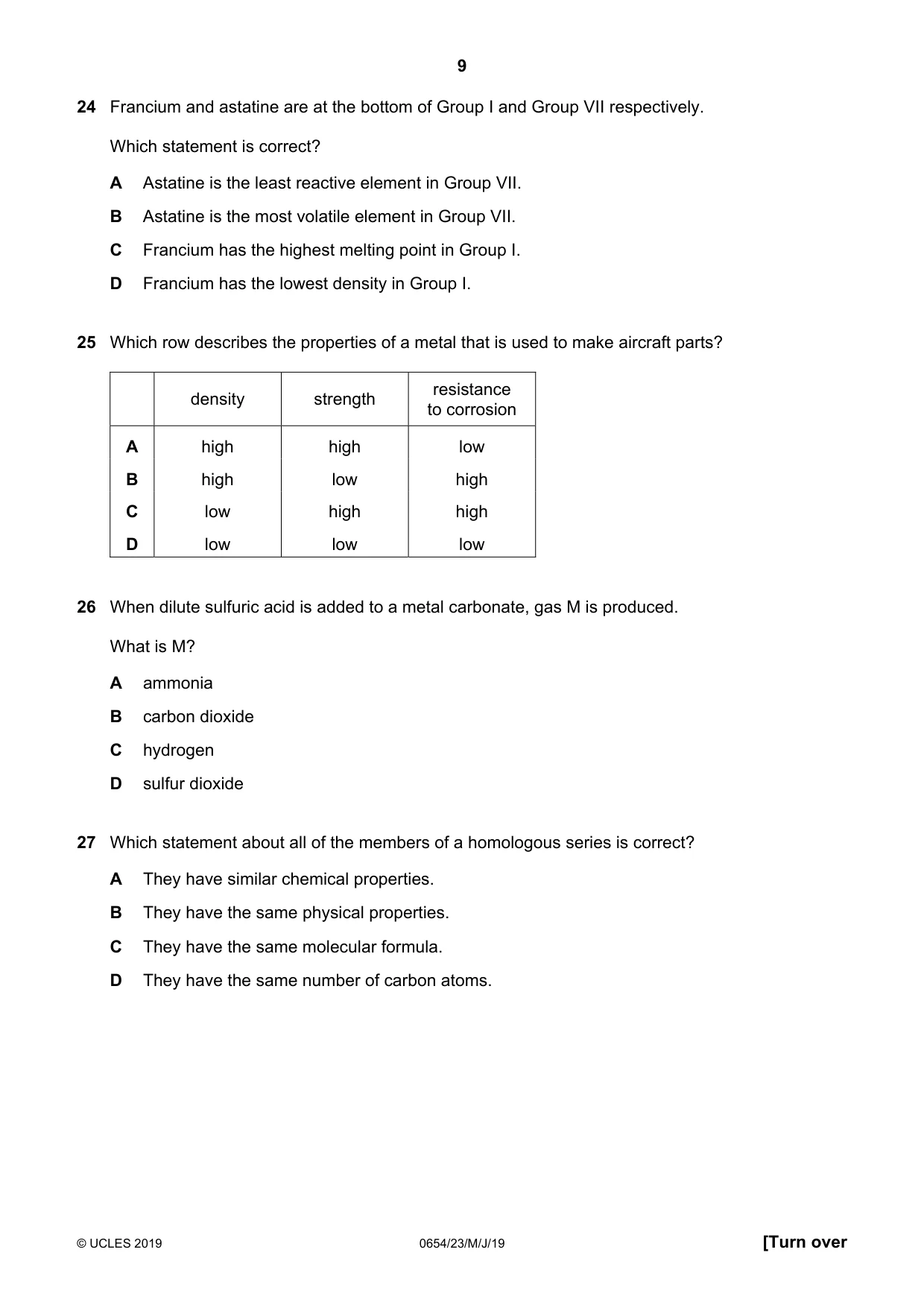
Q24 · Francium and astatine are at the bottom of Group I and Group VII respectively
24 Francium and astatine are at the bottom of Group I and Group VII respectively. Which statement is correct? A Astatine is the least reactive element in Group VII. B Astatine is the most volatile element in Group VII. C Francium has the highest melting point in Group I. D Francium has the lowest density in Group I.
Mark scheme: A
Q25 · Which row describes the properties of a metal that is used to make aircraft parts?
25 Which row describes the properties of a metal that is used to make aircraft parts? resistance density strength to corrosion A high high low B high low high C low high high D low low low
Mark scheme: C
Q26 · When dilute sulfuric acid is added to a metal carbonate, gas M is produced
26 When dilute sulfuric acid is added to a metal carbonate, gas M is produced. What is M? A ammonia B carbon dioxide C hydrogen D sulfur dioxide
Mark scheme: B
Q27 · Which statement about all of the members of a homologous series is correct?
27 Which statement about all of the members of a homologous series is correct? A They have similar chemical properties. B They have the same physical properties. C They have the same molecular formula. D They have the same number of carbon atoms.
Mark scheme: A
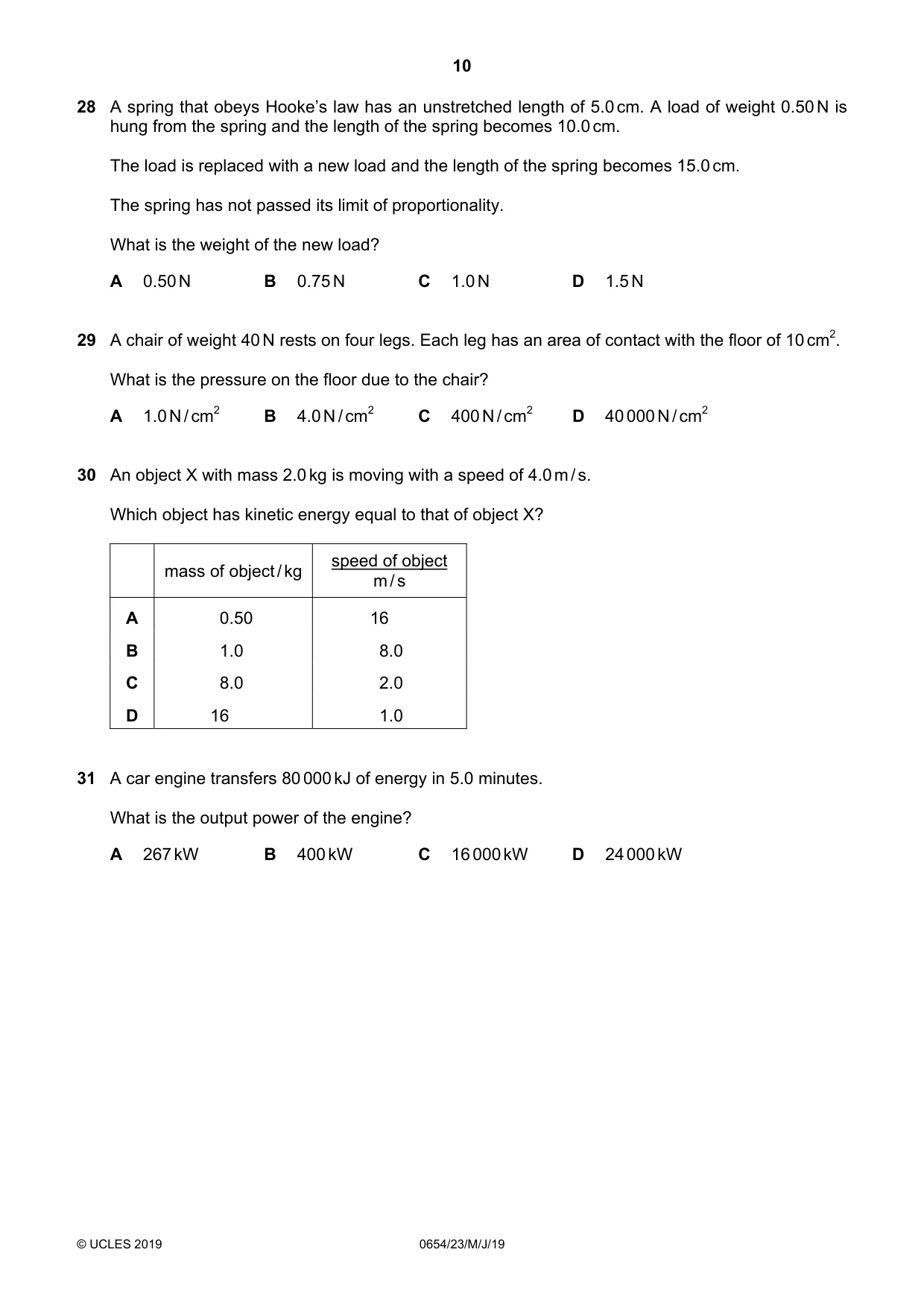
Q28 · A spring that obeys Hooke’s law has an unstretched length of 5.0 cm
28 A spring that obeys Hooke’s law has an unstretched length of 5.0 cm. A load of weight 0.50 N is hung from the spring and the length of the spring becomes 10.0 cm. The load is replaced with a new load and the length of the spring becomes 15.0 cm. The spring has not passed its limit of proportionality. What is the weight of the new load? A 0.50 N B 0.75 N C 1.0 N D 1.5 N
Mark scheme: C
Q29 · A chair of weight 40 N rests on four legs
29 A chair of weight 40 N rests on four legs. Each leg has an area of contact with the floor of 10 cm2. What is the pressure on the floor due to the chair? A 1.0 N / cm2 B 4.0 N / cm2 C 400 N / cm2 D 40 000 N / cm2
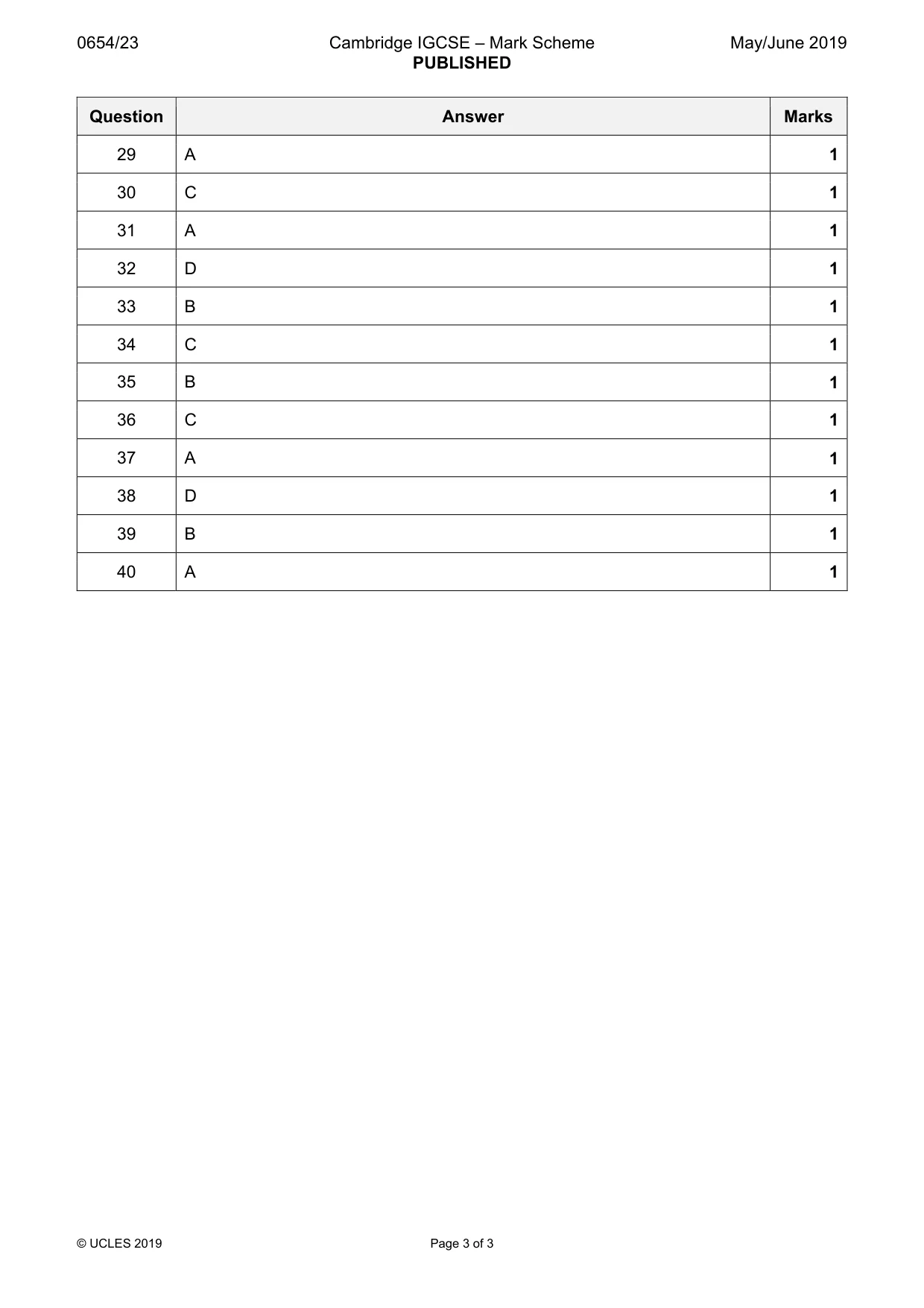
Mark scheme: A
Q30 · An object X with mass 2.0 kg is moving with a speed of 4.0 m / s
30 An object X with mass 2.0 kg is moving with a speed of 4.0 m / s. Which object has kinetic energy equal to that of object X? speed of object mass of object / kg m / s A 0.50 16 B 1.0 8.0 C 8.0 2.0 D 16 1.0
Mark scheme: C
Q31 · A car engine transfers 80 000 kJ of energy in 5.0 minutes
31 A car engine transfers 80 000 kJ of energy in 5.0 minutes. What is the output power of the engine? A 267 kW B 400 kW C 16 000 kW D 24 000 kW
Mark scheme: A
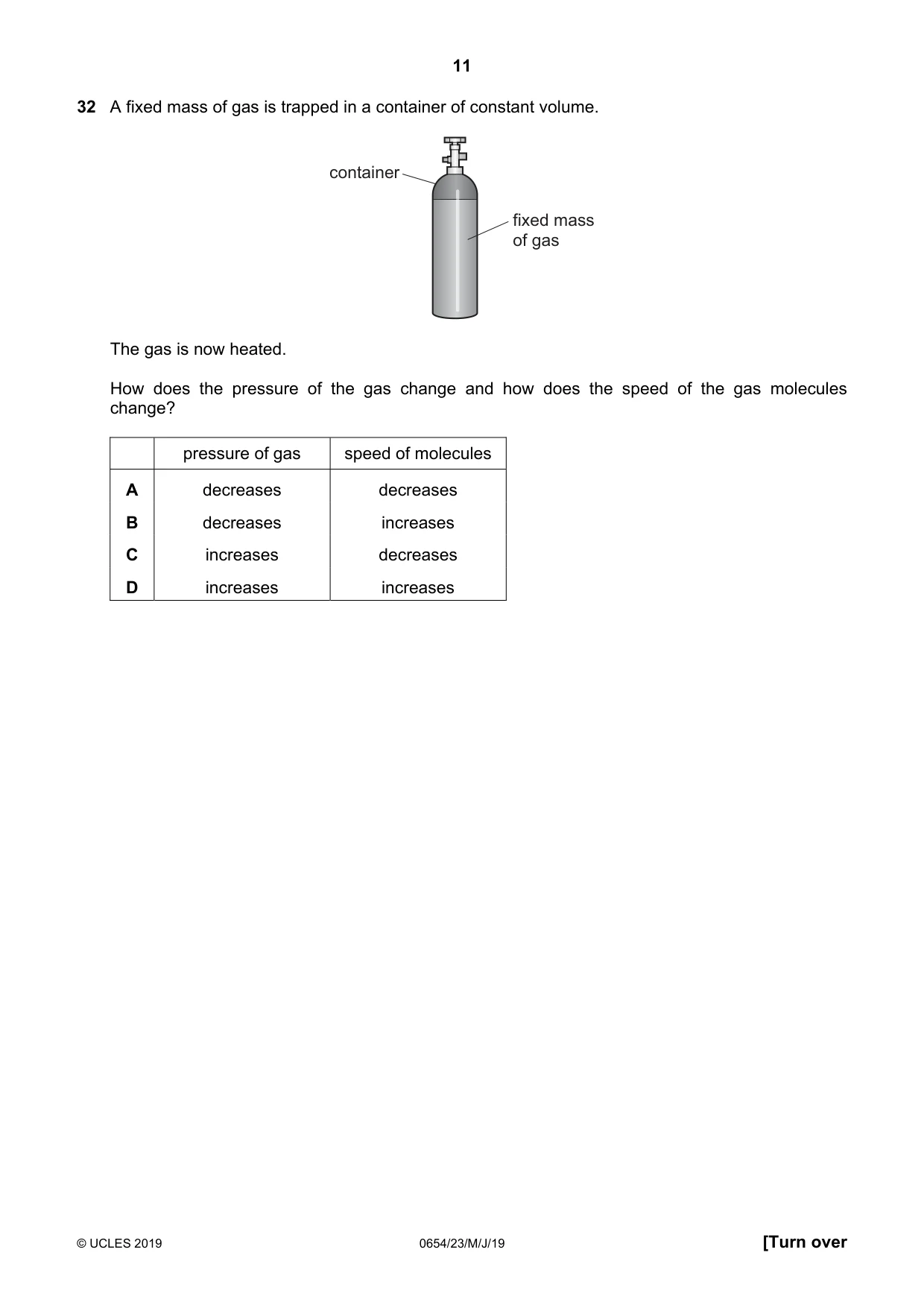
Q32 · A fixed mass of gas is trapped in a container of constant volume
32 A fixed mass of gas is trapped in a container of constant volume. container fixed mass of gas The gas is now heated. How does the pressure of the gas change and how does the speed of the gas molecules change? pressure of gas speed of molecules A decreases decreases B decreases increases C increases decreases D increases increases
Mark scheme: D
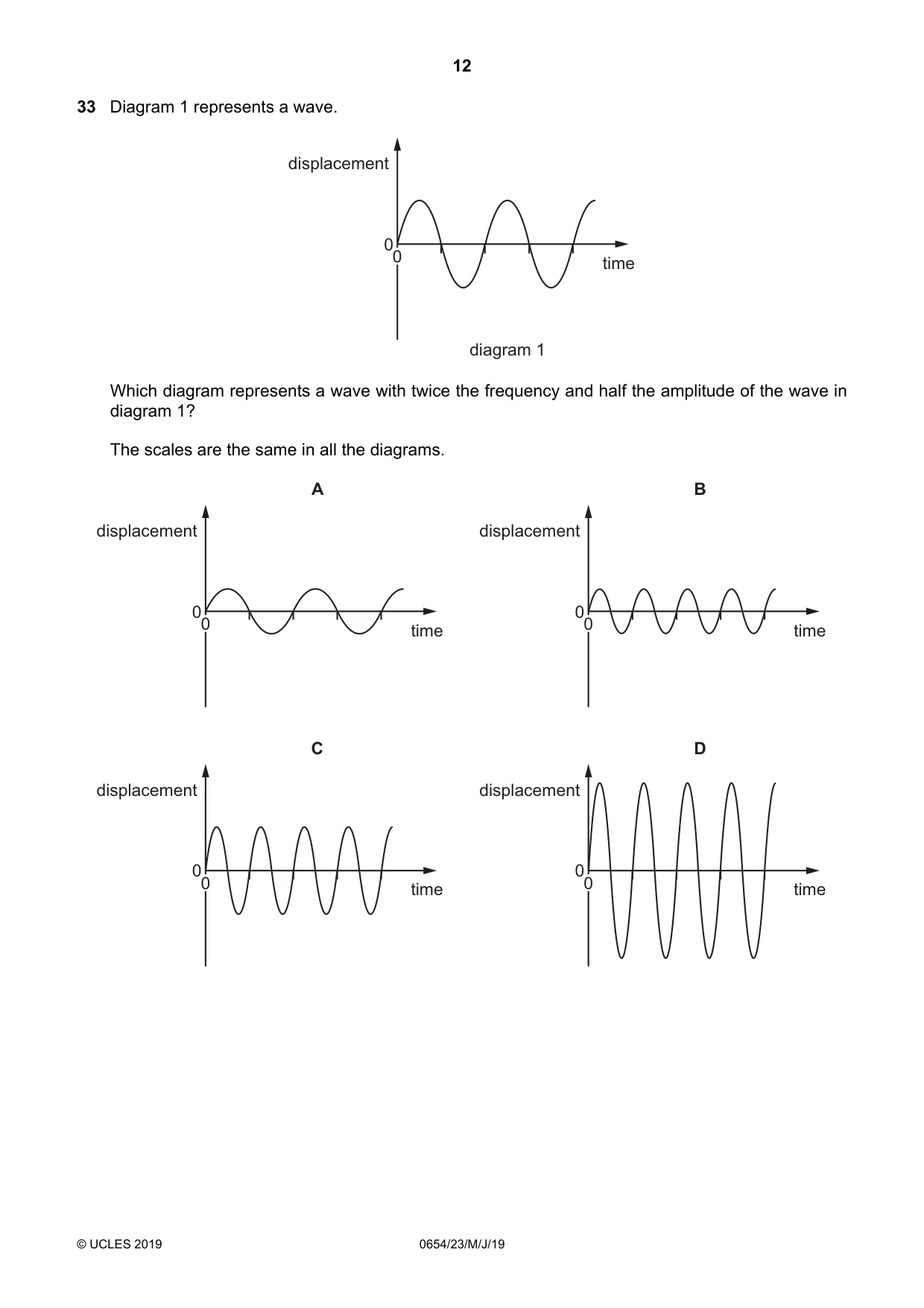
Question 33
33 Diagram 1 represents a wave. displacement 00 time diagram 1 Which diagram represents a wave with twice the frequency and half the amplitude of the wave in diagram 1? The scales are the same in all the diagrams. A B displacement displacement 00 00 time time C D displacement displacement 00 00 time time
Mark scheme: B
Q34 · A sports field is next to a large school building
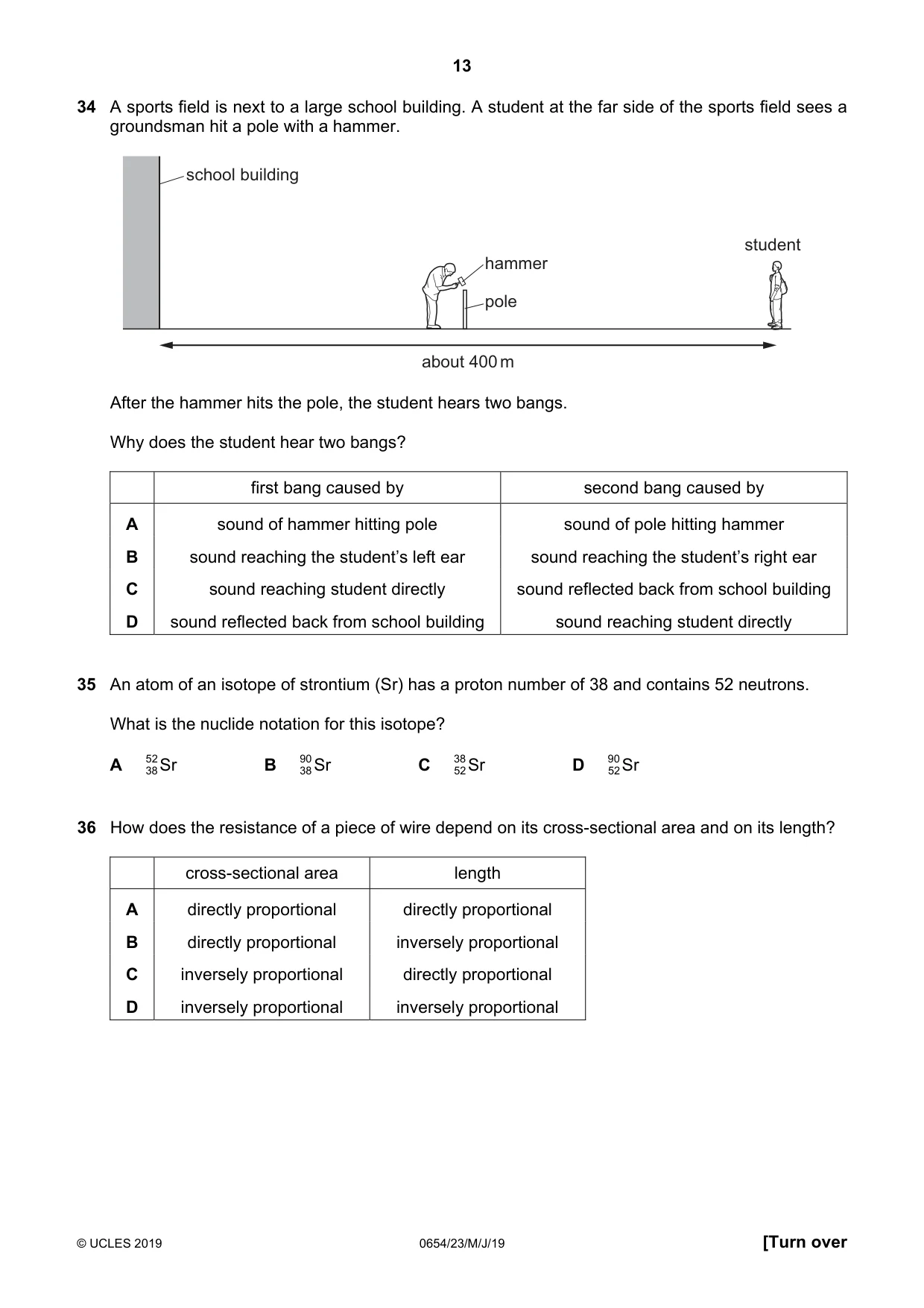
34 A sports field is next to a large school building. A student at the far side of the sports field sees a groundsman hit a pole with a hammer. school building student hammer pole about 400 m After the hammer hits the pole, the student hears two bangs. Why does the student hear two bangs? first bang caused by second bang caused by A sound of hammer hitting pole sound of pole hitting hammer B sound reaching the student’s left ear sound reaching the student’s right ear C sound reaching student directly sound reflected back from school building D sound reflected back from school building sound reaching student directly
Mark scheme: C
Q35 · An atom of an isotope of strontium (Sr) has a proton number of 38 and contains 52 neutrons
35 An atom of an isotope of strontium (Sr) has a proton number of 38 and contains 52 neutrons. What is the nuclide notation for this isotope? A 52 Sr B 90 Sr C 38 Sr D 90 Sr 38 38 52 52
Mark scheme: B
Q36 · How does the resistance of a piece of wire depend on its cross-sectional area and on its…
36 How does the resistance of a piece of wire depend on its cross-sectional area and on its length? cross-sectional area length A directly proportional directly proportional B directly proportional inversely proportional C inversely proportional directly proportional D inversely proportional inversely proportional
Mark scheme: C
Q37 · The cooling unit in a refrigerator is fitted at the top in the position shown in the…
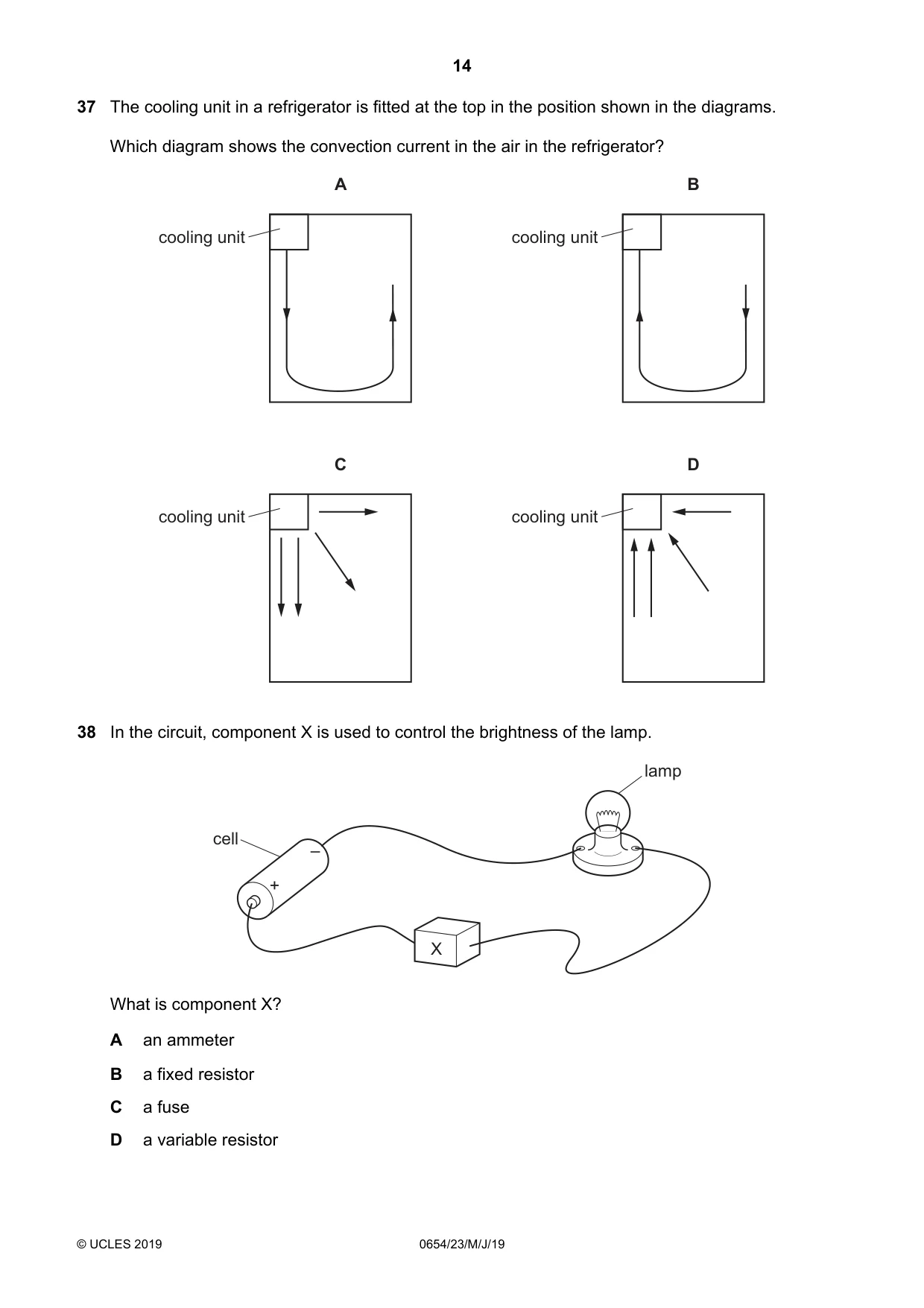
37 The cooling unit in a refrigerator is fitted at the top in the position shown in the diagrams. Which diagram shows the convection current in the air in the refrigerator? A B cooling unit cooling unit C D cooling unit cooling unit
Mark scheme: A
Q38 · In the circuit, component X is used to control the brightness of the lamp
38 In the circuit, component X is used to control the brightness of the lamp. lamp cell – + X What is component X? A an ammeter B a fixed resistor C a fuse D a variable resistor
Mark scheme: D
Q39 · A current-carrying wire is placed between the poles of a magnet, as shown
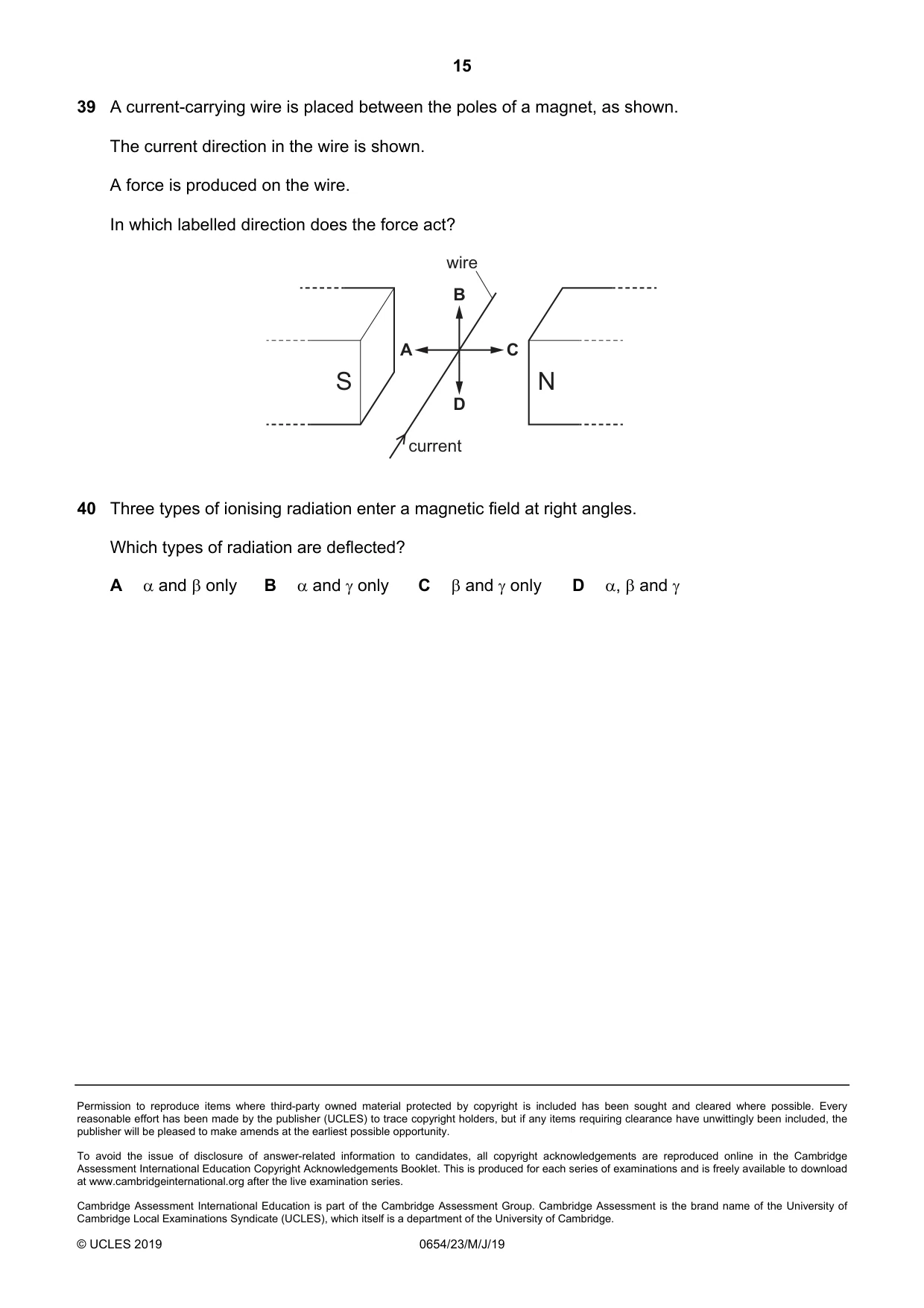
39 A current-carrying wire is placed between the poles of a magnet, as shown. The current direction in the wire is shown. A force is produced on the wire. In which labelled direction does the force act? wire B A C S N D current
Mark scheme: B
Q40 · Three types of ionising radiation enter a magnetic field at right angles
40 Three types of ionising radiation enter a magnetic field at right angles. Which types of radiation are deflected? A α and β only B α and γ only C β and γ only D α, β and γ
Mark scheme: A
What was in this paper
The subtopics covered by these 40 questions, and how many questions each got. Open one in a new tab to see every Cambridge question on it.
2Photosynthesis2Arrangement of elements1Biological molecules1Carbon cycle1Characteristics of living organisms1Coordination and response1Diet1Electrical circuits1Electrical quantities1Electrolysis1Electromagnetic effects1Energy flow1Enzymes1Exothermic and endothermic reactions1Experimental design1Forces1Formulas1Formulas and terminology1General properties of waves1Giant covalent structures1Heart1Identification of ions and gases1Kinetic particle model of matter1Osmosis1Oxides1Physical and chemical changes1Pressure1Radioactivity1Rate of reaction1Redox1Separation and purification1Sexual reproduction in plants1Sound1The nucleus1Transfer of thermal energy1Uses of metals1Variation1What you needed in this session
Cambridge’s own grade thresholds for 2019 May/June, Paper 2 · Variant 3. A higher threshold means an easier paper — the bar moves with how the cohort did.