Cambridge IGCSE Sciences - Co-ordinated (Double) 0654 — 2019 Oct/Nov Paper 2 · Variant 1
0654/21/O/N/19 · 40 questions · 40 marks · ≈45 min
The question paper and its mark scheme, free to read here and free to download. This is Cambridge’s own paper, exactly as it was sat.
Question paper16 pages

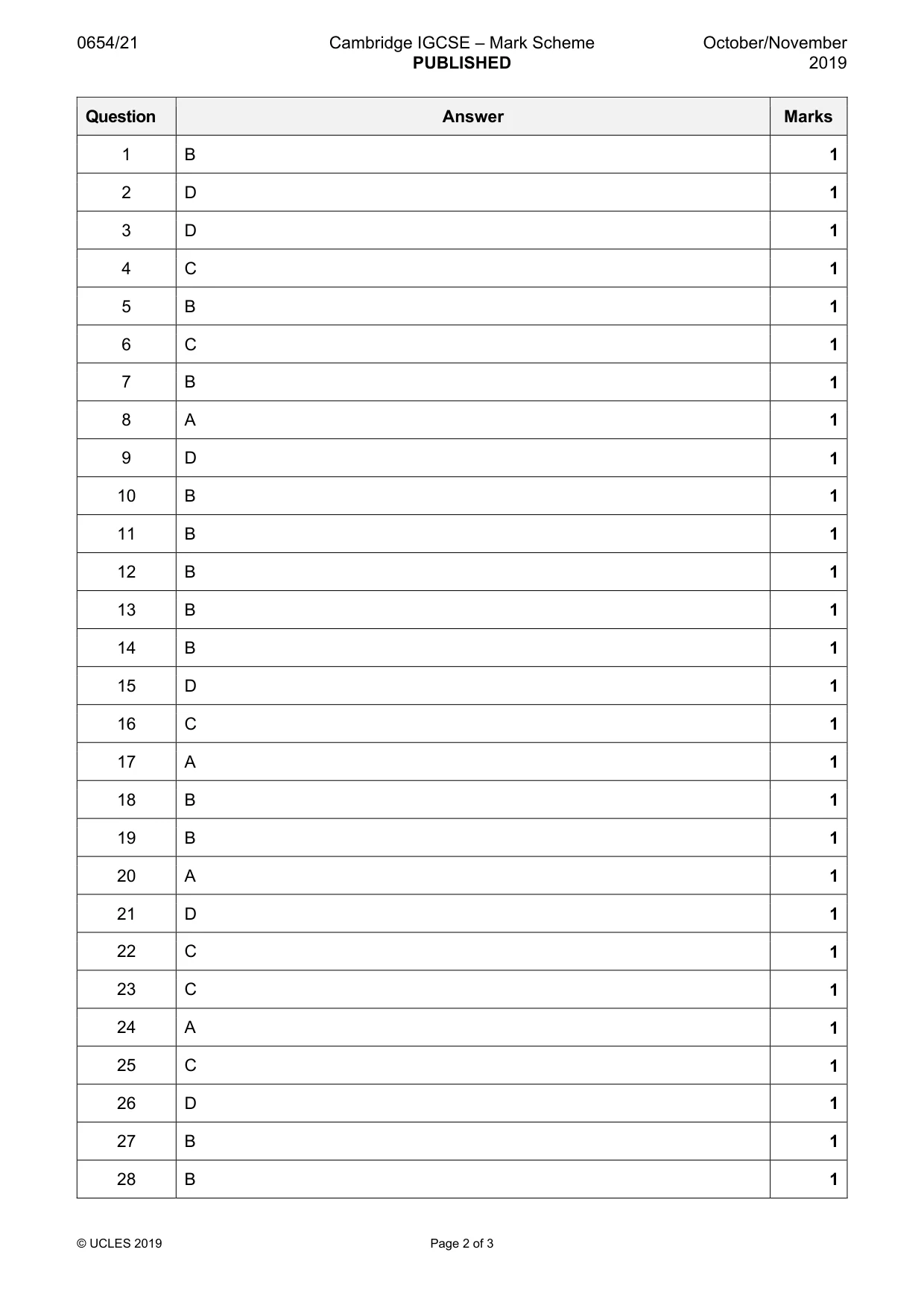
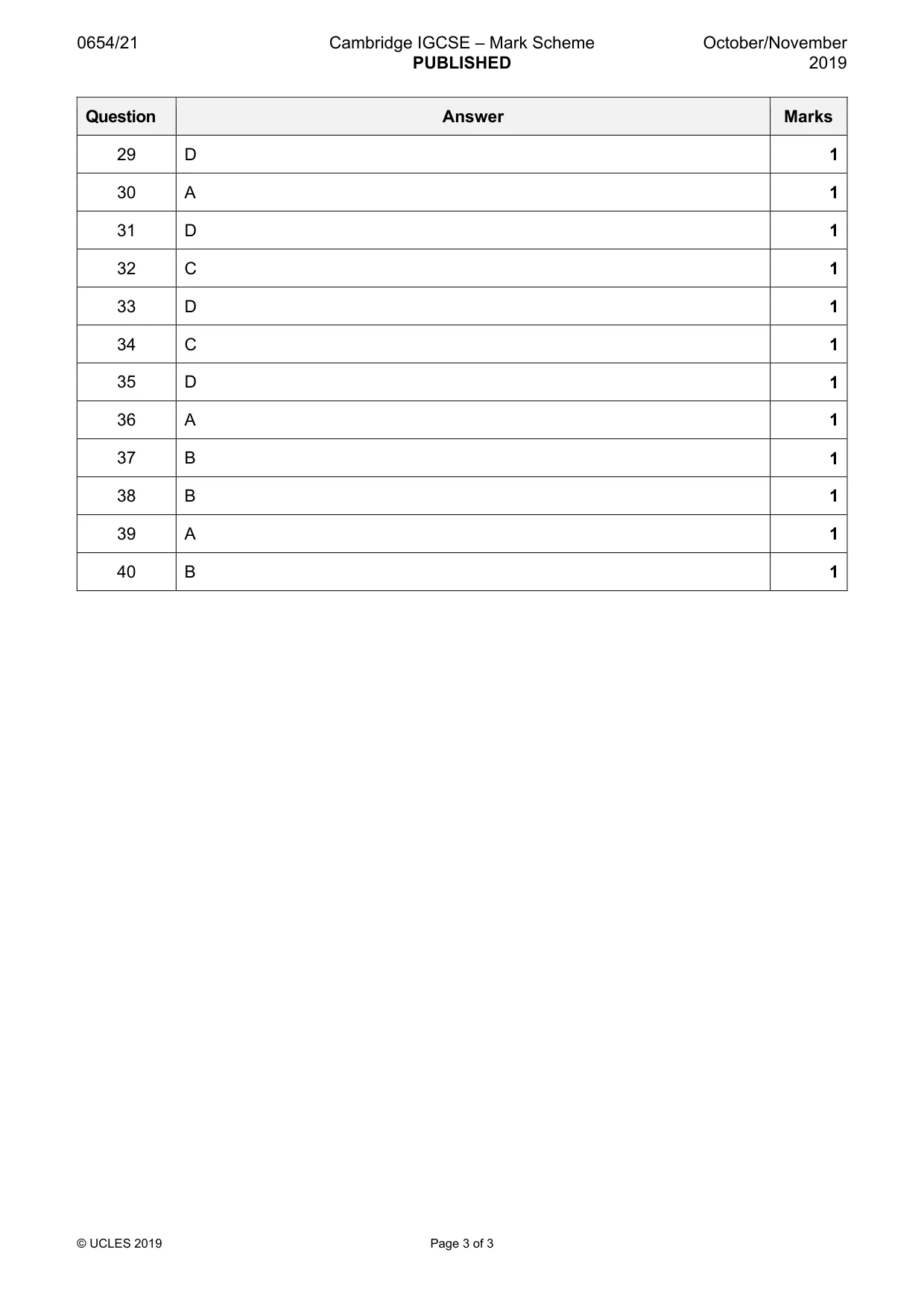
Mark scheme3 pages
Answers below. Sit the paper first if you are practising.
Questions as text
Q1 · Which process do all living organisms carry out?
1 Which process do all living organisms carry out? A asexual reproduction B excretion C ingestion D photosynthesis
Mark scheme: B
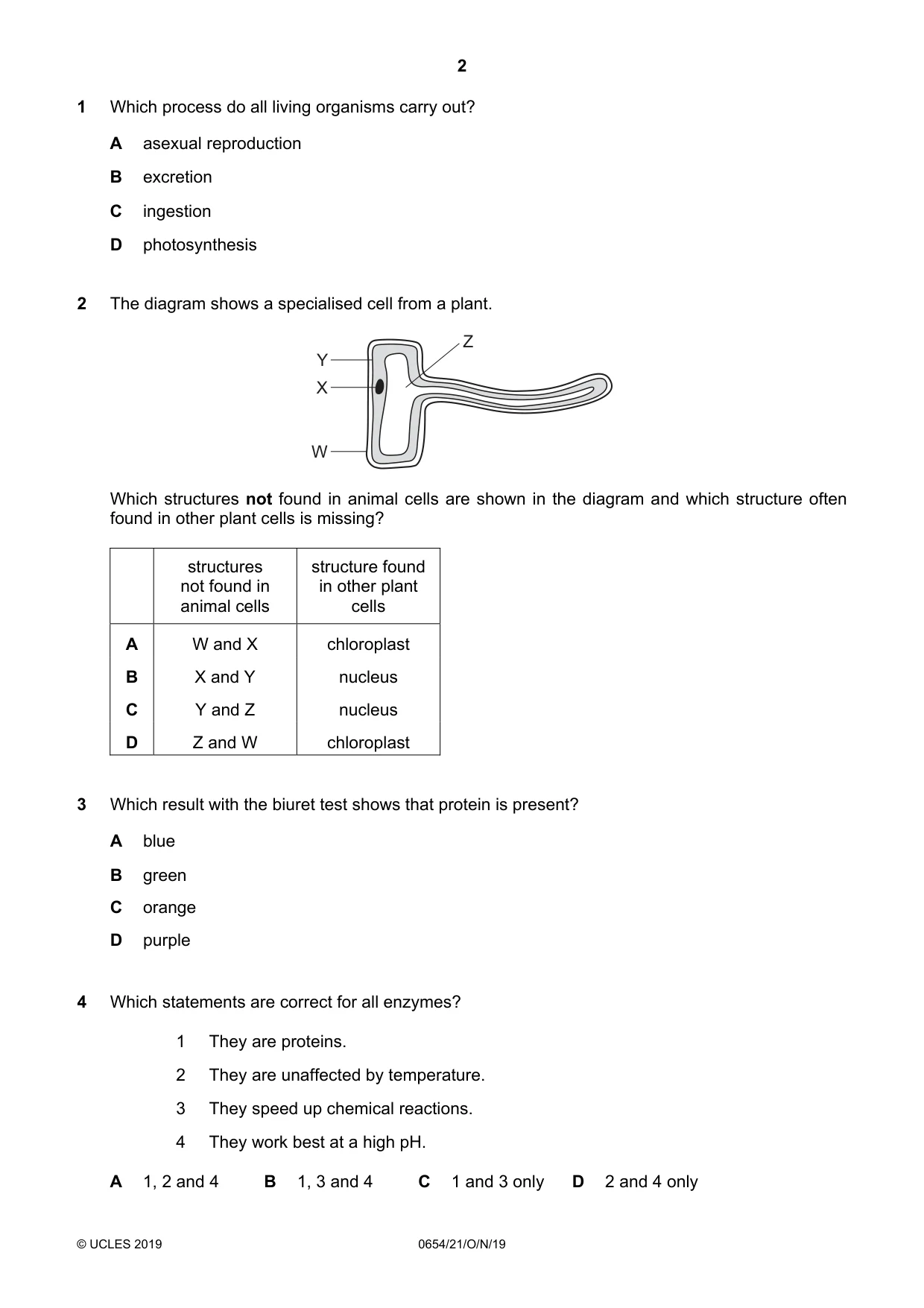
Q2 · The diagram shows a specialised cell from a plant
2 The diagram shows a specialised cell from a plant. Z Y X W Which structures not found in animal cells are shown in the diagram and which structure often found in other plant cells is missing? structures structure found not found in in other plant animal cells cells A W and X chloroplast B X and Y nucleus C Y and Z nucleus D Z and W chloroplast
Mark scheme: D
Q3 · Which result with the biuret test shows that protein is present?
3 Which result with the biuret test shows that protein is present? A blue B green C orange D purple
Mark scheme: D
Q4 · Which statements are correct for all enzymes?
4 Which statements are correct for all enzymes? 1 They are proteins. 2 They are unaffected by temperature. 3 They speed up chemical reactions. 4 They work best at a high pH. A 1, 2 and 4 B 1, 3 and 4 C 1 and 3 only D 2 and 4 only
Mark scheme: C
Q5 · Green plants need magnesium ions
5 Green plants need magnesium ions. Which plant process is limited when magnesium is deficient? A meiosis B photosynthesis C pollination D respiration
Mark scheme: B
Q6 · What is the effect of bile on food after it leaves the stomach?
6 What is the effect of bile on food after it leaves the stomach? A acidifies the food entering the duodenum B activates enzymes which digest glycerol C increases the surface area of fats for digestion D provides fat for digesting enzymes
Mark scheme: C
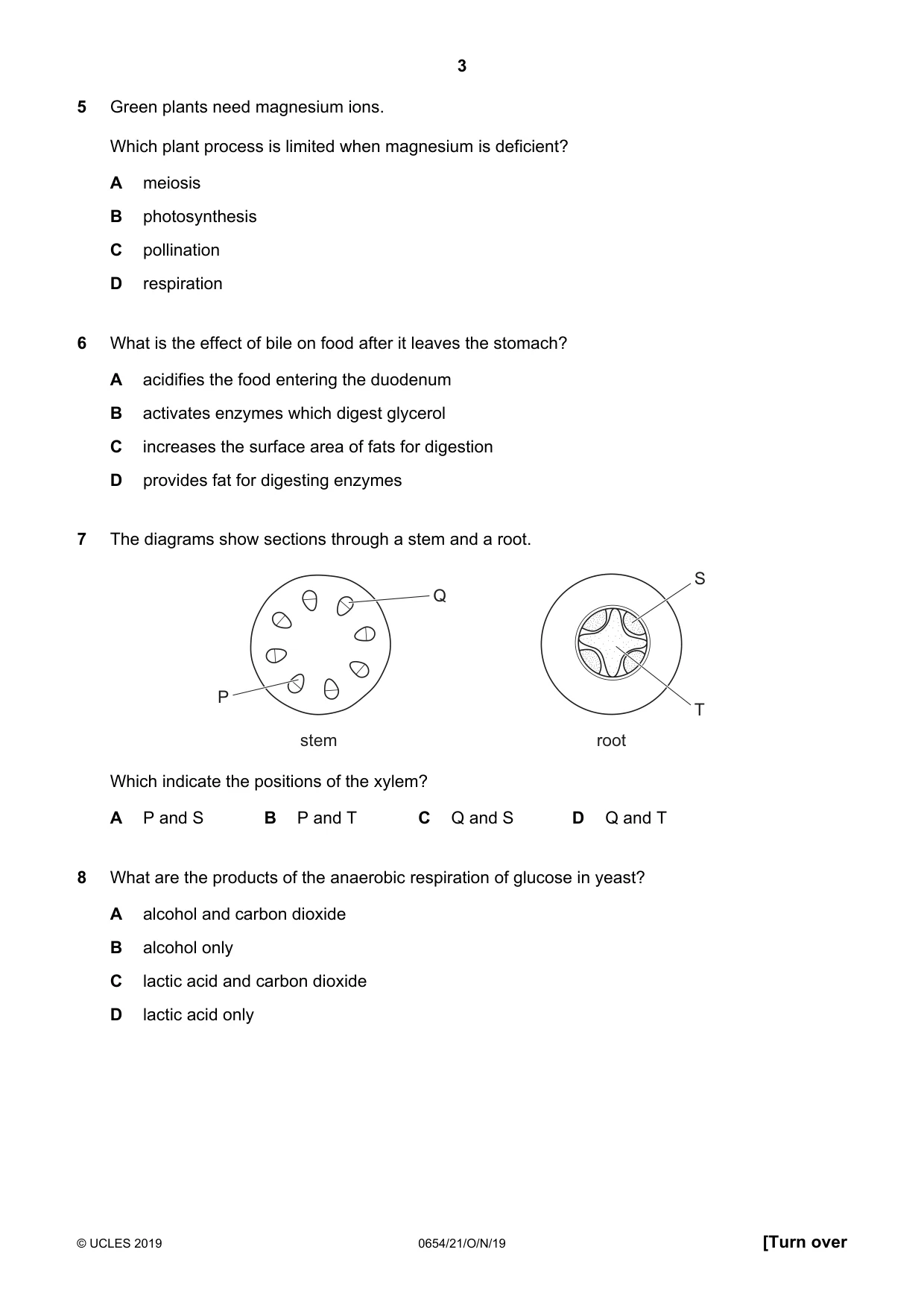
Q7 · The diagrams show sections through a stem and a root
7 The diagrams show sections through a stem and a root. S Q P T stem root Which indicate the positions of the xylem? A P and S B P and T C Q and S D Q and T
Mark scheme: B
Q8 · What are the products of the anaerobic respiration of glucose in yeast?
8 What are the products of the anaerobic respiration of glucose in yeast? A alcohol and carbon dioxide B alcohol only C lactic acid and carbon dioxide D lactic acid only
Mark scheme: A
Q9 · Which statement about the role of blood vessels in the skin is correct?
9 Which statement about the role of blood vessels in the skin is correct? A If the environment is too cold, vasoconstriction of capillaries occurs. B If the environment is too cold, vasodilation of arterioles occurs. C If the environment is too hot, vasoconstriction of capillaries occurs. D If the environment is too hot, vasodilation of arterioles occurs.
Mark scheme: D
Q10 · During pregnancy, the placenta is used to exchange substances between the mother and the…
10 During pregnancy, the placenta is used to exchange substances between the mother and the fetus. Which row is correct? substance exchanged direction A carbon dioxide mother to fetus B glucose mother to fetus C glucose fetus to mother D oxygen fetus to mother
Mark scheme: B
Q11 · A nucleus of a potato plant cell has 48 chromosomes
11 A nucleus of a potato plant cell has 48 chromosomes. How many chromosomes will there be in a potato pollen nucleus? A 12 B 24 C 48 D 96
Mark scheme: B
Q12 · In the food chain shown, 10% of the energy is transferred between each trophic level
12 In the food chain shown, 10% of the energy is transferred between each trophic level. grass → grasshopper → frog → snake → buzzard For every 100 kJ of energy in the herbivore, how much energy will be transferred to the tertiary consumer? A 0.1 kJ B 1 kJ C 10 kJ D 100 kJ
Mark scheme: B
Q13 · Some of the stages of eutrophication are listed
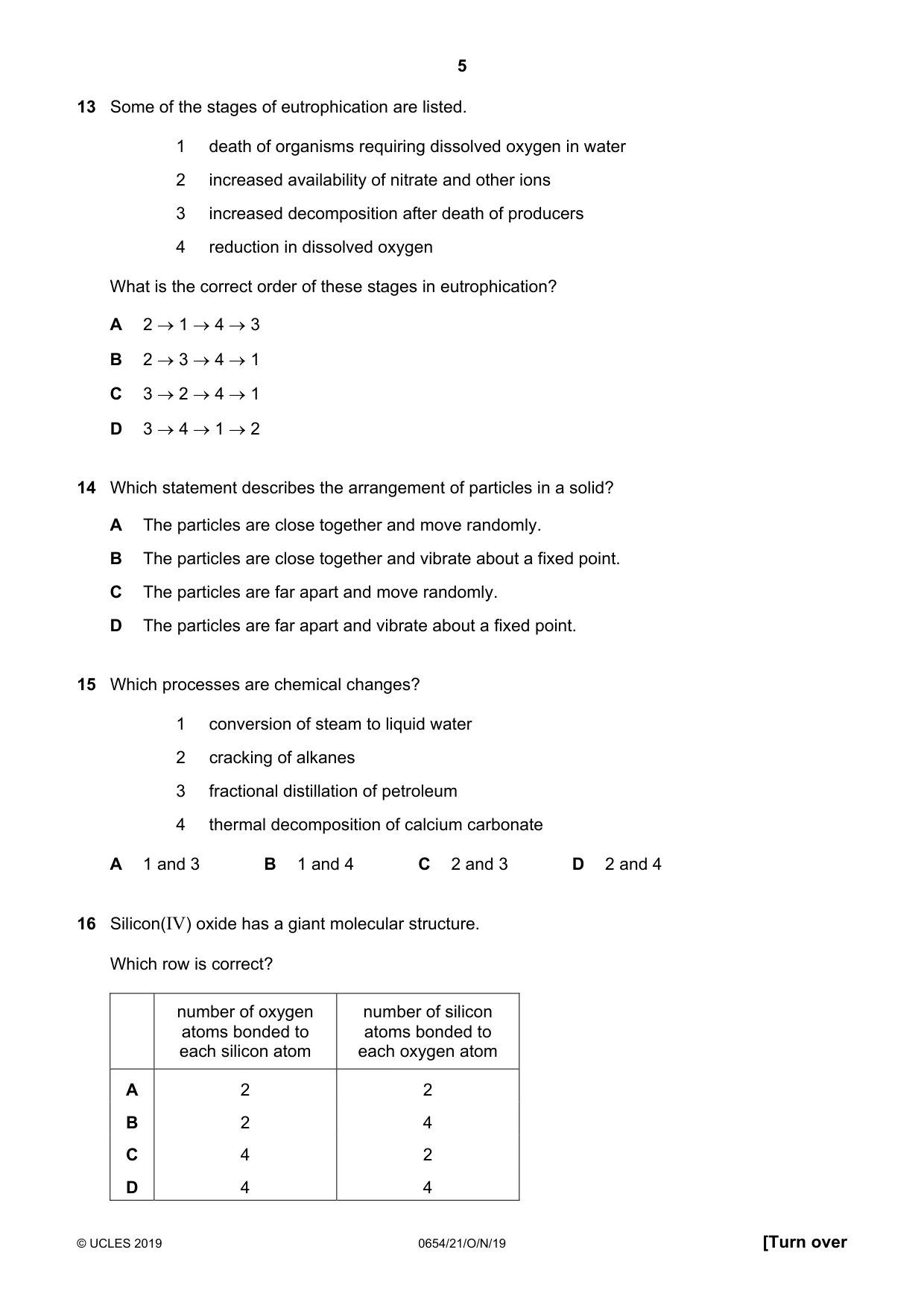
13 Some of the stages of eutrophication are listed. 1 death of organisms requiring dissolved oxygen in water 2 increased availability of nitrate and other ions 3 increased decomposition after death of producers 4 reduction in dissolved oxygen What is the correct order of these stages in eutrophication? A 2 → 1 → 4 → 3 B 2 → 3 → 4 → 1 C 3 → 2 → 4 → 1 D 3 → 4 → 1 → 2
Mark scheme: B
Q14 · Which statement describes the arrangement of particles in a solid?
14 Which statement describes the arrangement of particles in a solid? A The particles are close together and move randomly. B The particles are close together and vibrate about a fixed point. C The particles are far apart and move randomly. D The particles are far apart and vibrate about a fixed point.
Mark scheme: B
Q15 · Which processes are chemical changes?
15 Which processes are chemical changes? 1 conversion of steam to liquid water 2 cracking of alkanes 3 fractional distillation of petroleum 4 thermal decomposition of calcium carbonate A 1 and 3 B 1 and 4 C 2 and 3 D 2 and 4
Mark scheme: D
Q16 · Silicon(IV) oxide has a giant molecular structure
16 Silicon(IV) oxide has a giant molecular structure. Which row is correct? number of oxygen number of silicon atoms bonded to atoms bonded to each silicon atom each oxygen atom A 2 2 B 2 4 C 4 2 D 4 4
Mark scheme: C
Q17 · 1 g of hydrogen contains 6 × 10²³ atoms
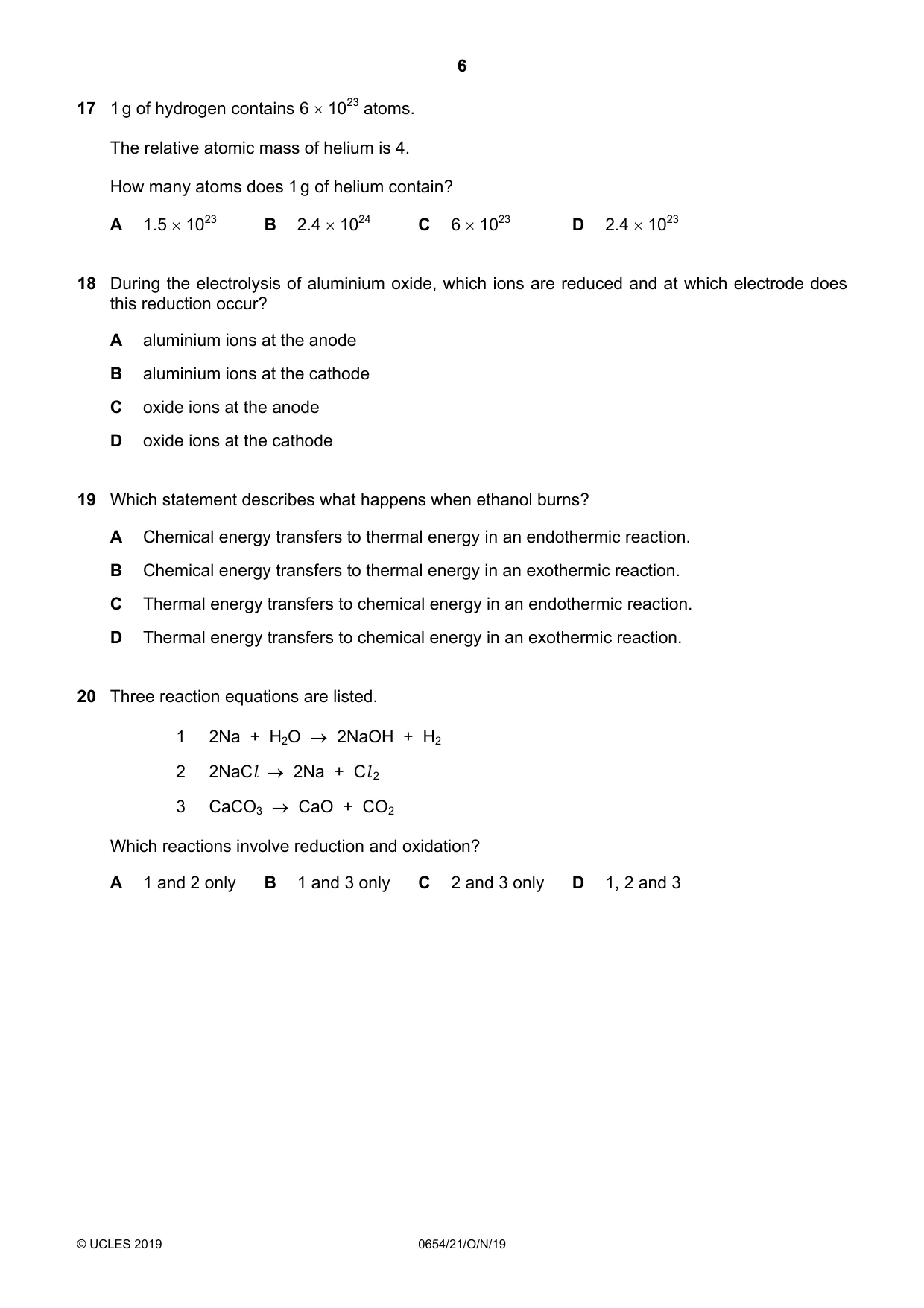
17 1 g of hydrogen contains 6 × 10²³ atoms. The relative atomic mass of helium is 4. How many atoms does 1 g of helium contain? A 1.5 × 10²³ B 2.4 × 1024 C 6 × 10²³ D 2.4 × 10²³
Mark scheme: A
Q18 · During the electrolysis of aluminium oxide, which ions are reduced and at which electrode…
18 During the electrolysis of aluminium oxide, which ions are reduced and at which electrode does this reduction occur? A aluminium ions at the anode B aluminium ions at the cathode C oxide ions at the anode D oxide ions at the cathode
Mark scheme: B
Q19 · Which statement describes what happens when ethanol burns?
19 Which statement describes what happens when ethanol burns? A Chemical energy transfers to thermal energy in an endothermic reaction. B Chemical energy transfers to thermal energy in an exothermic reaction. C Thermal energy transfers to chemical energy in an endothermic reaction. D Thermal energy transfers to chemical energy in an exothermic reaction.
Mark scheme: B
Q20 · Three reaction equations are listed
20 Three reaction equations are listed. 1 2Na + H2O → 2NaOH + H2 2 2NaCl → 2Na + Cl 2 3 CaCO3 → CaO + CO2 Which reactions involve reduction and oxidation? A 1 and 2 only B 1 and 3 only C 2 and 3 only D 1, 2 and 3
Mark scheme: A
Q21 · The pH values of four liquids are 1, 4, 7 and 13
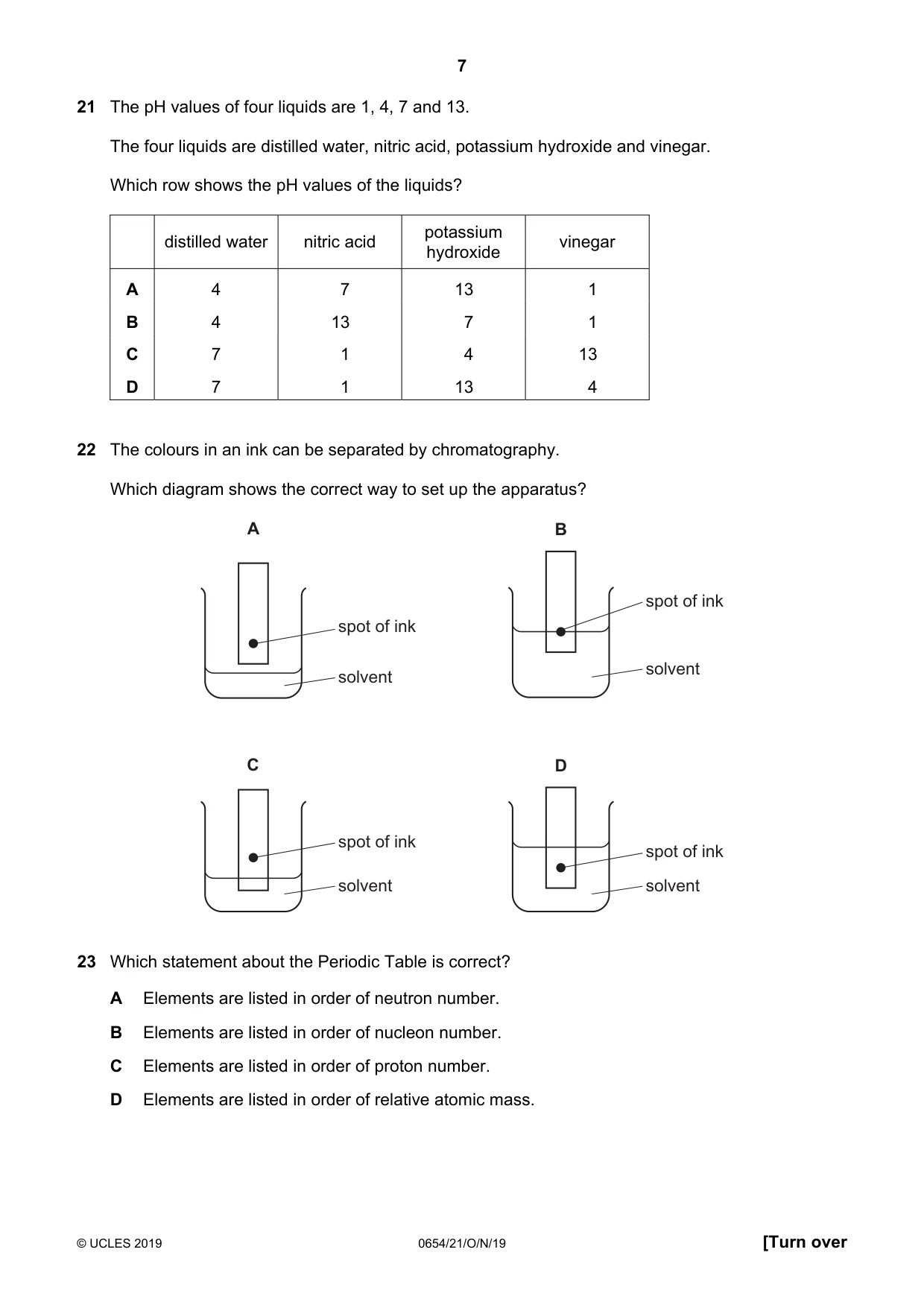
21 The pH values of four liquids are 1, 4, 7 and 13. The four liquids are distilled water, nitric acid, potassium hydroxide and vinegar. Which row shows the pH values of the liquids? potassium distilled water nitric acid vinegar hydroxide A 4 7 13 1 B 4 13 7 1 C 7 1 4 13 D 7 1 13 4
Mark scheme: D
More questions on The characteristic properties of acids and bases
Q22 · The colours in an ink can be separated by chromatography
22 The colours in an ink can be separated by chromatography. Which diagram shows the correct way to set up the apparatus? A B spot of ink spot of ink solvent solvent C D spot of ink spot of ink solvent solvent
Mark scheme: C
Q23 · Which statement about the Periodic Table is correct?
23 Which statement about the Periodic Table is correct? A Elements are listed in order of neutron number. B Elements are listed in order of nucleon number. C Elements are listed in order of proton number. D Elements are listed in order of relative atomic mass.
Mark scheme: C
Q24 · Information about three Group I elements is shown
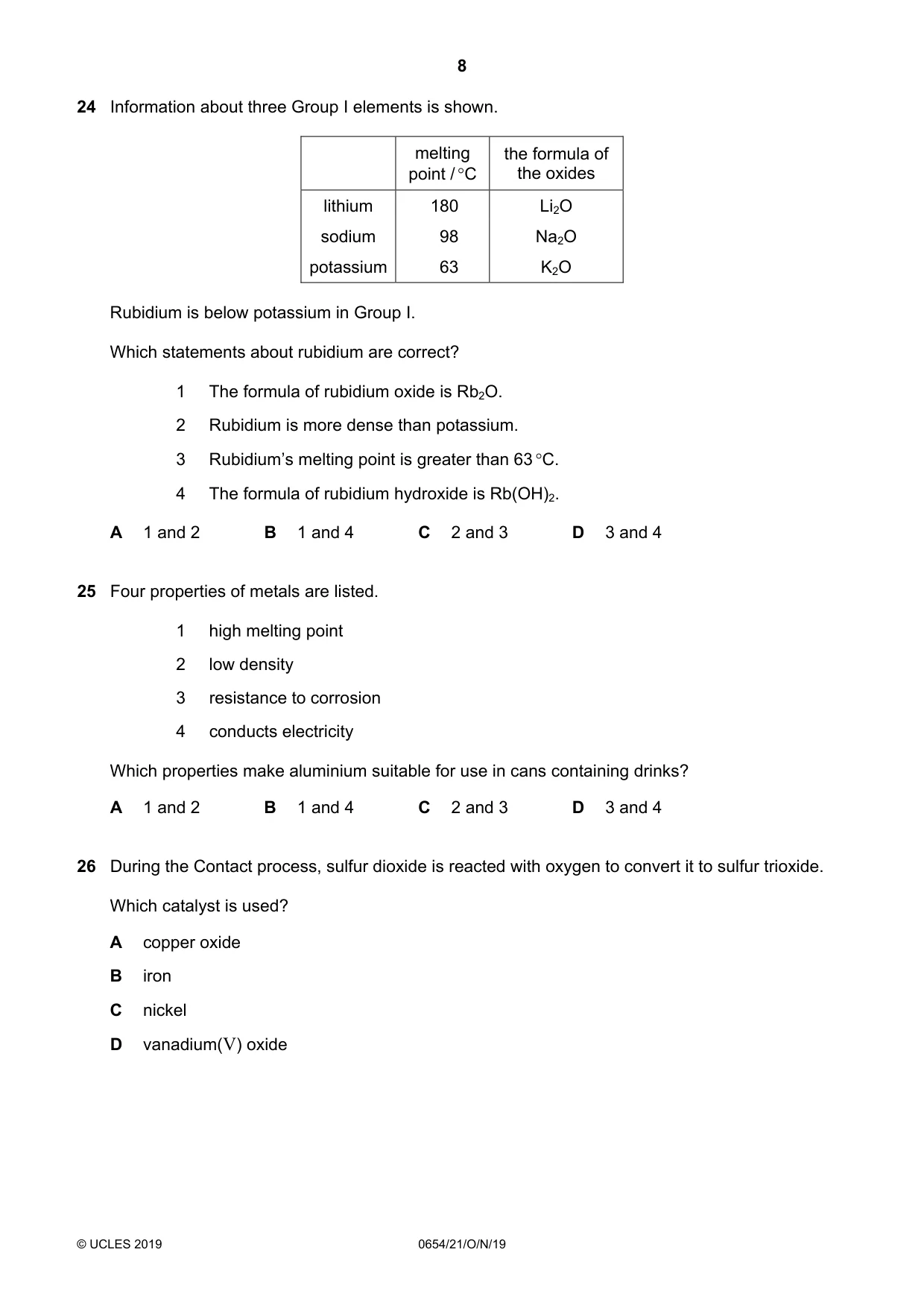
24 Information about three Group I elements is shown. melting the formula of point / °C the oxides lithium 180 Li2O sodium 98 Na2O potassium 63 K2O Rubidium is below potassium in Group I. Which statements about rubidium are correct? 1 The formula of rubidium oxide is Rb2O. 2 Rubidium is more dense than potassium. 3 Rubidium’s melting point is greater than 63 °C. 4 The formula of rubidium hydroxide is Rb(OH)2. A 1 and 2 B 1 and 4 C 2 and 3 D 3 and 4
Mark scheme: A
Q25 · Four properties of metals are listed
25 Four properties of metals are listed. 1 high melting point 2 low density 3 resistance to corrosion 4 conducts electricity Which properties make aluminium suitable for use in cans containing drinks? A 1 and 2 B 1 and 4 C 2 and 3 D 3 and 4
Mark scheme: C
Q26 · During the Contact process, sulfur dioxide is reacted with oxygen to convert it to sulfur…
26 During the Contact process, sulfur dioxide is reacted with oxygen to convert it to sulfur trioxide. Which catalyst is used? A copper oxide B iron C nickel D vanadium(V) oxide
Mark scheme: D
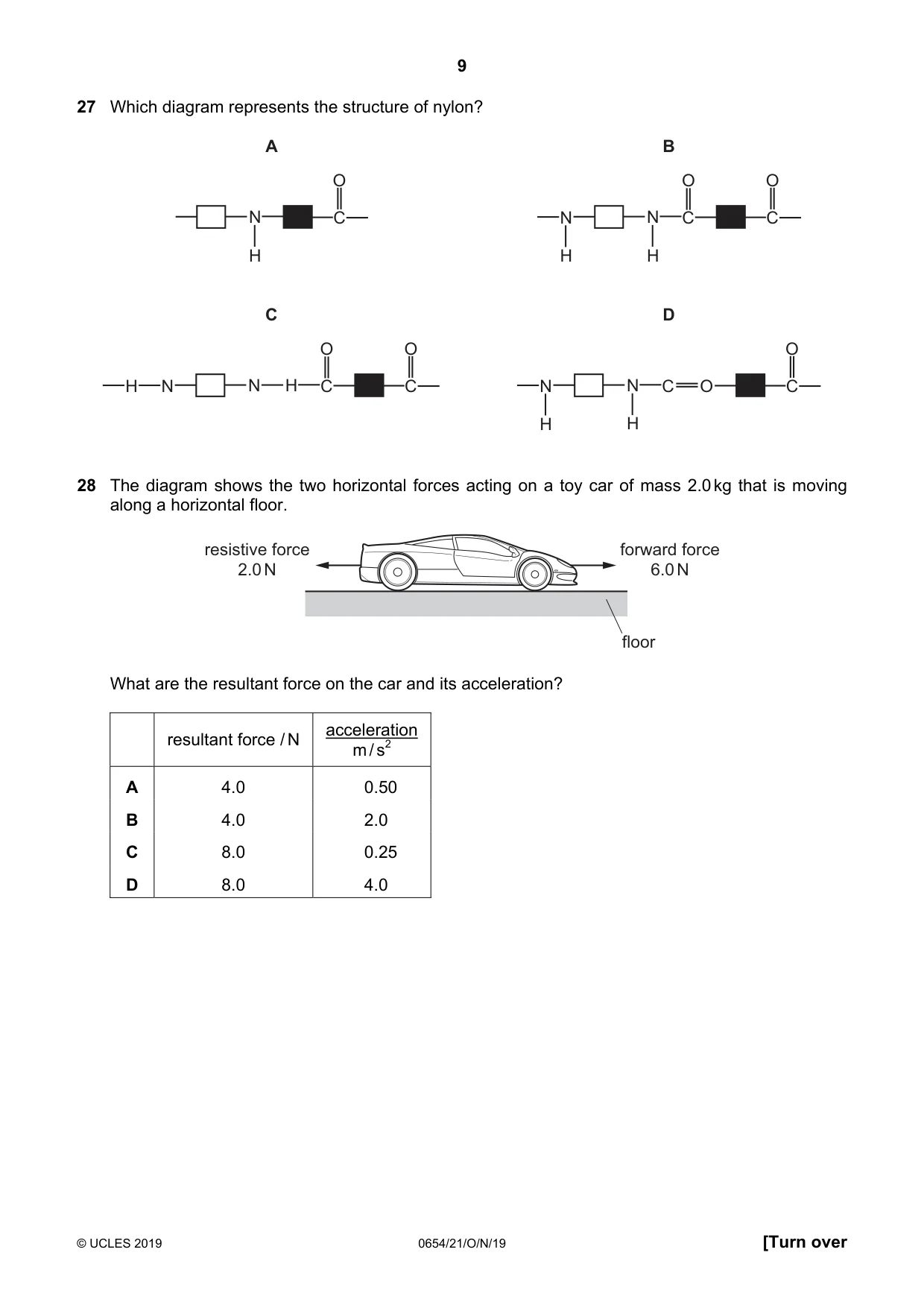
Q27 · Which diagram represents the structure of nylon?
27 Which diagram represents the structure of nylon? A B O O O N C N N C C H H H C D O O O H N N H C C N N C O C H H
Mark scheme: B
Q28 · The diagram shows the two horizontal forces acting on a toy car of mass 2.0 kg that is…
28 The diagram shows the two horizontal forces acting on a toy car of mass 2.0 kg that is moving along a horizontal floor. resistive force forward force 2.0 N 6.0 N floor What are the resultant force on the car and its acceleration? acceleration resultant force / N m / s2 A 4.0 0.50 B 4.0 2.0 C 8.0 0.25 D 8.0 4.0
Mark scheme: B
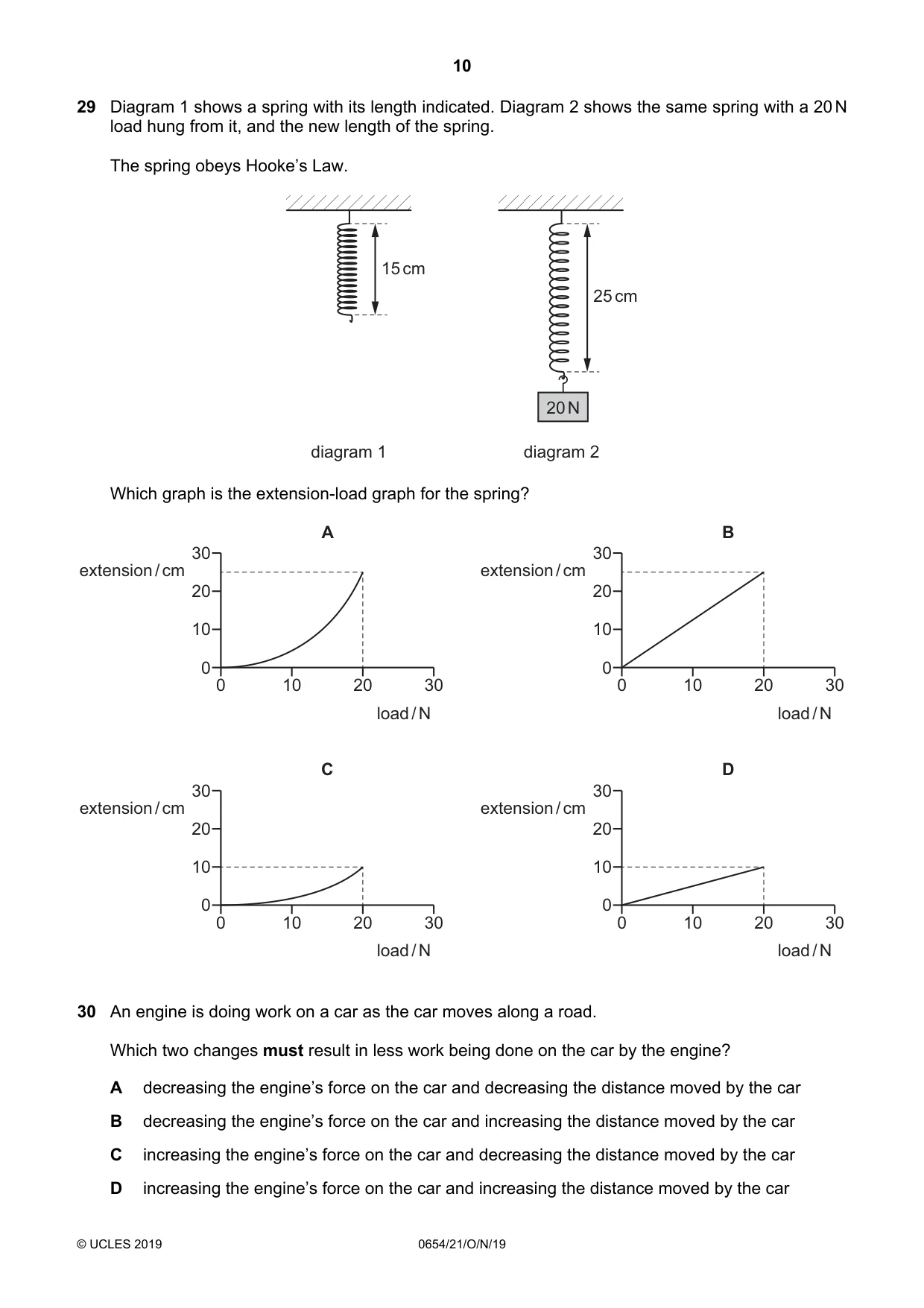
Q29 · A spring with its length indicated
29 Diagram 1 shows a spring with its length indicated. Diagram 2 shows the same spring with a 20 N load hung from it, and the new length of the spring. The spring obeys Hooke’s Law. 15 cm 25 cm 20 N diagram 1 diagram 2 Which graph is the extension-load graph for the spring? A B 30 30 extension / cm extension / cm 20 20 10 10 0 0 0 10 20 30 0 10 20 30 load / N load / N C D 30 30 extension / cm extension / cm 20 20 10 10 0 0 0 10 20 30 0 10 20 30 load / N load / N
Mark scheme: D
Q30 · An engine is doing work on a car as the car moves along a road
30 An engine is doing work on a car as the car moves along a road. Which two changes must result in less work being done on the car by the engine? A decreasing the engine’s force on the car and decreasing the distance moved by the car B decreasing the engine’s force on the car and increasing the distance moved by the car C increasing the engine’s force on the car and decreasing the distance moved by the car D increasing the engine’s force on the car and increasing the distance moved by the car
Mark scheme: A
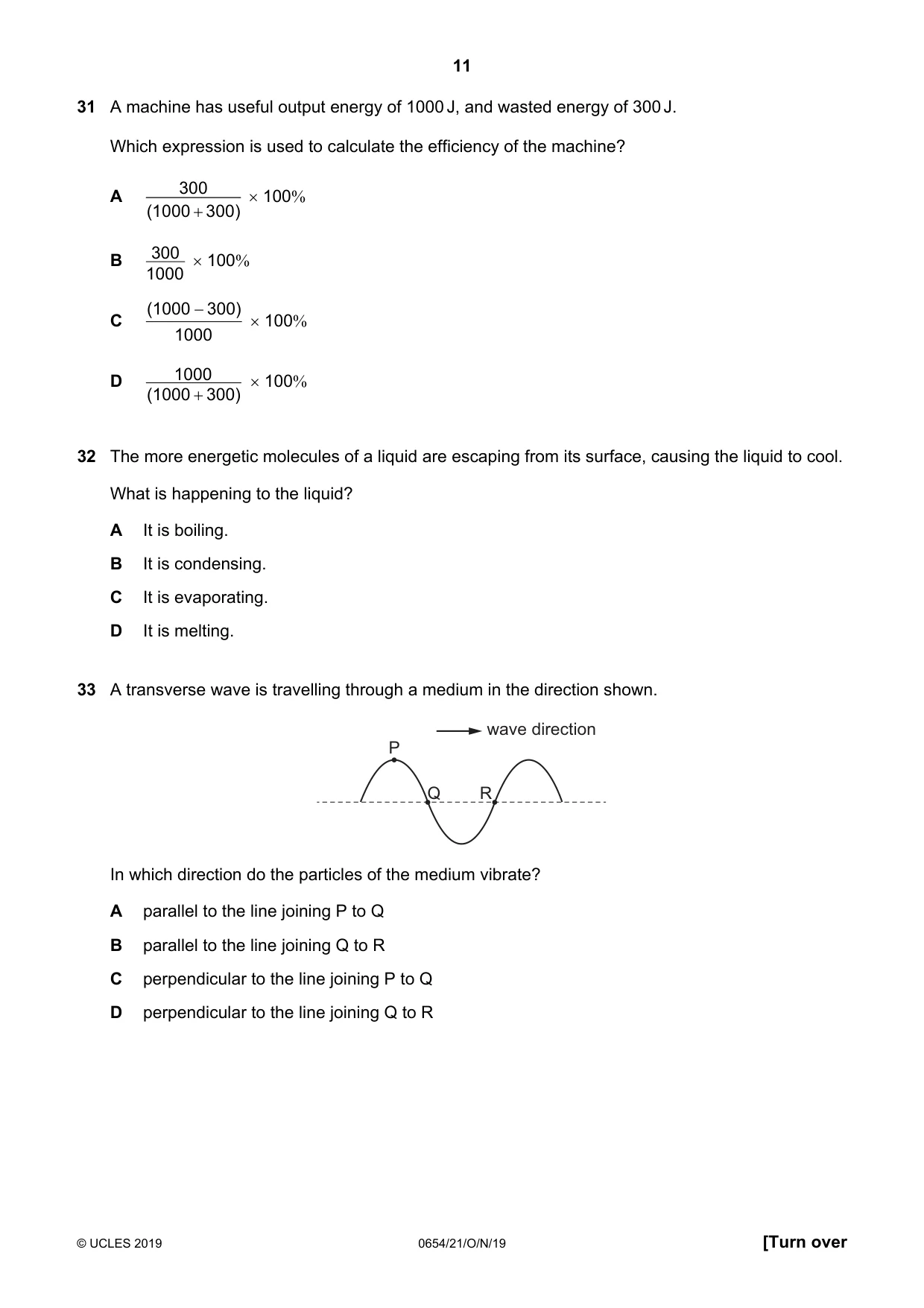
Q31 · A machine has useful output energy of 1000 J, and wasted energy of 300 J
31 A machine has useful output energy of 1000 J, and wasted energy of 300 J. Which expression is used to calculate the efficiency of the machine? 300 × 100% A (1000 + 300) B 300 × 100% 1000 (1000 − 300) C × 100% 1000 D 1000 × 100% (1000 + 300)
Mark scheme: D
Q32 · The more energetic molecules of a liquid are escaping from its surface, causing the…
32 The more energetic molecules of a liquid are escaping from its surface, causing the liquid to cool. What is happening to the liquid? A It is boiling. B It is condensing. C It is evaporating. D It is melting.
Mark scheme: C
Q33 · A transverse wave is travelling through a medium in the direction shown
33 A transverse wave is travelling through a medium in the direction shown. wave direction P Q R In which direction do the particles of the medium vibrate? A parallel to the line joining P to Q B parallel to the line joining Q to R C perpendicular to the line joining P to Q D perpendicular to the line joining Q to R
Mark scheme: D
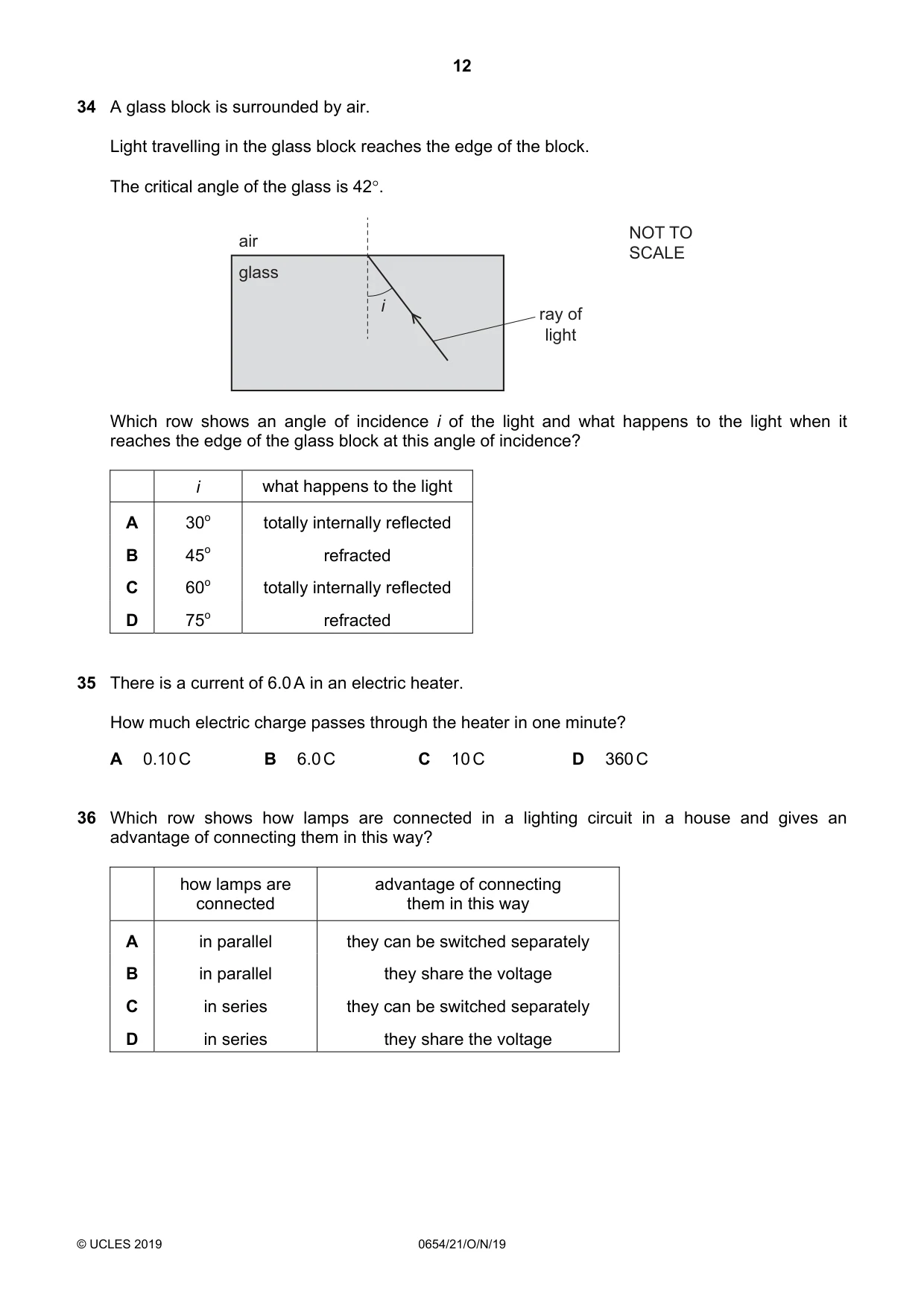
Q34 · A glass block is surrounded by air
34 A glass block is surrounded by air. Light travelling in the glass block reaches the edge of the block. The critical angle of the glass is 42°. NOT TO air SCALE glass i ray of light Which row shows an angle of incidence i of the light and what happens to the light when it reaches the edge of the glass block at this angle of incidence? i what happens to the light A 30o totally internally reflected B 45o refracted C 60o totally internally reflected D 75o refracted
Mark scheme: C
Q35 · There is a current of 6.0 A in an electric heater
35 There is a current of 6.0 A in an electric heater. How much electric charge passes through the heater in one minute? A 0.10 C B 6.0 C C 10 C D 360 C
Mark scheme: D
Q36 · Which row shows how lamps are connected in a lighting circuit in a house and gives an…
36 Which row shows how lamps are connected in a lighting circuit in a house and gives an advantage of connecting them in this way? how lamps are advantage of connecting connected them in this way A in parallel they can be switched separately B in parallel they share the voltage C in series they can be switched separately D in series they share the voltage
Mark scheme: A
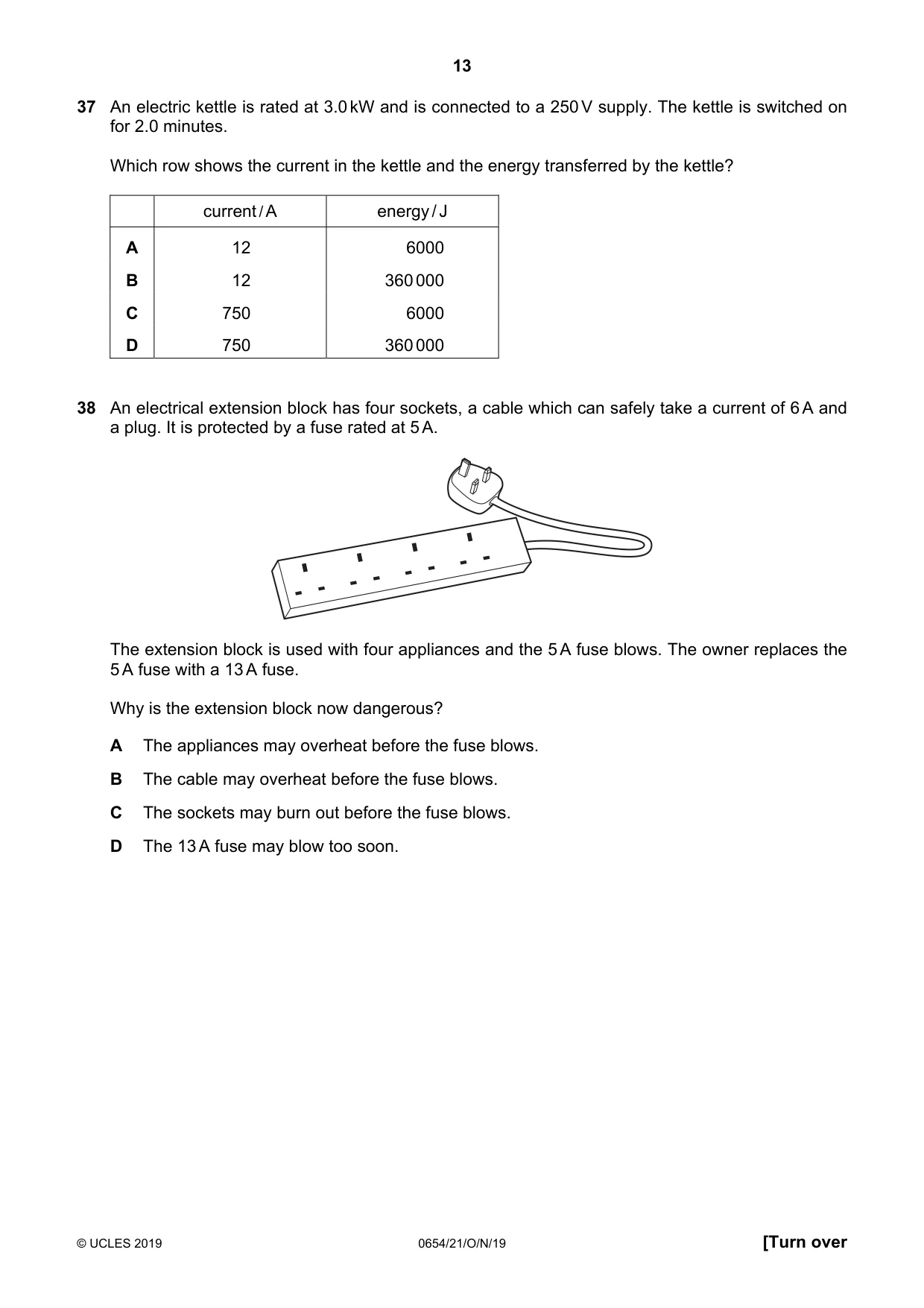
Q37 · An electric kettle is rated at 3.0 kW and is connected to a 250 V supply
37 An electric kettle is rated at 3.0 kW and is connected to a 250 V supply. The kettle is switched on for 2.0 minutes. Which row shows the current in the kettle and the energy transferred by the kettle? current / A energy / J A 12 6000 B 12 360 000 C 750 6000 D 750 360 000
Mark scheme: B
Q38 · An electrical extension block has four sockets, a cable which can safely take a current…
38 An electrical extension block has four sockets, a cable which can safely take a current of 6 A and a plug. It is protected by a fuse rated at 5 A. The extension block is used with four appliances and the 5 A fuse blows. The owner replaces the 5 A fuse with a 13 A fuse. Why is the extension block now dangerous? A The appliances may overheat before the fuse blows. B The cable may overheat before the fuse blows. C The sockets may burn out before the fuse blows. D The 13 A fuse may blow too soon.
Mark scheme: B
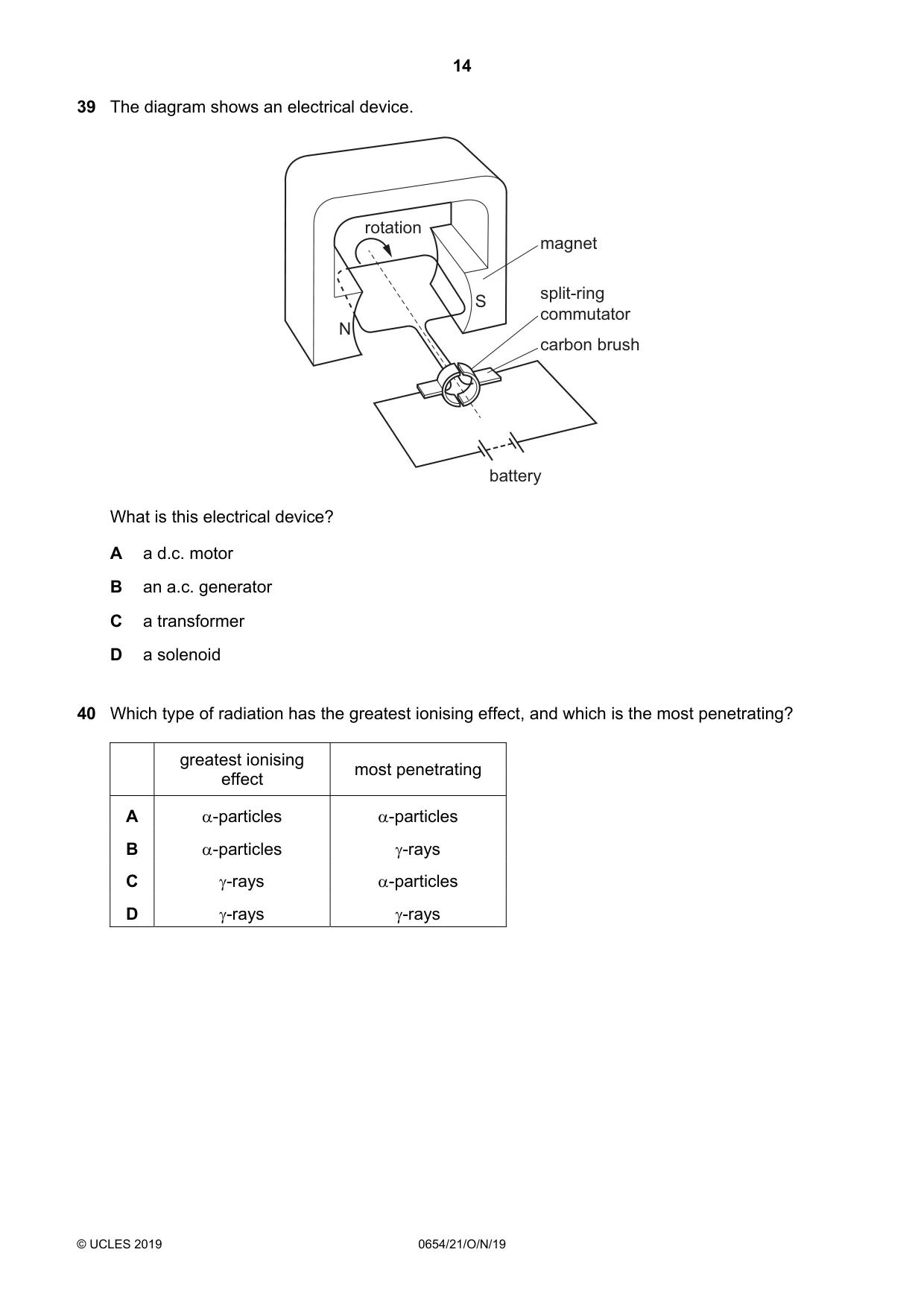
Q39 · The diagram shows an electrical device
39 The diagram shows an electrical device. rotation magnet S split-ring commutator N carbon brush battery What is this electrical device? A a d.c. motor B an a.c. generator C a transformer D a solenoid
Mark scheme: A
Q40 · Which type of radiation has the greatest ionising effect, and which is the most…
40 Which type of radiation has the greatest ionising effect, and which is the most penetrating? greatest ionising most penetrating effect A α-particles α-particles B α-particles γ-rays C γ-rays α-particles D γ-rays γ-rays
Mark scheme: B
What was in this paper
The subtopics covered by these 40 questions, and how many questions each got. Open one in a new tab to see every Cambridge question on it.
2Energy, work and power2Forces2Arrangement of elements1Biological molecules1Cell division1Cell structure1Characteristics of living organisms1Chromatography1Digestion1Electrical circuits1Electrical safety1Electrolysis1Electromagnetic effects1Enzymes1Exothermic and endothermic reactions1Food chains and food webs1General properties of waves1Giant covalent structures1Group I properties1Habitat destruction1Homeostasis1Kinetic particle model of matter1Light1Photosynthesis1Physical and chemical changes1Polymers1Radioactivity1Redox1Respiration1Sexual reproduction in humans1Solids, liquids and gases1The characteristic properties of acids and bases1The mole and the Avogadro constant1Transition elements1Uses of metals1Xylem and phloem1What you needed in this session
Cambridge’s own grade thresholds for 2019 Oct/Nov, Paper 2 · Variant 1. A higher threshold means an easier paper — the bar moves with how the cohort did.