Cambridge IGCSE Sciences - Co-ordinated (Double) 0654 — 2025 May/June Paper 2 · Variant 3
0654/23/M/J/25 · 40 questions · 40 marks · 45 min
The question paper and its mark scheme, free to read here and free to download. This is Cambridge’s own paper, exactly as it was sat.
Question paper16 pages


Mark scheme3 pages
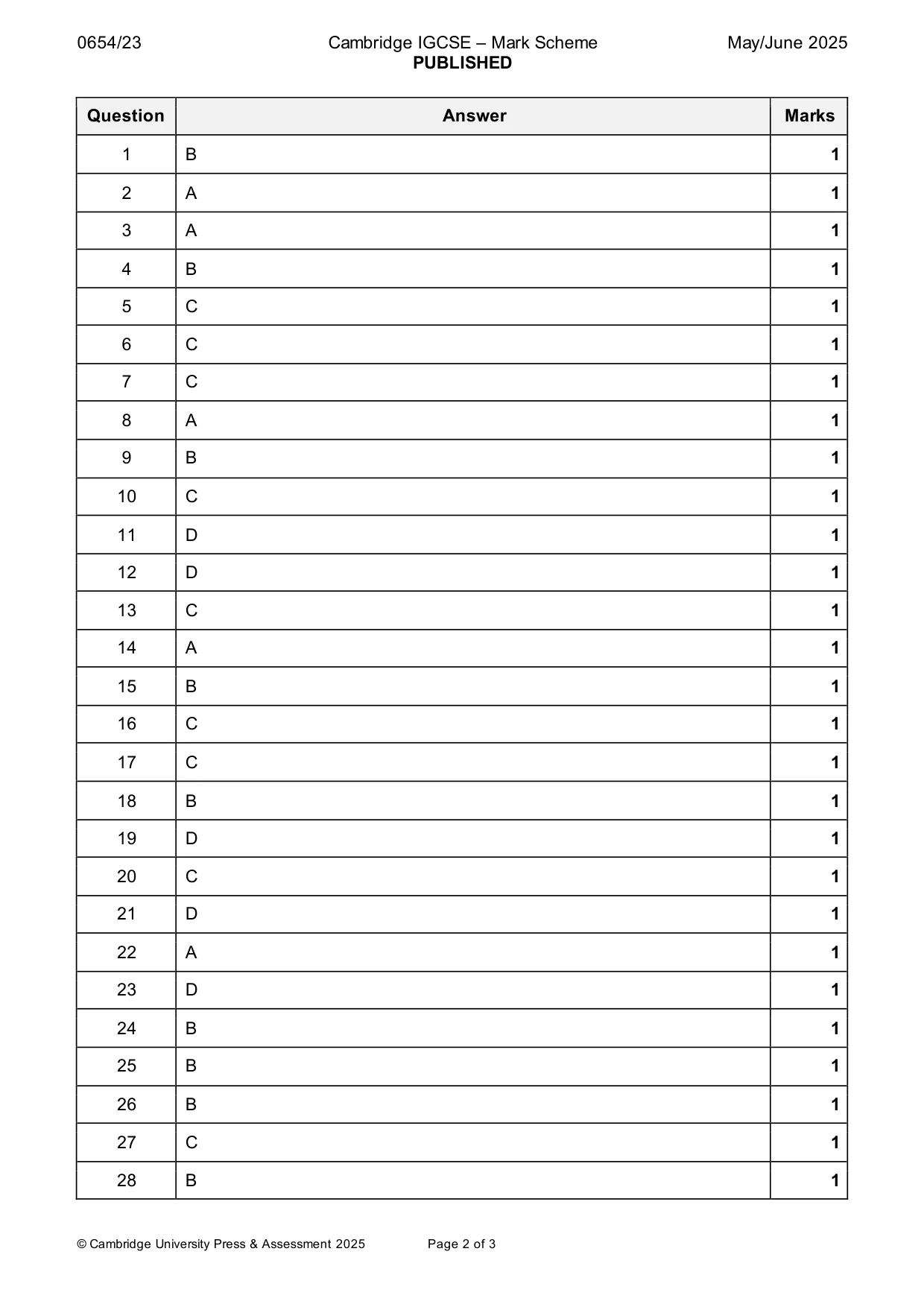
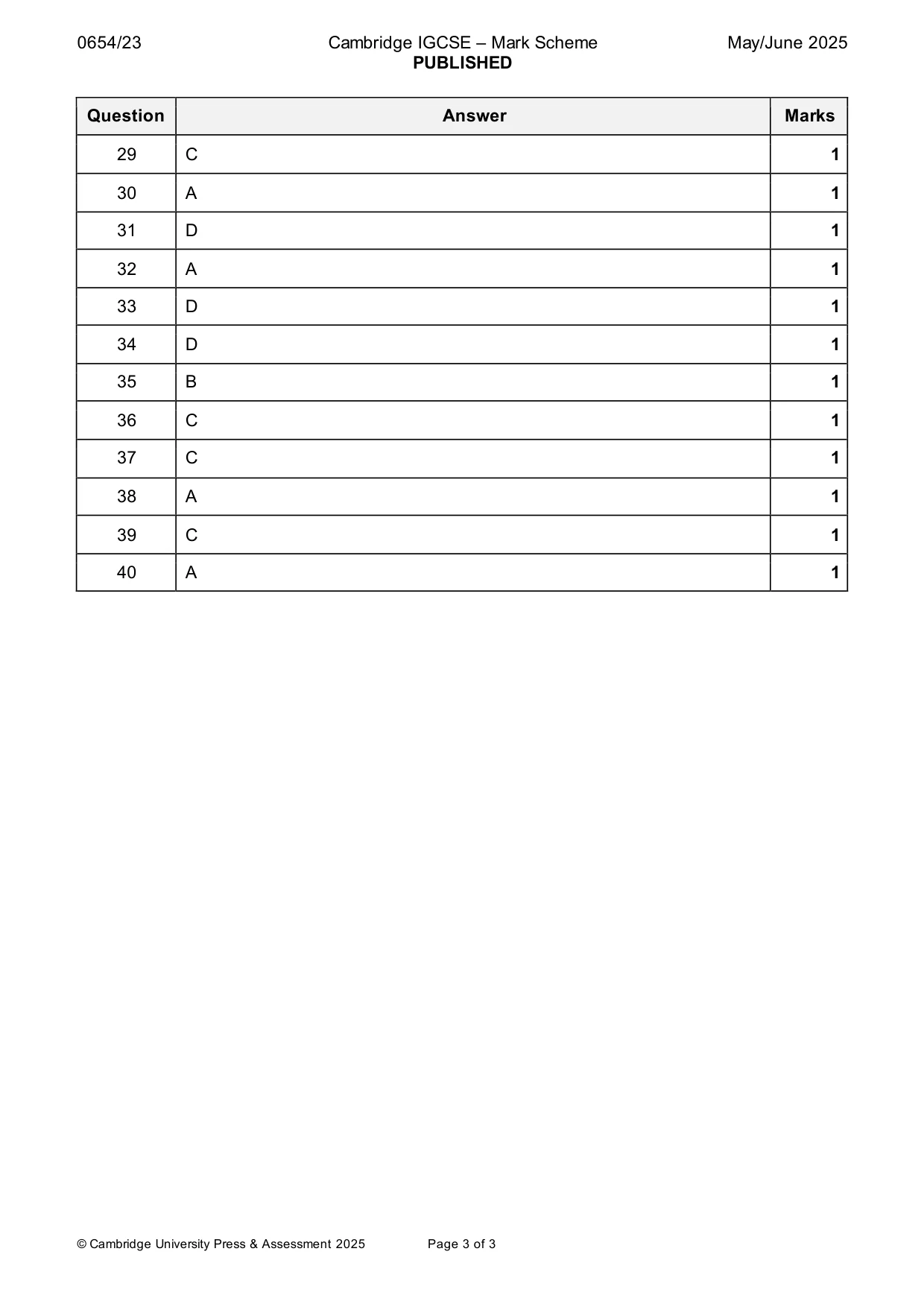
Answers below. Sit the paper first if you are practising.
Questions as text
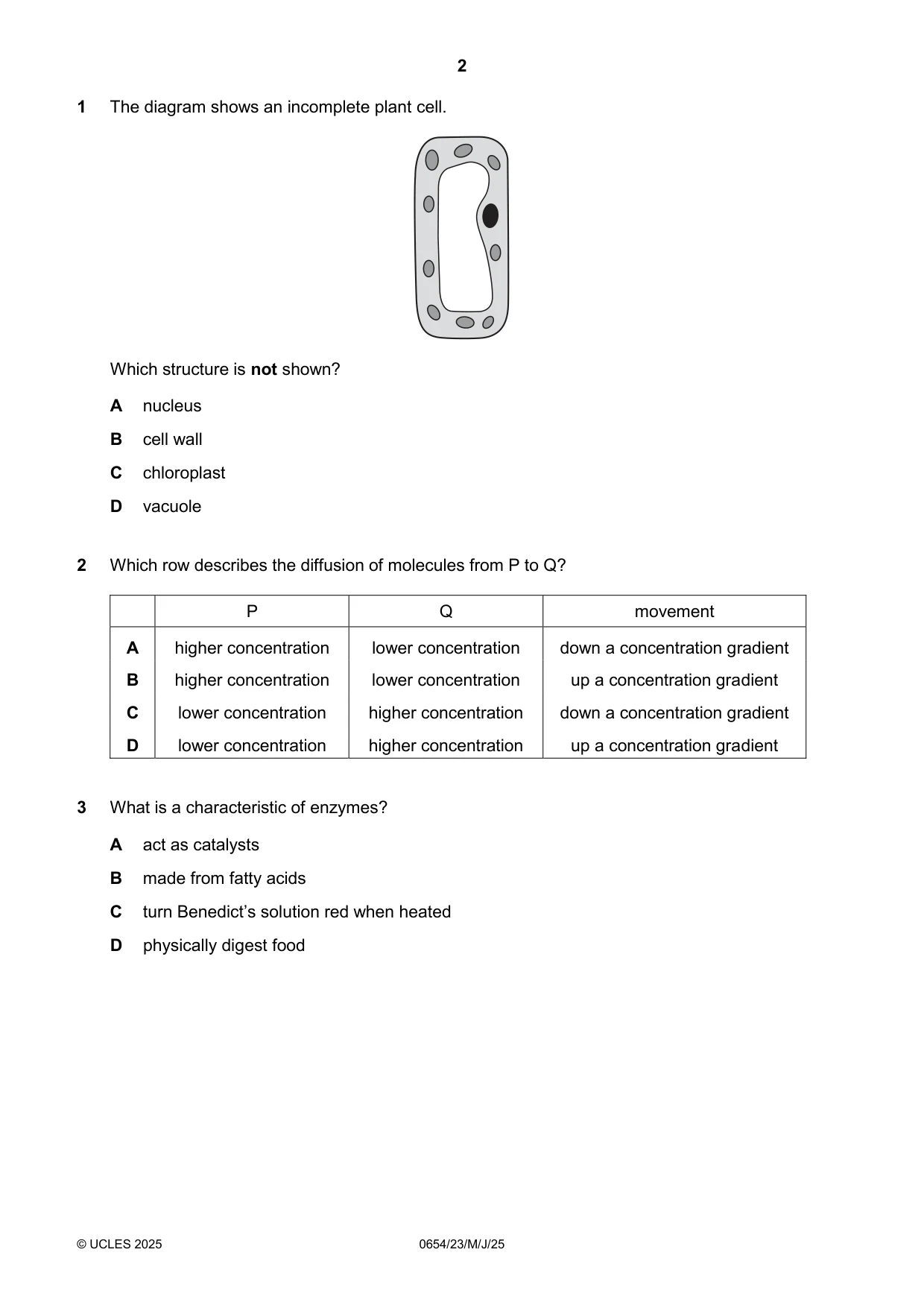
Q1 · The diagram shows an incomplete plant cell
1 The diagram shows an incomplete plant cell. Which structure is not shown? A nucleus B cell wall C chloroplast D vacuole
Mark scheme: B
Q2 · Which row describes the diffusion of molecules from P to Q?
2 Which row describes the diffusion of molecules from P to Q? P Q movement A higher concentration lower concentration down a concentration gradient B higher concentration lower concentration up a concentration gradient C lower concentration higher concentration down a concentration gradient D lower concentration higher concentration up a concentration gradient
Mark scheme: A
Q3 · What is a characteristic of enzymes?
3 What is a characteristic of enzymes? A act as catalysts B made from fatty acids C turn Benedict’s solution red when heated D physically digest food
Mark scheme: A
Q4 · Which row shows the parts of the alimentary canal where the enzymes amylase, lipase and…
4 Which row shows the parts of the alimentary canal where the enzymes amylase, lipase and protease are secreted? mouth small intestine stomach A amylase protease amylase B amylase lipase protease C protease protease lipase D protease lipase lipase
Mark scheme: B
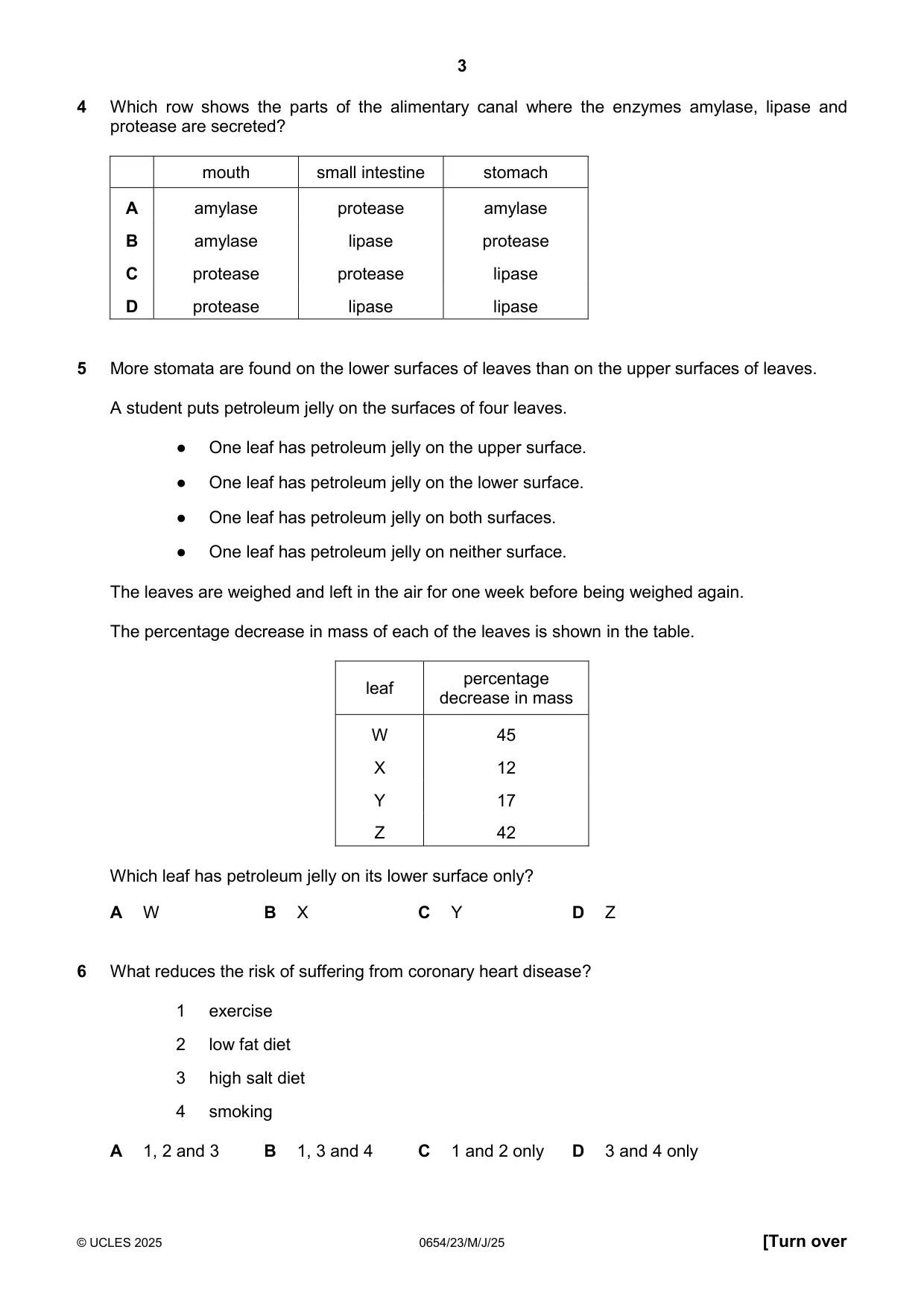
Q5 · More stomata are found on the lower surfaces of leaves than on the upper surfaces of…
5 More stomata are found on the lower surfaces of leaves than on the upper surfaces of leaves. A student puts petroleum jelly on the surfaces of four leaves. ● One leaf has petroleum jelly on the upper surface. ● One leaf has petroleum jelly on the lower surface. ● One leaf has petroleum jelly on both surfaces. ● One leaf has petroleum jelly on neither surface. The leaves are weighed and left in the air for one week before being weighed again. The percentage decrease in mass of each of the leaves is shown in the table. percentage leaf decrease in mass W 45 X 12 Y 17 Z 42 Which leaf has petroleum jelly on its lower surface only? A W B X C Y D Z
Mark scheme: C
Q6 · What reduces the risk of suffering from coronary heart disease?
6 What reduces the risk of suffering from coronary heart disease? 1 exercise 2 low fat diet 3 high salt diet 4 smoking A 1, 2 and 3 B 1, 3 and 4 C 1 and 2 only D 3 and 4 only
Mark scheme: C
Q7 · What is the role of glucagon?
7 What is the role of glucagon? A decrease blood glucose B decrease blood insulin C increase blood glucose D increase blood insulin
Mark scheme: C
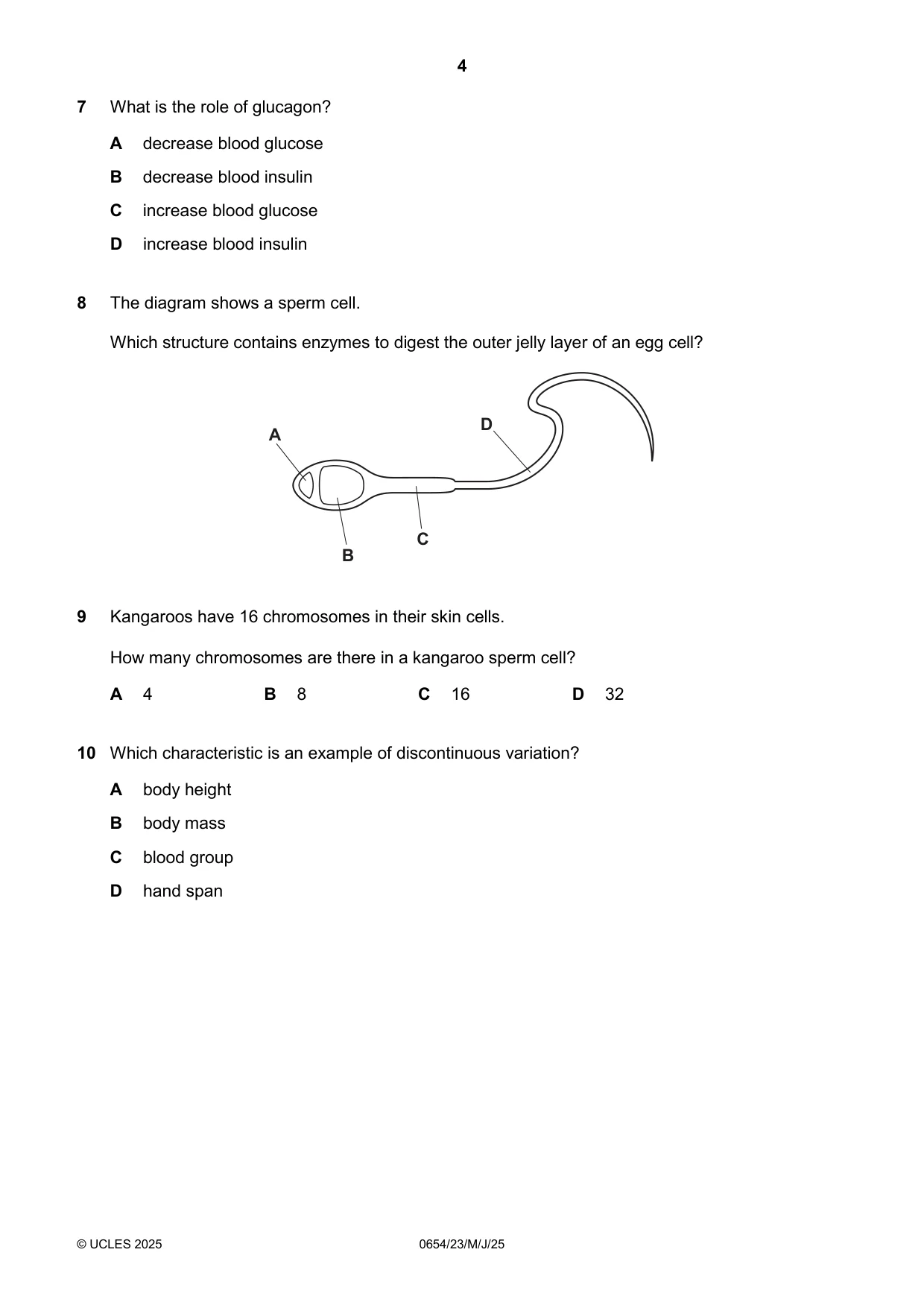
Q8 · The diagram shows a sperm cell
8 The diagram shows a sperm cell. Which structure contains enzymes to digest the outer jelly layer of an egg cell? D A C B
Mark scheme: A
Q9 · Kangaroos have 16 chromosomes in their skin cells
9 Kangaroos have 16 chromosomes in their skin cells. How many chromosomes are there in a kangaroo sperm cell? A 4 B 8 C 16 D 32
Mark scheme: B
Q10 · Which characteristic is an example of discontinuous variation?
10 Which characteristic is an example of discontinuous variation? A body height B body mass C blood group D hand span
Mark scheme: C
Q11 · A food chain is shown
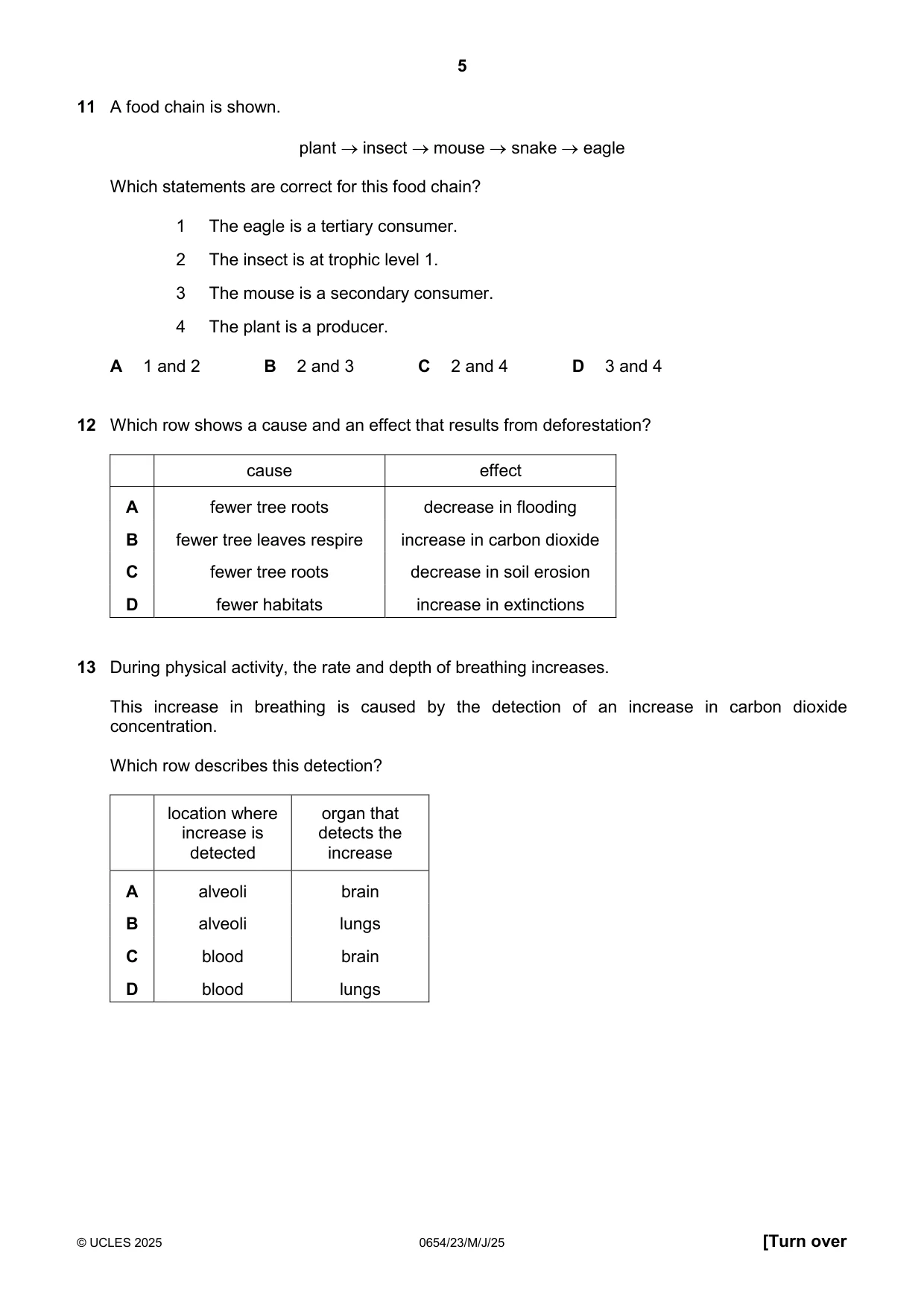
11 A food chain is shown. plant insect mouse snake eagle Which statements are correct for this food chain? 1 The eagle is a tertiary consumer. 2 The insect is at trophic level 1. 3 The mouse is a secondary consumer. 4 The plant is a producer. A 1 and 2 B 2 and 3 C 2 and 4 D 3 and 4
Mark scheme: D
Q12 · Which row shows a cause and an effect that results from deforestation?
12 Which row shows a cause and an effect that results from deforestation? cause effect A fewer tree roots decrease in flooding B fewer tree leaves respire increase in carbon dioxide C fewer tree roots decrease in soil erosion D fewer habitats increase in extinctions
Mark scheme: D
Q13 · During physical activity, the rate and depth of breathing increases
13 During physical activity, the rate and depth of breathing increases. This increase in breathing is caused by the detection of an increase in carbon dioxide concentration. Which row describes this detection? location where organ that increase is detects the detected increase A alveoli brain B alveoli lungs C blood brain D blood lungs
Mark scheme: C
Q14 · Atoms of element X have 11 nucleons and 6 neutrons
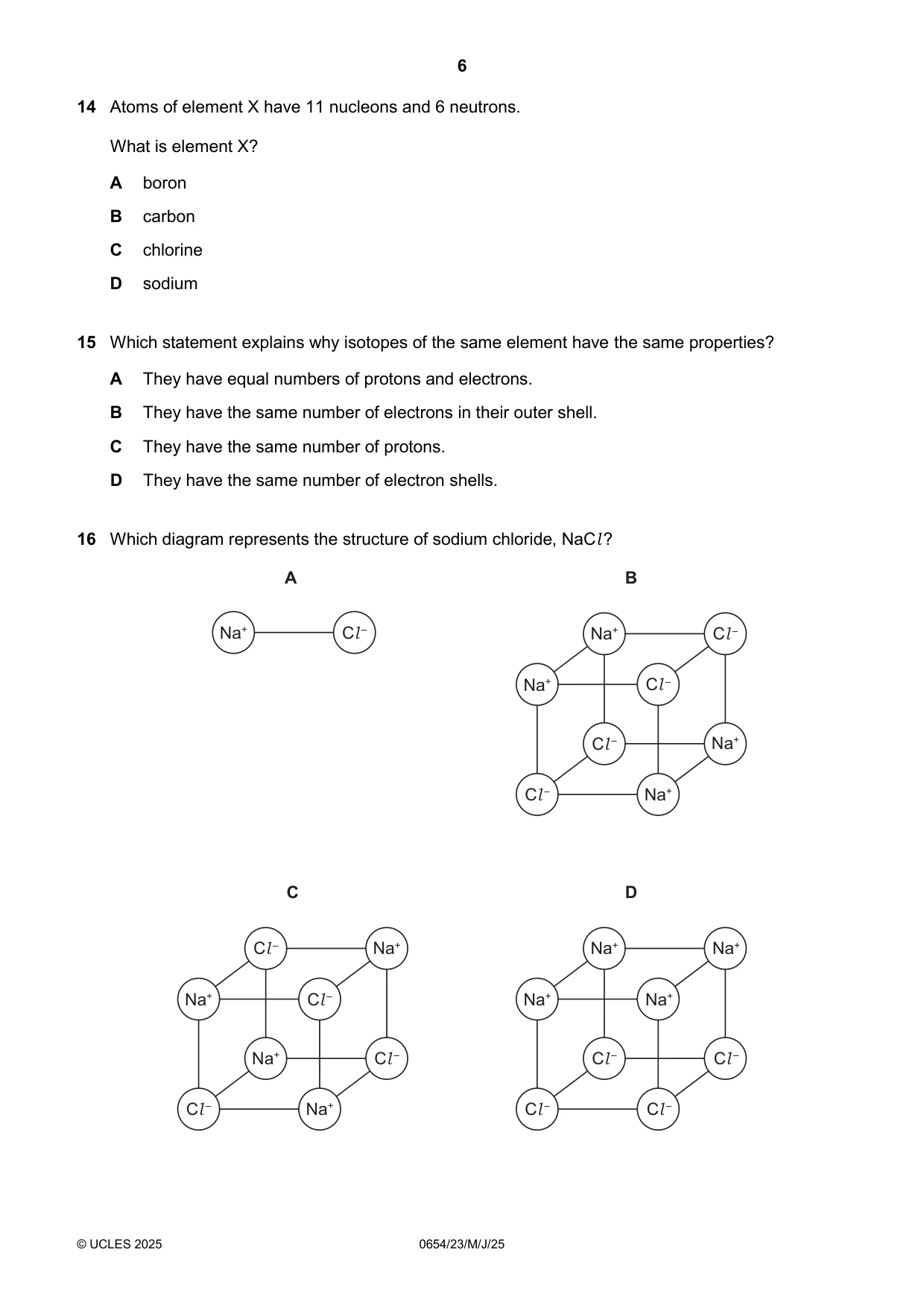
14 Atoms of element X have 11 nucleons and 6 neutrons. What is element X? A boron B carbon C chlorine D sodium
Mark scheme: A
Q15 · Which statement explains why isotopes of the same element have the same properties?
15 Which statement explains why isotopes of the same element have the same properties? A They have equal numbers of protons and electrons. B They have the same number of electrons in their outer shell. C They have the same number of protons. D They have the same number of electron shells.
Mark scheme: B
Q16 · Which diagram represents the structure of sodium chloride, NaCl ?
16 Which diagram represents the structure of sodium chloride, NaCl ? A B Na+ Cl – Na+ Cl – Na+ Cl – Cl – Na+ Cl – Na+ C D Cl – Na+ Na+ Na+ Na+ Cl – Na+ Na+ Na+ Cl – Cl – Cl – Cl – Na+ Cl – Cl –
Mark scheme: C
Q17 · Limestone contains calcium carbonate, CaCO3
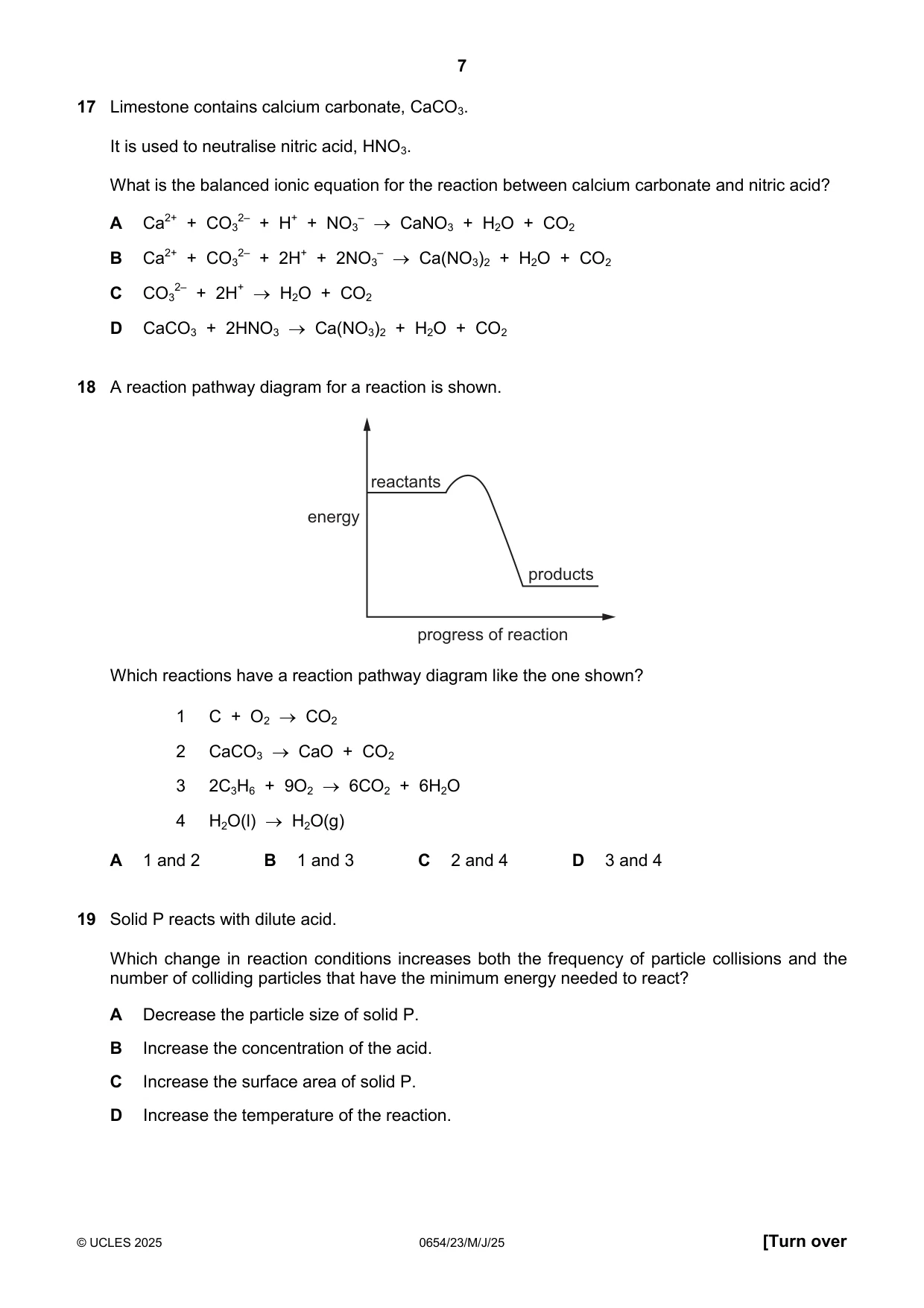
17 Limestone contains calcium carbonate, CaCO3. It is used to neutralise nitric acid, HNO3. What is the balanced ionic equation for the reaction between calcium carbonate and nitric acid? A Ca2+ + CO3 2– + H+ + NO3 – CaNO3 + H2O + CO2 B Ca2+ + CO3 2– + 2H+ + 2NO3 – Ca(NO3)2 + H2O + CO2 C CO3 2– + 2H+ H2O + CO2 D CaCO3 + 2HNO3 Ca(NO3)2 + H2O + CO2
Mark scheme: C
Q18 · A reaction pathway diagram for a reaction is shown
18 A reaction pathway diagram for a reaction is shown. reactants energy products progress of reaction Which reactions have a reaction pathway diagram like the one shown? 1 C + O2 CO2 2 CaCO3 CaO + CO2 3 2C3H6 + 9O2 6CO2 + 6H2O 4 H2O(l) H2O(g) A 1 and 2 B 1 and 3 C 2 and 4 D 3 and 4
Mark scheme: B
Q19 · Solid P reacts with dilute acid
19 Solid P reacts with dilute acid. Which change in reaction conditions increases both the frequency of particle collisions and the number of colliding particles that have the minimum energy needed to react? A Decrease the particle size of solid P. B Increase the concentration of the acid. C Increase the surface area of solid P. D Increase the temperature of the reaction.
Mark scheme: D
Q20 · Zinc sulfate is made by adding zinc oxide to dilute sulfuric acid
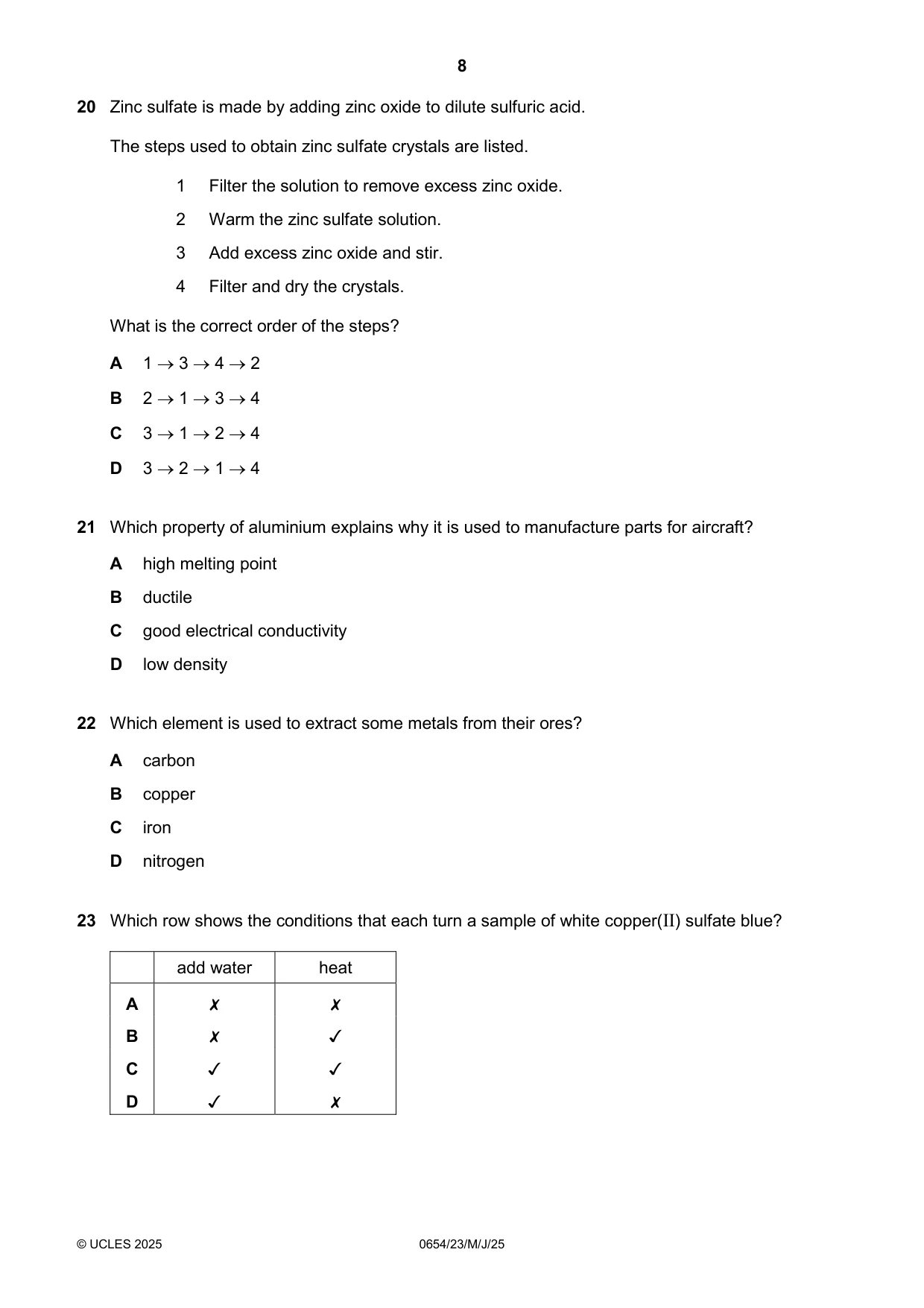
20 Zinc sulfate is made by adding zinc oxide to dilute sulfuric acid. The steps used to obtain zinc sulfate crystals are listed. 1 Filter the solution to remove excess zinc oxide. 2 Warm the zinc sulfate solution. 3 Add excess zinc oxide and stir. 4 Filter and dry the crystals. What is the correct order of the steps? A 1 3 4 2 B 2 1 3 4 C 3 1 2 4 D 3 2 1 4
Mark scheme: C
Q21 · Which property of aluminium explains why it is used to manufacture parts for aircraft?
21 Which property of aluminium explains why it is used to manufacture parts for aircraft? A high melting point B ductile C good electrical conductivity D low density
Mark scheme: D
Q22 · Which element is used to extract some metals from their ores?
22 Which element is used to extract some metals from their ores? A carbon B copper C iron D nitrogen
Mark scheme: A
Q23 · Which row shows the conditions that each turn a sample of white copper(II) sulfate blue?
23 Which row shows the conditions that each turn a sample of white copper(II) sulfate blue? add water heat \ \ x x SO
Mark scheme: D
Q24 · Which two processes are used to treat the domestic water supply?
24 Which two processes are used to treat the domestic water supply? A chlorination and evaporation B chlorination and filtration C crystallisation and evaporation D crystallisation and filtration
Mark scheme: B
Q25 · Which processes add carbon dioxide to the air?
25 Which processes add carbon dioxide to the air? 1 complete combustion of ethanol 2 displacement of copper from aqueous copper(II) sulfate 3 reaction of dilute hydrochloric acid with magnesium 4 reaction of dilute sulfuric acid with copper carbonate A 1 and 2 B 1 and 4 C 2 and 3 D 3 and 4
Mark scheme: B
Q26 · A chromatography experiment is performed on a coloured solution
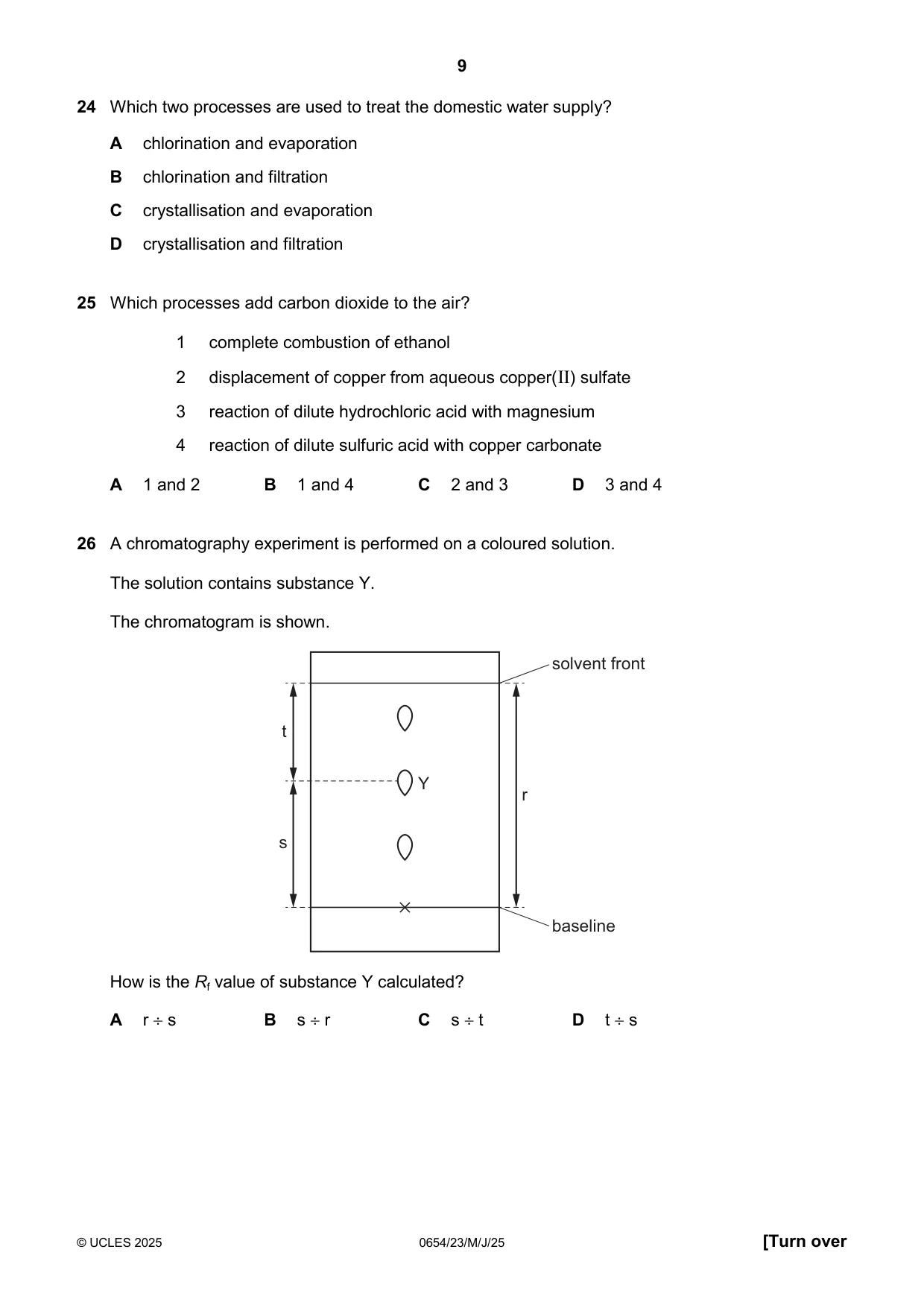
26 A chromatography experiment is performed on a coloured solution. The solution contains substance Y. The chromatogram is shown. solvent front t Y r s baseline How is the Rf value of substance Y calculated? A r s B s r C s t D t s
Mark scheme: B
Q27 · Three processes are listed
27 Three processes are listed. 1 cracking of hydrocarbons 2 combustion of methane 3 reaction of magnesium with steam Which processes produce hydrogen? A 1, 2 and 3 B 1 and 2 only C 1 and 3 only D 2 and 3 only
Mark scheme: C
Q28 · An object of mass 2.0 kg is taken from planet W to Jupiter
28 An object of mass 2.0 kg is taken from planet W to Jupiter. The gravitational field strength on planet W is 10 N / kg. The gravitational field strength on Jupiter is 25 N / kg. By which factor does the weight of the object change when the object is on planet W compared to when it is on Jupiter? A 0.040 B 2.5 C 5.0 D 250
Mark scheme: B
Q29 · An object X with mass 2.0 kg is moving with a speed of 4.0 m / s
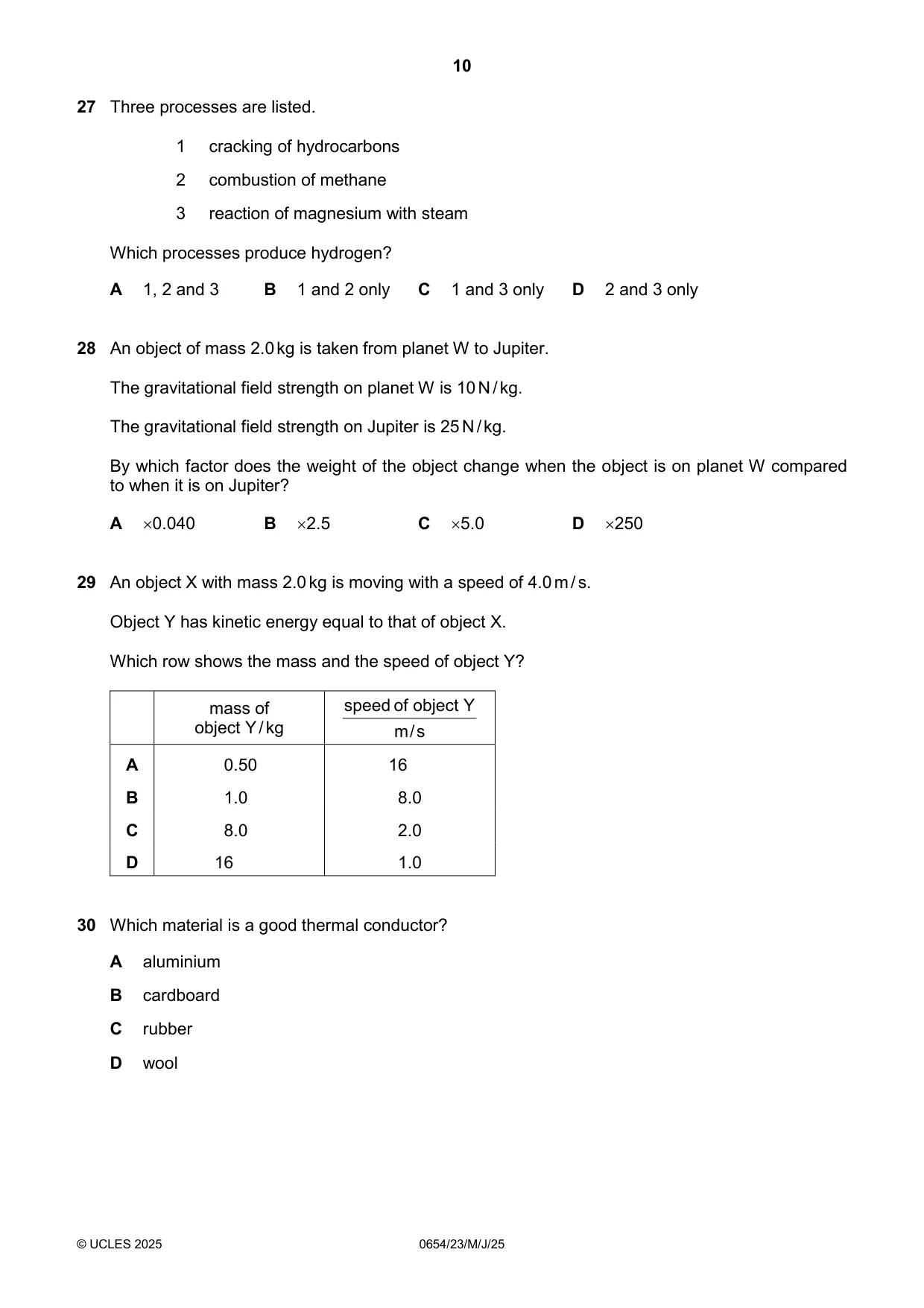
29 An object X with mass 2.0 kg is moving with a speed of 4.0 m / s. Object Y has kinetic energy equal to that of object X. Which row shows the mass and the speed of object Y? mass of speed of object Y object Y / kg m / s A 0.50 16 B 1.0 8.0 C 8.0 2.0 D 16 1.0
Mark scheme: C
Q30 · Which material is a good thermal conductor?
30 Which material is a good thermal conductor? A aluminium B cardboard C rubber D wool
Mark scheme: A
Q31 · At the coast on a hot day, the air above the land is warmer than the air above the sea
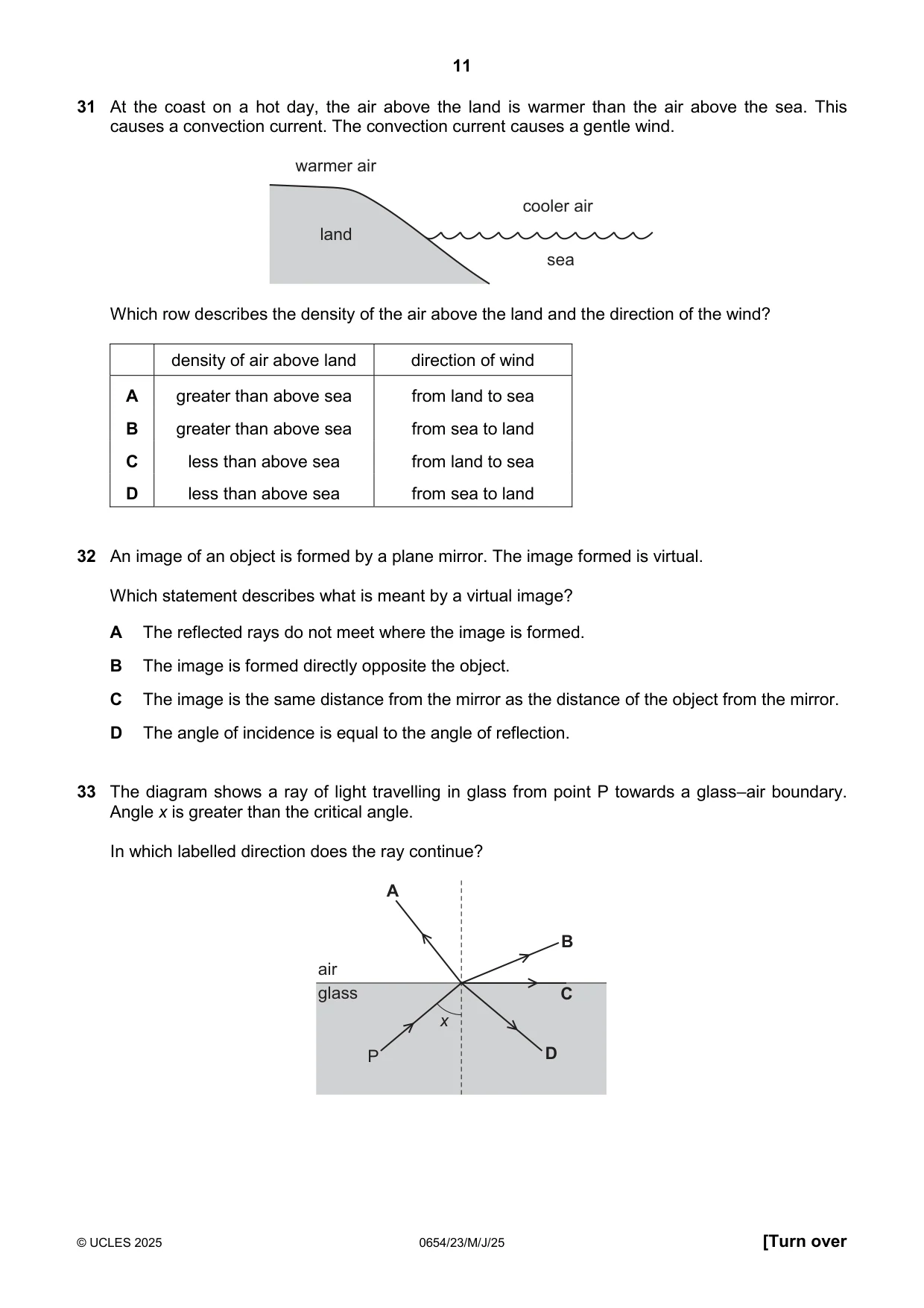
31 At the coast on a hot day, the air above the land is warmer than the air above the sea. This causes a convection current. The convection current causes a gentle wind. warmer air cooler air land sea Which row describes the density of the air above the land and the direction of the wind? density of air above land direction of wind A greater than above sea from land to sea B greater than above sea from sea to land C less than above sea from land to sea D less than above sea from sea to land
Mark scheme: D
Q32 · An image of an object is formed by a plane mirror
32 An image of an object is formed by a plane mirror. The image formed is virtual. Which statement describes what is meant by a virtual image? A The reflected rays do not meet where the image is formed. B The image is formed directly opposite the object. C The image is the same distance from the mirror as the distance of the object from the mirror. D The angle of incidence is equal to the angle of reflection.
Mark scheme: A
Q33 · The diagram shows a ray of light travelling in glass from point P towards a glass–air…
33 The diagram shows a ray of light travelling in glass from point P towards a glass–air boundary. Angle x is greater than the critical angle. In which labelled direction does the ray continue? A B air glass C x P D
Mark scheme: D
Q34 · Which row describes all electromagnetic waves?
34 Which row describes all electromagnetic waves? approximat e speed in a vacuum type of wave m / s A longitudinal 300 B longitudinal 300 million C transverse 300 D transverse 300 million
Mark scheme: D
Q35 · An iron bar is placed within the magnetic field of a permanent magnet
35 An iron bar is placed within the magnetic field of a permanent magnet. What happens to the iron bar? A It becomes an induced permanent magnet. B It becomes an induced temporary magnet. C It becomes negatively charged. D It becomes positively charged.
Mark scheme: B
Q36 · The diagram shows two 30 resistors and an ammeter connected to a 120 V battery
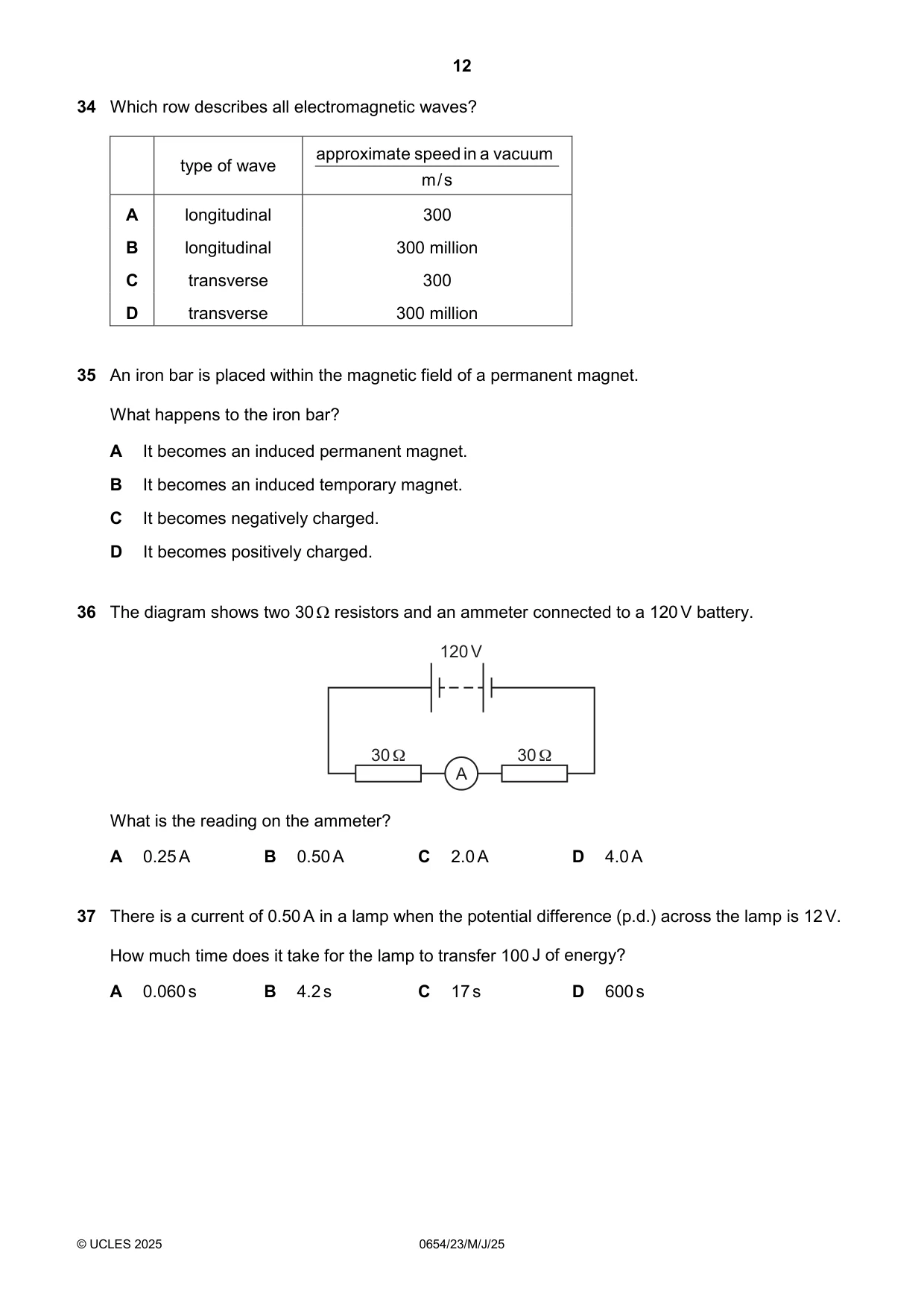
36 The diagram shows two 30 resistors and an ammeter connected to a 120 V battery. 120 V 30 Ω 30 Ω A What is the reading on the ammeter? A 0.25 A B 0.50 A C 2.0 A D 4.0 A
Mark scheme: C
Q37 · There is a current of 0.50 A in a lamp when the potential difference (p.d.) across the…
37 There is a current of 0.50 A in a lamp when the potential difference (p.d.) across the lamp is 12 V. How much time does it take for the lamp to transfer 100 J of energy? A 0.060 s B 4.2 s C 17 s D 600 s
Mark scheme: C
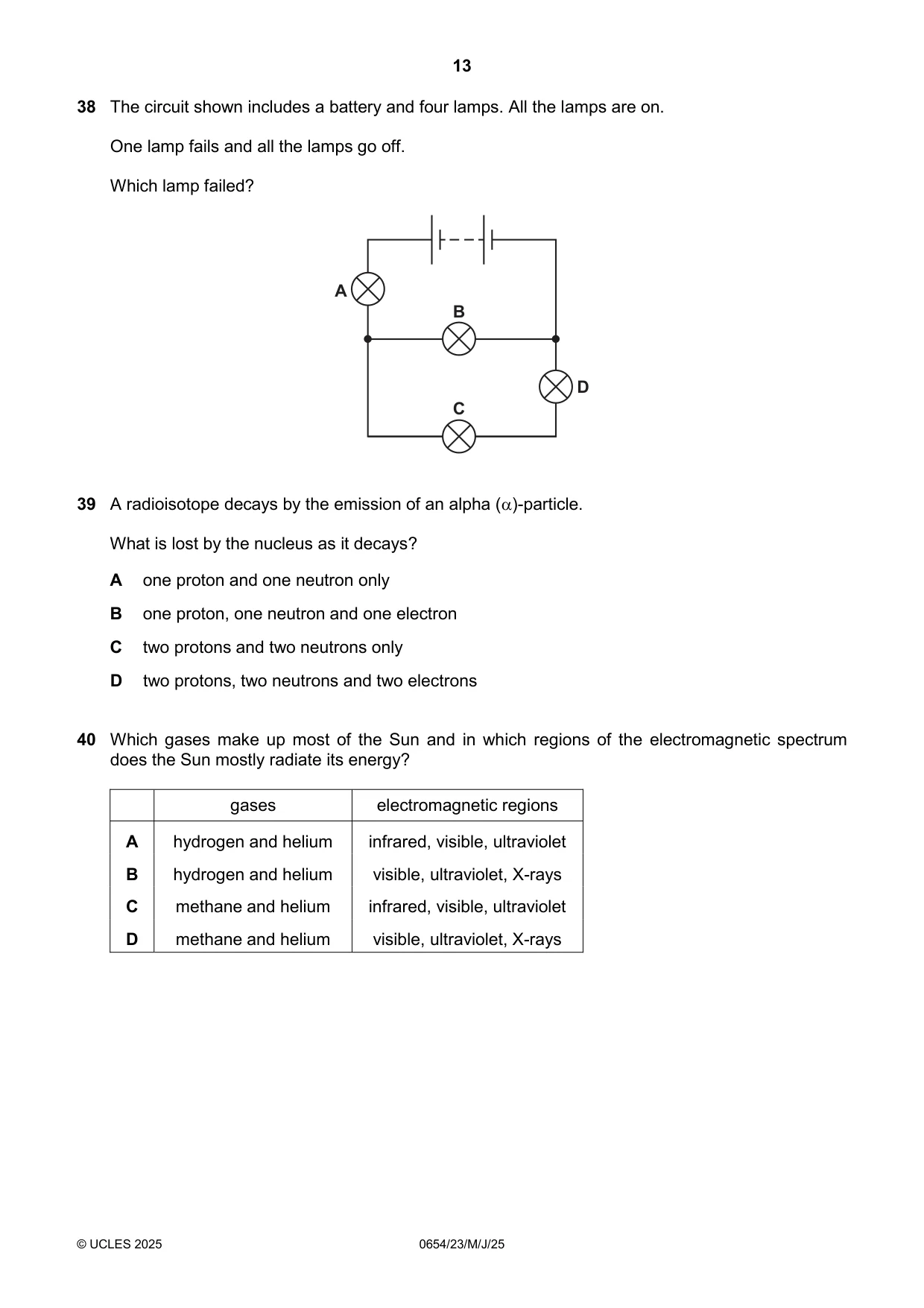
Q38 · The circuit shown includes a battery and four lamps
38 The circuit shown includes a battery and four lamps. All the lamps are on. One lamp fails and all the lamps go off. Which lamp failed? A B D C
Mark scheme: A
Q39 · A radioisotope decays by the emission of an alpha ()-particle
39 A radioisotope decays by the emission of an alpha ()-particle. What is lost by the nucleus as it decays? A one proton and one neutron only B one proton, one neutron and one electron C two protons and two neutrons only D two protons, two neutrons and two electrons
Mark scheme: C
Q40 · Which gases make up most of the Sun and in which regions of the electromagnetic spectrum…
40 Which gases make up most of the Sun and in which regions of the electromagnetic spectrum does the Sun mostly radiate its energy? gases electromagnetic regions A hydrogen and helium infrared, visible, ultraviolet B hydrogen and helium visible, ultraviolet, X-rays C methane and helium infrared, visible, ultraviolet D methane and helium visible, ultraviolet, X-rays
Mark scheme: A
What was in this paper
The subtopics covered by these 40 questions, and how many questions each got. Open one in a new tab to see every Cambridge question on it.
2Light2Preparation of salts2Transfer of thermal energy2Water2Air quality and climate1Atomic structure and the Periodic Table1Cell division1Cell structure1Chromatography1Diet1Diffusion1Digestion1Electrical quantities1Electromagnetic spectrum1Energy, work and power1Enzymes1Exothermic and endothermic reactions1Extraction of metals1Food chains and food webs1Fuels1Gas exchange in humans1Habitat destruction1Homeostasis1Ions and ionic bonds1Isotopes1Mass and weight1Properties of metals1Radioactivity1Rate of reaction1Sexual reproduction in humans1Simple phenomena of magnetism1Stars and the Universe1Transpiration1Variation1What you needed in this session
Cambridge’s own grade thresholds for 2025 May/June, Paper 2 · Variant 3. A higher threshold means an easier paper — the bar moves with how the cohort did.