Cambridge IGCSE Sciences - Co-ordinated (Double) 0654 — 2017 Oct/Nov Paper 2 · Variant 3
0654/23/O/N/17 · 40 questions · 40 marks · ≈45 min
The question paper and its mark scheme, free to read here and free to download. This is Cambridge’s own paper, exactly as it was sat.
Question paper20 pages


Mark scheme3 pages
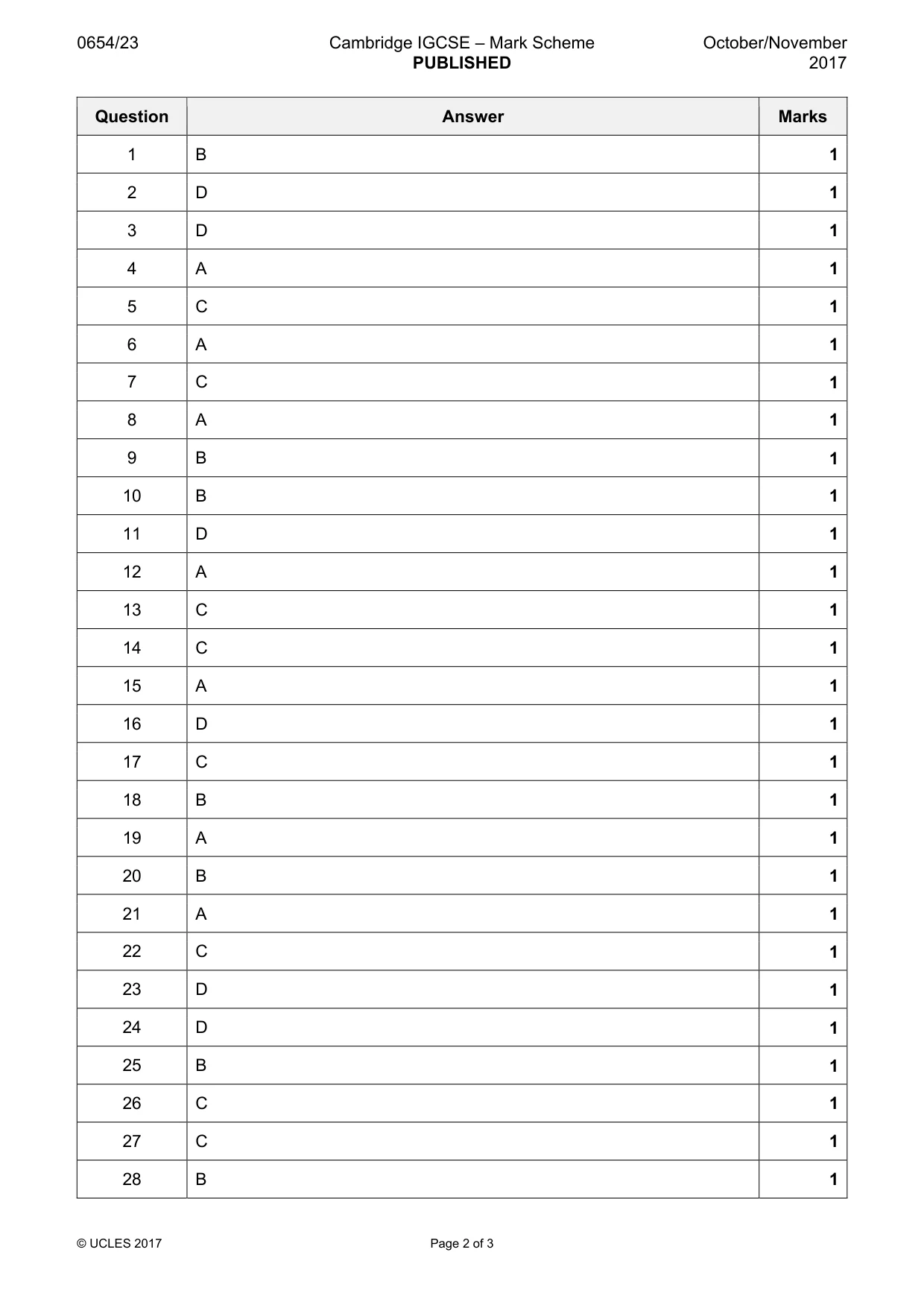
Answers below. Sit the paper first if you are practising.
Questions as text
Question 1
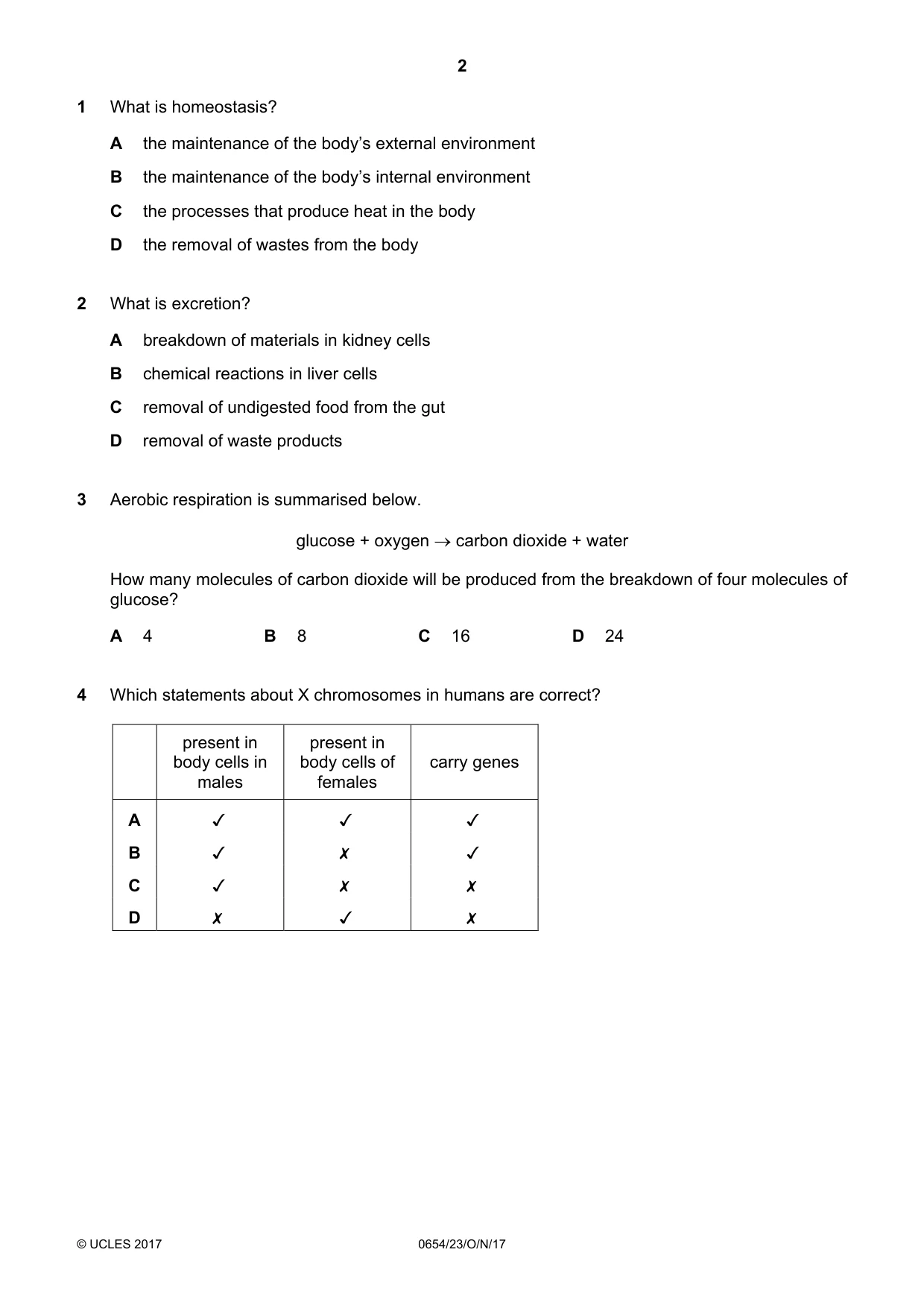
1 What is homeostasis? A the maintenance of the body’s external environment B the maintenance of the body’s internal environment C the processes that produce heat in the body D the removal of wastes from the body
Mark scheme: B
Question 2
2 What is excretion? A breakdown of materials in kidney cells B chemical reactions in liver cells C removal of undigested food from the gut D removal of waste products
Mark scheme: D
Q3 · Aerobic respiration is summarised below
3 Aerobic respiration is summarised below. glucose + oxygen → carbon dioxide + water How many molecules of carbon dioxide will be produced from the breakdown of four molecules of glucose? A 4 B 8 C 16 D 24
Mark scheme: D
Q4 · Which statements about X chromosomes in humans are correct?
4 Which statements about X chromosomes in humans are correct? present in present in body cells in body cells of carry genes males females A v v v B v x v Cc J x x D x v x
Mark scheme: A
Q5 · The diagram shows a section through a root hair cell
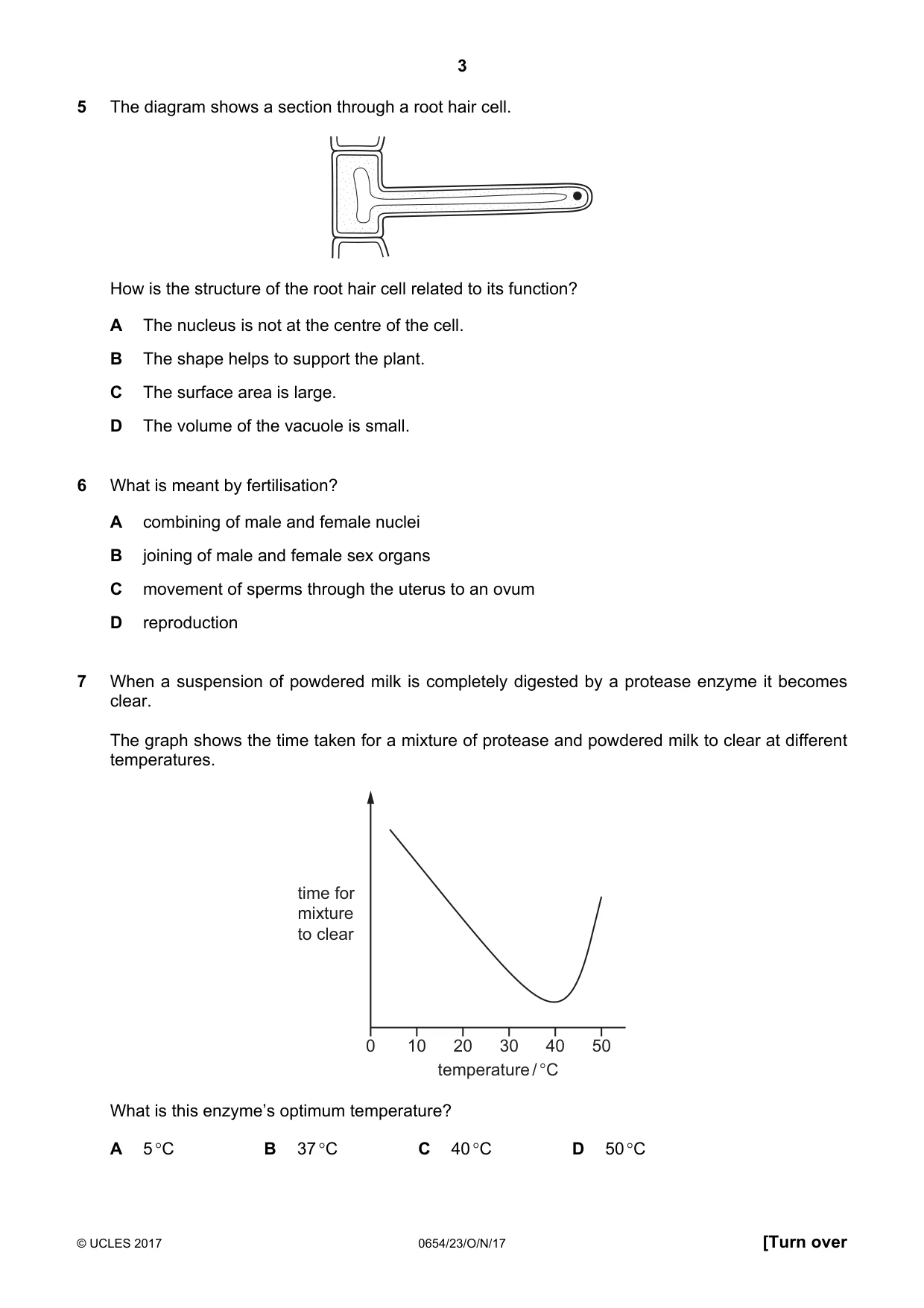
5 The diagram shows a section through a root hair cell. How is the structure of the root hair cell related to its function? A The nucleus is not at the centre of the cell. B The shape helps to support the plant. C The surface area is large. D The volume of the vacuole is small.
Mark scheme: C
Q6 · What is meant by fertilisation?
6 What is meant by fertilisation? A combining of male and female nuclei B joining of male and female sex organs C movement of sperms through the uterus to an ovum D reproduction
Mark scheme: A
Q7 · When a suspension of powdered milk is completely digested by a protease enzyme it becomes…
7 When a suspension of powdered milk is completely digested by a protease enzyme it becomes clear. The graph shows the time taken for a mixture of protease and powdered milk to clear at different temperatures. time for mixture to clear 0 10 20 30 40 50 temperature / °C What is this enzyme’s optimum temperature? A 5 °C B 37 °C C 40 °C D 50 °C
Mark scheme: C
Q8 · Which row correctly matches the form of malnutrition with its possible outcome?
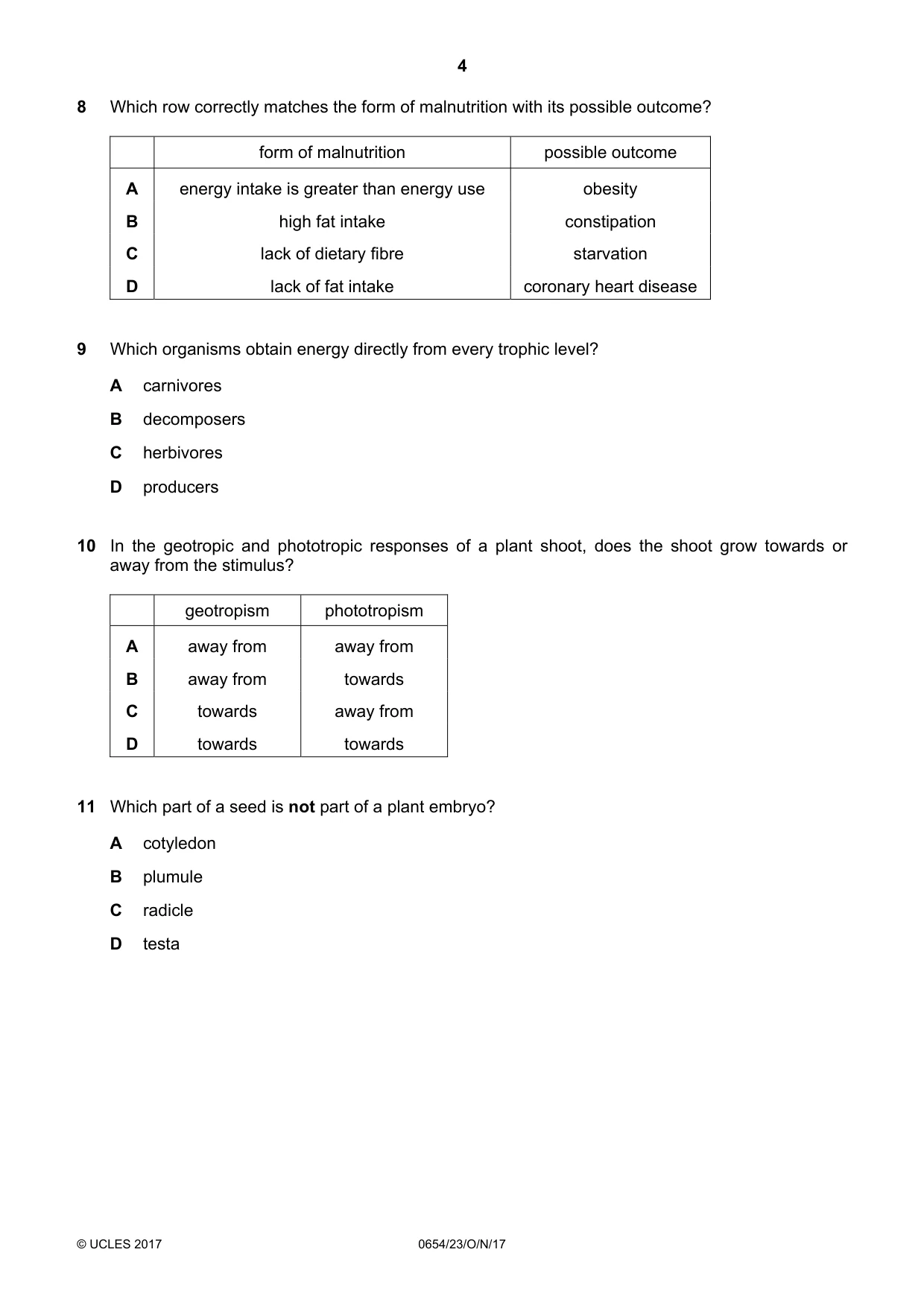
8 Which row correctly matches the form of malnutrition with its possible outcome? form of malnutrition possible outcome A energy intake is greater than energy use obesity B high fat intake constipation C lack of dietary fibre starvation D lack of fat intake coronary heart disease
Mark scheme: A
Q9 · Which organisms obtain energy directly from every trophic level?
9 Which organisms obtain energy directly from every trophic level? A carnivores B decomposers C herbivores D producers
Mark scheme: B
Q10 · In the geotropic and phototropic responses of a plant shoot, does the shoot grow towards…
10 In the geotropic and phototropic responses of a plant shoot, does the shoot grow towards or away from the stimulus? geotropism phototropism A away from away from B away from towards C towards away from D towards towards
Mark scheme: B
Q11 · Which part of a seed is not part of a plant embryo?
11 Which part of a seed is not part of a plant embryo? A cotyledon B plumule C radicle D testa
Mark scheme: D
Q12 · The graph shows how the pH of a lake has changed from 1600 to 2000
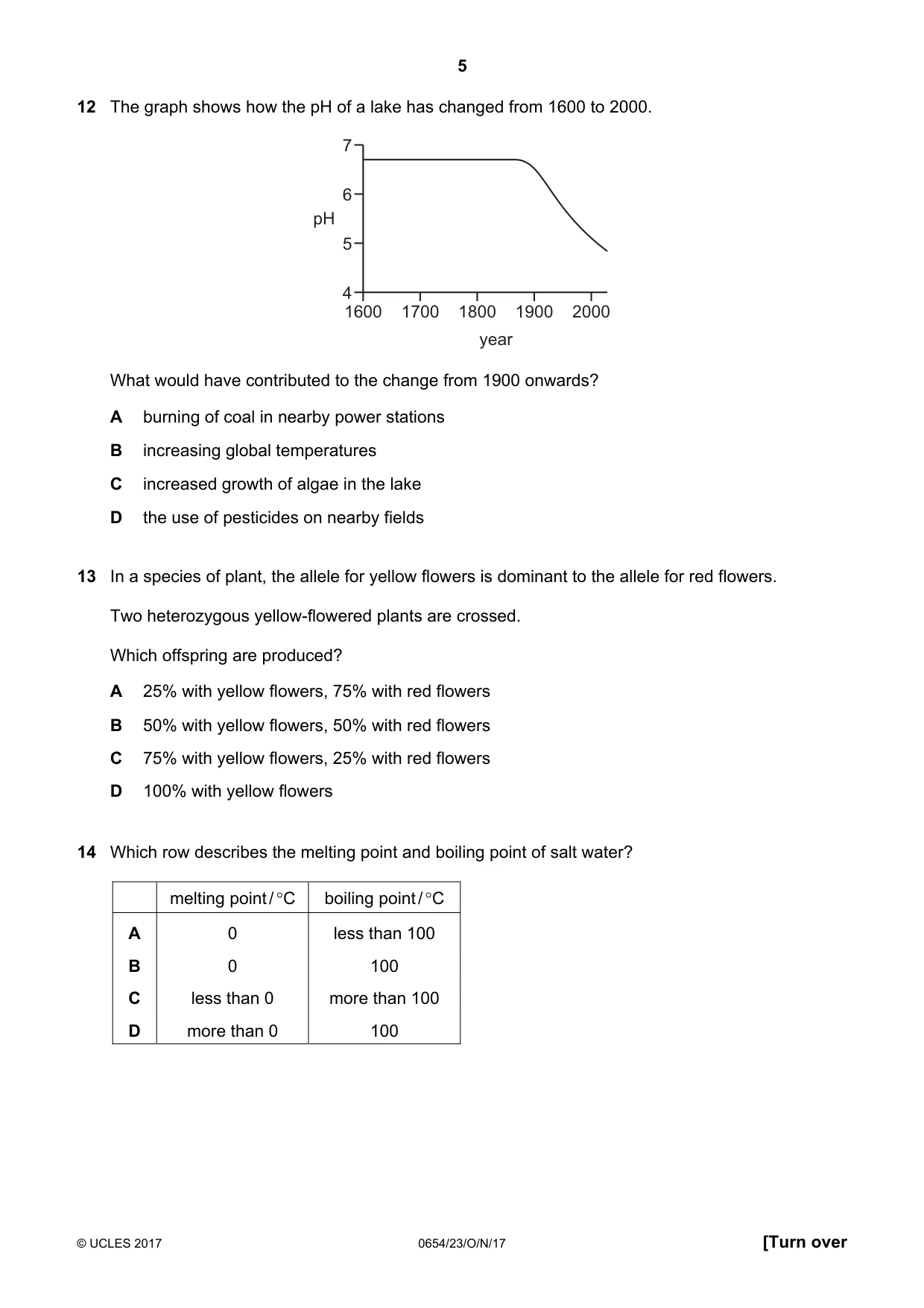
12 The graph shows how the pH of a lake has changed from 1600 to 2000. 7 6 pH 5 4 1600 1700 1800 1900 2000 year What would have contributed to the change from 1900 onwards? A burning of coal in nearby power stations B increasing global temperatures C increased growth of algae in the lake D the use of pesticides on nearby fields
Mark scheme: A
Q13 · In a species of plant, the allele for yellow flowers is dominant to the allele for red…
13 In a species of plant, the allele for yellow flowers is dominant to the allele for red flowers. Two heterozygous yellow-flowered plants are crossed. Which offspring are produced? A 25% with yellow flowers, 75% with red flowers B 50% with yellow flowers, 50% with red flowers C 75% with yellow flowers, 25% with red flowers D 100% with yellow flowers
Mark scheme: C
Q14 · Which row describes the melting point and boiling point of salt water?
14 Which row describes the melting point and boiling point of salt water? melting point / °C boiling point / °C A 0 less than 100 B 0 100 C less than 0 more than 100 D more than 0 100
Mark scheme: C
Q15 · When solid zinc carbonate is heated, a different solid and a gas are formed
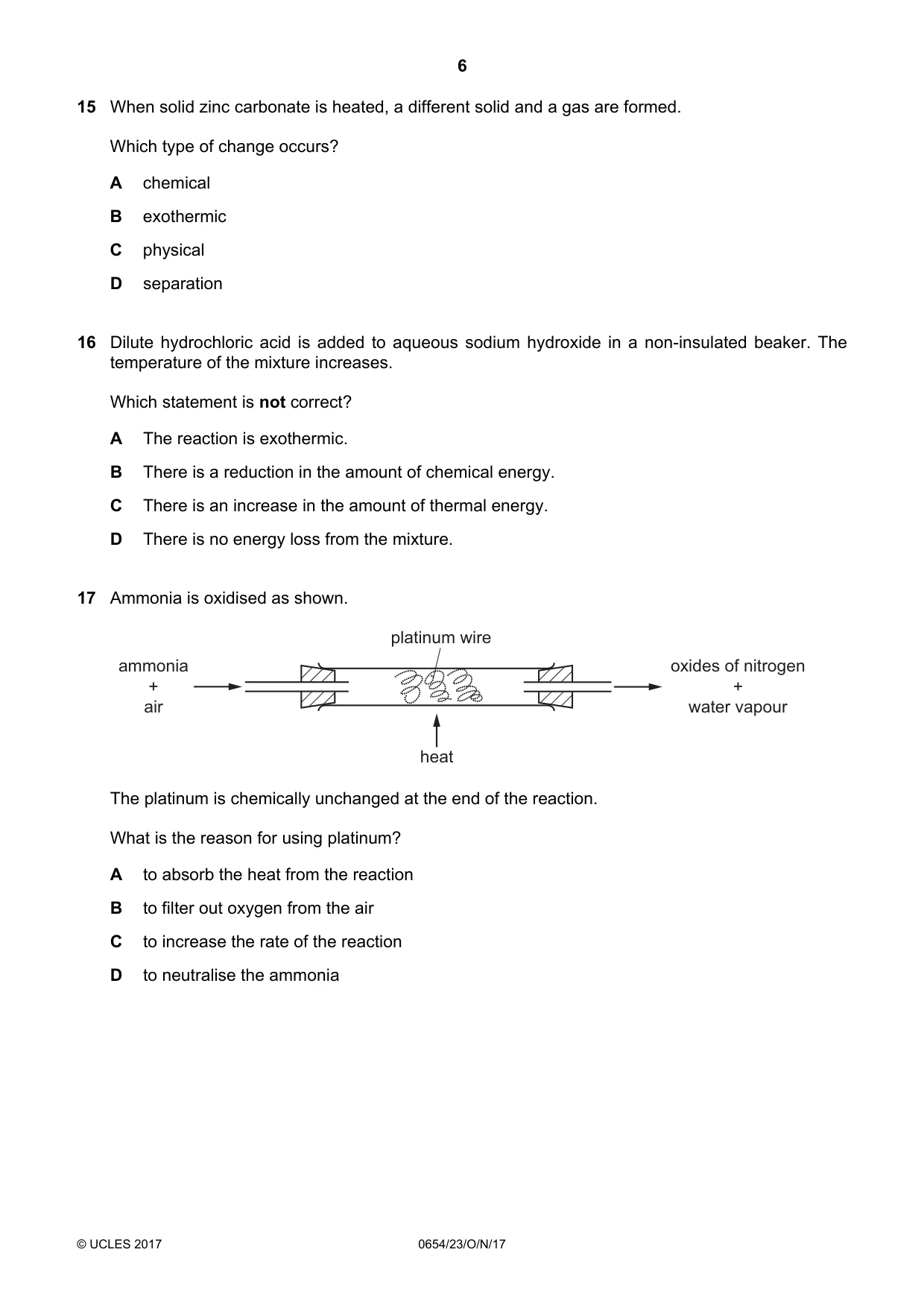
15 When solid zinc carbonate is heated, a different solid and a gas are formed. Which type of change occurs? A chemical B exothermic C physical D separation
Mark scheme: A
Q16 · Dilute hydrochloric acid is added to aqueous sodium hydroxide in a non-insulated beaker
16 Dilute hydrochloric acid is added to aqueous sodium hydroxide in a non-insulated beaker. The temperature of the mixture increases. Which statement is not correct? A The reaction is exothermic. B There is a reduction in the amount of chemical energy. C There is an increase in the amount of thermal energy. D There is no energy loss from the mixture.
Mark scheme: D
Q17 · Ammonia is oxidised as shown
17 Ammonia is oxidised as shown. platinum wire ammonia oxides of nitrogen + + air water vapour heat The platinum is chemically unchanged at the end of the reaction. What is the reason for using platinum? A to absorb the heat from the reaction B to filter out oxygen from the air C to increase the rate of the reaction D to neutralise the ammonia
Mark scheme: C
Q18 · The ionic equation for the formation of chromium(III) ions is shown
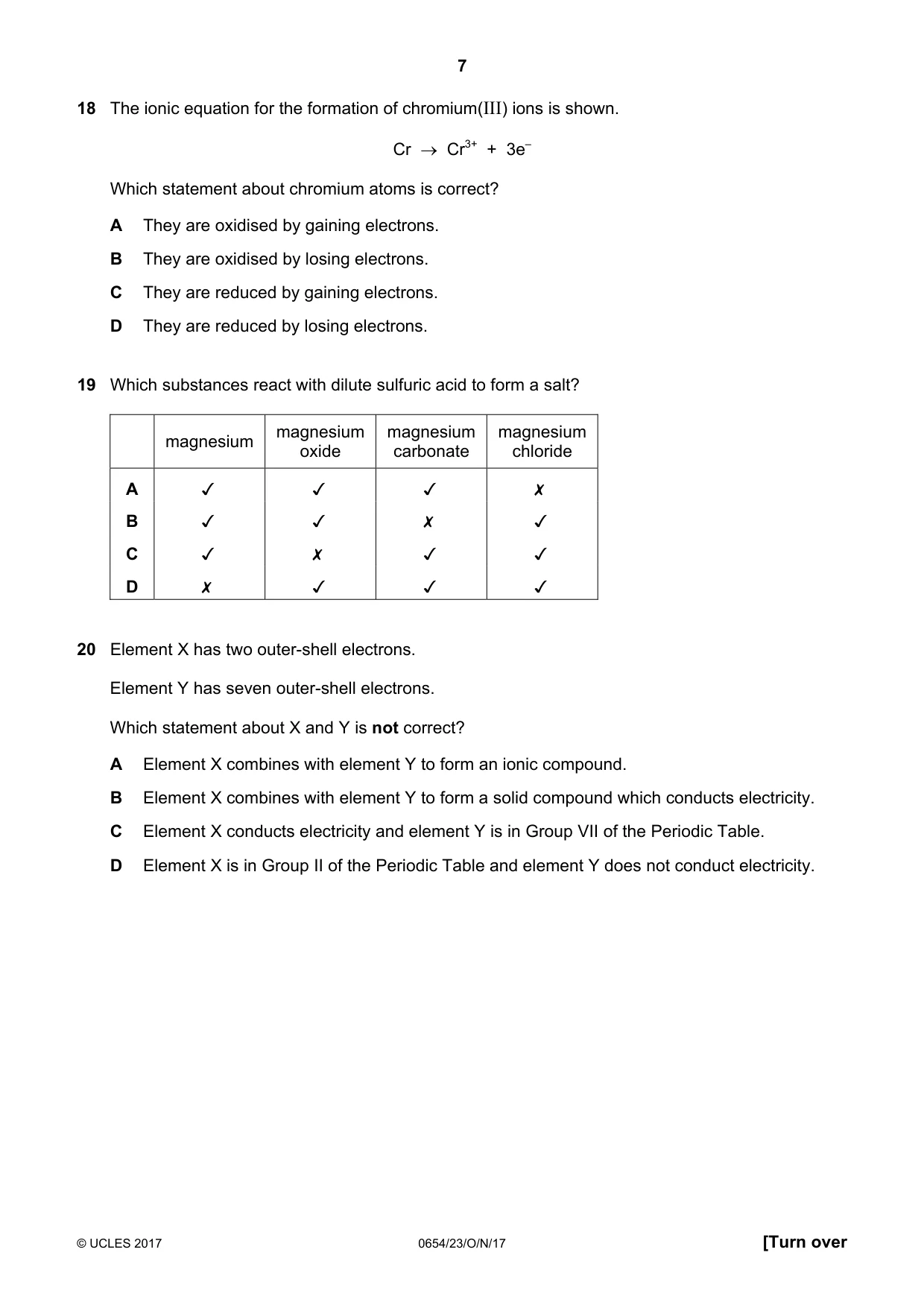
18 The ionic equation for the formation of chromium(III) ions is shown. Cr → Cr3+ + 3e– Which statement about chromium atoms is correct? A They are oxidised by gaining electrons. B They are oxidised by losing electrons. C They are reduced by gaining electrons. D They are reduced by losing electrons.
Mark scheme: B
Q19 · Which substances react with dilute sulfuric acid to form a salt?
19 Which substances react with dilute sulfuric acid to form a salt? magnesium oxide magnesium carbonate magnesium chloride magnesium v v ~*~ KKK v x x v v v
Mark scheme: A
Q20 · Element X has two outer-shell electrons
20 Element X has two outer-shell electrons. Element Y has seven outer-shell electrons. Which statement about X and Y is not correct? A Element X combines with element Y to form an ionic compound. B Element X combines with element Y to form a solid compound which conducts electricity. C Element X conducts electricity and element Y is in Group VII of the Periodic Table. D Element X is in Group II of the Periodic Table and element Y does not conduct electricity.
Mark scheme: B
Q21 · The melting points of three elements in Group I and of three elements in Group VII are…
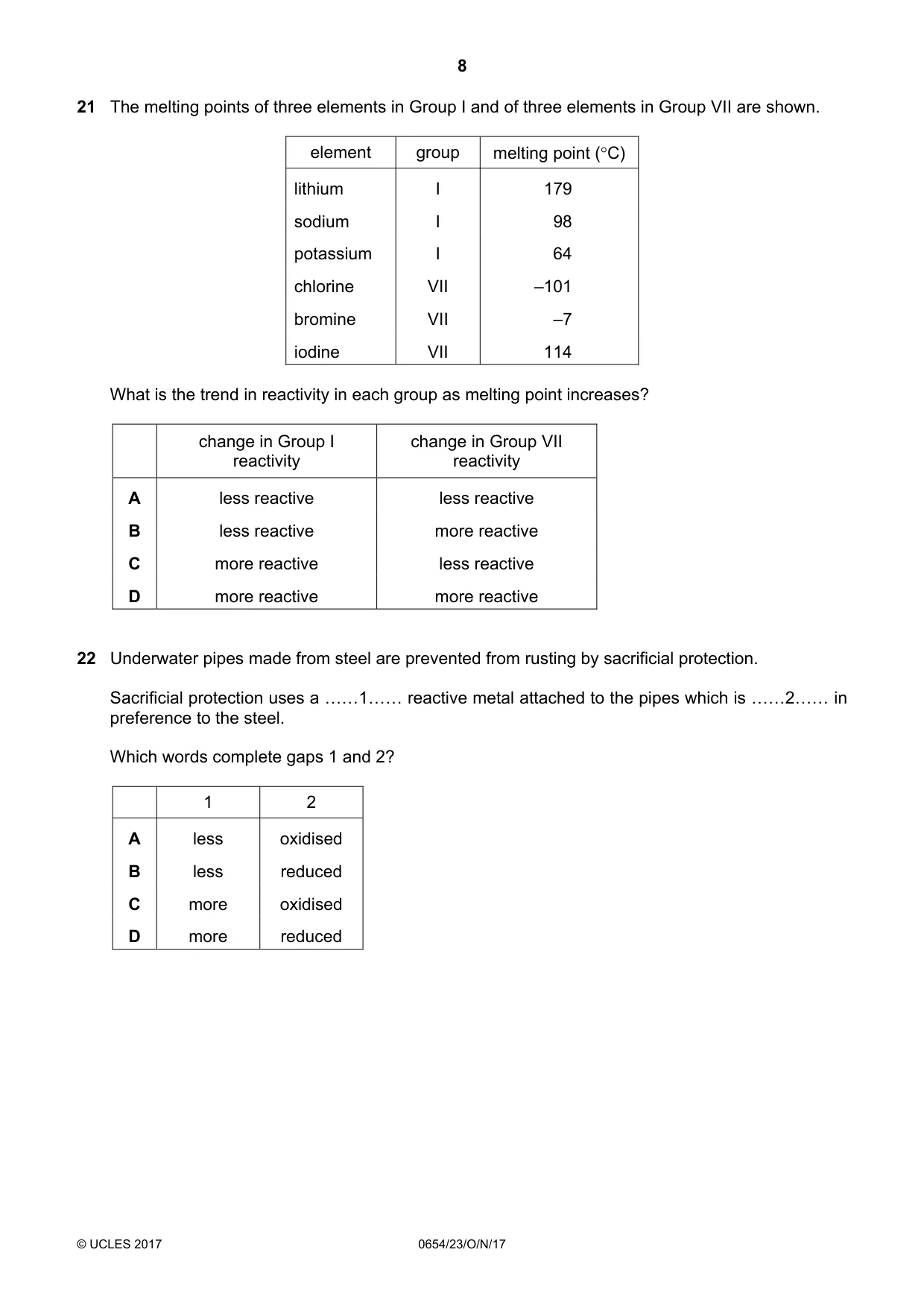
21 The melting points of three elements in Group I and of three elements in Group VII are shown. element group melting point (°C) lithium I 179 sodium I 98 potassium I 64 chlorine VII –101 bromine VII –7 iodine VII 114 What is the trend in reactivity in each group as melting point increases? change in Group I change in Group VII reactivity reactivity A less reactive less reactive B less reactive more reactive C more reactive less reactive D more reactive more reactive
Mark scheme: A
Q22 · Underwater pipes made from steel are prevented from rusting by sacrificial protection
22 Underwater pipes made from steel are prevented from rusting by sacrificial protection. Sacrificial protection uses a ««1«« reactive metal attached to the pipes which is ««2«« in preference to the steel. Which words complete gaps 1 and 2? 1 2 A less oxidised B less reduced C more oxidised D more reduced
Mark scheme: C
Q23 · Which row describes how hydrogen and nitrogen are obtained for use in the Haber process?
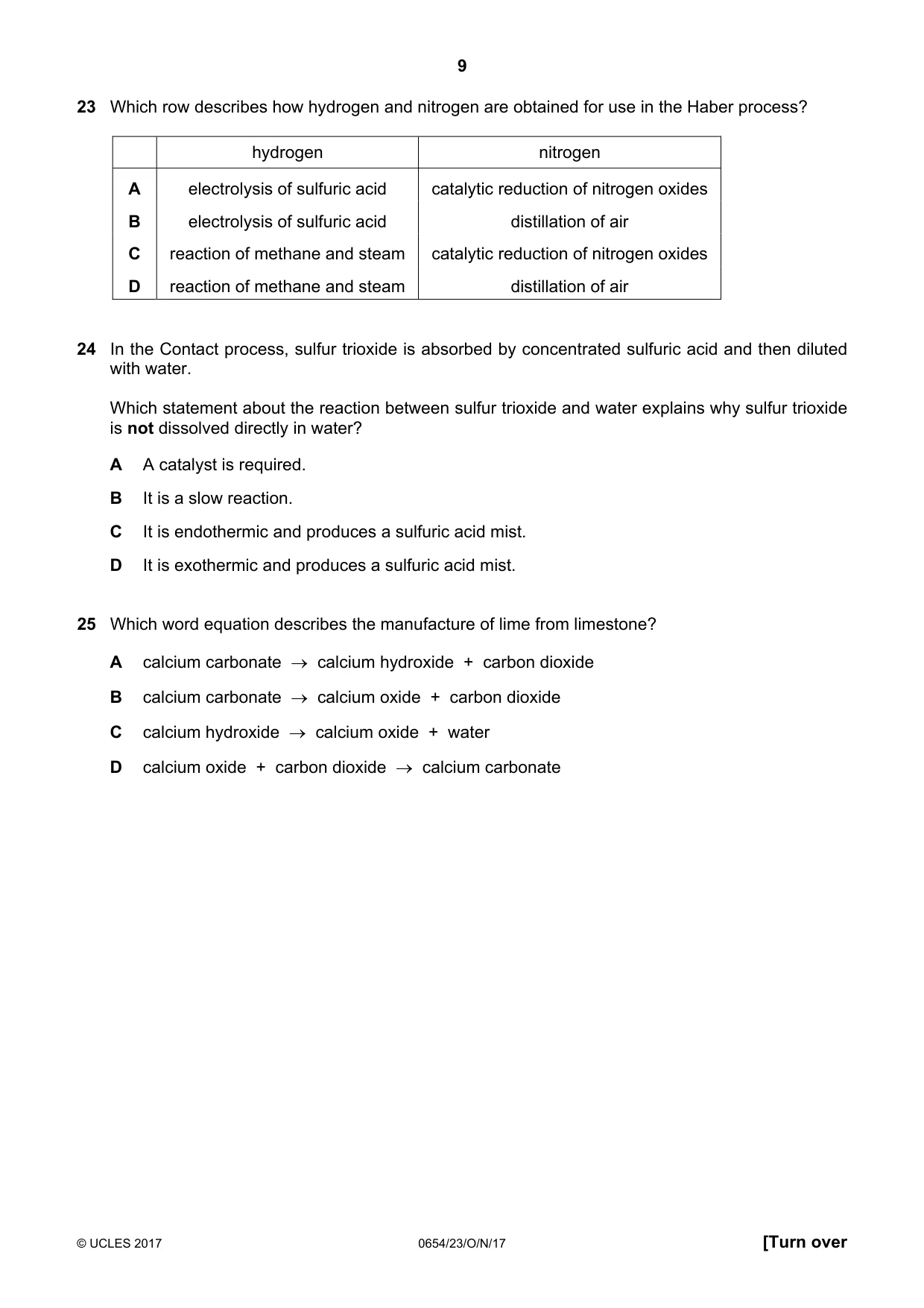
23 Which row describes how hydrogen and nitrogen are obtained for use in the Haber process? hydrogen nitrogen A electrolysis of sulfuric acid catalytic reduction of nitrogen oxides B electrolysis of sulfuric acid distillation of air C reaction of methane and steam catalytic reduction of nitrogen oxides D reaction of methane and steam distillation of air
Mark scheme: D
Q24 · In the Contact process, sulfur trioxide is absorbed by concentrated sulfuric acid and…
24 In the Contact process, sulfur trioxide is absorbed by concentrated sulfuric acid and then diluted with water. Which statement about the reaction between sulfur trioxide and water explains why sulfur trioxide is not dissolved directly in water? A A catalyst is required. B It is a slow reaction. C It is endothermic and produces a sulfuric acid mist. D It is exothermic and produces a sulfuric acid mist.
Mark scheme: D
Q25 · Which word equation describes the manufacture of lime from limestone?
25 Which word equation describes the manufacture of lime from limestone? A calcium carbonate → calcium hydroxide + carbon dioxide B calcium carbonate → calcium oxide + carbon dioxide C calcium hydroxide → calcium oxide + water D calcium oxide + carbon dioxide → calcium carbonate
Mark scheme: B
Q26 · The structures of four compounds are shown
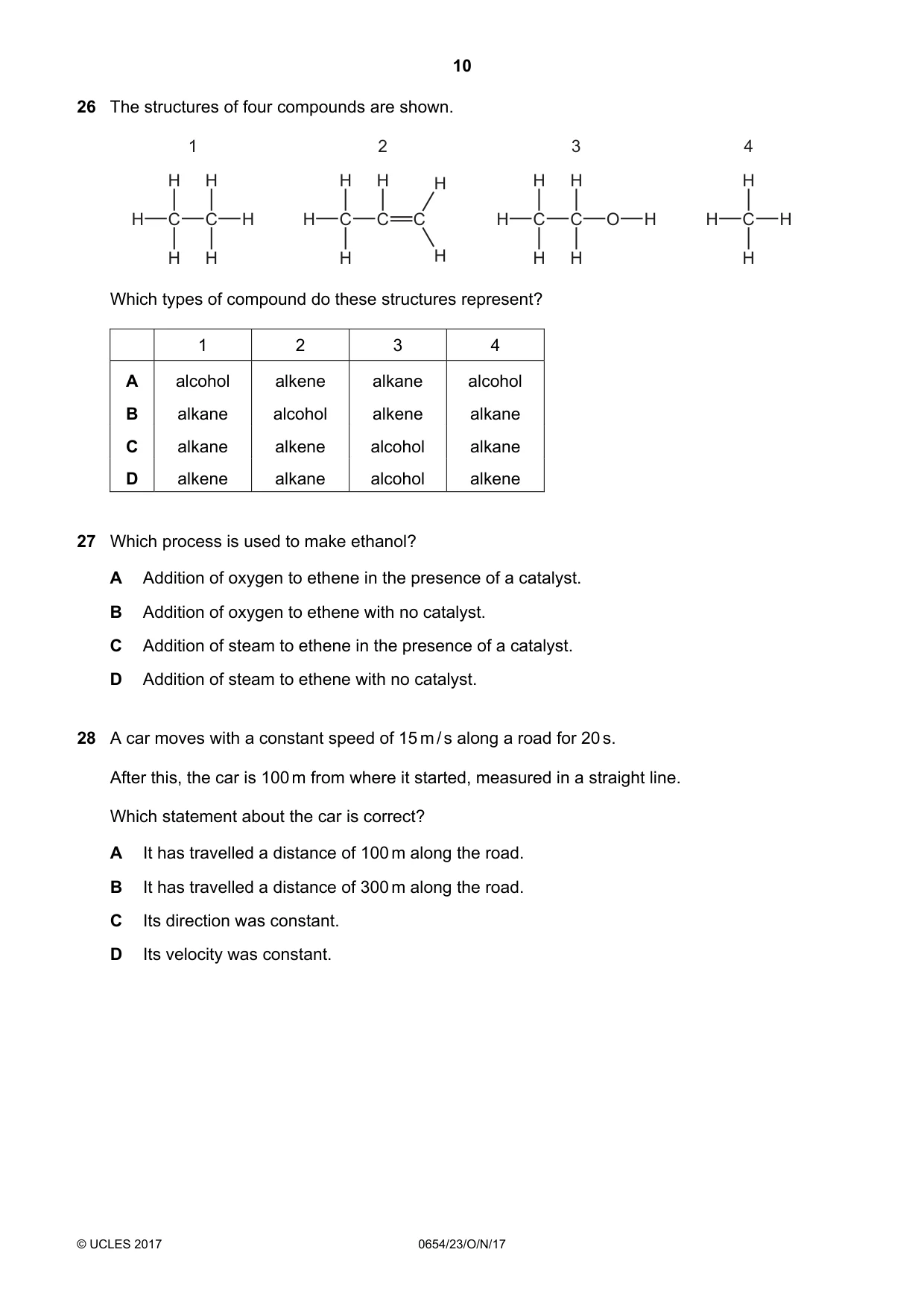
26 The structures of four compounds are shown. 1 2 3 4 H H H H H H H H H C C H H C C C H C C O H H C H H H H H H H H Which types of compound do these structures represent? 1 2 3 4 A alcohol alkene alkane alcohol B alkane alcohol alkene alkane C alkane alkene alcohol alkane D alkene alkane alcohol alkene
Mark scheme: C
Q27 · Which process is used to make ethanol?
27 Which process is used to make ethanol? A Addition of oxygen to ethene in the presence of a catalyst. B Addition of oxygen to ethene with no catalyst. C Addition of steam to ethene in the presence of a catalyst. D Addition of steam to ethene with no catalyst.
Mark scheme: C
Q28 · A car moves with a constant speed of 15 m / s along a road for 20 s
28 A car moves with a constant speed of 15 m / s along a road for 20 s. After this, the car is 100 m from where it started, measured in a straight line. Which statement about the car is correct? A It has travelled a distance of 100 m along the road. B It has travelled a distance of 300 m along the road. C Its direction was constant. D Its velocity was constant.
Mark scheme: B
Q29 · A worker carries bricks up a ladder
29 A worker carries bricks up a ladder. The following quantities are known. ● the height the bricks are lifted up ● the time taken for the worker to lift the bricks ● the volume of the bricks ● the weight of the bricks Which quantities are needed to calculate the useful power produced by the worker as he carries the bricks up the ladder? A height, time and volume B height, time and weight C height, volume and weight D time, volume and weight
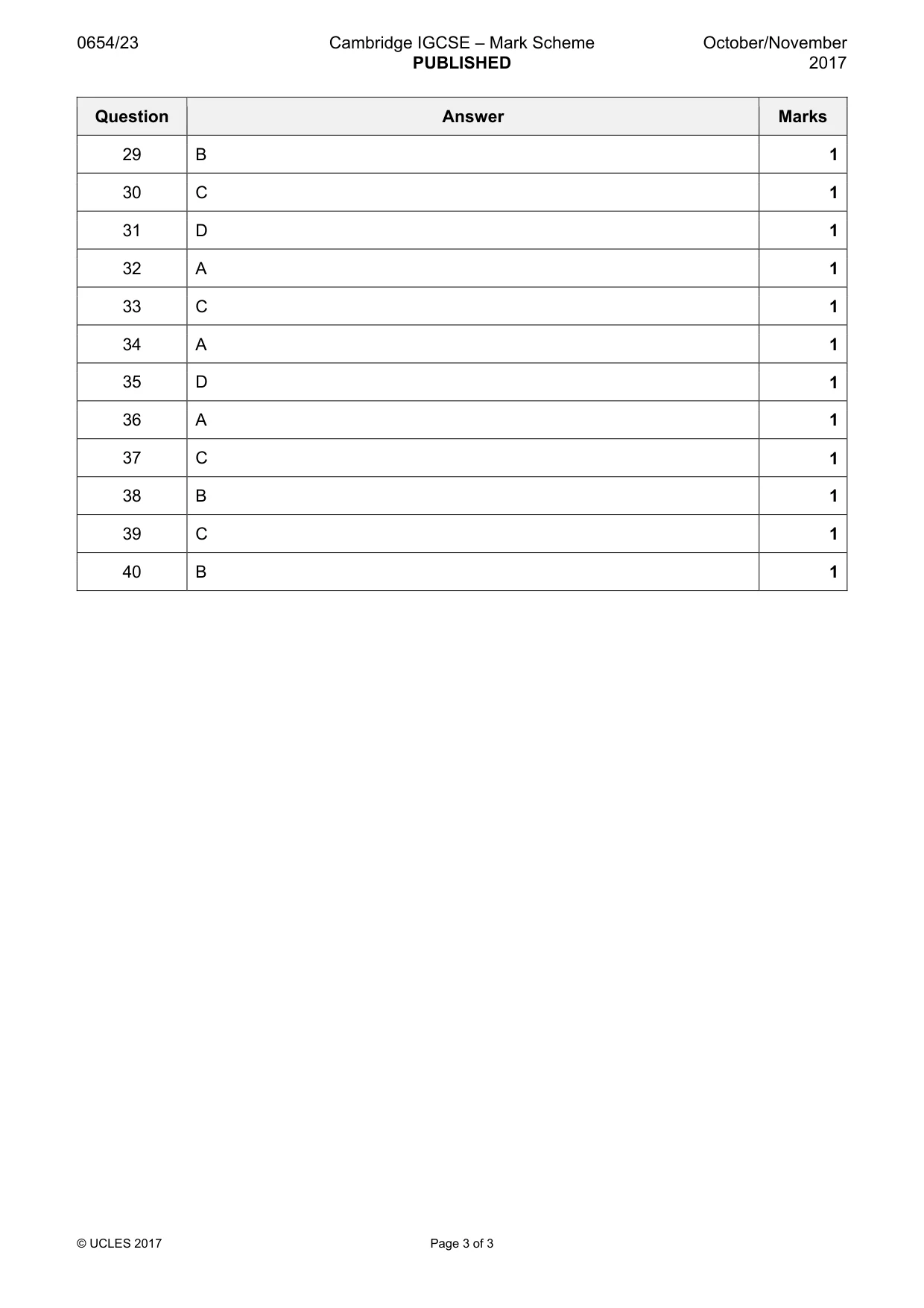
Mark scheme: B
Q30 · The pressure P of a fixed mass of gas at constant temperature depends on its volume V
30 The pressure P of a fixed mass of gas at constant temperature depends on its volume V. What is the relationship between P and V ? A P is directly proportional to V. B P is directly proportional to V 2. C P is inversely proportional to V. D P is inversely proportional to V 2.
Mark scheme: C
Q31 · Four blocks are made from different materials
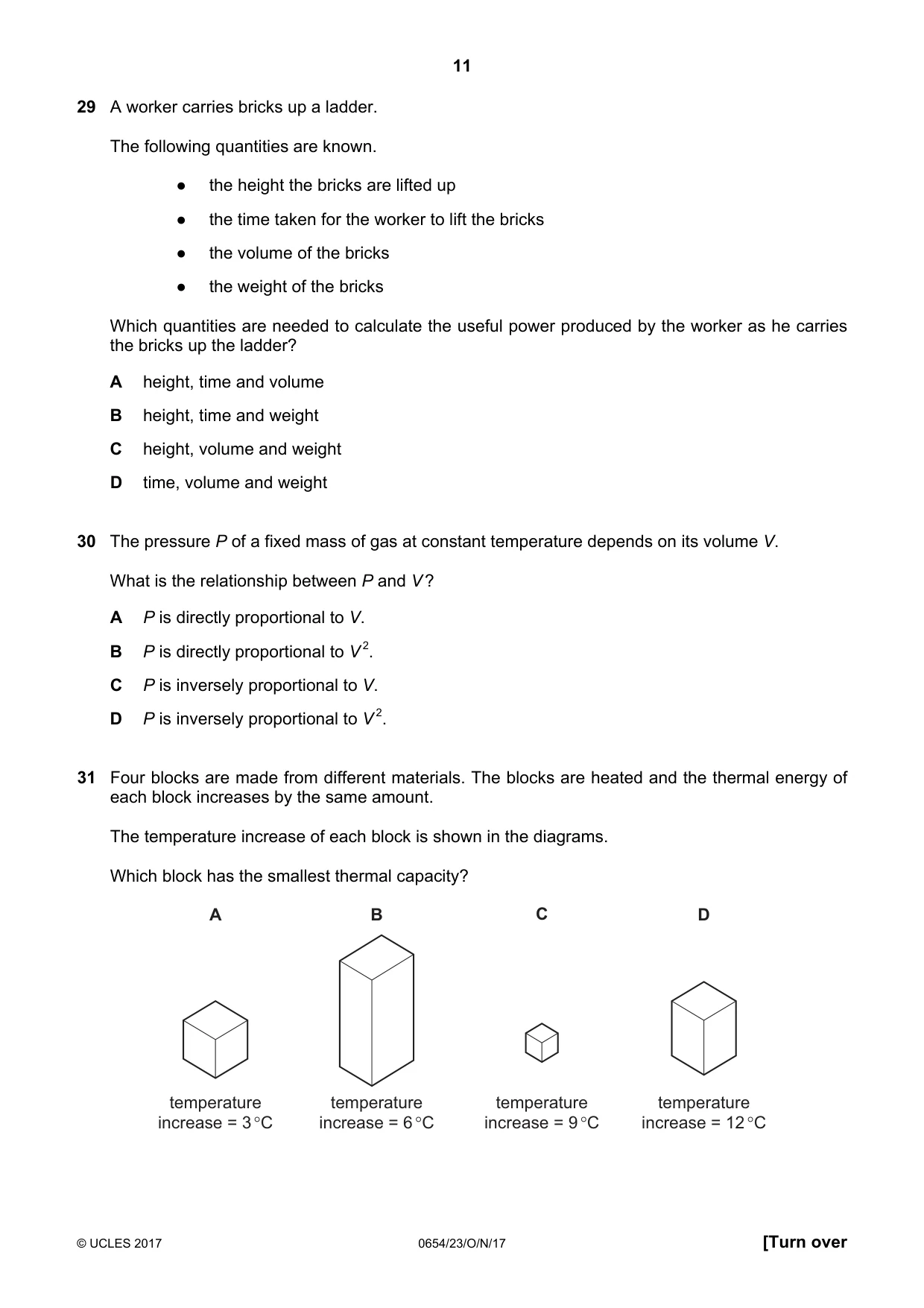
31 Four blocks are made from different materials. The blocks are heated and the thermal energy of each block increases by the same amount. The temperature increase of each block is shown in the diagrams. Which block has the smallest thermal capacity? A B C D temperature temperature temperature temperature increase = 3 °C increase = 6 °C increase = 9 °C increase = 12 °C
Mark scheme: D
Q32 · One type of double glazing consists of two panes of glass separated by a vacuum
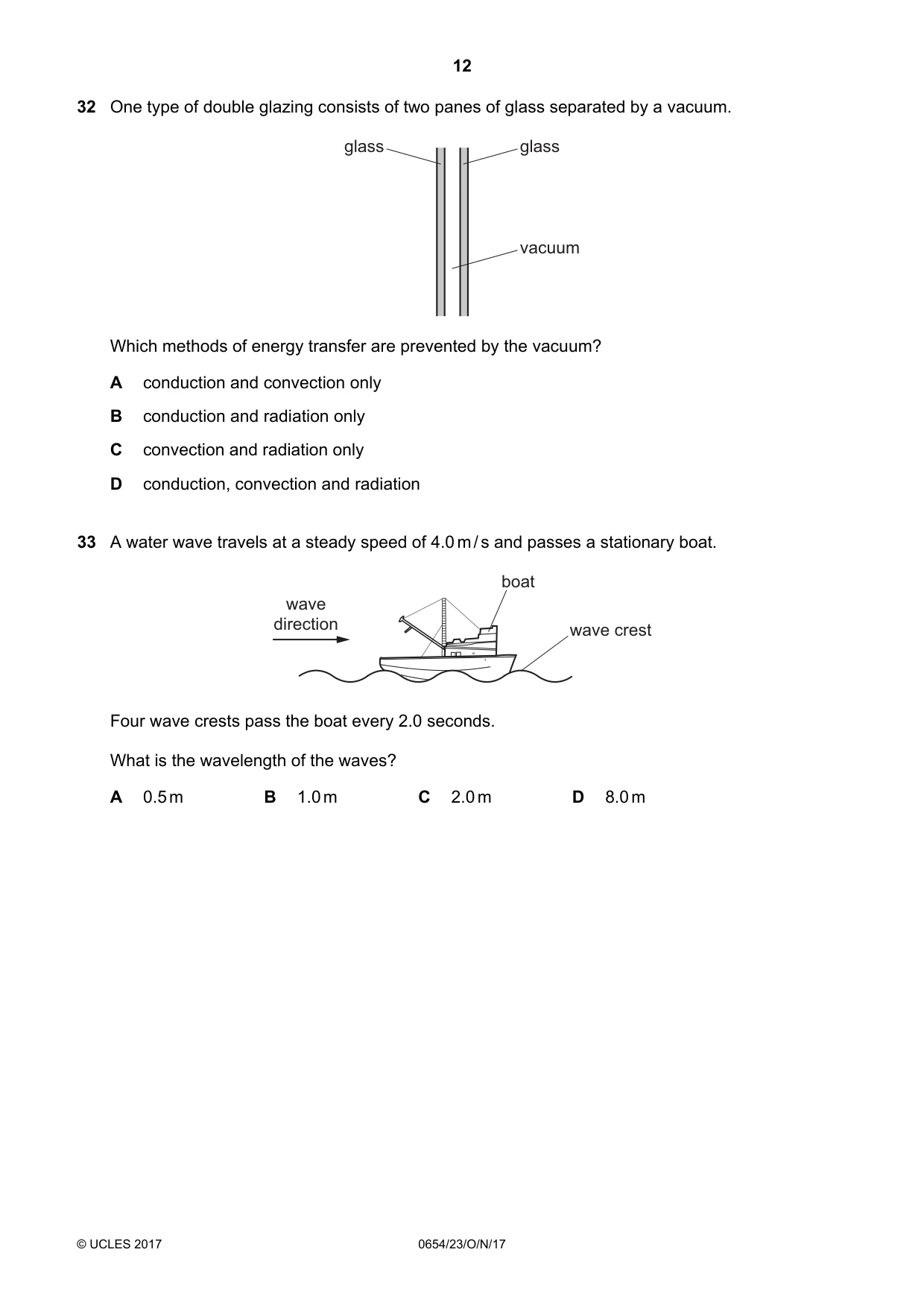
32 One type of double glazing consists of two panes of glass separated by a vacuum. glass glass vacuum Which methods of energy transfer are prevented by the vacuum? A conduction and convection only B conduction and radiation only C convection and radiation only D conduction, convection and radiation
Mark scheme: A
Q33 · A water wave travels at a steady speed of 4.0 m / s and passes a stationary boat
33 A water wave travels at a steady speed of 4.0 m / s and passes a stationary boat. boat wave direction wave crest Four wave crests pass the boat every 2.0 seconds. What is the wavelength of the waves? A 0.5 m B 1.0 m C 2.0 m D 8.0 m
Mark scheme: C
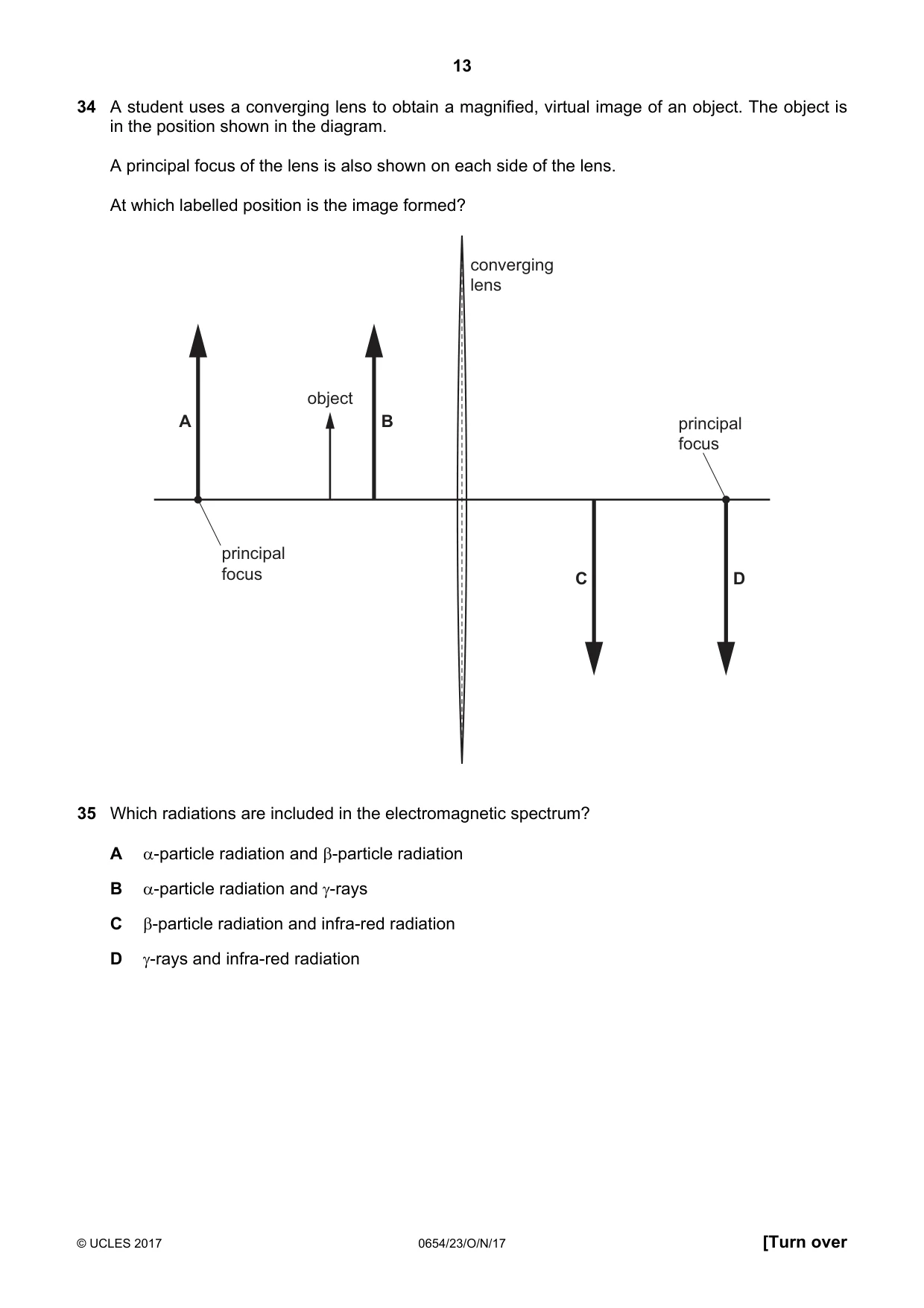
Q34 · A student uses a converging lens to obtain a magnified, virtual image of an object
34 A student uses a converging lens to obtain a magnified, virtual image of an object. The object is in the position shown in the diagram. A principal focus of the lens is also shown on each side of the lens. At which labelled position is the image formed? converging lens object A B principal focus principal focus C D
Mark scheme: A
Q35 · Which radiations are included in the electromagnetic spectrum?
35 Which radiations are included in the electromagnetic spectrum? A α-particle radiation and β-particle radiation B α-particle radiation and γ-rays C β-particle radiation and infra-red radiation D γ-rays and infra-red radiation
Mark scheme: D
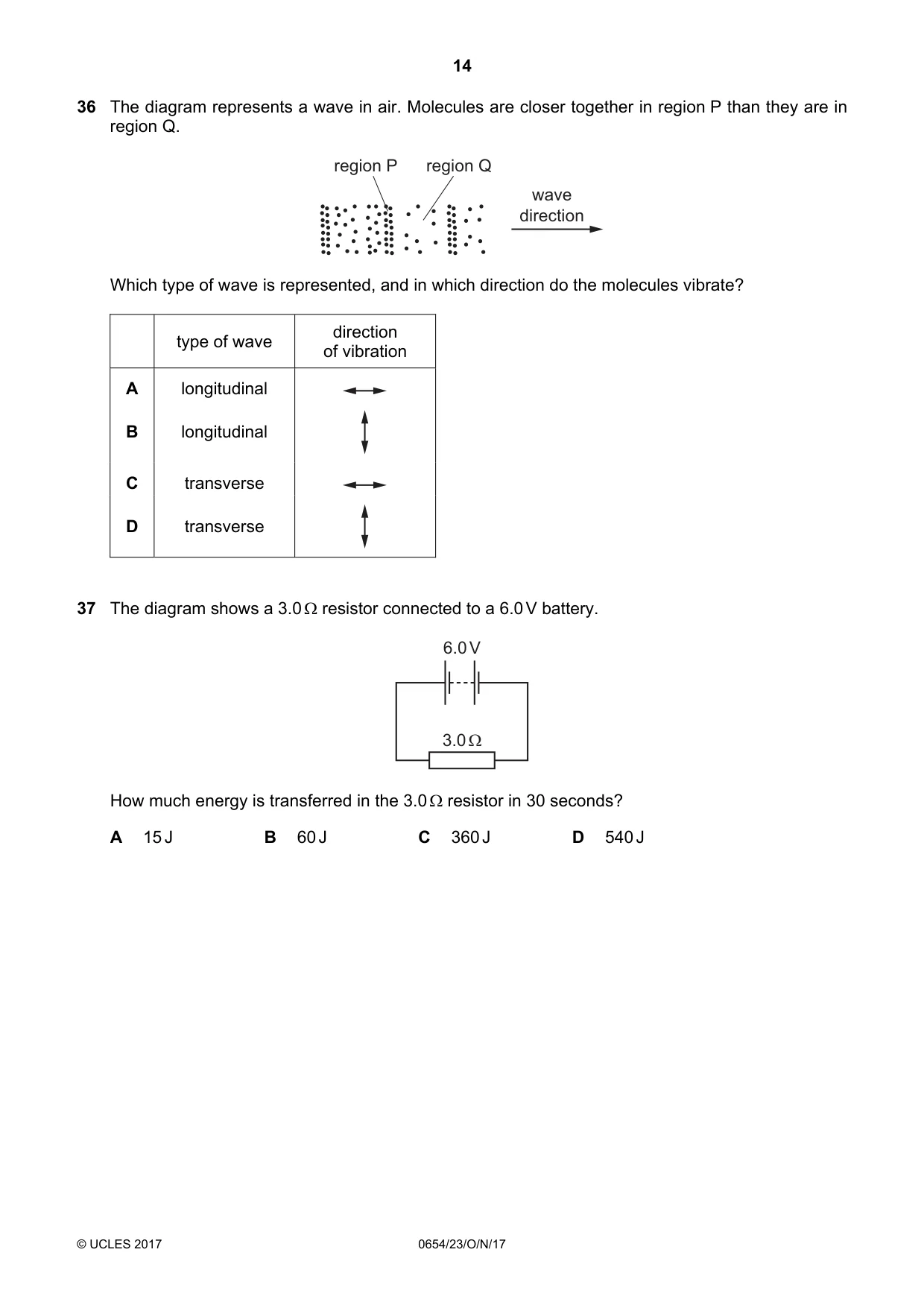
Q36 · The diagram represents a wave in air
36 The diagram represents a wave in air. Molecules are closer together in region P than they are in region Q. region P region Q wave direction Which type of wave is represented, and in which direction do the molecules vibrate? direction type of wave of vibration A longitudinal B longitudinal C transverse D transverse
Mark scheme: A
Q37 · The diagram shows a 3.0 Ω resistor connected to a 6.0 V battery
37 The diagram shows a 3.0 Ω resistor connected to a 6.0 V battery. 6.0 V 3.0 Ω How much energy is transferred in the 3.0 Ω resistor in 30 seconds? A 15 J B 60 J C 360 J D 540 J
Mark scheme: C
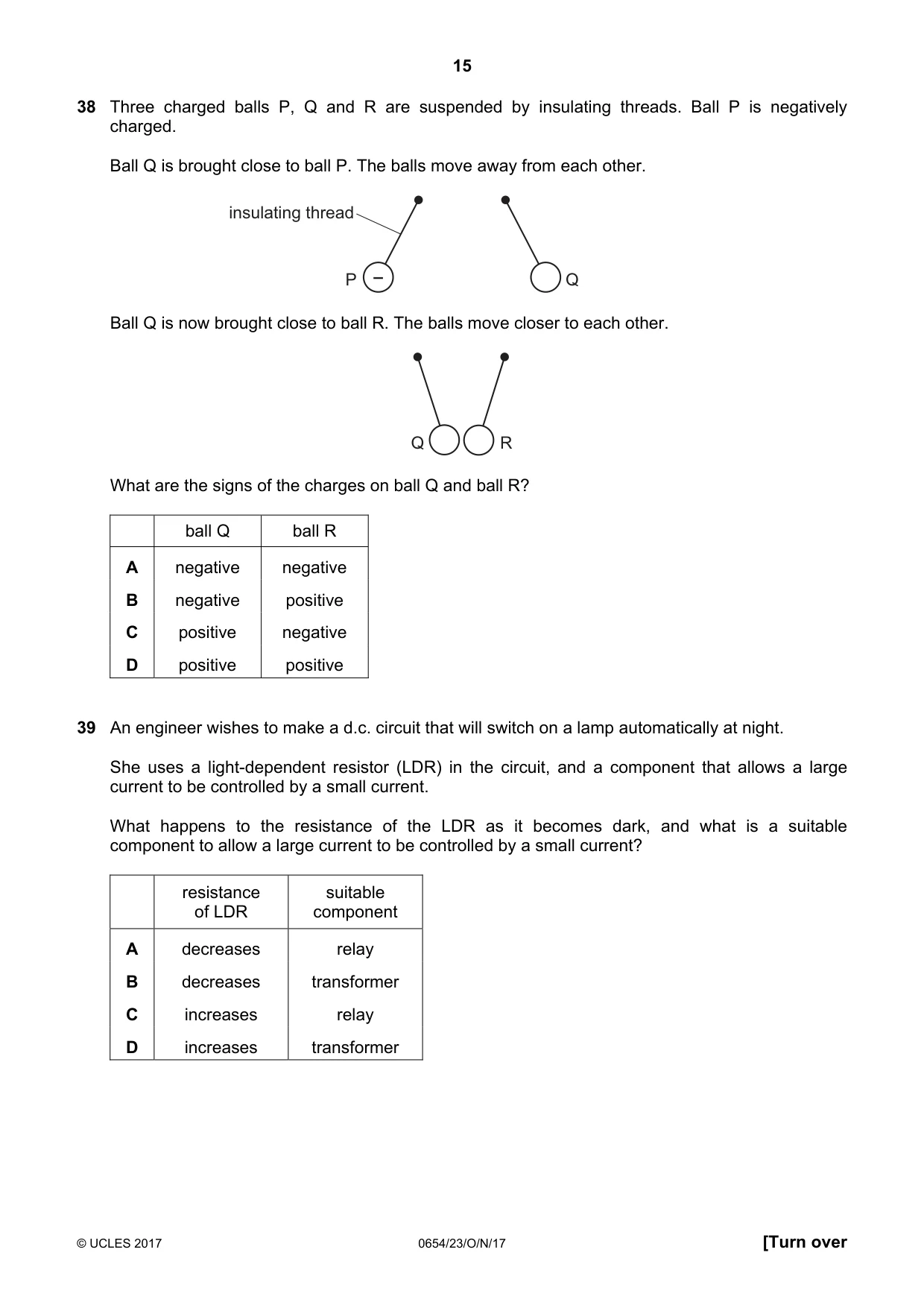
Q38 · Three charged balls P, Q and R are suspended by insulating threads
38 Three charged balls P, Q and R are suspended by insulating threads. Ball P is negatively charged. Ball Q is brought close to ball P. The balls move away from each other. insulating thread P – Q Ball Q is now brought close to ball R. The balls move closer to each other. Q R What are the signs of the charges on ball Q and ball R? ball Q ball R A negative negative B negative positive C positive negative D positive positive
Mark scheme: B
Q39 · An engineer wishes to make a d.c
39 An engineer wishes to make a d.c. circuit that will switch on a lamp automatically at night. She uses a light-dependent resistor (LDR) in the circuit, and a component that allows a large current to be controlled by a small current. What happens to the resistance of the LDR as it becomes dark, and what is a suitable component to allow a large current to be controlled by a small current? resistance suitable of LDR component A decreases relay B decreases transformer C increases relay D increases transformer
Mark scheme: C
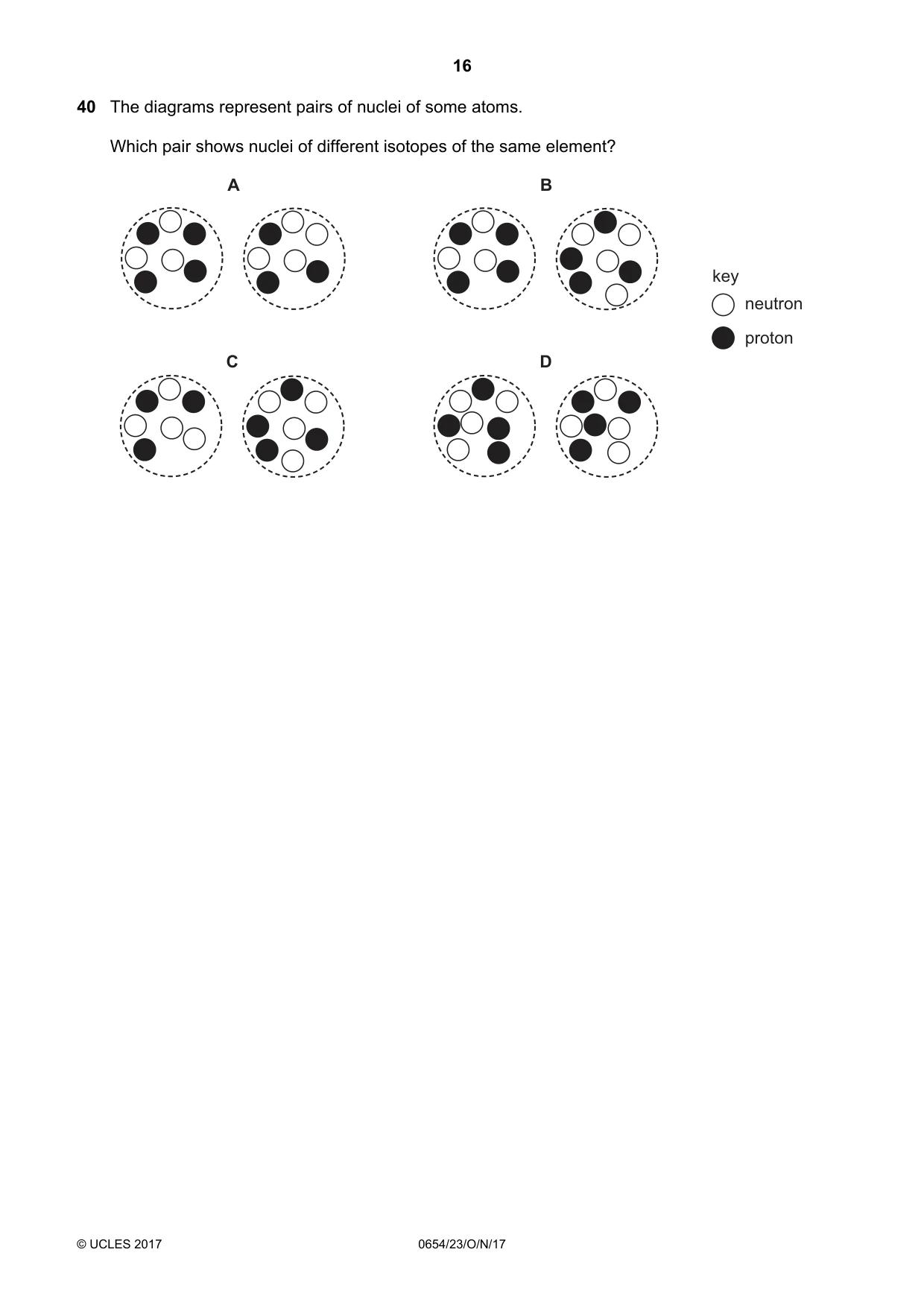
Q40 · The diagrams represent pairs of nuclei of some atoms
40 The diagrams represent pairs of nuclei of some atoms. Which pair shows nuclei of different isotopes of the same element? A B key neutron proton C D
Mark scheme: B
What was in this paper
The subtopics covered by these 40 questions, and how many questions each got. Open one in a new tab to see every Cambridge question on it.
2Homeostasis2Oxides2Alcohols1Arrangement of elements1Cell structure1Chromosomes and genes1Coordination and response1Corrosion of metals1Diet1Electrical circuits1Electrical quantities1Electromagnetic spectrum1Energy, work and power1Enzymes1Exothermic and endothermic reactions1Food chains and food webs1General properties of waves1Ions and ionic bonds1Isotopes1Kinetic particle model of matter1Light1Monohybrid inheritance1Motion1Naming organic compounds1Physical and chemical changes1Preparation of salts1Rate of reaction1Redox1Respiration1Sexual reproduction in humans1Sexual reproduction in plants1Simple phenomena of magnetism1Solids, liquids and gases1Sound1Thermal properties and temperature1Transfer of thermal energy1What you needed in this session
Cambridge’s own grade thresholds for 2017 Oct/Nov, Paper 2 · Variant 3. A higher threshold means an easier paper — the bar moves with how the cohort did.