Cambridge IGCSE Sciences - Co-ordinated (Double) 0654 — 2017 Oct/Nov Paper 2 · Variant 1
0654/21/O/N/17 · 40 questions · 40 marks · ≈45 min
The question paper and its mark scheme, free to read here and free to download. This is Cambridge’s own paper, exactly as it was sat.
Question paper16 pages
Mark scheme3 pages
Answers below. Sit the paper first if you are practising.
Questions as text
Question 1
1 What is homeostasis? A the maintenance of the body’s external environment B the maintenance of the body’s internal environment C the processes that produce heat in the body D the removal of wastes from the body
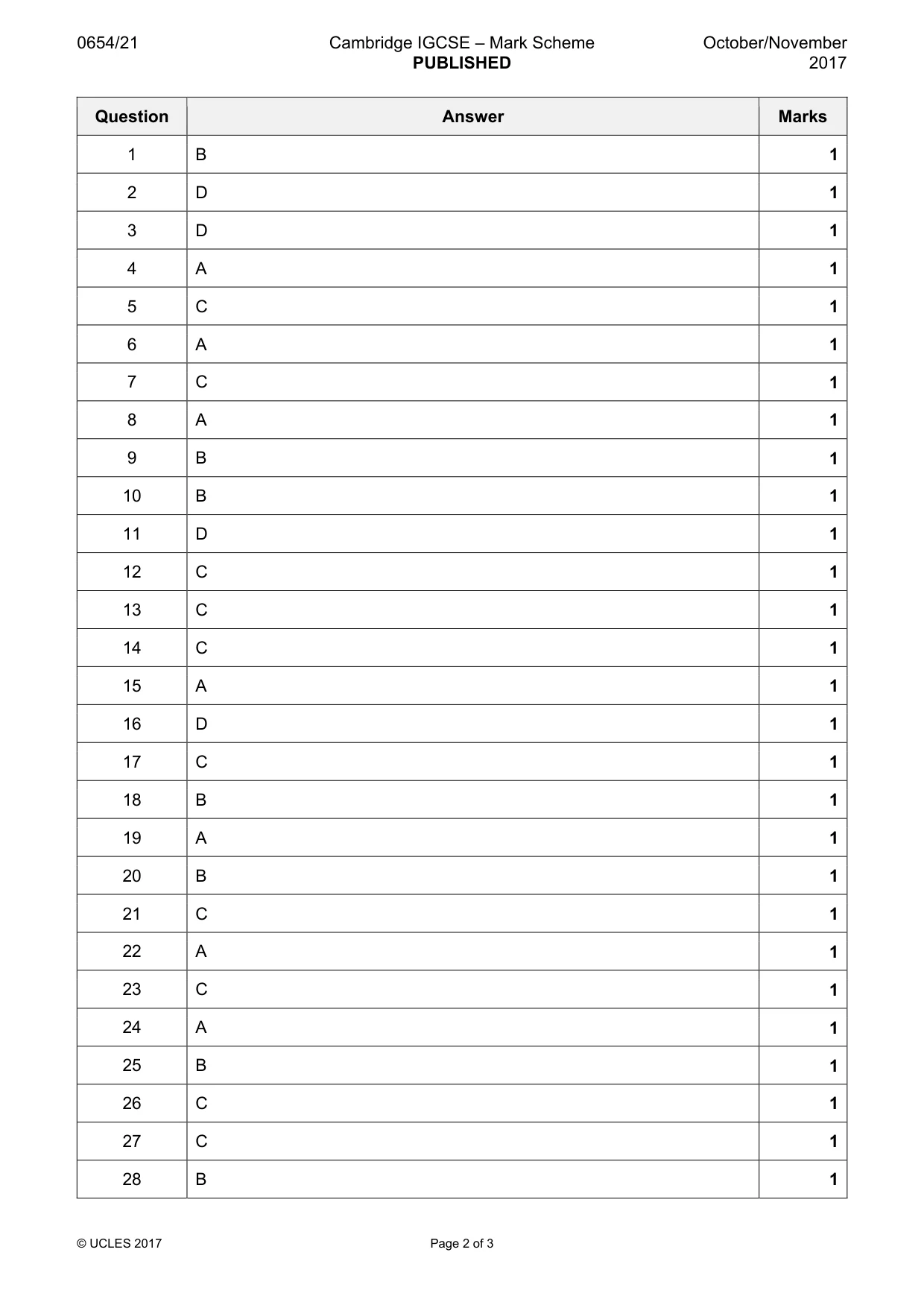
Mark scheme: B
Question 2
2 What is excretion? A breakdown of materials in kidney cells B chemical reactions in liver cells C removal of undigested food from the gut D removal of waste products
Mark scheme: D
Q3 · What could deforestation cause?
3 What could deforestation cause? A a decrease in carbon dioxide levels and a decrease in flooding B a decrease in carbon dioxide levels and an increase in flooding C an increase in carbon dioxide levels and a decrease in flooding D an increase in carbon dioxide levels and an increase in flooding
Mark scheme: D
Q4 · Which statements about X chromosomes in humans are correct?
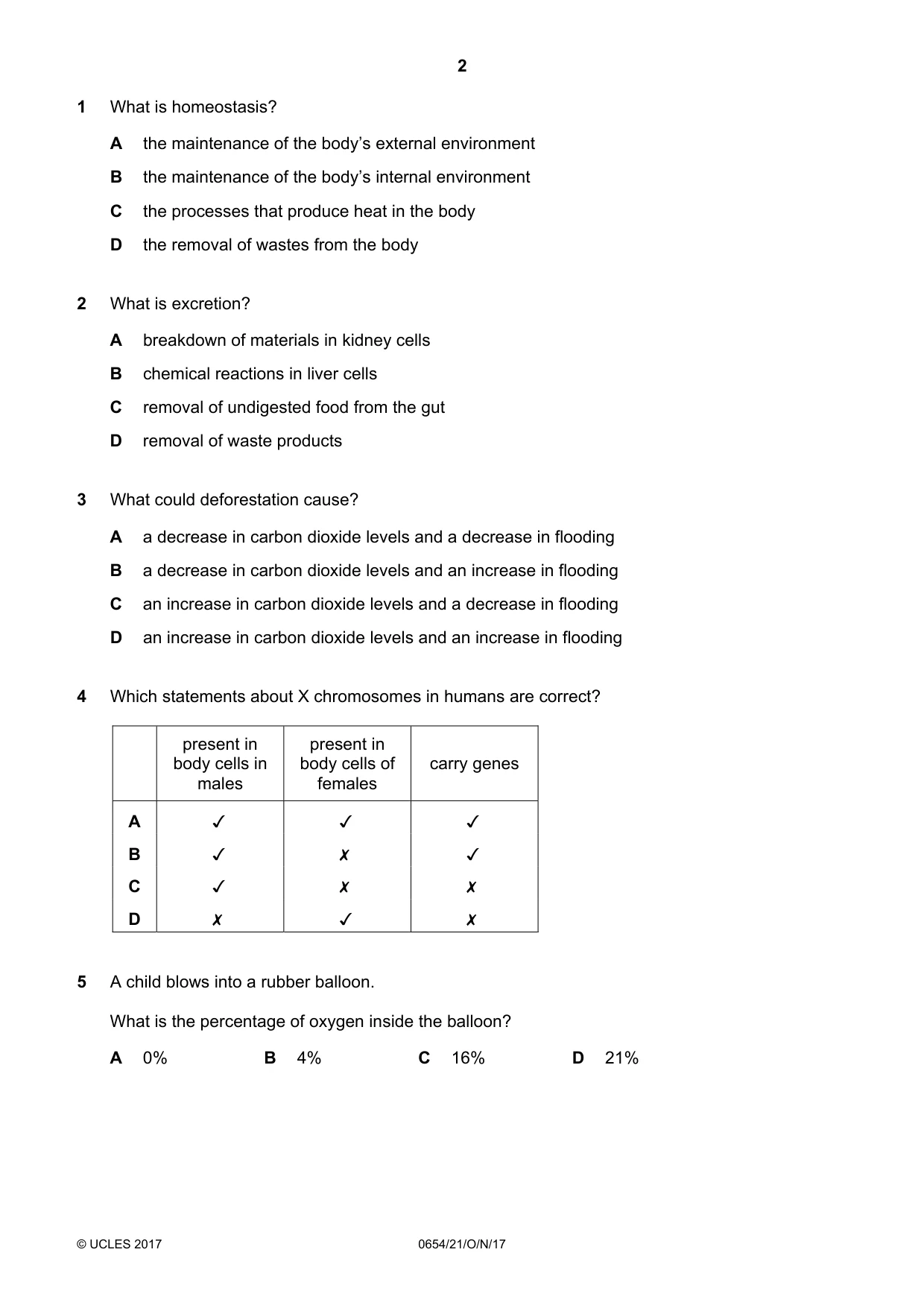
4 Which statements about X chromosomes in humans are correct? present in present in body cells in body cells of carry genes males females A v v v B v x v Cc J x x D x v x
Mark scheme: A
Q5 · A child blows into a rubber balloon
5 A child blows into a rubber balloon. What is the percentage of oxygen inside the balloon? A 0% B 4% C 16% D 21%
Mark scheme: C
Q6 · The maternal blood leaving the placenta is different in composition from that arriving
6 The maternal blood leaving the placenta is different in composition from that arriving. What are those differences? carbon oxygen glucose dioxide A less more less B less more same C more less more D more less same
Mark scheme: A
Q7 · When a suspension of powdered milk is completely digested by a protease enzyme it becomes…
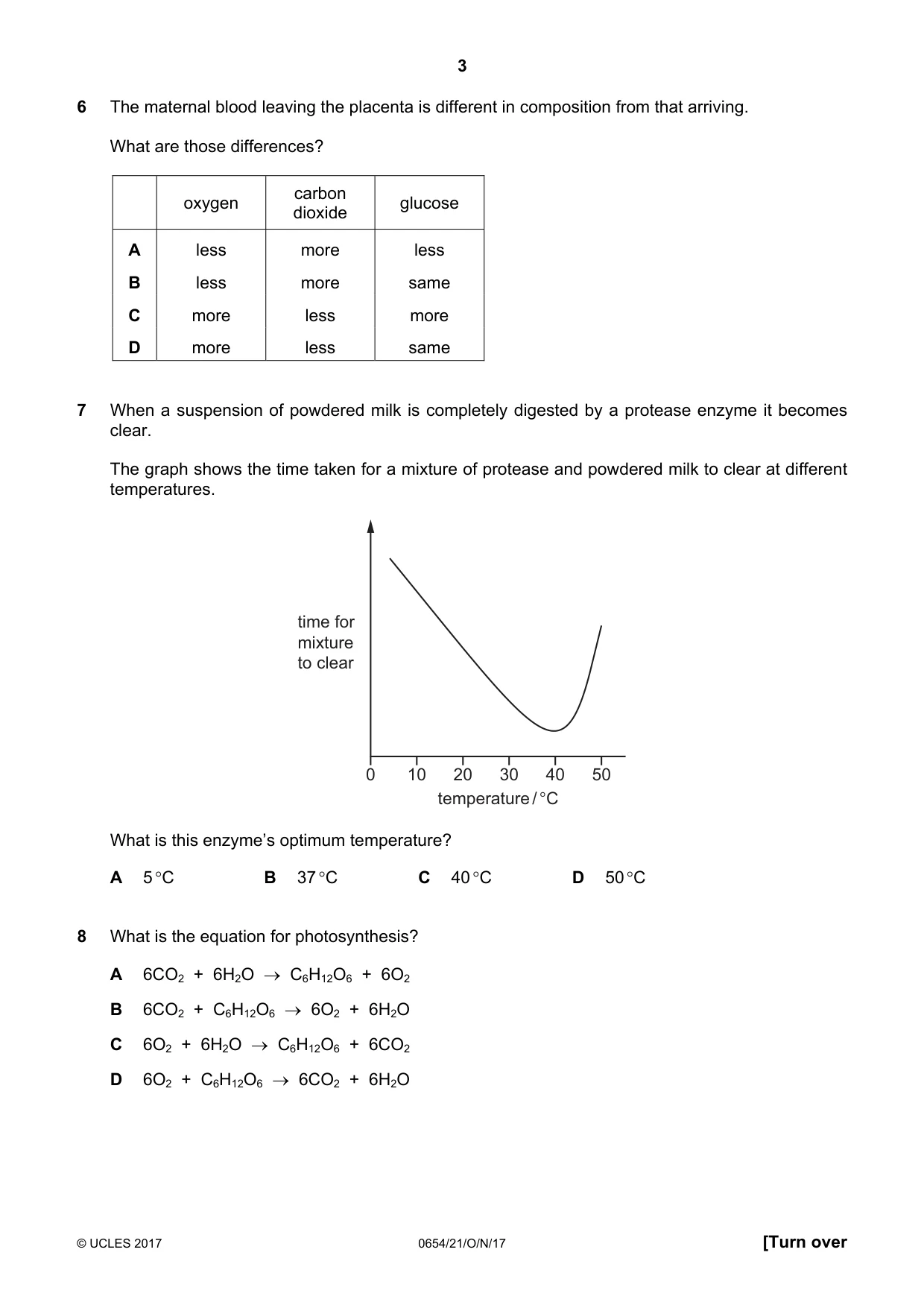
7 When a suspension of powdered milk is completely digested by a protease enzyme it becomes clear. The graph shows the time taken for a mixture of protease and powdered milk to clear at different temperatures. time for mixture to clear 0 10 20 30 40 50 temperature / °C What is this enzyme’s optimum temperature? A 5 °C B 37 °C C 40 °C D 50 °C
Mark scheme: C
Q8 · What is the equation for photosynthesis?
8 What is the equation for photosynthesis? A 6CO2 + 6H2O → C6H12O6 + 6O2 B 6CO2 + C6H12O6 → 6O2 + 6H2O C 6O2 + 6H2O → C6H12O6 + 6CO2 D 6O2 + C6H12O6 → 6CO2 + 6H2O
Mark scheme: A
Q9 · The diagram shows a section through a villus
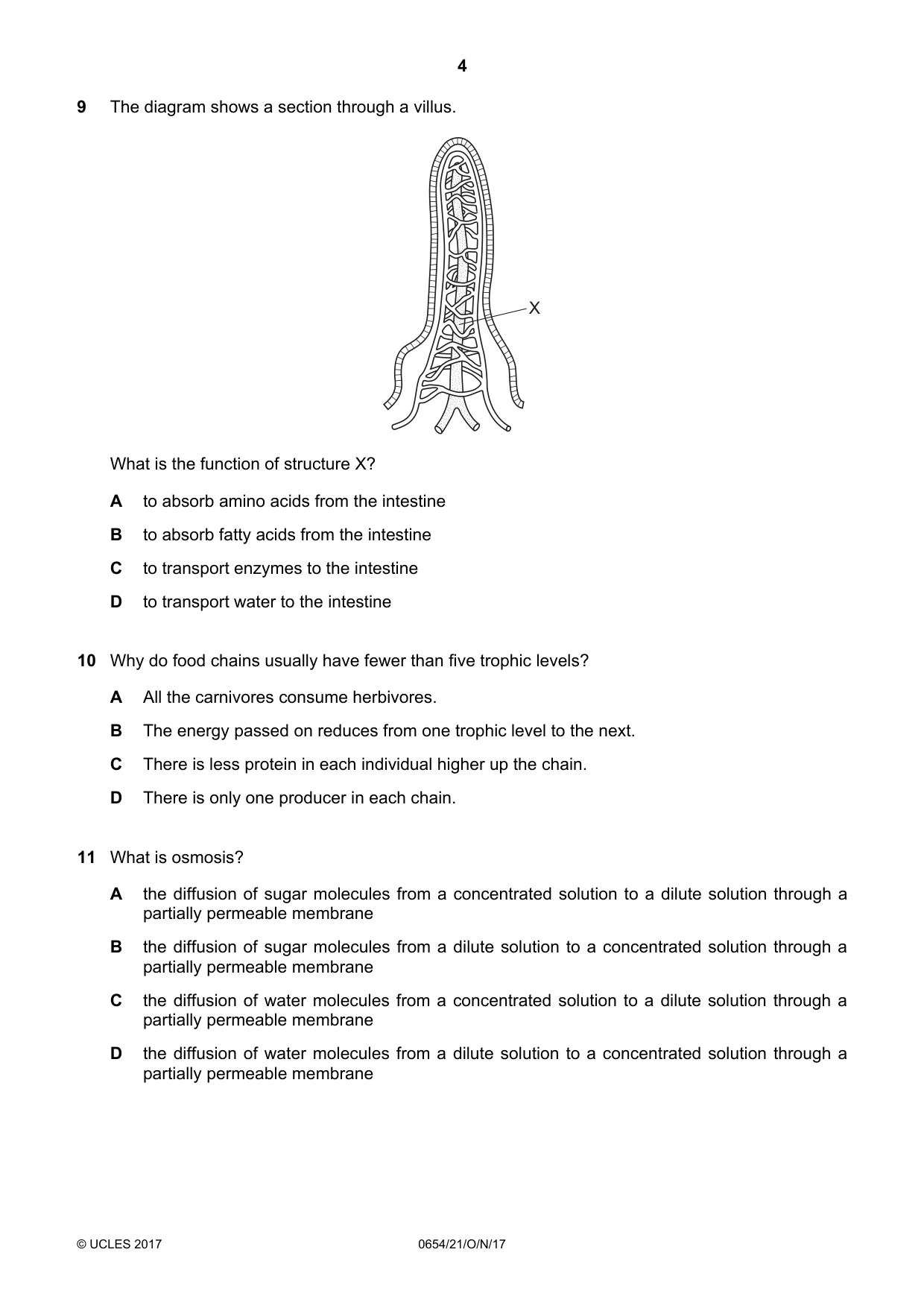
9 The diagram shows a section through a villus. X What is the function of structure X? A to absorb amino acids from the intestine B to absorb fatty acids from the intestine C to transport enzymes to the intestine D to transport water to the intestine
Mark scheme: B
Q10 · Why do food chains usually have fewer than five trophic levels?
10 Why do food chains usually have fewer than five trophic levels? A All the carnivores consume herbivores. B The energy passed on reduces from one trophic level to the next. C There is less protein in each individual higher up the chain. D There is only one producer in each chain.
Mark scheme: B
Question 11
11 What is osmosis? A the diffusion of sugar molecules from a concentrated solution to a dilute solution through a partially permeable membrane B the diffusion of sugar molecules from a dilute solution to a concentrated solution through a partially permeable membrane C the diffusion of water molecules from a concentrated solution to a dilute solution through a partially permeable membrane D the diffusion of water molecules from a dilute solution to a concentrated solution through a partially permeable membrane
Mark scheme: D
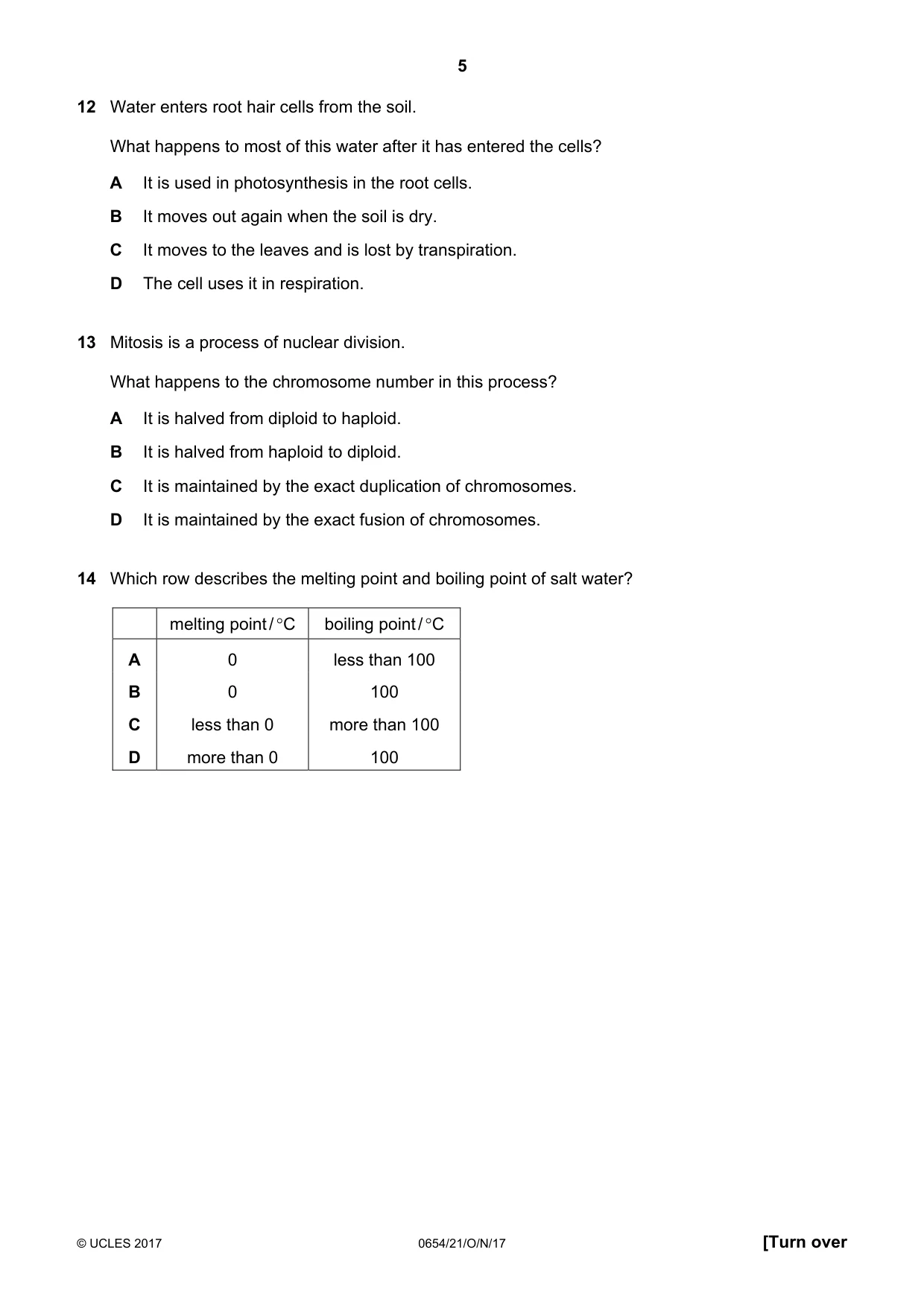
Q12 · Water enters root hair cells from the soil
12 Water enters root hair cells from the soil. What happens to most of this water after it has entered the cells? A It is used in photosynthesis in the root cells. B It moves out again when the soil is dry. C It moves to the leaves and is lost by transpiration. D The cell uses it in respiration.
Mark scheme: C
Q13 · Mitosis is a process of nuclear division
13 Mitosis is a process of nuclear division. What happens to the chromosome number in this process? A It is halved from diploid to haploid. B It is halved from haploid to diploid. C It is maintained by the exact duplication of chromosomes. D It is maintained by the exact fusion of chromosomes.
Mark scheme: C
Q14 · Which row describes the melting point and boiling point of salt water?
14 Which row describes the melting point and boiling point of salt water? melting point / °C boiling point / °C A 0 less than 100 B 0 100 C less than 0 more than 100 D more than 0 100
Mark scheme: C
Q15 · A student completes four experiments
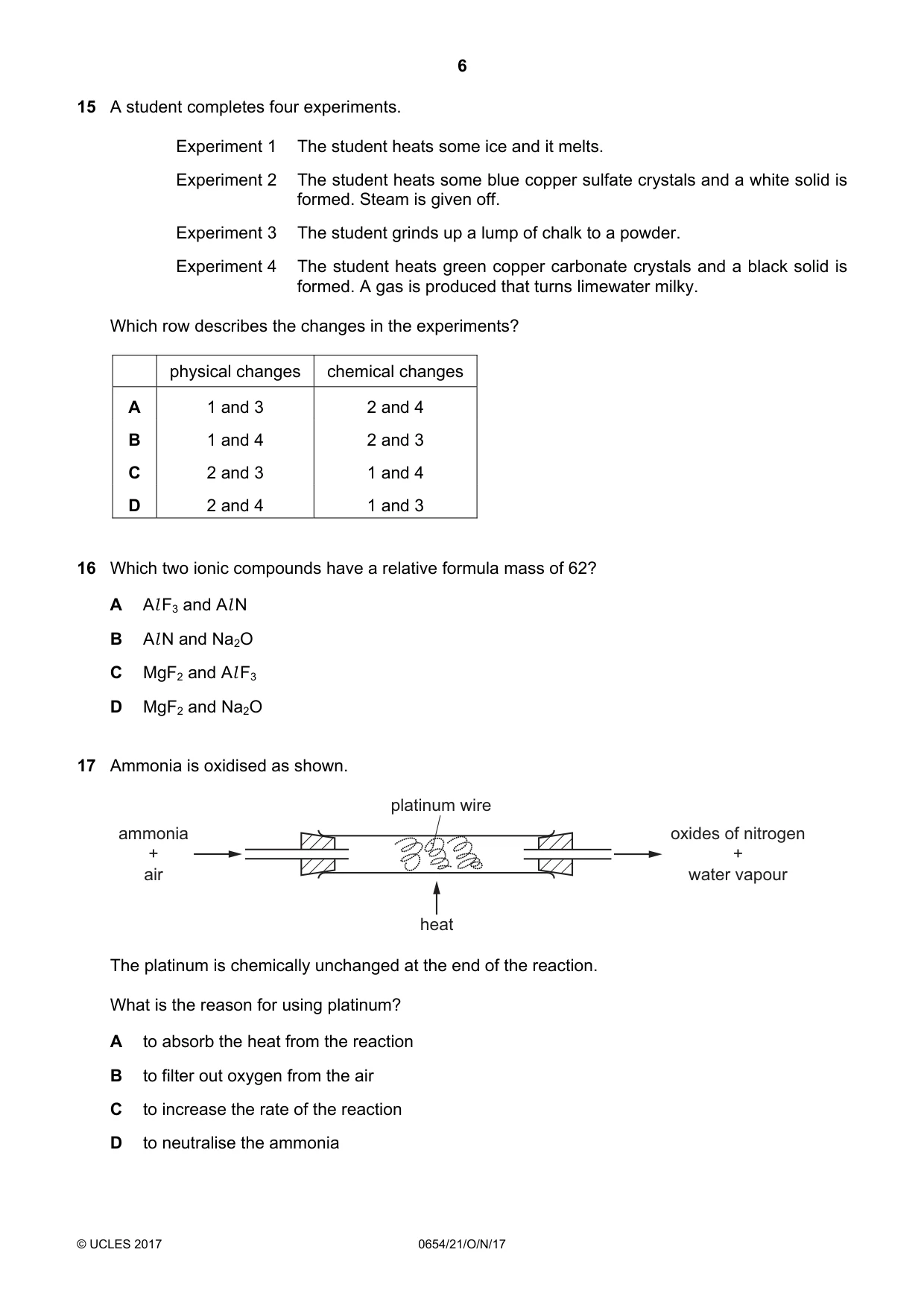
15 A student completes four experiments. Experiment 1 The student heats some ice and it melts. Experiment 2 The student heats some blue copper sulfate crystals and a white solid is formed. Steam is given off. Experiment 3 The student grinds up a lump of chalk to a powder. Experiment 4 The student heats green copper carbonate crystals and a black solid is formed. A gas is produced that turns limewater milky. Which row describes the changes in the experiments? physical changes chemical changes A 1 and 3 2 and 4 B 1 and 4 2 and 3 C 2 and 3 1 and 4 D 2 and 4 1 and 3
Mark scheme: A
Q16 · Which two ionic compounds have a relative formula mass of 62?
16 Which two ionic compounds have a relative formula mass of 62? A Al F3 and Al N B Al N and Na2O C MgF2 and Al F3 D MgF2 and Na2O
Mark scheme: D
Q17 · Ammonia is oxidised as shown
17 Ammonia is oxidised as shown. platinum wire ammonia oxides of nitrogen + + air water vapour heat The platinum is chemically unchanged at the end of the reaction. What is the reason for using platinum? A to absorb the heat from the reaction B to filter out oxygen from the air C to increase the rate of the reaction D to neutralise the ammonia
Mark scheme: C
Q18 · Which changes take place at the electrodes during electrolysis?
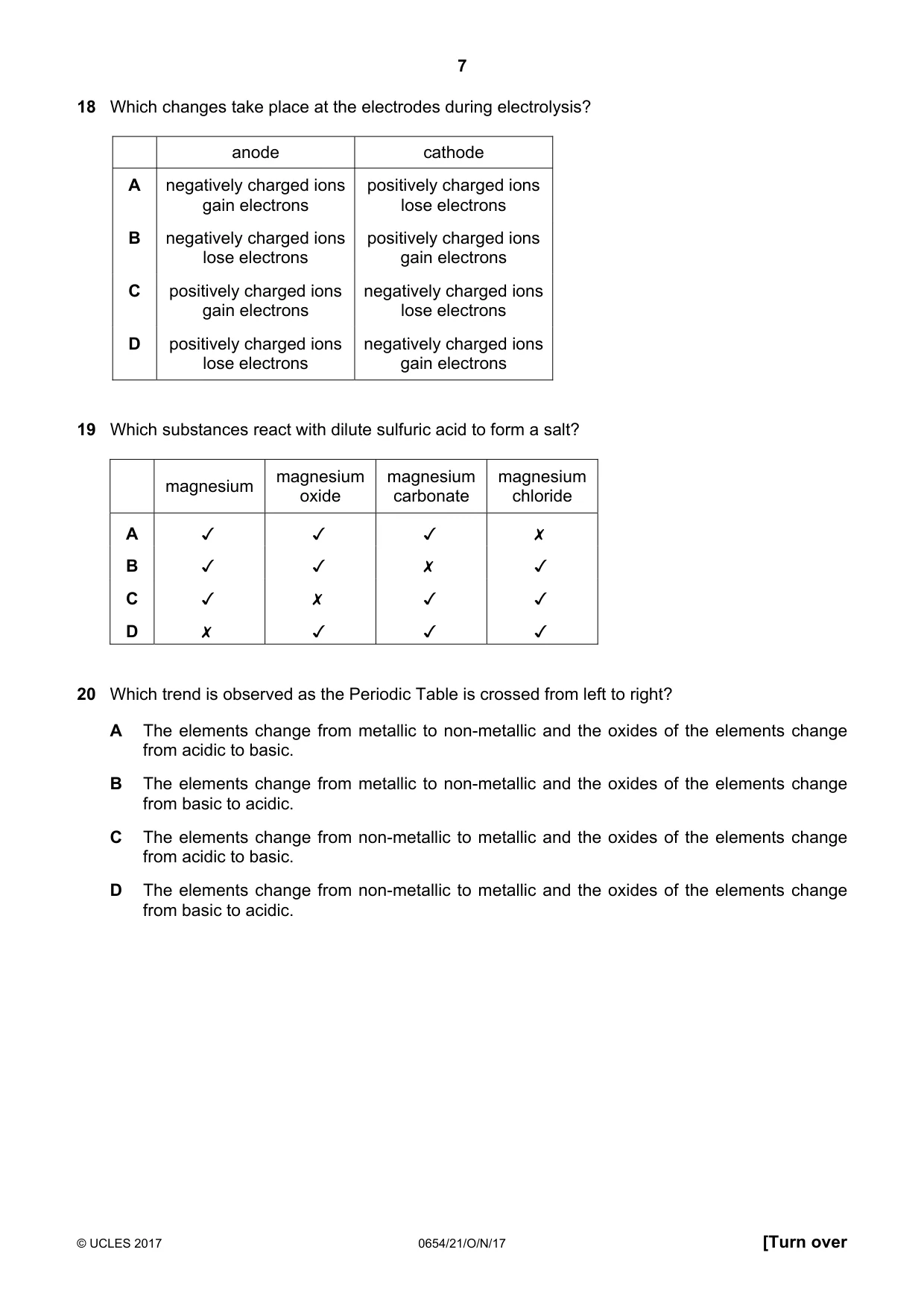
18 Which changes take place at the electrodes during electrolysis? anode cathode A negatively charged ions positively charged ions gain electrons lose electrons B negatively charged ions positively charged ions lose electrons gain electrons C positively charged ions negatively charged ions gain electrons lose electrons D positively charged ions negatively charged ions lose electrons gain electrons
Mark scheme: B
Q19 · Which substances react with dilute sulfuric acid to form a salt?
19 Which substances react with dilute sulfuric acid to form a salt? magnesium magnesium oxide magnesium carbonate magnesium chloride
Mark scheme: A
Q20 · Which trend is observed as the Periodic Table is crossed from left to right?
20 Which trend is observed as the Periodic Table is crossed from left to right? A The elements change from metallic to non-metallic and the oxides of the elements change from acidic to basic. B The elements change from metallic to non-metallic and the oxides of the elements change from basic to acidic. C The elements change from non-metallic to metallic and the oxides of the elements change from acidic to basic. D The elements change from non-metallic to metallic and the oxides of the elements change from basic to acidic.
Mark scheme: B
Q21 · Rubidium is below potassium in Group I of the Periodic Table
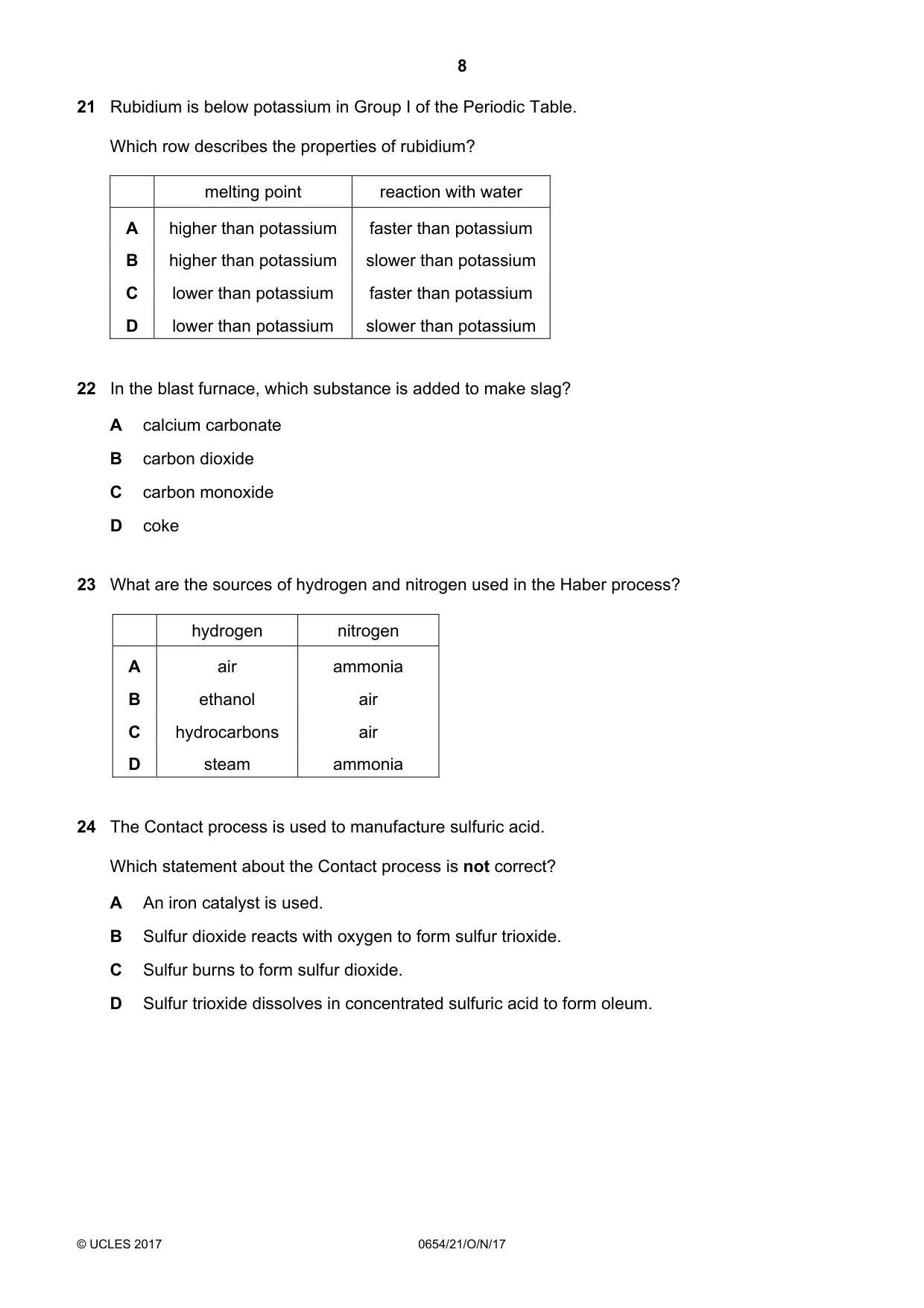
21 Rubidium is below potassium in Group I of the Periodic Table. Which row describes the properties of rubidium? melting point reaction with water A higher than potassium faster than potassium B higher than potassium slower than potassium C lower than potassium faster than potassium D lower than potassium slower than potassium
Mark scheme: C
Q22 · In the blast furnace, which substance is added to make slag?
22 In the blast furnace, which substance is added to make slag? A calcium carbonate B carbon dioxide C carbon monoxide D coke
Mark scheme: A
Q23 · What are the sources of hydrogen and nitrogen used in the Haber process?
23 What are the sources of hydrogen and nitrogen used in the Haber process? hydrogen nitrogen A air ammonia B ethanol air C hydrocarbons air D steam ammonia
Mark scheme: C
Q24 · The Contact process is used to manufacture sulfuric acid
24 The Contact process is used to manufacture sulfuric acid. Which statement about the Contact process is not correct? A An iron catalyst is used. B Sulfur dioxide reacts with oxygen to form sulfur trioxide. C Sulfur burns to form sulfur dioxide. D Sulfur trioxide dissolves in concentrated sulfuric acid to form oleum.
Mark scheme: A
Q25 · Which word equation describes the manufacture of lime from limestone?
25 Which word equation describes the manufacture of lime from limestone? A calcium carbonate → calcium hydroxide + carbon dioxide B calcium carbonate → calcium oxide + carbon dioxide C calcium hydroxide → calcium oxide + water D calcium oxide + carbon dioxide → calcium carbonate
Mark scheme: B
Q26 · What are the products of the complete combustion of ethanol?
26 What are the products of the complete combustion of ethanol? A carbon dioxide + carbon monoxide + water B carbon dioxide + hydrogen C carbon dioxide + water D carbon monoxide + water
Mark scheme: C
Q27 · The structure of a hydrocarbon is shown
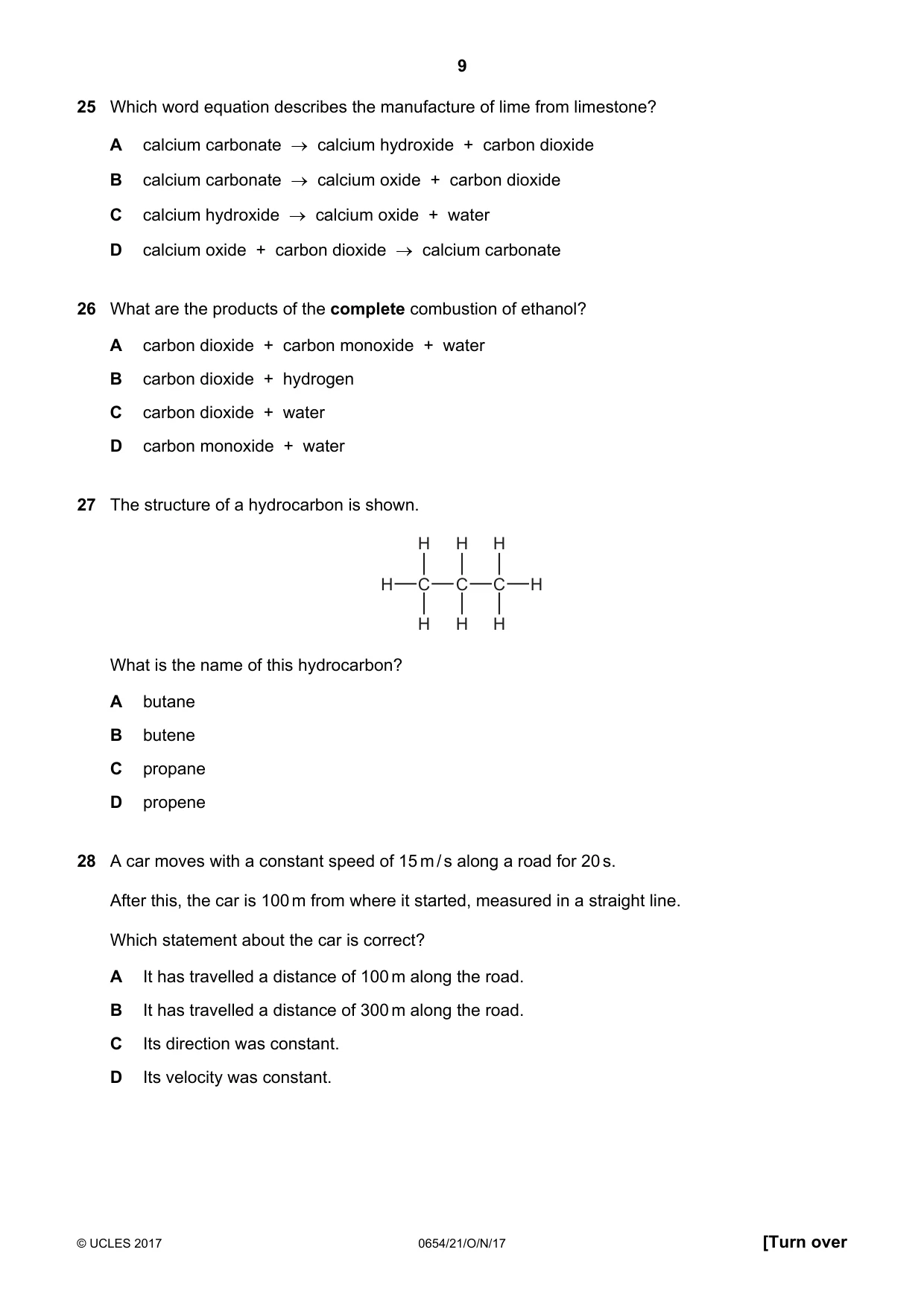
27 The structure of a hydrocarbon is shown. H H H H C C C H H H H What is the name of this hydrocarbon? A butane B butene C propane D propene
Mark scheme: C
Q28 · A car moves with a constant speed of 15 m / s along a road for 20 s
28 A car moves with a constant speed of 15 m / s along a road for 20 s. After this, the car is 100 m from where it started, measured in a straight line. Which statement about the car is correct? A It has travelled a distance of 100 m along the road. B It has travelled a distance of 300 m along the road. C Its direction was constant. D Its velocity was constant.
Mark scheme: B
Q29 · An astronaut travels from Earth to the Moon
29 An astronaut travels from Earth to the Moon. The gravitational field strength on the Moon is less than that on Earth. How do the mass and weight of the astronaut on the Moon compare with his mass and weight on Earth? mass weight A less than on Earth less than on Earth B less than on Earth the same as on Earth C the same as on Earth less than on Earth D the same as on Earth the same as on Earth
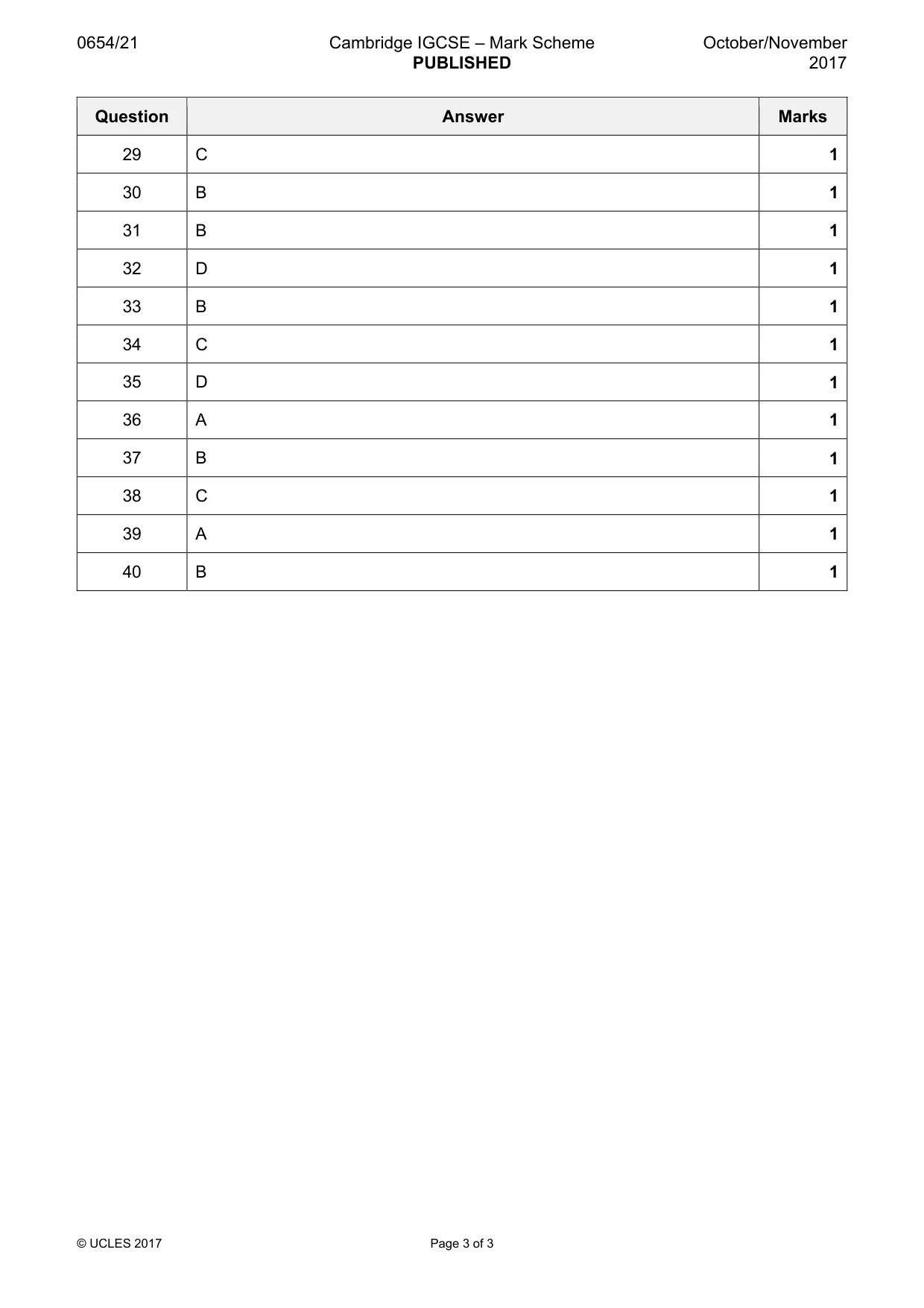
Mark scheme: C
Q30 · A load is applied to a copper wire
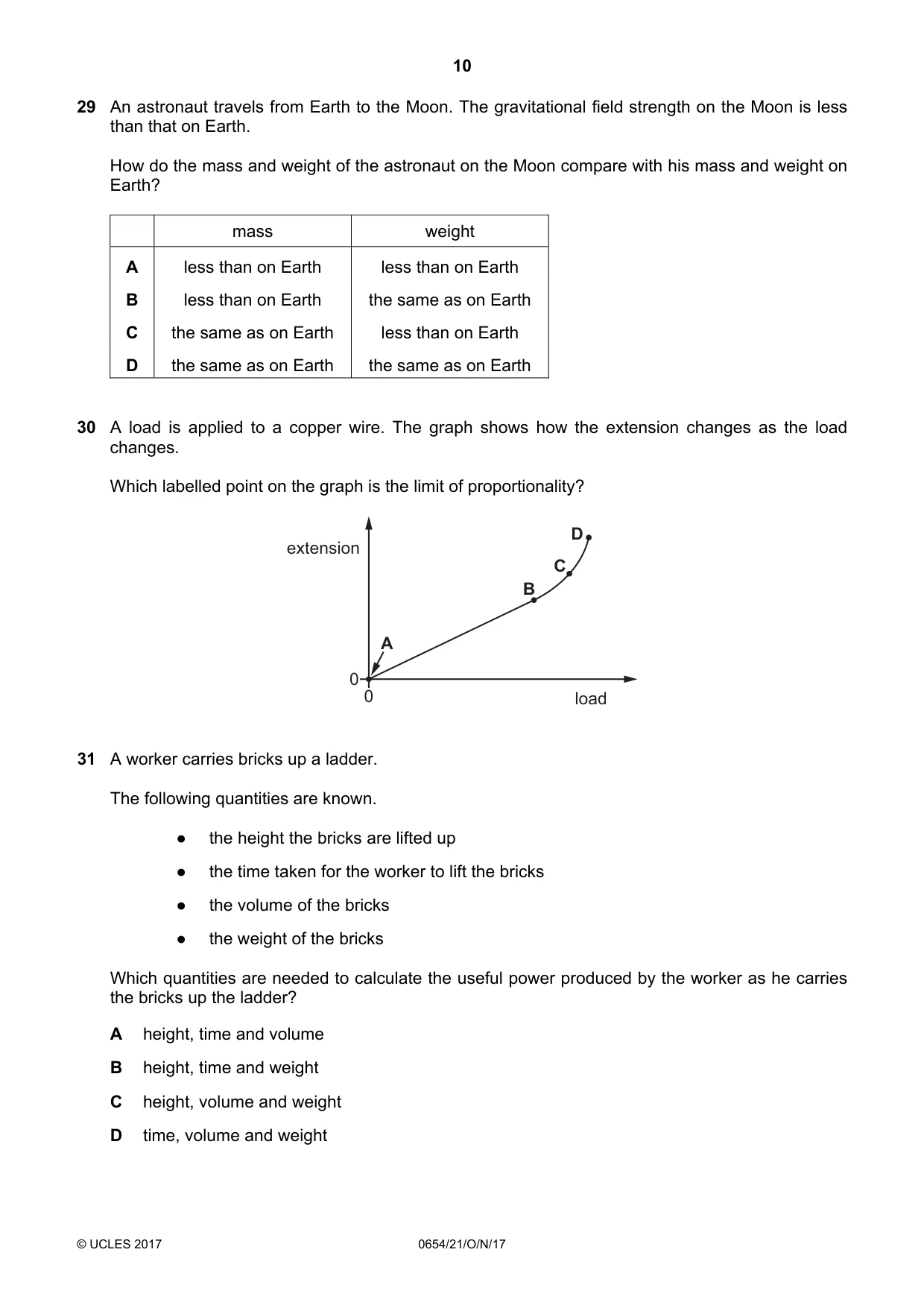
30 A load is applied to a copper wire. The graph shows how the extension changes as the load changes. Which labelled point on the graph is the limit of proportionality? D extension C B A 0 0 load
Mark scheme: B
Q31 · A worker carries bricks up a ladder
31 A worker carries bricks up a ladder. The following quantities are known. ● the height the bricks are lifted up ● the time taken for the worker to lift the bricks ● the volume of the bricks ● the weight of the bricks Which quantities are needed to calculate the useful power produced by the worker as he carries the bricks up the ladder? A height, time and volume B height, time and weight C height, volume and weight D time, volume and weight
Mark scheme: B
Q32 · Thermal energy is supplied to four different blocks
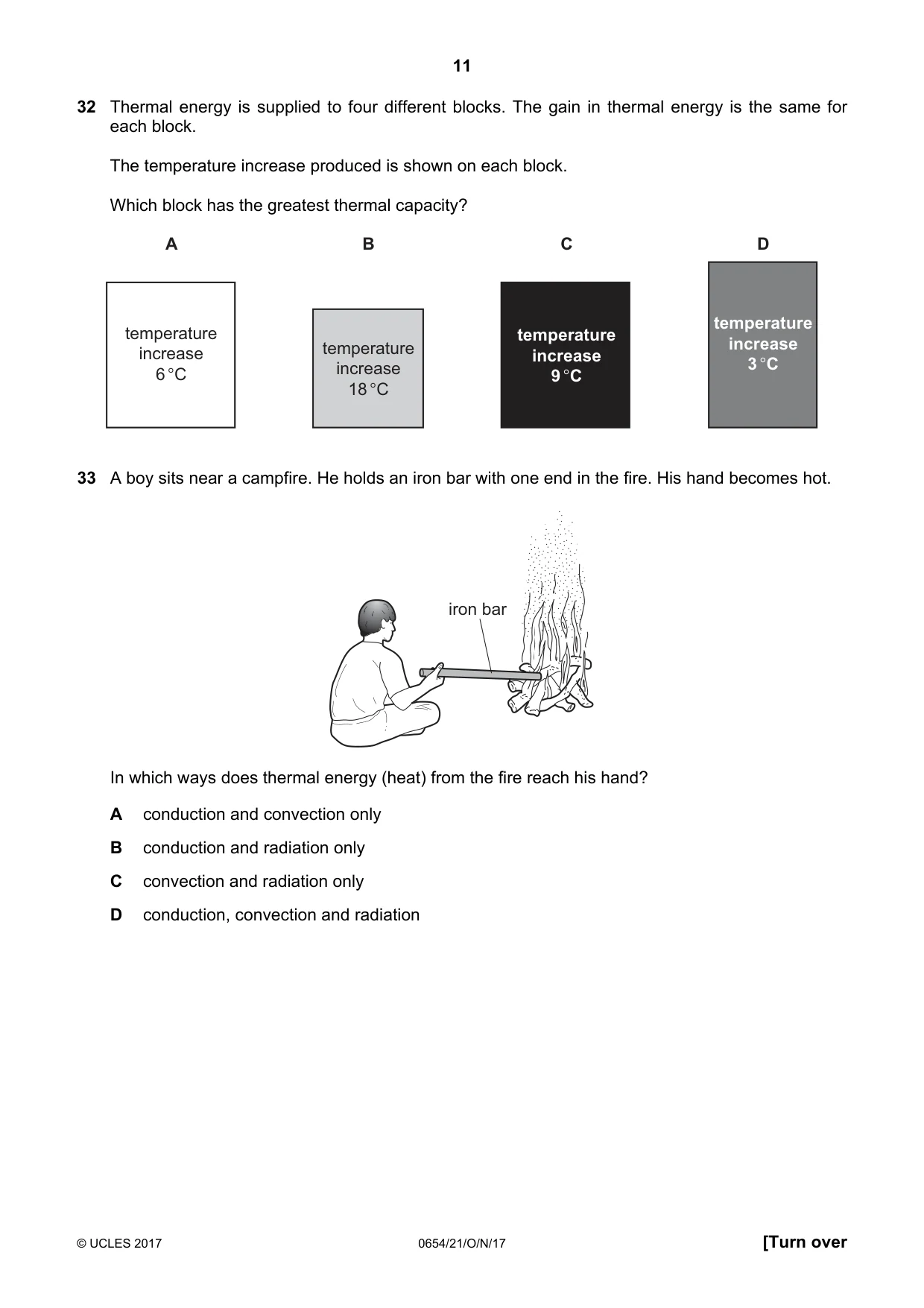
32 Thermal energy is supplied to four different blocks. The gain in thermal energy is the same for each block. The temperature increase produced is shown on each block. Which block has the greatest thermal capacity? A B C D temperature temperature temperature increase increase temperature increase 3 °C 6 °C increase 9 °C 18 °C
Mark scheme: D
Q33 · A boy sits near a campfire
33 A boy sits near a campfire. He holds an iron bar with one end in the fire. His hand becomes hot. iron bar In which ways does thermal energy (heat) from the fire reach his hand? A conduction and convection only B conduction and radiation only C convection and radiation only D conduction, convection and radiation
Mark scheme: B
Q34 · The diagram represents a wave
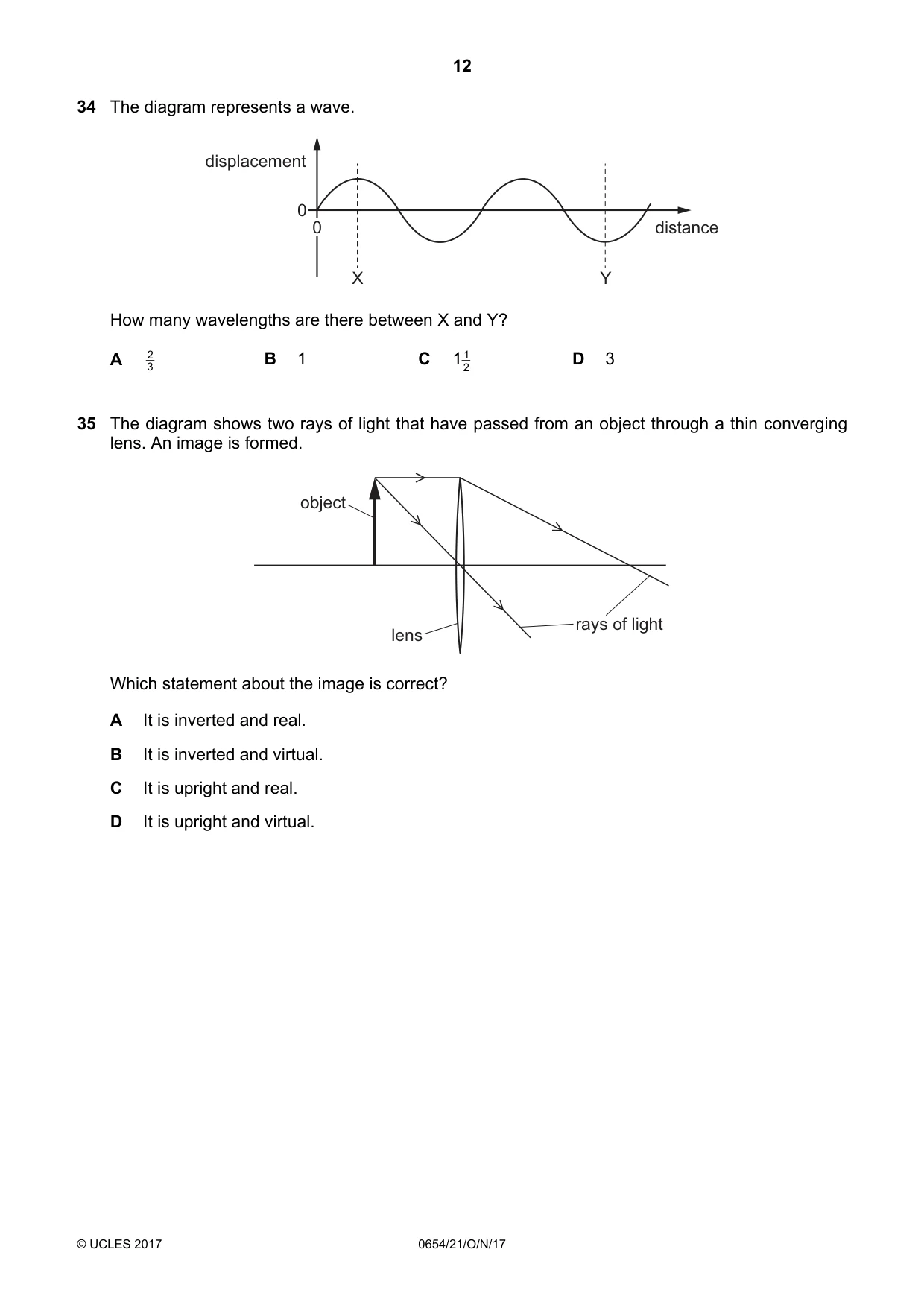
34 The diagram represents a wave. displacement 0 0 distance X Y How many wavelengths are there between X and Y? A 2 B 1 C 1 1 D 3 3 2
Mark scheme: C
Q35 · The diagram shows two rays of light that have passed from an object through a thin…
35 The diagram shows two rays of light that have passed from an object through a thin converging lens. An image is formed. object rays of light lens Which statement about the image is correct? A It is inverted and real. B It is inverted and virtual. C It is upright and real. D It is upright and virtual.
Mark scheme: D
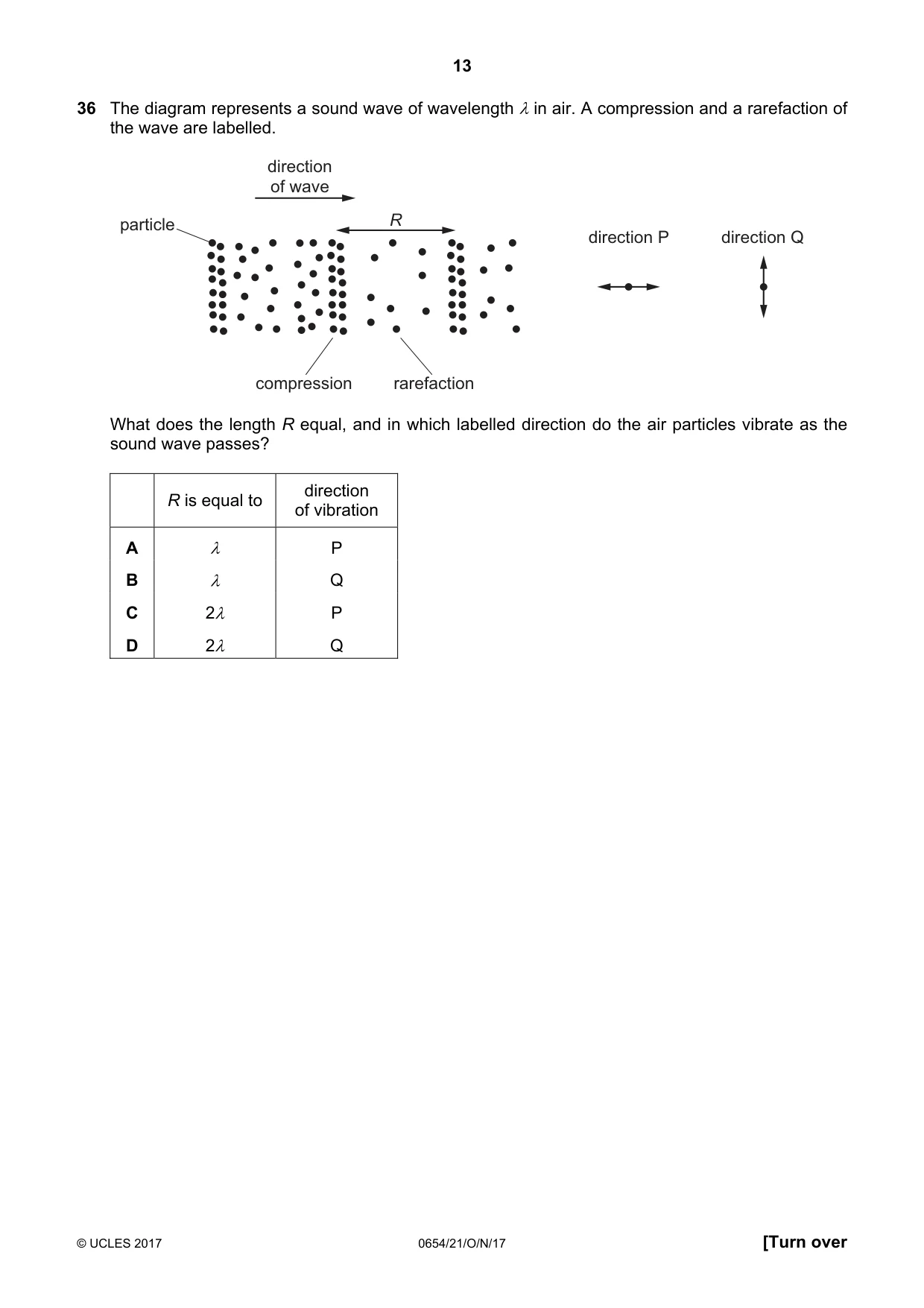
Q36 · The diagram represents a sound wave of wavelength λ in air
36 The diagram represents a sound wave of wavelength λ in air. A compression and a rarefaction of the wave are labelled. direction of wave particle R direction P direction Q compression rarefaction What does the length R equal, and in which labelled direction do the air particles vibrate as the sound wave passes? direction R is equal to of vibration A λ P B λ Q C 2λ P D 2λ Q
Mark scheme: A
Q37 · Three charged balls P, Q and R are suspended by insulating threads
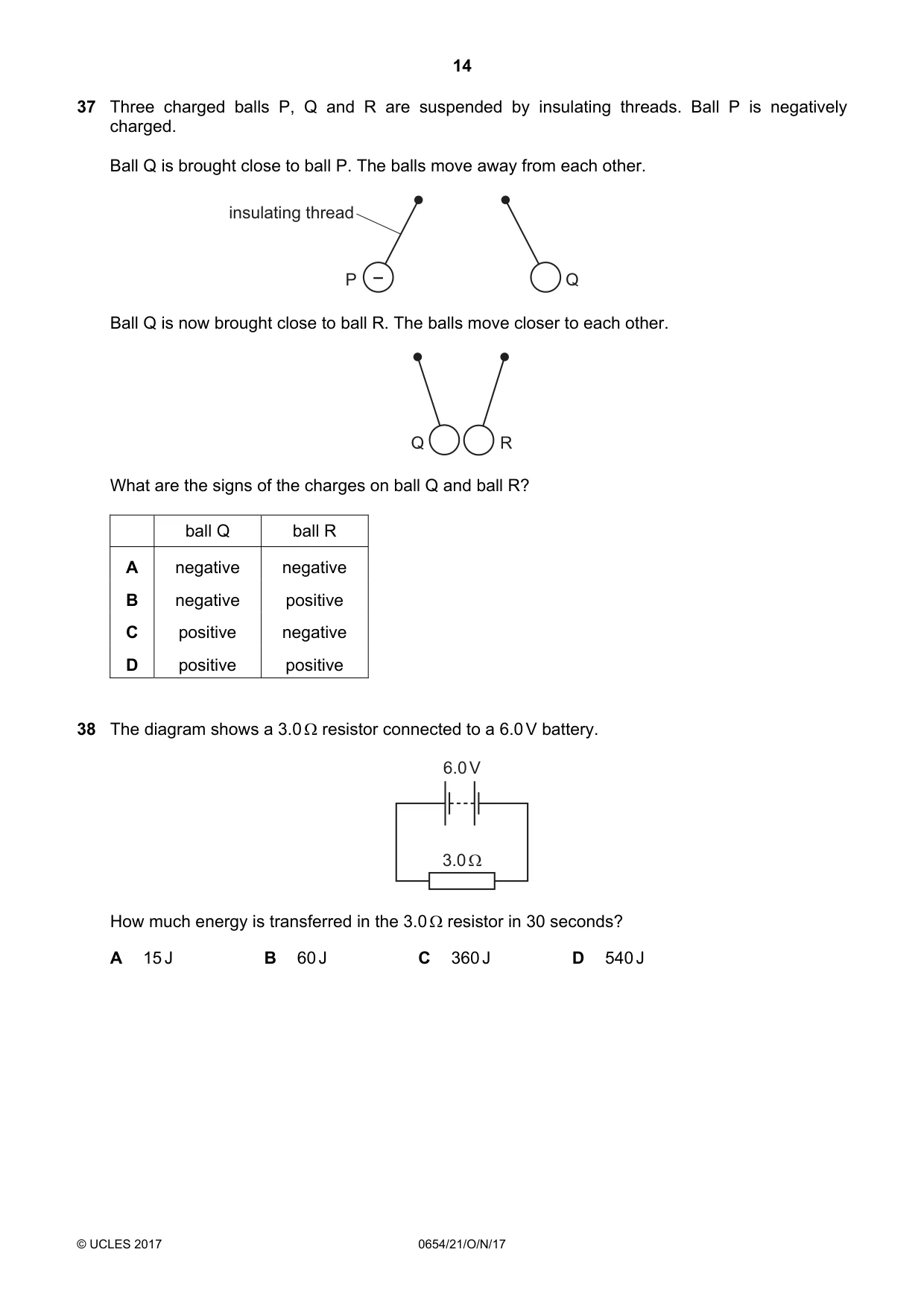
37 Three charged balls P, Q and R are suspended by insulating threads. Ball P is negatively charged. Ball Q is brought close to ball P. The balls move away from each other. insulating thread P – Q Ball Q is now brought close to ball R. The balls move closer to each other. Q R What are the signs of the charges on ball Q and ball R? ball Q ball R A negative negative B negative positive C positive negative D positive positive
Mark scheme: B
Q38 · The diagram shows a 3.0 Ω resistor connected to a 6.0 V battery
38 The diagram shows a 3.0 Ω resistor connected to a 6.0 V battery. 6.0 V 3.0 Ω How much energy is transferred in the 3.0 Ω resistor in 30 seconds? A 15 J B 60 J C 360 J D 540 J
Mark scheme: C
Q39 · The circuit in the diagram contains three resistors
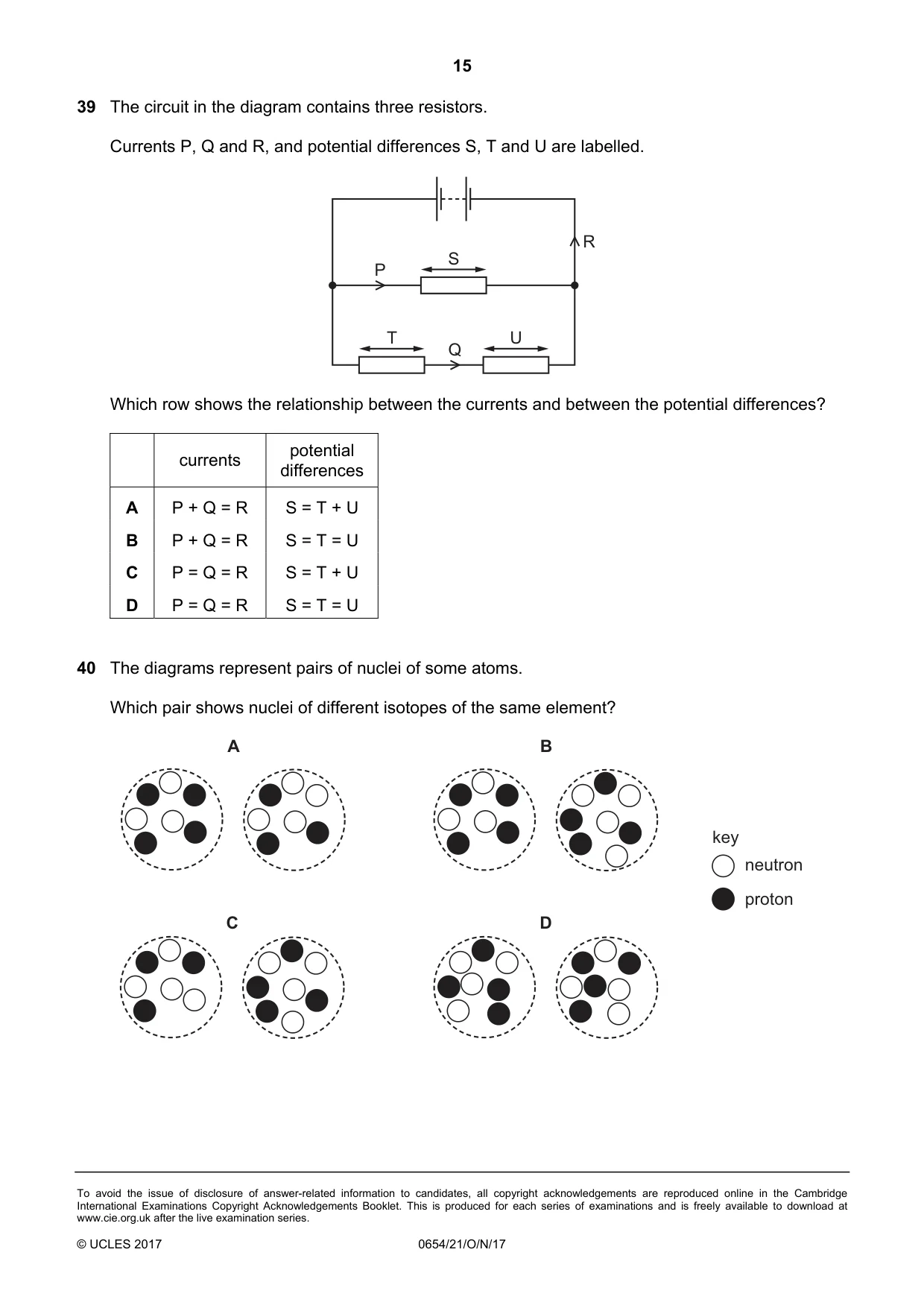
39 The circuit in the diagram contains three resistors. Currents P, Q and R, and potential differences S, T and U are labelled. R S P T U Q Which row shows the relationship between the currents and between the potential differences? potential currents differences A P + Q = R S = T + U B P + Q = R S = T = U C P = Q = R S = T + U D P = Q = R S = T = U
Mark scheme: A
Q40 · The diagrams represent pairs of nuclei of some atoms
40 The diagrams represent pairs of nuclei of some atoms. Which pair shows nuclei of different isotopes of the same element? A B key neutron proton C D
Mark scheme: B
What was in this paper
The subtopics covered by these 40 questions, and how many questions each got. Open one in a new tab to see every Cambridge question on it.
2Rate of reaction2Air quality and climate1Alcohols1Alkanes1Arrangement of elements1Cell division1Chromosomes and genes1Digestion1Electrical circuits1Electrical quantities1Electrolysis1Energy flow1Energy, work and power1Enzymes1Extraction of metals1Forces1Gas exchange in humans1General properties of waves1Group I properties1Habitat destruction1Isotopes1Light1Mass and weight1Motion1Osmosis1Oxides1Photosynthesis1Physical and chemical changes1Preparation of salts1Relative masses of atoms and molecules1Sexual reproduction in humans1Simple phenomena of magnetism1Solids, liquids and gases1Sound1Thermal properties and temperature1Transfer of thermal energy1Transpiration1What you needed in this session
Cambridge’s own grade thresholds for 2017 Oct/Nov, Paper 2 · Variant 1. A higher threshold means an easier paper — the bar moves with how the cohort did.