Cambridge IGCSE Sciences - Co-ordinated (Double) 0654 — 2025 May/June Paper 2 · Variant 2
0654/22/M/J/25 · 40 questions · 40 marks · 45 min
The question paper and its mark scheme, free to read here and free to download. This is Cambridge’s own paper, exactly as it was sat.
Question paper16 pages

Mark scheme3 pages
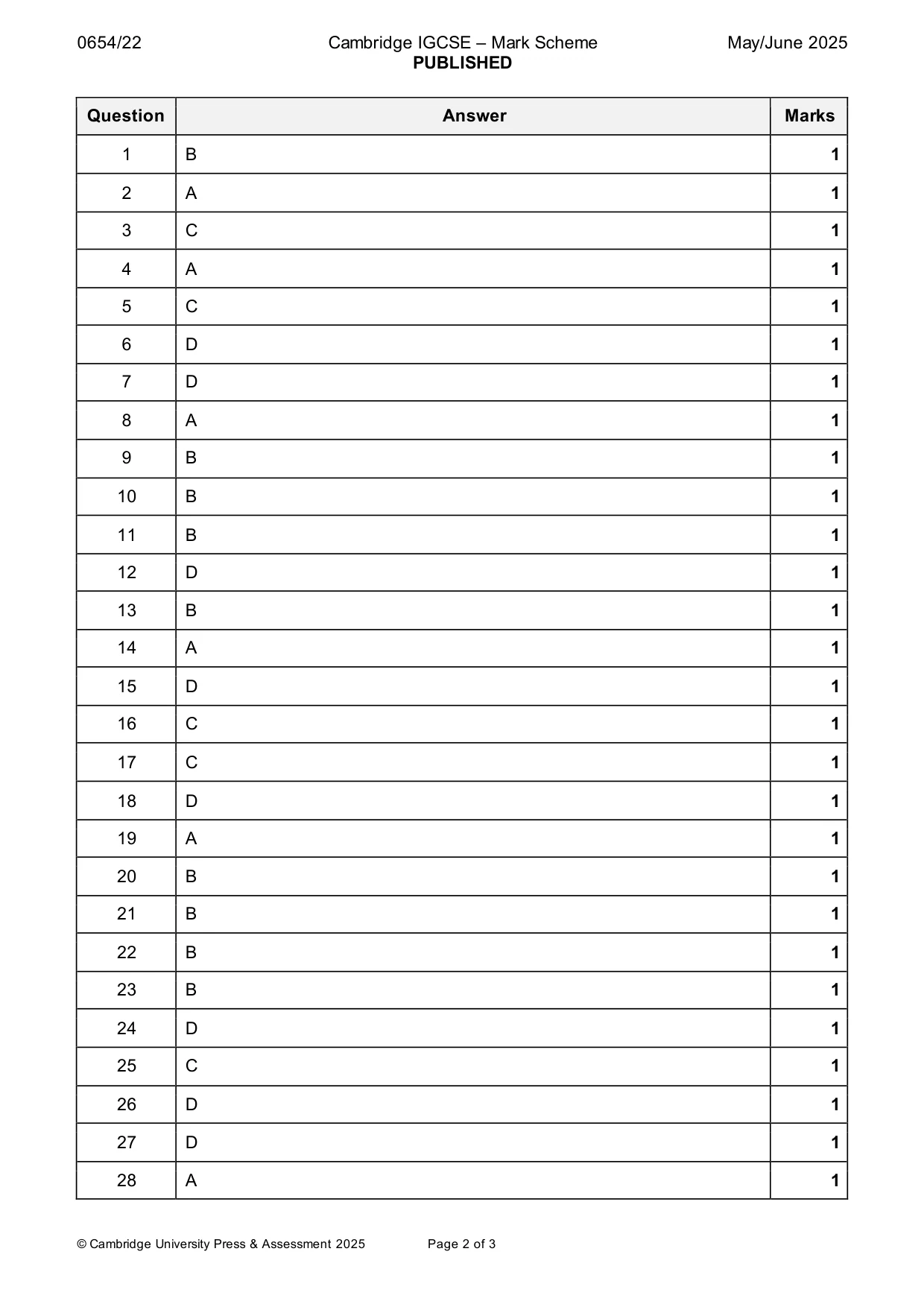
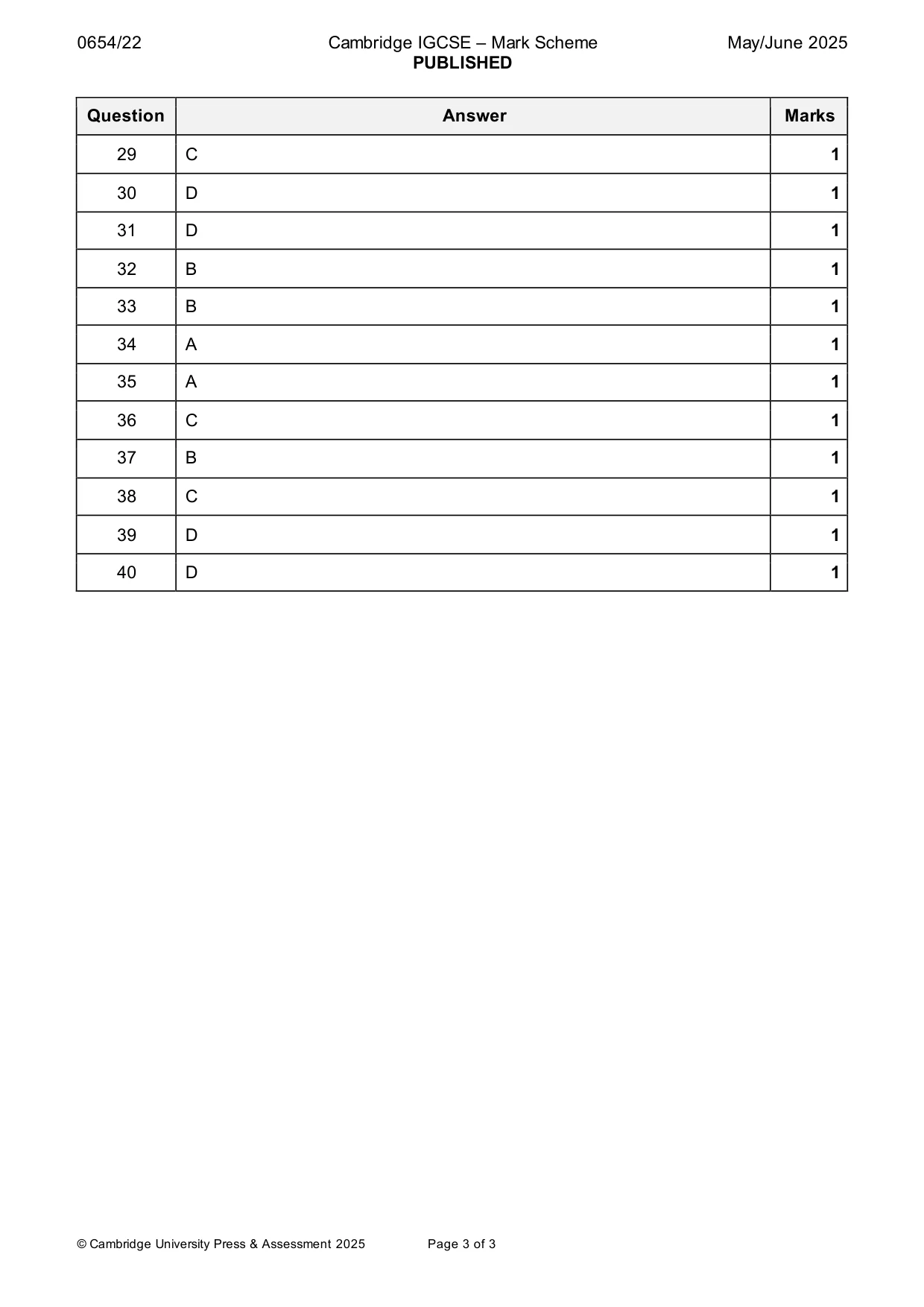
Answers below. Sit the paper first if you are practising.
Questions as text
Q1 · Which characteristic occurs in all living organisms?
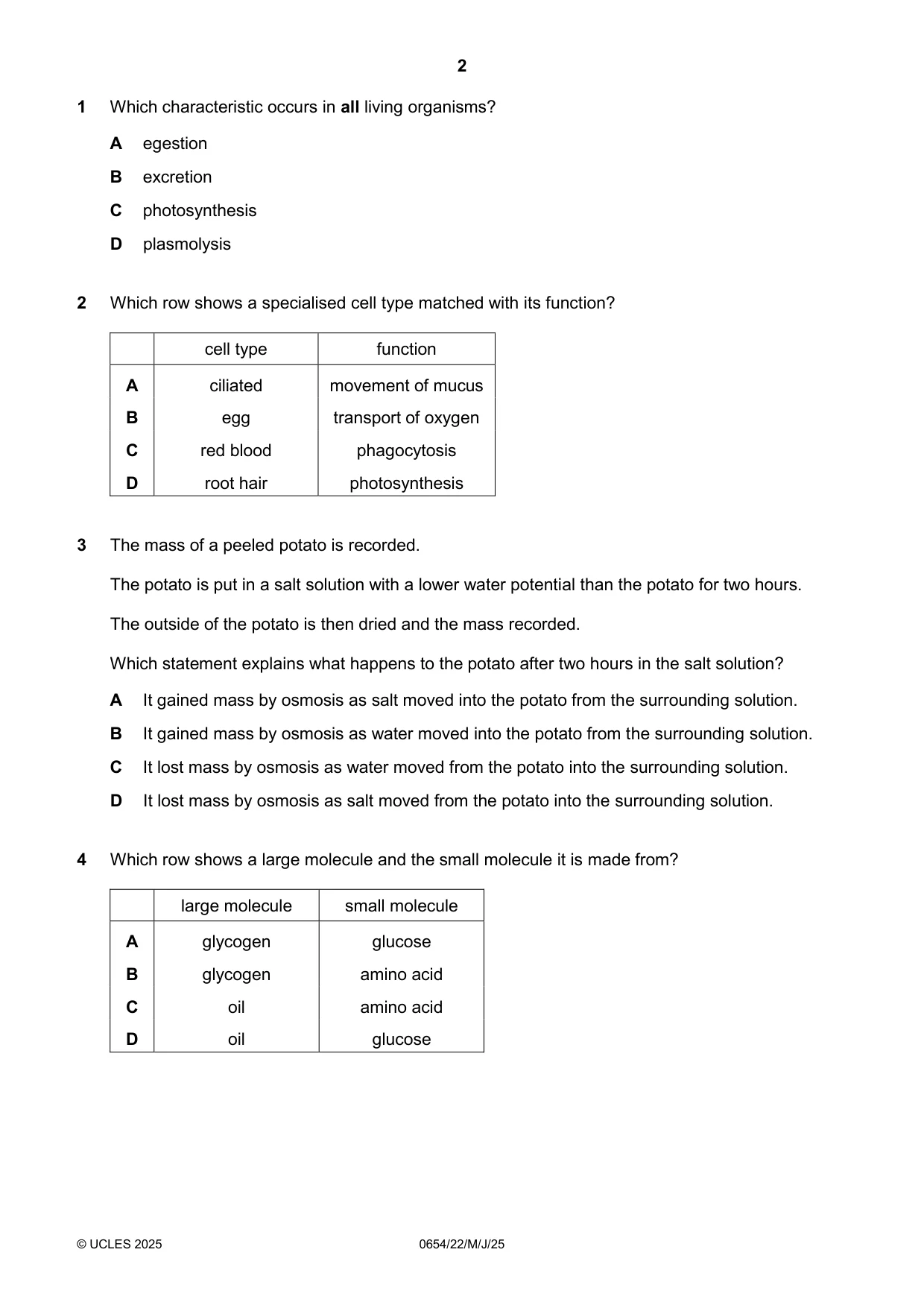
1 Which characteristic occurs in all living organisms? A egestion B excretion C photosynthesis D plasmolysis
Mark scheme: B
Q2 · Which row shows a specialised cell type matched with its function?
2 Which row shows a specialised cell type matched with its function? cell type function A ciliated movement of mucus B egg transport of oxygen C red blood phagocytosis D root hair photosynthesis
Mark scheme: A
Q3 · The mass of a peeled potato is recorded
3 The mass of a peeled potato is recorded. The potato is put in a salt solution with a lower water potential than the potato for two hours. The outside of the potato is then dried and the mass recorded. Which statement explains what happens to the potato after two hours in the salt solution? A It gained mass by osmosis as salt moved into the potato from the surrounding solution. B It gained mass by osmosis as water moved into the potato from the surrounding solution. C It lost mass by osmosis as water moved from the potato into the surrounding solution. D It lost mass by osmosis as salt moved from the potato into the surrounding solution.
Mark scheme: C
Q4 · Which row shows a large molecule and the small molecule it is made from?
4 Which row shows a large molecule and the small molecule it is made from? large molecule small molecule A glycogen glucose B glycogen amino acid C oil amino acid D oil glucose
Mark scheme: A
Q5 · Six test-tubes contain amylase and starch solution
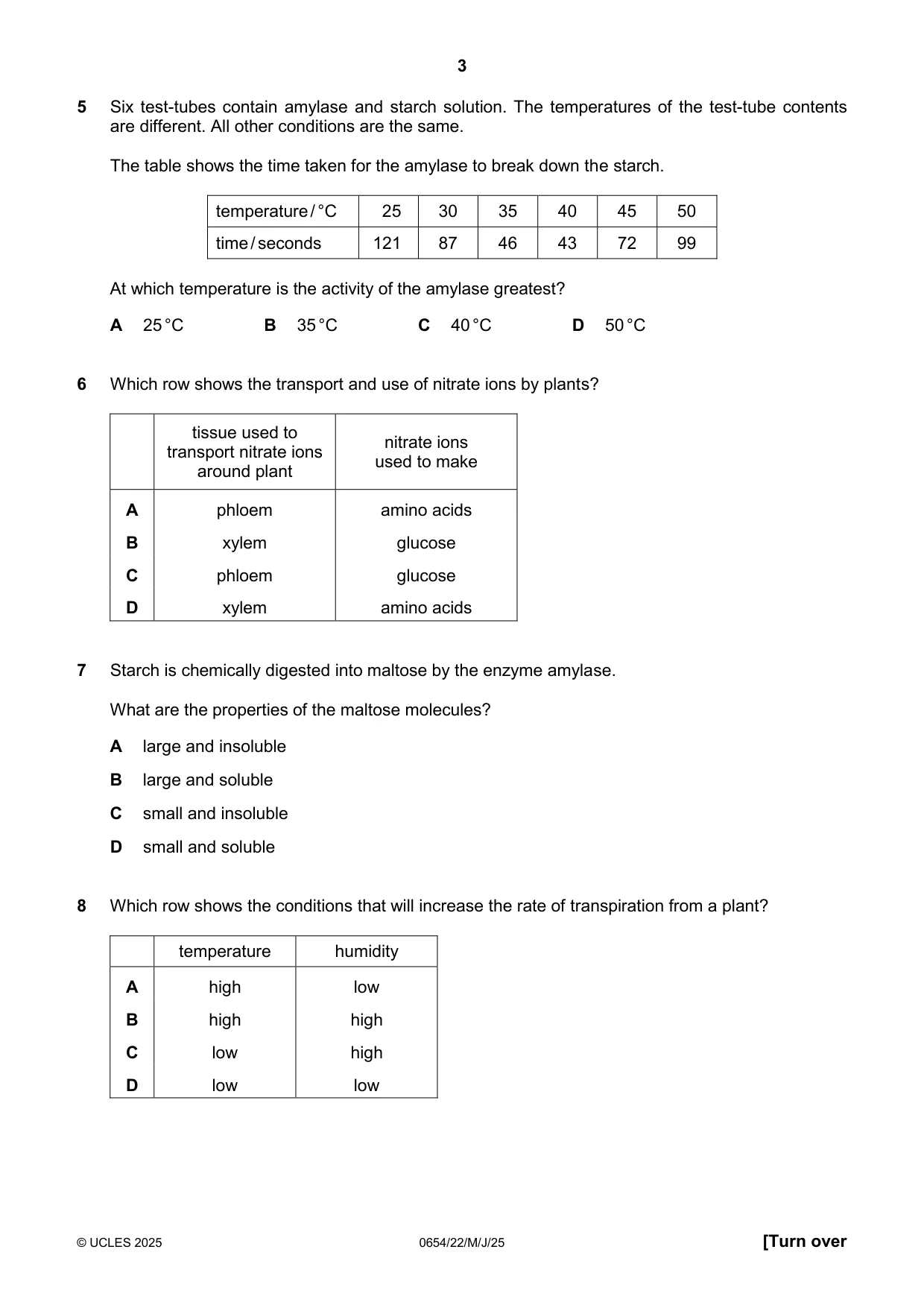
5 Six test-tubes contain amylase and starch solution. The temperatures of the test-tube contents are different. All other conditions are the same. The table shows the time taken for the amylase to break down the starch. temperature / °C 25 30 35 40 45 50 time / seconds 121 87 46 43 72 99 At which temperature is the activity of the amylase greatest? A 25 °C B 35 °C C 40 °C D 50 °C
Mark scheme: C
Q6 · Which row shows the transport and use of nitrate ions by plants?
6 Which row shows the transport and use of nitrate ions by plants? tissue used to nitrate ions transport nitrate ions used to make around plant A phloem amino acids B xylem glucose C phloem glucose D xylem amino acids
Mark scheme: D
Q7 · Starch is chemically digested into maltose by the enzyme amylase
7 Starch is chemically digested into maltose by the enzyme amylase. What are the properties of the maltose molecules? A large and insoluble B large and soluble C small and insoluble D small and soluble
Mark scheme: D
Q8 · Which row shows the conditions that will increase the rate of transpiration from a plant?
8 Which row shows the conditions that will increase the rate of transpiration from a plant? temperature humidity A high low B high high C low high D low low
Mark scheme: A
Q9 · The diagram shows a front view of a human heart
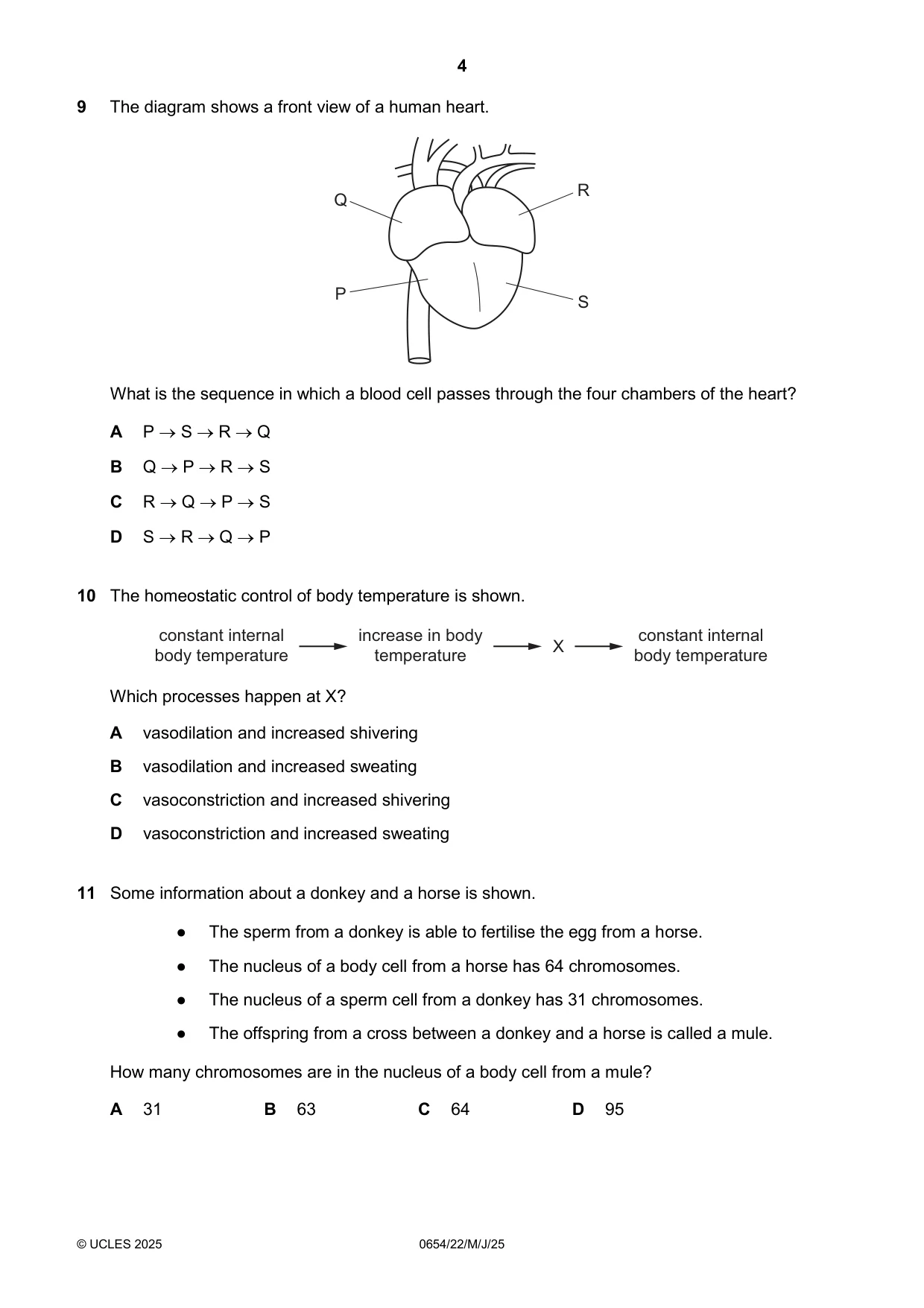
9 The diagram shows a front view of a human heart. R Q P S What is the sequence in which a blood cell passes through the four chambers of the heart? A P S R Q B Q P R S C R Q P S D S R Q P
Mark scheme: B
Q10 · The homeostatic control of body temperature is shown
10 The homeostatic control of body temperature is shown. constant internal increase in body constant internal X body temperature temperature body temperature Which processes happen at X? A vasodilation and increased shivering B vasodilation and increased sweating C vasoconstriction and increased shivering D vasoconstriction and increased sweating
Mark scheme: B
Q11 · Some information about a donkey and a horse is shown
11 Some information about a donkey and a horse is shown. ● The sperm from a donkey is able to fertilise the egg from a horse. ● The nucleus of a body cell from a horse has 64 chromosomes. ● The nucleus of a sperm cell from a donkey has 31 chromosomes. ● The offspring from a cross between a donkey and a horse is called a mule. How many chromosomes are in the nucleus of a body cell from a mule? A 31 B 63 C 64 D 95
Mark scheme: B
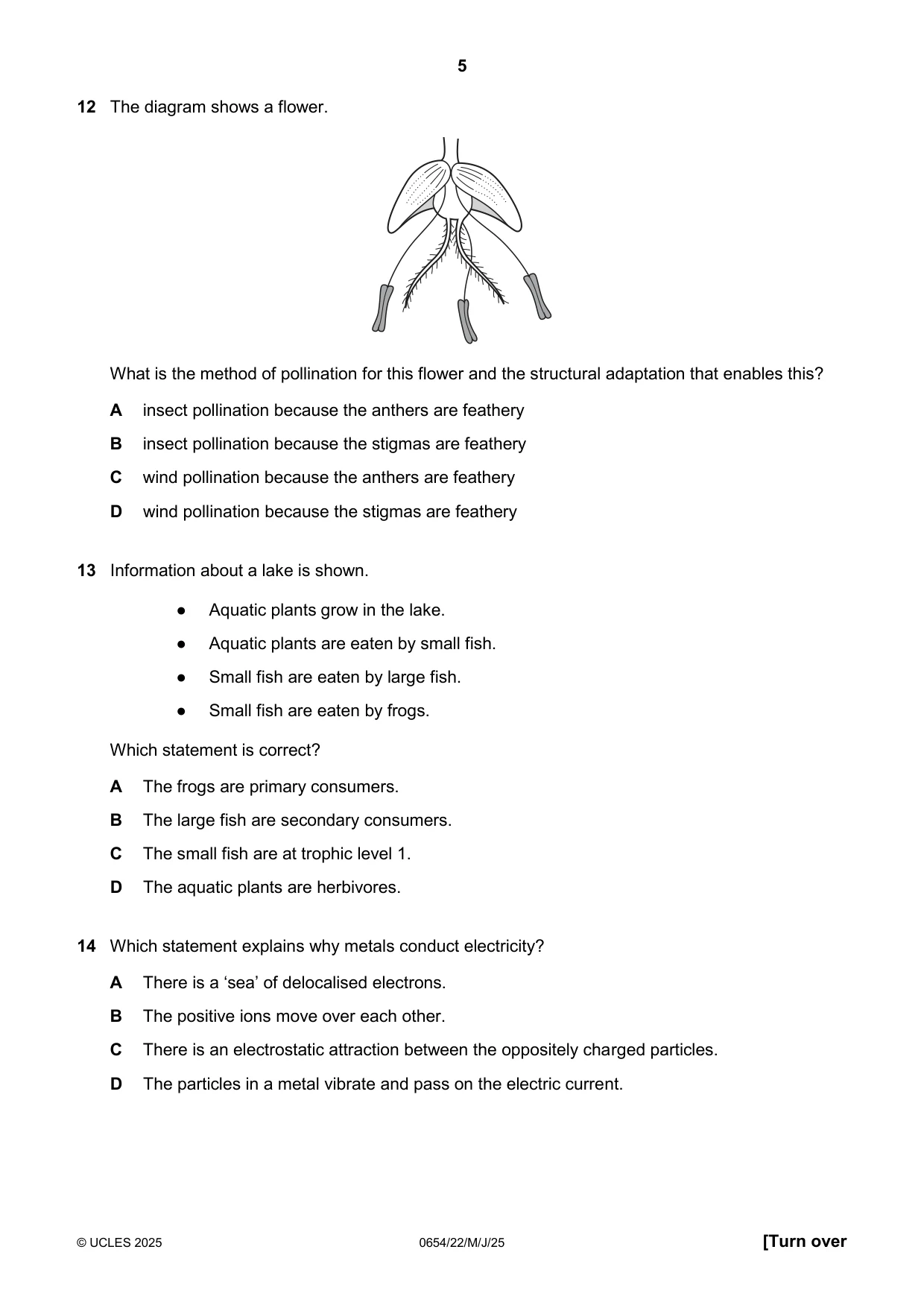
Q12 · The diagram shows a flower
12 The diagram shows a flower. What is the method of pollination for this flower and the structural adaptation that enables this? A insect pollination because the anthers are feathery B insect pollination because the stigmas are feathery C wind pollination because the anthers are feathery D wind pollination because the stigmas are feathery
Mark scheme: D
Q13 · Information about a lake is shown
13 Information about a lake is shown. ● Aquatic plants grow in the lake. ● Aquatic plants are eaten by small fish. ● Small fish are eaten by large fish. ● Small fish are eaten by frogs. Which statement is correct? A The frogs are primary consumers. B The large fish are secondary consumers. C The small fish are at trophic level 1. D The aquatic plants are herbivores.
Mark scheme: B
Q14 · Which statement explains why metals conduct electricity?
14 Which statement explains why metals conduct electricity? A There is a ‘sea’ of delocalised electrons. B The positive ions move over each other. C There is an electrostatic attraction between the oppositely charged particles. D The particles in a metal vibrate and pass on the electric current.
Mark scheme: A
Q15 · Ammonia decomposes when heated in a sealed container in the presence of an iron catalyst
15 Ammonia decomposes when heated in a sealed container in the presence of an iron catalyst. The equation for the reaction is shown. 2NH3(g) N2(g) + 3H2(g) 40.0 dm3 of ammonia is heated. After several hours, 21.0 dm3 of hydrogen is present. The volumes are measured at r.t.p. What is the percentage of unreacted ammonia? A 35.0% B 47.5% C 52.5% D 65.0%
Mark scheme: D
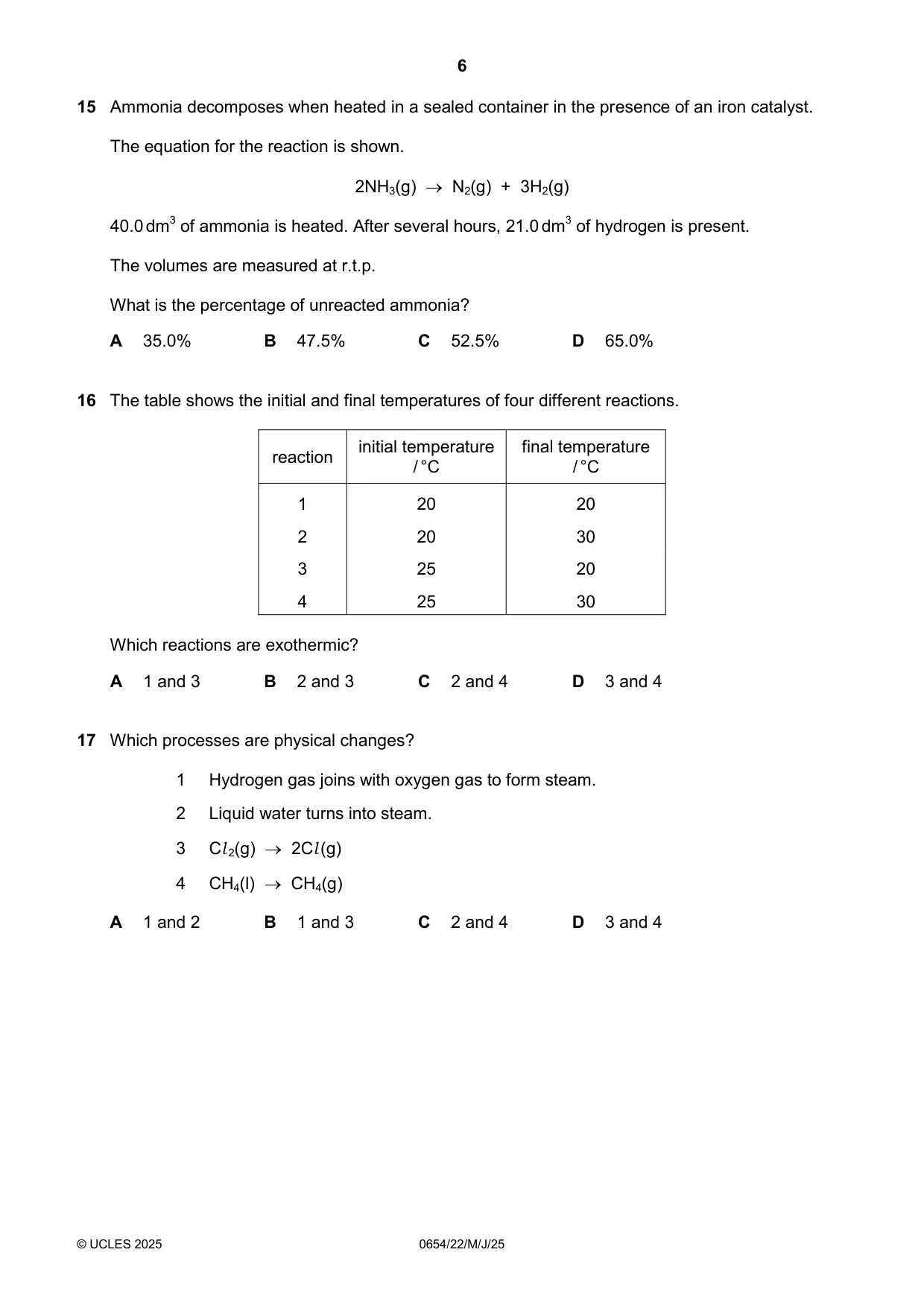
Q16 · The table shows the initial and final temperatures of four different reactions
16 The table shows the initial and final temperatures of four different reactions. initial temperature final temperature reaction / °C / °C 1 20 20 2 20 30 3 25 20 4 25 30 Which reactions are exothermic? A 1 and 3 B 2 and 3 C 2 and 4 D 3 and 4
Mark scheme: C
Q17 · Which processes are physical changes?
17 Which processes are physical changes? 1 Hydrogen gas joins with oxygen gas to form steam. 2 Liquid water turns into steam. 3 Cl 2(g) 2Cl (g) 4 CH4(l) CH4(g) A 1 and 2 B 1 and 3 C 2 and 4 D 3 and 4
Mark scheme: C
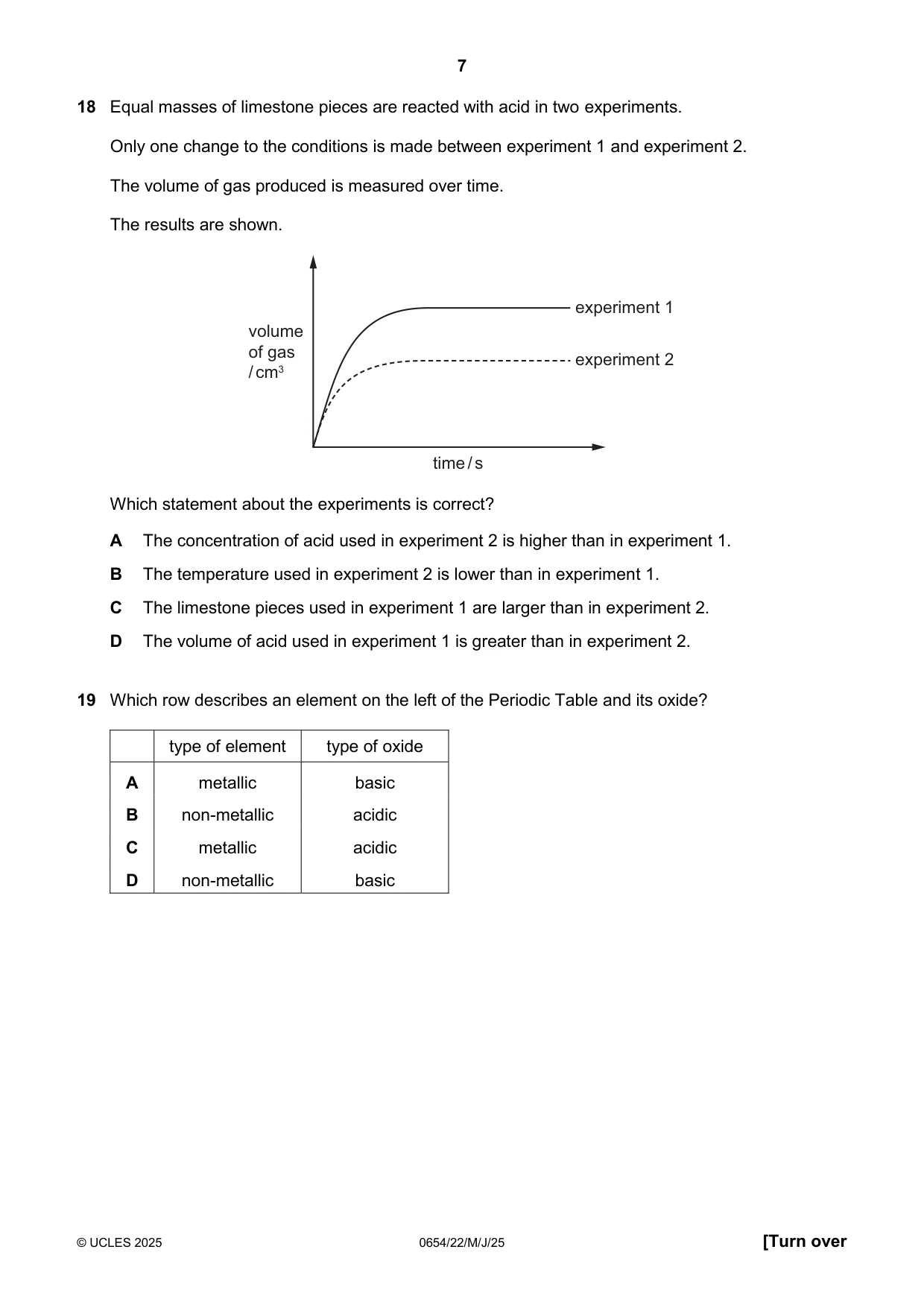
Q18 · Equal masses of limestone pieces are reacted with acid in two experiments
18 Equal masses of limestone pieces are reacted with acid in two experiments. Only one change to the conditions is made between experiment 1 and experiment 2. The volume of gas produced is measured over time. The results are shown. experiment 1 volume of gas experiment 2 / cm3 time / s Which statement about the experiments is correct? A The concentration of acid used in experiment 2 is higher than in experiment 1. B The temperature used in experiment 2 is lower than in experiment 1. C The limestone pieces used in experiment 1 are larger than in experiment 2. D The volume of acid used in experiment 1 is greater than in experiment 2.
Mark scheme: D
Q19 · Which row describes an element on the left of the Periodic Table and its oxide?
19 Which row describes an element on the left of the Periodic Table and its oxide? type of element type of oxide A metallic basic B non-metallic acidic C metallic acidic D non-metallic basic
Mark scheme: A
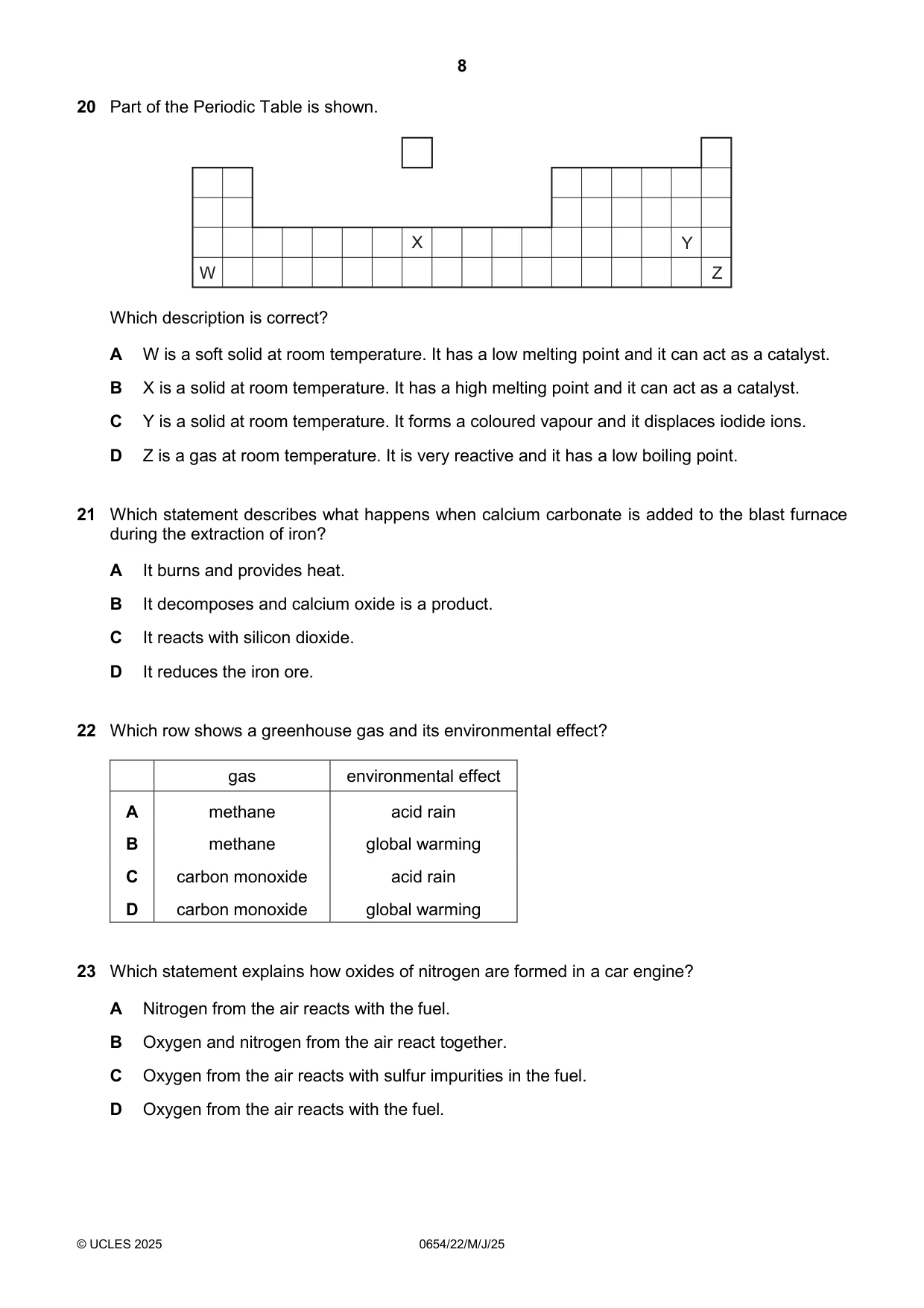
Q20 · Part of the Periodic Table is shown
20 Part of the Periodic Table is shown. X Y W Z Which description is correct? A W is a soft solid at room temperature. It has a low melting point and it can act as a catalyst. B X is a solid at room temperature. It has a high melting point and it can act as a catalyst. C Y is a solid at room temperature. It forms a coloured vapour and it displaces iodide ions. D Z is a gas at room temperature. It is very reactive and it has a low boiling point.
Mark scheme: B
Q21 · Which statement describes what happens when calcium carbonate is added to the blast…
21 Which statement describes what happens when calcium carbonate is added to the blast furnace during the extraction of iron? A It burns and provides heat. B It decomposes and calcium oxide is a product. C It reacts with silicon dioxide. D It reduces the iron ore.
Mark scheme: B
Q22 · Which row shows a greenhouse gas and its environmental effect?
22 Which row shows a greenhouse gas and its environmental effect? gas environmental effect A methane acid rain B methane global warming C carbon monoxide acid rain D carbon monoxide global warming
Mark scheme: B
Q23 · Which statement explains how oxides of nitrogen are formed in a car engine?
23 Which statement explains how oxides of nitrogen are formed in a car engine? A Nitrogen from the air reacts with the fuel. B Oxygen and nitrogen from the air react together. C Oxygen from the air reacts with sulfur impurities in the fuel. D Oxygen from the air reacts with the fuel.
Mark scheme: B
Q24 · A student prepares an insoluble salt by neutralising an acid with an alkali
24 A student prepares an insoluble salt by neutralising an acid with an alkali. Which method is used to separate the salt from the reaction mixture? A chromatography B distillation C evaporation D filtration
Mark scheme: D
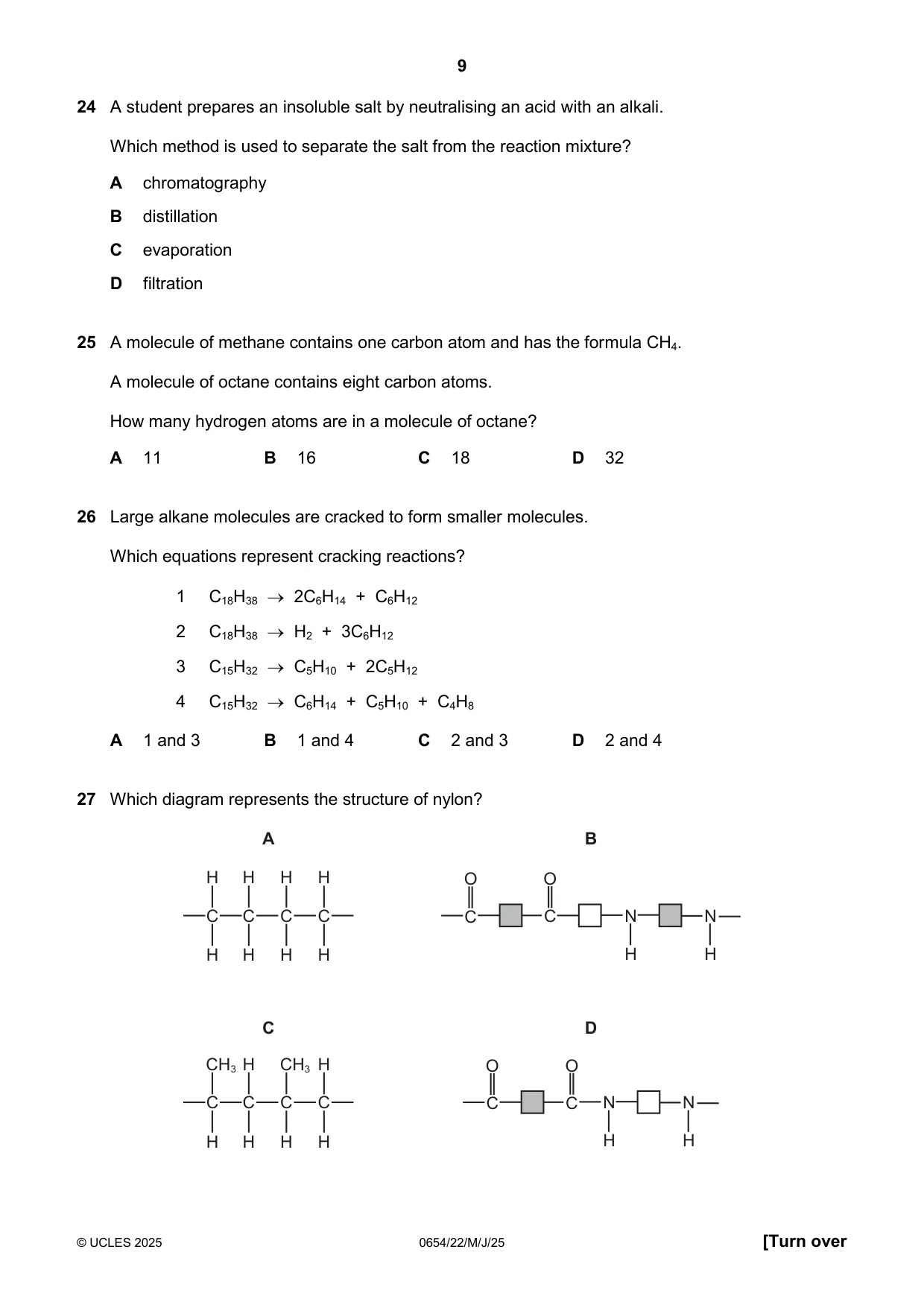
Q25 · A molecule of methane contains one carbon atom and has the formula CH4
25 A molecule of methane contains one carbon atom and has the formula CH4. A molecule of octane contains eight carbon atoms. How many hydrogen atoms are in a molecule of octane? A 11 B 16 C 18 D 32
Mark scheme: C
Q26 · Large alkane molecules are cracked to form smaller molecules
26 Large alkane molecules are cracked to form smaller molecules. Which equations represent cracking reactions? 1 C18H38 2C6H14 + C6H12 2 C18H38 H2 + 3C6H12 3 C15H32 C5H10 + 2C5H12 4 C15H32 C6H14 + C5H10 + C4H8 A 1 and 3 B 1 and 4 C 2 and 3 D 2 and 4
Mark scheme: D
Q27 · Which diagram represents the structure of nylon?
27 Which diagram represents the structure of nylon? A B H H H H O O C C C C C C N N H H H H H H C D CH3 H CH3 H O O C C C C C C N N H H H H H H
Mark scheme: D
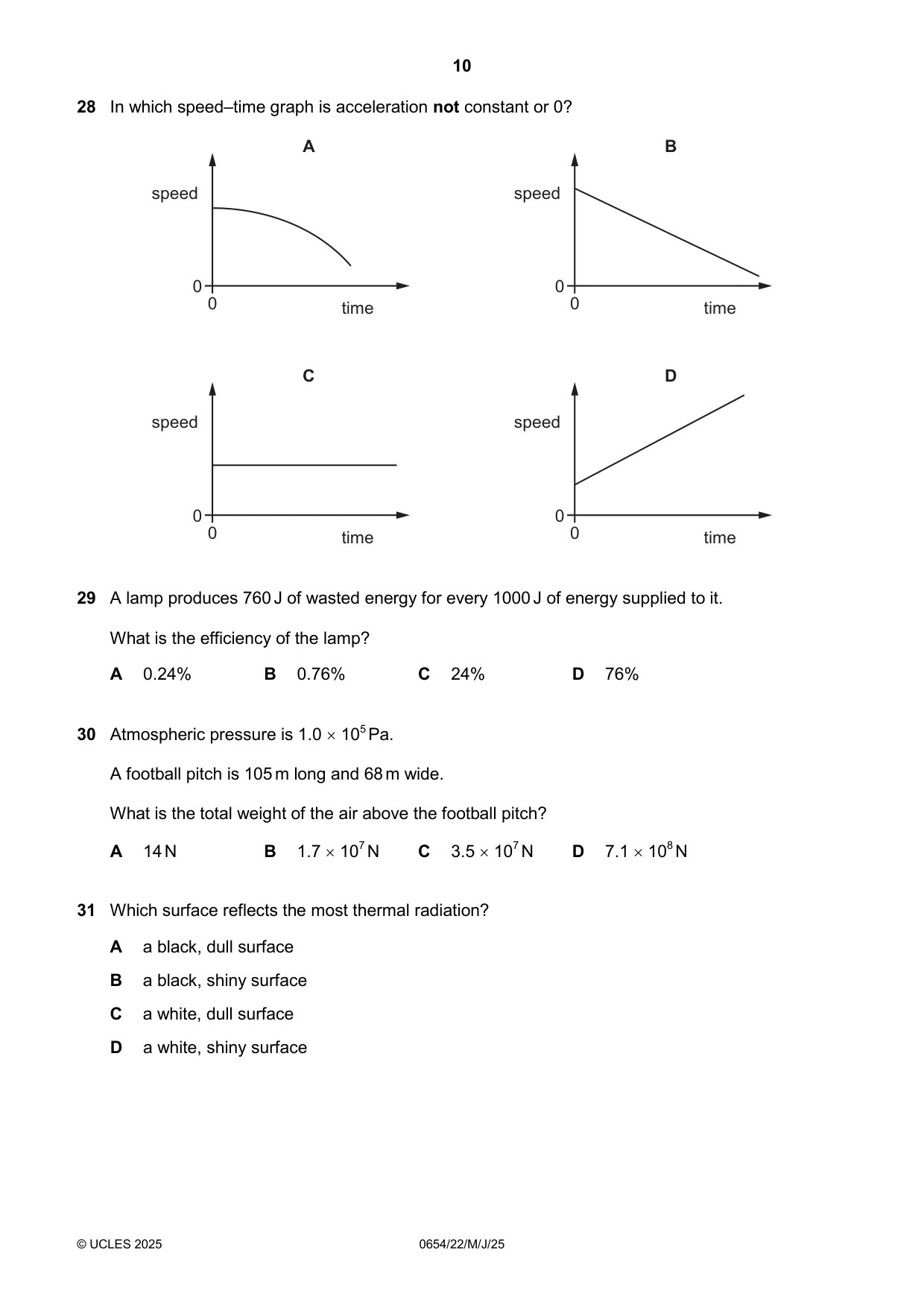
Q28 · In which speed–time graph is acceleration not constant or 0?
28 In which speed–time graph is acceleration not constant or 0? A B speed speed 0 0 0 time 0 time C D speed speed 0 0 0 time 0 time
Mark scheme: A
Q29 · A lamp produces 760 J of wasted energy for every 1000 J of energy supplied to it
29 A lamp produces 760 J of wasted energy for every 1000 J of energy supplied to it. What is the efficiency of the lamp? A 0.24% B 0.76% C 24% D 76%
Mark scheme: C
Q30 · Atmospheric pressure is 1.0 105 Pa
30 Atmospheric pressure is 1.0 105 Pa. A football pitch is 105 m long and 68 m wide. What is the total weight of the air above the football pitch? A 14 N B 1.7 107 N C 3.5 107 N D 7.1 108 N
Mark scheme: D
Q31 · Which surface reflects the most thermal radiation?
31 Which surface reflects the most thermal radiation? A a black, dull surface B a black, shiny surface C a white, dull surface D a white, shiny surface
Mark scheme: D
Q32 · Liquid water boils at 100 °C to produce steam
32 Liquid water boils at 100 °C to produce steam. The volume of the steam at 100 °C is much greater than the volume of the liquid water. Which statement explains the increase in volume at 100 °C? A The water molecules move faster in steam than in liquid water. B The water molecules are further apart in steam than in liquid water. C The water molecules are larger in steam than in liquid water. D The water molecules are regularly arranged in liquid water but are randomly arranged in steam.
Mark scheme: B
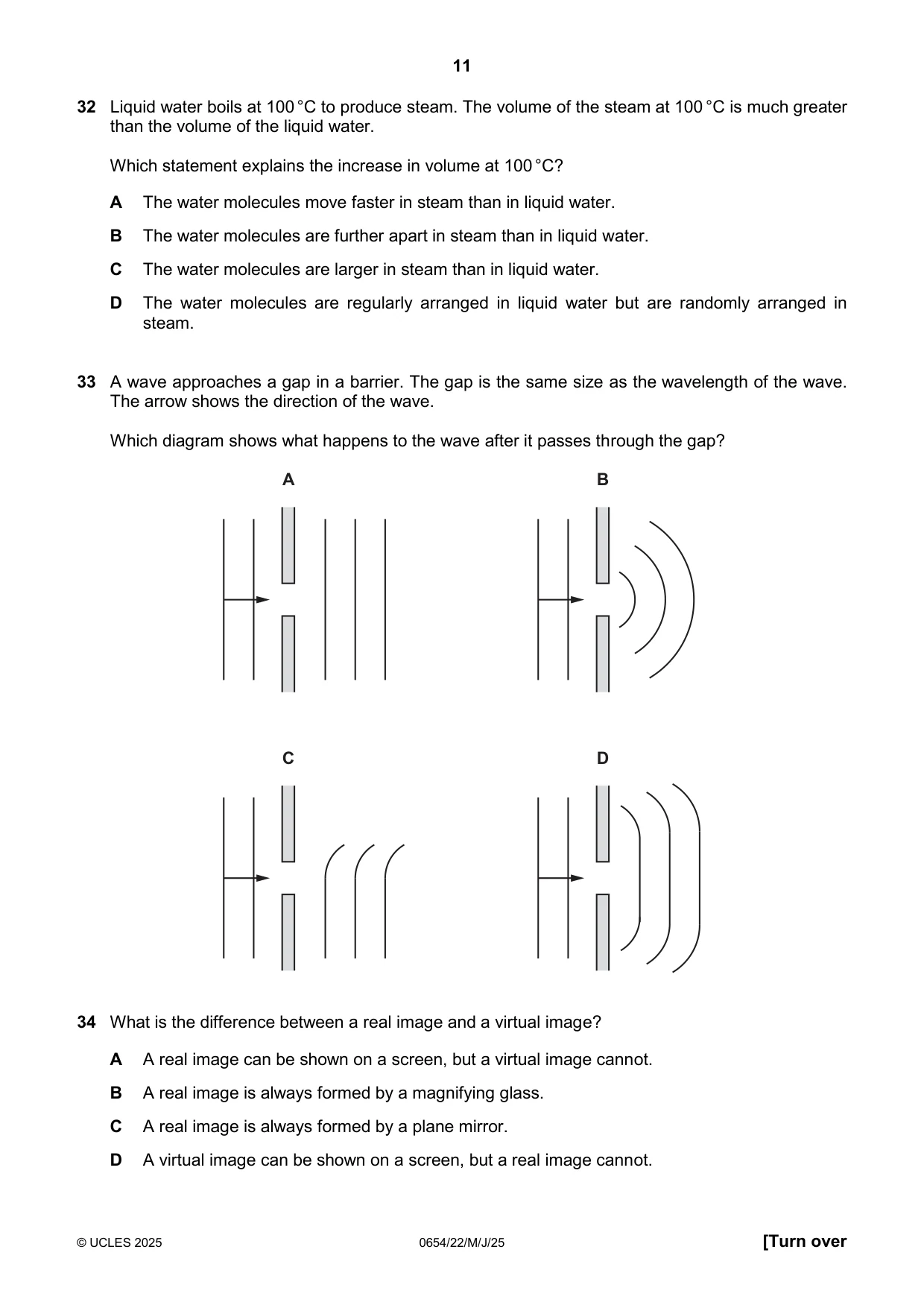
Q33 · A wave approaches a gap in a barrier
33 A wave approaches a gap in a barrier. The gap is the same size as the wavelength of the wave. The arrow shows the direction of the wave. Which diagram shows what happens to the wave after it passes through the gap? A B C D
Mark scheme: B
Q34 · What is the difference between a real image and a virtual image?
34 What is the difference between a real image and a virtual image? A A real image can be shown on a screen, but a virtual image cannot. B A real image is always formed by a magnifying glass. C A real image is always formed by a plane mirror. D A virtual image can be shown on a screen, but a real image cannot.
Mark scheme: A
Q35 · Which row shows the type of electromagnetic wave used in each application?
35 Which row shows the type of electromagnetic wave used in each application? television remote satellite television controllers A infrared microwaves B infrared ultraviolet C microwaves microwaves D microwaves ultraviolet
Mark scheme: A
Q36 · A student makes an electromagnet with a steel core
36 A student makes an electromagnet with a steel core. There is a problem with the electromagnet. Which problem with the electromagnet is caused by using a steel core? A The electromagnet does not become magnetised. B The electromagnet has the same type of magnetic pole at each end. C The electromagnet remains magnetised when it is switched off. D The electromagnet repels unmagnetised magnetic materials.
Mark scheme: C
Q37 · There is a current of 100 mA in a circuit
37 There is a current of 100 mA in a circuit. How much charge flows through the circuit in 1.5 minutes? A 0.15 C B 9.0 C C 150 C D 9000 C
Mark scheme: B
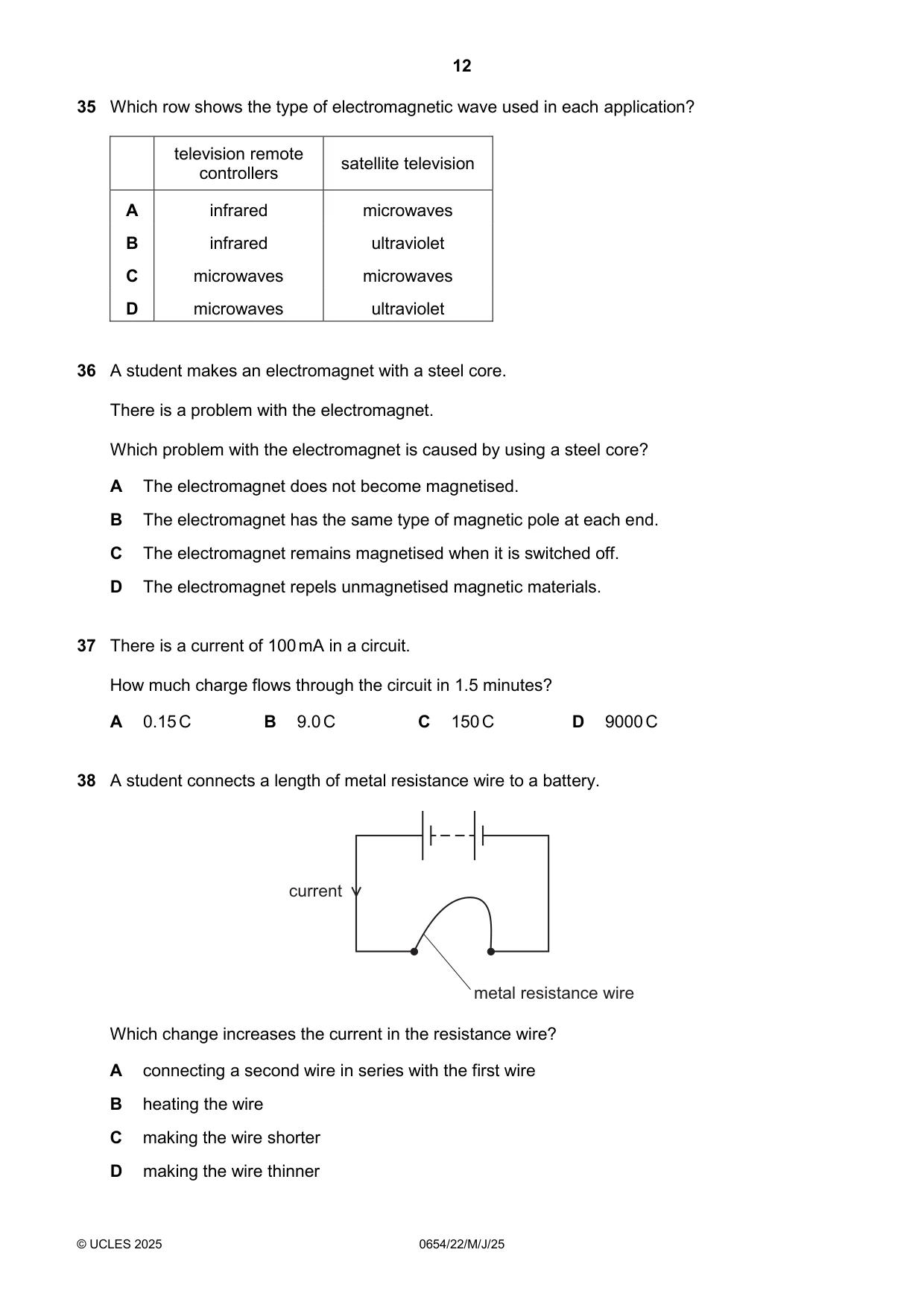
Q38 · A student connects a length of metal resistance wire to a battery
38 A student connects a length of metal resistance wire to a battery. current metal resistance wire Which change increases the current in the resistance wire? A connecting a second wire in series with the first wire B heating the wire C making the wire shorter D making the wire thinner
Mark scheme: C
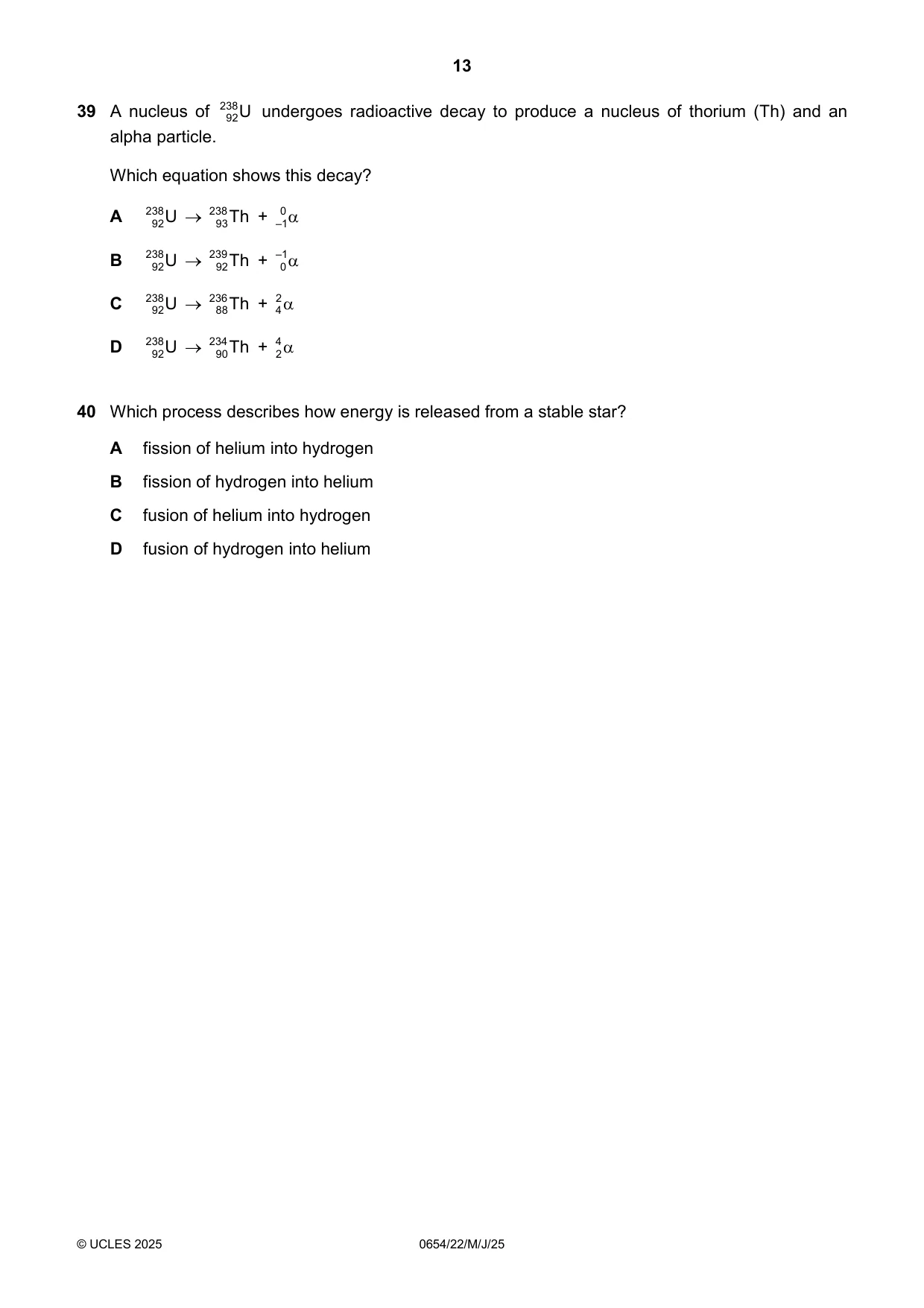
Q39 · A nucleus of 238 92U undergoes radioactive decay to produce a nucleus of thorium (Th) and…
39 A nucleus of 238 92U undergoes radioactive decay to produce a nucleus of thorium (Th) and an alpha particle. Which equation shows this decay? A 238 92U 238 93Th + 0 –1 B 238 92U 239 92Th + –1 0 C 238 92U 236 88Th + 2 4 D 238 92U 234 90Th + 4 2
Mark scheme: D
Q40 · Which process describes how energy is released from a stable star?
40 Which process describes how energy is released from a stable star? A fission of helium into hydrogen B fission of hydrogen into helium C fusion of helium into hydrogen D fusion of hydrogen into helium
Mark scheme: D
What was in this paper
The subtopics covered by these 40 questions, and how many questions each got. Open one in a new tab to see every Cambridge question on it.
2Alkanes1Arrangement of elements1Biological molecules1Cell structure1Characteristics of living organisms1Chromosomes and genes1Digestion1Electrical circuits1Electrical quantities1Electromagnetic spectrum1Energy, work and power1Enzymes1Exothermic and endothermic reactions1Extraction of metals1Food chains and food webs1Fuels1General properties of waves1Group VII properties1Heart1Homeostasis1Kinetic particle model of matter1Light1Metallic bonding1Motion1Osmosis1Physical and chemical changes1Polymers1Pressure1Radioactivity1Rate of reaction1Separation and purification1Sexual reproduction in plants1Simple phenomena of magnetism1Stars and the Universe1The mole and the Avogadro constant1Transfer of thermal energy1Transpiration1Xylem and phloem1What you needed in this session
Cambridge’s own grade thresholds for 2025 May/June, Paper 2 · Variant 2. A higher threshold means an easier paper — the bar moves with how the cohort did.